Ocean Pines board approves fiscal year 2026-27 budget after months of development, review and public input
By Sherrie Clifford ROC Edition Publisher
The Ocean Pines Association Board of Directors approved the fiscal year 2026–27 budget at its most recent regular board meeting, concluding a months-long process that included department-level planning, committee review, board deliberation and a public Budget Town Hall.
The budget process was directed by General Manager John Viola and carried out by the association’s senior leadership team in coordination with department heads, committee volunteers and the board of directors. Throughout the town hall presentation, Viola
emphasized that the adopted budget reflected sustained planning and coordination across multiple areas of operation rather than decisions made in isolation.
Viola opened the Jan. 15 Budget Town Hall by outlining the formal requirements governing the association’s budget process. Under Ocean Pines Association bylaws, the general manager is required to prepare and submit a proposed annual budget to the board of directors no fewer than 90 days prior to the start of the fiscal year. The board is then required to approve a final budget at least 45 days before the fiscal year begins.
“We did that,” Viola said in reference to the bylaw timeline. “And probably one of the earliest
times that it was completed and presented.”
According to Viola, the initial proposed budget was publicly posted on Dec. 16, followed by a revised version on Jan. 9 that identified and explained changes
made after early review. A Budget and Finance Committee presentation was held Dec. 18, with materials and video made available on the association’s website. The board of directors conducted its own
See BUDGET APPROVED page 2
ROC Edition secures new printer after Dover facility closure affects local papers
By Sherrie Clifford ROC Edition Publisher
When local newspapers printing at the Delaware Printing Company were given approximately 30 days’ notice that printing operations would cease, the impact rippled quickly across the Eastern Shore. Daily, weekly and monthly publications were suddenly forced to reassess long-standing production systems, vendor relationships and internal workflows under a compressed timeline.
For ROC Edition, the notice arrived just four months into its
print launch. While the timeline was tight, the paper moved quickly to secure a new printer and ensure readers and advertisers would experience no disruption.
ROC Edition successfully transitioned its printing operations to Adams Publishing Group in Easton, Md. Paper was ordered, delivered and staged on schedule, allowing the Feb. 1, 2026 edition to be printed and distributed during the final week of January without interruption. Distribution locations and availability remained unchanged.
See NEW PRINTER page 3
ROC Edition • Sherrie Clifford, Publisher
ROC Edition moves printing operations to Adams Publishing Group, following the closure of Delaware Printing Company.
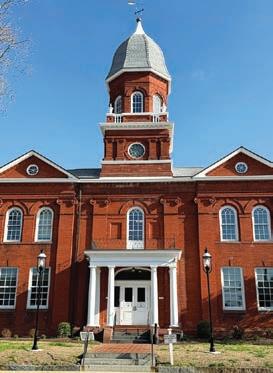
ROC Edition • Sherrie Clifford, Publisher OPA Board of Directors approves FY26-27 budget well ahead of schedule.
BUDGET APPROVED
Continued from page 1
review on Dec. 19.
With the fiscal year beginning May 1, the board’s approval at the Jan. 24 regular board meeting placed the association well ahead of the required deadline.
Management described the FY26–27 budget as the result of a bottom-up development process.
Department heads met with senior staff to prepare proposed budgets based on operational needs, staffing requirements and anticipated challenges for the coming year. Those requests were evaluated alongside current-year performance and financial forecasting before advancing to committee and board review. Viola said department leaders were given overall objectives but retained responsibility for developing the details.
The effort was supported by the association’s executive leadership team, including Senior Director of Administration Linda Martin, Senior Director and Controller of Finance
Steve Phillips and Senior Director of Public Works Eddie Wells, all of whom participated in the town hall presentation and addressed questions within their respective areas.
Reflecting on the coordination
required to complete the process, Viola acknowledged staff leadership directly.
“This is probably one of the strongest senior management teams that I’ve had,” he said.
Following internal development, the proposed budget advanced to formal review by the Budget and Finance Committee, where assumptions, tradeoffs and long-term implications were examined. That review was followed by continued discussion with the board of directors prior to final consideration.
A central component of the FY26–27 budget was its reliance on long-term planning tools, particularly the DMA reserve study. Viola described the study as a critical resource for understanding capital needs and reserve adequacy over time.
“This was the third time we did it,” he said. “It’s a huge tool.”
Viola noted that Ocean Pines adopted reserve studies years before such reviews became a statewide requirement, allowing the association to plan major capital needs proactively rather than reactively. The DMA study informed decisions related to infrastructure investment, capital replacement and reserve funding.
Public safety was identified as
a consistent priority during the budget presentation, with management citing resident surveys that place safety at the top of community concerns. Viola noted that the portion of homeowner assessments dedicated to police services and fire and EMS operations has increased over time, reflecting expanded services, rising personnel costs and equipment investment. At the same time, infrastructure investment has grown, even as overall assessments have remained comparatively stable.
Infrastructure topics discussed at the town hall included roads, drainage systems and bulkheads. Viola highlighted changes in public works operations, specifically the elimination of routine easement cutting, explaining that those funds were repurposed toward maintenance of aging drainage pipes and related improvements.
Capital planning represented one of the most significant elements of the FY26–27 budget. Management outlined more than $6 million in planned capital investment across multiple departments and amenities, including public works, recreation, aquatics, golf infrastructure and fire department facilities. Viola emphasized that the funding reflected years of disciplined planning rather than short-term decisions.
“If we had a knee-jerk reaction and used that money for something else,” he said, “we wouldn’t have had it now.”
The Jan. 15 Budget Town Hall served as the final public checkpoint before board approval. Management presented an overview of the proposed budget and invited residents attending in person to offer comments and ask questions. Remote attendance was available for observation, though public comment was limited to those present in the room.
“This is one of the reasons we’re here today,” Viola said as he opened the floor for public comments.
Residents offered comments on a range of topics. Those comments are presented in full on page 4 of this issue.
Following the town hall and additional review, the board of directors voted to approve the FY26–27 budget at its Jan. 24 regular board meeting, formally adopting the association’s spending plan for the upcoming fiscal year and concluding the budget cycle well ahead of the May 1 start of the fiscal year.
Additional financial detail is available in the ROC Ledger section of this month’s ROC Edition.
NEW PRINTER
Continued from page 1
The transition comes as print infrastructure across the region continues to shift. Consolidation within the newspaper printing industry has reduced the number of facilities capable of handling newspaper runs. As a result, sudden closures leave publishers with limited options and little time to adjust.
Printing remains one of the most complex and time-sensitive components of newspaper production. Press size, paper specifications, color capability, folding, banding and delivery timing all factor into whether a printer is a viable fit. A change in printer often requires more than a contract; it requires operational alignment across multiple stages of production.
As part of the transition, ROC Edition’s publisher toured the Adams facility to gain a firsthand understanding of the production process. The visit offered a comprehensive look at modern newspaper printing, from digital file intake and plate preparation to press operation, quality control and final packaging.
Digital page files are reviewed and converted into printing plates, which are mounted onto large presses. Throughout each print run, ink levels are continuously adjusted, color consistency is monitored and quality checks are performed to ensure accuracy. Once printed,
newspapers move through folding and banding before being staged for delivery.
The scale of the operation underscores the coordination required to meet deadlines, particularly for community newspapers that rely on consistent production schedules. Multiple teams work in sequence to ensure each issue is completed on time and ready for distribution.
Adams Publishing Group brings a long history in newspaper publishing and commercial printing, with roots in local journalism and regional production. The company serves publications across multiple states and combines traditional print operations with evolving digital and multimedia capabilities. That experience has become increasingly important as newspapers navigate industry-wide changes.
Most readers will never see the work involved in making such a transition possible. Behind each issue is a network of logistics, materials and skilled labor that allows the paper to appear
unchanged even when significant changes occur behind the scenes.
For independent newspapers, the ability to respond quickly to unexpected changes can determine whether publication continues uninterrupted. ROC Edition’s transition reflects that reality. By securing a new printer, aligning production systems and maintaining distribution schedules, the paper ensured continuity for its readers while navigating a significant industry change.
As Eastern Shore newspapers continue to adjust to a changing print landscape, the experience serves as a reminder that local journalism depends not only on reporting, but also on the unseen systems that deliver news to the community.
Adams Publishing Group, the new printer of ROC Edition, combines traditional print operations with digital and multimedia capabilities to keep regional newspapers on schedule amid industry changes.
ROC Edition • Sherrie Clifford, Publisher
Public comments from residents at the Jan. 15 Budget Town Hall
By Sherrie Clifford ROC Edition Publisher
Karen Kaplan, a resident of Ocean Pines, addressed several budget items, beginning with marina slip fees. Kaplan questioned the proposed 3% increase, noting that the marina reportedly has a waiting list of more than 100 applicants. She asked why the increase was not higher given demand and requested clarification on what capital investments had been made at the marina over the past year.
Association management responded that approximately $45,000 in capital improvements had been completed, including jet ski lifts, gas pump dock work, dock cameras and initial renovation efforts. Management noted that roughly 1.25% of the increase was attributable to higher water costs and characterized the overall increase as modest. Kaplan acknowledged the broader assessment context but stated that, in her view, the size of the waiting list suggested additional pricing flexibility.
Kaplan then asked about funding for the volunteer appreciation dinner, referencing prior public discussion surrounding the event’s cost. Management responded that
$15,000 has been allocated for the upcoming year, compared with last year’s $10,000 budget that ultimately resulted in the spending of more than $30,000 for the 2025 dinner.
Kaplan questioned how the allocation was justified given the reduction in standing committees, noting that only three committees currently exist. Management responded that the event is intended to recognize volunteers more broadly, not solely committee members and includes individuals who assist staff on various projects. Kaplan suggested expanding recognition to include groups such as the garden club, citing their contributions to the community.
Colette Horn raised multiple concerns, beginning with the volunteer appreciation dinner. She said that while volunteer recognition is important, she objected to association assessment dollars being used for what she described as a selective event that appears to honor only certain volunteer groups. She said that if a dinner is intended to honor volunteers broadly, it would need to include nearly everyone in Ocean Pines, as volunteerism is practiced by most residents.
Colette stated that the event
appeared to be a high-cost dinner which she estimated at roughly $50 per plate with an open bar funded by assessment dollars and limited to a small group. She cited volunteer organizations such as Quilters by the Sea and local crafting groups, noting that they contribute significant volunteer hours, raise funds and support parks and recreation, yet are not included. She said that during her six years on the board of directors, volunteer dinners were focused on committee members who worked directly for the board and whose efforts fed into board decisions.
She said she objected to what she described as “cherry-picking” certain volunteers for recognition while excluding others and questioned whether that use of assessment funds was appropriate.
John Viola responded that he agreed volunteerism is important and said he did not want to speak on behalf of the board but believed board members shared that view. He said the appreciation dinner is a board-sponsored event and that the purpose of the town hall was to gather feedback.
“I’m sure they heard you,” Viola said. “I’m sure they’ll talk about it, and then they’ll discuss it among themselves. That’s a board decision.”
Colette then turned to longterm bulkhead funding, referencing reserve study projections that show bulkhead expenditures fluctuating from under $1 million to nearly $6 million over the next 20 years. She asked how those large increases would be managed so homeowners do not experience sudden and significant assessment increases.
Viola responded that the fluctuations reflect how and when Ocean Pines was built, with certain construction periods now reaching replacement age. He said the association has long maintained detailed schedules for bulkheads and other infrastructure and that those plans were later validated through the DMA reserve study. He stated that projected bulkhead increases are generally incremental, often around $25 per year, with some years reaching $75 before leveling off after high-cycle periods.
Colette described the incremental increase as a “huge hit” to those who live on a bulkhead and suggested that bulkhead costs be more broadly shared among all homeowners. She argued that Ocean Pines would not exist without its canal system and bulkheads and that all property owners benefit from their existence,
See PUBLIC COMMENT page 5
Continued from page 4
even if they do not live on waterfront property.
Viola acknowledged her point but noted that a general bulkhead assessment already exists for all homeowners in addition to the waterfront differential. He said the issue ultimately represents a policy decision for the board of directors.
George Solyak raised questions regarding long-term reserve planning under the DMA reserve study, noting that previous studies referenced percentage-based reserve targets tied to the association’s assets. He asked what reserve percentage the association is currently targeting.
General Manager John Viola responded that the DMA methodology has changed and no longer relies on percentage targets. Instead, the current study establishes a minimum dollar threshold for reserves each year.
Viola explained that in earlier years, including following the 2017 study, the association adopted a reserve target of approximately 22% to 28% after an initial recommendation of 100% was determined to be impractical. He said that approach proved workable over the past seven to eight years and allowed the association to function while maintaining infrastructure.
Under the current DMA study, Viola said reserve planning is based on projected cash flow over a 20 to 25 year horizon rather than a fixed percentage. He explained that the study accounts for annual reserve contributions, ongoing assessment funding and additional revenue sources, including casino funds, which he said contribute approximately $400,000 to $500,000 annually and are largely directed into reserves.
Viola also addressed what he described as “high-cycle” years, during which bulkhead and road expenditures spike before declining again. He said the association’s goal is to balance those cycles over time so reserves are available when needed without creating sharp assessment increases in any single year.
Solyak then asked how the association’s contract with its food and beverage operator functions financially, specifically whether the association realizes any profit beyond depreciation coverage.
Viola responded that under the contract, the operator is required to fully cover depreciation costs, ensuring the association at least breaks even on those assets. He said depreciation was established
at approximately $380,000 to $384,000 annually and is paid monthly by the operator.
Viola noted that the contract also provides the association with a percentage of gross non-alcohol revenue, not net revenue. He said the association receives 6.5% of all non-alcohol sales under the agreement.
Using past performance as an example, Viola said the food and beverage operation generated approximately $4.4 million in gross revenue last fiscal year. He explained that roughly half of that total is typically attributable to non-alcohol sales, resulting in about $2.2 million subject to the 6.5% share.
“So, as of today, the calculation is somewhere around … $150,000,” Viola said, describing the association’s estimated positive contribution from food and beverage operations this year, allowing for some variation.
Viola contrasted that performance with the prior fiscal year, noting that after depreciation, the association recorded a loss of approximately $100,000. He said the shift from a loss to a positive contribution represents an improvement of roughly $250,000.
“(This is) one of the reasons we’re able to keep the assessment lower,” Viola said. He added that absent the recent increase in water and sewer costs, the assessment increase for the upcoming year would have been closer to $25.
Solyak thanked management for the explanation and said the clarification helped put the food and beverage numbers into context.
Tom Rogers asked how the approximately $162,000 increase in water and sewer costs affected the grounds maintenance budget. Management responded that while there is a small impact on grounds maintenance related to irrigation and EDU charges, the largest impacts are within administration and aquatics, driven by charges on previously unbilled and unconnected EDU lots. Management emphasized that the effect on general grounds maintenance is minimal.
Rogers also asked about the status of major irrigation projects at the golf course. Management responded that the irrigation system replacement is already underway as a multi-phase capital project. Staff explained that the system was originally designed decades ago and that replacement had been deferred for many years. The project is currently in its second phase, with the upcoming budget funding the next stage of work, which will move the system to more than halfway completion.
Ocean Pines cell tower application draws support and opposition, approved by Worcester County zoning board
By Sherrie Clifford ROC Edition Publisher
A proposed 150-foot telecommunications tower on the Ocean Pines Golf Course property drew extensive testimony both for and against the project during a public hearing before the Worcester County Board of Zoning Appeals in Snow Hill.
The application, filed by Milestone Towers with support from the property owner, the Ocean Pines Association, seeks approval for a special exception to construct a 150-foot telecommunications monopole on Ocean Pines Association community property at 100 Clubhouse Drive, adjacent to the Ocean Pines Golf Course maintenance area.
The structure is proposed as a camouflaged “monopine,” designed to resemble a tree and would be located within an unmanned, fenced, locked and secured ground compound measuring approximately 70 feet by 30 feet. Fencing and a landscaped buffer are proposed around the base. No lighting is required on the tower under Federal Aviation Administration guidelines.
According to the application, the facility is designed to accommodate antennas and associated equipment for at least three wireless carriers. Verizon Wireless would serve as the anchor tenant, with its equipment placed at approximately 143 feet. Additional carriers could be added at lower elevations, separated vertically by approximately 10 feet, with the lowest potential carrier placement at approximately 113 feet.
The tower would stand approximately 50 feet taller than the surrounding mature pine trees. The structure is engineered to withstand wind speeds of up to 125 miles per hour, based on a wind load analysis submitted as part of the application. The application did not address potential impacts should a surrounding tree fall onto the structure.
No existing trees would be removed during construction of the tower compound, according to the application materials. Routine maintenance and monitoring visits by carrier service vehicles are expected to occur less than once per month.
The site was selected following a documented site selection and “Existing Structure Rule Out + Site Selection” analysis dated Oct. 29, 2025, which evaluated alternative locations within Ocean Pines. The applicant described the golf course
maintenance area site as a central location capable of addressing documented wireless coverage gaps while meeting zoning requirements.
The proposed tower exceeds Worcester County zoning setback requirements by a substantial margin. While county code requires a minimum setback of 50 feet from the front yard and 20 feet from side and rear yards, the application states that the monopole would be located approximately 1,079 feet from the front yard, 1,520 feet and 404 feet from the side yards and 246 feet from the rear yard.
Radio Frequency propagation maps and a health compliance report were included in the application, certifying that the proposed equipment meets or exceeds Federal Communications Commission and ANSI standards for radiation emissions.
The Jan. 8 hearing included testimony from Tim Robinson, chief of police for Ocean Pines, who spoke in support of the project, citing persistent cellular service issues throughout the community that he described as a public safety concern. Robinson said he first became aware of the severity of coverage problems during his first full summer in Ocean Pines, when dropped calls, poor audio quality and an inability to connect became common during peak periods.
Robinson described incidents in which emergency communications were impaired, including situations involving medical emergencies and fire response. He said Ocean Pines police officers rely on cellular connectivity for communications
and data access and that volunteer firefighters receive dispatch notifications through mobile applications that have failed to alert responders during emergencies due to poor signal coverage.
Robinson also referenced a widespread power outage in March that forced residents off Wi-Fi and onto cellular networks, overwhelming existing towers located outside Ocean Pines and leaving many residents unable to make calls. He said the proposed tower would help alleviate those issues by providing localized capacity within the community.
Caroline Pierce, a homeowner living approximately 640 feet from the proposed tower site, testified in opposition. Pierce described the tower as a significant alteration to the viewshed from her home, which she said was a primary reason she and her husband purchased the property more than a decade ago. Pierce said she received notice of the hearing through a certified letter but expressed frustration that she had not been informed earlier in the process.
Pierce raised concerns about nearby property values as well as potential health effects related to electromagnetic frequency exposure. She questioned whether sufficient community engagement had occurred and whether alternative technologies, such as fiber-based solutions, had been fully explored.
She also questioned the adequacy of publicly available data regarding missed emergency calls and expressed concern that the project could lead to additional towers in
the future. Pierce urged the board to pause the process and require further study and broader community involvement.
Cindy Hoffman, an Ocean Pines homeowner, also testified, expressing concerns related to visual impact and public health. She asked if there is any recourse for possible health issues that arise as a consequence of the tower.
A representative for the applicant responded to these questions regarding RF exposure, explaining that the exposure levels cited in the application represent conservative worst-case scenarios based on continuous operation, full reflection assumptions and direct line-of-sight exposure. He stated that real-world measured exposure levels are
See TOWER APPROVED page 8
ROC Edition • Sherrie Clifford, Publisher Worcester County zoning board approves 150-foot cell tower proposed for construction near the Ocean Pines Golf Course maintenance area. The tower will be camouflaged as a pine tree, much like the one shown above.
Tyler Mailloux released on parole in 2022 hit-and-run death of Gavin Knupp
By Sherrie Clifford ROC Edition Publisher
Tyler Mailloux, the man convicted in connection with the 2022 hit-and-run death of 14-year-old Gavin Knupp, has been released on parole just over 10 months into his 18-month active sentence, according to Worcester County officials.
Mailloux, 25, pleaded guilty in February 2025 to one felony count of failing to immediately stop at the scene of an accident, having known or reasonably should have known the crash could result in death. The charge stemmed from a July 11, 2022 hit-and-run on Grays Corner Road near Berlin that killed Knupp.
In March 2025, Mailloux was sentenced to 10 years in prison, with all but 18 months suspended. The sentence included three years of supervised probation following his release, completion of a driver improvement program and 400
TOWER APPROVED
Continued from page 7
typically significantly lower and that building materials further reduce exposure inside homes. He also noted that FCC regulations prohibit local zoning boards from denying applications based on perceived health effects when facilities comply with federal standards.
Additional testimony addressed questions about alternative technologies. Representatives explained that fiber-optic infrastructure supports data transmission to homes and businesses but does not replace wireless cellular service, which relies on antenna-based infrastructure. Some wireless providers operate as mobile virtual network operators that lease capacity from carriers such as Verizon, further tying service quality to tower availability.
The applicant emphasized that the proposed facility meets all applicable county zoning requirements and is consistent with the county’s Comprehensive Plan goals related to public facilities and services. While the 2006 Comprehensive Plan does not specifically reference Ocean Pines as a designated growth area, the application argues that the project supports objectives related to adequate public services and minimizing adverse impacts on existing communities.
hours of community service.
Under Maryland law, Mailloux became eligible for parole after serving six months of his active sentence. A parole hearing was held in October 2025, at which time parole was denied. As a result, Mailloux was expected to serve the remainder of his 18-month active term.
Mailloux was released on parole Jan. 23, 2026, approximately 310 days after sentencing.
The case drew significant public attention in the months following the crash, with widespread calls for accountability as the investigation continued. Charges were filed nearly a year after the incident and Mailloux later admitted in court to being the driver involved in the fatal collision.
While the criminal proceedings have concluded, legal action related to Gavin Knupp’s death remains ongoing. In June 2025, Knupp’s
The hearing record includes 14 exhibits, including engineering drawings, RF propagation maps, photo simulations of the proposed monopine, property reports, FAA documentation and media reports addressing wireless service needs in Ocean Pines.
Following public testimony, the board closed the evidentiary portion of the hearing. A motion was made to approve the application, citing compliance with zoning criteria and the evidence presented. The board’s decision will determine whether the special exception is granted, allowing the project to move forward under county zoning regulations.
The proposed tower is not expected to significantly improve cellular coverage on the south side of Ocean Pines, according to testimony, and service levels will be monitored to determine whether additional infrastructure may be required in the future.
Following the close of public testimony, the Worcester County Board of Zoning Appeals voted to approve the special exception application submitted by Milestone Towers. With the approval granted, the proposed 150-foot telecommunications monopole on Ocean Pines Association property will move forward under county zoning regulations.
family filed a civil lawsuit against Mailloux and other defendants. Court records indicate a motions hearing in that case is scheduled for mid-February.
The parole release has renewed community discussion surrounding sentencing, parole eligibility and accountability in hit-and-run cases involving fatalities. While eligibility for parole is governed by statute, eligibility does not guarantee release.
Under the terms of his sentence, Mailloux will now serve three years of supervised probation. Any violations during that period could result in additional penalties, including possible incarceration.
More than three years after Gavin Knupp’s death, the legal process continues for his family as civil proceedings move forward and the case remains a lasting point of reflection for the Ocean Pines and Berlin communities.
Accepting New Patients
ROC Edition • Sherrie Clifford, Publisher Tyler Mailloux, convicted in the hit-andrun death of 14-year-old Gavin Knupp, was granted parole Jan. 23, 2026, after serving 10 months of his 18-month active sentence.
Considering a run for the Ocean Pines Board of Directors?
Part 1 of a Four-Part Series
By Sherrie Clifford ROC Edition Publisher
Serving on a homeowner association board is often described as volunteer service, but running for a seat is a serious commitment.
Before deciding whether to file as a candidate for the 2026 Ocean Pines Association Board of Directors election, prospective candidates deserve a clear understanding of how HOA election processes work, who administers them and where authority ultimately resides.
HOA elections differ in important ways from public elections. Unlike municipal, state or federal customs, HOA elections are not conducted by government election boards and are not governed by uniform statewide standards. Instead, they operate under an association’s governing documents, internal policies and board-adopted procedures. Balloting, tabulation, timelines and certification are typically handled internally or through third-party
vendors selected by the association.
For anyone considering a run for the board, understanding this framework is the first and most important step.
In most homeowner associations, the election process involves multiple layers. An election committee may be appointed to oversee certain aspects of the process, such as recommending procedures, reviewing vendor proposals or managing candidate communications. The scope of that committee’s authority depends on the association’s governing documents. In many cases, committees serve in an advisory role, while final decision-making authority rests with the board of directors.
Prospective candidates benefit from knowing where responsibility begins and ends. Understanding who sets election rules, who approves contracts and who certifies results helps clarify how decisions are made and where questions should be directed
throughout the election cycle.
Many HOAs use third-party vendors to assist with elections. These vendors may provide electronic voting platforms, manage paper ballots, tabulate results or handle a combination of services. Vendors are typically selected through an internal process that may include proposals, evaluations, committee recommendations and board approval.
Candidates should understand which functions are handled by the vendor and which responsibilities remain with the association. Important distinctions include whether the vendor simply processes ballots or whether it also helps establish procedures, controls access to election data or participates in certifying results.
It is also reasonable for candidates to understand how a vendor was selected and what standards were used in the evaluation process. Transparency around selection criteria, contract terms and oversight helps to build confidence in the election process for both candidates and voters.
Communication protocols are another key consideration. Candidates and voters benefit from knowing what information is shared between the vendor, the board and the election committee and how consistency is maintained. Clear communication rules help ensure that all candidates have access to the same information at the same time.
Candidates may also want to understand whether safeguards are in place to ensure equal treatment throughout the election period. Best practices typically include policies designed to prevent the sharing of non-public election information with any individual candidate and to maintain fairness in the administration of voting.
Electronic voting has become increasingly common in HOA elections. While it can increase participation and convenience, it also differs from public elections in terms of oversight and auditing requirements. Public elections are subject to extensive statutory controls, independent audits and recount procedures. HOA elections are governed by association rules, which can vary widely from one community to another.
Prospective candidates may want to understand what safeguards exist for electronic voting, whether results
are reviewed independently, how discrepancies are handled and how long election records are retained. Asking these questions early helps candidates understand the system they are entering.
HOA elections also include campaign rules governing signs, communications, use of common areas and access to association channels. These rules are intended to apply equally to all candidates, but it is the responsibility of each candidate to understand them.
Campaigning involves personal investment. Signs, printed materials, digital outreach and time spent engaging with residents all carry costs. Knowing what is permitted, what is restricted and what resources are available allows candidates to plan realistically and avoid unintended violations.
Running for the board should be an informed choice. Candidates invest time, energy and often personal funds. Voters invest trust. When candidates understand how elections are administered and where authority resides, expectations are clearer and confidence is stronger.
This four-part series is designed to provide prospective candidates with practical information well in advance of filing deadlines for the 2026 Ocean Pines Association election. Upcoming installments will focus on campaign expectations and costs, followed by a final pre-filing checklist to help candidates decide whether and how to run.
Transparency benefits everyone. Informed candidates strengthen elections, informed voters strengthen governance and clear processes strengthen the association as a whole.
COMING NEXT:
Part 2 March 1 issue will focus on campaigning for an HOA board seat, including rules, costs and realistic expectations.
Editor’s Note: This article is part of an ongoing informational series designed to help residents understand the board of directors election process before candidate filing deadlines.
When volunteer board service includes non-cash benefits in homeowner associations
By Sherrie Clifford ROC Edition Publisher
Homeowner associations across the country rely on volunteer boards of directors to govern communities, oversee budgets and make decisions that affect shared assets and member assessments. These positions are typically unpaid and are commonly described as volunteer roles. In some associations, however, board service may also include access to non-cash benefits, such as complimentary use of amenities or services.
These arrangements raise a broader governance question applicable to HOAs in general: How should non-cash benefits provided to volunteer board members be documented and communicated to association members?
In many communities, board members may receive access to amenities such as golf, fitness centers, pools or recreational facilities during their term of service. Depending on the amenities involved, the estimated annual value of such benefits can be significant.
From a financial reporting perspective, the existence of
non-cash benefits is not unusual. What varies widely among associations is how or whether their value is reflected in operating budgets, financial statements or governance disclosures. In some cases, these benefits do not appear as line items or explanatory notes, making them difficult for members to identify when reviewing association finances.
The issue is not whether such benefits are appropriate. That determination depends on each association’s governing documents, board policies and member expectations. Rather, the focus is on transparency and clarity.
In nonprofit and quasi-municipal settings, including homeowner associations, the term “volunteer” generally implies service without wages or salary. However, federal and state tax guidance distinguish between unpaid service and the receipt of non-cash benefits that have measurable fair-market value. Under certain circumstances, such benefits may be considered taxable income to the recipient and may be subject to information reporting, such as IRS Form 1099, depending on the specific facts involved.
Maryland tax law generally conforms to federal income tax definitions, meaning that non-cash compensation may be taxable if it does not qualify for an exclusion and exceeds applicable thresholds. Whether reporting is required depends on the nature, value and purpose of the benefit and typically requires review by qualified tax professionals.
This article does not assert that any reporting requirement has been triggered or violated by any association. Instead, it highlights an area where HOA practices can differ and where members may reasonably seek clarity regarding governancerelated benefits.
A non-cash benefit refers to something of value provided to an individual that is not paid in money. In HOA settings, this can include complimentary or discounted amenity access, waived fees or dues or use of association facilities that would otherwise require payment. From an accounting standpoint, the central consideration is fairmarket value, what a member of the public would ordinarily pay for the same benefit.
Because homeowner associations are funded by member assessments, some communities choose to proactively disclose the existence and estimated value of board benefits as part of their commitment to transparency. Others address the issue through policy statements, budget footnotes or annual summaries describing board compensation structures, if any.
Clear disclosure can help align member expectations, reduce speculation and reinforce trust in board governance. As HOAs face increasing scrutiny over financial management and accountability, documenting and communicating board benefit practices including non-cash benefits can serve as a preventative and informative measure for both boards and members.
At its core, the issue invites reflection. Would board service remain attractive if it involved no complimentary amenities and no tangible benefits beyond the trust and appreciation of the community? How associations answer that question may shape how they define volunteer leadership going forward.
Worcester County commissioner candidate deadline nears as races take shape
By Sherrie Clifford ROC Edition Publisher
As the 2026 election cycle moves forward in Worcester County, the deadline for filing as a candidate for the board of county commissioners is quickly approaching. Residents interested in running for county office must complete all required filings by Tuesday, Feb. 24, 2026, at 9 p.m., according to the Worcester County Board of Elections.
County commissioner races play a central role in shaping how local government functions. Commissioners are responsible for adopting the county budget, setting tax rates, guiding land use decisions and overseeing public services that directly affect residents across Worcester County. With issues such as growth management, infrastructure needs, public safety and long-term financial planning continuing to dominate local discussions, interest in the upcoming election has already become evident.
As of late January, multiple candidates have officially filed to run for commissioner seats across several districts. These early filings provide voters with an initial snapshot of who may be seeking office, though the field remains open until the filing deadline passes.
District 1 currently has two Republican candidates on record, Shaun W. Shockley and Wayne A. Taylor. In District 2, two Democratic candidates have filed, Roxie V. Dennis and Diana Purnell. District 3 lists Republican Eric Fiori as the sole candidate filed to date. District 4 shows two Republican candidates, Theodore “Ted” J. Elder and Steve Green. District 5 includes Republican candidates Chip Bertino and Joe Schanno. District 6 currently lists Republican Lou H. Taylor, while District 7 shows Republican Joseph M. Mitrecic has filed.
Election officials emphasize that this list reflects only those candidates who have completed filings so far. Additional candidates may still file through the Feb. 24 deadline, and incumbents who have not yet submitted paperwork remain eligible to do so. Once the filing period closes, the board of elections will certify the final list of candidates and begin preparation of ballots for the primary election.
Maryland election law establishes firm filing deadlines, and missing them can have significant consequences. Candidates who fail to complete the required paperwork on time are generally not eligible to appear on the primary ballot. Filing early not only ensures compliance with election law, it also allows candidates more time to organize campaigns, communicate with voters and prepare for the months of outreach that follow.
The primary election for county offices is scheduled for June 23, 2026. Candidates who advance from the primary will move on to the general election in November, when voters will determine the final composition of the Worcester County Board of County Commissioners for the next term.
For voters, the filing deadline serves as an important milestone. It marks the point at which the list of candidates becomes clearer and allows residents to begin researching who is seeking leadership roles in their districts. Understanding who has filed gives voters time to follow campaign developments, attend forums and evaluate positions well before ballots are cast.
The Worcester County Board of Elections, based in Snow Hill, oversees all aspects of the county’s election process, including candidate filings, voter registration and polling logistics. Once the filing deadline passes, the board will publish the official list of certified candidates, offering the first complete picture of the 2026 commissioner races.
WORCESTER COUNTY COMMISSIONER ELECTION
TIMELINE
Feb. 24, 2026 (9:00 p.m.)
Candidate filing deadline for primary ballot eligibility
June 11–18, 2026
Primary early voting period
June 23, 2026
Primary Election Day
Oct. 22–29, 2026
General election early voting
Nov. 3, 2026
General Election Day
By Sherrie Clifford ROC Edition Publisher
Strong leadership and management drive financial stability in Ocean Pines ROC Ledger ROC Tribute
Managing an organization the size and complexity of Ocean Pines requires more than operational oversight. It demands disciplined financial management, long-term planning, effective coordination across departments and a leadership style that prioritizes stability while guiding change.
As a large, multifaceted community with extensive infrastructure, public safety coordination, amenities, maintenance responsibilities and long-range capital needs, Ocean Pines requires systems that are both structured and adaptable. Under General Manager John Viola, those systems and procedures have been implemented with an emphasis on consistency, accountability and longterm planning.
At the center of that approach is organization. Budget development under Viola’s leadership has relied on coordinated planning across management, department leadership and the board of directors. Rather than isolated decision-making, the process emphasizes communication, documentation and shared timelines, allowing financial decisions to reflect both operational realities and longterm obligations.
Financial stability does not occur by accident. It is the result of disciplined forecasting, consistent review and the ability to manage resources across an organization with diverse revenue streams and expense categories. Ocean Pines’ operating performance, combined with careful reserve planning and capital coordination, reflects that level of oversight.
Viola’s background in accounting and corporate financial management drives that structure. A certified public accountant with an MBA from Pace University specializing in management and tax management, he also holds a Bachelor of Science degree from Manhattan College. Prior to joining Ocean Pines, Viola worked for Avon and Elizabeth
Arden as director of finance and assistant global controller, spending more than 25 years in the financial sector. That experience provided exposure to large-scale financial systems, internal controls and cross-functional coordination, skills directly applicable to managing a community the size of Ocean Pines.
Beyond numbers, leadership also involves people. A key component of Viola’s management style has been team development and succession planning. Building a capable senior management team, establishing clear roles and investing in staff training are essential for maintaining institutional knowledge and operational consistency. As responsibilities expand and projects overlap, that internal structure helps ensure continuity regardless of external pressures.
Stability is especially critical in organizations responsible for essential services and shared assets. From infrastructure maintenance to amenities that serve both residents and visitors, effective coordination ensures that operational demands do not outpace financial capacity.
Under Viola’s leadership, planning has emphasized balancing reinvestment with fiscal restraint, allowing improvements to move forward without compromising long-term sustainability.
Amenities play a significant role in Ocean Pines’ overall financial ecosystem, influencing revenue, resident satisfaction and long-term asset value. Managing those assets requires coordination between operations, maintenance and financial oversight, with an emphasis on consistency and alignment with broader community goals rather than isolated decision-making.
Capital planning further reflects that long-term perspective. Largescale projects require careful sequencing, realistic timelines and alignment with reserve funding strategies. Coordinating those efforts across multiple years demands not only technical planning but also clear communication with
boards, staff and the community.
Equally important is transparency. Financial systems and governance structures grow more complex over time, particularly as technology and regulatory requirements evolve. Effective leadership recognizes the importance of explaining processes, not just outcomes. Clear communication around budgeting, capital planning and operational priorities helps residents understand how decisions are made and why certain tradeoffs are necessary.
Viola has been an Ocean Pines homeowner for 17 years, bringing both professional expertise and personal investment in the community. That dual perspective informs a management style grounded in stewardship, where decisions are evaluated not only for immediate impact but also for their effect on long-term community health.
As Ocean Pines continues to grow and adapt, leadership that emphasizes organization, coordination and financial discipline remains essential. While departments and projects will continue to evolve, the underlying systems that support them depend on consistent management and a clear vision.
The association’s current financial position reflects a structure that has strengthened and improved under Viola’s leadership. Stability, effective planning and the ability to manage complexity are not abstract concepts. They are the product of Viola’s leadership, grounded in an understanding of both the numbers and the organization behind them.
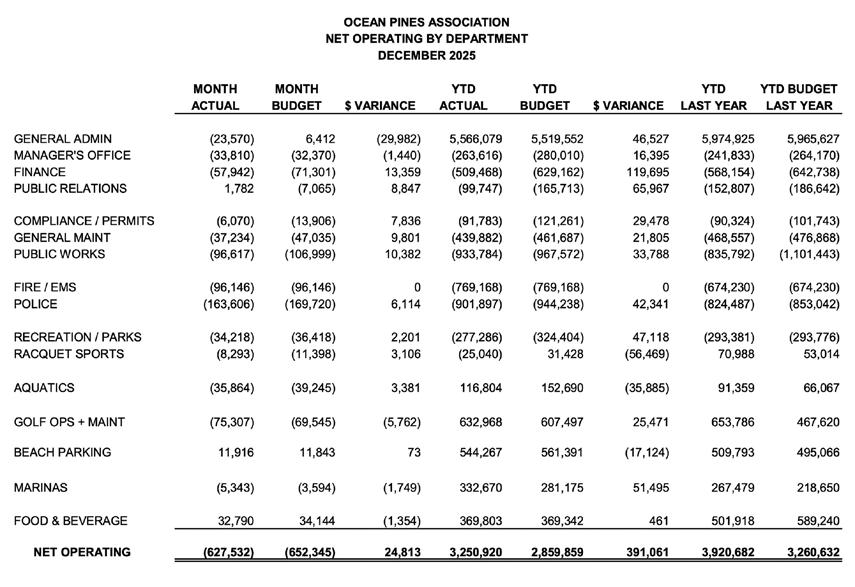
Ocean Pines ends December 2025 ahead of budget, remains $391,061 positive year-to-date
By Sherrie Clifford ROC Edition Publisher
The Ocean Pines Association closed out December 2025 with another favorable financial result, continuing a pattern of finishing ahead of budget as the fiscal year progresses.
For the month, the association reported a positive operating fund variance of $24,813, meaning actual results were that much better than budgeted. Revenues for December were $1,928 under budget, but that shortfall was more than offset by lower-than-expected expenses, which came in $26,741 under budget. The association recorded a net operating loss of $627,532, compared to a budgeted loss of $652,345, producing the positive monthly variance of $24,813.
On a year-to-date basis through December 31, the association’s financial position remains strong. The operating fund shows a net surplus of $3,250,920, compared to a budgeted surplus of $2,859,859. This places Ocean Pines $391,061 ahead of budget year-to-date, providing a notable cushion as the association moves deeper into the fiscal year.
Overall performance continues to be supported by both stronger-than-budgeted revenues and ongoing cost control. Through December, revenues are $197,508 over budget, while total expenses are $193,553 under budget. Together, those two factors explain why the association continues to outperform budget assumptions despite expected off-season losses.
As is typical during the winter months, several departments recorded operating losses in December. In many cases, however, those losses were smaller than budgeted, helping preserve the association’s favorable overall position.
Among administrative departments, General Administration recorded a net operating loss of $23,570 for December, compared to a budgeted loss of $6,412. Despite the monthly shortfall, the department remains $46,527 ahead of budget year-to-date, with yearto-date operating results totaling $5,566,079.
The Manager’s Office reported a net operating loss of $33,810 for the month, slightly worse than the budgeted loss of $32,370, but
remains $16,395 better than budget year-to-date.
The Finance Department recorded a net operating loss of $57,942 in December, finishing $13,359 better than budget for the month and remaining $119,695 ahead of budget year-to-date.
Public Relations posted a net operating gain of $1,782, exceeding its monthly budget by $8,847, and remains $65,967 ahead of budget year-to-date.
Operational departments continued to reflect seasonal patterns. Compliance, Permits and Inspections reported a net loss of $6,070, which was $7,836 better than budget, and remains $29,478 ahead of budget year-to-date.
General Maintenance posted a net loss of $37,234, finishing $9,801 better than budget for the month and $21,805 ahead of budget year-to-date.
Public Works recorded a net loss of $96,617, which was $10,382 better than budget, and remains $33,788 ahead of budget year-to-date.
Public safety departments showed similar results. Fire/EMS reported a net loss of $96,146 for December, exactly matching its budgeted amount. The Police Department
recorded a net loss of $163,606, finishing $6,114 better than budget for the month and standing $42,341 ahead of budget year-to-date.
Recreation-related departments continued to operate at expected off-season losses. Recreation and Parks recorded a net loss of $34,218, finishing $2,201 better than budget for December and remaining $47,118 ahead of budget year-to-date.
Racquet Sports posted a net loss of $8,293 for December, finishing $3,106 better than budget for the month, though the department remains $56,469 behind budget year-to-date. At this same point last year (December 2024), Racquet Sports showed a positive year-todate variance of $70,988, representing a year-over-year difference of around than $130,000.
Aquatics reported a net loss of $35,864, finishing $3,381 better than budget, but remains $35,885 behind budget year-to-date.
Golf Operations and Maintenance recorded a net loss of $75,307, which was $5,762 worse than budget for the month, but remains $25,471 ahead of budget year-to-date.
Beach Parking posted a net operating gain of $11,916, finishing $73
over budget for December, though it remains $17,124 behind budget year-to-date.
Marinas reported a net loss of $5,343, finishing $1,749 worse than budget for the month, but remain $51,495 ahead of budget year-to-date.
Food and Beverage posted a net operating gain of $32,790, finishing $1,354 below budget for December, with a year-to-date positive variance of $461. Results continue to reflect positive performance under the current lease arrangement with Touch of Italy, which shifted operations from a management model to fixed lease terms, providing more predictable revenue and reduced financial risk for the association.
Taken together, the December financial report shows that while seasonal operating losses are expected across many departments, Ocean Pines remains financially ahead of plan. With revenues exceeding expectations, expenses under control and a positive yearto-date variance, the association enters the next phase of the fiscal year in a solid financial position as budget discussions and long-term planning continue.
Major projects advance as association reviews key initiatives
By Sherrie Clifford ROC Edition Publisher
Ocean Pines Association (OPA) leadership provided updates on major initiatives and active projects during the Jan. 24 regular board meeting. The update outlined progress on capital projects, infrastructure improvements, budget planning and seasonal operations.
The report highlighted continued movement on the South Side Fire Station, golf course irrigation upgrades and multiple amenity improvement projects, while also addressing storm preparation, maintenance activity and leadership priorities.
SOUTH STATION FIREHOUSE
The South Side Fire Station remains the association’s largest active initiative and continues in green status, indicating the project is moving forward as planned. A construction contract was presented for approval, marking a transition from planning to implementation.
The total project cost remains about $5.2 million, funded through a combination of referendum-approved association funds, grants and contributions from the Ocean Pines Volunteer Fire Department. The project continues to track within established financial and scheduling parameters.
The project was awarded to The Whayland Company, with construction expected to begin in February and an estimated timeline of approximately 60 weeks to completion. A groundbreaking ceremony is planned for February, with the specific date to be announced.
GOLF COURSE IRRIGATION
The golf course irrigation project remains in green status, with Phase II having begun in December 2025. Work is currently focused on hole four, with new irrigation heads being marked and installed on holes seven and eight.
Phases I and II remain within the long-term budget framework established several years ago. Phase III is included in the recommended FY26-27 budget, keeping the overall irrigation program aligned with the previously projected multi-year plan. Emergency repairs completed to date have remained within the overall funding limits identified for the project.
CLUBHOUSE PAVILION AND BAR RENOVATIONS
Plans for the Clubhouse Bar and Grille pavilion continue to advance and remain in green status. Engineering work is ongoing, with the next steps identified as soliciting construction bids and obtaining board approval.
The pavilion is intended to enhance outdoor dining and gathering space adjacent to the Clubhouse and support expanded food and beverage service.
As part of the overall amenity improvement strategy, Touch of Italy will also invest in enhancements associated with the pavilion, contributing to upgraded finishes and service features that extend beyond basic structural construction. All permanent improvements will become association-owned assets.
Separately, Touch of Italy is scheduled to begin renovations inside the Clubhouse on Feb. 9, including a complete remodel of the bar area, representing an additional investment by the operator beyond the pavilion project.
YACHT CLUB OUTDOOR KITCHEN AND BAR RENOVATIONS
The Yacht Club outdoor kitchen project remains in green status and is currently in the engineering phase. In addition to planned kitchen improvements, renovation work is already underway inside the Yacht Club bar area.
The renovations currently in progress represent a substantial upgrade compared to the existing space, with higher-quality construction and finishes than what was previously in place, according to the general manager. While the association is contributing funding, the completed improvements will be owned by the association.
Once final outdoor kitchen plans are completed, the association will move forward with construction bidding and board approval.
BEACH CLUB IMPROVEMENTS
Beach Club improvements remain in green status, with engineering and planning activities continuing. Next steps include construction bids and board approval.
A significant portion of the planned Beach Club work reflects capital replacements that would have been required regardless of project timing, including decks,
With large projects advancing, amenity investments underway and long-term planning tools guiding decisions, the association enters the next phase of the fiscal year with defined priorities and clear next steps.
structural elements and facility upgrades identified through long-term planning.
Beach Club improvements are scheduled to begin at the close of the 2026 summer season.
AMENITY INVESTMENT PARTNERSHIP
Across the Clubhouse pavilion, Yacht Club kitchen and bar and Beach Club projects, the association anticipates a direct capital outlay of approximately $1.5 million, much of which aligns with replacements identified in the DMA reserve study.
In addition, Touch of Italy is investing in all three amenity projects, with the operator’s combined investment expected to exceed $800,000. These contributions expand the scope and quality of improvements beyond baseline replacements and are intended to enhance service areas, bar facilities and customer experience across all three locations.
All permanent improvements constructed or installed as part of these projects will ultimately be owned by the association, even where Touch of Italy is contributing funding or performing work. This shared investment structure is intended to deliver facilities with a total value well above the association’s direct cost while strengthening long-term amenity performance under the current lease-based operating model.
FISCAL YEAR 2026-27 BUDGET APPROVAL
The recommended fiscal year 2026-27 budget was approved by the board. The budget was developed using a bottom-up process, beginning with meetings with department heads and including forecasting of the current fiscal year.
The process included review sessions with the Budget and Finance Committee, a working session tied to the DMA reserve study and reinvestment of retained earnings resulting from favorable operating results into the assessment. Public safety represents approximately 42% of the approved
budget, reflecting long-standing community priorities.
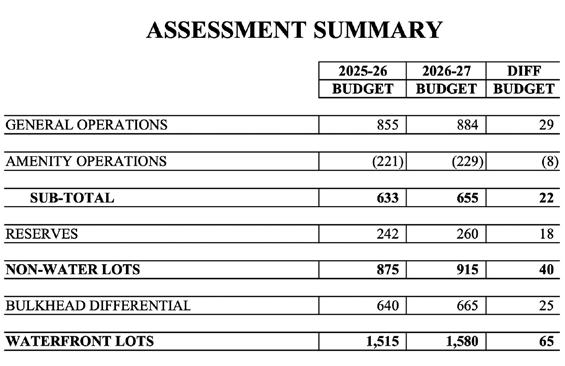
The approved budget includes an annual assessment of $915 for non-water lots and $1,580 for waterfront lots, the difference being caused by a bulkhead differential of $665. Assessment levels in this range were last seen around 20132014 and over the past six years the assessment has been increased only twice.
The first proposed budget was posted on Dec. 16, 2025, followed by a revised version on Jan. 9, 2026, with committee and board reviews completed in accordance with bylaw timing requirements.
PUBLIC WORKS STORM PREPARATION
Storm preparation efforts were reviewed ahead of a forecasted 2 to 4 inches of snow between Jan. 24 and Jan. 26. Public Works prepared six plows, five additional pieces of equipment, three salt spreaders and approximately 100 tons of salt.
Street brining operations began on Jan. 22, using an in-house brining system built by Public Works last year. Brining is most effective when storms do not begin as rain, allowing for reduced salt usage.
MAINTENANCE
Maintenance updates included the replacement of the community center kitchen floor, completed by DCH Enterprise at a cost of $3,850. The work was required to meet health department leveling standards that could not be addressed through in-house repairs.
OVERALL OUTLOOK
Overall, the January report reflects continued progress across major initiatives, disciplined budget development and coordinated capital planning. With large projects advancing, amenity investments underway and long-term planning tools guiding decisions, the association enters the next phase of the fiscal year with defined priorities and clear next steps.
Marina slip fees, Volunteer Appreciation Dinner and transient boat slips among issues raised during public comments
Addressing the Ocean Pines Association Board of Directors at their latest regular board meeting, Amy Peck said she was unable to attend the budget town hall and again asked the board to reconsider allowing hybrid public comments, where questions are taken from those who are present as well as those who are viewing virtually.
Peck said her remarks are focused on the proposed budget. She first urged the board to revisit marina slip fees, stating that the proposed 3% increase, about half of which reflects higher water costs, does not keep pace with inflation. She noted that there is a three-year waiting list for slips and that Ocean Pines rates remain well below comparable
Colette Horn, asked about the chemical composition of road pretreatment brine and its potential impact on local waterways. Staff responded that the brining process significantly reduces salt usage compared to traditional road salting and that no deterioration of road surfaces has been observed. However, staff indicated they did not have specific information available regarding waterway impacts.
Horn also questioned the practice of using retained earnings to lower assessments, suggesting instead that those funds be reinvested into reserve accounts, particularly for drainage and bulkheads.
Ann Shockley spoke to thank the board and staff for recognizing the volunteer efforts of Mr. and Mrs. Neal Hoffman through the Good Neighbors Award and to highlight a recent project that benefited Pintail Park.
Commenting on the reasoning behind the award, Shockley explained that the Hoffmans, instead of discarding the usable plants they had removed from their lawn during a redesign, contacted Patti Lookner of the garden club. Working with Public Works and garden club volunteers, the plants were relocated to Pintail Park, where aging roses were removed and replaced with new plantings.
Shockley said the donated materials included roses, hydrangeas, tall grasses and additional shrubs, with an estimated value of more than
marinas. With four board members who are boaters, Peck said it should be clear that slip revenue could be responsibly increased, particularly while the association is cutting costs elsewhere and realizing less interest income.
Peck then turned to the Volunteer Appreciation Dinner. She noted that the board approved a $10,000 budget for the event last year, but the final cost reached approximately $30,000 for 185 attendees, or about $162 per person. She said many attendees were not volunteers and included OPA staff, paid first responders, politicians, corporate counsel, select members of the press as well as only certain club members.
Staff responded by explaining that drainage reserves were created and funded without increasing assessments, while bulkheads are funded through a separate bulkhead differential. General Manager John Viola acknowledged that responsibility for certain bulkheads has long been debated and said funding decisions have been balanced, particularly in light of the DMA reserve study.
Horn thanked the board for its support of her Budget and Finance Committee application and voiced agreement with Peck’s comments regarding the Volunteer Appreciation Dinner.
$700, noting that the cost would likely have been higher if purchased from a nursery. She expressed gratitude toward the Hoffmans for reaching out before discarding the plants and credited the cooperative effort between residents, volunteers and Public Works for improving the park.
Shockley also addressed previously discussed plans related to adding transient boat slips near the canal bend at the golf course. She said that, as both a golfer and former boat owner, she believed the proposal was unnecessary.
Board President John Latham responded that the project had been tabled for the foreseeable future. Shockley expressed relief that the proposal was no longer being pursued.
Peck reminded the board that the original purpose of the event was to recognize board-appointed committee volunteers, not to host a broad social gathering. She said that since the last volunteer dinner, the board has eliminated nine committees, removing and disenfranchising approximately 50 volunteers from eligibility. Despite that reduction, the proposed budget allocates $15,000 for 130 guests, or roughly $115 per person. Peck said that if those volunteers and their guests are no longer included, attendance should drop to closer to 100 people, not just 55 fewer attendees. She said this raises concerns that non-volunteers may again be invited, while some actual volunteers could be excluded.
Peck also noted that many residents volunteer extensively with organizations that directly benefit Ocean Pines, including Maryland Coastal Bays, Assateague Coastal Trust, the Kiwanis and the garden club, among others, and said those volunteers have not been invited in the past.
Peck also questioned whether a board-funded appreciation dinner should include an open bar, stating that “optics matter.” She said that as structured, the event sends the wrong message about priorities and fiscal stewardship and asked that this line item be removed from the proposed budget.
Understanding HOA assessments: What the numbers mean for Ocean Pines homeowners
By Sherrie Clifford ROC Edition Publisher
Each year, Ocean Pines homeowners receive an annual assessment bill that helps fund the day-to-day operations, long-term maintenance and future stability of the community. While the number itself is easy to see, understanding how that amount is calculated, where the money goes and how it compares to past years takes a closer look at the budget documents behind it.
The fiscal year 2026–27 assessment charts show how the association is balancing rising costs, infrastructure needs and long-term planning while keeping increases measured and predictable.
ASSESSMENT RATES FOR 2026–2027
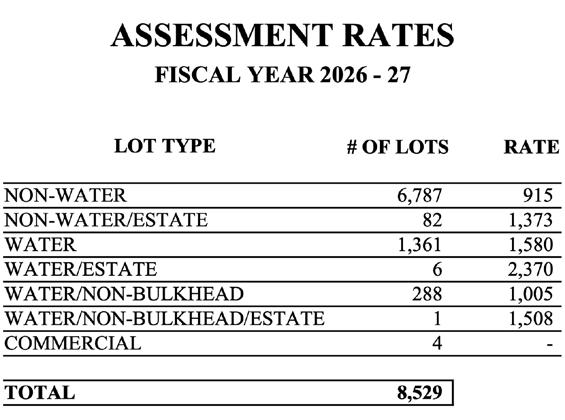
The assessment rates chart breaks down what homeowners pay based on lot type. For the upcoming fiscal year, non-waterfront residential lots are assessed $915, while waterfront lots are assessed $1,580. Estate lots pay 1.5 times the base rate, reflecting their larger footprint and proportional use of association resources.
In total, the association is billing 8,529 lots across all categories. The largest share is non-water residential lots, accounting for 6,787 properties. Waterfront and specialty classifications make up the remainder.
What matters here is not just the number, but the structure. Ocean Pines does not apply a single flat rate. Instead, assessments are scaled to reflect differences in infrastructure, waterways, bulkheads and services that vary by lot type. This approach spreads costs more evenly across the community rather than shifting them disproportionately onto one group of homeowners.
HOW THE ASSESSMENT IS BUILT, DEPARTMENT BY DEPARTMENT
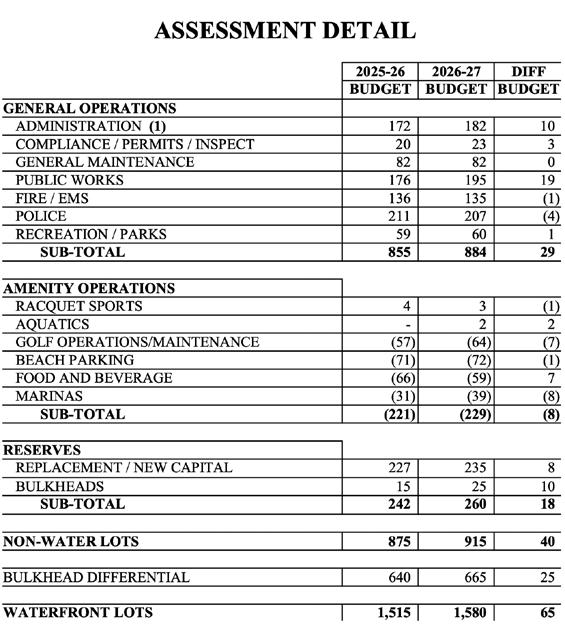
The assessment detail chart explains how the annual dues are allocated across operations, amenities and reserves.
On the operations side, general services such as Administration, Compliance, General Maintenance, Public Works, Fire/EMS, Police and Recreation total $884 of the assessment for FY26-27, up from $855 the prior year. The largest increase within this category is Public Works,
reflecting continued focus on roads, drainage and infrastructure upkeep. Police and Fire/EMS remain stable or slightly lower, showing that public safety funding has been maintained without sharp increases.
Amenity operations tell a different story. Several amenities, including golf, beach parking, marinas and food and beverage, continue to offset operating costs rather than add to the assessment burden. In simple terms, these amenities generate revenue that reduces how much homeowners must pay through assessments. While some amenity categories show small negative shifts year over year, the overall impact remains a net benefit to the association.
Reserves are where long-term planning becomes visible. Contributions to replacement and new capital reserves increase to $235, while bulkhead reserves rise from $15 to $25. These amounts are intentional. Rather than deferring maintenance or relying on emergency funding later, the association is steadily setting aside money for known future expenses.
WHY NON-WATER AND WATERFRONT ASSESSMENTS INCREASED
For non-water lots, the assessment increases from $875 to $915, a $40 change. Waterfront lots increase from $1,515 to $1,580, a $65 change. The bulkhead differential rises from $640 to $665.
These increases are tied directly to capital planning and reserve funding, not operating overruns. Roads, drainage, bulkheads and major facilities have predictable life cycles. Funding them gradually through assessments helps avoid large, sudden spikes later.
It is also important to place these numbers in historical context.
LOOKING BACK: ASSESSMENT HISTORY OVER TIME
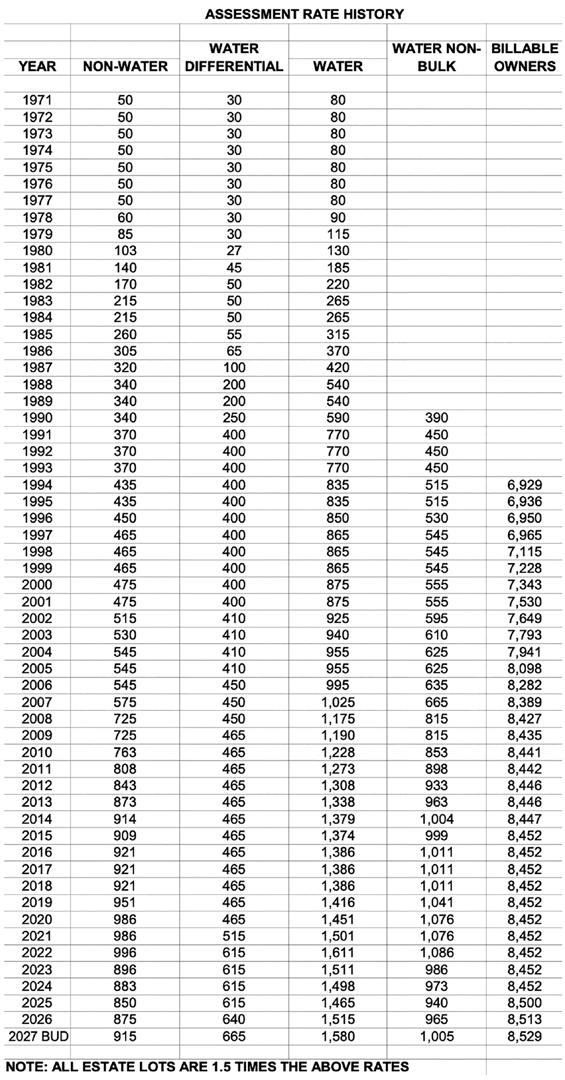
The assessment rate history chart shows how dues have changed since the early years of Ocean Pines. In the 1970s and 1980s, assessments rose quickly as the community was being built. In more recent decades, increases have been far more measured.
Notably, assessment levels in the current range were last seen around 2013–2014. Over the past six years,
For the upcoming fiscal year, non-waterfront residential lots are assessed $915, while waterfront lots are assessed $1,580. Estate lots pay 1.5 times the base rate, reflecting their larger footprint and proportional use of association resources.
assessments were increased only twice, despite rising labor, materials, insurance and utility costs nationwide.
That history matters. It shows that the association has not relied on annual increases as a default solution. Instead, increases have been spaced out and tied to specific needs, allowing homeowners to plan rather than react.
CAPITAL SPENDING: WHERE THE MONEY IS GOING
The capital summary chart explains how reserve funds and capital dollars are used. For FY26–27, total capital spending is projected at approximately $6.03 million.
Major items include golf maintenance, beach club improvements, aquatics, recreation facilities and a significant investment in the fire department. Roads and drainage also receive dedicated capital funding, separate from routine maintenance budgets.
These projects are not discretionary upgrades. Many are replacements or lifecycle renewals identified through long-term studies. Funding them through capital planning ensures facilities remain functional, safe and competitive without relying on borrowing or emergency assessments.
RESERVES: PLANNING BEYOND ONE YEAR
The reserves chart shows estimated balances at the beginning and end of the fiscal year across multiple categories, including replacement, bulkheads, roads, drainage and new capital.
While some reserve balances decline during years when major projects are completed, those declines reflect planned use, not financial distress. Contributions, interest and surplus transfers
continue to replenish reserves, maintaining long-term stability.
This approach allows the association to fund large projects over time rather than postponing them or shifting the burden to future homeowners.
WHAT THIS MEANS FOR HOMEOWNERS
Taken together, the charts show an association that is actively managing costs, reinvesting operating efficiencies into assessments and planning for the future. Assessments are rising, but they are doing so in a controlled way that reflects real expenses, not shortterm pressures.
Amenities continue to play a critical role in offsetting costs. Capital projects are being funded with foresight rather than delay. Reserves are being used as intended, then replenished.
For homeowners, this means fewer surprises, more predictable assessments and a community that maintains its infrastructure and services without sacrificing longterm financial health.
Much of this measured and disciplined approach reflects the experience and management philosophy of General Manager John Viola and the senior leadership team he has assembled over the years. Their combined experience has shaped how assessments are structured, how reserves are funded and how capital projects are timed. While no budget cycle is without challenges, the consistency of this approach has helped keep assessments managed, services maintained and long-term obligations in focus.
When systems change, communication must follow EDITORIAL
Change is not unusual in community governance. Systems evolve. Vendors change. Processes are updated. There is, however, a responsibility on the part of community leaders to ensure that such changes are communicated effectively to the public.
Recent months have offered clear examples of why communication matters. A major printing facility that served many Eastern Shore newspapers closed with little notice, forcing publications to reassess production systems under tight deadlines. Budgets are being reviewed amid rising costs and shifting priorities. Election cycles approach while procedures grow more complex, especially as technology becomes more embedded in governance.
None of these developments are inherently negative. In fact, many reflect necessary adjustments to changing conditions. What matters is whether residents are given a clear explanation of what is changing, why it is changing and how it affects them.
Take printing as an example. Readers pick up a newspaper expecting consistency. They rarely see the machinery, logistics and coordination required to meet deadlines week after week. When that system changes suddenly, as it did for many publications this winter, the work behind the scenes intensifies. Paper must be sourced. Press capacity evaluated. Schedules adjusted. Distribution coordinated. When those details are shared openly, even briefly, readers gain appreciation for the effort required to maintain continuity. When they are not shared, assumptions fill the gap.
Elections present an even more sensitive case. Homeowner association elections are not public elections. They are governed by internal rules, committee structures and vendor relationships that vary from one association to another. As systems become more technical and outsourced, fewer residents understand how voting is administered, what oversight exists and where authority resides.
This does not mean elections are flawed. It means they require more explanation, not less. When procedures change, when vendors are selected or when technology is introduced, residents and potential candidates need clear, timely information. Participation depends on understanding. Confidence depends on transparency.
Governance itself is no different. Committees, boards and management roles evolve as communities grow and face new challenges. Authority shifts. Responsibilities overlap. Decisions become more complex. When communication lags behind those changes, confusion follows. Questions are interpreted as challenges. Silence is mistaken for consent. Engagement declines.
None of this is inevitable. Strong communication does not require revealing confidential information or relitigating every decision. It requires explaining processes, timelines and roles in plain language before confusion takes root.
Communities are not weakened by informed residents. They are strengthened by them. When people understand how systems work, they are more likely to participate constructively, volunteer responsibly and accept outcomes even when they disagree with them.
The alternative is familiar. When communication fails to keep pace with change, rumors replace facts. Distrust grows quietly. Qualified residents stop volunteering. Elections still happen. Budgets are still approved. Decisions are still made. But confidence fades.
Local journalism plays a role here, not by inflaming tensions, but by explaining systems that often operate out of public view. Transparency does not mean advocacy. It means clarity. It means asking how decisions are made, not who benefits from them. It means recognizing that systems only function well when people understand them.
Change will continue. Printing infrastructure will evolve. Budgets will shift. Election methods will adapt. Governance structures will adjust. The question is whether communication will keep pace.
Communities that understand this do not fear scrutiny. They welcome informed participation. They recognize that clear communication is not a courtesy. It is a responsibility.
Every year, homeowner associations encourage residents to get involved, step up and run for the board. Notices are sent, deadlines are posted and elections are presented as open and fair. Yet in some communities, long before ballots are issued or online voting opens, a quieter reality is already understood by those paying close attention. When election processes lack clear independence and safeguards, participation can begin to feel symbolic rather than meaningful.
This commentary reflects a growing pattern observed in HOAs nationwide, particularly as elections have shifted to outsourced and online systems. The concern is not whether elections occur. It is whether they are structured in a way that limits undue influence at the very moment when votes matter most.
One of the most critical yet least examined risks arises when election administration functions are not clearly separated from governance roles. When oversight, administration and decision-making authority are concentrated within the same
structure, the potential for influence increases even in the absence of improper intent.
That risk becomes more pronounced in online voting environments. Modern election platforms often allow administrators to view participation metrics in real time, including how many ballots have been cast and how many remain outstanding. While such data may be intended for logistical purposes, access to this information during an active voting period introduces a structural vulnerability. If participation data is visible during live voting, it can shape strategy, outreach and timing in ways that are not equally available to all participants.
Homeowners are rarely informed who has access to this information or what restrictions govern its use. They may not know whether election administrators can view voting progress, communicate with vendors during live elections or receive real-time updates beyond basic operational needs. Without clear and documented boundaries, independence becomes an assumption rather than a safeguard.
This is not a hypothetical concern. Governance experts have long warned that elections can be compromised not only through ballot handling, but through information asymmetry, which raises legitimate questions about transparency and equal access. When some participants have insight into turnout patterns, remaining ballots or timing dynamics, the contest can feel uneven even if every vote is counted accurately.
In such environments, encouraging residents to run for the board can be misleading. The process may look competitive on the surface, while the structure of the election limits how much campaigns can actually affect the outcome. No amount of effort, engagement or qualification can overcome a system where influence exists during voting rather than at the ballot box.
When homeowners raise questions about election structure, they are often told that doing so undermines confidence or creates unnecessary tension. In reality, confidence grows when safeguards are visible, independence is
documented and oversight is clear. Discouraging inquiry does not protect elections. It weakens them. Over time, the consequences are predictable. Qualified homeowners choose not to run. Voter participation declines. Elections continue, but meaningful competition fades. Boards become increasingly insulated, not because residents are indifferent, but because the process no longer appears responsive.
If running for the board begins to feel like a poor use of time, the issue is not civic apathy. It is structure. And until election processes are demonstrably independent, transparent and protected from influence and control, outcomes will continue to feel predetermined regardless of how many names appear on the ballot.
Sherrie Clifford Publisher, ROC Edition
This commentary examines structural risks that can affect HOA election integrity. It does not allege wrongdoing by any specific association or individual.
STANDING Room Only
STANDING Room Only
STANDING Room Only
By Roger Marino
By Roger Marino
By Roger Marino
Stop signs and street lights
I often quote the late, great Yogi Berra, a New York Yankee hall of fame catcher whose classic lines are still quoted by media moguls.
As a player and manager, he would bark to his world championship teammates, “When you come to a crossroad, take it.” Seems comical to hear those words in that context, but common sense often does reveal its unusual rhythm to both the educated and uneducated book learners of our society.
There were quite a few times in my career as a reporter, covering major league baseball, that I heard those words and used them personally as they came from the All-Star leader’s mouth.
On the field and in the clubhouse, Yogi was a leader. Behind the plate, he called balls and strikes brilliantly. At the plate, he knew where the ball was coming and, most times, hit it out of the park. He cared for his team and those who watched the game from the stands, living his famous words to remember the crossroads and the consequences that will come from poor planning, sometimes before you are ready to meet that intersect. In a scholastic classroom, Berra would probably be ranked as a C-average performer. But on the field of living, he carried a straight 4.0 doctorate in common sense.
In Worcester County, we are at the crossroad of plowing under country roads that are incapable of handling dangerous speeders meeting up at unlighted traffic signals, too unstructured to take the influx of much needed eighteen-wheel trucks and unable to bear the tremendous increase of a hurried vacation traffic and a fast-growing internal population of family vehicles. To underrate the necessity of recognizing the danger in the upcoming crisis at the crossroads will be a costly overlook for the citizens of Worcester County.
WHAT WOULD YOGI DO?
Let’s go back to June 1972, and the torrential hurricane winds and rain that destroyed many homes, roads, bridges and businesses along the east coast. I was among those affected by the river water rushing down the main street of Ellicott City, Md. I watched as 21 parked automobiles were washed down the main street in the heart of the 200-year-old town. One of the oldest unincorporated cities in America was under siege by the elements of the Earth. Two-hundred years of history flushed down the street, through the walls of small businesses, dumping into the Patapsco River bottom and ultimately into the Baltimore Bay. What to do? Is the town lost forever?
A couple of years later, following the city’s 200-year celebration ceremonies, I was honored by the Howard County executive to organize and chair a committee to examine the destruction of this historic hurricane, detail back the results and to bring back in organizational form the possibilities of restoring this historic monument to American history. This was the place where the Tom Thumb steam engine raced the horse-driven stagecoach, spelling the demise of horse-drawn carriages and the advent of railroading in America. And so much more history.
It was a monumental task, and we went about it in Yogi-determination. After identifying the task at hand, sighting the many crossroads, I appointed a subcommittee of 12 citizens representing all sectors, political and business, of Howard County, our immediate intent to identify the town’s environs and its special qualities.
Our overall goals were to conserve and develop Ellicott City and its immediate environs while recognizing its unique position as a governmental hub, an area of striking natural beauty and diversity, an area of economic potential to the county and the state as well as
I know we have the best planners and community organizers this side of the Baltimore Bay. Let’s help them utilize the tools to grow this community without the proliferation of unnecessary street lights, stop signs, speed bumps, flooding and a cold-grey asphalt grounding where the wildlife once roamed.
a residential area which preserves a broad range of housing choices in a superior living environment. Does this all sound familiar? Ocean City, Md., is well on its way to becoming the entertainment capital of the east coast and continues to grow internationally as the yearround place to go for fun and music. Berlin houses the most unique, historically-cultured town on the Eastern Shore. The place to go for unique gift items, good food and charming people. We are extremely proud to know that Worcester County land has produced some of the finest agricultural products sold in America’s grocery stores. And our farmers grow quality, affordably-priced protein in our huge poultry industry, feeding the world with a bounty of chicken products. Our educational system is fast becoming the go-to place for a quality K-12 and college education. Our seafood industry, harvested off the Atlantic shore, is unequalled in its ability to produce an abundance of the freshest maritime products sold in restaurants and on the shelves of this nation’s shopping districts.
WHAT WOULD YOGI SUGGEST?
Let us think before we cross the crossing and cover the green of agriculture with the dollar-green smell of housing developments, producing more asphalt and concrete. I know we have the best planners and community organizers
this side of the Baltimore Bay. Let’s help them utilize the tools to grow this community without the proliferation of unnecessary street lights, stop signs, speed bumps, flooding and a cold-grey asphalt grounding where the wildlife once roamed.
I believe we are at the crossroad of a new era here in Worcester County. The Pines never smelled so fresh and the promise of living among the water and green never more inviting. Our community leaders never need much more than good judgement and educated management, qualities we are fortunate to have within our jurisdictions.
We did it in the now flourishing Ellicott City many years ago. A town thriving from the managerial input of a 40-page document titled “Ellicott City: New Life for an Old Town,” planning and developing the sensible restoration, rehabilitation and growth of a once-ravaged, floodtorn, 200-year-old American city.
And we can do even more restoration, beautification, historic district zoning and thoughtful rezoning within our bucolic, two-centuries-old county. It’s game time. Be ready for the curveball. Keep our eyes on the road, and with the proper management we have on this team of planning and zoning experts, guide us safely around and beyond the crossroads and into the future for nature’s gifted parkland: beautiful Worcester County, Md.
ROC Tribute
Burbage Funeral Home: A legacy of care serving Berlin families for generations
By Sherrie Clifford ROC Edition Publisher
For generations of families across Berlin, Ocean Pines and the surrounding Eastern Shore, Burbage Funeral Home has been a steady presence during some of life’s most difficult moments. Located on William Street in the heart of Berlin’s historic district, the funeral home has quietly served the community for more than two centuries, offering continuity, care and familiarity that few institutions can claim.
Founded in the early 1800s, Burbage Funeral Home began as a small, practical service making caskets for local families. Over time, it grew into a full-service funeral home, adapting to changing customs while remaining rooted in the same core mission: helping families honor their loved ones with dignity and respect. In a town where relationships span generations, that continuity has mattered.
Much of the funeral home’s legacy is shaped by Marianne “Anna” Adkins Burbage, whose influence extended far beyond the business itself. From 1927 until 1944, Anna and her husband, John “Jack” Burbage, operated the family funeral home together in Berlin. In those early years, funeral service was deeply personal and often demanding. The couple frequently traveled by horse and wagon to the homes of the deceased, assisting families directly and making arrangements on site.
After Jack’s death in 1944, Anna continued running the funeral home on her own, becoming one of the first female licensed undertakers in the state of Maryland. She was widely known for her compassion as well as her ability to provide services that were efficient and affordable. Her service to the community extended well beyond funerals. For many years, she helped operate the only ambulance in Berlin, provided medical equipment to local residents and donated food and clothing to people in need. One small tradition
In communities like Berlin and Ocean Pines, a funeral home often serves as more than a place of service. It becomes part of the social fabric, a place where stories are shared, memories honored and lives acknowledged.
she began involved baking a homemade cake for each grieving family, a tradition which still continues today.
When Anna passed away in 1985, the funeral home was entrusted to her grandson, Kirk Burbage, who later expanded operations to a second location in Snow Hill. While the business grew, the philosophy remained unchanged: Families are treated as family, not customers.
Today, Burbage Funeral Home continues to serve families throughout Worcester County and neighboring areas with a range of services that reflect both tradition and modern needs. Those services include traditional funerals, memorial services, cremation options and pre-planning arrangements. For some families, planning ahead provides peace of mind. For others, guidance is needed quickly and thoughtfully in the aftermath of loss.
In both cases, staff members focus on meeting families where they are, helping them navigate decisions with clarity and compassion.
The Berlin location itself reflects that approach. Once home to Anna Burbage, who lived in an apartment above the funeral home, the building retains a sense of warmth and familiarity. The space is designed to feel welcoming rather than institutional, offering comfortable areas for gathering, an outdoor garden for reflection and modern facilities that support today’s funeral services.
In communities like Berlin and Ocean Pines, a funeral home often serves as more than a place of service. It becomes part of the social fabric, a place where stories are shared, memories honored and
lives acknowledged. Over the years, Burbage Funeral Home has assisted in memorializing veterans, public servants, business owners, volunteers and neighbors whose lives shaped the Eastern Shore.
As the region continues to grow and change, businesses with deep local roots provide a sense of grounding. More than 200 years after its beginnings, Burbage Funeral Home remains a constant, guided by a tradition of compassion, service and respect that has endured across generations.
ROC Edition publishes obituaries as a community service.
Obituaries appearing in ROC Edition are prepared in coordination with Burbage Funeral Home and submitted on behalf of families they serve.
All obituary content is reviewed and written in standard newspaper style.
Photographs are welcome.
ROC Edition • Submitted Burbage Funeral Home serves Eastern Shore families with compassionate, personalized funeral services, maintaining a legacy of care that spans more than two centuries.
ROC Life
Rare complete run of Classics Illustrated finds new owner during Ocean Pines Library display
By Sherrie Clifford ROC Edition Publisher
Classics Illustrated came vividly to life in Ocean Pines during the month of January, when a complete collection of the iconic comic book series was placed on public display at the Ocean Pines Library. The exhibit offered residents a rare opportunity to view every issue in the groundbreaking series, all gathered in one place and presented as both a visual archive and a piece of publishing history.
The collection was owned by Dennis Kroger, an Ocean Pines resident who had assembled the full run and chose to share it publicly while exploring the possibility of selling it. Throughout the month, visitors paused over familiar covers, rediscovered classic titles and introduced a new generation to illustrated versions of literary works that once served as an entry point to reading for millions of young people.
By the end of the exhibit, the entire collection was purchased at the seller’s asking price, which was not disclosed. The buyer was John Talbott, also an Ocean Pines resident and local real estate professional. The sale preserved the integrity of the complete collection while marking the conclusion of a display that drew steady interest from readers, collectors and longtime fans of the series.
The exhibit also served as a reminder of the cultural impact of Classics Illustrated, a publishing experiment that reshaped how literature was introduced to young readers and left a lasting mark on both comic book history and education.
Originally launched in 1941, Classics Illustrated set out to adapt well-known works of literature into comic book form, making stories by authors such as Dickens, Twain, Shakespeare and Stevenson accessible to a broader audience. At a time when comic books were often dismissed as disposable entertainment, the series positioned itself as both educational and engaging,
bridging the gap between popular culture and classic literature.
Long before audiobooks, streaming adaptations and digital readers, Classics Illustrated occupied a unique space in American culture. These comic books introduced generations of readers to novels, historical narratives and epic poems that might otherwise have seemed daunting. Sold at newsstands, drugstores and five-and-dime shops, they were affordable, portable and unintimidating, yet grounded in stories that had endured for centuries.
The series was created by publisher Albert Kanter, who believed classic literature should be accessible to everyone, not just advanced readers or elite classrooms. His idea was both simple and ambitious: Adapt great works of literature into comic-book form while preserving their core plots, themes and emotional impact. The first issue, The Three Musketeers, appeared under the original title Classic Comics and met with immediate success, validating the idea that education and entertainment did not have to exist separately.
In 1947, the series was renamed Classics Illustrated, reflecting both its growing popularity and its educational purpose. Over the next three decades, more than 160 titles were published, adapting works by
authors such as Charles Dickens, Mark Twain, Alexandre Dumas and Herman Melville, along with historical accounts and ancient epics like the Iliad. Each issue condensed lengthy source material into roughly 44 illustrated pages, relying on narration and dynamic artwork to convey complex stories in a readable format.
What distinguished Classics Illustrated from many other comics of its
era was its respect for the original works. While abridged by necessity, the adaptations generally followed the source material closely. Many issues included supplemental pages featuring author biographies, historical context and suggested reading lists, reinforcing the idea that these comics were gateways to deeper exploration rather than substitutes for the original texts.
ROC Edition • Sherrie Clifford, Publisher Ocean Pines Library displays rare, complete set of the comic series Classics Illustrated. The collection, owned by Ocean Pines local Dennis Kroger (above), was purchased during the exhibit by John Talbott, a local real estate professional.
CLASSICS ILLUSTRATED
Continued from page 26
Educators and parents recognized the value of the series. At a time when comic books were often criticized as distractions from serious reading, Classics Illustrated earned a different reputation. Teachers used them to engage reluctant readers, and libraries frequently stocked them as companions to traditional novels. For many readers, a Classics Illustrated issue was the spark that led them to pick up a full-length book for the first time.
The artwork evolved alongside the broader comic-book industry. Early issues reflected the bold style of the Golden Age of comics, while later editions benefited from improved printing techniques and more refined layouts. Some stories were revised and redrawn over time, resulting in multiple versions of the same title. These variations, visible in complete collections such as the one displayed in the Ocean Pines Library, have become points of interest for collectors and historians.
The influence of Classics Illustrated extended beyond the United States. The series was translated and published in more than two dozen countries, often with locally produced covers or artwork. In many regions, these editions served as a first introduction to Western literary
classics, demonstrating the universal appeal of storytelling paired with visual narrative.
For readers encountering the series for the first time, certain titles have long stood out as ideal starting points. The Three Musketeers remains the natural beginning, both as Issue No. 1 and for its fastpaced adventure. Treasure Island offers another accessible entry, while legends such as Robin Hood provide familiar storytelling. More ambitious adaptations like Moby-Dick and The Count of Monte Cristo demonstrate the series’ willingness to tackle complex themes, while historical and mythological works such as The Last of the Mohicans, Ivanhoe and the Iliad showcase its breadth.
By the late 1960s, changing entertainment habits, rising production costs and competition from television contributed to declining sales. The final original U.S. issue was published in 1971. Yet the series never disappeared. Reprints, special editions and revivals have continued to introduce new readers to the format, while original issues have become prized collectibles.
Today, Classics Illustrated occupies a unique intersection of education, nostalgia and cultural history. For some, the comics evoke memories of childhood discovery. For others, they represent a bold publishing experiment that proved
classic literature could be both accessible and engaging.
The complete collection displayed at the Ocean Pines Library offered a rare opportunity to appreciate that legacy in full. Seeing every issue together underscored the scope of Kanter’s vision and the lasting impact of a series that met readers where they were and opened doors to stories that have endured for
centuries. In an age dominated by screens and shortened attention spans, Classics Illustrated remains a reminder that great literature can take many forms and that sometimes a single comic book is enough to begin a lifelong love of reading.
For those interested in viewing the collection, the Ocean Pines Library will continue to display it throughout the month of February.