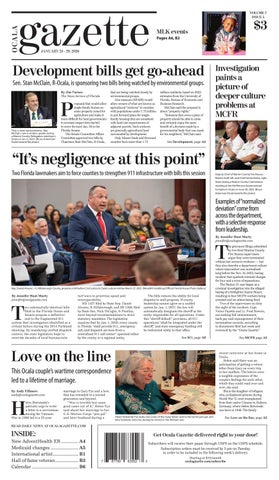

Development bills get go-ahead
Sen. Stan McClain, R-Ocala, is sponsoring two bills being watched by environmental groups.

By Jim Turner The News Service of Florida
Proposals that would allow single-family homes on some property zoned for agriculture and make it more difficult for local governments to increase impact fees started to move forward Jan. 20 in the Florida Senate.
The Senate Committee Affairs Committee approved two bills by Chairman Stan McClain, R-Ocala,
that are being watched closely by environmental groups.
One measure (SB 686) would allow owners of what are known as agricultural “enclaves” in counties with populations under 1.75 million to put forward plans for singlefamily housing that are consistent with land-use requirements of adjacent parcels. Such enclaves are generally agricultural land surrounded by development.
Only Miami-Dade and Broward counties have more than 1.75
million residents, based on 2025 estimates from the University of Florida, Bureau of Economic and Business Research.
McClain said the proposal is about “property rights.”
“Someone that owns a piece of property should be able to come and certainly enjoy the same benefit of a decision made by a governmental body that was made for his neighbors,” McClain said.
See Development, page A2
“It’s negligence at this point”
Two Florida lawmakers aim to force counties to strengthen 911 infrastructure with bills this session

By Jennifer Hunt Murty jennifer@ocalgazette.com
Two substantially identical bills filed in the Florida House and Senate propose a definitive end to the fragmented 911 system that investigators identified as a critical failure during the 2018 Parkland shooting. By mandating unified dispatch centers, the state legislators hope to override decades of local bureaucratic
turf wars to prioritize speed and interoperability.
HB 1427 filed by State Rep. Daniel Alvarez, R-Hillsborough, and SB 1586, filed by State Sen. Nick DiCeglie, R-Pinellas, move beyond recommendations to strict statutory mandates. The legislation requires that by Jan. 1, 2029, every county in Florida “shall provide 911, emergency call, and dispatch services from a centralized 911 call center” operated either by the county or a regional entity.
Love on the line
This Ocala couple’s wartime correspondence led to a lifetime of marriage.
By Andy Fillmore andy@ocalagazette.com
Helen Slotwinski’s patriotic urge to write a letter to a serviceman during the Vietnam War in 1966 led to a 55-year
marriage to Gary Fye and a love that has extended to a second generation and beyond.
“War is terrible but some good came out of it,” Helen Fye said about her marriage to her U.S. Marine Corps “pen pal” and later husband during a
The bills remove the ability for local disputes to stall progress. If county leadership cannot agree on a unified system by Jan. 1, 2027, the law will automatically designate the sheriff as the entity responsible for all operations. Under this “sheriff default” provision, all 911 operations “shall be integrated under the sheriff,” and state emergency funding will be redirected solely to that office.
See 911, page A8


Examples of “normalized deviation” come from across the department, with a selective response from
By Jennifer Hunt Murty jennifer@ocalagazette.com
The grievance filings submitted by two fired Marion County Fire Rescue supervisors argue they were terminated without fair access to evidence — but they also describe a department culture where misconduct was normalized long before the Nov. 16, 2025, hazing incident that sparked criminal charges for four and a wave of separations.
The Station 21 case began as a criminal investigation into the alleged hazing of a firefighter, Kayne Stuart, resulting in four MCFR workers being arrested and six others being fired.
Two of the supervisors on duty the night of the incident, Capt. Victor Payette and Lt. Fred Bowers, are seeking full reinstatement, back pay and expungement of their termination records, according to documents filed last week and reviewed by the “Ocala Gazette.”
See MCFR page A3
recent interview at her home in Ocala.
Helen said there was an anticipation of getting a return letter from Gary on every trip to her mailbox. The letters were a tangible expression of the couple’s feelings for each other, which they could read over and over, she said.
She is the daughter of refugees who, as displaced persons during World War II, were transplanted from their native Ukraine to Haltern, Germany, where Helen Slotwinski was born in 1946. The family
See Love on the line, page A2
Subscribers will receive their paper through USPS on the USPS schedule. Subscription orders must be received by 5 pm on Tuesday in order to be included in the following week’s delivery. Starting at $10/month ocalagazette.com/subscribe
Rep. Daniel Alvarez – R, Hillsborough County, presents a bill before Civil Justice & Claims subcommittee March 27, 2025. [Meredith Geddings/Official Florida House Photo Gallery]
Helen Slotwinski Fye looks over some of the many letters sent to her by her pen pal, and later husband, Gary Fye, during his service in the Vietnam war.
Deputy Chief of Marion County Fire Rescue Robert Graff, left, and Chief James Banta, right, listen during a Marion County Commission meeting at the McPherson Governmental Complex in Ocala on June 20, 2023. [Bruce Ackerman/Ocala Gazette file photo]
Then a state representative, Stan McClain, now a senator, speaks during a Marion County Delegation meeting in Ocala on Jan. 6, 2023. [Bruce Ackerman/ Ocala Gazette file photo]
Love on the line
Continued from page A1

immigrated to the U.S. around 1950. Helen was raised in Cherry Hill, New Jersey. She graduated from high school in 1964 and went to work as a secretary. Friends at work were writing to servicemen in Vietnam and she decided it was her “patriotic duty” to do the same.
Helen’s first letter made its way to Gary, who served in the USMC from 1965 to 1969. He was stationed in Chu Lai with the Force Logistics Command when he received the missive.
Helen and Gary soon were exchanging letters “every day” in a series of hundreds of letters each. Her letters had to be destroyed when he moved around within Vietnam, but she saved most of his. She said his letters arrived to her in envelopes with a map of Vietnam on the front and marked “United States Armed ForcesVietnam.” In the postage stamp area someone, likely Gary, wrote “free.”
She said his unit at one point received a Navy Unit Commendation for its support of the troops.
“It was a tough time. I think we were a comfort to each other,” Helen said.


Gary’s letters are filled with flowing prose and a yearning to meet Helen in person as soon as possible. One included the lines: “I can’t put in enough words to express my feelings for you… it’s no dream. It’s real, honest, sincere, true love. I will prove it to you that it is no dream when I come home.”
He wrote in the same letter that he knew her well enough to ask her to marry him and share their lives together and have children.
“I know you well enough to dedicate my entire life to giving you all the love I can,” he wrote.
Helen said Gary wrote some letters “during blackouts in candlelight.” She said at one point her letters were not delivered to Gary due to his changed location and he was concerned why they had stopped coming. He wrote to her asking what he’d done wrong to halt the letters.
Gary was on leave and sent a telegram to Helen to arrange their first in-person meeting in May of 1967. He drove 10 hours from his home in Erie, Pennsylvania, to Cherry Hill and proposed marriage “under an apple tree.”
“He was cute and a gentleman. It was wonderful to see him. I said, ‘Yes’,” Helen said, adding that they “bonded together.”
The couple had a favorite song
Development
Continued from page A1
Neil Fleckenstein, planning coordinator for the Tall Timbers land trust, expressed concern that the agricultural enclaves measure could undermine local planning and decision making.
“We work really closely with local governments on their comprehensive plans,” Fleckenstein said. “They spend a lot of time, and in the areas that I work in, they’re really focused on trying to protect those ag lands and rural working land.”
The growth-management group
1000 Friends of Florida said Jan. 16
“Can’t Take My Eyes Off You,” sung by Frankie Valli. Helen said whenever Gary would drive to Cherry Hill to visit while he was on leave, she would look for the approaching yellow square parking lights on his 1967 Plymouth Barracuda. She has a small, framed portrait of the couple in the 1960s and a sweetheart pin with the Marine Corp globe, eagle and anchor emblem.
Gary returned to Vietnam before their marriage but reaffirmed their bond in a letter.
“It’s no dream; Its real, honest, sincere, true love,” he wrote.
The couple married on Oct. 17, 1970, and lived until 1983 in Erie and New Jersey. Their daughter Michele was born in 1976, and their daughter Diana was born in 1979. The Fye family moved to Pompano, Florida, in 1983, where Gary’s career included work in the construction industry.
Gary and Helen moved to the On Top of the World community in Ocala in 2013. He enjoyed building and flying remote controlled model airplanes at an OTOW field.
He also became a talented and prolific pysanky artist. Pysanky is a Ukrainian art form that involves emptying natural eggs, such as chicken or ostrich eggs, and applying wax to the shell. The shells are then brightly hand painted with designs signifying various meanings like joy and hope using a small pen-like stylus. The eggs are typically given away as a gesture of love and friendship. Gary hand painted hundreds of eggs, and many are on display in the Fye residence.
Gary passed away on Aug. 21, 2025, following a year-long illness. He died after being under care for about three days in Empath Hospice of Marion County Cate’s House. Helen praised
that the proposal “would override local comprehensive plans and accelerate development in rural areas, even where communities have planned for agriculture or conservation.”
The other bill (SB 548) that moved forward Tuesday seeks to require local governments to demonstrate “extraordinary circumstances” where specific conditions are met before raising impact fees beyond ordinary limits on phasing in the fees.
Supporting the proposal, Louis Rotundo, a lobbyist for Altamonte Springs, said the bill clarifies that local governments have “to explain to both developers and to the citizens what is being charged and what is being built and when it is going to be built.”

“The press was to serve the governed, not the governors.”
- U.S. Supreme Court Justice Hugo Black in New York Times Co. v. United States (1971)
Publisher Jennifer Hunt Murty jennifer@ocalagazette.com
Bruce Ackerman Photography Editor bruce@ocalagazette.com
Greg Hamilton Editor greg@magnoliamediaco.com
the work of Hospice of Marion County and support from the local veteran community.
Helen and her daughters gathered recently at the OTOW home to reminisce and look over the Vietnam War-era correspondence and photos. Diana Fye is a ninth-grade science teacher at West Port High School and Michele Fye Retter is an English teacher for the same grade at the same school.
Diana said written letters were all her parents had to communicate in the mid-1960s, but a letter has some special qualities compared to electronic communications. She said a letter is something one can hold in their hand and know the other person held the same letter, as opposed to a text message. She recalled how her father “was always there” at every event she participated in as a youth.
“It’s like the magic in his letters was in everything he did,” she said.
The trio recalled how Gary often would point to his eye and then to his heart and then to one of them while saying: “I love you.”
Michele said as a youngster her dad would give her a ride on a motorcycle decorated with Christmas lights and said she and her sister would get rides wearing a helmet decorated with lights.
Michele has a daughter, Kayleigh, 22, and son, Alexander, 19. She became emotional while describing how her father lovingly interacted with his grandchildren. She said she uses the story of her father’s letters to teach her students about written correspondence and that the letters have inspired several of her students — born in the digital age and a time of “instant gratification” — to write.
“I ask the students, ‘How will you communicate without technology?’” she said.
As she looked over a stack of her husband’s wartime correspondence, Helen said, “Gary brought love into our lives. He’s still alive.”
Dani Eskridge Director of Operations & Sales dani@magnoliamediaco.com
Andy Fillmore Reporter andy@ocalagazette.com
Caroline Brauchler Reporter caroline@ocalagazette.com
Environmental groups also have opposed four other bills that McClain is pursuing this session. They include a bill (SB 208) intended to make the permit and development-order application process less costly while making it harder for local governments to deny applications because of a lack of compatibility with existing neighboring land uses.
Another bill (SB 354) would preempt local land-use regulations for what are dubbed “Blue Ribbon” projects of at least 10,000 acres, with at least 60 percent of the property set aside for environmental protection, agriculture, recreation and utilities.
Susan Smiley-Height Editor susan@magnoliamediaco.com
Belea Keeney Reporter belea@magnoliamediaco.com
Jamie Berube Reporter jamie@ocalagazette.com
Lauren Morrish Reporter lauren@ocalagazette.com
News tips tips@ocalagazette.com
Distribution Inquiries info@ocalagazette.com
Follow us @ocalagazette
Our mission is to inform and uplift our readers by reporting on the events, issues and stories that shape Ocala with accuracy, fairness and passion. We also strive to serve as a forum where all voices can be heard and to chronicle our community’s history.
ocalagazette.com
©2024 Ocala Gazette, LLC
Ocala Gazette (USPS# 25590) (ISSN 27711595) is published weekly by Magnolia Media Company, LLC, PO BOX 188, OCALA, FL 34478. Periodicals postage paid at Ocala, FL. POSTMASTER: Send address changes to: Ocala Gazette, PO Box 188, Ocala, FL 34478.
Share your news
The Ocala Gazette invites you to share your important news events with the community. Email your submissions to info@ocalagazette.com. Please include your name and contact information on the submission.
• Letters to the editor: 200 words or less.
• Honorable Mentions: 150 words or less about an individual or organization accomplishment in the business, education, community service, athletics or other area of endeavor. Attach a photo of the individual or group being honored, if available.
• Upcoming events: Are you holding a charitable or community event that is open to the public? Include the organization hosting the event as well as the time, date and a brief description of the event, along with registration information or other important instructions.
News tips: Include whatever information you consider relevant.
Photos by Andy Fillmore Ocala Gazette
This is the front of one letter sent by Gary Fye to his pen pal Helen Slotwinski, who later became his wife of 55 years.
A telegram and handwritten note from Gary to Helen.
Helen and Gary Fye on their wedding day, Oct. 17, 1970.
One example of the many artistic pysanky eggs created by Gary Fye.
Council member warns: ‘That train is going to fall the wrong way one day’
Ocala city manager to contact Florida Department of Transportation, representatives and possibly senator after third derailment.
By Jamie Berube jamie@ocalagazette.com
For the third time in recent months, Florida Northern Railroad has had a derailment within the Ocala city limits. The latest incident, on Jan. 5, involved at least two tanker cars within a rail yard area near the 1300 block of North Magnolia Avenue, according to city officials.
No injuries were reported and no hazardous materials were reported spilled, according to officials, but the derailment — following others on June 19 and July 25, 2025, on the same corridor — has raised concerns among city leaders about the potential for a more serious incident on the rail line.
“There was another train derailment last night, as some of you are aware, on Magnolia. The car didn’t turn over,” City Manager Pete Lee told Ocala City Council
MCFR
Continued from page A1
members during their Jan. 6 meeting.
“At this point, I’m concerned that three derailments in 12 months or less raises safety issues for me and concerns that if a car rolls the wrong way, the other way, someone may be injured or killed,” Lee said.
“I’m going to ask council’s permission to write a letter to the (Florida) Department of Transportation, because this line does cross a DOT facility. It crosses (State Road) 464,” he continued, adding that he will also reach out to the area’s state representatives and possibly State Sen. Stan McLain to discuss his concerns.
Florida Northern Railroad has not issued public comments about the Jan. 5 derailment.
Council member Jay Musleh emphasized the urgency for the city to act.
“I think it’s time that we get our U.S. senators involved and our congresswoman involved
Their grievances are now outside the fire department and awaiting a decision by County Administrator Mounir Bouyounes. If Bouyounes denies their grievance appeals, the firefighters union and officers indicate they will pursue mediation and binding arbitration.
While the county has framed the terminations as a leadership accountability issue — a failure to report, intervene, or properly manage a serious incident — the grievances reflect an underlying problem bigger than two newly promoted supervisors. The filings describe the department’s environment where hazing and “horseplay” had become so common that multiple employees struggled to recognize when behavior crossed into abuse.
A FAILURE OF “DUE PROCESS” AND PROPER INVESTIGATION METHODS
The grievances do not dispute that the allegations at Station 21 are serious. But Payette and Bowers contend the county’s response focused on swift punishment rather than a full and fair administrative fact-finding process.
Central to their appeals is the claim that Marion County officials refused to provide them with the witness statements, recordings, and other materials used to justify their firings — even during pre-termination hearings — and instead told their attorneys to file public records requests.
Attorneys Erica Hay, representing Payette, and Jennifer Seymour, representing Bowers, told the “Gazette” they were forced to meet grievance deadlines while still awaiting records needed to understand and defend the allegations.
In his appeal to Bouyounes, Bowers wrote that the county’s refusal to provide key materials before termination denied him timely access to evidence needed to defend himself.
Payette’s grievance similarly argues his due process protections as a public employee— often referred to as “Loudermill rights” — were violated because he was not given a meaningful opportunity to respond to specific accusations with access to the underlying evidence.
A “CULTURE FAILURE,” NOT JUST A PERSONNEL DISPUTE
Beyond the procedural disputes, the filings outline what the officers describe as a deeper problem: a workplace culture where serious misconduct could be reframed as routine firehouse behavior until it escalated into something undeniable.
In public safety environments, experts often describe this phenomenon as “normalized deviation” — when unsafe behavior becomes accepted as normal because it is repeated, tolerated, or minimized over time.
Payette’s grievance, in particular, argues

and the state Senate and state representatives. They need to hear that this is not acceptable. It’s a public service, public health issue,” Musleh said.
“That train is going to fall the wrong way one day, and it’s going to severely injure or kill somebody or do a lot of property damage,” he
that “normalized deviation” was across the department, not just at Station 21.
The filings point to witness accounts and investigative statements in which some firefighters described behavior as “horseplay,” “typical,” or part of the fire service culture — language that the grievances argue reveals a long-standing tolerance for boundarycrossing conduct.
Internal department reports from September 2022 indicate that Bowers had been the victim of department pranks himself when Chief James Banta’s son-in-law and another firefighter conspired to prank Bowers with an accusation that he stole $200 in cash. Bowers, the only Black male at the station that day, reported concerns of harassment and nepotism that he claimed, “kept being swept under the rug.”
Seymore, Bower’s attorney, indicated she’s still waiting for public records from the county for her investigation into whether or not Bowers was being retaliated against. Bowers was the only Black lieutenant in the department.
The grievances also claim that prior incidents and informal handling of violence at the stations contributed to an environment where employees either did not recognize the severity of what was unfolding or assumed someone else would stop it.
One example attached referenced a violent incident in July 2023 by one firefighter against a probationary firefighter/EMT involving “grabbing him by the throat and pushing him up against the grass truck” after a period of ongoing harassment. The punishment was a written reprimand and two-day suspension without pay, the aggressor was moved to another station and put on probation for year, as well as required to participate in remedial training.
There are no records indicating that incident was reported to law enforcement, nor did department officials hold a press conference about the incident, as occurred after the Nov. 16 incident.
Another example was in 2014, when someone’s hand was stabbed by a lieutenant. Banta, a division chief then, described in his findings the incident as “horseplay” and the incident was an “accident.” Again, law enforcement was not called, and no press conference was held.
Other evidence offered by Payette of “normalized deviation” in the department was unprofessional social media posts by MCFR’s Technical Rescue Team, who directly report to Deputy Chief Robert Graff – the official who led the investigation of the Station 21 hazing incident. The group’s Instagram page the_roost_trt which was followed by Graff and reflected his interactions with it.
Some of the posts on that account are “extremely graphic, inappropriate and disparaging posts involving women, extremely offensive music, and sexual comments all interlaced with Marion County Fire Rescue personnel and equipment from the Tech Team.”
The page was taken down today, but the “Gazette” was able to review the page prior
continued. “I still don’t think they’ve cleaned up their mess out there on the previous derailment from three or four months ago. That’s a public hazard right there, because, you know, young boys love to climb on trains and those train cars have a lot of sharp edges that will be totally unforgiving should a child fall on them. So, enough is enough. … They obviously don’t care about the safety of the citizens of Ocala.”
to its removal from Instagram. The page includes women being referred to as “hoes” and suggestive posts about “a woman’s throat” being offered in exchange for a ride in an MCFR rescue boat being pulled by MCFR trucks.
One photo appears to show a female lying trapped under a vehicle posted with a heavy metal song called “Slaughtered.” Another post shows a firefighter telling a woman in her car, “How about you shut up, you fat bitch.”
The posts on this page were all made in 2025 and incorporate MCFR equipment and the rescue team in uniform, indications that the technical team were creating content for the account while at work even employing a hashtag, #newpio. PIO is short for public information officer, usually a public employee tasked with disseminating information to the public.
While Banta didn’t seem to follow the page or engage with the posts, many other MCFR employees do. The “Gazette” noticed many accounts of young recruits to the department followed the page.
Payette not only filed his grievance for wrongful separation but also asked the county administration to launch an investigation into the leadership of the department.
“Both Chief Banta and Deputy Chief Graff have participated in establishing the culture at MCFR during their tenure,” his complaint states.
PROMOTION WITHOUT PREPARATION
The grievances also raise concerns about training and supervision inside MCFR, suggesting the department placed newly promoted supervisors in positions of responsibility without adequate preparation — then held them strictly accountable for the actions of others.
Payette and Bowers both argue their terminations treated them as the root cause of a problem they say they did not create.
Bowers’ legal team has maintained he had already retired to bed at Station 21 during key parts of the Nov. 16 incident and that the county’s narrative relies on disputed or mischaracterized statements from other firefighters. Payette’s grievance also cites vehicle location data that he said contradicts allegations about where he was at a key time.
Payette said he’s never been disciplined before and noted the disparity between how he was treated compared to a previous captain of the station. That captain had almost 80 pages of suggestions for improvements before he was transferred from Station 21 to another station months earlier and Payette was promoted to take his place.
Station 21 has the highest call volume in the county of any fire station. As previously reported, officials have told the Marion County Board of commissioners that station 21, amongst a few others, were operating at “twice the call volume considered safe.”
Council President Ire Bethea summarized the consensus of sending a communication to the Department of Transportation. Lee agreed to copy each member of the city council on the letter.
WHY THE GRIEVANCE FILINGS MATTER BEYOND TWO CAREERS
The grievances may determine whether Payette and Bowers return to work, but they also raise broader questions for MCFR and Marion County residents.
If MCFR culture has reached a point where misconduct is routinely minimized, then the risk extends beyond one incident: it becomes a departmentwide problem affecting employee safety, retention, recruitment, and liability- in an industry that faces nationwide shortages.
A culture where “normalized deviation” runs prevalent from the top down can create a chain reaction — placing new employees at risk, pressuring bystanders into silence, and leaving supervisors vulnerable to discipline for events they did not anticipate or were not trained to prevent, all at a time when the department is in dire need of recruiting experienced officers away from other departments.
WHAT HAPPENS NEXT
Bouyounes has not yet issued a final ruling or indicated whether he will meet with the officers before deciding the issue.
In a statement provided to the “Gazette,” the Professional Fire Fighters of Marion County said it is supporting Payette and Bowers in the grievance process and calling for fair investigations and due process.
“We adamantly oppose harassment, whether internal or external, and insist that our members are treated fairly and afforded due process,” the statement read.
Under the collective bargaining agreement, the union plays an integral part in advancing claims of the members to arbitration. In the past eight years Banta has served as fire chief, the union members indicate its only happened once and the union was successful at arbitration.
The “Gazette” has spoken with other MCFR workers unrelated to the Station 21 event who have indicated there is widespread fear of retaliation for reporting concerns.
Banta sent an email to all MCFR workers on Dec. 23, more than a month following the Station 21 incident, telling them not to speak to the media. Also, he wrote, “As we move forward, we are intentionally starting with what some may view as “the small stuff” because small things matter when it comes to culture.
• Effective immediately, we will be enforcing and reinforcing:
• Uniform and grooming standards
• Station and vehicle inspections
• Professional conduct expectations onand off-duty
• Clear supervisory responsibility at every level”
A train derailment blocks the railroad crossing in the 1300 block of North Magnolia Avenue in Ocala on Jan. 5, 2026. [Bruce Ackerman/
Ocala Gazette file photo]
BUSINESS NEWS
By Susan Smiley-Height susan@magnoliamediaco.com

ADVENTHEALTH OPENS NEW ER
AdventHealth leaders, local government officials and community members recently cut the ribbon on the new AdventHealth Heathbrook ER at 3941 SW College Road, Ocala.
The nearly 14,000-squarefoot facility features 12 exam rooms, a resuscitation room, bariatric room, isolation room, rooms designed for obstetric and pediatric patients and a triage room near the lobby. Patients will have access to on-site lab services and advanced imaging, including X-ray, CT scans and ultrasounds.
“As Marion County continues its rapid
Sgrowth, we know how important it is for families to have emergency care close to home, especially when every second matters,” said Erika Skula, president and CEO of AdventHealth Ocala, in the news release. “This new ER is part of our commitment to provide exceptional wholeperson care to the communities we serve.”
HuntonBrady was the architecture firm for the project and Robins & Morton managed construction.
To learn more, go to adventhealth. com/care-pavilion/adventhealth-carepavilion/heathbrook
SECO ENERGY SCHOLARSHIP PROGRAM
ECO Energy trustees have approved
$48,000 for 12 high school seniors who reside in the company’s service territory through the 2026 Youth Scholarship Program. Each selected student will receive $4,000 to help fund their educational journey.
The program is designed to foster local talent, prepare students for future careers and strengthen the pipeline of professionals who may one day join the SECO Energy team, the news release noted.
AApplicants must graduate from high school by the end of the 2025-2026 academic year and enroll in a Floridabased college, university or technical school by the end of the same year. Emphasis will be given to students pursuing degrees in technology, business, engineering or mathematics, especially those aligned with the energy sector. Applications are due by 5 p.m. March 27.
The application is available at secoenergy.com/scholarship
MARION COUNTY ACADEMY GRADUATES
t its Jan. 6 meeting, the Marion County Board of County Commissioners recognized the graduates of the 2025 Employee Academy and celebrated the seventh year of the program.
The academy is part of the county’s fiveyear Empowering Marion strategic plan, which prioritizes employee development,
education and leadership growth.
The 13-week program, held once a week from early September through midDecember, brought together 27 employees from across the organization. Participants gained an understanding of county operations and explored how their roles connect to the broader mission.
WESTERN IVY RELOCATES TO FTBOA
Western Ivy, a custom embroidery and promotional products company, opened Jan. 5 within the Florida Thoroughbred Breeders’ and Owners’ Association headquarters at 801 SW 60th Ave., Ocala. The company was previously in the Horse and Hound plaza on U.S. Highway 27.
Western Ivy has served the area for three decades.
LETTER TO THE EDITOR
The Constitution
By Kelly Kendrick Marion County
For me, this is not about immigration, pedophiles, Greenland or Venezuela; it is about upholding the Constitution. When U.S. citizens are detained and shot, you lose me. I am a 52-year-old white Christian woman with two blue-eyed children from generations of U.S. citizens who fought in the American Revolutionary War, the Spanish-American War, World War I, World War II and the Vietnam War, with family currently serving in the Marines and Navy.
I have no Black, brown, purple, blue or Jewish blood running through my veins. I am snow-white through and through. And I certainly don’t need the money to be a “paid agitator.” The Constitution will only survive through each individual American’s actions. I will be out on the street protecting the Constitution — not for Democrats, not for Republicans, but for Americans. When asked what our family did to protect the Constitution from this nation’s founding to today, we can proudly say, “We fought like hell!”
OPINION
My hopeful meditation

By Chris Miller
Ithink the greatest simplicity of complexity that I can hope to grasp is to gaze quietly at the night sky and ponder that humans throughout history have looked up at that same expansive sky and that long after my atoms return to Mother Earth, humans who don’t yet exist will look up at what I’m looking at right now and maybe think these very same thoughts.
That we, the players who presently strut and fret our hour upon the stage, are tethered by gravity to this rock that revolves around an ordinary sun that is just one of billions of suns in a galaxy that is just one of billions of galaxies. That’s more stars that exist than there are grains of sand that exist on our entire planet.
It’s an understatement to say that the Earth is to the universe as a single atom is to your body, but it’s a start. That’s the space we occupy.
I don’t think this is all an elaborate simulation constructed and studied by more advanced life forms. But I don’t know.
I DO think the universe is 14 billion years old and that the Earth is 4.5 billion years old. But I don’t know.
And while believers in an afterlife typically believe all those answers will be revealed in a hereafter, I believe I’ll just go back to not existing, just like I was for eternity until 1970. But I don’t know.
And my long and labored point here is just that we’re all living beings that happen to be on the same speck of dust in the middle of infinity, and even atop that pretty remarkable togetherness in this small space, we are also joined by time — we are alive on this speck of dust at the SAME time.
“This location puts us in the heart of the equine industry and we look forward to bringing our clients’ designs to life in an even better space,” proprietor Raymond Gladwell said in the news release.
“When we announced our office partnership opportunity last fall, Western Ivy is exactly the kind of professional partner we had in mind,» FTBOA Administrative Vice President Steve Koch said, in the release.
As for the time, we live maybe 80 years on a 4.5-billion-year-old planet. That is, the time we exist here is a comparative blink of an eye in the age of our home. So, we exist for a blink on a grain of sand in the middle of conceptual infinity — and yet we still manage to get pissed about people in traffic. Well, I do.
My point is that even though we want to understand and most people try to understand the big, heavy, basic questions of existence, the track record of human understanding ain’t great. Sun gods, Zeus, witch trials, and on and on…the parade of efforts by humans trying to figure out what this is, where it came from and why we’re here is as long as it is mistaken.
And even though people’s ego and understandable desperation for any life raft of stabilizing certitude will prompt them to push against the following premise, I feel it’s a healthy and necessary baseline to acknowledge and embrace that none of us really knows.
I’m an agnostic who leans toward atheism. But I don’t know.
I don’t think there’s a supreme being, but I don’t know.
And with as little as we know, as little as we can truly see, I think it’s that much more imperative that we understand that we are in many ways fumbling around in the dark and that it would benefit the greater good if rather than fueling up on the comorbidities of fear and anger, that we remember that the best existence we can make is dependent on our ability and willingness to be kind to one another. That we seek with greater care how we’re alike rather than how we’re different.
Sometimes clothes accentuate a trait. Blue eyes may look bluer in a particular shirt, but they’re not bluer; the shirt just amplifies that trait. Similarly, I think sometimes people can magnify traits in others…some good, some bad. Not to sound facile or idiotic, but if you drink poison, you get sick. Or as my fatherin-law would say in what I thought was a profoundly simple wisdom, “You plant corn, you get corn.”
Okay, I’m veering off into other terrain, so I’ll wrap up here: We’re here on this rock for two seconds in the middle of infinity and even 1,000 piddly years from now none of this will matter and no one will know the name of any of the people occupying your mind right now, so let’s try to focus on what’s in front of us…the easy breeze that rustles the trees, the moments we share with the ones we love and that big, endless sky. We’ll be gone soon enough, so let’s love what’s in front of us while we’re here.

City and community leaders joined AdventHealth leadership to celebrate completion of the AdventHealth Heathbrook ER in Ocala. [Photo courtesy AdventHealth]
Illustration by Chris Miller
New federal Medicaid policies compound state budget pressures
This is the second in a series of five articles examining key debates that will unfold in the nation’s statehouses this year.
By Riley Judd and Justin Theal
The Pew Charitable Trust
Medicaid — the health care provider for roughly 1 in 5 Americans and the largest single source of federal funding for state governments — is entering a period of major change that could reshape state budgets for years to come. State policymakers must now manage the budgetary and operational impacts of some of the most sweeping revisions in Medicaid’s 60-year history — changes enacted through H.R. 1, the federal budget reconciliation law passed last July — while contending with substantial and growing underlying cost pressures.
After multiple years of widespread budget surpluses, states now face slowing revenue growth and rising health care costs amid broader economic and fiscal uncertainties. Medicaid, a joint federal-state program, provides comprehensive coverage for health and long-term care to about 70 million lowincome people as of September 2025. In fiscal year 2023, the program’s share of state budgets rose at the fastest annual rate in at least two decades as pandemic-era federal aid expired but enrollment remained elevated. Today, Medicaid continues to command a growing share of state resources. Because states have limited control over the program’s growth, new mandates or funding restrictions can quickly ripple through their budgets.
“What this bill does is compound pressures that were already there,” California Medicaid Director Tyler Sadwith said of the reconciliation law. “Rural hospitals are struggling, legislatures are facing budget shortfalls and the standard tools [used to rein in costs] —cutting eligibility, rates or benefits — are limited.”
The choices that lawmakers make in early 2026 — how to implement the required federal changes, fund new requirements, and preserve access to care — will shape both their states’ fiscal outlooks and the program’s direction for years to come.
‘PRECARIOUS AND UNSUSTAINABLE’
Even before H.R. 1, Medicaid was straining state finances. A combination of rising health care costs and the “unwinding” — the phaseout of enhanced federal funding and pandemic-era protections that have led states to remove millions from their rolls — have left programs with fewer federal dollars. Still, enrollment remains well above pre-pandemic numbers. Such forces have pushed spending to levels that Amir Bassiri, Medicaid director for the New York State Department of Health, called “precarious and unsustainable.”
Even though states disenrolled more than 25 million people between March 2023 and May 2024 after the federal continuous coverage requirement linked to the pandemic ended, total Medicaid and Children’s Health Insurance Program enrollment still reached 85.8 million, about 33% above prepandemic levels.
In addition, many factors contribute to Medicaid’s upward spending pressures, including rising prescription drug costs (notably GLP-1 medicines for diabetes and weight loss), higher hospital and clinic payments to help address
workforce shortages, and a greater need for care as a result of the pandemic and an aging population. Together, these factors pushed total spending per enrollee to a 50-year high of $9,109 in fiscal 2023. State tax collections that surged during the pandemic began to decline in fiscal 2023. They’ve remained below their long-term trend since then, leaving less revenue to offset rising health care costs.
MORE STRAIN ON THE WAY
H.R. 1 makes key changes to Medicaid: who qualifies and how often, how states can finance their share of costs and how much they can pay health care providers.
“What we are seeing now is pretty historic in terms of the anticipated coverage losses and restrictions in federal support,” said Robin Rudowitz, who directs the Program on Medicaid and the Uninsured for KFF, a leading nonprofit analyst of health care policy.
Beginning no later than Dec. 31, 2026, most adults covered through the expansion of coverage included in the 2010 Affordable Care Act (ACA) must document 80 hours of work or qualifying activities each month, while all Medicaid enrollees will be subject to eligibility checks every six months, instead of annually. Not all states have expanded coverage.
At the same time, two of states’ key financing levers are being restricted. The law bans new or higher taxes on health care providers, which states often use to help pay for their share of Medicaid costs, and phases down rates on existing taxes in states that opted to expand the program. Starting in late 2027, expansion states that exceed the new federal limits must begin ratcheting down their tax rates, a cut of roughly half by 2031. In addition, state-directed payments — extra payments that states require Medicaid managed care plans to make to providers to help increase access and quality of care — will now be capped at lower rates, reducing how much federal matching funding states can claim. Payments above the new levels begin phasing down in 2028. And federal oversight will expand starting in 2029: Any claim paid without verified eligibility will be treated as an “erroneous payment,” increasing audit and funds recoupment risk for states that fall behind on documentation.
THE BUDGET IMPACTS
For most states, H.R. 1’s costs will arrive in near-term administrative costs for carrying out new eligibility and work rules, followed by a longer-term squeeze as financing limits are phased in.
Standing up new systems — which includes hiring staff to help reassess eligibility, expanding call centers and modernizing IT systems — will require upfront spending that will often become ongoing costs once those new processes are running. States collectively will receive $200 million in short-term implementation grants and can tap enhanced federal matching funds for certain Medicaid IT system upgrades, but those won’t cover all the costs.
The Congressional Budget Office (CBO) estimates that about 18.5 million adults will fall under the new rules each year once the law is fully implemented, underscoring the scale of the
administrative workload states must absorb. Yet only two states — Georgia, which now has a work requirement, and Arkansas, which previously had one — have experience building or maintaining such systems.
The financing limits mean many expansion states could lose up to half of their provider-fee revenue between 2027 and 2032, forcing tough choices about how to address the resulting decline. Lower caps on state-directed payments will require many states to scale down reimbursement rates to remain within federal limits, forcing some to replace lost federal matching funds with state dollars to help ensure access and quality of care or manage the impact of lower provider payments.
To help cushion these pressures for rural hospitals, in 2025 Congress created a $50 billion Rural Health Transformation Program fund, available through fiscal 2030. However, Edwin Park of Georgetown University’s Center for Children and Families notes that the federal guidance for that fund emphasizes investments in technology and other new spending and it caps payments to providers at 15% of funds awarded to each state.
“The way the states have been approaching it based on that guidance is really about temporary funding for new activities, not backfilling any losses that rural providers might otherwise face,” Park said.
But some policymakers with rural constituencies have a different perspective. For example, Emily Ricci, deputy commissioner of Alaska’s Department of Health, called the fund “a really critical funding opportunity coming at a unique period of time.”
A RANGE OF RISKS ACROSS STATES
The new law’s impact on state budgets will vary. The states with the greatest exposure include ones that expanded Medicaid coverage under ACA, given that the new work and reporting rules apply only to those states, and to ones that depend heavily on provider taxes to fund their programs.
States with larger ACA expansion populations will encounter greater administrative demands under the new work and verification rules.
The CBO estimates that H.R.1 will increase the number of uninsured individuals by 7.5 million in 2034, with expansion states seeing uninsured rates rise five times more on average than non-expansion states. The decrease in Medicaid enrollees is expected to reduce state costs, but the fiscal payoff may be limited: The federal government covers 90% of the costs for adults added through the expansion. These enrollees are generally younger and healthier, making them about $1,400 less expensive to cover than the average full-benefit enrollee, who is more likely to be older and have a disability requiring costly long-term services.
Some states expect the administrative costs of compliance to exceed any savings from enrollment declines. As the new limits phase in, KFF estimates that

roughly two-thirds of states will see reduced revenue from provider-based taxes on hospitals and certain health care organizations. Those with both higher assessments and greater reliance on federal dollars to fund their programs are particularly exposed to losing large amounts of federal revenue.
“Expansion states with narrow tax bases and heavy reliance on provider fees will face the toughest tradeoffs,” said Heather Howard, director of State Health and Value Strategies, a Princeton University-based program that offers states technical assistance to improve health outcomes.
“Filling H.R. 1’s longer-term holes from provider tax limits and work requirements isn’t feasible.”
As coverage declines, hospitals will face higher uncompensated care costs and reduced revenues, pressures that often shift to state and local budgets remain uninsured. Safety-net and rural hospitals, already operating with thin margins, are especially vulnerable.
For state budgets, these consequences are indirect but significant: as coverage drops, hospitals and other Medicaid providers see more uninsured patients, increasing uncompensated care costs and reducing revenue. That, in turn, will increase demand for state and local funding to help keep safety-net and rural hospitals open. In fact, research from the University of North Carolina at Chapel Hill looked at the potential impact nationwide of the Medicaid changes in H.R. 1 and found that more than 100 rural hospitals could be at high risk of closure by 2034, that federally qualified health centers could lose between nearly one-fifth and more than one-quarter of their revenue, and that the downstream ramifications could result in an estimated 300,000 to 400,000 lost jobs and up to $15 billion in lost local tax revenue.
THE DIFFICULT DECISIONS AHEAD
Policymakers must decide how to manage rising costs, fund the new administrative workload, address coverage changes and adjust to declining federal funding.
The first challenge is addressing the pressures of elevated enrollment and perenrollee costs. States try to contain these costs by, for example, reducing coverage
of certain benefits, decreasing provider reimbursement rates or limiting eligibility.
A second challenge is implementation. Policymakers are looking at expanding eligibility teams, upgrading data systems and modernizing call centers to handle twiceyearly renewals and new workrequirement tracking. Although the law provides limited short-term funds to help with implementation, and states can tap the existing enhanced federal match for IT upgrades, many of the added staffing and system costs will become new ongoing state expenses.
Complicating matters, state leaders still lack formal federal rules on how to implement the new requirements. A forthcoming Health and Human Services interim rule is expected by June, but that would only leave states six months to adapt systems before the January 2027 deadline.
These decisions will influence coverage levels and hospital finances in the years ahead. States are working to streamline paperwork, increase automation and coordinate with health insurance marketplaces to keep eligible residents enrolled.
And amid all of these challenges, states must plan for declining federal support. As provider-based revenue shrinks and lower caps on supplemental payments to health care providers take effect, policymakers will face tough choices about how to finance their share of Medicaid costs with less reliance on provider taxes. For example, will they turn to using more general fund dollars for this purpose? They will need to respond to growing pressures to keep safetynet and rural hospitals open as uncompensated care needs rise and reimbursement rates fall. Some may look to the federal Rural Health Transformation Program fund for shortterm relief, but the grants are temporary, with half being distributed equally among states and the remaining funds allocated through a competitive process. Another approach will be to adjust state policies to mitigate the budget impact when the federal reductions roll in. Several states already implemented Medicaid cuts in 2025 in response to tightening fiscal conditions.
Riley Judd is a senior associate and Justin Theal is a senior officer with The Pew Charitable Trusts’ Fiscal 50 project. To learn more, go to pew.org
Nationally, states spent 15.1%, or $294 billion, of their resources on Medicaid in fiscal year 2023, 0.5 percentage point less than the 15-year average. [Image courtesy The Pew Charitable Trust]
To


By Andy Fillmore andy@ocalagazette.com
The annual Dr. Martin Luther King Jr. Historic March, which took place Jan. 19, saw scores of marchers gather in downtown Ocala before they walked a mile and a half route to honor the slain civil rights leader’s ideals of non-violence and dream of unity.
The march was part of a host of events from Jan. 10-19, sponsored by the Dr. Martin Luther King Jr. Commemorative Commission, Inc., which included a prayer breakfast, ecumenical service, wreath laying, youth day and food drive.
On Monday, marchers walked from the downtown square to Webb Field in the 1500 block of West Silver Springs Boulevard.
The commission’s Facebook page states that the annual march honors the “legacy, courage and dream” of King, who was assassinated in Memphis, Tennessee, on April. 4, 1968, at the age of 39, according to history.com
This year’s march grand marshal, Ocala City Councilman Ire Bethea, said about 70 groups were participating in the march. Tara Woods, the Ocala Police Department’s community liaison, was “excited” about the “great turnout” at the MLK events, including an overflow of guests at the prayer breakfast on Jan. 17.
March participants included local clergy, church members, businesses and private individuals.


Members of the Clearwater Missionary Baptist Church in Ocklawaha march together as the sun rises on a freezing morning during the
Dr. Martin Luther King Jr. Commemorative Celebration March in Ocala on Jan. 19, 2026.
Students at Oakcrest Elementary School dance and cheer.
Members of the NAACP Youth and College Marion County Youth Council.
Members of Kut Different.
Members of the United Holiness Church of Christ Deliverance Center.
Members of the College of Central Florida Softball team. Jamaini Nelson carries his son, Jyair, 1.
Members of the Ocala Police Department and Marion County Sheriff’s Office Honor Guards.
Members of the New Hope Missionary Baptist Church in Anthony.
Taja Gordon, left, and her mother, Sylvia Gordon.
Annual MLK
Continued from page A6
Marion County School officials including Interim Superintendent Danielle Brewer and Melissa Conner and several school board members, including Sarah James of District 5, and members of the NAACP Marion County Youth Council participated.
Florida Coke had a group of about 30 marchers headed up by John Horner, general manager of the local facility.
Many marchers standing in low 30 degrees temperatures awaiting the start shared their thoughts on the event and King.
Corine Shelton, 90, Cassandra Ponder and her grandchildren, Kingston Ponder, 10, and Khaleb Ponder, 7, were part of the New Shady Grove Missionary Baptist Church group. Shelton said she has celebrated King’s memory for many years. Kingston said society should “not ignore” King’s message of non-violence.
Fort king Presbyterian Church pastor Bob Scott and members Daniel Banks, Pam Lewin and Mary Beth Neely and Little Chapel Community Church of Santos members Wayne Little and Natasha Sanford were lined up and ready to march in honor of King.
Lorenzo Bethel of Greater New Bethel Missionary Baptist Church was accompanied by Damir, 6, and Damauntai, 10, who said King’s message was to “bring freedom.”
NAACP Marion County Youth Council President Abigail Rose-McCoy 17, and Secretary Jay Moranet, 17, were joined by members Precious, 14, and Artayviac,13. The council members carried a sign that included one of King’s messages: “Hate cannot drive out hate; only love can do that.”

Rev. Eric Cummings of New Zion Missionary Baptist Church said clergy would lead the march and that his church had a group of about 30 participants.
Daisy Kendrick, a Marion County native, brought to the march her memories of violent racism, like “crosses burning.” Kay Ettson, Alexxis Simmons and pastor Martin Smith of Progressive Union Baptist Church were part of the march, as where Operation Desert Storm veteran Tom Marion and Army and Marine Corps veteran Keith Gilbert.
“Where Dr. King stopped, we continue,” Marion said.
The march was followed by Day in the Park activities that included entertainment, vendors and more.
To learn more, go to thekingcenter.org/about-tkc/ martin-luther-king-jr
Find the commission at fb.com/ profile.php?id=100081906943501


Photos by Bruce Ackerman Ocala Gazette
Members of Alpha Kappa Alpha Sorority.
Despite the weather, Kensley Levister, 4, sells lemonade during the Day In The Park event after the MLK March.
Amber Vital of Revealing Truth Ministries.
Ella Monroe, 5, with members of Welcome Stranger Missionary Baptist Church.
Tristan Miles, 7, tries to stay warm.
West Oak redevelopment project
Ocala City Council holds first public hearing on concurrency agreement.
By Jamie Berube jamie@ocalagazette.com
Ocala City Council
members this week got their first look at a proposed agreement with developers of the West Oak mixed-use project that would ensure the builders are prepared to mitigate the impact on local roads and other infrastructure.
The Jan. 20 initial public hearing was for a concurrency development agreement between Ocala and West Oak Developers LLC that addresses transportation concurrency for redevelopment of the former Pine Oaks Golf Course on a 198.80acre site south of Northwest 35th Street, east of Northwest 27th Avenue, north of Northwest 21st Street, and west of the Florida Northern Railroad right-of-way. The council took no action at the hearing. A second public hearing is scheduled for Feb. 3.
Concurrency is a Florida planning rule that requires new developments to make sure public infrastructure — such as roads, water and sewer systems — has enough capacity to handle the extra demand the new homes and businesses will create when the project is built. This aims to ensure that growth is managed responsibly so new construction doesn’t overwhelm the community’s infrastructure.
At full buildout, projected to be around 2030-31, the

project is predicted to add more than 1,000 vehicle trips to the surrounding roads during the morning and afternoon commute hours.
Ocala Public Information Officer Greg Davis provided an overview of the project.
“The project is comprised of 170 single-family homes, 138 attached single-family homes, 150 multifamily (low-rise) units, 1,752 multifamily (mid-rise) units, 90 senior adult housing
units and 25,000 square feet of retail space. This project is part of the city’s efforts to redevelop the previous Pine Oaks Golf Course, that includes affordable housing,” Davis said.
The concurrency agreement is necessary, Davis said, to provide for proportionate share contributions to identified traffic deficiencies.
“The agreement ensures the development has mitigated its projected impacts to the
overall transportation system as identified in the approved traffic study,” he explained.
Davis said the agreement binds the property owner to the terms of the agreement.
“Currently, two multifamily projects have been completed (Aurora St. Leon, 272 units; and Madison Oaks West Phase I, 96 units). The remainder of the project is in various phases of construction and platting,” he said.
Concerning the transportation improvements and proportionate share costs, Davis shared that the cost was determined by the project engineers with review and approval by the city’s engineering department.
“The improvements will ensure mitigation of the project traffic impact on the surrounding facilities, including Northwest 21st Street and Northwest 35th Street,” he said. “Proportionate share affords the owner satisfaction of their transportation improvement obligations under state law.”
The project is projected to generate 1,072 external trips during the morning peak hours and 1,135 during the afternoon peak hours at full buildout. The developer’s proportionate share contribution is $430,671 toward total transportation improvements costing $711,591, with the city covering the remaining $280,919.
Davis said the project is continuing with infrastructure improvements and platting of the project, with some of the single-family and multifamily development completed and in various phases of development.
Addressing potential environmental and community impacts, he said, “Other environmental, wildlife and resource impacts are or will be addressed through required state and local permitting for each phase of development.”
Court rules against estate of deceased inmate; family seeks appeal
Siblings of Corey Merchant fought for damages after his 2021 death at the Marion County Jail.
By Caroline Brauchler
caroline@ocalagazette.com
Afederal court has decided that as the sister of a deceased inmate, an Ocala woman is not entitled to damages after a two-year long lawsuit against the Marion County Sheriff’s Office. Now, she intends to take the case to appeals court. Krysti Merchant and Tommie Merchant, brother and sister, are the sole surviving family members of Corey Merchant, an inmate who died in 2021 after being attacked by another inmate in the Marion County Jail. Since his death, Krysti has taken up a lengthy legal battle on behalf of herself and Tommie as the representative of their latebrother’s estate.
Continued from page A1
As previously reported, the Ocala Police Department and Marion County’s two call centers work from different computeraided dispatch (CAD) systems, and the departments’ radios are not integrated to show real-time locations for closest dispatch.
OPD Chief Michael Balken has emphatically disagreed with the need to integrate to a unified call center and work from the same CAD system.
Marion County Sheriff Billy Woods has declined to comment on the legislation or his opinion on whether counties should be forced to consolidate public safety answering call centers.
U.S. District Judge James Moody Jr. ruled that Krysti is not entitled to damages related to pain and suffering that may have arisen from her brother’s death, granting a judgment in favor of Sheriff Billy Woods and his deputies, according to the order entered on Dec. 18, 2025.
Krysti first filed suit against the MCSO, Woods, and several deputies in November 2023. She argued that the defendants were aware of the risk to Corey’s life and could have reasonably prevented his death. Woods, Deputy Justin Kosinski, Deputy Joseph Miller and Sgt. Jerome Dukes are named as defendants.
Corey, 35, died on Nov. 13, 2021, after getting into an altercation with another inmate, Eric Lutterloah, in the Gulf Pod of the jail. Lutterloah is scheduled
The “Gazette” has pointed out several instances over the past few years where emergency communications were impacted by the lack of a seamless CAD system for all responding agencies and a central call center.
Examples include the first 911 call during the Paddock Mall shooting in December 2023 ringing to the county’s call center instead of OPD’s center; the delayed dispatch to a fiery crash that killed two people on SE 36th Avenue in February 2024; and, more recently, the city’s inability to see a realtime location during an incident involving the threat of a gun on board a school bus.
THE “FATAL DELAY”
To understand the value of these bills requires revisiting the specific
to stand trial for manslaughter on Feb. 18 for his role in Corey’s death.
The case centers on the Florida Wrongful Death Act, which states that after a person’s wrongful death, the estate of the decedent, depending on their relationship to him or her, may be entitled to damages for the following: loss of support and services; loss of the decedent’s companionship and protection; lost parental companionship, instruction and guidance; mental pain and suffering from the date of injury; medical or funeral costs; and loss of earnings or prospective net accumulations from an estate.
While Krysti was not a spouse, child or parent of the deceased, she argued to the court that she, on behalf of the estate, should
failures identified by the Marjory Stoneman Douglas (MSD) Public Safety Commission regarding the Feb. 14, 2018, Parkland shooting.
On that day, cellular 911 calls from the high school were routed to the Coral Springs Police Department, which did not have jurisdiction over the school. Callers had to explain their emergency to Coral Springs dispatchers, who then transferred them to the Broward County Sheriff’s Office.
The commission found this transfer process “took 69 seconds before the first law enforcement officer was notified.”
During that time, the shooter “had already shot 23 people on the first floor of Building 12.”
Investigators found the call-transfer process created an information gap “adversely affecting an effective law
be entitled to hedonic damages for the loss of enjoyment of life caused by the death of their brother, in addition to other noneconomic damages for pain and suffering, as the only surviving family members of Corey Merchant.
Shortly after Moody’s ruling, Krysti’s attorneys filed a Notice of Appeal to take the case to the 11th Circuit Court of Appeals.
They have until Feb. 18 to file an appellate brief to prove that the court should reconsider the U.S. District Court of Florida Middle District’s decision.
The scope of Krysti’s appeal will extend to all of the orders and rulings made in the original case, including the decision that the estate is not entitled to hedonic damages or pain and suffering damages.
enforcement response.”
The proposed legislation directly addresses this by mandating a unified system to ensure calls go directly to the agency capable of dispatching help.
In a “Gazette” interview, Alvarez expressed frustration that recommendations for consolidation of emergency communications following that incident were sent to the state years ago, but the vulnerability remains.
“It’s negligence at this point,” Alvarez said about local public safety agencies refusing to voluntarily follow state and federal authorities’ recommendations to centralize emergency call centers and work from the same computer aided dispatch system.
While counties like Broward have tried to bridge the divide since
In the meantime, Lutterloah, who has been incarcerated at the Marion County Jail since June 4, 2020, will simultaneously stand trial for a number of other charges, including two separate felony battery counts. These charges stem from incidents in which Lutterloah allegedly punched two other inmates, once in 2022 and again in 2023. Both incidents resulted in the victims suffering broken jaws.
Additionally, the Feb. 18 manslaughter trial will include Lutterloah’s original charges of failing to comply with sex offender requirements and giving a false report of a crime to law enforcement, the offenses for which he was put in jail for in 2020. Circuit Judge Barbara Kissner-Kwatkosky will preside.
the Marjorie Douglas Stoneman school shooting, local politics have historically undermined the efforts.
In 2002, voters approved a charter amendment to create a countywide communications infrastructure. However, cities like Coral Springs and Plantation opted out, fearing the county’s service levels would be inferior.
The MSD Commission described the resulting regional system as suffering from “dysfunction, distrust, inefficiency, [and] poor interpersonal relationships.” Public safety leaders reported a “lack of confidence” in the system, noting that county administrators without operational expertise were making decisions that negatively impacted safety.
Ocala fire union wins pension dispute
The cost of litigation with the city cost more than the benefits in dispute.
By Jennifer Hunt Murty jennifer@ocalagazette.com
Ayears-long legal battle over firefighter pension benefits has concluded with a victory for the Professional Firefighters of Ocala, IAFF Local 2135, after the Fifth District Court of Appeal affirmed a ruling that the City of Ocala cannot rely on legislative action to cap bargained overtime calculations for long-serving first responders.
The appellate court’s Oct. 23, 2025 opinion upheld a decision by Judge Gary L. Sanders in the Circuit Court for Marion County, ending a dispute that began with conflicting interpretations of state pension reforms enacted more than a decade ago. The litigation, which formally entered the courts in February 2022, was necessary to resolve an administrative deadlock that left the city’s pension board unable to calculate benefits without risking a lawsuit.
In a transcript of an Oct. 1, 2024 hearing, the union’s attorney, Paul Donnelly, told the judge the dispute affects a “really small set of firefighters.” Specifically, he noted there were “approximately nine people still in the A group” (active members) and “only a handful more who’ve retired.”
According to the city’s pension fund records, the litigation impacted approximately 29 members, and the amount of pension money in dispute since 2015 was approximately $252,923.
A TALE OF TWO COMPONENTS
At the heart of the dispute was how the city calculated “earnable compensation” for veteran firefighters following the passage of City Ordinance 2016-36. That ordinance divided firefighters into two classifications based on their proximity to retirement as of Nov. 1, 2015:
Component A: Firefighters who were within five years of normal retirement under the “Rule of 70.” (The rule includes age plus years of service equals 70).
Component B: Firefighters who were not within five years of normal retirement.
The union argued that “Component A” firefighters — those within five years of retirement as of 2015 — are exempt from any overtime cap. The union’s position was based on:
• The collective bargaining agreement:
The union asserted that the 20142017 CBA and the subsequent City Ordinance 2016-36 explicitly defined “earnable compensation” for Component A members to include “overtime” without any limiting language.
Comparison to Component B: The union pointed out that the ordinance places a specific 300-hour cap on Component B firefighters, implying by omission that no such cap exists for Component A.
• Constitutional rights: The union argued that under Article 1, Section 6 of the Florida Constitution, public employees have a right to bargain collectively. The union contended that its specific agreement with the city to define compensation for Component A supersedes the general statutory cap found in Chapter 175.
The city argued it was legally obligated to cap pensionable overtime at 300 hours for all members, regardless of the contract,
Continued from page A8
THE BIGGER PICTURE
For Alvarez, though, it’s not just about local response times; it’s about a bigger picture for Florida’s security.
The state’s “67 sheriffs and hundreds of local law enforcement jurisdictions all have differing levels of financial resources, size and abilities,” but this is our state’s fractured “frontline” defense to foreign threats and has increasingly become a vulnerable, claims Alvarez.
Even on the cyber front, the slower speed of government to respond to evolving technologies and “seemingly decentralized

due to state mandates. It sought to apply a statutory 300-hour cap on the amount of overtime that could be included in pension calculations for both A and B groups of firefighters.
CONFLICTING LEGAL THEORIES
Before the lawsuit was filed, the city and the union were entrenched in opposing legal theories regarding state pension reforms passed in 2011.
Ocala argued that Chapter 112 of the Florida Statutes imposed a mandatory 300-hour overtime cap on all public pension plans receiving public funds, regardless of local contracts. In correspondence before the lawsuit, the city contended that state law prevailed over local ordinances and that it had no obligation to negotiate a cap lower than the statutory maximum.
Furthermore, the city argued it did not qualify for exemptions because it had repealed its “supplemental plan” in 2000, merging it into the general pension fund.
Conversely, the union asserted that veteran firefighters were “grandfathered” in under a specific exemption in Chapter 175 for “supplemental plan municipalities.”
The union argued that the collective bargaining agreement trumped the general statutory cap and that the city’s status as a supplemental plan municipality allowed it to continue using the definition of compensation in effect on March 12, 1999 — a definition that did not limit overtime.
THE “HORNS OF A DILEMMA”
Caught in the middle was the Board of Trustees of the City of Ocala Firefighters Retirement Plan. In its initial complaint, the board described itself as being on the “horns of a dilemma.”
If the board applied the overtime cap as the city demanded, it faced a lawsuit from the union for diminishing vested benefits. The union took the position that “there is absolutely no limit on pensionable overtime hours for Component A earnable compensation.”
Seeking clarity, the board reached out to the State Division of Retirement in 2020 and 2021 for a formal opinion. However, state officials declined to intervene, stating that the division would not offer an opinion on the specific compliance of the plan and deferred to the board’s legal counsel.
Left with no administrative remedy,
nature of our security apparatus makes for a very dangerous combination.”
Alvarez thinks localized public safety assets can be maintained while developing a way to connect them into a stronger first line of defense for the entire state, which he feels is exposed on multiple fronts due to its geography and state ecosystem that includes deep water ports and three of the 11 U.S. military commands.
Alvarez said foreign adversaries like China are buying land throughout the state for possible “covert surveillance or staging activities,” bringing federal and state security concerns to counties that may not have the resources to address.
Although there have been efforts to curtail Chinese entities
the board filed for declaratory relief in February 2022, asking the court to settle the matter.
THE FINAL JUDGMENT
In November 2024, Sanders granted summary judgment in favor of the union. The court ruled that Ocala met the statutory definition of a “supplemental plan municipality” because it operated a supplemental plan as of the statutory cutoff date in 2000.
“The plain language and meaning of Chapter 175 is consistent with the plain language and meaning of the Ocala ordinances, which do not contain any overtime limit for Component A firefighters,” Sanders wrote.
The city appealed to the Fifth District Court of Appeal, but the appellate court affirmed the lower court’s decision in October 2025, cementing the exemption for the veteran firefighters.
The time has run out for the city to appeal to a higher court, so the union prevailed.
COSTS OF LITIGATION
Despite the city’s request in earlier motions for the court to award attorney’s fees, the court ultimately denied the request. In the final judgment, Sanders ordered that “the parties shall each bear their respective attorneys’ fees and costs,” leaving both the city and the union responsible for funding their own legal defenses in the multi-year dispute.
City Attorney William Sexton confirmed the city paid 48 invoices from Lewis, Longman & Walker, dating from 2019, with a total expenditure of $113,845 for the issue. The city also paid the firm Gilligan & Gooding, which represented the city during that time, to oversee the dispute.
The pension board indicates it has spent $273,682.17 to Klausner, Kaufman Jensen & Levinson, P.A. since 2020.
The union estimates it paid approximately $30,000 in attorney’s fees to Donnelly & Gross.
Sexton, who was hired by the city to create an in-house legal department in September 2022, could not find any prior financial analysis about the amount of money in question.
The city has no “shade meeting” minutes to provide as a public record explaining why it chose to appeal Sanders’ decision and incur additional attorney’s fees.
from buying land in Florida since 2023, Alavarez pointed to Chinese firms that have secured approximately 10,000 acres of farmland in Polk County, near MacDill Air Force Base, under agricultural pretenses.
ACCOUNTABILITY AND ENFORCEMENT
The new bills strip away the option to opt out. By mandating a unified center— and empowering the sheriff if the county commission fails to act—the legislation bypasses the bureaucratic gridlock that the MSD Commission identified as a threat to public safety.
Counties that do not comply with the unified mandate by 2029 face a 25% reduction in
The City of Ocala Firefighters Retirement Plan is a defined benefit plan, meaning it provides a guaranteed monthly retirement benefit based on a formula involving salary and years of service rather than investment performance alone. The plan is a “local law plan” governed by Chapter 43 of the City Code and regulated by Chapter 175 of the Florida Statutes, which establishes minimum standards for firefighter pensions.
Funding sources: The plan is funded through three primary streams:
1. Member contributions: Active members contribute 8.17% of their salary.
2. City contributions: The city acts as the plan sponsor and makes annual actuarially determined contributions.
3. State funds: The plan receives a portion of the 1.85% tax on fire insurance premiums collected by the State of Florida on policies covering property within the city.
Normal retirement: Available at age 55 with 10 years of service, upon completing 25 years of service regardless of age, or when age plus years of service equals 70.
Vesting: Members are 100% vested after 10 years of credited service.
DROP: The plan includes a Deferred Retirement Option Plan (DROP) allowing members to accumulate benefits in a separate account for up to 60 months while continuing to work.
Financial status: The last financial records filed on the city’s website reflect the plan’s fiduciary net position of approximately 103 million with pension liability of roughly 18.6 million.
General membership (as of Sept. 30, 2023): According to the September 30, 2024 GASB report (using data from the 2023 fiscal year), there were 233 total members in the plan:
124 active plan members.
106 inactive plan members and beneficiaries currently receiving benefits.
3 inactive plan members entitled to but not yet receiving benefits.
emergency funding from the state for each year of noncompliance.
A distinct component of the legislation offers financial protection for taxpayers regarding technology. Historically, integrating different computer-aided dispatch (CAD) systems has been expensive, with vendors charging high fees to allow different systems to communicate.
The bills mandate that vendors must provide the capability to interface with different CAD and radio systems “at no additional cost” and prohibits them from imposing licensing fees for integration. This removes a significant financial barrier to the interoperability that was missing at MSD.
The legislation includes high stakes for compliance. Counties that do not establish a unified 911 call center “may not receive state funds for emergency services,” with those funds being redirected to compliant entities or the sheriff’s office.
This statutory pressure aims to cure the complacency noted by Commission Chair Pinellas County Sheriff Bob Gualtieri in the commission’s initial report.
“Even after the MSDHS shooting and the implementation of new Florida law requiring certain safety measures, there remains noncompliance and a lack of urgency,” Gualtieri wrote. “We will not wait, we will be vigilant and we, like the Legislature, expect compliance and change with urgency.”
Ocala Fire Rescue Engine 1 and Tower 1 get washed at Ocala Fire Rescue Headquarters on Northwest Martin Luther King Avenue in Ocala on Sept. 15, 2021. [Bruce Ackerman/Ocala Gazette file photo]


People, Places and Things
Oh buoy!
International teacher Michelle Held leads local artists through
By Susan Smiley-Height susan@magnoliamediaco.com
The beauty of art is that there is no wrong way to do it. But sometimes even the most gifted artists can use a little guidance.
When artist Julie Shealy of Gallery B in Ocala met internationally acclaimed artist and teacher Michelle Held, it was a match made in heaven. Now, Shealy considers Held her mentor and “best friend.”
Shealy teaches twice weekly classes at Gallery B and recently hosted Held, who lives in Sarasota, for a three-day workshop in Ocala so her students could learn from the master.
“Michelle is a very famous international artist. These are all the artists I have from Gallery B and most of them have been painting with me for five or six years,” Shealy noted, sweeping her hand around the banquet room at the Braised Onion restaurant, where colorful canvases dominated the scene.
Seated at long tables filled with small easels, racks of paintbrushes, lamps and bright blobs of oil paints were art students Marilyn Peek, Karen Buss, Linda Shelnut, Penny Villea, Cindy Gude, Elaine Tucci, Ditsy Flynn, Lola Campbell, Jackie Keesee, Lynn Nobles, Susan Wilson, Cindy Schmidt, Anna Williams, Pam Duke, Laurie Cope and Leesa Rigby. They wore protective aprons and the floors were covered with cloths to catch errant bits of paint.
The room buzzed with conversation as Held held sway in front of a display of some of her finished works, along with the canvas she was painting with the class, and as Shealy moved among the students offering support.
“She’s a fine artist, but impressionistic, so we’re painting buoys today and then we’ll be painting turtles. We paint in oil and it’s a wonderful medium,” Shealy said. “Michelle leaves here and goes to Atlanta. She does plein air (painting outdoors) and is an award-winning artist. She’s a faculty member on Plein Air South (a five-day regional gathering in Apalachicola in March) and we are just very lucky to have her here.”

Shealy said the two of them met at a plein air event in Winter Park about six years ago.
“We just connected. I love her style of painting, and we have a lot in common. She’s definitely somebody I have learned from, and she’s taken me under her wing. I’m learning gouache from her, which is another medium, and now I’m teaching my students. In February, we’ll be going to Silver Springs State Park and Tuscawilla Park and doing gouache out there and it’s all because of her,” Shealy added.
“Some people love Mahjong, some people play bridge, but this is our fun hobby and we love it,” she added.
If you visit Held’s website, it will take you a few minutes to scroll through the numerous shows, paint outs and invitationals she has participated in — and the awards she won. Her works are currently in galleries in Longwood, Tavernier Key and Sarasota in Florida, and in Beaufort, South Carolina.
“I have been doing this for 36 years, painting. But with COVID-19 in 2020, I had to figure out how to make a living as an artist, so I went online and started teaching. This is my sixth year of teaching and now I travel internationally and teach. This year I’ll go to Ireland, Italy and Spain,” she explained.
Held teaches in Ocala every January and said, “Some of these students have taken several workshops with me, some are brand new, so we have all different levels. They feel like family, and it’s the one workshop, because of Julie and the ladies, that I will always say yes to.”
Held said that with the buoy paintings, she was teaching “light and shadow and form.”
“Most people would just paint a flat buoy, but these guys make it jump off the page. I teach a lot of things, but form is probably the number one thing,” Held noted.
Marilyn Peek is an avid fan of both Shealy and Held and was one of a handful of Ocala students who traveled to Held’s workshop in Cortona, Italy, last year.
“It’s where ‘Under the Tuscan Sun’ was filmed, and that’s where we had a farmhouse. How cool is that?” Peek said with a big smile as she pulled out a hardcover book that documents the experience. “It was so much fun. She
three-day workshop in Ocala.

makes it fun.”
Peek said she had done some painting in college and took it up again after the three children she had with her late husband, Albert Peek, were grown up. Albert, who founded a local appraisal company, real estate brokerage firm and several investment companies, and was a co-founder of the Country Club of Ocala, passed away in October of 2023. Marilyn said when he was ill, they would often visit the Braised Onion restaurant for meals and the “people here became like family to me.”
“So, when we were looking at where to have this workshop, I asked them if we could come here and they said, ‘absolutely,’” she shared.
“We love Marilyn,” said Michael Baker, the event organizer for the venue, which is managed by his son, Trevor Baker.
“We love to help the community out, so whenever we can accommodate groups, we don’t charge for the room or anything like that. We like to take care of our local businesses. I do a lot of business events, seminars, celebrations of life,


anniversaries. If it’s local, we’ll take care of it,” Michael Baker said.
As the painting class progressed, Held walked around the room to take a look at some of the students’ work. Then she went to her own canvas and picked up a paintbrush and a palette knife.
“What if I take this one and pull this up a little bit so that just makes it a little more sparkly and fun for me — for me — you don’t have to do it,” she said while making a bold move with the palette knife.
“I don’t want you guys to go crazy, because there will be crying, but maybe I just make a little mark here. Maybe I put a little green, a little reflective — that’s fun what I just did there,” she said with a big laugh. “It breaks up the monotony of I have a buoy, a buoy and a buoy — now I have your eye dancing everywhere.”
To learn more, go to artbymichelleheld. com and julieshealy.com
Photos by Bruce Ackerman Ocala Gazette


Michelle Held’s “Three Of A Kind.”
Michelle Held talks with students.
Marilyn Peek paints her “Three Of A Kind” oil on canvas.
Karen Buss works on her painting.
Michelle Held, right, helps Cindy Gude, left, with her painting.
Michelle Held, left, looks over her painting “The Rush,” with Julie Shealy.
Artwork by Michelle Held.
A close up of Karen Buss’ painting.
Michelle Held paints her “Three Of A Kind” oil on canvas during a workshop at the Braised Onion on Northeast 25th Avenue in Ocala on Jan. 14, 2026.

SOCIAL
SCENE 2026 MLK Youth Day
Staff report
MLK Youth Day was held at the Mary Sue Rich Community Center at Reed Place in Ocala on Jan. 17 as part of the overall Dr. Martin Luther King Jr. Commemorative Commission events.
“We were proud to welcome over 200 plus youth and community members for a day intentionally designed to educate, empower and celebrate our young people,” said Dwanette Dilworth, Ph.D., one of the key organizers of the youth day event.
“Youth participated in a wide range of activities, including basketball, arts and crafts, face painting, games and raffle prizes. The day also featured great food and treats, including snow cones; as well as impactful youth speeches, a life-skills segments on how to tie a necktie, planting a garden, I have a dream, too; and beautiful praise dance performances that inspired and uplifted the audience,” Dilworth shared.
The Ocala Alumni Chapter of Kappa Alpha Psi Fraternity, Inc., in partnership with Distinguished Gentlemen, supported the event by providing gift cards, backpacks, school supplies, snacks and drinks.
The awesome Omega Psi Phi have provided hot dogs and hamburgers for the past five years. We were also grateful for the support of our Divine Nine partners, including Zeta Phi Beta, Alpha Kappa Alpha, Delta Sigma Theta, Alpha Phi Alpha and Omega Psi Phi, she added.
“Overall, MLK Youth Day was a meaningful and successful event that reflected Dr. King’s legacy by investing in our future leaders and reinforcing the importance of service, unity and empowerment. Hats, off to a wonderful MLK Youth Team that made it a success,” Dilworth noted.
To learn about the Marion County MLK Commemorative Commission, go to fb.com/profile. php?id=100081906943501


Taila Finney, with daughters, Malayah Smith, 2 months, and Jordyn Jackson, 9.
Danialle Riggins, Dwanette Dilworth and Veronica Arnold.
Ja’Asia Brown, Sumiko Leahmon and Janay Thomas.
Sisters Artayvia Whitaker, 15, and Jamia Whitaker, 17.
Shauntae Harilus, with son, Eaiden, 13.
Trayvon Moore, 9, Cameron Bryant, 8, Jacoby Simpson, 10, and Jycob Smith, 12.
Corey Taylor and Wantanisha Morant.
Michael Johnson and Kimberly Wilkerson.
Vanguard High School’s girls’ basketball coach Terrance Lewis teaches players how to shoot for the basket during the Martin Luther King Jr. Youth Day at the Mary Sue Rich Community Center at Reed Place in Ocala on Jan. 17, 2026.
Sol Velez, Eric Eining and Romelia Torres.
Photos by Bruce Ackerman Ocala Gazette
Ocala veteran honored during recent local ceremony
Steve Petty was inducted into the Florida Veterans Hall of Fame in late 2025.
By Andy Fillmore andy@ocalagazette.com
Retired U.S. Army captain Steve Petty’s November 2025 induction into the Florida Veterans Hall of Fame in Tallahassee recently was celebrated during a gathering at the Empath Hospice of Marion County Elliot Center in southwest Ocala. Petty, 81, was inducted into the Class of 2025 Florida Veterans Hall of Fame on Nov. 6, 2025, in a ceremony in Tallahassee, hosted by the director of the Florida Department of Veterans Affairs, along with four other veterans.
In 2023, Craig Ham, a retired Army colonel, was inducted into the Florida Veterans Hall of Fame, making a pair of Marion County veterans chosen to date for the honor.

During his military service, Petty completed 1,000 combat assault missions and 1,261 flight hours as a UH-1D Huey helicopter pilot. He has been awarded the Silver Star, Distinguished Flying Cross for Heroism, Bronze Star, Purple Heart, 41 awards of the Air Medal with “V” for valor, an Army Commendation Medal and Vietnam Cross of Gallantry with Palm, according to a program from the Jan 10 event.
Petty was praised during the Jan. 10 gathering in Ocala for his military record and his continuing advocacy for veterans. He serves with at least seven

local veterans’ organizations, including the Veterans of Foreign Wars and American Legion. He is president of the Vet Resource Center, which provides information to veterans on where to get help with issues from Agent Orange and burn pits to PTSD.
Petty said he was honored by the awards, but that he was not alone in helping fellow veterans.
“I’m very appreciative of the honors, but there are a lot of veterans in Marion County and Florida who are working equally hard to help veterans,” he said.
A moving testimony shared at the event about Petty’s war service was from a fellow veteran, Ken Peterson, who Petty and his helicopter crew plucked out of harm’s way in enemy territory on April 2, 1968, during the Vietnam War after Peterson ejected from his flaming aircraft
Peterson wrote a moving letter praising Petty and his rescuers, which was read aloud at the gathering by Bob Levenson, a U.S. Marine Corps veteran and chairman of the nonprofit Vet Resource Center in Ocala.
“He got us home,” Peterson wrote.
Peterson wrote that he raised a family after the war and served as a New Hampshire State Representative, thanks to being rescued by Petty and crew.
Petty said that after Peterson was rescued, two of his three-man crew were awarded the Distinguished Flying Cross medal.
Marion County Commissioner Craig Curry was the keynote speaker at the event. Matthew Cretul presented a proclamation from the Marion County Board of County Commissioners. Vietnam War veteran and Ocala City Councilman James Hilty Sr. presented a proclamation from the city. U.S. Navy veteran Don Kennedy presented a proclamation from the Marion County Memorial Honor Guard, which posted and retired colors at the event.
The honor guard provides military honored at hundreds of veteran funerals annually and performs military functions at dozens of events locally each year. Kennedy said as president and director, Petty assisted with “appearance and paperwork” and revised some
MAYO CLINIC
procedures.
Navy veteran Tom Jones offered an invocation and benediction. Arisa Helbick, volunteer veteran coordinator for Empath Hospice of Marion County, led the pledge of allegiance. Empath Hospice of Marion County volunteer Jean Fernandez presented a commemorative blanket signed by well-wishers to Petty during the event. Beverly Lafferty, director of volunteer and veteran services for Empath Hospice of Marion County, served as emcee.
Petty’s photo will be displayed at the Mission BBQ restaurant’s Wall of Honor, Lafferty said.
Charles Calhoun, president of the Marion County Veterans Council, said one of Petty’s uniforms was on display in a glass case at Cody’s restaurant. He once received a call that the medals were missing. Calhoun said it turned out there were so many medals on the uniform, the weight had torn the pocket off, and it was lying inside the bottom of the glass case.
Marion County veterans may want to note that the Vet Resources Center administers the Galleri early warning cancer detection test at no cost to them. The test usually costs $949. Administered by Kathy Henderson, the VRC secretary, the test already has been given to 650 local veterans and a number of them have had positive indications for cancers.
The Galleri test, sponsored by the Marion County Memorial Honor Guard, was funded by a $600,000 Marion County Hospital District grant, $100,000 HUD Community Service Block grant through Marion County and a $59,000 donation from AdventHealth Ocala, according to the Oncology Risk in Overseas Service (ORIOS) website. Spouses of veterans and first responders can apply for discounted rates on the test, the site notes.
Levenson — whose wife, Grace Donlevy, along with Petty’s wife, Joan Lewis Petty, are both co-founders and officers with the VCR — said the testing program has been renewed for 2026.
Curt Bromund, CEO of the Marion County Hospital District Trust, was on hand for the Jan. 10 event. He said the liquid biopsy Galleri test administered to veterans exposed to toxins can detect 50 types of cancers.
For more information about the Galleri blood test, go to vetresourcecenter.com
Post-surgery recovery for women, what to know with endometriosis
DEAR MAYO CLINIC: I was recently diagnosed with advanced-stage endometriosis and I am told I need to have surgery. I still want children someday — should I be worried about my future fertility? What else should I know about recovering from surgery?
ANSWER: As you are learning, endometriosis is a condition in which tissue that is similar to the inner lining of the uterus grows outside the uterus. It can cause serious pain. With advanced-stage endometriosis and things such as uterine fibroids and large ovarian cysts, we do our best to minimize the negative effects on fertility and instead actually optimize for pregnancy. A myomectomy for uterine preservation, for example,
allows women to maintain their uterus, even with large fibroids. Similarly, removing endometriosis but leaving the uterus, fallopian tubes and ovaries intact ensures there is still the possibility of future pregnancy and can even promote a successful pregnancy. Even when large, endometriosis-filled cysts are present (endometriomas), we are able to remove the abnormal tissue but leave the normal, healthy ovarian tissue in place for future fertility and hormonal needs. The biggest question I get from patients after surgery is, “When can I get back to life?”
Patients have families, jobs or responsibilities outside of their own health. We know that women especially can struggle with that balance of taking care
of themselves while also taking care of everyone around them. Understanding what those constraints are from a personal perspective and getting women back to their lives as quickly as possible are among the key things that we focus on.
The best recommendation I have for anyone going into surgery is to be the healthiest you that you can be. The less stress you have, the better your diet is and the more rest and exercise that you’ve been getting is all going to support your body through the stress of surgery, which in turn is going to help speed along the recovery. The other thing I always make sure my patients are aware of is that, after surgery, be prepared to need some assistance doing daily things until the pain and
fatigue lifts. It’s normal to need a bit of help, so be prepared for that.
The advances that we’ve had in technology when it comes to surgical procedures have pushed the envelope and allowed us to do the majority of gynecologic procedures through a minimally invasive approach. This means most patients are back at work a couple of weeks after surgery, depending on the procedure, but have a speedy recovery because we’re not negatively affecting their bodies any more than necessary.
The other thing to keep in mind from a recovery perspective is not every surgery is the same. There are some surgical procedures where the total downtime is only the day of surgery. In contrast, if we’re doing something such
as a hysterectomy to remove the uterus— even if it’s done through small incisions — we want to ensure that healing happens well. So we don’t want any heavy lifting or strenuous exercise for typically six weeks after surgery. However, we do want normal physical activity to start even the day of surgery because that really helps maintain strength and normal body function, which helps speed along the recovery.
My team and I like to develop a close relationship with our patients to make sure that we know what their fertility goals are for the future and any barriers that might potentially stand in that way. Talk to your healthcare team about any other concerns, and best wishes to you during this time.
Empath Hospice of Marion County volunteer Jean Fernandez presents a commemorative blanket signed by well-wishers to retired U.S. Army captain Steve Petty at an event held Jan. 10, 2026, in Ocala at to recognize his induction to the Florida Veterans Hall of Fame. [Photo by Andy Fillmore/Ocala Gazette]
Steve Petty, a Vietnam War veteran who served in the U.S. Army, speaks during the Purple Heart and Agent Orange Recognition Ceremony at the Ocala-Marion County Veterans Memorial Park in on Aug. 12, 2023.
[Bruce Ackerman/Ocala Gazette file photo]
Tivoli: For 2,000 years, Rome’s great escape
When travel dreams take people to Europe, Italy is often their first stop. There’s something seductively charming about this country, its people, and la dolce vita. I always feel at home in Italy, whether struggling onto a crowded bus in Rome, navigating the fun chaos of Naples, sipping a cocktail in a Venetian bar, or sitting on the banister of Florence’s Ponte Vecchio for a midnight streetmusic concert.
But I also seek escapes from Italy's urban intensity. When I'm in Rome, I like to travel about 20 miles east to the hill town of Tivoli, a popular retreat since ancient times. Today it's famous for two very different villas: Hadrian's Villa, a Roman emperor's countryside getaway, and Villa d'Este, the lush and watery 16th-century residence of a Catholic cardinal.
Hadrian (ruled AD 117-138) had a perfectly good villa in Rome, but he preferred to live outside the capital, and toward the end of his reign, he lived fulltime at Tivoli. Just as Louis XIV governed France from Versailles rather than Paris, Hadrian ruled Rome from this villa complex of more than 300 evocative acres.
An architect, lover of Greek culture, and great traveler,
Hadrian envisioned the site as a microcosm of the lands he ruled, which at that point stretched from Great Britain to Iraq. In the spirit of Legoland, Epcot, and Las Vegas, he re-created famous structures from around the world, producing a kind of diorama of his empire.
By the time Hadrian was finished, he’d erected more than 30 buildings and created extensive gardens. With libraries, temples, baths, theaters, and palaces for himself and his friends and staff, the estate was completely self-contained.
Although most buildings have long since vanished, you can feel Hadrian’s hand in some remaining structures. The emperor surrounded a rectangular water basin – meant to represent the Nile – with columns and statues, including copies of the caryatids he had admired at the Acropolis. At one end he built a temple in memory of his close friend (and perhaps lover) Antinous, who had tragically drowned in the Nile.
Regrettably, with the fall of the empire, this “Versailles of Ancient Rome” was first plundered by barbarians and then by Renaissance big shots, who all wanted something classical in their courtyards. They even burned the marble to make

lime for cement. While some of the scavenged art ended up across town at the Villa d’Este, much of it wound up far away in museums throughout Europe.
Much later, in 1550, another patron of the arts, Cardinal Ippolito d’Este, further transformed the Tivoli landscape. Even though he was a man of the cloth, Ippolito, cultured and wealthy, lived like a secular prince. When he lost a closely contested election to be the next pope in 1549, he consoled himself by building his sumptuous villa in Tivoli. He cleared a Benedictine convent from the site and erected a luxurious Renaissance palace, with elaborately frescoed walls and ceilings.
But the main attraction is the spectacular garden (which wasn’t fully installed until after Ippolito’s death). A hallmark of Italian design, it clings to a steep hill cascading with pools, streams, waterfalls, and thundering fountains. Towering cypress,

boxwood hedges, Roman statuary, and pleasant paths direct the eye toward stately vistas all around.
Creating such an elaborate water park required the collaboration of an architect (to lay out the garden), a hydraulic engineer (to get water to the site), and a plumber (to make sure the fountains worked). At Tivoli, the hillside site was massively excavated and re-engineered so the water features could be gravity-fed.
Pirro Ligorio, Tivoli’s architect, was conveniently also excavating Hadrian’s Villa at the same time. That site provided much in inspiration – and raw material –for the fountains of Villa d’Este. Ligorio basically used Hadrian’s Villa as a quarry to provide statuary and decorative stonework for his vision.
After Ippolito’s death, the estate was passed down in the Este family, but by the 19th century the house was in disrepair
and the fountains plugged up. Now in the hands of the Italian state, it’s been completely restored, with all its fabulous water features flowing again.
While Hadrian’s Villa is about haunting ruins and a storied history, Villa d’Este is simply beautiful and relaxing (and is especially appealing when it’s sweltering in Rome). The two sights complement each other well and combine to make a satisfying day trip from Rome. An easy subway/bus combination gets you from the city to Tivoli, where a public bus connects the two villas.
When I'm in Italy, I savor my cappuccino and imagine what it was like centuries ago. At Tivoli, I can ramble through the rabble and rubble, mentally resurrecting those ancient stones. Escaping the hubbub in Rome, I get chummy with the winds of the past – and connect with the pleasures of the moment.

By Margo Wilson Special to the Gazette
Linda Reitz is an acrylic and resin artist whose works include images of a range of animals. She is an instructor at the Rainbow Springs Art in Dunnellon gallery, which is staging a new “Pop Up Pet Show” exhibit. [Margo Wilson/file photo]
After the fall of the Roman Empire, Hadrian’s Villa was plundered. Now, most of its original art and material is scattered across Europe. (Addie Mannan, Rick Steves’ Europe).
Proposal backed to phase out property taxes
By Jim Turner The News Service of Florida
AHouse proposal that would ask voters to phase out nonschool homestead property taxes moved forward Jan. 15 as lawmakers and Gov. Ron DeSantis try to reach agreement on a November ballot measure.
The Republican-controlled House State Affairs Committee voted along party lines to back a proposed constitutional amendment (HJR 203) that would annually increase the homestead exemption by $100,000 over the next decade, with a full exemption for nonschool taxes in 2037.
The proposal, which would require approval by 60 percent of voters, also would seek to prevent local funding cuts for law enforcement, firefighters and other first responders.
While cities and counties have raised concerns about potentially reduced funding for services, Rep. Monique Miller, R-Palm Bay, said local officials need to consider sharing
services and “to live within their means.”
“By reducing taxes over years, we are giving local governments time to adjust to new revenue levels and empowering them to find responsible solutions,” said Miller, the sponsor of the proposal.
But cities and counties warned about the proposal, which would lead to billions of dollars a year in lost property tax revenue.
“This is truly not tax relief,”
Charles Chapman, legislative consultant for the Florida League of Cities, told the committee. “It’ll end up becoming a tax shift, where costs do not disappear.
The burden will shift to businesses, the renters, because fees, assessments, higher nonhomestead millage rates could replace the homestead tax break.”
Democrats also raised concerns about a loss of local services and costs being shifted.
“Governance requires us to think through consequences, not just concepts,” said Rep. RaShon Young, D-Orlando.
Gov. Ron DeSantis has made
a priority of putting a proposed constitutional amendment on the ballot to slash property taxes. The House in October released eight proposals, but Speaker Daniel Perez, R-Miami, said this week he expects a single proposal to go on the ballot.
“I fully expect us to have something on the ballot for our constituents to eventually vote on,” Perez told reporters. “I do expect it to be one proposal for them to vote on.”
Perez added that it is “somewhat still up in the air” what final proposal will emerge.
“We don’t have a position from our friends across the hall (in the Senate) or the executive branch on what details they are proposing for our constituents to eventually vote on,” he said. “We’ve taken the initiative.”
A proposal (HJR 209) that is ready to go to the full House would increase the homestead exemption for residents who have property insurance.
In December, the State Affairs Committee also backed measures to eliminate non-
school homestead property taxes (HJR 201), eliminate non-school homestead taxes for homeowners 65 years and older (HJR 205) and to allow people to transfer the full value of accumulated “Save Our Homes” benefits to new homes (HJR 211). Miller’s proposal and those three measures would need approval from the Ways & Means Committee before reaching the House floor.
Save Our Homes places a 3 percent cap on annual increases in taxable values of homesteaded property.
Currently, homeowners can qualify for homestead exemptions from local government and school district taxes on the first $25,000 of the assessed values of their properties and from local government taxes on the values between $50,000 and $75,000.
DeSantis on Jan. 14 suggested a special legislative session might be needed to resolve the property tax issue, as “I don’t know that we’re going to have something passed in the regular session.”
“You have until pretty much,
I think, Aug. 1, to be able to get that done,” DeSantis said during an appearance at a Florida Chamber of Commerce “fly-in” event in Tallahassee. “I think it’ll get done before then, but we’re working with folks in both chambers (the House and Senate) on that.”
In his proposed fiscal year 2026-2027 budget, DeSantis earmarked $300 million to support rural “fiscally constrained” counties that would be affected by any effort to reduce or eliminate property taxes.
Jeff Scala, deputy director of the Florida Association of Counties, told the State Affairs Committee that under Miller’s proposal, 40 counties would still face a $2.9 billion impact in just the first year if the measure is approved by voters.
“We need to figure out who we want to be as a state,” Scala said. “Do we want to be a state that attracts residents because of our world-class infrastructure, because of those amenities that we provide in our communities. The math doesn’t work. This is a fiscal crisis by design.”
Senate passes ‘rural renaissance’
By Jim Turner
The News Service of Florida
The Florida Senate on Jan. 14 unanimously approved a “rural renaissance” plan that is a priority of Senate President Ben Albritton, a Hardee County citrus grower, but its fate remains unclear in the House.
The bill (SB 250), sponsored by Sen. Corey Simon, R-Tallahassee, and passed by the Senate on the second day of the annual legislative session, is aimed at boosting such things as health care, education, transportation and economic
development in rural areas.
“There are things that are needed in these communities, roads that are torn down, water systems that are failing, and so they do have that need, but it’s almost pulling and tugging at them to make that request,” Simon, who represents a sprawling, mostly rural North Florida district, said.
As an example, the bill seeks to help attract and retain educators in rural areas by establishing a student loan repayment program that would provide up to $15,000 to teachers and administrators who live in the areas. Other examples

include increasing money to help rural counties resurface and rebuild roads and creating an Office of Rural Prosperity at the Florida Department of Commerce.
The Senate approved a rural renaissance plan during the 2025 legislative session. But the package got broken up in the House and did not pass.
Asked about this year’s proposal, House Speaker Daniel Perez, R-Miami, said a similar measure (HB 723) has been filed by Rep. Shane Abbott, R-DeFuniak Springs. But Perez said it will be up to the members of the House to decide if the
issue is taken up. “As of right now, that’s a process that will take place over the next 60 days,” Perez told reporters.
Examples of funding in the plan include $50.3 million for rural “fiscally constrained” counties, $50 million to improve “farm-to-market” roads, $48.8 million to further help small county roads and $18.8 million that would go to the State Housing Initiatives Partnership, or SHIP, program
Simon said programs would be offered “a la carte” so local governments could select what best meets their needs.

Senate Minority Leader Lori Berman, D-Boca Raton, backed the bill and said, “rural prosperity is not a partisan issue.”
“This bill is about making sure that Florida’s rural communities are no longer an afterthought but a priority,” Berman said.
Before the vote, Simon removed nearly $50 million in health care measures from the package. The Senate said Florida is set to receive $209.9 million a year for five years for rural health care as part of the federal One Big Beautiful Bill Act approved last summer.

Government
JAN. 26, FEB. 2, 9, 16 AND 23
Marion County Development Review Office of County Engineer, 412 SE 25th Ave., Building 1, Ocala
9am
The committee meets each Monday to review and vote on waiver requests to the Land Development Code, major site plans and subdivision plans. See marion.fl.legistar.com/ calendar.aspx for agenda and minutes.
FEB. 3 AND 17
Marion County Board of County Commissioners
McPherson Governmental Campus Auditorium, 601 SE 25th Ave., Ocala
9am
The commission meets the first and third Tuesday of the month. Agendas, minutes and video are available at marionfl.legistar.com/ calendar.aspx
Ocala City Council
Ocala City Hall, 110 SE Watula Ave., Ocala
4pm The council meets each first and third Tuesday of the month. Agendas and minutes are available at ocala.legistar.com/calendar.aspx
Arts
JAN. 24
OTrak Chalk Walk
Tuscawilla Art Park, 213 NE Fifth St., Ocala
10am-5pm Free admission. Stroll along the OTrak
chalk drawing for $5 (chalk and
trucks and performances by
Madison Street Academy, Community Stages and
ocalafl.gov/culturalarts
JAN. 25
Belleview City Commission
Belleview City Hall, 5343 SE Abshier Blvd., Belleview 6pm The commission meets the first and third Tuesday of the month. Agendas, minutes and video available at belleviewfl.org/200/ agendas-minutes
JAN. 27, FEB. 10 AND 24
Marion County School Board 1614 E Fort King St., Ocala
5:30pm The board meets on the second and fourth Tuesdays of the month. Agendas and minutes are available at go.boarddocs.com/fl/marion/ Board.nsf/Public
FEB. 11
Dunnellon City Council
Dunnellon City Hall, 20750 River Dr., Dunnellon 5:30pm The council generally meets the second Wednesday of the month. Agendas, minutes and video are available at dunnellon.granicus. com/ViewPublisher.php?view_id=1
Community
JAN. 24-25
Ocala Camellia Show Fort King Presbyterian Church, 13 NE 36th Ave., Ocala Jan. 24, 1-5pm and Jan. 25, noon-4pm Attendance is free. The Ocala Camellia Club will have plants for sale. Anyone can offer blossoms for judging and entries will be accepted from 7-10 a.m. Jan. 24. To learn more, go to fb.com/OcalaCamellia-Society-100719056688048/?fref=nf
JAN.
26
Talking History Program
Reddick Public Library, 1510 NW Gainesville Road, Reddick 10:30am
The discussion will be about the history of Reddick High School, whose first graduation class was in 1927 and the last was in 1963. Refreshments will be available. To learn more, call (352) 438-2566.
FEB. 2, 12, 19, 26 AND MARCH 3
America 250 programming
Master the Possibilities, 8415 SW 80th St., Ocala Times vary Master the Possibilities (MTP) invites the community to explore history, culture, innovation and the arts through visiting speakers and special events. Many of these
one-day programs are part of MTP’s America 250: Exploring 250 Years of America theme, which recognizes the nation’s upcoming 250th anniversary. For more information or to register, visit masterthepossibilities.org. Registration also is available by calling the Master the Possibilities main office from 9 a.m. to 4 p.m. Monday through Friday, at (352) 8619751.
THROUGH MAY
9
Forever Forest exhibit
Discovery Science Center, 701 NE Sanchez Ave., Ocala Tuesday – Saturday, 10am-4pm Experience the new 2,000-square-foot immersive exhibit produced by the Omaha Children’s Museum. The exhibit teaches families how their everyday lives are connected to forests through the ways they live, work and play. The exhibit is inspired by the Hardwood Forest Foundation’s educational program, The Truth about Trees. Forever Forest includes hands-on activities focused on forest life and sustainable harvesting; lumber transportation with a realistic kid-sized replica of a Union Pacific engine and mini grapple skidders that children can operate, a tree-top climber and a mini home under construction in which children can help finish by adding siding, molding and other details. Get details at mydiscoverycenter.org
Marc Price “Awkward Adult Years” tour
Ocala Civic Theatre, 4337 E Silver Springs Blvd., Ocala
7:30pm The actor and comedian has shared the stage with Jay Leno and Jerry Seinfeld. He’s starred in movies alongside Ozzy Osbourne and Gene Simmons. He’s hosted late-night talk shows, TV game shows and his own radio show. And he’s written and produced for major networks like E!, TBS, and the Disney Channel. For tickets, go to ocalacivictheatre.com
JAN. 27
CF International Film Series: “Harry Benson: Shoot First” Appleton Museum of Art, 4333 E. Silver Springs Blvd., Ocala 2pm The documentary profiles famed photographer Harry Benson, who has captured iconic portraits of celebrities and notable figures including Winston Churchill, Michael Jackson, Muhammad Ali and Dr. Martin Luther King Jr. However, he may be best known for his coverage of the Beatles during their first trip to the U.S. in 1964. Free for Appleton and film series members; included with admission fee for nonmembers. Learn more at appletonmuseum.org
JAN. 28-MARCH 5
“Pop Up Pet Show” Rainbow Springs Art, 20826 Walnut St., Dunnellon Times vary The gallery is open 10 a.m. to 4 p.m. Tuesday through Saturday and 11 a.m. to 2 p.m. Sunday and Monday. An opening reception is planned for noon to 2 p.m. Feb. 7. A $150 People’s Choice Award will be given to the piece of art that gallery visitors vote as their favorite. To learn more, call (352) 763-4048 or go to rainbowspringsart.com
JAN. 29-FEB. 15
“Little Shop of Horrors”
Ocala Civic Theatre, 4337 E Silver Springs Blvd., Ocala Times vary With music Menken & Ashman, this campy, black-comedy musical was an off-Broadway smash hit in 1982, followed by the cult-classic 1986 movie adaptation. Let the show take you somewhere that’s green – and gleefully gruesome. But remember: Don’t feed the plants. There will be 15 performances: Thursdays and Fridays at 7:30 p.m., Saturdays at 2 p.m. and 7:30 p.m., and Sundays at 2 p.m. The show is rated PG. For tickets and to learn more, go to ocalacivictheatre.com
JAN. 30
Los Lonely Boys
Reilly Arts Center, 500 NE Ninth St., Ocala
7:30pm Join Los Lonely Boys for an electrifying night of their signature “Texican rock & roll.” After returning to the stage reinvigorated and releasing their acclaimed 2024 album “Resurrection,” the Grammy-winning Garza brothers bring the soulful harmonies, heartfelt stories and powerhouse musicianship that made hits like “Heaven” international sensations. Learn more at reillyartscenter.com
FEB. 1
Yellow Brick Road – A Tribute to Elton John
Reilly Arts Center, 500 NE Ninth St., Ocala
7:30pm Experience an unforgettable evening as Brann, the incredible Elton John tribute artist, takes the stage with his talented five-piece band. From his spot-on vocals and piano playing to the iconic costumes and signature glasses, Brann brings Elton’s music to life. Learn more at reillyartscenter.com
FEB. 6
Preservation Hall Jazz Band
Reilly Arts Center, 500 NE Ninth St., Ocala
7:30pm Celebrate the rich, ever-evolving sound of New Orleans with the torchbearers of the city’s legendary music for over 60 years. The ban bridges the past and present, drawing from Afro-Cuban roots, Afrobeat and

Fire Music while connecting with modern icons from Stevie Wonder to Beck. Experience a vibrant, living history of New Orleans music that continues to inspire audiences from Coachella to Newport. Get details at reillyartscenter.com
FEB. 7
The Sixties Show Reilly Arts Center, 500 NE Ninth St., Ocala 7:30pm Step into a high-energy time machine with the award-winning Off-Broadway spectacle that recreates the greatest music of the 1960s with stunning authenticity. Featuring former members of legendary bands and powered by immersive multimedia, vintage gear, mod costumes and note-for-note performances, this unforgettable concert-theater experience brings the sights, sounds and spirit of the ’60s roaring back to life. Learn more at reillyartscenter.com

Brick City Bluegrass Festival
Citizens’ Circle, 151 SE Osceola Ave., Ocala
1-7pm
The event will include performances by nationally recognized and local bluegrass artists, Bronwyn KeithHynes featuring Jason Carter, Lonesome River Band, Authentic Unlimited – Bringing, Becky Buller with Ned Luberecki and The Flattlanders. Food trucks, beer and wine. Kids 8 and under get in free and veterans receive discounted admission. Bring lawn chairs or blankets. Get details at ocalafl.gov/brickcitycluegrass
FEB. 12
Golden Anniversary Gala
Reilly Arts Center, 500 NE Ninth St., Ocala
6pm
This fundraiser in celebration of the Ocala Symphony Orchestra’s 50th anniversary will include dinner, drinks and entertainment. Black tie optional; navy/gold attire encouraged. Learn more at reillyartscenter.com
THROUGH FEB. 22
“Under the Cover of Knowledge: Betty Ford-Smith’s Pinecone Quilts”
Appleton Museum of Art, 4333 E Silver Springs Blvd., Ocala
Ford-Smith’s quilts are striking, contemporary interpretations of the traditional pinecone quilt, a form rooted in African American quilting practices dating back to the late 19th and early 20th centuries. To learn more, go to appletonmuseum.org
THROUGH MARCH 5
“Manifest” exhibition
CF Webber Gallery, 3001 S.W. College Road, Ocala
Monday-Thursday, 10am-4pm
The collaborative exhibition features works by two longtime friends and Georgia-based artists, Craig Hawkins and Matt Armstrong. The artists channel their shared southern upbringing into finding common ground to express their pursuit of a deeply personal faith, imagining how the supernatural may manifest. For more information, call (352) 854-2322, ext. 1664.
ocalagazette.column.us/place
The Bluegrass band Unspoken Tradition of Ashville, N.C., performs during the Brick City Bluegrass Festival at Citizens’ Circle in Ocala in 2025. [Bruce Ackerman/Ocala Gazette file photo]
Sudoku is played on a grid of 9 x 9 spaces. Within the rows and columns are 9 “squares” (made up of 3 x 3 spaces). Each row, column and square (9 spaces each) needs to be filled out with the numbers 1-9, without repeating any numbers within the same row, column or square.


E. CLEARWATER File No. 25CP-002004 Division AX Deceased.
NOTICE TO CREDITORS
The administration of the estate of STEVEN E. CLEARWATER, deceased, whose date of death was April 29, 2024, is pending in the Circuit Court for MARION County, Florida, Probate Division, the address of which is Post Office Box 1030, Ocala, Florida 34478 . The names and addresses of the personal representative and the personal representative's attorney are set forth below. All creditors of the decedent and other persons having claims or demands against decedent's estate on whom a copy of this notice is required to be served must file their claims with this court ON OR BEFORE THE LATER OF 3 MONTHS AFTER THE TIME OF THE FIRST PUBLICATION OF THIS NOTICE OR 30 DAYS AFTER THE DATE OF SERVICE OF A COPY OF THIS NOTICE ON THEM. The personal representative has no duty to discover whether any property held at the time of the decedent's death by the decedent or the decedent's surviving spouse is property to which the Florida Uniform Disposition of Community Property Rights at Death Act as described in ss. 732.216-732.228, Florida Statutes, applies,
IN THE COUNTY COURT OF THE FIFTH JUDICIAL CIRCUIT IN AND FOR MARION COUNTY, FLORIDA CASE NO.: 2024-CC-001857
IN THE CIRCUIT COURT FOR MARION COUNTY, FLORIDA PROBATE DIVISION File No. 2025 CP 3170
IN THE CIRCUIT COURT OF THE FIFTH JUDICIAL CIRCUIT
IN AND FOR MARION COUNTY, FLORIDA
IN THE CIRCUIT COURT OF THE FIFTH JUDICIAL CIRCUIT, IN AND FOR MARION COUNTY, FLORIDA
OF
CLAIMS NOT FILED WITHIN
PERIODS SET FORTH
FLORIDA STATUTES SECTION 733.702 WILL
FOREVER BARRED. NOTWITHSTANDING THE TIME PERIODS SET FORTH ABOVE, ANY CLAIM FILED TWO (2) YEARS OR MORE AFTER THE DECEDENT'S DATE OF DEATH IS BARRED. The date of first publication of this notice is January 23, 2026.
TIFFANY M. CERNIGLIO
Attorney Florida Bar Number: 121791
HARRIS BARRETT MANN & DEW
1700 66th Street N., Ste. 502 St. Petersburg, FL 33710
Telephone: (727) 892-3100
Fax: (727) 898-0227
E-Mail: tiffany@hbmdlaw.com
Secondary E-Mail: denise@ hbmdlaw.com
Personal representative: STEVEN B. CLEARWATER 1323 NE 115th Avenue Silver Springs, Florida 34488
the fictitious name NPO Music, located at 16 Walnut Road, Unit 1, Ocala, Florida 34480, intends to register said name with the Florida Department of State, Division of Corporations, Tallahassee, Florida, pursuant to Section 865.09, Florida Statutes. The name of the registrant is Nilsa Carroll, MT-BC, whose principal place of business is 2605 NE 3rd Street, Ocala, Florida 34470
FORE RANCH MASTER COMMUNITY ASSOCIATION, INC., a Florida not-forprofit corporation and FORE RANCH HOMEOWNERS ASSOCIATION , INC., a Florida not-for-profit corporation, Plaintiff, vs.
LORETTA N. BLANCHARD WHITE, individually; UNKNOWN SPOUSE OF LORETTA N. BLANCHARD-WHITE , Defendants. /
NOTICE OF FORECLOSURE SALE
NOTICE is hereby given pursuant to a Summary Final Judgment of Foreclosure and Award of Attorneys Fees and Costs, dated December 29, 2025, and entered in Case Number: 2024-CC-001857 , of the County Court in and for Marion County, Florida, wherein FORE RANCH MASTER COMMUNITY ASSOCIATION, INC., a Florida not-for-profit corporation and FORE RANCH HOMEOWNERS ASSOCIATION, INC., a Florida not-forprofit corporation . are the Plaintiffs, and LORETTA N. BLANCHARD WHITE, individually; UNKNOWN SPOUSE OF LORETTA N. BLANCHARD-WHITE , are the Defendants, the Marion County Clerk of the Court will sell to the highest and best bidder for cash, by electronic sale on-line at www.marion.realforeclose.com , beginning at 11:00 o’clock A.M. on the 10th day of February, 2026 the following described property as set forth in said Summary Final Judgment of Foreclosure and Award of Attorneys Fees and Costs, to-wit: Property Address : 4112 SW 46th Terrace, Ocala, Florida 34474 Property Description : Lot 130, of Cimarron, according to the plat thereof, recorded in plat book 10, Page(S) 154 - 158, of the Public Records of Marion county, Florida . If you are person with a disability who needs any accommodation in order to participate in this proceeding, you are entitled, at no cost to you, to the provision of certain assistance. Please contact Tameka Gordon, the ADA Coordinator at the Office of the Trial Court Administrator, Marion County Judicial Center, 110 NW First Avenue, Ocala, Florida 34475, Telephone (352) 401-6710, at least 7 days before your scheduled court appearance, or immediately upon receiving notification if the time before the scheduled appearance in less than 7 days; if you are hearing or voice impaired, call 711.
/s/ John L. Di Masi Florida Bar No.: 0915602 Patrick J. Burton Florida Bar No.: 0098460 Brian S. Hess Florida Bar No.: 0725072 Helena G. Malchow Florida Bar No.: 0968323 Eryn M. McConnell Florida Bar No.: 0018858 Rebecca Blechman Florida Bar No.: 0121474 Shelby Pfannerstill Florida Bar No.: 1058704 Nelson Crespo Florida Bar No.: 0121499 Arthur Barksdale Florida Bar No.: 0040628 Toby Snively Florida Bar No.: 0125998 DI MASI ‖ BURTON, P.A. 801 N. Orange Avenue, Suite 500 Orlando, Florida 32801 Ph. (407) 839-3383 Fx. (407) 839-3384 Service E-Mail: jdlaw@orlando-law.com Attorney for Plaintiff
Certificate of Service I HEREBY CERTIFY that a true and correct copy of the foregoing has been furnished via U.S. Mail to the following this ____ day of January, 2026. Loretta N Blanchard White 517 Ashdown Place Fayetteville, North Carolina 28311
Unknown Spouse of Loretta N Blanchard White 517 Ashdown Place Fayetteville, North Carolina 28311
/s/ Shelby Pfannerstill Shelby Pfannerstill, Esq.
Division IN RE: ESTATE OF MICHAEL DUNCAN MACLENNAN
Deceased. NOTICE TO CREDITORS
The administration of the estate of Michael Duncan MacLennan, deceased, whose date of death was September 26, 2025, is pending in the Circuit Court for Marion County, Florida, Probate Division, the address of which is 110 NW 1st Avenue, Ocala, Florida 34471. The names and addresses of the personal representative and the personal representative's attorney are set forth below. All creditors of the decedent and other persons having claims or demands against decedent's estate on whom a copy of this notice is required to be served must file their claims with this court ON OR BEFORE THE LATER OF 3 MONTHS AFTER THE TIME OF THE FIRST PUBLICATION OF THIS NOTICE OR 30 DAYS AFTER THE DATE OF SERVICE OF A COPY OF THIS NOTICE ON THEM. All other creditors of the decedent and other persons having claims or demands against decedent's estate must file their claims with this court WITHIN 3 MONTHS AFTER THE DATE OF THE FIRST PUBLICATION OF THIS NOTICE.
The personal representative has no duty to discover whether any property held at the time of the decedent's death by the decedent or the decedent's surviving spouse is property to which the Florida Uniform Disposition of Community Property Rights at Death Act as described in ss. 732.216-732.228, Florida Statutes, applies, or may apply, unless a written demand is made by a creditor as specified under s. 732.2211, Florida Statutes. The written demand must be filed with the clerk. ALL CLAIMS NOT FILED WITHIN THE TIME PERIODS SET FORTH IN FLORIDA STATUTES SECTION 733.702 WILL BE FOREVER BARRED. NOTWITHSTANDING THE TIME PERIODS SET FORTH ABOVE, ANY
CLAIM FILED TWO (2) YEARS OR MORE AFTER THE DECEDENT'S DATE OF DEATH IS BARRED.
The date of first publication of this notice is January 16, 2026.
Personal Representative: /s/ Scott Lawrence Dunn Scott Lawrence Dunn 8801 SW 214th Street Cutler Bay, Florida 33189
Attorney for Personal Representative: /s/ Lisa M. Miles Lisa M. Miles
Attorney Florida Bar Number: 1036064
DOUGLAS LAW FIRM 100 Southpark Blvd., Suite 414 St. Augustine, FL 32086 Telephone: (386) 530-2955
Fax: (386) 385-5914
E-Mail: Lisa@dhclawyers.com
Secondary E-Mail: Paulette@dhclawyers. com
IN RE: THE ESTATE OF MERLIN HEYE, DECEASED
Case No.: 42-2026-CP-000019-CPAXMX
Probate Division
NOTICE TO CREDITORS
The administration of the estate of MERLIN HEYE, deceased, whose date of death was December 23, 2025, is pending in the Circuit Court for Marion County, Florida, Probate Division, the address of which is 110 NW 1st Avenue, Ocala, Florida 34475. The names and addresses of the personal representative and the personal representative’s attorney are set forth below. All creditors of the decedent and other persons having claims or demands against decedent’s estate on whom a copy of this notice is required to be served must file their claims with this court ON OR BEFORE THE LATER OF 3 MONTHS AFTER THE TIME OF THE FIRST PUBLICATION OF THIS NOTICE OR 30 DAYS AFTER THE DATE OF SERVICE OF A COPY OF THIS NOTICE ON THEM. All other creditors of the decedent and other persons having claims or demands against decedent’s estate must file their claims with this court WITHIN 3 MONTHS AFTER THE DATE OF THE FIRST PUBLICATION OF THIS NOTICE.
The personal representative has no duty to discover whether any property held at the time of the decedent’s death by the decedent or the decedent’s surviving spouse is property to which the Florida Uniform Disposition of Community Property Rights at Death Act as described in ss. 732.216-732.228, applies, or may apply, unless a written demand is made by a creditor as specified under s. 732.2211, Florida Statutes. ALL CLAIMS NOT FILED WITHIN THE TIME PERIODS SET FORTH IN FLORIDA STATUTES SECTION 733.702 WILL BE FOREVER BARRED. NOTWITHSTANDING THE TIME PERIODS SET FORTH ABOVE, ANY CLAIM FILED TWO (2) YEARS OR MORE AFTER THE DECEDENT’S DATE OF DEATH IS BARRED.
The date of first publication of this notice is January 23, 2026.
Personal Representative: /s/ ANDREW P. HEYE 6615 McCambell Cluster Centreville, Virginia 20120
Attorney for Personal Representative : /s/ GANON J. STUDENBERG, Esq. E-mail Address: Info@studenberglaw.com
Florida Bar No. 0013991
Ganon J. Studenberg, P.A. 1119 Palmetto Avenue Melbourne, Florida 32901 Telephone: (321) 722-2420
Public Notice

PROBATE DIVISION File #25CP002502AX IN RE: THE ESTATE OF LEILA J. GLOSSER, a/k/a LEILA JEAN GLOSSER a/k/a LEILA GLOSSER, Deceased. / NOTICE TO CREDITORS
If you have been served with a copy of this notice and you have any claim or demand against the decedent's estate, even if that claim is unmatured, contingent, or unliquidated, you must file your claim with the court ON OR BEFORE THE LATER OF A DATE THAT IS 3 MONTHS AFTER THE FIRST PUBLICATION OF THIS NOTICE OR 30 DAYS AFTER YOU RECEIVE A COPY OF THIS NOTICE. All other creditors of the decedent and other persons who have claims or demands against the decedent's estate, including unmatured, contingent, or unliquidated claims, must file their claims with the court ON OR BEFORE THE DATE THAT IS 3 MONTHS AFTER THE FIRST PUBLICATION OF THIS NOTICE. ALL CLAIMS NOT FILED WITHIN THE PERIODS SET FORTH IN SECTION 733.702, FLORIDA STATUTES, WILL BE FOREVER BARRED. EVEN IF A CLAIM IS NOT BARRED BY THE LIMITATIONS DESCRIBED ABOVE, ALL CLAIMS THAT HAVE NOT BEEN FILED WILL BE BARRED TWO YEARS AFTER DECEDENT'S DEATH.
The address of the court where this probate is pending is: 110 Northwest 1 st Avenue, Room 202 Ocala, Florida 34475
The date of death of the decedent is: July 16, 2025
The date of first publication of this notice is: Jan. 16, 2026
Personal Representative Cameron Workman 1354 Master Street North Tonawanda, NY 14120
Lucy M. Berkman, Esq. FL Bar #0016558 LIPSITZ GREEN SCIME CAMBRIA LLP
Attorneys for Personal Representative 42 Delaware Ave., Suite 120 Buffalo, NY 14202 Phone: (716) 849-1333 Email: lberkman@lglaw.com
Secondary Email: rconnock@lglaw.com
Tertiary Email: mdavis@lglaw.com
IN THE CIRCUIT COURT FOR MARION COUNTY, FLORIDA IN RE: ESTATE OF GILBERTO ARIEL PEREZ SANCHEZ Deceased. File No.: 25CP002962AX Division: Probate
NOTICE TO CREDITORS The administration of the estate of GILBERTO ARIEL PEREZ SANCHEZ, deceased, whose date of death was April 8, 2025, is pending in the Circuit Court for Marion County, Florida, Probate Division, the address of which is 110 NW 1st Ave, Ocala, FL 34475. The names and addresses of the personal representative and the personal representative’s attorney are set forth below.
All creditors of the decedent and other persons having claims or demands against decedents estate on whom a copy of this notice is required to be served must file their claims with this court ON OR BEFORE THE LATER OF 3 MONTHS AFTER THE TIME OF THE FIRST PUBLICATION OF THIS NOTICE OR 30 DAYS AFTER THE DATE OF SERVICE OF A COPY OF THIS NOTICE ON THEM.
AFTER
All other creditors of the decedent and other persons having claims or demands against decedents estate must file their claims with this court WITHIN 3 MONTHS AFTER THE DATE OF THE FIRST PUBLICATION OF THIS NOTICE.
ALL CLAIMS NOT FILED WITHIN THE TIME PERIODS SET FORTH IN FLORIDA STATUTES SECTION 733.702 WILL BE FOREVER BARRED.
NOTWITHSTANDING THE TIME PERIODS SET FORTH ABOVE, ANY CLAIM FILED TWO (2) YEARS OR MORE AFTER THE DECEDENTS DATE OF DEATH IS BARRED.
Attorney for Personal Representative: PATRICIA LOPEZ PADRON, ESQ. E-mail: Patricia@lopezpadronlaw.com
Florida Bar No.: 1025541 Lopez Padron Law PA 2121 Ponce De Leon Blvd, Ste 740 Coral Gables, FL 33134 Telephone: (305) 390-4987
Personal Representative: Lisandra Suarez Borroto C/O Lopez Padron Law PA 2121
OF
OF
PUBLICATION OF
OR
OF
AFTER
COPY OF
All
of the decedent and other persons having claims or demands against decedent's estate must file their claims with this court WITHIN 3 MONTHS AFTER THE DATE OF THE FIRST PUBLICATION OF THIS NOTICE. ALL CLAIMS NOT FILED WITHIN THE TIME PERIODS SET FORTH IN FLORIDA STATUTES SECTION 733.702 WILL BE FOREVER BARRED. NOTWITHSTANDING THE TIME PERIODS SET FORTH ABOVE, ANY CLAIM FILED TWO (2) YEARS OR MORE AFTER THE DECEDENT'S DATE OF DEATH IS BARRED. The date of first publication of this notice is January 16, 2026. Personal Representative: CHARLES D. McGEE, JR. Attorney for Personal Representative: SHANTA MATTHEWS, Attorney Florida Bar Number: 69935 814 E. Silver Springs Blvd., Suite D OCALA, FL 34470 Telephone: (352) 421-8722 Fax: (352) 306-3759 E-Mail: shanta@smatthewslaw.com Secondary: lori@smatthewslaw.com


ANSWERS
Crossword
Jumble
Sudoku
Gasoline Alley
Broom Hilda
Middletons
Animal Crackers
