VOLUME 7 ISSUE 27
Heart of the Park exhibit center opens July 3 - 9 2026
$3
Page A3
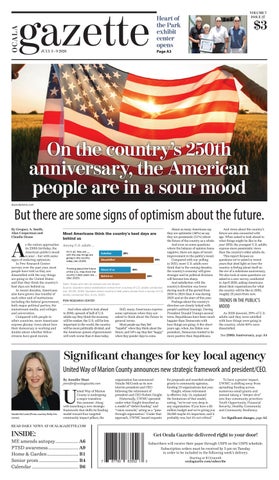
On the country’s 250th anniversary, the American people are in a sour mood depositphotos.com
But there are some signs of optimism about the future.
By Gregory A. Smith, Alan Cooperman and Claudia Deane
A
s the nation approaches its 250th birthday, the American public’s mood is sour – but with some signs of enduring optimism. In Pew Research Center surveys over the past year, most people have told us they are dissatisfied with the way things are going in the United States and that they think the country’s best days are behind us. In recent decades, Americans also have grown less trustful of each other and of institutions including the federal government, both major political parties, the mainstream media, and colleges and universities. Compared with people in other countries, more Americans express gloomy views about how their democracy is working and doubts about whether fellow citizens have good morals.
And when asked to look ahead to 2050, upward of half of U.S. adults say they think the economy will be weaker, the U.S. will be less important in the world, the country will be more politically divided, and the American system of government will work worse than it does today.
Still, many Americans express some optimism when they are asked to think about the future in general terms. Most people say they feel “hopeful” when they think about the future, and 54% say they feel “happy” when they ponder days to come.
About as many Americans say they are optimistic (48%) as say they are pessimistic (51%) about the future of the country as a whole. And even on some questions where the balance of opinion leans negative, there are signs of recent improvement in the public’s mood. Compared with our polling in 2023, more U.S. adults now think that in the coming decades, the country’s economy will grow stronger and its political divisions will become less sharp. And satisfaction with the country’s direction was lower during much of the period from 2020 to 2024 than it was during 2025 and at the start of this year. Feelings about the country’s direction are closely linked with people’s political leanings. During President Donald Trump’s second term, Republicans have been much happier than Democrats with how things are going. A few short years ago, when Joe Biden was president, Democrats tended to be more positive than Republicans.
And views about the country’s future are also connected with age. When asked to look ahead to what things might be like in the year 2050, the youngest U.S. adults express more pessimistic views than the country’s older adults do. This report focuses on questions we’ve asked in recent years that shed light on how the country is feeling about itself on the eve of a milestone anniversary. We also look at some questions we asked in a new survey, conducted in April 2026, asking Americans about their expectations for what the country will be like in 2050, roughly 25 years from now.
TRENDS IN THE PUBLIC’S MOOD
As 2026 dawned, 29% of U.S. adults said they were satisfied with how things were going in the country, while 69% were dissatisfied. See 250th Anniversary, page A4
Significant changes for key local agency United Way of Marion County announces new strategic framework and president/CEO. By Jennifer Hunt jennifer@ocalagazette.com
U Natalie McComb [Photo courtesy Reilly Arts Center]
nited Way of Marion County is undergoing a major transition this summer. Along with launching a new strategic framework that shifts its funding model toward four targeted community impact pillars, the
organization has announced Natalie McComb as its new interim president and CEO following the retirement of president and CEO Robert Haight. Historically, UWMC operated under what Haight described as a model of “deficit funding” and “vision councils,” acting as a “passthrough organization.” Under that approach, UWMC issued requests
for proposals and awarded smaller grants to community agencies, funding 19 organizations last year. Haight, whose retirement is effective July 15, explained the limitations of that model, noting, “we’re not very deep in any organization. If you have a $3 million budget and we’re giving you 20,000 maybe it’s important, and it probably was, but it’s not critical.”
To have a greater impact, UWMC is shifting away from spreading funding across numerous small grants and instead taking a “deeper dive” into four community priorities: Youth Opportunity, Financial Security, Healthy Community and Community Resiliency. See Significant changes, page A2
READ DAILY NEWS AT OCALAGAZETTE.COM
INSIDE:
ME amends autopsy..................... A6 PTSD awareness........................... A9 Home & Garden............................ B1 Senior prom................................... B4 Calendar......................................... B6
Subscribers will receive their paper through USPS on the USPS schedule. Subscription orders must be received by 5 pm on Tuesday in order to be included in the following week’s delivery. Starting at $13/month ocalagazette.com/subscribe