SPECIAL EDITION
theSignal O U A C H I T A
B A P T I S T
U N I V E R S I T Y
#ThrowbackThursday Provides Look into Signal, Ripples Past By TANNER WARD Editor-in-Chief
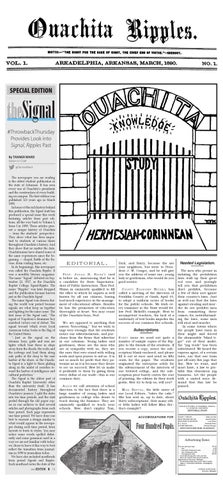
@TannerWard The newspaper you are reading is the oldest student publication in the state of Arkansas. It has seen every one of Ouachita’s presidents and the construction of every building on campus. The first edition was published 123 years ago in March 1890. In honor of the rich history behind this publication, the Signal staff has produced a special issue this week featuring articles from past editions, all the way back to Volume I, Issue I in 1890. These articles present a unique history of Ouachita — from the students’ perspective. They show what has been important to students at various times throughout Ouachita’s history. And they show that no matter the date, Ouachitonians have shared some of the same experiences since the beginning — chapel, Battle of the Ravine, dorm visiting times, etc. In its beginnings, this newspaper was called the Ouachita Ripples. It was a monthly literary magazine. The name “Signal” debuted on September 22, 1917, as the Ouachita Baptist College Signal-Ripples. The name “Ripples” was later dropped and the publication became known just as the Ouachita Signal. The name Signal was chosen during the world war period because signals are what keep us together and fighting for the same cause. The first issue of the Signal said, “The signal of Napoleon’s drummer boy snatched victory out of defeat. The signal toward which every loyal American today looks is the flag of the United States. “...Just as the signal on the streams, bays, gulfs and seas are lights which bear those in ships away from the shoals, the rocks and the icebergs and lead them along safe paths of the deep to the sure harbor at the shore, so the Ouachita Signal is a light to those gliding along in the midst of societies toward the harbor of intelligence and cultural perfection.” The Signal is the oldest part of Ouachita Baptist University other than the university itself. It has documented history throughout Ouachita’s journey. I split the dates into ten time periods, and the staff peeled through the old paper copies in our archives to find several articles and photographs from each time period. Each page represents one time period. We have done our best to recreate a design similar to what would appear in the newspaper during each time period, from layouts to fonts to styles. You may notice some words spelled differently and some grammar used in a way we are not familiar with today; we chose to leave it this way to best reflect the transition from journalism in 1890 to journalism today. We have also included mastheads from period Signals and Ripples. Each masthead notes the date of the see EDITOR z 10
editorial. P r o f . J o s i a h H. S h i n n ’ s card is before us, announcing that he is a candidate for State Superintendent of Public Instruction. That Prof. Shinn in eminently qualified to fill the office to which he aspires is well known by all our citizens, having had much experience in the management of educational affairs. Besides he has the promotion of education thoroughly at heart. You may count of the Ouachita boys, Prof. W e are opposed to anything that savors “boycotting,” but we wish to urge very strongly that the students notice our advertisements, and purchase from the firms that advertise in our columns. Young ladies and gentlemen, these are the men who are in sympathy with us, they are the ones that ever stand with willing souls and open purses to aid us. It is not so much for profit that they patronize us as it is because they desire to see us succeed. Now let us make it profitable to them by giving them every dollar of our trade—this is our common duty. A g a i n we call attention of school directors to the fact that there is a large number of young ladies and gentlemen in college who desire to teach during the Summer. They are eminently qualified to teach your schools. Now, don’t employ Tom,
Dick, and Harry, because the are your neighbors, but write to President J. W. Conger, and he will give you the address of some one, young lady or gentleman, who would do you good service. C o u n t y E x a m i n e r N i c k e l l has called a meeting of the directors of Franklin County at Ozark, April 19, to adopt a uniform series of books for the public schools. We wish every examiner in the State would follow Prof. Nickell’s example. Next to incompetent teachers, the lack of a uniformity of text books impedes the success of our common free schools.
Subscriptions.
E v e r y issue we send out quite a number of sample copies of the Ripples to the friends of the students. If you receive a copy, notice the subscription blank enclosed, and please fill it out at once and send us fifty cents for the paper. The students originated the enterprise solely for the advancement of the interests of our beloved college, and the subscription price barely covers the cost of printing; the editors do their work gratis. Now try to help us, will you? M i s s B e r t h a , the little sister of our Local Editors, “takes the cake.” She has sent in, up to date, about thirty subscriptions. How many other little ladies will follow Miss Bertha’s example? ACCOMODATIONS FOR
Four Hundred Pupils.
Needed Legislation. The men who persist in violating the prohibition laws wall up their great red eyes and jeeringly tell you that prohibition don’t prohibit, because a few of their sort ignore their country’s laws. Just as well say that the laws against stealing and murder do not prohibit men from committing these crimes, for, notwithstanding the laws, some men will steal and murder. In some towns where the people have risen in their might and forced the abominable “blind tiger” out of their midst, the “jug trade” has been substituted. We heard the express agent, of a certain town, say that one train put off sixty-five jugs that day. Now we want, and must have, a law to prohibit this obnoxious jug business. Let the people with a united voice demand that this law be passed.
Ouachita Ripples. Entered at Postoffice, at Arkadelphia, Arkansas, as second-class mail matter.
EDITORIAL STAFF.
GILES C. TAYLOR, . . . . . . . . . . . . . . . . . .Editor-in-Chief. MISS PAULINE PATTON, . . . . . . . . . . . Assistant Editor. MISS MAUD SLAUGHTER, . . . . . . . . . . . . Local Editor. B. L. ELLIS, . . . . . . . . . . . . . . . . . . . . . . . Exchange Editor. JOSIAH HARDAGE, . . . . . . . . . . . . . . Business Manager.
FIFTY CENTS PER YEAR, IN ADVANCE.
Advertising Rates. For one inch per year,. . . . . . . . . . . . . . . . . $4.00 “ two “ “ “ . . . . . . . . . . . . . . . . . . . 6.00 “ one-half column per year, . . . . . . . . . . . 12.00 “ one column per year, . . . . . . . . . . . . . . .18.00 “ one page per year,. . . . . . . . . . . . . . . . . 50.00 Local advertising five cents per line. Rates for shorter time mey be had on application to Business Manager. No deviation from these rates will be made. Address OUACHITA RIPPLES, Arkadelphia, Arkansas.
JOSIAH HARDAGE, Business Manager.
the college man is usually a gentleman A gentleman is a man of gentle and refined manners. Someone has said that refined manners are the natural expressions of an unselfish and kindly heat. Sometimes these elements of unselfishness and kindness are so overgrown by a selfish spirit, that they must be cultivated only by careful training. This training consists in daily practicing little acts of kindness and deference to others. At first these may be only mechanical, and not natural impulses; but this practice enables one to keep constantly before him the ideal and by so doing, he may finally attain to this ideal and make it a part of his nature. But we cannot deny that there are certain conventional rules of politeness that the most delicate instincts cannot prompt. These a man must acquire before he can reach the world’s idea of a gentleman. In college life, the boy who is to become the college-bred man, has the opportunity to obtain this two-fold training. He has entered this field for the purpose of improving his intellectual powers, and cultivating his better nature. Here he daily comes in contact with boys of every disposition, and in dealing with these, he learns to adapt himself to natures of every kind. He must make himself appreciate them in settling impartially questions that arise between himself and these other boys, he learns to realize and respect the rights of others, and to make allowances for their short comings. In addition to these students, who, like himself, are striving to develop the best that is in them, he has examples to follow his qualities of manhood. As his mind expands under their instruction, and by his own study, he learns to readily concede his liability to be mistaken in any matter, to be convinced that he is in the wrong and to confess it. Thus he learns to yield a point gracefully, an accomplishment which distinctly marks an educated man and a gentleman. The greater part of his associates are striving for refinement and culture, and so as the years go by, and the students advance, they establish certain customs that all must follow-- little acts of politeness which are learned by observation. Practicing these develops in the student the minor graces mentioned above which are essentials to refined manners. In every college there are certain rules and restrictions to be adhered to, which inculcate the spirit of deference. For example, if a student desires to make any arrangement in his work to transform from one class to another, he must have the consent of the President. He must also extend to the Professor of the class he is having the courtesy of explaining why he is leaving, and be honorably dismissed by him. The boy who has the ambition and perseverance to stay in this kind of training for four years, who daily improves these opportunities of showing unselfishness and kindness to others, and being found to show deference and respect, will as a rule, at the end of that time, have developed into a finished gentleman.
junior class prophecy After having waited in vain for the apathetic muse of history to descend and arouse our unfathomable genius, which persisted in remaining in a prodigiously alarming state of dormancy we are at last compelled to “plume our wings” for a solitary flight to impart to the innumerable throng of interested listeners a few of the trials and triumphs of the junior
2 n
March 14, 2013
class of “09. We have studied the lives of these great men and women sublime, and have drifted among the stars in our imagination and while we do not boast that they know everything, they do have a high degree of appreciation for things lovely an are fixed in the purpose, as that something from beyond whispers; “Build thee more stately mansions, O, my soul, As the swift seasons roll; Leave thy low vaulted part: Let each new temple, nobler than the last, Shut thee from heaven with a dome more vast; ‘Till thou are free, Leaving thine outgrown shell by life’s unresting sea.” Anyone who knows this progressive body of Junior Class as do the students, anyone who has the unspeakable privilege of associating with them at their best; at their worst recognizing the inexhaustible supply of knowledge of which we are daily led to believe by association and which requires maximum effort and restraint on their part to prevent from bursting the flood-gates and pouring forth in a torrent that would surely produce an overflow sufficient to float the universe. We, I say, who have the opportunity of recognizing these things is our Juniors, and can catch a vision of their hopes, their ideals and ambitions, ever broadening and expanding, must realize that they, as a whole, are swiftly leaving their lowvaulted past, and year by year are building more stately mansions and temples more vast. It would seem to us that there were nothing in any field whether of science, statesmanship, letters, oratory, generalship, soldier-craft, music or art; nothing indeed in which the Juniors of Ouachita Baptist College and Conservatory of Fine Arts, might not excel. So, when we are asked to write the prophecy of this great class we felt ourselves all inadequate, even unworthy of the task. We were sure that we could not begin to tell in our own estimation, what will be their future. We thought that any achievements we couldn’t think of for them would be so far short of what they will actually accomplish as to be almost ignoble. So we decided to call in super natural aid in the form of prophecy and find out what they will actually do. The Goddess of Phantasy transported us to the banks of the poetic Plaquemine and here we floated with its current in a little bark canoe. In drifting dreams we received the past; our spirit returned to the lost long ago, our youth, our college days and our Juniors. Happy visions bring before us their class, “Those grave and reverend Juniors!” Even more dignified than the senior class. Drifting, drifting we dreamed that we we awake. We thought of how society had lost its charm, how business life had become too public and monotonous and we wondered where our dear old friends and schoolmates were. What expressions of surprise and wonder flit across their faces if they could see this one of their number, once so joyous and care-free, now a pensive nun, solemn, steadfast and demure. Our canoe became in tangled with a maze of water lilies. How often had we wished for just such an opportunity of looking into nature. Just at this moment the muse of history, Clio appeared, so we decided to find our prophet in her. Troubled but finally turned to use and began; “With the aid of Mercury and his flying sandals, I traveled over mountains and oceans far, faraway to strange lands. At length I descended to earth and alighted at the part of a bluff which sloped to form the bank of
a tiny stream. Thinking this an ideal place to impart a secret which other muses had pledged to never reveal -that of a prophecy of the wonderful deeds of great and illustrious mortals who will live in the ages of the far, distant future. I dug a deep hole, and bending down, I shouted the wonderful prophecy into the ground. With this I was satisfied. Buds may have grown over the hole and may be to this day ringing the prophecy through their leaves as the wind blows them to and fro. I would advise you to listen to every bunch of reeds that you find growing by a stream. Possibly you may find that the spot I selected was on the banks of the Ouachita. This great secret is the prophecy of the Junior class of 1909. If ever it is found and you are disappointed in some of the members whom you consider so great, pray do not blame me for it. “What is to be will be.”
athletic notes The Ouachita Base Ball Team is just now getting in shape for playing real baseball. As yet, they have played no games of importance. They met the High School in three practice games, winning all three; also they won two out of three from Henderson. Every game shows much improvement over the last in the playing, and speaks well for the great good that Coach Riggs has done for the boys. The baseball department of the A.A.A. has been abandoned for this year and all the games will be on an independent basis. Mr. finger has written for games with various college teams but as yet we have no fixed schedule. We will have plenty of good games, and may be sure that our boys will hold up Ouachita’s old record in baseball. Among those from whom Coach Riggs is selecting the team is Muse, who is still performing behind the bat. He played with the team last year
and proved a good player with a cool head. Stell is trying out against him, and though he has little chance to show his real worth, he will probably be alternating behind the bat with Muse. In the box we have a trio of good pitchers. Finger, Manager and captain of the team, is well enough known without any introduction. It is enough to say that his speed and control are better than ever before. Byrne is a new man, but from his records, we know that he will make a reliable twirler. Sloan is also new and is doing fine work. He handles the stick with much success. Crow is again on the initial sack and is playing better than ever. C. Wallis is running around second instead of third this year and stopping everything that comes his way. Cannon is proving that he is a fast short stop. He played with Ouachita’s star team several years ago and is getting back into his old form. Stewart is a new man but is playing the third sack like an old timer. He is a heavy and safe hitter. Hughes and Pollard are trying for the left garden and both are competent players. Hughes is a new man but Pollard played sub on the team last year and is a good player. Carter, the fast outfielder, is occupying center field with great efficiency. Right field is at present being occupied by the pitchers to keep too many from the bench at the same time. The team works together nicely and we are sure that they will put up a good grade of ball this season. They are equipped with beautiful uniforms which add much to the appearance of the team. We hope to be able to give a record in the next issue of the good ball that all the students are sure to have. Gentlemen: Effie Goodgame, 1907 Prophecy: Lena Goodwin, 1909 Athletic Notes: Roy Cotton, Unknown
#ThrowbackThursday
A LETTER
CUPID THE CHAUFFEUR
MY ROOMY
I did not hear the broken gear, When riding out with Molly; I simply heard the single word Which sounded, then, so jolly. I did not feel the wobbling wheel. (I feel ‘twas unattended.) Her little hand was in mine. Grand! I think our lips were blended.
Dear Mother, I’m in Ouachita, And yes I love it too, It is the grandest school on earth And here much work to do.
When things go wrong and I’m cross and blue, Perhaps a wee bit homesick too, Who always smiles and makes things bright? My Roomy.
We must not talk of receptions, We must not think of boys, But always in our rooms remain Of quiet reap the joys.
When my parents come to town And I have not a new spring gown, Who lends me her’s without a frown? My Roomy.
I gave no thought to what I ought To do in case of trouble; Admit my mind was all inclined On Cupid’s brightest bubble. No look bestowed upon the road, Nor on the trees which fenced it, Till she said, “Yes.” Then, I confess, We both were “up against it.” – Selected.
It makes me think of days gone by, We’re not afraid at night, For when it’s time to go to bed, Miss Storts turns out the light.
She shares my pleasures, troubles, woes, A true friend, all my secrets knows, She’s thoroughbred from head to toes— My Roomy.
She comes around each night to see That we are all within, And she sometimes makes us believe We have committed sin.
So after all good-byes are said, And college days are past and dead, In memory I’ll hold her my dearest comrade My Roomy. – E. V. Hertz
Oh, yes, I love old Ouachita, I love its study hall And if I could my teachers please, I’d have no trouble at all.
LOCALS March, 1914
M I D - T E R M E X A M I N AT I O N S Editorial
“How’s your son getting on in college?” MR. TOLAND: “Not at all. Every time there are two men on bases and it’s his turn to bat, they bench him and give a substitute hitter a chance.” BRUCE: “Here! What do you mean by waking me out of a sound sleep?” ED: “The sound was too distressing.”
Miss Vera Jameson spent several days visiting Miss Betty Neel at the Majestic Hotel in Hot Springs the latter part of February.
PROF. LYLE: “Why are the middle ages known as the Dark Ages?” HOUSTON WOLF: “Because there were so many knights.”
Miss Mamie Cox, of Memphis, Tenn., visited Miss Lynnette Barnes from the fifteenth to eighteenth. Mrs. J. R. Autrey, from Columbus, spent a week with her daughter, Elizabeth.
www.obusignal.com
– Ruth Lyle.
1916
We have now finished our mid-term examinations. We, who have not fallen by the wayside, feel light and free, ready for the home stretch. It is gratifying to know that “F’s” are not so plentiful for this examination as for the previous one. Those who have been fortunate enough to get by both examinations without a fall, can get their second wind, and feel sure of the goal which is now in sight, for no ordinary conditions can knock them off the track. Yet, it is possible that one might fly the track even on the last mile. Let us hope that none may be so unfortunate this year.
It is a lamentable fact that some of our high schools and colleges are doing away with examinations. There may be evils resulting from examinations, yet we believe the good results far exceed the evil. Not only is the examination an aid to the teacher in determining the advancement of the pupil; but it is a revelation of the student’s advancement to himself. The most profitable weeks’ worth of an entire school year are those directly preceding examinations. The reference now is not to that cramming process that some use, but to that earnest, quiet review given to their studies by determined pupils, who are in school for a purpose. Students grasp and clinch thoughts in those examinations that they would not otherwise get.
The First Game of the Season
1916
By: Jason Fish
All the students and Ouachita supporters in town have been looking forward with interest for some time to the opening game of the baseball season. About thirty men have been reporting regularly for practice since the middle of February, but with the exception of two practice games, one with the “All Starts” from town, the other with the High School, no game was played under the 19th when we opened the season with a game between Ouachita and Arkansas University. The weather was almost ideal for baseball during the latter part
of February and the first half of March; but Winter must have decided on the 18th to make his last desperate stand against the oncoming tide of Spring. For on the 19th it was freezing cold, with a high wind from the north. People are accustomed to going to baseball games in their shirt sleeves and with a large palmetto fan. This time, however, they brought along their overcoats and wraps and built a log heap in front of the bleachers so they could comfortably watch the game. The game was called with Zellars and Toland as the battery for Ouachita, and Benton and Grover for Arkansas. Notwithstanding their “smoke” both pitchers were hit freely, Ouachita getting seven hits and Arkansas twelve. The field was slow on account of a rain in the
forenoon, and fast playing was impossible. The wind was also blowing at a terrific rate, which caused high fly balls to be very erratic in their flight. And as a result several “pop-ups” were misjudged by each team. All of these errors were costly and caused the score to be greater for each side than it should have been. There was no exceptionally good playing done by either team, though two from each one got “three-base hits.” The final score for the game was Arkansas 9 and Ouachita 4. While the game did not turn as we had hoped it would, still considering the weather and the condition of the field our boys made a good showing. We think that as the season advances we are going to have a winning team. -- J. S. F.
March 14, 2013
n 3
Twenty Pledges For Tigerettes Win Ouachita Players From Dumas 48-0 strange acts of wearers of
black mask make new dramatists very conspicuous
“soda pop” watts called back to make touchdown on his
The World Not Wrong, It’s Just You
alma mater
If you’re sick and tired of your empty life, Of your make believe and your sham, Of your weary toil and your useless strife, For the things that aren’t worth a “damn,” If you’re sore at the world and your fellow men, And disgusted with things that they do, Cheer up, my friend, and be glad once again, For the world’s not wrong, it’s just you.
1927 1927
Signal Staff
Signal Staff
The Ouachita Players held their third meeting of the year on Thursday night, Oct. 13, which by the way is a lucky date for the pledges. The assembly was brought to some semblance of order by the wailful and distressed voice of President “Hoss” Powers. There being no program, the pledging committee took charge and dealt out what misery it could to the new members, buy giving them some very definite instructions on what to do Friday. Each pledge was given a black mask to be worn about the neck until further notice shall be given. No pledge is to speak to an old member unless first spoken to. This item will prevent a great deal of useless conflab on the part of untrained minds and tongues. In order that they (the pledges) may not be slighted at chapel Friday, they will be permitted to remain standing until the first song has been finished. This will give them their first appearance before a public meeting, and will no doubt help rid them of any nervousness that may encompass them. Dietitians and food specialists everywhere agree that there is nothing so conducive to sound bodies and minds as slow and deliberate eating. In view of the fact, and in order to help the pledges all we can in forming correct personal habits, they are requested to eat their dessert Friday evening while standing. But before they partake of the dainties they will walk “hind part before” to the center of the dining hall and yell for Ouachita Players.
The Tigerettes trounced the Dumas High School Bob Cats on their own field Friday afternoon 47-0. All the little Tigers showed up well but the idea of playing college boys seemed to have frightened the Bob Cats. Bill Nowlin started the scoring in the fracas by dashing 20 yards for a touchdown on an end run. A few minutes later he took a pass from McMillan for the second touchdown. In the last half he made another on a short pass. Ouachita scored in every quarter and gained consistently through the Dumas line and by the aerial route. The Tigerettes outweighed the Dumas boys and showed the benefit of their experience. Bill Nowlin and B. Gill starred for Ouachita in the backfield and Harold “Soda Pop” Watts and Mat Norton in the line. Ross at quarter and Horton at tackle were best for Dumas. Officials: Referee, Collins (Arkansas); umpire, Denmark (Arkansas); head linesman, Burnett (Vanderbilt); time keeper, Pierce (Ouachita). Scoring: Touchdowns, Nowlin 3, McMillan, Gill, Henderson, Watts. Safety, Norton Ouachita. Points after touchdown, Nowlin 3, (Pass from McMillan).
Sports Notes
1927
Benton High School ended a long disputed question of superiority with the Arkadelphia Badgers in A.U. Williams Stadium. Benton won 6 to 0.
Office for Signal and Annual Staffs
1927
Signal Staff
Mr. Hill, recognizing the handicap under which the Signal and Ouachitonian staffs have been working, has helped them by establishing a publications office on the third floor of the administration building. A very comfortable workroom has been established in the old Philomathean library. It is equipped with desks, chairs, typewriters, and excellent lighting facilities. The Ouachitonian and the Signal staffs certainly appreciate this convenience and promise to give the student body better service.
If all you can see in a man or in life Is just hypocritical fraud, If your faith is gone and your thinking rife, With vague theories concerning God; IF the way seems dark and the path seems long, And if Fate seems turned against you, Change the point of your view, then sing a glad song, For the world’s not wrong, it’s just you. For whether you’re sad or whether you’re glad, This old world is here to remain, The same blessing the just and the unjust have had But yours you forgot to acclaim. Change your “outlook” on life to an “uplift,” my friend, Paint your dark clouds a rosy hue; Leave your low plane of life and to higher ascend, For the world’s not wrong, it’s just you. – Wilfred P. Harman, 1928
Class of 1935 buys tiger statue Signal Staff
1928
A life-sized tiger carved in stone will be the memorial left to the college by the senior class of 1935. The plan was presented to the seniors at their first meeting, Wednesday, September 19. The work will be done by B. F. Worley, a professional stone mason, recently matriculated as a ministerial student. As soon as the seven-ton stone of Batesville marble arrives, Mr. Worley will begin work on the tiger which is to be six feet in length with proportionate height. The scupltor estimates that the finished piece of work will weigh approximately 4,000 pounds. During the few weeks of school this year, he has carved several small tigers and sold them to students as souvenirs. The large tiger will be carved on the same pattern. The large tiger is to be placed on the college campus on the lawn between the administration building and the president’s home, and will be unveiled on Thanksgiving Day, November 29, just before the annual football game bwetween the Ouachita Tigers and the Henderson Reddies. Mr. Worley for the past eight years has gained renown in stone work. He acquired the idea of carving the animal from the University of Texas at Austin, for which he carved the school emblem “Long Horns,” when he was employed by a stone company. Worley is giving up stone work for the ministry. He spoke of the art as a great pleaasure and says he would not give it up for anything except a “call of God” which he now feels. “This tiger will probably be my last large piece of work,” he said.
Ouachita’s rivals from over the ravine defeated the Magnolia Aggies at Hope Friday by a 14 to 0 score. This gives the Reddies a better place on the dope sheet than that held by the Tigers.
Vanderbilt handed the Tigers a drubbing for the first defeat of the Arkansas champions in 25 games. Had Reasoner been in there against the Commodores, we doubt that the score would have been more than half as large.
College of the Ozarks were defeated for the second time this season by a large score. The Arkansas Razorbacks had the big end of a 32 to 0 score in Fayetteville.
The most important game in the state from the championship aspect was the Eagle-Bulldog tilt in Little Rock. The Eagles led the first half 10-9 but the Hendrix crew came back strong in the last frame and piled up a big score making the final score 27 to 10.
4 n
March 14, 2013
#ThrowbackThursday
EVERY BUY A BULL’S EYE
Things to think in Chapel: getting through the hour sane and awake
1949
By: Nancy Boothe
Fred L. Packer––Breaker Editorial Cartoon, Inc.
1944
Signal Staff
The campus Sixth War Loan Drive, under the direction of the Signal Staff, began November 20. The campus has a goal of $500. This means that each student will have to invest one dollar or more in stamps or bonds. Aside from the campus goal, Ouachita is trying to raise $3000. A special war stamp booth has been set up in front of the Dining hall and is open all day. Goals have been assigned to each of the Social Clubs and representatives have been chosen to aid the committee in selling stamps. The representatives who will direct a campaign within their own clubs are as follows: Hi Hate, Culley Yates; Kewpies, Mary Bob Hodges; E.E.E’s, Barbara Rudolph; W.C.F., Betty Lou Hampton; Gamma Phi, Vicki Brown; Beta Beta, Oras Dotson; S.A.S.,
Jack Rowe; Rho Sigma, Glen Baker; A.R.C’s, Jesse Gladden. Other organizations which have been asked to help are: Rel Ed Club, Volunteer Band, Life Service Band, Ministerial Association, and Dramatic Club. Dr. J.R. Grant and Mr. Price are giving their full cooperation. Professor J.C. Stewart is acting as faculty chairman and Mayme Beaty is student chairman. Aside from the official stamp booth and campaigning, a special program has been arranged for each week of the drive stressing the sale of bonds. A special Thanksgiving Day program will be staged during the noonday meal. Admission will be a twenty-five cent war stamp. During the week of December 4 there will be a basketball game in connection with the drive. Coach and Miss Cowan are in charge of this event. The last week will be climaxed by a Christmas play which will be given in chapel. Every student is urged to remember his duty and support this cause.
Oh Waitresses
1946
By: Bill Osborne
There are, to begin with, two kinds of waitresses. Good waitresses and bad waitresses. During my life I have come in contact with both types and in fact, I feel that I should set up some kind of organization similar to the one Duncan Hines inaugurated except that mine would be in regard to waitresses instead of restaurants. Looking ahead, I can see a large sign outside of attractive eating places with large bold lettering stating that, "Osborne recommends the waitresses in this restaurant." The only trouble I see in this is the ac that people now days are more interested in food than in who brings it to them. There s a very pretentious restaurant in Kansas City known as "Fred Harvey's." There you have the example of what I term the perfect waitress. I sometimes believe those girls have psychic powers. No sooner have you put own your empty appetizer glass than she materializes to remove it. The instant you lay down your knife and fork., having finished the main course, she appears with the dessert. This sort of thing has led me to suspect Fred Harvey of using witchcraft. In spite of the fact that these waitresses have acquired a high degree of perfect on they sometimes irritate me with their blasted efficiency. In contrast, there is the talkative type
www.obusignal.com
Yawn and cross your legs and slide further down into your seat. Glance idly about the room. Make sure the professor isn’t looking in your direction, then sneak a look at your watch. Try to convince yourself that it’s right and that it’s really that early after all. Reach over and pull back the sleeve of the lad on your right and check by his watch. Uncross your legs and sit up straighter. Study the shirt on the boy in front of you. Would you like a shirt like that? Would a shirt like taht like you? Is the collar clean? About how long would you say he’s worn that shirt? Where do they get people who’ll make shirts like that? Are shirts like that really made from castoff quilts? Consider the professor... Try to figure out what he does with his spare time. Does he ever stop talking? How must his wife feel about im? Don’t linger too
long om the subject, you’re on dangerous ground. Count the number of times he said “uh” in a sentence. Is there anything particularly wrong, and how did he know? Look at the lad on your right. Is he asleep or is he doing a crossword puzzle? If he’s asleep stare at him for a minute or two. Then begin making faces at him. If this doesn’t affect him, bear down and, staring hard at the center of his forehead, say over and over to yourself: “You are tired of it all, so tired. You can’t stand it any longer. You have got to get up and scream.” Try this several times. If he really gets up and screams don’t ever do it again -- it might develop into a power complex. If he fails to work, consider him. Does he ever take notes? Can you honestly say you’ve ever seen him take notes? What is he going to do when tests come around? What does everyone else do? Do they have friends? Why don’t you? Sit up again. Cough. Wait two minutes, by your watch, then cough again. Keep this up until you’ve coughed seven
times. Then try coughing backwards. Coughing backwards seven times at two minute intervals. Cross your legs. Watch the movement of your professor’s lips. Try to imagine what his mouth looks like inside. Do you think you could tell how old he is by his teeth? Do you think he’d bite you if you tried? Why? What would you do if he bit you? What would he do if you bit him? Do you believe in a double standard in such cases? Study the expression on the faces around you. Can you tell a 21 expression from a -|- expression? You’re not very good, are you? Can the professor tell? Do you think he feels any better because of it? Look at your watch again, openly this time. Sigh and uncross your legs and squirem into semi-comfortable position. Keep your eye on your watch and try to say “bong” just a fraction of a second before the bells start tinging. Walk as fast as you can out of the building and see how far away you can get before the bells stop. (Copied from the Rice Institute, Houston, Texas.)
also raided the superlative degree of praise (tricky). The Tiger was indeed, TRICKY beyond any shadow of a doubt. Up to that time, he had only been an old hound dog that always hung around the dining hall but in that moment he was transformed to greatness by a little bit of poster paint. An expedition of four men started out Saturday afternoon to catch a tiger for the Magnolia game. Ordinarily the old dog would have been in the way but he was no place to be found just when he had an opportunity to be of service to Ouachita. The crew ventured to the very heart of Henderson’s campus and had unsuccessfully tried to “acquire” two dogs for their experiment. They were unsuccessful because the owner caught them before they could get either dog in the car. About to give up, the hunters decided to go back to the ti-
ger stadium once more and what should meet their eyes but this old dog that they had been hunting. Very little stalking was necessary to catch the animal. When the animal arrived at Wallis Hall, he was touched up and changed from a canine to a cat. The dog was very notable while the preceedings were taking place -- it took two pounds of beef to keep him occupied. He was then transported to the stadium to wait for his glorious debut. Certainly, that dog has been to every ballgame in Arkadelphia for the past two years but his moment of triumph came Saturday night when he was the center of attraction. The next time you see that dog on the campus do away with your dignity and stoop over to pat him on the head and say a kind word to him. That will be enough to him to show that you appreciate the tiger spirit.
Don’t be scared to pet the Tiger; he quite likes it!
1948
By: Roy Carroll
“Hey, there is a tiger under the bleachers! Look out, here he comes!” Those were the words that ushered into the limelight a majestic beast of the jumgle. Saturday night for the first time many people got to see a tiger. No one was hurt in a mad rush for cover because the tiger was held in check by Jim “Bring ‘Em Back Alive!” Pleitz. As the tiger sauntered up and down in front of the bleachers roaring in a mighty voice, the stands went wild with enthusiasm. It was truly a sight to behold -- that black and orange creature from the heart of the deep dark Ouachita campus. He was not only majestic, magnificient and awe-inspiring but he
typical of small chop houses. In Alexandria, Louisiana , I discovered just that sort of person. I made the mistake of sitting at the counter and I don't mean to be didactic when I warn you never to sit at any counter in Alexandria. In the first place you are inviting trouble because in Alexandra anyone who sits at the counter has already expressed his desire to converse with the waitress. That counter has automatically put you in the parlor of the cafe. After I had given my order she launched into a thesis on the woes of a waitress and by the tie I had finished eating I knew enough about her past for blackmail. I derived a sort o sympathetic pleasure from that because I realized that waitresses are more inhibited than most people and besides they always have such interesting stories. In 1944 they had a new waitress at the Elk Horn hotel of Colorado Springs, I can detect a new waitress immediately by the conspicuous effort they make in trying to carry the water in one hand and the menus in the other. Statistics prove that two out of every ten new waitresses cannot make it safely to a take without mishap. This one tripped n a chair leg and showered water all over the floor. She was undaunted, however, and was determined to make it safely in her second attempt. I could tell by the purposeful gleam in her eyes as she crept to our table that she would make it successfully. Carefully taking our orders she started for the kitchen only to stop half way, turn, and come back announcing that there were no more scalloped potatoes. That sort of thing is typical
of new waitresses. She has waited on twenty-five people since the potatoes were gone; yet she will indubitably find herself half way to the kitchen before the remembers. In twenty minutes she was returning with the food and you can bet your last dollar that she will give me the vegetable plate and my friend the steak when it should be the opposite. Waitresses never deal in personalities. They say to themselves, "Chair on the left has steak and chair on the right has vegetable plate." Meanwhile she has taken other orders and it is inevitable that you will get he wrong thing. I thought it would be a clever strategy on my part if I switched seats with my friend in order to avoid confusion when she gave me the vegetables instead of the steak. Satisfied with this ingenuity I settled back in my chair confident that I had avoided an embarrassing situation. The waitress, without a moment's hesitation placed the steaming vegetables in front of me. New waitresses sometimes frustrate me. They aren't nearly as pellucid as they seem. If you are ever in Norfolk, Virginia don't fail to stop at a place called the "Patrick Henry Inn." It is a long, vinecovered stone anachronism that fairly reeks with local color. Inside, it is decorated in an old American motif complete with Paul Revere lamps and pseudo antique furnishings. My friend and I were so absorbed by the atmosphere that we failed to see the waitress standing at our table. I say "waitress" for lack of a better term because whren my eyes finally rested on her I was non-plussed. I started to say "shocked" but that would have been trite, and, in fact, would have
been inadequate. She was tremendous. Her arms were like those of the village smith. Her hair was short and curly like Hercules' and I could easily imagine her in the wrestling ring. Heretofore I had thought myself to be a connoisseur of waitresses but in this case I had to admit I was stumped. In fact it was I who was on the defensive. She threw the menus on the table and stood there with those tremendous arms on her hips. I wsa thinking wildly trying to conjure up some kind of defense to put myself in charge of the situation. I wanted her to feel that she was dealing with a man who was an authority on waitresses. Suddenly I knew my only hope to put her on the defensive would be to embarrass her in some way. She took our orders and reached again for the menus when suddenly my glass of water topped over splashing water on both the table and the surprised Amazon. Now always in the past when something like this happened the waitress was very gracious and apologetic. This one was neither. "Say, Mac," she said, looking me squarely in the eye, "are you drunk?" Now abstinence is one of my few virtues and one of the most irritating things I know of is to be accused of being drunk. In my most forceful tone of voice I said, "No Madame." I was thinking of something more flippant such as "dearie." With that, she turned and walked away never to come near our table again. I really don't know much about the quality of food at the Patrick Henry Inn but if you're ever in Norfolk don't fail to stop there because, as I said before, the local color comes in very large packages.
March 14, 2013
n 5
How to successfully cut chapel
1959
By: J.D. Scharfenberg
Being new on campus I have noticed that the majority of students are faced with one problem in particular, “How to Successfully Cut Chapel.” After much research into said subject matter I am under the conviction that I have solved the problem temporarily or until such a time that a better solution may be discovered. To be able to cut chapel successfully you must; (1) Find the chick who checks your seat and CHECK the chick; (2) After
you check the chick who checks your seat, locate the chick checker who checks the chick that checks you and CHECK the chick checker. Some solutions to problems you might encounter while achieving your goal: (A) If the chick who checks you becomes disturbed because you have also CHECKED the chick checker who checks the chick who checks you, steps must be taken to once again win the chick’s friendship. For example, a nice token of your appreciation for overlooking your absence in chapel would be a sawbuck. (B) However, the chick
checker who checks the chick who checks you may show a dislike for this type of bribery. At this point the chick checker who checks the chick who checks you may require a greater show of affection and gifts even if the chick checker who checks the chick who checks you is not very pleasing to the eye of the chick checker. (C) After this process continues (A and B), for a period of time in which you discover that this method of operation is costly, you may come to the same conclusion which I have reached concerning out problem. IT DOESN’T PAY TO CUT CHAPEL!
JFK: Legacy of an American By: Dwight Fine
1963
There was once a man living in the United States who seemed to embody the American Ideal; the Ideal set forth in the Declaration of Independence which was “that all men are created equal, that they are endowed by their creator with certain unalienable rights, that among these are life, liberty, and the pursuit of happiness.” This man could have lived in 1865 of 1964, but the date is not important. As he lived, he expressed a compassion for all persons of all races and social stations. He desired that everyone could receive an adequate education to cope with 20th century problems. He envisioned the sick and feebled having adequate medical attention, both physical and mental. He worked so that someday everyone would have a decent place in which to live. He strove for equal and full employment for all persons. He endeavored to bring economic recovery and stability to the newly emerging nations of the world. As one can see, this man must have been very compassionate. He wanted to see a standard of living above which all men could rise, but below which no man could fall. this was the type of man that one might want for a neighbor or even a leader, for indeed he appeared to be a great, good man. But to some he appeared to be a wolf in sheep’s clothing. To some he appeared to be power hungry; trying to establish a dynasty or a monarchy. He was to them a dangerous man. To others he was regarded as an exponent of the rule of law and not of men. This was most despicable. He was con-
sidered a pseudo-liberal who accepted the Negro as an equal to others. This was the ultimate crime against the closed society. To those people it appeared that he would have to be impeached. As the accusations against this man mounted, the majority of the people were willing to be restricted to the sidelines of American political activity. They were content to let things remain just as they existed. They were willing to remain seated until the hatred generated by this intense personal attack caused all to stand as the eulogies were spoke, the prayers were prayed, and the dirges were celebrated. Americans were willing to stand by and witness the waste of a young man’s life. His life was wasted because Americans were afraid to say “He is our President until the Inauguration in January, 1965. Until then, one can attack his party, his laws, or his program, but you cannot attack him or his family. If one does attack his program, then one must propose something better for blind obstructionism only generates chaos.” The stand then could have stopped the hatred that took the life of one, John Fitzgerald Kennedy. He was indeed a great and good man, but most Americans realized it all too late. Maybe his life will not have been in vain, though, for perhaps his brief passage across the American scene will uncover something higher and nobler in each American citizen. Now he is gone, and it is up to the American people to see that his legacy lives on. As Mike Mansfield has said, “He gave us of his love that we, too, in turn, might give to one another until there would be no room, no room at all, for the bigotry, the hatred prejudice, and the arrogance which converged in that moment of horror to strike him down.”
Boone Conducts Lab Experiment To Make Alcoholic Of Cat, Freida
1959
By: J.D. Scharfenberg
An experiment to see if Freida the Cat will drink milk with alcohol added after being given alcohol in capsule form over a period of time is being conducted by Gene Boone, Ouachita senior chemistry major from Charleston, South Carolina. At the start of the experiment, Boone placed two pans of milk in front of Freida. One contained plain milk and the other contained a mixture of milk and pure grain alcohol. Freida chose the pan of milk without the alcohol. Alcohol is given to the cat in capsule form so that she will not learn to like it from taste or smell. During the first week of the experiment, Gene gave the cat 2 ½ cc’s of alcohol a day in capsule form. At the end of the first week, he gave Freida 10 capsules with 5cc’s, to fully intoxicate her for the first time. Now he gives her 5cc’s twice
a week to make her drunk and 2 ½ cc’s the rest of the week. When Freida is drunk, she is not able to climb trees and loses her balance. While she is intoxicated, she will not drink milk no matter how hungry she is. She walks with hindquarters wobbling from side to side. Freida stagers and stumbles, trying to be friendly as possible while drunk, but is comparatively wild and shies away from people while sober. Drunk or sober, Freida knows her master and is right on Boone’s heels wherever he goes. Gene plans to continue giving Freida the same dosage of alcohol for another week. At the end of the week, he will repeat the same test he did when the experiment began. Boone contends that if Freida chooses the pan of milk with the alcohol in it he will have proved the hypothesis that after the cat has taken alcohol in capsule form over a period of time, eliminating desire based on sense of taste or smell, that there is a physical dependency.
UNDEFEATED SHARP SHOOTERS – The Ouachita Rifle Team remains undefeated in the Arkansas Rifle League and holds seventh place in competition with other teams of the fourth army area.
6 n
March 14, 2013
#ThrowbackThursday
Ouachita Becomes University
1965
Signal Staff
Ouachita Baptist College became Ouachita Baptist University on Jan. 14 when the board of trustees voted to change the school’s name. Although the name has already been put into effect by the student body, the change will not become effective until the necessary legal documents are filed with the office of the Arkansas Secretary of State. Ouachita, founded in 1886, is the largest private school in the state. “This matter had been under consider-
ation by the administration, faculty, and trustees for several years, and the action was taken after a separate school of nursing was established in Little Rock and after conferring with our consultant from the North Central Association for colleges and Secondary Schools,” Dr. Phelps said. “With a graduate program and with two separate schools in different cities, we have the essential ingredients for a university and took the action as an essential step in a developing education program for the state of Arkansas,” Dr. Phelps continued. Ouachita has been operating an extension center in the Camden since the fall of 1962. The school’s graduate program
was started in 1959 and includes an M.A. in religion and American Civilization and a master of music education. It was also voted by the trustees to add an M.A. in education. In other board action it was reported that the three-year endowment drive to add $1,200,000 has already been broken by $66,000. The board, grateful for this success, adopted a new goal for 1970 by an addition of another $8 million. R.D. (Rab) Rodgers recommended that the job of athletic director and head football coach be divided into two separate jobs and that Buddy Bob Benson be named head football coach. Rodgers was named athletic director.
Rodgers, head football coach and athletic director for 11 years, was a highly successful high school and junior college coach before coming to Ouachita. Benson, who was previously head track coach and assistant to Rodgers in football, was a high school All-American selection from De Queen. He is best remembered for his winning touchdown pass when the 1964 Razorbacks defeated Ole Miss at Little Rock. His duties began last Monday when approximately 40 gridiron specialists started spring football practice. The board also adopted a solution commending Rodgers for his outstanding job. It authorized the school to add a line coach.
Midnight Curfew Set For Penny a Minute
1964
Signal Staff
Friday night will be ‘penny night” sponsored by the Association of Women Students. On that night girls may stay out as late as 12 a.m. if they or their dates pay the AWS a penny for every minute after 11:30. All girls must be in the dormitory by 12. Money collected on “penny night” will be used to help sponsor a Korean orphan, one of the AWS’s projects for the year. On Dec. 15 the AWS will sponsor a “drop-in” between 2 and 4:30 in the student center drawing room. All students and faculty members are invited.
1977
As a Halloween “trick” this car was placed on the pedestrian bridge Monday by anonymous students. The car, an MG Triumph belonging to Terry Toller, was picked up over the handrail and placed in the middle of the bridge, then driven off.
Tiger sculptor returns after 43 years By: Janet Adams
1977
The sculptor of the Ouachita tiger, a symbol of school spirit, recently returned to Ouachita 43 years after the fact to find his work of art tailless and toothless and the beautiful white marble covered with gold paint…but still standing. Ben F. Worley, a professional sculptor who gave up his career to enter the ministry, undertook the task of carving a life size North American Tiger to be mounted on the campus lawn as a gift from the 1935 senior class. He was a Ouachita student at the time. He learned this art from his Italian father, who was in the stone business. Before coming to Ouachita at the age of 25, Worley did flat panel carvings at the Louisiana State Capitol, carved the Saints in the Philadelphia Cathedral and the eagles above the Little Rock post office. Even though these birds look life size from the ground, Worley said that they are actually nine feet in height. “I hate to see how the tiger has gotten broken up,” said Worley. An attempt at restoration was made once, related Worley. He constructed a new tail out of concrete, and the students took off the gold paint by putting gas on the tiger and burning it. Underneath, the marble tiger was as good as new. “I really wouldn’t mind carving a new tiger,” or “Restoring the old one,” but only under the condition that it would be encaged in a safety glass enclosure or bars in order to keep vandals from mutilating it, said Worley. A lot went into the making of OBU’s tiger. Somewhere in New York, the president of the senior class obtained a model of a North American Tiger. The school administration offered to exchange tuition for Worley’s skill, and the senior class offered to buy the marble. “Back in those days,” said Worley, “schools didn’t have money.”
www.obusignal.com
The senior class got a truck, drove to Batesville and found a seven ton piece of hard Batesville Marble which had broken and fallen down between railroad tracks while being loaded onto a train. “It was beautiful,” said Worley. After securing help, they picked the block of marble up and turned it around. It was then cut down to get the seams out, leaving one 2 ½ ton piece of solid flawless marble. There was no charge to the senior class for the marble, but they did have to absorb the expense of getting help with breaking it up and loading. In order to give the tiger a realistic look, Worley made a trip to Tulsa, the only place that housed North American Tigers, and studied the actual size and features of the tiger before carving it. Wishing that the tier had been placed at eye level so people could observe the details of viciousness sculpted into the tiger’s face. Worley said “It would really bite you when I carved it, but I don’t think it would now.” However, it did cause a lot of viciousness between the Tiger and the Reddies fans. So much so, in fact, that the two teams had to quite playing each other for several years. According to Worley, the Henderson students loved to paint the tiger; gang fights erupted and students even threw brickbats at each other. Worley said he enjoyed carving the tiger and appreciates knowing it has been an outstanding monument all these years. “It gives you a good feeling” to know that you’ve contributed something, said Worley. Even though he gave up an obviously brilliant career in stone work, Worley said that he has “no regrets,” and would do the same thing again. “The call of the Lord is wonderful, really,” said Worley, adding that having the privilege to witness and be used by the Lord to mold a soul is the greatest piece of sculpture work he can do. Worley, how has pastored in Texas, North Carolina, and Louisiana, is retired now and says he might get back into sculpturing as a hobby, simply as something to keep him busy.
Prejudice Against Women By: Janet Adams In 1961, for the first time in our nation’s history, a woman’s name was placed in nomination for the Presidency at a national convention of a major political party. This event would have been more notable if it had been more than an election-year gesture; everyone understood that Margaret Chase Smith had as much chance of getting the Republication nomination as Lyndon Johnson. The fact that today, after four decades of woman suffrage in this country, the possibility of a woman’s actually becoming President is so remote as to be comical sets people to wondering. Just what jobs are woman capable handling today? What particular qualities are they thought to possess that would make them good at one kind of work and bad at another? The most common reason given for distrust of a woman in the White House is that women are too emotional. “When decisions as serious as war confront the President,” wrote a Florida man, “I am afraid cold logic is preferred to mother love. I am sorry that this has to be so, but we do not live in a Utopia.” The minority who would like to see a woman become President are willing to grant that most women are more emotional than most men, but they feel that a woman who works her way to that position is of a very different caliber form that of an ordinary woman. Although a number of wives and mothers fear that a woman President would be distracted from affairs of state by the shrieks of her children echoing through the White House corridors, other agreed that motherhood is an excellent qualification for the Presidency. The emotionalism that mother hood brings might make a woman’s heart rule her head at times, but the world today needs more compassion. Women are much more creative, idealistic, loyal, and sociable than men, but that are also more emotional, jealous, narrowminded, and petty. For this very reason most women consider their special role in society and the home first. A North Carolina housewife summed up the female sentiment toward a woman President with these words: “Let women do whatever they like, whether it’s running a diesel engine or loading a boxcar. For myself I still prefer to be thought of a feminine and delicate. I enjoy being pampered, having men open doors for me, stand to greet me, help me with my coat. I do not want ment to classify me as one of the guys I work with.”
March 14, 2013
n 7
ZAPPED!! 1980
By: Jeff Root
How many times has it happened to you? You are late for class; so you park as close to your class as you can, disregarding the parking zones. Upon returning from class you find a white piece of paper that will cost you a green piece of paper because you are a blue and you parked in a silver. In other words, you got zapped. Almost inevitably, the ticket-giver (who looks like a student but is much too cruel to be) has arrived at the scene of the crime just as class is over. No matter how much you plead with the ticketgiver, he will never let you off the hook once he has started writing the ticket. Once again you have been engulfed by the awful efficiency of the school. It may seem that way at first but, in reality, the parking zones and citations save many more headaches than they cause. Ouachita worked out its zoning plan in the mid70s when the increased use of cars by students began to cause parking problems. It is probably hard for most of us to imagine present-day Ouachita without parking zones, but even a meager imagination can think of the problems we would have without them. Fines for Ouachita traffic citations are marginal unless creative parking becomes a habit. The fines run on the now-famous scale of one dollar for the first citation, two dollars for the second, three dollars for the third, and so forth. The scale is easy on the occasional offender but can be tough on the habitual space-hogger. By the tenth citation the offender has given up $55. Citations are paid in the business office in Grant Hall
but the money doesn’t stop there. According to B. Aldon Dixon, dean of students, the money goes into a general university fund. The fund is used to pay for general improvements such as the paving of parking lots. As the school continues to grow and plans are made for the Centennial in 1986, improved parking has not been left out. The 1986 Campus Plan calls for parking lots where several buildings now stand, including TerrelMoore, Johnson Hall, and Walton Gymnasium. Since most of us won’t be around in 1986, let us consider an existing parking lot which is not used to its full potential. This is the gravel lot behind Mitchell Auditorium. It is undesignated, so anyone can use it. It would be especially useful for owners of brown and blue permits since there is lighting all the way to the girls’ dormitories. According to Dixon, there is no “trouble” section of the campus where more citations are issued than other sections. At the beginning of the semester, the brown section led the others in citations. The brown section is used predominantly by freshman girls. Recently, citations have leveled off to be just about equal in all areas. Occasionally, the need for rezoning may occur. To determine when this is necessary each parking lot is checked every hour for vacant spaces. Every year someone comes up with a scheme to try to beat the system, according to Dixon. Very few have any success. When a car with a license number not registered with the school receives its third citation, it is traced. This prevents a student from simply driving an unregistered car. The best way to get around a citation is to simply park in the correct zone. Then the ticket-givers can only smile and move on.
The white sheet of paper that makes you see red
Ticket-giver Roger Felty is only doing his job, but ticket-getter Mike Hart is not too happy about the matter.
Quarterback has to make himself study
1980
By: Jill Tilley Hankins
Although Watty Strickland, a junior at Ouachita, is out on the football field every Saturday as Tiger quarterback, his priorities do not end at the goal line. With a grade-point-average of 3.939 out of a possible 4.00, Strickland defies the myth of a “jock without brains.” His only “B” was in a fourhour calculus class. To attain his goal to be an engineer, he tries to “study a little every night to keep from getting behind and go to all classes.” But it isn’t easy, especially in the fall during football season. Strickland practices football two and a half hours every weekday afternoon, watches films of past games, carries a class schedule of at least 15 hours and tries to find time for hunting squirrels and dating his girlfriend Carrie Sligh, a junior at OBU. “I have to make myself study,” he said. “It’s hard during football season, but I have more time in the spring for studying and dating.” He is majoring in physics, which is related to engineering. After graduation, he plans to go to an engineering school, although unsure about his area of specialization. Since his parents live in Bethel, Alaska, Strickland doesn’t get to go home on weekends like many students do. He flies home over the Christmas break and during the summer to work. “I like Alaska a lot,” he said. “The scenery is
8 n
March 14, 2013
pretty, especially the mountains.” “Bethel has a population of 2,000 with no roads into or out of the city – only roads within. You have to go in by plane or boat. But Bethel is the main city in that area of Alaska so it has an airport where 727s can land.” As a wildlife refuge manager, Strickland’s father Charles moved his wife and three youngest sons to Alaska while his oldest son, Watty, was a freshman at OBU. “I went to high school two years in South Carolina and one in Crossett,” said Strickland. In Crossett, he was an all district quarterback and an honor graduate. Through the recruiting efforts of Bill Vining, head basketball coach at OBU, Strickland came to Ouachita. Although is parents have attended rival schools, the University of Arkansas at Monticello and Henderson State University; they both graduated from Arkadelphia High School and they were pleased with his decision. Once at OBU, Strickland became a member of Rho Sigma men’s social club and Blue Key national honor fraternity. In his free time, he plays basketball and tennis “just for fun,” but he says “If I have any extra time, I probably need to be studying.” During the summer while he works, Strickland likes to hunt and fish in Alaska and to read “one good long book,” something he can’t find time to do while in school. What is Strickland’s real first name? Charles Watkins, just like his father’s. His grandfather was celled “Watty,” so it was passed down to avoid the confusion of two Charles.’
Strickland defies the myth of a ‘jock without brains’
Watty Strickland, Carrie Sligh
#ThrowbackThursday
Steven Curtis Chapman: A life like no other This is the great adventure
1992
By: Scott Pickle
The biggest concert event in OBU’s history easily sold out the 1,500-seat JPAC. Steven Curtis Chapman, Susan Ashton and Out of the Grey are saddlin’ up The Great Adventure tour with an unorthodox stop in Arkadelphia. After dedicating ten years to singing and songwriting, it’s hardly fair to call Steven Curtis Chapman an “overnight success.” “Overnight popularity” is a more adequate description. Chapman has certainly paid his dues in hard work over the last decade. First Hand was Chapman’s first album—back in 1987. But it wasn’t his first appearance in the Nashville music scene. Steven spent his collegiate
summers working in Nashville as a singer and dancer at Opryland, U.S.A. During this time, Steven developed relationships with the publishers and producers of major Christian labels. He finally signed with Paragon/Benson, relying on his songwriting abilities. He wrote for the Imperials, White Heart and Sandi Patti, distinguishing himself as a future star. Steven says that he was influenced musically by Dallas Holm, the Imperials and the Archers. There is no doubt that he’s created and solidified his own style over his five-album career. Chapman’s latest project is his refreshing video for The Great Adventure. Chapman and his wife, Mary Beth live in Nashville, TN and have tree children: Emily, Caleb and Will Franklin. They recently built a new home, Peach Hill, in south Nashville.
Everyday can be a day to give thanks
1989
By: Kent Smith
The anticipation of Thanksgiving employs thoughts of turkey, touchdowns, and Ted Turner (Advisory Note: eating should be a latter option to thinking of Ted Turner). The much merited Thanksgiving break grants a drawing together of families, much feasting, and allows students an opportunity to catch their breath before the final stretch of the Fall educational quest. Nonethe-less, amidst the season of counting your many blessings, some reflections need be reflections of thankfulness. Contrary to popular belief, Thanksgiving is not the only day to be thankful. In fact everyday is a unique blessing of the continuance of life. Paul said he thanked God for each breath. How we differ. I am more apt to say “Thank you God that test was cancelled.” Certainly the obvious rewards of life, family, friends, a beautiful new red car or a date with that blond, blue-eyed piece of perfection, merit our thankfulness, but what about the simple unnoticed gifts. The items which do not take on the immortal form of Nike or Outback Red. I find simple thankfulness in my watch. The watch is neither attractive nor proficient, but it is unique in its formation and character. It is a conglomeration of three different watches and each part speaks of a distinct memory. The clasp joining the bands is from an exquisite black leather Baylor quartz I received this summer. I was very protective of it and for weeks I would put it back in its case at the end of each day. It was cared for like a new born baby or front row tickets to a Chicago Bulls game. I was sure not to be careless with it or get even one scratch on it, right up to the day I ran over it. The shiny silver clasp reminds me of the transitional summer into my final year of college, bridging my part with the ever
www.obusignal.com
approaching anxiety-ridden future. It supplies me with the thankfulness of warm memories and new found ambition. The band is from a watch received for Christmas when I was fifteen. It lived a full life and died of natural causes- a failing battery. I wore it throughout high school, homeroom, the “rah rah rah’s,” Carol, Paula and Carol again. It as there when I got my first driver’s license and my first ticket, and every time I got into my two tone red, 1967, get out and push, leaks when it rains, stall in the cold Volkswagon Bug- I loved that car. Some of the brown leather on the band has turned black and s ome of it has just fallen off. Still it weaves its way through the sturdy new clasp and the familiar loop like the practiced pull of grandmother’s thread through the eye of a needle. It holds more than a watch, and joins the hand of the child with the man’s. The face of the watch is particularly special. I received it at the beginning of this school year but it is over 35 years old. It was my grandfather’s and he gave it to me when he discovered the untimely demise of my new watch. The face is scratched and dingy and the inside is faded and dull, but I protect it just like I did the new black watch. Each time I look to see how late I am to class, I remember Christmas and Thanksgiving at my grandparents’. Of moments spent when time didn’t matter. I hear the “crickle crackle” of the dry leaves my brother and I would play in, in their back yard. Big beds and soft pillows; gentle good-night kisses from withered lips and cold early morning lessons of proper hook baiting and steamy coffee. This Thanksgiving I am thankful for the gift of giving and how it had been expressed to me through my family and friends. As the food settles this Thanksgiving, I hope thoughts of thankfulness will surface and be voiced from each, and that the spirit of thankfulness will be a recognizable force daily.
The Association of Women Students held their annual bridal fair last night in Berry Chapel. Sophomore Justin Bowles models a wedding gown provided by Susan’s Bridal Shop in Hot Springs along with her personal tough of combat boots as she prepares for the upcoming battle of marriage--Susan Kappus.
Dr. J. Scott Duvall, assistant professor of religion, holds class outside Berry Chapel Wednesday. Many students took advantage of the warmer weather to study and play--Guy Lyons.
1992 ravine battle marks end of an era
1992
By: Cris Belvin
Maybe I’m a little more sentimental than most people, but this Saturday, when the final Battle of the Ravine is played, it will mark the end of an era for both OBU and Henderson. An era of which I am proud to say I have been a part. When the final gun sounds, when both teams walk off the field and when the scoreboard lights go out, Henderson will say goodbye to Ouachita as HSU moves onward and upward to NCAA Division II and the Gulf South Conference. Though some people at OBU are saying, “Good riddance,” I for one am saddened a bit. I am not much saddened for myself, but saddened for future students at both BSU and Ouachita, for they will never know what it is like to be a part of the most unique college football rivalry in America. In what has become the one even to look forward to more than any other during the school year, the weekend of the Battle, especially the Friday night be-
fore the game, has spawned some of my favorite college experiences. It is a tradition at this school and at HSU for students to wreak as much havoc on the other’s campus as possible before game time Saturday. And if my guess is correct, this Friday night will be no exception. The freshmen here at Ouachita this year don’t even understand what the rivalry is all about. In talking with one the other day, she told me that she was going home. She didn’t even care about the game. What a pity! She just doesn’t get it. Hey, I hate Henderson and the people that go there just as much as anyone, but I will miss the rivaly because it is such a tradition. Hating Henderson is just as natural as going to the bathroom or eating. And I know they feel the same way. Last spring, I was at the Swamp Stomp over at HSU and I got to talking with a couple of Henderson guys about this game. We all agreed that we hated for the rivalry to end because it gave all of us, Henderson and
Ouachita students alike, something to look forward to all year. Though it is not what it used to be, the Battle is still important to some people. The only activity I enjoy more than the Battle of the Ravine is sitting on my throne reading Jasper Bello’s column in the Oracle. Hey Jasper, who named you anyway? What I have been trying to do for the last few paragraphs is explain to you what the game and rivalry are all about. But it is very difficult to put it into words. It is basically a feeling inside, an attitude that no matter what the cost, we as a student body must prove our superiority over Henderson. Sure, we’ll probably play HSU again, but it wouldn’t mean as much. It won’t even be for pride. By the time we play them again, no one will even care about spray-painting the GSY bell on their scoreboard. I think because we interact with the other students on a daily basis that the rivalry has decreased a bit, but maybe this year we can get it going one last time. Goodbye, HSU. Despite popular belief, you will be missed.
March 14, 2013
n 9
theSignal O U A C H I T A
B A P T I S T
U N I V E R S I T Y
S I N C E
1 8 9 0
Arkadelphia Smiles Gives Family Photos www.obusignal.com Thursday, March 14, 2013 • Volume 121, Issue 19
ONLINEAT:
www.obusignal.com
WWII Enola Gay Navigator to Speak at Ouachita
2007
By: Hannah Holmes
World War II veteran Theodore “Dutch” Van Kirk, navigator of the B-29 bomber that dropped an atomic bomb on Hiroshima, will be speaking in the Walker Conference Center Tuesday, Sept. 18, at 7 p.m. The lecture is sponsored by the Arkansas Educational Television Network and the Elrod Center which has extensively involved with the World War II AETN program, “The War.” The program will be showed in the conjunction with Van Kirk and “Their Journey: A Veteran’s Tribute Tour.” Through Elderserve, Judy Duvall, assistant director of the Elrod Center, discovered a need to create written accounts of the memories of World War II veterans. That is how she came in contact with Van Kirk, born on Feb. 27,
1921, in Northumberland, Penn. “Many of the World War II veterans are either dying or unable to tell their stories, and so it is important to hear them while we can,” said Duvall. Ouachita students have interviewed more than 200 veterans since the project began and three publications of these interviews have been released. According to Duvall, Van Kirk played an unbelievably significant role in the history of our nation through his role as navigator of the Enola Gay. “Too many students don’t realize the significance of the Enola Gay,” Duvall said. Van Kirk left for Japan at 2:30 a.m. Aug. 6, 1945. His crew dropped its bomb on Hiroshima at 09:15:15. It was the first of two atomic bombs dropped on Japan. “I knew when we hit the coast of Japan we were well on the way to completing a successful mission, and the new bomb we carried would be a great
help in shortening the war,” Van Kirk said in his biography. After high school, Van Kirk attended Susquehanna University and joined the Air Cadet program of the U.S. Army Air Corps in October 1941. He has been decorated with the Silver Star, Distinguished Flying Cross ad Air Medal with 14 oak leaf clusters, plus many theatre awards, according to AETN. After reaching the rank of Major in August 1946, Van Kirk returned to civilian life and went back to his college career to earn a bachelor’s and master’s of science in chemical engineering at Bucknell University. He retired after 35 years at a major chemical company in 1985, AETN said. Van Kirk now travels around the country sharing his story. He will be sharing his story alongside two documentaries. “The War” explores a truthful look in the history and atrocities of World War II while “Their Journey” documentary
shows 47 Arkansas veterans as they experience the nation’s capital, the United States Holocaust Memorial Museum, the Arlington National Cemetery and the memorial built in their honor. Duvall traveled to Washington D>C> as was able to help in the making of documentary by serving as a veteran Support Coordinator. “It was one of the best things I’ve ever done; to get to take those veterans to the memorial and experience seeing it with those being honored was a very meaningful experience,” said Duvall. Student support of the lecture is a goal for Duvall and the Elrod Center. “We are encouraging students to come and be involved,” said Duvall. “Many students are not aware of the significance of the Enola Gay.” “The War” will air in seven parts on AETN beginning Sunday, Sept. 23, at 7 p.m... And “Their Journey” will premiere as part of a live event beginning at 4 p.m. Sept. 23. n
Fleming competes at To Tunes or Not to Tunes Miss America pageant
2004
Signal Staff
Lacy Fleming, Miss Arkansas 2004 and a former student at Ouachita, has reached a goal this week that she began pursuing when she was just 15 years old. Fleming is competing fo the title of Miss America in Atlantic City, NJ, and is representing her state, her college and many people who have supported her throughout her years in pageants. From her parents to her friends and pageant directors that have assisted her, Fleming sees this as an opportunity to do something special that she describes as a “once in a lifetime experience.” In preparing fo the event, Fleming said she realized she could approach the pageant feeling overwhelmed as if “odds were stacked against” her or she could realize that “one of us (contestants) has to win, and I feel capable of achieving it.” She has set her goal to “come away from this feeling accomplished for myself and for so many others.” Fleming said that competition was the element that she looked forward to the most, particularly in the interview setting. I like to be challenged, an I like the challenges the interview brings.” Fleming is scheduled to be interviewed by competition judges today. Prior to that, Fleming will have completed preliminary events in Evening and Casual Wear, Swimsuit and Talent. The final night of the pageant will be broadcast live on ABC beginning at 9:00 p.m. (EST). The broadcast will mark the 50th anniversary of the first telecast of the Pageant. Near the beginning of the broadcast, ten finalists will be named. Shortly afterward, the group will be narrowed to five. From there, the final five contestants will participate in a quiz of their knowledge of “issues relevant to Miss America and young women in today’s world,” according to a press release from the Miss America Organization. The last segment
10 n
March 14, 2013
2007
By: Adam Kirby
will involve a “showdown” between the top two contestants. Each will perform her talent on air. Afterwards, the woman with the highest score will be crowned. Fleming went into the pageant with a very positive and relaxed attitude saying that she felt this was a “win-win situation” because she would either be chosen to carry the title of Miss America or she would still have the honor of serving as Miss Arkansas. In her role as Miss Arkansas, Fleming said she serves as “the official hostess for the state.” She also carries responsibilities for serving as a spokesperson for the pageant system and to speak about her platform, which involves educating groups about the dangers and warning signs of child abuse. Through a program Fleming ahs titled “Reaching Out,” she has worked for several years to raise awareness about the issue. An early childhood education major at Ouachita, Fleming ahs also used her knowledge in the field to develop a five-day teaching unit that can be used in elementary school classrooms. The curriculum is designed to inform young children about the types of abuse and the methods of assistance. A copy of the curriculum can be requested through Fleming’s web site www.reachingout-caa.org. Fleming also spends many of her weekends speaking in different churches around the state where she has the opportunity to talk about her faith. “I grew up in a very spiritual home,” said Fleming, “My dad is a Baptist pastor, and I’ve grown up in church. Anytime I’m in a church, it feels like I’m home.” When asked for a word that best describes her experience thus far into her reign as Miss Arkansas, Fleming said that “it’s just weird. It’s weird for someone as common and ordinary as me to get to do these extraordinary things.” “It’s just amazing to get this amazing job,” she said. “It’s a huge, overwhelming blessing.” n
Well, it’s about time to have another article perpetuating the Tiger Tunes debate. For the uninitiated, the debate is roughly this: Tiger Tunes a waste of time and stress versus Tiger Tunes is beneficial for both the college and students. Both sides have effectively attacked the other’s momand suggested that their opponent may have less than stellar personal hygiene. However, the debate goes on for one very important reason: both sides have strong valid arguments. On the anti-Tiger Tunes side, the two major arguments center around academics and stress. People complain that the prolonged practices take a high toll on students whose primary job is their schoolwork. Almost every professor can recount numerous dreary-eyed students stumbling through a test because they burned the midnight oil. Others might admit readjusting their class’ syllabus to accommodate the increased workload. Friends of Tiger Tuners can recount hilarious stories of finding textbooks in the microwave and Ramen noodles in backpacks. It is hard to argue with these examples when one considers
EDITOR
z Continued from Page 1 specific issue it was pulled from. On behalf of my staff, I would like to say a special thank you to the Special Collections office in Riley-Hickingbotham Library. Without the help of Dr. Wendy Richter, Gail Hennagin and Eric Mahfouz, we would not have been able to compile all of this information for this special edition. Please enjoy flipping through this mini-history of Ouachita Baptist University. If you are interested in
how widespread they are. Tiger Tunes indiscriminately stresses students. Many are left wondering, at what cost? To respond to these objections, the pro-Tiger Tunes side argues by comparing Tiger Tunes to a varsity sports team. Our teams spend a great deal of time practicing, traveling and competing, which detract from heir studies. They often miss class because of tournaments. However, no one takes issues with these problems. Further, supporters of Tiger Tunes point to the publicity and money Tunes brings to our school. Many people who have never heard of Ouachita know something about Tiger Tunes. Like it or not, education is a business and a business needs customers. Considering both sides, I have to stand firmly in favor of Tiger Tunes with the important provision of expecting more from the students. Many people struggle with stress every day of their life. They learn how to deal with it while maintaining all their responsibilities. Proper planning and self-control make this possible. This is a valuable life skill that any college graduate should have learned. To expand on the athletics analogy the proTiger Tunes side is fond of, athletes are required to maintain a certain grade point and attendance policy regardless looking at more articles and photographs like these, most back copies of the Signal and Ripples are available on microfilm in Special Collections. The process of compiling this information has been particularly interesting for me, as it reminds me of the traditions of 123 years of publishing and the work of all of my predecessors before me. Perhaps in 20 more years, future staffers will be looking through the papers we’ve published this year for a similar project. This week’s current news is available at obusignal.com. Happy reading! n
of the season. We expect this level of discipline from them, and we should hold Tiger Tuners to the same standard. Many steps have already been taken toward this end, including one rule reducing the number of weeks clubs can practice. We should embrace these changes as a way to have our Tunes and watch it, too. n
theSignal Ouachita Baptist University Office: Evans Student Center E-Mail: signal@obu.edu Phone: 870.245.5210 Tanner Ward z EDITOR-IN-CHIEF
Sam Cushman z NEWS EDITOR
Emily Terry
z FEATURES/SOCIAL MEDIA EDITOR
Noah Hutchinson z OPINIONS EDITOR
Chelsea Byers z SPORTS EDITOR
Daniel Aylett
z ONLINE CO-EDITOR
Kelsey Lamb
z ONLINE CO-EDITOR
Nicole McPhate z PHOTO EDITOR
Abbey Fowler
z ADVERTISING MANAGER
Dr. Jeff Root z ADVISER
Dr. Deborah Root z ADVISER
Ms. Tiffany Eurich z ONLINE ADVISER
The Signal is the student newspaper of Ouachita Baptist University, and is published every Thursday during the fall and spring semesters when school is in session. The newspaper is distributed free of charge; 1,200 copies are placed in more than 20 locations across campus. Opinions expressed are those of the writer and not necessarily those of the newspaper staff or university. The Signal is a member of the Columbia Scholastic Press Association and the Associated Collegiate Press and is printed by the Hope Star. Letters to the editor are encouraged and accepted, unless libelous, irresponsible or obscene. Letters should be typed and include a signature and contact phone number. Letters must be less than 500 words. The Signal reserves the right to edit letters for space and style. Letters should be sent via campus mail to Box 3761 or via e-mail to signal@ obu.edu.
#ThrowbackThursday