Title Here Third & Fourth Class/Year 4 & 5: Reading Level 8+
TEACHING RESOURCES
O’BRIEN PRESS READING PROGRAMME R Real Books for Primary Schools Fo many years, teachers have been using O’Brien Press books as the basis for class reading For material, and many others have approached us seeking advice on how best to introduce real m books to their pupils. b As A a result, we’ve produced a Reading Programme for Schools which offers detailed suggestions on how to use real books in the classroom in a cross-curricular and integrated s way. w Written by primary teachers, our Programme offers the teacher variety and choice. It puts YOU in charge and helps you to: • Select real books for your classroom • Plan oral work for language classes • Plan cross-curricular work • Develop interesting and worthwhile extension work based on class reading material Real Books for Primary Schools is a complete primary reading programme with detailed classroom notes on over 80 books, based on the requirements of the Primary School Curriculum. As well as a focus on English, Mathematics, SESE (including History, Geography and Science), Arts Education (Visual Arts, Music, Drama), Physical Education and SPHE, Oral language is given prime importance. All SPHE suggestions, and most SESE ideas, are language-based. Inspectors of the Department of Education encourage this approach in the classroom. The O’Brien Reading Programme features titles for all classes and is available FREE to download, or search online, at www.obrien.ie/ReadingProgramme
GRANNY’S TEETH – PANDA 10 by Brianóg Brady Dawson, illustrated by Michael Connor
THE BIG FIGHT – FLYER 3 by Frank Murphy, illustrated by Kieron Black
ISBN: 0-86278-570-7 • D5.50 pb • 64 pages
ISBN: 0-86278-451-4 • D5.50 pb • 64 pages
Danny Brown is very excited because his Granny is coming to stay. He helps his mum to tidy his room by hiding his football under the bed and then sits at the window to watch and wait. Later, she announces that they will celebrate her birthday the next day with a meal in Danny’s favourite restaurant. When he borrows Granny’s teeth from the glass on the bedroom shelf he only means to have some fun with them at school, but the teeth go missing and are thrown and kicked around the classroom before landing, damaged, in a puddle outside. Granny is cross, Mum is too, and as he eats mashed potatoes at home instead of the giant burger he had hoped for, he decides that he will never, ever, ever play such tricks again. A very funny tale, with the hint of more to come! LANGUAGE – ENGLISH
t Language of water: Wet, slippery, dipped, rinsed, dried. t Word-portraits: Granny’s hugs too tight, her perfume smelled awful; when cross, her arms were folded, her lips in a thin line. Create oral word-portraits around the class, other children guess who is being described. t Discussion: Favourite places to eat, favourite party foods. t Creative: Write a simple birthday party invitation to a friend or relation. t Creative: Finishing a story. ‘Granny’s boiled egg rolled off the tray and …’ t Creative: ‘Good Time Grub.’ Think of other suitable names for restaurants. SESE – SCIENCE
t Living things: Human life processes. Differences between milk teeth, permanent teeth, false teeth/dentures. Characteristics of different materials when wet and dry. Identify
the five senses. Explore sense of taste – why did Granny’s teeth taste strange? SPHE
t Myself: Becoming more independent and self-reliant, taking care of personal belongings, tidying own bedroom, picking up bathroom towels. t Discussing and exploring the effects of poor personal hygiene; practising effective dental care;
foods and drinks which are good for growing teeth. t Myself and others: Ways in which members of families can help, support and care for one another; respecting the belongings of others; practising care, consideration and good manners when dealing with others. Making mistakes and making amends, accepting the consequences of our actions. t How friends can influence personal actions and decisions: Impressing friends by mimicking, jeering, playing tricks. PHYSICAL EDUCATION
t Movement: Show excitement, turning around in a
rush, waving arms, smiling. t Mime activities: Granny searching high and low
for her teeth. Granny’s face without her teeth. Try to eat, drink, speak without teeth. t Game: Two children link arms and make a mouth shape with their arms. Others line up with three small beanbags each. Aim is to throw the food (beanbag) into the mouth as it opens and closes. Children take turns being the mouth. VISUAL ARTS
t Danny’s giant burger: Using a large piece of
paper, create the fillings for the burger, include all your favourites. t Peephole teeth: Sheet of card with hole cut out,
Queen Maeve of Connacht and her husband, Ailill of Leinster, were both extremely rich. They lived in a fine palace and wanted for nothing. But when Maeve realised that Ailill possessed a fine white bull that she could not match, she decided to acquire the only bull in Ireland which was better than his. Careless talk from her warriors, who revealed that she was prepared to fight in order to possess Daire’s brown bull, led to the invasion of Ulster by Queen Maeve and her army. Only Cúchulainn could defend the territory and honour of King Conor. In this retelling of an ancient Irish epic, we read of that most famous táin or cattle-raid, which features greed, friendship, bravery, honour and betrayal in a form readily accessible to the younger reader. LANGUAGE – ENGLISH
SPHE
t Language of battle: Twisting and turning, falling
and rising, limping, charging, shield, armour, warrior. t Discussion: Many died to satisfy Maeve’s greed,
but why did she really want the Great Brown Bull so badly? Discuss her rivalry with Ailill and the results of their boasting. t Discussion: The Morrigán was a shape-changer. Children think of other mythological creatures that have the power to change. Which shapes might the children adopt if they could? t Creative: Read the messages on pp.21, 25; write imaginative notices with similar content. t Story: Children read/listen to the story of Mac Datho’s Pig (pp.61–66, Celtic Way of Life) and discuss similarities with Táin Bó Cuailgne. t Story: Children listen to Cúchulainn, read by Gay Byrne on Boyne Valley Irish Legends. LANGUAGE – GAEILGE
t Logainmneacha agus ainmneacha eile: Áth Gabhla
from gabhal meaning fork of a river and áth meaning ford; Ardee from Baile Átha Fhirdhia, the town of Ferdia’s ford; Cúchulainn, the hound of Culann. t Cúchulainn was a godson of Lugh, the greatest of the gods, who gave his name to the festival of Lughnasa, or Lugh-assembly. See pp.73–78, Celtic Way of Life.
t Myself: Self-identity. Recognising and appreciating
the similarities and differences between people, talking about personal strengths and weaknesses with reference to Maeve and Ailill’s rivalry. t Myself and others: My friends and other people.
Identifying and exploring qualities and skills associated with friendship: Discussing the notion of honour and how the warriors insisted on keeping their word; the friendship, kinship, loyalties and strong bonds created by fosterage. SESE – HISTORY
t Myself and my family: Games in the past.
Exploring traditional non-formal games: Street games, local games, house games, Hallowe’en games, May Day games. See Ch. 7, Celtic Way of Life. t Myself and my family: Feasts and festivals in the
past. Exploring and discussing the origins and traditions of some common festivals. See Ch. 8, Celtic Way of Life. t Story: Listen to, discuss and retell Rúraíocht or
Red Branch myths and legends. VISUAL ARTS
t The Art of the Celts, Ch. 9, Celtic Way of Life. t Script: Ogham writing. See Celtic Way of Life,
p.71. Write some words in Ogham script. t Script: See Everything Irish, pp.28–29.
place hole over photo/magazine picture of teeth and mouth, children focus on copying exactly what they see through the peephole.
O’BRIEN READING PROGRAMME
O’BRIEN READING PROGRAMME
FOUR KIDS, THREE CATS, TWO COWS, ONE WITCH (MAYBE) by Siobhán Parkinson
ISBN: 978-0-86278-515-4 • 192 pages
Four children set off to explore nearby Lady Island. Beverley, organised and practical, prepares lists and persuades the dreamy Elizabeth to join her in an expedition to explore the island ‘hovering greenly out of the sea’, and reluctantly allows Elizabeth’s cousin, Gerard, to accompany them, if only to do the dirty work. But Beverley loses control of the adventure when Elizabeth uncharacteristically insists that local lad Kevin should join them. Together the four children and Gerard’s cat, Fat, set off on a journey which is ultimately one of self-discovery. Their instinctive feeling that they are not alone proves correct – when they meet the eccentric Dymphna they find, not only refuge from a storm, but elements of their personalities previously unrecognised. An Author’s Note points up the deeper resonances of the story, which operates on many levels. LANGUAGE – ENGLISH
t Vocabulary extension: Ambiguity, pedantry, complacently, protocol, undulating. t Colourful writing: E.g., ‘a splashy, squelchy paddle-walk’ (p.9), ‘beer-and-ham-smelling pub-cum-grocery’ (p.10), ‘a sheep, standing half-undressed … its coat-tails flapping’ (p.64), ‘butter-red and silken-streamy’ (p.85). t Descriptive writing: Human emotions ascribed to inanimate objects, e.g., ‘this island … looked lost, homeless, thrown-aside … it longed to be visited, as if it were lonely out there in the sea ’(p.9). t Language of story: E.g., ‘in all the best stories with picnics in them, they have condensed milk’ (p.19), ‘he had not read the right island books’ (p.53), ‘their spines … like bookends without any books between them …’ (p.80). t References to story: E.g., The Canterbury Tales (pp.99–100, 145, 168), Little Women (p.22), Alice in Wonderland (p.166), Goldilocks and the Three Bears (p.166). Explore. t Discussion: The four children and Dymphna each tell a story. Read Dymphna’s response to Gerard’s question on p.181 and analyse the five stories with this comment in mind. t Discussion: Gerard understood the significance of Dymphna’s comment that everyone tells their own story. ‘She didn’t give us the key to the code,’ he explained, ‘because that’s not how stories work. You have to work them out for yourself and make your own sense of them …’ (p.190). Discuss this explanation and say if it is significant that Gerard, alone of the four children, understood the meaning of story. What might this tell us about his personality and character? t Story: Read Ch.1of Juliet’s Story by William Trevor in which we are told that Juliet liked ‘listening to stories’ because ‘you had to give the people faces’. Would Juliet have understood or agreed with Gerard’s explanation? t Creative: Discuss the phrase ‘poetic licence’ (p.45). Write an accurate account of break-time at school. Rewrite, with a lot of poetic licence! t Creative: Diary entry. Imagine a day in the life of a village shopkeeper/witch/city-dweller/ farmer. Imagine if they swapped roles, what would each find strange about the other’s life? t Creative: Newspaper report. Write the
report you would give, live to camera, as you watch the four missing children return from the island. Write interview questions and replies. t Creative: Letter-writing. Dymphna writes to
her friend about her unexpected visitors. SESE – SCIENCE
t Plant and animal life: Using the detailed
descriptions on pp.9, 55–56, 63–66 and 78–79, record as many examples as possible. Use an encyclopædia or other reference books to locate information on coastal plant/animal life. t Environmental awareness and care: Beverley refused a white plastic bag (p.12), and she was also conscious of litter pollution (p.145). Contact Enfo at 17 St Andrew St, Dublin 2 (Tel: 01-679 3144), or www.enfo.ie for further information on packaging and plastic recycling. SESE – GEOGRAPHY
t Weather, climate and atmosphere:
Collecting weather lore, especially local traditions and knowledge. Read the description of the storm experienced by the children on the island (pp.153–165), study the Beaufort Scale and assess the wind-force of that storm. t Human environments: Discuss island formation and continental shifts (p.9) and list islands off the west coast of Ireland. Advantages and disadvantages of island life: Dymphna’s water supply was pumped directly from the well, she used a gas stove and her groceries had to be collected by boat (p.130). MUSIC
t Dymphna called both of her cats Pappageno,
the bird-catcher in Mozart’s The Magic Flute ‘… they both catch birds’ (p.156). Listen to the two arias Der Vogelfänger bin ich ja (Now tell me, did you ever see) and Ein Mädchen oder Weibchen (A girl, or a little wife) and discuss your reactions to the music. SPHE
t Myself: The story each child told revealed
much about their self-perceptions and experiences. Verbalising these self-perceptions may have helped both to clarify their own thoughts and alter the opinions of the listeners. Beverley’s initial opinion of Gerard was far from positive, yet she displayed ‘unexpected tenderness’ toward him later in the book (p.115). Discuss the possible reasons for Beverley’s change of heart.
O’BRIEN READING PROGRAMME
You can find lots of FREE teaching resources and classroom notes, as well as a full list of all titles featured in the Reading Programme for Schools, at www.obrien.ie/schools
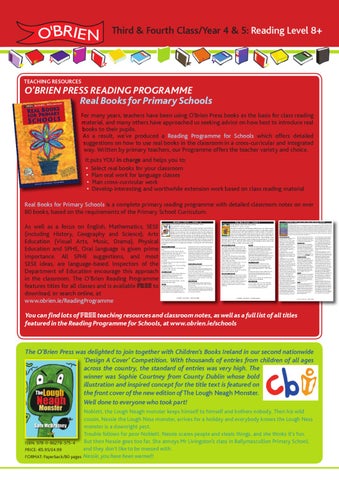
The O’Brien Press was delighted to join together with Children’s Books Ireland in our second nationwide ‘Design A Cover’ Competition. With thousands of entries from children of all ages across the country, the standard of entries was very high. The winner was Sophie Courtney from County Dublin whose bold illustration and inspired concept for the title text is featured on the front cover of the new edition of The Lough Neagh Monster. Well done to everyone who took part!
ISBN: 978-0-86278-375-4 PRICE: €5.95/£4.99 FORMAT: Paperback/80 pages
Noblett, the Lough Neagh monster keeps himself to himself and bothers nobody. Then his wild cousin, Nessie the Lough Ness monster, arrives for a holiday and everybody knows the Lough Ness monster is a downright pest. Trouble follows for poor Noblett. Nessie scares people and steals things, and she thinks it’s fun. But then Nessie goes too far. She annoys Mr Livingston’s class in Ballymascullion Primary School, and they don’t like to be messed with. Nessie, you have been warned!
t Myself: Recognising some physical disabilities
and how they can affect people’s lives. Gerard had quite severe asthma attacks, which made him anxious. Contact the Asthma Society of Ireland, 15 Eden Quay, Dublin 1 (Tel: 01-878 8511 or Callsave 1850 445464) and learn what you can about asthma. Was Elizabeth right in saying ‘people with asthma shouldn’t have cats’ (p.21)? Beverley suffered from vertigo (pp.72–75) but Kevin showed understanding and helped her to deal with the attack. Find out what causes vertigo and how to cope with the condition. t Myself: Beverley believed that she ‘was just growing out of seaside holidays’ (p.7), she resented her parents who were ‘going through one of their sticky patches’ (p.8). Yet she ‘had a sudden longing for her parents’ when she realised that her independence had brought with it responsibilities (p.150). Read the Author’s Note (p.6). How is this story a rite of passage experienced by the four children? t Myself and others: Exploring and discussing families and homes and how they can vary in many ways. Gerard had found that there ‘were two sorts of people in the world … the ones who despised you because your mother wasn’t married, and the ones who bent over backwards to show you that they didn’t disapprove …’ (p.19). In his story, he tells of the ‘disgrace’ of being pregnant and unmarried (p.104). Discuss the families of the four children: Beverley’s parents were ‘squabbling’ (p.7), Elizabeth’s were ‘cool’ (p.26) and Kevin’s dad had left his first family to start ‘a new life … in England’ (p.191). Are there parallels between their stories and their actual family lives? Has the home-life of each child affected his/her self-confidence and/or self-identity. If so, how? t Myself and the wider world: Dymphna is regarded as an outsider by the community and we hear that ‘the locals kept well away from [the island]’ (p.29), though ‘there was no harm in her, some people said’ (p.32). Later, Dymphna explains that she is on the island ‘on sufferance’ (p.144). Suggest reasons for the local community avoiding Dymphna. Are these reasons based on fear or prejudice? How might Dymphna’s knowledge of herbal lore have been regarded in former times? Read what Kevin says (p.188) and say if such behaviour can ever be justified.