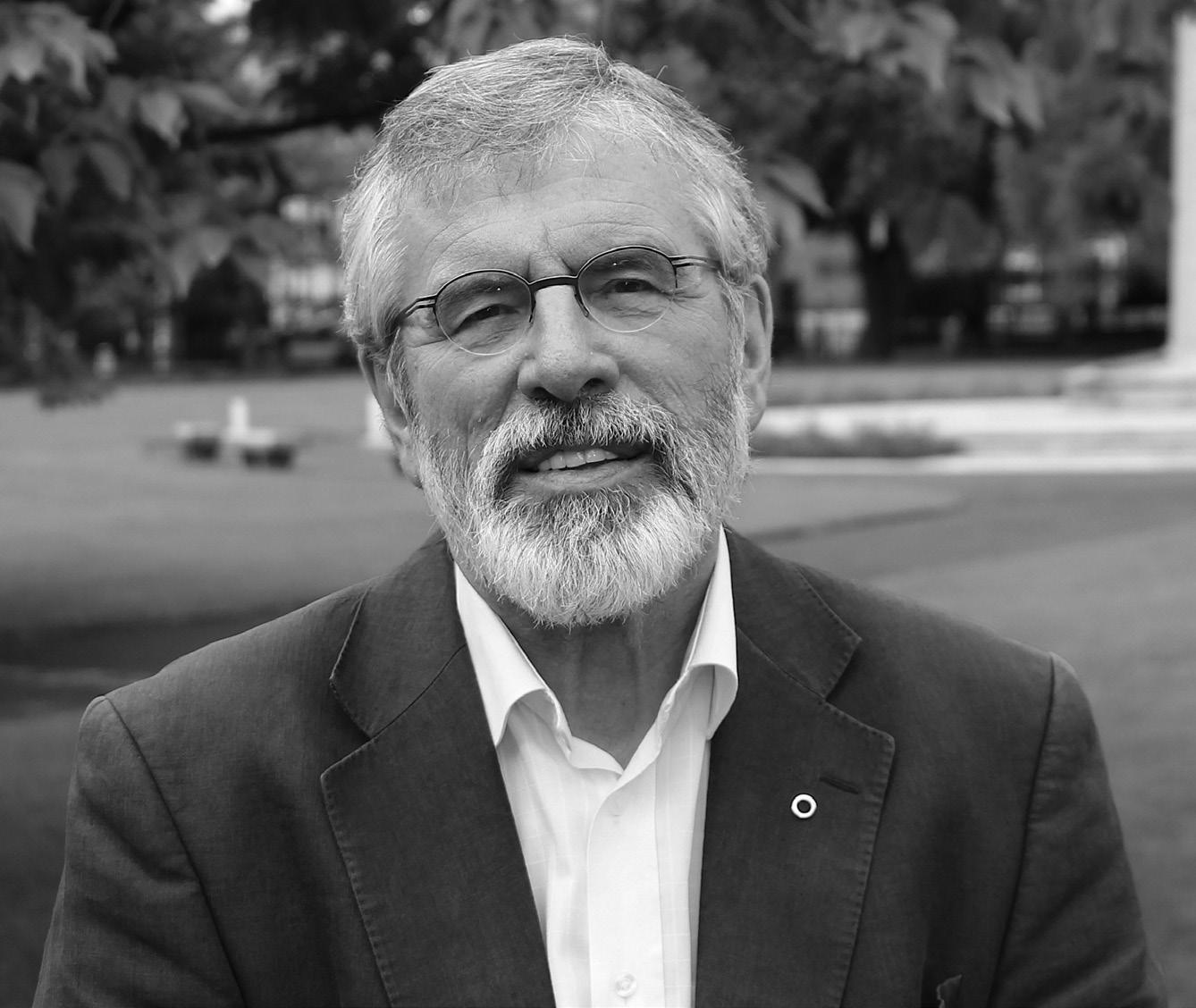
Gerry Adams is a former President of Sinn Féin and a former Teachta Dála (TD) for Louth and East Meath, and before that the MP and MLA for West Belfast. He has been an activist since his mid-teens and remains active in Sinn Féin and in his local community. He is a former political prisoner. In 2020, the British Supreme Court ruled that his imprisonment in the 1970s was unlawful. An internationalist, he has travelled widely – from the USA, Cuba and Palestine to the Basque Country and South Africa, he has supported progressive causes. He was one of the key figures in the Irish peace process and is now a key advocate of Irish Unity as set out in the Good Friday Agreement, which he helped to negotiate.
He is the author of eighteen books, including Falls Memories (1982); The Politics of Irish Freedom (1986), a statement of his political beliefs revised and expanded as Free Ireland: Towards a Lasting Peace (1995); An Irish Journal (2001); Hope and History (2003); The New Ireland (2005); An Irish Eye (2007); My Little Book of Tweets (2016); The Negotiators Cook Book (2018); and Poems for Hard Times (2020). Black Mountain, his second collection of short stories, was published in 2021.
Cage Eleven
Prison Writings from Long Kesh
A Brandon Paperback
This edition published in 2024 by Brandon an imprint of The O’Brien Press Ltd, 12 Terenure Road East, Rathgar, Dublin 6, D06 HD27, Ireland.
Tel: +353 1 4923333; Fax: +353 1 4922777
E-mail: books@obrien.ie
Website: obrien.ie
The O’Brien Press is a member of Publishing Ireland.
All rights reserved. No part of this publication may be reproduced or utilised in any form or by any means, electronic or mechanical, including for text and data mining, training artificial intelligence systems, photocopying, recording or in any information storage and retrieval system, without permission in writing from the publisher.
2 4 6 7 5 3 1
24 26 28 27 25
Printed in the UK by Clays Ltd, St Ives plc. The paper in this book is produced using pulp from managed forests.
For Danny Devenny
Buíochas
I am indebted to Colette who never missed a visit and to Gearóid who has become my best literary critic. Thanks also to Danny D. who did the illustrations for the original ‘Brownie’ articles and who encouraged me to compile this collection; to Dáithí from Cage Ten who did the original typing; to Jim Gibney who read and advised on the first draft; to Robin and Thomas who helped and to Dave and Aengus who promised to help but didn’t. Thanks also to Fionnuala who typed the first draft; to Mary Hughes and Sal (who got arrested in mid-sentence) who typed the final drafts; to big Eamonn and Pat who supervised photocopying and Deirdre who let them. Finally to the poet (who may have been Madra Rua but I can’t recall) who composed ‘Ar an tSlí go Béal Feirste’; to the late Ho Chi Minh whose poetry appears in ‘Nollaig Shona Dhaoibh’, and to anyone else I may have left out.
Gerry Adams 1990
Ar an tSlí go Béal Feirste
I bhfad ar shiúl
Déanann soilse na Ceise Breacadh bréagach I spéir no hóiche.
Thar an Cheis Fhada Ní gealtar aon lá Choíche.
Cé go lasann na mílte soilse
Ann anocht, Is siúd an áit is dorcha In Éirinn –Ó cheann ceann na hEorpa.
Roimh an dallrú úd Stadtar
Mar ós cómhair réamh-chúirteanna Ifrinn –
Aonrac, Ineaglach, Éadóchasach.
On the Way to Belfast
From afar
The lights of Long Kesh Make a false dawn In the night sky.
But over Long Kesh No dawn brightens Ever.
Though a thousand lights blaze there Tonight, It is the darkest place In Ireland –In the whole of Europe.
Before that glare One pauses –As before the forecourts Of hell –
Suddenly alone, In dread And despair.
LONG KESH
Britain’s Concentration Camp
Long Kesh, Spring 1977. Cages 1–8 and 22 housed internees; the rest housed sentenced prisoners.
Réamhrá
Cage Eleven was published first in 1990. By that time the cages of Long Kesh were emptied of prisoners, and the cages were replaced by the H-Blocks and filled with prisoners, including some from Cage Eleven.
This book is largely made up of articles smuggled out of the cages and published between August 1975 and February 1977 in Republican News. I am very pleased that this edition contains drawings by Danny Devenny, a long-time resident of Long Kesh who went on to become one of our best-known pioneering and leading mural artists. His work over decades is there for all to see on the walls of Belfast and other places.
Cage Eleven was first published by Brandon Books and the late Steve MacDonogh. Steve was my publisher for thirty years. Go ndéanfaidh Dia trocaire air. Time moves on. Prisoners from Cage Eleven – good friends of mine – featured in these pages have died also in the years since then. I think of them, and of Steve, often.
The year of Cage Eleven’s publication, 1990, was also the end of the decade of the prison protests including the hunger strikes
in Armagh women’s prison and the H-Blocks. Ten men died there on hunger strike in 1981. Now all of the prisoners of that time are released. The cages have disappeared. So too have the H-Blocks with only the prison hospital remaining.
These prisoner releases came as a result of the Good Friday Agreement in 1998. Much has changed since then. There is an enduring peace process, now decades old. Change continues across Ireland. There are still political prisoners, small in number and mostly supporters of unrepresentative anti-Good Friday Agreement groups. The inevitable and eventual decline of these groups and the release of these prisoners will mean an end also to that part of our penal history. Speed the day.
I am grateful to The O’Brien Press for this new edition of Cage Eleven. My thanks also to the late Michael O’Brien for encouraging me to write and for his patience and activism over many years.
Gerry Adams
30 May 2024
Foreword
LongKesh concentration camp lies beside the M1 motorway about ten miles from Belfast and near the town of Lisburn; nowadays the British government insists that everyone should call it ‘Her Majesty’s Prison, The Maze’. A rose by any other name …
Almost twenty years have passed since Long Kesh was opened, and through the years it has been a constant element in the lives of all the members of my family. On any one of the many days since then, at least one of us has been in there. That’s all the male members of our clann – as well as me, of course, and a handful of brothers-in-law, uncles and several more cousins.
Our female family members, like Colette and other wives, sweethearts, sisters, sisters-in-law, aunts and my mother, have spent almost twenty years visiting prisons. Yet for all that, ours is a perfectly normal family, and we are by no means unique. Long Kesh is full of our friends, and the north of Ireland is coming down with families just like ours, all with a similar British penal experience.
Thousands of men and women have been incarcerated by the British government during this last twenty years. Thousands of
wives and mothers and fathers and husbands and children have spent years visiting prisons, and it is they who do the real time. Today there are almost 800 Republican prisoners, most of whom are in British jails in the occupied six counties of Ireland. Others are imprisoned in Britain itself or are in the Dublin government’s custody in Portlaoise and other prisons. A handful are in prisons in continental Europe or in the USA. Everyone in the nationalist community in the north of Ireland knows someone who is or has been in prison. None of us is immune.
I was first interned in March 1972 on the Maidstone, a British prison ship anchored in Belfast Lough. It was a stinking, cramped, unhealthy, brutal and oppressive floating sardine tin. We had the pleasure of forcing the British government to close it. A wellpublicised solid food strike, organised at an opportune time when the government was replacing its old Stormont parliament with an English cabinet minister, ensured the Maidstone’s demise. We were airlifted to Long Kesh. A few months later I was released from Long Kesh, but thirteen months after that I was airlifted back in again, this time black and blue after being used as a punchbag in Springfield Road British army barracks and spending a few days in Castlereagh interrogation centre.
Long Kesh had grown: now over twenty cages contained both internees and Loyalist and Republican sentenced prisoners. In the internment area I became the camp’s most unsuccessful escapee, but I was consoled by my involvement in the successful
elopements of many of my close comrades. I was caught only twice.
In October 1974 we showed our heartfelt appreciation for being interned without trial by joining the sentenced prisoners in burning down the camp; just as it was being rebuilt, my escape attempts caught up with me, and I received two separate sentences of eighteen months and three years respectively. For a while I was an internee, a sentenced prisoner and a remand prisoner, all at the one time. Then I was moved with other would-be escapees to the sentenced area of the camp. From one cage to another – to Cage Eleven.
Today these cages no longer contain political prisoners, for they are held in Long Kesh’s infamous H-Blocks and in other jails. Cage Eleven exists now only in the minds of those who were once crowded into its Nissen huts. It is a memory which reminds us, among other things, that the H-Blocks, like the British regime which spawned them, will one day be only a memory also.
The bulk of this book is derived from articles which were smuggled out of the cages and published, under the pen name ‘Brownie’, between August 1975 and February 1977 in Republican News, the Belfast Republican newspaper which has since amalgamated to create An Phoblacht/Republican News. I was one of a small number of Long Kesh POWs who contributed to the weekly column in which we wrote, sometimes none too fluently, about a litany of issues as we perceived them from our barbed-wire ivory tower.
Many of the pieces I wrote then and many of the chapters of
this book are light-hearted, and the reader may imagine from them that Long Kesh was a happy, funny, enjoyable place. It was not then and it is not today. But the POWs were happy, funny, enjoyable people who made the best of their predicament. We wanted out, but we did our whack as best we could. We did our time on each other’s backs, and at times we may have got each other down, but mostly we enjoyed one another’s company and comradeship. The light-hearted pieces celebrate that enjoyment.
They also celebrate the lives of POWs who died in Long Kesh. Five men died while I was there. Another one died before I arrived, and Henry Heaney passed away after my release. Henry, an oldage pensioner, had been sentenced to fifteen years under a law which makes it an offence just to have it in mind to do something. My abiding memory of Henry is of Sunday mornings before mass as he walked around Cage Twelve in his best suit. Henry was a great wee man and a sound Republican. Three years after his death, ten other sound Republicans were to die in the H-Blocks of Long Kesh. They died after five years of unprecedented prison protest by over 500 blanket-men and by women in Armagh in the heroic hunger strikes of 1981.
In this book the main characters are fictional, but they and their escapades are my way of representing life as it was in Long Kesh. Amongst those with whom I was privileged to share Cage Eleven were Bobby Sands, later MP for Fermanagh/South Tyrone and leader of the 1981 hunger strike; Danny ‘Dosser’ Lennon, killed
on IRA active service; Kevin ‘Dee’ Delaney, killed in a separate IRA action; and Tommy ‘Todler’ Tolan, killed by so-called Official IRA. There was Hugh Feeney, who endured 205 days of forcefeeding in a prison in Britain along with Gerry Kelly and Dolours and Marion Price before the British government gave in to their demand for repatriation to jails in Ireland. There were Brendan ‘the Dark’ Hughes and Brendan ‘Bik’ McFarlane, later leaders in the H-Blocks blanket protests and hunger strikes; Bik was one of those who played a crucial role in the Great Escape of September 1983, the biggest jailbreak in Europe since the Second World War, when thirty-eight POWs escaped from H7 in the H-Blocks. These were some of Cage Eleven’s residents. The rest of the men were equally remarkable: not so well-known, but each unique in his own way. We did our time together, and this is my attempt to evoke, minus most of the f-ing and blinding, the atmosphere of that strange yet familiar world we shared. Sadly, some of the men who were there then are still in jail today. More of them, like Alec and Hugh, are only now being released. As I write, another of my heroes, Terence ‘Cleaky’ Clarke, is back in Long Kesh again, one of the many victims and scapegoats of a British mass trial. He was arrested months after the killing of two British soldiers who drove into mourners at Caoimhín Mac Brádaigh’s funeral on the Andersonstown Road. Caoimhín was killed in Milltown Cemetery along with Thomas McErlean and John Murray when loyalist gunman and British agent Michael Stone attacked mourners at
the funerals of IRA volunteers Dan McCann, Mairead Farrell and Sean Savage. Sixty other mourners were wounded that day by gunfire and grenades. Cleaky’s only offence was that he was chief steward at Caoimhín’s funeral. Big Sid is back, too, on a different charge. I hope that they, the many Irish POWs in jails everywhere, and the women in Maghaberry Prison and in jails in Britain, recognise themselves and some of their prison experiences in the antics of the men of Cage Eleven. I hope, too, that for most of my readers this book is the closest they ever get to finding out what a prison camp or any other jail is really like.
Gerry Adams
Belfast, 14 February 1990
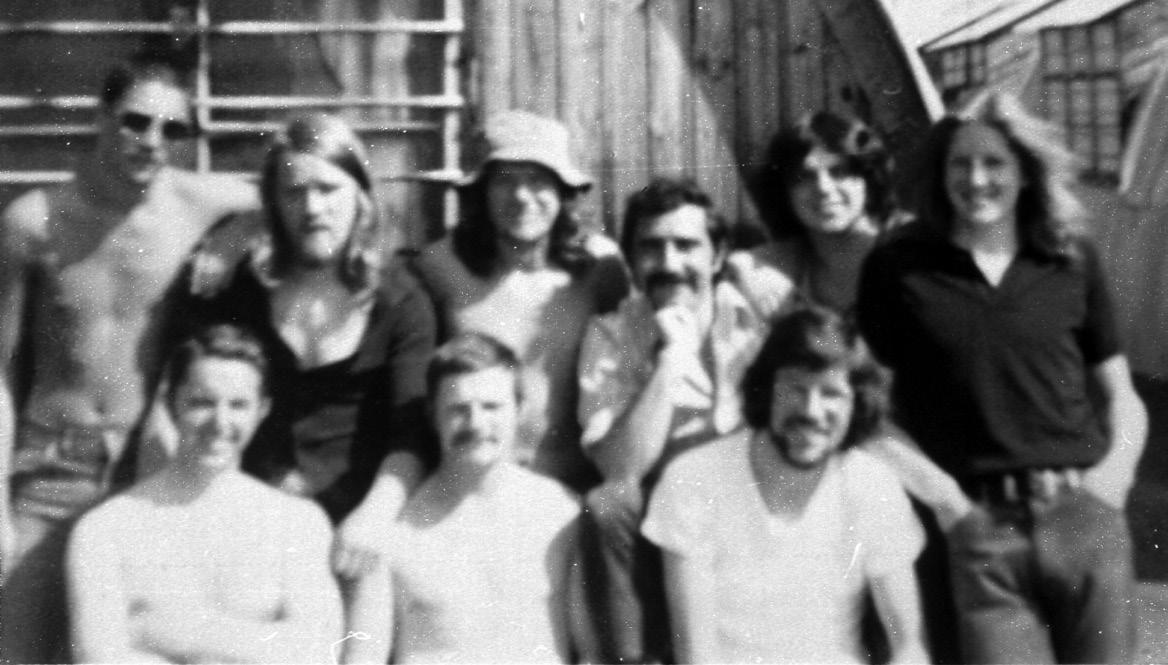
Long Kesh cages, summer 1975. Back row (l–r): Seanna Walsh; Gerald Rooney; Jimmy Gibney; Brendan ‘Dark’ Hughes; ‘Tomboy’ Loudon; Bobby Sands; front row (l–r): Tom Cahill; Tommy Tolan, Gerry Adams. Courtesy An Phoblacht.
Cage Eleven
I’m in bed at the moment, covered in breadcrumbs and skimpy grey British army blankets, my knees tucked up under my chin and a blue plastic mug of blue plastic tea in my hand. The eejit in the next bed is doing his staunch Republican bit. ‘McSwiney taught us how to die,’ he is saying to his locker, and him only two weeks without a visit. The visits get cancelled regularly here. I think we are only entitled to one visit a month; the other three are ‘privileges’ to be withheld as the prison governor decrees. After the first visitless week or so men take to their beds. It’s not a pretty sight. Your Man has retired for the night already, pink pyjamas neatly creased and rosary beads in hand. And it’s only seven o’clock.
During such phases the huts here are like some surrealistic limbo; made of corrugated tin sheets, they are unpainted Nissen huts. Leaky, draughty, cold, they are locked up at nine o’clock every night and unlocked at seven thirty every morning. We’re inside them of course: us and our lines of bunk beds, lockers, our electric boiler, a kettle, a row of tables, a television set and a radio.
Somebody has just decided to brush the floor. Big floors in here, and thirty men lying, sitting, squatting, sprawled and splattered all over it. Nowadays there’s thirty to a hut; it used to be worse. There are four or five huts to a cage, depending on the size of the cage: two and a half huts or three and a half for living in; an empty hut for a canteen of sorts; and the other half-hut for ‘recreation’, with a washroom and a ‘study’ hut thrown in. Wired off with a couple of watchtowers planted around, and that’s us.
Oh, and the drying hut. I can’t forget that. The drying hut is where we hang our wet clothes. When we don’t hang them on the wire. The drying hut is also the only place in here where you can be on your own. If nobody else is in it, that is.
All the gates open inwards. They probably do the same outside, but you notice it more in here – that’s called doing ‘bird’. And everyone walks in an anticlockwise direction. I don’t know why. Internees do it, Loyalists do it as well. ‘Will you do a lap?’ or ‘Fancy a boul?’ or ‘Ar mhaith leat dul ag siúl? ’ and away you go around and around. And always against the clock. Maybe some instinct is at work. That’s the funny thing about this place: a simple thing becomes a matter of life and death. I suppose it has always been like that. If you walk the other way you get the back ripped out of you.
Jail is unnatural. Even the men in this hut are wired up. Imagine thirty men of different ages, the oldest sixty-three, the youngest eighteen, all locked up together for years and years. I don’t know
how they stay in such good form. A well-informed comrade told me years ago that if he was building a sty for his pigs he could only keep twenty-odd pigs in a hut like this.
‘Apart from the size,’ said he, ‘there isn’t enough insulation, and the walls must be breeze block or brick.’ Nowadays when he feels outraged at something or other he is heard to mutter, ‘This place isn’t fit for pigs,’ but sure that’s another story.
The floor is clean now and some of the boys are waiting for the late news. Sometimes we miss it and then there’s a shouting match. Marooned as we are on the desert island of Long Kesh, television has become our electronic window on the world. The news programmes are of paramount importance. So is Top of the Pops; it has a consistently large audience while the audience for the news programmes goes up and down depending on what’s happening outside. News comes from other sources as well. From visits, from rumours. You would be surprised at the rumours which go the rounds here. Scéal is the word used to describe the widest possible generalised interpretation of the word ‘news’. It includes real news as well as gossip, scandal, loose talk, rumour, speculation and prediction.
Much of it is manufactured by my friends Egbert, Cedric and Your Man. They do it almost by instinct now, and the thing about it is that by the time it does the rounds here its source gets totally lost in the telling and retelling, the digesting and dissecting. What starts as an apparently innocent, throwaway remark from
any of the aforementioned comrades soon becomes attributed to a BBC newsflash, an absolutely impeccable source on the IRA army council or a senior civil servant in the British Northern Ireland Office. And, of course, everyone adds their own wee bit; in fact, that’s our main pastime. We manufacture it most of the time in our cage and sometimes shout it across to other cages, or we talk at the wire when we are out of the cage for visits, football or other excursions. We also throw ‘pigeons’ to each other. A pigeon is a well-tied snout (tobacco) tin containing a scéal note and a few pebbles for weight. We hurl our pigeons from cage to cage and thus have a line of communication which the screws can’t penetrate. If you’re a good thrower, that is.
The prison grub is awful. It comes to us from the ‘kitchens’ in big containers on a lorry. At the cage gates the containers are transferred to a trolley; then whichever POWs are ‘on the grub’ trundle the trolley across the yard and load the containers on to a ‘hotplate’ in the empty hut which poses as a canteen. If the food is particularly gruesome, it will be refused by the camp or the cage staff. If not, anyone who is ‘on the grub’ serves it to whoever has the courage, constitution or Oliver Twist appetite to digest it.
In the internment cages we rarely ate the prison grub, but then we were permitted to receive a fairly wide selection of cooked food which was sent in from outside by our families or friends. Here in the sentenced end the food parcels are more restricted and less frequent, and so, alas, we have to eat the prison grub. At
least some of the time. Apart from Seanna, that is, who eats it all the time. Sometimes we find more appropriate uses for certain alleged items of nutrition, and the cakes, which remain hard even with dollops of custard on them, came in handy on one occasion. During a British army riot here we managed to keep them out of the cage for long enough by loosing volleys of gateaux at their ill-prepared ranks.
We usually dine together in food clicks – it took me years to establish that click is spelt clique. Some of our more ideologically correct comrades call them co-ops, and for a while the word commune was favoured by a few free spirits, but click is actually a more accurate description. A food click shares out its members’ food parcels, usually on a rota basis, and divides the duties of cooking, plastic-dish washing, tea making and so on in a similar fashion. Periodically someone drops out or is ejected from a food click. Occasionally others, for less quarrelsome reasons, go solo – known here as creating a ‘thirty-two county independent click’ – but mostly collective eating predominates.
Cooking usually means reheating on the hotplate, or on one of the ceiling heaters from the shower hut, removed and suitably adapted for the purpose, or even on a wee fire lit outside in a corner of the cage.
We drink loads of tea here. The Cage Eleven intelligentsia drink coffee. The water for both beverages is boiled in a communal boiler, which each hut has. Being ‘on the boiler’ means being
Gunga Din the water carrier for a day. When I was in solitary once, I was able to make tea from a second-hand teabag with water heated by placing a water-filled brown paper bag on the pipes. It took eighteen hours and was only tepid, but it was still tea. I think. Without milk. Or sugar.
In between praising the food and manufacturing scéal, receiving scéal, discussing scéal and passing on scéal, we read a wee bit, back-stab each other a wee bit, talk a great deal and engage in a little sedition, which is mainly a matter of getting to understand the political situation which has us in here in Long Kesh. This process is occasionally revealing, sometimes amusing and always, next to scéal, the most time-consuming activity of most sane POWs. Other less sane POWs make handicrafts, but that’s a habit I’ve avoided so I can’t really comment on it. A lapsed handicrafter told me once of his belief that the making of harps, Celtic crosses, purses, handbags and even soft toys was addictive. Painting hankies with coloured marker pens was, he believed, less serious – merely a phase all POWs go through.
We also go through phases of depression – the big D. On the outside marriages break up, parents die, children get sick; all normal worries intruding into our impotent abnormality. Some comrades have nervous breakdowns. Some do heavy whack. Comrades also die in here through lack of medical facilities and in one case a British army bullet, and people are dying outside all the time as the war goes on. It all has its effects in this bastard of a