Strategic Review 2011
1. Estate Portfolio Management
To adopt a sustainable approach to the management 88and conservation of the State's heritage sites with an emphasis on quality and standards.
To present our heritage sites to the best advantage ensuring that their potential contribution to tourism is maximised and that visitor enjoyment and education experiences are enhanced.
• Achievement of budgetary/value for money targets identified in Annual Output Statements.
The Management Advisory Committee was broadly satisfied that the agreed Estate Portfolio Management Work Programme for 2011 was delivered efficiently and effectively in line with budgetary/value for money targets.
• Achieve expenditure targets.
• Customer satisfaction audit (surveys/feed-back).
• Endorsement by institutional bodies, Government.
The successful management of OPW locations during the State visits of Her Majesty, Queen Elizabeth II and President Obama in 2011 and the contribution of OPW to the success of those visits was acknowledged by Government.
• Activation of new/enhanced services.
Improvements were completed at a number of Historic Properties.
Visitor numbers to Guided sites were up 5.3% to 3.44 million
Key
Progress in 2011
The feasibility of introducing online booking facilities for Heritage Sites and the identification of the Sites requiring this facility was initiated in 2011. Work in this area will continue in 2012.
A social media pilot project was put into operation in Castletown in 2011 and a further project commenced in Rock of Cashel.
National Historic Properties established a public procurement process in 2010 for 2011 projects that invited proposals from event organisers to hold events at various Historic Property Sites. This process proved to be very successful and will continue in subsequent years.
A major signage project to improve information for tourists was planned and designed in 2011 for roll out during 2012.
Comment
To manage our property effectively, ensuring that its potential is maximised and that it is used
• The target of a 15% reduction in rent, set out in the National Recovery Plan 2011-2014 is met by 2014.
In 2011, OPW surrendered office accommodation in excess of 7,212 square metres (77,631 sq ft) as well as 113 car spaces, (30 leasehold properties).
The proposal on signage was conditional on funding from Fáilte Ireland, discussions ongoing.
The Department of Public Expenditure &
Key Objective
efficiently in terms of value for money, sustainability, space allocation, energy consumption and income generation where feasible.
Performance Indicator
• Following an aggressive annual rent review programme over the term of this Strategy, significant reductions in the rent roll, subject to market conditions and lease covenants.
Progress in 2011
Rental reductions were also negotiated through achieving downward outcomes in 31 rent reviews in 2011. Overall, OPW's expenditure on rent reduced by €10.3 million in 2011.
Comment
To implement programmes and projects to provide built accommodation and facility solutions for Government and State clients whether in new, existing or rented premises.
• Asset value of property is maintained or enhanced.
584 building projects of varying size and cost were being managed at year end and architectural advice was provided to building related tasks as required. These included ongoing programmes of minor works, universal access and mechanical and electrical works undertaken across the OPW property portfolio.
The responsibilities for maintenance of State Property as set out in Department of Finance Circular 1/94 were updated and a replacement circular was forwarded to the Department of Public Expenditure and Reform for approval and issue during 2012.
Reform will be bringing a memo to Government in 2012, which will facilitate the progression of Estate Portfolio Management objectives.
• More efficient use of office space.
Regionalisation and centralisation of common office activities to compensate natural wastage and achieve increased efficiency was considered during 2011. CEW
Key
• Optimisation of space utilisation.
Progress in 2011
integrated with BMS and the reorganisation of the regional payroll was ongoing and is on target.
The Limerick Workshop moved to Mungret in 2011 and a reduction from 4 to 3 Arterial Drainage Regions was achieved.
Comment
To create a central register of all State Property.
• Optimised use of accommodation and staffing resources.
Preparatory work on the examination of space allocations available to civil servants was undertaken during 2011. 50 large office accommodation buildings in the Dublin portfolio were surveyed.
The Regional Office to move in April 2012.
To support the delivery of the action identified in the Government Policy on
• Reduction in the total cost of providing accommodation for the civil service.
A shared filing system for minor capital works projects in the Property Maintenance Regional Offices was devised in 2011 to ensure that information on works to OPW property is recorded.
All OPW property and National Monuments structures were geo-referenced on our GIS system.
• Comprehensive register of all State property in place.
Progress has been made on some of the Actions that OPW has either a lead role or partner role for example:
• Targets relevant to the OPW in Government Policy on Architecture 2009-2015 met.
• OPW is involved in ongoing research with the State Laboratory in relation to materials used on Historic buildings and in conservation work.
• OPW participates on the Building Regulation
Key Objective
Performance Indicator
Progress in 2011
Architecture 2009 – 2015. Advisory Board.
• OPW contributes to the Government Construction Contracts Committee in developing procurement and contracting policies in support of architectural quality in State funded projects.
• OPW is involved in the Open House initiative in conjunction with the Irish Architectural Foundation.
2. Flood Risk Policy & Management
To advise the Government in relation to policy development and legislative requirements for flood risk management.
To develop, coordinate and implement programmes and measures to reduce the national level of flood risk to people, businesses, infrastructure and the environment.
To develop flood risk
• Achievement of budgetary/value for money targets identified in Annual Output Statements.
The Management Advisory Committee was broadly satisfied that the agreed Flood Risk Policy & Management Work Programme for 2011 was delivered efficiently and effectively in line with budgetary/value for money targets.
Comment
• Raised Government, local authority, corporate and public awareness.
• Sustainable planning and development management with respect to flood risk.
• Prioritised draft national long-term programme of investment for effective and sustainable
The National Preliminary Flood Risk Assessment (PFRA) was completed in 2011. Pilot Catchment Flood Risk Management Plans were also completed for consultation, and five of the six contracts under the National CFRAM Programme were commissioned.
A Report on the “Strategic review of options for flood forecasting and flood warning in Ireland” was completed during 2011. The Department of Public Expenditure &
Key Objective
Performance Indicator
management responses in line with international best practice. management of flood risk (with subsequent reductions in flood damages following implementation).
• Informed decision making by the relevant authorities.
Progress in 2011
Systems were put in place to disseminate any flood alerts and flood watches for Ireland issued under the European Flood Awareness System (EFAS) promptly to Local Authorities, the ESB and Met Éireann.
Comment
• Reduce existing risk in areas where schemes are advancing.
Four major flood relief schemes were completed and seven more progressed during 2011. Four schemes were prepared for construction commencement in early 2012. Funding of €4.623m was approved for 72 projects under the Minor Flood Mitigation Works and Coastal Protection Scheme.
Reform will be submitting an Aide Memoire to Government in 2012 around the issue of flood forecasting.
• Reduce existing risk in areas where works are being carried out.
The 2011 Programme of maintenance of river courses drained under the Arterial Drainage Acts was completed.
• Maintain current level of risk and residual value of historic investment.
• Improved awareness – coordinate actions of key stakeholders.
The OPW and the Environmental Protection Agency (EPA) collaborated during 2011 in reviewing OPW and EPA/Local Authority hydrometric gauging networks using agreed objective scoring methodology. It is expected that this
Key Objective
in 2011
evaluation will result in a reduction in the number of gauging stations currently operated by both the OPW and the EPA/Local Authorities.
3. National Procurement Service (NPS
)
Achievement of savings Be Centre of Excellence/ provide optimum efficiency and effectiveness in Strategic Sourcing for Central Government and other centres of Government at National Sectoral and Local levels.
• Achievement of budgetary/value for money targets identified in Annual Output Statements.
The Management Advisory Committee was broadly satisfied that the agreed NPS Work Programme for 2011 was delivered efficiently and effectively in line with budgetary/value for money targets.
Comment
• Reduced requirement for central funding due to increased cost savings on procurement.
• Reduced staffing in local procurement units due to increased centralised activity.
Savings negotiations commenced, led by Minister Brian Hayes, with top suppliers in September 2011.
The Irish national multi-stakeholder e-Invoicing forum was established in May 2011. Work proceeded during 2011 to put all elements of the pilot e-Invoicing project in place. Significant savings are anticipated from this initiative. In addition NPS progressed the introduction of low value purchase cards for use in the Irish Public Service during 2011.
The Department of Public Expenditure & Reform will be bringing a Memorandum to Government in 2012, which will facilitate the progression of NPS objectives.
Progress in 2011
Use of central contracts/ Frameworks by clients
To ensure that the optimum number of public service clients is utilising centrally available contracts and frameworks.
• Elimination of diverse contract practices.
• Reduction in business costs.
• Consistency in approach to market for categories.
Maximising strategic sourcing in the procurement area was an on-going process during 2011. The NPS ran competitions spanning all sectors of the public service. Under the energy frameworks 11 competitions were organised (5 electricity and 6 Natural Gas) with a value of over €140m, that resulted in the award of 221 contracts (151 electricity and 70 Natural Gas) covering some 12,000 supply points across all sectors of the public service. Significant savings have emanated from this particularly complex category of public service procurement.
• Consistency of best value prices across the public service.
This exercise demonstrates the benefits of collaboration and the power of approaching the market place in a unified and professional manner. It is likely that the work done on this energy project will act as a platform for many future collaborative projects across the public service. A total of 7 new framework contracts were established. Collaboration in both the Food and Laboratory Equipment markets in conjunction with the HSE, Irish Prison Service and An Garda Síochána took place.
Key Objective
Array of categories under contract
To ensure that the top 30 categories of spend in the public service are constantly monitored with a view to appropriate central contract coverage.
Performance Indicator
• Reduction in rolled over, ineffective or non compliant supply arrangement.
• Reduction in administration surrounding the purchase of major categories of goods and services.
Progress in 2011
A greater number of contracts were taken up in 2011 than in 2010.
Comment
Standardised Documentation
To make available standardised, template documents for use in the procurement process.
• Reduced requirement for outsourced legal services for buyers and suppliers.
The standard suites of competition documents for the supply of goods and services were launched in April 2011 and are now being widely used by public bodies.
• Reduced costs through simplification of Procurement Process.
• Increased compliance with EU and National Law with a consequential reduction in legal exposure to the state.
Standard Standstill notices were substantially completed and issued in 2011.
Key Objective Performance Indicator
Progress in 2011 Comment
Education & Development
Provide learning, development & guidance opportunities for public service customers and suppliers.
• Increased knowledge and awareness of complex procurement issues.
• Increased compliance with EU and National Law with a consequential reduction in legal exposure to the state.
The NPS, as part of its Education and Development role, facilitated at over 30 events across the country to assist both suppliers and buyers better understand the public service procurement process. These events were attended by over 2,000 supplier organisations and over 800 public service buyers.
• Reduced cost and time involved in procurement processes through correct selection of procurement methodologies.
Two CPD certified training courses, one providing for a Diploma in Public Procurement and a second for a Certificate in Public Procurement were developed by the NPS in conjunction with Dublin Institute of Technology with18 procurement officials graduating during 2011.
Key Objective
eProcurement
Develop an eProcurement platform as a major channel for business transactions and exploit all other emerging electronic opportunities.
• eContract Management will enable contracting authorities to monitor all their contracts from a central location leading to cost efficiencies.
• Increased transparency of central contracts and a consequent increase in utilisation of same.
• Ultimately eInvoicing will reduce costs for both buyers and suppliers.
• Significant savings accruing to both buyers and suppliers through reduced transactional costs.
4. Cross Organisational Objectives
Deliver an efficient and effective support service to facilitate the implementation of OPW's
• Achievement of Work Targets identified in Annual Work Programmes.
Progress in 2011
The NPS website www.procurement.ie was launched in April 2011.
The existing eTenders website was maintained during 2011.
A revised competition for redevelopment of eTenders was initiated.
Comment
The Management Advisory Committee was broadly satisfied that the agreed Work Programme for 2011 was delivered efficiently and effectively in line with targets set at the beginning of the year.
Key Objective
key objectives.
Performance Indicator
• Achievement of budgetary/value for money targets identified in Annual Output Statements.
Progress in 2011
Target outputs set in the Revised Estimate Volume were largely achieved. Gross Expenditure on the OPW Vote in 2011 was €397m representing a spend of 98% of the available Vote allocation. Capital funding of €8m was ringfenced for carry forward as a Deferred Surrender to the 2012 OPW Vote.
Savings on Administration Subheads of €0.588m in 2011 were carried forward under the terms of the Administrative Budget Agreement to the 2012 allocation.
Total Appropriations in Aid was €26.928m.
In addition to the OPW Vote, expenditure incurred on projects on behalf of other Government Departments on an agency basis during the year was €76.918m.
Comment
• Achievement of targets set out in the OPW Action Plan for the Implementation of the Public Services Agreement 2010 – 2014 (Croke Park Agreement).
• Achievement of targets in the Comprehensive Review of Expenditure.
The OPW reported in May and November 2011 to the Implementation Body for the Public Services Agreement 2010 – 2014 showing achievement of targets as set out in our Action Plan.
An Integrated Reform Delivery Plan (IRDP) was developed during 2011, which combined the various OPW reform initiatives such as the Public Service Reform Plan, the
Key Objective
Performance Indicator
Progress in 2011
Comprehensive Reviews of Expenditure, the Croke Park Agreement, as well as other OPW Reform initiatives. The IRDP maps out at a high level the priority reform initiatives of the OPW and will assist with regular reporting to the Department of Public Expenditure and Reform and the Cabinet Committee on Public Service Reform during 2012 and subsequent years.
Comment
• Greater flexibility in delivery of services.
• OPW is an on-going learning organisation with all the tools necessary to carry out knowledge management in support of our mandated functions.
• Enhancement of merit based opportunities for promotions.
• Staff trained to the highest levels, familiar with and implementing best practice in the relevant business environment.
In 2011 the ICT Unit continued to keep OPW's ICT systems operational in the context of a decreased budget. The Unit continued to use and deploy open source software (e.g. OpenOffice) where appropriate with a view to lessening our dependence on proprietary software and saving on licence costs. There are currently 800 Open Office users in OPW. In 2011 the OPW piloted an open source document management system in Engineering Services. Options for deploying an open source email system were investigated in 2011. A new open source phone system went live in the Botanic Gardens in September 2011.
Acquisition of new computer hardware (laptops and PCs) in 2011 was carried out using centralised framework agreements.
Key
Progress in 2011 Comment
A major review of mobile phone deployment resulted in significant rationalisation of the number of mobile phones in use in the OPW together with costs savings due to the use of centralised framework agreements.
A Building Information Modelling (BIM) pilot scheme was approved. BIM, when fully implemented, will greatly improve the current processes for the construction of new buildings and the maintenance of existing building stock. BIM will lead to greater information sharing between the various disciplines on a construction project and will result in efficiencies in the future.
• Individual staff members understand and know their role within their area of work and are complying with that role and achieving their targets.
The Purchase to Pay System was rolled out during 2011 and training in this area was completed.
Training in “Tackling under performance” was provided to all Established staff.
More user-friendly PMDS Role Profile and Review forms were introduced in 2011.
Key Objective
• All OPW staff involved in significant procurement exercises sufficiently skilled.
• Value obtained through use of centralised procurement arrangements.
Two CPD certified training courses - A Diploma in Public Procurement and a Certificate in Public Procurementwere developed in conjunction with Dublin Institute of Technology and 18 procurement officials from within the OPW graduated. 36 training/education events for buyers and suppliers were held.
OPW availed of available centralised procurement arrangements.
• Appropriate OPW contracts available for use by the wider public service resulting in a corresponding reduction in staff time and resources public service wide.
The standard suites of tender documents for the supply of goods and services was launched in April 2011.
Standard Standstill notices were substantially completed and issued in 2011.
A greater number of contracts were taken up in 2011 than in 2010, indicating a greater uptake of centralised procurement arrangements in the context of reducing Public Service Numbers.
• Excellent customer services to both internal and external customers as established by feedback and surveys.
The ICT Unit carried out an internal customer survey to obtain end-user feedback on the quality of services it delivers.
An internal Customer Survey on Personnel website was carried out, results analysed and improvements made were necessary.
Landowner surveys and project review meetings continued to be carried out during 2011.
Surveys were also carried out at some Heritage Sites e.g. email survey by Tipperary Tourism of visitorsat the Rock of Cashel and Cahir Castle, Visitor Origin Survey, Pearse Museum, Customer Service Survey in the Boathouse Restaurant in Farmleigh and a number of exit surveys and a customer satisfaction survey at Dublin Castle.
EXPENDITURE PROGRAMME
The Office of Public Works (OPW) is charged with the administration and execution of a number of separate and diverse areas of Government services. These are accounted for in three main areas with administrative support by Corporate Services.
OPW EXPENDITURE SUMMARY
The table below shows all expenditure managed by OPW in 2011 (2010 figures are shown for comparison purposes) which involves:
• funds granted directly to the OPW Vote;
• expenditure on works and services managed on a repayment basis by OPW for other Government Departments and State Agencies;
• activity on draw-down contracts managed by the OPW.
The three programmes under which expenditure is categorised are in line with the Published Revised Estimates Volume.
PROGRAMME EXPENDITURE 2010 vs 2011
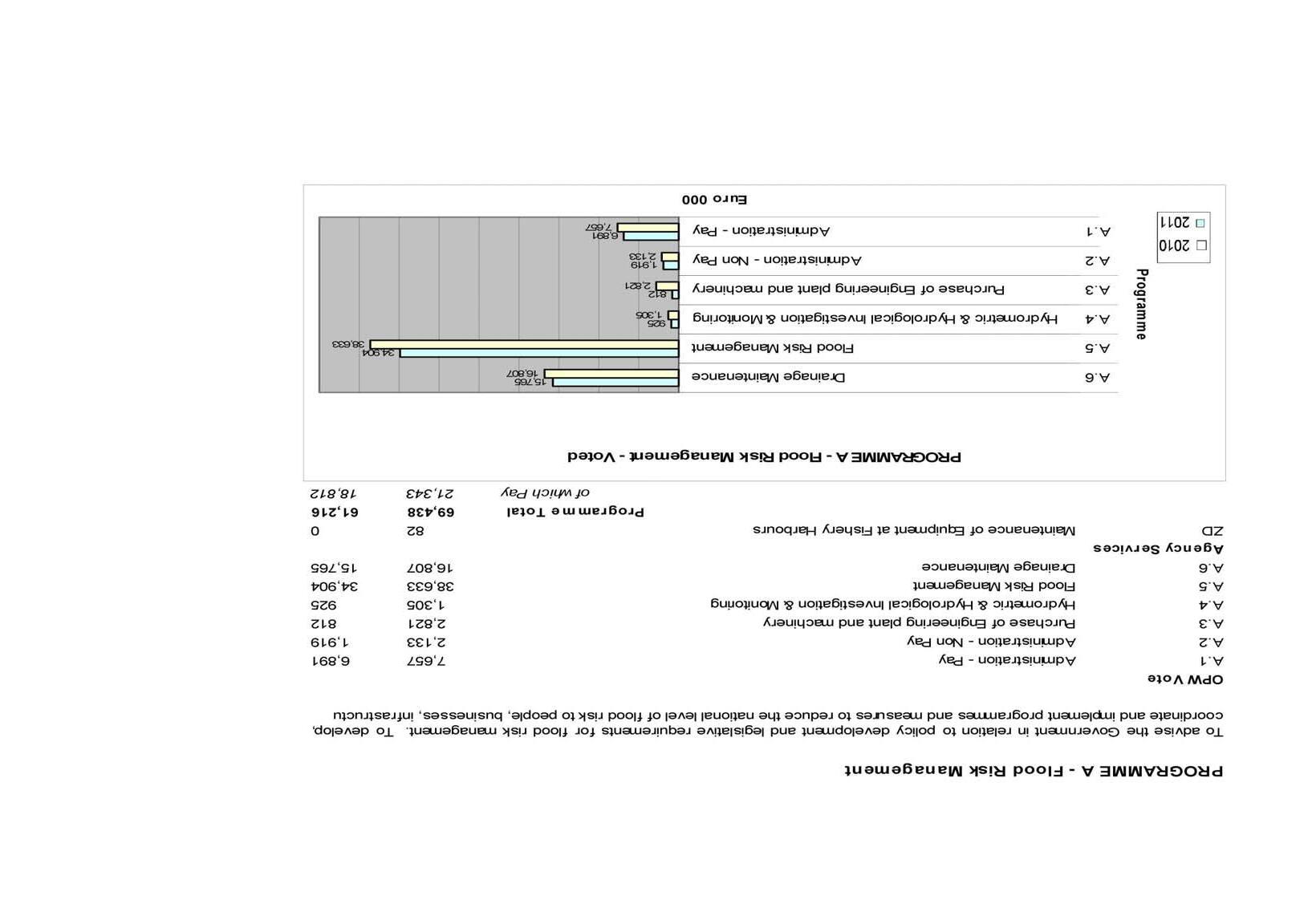
PROGRAMME A - Flood Risk Management
To advise the Government in relation to policy development and legislative requirements for flood risk management. To develop, coordinate and implement programmes and measures to reduce the national level of flood risk to people, businesses, infrastructure and the environment. To develop flood risk management in line with international best practice
PROGRAMME B - National Procurement Service (NPS)
To achieve greater efficiencies and value for money in the procurement of common goods and services for the Irish public service.
PROGRAMME B - National Procurement Service (NPS) - Voted
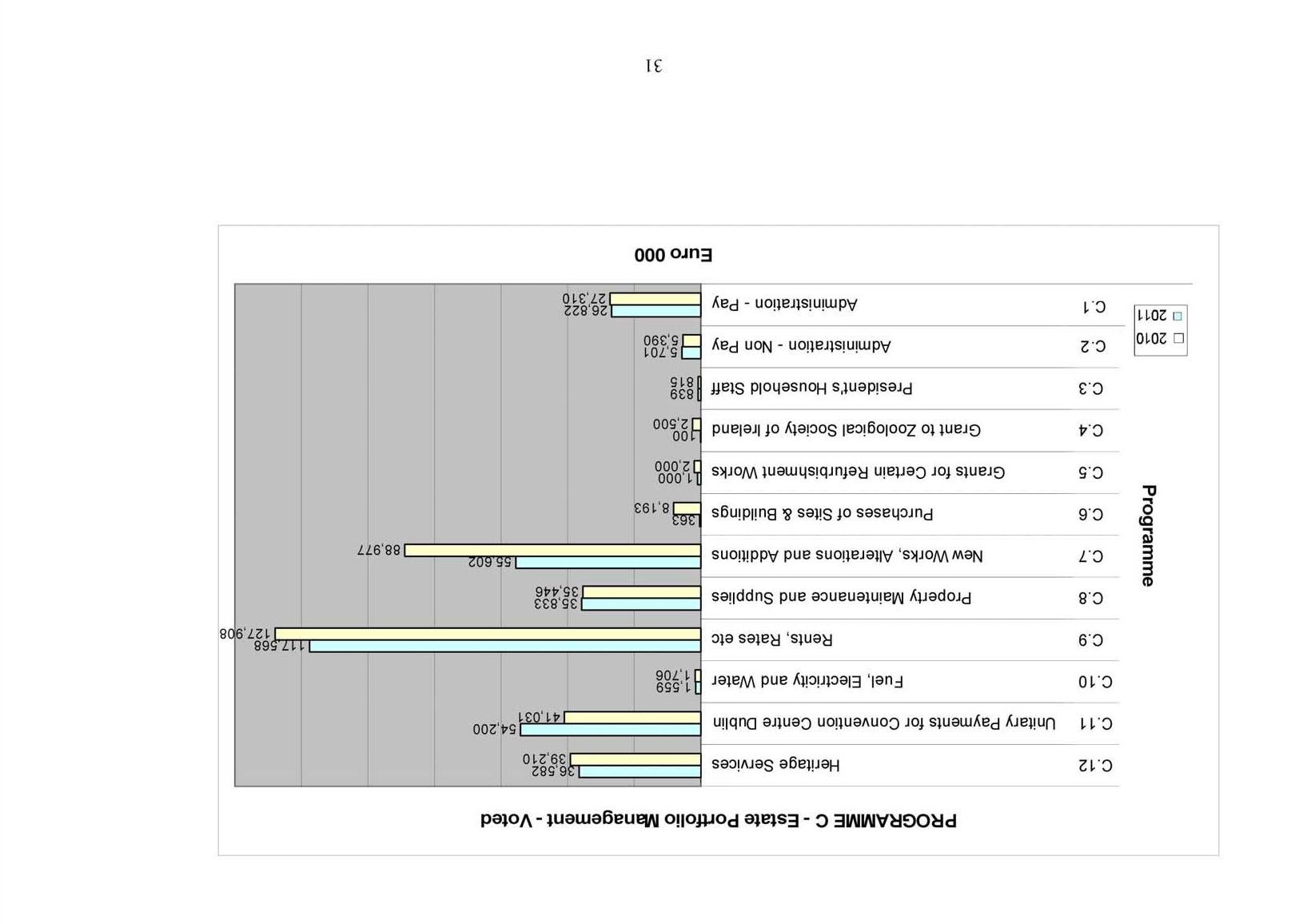
PROGRAMME C - Estate Portfolio Management
To provide a shared service in the area of property management and property maintenance incorporating architectural, engineering, valuation, quantity surveying, project management and facilities management services to central Government Departments and Agencies. To continue to be the lead agency in the country in the areas of conservation and presentation of cultural and heritage properties.
Agency Services:
OPW services are generally delivered from Voted funds. The OPW Vote however, does not represent the full scope of OPW activities. A significant element of funding is managed on behalf of other Departments using monies voted to other Departments bythe Oireachtas. The total amount of Agency Services in 2011 was €59m (excluding draw-down contracts).
Other Services:
In addition to functions funded by the OPW Vote and Agency Services for other Departments, the Office also provides a number of services, which demand OPW input and resources on a continuing basis. Examples of these services include:
· advising on architectural matters
· developing sustainable energy options
· conducting universal access audits
· examining and implementing flood protection proposals
· sourcing, assessment and acquisition of sites for primary schools on behalf of the Department of Education and Skills
· procurement issues related to specific projects
· Art Management within the State portfolio
· administration of the Local Loans Fund on behalf of the Department of Finance
· certification of repayments under grants on behalf of the Department of Arts, Heritage and Gaeltacht.
A functional split of all Administration costs are included in the above programmes but are summarised by expenditure type below for information only
and
Returns made to Department Enterprise, Trade & Employment under Government Decision No S29296 of 19 May 2009
Number of payments made in excess of 30
Penalty interest payments amounting to €5,295 were made by OPW in 2011 under the Prompt Payment of Accounts Act, 1997.
Awards Won by OPW 2011
Section Property Award
National Procurement Service n/a
National Procurement Service n/a
National Procurement Service n/a
National Procurement Service n/a
Architectural Services The Main Guard, Clonmel
Heritage Services Glendalough Visitor Centre
Heritage Services Dun Aenghasa Visitor Centre
Heritage Services Kilkenny Castle
Heritage Services Kilmainham Gaol
Heritage Services Clonmacnoise
Heritage Services Brú Na Bóinne
Awarding Authority
Certificate of Achievement - Central Award E-Government awards
Certificate of Achievement - Education Award E-Government awards
Innovation and Public Procurement Award (finalist)
Procurement Leader Award (Vincent Campbell)
National Procurement Awards
National Procurement Awards
Conservation and Restoration medal. RIAI
Silver Award, Special Merit
Silver Merit Award of Excellence
Silver Merit Award of Excellence
Silver Merit Award of Excellence
Silver Merit Award of Excellence
Silver Merit Award of Excellence
Heritage Services Dublin Castle Silver Merit Award of Excellence
Heritage Services
Historic Properties Phoenix Park Job Shadow Initiative Participant 2011
Heritage Services
Historic Properties Farmleigh Full Museum Accreditation
CIE Tours, Awards of Excellence
CIE Tours, Awards of Excellence
CIE Tours, Awards of Excellence
CIE Tours, Awards of Excellence
CIE Tours, Awards of Excellence
CIE Tours, Awards of Excellence
CIE Tours, Awards of Excellence.
The Irish Association Of Supported Employment (IASE)
Heritage Council
John Sydenham Commissioner
Estate Management & Development
Brian Allen- Project Mgt
John Curtin - Property Mgt
Michael Fennelly - Project Mgt
Ciarán O'Connor
Principal Architect State Architect Director of Architectural Services
Liam Egan APA Architectural Svcs
John Gallagher - Structural Engineer Estate Portfolio Info & Systems
Ken Moore - Property Mgt
Aidan Quinn - Quantity Surveyor, Project Mgt
OPW Senior Management Team
(following a reorganisation in March 2012)
Tony Smyth Director of Engineering Sces Chief Engineer Flood Risk Management
Clare McGrath Chairman
Mark Adamson - Asst Chief Eng
Liam Basquille - Principal
Tom Bolger - Asst Chief Eng
Michael Collins - Asst Chief Eng
Vincent Campbell Director of the National Procurement Service
Eilís O'Connell Director of Corporate Services
John Mc Mahon Commissioner
Heritage & Building Services
Martin Bourke - Principal
Brian Brogan - Principal
Eileen Leahy - Personnel
Mick Long - Accountant
Liam Stewart - ICT
George Moir - Nat. Hist. Properties
Angela Rolfe -Property Maint.
Frank Shalvey - Nat. Monuments
Jim O'Sullivan - Mech &Elec.
Central Engineering Workshop
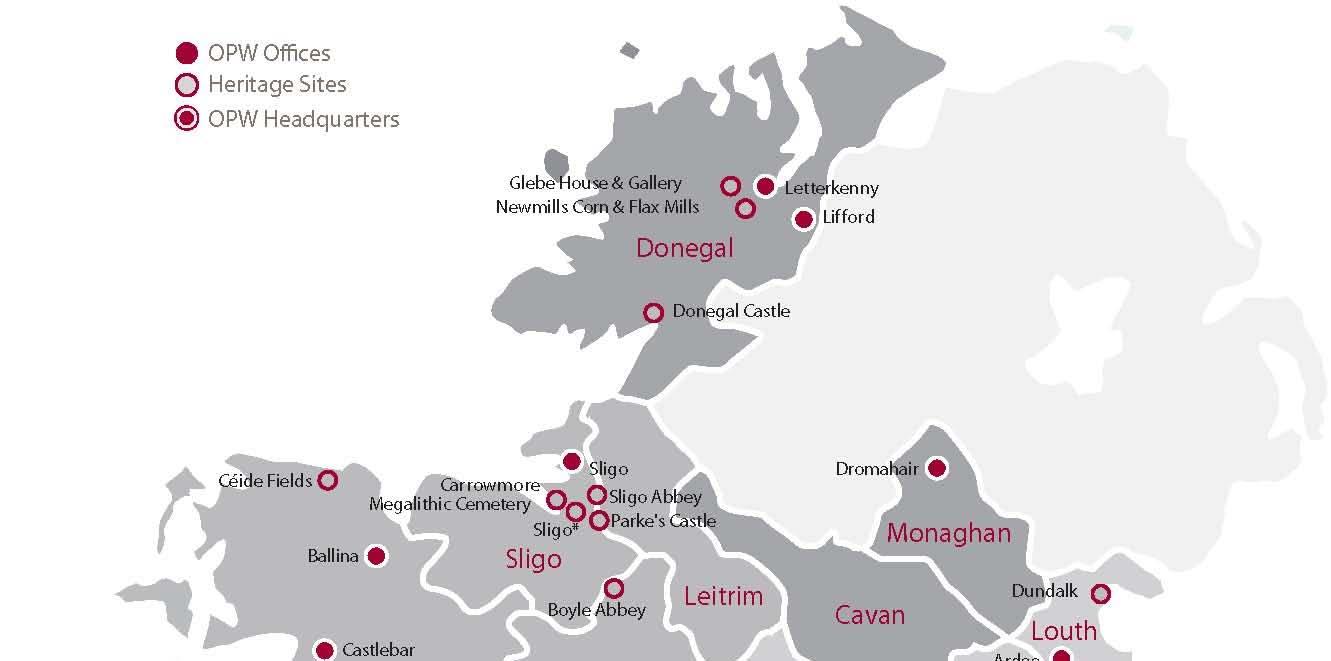
Jamestown Road, Inchicore, Dublin 8 (01) 453 4204
Arterial Drainage Maintenance
Newtown, Trim, Co Meath (046) 943 1352
Fairgreen, Ardee, Co Louth (041) 685 3256
Robinstown, Mullingar, Co Westmeath (044) 48332
Ballycraine, Castlebridge, Co Wexford (053) 24181
Drumbear, Cootehill Road, Monaghan (047) 83201
Main Street, Headford, Co Galway (093) 35456
Foxford Road, Ballina, Co Mayo (096) 22065
Gallows Brae, Lifford, Co Donegal (074) 914 1273
Templemungret House, Mungret, Limerick (061) 227 139
Inch Bridge, Listowel, Co Kerry (068) 21166
Connaught Harbour, Portumna, Co Galway (090) 974 1086
14 Old Blackrock Road, Cork (021) 4967087
Hydrometric Services
Newtown, Trim, County Meath (046) 9431352
Main Street, Headford, Co. Galway (093) 35456
Pearse Street, Athlone, Co Westmeath (090) 649 2918
Hebron Road, Kilkenny (056) 777 2641
Fair Green, Ardee, Co Louth (041) 685 7992
Templemungret House, Mungret, Co Limerick (061) 209118
Foxford Road, Ballina, Co Mayo (096) 22065
Regional Architectural Offices
Steward’s House, White’s Road, Castleknock, Dublin 15 (01) 812 8122
Dublin Castle, Dublin 2 (01) 677 6106
Govt Buildings, St Alphonsus Road, Dundalk, Co Louth (042) 933 4221
Government Offices, High Road, Letterkenny (074) 912 1365
Barrack Street, Athlone, Co Westmeath (090) 649 2087
13 Catherine Street, Waterford (051) 874 134
Government Buildings, Portlaoise (0502) 21133
Government Buildings, Anne St, Wexford (053) 22470
Buildings, St Alphonsus Road, Dundalk, (074) 912 1365
Westmeath m
Westmeath
ndalk, nny
Govt