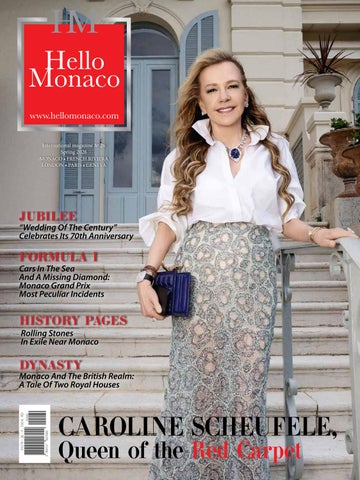
“Wedding Of The Century” Celebrates Its 70th Anniversary
FORMULA 1
Cars In The Sea And A Missing Diamond: Monaco Grand Prix Most Peculiar Incidents
HISTORY PAGES
Rolling Stones In Exile Near Monaco
DYNASTY
Monaco And The British Realm: A Tale Of Two Royal Houses
CAROLINE SCHEUFELE,
Queen of the Red Carpet
BRIDAL COLLECTION
LETTER FROM THE PUBLISHER
Sport, as always, plays a central role in Monaco’s story. As engines prepare to roar once again for the Monaco Grand PrixTM , we revisit some of the race’s most curious and unforgettable moments — including a fascinating chapter of history: Monaco was the first Formula 1TM race ever to welcome a woman driver. Meanwhile, tennis enthusiasts will soon gather for the Rolex Monte-Carlo Masters, where legendary matches, glamorous spectators, and unforgettable anecdotes continue to shape the tournament’s mythology.
This season we are also proud to celebrate a new sporting achievement for the Principality. In our Monaco’s Got Talent section, we introduce Sofia Aurelia George — the first-ever world champion from Monaco in pony jumping — a young athlete whose determination and talent promise a remarkable future.
Art and creativity remain at the heart of life on the Riviera. In this issue, we meet inspiring personalities who shape Monaco’s cultural landscape — from the artistic vision of Caroline Scheufele, whose jewels illuminate the red carpet to conversations with Denis Allemand and Almine Rech. We also explore some of the most exciting spring exhibitions across the region.
Dear Readers,
Spring in Monaco is a season of renewal, elegance, and anticipation. As the Mediterranean awakens under longer days and soft sunlight, the Principality once again prepares for its most vibrant months — when culture, sport, history, and art meet in a uniquely Monegasque rhythm.
In this issue, we celebrate remarkable milestones and stories that reflect the true spirit of Monaco. We look back at the 70th anniversary of what the world once called the “Wedding of the Century” — the marriage of Prince Rainier III and Grace Kelly — a moment that forever shaped Monaco’s modern identity. Spring also brings one of the Principality’s most beloved traditions, the legendary Rose Ball, whose 70th edition once again filled Monaco with beauty, elegance, and generosity.
Monaco’s story is inseparable from its heritage and international connections. We revisit the historical ties between the House of Grimaldi and the Ardennes, reflect on the relationship between Monaco and the British royal family, and pay tribute to Queen Elizabeth II — a sovereign whose life marked an entire century.
Beyond the Principality, we invite you to discover nearby destinations and experiences that embody the Mediterranean art de vivre — from the mysterious island of Sainte-Marguerite in the Bay of Cannes to new ideas in wellness and travel.
As always, Monaco reveals itself as much more than a destination. It is a place where tradition and innovation, elegance and ambition, history and modern life coexist in extraordinary harmony.
We hope this spring issue inspires you to rediscover the beauty, energy, and stories of the Principality.
Warm
regards,
Olga Taran
Olga Taran , Founder, Editor-in-Chief of HelloMonaco
Photo: Olga Sauvaire
International magazine
HelloMonaco № 26 • Spring 2026
Periodicity: 3 editions per year
Print run: 20.000
FOUNDED AND PUBLISHED BY HelloMonaco by Olga Taran
Publisher assumes no responsibility for the products or services advertised within this publication. Editorial contained within does not necessarily reflect the opinions of HelloMonaco editorial team.
No part of this publication may be reproduced in any way without expressed written permission of the publisher.
This magazine was printed following all ecological certificates and rules by a printing company using certified materials.
Distributed by SEC Monaco - Societé Presse Diffusion
Internet: www.hellomonaco.com
hello_monaco
welcomemonaco (eng)
monacoru (rus)
COOPERATION & GENERAL INQUIRIES
E-mail: info@hellomonaco.com
ADVERTISING & ADVERTORIALS
E-mail: ad@hellomonaco.com
EDITORIAL OFFICE
EDITOR-IN-CHIEF, FOUNDER: Olga Taran
EXECUTIVE EDITOR: Olga Chereshneva
PROOF-READER: Justin Brisk
TRANSLATOR: Angelina Clibbens
CONTRIBUTORS/WRITERS:
Justin Brisk, Xania Keane, Nicole Laffont, Helena Litvak, Julia SaintGermain, Olga Taran, Katya Taran, Olga Chereshneva
DESIGNER: Irina Roina
PHOTOGRAPHER: Yaroslav Treshchev @Yaro
COVER PHOTO: Caroline Scheufele, Chopard’s Co-President and Artistic Director
Necklace from Haute Joaillerie Collection featuring a sapphire cabochon weighing
“Wedding
British
219.31 carats, set with emerald-cut diamonds totaling 21.71 carats, pear-shaped diamonds totaling 28.56 carats, and Asscher-cut diamonds totaling 21.37 carats, set in 18-сarat ethical white gold.
Ring from Haute Joaillerie Collection featuring a marquise-cut diamond weighing 9.09 carats and paved with brilliants totaling 1.08 carats, set in 18-сarat ethical white gold.
Ring from Haute Joaillerie Collection featuring a cushion-shaped diamond weighing 17.58 carats (type IIA), shouldered by two half-moon-cut diamonds totaling 2.45 carats and 1.14 carats of diamonds, set in 18-сarat ethical white gold.
Watch from Happy Diamonds Collection featuring 4.80 carats of diamonds and 0.99 carats of moving diamonds, set in 18-сarat white gold.
Chopard Siren skirt fully embroidered with silk organza hearts adorned with sequins, crystals and beads on a light tulle base with short silk georgette lining. Paired with a pristine white, lightweight taffeta blouse.
Sofia Aurelia George, Monaco’s First-Ever World Champion In
Monaco
Her
Rackets,
Sainte-Marguerite, A Mysterious Little Paradise
In The Bay Of
Maison Albar, The Spirit Of The
YouHodler:
The Principality undeniably has a lead on the Mediterranean coast regarding the variety of events and entertainment, its cultural and social life being very diverse. There have been several important happenings and news worth recalling over the last few months. We offer you this list which features a kaleidoscope of noteworthy events that made the headlines in the media.
A Crown of Distinction: Hôtel de Paris Monte-Carlo Honoured among the World’s 50 Best Hotels
The legendary Monegasque palace has been recognized among the World’s 50 Best Hotels securing the 36th position in the prestigious global ranking 2025. The announcement, made in London during
“Too
Many Victims”: Monaco adopts New Law on Road Safety
The National Council unanimously voted to pass Bill No. 1107, which aims to strengthen road safety. The law includes deterrent measures for drivers, while also reinforcing the protection of traffic accident victims. The bill strengthens penalties applicable to several specific offences, including driving under the influence of alcohol or drugs, refusal to submit to prescribed vehicle checks and refusal to stop after causing an accident. The law also stipulates that repeated speeding offences exceeding 50 km/h are now classified as a criminal offence.
the third annual World’s 50 Best Hotels ceremony, brought together the elite of international hospitality, a circle to which the Hôtel de Paris Monte-Carlo naturally belongs. Accepting this new accolade on behalf of the
property were Louis Starck, General Manager, and Vincent Chasseignaux, Hotel Manager, both proud representatives of an institution that has defined the essence of refined living in Monaco for over a century and a half.
Young Talent Shines as Princess Charlène Crowns Winner of Monaco’s U16 Jersey Design Contest
H.S.H. Princess Charlène, President of the Monegasque Rugby Federation, visited the Collège Charles III for the 2nd edition of the U16 National Team Jersey Design Competition. Organized by the Monegasque Rugby Federation, in partnership with the Princess Charlène of Monaco Foundation and the Department of National Education, Youth and Sports, the initiative once again celebrated both art and athletic spirit. 158 young artists, 12 to 15 years old, took part in this challenge: to imagine a rugby jersey that would unite the vibrant symbols of Monaco and South Africa, along with the emblems of the Federation and the Foundation. The theme, symbolically linking Princess Charlène’s native South Africa and her adopted home of Monaco, reflected the values of unity, friendship, and respect that lie at the heart of both sport and the Princess’s personal story. The moment of triumph came for Yohann Fonkoa, a talented 9th-grade student, whose design perfectly captured the spirit of unity and dynamism at the heart of rugby. Yohann’s creation was worn by the Monegasque U16 national rugby sevens team at the Dubai International Tournament which took place on 28–30 November at the Sevens Stadium. As an additional honour, he received a unique jersey signed by the team’s players, a cherished keepsake marking this memorable achievement.
Prince Albert II makes First Official Visit to Paraguay
During his trip to South America, the Prince made his first official visit to Paraguay, at the invitation of Santiago Peña, President of the Republic of Paraguay. The Sovereign began by visiting the National Pantheon of Heroes, a major site of remembrance and a symbol of Paraguayan history, where he lay a wreath. Prince Albert II was then received at the Presidential Palace by President San -
tiago Peña during an official ceremony in the gardens, followed by bilateral talks and a larger meeting between the delegations. Prince Albert II received the Order of Marshal Francisco Solano López and President Peña was awarded the Grand Cross of the Order of Saint Charles. Discussions focused on strengthening cooperation between Paraguay and Monaco, particularly in the areas of the environment, trade, and cul -
ture. The First Lady of Paraguay, Leticia Ocampos, also attended the ceremony. The Sovereign then delivered an opening address at a Paraguayan Economic Conference, attended by 11 companies from the Principality as well as Paraguay’s President. The visit continued with a tour of the Itaipu Binacional hydroelectric power plant, located on the Paraná River on the border between Brazil and Paraguay.
When Monaco, the Princely Couple and their Twins Glow at 2025’s Joyful Fête Nationale
Every year on 19th November, the Principality of Monaco celebrates its National Day (also called the “Prince’s Day” or Fête du Prince) in honour of the reigning sovereign and the country’s warm relationship with him. The day began with the traditional mass of thanksgiving at the Cathédrale Notre Dame Immaculée de Monaco in Monaco-Ville, attended by the sovereign couple and extended members of the princely family. This 2025 edition included a spectacular free fireworks display at Port Hercule on the evening of 18 November (peaceful eye-popping “shock and awe” on the eve of National Day), a pop-rock concert by the band Superbus on 18 Nov, while on November 19 there were daytime activities at the Marché de la Condamine, giant stockfish tasting and musical entertainment. The princely family made a prominent appearance on the palace balcony, greeting everyone gathered on the Rock. The presence of the younger generation including heir Prince Jacques of Monaco and Princess Gabriella of Monaco always adds a fresh note to the tradition.
Marcel Ravin Receives the Ordre du Mérite Agricole as Prince Albert Looks On
On 20th November, in a ceremony held under the auspices of French diplomatic and Monegasque dignitaries, Chef Marcel Ravin received the Ordre du Mérite Agricole. The decoration, colloquially known as “le Poireau” (the Leek) is awarded to men and women who have rendered “outstanding services to agriculture.” The award is a meaningful addition to Ravin’s growing list of accolades. Already honoured with the Légion d’Honneur since 2017, he leads the kitchens of both Blue Bay and Elsa at Monte-Carlo’s resorts, Blue Bay boasting two Michelin stars and Elsa another. As the French Ambassador to Monaco, accompanied by members of the Principality and the Order, presented him with the insignia, and as Monaco’s own sovereign watched on, the honour felt like more than a career milestone.
Photo: Yaro
Photo:
Yaro
Bilateral Relations Elevated as Portuguese President Makes First-Ever State Visit to Monaco
On Friday, 21st November, Their Serene Highnesses
Prince Albert II and Princess Charlène welcomed His Excellency Mr Marcelo Rebelo de Sousa, President of the Portuguese Republic, for a historic official visit to the Principality of Monaco, the first visit by a Portuguese Head of State to Monaco. Committed to deepening and strengthening their bilateral and global relations, as well as the friendship and close cooperation between the two States, Prince Albert II and President Marcelo Rebelo de Sousa addressed several key aspects of the partnership between Monaco and Portugal. Both leaders recalled the quality of diplomatic dialogue since 2007, also rooted in a shared history of consular ties in the 19th century and a partnership born of a rich tradition of exchanges and cooperation. The two Heads of State also underlined the importance of the Portuguese community living in Monaco numbering in the hundreds and those Portuguese working here numbering in the thousands, whose contribution to the vitality of the Principality is particularly valued. President Rebelo de Sousa highlighted Portugal’s strong economic and social momentum, its development and stability.
26th No Finish Line: A Record-Breaking Edition!
After eight days of racing, the 2025 No Finish Line concluded in the presence of Prince Albert II, who completed the final lap, on 23rd November at 2 p.m. The event’s first weekend saw stormy weather, but in spite of this, participants came out in large numbers and performed exceptionally well. This year’s edition had the ambitious goal of covering 325,000 km and raising €325,000 with 14,000 participants. And those goals were surpassed! Participants covered 375,245 km, which means €375,245 will be
donated to fund around twenty projects for sick or disadvantaged children. That’s over €50,000 more than the goal! And 14,440 participants registered, or 440 more than the target. The Prince’s Cup was awarded to Justine Houter Magni with 928 km! She is the first woman ever to win the No Finish Line Monaco! She also surpassed the women’s record of 924 km held by Sarah Barnett in 2011, a record that had never been equalled or exceeded until now. She won 1st place overall (all categories combined) and 1st place on the
women’s podium 2025. The Government Cup went to 2nd place participant, Marie-Laure Roussel, with 784 km. Third place (National Council Cup) went to Paola Coccato with 681 km. For men, the Prince’s Cup was awarded to Andreas Michalitz with 845 km. Second place went to Christian Stolowitz with 843 km. Third place went to Philippe Pollesel with 829 km. The first-place winning team was Carabiniers Fight Aids Monaco with 14,189 km. The first-place charity was Special Olympics Monaco with 10,396 km.
When Champions Share the Road: The Human Heart of BEKING 2025
On November 23rd, BEKING 2025 showcased cycling, one that fused elite performance, grassroots joy and social purpose. This fifth edition confirmed what regulars already knew and newcomers discovered immediately: BEKING is not a conventional race day. It is a meeting point. A place where world champions, aspiring young riders, families and fans share the same tarmac. Claudia Morandini, the driving force behind the event, captured the mood perfectly. Relief blended with pride as she watched the harbour come alive once more, especially with a historic first: women racing on the BEKING course. Their presence was not symbolic, but essential. The women’s criterium exploded into motion across 27 relentless kilometres. Twenty laps of attacks, counter-attacks and surges kept spectators locked in until the final moments. In a decisive uphill move Lorena Wiebes asserted her authority, crossing the line ahead of Kasia Niewiadoma and Anna Trevisi. As the afternoon deepened, the men’s criterium raised the volume another notch. Thirty-five laps. Forty-eight kilometres. Thirty-five riders. Attacks flew, gaps opened and closed, and tactics sharpened with every circuit. At the end of it all, Jonathan Milan powered to victory, edging past Tadej Pogačar and local favourite Victor Langellotti.
Prince Albert II attends Festival des Étoilés Gala
Prince Albert II attended the closing gala for the 5th Festival des Étoilés in the Salle Empire of the Hôtel de Paris on 29 November. The Sovereign was accompanied by Princess Stephanie’s children, Louis Ducruet and his wife Marie Chevallier, Pauline Ducruet, and Camille Gottlieb. The Michelinstarred gala dinner was the festival’s grand finale. Several celebrities attended the gala, including model Baptiste Giabiconi and Italian singer Fedez. Chefs Alain Ducasse, Emmanuel Pilon, Yannick Alléno, Marcel Ravin, Domenico d’Antonio and Dominique Lory went all out to craft an elaborate seven-course menu. This year, pastry chef Cédric Grolet joined the team, unveiling an oversized SaintHonoré as the grand finale of the meal. Monte-Carlo Société des Bains de Mer now boasts ten Michelin stars, up from seven in previous editions, following the opening of new restaurants. The evening blended fine dining with entertain
ment, featuring performances by the children’s choir of the International School of Monaco, dancer Desislava Kancheva, and the duo Marc Emmanuel Zanoli and Claire Teyssière, before the group Divas on the Floor brought the celebration to a close. A sixth edition has already been confirmed for 2026.
When Fashion Takes the Chequered Flag: Monaco’s Grand Prix Enters a New Luxury Era
For nearly a century, the Monaco Grand PrixTM has been a race defined by speed, staged in a place where excess, elegance, and leisure reign supreme. Now, that has been formalised and monetised. From 2026, the jewel in Formula 1’s crown will officially be known as the Formula 1TM Louis Vuitton Grand Prix de Monaco, marking a decisive shift in how the sport frames its most storied event. The announcement, made by the Automobile Club de Monaco alongside the unveiling of the 83rd edition’s official poster, is more than a change of name. It is a statement about where Formula 1TM is heading, and who it wants in the driver’s seat culturally, if not literally. Louis Vuitton’s elevation from supplier to title partner fits neatly into a wider pattern across Formula 1TM: Over the past few years, the championship has welcomed an influx of luxury sponsors eager to tap into its rejuvenated audience and expanding global reach. Long before the naming rights, Louis Vuitton had already left its imprint on Monaco’s most photographed moment. Since 2021, the house has produced the bespoke trunk that carries the winner’s trophy, a modern heir to its 19th-century origins as a maker of travel cases for Europe’s elite. The 2026 Monaco Grand PrixTM, scheduled from 5 to 7 June, also breaks with tradition by moving away from its usual late-May slot. Instead, it will open the European leg of the Formula 1TM season, an adjustment that aligns neatly with its new status as a flagship luxury event.
Photo: Ivan Benedetto
From Monaco to the Moon: How Venturi Quietly Puts Europe on Lunar Wheels
In the cavernous ESA–DLR LUNA hall in Cologne, where crushed rock mimics parts of the lunar surface, a machine conceived by the Monaco-based Venturi Space and developed across Monaco, Switzerland and France (Toulouse), recently did something deceptively simple: it drove forward. The rover is called Mona Luna. The moment, its first successful roulages, is the visible proof of a long, deliberate ambition nurtured in the Principality: that Monaco, better known for motorsport and luxury, can also collaborate to shape Europe’s future on the Moon. While Venturi Space operates across borders, the programme is unmistakably Monegasque in spirit. Engineering and systems development are shared between Venturi’s three principal sites including Monaco. Venturi’s French site contributes advanced space engineering and industrial integration. And their Swiss site is home to precision manufacturing and critical component development. The rover itself weighs approximately 750 kg, expandable to up to a tonne depending on mission configuration. Yet numbers tell only part of the story. The aesthetic of Mona Luna bears the imprint of Sacha Lakic, Venturi’s long-time design director. On the Moon, form is function, and every curve, articulation and surface exist to solve a problem posed by dust, vacuum, or extreme temperature. During recent tests at the European Space Agency’s LUNA facility, Mona Luna demonstrated its ability to climb slopes exceeding 30 degrees, traverse uneven rock fields, and maintain stability where gravity offers little forgiveness. These tests were quiet confirmations that the engineering choices made in Monaco and refined across Europe were sound.
First Place Secured… Monaco United Even Forgot to Stop Scoring
Asoccer match with first place on the line and promotion ambitions hanging in the balance, Monaco United welcomed their closest challengers, Carros, for what felt like a championship decider. Level on points at the top of the table, separated only by goal difference, both sides knew that this was
more than just another league fixture. At the Didier Deschamps Stadium on January 11, and in front of a large, expectant home crowd, Monaco United delivered a performance that will be talked about long after the season ends. The evening also carried symbolic weight off the pitch. Among the spectators was Joël Bouzou,
President and Founder of Peace & Sport, Monaco United’s official partner. Thanks to this resounding victory with an incredible score of 10 goals to 1, Monaco United ended up alone at the top of the league, also boasting a commanding goal difference and a clear gap over their closest pursuers.
Photo credit: Dylan Garino
Condamine Market Restructuring Project Began in Mid-January
Monaco’s City Hall held an information meeting for local residents, shopkeepers, and other stakeholders prior to the start of the Condamine Market Hall restructuring project. The Mayor and his two Deputy Mayors presented the project’s main features. The restructuring of the market is planned because of the location’s “technical, regulatory, and safety requirements,” said the Mayor, particularly regarding fire protection. The project includes improvements to thermal, acoustic, and olfactory comfort, increased capacity, redesigned spaces, and modern equipment, all within the framework of Monaco’s Mediterranean Sustainable Buildings (BD2M) initiative. Throughout the construction period, estimated at 13 months, the Market will remain open thanks to a temporary setup on the Place d’Armes. Vendors will be accommodated outdoors in fully equipped kiosks for those who cook on-site. A large tent will be set up for other vendors with approximately 60 seats for customers, and another tent for Solis Bio. Measures planned to reduce disruptions caused by construction include: complete isolation of the work zone, installation of sensors and sound level meters to monitor noise levels, strict adherence to regulated working hours, scheduling of the noisiest work outside of peak hours, and measures to limit the spread of dust and vibrations. A digital monitoring tool will also allow local residents to be regularly informed of the progress of the construction. Once the work is completed, visitors will find a modernized Market Hall, with its architectural identity and welcoming atmosphere still intact.
Chocolate Time, The Chocolate Moment At Hôtel Métropole Monte-Carlo
At the Hôtel Métropole Monte-Carlo, winter was experienced with indulgence and generosity. Executive Chef Christophe Cussac, Pastry Chef Patrick Mesiano and Head Barman Mickaël Bellec imagined Chocolate Time, an invitation to savour chocolate in all its richness and sensuality. Set within the intimate ambiance of the Lobby Bar, this true chocolate bar revealed a selection of creations designed for sharing, featuring pastries and childhood classics prepared exclusively in the Hotel’s in-house chocolaterie. To be enjoyed time and again, shared or savoured solo depending on the mood: the utterly irresistible Chocolate Fondue; the Chocolate, Caramel and Peanut Bar, a deliciously crunchy treat; the Cookie with Vanilla Ice Cream, filled with nostalgic memories; and the soft, delicate Brioche Crème Brûlée with Chocolate Chips. Mickaël Bellec, Head Barman of Hôtel Métropole Monte-Carlo, has created a selection of drinks that elevate chocolate in all its forms. Among them are the powerful balance of the Noir Intense cocktail, with notes of Macallan Harmony V, Phoenix Honey Orchid tea honey, tonka bean and Angostura; the generous sweetness of the Chocolate Cascade, combining vanilla-infused gin, Amaretto, Kahlúa and chocolate; and the Choco-Delight, a vibrant mocktail of apple juice, cocoa-spiced caramel and ginger ale. Comforting infusions and hot chocolates, traditional or delicately scented with cinnamon, extended this chocolate-filled interlude until spring.
Monte-Carlo Casinos Receive Highest Distinction at 2026 European Casino Awards
The Casino de Monte-Carlo and the Casino Café de Paris shone at the European Casino Awards ceremony on January 19 in Barcelona. While the Monte-Carlo Société des Bains de Mer
has regularly won prestigious awards at this particular event, this year the Group received the highest distinction for its two gaming establishments: Best Overall Casino. The highly coveted Best Overall Casino
award recognizes the overall excellence of a casino based on several criteria, such as the quality and variety of games offered, the user experience, customer service, and player security.
Little Wonders: A New Family-Dedicated Space Opens in Monaco
On January 21, under the initiative of Marie Ducruet and Elise Rouillard and in the presence of the Princely Family, Monaco inaugurated Little Wonders. This brand-new indoor play concept has been thoughtfully designed for young children and their families, combining early learning, imagination, and shared moments — all within a warm, secure, and carefully curated environment. A true family cocoon, Little Wonders offers an innovative space created to stimulate children’s curiosity, creativity, and development, while also providing parents with a welcoming place to meet, connect, and accompany their children through their first discoveries. Little Wonders aims to become a reference destination for families in Monaco, offering far more than a play area: a living space for connection, encounters, and shared memories.
Magic Under the Big Top: Highlights of the 48th MonteCarlo International Circus Festival
Artists have been gathering for the 48th Festival International du Cirque de Monte-Carlo, a place where spectacle and soul waltz hand in hand. This edition also marked the 13th year of the New Generation competition, for young circus talents. Prince Albert II, accompanied by Princess Stéphanie, Camille Gottlieb, and Louis and Marie Ducruet, presided over this flagship event of the Monegasque season. Top honours were shared in a triumphant trio. Flying Fuentes Gasca who defied gravity with breathtaking aerial artistry. Angelina Richter, who with equestrian artistry blended elegance with raw power. And Troupe de Suining, a breathtaking trio of young acrobats whose contortions and energy earned them both Clown d’Or and Junior d’Or. These champions enchanted every eye in the tent, each act a story spun from courage and grace. Beyond the gold, the night sparkled with silver and bronze luminaries. Silver Clowns went to dynamic ensembles like Troupe Kolfe, the duo Ilya & Regina with Zara, Troupe Dalian, Troupe Navas, and Ambra & Ives for their remarkable versatility. Bronze Clowns honoured acts such as Angels of Mongolian Contortion, Troupe Nomuna, Hakuna Matata, Hermanos Reyes, and Joao Godinho, each weaving laughter and gasps in equal measure. Special accolades and audience prizes lit up the festival’s vibrant constellation of talent, from the Junior Silver for Stefan Dvorak to the crowd-favourite charm of Duo Peperoni and Soery Dell’Acqua.
The Barbagiuans of Monaco Win the Sixth Edition of the Fight Aids Cup
The Barbagiuans of Monaco won the sixth edition of the Fight Aids Cup after an intense and emotional match, played under the High Patronage of H.S.H. Princess St é phanie, President and Founder of Fight Aids Monaco. All funds raised during this charity event will be donated to the association, which is committed to the fight against HIV. Organised by Louis Ducruet and the Barbagiuans of Monaco, the Fight Aids Cup has become, over the years, a must-attend event in Monaco’s sporting and charitable calendar, held within the prestigious framework of the International Circus Festival of Monte-Carlo. Once again, this gala and prestige football match, played on 24th January, brought together numerous legends of world football on the pitch of the Stade Louis-II, in front of a large and enthusiastic crowd. This marks the Barbagiuans’ second victory in the Fight Aids Cup, following four wins by Cirque FC. Louis Ducruet lifted the trophy with his team and will return to the competition in 2027 as the defending champions. The evening continued with the traditional gala, during which the Fred Allard trophy — awarded to the best player of the Match — was presented to Eden Hazard. For his first participation, the former Belgian football legend delivered a top-class performance, warmly applauded by the knowledgeable crowd at the Stade Louis-II and by the organisers.
Thunder, Ice, and Glory: The 94th Rallye Monte-Carlo Conquers Legend and Makes History
In a dramatic finale on the icy flanks of Col de Turini and ended under the Mediterranean sun, Oliver Solberg seized victory in the iconic Rallye Monte-Carlo. At just 24, the Swedish powerhouse became not only a rally winner but a record-breaking champion, etching his name beside legend and legacy on the ever-challenging Alpine pistes. The podium read like a testament to Toyota’s Alpine dominance: 1st place for Oliver Solberg / Elliott Edmondson (Toyota GR Yaris Rally1) a defining breakthrough victory, the second one is Elfyn Evans / Scott Martin (Toyota GR Yaris Rally1) Strong and steady, Evans claimed runner-up honours with consummate skill, and, finally, the third place is for Sébastien Ogier / Vincent Landais (Toyota GR Yaris Rally1). The venerable multichampion added yet another Monte-Carlo podium to his legendary tally. Together, their results not only filled the podium with Toyota Gazoo Racing machines but underscored the team’s early-season prowess in the 2026 World Rally Championship. This edition, which took place from 22–25 January, was far from predictable. Solberg outpaced
every twist and frost-covered turn to secure a commanding win. Evans, consistent and composed, remained the chief challenger amid shifting conditions. Ogier showed veteran brilliance, proving his legacy isn’t just built on past victories but ongoing resilience.
For the first time since 2008, a high-octane Super Special stage unfolded around Port Hercule in Monaco, weaving World Rally Championship competition through the city streets and electrifying fans beside the harbour.
Monaco Celebrates Its Patron Saint with Faith, Fire and Light at the 2026 Sainte Devote Festivities
On the 26th and 27th of January 2026, residents, institutions and the Princely Family gathered in faith, reverence and shared identity to mark a festival that blends centuries-old ritual with modern expression. The festivities
began on the morning of the 26th of January, with the Messe des Traditions in the Monégasque language at Église SainteDévote, a foundational spiritual anchor for the community. In the early evening, the procession of the saint’s relics set out
from the Grand Prix chicane through the streets. As dusk settled, crowds gathered along Quai Albert I at Port Hercule for the most anticipated moment. In the presence of Prince Albert II and Princess Charlène, joined by Prince Jacques and Princess Gabriella, the symbolic boat was set alight by the young Royal Twins. Following the boat burning, the harbour sky was illuminated by an 8-minute drone show. The spectacle drew gasps and applause from spectators wrapped against the winter chill, combining heritage and technology in a uniquely Monégasque expression. On Tuesday, 27th January, the feast day and a public holiday, the focus shifted to Monaco Cathedral, where a pontifical Mass was celebrated in the presence of the Princely Family. The solemn service underscored the spiritual foundation of the celebrations. A candlelit concert was held at Monaco Cathedral. The Sartène Choir and the Choir of the Papal Chapel of Assisi performed, accompanied by musicians from the Rainier III Academy. The programme was devoted to Corsican chant and holy music. Afterwards, the saint’s relics were carried in procession through the streets of MonacoVille.
David Slays Goliath in Astana: Monaco’s Historic Davis Cup Breakthrough
At the centre of this story stands Valentin Vacherot, a 27-year-old whose rise has been as rapid as it has been remarkable. With a career-high ATP ranking of No. 27, Vacherot etched his name into Monégasque sporting lore last year as the first player from this country to win an ATP Tour singles title and to crack the Top 50, highlighted by a sensational Masters-level triumph. Against all odds, the Monegasques toppled Kazakhstan 3-1 in the 2026 Davis Cup Group I play-offs, on February 6 and 7, punching their ticket to the prestigious Group I stage this September. In a match defined by razor-thin margins, the Monégasque phenom gritted out two tense tiebreaks to win 7-6(4), 7-6(6), converting his fifth match point with a crushing ace. Soon after Vacherot’s ranking reached a current pinnacle of No 25. Monaco had never reached this stage in the modern Davis Cup format before. According to historical records, the nation’s Davis Cup journey began in 1929, but this victory, anchored by Vacherot’s brilliance and the doubles unit’s grit, marks perhaps its most significant milestone in the competition’s long history.
Monaco Took Part in the XXV Olympic Winter Games in Milan
On the legendary Stelvio slope in Bormio, Prince Albert II cheered on Monegasque skier Arnaud Alessandria during the men’s downhill race at the Winter Olympics on 7 February in the morning. Monaco’s athlete finished 31st in the race. Before presenting the medals to the three winners, the Sovereign praised Arnaud Alessandria’s performance, saying that the athlete represented the Principality very well. After presenting the medals for the men’s downhill alpine skiing event in Bormio, Prince Albert II traveled to Livigno to attend the final of the men’s snowboard big air event. The spectacular event drew thousands of spectators to the foot of the Livigno jump on the evening of 7 February. Prince Albert II, Princess Charlène and the princely twins attended several Milano Cortina 2026 Winter Olympic events. Firstly, the family attended the women’s curling events and even received a private curling demonstration. At the Cortina d’Ampezzo, the family watched three women’s curling matches: Italy vs. China, England vs. Canada, and Switzerland vs. Japan. After these preliminaries, where Sweden and Switzerland progressed to the gold medal game, the Prince and his family went onto the ice rink with World Curling President Beau Welling, who
offered them a demonstration. The twins were able to slide the curling stone along the ice. Next day, the Princely family headed to the legendary Olimpia delle Tofane slope to watch the women’s giant slalom. Italian skier Federica Brignone won Olympic gold to a standing ovation in her home nation. In the late afternoon, the Princely Family trav-
elled to the Cortina Sliding Centre to attend the mixed team skeleton event.
Prince Albert II presented the medals to the winners. The UK took home the gold, ahead of two German teams. The twins also attended the Paris Games with their parents in 2024.
Prince Albert II and Arnaud Alessandria after the men’s downhill race
Valentin Vacherot
Gala celebrates Chinese New Year with the Embassy of Monaco in China
Agala celebrating Chinese New Year took place in the Mediterranean Room of the Hôtel Méridien Beach Plaza on 11 February in the evening. Chinese New Year officially began on 17 February 2026, and this year is represented by the
Fire Horse, a powerful symbol of passion, change, and transformation. Xiaoqin Wang, President of the Monaco-China Association and Founder of Monaco Dragon Prestige, opened the evening by welcoming the guests and thanking the partners, which
Guillaume Ranvier is the New Manager of the Hôtel Hermitage
Guillaume Ranvier has officially become the Hôtel Hermitage MonteCarlo’s new General Manager. He officially took up his duties after arriving directly from the Four Seasons Hotel George V in Paris, where he held the position of Hotel Manager. Ranvier is succeeding Louis Starck, who was appointed General Manager of the Hôtel de Paris Monte-Carlo at the end of September. Graduating at the top of his class from the École Supérieure de Cuisine Française in Paris, Guillaume Ranvier spent over ten years with the Hyatt Hotels Group in key positions, both in France and internationally. The Hôtel Hermitage in the midst of big changes. It will unveilnew suites in June, as well as a brand-new lobby bar, Bar Gustave, located beneath the Eiffel dome in the heart of the Winter Garden.
included the Embassy of Monaco in China. Marie-Pascale Boisson, Ambassador of Monaco to China, spoke about the strength of the relations between Monaco and China, calling it “a successful example of friendly exchanges between a small and a large country.” The one hundred guests included Monegasque and Chinese dignitaries. Isabelle Berro-Amadei, Minister of Foreign Affairs and Cooperation, Julie Donati, Advisor to the Cabinet of HSH the Prince, and Guillaume Rose, Executive Director General of Monaco Economic Board were in attendance, among other officials. Guests also enjoyed a Tai Chi demonstration by Chinese language students from Collège Charles III, as well as a “fan-blowing” dance and a choir performance by students from Lycée Albert 1er. Later in the evening, live drawings by the artist FABEN took place as well as a fashion show featuring creations from AMC Haute Couture Monaco, before a DJ took over to keep the guests dancing. The event also celebrated the 30th anniversary of the establishment of official relations between Monaco and China by reviewing Monaco’s significant events in China.
Monaco Run Gramaglia 2026: Records Fall and The Community Rises in Monaco
The 16th edition of the Monaco Run Gramaglia filled the streets on February 14-15 with motion, purpose, and an unmistakable sense that this event is outgrowing its own legend. Across two days, more than 4,500 participants traced routes between sea and skyline, a significant leap from previous years.
Before the mass start, the spotlight fell on an athlete whose presence alone can shift the gravity of a race. Triple Olym -
pic champion Faith Kipyegon stepped onto the Monaco course for her first road experience, testing speed against the flat Mediterranean edge. Dutch runner Diane Van Es delivered one of the defining moments of the weekend, shattering the European women’s record in a mixed race with a time of 14:33. The 10 km, more democratic in spirit, crowned French-Moroccan runner Kertoum Abdellah in 30:25.
The
15th Pink Ribbon Monaco Walk to support the fight
against women’s cancer
The 15th Pink Ribbon Monaco Walk, dedicated to the prevention and awareness of women’s cancer, was held on February 15, 2026, on Port Hercule in Monaco, as part of the Monaco Run. The Monaco Pink Ribbon Walk gathered hundreds in support of the fight against breast cancer. Pink garments fluttered in the sea breeze, conversations flowed across languages, and partnerships formed between organizations from across Europe. In partnership with the Monegasque Athletics Federation (F.M.A.), the Pink Ribbon Monaco Walk takes place, as every year, alongside the Monaco Run and perpetuates a sporting and charitable tradition deeply rooted in the Principality. Unlike other races, participants do not wear timing numbers but instead write a message of support or tribute to people affected by cancer on their bibs. The goal is not performance, but collective mobilisation and raising awareness of the cause.
Charles Leclerc Marries Alexandra Saint Mleux in Intimate Monaco Ceremony
On Saturday, 28 February 2026, just one week before the Formula 1TM season resumes in Australia, Monaco witnessed a deeply personal milestone for its most celebrated racing figure.
Charles Leclerc crossed what may be the most meaningful finish line of his life: he married Alexandra Saint Mleux in an intimate ceremony held on home soil. The wedding took place in the utmost privacy, far from the glare of the paddock and the roar of engines. True to his loyalty to Scuderia Ferrari, the Monegasque driver was seen behind the wheel of a red 1957 Ferrari 250 Testa Rossa — a rare collector’s model valued at several million euros. The newlyweds were spotted in the heights of the Principality, escorted through Monaco’s streets by a small motorcade of security riders.
New Appointments in the Prince Albert II of Monaco Foundation
Olivier Wenden assumed a position of Chief of Staff to HSH Prince Albert II of Monaco. Vice Chairman and CEO of the Prince Albert II of Monaco Foundation since October 2019, following five years as its Executive Director, Olivier Wenden has, throughout his tenure, worked to expand and structure the Foundation’s missions in line with the vision of the Sovereign Prince, ensuring that it delivers ever more relevant responses to the challenges of safeguarding planetary health. By decision of the Sovereign Prince, Romain Ciarlet assumed the roles of Vice Chairman and CEO of the Foundation, having served as its Executive Director since December 2019. This natural succession reflects a clear commitment to continuity, as the Foundation celebrates its twentieth anniversary this year.
THE MONACO GRAND PRIX WAS THE FIRST EVER FORMULA 1™ RACE TO FEATURE A WOMAN DRIVER
By Olga Chereshneva
2026 marks the centenary of Maria Teresa de Filippis’ birth, the first ever female Formula 1™ driver. Even if her career was not long-lasting, Maria Teresa was the one to have opened the way for women in motorsports.
Maria Teresa de Filippis, a talented Formula 1™ driver, full of femininity and bravery
WHAT CAN COME OUT OF A BET
Maria Teresa de Filippis was born in Marigliano, near Naples, to the family of an Italian count and a Spanish aristocrat. The youngest of five children, she was raised in a luxurious 16th-century palace. The young lady dedicated much of her time to tennis and equestrian sports. In the late 1940s, however, she also developed a keen interest in car racing. At the age of 22, Maria Teresa came first in her category for the Salerno – Cava de’ Tirreni race at the wheel of her Fiat 500. What made this victory even more remarkable is the argument she had previously had with her older brothers: “According to Giuseppe and Antonio, the great speeds would get me scared. Imagine my surprise when, once accelerated, I didn’t feel the slightest fear. I was perhaps more frightened by the fact I was not experiencing any fear or excitement. The one who was really worried was our mother Narcisa, she would later always ask me to drive slower.”
Maria Teresa driving her Maserati in Silverstone in May 1959
Maria Teresa driving a new Porsche at the 1959 Monaco Grand Prix
Maria Teresa literally fell in love with motorsports. In 1954 she won silver at the national championship. She was nicknamed “pilotino”, a “little racer”, like a boy (just imagine, the female version of this word did not even exist back in the day). That very year Maria Teresa was officially invited to join the Maserati racing team.
THE VERY FIRST GRAND PRIX AND HER VERY BEST RESULT
In May 1958, the 31-year-old Maria Teresa finally raced in the official Formula 1™ Monaco Grand Prix, the second stage of the ninth world championship. Driving a Maserati, she did not manage to qualify for that race. To be fair, another
debutant, the future head of Formula 1™, Bernie Ecclestone, also failed to qualify. It must be said, however, once they met at
“We were all really friends back then. Rivals on the track, friends in life.”
that Grand Prix, Maria Teresa and Bernie became friends for years.
That 1958 Monaco Grand Prix was also the first one for the future two-time world champion, Graham Hill, and the last one for Louis Chiron in his long brilliant career. Chiron remains the oldest driver in history to have ever competed in Formula 1™ … at the time of the 1958 Monaco Grand Prix, he was 58.
A month later, however, at the Belgian Grand Prix, Maria Teresa did manage to both qualify for and finish the race. Driving a Maserati 250F, modified to accommodate her extremely low weight (under 50 kg), this woman racer finished tenth in the standing. This result remains the best in her career as a pilot.
A TOUGH 1958
“We were all really friends back then,” Maria Teresa was saying later. “Rivals on the track, friends in life. Staying in the same hotels, moving from race to race in the same car... Luigi Musso and Juan Manuel Fangio whom I worshipped were helping me with advice. One day Fangio even told me I was racing too fast and it was too risky. His words made me stop to think, but I still wasn’t fearing the slightest for my life.”
Fangio, the five-time world champion, sadly, was right. In the late 1950s, the World Championship was not as safe as it is today. At the next Grand Prix in France, in July 1958, Luigi Musso’s car flew off the track, taking the life of the 33-year-old Italian driver. Later on that year, in early August, British pilot Peter Collins also crashed at the Grand Prix in Germany.
These sad episodes could not but mark Maria Teresa. For the last two Grand Prix races of that season — Portugal in late August and Italy in early September — she retired before ever reaching the finish line.
RETIRING FROM BIG SPORTS
At the start of 1959, on May 10, Maria Teresa failed to qualify for the Monaco Grand Prix with the BehraPorsche team she had earlier joined. “For the new 1959 season, Jean Behra had created a new racing car,” Maria Teresa was recalling. “It arrived to Monaco on the second day of the training races only, with its body still not painted and questions raised as to its gearbox. Von Trips and I both tried to
Maria Teresa and Stirling Moss in Silverstone in 1959
put on a decent performance, but neither of us succeeded.”
Three months later, a fierce racer, an excellent engineer and a good friend, Jean Behra crashed at the German Grand Prix support race. His death was particularly shocking for Maria Teresa given she had to compete in the same race. After this tragic episode, she withdrew from the competition.
Thus, the career of the first Formula 1™ female racer both started and ended in Monaco. Over her two seasons, Maria Teresa competed in five Grand Prix races — once she failed to qualify, three times she managed to start and once, to start and finish.
AFTER FORMULA 1™
Thankfully, Maria Teresa managed to quickly recover from her disillusionment with motorsports. In late 1959, she met an Austrian chemist Theodor Huschek, who worked in Bergamo. The couple soon married, and their daughter,
Over her two seasons in the Formula 1™, Maria Teresa competed in five Grand Prix races.
Carola, was later born in their home in Lombardy. Twenty years after her last Formula 1™ race, in 1979, Maria Teresa became vice-president of the former Grand Prix Drivers Club. Created in 1962, it had her idol and mentor Juan Manuel Fangio among its founders. Theodor Huschek remained the club’s general secretary until 2024.
Maria Teresa de Filippis spent the last twenty years of her life with her husband, in the commune of Scanzorosciate, near Bergamo. Despite a number of invitations from the organizers, the couple preferred watching the races on TV, attending the Italian Grand Prix only occasionally. Maria Teresa admitted being sad that the motorsports of today were bearing little resemblance to the one she used to know, its success largely depending on electronics and mechanics rather than the driver’s skill.
Maria Teresa passed away in January 2016 at the age of 89. On that last journey she was accompanied by her husband of 50 years, their daughter Carola and granddaughters, Francesca and Claudia.
WOMEN IN MOTORSPORTS AS SEEN BY THE FIRST FEMALE RACER
Speaking of women in this male-dominated sport, Maria Teresa de Filippis would always say they’d be fewer in number. Motor sports require a great physical strength, men excelling in it by nature. “These bull necks are not a pretty sight, after all!” — she would say in one of her
interviews (racers are known to specially train their necks to withstand an extremely heavy helmet. — Ed.) Another obstacle, according to Maria Teresa, was a lack of interest on behalf of the sponsors, not confident a woman could compete with a man on the same terms.
The best Formula 1™ female racing record was set in 1975, 17 years after Maria Teresa de Filippis finished tenth at the Belgian Grand Prix. Earning half a point, 34-year-old Lella Lombardi managed to come sixth at the Spanish Grand Prix. To this day, she is the only woman to have scored points toward the World Motor Racing Championship. Interestingly, Lella was also born in Italy and her real name is Maria.
Maria Teresa de Filippis attends the 2010 Italian Grand Prix
HELLO MONACO PRESENTS: WORDS OF WISDOM IN MONACO
BUILDING A LIBRARY OF HUMAN WISDOM
Monaco is a unique place in the world. But in the wider public’s mind, the names Monaco and Monte-Carlo remain synonymous with casinos, Formula One™, luxury yachts, and offshore tax havens. But there is so much more to Monaco than these clichés. It’s the residents of the Principality who truly make Monaco unique: outstanding sportsmen, businessmen and women, film stars, artists, creative entrepreneurs, scientists, philanthropists, art collectors and more.
We come from different countries with different cultural heritage, religions and traditions. People who move to Monaco have a different personality and outlook on life. And we all manage to peacefully co-exist, literally side-by-side, in 2 square kilometres of territory. It could be argued that Monaco is the perfect prototype for countries of the future, where multi-cultural people live and create together.
Our project, “HelloMonaco: Words of Wisdom in Monaco” (WOW), will introduce you to the residents of the Principality who have achieved much in life. We will also interview eminent guests of the Principality, visiting Monaco on tour, for a concert, or here on holiday. Each person’s experience in life is different, but they all have valuable lessons to share. These interviews will be an invaluable resource, vital to our mission of building a library of human wisdom. We won’t be asking the usual questions — we will be asking questions about life, love, wellbeing, success and more. And many answers could be life changing.
For almost thirty years, the Swiss brand Chopard has been the official partner of the Cannes Film Festival. Caroline Scheufele, the brand’s co-president and artistic director, spoke with Hello Monaco Founder and Chief Editor Olga Taran about preparations for the 79th festival, which will take place in May, in addition to discussing her favourite films and actors and the strengths of women leaders while highlighting the main 2026 jewellery trends and why she enjoys being a godmother.
Monaco-born Denis Allemand has dedicated his life to the comparative physiology of marine flora and fauna. He is the author of a large number of scientific papers and has led the Monaco Scientific Centre for over twenty years, where researchers study Mediterranean red coral and its remarkable properties, such as its ability to regenerate constantly. The results of this research are already attracting significant interest from major anti-ageing cosmetics manufacturers.
Almine Rech, the owner of renowned art galleries in several cities around the world, is absolutely convinced that artificial intelligence will never kill the human desire to create.
She doesn’t want to confine her artistic vision to a single style and welcomes any innovation in art. In her opinion, great artists change the world, and this statement is absolutely correct for Pablo Picasso, the grandfather of Bernard Ruiz-Picasso, Almine Rech’s husband.
Photo: Olivier Borde
WORDS OF WISDOM IN MONACO WITH CAROLINE SCHEUFELE
By Olga Taran
For nearly three decades, the red carpet of the Cannes Film Festival has shimmered with creations from Chopard. At the centre of this dazzling story stands Caroline Scheufele — Co-President and Artistic Director of the maison, whose vision has transformed haute joaillerie into a language of glamour, emotion, and storytelling. In this conversation with Olga Taran, she reflects on cinema, creativity, leadership, and the everyday inspirations behind extraordinary jewellery.
Olga Taran: Chopard has supported the Cannes Film Festival for many years, and initiatives like Chopard Loves Cinema have become an important part of the brand’s identity. What is your favourite film of all time?
Caroline Scheufele: To be precise, this year marks 29 years of our partnership with
Cannes. Next year will be very special, as we celebrate 30 years, which coincides with the festival’s 80th anniversary.
Choosing a favourite film is almost impossible — it’s like asking me to choose my favourite dog. I have six! But I love classics such as Gone with the Wind and La Dolce Vita. And of course Pretty Woman holds
a special place for me, partly because Julia Roberts has been our ambassador for many years.
Olga Taran: Do you have favourite actors or actresses?
Caroline Scheufele: Yes, I do have a few. Among actors I would say Gene Hackman
Caroline Scheufele at the 2025 Cannes film festival
and Pierce Brosnan. Among actresses, definitely Julia Roberts and Sandra Bullock.
Olga Taran: Every year you unveil a new Red Carpet high jewellery collection in Cannes. Can you give us a clue about what inspired this year’s collection?
Caroline Scheufele: That remains a little secret for now. The collection is always revealed for the first time in Cannes, and I prefer to keep the inspiration private until that moment. What I can say is that it is a very emotional and spiritual theme. And to be honest, I am a little superstitious — so I never speak about it too early.
Olga Taran: Do you already know which celebrities will wear your creations this year?
Caroline Scheufele: Some of them, yes, but it is still difficult to say for sure. The festival has not yet announced the films selected for competition, so we do not know which actors and actresses will attend.
Of course, some of our ambassadors will be there — Bella Hadid, for example. But the final list always comes together quite late. In a way, that uncertainty is part of the magic of Cannes.
Olga Taran: What jewellery trends do you see defining 2026?
Caroline Scheufele: Jewellery is becoming more joyful, playful, and colourful. Semi-precious stones allow beautiful colour gradations — for examp le degradé tones in blues or reds. There is something almost rainbow-like about the current aesthetic. At the same time, rose gold remains very popular, and long necklaces — such as sautoirs making a return.
Personally, I always design many earrings. They frame the face and instantly bring life and movement to a look.
Olga Taran: And among gemstones, which is your personal favourite?
Caroline Scheufele: It will probably always remain the diamond. It is the most classical gemstone, yet it never loses its magic.
If I had to choose a variation, I would say a pink diamond. It has something incredibly delicate and romantic about it.
Olga Taran: Many historic jewellery houses have traditionally been led by men. Was it challenging to build your authority in this industry?
Caroline Scheufele: Yes, I would say so — not so much in jewellery itself, but certainly in watchmaking, which has traditionally been very much a man’s world.
When I joined the family company and began expressing my own vision and ideas, it was in a way quite revolutionary. As a woman, I instinctively understand how jewellery should feel when worn. You immediately notice if something is too heavy, if earrings hurt, or if a necklace doesn’t sit softly on the skin. Over time I found my place — but
Julia Roberts, Elton John and Caroline Scheufele at the Chopard x Julia Roberts launch event
Photo
in the beginning it was not simply assumed that I would one day run the company.
Olga Taran: What advantages do you see as a woman leading a jewellery house?
Caroline Scheufele: Very often men buy jewellery for their wives or partners. The first question they ask themselves is: What would she truly like? In that sense, it helps that I know many of our clients personally and understand their tastes and personalities. Sometimes I can guide the men and help them choose something their partner will truly love.
Olga Taran: Do you think there is a difference between male and female leadership?
Caroline Scheufele: Yes, I believe women often approach things from another perspective. Whatever we do, we tend to do it with more heart and awareness of others. Perhaps — though this is a generalization — women are also sometimes less driven by ego.
Sometimes I even think that if more women were leading countries, the world might be a little more peaceful.
Olga Taran: You collaborate with many ambassadors and celebrities. Do you have personal favourites?
Caroline Scheufele: Yes — Petra Nemcova. After she tragically lost her fiancé in the tsunami, she created a foundation building schools in disaster-affected regions. Together we created the Happy Hearts bracelet, where 10 % of each piece sold supports the foundation. Today her organization has built around 370 schools worldwide. She is also a very close friend — I am even the godmother of her son.
Olga Taran: I know that you are the godmother of several children. What does that role mean to you?
Caroline Scheufele: It does come with responsibilities. Traditionally it means that if something happens to the mother, the godmother steps in and supports the child. But beyond that, it is simply beautiful to watch children grow up. I truly love children.
Olga Taran: Am I right that you are also the godmother of Catrinel Marlon’s children?
Caroline Scheufele: Yes, that’s correct. Catrinel Marlon is a dear friend of mine. Her daughter is actually named after me — Carolina — which is a very touching honour.
Caroline Scheufele and Bella Hadid
Photo: Olivier Borde
Olga Taran: I discovered your Instagram, and what I really like is that it’s not polished. It’s not about glamour — it feels very alive.
Caroline Scheufele: Yes, that’s exactly the intention. I try to be myself and not someone else. The other day a friend told me, “You hardly ever post a product.” I said, “Well, I see the products every day, and they’re already on our official Chopard Instagram.”
When I post something, it’s more personal — my dogs, something in nature, or simply what I feel at that moment. It’s spontaneous. It’s not that a marketing team tells me what I should post.
Olga Taran: Sometimes I notice you appear in very relaxed outfits — simple T-shirts with messages. How do you choose them?
Caroline Scheufele: I usually choose them instinctively. Friends know that I love them,
so sometimes they give them to me. Often it’s about the message — something I might want to say that day.
Olga Taran: Have you ever thought about launching a collection with those kinds of messages?
Caroline Scheufele: Actually, we have done some limited editions. They were gifts during Cannes for clients and members of the press — with symbols like the sun, the heart, or Charlie Chaplin. But they were never sold.
Olga Taran: You also seem to be a devoted dog lover. Why dogs rather than cats?
Caroline Scheufele: I’ve never really had a cat. Cats are much more independent. Dogs are very caring — they truly understand how you feel. They know when you’re happy or upset, and they depend on you. That creates a very special bond.
Olga Taran: You travel a lot. Who takes care of your dogs when you’re away?
Caroline Scheufele: I have a wonderful couple at home who take care of them, and they love my dogs almost as much as I do. Sometimes the little one, Byron, travels with me — he’s almost the mascot of Cannes. When my dogs see my suitcase, they all go on standby, wondering if they’re coming with me or staying home.
@chopardbycaroline
From Caroline’s personal Instagram
BLITZ
What is your favourite colour?
Blue. All shades of blue.
Your favourite gemstones?
A pink diamond and a Paraiba tourmaline.
What is your greatest pride in life?
Professionally, what I achieved with jewellery at Chopard. When I began designing jewellery at sixteen, the company was focussed on watchmaking. Today jewellery represents nearly half of the business.
What is the greatest human weakness? Jealousy.
If you could have one superpower, what would it be?
To bring peace everywhere.
Olga Taran: Which books have influenced your life the most?
Caroline Scheufele: Recently I read a book about Einstein. I think he was not only an extraordinary scientist, but also a fascinating human being. What he brought to light changed the way we understand the world. In fact, one of my dogs is called Einstein — a very smart Labrador.
I have also read the Bible and from time to time I return to certain passages. And on a lighter note, I love Agatha Christie. Especially the Poirot series — the stories are beautiful, intriguing, and you can read them again and again.
Olga Taran: What is your biggest fear?
Caroline Scheufele: My biggest fear is what is happening in the world today. In the 21st century, seeing wars everywhere is very frightening. It makes no sense that people cannot respect one another — different cultures, religions, and ways of life. Too often it becomes about power, ego, and even profit made from human suffering. I truly pray for this to stop. It is very difficult to watch.
At the same time, life continues and we must carry on with our work. Even today I am going to a meeting to discuss what measures we should take as a company in the Middle East, because we have offices there and people are understandably worried.
If you could meet your younger self, what would you tell her?
I would tell her to be a little more cautious about the people she trusts.
What should every person do at least once in their life?
Visit a spiritual place — somewhere sacred where you can reflect. For example, Lourdes is on my personal bucket list. But it could be anywhere that makes you feel connected to something greater.
Who is your favourite composer?
For a composer, I would say Tchaikovsky. And for a musician — Elton John.
Is there a piece of jewellery that is particularly personal or unforgettable in your career?
Yes — the clown. It was my very first design.
One thing I strongly believe is that we must stand against extremism and terrorism, which put our entire planet at risk. But ultimately, I hope people learn to understand each other and live peacefully. If conflicts arise — whether between individuals, colleagues, couples, or even nations — we should remember to be grateful for what
Scheufele and Eva Herzigova
we have. So many people suffer far more, yet others argue over trivial things. It escalates unnecessarily.
Humans were not meant to live like this. We should take care of our planet, our animals, and nature, and focus on living and working peacefully.
Caroline
Photo: Marco Bahler
Photo N.L.
Denis Allemand in front of his library consulting a rare and ancient treatise on corals.
WORDS OF WISDOM IN MONACO WITH DENIS ALLEMAND
By Nicole Laffont
Mozart, Dali, Charlie Chaplin, Fernandel and Bourvil are rubbing shoulders on his bookshelves with the research on the oceans, Antarctica or a rare treatise on corals dated 1864 and signed by Henri de Lacaze-Duthiers*. Today we are invited to the home of Denis Allemand in the Terrasses du Port, Fontvieille. He is a highly eclectic and cultured researcher, lover of 1960s cinema and “vernacular architecture” also known as traditional hinterland architecture.
Denis Allemand is a native of the Principality. His grandfather first came from the Var region to work as a steward for the Princely Palace during the reign of Prince Louis II, later succeeded by his son. As for Denis Allemand, he is a Monegasque national, with a reputation for being an ardent researcher specializing in comparative marine flora and fauna physiology.
Author of countless scientific publications, for over 20 years he’s been presiding over the Monaco Scientific Centre, tirelessly studying red coral with its very specific properties. This is a peculiar and mysterious species. As a result of possessing extraordinary longevity, its study may have a phenomenal impact on anti-age medicine and cosmetics.
Denis Allemand has certainly embraced Jean Rostand’s statement from “Thoughts of a Biologist”: “The researcher’s pleasure lies in lifting the skirts of nature.” Having unveiled some unsuspected wonders, his curiosity in science also extends to being president of the Institute of Human Paleontology, a scientific foundation established by Prince Albert I of Monaco in 1910.
Nowadays, Denis Allemand has dedicated himself to preserving the planet. Following in the footsteps of the Sovereign Prince, he is tirelessly advocating the protection of our oceans.
Denis Allemand, a research professor, leads numerous conferences on corals and ocean conservation.
* Henri de Lacaze-Duthiers is one of the rare authors of the 19th century whose work on the anatomy, ecology, reproduction and skeleton formation of the Mediterranean red coral is still quoted in current publications. As such, he can be considered the founder of the modern science on the precious genus Corallium corals, for the results he obtained but also for the rigour and novelty of his methods.
Photo: Centre Scientifique de Monaco
Hello Monaco: How did you become fascinated with fundamental research?
Denis Allemand: I’ve always been curious about nature, eager to understand the world around me. Back at the age of ten, I was raising my own species. In my own aquariums, I was observing fish, insects, reptiles and amphibians, and it was fascinating. Later on, in Monte-Carlo, I was fortunate enough to be taught by some passionate professors, first at Middle School (Collège de l’Annonciade), then at High School 1er). And they passed on their passion to me!
Quite naturally, after graduating from high school, I enrolled in the Faculty of Science at the University of Nice. Later on I obtained a Master’s degree and a PhD in biology with the University of Montpellier.
: Was your thesis dedicated to marine biology?
DA: Not at all. It was actually researching human endocrinology, reproductive problems in particular. I was studying the oocyte maturing based on a marine species, the starfish. Its mechanisms are actually similar to those of vertebrates, even though the hormone involved is different from that produced by humans. I then got passionate about sea urchin research for a better understanding of cell activation, instrumental in the field of reproduction and cancer studies.
Photo:
Photo:
A team of researchers and technicians are working on all the mysteries of tropical corals.
Just a brief digression, which I believe is important. To study a scientific problem, you need to use animal species as a model. As to fertilization mechanisms, they were researched relatively recently, in the 1870s, by the scientists working in Villefranche-surMer — the future marine biology laboratory. (One of them, a German embryologist, Oscar Hertwig, incidentally designed chandeliers for the Oceanographic Museum of Monaco.) Those researchers studied sea urchin fertilization with the sperm penetrating into the oocyte, thus paving the way for future in vitro fertilization…
: Did you know this might have practical use in terms of fighting against infertility?
DA: No, not directly. I’m a strong advocate of fundamental research. To me, searching for a practical use without understanding the fundamentals is a recipe for disaster.
At the Monaco Scientific Centre, we’ve been studying bio-mineralization (the skeleton building process) for several years, the skeleton structuring protein, in particular. One of our researchers realized that this very unique protein was capable of protecting cells, skin cells among others. Ultimately leaving the centre, he created his “Coraliotech” start-up, working in the fields of cosmetics and pharmacology. (See above)
CORALIOTECH: CORAL FOR YOUR HEALTH
Arapidly growing Monegasque start-up, Coraliotech, is currently researching new molecules derived from Mediterranean red coral — a potential break-through for the health and beauty industries.
The concept is born from a chance encounter at the Monaco Scientific Centre, between marine biology researchers and a human genetics specialist, Rachid Benchaouir. Passionate about science and discovery from a young age, the founder and managing partner of Coraliotech focused his university studies on modern biology. Paris-6 graduate in 2004, a PhD holder in biochemistry, his career path was anything but typical. Alternating between public and private organizations, this dual exper-
: So the greatest discoveries are made by chance…
DA: Not exactly. We wanted to understand cellular functioning, to know how species are structured. We were then focusing on red coral, which contrary to popular belief, is an animal species. A very thin layer of living tissue is covering its
tise let Dr. Benchaouir make the best of two worlds.
“Welcomed to the Monaco Scientific Centre in 2015 for my expertise in human genetics, I embarked on an original and unexpected journey with marine biology researchers. This successful collaboration resulted in the creation of Coraliotech. Leveraging research findings on coral reef ecosystems, it is designed to integrate our innovations into a virtuous circle of scientific, economic and societal benefits.”
Based on its collaboration with the Monaco Scientific Centre, this Monegasque start-up is thus aiming to develop practical applications, and is generating a most genuine interest among pharmaceutical and cosmetic brands.
mineral skeleton, much like a glove covers a hand. This is where the animal dwells. It does not have organs as such, but a digestive and nervous system. It is therefore a proper animal.
Coral poaching, sadly, often occurs, but its fishing is strictly regulated. The Monaco Scientific Centre plays an impor -
Photo: Centre
The corals are cultivated and studied under optimal conditions.
tant role demonstrating these animals may be raised and studied in controlled laboratory conditions. Prior to that, all research had been carried out in the open seabed, in pure nature. Not a perfect scenario.
: Are there multiple corals in the Mediterranean?
DA: The red coral only. Tropical corals, belonging to a different family grow in the Red Sea. If you look at evolution, 700 million years ago a primitive organism gave rise to two major branches of life. The first one is corals, the second, all other animals. The diversity between the two types of corals may sometimes be phenomenal.
: Have you studied Mediterranean coral only?
DA: No, we did study tropical corals too, which are very different. We collect them live and then raise several types of corals, giving way to experimental biology under
optimal conditions. Before that, as mentioned, they had only been studied right in the seabed. Our contribution was about taking it all to the laboratory.
We benefit from a number of external funding sources, including that of Chanel, committed to the study and protection of biodiversity. This is how the corals research allowed us to create a global coral sanctuary and understand the sensitivity of these animal species to different environmental parameters. Our work has ecological implications, also allowing us to explore the relationship between the genes and the form, leading to an ultimate understanding of why coral doesn’t age. The oldest specimens are over three thousand years old now! This means that coral cells are constantly regenerating. How is that possible? We have a few leads, but we need to continue exploring it. We already have some cosmetic brands that are very interested…
: Questions are likely being asked as to their potential use. What are the benefits?
DA: In the environmental field, the benefits are significant. Our work has allowed us to create some protection programs, including this global coral conservation laboratory. We’ve been able to understand the sensitivity of these animals to environmental factors, such as global warming… In biology, more in general, we’ve managed to understand how the coral skeleton forms and how time seems to have no effect on it. A 2,000-year-old coral has the same physiology as a 5-year-old coral, meaning it ages under optimal conditions. And that’s what all other organisms are striving for!
: What causes these cells to regenerate incessantly? Is it the marine environment?
DA: We’re continuing to explore the mechanisms. Having laid several foundations for understanding, we need to keep investigating. It is already known that corals live at the surface of the seas. How can they survive? These are very specific animal species living with symbiotic algae, the latter being their tissues. Corals also live in tropical
Denis Allemand, a passionate and engaging speaker
Photo: Centre Scientifique de Monaco
environments and are not affected by the sun. Mycosporines transferred by the algae protect them even further.
The algae are also responsible for photosynthesis. Generating a phenomenal amount of oxygen, they also produce dangerous free radicals that coral is somehow able to resist. Based on that, we can try to discover molecules providing this particular protection. A field of a primary interest to certain cosmetic companies…
: Your job is truly about passion…
DA: Absolutely, and any researcher must never forget his childlike wonder. Life is magnificent, astonishing… To be marvelled by everything. No need to go to the other end of the world for that. Created in 1976, the Larvotto Marine Reserve was one of the first in an urban setting, and you can see some truly beautiful things here!
: Speaking of Larvotto, didn’t the construction of the Mareterra district have certain unfortunate consequences for the marine environment?
DA: During its construction, I was part of a committee tasked with assisting the government in relations with the developer. This new district is surrounded by two reserves: Larvotto to the east and Spélugues to the west, where the corals grow. The Prince was adamant in the constraints imposed. The developer thus transferred the seagrass and fan mussels, which sadly subsequently suffered from an epizootic disease destroying 80 % of the population.
We also held discussions with the Mareterra builders to have them roughen the concrete surface to ease the species’ attachment. This was the very first time such significant constraints had been applied to underwater construction.
: What are your thoughts on ocean pollution?
DA: Significant progress has been made here… Water quality is satisfying. Lead pollution has decreased considerably. The major problem today, however, stems from microplastics, source of endocrine disruptors, among other things.
Our laboratory has published a report highlighting this problem, making a major impact in the circles concerned. Scientists are providing the tools for political decisionmakers, but ultimately, it is up to them to use them. But the latter are often subject
to development-related economic constraints… The Prince of Monaco is not concerned about being re-elected, he is one of the very few heads of state in this position. He therefore has a free hand enforcing certain regulations, and he is being listened to very carefully. Because what he says, he says for real.
: Are you worried? Isn’t the awareness getting increasingly acute?
DA: Yes and no… We are witnessing that many people are making a great effort. But at the same time, there is weariness, us being drowned in information… Of course, if you’re prepared to wait millions of years for biodiversity to recover, no problem. It will come back stronger than ever. But it is humanity that will suffer. We will have nothing left and will not be able to survive. Those who claim to be climate change deniers, who think we still have time, do not take humans into account!
: What solution would you recommend?
DA: It’s always the same. We need to reduce greenhouse gas emissions. But it’s very complicated. Sharing the same atmosphere, we don’t all react in the same way. More and more countries are raising their awareness thanks to the conferences. So progress there is, but things are moving slowly. I’m not entirely pessimistic, I still remain confident in our environment’s capacity to resist, in the ability of living things to adapt.
: Do you have hobbies?
DA: I really enjoy watching 1950s and 60s movies. I’m also passionate about our region. I do a lot of mountain hiking… I’ve also compiled an inventory of vernacular architecture that does not have any architects behind it — the bories, those dry-stone huts so common in our highlands.
Walled natural caves are yet another area of my research. They’ve been used by humans as places of prayer or fortifications for many centuries. It’s absolutely fascinating!
But we must be vigilant, listen to science which allows us to understand the world and provides answers. In the age of fake news, this is extremely important.
Nathalie Techer, a technician at the Monaco Scientific Centre and also a talented illustrator, created these two drawings: a portrait of Denis Allemand and one of Acropora coral (see below).
WORDS OF WISDOM IN MONACO WITH ALMINE RECH
By Nicole Laffont
For her place of residency and for her headquarters of the company managing a portfolio of the most prestigious galleries on the planet, she has chosen the Principality. Paris, London, New York, Shanghai, Brussels, Gstaad, Monaco to name great cities…
Daughter of a renowned couturier, a cultured man, art lover and visionary, Georges Rech, this passionate woman, open to all sorts of artistic movements, is driven by a constant search for unique talents. Almine Rech thus represents around sixty artists of all generations, some twenty women among them.
Wife of Bernard Ruiz-Picasso, grandson of the great Master, together they have created a foundation researching the art of Pablo Picasso. Executing a loan policy for a number of exhi bitions worldwide, the two specialists of the mas ter of Cubism are thus enjoy ing exceptional working arrangements. Having chosen the immaculate Avenue de la Costa for her premises, in the very heart of Monte-Carlo, Almine Rech is now introducing the world to some of her favourite artists.
Almine Rech, an inspired gallery
Hello Monaco: When did you first become interested in art?
Almine Rech: Very early! One of the inventors of ready-to-wear clothing, my father worked with textiles. But his soul was that of an aesthete and a collector. On weekends, he would always take me to museums. On my mother’s side, my great-uncle was a leading figure in Vietnamese art. I used to visit him when I was little (he lived in Paris). That’s how I took to painting myself…
: Do you still paint?
AR: I don’t, I stopped at the age of 25. Following in my father’s footsteps, he was a Sunday painter, I mainly painted family portraits… After attending art classes, I carried on with studying literature with a focus on the film industry. Back then, I was already fascinated by the visual arts. Then came the Louvre School (Ecole de Louvre).
: Do you remember your very first artistic revelation?
AR: I remember my emotion at the Louvre Museum. Very young, I discovered Leonardo da Vinci’s Saint John the Baptist, the one also featuring the Virgin and Saint Anne. It was a revelation indeed. I still love old art…
: When did you decide to open your own gallery?
AR: I started my career working alongside an expert for the Drouot auction house. We were then doing appraisals in people’s homes. Modern and post-impressionist paintings, in particular. I learned a great deal from him… In the 1990s, I opened my first gallery in Paris, in the Marais area. At the time, I was only exhibiting living artists. But my choices were already quite eclectic. I never wanted a generational gallery or one exclusively devoted to one artistic movement.
: How do you choose your artists today?
AR: Same as in any profession… With a certain experience, you can easily eliminate something that is not of very high quality. A bit like antique dealers… I do some scouting, which is very exciting. I visit studios, preferably those undergoing a transformation. I could then quickly tell if it’s a case of a profound and authentic artist or not, brushing aside anything that is not top quality in terms of its execution.
Then comes talent, which is sometimes innate. Yes, it does exist! There are self-taught artists who never stop working, eventually becoming great masters. Someone who has learned a lot and is very talented, sooner or later, would give up apprenticeship. To become what he is. Picasso once said, “I used to
Three portraits created by Almine Rech in 1999
Almine Rech with her husband, Bernard Ruiz-Picasso. Almine Rech New York, Tribeca, 2023
paint like Raphael, but it took me a lifetime to learn to draw like a child…” Too rigidly molded by art schools, their students, sadly, will never stand out. You can’t conform and become a great artist at the same time. In that case, you are just an academic.
Some schools in Europe have tried eliminating painting in favour of a conceptual credo. Introducing new materials into art is certainly very interesting. I’m thinking of Joseph Kosuth, whom I’ve always championed, he was the first to use neon.
You know, when the first collages were made by Picasso or Braque in the early
There are certain artists you can’t remove. Otherwise there would be a great void, an abyss actually. Picasso is obviously one of them.
20th century with scraps of newspaper or wallpaper, they were barely appreciated. Artists are researchers. Great artists, like the great scientists of an era, are the ones who change the world. They see things in advance; they see the future. For me, the history of art is history as such. If we didn’t have the prehistoric caves with their paintings, Greece and Egypt, we would barely have anything to learn. Works of art are more important than dates, wars or peace treaties.
: You mentioned Picasso… It’s a bit of a love story of a lifetime. You also happen to be wife of his grandson…
Almine Rech, Peter Halley and his wife Mary Truitt at the opening of “Recent Paintings”, Almine Rech Monaco, 2026
Courtesy of the Artist and Almine RechPhoto: Elenora Paciullo
AR: Back when I was a child, a biennial was held in Paris. My father took me for a visit. I was then struck by a Picasso depicting the Korean War. I didn’t like it at all, it frightened me! But I was very impressed. Many years later, I saw the “Massacre in Korea” masterpiece again at the Picasso Museum in Paris.
My husband and I created the Foundation in 2002 — an invaluable tool for researching Picasso’s work. We commission specialists to work on certain paintings and exhibitions, and publish the catalogues.
My husband is the son of Paul, born of Picasso and Olga’s marriage. The Master was only married once. Part of our collection is exhibited at Picasso Museum Malaga, founded by Bernard and his mother. This museum is a private and public institution. A significant donation was made and it was for the region of Andalusia to provide the building and transform it into a museum, guaranteeing all the necessary conditions for the preservation of the artworks. In addition, we regularly lend our paintings.
: Do you have any anecdotes to share about Picasso?
AR: My husband was 14 when Picasso died. But he was very close to his grandfather who adored children. Picasso even did a number of pencil portraits of Bernard. There’s a very funny story. Bernard would often visit his grandfather in Cannes. One day, just before the start of the school year, he showed Picasso his schoolbag that contained a small slate and a box of white chalk. He was six years old. The Master who couldn’t help creating whenever he saw a new surface, immediately drew a pigeon in chalk and signed it. But much to my future husband’s dismay, he used a fixing spray. Bernard tried to erase it, but in vain which sent the child into a real tantrum. He was beside himself because Picasso had ruined his slate!
: Do you think we could possibly picture art today without Picasso?
AR: In the art world, there are certain artists you can’t remove. Otherwise there would be a void, a great void, an abyss actually. Picasso is obviously one of them. But today, a few other names can be mentioned as well. For me, it is Jeff Koons (whether you like him or not). Many others could be removed, and nothing would be missing. As to him,
echoing his personal history, he created sculptures that speak to children. Koons created a special foundation for children. He was separated from his own son for a very long time…
: Do you think the market reflects the actual artist’s value?
AR: Yes and no… I can say that after a 30-year career, if an artist is expensive,
Almine Rech and Ewa Juszkiewicz at the opening of “Locks with Leaves and Swelling Buds”, La Biennale di Venezia
it is for a reason. People have a perspective. The market and the public are the ones that give genuine recognition. Time legitimizes things. A decade may justify a surge of interest or suggest a brilliant future, but there is always room for surprises… A decade doesn’t allow knowing if the artist will remain creative and become historic.
They all dream of entering the Louvre. But they may be acquired by major museums and then disappear. The public and collectors’ perspective is time.
: Are you favourable to a mixing of genres, exhibiting contemporary art in historical locations?
AR: I find it interesting. Jeff Koons at Versailles, for example, was a real success. An occasional high-quality contemporary exhibition in a historical setting may attract a new, often younger audience.
: Are you worried artificial intelligence may get in the way of the artists’ creative drive?
AR: When photography was invented, it simply provided another medium.
A natural human desire to leave a handwritten mark remains intact. 20 years after conceptual art, Basquiat and Kenny Scharf wanted to give art to the public for free, creating graffiti on the walls and in the subway.
Look at ceramics. Only 15 or 20 years ago, it was considered a secondary technique, like crafts. Nowadays, a desire to recognize the value of the human hand is such that things have changed. All the great visual artists work with ceramics, and it is considered art. There is a revival that some wouldn’t have imagined in the 1980s… Wanting to deny the manual aspect, what a strange idea! Some schools
in the 1970s, however, were part of this movement. They actually declared painting dead!
: Do you have any hobbies outside of the visual arts?
AR: I love reading, biographies, for example, that of Stefan Zweig. I also enjoy great classical literature: Balzac, Flaubert, Tolstoy, Dostoevsky… You have to read such authors several times because you never tire of masterpieces. It’s like Picasso’s “Les Demoiselles d’Avignon”! Every time I go to New York, I go see this painting at MoMA. And every time, I feel the same emotion.
“The
Storm” painted by Mai Trung Thu (Almine Rech’s great-uncle) in 1958
“WEDDING OF THE CENTURY” celebrates its 70th Anniversary
By Xania Keane
A palpable sense of excitement and anticipation ripples through the 700 guests gathered in Monaco’s Cathedral as the bride makes her entrance through the front doors and down the aisle. Her dress was worked on for six weeks by three dozen seamstresses and her hair is crowned with a veil trailing 80 metres behind her. Exactly one minute later, His Serene Highness walks up the stairs of the portico.
“Rainier Louis Henri Maxence Bertrand, do you take Grace Patricia to be your lawfully wedded wife?” asks Bishop Gilles Barthe of Monaco, speaking in French.
“Oui, monseigneur,” responds Prince Rainier III.
“Grace Patricia, do you take Rainier Louis Henri Maxence Bertrand to be your lawfully wedded husband?” asks the Bishop.
“I do,” says Grace Kelly. The groom appears nervous as he holds out the wedding ring. The bride quells his nerves and helps him slide it on her ring finger, as a choir sings and guests applaud.
Prince Rainier III and his bride Grace Kelly sit solemnly in the Cathedral of St Nicholas during the religious ceremony of their wedding, April, 19, 1956
Princess Grace and Prince Rainier III had the world’s first televised royal wedding on 18 April 1956.
Dubbed the “Wedding of the Century” by the media, 1,500 reporters descended on the Principality’s small territory to report on the event. In the week leading up to the wedding, crowds of reporters and fans reached such a fever pitch that the government called in the French riot police. The wedding was watched by over 30 million viewers on live television and was broadcast by Metro-Goldwyn-Mayer (MGM) Studios.
“For once at least, let it be recorded that imagination has been matched by reality. There is little that can be added in words to an image of this kind,” said one reporter as Princess Grace and Prince Rainier stepped out of the Cathedral into the dazzling sun, “emerging from the cathedral on the arm of her husband the
Prince, Her Highness Princess Grace is a triumphal symbol of the world’s joy in youth and love.”
The wedding itself was only one part of the festivities, a joyous two-day celebration of arts, culture and national herit -
A stamp issued in Monaco to mark the wedding of the Sovereign Prince
Grace Kelly smiles happily as she is pictured with Prince Rainier on the bridge of his yacht on her arrival at Monaco, April 12, 1956
Prince Rainier and Grace Kelly before the signing of the documents during their civil wedding ceremony in the Throne Room of the Princely Palace, April 18, 1956
age in honour of the princely couple. Two weeks before her wedding, Grace Kelly sailed from New York to Monaco on the SS Constitution with 65 family members and friends. The day before the wedding, the bride arrived in Monaco and was met by the Prince aboard his yacht. In the port, they were greeted by an excited crowd.
The Napoleonic Code of Monaco required two ceremonies: a legal one and a religious one. The civil ceremony took place in the Palace throne room on 18 April and was presided over by Marcel Portanier, Monaco’s Minister of Justice, with 80 guests in attendance, including representatives from 24 nations. The ceremony was followed by an evening performance at the Opéra de Monte-Carlo and a gala.
Father John Cartin from Princess Grace’s home town parish (St. Bridget’s Roman Catholic Church) accompanied Princess Grace at the altar. The cathedral was decorated with lilies, white lilac and a newly
bred carnation called the Princess Grace, suspended from baskets and chandeliers. Guards of Honour from Britain, France, Italy, and the United States were stationed outside of the building. The service began with Grace’s arrival, walked down the aisle by her father, John Kelly, alongside the bridal party. The bride’s sister, Margaret, was her maid of honour. In accordance with Monaco tradition, the groom made his entrance after the bride, with trumpets signalling his arrival.
THE CAKE
The newlyweds departed the cathedral in a Rolls-Royce. Their reception at the Hotel de Paris had 600 guests. The Prince and Princess’s six-tiered, 200-pound wedding cake was a gift from the chefs at the Monte-Carlo Hôtel de Paris.
The cake itself was a work of art and featured a three-dimensional replica of the
Palace along the bottom. The Monegasque crest was recreated in red and white spun sugar on the middle tiers and two cherubs holding a crown topped the cake. The dessert also featured a musical box with a revolving statue of the bride and groom that played Mendelssohn’s Wedding March and Ave Maria. A cage holding two turtle doves was opened when the couple cut the cake, with Prince Rainier’s ceremonial sword.
GUESTS ARE ROBBED
The wedding guests included royalty and celebrities like Aristotle Onassis, Cary Grant, David Niven and his wife Hjördis, Gloria Swanson, Ava Gardner, the Aga Khan III, Gloria Guinness and many others.
On 14 April 1956, Riviera thieves stole jewellery estimated to be worth “$50,000” according to a 1956 report by the New York Times, from the hotel suite of wedding
guests Matthew H. McCloskey, Philadelphia publisher, and his wife.
Prince Rainier and Princess Grace’s honeymoon was a seven-week Mediterranean cruise aboard the Deo Juvante II yacht, which was a wedding gift from Aristotle Onassis. The honeymoon departure after the reception was attended by a throng of people, hoping for a glimpse of the newlyweds.
Princess Grace and Prince Rainier were one of the earliest tabloid super couples. The Prince and Princess would later describe the wedding event as “overwhelming”, with Prince Rainier later remarking that the couple had both agreed that perhaps they should’ve gotten married in a little chapel in the mountains.
THE PROPOSAL
The couple met at the Prince’s Palace on 6 May 1955 and after seven months of correspondence, Rain -
ier proposed to Grace over Christmas in 1955 at her family home in East Falls, Pennsylvania. Their engagement was announced on 5 January 1956 during a press conference with the couple at the Philadelphia Country Club. A celebratory ball was held in their honour at the Waldorf Astoria New York.
THE RING
Kelly’s initial engagement ring was fashioned from two family heirlooms, forming intertwining diamond and ruby circlets. During the filming of High Society, Rainier presented his fiancée with a second diamond engagement ring made by Cartier to wear during production, in the place of a prop. The second ring featured a 10.5 carat emerald-cut diamond flanked by diamond baguettes. Kelly’s family reportedly paid $2 million in dowry; half came from her inheritance, while the other half came from her own earnings.
THE DRESS
Princess Grace’s wedding dress is cited as “one of the most elegant and best-remembered bridal gowns of all time”. Its elegant and lavish style was a major influence on women at the time, who strove to emulate the masterpiece for their own weddings.
The gown was gifted to Kelly by MGM, designed by Helen Rose and created by the studio’s wardrobe artists. The dress was made of silk adorned with thousands of tiny pearls and 125-year-old rose-point lace, which was bought from a museum in Belgium. Prince Rainier III wore a military suit of his own design, based on the uniforms of Napoleon Bonaparte.
After the wedding, Princess Grace gifted the gown to the Philadelphia Museum of Art. To celebrate the 50th anniversary of the wedding in 2006, the museum displayed it in an exhibition, which was reported to have been its “most popular exhibit”.
Grace Kelly shows her engagement ring from her fiancé Prince Rainier to her parents. January 5, 1956
BRITISH ASSOCIATION OF MONACO AT 90: Mince Pies, Minute Books and a Very Monaco Heart
By Justin Brisk
All the photos are kindly provided by BAM.
You don’t expect a story about British life in Monaco to begin with a minute book. And yet that is exactly where Yvonne Bernhardt, President of the British Association of Monaco, begins. Not with glamour, not with Grand Prix engines echoing through the streets, but with a handwritten record from 1935, the year the British Association of Monaco (BAM) was created. A book she keeps at home. A book that quietly explains what BAM truly is.
“It was created in 1935,” Yvonne says simply, “to bring English people together.” Then there was a later stage where BAM began offering assistance and welfare; and that today is one of BAM’s really strong points. Ninety years later, that purpose remains intact, even as Monaco, and the British community within it, has changed beyond recognition.
Yvonne Bernhardt — President Christmas in Monaco Celebrating 90 years with taste
A BUILDING WITH A BRITISH STORY
We meet in a building that carries its own British imprint. The Barclay brothers, renowned British collectors and long-standing Monaco benefactors, helped make these premises available as a home for the foreign residents’ community (CREM). Known for serious art collections, their contribution here is more understated: a place to gather, to connect, to belong. It is a fitting setting for a conversation about BAM, because BAM has always worked quietly.
Yvonne is like that too. Warm, generous-hearted, and discreet. The kind of woman who makes hospital visits without announcing them, who checks in on people when they need help, and then moves on, without fuss. She watches, listens and learns like a little bird on a fence.
Because Monaco, as she gently reminds you, is not only yachts and headlines. “People think Monaco is all rich and famous,” she says. “No, it’s not.”
ADMIRALS, TITLES, AND THE VERY FIRST MEETING
BAM’s early days sound almost theatrical now. Founded by an Englishman, the Association’s first committee included men with imposing
titles, Admirals, Senior officers, figures linked to Monaco’s maritime and hydrographic world. Their first meetings were held near the port at the International Hydrographic Organization, in a Monaco that would be barely recognisable today. And yet BAM’s purpose was simple then, and remains simple now: connection.
Yvonne smiles as she explains that she owns the minute book from that very first meeting. The earliest pages are handwritten; later ones typed. It is a small detail, but a telling one, reflecting Monaco’s own evolution from formality to modernity, while holding fast to its identity.
NINETY YEARS LATER, A CELEBRATION ROOTED IN MEMORY
In October last year, BAM reached a remarkable milestone: 90 years. With membership at over 250, a full-scale anniversary celebration would have been difficult. Practical limits meant choices had to be made. Yvonne opted after discussion with her committee for a celebration including: past Presidents, past Committee Members, past Patrons, those who had truly given their time and assistance, the living memory of the Association. The location
A special label for a 90 year celebration
Re-enactment of a 1935 meeting
was to be in the library of the still existing International Hydrographic Organization on the Port of Monaco.
And then she did something inspired. Rather than speeches, she proposed a reenactment of BAM’s first meeting. A past devoted Admin Secretary played the role of minute-taker. Yvonne stood at the lectern, the original minute book open, guiding everyone through what had been written in 1935. It was charming. It was funny. And it was quietly powerful.
Yes, and there was a beautiful celebratory cake, made, as always, by the same trusted pâtissier Jean. There was champagne with their own personalized labels. But the heart of the evening was continuity.
THE WORK NO ONE SEES
BAM is often recognised for its social life, and rightly so. Drinks evenings, lunches, cinema afternoons, exhibition visits, a calendar that gives structure and warmth to life abroad. These events matter because they draw people in, especially those newly arrived, discovering that even paradise can feel lonely. But loneliness of course rightly disappears during the big celebration for Queen Elizabeth II’s 100th birthday on 21 April 2026 … a very special occasion indeed with toasts and evening drinks when all glasses are raised.
But the work that defines BAM’s soul happens away from the spotlight. Yvonne leads the team on the community support side of
the Association. That means hospital visits, visits to older residents, support that extends beyond Monaco itself into neighbouring towns. It means being present when people are vulnerable, sometimes frightened, sometimes isolated, sometimes simply in need of a familiar voice.
This is not glamorous work. It is human work. And it is carried out almost entirely by volunteers. “People don’t realise how much help is needed,” Yvonne says. “But we’re there.”
“WE’VE GOT ANOTHER WAVE OF LIFE NOW”
Monaco is changing, and BAM is changing with it. Yvonne has noticed what many residents sense: more English voices in cafés, more British accents drifting through the city, particularly in summer. Since autumn last year, BAM has welcomed a steady flow of new members.
More importantly, they are younger. There was a time, she admits with a laugh, when BAM had a reputation for being a Club of older people. Now, she says, it has found “another wave of life.” Younger members bring fresh energy, new ideas, and, crucially, continuity. Because associations like BAM only survive if each generation takes the baton.
Armistice Day at the Maison de France with Honorary British Consul, Mr. Eric Blair, MBE and Father Hugh Bearn, Chaplain of St. Paul’s Anglican Church, Monaco, when the flags stand side by side
A brochure designed by BAM — A tribute to our dear Queen Elizabeth II
One misconception Yvonne is quick to correct: BAM is not a closed British enclave. “Anyone who speaks English can join,” she says. Members come from many nationalities. Her own French husband is a BAM member. What matters is not a passport, but participation, and a willingness to engage in community life.
ROYAL MOMENTS AND FAMILIAR RITUALS
BAM’s year follows a recognisably British rhythm. What was once the Queen’s Birthday Party is now the King’s Birthday celebration. The Platinum Jubilee of Queen Elizabeth II was marked with particular care, and Yvonne keeps letters received in response after BAM sent tributes to both the Palace and to Prince Albert’s office.
But the relationship is not only one of correspondence. Yvonne notes that Prince Albert II has shown his support in person, attending certain BAM events over the years, moments that carry real significance for members. His presence is never treated as ceremonial box-ticking, but as a genuine acknowledgement of the role associations like BAM play in Monaco’s social fabric. “If it’s something special, we always send him our greetings,” Yvonne explains, “and we always receive a very kind response.”
These gestures, written and personal, anchor people emotionally. They make life abroad feel less like distance and more like extension, reinforcing the sense that BAM is not a separate enclave, but part of Monaco’s wider civic life.
And then there are the smaller rituals such as International Women’s Day lunches, mince pies
Burns Night, seasonal gatherings. The monthly newsletter Yvonne helps produce, emailed to most, posted by hand to older members who still prefer paper. BAM does not feel alive by accident. It is sustained, month by month.
TRIFLE, MINCE PIES … AND THE CHRISTMAS RESCUE MISSION
No British association survives without food. And BAM excels. If the closure of Marks & Spencer in Nice still stings, BAM has stepped in. At the Christmas kermesse, there are homemade jams, marmalade, Christmas cakes, and mince pies, neatly boxed and disappearing fast. Yvonne herself is known to make a killer trifle. Homesickness does not stand a chance.
GRAND PRIX LOYALTIES — AND A PERFECT MONACO CONTRADICTION
Then there is Formula 1 TM . Here, Yvonne becomes a perfect Monaco contradiction. Yes, British driv -
ers have dominated Monaco’s Grand PrixTM history. Who knows, somewhere deep inside there may be a tiny Union Jack with “Go Lewis” written on it.
But when Charles Leclerc is racing? Yvonne switches colours without hesitation. “That’s our boy,” she exclaims, watching races from home now, avoiding the noise and chaos of the streets, but fully invested.
It is entirely possible the Union Jack remains discreetly hidden behind her back as she cheers on George Russell also! Monaco allows this kind of dual loyalty. It almost expects it.
PATRONS, PARTNERS… AND QUIET GENEROSITY
BAM is run by volunteers, but strengthened by its Patrons and supporters, schools, professional firms, and community institutions. One name stands out in the British-Monaco landscape: Sir Stelios, whom Yvonne describes as extremely generous, supporting BAM with donations and making venues
available for events, including the King’s Birthday celebrations.
Behind every Patron, however, is administration, and behind that administration is a committee of eight volunteers who meet monthly, plan relentlessly, and make sure nothing falls through the cracks.
A HUG, NOT A HEADLINE
As the conversation draws to a close, one thing becomes clear: BAM does not chase attention. It doesn’t need to. It is there when someone arrives in Monaco and feels lost. It is there when someone is unwell. It is there for celebration, remembrance, laughter, and sometimes for quiet support that no one else sees.
And if you are fortunate enough to be reading this in time, please contact BAM for the big social occasion, the celebration for Queen Elizabeth II’s 100th birthday on 21 April 2026.
BAM will give you a big hug when you join — further information: bam@monaco.mc
Sir Stelios and Yvonne Bernhardt — Boss to Boss
MICHEL AUBÉRY: “I have two loves: art and sport”
By Nicole Laffont
A unique individual, Michel Aubéry would be an inspiration for a novelist or a filmmaker… Born in Monaco, he quickly became involved both in football and… painting.
Michel Aubéry held his very first exhibition at the age of just 15 in one of the Principality’s galleries, enjoying the prestigious patronage of none other than Princess Grace! The Hollywood star’s arrival to Monaco and her marriage to Prince
Rainier III remain some of the artist’s most moving memories. “A young member of the Monaco Cathedral choir, I was singing at this fabulous wedding on April 19, 1956. At the age of just 9!”
That day the Principality was vibrating with a joyful, festive atmosphere in every corner, while the world was glued to their tel -
evision screens… This exceptional event unsurprisingly left a lasting impression on the young Michel Aubéry. His whimsical animal gouaches subsequently seduced Princess Grace herself. Taught by Claude Viallat, one of the leading figures of the historic “Supports/Surfaces” group, the young artist pursued his calling at the School of Fine Arts in Nice. He eventually came to
Photo NL
Michel Aubéry at his work table finishing one of his latest drawings
teach art himself at the American school in Monaco.
A great pictorial adventure followed, with a profoundly original bestiary: marine crea -
tures, polar bears, penguins, turtles, deer… In a completely different vein, the Monegasque painter was also inspired by vintage cars, culminating in the Hôtel de Paris exhibition for the Historic Grand Prix in 2024.
The Oceanographic Museum also hosted four of his major exhibitions, with large paintings of marine animals, turtles, corals and polar animals alternately guiding us through Michel Aubéry’s art.
With Princess Grace during his first exposition in the Principality
One of the paintings of Historic Grand Prix cars displayed at the Hôtel de Paris
From the series of turtles presented at the Oceanographic Museum
Exhibited worldwide, including in China, he represented Monaco twice at the Universal Exposition, in Milan and Dubai. His contribution earned him numerous distinctions. Founder of the beach soccer tournament in the Principality, in 2002 he was awarded the Bronze Medal for Physical Education and Sports by Prince Rainier III. Named Knight of the Order of Cultural Merit by Prince Albert II in 2018, he became Knight of the Order of Grimaldi in 2023, one of the highest honours ever.
DISCOVERING THE WORLD OF SOCCER VERY EARLY ON
Aprofessional painter, his second passion is sport. “Much earlier on in my career, a journalist once said that I am a formal rebuff to all those opposing culture and sport. As my life revolves around both painting and football, the two are inseparable.”
Playing football from his very early days, Michel Aubéry joined AS Monaco at the tender age of 6 and played for them until he was 20. Later coaching the Amateur Honour team, he then became General Secretary, then President of AS Monaco Amateur Football. Subsequently appointed Vice-President of AS Monaco Professional Football, he is currently presiding over the AS Monaco Youth Academy. Accompanying the club through all its crucial moments, his career has taken Michel all around the world. His highly artistic jerseys created for his players also demonstrate a talent for textile design. Unsurprisingly, he often says, “I have two loves: art and sport.”
MICHEL AUBÉRY SKETCHES A CARICATURE OF THE SHAH OF IRAN
Rubbing shoulders with all sorts of celebrities, one of the highlights of his eventful life was meeting the Iranian Empress, Farah Diba, at a Hôtel de Paris society dinner. With all playfulness and imagination, Michel Aubéry then sketched a caricature of the Shah of Iran. And the empress loved it!
With his large studio in the port of Monaco, the Monegasque painter used to have the late Colombian sculptor Fernando Botero
The octopus
A fantastic and colourful bestiary
Photo
as a neighbour. A great friendship developed between the two artists, both regulars at the aptly named “Quai des Artistes”. “His passing leaves a great void, deeply affecting me. This endearing man was a part of my life.”
Despite recent health problems, Michel Aubéry is as glued to his work table as ever. The artist is now finishing the head of a large stag, immortalizing the animal in stylized lines and whimsical colours. Still inventive, cheerful and unique — these continue to be the very qualities that unsurprisingly seduced Princess Grace back early on in his career…
An impressive lynx head
In the series of sea birds
Michel Aubéry with Prince Albert II and Fernando Botero
Michel Aubéry showing one of his latest creations in his workshop
Photo
70th ROSE BALL: SPLENDOUR IN SPRINGTIME
By Xania Keane
The first day of spring is always full of hope and renewal. And this year it was also the date of the first high-profile event of 2026. The 70th Rose Ball took place on Saturday 21 March in the Salle des Étoiles of the Sporting Monte-Carlo. The black-tie event is always on the agenda for various international celebrities, Monaco’s own Princely family and 900 glamorous guests.
In 1970 the Rose Ball took place in the Salle Garnier transformed for the night into a palace straight out of the Arabian Nights! Decorator André Levasseur outdid himself with the decorations: 40 chandeliers shaped like hot air balloons, 10,000 roses. The opera house stage became a music hall stage, and the auditorium seats were replaced by a vast dining room reminiscent of a grand hotel. French soprano Mady Mesplé was the star of the party. The princely couple opened the ball.
THE BIRTH OF A GLAMOROUS LEGACY ROOTED IN ART, DANCE AND GENEROSITY
Born in 1954, the first Bal de la Rose was hosted by Henry Astric, Artistic Director of the Société des Bains de Mer. Three years later, the gathering was given even
more cultural flair when Princess Grace invited theatre designer André Levasseur and sensual dancer Colette Marchand to present a major ballet. On its 10th anniversary, the gala became a charity event with the creation of the Princess Grace Foundation.
The Rose Ball always manages to transport guests into a fantastical world of splendour with its highly detailed decor. Every year, the Princess of Hanover, President of the Princess Grace Foundation since 1982, selects the theme. The
Their Serene Highnesses Prince Rainier III and Princess Grace. To the Princess’s left: Prince Pierre. The Rose Ball in the Winter Sporting, February 7, 1958
much-anticipated decor of the 70th Rose Ball was entrusted to French-Egyptian fashion designer and personal friend of Princess Caroline, Christian Louboutin.
KARL LAGERFELD’S 20-YEAR CONTRIBUTION TO THE ROSE BALL
Karl Lagerfeld had been in charge of the Rose Ball’s artistic direction for 20 years. Beginning in 1999, the designer was in charge of everything from the poster design, the choice of theme, the decor
The Rose Ball themed “The Waltz,” April 19, 1976, Monte-Carlo Sporting Club — with Mady Mesplé as the party star. Arrival of the princely couple.
The “Rose des Sables” Ball, Monte-Carlo Sporting Club, March 13, 1982 — Princess Grace, with André Levasseur to her right
and even the menu. Karl Lagerfeld even came up with the idea of the 1950s Riviera theme for the 2019 edition, before he passed away.
UPCYCLING KARL LAGERFELD’S TABLECLOTHS
When the pandemic first turned the world on its head, many social charity events were forced to innovate in order to keep raising money. The Rose Ball did just that when they created 5,000 COVID masks made from the tablecloths designed by Karl Lagerfeld for the Riviera in the 1950s edition of the gala.
The Rose Ball is usually the Princess Grace of Monaco Foundation’s largest injection financially from a Charity event. In recent years, each Ball manages to raise over €250,000 for the Foundation. When the event was cancelled in 2020 and 2021 due to the pandemic, embroiderers quickly got to work and created a range of home
The “Cuba” Ball, Monte-Carlo Sporting Club, Saturday, March 19, 2016. This Rose Ball makes a stop in Cuba, celebrating the energy and optimism of a new world. The Malecón was redesigned for the backdrop, and sugarcane served as the entrance hall. H.S.H. Prince Albert, H.R.H. the Princess of Hanover, and Karl Lagerfeld were among the guests.
The Princely family at the “Riviera” Rose Ball, March 30, 2019
Photo Pierre Villard
Credit: Palais
Princier
/Jacques Witt / SBM
The “Morocco” Rose Ball, Monte-Carlo Sporting Club, March 27, 2010. The magical décor, inspired by oriental architecture and zellige tiles, transforms the hall into a grand Moroccan hotel from the 1930s. In a refined and exotic atmosphere, the show elevates traditional and contemporary oriental performing arts to their highest level with Rachid Taha, Band of Gnawa, the Orchestre National de Barbès, and DJ Ramdane. Arrival of H.S.H. Prince Albert II accompanied by H.R.H. the Princess of Hanover and Charlene Wittstock.
products, available in-store at the Boutiques du Rocher in Monaco and online. All the profits from the line of upcycled placemats, laundry bags, cushions, tea towels and masks went directly to the foundation.
CHRISTIAN LOUBOUTIN TAKES OVER
After years of developing his craft for the likes of Chanel, Yves Saint Laurent and Vogue, Christian Lou -
boutin established his eponymous label in 1992. His iconic Louboutin red lacquered sole was inspired by an assistant applying red nail polish, and instantly became the label’s signature. The coveted Louboutins have established Christian Louboutin as one of today’s leading luxury designers. Christian Louboutin is often spotted in Monaco, where he owns a boutique on Avenue de Grande-Bretagne.
The 2026 ball is the fifth Rose Ball under Christian Louboutin’s direction. The designer created spectacular decor with themes like Sunset Ball (2025), Disco (2024), Bollywood (2023) and Return of The Twenties (2022). Right after Christian Louboutin directed his first Bal de la Rose, the Grimaldi Forum dedicated their main summer exhibition to the designer.
CHARLOTTE CASIRAGHI UNVEILS HER ENGAGEMENT RING
When Charlotte and Dimitri Rassam attended Monaco’s Rose Ball in 2018, the press and attendees were happy to notice that Charlotte was wearing a diamond engagement ring. Charlotte and Dimitri were married on 1 June 2019 at Monaco’s Princely Palace.
BEATRICE
BORROMEO
SHOWS OFF HER BABY BUMP…TWICE!
Beatrice Borromeo, Pierre Casiraghi’s wife, showed off her baby bump at two separate Rose Balls. In 2018, she looked radiant in a black dress from Italian house Alberta Ferretti, while expecting her second child. At the 2025 Bal de la Rose, Beatrice Borromeo was pregnant with her third child and showed off her baby bump in a red gown.
LILY ALLEN, MIKA, AND OTHER TOP PERFORMERS
The Rose Ball’s live entertainment always features performances by special guests. Mika headlined in 2023. Imany and HollySiz, Rita Ora, Lily Allen, Mark Ronson and Jimmy Cliff have also performed at the Ball throughout the years. The Monte-Carlo Philharmonic Orchestra and the Prague Concert Philharmonic have also been in the spotlight at the Bal de la
Photo Philippe Fitte/ Realis
Rose, as well as renowned dancers like Jéré my-Loup Quer from the Paris Opera.
BRINGING PARENTS CLOSER TO THEIR HOSPITALIZED CHILDREN
The main purpose of the Bal de la Rose is to raise money for the Princess Grace Foundation’s work helping hospitalized children and their families. The foundation supports many paediatric centres all over France, aiding with the purchase of equipment for young patients and funding paediatric medical research at three of France’s most renowned laboratories.
One of the biggest projects of the Foundation is the construction and maintenance of 17 Parents houses, which help parents stay close to their hospitalized children. Over 1,500 hospitalized children in 62 French health establishments now benefit from the reassuring presence of their parents.
Culturally, the Foundation donated 680,000 euros in 2021 for student scholarships and bursaries, including bursaries for the Princess Grace Dance Academy and
the Rainier III Music Academy. The Foundation also administers the Princess Grace Irish Library, created in 1984 from the private collection of Princess Grace.
O ver 28 million euros of humanitarian and cultural aid have been distributed by the Foundation over the last 20 years.
TSH Prince Albert II and Princess Charlène, H.R.H. the Princess of Hanover and Christian Louboutin, Sporting Monte-Carlo, March 29, 2025
Mika was a headliner of the 2023 Rose Ball.
Photo Pierre Villard / SBM
YOUR NEXT SKY ADVENTURE WITH HANSJET
By Helena Litvak
As spring blooms and the sun begins to shine, it’s the ideal time to plan your next getaway with HansJet. This private aviation service focuses on providing personalized travel experiences, and with the renowned Pilatus PC-12, your journey will be just as exceptional as the holiday destinations you’ll explore.
Founded in the picturesque town of Stans, Switzerland, Pilatus Aircraft has been a pioneer of aviation since 1939. Known for their commitment to quality and safety, Pilatus has a rich history of achievements. The PC-12, launched in 1994, boasts the remarkable ability to take off and land on short runways, granting access to countless airports that larger planes cannot reach. Pilatus aircraft are trusted for everything from private flights to military training and emergency responses, always prioritizing safety. With beautiful interiors designed by BMW, they bring a touch of Monaco luxury, so you can truly fly in style.
This spring and summer, the HansJet membership program brings together simplicity and a rewarding way to experience private travel. It offers not only multiple destinations but also locked-in hourly rates, no ferry positioning fees, and guaranteed availability. Members can feel the sense of aircraft ownership that comes with flying private without any of the burdens. Imagine traveling in a luxurious Pilatus PC-12, experiencing the freedom and flexibility it provides. HansJet handles all the logistics, maintenance, and safety, giving you the freedom to enjoy every moment and make beautiful memories during your travels, especially with the busy season ahead.
César Laugier
To share more about what makes HansJet and Pilatus so special, HelloMonaco spoke with César Laugier, a proud Monegasque pilot who serves as the Sales Director for Southern Europe at HansJet.
HelloMonaco: César, as summer approaches, what are some of your top recommended destinations for HansJet travelers looking to enjoy the warm weather? Are there any hidden gems you would suggest?
César Laugier: For many of our members, summer means quick access to the Mediterranean. Operating primarily from Nice and Cannes Mandelieu, we connect seamlessly to beautiful destinations like
Sardinia, Mykonos, Ibiza, Palma, and Menorca within about two hours. One hidden gem is Saint-Tropez, where runway limitations can make access difficult for larger jets, but the PC-12 can efficiently land there during peak season.
: Are there any special offers or promotions for summer travel that members should know about? How can these improve their overall travel experience?
César Laugier: Our strength lies in our structured membership rather than seasonal promotions. With HansJet membership, you receive locked-in hourly rates, no ferry positioning fees, and guaranteed availability within defined notice periods. During the busy summer season, charter pricing can fluctuate, but our membership helps clients navigate that instability and plan confidently.
: What makes the HansJet membership program unique for those planning summer getaways? How does it give them an advantage over traditional private jet services?
César Laugier: Our membership is designed for frequent travelers. Many of our members regularly move between Monaco, their yachts, and summer residences around the Mediterranean. Unlike traditional charter services, they don’t need to renegotiate each flight; they operate within a stable framework focused on availability and cost control. This advantage becomes particularly valuable during the peak summer months.
: As a pilot, what unique features of the Pilatus PC-12 do you find make it especially well-suited for summer travel? How do these features ensure safety and comfort during flights?
César Laugier: The Pilatus PC-12 is incredibly versatile for Mediterranean operations. It combines short runway capability, strong performance in hot weather, access to smaller regional airports, and a spacious, pressurized cabin. These qualities are vital for efficient operations, ensuring the safety and comfort of our passengers throughout the summer.
: How does your expertise contribute to a smooth flying experience, especially when navigating to popular summer destinations?
César Laugier: Summer operations around the Riviera require careful plan -
ning. I coordinate slot availability at Nice, manage congestion in Cannes, and ensure effective runway performance at Saint-Tropez. My experience as both a pilot and Sales Director allows me to anticipate these factors, optimizing planning and ensuring a smooth, timely flight experience for our members.
: Safety is crucial in aviation. What specific safety measures and protocols are in place for HansJet flights during the busy summer season?
especially during the busy Mediterranean summer.
As we welcome the lively spring season, it’s time to take to the skies with HansJet and the incredible Pilatus PC-12. With a focus on quality, safety, and unique travel experiences, HansJet ensures your journey will be as memorable as the destination. Pack your bags and get ready for your next sky adventure!
César Laugier: Safety is a top priority year-round. We adhere to strict European regulatory standards with highly trained crews. During the busy summer months, we heighten our focus on performance calculations and traffic management to ensure that everything runs smoothly, especially during peak travel times.
: How does HansJet’s service make transfers easy to places like Cannes and Nice? What can travelers expect when arriving at these popular airports?
César Laugier: At Nice and Cannes, passengers benefit from dedicated business aviation terminals, ensuring privacy and quick service. Arrival procedures are streamlined, with quick transfers to Monaco typically taking under 30 minutes by car or just a few minutes by helicopter. We focus on a seamless transition from the aircraft to the final destination,
Monaco residents have long been accustomed to concierge services, delegating everything from family travel planning to urgent document-related matters. In this conversation, Dmitri Laush, CEO of Perfect.live concierge service, speaks with Olga Taran, Editor-in-Chief of Hello Monaco, about how modern concierge support is evolving.
: Monaco has no shortage of concierge services. Why did you feel there was still room for Perfect.live, and what do you do differently?
Dmitri Laush: You’re right, Monaco is rich in concierge services, yet expectations keep rising. Perfect.live was designed for the moments when classic lifestyle management infrastructure reaches its limits. We combine experienced human concierges, access to truly exclusive services worldwide, AI technology that strengthens our workflow, and a modern, intuitive app that replaces endless phone calls. With Perfect.live there’s no need to explain yourself twice. The system always remembers the
full client context, while decisions are always made by people.
We remove friction wherever it appears, from communication channels to payments: alongside all traditional methods, we support crypto payments, which many internationally mobile clients prefer for speed and flexibility.
: What do Monaco clients ask for most often?
Dmitri Laush: Travel and family-related requests dominate: ski trips to Courchevel, private shopping tours in Dubai, high-end beach vacations in the Maldives. The Perfect.live team is always happy to offer our clients luxury chalets or hotels that are of-
ficially overbooked but accessible through direct relationships.
Beyond travel, there’s strong demand for education and healthcare. Our clients ask us for guidance on top UK colleges for their children and for coordination with leading clinics in Switzerland and Israel.
Сourtesy
: And can you recall a truly extraordinary experience you’ve curated for your mem bers?
Dmitri Laush: Frankly, it’s hard to mention just one. Experiences that feel once-in-a-life time are woven into Perfect.live’s DNA. We’ve hosted a private dinner paired with an offthe-record discussion with a Forbes-listed entrepreneur. We’ve arranged an after-hours visit to the Vatican, followed by a private din ner. We’ve also organised an expedition as far as Antarctica, and yes, we’ve even managed a dinner prepared by a Michelin-starred chef at the edge of a volcano crater.
: What’s your guiding principle when you design such events and tours?
Dmitri Laush: For us, an event is not just about the location or the timing. We design experiences that combine aesthetics, emotion, culture, gastronomy, and meaningful interaction. Only by connecting all those elements can we surprise people who have travelled and seen a lot.
If we can somehow improve our client’s experience, save his time, or reduce his stress, we act. Sometimes it’s about a practical detail like a quieter hotel room or a preferred transfer type. Sometimes it’s something less obvious.
: You’re also known for sourcing rare items on short notice. How does that work when exclusivity and timing are critical?
Dmitri Laush: In the first place, urgent situ ations require experience and clarity. So we always follow clear protocols, and prioritise calm execution over urgency for its own sake. Lost passports, cancelled flights, or complex document-related issues are always stressful for clients, but operationally familiar for us.
Equally important is our global network of trusted partners, thanks to whom we can quickly resolve situations that initially appear impossible — even without involving the client. And yes, unlike many concierge services, we are literally available 24/7, because our team operates across all time zones.
: So, as we are mentioning the team, what do you look for in the people representing Perfect.live?
Dmitri Laush: Our work requires a very specific mindset. We look for people with
empathy, responsibility, intuition, and dis cretion. We also value integrity, cultural sensitivity, and composure under pressure. Our training program goes beyond service standards; it focuses on communication, judgment, and context awareness. Our clients feel understood without having to explain themselves.
Language also matters: we work fluently in English and Russian, which is not always easy to find in Monaco, where services are often limited to French.
: How would you describe Perfect.live to Hello Monaco readers in just one sentence?
Dmitri Laush: It’s a concierge built around outcomes, not tasks — combining human judgment with technology that remembers your context, protects your time, and keeps complexity out of sight..
https://perfect.live
Сourtesy of Perfect.live
THE CHOPARD ICONS OF THE RED CARPET
American model and Chopard Ambassador Bella Hadid shone with a pair of diamond earrings (24.12 carats), a ring featuring a cushion-shaped spinel (2.27 carats) set with diamond brilliants, and a ring featuring an oval-cut diamond (5.01 carats) surrounded by brilliants, all crafted in ethical 18-carat white gold from the Haute Joaillerie Collection.
Chopard Ambassador Bella Hadid shone in a pair of earrings in ethical 18-carat white gold featuring two emerald-cut emeralds (118.68 carats), topped with pear-shaped and brilliant-cut diamonds from the Red Carpet Collection, along with two Haute Joaillerie diamond rings.
French model, singer and former French First Lady Carla Bruni dazzled in chandelier earrings set with oval-shaped rubies (66.30 carats), diamonds (7.64 carats) and diamond brilliants (2.79 carats), a ring featuring a cushion-cut ruby (20.76 carats) shouldered by half-moon diamonds (2.04 carats), and a cuff bracelet set with pear-shaped diamonds (38.73 carats) and brilliant-cut diamonds (7.92 carats), all crafted in ethical 18-carat white gold from the Haute Joaillerie Collection.
Daniella Tarantino shone brightly in a pair of diamond earrings, two diamond rings and three diamond tennis bracelets, all crafted in ethical 18-carat white gold from the Haute Joaillerie Collection.
American director Quentin Tarantino completed his look with a L.U.C XPS timepiece in platinum.
American actress Eva Longoria sparkled in a necklace in ethical 18-carat rose gold from the Red Carpet Collection, featuring 23 kunzite briolettes (479 carats), marquise-cut amethysts (59.59 carats) and oval-shaped amethysts (13.33 carats).
She completed her look with a ring in ethical 18-carat rose gold set with pear-shaped and brilliant-cut diamonds (4.71 carats) from the Precious Lace Collection.
American actress Dakota Johnson shone in a necklace featuring round-shaped diamonds (37.49 carats), pear-shaped diamonds (30.78 carats), oval-shaped diamonds (11.76 carats) and emerald-cut diamonds (1.01 carats), along with earrings set with pear-cut diamonds (4.18 carats), round-cut diamonds (3.80 carats), oval-cut diamonds (1.84 carats) and emerald-cut diamonds (1.60 carats), and a ring featuring an emerald-cut diamond (0.65 carat), round-shaped diamonds (1.21 carats) and pear- and oval-shaped diamonds (0.89 carat), all crafted in ethical 18-carat white gold from the Haute Joaillerie Collection.
American actress Uma Thurman sparkled in earrings featuring tsavorites (21.21 carats) and coloured diamonds (11.96 carats), set in ethical 18-carat white gold from the Haute Joaillerie Collection.
Photo
Chopard / Courtesy of Chopard
French actor William Abadie completed his look with an L.U.C XPS timepiece in ethical 18-carat white gold.
Egyptian actress Yasmine Sabri sparkled in a necklace featuring a sapphire cabochon (219.31 carats), emerald-cut diamonds (21.71 carats), pear-shaped diamonds (28.56 carats) and Asscher-cut diamonds (21.37 carats), a ring featuring an Asschercut sapphire (15.69 carats) set with round and pearshaped diamonds, and earrings set with pear-shaped diamonds (32.40 carats), all set in ethical 18-carat white gold from the Haute Joaillerie Collection.
SOFIA AURELIA GEORGE, Monaco’s First-Ever World Champion in Pony Jumping
By Olga Taran
At just thirteen, Sofia Aurelia George is one of the most suc cessful and bright compe titors in pony jumping. Winning the 2025 FEI Jumping Ponies’ Trophy Final in Mechelen, Belgium, on December 30, 2025, Sofia became the very first Monegasque world champion in this sport. Overall, last year was truly triumphant for Sofia. In May, she came first in the FEI Jumping Nations Cup™ in Busto Arsizio, Italy, and in November, she won the FEI Jumping Ponies’ Trophy Grand Prix, Longines Equita, in Lyon, France.
At home, Sofia has already got some eighty golden trophies in her collection — impressive indeed for such a young age. These results are not only recognition of her own talent, but also that of her coaching team. Sofia is being trained by the official coach of the Monaco national team, Stéphane Darré, and by Maxime De Clercq. The national team’s head coach is the 2016 Olympic champion, Philippe Rozier.
Equestrian sport is an important part of the George family’s life. They have eleven horses and ponies in their stable, seven of them belonging to Sofia. The rest are used for training and developing the family sports farm. Two horses belong to Sofia‘s twin sister.
We met Sofia in her own home to talk about her journey in sports, training, family and dreams.
Hello Monaco: Thank you for inviting us, Sofia. What kind of role do your home and family play in your life?
Sofia Aurelia George: Our family is very large. I have four older brothers and a twin sister, Yulia. Yulia also takes part in equestrian competitions, demonstrating good results. We are very close, and my family is my greatest support. Mom and Dad are always there, helping us grow professionally. Over the past year, Dad has been more involved with me, travelling to different training sessions and competitions, while Mom has been mostly focused on Yulia. My sister trains in Ventimiglia, Italy, whilst I train in Villeneuve-Loubet, France.
: Do your brothers and sister support you during the competitions?
Sofia: Yes, absolutely so. They always encourage me when I do well. Sometimes they tease me a little. If I don’t win, they might jokingly say that they would have done better. But I understand these are just jokes and that everyone is happy about my success. Some of my brothers actually go to competitions with me.
: What role did your mother play in your being involved with equestrian sport?
Courtesy of Sofia
Aurelia
George
Sofia: I think it was my mother’s dream to do equestrian sports herself. Currently she also trains regularly. My parents are investing a lot of time, effort and money,
I am really hoping to represent Monaco with dignity in both youth and adult competitions in the future, as I was born, grew up and live here.
as the equestrian competitions are very resource-consuming. I think what makes it special is that they really care about our horses. They do everything to make sure the horses are happy and healthy, both physically and mentally. They have the best food and supplements, they spend time outside in big paddocks with other
horses, and they are trained in a kind and respectful way.
As I already mentioned, to avoid direct competition, Yulia is training in Italy and I am in France. I have seven horses, including two working ponies and one that I’ve already outgrown. We are leasing one of Yulia’s ponies, whilst our yearling foal is still growing up in Normandy.
: Is there any competition between you and Yulia?
Sofia: Yulia is showing very good results and has already won quite a few competitions. She perhaps lacks some time as she goes to school and cannot train as much as I do. I’m homeschooled so that I can fully focus on training and competitions. That’s why she often comes second (I jokingly
Courtesy of Sofia Aurelia George
call it “the curse of second place”). But we don’t really compete. We just support each other, and I’m sure Yulia too will succeed.
: What does your training week look like?
Sofia: I train almost daily, 6 to 7 hours a day. Each day covers a different mission — improving speed, working on the flats, jumping, working on distances between obstacles and turns. There is a strict training schedule I adhere to. The horses have their own weekly plan, but typically each one jumps once a week (this is called show jumping). They also do gymnastics for four to five days to strengthen muscles and improve flexibility, work on discipline and communication with the rider (this is called dressage), and they have one day off. Occasionally I treat my horses to forest walks. In spring, when it’s warm but the beaches are still empty, that’s where we go — to gallop and swim in the sea. Many horses love to swim. It’s both beneficial and enjoyable as they are curious creatures and love novelty!
Competitions are a huge part of my life. I spend about two weeks a month at tournaments. This is also very important for my experience and development as an athlete.
: What’s the most challenging part of show jumping to you — technique, speed or psychology?
S ofia: It’s all about finding a balance between all of these elements. But speed is particularly essential to me. I once had a
serious fall because I misjudged my speed before jumping over an obstacle. That made me realize how vital are critical speed control and the correct approach to the jump.
: How do you deal with being nervous before competitions?
Courtesy of Sofia Aurelia George
Sofia: I try not to think about performance, calm down and do everything I would do during training. Abstracting myself from the audience and the unnecessary noise around, I just concentrate on my job.
: Equestrian sport is very dangerous. Your parents probably get worried...
Sofia: Yes, my parents do get very worried indeed. During competitions, Dad is constantly recording my performance on video. Later on, when I watch, I can hear him sighing, screaming and worrying about me in the background. But Dad supports me, believes in me and we have a complete understanding.
: Some say all ponies have difficult personalities...
Sofia: Each pony is indeed an individual. Before buying one, we spend a long time looking at them to see if they’ll work well together. My favourite is Berlioz. He’s very kind and, I believe, he understands what we expect of him at all times. Sometimes I actually get the feeling he wants to win too.
: Congratulations on your successful performance in the Jumping Ponies’ Tro -
phy final in Mechelen. How did this victory make you feel?
Sofia: Becoming world champion in your category is a very important milestone for an athlete. I gave it my all and had good performance at the height of 135 centimetres, the highest in my age category. I still have a year to compete in the children’s category,
Becoming world champion in your category is a very important milestone for an athlete.
and will then move up to juniors and be able to jump even higher. I’m already clearing 145 centimetres in training, so there’s still a lot of work and new goals ahead.
: You are competing for Monaco. What are your dreams?
Sofia: Unfortunately, Monaco doesn’t have a pony sports federation, but I’m the first representative of the Principality to become world champion in this category. I am really hoping to represent Monaco with dignity in both youth and adult competitions in the future, as I was born, grew up and live here.
: Do you have any hobbies besides equestrian sports?
Sofia: I manage my social media. It takes up a lot of my time, as each of my horses has its own Instagram. I’m very happy that my victory in Mechelen gained me another thousand followers.
I also love running, especially late at night. That worries my mum a lot. But that’s my time to be on my own, to calm down and to find my balance. I really enjoy my night runs.
: Sofia, could you please share your future plans with our readers.
Sofia: Right now, I see myself in equestrian sports only and I want to dedicate my whole life to it. I love horses. I am truly, positively obsessed with equestrian sports and want to solely associate my future with it.
Courtesy of Sofia
Aurelia
George
The famous Fairmont hairpin where a diamond disappeared in 2004
CARS IN THE SEA AND A MISSING DIAMOND: Monaco Grand Prix most peculiar incidents
By Julia Saint-Germain
The Monaco Grand PrixTM is more than just a Formula 1™ event. A genuine open-air theatre, this is where speed, glamour, precision engineering and a battle of wills all intertwine. Over the decades, the narrow streets of the Principality witnessed not only the Grand Prix™ great victories but also a number of peculiar incidents that have long since become part of its history.
SEA SPRAY AND CHAOS ON THE FIRST LAP
The first FIA World Championship was held in 1950, the Monaco Grand Prix™ being one of its stages. And, as they say, the first try is always a mess... It was a windy day in the Principality, with the race track wet with sea spray. Nine of the nineteen pilots thus got involved in a massive accident on the very first lap, ultimately deciding the outcome of the entire race. Its leader, Juan Manuel Fangio, not only avoided the pileup, but steered clear of it altogether, breaking away from his rivals. He thus took a relatively easy victory, finishing a lap ahead of the silver medalist, Alberto Ascari, and two laps ahead of the winner of the bronze, Louis Chiron.
All in all, only seven cars made it to the finish line. As Fangio was later recalling, on the second lap the crowd was not watching him, but rather something much further away. Since there could be no cars ahead, he realized something serious had happened, prudently slowing down before the next turn. That saved him from a massive collision and secured the victory.
Juan Manuel Fangio memorial at the Grand Prix circuit in Monaco
This is how unpredictable the first Monaco Grand Prix™ turned out to be. Eliminating almost 50 percent of participants, this first lap thus stayed one of the most memorable in the Formula 1™ history.
DIVING AS PART OF THE FORMULA 1™ AGENDA?
Five years later, in 1955, two-time world champion Alberto Ascari became the first pilot ever to end up in Port Hercule waters. On the way out of the harbour chicane, Ascari slipped on oil spilled by Stirling Moss’ Mercedes. Losing control, he plunged right into the Mediterranean. Thankfully, the pilot quickly recovered, with just his nose broken and a minor concussion.
Ten years later, in 1965, Paul Hawkins’ Lotus spun on lap 80 almost at the same spot. Crashing through the barrier, he also finished up in the water. Amazingly, same as Ascari, the Australian pilot was barely harmed.
These days, racing safety is paramount. Since 1965, the Monaco Grand Prix™ has not witnessed any such unplanned dives.
“MR. MONACO” NEVER GIVES UP
In the same 1965, the Monaco Grand Prix™ was the scene of yet another peculiar incident. Trying to avoid a collision with Bob Anderson, Briton Graham Hill was forced to abruptly change line, entering the race track’s pocket. Immediately jumping out of the car, Graham pushed it back onto the road. He then went back behind the wheel and continued the race. Interestingly, even such a significant loss of time did not prevent Hill from catching up on his rivals and finishing first. His five Monaco Grand Prix™ victories between 1963 and 1969 earned Graham Hill the nickname “Mr. Monaco.” Beaten by Ayrton Senna only who has six.
A RACE THAT NOBODY WANTED TO WIN...
The 1982 Monaco Grand Prix™ was an absolute classic of oddities! One by one, its favourites were losing their chance to win in the final few laps. First, the rain got in the way, making a confidently leading Alain Prost crash just a few laps away from the finish line. Riccardo Patrese then took the lead, eventually spinning at the Loews hairpin. Didier Pironi, Andrea de Cesaris and Derek Daly were then alternately leading, each one of them ultimately let down by either fuel or technology. The only one left to pursue, Patrese finally crossed the line first, barely realizing the victory was actually his.
The 1982 race thus went down in history as “the one where everything went wrong.”
THE RAIN THAT RUINED EVERYTHING
The 1996 Monaco race was held under a torrential downpour. Weather conditions were so extreme that only three drivers made it to the finish line (the one-off in Formula 1™ history). Starting 14th, Olivier Panis finished first — an absolute record for a track where overtaking is virtually impossible. This was the only triumph in the French pilot’s career, etching his name in Monaco Grand Prix™ history.
HOW TO LOSE A DIAMOND AT THE MONACO GRAND PRIX™... IN JUST 52 SECONDS
That 2004 year was full of mysterious episodes. Mounting a real diamond on the Jaguar car nose, the jewellery house Steinmetz had chosen the Monaco Grand Prix™ as its luxury showcase.
The idea looked truly impressive, but that’s when the race track reality got in the way. Making his Formula 1™ debut, an Austrian, Christian Klien, crashed hard into the barriers at the Loews (now Fairmont) hairpin. Following the crash, the very precious stone... miraculously went missing.
Despite thorough investigations, the diamond’s fate remains unknown to this day. Ironically, the incident was perfectly timed with the “Ocean’s Twelve” movie campaign, having a daring heist at its core. One of the most expensive publicity stunts in motorsports thus became the greatest mystery of Formula 1™.
Alain Prost in 2005
Graham Hill in 1962
DARK AT THE END OF THE TUNNEL
The tunnel is a most recognizable stage not only for the Monaco circuit, but for the entire Formula 1™ championship. In 2004, it had a fairly unpleasant surprise for its participants. Right in the middle of the race, its lights suddenly went out. Just imagine the cars racing into the tunnel at breakneck speed, and all of a sudden, complete darkness... Thankfully, the pilots had a quick reaction slowing down, and the marshals were very helpful too. This unfortunate incident thus reveals that even the most legendary tracks renowned for their impeccable logistics are not immune to the unexpected...
BRAKES-FREE
One of the most alarming recent year episodes was the 2025 Monaco Grand Prix™ incident involving Pierre Gasly. It was all about the French pilot colliding with Japanese Yuki Tsunoda during the opening laps, at the tunnel exit.
According to official reports, a braking error and a collision of cars in the narrow tunnel made Gasly ram his rival’s car, causing serious damage to his own front. However, the worst was yet to happen. With no brakes working, before reaching the pit lane, Pierre Gasly’s uncontrollable car had flown for about half a kilometre through the narrow Principality streets. This mad race was eventually stopped by the mechanics, literally throwing themselves under the car. An absurd and a terrifying sight indeed...
Monaco’s dense urban landscape, proximity to the sea and minimal track width do not let its racers risk even the slightest chance of a mistake. Nothing is trivial about the Monaco Grand Prix™; any odd incident instantly becomes a legend. Perhaps this is why this particular Formula 1™ stage remains the most anticipated and most talked about race on the calendar. Anything can happen here, including the most unimaginable.
The Tunnel, another famous stage of the Monaco circuit
Pierre Gasly at the football match between Barbagiuans and Nazionali Piloti teams in 2025
RACKETS, YACHTS AND PINK PYJAMAS: The
Most Curious and Legendary
Moments of the Famous Tennis Tournament in Monaco
By Julia Saint-Germain
The Rolex Monte-Carlo Masters is far more than just another tournament on the ATP calendar. It is a stage where great victories, unexpected emotions and a touch of irony come together to form a single, unforgettable story. This is where legends are born, upsets unfold and moments occur that go far beyond the numbers on the scoreboard — from teenage prodigies and iconic champions to pink pyjamas and tennis played on the water. It is these moments that keep the tournament alive and make it truly legendary.
TENNIS… ON A SPEEDBOAT?
Few tournaments dare to mix tennis with maritime fantasy but Monte-Carlo does it effortlessly.
In 2018 in a now-legendary promotional challenge, players including Borna Ćorić, Feliciano López and Miloš Raonić were asked to hit tennis balls at a target attached to a speeding boat in the harbour. After multiple failed attempts, it was Feliciano López who finally managed the impossible, sending the ball cleanly through the opening.
Tennis purists may have shaken their heads but fans loved every second.
A TATTOO FOR VICTORY: A MONEGASQUE PROMISE
Local pride runs deep at the MonteCarlo Country Club, and for Romain Arneodo, it turned into a story of loyalty and a daring bet. Ahead of the 2025 edition of the Rolex Monte-Carlo Masters,
the Monégasque player made a bold promise to himself: if he lifted the title, he would have the Monte-Carlo Country Club logo tattooed on his body. After a dramatic triumph in the doubles competition, Arneodo did exactly that. True to his word, he honoured the wager, transforming a moment of sporting success into a permanent, deeply personal tribute to the club where he grew up and forged his career.
TWIN MAGIC ON THE RIVIERA
The doubles draw has always enjoyed its share of sunshine in Monte-Carlo, and few stories capture that better than the reign of Bob and Mike Bryan. The iconic American twins claimed their first doubles title in the Principality in 2007, beginning a love affair with the Monte-Carlo clay that would span more than a decade.
Their dominance reached its peak between 2011 and 2015, when the Bryans turned Centre Court into their playground, reaching five consecutive finals and lifting the trophy
four times. Effortless chemistry, instinctive movement and an almost telepathic understanding made them one of the most captivating doubles teams ever to grace the Riviera. When they returned in 2018 to secure a sixth Monte-Carlo title, it felt less like a comeback and more like a final bow, a celebration of a partnership that had become part of the tournament’s fabric.
WHEN WINNING EARNS YOU A SUITE
Some champions leave with trophies. Others leave with rooms named after them. After his historic dominance at the tournament, Rafael Nadal was honoured in 2018 with a suite dedicated to him at the Monte-Carlo Bay Hotel & Resort decorated with imagery celebrating his record-breaking victories on the clay courts overlooking the sea. A uniquely Monte-Carlo way to say “legend”.
The Rolex Monte-Carlo Masters is not only about ranking points or records. It is a living stage where sport, elegance, humour and human stories intertwine.
In 2025, Romain Arneodo became the first Monegasque champion in Rolex Monte-Carlo Masters tournament history. On photo: Romain Arneodo and Manuel Guinard with Prince Albert II, Mélanie-Antoinette de Massy and George Marsan
Photo: Chryslene Caillaud / MCCC
CARLOS ALCARAZ AND THE “HOMEMADE” TROPHY
Monte-Carlo also inspires creativity, and sometimes unexpectedly. In 2025, after lifting the trophy, Carlos Alcaraz amused journalists by revealing that he had jokingly made a homemade version of the Monte-Carlo trophy before the tournament, as a kind of personal motivation ritual. He laughed about his artistic skills, admitting the real trophy looked considerably better.
In Monte-Carlo, even superstition comes with a smile.
WHEN PLAYERS TURN INTO COMEDIANS: PINK PYJAMAS AND JUDY MURRAY
The Rolex Monte-Carlo Masters is famous not only for world-class tennis, but also for its legendary Player Revue, a tradition where players step away from competition and onto the stage.
One of the most memorable moments came when doubles star Jean-Julien Rojer in 2016
Carlos Alcaraz, the winner of the 2025 Rolex Monte-Carlo Masters, with his trophy
Photo:
Chryslene Caillaud
appeared on stage dressed in pink pyjamas, hilariously impersonating Judy Murray, the famously outspoken mother of Andy and Jamie Murray. The joke reached its peak when Judy Murray herself joined the sketch, turning the evening into a burst of laughter and applause.
It was a perfect reminder that even elite athletes don’t take themselves too seriously in Monte-Carlo.
A CHILD PRODIGY SHOCKS MONTE-CARLO
In April 2002, the Monte-Carlo Masters witnessed history when 15-year-old Richard Gasquet, competing in his very first ATP tournament, claimed a main-draw victory over a top-60 opponent.
Barely old enough to drive, Gasquet announced himself to the tennis world on one of its most prestigious stages. Nicknamed “Little Mozart” for his fluid onehanded backhand and natural sense of rhythm, his debut win remains one of the tournament’s most charming early memories.
Monte-Carlo would soon become the setting for an even more dramatic chapter. Three years later, in April 2005, the young Frenchman delivered a shock that still echoes through the tournament’s history. At just 18 years old, ranked outside the top 100, Gasquet stunned Roger Federer, then the untouchable world number one, in a
quarter-final that turned into an instant classic. After saving multiple match points, he sealed the victory in a tense final tie-break, producing one of the most electrifying upsets ever seen on the clay courts overlooking the Mediterranean.
WHEN EMOTIONS BOIL OVER: A RACKET THAT DIDN’T SURVIVE
Not all Monte-Carlo stories are graceful. During a tense match, young French talent Arthur Fils let frustration get
the better of him with the result being a visibly bent and destroyed racket, snapped in a moment of anger. The episode earned him a code violation and instantly went viral.
A reminder that beneath the Riviera sunshine and luxury surroundings, the tournament can still ignite raw emotion.
THE MUSTERMINATOR
Few players have embodied the spirit of Monte-Carlo quite like Thomas Muster. The Austrian left-hander remains one of the tournament’s most dominant champions, having lifted the trophy three times and earning a reputation as an almost unstoppable force on clay.
His most legendary triumph came in 1995, in a final that has since become part of Monte-Carlo folklore. Facing Boris Becker, Muster staged an extraordinary comeback, turning the match on its head and finishing with a breathtaking display of endurance and intensity. The encounter remains one of the most dramatic finals ever played at the tournament, cementing his fearsome nickname “The Musterminator.”
At the height of his powers, Muster was widely regarded as the best clay-court player in the world. His reign on the surface would soon culminate in victory at Roland-Garros, securing the only Grand Slam title of his career and confirming his place among the legends of the red clay.
Richard Gasquet in 2002 Alamy.com
RAMPOLDI, THE ONLY MICHELINSTARRED ITALIAN RESTAURANT ON THE FRENCH RIVIERA
80 years of success in the very heart of Monte-Carlo
By Nicole Laffont
A meeting place, a must for the gourmets, a true reference. For 80 years, Rampoldi has been welcoming celebrities, food lovers and all those who appreciate the Italian art of living. Nestled in the very heart of Monte-Carlo, just a few steps away from Casino Square, this elegant and hospitable restaurant has distinguished itself through the quality of its cuisine, earning it a Michelin star.
“Rampoldi’s longevity, success and achievement are rooted in a certain art of living, well appreciated by generations of loyal customers, my own family and myself included.” That’s how Prince Albert II prefaced the book dedicated to Rampoldi’s 75th anniversary.
It all started with Louis Rampoldi, an Italian immigrant working as a cook at the Hôtel de Paris. Confident with this exceptional experience, he then opened his own place. Monaco’s very first Italian restaurant, Rampoldi, was thus born in 1946, on Avenue des Spélugues. Its Dolce Vita allure quickly took over, with celebrities flocking to sample its generous and vibrant cuisine. Over the years, the enthusiasm only grew stronger. These days, Rampoldi is a mustvisit for all food lovers and gourmets.
Stardom truly came, however, in 2020, shortly after the arrival of Antonio Salvatore (see the interview). This young, meticulous chef deeply cherishes his roots
and the fundamentals of Italian cuisine.
Originally from Matera, a small town in the Basilicata region of southern Italy, he has retained the spirit of this scenic land where, for centuries, it took hard work
and great perseverance to even survive. Carved into the mountainside, the famous cave dwellings, the Sassi, are still bearing witness to the courage and tenacity of his people.
Antonio Salvatore was awarded his very first Michelin star just four months after taking over the restaurant. He has managed to transform a former cigar cellar into a gastronomic haven with just a few tables available for a unique culinary experience.
“La Table d’Antonio” is thus designed to delight the most discerning palates in an intimate and refined setting. Crowned by its first star in 2021, this initiative is described by the Michelin Guide as: “A corner of Italy recreated in a Franco-Italian restaurant, with a luxury touch typical of the Principality (Carrara marble and Murano glass lamps). A young enthusiastic chef is producing an authentic Mediterranean cuisine, attending to every dish, from the ravioli to the ice cream”.
“I’M ITALIAN, TRUE TO MY IDENTITY.”
The Chef is indeed keeping a close eye on everything, even if he never ceases to emphasize that his success is that of the entire team. “The Michelin star is our common achievement. You can’t do anything alone.”
The small producers he discovers in the hinterland, on the Riviera or in the south of Italy are also crucial in supplying the restaurant with exceptional produce. This is the first—and essential—step in creating season-inspired menus, complemented by traditional dishes, revisited but true to their essence.
“What really makes a difference is the choice of simple, fresh and flavourful cuisine. I go to the markets in Ventimiglia, San Remo, Menton, and of course, La Condamine in Monaco. Our local produce is incredibly versatile. You can find anything here, an abundance of fresh produce, and of course, plenty of fish. An elite terroir is thus the first step towards excellence.”
Staying true to himself, Antonio Salvatore is drawing on both Alpine and seaside inspirations. “I am Italian, and in spite of blending many flavours, I respect tradition. Adding a touch of modernity to the great classics, I would never betray Italian cuisine, now inscribed on UNESCO’s Intangible Cultural Heritage list!”
Since last year, indeed, and for the first time, its gastronomy in its entirety has been classed as UNESCO’s Intangible Cultural Heritage. This is certainly due to its authenticity, rooted in unchanging rules:
high-quality, minimally processed products, masterful cooking techniques and a deep commitment to seasonality.
These are precisely the Chef’s requirements, who confides: “I’m a chameleon… Adapting to the new generation, I understand the evolution of preferences. But history is the base, with the taste remaining fundamental.”
A FEW QUESTIONS TO THE CHEF
: This year, Rampoldi is celebrating its 80th anniversary. This is one of the oldest restaurants in Monaco. What does this extraordinary heritage mean to you?
Antonio Salvatore: The Tip Top restaurant, also part of our group, is indeed the oldest restaurant in Monaco. Such a longstanding heritage implies an immense responsibility. Being a
chef of an institution like Rampoldi is carrying a part of Monaco’s history, a unique country, rich in culture and exacting standards. I am deeply honoured to be sharing this art of living, this passion for fine food shining far beyond the Principality, both in France and internationally. As Rampoldi is perceived worldwide as a true Monaco gem, expectations are very high. It embodies a timeless charm, blending old-world elegance and modernity, in a world that is constantly evolving.
: Over the decades, Rampoldi has undergone profound changes in its gastronomy and culinary culture. How has its cuisine actually evolved over the years?
Antonio: Originally, Rampoldi was a large, traditional Italian restaurant. Today, it has become a genuine brand, with its locations in Monaco and New York. The cuisine has evolved towards a contemporary Mediterranean identity, open to international influences, while remaining true to its roots. This culinary evolution culminated
in “La Table d’Antonio” Salvatore, awarded a Michelin star.
: What new ideas have you personally brought to the menu and its overall concept since you took over the restaurant?
Antonio: Rampoldi remains a house of gourmet delights. Family-friendly and welcoming, but also vibrant and festive, it is suitable for a business clientele. I always wanted to stay very close—going out to the dining hall, talking to the customers, taking their feedback and adapting the menu to their expectations. I also attach great importance to passing on knowl -
edge, integrating many young talents into the group, to make the company evolve while respecting its identity.
: Do you have a signature or a favourite dish on the menu? How does it best reflect your vision for the restaurant?
Antonio: Yes, I definitely do: scallops with cauliflower, vanilla, Burgundy truffle and fresh porcini mushrooms. This dish perfectly embodies my vision: an Italian base, enhanced by French gourmandise. The truffle brings nobility, the vanilla delicacy, with the cauliflower texture creating a subtle harmony. It’s a dish of balance, precision and emotion.
: What do you have in mind for this 80th anniversary? Any special menus, signature events, collaborations with special guests or surprises for your loyal customers?
Antonio: Above all, we wish to celebrate it with Rampoldi’s heart and soul: our loyal customers, our friends and our partners. Festive moments are planned, as well as a symbolic surprise to stay as a lasting memento of this exceptional anniversary… we are keeping it secret for now.
: Behind every chef, there’s a personal story. Could you take us back to the very start of your culinary journey? When did you first feel that cooking was your calling?
Antonio: From a very young age, I was drawn to all forms of creativity: music, art, self-expression, in general. But what has always profoundly resonated with me, is sharing.
I come from southern Italy, from a very traditional culture where the table is a sacred space. That’s where we talk about the day, about life, where we share simple but heartfelt homemade dishes. After my first years at the culinary school, I understood it was my path. Gastronomy is an endless journey, and the table is a place where everything can be shared.
: After so many years of service, there must be some unforgettable moments. Could you share a few?
Antonio: I had a pivotal experience when I was 19. A man I didn’t know asked me to sample my cooking. I then prepared a takeaway meal—lasagna and tiramisu— served in beautiful ceramic boxes. He was deeply moved by my attention and its presentation. A few days later, he offered me a job working for him in Marbella and Syria. I only later discovered he was a sheikh. This experience taught me that respecting your values, simplicity and attention to detail may often open any door. It’s not the money or status that counts, but humility and passion.
: What do you think is an essential quality that earned you this Michelin star?
Antonio: I don’t believe there’s just one quality. It’s a combination of a few: believing deeply in your project, your team and your environment. To achieve great standards and Michelin-recognized culinary excellence it takes perseverance, sacrifice, teamwork and a lot of sharing.
Learn to Swim
CREATING LITTLE WONDERS IN MONACO
By Helena Litvak
Living in Monaco is a dream for many, but for families—especially those with young children—finding the right places to grow and connect can be quite challenging. This is where two young moms and friends, Marie Ducruet and Elise Rouillard, step in. They’ve beautifully brought to life Little Wonders, a brand-new indoor play space that had its inauguration on January 21, 2026, with the lovely presence of the Princely Family.
Both Marie and Elise experienced the joys and challenges of motherhood at the same time, which inspired them to create a warm café where parents can relax while their kids have fun in a safe play area designed just for them.
Elise is the interior designer, and her design eye contributed a lot to the vision for Little Wonders. Marie and Elise worked together on the design to achieve the same overall look and feel. They chose soft pastel colours to create a calm and welcoming vibe. When you walk into Little Wonders, you’re greeted with play areas that have a touch of that Disneyland magic—truly a dreamland for kids! There’s also a comfy reading corner filled with books to spark their imaginations, plus a soft area for babies to stay safe and cozy.
HelloMonaco: Marie, can you share the story behind Little Wonders and what inspired you to create it?
Marie Ducruet: Absolutely! Becoming mothers at the same time was the real trigger for us. We were going through those early parenting moments together and quickly realized how limited the options were for young children in Monaco, especially indoors. That sparked the idea to create something special.
: You’ve achieved so much in a short time. What motivated you to focus on this area of supporting young families?
Marie Ducruet: There was a clear lack of welcoming, safe indoor spaces where kids could truly play while parents felt comfortable. Most places are outdoors, weatherdependent, or not designed for the very young, and we really wanted to change that.
: What can families expect when they visit Little Wonders?
Marie Ducruet: Little Wonders is a cozy, thoughtfully designed indoor space with
controlled capacity to ensure comfort and safety. Everything is accessible, easy to navigate, and crafted to suit both children and parents, making it enjoyable for everyone.
: How have parents responded to the environment you’ve created?
Marie Ducruet: The feedback has been heartwarming! Parents often tell us they finally have a place where they can relax while their children play safely. Hearing that really inspires us to keep improving and expanding the experience.
: Your partnership with Elise seems to be a key part of this project. How has that influenced your journey?
Marie Ducruet: Our partnership is truly at the heart of Little Wonders. We trust each other completely and share the same values. That connection made the whole process feel natural from day one, and I couldn’t imagine going through this without her support.
: It’s great to hear about that support! How has your husband, Louis, contributed to this venture?
Marie Ducruet: Louis has been a rock for me. He has been incredibly supportive, both emotionally and practically. He believed in the project from the start and encouraged me through every challenge, just like Chris, Elise’s husband, who jumped in to help without hesitation, making this journey even more special for us.
: What sets Little Wonders apart from other spaces for families?
Marie Ducruet: We focus on a variety of play areas specifically for very young children, and we also have a café space for parents to unwind. It’s designed to make families feel welcome and right at home.
: Flexibility is key for families. How do you accommodate their needs?
Marie Ducruet: Little Wonders is designed to be flexible. Families can walk in freely, and we also allow bookings in advance during busier times to ensure everyone has a comfortable experience.
: What’s your vision for Little Wonders moving forward?
Marie Ducruet: Our dream is for Little Wonders to become a go-to place for fam -
ilies in Monaco—a space that grows with their needs and continues to bring joy, comfort, and connection. Who knows? We might even think about expanding internationally someday!
Little Wonders is all about the Monaco community and the connections it brings. Marie
and Elise have created a space for families to come together, share experiences, and make lasting memories. With the opening just around the corner, Little Wonders is set
to become a beloved spot for families to enjoy special moments with their little ones. HelloMonaco will follow along and share updates on this exciting journey!
THE CHAMPIONSHIPS OF THE SMALL STATES OF EUROPE — BIG ATHLETIC AMBITIONS FOR SMALLER STATES
By Julia Saint-Germain
On May 30, 2026, Monaco will be hosting the Championships of the Small States of Europe (CSSE), a fairly new but already quite famous competition for athletes representing small European countries. The CSSE is clear proof of the athletes’ ambitions and their ability to fly high irrespective of their country’s size.
NEW CHAMPIONSHIPS, NEW OPPORTUNITIES
The Championships of Small Countries of Europe, now held during even-numbered years, are organized by World Athletics to give federations from smaller European states a format suiting their sporting and structural possibilities. Malta, Liechtenstein, San Marino, Andorra, Luxembourg, Cyprus, Albania, Armenia, Azerbaijan, Bosnia and Herzegovina, North Macedonia, Georgia, Gibraltar, Iceland, Kosovo, Moldova, Montenegro, Vatican City and Monaco are among the CSSE members. Athletes from these smaller states now have an opportunity for palpable progress, both individually and within a team. Different from large-scale continental championships, every medal here has a particular significance.
The CSSE concept emerged from a dialogue between President of the Athletics Association of the Small States of Europe (AASE), Edwin Attard, and President of European Athletics Hansjörg Wirtz. For a number of years, smaller states competed at the European Championship as a unified team. But once it became biennial, a noticeable gap appeared in the international calendar. This new CSSE format filled this gap, giving athletes from smaller countries an opportunity not only to compete on an equal footing but also to meet international standards, paving their way to the European Championships and the Olympic Games.
Since 2016, the CSSE have been held five times: twice in Malta, in San Marino, Liechtenstein and Gibraltar, each host country bringing its own identity and approach to this unique sports competition.
TOP PERFORMANCES AND MEDALS
The very first CSSE competitions already shortlisted some consistent leaders. Malta is rightfully considered one of the most successful participants. At the inaugural championships in Marsa, in 2016, the Maltese athletes were clearly leading in the sprint and middle distances. Welcoming the championships in 2018, Liechtenstein was remembered for its strong technical performances — jumps, throws and all-around. Hosting the next tournament, San Marino dem -
onstrated the power of home cheering in terms of inspiring the athletes. The 2022 and 2024 championships confirmed the emergence of a new generation — mobile, well-prepared athletes, often training in multiple countries. Their performances demonstrated the openness and team spirit inherent in European sports. For many, a victory was literally a matter of a hundredths of a second.
Looking at the medal ratings for 2016–2024, Cyprus is clearly leading with its 70 medals, including 26 gold. Iceland is next one up, with 40 medals, 21 of them gold. Moldova ranks number 3 with its 16 gold medals out of the 50 in total. Malta and Luxembourg round out the top five. Both countries regularly climb the podium, with Luxembourg often taking the bronze and Malta boasting a balanced distribution of medals.
The Principality is not yet a leader. Its results, however, are encouraging. Four silver medals and a bronze stand for a remarkable success, even if it is yet to be confirmed. Taking part in the CSSE is a serious strategic goal for Monaco athletes, a crucial stage in their career, a competition where every medal is yet another step forward. Moreover, the experience
of these international championships is just as valuable as a medal per se.
PREPARING FOR THE SIXTH CHAMPIONSHIPS
May 30, 2026, is a symbolic milestone for Monaco who will be hosting the CSSE, whilst preparing for the 2027 Games of the Small States of Europe, also hosted by the Principality. The “Louis-II” stadium, a magnificent arena between the sea and the mountains, has repeatedly accommodated major international competitions. For the Principality’s track and field athletes, competing at their home stadium will be a significant and emotional milestone in their sporting careers. And for the organizers, it will be a major readiness test in terms of hosting larger competitions. Logistics, accommodating large delegations, meeting the highest technical standards — everything will be thoroughly run through in the lead-up to the 2027 Games.
This is what Monaco’s sporting evolution philosophy is all about: a confident, stepby-step progress, no rush, but a constant demand for quality.
YouHodler: The Infrastructure Partner for Monaco’s Financial Future
How global business learned to wait — and why that might finally change
A DEAL, A HANDSHAKE, AND A QUESTION
They met at the bar of the Hôtel de Paris just as dusk settled.
An investor from Geneva.
A fund from London.
A buyer from Singapore.
The deal was closed in an hour, on a napkin and a handshake. Outside, the terrace looked out on a harbour where yachts quietly outpaced most lifetime earnings. Inside, three men who owned some of them were waiting for their money to arrive.
“Do you need my euro account or my dollar account?” the Geneva investor asked.
“I have both,” the Londoner replied. “But dollars take three days, euros take five, and I have no idea which bank will charge what for the conversion.”
“I work through a Singapore bank,” the third interrupted. “If you send in SGD, I will get it tomorrow morning. If you send in USD, the day after. If you send in EUR — call me next week.”
They laughed. Because it is funny. Because in 2026, moving money across a continent is still harder than agreeing on a millioneuro deal.
The laughter faded. The waiter brought another round. And then they did what everyone does after such conversations: nothing. Because what could they do? The system is the system.
A SYSTEM DESIGNED FOR ANOTHER ERA
The world of global commerce has transformed in every possible way — except one. The way money moves still runs on rails built decades ago. SWIFT, launched in 1973, processes over 40 million messages a day. It is reliable, secure, and utterly unhurried. Correspondent banking, the network of intermediaries that actually moves the money, adds layers, delays, and fees that appear from nowhere.
A payment from London to Singapore can pass through three banks, sit in two time zones, and arrive five days later, lighter than when it left. Globally, businesses spend over $200 billion a year on cross-border payment fees. That money does not pay for speed. It does not pay for transparency. It simply vanishes into the gap between sending and receiving.
The London fund manager in that bar, the one who laughed about dollars taking three days? He still reconciles multicurrency payments with a paper ledger.
He inherited the habit from his father. It is not that he is nostalgic. It is that the system has never given him a reason to trust anything else.
For years, digital assets were framed as volatile, disruptive, and separate from traditional finance. That narrative is now outdated.
Today, the more important story is infrastructure. For Monaco’s internationally oriented business community, it’s all about how modern settlement tools integrate responsibly into global commerce.
SETTLEMENT IS MOVING FROM DAYS TO MINUTES
Traditional international wires still rely on correspondent banking networks. Transfers may take one to five business days and pass through multiple intermediaries, adding fees and reconciliation friction. For global businesses, this delay is not trivial. Blockchain and Stablecoin-based settlement operates continuously, and transactions can be completed within minutes.
STABLECOINS ARE BECOMING CORPORATE PAYMENT TOOLS
Stablecoins are increasingly used for settlement rather than speculation.
Traditional cross border payments rely on correspondent banks and SWIFT messages, leading to lengthy settlement times and costly intermediary fees. In contrast, blockchain settlement can occur in under three minutes, running 24/7 without pre funding.
The numbers are already compelling. An EY survey found that organisations using sta -
blecoins cut cross-border payment costs by an average of 10 percent — and most companies are now actively exploring adoption. For internationally active firms, the impact compounds: lower intermediary fees, reduced FX leakage, and faster settlement improve liquidity positioning, often more materially than headline fee reductions suggest. McKinsey analysts note that stablecoins already account for a small but growing share of global remittances and capital markets transactions.
This shift is not only about cost. Industry leaders such as Jeremy Allaire of Circle and Changpeng Zhao of Binance predict that billions of AI agents will emerge in the coming years — and that stablecoins are the only payment system capable of supporting them. For businesses earning revenue in Europe while managing expenses in the U.S. or Latin America, preserving value and minimizing FX leakage becomes not just efficiency, but survival.
WHAT HYBRID ACTUALLY MEANS
“Businesses don’t want revolution,” says Leandro Lepori, VP of Strategy at YouHodler. “They want their euros and their stablecoins in the same view, moving at the same speed, without three different banking portals and a spread -
sheet to reconcile them at the end of the month. That is a design problem. We just redesigned it.”
The logic, once you step back, is almost absurdly simple. One account. Multi-currency IBANs — USD, EUR, GBP, with CHF coming soon. Real-time settlements across a hybrid network that connects traditional and modern rails efficiently. Stablecoins and fiat, held together, managed together, moving together.
The numbers are not complicated either. Onboarding takes three to five days, not the weeks or months traditional banking still demands. Settlement happens in seconds, not days. The infrastructure supports both the currencies your parents used and the ones your children will use. You open it. You use it. You stop guessing where the money is.
A QUIETER KIND OF INNOVATION
YouHodler started with a quieter idea that international money should move as effortlessly as international life. What if your money lived in one place? What if it sat in all the currencies you actually use — not just one, not just the one your home bank happens to offer — and moved when you needed it to move, not when the system allowed it?
Not instead of the old system. Alongside it. Bridging it.
WHO THIS IS FOR
Companies that trade across borders, for one. A vineyard in Bordeaux is selling to a distributor in New York. A Monaco-based real estate firm raising capital from London and Dubai. A trading house moving goods between Asia and Europe, paying suppliers in three currencies, getting paid in two others, trying to keep margin alive through the noise of exchange rates and bank fees.
Stablecoins allow companies to hold assets outside national clearing systems, freeing working capital and accelerating cash conversion cycles. Through YouHodler’s platform, they can integrate these benefits into existing treasury systems with minimal friction.
They do not need ideology. They need their payments to land. They need to know, when they check the screen, that the money is there — not somewhere in the system, not “processing,” not “pending,” but there.
The system is live. It works. It is not magic.
It is simply what happens when you stop asking for money to wait.
THE QUESTION WE SHOULD ALL BE ASKING
“You know what is wrong with the old system?” asks Ilya Volkov, founder of YouHodler. “It is not bad. It is just old. And business should not have to wait for money to catch up with the deal.”
He pauses, then adds: “People forget that the financial system was designed for a world that no longer exists. Banks talked to banks. Countries talked to countries. But today, a business in Monaco doesn’t just talk to a business in Singapore — it is the same business. It has suppliers, customers, and maybe even employees there. The money should flow like information. Instead, it flows like molasses.”
Volkov built YouHodler because he could not accept that gap. “If you can send a photo to the other side of the world in a second, why does it take three days to send a payment? That question should embarrass the entire industry.”
He is right. Efficiency, in the end, is not about speed for the sake of speed. It is about removing the gap between intention and execution. When value moves as simply as information, business can focus on what it actually does — not on guessing where the money got stuck, not on explaining to clients why the transfer is taking so long, not on building spreadsheets to track what should be instant.
The average person checks their phone 96 times a day. Information travels at the speed of light. But money? Money still moves at the speed of the 1970s.
That $200 billion a year? Most of it is not payment for service. It is payment for waiting. For not knowing. For hoping.
BACK AT THE BAR
The man from Singapore got his money the next morning. His bank processed it in SGD, and the system, for once, worked the way it should.
The London fund manager is still waiting. His dollars are somewhere between three banks, two time zones, and a spreadsheet he will update tomorrow.
Outside the Hôtel de Paris, the harbour lights flickered on the water. Inside, the deal was done. The handshake had happened. The champagne had been poured.
The money just hadn’t arrived yet.
The next generation of business banking is already here. It does not ask you to choose between old and new. It simply makes both work together — in one place, in one account, with one logic.
The time money forgot need not last forever.
Ilya
THE ARDENNES: A
Region Strongly Connected with Monaco and the House of Grimaldi
By Justin Brisk
In 2025, HSH Prince Albert II of Monaco and HRH Princess Caroline of Hanover visited the Ardennes twice, first in April and then in December, reaffirming the deep historical and emotional ties between the Principality and this region of northern France. These visits were not simply ceremonial engagements. Together, they formed a powerful narrative of continuity, remembrance, and dynastic identity, reconnecting Monaco’s reigning family with ancestral lands linked to the Duchy of Rethel and the Mazarin heritage. They also cast renewed light on the role of two remarkable women whose lives profoundly shaped the destiny of the Principality.
At the Musée de l’Ardenne in Charleville-Mézières: Exhibition of aristocratic links between the Counts of Rethel, Dukes of Mazarin and the Princes of Monaco
CHARLEVILLE-MÉZIÈRES, LA CASSINE, LAMETZ: REDISCOVERING ROOTS
Despite the period of mourning following the death of Pope Francis, Prince Albert chose to honour this longplanned engagement,
demonstrating both his deep commitment to history and the enduring legacy of the House of Grimaldi, although he shortened the final day to travel to Rome. The visit, held at the invitation of Mr. Noël Bourgeois, President of the Departmental Council, reflected the enduring ties between the Monegasque Princely family and this storied region of northern France.
On April 24, the journey began in Charleville-Mézières, where the Royals were welcomed by local dignitaries at the Musée de l’Ardenne. There, they were immersed in the beautifully curated exhibition “Counts of Rethel, Dukes of Mazarin, Princes of Monaco: An Ardennes History (10th–19th Centuries),” a dazzling display of eight centuries of intertwined European nobility including two history-making
A solemn moment of reflection by Prince Albert and HRH Princess Caroline before the graves of their ancestors in the Cemetery in Lametz
Prince Albert II and HRH Princess Caroline warmly welcomed at Chateau de Lametz with a commemorative plaque
noble women in particular. Prince Albert, visibly moved, listened attentively as curator Léo Davy recounted the lineage that linked the Duchy of Rethel to the Grimaldis through the 1777 marriage of Louise d’Aumont-Mazarin to the future Prince Honoré IV.
The visit continued with a tour of the Rimbaud Museum, a nod to the region’s poetic legacy, and a Republican Welcome at the Hôtel du Département — an official yet heartfelt ceremony in honour of Monaco’s continued friendship with the French Republic.
In the afternoon, the scene shifted to the quaint village of La Cassine in Vendresse, where a plaque honouring the visit and a sign was unveiled marking the village’s inclusion in the “Grimaldi Historic Sites of Monaco.” The ruins of the Château des Ducs de Rethel, once grand and now melancholically beautiful, served as a powerful reminder of the enduring passage of time and memory. The former Cordeliers Convent provided the backdrop for a commemorative plaque unveiling — a quiet moment that spoke volumes. These gestures are part of Prince Albert’s broader
mission to preserve and connect historical locations across Europe that hold meaning to his family — a kind of noble archaeology of identity and shared past.
As the day drew to a close, the couple visited Lametz, a small commune with a mighty legacy. It was here that Caroline Gibert, wife of Prince Florestan I, spent part of her youth. In the town cemetery, the Prince and Princess paid their respects before the graves of Marie-Françoise Henriette le Gras de Vaubercy (1766–1845) and Antoine Rouyer de Lametz (1762–1836), the mother and stepfather of Princess Caroline. The visit concluded at the Château de Lametz, once a cherished family retreat.
A new plaque honouring the visit and a “Grimaldi Historic Site” sign now mark the site — a quiet tribute to personal history, loss, and continuity.
RETHEL: MUSIC, FLAGS, AND PRIDE
On April 25, Rethel rolled out a warm and ceremonious welcome. A Monegasque flag flut -
tered beside the French tricolor at the roundabout on Place des Minimes, while the municipal band performed both national anthems. The symbolic unveiling of another plaque honouring the visit took place at the site of the former Château Mazarin — once the administrative heart of the duchy.
Originating from a medieval county under the successive administration of several great dynasties (Burgundy, Albret, Foix, Cleves, Gonzaga of Mantua), the Duchy of Rethel, which covered a significant portion of the present-day Ardennes department, was renamed the Duchy of Mazarin in 1663 for the benefit of the cardinal’s nephew. It passed to the Grimaldis through the marriage, in 1777, of Louise d’Aumont-Mazarin to the future Prince Honoré IV.
In front of the town hall, Prince Albert delivered an earnest speech celebrating the shared history of Monaco and the Ardennes. His words struck a balance between pride and humility, anchoring the past in the present and reaffirming the family’s bonds to this land.
A warm welcome for Prince Albert II and Princess Caroline at the Town Hall in Rethel with a large enthusiastic crowd attentive to Prince Albert’s remarks.
ARNICOURT, CHÂTEAU-PORCIEN: SHARED MOMENTS OF LIVING HERITAGE
On December 13, 2025, Prince Albert II, accompanied by his sister Princess Caroline of Hanover, returned to the Ardennes, fulfilling a promise made seven months earlier when circumstances had forced a shortened spring visit. In Arnicourt, one of the communes most closely linked to the Grimaldi family, the visit began with the official unveiling of new signage confirming the village’s inclusion in the network of Grimaldi Historic Sites of Monaco. Welcomed by local authorities, including the Prefect of the Ardennes and the President of the Departmental Council, the Prince and Princess were met by residents who gathered in large numbers. The exchanges, warm, informal, and often emotional, highlighted how deeply this rural community identifies with its place in Monaco’s dynastic history, transforming a formal ceremony into a shared moment of living heritage.
The visit continued in Château-Porcien, another former Grimaldi stronghold, where
a second commemorative plaque was unveiled, reinforcing the historic continuity between the Principality and the Ardennes. A particularly symbolic moment followed
at the Church of Saint-Thibault, with the inauguration of a restored painting made possible through the Prince’s patronage. Once badly deteriorated, the artwork has
A delightful musical interlude rendered by the Municipal Band in Rethel
In Rethel, Prince Albert happy to embrace his welcomers in the crowd.
now been returned to public view, a tangible expression of Monaco’s long-standing commitment to cultural preservation beyond its borders. Throughout the day, Prince Albert II emphasised the importance of passing history on to younger generations, noting that an understanding of one’s roots is essential in shaping the future. As the visit concluded with further exchanges with residents and officials, the sense of shared heritage was unmistakable: more than a thousand kilometres from Monaco, the Ardennes felt closer than ever to the Principality.
LEGACY IN MOTION
These Princely visits weren’t about grandiose statements or royal spectacle. Instead, they were about history that breathes — about names carved into stone, alliances forged centuries ago, and the way heritage quietly shapes identity.
By retracing the steps of his ancestors, Prince Albert II offered a poignant reminder: the past is not simply remembered — it is re-lived, honoured, and woven into the very fabric of the future. And for those lucky enough to witness it in the Ardennes, it was a royal journey not only of state, but of soul.
A warm welcome for the guests and a commemorative plaque in Arnicourt.
TWO AMAZING WOMEN WHO SHAPED THE DESTINY OF THE PRINCIPALITY
Louise d’Aumont, Duchess of Mazarin (1759–1826)
Louise d’Aumont was a significant figure in Monaco’s history, primarily through her relationships with members of the Grimaldi family. The Duchy of Rethel in the Ardennes is linked to the Grimaldis through the 1777 marriage of Louise to the future Prince Honoré IV. Together they had two sons: Honoré (born 1778), Prince of Monaco from 1819 until 1841, and Florestan (born 1785), Prince of Monaco from 1841 until 1856. Thus, Louise d’Aumont was the mother of two reigning Princes of Monaco.
Louise d’Aumont was the great-greatgranddaughter of Hortense Mancini, Duchess of Mazarin, Duchess of Mayenne, Duchess of Meilleraye, the mistress of King Charles II of England, and one of the two heirs of her uncle Cardinal Jules Mazarin, the First Minister of King Louis XIV of France. Louise was the heir of Hortense Mancini’s titles and the Mazarin family wealth.
Louise’s relationship with her elder son, Honoré V, was strained over his fathering of an illegitimate child in 1814. This disapproval led her to threaten disinheritance, and ultimately, she left her entire fortune to Florestan instead. Florestan was closer to his mother, especially after being raised by her following her divorce from Honoré IV in 1793. Florestan remained loyal to his mother, and she rewarded this loyalty by leaving him her estate.
Louise d’Aumont passed away in Paris in 1826. Initially buried at Père Lachaise Cemetery, her remains were transferred to the Cathedral of Monaco in 1885, alongside her son Florestan’s, by order of her grandson, Prince Charles III. In 1814 Louise’s illegitimate daughter, Amélie
d’Aumont, married Louis Pierre Musnier de Mauroy. At this wedding held at the Château de Lametz Florestan met Caroline Gibert de Lametz, the half-sister of the groom.
Caroline Gibert de Lametz, Princess of Monaco (1793–1879)
Born on July 18, 1793, in Coulommiers, Marie-Louise Charlotte Gabrielle Gibert was the only child of Marie Françoise Henriette le Gras de Vaubercy and her second husband Charles-Thomas Gibert. After divorcing Marie-Louise’s (later known as Caroline) father, Marie-Françoise married her third husband Antoine Rouyer de Lametz, Chevalier d’Empire and Knight of the Legion of Honour. The marriage did not produce any children but Antoine Rouyer de Lametz officially adopted his wife’s daughter who chose to bear the name Caroline.
Florestan and Caroline married in 1816 and had two children: Charles, future Prince Charles III of Monaco (born 1818) and Florestine (born 1833).
After a reign of twenty-two years, Honoré V, Prince of Monaco, died on October 2, 1841, in Paris. Because he had never married, his younger brother Florestan was the heir to the throne of Monaco. Florestan was a man who had lived his entire life in France and had never set foot in the Principality and he was now to rule. Lacking political experience and unprepared for the responsibilities of leadership, Florestan’s reign of nearly fifteen years would be marked by support from a uniquely strong figure: his wife, Caroline Gibert de Lametz.
Princess Caroline, possessing a keen intellect and a natural acumen for finance and governance, stepped willingly in to help. Just as she had successfully managed the family’s personal finances, she took control of Monaco’s fragile economy and political affairs while her husband remained largely detached from matters of state.
Florestan died in Paris in 1856 at the age of 70, leaving behind a weakened principality on the brink of financial collapse. His successor, Charles III, aged 38, had been thoroughly prepared for leadership by his formidable mother. Princess Caroline remained a guiding force throughout the early decades of Charles’s reign, offering counsel and continuity during a critical transitional period for Monaco. One of
the defining challenges of Charles III’s early rule was the loss of Menton and Roquebrune, towns that comprised 95% of Monaco’s territory. These towns, plagued by uprisings and straining Monaco’s military for years, were officially ceded to France in exchange for diplomatic recognition of Monaco’s sovereignty.
With the country’s territorial and financial stability in question, Princess Caroline once again played a pivotal role. Aware of the need for bold economic innovation, she helped shape the idea that would forever transform Monaco’s destiny: the establishment of a gambling casino and the development of the principality into a luxury seaside resort. The result was the creation of the Casino de Monte-Carlo in 1865 that attracted wealthy clientele from across Europe and revitalized Monaco’s economy. At the time of the casino’s opening, Monaco had a population of only about 1,000. Yet within a few short years, it saw an influx of residents and visitors from Britain and the continent, drawn by its opulence and opportunity.
The Dowager Princess continued to act as a trusted advisor to her son throughout his reign. Her support became even more crucial as Prince Charles III began to lose his sight and suffered the devastating loss of his wife, Antoinette de Mérode, to cancer in 1864.
Caroline Gibert de Lametz outlived her husband by twenty-three years, passing away in Monaco on November 25, 1879, at the age of 86. She was laid to rest in the newly constructed Cathedral of Monaco, a grand edifice commissioned by her son to replace the older Church of Saint Nicholas.
Portrait of Caroline Gibert de Lametz, Princess of Monaco
Monaco Stamp of Louise d’Aumont, Duchess of Mazarin
Alamy.com
MONACO AND THE BRITISH REALM:
A Tale of Two Royal Houses
By Justin Brisk
Prince’s Palace of Monaco, the official residence of the Sovereign Prince of Monaco
Buckingham Palace, a royal residence in London
The House of Grimaldi, princes and sovereigns of Monaco, is often seen as a uniquely Mediterranean dynasty with its own local traditions and alliances, particularly with France, Italy and even through the ages with Spain. But in fact, over the centuries there have been several links between the Grimaldis and the United Kingdom royal and aristocratic world. Let’s take a look at connections from the 19th century to the present day, and highlight “royal cousins” in the British sphere.
THE GRIMALDIS: A BRIEF ORIENTATION
The Grimaldis first took possession of “the Rock” (Monaco) in 1297, and over the centuries strategically consolidated their position including by marriage and alliances. Because Monaco is strategically placed, its Princes often had close cultural, political and familial links with large European powers (France, Italy, Spain and various German states). The family has married into many European noble and princely houses. Ties to Britain are occasionally more subtle though real.
THE KEY LINK: LADY MARY VICTORIA DOUGLAS-HAMILTON (1850–1922)
The most direct, and widely acknowledged link between the British aristocracy and the Grimaldis comes from the marriage of Lady Mary Victoria Douglas-Hamilton to Hereditary Prince Albert of Monaco (later Albert I).
Background and marriage
Lady Mary was the daughter of William Douglas-Hamilton, 11th Duke of Hamilton, a prominent Scottish peer, and Princess Marie Amelie of Baden. Through Marie Amelie of Baden, Lady Mary already had imperial/German connections, Baden being a grand ducal house.
The marriage between Mary and Albert was arranged, in part influenced by the Dowager Princess Caroline of Monaco. Multiple accounts say the marriage to Lady Mary Victoria Douglas-Hamilton “had been arranged by Albert’s grandmother Caroline,” with Napoléon III advising her on the choice. Countess Marie Caroline Gibert de Lametz (1795–1879) on marriage to Prince Florestan had become Princess of Monaco; later, as a widow, she was indeed known as the famous and beloved Dowager Princess of Monaco. The wedding took place 21 September 1869 at Château de Marchais (in Champagne, France). The couple had a single son, Louis,
who would later become Louis II of Monaco. The marriage proved unhappy. Mary disliked life in Monaco, especially its climate, and ultimately their marriage was annulled in 1880. At the same time their son Louis was expressly recognised as legitimate.
Genealogical consequences
Through Mary, the Grimaldi (via Louis II) acquired a genealogical link to the Scottish ducal and Baden lines. In effect, subsequent Grimaldi princes, including Rainier III and Albert II, descend from Lady Mary Victoria Douglas-Hamilton through her son Louis II and the sovereign ordinances that later legitimized Louis’ daughter, Princess Charlotte, thereby securing the continuity of the dynasty.
Because Mary’s paternal line, the Hamiltons, themselves had Scottish royal ancestry (tracing their descent in part from Mary, the daughter of James II of Scotland) and because the Scottish and later British monarchy lines interweave over centuries, Mary provides a conduit through which the Grimaldis can be said in a distant way to have a “cousin-like” relationship with the British royal line.
Indeed, some genealogical accounts assert that Mary is a distant cousin by descent of Charles III (and prior British monarchs) via that very Scottish line. On secondary genealogical sites, it is claimed that Mary is the “maternal second cousin of Louis Alexander Mountbatten, 1st Marquess of Milford Haven, and a distant cousin to Prince Philip, Duke of Edinburgh,” even if the degree of kinship is remote.
Lady Mary Victoria Douglas-Hamilton
Alamy.com
LATER AND MORE RECENT CONNECTIONS: “ROYAL COUSINS” AND LINES OF SUCCESSION
While Mary Victoria’s marriage remains the most concrete historical link, later generations of the Monaco/Grimaldi family have had associations with the British royal line, usually through shared descent from Queen Victoria, or via membership in the line of succession to the throne.
Alexandra of Hanover: a recent example
A striking recent case is Princess Alexandra of Hanover, daughter of Princess Caroline of Monaco and Prince Ernst August of Hanover. Through her father’s line (the Hanover line), Alexandra was in the British line of succession. However, in 2018 Alexandra converted to Catholicism. Under British succession law, that disqualified her from the British line.
Though she no longer qualifies for British succession, her very presence in it (before 2018) underscores how the Grimaldi/Monaco
family, via intermarriage across European royal houses, has intersected with the extended Windsor genealogy.
PRESTIGE AND STATUS
Genealogical links to the British royal line bolstered the prestige of Monaco in the “European royal network” in the 19th and early 20th centuries, when dynastic marriages were badges of legitimacy. Mary Victoria’s British origin, for instance, may have served as an important piece of soft diplomatic capital.
Monaco’s royal family participates in many pan-European royal events (jubilees, funerals and coronations). The fact that Princess Alexandra was once in the British line shows that these genealogical intersections can produce real legal implications under the laws of royal succession.
The idea that Monaco’s princes are (in a manner of speaking) “cousins” of the British royals is a captivating narrative for public interest, tourism, and media, it evokes the notion of Europe’s interconnected dynastic “family tree.”
Finally, just as important is how currently the Royal families of Monaco and the United Kingdom have aligned their influential voices in harmony.
Prince Philip, Duke of Edinburgh, and Prince Rainier III in the Princely Palace of Monaco in 1951 Alamy.com
Princess Alexandra of Hanover and Ben Sylvester Strautmann at the 2025 Rose Ball
ROYAL VOICES IN HARMONY
Though often normally miles apart, King Charles III plus his successor in line to the throne, Prince William, and Prince Albert II are now often heard speaking at the same global arenas, as if two branches of the same environmental conscience. At COP28 in Dubai (held 30 Nov–12 Dec 2023), Charles delivered a keynote warning of “alarming tipping points” in the climate crisis, urging world leaders to act decisively. Meanwhile, Prince Albert likewise appeared at COP28, unveiling Monaco’s climate priorities and pushing for stronger international maritime frameworks.
In 2025, Prince William and Prince Albert took the stage together influencing two major ocean forums. First the Blue Economy & Finance Forum Monaco on 7–8 June 2025 where William called for urgent action to protect the oceans in a keynote timed to World Oceans Day, with Prince Albert hosting and speaking alongside heads of state and finance leaders.
Then came the United Nations Ocean Conference—UNOC3 in Nice, on 9–13 June 2025. Both had engaged with world leaders on the “Nice Ocean Action Plan,” with Prince Albert delivering high-level remarks as host-region sovereign and ocean advocate. Prince William had addressed leaders two days earlier in Monaco.
Princess Stéphanie of Monaco, and Prince Albert of Monaco and Lady Diana Spencer at the Wimbledon Men’s Single Final in 1981
William, Prince of Wales, and Prince Albert II of Monaco at the Blue Economy & Finance Forum held in Monaco in 2025
It was the spring of 1981, a glittering charity gala at London’s Goldsmiths’ Hall, Diana Spencer’s first formal en -
gagement with Prince Charles, and her first real baptism into royal life. The cameras flashed, the jewels sparkled, but be -
hind the smile, the nineteen-year-old nursery teacher felt overwhelmed by the weight of her new world.
Among the guests that evening was Princess Grace of Monaco, Hollywood’s own fairy-tale bride turned serene sovereign. Diana later recalled Grace being kind and understanding having noticed her distress and gently leading her away from the crowd, into a quiet anteroom. There, the young English princess-to-be poured out her nerves and fears. Grace listened, smiled with her trademark calm, and, as the story goes, said softly: “Don’t worry, dear, it will only get worse.”
It was a line at once maternal, and just a touch mischievous, the knowing wisdom of one woman who had lived the fantasy the other was about to enter. Just a year later, Grace would pass away tragically in a car accident and Diana, in time, would inherit both her global adoration and her haunting vulnerability.
For a fleeting moment, though, Monaco’s own icon of grace and tragedy shared a single conversation, one princess at the threshold of fame, the other already wise to the every dimension of fame, its advantages and disadvantages.
Members of European Royal Families at the wedding of Prince Charles and Lady Diana Spencer, among them Princess Grace of Monaco and Prince Albert in the back row. July 29, 1981
Princess Grace of Monaco with Prince Charles of Wales and Lady Diana Spencer at the Goldsmiths’ Hall in March 1981
Alamy.com
A ROYAL AFFAIR WITH THE RIVIERA
Long before paparazzi and private jets, Monaco was already a magnet for Britain’s blue-blooded elite. The lure was irresistible: a dash of Mediterranean light, a whiff of scandal, and, above all, discretion.
King Edward VII was among the first royal regulars. As Prince of Wales, “Bertie” adored the Riviera’s warmth and its roulette wheels, visiting Monte-Carlo regularly with a retinue of titled friends. The Grimaldis knew his presence lent their tiny principality enormous cachet; for Edward, Monaco offered the one thing Buckingham Palace never could … freedom.
Winston Churchill, too, was enchanted by the Rock. In the 1950s he stayed frequently at the Hôtel de Paris, painting seascapes and basking in the easy glamour that Princess Grace’s arrival would soon make legendary.
Crêpes for a Prince
Few desserts carry such a whiff of royal legend as Crêpes Suzette, that caramel -
ised confection of orange, butter, sugar, and Grand Marnier, flambéed to theatrical perfection. And fittingly, its story, though sometimes disputed, begins with a British royal in Monaco.
In 1895, at the Café de Paris in MonteCarlo, the young chef Henri Charpentier was preparing crêpes for the Prince of Wales — the future King Edward VII — who was dining with friends. In a moment of nervous clumsiness, the chef accidentally set the sauce aflame. The result, however, was divine. To save the situation, Charpentier presented it as a deliberate invention, naming it Crêpes Princesse in honour of one of the prince’s companions, a young lady called Suzette.
Spirits of Sovereignty
Where royalty gathers, fine drink is never far behind and Monaco has long been a favourite watering hole for the British crown and its courtiers.
When Edward VII wintered on the Riviera, the cellars of Monte-Carlo’s Hôtel
de Paris were stocked with cognacs and ports favoured by the British set and imported from Britain’s own merchant houses in St James’s.
Edward was likely most fond of Hine Cognac and Perrier-Jouët Champagne, both of which later appeared at Grimaldi banquets. Hine (later a royal warrant holder) and Perrier-Jouët (a Victorian royal warrant holder) were among the maisons enjoyed by Britain’s high society on the Riviera. The Prince’s convivial charm and love of brandy soirées helped cement Monaco’s image as a cosmopolitan playground for Europe’s elite.
Decades later, Winston Churchill continued the tradition. A regular visitor to the Côte d’Azur, he would have been surely sipping Pol Roger Champagne, his favourite, at the Monte-Carlo Casino’s terrace, declaring that “A single glass of champagne imparts a feeling of exhilaration… A bottle produces a contrary effect…” Princess Grace’s circle adored the same Champagne house, an elegant nod to the British admirers of MonteCarlo.
King Edward VII in 1902
Sir Winston Churchill
Alamy.com
Pixabay.com
HER MAJESTY THE QUEEN: A Royal Century Remembered
By Justin Brisk
When Princess Elizabeth addressed the nation during the Second World War, few could have imagined that the young woman speaking would one day become the longestreigning monarch in British history. Yet even then, her message was unmistakable: a belief in service, endurance, and duty that would come to define her life.
Adefining figure of modern monarchy, Elizabeth died peacefully on 8 September 2022 at the age of 96 at Balmoral Castle in Scotland, where she had spent her final summer. Her state funeral on 19 September 2022 drew dignitaries from around the world. The Monégasque royal family was officially represented at the solemn event by Prince Albert II accompanied by Princess Charlène. Crowds of hundreds of thousands lined the procession routes in London and Windsor. Across the Commonwealth, flags flew at half-mast and memorial services were held to honour her life and legacy.
Queen Elizabeth II, the official portrait, 1959
As Britain marks what would have been her 100th birthday in 2026, the legacy of Queen Elizabeth II is not merely one of longevity, but of dedication, a constant presence loved by her subjects through decades of global change.
THE REIGN AND LEGACY OF A MONARCH LIKE NO OTHER
Born on April 21, 1926, Elizabeth Alexandra Mary Windsor was the first child of the then titled Duke (later to be King) and the Duchess of York. Her path to the throne was not initially expected. It was the abdication of her uncle, Edward VIII, in 1936 that placed her father, George VI, on the throne, and quietly reshaped Elizabeth’s destiny.
The experience left a deep impression. Many believe it made her especially conscious of never putting the monarchy at risk. Duty, she would later demonstrate, was not optional.
During World War II, the young princess did not remain sheltered behind palace walls. In 1945 she joined the Auxiliary Territorial
Service, training as a mechanic and driver, the first female member of the Royal Family to serve full-time in the armed forces. This wartime service was not symbolic. It
forged a lifelong belief that leadership begins with personal commitment. Historians often point to these years as the moral foundation of her reign.
Queen Elizabeth II and Prince Albert II in 2011
TSH Prince Albert II and Princess Charlène arriving at Queen Elizabeth II’s official Diamond Jubilee Dinner in 2012
She became Queen in 1952, at just 25 years old, and would reign for more than 70 years, the longest in British history and one of the longest in Europe. In comparison, Prince Rainier III, another remarkable royal, ruled Monaco for a lengthy 56 years, while Elizabeth I, the other great Elizabeth of British history, reigned for 44. Together, the two Elizabeths span five centuries of national identity: one presiding over England’s emergence as a world power, the other guiding Britain through the transition from empire to Commonwealth.
Throughout her reign, Elizabeth II embodied stability. At a time when the press increasingly sought drama within royal families, she offered something countercultural: grace and restraint. She never publicly complained, explained, or defended her private life. Her marriage to Prince Philip lasted more than seven decades, marked by loyalty and discretion rather than public spectacle. In an age of constant exposure, she remained famously private, and it was precisely this reserve that earned her public trust.
Beyond her constitutional role, she was deeply human. She was devoted to her
corgis, owning more than thirty during her lifetime, and was rarely happier than when riding horses at Windsor or Balmoral or winning at Ascot. A lifelong horsewoman and breeder, she followed racing with genuine expertise, not merely ceremonial interest. These passions, quietly pursued, revealed a monarch grounded in humanity.
2026 marks the centenary of Queen Elizabeth II’s birth, a moment Britain is using not for nostalgia alone, but for reflection on a life defined by service … a Royal who inspired deep loyalty and affection.
ROYAL CONNECTIONS: FROM MONACO TO THE COMMONWEALTH
Elizabeth II’s relationships with Europe’s royal families were marked by diplomacy, continuity, and mutual respect. One of the most symbolic moments linking Britain and Monaco occurred at her 1953 coronation: Prince Rainier was represented there by his father, Prince Pierre, mingling among the assembled rulers of Europe. Prince Rainier had turned 30
just two days previously and was then just 5 years into his rule.
Throughout her reign, Elizabeth maintained cordial relations with Rainier and Princess Grace of Monaco, whose marriage in 1956 captured global attention. Queen Elizabeth II, according to Palace protocol, contemporary reports and diplomatic records sent Major-General Sir Guy SalisburyJones, Marshal of the Diplomatic Corps, to represent her. He was accompanied by Lt-Cmdr Wolstan Beaumont Charles WeldForester, the British Consul-General at Nice.
The connection between the two royal houses endured through official visits, shared diplomatic circles, and international gatherings. In later years, relations continued seamlessly with Prince Albert II, reflecting Elizabeth’s broader approach to monarchy: stability across generations. Personal correspondence and informal meetings were rarely publicised, consistent with her belief that royal relationships should be conducted with dignity rather than spectacle.
That continuity has continued into the present reign, with King Charles III and Prince
Prince Albert II of Monaco signing a book of condolence at Church House in London following the death of Queen Elizabeth II. September 19, 2022
Albert II sharing a long-standing commitment to environmental and climate issues, and collaborating through international forums and initiatives dedicated to ocean protection, biodiversity, and sustainable development.
CELEBRATING A CENTENARY & THE QUEEN’S BIRTHDAY
The Queen traditionally celebrated two birthdays: her actual birthday on April 21, and her official birthday in June, marked publicly by Trooping the Colour, a ceremony dating back to the
18th century. Across Britain and abroad, British associations have long marked the occasion with parades, garden parties, concerts, church services, and charitable events, often accompanied by bunting, Union flags, and, inevitably, corgi imagery.
The 2026 centenary elevates these traditions to a national scale including a Major Exhibition: Queen Elizabeth II: Her Life in Style at Buckingham Palace’s King’s Gallery (April–October 2026), showcasing around 200 outfits spanning her reign. There is Commemorative Coinage with a special £5 coin issued by the Royal Mint marking the 100th anniversary of her birth.
Planned is a new contemplative garden in Regent’s Park dedicated to her life of service. A wonderful memorial. National Programming across the UK and Commonwealth will feature lectures, exhibitions, and community events.
Queen Elizabeth’s passing prompted an unprecedented expression of affection across the Commonwealth and far beyond it, as millions paused to honour a monarch who had shaped their lives, often quietly and from a distance. Succeeded by her eldest son, King Charles III, Queen Elizabeth II left behind not only a crown, but a standard, one defined by duty, restraint, and an unwavering sense of service that continues to guide the monarchy into its next chapter.
QUIET HUMOUR, QUIET AUTHORITY
Even in lighter moments, Queen Elizabeth II revealed her character. At Buckingham Palace, a visiting dignitary once found himself surrounded by her enthusiastic corgis. Sensing his discomfort, the Queen calmly observed that they were “only being friendly” — before adding, with dry precision, that they liked to see “who’s in charge.”
As a young monarch, she showed the same instinctive authority in her first audiences with Winston Churchill. Moved by the
encounter, the veteran statesman momentarily struggled to conclude their meeting. The Queen waited patiently, allowing him the space, a gesture that left Churchill deeply impressed by her composure beyond her years.
Years later, her confidence was equally evident on horseback. Riding at Windsor with Ronald Reagan, she set a brisk pace over uneven ground, entirely at ease. Reagan later admitted his surprise: the Queen, an expert rider since childhood, had quietly taken the lead.
Queen Elizabeth II and USA President Ronald Reagan riding horseback in Windsor Castle in 1982
ROLLING STONES IN EXILE NEAR MONACO
By Xania Keane
Mick Jagger takes a deep drag of a smouldering cigarette while Keith Richards rhythmically strums an open G chord on his acoustic guitar. An almost-empty bottle of bourbon sits on the table. The room’s lavish, heavy curtains are pulled back, and early morning light trickles in through vast windows. The year is 1971 and the Rolling Stones are working on Exile on Main Street, their tenth studio album, in a Villa near the Principality. Some would say that a few of the tracks on the now-legendary double album have “Monaco” written all over them…
Keith Richard and Anita Pallenberg with their son Marlon at the rented villa Nellcôte, a 19th century sixteen-room mansion on the waterfront of Villefranche-surMer where The Rolling Stones recorded the Exile on Main Street album, May 1971
CREATING A CHEF-D’ŒUVRE
“But baby, baby, I don’t need no jewels in my crown ‘Cause all you women is low down gamblers
Cheatin’ like I don’t know how…. Baby, I can’t stay, you got to roll me, And call me the tumbling dice,” sings Mick Jagger on the album. His voice is punctuated by the smooth and powerful harmonies of a gospel chorus.
“I remember writing the riff upstairs in the very elegant front room, and we took it downstairs the same evening and we cut it,” said Keith Richards in the liner notes to Jump Back: The Best of The Rolling Stones Richards used a five-string open G tuning on the track, later dubbed “Keef-chord” tuning after he used it on several Exile on Main Street tracks.
There is no doubt that the song Tumbling Dice by the Rolling Stones is a masterpiece. The rhythm ropes you in, chugging along
like a steady moving train. The song itself became a top 10 hit, while the entire Exile on Main Street album was an immediate commercial success, reaching number 1 worldwide just as the band embarked on their 1972 American Tour.
VILLA LEASED BY KEITH RICHARDS
In the late 1890s, a large villa, fronted with imposing marble columns, was built on the waterfront of Villefranchesur-Mer, right on Saint-Jean-Cap-Ferrat. Eighty years later, Villa Nellcôte was leased by Keith Richards. The guitarist rented the property from April 1971 to October 1971. The sixteen-room mansion and its spectacular surroundings are said to have immensely inspired the Rolling Stones.
During those infamous few months on the Riviera, musicians, alcohol, drugs, fans and journalists flowed in and out of the Villa, like the Mediterranean tides. The Villa saw the likes of William S. Burroughs, Terry Southern, Gram Parsons and John Lennon, as well as countless other visitors.
The impromptu relocation to Southern France happened as the band was planning their US tour. A 93 percent supertax was suddenly imposed by Prime Minister Harold Wilson’s Labour government on the country’s top earners. The Rolling Stones quickly became “UK tax exiles” thanks to an idea by the band’s financial advisor, Prince Rupert Lowenstein.
WILD TIMES, A ROBBERY AND A DRUG BUST
The Rolling Stones played a short “farewell tour” in England, in April 1971, before lugging a mobile recording studio to the palatial villa. The walls in the Belle Époque basement were covered with carpets to dampen the sound. The band sometimes recorded upwards of one hundred takes for some of the songs, spending countless hours in the French mansion. And when they weren’t working on a track, the musicians had no shortage of wild experiences…
The band’s audio engineer and horn player set up a casino in the villa. The musi -
The Rolling Stones’ Exile on Main Street vinyl record with a black-and-white collage-style cover featuring vintage and circus-inspired images
wedding day of Mick
and Blanca
cians would take a speedboat to MonteCarlo, sipping cocktails along the way. One of the musicians reportedly threw furniture out of windows. The band and their friends enjoyed what was dubbed a “most perfect summer,” but everything seemed to turn sour in late August.
First, there was a burglary, during which several guitars were stolen from the house. Then, some of the musicians became more involved in heavy drug use. Finally, there was a drug bust. Keith Richards reportedly had to leave France in late August 1971 due to legal problems. A court in Nice imposed a one-year suspended sentence and a 5,000 franc fine on Richards for trafficking cannabis, and banned him from entering France for two years.
STONES IN EXILE DOCUMENTARY
In 2010, a documentary film about the recording of Exile on Main Street , directed by Stephen Kijak, premiered at Cannes. Soon after, it had its worldwide premiere on Late Night with Jimmy Fallon. Fallon led up to the re-release of the album with a week’s worth of musicians performing Rolling Stones songs. The final night of the week, he aired the premiere of the documentary.
In the film, Mick Jagger and Charlie Watts visit several locations crucial to the making of Exile on Main Street. They visit Stargroves (Mick Jagger’s former home) London’s Olympic Studios and Sunset Sound studios in Los Angeles (where the album’s
tapes were mixed and mastered). One pivotal location, however, is missing from the documentary: the Villa.
While making the documentary, director Stephen Kijak requested to visit the Villa, but the current owners declined. The property’s current owners purchased the Villa for an estimated €100 million in 2005.
EXILE ON MAIN STREET: THE STONES’ BEST ALBUM?
Rolling Stone Magazine originally gave Exile on Main Street mixed reviews. When it was first released, the album, backed by a large picture-book, made a big statement in record stores.
The
Jagger
Pérez-Mora Macías. It was the first of Jagger’s marriages. In the middle, the mayor of St Tropez. May 15, 1971, St Tropez
In May 1972, Lenny Kaye wrote, “There are songs that are better, there are songs that are worse, there are songs that’ll become your favourites and others you’ll probably lift the needle for when their time is due.” The critic, however, loved Tumbling Dice, calling it “a cherry on the first side,” which provides “one of the album’s only real moves towards a classic.”
“As the guitar figure slowly falls into Charlie’s inevitable smack, the song builds to the kind of majesty the Stones at their best have always provided. Nothing is out of place here, Keith’s simple guitar figure providing the nicest of bridges, the chorus touching the upper levels of heaven and spurring on Jagger, set up by an arrangement that is both unique and imaginative. It’s definitely the cut that deserved the single, and the fact that it’s not likely to touch Number One shows we’ve perhaps come a little further than we originally intended,” wrote Kaye.
Despite the initial mixed review, Rolling Stone magazine later ranked Exile on Main Street as number seven on its list of the “500 Greatest Albums of All Time” in 2003 and 2012, the highest-ranked Rolling Stones album on the list. In 2012, the album was inducted into the Grammy Hall of Fame, the band’s fourth album to be inducted.
A remastered and expanded version of the album was released in 2010 featuring a bonus disc with 10 new tracks. Unusual for a re-release, the album reached number one in the UK and number two in the US.
The album’s success, in two separate centuries, demonstrates that, at least with legendary rockers like the Rolling Stones, the atmosphere of the Côte d’Azur can truly inspire extraordinary music.
Mick Jagger, the rock legend, and Bernie Ecclestone, CEO of Formula One Group, in Monte-Carlo, May 2010
Mick Jagger behind the wheel of his small sports-car in St Tropez in May 1971
Alamy.com
I ART
TOP SPRING ART EXPOSITIONS
By Nicole Laffont
BRIGITTE BARDOT, MYLÈNE DEMONGEOT AND MICHÈLE MERCIER AT ESPACE LYMPIA, NICE
Until April 12
If it wasn’t for them, the French Riviera wouldn’t truly be what it is today. How could we possibly forget Brigitte Bardot’s frenetic dancing in front of “La Ponche” in Saint-Tropez from the legendary “And God Created Woman”? The sensual Michèle Mercier seducing the King in “Angélique” or an elegant and mischievous Mylène Demongeot, both of them native to Nice?
Not simply actresses, they are genuine icons, symbols of an era when France was truly reinventing itself in all its cinema and culture. Their presence on the screen, charm and personalities helped transform the very perception of women in the 1960s, giving rise to a model that was free, audacious and sensual all at once.
Filmed under the Mediterranean sun, images of these actresses contributed to forging the French glamour myth. An aura well
transcending the cinema, firmly anchored in the collective imagination.
Retracing their careers, “Brigitte, Mylène & Michèle – The Little Darlings of the French Riviera” at Espace Lympia is thus paying tribute to these timeless icons. Photographs, film clips, posters, archival documents, works by visual artists, such as Arman’s “Bardot Trash Can”, are witness to their undeniable influence on the cinema and society at the time, whilst building the French glamour myth.
A must-see in anticipation of the Cannes International Film Festival.
«Brigitte, Mylène & Michèle – Les petites chéries de la Côte d’Azur»
Espace Lympia
2, Quai Entrecasteaux, Nice
THE HUMAN CONDITION AS SEEN BY FRANTA AT THE MUSEUM OF VENCE
The message is certainly humanist, that of an unfailing commitment to respecting human dignity and freedom. His art, however, goes even further. Franta’s drawings and paintings are demonstrating how fragile existence is, how painful the finitude. This existential, philosophical dimension gives his art an exceptional power. His bodies are fragmented, tormented, suggesting rather than imposing themselves. Despite everything, we feel that they are desperate to live — in line with a history of events, in spite of vicissitudes of time. Time which passes inexorably, doing its work.
Born in Czechoslovakia, he chose Vence in 1958. Strongly marked by the Second World War and the massacres of Srebrenica, Franta truly experienced all the upheavals of modern history. With a carnal force, his art is thus an expression of man’s struggle against all forms of power and oppression the contemporary world is going through. The retrospective at the Vence museum thus brings together paintings, sculptures and drawings, shedding light on his journey as a man and an artist.
Based on the city ramparts and built in the 17th century, the Château de Villeneuve / Émile Hugues Foundation, is offering a bright exhibition space for visual artists, particularly those who chose Vence as their home. In line with its temporary exhibition, the Museum of Vence is now opening “Espace Franta”, a permanent space honouring his art on the third
floor. Some thirty works are thus representative of the artist’s career. A set of paintings and drawings reflect a constancy of a profoundly humanist work, driven by a relentless reflection on the human condition, on the memory, violence and domination of a system, but also that of the capacity of individual resistance.
Contemporary art reflected in the work of Nicolas Poussin. This is the perspective the New National Museum of Monaco (NMNM) has chosen for its Villa Paloma spring exhibition. A wide selection of artists is witnessing just how pertinent the legacy of this great master of French classical painting is to this today.
According to the exhibition curator, Guillaume de Sardes, “Poussin was the first to paint not just landscapes, but nature itself. Inherent to his career, with an increasingly pronounced lyricism, it resonates strongly with our sensibilities even today”.
This juxtaposition of contemporary art and the great classical tradition is as relevant as it can be. Sculptures, installations, photographs, videos, films, paintings and drawings by some forty visual artists thus engage in a conversation with the 17thcentury, demonstrating how poetic it still is today, with nature invariably fascinating each one of us, artists in particular.
Divided into six sections, each offering a focused perspective on our planet’s mysteries, it is alternately revealing storms and nights, forests and gardens, seascapes and waterfalls, deserts and volcanoes, hills and mountains, crowned by flowers
Until May 25
and butterflies. We are thus invited on a versatile journey exploring what the Ancient used to call the miracula naturae, that is, the wonders of nature.
This exhibition may well be summed up by Van Gogh: “Cultivate your love of nature, for it is the only way to better understand art.”
«Le sentiment de la nature. L’art contemporain au miroir de Nicolas Poussin» Villa Paloma 56, Boulevard du Jardin Exotique, Monaco
Inking, Letifa Echakhch
Thunder, Nicolas Poussin
NMNM/Andra Rossetti
Sea, Ange Leccia
Hawaii, Walter Robinson
From May 29 till June 21
THE “FESTIVAL DU PEU” IS REHEARSING IN LE BROC
An event like no other. Born in 2003 in Bonson, out of determination of its then mayor, the “Festival du Peu” is now exported to the charming village of Le Broc in Nice hinterland. Perched between the sea and the mountains, it is hosting a number of contemporary artists — Mona Barbagli, Alain Biet, Philippe Bresson, Caty Laurent, Jean Mas, Alain Vagh, Anne-Laure Wuillai, just to name a few. Under the direction of its founder, a leading figure of the Nice School, Jean Mas, the event is rightfully taking over the local narrow
streets and small squares. Use this chance to discover this scenic little town perched on a rocky spur.
Led by Jean Mas, shaping the festival’s visual identity for nearly three decades, and by the founding vision of Jean-Marie Audoli, then mayor of Bonson, the festival champions a simple yet powerful idea: going down to the essential, a potent engine of creation and social connection. This year, the collective exhibition is exploring the theme of repetition.
It is, in a way, a dialogue between what has been and what is yet to be.
Alongside multiple-practice artists, Jean Mas is a special guest of this Dress Rehearsal — inventor of the ineffable fly cage, he is a true expert in repetition and variation.
Rich in surprises, this edition is taking us on a journey through the baroque universe of visual artists celebrating an eternal return of the same, aptly acknowledging what the Greek philosopher Heraclitus once said, «You never step into the same river twice...»
On 12 March, Paris-based painter and fashion illustrator Yuliya Yg presented her work in the Club of Foreign Residents of Monaco (CREM), bringing her distinctive vision of feminine elegance and refined luxury to the Principality. Hello Monaco is delighted to invite its readers to discover an artist whose expressive portraiture seamlessly blends classical influences with contemporary fashion imagery.
Originally from Kazakhstan, Yuliya Yg has lived and worked across China, Singapore, and now France, building a cross-cultural artistic language that has led to collaborations with leading publications and brands such as Vogue Italy, Marie Claire, and Trussardi. We spoke with the artist ahead of her exhibition titled “Boudoir à Monaco” about her journey, inspirations, and creative philosophy.
HelloMonaco: Your journey has taken you from Kazakhstan to China, Singapore, and now Paris. How have these different cultural landscapes shaped your artistic identity?
Yuliya Yg: I truly believe that each culture has left a special mark on my art. Kazakhstan, with its rich ornamental traditions, was where I took my first steps as an artist, and those roots are still close to my heart. China opened my eyes to the beauty of the East — its vibrant colours, meticulous craftsmanship, and deep sense of dedication inspired me to be more precise and passionate in my work. Singapore impressed me with its extraordinary nature and unusual plants, fuelling my imagination. France, with its countless museums and majestic castles, constantly sparks new ideas in me. Being here has also given me fresh perspectives and the courage to experiment boldly, pushing the boundaries of my creativity.
: Which artists or art movements have most deeply influenced your style, and why?
Yuliya Yg: I have a deep admiration for classical art, especially the Northern Renaissance, for its mystical and beautiful backgrounds, as well as its vibrant portraits. Modern artists like Amedeo Modigliani inspire me with the unique depth and emotion captured in their portraits. I also appreciate Marc Chagall and Ma
“Crying Lady with French bulldog”, 80×65cm, oil on canvas
rie Laurencin for their dreamy and charming imagery. Art Deco, exemplified by Tamara de Lempicka, along with vintage Vogue covers, has influenced me through its elegant presentation of women’s fashion, adding grace and sophistication to my vision.
: Do you experiment with new mediums or techniques, and if so, what direction interests you next?
Yuliya Yg: Watercolour remains my preferred medium because of its fluidity and emotional transparency. However, in the future, I would love to explore creating installations that incorporate ceramic objects and wooden sculptures, expanding my visual language into three-dimensional space.
: How do commissioned pieces influence or differ from your personal work?
Yuliya Yg: In my personal work, I allow myself greater freedom to experiment — adding unexpected colours, unusual shapes, or even slightly bizarre elements. Commissions, however, require a different discipline. I must carefully follow specific guidelines and avoid taking too many creative risks. Deadlines, especially for magazine collaborations, are often very tight, which demands focus and precision.
: How do you want viewers to feel when they stand in front of one of your pieces?
Yuliya Yg: I hope viewers experience a sense of elegance and sophistication. My aim is to evoke serenity, beauty, and a touch of timeless luxury — allowing people to step into a world of refinement and grace. “Lady
in Paris”, 95×65 cm, watercolour
”Lady with lemons and sea urchins”, 200×100 cm, oil on canvas
: Can you walk us through your creative process, from the first idea to the finished artwork?
Yuliya Yg: My creative process usually begins with selecting one dominant colour that will define the painting’s atmosphere. I then invite models to pose in my studio or select a model from a fashion show. I review outfits from recent collections or even from the 1990s, along with carefully chosen accessories.
I start with a small black-and-white sketch to plan the composition. After that, I determine the colour palette for each element. The final step is transferring the sketch onto canvas and bringing it to life through layers of watercolour.
: What does it mean to you to be showing your work in Monaco this March? Is there something special about this moment or location?
Yuliya Yg: I am a big fan of Hitchcock’s films, and of course, I admire Grace Kelly, Princess of Monaco. For me, Monaco is a symbol of elegance, style, fashion, and luxury. It perfectly reflects the qualities I strive to portray in my paintings — the ideal woman living her perfect life, dressed impeccably, calm, elegant, feminine, and confident.
Each summer, I spend time on the French Riviera, and I am deeply inspired by its atmosphere — the sky, the sea, and the relaxed, luminous feeling of the southern coast of France. I try to capture that light and serenity in my work.
That is why I am especially excited about exhibiting in Monaco. It feels like the perfect setting to share my artistic vision and celebrate this moment.
”Lady with Siamese cats”, 130×100 cm, oil on canvas
SAINTE-MARGUERITE
Fort Royal dominates the island with its imposing silhouette.
A MYSTERIOUS LITTLE PARADISE RIGHT IN THE BAY OF CANNES
By Nicole Laffont
You might feel at the other end of the world, and yet the Croisette is beckoning just across. Easily reached from both the Bay of Cannes, and a little further east, Golfe Juan, one of the two Lérins Islands jewels, Sainte-Marguerite, is just a 15-minute boat ride away. This is how close this small piece of land, distinguished by its wild and unspoiled nature, is to the coast.
Partly covered by a majestic eucalyptus forest, the oldest in Europe, it is crisscrossed by countless idyllic paths and teeming with birds. Free to grow as it pleases, lush vegetation takes root here without constraint. Maritime pines, hackberry trees laden with summer blossoms and holm oaks all rub shoulders with a multitude of shrubs and plants. Beneath a dappled shade of its pines, the dense scrubland unfolds, rich with fragrance and lush greenery.
Baffling even a most seasoned botanist, a sense of wonder is omnipresent here. This is what makes this charming French
Riviera spot, where time seems to stand still, so unique.
A small paradise between the sky and the sea, free of any shops and vehicles, with birdsong punctuated by the lapping of waves. A perfect place to recharge your batteries for a day — no accommodation is provided for longer stays on the island.
Birds, in fact, seem to have found a specially designed habitat here. A peaceful brackish lagoon, Pond of Batéguier, is the birdwatchers’ favourite spot. Its shaded paths unveil stunning vistas of herons, egrets and migratory flocks in a particularly serene set-
ting. A touch of Camargue in an exceptional natural environment.
FORT ROYAL, PRISON OF THE IRON MASK
While its natural beauty is well worth a visit on its own, the island is storing still more treasures of a completely different kind. Perched on a promontory some 20 metres above the sea, the magnificent Fort Royal is a true Cannes heritage jewel.
400 years of history are hidden behind these massive stones. In 1617 the Duke of Guise
The cell of the “Man in the Iron Mask,” certainly the most beautiful and secure prison in Europe at the time
commissioned a fortification here. It was, in fact, the Spanish who, after a victory over France, built the fortress. Marshal Vauban later visited it on multiple occasions.
Preserved in its original state, Fort Royal was listed as a historical monument in 1927. These days, crowds of visitors are eagerly exploring this unique site all year round. The subject of numerous legends, that of the Iron Mask is the most intriguing of them all.
Imprisoned in an exceptional cell, built exclusively for him, this man did indeed exist for real. Thirty square metres, a fireplace, a private latrine… A VIP prison, in a way. A comfort worthy of somebody most distinguished, yet kept in a cell of unprecedented security. Fiercely protected by three impenetrable solid wood doors and three rows of bars on the window. The slightest attempt at an escape or contact with the outside world could not even be imagined. Certainly, the most scenic and secure prison in Europe!
Its occupant, certainly, held a secret that, if revealed, was compromising the very king’s reign. A very important state or a family secret for sure… A man who was not to be killed, but kept alive in a mask, concealing his face forever. A 1687 gazette described his arrival to the fortress, his prison of 11 years, as follows: “Locked in a sedan chair, he was wearing a steel mask.”
But who in fact was that man? Some believed he was Louis XIV’s twin brother, born moments before and therefore questioning the Sun King’s legitimacy. A 1789 engraving, on the other hand, claims the prisoner was Louis XIV’s illegitimate son, Louis de Bourbon. Their striking resemblance may have well explained the use of that mask… A number of other, more or less fanciful versions have come up over the centuries, but the mystery remains unsolved. So much so that a major symposium brought together experts on the subject in Cannes in 1987…
As you explore these impressive walls, let your imagination roam. Housing an archaeological museum, the building is scheduled to undergo a massive and costly reconstruction. Whilst preserving the spirit, it would also allow a better representation of its collections.
Marine excavations have indeed unveiled some exceptional artifacts here. In 2017, the oldest shipwreck ever found was discovered north of the island. Back in the early 2nd century BC, the ship was carrying a cargo of wine. Its recovered Roman
amphorae, among other things, are now on display in the Fortress. Roman cisterns on the first floor also contain underwater artefacts going back to the Roman and Saracen shipwrecks of La Tradelière and Le Batéguier (ceramics, amphorae, glassware). Roman wall painting, fragments from Sainte-Marguerite excavations, are also there to be seen. A special space dedicated to temporary exhibitions opens onto a vast terrace overlooking the sea and the Cannes coastline. An amazing panorama, all over the Southern Alps to Cap d’Antibes and the Esterel mountains, will truly take your breath away.
AN UNDERWATER MUSEUM TO VISIT WITH A MASK AND A SNORKEL
Among the island’s many curiosities, hiding wells, cannons and Roman ruins along its winding paths, is an underwater museum. Following the forester’s house path, equipped with a mask and a snorkel only, you can reach it with a short 100 metre swim. This first underwater ecomuseum in France and in the Mediterranean is the creation of artist, Jason de Caires Taylor. Take your snorkeling gear and dis-
Significant collections were assembled at the museum following archaeological excavations on the seabed.
cover these six imposing statues, gradually colonized by a multitude of algae and fish. In addition to being original, these sculptures primarily serve an ecological purpose. Made from specific marine material, they provide a prime refuge for the local aquatic life. Little by little, algae, shells, corals, and fish come to live there, bringing the whole site back to life.
A very unusual and appealing way indeed of preserving this little paradise — a haven of peace and beauty, just a stone’s throw away from Cannes and its hustle and bustle. Multiple boaters specially come here to enjoy this tranquility. Anchoring anywhere close to the ecomuseum, however, — a now artistic, animal and plant sanctuary — is strictly prohibited.
To reach Île Sainte-Marguerite, shuttle boats operate daily except for May 1st. Boarding at Quai Laubeuf, Cannes.
A breathtaking landscape with the snow-capped peaks of the Mercantour mountains on the horizon
A walk through the fortress reveals Roman remains and ancient stones
Beach body, bikini body… Summer is almost here and everyone wants to get in shape — which usually means shedding a kilo or two. We know that traditional diets don’t work, but experienced nutritionists like me are re-discovering a way that does. Intermittent fasting — or chrono-fasting as it’s sometimes called. Read on to discover how it can help you lose weight and improve your health.
HelloMonaco is pleased to introduce Susan Tomassini, a licensed nutritionist and co owner of The Clever Kitchen and Foodwise in Monaco. She contributes a column on healthy lifestyle to give our readers important information on eating well, staying healthy and finding balance in our often hectic lives. Susan spent over 20 years as a model in Milan and after having children, devoted her life to studying health and nutrition. Her website, Foodwise (www.foodwise.life), offers practical nutrition and lifestyle advice. Through Monaco based The Clever Kitchen (www.thecleverkitchen. com), Susan offers nutrition workshops with inspirational and realistic ways to stay healthy, featuring healthy recipes based on fresh, seasonal produce and nutrient dense Superfoods.
Susan Tomassini
Intermittent fasting is nothing new. It has been a traditional practice throughout history. Virtually forgotten until now, but if done right, this powerful dietary intervention has huge benefits that include weight loss, reversal of type 2 diabetes, increased energy and many other things.
FASTING VS STARVING?
No. It’s all about control. Starvation means the involuntary absence of food, whereas fasting means abstaining from food for spiritual,
The rest is turned into fat and deposited around the body. Energy stored in the liver is easily accessible, but energy stored as fat is much more difficult to access and has unlimited storage space — as anyone who has struggled with their weight can attest.
health or other reasons. In other words, you could eat, but you choose not to. You can fast for a few hours or a few days and you can stop whenever you want. You decide. Anytime you are not eating, you are fasting. Consider the term “break fast”. It means that you are fasting between dinner and breakfast the next day — usually for about 12–14 hours. Breakfast is the meal that breaks your fast.
So, fasting is a normal part of everyday life. It’s probably one of the oldest and most powerful ways of boosting our health — but these days we’ve forgotten how to do it and we ignore its enormous therapeutic potential.
FASTING FOR WEIGHT LOSS:
DOES IT REALLY WORK?
Simply put, fasting allows your body to burn off excess fat. We need to understand that this is perfectly normal and humans have evolved to fast without detrimental consequences to our health. Body fat is just energy from food that has been stored away for later use. If you don’t eat, your body simply “burns” this stored fat for energy.
When we eat, we consume more calories than we can put to immediate use. Insulin is the hormone that stores the rest away. Remember that — insulin is a storage hormone! Its job is to store fat.
Some of this food energy is stored in the liver. But that quickly reaches capacity. depositphotos.com
The process goes in reverse when we do not eat (fasting). Insulin levels fall, which tells the body to start burning stored energy as it’s no longer getting it through food. Blood glucose falls, so the body must now pull glucose out of storage to burn for energy. Energy stored in the liver can power our body for about 24 hours. After that it starts to break down fat as energy.
MAIN WEIGHT LOSS TIP: IT’S ALL ABOUT BALANCE
Basically, our body is either in the (high insulin) mode or the fasted (low insulin) mode. Either we are storing food energy, or we are burning it. It’s one or the other. If eating and fasting are balanced, then you don’t gain weight.
On the other hand, if we start eating the minute we get up and don’t stop until we go to sleep, we spend almost all our time in the fed state. Over time, we will gain weight because we never allow our body any time to burn food energy.
To restore balance or to lose weight, we simply need to increase the amount of time we burn food energy. Fasting allows the body to use up its stored energy. It’s as simple as that.
FASTING: HEALTH BENEFITS
The most obvious one is weight loss. But there are many others. Like detoxes and cleanses, fasting helps
to clear toxins and rejuvenate our body’s cells, so the benefits are similar:
w Improved mental clarity and concentration
w Weight and fat loss
w Lowered blood insulin
w Reversal of type 2 diabetes
w Increased cellular cleansing
w Reduced inflammation
w Improved mood and memory and protection against neurodegenerative diseases
w Decreased risk of heart disease and cancer
FASTING VS DIETS LIKE KETO
Fasting has the edge for many reasons. There is no better way to lower insulin and decrease body weight:
w Diets complicate it — fasting simplifies it.
w Diets cost money — fasting is free.
w Diets take time — fasting saves time.
w Diets are limiting — you can fast anywhere.
w Diets don’t work — fasting does.
INTERMITTENT FASTING SCHEDULE
As with any diet, for best results you need the guidance of a trained professional. More of an eating pattern than an actual diet, there are different ways to do it — usually either eating 500 calories one or two days a week or going twelve to eighteen hours a day without food (not as hard as it sounds!). A licensed nutritionist can help you decide what works best for you and plan accordingly. My preferred approach goes something like this; drink green tea or coffee in the morning, exercise, keep busy until 1:00 pm, eat a light, healthy, balanced meal (around 600 calories) and eat your evening meal early. One of the big advantages is that the mind is sharper and your mornings are more productive. After the initial “getting used to” period, you’d be surprised how easy it is.
STILL NOT CONVINCED?
You might be wondering whether fasting will put you in starvation mode. The answer is no. Fasting increases basal metabolic rate. And it’s a myth that breakfast is the most important meal of the day. Since hunger tends to be lowest in the morning, skipping breakfast is the easiest meal to give up. Another important thing to remember is that hunger comes in waves. Despite what you might think, hunger does not continue to grow until it’s unbearable. Have a cup of tea and often it will pass. What’s more, once your body starts burning fat most people find that they’re no longer hungry.
BOTTOM LINE
Intermittent fasting is an almost fool-proof way to lose weight. Still sounds too good to be true? Give it a try and see!
WORLD-RENOWNED CUISINE WITH MONACO FLAIR
In its refined setting overlooking the Mediterranean, Nobu Fairmont Monte Carlo invites you to discover the world-famous cuisine of Chef Nobu Matsuhisa.
Each evening, this exceptional venue takes you on a true culinary journey, blending delicate Japanese flavors with bold Peruvian influences. Indulge in the iconic Black Cod Miso, exquisitely crafted sushi, or a signature Omakase tasting.
A unique gastronomic experience, in the heart of Monte Carlo.
MAISON ALBAR, the Spirit of the 1930s in the very Heart of Nice
By Nicole Laffont
Refined luxury on the Riviera, a preferred holiday destination for royalty and the international elite. Favoured by countless English visitors in the mid-19th century, the legendary Nice Promenade was unsurprisingly named after them. Shining brightly all through the 1930s, this spirit is now reborn in an exceptional setting, Maison Albar – Le Victoria.
An incredible view of the Albert I Garden and the sea
Opened one year ago in its former premises after seven years of renovation work, this boutique hotel is a hidden gem between the sea and the cityscape of Nice. Discreet, intimate, classic, captivating in its understated yet chic décor, this five-star hotel is indeed very special. Stepping through a narrow doorway on the legendary Avenue de Suède, lined with its luxury boutiques, you have no idea what surprise is awaiting you here. First, a monumental staircase is taking you to a reception area beautifully bathed in light. Its chandelier is a true work of art. A composition of some 500 white and yellow blown glass bubbles evokes a shower of mimosa blossoms — a poetic allusion to this unique tree attracting crowds of visitors to the Cannes area every winter.
With blue dominating the interior, its marble, lacquer lobby is gilded with azure. A delicate pinch of black is a contemporary allusion to its 1930s spirit. There is no ostentatious luxury here, but rather a warm elegance blending white, beige, ivory and taupe. The same clean lines are echoed through the hotel’s 132 rooms. Some of them offer breathtaking views of the Mediterranean, others open onto the city and its hills. Either way, one gets an impression of being outside of time, far from the urban bustle, yet in the heart of the city. Nestled in the very centre, yet escaping a typical metropolis frenzy, this place is truly unique.
Designed like apartments, each boasting a very large panoramic terrace, some thirty suites are yet another one of Maison Albar’s highlights. Perfect for business meetings, festive events or exceptional family getaways alike.
A cozy haven, the “Victoria” café is serving breakfast. You can also enjoy a drink or a light snack in the afternoon hours. A very elegant and welcoming meeting place indeed.
A LUNCH BETWEEN THE SKY AND THE SEA AT “TAULISSA”
Another unmissable experience is reserved for both Maison Albar’s guests and other gourmets and aesthetes. Right between the sky and the sea, the hotel’s top floor is inviting you on a culinary journey. Its constantly renewed background, from dawn to dusk, is a breathtaking view of the Mediterranean, with its ever-changing reflections.
Made all the more precious by its masterful chefs, the restaurant is promising you a truly unique experience. Three Michelin star holder for his “L’Oustaou de Baumanière” in Les Baux-deProvence, Glenn Viel is collaborating here with
Fred Grava, now at the helm of “Taulissa”. Contributing to the second star awarded to “Kilimandjaro” in Courchevel, the two chefs have worked hand-in-hand for many years.
The “Taulissa” menu is showcasing local produce, honouring Mediterranean traditions. Blending multiple flavours, beautifully presented on specially arranged plates, it is offering us a truly refined and
colourful cuisine. Savour its exquisitely delicate stuffed vegetables from Nice or fish highlighted by homemade condiments and wildflowers. Fostering serenity and reverie, the very essence of the South is captured in this picture-postcard setting. For the guests to fully enjoy a moment of pleasure and relaxation, both attentive and discreet service may be well commended here. For elegance is also found in human interaction…
A PURE 24-KARAT GOLD SPA
For centuries gold has been celebrated not only for its brilliance but also for its many other virtues. Long recognized for its dermatological care effect, symbolizing purity and regeneration, some civilizations long used it to protect their skin from external aggressions. On top of that, it is also known
Refined decor and soothing colours in the spacious rooms
The “Taulissa” restaurant offers inventive cuisine with breathtaking sea views.
A pear dessert presented like a watercolour painting
to promote cell renewal and a radiant complexion…
Gold is thus at the very essence of the “Oria Spa” harmony, incorporated into its signature face and body treatments.
The Beauty Gold range by Manetti Battiloro is exclusive to the French Riviera. On top of its golden leaf, the line is offering three other formats obtained by grinding it into powder, flakes and petals. These exceptional treatments are complemented by “La Colline” products of an exceptional purity, crafted at the foot of the Swiss Alps.
The combination of these rich and efficient creams and gold produces stunning results that can only be experienced here. Unfolding in three phases, facial treatments are tailored to your individual needs and desires. First, a gentle yet deep cleansing is performed, followed by an exfoliation and a relaxing massage. A rehydrating and anti-aging mask is then applied, specially targeting eye and lip contours. Serums and day creams are part of
this ritual, expertly administered by experienced estheticians, particularly skilled at firm and tapping massages. With your cheeks all plumped up, your face is clear and radiant.
Another “Oria Spa” specialty is light therapy. You are invited to lie down in a cylinder where a LED mask is placed over your face. To achieve optimal results for your beauty and sleep, the “Vital Dome” is recommended at a rate of two sessions per week. This French-designed infrared therapy device is inspired by the traditional Japanese sauna. Unlike classic saunas, the individual dome envelops your body only, leaving your head uncovered and facilitating breathing. With the perspiration occurring deep in skin tissues, its detoxifying properties also help with weight loss. A ritual to try and be repeated as often as you like to feel rejuvenated, relaxed and comfortable in your own skin. A truly golden experience.
The monumental staircase is illuminated by a shower of blown-glass mimosa.
The rooftop pool blends seamlessly into the Mediterranean.
Monaco is not only a symbol of luxury and elegance but also a place where some of the world’s most dazzling and significant events take place each year. This spring, the Principality will once again become the epi centre of unique gatherings, attracting not only locals but also visitors from around the globe. From prestigious automobile exhibitions and exclusive cultural events to high-profile sports competitions and international racing, these months promise to be truly un forgettable. The Hello Monaco editorial team brings you the most anticipated and spectacular events that will make spring in Monaco truly special.
Superyacht Chef Competition
April 2
Nine chefs working aboard 40m+ superyachts will rendezvous in Monaco for the Superyacht Chef Competition, an unmissable culinary showdown where talent, speed and creativity take centre stage. Given just 40 minutes and a mystery basket of ingredients, the chefs must craft a refined, flavour-packed dish capable of captivating a demanding jury, all while the action is livestreamed worldwide. Held under the aegis of the Yacht Club de Monaco’s La Belle Classe Academy, the competition highlights gourmet excellence at sea and shines a spotlight on one of yachting’s most demanding professions. For its 7th edition, the competition is guided by a jury that mirrors the evolving face of contemporary gastronomy. The jury is chaired by Chef Philippe Etchebest, Meilleur Ouvrier de France and double Michelinstarred chef, whose exacting standards set the tone for this prestigious event. The competition unfolds under the supervision of Chef Philippe Joannès, Meilleur Ouvrier de
https://ru.freepik.com/
France and culinary consultant to the Yacht Club de Monaco, alongside Chef Simon Ganache, Head of Events at YCM, with the active support of Frédéric Ramos, President of the Monaco Goût & Saveurs association.
Prince Albert II, Princess Charlène and Mélanie-Antoinette de Massy with Carlos Alcaraz and Lorenzo Musetti, the two finalists of the 2025 Rolex Monte-Carlo Masters.
Rolex Monte-Carlo Masters
TApril 4–12
he Rolex Monte-Carlo Masters is one of the oldest tournaments in the world of tennis. Previously known as the “Monte-Carlo Tennis Championship”, the famous competition on clay originated in 1897. It is now part of the Masters 1000 series, a category of events organised by the ATP that includes nine tournaments staged annually in Europe, North America and Asia.
https://montecarlotennismasters.com
Photo:
Monte-Carlo Fashion Week
April 14–18
The Monte-Carlo Fashion Week 2026 is one of the most glamorous spring events of the Principality. One of the main goals of the MCFW is to focus on sustainable and ethical fashion and help to raise awareness of the importance of protecting our planet and the life on it, following the guidelines of H.S.H. Prince Albert II of Monaco.
www.chambremonegasquemode.com
Art Monte-Carlo
April 29 – May 1
The 10th edition of the prestigious art fair will bring together around thirty leading international galleries specializing in modern and contemporary art, presented within an elegant setting and refined scenography. Founded in 2016, Art Monte-Carlo was conceived with the ambition of establishing a high-quality artistic event on the French Riviera, designed to meet the expectations of the region’s many collectors and art enthusiasts.
https://www.artmontecarlo.ch/
15th Historic Grand Prix of Monaco April 24–26
This April, the Principality will again fold decades into a single breath as the 15th Historic Grand Prix of Monaco transforms the streets of MonteCarlo into a living archive of speed. The legendary circuit will host 205 racing machines spanning 60 years, from pre-war pioneers to turbocharged beasts of the 1980s. The 2026 edition promises an exceptional grid: 205 single-seaters built between 1925 and 1985, organized across eight racing series. Expect pre-war Grand Prix relics with exposed rivets and stubborn dignity; also front-engined Formula 1TM cars from the heroic 1950s and winged missiles of the 1960s and 70s. As a special treat there will also be turbocharged monsters from the early modern era. Each class represents a technological era. Some cars hum like a sewing machine. Among the most intriguing entrants are machines approaching a century of age, mechanical survivors from the dawn of Grand Prix racing sharing asphalt with the explosive turbo era that reshaped Formula 1TM in the late 20th century.
This prestigious event serves as a qualifying round for Crufts 2026, the world’s largest dog show. This year, special attention will be given to four breeds: Bichon Frisé, Bichon Havanese, Chinese Crested Dog, Poodle. Judging will be conducted by experts from various countries, including France, Peru, Italy, Finland, Switzerland, Ireland, Romania, and Spain. Key evaluation criteria will include harmony of lines and form according to breed standards, overall health and appearance, correct posture, and obedience training. The exhibition is organised under the patronage of the Monaco Kennel Club, a member of the Fédération Cynologique Internationale (FCI), chaired by MélanieAntoinette de Massy.
www.monacokennelclub.com
Top Marques Monaco is the world’s premier supercar show on land. Cutting-edge technology, outstanding performance, refined style, and even a commitment to sustainability make Top Marques Monaco a truly remarkable window into the supercar industry and the world of luxury. Dubbed “the world’s most exclusive auto show,” this year’s Top Marques will debut a 1,500m² pavilion dedicated exclusively to luxury tuners and bespoke automotive constructors. The Luxury Tuners Hall, located in the Verrière area of Monaco’s Grimaldi Forum, will complement the event’s existing supercar, hypercar, and vintage vehicle displays, creating the ultimate destination for collectors and enthusiasts. Top Marques Monaco 2026 will also feature multiple supercar world-premieres, including luxury tuning exclusives from Mansory, TopCar, and Brabus. This year’s event will also feature bespoke motorbikes, superboats, and even an aircraft, alongside a record number of luxury jewellery and watch brands. Van Bergen 1795 will make its global debut in the field of watchmaking at Top Marques Monaco. Renowned for its heritage in the manufacture of chimes and tower clocks, the Dutch brand is now venturing into fine watchmaking and will unveil its first Heero collection in the show’s expanded Watch and Jewellery Pavilion.
www.topmarquesmonaco.com
The 79th Cannes Film Festival
May 12–23
Spring on the French Riviera marks the awakening of the region after the winter season. In May, the rich and famous flock to Monaco and the Côte d’Azur for two major events: the Cannes Film Festival and the Monaco Grand Prix. The Cannes Film Festival is an annual event held in Cannes, France, showcasing new films of all genres, including documentaries, from around the world. Founded in 1946, the invitation-only festival is hosted each year at the Palais des Festivals et des Congrès. On Saturday, May 23, at the Grand Théâtre Lumière, Park Chan-wook and the members of his jury will present the 2026 Palme d’Or. The award will follow last year’s prize, which Juliette Binoche handed to Iranian director Jafar Panahi for It Was Just an Accident.
www.festival-cannes. com/en
Photo:
Yaro T.
May 16–17
Over the years, the Principality’s distinctive circuit has delivered exceptionally intense racing, defined by frequent overtaking and finishes that often come down to the wire. Celebrated drivers including Sébastien Buemi, Jean-Éric Vergne, António Félix da Costa, Stoffel Vandoorne, Nick Cassidy, Mitch Evans and Oliver Rowland have all claimed victory on this track, renowned both for its prestige and its demanding technical layout. In 2026, Monaco will play an even more pivotal role in Season 12, hosting two back-to-back races that will serve as the championship’s ninth and tenth rounds. This double-header is set to be one of the most highly anticipated highlights of the season for fans and drivers alike.
www.acm.mc
Ready for IT June 2–4
Monte-Carlo International Swimming Meeting –Mare Nostrum
May 23–24
The Monaco Swimming Federation is also a founding member of the Mare Nostrum Swim Tour and welcomes swimmers and fans alike on 23–24 May, for the 2026 edition! This circuit is unique in the world of swimming, as confirmed today by the presence of a galaxy of international-level swimmers, and is an outstanding technical opportunity for coaches, with three very highlevel meetings held over eight days. All the countries of the world come to take part in the Mare Nostrum swimming event.
www.marenostrumswimming.com
https://www.ready-for-it.com
The unmissable event for IT decision-makers! Experience 3 days of business and discussion around digital transformation. The promise of Ready for IT is to bring together, in a friendly environment and around quality content, all the major players in IT, but also start-ups that know how to go beyond the limits of innovation. Articulated around three areas of focus: Cloud, Cybersecurity and Data, the event aims to become a real place of convergence between technological and innovation departments, based on four major pillars: live demonstrations and feedback, one-to-one meetings between suppliers and decision-makers, a forum for presenting innovations, conferences and expert round tables on major trends in the sector.
https://www.ready-for-it.com
FORMULA 1 LOUIS VUITTON GRAND PRIX DE MONACO 2026
June 4–7
From 4 to 7 June 2026, the 83rd Formula 1 Grand Prix will take place in the Principality of Monaco, one of the most prestigious events in the world of motorsport. The 2026 Formula 1 season, ushering in a new chapter in the sport’s history, began with the traditional series of livery unveilings. With Cadillac, McLaren and Aston Martin revealing their colours, the 2026 grid is now complete. While the cars themselves have evolved, several liveries remain largely unchanged. Racing Bulls has retained its white base, incorporating slightly more exposed carbon than in 2025, while Williams has opted for a lighter look, featuring white and sky-blue sidepods. As for Alpine, Aston Martin and McLaren, their 2026 designs are almost identical to last season’s. The only notable update for the reigning world champions is that Lando Norris now carries the number 1 on his McLaren MCL40.
Festival de Télévision de Monte-Carlo
June 12–16
For 65 years, the Principality of Monaco has hosted its own International Television Festival. Over several days, studios, television networks, digital platforms and celebrities gather in an idyllic setting to showcase their programs to the press and the public, while competing for the prestigious Golden Nymph Awards. Featuring world premieres, tributes, anniversary celebrations, behind-the-scenes series panels and autograph sessions, the Festival offers an unmissable experience for fans, industry professionals, media representatives, studios and platforms alike. Beyond serving as a major launchpad for new content, it also provides an ideal environment for expanding professional networks through its BUSINESS FORUM, a tailored program of conference sessions and networking events designed to foster connections and create business opportunities in a relaxed and welcoming atmosphere.
www.tvfestival.com
Fête de la Mer June 20
Every year St Peter, the patron saint of fishermen, is celebrated in a day-long festival organised by the YCM in partnership with other Monegasque institutions, including Monaco City Hall, Société Nautique de Monaco (rowing club), Association des Pontons de Monaco (pleasure boats), Prince Albert II of Monaco Foundation, Oceanographic Museum, Club d’Exploration sous-marine de Monaco (scuba diving), and the Association Monégasque de la Protection de la Nature (Environment Protection Association). Port Hercule will once again celebrate the Fête de la Mer during which a large parade will be organised at sea. Sailing, motor, rowing, all units are welcome to participate in this event.
The Monte-Carlo Jumping International equestrian tournament 2026, which takes place in the heart of Monaco, Port Hercule, is an indicator of the high level of both sports performance and organization of an event. In Monaco, nothing is impossible, even building a giant arena for show jumping, which requires hundreds of tons of special sand to cover the arena. Well-known is that the main initiator of the sports event is Charlotte Casiraghi. Monaco is one of the finest stars on the Longines Global Champions Tour, the prestigious world circuit of 5-star show jumping competitions. Suspense, top-level sport and shared emotions between riders and spectators make the Jumping International de Monte-Carlo a unique and endearing event.
https://www.jumping-monaco.com/
Monaco Energy Boat Challenge July 8–11
The Monaco Energy Boat Challenge, which will take place from 8 to 11 July 2026, is a race with an ambitious finish line. It is not just about crossing the line first, but also about using alternative designs and energy sources that reduce environmental impact. These can include solar energy, hydrogen, electricity, and other
renewable energy sources. The event will also continue to support innovation with the Prince Albert II of Monaco Foundation Sustainable Yachting Technology Award, which will be presented for the best technological solution in energy efficiency and/ or carbon emission reduction. A true openair laboratory focused on sustainable pro -
pulsion technologies, the event will bring together 43 teams representing 21 nationalities from Europe, Asia, North America, the Middle East and Africa, all united by a shared ambition: to drive forward the energy transition in the yachting sector.
https://energyboatchallenge.com/
Photo: Yaro T.
Herculis Monaco
July 10 T
he Meeting …Herculis EBS Monaco, ranked the world’s fourth-best athletics meeting in 2025, will take place at the Stade Louis-II. The 2026 edition has already secured its first headline name: global middle-distance star Faith Kipyegon has confirmed she will compete on Friday, July 10, 2026. Following a notable road appearance at the Monaco Run Gramaglia, where she ran her first-ever 10 km in 29:47 — a time that immediately places her among the top fifteen performers in history for a debut over the distance — the Kenyan champion is set to return to the Monaco track.
https://monaco.diamondleague.com/
Le Gala de la Croix-Rouge Monégasque
July 18
The Monaco Red Cross Gala stands among the most prestigious events in the Principality. Led by H.S.H. Prince Albert II of Monaco, the organization will celebrate its 77th edition this year. Each year, the Gala gathers committed celebrities and philanthropists from around the world to raise funds in sup -
port of the Red Cross’s many humanitarian initiatives. It remains the flagship event of the Monaco Red Cross. Charity shows have been organized since 1948 to finance the organization’s humanitarian work. In 1974, the Gala took on its current format at the Salle des Étoiles, welcoming renowned performers each summer for
unique shows presented by equally distinguished hosts. A highlight of the evening, the much-anticipated raffle always features prestigious prizes, much to the delight of the guests.
https://croix-rouge.mc/en/evenements/le-gala/
Princess Charlène at the 2025 Monaco Red Cross Ball
La céramique de la J12 est sept fois plus résistante que l’acier. Pourtant sa plus grande force réside dans sa douceur : polie à la poudre de diamant, elle est aussi lisse que la soie au contact de la peau. Associé au mouvement Manufacture Calibre 12.1, ce matériau d’exception incarne tout le savoir-faire de l’Horlogerie CHANEL. Une douceur invincible qui ne fait qu’un avec celle ou celui qui la porte.