Combat Simulation Naval warfare is a team sport, it’s at its height when you’ve got lots of players involved. But how do we play with our friends when your navy is a long way away? With simulation and war gaming, it’s simply a matter of plugging in, being connected and getting stuck in.
10 | Navy Today #247
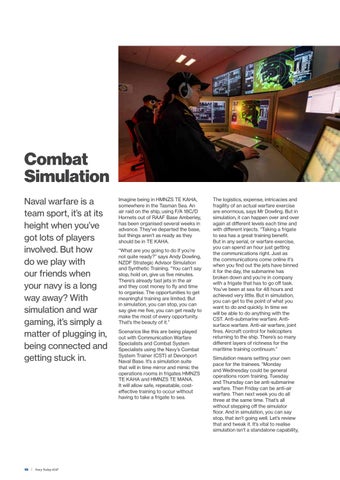
Imagine being in HMNZS TE KAHA, somewhere in the Tasman Sea. An air raid on the ship, using F/A 18C/D Hornets out of RAAF Base Amberley, has been organised several weeks in advance. They’ve departed the base, but things aren’t as ready as they should be in TE KAHA. “What are you going to do if you’re not quite ready?” says Andy Dowling, NZDF Strategic Advisor Simulation and Synthetic Training. “You can’t say stop, hold on, give us five minutes. There’s already fast jets in the air and they cost money to fly and time to organise. The opportunities to get meaningful training are limited. But in simulation, you can stop, you can say give me five, you can get ready to make the most of every opportunity. That’s the beauty of it.” Scenarios like this are being played out with Communication Warfare Specialists and Combat System Specialists using the Navy’s Combat System Trainer (CST) at Devonport Naval Base. It’s a simulation suite that will in time mirror and mimic the operations rooms in frigates HMNZS TE KAHA and HMNZS TE MANA. It will allow safe, repeatable, costeffective training to occur without having to take a frigate to sea.
The logistics, expense, intricacies and fragility of an actual warfare exercise are enormous, says Mr Dowling. But in simulation, it can happen over and over again at different levels each time and with different injects. “Taking a frigate to sea has a great training benefit. But in any serial, or warfare exercise, you can spend an hour just getting the communications right. Just as the communications come online it’s when you find out the jets have binned it for the day, the submarine has broken down and you’re in company with a frigate that has to go off task. You’ve been at sea for 48 hours and achieved very little. But in simulation, you can get to the point of what you want to do and quickly. In time we will be able to do anything with the CST. Anti-submarine warfare. Antisurface warfare. Anti-air warfare, joint fires. Aircraft control for helicopters returning to the ship. There’s so many different layers of richness for the maritime training continuum.” Simulation means setting your own pace for the trainees. “Monday and Wednesday could be general operations room training. Tuesday and Thursday can be anti-submarine warfare. Then Friday can be anti-air warfare. Then next week you do all three at the same time. That’s all without stepping off the simulator floor. And in simulation, you can say stop, that isn’t going well. Let’s review that and tweak it. It’s vital to realise simulation isn’t a standalone capability,