A P P ENDIX 3. INDICATOR T YPE S – D E F I N I T I ON S, T R EN D S , A N D EX A M P LES
Type
Input
Definition
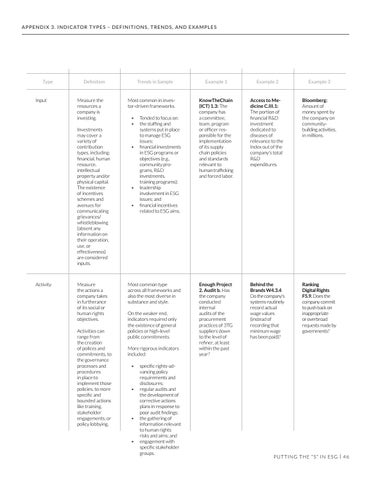
Measure the resources a company is investing. Investments may cover a variety of contribution types, including: financial, human resource, intellectual property and/or physical capital. The existence of incentives schemes and avenues for communicating grievances/ whistleblowing (absent any information on their operation, use, or effectiveness) are considered inputs.
Activity
Measure the actions a company takes in furtherance of its social or human rights objectives. Activities can range from the creation of polices and commitments, to the governance processes and procedures in place to implement those policies, to more specific and bounded actions like training, stakeholder engagements, or policy lobbying.
Trends in Sample
Most common in investor-driven frameworks. • Tended to focus on: • the staffing and systems put in place to manage ESG issues; • financial investments in ESG programs or objectives (e.g., community programs, R&D investments, training programs); • leadership involvement in ESG issues; and • financial incentives related to ESG aims.
Most common type across all frameworks and also the most diverse in substance and style. On the weaker end, indicators required only the existence of general policies or high-level public commitments. More rigorous indicators included: • specific rights-advancing policy requirements and disclosures; • regular audits and the development of corrective actions plans in response to poor audit findings; • the gathering of information relevant to human rights risks and aims; and • engagement with specific stakeholder groups.
Example 1
Example 2
Example 3
KnowTheChain (ICT) 1.3: The company has a committee, team, program or officer responsible for the implementation of its supply chain policies and standards relevant to human trafficking and forced labor.
Access to Medicine C.III.1: The portion of financial R&D investment dedicated to diseases of relevance to the Index out of the company’s total R&D expenditures.
Bloomberg: Amount of money spent by the company on communitybuilding activities, in millions.
Enough Project 2. Audit b. Has the company conducted internal audits of the procurement practices of 3TG suppliers down to the level of refiner, at least within the past year?
Behind the Brands W4.3.4 Do the company's systems routinely record actual wage values (instead of recording that minimum wage has been paid)?
Ranking Digital Rights F5.9. Does the company commit to push back on inappropriate or overbroad requests made by governments?
PU TTI N G TH E “ S” IN E SG | 4 6