W
W
W
.
N
Y
S
C
C
.
O
R
G
sustainable ingredients, operations, and products, respected thought leaders argue our collective response is insufficient to meet the human and ecological challenges. Regulators, consumers, and retailers are ratcheting up their scrutiny and expectations, and argue that corporations, suppliers, and product development teams need to aim higher. This session, led by an executive who has worked for more than eighteen years at the leading edge of consumer goods and sustainability, will share the remarkable concept and story of Thrive Natural Care, a fast-growing brand that has created and operates the first regenerative supply chain in the personal care industry. Topics covered during the presentation and subsequent Q&A period include: • What does a ‘beyond sustainability’ business model look like in the cosmetic industry? • Is there a business case for operating a ‘beyond sustainability’ model? • What lessons learned are useful for other brands, suppliers, and industry leaders?
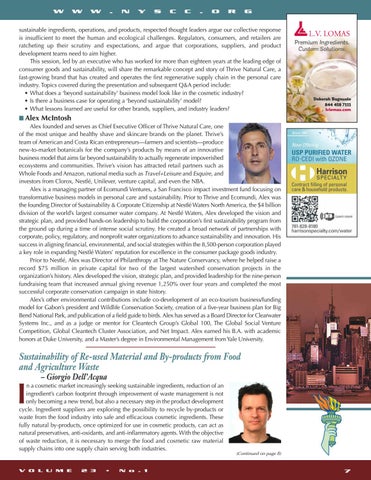
n alex Mcintosh Alex founded and serves as Chief Executive Officer of Thrive Natural Care, one of the most unique and healthy shave and skincare brands on the planet. Thrive’s team of American and Costa Rican entrepreneurs—farmers and scientists—produce new-to-market botanicals for the company’s products by means of an innovative business model that aims far beyond sustainability to actually regenerate impoverished ecosystems and communities. Thrive’s vision has attracted retail partners such as Whole Foods and Amazon, national media such as Travel+Leisure and Esquire, and investors from Clorox, Nestlé, Unilever, venture capital, and even the NBA. Alex is a managing partner of Ecomundi Ventures, a San Francisco impact investment fund focusing on transformative business models in personal care and sustainability. Prior to Thrive and Ecomundi, Alex was the founding Director of Sustainability & Corporate Citizenship at Nestlé Waters North America, the $4 billion division of the world’s largest consumer water company. At Nestlé Waters, Alex developed the vision and strategic plan, and provided hands-on leadership to build the corporation’s first sustainability program from the ground up during a time of intense social scrutiny. He created a broad network of partnerships with corporate, policy, regulatory, and nonprofit water organizations to advance sustainability and innovation. His success in aligning financial, environmental, and social strategies within the 8,500-person corporation played a key role in expanding Nestlé Waters’ reputation for excellence in the consumer package goods industry. Prior to Nestlé, Alex was Director of Philanthropy at The Nature Conservancy, where he helped raise a record $75 million in private capital for two of the largest watershed conservation projects in the organization’s history. Alex developed the vision, strategic plan, and provided leadership for the nine-person fundraising team that increased annual giving revenue 1,250% over four years and completed the most successful corporate conservation campaign in state history. Alex’s other environmental contributions include co-development of an eco-tourism business/funding model for Gabon’s president and Wildlife Conservation Society, creation of a five-year business plan for Big Bend National Park, and publication of a field guide to birds. Alex has served as a Board Director for Clearwater Systems Inc., and as a judge or mentor for Cleantech Group’s Global 100, The Global Social Venture Competition, Global Cleantech Cluster Association, and Net Impact. Alex earned his B.A. with academic honors at Duke University, and a Master’s degree in Environmental Management from Yale University. _____________________________________________
Premium Ingredients. Custom Solutions.
Deborah Bagnuolo 844 458 7111 lvlomas.com
Sustainability of Re-used Material and By-products from Food and Agriculture Waste
i
– Giorgio Dell’Acqua
n a cosmetic market increasingly seeking sustainable ingredients, reduction of an ingredient’s carbon footprint through improvement of waste management is not only becoming a new trend, but also a necessary step in the product development cycle. Ingredient suppliers are exploring the possibility to recycle by-products or waste from the food industry into safe and efficacious cosmetic ingredients. These fully natural by-products, once optimized for use in cosmetic products, can act as natural preservatives, anti-oxidants, and anti-inflammatory agents. With the objective of waste reduction, it is necessary to merge the food and cosmetic raw material supply chains into one supply chain serving both industries.
V O L U M E
2 3
•
N o . 1
(Continued on page 8)
7