
nysALL
Executive Board 2025-2026
President
Matthew Younghans
Smithtown CSD
President-Elect
Amanda Zullo
St. Regis Falls CSD
Immediate Past-President
Mark Secaur
Smithtown CSD
Vice President for Communications and Affiliate Relations
Brenda Aull-Klaben
Cayuga Onondaga Teacher Center
Treasurer
Deborah Hoeft
Young Women’s College Prep
Secretary
Marcia Ranieri
Capital District, RBERN
Ex-officio NYS Education Department
Santosha Oliver
Assistant Commissioner, Office of Standards and Instruction
Executive Director
Brian Kesel
West Genesee CSD (retired)
NYSALL.org
Publication Statement
Board Members
Gregory Borman
NYC Department of Education
Lisa B. Brosnick
North Collins CSD/SUNY Buffalo
Jill Christian-Lynch
Jamesville-DeWitt/Syracuse University Teacher Center
Ted Fulton
Hicksville PSD
Eric Larison
Solvay UFSD (retired)
Mary Loesing Connetquot CSD (retired)
LaQuita Outlaw
Bay Shore UFSD
Krissy Purcell
Central NY/Oswego County Teacher
Center Your Executive Board of Directors represents urban, suburban, and rural districts. The members hail from the tip of Long Island to Western New York. We have teachers, administrators, college professors, and NYSED representatives.
Impact on Instructional Improvement is the official journal of NYSALL.
Membership in NYSALL includes a subscription to Impact and the newsletter, NYSALL Developments. The views expressed or implied in the articles in this publication are not necessarily official positions of NYSALL or the editor.
by: NYSALL PO Box 282 Camillus, NY 13031 director@nysall.org
Editor - IMPACT
LaQuita Outlaw, Ed.D. director@nysall.org
Design & Digital Publication: CatStone Press (434) 960-0036 catstonepress.com@gmail.com
Write for the Journal
Interested in sharing ideas around issues that shape the educational landscape? We want to hear from educators, researchers, and innovators like you. Submit your short, research referenced contribution (1,500 - 2,000 words) on an educational solution, emerging research, or a practical, transformative approach that can help educators across New York State reimagine technologies and/or education. Send your submission to director@nysall.org. We’ll contact you if your article is selected for publication.
nysALLAnnouncement!
NYASCD is growing into NYSALL: New York State Alliance for Leadership and Learning - an organization focused on elevating education across New York State.
nysALL
Mission Statement
NYSALL aims to assist educators in the development and delivery of quality instructional programs and supervisory practices to maximize success for all learners.
If you aren’t already a member please consider joining NYSALL or suggesting that a colleague join for only $55.00 annually.
As a member of NYSALL you will receive our on-line newsletter, NYSALL DEVELOPMENTS, as well as our on-line journal, Impact and discounts for all of our professional development activities. Complete information about NYSALL may be found on our website. This website gives you information about our organization, professional development activities, information about affiliates across the state, and links to other professional organizations and resources.
LaQuita Outlaw, Ed.D. has worked in school leadership for over a decade. Dr. Outlaw serves as a peer editor for Corwin Press and assists several local organizations with organizing professional development opportunities for educators across Long Island.
Beyond the Hype – Deepening Learning in the Age of Cognition and AI
Education is, at its core, an act of belief—belief that learning is possible, that growth is real, and that every student deserves the tools and opportunities to thrive. Yet the landscape is shifting faster than ever before, shaped by evolving research, emerging technologies, and an urgency to build effective systems. The articles in this issue invite us to meet that challenge with intention, clarity, and an unwavering commitment to children.
We begin with a powerful reminder that vocabulary is not an accessory to learning, but it’s the foundation. Amy Benjamin’s call for “quality time” with words reframes vocabulary instruction as one of the most meaningful investments educators can make—an essential gateway to comprehension, expression, and academic success across disciplines.
From the importance of language itself, we move naturally into the exploration of artificial intelligence and the urgent need for durable assessments. As students gain instant access to information, educators must rethink what it means to measure learning. Shawn Robertson challenges us not to retreat from innovation but to create thoughtful frameworks that ensure integrity, sustainability, and deeper thinking.
As assessment evolves, so must instruction. Robert Greenleaf, Elaine Millen, and LaVonna Roth extend the conversation by grounding learning in cognitive science
through dual coding—showing how the deliberate pairing of visual and verbal processing strengthens comprehension and memory. Their practical “neuro-move” reinforces that learning is not just about content delivery, but about designing experiences the brain can retain.
Finally, Melissa Garcia brings these themes together through the lens of inclusion and access. Her work reminds us that rigorous learning is not reserved for a select few—it is a right. By shifting language, mindset, and systems, she illustrates how schools can move students from struggling to striving, and ultimately thriving.
Together, these pieces form a roadmap for what education can become when we teach with purpose, adapt with wisdom, and lead with belief.
Vocabulary Instruction: Quality Time Pays Off
Amy Benjamin

Amy Benjamin, a nationally recognized consultant and author, works with teachers throughout Long Island on literacy instruction at the secondary level.
As a middle and high school English teacher, her classroom work has been used in training videos for Standards-based education. She leads workshops for seniors in the craft of writing and in revisiting literary classics. Amy is a professional Shakespearean actor whose most recent role is King Lear in King Lear. Her website is www. amybenjamin.com
Educators, whoever they are and whatever or wherever they teach, cannot spend academic class time more productively than by teaching about words: what they mean in various contexts, how they are used, where they come from, how they can change their forms to fit into a sentence, how they can be recalled, what kinds of words usually surround them, how they differ from similar words, and, yes, how they are spelled. We have long recognized the importance of building background knowledge, and, according to Robert Marzano (Building Background Knowledge for Academic Achievement. ASCD, 2004), background knowledge and vocabulary knowledge are so closely aligned as to be inseparable. Without a doubt, vocabulary knowledge, which includes terms in phrases as well as single words, is foundational to learning content. Any content.
Yet without a doubt, too many educators address vocabulary marginally—sidelining it as mere workbook exercises— and superficially—not moving beyond brief definitions. The result is the persistent deficit that everyone frets over. If we are still seeing teachers minimizing vocabulary instruction by assigning weekly lists of words that have nothing to do with each other; if students are copying dictionary definitions without even understanding what they
are copying; if they are writing brief sentences with little meaning; if all this is assessed by a Friday quiz requiring memorization; and if no evidence points to the genuine growth
we learn words effortlessly through this natural process. We understand the meaning of a word receptively first, i.e., by hearing it used authentically, before we use it
...we need to understand how words get learned and stay learned, and we need to give vocabulary the quality instructional time it deserves.
in word knowledge that we should expect to see in reading and writing skills, then we need to do better. And we can. But we need to understand how words get learned and stay learned, and we need to give vocabulary the quality instructional time it deserves.
In this article, I will explain how words get learned and stay learned (natural language acquisition) and how there are three kinds of words: generic academic words, glossary words, and literary words. I will suggest research-aligned ways in which these three types of words can be taught so that they are retained and used, resulting in durable vocabulary growth, the key component of information processing and expression. I will suggest formative and summative assessment as well.
Repeated Exposure
Words get learned and stay learned as a result of repeated exposure in a variety of contexts and forms, over time. Theoretically,
productively, i.e. speaking it ourselves. The full meaning of a word may not be clear at first—a learner may use it too broadly, or in the wrong grammatical form— but upon repeated exposure in a variety of contexts and forms, its correct meaning and use emerges, as if out of the mist.
A five-year-old in an English-speaking family knows the meaning of the words inappropriate, decorate, and maybe accessory not because someone has sat her down and given her the definition of those words; not because she filled in spaces in a worksheet, but only because she has been exposed to those words in a variety of contexts and forms. Yet, these words are polysyllabic and abstract. By all rights, they should be “hard words.” But, in fact, there is no such thing as a hard word! Words that we think of as “hard” are really just infrequent in a person’s world.
Well, that is good news indeed. All we educators have to do is make academic words more frequent—by using them repeatedly in
a variety of contexts and forms, over time— and students will learn them without even knowing what hit them. That is what we mean by implicit or indirect instruction, sometimes referred to as being “caught, not taught.”
The AWL
“Caught, not taught” for generic academic words will work over time. That is because such words appear frequently as supportive players in academic text. What exactly are the most frequent generic academic words? You can find many such lists. The one I prefer is The Academic Word List (AWL) compiled by Dr. Averil Coxhead in (2000). Dr. Coxhead compiled her game-changing list of some 570 words gleaned from two hundred college-level texts across thirtyeight subject areas. She then divided the list into ten subsets, each presented in order of frequency. This teacher-friendly organization sets the AWL apart as a uniquely teacherfriendly bridge between linguistic research and classroom practice. The New York State Assessments in all subject areas are replete with words from the AWL.
It has been my privilege to have worked with thousands of New York State educators, K-12, in every kind of demographic and structure you can think of. I have never heard any of them deny that knowledge of generic academic vocabulary—the kind of words on the AWL—is a problem when it comes to the
NYSED Assessments: “My students know the answers. But they don’t understand the words in the questions. It’s so frustrating.” We can reduce that frustration by acquainting our educators with the AWL and having them understand the simple way that they can help—elevate their own vocabulary when speaking with students by using AWL words. Infuse the atmosphere with these words, subset by subset.
Conveniently enough, there are ten subsets and ten months in the school year. What would happen if all educators in your school or district entered into a conspiracy in which they agreed to use as many of the words as possible, in a natural way, every day. What would happen if they practiced a routine of having students work cooperatively to write one or two sentences summarizing recent learning, integrating at least one of the AWL words in their sentences?
Scaffolding with Synonyms
I’ve heard teachers say, “But if I used words like this, the students wouldn’t understand me.” A common concern, but one that is easily fixable. Many teachers are already in the habit of scaffolding comprehension by coupling what might be an unfamiliar word with an accessible synonym, all in the same breath. The parent who admonishes her five-year-old by saying, “Stop doing that. That’s inappropriate, It’s
not nice. We don’t do that here” is doing that kind of toggling. We need all teachers to become expert at toggling like that.
If you are reading this journal, you know all of the AWL words and you never looked any of them up in a dictionary, never filled in blanks in a worksheet, never had anyone give you a definition. You learned them through natural language acquisition, and that is how the students in your school or district will learn them. Trust the process. It works.
Assessment
uses academic language. Note that in both formative and summative assessments, we’re looking for gradual progress on an individual basis rather than the student’s ability to produce a memorized definition on demand.
Teaching Glossary Words
Not all words can be learned through natural language acquisition (repeated exposure in a variety of contexts and forms) because some words are limited to specific topics. If you don’t know what “iambic pentameter” is, you’re probably not going to be able to figure it out without a definition and examples. Once you learn it, however, you will forget it if you don’t use it after your twelfth grade English class (unless you become a Shakespearean actor). Glossary words have to be explicitly taught.
Note that in both formative and summative assessments, we’re looking for gradual progress on an individual basis rather than the student’s ability to produce a memorized definition on demand.
As a formative assessment, teachers can use a quick “strangers, acquaintances, friends” rating of a set of words to get an idea of how well students themselves say they know them. They can then use the data to determine which words to emphasize as they deliver lessons. After a week or so, students revisit their ratings to celebrate word growth.
An authentic summative assessment would be to see if there’s any improvement in how students handle AWL words that are embedded in the kind of tests that
Here are some guidelines for teaching glossary words deeply:
To introduce the word, the teacher describes the concept before presenting the target word. We do it that way because the brain finds it easier and more sensible to label something already known than it is to be told
what an unfamiliar word means right off the bat. The teacher may describe the concept with a metaphor, a personal connection, a story, a visual, or all of these. When the new word is introduced, it knows where to go in the brain. Brains love their filing systems.
Once the targeted word has been spoken and shown, the teacher repeats it numerous times in the course of her explanation. Remember, she is condensing and intensifying the normal course of language acquisition because the glossary word is probably not going to come up outside of school. She reinforces the concept and word with a visual. Visuals are powerful tools for retrieval and comprehension.
She takes the time to have students notice how the word is spelled, pointing out other words that have similar letter patterns. If the word has an affix, she points it out as well because that will make a polysyllabic word more accessible. Most glossary words have Latin or Greek roots or prefixes, often both. She helps students think analytically about words and find connections to other words. To strengthen visual, auditory, and muscle memory, she has students write the word, spelling it out aloud in a rhythmic manner. She has them write it by hand, larger than necessary, mindful of legibility. All of these practices increase the likelihood that the word will be remembered and used. That’s quality time instruction.
After the initial exposure, students need to practice and revisit. As a formative assessment, she will have them work cooperatively to compose a sentence related to what they are learning. The sentence should have at least eight words, an action verb, and words that create a visual image. The sentence should put the word to use, not just declare what it means. The summative assessment will be a traditional test in which knowledge of glossary words is expected.
Literary Words
Now let’s talk about teaching the kinds of words we meet in literature, which is the domain of our English Language Arts team.
There will never be enough time to thoroughly teach all of the words in a work of literature that students do not know. Teachers need to apply criteria to privilege key words for extended instruction and deep processing. I recommend that we limit the number of words to five per week, but the words chosen must have a wide “blast radius”: one well-chosen, well-taught word can radiate out to to many others connected by meaning or morphology. Brains love clusters of related things.
Reading for Enjoyment
I conclude with what is arguably the most important academic habit we can nurture: reading for enjoyment. When our institution
promotes a reading culture, our students grow their vocabulary seamlessly, organically, and measurably. Let’s never lose sight of the importance of vibrant and well-used school libraries, classroom libraries, connections to public libraries, book clubs, book fairs, parent outreach, designated independent readingfor-fun time, teachers and administrators modeling themselves as readers, “One School, One Book” events, summer reading programs, celebrations of book achievements, access to diverse and interesting texts of all kinds at all levels, author visits, student involvement in library selections, reading-related professional development for teachers and administrators, and a visible book presence throughout the school and district.
REFERENCES
Coxhead, A. (2000). A new academic word list. TESOL Quarterly, 34(2)-213-238. https://dol.org/10.2307/3587951.
Cullinan, B.E. (2000). Independent reading and school achievement. School Library Media Research, 3, 1-24.
Krashen, S. D. (2011) Free voluntary reading. Libraries Unlimited.
Marzano, R. J. (2004). Building Background Knowledge for academic achievement: Research on what works in schools. ASCD.
National Center on Improving Literacy. (2023). The educator’s science of reading toolbox: Explicit vocabulary instruction to build equitable access for all learners. U.S. Department of Education, Office of Elementary and Secondary Education, Office of Special Education Programs. https://improvingliteracy.org
New York State Education Department. (2017) Hallmark 4 of Advanced Literacies Instruction: Academic Vocabulary and Language (Topic Brief 6 of 8). Albany, NY: NYSED.
New York State Education Department. (2024). The Science of Reading: The Elementary Years (Brief 5 of 7). Albany, NY: NYSED.
Durable Assessments: How Can We Begin the Process of Evaluating and Using AI in Our Teaching and Learning?
Shawn Robertson
Dr. Shawn Robertson is an Associate Professor in the Child Study Department at St. Joseph’s College. He is a former middle school and high school English teacher and has served as an Assistant Principal, Principal and Chief Academic Officer. He holds a BA from SUNY Cortland, an MS in English Education from Queens College, an MA in Education from Massachusetts College of Liberal Arts, and a Doctorate in Educational Leadership and Administration from St. John’s University. He is a consistent presenter to local, national and international audiences in the areas of pedagogy and technology integration. He has authored several articles, and is a self described “tech-geek” who has a passion for teaching educators how to successfully bridge the digital divide through leveraging technology in the classroom.
Society is changing faster than instruction can keep up in classrooms all around the world. There are a myriad of challenges that exist when it comes to pedagogy in the classroom. Pedagogy—or the interplay between teaching and learning—is at the center of how teachers and educators of all kinds will be able to support learners as we move through uncharted waters of artificial intelligence and education. As the gateway between higher education and/or the world of vocational and other work, secondary administrators and teachers are uniquely positioned to shape educational processes in this new frontier. There are many questions that challenge secondary educators today when it comes to instruction in the classroom, but two major points will be explored through this practical theoretical paper. Contention number one is that educators must create durable assessments that can withstand students’ ability to access intelligence and information at the touch of a finger or even merely speaking and asking. That is those assessments that integrate durable skills such as problem solving, critical thinking and as well as meeting proficiency levels for each grade level. The assessments of old will no longer be able to hold muster in the face of such ground-shifting technological change.
Contention number two proposes the idea that teachers themselves must be able to create frameworks through
which students can learn to utilize artificial intelligence in teaching and learning processes or schooling. Secondary educators need to lean into and develop frameworks that will help themselves and their students navigate these waters with clear support and well defined goals posts. Secondary administrators must be at the forefront as they owe it to their teachers and students and stakeholders to create frameworks, policies and practices that will help usher in this brave new world in a positive way.
One key component of assessment for many educators over the years and in particular over the last several decades has been to have students engage in creating a product in isolation, oftentimes over time, and depending on the type of assessment, unsupervised.
When assessments do not live up to their potential... students and teachers as well as administrators are left unclear...
Contention 1: Durable assessments
Assessment is at the core of identifying, whether or not curriculum and instruction are helping students to successfully achieve learning standards and objectives. Such student learning outcomes are integral to schooling as it demonstrates how students are learning in relationship to the teaching that is going on in their classrooms. In short assessment is a key contributor in helping educators lean into pedagogy. When assessments do not live up to their potential, teaching and learning suffers and students and teachers as well as administrators are left unclear about whether they are as a group successfully reaching or achieving learning standards and objectives.
Assessments that have fallen into this category are essays and other projects in which students are given the assignment and are to complete it on their own, frequently outside of class. Although at times they may complete components within the classroom, there are challenges with these types of assessments in the current learning context.
The main issue is, of course: Can the assignment be completed with a simple prompt into a generative AI system such as ChatGPT or Gemini?
A practical way of figuring out if the assessment is durable is to use a framework for analysis. A basic one such as completing a SWOT (Strengths, Weaknesses, Opportunities, Threats) analysis could be used as a starting point. A template that could help a group navigate this process of analysis can be found here.
This template helps to clearly organize what is a strength of an assessment or a
weakness as well as where opportunities for improvement or challenges might come from both internally or externally. Engaging in a conversation around such assessment practices will yield the chance to evaluate what is being done more effectively. A major question to consider in doing this analysis is: Which instructional practices are sustainable in this new frontier?
through using generative AI in any significant capacity. Part of the challenge is that teachers and administrators sometimes look to fix the problem of academic integrity and
Part of the challenge is that teachers and administrators sometimes look to fix the problem of academic integrity and miss the opportunity to embrace academic sustainability
For example, the practice of assigning papers to students as many have ascertained is, for intents and purposes, a fruitless activity if done using a traditional model or framework where students are given the prompt and allowed to work on the paper in isolation.
Transforming such an activity requires significant shifts from traditional pedagogy. In some schools there is a shift to move to some form of observed exam or assessment in lieu of such a paper. This shift is somewhat of a “turn-back-the-clock” approach that can successfully force students into demonstration of knowledge and competency that is truly known. It is certainly one way to ensure that students are learning. However, it is also time intensive and misses one key ingredient to navigating this new frontier: It does not address the opportunity to grow
miss the opportunity to embrace academic sustainability (new ways of pedagogy that are fluid) within the new context of teaching and learning. In other words, AI is not embraced or utilized in any aspect of the learning process or used in limited fashion. Many educators have a challenge with redesigning learning and assessment because they are unclear of where to draw the line of academic integrity or answering the question: How does the student demonstrate their literacy competencies while utilizing generative intelligence?
Again, administrators should collaborate with their teachers to lean into exploring and building frameworks for generative AI usage in order to set clear boundaries of usage and assist in connecting pedagogy to generative AI in a sound constructive way.
Contention 2: Frameworks for Utilizing
Generative AI
Students need to have clear guidelines concerning the work they engage in and to what degree they are able to lean into the
use of AI. Administrators and teachers have the challenge of figuring this out in relation to current and future teaching and learning practices. The advantage that many districts now have is that after the COVID epidemic, educators leaned into technology at historic rates. They learned how to design, implement and assess learning in a myriad of new ways; therefore the capacity for the next level of technology integration into pedagogy at least has been partially developed.
This new technology has disrupted every sector in the world, especially education. A simple way to approach the breaking down of utilizing Generative AI for use in the classroom and beyond is to first consider the SWOT analysis of creating Durable Assessments and then second review different frameworks that give insight into how teaching and learning can be supported, developed and re-fashioned. For example, if educators want to test students’ base level knowledge of a concept then it’s probably useful to engage in a clear limiting of AI usage to complete any assessment. This might mean an in-class observable assessment could be given. If some activities lend themselves to be an opportunity to collaborate with Generative AI tools then show the process of how students could be engaged in that work. Label those activities as Collaborative AI opportunities with clearly delineated guidelines. In order to obtain a clearer
sense of how to either utilize or develop such frameworks, make such frameworks a professional development study.
A place to start in regards to resources for frameworks is this website which has multiple examples of frameworks to utilize. The aforementioned website by Furze (2024) also has a newer site. This site has their newest version of their AI assessment scale as well as a GPT to assist educators in using the scale. Starting here is a prudent way to go and will give educators a clear pathway forward for redesigning their assessments as well as making clear when students are able to use Generative AI and when they are not.
The added benefit to engaging in this process is that in order to make it clear for students, administrators and teachers must be clear on how and why they have designed instruction and assessments in the ways in which they have chosen to do so. Critical questions to consider throughout this process include:
• What is the purpose of the work that students are engaged in?
• Which learning standards or durable skills are we trying to assess? Will AI help or hurt such efforts?
• How can we continue to be forward thinking in our use and assessment of both using AI or limiting its use?
These critical starting questions allow for clear planning and creates an initial point from which to start discussions between teachers and administrators. Conversations and actions dealing with this new frontier are and will continue to be challenging as the educational landscape continues to shift on an almost daily basis. Holding fast to the notion that it must be educators that lead the way concerning new practices of pedagogy. Educators must not let go of the reigns of education, but must continue to grow and evolve into what’s next. What that will must be created by and for us.
REFERENCES
Furze, L. (2024, May 20). The AI assessment scale in action: Examples from K–12 and higher education across the world. Leon Furze. https://leonfurze. xom/2024/05/20/the-ai-assessmentscale-in-action-examples-from-k-12and-higher-educatio-across-the-world/ comment-page-1/
DUAL CODING: Neuro-move #3 (of 5)
Robert K. Greenleaf, Elaine M. Millen, and LaVonna Roth

Dr. Robert K. Greenleaf was formerly a professional development specialist at Brown University. Having taught in all grades, he has 45 years of experience in education ranging from superintendent, assistant superintendent, elementary principal, teacher, special education assistant, playground supervisor and even bus driver! He served as an adjunct professor and in other capacities at Thomas College, SNHU and USNH-GSC. As President of Greenleaf Learning Bob specializes in strategies for understanding behaviors, learning and cognition. He is the author of 8 instructional books on Movies of the Mind, the Neuroscience of Learning, Microformative Assessments and Engaging Students and has traveled the world conducting Brain & Learning Institutes. Dr. Bob holds a doctorate in education from Vanderbilt University, a M.Ed in Education and a Bachelor’s degree in psychology. bob@greenleaflearning.com
“A picture is worth a thousand words... be it hard copy or internal imagery.”
The “Wings” of the DNA of Learning Blueprint “give flight” to four principles of engagement that must be interwoven within pedagogy and instruction. As relationships are built and student interests become known, there are demonstrable practices that intersect education with learning science research. Without becoming experts, we can adopt practices that align with the fundamentals of generating “minds-on” processing. These promote results that go well beyond the “entertaining, flashy, the kids love it” type of approach. Many common brain-based strategies are misunderstood or misapplied, yielding little benefit. These neuro-moves are readily incorporated into educational settings. The focus of this segment is “dual coding.”
Strategies need to be timeless, effective approaches for learning and life!
What if we placed a post-it at intervals in a book and asked students to stop at each one, pause, and take note of what the primary image or thought was in their head at that time? Would this practice improve comprehension and memory? Well, it certainly does! This is one way to help teach kids how to make best use of their brain’s natural learning systems. Have
them write a word, phrase, or draw a picture that captures the mental image. As they collect and organize their visually generated quick notes, the capacity for comprehension and recall will increase. As they begin to access their innate capacity for visual memory, they will automatically apply this across subjects. Unfortunately, there is a mindset in education that, as students’ reading proficiency increases, we should use fewer educational practices that deliberately integrate central visuals to deepen understanding for sustained learning.
Dual Coding
Dual coding is the merging of visual and verbal cues for the learner. These MUST be done explicitly and simultaneously if they are to yield full impact. When effective, they support a more comprehensive capacity for expressive and receptive communication. If students had a picture of George Washington and Abraham Lincoln and placed what they had in common between the images while writing ideas that distinguished them from each other on the respective pictures, they would be dual coding. EXPLICITLY (directly stated, not implied) and SIMULTANEOUSLY (at the same time) are imperatives. When we use both modes to consciously process the verbal and visual attributes together, our brain uses and integrates pathways. Visuals contain many cues, subtleties and prompts that bolster memory, recall, and transfer. When we superimpose visuals, whether on paper or in our minds, with verbal elements, we take better advantage of our natural capabilities—a timeless skill!
Central Image Example
Many students struggle to retain the ocean of content encountered weekly, if not daily. To coach learners how to take advantage of this, put the verbal (text) and visual (image)
Elaine M. Millen, M.Ed. C.A.G.S.., has over 50 years of experience in education as a teacher, principal, director of special education, curriculum director and assistant superintendent of schools. She has taught at both the undergraduate and graduate levels in both pubic and private institutions. As an educational consultant and instructional coach, she has worked with hundreds of school leaders across the country in areas related to leadership, instructional coaching, student engagement, and helping schools design structures and systems to meet 21st Century learner needs. She was part of the Northeast Regional Laboratory at Brown University and was a consultant to the secondary reform project. Elaine has written several articles on transforming professional learning opportunities for teachers, students and leaders. Elaine.millen90@gmail.com

LaVonna Roth, M.A.T., M.S.Ed. is an engaging and interactive keynote speaker, consultant, educator, and mom, LaVonna bridges her passion for how the brain learns with identifying how every individual S.H.I.N.E.s with their mindset and socialemotional well-being. She leads a small business where her and her team boost schools in embodying a Human-Focused Culture. A culture where we put those doing the work at the heart of the impact desired. How? By supporting schools in harnessing the S.H.I.N.E. framework, increasing psychological safety, & building the foundation based on the brain sciences.
S.H.I.N.E. is the secret to a work environment where all want to be! LaVonna has 3 degrees, is the author of 8 books, and has worked with organizations in the U.S./Canada, Europe, South America, and the Middle East.
aspects together, make an enlarged copy of such a key representation for each student. Instruct students they have the option to write directly on the image in whatever way they believe has importance or meaning for them. They can capture what they believe is relevant (locating geographical points during exploration, identifying chronologies of events, depicting characterizations of key people) by writing directly on the visual. Their own system of symbols and markings will identify items of importance that later cue memory. The big ideas of the unit develop clarity, connections and expand depth of understanding. Conscious acts generating a physical illustration of their own from readings or discussion causes the mind to work further to capture personal understanding. Ultimately, when a learner creates his/her own mental image its relevance is increased.
Powerful Internal Imagery
Let’s explore internal coding in the brain. Close your eyes and ask yourself, “How many windows are in my living room?” Given the verbal prompts of “windows” and “living room,” the mind scans the room via visual memory and knows for certain how many windows there are. Right? You have never intentionally studied or rehearsed this, yet the visual recall is available. Now ask, “What type of locks are on the windows?” Again, internal visual scanning begins, bringing focused attention to access the location of the window locks. All of this without the benefit of study or deliberate conscious processing. The brain has visually coded the information as a fundamental way experiences are processed, stored, and retrieved without formal school-type study activities.
Unpacking the Basics
Infants first learn to understand the world through their senses. Prior to being introduced to letters, numbers, and written words, the mind learns by seeing/hearing patterns and by trial and error. Processing visual cues becomes a vital component of assessing the
Many students str uggle to retain the ocean of content encountered weekly, if not daily To coac h lear ners how to take advantage of this, put the verbal (text) and visual (image) aspects together, make an enlarged copy of suc h a key representation for eac h student. Instr uct students they have the option to write directly on the image in whatever way they believe has impor tance or meaning for them. They can capture what they believe is relevant (locating geographical points during exploration, identifying c hronologies of events, depicting c haracterizations of key people) by writing directly on the visual Their own system of symbols and mar kings will identify items of impor tance that later cue memory. The big ideas of the unit develop clarity, connections and expand depth of understanding. Conscious acts genera ting a physical illustration of their own from readings or discussion causes the mind to wor k fur ther to capture personal understanding. Ultimately, when a lear ner creates his/her own mental image its relevance is increased.
Powerful Internal Ima ger y
world we are born into. When available, the visual modality is key to both early and later learning and is often underutilized. Marzano et al.’s (2001) work supports this through findings on nonlinguistic representations, showing that the use of visual supports while learning bolsters achievement (27% gain). Unfortunately, the more proficient the students’ reading capabilities become, the less educational practices deliberately integrate central visuals that deepen understanding.
“Draining Text” from Visuals

Let’s explore inter nal coding in the brain. Close your eyes and ask yourself, “How many windows are in my living room?” Given the verbal prompts of “windows” and “living room,” the mind scans the room via visual memory and knows for cer tain how many windows there are. Right? You have never intentionally studied or rehearsed this, yet the visual recall is available Now ask, “What type of loc ks are on the windows?” Again, inter nal visual scanning begins, bringing focused attention to access the location of the window loc ks. All of this without the benefit of study or deliberate conscious processing. The brain has visually coded the infor mation as a fundamental way experiences are processed, stored, and retrieved without for mal sc hool-type study activities.
Unpacking the Basics
Have students “drain” meaning via text from a key image (picture example). As words come to mind, all learners can contribute to a brainstorm of ideas, emotions, words that come to mind, regardless of prior levels of accomplishment (joy, ecstasy, happiness, elation...). As related and differing perspectives are offered, everyone present benefits from the array of vocabulary generated. Any learning focus can follow! Word choice, synonyms, genres,
©
Millen & Greenleaf, In Press
After watching selected videos on climate, have students generate, from prior knowledge, all they know about climate (or other big idea) and the relationship or cause/ effect of climate conditions that exist or happen. Brainstorm and list all contributed terms and phrases where everyone can “WINGS”
purposes of writing, etc. could be emphasized. Images, illustrations, maps, diagrams, and photos all provide a wealth of material from which learners can interpret and express experiences, prior knowledge, and impressions on the route to applying skills and concepts that move learning forward.
Climate (any big idea) example:
Infants first lear n to understand the wor ld through their senses. Prior to being introduced to letters, numbers, and written words, the mind lear ns by seeing/hearing patter ns and by trial and error Processing visual cues becomes a vital component of assessing the wor ld we are bor n into. When available, the visual modality is key to both ear ly and later lear ning and is often under utilized. Marzano et al.’s (2001) wor k suppor ts this through findings on nonlinguistic representations, showing that the use of visual suppor ts while lear ning bolsters ac hievement (27% gain). Unfor tunately, the more proficient the students’ reading capabilities become, the less educational practices deliberately integrate central visuals that deepen understanding.
Central Ima ge Example
prior knowledge, and impressions on the route to applying skills and concepts that
ecstasy, happiness, elation...). As related and differing persp are offered, everyone present benefits from the array of voc generated. Any lear ning focus can follow! Word c hoice, syno genres, purposes of writing, etc. could be emphasized. Image illustrations, maps, diagrams, and photos all provide a wealth material from whic h lear ners can interpret and express expe prior knowledge, and impressions on the route to applying sk
see them (whiteboard, flipchart). This brainstorming will provide review for some, a stretch for others, and a good cueing mechanism for their memories to become more accessible as they proceed. Have them individually create a personal anchor chart, “mind-map,” or other format of their choice of how they perceive the causes/effects of climate conditions. These initial studentgenerated representations provide an ongoing guide to assist students in capturing new information, understandings and making adjustments within context as they learn. In pairs or alone, they compare/contrast their visuals, ideas, relationships, words, writings, connections, etc. as their understanding grows. Sharing their work with each other provides opportunities to give and gain feedback. As activities progress, students may want to generate an updated representation of their understandings. The initial and final visuals become telling pre-post indicators (assessments) of their work!
Clima te (any big idea) example:
lear ners can contribute to a brainstor m of ideas, emotions, words that come to mind, regardless of prior levels of accomplishment (joy, ecstasy, happiness, elation ) As related and differing perspectives are offered, everyone present benefits from the array of vocabulary generated Any lear ning focus can follow! Word c hoice, synonyms, genres, purposes of writing, etc could be emphasized Images, illustrations, maps, diagrams, and photos all provide a wealth of material from whic h lear ners can interpret and express experiences, prior knowledge, and impressions on the route to applying skills and concepts that move lear n
Clima te (any big idea) example:
After watc hing selected videos on climate, have students generate, from prior knowledge, about climate (or other big idea) and the relationship or cause/effect of climate conditions th happen. Brainstor m and list all contributed ter ms and phrases where everyone can see them flipc har t) This brainstor ming will provide review for some, a stretc h for others, and a good cu for their memories to become more accessible as they proceed. Have them individually creat anc hor c har t, “mind-map,” or other for mat of their c hoice of how they perceive the causes/eff conditions. These initial student-generated representations provide an ongoing guide to assist capturing new infor mation, understa making adjustments within context a pairs or alone, they compare/contr ideas, relationships, words, writings as their understanding grows. Shar with eac h other provides oppor tuni gain feedbac k. As activities progr may want to generate an updated representation of their understandings. The initial and fina telling pre-post indicators (assessments) of their wor k!
Ma th Example:
Clima te (any big idea) example:
Math Example:
After watc hing selected videos on climate, have students generate, from prior knowledge, about climate (or other big idea) and the relationship or cause/effect of climate conditions th happen Brainstor m and list all contributed ter ms and phrases where everyone can see them flipc har t) This brainstor ming will provide review for some, a stretc h for others, and a good c for their memories to become more accessible as they proceed. Have them individually creat anc hor c har t, “mind-map,” or other for mat of their c hoice of how they perceive the causes/ef conditions These initial student-generated representations provide an ongoing guide to assis capturing new infor mation, underst making adjustments within context pairs or alone, they compare/contr ideas, relationships, words, writings as their understanding grows Sha with eac h other provides oppor tun gain feedbac k. As activities prog may want to generate an updated representation of their understandings The initial and fina telling pre-post indicators (assessments) of their wor k!
Ma th Example:
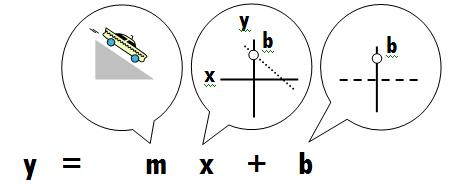
Show students a cause/effect or digital story video, in this case—a vehicle rolling down a steep slope into a lake. Then show a similar video, but with a gentle slope. Ask them what they noticed...and what it would take to determine the speed or time elapsed as the vehicle enters the water. Ask students to think of the videos and represent components in formulas that are used to figure this out. As they process to generate an image that aligns with each letter, their comprehension of what the algorithm indicates increases. Importantly, they have applied mathematics to real-life occurrences.
Show students a cause/effect or digital story video, in this case a vehicle rolling down a a lake. Then show a similar video, but with a gentle slope. Ask them what they noticed...and take to deter mine the speed or time elapsed as the vehicle enters the water. Ask students to t videos and represent components in for m ulas that are used to figure this out As they process image that aligns with eac h letter, their comprehension of what the algorithm indicates increas they have applied mathematics to real-life occurrences.
Show students a cause/effect or digital story video, in this case a vehicle rolling down a a lake. Then show a similar video, but with a gentle slope. Ask them what they noticed...and take to deter mine the speed or time elapsed as the vehicle enters the water Ask students to videos and represent components in for m ulas that are used to figure this out. As they process image that aligns with eac h letter, their comprehension of what the algorithm indicates increa they have applied mathematics to real-life occurrences.
© Millen & Greenleaf, In Press
© Millen & Greenleaf, In Press
After watc hing selected videos on climate, have students g about climate (or other big id ) d h l h aus happen. Brainstor m and list a ase flipc har t). This brainstor ming a for their memories to become more accessible as they procee anc hor c har t, “mind-map,” or other for mat of their c hoice of h conditions. These initial student-generated representations pr ca ma pa ide as wit

Moving
toward tomorrow
Step 1: Identify a key, pivotal, central representation from the upcoming unit. Make a copy for each student to use as a reference, make notes on, alter, etc. This representation must connect to the primary purpose of the unit!
Step 2: Cause students to consciously access their internal images that relate to the big ideas articulated in the unit
Step 3: Consider how students might generate an image of their own (whole class, groups or individuals) if feasible
Step 4: Ensure that each segment of learning has at least one opportunity for learners to simultaneously and explicitly process visual/ verbal aspects of a main idea, concept or learning goal.
Step 5: When presenting learning outcomes (potential assessment component), invite students to demonstrate their understanding in both visual and verbal ways.
Once the psychology of engaging a learning mindset occurs, then the biology of neuro-moves can complete the learning agenda. The deliberate and conscious use of simultaneous verbal & visual senses strengthens processing. Increased attention, memory construction and retrieval cue pathways are greater if the information is dually coded into affiliated memory pathways.
The cognitive load of a task impacts the extent to which working memory is available... or overloaded. When learners deliberately, consciously use two modalities in synch— together—explicitly--the resulting processing increases potential “related connections.” This can ease the demands on working memory. If so, “a picture may well be worth a thousand words!”
For more strategies and tools, visit www. greenleaflearning.com. Coming soon: Stay tuned for the 4th neuro-move of the DNA of Learning series!



From Struggling Learners to Strivers & Thrivers: Achieving Inclusion
& Enrichment
Melissa Garcia

Melissa Garcia is an educational leader, researcher, and high school English and special education teacher at Harrison Central School District. She currently teaches in a therapeutic setting, supporting students with social-emotional and academic skills so they can be successful in the general education classroom, while also consulting with general education teachers to strengthen inclusive supports. She holds a Master’s of Science in Teaching from Pace University and a Certificate of Advanced Study in Educational Leadership from Binghamton University.
Take a moment to think about the highest-level courses in your district: Who gets a seat? Who is left out? Too often, access to rigor requires students to “prove” they are ready. But what if the doors were open for all students—regardless of past performance?
It starts with leadership. The National Policy Board for Educational Administration (2015) calls for leaders to enact a shared mission, vision, and core values that promote highquality education for the well-being of each student (p.9).
By embracing the core values of equity, access, rigor, and adaptability, Harrison Central School District has adopted a K–12 “International Baccalaureate (IB) for ALL” model through co-teaching and UDL, to include those receiving special education and English as a New Language (ENL) services in rigorous coursework.
A commitment to access prompted a fundamental redesign of beliefs and systems in the District. The “International Baccalaureate (IB) for ALL” model, Universal Design for Learning (UDL), and an unwavering belief in every learner’s potential have reshaped how we define rigor, access, and belonging. This work is more than an initiative; it
is a mindset. It requires examining language, redesigning systems, and rethinking who rigorous learning is for. And when we do, students rise. Since 1999, AP/IB exam participation has grown from 131 students in the 1998–1999 school year to 1,532 students in the 2023–2024 school year. Despite this growth, college readiness scores remained relatively steady, demonstrating that widening access does not dilute outcomes. Instead, it expands opportunity.
Every 11th and 12th grader takes IB-level math and English, with co-taught sections available (except students in self-contained programs). Students do not need to test in or be hand-selected—they simply need to be welcomed and have a team that believes in them. The Class of 2025 demonstrates the impact: 97% enrolled in AP/IB; 57% took 10 or more AP/IB courses.
Inclusion and UDL: The Right to Enrichment
In alignment with the Individuals with Disabilities Education Act (IDEA), the Least
an equitable opportunity to access the general education curriculum. Such environments value all learners and support achievement with specially designed instruction.
In Harrison, the Least Restrictive Environment has lent itself to robust Integrated Co-Teach (ICT) models, extending to IB courses. As a special educator, I believe that LRE has shed light on the fact that a “disability” does not indicate an “inability” to achieve. Rather, it demonstrates that, as appropriate, students require varying, individualized supports to provide access to general education and advanced curricula.
Understanding the Problem: WateredDown Curriculum and the Cycle of Disengagement
Perception is reality. The historical response to students who “struggle to understand the unaltered curriculum” is to view them as “slow or disabled” (Brooks & Books, 1999, p.7). This contributes to a gap between how successful students are perceived to be and their actual ability to
...a “disability” does not indicate an “inability” to achieve.
Restrictive Environment (LRE) requires that, to the maximum extent appropriate, students with disabilities be placed in mainstream classrooms that accommodate their needs for
learn and perform (Brooks & Books, 1999, p. 8). Students who are performing below grade level too often face remedial, drill-based instruction that undermines engagement and
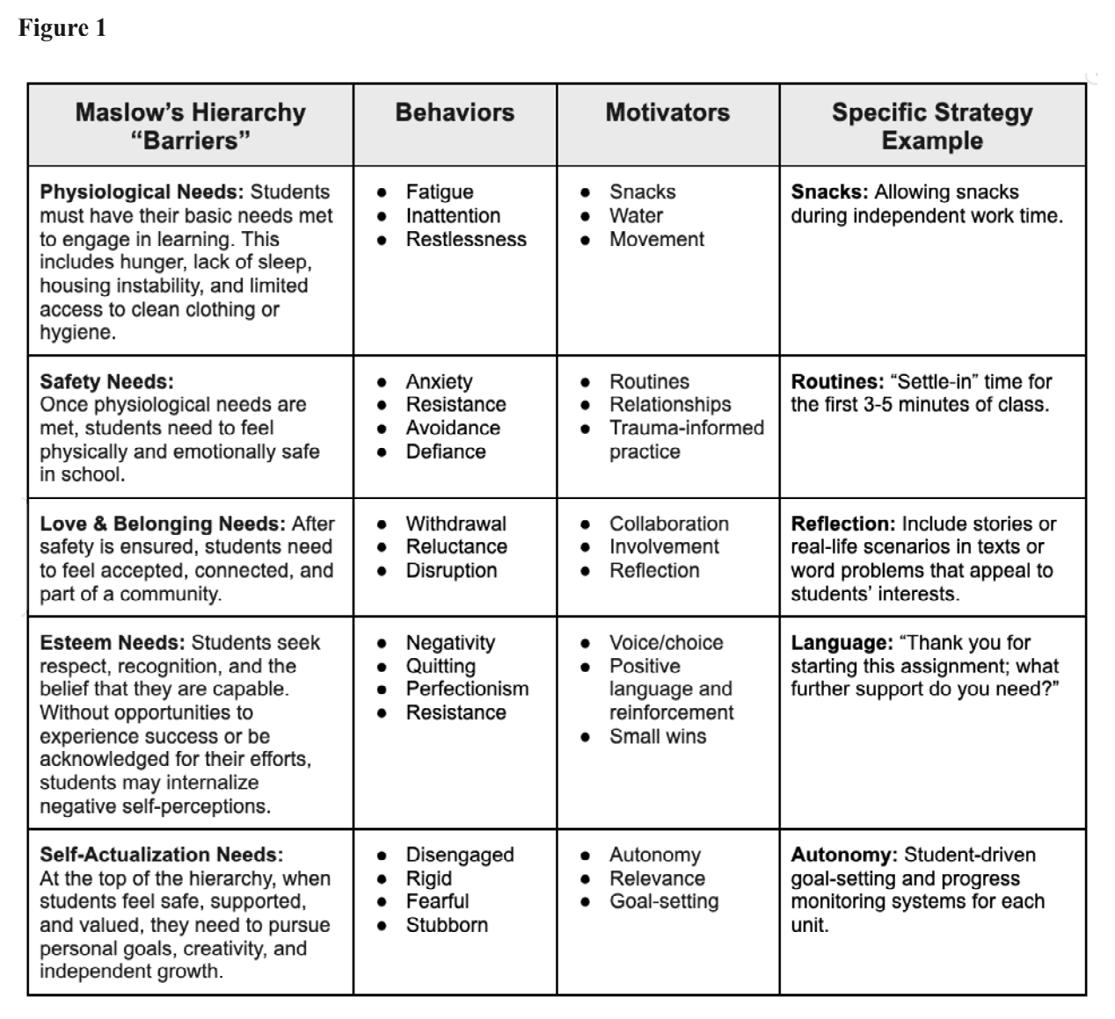
and what need must be met before learning can happen? Maslow reminds us that fo come first; Bloom reminds us that higher-level learning follows. By removing barri language, and instructional design, we can shift student self-perception, build resilie cycle of disengagement. (See Figure 1 for our barrier-to-strategy framework.)
confidence. This deficit-based approach reinforces a belief that these students are not capable. Over time, this mindset becomes a barrier as real as any academic skill gap.
When we see student apathy or negative behaviors, the real question is: What barrier is the student facing, and what need must be met before learning can happen? Maslow reminds us that foundational needs come first; Bloom reminds us that higher-level learning follows. By removing barriers through mindset, language, and instructional design, we can shift student self-perception, build resilience, and disrupt the cycle of disengagement. (See Figure 1 for our barrier-to-strategy framework.)
Source: Matthew Radoslovich and Melissa Garcia
A Shift in Language to a Shift in Mindset: From
Deficit to Growth
Inspired by Michele Borba’s book, Thrivers (2022), special education teacher Matthew Radoslovich and I built a professional development course that helps reframe how we view “struggling” or
...it is important to remember that our job is not to sort students into these categories but to help all strivers become
thrivers.
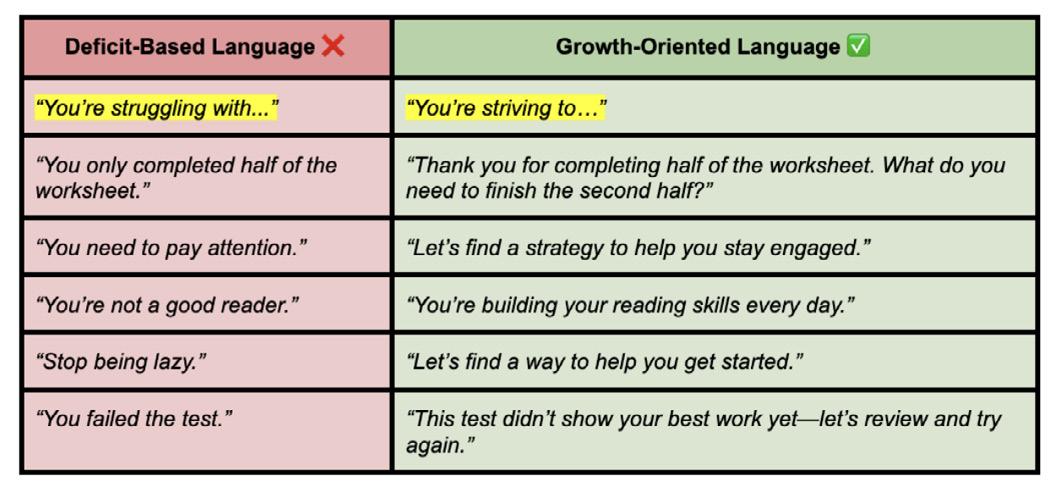
Words matter. They shape how students see themselves and how they respond to challenges. When addressing students with disabilities, academic gaps, Social-Emotional learning (SEL) needs, trauma histories, language differences, or diverse cultural identities, it is crucial that educators practice utilizing inclusive, encouraging language. Research has proven that students who are exposed to growth mindset language show increased motivation, effort, engagement in learning, and improved academic performance (Suman, 2018). One example of shifting language is the difference between telling a student, “You are struggling with this,” versus “You are striving to master this.”
The first reinforces a deficit; the second empowers progress. Our district values this practice—we welcome all students into rigorous environments, while continuing to build the capacity of educators to incorporate effective, inclusive, growth-oriented language and strategies. This is especially important in inclusive IB classrooms and summer school, where students may struggle to see themselves as capable, confident learners.
“reluctant” learners. At its core, we embrace these definitions: strivers persevere through obstacles but still need support developing resilience, while thrivers have internal protective factors that allow them to flourish, such as self-awareness, motivation, and regulation (Borba, 2022). However, it is important to remember that our job is not to sort students into these categories but to help all strivers become thrivers. This is where the culture shift is rooted.
In the classroom, there are simple ways teachers can shift language so that students can begin to internalize a growth mindset
(See Figure 2 on the following page).
Reimagining Summer School: A Case Study
This mindset shift began for me in an unexpected place: summer school. Traditionally a last-chance effort for at-risk students, our program has evolved into a model of success and celebration. We redesigned our approach
Source: Matthew Radoslovich and Melissa Garcia
Source: Matthew Radoslovich and Melissa Garcia
Reimagining Summer School: A Case Study
to focus on relationships, data-informed instruction, growth mindset, UDL, and most importantly, joy.
This mindset shift began for me in an unexpected place: summer school Traditionally a last-chance effort for at-risk students, our program has evolved into a model of success and celebration. We redesigned our approach to focus on relationships, data-informed instruction, growth mindset, UDL, and most importantly, joy
Summer school teachers identified barriers and analyzed student feedback and behavior to design targeted interventions. Summer school teachers triangulated academic, behavioral, and perception data from students, previous teachers, and families, while intentionally building relationships and using “striver and thriver” language. Each day began with community circles and check-ins, embedding mindfulness, reflection, and moments of joy. Student voice shaped our ELA curriculum, which centered on self-care, personal growth, and reflection. With complete student profiles, we used content to build skills and shift students’ mindsets.
Summer school teachers identified barriers and analyzed student feedback and behavior to design targeted interventions. We triangulated academic, behavioral, and perception data from students, teachers, and families, while intentionally building relationships and using “striver and thriver” language. Each day began with community circles and check-ins, embedding mindfulness, reflection, and moments of joy
their intelligence, learning styles, values, and ability to self-regulate and succeed. That summer, 100% of our students in ELA creditrecovery passed, including those retaking the New York State Regents Exams required for graduation. We then passed on one-page summaries of each student to their teacher teams for the next year to continue the support. Even more telling: all of our summer school students passed their English class the following year.
Scaling Up: A District-Wide Shift
Student voice shaped our ELA curriculum, which centered on self-care, personal growth, and reflection
With complete student profiles, we used content to build skills and shift students’ mindsets.
In the end, our students didn’t just earn back credits they reflected on discovering their intelligence, learning styles, values, and ability to self-regulate and succeed. That summer, 100% of our students in ELA credit-recovery passed, including those retaking state assessments required for graduation (New
In the end, our students did not just earn back credits—they reflected on discovering
Given that success, we expanded the work through district-wide professional learning. During our Superintendent’s Conference Day, Matthew and I led a “Strivers & Thrivers” session open to district faculty. To extend the success of our summer program, we modeled how to collect and analyze data to identify
root causes of disengagement. Teachers used Maslow’s hierarchy to guide action plans, paired with asset-based language, to help “strivers” overcome barriers and build lasting momentum toward becoming “thrivers.”
Teachers in the session reported that the strategies designed for their target students would prove successful for all of their students. This work emphasizes a powerful truth: all teachers are teachers of all students. When we design for the margins, everyone benefits.
UDL in Practice: Our IB Co-Teaching Toolbox
The brain learns best when conditions are clear and supportive: challenging yet manageable, with clear information and enough mental space to connect new ideas to prior knowledge (Willingham, 2021). To sustain this passion for learning, these conditions must be consistent.
But how can educators create these optimal conditions? Our district points to UDL as a proactive instructional approach for the whole class, rather than relying on reactive modifications for struggling students. Center for Applied Special Technology (2011) notes that UDL is often mistakenly applied “after-the-fact” to a “one-size-fits-all” curriculum when it should be “intentionally and systematically designed from the beginning to address individual differences” (CAST, 2011, p. 9).
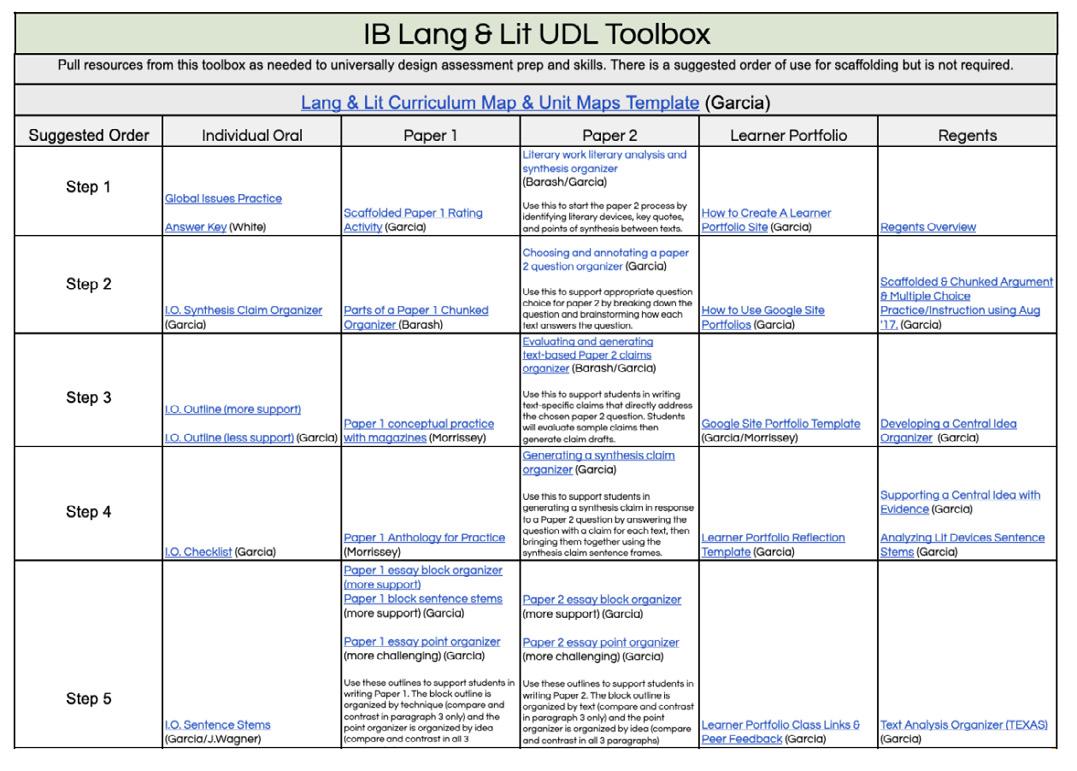
Co-teaching IB Language and Literature, I have seen how UDL unlocks access without compromising rigor through intentional design and a shared growth mindset. Rather than prescribing fixed accommodations to certain students, we use universally designed routines and materials that promote student agency, self-awareness, and collaboration with teachers. While adhering to Individualized Education Programs (IEPs) and 504s for students with disabilities, supports are available to all, based on genuine need. For example, when writing a literary analysis, all students choose from a tiered menu of supports, ranging from a blank brainstorming page to detailed outlines with sentence stems, through a reflective process guided by teacher conferences.
These tools live in our shared IB Language and Literature UDL Toolbox (Figure 3 on the following page), a hyperlinked, collaborative resource accessible to all educators. What makes this toolbox powerful is not just the content, but the culture of access behind it; any teacher can seek out what a student needs, when they need it. For learners with identified needs, this process is more structured, but the underlying principle remains: support is proactive, intentional, personalized, rooted in equity, and grounded in enrichment. This model does not lower the bar; it provides access.
Source: Melissa Garcia
Source: Melissa Garcia
The Results: Rising Literacy and Resilience
The Results: Rising Literacy and Resilience
Since implementing this collaborative UDL-driven approach in an inclusive, detracked IB course, our NYS English Regents scores have continued to rise year over year, with 95% of students demonstrating proficiency in the 2023-2024 school year (NYSED, 2024). Students are not only passing— they are flourishing. They learn to advocate for themselves, take pride in their work, and approach challenges with confidence. The data supports what we already feel in our classrooms: equity, access, and rigor are not mutually exclusive and are all a result of adaptability.
Since implementing this collaborative UDL-driven approach in an inclusive, de-tracked IB course, our NYS English Regents scores have continued to rise year over year, with 95% of students demonstrating proficiency in the 2023-2024 school year (NYSED, 2024). Students are not only passing, they’re flourishing They learn to advocate for themselves, take pride in their work, and approach challenges with confidence The data supports what we already feel in our classrooms: equity, access, and rigor are not mutually exclusive and are all a result of adaptability.
To this effect, Boaler (2022) argues, “there is another solution to the problem of students being placed into low-level tracks and classes; that is, to not even offer low-level tracks or classes” (p. 100). In our district, no matter their needs or academic history, all students now access IB courses with embedded supports. Boaler also cites a study showing that students in de-tracked environments took more advanced math, enjoyed it more, and passed the state test a year earlier than
To this effect, Boaler (2022) argues, “there is another solution to the problem of students being placed into low-level tracks and classes; that is, to not even offer low-level tracks or classes” (p 100) In our district, no matter their needs or academic history, all students now access IB courses with embedded supports Boaler also cites a study showing that students in de-tracked environments took more
those in tracked settings (Boaler, 2022, p. 117). In line with Boaler’s conclusions, all 8th graders in our district take the New York State Algebra Regents, scoring 25% higher than the state average (NYSED, 2024). We have seen similar results with steady growth in NYS English Regents scores.
Students trained through enrichment and critical thinking rather than rote drills become what the IB learner profile defines as thinkers: those who “use critical and creative thinking skills to analyse and take responsible action on complex problems” (IB Organization). In our district, we view and treat all students as thinkers, and students adopt this belief about themselves in the process.
Conclusion: A Lighthouse District in Action
This cultural shift began with a shift in belief: first among educators, and ultimately, students. As Willingham (2021) explains, the joy of learning is hardwired into us; it does not need to be unlocked, only nurtured. The workings of “IB for All,” UDL, growth mindset, and co-teaching reflect that philosophy: when we assume all students can and want to learn, and we provide them with enriching, supportive environments, their innate desire to learn is awakened and sustained.
When schools dare to believe in every student’s potential and back that belief with intentional systems, real change happens.
We become a lighthouse: shining a beam of possibility for what education can be when it is built on inclusion. Systems rooted in UDL, guided by data, and uplifted by the simple but powerful belief that every student can grow and engage will create a culture where students move from strivers to thrivers—and educators light the way.
REFERENCES
Boaler, J. (2022). Mathematical mindsets. Jossey-Bass. (Text, Chapter 1, “The Brain and Mathematics Learning,” Chapter 2, “The Power of Mistakes and Struggle,” Chapter 6, “Mathematics and the Path to Equity,” and Chapter 7, “From Tracking to Growth Mindset,” pp. 1-23, 95-148)
Borba, M. (2022). Thrivers: The surprising reasons why some kids struggle and others shine. G. P. Putnam’s Sons.
Brooks, J. & Brooks, M. (1999). In search of understanding: The case for constructivist classrooms. Alexandria, VA: ASCD. (Part 1, pp. 3-31)
CAST (2011). Universal Design for Learning Guidelines version 2.0. Wakefield, MA. (PDF, pp. 1-10, highlighted sections)
IB Organization. (n.d.). Learner Profile for IB students. International Baccalaureate. https://www.ibo.org/benefits/learnerprofile/
National Policy Board for Educational Administration. (2015). Professional standards for educational leaders. https://www.npbea.org/wp-content/ uploads/2017/06/ProfessionalStandards-for-Educatio nalLeaders_2015.pdf
New York State Education Department. (2024). Harrison CSD – report card. NYSED Data Site. https://data.nysed. gov/essa.php?instid=800000035425&yea r=2024&createreport=1®ents=1
Suman, C. (2018). Growth Mindset Language in the Classroom. UGC Journal. https://www.researchgate.net/ publication/380817296
Willingham, D. T. (2021). Why don’t students like school? 2nd Edition. Jossey-Bass. (PDF, pp. 1-24)
nysALL Webinar Offerings
Click each to learn more.
❏ Supporting K-12 Multilingual Learners with Dr. Sarah Cioffi - in partnership with Capital District Region RBERN
❏ Ensuring Reading Success: Strengthening RTI/MTSS Systems Through Deeper Understanding
❏ High Impact Engagement Strategies
❏ Better Boundaries: Building Trusted Relationships with Students Without Blurring Lines or Burning Out
❏ EdTech Essentials: Strategies for Every Classroom in the Age of AI with Monica Burns
❏ Beyond Grades: Transforming Assessment to Empower Student Learning with Starr Sackstein
❏ Supporting Struggling Adolescent Readers with Dr. Heidi BeverineCurry
❏ Confident, Capable, Connected: A Series for Teacher Assistants & Paraeducators
nysALLPartnerships

Click each logo to learn more.
Lexia From acceleration, to intervention, to English Language Development, to assessment and professional learning, Lexia solutions can be used together or individually to meet all structured literacy needs for any student.
PLC Associates PLC Associates is completely committed to working with schools and organizations to achieve results, simply stated. We will stay with you and provide our “wraparound support” in order to get to the target outcomes each school and district designates. The result – we help you actually achieve your student achievement and performance goals. The company has developed numerous proprietary tools © and methodologies used successfully by schools.
New York State Teacher Centers From the Lighthouse in Montauk to the Adirondack Mountains to Niagara Falls, the NYSTC Network is a vibrant collaborative public organization that provides professional learning opportunities for educators. With 125 Teacher Centers and 7 regional networks, the NYSTC Network meets the needs of our diverse student population living in an ever-changing global environment. For more information, or to determine which Center is yours, visit www. nysteachercenters.org
SAANYS - the School Administrators Association of New York State SAANYS has a long history of supporting New York’s public school leaders and their communities. Their mission is to provide direction, service, and support to their membership in their efforts to improve the quality of education and leadership in New York State schools.
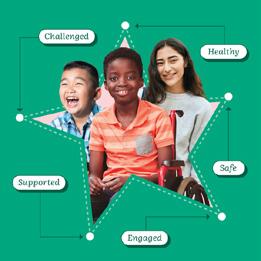
ASCD Connect the dots to your child’s success with the ASCD Whole Child approach to education.
nysALL
Over 60 Years of Service to New York State Educators
1941-2025
NYSALL has provided over 60 years of service under the capable leadership of the following Presidents:
Lance Hunnicut
Fred Ambellan
Ethel Huggard
Lillian Wilcox
Ernest Weinrich
Amy Christ
William Bristow
Bernard Kinsella
Grace Gates
Joseph Leese
Charles Shapp
Gerald Cleveland
Mark Atkinson
Ward Satterlee
Lilian Brooks
John Owens
Dorthy Foley
Anthony Deuilio
Tim Melchoir
Arlene Soifer
Mildred Whittaker
Lawrence Finkel
David Manly
George Jeffers
George McInerney
Thomas Schottman
Helen Rice
Albert Eichel
Conrad Toepher, Jr.
Peter Incalacaterra
Albert Eichel
Robert Brellis
James Beane
Thomas Curtis
Marcia Knoll
Don Harkness
Nick Vitalo
Florence Seldin
Donna Moss
Lynn Richbart
John Glynn
Robert Plaia
Robert Schneider
John Cooper
Diane Kilfoile
Diane Cornell
Marilyn Zaretsky
John Gangemi
Sandra Voigt
Mary Ellen Freeley
Jan Hammond
Linda Quinn
James Collins
Lynn Macan
Judy Morgan
John Bell
Judy Morgan
Brian Kesel
Timothy Eagen
Ted Fulton
Mary Loesing
Mark Secaur