



Kalle Condliffe, Esq. & Amanda Jack, Esq. Gideon Champions of Justice
PRESIDENT:
Jessica A. Horani, Manhattan
PRESIDENT-ELECT:
Kevin M. Stadelmaier, Buffalo
FIRST VICE PRESIDENT:
Alan S. Lewis, Manhattan
VICE PRESIDENTS:
John Ingrassia, Newburgh
Randall Inniss, Suffern
Seymour W. James Jr., Manhattan
Jill Paperno, Rochester
Claudia Trupp, Cragsmoor
SECRETARY:
Grainne E. O'Neill, Brooklyn
TREASURER:
Samuel Braverman, Manhattan
DIRECTORS
Natalie Brocklebank, Albany (NYSDA Designee)
Xavier R. Donaldson, Manhattan
Drew DuBrin, Rochester
Allegra Glashausser, Brooklyn
Kendea Johnson, Manhattan
Jessica Kulpit, Buffalo
Leanne Lapp, Canandaigua
Lindsey Lewis, Manhattan (NACDL Designee)
Renate Lunn, Manhattan

Greg Lubow, Tannersville
Nathanial Z. Marmur, Manhattan
Noreen McCarthy, Keene Valley
Michael McDermott, Albany
Eli Northrup, Bronx
Stephen Preziosi, Manhattan
Hilary Rogers, Plattsburgh
Donald Thompson, Rochester
Andre A. Vitale, Jersey City
Sherry Levin Wallach, White Plains
IMMEDIATE PAST PRESIDENT:
Steven Epstein, Garden City
PAST PRESIDENTS:
Lawrence S. Goldman
Paul J. Cambria, Jr.
Jack T. Litman*
Mark J. Mahoney
David L. Lewis
William I. Aronwald*
Thomas F. Liotti
Ira D. London
Jeanne E. Mettler
Murray Richman
Gerard M. Damiani
Marvin E. Schechter
Kathryn M. Kase
Russell M. Gioiella
James P. Harrington
Richard J. Barbuto*
Martin B. Adelman*
Joshua L. Dratel
Ray Kelly
Daniel N. Arshack
Lisa Schreibersdorf
Craig Schlanger
George R. Goltzer*
Kevin D. O’Connell
Richard D. Willstatter
Benjamin Ostrer*
Aaron Mysliwiec
Wayne C. Bodden
Andrew Kossover
John S. Wallenstein
Robert G. Wells*
Lori Cohen
Timothy W. Hoover
Alice Fontier
Brian Melber
Yung-Mi Lee
Steven Epstein
EXECUTIVE DIRECTOR:
Jennifer Ciulla Van Ort, Clifton Park
STAFF:
Stefanie Andrews, Membership Representative
*Deceased
Ensure NYSACDL’s Con�nued Success with a Dona�on to The Defenders Circle!
The Defenders Circle benets NYSACDL members, seminars, and programs. NYSACDL has experienced tremendous growth over the past several years in membership, seminar a�endance, advocacy efforts and more. Defenders Circle members play a crucial role in ensuring that NY SACDL maintains its success and strength as the leading criminal defense organiza�on in New York State.
I want to join the
Circle at the
below*!
Publication of the New York State Association of Criminal Defense Lawyers
By the time you see this edition of Atticus, it will be just about time for our annual dinner in January, where we honor and recognize our association and those who uphold our ideals. It will also be where my time as President comes to an end and I will have the privilege of swearing in your new President, Kevin Stadelmaier. This year, our dinner takes place mid-week, January 14th, and, as luck would have it, I am scheduled to begin a homicide trial in Manhattan the day prior. It is fitting (and almost comical) that this constant interplay between my responsibilities as a trial attorney and as President of NYSACDL should come to such a head at the end of my term. I started the year with a five-week murder trial just over a week into my presidency; the glow from that memorable evening eased my way into the days of battle ahead.
Managing it all has not been easy. But then, few things worth doing ever are. So many of you (and certainly many of our past presidents) have been there themselves; mastering the high wire juggling act between the demands of the courtroom, the boardroom and everything else! When I take my place as a Past President and think of all those before me who shouldered similar burdens and challenges, I feel heartened and quite proud to be in this select and special club. ‘We happy few’ to borrow a phrase from the Bard. We have entered the fray each of us and emerged on the other side with a few more gray hairs perhaps, but a wealth of experience and perspective to go along with it.
But we don’t become criminal defense attorneys because it is easy, do we? We don’t go to trial on behalf of our clients because it is easy. We don’t face off against the government on an uphill battleground because it is easy. We do it because someone has to stand up in the face of governmental prosecution and hostile public perception, take it on the chin and turn to their client and say-I’m going to fight for you and your rights, no matter what.
We don’t always win; in fact, the odds are often not in our favor, but when we do it is thrilling and heartening and we certainly don’t get there alone. It is always the result of having people in your corner to support you. Those members who will respond to a late-night frantic trial question on the listserv, who will brainstorm theories and themes with you, who share transcripts and caselaw
and strategy and who can simply commiserate when you are stressed out and stretched thin but still hanging on.

So here’s to you, the trial attorneys. The very lifeblood of NYSACDL. The charter members who founded this organization and each one along the way who shaped it into a place where a criminal defense attorney, whether State or Federal, Public or Private, could feel at home, supported, and assisted. My task as President was simple but significant; to keep this as the premier home for criminal defense attorneys throughout New York State and to help ensure that we have future generations of members to take us into the future. I hope I have done so. I have been an active member of NYSACDL long enough that many of you are familiar names and faces to me and I cherish the contributions you continue to make and the foundation and stability you provide to this organization. This year I’m proud to have lent my hand to developing the leaders of tomorrow and seeing newer members take on committee positions, creating a new Emerging Defenders committee to engage those coming up in criminal defense, and seeing fresh faces, voices, and opinions populate our listserv, our Board meetings, our lobbying, and our CLE presentations.
Our means and methods continue to change and advance through the years; legal pads and pens turn into laptops and tablets; tech will be both a boon and a bane. We welcome new perspectives and develop new techniques. But at the core, the criminal defense attorney, which this organization was created by and for, will remain. A lawyer stepping into the well of a courtroom, the eyes of a jury upon them, the weight of a government against them, armed as best they can to stand next to the accused. No matter the charge, no matter the odds. To fight for them and for their rights. That is who we are, that is what we do, and that is why we are all here.
It has been a privilege and an honor to lead the organization that aims to stand with each of you as you step into that courtroom. Thank you for a terrific year and for giving us something to fight for.




2025 has been a difficult year for the criminal defense bar. As this is written, the Federal government is still shut down, although a resolution is expected in days. Those who practice Federal criminal defense as appointed counsel under the Criminal Justice Act have not been paid since the end of June; we are informed that the nationwide shortfall in payments is around $87 million! This is an intolerable and unsustainable situation, which will only be worse next year if Congress fails to appropriate enough money for the judiciary budget.
EDITORS
Mehdi Essmidi
Gráinne O'Neill
Joe Rochman
John S. Wallenstein
A publication of the New York State Association of Criminal Defense Lawyers
©2024 NYSACDL
636 Plank Road, Ste. 215
Clifton Park, NY 12065
Phone: 518-443-2000
Fax: 888-239-4665
www.nysacdl.org atticus@nysacdl.org
But money is not the only issue. Our members have worked tirelessly to provide the best representation possible to our clients, in spite of personal hardship. The Department of Justice has been decimated by firings and resignations, often of honorable, ethical, hard-working prosecutors who have tried to do their jobs in the best traditions of DOJ. These people have been replaced in many cases by partisan hacks who seem to believe that their function is not to do justice, but to advance a partisan agenda regardless of the law. This situation makes the job of criminal defense lawyers more difficult, but we continue to fight for our clients every day!
Even as we enter 2026, celebrating the installation of our new President, Kevin Stadelmaier, and looking back at the term of Jessica Horani, we must pause to reflect. In 2025, we lost two giants of the New York State criminal defense bar, Don Rehkopf and Rob Wells. Both were stalwarts of the upstate bar, Don in Rochester and Rob in Syracuse, and both contributed mightily to NYSACDL’s success.
Take some time to thumb through this issue (well, figuratively if you’re reading this online). Read the comments from colleagues who were sworn into the Supreme Court Bar in a ceremony NYSACDL hopes to hold each year. Don’t miss Diane Lopez’s article about the intersection of criminal defense and immigration law; it has some invaluable tips for protecting some of our most vulnerable clients in this climate. Read the bios of our dinner honorees, and you’ll understand why we chose them for the awards. As you keep up with your legal scholarship, be sure to digest Tim Murphy’s column on decisions of note.
In these pages, we strive to serve and reflect all our members. But we can’t do that without your input and help! If you are so inclined, please reach out to join us on the Publications Committee, pitch an article, or share a trial win or other significant success or accomplishment. And as always, keep fighting!
John S. Wallenstein, Joseph Rochman, Mehdi Essmidi, Gráinne O'Neill
Members wishing to submit articles for inclusion in Atticus should submit them via email to atticus@nysacdl.org.
Questions regarding submission may be directed to: Jennifer Van Ort, Executive Director, NYSACDL 518-443-2000 jlvanort@nysacdl.org
The editors reserve the right to modify any submission for style, grammar, space and accuracy. Authors are requested to follow these guidelines:
1. Use footnotes rather than endnotes.
2. When a Case is mentioned in the text, its citation should be in the text as well.
3. Articles longer than 4 pages may be edited or serialized.
The sun is setting on another successful year at NYSACDL. It seems like each one goes faster! We saw a lot of growth and exciting events in 2025, and I’m looking forward to more of the same in 2026.
Jennifer Van Ort, Executive Director

I am particularly pleased that our new Membership Representative & Administrative Assistant - Stefanie Andrews - has been with us for over three months. She has been an incredible asset to me over the past weeks and we are looking forward to how this position will continue to enhance our member services and programming, including enhancements to how our web site can help you better and our member onboarding so you can learn all the ins and outs of NYSACDL! As a reminder, you can contact her with your member needs at sandrews@nysacdl.org.
Also exciting is our new venue for the 2026 Annual Dinner, the City Winery at Pier 57. While we enjoyed our time at Cipriani, I am looking forward to the new atmosphere the City Winery provides. As we welcome 2026 President Kevin Stadelmaier we will also celebrate the achievements of 2025 President Jessica Horani and the caliber of our 2026 awardees. I look forward every year to seeing familiar faces and meeting those of you who haven’t had a chance to join us before. Sponsorships and individual tickets are available online at www.nysacdl.org.
As you will see in this issue, we are also gearing up for another busy Legislative Session in Albany. I encourage you to keep an eye out for opportunities to participate in the important advocacy work we do along with many partners. There will be opportunities to come to Albany to have your voice heard in person, as well as requests to call or email your representatives. While we attempt to maintain an active social media presence throughout the year, amplification of our posts during the legislative session has particular importance. Please follow us on Facebook, Instagram, LinkedIn and X to stay abreast of what’s happening and participate in the process!
I would be remiss if I did not acknowledge outgoing President Jessica Horani’s steadfast dedication and tireless work on behalf of NYSACDL the past year. We are better for your service! Thank you!
Throughout 2026, we will be focusing on continuing her work with renewing our commitment to strategic planning and ensuring your NYSACDL continues to meet the needs of our current and future members. I encourage you to participate in this process as we create opportunities such as member surveys to engage with us and provide feedback.
As I travel around the state in 2026, I hope to see you at one of our events! Please introduce yourself and let me know a little about your practice and your thoughts about NYSACDL!
I hope you all have an enjoyable and restful holiday season and enter 2026 with the energy ready to take on the year!
The incoming President of the New York State Association of Criminal Defense Lawyers typically knows of their responsibility to pen this Message two years in advance. As such, I have had a great deal of time to ponder exactly what I might say. Probably too much time, if I’m being honest.
At one point, focusing on the reformation of our bail system seemed the proper course. Celebrating affording the indigent the same freedom from pre-trial incarceration as provided to those of means for identical charges seemed a noble enough address topic.
Later, zeroing in on the extremely positive impact that reforming our criminal discovery laws has had on practitioners and the clients we serve, felt like the right way to turn. Having been intimately involved in that effort, as well as privy to the mechanics by which opponents have relentlessly attempted to dismantle it since its inception 5+ years ago, I would have proudly highlighted the “Alliance to Protect Kalief’s Law” that both created, and thereafter defended, that landmark piece of legislation. However, as my deadline for publication drew closer (and my anxiety about penning a message with the requisite profundity increased) My thoughts crystallized on a timelier, yet inextricably related concept; “The Rule of Law.”
As I started down the drafting path, several questions came to mind.
What is the “Rule of Law?” What is the role of a criminal defense attorney in defending the Rule? What are our responsibilities in ensuring that it remains meaningful? Having focused for over twenty years on defending the rights of the accused in the face of government authority, ideas came rushing out.
Alexander Hamilton framed the “Rule of Law” concept in Federalist #78 through an independent judiciary, operating as an “intermediary between the People and the legislature, ensuring that the People’s representatives, acted only within the authority given to Congress under the Constitution.” A noble concept indeed. And one that certainly holds historical validity.
Over time, however, the “Rule” evolved into providing a hard and fast backstop against government overreach; whether that backstop be executive, judicial, legislative, or external of these three. The view that the government should protect us from bad actors seeking to subvert the integrity of the Constitution and the freedom it imbues is sacrosanct. Unfortunately, as the last decade plus has proven, this view is also naïve.
Of course, where there is respect for the Constitutional mandate of “checks and balances” the Rule functions as intended. Each of the branches checks the other to ensure that “The People’s” interest is protected, that no group is given more favor than another, and that the social compact inherent in our creation documents persists.
Kevin Stadelmaier

However, what happens when those bad actors throughout the three branches seek to subvert the “checks” for selfish or partisan ends? Or where the “watchmen” abandon their responsibility to exert checks for appeasement, pardon or worse? Where are citizens to turn when their government’s expressed policy is to deny social justice for all?
While hope springs eternal that constitutional protections and checks and balances will hold firm against corrupt discharge of power, hope is hardly a strategy upon which I would rely. Maintenance of our republic and the freedoms it grants requires more than hope. It requires diligence. It requires effort. It requires fight.
Thankfully, in this room, among those reading this message, there are fighters aplenty.
While the United States is no stranger to crisis in the discharge of the “Rule,” and has certainly seen its share of conflict between the branches, recent events have served as a stark reminder of what can occur when the solemn responsibility inherent in discharging the Rule is forgotten or, worse, abrogated.
For those of us who serve the poor, the undocumented, the criminally charged and the less fortunate, these have been trying times. We have seen executive orders which strain legality, unlawfully impounded budget appropriations, and other negative actions seeking to relentlessly marginalize the communities we serve.
We have seen a largely impotent congressional majority bend the knee to a corrupt executive administration, unwilling or unable to exercise any meaningful check on their authority. Even more disturbing, we have seen a high court seemingly content to stand idly by while solid precedents, tested through the years, are cast aside in the name of total executive, hegemonic domination. Where will it end? Difficult to say…However, you, as defense attorneys, can stand in the breach. As Uncle Ben of Spider-Man fame once famously said “With great power, comes great responsibility.”
Continued on page 9
By Kevin Stadelmaier
Coming on the heels of one of the most challenging legislative terms in memory, NYSACDL’s Legislative Committee is highlighting not only a superior Legislative victory from last term but also charting an optimistic course for the coming term.
We are also asking YOU to enlist;!; our members, supporters, and defenders of justice in the fights to come. More on that later…

Kevin Stadelmaier First Deputy DefenderCriminal Division for the Erie County Assigned Counsel Program
First, to strike an optimistic tone, we would be remiss in not leading with our signature win of the 2025 legislative session, saving Kalief’s Law.
Although we could see the Executive and New York City District Attorneys’ intentions from miles away, the Defender community was nevertheless optimistic that a signature NYS criminal legal system reform–the creation of Criminal Procedure Law 245–would remain fully intact in 2025. The hard-fought benefits have been tremendous, with no impact on public safety since its inception.
For the uninitiated, CPL 245 transformed the practice of discovery disclosure in criminal cases. It mandated complete discovery on designated timelines, required the prosecution to
certify complete disclosure prior to plea offer expiration or trial readiness declaration, and, importantly, linked the complete disclosure to the NYS speedy trial statute. It ushered in a sea change in how defense attorneys practice, and was an unmitigated success for the People of New York.
Of course, not everyone agreed. From the moment of enactment, NY prosecutors and right-wing legislators wanted it gone. They complained about the tight timelines. They complained about the burdens of disclosure. They complained about defense counsel unfairly using the law to the benefit of their clients. They used victims as props and cited misleading and, sometimes, outright misrepresented statistics in support of their efforts.
We defense lawyers often said that, had they spent a fraction of the time implementing the law as they spent complaining about it, all issues would have been resolved. Alas, it was not to be. They were resolute in wanting to return to a system where they held the leverage, where they turned over what they wanted, when they wanted–a system of blindfold pleas and trial by ambush. And fortunately for them, they had a willing partner in the NYS Executive.
Continued on next page
Continued from previous page
Late in 2024, the defense community began to receive communication from our legislative contacts that CPL 245 was on the chopping block. The Executive Office was poised to deliver her budget, including a fulsome repeal of the statute. Among their wish list of repeals was:
• Changing the standard of possession from the current standard of “constructive” (if the police have it, possession was imputed to the prosecution) to a revised standard of “actual” (the prosecution only had to turn over what they actually had, and had no duty to seek out what they didn’t);
• Changing the standard of discoverable materials from “related to” to “relevant to” thus putting the decision as to what materials are discoverable firmly in the hands of the prosecution;
• Permitting filing of “Certificates of Compliance” and thus stopping the speedy trial clock by disclosing only material in their “actual” possession, thus returning us to a system of meaningless trial readiness declarations.
• A requirement that a client show “prejudice” before filing a motion to dismiss or for sanctions.
These proposed amendments would have gutted the law. It would have resulted in pleas without discovery review, extended pre-trial detention, and a guaranteed rise in wrongful convictions. In many ways, it was worse than the system pre-CPL 245.
The Defense community could not abide: so we mobilized. In one of the most robust community resistance efforts in recent memory, the “Alliance to Protect Kalief’s Law” was formed.
Over the 5+ months from the submission of the Executive Budget to the final passage of same, the Alliance fought daily to ensure that our landmark Discovery system remained in place.
We held rallies. We delivered scathing, public rebukes of opponent proffered justifications for repeal. We delivered testimony before the Joint Legislative Public Protection Committee hearing. We wrote, and published op-eds in numerous publications. We delivered briefings to Legislatures and their staff. We even set up a “Lucy Booth” in the hallways of the Legislative Office Building and invited both the skeptical and supportive to come hear the straight dope on why the Executive’s changes were both wrong and dangerous. The work was constant and directed. And if you were wondering why our NYS budget in 2025 two months was late; this was the reason.
Finally, as June approached, we received word that our efforts had paid off. Although there would be changes, they were nowhere near as sweeping as the Executive and DA’s had hoped. Our champions in the Legislature; principally Speaker Carl Heastie and Leader Andrea Stewart-Cousins, had held firm against the desired repeal.
Although there were changes to the automatic discovery sections (minor adjustments in the status of material to be delivered), the bulk of the changes came in:
• defining prosecutorial “due diligence,” as same had previously been expressed in the unanimous NY Court of Appeals decision People v. Bay, 41 NY3rd 200 (2023);
• imposing a duty to confer on both the prosecution and defense in addressing discovery deficiencies; and
• imposing time limits on the defense in challenging prosecution “Certificates of Compliance.”
Notably, there was no change in the standard of possession, and no decoupling of the speedy trial. In essence, the law remained mostly intact. The Alliance had succeeded. NYSACDL and its dynamic Legislative Committee had
taken a lead role in this fight; and a fight for the ages it was.
While we will remain ever vigilant regarding renewed calls for changes (and there have already been some), we are optimistic that our efforts will result in a lasting status quo on the discovery front.
As we approach the coming (or just starting dependent on when you are reading this) Legislative Session, NYSACDL remains laser focused on both fighting against wrongheaded calls for changes to signature criminal legal system reforms, but also promoting further needed changes.
Among the things NYSACL will fight for in 2026 are:
• A strong stand against any further, negative changes to bail, discovery, and most notably “Raise the Age.” We have already heard rumblings that the Executive, DAs and pro-carceral stakeholders have their eye on prosecuting a far larger percentage of 16- and 17-year-old offenders in adult court. We expect this fight to define the 2026 Session. Have no doubt we are prepared for this fight;
• Ensuring a continuing our ILS Funding for quality improvements and caseload relief, as well as Department of Criminal Justice Services funding for the full implementation of CPL 245;
• Continued push for a “cost of living” increase for essential statewide 18-b assigned counsel providers to avoid a stagnation in their rate of pay;
• Opposition to “Cameras in the Courts.” in (S462-A-Hoylman-Sigal)/A1518-AWeprin) NYSACDL remains staunchly opposed to any criminal courtroom recording/transmission as same cuts against the presumption of innocence.
• Support for “End Predatory Court Fees Act S318 (Salazar)/A8672 (Reyes) Elimination of burdensome “poor taxes” like mandatory fines and commissary
garnishment is a moral imperative for our clients.
• Support for Ending Coercive Police Interrogation with Amendment of CPL 60.45 (S1860 Myrie/A3269Vanel). Statutorily eliminating the ability of police to lie, or proffer false evidence, to those interrogated will reduce wrongful convictions.
• Support for “Communities Not Cages”
- Eliminating Mandatory Minimums (A1297-Meeks/S1209-Myrie)
- Second Look Act (A1283-Walker/ S158-Salazar)
- Earned Time Act (A1085-Kelles/ S342-Coone
• Providing a dedicated path for our incarcerated clients to seek early release, while providing NYS judges latitude to craft just sentences will reduce the staggering prison population in NY and provide our clients further rehabilitative avenues.
• Support for “Youth Justice and Opportunities Act” (A5293-Walker)/ S4330-Myrie). Expanding the ability of our adolescent and young adult population to escape criminal records for youthful indiscretions will result in stabilized communities and yield economic benefits.
• Support of “Treatment Court Expansion Act” (S4547-Ramos/ A4869-Forrest). Creating a more just, expansive and less penal, treatment court system is a long-term goal of the defense and mental health communities.
• Re-Submission of Suppression Hearing Waiver Bill (S939-Bailey/A152-Cruz). Allowing appellate review of suppression hearing decisions, even after plea, will create a more accountable criminal legal system.
• Support of The Promoting PreTrial (PromPT) Stability Act. (S6721a- Ramos/A6455- Septimo). Codifying the Crowford decision,
and giving persons subjected to pretrial Orders of Protection an avenue of redress when they have been unjustly displaced from their homes following an arrest would be a triumph of due process.
• Support of SAFTE (Safe and Fair Traffic Enforcement) – (S3662AHoylman/A6631-Jackson). Eliminating pre-textual traffic stops would promote the integrity of the ban against unconstitutional search and seizure while enhancing safety of both motorists and law enforcement.
• Support of the Forensic Sciences Committee Reform Bill (S1274-Gianaris/ A3969-Kelles). Enhancing the ability of the current Forensic Sciences Committee’s ability to establish and enforce industry best practices in the criminal forensic testing space will create a more accountable system.
If this list seems daunting, you’re right. Will we accomplish everything we set out to? Unlikely. Will we fight like hell in spite of the odds? We are Criminal Defense Attorneys. Of course, we will.
And that’s where you come in.
As members and supporters of this outstanding organization, YOUR VOICE MATTERS. You don’t have to be a legislative superstar like former NYSACDL President Yung-Mi Lee, or a future NYS Legislator like NYSACDL Legislative Committee stalwart Eli Northrup, to assist in these efforts.
When we have calls for attendance at rallies; come down and support. When we ask for sign-ons for letters to support positive change or battle against that which might damage our clients, please sign. If you have issues that concern you that you don’t believe are receiving due hearing, my door is ALWAYS open to you.
And, if you’re truly picking up what I’m putting down, our NYSACL Legislative
Committee meets every other Tuesday at 8:30am. Join us for a chat and join the fight.
So, if you’re all in, I’m all in. Looking forward to working with you and fighting for you and your clients as this session begins.
Continued from page 6
As you have done for your entire careers, and in the days to follow, STAND UP when the government seeks to unjustly punish your clients. SPEAK OUT for those attacked by a system that sees them as lesser. FIGHT for their rights and for the diversity of opinion, ethnicity, experience, creed, word and deed that makes America what the Founders envisioned it to be. Don’t be dissuaded by the perceived strength of your opponent. They are hardly Goliath and you are hardly David.
I know this seems daunting. It will be hard. However, as Jimmy Dugan (played by Tom Hanks in “A League of Their Own”) once eloquently opined... “If it was easy, everyone would do it. It’s the hard that makes it great.”
Take solace in knowing that the force of hundreds in this room, thousands in NYSACDL, and the millions of us for whom the Rule of Law still means something have your back in this fight. As NYSACDL Past-President Steve Epstein is fond of saying “We are better together.” In this regard, truer words don’t exist.
So, take the hard road. Fight for your clients. Fight for the Rule of Law. I know you will. And always be mindful that myself and those in NYSACDL will be there with you whenever, and for whatever, you require in that fight.

By Timothy P. Murphy, Esq.
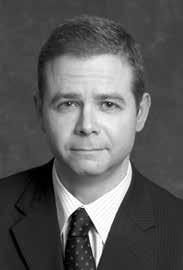
Timothy P. Murphy, Esq. is an Assistant Federal Defender, WDNY, formerly chief appellate attorney for the Legal Aid Society of Buffalo, and past Chair of NYSACDL's Amicus Curiae Committee
These NYS summaries are provided with the generous permission of the Office of Indigent Legal Services (“ILS”) through its Statewide Appellate Support Center. The holdings are authored by ILS. The commentaries in the second paragraph are authored by Tim Murphy.
Appeals reversed, with two judges dissenting, and remitted. Preservation of appellant’s challenge to his plea was not required, because he had “no practical ability to object to an error . . . which is clear from the face of the record.” The court’s repeated statements to appellant that he faced up to 45 years in prison were legally erroneous on the face of the record, as the aggregate sentence was statutorily capped at 20 years. Appellant could not be expected to correct what the court authoritatively stated, and the prosecution and defense counsel mistakenly believed. The Court has “never held that defense counsel’s failure” to “step in to correct” the court’s error, “even if it provides a basis for a CPL [§] 440.10 motion, pre-
cludes a defendant from separately challenging on direct appeal the voluntariness of their plea due to the court’s dereliction of its own constitutional duty.” Under the totality of the circumstances, appellant’s plea was involuntary: appellant was only 23 years old at that time, had no comparable experience facing serious charges, was under immense pressure to decide whether to accept the plea offer, and the court’s egregious error left him with little to no choice. Judge Singas, joined by Judge Garcia, would have affirmed, “because defense counsel plainly had the requisite practical opportunity to raise [the claim] before the trial court.” The Legal Aid Bureau of Buffalo, Inc. (Nicholas P. DiFonzo, of counsel) represented Scott.
Continued on next page
Continued from previous page
TM: Nice appellate work here. PL § 70.30(1)(e)(i) capped the potential sentence at less than half the time threatened at the time of the plea. The 5-judge majority noted the defendant’s young age (23) and his inexperience with dealing with such serious charges. It’s interesting that the 4th Dept., though affirming, did decide to reduce the sentence in the interests of justice. The Court of Appeals also takes some time to address the preservation rule and its exceptions, noting that the lower court’s constitutional duty to assure a voluntary plea is separate from the preservation doctrine. Though the dissent is weary of disincentivizing the filing of objections (i.e., promoting gamesmanship), counsel’s failure to discover an error does not change the lower court’s fundamental obligations. The dissent, giving its usual warning of the “flood gates opening” apocalypse, opines that a CPL 440 motion or a CPL 220.60(3) motion to withdraw the plea would be required under the circumstances.
2025 NY Slip Op 01563
Appellant appealed from a Second Department order affirming his Nassau County conviction of first-degree aggravated unlicensed operation of a motor vehicle, aggravated driving while intoxicated, and leaving the scene of an accident without reporting, following his guilty plea. The Court of Appeals reversed, vacated the plea, and remitted. The court’s failure to inform appellant at the time of his plea that the sentences for two of the offenses to which he was pleading guilty included mandatory fines rendered the plea involuntary. Preservation was not required where appellant had no practical ability to object prior to the imposition of the fines, which the court did not mention until imposition of sentence. Nor can a valid appeal waiver preclude a challenge to an involuntary plea “where the court fails to advise…of a component of th[e] sentence before it is imposed.” Judge Singas took no part in the decision; Justice Webber, from
the First Department, sat on the panel by designation. The Legal Aid Society of Nassau County (Argun Ulgen, of counsel) represented Padilla-Zuniga.
TM: Not much more to say; the Court also reminds us here that “a valid appeal waiver does not preclude a defendant from challenging a plea as involuntary, where the court fails to advise a defendant of a component of their sentence before it is imposed.” See People v. Louree, 8 NY3d 541, 545-546 (2007).
April 10, 2025
People v. Farrell
2025 NY Slip Op 02100
Appellant appealed from a Ulster County Court order reversing a dismissal of the accusatory instrument as facially insufficient on the ground that Agriculture and Markets Law § 353 is constitutionally void for vagueness as applied to the failure to provide veterinary care. The Court of Appeals reversed and reinstated the Kingston City Court order dismissing the accusatory instrument. The misdemeanor information solely charged appellant with failing to provide the dog with “sustenance.” Without deciding whether “sustenance” as used in § 353 encompasses veterinary care, the Court of Appeals found that the accusatory instrument lacked non-hearsay allegations that appellant deprived the dog of veterinary care. In the instrument, the investigator alleged that the dog was “infested with fleas,” had “a mass on his spine,” “suffered from spondylosis,” and had “never visited a vet,” without attaching a veterinary diagnosis, or asserting that a veterinarian had examined the dog or that the injuries were visually apparent. Mitchell H. Spinac represented Farrell.
TM: “Mogley,” the dog, was found splayed out in the middle of a traffic lane, barely able to walk or stand. He was plainly in a deteriorated condition. CPL 100.40(1) requires non-hearsay allegations in the accusatory instrument,
which, if true, establish every element of the offense charged. This addresses the issue of notice, which implicates due process and double jeopardy protections. The People thus failed to comply with the nonwaivable jurisdictional prerequisite of filing a valid and sufficient accusatory instrument.
May 15, 2025
2025 NY Slip Op 02966
Appellant appealed from a Second Department order affirming his designation as a level two sex offender and a sexually violent offender (SVO) under SORA, stemming from his federal child pornography conviction. The Court of Appeals modified by vacating appellant’s SVO designation and otherwise affirmed. The SORA court improperly designated appellant a SVO under the “foreign registration clause” of Correction Law § 168a(3)(b), which “defines a sexually violent offense as one based on a conviction of a felony in any other jurisdiction for which the offender is required to register as a sex offender in the jurisdiction in which the conviction occurred.” The federal government does not maintain a sex offender registry comparable to a mandated state registry, and there is “no requirement that federally convicted sex offenders register with the federal government.” Further, appellant was convicted under a federal statute that was explicitly included under New York’s statutory definition of “sex offense” but not “sexually violent offense.” However, the Court affirmed the level two designation, as there was record support for the Second Department’s denial of appellant’s request for a downward departure. Lisa Marcoccia represented Sherlock.
TM: This unanimous opinion authored by Judge Cannataro is the only bright spot for SORA caselaw this past year. Hats off to the court’s strict textual reading of Correction Law § 168-a(3)(b).
See also, People v. Kennedy, 7 NY3d 87,
89-90 (2006) (reaching same conclusion where defendant had been previously convicted under the authority of the US Navy); see also, People v. Talluto, 39 NY3d 306, 313 (2022) (recognizing statute imposes higher burden on nonviolent offenders convicted in foreign jurisdictions relative to similar offenses in New York).
May 20, 2025
2025 NY Slip Op 03011
Appellant appealed from a Second Department order affirming his Queens County conviction of first-degree robbery, first-degree assault, second-degree robbery, second-degree assault, and second-degree obstruction of governmental administration. The Court of Appeals reversed, with three judges dissenting, and granted a new trial. The trial court violated appellant’s constitutional right to selfrepresentation. During the months leading up to his trial, appellant continuously informed the court of his dissatisfaction with defense counsel, and then, after successfully withdrawing an earlier guilty plea, appellant “twice requested to represent himself, and in direct response to the court’s question of whether he would represent himself at trial, answered…‘yes.’” The court denied, without inquiry, appellant’s unequivocal and timely request to proceed pro se and expressly refused to consider any further request until the day of trial. Understanding that appellant’s request required resolution, the court responded that it would “deal with that,” but failed to inquire. Further, appellant did not “abandon” his request by failing to renew it on the morning of trial since only one unequivocal and timely request is required to trigger the duty to inquire. Judge Singas, joined by Judges Garcia and Cannataro, would have affirmed, finding that appellant’s request was not unequivocal where it was “prompted by his dissatisfaction with yet another appointed attorney…and embedded within a litany of extraneous and unrelated requests,
evidently designed to obstruct his criminal proceedings.” Appellate Advocates (David Fitzmaurice, of counsel) represented Lewis.
TM: Here’s what counsel told the court about his client: “Not to belabor the point, but he did threaten to kill me during our video conference, so on those grounds, Judge, I’d ask to be relieved.”
Some helpful discussion here under the seminal McIntyre doctrine involving the classic scenario of a defendant possessing a number of complaints in addition to wanting to represent him or herself pro se. People v. McIntyre, 36 NY2d 10, 14-18 (1974) (setting out a three-part test: requiring that the pro se request be unequivocal and timely, that the waiver be knowing and intelligent and that the defendant’s conduct not prevent the fair and orderly exposition of the issues); see also, Faretta v. California, 422 US 806, 819 (1975). The predictable 3-judge dissent, of course, reminds us of the violent facts involved in the underlying allegations (which have nothing to do with the issue at hand); but the dissent also reminds us that context is critical. And watch out for the Court’s more recent indulgence in this area, like in People v. Duarte, 37 NY3d 1218, 1219 (2022), where the appellant’s second-prong McIntyre argument was rejected despite his telling the court that he’d “love to go pro se” prior to a suppression hearing.
June 12, 2025
2025 NY Slip Op 03603
Appellant appealed from a First Department order affirming his conviction for second-degree murder and affirming the trial court’s summary denial of his CPL § 440.10 motion. The Court of Appeals modified by remitting the case for an evidentiary hearing on the 440.10 motion. In rejecting appellant’s mode of proceedings O’Rama claim, the court observed that where, as here, “a transcript of onthe-record proceedings material to [an] O’Rama claim is missing, the proper rem-
edy is a reconstruction hearing, provided that [appellant’s] conduct ‘evidence[s] a good faith purpose to obtain prompt and effective reconstruction.’” Here, the fact of a missing transcript alone did not constitute an O’Rama violation, because the trial court may have fully complied with O’Rama on the record; the appellate court simply does not know. That is why reconstruction hearings exist: “if the record can be accurately reconstructed[,] no prejudice results from its loss.” On the CPL § 440.10 issue, the Court of Appeals held that Supreme Court abused its discretion in denying an evidentiary hearing, since the defense motion, together with the trial record, “suggest that counsel may have lacked a strategic or other legitimate basis for one or more of his actions relating to eyewitness identification testimony at the heart of the People's proof.” The Court of Appeals remitted for an evidentiary hearing, because the question of whether counsel had a strategic or legitimate basis for his conduct “turn[ed] on factual information outside the present record.” Gamaliel Marrero represented Salas.
TM: It seems that most criminal courts do not realize CPL 440.30(5) indicates that “[i]f the court does not determine the motion pursuant to subdivisions two, three or four, it must conduct a hearing and make findings of fact essential to the determination thereof.” (emphasis added). Here, while nine and a half years elapsed since appellant’s conviction, there were material and factual IAC-related issues that needed to be addressed under People v. O’Rama, 78 NY2d 270, 277278 (1991); see also generally, People v. Baldi, 54 NY2d 137, 147 (1981); People v. Benevento, 91 NY2d 708, 712 (1998); People v. Zeh, 22 NY3d 1144, 1145-1146 (2014). The Supreme Court abused its discretion in summarily denying the CPL 440 motion under either CPL 440.10(1) (a) or (4)(d).
Continued on next page
Continued from previous page
June 17, 20255
2025 NY Slip Op 03642
Appellant appealed from a Fourth Department order affirming her conviction in Erie County Court for first-degree manslaughter. The Court of Appeals reversed the conviction and ordered a new trial. Trial counsel was ineffective for failing to object to repeated improper remarks by the prosecutor during summation. First, the trial prosecutor argued that the jury had never heard testimony that appellant had feared for her life, when in fact appellant had testified that she was scared for her life just before she fatally stabbed her abusive partner during an attack. This misrepresentation of the record, conceded by the prosecution on appeal, “went to the heart of [appellant’s] justification defense” and “well exceed[ed] the bounds of permissible commentary on the evidence.” Second, the prosecution repeatedly called appellant a liar. While commentary on appellant’s prior inconsistent statements would have been fair, the prosecutor crossed the line by expressing a “personal belief or opinion as to the truth or falsity of [appellant’s] testimony.” There was no legitimate strategic reason for counsel’s silence. Judge Rivera filed a concurrence advocating for reversal on different grounds: trial counsel was ineffective for failing to request a charge instructing that the jury could consider the decedent’s prior violent acts against appellant in determining the reasonableness of her belief that deadly physical force was necessary to defend herself. She also would have found counsel ineffective for failing to request a clarification on the initial aggressor instruction. Judge Rivera’s concurrence suggested model language modifying the CJI instructions on justification in cases where the complainant has a history of abusing the accused or third parties. Judge Garcia filed a separate concurrence warning trial courts against adopting Judge Rivera’s proposed changes to the standard CJI charge and criticizing
her for proposing CJI changes neither party requested. David Polk & Wardwell LLP (Corey M. Meyer, of counsel) represented T.P.
TM: Unfortunately, it takes a scathing misrepresentation and the labeling of the defendant a liar 14 times to obtain a new trial on IAC for solely not objecting to the prosecutorial misconduct in summation. See generally, People v. Ashwal, 39 NY2d 105, 109 (1976) (reminding that summation “[i]s not an unbridled debate in which the restraints imposed at trial are cast aside so that counsel may employ all the rhetorical devices at [their] command”); People v. Wright, 25 NY3d 769, 780, 782 (2015) (addressing prosecutorial misrepresentations in summation regarding critical issue of DNA); People v. Fiori, 262 AD2d 1081, 1081 (4th Dep’t 1998) (addressing multiple examples of prosecutorial misconduct in summation).
Pertinent U.S. Supreme Court and Second Circuit Decisions; February through June of 2025:
Feb. 25, 2025
Glossip v. Oklahoma
145 S. Ct 612
This is a capital case originating in Oklahoma state court. Mr. Glossip had previously been on the losing end of a Supreme Court decision in 2015, when he and three other capital inmates unsuccessfully challenged through a 42 U.S.C. § 1983 action challenging Oklahoma’s three-drug lethal injection protocol. See Glossip v. Gross, 576 U.S. 863 (2015).
Mr. Glossip, a hotel manager, was convicted of having another person beat to death the hotel’s owner, purportedly over money. That other person, Justin Sneed, provided testimony in exchange for avoiding the death penalty. The first trial resulted in a reversal on appeal. During the second and latest trial, Sneed was dishonest in his testimony about why he had been taking lithium. It was only
revealed years after the conviction (when the prosecution unveiled eight boxes of discovery to the defense) that Sneed had considered recanting his testimony and suffered from bipolar disorder, which, when combined with certain drug use, caused compulsive and violent outbursts.
Though the government ultimately confessed error in response to Mr. Glossip’s state post-conviction motion, the Oklahoma Court of Criminal Appeals still denied the defendant a third trial based on a procedural default issue and a rejection of the petitioner’s new constitutional argument. The Supreme Court, however, in a decision authored by Justice Sotomayor, reversed. Justice Thomas wrote for a three-judge dissent. Justice Gorsuch recused himself.
Putting aside the unaddressed but rampant Brady violations regarding the state’s failure to timely disclose multiple boxes of items revealing mental health and exculpatory-related information, Napu v. Illinois, 360 US 264, 269 (1959) was violated. The petitioner was deprived of his 14th Amendment right to Due Process under Napu by the government not correcting Mr. Sneed’s testimony that the prosecution knew, or had reason to know, was false. A new trial was ordered.
March 7, 2025
United States v. Harry 130 F.4th 342 (2d Cir. 2025)
The defendant owned an automotive audio store in Hartford Connecticut. He was being investigated by the DEA for being the leader of a drug trafficking scheme. As part of the investigation of drugs being transported near the defendant’s store, a surveillance pole-camera was set up across the street. No warrant was secured. The camera fed live footage to the DEA, continuing 24 hours a day for 50 days (28 minutes of which were introduced at trial). Drugs, firearms, ammunition, and drug paraphernalia were ultimately recovered inside the store. The
pole-camera surveillance was not a search under the Fourth Amendment. Katz v. US, 389 US 347, 360 (1967) (Harlan, J., concurring); Carpenter v. US, 585 US 296, 310 (2018). The camera was not, like in Carpenter, attached to the object it was surveilling. The defendant made no effort to conceal the clearly visible goings-on outside his store. The defendant had no reasonable expectation of privacy in the subject area of the surveillance. His suppression motion was properly denied.
145 S. Ct. 797
The petitioner, a purported associate of the Genovese crime family in NYC, was hired to kill a suspected police informant. He attempted to do so by providing a loaded firearm to a local street gang he recruited for the job. They ultimately failed to carry out the deed and were caught by law enforcement. The feds charged the petitioner with using or carrying a firearm during or in relation to a “crime of violence” (“CoV”) under 18 U.S.C. § 924(c).
The indictment charged NYS attempted murder as a predicate under the violent crimes in aid of racketeering (“VICAR”) statute. See 18 U.S.C. § 1959(a)(5) (which requires proof of the commission of a qualifying state or federal offense). As a NYS attempted murder may be committed through omission (i.e., not performing a legally imposed duty), see e.g., People v. Steinburg, 79 N.Y.2d 673, 680 (1992); People v. Best, 202 AD2d 1015, 1016 (4th Dep’t 1994), the primary issue before the Court was whether omitted acts may qualify as a CoV. The answer, unfortunately, is yes. Supposedly applying the categorical approach, the Court concluded the CoV definition under § 924(c) (3)(A) (the elements clause) includes the indirect (and perhaps nonviolent) application of force against another person.
Justice Gorsuch authored a dissent, joined by Justice Jackson. As he has in
previous cases, Gorsuch opined that the rule of lenity should be moved up as a priority in judicial statutory construction. Gorsuch posed the hypothetical of a lifeguard purposely not saving someone from drowning. Where is the physical act of violence in that? Of course, letting someone drown on purpose is an act that should be prosecuted in criminal court, but § 924(c), with its 5-year mandatory minimum, is only (according to the dissent) for the worst of the worst.
145 S. Ct. 821
Patrick Thompson was a corrupt alderman in Chicago. When asked by his federally insured lending company if he had any outstanding loans with a particular bank, the defendant indicated (more than once) that he had taken out a loan for $110,000. This was, in a technical sense, true. But he also had two other outstanding loans, with the three totaling $219,000.
The issue before the Supreme Court was whether a misleading -- but not technically “false” statement -- qualifies under 18 USC § 1014, which only prohibits making “false” statements in federal loan applications. Congress has used the phrase “false and misleading” many times in other statutes. They chose not to in this statute. True but misleading is not false. Context is everything. Misleading is false under certain circumstances. False is always false.
The Court unanimously reversed. The Chief authored the majority opinion. Justices Alito and Jackson authored separate concurring opinions.


I’m a
, not an
Written by: Diane Lopez, Esq.
The Supreme Court in Padilla v. Kentucky2 expanded the Sixth Amendment right to counsel by including a duty for attorneys to inform clients about immigration consequences that result from a guilty plea. It’s long been recognized that advising on immigration issues is a complex and challenging task. Some cases allow for straightforward advice by reviewing relevant case law and statutes, but others involve consequences that are not immediately obvious, making the analysis more complicated. Yet, even in complex cases, the obligation to advise clients of the risk of being deported remains. The real question is: how can a criminal defense attorney fulfill their Padilla duties if they are not well-versed in immigration law? This article provides key tips to consider when counseling and advising non-citizen clients.
Learn: Your Client’s Immigration Status and History
Complying with the Padilla duties starts with understanding a client’s immigration status and history. This information can be obtained in various ways. An attorney can ask the client directly about the client’s country of birth and how they came to the United States. They can also review the client’s RAP sheet to find relevant details. If the client had any contact with immigration authorities or was detained while entering the United States, these encounters are often noted in the RAP sheet. However, even though the RAP sheet may provide information about a client’s immigration status, a defense attorney should not rely on it alone. They must speak directly to the client to get accurate details about their immigration history. Understanding a client’s immigration situation will help determine the
advice given to a client before they agree to a plea in their criminal case. For example, a client who entered the United States without inspection should receive different advice than a lawful permanent resident because the circumstances surrounding their entry into the U.S. are different. Analyzing a person’s inadmissibility and/or deportability is a complex process that must be tailored to each individual’s specific immigration circumstances.
Read: The Immigration and Nationality Act
The Immigration and Nationality Act (INA) is the primary body of law governing immigration policies and determining whether a person is inadmissible3 and/or deportable4. Inadmissibility and deportability are two issues that, if not properly addressed, can directly impact a client’s immigration status and significantly change the course of their life. A defense attorney is neither required nor expected to be an expert in immigration law. However, they are expected to exercise due diligence by reviewing the INA statutes to determine whether a specific offense would render a client inadmissible or deportable. Two key statutes that can guide a defense attorney in their analysis are INA § 212(a)(2), which lists all the reasons that can make a person inadmissible, and INA § 237, which outlines the situations that can render someone deportable. For example, when handling a case involving an order of protection, INA § 237(a)(2)(E) (ii)5 would be relevant to the issue of deportability because, as the statute states, a person becomes deportable if a court determines that they violated an order of protection. Since a conviction is not necessary, a criminal defense attorney
would have the obligation to inform their client of the deportation risks if they do not comply with the order of protection. Failing to review the INA statutes before explaining the immigration consequences to a non-citizen client would violate the client’s constitutional right to have effective assistance of counsel.
The Court in Padilla found that the attorney failed to act as a “constitutionally competent counsel” by not advising “that [Padilla’s] conviction for drug distribution made him subject to automatic deportation.”6 In making its determination, the court emphasized the language of the relevant INA statute, describing it as “succinct, clear, and explicit in defining the removal consequence for Padilla’s conviction.”7 This underscores the importance of thoroughly and effectively reading the INA to understand how it applies to a client.
Where the consequences are not clearly spelled out in the statute, the Padilla Court states that “a criminal defense attorney need do no more than advise a noncitizen client that pending criminal charges may carry a risk of adverse immigration consequences.”8 However, misadvising a client can be considered a form of representation that “falls below the objective standard of reasonableness.” For instance, the Appellate Court in People v. Go9 held that “[w]here…defense counsel gives incorrect advice regarding the immigration consequences of a guilty plea, that constitutes ineffective assistance.”10 In Go, counsel incorrectly advised that the risk of deportation “would be diminished because ‘the crime occurred beyond five years of him obtaining his green card.’”11 The defense attorney in Go did not consider existing case law, which categorized the offense as a deportable aggravated felony, and instead incorrectly told the client that the immigration consequences would be less severe. Similarly,
the Appellate Division, Third Department, has ruled that it is not enough to advise only on the likelihood of deportation. In People v. Marcellus, counsel told their client that deportation after a guilty plea was only probable, not guaranteed. The Marcellus court found this ineffective representation because “defense counsel readily could have ascertained— simply from a reading of the relevant statutes—that defendant’s plea to criminal possession of a controlled substance in the third degree rendered deportation presumptively mandatory.” These rulings demonstrate that a criminal defense attorney is expected to proactively research and understand the immigration consequences related to a criminal case.
Discuss: The Plea Offer or Agreement With Your Client Thoroughly
Beyond confirming a client’s immigration status and reviewing the INA statutes, a criminal defense attorney is also expected to talk to their client about the possible immigration consequences. While there is no prescribed approach for having these discussions, courts have recognized that a criminal defense attorney is not required to use exact immigration-related terminology when discussing the possibility of deportation. As long as the attorney accurately advises their non-citizen client, they have met their duty. For example, an attorney can use phrases such as “very likely” instead of “presumptively mandatory” when discussing the possibility of deportation because “there is no reason why an attorney cannot explain legal terms using more accessible language.”12
Attorneys should diligently discuss the terms of a plea agreement or offer with their client, especially when the agreement includes clauses related to the likelihood of deportation. For example, the
plea agreement in De Goorte v. United States13 contained very specific provisions regarding the possibility of deportation, stating that “[t]he defendant recognizes that, if he is not a citizen of the United States, his guilty plea and conviction make it very likely that his removal from the United States is presumptively mandatory . . . .”14 To ensure the client was adequately informed of the impact on their immigration status, counsel in De Goorte met with their client twice to discuss the plea agreement. In addition to these meetings, the attorney also directed the client to speak with an immigration attorney before accepting the offer. These combined steps satisfied the attorney’s Padilla obligation and did not fall below the “objective standard of reasonableness”. The Court noted that the client could not “dispute that [defense counsel’s] advice put him on notice that his guilty plea would place him at serious risk of deportation.”15 The “objective standard of reasonableness” is a fact-based analysis that requires the court to consider all measures taken by the attorney to ensure the client was satisfactorily informed of the possible immigration consequences. With this in mind, criminal defense attorneys should follow these tips to both protect the client’s rights and adhere to their Padilla obligations.
An effective defense attorney considers issues beyond Padilla when advising a client because immigration laws are rapidly changing at both the state and federal levels. While the Padilla decision aims to ensure non-citizen clients are properly advised before accepting a guilty plea, it does not cover the many consequences that can arise from a simple arrest, especially in today’s environment.
Continued on page 28
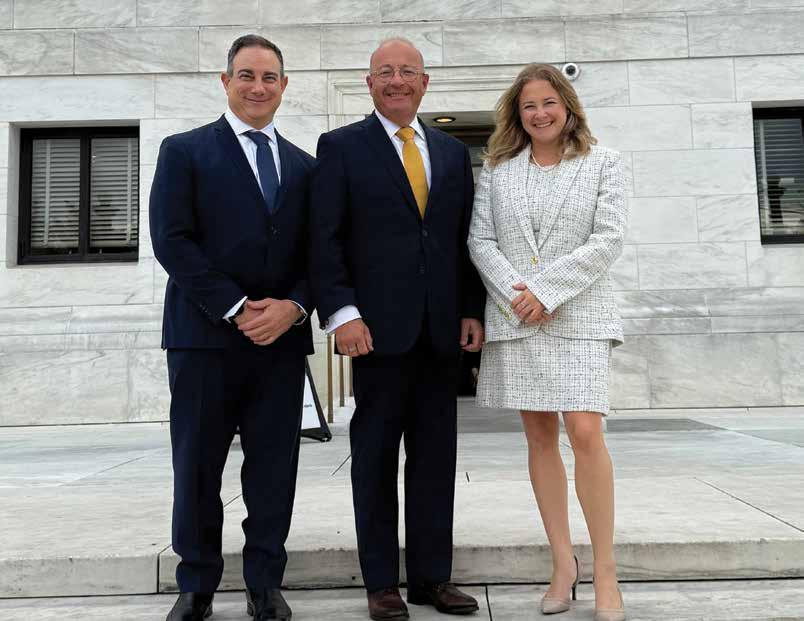
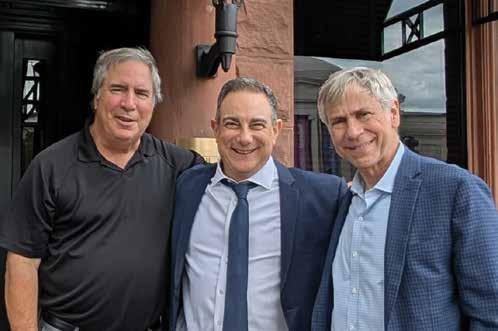
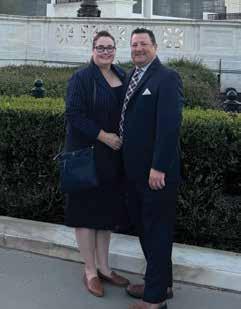
“To stand before the Supreme Court and be moved in by my father was a deeply meaningful milestone. Being admitted with other exceptional lawyers and getting to experience it with my family is a memory I will cherish. Now I can say I’m a part of the Court where history has been made and groundbreaking lawyers have practiced and presided.
Alexis Epstein, Esq.
Welcomemembers of the New York State Association of Criminal Defense Lawyers on the eve of your admittance to the United States Supreme Court Bar. I’m sorry I’m not able to be with you all in person today but I honor and appreciate what this moment signifies both personally and professionally and I congratulate you all. As attorneys; few halls feel as hallowed as those of the highest court of our land. Few legal decisions have had such an impact as those coming down from the Justices who sit therein. And few institutions carry such a place of importance and solemnity in our nation’s history.

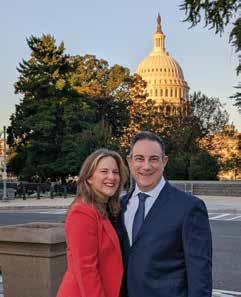

“Being admitted to the U.S. Supreme Court was a historical day for me, being the second exoneree to get admitted there. Having the support of lawyers who fought to free me and NYSACDL made the day even more special. I look forward to the day I win a case before the Court.”
Martin Tankleff, Esq.
January 14, 2026
City Winery, New York, NY

Hon. Raymond J. Dearie
Hon. William Brennan Award for Outstanding Jurist
David Schopp, Esq.
Lifetime Achievement Award
Kalle Condliffe, Esq.
Amanda Jack, Esq.
Gideon Champions of Justice
Public Works
Justice Through The Arts Award
Kevin Stadelmaier, Esq.
Installation as 2026 NYSACDL President
Jessica Horani, Esq.
Recognition as 2025 NYSACDL President

Hon.
Hon.
Judge Raymond J. Dearie was appointed United States District Judge for the Eastern District of New York on March 21, 1986. In March 2007, he became the court’s Chief Judge, and served in that capacity through March 2011. In September 2010, Judge Dearie began service as the representative to the Judicial Council of the United States for the Second Circuit Court of Appeals. In July 2012, Chief Justice John Roberts appointed Judge Dearie to a seven-year term on the Foreign Intelligence Surveillance Court. Judge Dearie was appointed Special Master on September 15, 2022, in Donald J. Trump v. United States of America.
Judge Dearie was born in Rockville Centre, New York, and graduated from Fairfield University in 1966. He graduated from St. John’s University School of Law in 1969, where he was editor-in-chief of the Law Review. From 1969 to 1972, Judge Dearie practiced law at Shearman & Sterling in New York City. In 1971, he became an Assistant United States Attorney for the Eastern District of New York. During the next six years, he held several positions at the U.S. Attorney’s Office, including Chief of the Appeals Division, Chief of the Criminal Division, and Executive Assistant to the U.S. Attorney. In 1977, Judge Dearie joined the law firm Surrey & Morse, in New York City. In 1980, he returned to the U. S. Attorney’s Office for the Eastern District of New York as Chief Assistant to the U.S. Attorney. In 1982, he was named United States Attorney for the Eastern District of New York, a position he held at the time of his judicial appointment.
Judge Dearie was a member of the Association of the Bar of the City of New York, the New York State Bar Association, and is currently a member of the Federal Bar Council. He is also a former President of the St. John’s Law Review Alumni Association and participant in the Inns of Court.
Judge Dearie has served as a legal educator in a wide range of settings. He taught courses at St. John’s School of Law and Brooklyn Law School and guest-lectured at New York University Law School; delivered lectures and presentations on a wide range of legal topics at Practicing Law Institute seminars, the Federal Judicial Center, the Federal Bar Council, the Association of the Bar of the City of New York, and other bar groups; served as consultant and instructor on American law to foreign judiciaries, including at the Thai Judicial Training Institute I Bangkok and in the Former Soviet Union as part of the ABA Rule of Law Initiative’s Central and Eastern European Law Institute; regularly serves on the judging panel of law school moot court competitions; and frequently hosts legal outreach programs for college, high school and elementary students.
In 2008, Judge Dearie received an honorary degree of Doctor of Laws from his alma mater, the St. John’s University School of Law, and delivered the Commencement address to the graduating class.
Judge Dearie is married to Vivian Dearie. He has five children.


Kalle Condliffe, Esq. Amanda Jack, Esq. Gideon Champions of Justice
Honoring Amanda Jack and Kalle Condliffe.
The New York State Association of Criminal Defense Lawyers is proud to honor Amanda Jack and Kalle Condliffe with the 2026 Gideon Champion of Justice Award for their relentless advocacy and leadership in the fight to protect Kalief’s Law and to preserve the hard-won discovery and speedy trial reforms that safeguard the right to a fair process for all New Yorkers.
Together, Amanda and Kalle have been a driving force behind the defense community’s efforts to prevent significant rollbacks to the 2020 discovery reforms—reforms that were the product of decades of advocacy and the tireless work of defenders, impacted communities, and justice reform leaders across the state. In the face of immense political pressure, they marshaled data, expertise, and the collective voice of the defense community to ensure that the promise of Kalief’s Law remained intact. Their steadfast work has protected the constitutional rights of countless individuals who might otherwise have languished in jail or faced prosecution without access to critical evidence.
Amanda Jack, Policy Director for the Criminal Defense Practice at the Legal Aid Society, has built her career on transforming systems through both advocacy and action. From her early days at Brooklyn Defender Services to creating one of the largest pretrial bailouts in history with the Robert F. Kennedy Human Rights organization, Amanda has always embodied the defender’s duty to pursue justice beyond the courtroom. At Legal Aid, she now leads statewide policy coordination and legislative advocacy to modernize New
York’s criminal statutes and reduce incarceration, while working in deep partnership with coalitions, community leaders, and defenders across New York.
Kalle Condliffe, Supervising Attorney and Manager of Litigation Training and Resources at the Legal Aid Society, combines rigorous legal expertise with a deep commitment to defender education and systemic reform. From her years as a Bronx trial attorney to her current leadership in litigation training, Kalle has been a trusted resource for defenders navigating the complex landscape of discovery and speedy trial practice. In the fight to defend Kalief’s Law, she brought clarity, strategy, and an unwavering belief in fairness to every discussion—from the courthouse to the Capitol.
Through their partnership, Amanda and Kalle exemplify the spirit of the Gideon Champion of Justice Award: fearless, principled advocacy in defense of the right to counsel, the presumption of innocence, and the pursuit of justice for all. Their work has fortified the foundation of New York’s criminal legal system and stands as a testament to what defenders can achieve when they fight together for systemic change.
On behalf of defenders across New York and the clients and communities they serve, NYSACDL proudly names Amanda Jack and Kalle Condliffe as the 2026 Gideon Champions of Justice.
Kalle Condliffe is a Supervising Attorney and Manager of Litigation Training and Resources at the Legal Aid Society (LAS) in the Criminal Defense Practice.
Prior to joining LAS’s Training Unit, Kalle was a trial attorney in the Bronx. Kalle dedicates much of her time to helping attorneys navigate the discovery and speedy trial reforms. She also works with Legal Aid’s policy team and other advocates in Albany to fight rollbacks to the 2019 discovery and speedy trial reforms.
Amanda Jack is the Policy Director for the Criminal Defense Practice, Law Reform Unit at the Legal Aid Society. She is a 2011 graduate of the City University and its criminal defense clinic and began her career as a public defender with Brooklyn Defender Services that same year.
In late 2018 she left BDS to create what became the largest bailout of people awaiting trial at Rikers Island, working with the Robert F. Kennedy Human Rights organization to create the "Mass Bail Out".
In 2019 she joined the Legal Aid Society as a trial attorney in the Manhattan office. Throughout her career as a public defender, she engaged in organizing and reform work as part of 5 Boro Defenders. Now, as Policy Director, she works to coordinate experts across the criminal practice at LAS while also
working with coalitions, community groups, impacted leaders and defenders across the state to modernize and improve our criminal statutes while shrinking our prison population.
She is privileged to co-chair the Legislative Committee of the Chief Defenders Association, serve as co-chair of the Legislative Committee of the NYSBA Criminal Justice Section and is a proud member of NYSACDL.
Prior to law school Amanda worked at a migrant hospitality house in Texas, as an organizer with the Texas Criminal Justice Coalition and as a human rights accompanier in the north of Colombia.
She loves life with her husband and 2 kids and someday will realize her dream of opening a combined community organizing space/ donut shop called "Donut Talk to Cops".

The New York State Association of Criminal Defense Lawyers (NYSACDL) is proud to announce that the recipient of its 2026 Justice Through the Arts Award is Public Works, a groundbreaking civic artistic program of The Public Theater.
The Justice Through the Arts Award recognizes individuals and organizations whose creative endeavors illuminate, challenge, and transform the pursuit of criminal and social justice. Past honorees include the Oscar-nominated film Sing Sing, written by Greg Kwedar and Clint Bentley and accepted by actor and exoneree Jon-Adrien “JJ” Velazquez; the television docu-series The Last Defense, executive produced by Viola Davis, Julius Tennon, and Andrew Wang for JuVee Productions; and the documentary The Central Park Five, directed by Ken Burns and Sarah Burns.
Public Works embodies the spirit of this award through its visionary commitment to building community and expanding access to the arts for all New Yorkers. Working in partnership with community organizations across all five boroughs, Public Works invites thousands of people each year to participate in classes, storytelling, and the creation of
large-scale, participatory theater. By blurring the line between professional artists and community members, Public Works redefines what it means for art to be of, by, and for the people.
Through year-round programs—ranging from teaching-artist-led classes to community choirs, monthly potlucks, and the powerful Public Stories initiative—Public Works creates spaces where participants reflect on the world as it is and imagine new possibilities for what it might become. Each year’s culminating production brings together artists and community members alike in extraordinary theatrical collaborations that celebrate the shared humanity at the heart of justice.
In honoring Public Works, NYSACDL celebrates the organization’s belief that art is not merely a reflection of society, but a force for equity, empathy, and transformation.
The 2026 Justice Through the Arts Award will be presented at NYSACDL’s Annual Gala, where members of Public Works and The Public Theater will be recognized for their profound contributions to community, creativity, and justice.

Public Works, a major civic artistic program of The Public Theater, aims to restore and build community by connecting people through the creation of extraordinary works of art. Working with partner organizations in all five boroughs, Public Works invites community members to take classes, participate in programming, attend performances, and join in the creation of ambitious works of participatory theater. Public Works deliberately blurs the line between professional artists and community members, creating theater that is not only for the people, but by and of the people as well. Public Works seeks to create a space where we can not only reflect on the world as it is, but where we can propose new possibilities for what our society might be.
Between our annual productions, Public Works builds relationships with community members through year-round programming throughout the city designed in collaboration with our local partner organizations.
• We offer CLASSES at our community partner organizations and at The Public, taught by teaching artists and tailor-made to serve the artistic interest of each community.
• Monthly potlucks give us all an opportunity to share a meal, celebrate our achievements and present the creative projects that people have been working on throughout the year.
• Programming also includes a community choir, attending plays, member-run leadership committees, and Public Stories, an initiative centering oral personal storytelling directly from our community's experience.
• All this programming culminates in ambitious participatory theater PRODUCTIONS. Once a year, our vast community comes together to create an extraordinary, largescale production.


NYSACDL's Lifetime Achievement Award honors an individual whose career has been defined by exceptional dedication to the constitutional rights of the accused and the highest standards of criminal defense advocacy. This award recognizes an attorney whose lifelong commitment to justice, integrity, and professional excellence has made a profound and lasting impact on the practice of criminal law. Recent recipients include: Andrew Kossover, Ben Ostrer, Seymour James, Jr., and Jonathan Gradess.
Lifetime Achievement Award presented to David Schopp (provided by Kevin Stadelmaier)
David C. Schopp has dedicated more than three decades to advancing equal access to justice through his work with the Legal Aid Bureau of Buffalo, where he has served as Executive Director since March 2000. He first joined the Bureau’s Appeals Unit in 1985, returning in 1989 after a brief period in private practice. His leadership journey began with his appointment as Chief Attorney of the Attorneys for Children Unit in 1999, marking the start of a tenure defined by steady growth, innovation, and a deep commitment to clientcentered representation.
Under his direction, the Bureau has expanded from 53 employees to more than 170 while broadening its practice areas and embracing a holistic model of representation, particularly within the Criminal Defense and Civil
Legal Services Units. A proud alumnus of the University at Buffalo, where he earned both his B.A. in English and his J.D., David has received the UB Law Alumni Award for Commitment to Public Service and the Distinguished Alumnus Award for his lifelong contributions to the legal community.
Beyond Legal Aid, David has been a respected leader in defender advocacy at both the state and national levels, serving as Past President of the Chief Defenders Association of New York and on the Boards of the New York State Defenders Association and the New York State Bar Association’s Committee on Mandated Representation. Guided by the principle that every action must be rooted in what clients need and can achieve, he envisions a bright future for Legal Aid, marked by continued growth, strong leadership, and the unwavering pursuit of justice for all.

Continued from page 17
For example, non-citizen clients who have been arrested and have pending applications with United States Citizenship and Immigration Services (USCIS) face a risk of immigration enforcement because USCIS has been given unprecedented authority “to order expedited removal and investigate civil and criminal violations of the immigration laws within the jurisdiction of USCIS”16 if an application is denied. Satisfying all statutory requirements for specific applications, like adjustment of status, does not guarantee approval because the “USCIS only approves the application if the applicant demonstrates that he or she warrants a favorable exercise of discretion.”17 When exercising discretion, USCIS heavily considers an applicant’s “[r]espect for law and order, and good moral character (both in the United States and abroad) demonstrated by a lack of a criminal record and evidence of good standing in the community.”18 As such, a non-citizen with a pending application and an open criminal case will likely not meet the burden of proof required for positive discretion, which could result in a denial. More seriously, USCIS can exercise its authority and initiate deportation proceedings. This is especially important if a non-citizen client has a scheduled appointment with USCIS while their criminal case is still open because, depending on the charges, they can be detained at their appointment. The same applies to non-citizens with pending immigration cases. A simple arrest or ongoing criminal case—even without a conviction—can jeopardize their freedom and force them to fight their immigration case from ICE detention.
During a criminal defense attorney’s intake with their non-citizen client, they should find out whether the client has any pending applications or upcoming immigration court dates. The answers to
these questions will guide the course of action a defense attorney should take in a criminal case, even before plea negotiations begin.
The Laken Riley Act (LRA), passed on January 29, 2025, further illustrates how legislative changes significantly increase risks for certain non-citizens. The LRA expanded mandatory detention to individuals “charged with, arrested for, convicted of, or admits to having committed acts that constitute the essential elements of burglary, theft, larceny, or shoplifting.”19 Under this law, even a simple arrest, whether or not a conviction is obtained, can trigger mandatory detention. Even more important, a person who is mandatorily detained may be held far from home, restricting access to legal counsel and making it harder to gather evidence to support their valid claim. In fact, “an estimated 70 percent of people held in immigration detention on deportation cases opened in the past three years are unrepresented in their proceedings.”20 Individuals can remain detained for years before being seen by an immigration judge, causing them to abandon their right to litigate their case. Given the LRA’s immediate and profound impact, defense attorneys must address immigration risks during arraignment—not only after receiving a prosecutor’s offer.
When representing clients charged with offenses covered by the LRA, attorneys should (1) investigate the client’s encounters with immigration authorities to determine whether they’ve been deemed inadmissible, (2) warn them about the risk of mandatory ICE detention, and (3) consult with an expert in the field.
The United States is in an era where the Department of Homeland Security
(DHS) was instructed to “sharply increase arrests of migrants in the U.S. illegally…That has meant changing tactics to achieve higher quotas of 3,000 arrests per day, far above the earlier target of 1,000 per day.”21 To do this, DHS has expanded its use of Expedited Removal (ER). ER, or fast-track deportation, allows DHS to deport certain non-citizens without due process. Even if a non-citizen is in removal proceedings and exercising their constitutional right to due process, DHS has been given the authority to seek termination of these proceedings to carry out an expedited removal.22 Simply put, having an open deportation case does not necessarily protect a non-citizen from the risk of expedited removal.
Once a non-citizen is flagged for ER, their deportation is nearly inevitable. Naturally, this raises the question: who is subject to ER? Most undocumented individuals are at risk of expedited removal because the law applies to all people who sought admission at a port of entry and were deemed inadmissible.23 The law also covers non- citizens who did not seek admission at a port of entry, stating that non- citizens “who arrive in, attempt to enter, or have entered…without having been admitted or paroled following inspection by an immigration officer at a designated port- of- entry, and who have not established to the satisfaction of the immigration officer that they have been physically present in the United States continuously for the 2-year period immediately prior to the date of determination of inadmissibility”24 are subject to expedited removal. Because there is a specific exception for non-citizens who have been in the U.S. for less than two years, clients fitting this profile are at higher risk of expedited removal. This highlights the risk of deportation before a criminal case is even resolved because a client subject to ER might be deported while their criminal case remains pending. Defense
attorneys should implement Tip 1 at the start of their criminal case. While Padilla focuses on an attorney’s duty to provide immigration advice in relation to a plea offer, the core of the decision applies to all stages of a criminal case. Preemptively, defense attorneys should: (1) learn the client’s immigration history, (2) verify documentation of two years’ presence, and (3) consult an immigration expert to ensure the client is properly advised. Proactively taking these steps helps defense attorneys safeguard their clients from unexpected and rapid deportation.
Non-citizen clients may also face federal charges under 8 U.S.C. § 1325, which relates to illegal entry into the United States, and 8 U.S.C. § 1326, concerning unlawful re-entry. To date, there have been over 32,000 prosecutions nationwide under these statutes, with the majority of cases originating from states near the border.25 As it stands, there is no mechanism to determine if a non-citizen client has an active federal warrant under these statutes. However, a criminal defense attorney can prepare by (1) asking targeted questions about the client’s border-crossing experience and (2) carefully reviewing the client’s RAP sheet for any contact with immigration officials. This helps the attorney gauge the likelihood of an existing federal warrant. For example, a non-citizen who entered without inspection and was found inadmissible to the U.S. is more likely to have a warrant under 8 U.S.C. § 1325 than a client who was lawfully admitted to the United States but overstayed their visa. By taking these steps, defense attorneys can better protect their clients’ rights at every stage, especially since federal law enforcement may appear at arraignments to execute warrants under 8 U.S.C. §§ 1325 or 1326. If officers arrive at an arraignment with
a valid warrant signed by a judge, the defense attorney should: (1) request a copy of the warrant, (2) inform the client about what is happening and what to expect, (3) speak with an expert in the field, and (4) talk with the prosecutor to potentially resolve the case in state court, as an open state case can delay federal and immigration proceedings. Taking these steps reaffirms the importance of comprehensive advocacy to protect a client’s rights.
Since the 2010 Padilla decision, advisals under Padilla typically focused on non-citizens. However, in United States v. Farhane, the Second Circuit extended this protection to naturalized citizens, ruling that “the Sixth Amendment entitles a naturalized U.S. citizen facing the risk of deportation following denaturalization to no less protection than a noncitizen facing deportation."26 Naturalized citizens,27 by definition, must apply to become United States citizens. The naturalization process requires applicants to disclose any criminal arrests, convictions, or activities—even those for which they were not arrested. Therefore, denaturalization28 under Farhane depends on these disclosures. For example, if a naturalized citizen answers “No” to "Have you ever... knowingly committed any crime for which you have not been arrested?"29 in their citizenship application and is later arrested for conduct that occurred before their application was filed, they may face denaturalization.
The Farhane court clearly shows the consequences that can happen when a naturalized citizen is not informed about the risk of denaturalization before entering a plea. Mr. Farhane applied for citizenship in March 2001, attended his citizenship interview in March 2002, and took the Oath of Allegiance in April 2002. At
each stage, he answered “No” to questions about his involvement in criminal activity. After being arrested and charged criminally a few years later, Mr. Farhane pleaded guilty on November 9, 2006, without receiving Padilla advice and admitting to involvement in a conspiracy that began in November 2001. In 2018, the government started denaturalization proceedings against Mr. Farhane, claiming that “he had procured his naturalization by concealing a material fact: that he had committed a crime for which he had not been arrested.”30 To prove “concealment of a material fact”, the U.S. government relied on Mr. Farhane’s admission during the plea colloquy, specifically the dates the crimes were committed, rather than just the conviction. Meaning, when Mr. Farhane took the plea, he explicitly admitted to having committed a crime for which he was not arrested, which “conclusively established that he could not show in April 2002 that he was a "person of good moral character," as he had to, to naturalize then.”31 Because the government’s civil complaint for denaturalization necessarily relied on Mr. Farhane’s admission during his plea, the Second Circuit determined that his conviction and risk for denaturalization are "enmeshed; and denaturalization has a ‘close connection to the criminal process.’"32
Unlike traditional Padilla advice, which emphasizes criminal convictions, denaturalization under Farhane focuses on a client’s misrepresentation during the naturalization process. Authority to denaturalize derives from 8 U.S.C. § 1451(a), which states. “[i]t shall be the duty of the United States attorneys […] to institute proceedings in any district court of the United States […] for the purpose of revoking and setting aside the order admitting such person to citizenship and canceling the certificate of naturalization on the ground that such order and certificate of naturalization
Continued on next page
Continued from previous page
were illegally procured or were procured by concealment of a material fact or by willful misrepresentation…”33 Based on the statute, the United States government does not require a conviction to initiate denaturalization proceedings. It only needs to prove “concealment of a material face or by willful misrepresentation.” This burden can easily be met through admissions made on the record during a plea, as seen in Farhane. This suggests that a defense attorney’s role in advocacy extends beyond obtaining an offer. The attorney should continue negotiating with the prosecutor to clarify what the client will admit to on the record. To assess whether a naturalized client faces a risk of denaturalization, a criminal defense attorney must (1) find out when the client naturalized, (2) check if the criminal conduct occurred before that date, (3) review the plea colloquy and explain the risks of making admissions, and (4) consult with an expert to gather
1Padilla v. Kentucky, 559 U.S. 356, 130 S. Ct. 1473 (2010)
2Id.
3Inadmissible refers to individuals who are prohibited from entering the United States for a specific reason. See 8 U.S. Code § 1182. An individual seeks admission in many circumstances, including but not limited to, applying for a visa, applying for a green card, and traveling back to the United States. These types of situations require immigration officials to rely on an individual’s criminal record to determine whether the person.
4Deportable refers to individuals who have been lawfully admitted into the United States, but because of criminal convictions, security concerns, or violations of the terms of their lawful status, they are subject to removal. See 8 U.S. Code § 1227(a)(4)(c).
5“Any alien who at any time after admission is enjoined under a protection order issued by a court and whom the court determines has engaged in conduct that violates the portion of a protection order that involves protection against credible threats of violence, repeated harassment, or bodily injury to the person or persons for whom the protection order was issued is deportable. For purposes of this clause, the term "protection order" means any injunction issued for the purpose of preventing violent or threatening acts of domestic violence, including temporary or final orders issued by civil or criminal courts (other than support or child custody orders or provisions) whether obtained by filing an independent action or as a pendente lite order in another proceeding.” INA § 237(a)(2)(E)(ii).
details about the denaturalization process. Farhane highlights the importance of an attorney providing Padilla advice to naturalized citizens, noting that “naturalized citizens who plead guilty to criminal conduct pre-dating their naturalization— and within the statutory period—their convictions create a ‘nearly . . . automatic" risk of denaturalization’”.34
Resources are readily accessible in New York, and criminal defense attorneys are encouraged to use them. Addressing the INA and cross-referencing it with relevant criminal statutes requires expertise. While a criminal defense attorney can provide Padilla advice to their client, seeking additional support is often necessary to ensure clients’ rights are upheld. An expert in the field can evaluate the client’s situation to consider the conse-
6Id. at 1483
7Id.
8Id.
9People v. Go, 207 A.D.3d 1081, 170 N.Y.S.3d 454 (2022)
10Id. at 1083.
11Id.
12Id.
13De Goorte v. United States, No. 22-2324, 2023 U.S. App. LEXIS 29473 (2d Cir. Nov. 6, 2023)
14Id. at 2.
15Id. at 8.
16USCIS to Add Special Agents with New Law Enforcement Authorities, (September 4, 2025), https://www.uscis.gov/newsroom/news-releases/uscis-to-add-specialagents-with-new-law-enforcement-authorities
17Chapter 10: Legal Analysis and Use of Discretion, USCIS.gov, https://www.uscis.gov/policy-manual/ volume-7-part-a-chapter-10
18Id.
19Laken Riley Act (LRA), Pub. L. 119-1, 139 Stat. 3
20Trump’s Week One Order On Immigration Law, Explained, (January 29, 2025). https://www.vera.org/ explainers/trumps-week-one-orders-on-immigrationlaw-explained
21Ted Hesson and Kristina Cooke, ICE Tactics Draw Criticism as it Triples Daily Arrest Targets, (Jun. 10, 2025, 10:57pm updated June 11, 2025), https://www. reuters.com/world/us/ices-tactics-draw-criticism-ittriples-daily-arrest-targets-2025-06-10/
22Erica Bryant, What Does Due Process Mean for Immi-
quences beyond deportation. Accordingly, the New York State Office of Indigent Legal Services has established a network to assist in providing Padilla services to clients. These regional centers are available to criminal defense attorneys.35
Ultimately, the duty of a criminal defense attorney is to ensure that a non-citizen’s 6th Amendment right to effective assistance of counsel is met. By following these tips, properly advising clients, and using the Regional Centers to consult with experts, a criminal defense attorney helps ensure that a non-citizen client’s rights are protected. The Padilla Court expressed it best:
“When attorneys know that their clients face possible exile from this country and separation from their families, they should not be encouraged to say nothing at all.”36
grants and Why Is It Important, (June 4, 2025), https:// www.vera.org/news/what-does-due-process-mean-forimmigrants-and-why-is-it-important
238 CFR § 235.3(b)(i)
248 CFR § 235.3(b)(ii)
25Office of the United States Attorneys, Prosecuting Crimes Report, 8 USC 1325MG FY 25, https://www. justice.gov/usao/media/1407507/dl?inline and 8 USC 1326 FY 25, https://www.justice.gov/usao/media/1407487/dl?inline
26Farhane v. United States, 121 F.4th 353, 357 (2d Cir. 2024)
27A naturalized citizen is an individual who has been given U.S. Citizenship after having taken an Oath of Allegiance.
28Denaturalization refers to the process of revoking an individual’s citizenship.
29Id. at 359.
30Id. at 361.
31Farhane v. United States, 121 F.4th 353, 361 (2d Cir. 2024)
32Id. at 367. Citing to Padilla v. Kentucky, 559 U.S. 356, 365-366 (2010)
338 U.S. Code § 1451(a)
34Id. at 367.
35Regional Immigration Assistance Centers (RIAC) https://www.ils.ny.gov/regional_immigration_assistance_centers/index.php#faq-questions-43
36Padilla v. Kentucky, 559 U.S. 356, 370, 130 S. Ct. 1473, 1484 (2010)
Continued from page 19

Recently, many have begun to doubt and fear for the integrity within these halls. Precedent appears to be thrown aside in favor of fealty to a President’s personal agenda and justice doesn’t seem so just when decisions are issued as rapid-fire mandates from a shadow docket.
Some have felt so disillusioned that they want to abandon our institutions entirely. For them, and for you, I want to say that I understand the sentiment but not the action. Even an institution as venerable as our Supreme Court has made mistakes before and has, on occasion, come down on the wrong side of history. Dred Scott v. Sandford, Plessy v. Ferguson, and Korematsu v. United States are but a few decisions that had negative impacts on our society and our people. They demonstrated moral and ethical failures of the time and certainly fall under the annals of injustices at the highest level in our nation’s history.
“I can confidently say that appearing, being admitted and hearing an argument before the United States Supreme Court is a dream of every person who has ever been to law school or read a SCOTUS brief; it certainly was mine. To stand in the same hall as luminaries such as Brennan, Marshall, and Ginsberg was truly awe-inspiring. After being there, I remain hopeful that the honored Court has the best interest of all Americans at heart and will continue to operate as a protector of our nearly 250-year-old Republic.”
Kevin M. Stadelmaier, Esq.
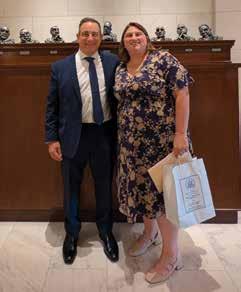
Continued on next page
Continued from previous page
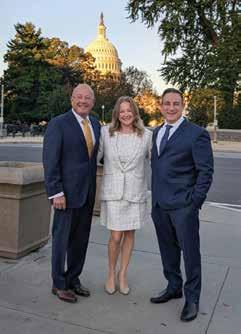
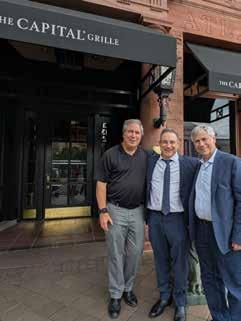
BUT for every ruling got wrong, for every injustice wrought even in the court of last resort, there are those who got it right. Those decisions that ushered in new eras of equality, those that protected freedoms and made the pursuit of the American dream more readily accessible to all. For every decision we might disagree with; there are those on the Court who dissented and who had to wait years, even decades, for the reasoning of their dissents to be widely accepted and implemented in future decisions.
If you believe that, “the arc of the moral universe is long but it bends towards justice,” as Martin Luther King, Jr. so eloquently stated; then you must also be willing to work to make that bend happen. We don’t abandon our institutions when we fear they are failing or faltering in upholding the ideals and values many of us hold dear. We remain and fight.
I hope you all will continue to embody that fighting spirit in your own legal practices and feel proud that you can be a distinguished part of a shared history as admitted members of the Bar of the Supreme Court of the United States.
“There are moments in a career that as you experience them you are aware they will be memorable for a lifetime, the US Supreme Court swearing in ceremony put together and arranged by NYSACDL was one such moment. I was honored to move in the admission of 11 attorneys, including Martin Tankleff (only the second exonerate to be admitted to practice before the Supreme Court), Kevin Stadelmaier (NYSACDL’s next President), and my daughter. I am very appreciative of NYSACDL and Jennifer Van Ort for making the day possible, and I encourage members to sign up for the next swearing in ceremony.”
Steven Epstein, Esq.

NYSACDL is noted for our innovative, interesting and informative CLE programs, which we present at various locations around the state each year.
Seminar registration & information available at: www.nysacdl.org
Questions?
Call the NYSACDL office at: (518) 443-2000 or email jlvanort@nysacdl.org
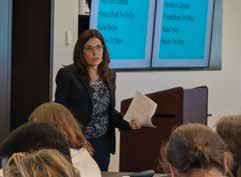

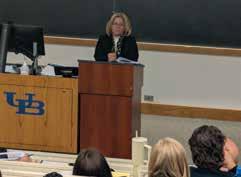
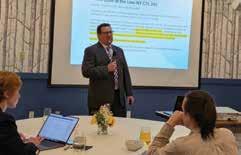
Get ready for an outstanding year of learning and connection. NYSACDL’s 2026 season of CLE webinars and in-person programs is on the way, featuring dynamic speakers, timely topics, and practical training designed for New York’s defense community.
From convenient online webinars to in-depth days in person, our 2026 lineup will deliver the skills, updates, and insights you need to stay at the top of your practice.
NYSACDL standing committees are chaired by members in good standing who are appointed by the President. Committee membership is a rewarding opportunity for members to network with colleagues throughout the state and to explore various issues in depth. Members are invited to join committees to further the important work of our association. If you are interested in joining a standing committee (listed below), please contact the committee chair or the Executive Director’s office: jlvanort@nysacdl.org, 518-443-2000, for more information.
AMICUS CURIAE COMMITTEE
Chair: Stephen Preziosi
Vice Chair: Claudia Trupp
Members: Alan Lewis, Nathaniel Marmur, Timothy Murphy, Richard Willstatter
ANNUAL DINNER COMMITTEE
Chair: Kevin Stadelmaier
Vice Chair: Alan Lewis
Members: Steve Epstein, Alice Fontier, Renee Hill, Jessica Horani, Andy Kossover, Yung-Mi Lee, Lindsay Lewis, Claudia Trupp
CONDITIONS
Chair: TBD
Members: Joseph DeMatteo, Alexis Epstein, Steven Epstein, Allegra Glashausser, Michelle Grant, Timothy Hoover, Seymour James, Jr., Hon. David Lewis (Retired), Prof. Michael Mushlin, James Neuman, Eli Northrup, Norman Reimer, Eric Seiff, Martin Tankleff, Sarena Townsend, Howard Weiner
CONTINUING LEGAL EDUCATION COMMITTEE
Chair: Andre Vitale
Vice Chair: Renate Lunn
Members: Samuel Braverman, Lori Cohen, Steven Epstein, John Ingrassia, Andy Kossover, Jessica Kulpit, Yung-Mi Lee, Peter Mitchell, Jill Paperno, Adam Shlahet, Kevin Stadelmaier, John S. Wallenstein
EMERGING DEFENDERS COMMITTEE
Chair: Alexis Epstein
FEDERAL PRACTICE / WHITE COLLAR
CRIME COMMITTEE
Chair: Samuel Braverman
Vice Chair: Grainne O’Neill
Members: Lance Clarke, Alan Lewis, Donald Thompson, John Wallenstein, Richard Willstatter
FINANCE COMMITTEE
Chair: Samuel Braverman
Members: Steven Epstein, Seymour James, Alan Lewis, Kevin Stadelmaier
JUDICIAL SCREENING COMMITTEE
Chair: Alan S. Lewis
Vice Chair: Jill Paperno
Members: Derek Andrews, Samuel Braverman, Xavier Donaldson, Alice Fontier, Jamal Johnson, Greg Lubow, Nathaniel Marmur, Timothy Murphy, Donald Thompson, Claudia Trupp
JUSTICE COURTS COMMITTEE
Chair: Greg Lubow
Vice Chair: Laura Fiorenza
Members: Jenny Cheung, Clare Degnan, Thomas Donaldson, Lucien Elliott, Steven Epstein, John Ingrassia, Mark Juda, Robert Knightly, Greg Magnell, Dennis Nave, Ira Pesserilo, Alvin Spitzer, Joseph Tock, Michael Viscosi, Menachem White, Sandra Williams
LAWYERS STRIKE FORCE
ASSISTANCE COMMITTEE
Chair: Jessica Horani
Vice Chair: Kevin Stadelmaier
Members: Samuel Braverman, Steve Epstein, Jill Paperno, Richard Willstatter
LEGISLATIVE COMMITTEE
Chair: Kevin Stadelmaier
Vice Chair: Yung-Mi Lee
Members: Matthew Bova, Laura Fiorenza, Alice Fontier, Jessica Horani, Lapp, Greg Lubow, Amy Marion, Michael McDermott, Brian Melber, Eli Northrup, Jill Paperno, Martin Tankleff, Sherry Levin Wallach
MEMBERSHIP COMMITTEE
Chair: Jill Paperno
Vice Chair: Kendea Johnson
Members: Samuel Braverman, Jonathan Cohn, Steven Epstein, Jessica Horani, Leanne Lapp, Alan Lewis, Greg Lubow, Brian Melber, Grainne O'Neill, Hilary Rogers, Frederick Sosinsky, Claudia Trupp, Richard Willstatter
MOTOR VEHICLE ISSUES COMMITTEE
Chair: Randall Inniss
Members: Derek Andrews, David Arpino, Jonathan Cohn, Steven Epstein, Dan Friedman, William Furber, Zev Goldstein, Barry Jacobson, Andrew Kossover, Greg Lubow
PROSECUTORIAL AND JUDICIAL
COMPLAINT COMMITTEE
Chair: Noreen McCarthy
Vice Chair: Fred Sosinsky
Members: Chandra Gomes; Fonda Kubiak; Leane Lapp
Advisory Member: Bennett Gershman
PUBLICATIONS COMMITTEE
Chair: Joe Rochman
Vice Chair: John Wallenstein
Members: Mehdi Essmidi, Jessica Horani, Timothy Murphy
WOMEN IN CRIMINAL DEFENSE COMMITTEE
Chair: Lindsay Lewis
Vice Chair: Hilary Rogers
PRESIDENT:
The Largest Criminal Defense Bar Association in New York State
PROMOTING EXCELLENCE IN CRIMINAL DEFENSE • OUR MEMBERSHIP IS OUR GREATEST STRENGTH
Jessica A. Horani, Manhattan
PRESIDENT-ELECT:
Kevin M. Stadelmaier, Buffalo
FIRST VICE PRESIDENT:
Alan S. Lewis, Manhattan
VICE PRESIDENTS:
John Ingrassia, Newburgh
Randall Inniss, Suffern
Seymour W. James Jr., Manhattan
Jill Paperno, Rochester
Claudia Trupp, Cragsmoor
SECRETARY:
Grainne E. O'Neill, Brooklyn
TREASURER:
Samuel Braverman, Manhattan
DIRECTORS
Natalie Brocklebank, Albany (NYSDA Designee)
Xavier R. Donaldson, Manhattan
Drew DuBrin, Rochester
Allegra Glashausser, Brooklyn
Kendea Johnson, Manhattan
Jessica Kulpit, Buffalo
Leanne Lapp, Canandaigua
Lindsey Lewis, Manhattan (NACDL Designee)
Renate Lunn, Manhattan
Greg Lubow, Tannersville
Nathanial Z. Marmur, Manhattan
Noreen McCarthy, Keene Valley
Michael McDermott, Albany
Eli Northrup, Bronx
Stephen Preziosi, Manhattan
Hilary Rogers, Plattsburgh
Donald Thompson, Rochester
Andre A. Vitale, Jersey City
Sherry Levin Wallach, White Plains
STAFF:
Executive Director:
Jennifer Ciulla Van Ort
Membership Representative:
Stefanie Andrews
LIFE MEMBERS:
(As of 11/19/2025)
Daniel Arshack
Wayne C. Bodden
Peter E. Brill
David J. Cohen
Lori Cohen
Terrence M. Connors
Anthony Cueto
Gerard M. Damiani
Edgar De Leon
Joshua L. Dratel
Steven B. Epstein
Mark A. Foti
Russell M. Gioiella
Lawrence S. Goldman
James Grable
Renee Hill
Timothy W. Hoover
Jessica Horani
John Ingrassia
Kathryn M. Kase
Ray Kelly
Terence L. Kindlon
Seth H. Kretzer
Gerald Lefcourt
David L. Lewis
Thomas F. Liotti
Scott Lockwood
Greg D. Lubow
Christopher X. Maher
Zachary Margulis-Ohnuma
Brian Melber
Florian Miedel
Cory Morris
Aaron J. Mysliwiec
Brian J. Neary
Thomas J. O'Hern
Paul D. Petrus
Frank Policelli
Murray Richman
Stacey Richman
Joel B. Rudin
Lisa Schreibersdorf
John S. Wallenstein
Richard D. Willstatter
Todd J.W. Wisner
SUSTAINING MEMBERS: (As of 11/19/2025)
Joseph R. DeMatteo
Karen L. Dippold
Michael G. Dowd
Mario F. Gallucci
James P. Harrington
Daniel J. Henry
Todd Edward Henry
Michael D. Horn
Isabelle A. Kirshner
Robert P. Leighton
Mark J. Mahoney
Roland G. Riopelle

MEMBER BIOGRAPHICAL INFORMATION IN OUR MEMBER PROFILE – Members can now include brief biographical information (positions held, bar admissions, schools attended, honors or publications) in our online searchable Membership Directory. This directory is available to the general public and is referenced by those seeking counsel and assistance throughout the state.
NYSACDL LISTSERV – NYSACDL offers both a Federal and State Practice Listserv which provide members with invaluable forums in which to pose questions, seek information, exchange ideas and share resources with members statewide.
CLE SEMINARS – NYSACDL is an Approved Provider accredited by the New York State CLE board. We sponsor numerous CLE seminars during the year throughout the state at reduced rates for members. Practical nuts and bolts topics alongside cutting edge issues make our CLE programs invaluable to new members as well as those with years of trial experience. Our speakers are among the most respected and experienced criminal defense attorneys and leading experts in the country.
NCDC SCHOLARSHIP PROGRAM – NYSACDL members in good standing are eligible to apply for the Twelve Angry Men scholarship to the annual National Criminal Defense College in Macon, Georgia.
LEGISLATIVE ADVOCACY – NYSACDL’s Legislative Committee, working with a retained
lobbyist, develops and pursues positions on legislative issues relating to the criminal justice system thereby providing a respected voice of the defense bar in Albany. Members have an avenue to become involved and stay informed. Our members were involved in the recent reforms of the Rockefeller Drug Laws.
AMICUS BRIEFS – NYSACDL provides amicus assistance on issues of particular import.
COMMITTEE MEMBERSHIP – NYSACDL committees are active in areas throughout the state and work on issues vital to strengthening the criminal defense community. Membership on a committee provides an excellent opportunity to pursue specific interests, serve the criminal defense bar and to network with lawyers throughout the state.
MENTORING AND STRIKE FORCE ASSISTANCE – NYSACDL members provide mentoring and assistance for other members. If a question or need arises, a member will be there to give assistance. NYSACDL members are ready to step in to help other members who are subpoenaed, threatened with contempt, or otherwise under attack for the vigorous representation of the accused.
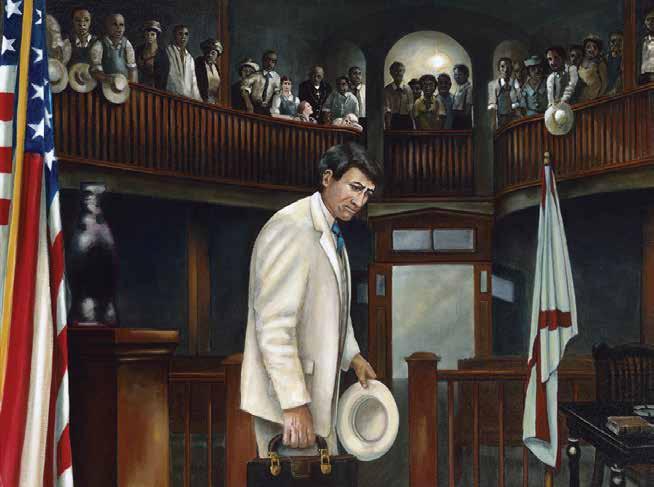
“Miss Jean Louise, stand up. Your father’s passin’.”Townsfolk stand and pay their respects to Atticus Finch after the jury conviction of Tom Robinson in one of the most poignant scenes of Harper Lee’s great American classic To Kill a Mockingbird Original painting, © 2004 by the artist Trevor Goring • limited edition prints available, www.imagesofjustice.com

636 Plank Road, Ste. 215
Clifton Park, NY 12065
Phone: 518-443-2000 Fax: 888-239-4665 U.S.
atticus@nysacdl.org www.nysacdl.org