CON V ERGING CA MPUS & COMMUNIT Y
NORTHWEST MISSOURIAN THURSDAY, NOVEMBER 30, 2023
MARYVILLE, MISSOURI
NWMISSOURINEWS.COM
VOL. 112, NO. 14
<MONEY_MAYHEM> <BLACKMAIL>
Scams, fraud continues to increase in severity
A
HANNAH CLAYWELL News Editor | @Hannah_9504
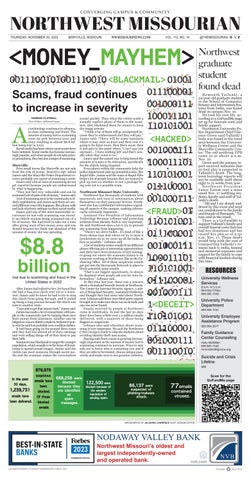
s technology continues to advance, so does scamming and fraud. The amount of money lost to scamming went up 30% between 2021 and 2022 resulting in almost $8.8 billion being lost in 2022. Social media has been where most scams have been initiated. Social media has become increasingly popular, and when people do not take privacy precautions, they become a target of scamming. Maryville Even small towns like Maryville are not safe from the risk of scams. Detective Sgt. Adam James said the Maryville Police Department receives probably one report of scamming a week. James said a lot of cases of scamming do not get reported because people are embarrassed by what is happening. “They just feel very vulnerable and can be scammed out of quite a bit of money,” James said. A lot of scamming seen in the community is elderly exploitation, and James said there are several different ways this happens, like phone calls and lack of privacy settings on their social media. James said one of the most memorable occurrences he had with scamming was recently an elderly woman being scammed out of a lot of money. She had tried to take out a loan after giving most of her money away and was denied because her bank was skeptical of the amount of money she was spending.
$8.8
billion
lost due to scamming and fraud in the United States in 2022. After James had talked to her, he found that she had a $44,000 check sent out to a scammer. James said he knew he had to try to stop this check from going through, and it ended up being a long process because the check was sent to another state. “I was able to get that money back,” James said. James has made a lot of connections with people in the community just by helping them save their money from scammers. Another case he helped on was an elderly couple in Atchison County who he said lost probably over a million dollars. It had been going on for around three years and they had lost almost all of their earnings and were selling things off of their farm to pay their bills. Scammers use blackmail to target the younger population, which usually is in the form of threatening to spread sexual images. James said the victim can meet someone through social media and the scammer makes the conversation
sexual quickly. Then when the victim sends a sexually explicit photo of them to the scammer, they blackmail them for money to keep the image private. “I think a lot of them will go unreported because they’re embarrassed and they will pay,” James said. “There will be some instances where it may start as $100 and then now it’s going to be $500 more, then $600 more, then it just gets to the point where ‘I can’t pay you anymore… I have nothing left’ and that’s usually when they come to us.” James said the easiest way to help lessen the amount of scams is by education, specifically for the elderly being targeted. Even places within the community help the police department pick up potential scams, like Rapid Elite. James said the team at Rapid Elite helps a lot of people because they are trained to pick up cues on whether or not a package being sent out is a possible scam. Northwest Missouri State University Northwest has thousands of students with passwords and tons of information about themselves on their personal devices. Northwest also has confidential information regarding all aspects of the campus, making cybersecurity extremely important. Assistant Vice President of Information Technology Brennan Lehman said protecting students from identity theft is very important. He said Northwest does a lot to try to prevent any scamming from happening. “There’s no silver bullet…it’s kind of like a Swiss cheese type deal where we try to layer it (protection) on so we cover up all the holes as best as possible,” Lehman said. A lot of students notice emails from different places offering job or internship opportunities, and there have been instances of text messages going out where the scammer claims to be someone working at Northwest, like in the Cashiering Office. All of these suspicious emails get put into the Barracuda Network in place to block potential spam emails. “That’s our biggest opportunity, to always be skeptical when people ask you for your information,” Lehman said. At this time last year, there was a concern about a Homeland Security breach at Northwest. The Center for Internet Security Agency, a subset of Homeland Security, contacted Northwest and thought they had some intel about Northwest. Lehman said there were third-party experts brought in to make sure there was no breach, and one was never found. Emails received by people at Northwest come in multitudes. In just the last 30 days there have been a little over 1.2 million emails delivered, with a majority of those being flagged as suspicious. Lehman also said education about scamming is very important. He said the Northwest Cyber Group is ready to educate students about avoiding identity theft and scams. Staying safe from scams is growing increasingly important as the amount of money lost to scamming continues to increase. Ways to stay safe are to know who is contacting you and if they are able to be trusted, choose unique passwords and make sure to use genuine websites.
<HACKED>
<FRAUD>
@THEMISSOURIAN
Northwest graduate student found dead
Hemanth Yallanki, a 24-year-old graduate student in the School of Computer Science and Information Systems from India, was found dead on campus Nov. 16. He took his own life, according to a GoFundMe page set up for funerals costs and family support. Northwest University Police Department Chief Clarence Green said Yallanki’s body was found in the treed area between the University Wellness Center and the Maryville Community Center. The call notifying UPD came in at about 9 a.m. Nov. 16. Green said the autopsy report received indicates that no foul play is suspected in Yallanki’s death. The longterm toxicology reports will not be available until about eight to 12 weeks from now. Northwest President Lance Tatum sent a mass email Nov. 17 notifying students, faculty and staff of Yallanki’s death. “Jill and I are deeply saddened by this event and send our condolences to the family and friends of Hemanth,” Tatum said in the email. There is a GoFundMe to support Yallanki’s family and overall funeral costs that has had 610 donations and has raised $21,569 as of 9:30 a.m. Nov. 17. These funds would help with the cost of transporting Yallanki’s remains back to India, funeral and memorial expenses and support for the family to cope with financial burdens during this time.
RESOURCES
University Wellness Services 8 a.m. to 5 p.m. Monday-Friday 660.562.1348
<DECEIT>
University Police Department 660.562.1254
University Employee Assistance Program 800.964.3577
Family Guidance Center Counseling Holly McMillen 660.853.7348 hmcmillen@fgcnow.org
Suicide and Crisis Lifeline 988
Scan for the GoFundMe page
INFOGRAPHIC BY JULIANNA LAWRENCE ASST. DESIGN EDITOR
AN INDEPENDENT STUDENT NEWSPAPER SINCE 1914.
PLEASE
RECYCLE