LOCAL
FICTION, POETRY AND JOURNALISM BY YOUNG WRITERS ISSUE 5
DECEMBER 2016
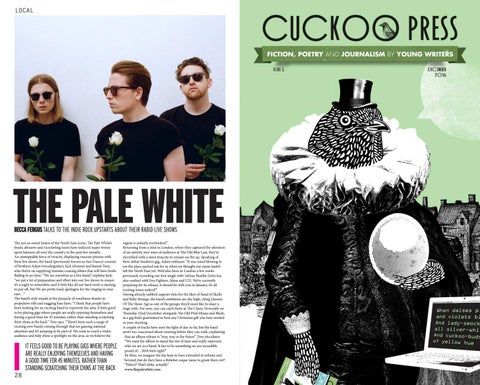
THE PALE WHITE BECCA FERGUS TALKS TO THE INDIE ROCK UPSTARTS ABOUT THEIR RABID LIVE SHOWS The not-so-sweet hearts of the North East scene, The Pale White’s brash, abrasive and ricocheting tunes have induced major frenzy upon listeners all over the country in the past few months. An unstoppable force of vivacity, displaying raucous pizzazz with their live shows, the band (previously known as Sun Dance) consists of brothers Adam (vocals/guitar), Jack (drums) and bassist Tom, who thrive on supplying tinnitus-coaxing ditties that will have limbs flailing in no time. “We see ourselves as a live band,” explains Jack, “we put a lot of preparation and effort into our live shows to ensure it’s a night to remember, and it feels like all our hard work is starting to pay off, but We are pretty loud; apologies for the ringing in your ears…” The band’s style stands at the pinnacle of rowdiness thanks to propulsive riffs and nagging bass lines. “I think that people have been looking for an exciting band to represent the area. It feels good to be playing gigs where people are really enjoying themselves and having a good time for 45 minutes, rather than standing scratching their chins at the back.” Tom says. “There’s been such a surge of exciting new bands coming through that are gaining national attention and it’s amazing to be part of. We want to reach a wider audience and help shine a spotlight on the area, as we believe the
28
IT FEELS GOOD TO BE PLAYING GIGS WHERE PEOPLE ARE REALLY ENJOYING THEMSELVES AND HAVING A GOOD TIME FOR 45 MINUTES, RATHER THAN STANDING SCRATCHING THEIR CHINS AT THE BACK
region is unfairly overlooked.” Returning from a stint in London, where they captured the attention of an entirely new wave of audience at The Old Blue Last, they’re electrified with a stern tenacity to remain on the up. Speaking of their debut Southern gig, Adam enthuses: “It was mind blowing to see the place packed out for us when we thought our name hadn’t left the North East yet. We’d also been in London a few weeks previously recording our first single with Adrian Bushby [who has also worked with Foo Fighters, Muse and U2]. We’re currently preparing for its release, it should be with you in January, it’s all exciting times indeed!” Having already nabbed support slots for the likes of Band of Skulls and Baby Strange, the band’s ambitions are sky high, citing Queens Of The Stone Age as one of the groups they’d most like to share a stage with. For now, you can catch them at The Cluny, Newcastle on Thursday 22nd December alongside The Old Pink House and Blesh, at a gig that’s guaranteed to beat any Christmas gift you have nestled in your stocking. A couple of tracks have seen the light of day so far, but the band aren’t too concerned about running before they can walk, explaining that an album release is “way, way in the future”. Tom elucidates: “We want the album to stand the test of time and really represent who we are as a band. It has to be something we are incredibly proud of…2018 feels right!” By then, we imagine the fan base to have extended to infinity and beyond, but do they have a Belieber-esque name to grant them yet? “Paleys? That’s shite, actually.” www.thepalewhite.com
29
welcome
short fiction
Best Served Cold (Cuckoo Award Winner)
Welcome to cuckoo press
BY KATE COLLINS, 18
BY RACHAEL WALSH. COPY EDITOR, GEORGE AIRD
CONTENTS
Hello and welcome to our glorious fifth issue of Cuckoo Press! We have an incredible selection of work from young writers across the North East including our Cuckoo Award winner Kate Collins’ short story Best Served Cold. We’ve also got some poetry from the students of Excelsior Academy who participate in our Young Writers’ City programme which makes Newcastle THE place to be for young writers. If that wasn’t enough of a treat for you we’ve got some more award winning poetry by Amy Langdown and Shana Nichols, winners of the 2016 Matthew Hale Award. Guardian journalist Decca Aitkenhead is on the receiving end of an interview for a change with a brilliant write-up by Amrita Paul, one of this year’s Durham Book Festival Reviewers in Residence. Finally to wrap up this issue we have three fantastic reviews by young journalists from Cuckoo Review, our online magazine. Cuckoo Press is part of New Writing North’s Cuckoo Young Writers Programme. If you’re wondering how to get involved it’s very easy! Your first stop should be the Cuckoo website: www.cuckoowriters.com. Designed to be the ultimate repository of all the stuff a young writer could ever need, we have writing tips, how-to guides, careers advice, writing exercises and all our Cuckoo news. We also have exclusive interviews and articles from top writers, poets and musicians. If you’re a wannabe journalist, you should sign up for Cuckoo Review, our online arts journalism magazine. It’s a chance to review the latest gigs, books, art, theatre and film and get your opinions published online: you’ll also have a chance to participate in our exclusive Reviewers in Residence programmes too. If you’re looking for something a bit more real-life, we also run weekly young writers sessions in Newcastle, Cramlington, Amble, Sunderland, Durham and South Shields. Check the website for details of times, dates and locations. Finally, submissions are now open for the Cuckoo Young Writers Award 2017, which is designed to support the development of one young writer aged 14-18 from the North East, North West or Yorkshire. The writer whose work is judged to show the most promise – whether prose, poetry or creative nonfiction – will win an award worth £200. The award will be judged in 2017 by YA author Juno Dawson. For details of how to apply for the award, go to the Cuckoo website.
31 Fiction 32 Poetry 33 Interview - Durham Book Festival 34 Cuckoo Review www.cuckoowriters.com www.newwritingnorth.com www.narcmagazine.com Published annually by NARC. Media and New Writing North Cuckoo Press, c/o New Writing North, 3 Ellison Terrace, Ellison Place, Newcastle, NE1 8ST Cuckoo illustrations by Velcrobelly.co.uk
WWW.CUCKOOWRITERS.COM
30
AWA WINNRD ER
CUCKOO PRESS – FICTION, POETRY AND JOURNALISM BY YOUNG WRITERS – ISSUE 5 – DECEMBER 2016
New Brighton looked like a black and white silent film. Sheets of rain (that fine rain, you know) fell on another bloody dreary Saturday afternoon. Everything seemed to have been put on mute. The world was sucked into a broad, soft silence that might have gone on forever - were it not for one sound: a clunky, atonal rendition of ‘Greensleeves’ murmured from the faltering speakers atop Peter Keeley’s ice cream van. Peter stood at the back of the vehicle, scanning the promenade for signs of life. The beach was littered with empty cans of own-brand energy drink, standing erect in the sand like budget monoliths. He sighed and walked back to the driver’s seat, passing the cheerful pink “mind that child!” on the rear doors. Mind what child? He slammed the door, staring out of the windscreen at the distinctly childless scene before him. It was October. Who in their right mind buys a 99 Flake in October? He glanced to the stacks of wafer cones, going soft and stale in the back of the van. The little waffle obelisks had started to collapse in on themselves. Untouched, even rejected by whatever it was that had left the droppings Peter had discovered last week. This was the ice cream man’s lot. June through August was peak time. Even then, his business was swiftly being stolen by these upmarket independent ice cream - pardon, Gelato - sellers that boasted weird and eclectic flavours like ‘papaya.’ People in New Brighton couldn’t even pronounce ‘papaya’, and yet they were lapping it up by the spoonful. And that didn’t even come close to the problems introduced by the sudden surge in popularity for ‘frozen yoghurt.’ In Peter’s opinion, whoever invented ‘frozen yoghurt’ deserved to spend the rest of eternity in the deepest pits of hell, suffering a brain freeze so intense it was reminiscent of dental drilling. He flicked off ‘Greensleeves’ and stared at the black waters of the Mersey. With a silent prayer, he made a compromise with the gearstick and was about to muster the energy to put his foot down when The harsh rap of knuckles against glass. “Oh sod off,” he muttered. What was it to be? Another group of feckless teenagers coming to order ice cream with painfully forced innuendo? ‘Is the ice cream defrosted? Or is it… HARD?’ God forbid. He went into the back and slid open the window. No bored, feckless teenagers. Not even an Italian tourist thoroughly disappointed that they’d visited the wrong ‘Brighton.’ He was met with the eager, ruddy faces of a couple in their early twenties. The woman shouted through the rain: “ARE YOU SERVING ICE CREAM?” Peter didn’t really know how to respond, so went with: “IT’S OCTOBER.” “WE KNOW. BUT WE HEARD NEW BRIGHTON DOES THE BEST ICE CREAM.” Poor souls. Peter looked around the van. “IT’S NO GELATO.” He said. They laughed. The rain let up. That was when he saw it. The man’s t-shirt. A cow stencilled onto a dark green background. The same cow that seemed to follow Peter everywhere, like some kind of bovine poltergeist.
@CUCKOOYOUNGWRITERS
/CUCKOOQUARTERLY
The horrible, inescapable cow. And, as always, above the cow were the words: ‘The Cardboard Lovers.’ Peter’s face darkened. “Nice t-shirt,” he said, loading soft-serve onto a crumbling wafer. “Oh yes,” said the man, grinning. “Me and Judy have been ‘Lovers’ fans for years. We met at a gig actually.” Peter didn’t ask. “It was one of those ‘at first sight’ things. They’d just started to play ‘Shines But Dimly’ when she spilt her drink on me!” Peter handed over the 99. The ice cream spilled over the sides of the cone like a scene from a disaster movie: the moment the avalanche slid from the mountain. Thick, messy lashings of raspberry sauce in place of the blood of those lost in the event, a broken tree-trunk of a Cadbury’s flake limply stuck into the snowy peaks. The man looked at it for a second, but then saw Peter’s face. Change was passed from hand to hand, and Peter shut the window without saying goodbye. He gripped the steering wheel. His fingers drained of colour. The van lurched forwards. He jabbed at the radio. The radio burst into life. “Coming up, the new single from the Cardboard Lovers ‘Means of Support.’ These guys can do no wrong, Gaz Whileman is a lyrical genius who-” Peter attacked the radio with a nearby pot of hundreds and thousands, cutting the DJ short. Gaz Whileman. Gaz Whileman wasn’t even his real name! His name was Ian! He lived with his mum until he was thirty, for Christ’s sake! Gaz Whileman was an epidemic, like bird flu, only nastier and with a more pretentious haircut. Gaz Whileman was the sort of idiot who puts a cow on his album cover and pretends it’s a statement. ‘Gaz Whileman.’ “Sorry, Pete, just… musical differences you know?” Peter sped along the prom past the mini golf and boating lake. He counted seven horrible ways in which he could kill Gaz Whileman. He nearly got to eight, but the lights changed, the brakes slammed, he was thrown forwards, and a sullen ‘thunk’ came from behind. He turned around. His guitar had fallen from the cupboard and onto the floor. He stared at it. Custom Gibson, deep blue, missing two strings and coated in dust. He stared at it. Like Excalibur. It had been his Excalibur. The Sword in the Stone. He stared at it. Now look at it. Now look at him. It was on than sodden Saturday afternoon in the seaside town that time forgot that Peter Keeley made a choice. He rummaged around in the back of the van, and procured an old Cornetto wrapper. He took a black biro from the glove compartment and pulled over. He sat in silence for a good minute, staring out of the windscreen. He leant the wrapper on the dashboard and brought the pen to it. Once he had finished, he smiled. “Peter Keeley and the 99s.”
31
poerty
interview
The Competency of Rage
The Pain In Pie
BY AMY LANGDOWN, 14 & SHANA NICHOLS, 14
BY HOLLY FRATER, 14
AWA WINNRD ER
I will not obey your dress code I will not be silenced I will not man up I will not
Durham Book Festival Interview with Decca Aitkenhead BY AMRITA PAUL, 23
Thank you for the pie you left. The pastry flaked away like our crusty memories.
I will not conform to you mindless stereotypes I will not Keep Calm and Carry On I will not succumb to your lazy expectations I will not I will not mindlessly follow the crowd I will not live in a cage of restriction I will not lose weight and feel great I will not
The cherries Now, stalks taken off Their bonds picked away Like the bonds of our now forgotten secret That once kept us close. I taste your bitterness through the jam.
Image by Shakira Kleiner
I smell your lies as I raise the fork to take the last bite.
I will not be objectified I will not be part of my facile cult of perfection I will not dance under the gallows I will not dumb down I will not I will not trim my waist to the size of a twig I will not wear make-up just to impress you I will not be classified by your lazy anthropology I will not I will not alter my appearance to win your affection I will not submit to the lies of the patriarchy I will not be labeled provocative for wearing my favourite skirt I will not buy this shit I will not I will not lose the capacity for thought and care because I am young I will not tolerate this barrage of misinformation I will not be slandered by the weight of a hood I will not prejudge at the behest of fears and lies I will not be told I will not collapse under the pressure of your labels I will not accept opinion as fact I will not believe your petty lies I will not be rendered as a man hater I will not I will not be controlled I will not be constrained by the make up of our chromosomes I will not be castigated from my confidence I will not I will not be drowned by the swell of tradition I will not be shackled by the limits of language I will not worship at the altar of your logos I will not
Chill Sister BY COURTNEY TAYLOR Lying in bed, drifting off silence is upon me except for the pitter-pit-pitter of rain growing louder & louder
It is still a bit disabling and unsettling, but writing helped me gain a sense of coherence
A glance out of the window and there a girl floating in the rain, see through like water pitter-pit-pitter she floats closer to me the rain flows around us I stare into her weeping eyes She stares into mine
Untitled BY MORGAN HARDY With every whisper there is a different thought for every person in this silence
I will not know limits I will not curtail the boundaries of my dreams I will not regulate the volume of my laughter I will not bask in hindrance of your hatreds I will not
32
CUCKOO PRESS – FICTION, POETRY AND JOURNALISM BY YOUNG WRITERS – ISSUE 5 – DECEMBER 2016
@CUCKOOYOUNGWRITERS
For an obsessive memoir reader like me, part of the job involves conjuring a personal image of the author. This can be difficult, especially when their stories have made you weep in public places, smile and also wonder if there is anything in the world that a good book can’t fix. As such, I was incredibly happy to discover that Decca Aitkenhead, author of All At Sea, is, in real life, the same person I had imagined her to be: kind, warm and lovely to talk to. Her book is an account of the time when, on a family vacation at a Jamaican beach, her partner Tony drowned while trying to save their four-year-son Jake. Having worked as a journalist with The Guardian for many years, Aitkenhead’s book doesn’t hover around the incident. Tony dies in the first chapter and the rest of the book looks back at his life and the author’s own difficult relationship with grief. But the nature of a book like this is that, when you go out and talk about it, the trauma is never fully out of sight; you are reliving it with every retelling of the story. Does it ever get difficult for her? She says, ‘I worry about it becoming not difficult, I worry that once you write a book and you talk about it and you get familiar with talking about it, there is a kind of detachment and an ease which feels inappropriate and almost unseemly.’ The author doesn’t know if it is healthy to get to that place where one is slightly emotionally disconnected, but because she writes for a living, she is wary of this tragedy becoming work – of professionalising it. She adds, ‘At the same time the alternative would be to not have written a book about it, or not be talking about it and that would trouble me more.’ Just over two years have passed since the incident and although her sons were incredibly close to their father, they are already forgetting about him. Aitkenhead looks somber in her realisation that when Tony passed away, it was a shared experience between her and her three and four-year-old sons. Now with them not remembering much, it feels like just her loss which is a painfully isolating experience. Unable to concentrate at work, Aitkenhead wrote the book very quickly, over a period of just six months. She says, ‘I didn’t have to focus my mind on it because my mind wouldn’t go anywhere else. The thought was, whilst I am bleeding anyway, I might as well bleed on to the page… It wasn’t a cathartic experience in the literal sense, although it discharged some of the horror. It was about organising the incident in my mind, so that was my way of making peace with something so jumbled up and chaotic. ‘It is still a bit disabling and unsettling, but writing helped me gain a sense of coherence. When you find yourself at the mercy of a senseless event, that itself is a very destabilising thing, but the book helped me revive the myth that the world is a logical sensible place.’ Shortly after submitting the manuscript of the book Aitkenhead was diagnosed with breast cancer. She thought of writing at least one chapter about it in the book but the ongoing chemotherapy sessions kept her from even writing a sentence. Eventually, she had to concede defeat. She says, ‘I also found it harder to write about cancer. It felt like an intense, lonely, dark place without a great deal of revelation. I didn’t feel as if I had learned much that I would want to share with the world.’ I ask the author about what she has learned about life and happiness from these two traumatic incidents and her answer just breaks my heart. ‘I don’t want this to sound gloomy, but the concept of being in a good mood, that feeling of well-being is as unimaginable as flying to the moon. I can’t quite remember what that feels like. Everyday life does bring lots of good things, but one’s default setting, one’s center of gravity or one’s emotional resting place is in the sunlight. ‘I don’t know how or when that will happen [again] and I am partly superstitious that bad things could keep happening to us. I can’t imagine myself as being the recipient of fabulously good luck.’ The author adds that the traditional assumptions about grief or bereavement are simplistic clichés and there is so much more to it than feeling sad and people saying they are sorry for you. She says, ‘The practical, logistical reality of life without Tony is so intensely overwhelming and demanding that there isn’t very much room for anything anyway. I have just become cerebral and pragmatic because I have to keep getting the show on the road.’
/CUCKOOQUARTERLY
33
cuckoo review
cuckoo review
BOOK REVIEW: JIHADI: A LOVE STORY BY YUSUF TOROPOV
POETRY REVIEW: SHENANIGANS BY PATRICK LODGE
FILM REVIEW: CAPTAIN FANTASTIC @ TYNESIDE CINEMA
REVIEW BY NASIM ASL, 22
REVIEW BY MADELEINE SINCLAIR, 20
REVIEW BY RYAN OGDEN, 19
Through his playful free verse, Patrick Lodge carries us from one corner of the world to the other, transporting us – at the turn of a page – from Ireland, to Berlin, to Greece, to Africa. We become tourists, ‘embalmed in factor 50’, witnessing little snapshots of life from the receding past to our own digital present. This anthology transcends geographical and historical borders. It takes us from an Eighteenth-century aristocratic gentleman’s club, to the fall of the Berlin Wall, and marvels at the ‘mystery of the eternal digital now’ in contemporary San Polo. The title Shenanigans derives from the Irish sionnachuighim, meaning ‘I play the fox’. This expression encapsulates Lodge’s persistent concern with the kinship between animals and beasts. Human beings are endowed with animalistic qualities, deconstructing the borders between humans and their (imagined) others. Sometimes, this adds to the collection’s wry humour. For instance, in his poem Shenanigans, Lodge describes a fox – the ‘green eyed seducer’ – who presents his sweetheart with a varied array of footwear (brogues, wingtips, winklepickers), before asking her to put on her dancing shoes and ‘trot a tricksy/ measure’ with him. Believe it or not, this actually recalls the bizarre events covered by a BBC Leeds report in 2014, which reported that a fox was stealing men’s shoes in a Leeds suburb, before dumping them outside a woman’s house. Although the anthology is full of such observational humour, at times it becomes overtly political and tragically sad. This is most evident in his poem Tuol Sleng Genocide Museum, Phnom Penh, referring to the former high school which was turned into a torture, interrogation and execution center during the Cambodian Genocide. Lodge describes a child who is trapped in a ‘death pit/ dug in a playground’. The poem also draws attention to the voyeuristic danger of presenting atrocious war crimes in museums. Other poems shed light on the plight of the abused child. Alphabet Baby incorporates an emotive litany from ‘A Guide to the Growing Child’, before concluding with the pertinent line: ‘I have learned that chocolate hides bruises.’ My favourite poem in the collection is The Respectable Working Class. It humorously voices political grievances concerning land ownership and religion, incorporating theological language such as the Anglican hymn which positions ‘The rich man in his castle’ and ‘the poor man at his gate’. Aside from its obvious socio-economic sentiments, this poem brilliantly presents a man who is trapped in a life of routine, sameness and monotony – ‘Week in, week out, I give my labour for next to nowt’. Throughout the collection, characters are often trapped in whirlpools and in cages; they are imprisoned within automatic habits of thinking and feeling. This anthology pushes us to renegotiate our relationship with the vast universe that surrounds us. Lodge’s free verse exudes an erratic energy, transporting us to different eras and locations. The supposed borders between past and present, and animal and human, shift like tectonic plates – ‘subterranean, dangerous, making waves’.
Despite its garishly positive – but deliberately ironic – title, Captain Fantastic is a film that deals almost exclusively in grey areas. The plot follows a father, Ben (Viggo Mortensen), who has raised his children in the forests of the Pacific Northwest, removed from the consumerist society he abhors. He has taught them to hunt, navigate and treat severe burns, among other things – but when a family tragedy forces them to return to civilisation, the kids begin to realise that they know nothing of the real world. It’s murky waters; Ben’s treatment of his children is characterised by one observer as ‘amazing’, by another as ‘child abuse’. Watching the film unfold as an audience, we’re never forced to see it as one any more than the other. There was certainly a palpable sense of moral divide during my screening. Though I found Ben easy to sympathise with, the protagonist’s actions prompted a series of disapproving tuts and one grumbled muttering of ‘irresponsible father’ from older members of the audience. Opinions of the family’s lifestyle are polarised on-screen, as well as off, and these doubts are never more poignant than when they come from within, particularly as the children begin to discover urban life and question their father. A standout performance, alongside Mortensen, is Pride’s George MacKay, who plays eldest son Bo. Perhaps the most sharplydrawn character, his arc roams from moving to hilarious, and back round again. And the premise allows for that. Captain Fantastic is both tragic drama and charming comedy, but it’s not tied down to either genre. Coming into the project from relative obscurity, Matt Ross acts as both writer and director – and handles both with assurance. The emotional sequences are suitably weighted; the comedy is well-earned, and remarkably warm, neither treads on the other’s toes. Each scene is simply what the story demands it to be. And it works. Fair warning: there are moments of this film that are painful to watch, and are best viewed through the fingers – from the opening scene which features the graphic slaughter of an elk, to Ben giving his youngest ‘the talk’ and a lingering shot of Viggo Mortensen in his, er, natural state (‘every man has one!’) – it’s cringe-inducing viewing, but it’s meant to be, and it adds to the film’s overall effect rather than detracting from it. There are no easy answers in Captain Fantastic. Remove all context and the climax of the film becomes shocking, but absorbed in the world of Ben and his kids, knowing their story, it’s actually poignant, and beautifully touching. Yes, this film is emotionally weighted. But it’s also so much fun that moral contemplations are never a chore. It’s character drama. It’s heartfelt comedy. It’s Aragorn, dropped into the family road trip world of Little Miss Sunshine. Captain Fantastic is, in short, fantastic.
The Arabic word for ‘struggle’, ‘Jihad’, is a word currently heavily associated with terrorism. It is the pure form of the word that Yusuf Toropov has attempted to recapture and reconcile with its contemporary associations in his debut novel, Jihadi: A Love Story. It is, beyond doubt, a story of struggle. Various struggles permeate the narrative, and range from marital disputes to ideological conflicts between the USA and the fictional Islamic Republic. Simply, the narrative is pegged as the journal of Ali Liddell, a former US intelligence agent, as he reflects on the events that have eventually led him to the prison in which he is writing. He has been stationed in the Islamic Republic, and upon his return to America it is clear that he has not only experienced disillusionment with the US services, but also mass trauma during his placement. His conversion to Islam and his emotional love affair with his captor, Fatima, take centre stage. The journal itself is a multi-layered experience – readers not only follow Liddell, but also Fatima’s struggle as a female operative in a man’s world, and the racist brutality of some US soldiers stationed in the Islamic Republic. On top of this, the journal is frequently interrupted by the commentary of another US agent, known as RL Firestone, who offers bizarre and sometimes inaccessible reviews of Liddell’s case. Although innovative, this fractured storytelling often makes for a complicated and jarred reading experience which distracts from the heavy themes that weave the stories and characters together. Jihadi: A Love Story is not a light read, nor is it an easy one. The content is dark – torture and rape are alluded to and witnessed, sadistic soldiers take pride in the racist murders of children, and civilian killings are not always shown to be accidental. Although fictional, the experiences Toropov crafts are harrowingly realistic. As Liddell’s memoirs are contested by Firestone’s annotations, the truth becomes a fickle and morally ambiguous concept. Readers will find themselves gripped by this lack of clarity. Toropov seems to take pleasure in making his readers move between the mentalities of a diverse range of characters, forcing them to uncomfortably sympathise with characters that are, at their core, cruel and twisted as well as those who are victims of injustice. It’s a scarring novel. Readers will be left constantly wondering and second-guessing both the reliability and veracity of the narrative, unsettled by an authorial voice that threatens to self-destruct at any moment. Populated by a range of characters from both the Islamic Republic and the USA, Toropov constantly flips alliances and questions the truth of what terrorism is within the novel. He plays with the emotions of his readers, taunting them with a lack of clarity before bombarding them with intricate detail. If you can keep up as the memoirs unravel, and adjust to the complex and bold narrative innovations that Toropov manipulates, Jihadi is a novel that will haunt you. Above all else, Toropov has created an incredibly original and engaging novel that offers a damning insight into the complex emotional and political situations that are currently building in the Middle East. Unsettlingly, his observations then look forward, revealing a glimpse into a future of terror that could be.
34
CUCKOO PRESS – FICTION, POETRY AND JOURNALISM BY YOUNG WRITERS – ISSUE 5 – DECEMBER 2016
@CUCKOOYOUNGWRITERS
/CUCKOOQUARTERLY
35