Powering a shared energy future
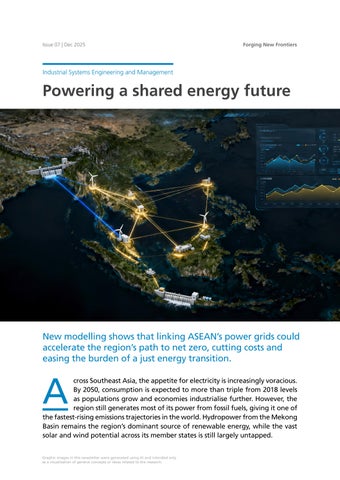
New modelling shows that linking ASEAN’s power grids could accelerate the region’s path to net zero, cutting costs and easing the burden of a just energy transition.
Across Southeast Asia, the appetite for electricity is increasingly voracious. By 2050, consumption is expected to more than triple from 2018 levels as populations grow and economies industrialise further. However, the region still generates most of its power from fossil fuels, giving it one of the fastest-rising emissions trajectories in the world. Hydropower from the Mekong Basin remains the region’s dominant source of renewable energy, while the vast solar and wind potential across its member states is still largely untapped.
Each ASEAN country has pledged to cut emissions under the Paris Agreement, but the question remains: how can a diverse region of ten1 countries with uneven resources and infrastructure decarbonise both effectively and affordably?
That inquiry underpins a new study led by Dr Su Bin, Senior Research Fellow from the Energy Studies Institute and the Department of Industrial Systems Engineering and Management at the College of Design and Engineering, National University of Singapore, conducted in collaboration with ExxonMobil. The study builds an integrated model of ASEAN’s power sector to test how different strategies, from “go it alone” national plans to fully connected regional grids, might influence the journey to net zero. The findings paint a clear picture where greater crossborder cooperation could make the energy transition faster, fairer and far less costly.
A region connected by power

Dr Su Bin’s study builds an integrated model of ASEAN’s power sector to test how different strategies, from “go it alone” national plans to fully connected regional grids, might influence the journey to net zero.
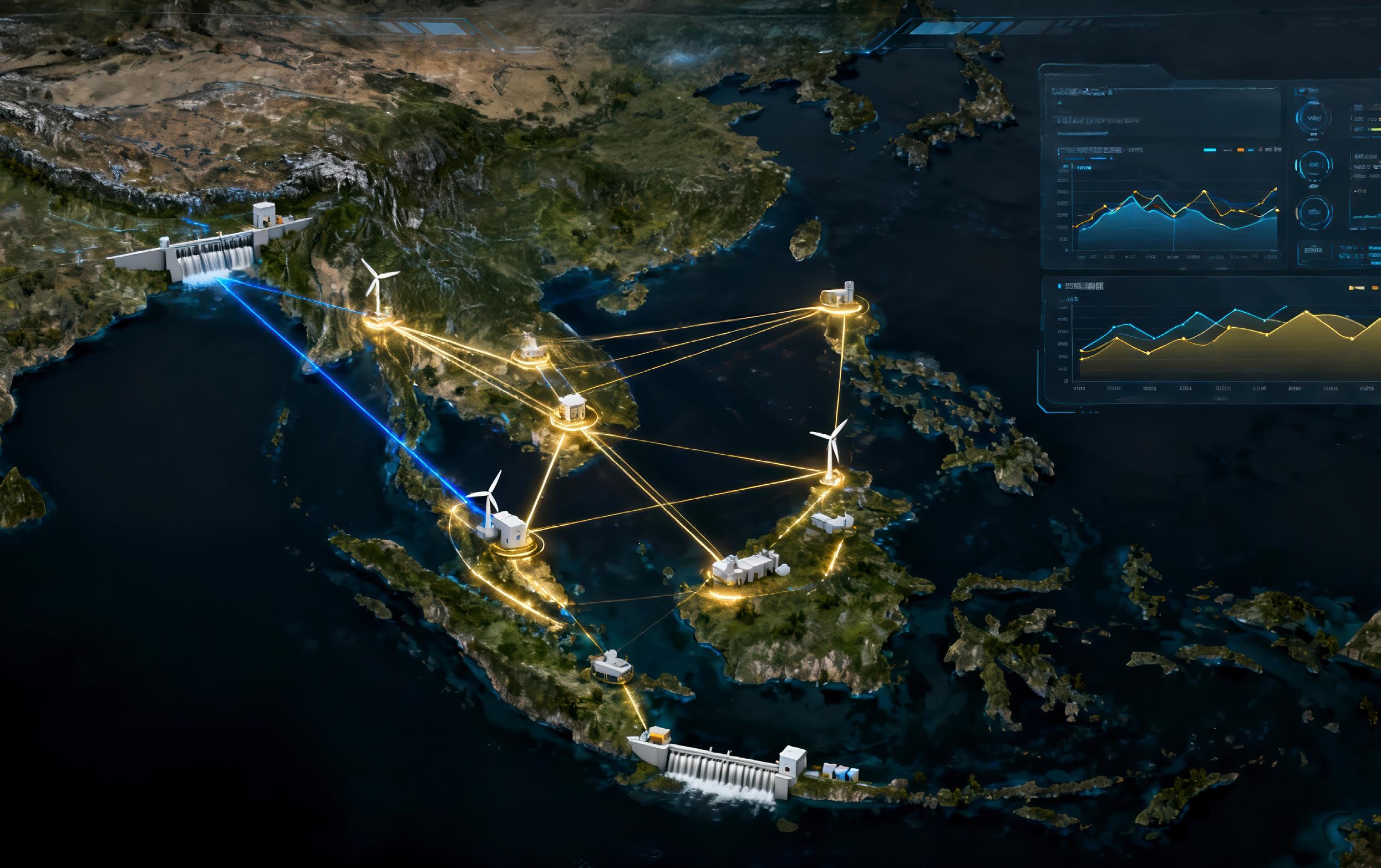
The model, which simulates power generation, transmission and storage across all ten ASEAN countries from 2018 to 2050, explores three pathways. The first assumes each country develops its power system independently. The second allows for crossborder electricity trade through the ASEAN Power Grid — a regional initiative to interconnect Southeast Asia’s national electricity systems — while maintaining moderate emission goals. The third envisions a fully connected system targeting net-zero emissions by 2050.
The team found that building transmission links between countries — at a cost of only about 0.5% of total infrastructure investment — could reduce overall system costs by an outsized 12%. Regional trade would also lower the average price of electricity by more than 10% while allowing countries with limited renewable resources to import clean energy from their neighbours. For example, Lao PDR and Indonesia could become major exporters of hydropower and solar power, while importers such as Thailand, Vietnam, Brunei and Singapore could avoid overbuilding fossil-fuel capacity or rushing prematurely into exorbitant carbon-capture systems.
In the most ambitious scenario, renewables would account for about 92% of ASEAN’s power generation by 2050, nearly half of it from solar energy. Hydropower would continue to play a major role where geography allows, and wind power would
1 At the time of the study, ASEAN consisted of ten member states. Timor-Leste joined the Association after the study was completed.
take off in the Philippines, Thailand and Vietnam. Fossil fuels — largely natural gas equipped with carbon capture and storage — would make up the remaining 8%, offset by biomass-based technologies capable of extracting carbon from the atmosphere.
“We often think of energy transitions in national terms, but the reality is that power systems do not stop at borders,” says Dr Su. “When countries connect their grids, they share more than just something tangible like electricity. They also transmit flexibility, resilience, security and opportunity.”
“When countries connect their grids, they share more than just something tangible like electricity. They also transmit flexibility, resilience, security and opportunity.”
Bridging the investment gap
Transitioning to a cleaner, interconnected power system will require substantial and uneven investment. The study estimates that total investment in generation infrastructure alone could reach roughly 30–45% of ASEAN’s 2018 GDP by 2050. Developing economies with abundant sources of renewable energy but weaker financial systems, especially in the Greater Mekong subregion and parts of the Indonesian archipelago, face an uphill battle. This uneven burden emphasises the need for joint financing and policy frameworks that promote a just and inclusive transition.
Beyond the economics, the study highlights governance and policy gaps that must be addressed. In particular, harmonising regulations, ensuring energy security and building trust across jurisdictions will be as important as engineering and capital. Regional mechanisms for benefit sharing, coordinated grid planning and investment support could help turn modelling scenarios into reality.
“While our paper focuses on technical feasibility, it prompts further thought and exploration, for policymakers and industry alike,” says Dr Su. “For example, how can ASEAN strengthen its financing architecture to support large-scale renewable investments? What regional mechanisms could balance the costs and benefits of cross-border grids?”
“Above all, the data tells us the transition is technically and economically possible,” Dr Su adds. “The next step is to make it politically and institutionally possible too.”