A new current of change
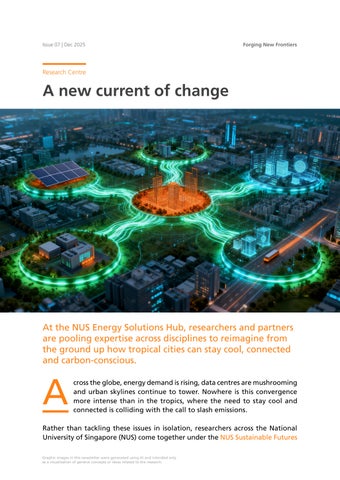
At the NUS Energy Solutions Hub, researchers and partners are pooling expertise across disciplines to reimagine from the ground up how tropical cities can stay cool, connected and carbon-conscious.
Across the globe, energy demand is rising, data centres are mushrooming and urban skylines continue to tower. Nowhere is this convergence more intense than in the tropics, where the need to stay cool and connected is colliding with the call to slash emissions.
Rather than tackling these issues in isolation, researchers across the National University of Singapore (NUS) come together under the NUS Sustainable Futures
initiative, a community-building platform convening experts from every discipline to find actionable paths towards a resilient, low-carbon world.
Among its first missions is the NUS Energy Solutions Hub (NESH) — a cross-disciplinary initiative seed funded by the Office of the Deputy President (Research and Technology) and led by Professor Lee Poh Seng, Head of the Department of Mechanical Engineering at CDE, and Co-Director of NUS Sustainable Futures in charge of NESH. For Prof Lee, the question is not just how to generate cleaner energy, but how to redesign the entire system that uses it.
“Energy sustainability is a systems problem,” he says. “We cannot solve it by improving one component alone — whether it is a battery, a building or a data centre. We need to integrate expertise across engineering, design and the social sciences to make solutions that are viable in the real world.”
Energising collaboration
NESH is built upon this principle of integration. Its five pillars of research — spanning multi-energy districts, urban redevelopment, digital infrastructure, energy policy, as well as sustainable industry and transport — weave together as a framework for collaboration. Each connects different fields to address the interconnected challenges of energy security, decarbonisation and urban resilience.
Take the issue of cooling, for instance. Singapore’s tropical climate demands enormous amounts of energy for air-conditioning — new materials, passive design and data-driven controls could dramatically cut consumption. In another area, researchers are devising ways to make the island’s growing digital infrastructure — from cloud facilities to edge devices — run on less power and more intelligence. These projects exemplify NESH’s approach to blend deep technical expertise with a sensitivity to the social and spatial realities of tropical urban life.
“NESH was created to connect the full spectrum of NUS energy research,” adds Prof Lee. “By fostering collaboration between disciplines and partners, we’re able to translate scientific innovation into practical solutions that improve lives, especially in dense, tropical cities like Singapore.”
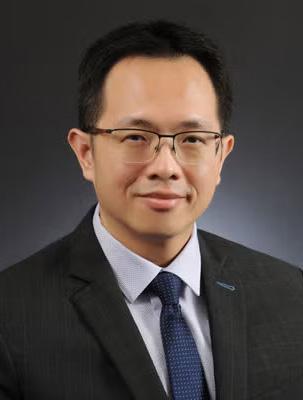
Professor Lee Poh Seng is the Co-Director of NUS Sustainable Futures in charge of the NUS Energy Solutions Hub (NESH).
Issue 07 | Dec 2025
Turning ideas into impact
These ideas are already moving into large-scale demonstration. In November 2025, NUS and JTC signed an MoU to explore Phase 2 of the Sustainable Tropical Data Centre Testbed (STDCT 2.0) and a Jurong Island microgrid, a development led by Prof Lee from the NUS side. Slated to begin in 2026, the project will test climate-adapted cooling, low-carbon power architectures and grid-supporting operations in a multi-megawatt facility embedded within Singapore’s largest low-carbon data centre park.
Building on the first-phase testbed hosted at CDE, STDCT 2.0 will investigate next-generation approaches such as liquid cooling, ultra-low-water concepts, seawater-based heat rejection and hydrogen-compatible backup systems — all crucial as AI-class data centres push energy demands to new extremes. The Jurong Island setting, with its emerging ecosystem of hydrogen-ready plants, sustainable fuels and energy-storage pilots, will allow integrated studies linking digital infrastructure with industrial decarbonisation.
“We see Jurong Island as one integrated opportunity,” says Prof Lee, who is also the Programme Director of the STDCT project. “It is a place where ongoing industrial and energy developments can serve as living laboratories, helping us re-imagine how we design, power and cool AI-ready infrastructure in a hot, humid and resource-constrained setting.”
NESH’s impact is also taking shape in clean transport. A major cross-disciplinary project led by Professor Yang Wenming recently secured an $8.3 million grant to develop a next-generation ammonia marine engine with high efficiency and near-zero greenhouse gas emissions. The initiative brings together expertise in combustion, materials, catalysis and fuel systems, and signals the maritime sector’s growing interest in green ammonia as a viable future fuel.
“We see Jurong Island as one integrated opportunity. It is a place where ongoing industrial and energy developments can serve as living laboratories, helping us re-imagine how we design, power and cool AI-ready infrastructure in a hot, humid and resourceconstrained setting.”
Multidisciplinarity at the core
“Strengthening interdisciplinary collaboration across engineering, science, policy and industry is key. The challenges ahead, whether integrating renewables, greening digital infrastructure or decarbonising transport, all cut across domains,” Prof Lee says. “NESH’s role is to bring these threads together so solutions are technically robust, economically viable and environmentally sustainable.”
This approach is vital not only for Singapore but for tropical cities worldwide. Developing models that reflect the realities of heat, humidity and land constraints enables NESH to offer insights that can be adapted across the region.
“Energy research cannot happen in silos,” says Prof Lee. “The complexity of the climate challenge demands that we work across boundaries — uniting science, policy and industry to build a cleaner, more resilient world.”