TRANSFORMING
in Nebraska
Why Now is the Time to Take a Different Approach? SUICIDE DEATHS OF INDIVIDUALS IN OUR CARE CAN BE PREVENTED People who are dying by suicide are touching our health and behavioral health care systems. Many suicide deaths occur among people who have been recently seen by a medical or mental health professional or are currently in care.
HEALTH & BEHAVIORAL HEALTH CARE
FOR SAFER CARE
Key Statistics of Those Who Have Died by Suicide
~45%
had contact with a primary care provider in the month prior to their death.1, 2
~19%
had contact with mental health services in the month prior to their death.1
300x
more likely than the general population to die by suicide in the first week after discharge.3
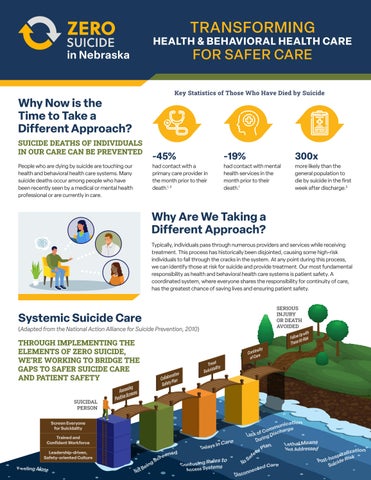
Why Are We Taking a Different Approach? Typically, individuals pass through numerous providers and services while receiving treatment. This process has historically been disjointed, causing some high-risk individuals to fall through the cracks in the system. At any point during this process, we can identify those at risk for suicide and provide treatment. Our most fundamental responsibility as health and behavioral health care systems is patient safety. A coordinated system, where everyone shares the responsibility for continuity of care, has the greatest chance of saving lives and ensuring patient safety.
Systemic Suicide Care
(Adapted from the National Action Alliance for Suicide Prevention, 2010)
THROUGH IMPLEMENTING THE ELEMENTS OF ZERO SUICIDE, WE’RE WORKING TO BRIDGE THE GAPS TO SAFER SUICIDE CARE AND PATIENT SAFETY SUICIDAL PERSON Screen Everyone for Suicidality Trained and Confident Workforce Leadership-driven, Safety-oriented Culture
SERIOUS INJURY OR DEATH AVOIDED