Updates : Fonner Park ; Nebraska State Fire School 2026. The NSVFA and Fire School Committee would like to extend welcome wishes to those who are planning on attending the 89 th Annual State Fire School in Grand Island. There are a few changes with Fonner Park as construction of parking lots is taking place on the west side of Fonner Park . This is adjacent to Fonner Park Boulevard this year and should not have a significant impact on the fire school itself. There will be construct ion equipment in this area, and we can expect an increase in traffic on Fonner Park B ou levard. We are encouraging students and participants to park on the south side of the Heartland Event Center (HEC) as in the past. The north parking lot of the HEC is available although its primary use is for th ose attending the Grand Island Casino Resort. These are public parking lots, use your common sense and respect for others as usual.
Updates: Fonner Park; Nebraska State Fire School 2026.
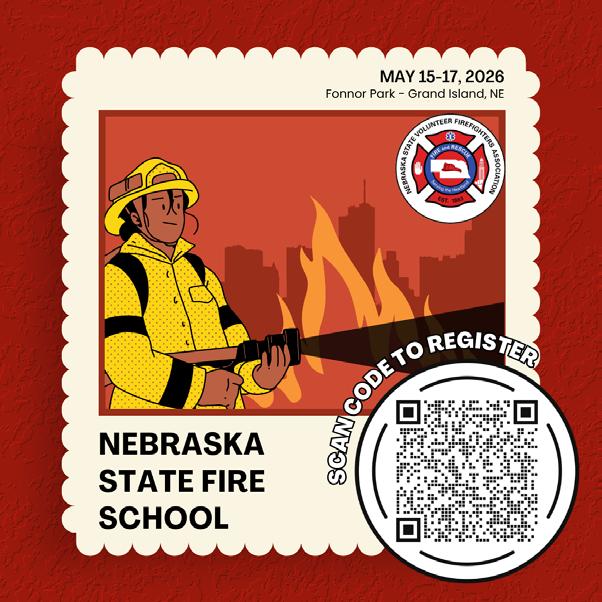
The NSVFA and Fire School Committee would like to extend welcome wishes to those who are planning on attending the 89th Annual State Fire School in Grand Island. There are a few changes with Fonner Park as construction of parking lots is taking place on the west side of Fonner Park. This is adjacent to Fonner Park Boulevard this year and should not have a significant impact on the fire school itself. There will be construction equipment in this area, and we can expect an increase in traffic on Fonner Park Boulevard. We are encouraging students and participants to park on the south side of the Heartland Event Center (HEC) as in the past. The north parking lot of the HEC is available although its primary use is for those attending the Grand Island Casino Resort. These are public parking lots, use your common sense and respect for others as usual.
Blood Pressure screenings which are required for the “hands on” classes that use any level of PPE in their trainings The medics taking blood pressure last year recorded elevated pressures that were being attributed to energy drinks being consumed by students This should be considered and prohibited by students enrolled in these classes. If your blood pressure is at risk the medics will record the pressures and you will not be allowed to take the class. Give it some thought. It’s their determination and your responsibility not only to you as a student but also to the instructors and the other students associated with the class. Along with those lines, if you are concerned about a particular evolution in the hands-on class and are not feeling well or have a medical condition that could prevent you from completing the training evolution, please inform the instructor so accommodation can be arranged. Hopefully this will prevent a response by Grand Island Fire Department Medics that is unnecessary and place a lot of responders at risk.
A question has come up regarding age limits for students participating in the “Hands On” classes requiring the use of any level of PPE. The minimum age for those students is 18 due to insurance coverage this is being attributed to issues that came before the NSVFA Board and the fire school committee concerning underage students. Students under 18 years of age are more than welcome to attend any other classes and gain interest in the fire service. The NSVFA and fire school committee supports recruitment efforts, and cadet programs that are in place by local fire departments.
Travel Safe Nebraska State Fire School Committee.
Blood Pressure screenings which are required for the “hands on ” classes that use any level of PPE in their trainings . T he medics taking blood pressure last year recorded elevated pressures that were being attributed to e nergy d rinks being consumed by students . This should be considered and prohibited by students enrolled in these classes. I f your blood pressure is at risk the medics will record the pressures and you will not be allow ed to take the class. Give it some thought. It’s their determination and your respo n sibility not only to you as a student but also to the instructors and the other students associated with the class. Along with those lines, if you are concerned about a particular evolution in the handson class and are not feeling well or have a medical condition that could prevent you from completing the training evolution , please inform the instructor so accommodation can be arranged. Hopefully this will prevent a response by Grand Island Fire Department Medics that is unnecessary and place a lot of responders at risk.
A question has come up regarding age limits for students participating in the “Hands On” classes re quiring the use of any level of PPE . The minimum age for those students is 18 due to insurance coverage this is being attributed to issues that came before the NSVFA B oard and the fire school committee concerning underage students . Students under 18 years of age are more than welcome to attend any other classes and gain interest in the fire service . The NSVFA and fire school committee support s recruitm ent efforts , and cadet programs that are in place by local fire department s.
Information in the fire schoolbook that was mailed out to every fire department in the state, and online at nsvfa.org contains information on the classes being offered, we are asking the class participants to review this information. Instructors have requested that students have the proper PPE available and experience levels that are required in some of the advanced classes that are being offered. In other words, read the class descriptions not just the titles.
Information in the fire schoolbook that w as mailed out to every fire department in the state , and online at nsvfa.org contains information on the classes being offered , we are asking the class participants to review this information . Instructors have requested that students have the proper PPE available and experience levels that are required in some of the advanced classes that are being offered. In other words, read the class descriptions not just the title s. Travel Safe . Nebraska State Fire School Committee.
-
| Website: www.nsvfa.org
| Fax: 4027612224
County Line Fire draws 14 departments to scene
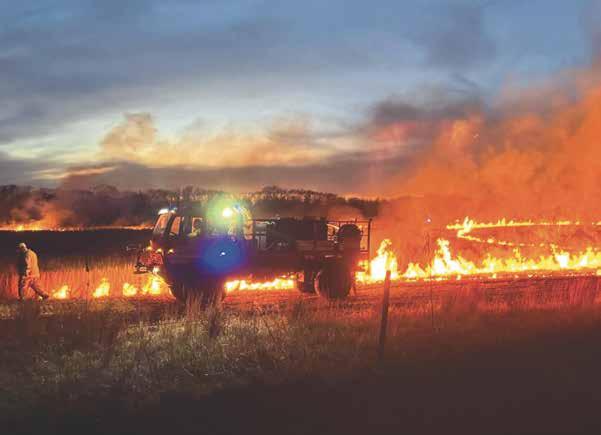
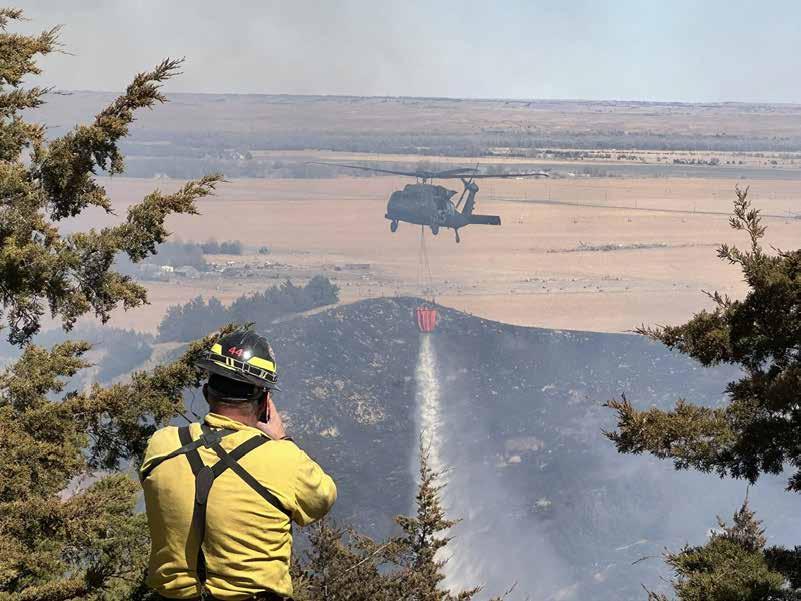
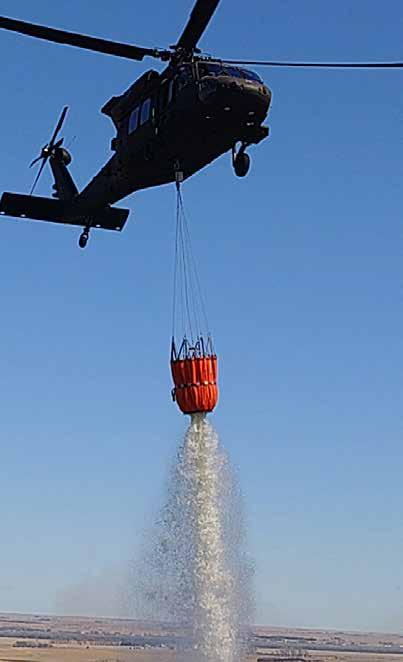
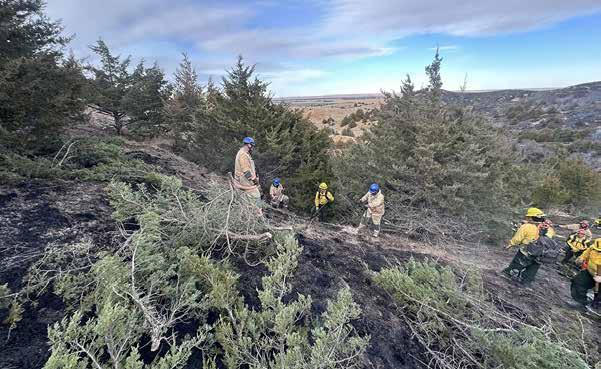
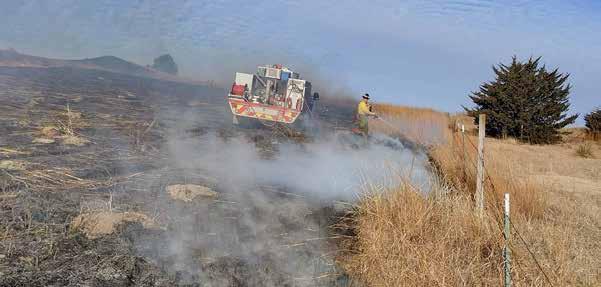
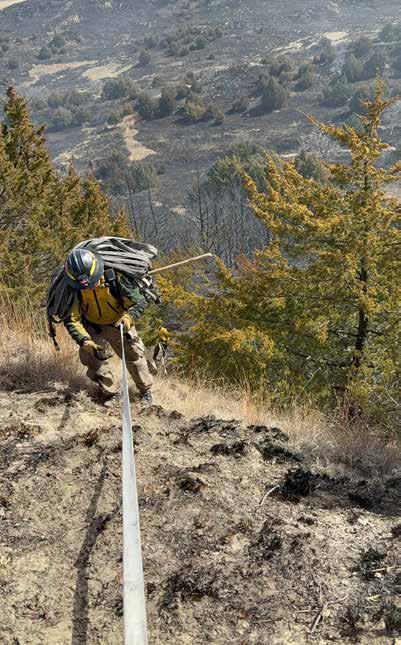
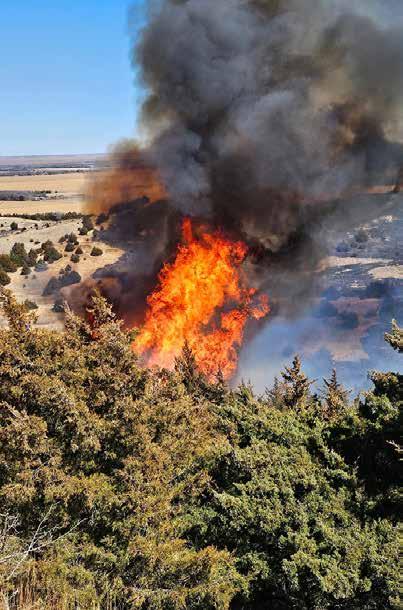
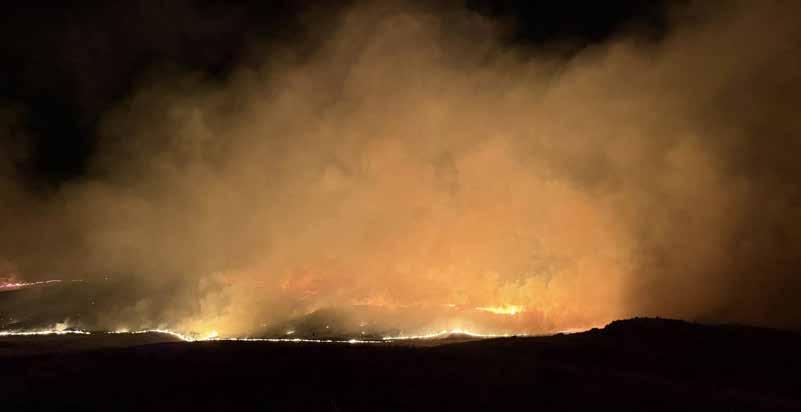
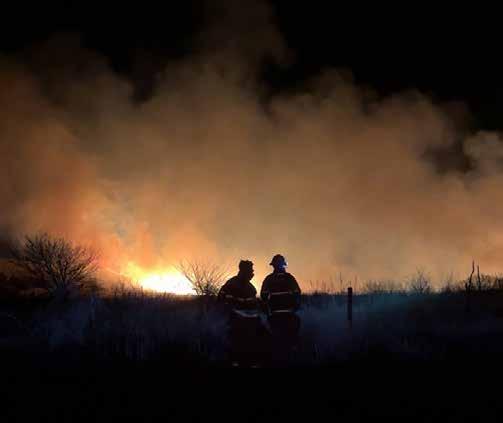
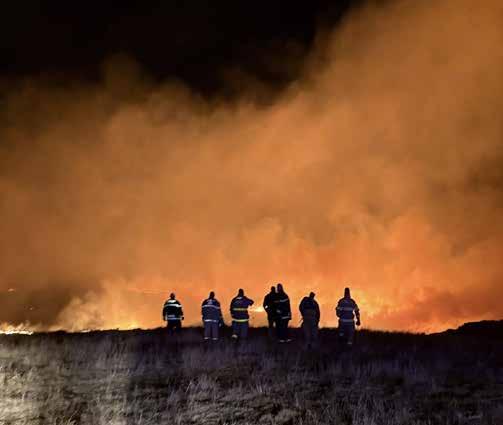
The dry conditions and wind played a factor in the major fire event on Saturday, March 26, on the Holt and Antelope County line around 3:30 p.m.
The fire, possibly sparked by power lines or a truck in a field, started at 859th Road and 510 Ave. It raced north toward Hwy.
20. Ewing and Orchard Fire Departments were immediately dispatched. Because of the large smoke plume, residents north of Hwy. 20 reported a grass fire in the Page Fire Department’s district. Due to imminent danger, O’Neill automatically rolled mutual aid to the possible fire in the Page Dis-
trict.
Reports of the Page fire being false, all units rolled to the Ewing Orchard Fire. The wind at 25 miles per hour, with gusts higher, brought in 14 departments from Holt, Antelope, and Knox Counties to fight the blaze, as well as many farmers and their discs and
water trucks.
The Departments took charge of fighting the fire on both sides of the County’s dividing line. As the wind died down around 7 p.m., they successfully put out the blaze and stopped the head fires. Anticipating a change in wind direction, Chief Bill Kunz of the Stuart Fire Department then coordinated a back burn to protect a large shelter belt.
Fire Departments on scene were: Bloomfield, Verdigre, Creighton, Atkinson, Stuart, O’Neill, Page, Ewing, Orchard, Clearwater, Chambers, Niobrara, Elgin, Neligh, Royal and Elgin. Water trucks from Central Valley Ag, Ag Services, and Wibur Ellis, to name a few, were dispatched to the scene, filling fire trucks in the field. Numerous farmers were also on scene with discs to cut off fuel to the fire.
Governor Jim Pillen has issued a series of new documents to address ongoing weather conditions and areas impacted by multiple wildfires across the state. Notably, four of the largest fires have burned more than 800,000 acres.
A new proclamation declares emergencies in counties associated with the following fires: Morrill, Cottonwood, and Anderson Bridge. However, the Road 203 Fire, which impacts Blaine and Thomas counties, was managed by federal authorities and therefore was not included in the latest proclamation for state resources.
In addition to that proclamation, Gov. Pillen has issued two
new executive orders. The first (26-08) extends the prohibition on fire chiefs and their designees from issuing open burning permits statewide. This order takes effect March 28 and runs through April 10. The prior ban was set to expire on March 27.
The second executive order (26-09) waives hours-of-service restrictions and adjusts maximum load width/weight limits for commercial motor carriers operating within the state and delivering feed and other supplies under the ongoing wildfire emergency. That new order is also effective March 28.
The Nebraska Emergency Management Agency (NEMA) activated the State Emergency Operations Center (SEOC) in response to the latest reported fires in Grant County. Similarly, as seen with the Morrill and Cottonwood fires, the Rocky Mountain Complex Incident Management Team is providing operational management of those wildfires under the direction of the state and Gov. Pillen.
Brant Pavel, President of the Chambers Fire Department, reminds everyone to exercise extreme caution when working with equipment or heat sources near high fuel loads. In addition to using extra precaution, be sure to watch for potential fires and alert authorities immediately so emergency crews can respond quickly. From the Frontier and Holt County Independent.
Structure fire reported in Franklin
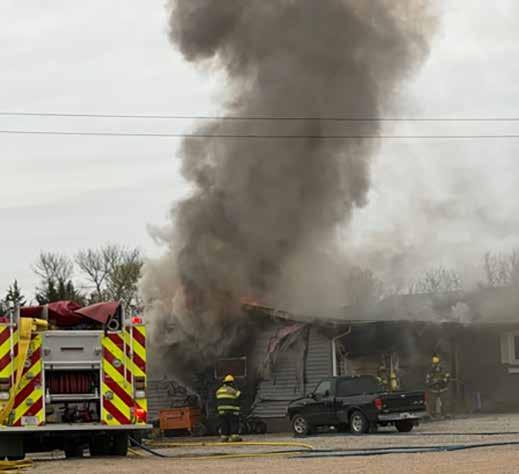
The Franklin County Sheriff’s Office says emergency personnel responded to a structure fire reported at 120 Brierwood in Franklin at around 1:45 p.m. Wednesday, April 1. Sheriff’s deputies and Franklin Fire and Rescue were first dispatched, with Quad Cities Fire dispatched for mutual aid. Fire units were on scene within two minutes. The sheriff’s office says the fire was mostly contained to the garage of the home, and fire crews had it under control within 45 minutes of the initial report. They say the residents of the home were evacuated and no injuries were reported. The Nebraska State Fire Marshalls office is investigating the fire. The garage is a total loss and the main structure sustained smoke damage. Departments responding and assisting Franklin were Riverton Fire, Naponee Fire, Upland Fire, Campbell Fire, Minden Fire, Axtel Fire, and Wilcox Fire.
O’Neill Truck 11 assisted in the back burn at the County Line Fire.
Fire Prevention Nebraska Style Fire Prevention Nebraska Style
As the school year comes to an end and a family vacation is in order, there’s always the question of, once we get there, where will we stay? Many travelers have found the short-term rentals, also referred to as Airbnb’s, to be very economical, convenient, and available in almost any location you may choose to visit. But it is very important to remember that practicing fire prevention while staying at short-term rental properties like an Airbnb is essential for your safety and the safety of others. Here are some tips to help you prevent fires:
CHECK FOR SMOKE ALARMS AND FIRE EXTINGUISHERS: Before settling in, ensure that the property has working smoke alarms installed on every floor and near bedrooms. Additionally,
Upcoming Events Upcoming Events
Email your Upcoming Event by the 10th of the previous month (ex. Aug. 10 for the September issue) to jeff@nebraskafirefighter.com . There is no charge.
MAY 8, 2026: Northeast Nebraska Volunteer Firefighters Association meeting, 7:30 p.m. in Scribner.
MAY 15-17, 2026: 2026 Nebraska Fire School, Grand Island, NE.
JULY 9, 2026: Scotts Bluff County Mutual Aid Association Meeting, Banner County.
SEPT. 20, 2026: NSVFA Memorial Service, Nebraska Firefighters Museum and Education Center, Kearney, at 2 p.m.
OCT. 8, 2026: Scotts Bluff County Mutual Aid Association Meeting, Bayard.
OCT. 15-17, 2026: NSVFA Annual Conference, hosted by Dakota City Fire Department in South Sioux City.
OCT. 14-16, 2027: NSVFA Annual Conference, hosted by Battle Creek Volunteer Fire and Rescue in Norfolk.
locate fire extinguishers in easily accessible areas.
KNOW THE ESCAPE ROUTES:
Familiarize yourself with the layout of the property and identify all possible exit routes in case of a fire. This includes doors, windows, and any alternative exits.
INSPECT ELECTRICAL APPLIANCES AND CORDS: Check that all electrical appliances and cords are in good condition. Avoid overloading electrical outlets and using damaged cords.
BE CAUTIOUS WITH COOKING: If you plan to cook during your stay, never leave cooking appliances unattended while in use. Keep flammable items, such as kitchen towels and curtains, away from the stove.
AVOID SMOKING INDOORS: If smoking is allowed in the rental
property, do so only in designated outdoor areas. Ensure that cigarette butts are completely extinguished and disposed of safely.
USE CANDLES SAFELY (OR AVOID THEM): If candles are provided, use them with caution. Keep them away from flammable materials and never leave them unattended. Consider using flameless LED candles instead.
KEEP HEAT SOURCES CLEAR: Ensure that heaters, radiators, and other heat sources have ample space around them and are not obstructed by furniture or other items.
DISPOSE OF ASHES PROPER-
LY: If there’s a fireplace or outdoor fire pit, ensure that ashes are completely cooled before disposing of them. Use a metal container with a lid for ash disposal.
REPORT POTENTIAL HAZ-
Please send them to jeff@nebraskafirefighter.com along with information to explain the photo.
Rhonda Cerny, NSVFA Fire Prevention
“...it is very important to remember that practicing fire prevention while staying at short-term rental properties like an Airbnb is essential for your safety and the safety of others.”
ARDS: If you notice any fire hazards or malfunctioning equipment in the rental property, report them to the property owner or manager immediately.
HAVE AN EMERGENCY PLAN: Discuss and establish an emergency plan with your travel companions, including how to evacuate the property safely in case of a fire. By following these fire prevention tips, you can help ensure a safe and enjoyable stay at your shortterm rental property.
I appreciate you taking the time to read this article and hope you have an opportunity to share it with
Firefighter Cancer Bill Fails By A Single Vote
By GORDON HOPKINS , Fairbury Journal-News
Last week a bill intended to provide compensation under the Nebraska Workers’ Compensation Act for cancers experienced by Nebraska firefighters failed to get past cloture in the Nebraska Legislature by a single vote.
A motion to close debate and send the bill to be voted on required a minimum of 33 votes. The motion failed on a 32-15 vote.
According to the statement of intent for LB (Legislative Bill) 400, “Cancer that results in either temporary or permanent disability or death is now an occupational disease and is compensable as such. This applies to firefighters who were exposed to carcinogens or reasonably know human carcinogens during the course of their employment or service.”
The bill was introduced by Senator Dave Wordekemper, who has pointed out that the International Agency for Research on Cancer (IARC) classifies firefighting as a Group 1 carcinogen, meaning the highest level of cancer risk.
State Senator Tom Brandt discussed LB400 with local firefighters at the Fire Department Banquet in Fairbury on March 6 of this year. He warned those in attendance at that time the bill was facing an uphill battle, “Senator Wordekemper, a retired firefighter from Fremont, professional and also volunteer, a good friend, sits right in front of me (in the legislature), he’s trying to get through LB400. A lot of head winds on that bill, particularly because of the liabilities from the cities. I know he has some amendments on that. So, I’m not going to say for sure that that bill is going to go through or not.”
CANCER
A series of wildfires throughout Nebraska, which have been fought
by firefighters from all over the state, has brought the dangers of firefighting into sharp focus. However, there are more dangers than just the immediate and obvious ones such as burn injuries and smoke inhalation.
In 2023, IARC noted, “Occupational exposure as a firefighter is complex. Firefighters respond to various types of fire (e.g. structure, wildland, and vehicle fires) and non-fire events (e.g. vehicle accidents, medical incidents, hazardous material releases, and building collapses). They may be exposed to a mixture of combustion products (e.g. polycyclic aromatic hydrocarbons, particulates), chemicals in firefighting foams, flame retardants, diesel exhaust, building materials, and other hazards, such as night shift work and ultraviolet radiation. Changes in types of fire, building materials, personal protective equipment, and roles and responsibilities among firefighters have resulted in significant changes in firefighter exposures over time.”
To support the bill, Senator Wordekemper cited a number of different studies in his testimony, “NIOSH, National Institute for Occupational Health and Safety, in 2013 researchers reported a twofold excess of malignant mesothelioma, a rare cancer. Firefighters have 100 percent increase of getting mesothelioma. Firefighters have 129 percent increased risk of dying from it.”
Wordekemper cited a 2006 study done by Grace Lemasters University of Cincinnati College of Medicine, “There was a twofold excess for testicular cancer, 62 percent higher risk of getting esophageal cancer, 39 percent increase of dying from it.
The senator also cited a study that was done in 2017 at the Blais Laboratory at the University of Ottawa, Canada, which “Examined chemical exposure during
family and friends. I also hope to see many of you at the Nebraska State Fire School, and if you are interested in learning more about the importance of Fire Prevention in our daily lives, please register for the Fire Prevention Class. The NSVFA Fire Prevention Committee members have some great ideas to share with you and would enjoy your participation.
Rhonda Cerny, NSVFA Fire Prevention Committee
emergencies on shift fire personnel suppression. The researchers found firefighters absorb harmful chemicals, including polycyclic aromatic hydrocarbons that comes from the smoke and it’s absorbed through our skin. Firefighters had from three to five more times the amount of this by product in their urine after the fire compared to before.”
BURDEN OF PROOF
The primary impact of the bill would have bene to shift the burden of proof for the cause of cancer from the firefighter to the employer. In other words, any cancer a firefighter is diagnosed with would have been presumed to be work-related unless proven otherwise. Currently, firefighters with cancer must prove the cancer is work-related before they are eligible for benefits. Given the nature of the disease, that can be difficult, if not impossible in some cases.
OPPOSITION
Opponents, led by Senator Mike Jacobson, raised concerns about increased costs for municipalities and volunteer fire departments, potential unfunded mandates, and the bill’s impact on property taxes.
“This bill is not necessary,” said Senator Jacobson. “So, I don’t understand why the requirement, the burden of proof, would be on the other side. If you believe that the cancer was caused from workplace, prove it. The employer should not have to prove that it was not workplace related.”
Jacobson said, “What will happen if this would pass is, the number of claims, anyone with cancer on the job will file a workman’s comp claim. Consequently, premiums for workman’s comp will go through the roof. So, this unfunded mandate then becomes a taxpayer problem.”
“This is not good public policy, this is not good for the taxpayer
and it doesn’t seem right. This is just another case where we have another year that goes by and the paid firefighters are wanting something more than they already have,” added Jacobson. Senator Wordekemper disputed that assessment, “There is no new cost created by this bill. There is no new system. There is no blank check. There is no free handout. The claims are already being filed. The city’s already retained lawyers to fight them. The only question is, who carries the burden at the start of the litigation, and right now, it’s the firefighter who is dying of cancer.”
LOCAL REACTION
Chief Taylor McHenry of Barneston Rural Volunteer Fire Department told FJN there are 30 other states with similar legislation. He emphasized that his comments are his own and do not represent the fire department, “Compensation is a pooled resource, it would have gradually increased for the entire pool in the risk management category, yes that is very true. But the argument that this would cost too much money is simply saying, in my personnel opinion, there is absolutely a problem that needs a solution but we don’t want to pay for it.”
WHAT HAPPEN NEXT
After the vote to end debate failed, Senator Brandt told FJN, “I did vote to end cloture on LB400, it needed 33 votes and received 32. Senator Wordekemper was open to amending the bill on next round to include volunteer firefighters along with the paid firefighters, this was the reason for my support. I believe most of the concerns were from the cities and villages on how they would cover the costs of the increased benefit. Senator Wordekemper stated he will bring it back again next year.”
Vehicle stabilization training held at Crete
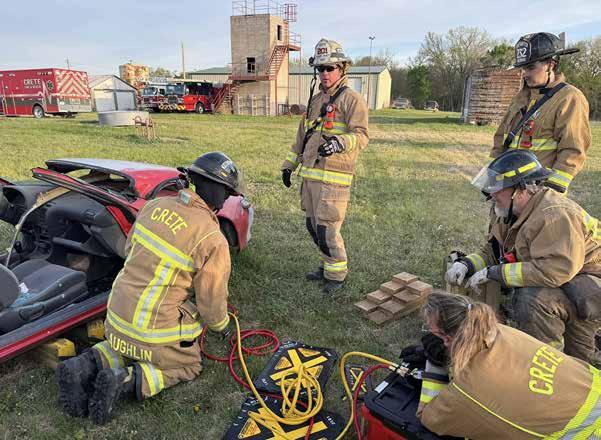
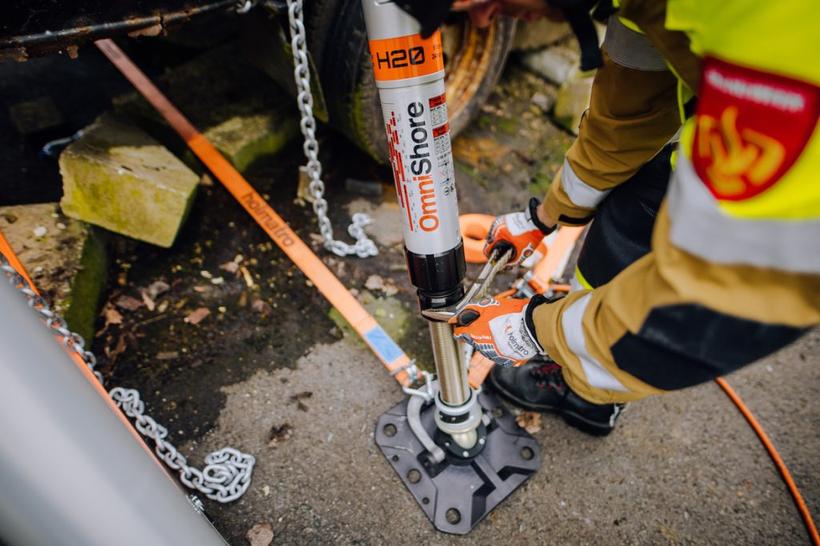
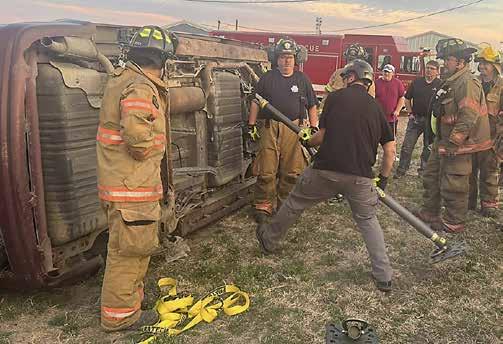
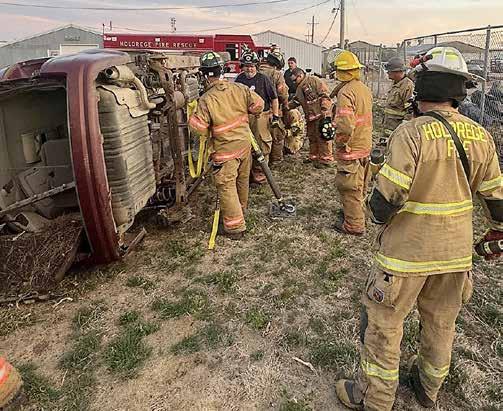
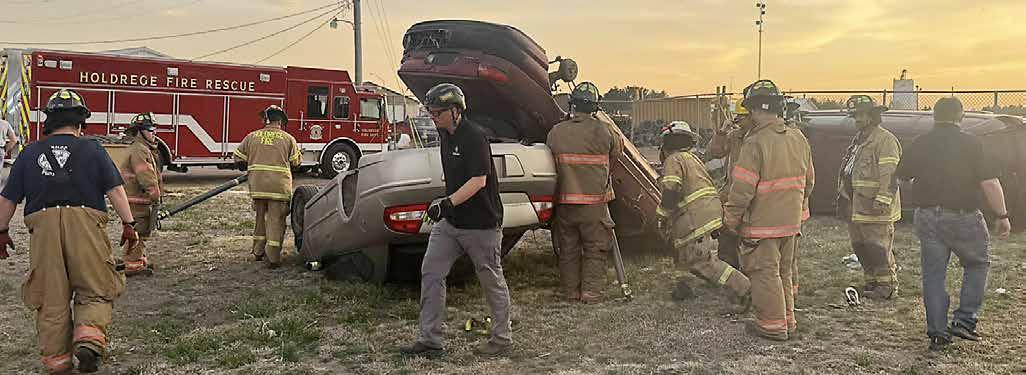
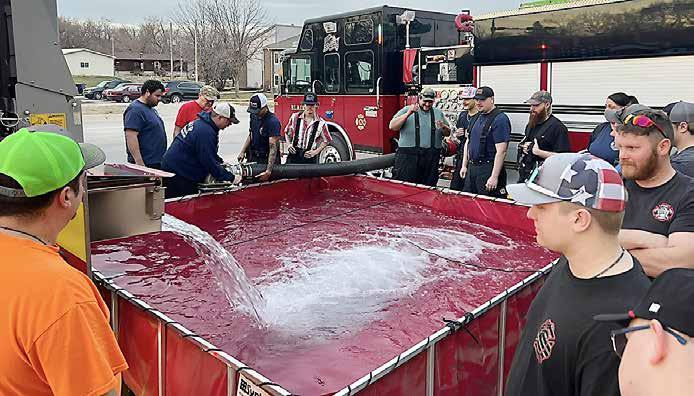
Vehicle stabilization is essential before performing any rescue efforts. Stabilizing wrecked vehicles prevents unwanted movement of crashed vehicles, ensuring the safety of rescuers and patient. During recent training, Crete Fire and Rescue members learned the fundamentals of vehicle stabilization and got hands-on practice using specialized equipment to stabilize vehicles, such as rescue struts, cribbing and their new airbags.
Departed Firefighters
Here is a list of departed firefighters since the last newsletter. If you know of a fellow firefighter who passed away, and their name is not listed in this newsletter, contact the executive director’s office and she will add their name to the list in the next newsletter.
• Robert “Bob” Gifford - Paxton Volunteer Fire Dept
• Robert G. Martin - Lexington Volunteer Fire Dept
This month’s article is dedicated to the memory of Jim Grosserhode, Scribner Volunteer Fire Department, 9/17 2022.
According to my latest information fire departments in Nebraska make up 93 to 94% of all fire departments in Nebraska (23% combination paid and volunteer departments, six fully paid departments). With the recent wildland fires volunteer and career firefighters working together helped save NEBRASKA. A job well done by
one and all. Just because Gov. Pillen lifted the burn ban, please issue permits with caution. Last of all, if we ALL did a better job on prevention how many fires could we prevent? If your fire department would like some assistance, PLEASE REACH OUT TO ME. My email address is heckmanbob1@gmail.com or any N.S.V.F.A Fire Prevention Committee member. Better yet, at fire school take the fire prevention class, let us know what works for your fire department. Fireman Bob
After Nebraska wildfires, officials urge long-term mental health check-ins
One month after wildfires erupted across Nebraska and burned hundreds of thousands of acres, the University of Nebraska Medical Center’s Behavioral Health Education Center of Nebraska is joining Nebraska Extension’s disaster response to help communities address the mental health toll. The fires included the Morrill Fire — described as the largest in state history — along with three other major fires that together burned more than 700,000 acres.
Nebraska Extension has formed a wildfire task force to coordinate recovery needs across the region, and the University of Nebraska Medical Center’s Behavioral Health Education Center of Nebraska, known as BHECN, is now part of the team focused on behavioral health support.
BHECN was created by the Nebraska Legislature in 2009 and is housed at UNMC. The center is charged with leading statewide behavioral health workforce development, including recruiting, training and retaining behavioral health workers, according to a UNMC press release. UNMC said BHECN has six regional sites across Nebraska, with site co-directors working in their local communities as part of response efforts. UNMC also said BHECN leadership is serving on Nebraska Extension’s Wildfire Task Force.
(KSNB-TV NBC 4, Hastings, NE, April 15, 2026)
2026 BROWNING MEMORIAL AWARD RECIPIENT
The 2026 Browning Memorial Recipient is J.R. Pounds. J.R. is 4 years old and is the Son of James and Amber Pounds from Blair, Nebraska. J.R. spent his first 50 days in the NICU at Children’s. From the very beginning, he faced significant medical challenges, including a severe curvature of his spine, limited movement in his right arm, and other complex internal abnormalities.
James Pounds served 20 yeats on the Blair Volunteer fire Department including a period of time where he served in the U.S. Navy, SanDiego, CA. Amber has also dedicated her time in support of the department as a member of the Ladies Auxiliary for several years.
At just days old, J.R. underwent an intricate surgery that began as a repair for a diaphragmatic hernia but quickly became far more complex.
Surgeons discovered a neurenteric cyst, a branch of intestine attached to his spine, requiring multiple specialty teams to carefully separate it. During that operation, he also had an appendectomy due to abnormal placement of his appendix and a Ladd’s procedure to correct intestinal malrotation.
His recovery included time on a ventilator and treatment for a collapsed lung before he steadily regained strength. Shortly before
discharge, he underwent a a second surgery to place a G-button to support his nutritional needs.
Since then, J.R.’s journey has continued with remarkable resilience. He wears a neck brace more than 20 hours a day to support muscle and ligament development and will require future spinal surgery under the care of Shriners Children’s Hospital in Philadelphia, PA. Due to an abnormality in the formation of his rib cage, J.R. participated in multiple sleep studies to monitor the resulting restrictive lung disease. Due to the findings, he underwent a third surgery to reduce his tonsils and adenoids and have ear tubes placed following recurrent infections. He recently endured two falls resulting in fractures to his elbow and humerus, each time facing recovery with little complaints.
In addition to periodic monitoring by multiple specialists, J.R. participates in physical, occupational, and feeding therapies. Through every appointment, procedure, and setback, he remains incredibly tolerant and cooperative, receptive to providers and willing to do the hard work asked of him.
What truly sets J.R. apart, however, is his spirit. He has a big personality packed into a little body. He is kind, funny, observant, and
a wonderful listener. Though he may be shy at first, it doesn’t take long before he’s chatting away and winning people over. Providers, therapist, and even strangers often comment on how sweet and special he is. Despite the many obstacles he has faced in his young life, and those still ahead. J.R.’s joyful, resilient personality has shaped his journey into one filled with connection, warmth, and hope. His strength is remarkable, but
it is his heart that truly makes the difference.
J.R. will be recognized at the 2026 Nebraska State Fire School in Grand Island during opening ceremonies on May 15, 2026 at the Heartland Event Center.
The Special Recognition Committee would like to make this a special day for J.R. We are asking all Fire and Rescue departments, auxiliaries, individuals and anyone that would like to bring something for J.R. that day.
JR wears a size 4T shirt, loves all the normal cartoon characters such as Spidey, Cars, trucks, John Deere tractors and mag tiles. JR will start his 2nd year of baseball with ALLPlay Miracle League in May.
If you have any questions, please give me a call or text. Marlene Bomar Special Recognition Committee member, 402-9921561, mbomar126@gmail.com
Directory
President
BRENDA JENNY 1767 Colfax Street, Blair, NE 68008 402.639.9647 bgolf2560@yahoo.com
1st Vice President
TROY SHOEMAKER 1433 Grove Ave Alliance, NE 69301 308-760-7682 tshoemaker@cityofalliance.net
2nd Vice President
KENNY KRAUSE 1229 D St. Fairbury, NE 68352 402-300-0097 krausechief@gmail.com
Secretary/Treasurer
MARK MEINTS 502 E H St, Wymore, NE 68466 402-806-7451 meints2@windstream.net
NSVFA Lobbyist
RYAN K. MCINTOSH PO Box 13 Nebraska City, NE 68410 ryan.mcintosh@stilmockmcintosh.com
NSVFA Legal Advisor
SCOTT SMITH
P.O. Box 186 Syracuse, NE 68446 scott.smith@bhhslawfirm.com
Past President
SCOTT SCHREMMER 815 W 6th, Chadron, NE 69337 308-430-1494 buffhater@gmail.com
#2 JOHN BOMAR P.O. Box 222, Battle Creek, NE 68715 402-992-1560
JBomar1970@gmail.com
#3 RON CHADA 1721 N Sheridan North Platte, NE 69101 308-520-2828 rmchada@winnelson.com
#4 DANIEL CHAPEK 1491 County Road 30 Weston, NE 68070 402-430-7859 dchapek@dc-ww.com
NSVFA Representative National Vol. Fire Council
JUSTIN SCAMEHORN
202 Hidas Ave. Waco, NE 68460 402-366-1939 jscamehorn@yahoo.com
Appointed NVFC Director
JOEL CERNY 1618 Denver St. Schuyler 68661 402-720-4100 cerny_j@hotmail.com Chaplain
MATTHEW MAU
Cell: 402-363-1540
E: pastormattwaco@gmail.com
NSVFA OFficer Reports NSVFA Officer Reports
It’s hard to believe that May is already here and that firefighters from across Nebraska are preparing to gather in Grand Island for the highly anticipated NSVFA Fire School, taking place May 15–17. The fire school committee say this year’s event promises to be a dynamic and engaging weekend focused on strengthening skills, sharing knowledge, and building connections within the fire service community.
The three-day training features hands-on learning and classroom learning, giving participants the opportunity to sharpen both practical and technical abilities. From live training scenarios to in-depth educational sessions, the NSVFA Fire School is designed to meet the evolving demands faced by today’s firefighters. Just as important, the event will provide valuable networking opportunities, bringing together firefighters from across the state to exchange experiences, ideas, and best practices. In addition to this year’s Fire School, the NSVFA announced
Thankfully things have calmed down since the last time I sat down to write my monthly article. By the way, when I say I sat down to write this letter, I sat down next to my wife and dictated it to her while she typed. Without her help, these articles would probably be only a sentence or two.
We have been lucky enough to catch a few rains in the southeast corner of the state, so things are looking much better than other parts of the state. Hopefully the rest of you will start to see some timely rain soon. I’m sure all of you out west would like to enjoy a few days, and not wonder when the next fire will break out.
mid-April that the Wildland Fires Reimbursement program submissions are now open for Nebraska Volunteer Fire Departments that recently responded to and assisted Nebraska communities in battling the recent wildland fires. These reimbursements are intended to help offset the financial burden incurred during mutual aid responses.
Funding for the Wildland Fires Reimbursement program comes from a variety of sources, including proceeds from the UNL Spring Game, donations from the Omaha Community Foundation, support from the Nebraska Bankers Association, and generous donations from the general public. The NSVFA office emphasizes that these funds are specifically designated to help Nebraska Volunteer Fire departments recover expenses that were not covered by federal or state assistance programs such as FEMA and NEMA. Departments eligible for reimbursement are encouraged to submit their applications promptly as the deadline to submit is May 8th, 2026.
On a positive note, all of these fires have brought some real attention to the volunteer fire service. I am really confident that we have always been appreciated, but it is more apparent now, because of the way you have all stepped up and performed to everyone’s expectations. Departments are seeing increases in their local fund raisers. I really think this has helped to bring an increased awareness to legislation that has impact on firefighters. It’s time to start thinking about fall conference. If you have members that meet the 25 and 50 years of service, please get their names submitted to the office. It would be a good time to consider if you
Brenda Jenny , Presi dent
“From live training scenarios to in-depth educational sessions, the NSVFA Fire School is designed to meet the evolving demands faced by today’s firefighters. Just as important, the event will provide valuable networking opportunities, bringing together firefighters from across the state to exchange experiences, ideas, and best practices.”
The application can be found here: https://forms.monday.com/ forms/088b20c0f249e117e0847fc1cd9f5820?r=use1
As this year’s wildfire season continues to place increased demands on local resources, both the NSVFA and the Wildland Fires Reimbursement program donors highlight a shared commitment to preparedness, resilience, and mutual support among Nebraska’s Volunteer firefighting community.
As always, if you have a meeting or event, you would like me to attend, please reach out and I will make every effort to be there. Be-
low are the upcoming events you don’t want to miss:
NSVFA Fire School: May 15 – 17, 2026 in Grand Island, NE at Fonner Park.
NSVFA Fallen Firefighters Memorial Service: September 20, 2026, Kearney, NE at Nebraska Firefighters Museum and Education Center
Until next time, stay safe and healthy.
BRENDA JENNY President, NSVFA
Kenny Krause, 2nd Vice President
“Its time to start thinking about fall conference. If you have members that meet the 25 and 50 years of service, please get their names submitted to the office.”
would like to run for an NSVFA office, if so, your name is to be submitted to the office in July. There are many proposed changes to our by-laws, it is important
Legal Advisor’s Report Legal Advisor’s Report
APRIL 2026 FIREFIGHTERS,
I’ve received a number of questions on the nuts and bolts of the Rural Fire District Board’s annual meeting. The following is a checklist to think through as your annual meeting comes up.
Be sure to attend the rural board annual meeting. This is the meeting that sets the budget and conducts elections. Even if you aren’t a resident of the district and cannot vote, it is advisable to attend. Check who is up for re-election (if anyone). It’s best to do this well in advance of the meeting. There are a total of five (5) rural board seats. When the board was initially started, three (3) of the members were elected to serve a four (4) year term and the other two (2) were elected to serve a two (2) year term. After the expiration of the initial terms, all seats are elected to four (4) year terms. At this point, after the initial terms expire, you should have an election every two (2) years. At one election two (2) board seats are up for election and two (2) years later the other three (3) are up for election. All board
seats serve four (4) year terms.
Board members must reside in the district. If a Board member moves to town and the town is not merged with the district, the board member cannot serve on the board and must be replaced at that annual meeting. It’s worth noting that ownership of land within the district does not make you eligible to serve on the board, it’s where you reside. A board member must reside in the rural fire district and be a registered voter.
Pay attention to the budget and do an accounting of all funds. Be sure that any funds derived from
the use of district equipment go into the rural fire district’s account. The only money that should go into a department’s trust account are funds from fundraisers or other activities that did not come about from the use of district equipment. If a mistake is discovered, move the funds to where they should go. Non-residents may speak at the annual meeting as they are a member of the public but they cannot vote. If you are involved with a department in the district but you do not reside in the district, please do attend and feel free to speak at the meeting. You just can’t vote.
NE Nebraska meeting
The next Northeast Nebraska Volunteer Firefighters Association meeting will be May 8, in Scribner. Meal will start at 7:30 p.m. and the meeting will start at 8 p.m. The program is being finalized and will follow the meeting.
to attend conference to help make these decisions. As always, stay safe,
KENNY KRAUSE 2 nd Vice
I hope these tips are helpful as you think through your annual meetings. It is important to your local departments and fire districts that you get involved! If you’ve never attended a rural board meeting, now is the time to start. Your hands-on experience, relationships, and input are valuable to rural board members and attending meetings is the best way to share those things. Stay safe and see you at fire school!
Respectfully,
SCOTT G. SMITH, NSVFA Legal Advisor
Please send them to jeff@nebraskafirefighter.com along with information to explain the photo.
NSVFA OFficer Reports NSVFA Officer Reports
Can a Pair of Socks change a Fire Department’s Culture?
Absolutely – a pair of socks can change a fire department’s culture, not because of the socks themselves, but because of what they signal.
At first glance, the idea sounds trivial. Fire service culture is shaped by tradition, discipline, shared risk, and service under pressure. Compared to that, socks seem inconsequential. Yet culture is not defined only by policies, rank structure, or standard operating guidelines. It is defined by daily human signals—what is permitted, encouraged, and valued. Something as small as socks can become a surprisingly powerful signal.
This unintentional shift in Alliance’s culture started 18 years ago. I am the brand-new fire chief attending my first installation of the officers’ banquet in March after being appointed in January. A firefighter I was about to appoint as a Lieutenant sat at a table directly in front of me, and my eyes went straight to the white tube socks he was wearing. I am like, you must be kidding me, who wears white tube socks in a dress uniform? KMART happened to be open right across the street from where we were holding the department’s event. I said, “You need to walk over and get yourself a pair of black dress socks before you take the oath and get your badge pinned on.” That was the former Navy sailor in me coming out. He did exactly that.
CULTURE LIVES IN SMALL THINGS
Organizational culture is built less by speeches than by the behaviors people experience every day. Uniforms are a perfect example. They do more than provide safety and recognition; they communicate identity and expectations.
When a department enforces total uniform rigidity—even in areas unrelated to safety—it can unintentionally communicate:
“Conformity matters more than individuality.”
“Tradition outweighs adaptability.”
“Authority is expressed through control.”
On the other hand, allowing something minor like nontraditional socks (holiday socks, causerelated socks, personalized designs) can signal:
TRUST PROFESSIONALS TO
KNOW WHERE FLEXIBILITY IS APPROPRIATE.
Respect for individuality within a team identity.
A modern, peoplefirst leadership approach.
The socks do not change the culture by themselves, the permission does.
PSYCHOLOGICAL SAFETY AND BELONGING
Firefighters work in high-risk, high-trust environments. A healthy culture requires psychological safety: the belief that you can be yourself, speak up, and be human without negative consequences.
Small gestures of flexibility can lower invisible barriers. When firefighters see leaders allow harmless personalization:
NEW MEMBERS FEEL LESS INTIMIDATED.
Veterans recognize a shift from “because we’ve always done it this way.”
The organization feels more approachable and less transactional. In short, socks can quietly reinforce the idea that you belong here as a person, not just in a position.
MORALE, HUMOR, AND SHARED HUMANITY
The fire service is serious work— but not solemn work. Humor, morale, and stress relief are survival tools.
FUN OR SYMBOLIC SOCKS:
Become conversation starters across ranks.
Create shared laughs during long shifts.
Humanize officers and chiefs without eroding authority.
Importantly, this kind of flexibility does not weaken discipline. Crews who feel respected and valued are often more willing to uphold standards that truly matter—training, safety, and performance.
CHANGE WITHOUT THREAT
Cultural change often fails because it feels imposed or threatening. Big initiatives raise defenses. Small changes do not.
Offers visible evidence that leadership is thoughtful and intentional about change.
It subtly answers a question firefighters are always asking:
“DO THEY ACTUALLY TRUST US?”
THE BOUNDARY MATTERS
This only works if leaders clearly communicate why flexibility is allowed—and where it stops. The cultural message is not:
“Standards don’t matter.”
It’s:
“Standards matter where they protect safety, professionalism, and public trust—and we’re ma-
Troy Shoemaker, 1st Vice President
“In that sense, the socks are never really about laundry; they are about leadership!”
ture enough to tell the difference.”
Socks work as a cultural tool precisely because they are personal, lowstakes, and symbolic.
SO, CAN SOCKS CHANGE CULTURE?
Yes—if leadership understands that culture changes through meaning, not magnitude.
A pair of socks can: Represent trust over control. Signal progress without disrespecting tradition.
Demonstrate that leadership notices the human details.
Every year since that first installation of officers, right before I have them raise their right hand, I check what kind of socks they are wearing. It has become their custom, our culture, that not one of them has a pair of black dress socks on. Not one of them!
This year, as I was about to give the first oath of office, the person stopped me and said to me, Chief, I must stop you. This is the guy with the white tube socks from 18 years earlier. Mind you, he had
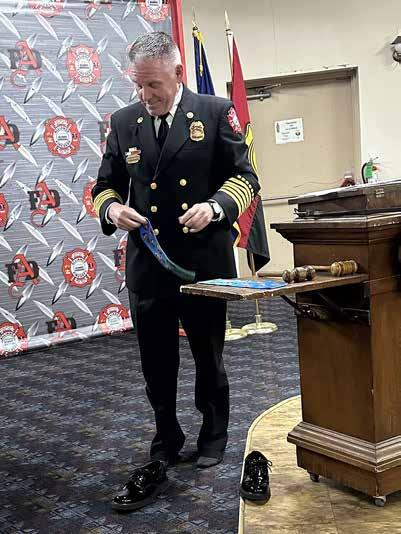
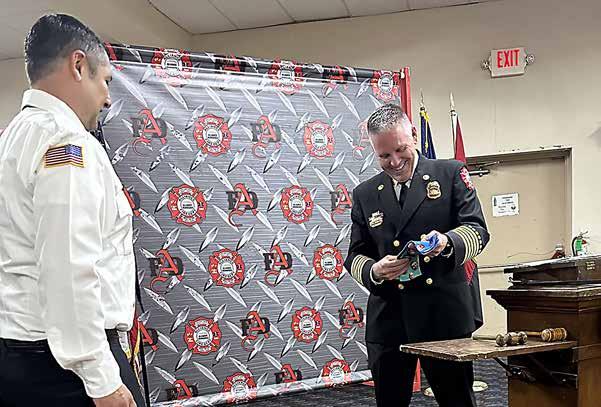
been an officer for several years, had stepped out as an Assistant Chief several years ago, and was returning to the officer ranks this year as a Lieutenant. I looked at him, and I was like, “Hmm, something is fishy here.” Up come two of our officers; they tell me and the department a story and hand me my own pair of non-traditional socks with all the line officers’ faces on them. The entire crowd had a good laugh.
I placed them on the podium after accepting them, and they said, “Oh no, you cannot start the oath of office until you put your socks on.” So, I put the socks on, and we went on our merry way with the oath of offices. My tradition of checking their socks was maintained as it has been for the last 18 years. Lo and behold, every one of them had a pair of non-traditional socks on; this year, their socks were adorned with my face. In that sense, the socks are never really about laundry; they are about leadership!
Until next time, stay safe!
TROY SHOEMAKER,
NSVFA 1 st Vice President
Lobbyist Report Lobbyist Report
The 109th Legislature, Second Session, has officially adjourned sine die. Heading into the 60-day “short” session, Speaker John Arch (La Vista) made clear that mid-biennium budget adjustments would define the year. That prediction proved accurate, as the budget bills ultimately passed in dramatic fashion.
After weeks of stalemate, senators broke through the gridlock and advanced the state’s two main budget bills, LB 1071 and LB 1072, following earlier filibusters that had stalled progress. LB 1071 had previously failed twice after senators rejected two separate motions to invoke cloture. The turning point came when lawmakers agreed to remove two contentious policy provisions: $3.5 million in proposed funding for an opportunity scholarship “bridge” program and a permanent expansion of child
care subsidy eligibility. With those provisions stripped out, tensions eased, and LB 1071 advanced 34–7 without the need for a cloture vote—something that had been impossible earlier in the session. The shift in tone was evident, with lawmakers giving standing ovations to Appropriations Chair Senator Rob Clements (Elmwood) for steering the chamber through the impasse. In a notable move, Governor Pillen signed both budget bills without issuing any line-item vetoes—an uncommon outcome that reflects the level of compromise required to close the projected $646 million budget shortfall.
The Legislature closed its final working week with a marathon agenda of 65 bills on Final Reading, contributing to more than 100 bills sent to Governor Pillen throughout the week. On the final day, senators delivered tributes
NVFC Reports NVFC Reports
As Nebraska is finally greening up, I hope this means the wildland fires are slowly coming to an end. With all the fires we have responded to, I’m sure most of us are wishing we had a bigger crew. So, with that said, we all know that the Nebraska State Volunteer Firefighters Association’s SAFER Grant 4 has ended, and the application for our SAFER Grant 5 is in limbo because of the government shutdown of FEMA. If you’re looking for help with Recruitment and Retention, my article this month will cover what’s available on the National Volunteer Fire Council’s “Make Me A Firefighter” Program
The National Volunteer Fire Council (NVFC) is strengthening its nationwide push to bolster the volunteer fire service through its flagship recruitment platform, Make Me A Firefighter™, a program designed to connect fire departments
with potential volunteers and reverse the decadeslong decline in volunteer numbers. Launched in 2015 with support from a federal SAFER grant, the initiative has grown into one of the most comprehensive recruitment resources available to the fire and emergency services.
The Site is a Central Hub for Connecting Volunteers and Departments. At the heart of the program is MakeMeAFirefighter. org, a public-facing site where individuals can explore what it means to serve and search for volunteer opportunities in their own communities. With seven out of ten U.S. firefighters serving in a volunteer capacity, the site emphasizes that “if you have the heart to serve, you have everything we need.” Visitors can browse local openings, learn about the demands and rewards of the fire service, and
Talk to Us About Your Next Apparatus
to outgoing colleagues—those term-limited and those choosing not to seek reelection. The session concluded on Friday, April 17, with a farewell message from Speaker Arch and remarks from Governor Jim Pillen.
I want to again extend a sincere thank-you to everyone who responded to our action alerts on LB 400, introduced by Senator Dave Wordekemper (Fremont). LB 400 would create a rebuttable presumption within the Nebraska Workers’ Compensation Act recognizing cancer as an occupational disease for both volunteer and paid firefighters. Senator Wordekemper designated LB 400 as his personal priority bill to ensure protections for all firefighters. Unfortunately, attempts were made to remove volunteer firefighters from the bill so the presumption would apply only to paid firefighters. Early in the ses-
Ryan K. McIntosh, Lobbyist
“I want to again extend a sincere thank - you to everyone who responded to our action alerts on LB 400, introduced by Senator Dave Wordekemper (Fremont). LB 400 would create a rebuttable presumption within the Nebraska Workers’ Compensation Act recognizing cancer as an occupational disease for both volunteer and paid firefighters.”
sion, LB 400 received five hours of debate before being pulled from the agenda. When it returned on March 30, the motion to invoke cloture failed on a vote of 32–15—one vote short of the 33 needed. While it was disappointing to see the bill fall short this year, it was encouraging to witness the strong support voiced for volunteer firefighters throughout the debate.
With the 109th Legislature now adjourned, I will continue providing updates on our proposals that did not advance this year, as well
as our work throughout the interim as we prepare for the 110th Legislature in January 2027. We will also be meeting with legislative candidates ahead of the May and November elections. If you have information about candidates in your district, please reach out and share it with us. Thank you to all who engaged with your elected officials this session.
RYAN K. MCINTOSH, Lobbyist
sign up for notifications when new opportunities appear in their area. The platform also directs users to state fire associations when no immediate listings are available.
The site also has a Powerful Recruitment Portal for fire and EMS agencies, as the program offers a dedicated Department Portal, giving departments free access to researchbased recruitment tools. Through this portal, departments can:
• Post volunteer opportunities to a national database searchable on multiple platforms
• Customize marketing materials with departmentspecific information
• Access recruitment strategies, tips, and readytouse outreach resources
• Track potential recruits and manage local campaigns more efficiently
The portal was built to make recruitment “as easy as possible” for local departments facing rising call volumes and shrinking volunteer numbers.
The Site also provides a national
J oel Cerny, NVFC Director
“The National Volunteer Fire Council (NVFC) is strengthening its nationwide push to bolster the volunteer fire service through its flagship recruitment platform, Make Me A Firefighter™, a program designed to connect fire departments with potential volunteers and reverse the decadeslong decline in volunteer numbers.”
map showing where volunteer opportunities are posted and where potential recruits have expressed interest. This tool helps departments understand local recruitment trends and identify untapped audiences. Volunteer firefighters can save communities an estimated $46.9 billion annually, yet the number of volunteers has steadily declined over the past 30 years. The Make Me A Firefighter program aims to reverse that trend by giving departments modern, accessible tools and by making it easier than ever for citizens to step forward and serve. As recruitment and retention remain top concerns for departments across the country, the NVFC’s Make Me A Firefighter program stands out as a vital resource—one that bridges
the gap between community members willing to help and the departments that need them.
Hopefully, this information is helpful to you and your department. In the end, I wish I could say I hope to see you at Fire School, but this year, the NVFC Spring meetings and Fire School happen to fall on the same weekend. Justin Scamehorn and I will have NVFC materials available for you at a table at Fire School, including a QR Code that allows firefighters who are not currently members of the NVFC to enter a drawing for a free year of membership to the NVFC. Please take the time to enter.
JOEL CERNY, NVFC Director
Pierce called to multiple fires
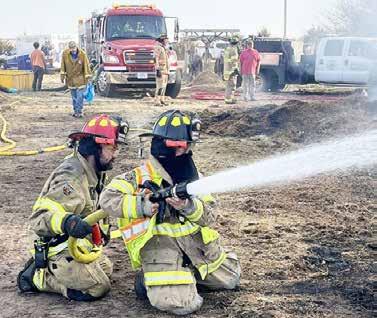
The Pierce Volunteer Fire Department had a busy past couple weeks responding to numerous fire calls, the majority being grass and hay fires. Above, Pierce firefighters Nate Emerson (left) and Paula Bretschneider apply water to some burning bales at the Alek and Jacy Flesner farm. Pierce Fire and Rescue responded to the call and upon arrival, found approximately 20 bean stubble bales and a pile of ground hay on fire. Fire Chief Steve Dolesh said a spark from a hay grinder that was in use before the fire was discovered was the cause. Firefighters were on the scene for three hours. The department responded with 1 engine, 3 tankers, 3 grass rigs, 2 command vehicles, 1 rescue unit, 25 firefighters, and 5 rescue personnel.
NSVFA OFficer Reports NSVFA Officer Reports
Instead of the usual banter, I thought I would give a short report on the comings and goings of our local association.
The quarterly meeting of the Scotts Bluff County Mutual Aid Association was hosted on April 9 by Fire Chief Troy Shoemaker and the Alliance Fire Department.
Following the usual order of business, Gering Fire Chief Nathan Flowers announced his resignation as president.
A motion was made to nominate Vice President Matt Hinman to fill the position which was voted on and carried. Matt currently serves as Chief of the Morrill Fire Department.
Another motion followed to nominate yours truly as
While searching for something “different” to write about, I stumbled across a program book regarding the 1946 Nebraska State Fire School. The ‘46 school was only nine years after the very first gathering in 1937. What an opportunity for many of the NSVFA “old timers” to reminisce!
It appears that some of the early schools were held close to the South Side Fire Station in Grand Island. 1946 was no different with dates which included April 24, 25 and 26.
The usual invocation, welcome and response was the appropriate duty of Rev. Walter Rundin, Grand Island Mayor Harry Grimminger and Fire Chief Otto Johannes. The Master of Ceremonies was Joseph Fetters, representing the Nebraska Department of Vocational Education.
Some of the featured classes included Water Supply, Water Mains, Hydrants and Hose Threads by Harry Corcoran (Iowa Insurance Bureau), Rural Fire Protection Problems by Cecil Hines (State Fire Instructor) and E. C. Iverson (Deputy Fire Marshal), Advance Fire Planning by Chief Everett Hudiburg (Stillwater, Oklahoma), Arson, Incendiarism and Evidence by Chief Bob Smith (Omaha,
Kearney crews knock down hay fire near Riverdale
A hay pile fire prompted a response from the Kearney Volunteer Fire Department Monday afternoon northeast of Riverdale.
Firefighters were dispatched around 1:15 p.m. to the 15000 block of YDC Road. Good Samaritan EMS also responded to the scene.
Upon arrival, crews began pulling apart the hay pile to access heat pockets and douse lingering hot spots.
Several units were initially sent, with some returning to service once the fire was contained.
The situation was brought under control by about 2 p.m.
(By Ethan McCormick, KRVN 880, April 14, 2026)
Vice President which was voted on and carried.
I currently wear two hats as NSVFA District One Director as well as a member of the Gering Fire Department, so why not?
One final order of business, it was our pleasure to donate $500 to the Special Education Fund of Nebraska State Fire School.
Our next meeting will be held at the Banner County fire station in Harrisburg on July 9. Everyone is welcome!
Hope to see you all at the Nebraska State Fire School in Grand Island May 15-17.
Respectfully Submitted, DARRELL VANCE, Gering, NE.
Nebr. Fire Department), Fire Insurance and the Fireman by C. E. Heckenlively (Nebraska Fire Prevention Association), Overhauling the Fire by Asst. Chief John Horan (Denver, Colorado Fire Department), Fire Prevention for Citizens by Lt. Harry Wolf (Chicago, Illinois Fire Department), Public Relations - a Fire Department Must
by Dr. W. A. Ross (Public Service Occupations/Washington, D. C.), Chemistry in the Fire Service by Captain Loren Farrell (Assistant Fire Marshal Detroit, Michigan), Why Have Fire Schools by O. C. Kreymborg, M.D. (President/Nebraska State Volunteer Firemen’s Association).
Actually, there were a total of
Darrell Vance , District 1 Director
“One final order of business, it was our pleasure to donate $500 to the Special Education Fund of Nebraska State Fire School.”
“It appears that some of the early schools were held close to the South Side Fire Station in Grand Island. 1946 was no different with dates which included April 24, 25 and 26.”
34 special activities and/or classes featured during this three day event which included 30 instructors and guest lecturers. In other words, something for everyone!
Another feature was the cost of the registration fee – there was none! And the fire school committee suggested the Yancy and Stratton Hotels.
I could not find a total number of “firemen” who actually registered but I’m quite certain a good time was had by all who looked forward to returning in 1947!
Respectfully Submitted,
DARRELL VANCE, District # 1 Director Gering, NE
11:00am
SCHEDULE OF EVENTS
Wednesday, May 13th
Fire School Committee Meeting
Thursday, May 14th
8:00am - 5:00pm 11:00am 7:00am
Registration and packets pickup not available until Friday at 7:00am
Friday, May 15th
Vendor Setup (Vendor sales begin Friday at 7:00am) NSVFA Board Meeting Registration Open
Pre-Registration Packets to be Picked-up before 11:00am
7:00am - 6:00pm 9:00am 11:00am 11:00am
11:00am - 1:00pm
Vendor Exhibits Open Opening Ceremonies
Area Representatives Meeting Instructors Meeting Lunch
Served to all registered persons with meal tickets, extra meal tickets may be purchased at registration desk
1:00 - 4:00pm
6:00pm 7:00am - 4:00pm
8:00am - 3:00pm
Classes in Session
Vendor Exhibits Close
Saturday, May 16th
Vendor Exhibits Open Classes in Session
11:00am - 1:00pm
3:30pm 4:00pm 4:30pm 4:30pm
5:00pm 8:00am - 11:00am 11:00am
Staggered 1 hour Lunches NE Fire Chiefs Association Meeting
Vendor Exhibits Close Catholic Church Services All Faith Services (Buildings for Vendors & Classes)…Closed
Sunday, May 17th
Classes in Session 2026 NE Fire School Closes
Camping and Trailer Park facilities are available at Fonner Park
A $35.00 PER DAY Camping Permit Fee is payable to Fonner Park and can be purchased at the Fonner Park Office.
CODE OF CONDUCT
Your conduct while attending out of town educational programs or other Fire/EMS service events should be no different than it would be at home in front of your families. Wherever you travel, the window decal, the Maltese cross on your jacket or tee shirt identifies you as a member of an honorable and proud profession. Your actions reflect not only upon you as an individual, but upon your department and the Fire/EMS service as a whole. The public expects our actions to be above reproach on and off the emergency scene.
NO CONCEALED WEAPONS
The Nebraska State Fire School will not allow concealed weapons including permit holders on the Fonner Park grounds and/or at any Fire School activity.
AMERICANS WITH DISABILITIES
If you have special needs as addressed by the American with Disabilities Act, please contact the NSVFA Office prior to Fire School at 402-761-2211. Reasonable efforts will be made to accommodate your needs.
NOTICE OF NON-DISCRIMINATION
The NSVFA is committed to maintaining an environment free from all forms of discrimination against any person on the basis of race, color, religion, sex, national origin, age, disability, veteran status, or any other legally protected characteristic.
HEALTH WARNING
Certain classes offered require significant physical exertion and stamina. Persons with heart, respiratory, or other physical conditions that may be aggravated by this type of exertion, or that may hinder their participation should not participate in the program. Please consult your physician regarding your participation. The NSVFA office will also have information concerning physical requirements of particular courses.
REGISTRATION FORM 89TH NEBRASKA STATE FIRE SCHOOL
May 15-17, 2026
Mail completed form and payment to: NSVFA Fire School, 521 First Street, PO Box 10, Milford, NE 68405.
Mailing Address
City State Zip
Date of Birth Phone
2026 FIRE SCHOOL CLASS LIST
Please Mark you 1st, 2nd, & 3rd Choices
Building Construction, Tactics and Fireground Operations
Legal Smorgasbord (Saturday Only)
Fire Prevention: Building Stronger, Safer Nebraska Communities
Structure Protection During Wildland Urban Interface Fires
Wildfire Leadership
Farm Emergencies and Extrication Practices
Intro to Firefighting
Advanced SCBA
Basic Vehicle Extrication
Confined Space Rescue
Advanced Rope Rescue Techniques
Fireground Operations
Forcible Entry Techniques
Rural Water Supply
Nebraska Fire Happenings
Fire Investigations
CSI Nebraska
Resources for the New Fire Chief and New Chief Officers
Grain Engulfment Training
EMS Segmented Class
Incident Leadership and Decision Making
Live Flashover Training Simulator and Mobile Live Burn Simulator & SCBA
Union Pacific RR Preparing and Responding to HazMat Incidents
Every Vehicle (EV) Fire Training – Best Practices in the EV Era
The ISO Public Protection Survey
Machinery and You (Man Vs. Machine)
Grand Island Fire Search Academy: LIVE FIRE
Culture in the Firehouse
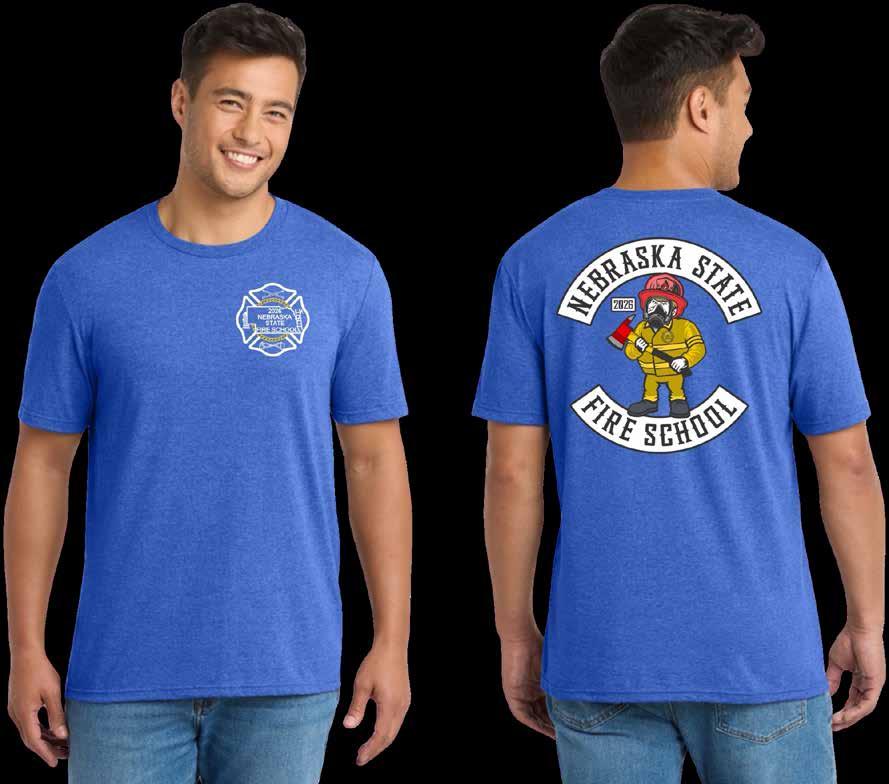
T-shirts are pre-order only and will be available for pick up onsite at Fire School
NSVFA MEMBER FEE: NON-MEMBER FEE:
LEGAL ISSUES CLASS:
(Saturday, May 16th, 1:00-3:00 pm) $55 00 $
METHOD OF PAYMENT:
(Payable to NSVFA Fire School)
Department Check
Personal Check
Check Number
Date Received
Firefighters contain Old 83 Fire, respond to fires near North Platte and McCook
Firefighters were called to three fires south of North Platte, and one fire near McCook this weekend, according to Watchduty.org.
The Old 83 Fire was reported at 3:37 a.m. on Sunday as a vegetation fire. The fire was seen moving southwest and additional mutual aid was requested, at this time the fire was renamed to the “Old 83 Fire.” As of 4:31 a.m., the fire has since been contained, however high
winds in the area remain an issue.
The Maywood Fire was reported on Saturday by the National Interagency Fire Center at 12:20 p.m. It’s affected .1 acres. Meanwhile, firefighters were called to a vegetation fire west of Harry Strunk Lake at 1:58 p.m. As of 5:50 p.m., firefighters were clearing the scene.
While this was going on, the Cottonwood Fire continues near Gothenburg. According to Moun-
tain Complex Incident Team 1, the extreme weather from this afternoon contributed to significant fire behavior within pockets of unburned fuel on the Fire. The conditions led to the ignition and loss of three unoccupied responder vehicles, but no injuries were reported.
An investigation into the incident is underway. No further details are available at this time. This fire has burned 128,036 acres and is cur-
rently 94 percent contained.
Firefighters were also called to a vegetation fire at 6:26 p.m. south of McCook near the 71100 block of Highway 83. According to the Red Willow County Sheriff’s O[ce, fire crews are still monitoring the fire as of 9 p.m.
Red Willow Western Rural, Culbertson Fire, Beaver Valley Fire, McCook Fire and Rescue and Indianola in Decatur County, Kan., as
well as several farmers with tractors and disks all battled the blaze at the front edge of he fire hot spots and appear to have the fire maintained. The Department of Roads and Sheriff’s Department were also helping vehicles navigate through the smoke. One firefighter was treated for heat exhaustion, but no other injuries have been reported.
(KSNB-TV NBC 4 Hastings, March 23, 2026)
Nebraska lawmakers halt bill shifting burden of proof for firefighters’ job-related cancers
Former Waverly fire chief Jared Rains, battling prostate cancer, says the vote was a blow for those who “answer the call”
By DARSHA DODGE , KSNB, Hastings
With the fires in western Nebraska over the past few weeks, much attention has been placed on the role of firefighters — both paid and volunteer.
But a bill to change how they obtain compensation for job-related cancers stalled in the state’s Unicameral on Monday.
“Those fires are a vivid, painful reminder of what we are actually talking about when we debate this legislation,” said Fremont Sen. Dave Wordekemper, who introduced the legislation. “The men and women who answer the call, no matter the scope of the emergency.”
Nebraska’s 49 state senators spent three hours Monday morning debating LB 400, which would have changed the burden of proof for workers’ compensation when a
firefighter gets cancer — presuming any cancer they’re diagnosed with is work-related until proven otherwise.
It wouldn’t have changed any eligibility for those firefighters, but would have moved the burden of proof to the employer.
“Right now, a firefighter notifies their employer that they have cancer and has to prove it on their own, while sick, while fighting for their life, that the cancer came from the job,” Wordekemper said. “Right now, the deck is stacked against them.”
He faced stiff opposition in the chamber.
Back in January, North Platte Sen. Mike Jacobson called LB 400 the “Mother of All Unfunded Mandates.”
Jacobson filed multiple amendments on Monday, and spent much of his time on the microphone criticizing his colleagues for not
Classifieds Classifieds
CLASSIFIED ADS FOR THE NEBRASKA FIREFIGHTER NEWSPAPER
Classified ads run $10 for the first 10 words, and 25 cents a word after that. A photo is $10 additional. Rates are the same in each state (Iowa, Minnesota, South Dakota, Nebraska and Kansas). Email the ad to jeff@nebraskafirefighter.com to place your personal or departmental ads.
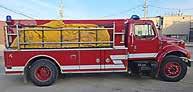
FOR SALE: 1999 International 4900, diesel engine, Allison automatic transmission, 2100-gallon poly tank, 18,300-miles, 1561-hours, 2500-gallon porta-tank, good tires, double low side compartments, 250-gpm pump, with electric start and emergency warning package. This unit is priced at $69,950. Please call 269-760-5269.
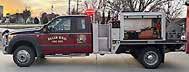
FOR SALE: 2013 F550 6.7 diesel, extended cab, Brush Truck, 6,075 miles, 400-gallon tank, new Hale (gas) pump installed in March of 2025 and whip lines, passenger side scene light mount replaced. Asking $150,000 OBO. Call Jared with Hallam Fire at 402-580-1071 or email hallamfire@gmail.com for more information.
considering the impact to taxpayer-funded volunteer departments.
“We can talk all we want about caring about the property taxpayer, caring about driving property taxes down, being opposed to unfunded mandates, but here we are,” Jacobson said.
For firefighters like Jared Rains, a firefighter and EMT with Waverly who previously served as chief, the failure of LB 400 to advance is a huge blow to those who put their lives on the line to answer the call.
“When a call comes out, it’s the last thing I think about. I don’t think about, am I going to go to this call and I’m going to get cancer? No. Guess what? I’m going to go to this call because somebody called 911 and they need help.”
Rains is still battling prostate cancer. LB 400 would have helped cover the cost of his treatment.
“I did testing, genetic testing, nothing in there that says I should add prostate cancer. It doesn’t run in my family,” Rains told 10/11 on Monday afternoon. “The one thing is I’ve been around firefighting for most of my life. So is it because of firefighting? I don’t know.”
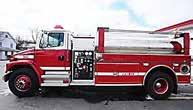
FOR SALE: 2000 Pierce/Freightliner FL80 with 20,800 miles, powered by a Cummins 8.3L turbo diesel engine paired with an Allison automatic transmission. It is equipped with a Waterous 250-gpm pump-and-roll system, a 2,000-gallon stainless steel tank, rear and side dump valves, a porta-tank rack, hard suction storage, hose bed, and multiple compartments for equipment. The truck also features air horns and a full emergency warning package. $73,950. If you have any questions, please feel free to contact me at 269-760-5269
But Wordekemper’s bill faced stiff opposition from colleagues who said it’s too big an unknown for Nebraska taxpayers.
“I don’t know how in good conscience you can go home and look at your taxpayer constituents in the eye and say, ‘I’m looking out for you in the Legislature,’ because you aren’t,” Jacobson said.
Brenda Jenny, president of the Nebraska State Volunteer Firefighters Association, told 10/11 over the phone that fires don’t discriminate between paid and volunteer departments.
Linwood Fire Chief Joel Cerny, who is also the National Volunteer Fire Council representative to the NSVFA, said typical structure fire of involves the high-temperature destruction of many types of plastics and foams, along with various woods, fabrics and other materials.
All of those are potentially cancer-causing materials that release toxins like formaldehyde, benzene and sulfur dioxide, he said, adding firefighters now are more aware and working better to protect themselves.
“Ten- to 15-years ago, most firefighters didn’t have any idea that we were being exposed to so many cancer-causing chemicals.
Even the gear that we wear contain per- and polyfluoroalkyl
substances (PFAS) and the AFFF foam that we used heavily in the past,” Cerny said. “AFFF exposure is most strongly linked to kidney and testicular cancers, though studies also connect it to thyroid, liver, bladder, prostate, colorectal cancers, mesothelioma and leukemia through toxic PFAS ‘forever chemicals.’”
Rains said it was a “gut-punch” the volunteers were being cut out of it.
The amendment to remove volunteers, FA 921, was introduced by Whitman Sen. Tanya Storer this January.
Jenny said that seems to happen a lot when the Unicameral is dealing with firefighter-related bills, because so many in Nebraska are unpaid volunteers.
“These men and women are out there busting their butts every day and for nothing, just for the love of doing it and wanting to help in their communities,” Rains said. “So it’d be great to see the government back us.”
LB 400 was a single vote short of ending the filibuster and is considered dead this session.
Wordekemper said he’s not sure if he’ll bring the bill back next year, adding, “Let’s get through this one first.”
Medical Services program offerings:
• Company Officer/Instructor
• EMT and paramedic courses
• Courses from the National Association of EMT (PHTLS, AMLS)
• Rapid Extraction Module Support (Wildland RIT)
• Rope Rescue and Repelling Awareness/Operations/ Technician
• Tactical EMS courses
• Confined Space Rescue/Trench/Grain Bin Rescue
• Certified Emergency Vehicle Operations (CEVO)
• Courses from the American Heart Association (BLS, ACLS, PALS)
• Annual Weekend Fire School, continuing education opportunities
Speccing Apparatus for Technical Rescue Success
Aerial rope system components to consider when ordering a new ladder truck
By CAPTAIN PATRICK O’BRIEN
Aerial apparatus have come along way over the years with regard to their capabilities such as weight capacities, tip loads, turning radius, etc. Another aspect that has evolved are parts and specialized components specific to a rescue evolution that are deemed technical rescue in nature. One of these evolutions is commonly called an aerial stokes or aerial pick-off. This evolution requires rope suspended by the aerial itself in some fashion that allows for a victim and/or rescuer to access and extricate from places otherwise difficult or impossible by means of traditional ground operations. This type of evolution has been somewhat controversial depending on what part of the country, department, or culture you belong to. I have found that there appears to be two schools of thought on this.
One, it is inherently too risky as the apparatus was manufactured with relatively low tip load capacities (250-500lb) and any rope systems introduced to the aerial can increase the risk of exceeding those tip loads.
BUILT TO ENDURE
Maximum durability means maximum readiness. MacQueen delivers comprehensive fire apparatus solutions backed by expert service and support.
Two, departments have ordered apparatus with tip loads that can support an increased load which lends itself to the idea of suspending a victim and rescuer without exceeding the tip load.
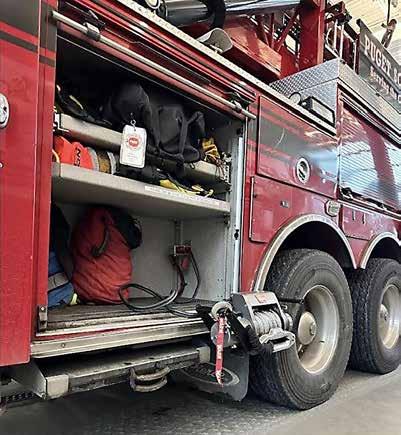
I have found that if option two has been identified, aerial rope system ideas often start to develop as members start to look for ways to use the aerial for specific evolutions to overcome those “what if” call types. We call this being visited by the “good idea fairy” which has been known to produce some very suspect rigging to overcome a lack of specific equipment that could’ve been specified in the aerial build.
Many manufacturers will listen to your requests throughout the speccing process and point you in the direction of equipment and engineering that has been done previously by other departments. This is a good thing to listen to, as many departments have asked for specific equipment for very specific rope rescue evolutions. If the manufacturer is offering and recommending these add-ons, then chances are they have been vetted by their engineers and they work!
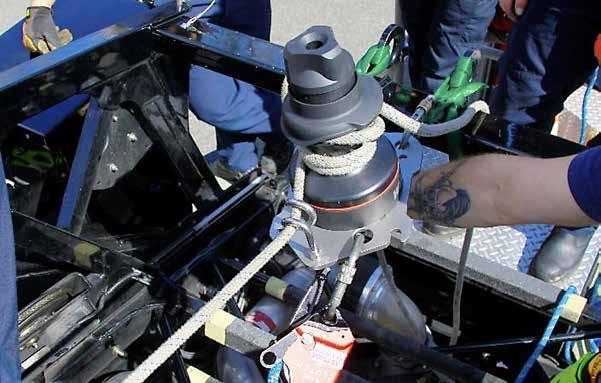
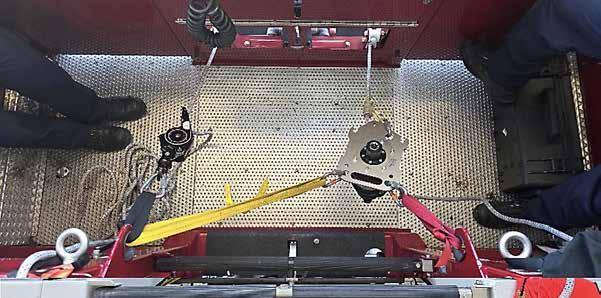
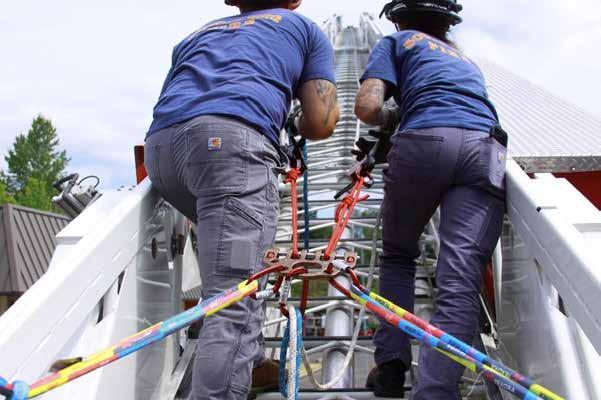
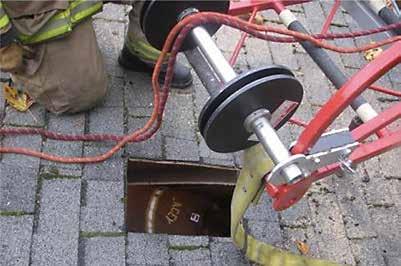
One example of a specialized piece of equipment, is a rope anchor crossmember made by some apparatus manufacturers for their straight frames and tiller aerials, it is removable and is specifically designed for anchoring rope systems on top of the turntable. (Fig 1) This system demands that rope be used
on top of the ladder vs underneath which produces less tip load influence keeping the operation safer. The other piece of equipment that is almost a necessity if using this crossmember is a manufacturer supplied tip roller. (Fig 2) This pulley reduces friction and has a large DD ratio (Pulley, sheave ratios (Pitch Diameter of Sheave / Diameter of Rope) determining bending stress, fatigue life, and efficiency, with higher ratios (e.g. 18:1) to (40:1) reducing premature rope failure. ASME standards often require minimums (e.g., (15:1) to (18:1) for cranes, while smaller ratios increase bending fatigue and reduce lifespan. This along with introducing a force multiplier at the tip is typically why we don’t recommend rigging your own anchor and small 1.5” to 2’’ pulleys for changes of direction. These manufacturers supplied items are the “go to” way of securing proficiency and safety for a rope-based system on your aerial and MUST be specified at premanufacturing meetings. Most manufacturers will not approve or satisfy any retro work after the apparatus has been delivered.
There are ways to safely overcome these oversights if you are working off an older aerial with a tip load that your department deems safe for rope based aerial operations. Depending on the manufacturer, a tip roller type of apparatus or similar may be a bolt-on option, but you will be hard pressed to get approval for a welder to come out to create the brackets needed to hold an anchor crossmember. Creative rigging will be needed to supply a safe and efficient anchor system that does not put the apparatus or any of its components at risk. For many years departments have rigged this system off of the last rung of the bed section stating that the manufacturer has “rated” the rung at 500 lbs. This may be true, but it introduces many issues such as rope running over the aggressive anti-skid footing material applied to most aerial rungs. Recent adaptations have moved this system up to the handrails to eliminate this problem which intern has raised another. Are the handrails rated? The straightforward answer is no. However, after doing some load calculations with regard to applied force seen at the anchors given a two person NFPA Rescue Load of 600 lbs, some deem it acceptable and safe. (Fig 3) However you will probably never get a “rating” on the handrails that gives you the green light for rope rescue rigging. The ability to rig ropes over
the aerial rungs and move away from the traditional paradigm of under the rungs using the aerial as a high point change of direction has made rope rescue utilizing the aerial apparatus safer with regard to tip load deviation and overload.
Another unique aerial based rope system modification is gaining popularity with the Tower Ladder community. Again, it is based on the premise of “rope over rungs” reducing any force multiplier applied during an artificial high directional operation (rigging pulleys to the bottom of the platform and running ropes through as a change of direction). Typically these apparatus have a higher tip load rating (1000lbs) and may be able to safely pull off this style of rope rescue, however by anchoring back to the apparatus itself or to the ground, the introduction of the force multiplier takes effect solely based on the interior angle of the the rope running through the change of direction (i.e the interior angle is acute at 45°, the tip load deviation force equals 185%) this means that the platform is seeing 185lbs given a 100lb load. Or in real life, a 500lb load of an attendant and victim with stokes basket and gear will equal 925lbs, almost maxing out the rated capacity of the platform. To eliminate this, anchor becketts were specced to the rear of the platform and guide pulleys on the tip of the bucket. The team can now rig all rope systems from within the platform, reducing any chance of a force multiplier as well as allowing 360° of bearing angle or lateral movement without being limited by the rope anchored to the chassis or ground. (Fig 4) Other rescue centric prebuilt equipment and accessories should be considered in your apparatus specification based on your demographic. A couple of these accessories, receiver hitches and tow eyelets, can fulfill the need for anchors systems and winch applications. Pre-specced receivers can be called out for almost every side of the apparatus and welded at the factory with an associated rating, typically 9,000 lbs. Now, they still won’t give you an NFPA rating, however the AHJ (authority having jurisdiction) may deem it acceptable within their SOGs to use the receiver with a rope anchor style insert. Another option is to add the use of a 12 Volt Winch mounted to a hitch or commercially made hitch mount. The hitch mount with winch can stay coupled and easily removed and stored in a compartment. A very simple and economical addition if you are using this style of mounting is to have a receptacle hard wired into a place that is easily accessed by the 12 V lead from the winch. Anderson Powerpole Connectors are typical heavy duty quick link style attachments for power and can easily be mounted in a compartment out of the elements. (Fig 5) Whether on a ladder, engine or heavy rescue, taking the time to research and investigate pre-installed components that are conducive to future rescue accessories may pay dividends down the road for quick and proficient rescue systems.
These components have changed some rescue evolution designs and simplified the number of components needed as well as their set up times. All this leads to quicker evolution times, safer operations and unique standard operating procedures. Yes, these custom options will cost more at the factory, however in the grand scheme of cost per apparatus, they are a small price to pay for quicker, more efficient customer service.
AUTHOUR BIO
Patrick O’Brien, Captain, is a 24year fire service veteran and training officer with Puget Sound Fire and the South King County Fire Training Consortium overseeing ladder truck operations and technical rescue. He is an instructor with Rescue 3 International, member of the International Society of Fire Service Instructors, former Rescue Specialist with WATF1 US&R, and co-founder of the training group KD Rescue. Patrick recently co-developed and launched the online databases and associated websites www.technicalrescuesurvey.com and www. waterrescuesurvey.com both free online reporting databases designed to help find trends in technical rescue incidents. O’Brien also developed and authored the South King County’s aerial opera-
tor program and Aerial Dynamics user manual and has been at the forefront of training prop development. With a background in small business development, technical drawing, illustration, and fabrication, O’Brien helped co-invent the SVT (Submerged Vehicle Trainer) a vehicle-in-water simulator for Swiftwater Rescue and Rescue Swimmer Operations.
Training burns held in Hebron
Hebron Fire Department conducted some training burns in mid-April.
Please send them to jeff@nebraskafirefighter.com along with information to explain the photo.
Suspicious Blaze Raises Alarm In Sherman Co.
Article Courtesy of Sherman County Sheriff's Office, ETHAN MCCORMICK
Authorities are investigating a grass fire in Sherman County that is being classified as suspicious after crews were unable to determine an ignition source.
The fire was reported Wednesday east of WPA Road and south
of 787 Road, where it is believed to have started in a roadside ditch. According to officials, no clear cause could be identified, raising concerns due to its proximity to several other suspicious fires reported in the same area over the past two years. The incident also mirrors a similar unreported fire last fall that ultimately burned itself out.
Investigators are currently following up on leads involving individuals seen in the area around the time of the fire. The Nebraska State Fire Marshal's Office, which has assisted with previous incidents in the area, has been notified and is aiding in the investigation.
At nearly the same time, a second grass fire was reported west of Loup City, approximately five
miles from the community and two miles south of Highway 92. That fire is believed to have been accidental, originating near the edge of the highway shortly before 4 p.m.
The Loup City Volunteer Fire Department requested mutual aid from several surrounding departments, including Hazard, Litchfield, Arcadia, Mason City, Ans-
ley, and Ravenna, as crews worked to contain the blaze. The Sherman County Sheriff's Office reported that both pastureland and a cornfield were impacted.
Local farmers and businesses also played a critical role in the response, assisting with discs to create firebreaks and water tankers to support suppression efforts.
Built on the proven “wireframe” SCBA backframe and pneumatics platform, the 3M™ Scott™ Air-Pak™ XD SCBA focuses on today’s firefighter who requires an extreme duty SCBA, while maintaining cleanability, comfort, and connectivity.
Integrated Drag Rescue Loop provides a horizontal pull strength of 1,000 lbs. to assist with rescuing a downed firefighter.
Low-profile SCBA designed to help minimize snag points when working in tight spaces.
Redundant Safety Features including the dualredundant pressure reducer are designed to help the SCBA perform, while also providing firefighters peace of mind.
“Buddy” Lights help enable a 360° view of the firefighter’s air pressure and PASS status.
Authorities reminded the public to avoid active fire scenes and yield to emergency responders traveling to incidents, regardless of roadway position.
By Thursday morning, officials confirmed the fire had been contained due to a rapid and coordinated response from firefighters and volunteers. The Loup City Fire Department extended thanks to Trotters, Top Line Ag, West Fork Ranch, Jim Obermiller Farms, and additional community members who assisted in bringing the fire under control.
(Ord Quiz, Ord, NE, March 25, 2026)
Kearney breaks ground on new Fire Station #3
City leaders and firefighters broke ground on a new fire station Monday aimed at improving emergency response as Kearney continues to expand. Fire Station #3 will serve the rapidly growing areas of North and East Kearney, where new residential neighborhoods and industrial development have increased demand for emergency services.
City officials say the station is designed with the future in mind, including updated safety features, dedicated training space for firefighters and improved operational efficiency.
“Seconds matter in public safety, and this station is going to make sure we’re keeping people safe and keeping structures safe as the city continues to grow,” said Kearney Mayor Jonathan Nikkila. The facility will also include a small fire service museum made possible through a donation from the Ron and Pam Blessing family. The museum will showcase historic firefighting artifacts, including one of Kearney’s oldest motorized fire trucks.
Fire officials say the new station will help crews respond more quickly to emergencies in an area of the city that has seen significant growth in recent years.
(News Channel Nebraska, April 7, 2026)
Holdrege completes stabilization training
Wood River conducts practice burn
Wood River Fire & Rescue spent part of Sunday, April 19, sharpening the skills firefighters rely on when real calls come in, inside a burning structure. The department said crews conducted a practice burn, giving firefighters a chance to work in live-fire conditions. Two newer firefighters also got their first experience battling fire from inside a burning building, according to the department. Fire officials say training like this is critical because some parts of interior firefighting can’t be fully replicated in a classroom or controlled simulation. Live-fire training allows crews to practice decision-making, communications, and safety procedures under realistic heat, smoke and visibility conditions. Interior firefighting is one of the most dangerous jobs first responders do. Departments regularly train to reduce risk and ensure crews are ready for fast-changing conditions when lives and property are on the line.
“We
Do It for Each Other”
Posted on March 31 on the Gering Fire Department Facebook page. 16 total days assisting other fire departments and trying our best to minimize the impact fire has on our ranchers, farmers and amazing Nebraskans. It’s brutal. 24-38 hours of no sleep. Eating smoke. Singeing hairs. Cold temperatures. Feeling extreme heat. Hiking up and down hills plugging 600foot hose lays all day long. We do it for each other. Spending time with fellow firefighters is unexplainable, other than we stand side by side, knowing that eventually the fire will go out. We thank every firefighter that’s been on the line and supporting the cause for the past month. We are especially proud of our Gering firefighters that worked as hard as they could. And we hope for a quick recovery to those Nebraskans that were impacted by some of the most extreme fire behavior we have seen.
No injuries after semi full of gummy bears catches fire along I-80 near Lincoln County
The Lincoln County Sheriff’s Office said in a Facebook post that on April 7, 2026, at about 3:55 a.m., deputies responded to a report of a semi on fire near mile marker 166 on Interstate 80.
When deputies arrived, the semi trailer was fully engulfed in flames, and the driver was successful in removing the truck before the fire got out of control. The post said the semi was loaded with gummy bears and posed no hazmat danger. Hershey and Sutherland Volunteer Fire Departments responded and stopped the spreading grass fire, as well as extinguished the trailer.
(KNOP-TV NBC 2, North Platte, NE, April 9, 2026)
Loomis assists at Bertrand fire
After a long Saturday afternoon, March 28, assisting Elm Creek with a grass fire, Loomis Volunteer Fire and Rescue responded to assist Bertrand just before 1 a.m. They sent one type 6 engine and one tanker to Elm Creek. Two type 6 engines and the tanker responded to Bertrand. Loomis crews currently remain on the Bertrand fires. From the Loomis Volunteer Fire and Rescue Facebook page.
Blair training
At training on March 19, Blair Fire Department focused on rural water supply operations, including drafting, along with truck operations and hand line deployment. These skills are critical to protecting our community—especially in areas without hydrants—and we’re proud of the continued dedication our team shows in sharpening their abilities. From the Blair Volunteer Fire and Rescue Facebook page.
Kearney house fire
On March 18, at 2:35 p.m., the Kearney Volunteer Fire Department was dispatched to 2003 West 34th Street for the report of a structure fire. Buffalo County Dispatch advised that the structure was fully engulfed and all occupants had evacuated safely. Upon arrival, heavy fire conditions were reported in the garage of the home. KVFD crews initiated fire attack and primary search operations. The fire was brought under control at 3:33 p.m. The home sustained substantial fire damage to the attached garage and the interior of the home sustained smoke damage. The Nebraska State Fire Marshal was requested to assist with the origin and cause investigation. The cause of the fire is still under investigation. Other agencies who assisted at the scene were the Kearney Police Department, CHI Health Good Samaritan Emergency Medical Services, NPPD, and Northwestern Energy. Photo by Brian Neben.
Small fire quickly stopped on edge of Chadron
A focused response from the Chadron Volunteer Fire Department kept a small field fire from taking off late Wednesday afternoon.
The Marlboro Fire was reported around 5:30 from the west edge of town just past the cemetery. Chadron Fire checked out three brush trucks as well as two water tenders. The fire burned in a small field just off the south edge of Highway 20.
The fire department, with assistance from other agencies, were able to quickly stop the spread of the fire and all units were cleared from the scene within an hour. A lane of traffic on Highway 20 was temporarily shut down by local law enforcement during the initial attack to ensure first responder safety.
(By Jared Fernau, KCSR 10, KBPY 107.7, Chadron, NE, March 26, 2026)