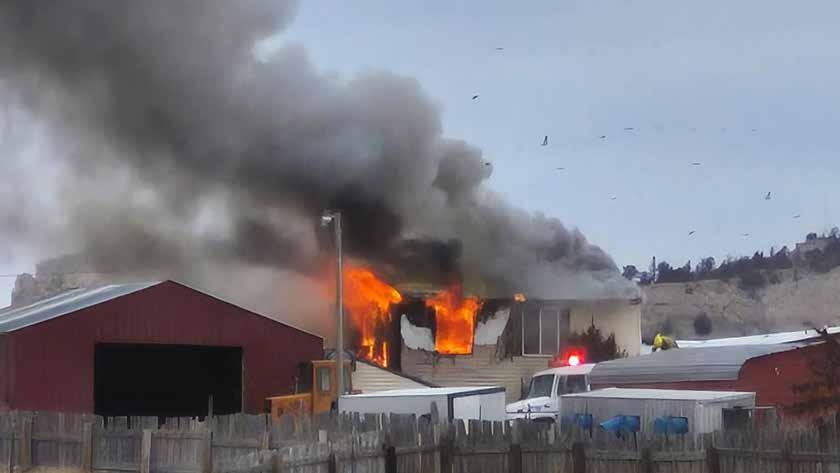
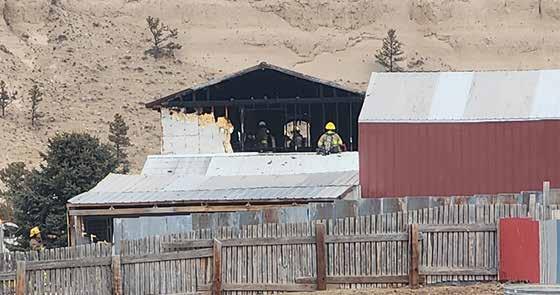
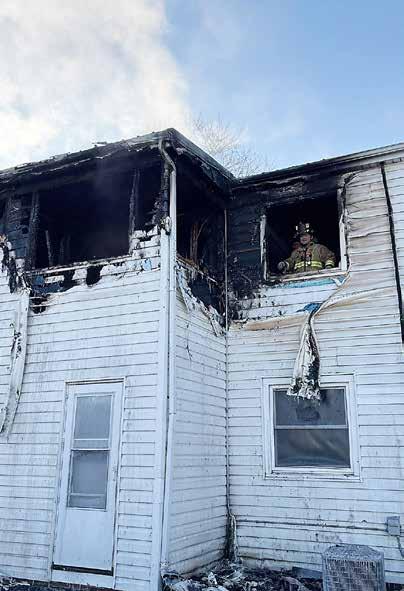
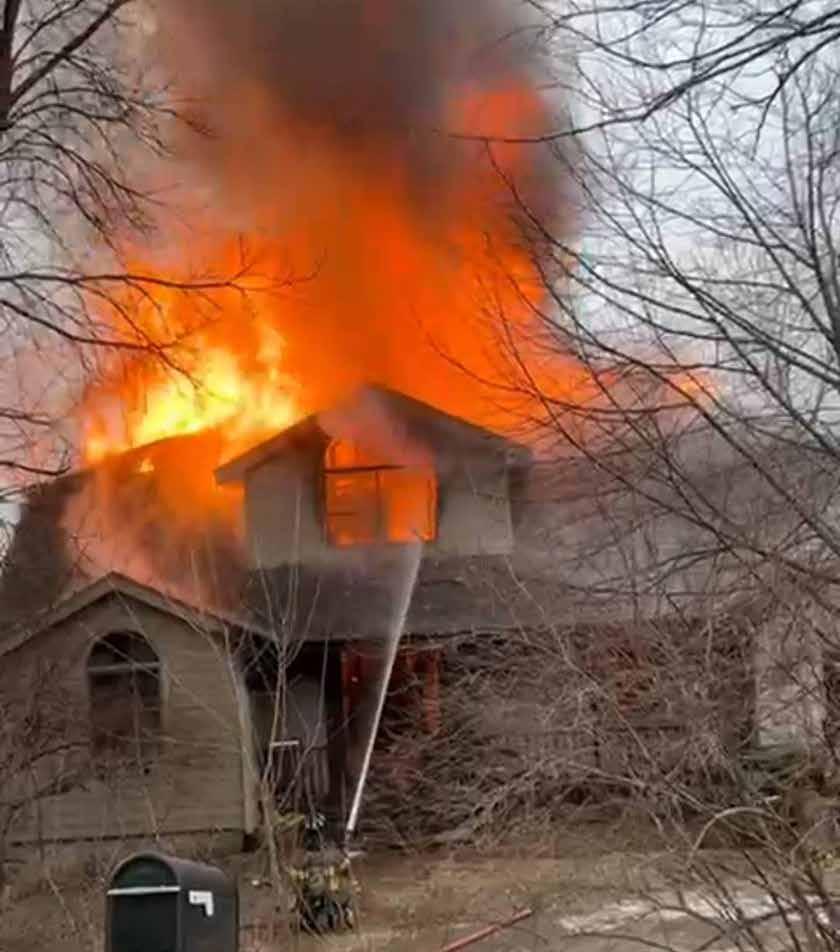
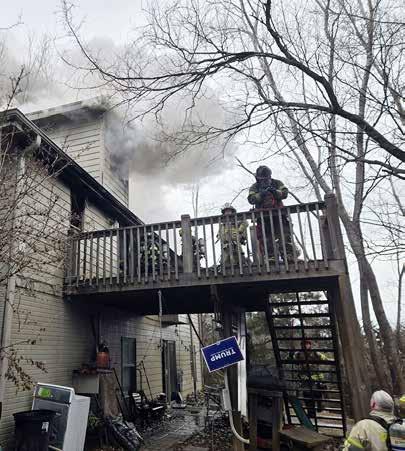
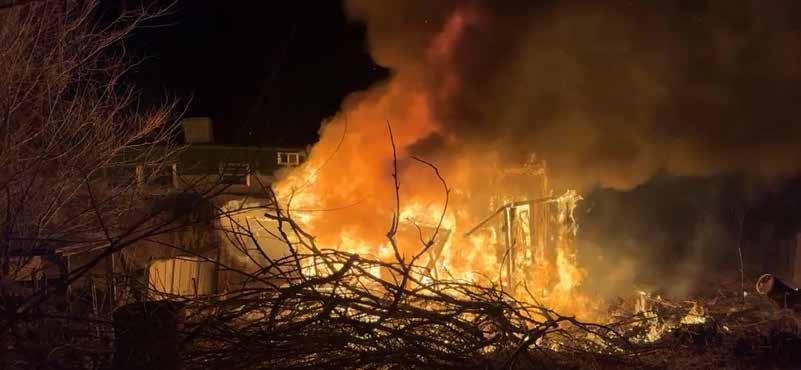
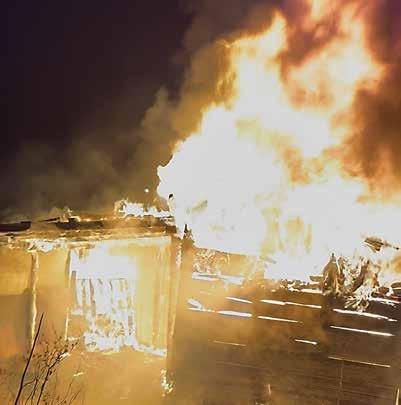
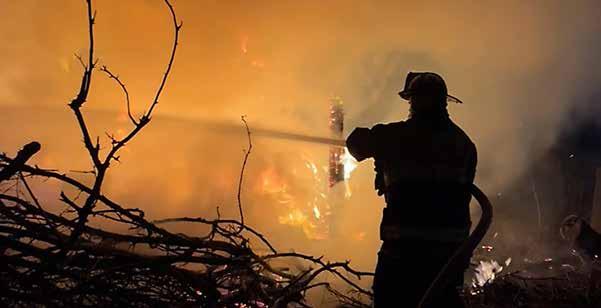
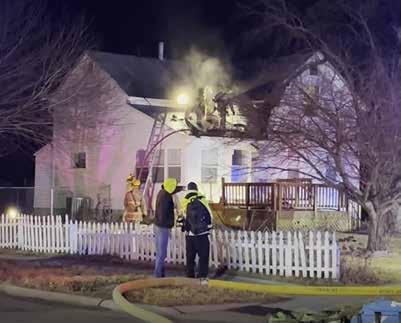
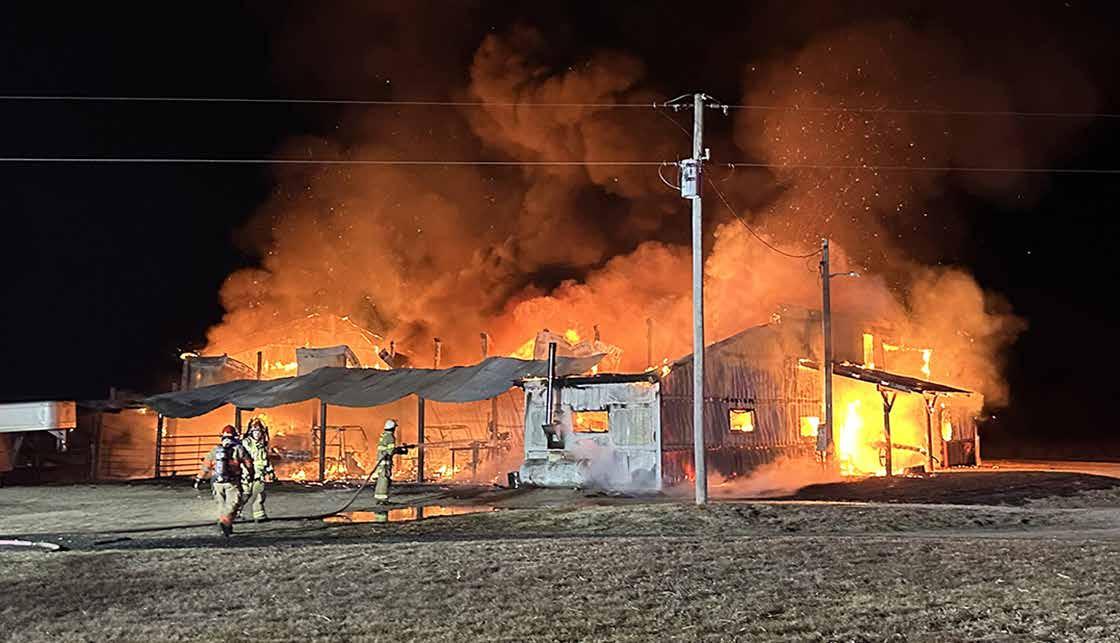
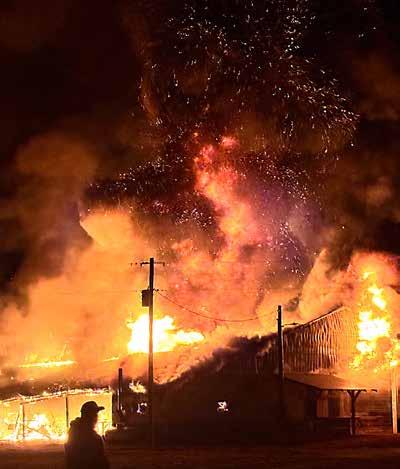
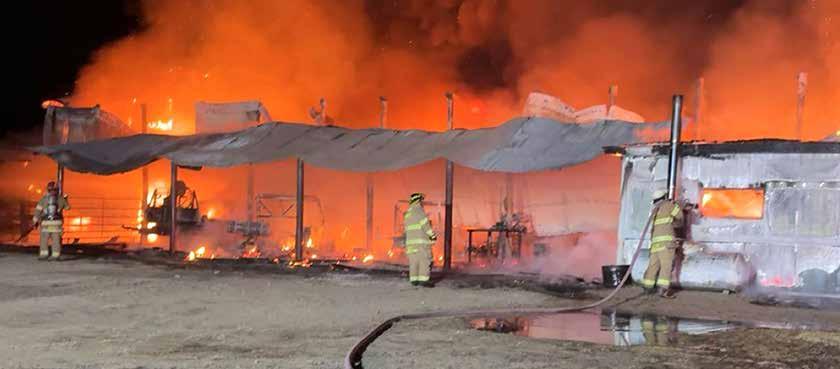
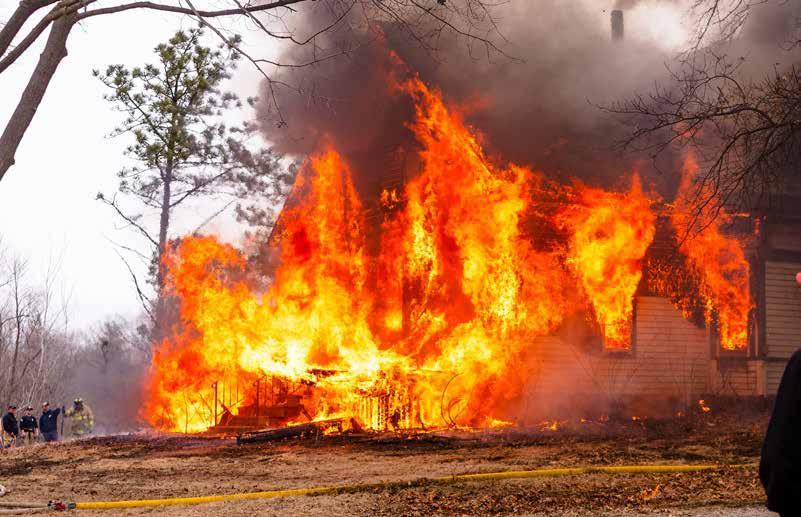
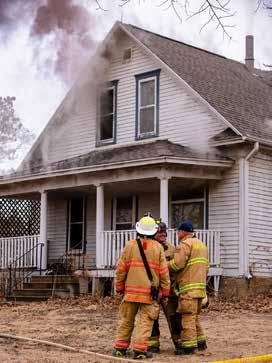
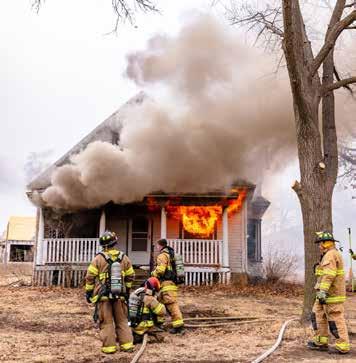
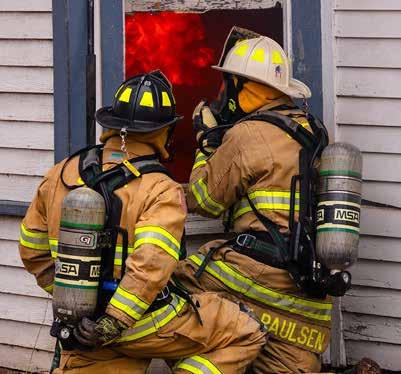
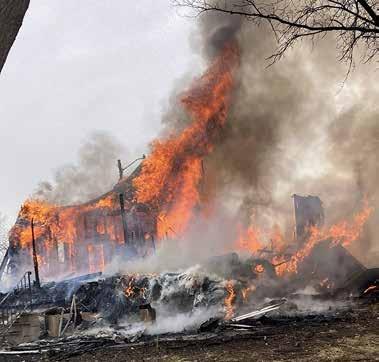
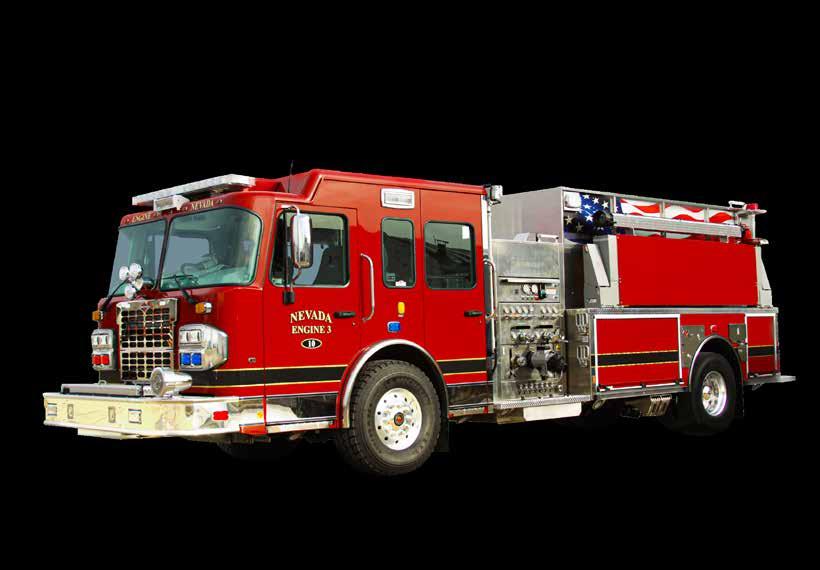
Authorities say an apartment addition to a Rural Banner County home was destroyed but there were no injuries in a structure fire Wednesday afternoon, Jan. 28. Banner County Fire Chief Tim Grubbs says his department was called to the scene along Highway 88 about a mile and a half west of Highway 71 around 1:30 p.m. Grubbs says with a column of smoke visible from a distance, mutual aid was immediately requested from the Gering Volunteer, Scottsbluff Rural and LaGrange fire departments. Occupants and all pets were outside the residence when firefighters began their exterior attack, and Grubbs said there was a significant amount of water applied to the second floor, the blaze was under control in about 20 minutes. The second story was consumed, and the lower level suffered extensive smoke, fire and water damage. Grubbs said because the construction of the addition included it’s own exterior wall and was not tied in structurally to the main house, it was possible the original home could be occupied in short order. The fire was investigated by the Nebraska State Fire Marshal and was determined the cause to be electrical in nature. The main structure was saved but the apartment addition was a total loss. Additional response included the Banner County Sheriff’s office with two units for traffic control, as well as a Wyrulec crew. Firefighter Ministry is working on assisting the individuals impacted.
Fire reported north of Minatare
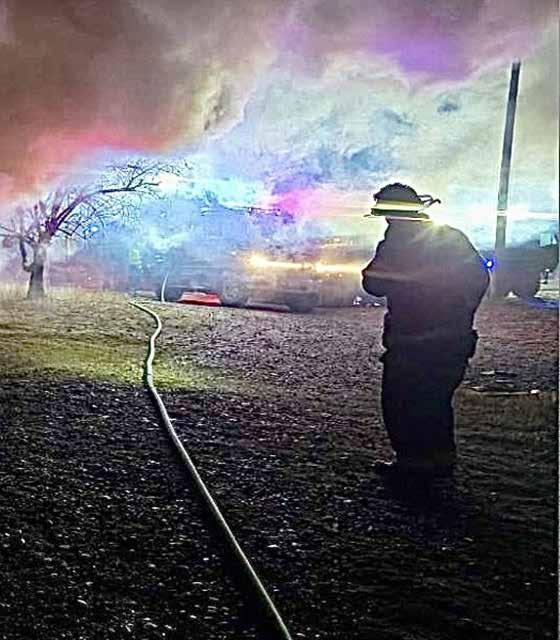
Minatare/ Melbeta Fire Department was on scene at a structure fire on County Road 29 north of Minatare just after 3 a.m. on Jan. 20. Mutual aid was provided by Gering Fire Department and Scottsbluff Rural Fire Department. State Fire Marshal was called in to investigate the cause. Fire was extinguished and Minatare units cleared around 5 a.m. Photo credit to Nicole Smith.
Fire Prevention Nebraska Style Fire Prevention Nebraska Style
NSVFA Fire Prevention Awards — Applications
Due March 26th
By RHONDA CERNY
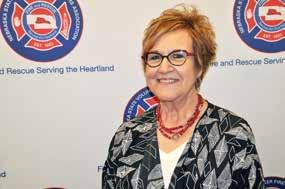
The Nebraska State Volunteer Firefighters Association (NSVFA) Fire Prevention Committee is now accepting applications for the annual Fire Prevention Awards, recognizing outstanding efforts in fire prevention across the state.
Awards will be presented in four categories: Fire Prevention Recognition for Departments, the Smokey PAW Award, the Fire Prevention Co-op Award, and the Dave Heywood Outstanding Fire Prevention Leadership Award. These honors highlight departments and individuals who demonstrate exceptional commitment to reducing fire risk and promoting public safety through education and outreach.
Fire prevention programs play a
Crews respond to Crete apartment fire
On the morning of January 25 at around 6:30 a.m., Crete Fire was dispatched to 204 E 11th Street for a report of a working structure fire in an apartment complex near Crete Elementary. Crete Fire responded with Engine 31, Ladder 51, Squad 13, and Squad 12. Wilber Fire & Rescue and Dorchester Volunteer Fire Department were also on scene per mutual aid request for man power. Fire consumed much of the second floor and was caused by smoking. Apartment residents were able to evacuate the structure safely. One resident sustained minor injuries during the evacuation but was evaluated and released on scene. Despite below freezing temperatures, fire was extinguished before spreading into other parts of the structure. Valiant effort by the volunteers from Crete Fire, Wilber Fire and Dorchester Fire. All Crete units remained on scene for 5-6 hours for additional mop up and further evaluations before returning to service. From the Crete Fire Department Facebook page.
Action Fire Photos Needed!
Please send them to jeff@nebraskafirefighter.com along with information to explain the photo.
critical role in protecting Nebraska communities year-round. From school presentations and public demonstrations to innovative safety campaigns, many departments dedicate countless hours to keeping citizens safe. The NSVFA encourages all eligible departments and individuals to share their successes by submitting an application.
Applications are available on the NSVFA website at nsvfa.org.
All completed applications must be postmarked no later than March 26, 2026.
Applications should be mailed to: NSVFAFire Prevention Committee
Attn: Rhonda Cerny, Chairperson 1618 Denver Street Schuyler, NE 68661
Recognition through these awards not only honors those involved but also promotes the importance of fire prevention efforts statewide.
Rhonda Cerny, NSVFA Fire Prevention
“These honors highlight departments and individuals who demonstrate exceptional commitment to reducing fire risk and promoting public safety through education and outreach.”
Smokey sez Smokey Sez
By BOB HECKMAN
This month’s article is dedicated to the memory of Jerry Smith Kearney VFD 5/18/2023, gone but not forgotten. This month we will chat about exhaust fans. Some homes have them in the bathroom and laundry room or kitchen. Exhaust fans can cause fires when neglected. While writing this article I checked ours in the bathroom. I could not believe the amount of
dog hair in ours. It’s hard to believe our puppers are not bald. When not cleaned annually lint and dust can build up causing the motor to overheat after running for extended time. You can google your type on the web and follow the manufacturer’s recommendation. If you hear a strange noise or sound coming from your exhaust fan it may be time to replace it.... fireman bob.
Multiple departments respond to fully involved Fort Calhoun house fire
Fort Calhoun Fire Department firefighters responded to a house fire on Mad Hatter Lane on Jan. 20. Firefighters found a large amount of fire throughout the structure upon arrival. An interior fire attack was attempted but crews exited the structure due to the deteriorating conditions inside the home. All occupants were able to get out prior to arrival. Mutual aid was received from Kennard Fire Rescue, Bennington Fire & Rescue, Irvington Volunteer Fire Department, Blair Volunteer Fire & Rescue, Ponca Hills Volunteer Fire Department, Herman Fire and Rescue and Waterloo Fire and Rescue.
FYR-TEK has been ser ving the fire and rescue community since 1986. Our ser vice technicians are exper ts in their trade and maintain NFPA standards to ensure that your critical fire and rescue equipment is always prepared to answer the call.
FYR-TEK is here for you when you need it most, call (800) 473-8903
Bayard VFD called to structure fire
At about 2140 on January 30 Bayard Volunteer Fire Department was paged for a structure fire on 1st Avenue. They arrived and found an approximately 15’x15’ shop fully involved. Crews cleared just before 2330. Submitted by Andrew Lawson.
Upcoming Events Upcoming Events
Email your Upcoming Event by the 10th of the previous month (ex. Aug. 10 for the September issue) to jeff@nebraskafirefighter.com . There is no charge.
MARCH 13, 2026: Platte Center Fire Department Fish Fry (all you can eat), 5-8 p.m., Platte Center Fire Station. Adults $15, kids 5-12 $5, kids four and under free.
MARCH 13-15, 2026: NEMSA Super Conference, Younes Conference Center, Kearney, NE.
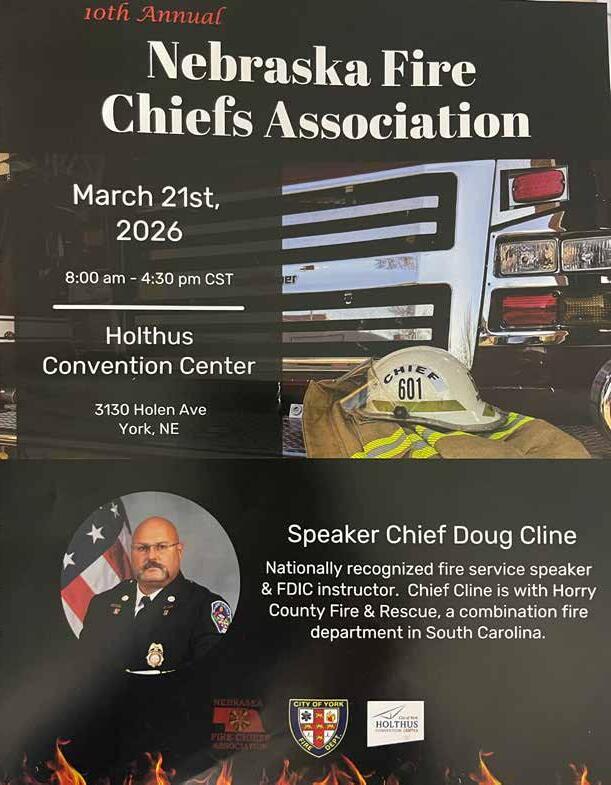
MAR. 21, 2026: 10th Annual Nebraska Fire Chiefs Association, 8 a.m.-4:30 p.m., Holthus Convention Center, 3130 Holen Ave., York, NE. Speaker will be Chief Doug Cline.
MARCH 27, 2026: Platte Center Fire Department Fish Fry (all you can eat), 5-8 p.m., Platte Center Fire Station. Adults $15, kids 5-12 $5, kids four and under free.
APR. 9, 2026: Scotts Bluff County Mutual Aid Association Meeting, Alliance.
MAY 15-17, 2026: 2026 Nebraska Fire School, Grand Island, NE.
JULY 9, 2026: Scotts Bluff County Mutual Aid Association Meeting, Banner County.
SEPT. 20, 2026: NSVFA Memorial Service, Nebraska Firefighters Museum and Education Center, Kearney, at 2 p.m.
OCT. 8, 2026: Scotts Bluff County Mutual Aid Association Meeting, Bayard.
OCT. 15-17, 2026: NSVFA Annual Conference, hosted by Dakota City Fire Department in South Sioux City.
OCT. 14-16, 2027: NSVFA Annual Conference, hosted by Battle Creek Volunteer Fire and Rescue in Norfolk.
Directory
President
BRENDA JENNY 1767 Colfax Street, Blair, NE 68008 402.639.9647 bgolf2560@yahoo.com
1st Vice President
TROY SHOEMAKER 1433 Grove Ave Alliance, NE 69301 308-760-7682 tshoemaker@cityofalliance.net
2nd Vice President
KENNY KRAUSE 1229 D St. Fairbury, NE 68352 402-300-0097 krausechief@gmail.com
Secretary/Treasurer
MARK MEINTS 502 E H St, Wymore, NE 68466 402-806-7451 meints2@windstream.net
NSVFA Lobbyist
RYAN K. MCINTOSH PO Box 13 Nebraska City, NE 68410 ryan.mcintosh@stilmockmcintosh.com
NSVFA Legal Advisor
SCOTT SMITH
P.O. Box 186 Syracuse, NE 68446 scott.smith@bhhslawfirm.com
Past President
SCOTT SCHREMMER 815 W 6th, Chadron, NE 69337 308-430-1494 buffhater@gmail.com
#2 JOHN BOMAR P.O. Box 222, Battle Creek, NE 68715 402-992-1560 JBomar1970@gmail.com
#3 RON CHADA 1721 N Sheridan North Platte, NE 69101 308-520-2828 rmchada@winnelson.com
#4 DANIEL CHAPEK 1491 County Road 30 Weston, NE 68070 402-430-7859 dchapek@dc-ww.com
NSVFA Representative National Vol. Fire Council
JUSTIN SCAMEHORN
202 Hidas Ave. Waco, NE 68460 402-366-1939 jscamehorn@yahoo.com
Appointed NVFC Director
JOEL CERNY 1618 Denver St. Schuyler 68661 402-720-4100 cerny_j@hotmail.com Chaplain
MATTHEW MAU
Cell: 402-363-1540
E: pastormattwaco@gmail.com
NSVFA OFficer Reports NSVFA Officer Reports
WELLNESS MATTERS: TAKING CARE OF THOSE WHO SERVE
Volunteer firefighters dedicate countless hours protecting their communities. We train hard, respond at all hours, and put others first without hesitation. But while we work to save lives and property, we must also remember something just as important: taking care of ourselves.
Wellness is not a luxury — it is a responsibility. We owe it to our fellow firefighters, our departments, and most importantly, our families, to stay healthy and go home safely after every call.
THE IMPORTANCE OF FIREFIGHTER WELLNESS
The demands of the fire service are both physical and emotional. Long hours, high-stress incidents, traumatic calls, disrupted sleep, and physical strain all take a toll over time. Without proper support, these stressors can impact mental health, physical health, relationships, and overall job performance.
Prioritizing wellness helps:
• Reduce stress and burnout
• Improve focus and decision-making
• Strengthen physical resilience
• Support mental and emotional health
• Build stronger teams
• Ensure we are fit for duty and ready to serve
Fortunately, Nebraska firefighters have access to valuable tools designed specifically to support firefighter wellness.
CORDICO APP FROM LEXIPOL –AVAILABLE TO NEBRASKA FIRE -
FIGHTERS
The Nebraska State Volunteer Firefighters Association provides access to the Cordico wellness app powered by Lexipol — a confidential, comprehensive wellness resource built specifically for first responders.
The Cordico app offers:
• Confidential self-assessment for mental wellness
• Stress and resilience training
• Sleep improvement resources
• Family support tools
• Peer support guidance
• Fitness and nutrition informa-
2025-26 Nebraska State Volunteer Firefighters Association Auxiliary
PRESIDENT
Courtney Lane
1ST VICE PRESIDENT
Mary Chada
2ND VICE PRESIDENT
Jacey Rasmussen
TREASURER
Kristi Rounds
SECRETARY
Kathy Horn, Schuyler
PARLIAMENTARIAN
Sharlene Kuhr
tion
• Trauma and crisis resources
• Suicide prevention support
This tool is designed to be private and easy to use, allowing firefighters to access support anytime, anywhere.
HOW TO ACCESS
THE CORDICO APP
The Cordico app and login information can be found on the NSVFA website To access:
Visit the NSVFA website. Navigate to the wellness resources section. (https:// static1.squarespace.com/ static/62912ea0d2a22d377c180282/t/68b89395e73eff1cf6763334/1756926869054/ Lexipol+Wellness+App+for+Nebraska+Fire+Departments+%282%29.pdf)
Use the provided login credentials to register and access the app. If you have difficulty locating the login information, please contact the NSVFA office for assistance or any NSVFA board member. Taking just a few minutes to explore the app can make a meaningful difference in managing stress and maintaining overall health. In addition to state-level resources, the National Volunteer Fire Council (NVFC) offers an extensive range of wellness tools and programs to support volunteer firefighters nationwide. The NVFC’s Share the Load program promotes mental health awareness by providing educational materials, suicide prevention resources, crisis support tools, and training to help recognize warning signs in fellow firefighters. Beyond behavioral health, the NVFC also provides comprehensive health and wellness resources, including heart-health initiatives, cancer prevention and awareness materials, physical fitness and nutrition guidance, sleep health education, and safety stand-down resources. These programs help firefighters recognize early signs of stress, build resilience, reduce stigma around seeking help, strengthen department culture, and improve long-term physical and emotional health. Many of these resources are free and available online through
Once again, a month has passed, and a newspaper article is due.
Since my last article, we have held our legislative stance meeting via Zoom on January 31st and had an in-person fire school and e-board meeting in Grand Island on February 7th. A lot of hard work is happening for the benefit of our association. Fire School has a lot of great classes as always, and it will be here before we know it. Please remember that it is being held May 15th – 17th, 2026, in Grand Island. Your department should have already received the booklet, and pre-registration opens on March 2nd.
The e-board meeting that followed the fire school meeting was devoted to reviewing our association’s by-laws page by page, recommending several potential updates for our constitution and
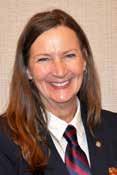
Brenda Jenny , Presi dent
“Wellness is not a luxury — it is a responsibility. We owe it to our fellow firefighters, our departments, and most importantly, our families, to stay healthy and go home safely after every call.”
the NVFC website (Home | NVFC).
BUILDING A CULTURE OF WELLNESS
Wellness is not just an individual effort — it is a team commitment. We must look out for one another the same way we do on the fireground.
That means:
• Checking in on each other after difficult calls
• Encouraging open conversations about stress and mental health
• Promoting physical fitness within our departments
• Supporting members who seek help
• Using the tools available to us
Strength is not measured by how much stress we can carry alone. True strength is recognizing when to lean on the resources and support systems available to us.
OUR COMMITMENT TO EACH OTHER AND OUR FAMILIES
Every time we respond to a call, our families trust that we will come home. Staying mentally, physically, and emotionally healthy is part of honoring that trust.
By using resources like the Cordico app through the NSVFA and the wellness programs offered by NVFC, we take proactive steps toward protecting not only our communities — but ourselves.
We owe it to our fellow firefighters to stay healthy
We owe it to our departments to stay ready
And we owe it to our families to go home
Let’s make wellness a priority in every Nebraska volunteer fire department.
As always, if you have a meet-
ing or event you would like me to attend, please reach out and I will make every effort to be there. Please take note of the following upcoming events designed to educate, inspire, and empower our membership:
• NEMSA Super Conference March 13-15, 2026
Younes Conference Center –Kearney, NE Conference Details | NEMSA
• Fire Chief’s Leadership Symposium Saturday, March 21, 2026 Holthus Convention Center –York, NE 8:00 a.m. – 4:30 p.m. Registration details are available at:
• NSVFA Fire School Registration Opens early March. Early registration is encouraged to secure preferred classes. Information is available at: https://www.nsvfa.org/ nebraska-fire-school • NSVFA Fire School May 15–17, 2026
As we continue moving forward, please remember that this is your association. Your voice, your ideas, and your involvement matter. If you have questions, concerns, or suggestions, I encourage you to reach out to me or any board member. We are here to serve you and to advocate on your behalf. Until we meet again, stay safe and healthy.
BRENDA JENNY President, Nebraska State Volunteer Firefighters Association
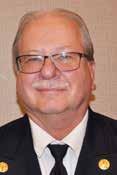
Troy Shoemaker, 1st Vice President
“By the time you read this, the Nebraska Fire Chiefs Association Leadership Symposium will be near. It will be held Saturday, March 21st, in York at the Holthus Convention Center with Chief Doug Cline as the presenter. I hope to see you there!”
by-laws committee to review and recommend those changes to our membership. It was a long meeting, but well worth the time.
By the time you read this, the Nebraska Fire Chiefs Association Leadership Symposium will be near. It will be held Saturday, March 21st, in York at the Hol-
thus Convention Center with Chief Doug Cline as the presenter. I hope to see you there!
I’m on a roll, Scotty, two months in a row now, and I have my article in the paper. I hope you’re proud! Until next month, Stay Safe!
1st Vice President
NSVFA OFficer Reports NSVFA Officer Reports
February 9, 2026
Thanks to all of those that have invited us to attend their annual banquets. LeAnn and I enjoy the traveling and getting to know some of you a little better each year. Congratulations to all those who have gotten awards this year. It’s good to recognize those who have put in so many years of service for the betterment of their departments.
This leads me to a topic we have had to address at one of our meetings…we had to firm up the policy for sending out death notices through the NSVFA’s mass email. The policy was loosely
If there weren’t enough things to worry about when we respond to emergency calls, yet another rises that you may not even think about until, you or your department brings them home to you. We talk about HAZMAT issues all the time, how to protect ourselves, the use of protective gear, decontamination and so on, but do we consider the same as we respond to homes, apartments, hotels that have insect problems? And I’m not talking about sugar ants, crickets, or “grandaddy long leg” spiders, I’m talking about cockroaches, and bedbugs. Yes, that’s right, does your department have policies that reference what to do when you find yourselves in an emergency situation and you encounter this problem? Do you just space it off and go on as if nothing has changed from that call as any other? Are you willing to take the chance of bringing them back with you to your station house or even your own home?
We have seen more insect infestations problems growing over the past years. As we respond to medical calls, welfare checks, not only to homes, but that of motel and hotels, structure fires, we are finding this problem that needs to be addressed sooner than later.
And no, it’s not just low-income families who we find as to hav-
written, and it is necessary for us to maintain some control over these emails. The policy from here on out states that past NSVFA officers and past Nebraska Fire Chiefs Association officers would be eligible for the death notice to be emailed out, as well as any NSVFA member that has served ten or more years on a NSVFA committee. Hopefully this clarifies the policy. If not, reach out to an officer for further clarification. This policy in no way affects the Nebraska Firefighter publication.
The NSVFA officers have met several times now since confer-
ing this problem. It seems to affect us all, from the homeless, low income, to half million-dollar homes, and that of five-star hotels.
How does one get these pests?
When you travel, you could pick them up from where you stayed, when you shop at a local grocery store you may get them there, “as a bonus gift,” or if a neighbor has an infestation you’re next in line.
Over the years I have seen this problem many times. I recall a house fire of which was fully involved, as we proceeded with a hose line into the structure, we were met with a line of cockroaches six inches wide racing for the front door in an effort to get out. And I’m sure that I’m not the only one who has seen this.
Others have reported that during a rescue call, the carpet seemed to move with every step, and walls had what was believed to be pictures move across the room. Others have addressed the crunching sound they hear while walking across the floor. Have you seen what appears to be a beehive in an attic space while preforming overhaul? And then you find it to be cockroaches? Some of us have. This problem affects us all. It’s not only us as first responders but all the health and safety of our public of which we serve.
The problem carries over to our public service transit, where pests
ence. Some in person and some by Zoom. Be assured that we continue to work hard to make the Association the best it can be. We realize there is always room for improvement and that it is sometimes difficult to please every member.
Our most recent meeting in Grand Island was to go through the Association bylaws. We try to make them more applicable to how the Association operates. There are a lot of proposed changes. I would ask that you watch closely when these are published so that you can review them thoroughly as we did. If you should
are transported from one location to the next. We here in North Platte have started aggressive efforts to hopefully control the spread and protect the public we serve. Media articles have been made in hopes that landlords, and homeowners alike are made aware of the problems we face. Defensive efforts are being made as such as purchasing a heater known as “The Bedbug Heat Doctor,” a heater that heats up to 120 degrees of which will kill bedbugs and other insects. But it takes up to 4-6 hours to do so. The cost of equipment as such as this begins around $2,000. We also need to decontaminate our rescue unit of which was used for transport. Now we’re down a rescue unit while decon takes place. If we find ourselves at a structure fire with an infestation problem, we treat it nearly the same as a HAZMAT call. Firefighters are required to strip out of all protective gear, bag it up, and shower as soon as they returned to station. If you’re on the fire grounds but do not go into the structure, you will be required to get your bunker gear wash, including your boots, the soles leave enough room for transportation of insects. We contacted MSA (Globe) as to what to do with our protective gear, and what we have found out about getting your bunker gear back into service is
Legal Advisor’s Report Legal Advisor’s Report
Firefighters,
Most of the questions we receive on a regular basis revolve around rural and suburban board governance. I want to look at a few topics over the coming months on the subject. First up, the Nebraska Open Meetings Act DOES NOT ALLOW virtual meetings for the rural or suburban fire protection district board and MOST public bodies.
Neb. Rev. Stat. § 84-1411(2) lists the ONLY public bodies that are allowed to conduct meetings via virtual conferencing. Rural and suburban fire protection districts ARE NOT among those listed. Further, section (3) of the statute maintains that any use of emails, virtual teleconferencing, and other
digital communications “shall not be used to circumvent any of the public government purposes established in the Open Meetings Act.” This means we must be aware of who is included in an email chain, group text, or phone call. It’s very easy to have a quorum of board members present on an email or text chain with business of the district being discussed within the messages. This would result in an unintentional meeting that wasn’t properly noticed to the public. It should be noted that virtual teleconferencing is permissible for members of the public to watch the rural/suburban board meeting. The statute simply prohibits board members from participating (voting, being counted toward a quo-
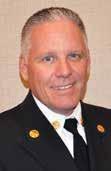
Kenny Krause, 2nd Vice President
“Our most recent meeting in Grand Island was to go through the Association bylaws. We try to make them more applicable to how the Association operates. There are a lot of proposed changes. I would ask that you watch closely when these are published so that you can review them thoroughly as we did.”
have concerns after reading them, the sooner we hear about them, the sooner they can be addressed, so please contact a bylaws committee member or a NSVFA officer. This matter will undoubtedly consume a lot of time at our next conference. Let’s try to be pre-
pared to handle them professionally and efficiently. I am confident that you will understand that these changes are necessary, and only make good sense. As always, stay safe,
“And I’m not talking about sugar ants, crickets, or “grandaddy long leg” spiders, I’m talking about cockroaches, and bedbugs. Yes, that’s right, does your department have policies that reference what to do when you find yourselves in an emergency situation and you encounter this problem? ”
that it requires to be heated up to 120 degrees for that of no less than 90 minutes, You need to keep the temperature as low as possible to be effective, but a higher temperature may cause degradation to the gear. Degradation at temperatures over 120 degrees? Now that’s another subject!
Following the heating process, we are required to wash the gear at 140 degrees, followed by drying at 105 degrees or more for a period of 30 minutes. If in doubt see NFPA 1851 Standards on Care for Protective Gear.
Another yet more defensive move, is that we begin a list of addresses of which we have responded to with this problem, if you do this, keep this list out of view of
the public, and use no names. By doing this respond with our backup unit, request to meet patients at the front door if possible, and respond in protective gear, such as a low HAZMAT attire.
I would like to hear from you as to what your department does with this problem. E-mail me at rmrlchada@outlook.com. If you would like to speak to someone about this article as to policy, or other questions please contact Chief Dennis Thompson at thompsondr@northplattene.gov or that of Assistant Chief Trent Kleinow at KleinowTD@northplattene.gov
Respectfully,
RON CHADA, District 3 Director NSVFA
rum, etc.) in the meeting via virtual teleconference. If you are a rural or suburban fire protection board holding telephone or video conferencing meetings, please note that you CANNOT hold such meetings because you are NOT one of the entities the Nebraska Statutes say can have such meetings. Also, be aware of the people in your email/ text chains and the topics you discuss to avoid unintentional digital violations of the Open Meetings Act.
Respectfully,
Scott G. Smith NSVFA Legal Advisor
Proud Sutphen & Spencer Fire Apparatus Dealer
Talk to Us About Your Next Apparatus
Contact Mark Riddle
(316) 204-9639
www.flinthillsfirerescue.com
flinthillsfire@yahoo.com
KENNY KRAUSE 2 nd Vice
Flint Hills Fire & Rescue
Spencer Fire Trucks Sutphen Fire Trucks
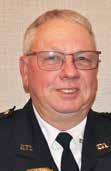
Ron Chada , District 3
Lobbyist Report Lobbyist Report
The Nebraska Legislature has moved through several intense weeks of committee hearings and early floor debate, and the pace is only accelerating as senators approach the February 19 deadline to select personal priority bills. With 1,260 bills introduced this biennium—and limited floor time—priority designations will determine which proposals will be heard.
Speaker John Arch (LaVista) has signaled that debate will now focus almost exclusively on priority bills and measures already out of committee, leaving many non-priority bills unlikely to be heard this year.
Floor action has been lively and, at times, contentious. Lawmakers passed their first bill of the session, LB 258, establishing a youth and training wage and capping future minimum-wage increases. Several days were also consumed by debate on LB 538, dealing with antisemitism-related training requirements for schools, before the Speaker passed it over amid controversy. These debates, combined with long hearings on high-profile social-policy bills, have contributed to a charged at-
mosphere, though senators have still advanced dozens of measures through various stages of debate.
A notable early-session floor fight occurred over LB 400 (NSVFA Support), which drew roughly five hours of filibuster led by Senators Mike Jacobson (North Platte) and Bob Hallstrom (Syracuse). After extended debate, the bill was passed over. Senator Dave Wordekemper, the bill’s sponsor, announced he would work with opponents to find a compromise before attempting to move the bill again. Senator Hallstrom made clear that he is seeking funding for the Nebraska Firefighter Cancer Benefit Act as an alternative.
Budget pressures continue to shape the session. Nebraska faces a significant mid-biennium shortfall, and the Appropriations Committee’s preliminary budget reduces—but does not eliminate—the deficit. Revenue hearings have been especially active, with LB 1244, the Governor’s proposal to broaden the sales-tax base to many services, drawing strong opposition from businesses and local stakeholders. Nebraska lawmakers received encouraging short-term
NVFC Reports NVFC Reports
March 2026 Nebraska Firefighter news Heart Health article
By JOEL CERNY
Cardiovascular events continue to be the leading cause of death of the nation’s firefighters. Of the 76 who gave the ultimate sacrifice last year, half suffered cardiac issues with stress and overexertion as key factors, according to data compiled by the U.S. Fire Administration. Records also show of the 42 of the 72 firefighters who died in line of duty deaths in 2024 also suffered cardiovascular events.
With that said the National Volunteer Fire Council (NVFC) is intensifying its push for hearthealth awareness with new tools, training materials, and wellness guidance designed to protect the nation’s first responders.
Since heart attacks consistently top the list of firefighter fatalities each year, it is a trend the NVFC has been working to reverse since launching its HeartHealthy Firefighter Program in 2003. The initiative focuses on education, prevention, and practical strategies to help both volunteer and career firefighters reduce their risk. Please review the topics below to help protect you and your crew.
A RENEWED FOCUS ON PREVENTION
The NVFC’s latest resources emphasize that heart disease remains the single greatest threat to firefighter safety, accounting for nearly half of all onduty deaths annually. The organization stresses that understanding and managing
revenue news as January state tax collections came in $37 million above projections, offering some modest relief as they continue grappling with a significant state budget shortfall. Stronger-than-expected individual income and sales tax receipts largely drove the surplus, though officials cautioned that monthly fluctuations do not resolve the broader structural imbalance facing the state budget.
Despite the positive January numbers, legislative leaders still face a substantial budget deficit for the upcoming biennium, entering the session projected $471.5 million in the red. Lawmakers are weighing a mix of spending reductions, agency cost controls, and possible revenue adjustments as they work to craft a balanced budget. The updated revenue figures will factor into ongoing budget deliberations in the Legislature’s Appropriations Committee, where members continue evaluating agency requests and the governor’s proposed budget adjustments.
Committee hearings remain packed, with numerous bills affecting local governments, public
Ryan K. McIntosh, Lobbyist
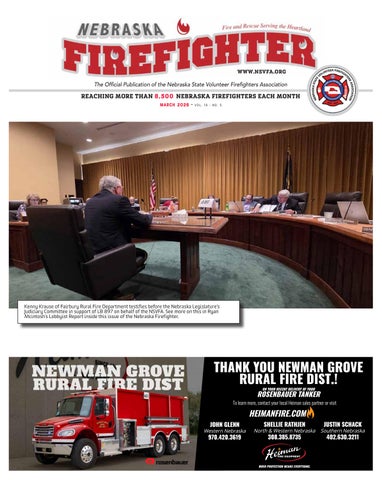
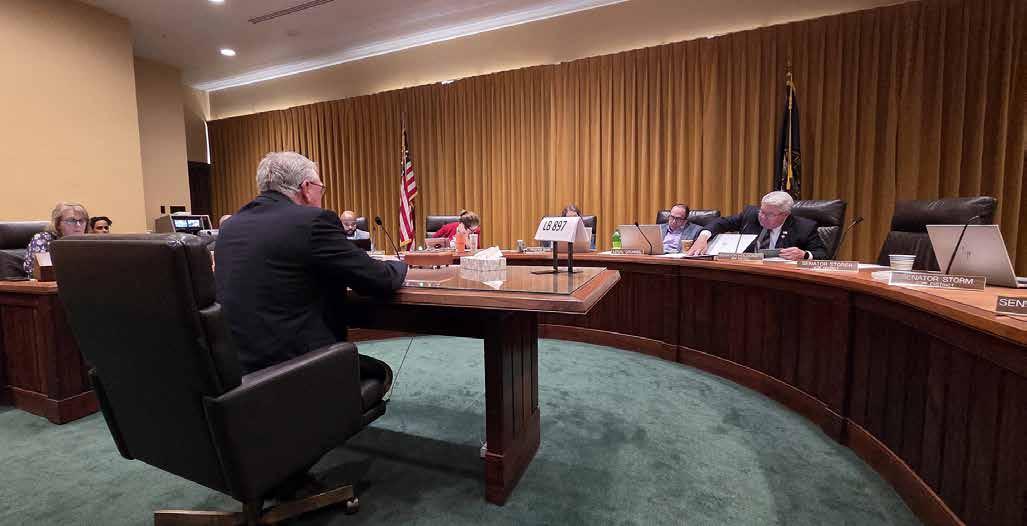
“I would like to give a special thanks to Kenny Krause who testified at the committee hearing, as well as the dozens of firefighters that submitted comments in support of the bills.”
safety, and community services moving through the process. Hearings will wrap up next week, and all-day floor debate begins March 3. As senators finalize their priority selections, the focus will shift to which bills advance and how the Legislature balances budget constraints with policy goals. These decisions will shape the remainder of the session.
Notably, LB 897, introduced by Senator Dan Lonowski (Hastings) was heard before the Judiciary Committee on February 11th. LB 897 upgrades the penalty for violating the open burn ban from a Class IV to a Class III misdemeanor. It also allows municipalities and rural or suburban fire protection districts to charge violators a fee covering the costs incurred in responding to and extinguishing
fires resulting from violations. I would like to give a special thanks to Kenny Krause who testified at the committee hearing, as well as the dozens of firefighters that submitted comments in support of the bills. Lynn Rex of the Nebraska League of Municipalities also testified in support of the bill. Opposition with the Nebraska Criminal Defense Attorneys Association was worked out prior to the committee hearing. With a strong hearing and no opposition, we are hopeful the bill will move soon. Thank you to all who have been engaged with your elected officials thus far. As always, please don’t hesitate to contact me with any questions.
RYAN K. MCINTOSH, N.S.V.F.A. Lobbyist
risk factors—such as high blood pressure, obesity, poor nutrition, and lack of physical activity—is essential for longterm health and operational readiness.
To support this effort, the NVFC recently released updated materials aimed at helping responders take proactive steps toward better cardiovascular health. These include the HeartHealthy Firefighter Resource Guide, functional fitness videos, and educational tools that departments can use to promote healthier habits.
FITNESS AND FUNCTIONAL STRENGTH TAKE CENTER STAGE
Firefighting demands strength, endurance, and resilience—qualities that depend heavily on cardiovascular fitness. The NVFC’s HeartHealthy Firefighter Program encourages responders to adopt regular exercise routines tailored to the physical realities of the job. Functional fitness videos now available through the NVFC demonstrate movements that build core strength, mobility, and stamina, helping firefighters prepare their bodies for highstress, highintensity operations.
NUTRITION AND LIFESTYLE GUIDANCE
Beyond fitness, the NVFC highlights the importance of nutrition and daily habits in reducing cardiac risk. The HeartHealthy Firefighter Resource Guide provides practical advice on maintaining a balanced diet, managing weight, and making healthier choices both on and off duty. These tools help firefighters assess their personal risk factors and take steps toward
longterm wellness.
SLEEP, STRESS, AND RECOVERY
Recognizing that heart health is influenced by more than diet and exercise, the NVFC has also released new educational content on sleep and recovery. A dedicated sleephealth video underscores how rest impacts performance, decisionmaking, and cardiovascular resilience—critical considerations for responders who often work irregular hours.
RESOURCES FOR DEPARTMENTS, NOT JUST INDIVIDUALS
J oel Cerny, NVFC Director
“As the fire service continues to confront the persistent threat of cardiac related deaths, the NVFC’s message is clear: heart health must be a priority. With new guides, videos, and stationready materials, the organization aims to empower firefighters to protect the most important tool they bring to every call—their own wellbeing.”
While individual firefighters are encouraged to take charge of their health, the NVFC also provides tools for departments to build structured wellness programs. These resources help leaders create supportive environments, implement fitness initiatives, and promote a culture where heart health is treated as a core component of operational safety.
A CALL TO ACTION
As the fire service continues to confront the persistent threat of cardiac related deaths, the NVFC’s message is clear: heart health must be a priority. With new guides, videos, and station-ready materials, the organization aims to empower firefighters to protect the most important tool they bring to every call—their own wellbeing. Justin and I are trying to get copies of the HeartHealthy Firefighter Resource Guide and if we do, we will have them on our table at Fire School.
Lincoln residents displaced after early morning fire
Two residents were displaced as a result of a house fire early Friday morning, Feb. 13, near Southwest 9th Street and West A Street. Lincoln Fire and Rescue crews were called to the scene around 2 a.m. after neighbors noticed smoke coming from inside the home. Officials said the fire was burning inside the walls of the house, making it more difficult to access and extinguish. An investigator later determined the blaze was caused by old electrical wiring. Fire officials estimate the damage at approximately $30,000. No injuries were reported.
Superior VFD training night
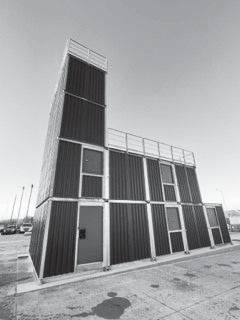
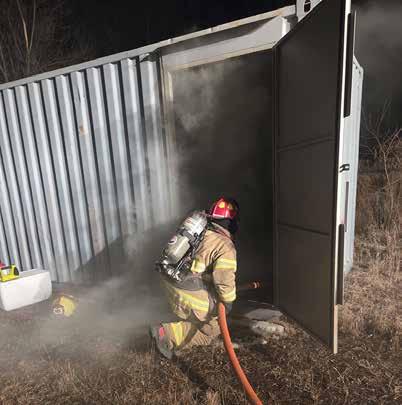
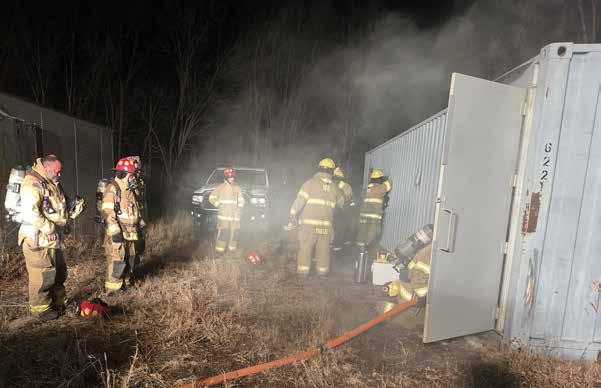
On Monday night , Feb. 2, Superior Volunteer Fire Department was able to take advantage of their live burn simulator. Thanks to TJ and everyone at Superior Industries for converting this shipping container for the department. Members got some valuable training with real smoke and real fire. From the Superior Volunteer Fire Department Facebook page.
Fire reported south of Ansley
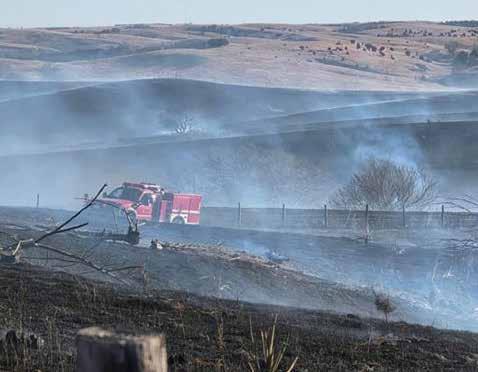
The Ansley Fire Department was dispatched to a fire approximately one mile south of Ansley on Highway 183 around 14:12 p.m. on Thursday, February 5. According to officials, the fire spread quickly to the southeast due to winds and terrain issues hindering firefighting efforts. Two homes and a feedlot were threatened but no damage was reported. Twelve volunteer departments and one aircraft helped battle the blaze which grew to an estimated 200 acres. The Custer County Sheriff’s Office, Custer County Emergency Management, Custer County Communications, and the Nebraska Department of Roads also were on scene. During the Ansley 183 Fire two firefighters were injured but able to walk away after one truck was damaged. Sudden changes in conditions created a hazardous circumstance for crews on scene. Both firefighters were transported for medical clearance and are now at home recovering.
Action Fire Photos Needed!
Please send them to jeff@nebraskafirefighter.com along with information to explain the photo.
Broken Bow trailer lost to fire
On Feb. 4, 2026, at approximately 9:36 p.m., Broken Bow Fire Department and Broken Bow Ambulance Service were dispatched to a reported structure fire in the 600 block of South N Street.
Fire crews arrived on scene and worked quickly to contain and extinguish the fire. The occupants
of the home had evacuated prior to the arrival of fire and EMS crews. The incident was brought under control, and units cleared the scene at approximately 2:34 a.m., Feb. 5. There were no human fatalities. Additionally, there were no injuries to first responders as a result of this incident. A total of 20 fire
personnel and seven EMS personnel responded. Resources on scene included four fire apparatus and two ambulances. We would like to thank the following agencies and departments for their assistance and support during this incident: Broken Bow Ambulance Service, Broken Bow
Police Department, Custer County Sheriff ’s Office, Broken Bow Electrical Department, Broken Bow Water Department and Black Hills Energy. Their coordination and support were instrumental in ensuring scene safety and an effective response.
The Nebraska State Fire Mar-
shal’s Office is investigating the fire. There is no additional information available at this time.
(Broken Bow Custer County Chief, Broken Bow, NE, February 12, 2026)
When the Window is the Only Exit
By COLE KLEINWOLTERINK
This article focuses specifically on single-firefighter window bailouts using a personal escape system. While the hardware referenced throughout is the CMC LEVR, the fundamentals discussed are not unique to one manufacturer. These concepts can be adapted to other NFPA-compliant bailout systems with appropriate training and an understanding of how each system operates.
The CMC LEVR is used here simply because it is the system I personally carry and understand best. Its inclusion should not be interpreted as an endorsement. Emergency escape is a last-resort skill. When that moment arrives, success depends far less on the logo on the equipment and far more on repetition, positioning, and disciplined execution under stress. Firefighters should train with, and deploy, the bailout system issued or approved by their department, and ensure they are proficient with its specific capabilities, limitations, and operating procedures.
SYSTEM DEPLOYMENT AND ANCHORING
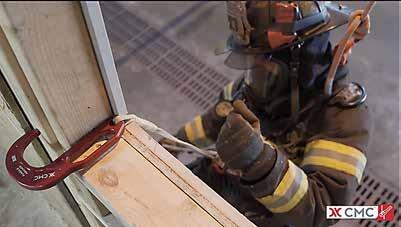
The firefighter begins by deploying the system from its stowed position by pulling out the Flash Escape Anchor. An appropriate anchor point is selected based on building construction and available features. Both styles of hook options, the Flash G and Flash.2 anchors, are rated as emergency escapee anchors per NFPA standards.
ESTABLISHING A CONTROLLED EXIT
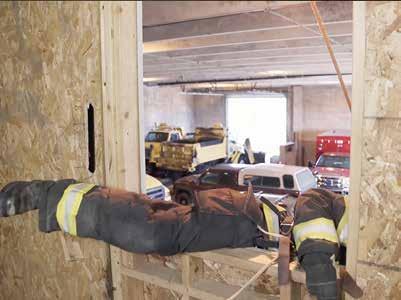
The actual bailout sequence begins with a window hang, which allows the firefighter to transition from the interior to the exterior in a controlled manner while maintaining system integrity.
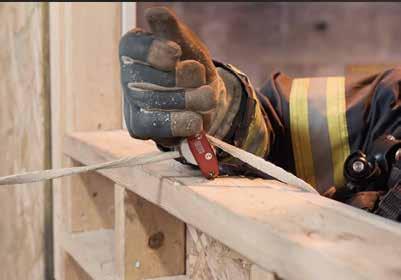
From a low position in the window opening, the firefighter should get their top 50% out of the window while their anchor side arm hooks the corner of the window sill (if using a remote anchor) or their anchor side hand holds the
Flash.G or Flash.2 Anchor in place on the window sill.
The opposite hand, referred to as the tail-side hand, maintains continuous contact with the escape webbing distal to the anchor. This practice, known as tail-hand discipline, keeps constant tension on the system and helps ensure the anchor remains properly seated throughout the bailout.
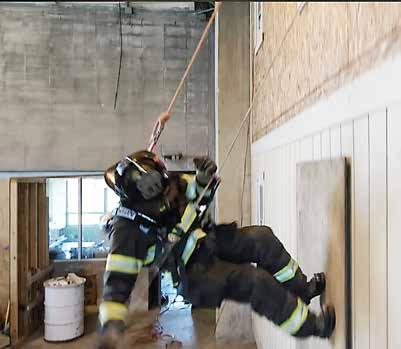
As the firefighter leans farther out of the window, the first leg (opposite the anchor-side arm) is moved completely outside the opening. The second leg, on the same side as the anchor-side arm, briefly hooks the opposite side of the window. As proficiency increases, this hook becomes minimal, and the firefighter transitions smoothly toward full exit. From the window hang, the firefighter pivots on the anchor-side arm and transitions the entire lower body out of the window, fully loading the system.
EDGE TRANSITION AND DEVICE PLACEMENT
Ideally, the LEVR descender is positioned outside the window once the firefighter has fully exited. However, if it remains inside, the descender’s egg-shaped profile allows it to roll smoothly over the window sill without getting hungup and caught.
RAPPELLING BODY POSITIONS
Following a successful window exit, the firefighter transitions into a rappel position to support a controlled descent and obstacle negotiation. There are two basic rappelling positions: standard and feet-down.
In the standard rappel position, the firefighter places both feet against the exterior wall and leans away from the building. When transitioning from the window hang, placing the outside knee against the wall before full exit positions both knees against the wall once the firefighter clears the window.
This position allows the firefighter to “walk” down the wall during descent, reducing strain by transferring load to the legs. It also
CLASSIFIED ADS FOR THE NEBRASKA FIREFIGHTER NEWSPAPER
Classified ads run $10 for the first 10 words, and 25 cents a word after that. A photo is $10 additional. Rates are the same in each state (Iowa, Minnesota, South Dakota, Nebraska and Kansas). Email the ad to jeff@nebraskafirefighter.com to place your personal or departmental ads.
provides improved control when negotiating exterior obstacles such as light fixtures, balconies, signage, or window hardware.
In the feet-down rappel position, the firefighter fully exits the window and free-hangs on the system with the front of the body facing the building. This position will be dictated by urgency or building features, such as overhangs, balconies, or full curtain-wall construction where foot placement is not possible.
The firefighter can transition from the feet-down position to the standard rappel position at any point during the descent. This transition is accomplished by pushing away from the wall with the arms while simultaneously tucking the knees upward. From this position, the firefighter rocks back into the standard rappel stance while gradually releasing the LEVR descender. While performing this maneuver, some firefighters find it beneficial to briefly tension the webbing with their tail-side hand to stabilize the knee-tuck during the transition.
DESCENT CONTROL AND OPERATION OF THE LEVR
Once positioned, the firefighter initiates descent by rotating the LEVR descender to release the auto-lock. Under load, approximately six pounds of force is required to begin descent. The device may be operated with one hand on the control handle and one hand on the web tail, or by routing the web tail between the thumb and index finger of the control hand to create friction against the handle. Descent speed is controlled by the degree of lever rotation and the amount of friction applied to the web tail. To stop descent, the firefighter simply releases the LEVR, allowing the auto-lock to re-engage.
Effective use of the CMC LEVR, like any bailout system, is dependent on deliberate, repeated training. Emergency escape is a low-frequency, high-consequence skill with very little margin for error, and successful execution is driven by familiarity with the system, sound body positioning, and disciplined movement under stress. When training these techniques, a secondary belay system should always be used to provide an added layer of safety and prevent uncontrolled descent in the event of a mistake, equipment issue, or loss of control. A properly managed belay allows firefighters to train realistically while still protecting against the inherent risks of bailout training, ensuring repetitions can be performed confidently, consistently, and without unnecessary exposure to injury.
Photos courtesy of CMC Pro. Cole Kleinwolterink is a member of the Waukee Fire Department, Granger Fire Department, and Fire Science instructor at Des Moines Area Community College. Feel free to reach out to him at kleinwolterinkc@gmail.com with any questions, comments or inquiries.
Unadilla, Palmyra participate in grass burn training
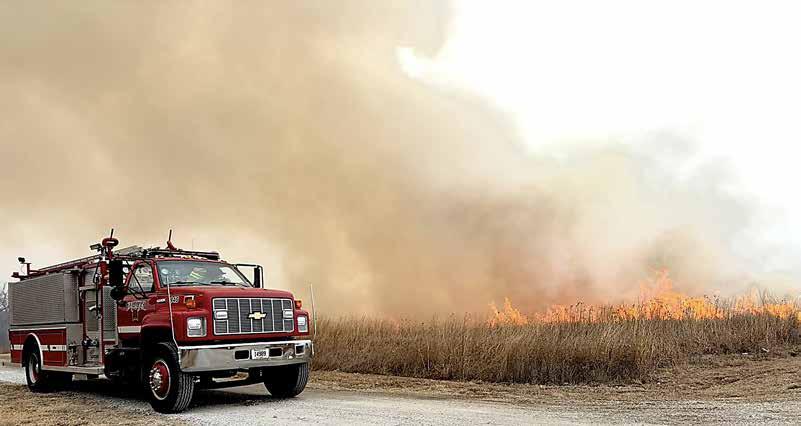
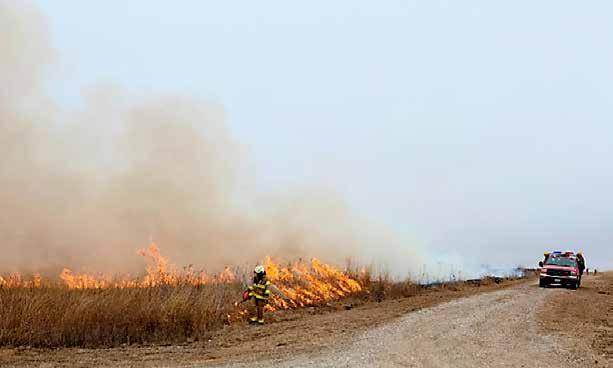
The Unadilla Fire and Rescue Department and Palmyra Vol. Fire Department trained together recently in grass burn training, gaining hands-on experience and the chance to train alongside each other.
Hastings man charged
A Hastings man is facing two felony charges following an arson incident that occurred at the Brewery Loft Apartments during the early morning hours of Wednesday, Feb. 4. Elijah Born, 21, is charged with aiding and abetting a Class 2 felony, a Class 2 felony and possession of a firearm while committing a felony, a Class 2 felony.
Born was arraigned in Adams County Court on Feb. 9 and his bail was set at ten percent of $50,000. A hearing in the case has been scheduled to waive or set a date for a preliminary hearing.
According to an affidavit submitted in Adams County Court, at 6:38 a.m. on Feb. 4, an officer with the Hastings Police Department was dispatched to the Brewery Loft Apartments, 219 W. 2nd St. for an arson investigation.
It was found that a large orange traffic cone had been intentionally set on fire at the bottom of stairwell three on the southwest corner with newspaper being used as kindling.
Firefighters with Hastings Fire and Rescue advised that the entire four-story stairwell was filled with black smoke when they arrived on scene. Four occupants from the building were transported to Mary Lanning Hospital for smoke inhalation.
It was noted the fire alarm had not sounded until after the firefighters entered the building. The fire department had been contacted by a resident who had entered the smoke-filled stairwell.
Damages are estimated at around $5,000 including smoke damage to the stairwell. No residences were damaged by the fire.
Surveillance footage was reviewed and showed an individual, identified as Born, and a 15-yearold Hastings resident entered the building carrying the traffic cone. Both Born and the 15-year-old would be arrested following the investigation.
(By Brian Neben,Central Nebraska Today, February 10, 2026)
O’Neill shed, contents considered complete loss
Around 8: 44 p.m. on January 27, the O’Neill Volunteer Fire and Rescue Department was called to a shed on fire at the Mike Mahony residence five miles south and 1.5 miles west of O’Neill. The shed was fully involved when the department arrived. The shed was used as storage for ranching equipment, tractors and assorted vehicles. The shed and its contents were a complete loss. The cause of the fire is undetermined at this time, and the Nebraska State Fire Marshal’s Office is investigating. The department was on scene until about 12:45 a.m.
Car versus train crash
On January 30, 2026, at approximately 8:41 a.m., the Fremont/Dodge County Communications center received a report of a car hitting a train on County Road C and Wheatley Road, southwest of Uehling, Nebraska. The investigation revealed that a white Chevrolet Avalanche was eastbound on County Road C, while a Burlington Northern Santa Fe train was southbound. It was determined that the Chevrolet Avalanche had collided with the second engine of the train. The male driver and lone occupant of the Chevrolet Avalanche was identified as Matheu Pillatzki, 19, of Hooper, Nebraska. Pillatzki was transported by Uehling Rescue to Methodist Fremont Health where he was treated and released. Seat belts were not in use and airbags were deployed. Speed was determined not to be a factor. The investigation is ongoing. The Dodge County Sheriff’s Office was assisted by the Uehling Fire Department and Nebraska State Patrol.
(Hooper Rustler-Sentinel, Hooper-Scribner, NE, February 4, 2026)
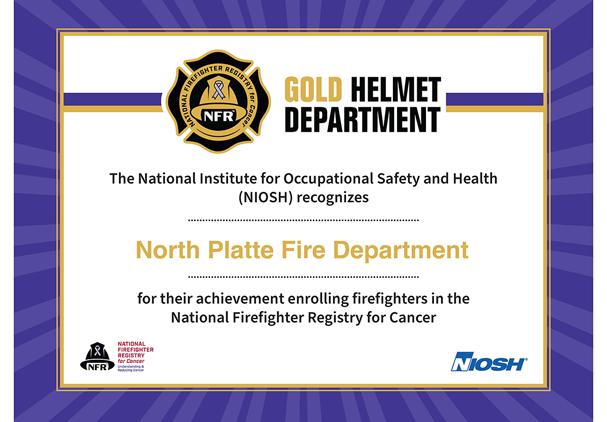
North Platte FD recognized for achievement
North Platte has achieved 100 percent participation from Career and Volunteer personnel in the NIOSH National Firefighter Cancer Registry. “I am proud of our personnel and their commitment to understanding and reducing cancer risk in the fire service,” said Dennis Thompson, Fire Chief, North Platte Fire Department.
Stapleton firefighters assist with Arnold house fire
The Arnold Fire Department responded to a house fire on Lower Powel Canyon Road on January 18 at approximately 2:33 p.m. The fire involved a single-family residence with attached garage/building.
The home was fully engulfed upon arrival with flames extending through the roof. Crews focused on
protecting an adjacent garage on the south side of the residence and preventing the fire from spreading into nearby pasture.
Winds were reported to be gusting over 40 mph at the time of the incident while firefighters were atto put out the fire. The department expressed appreciation to firefighters, local farmers, neighbors
and anyone who assisted during the incident. Community support is vital in rural emergencies. The department also extended thoughts and prayers to the family affected by the loss of their home, belongings and pets. While they were not home at the time the fire started and are safe, they still have lost everything.
Donation drop-off sites have been established at Reed's Food Center and Mills Hardware in Arnold, or at 402 N. Morgan Ave. in Callaway. For more information you may call Deb Hall at 308-3403126.
Marv and Debbie Ritchie are safe and thankful for the community's support. Items needed
Wider field of
include toiletries, women's size 8 shoes, 18 pants, and large/XL tops; men's size 9.5 shoes, 48x32 pants and 2XL shirts.
(Andrew Tickle, Arnold Fire Chief, Stapleton Enterprise, Stapleton, NE, February 5, 2026)
Structure fire forebodes the winter wildfire season
Fire risk ranges from critical to very high in Nebraska
A structure fire in Peru Sunday is a reminder of the dangers of wildfires.
Peru resident Jayden Ford said she was taking an elderly Second Street resident home from church on Sunday when they noticed a fire at the north end of the street.
Ford said the fire destroyed what she described as an abandoned house where debris had collected. Nearby trees were charred 25 feet from the ground on the fire side of their trunks. Ford said smoke and heat reached the neighboring house.
Ford said burn permits are essential especially in dry conditions.
Ford: “If we didn’t leave church when we did, I mean her house and dogs could have been dead. It all caught on fire. By the time the firefighters got here, it was high in the trees. I’m glad we called and came home when we did.”
She said firefighters had to return several times after the initial fire because of rekindled flames and smoke.
The Nebraska Fire Weather Forecast Map has the rangeland fire danger today at very high for most of eastern Nebraska. Conditions are expected to improve to moderate on Tuesday and reach low levels in Cass and parts of Otoe County on Wednesday.
Last February, Nebraska experienced several major wildfires. Over 4,100 acres were scorched in Custer and Dawes counties in central Nebraska. A state of emergency was declared on Feb. 27 as high winds and low moisture increased fire danger.
State officials say 90 percent of range fires that required a response were caused by human activity. Red Flag warnings were issued Monday in the Nebraska Panhandle.
(By Dan Swanson, NCN, News Channel Nebraska, February 9, 2026)
Live training burn
hosted by Southeast FD
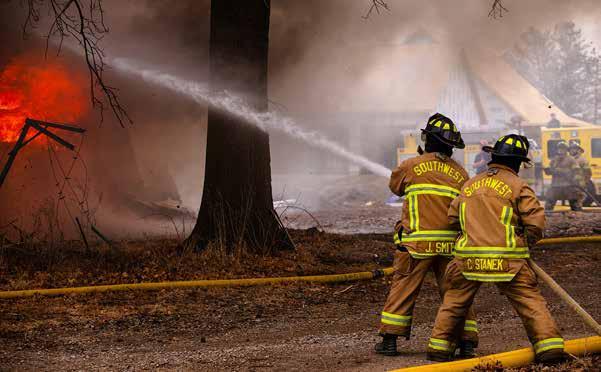
On Saturday , Feb. 14, Southeast Fire Department hosted a live training burn at a residential structure. They had multiple members from their department as well as surrounding volunteer agencies throughout Lancaster County that were able to participate in the beneficial training. They thanked partner agencies for coming out including: Firth Rural Fire and Rescue Waverly Fire/ Rescue Eagle Fire & Rescue Department Bennet Fire and Rescue Hickman Rural Fire and Rescue Southwest Fire Department.
Ice rescue training
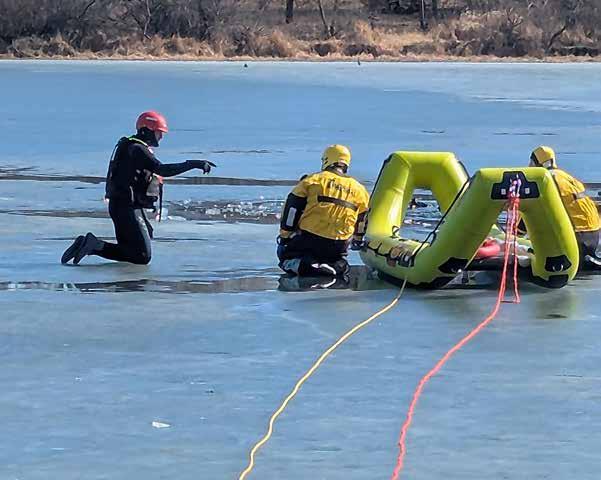
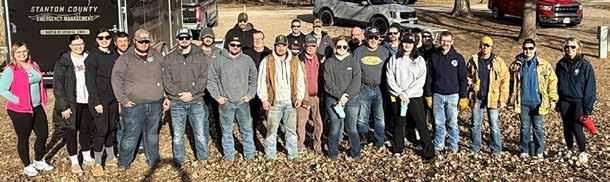
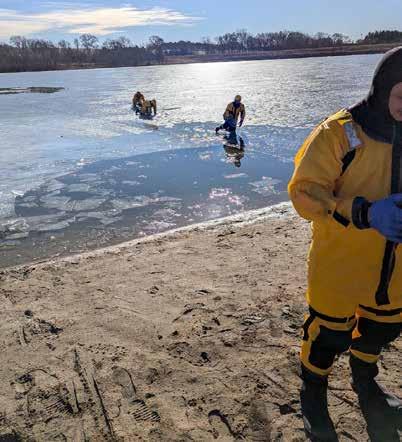
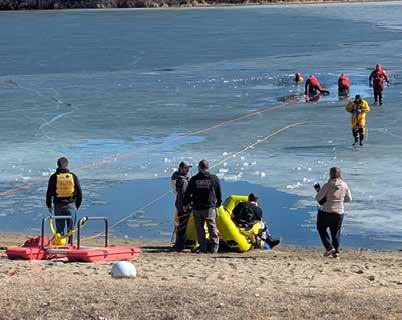
On Feb. 15, members of Stanton Fire and Rescue were out on the ice for an important day of hands-on ice rescue training. When temperatures drop, lakes, ponds, and rivers can become dangerous very quickly. Ice conditions can change without warning and knowing how to safely and efficiently rescue someone who has fallen through the ice can mean the difference between life and death. These situations are high-risk, time-sensitive, and require specialized skills, equipment, and teamwork. We’re proud to be training alongside our partners from Pierce Fire and Rescue, Battle Creek Fire and Rescue, Stanton Emergency Management, Game and Parks, and Pilger Fire and Rescue. Working together strengthens our response capabilities and ensures that if the unthinkable happens, we are prepared to act quickly and safely. Training like this keeps our crews sharp, builds interdepartmental coordination, and ultimately helps us better serve and protect our communities year-round. Stay safe and remember: no ice is ever 100% safe. From the Stanton Fire and Rescue Facebook page.
Holdrege firefighters honored at annual banquet
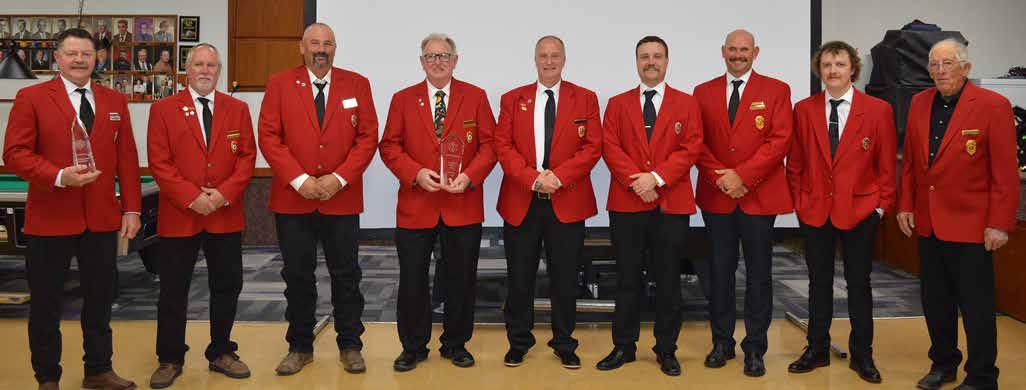
The Holdrege Volunteer Fire Department held its Annual Department Banquet at the Holdrege Eagles Club on November 8. Those attending included department members and their spouses, retired department and Auxiliary members, members of the Holdrege City Council and the Holdrege Rural Fire District Board, plus a couple of special guests. Length of Service Awards were presented. Those who received Length of Service Awards and the Department Officers are pictured from left to right: Kent Matousek, 20 years on Fire Department; Robert Johnston, Rescue Captain; Charlie Heinen, one year on Rescue Squad; Dudley Karlson, 20 years on Rescue Squad; Joel Omundson, one year on Rescue Squad; Jason Houdek, one year on Fire Department; Dallas Roemmich, Fire Chief; Aaron Tavenner,
Accident near Riverdale
Icy road conditions contributed to a single vehicle rollover near Riverdale during the morning hours of Wednesday, Feb. 4.
At 7:21 a.m., Kearney Volunteer Fire Department was dispatched near the intersection of Highway 40 and Dove Hill Road, west of Riverdale, for the report of a single vehicle rollover.
On scene, a pickup truck and rolled and landed back on its wheels between Dove Hill Road and field to the south of Highway 40.
The Buffalo County Sheriff’s Office provided traffic control and was investigating the accident scene.