The next Northeast Nebraska Volunteer Firefighters Association meeting will be May 8, in Scribner. Meal will start at 7:30 p.m. and the meeting will start at 8 p.m. The program is being finalized and will follow the meeting.
Blair training
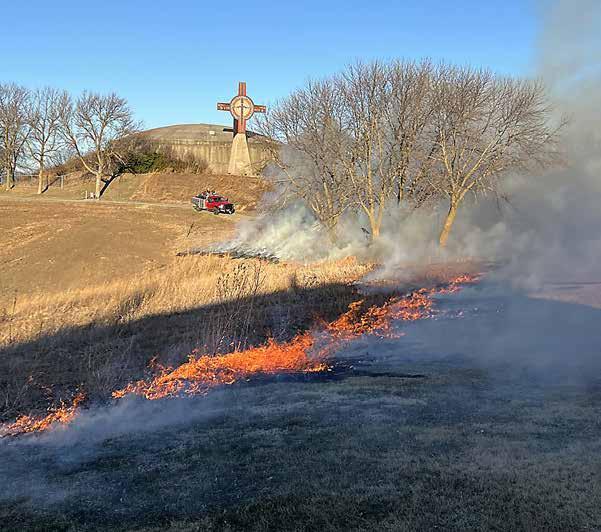
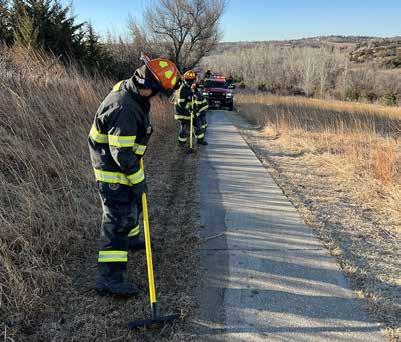
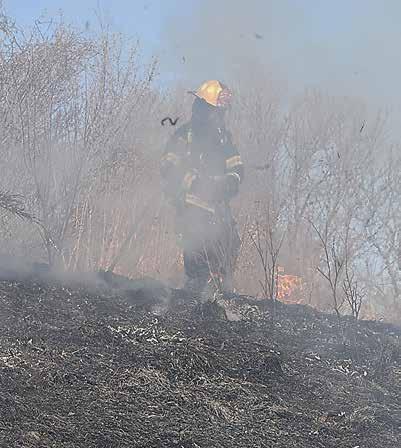
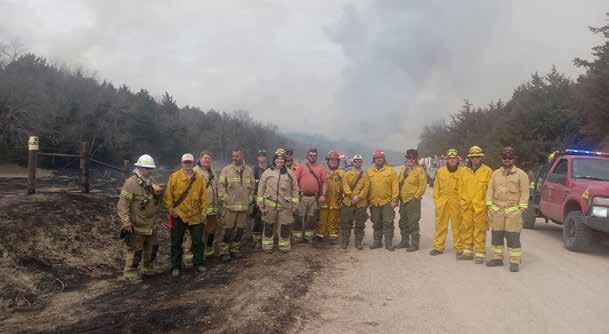
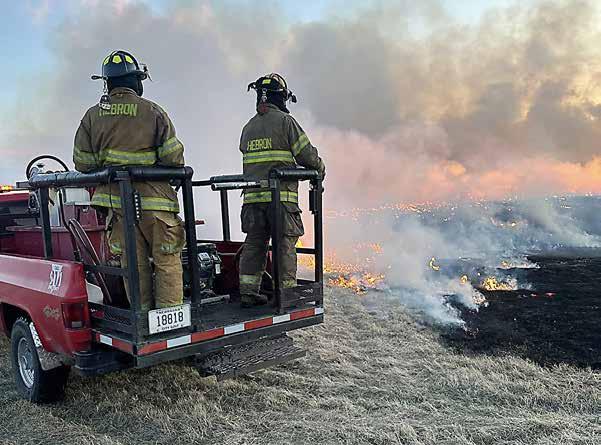
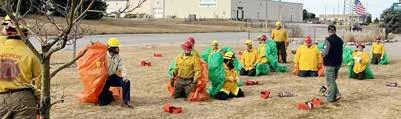
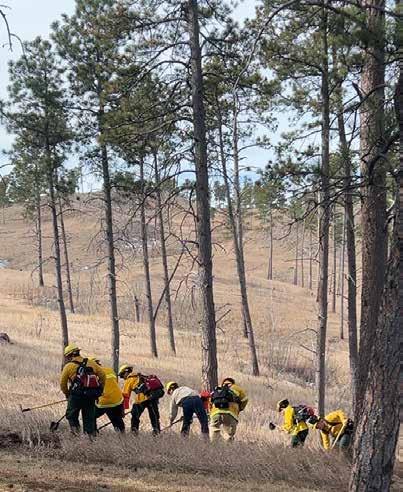
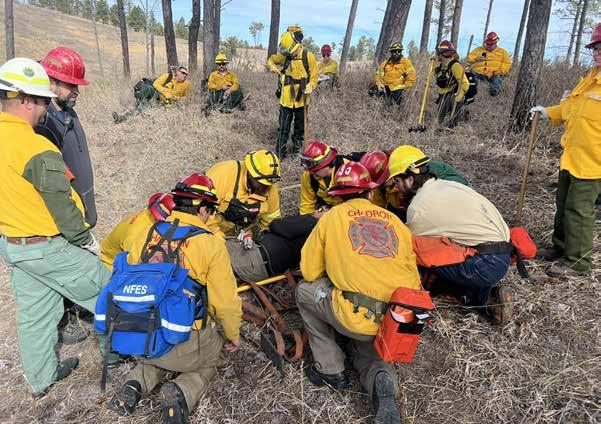
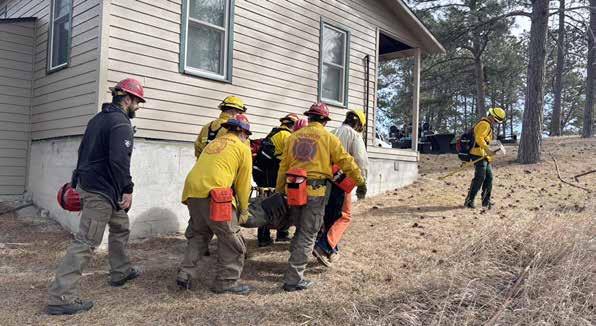
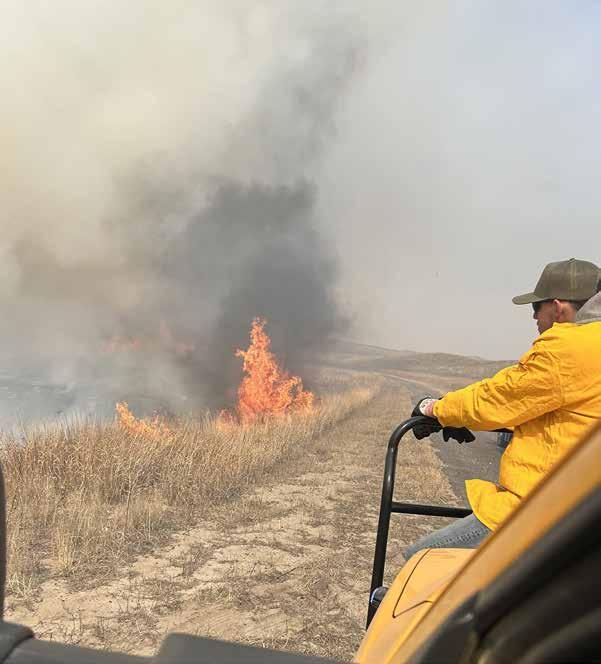
On March 9, 10 members along with eight cadets took part in a controlled burn at Black Elk-Neihardt Park alongside the Public Works team from the City of Blair, Nebraska. It was a great opportunity for hands-on training and teamwork. Thanks to everyone involved for helping make it a safe and successful training event! From the Blair Fire Department Facebook page.
Fire Prevention Nebraska Style Fire Prevention Nebraska Style
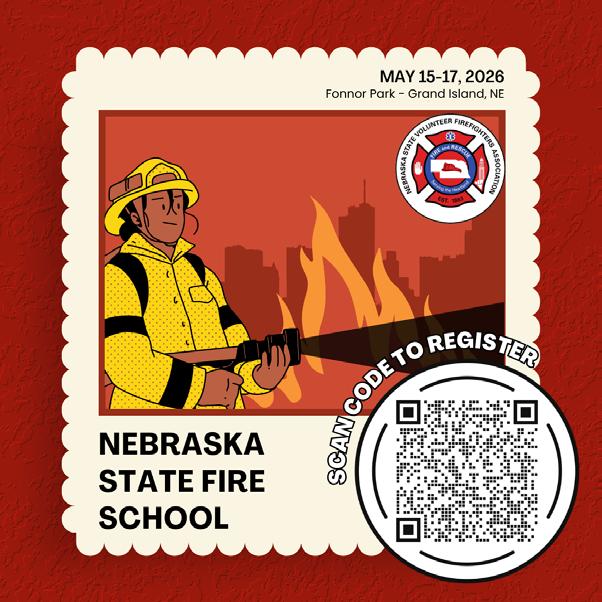
You Are Cordially Invited to join the members of the NSVFA Fire Prevention Team as we share our passion for fire prevention and ways to address a very important message in an enjoyable, memorable format. Registration for our class at the Nebraska State Fire School is open, and we encourage you to join us.
FIRE PREVENTION: BUILDING STRONGER, SAFER NEBRASKA
COMMUNITIES
Class #603
This comprehensive, hands-on
Upcoming Events Upcoming Events
Email your Upcoming Event by the 10th of the previous month (ex. Aug. 10 for the September issue) to jeff@nebraskafirefighter.com . There is no charge.
APR. 9, 2026: Scotts Bluff County Mutual Aid Association Meeting, Alliance.
MAY 8, 2026: Northeast Nebraska Volunteer Firefighters Association meeting, 7:30 p.m. in Scribner.
MAY 15-17, 2026: 2026 Nebraska Fire School, Grand Island, NE.
JULY 9, 2026: Scotts Bluff County Mutual Aid Association Meeting, Banner County.
SEPT. 20, 2026: NSVFA Memorial Service, Nebraska Firefighters Museum and Education Center, Kearney, at 2 p.m.
OCT. 8, 2026: Scotts Bluff County Mutual Aid Association Meeting, Bayard.
OCT. 15-17, 2026: NSVFA Annual Conference, hosted by Dakota City Fire Department in South Sioux City.
OCT. 14-16, 2027: NSVFA Annual Conference, hosted by Battle Creek Volunteer Fire and Rescue in Norfolk.
course is designed for firefighters who want to strengthen their department’s fire prevention and public education efforts. As communities change and fire risks evolve, proactive education remains one of the most effective ways to reduce injuries, property loss, and preventable fires. This class will prepare firefighters of all experience levels to confidently deliver meaningful, engaging, and accurate fire and life safety programs across Nebraska. Participants will explore the essential components of a successful fire prevention program, including: Community Risk Reduction
(CRR)- identifying local hazards and tailoring messages to community needs.
Age-appropriate education techniques for preschoolers, youth, teens, adults, and senior populations.
Effective messaging tools using resources, materials, props, demonstrations, and hands-on activities.
Planning and presenting programs through community outreach events.
Engaging high-risk and underserved groups, including rural residents, aging populations, and vulnerable individuals.
Seasonal and holiday safety
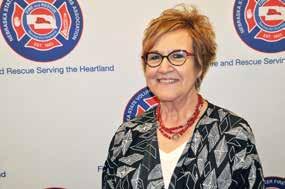
Rhonda Cerny, NSVFA Fire Prevention
“Join us at the 2026 Nebraska State Fire School to help shape a safer Nebraska, one program at a time.”
messaging relevant to Nebraska’s climate and traditions. Through interactive discussion, real-world examples, and practical demonstration opportunities, attendees will build the skill and confidence needed to represent their department as an effective public educator. Whether you are new to fire prevention or looking to expand your outreach abilities, this course will
equip you with the tools to make a lasting difference in your community. Join us at the 2026 Nebraska State Fire School to help shape a safer Nebraska, one program at a time.
CONTROL
you encounter blowing gas from a pipeline:
• Approach from upwind
• Keep all ignition sources away from the gas
• Set up a perimeter to keep people at a safe distance When responding to a gas leak inside a building:
• Evacuate the building immediately
• Move people to a safe distance
• Eliminate all ignition sources
• Check all nearby buildings for a gas presence
If you need to shut off gas:
• At the meter, turn off the service valve to a horizontal position
• DO NOT reopen the valve yourself; only MidAmerican can restore service
RHONDA CERNY, NSVFA Fire Prevention Team
Crews battle more than fire at Gordon structure fire
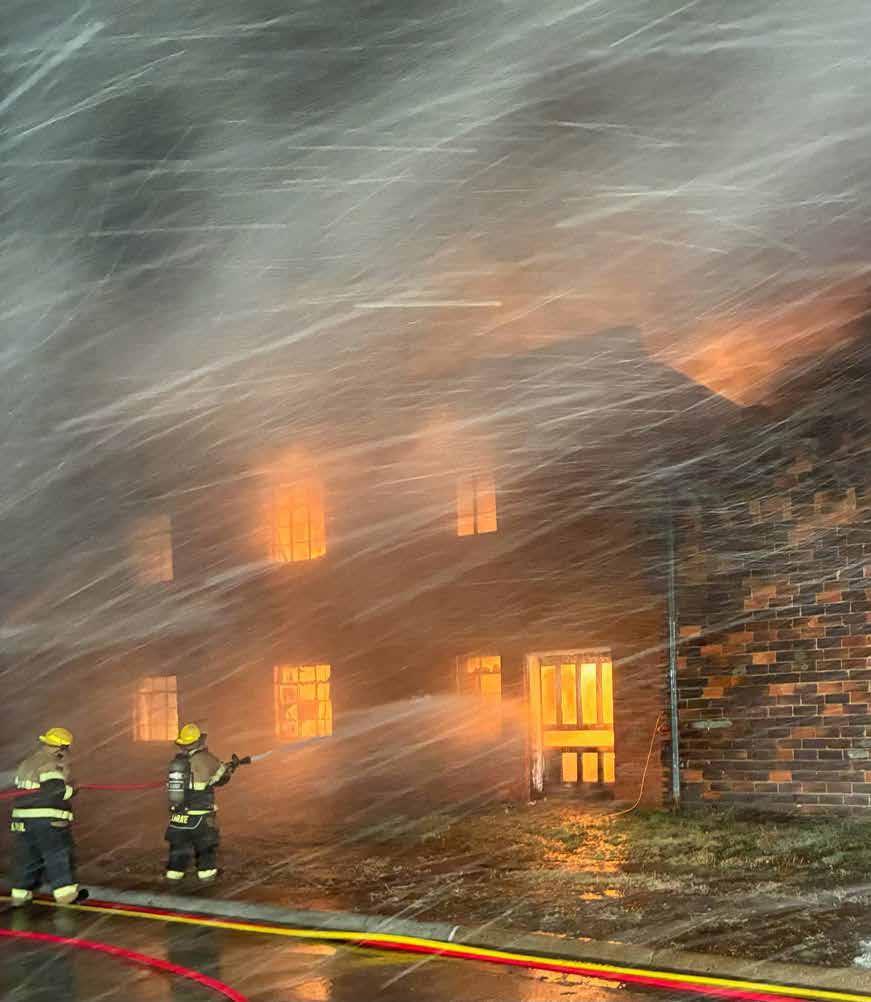
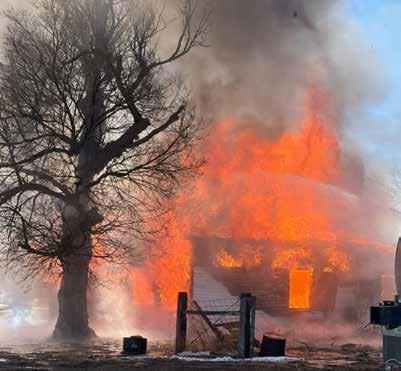
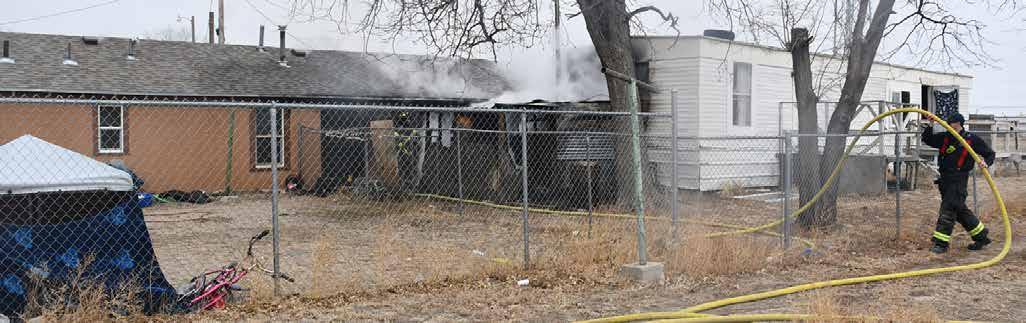
It was another busy night for volunteer firefighters in Gordon and Rushville. Crews were called to the Macumber Plumbing building in Gordon for a fire around 11:30 Saturday night, March 14. Gordon Fire Chief Rich Haller said strong wind and blowing snow made battling the fire even more challenging. Haller said the building is a total loss.
Smokey sez Smokey Sez
By BOB HECKMAN
This month’s article is dedicated to the memory of Dana Udey from Columbus Vol. Fire Department. I served with him for 28 years. Gone but not forgotten. Dana we can take it from here, rest easy my friend. Let’s talk about severe weather safety. I will admit that I am not the sharpest tack in the box. I will leave moving downed power lines and poles to the electric companies / power districts. Just grabbing pike poles that may be dirty or covered with carbon may be the last thing you may do. Carbon may conduct electricity. Then your lights may go out permanently. Some of us have generators so follow the manufacturer’s recommendations. Put at least 25 to 30
feet from your home. Keep an eye on the wind. When you add fuel shut it down and let it cool down. If you spill fuel on it wait until the gas evaporates before restarting. We are always looking out for others and remember family first. Some of us have elderly neighbors. Please see if they are safe. Some members of our community need electricity to survive. If your community has nursing homes, please check with them before the disaster happens. Now is the time to check your flashlight batteries. This day and age most of us have cell phones to check for severe weather alerts that are up to date or need to be installed...... Now is the time to plan BEFORE the disaster.....Fireman Bob, Plattsmouth Fire.
Departed Firefighters
Here is a list of departed firefighters since the last newsletter. If you know of a fellow firefighter who passed away, and their name is not listed in this newsletter, contact the executive director’s office and she will add their name to the list in the next newsletter.
• Don Wood - Sergeant Bluff Fire Rescue
• Scott McKee - Superior Fire Department
2026 BROWNING MEMORIAL AWARD RECIPIENT
The 2026 Browning Memorial Recipient is J.R. Pounds. J.R. is 4 years old and is the Son of James and Amber Pounds from Blair, Nebraska. J.R. spent his first 50 days in the NICU at Children’s. From the very beginning, he faced significant medical challenges, including a severe curvature of his spine, limited movement in his right arm, and other complex internal abnormalities.
James Pounds served 20 yeats on the Blair Volunteer fire Department including a period of time where he served in the U.S. Navy, SanDiego, CA. Amber has also dedicated her time in support of the department as a member of the Ladies Auxiliary for several years.
At just days old, J.R. underwent an intricate surgery that began as a repair for a diaphragmatic hernia but quickly became far more complex.
Surgeons discovered a neurenteric cyst, a branch of intestine attached to his spine, requiring multiple specialty teams to carefully separate it. During that operation, he also had an appendectomy due to abnormal placement of his appendix and a Ladd’s procedure to correct intestinal malrotation.
His recovery included time on a ventilator and treatment for a collapsed lung before he steadily regained strength. Shortly before
discharge, he underwent a a second surgery to place a G-button to support his nutritional needs.
Since then, J.R.’s journey has continued with remarkable resilience. He wears a neck brace more than 20 hours a day to support muscle and ligament development and will require future spinal surgery under the care of Shriners Children’s Hospital in Philadelphia, PA. Due to an abnormality in the formation of his rib cage, J.R. participated in multiple sleep studies to monitor the resulting restrictive lung disease. Due to the findings, he underwent a third surgery to reduce his tonsils and adenoids and have ear tubes placed following recurrent infections. He recently endured two falls resulting in fractures to his elbow and humerus, each time facing recovery with little complaints.
In addition to periodic monitoring by multiple specialists, J.R. participates in physical, occupational, and feeding therapies. Through every appointment, procedure, and setback, he remains incredibly tolerant and cooperative, receptive to providers and willing to do the hard work asked of him.
What truly sets J.R. apart, however, is his spirit. He has a big personality packed into a little body. He is kind, funny, observant, and
a wonderful listener. Though he may be shy at first, it doesn’t take long before he’s chatting away and winning people over. Providers, therapist, and even strangers often comment on how sweet and special he is. Despite the many obstacles he has faced in his young life, and those still ahead. J.R.’s joyful, resilient personality has shaped his journey into one filled with connection, warmth, and hope. His strength is remarkable, but
it is his heart that truly makes the difference.
J.R. will be recognized at the 2026 Nebraska State Fire School in Grand Island during opening ceremonies on May 15, 2026 at the Heartland Event Center.
The Special Recognition Committee would like to make this a special day for J.R. We are asking all Fire and Rescue departments, auxiliaries, individuals and anyone that would like to bring something for J.R. that day.
JR wears a size 4T shirt, loves all the normal cartoon characters such as Spidey, Cars, trucks, John Deere tractors and mag tiles. JR will start his 2nd year of baseball with ALLPlay Miracle League in May.
If you have any questions, please give me a call or text. Marlene Bomar Special Recognition Committee member, 402-9921561, mbomar126@gmail.com
Directory
President
BRENDA JENNY 1767 Colfax Street, Blair, NE 68008 402.639.9647 bgolf2560@yahoo.com
1st Vice President
TROY SHOEMAKER 1433 Grove Ave Alliance, NE 69301 308-760-7682 tshoemaker@cityofalliance.net
2nd Vice President
KENNY KRAUSE 1229 D St. Fairbury, NE 68352 402-300-0097 krausechief@gmail.com
Secretary/Treasurer
MARK MEINTS
502 E H St, Wymore, NE 68466 402-806-7451 meints2@windstream.net
NSVFA Lobbyist
RYAN K. MCINTOSH PO Box 13 Nebraska City, NE 68410 ryan.mcintosh@stilmockmcintosh.com
NSVFA Legal Advisor
SCOTT SMITH
P.O. Box 186 Syracuse, NE 68446 scott.smith@bhhslawfirm.com
Past President
SCOTT SCHREMMER 815 W 6th, Chadron, NE 69337 308-430-1494 buffhater@gmail.com
#2 JOHN BOMAR P.O. Box 222, Battle Creek, NE 68715 402-992-1560
JBomar1970@gmail.com
#3 RON CHADA 1721 N Sheridan North Platte, NE 69101 308-520-2828 rmchada@winnelson.com
#4 DANIEL CHAPEK 1491 County Road 30 Weston, NE 68070 402-430-7859 dchapek@dc-ww.com
NSVFA Representative National Vol. Fire Council
JUSTIN SCAMEHORN
202 Hidas Ave. Waco, NE 68460 402-366-1939
jscamehorn@yahoo.com
Appointed NVFC Director
JOEL CERNY 1618 Denver St. Schuyler 68661 402-720-4100 cerny_j@hotmail.com
Chaplain
MATTHEW MAU
Cell: 402-363-1540
E: pastormattwaco@gmail.com
NSVFA OFficer Reports NSVFA Officer Reports
Nebraska’s Volunteer Firefighters Answer the Call—In Every Season
This past week has reminded us once again that in Nebraska, our volunteer firefighters and EMS providers stand ready no matter the challenge. Across our rural landscapes, departments have battled multiple wildland fires driven by dry conditions and strong winds. At the same time, communities on the eastern side of the state have been dealing with blizzard conditions—two dramatically different emergencies unfolding at once.
For many of our volunteer departments, this has meant long days and even longer nights. Crews have responded to fast-moving grass fires threatening homes, farms, and livelihoods, while others have worked in snowy and bitter cold conditions to assist motorists, provide medical aid, and ensure their neighbors remain safe. These are not isolated efforts—they represent the coordinated response of volunteer departments across Nebraska stepping forward whenever and wherever they are needed.
What stands out most in moments like these is the spirit of service that defines Nebraska’s volunteer fire and EMS service. Departments from across the region have deployed personnel and equipment to assist with the wildland fires, reinforcing local crews and ensuring that communities under threat are not left to face these challenges alone. These firefighters leave their jobs, step away from their families, and dedicate countless hours to protecting people they may never meet. That willingness to serve is the backbone of Nebras-
ka’s volunteer fire service.
At the same time these emergencies were unfolding, many EMS providers from across the state were attending the 2026 Super Conference hosted by the Nebraska Emergency Medical Services Association (NEMSA). While others were responding to calls, these dedicated professionals were investing their weekend in additional education — learning new skills, refining lifesaving techniques, and sharing knowledge with fellow providers. They too stepped away from their families, jobs, and daily responsibilities so they can return home better prepared to serve their departments and their communities.
During these difficult days, we were also reminded of the lasting legacy that service creates. On March 14, the Gibbon Volunteer Fire Department held its annual Awards Banquet, where they honored Lee Vohland upon his retirement after an extraordinary 65 years of service. Joel and Rhonda Cerny (NVFC Director), Ron and Rhonda Chada (District 3 Director), and I had the privilege of attending the banquet to help celebrate Lee and recognize his remarkable dedication to the fire service.
It is hard to fully grasp what that level of dedication represents. Sixty-five years of alarms in the middle of the night. Sixty-five years of missed holidays, family dinners interrupted, and countless hours spent training, responding, and mentoring younger firefighters.
Members who dedicate that much time to their department do more than answer calls—they build a legacy. They shape the culture of service that carries forward through generations of firefighters. Their experience becomes the
Brenda Jenny , Presi dent
“Members who dedicate that much time to their department do more than answer calls—they build a legacy. They shape the culture of service that carries forward through generations of firefighters. Their experience becomes the foundation upon which new members learn, grow, and eventually lead.”
foundation upon which new members learn, grow, and eventually lead.
That same spirit is visible today in the firefighters currently deployed to wildland incidents across the state and in the EMS providers returning home from training with new knowledge to share. Together, they represent the next chapter of that legacy— individuals who understand that service to their community is a responsibility worth sacrificing for.
Nebraska’s volunteer firefighters and EMS providers are farmers, mechanics, teachers, nurses, business owners, and neighbors. When emergencies strike—whether it’s a grass fire or a blinding winter storm—they become the first line of defense for the communities we all call home.
On behalf of the Nebraska State Volunteer Firefighters Association, I want to personally thank every volunteer firefighter and EMS provider who has stepped forward this past week. Your commitment, courage, and dedication exemplify the very best of the fire and EMS Service in Nebraska.
And to Lee Vohland for 65 remarkable years of service—thank you for setting the standard. Your legacy lives on in every volunteer who answers the call today.
The strength of our communities has always been found in neighbors helping neighbors—and nowhere is that more evident than in the service of our volunteer firefighters and EMS providers. As always, if you have a meeting or event you would like me to attend, please reach out and I will make every effort to be there. Please take note of the following upcoming events designed to educate, inspire, and empower our membership:
NSVFA Fire School Registration NOW OPEN. Early registration is encouraged to secure preferred classes. Information is available at: https://www.nsvfa.org/nebraska-fire-school NSVFA Fire School May 15–17, 2026
As we continue moving forward, please remember that this is your association. Your voice, your ideas, and your involvement matter. If you have questions, concerns, or suggestions, I encourage you to reach out to me or any board member. We are here to serve you and to advocate on your behalf. Until we meet again, stay safe and healthy.
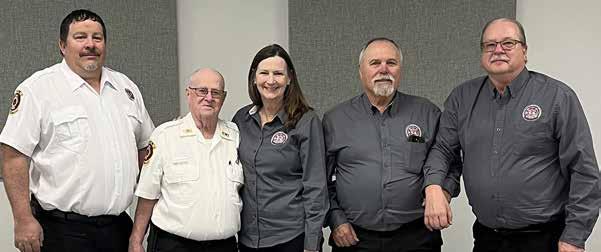
On March 14, the Gibbon Volunteer Fire Department held its annual Awards Banquet, where they honored Lee Vohland upon his retirement after an extraordinary 65 years of service. Joel and Rhonda Cerny (NVFC Director), Ron and Rhonda Chada (District 3 Director), and I had the privilege of attending the banquet to help celebrate Lee and recognize his remarkable dedication to the fire service. From left to right are Chief Brown, Lee Vohland, Brenda Jenny, Joel Cerny and Ron Chada.
Gibbon Volunteer Fire Department honored Lee Vohland after 65 years of service.
BRENDA JENNY President, Nebraska State Volunteer Firefighters Association
NSVFA OFficer Reports NSVFA Officer Reports
Passion in the Fire Service: Powerful Force or Potential Pitfall?
Passion has always fueled the American fire service. As our profession changes, we must consider whether passion always helps or sometimes drives us past our limits. I asked myself these questions while attending a recent fire department banquet, where a respected Nebraska Fire Chief talked about how passion shapes our work and those who serve. The banquet reminded me that while passion is one of our greatest strengths, it can also push firefighters beyond healthy limits if leaders do not actively guide and support it.
To address the effects of passion, leaders must protect members and manage their drive. This means modeling work-life balance, holding regular oneonone checkins, and establishing open forums for
MARCH 15, 2026
It is Sunday, March 15, 13:20 hours.
This article may not make sense, due to lack of sleep. I procrastinated and did not get this submitted earlier in the week, then the second half of my week turned extremely busy as it has for MANY Nebraska firefighters. The weather on Thursday, March 12th, had an impact on many Nebraska lives, and has continued through the weekend.
firefighters to voice concerns or seek help. Scheduling time for rest and professional growth further supports teams and prevents overwhelming.
THE POWER OF PASSION
If you ask any seasoned firefighter, they will say that passion fuels training, professionalism, and dedication to the job. As a result, teams that care deeply are typically better prepared, collaborate more effectively, and take pride in their work, elevating morale throughout the department.
WHEN PASSION TURNS COSTLY
While passion strengthens performance and morale, it can also carry risks when not balanced with realistic limits.
However, passion can become destructive if left unchecked. For example, many departments are seeing increased burnout as firefighters devote themselves fully to
Originally my article was going to be about the impact each one of us can have, no matter the size of your department. Just because you belong to a smaller agency does not mean that you can make less of a difference in any matter. It’s the passion, commitment, knowledge and experience that allow you to make a difference in whatever it is that you are trying to resolve. Increasing the penalties for burning without a permit is some-
the jobs at hand. When individuals exceed their own limits, health, performance, and job longevity decline. Even effective motivators can have unintended negative impacts if not monitored.
FINDING A HEALTHY MIDDLE GROUND
In response to these challenges, leaders need to focus on helping firefighters maintain passion without sacrificing their wellbeing.
This includes setting clear time rules, encouraging people to take leave, and recognizing firefighters who take care of themselves. The aim is not to limit excitement, but to keep it going by setting healthy expectations, supporting rest, and showing that taking a break is strength, not a weakness. Passion can make firefighters want to do everything, even if it means losing sleep. As leaders, we need to guide that energy by helping with
thing that has been brought to my attention time and time again as I travel to Mutual Aid meetings. There was a hearing on LB 897 by Senator Dan Lonowski of Hastings, on February 11, 2026. We sent out a request for testifiers, and no one responded. Luckily, at the last minute I was able to represent the NSVFA and the NSFC at this hearing. No matter if you’re from a small village rural fire department or one of the bigger agencies
Troy Shoemaker, 1st Vice President
“By setting expectations, watching for early signs of overload, and reinforcing that healthy balance strengthens performance, leaders can ensure passion remains a force that sustains long careers rather than shortens them. Our role is to shape a culture where dedication thrives, and firefighters can serve with energy, purpose, and longevity”
workload, spotting early signs of burnout, and making sure support is available—so passion helps, not hurts, our teams. By understanding both the benefits and the pressures that passion creates, leaders can guide their teams with greater intention and awareness.
PASSION: GOOD OR BAD?
Passion is simply powerful, and it falls to leaders to guide it intentionally, so it supports—not strains—our people. By setting expectations, watching for early signs of overload, and reinforc-
ing that healthy balance strengthens performance, leaders can ensure passion remains a force that sustains long careers rather than shortens them. Our role is to shape a culture where dedication thrives, and firefighters can serve with energy, purpose, and longevity. In closing, I am trying to find my writer’s passion for these monthly articles Scotty, so keep encouraging me!
Until next month, stay safe!
1 st Vice President
Kenny Krause, 2nd Vice President
“It is your stories that they need to hear, they can be meaningful in helping them to understand the reasons that we are asking for this type of legislation. Please, the next time you receive an email for a call to action, seriously consider coming to the hearing and telling your story. You can make a difference.”
in the state any of us can help get information to our state senators to help them make the right decisions.
It is your stories that they need to hear, they can be meaningful in helping them to understand the reasons that we are asking for this type of legislation. Please, the next time you receive an email for a call to action, seriously consider coming to the hearing and telling your
story. You can make a difference. Much like the wildfires that are burning now, any of us can make a difference no matter the size of our department. Again, all we have to have is the passion, knowledge and desire to get out and make a difference.
As always, stay safe,
KENNY
KRAUSE 2 nd Vice
TROY SHOEMAKER
Kenny Krause, Crew Leader, on Fairbury’s Type Six.
Our 3&33 Mutual Aid Task Force at the Cottonwood Fire, Alpha Division.
Finishing burnout on Cottonwood Road.
Lobbyist Report Lobbyist Report
I would like to extend my gratitude and appreciation to those that – as I write this – are away from home and engaged in the multitude of wildland fires raging across central and western Nebraska. Thank you hardly feels sufficient. Your courage in the face of danger, your endurance through long days and sleepless nights, and your unwavering commitment to protecting your neighbors and communities embody the very best of who we are as Nebraskans. While evacuation orders were entered, you ran toward the smoke. In a week marked by loss and heartbreak, your service has been a source of strength and hope for the entire state.
You are the reason communities still stand. You are the reason families were able to return home. And you are the reason Nebraska
continues to weather moments like this with resilience and unity. Volunteer firefighters give not only their time, but their safety, their energy, and often their own resources—asking for nothing in return. Please know that your sacrifice has not gone unnoticed. From the ranchers whose land you protected, to the families whose homes you saved, to the countless Nebraskans watching anxiously from afar, we are profoundly grateful. May you find rest, healing, and comfort in the days ahead, and may you always feel the deep appreciation of the people you so selflessly serve.
It is difficult to transition from that, but I will provide an update to what is going on in the Nebraska Legislature. April 1st marks day 54 of the 60 day session, with little time left to get legislation across
NVFC Reports NVFC Reports
As always, I hope this article finds everyone healthy and safe. As I write this article, I pray that God keeps all those fighting the Morrill and Candlewood fires safe, as well as the other wildfires that are setting Nebraska ablaze tonight. Know that you are all in the prayers of our family. Now, back to the usual bimonthly ramblings.
WHY THE NATIONAL VOLUN
TEER FIRE COUNCIL MATTERS TO
NEBRASKA’S FIRE SERVICE
Across Nebraska, the fire service is built on volunteers. From the smallest villages to our larger rural communities, the majority of departments are staffed by men and women who respond from home, from work, or from the middle of a family dinner when the pager goes off. These firefighters are
neighbors protecting neighbors, and they represent the backbone of emergency response across our state.
Supporting all of you volunteers at the national level are Joel and myself through the National Volunteer Fire Council (NVFC), while the Nebraska State Volunteer Firefighters Association (NSVFA) fights for you at the state and county level. While many firefighters recognize the NVFC name, they may not always realize how much the organization contributes to the success and sustainability of volunteer departments across our great state.
A NATIONAL VOICE FOR VOLUNTEERS
Founded in 1976 and celebrating 50 years this year alongside our nation’s 250th anniversary, the
Ryan K. McIntosh, Lobbyist
“Please know that your sacrifice has not gone unnoticed. From the ranchers whose land you protected, to the families whose homes you saved, to the countless Nebraskans watching anxiously from afar, we are profoundly grateful.” the finish line. The most notable issue during March was floor debate centered on midbiennium budget adjustments, as senators have worked to close a projected deficit that has grown from roughly $471.5 million at the start of session to more than $646 million following updated revenue forecasts late last month. The Legislature’s budget bills, sent to the Governor by the March 25 deadline, use a mix of spending reductions, cashfund transfers, and withdrawals from the Cash Reserve Fund to shrink the remaining gap.
I would like to extend another thank you to those of you who responded to our action alert on LB 400 introduced by Senator Dave Wordekemper (Fremont). LB 400 would create a rebuttable presumption within the Nebraska Workers’ Compensation Act treat-
ing cancer as an occupational disease for both volunteer and paid firefighters. Senator Wordekemper designated LB 400 as his personal priority bill to provide protections to ALL firefighters. However, some supporters of the bill have sought to remove the protections for volunteer firefighters, so the presumption would only apply to paid firefighters. Your actions in contacting your Senators has prevented this so far.
As the 109th Legislature winds
down, we will continue to fight for our affirmative legislation. As we approach the interim, please don’t hesitate to reach out with questions and suggestions on our future legislative agenda. Input from the NSVFA membership is what drives our legislative efforts. Thank you to all who have been engaged with your elected officials this session.
NVFC represents the interests of volunteer fire, EMS, and rescue personnel in Washington, D.C. Volunteer departments make up roughly two-thirds of the fire service in the United States, and in states like Nebraska that percentage is even higher.
Through its advocacy efforts, the NVFC works to ensure that the needs of volunteer departments are recognized when federal policy and funding decisions are made. Programs such as the Assistance to Firefighters Grants (AFG) and SAFER grants have helped Nebraska departments acquire apparatus, protective equipment, and training that would otherwise be difficult for small communities to afford.
TRAINING AND LEADERSHIP DEVELOPMENT
The NVFC also serves as a national hub for education and leadership development. Volunteer firefighters often balance emergency response with full-time careers and family responsibilities. The NVFC provides accessible online training, leadership resources, and safety initiatives designed specifically for volunteers who may not have the same access to training infrastructure as large career departments.
These programs range from firefighter health and safety initiatives to leadership training and department management resources that help small rural agencies remain sustainable.
LESSONS FROM NEBRASKA’S RECENT WILDFIRES
The importance of strong volunteer fire service support has been especially visible during the recent wildfires that have impacted Nebraska. Multiple large fires— including the Morrill and Candlewood fires, along with others across central and western Nebraska—have burned hundreds of thousands of acres, making this
Justin Scamehorn
,
NVFC Director
“By connecting local departments with national training, funding opportunities, and advocacy, the NVFC helps ensure that Nebraska’s volunteer firefighters remain ready to protect the communities that depend on them.”
one of the most significant wildfire events in the state’s history.
The Morrill Fire alone has scorched more than 450,000 acres across Morrill, Garden, Keith, and Arthur counties, spreading rapidly across grasslands under extreme winds and dry conditions.
Volunteer firefighters from departments across Nebraska responded to these incidents, often working long operational periods in difficult wind-driven fire conditions. In many cases, local farmers, ranchers, and neighboring departments also joined the effort by providing water tenders, equipment, and logistical support to firefighters battling the blazes.
These events serve as a reminder that rural volunteer departments are frequently the first—and sometimes only—line of defense when large-scale wildfires occur across our state and its vast grasslands.
SUPPORT FOR RECRUITMENT AND RETENTION
One of the greatest challenges facing volunteer departments nationwide is maintaining membership. The NVFC has taken a leadership role in addressing this issue through national recruitment campaigns, research, and toolkits that departments can adapt locally.
Programs focused on volunteer recruitment messaging, community engagement, and firefighter health have provided Nebraska departments with practical strategies to strengthen their rosters and maintain operational readiness.
FOR NEBRASKA
Nebraska communities depend heavily on volunteers. In many towns, the local fire department is not only an emergency response agency but also a cornerstone of community life. When large incidents such as the recent wildfire outbreaks occur, the strength of the volunteer fire service becomes even more evident. Organizations like the NVFC help ensure that those volunteers—who protect communities across thousands of rural miles—have the resources, advocacy, and national support they need.
MOVING FORWARD
The strength of Nebraska’s fire service lies in its volunteers. As the challenges facing rural emergency services evolve—whether responding to structure fires, medical emergencies, or large-scale wildland events—partnerships with organizations like the NVFC remain essential. By connecting local departments with national training, funding opportunities, and advocacy, the NVFC helps ensure that Nebraska’s volunteer firefighters remain ready to protect the communities that depend on them. As always, stay safe out there. Know that we are all thinking about those fighting the worst fires this state has seen tonight. Know that you are all in our prayers.
JUSTIN SCAMEHORN NVFC Director, State of Nebraska
RYAN K. MCINTOSH, N.S.V.F.A. Lobbyist
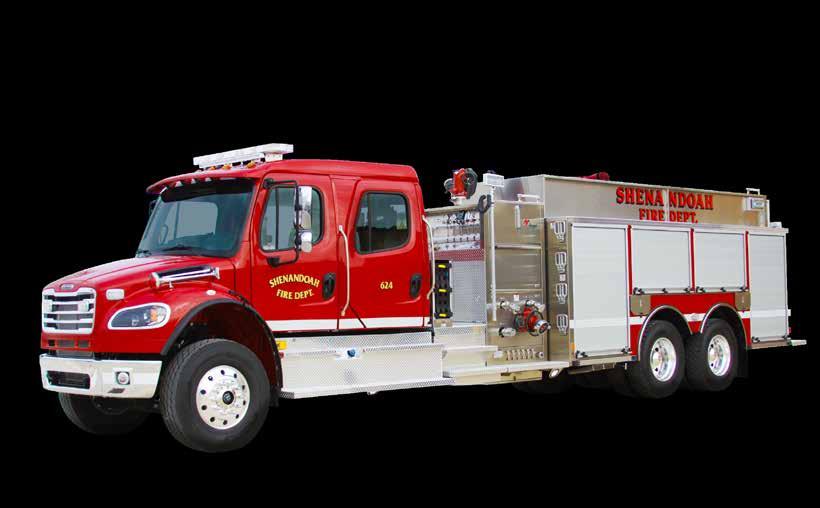
Fire Trucks Sutphen Fire Trucks
Legal Advisor’s Report Legal Advisor’s Report
Firefighters, I want to address some recurring themes I’ve observed in the compliance questions I get. These largely revolve around governance of rural fire district boards and their interactions with the nearest city/village or department.
1. Rural Boards are political subdivisions and do not have by-laws. They operate under Nebraska Statutes Section 35-501 to 35-540. Specifically, Section 35-508 is the list of all powers of the rural board. Each rural board member should read through these
sections to familiarize themselves with their contents and operation.
2. Rural Boards are subject to the Nebraska Open Meetings Act (Nebraska Revised Statute Section 84-1408 to 84-1415). Rural boards must have a current copy of these statutes available at every meeting and inform those in attendance that such a copy is available for examination (Neb. Rev. Stat. Section 841412(8)). These sections can be printed from the Nebraska Legislature’s website. Your
Nebraska Volunteer Firefighters Put Family Life on Hold to Serve Their Communities
In towns across Nebraska, volunteer emergency crews don’t just answer the call; they put their lives on pause to save yours.
In towns across Nebraska, volunteer emergency crews don’t just answer the call; they put their lives on pause to save yours.
“It was like a Thanksgiving dinner or Easter or something and they said no its fine, we’ll finish up, and we’ll see you in an hour or however long it’s going to be,” said Ginger Howser.
Mike Goodwater owns Goodies Grill in Battle Creek. When the pager goes off, he steps out of one pair of shoes and into another for the Battle Creek Volunteer Fire Department.
“It's a camaraderie that people may not understand, why you do the things you do for nothing, but we all are here for the community,” said Goodwater.
According to the Nebraska State Fire Marshal, there are over 300 volunteer fire departments, including Battle Creek.
Working emergency scenes together takes trust, and John and Marlene Bomar have more than
40 years of trust from being married. At the end of the day for the Bomars, it's not about the paycheck.
“It’s all in here we love it, the volunteer part of it, wouldn’t want to do it any other way,” said Marlene Bomar.
“I guess we’re fortunate being a husband and a wife that we can go home and talk about stuff that you shouldn’t be able to talk about,” said John Bomar.
For Randy and Ginger Howser, they first started volunteering because their daughter wanted to do it. Without the support from family, they don’t know what they would do.
“We never really thought about it,” said Ginger Howser.
“We never thought about it because they always supported it. So I guess we never really thought of what it would be like to not have it,” said Randy Howser.
As drought conditions worsen in many parts of the state, John Bomar left a message for all Nebraskans.
“Come down to one of the trainings and ask when you can come out. And just everybody in the state, actually the whole country needs volunteers right now,” said John Bomar.
(Written by Tyler Murphy, NCN, February 25, 2026)
county attorney or your retained legal counsel can also get you a copy. Not having a copy of available at meetings is a violation of the Act and can subject the board to suit to overturn decisions made at the meeting where the violation occurred. Though this may seem a silly step to comply with statute, it is a simple way to stave off a common compliance trap.
3. Rural board members should review a copy of the Workers’ Compensation Statutes for volunteer fire and rescue
personnel found at Nebraska Revised Statute Section 48115. Again, this section can be printed from the Nebraska Legislature’s website. Your county attorney or your retained legal counsel can also get you a copy.
I often hear of disagreements between rural boards, departments, and city/villages on the various decisions you would expect to come up. A general familiarity with the above-mentioned statutes will be very helpful in navigating many of the issues that surface in
the day-to-day. But with that, our rural board governance statutes are not exhaustive, they leave a lot to ambiguity. There is no substitute for good-will cooperation, this will always be faster and bring about a better result for everyone involved.
Our thoughts and prayers at the NSVFA are with those of you fighting wildfires in some tough conditions right now. Stay safe and talk to you next month!
Respectfully,
SCOTT G. SMITH NSVFA Legal Advisor
Please send them to
along with information to explain the photo.
11:00am
SCHEDULE OF EVENTS
Wednesday, May 13th
Fire School Committee Meeting
Thursday, May 14th
8:00am - 5:00pm 11:00am 7:00am
Registration and packets pickup not available until Friday at 7:00am
Friday, May 15th
Vendor Setup (Vendor sales begin Friday at 7:00am) NSVFA Board Meeting Registration Open
Pre-Registration Packets to be Picked-up before 11:00am
7:00am - 6:00pm 9:00am 11:00am 11:00am
11:00am - 1:00pm
Vendor Exhibits Open Opening Ceremonies
Area Representatives Meeting Instructors Meeting Lunch
Served to all registered persons with meal tickets, extra meal tickets may be purchased at registration desk
1:00 - 4:00pm
6:00pm 7:00am - 4:00pm
8:00am - 3:00pm
Classes in Session
Vendor Exhibits Close
Saturday, May 16th
Vendor Exhibits Open Classes in Session
11:00am - 1:00pm
3:30pm 4:00pm 4:30pm 4:30pm
5:00pm 8:00am - 11:00am 11:00am
Staggered 1 hour Lunches NE Fire Chiefs Association Meeting
Vendor Exhibits Close Catholic Church Services All Faith Services (Buildings for Vendors & Classes)…Closed
Sunday, May 17th
Classes in Session 2026 NE Fire School Closes
Camping and Trailer Park facilities are available at Fonner Park
A $35.00 PER DAY Camping Permit Fee is payable to Fonner Park and can be purchased at the Fonner Park Office.
CODE OF CONDUCT
Your conduct while attending out of town educational programs or other Fire/EMS service events should be no different than it would be at home in front of your families. Wherever you travel, the window decal, the Maltese cross on your jacket or tee shirt identifies you as a member of an honorable and proud profession. Your actions reflect not only upon you as an individual, but upon your department and the Fire/EMS service as a whole. The public expects our actions to be above reproach on and off the emergency scene.
NO CONCEALED WEAPONS
The Nebraska State Fire School will not allow concealed weapons including permit holders on the Fonner Park grounds and/or at any Fire School activity.
AMERICANS WITH DISABILITIES
If you have special needs as addressed by the American with Disabilities Act, please contact the NSVFA Office prior to Fire School at 402-761-2211. Reasonable efforts will be made to accommodate your needs.
NOTICE OF NON-DISCRIMINATION
The NSVFA is committed to maintaining an environment free from all forms of discrimination against any person on the basis of race, color, religion, sex, national origin, age, disability, veteran status, or any other legally protected characteristic.
HEALTH WARNING
Certain classes offered require significant physical exertion and stamina. Persons with heart, respiratory, or other physical conditions that may be aggravated by this type of exertion, or that may hinder their participation should not participate in the program. Please consult your physician regarding your participation. The NSVFA office will also have information concerning physical requirements of particular courses.
REGISTRATION FORM 89TH NEBRASKA STATE FIRE SCHOOL
May 15-17, 2026
Mail completed form and payment to: NSVFA Fire School, 521 First Street, PO Box 10, Milford, NE 68405.
Mailing Address
City State Zip
Date of Birth Phone
2026 FIRE SCHOOL CLASS LIST
Please Mark you 1st, 2nd, & 3rd Choices
Building Construction, Tactics and Fireground Operations
Legal Smorgasbord (Saturday Only)
Fire Prevention: Building Stronger, Safer Nebraska Communities
Structure Protection During Wildland Urban Interface Fires
Wildfire Leadership
Farm Emergencies and Extrication Practices
Intro to Firefighting
Advanced SCBA
Basic Vehicle Extrication
Confined Space Rescue
Advanced Rope Rescue Techniques
Fireground Operations
Forcible Entry Techniques
Rural Water Supply
Nebraska Fire Happenings
Fire Investigations
CSI Nebraska
Resources for the New Fire Chief and New Chief Officers
Grain Engulfment Training
EMS Segmented Class
Incident Leadership and Decision Making
Live Flashover Training Simulator and Mobile Live Burn Simulator & SCBA
Union Pacific RR Preparing and Responding to HazMat Incidents
Every Vehicle (EV) Fire Training – Best Practices in the EV Era
The ISO Public Protection Survey
Machinery and You (Man Vs. Machine)
Grand Island Fire Search Academy: LIVE FIRE
Culture in the Firehouse
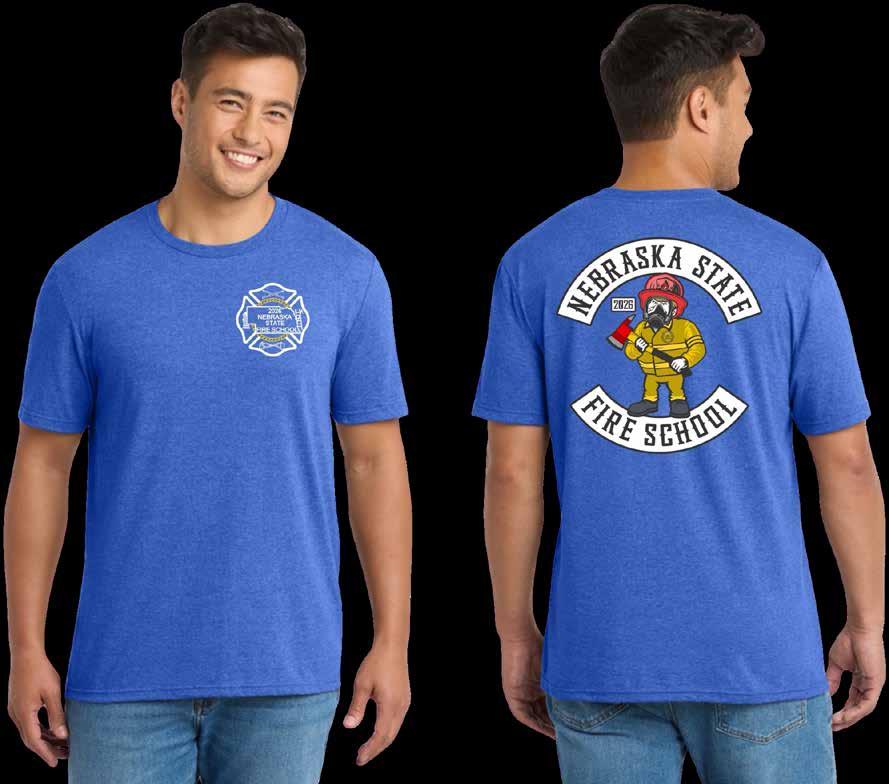
T-shirts are pre-order only and will be available for pick up onsite at Fire School
NSVFA MEMBER FEE: NON-MEMBER FEE:
LEGAL ISSUES CLASS:
(Saturday, May 16th, 1:00-3:00 pm) $55 00 $
METHOD OF PAYMENT:
(Payable to NSVFA Fire School)
Department Check
Personal Check
Check Number
Date Received
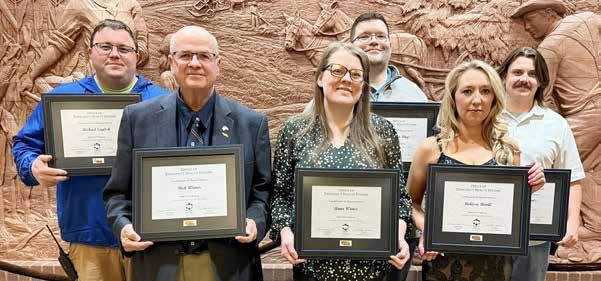
Arnold awards
Those receiving awards for responding to over 30% of all calls were
Andrew Tickle, Gregg Tickle, Robbi Smith, Cam Meyer, April Tickle, Grady Lashley, Dave Smith, Tammy Weinman, Cassy DeLosh, and Amanda Wehnes.
Arnold Volunteer Fire Department holds annual awards banquet
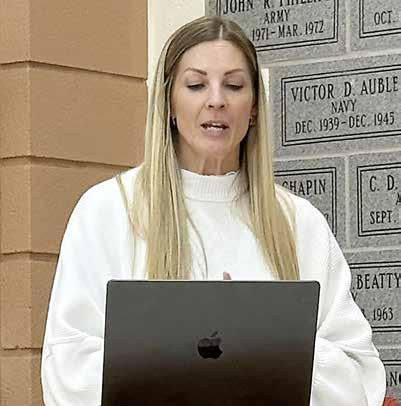
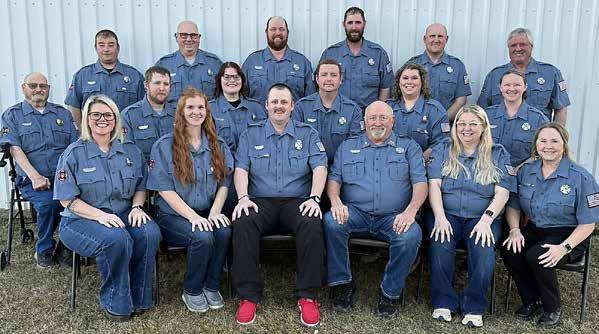
The Arnold Volunteer Fire Department held its annual awards banquet on Friday, February 27, at the Arnold Legion. They enjoyed a meal catered by Around the Block Catering. Tami Smith was the speaker for night. Tami is a provisional mental health practitioner, and her husband Dave serves on the department. “I was asked to speak about how to deal with difficult calls — not from theory, but from what actually helps people stay well in this work. There’s a framework used in high-stress professions. It’s not about forcing people to talk, and it’s not about pretending nothing happened. It’s called BICEPS, and it works because it respects how human beings — and nervous systems — actually function under “load.” I want to walk through it with you as a way of downshifting together after heavy calls — a way of taking care of yourselves and your tribe,” Tami said. The acronym BICEPS stands for B- Brevity (a short check-in with each other), I- Immediacy (support works best sooner rather than later), C-Contact (letting yourself be near people who understand this work), E- Expectancy (recovery is expected — not optional), P-Proximity (stay close to your people and your routines), and S-Simplicity (Eat, Hydrate, Shower, and Sleep). “Having this information for first responders, especially after a tough year for Arnold’s first responders, is important and we were privileged to have someone like Tami to present that information to our department and our
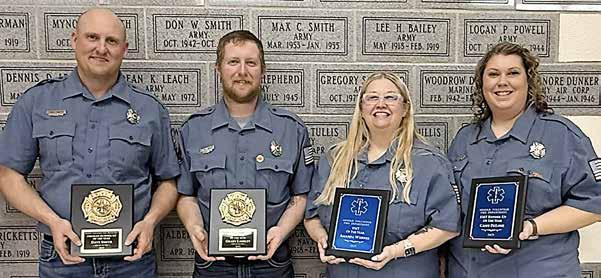
family members,” Rescue Captain Tammy Weinman said. Andrew Tickle, Fire Chief, handed out several awards for the night including Tammy Weinman- The Overcomer Award, Robbi Smith- The Fastest Responder Award, Cassy DeLosh- Most Training Hours for 2025, Jane Lashley- The Comeback Kid Award, Dalton SwopesThe Nutcracker Award, Cassy DeLosh- Getting Over Your Fear Award, Amanda Wehnes- Screech the Tire Award. Amanda Wehnes researched our call data to award those that respond to the most EMS calls between midnight and 6:00 calling it the Red Eye Award. Award winners for this award were Tammy Weinman and Andrew Tickle with a tie among the EMT’s and fireman Robbi Smith. Those receiving awards for responding to over 30% of all calls were Andrew Tickle, Gregg Tickle, Robbi Smith, Cam Meyer, April Tickle, Grady Lashley, Dave Smith, Tammy Weinman, Cassy DeLosh, and Amanda Wehnes. Responding to over 50% of all calls award were Andrew Tickle, Robbi Smith, Tammy Weinman, Cassy DeLosh and Amanda Wehnes. Years of Service pins were given to April Tickle 15 years, Andrew Tickle 15 years, Heather Hagler 15 years, Jane Lashley 5 years and Grady Lashley 5 years. Dave Smith was awarded 2025 Runner Up Fireman of the Year, Grady Lashley 2025 Fireman of the Year, Amanda Wehnes 2025 EMT of the Year, and Cassy DeLosh 2025 Runner Up EMT of the Year. These awards were voted on by their peers.
Speaker Tami Smith
Responding to over 50% of all calls award were Andrew Tickle, Robbi Smith, Tammy Weinman, Cassy DeLosh and Amanda Wehnes.
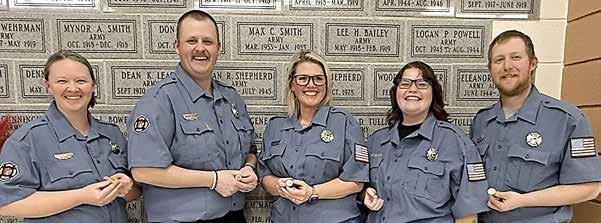
Years of Service pins were given to April Tickle 15 years, Andrew Tickle 15 years, Heather Hagler 15 years, Jane Lashley 5 years and Grady Lashley 5 years.
Dave Smith was awarded 2025 Runner Up Fireman of the Year, Grady Lashley 2025 Fireman of the Year, Amanda Wehnes 2025 EMT of the Year, and Cassy DeLosh 2025 Runner Up EMT of the Year. These awards were voted on by their peers.
Members of the Arnold Fire Department.
Happy Birthday NVFC
By STEVE HIRSCH, NVFC Chair
In November of 1975, representatives from seven state firefighter associations gathered in Chicago to talk about establishing an organization, national in scope, to represent volunteer firefighters. The first meeting of the National Volunteer Fire Council (NVFC) was held on March 15, 1976, with twelve states represented. Over the
years, the NVFC has continued to grow and mature. It is exciting that our birthday coincides with the bicentennial of our great nation – and just as exciting that we will be celebrating 50 years when the nation celebrates its 250th! We have a lot in common with this great country’s founding. George Washington was a volunteer in Alexandria, VA, Ben Franklin was one of the
founders of Union Fire Company in Philadelphia in 1736, and Thomas Jefferson started a volunteer fire department in Richmond, VA, in 1779. President Franklin Pierce was a volunteer in Concord, NW, President Calvin Coolidge in Northampton, MA, and President Herbert Hoover in West Branch, IA. Of all of these, I believe that West Branch is still a volunteer department.
Our country’s founders believed in individual liberties – the right to life, liberty, and the pursuit of happiness – but they also knew that protection of the citizens and their property from the ravages of fire was not something that could be done alone, which is why they organized fire companies. They knew that one wooden house built close to one another in our cities was a recipe for disaster. They
Wider
knew that a wildfire in grasslands would ultimately find a house or a barn unless checked by the townspeople.
That’s why my dad got involved in the fire service – and I suspect why many of you got involved – to serve our communities, to help out our neighbors when they need our help the most. We know that if we don’t volunteer, there isn’t anyone to handle those calls.
Over the years we evolved into a service that doesn’t just handle fire, but rather are an all-hazards agency. The country started that way too. A nation founded over the love of liberty that found that when it stood for what was right, it would grow and prosper. There is no country on this earth – none was ever founded – that can match our nation’s strength, its generosity, and its kindness. The same can be said for the nation’s volunteer fire service. Volunteer firefighters make up the overwhelming majority of firefighters in our nation. Volunteer firefighters cover the largest land mass in the nation. Volunteer firefighters are professional, they are strong, they are generous and they are kind.
Have we made mistakes as a nation and as a fire service? Sure. We didn’t give women the right to vote for many years – and we couldn’t quite see the need to have female firefighters. We were okay that a huge section of our population was enslaved – and we couldn’t bring ourselves to have anything other than Caucasian firefighters. Just as the nation grew in might, it changed its attitudes and as the volunteer fire service grew we understood that we couldn’t exclude segments of our population from among our ranks.
I am a proud American. I am very proud to serve this nation as a volunteer firefighter. Every day our brothers and sisters are fighting fires, extricating people in rescue situations, caring for our citizens when their health demands it, responding to gas meters that are broken off, responding to wildland fires, watching the clouds for the next weather event, and so much more.
If you are reading this and are a volunteer firefighter, thank you! If you are reading this and aren’t, then now is the time. Your community – yes even your nation – needs you. God bless the volunteer fire service, and may God continue to bless the United States of America.
Inside the Cottonwood Fire
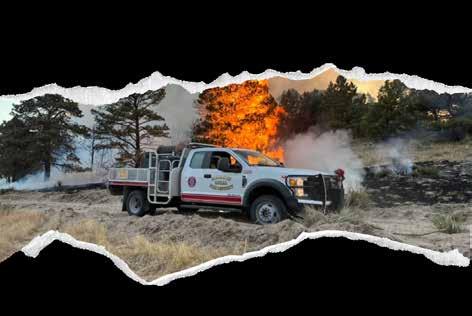
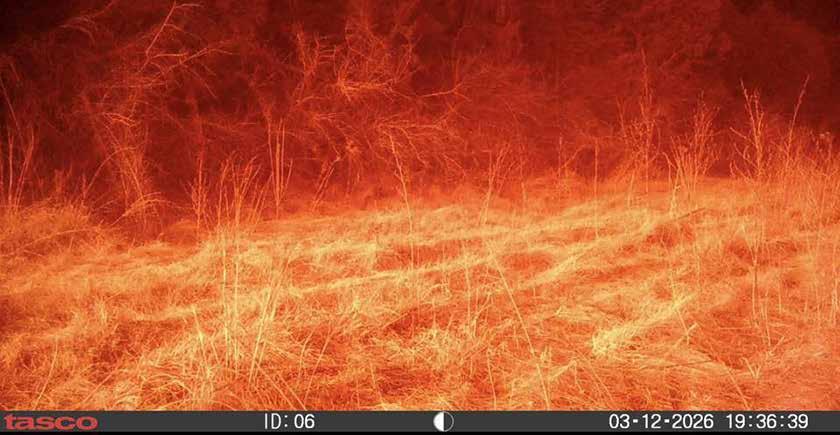
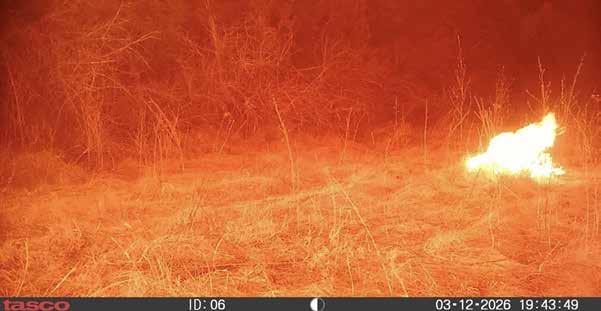
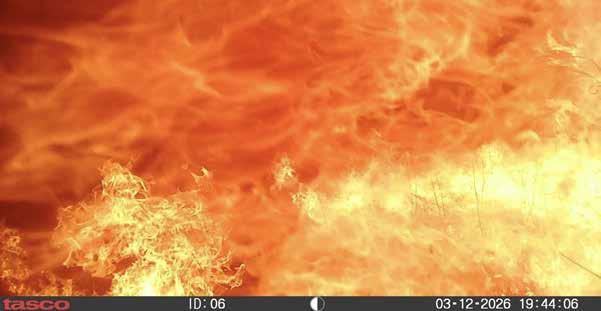
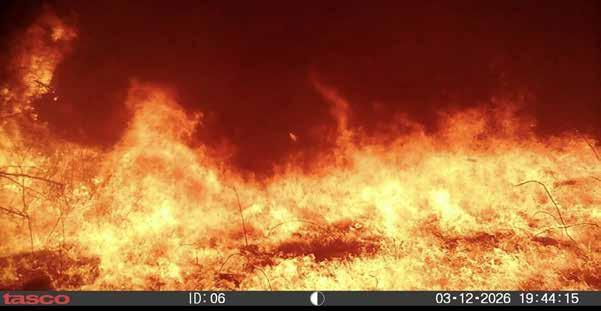
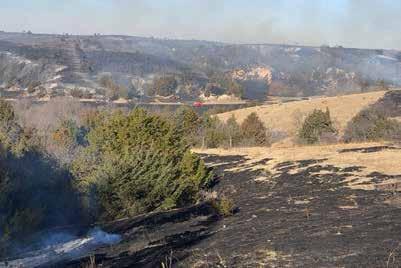
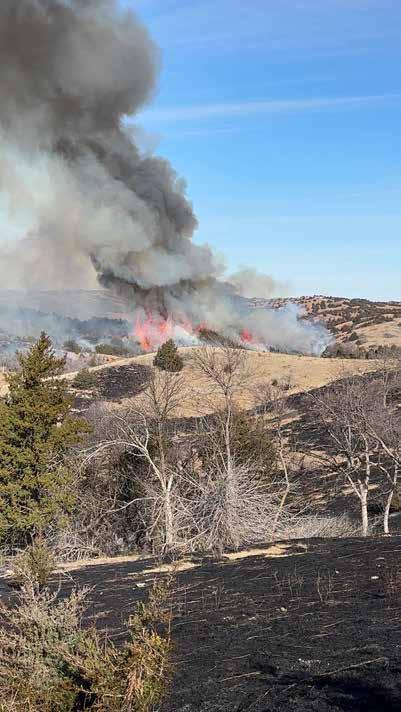
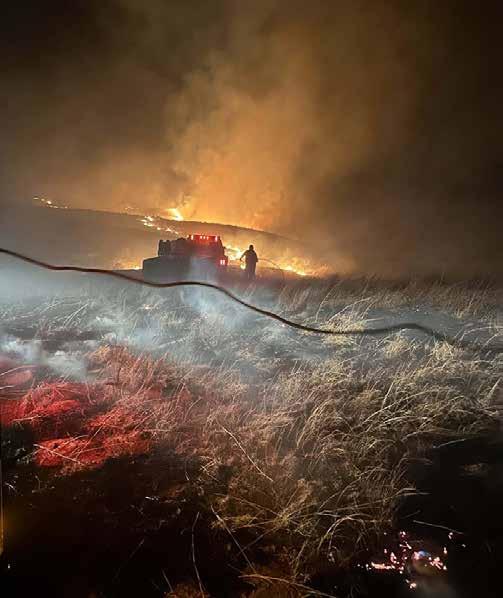
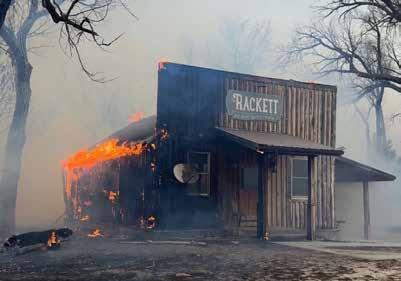
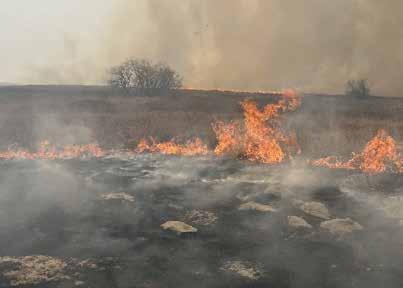
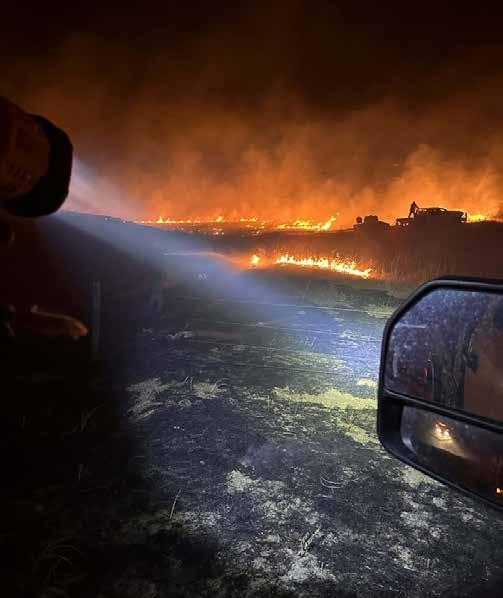
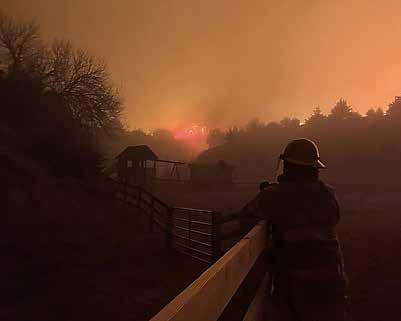
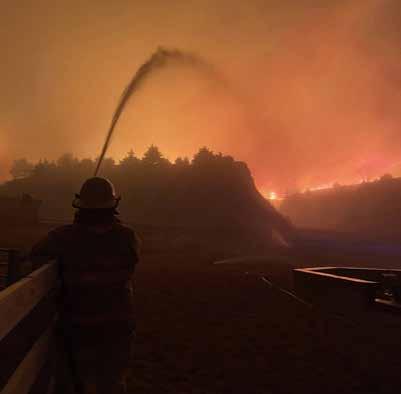
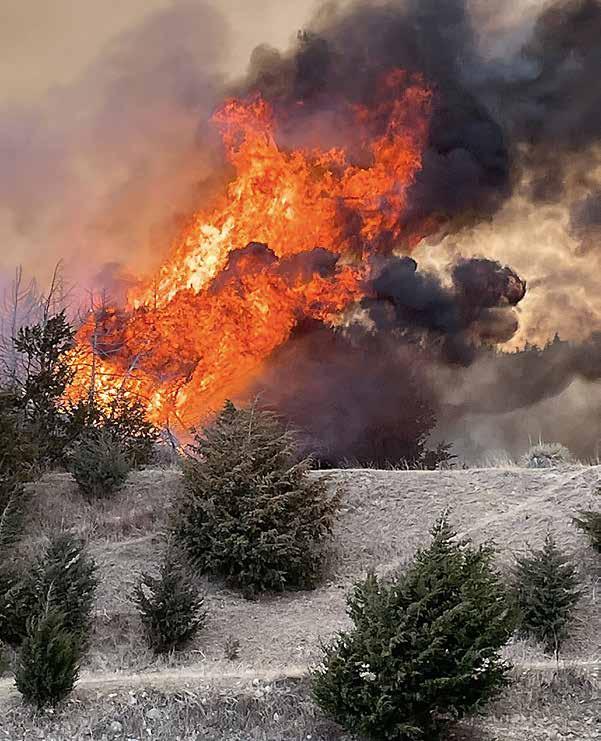
These images come from inside the Cottonwood Fire burn area in Nebraska. Jordan Adams says a non-cellular trail camera on the property went through the wildfire and was left completely melted. When he returned to check the site, he brought the damaged camera home and carefully peeled it apart — discovering the SD card inside was still perfectly intact. What he found on that card was remarkable. The recovered photos show the landscape during the fire, offering a rare glimpse of what is happening inside the burn zone. The trail cam photos are date and time stamped for an accurate look at how quickly this fire spread. Photos courtesy of Jordan Adams. From the North Platte Post Facebook page.
Nebraska firefighters battle multiple blazes around Sandhills
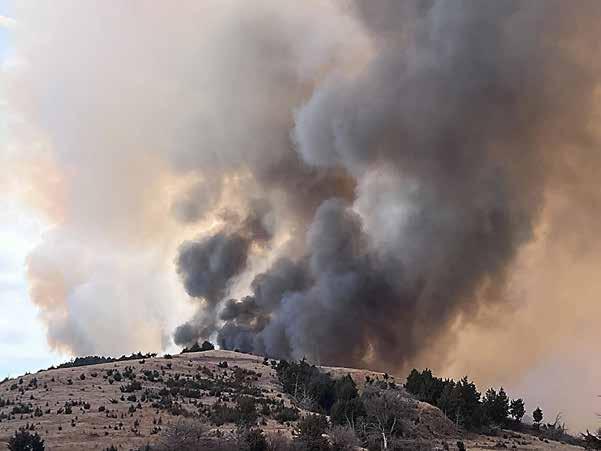
Fire danger runs high across Nebraska, as firefighters were called to multiple fires Thursday in and around the Sandhills.
Region 26 Emergency Management based in Taylor issued an evacuation notice for Dunning, but later said the grass fire has shifted and is now moving south, and Dunning is in the clear at this time. Fire crews are continuing to monitor and work the fire.
A rancher near Purdum shared a photo of smoke billowing in the air near the Nebraska National Forest in Halsey. A federal fire website showed 5,000 acres burned as of Thursday evening. Federal forest service officials said extremely high winds were causing the fire to spread quickly.
The fire at the National Forest and Grasslands follows a prescribed burn earlier this week.
Meanwhile, fires were reported in several other fires including in Lincoln and Buffalo Counties. A large grass fire continues south of Maxwell. Mutual aid from as far away as Lexington, Cozad, and Arnold are assisting.
Lincoln County Emergency Management has issued an evacuation order for the Jeffrey Lake area.
Highway 47 was closed south of Gothenburg due to a brush fire.
The National Weather Service has been cautioning conditions could lead to fires while the Nebraska Forest Service has been warning that warm, dry start to the year and lack of snowfall was likely to result in fires.
Winters with little snowpack are followed by unseasonably warm, windy springs that dry out grasses and crop residue, creating ideal conditions for large fires.
Ben Bohall of the Nebraska Forest Service recently told the Rural Radio Network that Nebraska had endured four “bad” years of fires in a row.
“What we’ve seen is, since 2022, it’s been almost like clockwork,” Bohall said. “We hit these springs that are unseasonably warm where we have high temperatures, strong winds, things begin to dry out, and then we seem to have at least one big wildfire occur in the state.”
The Nebraska Forest Service reported that staff members were responding to several of the large wildfires occurring across the state, including Kilgore, Valentine, and Brady/Maxwell/Curtis. If you’re near these areas, please stay clear of active fire zones and remain safe.
(Written by Steve White, KNEB, March 12, 2026)
Spring game proceeds
By RYAN MCINTOSH
The University of Nebraska Athletic Department announced in March that it would donate all ticket proceeds from its upcoming spring football game to support volunteer firefighters and departments who responded to the wildfire relief efforts across the state, offering a powerful example of community leadership in a time of crisis. The University of Nebraska Athletic Department worked with the NSVFA to set up a website to collect additional donations and in getting funds to departments in Need. The March 28 game in Lincoln will serve not only as a preview of the Huskers’ upcoming season, but also as a statewide effort to aid re-
covery of the March wildfires that impacted so many families, ranchers, and communities.
This effort reflects the best of Nebraska, and it would not be possible without the leadership and support of Governor Jim Pillen, Athletic Director Troy Dannen, and the entire University of Nebraska Athletic Department, who have taken action to provide emergency assistance to those affected. Together, these efforts highlight how public institutions and state leadership can come together to serve Nebraskans in times of need.
As communities continue to recover, this initiative stands as a reminder that the strength of Nebraska lies in its willingness to support one another when it matters most.
Going Long: Stretching 300’ and Beyond with the Supply Side Leadout
By COLE KLEINWOLTERINK
Access to certain structures can be difficult. Long setbacks, extended driveways, garden apartments, and large commercial footprints all challenge the traditional 200’ preconnect. Because of this, every engine company should carry at least one line capable of “going long,” along with a clear game plan for stretching it quickly and efficiently. The exact length needed will depend on your district, but simply having the hose isn’t enough — crews must be comfortable deploying it.
This article examines a hose stretch technique known as the Supply Side Leadout. While the method can be adapted for use with a traditional 200’ preconnect, it becomes especially valuable when deploying longer hose loads of 300 feet or more. This article uses a 300’ × 1¾” preconnected attack line to illustrate the technique, but my engine company also applies the same concept when stretching our 400’ deadload of 2½” hose.
For this stretch to work effectively, the hose should be loaded as either a flat load or a modified minuteman load. For the purposes of this article, the technique will be illustrated using a flat load, as that is what my engine company runs.
Our engine carries a 1¾” × 300’ attack line off the rear of the apparatus. The hose bed is arranged with a loop every 100 feet and includes a clear loop located after the first fold in the bed. This configuration allows firefighters to quickly identify and pull sections of hose during the stretch.
HOW TO STRETCH IT
Firefighter #1 begins by shouldering the first section of hose. For our engine, this is the top 100 feet. As Firefighter #1 steps away from the engine, they should move in the direction of the intended stretch. For example, if the fire building is to the right of the apparatus, Firefighter #1 should take a couple steps to the right as they move away from the rig.
Once Firefighter #1 has cleared enough space, Firefighter #2 shoulders the next section of hose; for my engine this is another 100 feet. After this section is shouldered, Firefighter #1 returns to the hose bed and pulls the remaining section of hose, which is the final 100 feet.
When pulling the last 100’ hose, Firefighter #1 should grab a fold approximately halfway up the remaining bundle (roughly 50 feet mark) along with the clear loop at the bottom of the load. This will clear the bed quickly while still being able to easily flake out.
At this point, both firefighters are positioned with hose shouldered. Firefighter #2 now leads the stretch toward the objective. This is intentional because once the pull section is deployed, the hose on Firefighter #2’s shoulder will be the first to flake off.
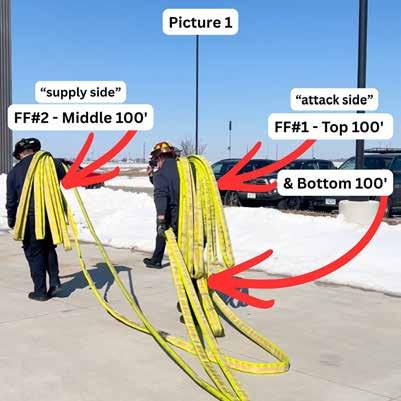
As Firefighter #2 moves forward, Firefighter #1 drags the final section of hose behind them (see Picture 1). The clear loop will pull tight first. When this occurs, Firefighter #1 should drop that loop while maintaining control of the 50’ fold. Once the 50’ loop pulls
tight, it should also be dropped.
When the bottom 100 feet of hose is fully deployed, Firefighter #1 should communicate this to Firefighter #2. This lets Firefighter #2 know that once the line pulls tight, the hose on their shoulder should begin flaking off. If Firefighter #2 feels the hose pull tight before Firefighter #1 communicates that the bottom 100’ is flaked, they know that the hose caught on a pinch point somewhere and to not let the hose begin flaking off their shoulder bundle yet.
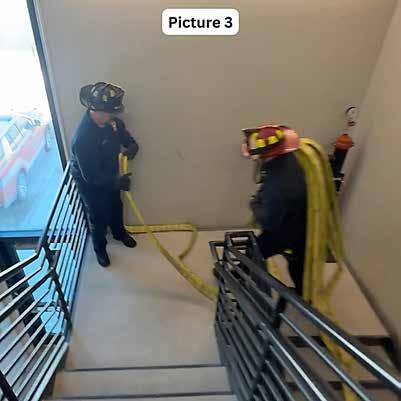
Once Firefighter #2’s shoulder load has deployed, the stretch naturally transitions. Firefighter #1 moves past to continue advancing the line while Firefighter #2 drops behind the nozzle to manage the remaining hose and address any friction points (see Picture 3). As the crew closes in on the objective, the final 100’ section carried by Firefighter #1 can begin deploying to finish the stretch and position the line for the attack.
Upon reaching the destination, Firefighter #1 can place the hose on their shoulder onto the ground and flake out the hose as needed to properly position the line for the attack.
There is a video example of this on the Iowa Firefighter Training Article Archive website (tinyurl. com/3mpjcsuv).
WHY THE
SUPPLY SIDE LEADS
Many engine companies tradition-
SEE GOING LONG, PAGE 17
Going Long
ally stretch bulk hose loads with the nozzle firefighter leading while the second firefighter shoulders additional hose and follows behind. While this method works, it has several drawbacks.
During a traditional stretch, nobody is watching the back end of the line. Friction points at corners, doorways, or stair landings can go unnoticed. The nozzle firefighter may feel tension in the line and mistakenly begin flaking hose early, thinking the line has run out when it is actually hung up somewhere behind them.
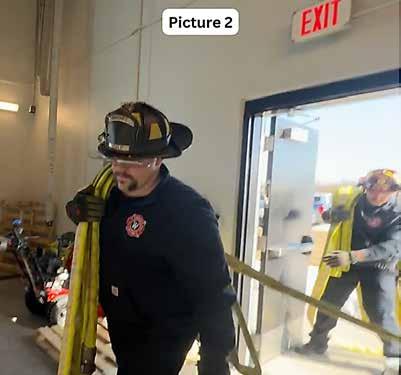
By allowing the supply side firefighter to lead the stretch, these problems are reduced. The nozzle firefighter can stay focused on the back end of the line, managing friction points and ensuring the hose moves cleanly around corners, through doors, and up stairs (see Picture 2).
THIS APPROACH IS ESPECIALLY VALUABLE FOR THREE-PERSON ENGINE COMPANIES.
On three-person crews, the officer often has to assist with stretching the line, which limits their ability to move ahead of the hose line, perform reconnaissance, open doors, and ensure the stretch is accurate. In single-family dwellings this may be manageable, but in multi-family occupancies it can
quickly become problematic.
Using the supply side leadout allows the driver/operator to assume the supply side role, leading out the stretch while the nozzle firefighter manages the line behind them. Once the driver’s shoulder load has deployed, they can
Three-Vehicle Accident In Ellis
On Friday, February 27, 2026 at approximately 12:38 pm, the Gage County Sheriff’s Office was dispatched to a three-vehicle injury accident on Highway 136 at the intersection of Southwest 117th Road, just outside of Ellis, Nebraska.
According to the sheriff’s office, the on-scene investigation indicated that Kodi Surrell, age 34, of Fairbury, was driving a red 2007 Chrysler Town and Country van eastbound on Highway 136 and swerved to the left when he came upon a pickup truck that was stopped on the highway 136 to turn left onto Southwest 117th
Road.
Surrell’s vehicle struck the rear of the pickup, then struck, nearly head on, a Chevrolet Malibu that was westbound on Highway 136.
The Beatrice Rural Fire Department and Beatrice Fire and Rescue were also dispatched to the scene and transported Surrell to Beatrice Community Hospital for non-life-threatening injuries.
Speed and alcohol are not considered a factor. All drivers were wearing seatbelts. The investigation is ongoing.
(Fairbury Journal News, Fairbury, Nebraska, March 4, 2026)
Fire takes Kearney house, outbuildings
The Kearney Volunteer Fire Department reported there were no injuries or loss of life in a Friday evening fire northwest of the city.
Owners Boyd and Barb Damme and their dog escaped without harm, but there was extensive damage to their home at 5910 Bison St. near the intersection of Bison and Cottonmill Avenue, said Jason Whalen, KVFD's fire administrator.
Kearney firefighters were dispatched to the blaze at about 6:30 p.m. Friday. Neighbors said it
sounded as if there were explosions, but Whalen said pressure relief mechanisms on propane tanks were expelled from the tanks, and large flames resulted.
"The house is unlivable, and they lost a couple of outbuildings," Whalen said.
KVFD fought a "minor fire" on Friday at Odessa, he said, and also sent volunteers to help fight range fires in western Nebraska.
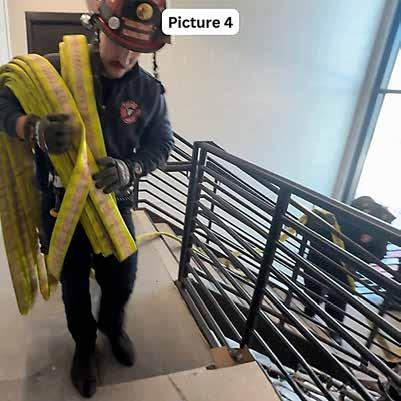
communicate that the line is on the nozzle firefighter and begin working back toward the apparatus. As the driver returns to the rig, they retrace the stretch, ensuring the hose is free of kinks, not trapped in doorways, and properly aligned before making the connection and charging the line (see Picture 4).
All of this happens while the officer is free to work ahead of the line, confirming the location of the fire, controlling doors, and ensur-
ing the first line is placed where it will have the greatest impact.
For engine companies operating with limited staffing or longer hose loads, the Supply Side Leadout can be a simple adjustment that significantly improves the efficiency and accuracy of the stretch. By allowing the supply side to lead out, crews can better manage friction points, maintain awareness of the back end of the line, and keep the stretch moving toward the objective. If your com-
pany has never experimented with this method, it is worth putting it on the training ground. You may find it quickly earns a place in your engine company’s playbook.
Cole Kleinwolterink is a member of the Waukee Fire Department, Granger Fire Department, and Fire Science instructor at Des Moines Area Community College. Feel free to reach out to him at kleinwolterinkc@gmail.com with any questions, comments or inquiries.
BUILT TO ENDURE
Maximum durability means maximum readiness. MacQueen delivers comprehensive fire apparatus solutions backed by expert service and support.
Application Period Now Open for MSA’s Globe Gear Giveaway
52 sets of turnout jackets, pants, and helmets will be awarded in 2026
MSA Safety, Nomex® and Kevlar® for Personal Protection, and the National Volunteer Fire Council (NVFC) are pleased to announce that the 2026 application period is now open for MSA’s Globe Gear Giveaway. Through this annual program, volunteer fire departments in need can apply to receive new Globe® turnout gear and MSA Cairns® helmets to enhance the protection and safety of their firefighters.
Now in its 15th year, the program has provided 186 departments with a total of 819 sets of turnouts and 364 helmets. In 2026, an additional 52 sets of gear will be awarded to 13 departments. Eligible volunteer fire departments can apply for four sets of turnout jackets, pants, and helmets to help protect their responders and increase the capabilities of their department.
“Turnout gear is critical to the health, safety, and effectiveness of firefighters, yet there are many volunteer fire departments across the U.S. and Canada that struggle to find funding for the gear they need,” said NVFC Chair Steve Hirsch. “For 15 years, this program has helped address that need and ensure more firefighters are properly equipped to serve their communities. We thank MSA Safety for this ongoing partnership and their commitment to supporting the volunteer fire service.”
“We’re proud to support firefighters who are dedicated to protecting their communities,” said Joann Serakowski, MSA Safety Vice President of United States and Canada Fire Business. “Through our long-standing partnership with this program, we remain committed to helping keep firefighters safe by providing safety gear to those who need it most. We’re grateful for the opportunity to help enhance the safety of those who serve on the front lines every day.”
“Our partnership with the NVFC and MSA remains incredibly important to us, as both organizations share our passion for equipping front-line volunteers with cutting-edge gear, research-driven solutions, and ongoing education,” said John Denison, DuPont Personal Protection Market Leader. “DuPont proudly supports the Globe Gear Giveaway each year as part of our focused mission in the emergency response market – to develop innovative Nomex® and Kevlar® fibers designed to help protect firefighters who work tirelessly to keep our communities safe. Through this program, we are able to turn that mission into action by delivering gear directly to the departments that need it most.”
The application period is open through noon ET on June 1. To be eligible to apply, departments must meet the following criteria:
• Be over 50% volunteer.
• Serve a population of 25,000 or less.
• Be located in the United
States or Canada and be legally organized under state/province law. *Indian/tribal entities not organized under state/ province law are eligible.
• Have at least one active NVFC member. To help departments meet this requirement, MSA will provide one-year individual NVFC memberships to the first 500 applicants.
• Demonstrate a need for the gear.
View the full criteria and apply at www.nvfc.org/gear
Winners will be announced monthly between July and December. Stay tuned to the NVFC web site and Dispatch newsletter for details.
ABOUT GLOBE MANUFACTURING COMPANY AND MSA SAFETY
Globe Manufacturing Company, a leader in fire service protective clothing, is a subsidiary of MSA Safety Incorporated. MSA Safety Incorporated (NYSE: MSA) is the global leader in advanced safety products, technologies and solutions. Driven by its singular mission of safety, the company has been at the forefront of safety innovation since 1914, protecting workers and facility infrastructure around the world across a broad range of diverse end markets while creating sustainable value for shareholders. With 2024 revenues of $1.8 billion, MSA Safety is headquartered in Cranberry Township, Pennsylvania and employs a team of more than 5,000 associates across its more than 40 international locations.
For more information, please visit http://www.msasafety.com/
ABOUT
DUPONT PERSONAL
PROTECTION
From first responders to industrial workers, DuPont provides a wide range of personal protection solutions, including some of the most trusted and innovative brands in the industry, such as Kevlar®, Nomex®, Tyvek® and Tychem® to meet your safety needs. More information can be found at personalprotection.dupont.com.
ABOUT DUPONT
DuPont (NYSE: DD) is a global innovation leader, providing advanced solutions that help transform industries and improve everyday life across our key markets of healthcare, water, construction, and transportation. More information about the company, its businesses and solutions can be found at http:// www.dupont.com/. Investors can access information included on the Investor Relations section of the website at investors.dupont.com
DuPont™, the DuPont Oval Logo, and all products, unless otherwise noted, denoted with ™, ℠ or ® are trademarks, service marks or registered trademarks of affiliates of DuPont de Nemours, Inc.
ABOUT THE NVFC
The National Volunteer Fire Council (NVFC) is the leading nonprofit membership association representing the interests of the volunteer fire and emergency medical services. The NVFC unites and supports volunteer and combination fire and EMS organizations through education, advocacy, leadership development, and collaboration. Guided by professionalism and innovation, we provide the tools and resources needed to protect communities, advance responder health and safety, and prepare leaders for the future. Learn more and join at www.nvfc.org.
Holdrege, Loomis rest up
Units Holdrege 27 and Loomis 26 returned to their stations around 22:00 on March 13. After obtaining rest and supplies, they resumed fighting the fire at 0500 as part of the Buffalo County Task Force. Multiple fire departments from Nebraska and other states are currently battling these fires. However, it’s crucial to note that not all resources can be deployed to a single incident, as each district must maintain protection and readiness for potential fires and emergency medical services within their own jurisdictions.
Mitchell VFD participates in training
On March 7, members of the Mitchell Volunteer Fire Department participated in a controlled burn of a house in Bridgeport Fire Department’s district. This was a great training for our members and gave them a chance to practice inside a burning building in a non-emergent situation. Trainings like these allow firefighters to see real fire situations and see how a fire evolves in real life. From the Mitchell Fire Department Facebook page.
March, 10 2026
Prepared by
RYAN WOODWARD , Chief of Legislative and Regulatory Affairs
Summary of Contents:
The following report contains an overview of the NVFC’s Legislative/ Regulatory Actions since the beginning of the 119th Congress on January 3rd, 2025. This information will be broken-down as follows:
* NVFC SUPPORTED LEGISLATION SIGNED INTO LAW (PAGE 2)
o The Honoring Our Fallen Heroes Act via the National Defense Authorization Act for Fiscal Year 2026 (P.L. 119-60)
o Protecting Access to Ground Ambulance Medical Services Act (H.R. 2232/S. 1643)
o First Responders Retirement Parity Act (H.R. 2382)
o High-Rise Fire Sprinkler Incentive Act (H.R. 173/S. 504)
o EMS Counts Act (H.R. 3791)
o Setting Consumer Standards for Lithium-Ion Batteries Act (H.R. 973/S. 389)
o The Public Housing Fire Safety Act (H.R. 4359)
o The Pro Codes Act (H.R. 4072)
o AM Radio for Every Vehicle Act (H.R. 979/ S. 315)
o Comprehensive Alternative Response for Emergencies (CARE) Act (H.R. 2538/S. 3145)
o Helping Our Heroes Act (H.R. 5905)
o Provision Related to the Criteria Modernization of the Volunteer Fire Assistance Grant (VFA) in the Farm, Food, and National Security Act of 2026 (H.R.7567)
o A Resolution Supporting National Move Over Law Day (S. Res. 527)
• NVFC ACTIONS TAKEN TO ADDRESS LAPSES AND CUTS IN FEDERAL FUNDING (PAGE 8-9)
o National Institute for Occupational Safety and Health (NIOSH)
o National Fire Academy (NFA)
o 2025 Government Shutdown
o 2026 DHS Shutdown
• NVFC REGULATORY ACTIONS (PAGES 9-12)
o Proposed Occupational Safety and Health Administration’s (OSHA) Heat Rule
o Proposed OSHA Emergency Response Standard
NVFC FEDERAL POLICY REPORT
o Federal Emergency Management Agency (FEMA) Review Council
o Pipeline and Hazardous Materials and Safety Administration’s (PHMSA) Proposal on Transportation of Hazardous Materials Using Highly Automated Transportation Systems (ATS)
NVFC SUPPORTED LEGISLATION SIGNED INTO LAW:
• THE HONORING OUR FALLEN HEROES ACT VIA THE NATIONAL DEFENSE AUTHORIZATION ACT FOR FISCAL YEAR 2026 (P.L. 119-60):
Signed into law on December 18, 2025, this legislation will expand the Public Safety Officers Benefits (PSOB) program to provide benefits to the survivors of first responders who succumb to or first responder who suffer permanent injury due to certain job-related cancers.
NVFC FY 2026 APPROPRIATIONS/ FUNDING PRIORITIES
To be considered an NVFC Funding Priority, a program or agency’s status as a priority is voted on by the NVFC’s Legislative Committee and presented to the full NVFC Board at either the Spring or Fall Conference. A note on funding, since February 3, 2026 the entire federal government had been funded by FY 2026 Appropriations bills that were signed into law except for the Department of Homeland Security (DHS). Since February 14, DHS has been shut down due to Congress’s failure to come to an agreement on Immigration and Customs Enforcement (ICE) funding. The NVFC has been actively urging Congress to immediately restore DHS funding.
• ASSISTANCE TO FIREFIGHTER GRANTS (AFG) AND STAFFING FOR ADEQUATE FIRE AND EMERGENCY RESPONSE GRANTS (SAFER)
o OVERVIEW: The AFG program provides funding to fire departments and some non-fire-based EMS agencies to purchase equipment, training, and apparatus. The SAFER grant program provides assistance for the hiring and retention of career firefighters as well as recruitment and retention of volunteer firefighters. Both programs direct funding to recipients based on criteria established by the fire service and a competitive, peer-reviewed grant process.
o CURRENT STATUS:
▪ The NVFC requested $405 million in FY 2027 funding for each program.
▪ The FY 2024 enacted level for each program was $324 million. FY 2025 funding was provided via a continuing resolution
▪ The House of Representatives is proposing $342 million in FY 2026 funding for each program.
▪ The Senate has not published a Homeland Security funding bill for FY 2026.
▪ Has not been funded since February 14.
• U.S. FIRE ADMINISTRATION (USFA)
o OVERVIEW: The USFA through the National Fire Academy provides training to more than 100,000 fire and emergency services personnel each year. USFA performs research and collects data specific to
the fire service and fire service activities. USFA also educates the public on the importance of fire safety.
o CURRENT STATUS:
▪ The NVFC requested $75 million in FY 2026 funding for USFA.
▪ The enacted level of FY 2024 funding for the USFA’s based budget is $59.975 million. FY 2025 funding was provided via a continuing resolution.
▪ The House of Representatives is proposing $60.084 million in FY2026 funding for the USFA’s base budget.
▪ The Senate has not published a Homeland Security funding bill for FY 2026.
▪ Has not been funded since February 14.
• VOLUNTEER FIRE ASSISTANCE GRANTS (VFA)
o OVERVIEW: VFA is a grant program that provides funding to rural fire departments on a 50/50 cost share basis to pay for training, equipment, and protective clothing to help them prepare for wildland fires. VFA is administered by the U.S. Forest Service and funds are distributed by state forestry agencies.
o CURRENT STATUS:
▪ The NVFC requested $23 million in FY 2027 Funding for VFA.
▪ The enacted level of FY 2026 funding for VFA is $21 million.
• NATIONAL FIREFIGHTER [CANCER] REGISTRY (NFR)
o OVERVIEW: The purpose of the National Firefighter registry is to collect relevant history and occupational information that can be linked to available cancer registry data in existing State cancer registries. This data will improve our knowledge of how and why firefighters contract cancer.
o CURRENT STATUS:
▪ The NVFC requested $7.5 million in FY 2027 funding for the NFR.
▪ The enacted level of FY 2026 funding for the NFR is $6.5 million.
• SUPPORTING AND IMPROVING RURAL EMS NEEDS (SIREN) GRANTS
o OVERVIEW: SIREN grants help rural EMS agencies pay for equipment, training, and staffing. SIREN grants are capped at $200,000 and there is a ten percent local matching requirement. Public and private, non-profit EMS agencies that serve rural areas are eligible to apply for SIREN Act funding.
o CURRENT STATUS:
▪ The NVFC has not developed a 2027 Funding request for SIREN yet
▪ The enacted level of FY 2026 funding for SIREN is $13.5 million.
NVFC LEGISLATIVE PRIORITIES:
To be considered an NVFC Legislative Priority, a bill’s status as a priority is voted on by the NVFC’s Legislative Committee and presented to the full NVFC Board at either the Spring or Fall Conference.
• FIRE STATION ACT
o BILL SUMMARY: The FIRE STATION Act would authorize a one-time $750 million appropriation to help local fire and EMS agencies modify, upgrade, and build new stations and/or training facilities.
o CURRENT STATUS:
▪ In last Congress’s version of the bill the fire station grant program would have been housed in FEMA. Given the volatility and uncertainty surrounding FEMA right now we are exploring editing this bill’s language to move the fire station grant program to the Department of Agriculture or Department of Housing and Urban Development.
▪ The NVFC is working with Sen. Chris Van Hollen (D-MD) to reintroduce this bill in the Senate.
▪ The House sponsor for this legislation last Congress, Rep. Bill Pascrell (D-NJ), passed away in August 2024. The NVFC is working with a couple of House Members to potentially sponsor this bill this Congress.
• VOLUNTEER FIRST RESPONDER HOUSING ACT
o BILL SUMMARY: This bill would increase access for qualified volunteer firefighters and EMS personnel to two existing federal housing assistance programs. The bill would expand eligibility for qualified volunteers to receive a loan through the Single-Family Housing Guaranteed Loan Program, administered by the U.S. Department of Agriculture. It would also make qualified volunteers eligible to participate in the Good Neighbor Next Door Program, through the U.S. Department of Housing and Urban Development.
o CURRENT STATUS: The NVFC is working with Rep. Andrew Garbarino (R-NY) and Sen. Tammy Baldwin (D-WI) to reintroduce this bill.
• HERO ACT (H.R. 1902)
o BILL SUMMARY: The HERO Act would establish a series of programs designed to address public safety behavioral health issues, including:
▪ A grant program for peer-support behavioral health and wellness programs at fire and EMS departments.
▪ Directing the USFA in coordination with the Department of Health and Human Services to develop and make publicly available resources to be used by the federal government and other entities to educate mental health professionals about the unique behavioral health issues that firefighters and EMS personnel face.
▪ A system for collecting data on suicide deaths of public safety officers.
o CURRENT STATUS:
▪ Sponsored by Rep. Ami Bera (D-CA) in the House. This bill has 28 cosponsors (25 Democrats, 3 Republicans).
▪ The NVFC is working with Sen. Jackie Rosen (D-NV) to reintroduce this bill in the Senate.
ADDITIONAL NVFC ENDORSED LEGISLATION
All NVFC endorsed legislation is reviewed and approved by the NVFC’s
Legislative Committee.
• PROTECTING ACCESS TO GROUND AMBULANCE MEDICAL SERVICES ACT (H.R. 2232/S. 1643)
o BILL SUMMARY: This bill would extend and increase the temporary Medicare ambulance addon payments through 2028. These extended payments would be at the level of 3.4% urban, 4.3% rural and 26.7% for super rural areas. These Payments are currently scheduled to expire on September 30, 2025.
o CURRENT STATUS:
▪ Sponsored by Rep. Claudia Tenney (R-NY) in the House. It has 53 cosponsors (31 Democrats, 22 Republicans).
▪ Sponsored by Sen. Catherine Cortez-Masto (D-NV) in the Senate. It has 18 cosponsors (9 Democrats, 8 Republicans, 1 Independent).
▪ The FY 2026 Omnibus Appropriations bill (P.L. 119-75), signed into law on February 3, extends the current add-on payments of 2% for urban, 3% for rural and 22.6% for super-rural areas through December 31, 2027.
• FIRST RESPONDERS RETIREMENT PARITY ACT (H.R. 2382)
o BILL SUMMARY: This bill would allow paid firefighters in combination departments classified as nonprofits to have access to state pension benefits. It alters IRS and labor laws to allow the North Carolina General Assembly to implement a law they previously passed to include paid firefighters from non-profit fire departments into the state pension system. This bill could also pave the way for other states to do the same in the future.
o CURRENT STATUS:
▪ Sponsored by Rep. Greg Murphy (R-NC) in the House. It has 7 cosponsors (all Republicans).
• HIGH-RISE FIRE SPRINKLER INCENTIVE ACT (H.R. 173/S. 504)
o BILL SUMMARY: The current tax code does not adequately incentivize high-rise building owners to install fire sprinklers, since it treats them similarly to plumbing and depreciates the costs over 39 years. This bill would encourage high-rises to modernize their fire prevention systems by decreasing this cost recovery to 15 years.
o CURRENT STATUS:
▪ Sponsored by Rep. Nicole Malliotakis (R-NY) in the House. It has 6 cosponsors (5 Democrats, 2 Republicans).
▪ Sponsored by Sen. Michael Bennet (D-CO) in the Senate. It has 1 Republican cosponsor.
• EMS COUNTS ACT (H.R. 3791)
o BILL SUMMARY: This bill would require the Secretary of Labor to revise the Standard Occupational Classification System by dividing the general occupational category of Firefighter into four sub-categories. Specifically, the bill would direct the Bureau of Labor Statistics (BLS) to revise the broad description under the occupational series ‘‘33-2011 16 Firefighters’’ of the 2018 Standard Occupational Classification System of BLS to include the following new occupations: (1) Firefighters, (2)
Firefighter/EMTs, (3) Firefighter/ Paramedics, and (4) Firefighters, All Other. These changes will address the chronic miscounting of EMS personnel by allowing firefighters to identify themselves as cross-trained EMS providers.
o CURRENT STATUS:
▪ Sponsored by Rep. G. T. Thompson (R-PA) in the House. It has 7 cosponsors (5 Democrats, 2 Republicans).
▪ Sen. Susan Collins (RME) is expected to introduce the Senate version of the bill soon.
o BILL SUMMARY: This bill would require the Consumer Product Safety Commission to issue a consumer product safety standard for rechargeable lithium-ion batteries used in micromobility devices, including electric bicycles and electric scooters, to protect against the risk of fires caused by such batteries.
o CURRENT STATUS:
▪ Sponsored by Rep. Ritchie Torres (D-NY) in the House. It has 23 cosponsors (17 Democrats, 6 Republicans).
▪ Sponsored by Sen. Kirsten Gillibrand (D-NY) in the Senate. It has 5 cosponsors (2 Democrats, 3 Republicans).
▪ Passed the House on April 28, 2025 by a vote of 365 to 42.
▪ Passed the Senate Committee on Commerce, Science, and Transportation on March 12, 2025.
• THE PUBLIC HOUSING FIRE SAFETY ACT (H.R. 4359)
o BILL SUMMARY: This bill would create a $25,000,000 grant program at the Department of Housing and Urban Development to provide funds to public housing authorities who wish to retrofit older high-rise apartments. It would collect data on the status of sprinkler installations and submit a report to Congress on the presence or absence of automatic sprinkler systems in public housing with recommendations to improve fire safety.
o CURRENT STATUS:
▪ Sponsored by Rep. Bonnie Watson Coleman (D-NJ) in the House. It has 2 cosponsors (1 Democrat, 1 Republican).
• THE PRO CODES ACT (H.R. 4072)
o BILL SUMMARY: Nonprofit standards development organizations (SDO) use significant resources to bring stakeholders together and develop consensus-based standards on a wide array of safety issues. SDOs fund their work developing these standards by selling copyright-protected copies of their standards. However, federal courts have endangered SDO’s copyright protections by ruling that SDOs lose the benefit of copyright protection for their safety standards when they are incorporated by reference into law by federal, state, and local governments. The Pro Codes Act supports SDOs by requiring them to provide free online accessibility to their standards that are incorporated by reference, while ensuring SDOs retain copyright ownership of their
standards.
NVFC FEDERAL POLICY REPORT
o CURRENT STATUS:
▪ Sponsored by Rep. Darrel Issa (R-CA) in the House. It has 3 cosponsors (2 Democrats, 1 Republican).
• AM RADIO FOR EVERY VEHICLE ACT (H.R. 979/ S. 315)
o BILL SUMMARY: This bill would require every new vehicle to have an AM receiver, due to AM radio’s role in emergency communications.
o CURRENT STATUS:
▪ Sponsored by Rep. Gus Bilirakis (R-FL) in the House. It has 317 cosponsors (158 Democrats, 159 Republicans).
▪ Sponsored by Sen. Ed Markey (D-MA) in the Senate. It has 60 cosponsors (21 Democrats, 37 Republicans, 2 Independents).
▪ Passed the House Committee on Energy and Commerce on September 17.
▪ Passed the Senate Committee on Commerce, Science, and Transportation on February 5.
• COMPREHENSIVE ALTERNATIVE RESPONSE FOR EMERGENCIES (CARE) ACT (H.R. 2538/S. 3145)
o BILL SUMMARY: This bill would allow seniors on Medicare to receive at-home emergency medical services to treat minor medical incidents by creating a 5-year pilot program that reimburses Emergency Medical Service (EMS) providers delivering treatment in place and not just reimburse when Medicare patients are transported to the hospital.
o CURRENT STATUS:
▪ Sponsored by Rep. Mike Carey (R-OH) in the House. It has 30 cosponsors (19 Democrats, 11 Republicans).
▪ Sponsored by Sen. Susan Collins (R-ME) in the Senate. It has 7 cosponsors (4 Democrats, 3 Republicans).
• HELPING OUR HEROES ACT (H.R. 5905)
o BILL SUMMARY: The bill would create an above the line tax deduction allowing volunteer firefighters to deduct $20 per hour of service (up to 300 hours) from their taxes.
o CURRENT STATUS:
▪ Sponsored by Rep. Bresnahan (R-PA) in the House. It has 4 Democrat cosponsors
• PROVISION RELATED TO THE CRITERIA MODERNIZATION OF THE VOLUNTEER FIRE ASSISTANCE GRANT (VFA) IN THE FARM, FOOD, AND NATIONAL SECURITY ACT OF 2026 (H.R.7567)
o BILL SUMMARY: This bill is otherwise known as the Farm Bill. It is a very large legislative package that reauthorizes major agriculture programs, usually every five years. Congress hasn’t passed a Farm Bill since 2018 and the authorizations in the 2018 bill have been extended through September 30, 2026. The House Agriculture Committee considered amendments to this bill, along with the full bill text on March 4. One of the amendments offered was supported by the NVFC and was introduced by Rep. John Rose (RTN). Rep. Rose’s amendment would
update the eligibility criteria for VFA for the first time in decades, by increasing the population threshold from 10,000 to 15,000 and lowering the percentage of volunteers needed in eligible departments from 80% to 70%. This amendment unanimously passed the committee and was added to the House Farm Bill text.
o CURRENT STATUS:
▪ Sponsored by Rep. Glenn Thompson (R-PA) in the House. It has no cosponsors
▪ Passed the House Agriculture Committee by a vote of 34 to 17 on March 4.
• A RESOLUTION SUPPORTING NATIONAL MOVE OVER LAW DAY (S. RES. 527)
o BILL SUMMARY: Non-binding resolution expressing that the Senate supports the goals and ideals of a National Move Over Law Day and urges national, State, and regional incident management organizations to spread awareness and promote the existence of, and adherence to, State move over laws and educate the public further on the dangers and loss of life that occur if State move over laws are not faithfully observed.
o CURRENT STATUS:
▪ Sponsored by Sen. Richard Bluementhal (D-CT) in the Senate. It has one Republican Cosponsor.
NVFC ACTIONS TAKEN TO ADDRESS LAPSES AND CUTS IN FEDERAL FUNDING:
• NIOSH AND NATIONAL FIRE ACADEMY IN EARLY 2025: In early 2025 a number of programs that are of key importance for the nation’s fire service were cut by executive actions, despite having broad support and being authorized and funded by Congress. Due in part to the NVFC’s advocacy these pro-
grams had their funding or function restored. However, we are still monitoring whether these entities are able to function in the same capacity they had before they were cut.
O NATIONAL INSTITUTE FOR OCCUPATIONAL SAFETY AND HEALTH (NIOSH)
▪ SUMMARY: On March 27, 2025, the Department of Health and Human Services (HHS) announced a consolidation plan that would reportedly cut two-thirds of the National Institute for Occupational Safety and Health’s (NIOSH) staff. In Early April this consolidation plan manifested in mass firings of staff for the National Firefighter Registry (NFR) for cancer, the Firefighter Fatality Investigation and Prevention Program (FFFIPP), and the National Personal Protective Technology Laboratory (NPPTL). These programs were subsequently restored, though concerns still linger as to whether the employees of these programs possess the same authorities they once had and whether they have the support staff/ resources needed to carry out their missions.
▪ NVFC ACTIONS:
1. The NVFC issued a Legislative Action Alert on this, which resulted in 810 letters being sent to Congress via VoterVoice campaign.
2. The NVFC sent letters to Secretary Kennedy and Congress expressing the importance of the NFR, FFFIPP and NPPTL.
3. The NVFC’s Chief of Legislative and Regulatory Affairs met with numerous Congressional offices calling for the restoration of NFR, FFFIPP and NPPTL.
O NATIONAL FIRE ACADEMY (NFA)
▪ SUMMARY: In person classes at the NFA, which is run through USFA, were canceled from March to June 2025.
▪ NVFC ACTIONS:
1. The NVFC issued a Legislative
Action Alert on this, which resulted in 1,657 letters being sent to Congress via VoterVoice campaign.
2. The NVFC sent letters to Secretary Noem and Congress expressing the importance of the NFA.
3. The NVFC’s Chief of Legislative and Regulatory Affairs met with numerous Congressional offices calling for the restoration of in person classes at NFA.
• 2025 GOVERNMENT SHUTDOWN:
o SUMMARY: The 2025 government shutdown lasted 43 days, running from October 1, 2025, to November 12, 2025. This was the longest U.S. government shutdown in history.
o NVFC Actions:
▪ The NVFC sent a letter to Congressional Leadership explaining the impact of the shutdown on the nation’s fire service and urged them to immediately restore government funding.
▪ The NVFC issued a Legislative Action Alert on this, which resulted in 477 letters being sent to Congress via VoterVoice campaign.
• 2026 DHS SHUTDOWN:
o SUMMARY: Since February 14 DHS has not been funded due to a stalemate in Congress over the funding of ICE.
o NVFC Actions:
▪ The NVFC sent a letter to Congressional Leadership explaining the impact of the shutdown on the nation’s fire service and urging them to immediately restore DHS or FEMA funding.
▪ The NVFC issued a Legislative Action Alert on this, which resulted in 1178 letters being sent to Congress via VoterVoice campaign.
Hebron controlled burn Hebron Fire Department conducted a
NVFC REGULATORY ACTIONS:
• PROPOSED OCCUPATIONAL SAFETY AND HEALTH ADMINISTRATION’S (OSHA) HEAT RULE
o SUMMARY: OSHA is in the process of developing a proposed rule for “Heat Injury and Illness Prevention in Outdoor and Indoor Work Settings, otherwise known as the “Heat Rule.” The proposed Heat Rule exempts “Organizations whose primary function is the performance of firefighting; emergency response activities of workplace emergency response teams, emergency medical services, or technical search and rescue; and any emergency response activities already covered under 29 CFR 1910.120, 1910.146, 1910.156, part 1915, subpart P, 1926.65, and 1926.1211.” There is concern that the trajectory of the proposed Emergency Response Standard may impact this exemption.
o NVFC ACTIONS:
▪ The NVFC submitted public comments in January 2025 expressing that the public safety exemption for OSHA’s proposed heat rule must apply to fire and EMS.
▪ In June 2025, the NVFC emphasized these points in its testimony at OSHA’s public hearing on the proposed Heat Rule.
▪ In October 2025 the NVFC submitted post-hearing comments emphasizing these points.
• PROPOSED OSHA EMERGENCY RESPONSE STANDARD:
o SUMMARY: On February 5, 2024, the Occupational Safety and Health Administration (OSHA) published its proposed Emergency Response Standard. This proposed standard would impose numerous requirements that would be infeasible for many volunteer fire departments to comply with. The initial public comment period on this pro-
NVFC FEDERAL POLICY REPORT
posed standard concluded on July 22, 2024. OSHA then held a virtual public hearing regardingthe proposed standard from November 12 to December 4, 2024, followed by a subsequent public comment period that ended on January 17, 2025. On September 17, 2024 OSHA issued a statement saying that based on the comments and information received in the public docket they will “assess and minimize detrimental effects on volunteer fire departments. If supported by the record, this may include excluding voluntary emergency response organizations entirely based on these feasibility concerns.” OSHA is still reviewing the comments and testimony it received last year. There has been no news on a concrete timeline for when OSHA maybe releasing an updated or final standard.
o HIGHLIGHTS of NVFC ACTIONS:
▪ The NVFC submitted public comments regarding the proposed Emergency Response Standard in July 2024.
▪ The NVFC delivered testimony at OSHA’s public hearing regarding the proposed Emergency Response Standard in November 2024 via a 5-person panel.
▪ The NVFC submitted post hearing public comments outlining an alternative to the proposed Emergency Response Standard in January 2025.
▪ In January 2025 the NVFC sent a letter to President Trump expressing concerns about the economic and administrative burdens of the proposed Emergency Response Standard.
▪ In February 2025 the NVFC sent a letter to Vice President Vance expressing concerns about the economic and administrative burdens of the proposed Emergency Response Standard.
▪ In February 2025, at the NVFC’s request, Sen. Susan Collins (R-ME) asked the Secretary of Labor at her confirmation hearing if she would work with volunteer firefighters to address their concerns regarding the proposed Emergency Response Standard.
▪ In April 2025 NVFC representatives met with the Secretary of Labor, International Association of Fire Chiefs (IAFC), and International Association of Fire Fighters (IAFF) regarding the proposed Emergency Response Standard.
▪ Since between March and December 2025, the NVFC representatives and the IAFF developed a revised version of the proposed Emergency Response Standard and submitted it to the Secretary of Labor.
▪ Between May 2024 and April 2025, the NVFC issued four Legislative Action Alerts on the proposed Emergency Response Standard, which resulted in 6,320 letters being sent to Congress via VoterVoice campaigns.
▪ The House Homeland Security Subcommittee on Emergency Management and Technology held a hearing on OSHA’s proposed Emergency Response Standard on June 4, 2024. The NVFC had a witness testify at this hearing.
▪ The House Education and Workforce Committee’s Subcommittee on Workforce Protections held a hearing on OSHA’s proposed Emergency Response Standard July 24, 2024. The NVFC had a witness testify at this hearing.
▪ With the NVFC’s support in May 2024 Rep. Jared Golden and Rep. Anthony D’Esposito co-led a letter with 40 other members of congress (29 Republicans, 13 Democrats total) asking OSHA to make the proposed Emergency Response Standard more scalable for volunteer
firefighters.
▪ With the NVFC’s support in June 2024 Education and the Workforce Committee Chairwoman Virgina Foxx led a letter with 23 other Republican Members of Congress asking Acting Secretary Su to exempt volunteers from the emergency response standard.
▪ With the NVFC’s support in July 2024 Sen. Cynthia Lummis (R-WY) led a letter with 4 other Republican Senators to the Assistant Secretary of Labor for OSHA requesting that OSHA exclude volunteer firefighters, volunteer EMS, and wilderness search and rescue from the proposed Emergency Response Standard.
▪ With the NVFC’s support in July 2024 the entire Arkansas Congressional Delegation, consisting of 2 Republican Senators and 4 Republican House Members, sent a letter to the Acting Secretary of Labor requestion that the proposed Emergency Response Standard be rescinded.
▪ With the NVFC’s support in August 2024 Sen. Jerry Moran and Sen. Chris Coons led a letter with 7 other Senators (7 Republicans, 1 Democrat, 1 Independent total) asking Acting Secretary Su to exempt volunteers from the Emergency Response Standard.
▪ With the NVFC’s support Sen. John Boozman sponsored an amendment that was included in the mark-up of the Senate’s FY 25 Labor HHS Appropriations Bill that encourages OSHA to conduct listening sessions and outreach with stakeholders to fully understand the impact of new requirements on volunteer fire departments.
• FEMA REVIEW COUNCIL
o SUMMARY: The President established a FEMA Review Council to review the efficiency of FEMA
and make recommendations on its future. The council is Co-Chaired by the Secretary of War and Secretary of Homeland Security. The FEMA Council’s December meeting where it was set to vote on a draft report was canceled. The council’s authority was initially supposed to expire on January 24, 2026, and it has since been extended to March 25, 2026.
o NVFC ACTIONS:
▪ In May the NVFC submitted public comments supporting the Congressional Fire Services Institutes recommendations to the FEMA Review Council.
▪ This summer the NVFC developed additional recommendations for the FEMA Review Council via its FEMA Study Group.
▪ In November, as a member of the its National Advisory Committee, the NVFC was a cosigner on the Congressional Fire Services Institutes report FEMA Reform Recommendations from America’s Fire and Emergency Services.
• PHMSA PROPOSAL ON TRANSPORTATION OF HAZARDOUS MATERIALS USING ATS
o SUMMARY: In December 2025, PHMSA released an Advance Notice of Proposed Rulemaking (ANPRM) seeking input on the possible development of regulations surrounding the transportation of hazardous material via ATS. Some of the automated modes of transportation that were listed in the ANPRM include unmanned ariel system, autonomous vehicles, autonomous rail, and marine vessels.
o NVFC Action:
▪ In March the NVFC submitted joint comments with the IAFC to PHMSA laying out recommendations for PHMSA to consider when developing proposed regulations on the transportation of hazardous materials via ATS.
Scottsbluff responds to structure fire
Shortly before 1 p.m. on March 16, Scottsbluff Fire was dispatched to a possible structure fire in the 1300 block of East Overland. Engine One, Engine Two, Scottsbluff Two, and Scottsbluff One responded with a total of seven personnel, with automatic aid requested from Gering Fire Department who responded with six personnel. Engine One arrived on scene about four minutes after the initial page and observed a shed on fire next to a vacant trailer, and behind the apartment complex at 1308 E Overland. Crews were able to make a quick knock down on the fire and during salvage and overhaul crews located heavy smoke in one of the vacant apartments. Crews made forcible entry into that apartment and located some smoldering hot spots in the attic space and was able to extinguish the hot spots without further damages. Damages are estimated to be around $15,000 dollars. Utilities were shut off to the apartments as a precaution, and no one was displaced as a result of the fire. The cause of the fire currently remains under investigation.
In all 16 personnel responded to the fire and were on scene for about an hour and 15 minutes, with additional personnel covering the station for subsequent calls. We want to also thank the Scottsbluff Police Department, Scotts Bluff County CERT, Regional West EMS, Black Hills Energy, Scotts Bluff County Communications Center and NPPD for their response and assistance. From the Scottsbluff Fire Department Facebook page.
Chadron VFD hosts Red Card class
On March 7, Chadron Volunteer Fire Department hosted a Red Card 130/190 class put on by Nebraska Forest Service. There was a good turnout of 20 students representing western Nebraska communities. We appreciate the instructors for putting on this informational class for the pine ridge district area. From the Chadron Fire Department Facebook page.
Helping those who are unable to help themselves
Vohland retires from Gibbon VFD after 65 years of service
After a long, esteemed term of 65 years, Larry “Lee” Vohland tendered his resignation for the Gibbon Volunteer Fire Department at the department’s monthly meeting on Monday, February 9.
As a well-known Gibbon resident, Lee became well known as a member of the fire and rescue squad as well as for a long career at Nebraska Central Telephone Company in Gibbon beginning on September 1 of 1959, retiring from that firm on September 1, 2009. Vohland related that he was born when his parents resided in Shelton. His father worked for the Union Pacific Railroad and when he was transferred to Gibbon, the family put down roots there as did Lee who was four years old at the time of the move. He graduated from Gibbon High School as a member of the Class of 1959. Growing up, Lee said that he admired members of the Gibbon Volunteer Fire Department, many of whom he got to know, and when he was old enough to join the department, was encouraged by
those members to fill out an application, which he did. He was voted onto the department in January of 1961 and was made an official member the next month.
Over the years, Lee has served as assistant fire chief and secretary and treasurer of the department.
“I guess I just wanted to be a part of the department and help the community,” Vohland offered as to why he continued to serve on the department. “I wanted to support the community and the people of the town. It was something I enjoyed doing.”
While he didn’t keep track of the number of calls that he’d answered as a member of the GVFD, Vohland did keep track of the number of trips he made to a hospital with a patient, a staggering 4,512 trips in his 65 years of service.
Modern technology and communications were the biggest changes that Vohland saw to the department and how it operated over the years. “When I joined, we had telephone operators at the time. If someone wanted to call the
fire department they just picked up the phone, the operator said, ‘May I help you?’ The caller would say, ‘I need the fire department,’ and the operator had a control on the switchboard, a switch, that would blow the whistle.” Lee said that the first person to the fire hall would talk to the operator who would then give them the location of the emergency. As time went on, Vohland recalled, pagers came in followed by 911, automatic resident locations, and more. “Communications was the big thing,” Lee reiterated.
When asked if, after 65 years of service on the GVFD if he had “seen it all,” Lee offered, “I can say that, during those 65 years when you thought you’d seen it all, something new would come along.” As an example, Vohland said sometime in the late 1990s or early 2000s, someone had asked him that question and he gave the same answer. Just one or two days later, he and the department were called out to a horse and buggy roll over. An area lady who drove a
horse and buggy had come up to an intersection where a truck also arrived which must have spooked the horse. “I’ve only had one of those. So when you think you’ve seen it all, no, you haven’t,” Vohland said with a characteristically good natured chuckle.
Of his favorite part of his years on the department, Lee said, “Just the fact that you’re participating in something very worthwhile and, in some cases, helping individuals who are unable to help themselves.”
Age weighed into his decision to retire, according to Lee. “I don’t have the strength that I used to have,” he began. “I don’t have the speed I used to have. I think I was doing justice on calls but for how much longer, don’t know. Two or three years ago I started thinking this way. I was past sixty years and I thought, ‘Well, let’s make it an even number at least and go with sixty-five. As time went on, I just kept thinking with the way technology is going, the time you have to spend, maybe it’s time’. I don’t
want to be out there on a call and something happens and they have to take care of me instead of taking care of whatever the call is for. I just figured that while I’m still physically able, I’ll get out.”
Now that he’s retired, Vohland said he doesn’t have any definite plans for the future. “It used to be that if someone said, ‘You want to go do this or that,’ I’d have that in the back of my mind, ‘Yeah, I can leave, but what if there’s a call?’ That I don’t have to worry about anymore. I’ don’t know if I’ll go anywhere. I don’t know what I’ll do.” Lee said that in the last week, he has enjoyed going to bed at night when he wants to without the thought that he might have to get up again for possibly more than one call.
The time has come for Lee to enjoy the small things in life, such as sleeping all night long after 65 years of serving the public.
(Shelton Clipper, Shelton, Nebraska, February 26, 2026)
Morrill Fire
Authorities confirm one person has died as a result of the massive Morrill Fire in western Nebraska. The wildfire has burned more than 453,000 acres and was 0% contained Friday, March 13.
by Gordon Fire Chief Rich Haller.
Photo
Cottonwood Fire
These photos from the Cottonwood Fire were posted on the Gothenburg Fire Department Facebook page.
Fire north of Lake McConaughy contained
At least five fire departments responded to a grass fire north of Lake McConaughy on Friday, bringing it under control after battling the blaze for several hours.
The fire prompted an immediate evacuation order for the Cedar View area earlier in the day. The evacuation notice was issued at 12:19 p.m. at the request of Keith County Emergency Management and 911.
Fire departments from Ogallala, Keystone-Lemoyne, Brule, Paxton and Blue Creek responded. Blue Creek is a settlement just north of the lake along Highway 92 and includes the subdivisions of Peterson 1, Peterson 2 and Otter Creek Meadows, as well as JC Cedarview, a campground, convenience store and bait shop complex on the south side of the highway owned by Johnny and Christina Carson.
Christina Carson said the fire started after 10 a.m. She reported it after noticing a towering column of smoke northwest of her business.
Highway 92 was closed just west of JC Cedarview as crews
worked to contain the fire. Residents north of the highway were evacuated and gathered in their vehicles in the JC Cedarview parking lot while firefighters worked the scene.
With the fire under control and crews focused on preventing reignition, residents were allowed to return to their homes at about 2 p.m. Earlier reports indicated authorities were evacuating Cedar View, Lakeshore and Albees. One witness told News Channel Nebraska the fire started on Otter Creek Ranch.
The fire occurred as a Red Flag Warning remained in effect until 6 p.m. CST (5 p.m. MST) Friday for portions of western and north central Nebraska. The National Weather Service reported northwest winds of 10 to 20 mph with gusts up to 35 mph, relative humidity as low as 16% and temperatures near 65 degrees, creating conditions favorable for rapid fire spread. No injuries or structural losses were immediately reported. Firefighters remained on scene Friday afternoon monitoring hot spots.
(By News Channel Nebraska, February, 27, 2026)
West Point Fire Department Awards Night
Rocky Mountain incident team takes command of Morrill Fire as crews continue suppression
A specialized wildfire management team has taken command of firefighting efforts on the historic Morrill Fire as crews continue working to contain the blaze in western Nebraska.
The Rocky Mountain Complex Incident Management Team 1 assumed management of both the Morrill Fire and the Cottonwood Fire on Saturday evening. The team will coordinate closely with local firefighters who have been battling the fires since they began.
Officials said the team includes local, state and federal personnel from Colorado, Nebraska, South Dakota and Wyoming. Members serve in key incident management roles including operations, logistics, planning, finance and public information.
Incident management teams are typically deployed when wildfires grow more complex and require additional resources and coordination. Fire officials acknowledged the efforts of local responders who have been working the fires since they began on Thursday afternoon.
Operations personnel spent Saturday working alongside local crews to familiarize themselves with the fire areas. Additional scouting and planning will continue as more resources arrive.
High winds are expected to limit air operations Sunday, which could keep firefighting aircraft grounded.
The Morrill Fire made a push
south in the Clear Creek area west of Lake McConaughy but did not cross the North Platte River, according to fire officials.
"We had a large blow up in the Omaha Beach and K2 Cabin areas," Keystone-Lemoyne Fire & Rescue Chief Ralph Moul said. "We had resources up there. They were getting overwhelmed, so we had to bring a bunch more resources up there. We were afraid we were going to lose a bunch of homes. We did major evacuations again. We got the people out of there. Fortunately, the wind helped us and took it away from the cabin area. All evacuees have been allowed to go back in."
"There's a lot of fire traffic out there on the road. We had an awful lot of cars out there wondering what's going on," Moul said. "They were hindering the firefighters who were trying to protect people's homes. We don't need that. We've been dealing with enough the last three days. Please drive respectfully, stay out of the area and let the firefighters do their jobs."
Moul said Saturday night he feels confident in their fire protections lines along the north side of Lake McConaughy, but remain vigilant in watching for flare ups.
The Morrill Fire has burned more than 548,000 acres across Morrill, Garden, Keith, Arthur and Grant Counties, making it the largest wildfire in Nebraska's history.
Gov. Jim Pillen confirmed Saturday the fire began near Angora when a power pole and line blew over, sparking the fire on Morrill County ranch lands.
The status of the fire remains active and there are no reports of containment. Moul did report Saturday night the fire in Keith County is 10% contained.
Meanwhile, firefighters working the Cottonwood Fire will evaluate structure protection needs on the north side of that fire while continuing mop-up operations on the south and southeast flanks where fire activity has decreased. Weather conditions remain a major concern for firefighters. A High Wind Warning remains in effect through Sunday evening, with northwest wind gusts expected to exceed 50 mph. Although snow fell on the northwest side of the Morrill Fire, officials said strong winds may limit its impact on fire behavior. Despite the colder conditions, forecasters warn that hot, dry weather with possible record temperatures could return later this week. Officials said the region remains in significant drought, leaving vegetation highly receptive to fire.
A temporary flight restriction remains in place over both the Morrill and Cottonwood fires. Officials remind the public that unauthorized aircraft and drones are prohibited in wildfire areas because they can interfere with firefighting aircraft.
West Point’s Firefighter of the Year is Jordan Breitkreutz. Pictured with him is Fire Chief Tom Stratman. West Point’s EMT of the Year is John Adams (who was not pictured). Photos courtesy of Mike O’Brien with the Cuming County News.
The West Point Fire Department recognized members for their years of service. Those honored were, from left, Don Roeber (40 years), Doug Kaup (30 years), Jeff McGill (30 years), Travis Streeter (25 years), Aaron Spenner (10 years) and Shea Stokely (10 years).
Richard Johnson was honored for his 20 years of service to the West Point Rescue Department. Pictured with him is President Rick Wimer, right.
Honored with the Code Save Award from May 2025 are, from left, front: Rick Wimer, Anna Wimer, Melissa Bovill; back: Michael English, Brandon Biggs and Braden Schantz. Not pictured are John Adams, Drew Wimer, Thomas Kreikemeier and officer Brett Vance.
Braden Schantz was honored for his one year of service to the West Point Rescue Department. Pictured with him is President Rick Wimer, right.
Sun rises on new station in York community
As the sun came up on Tuesday, March 17, it was big moment for the York community. As of 7 a.m., the transition of fire station operations became official, meaning all responses are now coming from the new location. All the beautiful red vehicles could be seen inside the new state-of-the-art facility on North Lincoln Avenue. The first call for service — a medical emergency — on this day, came at 7:20 a.m. The station is not yet open for public viewing — but an open house will be held later this spring, according to the fire department. Now, the public will notice the initial sounds of sirens coming from not downtown but on the northern side of town. This big day comes after literal years of conversation about the need for a new station, years of planning and many months of construction.
Photo and information from Just Melanie, Melanie Wilkinson.
Ansley Rd 460 fire
The Ansley and Mason City Fire Departments were dispatched at approximately 9:46 p.m., Tuesday, Feb. 17, to a grass fire roughly seven miles east of Ansley along Highway 92.
According to officials, the fire spread slowly to the east before being successfully stopped at County Road 460 without incident. No immediate threats to residents, livestock, or structures were reported at any time during the response.
Six volunteer fire departments assisted in battling the fire, which grew to an estimated 70 acres before being fully contained. At approximately 1:30 a.m., Feb. 18, command of the scene was transferred to the Mason City Fire Chief.
Units from the Mason City Fire Department remained on scene overnight to monitor hot spots. No additional incidents were reported.
Additional support was provided by the Custer County Sheriff ’s Office, Custer County Emergency Management, and Custer County Communications.
The fire was 100 percent contained. The cause remains under investigation but is believed to be accidental at this time.
The Mason City and Ansley Fire Departments extend their sincere appreciation to all assisting agencies and volunteers.
(Broken Bow Custer County Chief, Broken Bow, Nebraska, February 26, 2026)