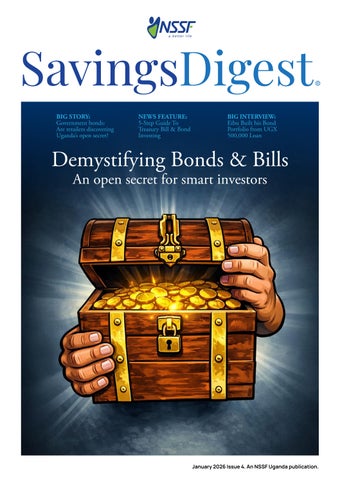
BIG STORY: Government bonds: Are retailers discovering Uganda’s open secret?

NEWS FEATURE: 5-Step Guide To Treasury Bill & Bond Investing
BIG INTERVIEW: Eibu Built his Bond Portfolio from UGX 500,000 Loan
![]()
BIG STORY: Government bonds: Are retailers discovering Uganda’s open secret?

NEWS FEATURE: 5-Step Guide To Treasury Bill & Bond Investing
BIG INTERVIEW: Eibu Built his Bond Portfolio from UGX 500,000 Loan
An open secret for smart investors


Demystifying Bonds And Bills: Uganda’s Opportunities Amid Regional Developments 13. Facts And Figures

14. Government Bonds: Are Retailers Discovering Uganda’s Open Secret?


Esteemed Readers,
A recent October 2025 FinScope survey returned a startling revelation. Whereas the majority of respondents had a high level of self-assessed financial literacy, the survey showed a low level of objectively measured literacy. A significant majority have a limited understanding of concepts such as interest rates, inflation, and securities.
Worse, the survey also revealed that there is overestimation of financial literacy is particularly prevalent among younger people and those in the formal sector. Financial Education efforts by institutions such as NSSF, Bank of Uganda, and others are therefore not only timely but also of utmost importance.
This insight, among other considerations, informed the focus on Government Treasury Bonds for this issue of the Savings Digest, given the consistently increasing attraction in the asset class by both individual and institutional investors.
The information contained herein is not advisory, but meant to highlight why the asset class is becoming all the more attractive in Uganda today, and why individual, alongside institutional
To invest is a nobrainer. However, for the how, when, how long, and how much, we advise a sit-down with your Investment Advisor.
investors, have a huge appetite for the asset.
To invest is a no-brainer. However, for the how, when, how long, and how much, we advise a sit-down with a Wealth Manager or Investment Advisor of your choice. There are many licensed players at an affordable rate in Uganda today.
Herein, our seasoned financial writers and experts focus on understanding why all the rage about treasury bonds today, the opportunities, and risks (if any). For individuals on the fence, ask yourself why an institutional investor like NSSF has over 75% of its portfolio on government treasury bonds, or why commercial banks have a huge appetite for the same.
In addition, ask yourself why investors look at bonds not only as a haven but also a strategic, forward-looking asset, providing predictable cash flow. The asset also serves as a counterweight to more volatile asset classes such as equities, and highly speculative ones like Real Estate, especially in a market like Uganda.
Whether you are a seasoned institutional investor or a retail saver building long-term security, government bonds remain a tool that can bring both balance and resilience.
We hope that in this issue, you will find the clarity, insights, and information to make you pick up the phone and call your financial advisor.
Victor Karamagi Editor


If you have been thinking about growing your money safely and steadily, then Treasury Bills (T-Bills) and Treasury Bonds (T-Bonds) should be on your radar. They are some of the safest investment options you can find in Uganda, mainly because they are backed by the government. But how exactly do you get started? Let’s break it down in the simplest way possible.
Treasury Bills (T-Bills)
These are short-term government securities. You lend money to the government for 91, 182, or 364 days. At the end of that period, you get your money back plus interest. The interest is paid upfront meaning when investing, you actually pay less than the face value.
For example, when you invest in a 364-day T-Bill worth UGX 1,000,000, you only pay UGX 900,000, and you get the full million at maturity.
Treasury Bonds (T-Bonds)
These are long-term. They range from 2 years to 25 years and pay interest every six months until the bond matures. This makes them great for investors looking for long-term, stable cash flows.


You lend money to the government for 91, 182, or 364 days. At the end of that period, you get your money back plus interest.

Why Invest in T-Bills and Bonds?
• They are safe; backed by the government.
• They offer predictable returns and cash flows.
• Interest rates are usually higher than ordinary savings accounts.
• They help you diversify your investments. Who Can Invest
Pretty much anyone! You can invest as an individual, company, SACCO, or investment club.
Minimum investment amount in Uganda
Minimum investment in Uganda is UGX 100,000 for T-Bills and Bonds.
Open a Securities Central Depository (SCD) account
This is similar to your “investment bank account” for government securities.
You can open it through: licensed commercial banks that act as an agent/ Primary dealer. Uganda has 7 licensed primary dealers: ABSA, Centenary Bank, Citibank, Equity Bank, Housing Finance Bank, Standard Chartered Bank and Stanbic Bank.
You will need:
• Valid National ID or passport
• Passport photo
• Completed SCD form
Your SCD account is free.
This sounds complicated but it’s not. When Bank of Uganda puts forward an auction, you simply write to your bank informing them of the following:
• The security you want (e.g., 182day Bill, 5-year Bond)
• The amount you want to invest. This will determine whether it is a competitive or non-competitive bid. In Uganda, the minimum investment for a non-competitive bid in Treasury Bills and Bonds is UGX 100,000, while the minimum for a competitive bid is UGX 200,100,000. A non-competitive bid means that you don’t set your own interest rate or price. Instead, you automatically get the average accepted rate that Bank of Uganda announces after the auction.
People choose non-competitive bids because they are simple — no calculations needed, you are guaranteed to get the investment as long as you submit correctly.
It is also perfect for beginners or casual investors.
For instance, if you invest UGX 1,000,000 in a 364-day T-Bill non-competitively, you’ll get the same interest rate as everyone else who used non-competitive bids—no need to guess rates.
On the other hand, with a competitive bid, you determine the interest rate you want.
Bank of Uganda will accept bids from the lowest yields (cheapest for government) to the highest and stop when the total amount they need is fully allocated.
Choose Where to Buy From
You have two options:
Directly from Bank of Uganda (Primary Market) tracked on the annual auction calendar
The auctions are held every two weeks for T-Bills and monthly for Bonds.
You submit your bid through your bank that is appointed a primary dealer.
Through a Commercial Bank or broker (Secondary Market)
They will handle the entire process for you, though some charge a small fee.

If your quoted yield is too high (meaning you are demanding too much interest), your bid might be partially accepted or rejected.
Competitive bids are usually good for experienced investors because they can control the rate they want to earn ie, you might get a better-than-average return.
They are also useful for institutional or high-volume investors.
If you bid too high, you may miss out entirely.
If you bid too low, you get accepted but earn less than you could have.
This means, if you bid for a 2-year bond at 16%, but most investors bid at 15.3%, you might be left out.
But if you bid 15.2%, you’ll almost certainly be included—just at a lower return.
Once your bid is successful, your bank will tell you how much to pay.
Sit Back and Earn
For T-Bills, you get your full amount at maturity while bonds pay interest every six months.
Treasury Bonds (not Bills) can be sold on the secondary market through your bank. This means you are not locked in if you need your money, but the price may be slightly higher or lower depending on market conditions.
The mini-
mum for
a competitive bid
is UGX 200,100,000.

With a competitive bid, you determine the interest rate you want.

Julius Businge Financial Journalist

Uganda’s government securities market is drawing growing attention from both domestic and foreign investors as treasury bills and bonds increasingly become central to the country’s financing strategy.
With yields on both short- and longterm government paper rising in recent months, the market is now at the center of conversations about inflation, debt sustainability, and the future of government borrowing.
The August 2025 auction, which included two, five, 15 and 25-year bonds, saw significantly higher pricing compared to earlier months. This reflects Uganda’s position as a higher-yield market within the region, attracting investors seeking better returns. However, these returns come with trade-offs. The higher yields signal tighter domestic financing conditions and reveal growing concerns over fiscal stability and the country’s mounting debt obligations.
Comparatively, in August 2025, Uganda’s Treasury bond auction fea-
tured attractive coupon rates, with the 2-year bond at 14.125%, 10-year bond at 16.25%, 15-year bond at 15.8%, and 25-year bond at 16%.
In Kenya, the latest 10-year government bond offers a 13.4% coupon, reflecting a more liquid but slightly lower-yielding market. Tanzania continues to offer high-carry opportunities, with one of its long-dated bonds, maturing in 2046, carrying a 15.95% coupon, according to Bank of Tanzania data. Rwanda’s smaller and niche government bond market offers coupon ranging between 8-9%, depending on maturity and demand.
Uganda’s rising debt
Uganda’s public and publicly guaranteed debt stood at US$31–33 billion by mid-2025, driven largely by rising domestic borrowing and longer-dated bond issuance. This represents a sharp rise compared to previous years, as the government has stepped up issuance to fund infrastructure projects and cover widening budget deficits. In comparison, Uganda’s neighbors display different debt dynamics. Kenya, which operates the region’s most liquid securities market, had a debt stock of KSh 10.9 trillion (approxi-
Many investors continue to view treasury bills as risk-free instruments, and Uganda must seize this opportunity to raise funds and finance its activities.
could be a valuable tool for financing national development, provided policies encourage broader participation.
While Uganda’s bond market offers attractive yields, there are underlying structural concerns that cannot be ignored. Senior economist Fred Muhumuza warns that much of the country’s borrowing has been driven by political rather than economic considerations, especially as the country approaches another election cycle.
“The challenge is that public investment is being driven more by political expediency than economic necessity,”
Muhumuza said in a televised show.
“Many high-cost projects are being pushed through to win political favor rather than to meet urgent economic needs. This creates distortions in the bond and bill markets, as the government has to issue more paper to fund these expenditures.”
Muhumuza cautioned that Uganda is at risk of falling into a debt trap,
where an increasing share of government revenue is spent on debt repayment rather than productive investments in health, education, or infrastructure. “In essence, Uganda is in a debt trap,” he said. “We are diverting resources away from essential sectors to pay for past borrowing. It’s unsustainable and puts upward pressure on yields, as investors demand higher returns to compensate for perceived fiscal risk.”
If government borrowing continues at the current pace, private-sector credit may become crowded out as commercial banks allocate more funds toward government securities.
“We’ll see more of the government competing with the private sector for credit, which will drive up interest rates across the economy and undermine the very development objectives these borrowings are supposed to achieve,” he added. Regional opportunities, risks
mately US$84.5 billion) by December 2024. Tanzania reported central government debt of TZS 91,708.3 billion (US$35.7 billion) as of March 2024, while broader figures put its total debt slightly above US$40 billion, reflecting a growing domestic bond program supported by external concessional borrowing. Rwanda, meanwhile, has a smaller and shallower market, with its public debt rising to Rwf 10.1 trillion by mid-2023, representing a debt-to-GDP ratio of between 60 and 70 percent.
These numbers position Uganda between Kenya’s deep, highly liquid market and Tanzania’s higher-yielding, less liquid environment. Rwanda, on the other hand, represents a niche investment space, with fewer instruments but higher potential volatility.
“Many investors continue to view treasury bills as risk-free instruments, and Uganda must seize this opportunity to raise funds and finance its activities,” said John Walugembe, Head of the Federation of Small and Medium-Sized Enterprises, in an interview with this publication. He noted that Uganda’s relatively stable market

Across the East African region, each country’s bond market tells a different story. Kenya offers the deepest and most liquid market, allowing large institutional investors to move in and out with relative ease, though yields are lower. Tanzania provides attractive mid-teen coupon rates on its long-term bonds, which draw yield-seeking investors willing to accept less secondary market liquidity. Rwanda’s small market caters to specialized investors who adopt a buyand-hold strategy, given its limited trading activity.
Dr. Enock Twinoburyo, a senior economist and advisor to regional governments, emphasized the importance of disciplined borrowing and strategic debt management. “Debt levels may be low in absolute terms, but the risks become insurmountable if borrowing is not disciplined and tied to productive investments,” he said. He noted that while Uganda’s high yields may attract investors, transparency and fiscal discipline will determine whether these opportunities are sustainable over the long term.
Twinoburyo explained that regional investors should consider East Africa not as a single uniform market but as a collection of distinct opportunities. Kenya’s strength lies in liquidity, Uganda’s in higher returns, Tanzania’s in long-term high coupons, and Rwanda’s in specialized, targeted investment potential. For investors with diversified strategies, combining exposure across these markets can balance yield, liquidity, and risk.
Walugembe believes that one of Uganda’s greatest opportunities lies in expanding domestic participation in the bond market. Currently, foreign investors dominate government securities, often repatriating profits abroad. Increasing local investment would keep more wealth circulating within the economy.
He pointed to Uganda’s low savings rate as a major obstacle but praised government backed initiatives such as SACCOs and Unit Trusts, which are designed to encourage broader participation in the financial system. However, he cautioned against policies that could discourage savers. “Introducing higher taxes on interest earned from these instruments could

reverse progress by discouraging people from saving and investing,” he warned.
struments could become engines of sustainable development rather than sources of economic instability.
As Uganda’s ageing population steadily exits formal employment, treasury bills and bonds can provide a secure vehicle for individuals to grow their retirement savings.
The months ahead will be critical for Uganda’s bond market. The government’s ability to execute its FY2025/26 plan to reduce domestic borrowing will determine whether yields stabilize or continue rising. Across the region, other countries face their own pressures: Kenya is working to reduce its debt-to-GDP ratio, Tanzania is expanding its domestic bond program while managing external financing, and Rwanda is balancing ambitious infrastructure spending against debt sustainability concerns.
For investors, navigating these markets requires a careful blend of strategies. Those seeking liquidity may favor Kenya, while those looking for higher yields could focus on Uganda and Tanzania. Rwanda’s market remains suited for niche, patient investors.
East Africa’s bond and bill markets no longer present a uniform picture but rather a series of unique opportunities and challenges. If fiscal discipline and transparency are prioritized, these in-
Currently, foreign investors dominate government securities, often repatriating profits abroad.

Paul Busharizi Financial Journalist

Maurus remembers it like it was yesterday, when he was a teenage boy, listening to his father come home one evening in the 1990s shaking his head in wonder.
“They are paying more than 30% on treasury bills,” he said, incredulous.
Inflation was rampant then, the economy struggling to find its feet, and those astronomical interest rates were the government’s way of trying to mop up liquidity and restore order. Maurus didn’t fully grasp the mechanics, but the figure stayed with him. It was proof that money could be made to work for you if only you knew how.
Decades later, the boy has become a man, a retiree, who lives partly off his bond portfolio. Twice a year, like clockwork, he receives coupon payments from the bonds he has accumulated. That semi-annual income is now one of the pillars of his retirement finances, giving him certainty that no dividend stock, fixed deposit, or real estate venture could match.
“It’s the most open secret in our economy,” he says. “I don’t understand why more people are not jumping on the bandwagon.”
He adds with a grin that bonds have become his favourite form of collateral. “No land title headaches, no valuation disputes. The bank looks at my holdings, and in a day or two, the money is in my account. Hustle-free.”
Big Story
The changing face of bonds
What was once the preserve of commercial banks, the National Social Security Fund (NSSF), insurers and a handful of offshore investors is slowly being discovered by ordinary Ugandans. Retail participation in the government securities market, almost negligible when the first Treasury bonds were introduced in 2004, is today carving out a visible space. Teachers, SACCOs, salaried professionals, and retirees like Maurus are learning that government paper can be more than just a line item in the budget speech.
The bank looks at my holdings, and in a day or two, the money is in my account. Hustle-free.
The reforms have been gradual but meaningful. First came the introduction of non-competitive bids, lowering the entry ticket to just UGX 100,000; then the dematerialisation of bonds, replacing clumsy paper certificates with electronic records in the Securities Central Depository; and most recently, the retail windows through commercial banks, some of them already moving toward mobile-based access. These changes opened the door that had long been bolted.
Once through that door, investors found something startling — the best returns in the market. A 10-year bond yielding more than 15%, against inflation running at under 5%, offers real returns that crush what you get from fixed deposits, or rental property. The paradox of our times is that the “risk-free” asset is beating the risk assets at their own game.
A 10-year bond yielding more than 15%, against inflation running at under 5%, offers real returns that crush what you get from fixed deposits, or rental property. The paradox of our times is that the “risk-free” asset is beating the risk assets at their own game.
The
25-year bond: A market comes of age
It was against this backdrop that the government launched its boldest move yet—the debut of a 25-year Treasury bond in August 2025. For the first time, investors could lend to the state for a quarter of a century. The target was UGX 500 billion. Demand was feverish: bids worth UGX851 billion poured in. That kind of oversubscription would ordinarily suggest a red-hot appetite. But here came the twist.
Bank of Uganda accepted only UGX 57 billion of the bids. Over 90% of the money on offer was turned away. The cut-off yield was set at 16%. To many observers, that was a surprise. The 15-year bond offered in the same auction had cleared at 17.65%, and the 20-year was not far behind. Market chatter had placed the likely yield of the 25-year in the 17–18% range. Yet here was the government anchoring it at 16%, effectively telling investors it would not pay more just because they demanded it.
The signal was clear. The government wanted to lengthen its debt maturities to reduce refinancing risk, but not at any cost. It was prepared to let bids go rather than saddle itself with punitive rates. For investors, the message was equally blunt: the days of automatic yield premiums for longer maturities may be fading.

Technology is set to make bond purchases even easier. Uganda may soon see a mobilebased platform like Kenya’s M-Akiba, where buying a government bond is as simple as topping up airtime.

For retail investors like Maurus, the auction was a lesson in the politics of yield. On the one hand, 16% is still spectacular—more than double inflation, and leagues ahead of bank deposits or dividend stocks. On the other, the oversubscription and high rejection rate showed that demand is deepening, and competition for these instruments is stiff. Retail investors will have to be sharper, and more deliberate in how they place their bids.
However, the very existence of the 25-year bond opens new horizons for retail savers. It is a product tailor-made for those thinking long term: retirement, children’s education, intergenerational wealth. Imagine a young professional locking in 16% for 25 years. By the time she retires, her coupons alone would have compounded into a handsome stream of income.
And as Maurus notes, the collateral value of such long bonds is immense. Banks are more than happy to lend against them. They carry less valuation drama than land, and less volatility than shares. For a small business owner or retiree, that flexibility is invaluable.
The 25-year bond also speaks directly to institutional investors. Their liabilities stretch decades into the future. For them, short-term paper creates a mismatch: they have to keep rolling
If the story of the 25-year bond is about institutions and state strategy, the longer story of the past two decades is retail’s slow but steady entry into the bond market. In 2004, retail held virtually nothing. By the mid2010s, it was edging toward 2–3%. Today, estimates place it between 5–8%.
Those percentages may look small, but in absolute terms they are hefty. With domestic bonds standing at UGX52.6 trillion as of June 2025, even a five percent retail share is worth over UGX2.5 trillion. That’s money in the hands of teachers, SACCOs, boda groups, salaried professionals, retirees and more.
it over while their obligations remain fixed and far away. A 25-year bond solves that problem neatly, aligning assets and liabilities.
No wonder, then, that institutions piled in. But their expectations of higher yields were thwarted. Many will now adjust strategies, realising that the government will anchor long-dated yields closer to its comfort zone. That discipline may, in the long run, stabilise borrowing costs and deepen the market.
Why did the 25-year yield come in below expectations? Several factors explain this. The government was selective, rejecting bids it considered too expensive. Some investors, particularly long-horizon funds, may believe inflation will remain moderate, making 16% attractive in real terms. Others may simply value the predictability of long-dated cash flows enough to accept a smaller premium. And some may see the prestige of holding a “first of its kind” instrument as worth the concession.
Whatever the reason, the outcome establishes a precedent. Bonds in Uganda may no longer automatically command higher rates just because they are placed for a longer time. The market will now price them with more nuance, balancing demand, government resolve, and expectations about macroeconomic stability.
It has taken reforms to get here, but also a shift in psychology. When people realise they can earn double-digit returns safely, they start to question why they should leave money idling in accounts that barely cover inflation. Slowly, bonds are entering the vocabulary of everyday savers.
The bigger picture
This retail drift has consequences beyond individual returns. A broader investor base makes the market more resilient. Higher domestic participation raises the national savings rate, which has lagged stubbornly behind regional peers. Greater reliance on domestic bonds reduces vulnerability to external shocks and fickle foreign creditors, and every retail investor who learns how to buy a bond acquires financial literacy that can spill over into equities, unit trusts, and even entrepreneurship.
The government benefits too. A steady stream of domestic savings to tap means less pressure to borrow abroad on onerous terms. It also reduces refinancing risks. The 25-year bond, even at just UGX57 billion accepted, marks a milestone in extending the maturity profile of public debt.
It would be naïve, however, to imagine this is a one-way street to prosperity. Crowding out is a risk. When government paper yields 16%, why should banks lend to businesses at similar or lower rates with far greater risk? Credit to the private sector may suffer. Debt sustainability is another
5–8%
The estimated percentage held by retail in the bond market.
worry. Domestic debt already tops UGX 60 trillion. Servicing it at double-digit rates could become a fiscal millstone.
For retail investors, liquidity is a practical issue. Selling a long-dated bond in the secondary market is not always easy. And while inflation is tame today, it has a habit of surprising. Should it return to double digits, real returns would evaporate quickly.
Yet the trajectory remains promising. Technology is set to make bond purchases even easier. Uganda may soon see a mobile-based platform like Kenya’s M-Akiba, where buying a government bond is as simple as topping up airtime. Product innovation is likely such as retail-friendly savings bonds with shorter maturities, simpler redemption, and perhaps even tax breaks for small investors. Financial education campaigns are multiplying, slowly pulling bonds into the mainstream consciousness.
The regional angle matters too. East Africa’s capital markets are inching toward integration. A Ugandan investor might one day seamlessly buy Kenyan or Tanzanian bonds, and vice versa, creating deeper pools and more choice.
If these trends hold, retail participation could double or triple within the decade. By 2030, Ugandans could hold 10–15% of the bond market directly, transforming it from an institutional playground into a genuine mass savings vehicle.
The long-term bond as a turning point
For Maurus, the debut of the 25-year bond was both validation and revelation, validation that the government was serious about lengthening maturities, and creating space for investors like him to secure long-term streams of income. It was revelation that the market was maturing to the point where oversubscription and yield anchoring were realities, not abstractions.
He sees the lower-than-expected yield as a sign that the government is learning to balance cost with access. He sees the oversubscription as proof that demand is real, both institutional and retail. And he sees his own experience — semi-annual coupons, collateral value, steady income — as evidence that bonds are not just for the few, but could be the foundation of national wealth building.
The Ugandan bond market has come a long way from the days of 30% teasury bills. It is deeper, more sophisticated, and increasingly inclusive. Retail participation, once negligible, is rising steadily. Bonds now offer the best returns in the market, outpacing inflation and outperforming riskier assets.
Maurus, marvels that others still hesitate. Perhaps, with each new auction, that information is becoming a little less secret, and a little more the shared story of Uganda’s financial future.


Uganda’s bond market has never been busier. Each month the Bank of Uganda announces an auction, and each time the market responds with gusto.
Bonds are how government borrows from the public, and from past evidence, they remain the safest instrument in any fund manager’s toolbox.
To the casual observer, this looks like a vote of confidence — citizens and institutions lending willingly to their government in shillings, helping bridge yawning budget gaps. But beneath the optimism lies a more sobering story. Debt levels are climbing faster than revenues, interest payments are ballooning, and the weight is increasingly distorting the budget.
Outstanding Treasury bills and bonds reached roughly UGX 58–60 trillion by June 2025, up from about UGX 53 trillion a year earlier. Bonds alone account for approximately UGX 51–
53 trillion, reflecting government’s deliberate pivot toward longer-dated instruments.
In the 1990s, government paper was a niche tool, deployed mainly to mop up liquidity in an economy groaning under inflation. Rates shot above 30% at times as the state scrambled to soak up excess cash. Investors treated treasury bills as curiosities, not the bedrock of their portfolios.
By the 2000s, the picture had changed. Inflation had been tamed, liberalisation entrenched, and treasury bills became routine monetary instruments. Bonds were introduced to create a yield curve and extend maturities, but domestic debt stock remained modest relative to GDP. Donors and concessional loans still carried much of the budget. Domestic borrowing was a supplement, not the mainstay.
Today, it is the mainstay. Government paper has become the oxygen line keeping the budget alive.
Outstanding Treasury bills and bonds reached roughly UGX 58–60 trillion by June 2025, up from about UGX 53 trillion a year earlier.
Source - Bank of Uganda
That reliance comes with a punishing bill. In FY2023/24, Uganda spent just over UGX 6 trillion servicing its debt. By the close of FY2024/25, total interest payments had risen sharply to approximately UGX 9.6–9.8 trillion, with domestic interest accounting for about UGX 8.2–8.4 trillion of that figure. Interest is now one of the fastest-growing items in the national budget.
The arithmetic is merciless. When coupon dates fall due, the Treasury must pay. Wages can be delayed, suppliers fobbed off, projects shelved. But bondholders are untouchable. The result has been a steady pile-up of arrears, as ministries juggle their bills. Government has even carved out budget lines for arrears clearance — an open admission that resources meant for drugs, textbooks and road repairs are being redirected to service debt.
This is how debt quietly crowds out public goods. It does not announce itself with ribbon cuttings. It simply shrinks the space for service delivery, one coupon at a time.
In FY2023/24, Uganda spent just over UGX 6 trillion servicing its debt. By the close of FY2024/25, total interest payments had risen sharply to approximately UGX 9.6–9.8 trillion, with domestic interest accounting for about UGX 8.2–8.4 trillion of that figure. Interest is now one of the fastest-growing items in the national budget.
Source - Ministry of Finance, Planning and Economic Development (MoFPED).
The crowding out effect
There is another crowding out — one that hits the private sector directly. With government sucking up vast sums of domestic savings, banks find lending to the state safer and more rewarding than lending to businesses. Why risk a manufacturer or farmer when a gilt-edged treasury bond pays a tidy coupon on schedule?
The effect is to starve entrepreneurs of credit. Lending rates remain stubbornly high, partly because government sets the benchmark. If a 10-year bond pays 16%, no bank is going to lend to a small business at single digits. This is the unspoken cost of a hungry government debt programme: it diverts capital away from enterprise, slows job creation, and keeps the economy trapped in a high-interest equilibrium.
The paradox is painful. The very instrument that gives government fiscal breathing room can suffocate the private sector it relies on for growth. Why borrowing at home still matters
It would however be wrong to dismiss domestic borrowing as reckless. Borrowing in shillings protects the state from currency mismatches that come with external debt. Servicing in local currency is far less precarious than scrambling for scarce dollars to pay Eurobonds.
The bond market has also matured into the scaffolding of Uganda’s financial system. Banks use yields as benchmarks for lending. Corporates price their bonds against the curve. Pension funds and insurers rely on the long-term paper government issues. What began as a shallow experiment in the 1990s is today a backbone of the economy.
And perhaps most importantly, domestic borrowing strengthens sovereignty. In the early 2000s, nearly half the budget was donor-funded. Today, that dependence has fallen sharply. Being able to raise money internally means fewer strings attached and more resilience when donor flows dry up or foreign investors retreat.
The paradox of Uganda’s debt story is this: today’s fiscal pain could seed tomorrow’s independence — but only if the money is borrowed and spent wisely.
A mirror from Nairobi
Kenya shows both the promise and peril. Nairobi has built one of Africa’s deepest domestic securities markets. Infrastructure bonds are regular fixtures, pension funds and banks line up to buy, and even retail investors have been roped in through the M-Akiba mobile bond. The market is liquid and government rarely struggles to sell paper.
But the price is clear. Nearly a third of Kenya’s revenues now go to interest, much of it domestic. Banks have grown accustomed to lending to government, starving entrepreneurs of credit. Private borrowers complain of punitive lending rates, yet the reality is simple: government sets the floor. What began as a sign of maturity has become a treadmill, forcing the state to run faster each year just to stay upright — while the private sector wheezes on the sidelines.
Uganda must heed this warning. Access to debt markets is not the same as affordability. Without discipline, the very market that gives independence can easily become the trap that strangles both the budget and the private sector.
A turning point on the Nile
Ethiopia offers another angle. In early September 2025, Addis Ababa officially commissioned the Grand Ethiopian Renaissance Dam, Africa’s largest hydroelectric project. At US$5 billion, it was not only an engineering marvel but a financing one. Ninety-one percent of the cost was carried by the centralw bank and the Commercial Bank of Ethiopia. The remainder came from citizens, civil servants whose salaries were docked, and the diaspora, who bought bonds and remitted money specifically for the dam.
The symbolism was immense. GERD was not just a dam; it was a declaration of sovereignty. Farmers, schoolchildren, public servants, and Ethiopians abroad all contributed.
The commissioning was more than the flick of a switch. It was proof that disciplined domestic mobilisation can deliver monumental projects. For Uganda, it is a reminder that local markets, patriotic contributions and diaspora capital are not abstractions
— they are tools that, used transparently, can change a nation’s trajectory.
Uganda’s diaspora remits more than a billion dollars annually. Yet no serious diaspora bond has ever been floated. Properly structured, these flows could build industrial parks, oil infrastructure, and export corridors. GERD shows the potential, but also the risks: pouring so much into one project strained Ethiopia’s wider economy. Inflation rose, and opportunity costs mounted. Domestic mobilisation is powerful, but never free.
Uganda stands at a crossroads. It can keep auctioning larger volumes, rolling over maturities, and letting interest bills balloon. Or it can borrow smarter.
That means issuing more long-term bonds like the 25-year paper that was recently oversubscribed, to spread obligations across decades. It means broadening participation so that SACCOs and ordinary citizens can buy in, not just banks and pension funds. It means guarding credibility like gold, because once trust erodes, yields spike. And it means mobilising the diaspora not just as remitters but as investors, through transparent instruments tied to visible projects.
Above all, it means showing value for money. Increased borrowing would not be a problem if government demonstrated efficiency in project execution, completing works on time and within budget. If corruption were curbed and waste reduced, investor confidence would deepen. The result would be lower yields, less crowding out, and cheaper credit for the private sector.
The long view
Uganda’s domestic debt journey is three decades old. In the 1990s, securities were tools to tame inflation. In the 2000s, they were modest supplements to donor inflows. Today, they are the backbone of fiscal financing. Tomorrow, they will be judged either as the burden that strangled growth or the foundation that sustained it.
Kenya shows the danger of a deep market turned treadmill, where private borrowers are squeezed and lending rates remain high. Ethiopia shows the power of patriotic mobilisation, crowned by the September 2025 commissioning of GERD, but also the risks of overconcentration. Uganda must find its own balance.
The bond market will keep expanding, and coupons will keep falling due. The real test will be whether, in 10 years, we see power lines, factories and highways that justify the sacrifices — or only ballooning interest bills and a private sector starved of credit.
Borrowing from ourselves is neither inherently good nor bad. It is what we do with the money that matters. If government can show efficiency, curb corruption and deliver value, today’s debt could become tomorrow’s prosperity. If not, we risk mortgaging the future while suffocating the very entrepreneurs who should be building it.
Uganda is learning this lesson one auction at a time — and the GERD, flickering to life across the Nile in September 2025, stands as both inspiration and warning of what disciplined domestic financing can achieve.


Charles Jubilee Eibu started with only UGX 500,000 and grew his portfolio more than he ever expected. In this Q&A, he shares with Julius Businge how starting small, building consistency, and discipline have shaped his investment journey, and what others can learn from it.

Julius Businge Financial Journalist

First, who is Charles Eibu — occupation, age, marital status, level of education, hobbies, and more?
I’m Charles Jubilee Eibu, 28 years old, a civil engineer by training with a bachelor’s degree from Kyambogo University, Kampala. I have a strong background in engineering. Currently, I’m a co-founder of a construction company called CJ Engineering Services Ltd that deals in engineering and construction works. Away from engineering, I’m deeply passionate about finance and capital markets. I spend much of my time investing, writing about capital markets, that is, fixed income securities (treasury bills, bonds) and equities on the Uganda Securities Exchange, and helping people understand how money can actually work for them. I’m not mar-
ried yet but hopefully soon. Outside work and investing, you’ll probably find me writing articles on finance and investment, on a soccer field or in a swimming pool, my favourite hobbies.
Can you tell us when you first decided to invest in Uganda’s treasury bills, and what motivated you to take that step?
I first got introduced to capital markets through my investment group, which mainly focuses on managing assets in stocks and bonds. At the time, I had just graduated from university in late 2021, and it was in this investment group that I first heard about the stock market and treasury bonds. With their influence, I decided to start investing.
My strategy has been to borrow, invest wisely, and repay steadily.

I began with just UGX 500,000, and this was boosted by a small loan from my investment group, which supports members with affordable credit at an interest rate of 10% annually which is below the returns that bonds pay. My strategy has been to borrow, invest wisely, and repay steadily.

My first move was into the stock market when I bought shares in UMEME on the Uganda Securities Exchange. At first, I concentrated on building my portfolio in the stock market. Later, I saw the need to diversify my portfolio into fixed-income securities to spread risk. This led me to study treasury bonds in detail, and in 2024 I made my first investment in them.
How much did you start with initially, and how has your investment grown since then?
I began with just UGX 500,000, and this was boosted by a small loan from my investment group, which supports members with affordable credit at an interest rate of 10% annually which is below the returns that bonds pay. My strategy has been to borrow, invest wisely, and repay steadily. What started as a modest step has grown into a portfolio I never imagined at the beginning — I will keep the number to myself — but just know it is big and I am happy with it so far. By laddering my bonds, I’ve reached a point where coupon payments flow in almost every month, creating a steady income stream. Along the way, I’ve built
the discipline of setting aside UGX 300,000 every month to take part in primary market auctions, which has kept my momentum going and strengthened my financial journey.
What kind of returns or gains have you seen from your TBs investments so far?
On average, my bond investments return about 14.5% annually. What excites me most isn’t just the percentage but how those returns build on themselves through compounding, the “eighth wonder of the world.” Each time I reinvest, the growth becomes stronger and more visible. Very few businesses can guarantee such steady returns, and this has shown me that even with limited starting capital, discipline and consistency can turn small steps into real financial progress.
Have you ever faced any challenges or losses while investing, and how did you handle them?
The main challenge for me has been access to large amounts of capital, since I have a high-risk appetite and like to go big. For now, I’m managing
this by taking slow, steady steps and staying consistent. When the right opportunity comes for me to access bigger capital, I’ll be ready to take it. As for losses, I haven’t experienced any. My coupons have been paying consistently, almost every month. I’m also a long-term investor. My strategy is to buy and hold with a long investment horizon.
What factors or risks do you keep in mind before putting money into treasury bills? Are there any worries that still linger?
Treasury bills and bonds are safe low risk investments. Uganda has been issuing TBs since 1969. Over the decades, the country has undergone major political transitions, including leadership changes and even periods of civil unrest during Idi Amin’s regime in the 1970s and before the NRA took power in 1986. Yet through it all, the government has never defaulted on its obligations to investors. Just like in Game of Thrones, “A Lannister always pays his debts”, so does the government. With this strong track record, treasury bills and bonds remain one of the safest and most reliable ways to grow your money.
Has investing in treasury bills influenced your personal finances or overall investment strategy?
Yes it has. Many people think investing is only for the highly intelligent or those with a lot of money. Some even find it intimidating, especially when they hear about it for the first time. But the truth is, investing is a life skill, one that can help you achieve your personal financial goals. Take a moment to reflect. Can you sustain your current lifestyle for the next 20 years? Or, even better, can you improve it? That’s where the art of investing comes in. It’s about choosing to delay instant gratification today so you can enjoy greater rewards in the future.
What advice would you give someone who hasn’t yet invested in treasury bills, about getting started?
Treasury bills and bonds are considered a low-risk investment with a solid return, averaging around 14%. Very few small businesses in Uganda can match that. When you reinvest your earnings, through compound

interest, your money grows even faster. Look at commercial banks, insurance companies, and fund managers: nearly half of their customer deposits are invested in treasury bills and bonds. Banks are the real players in the economy, driving growth through smart investments. Be the bank, not the banker. This is where real wealth is built. You don’t need millions to get started. With just UGX 100,000, you can begin investing today. Once you shift your mindset and take that first step, you’ll be amazed at how your money grows.
Any parting shots?
Did you know that 75% of Ugandan start-ups don’t survive their first year? That’s a staggering figure. Maybe entrepreneurship isn’t for everyone, but investing can be. With consistency and discipline, anyone can become a successful investor. As Charlie Munger, who was Warren Buffett’s legendary right-hand man, once said: “The big money is not in the buying or the selling, but in the waiting…”

Julius Businge Financial Journalist
What are the gains to be made from T-bills and bonds? How does Uganda compare with other countries? How can one make the choice in what to invest? Julius Businge provides answers to these questions.
1
If I’m a low-income earner, can I invest in Ugandan T-bills or government bonds?
Yes, Uganda allows small investors to participate, with a minimum investment of UGX100,000 (about USD 25–30) in increments of UGX 100,000. This is lower than Kenya, where Treasury bills start at KES 50,000 (UGX 1.5 million), and Tanzania, where the minimum is TZS 500,000 (UGX 200,000). Rwanda is also accessible to small investors, with a minimum of RWF 100,000 (UGX 310,000) for non-competitive bids, making it similar to Uganda in encouraging financial inclusion for low-income earners. Competitive bids in Rwanda, however, require a minimum of RWF 50 million (UGX 155 million).

2
Do I get paid interest regularly, or only at maturity?
T-bills are bought at a discount and pay the full face value at maturity, so the interest is embedded in the purchase price. Bonds typically pay periodic coupons, semi-annual or annual, in addition to principal at maturity. This structure is similar across Uganda, Kenya, Tanzania, and Rwanda, with Rwanda’s Treasury bonds also paying semi-annual coupons.
3
What risks should I watch for when investing in Ugandan government debt?
Risks include inflation, which can erode real returns, currency depreciation, liquidity risk if selling before maturity, and sovereign risk in extreme scenarios. While Uganda has not defaulted on domestic payments in recent years, rising domestic borrowing and external obligations can strain finances. Kenya and Tanzania face similar risks, though Uganda’s higher yields partially compensate investors for these factors. Rwanda’s risks are somewhat lower due to its stable macroeconomic environment, but its lower yields mean investors must watch inflation carefully, as it can sometimes match or exceed T-bill returns, making real gains minimal. Currency fluctuations of the Rwandan franc (RWF) also matter for foreign investors.

Can inflation sometimes make a high yield ‘bad’?
Yes. If inflation runs close to or above the nominal yield, real returns can be low or even negative. For example, a 14% bond during 10% inflation provides a real gain of just 4%, emphasizing the need to compare yields against inflation forecasts. In Uganda, where inflation is often higher, this is a key consideration. In Rwanda, inflation has been around 6–7%, which means that a T-bill yielding 6.8% barely covers inflation, offering almost no real return unless interest rates rise or inflation falls.
4 5 6 7
How does Uganda’s domestic borrowing affect bond yields?
Higher domestic borrowing pushes yields up as the government competes for funds. Uganda plans to reduce domestic borrowing by 21.1% in 2026/27 to manage costs, while Kenya and Tanzania use strategies like debt buybacks and long-term bond issuance to maintain investor confidence. Rwanda has maintained moderate domestic borrowing, which has helped keep its yields relatively low. However, as Rwanda issues more debt to fund infrastructure projects, yields could rise in the future, though they currently remain below Uganda’s and Tanzania’s levels.
Is Uganda’s bond market open to international investors?
Yes, foreign investors can participate but should consider currency and tax implications. Kenya and Tanzania also welcome international investors, and Tanzania’s recent oversubscribed bond auctions indicate strong foreign interest. Rwanda’s market is also open to foreign investors, who can access both Treasury bills and bonds through licensed brokers or banks, though they must manage currency risk due to fluctuations in the Rwandan franc.
For someone with UGX 1 million, what mix of T-bills vs bonds might make sense?
For short-term holding under a year, 60–80% in T-bills (91- to 364-day) helps maintain liquidity and reduce risk, while 20–40% in a 2- to 5-year bond captures higher yields. This strategy balances safety, steady income, and inflation protection while diversifying across short and longterm instruments. In Rwanda, given lower short-term yields and stable inflation, a slightly higher allocation to medium-term bonds may be more attractive, such as 50–70% in bonds and 30–50% in T-bills, especially for investors seeking stable, predictable income.

Oscar Twinomugisha
Financial Accountant, NSSF Uganda

Government securities including treasury bills, bonds, and government-backed infrastructure bonds are widely considered low-risk investment vehicles and form a foundational component of institutional portfolios, particularly for retirement funds like the National Social Security Fund.
It is useful therefore for investors and portfolio managers to have a comparative analysis of the tax treatment applicable to these instruments in Uganda against other key East African jurisdictions, so that they can evaluate and thereafter optimize investment strategy and net returns.
In Uganda, the Income Tax Act establishes a clear and incentivised tax framework for government securities.
Interest earned on standard treasury bills and bonds is subject to a tiered withholding tax (WHT) of 20% for maturities of less than 10 years, and a reduced 10% rate for those held for 10 years or longer. Infrastructure bonds receive a full income tax exemption on interest, provided they are listed, have a minimum maturity of 10 years, and the proceeds are used to fund public infrastructure and social services. This exemption is a strategic policy tool designed to attract long-term capital for national development projects by making infrastructure bonds a more attractive investment.
According to the Uganda Income Tax Act, specifically Schedule 4, Part V (2) with reference to Section 82, non-resident investors are subject to WHT on interest from government

In Uganda, the Income Tax Act establishes a clear and incentivised tax framework for government securities. Interest earned on standard treasury bills and bonds is subject to a tiered withholding tax (WHT) of 20% for maturities of less than 10 years, and a reduced 10% rate for those held for 10 years or longer.

securities, mirroring the structure that applies to residents of 20% rate for maturities of 10 years or less, and a 10% rate for maturities exceeding ten years. They are also exempted from tax for infrastructure bonds
The withholding tax applied to interest from these government securities is designated as a final tax. Consequently, no further income tax liability arises for the investor on the same interest income.
In Kenya, the withholding tax on bearer bonds depends on the instrument type, the holder’s residency status, and its maturity. Government bearer bonds issued externally are subject to a 7.5% WHT for residents and 15% for non-residents. In contrast, all other bearer bonds carry a uniform WHT rate of 25% for both residents and non-resident holders. A reduced rate of 10% applies to bearer bonds with a maturity of ten years or more for both residents and non-residents, Furthermore, infrastructure bonds designated as tax-exempt by the Central Bank of Kenya, are entirely free from withholding tax.
In Tanzania, interest earned on government securities such as treasury bonds is generally subject to a 10% withholding tax (WHT). However, exemptions have been introduced for interest on listed corporate and municipal bonds with a maturity of more than three years, as part of measures to deepen the capital markets. While the Income Tax Act does not explicitly classify infrastructure bonds as exempt, government-issued infra-
certain cases to encourage investment in the capital markets. Specifically, a 5% WHT is charged on interest from government securities that are listed on the capital market when the beneficiary is a resident of Rwanda or another East African Community member state. The same reduced 5% rate applies to interest on treasury bonds with a maturity of at least three years, providing an incentive for investors to hold longer-term government debt.
structure bonds that are listed on the Dar es Salaam Stock Exchange may qualify for exemption under the Finance Act provisions that came into effect on 1 July 2022. Consequently, government-issued infrastructure bonds could be exempt from WHT, provided they meet the listing and designation criteria.
In Rwanda, interest earned on government bonds is generally subject to a 15% withholding tax (WHT). However, preferential rates apply in
Across East Africa, the taxation of government securities shows a clear policy trend toward encouraging long-term capital investment through lower WHT rates or outright exemptions on infrastructure bonds and listed instruments. Uganda’s full exemption on qualifying infrastructure bonds, Kenya’s tax-free designation for infrastructure bonds, Tanzania’s listing-based exemptions, and Rwanda’s preferential 5% rate on longer-dated securities all underscore the use of tax policy as a tool to mobilise domestic savings for infrastructure financing. For institutional investors such as pension funds, understanding these fiscal policies is critical to optimising portfolio yields, ensuring compliance, and supporting national development goals through targeted investment.


Paul Busharizi Financial Journalist

It began, as many of life’s money lessons do, with disappointment.
In 2009, David Angura, one of those thrifty fellows who believe every shilling should have a job, walked into his bank branch to roll over his maturing Treasury bill.
He had put in UGX 10 million the year before, lured by the promise of a 12 percent return. When the teller printed his statement, the numbers looked good. He had earned every bit of that interest.
But when he stopped by the shop to buy a 50-kilogramme sack of maize flour, he froze. The price had nearly
doubled. His money had grown yet bought less. That was the year he discovered the meaning of real returns.
It was also the year he began watching inflation like a hawk.
When the price of time changed
In the early 2000s, Uganda’s bond market was a sleepy corner of finance — the domain of banks, insurers, and the occasional institutional investor.
The one-year Treasury bill yielded about 12 percent in 2005, while inflation hovered near 8.6 percent. A tidy 4 percent real return if you were patient — far better than a fixed de-
posit and certainly safer than lending to that cousin with “a sure deal.”
The economy was calm, optimism was fashionable, and a middle class was learning that government paper wasn’t just bureaucratic jargon. It was an investment.
Then came 2008.
Global fuel and food prices spiked, and Uganda’s inflation climbed to 12 percent, then 13 percent in 2009. Treasury bill yields barely budged. For the first time in years, savers lost ground. The returns came in, but val-
ue leaked out. That paradox, earning interest while losing purchasing power, has haunted investors since.

2011: When inflation burned the rulebook
If 2009 was a slap, 2011 was a punch. The shilling stumbled, fuel costs soared, and inflation rocketed to nearly 19 percent, the highest in two decades.
Those who had locked into bonds the previous year saw their returns melt. “How can you earn 12 percent and still get poorer?” became the year’s bitter joke.
The central bank, under siege, launched the Central Bank Rate and raised it sharply. Yields followed. By 2015, the 364-day T-bill paid nearly 18.5 percent, while inflation had cooled to 5 percent. For the disciplined investor, that was sweet redemption. Those who had bought bonds during the panic — and held — earned some of the best real returns in Uganda’s history.
After the 2011 flames, the market grew up. The government introduced longer maturities — 2, 5, 10, and 15year bonds — and began issuing them with discipline. Institutional investors like NSSF and insurance funds stepped forward. They had data, patience, and balance-sheet muscle.
Inflation slid to 6 percent, then 5 percent, while the one-year bill floated at about 14 to 17 percent. It was a rare era when inflation was low and yields high — double-digit nominal returns in a single-digit inflation world.
For ordinary savers, this was the discovery of “real income.” SACCOs, church groups, and WhatsApp investment clubs started whispering about Treasury bills.
built a credible bond market, one capable of rewarding patience and punishing panic.

2020 – 2022: The Pandemic and the global storm
Then the world stopped. COVID-19 shattered businesses and froze trade. To keep economies breathing, central banks loosened policy. Yields softened, but inflation stayed tame — 3 to 4 percent. Government paper became a safe harbour in a sea of uncertainty. But as the pandemic eased, war erupted in Europe. Supply chains broke again. Prices surged. Uganda’s inflation hit 7.2 percent in 2022.
Unlike in 2011, investors didn’t flinch. They had seen this movie before. The one-year yield climbed to 11.9 percent. Savers rolled their bills and bought even longer bonds, trusting that the storm would pass.
2016 – 2019: The age of anchored expectations
If the previous decade was about survival, this one was about stability. Inflation sat between 2 and 5 percent, while the one-year T-bill offered 9 to 12 percent. The math was beautiful — 6 to 8 percent real returns with almost no drama.
Economists called it anchored expectations. Investors began building portfolios rather than chasing single auctions. They staggered maturities, reinvested coupons, and spoke casually about “duration” and “yield curves.” In coffee shops around Kampala, finance talk had replaced football banter. Even the big players — pension funds, insurers, money-market managers — lengthened their horizons. Uganda had quietly

The dance between prices and policy
Across 20 years, inflation has been both tormentor and tutor. It forced the state to grow a disciplined bond market. It turned ordinary savers into students of macroeconomics. And it reminded everyone that wealth isn’t how fast your money grows — it’s how slowly it loses value.
When inflation rises, everyone hugs the short end: 91-day and 182-day bills. The government pays more to
borrow, and the market demands compensation for uncertainty.
When inflation cools, confidence stretches. Investors walk out along the curve — 10, 15, 20, 25 years — chasing steady real income. Pension funds anchor the long end. Banks play the middle. The patient retail saver, armed with a phone and a plan, quietly compounds wealth. Every inflation cycle redraws the map, but the rhythm is the same. Those who panic lose. Those who persist, prosper.
A country learns to lend to itself
The most striking change since 2005 isn’t just macroeconomic — it’s cultural. Bonds are no longer an elite secret. They are household conversation. Teachers, boda riders, and civil servants now talk about auctions and maturities.
Ugandans are learning the power of compound interest — quietly, steadily, patriotically. They are lending to their own country and earning handsomely for it. Inflation, ironically, taught them discipline.
2024: the calm after the storm
With inflation around 3.3 percent and one-year bills paying 13.8 percent, Uganda now offers some of the highest real yields in East Africa. Investors are locking in value, not chasing hype. But no one’s getting complacent. Inflation, that old adversary, never really dies — it merely sleeps.
The difference today is wisdom. From the biggest pension fund to the humblest SACCO saver, Ugandans understand the rhythm. They know when to roll, when to hold, and when to buy long.
Inflation may still lead the dance — but nobody’s dancing blind anymore.
Every bond is a promise — a handshake between citizen and state. If you lend today, you will be repaid tomorrow, and you will hope that tomorrow’s shilling still holds meaning. Inflation tests that faith.
Between 2005 and 2024, Uganda stumbled, recovered, and matured. In the process, a generation of investors learned that the secret to wealth isn’t cleverness, it’s consistency.
1. Real returns beat big numbers.
A 10 percent yield in a 5 percent inflation world is better than 15 percent when prices rise to 14. Inflation humbles vanity.
It did. Inflation cooled to 5.3 percent in 2023 and 3.3 percent in 2024. Yet the one-year yield held near 13.8 percent. That meant a real return of 10 percent — an extraordinary outcome in a region where inflation usually eats the small saver alive.
2. Pain today, profit tomorrow.
Buy bonds when inflation rages, and you will dine well when it fades. Fear is the seedbed of opportunity.
3. Trust is a yield.
Every year of credible policy lowers the cost of borrowing. Faith in the central bank is worth a whole percentage point of interest.
4. Diversify your durations. You can’t outguess inflation. But you can build a ladder — short, medium, long — so that part of your portfolio is always in the sweet spot.
5. Inflation is mood as much as math. When prices rise, fear spreads. When prices fall, courage returns. Markets trade emotion long before they trade numbers.


Kenneth Owera, a seasoned investment management professional, has been appointed the Fund’s substantive Chief Investment Officer (CIO). He will be responsible for steering the investment strategy of its Ugx 28 trillion portfolio.
Owera’s appointment follows a thorough recruitment process conducted by external consultants and thereafter reviewed and approved by the NSSF Board of Directors.
Owera joined the Fund in 2016 as a Portfolio Manager and has steadily risen through the ranks to his current position. He is a seasoned investment professional with deep expertise in pension fund management, capital markets, infrastructure finance, and strategic asset allocation.
He has played a central role in strengthening the Fund’s long-term investment strategy, advancing participation in infrastructure, real estate development, private equity–style investments, and regional opportunities across East Africa.
He has also been instrumental in reinforcing robust governance, due diligence frameworks, and disciplined capital allocation, while supporting the development of innovative investment solutions aimed at enhancing voluntary retirement savings and long-term value creation for members.
Owera’s experience across the investment value chain is broad.
Before joining NSSF Uganda, he served as an analyst at Stanlib Investments East Africa and a Corporate Trader at SBG Securities, a subsidiary of the Standard Bank Group.
Kenneth is a Chartered Financial Analyst and holds an MBA from Warwick Business School.

The NSSF Smartlife Flexi is a flexible, goal-driven savings plan designed to help you achieve your financial goals on your terms. It offers the freedom to choose how much you save, when you save, and the duration of your savings period. It is as adaptable as you need it to be—all while earning a competitive daily return, credited monthly.
Whether you’re building a rainy-day fund, planning a holiday, securing your child’s education, or saving for a new car, Smartlife Flexi offers a straightforward way to reach your goals with confidence and control.
Smartlife Flexi is open to anyone above 16 years with a willingness to save. Eligible individuals include Ugandans living both within the country and abroad, provided they have a National Identification Number. Non-Ugandan residents with valid passports and refugees in Uganda with valid identification are also welcome to join.
• It is goal-focused based on either passage of time or purpose (e.g., education).
• A member may have more than 1 goal, i.e., more than 1 subaccount.
• Return is computed on a daily balance but credited every month. Return computation starts at 3 days after the deposit.
• There is a lock-in period of 1 year to cultivate a good savings habit. Early exit is permitted net of any withdrawal costs.
• Any person can make contributions to the NSSF Smartlife Flexi
• A saver may have a sub-account for a minor. The balance can be transferred when the minor attains the age of 16.
• The minimum amount per contribution is UGX 5,000. Member states the frequency of contributions (daily, weekly, monthly, quarterly, annual, or any other frequency).
As of January 31, 2026, the total value of the NSSF Smartlife Flexi exceeded Ugx 89.45 billion.

Since its introduction in November 2024, the NSSF Smartlife Flexi has averaged an annualized interest rate of over 13.25%, with the highest being 14.81% in October 2025.


• Competitive Return – NSSF Smartlife Flexi offers members a competitive return. Interest is computed daily and credited monthly.
• Choice – You choose your goal and aspirations, savings frequency, and the savings period.
• Flexibility – You can sign up anytime, anywhere. You can save as many times and open as many sub-accounts as you need. Exit is simplified
• Affordability – you can start with a minimum amount per contribution of Ugx 5,000.


The Kenya National Social Security Fund and the Rwanda Social Security Board (RSSB) recorded strong financial performance in the year 2025.
The RSSB announced that it posted a profit of Rwf 413 billion in 2025 (approximately Ugx 1 trillion), a 15.6% increase from the previous year, according to RSSB Director General Régis Rugemanshuro.
Rugemanshuro also told the Rwandan Parliament Committee on Social Affairs Committee that the RSSB’s Assets Under Management have in-
years ago to Rwf 3 trillion (about Ugx 7.3 trillion) as of January 2026, following interventions to improve investments and operations.
Across the East in Kenya, the Chief Executive Officer, David Koros, announced that NSSF Kenya had recorded Kenya Shillings 105 billion (about Ugx 2.8 trillion) in investment returns, compared to Kenya Shillings 41.7 billion (about Ugx 1.15 trillion) the previous year. As a result of the stellar performance, NSSF Kenya declared a record interest rate of 17%
on its members’ savings, an increase from 11% the previous year.
NSSF Kenya Assets Under Management increased to Kenya shillings 670 billion, buoyed by an increase in member contributions following the implementation of the NSSF Act of 2013 that increased NSSF deductions, for the third year running. Koros also announced an ambitious target to grow NSSF Kenya’s Assets Under Management (AUM) to Kenya shillings 1 trillion (about Ugx 27.6 trillion) by June 2027.

The Kenya National Social Security Fund announced that it was considering investing in the proposed Rironi-Mau Summit Road, further diversifying into infrastructure investment.
Chief Executive Officer David Koross defended the planned investment, saying that it would generate sustainable returns for Kenyan savers, as well as ease traffic flow on the Nakuru Highway.
The road would operate as a toll facility for a period of time to enable the NSSF kenya recoup its investment. Koross also noted that the project has “social impact”.
NSSF General Manager for Finance and Investments Ronald Nyamosi also defended the investment, saying that such projects deliver stable, long-term returns, the same way government bonds do, but with more economic and social value.
The Rironi-Mau Summit Road is a 175-kilometre section of the A8 highway that is currently being upgraded from a two-way single carriageway into a modern dual carriageway.
President William Ruto launched construction of the road in November last year, with a completion date of June 2027, under a Public-Private Partnership (PPP) implementation arrangement.


Christine Kasemiire Public Relations Officer

The National Social Security Fund (NSSF) Uganda in November announced a partnership with Interswitch Group, one of Africa’s leading digital payment and e-commerce companies, to extend social security services to more Ugandans through Quickteller an agent network owned and managed by the Interswitch Group.
The partnership launched in Kampala aims to onboard over 100,000 new voluntary savers onto the Fund’s SmartLife Flexi product through the
countrywide Quickteller Agent Network.
The NSSF SmartLife Flexi is a flexible, goal-driven savings plan designed to help Ugandans achieve their financial goals with the freedom to choose savings period and frequency while earning a competitive monthly return, accrued daily.
Speaking at the unveiling ceremony, NSSF Managing Director, Patrick Ayota, said the partnership will accelerate the Fund’s drive to expand social security coverage in both the

vided convenience for remittances of contributions. However there remains a big number of people who prefer a human interface and yet our 21 branches might not be within their proximity. Quickteller agents are the bridge to the informal economy.” said Ayota.
He added that the partnership responds to the continued need to simplify savings and payments amid the country’s growing cash economy.
According to the Bank of Uganda’s June 2025 report, the value of cash currency in circulation increased from UGX 8.21 trillion in FY2023/24 to UGX 8.98 trillion by June 2025, a 9% rise, even as digital transactions continued to rise.
Quickteller agents are the bridge to the informal economy.”
Patrick Ayota,
“This partnership will ease how our members and new savers onboard onto SmartLife Flexi and make contributions to their accounts using digital payment channels they already trust, such as Quickteller. It’s about meeting Ugandans where they are, digitally and physically,” Ayota added.
Customers can now enrol and register for SmartLife Flexi free of charge at any nearby Quickteller agent. The minimum initial deposit is UGX 10,000, and members can make subsequent contributions conveniently at affordable Quickteller transaction rates.
In addition, employers can also remit their mandatory contributions through the same network of Quickteller agents, making the process faster and more accessible.
Interswitch Country General Manager, Moris Seguya, said the collaboration reinforces the company’s mission to simplify and deepen financial inclusion.
“This partnership is pivotal to our primary objectives at Interswitch Group, we are driven by the need to see every Ugandan access financial services easily and affordably. With over 20,000 agents spread across the country, Quickteller is strategically placed to serve everyone, especially Ugandans in the informal sector.”
“Today, about 80% of our population is employed in the informal sector where benefits to do with savings are limited. Partnering with NSSF allows us to ensure that Smartlife customers, especially those in the informal sector, can deposit their savings at the Quickteller agents within their neighborhood, making saving easy and convenient. In addition, our systems, which are reviewed by the regulator, Bank of Uganda on a regular basis, are secure and robust to ensure safety of our customer’s transactions,” he added.
Flavia Namutamba, a Quickteller agent located in Kampala, said that the partnership will provide a solution to some of their customers who do not have easy access to formal banking services, bringing them into the fold of a modern financial services system.
“Some people always inquire whether they can register or send money to their NSSF accounts through Quickteller since we are located nearer to them. This solution helps us bridge this gap in the market,” she said.
formal and informal sectors, in line with the Fund’s expanded mandate.
“One of the key pillars of our new 10year strategic direction, informed by our mandate to provide social security services to all eligible Ugandans, is to increase national social security coverage to 50% of Uganda’s workforce by 2035, representing over 15 million people.”
“We have in the past partnered with telecoms and commercial banks, this enabled us to avail all our services on USSD, mobile and online, and pro-
