The Gallery is committed to reducing our environmental impact and this magazine is printed on paper certified by the Forestry Stewardship Council and is fully recyclable.
Dr Nicholas Cullinan
as we enter 2022 , the Gallery’s reopening comes ever closer and plans are progressing steadily. Different teams across the Gallery are working hard. Ed Purvis, Head of Collections Services, tells you about our plans for the upcoming recant of the Collection to the Gallery.
In order to provide you with the best experience possible upon your return to the National Portrait Gallery, we are creating new retail and catering offers. Alex Cochrane Associates has been awarded the tender to design the retail spaces, and Alex himself tells you about the experience that he brings to the role and his enthusiasm for the Gallery. We also include in this issue an interview with the designer Cressida Bell, who has a unique family association with the Gallery. Cressida is now working with us to produce beautiful textiles that are available for sale on our website.
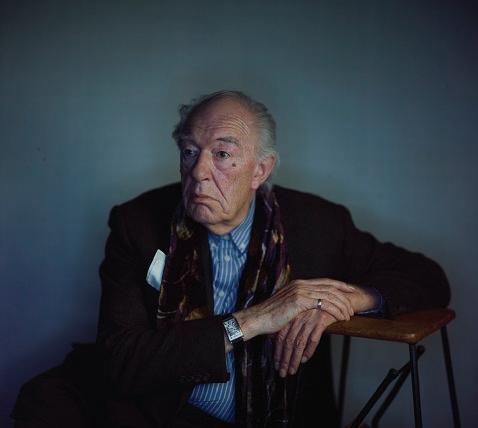
During closure, the Gallery continues to undertake the important work of conserving and loaning our Collection, as well as acquiring new work. We are proud to tell you about a newly acquired portrait of the actor Sir Michael Gambon by the photographer
Richard Learoyd. Richard has produced a wonderfully evocative portrait using an updated version of a Renaissance technique. I think you will agree that the results are very impressive. This issue also highlights the work of our Conservation Department with a piece by Polly Saltmarsh, Paintings Conservator, on her work to restore the portrait of Katherine Parr, Queen of England and the last wife of King Henry VIII.
On the subject of the Tudors, we are pleased to tell you about new research undertaken by Charlotte Bolland, Senior Curator, 16thCentury Collections. Charlotte has taken a close look at the extraordinary jewels worn by Queen Elizabeth I in the ‘Darnley portrait’ and the significance of the story that they convey.
Finally, this month’s My Favourite Portrait is kindly written by Stephen Boyce from the National Lottery Heritage Fund. We are grateful to Stephen for his enthusiastic support of our work and for the generosity of the NLHF and all our donors to Inspiring People
Thank you all once again for your continued support.
Dr Nicholas Cullinan director
MY FAVOURITE PORTRAIT
by Stephen Boyce
National
Lottery Heritage Fund
to work for the National Lottery Heritage Fund, supporting major projects involving heritage, is a huge privilege. The Fund’s investment in Inspiring People aims to give a wider audience better access to the National Portrait Gallery’s outstanding collections, to speak to everyone about our history and shared humanity.
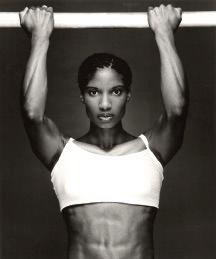
This striking portrait of Denise Lewis was taken in 2000, the year of the British heptathlete’s crowning achievement winning Gold at the Olympic Games in Sydney, adding to her Commonwealth Games and European titles. The geometric style of the image, with its strong vertical and horizontal lines, its sharply contrasting tones, creates a powerful sense of balance in which the subject is simultaneously at rest and in a state of dynamic readiness.
The portrait clearly celebrates Lewis’s athleticism, but the strength of her physique is matched by the strength of her gaze –direct, confident, composed. It speaks as much of intelligence and grace as of physical prowess. And the framing of her face between her arms, the beam she’s holding and her white vest, draw us inexorably into that gaze. Denise Lewis is seen to assert with dignity and poise her identity as a black female athlete. But you don’t need to share those particular characteristics to identify with the human qualities of self-worth, openness and equanimity which she conveys, to see her as not simply a successful sportswoman, but as a twenty-first-century role model – an inspiring person.
In discovering this portrait some years ago I was pleased to be introduced to the work of photographer Sheila Rock, an American who has made her home in the UK since the 1970s. She worked for the style magazine The Face, and is particularly known for documenting the Punk era. Her wide-ranging portfolio encompasses fashion, horses and Tibetan monks.
Stephen Boyce is a member of the National Lottery Heritage Fund’s London & South Committee and has a background in arts development and heritage consultancy. He has held senior positions at Southern Arts Board, the Community Fund and the Heritage Fund. He has been a trustee of several cultural charities and chairs South West Museum Development. Also a published poet, he lives in north Dorset.
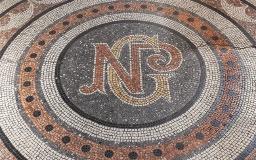
below left from top Mosaic in Room 33 by Diespeker and Co., 1894
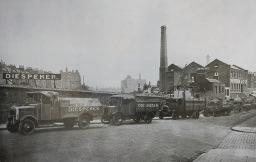
Diespeker and Co. delivery vans, 1932 Photograph courtesy of Diespeker & Co.
https://www.diespeker.co.uk
have you ever noticed the mosaic floors at the National Portrait Gallery? They are one of the great architectural gems of our Grade I listed building. Although they are incredibly hardwearing, a century of footfall has taken its toll; tiles are missing and the cracks are starting to show. This summer, thanks to a committed group of supporters, the mosaics will be carefully restored to their former glory.
The mosaics were created in 1894 by Diespeker and Co. The story goes that in 1881 Italian entrepreneur Luigi Ordorico sent his craftsman, Giovanni Mariutto, and
his salesman, Sigmund Diespeker, to London to research the local terrazzo and mosaic market. Instead of reporting back, Diespeker and Mariutto started Diespeker & Co., going on to make floors for the London Coliseum, the General Post Office and hotels across the capital. Today Diespeker and Co. continue to manufacture mosaic and terrazzo from their headquarters off the Old Kent Road.
The mosaics in the National Portrait Gallery are in the Roman Cube style. The mosaic cubes were formed by sawing marble blocks into thin slabs, usually ½'' to 5/8'' thick. Each tile was then installed free-hand, piece by piece. A simple design was needed, so as not to distract from the treasures on the walls.
Sir George Scharf, the Gallery’s first director, designed the first NPG insignia, and this became a central motif.
The restoration process begins with a photographic survey to allow areas of repair to be identified. Soft brushes are used to remove loose debris and dirt and cracks in the grout are repaired with lime mortar. Where there are missing tiles, new ones are provided to match.
A huge thanks to everyone who is supporting this project. Like a mosaic, together we are achieving something spectacular.
If you would like to support the restoration of the Gallery’s mosaics by sponsoring a mosaic tile for £50, please visit https://www.npg.org.uk/support/ inspiring-people-make-history. All mosaic donors will be acknowledged during our re-opening celebrations.
CONSERVATION UPDATE:
THE PORTRAIT OF KATHERINE PARR
by Polly Saltmarsh Paintings Conservator
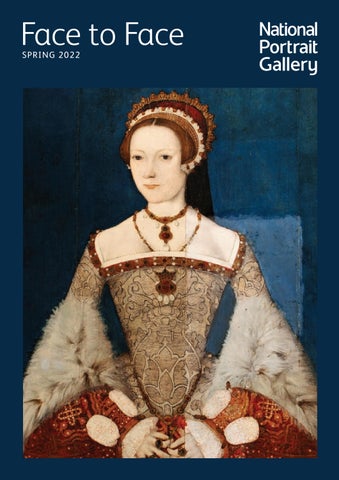
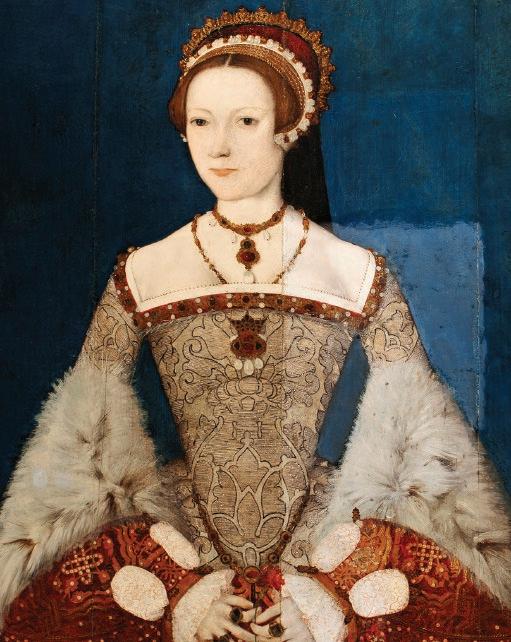
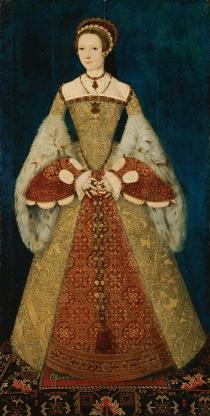
full - length portraits were rare in the Tudor period and those that have survived to this day are rarer still. The portrait of Katherine Parr is a remarkable, full-length painting of a female sitter, commissioned when she was Queen to Henry VIII. The portrait is one of the best-known works in the Collection and is rarely off display. The closure of the Gallery for the Inspiring People project has allowed it to come to the conservation studio for treatment.
The importance of the sitter is reflected in the materials used to create the portrait. The dress is made from luxurious fabric, depicted in gold and silver leaf, laid in before the upper paint-layers. The striking blue background is made from layers of the expensive pigment azurite. Before the upper paint-layers were applied, a light-blue preparation layer was applied to the area where the figure would be painted. This is an unusual colour choice but one that the artist has cleverly utilised to create the cool tones of the sitter’s flesh as well as the mid-tones in the fur cuffs. The painting support is a large wooden panel formed from four boards that are remarkably thick. The original tool marks are still evident on the reverse including a cargo mark, applied by tradesmen shipping wood from the Baltic region to London.
Although the condition of the painting is regularly checked, no significant treatment had been undertaken since the portrait entered the Collection in 1965. It was
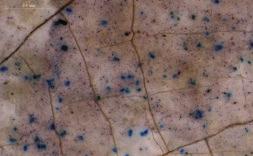
Photomicrograph of fine fluorite particles mixed with azurite
compromised by thick layers of varnish that had discoloured over time, becoming yellow and altering the tones of the original paint-layers. Areas of overpaint had also discoloured; this was particularly noticeable in the silver fabric of the dress, which had developed a mottled and confusing appearance to the viewer. The thick and uneven varnish had also affected the intensity of the azurite blue background.
The treatment has involved removal of the degraded varnish-layers to reveal the brilliance of the original paint-layers below. Where possible and safe to do so, discoloured overpaint has also been removed. The painting has been treated according to its condition and conservation requirements with the intention of ensuring its stability and improving its appearance without disguising its age and history. The next stage of treatment is to reintegrate areas of loss and abrasion through retouching.
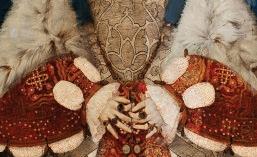
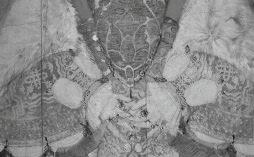
Technical analysis of the portrait had been undertaken in 2008 as part of the Gallery’s ground-breaking research project, Making Art in Tudor Britain. Removal of the discoloured varnish has allowed further insights into the making of the portrait. The rare purple pigment fluorite has been identified in the white neckline of the dress. Thanks to new equipment acquired by the Gallery through a grant from the Capability for Collections fund, Arts and Humanities Research Council (AHRC), the team has been able to capture high-
During cleaning of hands and background
Details of under-drawing in hands and sleeves, infrared
resolution images using infrared photography, revealing the free-hand under-drawing applied by the artist in the hands and sleeves.
One of the great privileges of a conservator’s job is to work closely with the objects in the Collection, and examining every inch of this incredible portrait has certainly been a career highlight. The Gallery is grateful to the Leche Trust, which has generously helped to fund the project. The painting will be on display at the Walker Art Gallery, Liverpool, in 2022 as part of The Tudors: Passion, Power and Politics exhibition, prior to being reinstalled at the Gallery ready for its reopening in 2023. below
WITH ANCESTRY
by Emily Summerscale Marketing Manager
For more information about The Nation’s Family Album, visit www.ancestry.co.uk/ familyalbum
our partnership with Ancestry ® has been several years in the making. The idea first germinated with our Digital team, who saw the number of ‘Tell us more’ comments and print purchases from relatives of those in the Collection, and wanted to share the Gallery’s images with even more people who were researching their family history with Ancestry. Anna Starling, our Director of Commercial, took this forward with a view to promoting our custom print sales. The Gallery has an extraordinary number of images that can be ordered in different formats, framed or unframed from the Gallery’s website. From February, over 125,000 of our Collection images will be available to Ancestry members, with the option to explore more about their ancestors and buy prints on our website. This is a really exciting opportunity to promote our Collection and enable people to make links with their family history.
Ancestry and Gallery marketing teams discussed how to promote the partnership. Both agreed that this opportunity should be amplified with a press and marketing campaign. When I mentioned that the Gallery is sometimes referred to as ‘the nation’s family album’, we felt this embodied what the partnership is all about.
We want to encourage people to explore their own family photos and submit them with an accompanying story or line of explanation. A panel, including experts from Ancestry and the Gallery, will make a selection
of images. We will be launching the digital submissions process later this year, with a view to displaying some of the images after the Gallery reopens in 2023.
Russell James, UK Marketing Director at Ancestry, comments, ‘We’re excited to be working with the National Portrait Gallery to provide wider access to some of its captivating and historically rich Collection. Hosting these portraits online at Ancestry means more people can explore over 500 years of British life – and some might even discover a family member in the collection! To complement the launch and highlight the diversity of family stories across Britain today, we are creating The Nation’s Family Album – to gather the undiscovered portraits of everyday British people into one representative photo album. We’d encourage Gallery members to submit their family photos and stories to The Nation’s Family Album, with the opportunity of these being displayed in a dedicated display at the National Portrait Gallery in the future.’
NEW ACQUISITION: SIR MICHAEL GAMBON
BY RICHARD LEAROYD
Unique camera obscura Ilfochrome photograph, 2019
by Sabina Jaskot-Gill Curator, Photographs
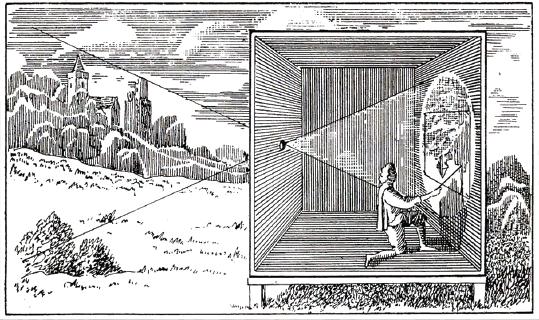
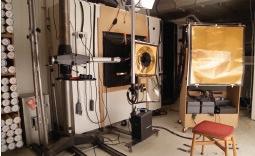
throughout its history , the Gallery has acquired portraits based on the authenticity of the sitter’s likeness. Our collecting ambitions have more recently expanded to reflect upon the artistic practice of portraiture, and the ways in which the genre has been explored and developed by artists. We recently acquired a portrait by Richard Learoyd (b.1966), an internationally recognised contemporary British photographer, who uses a pre-photographic device – the camera obscura – to create his distinctive imagery. Translated as ‘dark room’, a camera obscura is a dark chamber with a small aperture or
Early illustration of a camera obscura
lens, through which an image of the outside world is projected on to the interior wall.
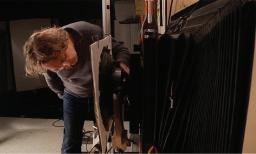
Learoyd has constructed a room-sized camera in his east London studio, measuring roughly 3m2. To create a portrait, he carefully positions his sitter in an adjacent room, connected to the camera obscura by a lens that projects the subject’s image into the dark chamber. Learoyd enters the camera obscura to make refinements to the position and focus of the image, then closes down the lens, attaches a large sheet of light-sensitive photographic paper to the back wall, and steps out of
the camera to open the lens and make an exposure with flash. The paper is then processed to produce the finished photograph.
Pared down to the essential components of dark chamber, lens, sensitised paper and light, this labour-intensive process references the early history of the photographic medium. It is a slow and meticulous analogue process that creates a single positive image directly on the photographic paper. There is no interposing negative, so each print is unique, and with no transfer from negative to print, the resulting image possesses a striking clarity of detail.
The subjects of Learoyd’s photographs include still lifes and portraits, though he does not typically photograph celebrities, which makes this portrait of Sir Michael Gambon (b.1940) all the more special. Gambon is one of Britain’s best-known stage and screen actors, recipient of four BAFTA awards, three Olivier Awards, a CBE, and a knighthood in 1998. His instinctive ability to express subtlety of emotion and intensity of feeling has made him one of the leading thespians of his generation. This new acquisition represents Gambon later in his career, when contemporary audiences will recognise the actor from his role as Professor Albus Dumbledore in the Harry Potter film series.
Learoyd’s process requires the sitter to hold a pose for upwards of 30 seconds, as the artist focuses the lens and prepares for the exposure. This period, in which the subject is seated alone and very still in a dark room, allows the sitter to make decisions about how they wish to project themselves in the photograph, and to be seen. As a result, this portrait possesses a sense of stillness and quietude, with the actor seemingly frozen in deep reflection. This contemplative portrait also possesses a psychological weight, taken in the same year that Gambon stepped back from television projects because of his ongoing struggle with memory loss. He had previously retired from the theatre in 2015 after being unable to remember his lines, and has openly discussed his fear of developing dementia. The heavy atmosphere of the
portrait therefore introduces questions of mortality, underscored by the framing of the actor’s watch at the centre of the composition as a memento mori.
Learoyd has acknowledged his own interest in exploring obsolescence, particularly in the outmoded technology he uses. Both the
Ilfochrome photographic paper, and the chemistry needed to develop the image, are no longer manufactured and Learoyd uses what is left of his limited supply, acutely aware that eventually this will run out. Each work therefore draws attention to the lifespan and evolution of photographic technologies and processes.
Sir Michael Gambon by Richard Learoyd, 2019 (NPG P2093)
Anna Starling Director of Commercial in conversation with Alex Cochrane Designer, National Portrait Gallery retail spaces
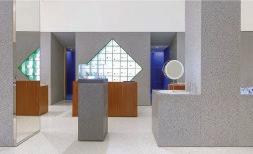
Alex Cochrane Architects were appointed in 2021 to design the new retail spaces as part of the Inspiring People project. Here, Alex talks about his vision for the spaces, how he became a designer and his love of the Gallery’s Collection.
anna starling Can you tell us a bit about your background as a designer, how you decided it was what you wanted to do?
alex cochrane My interest in architecture and design initially stemmed from my interest in Fine Art. I did a fine art course at the Byam Shaw School of Art and became captivated by Colourfield painting and the minimalist sculptural works of Donald Judd, Dan Flavin, Richard Serra and James Turrell. My interest in the spatial qualities of abstraction led me to doing a spatial design and architecture course at the Chelsea College of Art and Design and then the Architectural Association (AA).
How did you became so involved in retail?
Our first retail project was for Selfridges on Oxford Street 10 years ago. We designed their Contemporary Men’s clothing edit.
It was in a very prominent location, so it had to be special – we placed the clothing rails either side of a series of sculptural marble display plinths down the middle of the floor. Following that we designed an altogether different retail space called the Silence Room. This room allowed visitors to escape the stimulation of the department store, a room within a room – an inner chamber of silence if you like. The project’s lifespan was to be four weeks, but Selfridges kept it for six months thanks to its success. We have been designing retail environments in the UK, Europe and North America ever since.
What drew you to this project?
We have designed many shops but not for a gallery or museum until now. We are enjoying a close working relationship with the Gallery and the larger design team who are instrumental in allowing us to develop our three retail environments. We are delighted to be a modest but important part of this ambitious refurbishment. Equally, we want our shops to be exemplary retail destinations.
Where did you look for inspiration for this project and how do you go about starting to sketch out a concept?
Our concept designs developed with three main objectives. The first was to create a design that would be both complementary and sensitive towards the historic fabric. The second was to understand in detail the requirements of the Gallery, whether commercial, practical, operational or
services-led. It was important that our designs continue to welcome the existing Gallery visitor but draw in a new audience too. Thirdly, we researched numerous museum and gallery shops in London and beyond. We hope to ensure positive memorable experiences for the customers in our Gallery shops.
As more and more shopping moves online how do you think the shop experience needs to evolve?
Shops need to provide a truly memorable experience, enticing a visitor to return and spread the word. There are many ways to do this but surprising the visitor through quality and unique retail design, desirable products and excellent customer service is key.
Is there a portrait in the Collection that has particular resonance for you?
A good number of National Portrait Gallery
below left
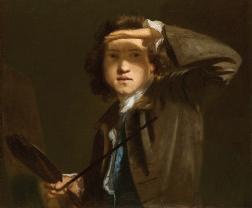
Self-portrait by Sir Joshua Reynolds, c.1747–49 (NPG 41)
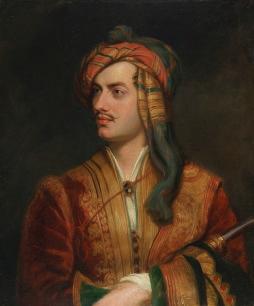
below Lord Byron Replica by Thomas Phillips, c.1835, based on a work of 1813 (NPG 142)
portraits have resonated with me at different times and for different reasons. As an A-level student I recall standing in front of Reynolds’s Self-Portrait with sketchbook in hand, thinking it was exceptional. I was intrigued by his decision to shade his eyes with his hand: an unusual pose compared to some of the sterner poses in the Gallery. It was as if he really was trying to focus on me. I also remember visiting with my mother, who very much wanted to see Thomas Phillips’s portrait of Lord Byron. I was captivated by it, not least because of the exceptional precision of his wonderful Albanian costume and headdress. Secretly, I really wanted to be Byron as I stared at the picture.
‘FOR THE FAIREST’: A CLOSER LOOK AT AN ELIZABETHAN
JEWEL
by Charlotte Bolland Senior Curator, Research and 16th-Century Collections
below left
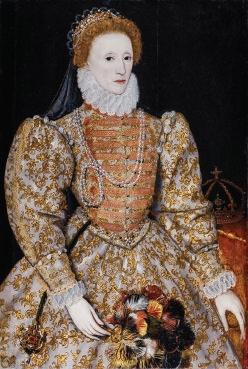
Queen Elizabeth I by an unidentified artist, c.1575 (NPG 2082)
elizabeth i ’ s jewels were one of the marvels of the Tudor court. She owned countless pieces, made from gems, pearls and precious metals sourced from across the world. Only a handful survive, with the vast majority destroyed by subsequent generations because of their material value, taken apart and melted down to be recreated in new styles or converted into currency. All that remains of most of Elizabeth’s jewels are the detailed descriptions in royal inventories and the records of what was given at New
Year, when courtiers competed to display their adoration and intimacy with the queen through the presentation of intricate gifts. However, we can gain an impression of their style and splendour, and the messages that they could be used to convey, through Elizabeth’s portraits.
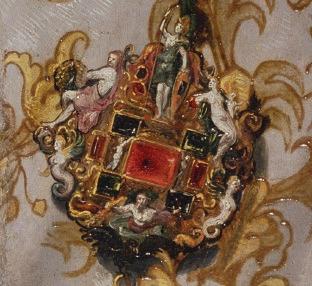
One of the most extraordinary jewels to be depicted in the Gallery’s portraits of Elizabeth I is the pendant that hangs from Elizabeth’s waist in the so-called ‘Darnley’ portrait. Less famous than the phoenix jewel placed at the centre of Nicholas Hilliard’s contemporaneous portrait of the queen, the richly detailed depiction of this jewel is often overlooked because of the artist’s skill at capturing the queen’s commanding presence. Carefully placed in the lower-left corner of the composition, where it could be closely inspected in juxtaposition with the free-flowing brushstrokes of the exuberant multi-coloured feathers of the fan, the jewel is weighted with iconographical significance. Its subject relates to the classical legend of the Judgement of Paris, a theme that was used in praise of Elizabeth throughout her reign. In the legend, Jupiter asked Paris to judge who was the fairest of three goddesses – Juno, Minerva and Venus – after Eris, the goddess of discord, cast a golden apple inscribed ‘For the fairest’ among the guests at a wedding to which she had not been invited. In Elizabeth’s jewel, four diamonds backed with black foil to emphasise their lustre surround a large rectangular ruby. Enamelled figures surround
This portrait of Elizabeth I will be on display in The Tudors: Passion, Power and Politics
The Holburne Museum, Bath from 28 January to 8 May 2022 Walker Art Gallery, Liverpool from 21 May to 29 August 2022
the stones: Juno and her peacock are on the left, in the centre Minerva stands with helmet and shield, while a naked Venus reclines on the right with Cupid; at the base of the jewel Jupiter can be identified by his thunderbolt. However, where Paris chose Venus in the legend, and triggered the events that led to the Trojan War, in the Tudor iconography Elizabeth’s possession of the jewel indicated that she was not only the fairest of all goddesses – she also retained all their virtues and shared Jupiter’s divine majesty.
The themes of the Judgement of Paris allowed patrons and artists to praise Elizabeth while also addressing the iconographic challenge of an unmarried female ruler. In
holding the virtues of all three goddesses, Elizabeth balanced regal power, intellect and femininity, thereby preserving peace. In the design of the jewel, Juno, the goddess associated with marriage and the queen of the gods, offers a counterpoint to Venus, the goddess of love and desire; Minerva, the virgin goddess of wisdom and war, occupies the central position. This balancing of identities is in keeping with the choices made elsewhere in the portrait, such as the loop of pearls pinned on to the queen’s masculinestyle doublet, with unusual frogging in the Polish style. At a time when it was still hoped that Elizabeth would marry, this image clearly conveys that marriage would in no way reduce her personal authority.
‘MUCH
TO DO
ABOUT
UNPACKING’: REINSTALLING THE NATIONAL COLLECTION FOR INSPIRING PEOPLE
by Edward Purvis Head of Collections Services
i was enthusiastically speaking to my wife the other day about overcoming the challenges of reinstalling the National Collection. She doesn’t work in the heritage sector, but simply replied, ‘Well, it’s like going on holiday – easier to unpack than pack!’ I paused for a moment, thinking to myself, ‘If only it was as simple as that’, but nevertheless the sentiment resonated with me. The challenges of removal were as much about finding storage for all the works, a place in the ‘suitcase’ as it were, as they were for my teams physically undertaking the move.
Logistics aside, the reinstallation of over 1,000 works across 40 rooms along with the exhibitions is a serious challenge – nothing on this scale has been done before in the Gallery’s history. It’s a challenge, not just for my teams to meet head-on, who are responsible for the physical movement, conservation and installation of the works, but for the whole Gallery. As with removal in 2020, it will be a Gallery-wide effort. The entire operation’s mechanics have to be considered – at the end of the day, translating Trustee and Curatorial ambition into what visitors see on the walls and in cases.
Taking the holiday analogy a bit further –who has ‘unpacked’ like this before? Learning from peers is critical in the world of care and logistics where I operate, and is no different for this mammoth operation ahead of us. We’ve already reached out to the Royal Academy and the Courtauld to learn from below
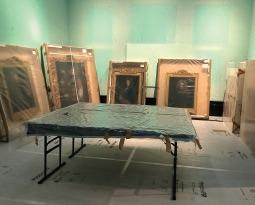
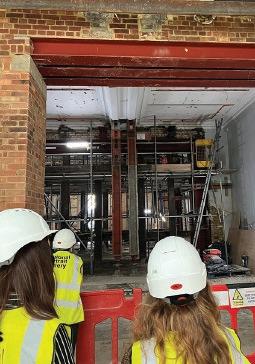
Reinstall team tour of the main site to see the new display areas take shape (picture shows ground floor)
them what worked and what didn’t for their redevelopment projects. The devil is in the detail; copious notes were taken.
A strong Gallery project management process is the next vital piece in the puzzle. As part of this, we’ve set up the Gallery’s Reinstallation Delivery Group to drive forward every element of the collections planning. The conservation of works is one of the central themes. Having the right colleagues around the table at the right time is always important, and how this feeds into decisions made by the Inspiring People Project Board, and other forums. Communication is the next part. The complexity of planning over several years can cast a long shadow if not handled correctly; it will have been two and a half years of planning the physical reinstall by the time the Gallery reopens in 2023. Everyone at the Gallery, whether involved directly with the planning or not, needs to have a good understanding of what’s going on; it is as much about how we operate as a Gallery once we open as it is about the actual install.
Marshalling different scenarios and variables is also important; the project management process helps manage this, including risk registers. There can be countless thoughts, and rightly so. Late at night, I play with scenarios in my mind. Will we need road closures? How many lifts can we use? What’s the load-bearing limit of the new areas? Considering the 40 rooms as a blank slate helps temper this – where do we set up
‘base camp’? Sustainability is an important part of our thinking – from recycling gloves to electric trucks.
Finally, and perhaps most importantly, the process has to consider the whole picture (excuse the pun). My teams have, naturally, an important part to play, but as I’ve indicated above, it is about the collective effort to reach the finishing line. So, with that in mind, the Gallery’s founders look down expectantly from their roundels above; the great reveal awaits. Will it be worth it in the end? As you’d expect, there’s no doubt in my mind that it will. Then I will be off on a welldeserved holiday!
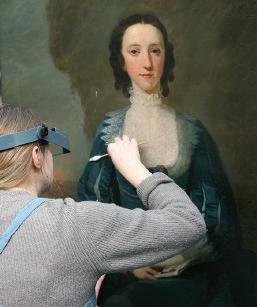
Sally Higgs undertaking treatment on Flora MacDonald by Richard Wilson (NPG 5848) for the new displays
by Jasmin Woolley-Butler Ecommerce Marketing Manager
we caught up with acclaimed designer Cressida Bell ahead of the launch of her new range, designed exclusively for the National Portrait Gallery, to find out more about her practice and the inspiration behind the design.
Cressida specialises in designing for textiles and interiors, producing a wide range of products, including accessories for men and women as well as objects for the home, from her studio in Hackney, London.
Having studied first at St Martin’s School of Art, then at the Royal College of Art, Cressida set up her company in 1984. The decorative designs she creates are uncompromising and retain independence from mainstream fashion.
As the daughter of Quentin Bell, granddaughter of Vanessa Bell and greatniece of Virginia Woolf, her work reveals an undoubted influence from her well-known Bloomsbury Group heritage. However, this has not prevented her from forging her own individual style over the last few decades.
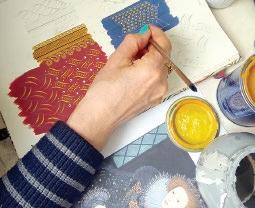
We began by speaking to Cressida about her design practice, and she explained how she believes herself to be one of just a few practitioners creating screen-printed textiles by hand today.
Cressida told us, ‘I specialise in small editions of silk scarves but also create textiles for the home, and interior lighting.’ And speaking further about the techniques used,
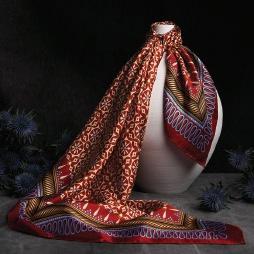
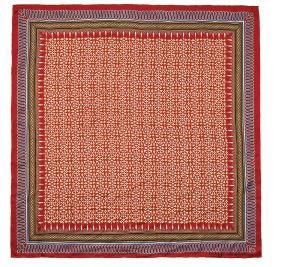
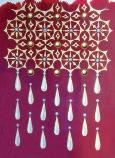
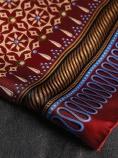
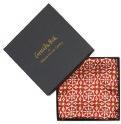
The Hilliard silk scarf created by Cressida Bell exclusively for the National Portrait Gallery is available to purchase now through our online shop and don’t forget, members get 20% off with code MEMBER2020. The scarf is presented in a gift box, measures 100cm x 100cm and is made from 100% silk twill, featuring rolled edges. https://npgshop.org.uk/products/cressida-bell-hilliardsilk-scarf
she explained, ‘I purchase white or natural fabric and all dyeing, printing, painting and finishing is done in my studio. Many of the scarves I produce employ discharge printing techniques whereby the colour applied removes the dyed colour with an “illuminating” colour, making for particularly vibrant shades and contrasts. My designs are very much about pattern and colour rather than texture, and I believe they display a strong personal style.’
While the process of creating this exclusive scarf for the National Portrait Gallery has been different from her usual studio practice, Cressida said that ‘All my prints begin life as hand-drawn designs. I have carefully designed my artwork so that it could be repeated and cropped.’ These initial designs were then digitised to create the repeat pattern and printed on to 100% silk twill digitally. She added, ‘I hope there will be more product down the line and I will be involved in further items.’
This new scarf design features decorative elements found in our Elizabethan portraits, including tear-drop pearls, patterns reminiscent of ruffs and gilded frames, all surrounding a central field filled with an intricate, decorative lace pattern on a vivid red background.
Speaking about her inspiration, Cressida commented, ‘I looked at all the major Elizabethan-era paintings, particularly those strong on pattern and showing elaborate clothing; my design draws on the ruffles and lacework so prevalent in the era.’
PAINTINGS THAT INFLUENCED CRESSIDA BELL: Queen Elizabeth I by an unknown English artist c.1588 (NPG 541); King Henry VII by an unknown Netherlandish artist, 1505 (NPG 416); Queen Elizabeth I by an unknown English artist, c.1600 (NPG 5175); Lord Byron replica by Thomas Phillips, c.1835, based on a work of 1813 (NPG 142); Queen Elizabeth I associated with Nicholas Hilliard, c.1575 (NPG 190)
Spring offer for Gallery Supporters
THE TUDORS: PASSION, POWER AND POLITICS
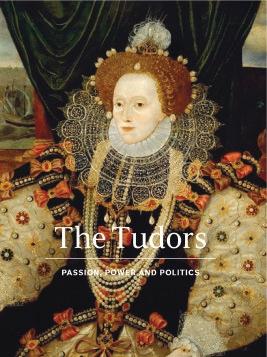
January saw the publication of an exciting new title exploring the Tudor Dynasty in an international context. Richly illustrated and highlighting contemporary research, the book provides an overview of the ways in which the Tudors engaged with the world and were impacted by broader currents: the internationalism of court culture, religious shifts, trade, naval conflict and the expansion in the Americas.
The Tudors: Passion, Power and Politics is edited by Charlotte Bolland, Senior Curator, Research and 16th-Century Collections at the National Portrait Gallery, and accompanies a touring exhibition of the same name, visiting the Holburne Museum, Bath, 28 January to 8 May 2022, and the Walker Art Gallery, Liverpool, 21 May to 29 August 2022.
To purchase your copy online go to npgshop.org.uk, and be sure to enter the code MEMBER2020 at checkout to receive your exclusive 20% discount.
This offer is open to National Portrait Gallery Members and Patrons only.