Face to Face
cover ( and below )
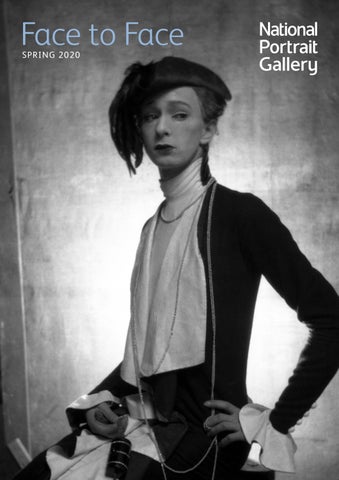
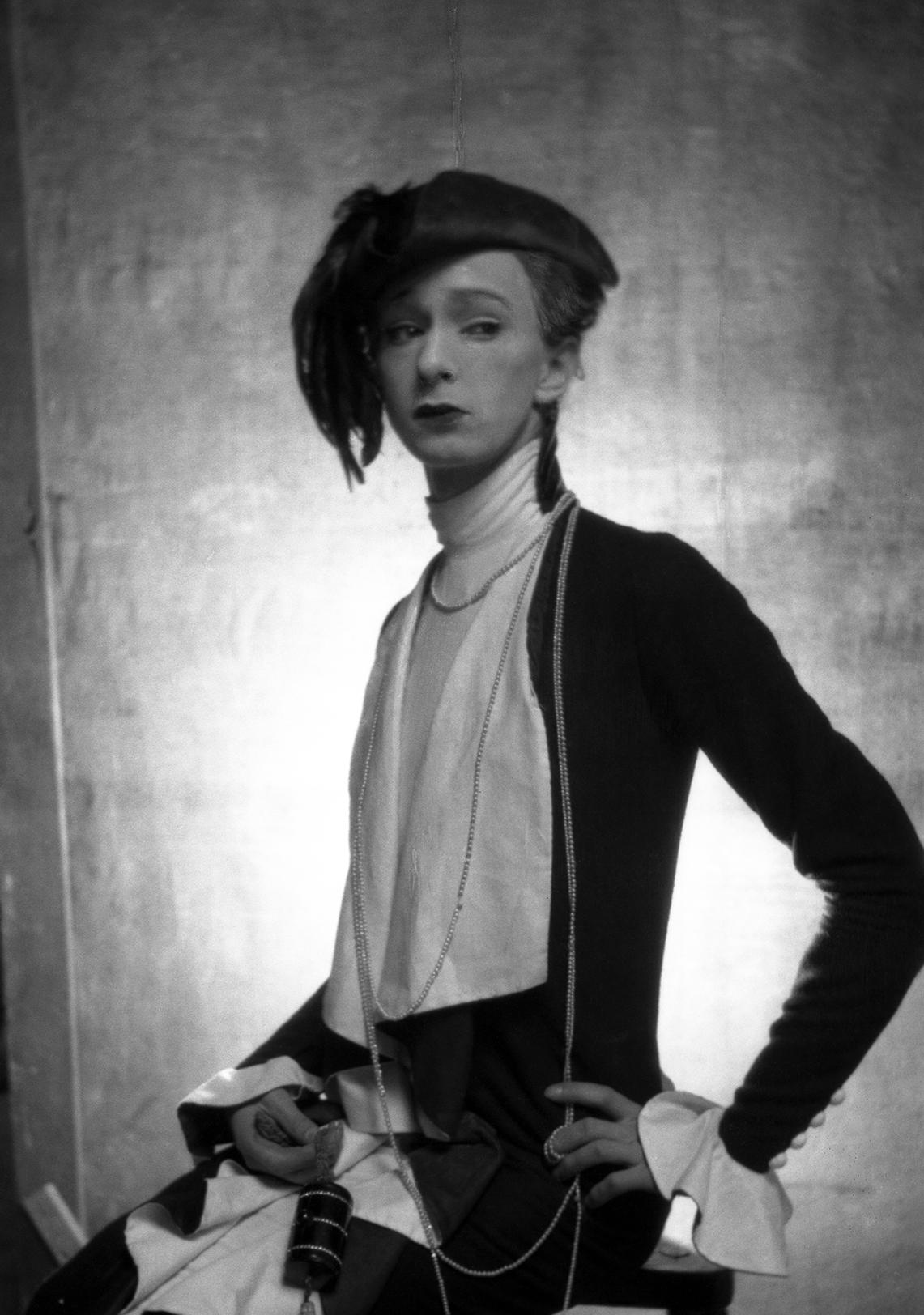
Edward Le Bas as Mrs Vulpy in The Watched Pot (detail) by Cecil
Beaton,
1924
Courtesy The Cecil Beaton Studio Archive
© The Cecil Beaton Studio Archive
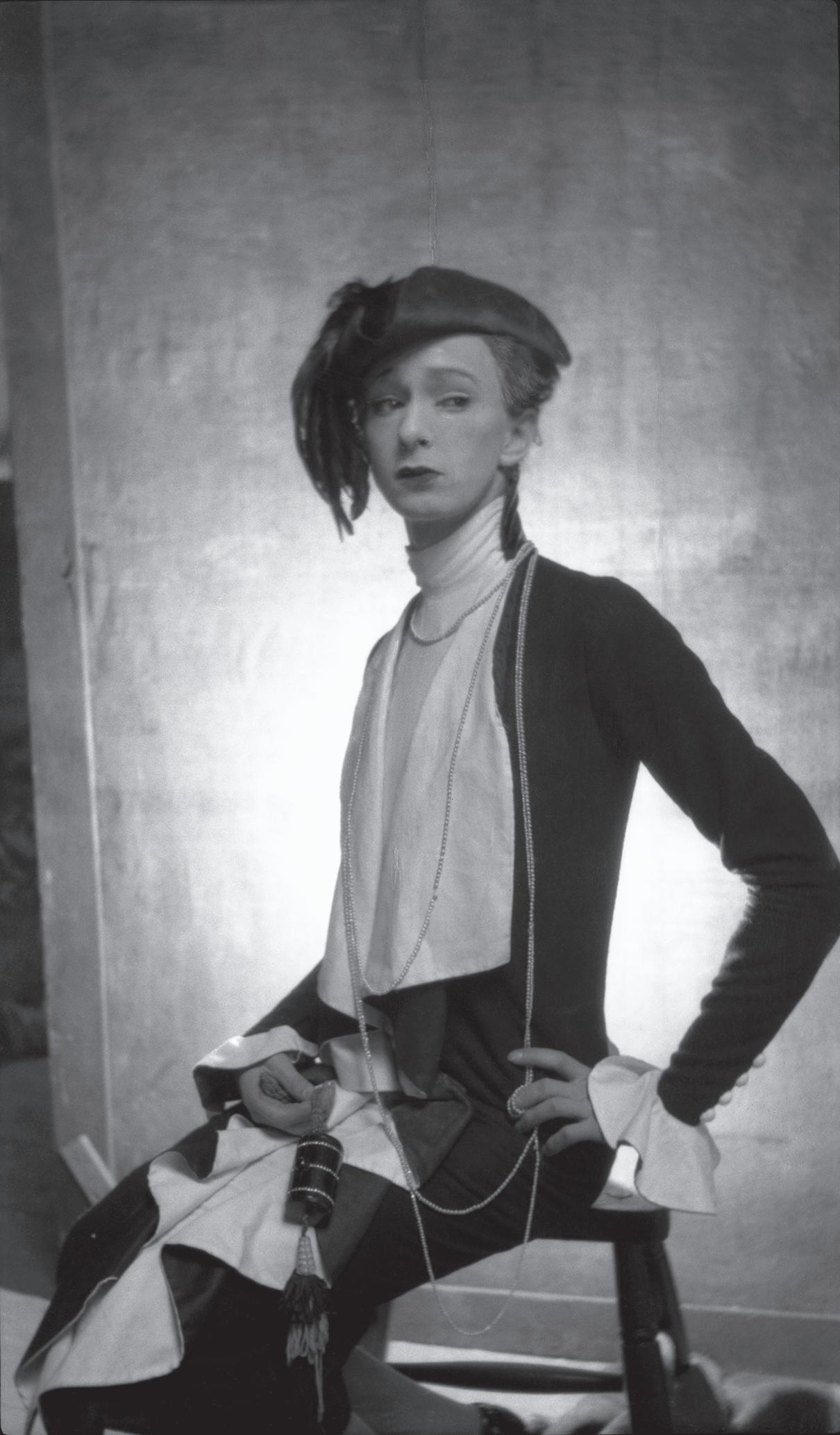
Cecil Beaton’s Bright Young Things will be on display in the Porter Gallery Plus from 12 March until 7 June 2020
Face to Face Issue 62
Director of Development
Jessica Litwin
Manager Daniel Hausherr
Copy Editor
Elisabeth Ingles
Designer Annabel Dalziel
All images National Portrait Gallery, London and © National Portrait Gallery, London unless stated
npg.org.uk
Gallery Switchboard 020 7306 0055
Dr Nicholas Cullinan
this spring the Gallery presents the work of two great icons of British art. Cecil Beaton’s Bright Young Things explores the extravagant world of the glamorous ‘Bright Young Things’ of the Twenties and Thirties, seen through the eye of one of Britain’s most renowned photographers. A selection of his portraits from this fascinating period will be brought together for the first time, highlighting Beaton’s remarkable photographic style and equally remarkable friendships.
David Hockney: Drawing from Life will be the first major exhibition to feature Hockney’s drawings in over twenty years. Like Bright Young Things, the exhibition focuses on the artist’s depictions of himself and a group of sitters close to him. Featuring around 150 works, it will be a unique opportunity to trace the trajectory of Hockney’s practice as he revisits five subjects over a period of six decades.
As we move forward with our transformation project, Inspiring People, we are preparing to share our Collection with the nation in a major programme of activities across the UK. This is a wonderful opportunity for important portraits to be displayed in new contexts. Charlotte Bolland, Senior Curator, talks about Holbein’s Whitehall Cartoon temporarily moving to the National Gallery, where it will be shown alongside another of Holbein’s most important works, The Ambassadors
On the same note, our touring exhibition, Tudors to Windsors, opens at Royal Museums Greenwich in April. Kristian Martin, RMG Exhibitions Curator, talks about the collaboration. Another RMG display, Faces of a Queen, will show the three Armada portraits of Queen Elizabeth I together for the first time at the Queen’s House, Greenwich. Both exhibitions are free for National Portrait Gallery Members.
As our work on Inspiring People continues, we have asked the project architect, Jamie Fobert CBE, to write about his favourite portrait, and our Acting Project Director, Jo Dunnett, to provide you with an update on progress during this very exciting period for the Gallery.
Photographer Zoë Law has produced a series of photographic portraits, which will be shown in a new display, Legends of British Industry, opening in March. The subject of each portrait represents the very best of British talent, be that from film, music, fashion, business, journalism, art or sport. One of the sitters, Dame Laura Lee, Chair of Maggie’s Centres, tells us what it’s like to be in front of the camera.
Finally, we sat down with our former colleague, Judith West, to hear why she has chosen to remember the Gallery in her will.

Dr Nicholas Cullinan director
by Jamie Fobert CBE
Lead architect for the National Portrait Gallery’s major redevelopment, Inspiring People
on one of my many visits to the National Portrait Gallery since commencing the redesign, I decided to search out all its architects. Scattered throughout the galleries are some of the greatest British architects of their time, from Christopher Wren to Zaha Hadid. But one portrait was of a man I had never heard of: Ralph Simons.
I was immediately struck by his extraordinary, weather-beaten face. It was a surprise to see this man among his fellow Elizabethan sitters – all nobles and courtesans, with smooth skin and silk attire. He has the complexion of a man who has spent most of his life on a building site, yet his face is framed by a delicate, crisp ruff. I was intrigued to find out more about him.
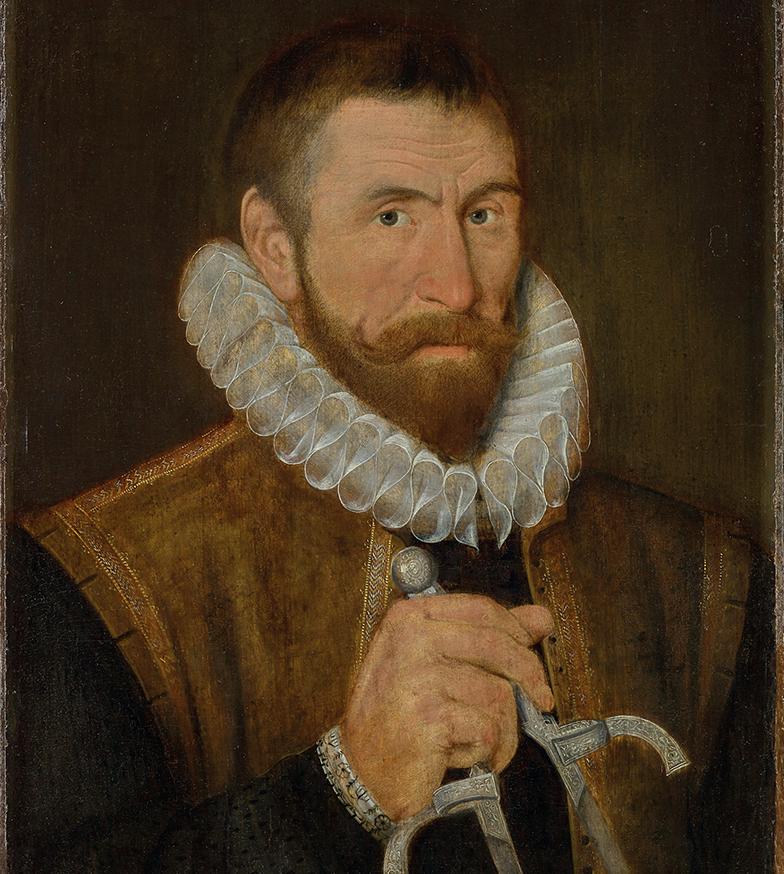
below left Ralph Simons (Symons) (detail) by an unknown English artist, c.1595 (NPG 7021)
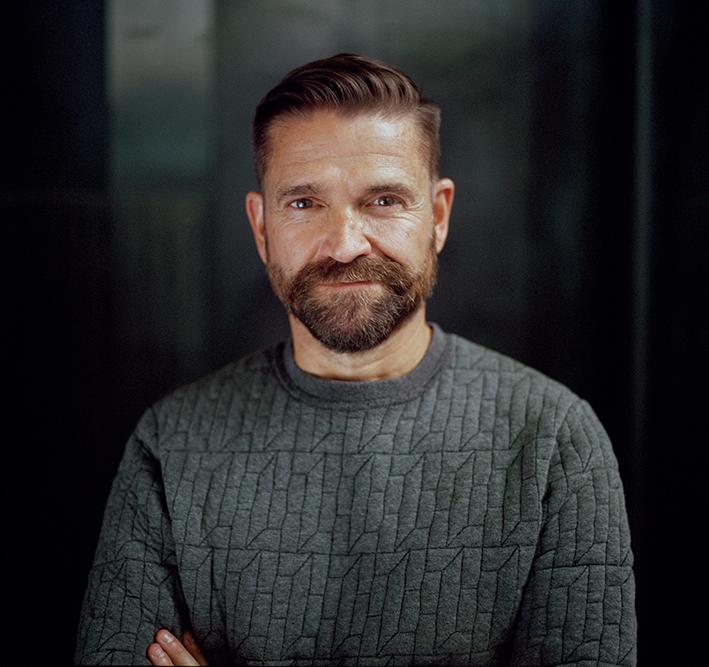
His origins are obscure, but we may assume that Ralph was born into a humble family and was apprenticed to a stonemason as a young man. Through talent and hard work, he became a draughtsman and architectural designer so accomplished and well regarded that he was considered worthy of having his portrait painted.
Today, architecture as a profession is somewhat removed from the act of making. But for Ralph, even after he had earned a reputation as ‘the most skilful architect of his time’, it was natural to continue to work on-site as a skilled mason. It was tough work, and dangerous, too. During the construction of the Second Court at St John’s College, Cambridge, he lost his left hand.
This portrait reflects his dual status as an artisan and a man of stature. He wears the leather jerkin of a mason, unusually ornamented with fine gold thread embroidery. In his right hand, he holds an elaborate pair of dividers in the open position, as if he is about to start measuring. I like to think Ralph adopted the ruff just for the portrait, as I cannot imagine he wore it on his building sites.
Jamie Fobert is a London-based architect and designer. Born in Canada, he arrived in London in 1988 and worked for David Chipperfield Architects for several years before establishing his own practice, Jamie Fobert Architects, in 1996. Since then, Jamie and his team have consistently produced innovative and inspiring architecture.
© Laura Pannack
HANS HOLBEIN THE YOUNGER: HENRY VIII AT THE NATIONAL GALLERY
by Dr Charlotte Bolland Senior Curator, Research and 16th-Century Collections
hans holbein the younger was one of the finest portraitists ever to work in England, and a number of his most important large-scale works can be seen in London. These include the Gallery’s iconic depictions of Henry VIII and Henry VII in the Whitehall Cartoon
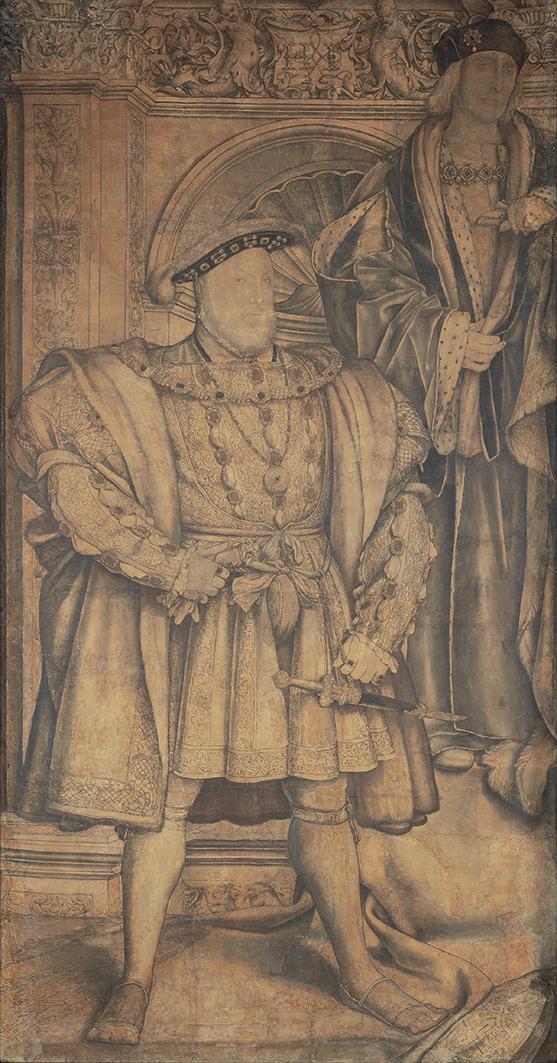
(NPG 4027). In preparation for the Gallery’s temporary closure, in order to allow essential works for the Inspiring People project to take place, this drawing is travelling next door to go on display at the National Gallery. There it will be shown alongside Holbein’s magnificent double portrait of Jean de Dinteville and Georges de Selve, known as The Ambassadors, and his famous depiction of the sixteen-yearold Christina of Denmark, Duchess of Milan. The Ambassadors was commissioned by the ambitious young French diplomat Dinteville when he was in London for Anne Boleyn’s coronation, while Christina of Denmark’s portrait was sought by Henry VIII when he was looking for a fourth wife following the death of Jane Seymour. The young woman is supposed to have quipped that if she had a spare head, she would be happy to place it at the king of England’s disposal. Henry was so pleased with the portrait that he kept it in his collection even though nothing came of the marriage negotiations.
Displaying the Whitehall Cartoon in the National Gallery also offers the exciting opportunity to place the double portrait in an international context, allowing for comparison with the portraits of Henry VII and Henry VIII’s peers that are on display, such as Giovanni Bellini’s portrait of Doge Leonardo Loredan (Room 55).
The Whitehall Cartoon will be on display from March 2020 in Room 4 at the National Gallery.
below left
Henry VIII and Henry VII (the Whitehall Cartoon) by Hans Holbein the Younger, c.1536–7 (NPG 4027)
CECIL BEATON’S
BRIGHT YOUNG THINGS
by Robin Muir Exhibition Curator
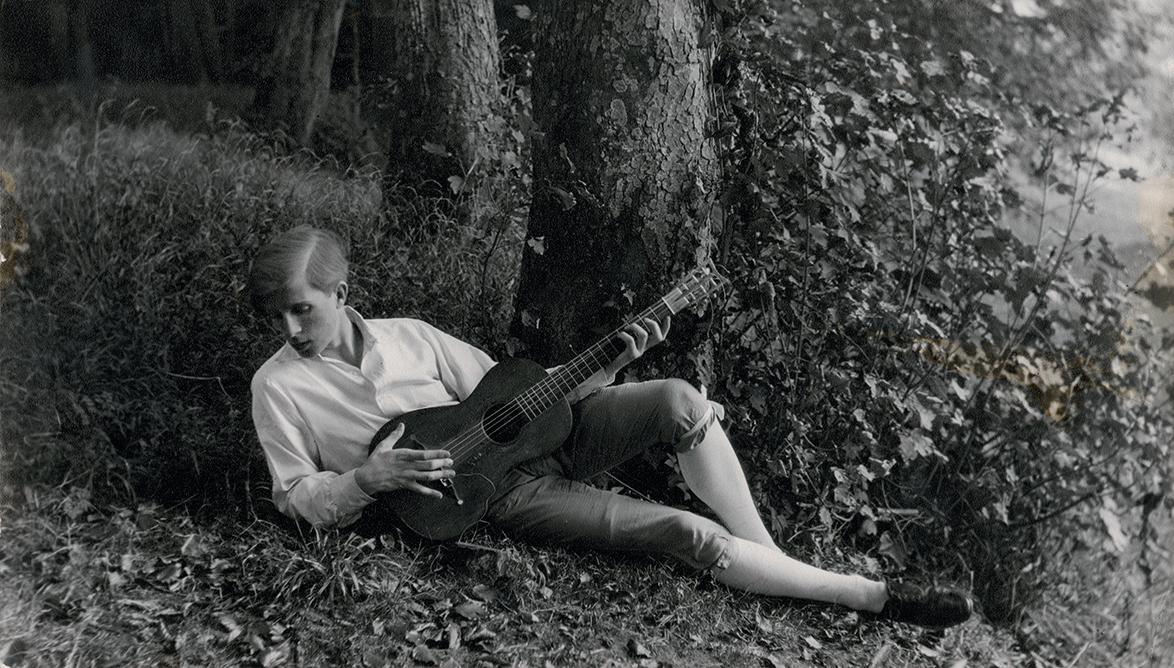
cecil beaton (1904–80) and the National Portrait Gallery have a long and distinguished history. The archive holds nearly 1,500 artworks by or of him, the largest holding outside the Cecil Beaton Studio Archive at Sotheby’s. The earliest Beaton print contained at the Gallery is nearly a century old; an undated self-portrait, a pastiche of an Edwardian picture postcard which he used as a Christmas card and which he must have made some time in the early 1920s. He beams confidently, though a little selfconsciously, as any sixteen-year-old might in a borrowed picture hat. It’s a prescient picture. Though Beaton declared around that time, ‘I want only to be Cecil Beaton’, his experiments with costume and identity would allow him, time and again, to choose just who that Cecil Beaton might be.
In 1968 the Beaton Portraits exhibition opened here. The newly appointed director, Roy Strong, recalled it in his memoirs as ‘the exhibition which was to change the public’s perception of the NPG forever’. This
was not just the Gallery’s first exhibition of photographs, or the first time living sitters had been exhibited, or the first time that non-British faces were included: it was also Britain’s very first museum show of a living photographer. In 2004 the Gallery marked Beaton’s centenary with the well-received and popular Cecil Beaton Portraits exhibition.
Both these distinguished exhibitions were career-long surveys. Cecil Beaton’s Bright Young Things focuses instead upon one aspect highlighted in both but never studied in any great detail. Through the prism of his early portraits the exhibition will present the leading cast of Bright Young People, who in these early years helped refine a remarkable photographic style. Among them are artist and aesthete Stephen Tennant; set designer, muralist and illustrator Rex Whistler; designer Oliver Messel; fledgling composers William Walton and Constant Lambert; friends Nancy Cunard and Iris Tree; socialites Edwina Mountbatten and Mrs Bryan Guinness (the former Diana Mitford). An older generation gave Beaton’s career early impetus: Edith Sitwell, perhaps his first celebrity sitter; Lady Diana Cooper; Hazel, Lady Lavery; Viscountess Wimborne, extravagant patron of William Walton; and the extraordinary Lady Alexander, whose late husband produced Oscar Wilde’s comedies, and who became an early patron of Beaton’s.
He took his first photographs as a ten-yearold when he was given a Box Brownie for
Rex Whistler, Wilsford by Cecil Beaton, 1927 (NPG x40400)
© The Cecil Beaton Studio Archive
Cecil Beaton’s Bright Young Things
From 12 March until 7 June 2020
Porter Gallery Plus
Tickets from £20 (Concessions from £17)
Free for Gallery Supporters
Supported by the Noël Coward Foundation Spring Season 2020 sponsored by Herbert Smith Freehills LLP
Christmas. At twelve he graduated to a more adventurous Kodak A3 folding camera. He honed his skills at St John’s Cambridge, his first proper sitter, outside his family, being the future Byzantine classicist Sir Steven Runciman, then an undergraduate at Trinity, with a daring Italianate fringe, highly decorated rooms and a parakeet called Benedict. Beaton’s last photographs included forty-four pages for French Vogue in 1979.
Cecil Beaton’s Bright Young Things covers in essence his first thirteen years as a
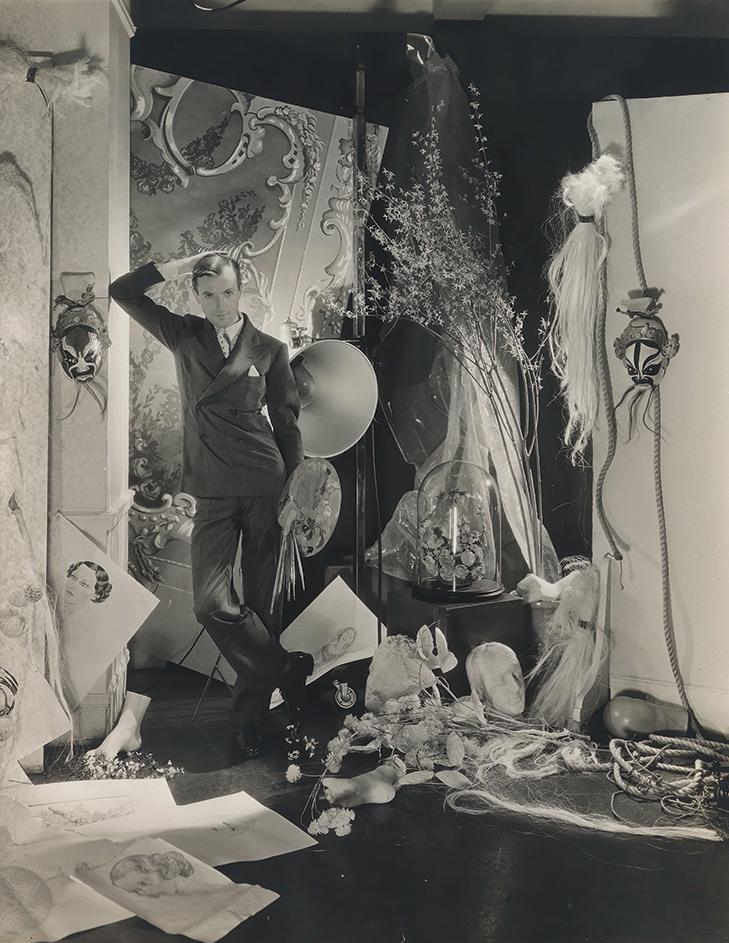
professional photographer. It takes us from 1924 and his first published Vogue picture (his greatest patron – he stayed with the magazine for the next half-century) and ends in 1937 when he holds a fantastical, rustic fête champêtre at Ashcombe, his Wiltshire home. The backdrop to that, of course, is the storm clouds gathering in middle Europe, a swansong for an era.
Socially avaricious, Beaton was a celebrity in his own right. His transformation from middle-class suburban schoolboy to glittering society figure, and the unrivalled star of Vogue, revealed a social mobility all but unthinkable before the Great War. He used his artistic skills, his ambition and his larger-thanlife personality to become part of a world that he would not have joined as of right.
‘Some of my earliest visions of certain celebrities were formed by Cecil Beaton,’ wrote Roy Strong in the catalogue to that milestone of a show in 1968. ‘If this is proof that photography is an art, then Beaton must rank high amongst this century’s interpreters of the human persona.’ It’s hard to disagree, and I hope that Cecil Beaton’s Bright Young Things shows us just how early on, in such a long and significant career, it was by his remarkable, idiosyncratic sense of style that Cecil Beaton transformed his sitters into ciphers for their age; and just how his images of certain individuals taken long ago are the images by which we now know them best.
Cecil Beaton by Cecil Beaton, 1934 (NPG x40418) © The Cecil Beaton Studio Archive
THE ROYALS COME TO GREENWICH
by Kristian Martin Exhibitions Curator, Royal Museums Greenwich
this year , an exciting collaboration with the National Portrait Gallery will see the Gallery’s successful touring exhibition Tudors to Windsors: British Royal Portraits coming south of the Thames to Royal Museums Greenwich. Beginning with the famous and infamous kings and queens of the Tudor dynasty, the exhibition will consider, through more than 150 works, the development of royal portraiture over five centuries and how it was impacted by both the personalities of individual monarchs and wider historical change.
For me, this is a thrilling project to be working on. As a child with an insatiable appetite for
history, the highlight of any visit to a museum or gallery was coming face to face with the great monarchs of the past. Gazing up at Elizabeth I or George III, I would wonder what they were really like and what they might say. Even then, I realised that some royal portraits were shouting loudly, ‘I’m really powerful’, ‘I’m very rich’, ‘I’d make a brilliant wife’ or ‘I’m an excellent soldier’, yet some of the more nuanced messages and strange symbolism were entirely baffling.
The power of royal portraits to convincingly project a particular and endorsed image of the sovereign sits at the very centre of the exhibition at Greenwich. From the foundation of portrait painting in England in the early sixteenth century, Tudors to Windsors will explore how the changing nature of monarchy was reflected by some of Europe’s finest artists against particular cultural and political settings. It will consider how tensions between power, continuity and tradition, domesticity, familiarity and modernity have been negotiated while retaining the mystery of majesty.
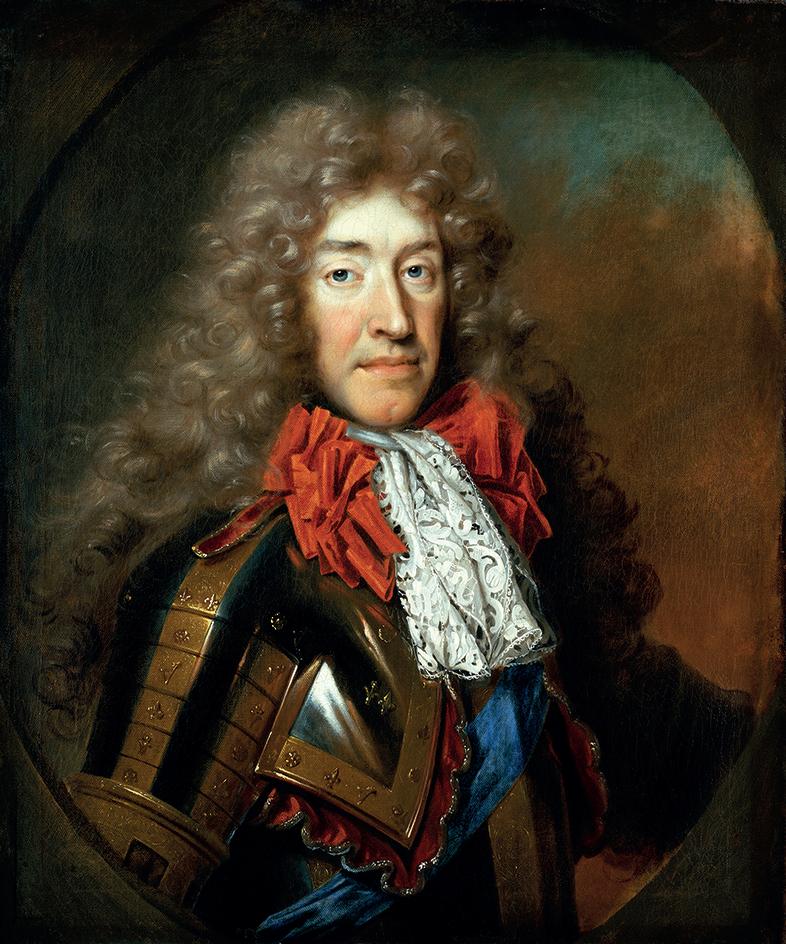
Works on display in the exhibition – paintings, miniatures, prints, sculpture and photographs – are primarily drawn from the National Portrait Gallery’s unrivalled collection, but will be joined by paintings from Royal Museums Greenwich, including fine portraits of Henry VIII by the studio of Hans Holbein the Younger, and James II by Nicolas de Largillière, as well as miniatures by Samuel Cooper and
National Maritime Museum, Greenwich, London, Caird Fund
Tudors to Windsors:
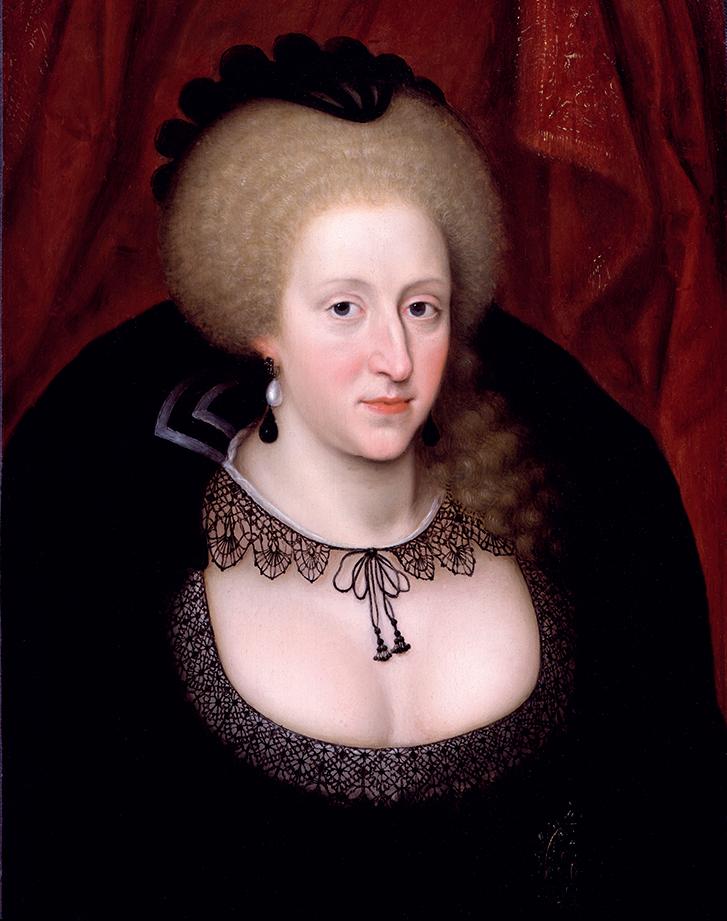
British Royal Portraits From 3 April until 31 August 2020 at Royal Museums Greenwich below Anne of Denmark by an unknown artist, c.1628–44 (NPG 4656)
medals by some of the finest engravers of the day. We will also be displaying clothing worn by some of those featured including, from our own collection, an adorable sailor suit made for the five-year-old Albert Edward, Prince of Wales (later Edward VII), to wear on the Royal Yacht.
For Royal Museums Greenwich, the exhibition is a perfect fit. We sit at the heart of one of London’s major royal sites, where several of the kings and queens included in the exhibition were central to its foundation and development. Greenwich was the site of the principal Tudor palace where Henry VIII was born and lived, where he jousted and hunted, courted and married. It was also the birthplace of his daughters, Mary and Elizabeth, who would both go on to become queen.
Other royal associations include the Queen’s House, Inigo Jones’s classical masterpiece. Today it is home to the Museum’s fine art collection, but its royal connections stretch from Anne of Denmark, wife of James I, who commissioned the house, through Henrietta Maria, queen of Charles I, who used it as her very own ‘House of Delights’, to George III, who gave it to the Royal Naval Asylum in 1805. There have been several grand unrealised plans for riverside royal palaces at Greenwich, and it is home to the Royal Observatory, founded by Charles II, and the Royal Hospital for Seamen (today the Old Royal Naval College), established by William III and Mary II. In more recent
times the preservation and restoration of the clipper Cutty Sark, which also forms part of Royal Museums Greenwich, has been a project of personal interest to the Museum’s patron, HRH the Duke of Edinburgh. These associations were recognised when the borough was granted royal status in 2012.
We are delighted to be welcoming many of these royals back to Greenwich this April. We look forward to our close and fruitful relationship with colleagues at the National Portrait Gallery and hope to welcome Gallery Members and Patrons to see a familiar collection in a brand-new setting.
DAVID
HOCKNEY:
DRAWING FROM LIFE
by Sarah Howgate Senior Curator, Contemporary Collections
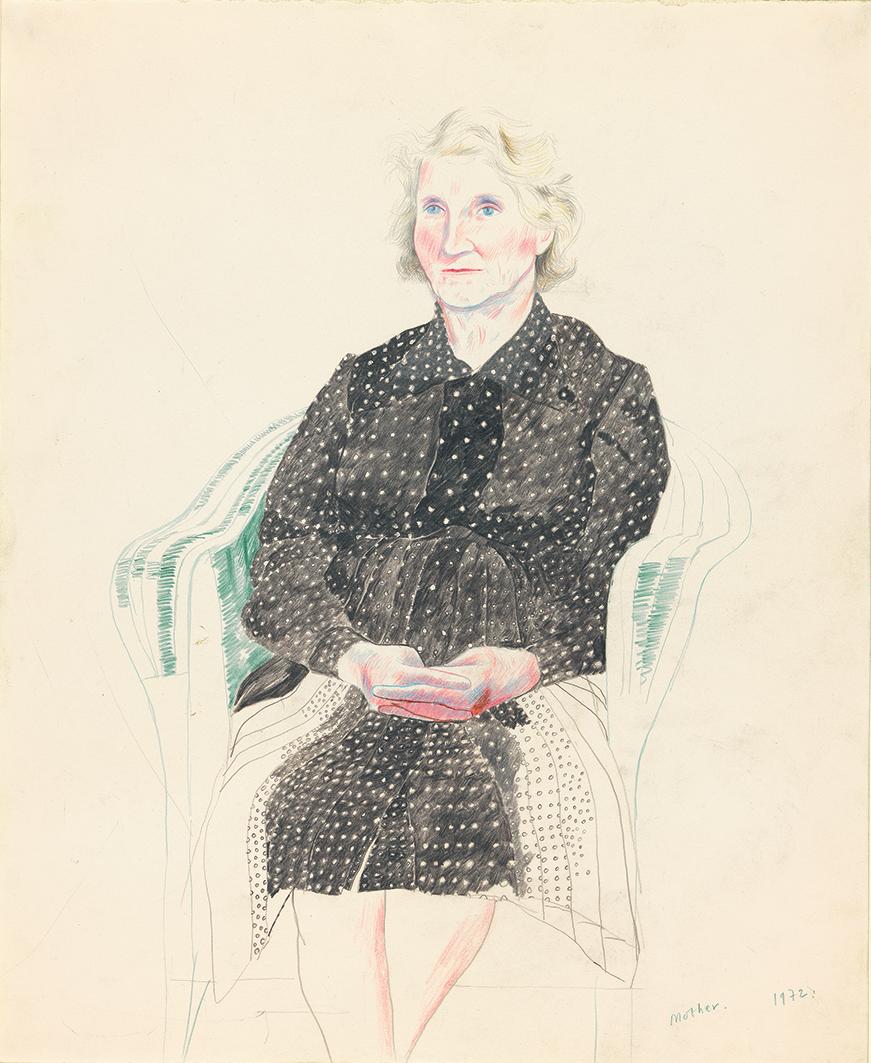
below
David Hockney
Mother, Paris, 1972
Coloured pencil on paper 17 x 14"
© David Hockney
Photo Credit: Richard Schmidt
Collection, The David Hockney Foundation
the first major exhibition in over twenty years devoted to David Hockney’s drawings explores the artist’s portraits on paper from the 1950s to the present by focusing on depictions of himself and a small group of sitters. Here the exhibition curator, Sarah Howgate, discusses his drawing practice and relationships with his sitters.
Drawing is at the heart of David Hockney’s studio activity and has underpinned his work since his art-school days. Recognised as one of the master draughtsmen of our times, Hockney has always drawn with confidence. His creative mind never rests. When he is not smoking, he is drawing; he smokes to think about drawing in the pauses between markmaking. He draws on every available piece of paper – as though there is a paper shortage – and draws as he talks, often to demonstrate a point he wants to make about the work of other artists, whether the absence of shadows in Chinese art, Brunelleschi and perspective, or the fluid line of Rembrandt. Over the past six decades the artist’s experimentation has taken many different stylistic turns. From Ingres’s neo-classical line to Picasso’s Cubist style to the linear drawing of Matisse and Van Gogh, Hockney’s admiration for both the Old Masters and modern Masters is unquestionable.
Drawing not only represents the artist’s distinctive way of observing the world but is a record of his encounters with those close to him. Self-portraits, together with portraits
of family and friends, including his mother, Laura Hockney, and Celia Birtwell, Gregory Evans and Maurice Payne, represent a lifetime of drawing. Hockney has returned to this intimate circle over and over again and, because their faces are so familiar to him, achieving a likeness does not distract from the search for a more nuanced and psychological portrait that also records the passage of time. The artist’s relationships with his most familiar and frequent sitters have been the catalyst for changes in his drawing style, in all its mediums and forms.
David Hockney: Drawing from Life
From 27 February until 28 June 2020
Wolfson Gallery
Tickets from £20 (Concessions from £17)
Free for Gallery Supporters
Supported by LOEWE
Spring Season 2020 sponsored by Herbert Smith Freehills LLP below David Hockney
Hockney’s earliest portraits were of those closest and most available to him, his family and himself. His mother was always supportive of her son’s desire to be an artist. A loyal and patient model, she is a recurring subject. As a student at Bradford School of Art he drew in sketchbooks family scenes in domestic interiors. These previously unseen drawings will be included in the exhibition together with the Bridlington Sketchbook, a series of private portraits made of his mother towards the end of her life.
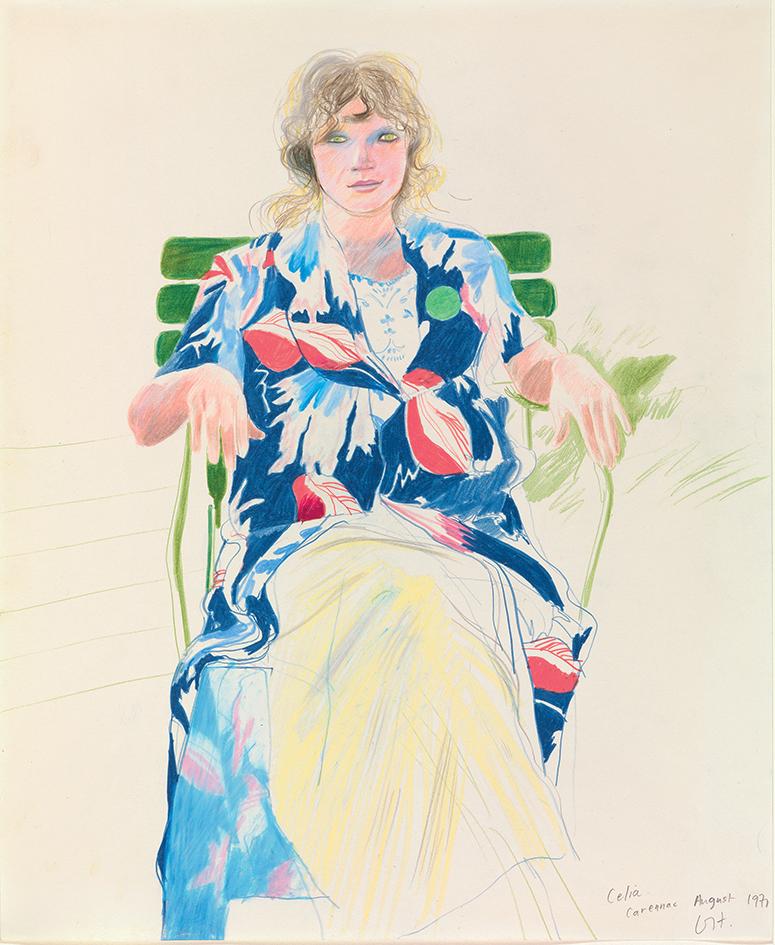
The textile designer Celia Birtwell met Hockney in the 1960s and remains the artist’s dear friend and confidante to this day. Her distinctive romantic designs epitomised the 1960s and 1970s, and together she and Hockney represented bohemian London. In 1973 Hockney left London to live in Paris, where for the next two years he produced highly finished academic portraits in coloured pencil, inspired by his daily visits to the Louvre to look at the work of Ingres and other European Old Masters. In their delicacy of touch, the drawings of Celia are among his most accomplished. Celia later reflected: ‘In the French drawings when we were very close, there was something going on between us which I think he portrayed through those drawings. He said to me that this was his way of expressing how he felt about me.’
Maurice Payne has been a friend of Hockney’s since the late 1960s. He has collaborated with him on several major
Maurice, 1998
Etching A.P. II/X
44 x 30 1/2"
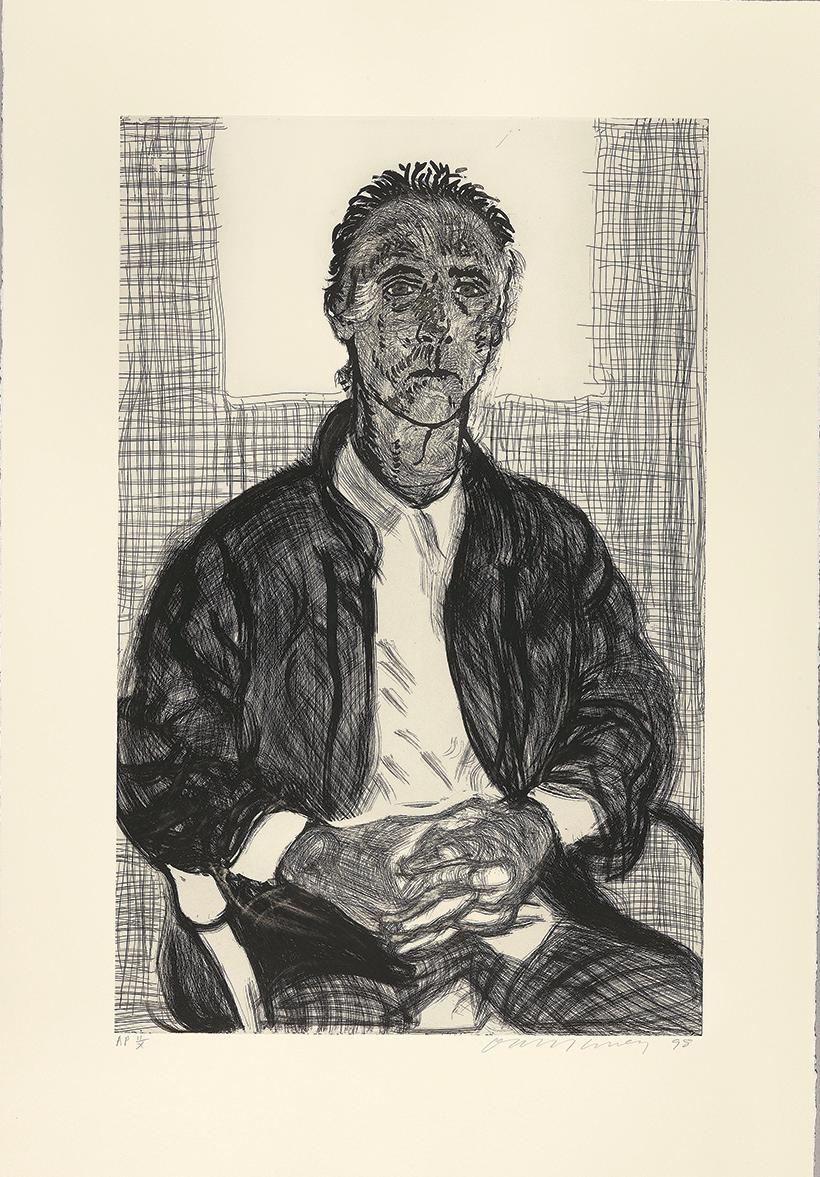
etching projects, as well as being the subject of many portraits. In 1998 Hockney returned to making etchings, a printing process he hadn’t explored since The Blue Guitar series of the mid-Seventies. To create the right conditions for the new works, Maurice prepared plates for the artist to work on directly and from life. Maurice, 1998 demonstrates the inventiveness of Hockney’s approach.
© David Hockney
Photo Credit: Richard Schmidt Collection, The David Hockney Foundation
David Hockney
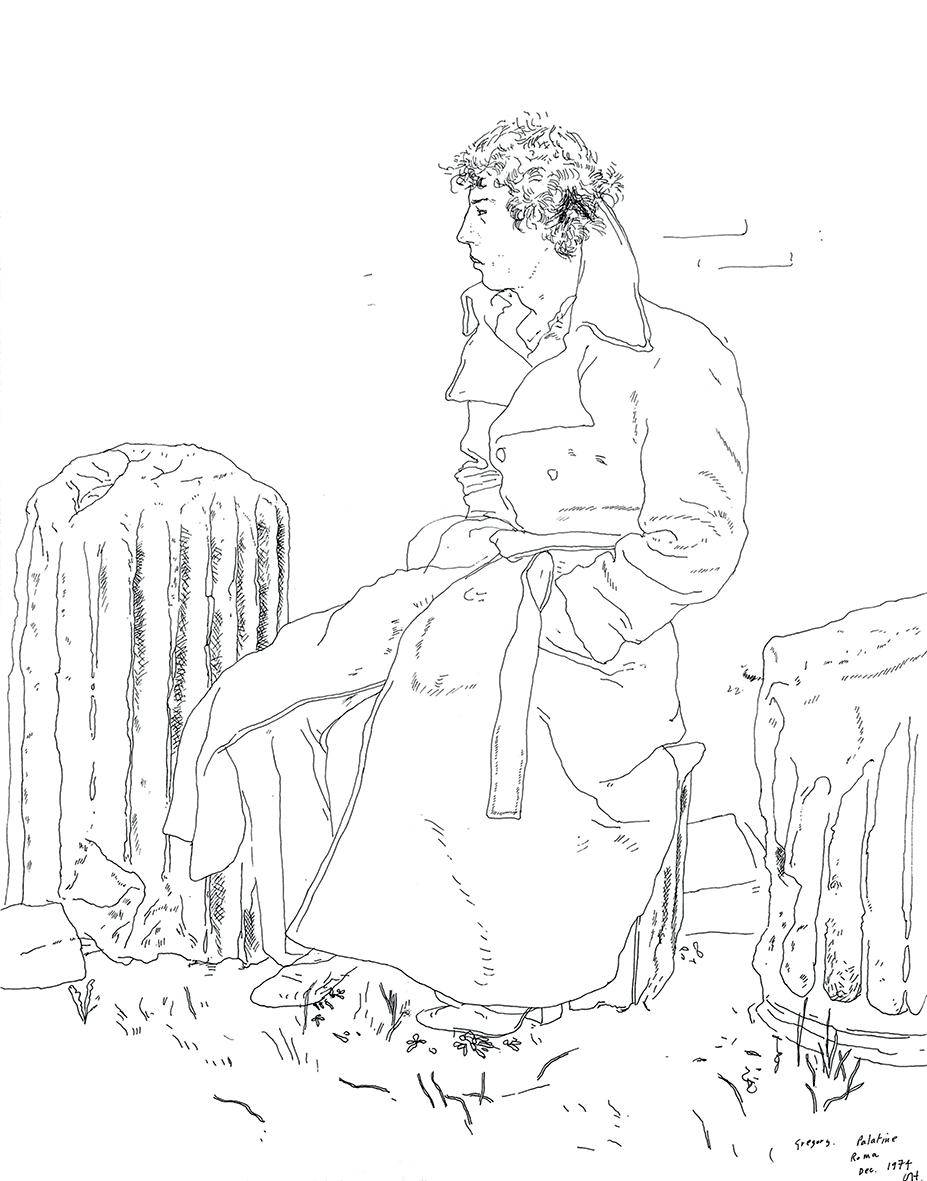
Gregory. Palatine, Roma. Dec. 1974
Ink on paper
17 x 14"
© David Hockney
Credit: Robert Wedemeyer
Gregory Evans has remained a consistent model and close companion for many years. The portraits, in which he can be seen in many moods and guises, reflect the intimacy of their friendship. Gregory. Palatine, Roma. Dec. 1974 was made in the early years of Hockney’s relationship with Gregory when they travelled extensively together and forms part of the artist’s visual diary. In this drawing Hockney uses a spare, unbroken line in pen and ink to capture his fascination with his new lover.
Self-portraiture is a continuous thread which runs through the exhibition. Like many young art students, Hockney began exploring the
creative process by recording his image in the mirror. Even as a teenager he was aware of his own identity and a self-possession emerges in the early self-portraits. A new phase of self-reflection is recorded in a series of digital self-portraits produced on the iPad in 2012. Over a period of twenty days the artist made self-portraits that explored character types in the vein of the heads by the eighteenthcentury sculptor Franz Xaver Messerschmidt. These drawings reveal a more vulnerable and introspective side to the artist, a far cry from the bleached hair and owl glasses of his youth.
Hockney is considered one of the most influential and celebrated British artists of his time, and Drawing from Life promises to bring the visitor closer to the artist’s skill as a draughtsman and to his intimate relationships. In 2019, in preparation for the exhibition at the National Portrait Gallery, Hockney invited his most consistent models to sit for him again. These new portraits of Gregory, Celia and Maurice are drawn from life and rendered in ink in the walnut-brown colour favoured by Rembrandt. The drawings represent a culmination of everything that has gone before, a lifetime of revisiting the faces of his friends. In the artist’s own words:
What an artist is trying to do for people is bring them closer to something, because of course art is about sharing; you wouldn’t be an artist unless you wanted to share an experience, a thought.
Photo
NEW ACQUISITION: LEONARD McCOMB’S TOWN CRIER
by Dr Georgia Haseldine Assistant Curator
glasgow - born sculptor and painter Leonard McComb met Lambeth’s town crier Alfie Howard on the Tube on the way to the Lord Mayor’s banquet in 2002. Howard agreed to model for the artist in front of Lambeth Bridge wearing a uniform that he had handembroidered with the repeated heraldic shield of Lambeth, a task that took 500 painful hours with his arthritic hands. Like Howard’s meticulous stitches, many small dashes of oil paint were applied using a sable brush to create McComb’s remarkable portrait. This distinctive patterned mark-making arose from the artist’s observation that people had the capacity ‘to radiate energy like the effect of a stone thrown into a still pond’. Inspired by William Blake, he sought to attend to the ‘minute particulars’ of his sitters so as to capture something of their uniqueness, asymmetry and touchable presence.
As a child, Alfie Howard had performed with Charlie Chaplin and had a brief career as a boxer before being called up in World War II where he was wounded during the Dunkirk landings. He represented the borough of Lambeth as its town crier for more than sixty years, meeting heads of state and travelling abroad carrying out civic duties. He began his cries by proclaiming ‘Oyez! Oyez! Oyez!’ – Norman French for ‘Hear ye! Hear ye! Hear ye!’ – and finished with ‘God Save the Queen!’
Leonard McComb’s portrait of Howard is larger than life-size, a grand scale that befits
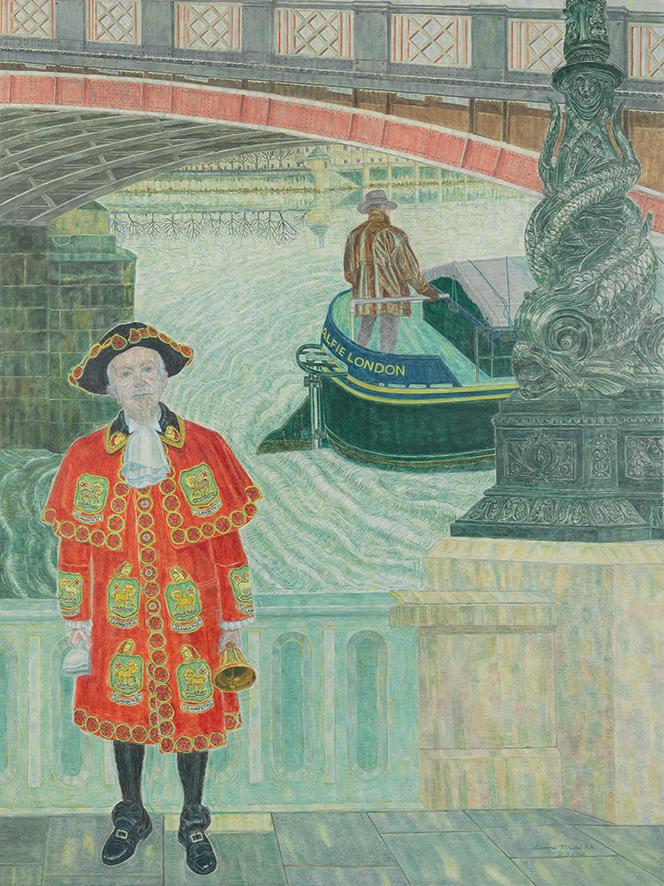
this extraordinary Londoner, and will be on display in Room 33 this spring, alongside a self-portrait of the artist. Both portraits were generously given to the Gallery by the Estate of Leonard McComb, who died in 2018.
Leonard McComb’s vibrant portrait of Lambeth’s former town crier Alfie Howard will be on show in Room 33.
INSPIRING PEOPLE
by Anna Maria Foster Membership and Gift Aid Manager
this november , the Gallery announced its temporary closure from 29 June 2020 until spring 2023 for our Inspiring People redevelopment. This major transformation will see many exciting changes, making the building more welcoming, easier to explore and better equipped for the future.
While the Gallery in St Martin’s Place undergoes major building works we are sharing our Collection widely across the UK,
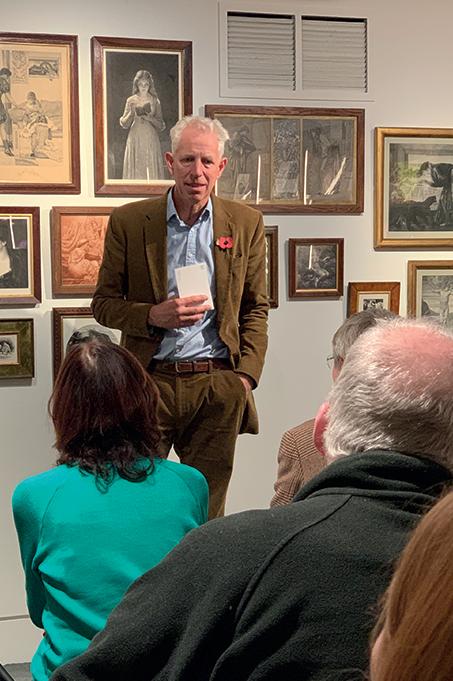
Introduction to Pre-Raphaelite prints with Rupert Maas
giving more people the opportunity to see some of the nation’s favourite faces. We will be forging partnerships with a wide range of institutions, from York Art Gallery and Museums Liverpool to the Holburne Museum in Bath and the Scottish National Portrait Gallery.
This period marks an exciting new phase in your relationship with us as a Gallery supporter, giving you exclusive access to our Collection in new contexts. There will be a range of opportunities to continue to enjoy the Gallery’s work, including visits to our own Heinz Library and Archive and to partner venues in London. More details will be announced in the coming months.
Since its inception, the Gallery has thrived thanks to the continued support of generous donors. Over the last twenty years Members have demonstrated this spirit by continually giving back, including the current Make History public appeal, with donations reaching nearly £15,000.
Members who renew in 2020 will receive three years’ Membership for the price of one, enabling you to be the first to hear about key milestones in the project, participate in behind-the-scenes tours and see the building before it reopens to the public. We hope you will continue to be one of our familiar faces and join us in inspiring future generations.
© National Portrait Gallery
FLORENCE NIGHTINGALE AT 200
by Dr Sarah Moulden Curator, 19th-Century Collections
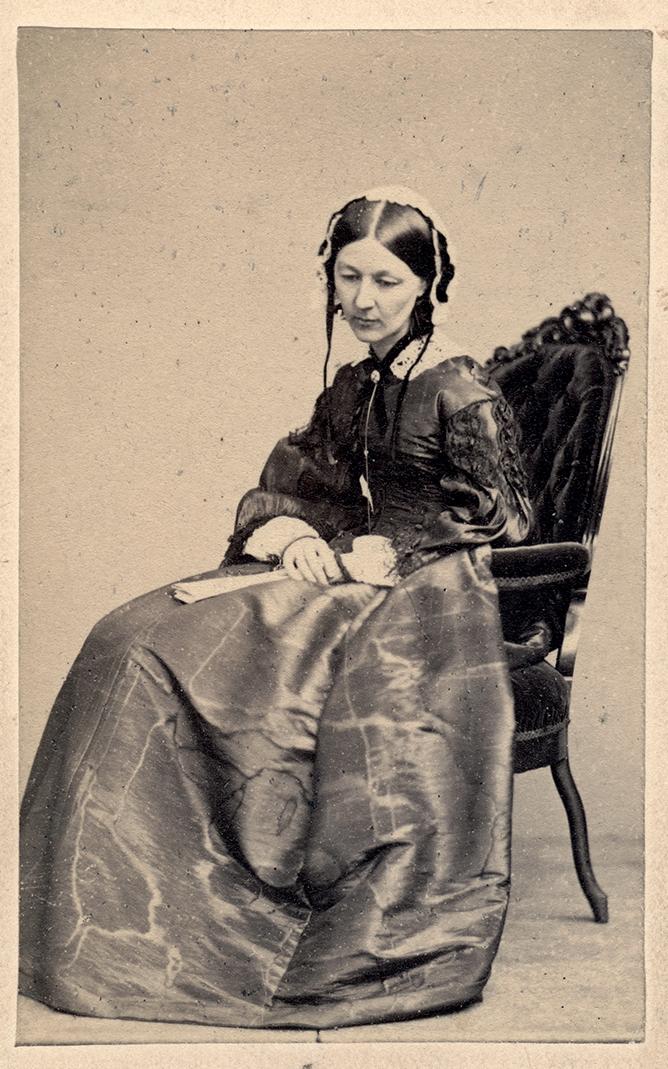
hot on the heels of George Eliot’s 2019 bicentenary display is a new display commemorating 200 years since the birth of another remarkable Victorian woman, Florence Nightingale (1820–1910).
Nightingale’s pioneering care of sick and wounded soldiers during the Crimean War (1853–6) catapulted her into the public eye, making her a national cultural icon and an
below left
, 1864–77 (c.1856) (NPG x16136)
exemplar of female virtue. The newspaper press nicknamed her ‘The Lady with the Lamp’ because of the nightly rounds she made by lantern-light to tend to the soldiers. Like George Eliot, Florence despised sitting for her portrait and did so with the greatest reluctance. Consequently, and despite the demand for her image, few portraits of her survive.
Florence contracted a serious illness during her inspection of the Crimean field hospitals (it is now believed to have been the bacterial infection brucellosis), which left her bedridden for much of the rest of her life. But this did not curtail her efforts to improve the standards of nursing. Working away from the public eye and largely from her sickbed, she campaigned for public healthcare reform, supervised the modernisation of nursing, and advised governments on army health provision, sanitation improvements and hospital design. In 1883, she was awarded the Royal Red Cross and, in 1907, was the first woman to receive the Order of Merit, Britain’s highest civilian decoration. She was a trailblazer of her time, and her legacy lives on today.
This new display, which includes watercolours, photographs and a commemorative medal, traces the representation of the woman who transformed the public image of nursing.
Florence Nightingale printed by Henry Lenthall, after William Edward Kilburn, albumen carte-devisite
Florence Nightingale at 200 is on show in Room 25. Admission free.
MAKING A LASTING DIFFERENCE: WHY I HAVE CHOSEN TO REMEMBER THE GALLERY IN MY WILL
by Judith West
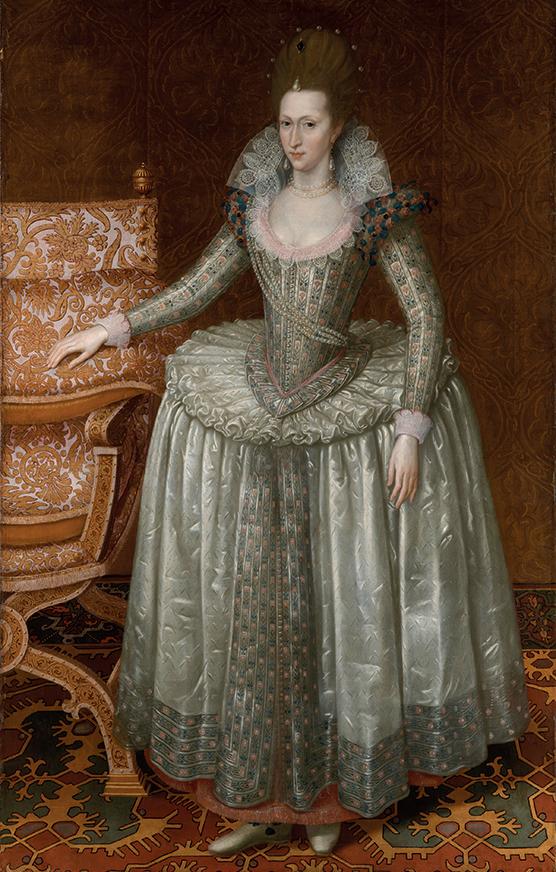
i have always cherished the National Portrait Gallery and visit as often as I can. I love the historic building, with its beautiful architectural details, and I like the way you turn a corner and it can suddenly feel completely different. I love the Collection for its astonishing variety, and if I were to choose a favourite room, it would be Room 4 with its dazzling full-length portraits from the Early Stuart period. Married at fifteen to James VI of Scotland, Anne of Denmark by John De Critz the Elder is a striking figure in richly embellished silver robes, and I always try to see her when I visit.
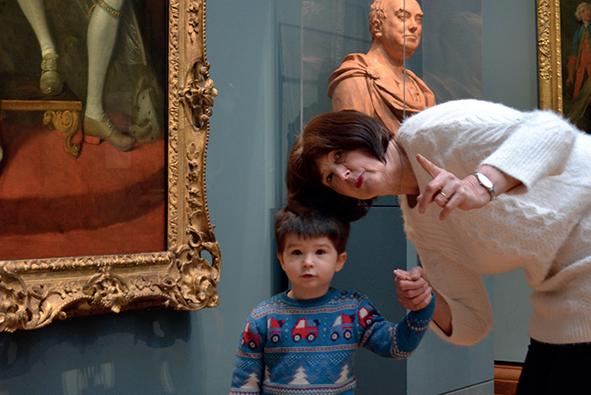
I once worked at the Gallery so I know how much money it costs simply to run the building, let alone what pressure there is to raise funds to acquire portraits for the Collection. It gives me enormous pleasure to take my grandchildren around the Gallery, knowing that there is always something new to see and interesting stories to absorb even for the youngest of visitors. So much valuable work goes on behind the scenes, from conservation and art handling to exhibition development and caring for the building. I admire the staff for their remarkable skills, knowledge and dedication, and know how wisely they handle the resources in their care. That is why I have chosen to remember the National Portrait Gallery in my Will.
The National Portrait Gallery is a charity and gifts in Wills are a vital source of income for our work. To find out more about remembering the Gallery in your Will, please contact Susie Holden at sholden@npg.org.uk or telephone 020 7312 2454.
below bottom
Anne of Denmark (detail) by John De Critz the Elder c.1605–10 (NPG 6918)
On display in Room 4
ZOË LAW: NEW WORKS
by Dame Laura Lee DBE CEO of the Maggie Keswick Jencks Cancer Caring Centres Trust (Maggie’s)
it was a great honour to be asked by Zoë to sit for her Legends series, and very flattering. I was aware of the outstanding calibre of the people who had agreed to be part of the project. When she asked me I felt very proud of the work we do at Maggie’s and appreciative of Zoë’s kindness in recognising that. The fact that the whole series is on behalf of Maggie’s is just wonderful, and when we found out that they would be exhibited at the National Portrait Gallery it was the icing on the cake.
In my role as CEO at Maggie’s I am sometimes photographed at events, but this was a totally new experience for me and I was quite nervous. Zoë invited me to her canal-side studio in West London, where a selection of beautiful clothes was waiting along with her superb team helping with hair and make-up.
I absolutely loved the next two hours – we had a wind machine and several changes of clothes, and Zoë spent a lot of time perched on her ladder, chatting, while she took shots. She put me totally at ease (helped by a glass of champagne) as we talked together about how the portrait might feel. I am lucky to have known Zoë for some years and she has absolutely captured me in a way that hasn’t happened before.
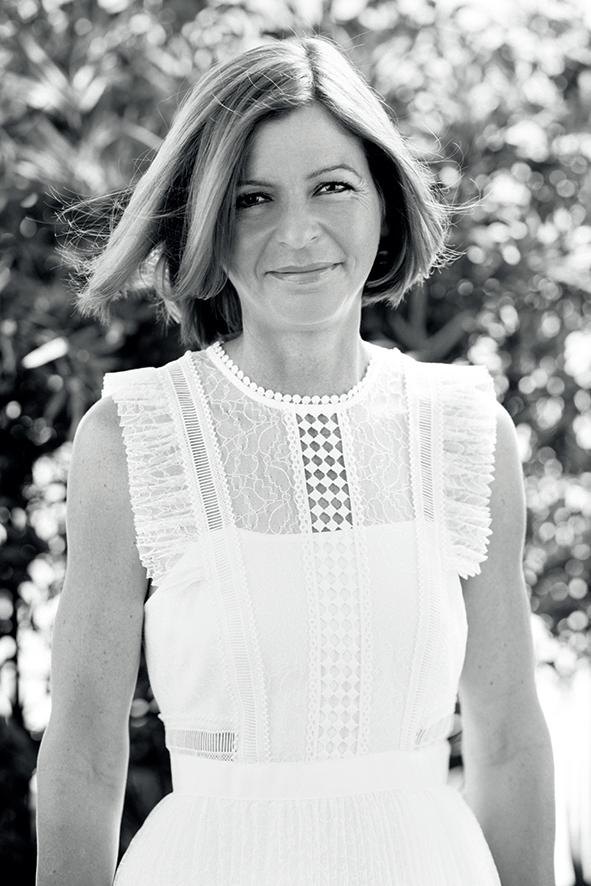
We’re so grateful to Zoë and the team at the National Portrait Gallery for supporting Maggie’s. The display really helps us to show the support that we offer to people after a cancer diagnosis. That all those famous faces support Maggie’s makes us extremely proud, and Zoë and her team made it happen.
Legends of British Industry will be on show in Room 33 from19 March 2020. Admission free.
INSPIRING PEOPLE : AN UPDATE ON TRANSFORMING THE GALLERY
by Jo Dunnett Acting Head of Inspiring People
below top
A visualisation of the welcoming and spacious new entrance hall, with a glimpse of the new shop beyond by Jamie Fobert Architects
below bottom
A technical drawing which reveals how three original windows on the north façade will be transformed into the Gallery’s new entrance doors by Purcell
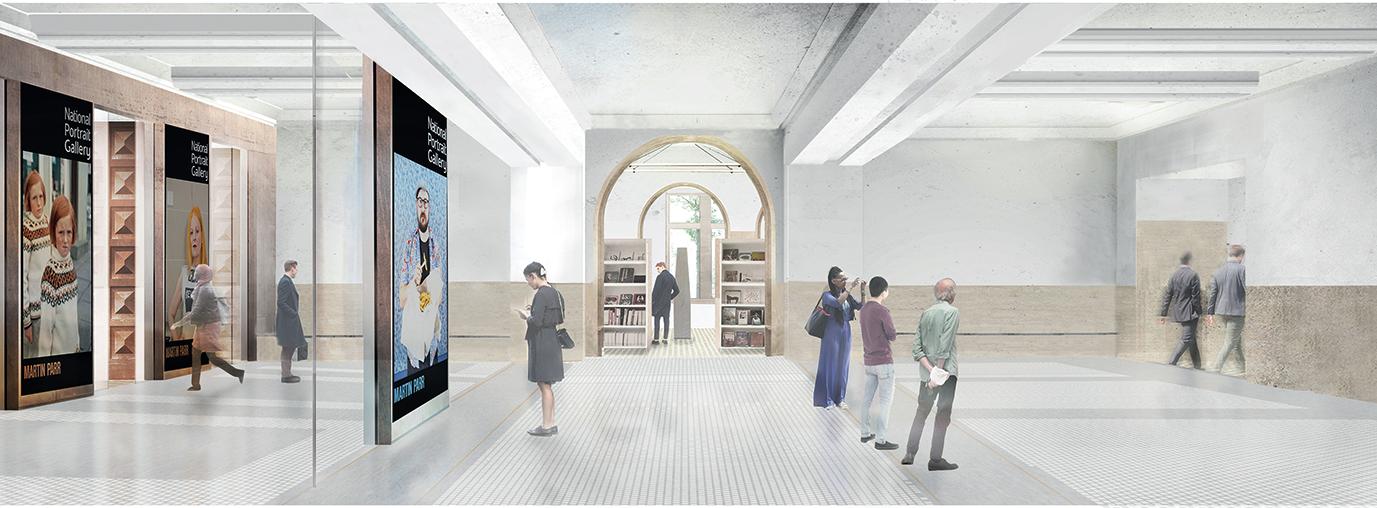
since the fantastic announcement from the National Lottery Heritage Fund of the £9.4 million grant towards the Inspiring People project, really exciting progress has been made. Presently, the architectled design team are working towards the completion of construction drawings in the spring.
Inspiring People has always had three key areas of emphasis: to give the Gallery an improved public presence; to create dynamic new Learning Studios; and to re-display the Collection. Now those ambitions are closer to becoming reality.
The creation of a new entrance and the outdoor public space facing Charing Cross Road has been a major area of work on
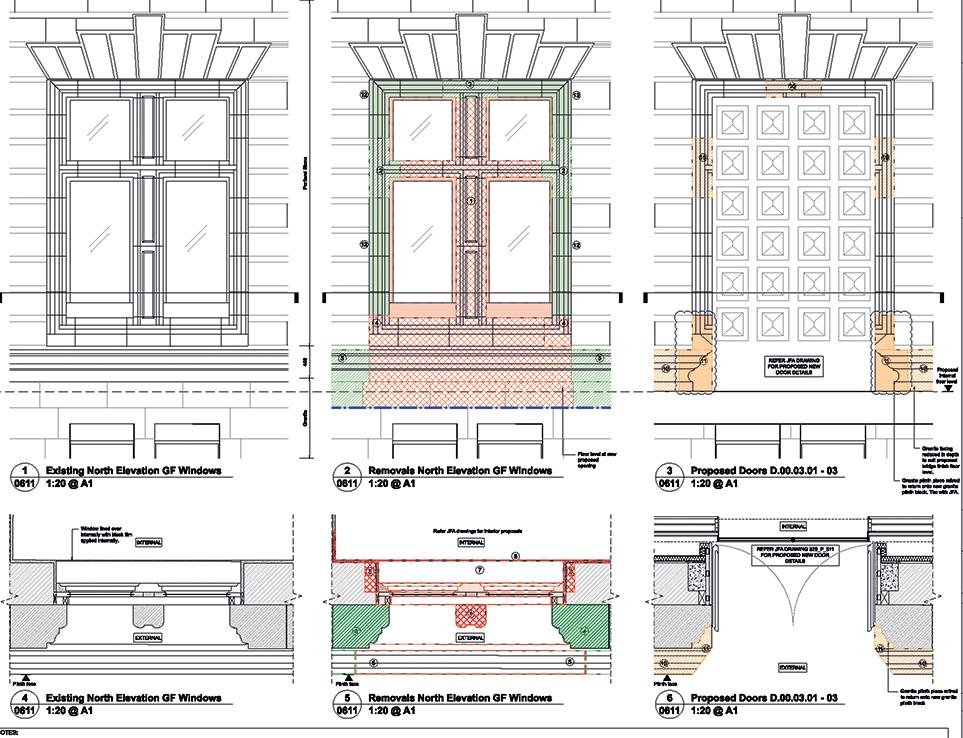
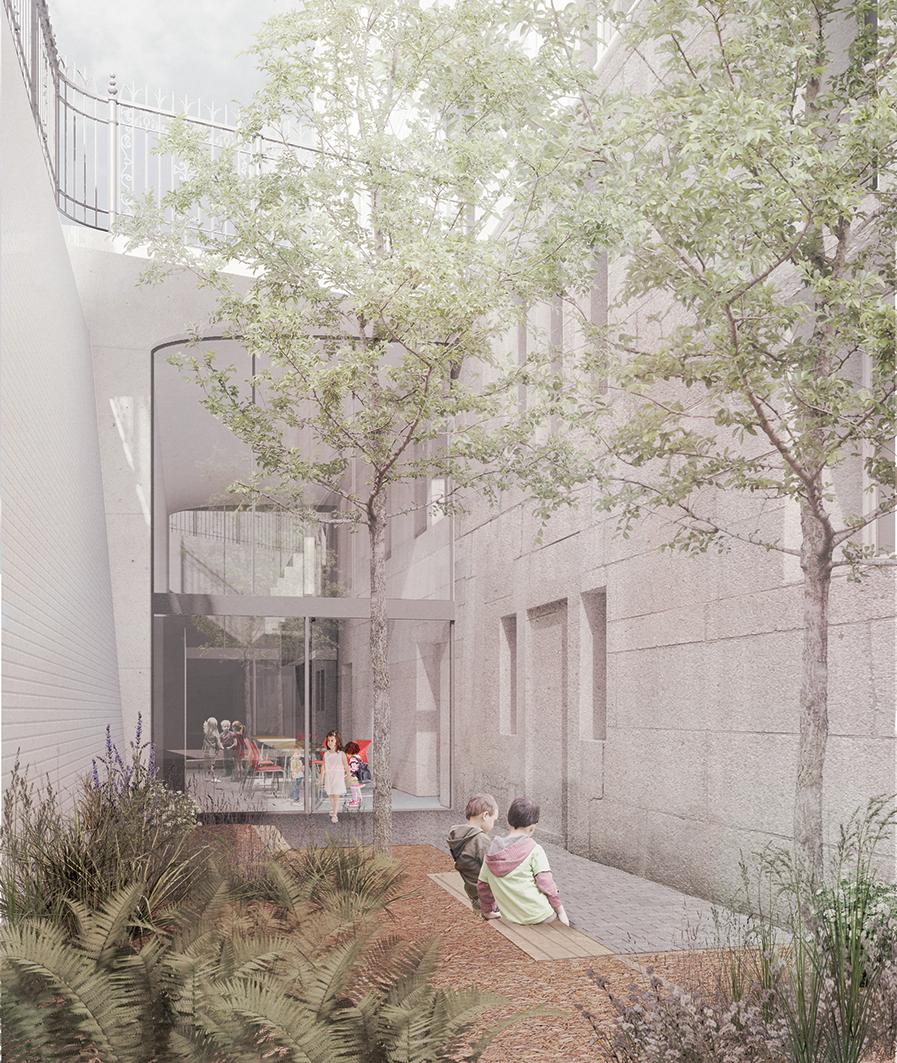
the part of the whole design team, which includes heritage and planning specialists and engineers. The purpose-built Learning Studios have been designed with learning and engagement as their central aim, and feature a courtyard as a welcome break-out space. Alongside these new additions, there has also been an ambition to reveal and enhance the existing Victorian building. On re-opening, some of the original features that will be revealed are airy, previously blocked windows and the renovation of the original East Wing galleries, previously used as offices.
One of the most exciting aspects of the new National Portrait Gallery will be the re-display of the Collection. Gallery teams and external experts are working together on this complex subject to ensure that the re-interpretation of the Collection tells new and widely varying stories, backed by ground-breaking research.
Delivering the design brief was a highly collaborative process. The design team met extensively with Gallery staff, among them the four Learning and Participation, Visitor Services, Curatorial and Commercial teams, in order to understand the needs and objectives for all the new and innovative spaces being created. The Project Board and Trustees continue to play a dynamic role in guiding the evolution of the project.
The Fundraising campaign is going extremely well and we hope shortly to achieve our target of £35.5 million.
A visualisation of the learning courtyard, below the handsome north façade by Jamie
Jo Dunnett has over twenty-five years of senior management experience within the cultural, design and architecture sectors and specialises in the conception, strategy and delivery of capital projects.
Fobert Architects
Spring offer for Gallery Supporters
EXCLUSIVE CELIA BIRTWELL COLLECTION DESIGNED FOR THE NATIONAL PORTRAIT GALLERY: BEHIND THE SCENES
Celia Birtwell has designed two collections for the National Portrait Gallery to celebrate the upcoming exhibition David Hockney: Drawing from Life, launching in February 2020. Celia Birtwell is a fashion and interiors textile designer and muse to David Hockney.
We spoke to Celia about the collaboration; she said: ‘As a friend of David’s I was honoured to be asked to do a collection of scarves and products to coincide with this exhibition of his portraits. I decided to look through my archives to select some prints that reminded me of David’s portraits in some way, particularly those which complemented the colours and styles of his work. I have always enjoyed making scarves; they are an entity in themselves, and it is such a joy to see them being worn. The fun collection of gifts and bags is from my more recent work, and I think they show a more playful side to complement David’s exhibition.’
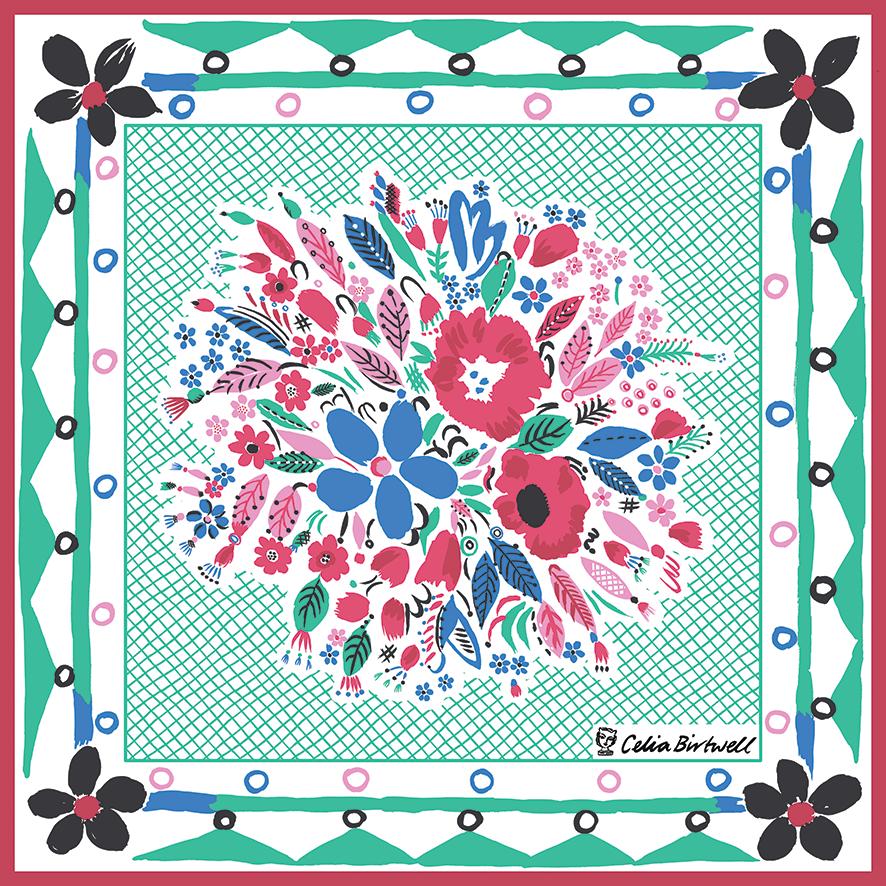
Celia Birtwell & National Portrait Gallery will launch exclusively at the National Portrait Gallery shops and online on 27 February 2020.
Gallery Supporters receive a 10% discount on our David Hockney: Drawing from Life range in the shops, including this exclusive collection by Celia Birtwell.
above right
David Hockney
Celia, Carennac, August 1971
Coloured pencil on paper 17 x 14"
Photo: Richard Schmidt Collection, The David Hockney Foundation