The right of Scott Allen to be identified as the author and Antoine Corbineau to be identified as the illustrator of this work has been asserted.
All rights reserved.
This book is sold subject to the condition that it shall not, by way of trade or otherwise, be lent, hired out or otherwise circulated in any form of binding or cover other than that in which it is published. No part of this publication may be reproduced, stored in a retrieval, or transmitted in any form or by any means (electronic, mechanical, photocopying, recording or otherwise) without the prior written permission of Nosy Crow Ltd.
A CIP catalogue record for this book is available from the British Library.
Printed in China.
Papers used by Nosy Crow are made from wood grown in sustainable forests.
Written by Scott Alle n
Illustrated by
Antoin e Corbineau
iNTRODUCTION
Hello and welcome to your fact-filled and funny guide to the Olympic and Paralympic Games. Some sports you might already play, some you will have heard of before but never tried, and some might be brand new. But remember, with every sport in this guide, you could be in with a chance of winning something very special – an Olympic gold medal!
But first, becoming a top Olympic athlete takes dedication, determination, skill and a good slice of old-fashioned luck. Most gold medal winners start their journey when they’re still at school, and some athletes even start while they’re in nappies! They face a roller coaster of emotion and physical torment, but top athletes stay strong, grit their teeth and battle for glory.
Nobody wins an Olympic gold medal without putting in plenty of hard work, so training is essential. It comes in lots of different shapes and sizes and this guide might give you an extra edge against your rivals or make your dad angry that you’ve ruined his carpet. In the world of sport, everyone has to make sacrifices . . . even your parents.
Hopefully this guide will inspire you to get involved. But what if you’re thinking you’ll never be good enough to be an Olympian? Well, that’s loser’s talk! Everybody has the potential to become great at one sport, maybe even two or three. You just have to discover the sport you enjoy the most and train to become brilliant at it. You might think you’re an average footballer and you’re OK at swimming, but have you ever tried water polo or wrestling? Have you ever climbed to the top of a high diving board and leapt from it, or made a horse dance to music? Probably not. However, if you do decide to try something new, you might just discover an amazing hidden talent and be ready to take on the world.
And even if you don’t win an Olympic gold medal, you will have gathered some important life skills in your quest. You’ll make new friends, become part of a team, get fit and healthy and most importantly have a lot of fun. Many courageous Olympians who don’t even get close to winning a medal can become an inspiration to generations of young athletes around the world. So, what are you waiting for?
On your marks, get set . . . gold!
How Did the Olympics begin?
The first thing to remember is there are two types of Summer Olympics – the ancient ones and the modern ones, and there was a 1,500-year gap between them. Since 1960, there have been Paralympic Games too. Here’s a quick guide so you don’t get them all muddled up.
Ancient Game s
Years active: 776 BCE to 393 CE
Inventor: Ancient Greeks
Host city: Olympia
Competitors: Greek men. Women were only allowed to own and train horses for equestrian events.
Sports included: Running, boxing, wrestling, pentathlon and equestrian events.
Equipment: Not much equipment or even clothes.
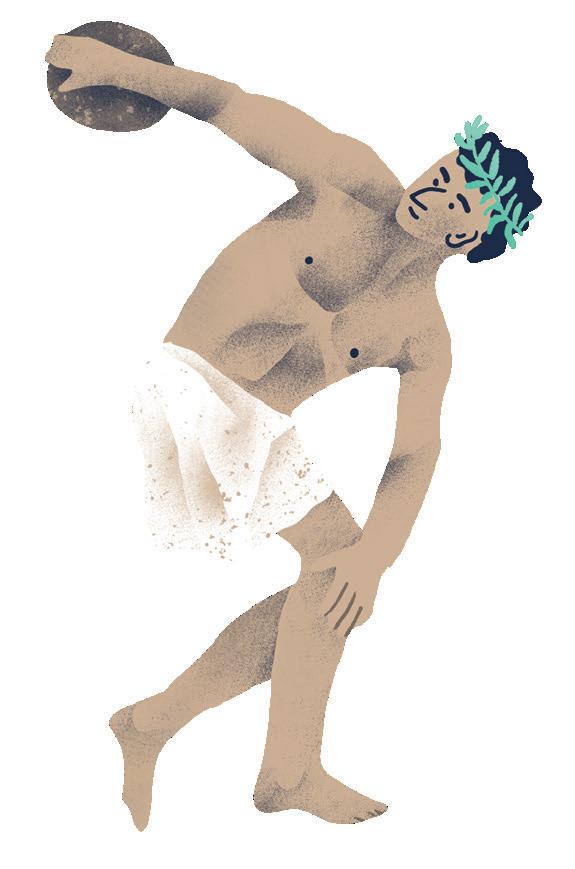
Prizes: An olive-wreath crown made of leaves from Zeus’s sacred grove. No prizes for second or third place. The best of the best had statues built, and songs and stories made up about them.
Top stars:
· Leonidas of Rhodes - running - winner of 12 individual victory wreaths (a record held until 2016)
· Cynisca of Sparta - equestrian,four-horsechariot - first female victor at the Olympics, as a horse trainer
· Milo of Croton - wrestling - six-time victor and known for carrying bulls around on his shoulders and tearing trees apart
Paralympic Games
Years active: 1960 to present day
Modern Game s
Years active: 1896 to present day
Inventor: Baron Pierre de Coubertin, a French aristocrat and academic. He won a gold medal in the 1912 Olympics for a poem!
Host cities: All over the world, although the Olympics has never had an African city as a host.
Competitors: Any country with a National Olympic Committee.
Sports included: See pages 10-91 to find out.
Equipment: Loads and loads, but a pair of trainers is probably the most important.
Prizes: A gold, silver or bronze medal, glory in your country, lots of appearances on TV and sponsorship deals. The best of the best still have statues built, and songs and stories made up about them.
Top stars:
· Michael Phelps - USA,swimming - 28 medals (23 gold)
· Nikolai Andrianov - USSR,gymnastics - 15 medals (7 gold)
Inventor: Dr Ludwig Guttmann organised the Stoke Mandeville Games for wheelchair athletes, which later became the Paralympic Games. It wasn’t called the Paralympics until 1988.
‘Para’ means parallel, showing that the two Games work side-by-side.
Host cities: In the same cities as the Olympics.
Competitors: Only wheelchair athletes competed until 1976, when it was expanded to include athletes with a much wider range of impairments.
Sports included: Almost the same as the Olympics. There are just two sports that feature only at the Paralympics - goalball and boccia.
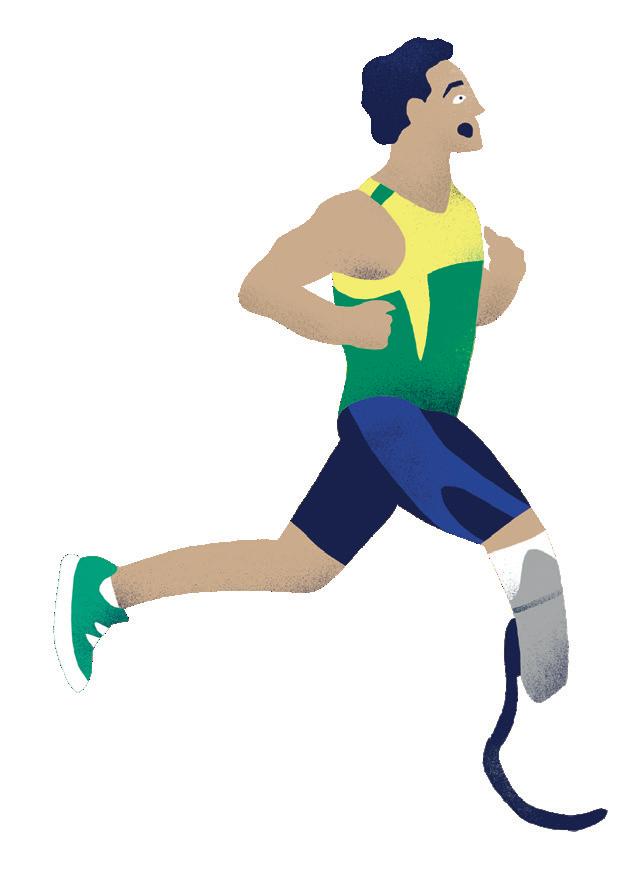
Equipment: Depends on the sport, but some Paralympians have specially adapted equipment like running blades.
Prizes: The same as the Olympics. It’s all about the medals!
The first of the modern Olympics. There were 14 nations competing – now there are more than 200!
Modern Summer Olympics so far
PARIS, FRANCE
The first time women ever competed and there was a tug-of-war event.
1920
ANTWERP, BELGIUM
1924
PARIS, FRANCE
Sweden’s Oscar Swahn became the oldest Olympic medal winner ever – aged 72!
Long-distance running was dominated by a group of athletes from Finland known as the ‘Flying Finns’.
1948
1928
ST. LOUIS, USA
The first time gold, silver and bronze medals were awarded.
1916
BERLIN, GERMANY
Cancelled due to the First World War.
1912
1932
LONDON, UK
Duelling made its first and only appearance. Competitors shot each other with wax bullets!
STOCKHOLM, SWEDEN
Art events were introduced, with medals for literature, music, sculpture, painting and architecture.
1936
AMSTERDAM, NETHERLANDS
This was the first appearance of the Olympic flame.
1944
LONDON, UK
Dutch sprinter Fanny Blankers-Koen won four golds and was known as the 'Flying Housewife’.
Czech Emil Zátopek won gold in the 5,000 metres, the 10,000 metres and the marathon. He’d never run a marathon before! 1952
HELSINKI, FINLAND
1976
LOS ANGELES, USA
The victory podium for medal winners appeared for the first time.
LONDON, UK
Cancelled due to the Second World War.
MELBOURNE, AUSTRALIA
Due to strict rules about foreign animals being flown in, the equestrian events took place in Sweden.
1972
1960
ROME, ITALY
The first official Paralympic Games were held this year.
1940
BERLIN, GERMANY
The first games to have live TV coverage and the torch relay was introduced.
TOKYO, JAPAN
Cancelled due to the Second World War.
1964
1968
TOKYO, JAPAN Ethiopia’s Abebe Bikila became the first person to successfully defend the marathon title.
MONTREAL, CANADA
Fourteen-year-old Romanian gymnast Nadia Coma ň eci scored the first ever set of ‘perfect 10s’.
MOSCOW, SOVIET UNION (USSR)
Sixty-six countries didn’t attend for political reasons and the USSR won 195 medals.
2004
2008
MUNICH, GERMANY
USA swimmer Mark Spitz won seven gold medals – all in world record time.
LOS ANGELES, USA
The USSR and 13 other countries boycotted the Games and the USA won 174 medals.
ATHENS, GREECE
German kayaker Birgit Fischer won the last of her eight gold medals across six different games.
2012
2000
MEXICO CITY, MEXICO
Dick Fosbury won high-jump gold with his new style, now known as the ‘Fosbury flop’.
SEOUL, SOUTH KOREA BARCELONA, SPAIN
Swedish fencer, Kerstin Palm, became the first woman to take part in seven Olympic Games.
SYDNEY, AUSTRALIA
British rower Sir Steve Redgrave became the first athlete to win gold medals in five Olympics in a row.
2016
1996
Gymnast Vitaly Scherbo from Belarus won six gold medals – including four in one day!
ATLANTA, USA
USA sprint and long-jump legend Carl Lewis won the last of his nine Olympic golds.
2020
BEIJING, CHINA
US swimmer Michael Phelps became the most successful athlete at an Olympics by winning eight gold medals.
LONDON, UK
Canadian equestrian athlete, Ian Millar, appeared at his tenth Olympics, a record across all Olympic sports.
RIO DE JANEIRO, BRAZIL
Usain Bolt became the only sprinter to win 100-metre and 200-metre gold at three Olympics in a row.
TOKYO, JAPAN
Tokyo hosts for the second time with new sports: karate, sport climbing, surfing and skateboarding.
Having a Ball
Basketball
What is it?
The Rules
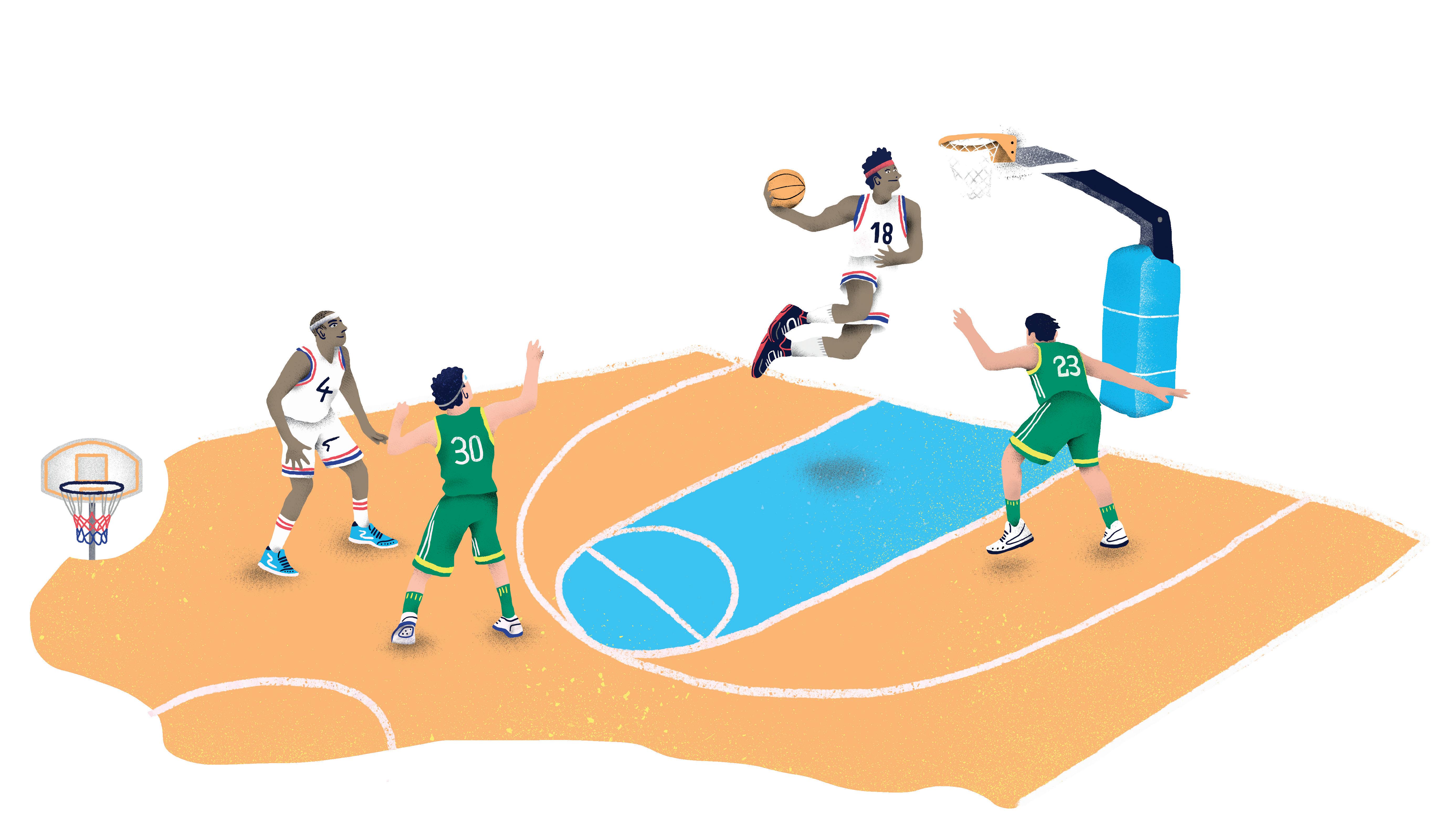
Two teams of five have to shoot the ball through their opponent’s basketball hoop. To move the ball forward, players dribble by bouncing the ball on the floor, or by passing it to one of their teammates. It’s two points for shots inside the three-point line, and three points for those outside. Pushing and shoving the other team isn’t allowed, although it’s very easy to do. The team with the most points at the end of four quarters wins.
The History Bit
A team sport where really, really tall people hurl a big orange ball through a hoop hung high in the air. Basketball wasn’t invented until 1891, using a peach basket as a net, so it’s a relatively young sport. It quickly spread through universities across the USA and then across the world, and was so popular it became an Olympic sport in 1936. Wheelchair basketball has been at the Paralympics since the first games in 1960.
HEADBAND
Basketball is a sweaty sport; these stop you dripping all over the court.
GOGGLES
If your eyesight isn’t good then these are a must.
Acloser look
SCORING HOOP
This is 46 centimetres wide and strong enough for players to hang from during dunks.
BIG TRAINERS
Support your ankles and the air-cushioned soles help with higher leaps.
Basic training
Bouncing a ball is a natural thing to do, so now do it lots of times while running. After you’ve run around a bit, stop and throw the ball at the top of a very high wall. When you’re comfortable doing this, add loads of tricks so you look cool.
FREE-THROW LINE
Players shoot from here after being fouled. Shots are worth one point each.
upsides
Downsides
It’s fast and high scoring. Games never end 0 – 0. They’re more likely to end 98 –102 and that’s a lot of baskets. Even if you’re not very good, there’s a chance you might score. Just chuck the ball up there and see what happens. Some basketball players will hog the ball, so it can feel like you’re spending all your time running up and down the court without ever getting a touch.
BACKBOARD
Always clear, so people sitting behind still get a good view of the
In the past, balls were heavy and bounced all over the place. Now they're much lighter, but still bounce all over the place.
If you are
THREE-POINT
Skills needed
Anyone can play basketball, but it helps if you're tall. The average height for male players is 6 foot 7 inches, or 202 centimetres. The average height for female players is 6 feet, or 185 centimetres. So height is a plus, but so are speed, agility and ball-handling skills.
Height is not important in wheelchair basketball, but you do need good balance, skill and strong wrists, shoulders and arms.
Injuries
With all that twisting, pivoting and jumping, basketball players get a lot of ankle and foot injuries. That large ball also hurts like mad if it hits you on the tops of your fingers, so make sure you learn how to catch it properly.
— A player catching a pass in mid-air and slamming it down into the basket.
“Dunk”
— Slamming the ball through the hoop. “Travelling”
— Running with the ball in your hands, instead of bouncing it. Foul!
“Buzzer-beater”
— A shot made in the final second of a game.
Unsurprisingly USA has dominated Olympic basketball in both men and women’s events. They’ve won 28 medals, 23 of them gold. Russia are next up with just 12.
Having a Ball
Football
What is it?
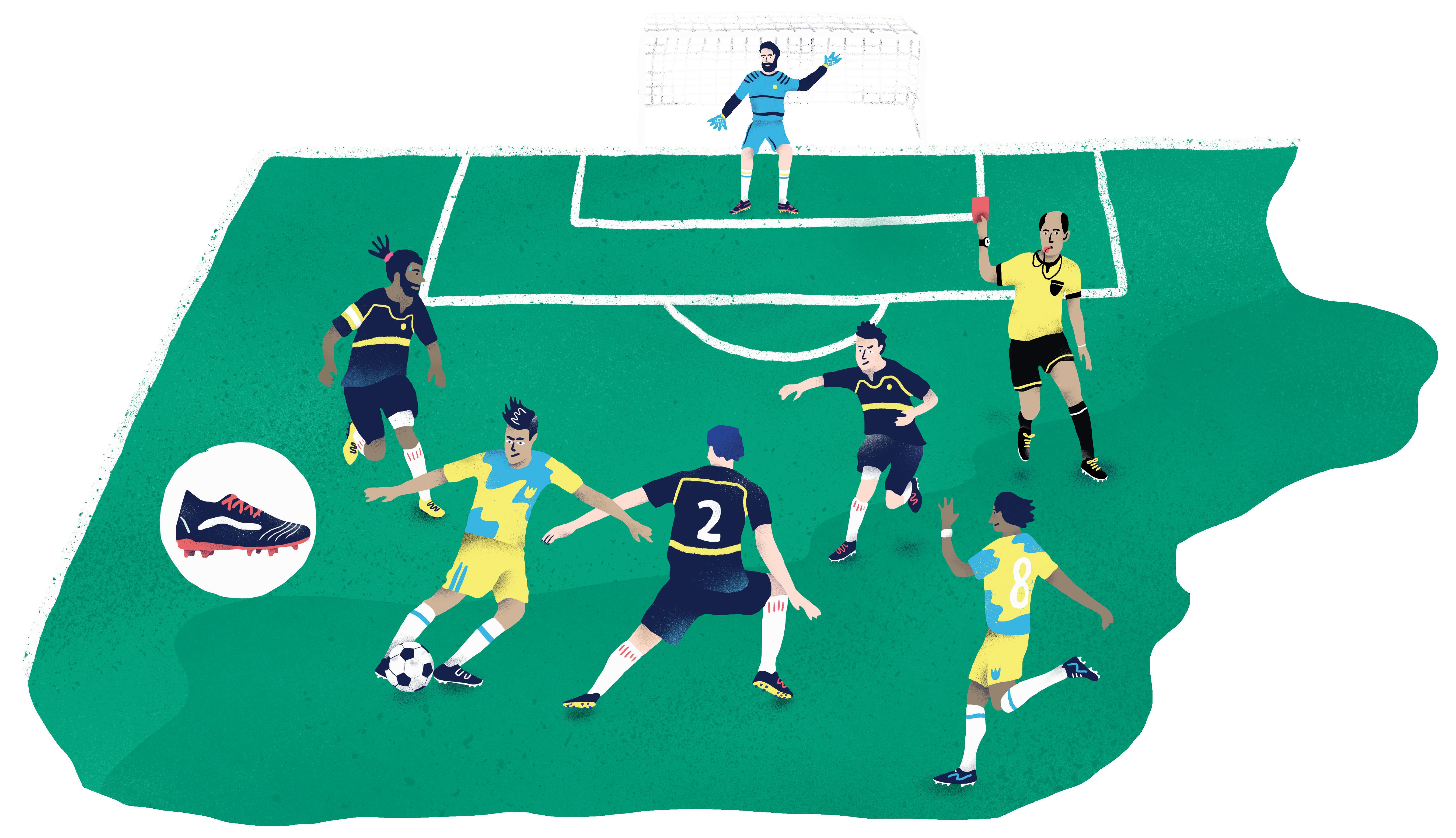
Two teams of 11 try and kick a ball past a goalkeeper and into the opposition’s net to score a goal. After scoring, they celebrate wildly or do a silly dance.
The Rules
Football has loads of rules nowadays, but basically two teams must kick or head the ball into the other team’s net. Only the goalkeepers are allowed to touch the ball with their hands, and only in their own area. You can’t foul your opponents or you will get sent off.
Skills needed
All kinds of skills can be applied to being a top footballer, but not all of them are vital. It helps if goalkeepers are tall and good with their hands. Defenders should be tough and good at tackling and heading. Midfielders should be quick, able to do tricks, and good at passing and tackling. Strikers should be fast and good at shooting.
This player leads the team out, tosses the coin to start and does most of the shouting at his team and the referee.
GOALPOSTS
7.32 metres across and 2.44 metres high, so perfect for swinging on if you are a bored keeper when all the action is at the other end of the pitch.
Now available in every colour of the rainbow, with added studs for grip.
The history bit
A version of football began in China in 300 BCE and since then various ancient civilisations have played ball games using their feet. However, it wasn’t until the Middle Ages in the UK that football took off, and proper rules were drawn up by the Football Association in 1863. Football first appeared in the Olympics in 1900, but only three teams entered and nobody won a medal. Five-a-side football has been at the Paralympics since 2004.
Acloser look
BALL
Injuries
Footballers sometimes spend a great deal of time rolling around on the pitch screaming in pain like they’ve been hit with an iron bar. Then moments later they are totally fine. This is known as diving.
Used to be made out of a pig's bladder or heavy leather, but now it’s fake plasticky leather and much lighter.
FOOTBALL BOOTS
CAPTAIN’S ARMBAND
NET Stops the ball flying into the crowd and hitting them in the face.
GOALKEEPING GLOVES
Protect fingers and help keepers get a better grip on the ball.
RED CARD
Get one of these and you are sent off and have to go back to the changing rooms for a little cry.
REFEREE
The person in charge of the match.
SHIN PADS
Protective covering for shins worn under socks, so great when tackled.
Slim
CHANCE OF BECOMING A CHAMPION
Good Great OK
Football is the most popular sport in the world. Everyone wants to be a professional footballer.
Upsides
Footballers are among some of the richest and most famous people in the world.
Downsides
Being rich and famous sometimes isn’t all that it’s cracked up to be.
Basic Training
Get a ball – it doesn’t matter how big or small – and practise juggling it, using your feet and head. Try to keep it off the floor. Then find a wall and shoot the ball at the wall as many times as you can. In your head pretend you’re scoring the winning goal in the final.
Sound Lik e a Pro
“Nutmeg”
— Passing the ball through your opponent’s legs and collecting it on the other side.
“Tiki-taka”
— A style of play with short, quick passing and movement.
“Rabona”
— Kicking the ball by wrapping your foot around the back side of your standing leg.
“Row z” — Booting the ball as far away into the crowd as possible to waste time.
“Underdog”
— A team that isn’t expected to win, not one that spends the game hiding under a dog.
Best ever
The queens of Olympic football are the USA team, who have won four gold medals and one silver. In the men’s tournament, Hungary have won three golds, a silver and a bronze, while Brazil have the most medals with six, but only one of them is gold.
Having a Ball
What is it?
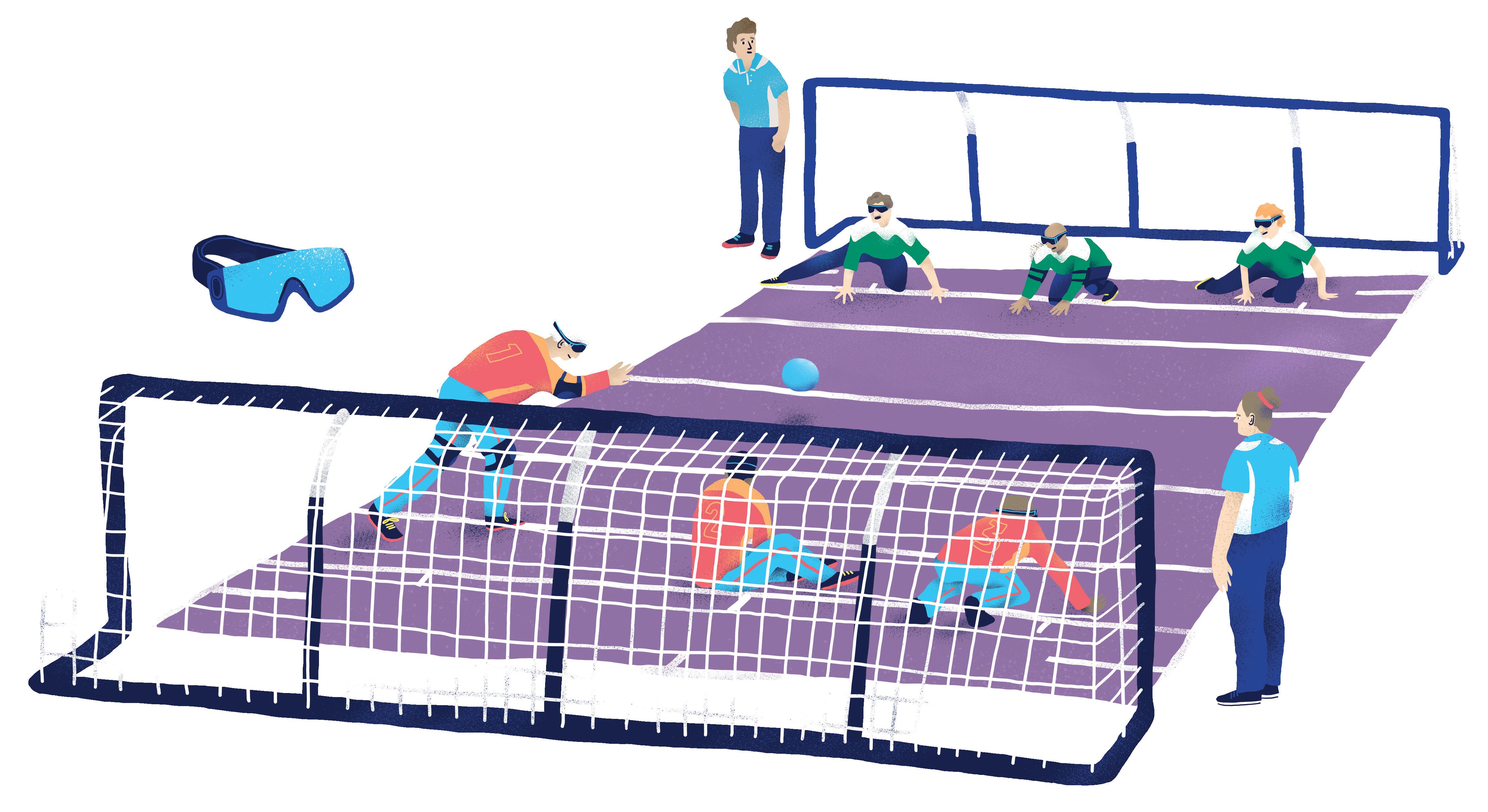
A team sport where players roll a hard rubber ball, with two bells in it, towards a large goal in an attempt to score.
Goalball
Acloser look
The History Bit
Goalball was invented after the Second World War to help visually impaired soldiers with their recovery. It was so popular that it became a men’s Paralympic sport in 1976, and women’s in 1984. Goalball is one of only two Paralympic sports that doesn’t have a matching sport at the Olympics.
Skills Needed
To generate power when they roll the ball, many goalball players use a 360-degree turn-and-roll technique. This sometimes causes the ball to bounce slightly, making it harder to stop.
Players need a lot of skill, tactical knowledge and split-second reactions. There’s hardly a moment to take a breather.
The Rule s
The aim of goalball is to score as many goals as possible, in two 12-minute halves, by rolling the ball into your opponent’s net. The defending team tries to block the ball with their bodies, usually at full stretch. It’s like having three goalies.
Injuries
Goalball players will use any part of their body to stop the ball going in the net, so be prepared to get bashed in the face by the ball.
EYESHADES
Goalball is played by athletes who may have varying degrees of visual impairments, so every player wears blackout eyeshades to keep things even. Athletes can’t touch their eyeshades without permission from the referee.
It’s a very fast-flowing game. Each team has three players on court at a time, with three substitutes, and teams have just ten seconds to throw the ball back to the other team. Balls can reach speeds of 80 kilometres per hour! The crowd needs to be totally silent when the ball is in play, so the players can hear the ball and each other, but cheering is allowed when a goal is scored.
Upsides
There are very few sports exclusively for visually impaired athletes. It’s fast moving and with only three players on each side, you are always in the thick of the action.
Downsides
You will spend most of the game on the floor. Also, the bigger the crowd, the harder it is to keep them quiet.
LARGE RUBBER BALL WITH TWO BELLS IN IT
The sound helps the players follow the ball.
HIP PADDING, KNEE AND ELBOW PADS AND CHEST PROTECTORS
Because athletes spend a lot of time on the court floor.
The goal stretches the whole width of the 9-metre playing area.
STRING
The court is marked out with string to help players know where they are.
OFFICIALS
There are more officials than players on court: two referees, plus goal judges, timers and scorers.
“Discus throw”
Sound Lik e a Pro discus“High-armthrow”
— When a player crouches down, rotates 360 degrees and releases the ball so it bounces near to them. Designed to bamboozle the defenders.
— When a player stays upright and does a discus throw. Even more bamboozling.
“Brazilian special” — When a player throws the ball backwards between their legs towards the opposing goal.
Tie a scarf over your eyes and get a family member to ring a bell in your house and see if you can find it in a couple of seconds. Avoid having the bell thrown at you as this might hurt. Basic training
Best ever
Goalball is a very open competition, and no country really dominates the medals. Finland and Denmark are the only countries with two gold medals in the men’s event, while USA and Canada each have two golds in the women’s competition. USA has 12 medals in total across both men and women’s events.
CHANCE OF BECOMING A CHAMPION
If you have a visual impairment, goalball is a great sport to get involved with. Start young and your chances of making it to the Olympics are greatly increased.