

SOARING OSPREY POPULATION
Together we are working to deliver a bright future.

BRIGHT MAGAZINE is published four times a year by NorthWestern Energy. The publication is free with postage paid by NorthWestern Corporation d/b/a NorthWestern Energy. It is printed and published by the Communications & Creative Services Department, 11 E. Park St., Butte, MT 59701.
Although Bright Magazine is copyrighted, permission to reprint articles is available by writing our office. NorthWesternEnergy.com/Bright
For address changes or subscription information, call or email:
(888) 467-2669
bright@northwestern.com
VOL 1 // ISSUE 3 // ENVIRONMENT
Editor in Chief:
Bobbi Schroeppel
Managing Editor:
Erin Madison
Creative Director:
Brandy Powers
Designer:
Cassie Scheidecker
POSTMASTER
Production Support: Josh Peck
Joanie Powers
Gary Robinson
Send address changes to: Bright Magazine, NorthWestern Energy, 11 E. Park St. Butte, MT 59701
Preferred periodicals postage paid.
Photographers:
Jo Dee Black
Jamie Brost
Alissa Byrd
Angie Christiansen
Ed Coyle
Robert Emineth
Amy Grisak
Grant Grisak
Erin Madison
Susan Malee
Outlaw Partners
Brandy Powers
Jeff Quam
Deb Regele
Marco Restani
River’s Edge Trail Foundation
Cassie Scheidecker
Jeff Weymier
Contributing
Writers:
Jo Dee Black
Alissa Byrd
Amy Grisak
Jon Hanson
John Hines
Whitney Jurenic
Tucker Kramer
Erin Madison
Amie Thompson


Soaring Osprey Population
As the osprey population rebounds, we are working to make sure the birds have safe places to nest.
A habitat restoration project is truly successful when it helps a species of concern to thrive. 20 On the Edge of Wilderness
Every three years, members of our environmental team visit Mystic Lake to monitor water quality and fish populations.
24 Return of the Swans
Works of Art
Montana artist Monte Dolack captured the restoration of our waters and habitats.
The malting and brewing industry in Montana is not only hard working – but working efficiently! 36 Repairing the River’s Edge Trail
When a landslide threatened to wipe out a portion of the River’s Edge Trail, we were able to help fund the needed repairs.
Seed to Malt to Brew
This edition of Bright magazine features many of NorthWestern’s environmental stewardship projects. I am proud of the company’s efforts to balance the need to provide reliable energy at a low cost while also protecting the environment.
Everything we do affects the environment; our environmental stewardship focuses on adherence or compliance and proactive mitigation efforts. Through our environmental programs, we often find ways to not only protect but also enhance rivers, streams and habitats. We are aided in this effort because of partnerships with our resource agencies. When we are able to leverage our contributions and work with partners, we can accomplish so much more. We also become partners by working together for the common good when it comes to the environment. Be sure to read about O’Dell Creek on Pages 26-29 for a good example of how NorthWestern, landowners, the resource agencies and non-governmental organizations have worked together for years to restore 16.7 miles of creek channel and 919 acres of wetlands that are now home to more than 126 species of birds and waterfowl. It is unlikely any of this would have been achieved going it alone, but together, great things have happened and will continue to happen.
Reaching our carbon and methane emissions targets will also require all of us pulling together. Our customers, regulators, owners, communities and employees will need to be creative as we look toward a more sustainable future. Fortunately, we have a strong foundation from which to build with our hydroelectric generating facilities. The 11 dams on the Missouri, Madison and Clark Fork rivers and West Rosebud Creek already contribute more than 40% of carbon-free generation to our Montana portfolio. We have upgraded several of our hydro facilities and plan for more upgrades so we can generate more clean electricity while still protecting the environment for fisheries, wildlife, water quality and recreation, including whitewater kayaking.
ON A BRIGHT NOTE
We love hearing from our readers. We welcome all your comments, questions and letters to the editor. We’ll edit letters as needed for accuracy, style and length, and we will feature letters in future issues. Write us at:
Bright Magazine
NorthWestern Energy
11 E. Park St. Butte, MT 59701 Or email us at: bright@northwestern.com

Best regards,

John Hines Vice President – Supply and Montana Government Affairs
Dear Editor,
Thank you for brightening my day with the Bright magazine! It is a highly professional magazine with interesting information about NorthWestern Energy and its employees along with great stories about the people, places and events in your service area. I love the “Bright Spots” section that highlights people and events around the state. NorthWestern Energy can be very proud of the job being done to create community everywhere they work. The environment and how we can protect and hand it down to future generations is very important to me. The company commitment was highlighted by intern Joseph Hagengruber as he spoke of his favorite thing about NorthWestern Energy. He reported that “NorthWestern Energy prides itself in creating a clean and sustainable energy source.” I appreciate that commitment. Thank you for this wonderful magazine that both informs and entertains.
Sincerely,
Diane Inbody Choteau, Montana
There’s so much to celebrate in our region! Here are some highlights from across our service territory (shaded in green).

Mitchell: NorthWestern Energy helped sponsor a mural in participation with the Mitchell Diversion Program, which aims to provide a positive direction to young people who are cited for minor offenses rather than sending them to a juvenile detention center. Participants of the program helped paint the mural, which is located downtown on the 100 block of East Third.

Oldham: We sponsored the Nativity lighting in Oldham, which was followed by games, food and a visit from Santa.
North Platte: Nebraska Gov. Pete Ricketts named the City of North Platte as the recipient of 2021’s “Governor’s Showcase Community Award” for outstanding achievements in economic development and the impactful use of state and federal funds. NorthWestern Energy is proud to serve natural gas to North Platte and to support the city’s economic development efforts.

Sioux Falls: We participated in the Touch a Truck event in Sioux Falls in September, where kids had the chance to see our gas trucks up close. They also were able to explore the operations of a gas meter and learn how to cut and fuse gas pipe through demonstrations from our gas workers.
Thompson Falls: This summer, the pavilion at NorthWestern Energy’s Power Park in Thompson Falls was destroyed in a fire set by vandals. The pavilion hosted many events over the years, providing an outdoor place to celebrate and create memories. We have committed to rebuilding the pavilion and are working with the community of Thompson Falls to gather information on what kind of facility would be the best fit. We recently completed a community survey and are reviewing the results.

Missoula: We’re proud to sponsor the Montana Repertory Theatre. Our donation allows this leading arts organization to offer tickets this season with Pick What You Pay prices. The Montana Reparatory Theatre believes cost should never be a barrier to art. Art, including live theater, should be for everyone. And we strongly agree! Learn more at montanarep.com/pick-what-you-pay.
Helena: We sponsored a new exhibit at ExplorationWorks featuring a giant, interactive LED light wall. Light-emitting diodes, or LEDs, are today’s most energy-efficient and rapidly developing lighting technology. LED lighting uses at least 75% less energy and lasts 25 times longer, compared to incandescent lighting.


Bozeman: In 2018, while going to graduate school, Tiffani Pimley and Amber Hughes were astonished to learn that in one of the wealthiest cities in Montana, many of Bozeman’s high school students were homeless.
Tiffani and Amber connected with the homeless liaison at the Bozeman School District and the idea of the Holiday Backpack Project was born. Tiffani and Amber began reaching out and asking for donations – backpacks, hygiene items, socks, hats, gloves, and gift cards to restaurants, Walmart, Target, gas stations, indoor activities, hair salons, etc. They collected and packed around 20 backpacks full of items and gifts for the kids, along with approximately $300 in gift cards for each child. Tiffani’s boyfriend, Jr Karo, is a lineman/foreman for NorthWestern Energy so he knew to contact Community Relations Manager Heather Bellamy and our Donations Committee to ask for additional support for the Holiday Backpack Project.
In past years, some juniors and seniors were also given a Chromebook. This would prove to be vital during COVID and online learning. Through the past three years, more than 50 unaccompanied/ homeless youths in the Bozeman area have benefited from this project.

Great Falls: NorthWestern Energy Superintendent of Hydro Jerry Gray says his biggest concern when Master Sgt. Ryan Osterman, supervisor of the hydro maintenance team, was on an eight-month deployment with the Montana Air National Guard was ensuring everything was taken care of so Ryan could focus on his duties.
For Ryan, Jerry’s extraordinary support of his military service went far beyond what he expected. Ryan nominated Jerry for the Employer Support of the Guard and Reserve Patriot Award, recognizing employers who provide outstanding support and cooperation for their employees who are National Guard and Reserve military personnel.

Red Lodge: In the spring and summer, Red Lodge is in full bloom with baskets of flowers hanging on light posts downtown. NorthWestern Energy helps hang and remove the baskets, which weigh 30 to 40 pounds.
“We are so grateful to NorthWestern,” said Vivian Beam of Red Lodge. “In the past, we did the job with tall ladders and very strong people. I don’t worry anymore about someone getting seriously hurt, not to mention the time it saves.”

Livingston: Due to budget restraints, K-9 Handler Sgt. Andrew Emmanuel of the Livingston Police Department was using his own funds for training and equipment for his K-9 Officer Rhino. NorthWestern Energy made a donation to the Livingston Elks Charitable Fund to cover Rhino’s training and equipment to ensure Rhino and his handler will be prepared to serve the city of Livingston when the need arises, without Sgt. Emmanuel having to cover those costs.
“We are so proud to support our Livingston law enforcement, and our Donations Committee enthusiastically supported this gift,” said Community Relations Manager Heather Bellamy. “Thank you for your service Officer Emmanuel and K-9 Officer Rhino!”
ENHANCED EMISSIONS CONTROLS AT NEW FACILITY
In July 2020, we broke ground on an $84 million, 58-megawatt natural gas-fired generation plant near Huron, South Dakota. This flexible-capacity resource will help meet critical energy demands 24/7 for NorthWestern Energy’s South Dakota customers.
The new Bob Glanzer Generating Station is named in honor of the late South Dakota State Rep. Bob Glanzer, who was a high school teacher and coach before becoming the manager of the South Dakota State Fair in 1975. It is designed to be more efficient and to reduce emissions, compared to the old Huron Generating Station. The plant design also includes several mitigation measures to reduce noise from the plant during operation.
• BGGS will have six new natural gas-fired, 9.7-megawatt Caterpillar reciprocating engine generator sets that will replace the three combustion turbine generators at the old Huron Generating Station.
• The heat rate (BTUs it takes to generate 1 kilowatt-hour) of the new Caterpillar engines is about 45% lower than one of the old units, and 32% lower than the other two old units. It will take much less fuel to generate the same amount of electricity as the old plant.
• The natural gas-fired, 9.7-megawatt Caterpillar engines are highly efficient with a lean-burn design where natural gas and air are premixed in a low fuel/air ratio before being supplied to the cylinders. The lean-burn process efficiently reduces thermal NOx (nitrogen oxides) emissions due to lower combustion temperatures.
• Each of the six engines will have its own exhaust stack with selective catalytic reduction (SCR) to further reduce NOx emissions and an oxidation catalyst to control carbon monoxide (CO), volatile organic carbon and formaldehyde emissions. The old units did not have SCRs to reduce emissions.
• The SCR will reduce NOx in the engine exhaust by about 94%.
• The oxidation catalyst will reduce CO emissions by about 95%.

• The oxidation catalyst will reduce formaldehyde emissions by about 90%.
• Caterpillar’s contract with NorthWestern Energy includes low emissions guarantees for NOx, carbon monoxide, particulate matter (PM, PM10, PM2.5), volatile organic compounds, formaldehyde and sulfur dioxide.
• The old plant was permitted to run on diesel fuel part of the time. The new engines will exclusively use clean-burning, pipeline-quality natural gas, which is low in sulfur content.
Checks and balances for our South Dakota emissions
There’s a lot that goes into managing a thermal plant in a way that it meets all the regulatory requirements and stays in compliance with emissions permits.
NorthWestern Energy is committed to following these requirements, which is why we recently conducted an internal audit of our South Dakota emissions permits.
Internally, we use a computer program called the Environmental Management Information System, or ECO System, to help facilitate, organize and track environmental compliance obligations, including emissions permits. The Environmental and License Compliance team asked our Internal Audit team to conduct an audit to make sure this was an effective system.
“We looked at all the requirements these plants are subject to and made sure all the procedures are in place to address those require-
ments,” Environmental and License Compliance Engineer Ben Sorensen said.
Our permits include a variety of requirements that have to be reported throughout the year, including air quality, visibility and emissions. Some of those reports are required annually, semi-annually, monthly or weekly. ECO System helps track those requirements and notify us when reports are due.
The audit covered five thermal generation plants – Huron, Aberdeen, Yankton, Faulkton and Clark. Overall, the audit found ECO System to be a good tool to electronically track permits and manage environmental compliance obligations, Manager of Internal Audit Lynn Ranf said. It also found some enhancement opportunities.
“The report did a good job of breaking down what we found and identifying strategies to address the findings,” Ben said. “It was very thorough.”

MONITORING FOR RARE BEETLES IN NEBRASKA
Weighing in at about 3 grams and measuring about 4 centimeters in length, the American burying beetle is about the size of LEGO brick.
They might be small, but American burying beetles, also known as ABBs, are an important insect. They are detritivores, which means they feed on dead organic material and help recycle decaying carcasses into the ecosystem, thereby returning valuable nutrients to the soil.
ABBs were once common across the eastern and central United States and had been recorded in 35 states. Now, natural populations are found in only four states: Rhode Island, Oklahoma, Arkansas and Nebraska, according to the U.S. Fish and Wildlife Service. It’s unclear exactly why the population has declined so dramatically, but it’s likely due to the loss of suitable habitat and habitat segmentation. In 1989, the American burying beetle was added to the federal endangered species list.
When NorthWestern Energy proposed the construction of a new pipeline that will run parallel to U.S. Highway 83 south of North Platte, Nebraska, part of the planning process was to survey for ABBs. The project lies at the western edge of where ABBs are known live, and habitat suitability for ABBs ranged from poor to fair.
For five days, 16 traps were placed in suitable ABB habitat along U.S. Highway 83. While the traps caught several other species of beetles, no ABBs were captured. A similar study done in 2006 showed the same results.
Because no American burying beetles were found in the area, we were able to proceed with our pipeline project knowing we wouldn’t disturb this rare and important insect.
RESPONSIBLE WASTE MANAGEMENT
Preventing contaminants from entering the environment is central to our waste management efforts. However, sometimes unpreventable spills occur. When this happens, we have procedures in place to ensure any impacts are properly addressed and the site is remediated.
For example, electrical transformers, located on the ground or on poles, typically contain mineral oil. If a pole fails during a storm or a pad-mount transformer on the ground is struck by a vehicle, oil is often released to the environment. When this happens, responding personnel work to minimize the impacts, which involves stopping the spill and then containerizing the residual oil and contaminated materials. Impacted materials are placed in nylon bags, barrels or roll-off dumpsters, and then tested to determine appropriate handling and disposal requirements. The soils adjacent to a spill removal are also tested to ensure all impacted materials have been removed as required by state and/or federal regulations. Then, using the analytical data gathered from the
testing, we work with certified facilities to dispose of it appropriately
“We’ve developed a really good working relationship with many of the local and regional disposal facilities within our service territories,” said Ben Sorensen, Environmental and License Compliance Engineer.
We periodically audit disposal facilities we work with as part of our waste management process. Audits are completed to ensure the waste is being properly managed.
When we are working on projects involving old buildings and equipment, we perform waste surveys to ensure safe handling and proper disposal. Occasionally, asbestos-containing materials (ACM), lead paint, PCB-containing materials and other contaminants are identified that require special handling and disposal.
“Waste identification is a critical part of our waste management process,” Ben said.
THE RAPTOR GUY
By Alissa Byrd
Dr. Marco Restani began his career as a professor in Montana but soon relocated to Minnesota for a job opportunity.
“When I moved to Minnesota, I wanted to maintain a connection to Montana, so I bought a home in Red Lodge,” Marco said. “I always had university vacations and summers to come back to visit.”
Although he lived in Minnesota for nearly 14 years, Marco always wanted to get back to the place he loved. Throughout his career, he developed several connections, including with Sam Milodragovich, NorthWestern Energy’s now-retired wildlife biologist.
Sam and Marco met 25 years ago while Marco conducted bald eagle research. At the time, Sam was working for the Montana Power Company, which funded a portion of Marco’s Ph.D. research.
Sam and Marco stayed in touch throughout the years. Marco would jokingly ask Sam when he was planning to retire because Sam had his dream job.
Once Sam announced his retirement, Marco applied and interviewed to be NorthWestern Energy’s wildlife biologist. In August 2019, Marco accepted the position.
herself. Eager to do anything outside, Marco frequently shoveled his neighbor’s sidewalk and driveway in the winter. While helping her, he noticed she had birdfeeders all over her backyard. Eventually, she began introducing Marco to different types of birds while teaching him the basic principles of birdwatching. Shortly after, he discovered the Seacoast Chapter of New Hampshire Audubon.

“So, in a way, I have come full circle,” Marco said. “Montana Power Company paid for a portion of my Ph.D., and now, here I am working for NorthWestern Energy.”
Marco’s passion for wildlife, specifically his niche for birds, began years ago while growing up in New Hampshire.
As a child, Marco always found himself spending time outdoors. In junior high, his next-door neighbor was an older woman who lived by
“I remember being in high school before I had a driver’s license and having my parents drop me off at Burger King at 4:30 a.m. to go bird watching with the Seacoast Chapter,” Marco said. “The members were mostly retirees, and then there was me, this young high school kid. But I loved every bit of it.”
In 2012, the Yellowstone Valley Audubon Chapter in Billings asked Marco to collaborate on their Osprey Project as the volunteer research director.

The Yellowstone Chapter eagerly wanted to work with energy companies because ospreys were increasingly building nests on power poles. This behavior posed electrocution hazards to the birds and outage possibilities for the companies. Ospreys are also notoriously known for using baling twine in their nests, resulting in entanglement and leading to serious injury and death. By working with energy companies, the chapter also wanted to reduce the dangers of
Marco works with NorthWestern Energy Lineman Shane Dunn to untangle an osprey from baling twine.
baling twine by removing it from nests.
“It was remarkable to see a nonprofit organization reaching out to utility companies to help with this osprey conservation problem,” Marco said. “Having an organization composed of bird watchers collaborate with an industry is rare. Both the Yellowstone Chapter and utility companies have truly embraced working together for this conservation effort.”
The Yellowstone Chapter keeps track of approximately 100 osprey nest sites. Members are assigned nests to monitor yearly from April to August. They provide information on whether ospreys returned to the nest, if they laid eggs and how many young

they raised.
To help the chapter with osprey monitoring techniques, Marco holds an annual training orientation. He spends time training members to recognize certain bird behaviors, including the age of nestlings. Once the nestlings are old enough, Marco places a band on their leg. To access the nests, he needs bucket trucks. NorthWestern Energy and the Osprey Project each play a significant role in the conservation of the birds.
“All of the utility companies involved have remained great partners in providing resources for the project, but now working for NorthWestern Energy makes banding the birds even easier,” Marco said. “I am grateful for the help provided by linemen, supervisors and managers.”
Initially, Marco’s involvement with the Osprey Project was strictly as a volunteer, but now as a wildlife biologist, it’s a portion of his summer workday, too. NorthWestern Energy also receives requests to rescue and untangle ospreys from baling twine.
Marco is state and federally licensed to handle and band the birds. Federal bands are silver in color with nine small numbers engraved. In addition to the silver bands, Marco uses green bands with an engraved number and letter, which make it easier to identify the birds from a distance.
One of Marco’s green-banded ospreys found itself on a Facebook post earlier this fall when someone snapped a picture that eventually led the woman to connect with Marco on the bird’s whereabouts.
“I really enjoy how collaborative my work is,” he said. “I meet so many new people because of my green bands.”
Another of Marco’s green-banded ospreys has gone to the same tree in Texas each winter for five years. A woman from Texas updates Marco every year when the osprey returns.
“I know where he was raised, where he winters, and where he breeds,” Marco said. “This woman was so intrigued that she and her husband drove up to Montana from Texas one summer to help band nestlings.”
As a wildlife biologist, he studies behavior, ecology, management and conservation. Marco’s position is primarily focused on raptors. NorthWestern experiences problems with raptors interacting with power lines. He’s been able to lend his expertise and background to help solve these problems while continuing to help the Osprey Project, too.
“The position was my dream job, really,” Marco said. “I can do all of the things I love in one place.”
Previously a wildlife professor for nearly 20 years, Dr. Marco Restani serves NorthWestern Energy as a wildlife biologist and is an avid volunteer with the Yellowstone Valley Audubon Society.

SOARING OSPREY POPULATION
As the osprey population has rebounded, we are working to make sure the birds have safe places to nest.
The recovery of the osprey population, a raptor that returns to Montana from the south each spring, is a success story that began almost 50 years ago when a widely used pesticide, DDT, was banned.
But this wildlife management success story comes with some conflict. Younger osprey in search of nesting sites to breed and hatch eggs will build nests on power poles, causing outages and putting the birds at risk of electrocution.
NorthWestern Energy crews were in Augusta, Montana, in early June to install raptor nest deterrents on power poles, along with a nesting platform to encourage osprey to choose a safe nesting site.
“We don’t know if historically osprey had been in the Augusta area or not, if the species is colonizing a new area in Montana or recolonizing,” said NorthWestern Energy Biologist Marco Restani.

The new, or perhaps returning, Augusta-area winged residents built a nest on a power pole this spring just outside the substation serving the community. The nest caused a fire on the pole, and falling nest debris damaged equipment and caused a power outage.
Ospreys build nests by dropping sticks to their chosen site while in flight.
“Traditionally, they look for dead trees, snags, with the tops broken off for a nesting place,” Marco said. “Power poles, especially those with cross arms, are often the choice of younger osprey looking to establish a new nesting site. It is dangerous for the birds and it is damaging to NorthWestern Energy’s system.”
Deterrents are PVC pipes that are secured above power pole cross arms. When ospreys drop sticks in flight on a power pole, the PVC pipe prevents them from hitting their target and the sticks fall to the ground. Five are now installed in the Augusta area, along with a raptor nesting platform to encourage the birds to nest in the safe location.
NorthWestern Energy relies on customer reports of ospreys or other raptors beginning to build nests on power poles and other equipment to proactively remove the sticks before nests are complete and eggs are laid.
“The public has been extremely helpful with this effort,” Marco said. Another threat to ospreys, ravens and other avian species also requires action by the public.
Unsecured baling twine picked up by birds and used in their nests has devastating, deadly consequences.
The birds can get tangled in the twine and cannot escape.
This spring the male of a pair of ospreys that nested on a platform near Whitehall, Montana, died after its talons were caught in a coil of baling twine the birds had picked up and used in their nest.
“It’s really distressing to have this result,” Marco said. “The crew called to remove the dead male said the female had abandoned the nest, which did have a couple of eggs in it.”
Baling twine should be secured in a covered container and disposed of properly to prevent osprey or other birds from picking it up to use in nests.
The Yellowstone Valley Audubon Society has a Twine Collection & Recycling Site in the Laurel, Montana, area. For more information on the project, go to yvaudubon.org/baling-twine-recycling
NorthWestern Energy installs osprey platforms to give the birds a safe place to build their nests.
STEP 1: ELECTROFISHING
On an evening in April, Grant joined two FWP biologists to capture fish at Gates of the Mountains on Holter Reservoir.
The fish capture is done through electrofishing. An electrical current is sent into the water, which temporarily stuns the fish, causing them to float to the surface. The fish are scooped up with a net and kept in holding nets in the lake.
The biologists captured 300 fish over three nights, which is generally enough to meet the requirements for stocking Canyon Ferry, Holter and Hauser.
THE FISH FOLLOW
By Erin Madison
Hauser and Holter reservoirs are two of the most popular fishing destinations in Montana. Combined, the two reservoirs see about 120,000 angler visits each year.
NorthWestern Energy is committed to keeping those fisheries healthy.
“These reservoirs provide an incredible amount of recreation and revenue to the state economy,” said NorthWestern Energy Biologist Grant Grisak.
Protecting fish populations and enhancing fish habitat are some of the requirements included in the Federal Energy Regulatory Commission license that directs the operations of the dams on the Missouri River.
We partner with Montana Fish, Wildlife and Parks to harvest eggs from wild rainbow trout at Holter Lake, raise the eggs into trout and stock them in Holter and Hauser reservoirs.

STEP 2: TROUT EGG TAKE
Once the fish are captured, a group of FWP biologists gather on the shore at Gates of the Mountains to harvest eggs from the fish.
“A typical rainbow trout has about 3,200 eggs,” Grant said.
The group collected about 400,000 rainbow trout eggs, which were mixed with sperm collected from male fish.
In addition to harvesting eggs and sperm, the weight and length of each fish is recorded and samples are collected to monitor fish health.


STEP 3: THE HATCHERY
The fertilized eggs are transferred to the Big Spring Trout Hatchery in Lewistown, Montana.
At the hatchery, the eggs are placed into an incubator where they’re monitored every few days. After 50 to 60 days, the eggs hatch and the fry swim out of the incubator and into a large trough.
After another 14 days, the fish develop mouth parts and begin eating feed.
“From that point on, they monitor their growth and health until they’re ready for planting,” Grant said.
As the fish grow, they are moved into larger troughs. Depending on how much they feed the fish, biologists can be fairly precise about how big they will be at a certain point in time.
STEP
4: FISH MARKING
By June, the fish are about 4 inches long, and at this point, they’re marked to identify their strain.
The Lewistown hatchery primarily raises two strains of rainbow trout – Arlee trout from the hatchery in Arlee, Montana, and Eagle Lake trout, a strain that originated in California.
The Arlee trout are marked by removing the fish’s adipose fin.
“It’s a non-essential fin on their back,” Grant explained. “It’s a non-lethal mark that’s noticeable to a biologist.”
When trout eggs are harvested from Holter, biologists only capture non-Arlee trout. So if they see a fish missing its adipose fin, they throw it back. That means the eggs harvested at Holter are most likely from Eagle Lake trout.
To mark the Arlee trout, fish are corralled in an outdoor raceway and then placed into small tubs, where a little anesthetic is added so the fish are easier to handle. Fish marking is a major undertaking. In all, about 230,000 fish have to be handled, and it takes upward of 30 people working most of a week to tackle the task.


STEP 5: STOCKING
In mid-September, FWP employees from the hatchery in Lewistown start hauling fish and releasing them in Holter, Hauser and Canyon Ferry. The fish are about 4 months old and 8 inches in size, big enough that they have a good likelihood of surviving in the wild.
“The smaller the fish is, the more vulnerable they are to predation by other fish,” Grant said.
They stock both Arlee and Eagle Creek trout. These two strains of rainbows are stocked in Helena-area reservoirs because they grow to a large size quickly, they survive well in these reservoirs and are easily caught by anglers.
The fish are transported from the hatchery in large, specially designed trucks that can hold about 9,000 to 11,000 8-inch fish. Oxygen is constantly flowing through the water tanks on the trucks to keep the fish healthy in transit. Once they reach the reservoirs, the fish are transferred into the lake via a long tube that attaches to the trucks’ tanks.
In all, the hatchery stocked about 400,000 rainbow trout in Holter, Hauser and Canyon Ferry reservoirs. Another 300,000 fish from other hatcheries around the state are released in the reservoirs.
THE RESULT: A THRIVING FISHERY
On odd years, Grant and his colleagues electrofish below Hauser Dam to monitor fish populations. They always find some large rainbows with missing adipose fins.
“Those are all fish that came through the Lewistown hatchery,” Grant said.
NorthWestern Energy’s involvement
The partnership of funding, equipment and staff allows both NorthWestern and Montana FWP to maintain valuable public recreation opportunities like rainbow trout angling at Hauser and Holter reservoirs.
NorthWestern Energy funds a portion the salaries for FWP staff who work throughout the fish stocking process and some operational costs. We also provide our boat, equipment and personnel to help.
We provide funding for monitoring of the fisheries at Holter and Hauser, which is done through gill netting and creel surveys. Gill netting allows biologists to monitor the fish population and provides data on fish size and species prevalence. Creel surveys are done by asking fishermen about how many fish they caught, what kind and how many hours they spent fishing.
All of this is done to maintain the healthy fisheries enjoyed by thousands of anglers every year.

“There are massive fish down there.”
Photo by Ed Coyle
Partnering to Protect Eagles
By Alissa Byrd

The Eagle Protection and Offset Program, or EPOP, is a remarkable program designed to provide long-term protection to both bald and golden eagles, while streamlining the process for wind project owners needing to fulfill permit requirements.
By nature, eagles, and most raptors, are drawn to areas of wind updraft – these conditions allow the birds to hunt while using the minimal amount of energy required for flight.
Windy areas are also prime locations for wind farms. And when wind farms are built in areas where they may pose a collision and mortality risk to eagles, developers are strongly encouraged to work with the U.S. Fish and Wildlife Service to obtain an Eagle Incidental Take Permit.
Bald and golden eagles are protected by the Bald and Golden Eagle Protection Act, which prohibits the “take” of bald and golden eagles, unless permitted by USFWS. “Take” can include pursuing, shooting, poisoning, wounding, killing, capturing, trapping, collecting, destroying, molesting or disturbing protected eagles, their eggs or their nests.
That means if a wind farm causes eagle mortalities, the developer should obtain an Eagle Incidental Take Permit. EITPs serve as a way to offset eagle take through compensatory mitigation measures while staying compliant with the federal protection of eagles. The USFWS evaluates the complexity of the project to determine the number of offset
credits needed.
“It’s the same principle as a carbon offset program,” said Dr. Marco Restani, NorthWestern Energy wildlife biologist. “If an industry is substantially polluting somewhere, they can buy carbon offset credits somewhere else, except in this case, it’s with eagles.”
NorthWestern Energy, along with USFWS, and Burns and McDonnell, an architectural and engineering company, recently developed the Eagle Protection and Offset Program, or EPOP, which allows wind developers and others to obtain EITPs by purchasing EPOP credits. The credits fund power pole retrofit projects to upgrade power lines to meet Avian Power Line Interaction Committee, or APLIC, recommendations.
Older power lines can pose an electrocution risk to eagles. The birds are large enough that both of their wing tips could touch two different conductors, causing them to be electrocuted. Newer power lines are built to Avian Power Line Interaction Committee guidelines, which were established in 2006 to prevent bird electrocutions.
“From our perspective as a utility company, it’s a conservation win
for eagles and a system reliability win for us because there will be fewer outages,” Marco said.
NorthWestern Energy’s Avian Protection Plan calls for new lines to meet APLIC guidelines. We also retrofit poles when there is an issue. However, with 28,000 miles of electrical lines on our system, more than enough to go around the circumference of the Earth, it’s impossible for us to retrofit all power poles.
EPOP will help us to retrofit more poles. Through EPOP, when a company purchases EITPs, those funds will be used to proactively retrofit poles in areas known to be high-quality habitat for eagles.

To meet Avian Power Line Interaction Committee guidelines, which were established in 2006 to prevent bird electrocutions, power lines must meet the 60/40 rule – 60 inches of distance horizontally between conductors and 40 inches vertically. The photo above shows an older pole before it was upgraded, and the photo on the right is a pole that has been rebuilt to meet APLIC guidelines.
“We do have a large population of eagles in Montana, so it makes sense to implement a program like this,” Marco said. “At the same time, there is a fair amount of wind development happening, and those companies will probably be searching for help with mitigation. Thankfully due to EPOP, we can lend our help to those wind developers.”
Much of our service territory is made up of large expanses of treeless landscapes that are home to eagle prey, such as prairie dogs and other rodents. When we build power lines across those landscapes, they become prime hunting perches for eagles.
EPOP will allow us to retrofit long stretches of power lines in known eagle habitats.
“Instead of our pole-by-pole retrofit approach, we’re going to be able to retrofit entire circuits,” Marco said. “NorthWestern Energy views this landscape approach as being a really important component to our Avian Protection Plan.”
The idea for EPOP was developed by Jim Burruss, a retired biologist at Burns and McDonnell. Jim and Sam Milodragovich, NorthWestern Energy’s now-retired wildlife biologist, collaborated to develop what is now a nationwide program.
“EPOP is their brilliant idea. It’s pure genius,” Marco said.
To satisfy offset eagle take requirements with the only compensatory mitigation measure USFWS recognizes, permittees must replace high-risk power poles with power pole retrofits within the same Eagle

Management Units where eagle take may occur.
There are three EMUs in the United States: East, Central and West. In Montana, NorthWestern Energy uniquely falls into both the Central and West EMUs. Those two EMUs cover nearly half of the United States.
“We are hoping to start new construction in the next couple of years,” Marco said. “It requires several different departments to make the program a success. We need to bring in construction workers, engineers and biologists.”
EPOP produces sustainable long-term results by creating an efficient nationwide approach to mitigate eagle take.
“As the first infrastructure sponsor, we realize the EPOP is an important piece of the conservation puzzle,” said Mary Gail Sullivan, director of environmental and lands permitting and compliance at NorthWestern Energy. “We’re honored to be included in an initiative that serves as a bridge between project owners, utilities and the USFWS.”
WILDERNESS

WILDERNESS


Reaching Mystic Lake isn’t easy. A bumpy gravel road will get you close, but from the end of the road, it’s another three miles and 1,300 feet of elevation gain to the lake.
Despite its remote location, NorthWestern Energy crews make the trek to the lake sometimes daily, or even multiple times a day during runoff Mystic Lake is home to Mystic Dam, a 12-megawatt hydroelectric facility owned by NorthWestern Energy and flanked by the rugged snowcapped peaks of the Beartooth Mountains, southwest of Billings, Montana.
Every three years, members of our environmental team visit Mystic Lake to monitor water quality and fish populations.
Jordan Tollefson, NorthWestern Energy Hydro Compliance Professional, tests the water quality by taking chemical and biological samples from the lake. He looks at microscopic plant and animal life, metals, nutrients, pH, turbidity and more. Typically there aren’t any surprises in the measurements.
“We don’t see much of a change at all,” Jordan said.
And that’s a good thing. It means the lake is staying consistently healthy.
“The water quality doesn’t change because there aren’t many impacts” he said.
NorthWestern Energy Biologist Grant Grisak checks a gillnet at Mystic Lake.
water flowing into Mystic Lake is some of the freshest and cleanest you’ll find anywhere. It’s the goal of NorthWestern’s Hydro License Compliance team to make sure Mystic remains pristine.
“We monitor on the deepest part of the lake,” Jordan said. “It’s about 160 feet deep.”
Water samples are taken from various depths in the lake. Mystic Lake is incredibly clear. Water clarity goes down about 15 meters, or almost 50 feet. In comparison, water clarity on the Missouri River near Great Falls is usually 1.5 to 3 feet.

That is due in large part to Mystic Lake being surrounded by the Absaroka-Beartooth Wilderness Area. One of the goals of federally designated wilderness areas is to protect watersheds, which means the
“That’s pretty amazing,” Jordan said. “The wilderness obviously has something to do with it.”
Mystic Dam was built in 1924, 40 years before the Wilderness Act was passed, which gave Congress the ability to create federally designated wilderness areas. In 1978, the Absaroka-Beartooth Wilderness was created, spanning more than 937,032 acres, including the mountains and forests surrounding Mystic Lake. The wilderness boundary was drawn to exclude Mystic Lake and Mystic Dam, but just barely. The high-water line of the lake is also the edge of the wilderness area.
The Wilderness Act of 1964 was enacted with the goal of restricting human manipulation on some of the most untouched swaths of public land. Logging and drilling are prohibited in most wilderness areas, as are commercial enterprises, man-made structures, and motorized and
Hydro License Compliance Intern Joseph Hagengruber processes water samples at Mystic Dam.
mechanized travel. Even chainsaws, wheelbarrows and drones aren’t allowed in wilderness areas.
While the Mystic project is surrounded by a wilderness area, all the work done by NorthWestern Energy is outside the wilderness boundary. That means we can run the tram, use mechanized tools to work on the dam and perform other work without violating the wilderness protections. Our Hydro License team can even use a motor boat, which was flown in by helicopter, to reach sampling sites on the lake.
As Jordan takes samples from deeper and deeper in the lake, there’s a dramatic shift in temperature. Mystic Lake is basically divided in half, or stratified. The top half of the lake is warmer and home to fish, zooplankton and phytoplankton. The lower half is cold and dark with little life in it.

“The whole lake shifts in temperature,” Jordan said. “All the warm water just sits above the cold water.”
While the surface of the lake was about 63 degrees last August, it was about 40 degrees near the bottom of the lake.
“It’s super cold water.” Jordan said. “There’s not a lot there.”
However, the warmer, top portion of the lake is home to numerous life forms, including a healthy population of rainbow trout and some cutthroat trout.
NorthWestern Biologist Jon Hanson is in charge of monitoring the fish population in Mystic Lake. Every three years, he sets several nets in specific locations throughout the lake. After leaving the nets overnight, the captured fish are counted, measured and weighed.
“We’re looking to see if there are any changes to the fishery over time,” Jon said.
Technical Advisory Committees
The water quality and fisheries data gathered by the Hydro Compliance Team is compiled into a report and presented to the Mystic Fisheries Technical Advisory Committee.
We have several Technical Advisory Committees, or TACs, that help guide the work we do around our hydro facilities. The FERC licenses that allow us to operate our dams include requirements for the protection, mitigation and enhancement of fisheries, wildlife and habitat resources.
TAC members review progress, discuss and approve projects, and ensure approved projects comply with FERC license requirements.
Jordan Tollefson, NorthWestern Energy Hydro Compliance Professional, collects a water sample from Mystic Lake.
Like Mystic’s water quality, the fish population is fairly stable and consistent.
Fishing at Mystic Lake is a popular activity, and rightfully so. The lake boasts an abundant population of rainbow trout in the 9-to-14-inch range, and fishing can be fantastic during the summer months.
Getting to work at Mystic Lake is a pretty special opportunity, but it comes with challenges, too. With an elevation of 7,600 feet, it snows 12 months a year at the lake.
“It can get pretty hairy up here really quickly,” Jon said.
The Hydro License Compliance group always does their Mystic Lake work in early August, but that doesn’t guarantee summer-like weather. They’ve endured everything from snow to windstorms to sunshine.
Getting to Mystic to do their work is no easy task. From the powerhouse, which sits 1,300 feet below the lake, the group loads all their equipment onto a tram. The open-air tram climbs a set of tracks that seem to go straight up a hillside. At the top, they transfer everything to a small train that runs horizontally along the face of the mountain. A portion of those tracks was washed out decades ago, so a sky crane is used to move gear from one side of the washout to the other. A suspension bridge allows the passengers to cross the deep gully. A final train takes the group to the dam. The whole trip takes about two hours. Three days later, when their work is done, they take the same trip in reverse.
The environmental team only visits Mystic Lake once every three years. However, our Mystic Lake operations crew might make that trek a couple times a day. Sometimes they’ll go weeks without traveling up to the dam, just depending on work that needs to be done.

Scan this QR code with your phone’s camera to watch a video about Mystic Dam.

Return of the swans

By Erin Madison
Swans will teach you patience.
That’s the mantra of Bill Long, Founder of the Wyoming Wetlands Society. Bill has been working for nearly four decades to restore the population of trumpeter swans in the Rocky Mountain region. While trumpeter swan numbers are improving, it hasn’t happened over night.
“They live to be about 25 years of age,” Bill said. “A lot of times they don’t breed until they’re 5.”
Bill, along with Montana Fish, Wildlife and Parks, with funding from NorthWestern Energy, recently released five young swans, or cygnets, in the Madison Valley, near Ennis, Montana.
“This is a long-term investment,” Bill said.
The hope is those swans will find mates and begin breeding in the Madison Valley.
“We really want to get breeding pairs,” said Claire Gower, wildlife
biologist with Montana FWP.
NorthWestern Energy has been funding swan releases in the Madison Valley since 2015, said Grant Grisak, biologist with NorthWestern.
Trumpeters were overhunted for their feathers, which were used to adorn hats and to make writing quills. By the late 1800s, the population of trumpeter swans in North America was decimated. Habitat conservation efforts and swan reintroductions have helped restore trumpeter swan populations, but the birds remain a species of special concern.
NorthWestern Energy and our partners have done extensive habitat and wetlands restoration in the Madison Valley. The true measure of success of those projects is for species of special concern to thrive in areas that have been restored, Grant said. That’s why NorthWestern Energy funds swan releases.
Releasing swans in the Madison Valley is just one piece of a larger swan management plan, the goal of which is to link swan populations
A
“ “
habitat
restoration project is truly successful when it helps a species of concern to thrive.

NorthWestern Energy Biologist Grant Grisak, left, along with representatives from the Wyoming Wetlands Society and Montana Fish, Wildlife and Parks, carry cygnets to a release site near Ennis.
from the Tetons, Yellowstone, Madison Valley, Blackfoot River, Flathead and into Canada.
“The more birds we have, the more mixing we’re going to have,” Claire said.
Already, GPS collars show birds from the Flathead and Blackfoot have overwintered in the Ruby Valley. A Madison swan spent one winter in Rexburg, Idaho, and now moves between the Madison and Ruby valleys.
FWP is already seeing successful breeding in the Madison Valley. However, it’s unknown exactly how many breeding pairs are in the valley. The goal is to have five.
Swan releases are done in the fall, when the birds, which are raised by the Wyoming Wetlands Society, are 2 to 3 months old. Ideally, cygnets have spent enough time with their parents to learn to survive in the wild and are ready to begin flying.
Trumpeter swans imprint on the place they learn to fly, meaning wherever they learn to fly is where they consider to be home and where they’ll always return to.
“These birds have not flown except for here,” Bill said after releasing the cygnets at Ennis Lake.
The night before the swan release, Bill tracked the GPS collars of two yearling swans that were nearby the release site. Ideally, the yearlings will help the cygnets adapt to life in the wild and possibly even form breeding pairs.
“This is perfect,” Bill said after releasing the five cygnets. “They’re on a big lake. They’ll find the other birds.” Scan this QR code with your phone’s camera to see the swans being released.


Trumpeter swans imprint on the place they learn to fly, meaning wherever they learn to fly is where they consider to be home. These cygnets had never flown before.
WORKS OFArt

My job was to come here and look at it and learn about it and somehow reveal the magic of this place. “ “


Montana artist Monte Dolack captured the restoration of our waters and habitats
By Erin Madison
On a bluff outside Ennis, Montana, overlooking O’Dell Creek, surrounded by the snowcapped peaks of the Madison and Gravelly ranges, it’s easy to see why rancher and landowner Jeff Laszlo describes this place as magical.
Jeff’s family has worked on this land since 1936.
“This ranch has always had a special place in our hearts, and this valley as well,” he said.
In the early days of ranching, little was understood about wetland habitat, and decades of mismanagement took a toll on O’Dell Creek. The creek had been straightened, and the surrounding wetlands drained. Now, from the bluff, you can see the creek gently meander through the valley, restored to its naturally winding original streambed.
Starting in 2005, NorthWestern Energy
partnered with the Laszlo family and Granger Ranch to rehabilitate O’Dell Creek. Since then, NorthWestern Energy has invested $2.9 million in the project, and together we have restored 16.7 miles of O’Dell Creek and enhanced 919 acres of surrounding wetlands.
“This area wasn’t what it is today,” said Mary Gail Sullivan, NorthWestern Energy’s Director of Environmental & Lands Permitting & Compliance. “It had deficiencies from an environmental standpoint.”
O’Dell Creek is truly a success story, and to celebrate that success, NorthWestern Energy commissioned Montana artist Monte Dolack to capture the story of O’Dell in his iconic painting style.
“My job was to come here and look at it and learn about it and somehow reveal the magic of this place,” Monte said.
While Monte has lived most of his life in Montana and captured much of the state
NorthWestern Energy CEO Bob Rowe, left, and Monte Dolack unveil Dolack’s painting titled “Restoring Our Waters.”
through his paintings, he had not spent much time in the Madison Valley. Monte and NorthWestern Energy CEO Bob Rowe became friends several years ago, and Monte was intrigued when Bob told him about the O’Dell Creek restoration.
“Bob’s passion about this project was contagious,” Monte said.
So he scheduled a trip to Ennis to see it for himself.
“I drove out on an October day, and it was beautiful,” he said.
The next morning, smoke from wildfires in California moved in and obscured everything, so he spent the day learning about the restoration project. The following morning, some of the smoke had cleared, leaving behind just enough to give the skies a tinge of pink.
“It was truly magical,” Monte said.
He spent the day taking photos and sketching, and then returned to his studio and spent the next two months creating his painting titled, “Restoring Our Waters.”
In the painting, you can see O’Dell Creek winding through the valley. The iconic Sphinx Mountain is in the background, along with other peaks in the Madison Range. Swans and sandhill cranes fly overhead, while antelope graze near the creek. The valley is captured in fall with the reds or oranges of autumn, and the sky is pink with just enough smoke in the air to give the entire painting a magical glow.
“It’s an emotional and spiritual experience to be in a place that’s unspoiled and protected,” Jeff said.
As the owner and operator of numerous hydro facilities in Montana, NorthWestern Energy is obligated to protect, mitigate and enhance habitat impacted by our hydro projects.

“This project fit that perfectly,” Mary Gail said.
O’Dell Creek is a tributary to the Madison River, which flows into the Missouri River, and is important habitat for fish, birds and other animals.
In the past 16 years, NorthWestern Energy has funded 63 unique projects along O’Dell Creek, including 20 monitoring projects and 35 habitat restoration projects. We’ve also partnered to reintroduce trumpeter swans to the area.
One of the best indications of the project’s success is the abundance of birds that now flock to O’Dell Creek, Mary Gail said. In 2005, 11 species of birds were found in the area. Today, there are about 130.
Water, which is central to this project, is critical to a ranch, Jeff said, but it also impacts all his neighbors, the community and the entire state. His neighbors rely on water for irrigation, the community of Ennis relies on the recreation industry based around the river and NorthWestern Energy relies on water to produce clean energy for our Montana customers.
While the painting is realistic, it’s not photographic, Monte explained. It’s more like taking hundreds of photographs and combining them into a single image.
Monte’s painting was unveiled in May 2021, on a bluff overlooking O’Dell Creek. Jeff was in awe of how perfectly Monte captured the creek’s new life.
“I don’t know if you can find another scenario where all those interests are served by one project,” Jeff said.
While the O’Dell Creek project has far-reaching benefits, it’s also had a positive impact on Jeff and the Granger Ranch.
“We’re a working ranch,” he said. “We’re learning a lot about how to find the synergy between conservation, protection and ranching.”
Monte Dolack explores O’Dell Creek before making his painting.

Good Thymes campers learn about conservation at O’Dell Creek
In July, about 20 young campers wandered along the banks of O’Dell Creek, looking for birds, fish, plants and aquatic insects.
The young students were part of the Good Thymes Camp organized by Farm to Fork, an Ennis-based nonprofit whose mission is to develop and nurture a sustainable local food system. NorthWestern Energy is donating all proceeds from the sale of Monte Dolack’s painting “Restoring Our Waters” to Farm to Fork to help the organization expand its conservation programming.
Thanks to that funding, Farm to Fork’s summer camps added a focus on habitat and environment. That included spending a day with NorthWestern Energy biologists. Campers got a close-up look at the macroinvertebrates found in O’Dell Creek and learned to identify these small creatures. They learned how biologists track fish movements and gained an understanding of habitat restoration.
How to purchase a print
Prints of Monte Dolack’s “Restoring Our Waters” are 30 inches by 25 inches.
• $25 for an unsigned print.
• $75 for a signed and numbered print.
To order a print, please mail a check, money order or cashier’s check to:
NorthWestern Energy
Attn: Creative Services 11 E. Park St. Butte, MT 59701
All proceeds go to youth conservation programs at Madison Farm to Fork. Learn more at madisonfarmtofork.org.

Scan this QR code with your phone’s camera to learn more about prints of Monte Dolack’s “Restoring Our Waters,” or visit NorthWesternEnergy.com/odell.
NorthWestern Energy Biologist Jon Hanson teaches Good Thymes campers about fish tracking.
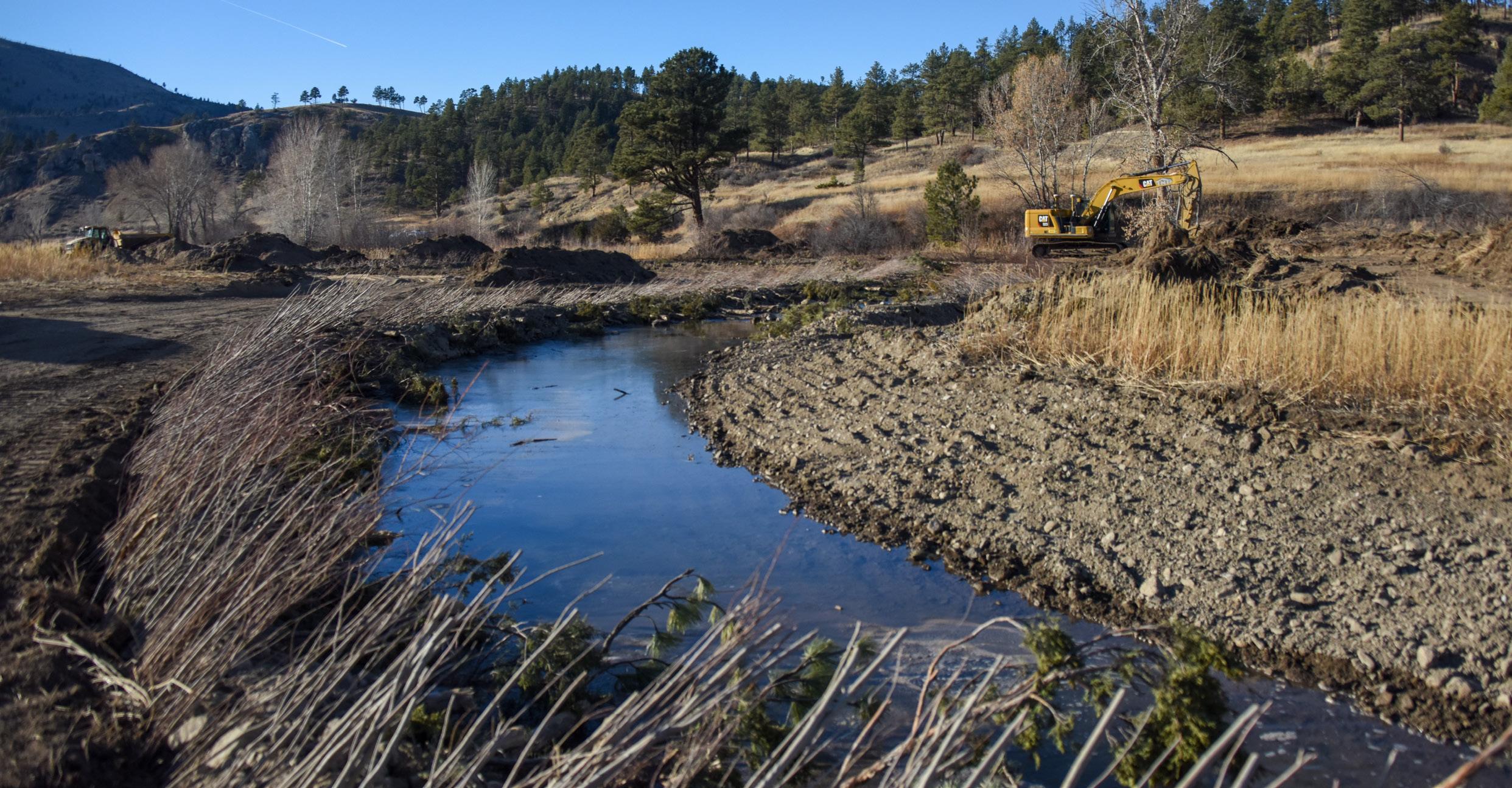
The Beaver Creek restoration project aims to improve Missouri River spawning habitat
By Erin Madison
Beaver Creek, a tributary to the Missouri River downstream from Hauser Dam, has a long history of serving as spawning habitat for the trout that give the stretch of the Missouri below Hauser Dam the nickname “Land of Giants.” However, over time, Beaver Creek’s health has slowly degraded.
The creek has been heavily manipulated over the years by land use — ranching, roads, irrigation, etc. It was straightened, which caused it to erode into a 20-foot-deep channel. A deep, straight stream channel is not a healthy situation for a creek.
However, a visitor to Beaver Creek today would never know the creek was just recently in such bad shape. Beaver Creek now meanders across the floodplain, making large S curves with deep pools and fast riffles.
The first phase of the Beaver Creek restoration project, funded in part by NorthWestern Energy, wrapped up in late 2020. Part of NorthWestern Energy’s hydro licensing requirements are to improve tributaries in the Missouri-Madison watershed. Beaver Creek was an obvious candidate for restoration.
“There are so few tributaries in this area,” said Grant Grisak, NorthWestern Energy biologist.
Planning for the project dates back to 1983. It took until 2020 to gain the necessary funding and buy-in.
“It’s a fairly costly project,” Grant said. “This is pretty extensive in terms of restoration work.”
The project was almost 40 years in the making, but it was worth the wait.
“Anything that would have been done in the ’80s wouldn’t have been done like this,” Grant said.
Stream restoration has come a long way in the last several decades. The focus of stream restoration today is to return the stream to its historic and natural channel, while focusing on benefits far beyond the stream channel.
The design for Beaver Creek was all done digitally, and GPS units on the excavators, backhoes and other equipment allowed crews to precisely build stream banks to the right elevation.
Beaver Creek’s restoration will benefit aquatic habitat, the floodplain, birds and other wildlife.
“We’re taking a holistic approach,” said John Muhlfeld, hydrologist from River Design Group, who designed and oversaw construction.
Beaver Creek provides spawning habitat for brown and rainbow trout and kokanee.
Over the years, the Forest Service has conducted spawning surveys in Beaver Creek and has good data on fish numbers.
“There’s no doubt there will be benefits, but we’ll be able to quantify it,” Grant said.
Beaver Creek’s restoration will benefit aquatic habitat, the floodplain, birds and other wildlife.
Protecting and preserving fisheries
The FERC license that allows us to operate nine dams on the Missouri and Madison rivers in Montana includes many requirements for the protection, mitigation and enhancement of fisheries, wildlife and habitat resources along the river corridor.
In order to monitor and offset effects from our hydroelectric projects, we administer Protection, Mitigation and Enhancement Programs (PM&E) in cooperation with state and federal resource agencies.
In 2019, NorthWestern Energy provided $1.06 million to support 33 fisheries, wildlife and habitat improvement projects along the 550-mile Madison-Missouri River corridor from Yellowstone National Park to Fort Peck Reservoir. This funding leveraged another $900,000 in matching funds totaling $1.9 million going toward resource stewardship projects.
To date, nearly $60 million has been spent toward fisheries and wildlife projects under the Missouri-Madison PM&E Program.
Recent fisheries projects throughout Montana
Hardy Creek – In 1963, as part of the construction of Interstate 15 between Great Falls, Montana, and Helena, Montana, a gravel pit ended up cutting off Hardy Creek from the Missouri River, creating a fish trap.
NorthWestern Energy helped fund a project to reroute Hardy Creek and remove an undersized culvert and install steps and pools to help fish access additional spawning habitat.
Sevenmile Creek - Sevenmile Creek runs from near the Continental Divide through the Helena Valley into Tenmile Creek. Several years ago, Prickly Pear Land Trust acquired a 350-acre parcel of land surrounding the creek and started a restoration project. NorthWestern Energy has provided funding for the project for the last five years. The goal of the restoration is to move Sevenmile Creek back up on the floodplain and into its historical stream channel, creating better habitat for fish and other animals.
Fishtrap Creek – Fishtrap Creek has experienced historic human impacts – numerous roads run through the drainage, there has been logging in riparian areas and cattle used to graze along the creek.
NorthWestern Energy helped with three projects in the Fishtrap Creek drainage, all designed to reduce and repair past damage to the watershed from human impact:
• The realignment of West Fork Fishtrap Creek Road to move sections of the road out of the creek bank.
• Create log jams in the creek to add habitat complexity, creating more pools and spawning areas for fish.
• Remove an undersized culvert from Bear Trap Creek to allow fish to swim upstream.
“
“ To date, nearly $60 million has been spent toward fisheries and wildlife projects.
Bozeman Townsend
Anaconda
Hamilton
Missoula
Kalispell
Whitefish
Cut Bank
Libby
Sevenmile Creek
Fishtrap Creek
GOING Green NorthWestern Energy’s manager of sustainability is working with communities to meet climate action goals

NorthWestern Energy Manager of Sustainability John Bushnell works with Montana, South Dakota and Nebraska communities to meet their climate objectives and clean energy goals.
By Jo Dee Black
NorthWestern Energy Manager of Sustainability John Bushnell uses his three decades of experience in the energy industry to assist Montana, South Dakota and Nebraska communities with their climate objectives.
The role is new to both Bushnell and NorthWestern Energy.
“My interest in this position was generated by communities’ desire to obtain their clean energy goals and NorthWestern Energy’s desire to be to responsive customers,” he said.
Previously, he managed NorthWestern Energy’s energy supply planning: a data-created roadmap with short-term and long-term forecasts for the energy supplies needed to meet customers’ energy demands reliably and affordably.
“I started about two years ago working with communities in Montana interested in opportunities that allow customers to choose to go from what is already a portfolio that is currently 70% clean energy to 100% clean energy,” John said.
NorthWestern Energy already offers customers in Montana E+ Green, a voluntary program that allows customers to buy carbon-free electricity blocks, incrementally, each month. NorthWestern Energy supports the E+ Green program with renewable energy certificates purchased from the Bonneville Environmental Foundation from resources in the northwest. Find more information at NorthWesternEnergy.com/ GreenPower.

But what are the opportunities for new resources in Montana, such as additional wind or solar generation, some asked? John is now exploring those opportunities in partnership with communities.
“Our communities in Montana with climate action goals have shown a lot of interest,” John said. “We’re also seeing interest from national corporations, and local business such as Philipsburg Brewing in Philipsburg Montana.”
Municipal governments in Bozeman, Missoula and Helena, and Missoula County, Montana, are working with a consultant and NorthWestern Energy to develop a voluntary green-power product. The premium product will include investment in a new renewable energy resource in Montana.
Large customers are also interested in increasing the renewable energy they use.
“In South Dakota, we’ve got manufacturing customers interested in procuring more carbon-free energy to meet their own standards,” John said. “We are working with them to meet their interests.”
Working with customers on green-energy projects is not a path John, an economist, envisioned when he began his career with the Montana Public Service Commission in 1986.
“The opportunity to work directly with our customers on solutions they are asking for is very rewarding,” John said. “We are all working together to meet customers’ interest in cleaner energy in ways that are affordable and reliable.”
WORKING AROUND THE CLOCK
By Jo Dee Black, Amie Thompson and Erin Madison


After a gate malfunction at Hebgen Dam, crews worked around the clock to make repairs and restore flows to the Madison River.
Water flow from Hebgen Dam to the Madison River significantly decreased Tuesday, Nov. 30, 2021, when a gate component failed on the dam’s outlet structure.
NorthWestern Energy hydro engineers and personnel worked around the clock to develop a repair plan to restore gate functionality and river flows to the Madison River as quickly as possible, safely. The repairs required a custom-made gate component fabricated and machined by the Anaconda Foundry Fabrication Company (AFFCO).
That component was installed on the dam gate by a dive crew from Washington-based Associated Underwater Services who specialize in underwater construction and repair.
The Hebgen Dam gate was open and outflows to the Madison River were restored just before midnight on Wednesday, Dec. 1. The repair was completed safely and without requiring any further flow reduction in the river.
“This successful repair was the culmination of outstanding effort by many NorthWestern Energy employees and partner contractors. From the time this issue was identified, work was underway without stoppage until the river flows were restored,” said Jeremy Clotfelter, director of Hydro Operations.
The dive team worked in 38-degree water. Diver Travis Wilson wore a hot water suit that constantly pumped warm water through his suit next to his skin.
“It’s like working in a Jacuzzi,” Travis said.
The diver wore a helmet and was always tethered to dry land by an air hose, water hose, and video and audio communications that allowed him to communicate with the dive coordinator on shore, who watched a video feed of what the diver was seeing.
While the diver worked below water to install the gate component, engineers watching from above water helped him troubleshoot through obstacles. Hydro crews also worked to maneuver equipment to make installation easier.
While our crews worked around the
Diver Travis Wilson gathers his diving equipment before making repairs to Hebgen Dam.
Chris Calero of Associated Underwater Services watches a video feed from the diver making repairs to Hebgen Dam.
Jeremy Butcher, Superintendent of Hydro Operations, left, and BJ Cope, Senior Engineer, discuss plans to restore river flows.
Mitch Hedberg, Journeyman Maintenance Operator for NorthWestern Energy, preps for repair of Hebgen Dam.
Madison River flows were restored to preevent levels not long after the gate on Hebgen Dam was repaired.
clock to repair the dam gate, dozens of volunteers arrived the morning of Dec. 1 in Ennis to help Montana Fish, Wildlife & Parks at the Madison River. The volunteers worked to transfer stranded fish into the main channel of the river. When water levels dropped, some side channels dropped so quickly that fish didn’t have a chance to move to deeper water and were stuck in puddles.
About 15 NorthWestern Energy employees also joined the effort, delivering refreshments and lunch to volunteers. We extend our sincere gratitude to all who volunteered time with the fish relocation effort on the river.
Once the gate was repaired and reopened, flows to the Madison River recovered quickly.
We will complete a thorough analysis of the failure of the gate component at Hebgen Dam. NorthWestern Energy’s dams in Montana meet the Federal Energy Regulatory Commission’s extensive dam safety program requirements.
We worked directly with Montana Fish, Wildlife & Parks in immediate response to this event and will continue to work with FWP to develop a plan to understand any impacts on the fishery. Lee Newspapers reported FWP believes the low-water event will not have significant long-term impacts to the fishery, since it was for a short period of time and isolated to a small stretch of river. The impacted portion of the river was mainly between Hebgen Lake and Quake Lake.
“It could have been a lot worse in a lot of different circumstances,” said Andy Welch, NorthWestern manager of hydro compliance. “Had this happened in the heat of the summer, it could have been much more impactful to fish and aquatic life. But also, if it had gotten much colder, the exposed side channels and spawning gravels could have frozen overnight.”
NorthWestern Energy is committed to appropriate follow-up actions. The long-term health of the fishery is the priority for NorthWestern Energy and all of our partners.
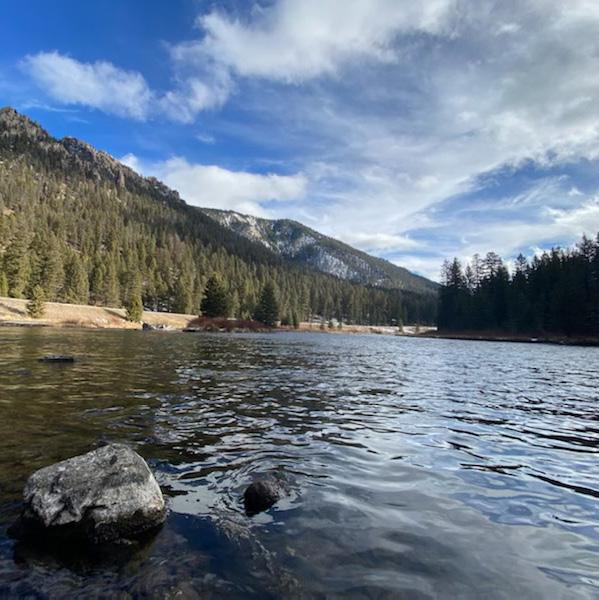
NorthWestern Energy will continue to fund the existing programs to support the fishery, aquatic and wildlife resources, including long-term monitoring of fish and aquatic insect populations on the Madison River. The work on these programs will continue to be done with our resource agency and non-governmental organization partners, including Montana FWP, the U.S. Bureau of Land Management, the U.S. Fish and Wildlife Service, the U.S. Forest Service, Trout Unlimited, Madison Conservation District, Madison River Foundation, and other local entities.
Photos (clockwise from left)
Diver Travis Wilson prepares to enter Hebgen Lake to replace the coupler that failed on Hebgen Dam.
REPAIRING THE RIVER’S EDGE TRAIL
By Alissa Byrd
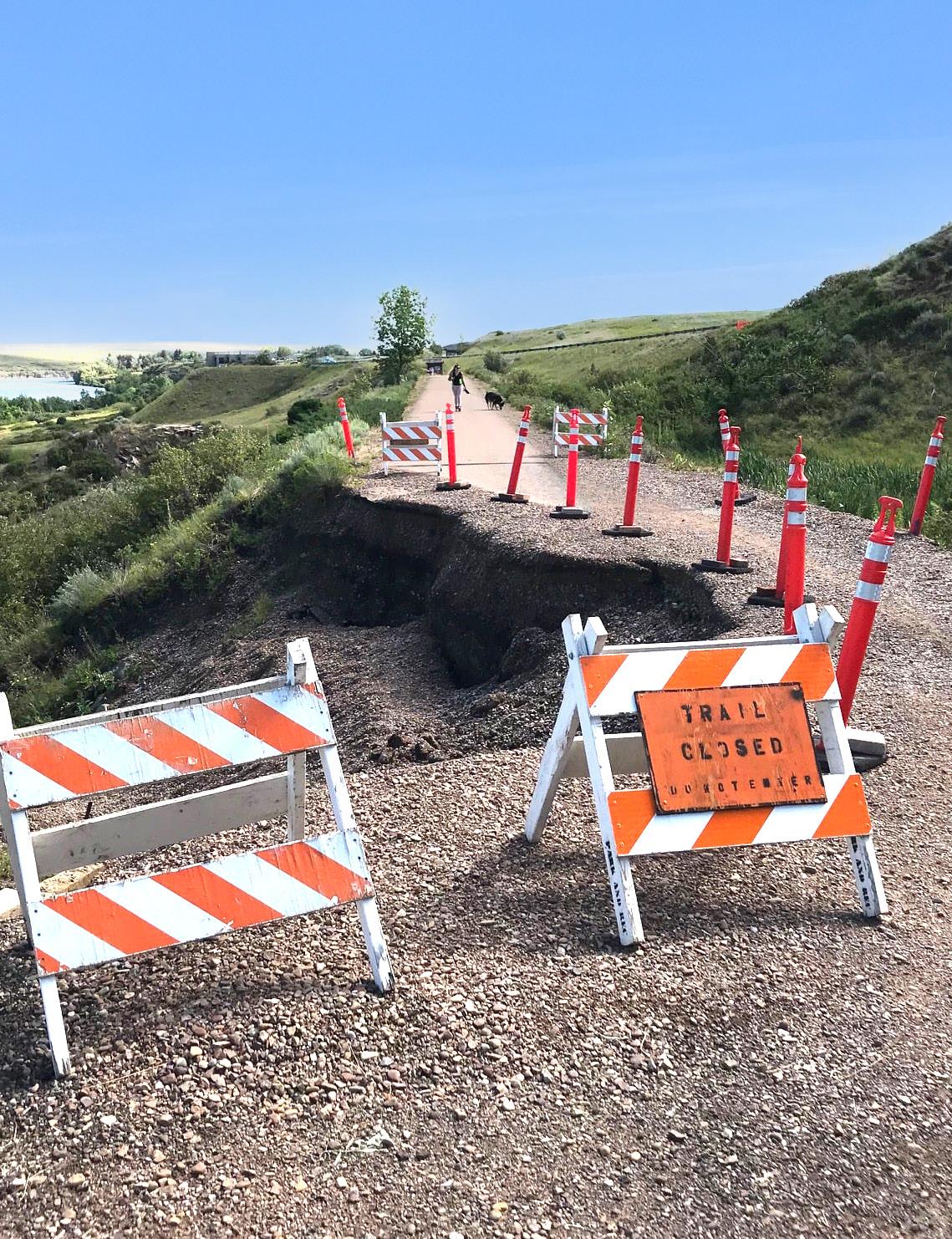
When a landslide threatened to wipe out a portion of the River’s Edge Trail in Great Falls, Montana, NorthWestern Energy and the Missouri-Madison River Fund were able to help pay for the needed repairs.
In 2019, a landslide began to form on a popular stretch of the River’s Edge Trail in Great Falls, Montana, between Black Eagle Dam and Giant Springs Road, causing severe damage to the trail.
The River’s Edge Trail is a well-used and well-loved attraction in Great Falls. It stretches 60 miles along the Missouri River and offers a combination of dirt single-track and paved trails.
The landslide destroyed an approximately 90-foot section of the trail. Before the landslide occurred, preventive measures were taken in 2018 with the installing of a crib wall, but it was unsuccessful at keeping the trail from collapsing.
The City of Great Falls, which owns and maintains much of the trail, applied for a Missouri-Madison River Fund grant and NorthWestern Energy matching funds to help pay for the repairs that would prevent the landslide from being an issue in the future. The River’s Edge Trail Foundation, a volunteer trail advocacy group, supported the application with a financial contribution to the project.
“We’re very thankful that River Fund and NorthWestern Energy stepped up and helped fund the project,” Great Falls Park and Recreation Trail Coordinator Steffen Janikula said. “The construction was very robust, I would say, so it will stand the test of time.”

The Missouri-Madison River Fund grant paid for a majority of the repair and mitigation of the landslide. NorthWestern Energy helped fund some of the remaining costs of the project.
The River’s Edge Trail follows the Missouri River and includes 60 miles of paved and single-track trails.
The project, which was completed in summer 2020, included a geotechnical report, 100 feet of sheet pile wall with helical tiebacks, a drainage system, fencing, asphalt trail replacement, grading and site restoration.
The Missouri-Madison River Fund grant paid for a majority of the repair and mitigation of the landslide. Additionally, the City of
About the Missouri-Madison River Fund Grant Program
The Missouri-Madison River Fund Grant Program, implemented through the Missouri-Madison Comprehensive Recreation Plan, addresses ongoing needs for public recreation in the Missouri-Madison Project Area. Created as a public-private partnership among local government, state and federal agencies and licensee of the 2188 Hydroelectric Project, River Fund grants and NorthWestern Energy matching funds are awarded annually for qualifying projects.
River Fund Grants since 2007 total:
• $5.3 million in grant funding for public recreation.
• $1.3 million in licensee matching funds.
• $10.3 million in public recreation enhancements.
Learn more about the Missouri-Madison River Fund and find details on how to apply at NorthWesternEnergy.com/RiverFund.
Learn more about the River’s Edge Trail at thetrail.org

Great Falls, River’s Edge Trail Foundation and NorthWestern Energy all worked together to fund the remaining costs of the project. The River Fund contributed a total of $237,400. NorthWestern Energy donated $16,300 of the roughly $325,000 total project cost. Without the repair, the trail itself would have most likely slid away, and due to the location of the slide, it would have been nearly impossible to replace without a total rebuild project.
The Missouri-Madison River Fund has helped pay for numerous improvement projects on the River’s Edge Trail over the years.
“NorthWestern Energy and the River Fund have been a vital resource in maintaining and repairing what is already there,” said Bruce Pollington, president of the River’s Edge Trail Foundation.
“I got involved 25 years ago,” Bruce said. “Back then the river was not much of a consideration to the public. We wanted to change that for our community. We viewed the trail system as a way to preserve the river frontage for public access and recreation.”
Bruce has dedicated his career to holding that promise. In addition to serving as the President of the River’s Edge Trail Foundation Board, he is the public representative to the River Fund Board of Directors.
Transforming the riverfront to a trail became a reality through the dedication of trail pioneers like Doug Wicks, ongoing support from countless volunteers and government employees and, most importantly, active donors supporting a shared community vision.
“The thing is, I have walked that trail in all seasons, including the middle of winter, but I have never once been on that trail alone,” Bruce said. “People are always out there.”
Thompson Falls RELICENSING
By Erin Madison

Study looks at potential impacts of operating Thompson Falls Dam for flexible
In order to operate our hydro facilities on Montana’s rivers, NorthWestern Energy is required to obtain a license from the Federal Energy Regulatory Commission, or FERC. The license term is anywhere from 30 to 50 years, and relicensing is a long, intensive process.
We are in the middle of the relicensing process for our Thompson Falls hydro facility and will file the final license application at the end of 2023.
Relicensing requires meetings, public input and studies looking at everything from fish behavior to visitor use. The whole process takes five to seven years.
One of the required studies is looking at flexible capacity generation, which allows us to change how much energy is generated relative to what’s needed. We currently manage the generation at the project to
maintain a fairly consistent reservoir level at Thompson Falls.
“The water coming in is the same as the water going out, or fairly close,” explained Andy Welch, Manager of Hydro License Compliance.
With the new license, we’re looking at the possibility of raising and lowering the reservoir a few feet so the amount of energy we produce can better meet demand. This is especially important as we bring more solar and wind on our system because when and how much energy these renewables produce fluctuates greatly.
“We have a lot of grid regulation requirements we have to meet,” Andy said. “This would give us the flexibility to use Thompson Falls to help with that.”
We completed a study last summer to see what effects a fluctuating reservoir would have on public safety, habitat, recreation, fisheries, wet-

flexible capacity generation
lands, cultural resources and shoreline erosion. Over three phases, we increased or decreased generation resulting in raising and lowering of the reservoir elevation to simulate flexible capacity generation and looked at what impacts it had. In each phase, we progressively increased the magnitude of generation, which resulted in an increased rate at which the reservoir elevation changed.
“We collected a ton of data,” Andy said.
Our Hydro License Compliance team is now in the process of analyzing that data and compiling it into an initial study report, which will be released in May 2022 and incorporated into our draft license application.
Based on the result of this study and others, FERC will determine how we can operate the project and what mitigation measures are required.

Trout travels through fish ladder, 150 miles in 33 days
By Jon Hanson
An impressive migration was documented in the spring of 2020 when a 21-inch, 3.5-pound rainbow trout was captured in the Thompson Falls fish ladder on March 25 and tagged with a Floy and PIT tag. It was released upstream, and then Montana Fish, Wildlife and Parks recaptured it at Johnson Creek, a tributary to the lower Blackfoot River on April 27.
This is the farthest documented fish movement from the fish ladder to date, and the first documented connection from the Lower Clark Fork to the Blackfoot River system. In 33 days, this rainbow moved more than 150 miles upstream to where it likely hatched, to carry out its life history and presumably spawn.
Several years ago, this juvenile rainbow trout (now known as tag #0068) left Johnson Creek and moved downstream. The removal of Milltown Dam reduced a predatory population of nonnative northern pike from the reservoir. As this juvenile matured and instincts kicked in to return to its natal stream, the operation of the Thompson Falls fish ladder then started the upstream sequence and allowed access to the Middle Clark Fork River. Again, the removal of Milltown Dam allowed #0068 further access to this Blackfoot River tributary, where it was trapped incidentally via another fisheries research project.
The biological documentation linking all the actions is a notable feat. Montana Fish, Wildlife and Parks, Lolo National Forest, U.S. Fish and Wildlife Service, Big Blackfoot Chapter of Trout Unlimited, Trout Unlimited, The Nature Conservancy and NorthWestern Energy are just a few of the key contributors to make this multi-drainage success happen.
Jon Hanson is NorthWestern Energy’s Hydro Compliance Professional – Fish Biologist based in Missoula.

Scan this QR code with your phone’s camera to watch a video about the Thompson Falls Fish Ladder.
SEED
MALT
BREW
By Whitney Jurenic and Tucker Kramer
The malting and brewing industry in Montana is not only hard working – but working efficiently! From the tractor seat to the bar stool, these local businesses have invested in energy-efficient projects with a goal of energy management best practices. What’s more, they have all received rebates and incentives from NorthWestern’s Energy Efficiency Plus (E+) Programs to “go green” while saving some green, too.
Our Efficiency Plus (E+) Programs
NorthWestern Energy offers a variety of rebates and incentives through our Efficiency Plus (E+) Programs. The E+ Programs help Montana customers save money and energy. E+ Program savings are realized through lower customer use of energy resources, which reduces the amount of electricity and natural gas NorthWestern must generate or purchase to meet customer needs. Several options are available to NorthWestern’s Montana residential and commercial customers: simple rebates, weatherization programs, energy assessments, custom commercial incentives and support of renewable energy generation. To learn more, visit NorthWesternEnergy.com/EPlus.
To learn more about these featured Montana businesses, please visit their websites at boshayandgrain.com, montanacraftmalt.com and philipsburgbrew.com


The Seed: Bos Hay and Grain
Barley is an important crop, and Montana supplies the U.S. with approximately 22% of the nation’s barley production. Malt barley is a subset grain crop that is primarily used for beer production. Located in southwest Montana in the Gallatin Gateway, Bos Hay and Grain is a family farm that was established in 1965 by Ron Bos. Craig Bos, Ron’s son, now operates the business, which produces a variety of grains including malt barley. Malt barley is considered a specialty crop that requires thoughtful and efficient irrigation practices. Craig stressed that “irrigation is critical in the success of our business,” as malt barley has specific protein requirements that are water dependent. Bos Hay and Grain has participated in NorthWestern’s E+ Irrigation Program with the installation of a variable frequency drive (VFD) pump, which Craig states was “impactful and helpful” to their business.
NorthWestern offers rebates for Montana irrigation customers including farms and ranches that produce feed and grain, as irrigation systems can be energy-intensive. Our rebates can help irrigators upgrade their systems to be more energy efficient. In the 2020-2021 program year (July 1, 2020-June 30, 2021), NorthWestern’s E+ Irrigation Program saved customers 173,250 kilowatt hours and incented $14,437 in irrigation rebates for 12 VFD projects.
The Malt: Montana Craft Malt
Montana Craft Malt (MCM) is stirring things up with big ideas and a bold vision to transform the craft malt business. Headquartered in Butte, Montana, MCM is located near the world’s best barley-growing region. “Montana has premium agriculture products,” said Jen O’Brien, President of MCM. “But we send it out of state to be processed, which is where the jobs are created.” MCM was created with the goal of using Montana-grown grain to produce malt for craft breweries. Making malt is an energy-intensive process. Barley is soaked in water to germinate. The germination process is then halted by using hot air to dry the grain. MCM produces about 25 million pounds of malt per year, which is distributed across the country and into Mexico. The company sells directly to numerous craft breweries in Montana.
When construction began in 2018, MCM collaborated with NorthWestern to participate in E+ Program offerings. MCM was able to receive three incentives for implementing energy efficiency measures in their facility utilizing the E+ Commercial Lighting, E+ Electric Business Partners and E+ Natural Gas Business Partners programs. The E+ Commercial Lighting Program rebated an LED lighting upgrade at the MCM facility. Through the E+ Electric Business Partners Program, NorthWestern funded an incentive for MCM’s compressed air system, which feeds the pneumatic robots used in the malt house. In 2020, MCM completed a heat recovery system for its kiln (essentially a large oven where malt is dried) that received an E+ Natural Gas Business Partners incentive. With the heat recovery system, the kiln is about 10% more efficient. Through the implementation of these three projects, MCM was able to capitalize on both electric and natural gas savings.
The Brew: Philipsburg Brewing Company
Philipsburg Brewing Company opened its doors in 2012 with a mission to provide quality, handcrafted beers in a friendly, unique setting. Philipsburg Brewing uses only the finest Montana malt and local mountain spring water to craft its beer. Initially, Philipsburg Brewing opened inside an old bank building in downtown Philipsburg. A couple years after opening, the brewery had outgrown its space. “There was demand for our beer on draft that we couldn’t keep up with,” said Nolan Smith, Co-owner and Operations Manager. In 2015, Philipsburg Brewing opened a production brewery up the street from the downtown location. The facility is inside a water bottling plant that was built in the ’90s that sat vacant for about 10 years. “It’s actually where the original brewery was built in Philipsburg in 1875,” Nolan said.
The building, known as The Springs, was equipped with mercury vapor lights that had to warm up for several minutes before they reached full brightness. “It took a while for them to come on,” Nolan said. In 2018, NorthWestern worked with Philipsburg Brewing on an E+ Commercial Lighting Program rebate, which helped the brewery upgrade its lights to LEDs, including motion sensors. “The lighting upgrade certainly was needed,” Nolan said. “It makes the work environment a lot better for our guys, and we’re saving energy.”


Many know the small town of Huron, South Dakota, as home of the South Dakota State Fair, the World’s Largest Pheasant or for being located in east-central South Dakota, but for me, I call it home.
Throughout the years, the community, myself included, witnessed the small town of Huron transform into something bigger, better and more beautiful.
I watched my classroom expand with students of all backgrounds and ethnicities, with
HURON, South Dakota
By Alissa Byrd
whom I later walked across the stage at high school graduation. In the last decade, Huron has blossomed with a population of Karen immigrants, many who came to work at the turkey plant, Dakota Resources, and also opened restaurants and grocery stores and became members of the community.
My family welcomed new neighbors in our neighborhood. My little sister had new friends to invite to play.
Huron, located at the intersection of U.S. Highway 14 and South Dakota Highway 3, is composed of several amazing small businesses, way too many to fit in one article, and I recommend branching out and exploring all the additional options Huron has to offer.

Small business are what make Huron and every NorthWest Corner thrive. When you support a small business, your impact doesn’t go unnoticed. You could be paying for their child’s ballet lessons, helping put food on the table for dinner or making holiday shopping a little less
Dakota


stressful.
I’m not shy when recommending my local favorites in Huron. You will fit in like a local after visiting all of the places featured. Thank you for #shoppinglocal during your visit to Huron.
A Dozen Donuts. If you’ve been searching for the best donuts in South Dakota, look no further! The Donut Shoppe, a small, family-run bakery has served fresh, delicious donuts for 38 years and counting. Oh, and they take donut making very seriously, too. Their donut-making magic begins at 10 p.m. the night before they open their doors. From start to finish, it typically takes five to six hours to prepare for the next day of business. Make sure you arrive early to guarantee your donut selection. Don’t miss The Donut Shoppe, located in downtown Huron at 474 Dakota Ave. S., where you can expect fresh, delicious donuts and friendly service while supporting a local community favorite.
Shop Until You Drop. Boss Boutique offers a city-feel shopping experience while staying in the heart of Huron. Store owner Ashley loves women’s fashion and staying on top of new trends to provide the latest styles for customers. Her goal is to feature fun yet affordable options. Enjoy browsing through a selection of women’s clothing, shoes, plus-size clothing, boots and fashion accessories. Visit bossboutique.com to learn more.
Family Owned. Sah Ray and her nephew, Rawlay, opened Golden Horn Karen Asian Market one year ago to provide more options for the community. The store, located at 175 Dakota Ave. S., offers a little something for everyone, from clothing to grocery and produce items. It was Sah Ray’s dream to start her own business, and the
small-town of Huron provided her the opportunity to make her dream a reality. Please stop in and show your support to their culture while welcoming this new local business, too!
Hidden Town Treasure. If you blink, you will miss it. So, don’t blink when looking for Coney Island Cafe, located at 24 2nd St. SW. This hidden treasure serves the tastiest breakfast and arguably the BEST caramel rolls EVER. But, don’t worry, we will let you be the judge of that one. I recommend arriving early, they open at 7 a.m. Or call 605-352-7112 to reserve a caramel roll.
Need. More. Caffeine. Don’t Spill The Beans, located on Third and Dakota in the Centre Plaza, offers dine-in, curbside, online ordering and takeout. Hungry? No problem. You’ll find a fabulous lunch menu with daily specials that will tempt even the pickiest of appetites. Need a caffeine boost? Try a specialty drink, or kindly ask the baristas to recommend their latest favorite. Not a coffee fan? That is A-OK; they offer several alternatives. I recommend trying an Italian raspberry soda with cream! Visit dontspillthebeans.net to learn more.
Stronger Together. While strolling through downtown, capture a picture to remember your visit to Huron. If you’re feeling inspired, post your photo and share a few words on what being strong means to you. A photo-op mural is located on Dakota Street across from Don’t Spill The Beans.
A Must See. Not everyone can say they have a picture with The World’s Largest Pheasant, but you could after your trip to Huron. The World’s Largest Pheasant is located on Highway 14, and you don’t want to miss it. Is it really a trip to Huron if you didn’t get a picture with the 28-foot-tall, 22-ton pheasant?


Now That’s What You Call A Sandwich. This is no fast-food joint. At Manolis Grocery, sandwiches are ordered fresh and made with love. Lots and lots of layers of love, aka meat and cheese. It might surprise you what all this store has to offer. Although they are famous for their sandwiches, they offer wine, liquor and several grocery items. The sandwich counter is located toward the back of the store, where you will find a menu of specialty options, or feel free to build your own. You can dine in or order to go, but I recommend getting comfortable and enjoying the small-town atmosphere. 47 3rd St. SW.

Authentic Thai Food. Mercy Thai Restaurant, located on the south side of town, offers authentic Thai food options for the Huron community. If you’re an appetizer lover, I recommend ordering a rice ball to start. Visit mercythairestaurantinhuron.com to see all of their delicious menu options.

Water Your Green Thumb.
Plant-shopping is always on my to-do list. If you’re searching for a souvenir that will last a while (depending on your plant-parent skills), visit Cara at Rainbow Flower Shop. She will help you find the perfect plant to add to your collection. This cute little shop at 162 3rd St. SW is hard to miss with its beautiful new #EternalSummer mural on the east side of the building.

Pass the Popcorn. After a long day of exploring the town of Huron, take an evening to relax and catch the latest movie at Huron Luxury Cinemas. While you’re at it, order a bag of popcorn, something sweet and a large drink of your choice. Visit loganmovie.com to view upcoming showtimes.
Did Someone Say Snacks?
Need a pick-me-up before you travel home? Stop into Mely’s Mexican Store & Bakery, located at 256 Kansas Ave. SE, to expand your typical snack selection for your road trip home. Not sure what to get? Try one of each: something sweet, salty and something to drink! I recommend Corn Brights, delicious sugar-coated, vanilla-flavored corn snacks!
Year-Round Fun. The fairgrounds is most well known for hosting the South Dakota State Fair. This 190-acre park offers several other events throughout the year, such as Wheel Jam, livestock events, trade shows and other family-friendly community events. In 2022, the South Dakota State Fair will be held on Sept. 1-Sept. 5. Visit sdstatefair.com to learn more.
Plan Ahead for Pheasant Season. Interested in pheasant hunting? Wild Wings & Retrievers offers a guided pheasant hunt experience in one of the most highly pheasant populated areas in eastern South Dakota. Steve, the owner of Wild Wings & Retrievers, has hosted guided hunts for 30 years and provides a safe, relaxing hunt for everyone. While he wants his hunters to enjoy a relaxed and exciting hunt, his main focus is safety. A safety meeting will precede the hunt so all individuals are aware of the expectations of the hunting party. To learn more, visit wildwingsretrievers.info or call 605-350-4702.

Scan this QR code with your phone’s camera to watch a video about NorthWestern Energy partnering with Advantage South Dakota to help companies recruit and train employees and to help new residents settle into life in South Dakota.


BEER CHEESE SOUP


You read about energy efficiency from “Seed to Malt to Brew” on Pages 40-41. Now use some of that locally crafted, energy-efficient beer in this delicious, creamy beer cheese soup recipe.
INGREDIENTS
¼ cup butter
1 medium yellow onion, diced
2 carrots, diced
½ red pepper, diced
2 cloves garlic, minced
¼ cup flour
2 cups chicken broth
1 cup heavy cream
16 ounces beer
1 tablespoon ground mustard
1 bay leaf
1 teaspoon salt
½ teaspoon pepper
Additonal salt and pepper to taste
DIRECTIONS
1
2
3
4
5
6
7
Heat a large saucepan over medium heat. Add butter and let it melt.
Add onion, carrots and red pepper. Saute 5-6 minutes or until softened. Add garlic and saute for another minute.
Sprinkle the flour over the vegetables and mix well. Cook for one minute, stirring frequently.
Continuing to stir, add chicken broth, cream and beer. Then add mustard, bay leaf, salt and pepper.
Let simmer 5 minutes until vegetables are very soft. Take out the bay leaf.
Puree soup using an immersion blender. Alternately, a food processor or blender may be used — blend in batches to not overflow.
Add the cheese to the soup base gradually, stirring often. Reheat to meld flavors for 3-5 minutes. Serve immediately.
WHERE DOBees GO IN THE WINTER?

By Amy Grisak
Editor’s note: In each edition, gardener and writer Amy Grisak will share a Bright Idea that readers can try at home.
Throughout the summer, honeybees are our gardening companions, pollinating the plants, flowers and vegetables we love. But what happens when the weather chills and the flowers are gone? There’s no hibernation for these industrious ladies. The reason honeybees work so hard during the summer is to survive the winter, but how they do it is remarkable.
The goal for the entire colony is to keep the queen alive. This requires the workers, which are all females at this time of the year, to cluster around her during cold spells, typically once the outside temperature dips below 50 degrees, and generate heat through muscle contractions. It doesn’t matter how cold it is outside. Inside the hive remains a toasty 90 degrees Fahrenheit. It’s kind of mind blowing to consider there can easily be a 100-degree difference between the subzero outside temperatures and the interior of the honeybee cluster.

Maintaining this tight group is the key to the colony’s survival. If something happens to the existing queen, they will raise a new one, if given enough time. During the warmer months they draw out queen cells, which are larger than the smaller spaces created for the worker bees or even the male drones. When the existing queen lays eggs in these cells, the workers feed the lar-

vae a nutrient rich substance called royal jelly to create reproductive females. When a new queen is born, she immediately kills any of her sisters still in their cells with her stinger (unlike the worker bees that can only sting once), or if another queen is born at the same time, they’ll fight to the death. The victorious queen mates, then takes over the responsibility of producing up to 1,500 eggs per day during the height of the summer.
But there is no time to go through this process in the winter. The queen does not lay eggs during the winter months; if she perishes there is no way to replenish the population. The colony will die out. This is why the cluster is critical.
Giving the bees a boost
Although honeybees are well adapted to survive northern climates, they fare better when beekeepers give them a little help at the end of the season. Keep in mind, if you ask 10 beekeepers the same question on care, you’ll receive at least 11 different answers, but this is the general course of action at the end of the season.
Winter preparation begins with the honey harvest. Honeybees produce far more honey than they actually need to survive the cold months, which is why people benefit. Harvest typically happens toward the end of the summer after the nectar flow wraps up.
A centrifuge is used to extract honey during honey harvest.
Most northern beekeepers believe a hive will require roughly 100 pounds of honey to make it through the winter, and harvest accordingly.
To harvest the honey, the beekeeper removes the honey supers after smoking or using a product to drive the worker bees out of the supers. A centrifuge is used to extract the honey from the cells. Smaller scale beekeepers sometimes scrape the honeycomb off of the frames, then place it in a strainer to strain the honey.
Preparing hives for the cold
In many parts of the country, beehives require little to no preparation to survive the winter. But in colder areas, beekeepers do their best to allow bees to keep the interior of the hive warm. This might be as simple as buffering the hives with straw bales in order to reduce the effect of harsh winter winds. Stacked around the sides of the prevailing winds, straw bales can prevent the cold from creeping into the cluster.
of dead bees at the entrance, but it’s good to know that the remaining workers are maintaining their housekeeping.
Looking forward to spring


When it is the first part of the year, even in colder climates, the queen begins laying a few eggs. As the days lengthen and the temperature rises, she increases egg production. When spring rolls around, there is typically a healthy population of sterile, female worker bees, along with drones, the fertile males that were kicked out before winter. If there is a new queen produced, the drones will meet with her. If not, they pretty much just hang out in the hive. They do not collect honey, nor do they even have a stinger to be able to protect the hive.
Another option is to attach solid foam insulation around the sides of the hive. The one caveat being the beekeeper must allow for air circulation and for the bees to fly out during warm winter days. The buildup of humidity is one of the key reasons bees die in the winter time, and can cause mold issues, which are equally harmful. With this in mind, it’s also important to keep the vent holes open during the winter, particularly if snow drifts around the hives. While snow is a good insulator, it can smother the bees.
In preparation for winter, straw bales are stacked around beehives to help insulate them.
And, as mentioned, the bees need to be able to fly out during winter days when the temperature crests above 50 degrees. Being the clean and organized creatures that they are, they rely upon these warm days for defecating flights since they do not do so inside the hive. It’s also an opportunity for them to sometimes clean out the dead bees from the bottom of the hive. It might be shocking to go out on a winter’s day and see a large number
At the height of the season in the early summer, a healthy colony will contain between 50,000 and 60,000 bees. When the nectar flow is heavy, it is not unusual for the bees to put up more than 30 pounds of honey within a day or two. Even in northern climates, a hive can easily produce 270 pounds of honey.
With a complete
focus of “God save the queen!” the honeybees’ dedication would make any Anglophile proud. It’s a group effort when beekeepers do what they can to ensure the hive is strong and healthy so they survive the winter and are ready for spring blossoms.

Amy Grisak is an avid gardener and writer. Her writing appears in everything from the Farmers’ Almanac to Popular Mechanics, and her first book, “Nature Guide to Glacier and Waterton Lakes National Parks,” is now available. Amy lives in Great Falls, Montana, with her two sons and her husband, Grant, who is a biologist with NorthWestern Energy.
OUR GENERATION PORTFOLIO
Timeline of Our Montana Generation Portfolio
Since the end of 2011, we have added only carbon-free resources – hydro, wind and solar – to our Montana generation portfolio. In the last 10 years, we have added more than 760 megawatts of carbon-free generation.
ConEd sites,Caithness Beaver Creek, and Triple Oak/Jawbone 314.2 MW
Apex 1, MT Sun & Open Range 166 MW
dams
We’ve invested more than $121 million in energy efficiency, demand-side management and small-scale renewable energy development support since 2006.
Systemwide, our electric generation was 65% carbon-free in 2020.
NorthWestern Energy
2020 Electric Generation Portfolio
The average among U.S. energy companies of carbon-free resources (as a percentage of total nameplate capacity). NorthWestern Energy is significantly cleaner at 57%.
Today, nearly 70% of the energy produced by NorthWestern Energy for Montana comes from renewable and carbon-free sources, including hydro, wind and solar. Over the last decade, we have already reduced the carbon intensity of our energy generation in Montana by more than 50%.
DO YOU RECOGNIZE THE LOCATION OF THESE PHOTOS?
Do you recognize the location of any of these photos? Send us your guesses to be placed in the drawing for a prize. Guesses should be specific such as naming a feature in the photo or giving the exact location. Send your guesses to bright@northwestern.com. Be sure to include your name, mailing address and phone number so we can contact you if you’re a winner.

MONTANA

NEBRASKA
Answers from the People issue



Montana: Lots of readers recognized the historic Washoe Theatre in Anaconda. From the correct guesses, we selected Sue J. of Columbia Falls, Montana, as the winner.
South Dakota: That is the World’s Only Corn Palace, located in Mitchell. Several people sent in correct guesses, and we drew Lydia M., of Chamberlain, South Dakota, as the winner.

Nebraska: This building is in downtown Lincoln and houses the Nebraska Public Service Commission. Two people recognized this location. In fact, these two people both correctly guessed all three locations, so we’re declaring them both winners: Phyllis T. of Great Falls, Montana, and Mike S. of Butte, Montana.

