Quite by chance, milkweed has emerged to the fore in recent issues of Butterfy Gardener. Lynne and Jim Weber introduced us to “Distinctly Different Milkweed” in the Winter 2018 issue and Ken Carman gave suggestions on growing Common Milkweed in “Managing Milkweed” in the Summer 2018 issue, while Lenora Larson proposes “Extending the Milkweed Banquet” in the current issue. It’s hardly surprising that so many butterfy gardeners have discovered the virtues of milkweed for providing butterfy habitat and ensuring the enduring delight of a steady stream of butterfy visitors to their gardens. And although we are not yet ready to retitle the magazine Milkweed Gardener, we should at least be open to the possibility if the milkweed articles continue to come in!
Lenora Larson states in her article in this issue that “providing multiple species of caterpillar food plants can be your insurance strategy against failure.” While her article is about milkweeds and the many different species we can grow to feed Monarch caterpillars, I believe her statement applies to all the caterpillar food plants that we love to grow and explore. Spring is the time of new beginnings each year when we add new plants to our gardens, so the next time your car magnetically drives you to a plant sale or garden center, look beyond the standard butterfy garden palate and search out something you haven’t previously grown that will feed caterpillars in your garden. It does not even have to be a milkweed!
Please send Butterfy Gardener correspondence and submissions to: Jane Hurwitz, Editor, NABA, 4 Delaware Road, Morristown, NJ 07960; hurwitz@naba.org
Articles, gardening tips and observations, artwork, digital high resolution photographs, poetry and comments will be considered for publication. Please send self-addressed stamped envelope for items to be returned.
Advertising
Butterfy Gardener welcomes advertising. Please write us at: Butterfy Gardener, 4 Delaware Road, Morristown, NJ 07960, or telephone (973) 285-0907 or fax (973) 285-0936 for current rates and closing dates.
Membership Services
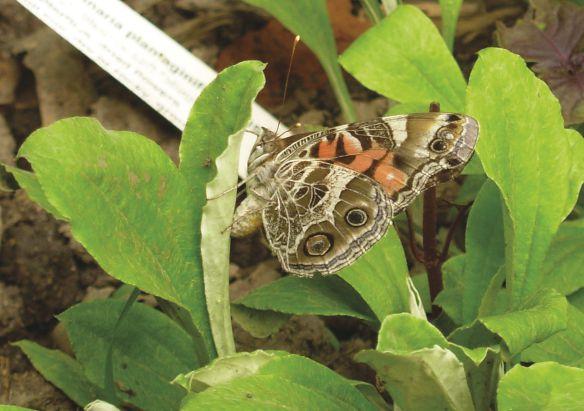
Not milkweed! American Lady laying eggs on Woman’s Tobacco, also known as plantain-leaved pussytoes.
For questions concerning membership issues, magazines, or changes of address, please write to NABA Membership Services, 4 Delaware Road, Morristown, NJ 07960. Occasionally, members send membership dues in twice. Our policy in such cases, unless instructed otherwise, is to extend membership for an additional year.
Butterflies on My Balcony
Text and photos by Peter
H. Waldeck
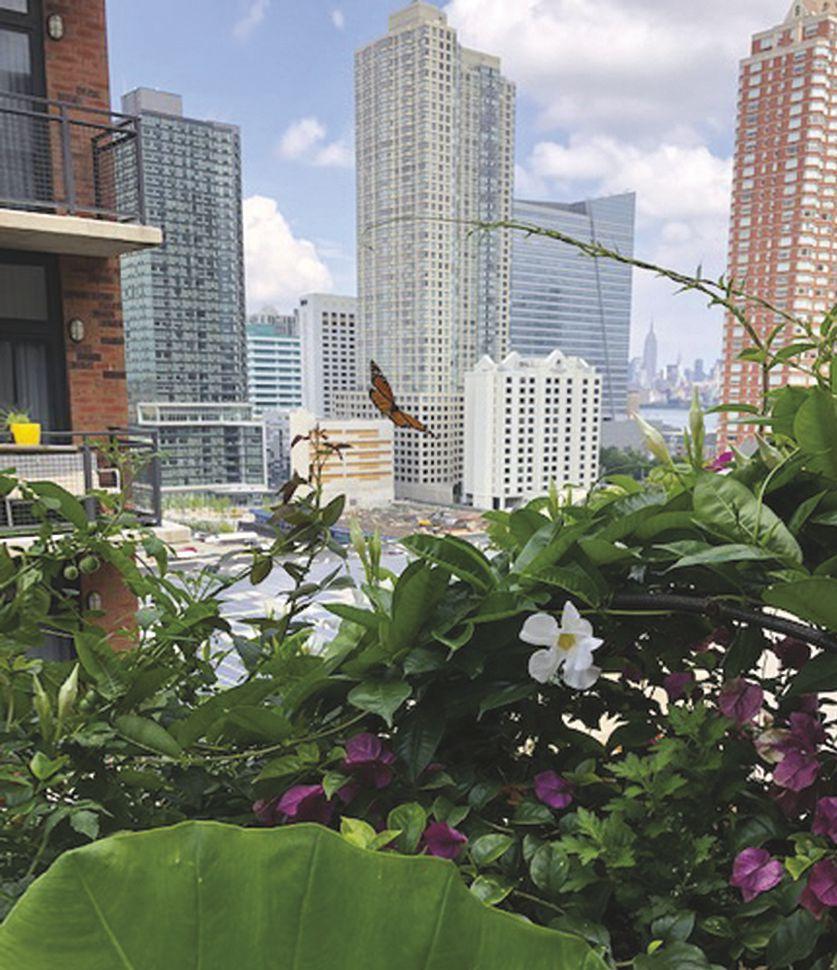
By early April the frst streaks of spring sunlight reach the edge of my north-facing balcony, signaling the end of dark days and the start of fun time—planting plants! From that moment until the last of summer’s rays fade entirely in early September, it’s a mad rush to populate as much potted green as possible onto a slim 121 square feet of space, 12 stories high above the nearly greenless expanse of downtown Jersey City.
Although I grew up with a large garden, I never had much interest in horticulture until I was well into my forties and found myself with a backyard patio in Brooklyn. During the frst year I was proud to propagate three plants and by the third year I stopped counting at 150. Then it was a move to Manhattan and the frustration of having only a few fower boxes facing a center courtyard with no sun and a line of garbage cans for a view.
When I came across an apartment with its own private outdoor space in Jersey City—having never stepped foot on that side of the river—I fairly leapt across the Hudson in a single bound to snap it up! Finally, I could get my hands back in soil again and perhaps grow some chilies and tomatoes.
Of course, balcony gardening presents many challenges, the foremost being the relentless wind that ruthlessly dries everything out. Plus neighbors below who don’t appreciate plant debris drifting onto their spaces. But I refuse to be thwarted and have happily flled every nook and corner with as much leafy green as possible.
What I didn’t give much thought to, initially, was attracting pollinators. Although I had a great view of Manhattan and of open western skies, it was a very rare sight indeed to see any winged creatures futter by. Then one afternoon last spring I spotted an Eastern Tiger Swallowtail perched atop a purple-fowering Calibrachoa on the railing. I was overjoyed! When I found the butterfy in the same spot the next morning I knew something was wrong and was sad to realize that it had died. Eventually a stiff breeze carried it away.
Naturally I had no idea what happened to the poor swallowtail, but thought that perhaps I could do a little more in way of plantings to help any other wayward critter in search of vital sustenance. Initially I fgured that just about any fower would do, so in went all the pretty plants. But as I read more about what pollinators fnd attractive—and equally important, what they don’t—I realized that although I had created a colorful and lush habitat, it wasn’t necessarily a benefcial one. It dawned on me that I was capable of providing a much more welcoming oasis.
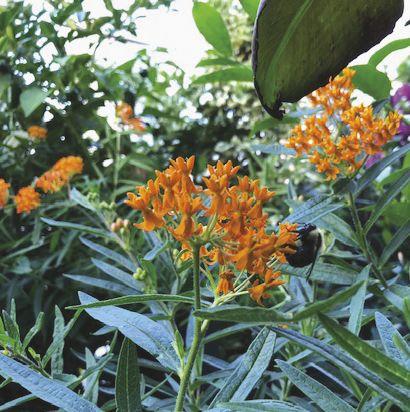
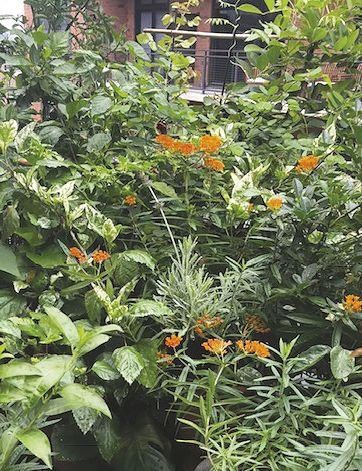
Butterfy Milkweed was a hit with all insect visitors.
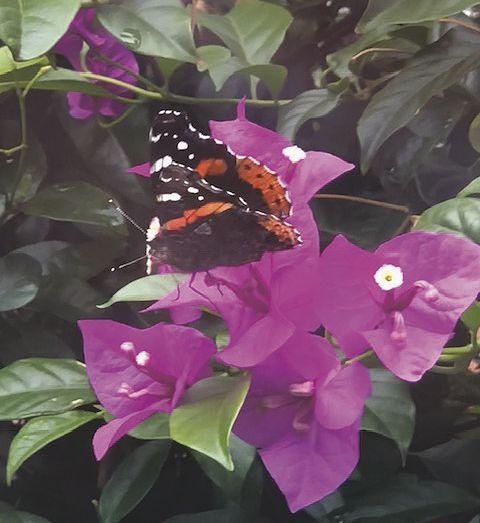
Red Admirals were not too interested in Bougainvilla except as resting spot.
Internet research ensued and I made a list of musthaves. First and foremost was milkweed, which turned out to be a major revelation. How could I not have known about that previously? When I went in search of it at my favorite greenhouse, I came across Butterfy Milkweed. I enthusiastically purchased three, as well as Calibrachoas, English Lavender, lobelias, Russian Sage, and, improbably, a Plumbago plant.
To make room for these new arrivals, out went useless fllers such as the attractively trailing, but ineffectual, Petunias. Although Begonias supposedly were good attractors for pollinators, I never saw so much as a fy on mine—so out they went, too. Zinnias would have been an excellent choice, but I simply ran out of room and pots.
Suddenly, as if advertised by some unseen neon billboard, the balcony literally began to hum with bumblebees, butterfies, hummingbird moths, and several other insects I couldn’t identify. It became my morning ritual to sit out on the balcony with a cup of coffee and count the number of bees bouncing from one fower to the next. Pure enjoyment!
But despite my best efforts, not all went according to plan. The Cigar Flower, also known as Mexican Cigar Plant, with its orange bulbous offerings (an impulse purchase at the Union Square farmer’s market) might have tempted an (unlikely) hummingbird, but was impossible for any insect to access and therefore completely ignored. So, too, hibiscus blooms with double fowers in lemon-yellow and red. More surprisingly, the purple bracts of Bougainvillea seemed to hold no allure at all—at least not that I observed. An occasional butterfy, such as a Red Admiral, would stop and perch to rest there, but nothing more. No guest ever came buzzing about the Brugmansia fowers with their elegant hanging tubes of white taffeta, but perhaps moths came a-calling late in the night?
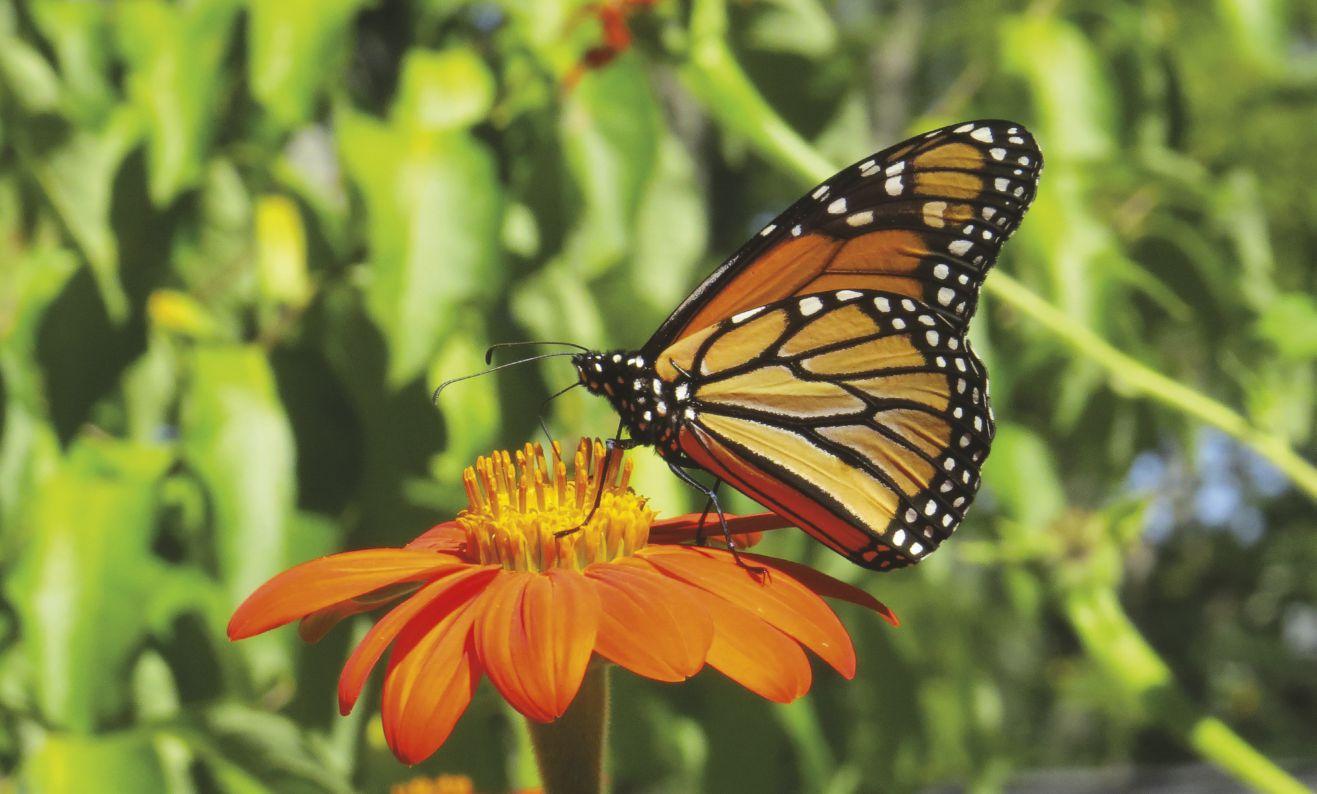
The star of the show was, of course, the milkweed. The favored visitor, the Monarch, would poke and prod in eager anticipation, and bumblebees, with military precision, came and conquered. So attractive was the milkweed that within a week the insects had clearly depleted all the pollen and nectar the plants could produce. And when no sustenance was left, they all ceased coming altogether. Sad times!
By then—late August—the arc of the sun has drastically changed. In another week only the very tips of the climbing roses and satsumas, hanging over the far edge, receive a kiss of sun. Then that, too, fades completely. Before the frst frost arrives, I lug plants needing to be overwintered back indoors for the long haul. In November it’s not surprising to fnd a lost ladybug crawling across the bathroom mirror or a caterpillar of some sort inching along the living- room foor. But thankfully the butterfies and bees are nowhere to be seen indoors, having headed south; ended their brief, busy lives; or had the good sense to take shelter somewhere out in the urban jungle. When they or their offspring return to my balcony next spring I will be ready!
Peter Waldeck is a plant-crazy enthusiast who has been making the most of his small balcony garden for the last several years. Obsessed with all things leafy and green, he has recently dedicated himself to providing pollinator-attracting blooms as well. His goal this year is to reap a bumper crop of chilies, pot milkweed galore and inspire neighbors to green-up their own outdoor spaces. Peter currently lives in Jersey ,City, NJ. His next home will have flower-filled meadows and a plot of earth to create a true garden oasis.
Butterfy Milkweed was the star of the balcony show for butterfies.
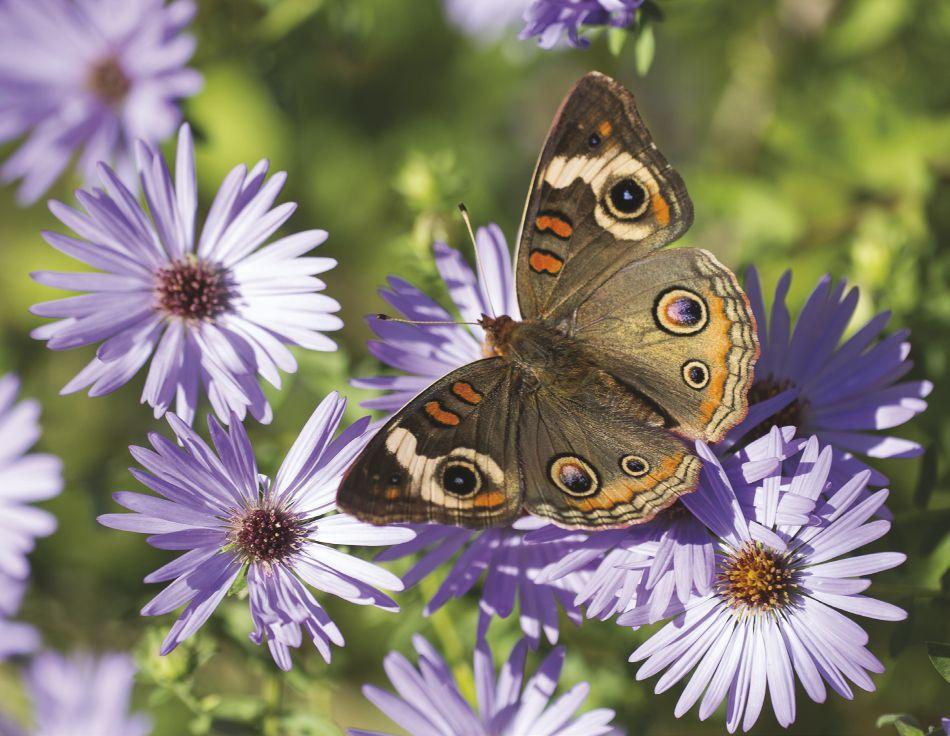
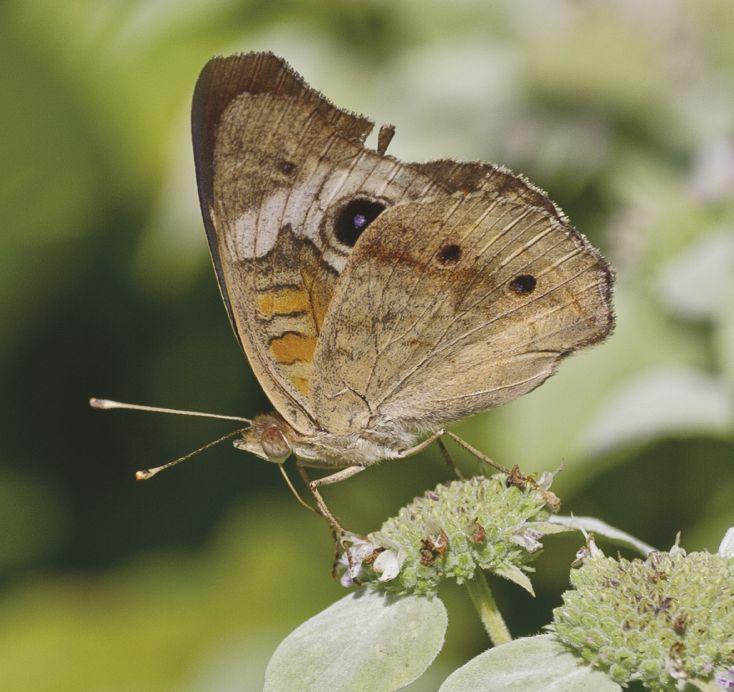
Common Buckeye
Text by Jane Hurwitz
Known Food Preferences: Like many seasoned travelers, Common Buckeye caterpillars are able to feast on local cuisines as they migrate across the United States and southern Canada. Weeds in the Plantain Family, such as Common Plantain; garden fowers such as Garden Snap-dragon; and the yellow-fowered Butter and Eggs are non-native caterpillar food possibilities. Native plants such as false foxgloves, wild petunias, fgworts, and Turkey Tangle Fogfruit are also sought out by egg-laying Common Buckeyes, which deposit single eggs on leaf buds and fresh plant leaves. While the menu is varied across a few plant families, all of the caterpillar food plants chosen by Common Buckeye contain iridoid glycosides, a group of chemicals that act as egg-laying as well as caterpillar-feeding stimulants. Iridoid glycosides sequestered by the hungry caterpillars provide resistance against some predators such as ants––these are bad tasting caterpillars! Unlike the case with Monarchs, the chemicals that protect Common Buckeye caterpillars and chrysalises are not retained in the adult butterfy.
Mary Anne Borge
Winter hide-out: Common Buckeyes have no need for winter hide-outs—they are year-round residents in many southern states where they produce multiple broods. Each spring, southern-born adults leave their warm winter homes and migrate northward, eventually populating most of the United States (except the northwestern states) and into southern Canada. Each fall, the ofspring of these mighty fiers migrate southward, returning to the warm southern United States and coastal areas as far north as central California and North Carolina.
Known disguises:
Special weaponry:
The orange and black coloring of Common Buckeye caterpillars advertises to would-be predators that they are not palatable. If enemies don’t heed the aposematic warning, caterpillars also have a foul defensive strategy—when disturbed, they vomit, creating a very effective deterrent to being eaten. In adults, the bright, bullseye-shaped eyespots found on the wings may help to deter predators.
If capture is avoided:
Common Buckeye butterflies will visit nectar-producing flowers in a variety of habitats. Flying low to the ground with quick and erratic movements, then spreading their spectacular wings on a flower, they are welcome to find a hangout in any garden!
Common Buckeye caterpillars use the cloak of darkness as a disguise, wandering of the food plant to hide during the day, returning at night to feed.
Jane Hurwitz is editor of Butterfly Gardener magazine and author of Butterfly Gardening: The North American Butterfly Association Guide.
Mary Anne Borge
Jane Hurwiitz
Jane Hurwiitz
Extending the Milkweed Banquet
Text and photos by Lenora Larson
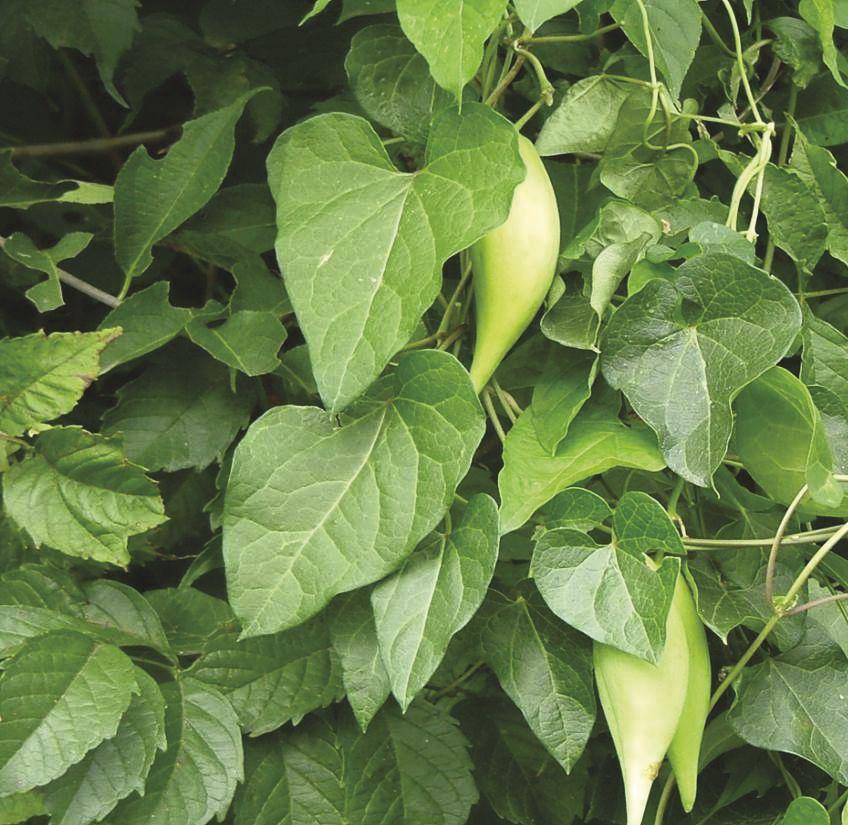
The September seed pods and lush leaves of Honeyvine.
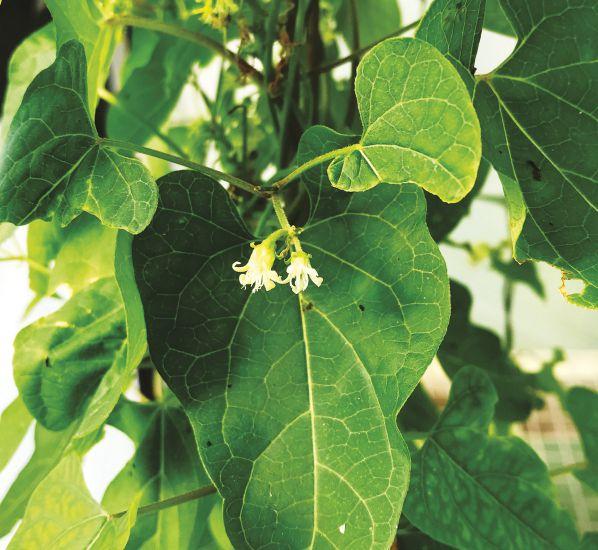
Honeyvine fowers do not resemble most milkweed fowers.
Kansas boasts 18 native milkweed species in the genus Asclepias, which includes many familiar friends such as Common, Swamp, and Butterfy milkweeds. In my garden these species share a common trait: by August, most have gone dormant until the next spring. This is a problem because Monarchs are still actively breeding and laying eggs in the central and southern Midwest (and elsewhere in their range). My garden's Monarch caterpillar population peaks in September. What are they to eat? Is there a native milkweed that persists into fall? Yes—but we must look beyond the familiar Asclepias genus.
A Native Solution
The genus Cynanchum in the Milkweed Family includes our native species, Honeyvine, a plant that is known by a multitude of other common names, including Angle Pod, Milkweed Vine, Climbing Milkweed, Sandvine, Bluevine, Dog's Collar, and Smooth Swallow-wort.
The perennial Honeyvine has large, bright-green, heart-shaped leaves, and aggressively twines up to 20 feet, attaching with modifed petioles. Superfcially, the small, white, vase-shaped fowers do not resemble milkweeds, but the large seedpods tell the truth: this is a milkweed pod that splits open to release fuff-attached seeds into the wind. Honeyvine is an ideal Monarch host, with tender leaves persisting until the hard freeze in November. And, unlike so many other species of milkweed, it does not wilt when picked and placed in water. This makes Honeyvine perfect for
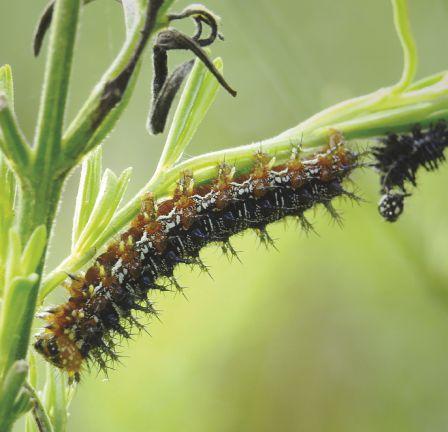
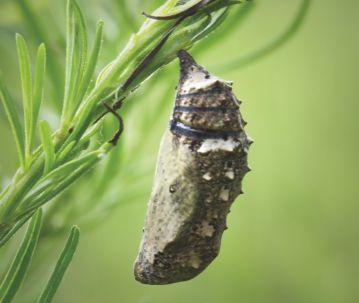
indoor caterpillar raising. An added advantage, most of the feeding Monarch caterpillars skip the wandering stage and pupate directly on the vine. It can be an aggressive spreader in an ornamental garden, so I have a designated area where I allow it to fourish where I have enough to pick to feed my indoor caterpillars. In other areas, I collect and destroy the seedpods and consistently cut back unwanted sprouts.
NOTE: Beware of the somewhat similar European Swallow-wort and Louise’s (aka Black) Swallowwort! In addition to being invasive in North America, these European species will trigger Monarch egg-laying, but they are so toxic that the frst-instar Monarch caterpillars are do not survive. Do not plant them!
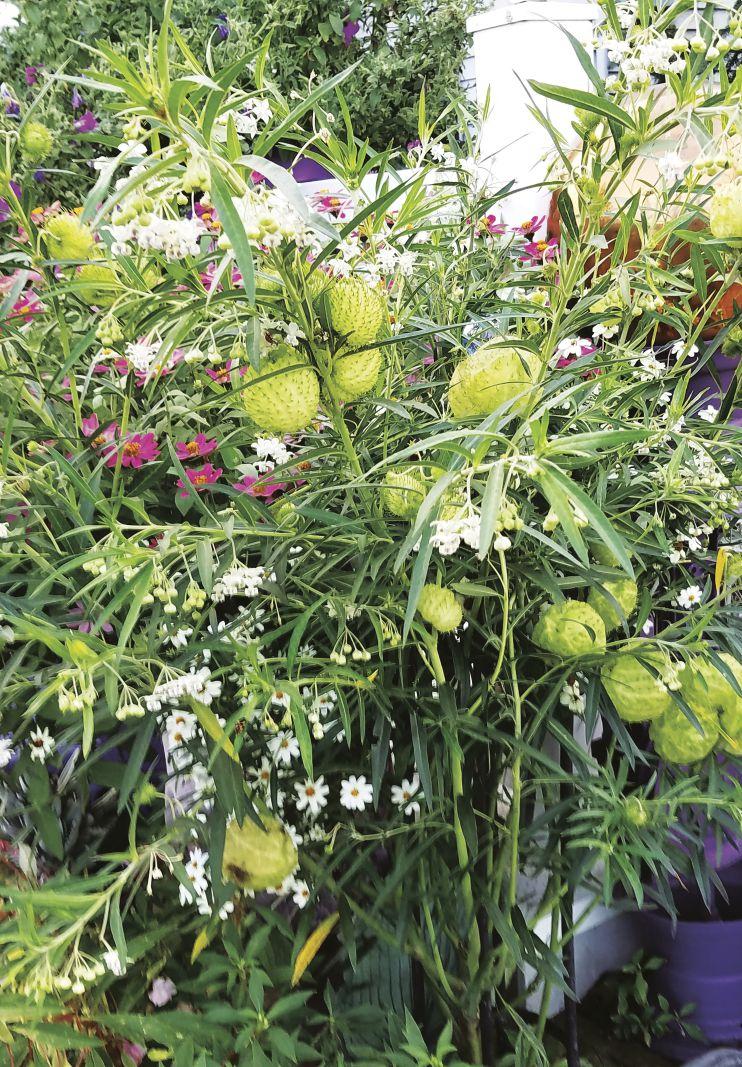
Balloonplant makes a stunning specimen plant.
Some Exotic Options
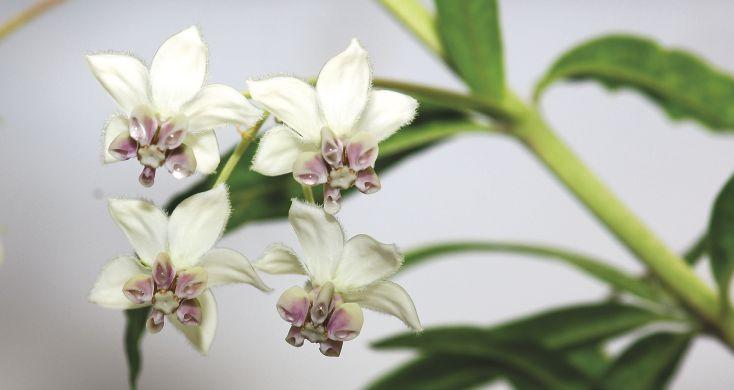
In its native southern Africa, Balloonplant is a tropical perennial. Where I live in zone 6, Balloonplant is an annual. It grows from seed to an eight-foot giant in a mere three months and continues lush until the frst frost in mid-November. The fragrant pale pink fowers are produced continuously even as the seed pods appear by early August. Balloonplant will reseed itself if one has multiple plants for cross pollination.
Balloonplant fowers seem to drip with nectar.
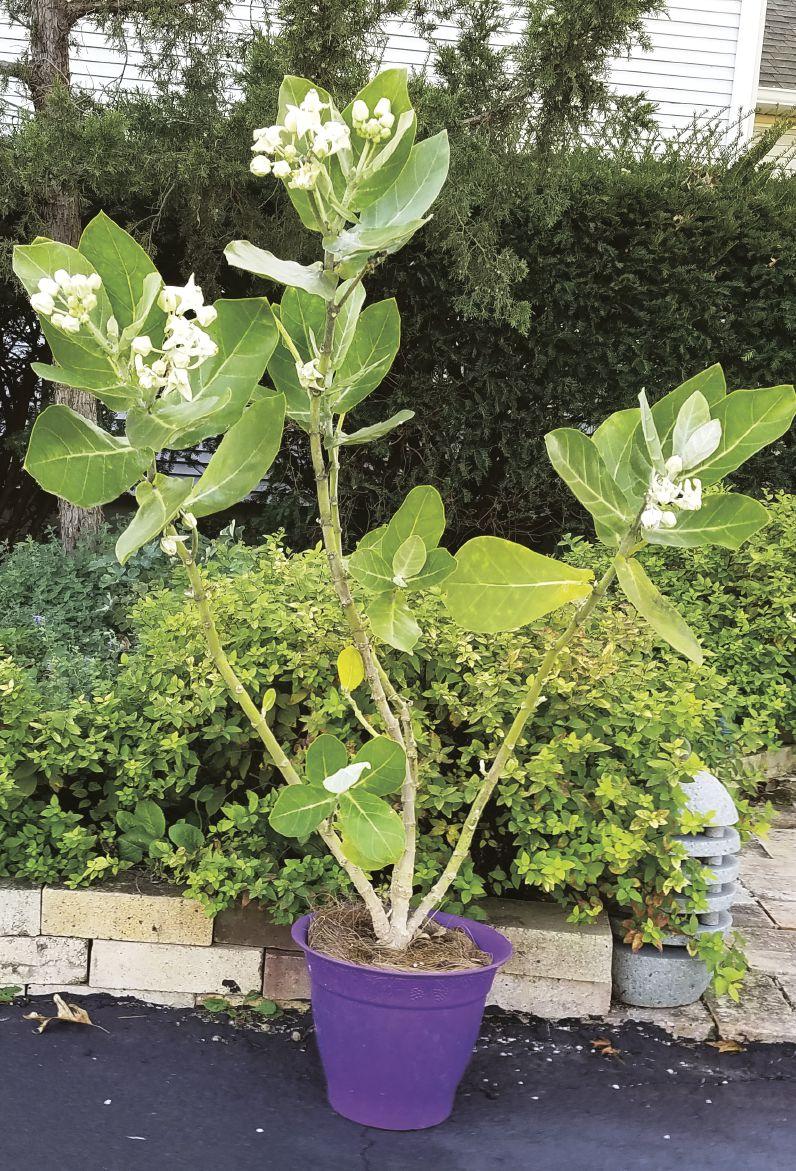
Above: If Giant Milkweed is planted in the ground it will form a taproot which makes removal for overwintering inside almost impossible.
A Large Consideration
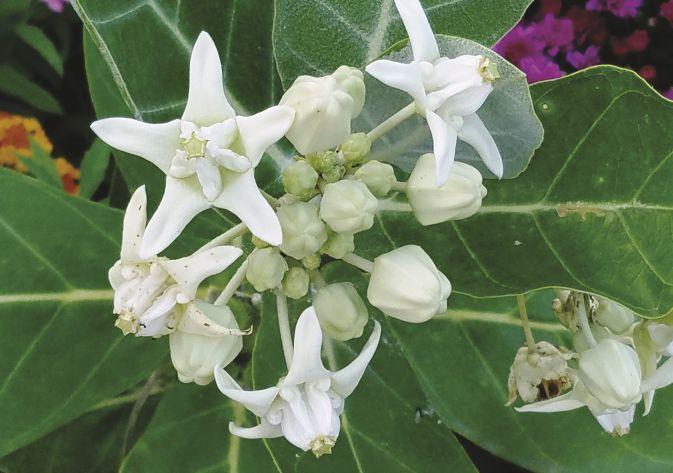
Giant Milkweed is a small tree that can grow up to 8-15 feet in its native Asia and tropical Africa. It has large furry leaves and waxy white fowers with the familiar milkweed hood/ horn structure. The similarappearing but smaller Roostertree has lavender fowers and also serves as a host for Monarchs and as a decorative fower for arrangements.
Giant Milkweed is popular at our Master Gardener plant sale each spring, not only because of its striking tropical appearance and continuous blooming, but also because the non-wilting stems are convenient for indoor caterpillar raising.
Right: Giant Milkweed fowers.
We propagate Giant Milkweed by cuttings since none of our plants have produced seeds. A 6" rooted cutting purchased in April and placed in a large container will grow to 8 feet its frst summer. These tender perennials must be housed in a greenhouse over winter where they will continue blooming and eventually surpass 10 feet in subsequent years.
Summary
Gardening is a complex hobby because every gardener is different and no perfect plants exist. Year to year, garden conditions can fuctuate widely, so providing multiple species of caterpillar food plants can be your insurance strategy against failure. Searching for new species of caterpillar food plants is exciting for long-time butterfy gardeners, plus the newcomers may solve horticultural or caterpillarraising dilemmas.
Editor’s Notes:
1.Balloonplant is winter hardy to USDA Zones 8-10. It is an invasive self-seeder in tropical areas, and has naturalized as a pasture weed in Hawaii.
2.Giant Milkweed is considered invasive in Hawaii. It is hardy to USDA zones 11-12.
3.See “Managing Milkweed” in the Summer 2018 Butterfy Gardener for suggestions to extend Common Milkweed’s season as a caterpillar food.
4.The USDA classifes Milkweed in its own family, Asclepiadaceae. Not all botanical authorities agree. Some classify it as part of the Dogbane family, Apocynaceae, while others classify it as a subfamily of the Dogbane family. (Pesky botanists!)
Extension Master Gardener and a member of the Idalia Butterfly and Kansas Native Plant Societies. She loves to garden and host butterflies in the cruel winds and clay soils of Paola, Kansas. She may be contacted at lenora. longlips@gmail.com
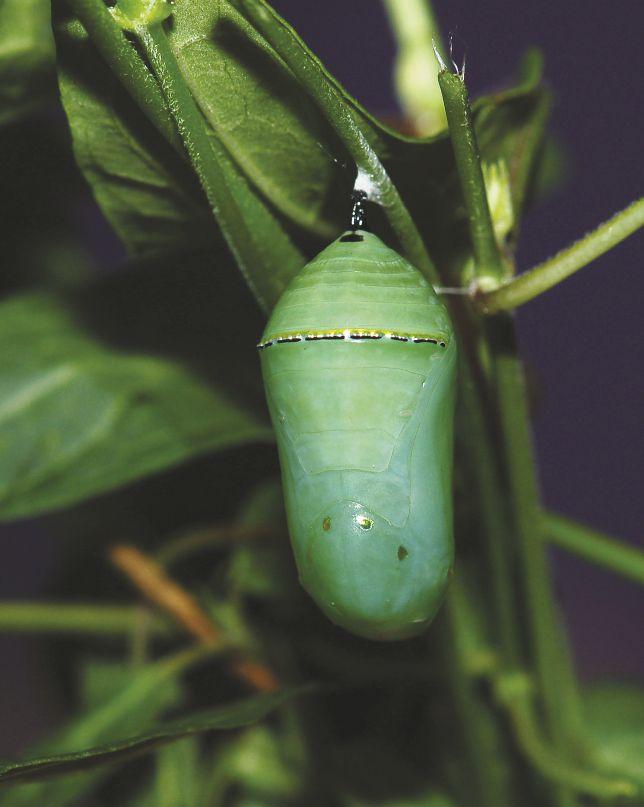
In my experience, Monarch caterpillars pupate on Honeyvine rather than wander off the milkweed which is more the norm.
Book Review by Mary Anne Borge
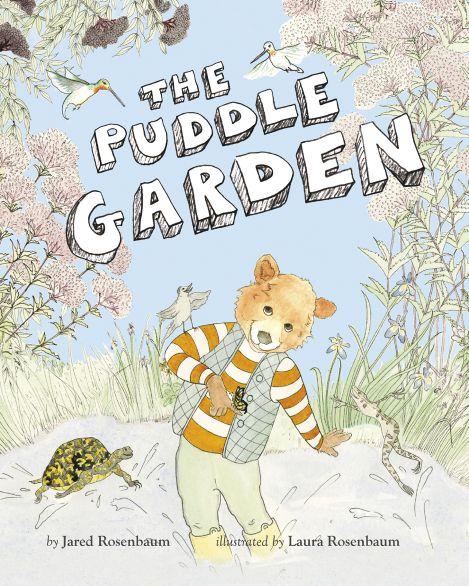
Looking for a good way to introduce a child to the relationships between plants and animals, and the pleasures and rewards of gardening? The Puddle Garden by Jared Rosenbaum might be the answer.
Targeted at two- to eight-year-olds, the story introduces young Bear Cub, whose family has just moved to a new house surrounded by nothing but lawn. He looks for frogs, birds, butterfies, dragonfies, and turtles to play with in his new surroundings, but doesn’t fnd any. This makes Bear Cub feel sad and lonesome, so he goes to his Papa bear for help in fnding a way to invite some playmates to join them. Together they make a plan to provide a welcoming place for wildlife. Working with Mama bear, they create a native plant garden that provides food, water, and shelter for neighboring creatures. Success! Playmates for Bear Cub quickly appear.
The lovely illustrations by Laura Rosenbaum make the story come to life in such a way that you feel like you’re experiencing the garden. As I read through the book I could feel the calming effects of being in a garden.
This simple story shows the dependencies between plants and animals very effectively. It’s an invitation to engage in a project like this with your own favorite child, and is also a blueprint for how to go about it.
The Puddle Garden is available from Wild Ridge Press at http://www.thepuddlegarden.com.
For the Love of Butterflies
Please photocopy this membership application form and pass it along to friends and acquaintances who might be interested in NABA.
www.naba.org
Yes! I want to join NABA and receive American Butterflies and Butterfly Gardener and/or contribute to the creation of the premier butterfly garden in the world, NABA’s National Butterfly Center. The Center, located on approximately 100 acres of land fronting the Rio Grande in Mission, Texas, uses native trees, shrubs and wildflowers to create a spectacular natural butterfly garden that significantly benefits butterflies, an endangered ecosystem, and the people of the Rio Grande Valley.
Name:
Address:
Email:
Telephone:
Special Interests (circle): Listing, Gardening, Observation, Photography, Conservation, Other:
For a $35 donation, one receives NABA publications as either digital or print. All higher levels of donations receive both digital and print versions. Outside the U.S., only digital is available, at any donation level.
Tax-deductible dues (donation) enclosed (circle): Regular $35 (must choose either digital or print — circle one), Family $45. Special sponsorship levels: Copper $55; Skipper $100; Admiral $250; Monarch $1000. Institution/Library subscription to all annual publications $60. Special tax-deductible contributions to NABA (please circle): $125, $200, $1000, $5000. Mail checks (in U.S. dollars) to NABA, 4 Delaware Rd., Morristown, NJ 07960.
Article and Other Submissions
Articles, gardening tips and observations, artwork, digital high resolution photographs, poetry and comments will be considered for publication. Contact Jane Hurwitz, Editor, hurwitz@naba.org
Advertising
Butterfly gardener welcomes advertising. Please contact us for current rates and closing dates at naba@naba.org, or telephone 973.285.0907, or fax 973.285.0936
Membership Services
If you have questions about duplicate magazines, missing magazines, membership expiration date, change of address, etc., please write to NABA Membership Services, 4 Delaware Rd., Morristown, NJ 07960. Occasionally, members send membership dues twice. Our policy in such cases, unless instructed differently, is to extend membership for an additional year. NABA sometimes exchanges or sells its membership list to like-minded organizations that supply services or products that might be of interest to members. If you would like your name deleted from membership lists we supply to others, please write and inform us at: NABA Membership Services, 4 Delaware Rd., Morristown, NJ 07960.