Butterfy Garden Journal: Common and Uncommon Butterfies in the North Woods
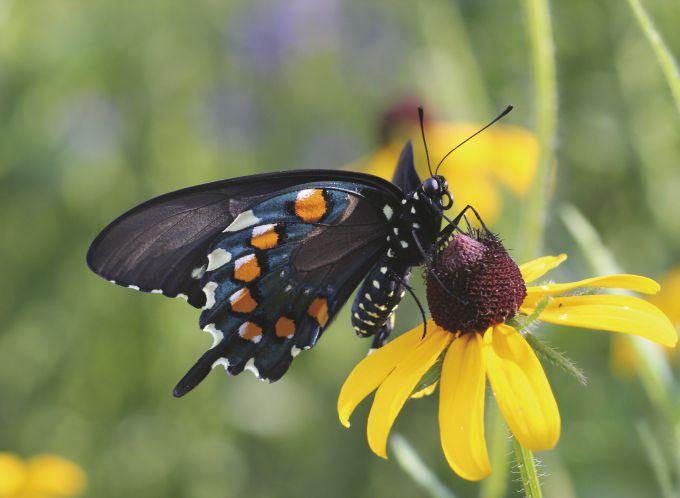
Wanted Alive in Your Garden: Pipevine
Swallowtail Caterpillar
On a sunny day in early fall, as I walk the ffty steps from my front door to the garage I might count a dozen butterfy species. It is true that I often walk very slowly, stopping along the way to watch the butterfy activity, taking twenty minutes to get to the car rather than one.
Over the years I have learned what nectar plants work in my garden to draw in butterfies and I grow these A-list plants along the path I walk daily. Zinnias, Eastern Purple Conefower, Purpletop Vervain, and Phlox ‘Jeana’ provide fowers from June until frost, ensuring that I will consistently be late for appointments many months of the year.
Butterfy Gardener used to run a regular feature titled “Butterfy Garden Journal” and I am happy to report that it has returned in this issue. Allison Snopek Barta sent in photos along with a brief email detailing a few highlights from her butterfy garden. That was all that was needed to revive the journal.
“Butterfy Garden Journal” shares with our readership small victories and lessons learned. Only a few short paragraphs are needed to have your garden story run in the journal. As the butterfy season wanes for many, take time to think back on the season in your area. What plants stood out? Did you have a newto-you butterfy visit your garden? Do you have a photo with a story behind it? What has been happening in your butterfy garden that has had the potential to make you late as you hurry out to work or to have coffee with a friend? Share your experiences with Butterfy Gardener and possibly be featured in “Butterfy Garden Journal.”
Editor: Jane Hurwitz Associate Editor: Mary Anne Borge
We want to hear from you! Please send Butterfy Gardener correspondence and submissions to: Jane Hurwitz, Editor, NABA, 4 Delaware Road, Morristown, NJ 07960; hurwitz@naba.org
Articles, gardening tips and observations, artwork, digital high resolution photographs, poetry and comments will be considered for publication. Please send self-addressed stamped envelope for items to be returned.
Advertising
Butterfy Gardener welcomes advertising. Please write us at: Butterfy Gardener, 4 Delaware Road, Morristown, NJ 07960, or telephone (973) 285-0907 or fax (973) 285-0936 for current rates and closing dates.
Membership Services
For questions concerning membership issues, magazines, or changes of address, please write to NABA Membership Services, 4 Delaware Road, Morristown, NJ 07960. Occasionally, members send membership dues in twice. Our policy in such cases, unless instructed otherwise, is to extend membership for an additional year.
Zinnias for Butterflies--and the Kitchen Table
Photos and Text by Gary Noel Ross, Ph.D.
The garden-variety zinnia has been around for a long time. You know, those large colorful flowers that were a mainstay of summer cottage gardens, and when cut and placed into a vase, were a showy centerpiece for the kitchen table?
Well, the zinnia is still going strong. And for butterfly aficionados, the plant is now recognized as a numero uno component of a pollinator garden—even in highly urbanized landscapes. In fact, I dare say that zinnias are the hardest-working flowers in the summer garden of any size.
So, what is this super plant?
The zinnia belongs to the aster family. Hallmarks include multi-petals arranged in a starburst pattern, as the name “aster” implies; centers are usually open to accommodate the reproductive stamens and pistils. Several species are native to the drier regions of the U.S., Mexico, and Central and South America. (By the way, the name zinnia honors the eighteenth-century German anatomist and botanist Johann Gottfried Zinn.)
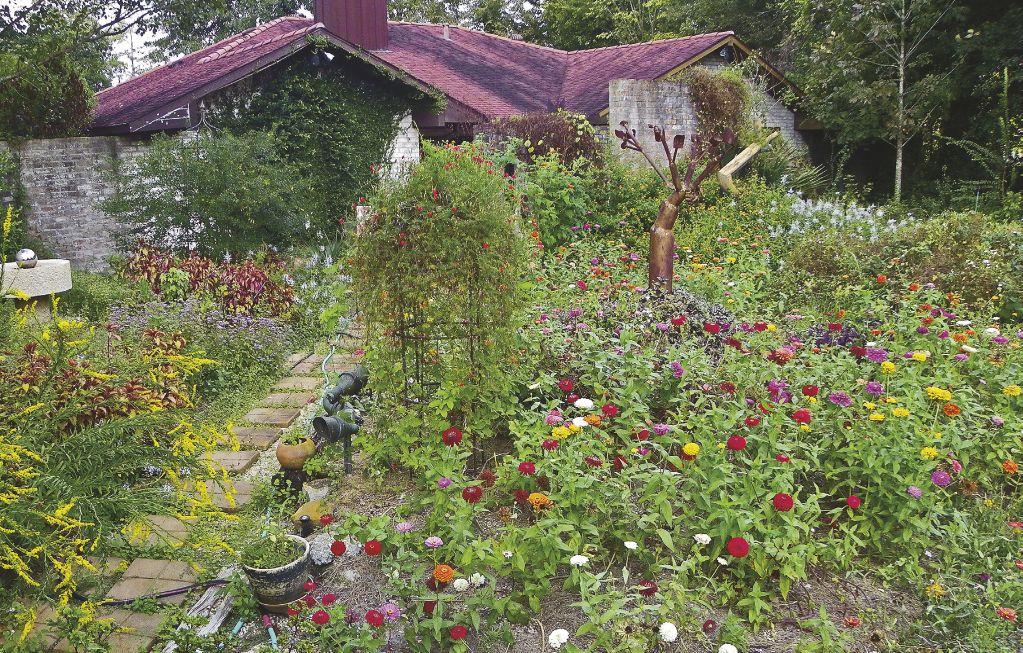
Photo above: Zinnia planting in author’s pollinator garden in Baton Rouge, Louisiana.
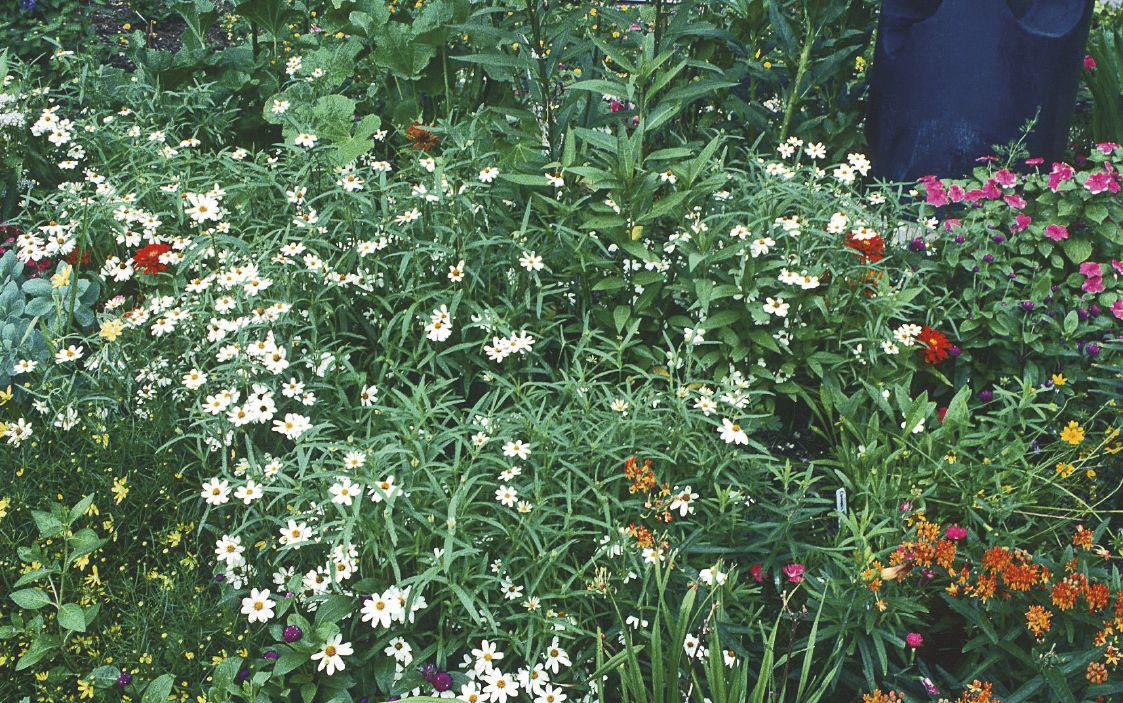
Photo lower right: A sidewalk bed featuring “Crystal Series,” a spreading/dwarf zinnia form. “Crystal White” and “Star Orange” forms are more prominent than “Star Gold.”
Although wild plants produce flowers that are small, single, and usually restricted to yellow and orange, hybrids can reach the size of a saucer and sport colors that span the spectrum—except for blue. Flower shape is always circular, of course. But the petals can vary from a single whorl to multi-tiers, to even “pompomesque.” But for pollinators, the fewer the petals, the more reproductive structures (pistils and stamens), and hence, more nectar and pollen.
Over the years, horticulturists have tweaked the genetics of two wild zinnias (Z. elegans and Z. augustifolia, both native to Mexico) by cross-pollinating. The goal has been to create plants that are more robust and more resistant to moisture in both soil and air. (Historically, excessive moisture tends to foster mildews that create powdery leaves and brown leaf spots. For that reason, zinnias inherently thrive best in climes that have rainfall below 40 inches per year and where nighttime temps routinely drop below 70 degrees F.) Today, scientific diligence has produced several varieties that are relatively tolerant to the sultry days and nights of even the Deep South, and like their ancestors, still resistant to heat and drought.
Zinnias can be separated into two basic categories: tall and spreading. First, the tall. I have found that here in the Deep South, the variety known as “Benary’s Giant Mix” does best. Up to three or four feet in height, the plants are topped by large flowers in a seemingly endless variety of colors and shapes—all with long stems. Swallowtails are particularly drawn to the flowers since the massive flower heads serve as excellent landing platforms. Two cautionary notes: First, Benary’s are subject to mold. I compensate by discarding my plants in early August. I then sow another set, and that guarantees a showcase bloom all the way until frost. And second, because of their height, Benary’s often succumb to the wind. But this can be offset by planting in dense clusters or near a wall.
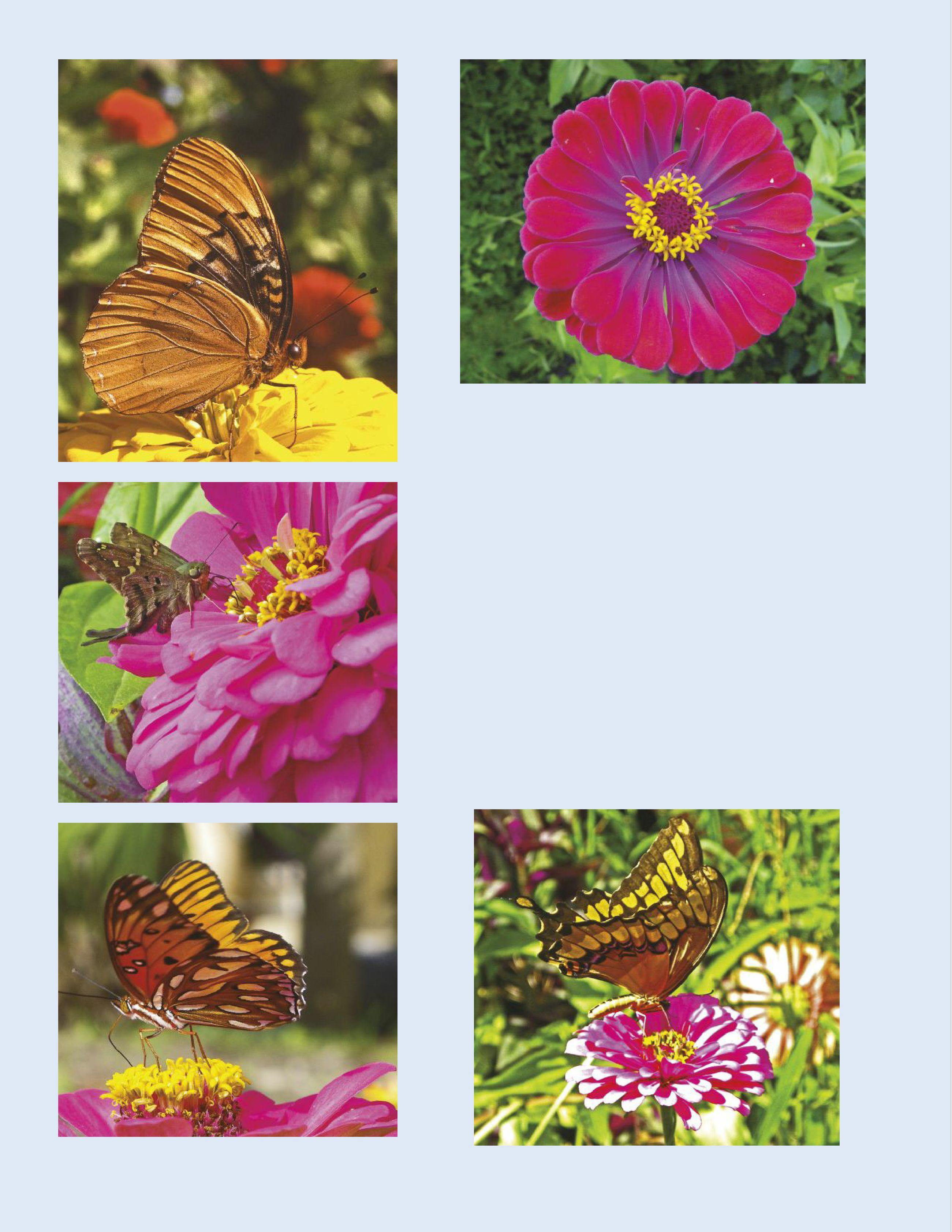
Male Diana Fritillary on triple form of "Benary's Giant Mix" in a rural garden on Mt. Magazine, AR.
Single form of “Benary’s Giant Mix.” This form with its numerous reproductive parts is the most attractive to pollinators.
Giant Swallowtail on double form of "Benary's Giant Mix."
Gulf Fritillary on single form of “Benary’s Giant Mix.”
Long-tailed Skipper on double form of "Benary's Giant Mix."
Clockwise from upper left:
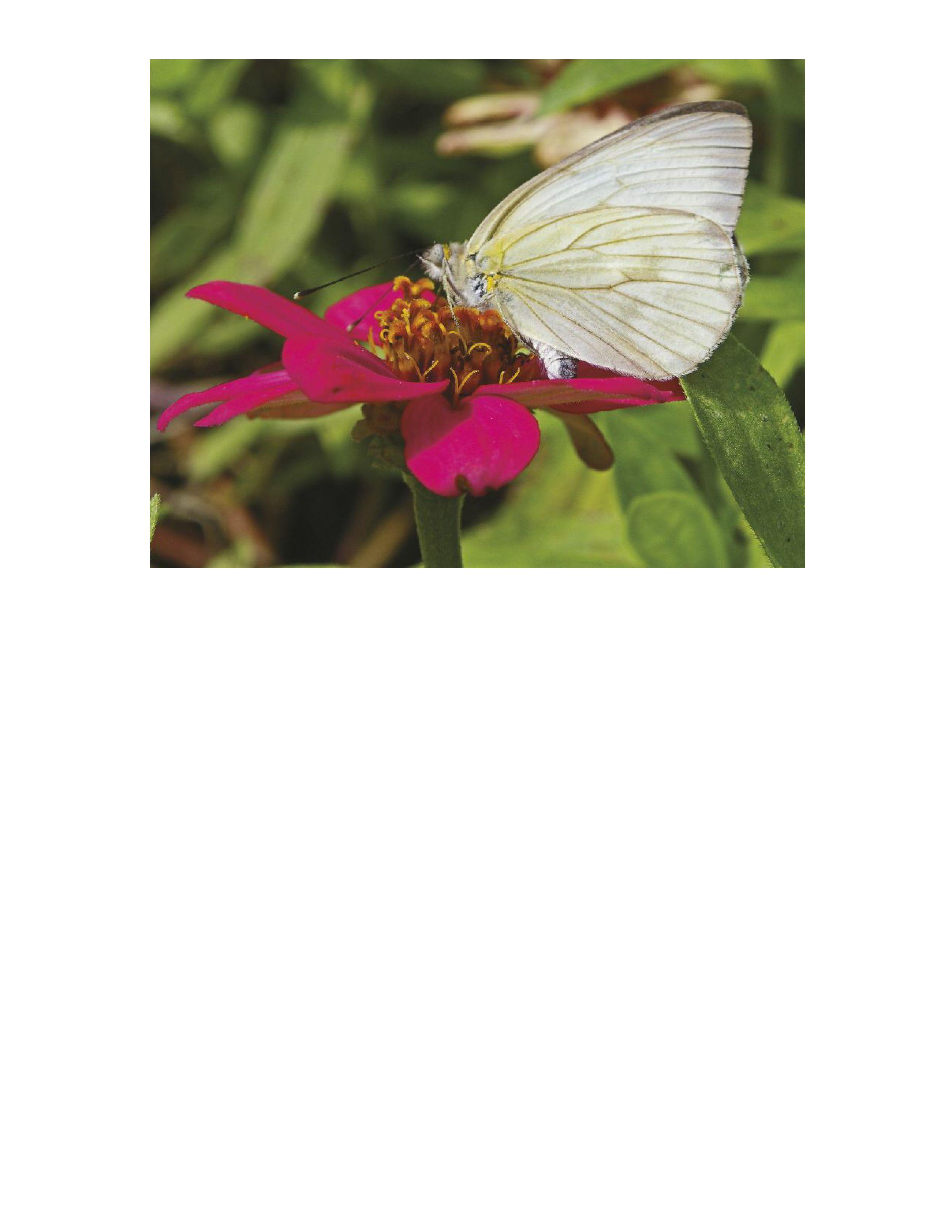
Great Southern White on compact, dwarf "Zahara" series, a mildewresistant cultivar for the South
One of the oldest spreading varieties is the “Crystal” series featuring “Crystal White,” “Star Gold,” and “Star Orange.” These are narrow-leaf forms that resemble their wild ancestors. Plants remain short but tend to become rather leggy. Flowers are small, single, and open. These plants are especially attractive to small butterflies such as skippers.
The most popular spreading zinnias are the “Profusion” and “Zahara™” series. Both are lowgrowing, compact, and produce medium-sized, tight flower heads in a wide range of color— “Zahara” more so than “Profusion.” In addition, flowers of “Zahara” exhibit less fading with age. Both series are noticeably resistant to mildews. Another advantage: no need to deadhead. Fresh flowers attract butterflies of all sizes.
But whichever variety you select, butterflies and other insect pollinators will be “magnetized.” As a lagniappe, all varieties are easily started from commercially available packets of seed or seeds that you reserved from your previous year. Just make sure your flower beds are in full sun and filled with loose, well-drained soil. And NEVER OVERWATER since zinnias are highly tolerant of drought conditions. One last point: fertilize when the plants are young, but then back off. Excessive nitrogen stimulates vegetative growth with a reduction in flowers. Bottom line, respect the zinnia’s heritage and you will be rewarded with an abundance not only of flowers but also of butterflies and other pollinators.
Gary Noel Ross is a frequent contributor to Butterfy Gardner. He lives in Baton Rouge, LA and maintains a zinnia garden each summer.
Sowing the Seeds of the Future
Text
and
Photos by Ellen Federico
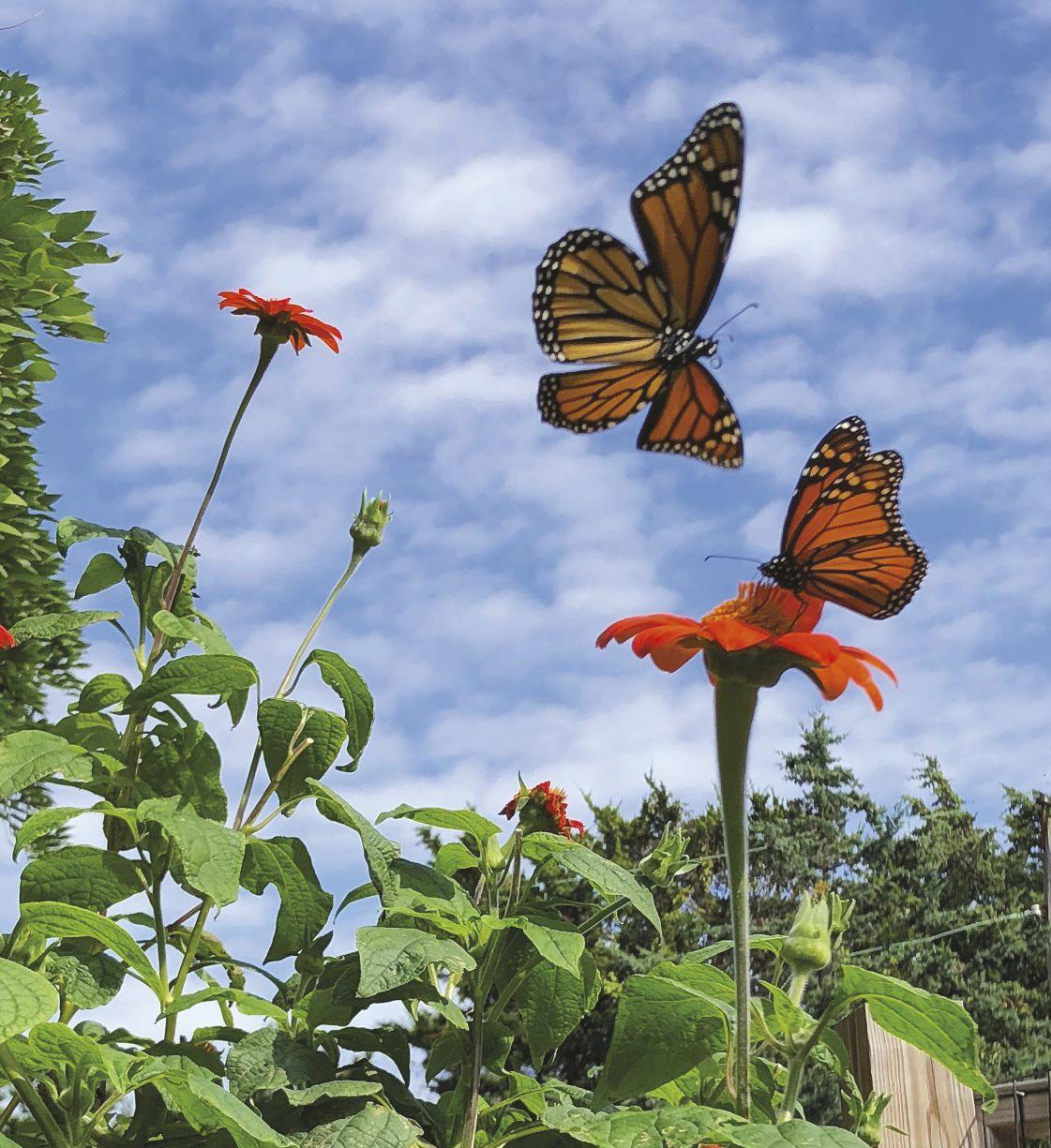
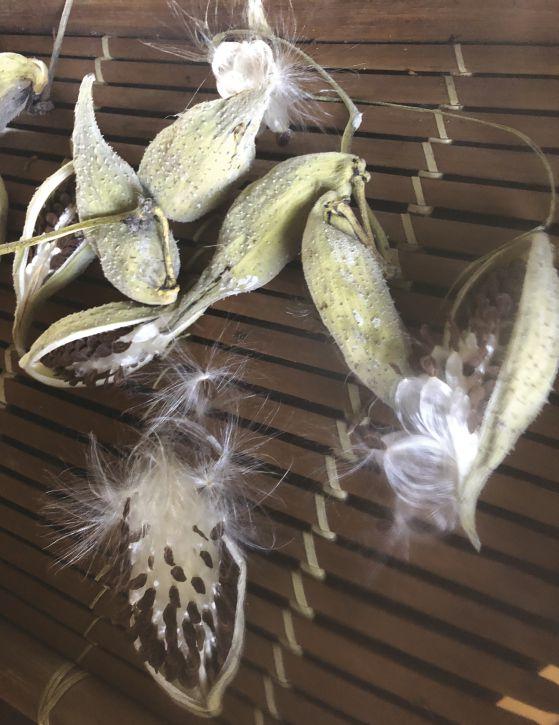
When the children on Fire Island scatter milkweed seeds in fall, they do it with high expectation because they know that, if we plant the seeds, the Monarchs will come.
Fire Island is a barrier island three miles south of Long Island, New York, and a super fyway for migrating Monarchs that glide our dune thermals, lay eggs on native milkweed, nectar on fowers, and sip salt from sand. This summer our Common Milkweed is abundant and tall, waving orbs of fragrant blossoms to attract the royal Monarch butterfy.
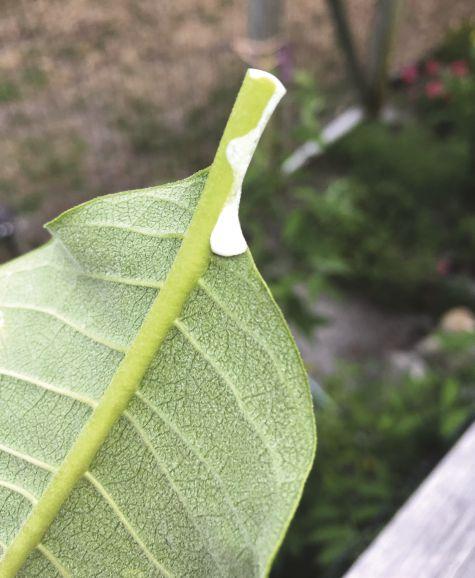
Carl Linnaeus frst identifed the genus and named it Asclepias after the Greek god of healing. Its common name, milkweed, refers to the milky latex sap that is exuded when a stem or leaf is broken.
Native Americans used milkweed sap to remove warts and the roots were steeped to treat pleurisy. Today medical researchers are studying milkweed in the fght against cancer and organic farms in the Midwest are growing milkweed to extract the oil in seeds as a topical remedy to relieve arthritis, asthma, and muscle pain.
Use caution when handling milkweed. The milky sap that seeps from broken stems and leaves can cause skin irritation.
In Lonelyville, a small beach community on the western end of Fire Island, our Monarch habitat is planted with Common and Swamp Milkweeds in addition to nectar plants such as Mexican sunfowers, Nippon Daisies, and Alpine Asters. Towering above the milkweed and other fowers, an abundance of cedar trees offer perfect overnight roosting so the migrating Monarchs can rest on their long journey.
The local children are avid citizen scientists who help tend the habitat. Our goal is to engage neighbors to sow Common Milkweed seeds gathered from established plants and scatter the seeds across 5000 acres of Fire Island grasslands. This is an excellent activity for families, schools, or community social gatherings.
When the shadow of a butterfy crosses our path, we look up by some silent command and our spirits lift. The extraordinary migration of Monarch butterfies reminds us how precious they are, and the safety of their future lies in our hands. If seeds contain genetic information to produce tomorrow’s promise of new growth, so do our children.
An educated futter can heal the world.
Ellen Federico operated a successful corporate meeting planning frm in Manhattan for 32 years. Now she travels, writes, and maintain a Monarch habitat in Fire Island, New York.
Butterfy Garden Journal
Common and Uncommon Butterfies in the North Woods
Text and Photos by Allison Snopek Barta
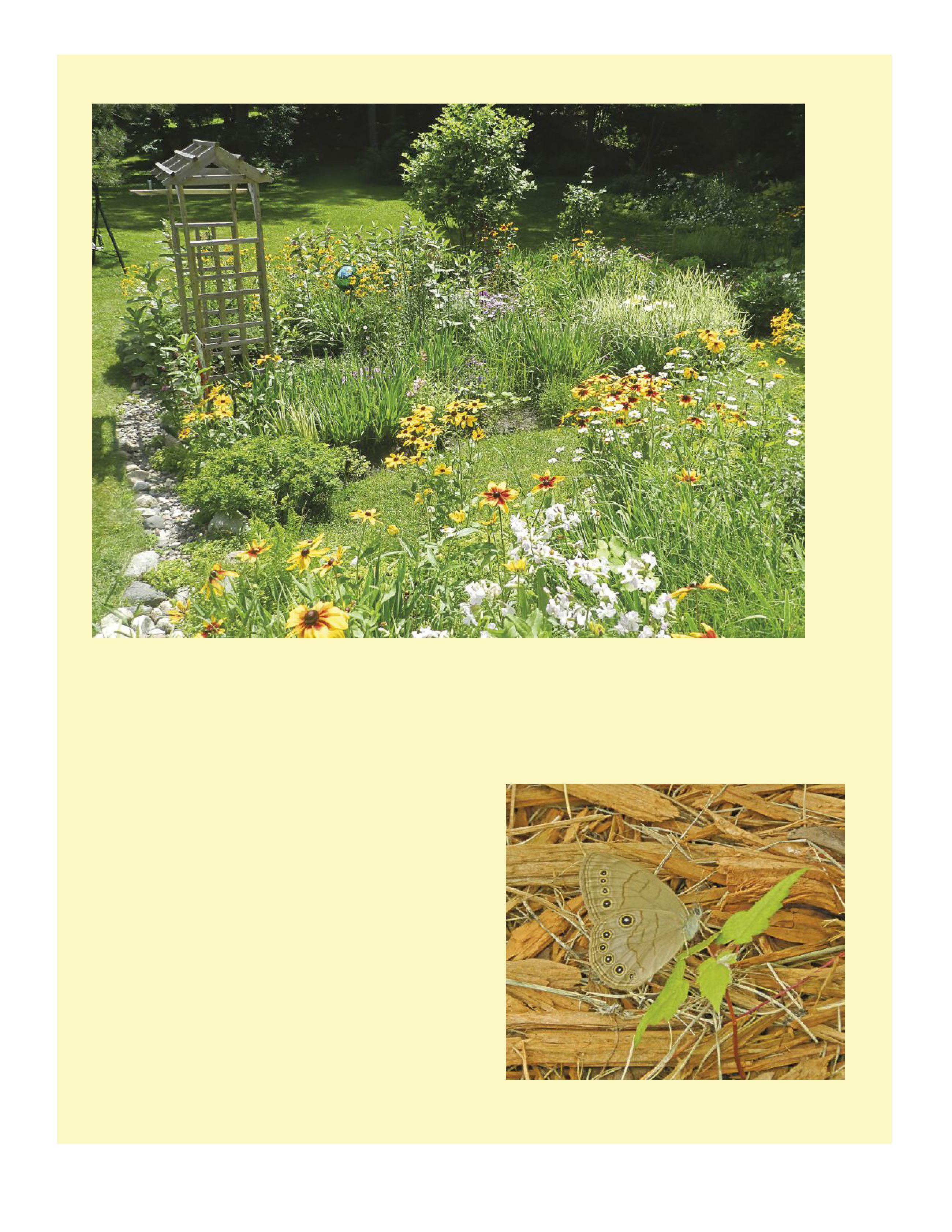
My garden keeps growing and the butterfies keep arriving. This summer I was really surprised to discover an Appalacian Brown in my yard and garden. This was a frst time sighting in my garden––I usually only see this species in swampy areas about two miles from my house. It apparently few up from a nearby swamp, liked my garden better, and stayed.
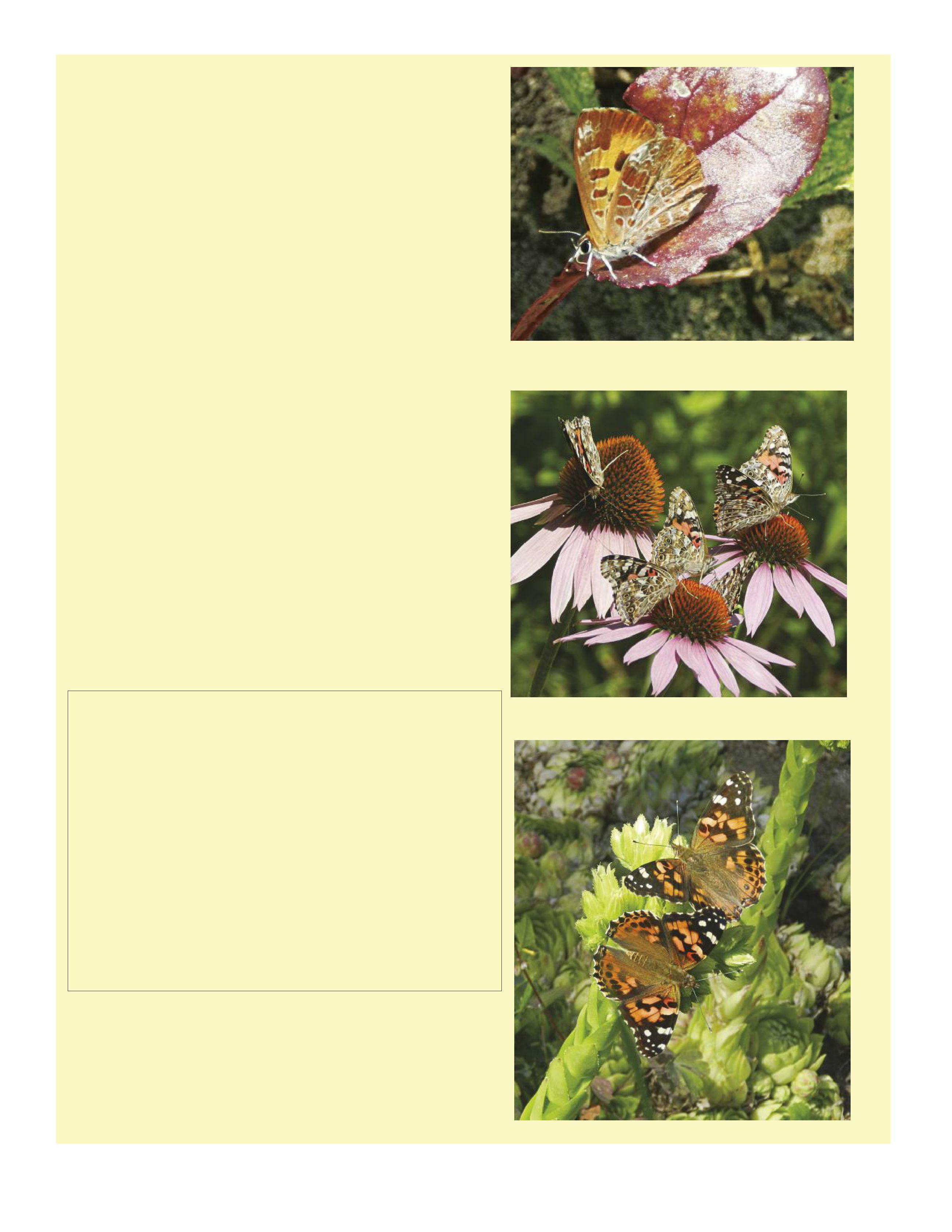
Later in the summer I was shocked to have another frst time sighting in my garden. While mowing our yard I came across a Harvester! It is rare for me to fnd this species in any of my usual observation locations here on Oak Point, Minnesota. If you fnd one I hope you get some
Top photo: Allison’s garden. Above: Appalachian Brown
photos because it is an uncommon sighting. Much to my surprise I saw two in our yard, and another individual in a yard of a nearby neighbor. With some effort, I was able to get a nice photo of it on a beet leaf in my garden.
As of September 1st, I've seen and photographed 29 species in my fower garden this summer and enjoyed watching Monarch caterpillars grow and emerge as adult monarchs.
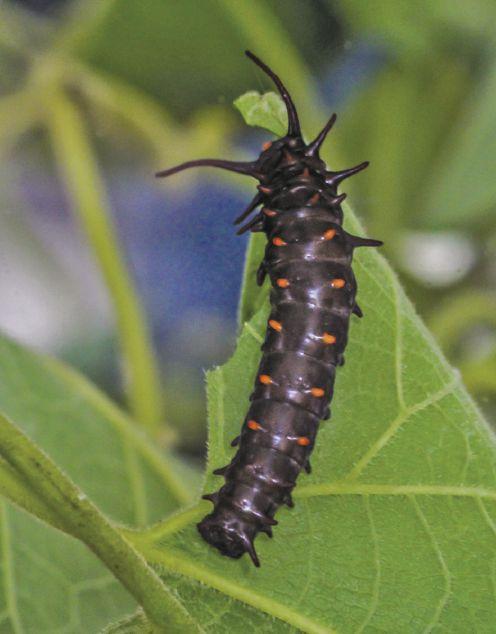
With summer coming to an end, the Monarchs left on their journey south and I thought the butterfy season was over. But much to my surprise more than 50 Painted Ladies arrived over Labor Day weekend turning my garden into a Butterfy Show! What a joy to see them all!
I was so surprised to see so many Painted Ladies in my fower garden, that I got in my car and drove all around Oak Point to see if this phenomenon was occurring anywhere else. It wasn’t. At each observation site I only saw a few Painted Ladies. I wonder what will happen next in this fower garden I built ?
Allison Snopek Barta is a lifelong advocate of butterflies. She has been recording her Minnesota butterfly observations for many years and has compiled her sightings into a presentation titled “On the Hunt for the North Woods Butterflies.” She hopes to publish her photos and observations after finding and photographing just two more species (Olympia Marble and Red-disked Alpine), which will bring her total observations to 90 species for northern Minnesota.
Top photo: Harvester.
Middle photo: Painted Ladies
Bottom photo: Painted Ladies
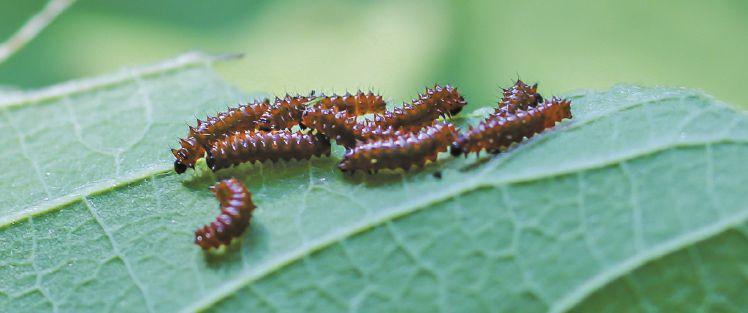
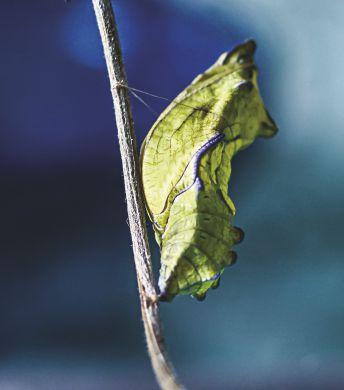
Pipevine Swallowtail Caterpillar
Text and Photos by Jan
Dixon
Known disguises:
Pipevine Swallowtail caterpillars are usually dark brown to black, although a dark-red form does occur as well. Bright-orange rounded projections (called tubercles) run in rows along the body, sending a signal to possible predators that “I don’t taste good!”
Special weaponry: Pipevine Swallowtail caterpillars sequester aristolochic acids from their food plants. These toxins protect them from predators through the rest of their life cycle, from caterpillar to pupa to butterfy, and even to the eggs of the next generation. The thick outer layer of the caterpillar’s exoskeleton resists damage from pecks and bites while releasing a bitter-tasting liquid that is an efective deterrent to attackers.
The caterpillars are quite gregarious in the early stages of development. They hang out in groups, subscribing to the “safety in numbers” philosophy of defense.
Like other swallowtail caterpillars, those of Pipevine Swallowtail can evert osmeteria from their heads that release ofensive chemicals when the caterpillar feels threatened.
Known Food Preferences:
Pipevine Swallowtail caterpillars feed on many plants in the genus Aristolochia (Dutchman’s Pipe). While there are many native Dutchman’s Pipe species to choose from, many of the tropical Dutchman’s Pipes are toxic to Pipevine Swallowtail caterpillars, although females may lay eggs on these species.
Native Dutchman’s Pipe species that support Pipevine
Swallowtail caterpillars
Pipevine (Aristolochia macrophylla)
Woolly Dutchman’s Pipe (Aristolochia tomentosa) Texas Dutchman’s Pipe (Aristolochia reticulata) California Dutchman’s Pipe (Aristolochia californica) Virginia Snakeroot (Aristolochia serpentaria)
Tropical Dutchman’s Pipes that are toxic to Pipevine
If capture is avoided: The caterpillar usually leaves its food plant for a suitable site for its next phase, pupation. Pupae can be green or brown, depending on the surface to which they are attached, and are often placed off the ground on tree trunks. There are two generations in the northern part of its range, 3 or more in the southernmost part. Pupae overwinter, with a new generation of butterflies emerging in spring.
The Pipevine Swallowtail has a wide distribution across the United States, from southern Connecticut and New York west to southern Nevada, and south to Florida and Mexico. It may stray further north. This beautiful swallowtail can be found in woodlands, meadows, and backyard gardens where the host plant is found.
Jan Dixon enjoys observing caterpillars, almost as much as adult butterfies, and has raised ten species from her gardens. She volunteers as a butterfy monitor at the Nature Conservancy’s Kitty Todd Preserve in Northwest Ohio and is on the board of the Oak Openings Region chapter of Wild Ones. She also enjoys teaching about butterfy gardening.
Edited
by Stephen Love | ISSN: 1522-8339, e-ISSN: 1548-4785, 3/year
Native Plants Journal is a forum for dispersing practical information about planting and growing North American (Canada, Mexico, and U.S.) native plants for conservation, restoration, reforestation, landscaping, highway corridors, and related uses. Topics include seed germination, planting techniques and tools, equipment, cultural techniques, production trends, seed collection, genetics, and fertilization. The second issue of each year includes the Native Plants Materials Directory, which provides information about producers of native plant materials in the U.S. and Canada. Relevant books are reviewed. Subscribers receive online access to all back issues. Volumes one through fve are open access and available to all.
Native Plants Journal began in January 2000 as a cooperative efort of the USDA Forest Service and the University of Idaho, with assistance from the USDA Agricultural Research Service and the Natural Resources Conservation Service.
journals@uwpress.wisc.edu
For the Love of Butterflies
Please photocopy this membership application form and pass it along to friends and acquaintances who might be interested in NABA.
www.naba.org
Yes! I want to join NABA and receive American Butterflies and Butterfly Gardener and/or contribute to the creation of the premier butterfly garden in the world, NABA’s National Butterfly Center. The Center, located on approximately 100 acres of land fronting the Rio Grande in Mission, Texas, uses native trees, shrubs and wildflowers to create a spectacular natural butterfly garden that significantly benefits butterflies, an endangered ecosystem, and the people of the Rio Grande Valley.
Name:
Address:
Email:
Telephone:
Special Interests (circle): Listing, Gardening, Observation, Photography, Conservation, Other:
For a $35 donation, one receives NABA publications as either digital or print. All higher levels of donations receive both digital and print versions. Outside the U.S., only digital is available, at any donation level.
Tax-deductible dues (donation) enclosed (circle): Regular $35 (must choose either digital or print — circle one), Family $45. Special sponsorship levels: Copper $55; Skipper $100; Admiral $250; Monarch $1000. Institution/Library subscription to all annual publications $60. Special tax-deductible contributions to NABA (please circle): $125, $200, $1000, $5000. Mail checks (in U.S. dollars) to NABA, 4 Delaware Rd., Morristown, NJ 07960.
Article and Other Submissions
Articles, gardening tips and observations, artwork, digital high resolution photographs, poetry and comments will be considered for publication. Contact Jane Hurwitz, Editor, hurwitz@naba.org
Advertising
Butterfly gardener welcomes advertising. Please contact us for current rates and closing dates at naba@naba.org, or telephone 973.285.0907, or fax 973.285.0936
Membership Services
If you have questions about duplicate magazines, missing magazines, membership expiration date, change of address, etc., please write to NABA Membership Services, 4 Delaware Rd., Morristown, NJ 07960. Occasionally, members send membership dues twice. Our policy in such cases, unless instructed differently, is to extend membership for an additional year. NABA sometimes exchanges or sells its membership list to like-minded organizations that supply services or products that might be of interest to members. If you would like your name deleted from membership lists we supply to others, please write and inform us at: NABA Membership Services, 4 Delaware Rd., Morristown, NJ 07960.