


Jane Hurwitz Is Retiring as Editor of BG. The next issue of Butterfy Gardener is slated to be Jane Hurwitz’s last issue as editor. Jane created nine great years of Butterfy Gardener magazines and it will be diffcult, if not impossible, to fnd someone with all of her talents. Thanks Jane, NABA and its members truly appreciate all that you’ve done. We all wish Jane the best of luck with her new endeavors.
NABA is seeking an editor for Butterfy Gardener magazine who will acquire, edit, and format articles for each quarterly issue.
Responsibilities include: soliciting articles and photographs, editing submissions, maintaining a content style that is consistent with NABA’s goals and mission, coordinating with NABA members, staff, and printer.
If you have experience and knowledge of butterflies, gardening, and native plants. Strong proofreading, editing, and fact-checking skills NABA would welcome your application. Proficiency with Microsoft Word, Adobe Photoshop, and InDesign are strong pluses as is an ability to work independently as well as collaboratively.
Compensation includes a very modest honorarium and great satisfaction.
NABA is offering free trial memberships to people who have not previously been NABA members, if they help NABA monitor butterfies by entering data into the Recent Sightings page and/or participate in the NABA Butterfy Count program. The free, trial membership includes access to digital versions of NABA publications as well as access to NABA-Chat and other NABA programs. So, invite your friends, family and neighbors to participate in Recent Sightings and/ or the Counts, helping to monitor and conserve butterfies throughout North America — they will be rewarded with a free, trial membership.
Because of Covid19, the laws relating to the taxdeductibility of donations has been liberalized for 2020. Changes in the tax law brought about in the CARES Act, allow for an above the line $300 charitable deduction on cash gifts for taxpayers who use the standard deduction. For those who itemize deductions, cash gifts are now fully deductible up to 100% of adjusted gross income in 2020. With the stock market down, using cash versus appreciated securities may make a lot more sense, especially with this temporary increase in the allowed deductibility.
Sad to say, the NABA Biennial Members Meeting, planned for August 2020 in Santa Fe, NM, has been cancelled. We will shoot for 2021, when hopefully the world will be a more welcoming place. All payments will be refunded.
We’d like to ask those NABA members who have planned estates, to consider including NABA and the National Butterfy Center in their plans. This will allow you to continue to help butterfies and conservation.
Those of you who generously contribute donations to NABA and work at a large corporation may be able to double your
Continued on inside back cover
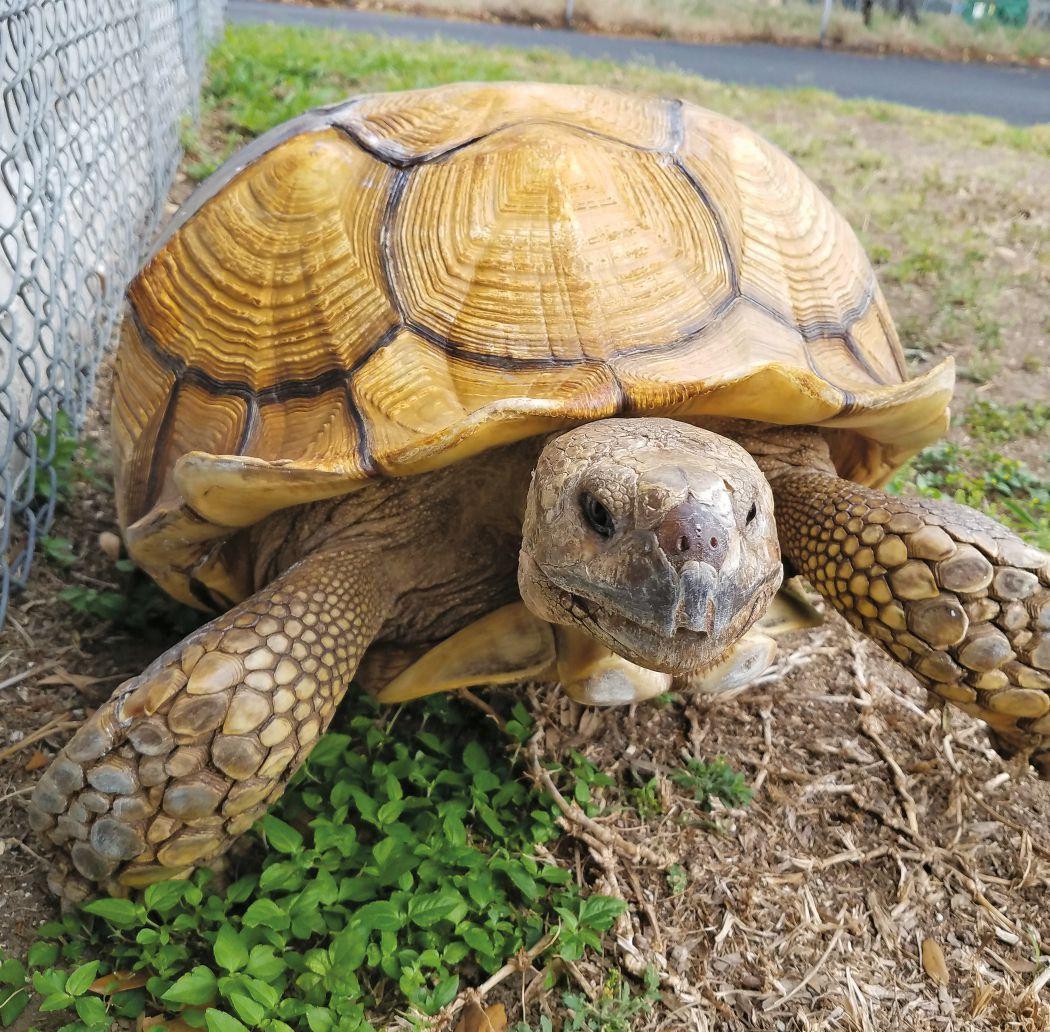
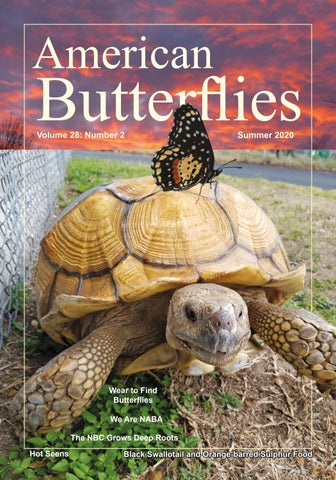
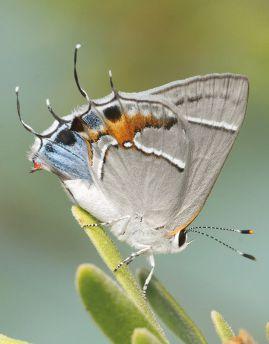
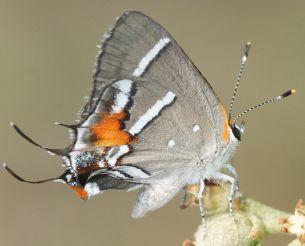
Front cover: “Here’s looking at you, Spike.” Main photo of Spike, a rescued African-spurred tortoise at the National Butterfy Center, taken by Marianna Wright on April 4, 2020 at the Valley Animal Hospital, Pharr, Hidalgo Co., TX. Photo of a Crimson Patch taken by Jeffrey Glassberg on Nov. 5, 2017 at the National Butterfy Center. Sunset photo taken by Jeffrey Glassberg on Dec. 25, 2013 in Middletown, Monmouth Co., NJ. See the article about the NBC on page 4.
The North American Butterfy Association, Inc. (NABA), a non-proft organization, was formed to promote public enjoyment and conservation of butterfies. Membership in NABA is open to all those who share our purpose.
President: Jeffrey Glassberg Vice-president: James Springer Secrty./Treasurer
Ann James Directors: Jeffrey Glassberg
Fred Heath
Yvonne Homeyer
Ann James
Dennis Olle
Robert Robbins
James Springer
Patricia Sutton Scientifc Advisory Board
Nat Holland
Naomi Pierce
Robert Robbins
Ron Rutowski
John Shuey
Ernest Williams
Volume 28: Number 2
Summer 2020
Inside Front Cover NABA News and Notes
2 You Can’t Escape the Effects of Covid19 by Jeffrey Glassberg
4 The National Butterfy Center Community by Marianna Treviño-Wright
16 Wear to Go Butterfying by Jeffrey Glassberg
24 You Are What You Eat
25 Black Swallowtail on Sweet Fennel in Texas by Don Dubois
31 Orange-barred Sulphur on Emperor’s Candlesticks in Texas by Sandy-Crystal Vaughn
36 We Are NABA: Jaeson Clayborn interview by Mike Cerbone
40 Hot Seens by Mike Reese
48 Contributors Inside Back Cover Readers Write
American Butterfies (ISSN 1087-450X) is published quarterly by the North American Butterfy Association, Inc. (NABA), 4 Delaware Rd., Morristown, NJ 07960; tel. 973285-0907; fax 973-285-0936; web site, www.naba.org. Copyright © 2020 by North American Butterfy Association, Inc. All rights reserved. The statements of contributors do not necessarily represent the views or beliefs of NABA and NABA does not warrant or endorse products or services of advertisers.
Editor, Jeffrey Glassberg
Editorial Assistance, Matthew Scott and Sharon Wander
Please send address changes (allow 6-8 weeks for correction) to: NABA, 4 Delaware Rd., Morristown, NJ 07960; or email to naba@naba.org
Perhaps you’ve been hunkered down in your house for the past two months, as I have been. Perhaps you’ve already lost your mind, as I have. Half the time I’m fxated on trying to snag a spot on Instacart or Amazon Prime, for grocery deliveries. Each time I think I’ve fgured out the system, they change it! However, as you can tell, I haven’t starved, yet. The other half of the time, I’m crying while watching “Sleepless in Seattle” or some other saccharine movie.
You may recall that I have been trying to see the butterfy species that I’ve never seen in the U.S. — a continuing feature that I sarcastically call “My Big Life.” I was looking forward to an action-packed year of butterfying adventures. Clearly, this is not to be. I’ve already missed my scheduled April trip to West Texas, searching for four species. May in south Texas looking for Manfreda GiantSkipper is not happening. Mid June in Alaska looking for Green Marbles? I think that I’ve already mentioned that I’ve lost my marbles. It pretty much looks like a lost year, although I’m still hoping that travel is possible in the fall (you can see that I’m an optimist, right?).
OK, that’s me. But how is NABA doing? Here are some indications. The Wild Gardening Festival at the National Butterfy Center, whose inaugural event was scheduled for this April, was, of course, cancelled; the NBC-sponsored butterfying trip to Costa Rica in June has been cancelled; NABA’s Biennial Members Meeting, scheduled for August in Santa Fe, NM has just been cancelled; all school trips to the National Butterfy Center this spring have been cancelled; visitorship to the NBC (which was closed as Texas locked
down) is down. At this point, NABA’s 2020 income is down substantially. All the NABA offcers and Board members would happily take pay cuts, except that, since none of them currently receive any pay, this would net NABA zero.
NABA’s mission is to conserve butterfies and the habitats upon which they depend. Basically, NABA is trying, in its own small way, to make the world a better place. Rather than trying to monetarily enrich shareholders, NABA tries to enrich everyone’s life by spreading word of the importance and beauty of butterfies and the natural world and by working directly to conserve them.
Although NABA’s Board and offcers are volunteers, NABA does have paid employees. And, while NABA is committed to butterfies and the environment, NABA is also committed to the people who work for NABA. Across the country, NABA has some important projects in the works. And so, NABA has committed to continuing to pay all employees their normal wages, even as the National Butterfy Center was closed to the public. People are part of the environment that we all care about.
You can see a short thank-you video, from the NABA employees at the National Butterfy Center, to you, by going to https://youtu.be/ pOlDqpB80Xw
While I realize that it’s a diffcult time for all of you, if and when you are able to again support NABA’s efforts, that support will be greatly appreciated!

Please photocopy this membership application form and pass it along to friends and acquaintances who might be interested in NABA
Yes! I want to join NABA, the North American Butterfy Association, and receive American Butterfies and The Butterfy Gardener and/or contribute to building the premier butterfy garden in the world, the National Butterfy Center. The Center, located on approximately 100 acres of land fronting the Rio Grande River in Mission, Texas uses native trees, shrubs and wildfowers to create a spectacular natural butterfy garden that importantly benefts butterfies, an endangered ecosystem and the people of the Rio Grande Valley.
Name:
Address: Email (only used for NABA business):______________________ Tel.:______________________
Special Interests (circle): Listing, Gardening, Observation, Photography, Conservation, Other
For a $35 donation, one receives NABA publications as either digital or print. All higher levels of donations receive both digital and print versions. Outside the U.S., only digital is available, at any donation level.
Tax-deductible dues (donation) enclosed (circle): Regular $35 (must choose either digital or print — circle one), Family $45. Special sponsorship levels: Copper $55; Skipper $100; Admiral $250; Monarch $1000. Institution/Library subscription to all annual publications $60. Special tax-deductible contributions to NABA (please circle): $125, $200, $1000, $5000. Mail checks (in U.S. dollars) to NABA, 4 Delaware Rd., Morristown, NJ 07960.
American Butterfies welcomes the unsolicited submission of articles to: Editor, American Butterfies, NABA, 4 Delaware Rd., Morristown, NJ 07960. We will reply to your submission only if accepted and we will be unable to return any unsolicited articles, photographs, artwork, or other material, so please do not send materials that you would want returned. For the type of articles, including length and style, that we publish, refer to issues of American Butterfies
Occasionally, members send membership dues twice. Our policy in such cases, unless instructed differently, is to extend membership for an additional year.
American Butterfies welcomes advertising. Rates are the same for all advertisers, including NABA members, offcers and directors. For more information, please write us at: American Butterfies, 4 Delaware Road, Morristown, NJ 07960, or telephone, 973-285-0907, or fax 973-285-0936 for current rates and closing dates.
If you have questions about missing magazines, membership expiration date, change of address, etc., please write to: NABA, 4 Delaware Rd., Morristown, NJ 07960 or email to naba@naba.org.
by Marianna Treviño-Wright
NABA founded the National Butterfy Center almost twenty years ago, with the idea of creating a butterfy paradise that would serve as a national fagship project, conserving butterfies, highlighting their importance for the environment, and functioning as a gathering place for butterfiers from around the continent. Amazingly, we’ve accomplished all of that!
Perhaps less intended, but increasingly important, is that the National Butterfy Center has put down deep roots in Mission, Texas and the entire Lower Rio Grande Valley,
growing connections with the residents of South Texas. From environmental tourists to Winter Texans, garden clubs to traveling law students, our focus is always on increasing the understanding and appreciation of wild, freefying butterfies and their intimate connection to native plants. Like the North American Butterfy Association, our parent organization and whose members sustain it — we work hard to help people see the importance of healthy habitats, what it means and how humans shape and impact it, for better or worse.
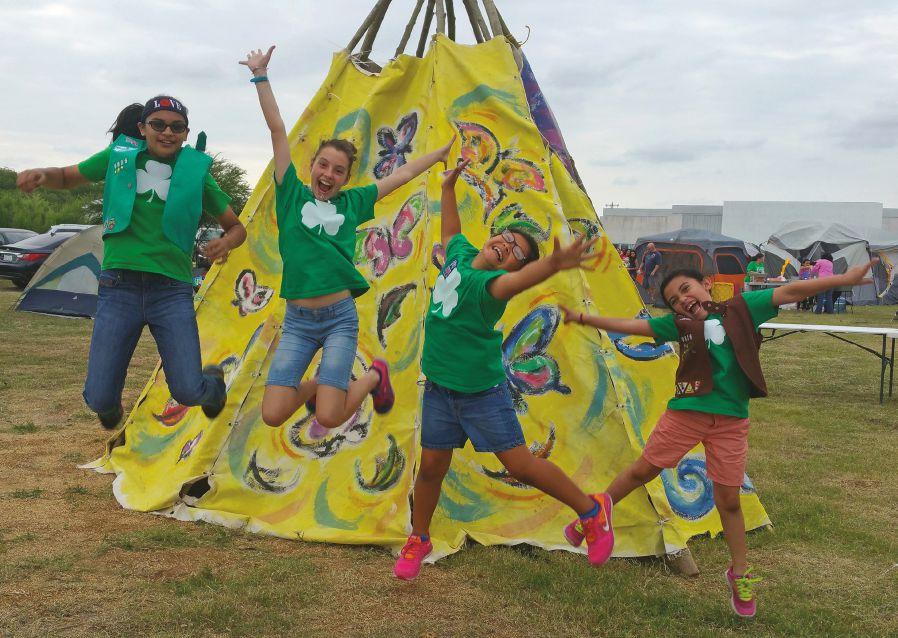
Opposite page: Girl scouts jump for joy during their overnight camp out at the National Butterfy Center. April 9, 2016.
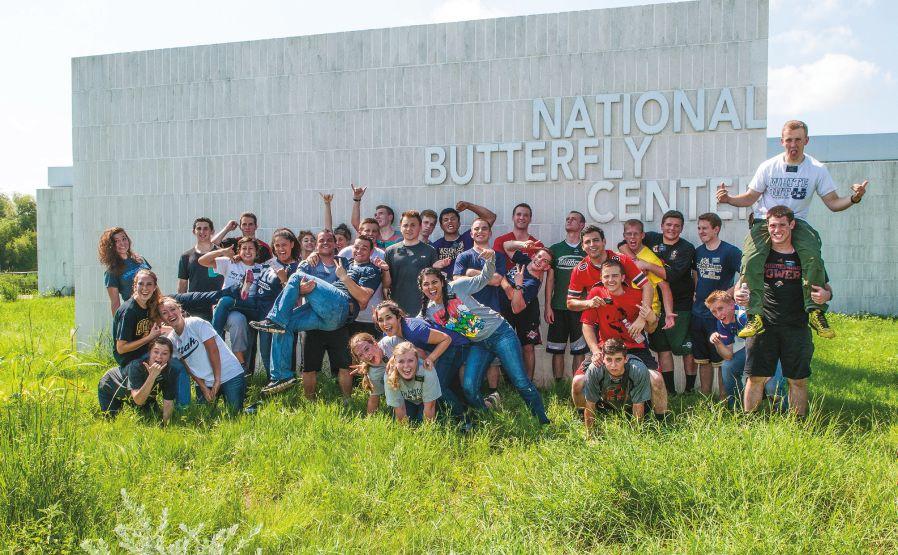
This page top: A Latter-Day-Saints volunteer group. Sept. 3, 2015.
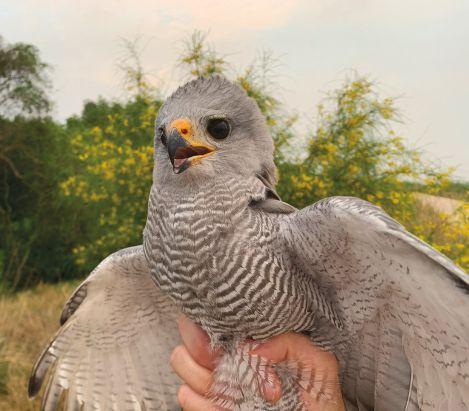
This page right: A young Gray Hawk that fedged at the NBC was part of a scientifc study and survey of this rare species in the Lower Rio Grande Valley. March 21, 2020.
Our ceaseless outreach, in person and online, by our employees, members and visitors and buoyed by social media, has allowed our roots to spread and foster beautiful relationships. While we can’t possibly mention everyone, we can highlight a few, like the teachers from Valley View High School who usually show up wearing superhero t-shirts with their National Honor Society kids in tow. These club sponsors and kids who have sworn an oath to uphold the principles of service and leadership come
prepared to sweat! Not only do they shovel, cart, dig and spread, they do the Hustle. Really! These kids DANCE throughout their service learning. The frst time I saw this, one young man brought a backpack outftted with a solar panel and a Bluetooth speaker connected to his cell phone. He kept the tunes thumpin’ so his classmates could pair up or line up to show off their fancy foot work around the compost heap and down the trails, spinning, leaping and high steppin’! It was truly joyous.
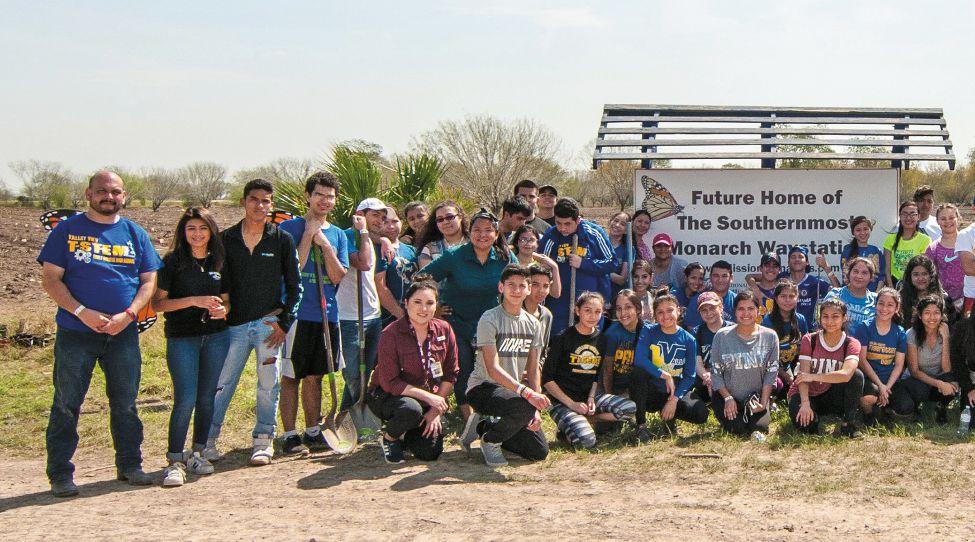
Above: Valley View High School students volunteered to help plant the Southernmost Monarch Waystation at the National Butterfy Center. Feb. 24, 2018.
Right: Girl Scouts earn their digital photography badge, with pro tips from our award-winning, wildlife photographer, Luciano Guerra, at our annual Artful Garden + Naturalist Program that now takes place on Spike’s birthday (the second Saturday in December). Oct. 13, 2018.
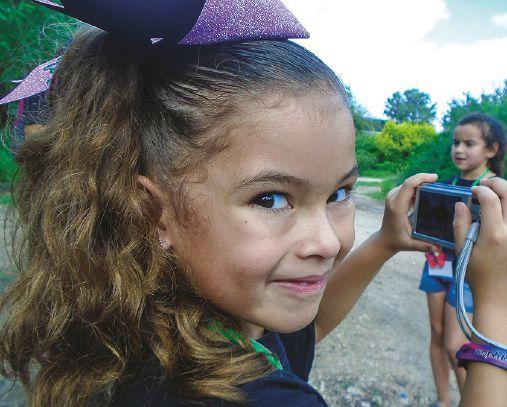
In another stroke of good fortune, about six years ago we became a certifed partner of Girl Scouts of the U.S.A. This means we are qualifed to conduct badge programs, according to their Discover-Connect-Take Action framework for personal development. From September to April, many hundreds of future leaders and innovators pass through our doors, like the Gonzalez Girls: Mom and two daughters (and dad comes around, too).
We’re so lucky to be a part of their lives and get to watch them grow up. Mom is clearly comfortable at the National Butterfy Center, where we have become a second home thanks to our badge programs scheduled throughout the year; and the girls know the place well enough to lead their own tours for their friends. Whether they are attending our proprietary M3: Monarchs, Milkweed & Me fun patch program; Surviving South Texas,
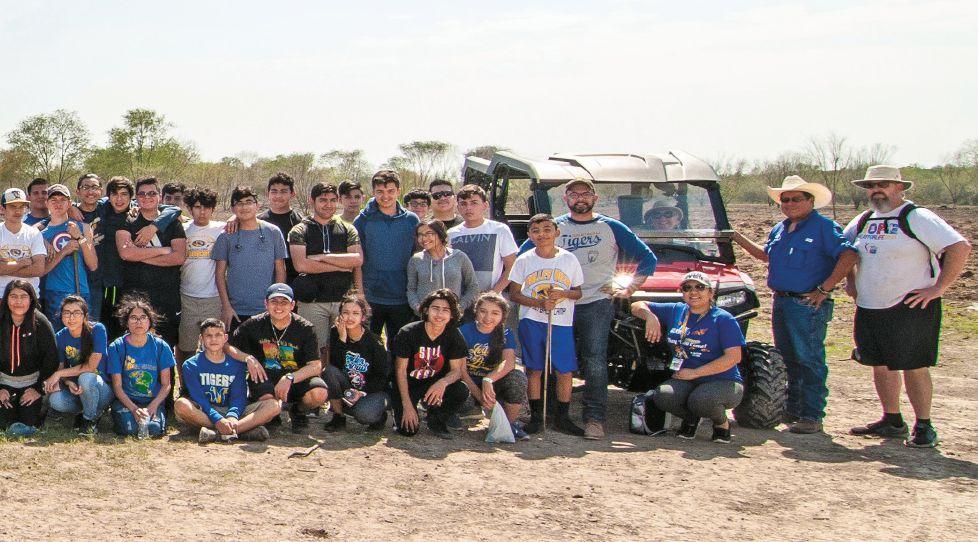
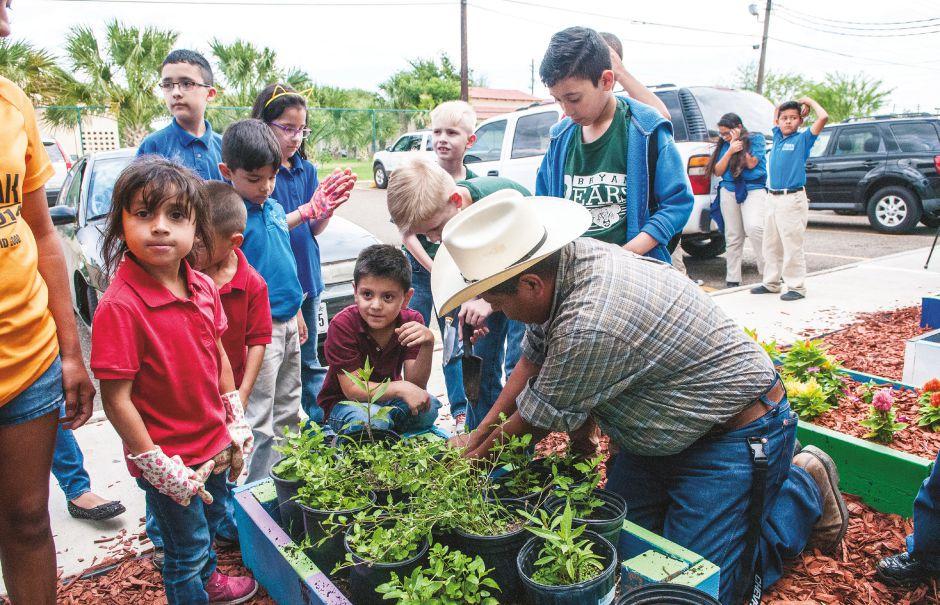
Above: Max Munoz, the National Butterfy Center’s Director of Operations, organizes the creation and planting of a butterfy garden by the Mission Boys and Girls Club. Due to the presence and outreach of the National Butterfy Center, there are now butterfy gardens throughout the Lower Rio Grande Valley of Texas. April 19, 2016.
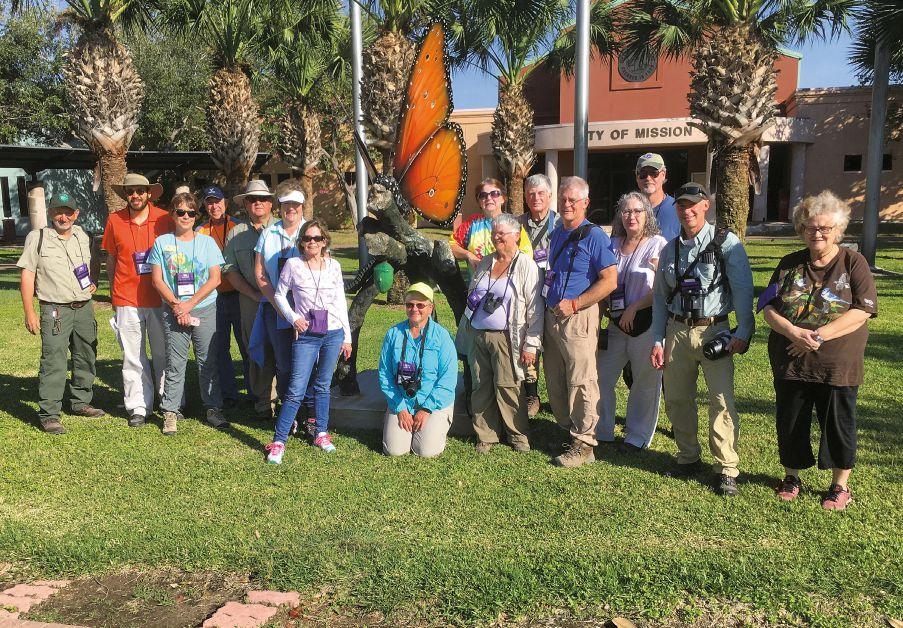
A group of Texas Butterfy Festival participants in front of Mission City Hall, featuring a large statue of a Queen, showing how NABA’s presence has changed the Valley. Nov. 5, 2017.
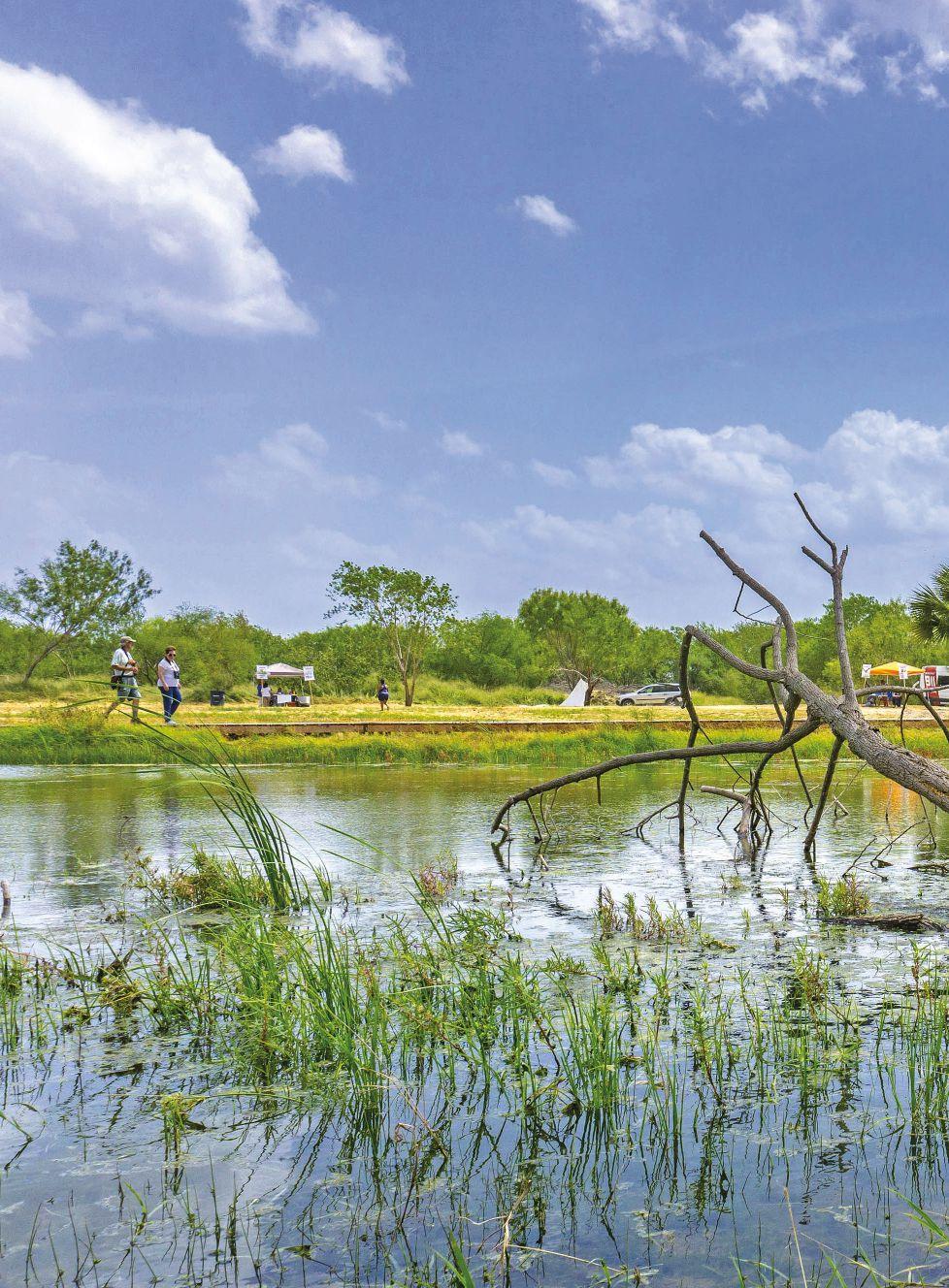
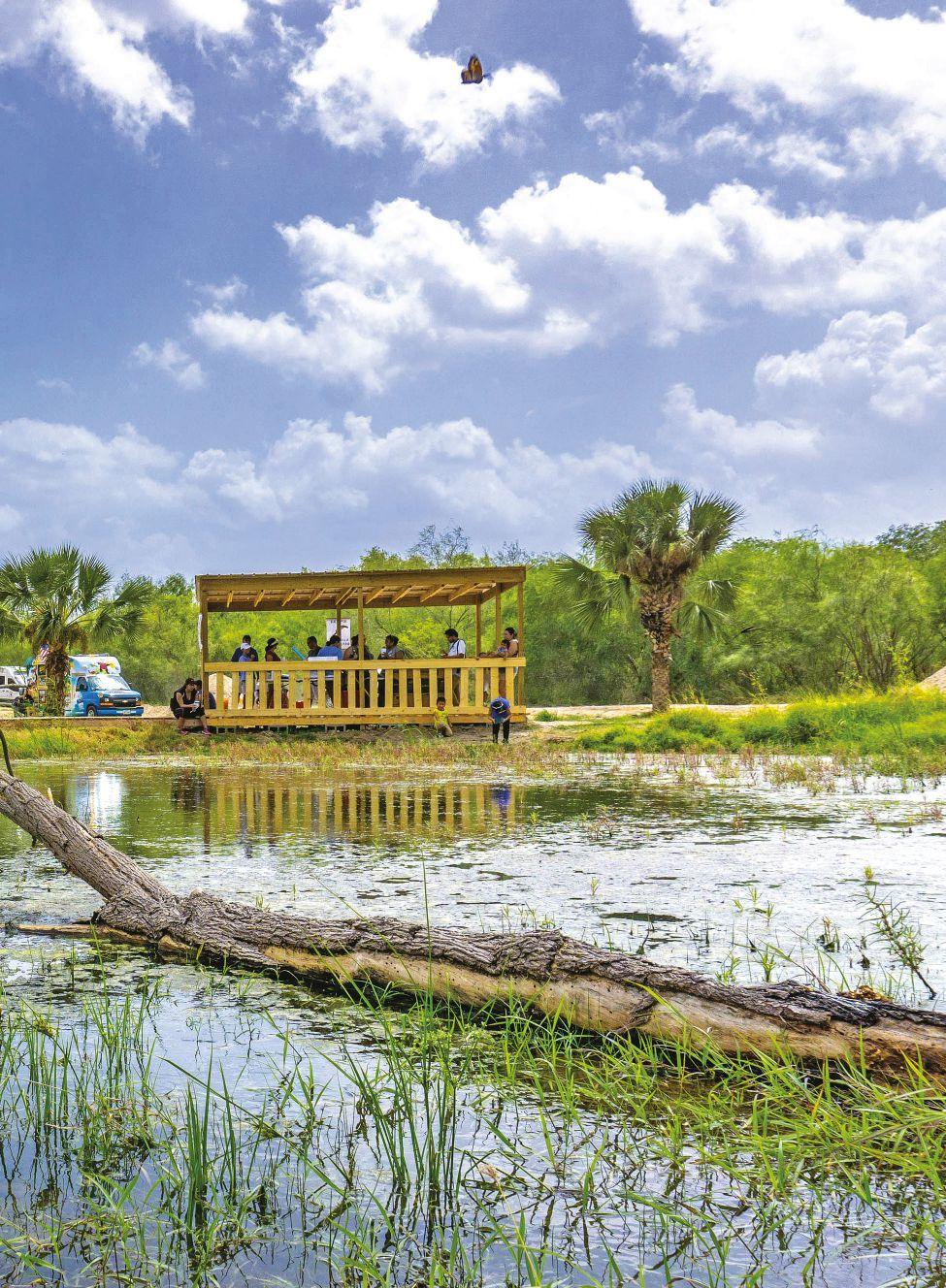
Pages 8-9: Setting up early in the morning, by the recreated wetland on the National Butterfy Center south 70 acres, for the Take Back the River event. Note the American Snout fying by. Aug. 12, 2018.
a badge program we devised for Girl Scouts to learn basic frst aid and other skills for a life outdoors; or visiting ‘just because,’ it’s a privilege to play a part in their education and know that one day, Big Sister and Little Sister will bring their own families, here, and remember us fondly.
And who could forget Dr. Mehrzad Mahmoudian-Geller from South Texas College? Her Biology Club has adopted their own garden bed, which they tend, regularly, because she understands that ecosystems and lifecycles must be more than abstract concepts if she and her students are to impact the world around them for good. Not to mention the
University of Texas-Rio Grande Valley’s Environmental Awareness Club! These students have organized border wall protests, hosted yoga on the riverbank and worked in the nursery with Stephanie to propagate plants that provide life to butterfies.
During our annual Earth Day and other festivities, student volunteers from these groups as well as Med High and Mission High School Band, the local Leo Clubs (sponsored by the Mission Lion’s Club) and La Joya High School’s Society for Hispanic Engineers Society all contribute so much to our viability and our sustainability. From set up to clean up (and all the scavenger hunts
in between), these energetic teenagers give more to this place than they will ever know. Without their tireless assistance to midnight and beyond, we would not be able to host our annual Halloween fundraiser, Haunted Trails, where they help us transform the normallytranquil, woodland and garden trails, and then terrorize thrill-seekers by serving as guides and character actors for two nights of blood-curdling screams. While the Texas Master Naturalists and Red Hat Ladies avoid un-natural events like Haunted Trails, we’re always happy to receive them and maybe even teach them a thing or two.
We’ve become a useful site to professionals, too, partnering with corporations such as United Parcel Service (UPS) and Home Depot, whose employees are required to represent their values beyond storefronts and regular duties. The “UPSers,” as we call them, demonstrate care and good stewardship through their Neighbor-toNeighbor Program at the National Butterfy Center. Sometimes that means they are driving the golf cart courtesy shuttle for people who attend Community Day at the Texas Butterfy Festival; other times they are helping us plant trees, build bat houses and direct parking. Similarly, Home Depot’s employees have led workshops for families during our free, “open house” events and have rented the center for professional development days, where Max Munoz, our Director of Operations and a former employee of Home Depot, has led nature-oriented activities that generate selfawareness and team.
Our community engagement extends to those who “involuntarily” volunteer, here, too. Thanks to our partnership agreement with the County Probation Offce, we are eligible to receive non-violent offenders granted deferred adjudication or sentenced to court-mandated service hours. Along with the food bank and the local animal shelter, the National Butterfy Center provides a place for people to do good after they’ve done something bad in the eyes of the law.
These community service workers, or CSWs, are also integral to our success. Some have never been introduced to the outdoors; others have certifcates and trades that keep them there. Regardless, we treat them like family, sharing butterfies and birds, gardening tips and goals. In fact, some of our best employees have come through this program.
It is my personal belief that one (or more) mistakes does not the person make. Through their consistent community service, we get to know the CSWs and they get to know us. It’s an arrangement that has been way more positive than negative. There’s the welder who got ticketed while speeding home from a shift that ran long, so the children would not be left alone and his wife could get to her job on time. He comes to help us when we call, even now, long after his “debt” to society has been paid. And there’s the woman charged with shoplifting groceries, who asked if she could schedule her hours when we had school feld trips because, as a child, her family was too poor to pay the $5 for her to go on them. She said she learned something new from us every time she came and thanked us profusely for “allowing” her to enter.
The CSWs may be invisible to our members and visitors, but they are often responsible for cleaning our facilities, assisting our groundskeepers with extra muscle, and lending valuable skills, like bee keeping and small engine repair, that keep us running smoothly and save us money, time and again.
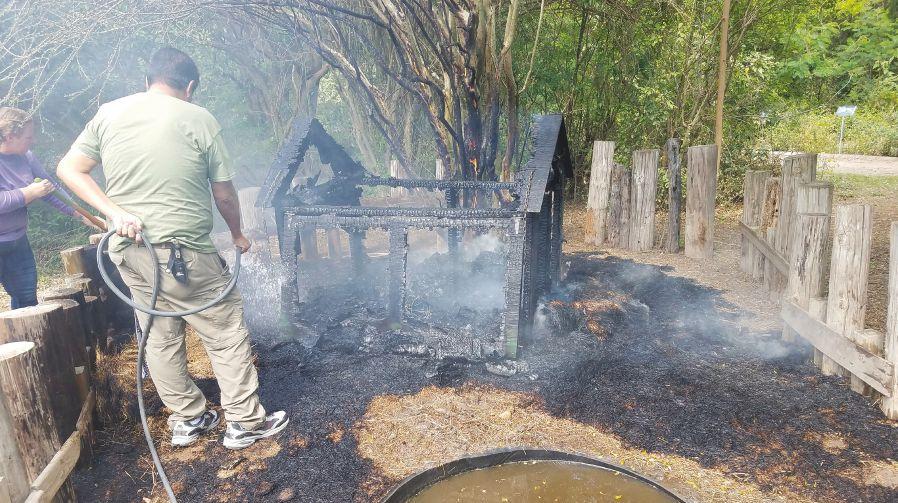
Recently, we developed a new community partnership with the Mission Fire Fighters Association and employees of the Mission Fire Department, when Spike’s enclosure caught fre. In the past, their chief has donated old, high-volume hoses to us for food irrigation, but we’ve never had to call on them in an emergency.
Monday, March 23, 2020 was the day all that changed.
Spike is our giant, African-spurred Tortoise. An exotic species that does not belong in South Texas, he came to us through Mission Animal Control, after a local family
surrendered him to their custody. We made a permanent home for him at the National Butterfy Center about seven years ago, and since then, he’s become a big part of our environmental education programs and an ambassador for scaled things of all types; so, imagine our horror when Omar’s voice came screaming across the radio, “Fire! Fire! At Spike’s place!”
Randi and Max went running to Spike’s enclosure near the Monarch Palapa, while I dialed 9-1-1. When I got to the back gardens, the fames were nearly extinguished, but the full extent of the damage was not yet visible.
As we shuffed soggy straw and sprayed everything down, engines roared and sirens wailed in approach. To our relief, Mission frefghters arrived with a full tanker and the right equipment to make sure Spike’s shelter and everything around it were properly extinguished.
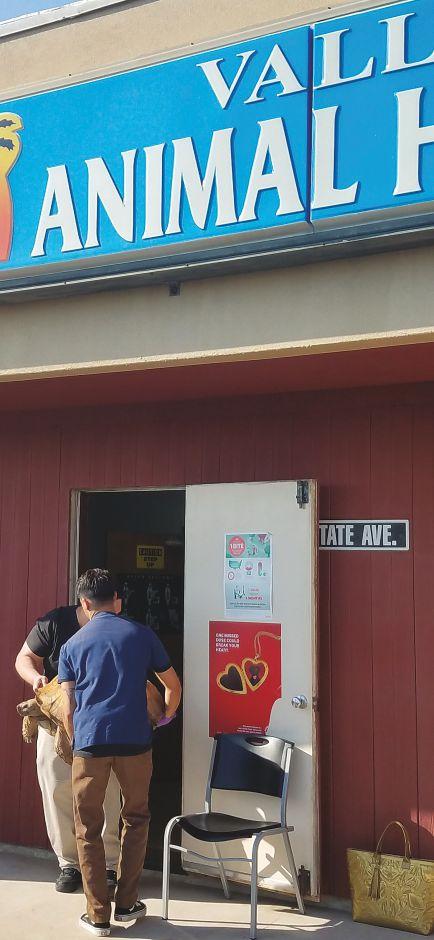
A Border Patrol feld medic named Eric showed up, too. He took a good look at Spike, called a veterinarian for assistance in assessing the patient and strongly suggested we get him to the clinic right away. Thus, began Spike’s prolonged hospitalization and slow recovery,
which we have documented on Facebook for all of his adoring fans.
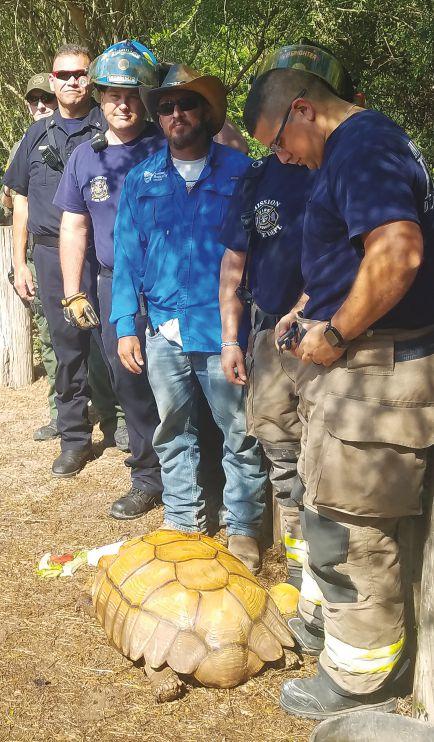
Although few can visit him now, we do hope to have a homecoming party for Spike, soon, as well as a formal recognition ceremony for the frefghters who have adopted him. It seems they want Spike to be their mascot, too, and plan to paint his new home like their frehouse in the near future.
In addition to Mission Animal Control, we have a great relationship with Palm Valley Animal Society, the county’s contracted animal shelter and welfare/rescue agency. Of all the productive partnerships we’ve formed, these two may be the most surprising. I think everyone imagined the National Butterfy Center would become a popular attraction, trusted education site and an international tourist destination, but did anyone think we would become the drop-off spot for public and private agencies receiving possums, raccoons, foxes, coyotes, bobcats, javelina, snakes and even a white-tailed deer caught in the surrounding towns? With nearly 2,000 acres in our section of the Lower Rio Grande Valley Wildlife Conservation Corridor and plenty of farmland to forage, native wildlife caught in
traps or captured as pets gets a second chance to fulfll their role in the food chain out here, instead of being sentenced to an unnatural death elsewhere.
The National Butterfy Center also serves the community-at-large by facilitating scientifc research projects focused on understanding and conserving native plants and wildlife that belong in the Rio Grande Valley. Recently, studies related to Gray Hawk nesting, Rio Grande Coot distribution and the specialized feeding habits of the Disonycha stenosticha fea beetle — just to name a few — have been conducted at the center by Ph.D. students from various universities; while the center’s own staff have contributed to programs of Partners of Fish & Wildlife, U.S. Fish & Wildlife Service, concerning best practices for propagating one of our native
Opposite page: Putting out the dying embers of the fre that burned Spike’s enclosure. March 23, 2020.
This page left: The fre crew that came and put out the fre bonded with Spike. March 23, 2020.
This page right: Carrying a burned and wounded tortoise into the Valley Animal Hospital in Pharr, Hidalgo Co., TX. March 23, 2020.
milkweeds, Asclepias oenotheroides, and the federally-listed, endangered Ayenia limitaris, or Tamaulipan kidneypetal.
As the center has grown, so has our ever-expanding network of relationships and the role we’ve come to play in the life of our community. The sudden isolation we’re experiencing from the Covid-19 pandemic is jarring for multiple reasons, not the least of which is the loss of income from this time, which represents about 20% of our annual operating budget; but, right now, what we’re really feeling is a loss of purpose. Under the county order, we’re allowed to continue what government deems the essential work of “landscaping” and “animal care,” however, our primary function of teaching people, of cultivating conservationists, has been practically suspended. Without our mission — Growing Connections — what are we?
Without the school children and scouts, volunteers and visitors, our days all blend together. If this sounds familiar, for those “stuck” indoors, we apologize; we don’t mean to complain. If you follow us online, where you can see Luciano’s gorgeous photos, you know we’ve got it good; good butterfies, good birds, wildfowers, sunshine and a few seats on the foating dock to enjoy the cool breeze coming off the Rio Grande. It’s just that we’re a bit lost and lonely, because we are social animals, intelligent creatures, capable of comprehending how fundamental human contact is to our operations, to our identity, to our mission…and we miss you. All of you.
Until we can be together, again.
Come spring, each year, we prepare to receive over 6,000 school children of all age levels from almost all of the 32 school districts, across four counties, in the Lower Rio Grande Valley. These curious and impressionable young people, all of whom hail from federally-designated Title I, low-income public schools, range from preschool children in Head Start to adult children in Special Education. At the National Butterfy Center, it is our absolute privilege to deliver lesson plans, games and traditional feld experiences
designed with each of them in mind. We spend considerable resources crafting, organizing and scheduling these mutuallyrewarding activities, then we stock up the gift shop and roll out the shop vac to ensure our guests learn something new, leave with a memento and last, but not least, fall in love.
Losing the opportunity to engage with school children and community members as the result of this “Covid spring” has shown us how much we love what we do, and how we’ve fallen in love with them, too.
March typically ushers in a noisy, chaotic and fun-flled season of feld trips and special events that last through the end of May, but not this year. Instead of welcoming thousands of school children and scads of community members, posting “want ads” for summer interns and advertisements for our signature, summer Critter Camps, we had to close in compliance with county shelter-at-home orders.
Although we’ve re-opened with masks and social distancing requirements, school has been dismissed for this academic year, leaving us without opportunity to share our love for the outdoors with enthusiastic youngsters. We also had to postpone the sold-out, annual Sleep Over Under the Stars for Girl Scouts of South Texas, Earth Day celebrations and the inaugural Wild Gardening Festival. Rather than collaborating with Eagle Scouts who need to complete their projects and Community Service Workers who need to fulfll hours, we’re shipping sterile online orders and responding to group text messages from staff about where they’ve scored or just missed out on eggs, cat food and toilet paper.
We know that this too shall pass and that we will welcome you again, but for now, it all seems too strange to believe.



Yesby Jeffrey Glassberg
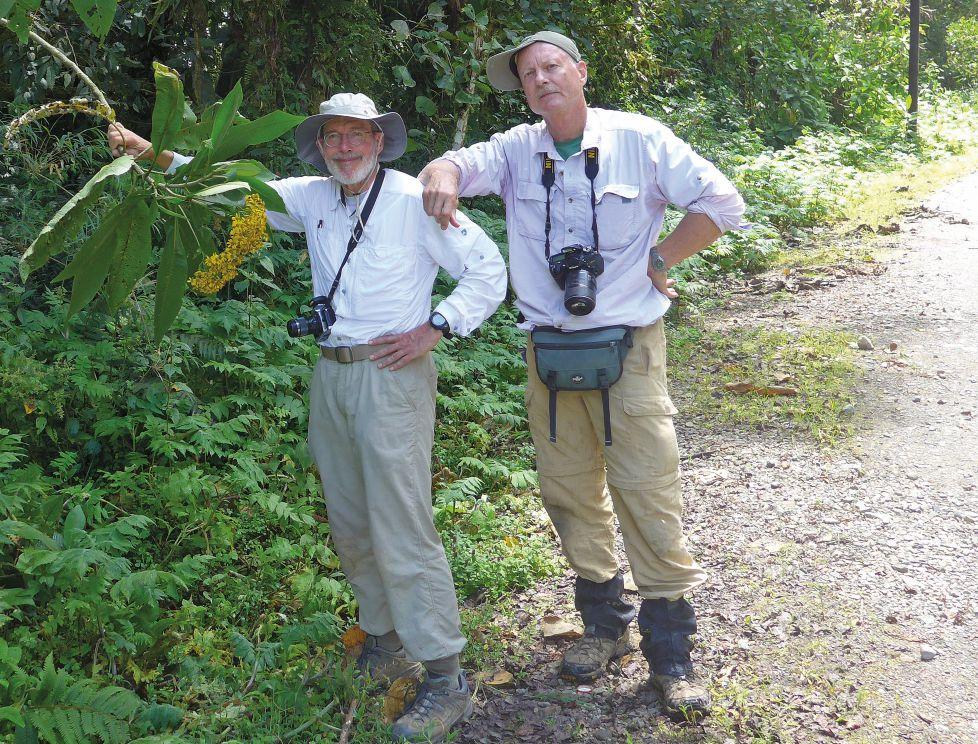
Martin Schwartz (on left)(retired obstetrician/gynecologist) and Ken Kertell (active butterfy photographer) model appropriate gear for butterfying.
Note hats, light-colored shirt tucked into light-colored pants, tucked into socks or other legging; sturdy shoes. Oct. 25, 2014. San Isidro, Napo, Ecuador.
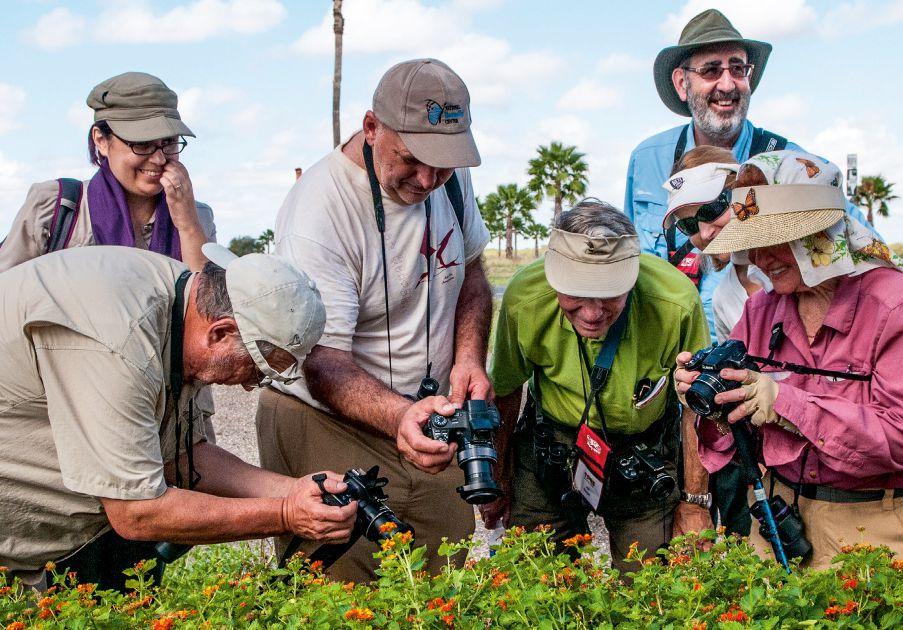
NABA’s crack investigatory reporters have dug into the question on everyone’s mind: What should I wear into the feld when the feld becomes open? Because so many butterfiers are fashionistas, you’ll want to don the right apparel to ft in. And, we’re here to help!
What should you consider? Well, when butterfying one is usually in the sun and the temperature is usually warm to hot. Ideally you want to stay cool and protect yourself from sunstroke and sunburn at the same time. When butterfying, one not infrequently encounters annoyances such as prickly plants, intrusive insects and, perhaps most alarmingly,
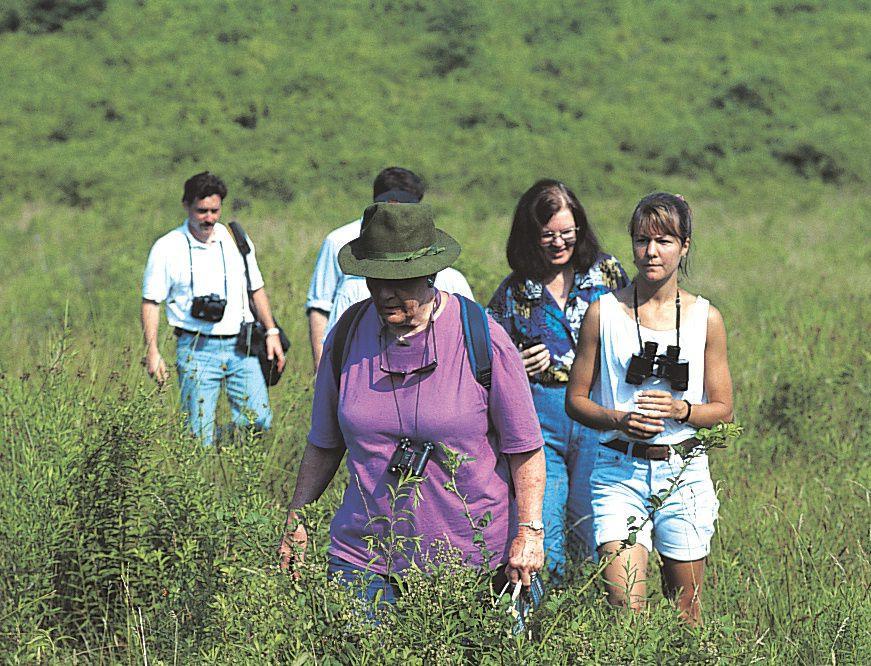
Participants in a NABA Butterfy Count demonstrate poor choices in feld gear, including no hats, dark-colored shirts and pants, shirt not tucked into pants, and shorts. From front: Jean George (author of “The Other Side of the Mountain” and “Julie of the Wolves”), Valerie Giles (artist and daughter of well-known artist Lee Bontecou), Jane Vicroy Scott (NABA Director and Secretary/Treasurer), Andrew Vallely (co-author of “Birds of Central America”) and Paul Sweet (Ornithology Collection Manager at the American Museum of Natural History). July 10, 1993. Chappaqua, Westchester Co., NY. chiggers and ticks. Most of the clothing choices mentioned here are in consideration of these latter threats. Why? Well, although people’s responses vary, chiggers, in the U.S. found mainly southward, can be amazingly annoying. Ticks are found throughout much of the U.S., and, you do not want ticks to imbed in you. Not only are they pretty gross,
they also can carry an array of very serious diseases, including Lyme disease, babesiosis and Rocky Mountain spotted fever. Also, when butterfying, one often walks off of established trails, thus increasing one’s chance of stepping on, or into, unexpected situations or life forms. And this should inform your choice of shoes.
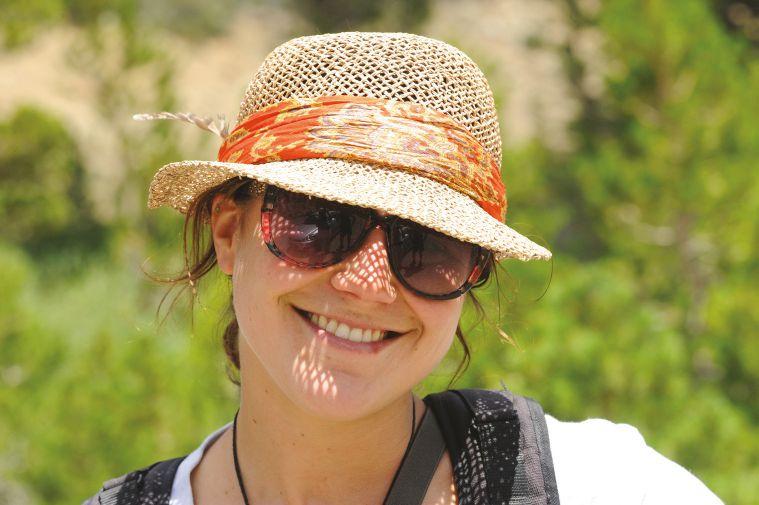
While a hat is highly recommended, what type of hat you wear is up to you.
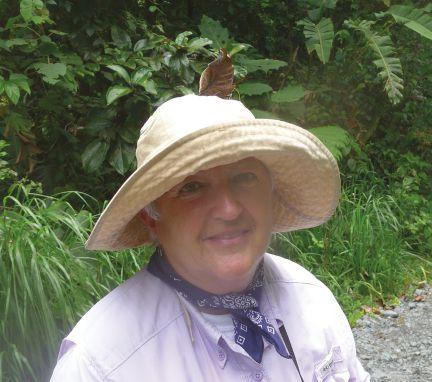
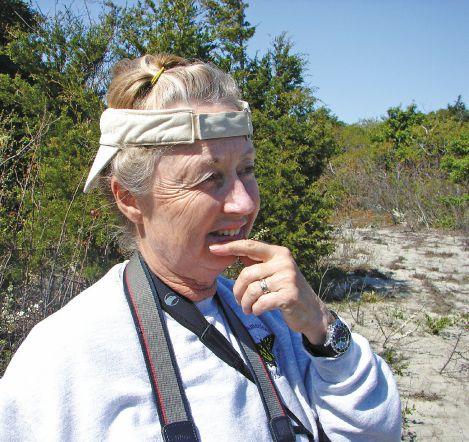
This page top: Mary Clapp (Evolutionary Biology graduate student at U.C. Davis) in a rakish hat. July 29, 2013. Above Ellery Lake, Mono Co., CA.
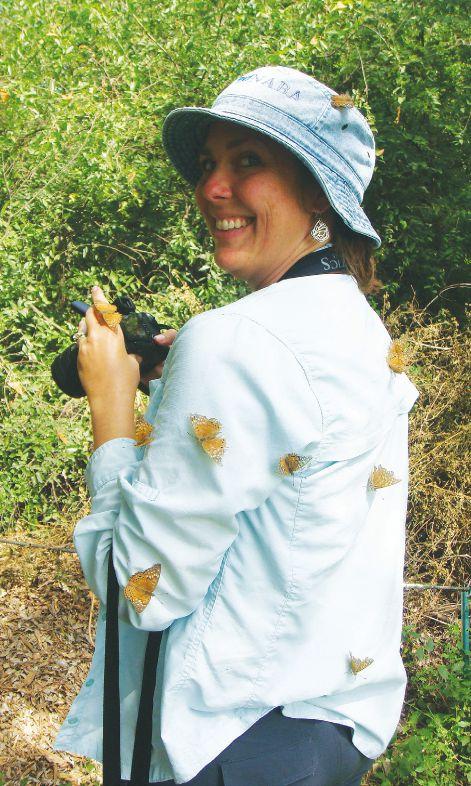
This page at right: Chris Balboni (retired Coast Guard Commander) in a very vaguely sailoresque hat adorned with an Orion Cecropian. Oct. 28, 2018. Sumaco, Ecuador.
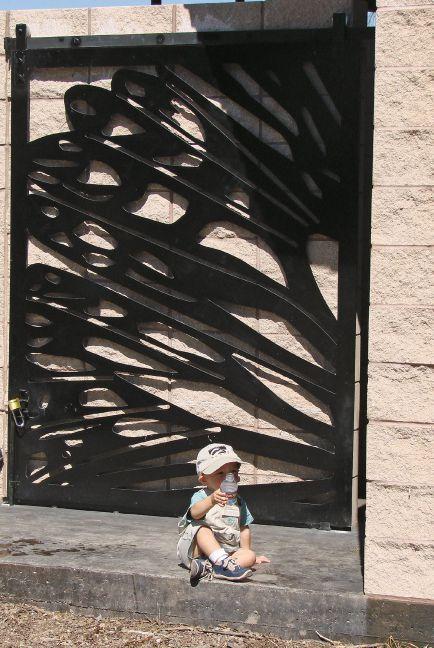
Opposite page top left: Isaac McAllen (professional baby butterfier and grandson of Margaret and Robert McAllen) in a baseball cap, takes a hydration break in front of butterfy wing gates. Oct. 25, 2007. National Butterfy Center, Hidalgo Co., TX.
Opposite page top right: Alana Edwards (cofounder of the NABA-Atala chapter) in a NABA bucket hat. 2010. Hidalgo Co. TX.
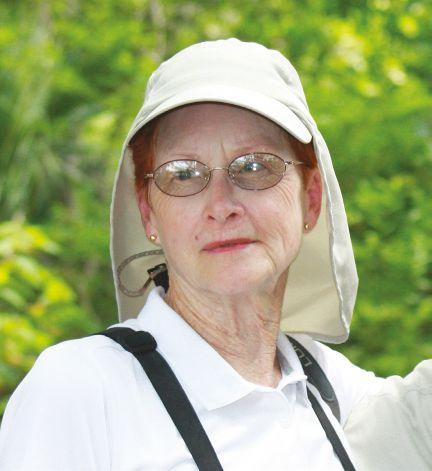
Bottom left: Linda Cooper (a dedicated Florida butterfier) deters mosquitos with a fap hat. April, 2009. Bull Creek WMA, Osceola Co., FL.
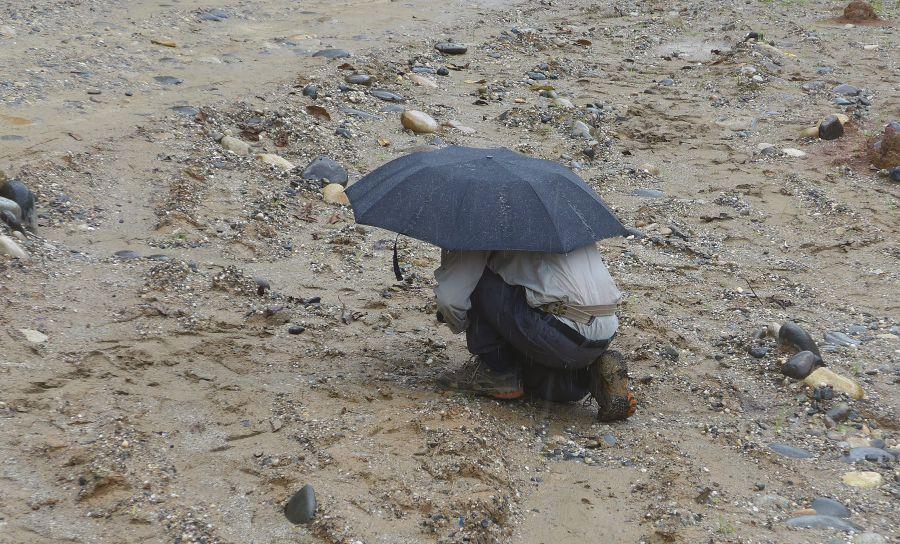
Top: Andrew Neild (author of “Butterfies of Venezuela) photographing a leafwing in the rain. Oct. 23, 2014. El Capricho, Napo, Ecuador.
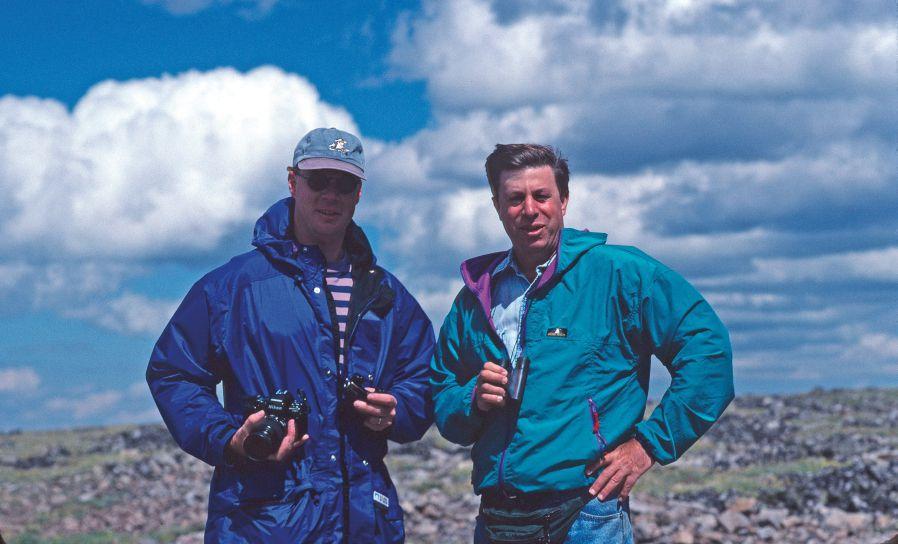
Bottom: John Acorn (author of “Butterfies of Alberta”), left, and Jeff Glassberg try to stay warm while searching (unsuccessfully) for Alberta Fritillaries. July 22, 1997. Plateau Mtn., Alberta, Canada.
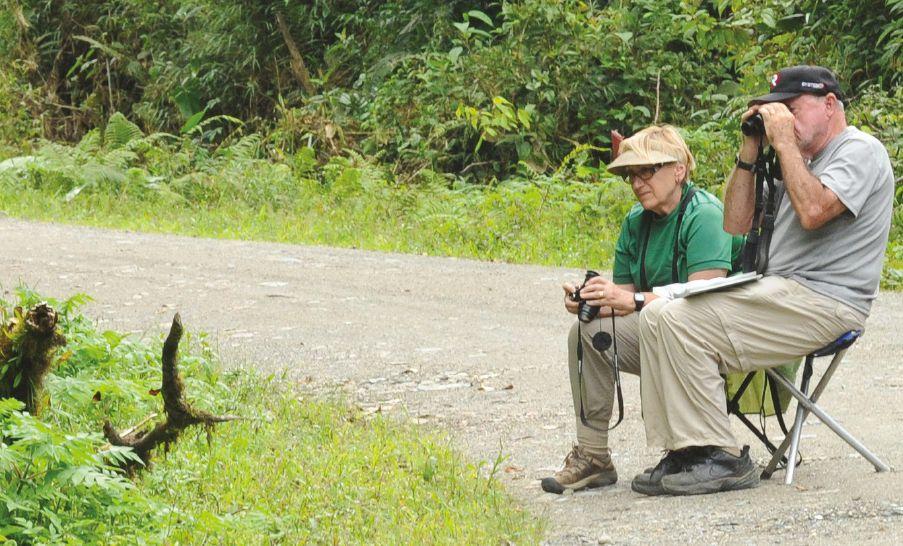
Top: Nancy Gallaugher and Larry Simpkins stay comfortable while watching butterfies lured in by rotting fsh brew (if you look carefully, you can see two satyrs fying in). Oct. 24, 2013. San Isidro, Napo, Ecuador.
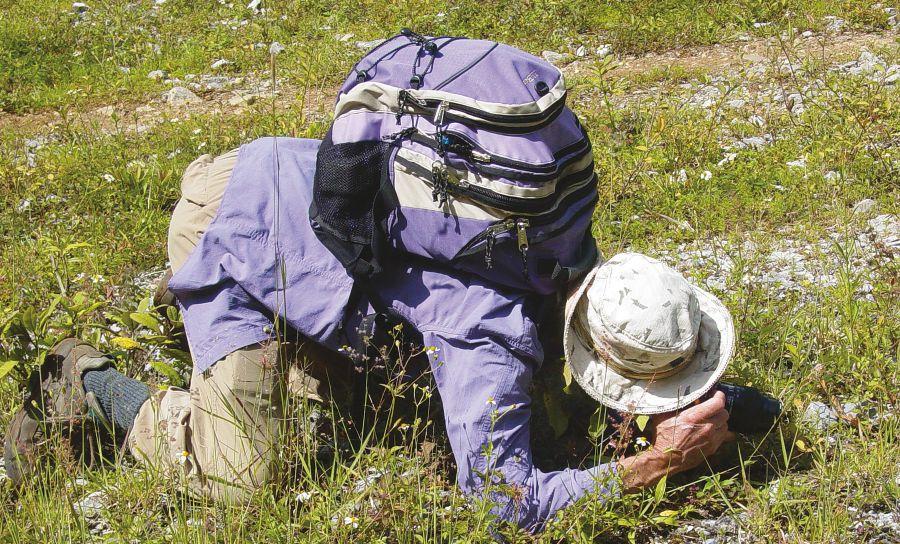
Bottom: Backpacks can carry supplies, but here, the added weight brings Rob Gill to his knees. Aug. 6, 2003. Zongolica, Veracruz, Mexico.
Ideally, your clothing can help you ward off some of these assaults or encounters without making you too hot or restraining your movement.
So, let’s start at the top and work our way down to the bottom.
Why do you want one? Importantly, you can use it to let people know about NABA and its work saving butterfies — see page 19. Also, a hat will keep the sun from overheating your head and, if it has a brim, it may keep the sun out of your eyes. Baseball type caps have a long bill that can help with the sun, however, I fnd that the long bill interferes with photography, possibly explaining Ken Kertell’s sideways fashion statement in the photograph on page 16.
Another advantage of hats is that they discourage biting or stinging insects from approaching your head. While enterprising insects can circumvent most hat barriers, some people prefer hats with side faps, to keep mosquitoes and other insects away from their ears. Others fnd that faps make them claustrophobic!
If the “hat” doesn’t have a top (see page 19) it pretty much fails at stopping the sun from beating down on your head. However, some people claim that wearing a hat makes them hotter! Really, it’s all about what works for you.
Personally, I prefer a NABA bucket hat because it has a brim to ward off the sun and biting insects but the brim is not so wide as to interfere with photography. As a bonus, the unconstructed hat is easy to fold up and put in a pants pocket.
Most of us will agree that wearing a shirt while butterfying is a good idea. People have different preferences regarding long v. short sleeves. Long sleeve afcionados weigh the added protection from the sun and from insects higher than the rising heat index. Short
sleeve selectors value the cool factor more than the additional protection.
Shirt color matters as well. Mosquitoes are more attracted to dark colors than they are to pale colors. And, more importantly, ticks are more easily seen on pale colors than they are on dark colors.
While wearing a shirt is important, tucking the shirt into your pants is just as important. Doing so, forces any ticks or ants that have traveled up your pants to continue on your shirt, rather than under your shirt and onto your skin.
Even more people will agree that wearing pants in the feld makes sense. As with shirts, pale, solid colors, such as tan, are best, because it is easy to spot ticks crawling up your pants on these backgrounds.
And, what you really, really, want to do, is to tuck the bottoms of your pants into your socks (see photo on page 16). You will be quick to notice that it is not normally possible to do this when wearing short pants. As with shirts, tucking into the lower clothing forces ants and ticks to crawl onto the outside of your pants, rather than going inside and fnding a nice moist spot on your body to bite or burrow into. Did I mention that you don’t want ticks to imbed in you? I’ve been searching for butterfies for 67 years and, following these rules, although I’ve had thousands of ticks on me, I have only had a tick imbed in me twice — and one of those was a time that I forgot to tuck in my pants!.
Now might be a good time to let you know that even ticks, as disgusting, dangerous and seemingly useless as they are, have a silver lining. Even after wearing protective clothing, when one gets back from the feld one should remove all one’s clothes, wash them (in water that is at least warm — cold water won’t kill the ticks), take a shower, and then check oneself for ticks, or better yet, have a partner do the tick check. How is this a silver lining, you ask? Well, because the tick check needs to be extremely thorough — checking each
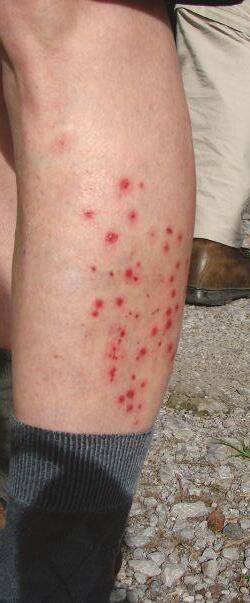
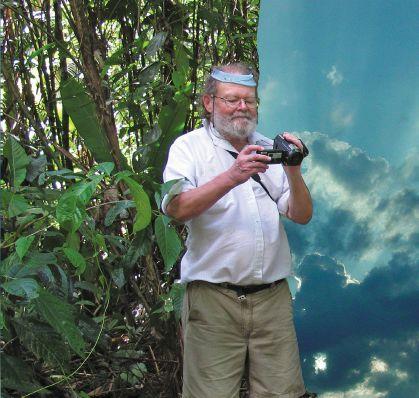
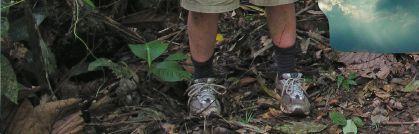
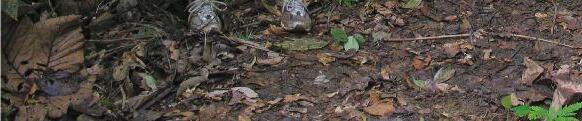
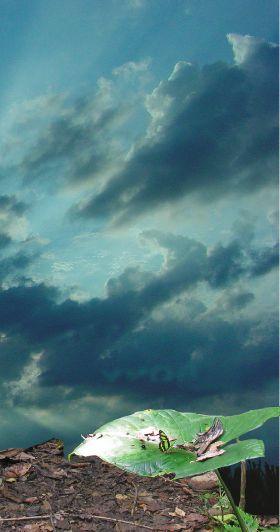

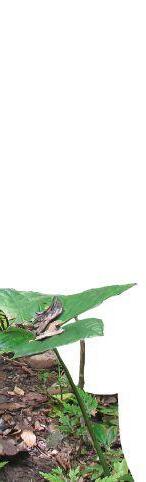
Don Stoltz (a molecular biologist who works on insect viruses), seen here photographing a Malachite, is comfortable wearing shorts in the e e es t see t i t e re i t b e se ue e t t be seen at left. Note that the main photo of Don, still in shorts, was taken after the photo at left. Rain forest photo, Nov. 8, 2012, Apuya, Napo, Ecuador. Sky photo. July 10, 2004. Morris Co., NJ. Don Stoltz leg photo. July 26, 2009. Rio Blanco Canyon, Veracruz, Mexico.
square inch of your skin and all the nooks and crannies — a properly performed tick check by a proper partner often leads to the most pleasurable part of the day.
Shoes
Believe it or not, I have seen people wear high-heels and open-toed shoes into the feld. What you want is simple, sturdy footwear. See photos on pages 16, 20 and 21 for examples.
Accessories
Umbrellas are useful if undertaking a long
hike or wandering in a rain forest. The umbrella handle can be hooked around a belt loop for easy carrying. Another worthwhile water repellent is a plastic poncho that one can put into a pants pocket for use as needed. In colder climates, where butterfies fy even when it’s only 40 F, windbreakers are very useful. Some people bring stools so that they can comfortably sit. And, many fnd a backpack useful for carrying supplies, such water and lunch.
All photos this article by Jeffrey Glassberg, except as indicated.
We have initiated a project to document the caterpillar foodplants of North American butterfies. For those who would like to participate in this photodocumentation, here are instructions:
Find an egg or a caterpillar (or a group of eggs or caterpillars) on a single plant in the “wild” (this includes gardens). The plant does not need to be native to the area — we want to document all plants used by North American butterfies.
Follow this particular egg or caterpillar (or group of eggs or caterpillars) through to adulthood, with the following documentation.
1. Photograph the actual individual plant on which the egg or caterpillar was found, showing any key features needed for the identifcation of the plant.
2. Photograph the egg or caterpillar.
3. Either leave the egg or caterpillar on the original plant, perhaps sleeving the plant it is on with netting, allowing the caterpillar to develop in the wild, or remove the egg or
caterpillar to your home and feed it only the same species of plant on which it was found.
4. Photograph later instars of the caterpillar.
5. Photograph the resulting chrysalis.
6. Photograph the adult after it emerges from the chrysalis.
7. If the egg or caterpillar was relocated for raising, release the adult back into the wild at the spot where you found it.
We would like to document each plant species used by each North American butterfy species, for each state or province. This documentation includes both native and nonnative plant species, inclusion in this series is not necessarily a recommendation to plant the plant in your garden..
In addition to appearing in American Butterfies, the results of this project will be posted to the NABA website. Please send any butterfy species/plant species/state or province trio that is not already posted to naba@naba.org.
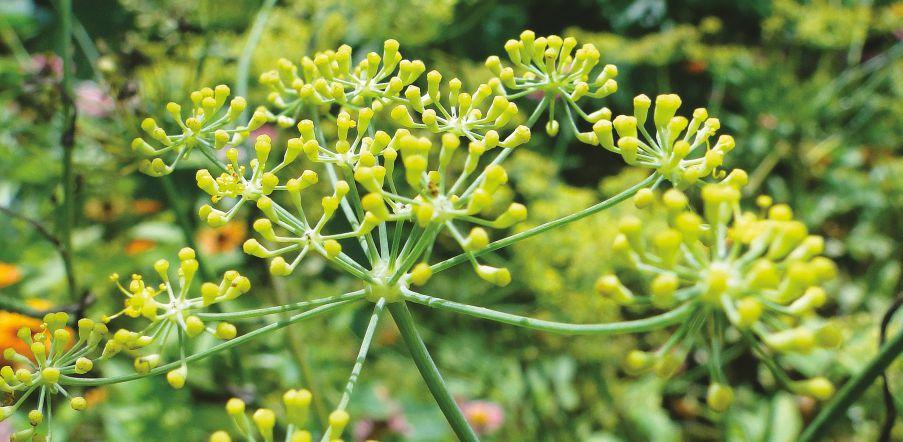
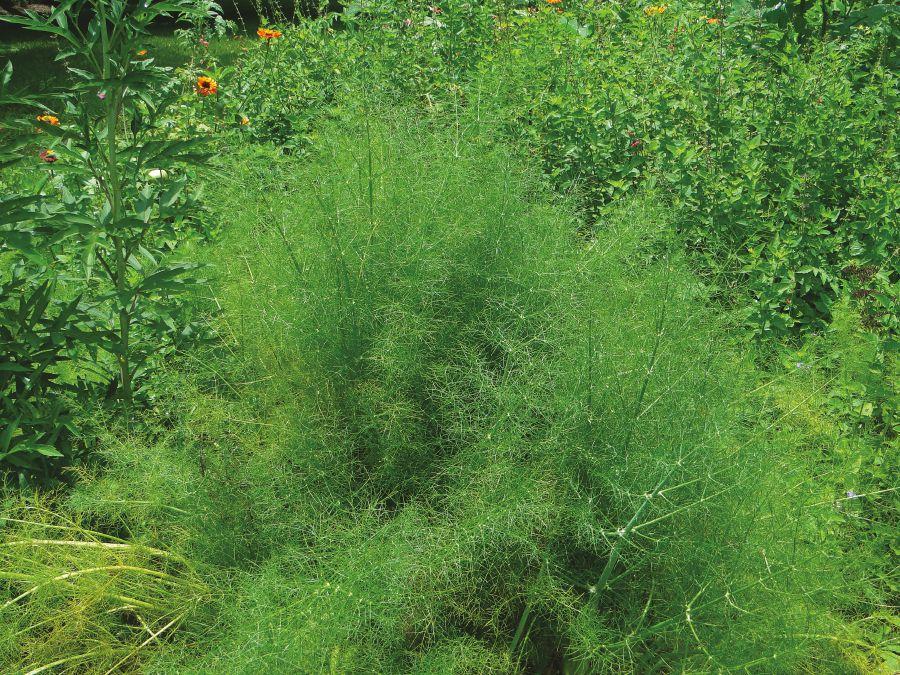
Opposite page top: Sweet Fennel in bloom in the author’s yard. June 25, 2016.
Opposite page bottom: Sweet Fennel in the author’s yard. June 25, 2016.
County, Texas text and photos by Don Dubois
This page top: A Black Swallowtail laid eggs on a Sweet Fennel in the author’s yard.
June 16, 2006.
This page bottom: First instar caterpillars.
June 18, 2006.
Opposite page top: The caterpillar grew rapidly.
June 21, 2006.
Opposite page bottom: Two days later, they were even larger.
June 23, 2006.
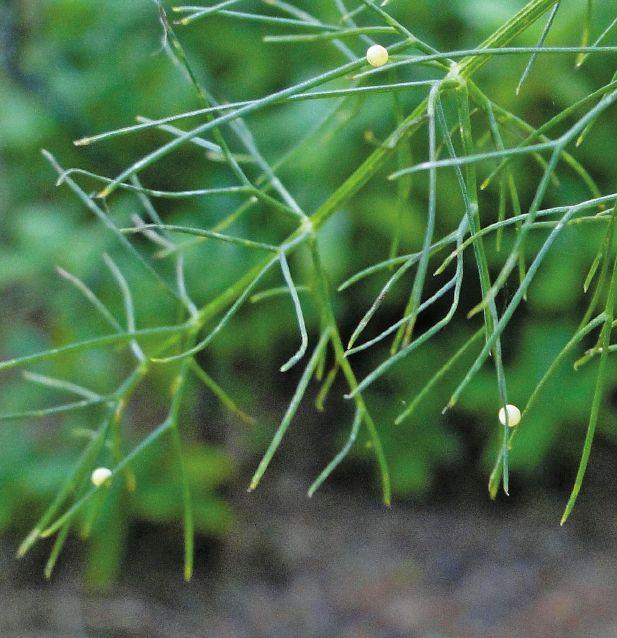
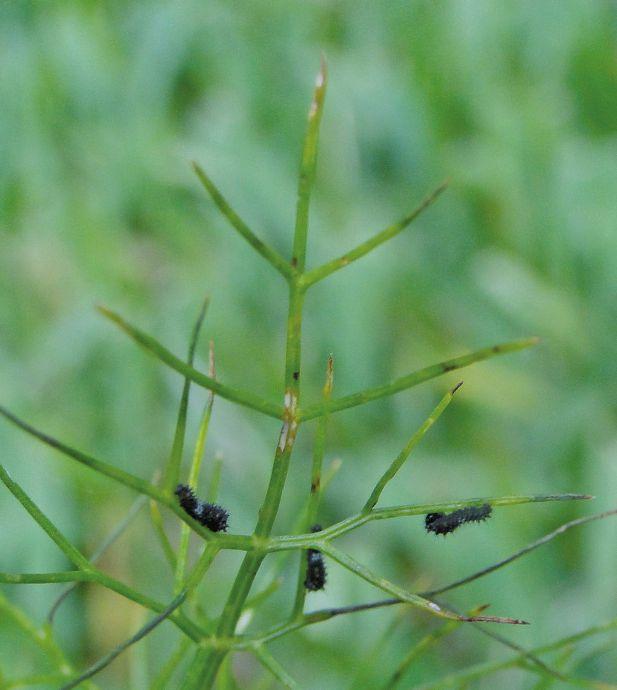
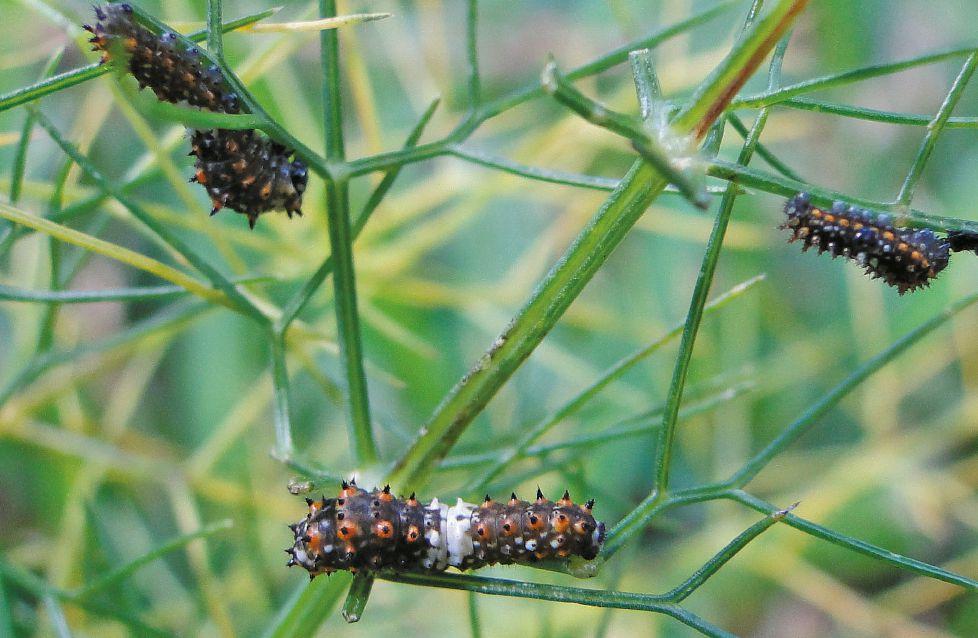
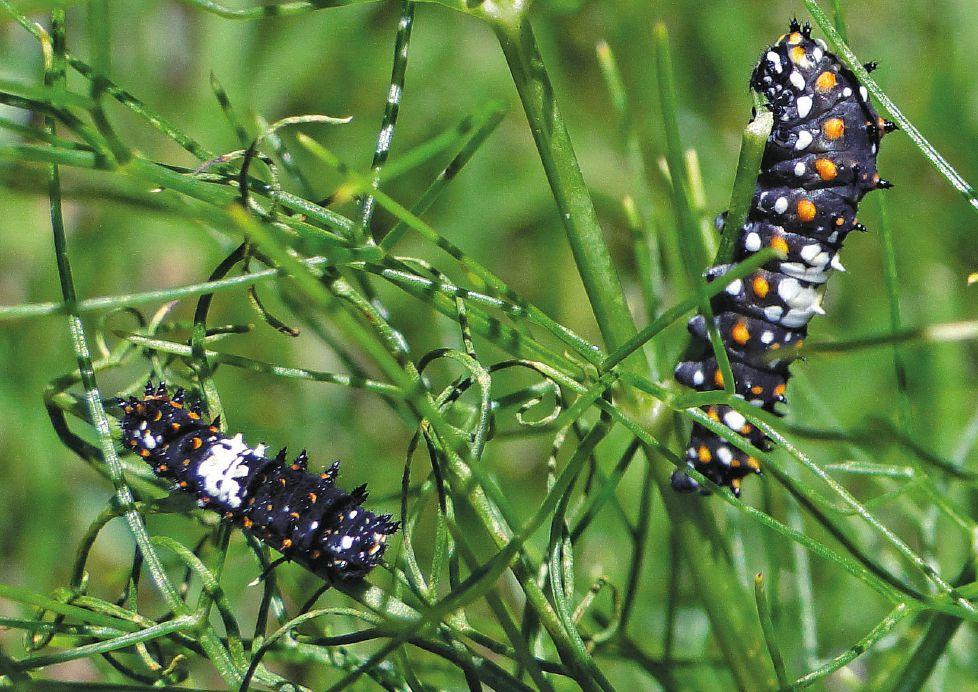
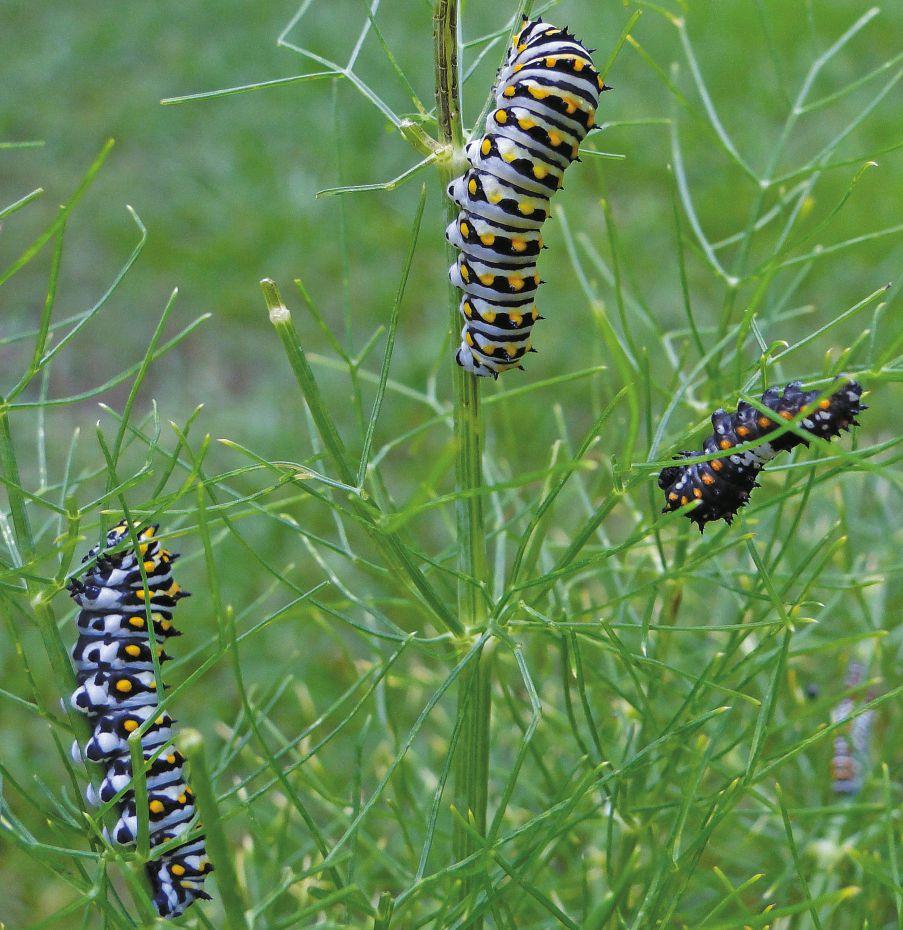
Black Swallowtails use many plants in the carrot family as caterpillar foodplants. Of the native plants in the Greater Houston area, Golden Zizia (also known as golden alexanders) and Texas Prairie Parsley have been reported as foodplants. Among the common garden plants, parsley and Sweet Fennel are frequently reported as hosts. With its tender foliage, Sweet Fennel is often selected by Black Swallowtails instead of its native cousins. This was the case on June 16, 2016, when a female black swallowtail was
seen visiting the Sweet Fennel in my garden. While both Golden Zizia and Texas Prairie Parsley were available, eggs were found only on the Sweet Fennel. A Sweet Fennel branch with eggs was snipped and brought inside to rear so as to avoid predation. The caterpillars hatched on June 18 and were fed additional Sweet Fennel branches as needed. Photos were taken periodically to document the progression from egg to butterfy. From the discovery of eggs to the formation of the frst chrysalis was two weeks. The frst two adult
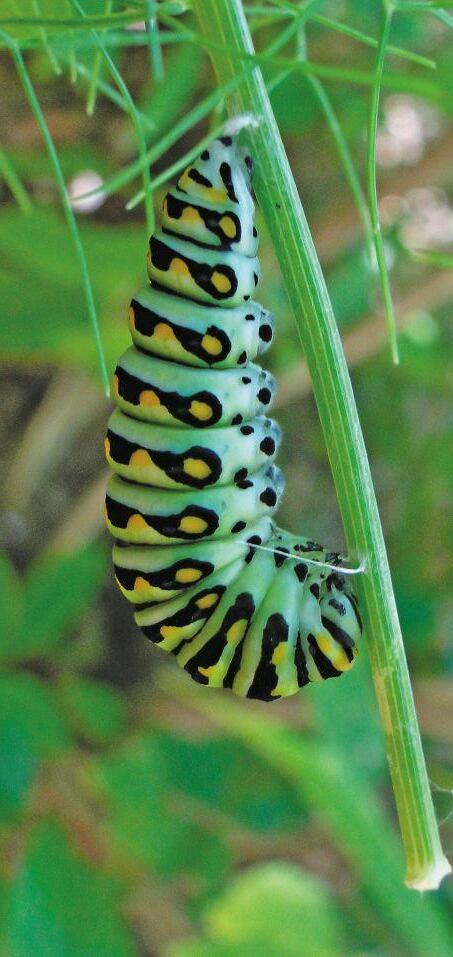
Opposite page: Late instar caterpillars. June 25, 2016.
This page left: A caterpillar begins pupation. June 30, 2016.
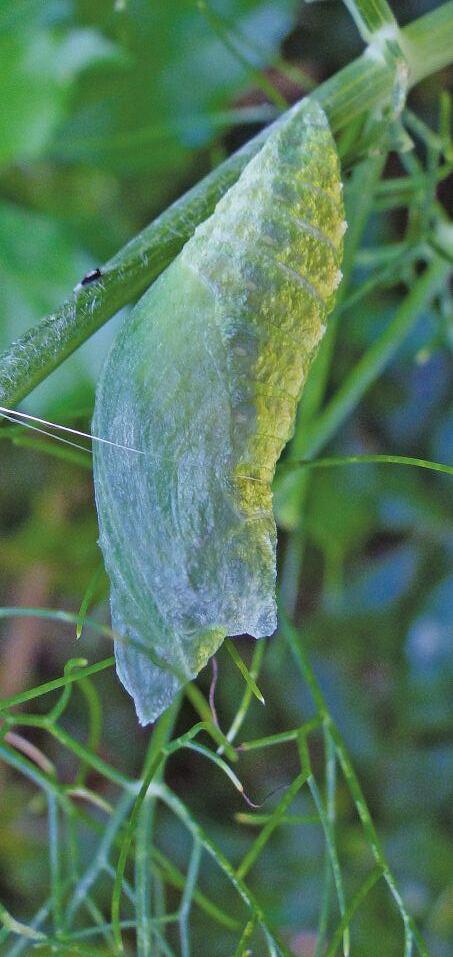
This page right: a chrysalis. July 1, 2016.
butterfies emerged on July 12, followed by a third the next day. The total time from egg discovery to adult butterfy was 26 days. All
adult butterfies were released back into the garden.
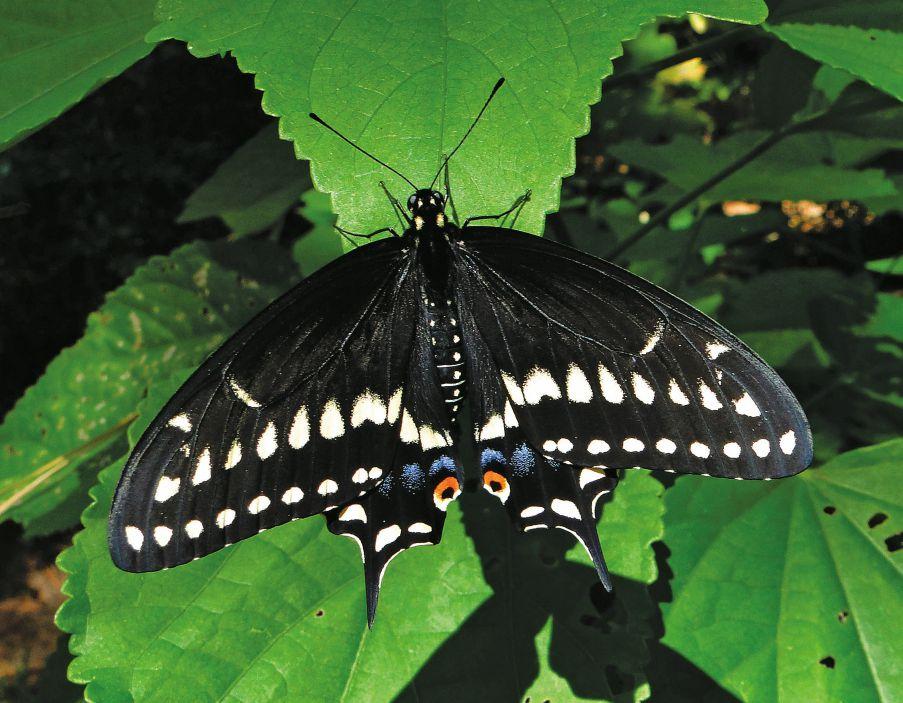
An adult Black Swallowtail emerged on July 12, 2016.
Above: A drawing of the approximate range of Black Swallowtails. Purple indicates that there are two broods, orange, three or more broods. Cherry spots indicate that strays have occurred there. (drawing modifed from A Swift Guide to Butterfies of North America).
Above: A drawing of the introduced range of Sweet Fennel. This plant is hardy in plant zones 4-9 and can be used as an annual everywhere. This might be a useful plant for your garden if you live within the range shown. If Black Swallowtails don’t show up, you can eat the plant yourself.
text and photos by Sandy-Crystal Vaughn
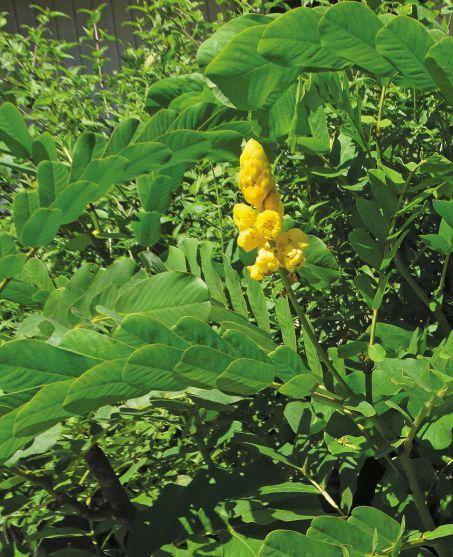
Left: The Emperor’s Candlesticks in the author’s yard. June 7, 2016.
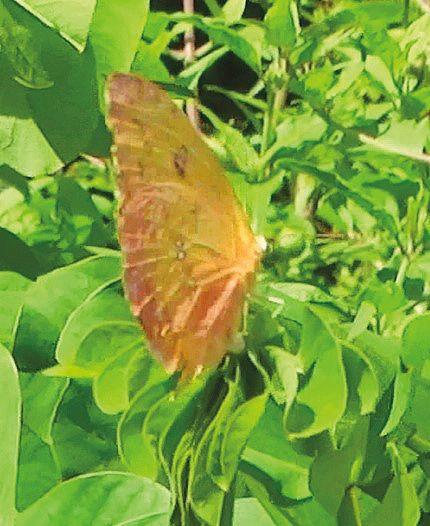
Right: A female Orange-barred Sulphur, quickly few in to lay her eggs. June 7, 2016.
Emperor’s
in my yard, originally purchased at the Cockrell Butterfy Center in Houston, started to bloom in 2016. It can grow to eight or nine feet in a single growing season. I trim it back in the late fall and save a seed pod or two just in case it does not come back in the spring. So far, so good!
On June 7th, this worn female Orangebarred Sulphur came in fast and furious laying her eggs! Part of her right hindwing was gone. She was moving so quickly, that I switched to video mode on the camera to capture her image in fight. I later pulled this frame from the short video. It has been a few years since this butterfy has been seen in the area.
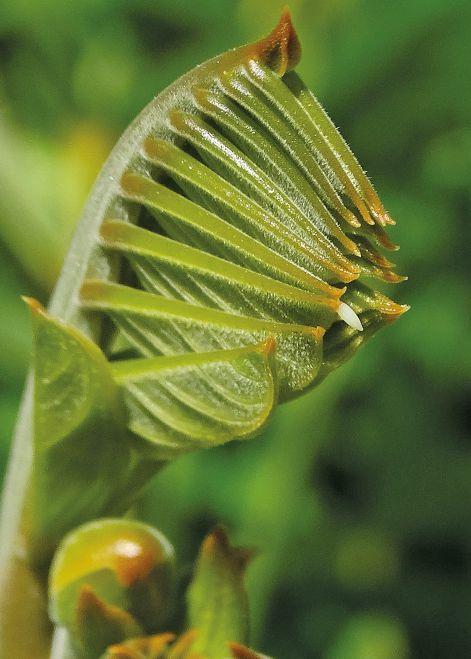
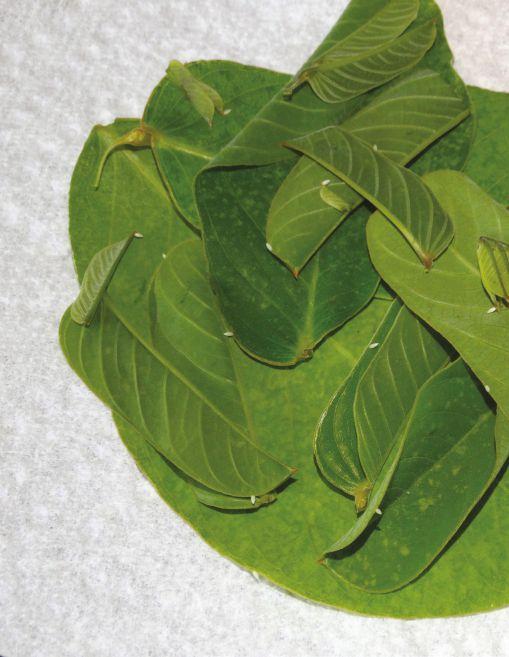
Top left: One of the Orange-barred Suphur eggs on the tender, new growth of the Emperor’s Candlesticks plant. June 7, 2016.
Top right: Seventeen eggs were collected and brought inside to a rearing bin. June 7, 2016.
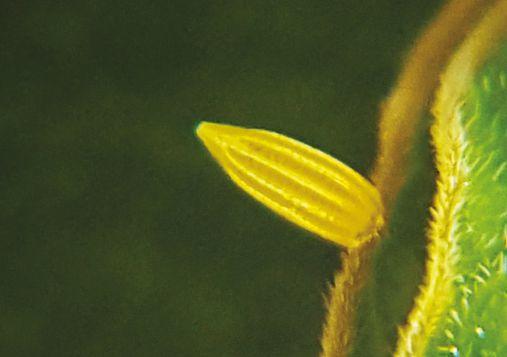
Above: Forty-eight hours later, the eggs This image was taken with a 45x magnifcation microscope and a cell phone camera.
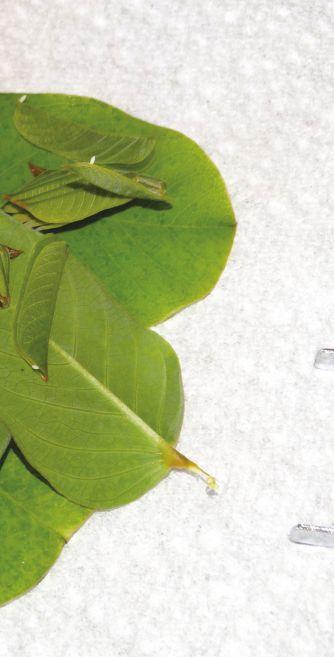
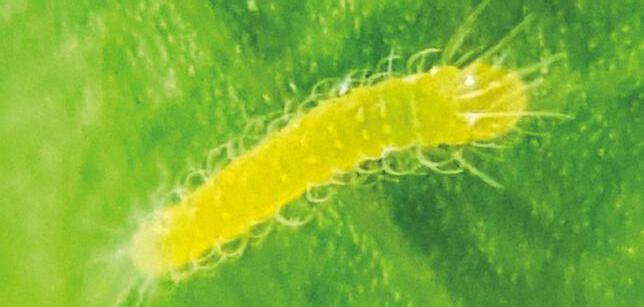
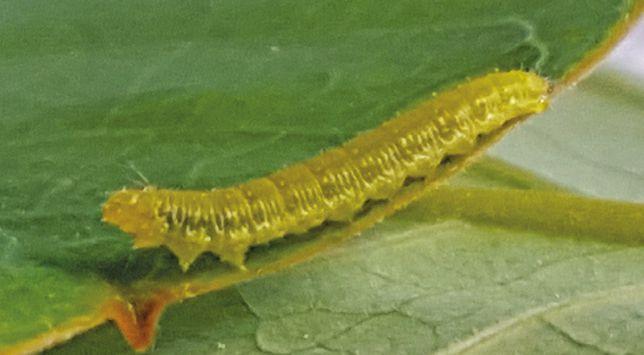
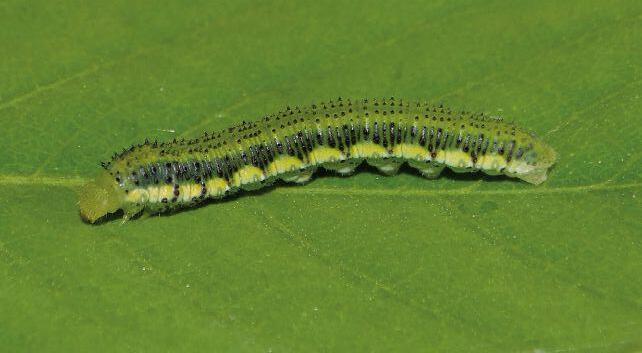
Top: The frst day as a caterpillar. June 10, 2016.
eggs have darkened. magnifcation pocket camera. June 9, 2016.
Middle: Early instar caterpillar. June 13, 2016.
Bottom: Late instar caterpillar. June 17, 2016.
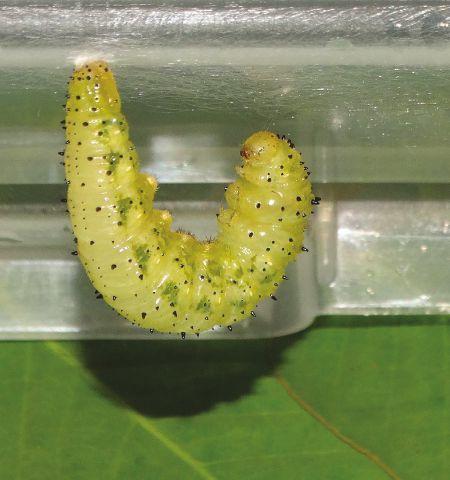
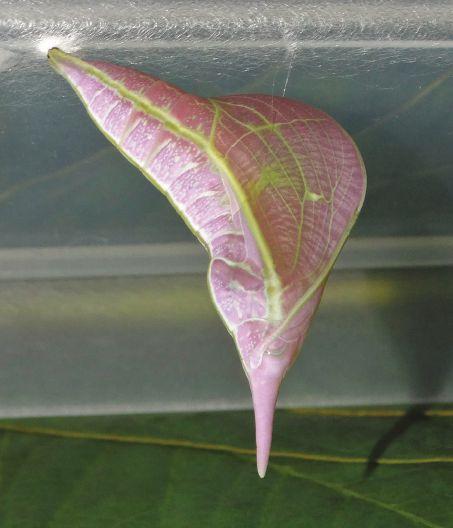
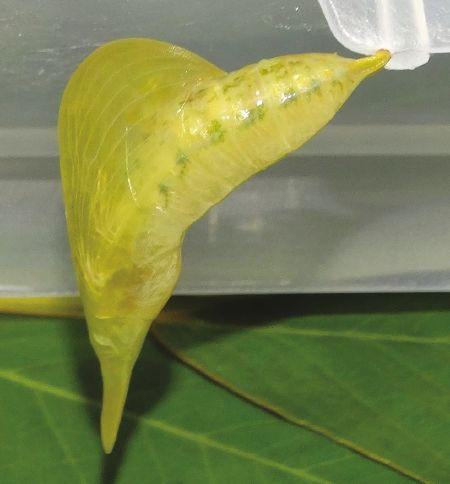
Top: One of the caterpillars pupates. June 22, 2016.
Top right: Some of the chrysalises are green. June 22, 2016.
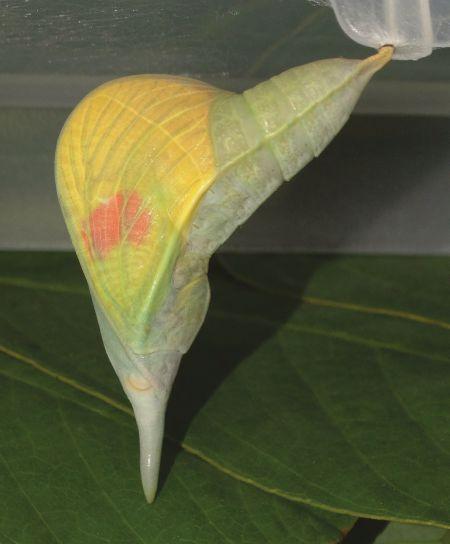
Middle left: Some of the chrysalises are red June 26, 2016.
Middle right: Getting ready to eclose from a green chrysalis. July 2, 2016.
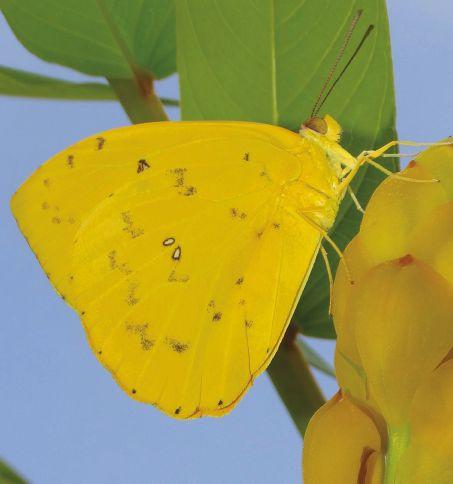
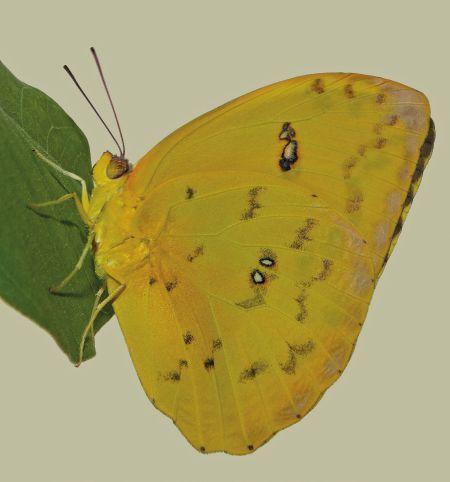
The adult Orange-barred Sulphurs began to eclose in early July and were released into the garden.
Left: This male emerged on July 5, 2016.
Right: This female emerged on July 3, 2016.
Above: A drawing of the approximate range of Orange-barred Sulphurs. Turquoise indicates that there is one brood. Purple indicates that there are two broods, orange, three or more broods. Cherry spots indicate that strays have occurred there. (drawing modifed from A Swift Guide to Butterfies of North America).
Above: A drawing of the naturalized range of Emperor’s Candles. We are simply documenting its use by Orange-barred Sulphur. We are not recommending this for normal garden use because, although not yet a real problem in the U.S. mainland, it is highly invasive on Pacifc islands.
Cerbone. When and how did you join NABA?
Clayborn. I am not sure of the exact date; however, I believe I became a NABA member in 2013. In the beginning, I participated in NABA butterfly surveys in the Everglades and on the Florida Keys before officially becoming a NABA member.
Cerbone. You are the president of the Miami Blue chapter of NABA, can you tell me a little bit about what you do in that role and what made you decide to pursue it?
Clayborn. As president of the NABA Miami Blue chapter, I place more energy in the pursuit of diverse speakers for our quarterly meetings and attempt to expand outreach activities and services. Our chapter delegates the work required and needed; meaning, even though I am president, other board members, officers, and general members dedicate a lot of time and ingenuity to maintain this chapter, too; therefore, even as president, I want to acknowledge the entire board, officers, members and volunteers. Thank you for your service and commitment!
Cerbone. For those readers out there that don’t belong to a chapter, can you talk about what yours works on?
Clayborn. Many NABA Miami Blue chapter members volunteered their time to survey one of the rarest butterflies in
Interview by Michael Cerbone
the United States, the federally endangered Schaus’ Swallowtail; and collectively, NABA members and other devoted volunteers recorded more than 430 Schaus’ Swallowtails in 2019 during 570+ volunteer hours in often hot, humid, and buggy (mosquitoes) subtropical dry forest habitat on the Florida Keys.
We also organized an event led by Barbara McAdams and Patty Phares titled: Butterfly and Bird Day. This all-day outdoor event in collaboration with Miami-Dade County Parks and sponsored by Florida Power & Light featured butterfly and bird hikes and tours, guest speakers, nature vendors, arts & crafts, and native plant sales and giveaways. We hosted a good crowd and, hopefully, inspired and informed more people about the many ways we can coexist with butterflies, birds, and wildlife, in general.
Cerbone. When did you decide to pursue a career in academic science?
Clayborn. I was an AmeriCorp teacher at a charter school in St. Petersburg, Florida for a year; the atmosphere there was extremely stressful. I knew I still wanted to teach science, do research, and commit to outreach, however, I believed there was a better way. Therefore, I pursued a Master’s degree from the University of South Florida St. Petersburg and eventually a Ph.D. from Florida International University (FIU). I continue to work with and support
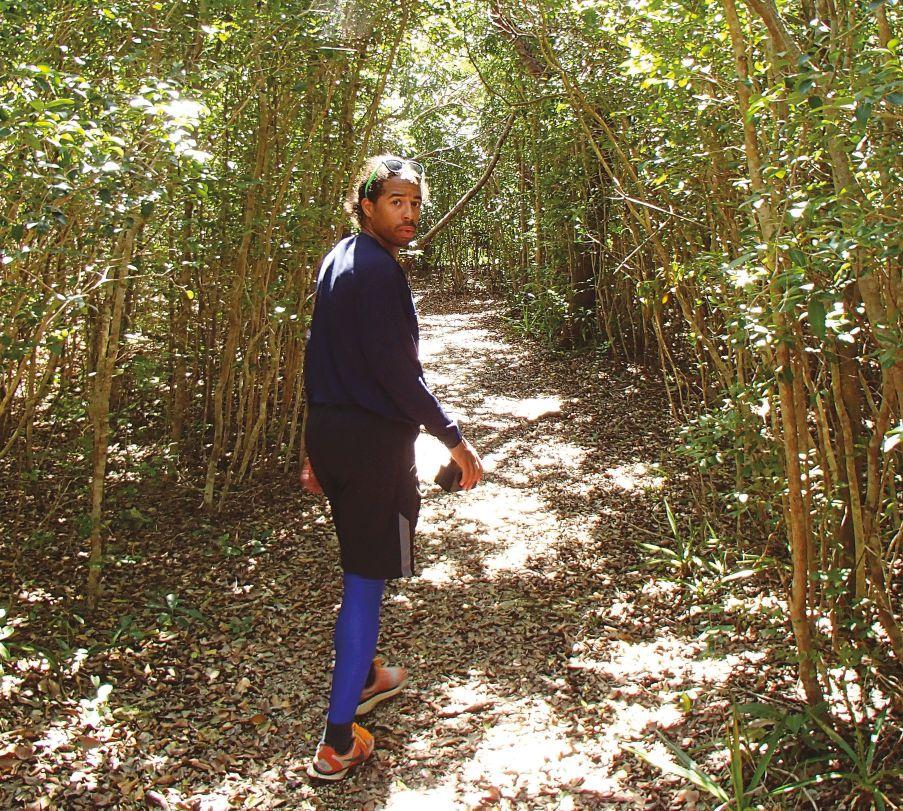
K-12 teachers in Florida and do outreach activities and programs in Ohio, Florida, and Cuba.
Cerbone. Can you tell me about your project “Butterfly World 1.0”? I am especially interested in where the idea for this came from. I have a background in the software industry so I find the details of the development cycle interesting; how involved were you with the technical aspects of the project? What ultimately do you hope the application will achieve?
Clayborn. Butterfly world 1.0 actually
started because of FIU intramural basketball. I was playing with a teammate, Alban, a computer engineer, and we started talking about our respective research. One day, we came up with the idea of using video games to teach people about nature preservation through fun, interactive activities. We were excited about immersing people in a virtual world filled with common and rare butterflies in diverse ecosystems throughout the world; accordingly, we named the game: Butterfly World 1.0. Alban offered to program a prototype of the game.
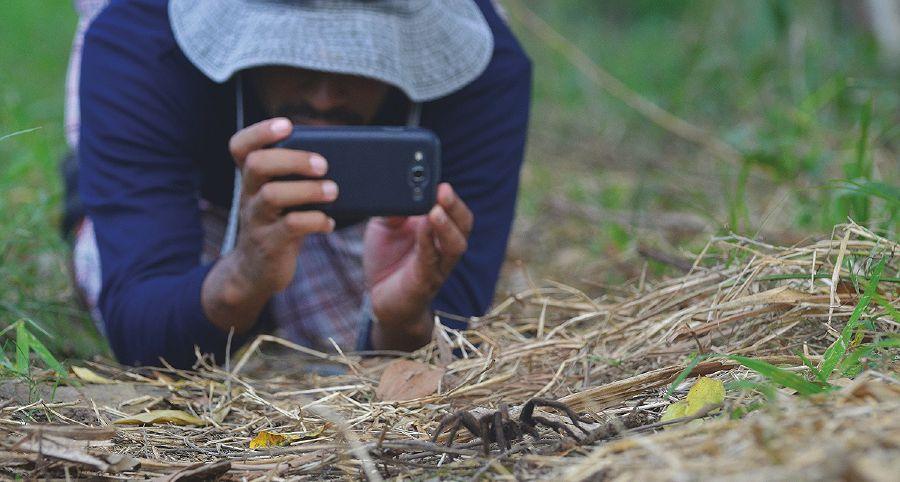
Since the first prototype, Butterfly World 1.0 has evolved from a desktop simulation harboring one butterfly species to an immersive experience in a tropical dry forest ecosystem with more than ten butterfly species. Butterfly World 1.0 has great potential; we have a lot more ideas for future applications.
Regarding game development, Alban writes the code and creates the virtual butterflies, plants, and structures in Butterfly World 1.0. He truly is gifted with the uncanny ability to learn new skills and overcome obstacles in game development. In the beginning, there were lots of bugs, computer bugs; however, he has fixed them over time and Butterfly World 1.0 has progressed. I am responsible for the selection of species, habitat design, and content.
We want to engage people in an immersive virtual ecosystem to learn about rare and common butterflies in their natural habitats throughout the world. In order to be successful in the game, the player must
correctly identify the targeted butterflies and their host plants in the proper habitat. Gaining these skills can bring out latent curiosity and inspire people to build their own butterfly gardens and promote awareness of the lesser known species.
Cerbone. Jeff likes to have me ask the question “How is your profession like going butterflying” but that’s a little different for you! So instead I will ask “how has your role as an academic scientist informed your personal enjoyment and practice of butterflying? Or vice versa?”
Clayborn. I enjoy being immersed in nature and butterflying challenges me to be aware of plants. I often ask myself, “Is this a host plant for a caterpillar or caterpillars?”
Am I cured from Plant Blindness? Being aware of South Florida’s FAB FOUR, Schaus’ Swallowtail, Florida Leafwing, Bartram’s Scrub-Hairstreak, and Miami Blue, and concerned about their populations’ vulnerability to a myriad of threats in the present and future, I reflect on the gems in South Florida: federal and state parks
where these butterfly species continue to exist and on the people dedicated to their preservation. My dissertation research advisor, Dr. Koptur at FIU, piqued my interest in butterflies, plants, and the imperiled pine rockland ecosystems.
Cerbone. We talk about there being no silver bullet for getting people, especially young people, engaged in conservation and ecology. But that said, what do you think the best tools are for increasing that engagement in a beneficial way? Where and how should the already engaged be focusing their energy in growing organization organizations and individual efforts?
Clayborn. Ok, I am glad you asked this important question and I could go on for days regarding this topic; however, I will attempt to be direct and succinct: let’s go. I have worked with many people, young and old, diverse ethnicities, varying attitudes and interests, and wide-ranging abilities to spend. The one thing these diverse groups have in common is their interest in nature and, for the most part, butterflies. However, the recipe to engage and pique interest is just as diverse. Where we often fail: I encourage ALL butterfly advocates to improve their presentation skills and transition away from lecturestyle, more than 50 slides PowerPoint presentations. This needs to go away forever; there are plenty of videos on YouTube demonstrating better ways to deliver dynamic presentations. In South Florida, we often do surveys and habitat restoration projects in hot, humid, and sometimes buggy conditions, which only cater to the most dedicated or enthusiastic people (probably already NABA members), which can stymie growth in membership and engagement in conservation and ecology. Therefore, I suggest multiple pre- and post-sessions embedded within these outings to precondition relevance and excitement before volunteers endure
the hard labor. Often, we might start a butterfly survey in the morning, state the butterfly is endangered, go survey for many hours, finish, and then say, “Thank you for your service, bye!”. That might work for a few (once again, NABA members), however, not the majority, and we need as many advocates as possible to bridge the intention-behavior gap between being concerned about butterflies and other wildlife and pro-actively doing something about it. We usually have the same volunteers (I acknowledge and appreciate their work) committed to the mission of butterfly knowledge and conservation with little growth in the number of volunteers, let’s improve our growth, we have the perfect mascots: butterflies! Let’s succeed: I believe the largest partially tapped resources are schools, community centers, detention centers, low-security prisons, hospitals, and retirement facilities. Let’s continue to work with teachers and staff through engagement on their grounds and field trips in the parks. I believe we do great work; however, as stated before, we can’t use the same recipe at each location. I, personally, believe we should donate butterfly and plant guides to people in order to properly identify local butterflies and, occasionally, donate host plants. During my presentations, I challenge my audience to identify different species and then end the presentation with the game: Kahoot! Winners earn native plants and butterfly guides to take home. Periodically, though anecdotal, past audience members have contacted me to share pictures of their host plant trees or shrubs in their butterfly garden. Give people a butterfly presentation: they listen; give people a butterfly presentation, butterfly guide, and a host plant: they build a garden.

he ational Butterfy enter, In ission, idalgo o., , was the place to be in ecember ot seens included a couple of Green-backed Ruby-eyes on ec. 1 and 2, seen and photographed by inda opper and uciano Guerra an Isabella’s Heliconian photographed by Jack ochran on ec. an unusual Gray Hairstreak, with the orange replaced by pale yellow, also on ec. , reported by arl and orothy egler a Goldspotted Aguna, spotted by ick irschl on ec. 1 and a series of Spot-celled Sisters, very rare strays to southern exas, present at least from Dec. 9 to Dec. 23 and photographed by an Jones and uciano Guerra. A good number of species was present at the B , for example, on ec. , an Jones saw 40 species there, including Julia Heliconian, ebra eliconian, Isabella’s eliconian, and Ruddy Daggerwing. earby, an Emerald Aguna was observed on ecember 6 by aniel Jones at uinta a atlan, cAllen, idalgo o.,
. A little further east, an Jones had both a female Blue-eyed Sailor and a ercurial Skipper in his yard on ec. 16 we can all dream of a yard like that ther ecember butterfy sightings included a December 24 late sighting of an Eastern Comma from inda omine in Shawnee State Forest, F , Scioto o., a ecember 26 report from en Wilson of only fve onarchs overwintering at a city park in Fremont, A where normally there were 200- 00 overwintering and a ecember 26 late sighting from on Smith of four Statira Sulphurs at Fort e Soto ark, F . n ecember 2 Bart Jones, in his yard in emphis , saw a fresh Cloudless Sulphur on ecember 2 , enis . uinn saw a late
by Michael Reese
The ruby-red eye color of Green-backed Ruby-eyes helps people to recognize these rare visitors to the Lower Rio Grande Valley of Texas. They are related to other ruby-eyes (a group of grass-skippers), most of which are crepuscular f i i t r dusk. A group of spreadwing skippers, the scarlet-eyes, also have red eyes and are crepuscular. No one knows if there is a functional relationship between the red eye color and the behavior of f i i i t but bet dollars to donuts that there is.
Opposite Top Green-backed Ruby-eye. Dec. ti utterf e ter Hidalgo Co., TX.
Opposite Bottom Green-backed Ruby-eye. Dec. ti utterf e ter Hidalgo Co., TX.
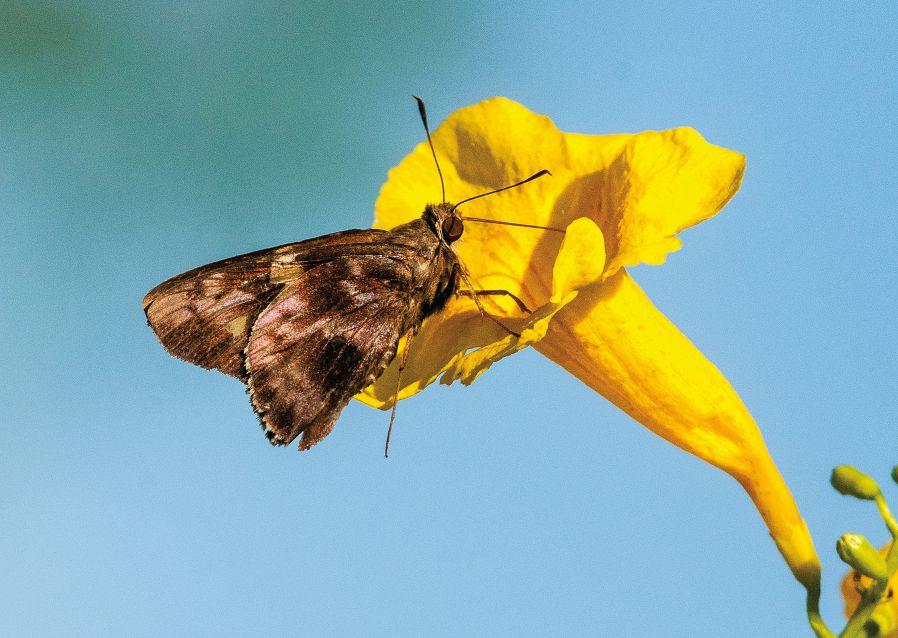
Eastern Comma 1 mile west of US route 1 on Mason-Dixon MD/PA line, Chester Co., PA, and, on December 31 David H. Bartholomew saw a Red Admiral in Mitchell Park, Palo Alto, Santa Clara Co., CA.
January butterfy sightings were mostly from Florida and California. Florida sightings included a January 1 submission from Ron & Lori Smith from Navy Wells Preserve, Homestead of seven species including four U.S. endangered Bartram’s Scrub-Hairstreaks and a Baracoa Skipper; a January 3 sighting from Ron Smith at Weedon Island Preserve of the frst January record from Pinellas County of a Statira Sulphur; Edward Perry IV reported that on January 6 Pam Higginbotham saw and photographed 60+ Atalas in Jetty Park, Cape Canaveral, possibly the northernmost documentation for this species. A January 8 list from Matt Orsie of 13 species included Martial Scrub-Hairstreak and Florida Duskywing at Key Deer NWR – Big Pine Key, Monroe Co., FL. Other Florida sightings included a January 9 report from Walter Wallenstein, Rachel Warner, and Edward Perry IV in Navy Wells Pineland Preserve, Miami-Dade Co. of 17 species including eight Bartram’s Scrub-Hairstreaks and four Baracoa Skippers; a January 12 list from Bart Jones, Leigh Williams, and Amy Grimm of 14 species including a Miami Blue in Bahia Honda State Park, Monroe Co.; a January 14 sighting from JoAnna N Clayton, from Mangrove Cay Gandy area, Pinellas Co., that included 30+ Little Yellows and two Statira Sulphurs; and a January 31 submission from Amelia Grimm from John Pennekamp Coral Reef State Park, Monroe Co. of 16 species including four Silver-banded Hairstreaks and a Florida Purplewing.
January sightings from California included a January 4 list from Ken Wilson from a hilltop in San Clemente, Orange Co., CA of four species including a Gray Hairstreak and a Cabbage White; a January 22 report from Brett Badeaux from the Santa Margarita River Trail, San Diego Co., of eight species including
When it’s winter where you live, perhaps you should consider a trip to the National Butterfy Center and the Lower Rio Grande Valley.
An Isabella’s Heliconian was at the National Butterfy Center on Dec. 8th and 9th. This one was photographed on the 8th by Jack Cochran.
Bottom left
Emerald Agunas are very rare strays (for example, none of the very rare strays shown in this article have been seen in the U.S. by the editor of American Butterfies) to the Lower Rio Grande Valley. This one was photographed at Quinta Mazatlan, McAllen, Hidalgo Co., TX by Dan Jones on Dec. 6.
Bottom right
Another rare species of Aguna! This one, a Gold-spotted Aguna, was photographed at the National Butterfy Center by Rick Nirschl on Dec. 13.
seven Sara Orangetips, four Brown Elfns, and two Satyr Commas; a January 24 submission from Ken Wilson from Anza-Borrego State Park, San Diego Co., with photos of Becker’s White and Sara Orangetip; a January 24 by John Heyse of his frst butterfies of the year, two Mourning Cloaks in Crockett Hills Park, Contra Costa Co.; and a January 31 sighting from David H. Bartholomew of 25 Mourning Cloaks in Rancho San Antonio Open Space Preserve, Santa Clara Co.
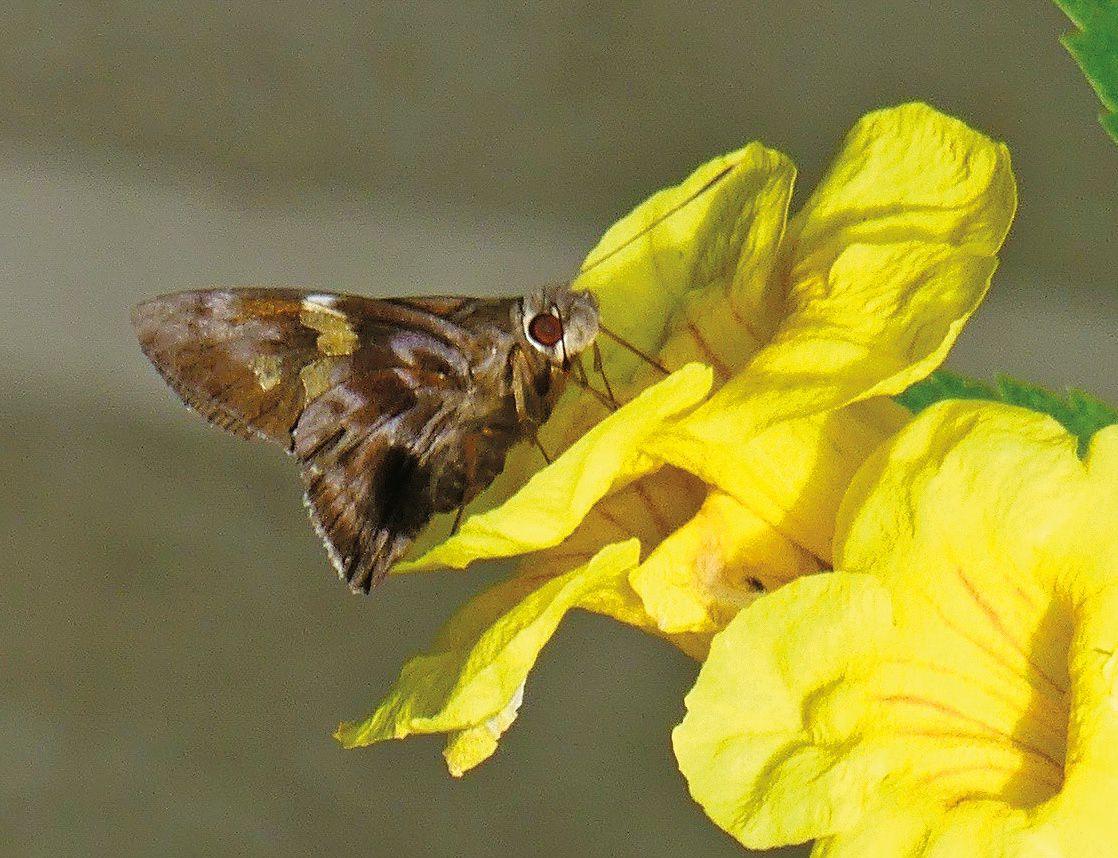
A Variegated Skipper, a very rare stray to the Lower Rio Grande Valley, was seen on Jan. 17 by Mike Troyan at Estero Llano Grande SP, Hidalgo Co., TX.
February sighting included many frst of the year butterfies included a February 9 sighting of a Cabbage White by Chris Blazo near St. Thomas, Franklin Co., PA; a February 12 sighting from Barbara Peck of 12 California Tortoiseshells, despite cool temperatures, in Coot’s Roost on Lewiston Lake plus other locations near Lewiston, Trinity Co., CA; and on February 19 David H. Bartholomew saw his frst of the season Orange Sulphur, Common Buckeye, and Silvery Blue in Sunol Regional Wilderness, Alameda Co., CA. Other frst of the year reports included a February 22 list from Barbara Peck of a frst of the season Pipevine Swallowtail in Turtle Bay, Redding, Shasta Co., CA, a February 22 sighting by John Heyse from his home in Crockett, Contra Costa Co., CA of a frst of the season Pipevine Swallowtail, a February 23 report from Mark Adams of an Eastern Comma and a Mourning Cloak in Sugar Hollow, Albemarle Co., VA; and a February 28 submission from Joanne Langabee of her frst butterfy of the year, an Eastern Comma in Fontenelle Forest, Bellevue, Sarpy Co., NE.
Other February sightings of note included a February 2 list from Linda Cooper, B. Harden, and D. Oakley of an Atala and six Bartram’s Scrub-Hairstreaks in Homestead, Miami-Dade Co., FL; a February 5 sighting from Ronda G Spink of ten species including 201 Ceraunus Blues in Flamingo
Seeing family members is a good thing, and sisters are part of the family!
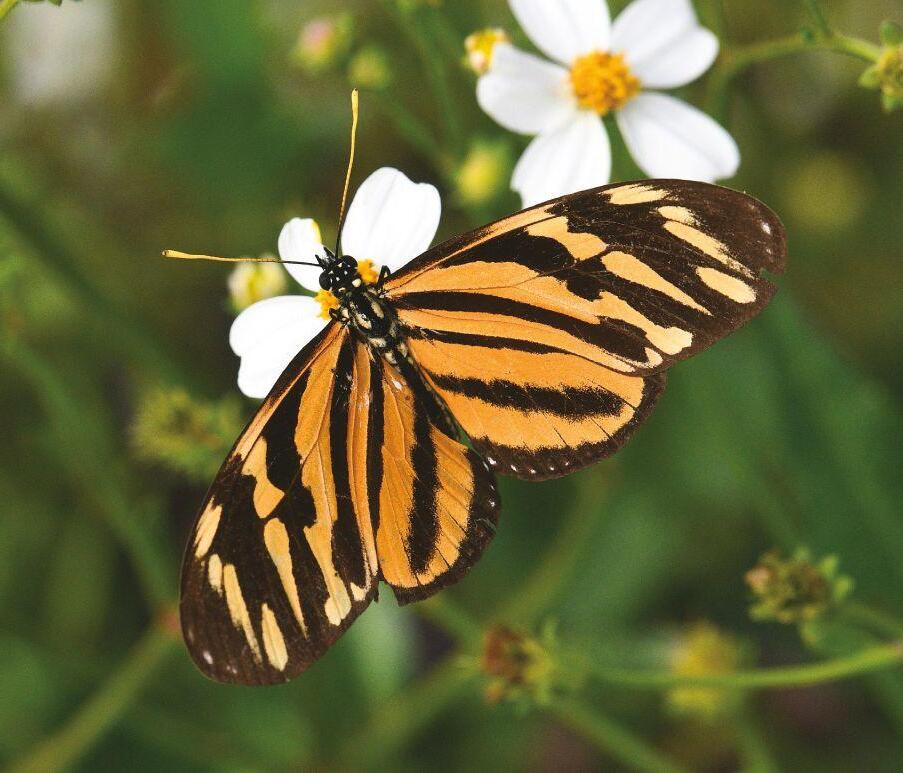
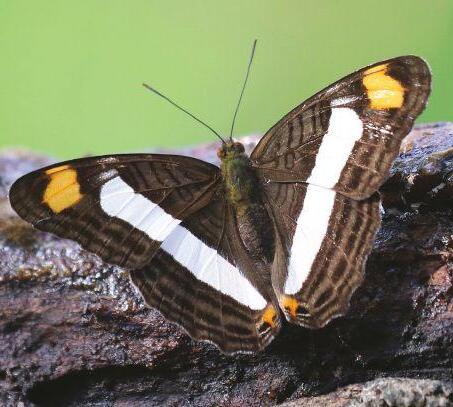
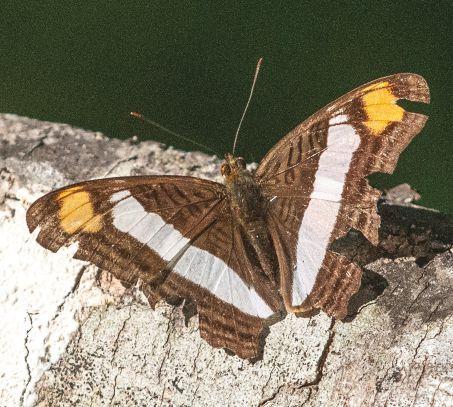
Spot-celled Sisters are very rare strays to the Lower Rio Grande Valley. In December, a number of individuals were present for at least two weeks at the National Butterfy Center
Top Left
Spot-celled Sister. Dec. 9, 2019. National Butterfy Center
Top right
Spot-celled Sister. Dec. 23, 2019. National Butterfy Center
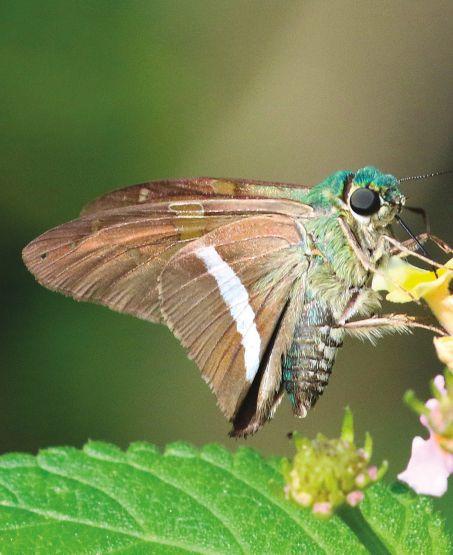
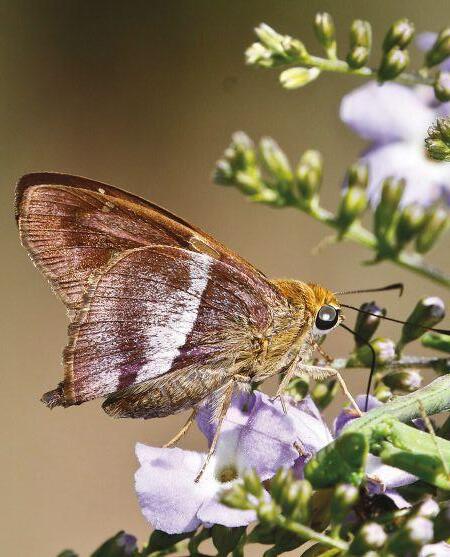
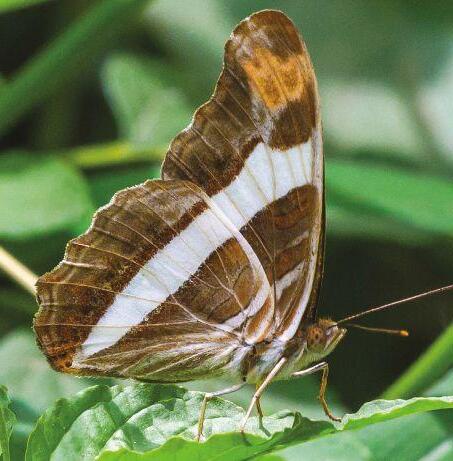
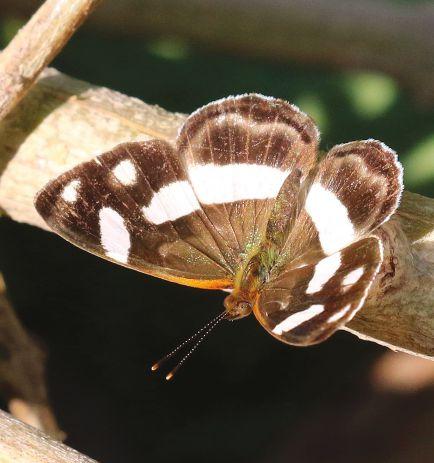
Band-celled Sisters are not as rare in the U.S. as are Spot-celled Sisters, but they are still quite uncommon.
Middle left and right Band-celled Sister. National Butterfy Center. Feb. 11, 2020.
Old friends are good as well
Bottom Left
A female Blue-eyed Sailor. Dec. 16, 2019. Progresso Lakes, Hidalgo Co., TX.
Bottom right
Mexican Silverspot. Dec. 23, 2019. National Butterfy Center
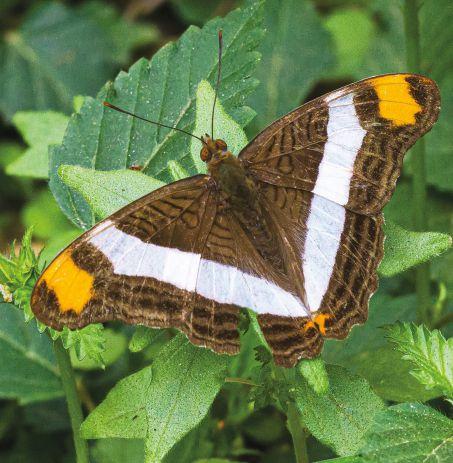
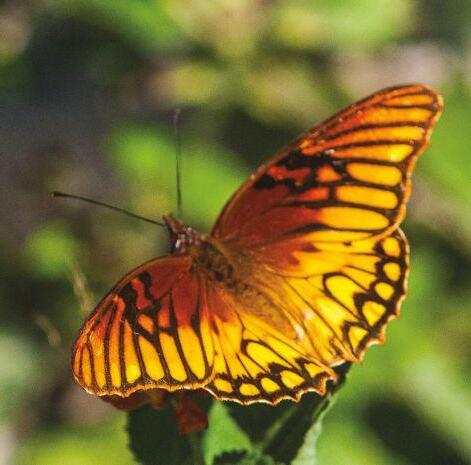
Campground, Everglades National Park, Miami-Dade Co., FL; a February 8 report from Jim Egbert of fve species nectaring on wild plum including a Monarch and two Juvenal’s Duskywings in Orange Beach; Roscoe Rd. Baldwin Co., AL; a February 12 sighting form Walter Wallenstein on Rowdy Bend Trail in Everglades NP, Miami-Dade Co., FL of 500+ Eastern Pygmy-Blues; and a February 13 submission from Daniel Jones of 30 species including Boisduval’s Yellow, Mexican Bluewing, and Blue Metalmark in Resaca de la Palma State Park, Hidalgo Co., TX. On February 18 Steven Glynn observed fve hairstreak species including two Amethyst Hairstreaks at Fort Zachary Taylor State Park, Monroe Co., FL; a February 23 report from Ron & Lori Smith of 40 Red-banded Hairstreaks in Torreya State Park, Liberty Co., FL; a February 24 report by Scott Anderson of 22 species including 35 Dainty Sulphurs and 14 Horace’s Duskywings in Sleeping Turtles Preserve North, Sarasota Co., FL; a February 25 sighting list from David H. Bartholomew of eight species including 25 Anise Swallowtails in San Bruno Mountain, Ridge Trail, San Mateo Co., CA; and a February 28 list from Daniel Jones from his back yard in Progresso Lakes, Hidalgo Co., TX of 36 species including White-striped Longtail and Coyote Cloudywing

Whether you see an unusual butterfly, an early or late sighting of a common species, or have a complete list of the species you have seen, we would appreciate hearing from you. Please send your butterfly sightings to sightings@naba.org. Those who record your sightings to the Butterflies I’ve Seen website can just click on “email trip” and send it to the address given above. Your sightings will go into the larger database and will also be available for others to see on the Recent Sightings web page.
Opposite page
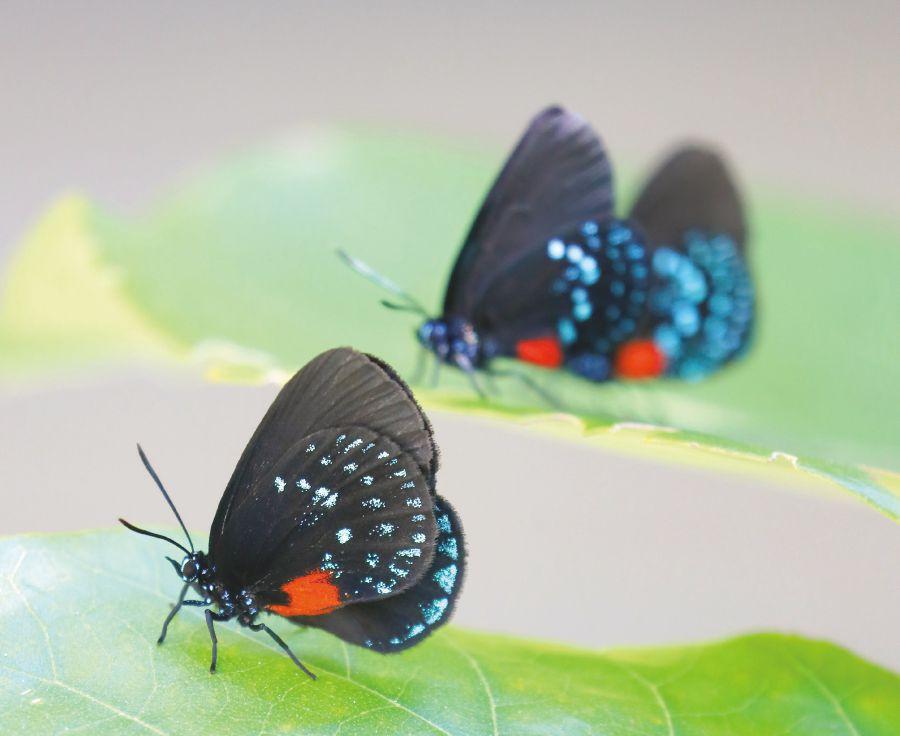
Top Humans are responsible for the decline of butterfies throughout much of the world. Occasionally, they boost a butterfy. Atalas are a case in point, as more and more Floridian gardeners plant hostplant cycads, Atalas increase in number and expand their range. Pam Higginbotham photographed these Atalas at a new northernmost colony in Jetty Park, Brevard Co., FL on Jan. 6, 2020.
Bottom left
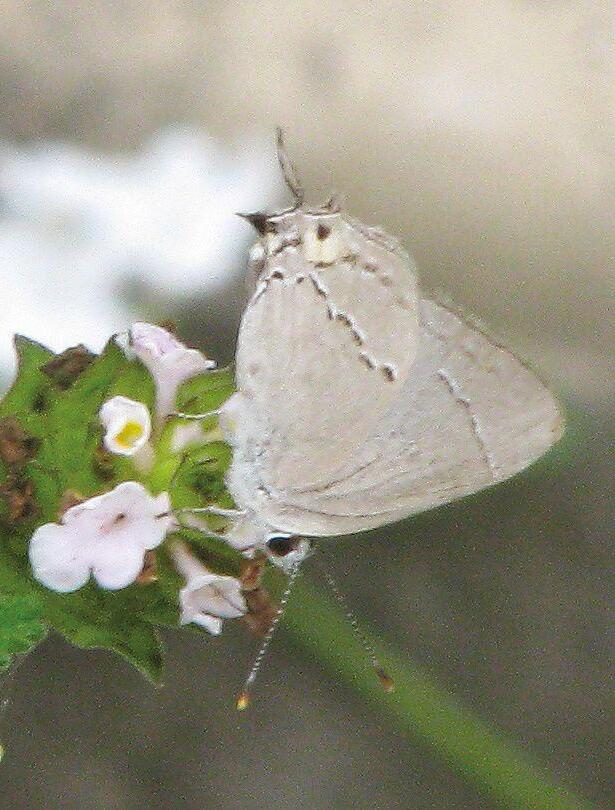
Karl and Dorothy Legler photographed this unusual Gray Hairstreak with a very pale HW large marginal spot, rather than the usual bright orange spot. Dec. 8, 2019.
National Butterfy Center.
Bottom right Variegated Skippers are very rare strays to the Lower Rio Grande Valley. This one was photographed at Estero Llano Grande SP, Hidalgo Co., TX on Jan. 17, 2020 by Mike Troyan.
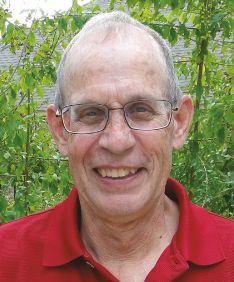
Don Dubois’ formal training is in the area of chemistry, with a Ph.D. from the University of Kansas. He retired in 2002 after working 32 years as a chemical researcher and relocated to the Houston, Texas area. Since then Don has busied himself converting a large barren backyard into a butterfy friendly habitat. This gardening effort has been rewarded with visits by over 80 species of butterfies, several of which were county records. His interest in butterfies and insects started at an early age and involved the usual insect collection. With the availability of good quality, reasonably priced digital cameras, collecting was abandoned in favor of photography. Don’s interest in native plants has been nurtured by volunteering with native plant specialists at Mercer Arboretum and Botanic Gardens.
Jeffrey Glassberg’s short biographical sketch appeared in the Spring 2020 issue of American Butterfies
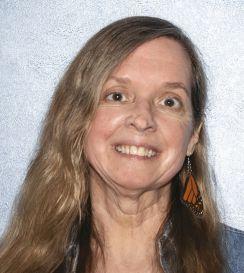
Sandy-Crystal
Vaughn is retired; she worked for Alcon Surgical for several years in Houston. She is an active member of B.E.S.T. (Butterfy Enthusiasts of Southeast Texas), the local area NABA chapter, and is also a Texas Master Naturalist (Galveston Bay Area Chapter). She feeds her passion with raising butterfies, participating in butterfy counts, submitting observations to NABA Sightings, and butterfy photography. With the
opening of Clear Lake City’s Exploration Green in southeast Houston, a storm water detention wetlands converted from an old golf course, she can be found with camera and equipment, documenting all the wonderful wildlife developing along the trails!
Mike Reese updates the NABA Recent Sightings web pages. He enjoys photographing wild fowers, birds, dragonfies, and, of course, butterfies. He is an educator in Wautoma, Wisconsin and has been recording and documenting the butterfies that are found there for over 15 years. He also maintains a website on the Butterfies of Wisconsin.

Marianna Wright is Executive Director of the National Butterfy Center, in Mission, Texas, where she has the distinct pleasure of serving members and visitors who wish to explore and learn more about this pilot project of the North American Butterfy Association. A graduate of McAllen High School, in McAllen, Texas and of Columbia University in New York City, Marianna grew up bouncing between the city, country and coast, where her exposure to wildlife engendered a deep affection for the diverse and remarkable creatures of the Rio Grande Valley. Before joining the NBC, she was Executive Director of the Foundation for the Mission Regional Hospital. Now, she is privileged to spend her days “chasing butterfies” and sharing the NABA’s mission with stakeholders, school children and prospective supporters, in order to increase enjoyment of wild butterfies and awareness of issues related to their survival.

Grass Growing Under This Hoppin Mad (not really) Naturalist’s Feet.
If you wanted an ID for the grasshopper shown on page 21 of the spring 2020 issue, all you had to do was ask! It’s Agroecotettix modestus. Robert Behrstock, Hereford, AZ
Not being a member of the tettix tribe, I modestly bow to your impressive expertise [Ed.]
Coahuila Who?
I enjoyed the article about your adventures near Del Rio. My husband was stationed at Laughlin Air Force Base for two years (back in the dark ages at the end of the Vietnam War). We enjoyed living there, exploring Lake Amistad (was not happy about the dam but took advantage of it with our boat) and the deserts of the Southwest! Sorry to hear about La Quinta Inn. There were not any of those around! We enjoyed the outdoors, but regrettably, I couldn’t ID any of the butterfies back then!
Teri Jabour, North Palm Beach, FL
Membership Drive — 2020
NABA is launching it’s frst membership drive. We’re asking NABA members to help sign up other butterfy lovers to advance the cause of butterfly conservation. The NABA member who brings in the most new members (family membership counts as two new members; free trial memberships don’t count) will be named NABA’s 2020 Giant-Skipper! The winner will have her or his photo in American Butterfies (unless not desired) and will win a beautiful and practical NABA tote bag as well as a NABA-logo bucket hat. To count, when the new member joins NABA, either online or using a paper application, the new member must include in the comments section “I joined because of [your name].” The cut-off date for this contest is July 31, 2020. Start your engines and drive!
contribution. Many corporations have matching gift programs. Check with your human resource or public relations dept.
The next NABA Photography Contest will be held in 2020. The winner will receive $300 and the 1st runner-up will receive $100. Winning entries will be published in American Butterfies. Photographs of adults must be of free-fying, unrestrained butterfies taken in the feld (not in a butterfy zoo), in Canada, the United States, or Mexico.
Photographs of immatures must be of eggs, caterpillars or chysalises taken in the feld, or at a location (e.g., one’s house or laboratory) within 20 miles of where the eggs or caterpillars were obtained. Submissions, which must be received by June 30, 2020, should be in the form of digital images, sent as high resolution jpeg fles to naba@ naba.org. Please include the photographer’s name in the fle name. Please limit your submissions to three images (only the frst three images received, per entrant, will be considered).
Entries must be accompanied by a signed statement giving NABA the right to copy and publish the photographs, both in print and digital form, and vouching that the photographs, if taken of adults, were taken in the feld, of free-fying, unmanipulated butterfies. If of immatures, the photographer’s statement must vouch that the immatures were either photographed in the wild; or within 20 miles of where found and if removed from the wild that they were reared through to adults (or attempted to rear through to adults) and released where they were found.
Please include detailed information about when and where the photographs were taken, as well as camera, lens, fash, flm, and setting information — to the extent known. Please include a telephone number and an email address where you can be reached.
Again, send your entries (maximum of three) to: naba@naba.org.
Plant names used are those given at http://plants. usda.gov