








Master Drawings New York
c. 1450 - 1950 January 30th - February 7th
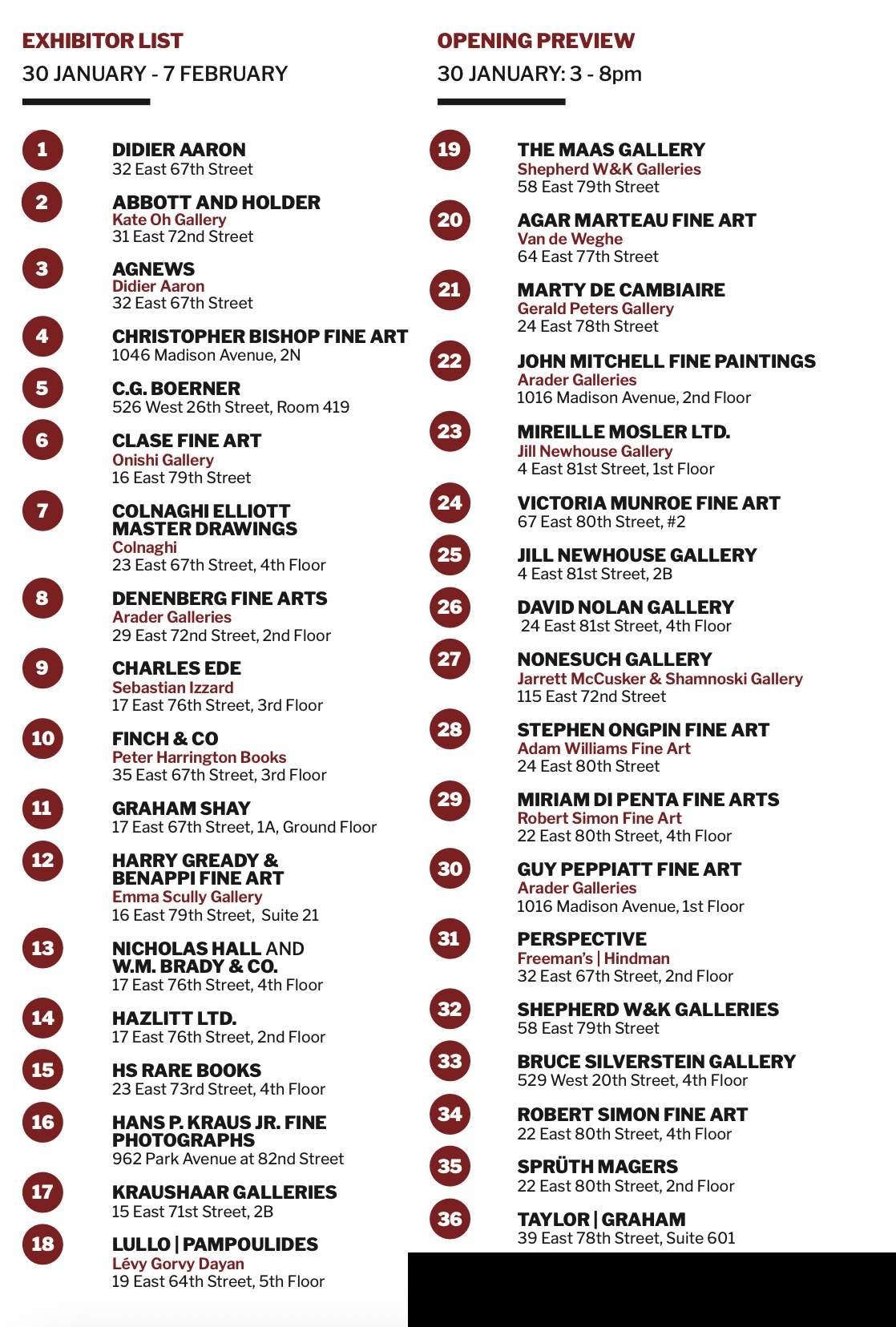
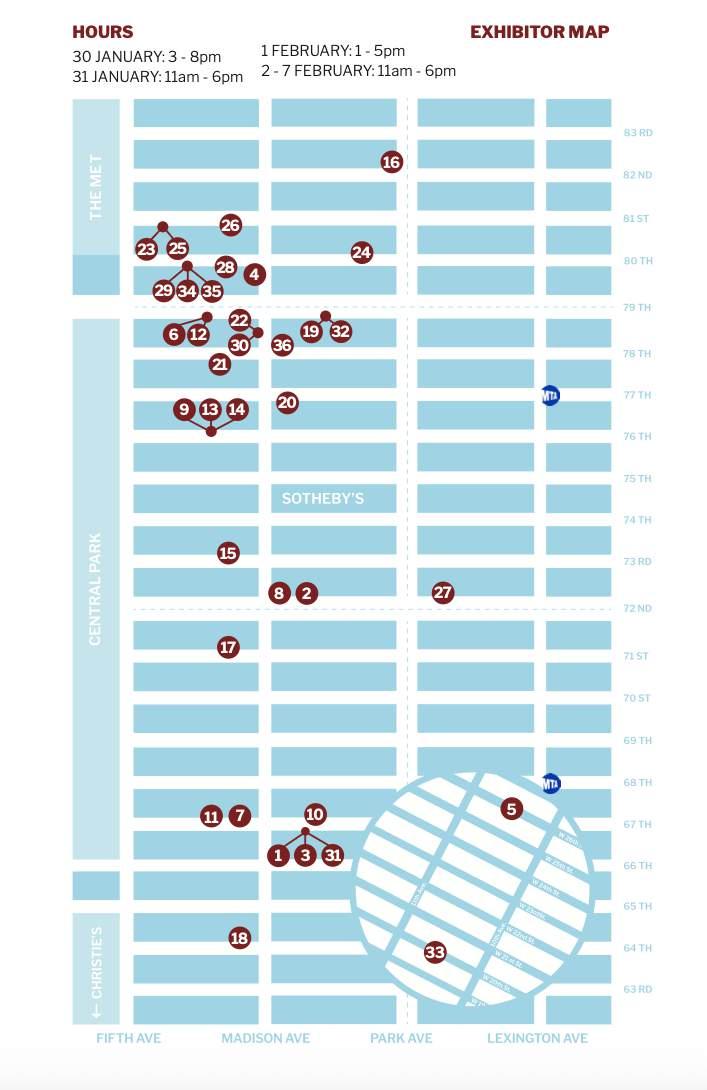
JARRETT MCCUSKER & SHAMNOSKI GALLERY
115 EAST 72ND STREET , New York, NY 10021 GROUND FLOOR
Tom Mendel read Theology and the History of Art at Clare College at the University of Cambridge, before going on to run the P icture sales for an auction house in West London. Tom set up Nonesuch in 2020, with the aim of providing quality, thoroughly -researched and above all interesting pictures to established collectors, institutional collections, and first-time buyers. The gallery specialises in works on paper from the 16th to 19th centuries, particularly those relating to 'The Grand Tour'. We have previously exhibited as part of London Art Week, Master Drawings New York, Classic Art London, Trois Crayons, and further events are on the horizon for the gallery in 2026.
Tom is the youngest member of the Society of London Art Dealers (SLAD), and was recently featured in both FRIEZE and CULTURED magazine as part of features on the changing nature and face of the Old Masters trade. He has a particular personal interest in paintings on vellum by Northern Italian artists of the 17th century and drawings of Rome by the Bentveughels and students at the Académie de France à Rome.
Notable institutions to whom we have sold include:
METROPOLITAN MUSEUM OF ART, NEW YOR K
CLEVELAND MUSEUM OF ART, OHIO
MUSEUM OF FINE ARTS, HOUSTON, TEXAS
HARVARD ART MUSEUMS, MASSACHUSETS
GROLIER CLUB LIBRARY, NEW YORK
STATENS MUSEUM FOR KUNST, COPENHAGEN
KLASSIK STIFTUNG WEIMAR, GERMANY
BRITISH MUSEUM, LONDON
PALESTINE EXPLORATION FUND, LONDON
ST JOHN'S COLLEGE, CAMBRIDGE
PARHAM PARK TRUST, SUSSEX
MUSÉE DES BEAUX - ARTS DE CARCASSONNE
MUSÉE EU GÈNE - CARRIÈRE, PAR I S
I would like to thank the following for their generous assistance in the preparation of this catalogue and exhibition:
Dr Yuri Primarosa, Dr Marco Simone Bolzoni, Cordélia Hattori Prof. David Stone, Dr Andrei Bliznukov, Dr Neil Jeffares, Sergei Varshavsky,Dr Jonathan Yarker, Dr Stijn Alsteens, Dr Emily Weeks, Rupert Maas, Katie Bannister, Sarah O'Donoghue, Charles Dagget, Jarrett McCusker, Mark Shamnoski, Cydney Williams, Rev. Canon Tom Mendel SSC, and Amy Glover.
TOM MENDEL
Dimensions are given in centimetres, with height before width. Where possible, all provenance details have been checked again st documentary records or are given on the basis of the information received from the previous owner and/or auctioneer from whom the work was acquired. We are happy to arrange re-framing or re-mounting separately to suit your preferences, at cost
All enquiries should be addressed to:
Tel: +44 (0) 7564 179 106
Email: GALLERY@NONESUCH - GALLERY.CO.UK
Correspondence Address: 2nd Floor, 15 Duke Street St James's, London, SW1Y 6DB
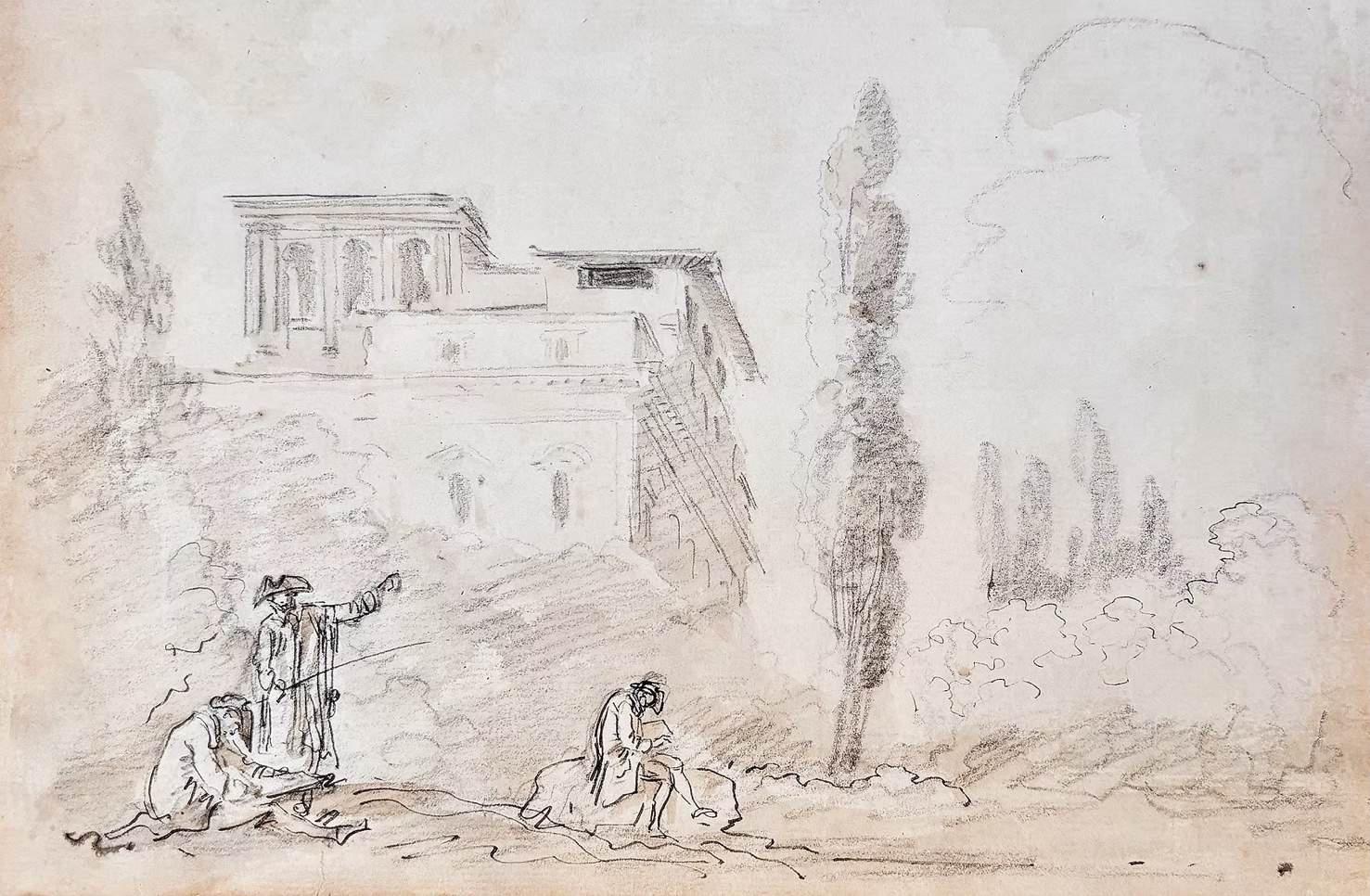
Venice, fl. c.1430 - 1460
Gold and coloured pigments with ink, on vellum
8.3 x 8.2 cm | 3.25 x 3.26 in
PROVENANCE
Anonymous sale, Sotheby’s, 03.07.1984, lot 9 (part of lot);
Private collection, London
Peter Kidd, MSS Provenance (online), The Murano Gradual Initials [II]: The Minor Initials, 6 March 2022
Ibid., ' The Minor Initials of the Murano Gradual'
Ibid., Minor Initials from the Murano Gradual: Two More 19th-Century Albums, 14 October 2023
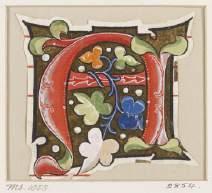
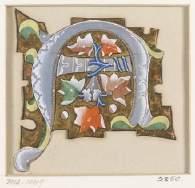
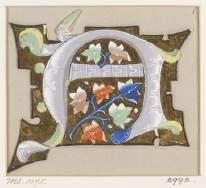
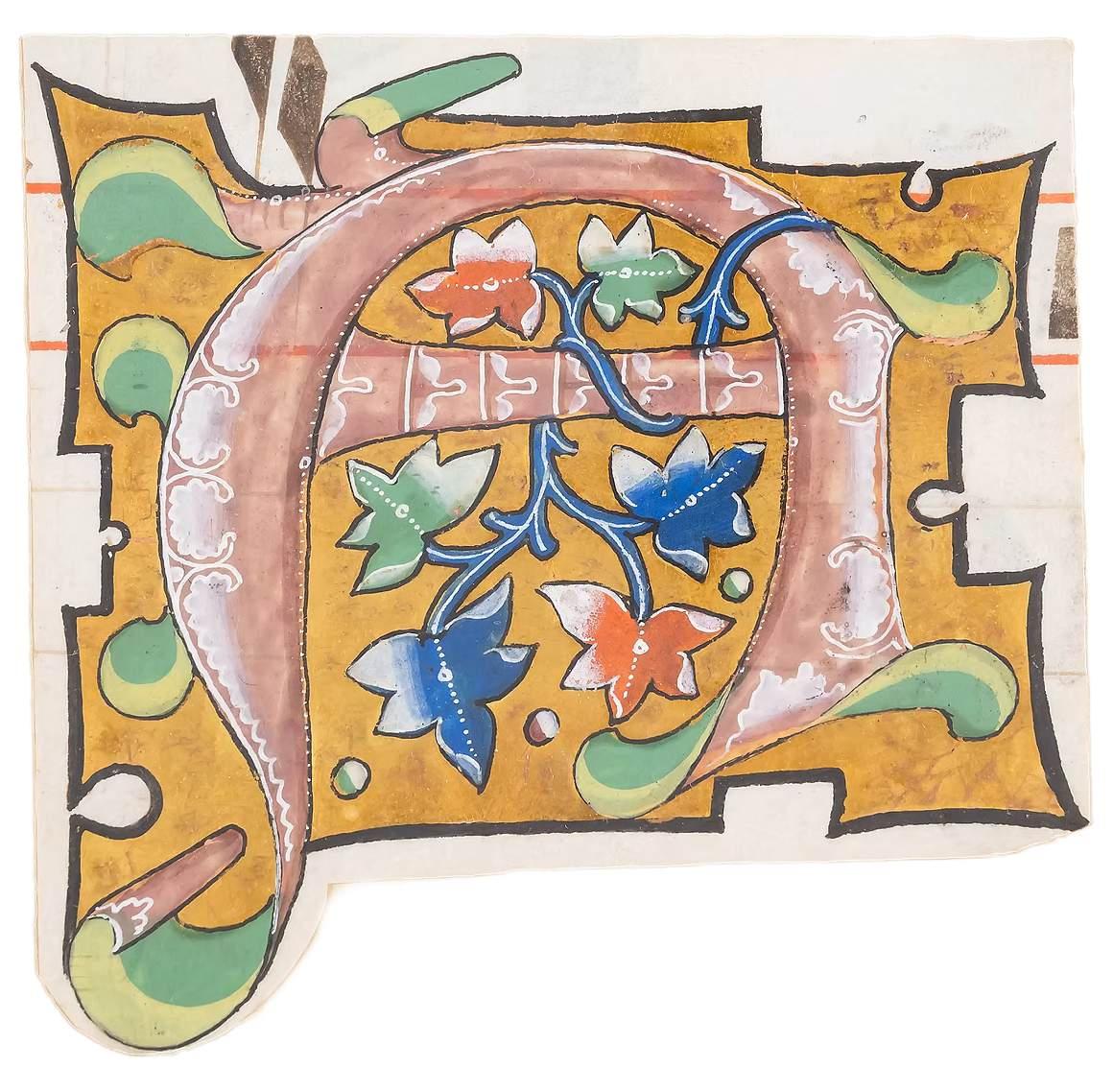
The present work comes originally from one of the great masterpieces of Italian 15th century illuminated manuscripts, called the 'Murano Gradual'. The artist responsible for the illuminations has been called 'one of the most enigmatic illuminators working in early fifteenth-century Venice' 1 and 'one of the most distinctive artists to illuminate manuscripts in northern Italy' 2. Although his identity remains elusive, the works given to him all come from a gradual (now disbound) which is thought to have come from the Camaldolese monastery of San Michele on the island of Murano, in the Venetian lagoon.
Our picture is one of the 'minor' initials, of which there are numerous examples spread across collections worldwide, kept both individually and presented together in albums.
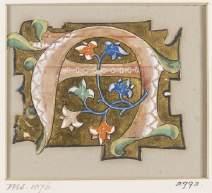
1 S. Azzarello & B.C. Keene, 'Spendlors of the Serenissima in a Digital Age: The Master of the Murano Gradual Reconsidered', in Manuscript Studies, vol. 6, no. 2 (Fall 2021), abstract
2 https://www.getty.edu/art/collection/person/103M1T (last accessed 03.12.2025)
Bordeaux or Paris, c.1525 - 1604
Pen & ink on laid paper
19.2 x 29.7 cm | 7.6 x 11.7 in
PROVENANCE
Acquired by Dr Robert Weil (1843-1923) in Paris before 1870; 3 Sold anonymously at auction in Paris, 2025
LITERATURE
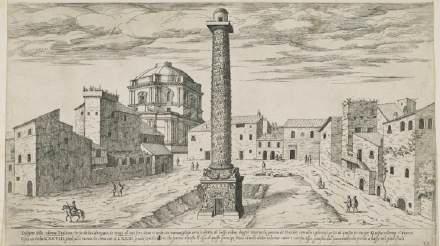
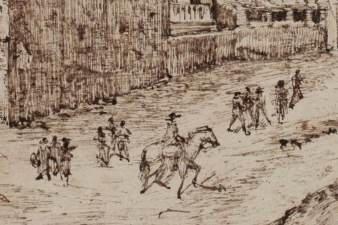
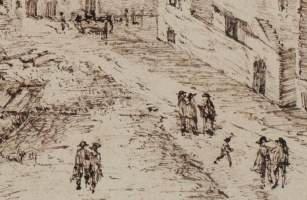
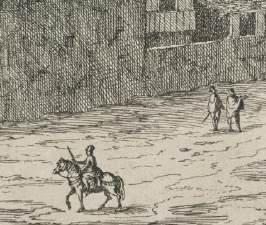
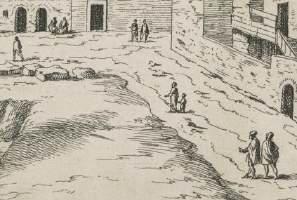
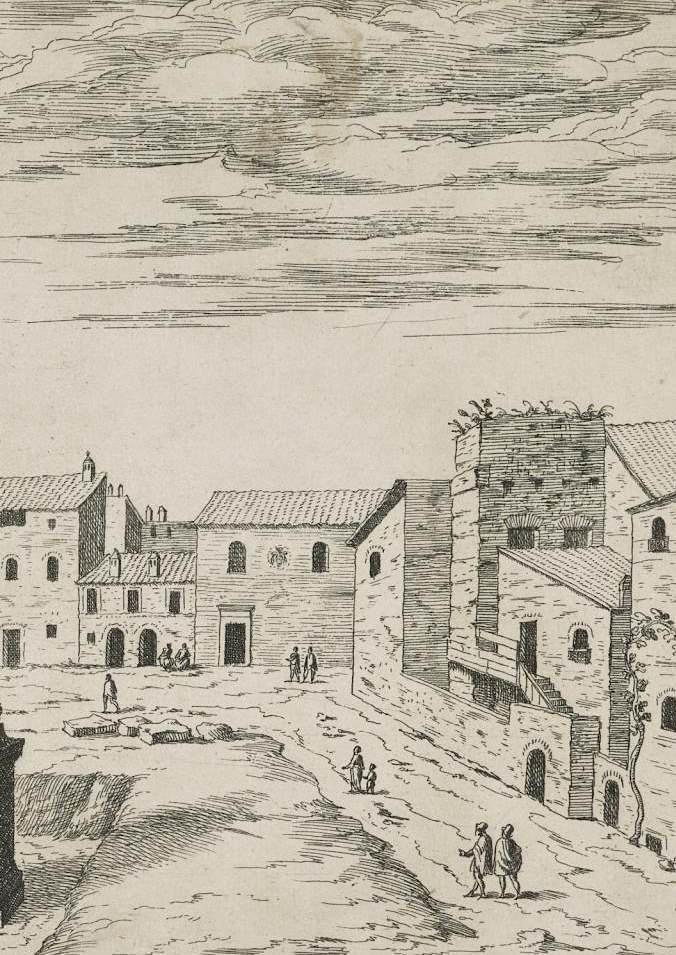
Étienne Dupérac, I Vestigi dell'Anticha di Roma, Paris (1575), pl.XXXIII (see fig. I above)
BIBLIOGRAPHY
Thomas Ashby, Topographical study in Rome in 1581. A series of views with a fragmentary text by Étienne du Pérac, in the library of C.W. Dyson Perrins, Esq., Roxburghe Club (1913)
Simonetta Prosperi Valentin Rodinó & Fabio Fiorani, I disegni del Codice Resta di Palermo, Milan (2007), pp.202-214
Emmanuel Lurin, 'Étienne Dupérac vedutista e cartografo: la costruzione della pianta di Roma del 1577', in Le città dei cartografi. Studi e ricerche di storia urbana (eds. de Seta & Marin) , Naples, (2008), p.49-59
Emmanuel Lurin, 'Un homme entre deux mondes: Étienne Dupérac, peintre, graveur et architecte, en Italie et en France', Renaissance en France, renaissance française? (eds. Bayard & Zerner), Rome (2009), pp.37-59
Emmanuel Lurin, 'Paysages, documents ou vedute? Les vues gravées d’Étienne Dupérac et leurs fonctions à Rome au XVIesiècle', in Studiolo: Revue d'histoire de l'art de l'Académie de France à Rome, vol. 11 (2015), pp. 92-119
3 Dr Robert Weil was the professor of German at the Sorbonne until the outbreak of the Franco-Prussian War. He later started a very successful and respected winery in Kiedrich, Germany, which is still run by the Weil family to this day.
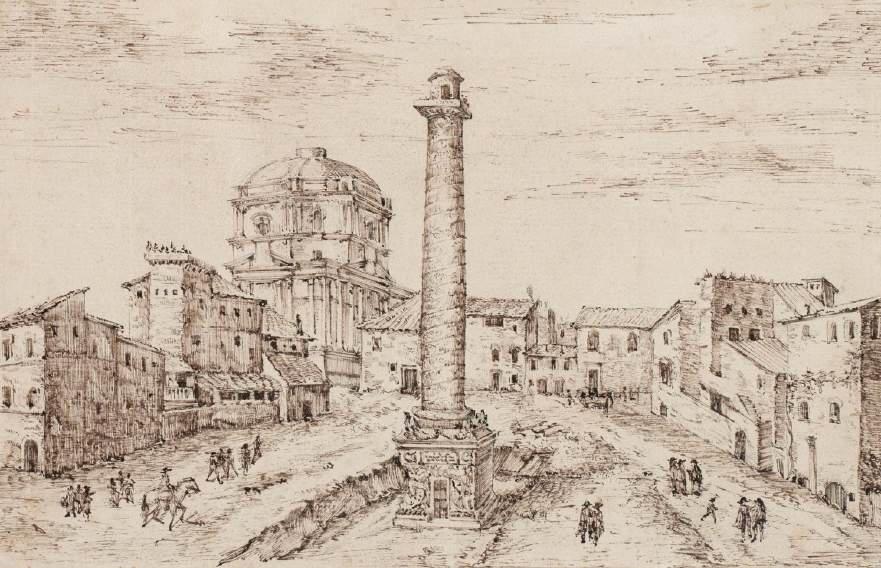
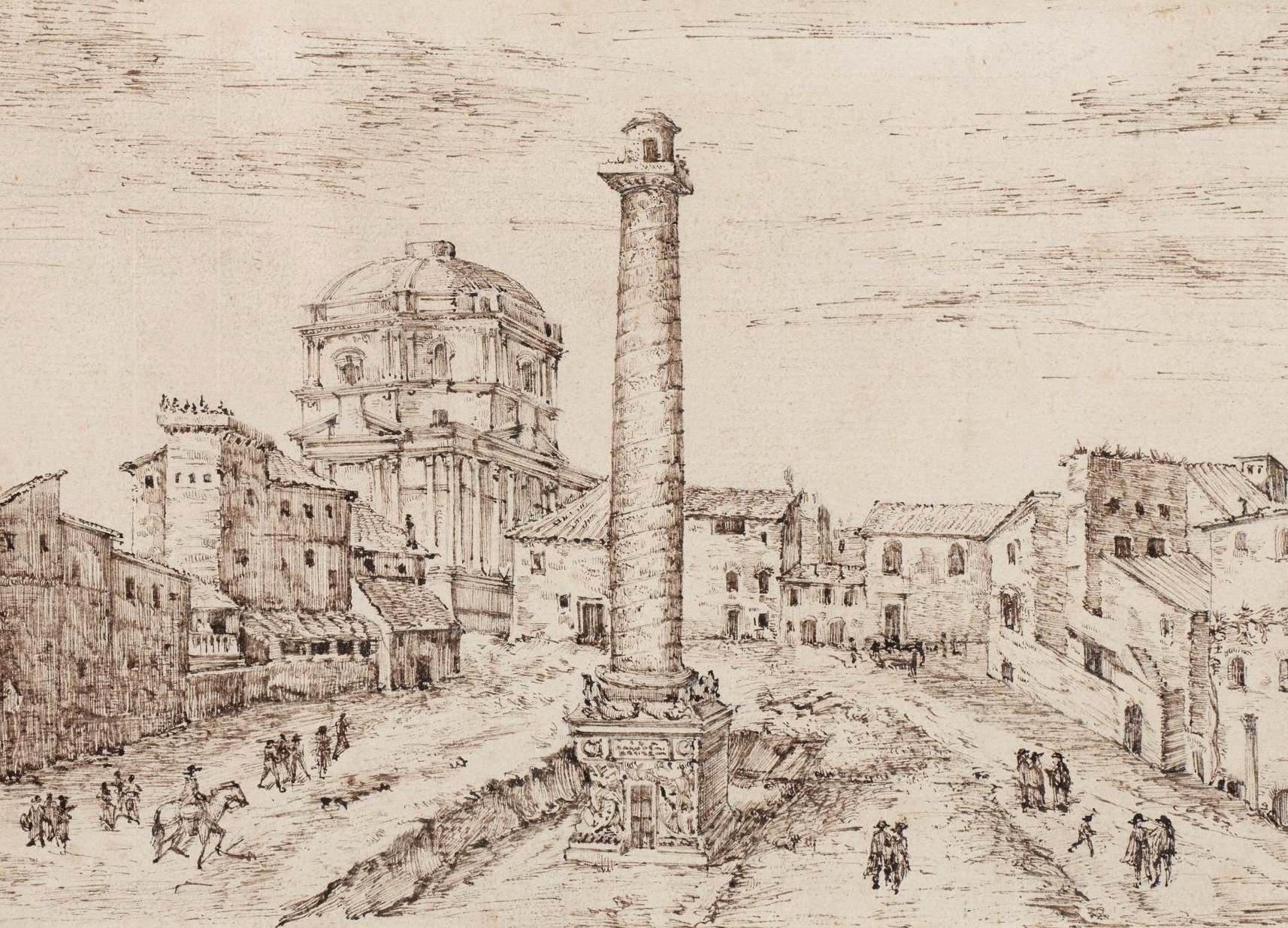
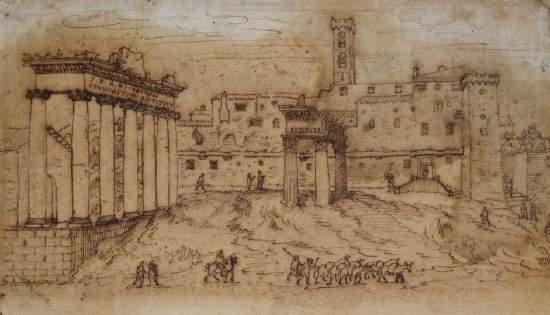
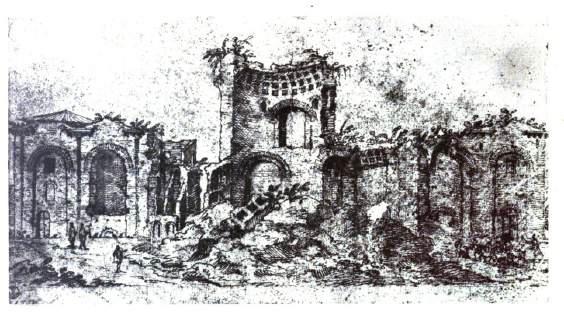
Fig. II - Etienne Dupérac, Roman Forum with the Campidoglio, pen & ink, Codice Resta, Biblioteca Communale di Palermo, p.73
Fig III - Étienne Dupérac, Terme di Constantino, pen & ink, Uffizi, Florence (old inv. no. 1751), repr. in Ashby, op. cit., fig. 3, p.22
This outstandingly-preserved drawing is a remarkable rediscovery, being the only extant preparatory drawing by Dupérac for this series which is not held in an institutional collection. 4 Our drawing relates to a plate from one of the most important series of Roman views ever to be published, the Vestigi dell'Anticha di Roma, a seminal publication which comprised the very first visual presentation of the topography of contemporary Rome. 5 The publication, orchestrated by the Roman publisher Lorenzo della Vaccheria, was timed to coincide with the Jubilee Year of 1575, an event which saw more than 100,000 pilgrims descend upon Rome, and the series was understandably an instant bestseller thanks in part to this context. Indeed, between the date of publication and 1773 (when the original plates seem to have vanished or degraded beyond repair), the Vestigi ran to no fewer than ten editions (as well as being copied by Sadeler in Prague in 1606).
4 4 The only examples known today are two sheets in the Uffizi (The Baths of Ostantino, see fig. III, inv. no. 1750, and The Mausoleum of Augustus, inv. no. 1751, both identified by Thomas Ashby in 1916 having been formerly attributed to Bramantino) and a group discovered by Rodinó in 2007 that are part of the Codice Resta in Palermo (see Bibliography). Lurin notes that there must have been many more drawings than these (2007, p.53).
5 Lurin, 2009, p.49, "Les quarante planches des Vestigi dell’antichità di Roma (1575) constituent la plus ancienne série de paysages gravés dans lesquels les ruines de Rome sont reproduites avec la plus grande attention, telles qu’elles apparaissaient alors dans leur environnement rural ou urbain"
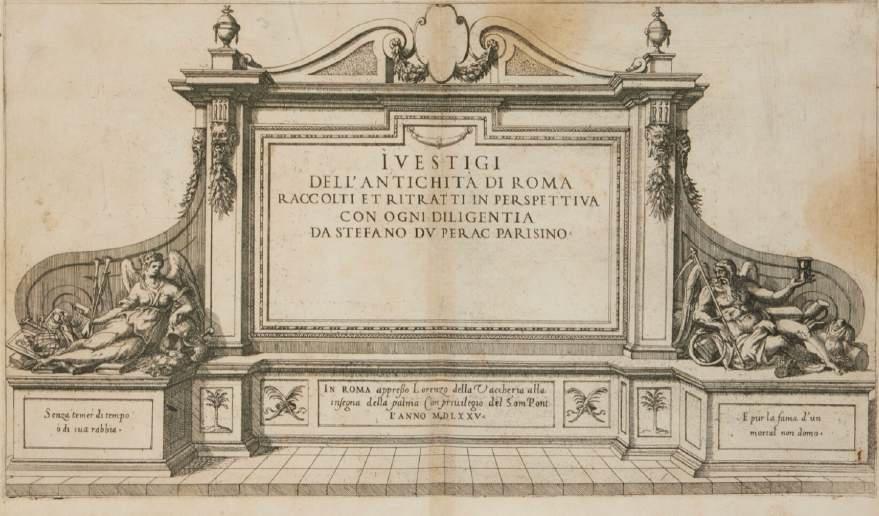
Fig. IV - The frontspiece to the 1575 edition of the Vestigi, in a rare example sold from the collection of T. Kimball Brooker Sotheby's, New York, 12.10.2023, lot 31
The presentation of the prints, which measured approximately 21.5 x 37.5 cm each and were almost certainly bound in albums by della Vaccheria, allowed pilgrims and visitors to carry them around with them as a sort of proto-guidebook. Each plate was accompanied by a legend written in Italian and a basic key identifying the main sites of interest, both contemporary and classical. Previous publications of Roman views had never depicted the city with such verisimilitude, nor had the perspectives of their views taken in so much scenery in a single picture. Hieronymus Cock, in his series of prints from 1551 (a bestseller in its time and very influential in the Low Countries particularly), admitted in their preface that the views were 'vivis prospectibus ad veri imitationem'; the publication's scope was limited and the locations depicted were not presented in a methodical order. Dupérac's Vestigi by contrast allowed the viewer to walk along designated routes following the series, a radical invention in its time. Similarly, Giovanni Antonio Dosio's 1569 Urbis Romae aedificiorum illustrium included picturesque interpolations and recreations and did not have the same 'unité d’intention en comparaison des Vestigi' 6
6 Lurin, 2015, p.102
The condition of our drawing is an important element to understand when comparing it with the other known preparatory drawing s by Dupérac for the Vestigi. The nineteen sheets that are now bound in the Codice Resta in Palermo 7 are noticeably very different in their state of repair: they are, like our sheet, drawn in metallic-gall ink, however this has oxidised considerably to the extent that the paper has degraded. Furthermore, these drawings were (likely by the artist himself) incised with some sort of stylus, so much so that there are areas of perforation in the paper of some of them. There are also small graffiti and interpolations in pen & ink, which Fiorani states are later attempts to restore damaged or incomplete areas. The same is true of the examples in Florence, and Fiorani has concluded that these are all sheets which were actually used in the printing process, being impregnated with fatty substances and reduced almost to transparency as the stylus carved into the copper p late. 8 This usage is further confirmed by the fact that the drawings in Palermo and Florence are, unlike our sheet, the same dimensions as the prints.
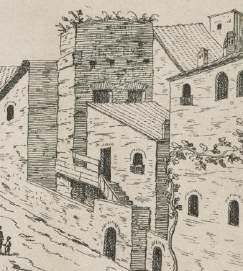
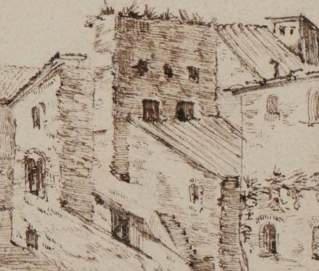
Unlike the aforementioned examples, the present work shows no physical signs of having been used for the plate, precisely as one would expect given the notable differences between it and the print. These include notable losses among the staffage of the finished print when compared to our sheet (see fig V below), simplifying the composition to make it less 'busy' perhaps Furthermore, upon close examination of our sheet, one can see another tell-tale indication of our drawing having been simplified to some extent once it was composed for the print: the number of windows in the right-hand edifices has been reduced here and there (see fig. VI overleaf), notably to the uppermost turret on the far right (two windows in the drawing versus one in the print) and the building situated on the right hand of the square's corner in the upper right (three windows in the drawing versus a single arched window in the print).
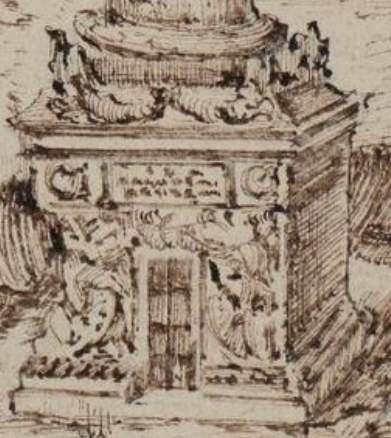
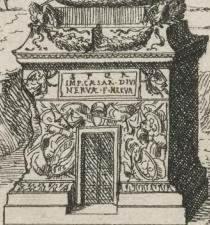
By contrast, the detailing in our drawing is not always as clear as it is in the print, particularly in areas where it is particularly fine in the print such as the decorations of the Column itself (see fig. VII). This makes sense, as the purpose of the prints was in part to satisfy antiquarian's desire to have a proper record of the ruins, and the reliefs on the column (together with the ancient text) were particularly important in this regard.
When comparing our drawing stylistically to those in Florence and Palermo, one thing becomes immediately obvious: the latter drawings are very rigid, with lines evidently drawn using a ruling device and a strict geometry employed in parts; our sheet by contrast has a fluidity that suggests it could have been the original study sketched in situ, which was then adapted and altered for the purposes of publication. Our drawing therefore constitutes an even rarer example of Dupérac's oeuvre, as the only extant example of a topographical Roman subject to have potentially been drawn from life by the artist.
7 Not to be confused with the other codex once owned by Padre Sebastiano Resta that is kept in the Biblioteca Ambrosiana, Milan
8 Cf.Fiorani, op. cit., p.202
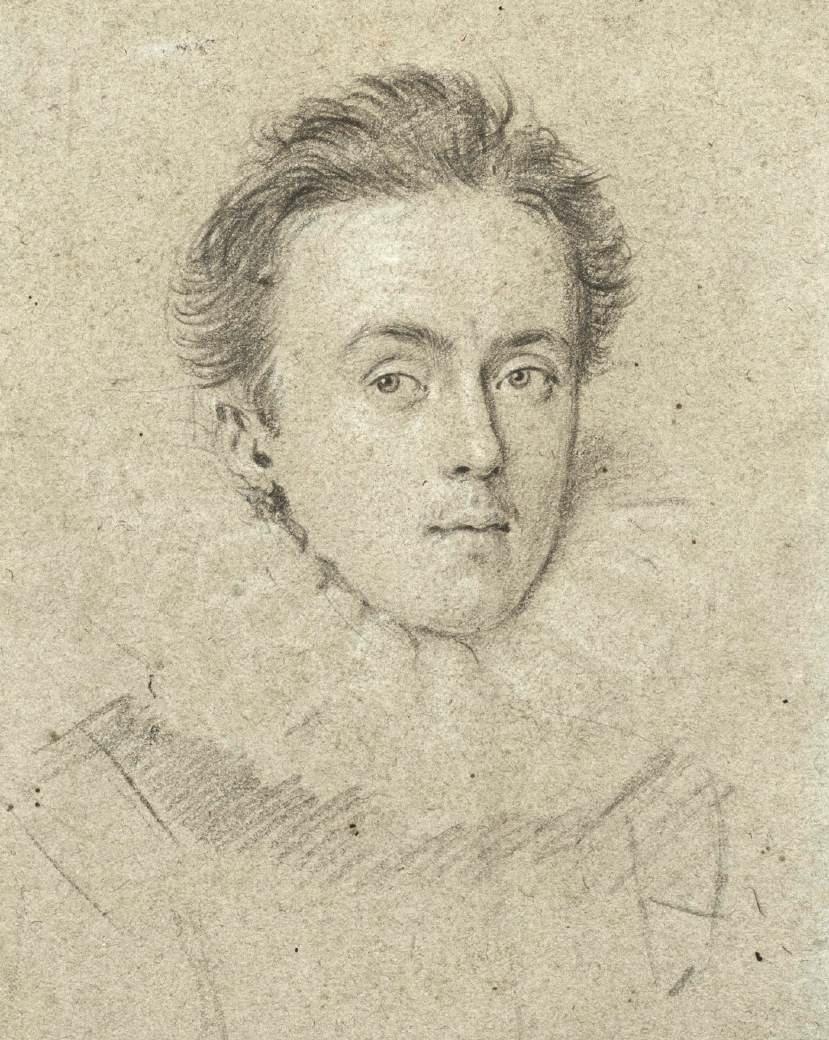
Rome, 1578 - 1630
Bears inscription verso in pencil Ottavio Leoni Pencil on paper, heightened with white chalk
16.3 x 13.2 cm | 6.4 x 5.2 in
Private collection, France
We are grateful to Dr Yuri Primarosa and Dr Marco Simone Bolzoni for previously endorsing the attribution of the present work. We are also grateful to Cordélia Hattori for previously providing further information on and images of a related copy in the Palais des Beaux-Arts, Lille, drawn on the verso of another portrait by Leoni.
The present work is absolutely typical of the artist's intimate drawn portraits: rendered in chalks on a lightly-tinted paper, these informal bust-studies established Leoni as one of the most sought-after portrait draftsmen of Baroque Rome, with dozens of examples to be found in collections across the world. As with all of these, our portrait was almost certainly produced from life. Leoni was able to capture his clients' likenesses with a remarkable economy of line, rarely spending much if any effort on their costume, and never relying on facial 'types' as so many portraitists did
The sitter's identity remains elusive at present; however, a copy of our drawing exists in the collection of the Palais des BeauxArts, Lille, suggesting its previous circulation
Leoni was active primarily in Rome and in his time was considered the most fashionable portraitist in the city. In his Lives of the Artists (1642), Giovanni Baglione - Leoni had drawn his portrait, with that work published as a print in 1625 - said of Leoni’s portraits “…they are so natural and alive, that in that genre one could not do better.” 9
Leoni famously executed the only known contemporary likeness of Caravaggio, contained in a volume of 27 drawings in the Biblioteca Marucelliana in Florence, with further portraits of various seventeenth century painters, sculptors, writers and scientists (including Galileo), with many of these published by Leoni as prints in his own lifetime
Born in Rome, Leoni first trained with his father, Lodovico Leoni. He painted altarpieces for churches in Rome such as an Annunciation for Sant'Eustachio and a Virgin and child with St. Giacinto for Santa Maria della Minerva, and a Saints Charles, Francis, & Nicholas for Sant’ Urbano. He became a member, and later president, of the Accademia di San Luca and a Cavalieri of the Order of Christ, on which occasion he presented to the church of the Academy the Martyrdom of St. Martina.
9 G. Baglione, Le vite de' pittori scultori et architetti. Dal pontificato di Gregorio XIII del 1572. In fino a' tempi di Papa Urbano Ottavo nel 1642, Rome (later edition, 1733), pp.208-209
Città della Pieve, c.1574 - c.1629
Bears inscription verso in pen & ink Del Pomarancio
Pen & ink with black chalk and wash, heightened with white, on brown-washed laid paper
26 x 19.1 cm | 10.2 x 7.5 in
L. Salerno, 'L'opera di Antonio Pomarancio', in Commentari: rivista di critica e storia dell'arte, no..2 (1952), pp.128-134
E. Giffi, ‘Alcune proposte per Antonio Pomarancio’, in Bollettino d'arte , no.19 (May-June 1983), pp. 17-30; L. Barroero,’ A proposito di Antonio Pomarancio’, in Scritti di storia dell'arte in onore di Federico Zeri, vol. 2, 1984, pp. 513-523
The present work's attribution is predicated in large part on the words inscribed in pen & ink in an early hand to the verso: Del Pomarancio
10 A study for Jacob betrayed by his brethren owned by Dr Luciano Bertini (repr. in G. Panofsky-Soergel, 'Römisches Jahrbuch für Kunstgeschichte', xi (1967-8), p. 130, no. 91); St Agnes and Sempronius, British Museum, London, acc. no.
Three artists bore this name, derived from a small town in Tuscany: Niccòlo Circignani (Pomarance, c.1517 - c.1596, Città della Pieve), his son Antonio, and Cristoforo Roncalli (15521626), the last of whom was Niccolò's student. Of these three, one can immediately rule the elder Circignani out, as his graphic oeuvre is utterly different stylistically.
Cristoforo Roncalli worked for the most part in chalks when drawing, tending much more towards Cavaliere d'Arpino and the Roman school. He did collaborate on occasion with his teacher's son Antonio, but their styles are easily distinguishable.
Antonio, perhaps the least well-known and least understood of the trio, remains an enigma when it comes to his drawings: there are just three whose attributions are resolute, 10 despite the fact that several dozen frescoes and paintings by his hand survive, as well as just over a dozen prints made after his designs.
1946,0713.474; finally, a Madonna in Glory kept in a private collection, Milan, repr. in a poor-quality negative here: https://irisoluti-pomarance.it/antonio-cercignani/
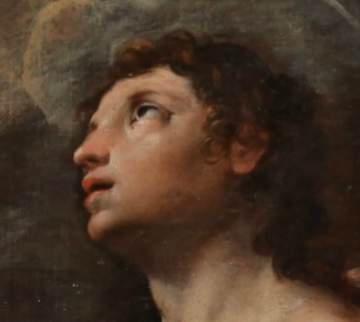
The complications above give very little to work with when examining this drawing with an open mind towards the inscription; however, the more distinctive elements of Antonio's paintings do give us some insight into how his drawings (which may be very few in number anyway of course, depending on his working methods) could appear, in the absence of a finished painting that corresponds directly. 11 Antonio's figures from the middle of his career can be defined by partly by their expressive, open faces, much like the central putti in the lower register of our work and especially the angel Gabriel to the lower right (see fig. I below), in sharp contrast to his father Niccoló's more angular and less defined facial types in his graphic work. From the 1620s onwards, Antonio adopted a very Caravaggesque manner, moving away from the works which we associate here with the present sheet.
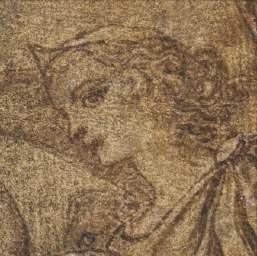
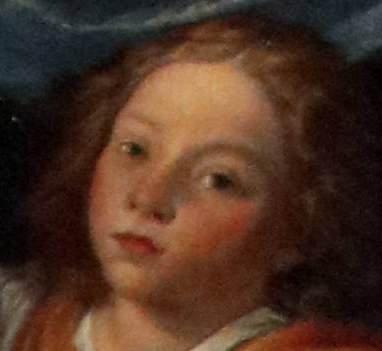
Beyond the stylistic similarities between our drawing's figures and the painted figures of Antonio, there is a very clear con nection between two specific putti in our sheet and two in one of the artist's frescoes for the Palazzo Altemps in Rome. Although not exact copies, their poses are almost identical, and their arrangement (adjacent to each other in both our drawing and the fresco) suggests that the artist could have referred back to our sheet, or perhaps a connected previous (and low lost) commission when considering the possible arrangement of the many putti in the fresco in Rome (see fig. II overleaf).
With so few drawings, and the knowledge that not all of the artist's paintings have survived or been identified, the inscription on our drawing - which seems at first to be so unusual - coupled with the very close similarities between these individual putti, opens the door to a potential attribution and an exciting re-examination of an almost-unknown body of drawings by Antonio, himself an oftunderappreciated but important artist
11 It should be noted that no paintings of Archangels, Saint Michael or even simply 'Justice' that are recorded in the Zeri archives or the Beniculturali digital archives come close to matching our drawing. Nor do documentary records for Circignani father and son and Cristoro Roncalli mention any paintings of Arcangeli or the Arcangelo San Michele etc. exist today. However, Antonio did complete one of his most important commissions for the Church of San Michele Arcangelo in Mondaiano, the wonderfully dramatic and Caravaggesque Deposition (1625), finished shortly before he died.
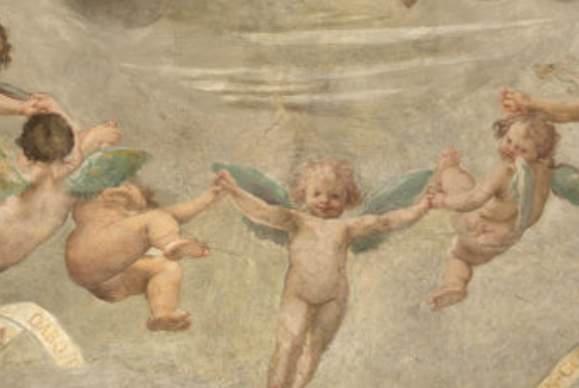
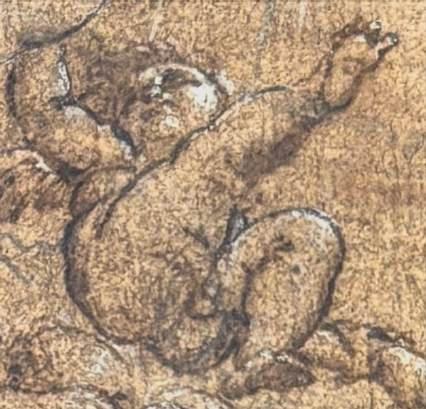
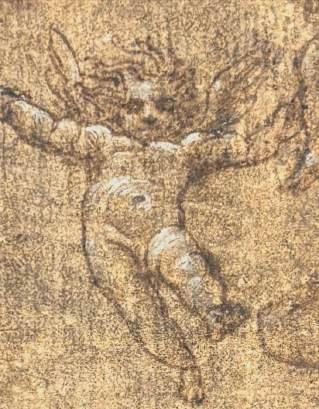
V - Comparison between the putti in our sheet and those in a detail from the fresco cycle of The Martyrdom of Pope Anicetus,
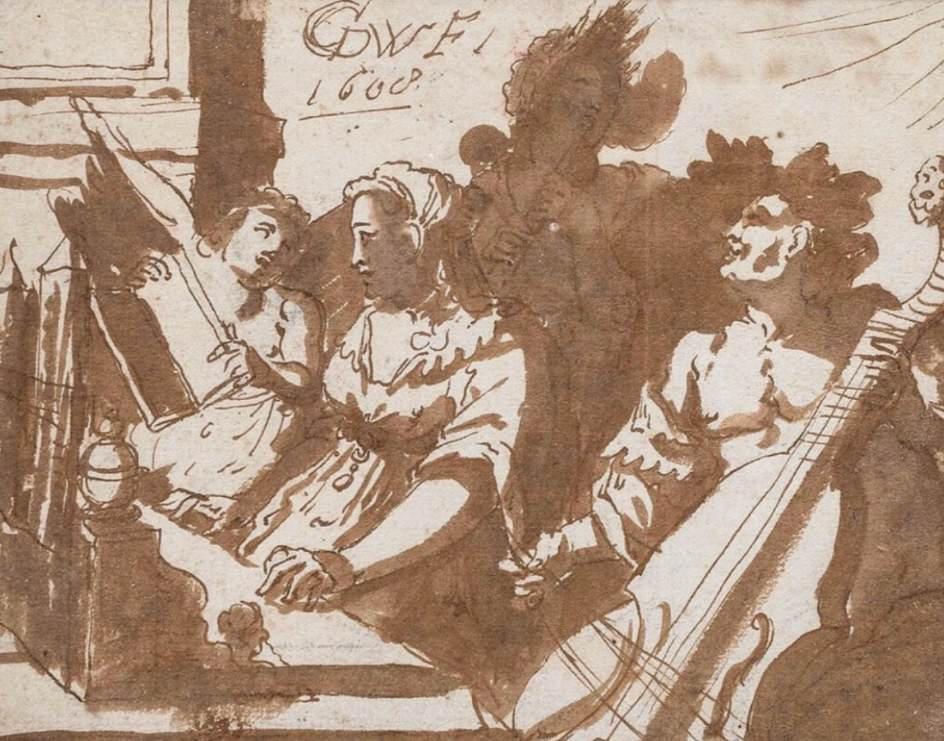
Cologne, 1583 - 1641
Signed & dated with the artist's monogram u.m.
GDWF / 1608
Pen & ink with brush & brown wash on laid paper 14.5 x 19.5 cm | 5.7 x 7.7 in
With Galerie de Bayser, Paris (as Cornelis de Witte); From whom acquired in 1978 by a previous owner; Private collection, Paris
De Wedig, sometimes called Gotthard von Wedig, was born in Cologne and is thought to have studied under his grandfather, Barthel Bruyn the Younger, a prominent figure in the politics of Cologne and an accomplished portraitist. We know precious little about de Wedig's career after this: he painted a number of portraits which demonstrate his considerable skill in this genre 12 ; however, the largest body of work that survives are his still lives, and several of these chiaroscuresque compositions, dominated by the candle that lights the scene, suggest an affinity with his Dutch contemporaries' work.
Drawings by the early German artist Gottfried de Wedig are extremely rare, with just three examples in institutional collections worldwide: a passion scene in the Louvre, Paris; an adoration scene in the Metropolitan Museum of Art, New York; and an Allegory of the Fall and Redemption of Mankind, in the British Museum, London. The only example to appear at auction in the past twenty-five years is the drawing which was acquired by the Metropolitan Museum of Art at Sotheby's, New York, 26.01.2000, lot 160 (for €19,000).
The present drawing calls to mind a painting by de Wedig that is something of an anomaly within his oeuvre, a group Portrait of the Family of Christoph Wintzlers, now in the WallrafRichartz-Museum, Cologne: that work shows a woman seated at a large keyboard, surrounded by seven children, and another lady (possibly her sister) who holds an infant. The painting was executed c.1615-1616, and so it is possible that De Wedig referred back to our sheet when considering how to execute this altogether different, secular genre scene or portrait some seven years later.
12 H. Seifertová, 'Kölner Bildnisse In Böhmen', in Wallraf-Richartz-Jahrbuch, vol. 50 (1989), pp.323-327
Cento, 1591 - 1666, Bologna
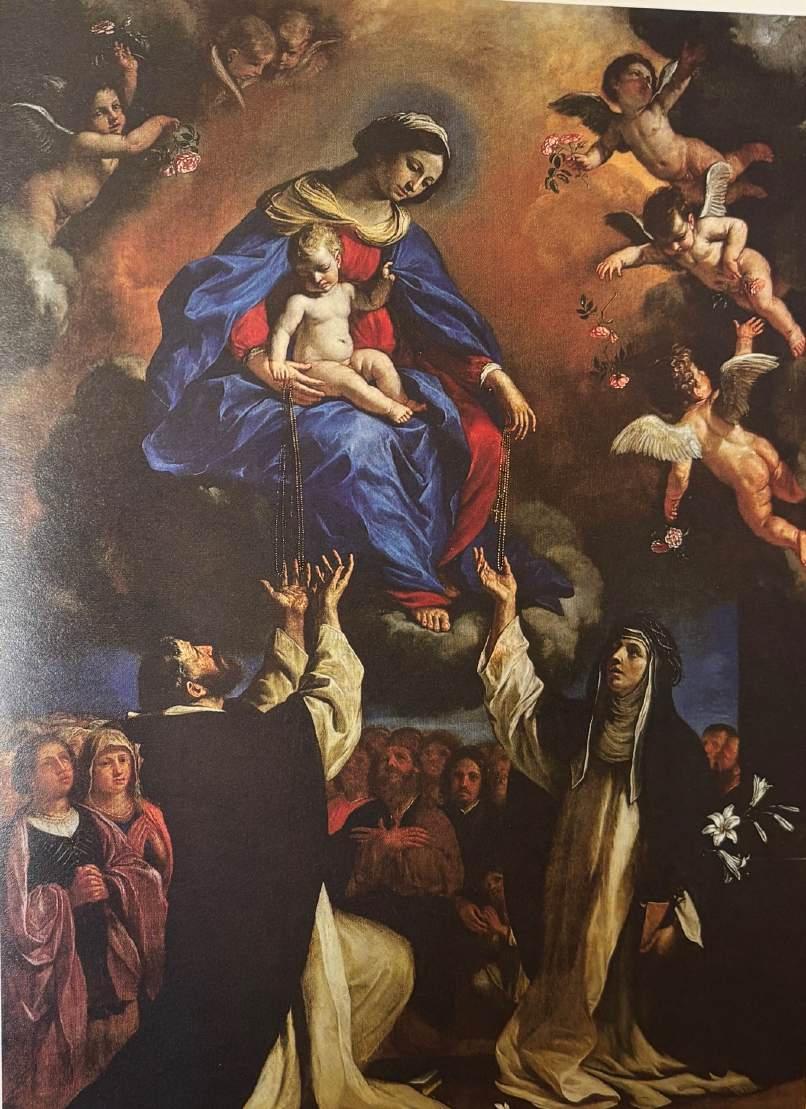
A Study for 'La Madonna del Rosario' in San Marco, Osimo
Bears inscription in pen verso
Marià Elvira Celia Méndez de Bernasconi / 1977 [L.5374]
Bears inscription in pencil verso Gennari originale 4430
Red chalk on laid paper
12.5 x 10.2 cm | 4.9 x 4 in
Juan and Felix Bernasconi, Milan (19th century); By descent to Marià de Bernasconi (1927-2005), Buenos Aires [Lugt 5374];
Private collection, U.K.
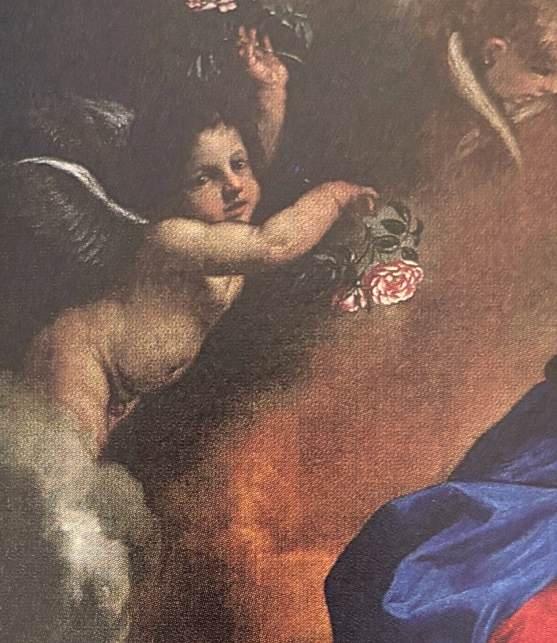
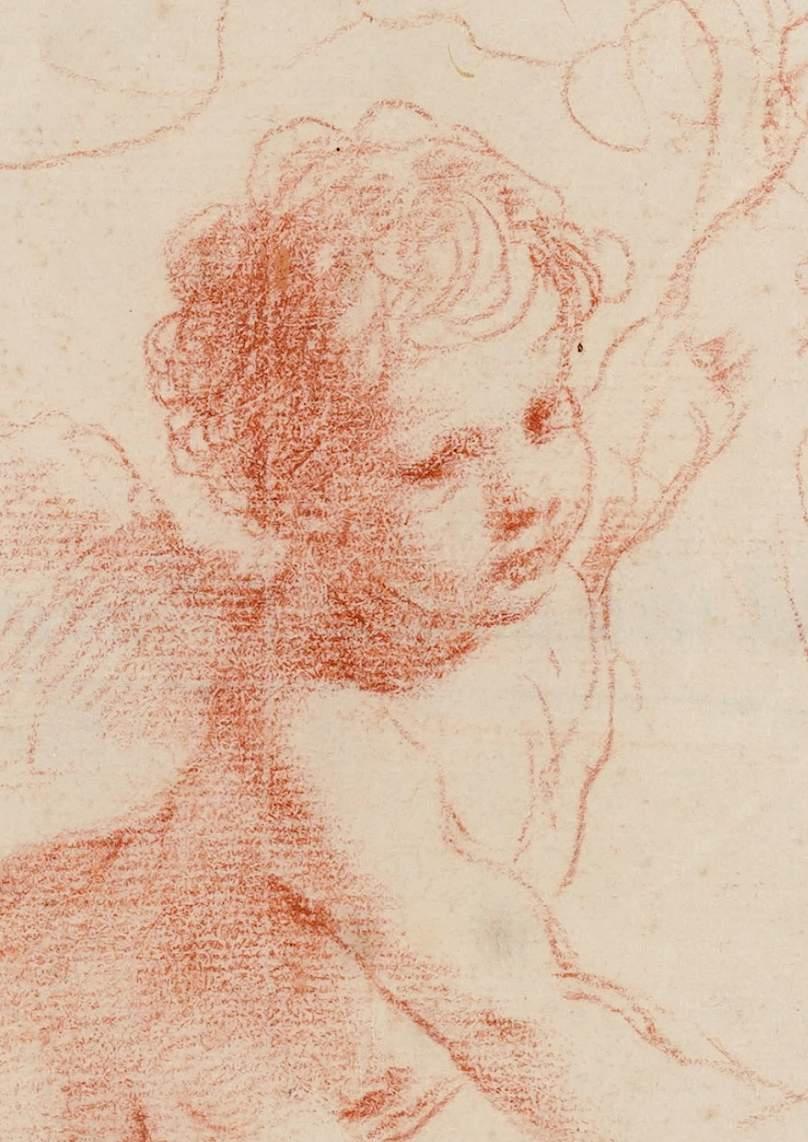
We are grateful to Prof. David Stone for his generously contributing the following catalogue note, and for endorsing the attribution on the basis of digital images. This charming red chalk figure study of a flying putto by Guercino is a welcome addition to the numerous preparatory studies by the master for his important altarpiece of the Virgin of the Rosary with Saints Dominic and Catherine of Siena, which he painted in 1641–42 for the church of San Marco Evangelista at Osimo. Beautifully restored, the picture is still in situ on the high altar (fig. III overleaf) 13 This previously unpublished sheet can be connected to the putto with wings holding roses (symbolizing the rosary) in the upper left corner of the canvas (fig. I above).
13 For the history of the commission and a list of connected drawings, see Nicholas Turner, The Paintings of Guercino. A Revised and Expanded Catalogue Raisonné, Rome: Ugo Bozzi, 2017, pp. 569-70, no. 279. See also Sir Denis Mahon (ed.), Giovanni Francesco Barbieri, Il Guercino (1591–1666), exh. cat., Bologna, Museo Civico Archeologico; Cento, Pinacoteca Civica e Chiesa del Rosario (6 September – 10 November 1991), Bologna: Nuova Alfa Editoriale, 1991, pp. 238–240, no. 86.
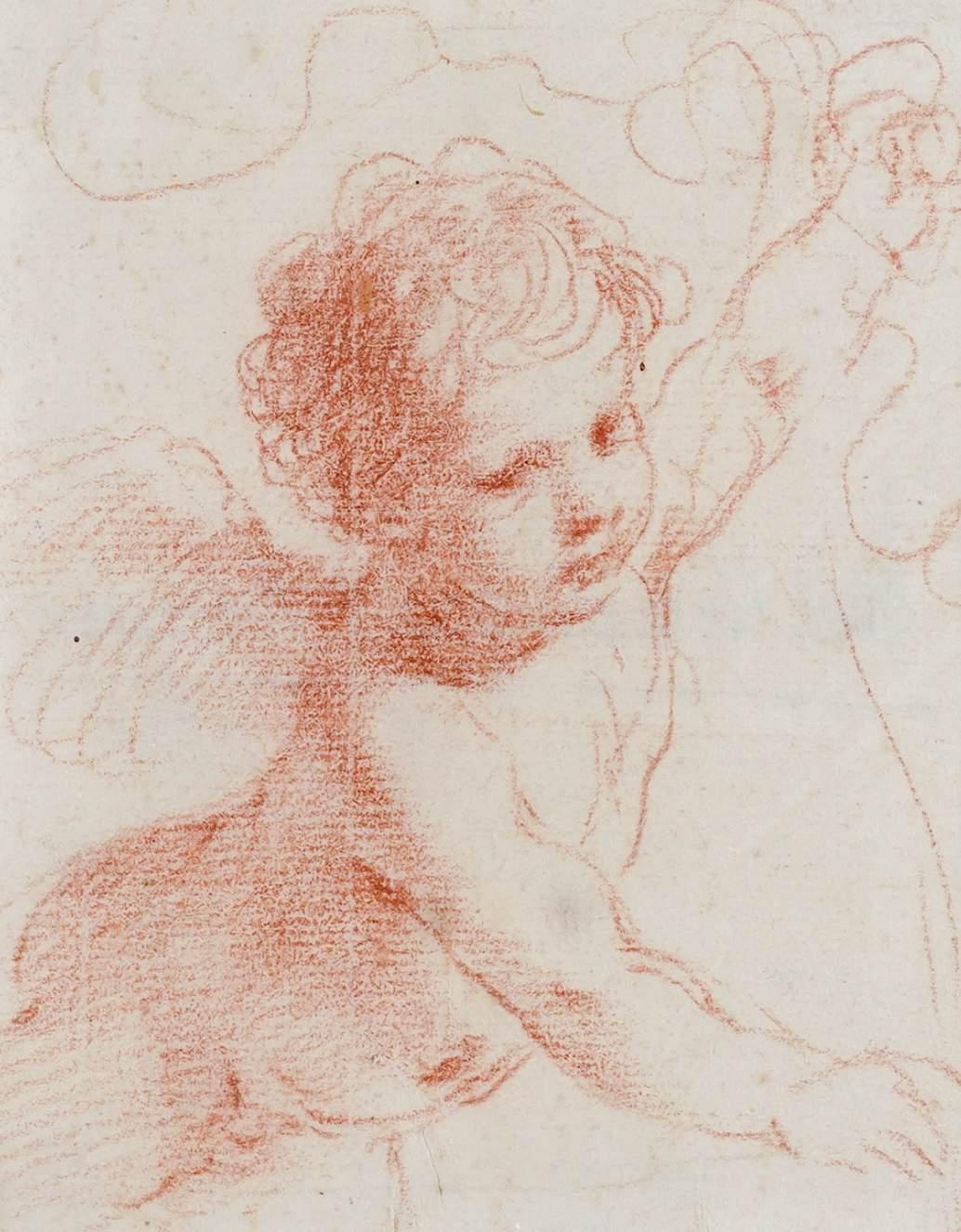
As is characteristic of Guercino’s methods even in finished studies for individual figures such as this one which typically come towards the tail end of his creative process the paintings do not slavishly follow their drawn counterparts.14 In the Osimo altarpiece, while leaving the delineation of the putto’s hip and belly projected in the drawing intact, Guercino decided to raise the positions of both arms. The right arm in the painted version now swings across the putto’s body at shoulder level, obscuring the neck and even a bit of the chin. The left arm now is raised straight up. Guercino’s adjustments to his compositions and figures often continued well into the painting phase: for example, Denis Mahon noted a pentimento to our putto’s right hand in the Osimo canvas (not visible in photographs).15
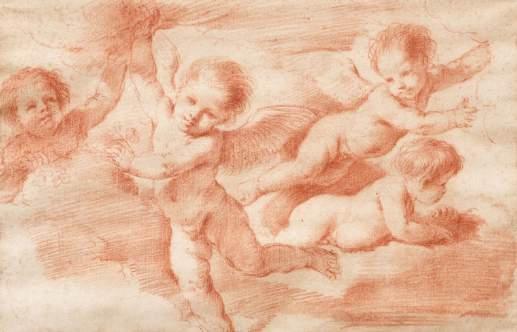
Of the many drawings connected with this project, which was originally ordered by Cardinal Agostino Galamini (1522–1639), Bishop of Osimo and titular of the church of Santa Maria in Aracoeli, Rome, 16 the red chalk sheet of Four Putti recently on the art market and now in the National Trust at the Vyne, Basingstoke, is particularly close in handling and morphology to the present sketch (see fig. II below).17 One of twenty-eight Guercino drawings assembled into what was known as the “Chute Album,” 18 the Basingstoke sheet demonstrates how much Guercino subsequently deviated from his original ideas for the putti when he came to paint the right side of the canvas. The drawn putti are now reversed or eliminated entirely from the painted work. In the far-left area of the Chute drawing is a wingless putto who was thoroughly reconceived in the sheet presented here. Guercino’s drawings were surprisingly experimental and his methods fluid as he worked his way towards a finished, painted product.
14 For an overview, see David M. Stone, “Guercino’s Preparatory Drawings: Creative Process, Narrative Experience, Pricing Paradox,” Artibus et Historiae 91 (XLVI; 2025: Papers in Honour of Catherine Puglisi, Part I): 109–125.
15 Mahon 1991, p. 240: “e si può anche notare che il maestro ha avuto un pentimento nel dipingere la mano destra del putto in volo a sinistra in alto.”
16 Galamini died before the first downpayment was made to Guercino. After some delays, the church carried on in earnest with the commission in memory of the late bishop.
17 220 x 335 mm. (8 5/8 x 13 1/4 in.)
18 For the interesting provenance of the album, which was owned by John Chaloner Chute, who acquired it during his visit to Italy (1741–46), as well as for an analysis of the Four Putti drawing, see the catalogue entry by Nicholas Turner at the website for Stephen Ongpin Fine Art, London.
19 Image repr. by kind permission of Stephen Ongpin Fine Art, London
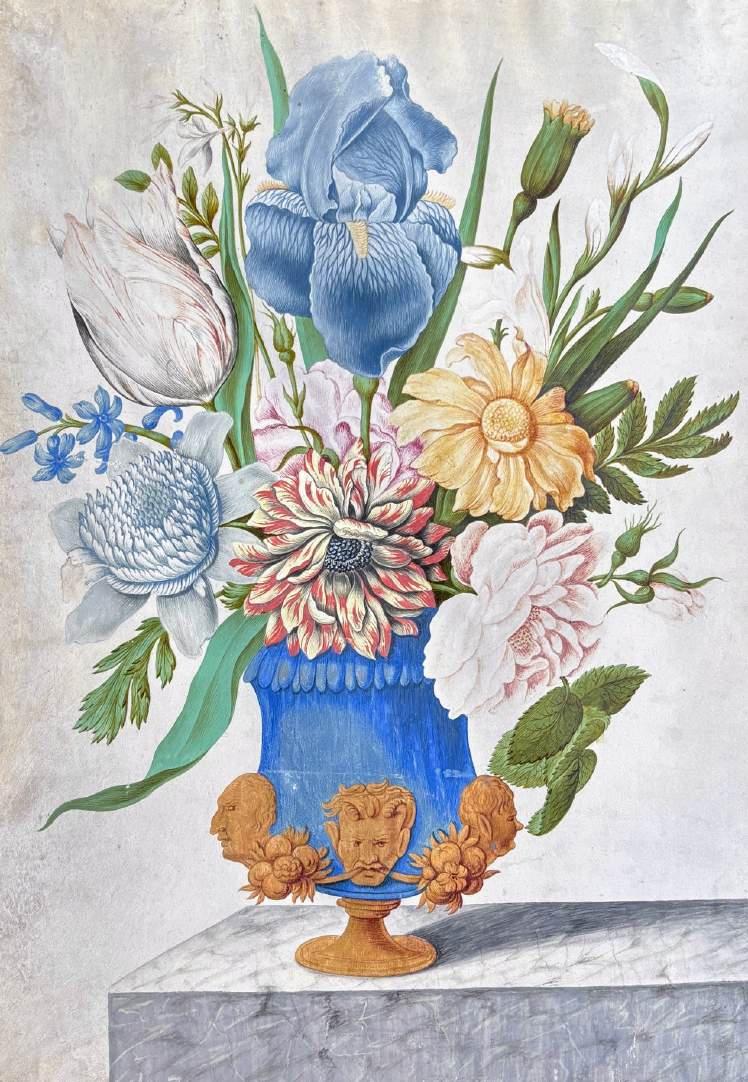
Florence, 1646 - c 1689
Tempera & gold pigment on vellum
44 x 30.5 cm | 17.3 x 12 in
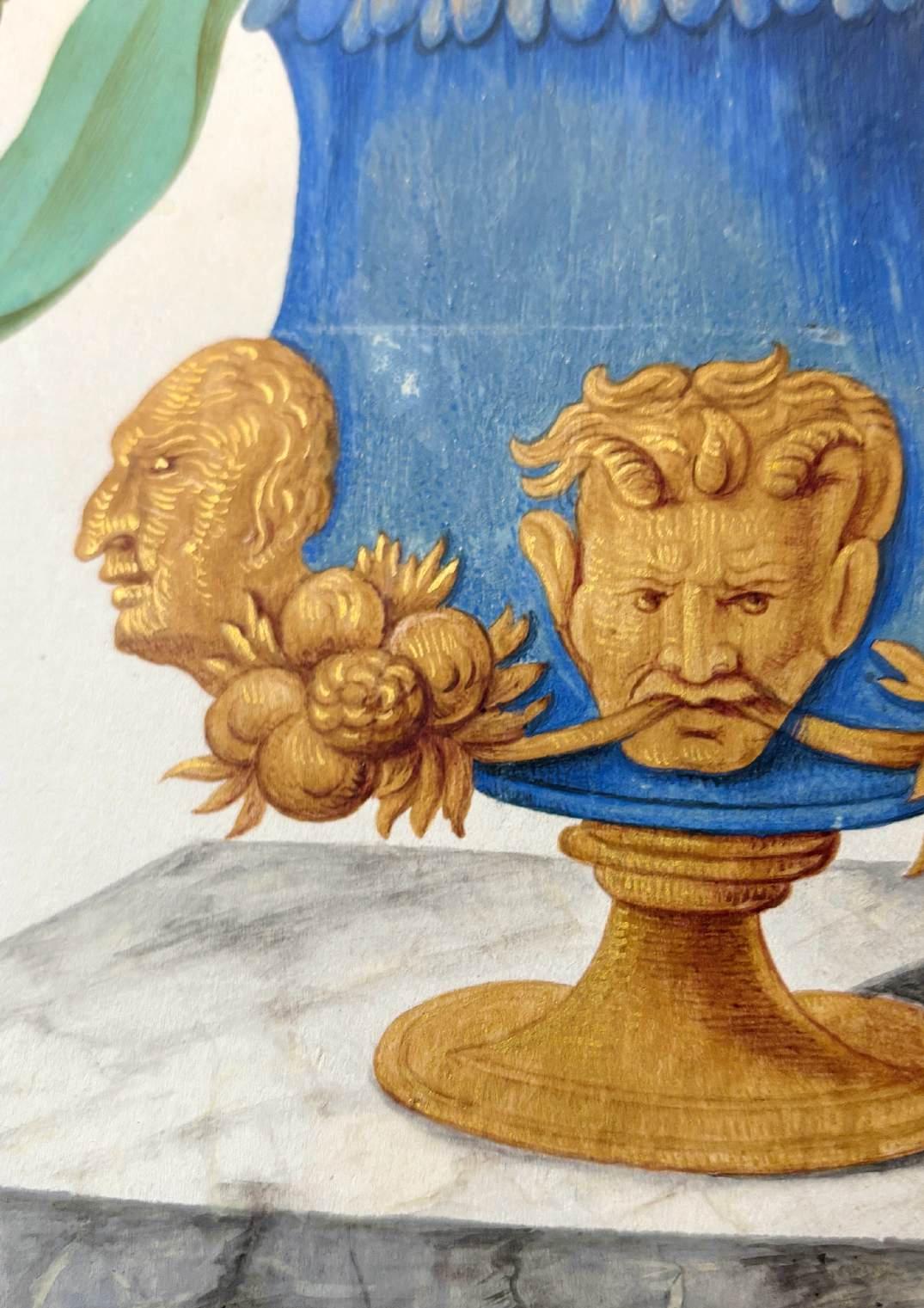
We are grateful to Dr Andrei Bliznukov for his generous assistance in cataloguing this work and confirming the attribution on the basis of digital images. Dr Bliznukov has suggested that this work was likely executed in the same period as another drawing by the artist, in the former Medici collections at Poggia a Caiano (dated to 1684, see fig. above).
Lorenzo Todini is an artist whose works are, today, remarkably scarce outside Northern Italy, with the majority of his works being held in private collections and Tuscan institutions (primarily the former Medici collections). On the basis of his name, it is likely that the artist's family hailed from Todi, a small town in Perugia; however, we know that he was born in 1646 in Florence, the son of an associate or member of the Court of the Medici, and that his godfather was Lorenzo de'Medici (after whom he was likely named), one of the great artistic patrons of his age. It is likely that the young Todini grew up in the milieu of court life in Florence and was apprenticed first to calligrapher and engraver Valerio Spada (1613-1688), who acted as godfather to Lorenzo's first son in 1680. Spada had earned acclaim for his engravings for the Saggi di Naturale Esperienze fatte nell'Accademia del Cimento, an
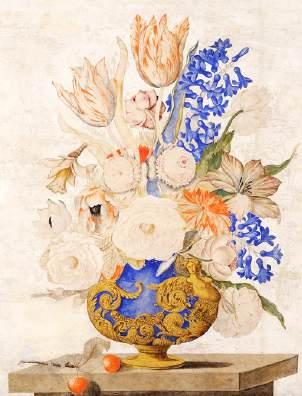
important text recording the experiments and studies of the followers of Galileo and other scientific research of the age. Simari notes that, in this respect, Todini underwent a similar training to the earlier Garzoni, who had studied under Giacomo Rogni in Venice early in her career. 20 .
Like Garzoni to some extent, and particularly Octavianus Montfort (active c.1650-1700 in Piedmont and Tuscany), Todini's works generally follow a simple formula: flowers in vases atop marbled pedestals, generally blue delftware but occasionally the elaborate blue and gold vases such as the present work, often with animals or loose fruit placed either side of the vases. Todini's elaborate vases with fantastical handles are highly distinctive within the genre of 'fiori su pergamene' ('flowers on vellum') that was so fashionable in Tuscany at this time. Indeed, they are more reminiscent of the pietra dura designs of the Grand Ducal Workshop in Florence, than the more naturalistic depictions that his artist contemporaries were producing. A tentative comparison can also be made to the elusive group of artists grouped under the singular title 'Master of the Grotesque Vases', active earlier in the 17th century in Italy. 21
21 Cf. 'I Maestri del vaso a grottesche', in La natura morta italiana da Caravaggio al Settecento, Florence, 26 June-12 October 2003, pp. 107-9
Beverwick, c.1616 - 1677, Haarlem
Signed & dated u.r.
Thomas / Wijck / in Napels / ag(?)[ustus(?)] 1659
With various inscriptions [colour notes?] in pen & ink
Pen & ink with brown wash
23.6 x 38.7 cm | 9.3 x 15.2 in
Maria Paternò Castello Ricci (c.1847-1915) [Lugt 5081];
Anonymous sale, Gonnelli Casa d'Aste, Florence, 25.05.2023, lot 129 (as Thomas Wijck); With Stephane Rénard Fine Art, France
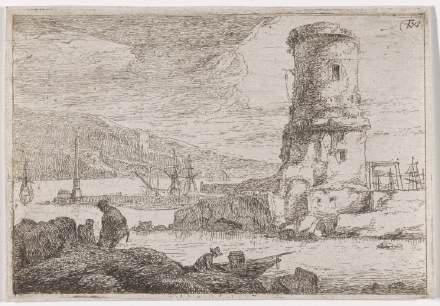
Fig. I - Thomas Wijck, A Round Tower in a Harbour, Bartsch 7
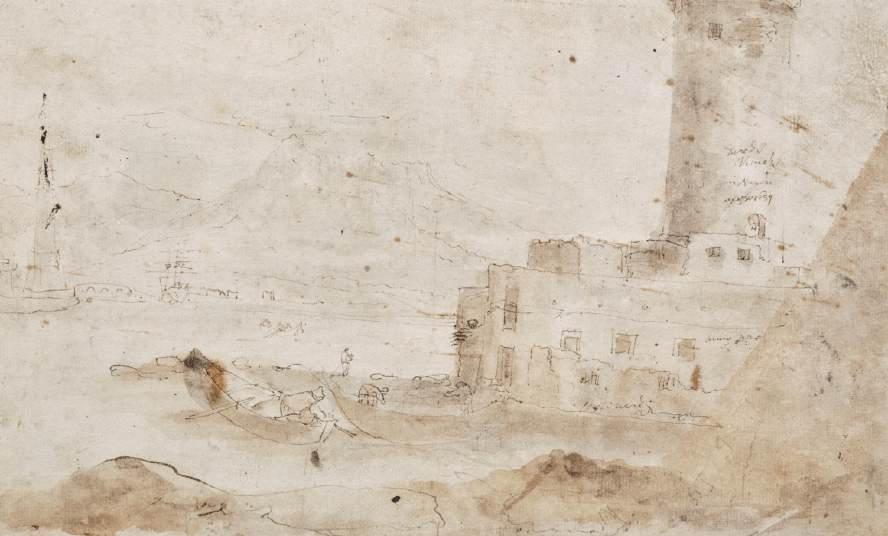
The present work corresponds very closely to Wijck's undated etching A Harbour with a Round Tower (see fig. I below left), which takes some artistic license with the architectural arrangements of the harbour at Naples, whereas the present work is more strictly topographical.
Thomas Wijck, sometimes spelled Wyck, is believed to have been born in Beverwijk in either 1616 (as Arnold Houbraken wrote in 1719) or shortly before 1621 (as more recent scholarship has argued). His name first appears in the registers of the Guild of St Luke in Haarlem in 1642, and from then onwards he is well-documented. He was a student of Adriaen van Ostade, one of the foremost genre painters of the Dutch Golden Age, and his teacher's influence is clearly visible in Wijck's well-known drawings of Italianate courtyards and welllit interiors, both in their execution and handling.
The artist is thought to have journeyed to Italy at some point after his marriage, in c.1644, and the combination of an Italian subject and the use of Italian paper provide concrete evidence of his presence in Italy, therefore confirming Houbraken’s account that the artist used to make drawings of Italian buildings ‘from life.' The present work, which is inscribed in Napoli, may have been executed in situ, though Wijck's presence back in Haarlem in 1659 is attested to, and it is possible therefore that this was executed from memory in his studio, as many of his paintings were.
London (?), c.1650 - 1737, Braunton
'The great czar'
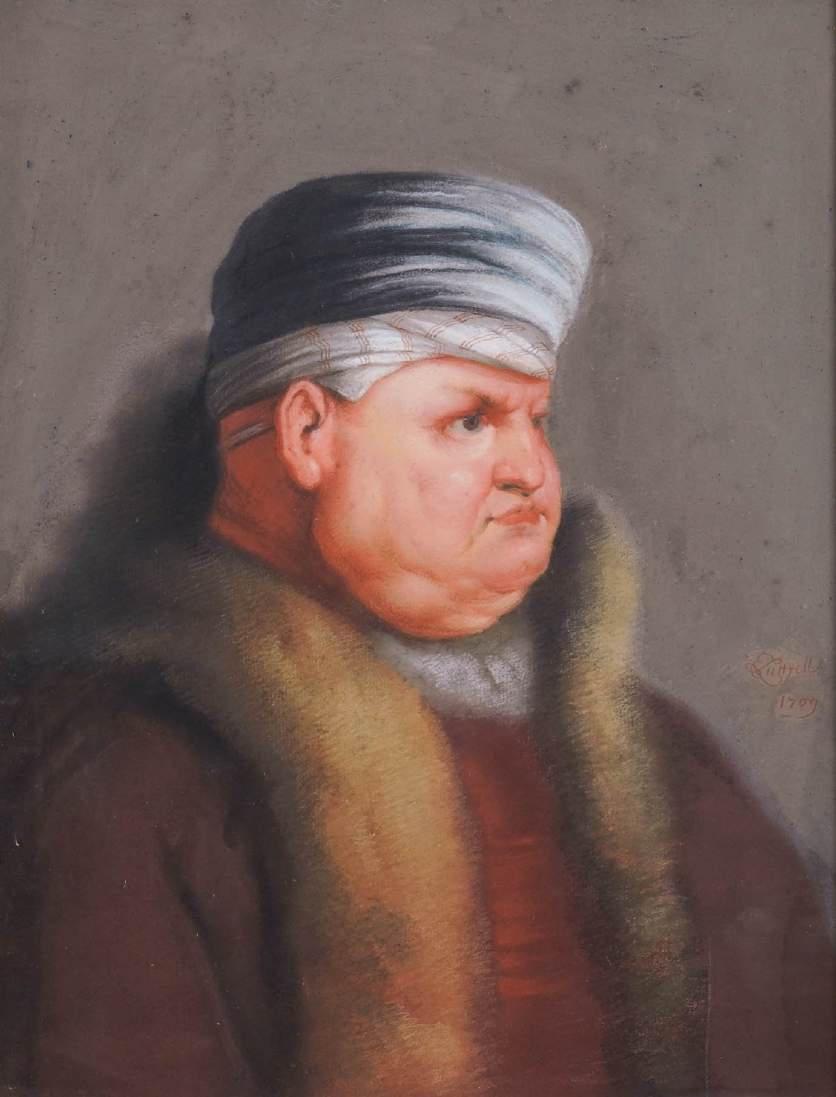
Signed & and dated centre right ELUTTRELL 1709
Pastels on paper
31.5 x 24.5 cm | 12.4 x 9.65 in
N. Jeffares, Dictionary of Pastellists before 1800, online ed., J.506,32303
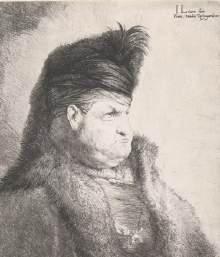
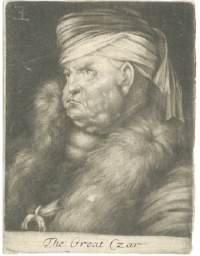
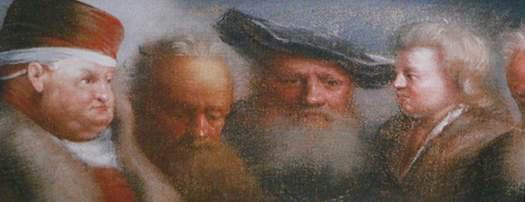
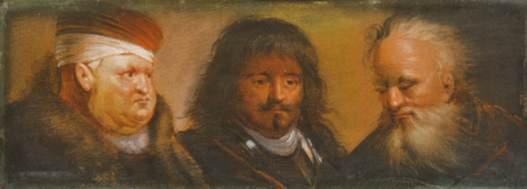
The artist was evidently quite taken with this wonderfully distinctive figure, as he can be found in several other pastels, including two where he is featured among other figures (figs. III & IV). This specific sitter is derived from or at least inspired by an etching by Jan Lievens of an unknown man in 'oriental' attire (Bartsch 13 / Hollstein 30 iii/iii), although Luttrell has chosen here not to copy the necklace in the original portrait, which bore the insignia of the Order of the Golden Fleece. There are two further versions of this composition and sitter by Luttrell, slightly different from ours (Jeffares, ibid., J.523.323, which features the necklace, and J.523.32302). Most intriguingly, Luttrell produced a, extremely scarce mezzotint that featured our figure, entitled 'The Great Czar' in c.1709 (the only copy we have been able to trace is held by the Varshavsky Collection, New York). 22 Why the mezzotint was titled this remains a mystery, as Lievens' sitter is generally just known as an 'Oriental'. It certainly cannot be Peter the Great, who visited London as a young man in 1698 and, at 6'8" and of a slim build, is clearly not this man.
Although Luttrell's birth and parentage remain uncertain (Patrick Noon has made a strong case for him being from a prominent Devon family23), he began studying law in about 1670 at New Inn, London. He soon abandoned this path to pursue a career as an artist, and became a pupil of the portraitist Edmund Ashfield, one of the foremost early British pastellists. Luttrell developed the novel practice of drawing with crayons on copper-plates and expanded the spectrum of colours which could be used, writing a treatise in 1683 on the processes involved in this and early mezzotints.
Figs. (Top left, clockwise):
I. Jan Lievens, Bust of an Oriental Man, Bartsch 13 | Hollstein 30 III/III
II. Edward Luttrell, The Great Czar - Image repr. by kind permission of the Varshavsky Collection, New York
III. E. Luttrell, Three Male Heads, previously with Galerie Ratton & Ladrière, Paris
IV. E. Luttrell, Study of Men, sold Sotheby's, London, 12.04.1995, lot 1
23 P. Noon, English portrait drawings and miniatures, Yale Center for British Art, 1979, pp.11-12
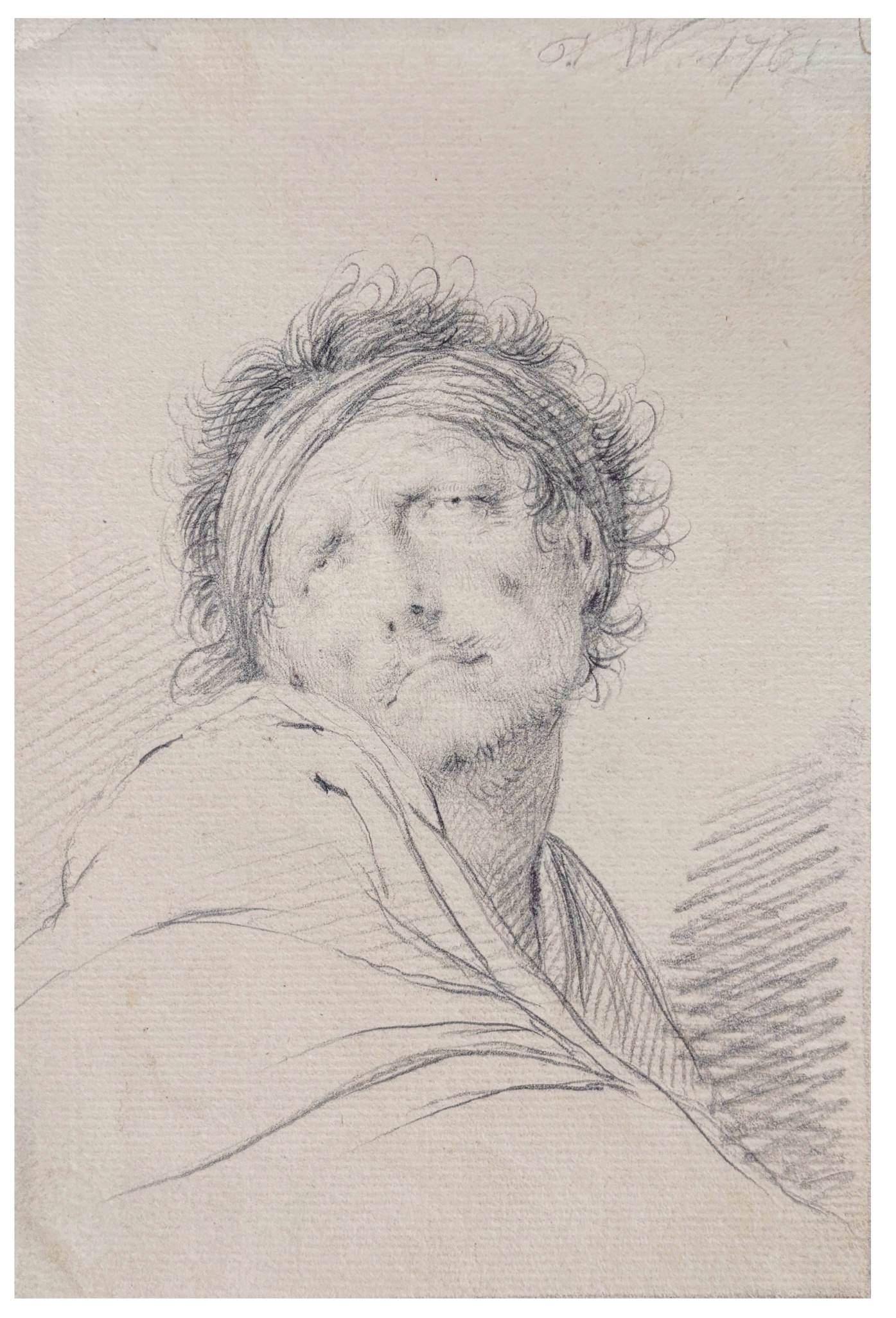
Peterborough, 1700 - 1766, London
Graphite, with stumping, and double framing lines in pencil
Signed with initials & dated u.r. TW 1761
20.4 x 14 cm | 8 x 5.5 in
With Stephen Ongpin Fine Art, London
London, Stephen Ongpin Fine Art & Guy Peppiatt Fine Art, 'One Hundred Drawings and Watercolours', Winter 2016-17, cat. no. 9
Worlidge also made direct copies of some of Rembrandt’s prints, among them the artist’s portrait of himself and the hundred-guelder plate. An etching after Rembrandt’s portrait of Sir John Astley was described by Horace Walpole as Worlidge’s ‘best piece.’
Worlidge was a versatile artist who worked across several media throughout his career. He began as a portrait painter and miniaturist, but turned in middle life to producing headstudies such as the present sheet in black-head pencil, for which he charged two guineas, and found great commercial success in this. Later in life, he focused on producing etchings in the manner of Rembrandt, using a dry-needle with triangular point.
Worlidge’s last work was his Antique Gems, a series of 182 etchings of antique gems and cameos. The series was published in several parts, some of which seem to have been issued as early as 1754; but Worlidge died before the work was completed. It was finished by his pupils William Grimaldi and George Powle. In April 1754 Worlidge had a large collection of his works to be sold by public auction. The printed catalogue bore the title, ‘A Collection of Pictures painted by Mr. Worlidge of Covent Garden, consisting’ ‘of Histories, Heads, Landscapes, and Dead Game, and also some Drawings.’ The highest price fetched was £51 15s. 6d., which was given for a ‘fine head’ after Rembrandt. More than sixteen hundred prints and more than thirteen hundred drawings by Worlidge were sold by Abraham Langford in March 1767 by order of his widow, Elizabeth Wicksteed, who was a talented artist herself.
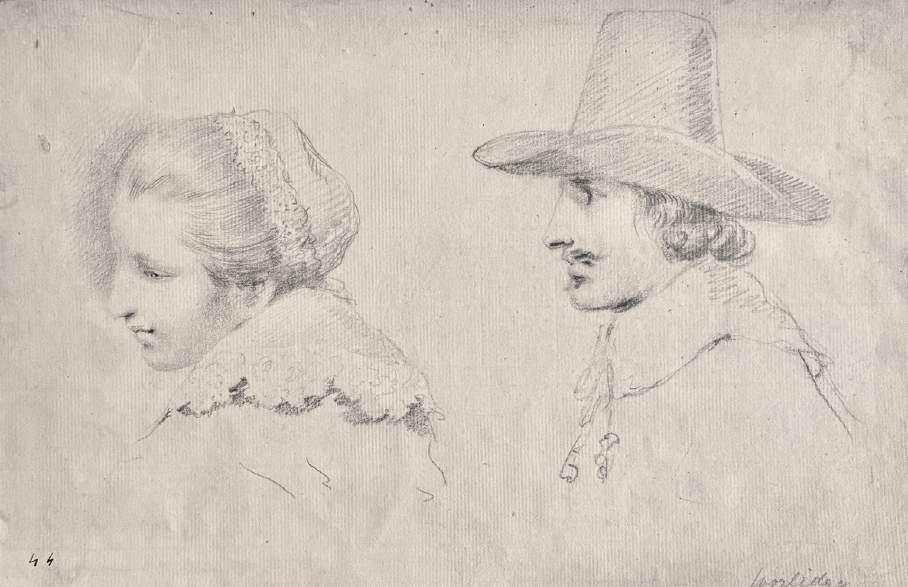
Peterborough, 1700 - 1766, London
STUDY OF TWO HEADS IN PROFILE
Bears pencil inscription l.r. Worlidge, bears numbering in pen & ink l.l. 44
Graphite on laid paper
18.5 x 29.4 cm
PROVENANCE
(Possibly) Thomas Newport, 4th Earl of Bradport, sold at Langford’s, London, 18.03.1774, lot 44 (‘Thirty-two by Worlidge’); (Possibly) Sold anonymously at John Gerard’s, London, 19.03.1789, lot 44 (‘Ten Heads (Loose Prints and Drawings)’)
With Stephen Ongpin Fine Art, London
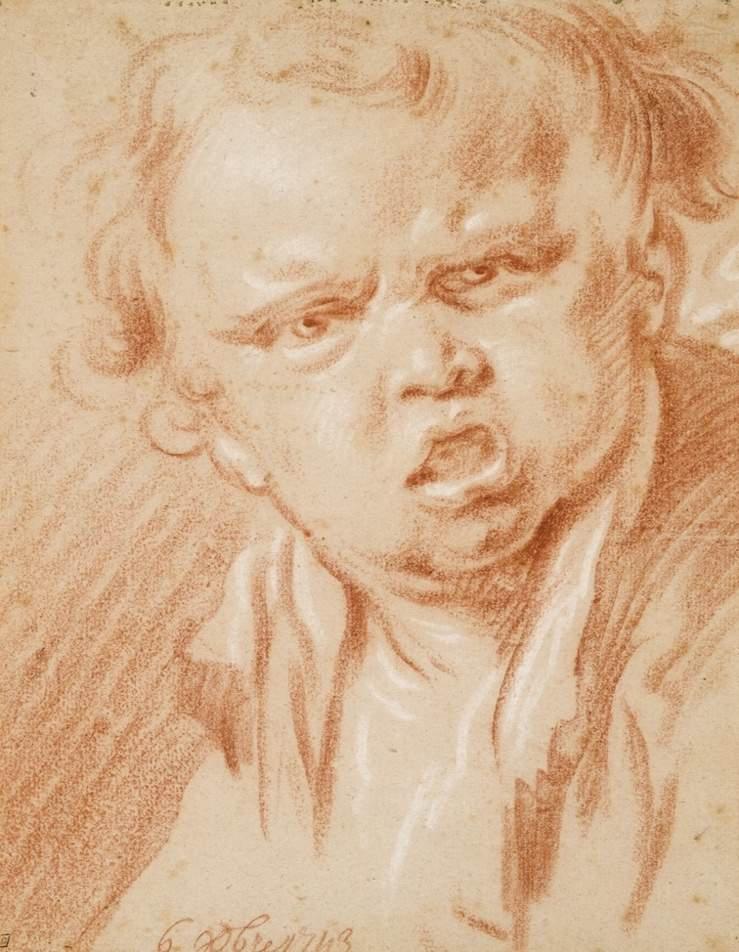
Bruges, 1712 - 1799
Dated l.m. 6 O .. [?] 1743, Bears collector's stamp l.l. [L.837]
Red & white chalks on laid paper
25.5 x 20 cm | 10 x 7.9 in
Émile Calando "Père" (1840-1898), Paris (Lugt 837); Private collection, Spain
Jan Anton Garemyn (sometimes spelled Garemijn) was born in Bruges, and was sent off to writing school at the tender age of just four, where his marginalia and doodles were quickly spotted by his teachers. Encouraged by these early signs of artistic promise, his parents placed him under the care of Rochus Aerts, a sculptor, before putting him into the Bruges drawing Academy at nine, which he attended for three years. Subsequent teachers included Hendrik Pulinx and Lodewijk Roose, and Garemyn himself became a teacher and headmaster at the same drawing school in 1765, holding that position for a decade.
Garemyn was a prolific draughtsman and painter, and worked across many genres, producing portraits, genre scenes, landscapes, and a number of important religious commissions (the latter of which included altar-pieces in prominent churches in both Bruges and nearby Courtrai). He was also commended as a decorative artist, and was tasked with designing triumphal arches for local processions and festivals.
Above all, Garemyn was a gifted draughtsman, excelling in characterful figure studies such as the present works, whose contorted faces were no doubt influenced by earlier masters such as Teniers, Van Ostade and particularly Jacob Jordaens. Several of these sheets bear the same distinctive large-lettered handwriting to their margins with a date, indicating that they were drawn from life and not merely genre pieces. His earliest, sadly now lost, self-portrait drawing is said to have been inscribed by him ‘Nulla dies sine linea’ (‘No Day without a Line’), a testament to his relentless work ethic and practice.
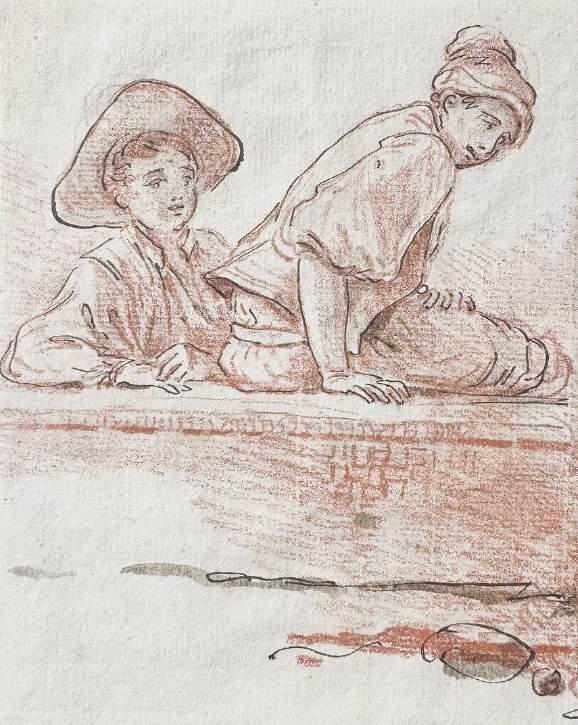
Paris, 1733 - 1808
BY A WALL
Red chalk with pen & ink on laid paper
Watermarked with the countermark (?) GR
14.7 x 11.7 cm | 5.8 x 4.6 in
PROVENANCE
Anonymous sale, Sotheby's, London, 07.12.1976, lot 36
BY A FOUNTAIN
Red chalk with pen & ink on laid paper, partially made up
13.5 x 14.5 cm | 5.3 x 5.7 in
PROVENANCE
With J.H.J. Mellaart, The Netherlands & London (by 1948); Private collection, U.K.
The present two sheets are part of a series of early figure studies by Robert executed in both pen & ink and red chalk. Closely-comparable examples include Personage vue en pied, École des Beaux-Arts, Paris and others in Lille (cf. S. Raux, Catalogue des Dessins Français du XVIIIe Siècle (exhib. cat.), Lille, Palais des Beaux-Arts, Paris, 1995, no. 63).
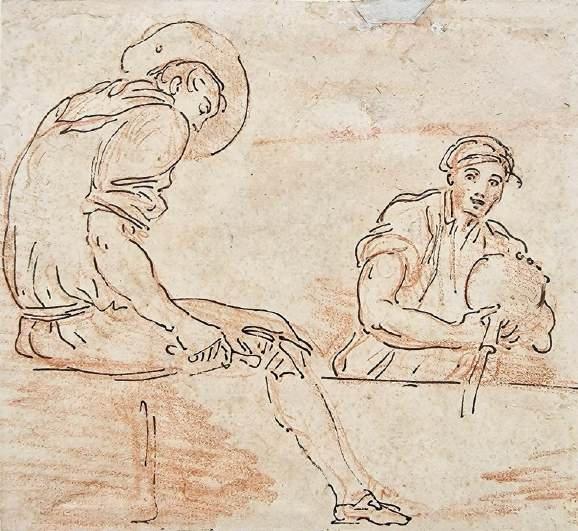
Paris, 1733 - 1808
Pencil with pen & ink and wash, on laid paper with a partial Strasbourg Lily watermark 17.5 x 23 cm | 6.9 x 9 in
Folio 26 of the album of 101 drawings made in Italy by Hubert Robert; (Likely) Sold as part of the artist's studio sale, Paris, 05.04.1809; The Countess of Béhague (1870-1939) [this work folio 8]; Thence by descent in the family of Ganay; The Estate of the Marquis de Ganay, Sotheby's, Monaco, 01.12.1989, lot 34 (ill. p.41); Private collection France
EXHIBITED (the album)
Paris, Galerie Caileux, 1957, Hubert Robert - Louis Moreau: Exposition du Cent-Cinquantenaire De Leur Mort, cat. no. 1;
Washington, National Gallery of Art, 1987, Hubert Robert: Drawings & Watercolours, cat. no. 12
LITERATURE (the album)
R.O. Parks, Piranesi, exhib.cat., Northampton, Mass., Smith College Museum of Art, 1961, p. 74; J. Scott, Piranesi, London (1975), p. 175 and p. 311, note 9; V. Carlson, Hubert Robert: Drawings & Watercolours (exhib. cat.), Washington (1987) cat. no. 12
Robert enjoyed depicting his fellow artists in the act of drawing, and they populate many of his sketches and paintings both from his student days to his later monumental paintings, almost becoming a romanticising motif in the latter. An example of the latter, previously with Nicholas Hall and recently given as part of Aso Tavitian's gift to the Clark Institute, Williamstown, shows a similar arrangement of artists sketching under the instruction of a teacher (obj. no. 2025.1.133). Although Robert's studies from this period would often inspire elements of his more fantastical capricci, the present scene almost certainly taken from life: pensionnaires at the French Academy in Rome were strongly encouraged to draw what they saw around the city, a tenet which had been evinced from the earliest days of the Academy in the late 17th century, particularly under the stewardship of Nicolas Vleughels, an early Director of the Academy. Robert was however one of the first artists to capture the sight of these young artists themselves engaged in the practice, and his drawings are valuable records of artistic life and study in Rome at this time.
This sheet comes from one of the few extant Roman sketchbooks of Robert's, in this instance an album that was kept complete until as recently as 1989, and which almost certainly featured in the artist's studio sale of 1809. Drawings from the same album can now be found in collections worldwide, including the Louvre, the Getty Museum, the Morgan Library, and the National Gallery of Art in Washington. It is thought that this particular sketchbook was used during Robert's final years in Rome, as two drawings from it are dated, one to 1764 and the other to 1765.
Pont-l'Évêque, 1758 –1829, Bern
Trois crayons on buff paper 57 x 42 cm | 22.4 x 16.5 in
Pierre-Nicolas Sicot, called ‘Legrand de Lérant’, was a pupil of Jean-Baptiste Descamps (1714-1791) at the École Régionale des Beaux-Arts de Rouen. He displayed considerable talent from an early age, winning the second prize at the École for drawing at just 15. After completing his studies in Rouen, he enrolled at Paris’ École Nationale, which later became the Academie.
The artist travelled to Bern in c.1794 to flee the Revolution, and the present sheet comes from a Swiss collection so may well have been kept by the artist among other life studies when he left France. Here he worked for local dignitaries, specialising in family portraits, and produced illustrations for the Swiss-Dutch writer Isabelle de Charrière, a prominent writer of the late Enlightenment. He gained some fame in his home country by exhibiting his Portrait of Cange, a prison commissioner, at the 1796 Salon in Paris. The work became a symbol of generosity of spirit during the Revolution.
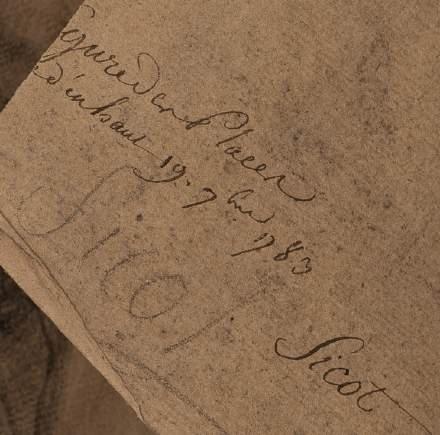
Fig. I - Detail of the inscription on the verso of another sheet by the same hand, from the same collection as our work.
Maidstone, 1767 - 1816
With a head study u.r.
Indistinctly inscribed u.r. & numbered u.m. 13
Watercolour over black chalk on buff wove paper 21 x 14.3 cm | 8.3 x 6.6 in
William Beckford (1760-1844), Fonthill Abbey; By descent to his son-in-law, Alexander Hamilton, 10th Duke of Hamilton (1767-1852);
By descent to the 12th Duke of Hamilton, by whose heirs sold, Sotheby's, Hamilton Palace (sale held on site), 30.06.1882, lot 146 ('Alexander (W.) Dress and Manners of the Chinese, 50 original water-colour Drawings, from which the Engravings in his book were taken, mounted on tinted paper, Russia extra, leather joints, gilt edges, by C.) [sold for £21];
The Earl of Derby; Anonymous sale, Christie's, South Kensington, 17.06.2015, lot 56
W. Alexander, Picturesque Representations of the Dress and Manners of the Chinese, London (1814), pl. 13;
Cf. P. Connor & S. Legouix, William Alexander: An English Artist in Imperial China (exhib. cat.), Brighton (1981); Cf. F. Wood, 'Closely Observed China: From William Alexander’s Sketches to his Published Work’, British Library Journal, vol. 24 (1998) pp. 98-121
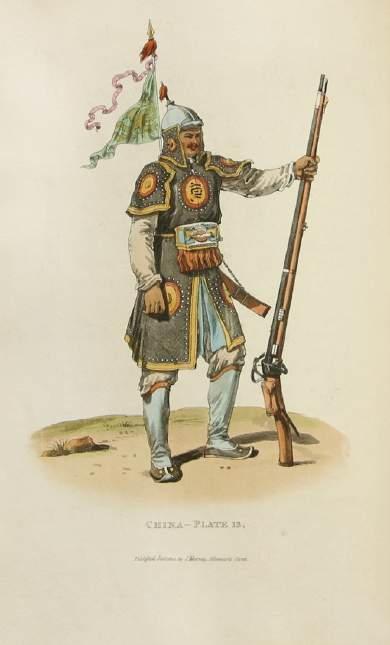
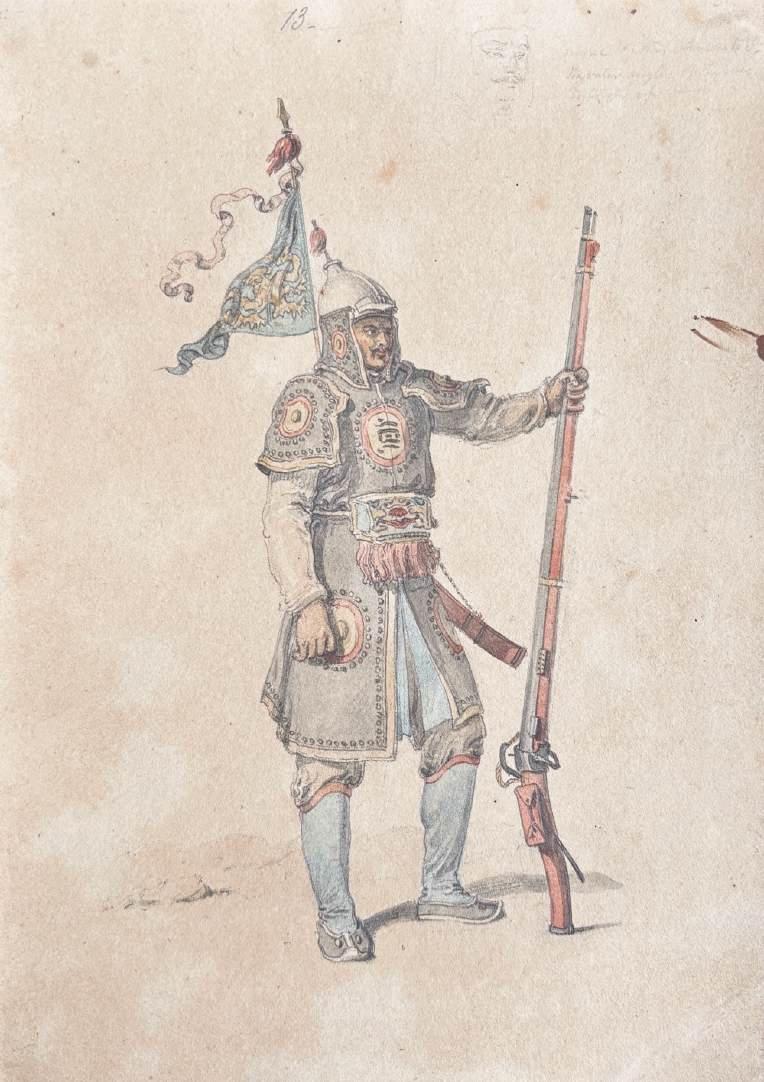
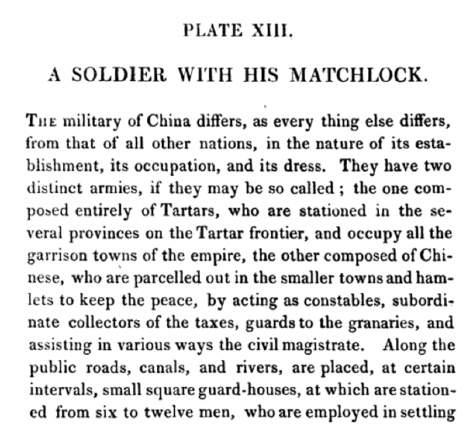
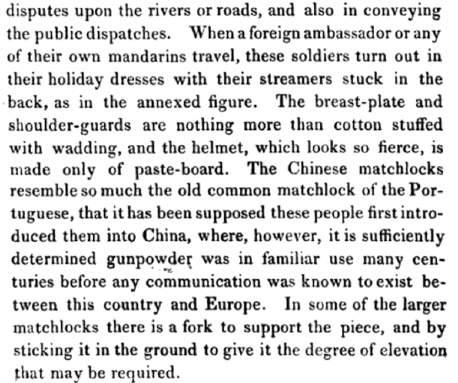
Fig. I - The explanatory letterpress accompanying the engraving of the present work in the 1814 publication.
William Alexander is chiefly remembered as one of the first Western artists to spend a lengthy period in Imperial China documenting the customs and costumes of the areas he visited, albeit through a distinctly Western lens. The present work is one of numerous so-called 'costume studies' of Chinese figures by Alexander which were once in the possession of the notorious William Beckford, the immensely wealthy writer and collector whose lavish lifestyle and ambitious architectural projects (as well as his early exile to Portugal for alleged homosexual acts) gained him lifelong infamy. Despite this reputation, he ranked among the most important artistic patrons of his age, supporting Turner, Cozens and numerous others early on in their careers.
Alexander moved to London at the age of fifteen to study art under William Pars, later studying under Julius Caesar Ibbetson and finally enrolling at the Royal Academy Schools. His big break came in 1792, when he was appointed to accompany the British ambassador Lord Macartney on the latter's embassy to the Chinese Emperor.
His numerous studies from this trip were published as illustrations in Sir George Staunton's account of the embassy published in 1797. The success of this book spurred Alexander to publish some of his other pictures from the trip in his own work, Views of the Headlands, Islands, &c., taken during the voyage to China (1798), and what remained featured in Barrow's Travels in China (1804) and Voyage to Cochin China (1806).
Our drawing featured in Alexander's final penultimate book on China, Picturesque Representations of the Dress and Manners of the Chinese, published in 1814. Many of the illustrations were republished at various dates throughout the 19th century.
In 1802, Alexander was appointed professor of drawing at Great Marlow's military college, but his skills were put to much more fruitful use when he became the first Keeper of prints and drawings at the British Museum. He drew and supervised the engraving of the ancient marbles and terracotta sculptures in the collection, which were the basis of the first four catalogues of the Museum's collection.
The small study of a soldier's head in the upper right of our sheet is likely a preliminary sketch for another figure, A Tartar of the Chinese Army, which first featured in Staunton's account published in 1797. The original study for this is now in the Yale Centre for British Art (see fig. II overleaf for a detail comparison).
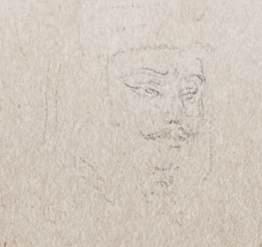
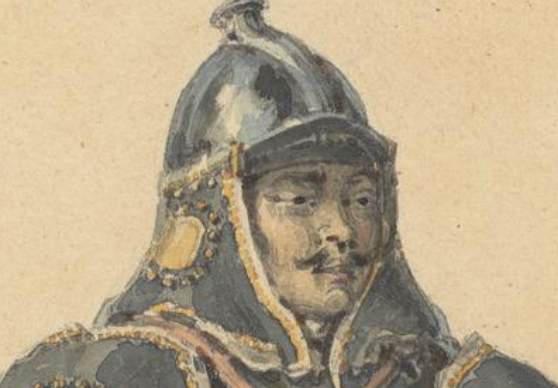
Fig. I - Comparison between the head study to the u.r. of our sheet and the face in Alexander's Portrait of a Chinese Soldier from the same series and previously also owned by William Beckford, YCBA, ac. no. B1975.4.986
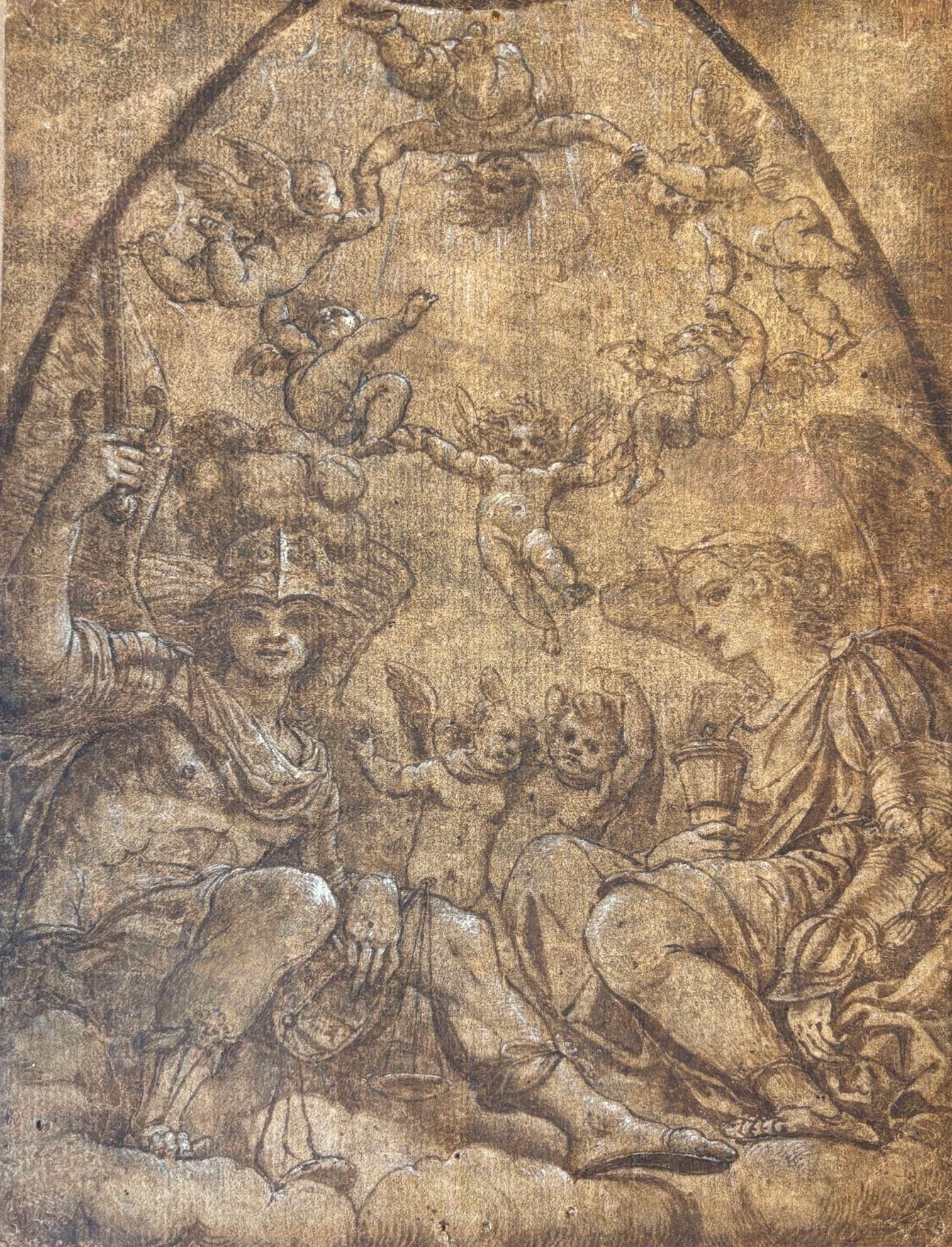
Rome, c.1770 - 1780
Black chalk & oil on brown-tinted laid paper
24.5 x 19 cm | 9.6 x 7.5 in
Private collection, Scotland
When this was work was examined by Henry Wyndham and Peter Nahum on the BBC television show 'The Antiques Roadshow', it was deemed to be by Henry Fuseli and to depict the embodiment of 'Charity' (generally titled 'Caritas'). 24 The attribution, perhaps given incautiously, does make good sense: the Michelangelo-esque figures and their proportions, coupled with the very characterful and graphic facial type of the central larger figure, immediately call to mind the work of both Fuseli and several of his acolytes active in Rome in the 1770s and afterwards. A conclusive attribution remains elusive for the moment, though James Northcote R.A. (17461831) has recently been proposed as a possibility.
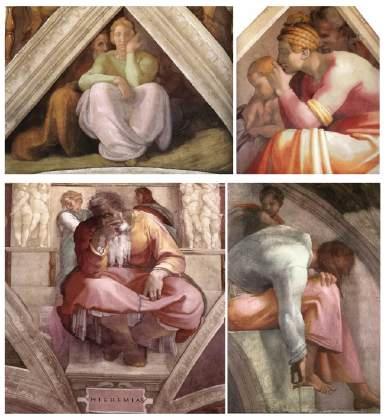
The figures undoubtedly owe a considerable debt to Michelangelo and the Sistine Ceiling, and are something of a synthesis of the 'Ancestors of Christ' (sometimes called 'The Patriarchs'). These figures, who together comprise a comparatively lesser-known section of the famous fresco cycle, can be found in the eight spandrels of the side walls of the Chapel, between the thrones of the Prophets and Sibyls and above the lunettes. Several of these figures (reproduced in the figure above right) rest their hands in their hands, as the present sheet depicts, a pose which does not feature in Michelangelo's oil paintings of similar figural groups such as the various Holy Family tondi. Fuseli was fascinated by the 'Ancestors' and referred to them at length in his own theory and adapted them for his own drawings and paintings, as well as sketching several studies after them. 25 26 He viewed these figures as 'embodiments of sublime sentiments' 27
24 Broadcast 10th January 1993.
25 In particular, Fresco Design for Twelfth Night (1777-8), British Museum, London, no. 1885-3-14-25
26 Cf. F. Antal, Fuseli Studies, London (1956), pp.36-38, 112 and p.173 (index) for the full list of references
27 Antal, ibid., p.112; also cf. H. Fuseli, quoted in The Life and Writings of Henry Fuseli, ed. John Knowles, London (1831), p.145 (Aphorism 231): '...the Prophets, Sibyls and Patriarchs of Michael Angelo are so many branches of one great sentiment.'
London, 1775 - 1851
Watercolour with pencil on paper
Watermarked to l.r. of sheet: J Whatm[an] / 1837
32 x 25.7 cm | 12.6 x 10.1 in
H.A.J. Munro of Novar (1797-1864)
His sale, Christie's, London, 02.06.1877, lot 23
Where acquired by Metzler
Anonymous sale, Christie's, London, 27.03.1909, lot 81
Where acquired by Knity
Acquired privately by the Nonesuch Gallery, 2025
Engraved by E. Goodall for Thomas More's Epicurean, London (1839), p.58
A. Munro, The Life of J.M.W. Turner, London (1897), p.152 (not repr.)
A. Wilton, J.M.W. Turner: His Art & Life, London (1979), p.456, no. 1299 (not repr., untraced)
J. Piggott, Turner's Vignette's, London (1993), pp.65-67 (not repr.), App. B. No. 142 (the engraving)
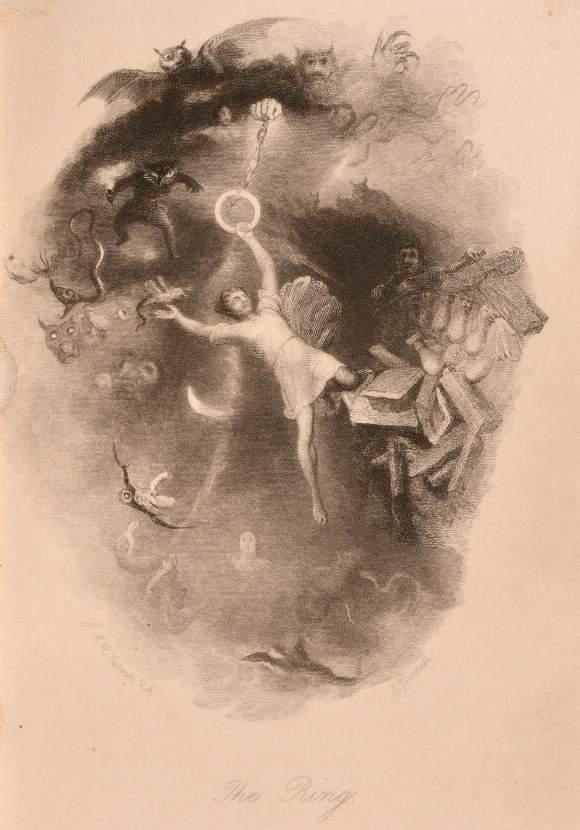
Fig. I (above right) - E. Goodall after J.M.W. Turner, The Ring, engraving, publ. 1839
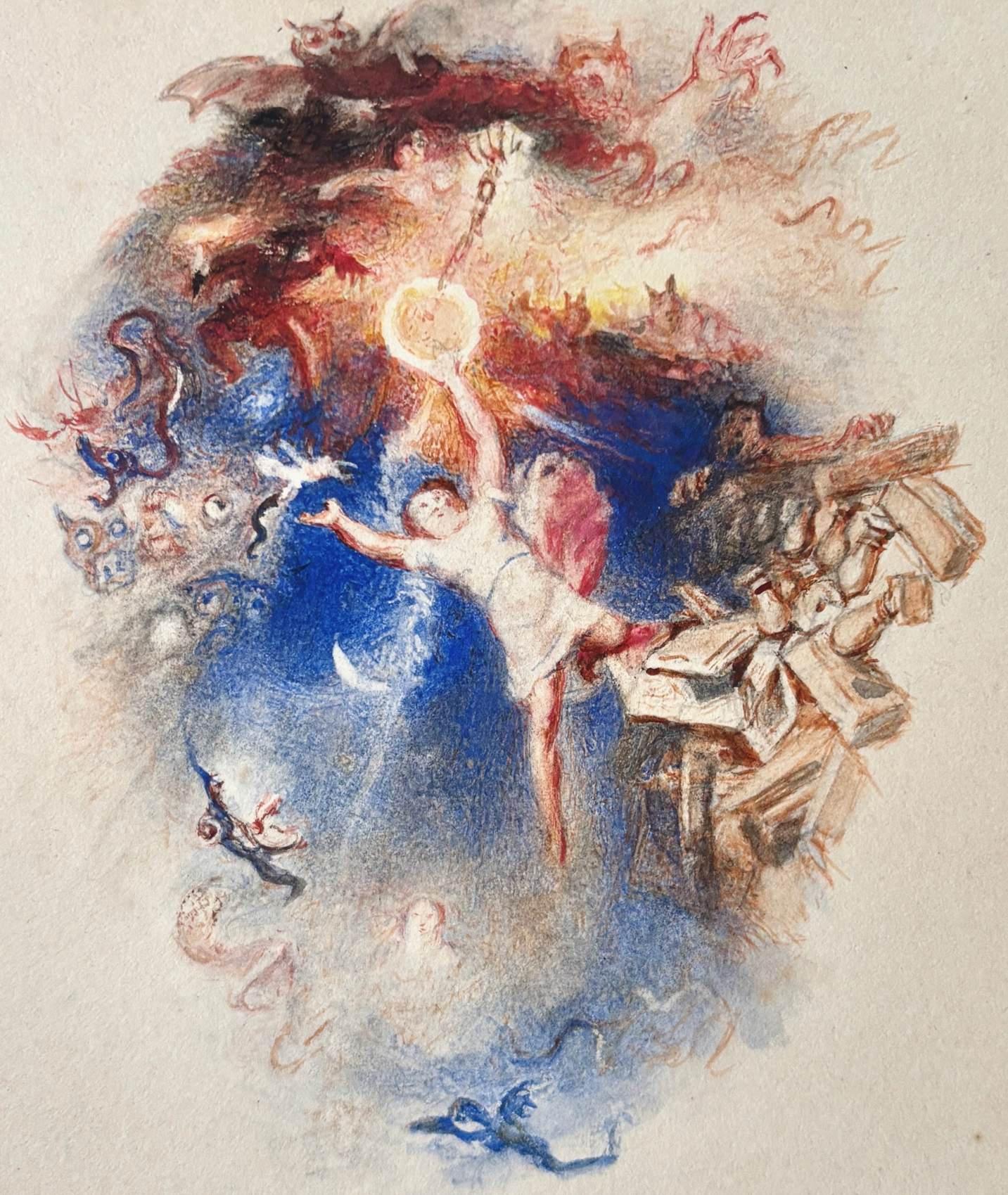
The present work is an exciting rediscovery that has lain dormant for more than a century, with its location unknown at the t ime of both the definitive catalogue of the artist's works by Andrew Wilton and the catalogue of his vignettes by Jane Piggott.
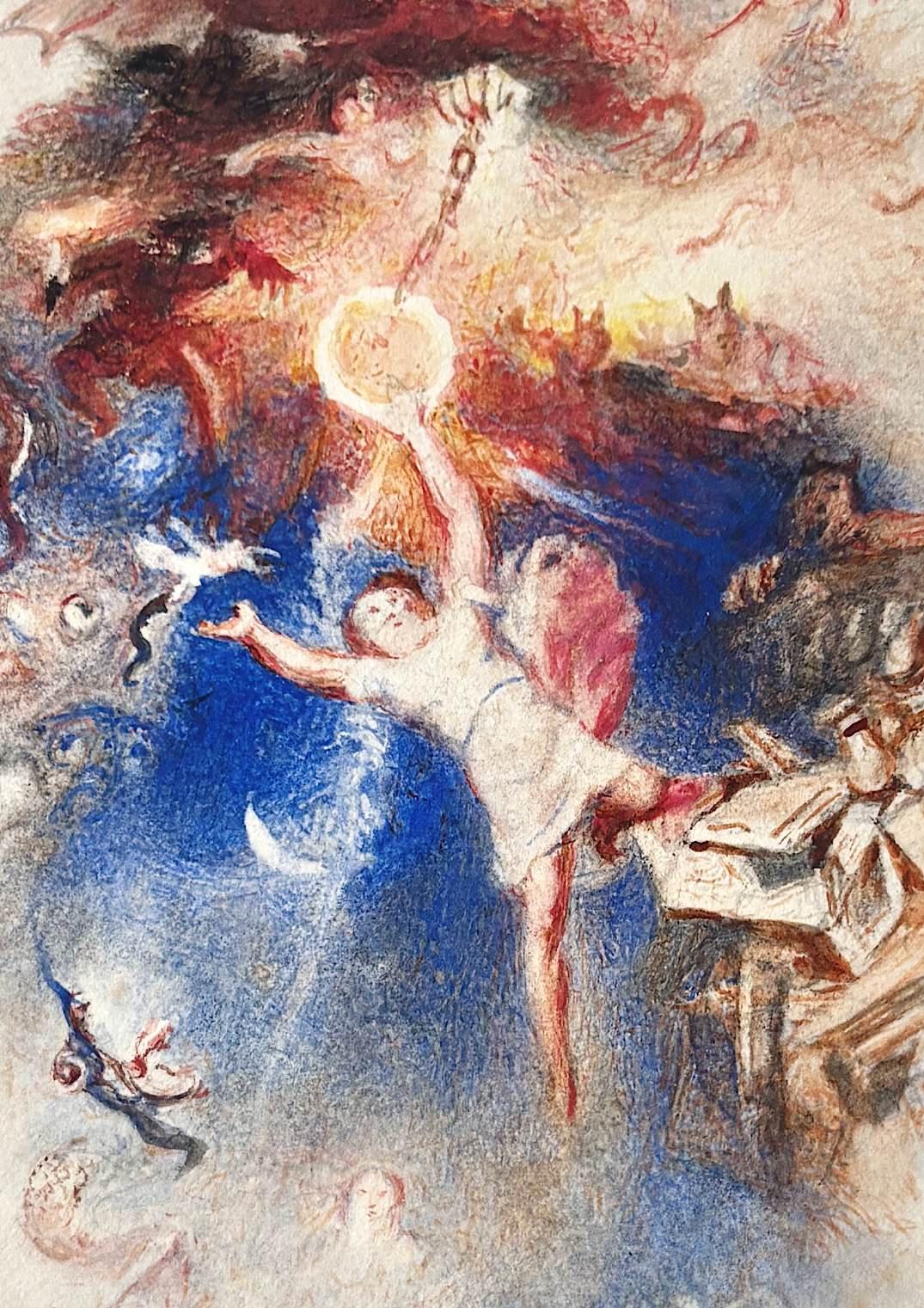
Turner produced a number of watercolour drawings for Thomas Moore’s prose poem ‘The Epicurean, a Tale; and Alciphron, a Poem’ ; however, only four designs were used in the publication, partly because the author was surprisingly dissatisfied with what Turner presented him with. These four were engraved by Edward Goodall and comprise: ‘The Garden’, ‘The Ring’, ‘The Nile’ and ‘The Chaplet’ Today, the other known studies for this particular illustration in the book are part of the Turner Bequest at the Tate (figs II & III), and are considerably less finished than our painting, which was likely the final version of this scene, that was then given to Goodall for engraving. A study for The Garden, of a similarly-finished nature to ours, is at the Clark Art Institute, Williamstown (obj. no. 2007.8.118), having come initially from Munro of Novar's collection as ours did (see figs IV & V overleaf)
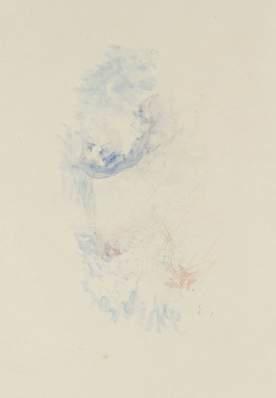
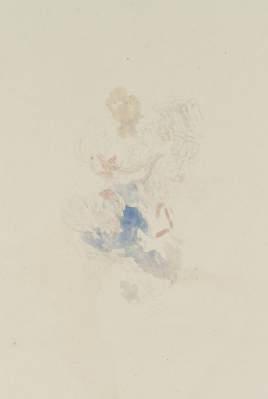
Figs. II & III - J.M.W. Turner, Studies for 'The Ring', pencil & watercolour Tate, London, acc. nos. D27631 & D27640
Our picture depicts the moment when the hero, Alciphron, in the midst of exploring a treacherous Egyptian pyramid, grabs hold of a magical ring that eventually guides him to safety. The hero is mounting a staircase, when the steps begin to crumble beneath his feet:
'I could hear the plash of the falling fragments, as every step in succession gave way from under my feet. It was a most trying moment, – but even still worse remained. I now found the balustrade, by which I had held during my ascent, and which had hitherto seemed firm, grow tremulous in my hand, – while the step, to which I was about to trust myself, tottered under my foot. Just then, a momentary flash, as if of lightning, broke around me, and I perceived, hanging out of the clouds, and barely within my reach, a huge brazen ring. Instinctively I stretched forth my arm to seize it, and, at the same instant, both balustrade and steps gave way beneath me, and I was left swinging by my hands in the dark void.'
The Epicurean, 1839, p.58
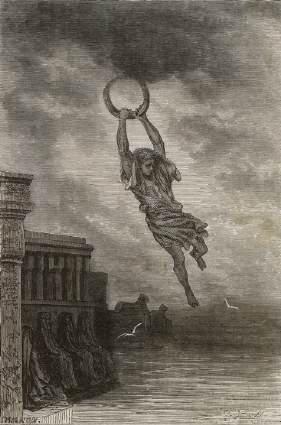
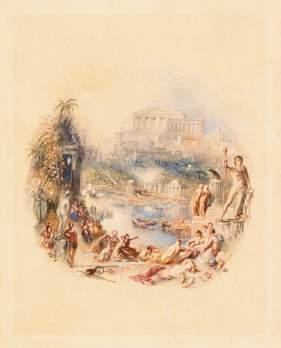
Figs. IV & V
* G. Doré, Illustration to Thomas Moore's 'Epicurean', engraving, publ. 1865
* J.M.W. Turner, The Garden, watercolour with pencil, Clark Art Centre, Williamstown, acc. no. 2007.8.118
Our painting is, by contrast with many of Turner's literary illustrations, bracingly modern in both its composition and subject matter. Indeed, it is more redolent of the later French artists Gustave Doré or even Victor Hugo, and seems far ahead of its time, particularly by comparison with Turner's more staid illustrations to Byron or Walter Scott. Those illustrations, many of which date to just a year or two prior to our work, are very much more in the tradition of earlier artists like Stothard or William Hamilton, hardly names one would associate with this striking design. Gustave Doré himself did in fact illustrate the 1865 French translation of Moore's poem, and depicted the same scene in a not dissimilar manner (see fig. IV), suggesting a familiarity with Turner's illustrations for the text.
Turner's illustrations for Moore's poem faced unusually harsh criticism from even his most ardent supporters, namely Ruskin and his (posthumous) biographers, P.G. Hamerton and Walter Thornbury. Hamerton was scathing in his appraisal, writing 'The Ring may be dismissed at once as a wild fancy of a man swinging in the void, surrounded by diabolical apparitions, a subject authorised by the story, but not well chosen for illustration.' 28 Thornbury labelled the group 'Feeble, strained, and misunderstood.' 29 But it was Ruskin who was the most succinct (and bluntest), adding just a single word to the parcel that once contained the Tate's nine drawings for The Epicurean: 'Bad' 30 It should be noted that Ruskin regretted his choice of word, writing to Ralph Wornum that his inscription was 'horrible’, adding ‘I never meant it to be permanent.’ 31
Today, we can appreciate the illustration and our drawing for what it truly is, namely an insight into the remarkable imagination of an artistic genius at the height of his powers as an illustrator. Meredith Gamer recognised the group's special status among Turner's vignettes in her 2006 catalogue essay for the Tate, writing: 'Like the published vignettes for Moore’s Epicurean, the preliminary sketches possess an element of fantasy and high drama that is unique among Turner’s works of literary illustration.' 32
28 Philip Gilbert Hamerton, The Life of J.M.W. Turner, R.A., London (1879), p.280.
29 W. Thornbury, The Life of J.M.W. Turner, London (1897), p.162
30 A Complete Inventory of the Drawings of the Turner Bequest, ed. A.J. Finberg, London (1909), p.898, no. 125
31 Ibid., p.897
32 M. Gamer, ‘Watercolours Related to Thomas Moore, The Epicurean, a Tale, and Alciphron c.1837–8’, subset, Aug. 2006, in D.B. Brown (ed.), J.M.W. Turner: Sketchbooks, Drawings and Watercolours, Tate Research Publication, December 2012
Kassel, 1778 - 1868, Rome
Numbered in pencil beneath mount l.l. VIII
Graphite on laid paper
41.4 x 53.3 cm | 16.3 x 21 in
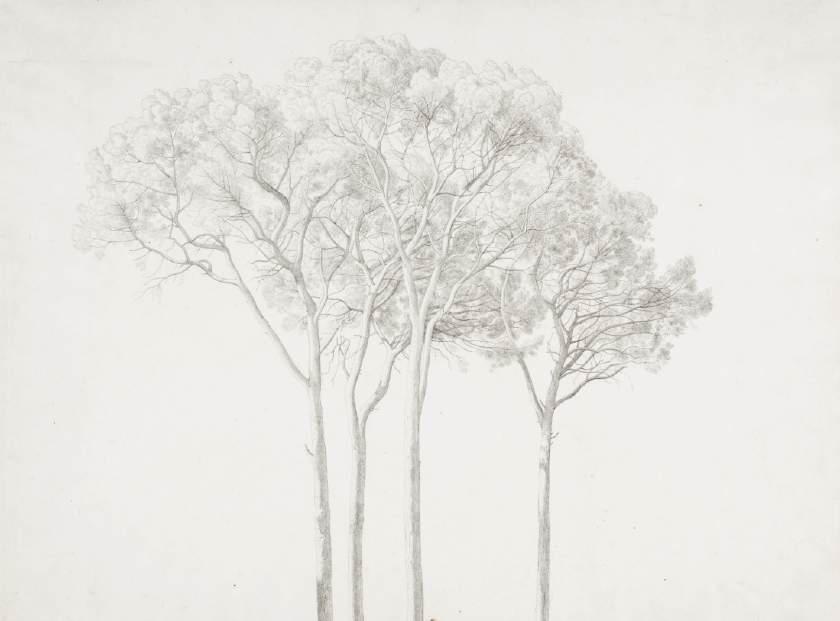
The subjects of the present study are the distinctive umbrella pines found in various sites around Rome and Tivoli and throughout Italy They feature in numerous paintings by Von Rohden executed during his time in the country (including the examples to the right). Tivoli in particular held a special place in the artist's heart, as he married the daughter of the innkeeper of the town's Sibylla Inn, a popular waypoint for the many artists who visited
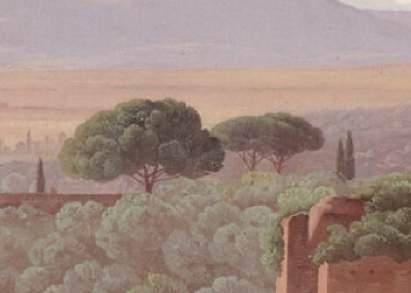
Von Rohden began his studies at Kassel's Kunsthochschule and was just seventeen when he first visited Rome. He returned to Italy in 1802 and would spend most of his life in Italy thereafter, playing a pivotal role in the creation of the German Academy there and the adoption of plein air painting among his countrymen. Von Rohden's conversion to Catholicism led him away from the pure naturalism of many of his peers, as he painted landscapes with an eye towards the neoclassical serenity of earlier artists.
Von Rohden was a popular figure in the artistic community in Rome and associated with the Nazarenes and the circle centred around Joseph Anton Koch and J.C. Reinhart.
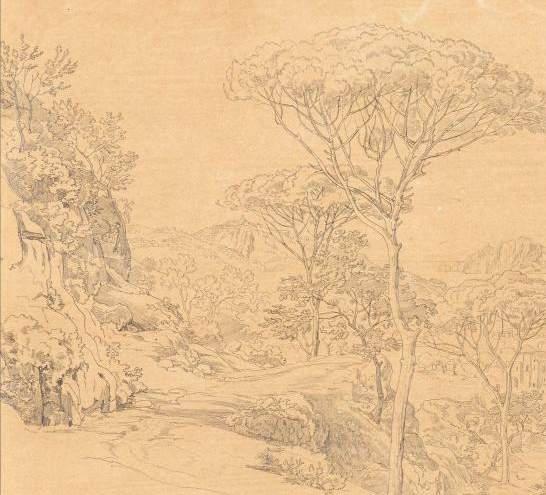
Fig. I - J.M. von Rohden, View of Hadrian’s Villa in Tivoli... (detail), Fondation Custodia, Paris (inv. no. 2019-S.23)
Fig. II - J.M. von Rohden, View from Massa Lubrene to the Island of Capri, offered at Van Ham, Cologne, 17.11.2023, lot 1245
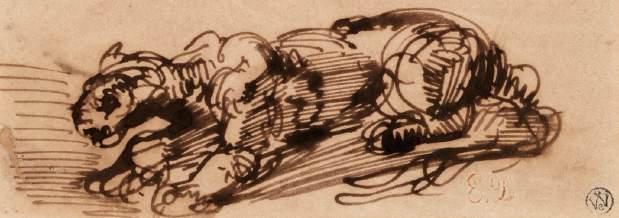
Saint-Maurice, 1798 - 1863
Bears artist's studio stamp l.r. [L.838a]
Bears collector's stamp l.r. [L.911]
Pen & ink on wove paper
10.3 x 13 cm | 4 x 5.1 in
The artist's studio sale, Paris, Hôtel Drouot, 17-29 February 1864, lot 496 (Études de Tigres...) (Part of lot, sold for 466fr.) [Lugt 838a];
Where acquired by Gustave Arosa (1818-1883), Paris;
His sale, Paris, Hôtel Drouot, Me P. Chevallier, 27-28 February 1884, lot 165 (an album containing many sketches...) (part of lot);
Where acquired by Emile Wauters (1846-1933), Paris [Lugt 911];
His sale, Frederick Muller & Cie, Amserdam, 15-16.06.1926, lot 54
(Part of lot when presented together, 'Etudes de quatre léopards sur trois feuilles. A la plume. Haut. de chaque feuille 1o, larg I3 cent. Monogrammées E. D., marque de la vente après décès du maître.');
Where acquired by Frits Lugt (1884-1970), Paris;
By whom sold either to the dealers Jacques Mathey (Paris) or 'Neuville' [Galerie Neuville & Vivien, Paris], 1947 or afterwards; Private collection, Basel
LITERATURE
A. Robaut & E. Chesneau, L’œuvre Complet De Eugène
Delacroix: Peintures, Dessins, gravures, lithographies, Paris (1885), Supplement, p.459, no. 1858 (Études de Tigres);
Frederic Lees, The Art of the Great Masters, London (1913), p.164, fig. 184;
J.F. Heijbroek, Frits Lugt 1884-1970: Living for Art, Paris (2012), p.199 (not repr.)
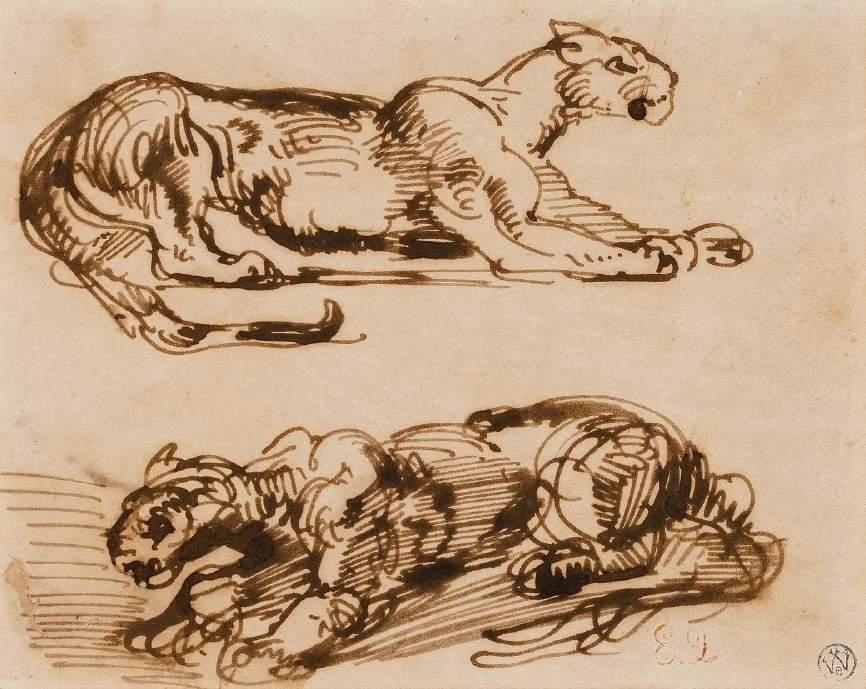
'Whatartist hasdisplayedbolderandsurer pen-workthanhewhodrewthesestudiesofpanthers,whose fiercegrowlingwe can almostimagine we hear.How wellhehasdepictedtheanimals'musclingandtheir movements!Ingresmighthavedrawnthesewildbeasts witha clearer,more impeccableline,butassuredly hewouldnot haveimpartedto themthatintense animation whichDelacroixknewhowto renderwithhis hastyyet genialpen-work.Theonlyartist whoattainedhisperfectionin thisbranchofart was Rembrandt...in thesestudiesofpantherswe can readtheentire lifeofa master whohasnever fora moment ceasedto admireandto scrutinise nature. '
Frederic Lees, op. cit., pp.161-162
“Lestigres,lespanthères,lesjaguars,leslions,etc.D’oùvientlemouvementquelavuedetoutcelaa produitchezmoi:decequejesuissortidemesidéesdetouslesjoursquisonttoutmonmonde,dema ruequiestmonunivers.Combienilestnécessairedemesecouerdetempsentemps...”
'Tigers, panthers, jaguars, lions, etc. Why is it that these things have stirred me so much? Can it be because I have gone outside the everyday thoughts that are my world; away from the street that is my entire universe? How necessary it is to give oneself a shake from time to time.'
The present drawing is one of a group of studies of wild felines (variously identified as tigers and panthers throughout their sale history) by Delacroix which were once presented together on a single sheet, with each study of identical dimensions. These were acquired by Frits Lugt in 1926 at the posthumous sale of the Belgian painter Emile Wauters, and Lugt went on to sell the present sheet some years after the War. Intriguingly, despite the clear description in Wauters' sale catalogue of 'Four studies of Tigers on three sheets', Lugt noted that there were in fact four sheets, as two were glued together, and so he was able to sell two sheets off and keep the remaining two.
The two drawings which Lugt kept from the group are now held by the Fondation Custodia, Paris (inv. nos. 2507A & B), and when they were exhibited at the Frick in 2010, they were tentatively dated to the second half of the 1840s, when Delacroix resumed his earlier practice of regularly visiting and sketching the animals of the Jardin des Plantes in Paris. (2)
We are grateful to Dr Stijn Alsteen of the Fondation Custodia for his invaluable assistance in establishing the provenance of the drawing from the date it was acquired by Frits Lugt.
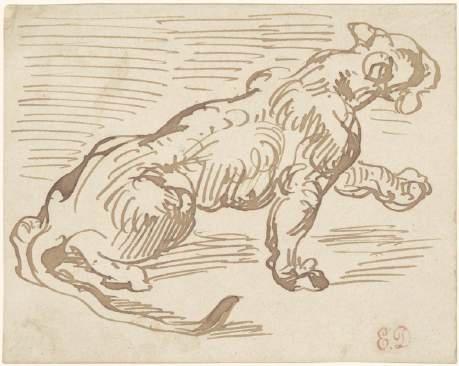
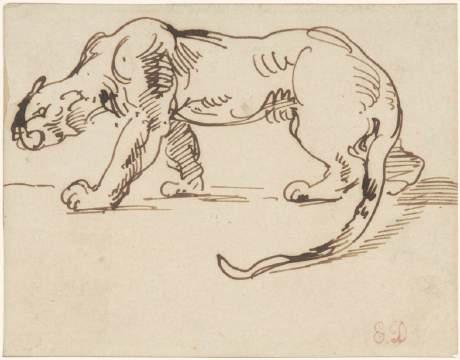
Delacroix's drawings of wild cats often depict animals which he had seen at the Jardin des Plantes in Paris, which then conta ined a zoo populated by numerous lions, tigers, panthers and other 'exotic' animals. As a young artist, he was captivated by the majesty and power of these beasts but, just as importantly, he attached a moral value to their attributes, an aspect of his thinking that is often forgotten but was examined in depth by F.A. Trapp in 1988: 'Delacroix's persistent attraction to this wild-animal genre - to the lion and tiger particularlyintimately relates to his convictions about moral issues. At one level, the felines stand for an amoral nature powerfully opposite to the human rationality he fervently valued. Yet he also recognises in those creatures’ metaphoric embodiments of virtues and vices that in complicated ways he associated with mankind.' 33
33 Delacroix and the Romantic Image: Oriental Themes, Wild Beasts and the Hunt (exhib. cat.), Mead Art Museum, Amherst, 1988, introductory essay by F.A. Trapp, p.31. Cf. also Trapp, Attainment of Delacroix, Baltimore, (1970), pp.203-205, and E.T. Kliman, 'Delacroix's Lions and Tigers: A Link Between Man and Nature', in Art Bulletin, vol. 64, no. 3 (Sept. 1982), pp.446-466
Vesoul, 1824 - 1904, Paris
With an additional lion head (c.1882-1883)
Inscribed by Aimé Nicolas Morot in pencil l.r. dessin de J-L. Gerome / Aimé Morot
Black chalk on paper
16.5 x 25.5 cm | 6.5 x 10 in
PROVENANCE
Aimé Nicolas Morot (1850-1913), the artist's brother-in-law; Private collection
We are grateful to Dr Emily Weeks for confirming the attribution of this work on the basis of digital images and for preparing the following catalogue note. This drawing will be included in Dr Weeks' forthcoming revised catalogue raisonné of the artist's works.
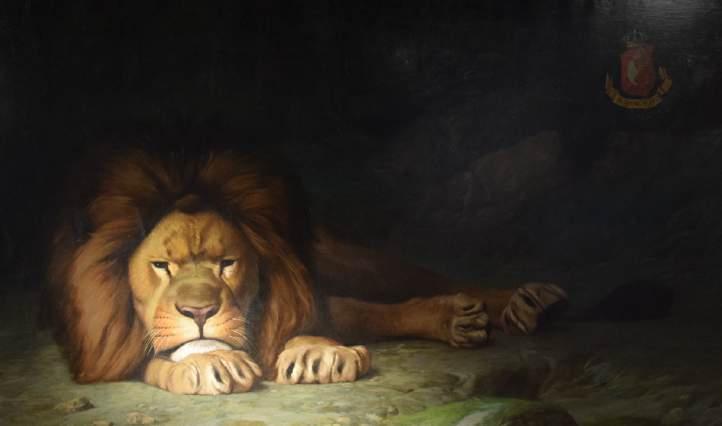
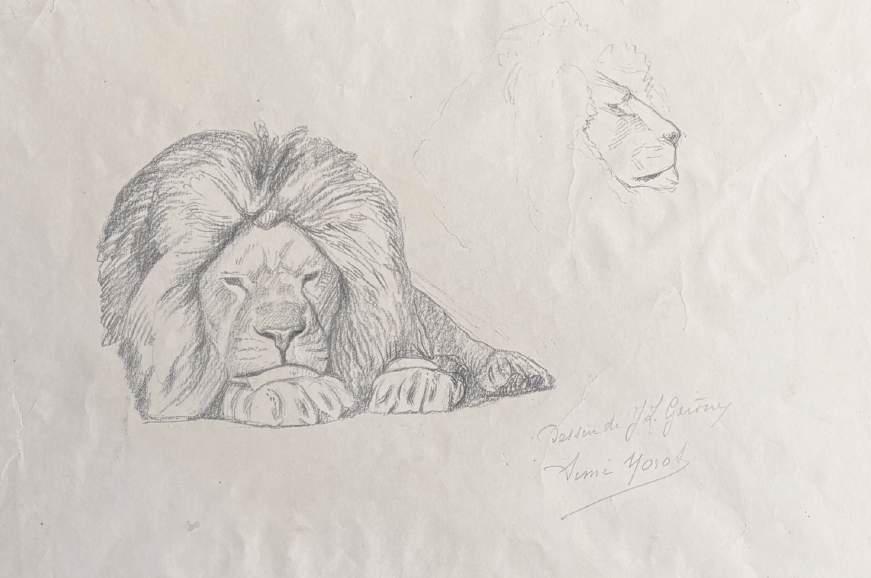
In the 1880s, at the height of his long and celebrated career, the French artist Jean-Léon Gérôme (1824-1904) began a series of animal pictures featuring lions, tigers, and other big game cats.34 The impressive number of these works produced over the course of the next two decades establishes them as an important subgenre within his oeuvre, with both art historical and personal significance. The lion may in fact be a surrogate for the artist, whose very name contains both the word “Léon” (Latin, “lion”) and a reference to St. Jerome (“Gérôme”), who was often associated with this animal.35 Contemporaries were quick to note the physical similarities between man and beast, as well: “A superb head with mane tossed back,” wrote M. de Belina of Gérôme in a Parisian art journal, “a lion who paints other lions and one scarcely knows which has the prouder glance, the painter or his model!”36 In 1883, Gérôme confirmed these allusions and speculations, making the autobiographical connection clear: In an oil painting later given to his hometown of Vesoul, Gérôme inscribed the words “NOMINOR LEO” (“My name is lion”) on a heraldic banner near a male lion stretched out along a rocky ledge. The chalk sketch presented hererecently authenticated and to be included in the forthcoming revised catalogue raisonné - is the only recorded preparatory work for Gérôme’s striking, self-reflexive painting.
Preparatory drawings for several of Gérôme’s most important paintings have recently come to light, offering new information about his process and technique.37 Varied in degrees of finish and their correspondence to the final composition, they nevertheless consistently display Gérôme’s restless search for perfection. In the present sketch, the artist’s characteristic interplay between firm and delicate lines is evident as he changes the pressure with which the chalk touches the surface of the paper and explores - through line rather than blurring or smudging - relationships of light and shadow. In the upper right, a second, less finished sketch depicts the lion’s head in profile, again through a few spare lines and Gérôme’s distinctive hatching technique. Also visible on the large sheet of paper is an inscription related to the provenance of the work: It was approved by and included in the collection of the artist's son-in-law and executor of his studio estate, the artist Aimé Morot (1850-1913).
Inspiration for Gérôme’s animal pictures may have come from his friendship with Emmanuel Fremiet (1824-1910) and Antoine-Louise Barye (1796-1875), two of the leading animaliers of the day. Indeed, the small-scale bronzes that these men produced led Gérôme to create a variety of sculptures himself, intended both as independent artworks and as working “sketches” for his later paintings.38 By February 1890, Gérôme’s confidence in his abilities as a nascent animalier had clearly grown: He was now proposing life-size lion sculptures, “to bring some pleasure into my life and amuse myself a little. It will cost me a great deal, but one can’t pay too dearly for such pleasures!”39
34 Gérôme’s first lion painting dates from 1848, when he submitted an allegorical image of the French Republic featuring a resting lion to the annual Paris Salon. (Called Le Republique, this work is now at Mairie des Lilas.) His Christian Martyrs’ Last Prayers (186383, Walters Art Museum, Baltimore), however, was the painting that established lions as a major and consistent focus within his compositions. Gérôme’s exploration of the lion as the sole subject of his paintings began in the 1880s, the same period in which this work was likely made.
35 See, for example, Albert Boime “Jean-Léon Gérôme, Henri Rousseau's Sleeping Gypsy and the Academic Legacy,” The Art Quarterly, 34.1 (Spring 1971), pp. 11, 25, n. 68. St. Jerome’s attribute was the lion, having once saved one from injury and pain. In recognition of this association, in 1877 Gérôme had painted a picture (now lost) of St Jerome asleep in a cave, with his head against the body of a dozing lion.
36 Quoted in Fanny Field Hering, The Life and Works of Jean-Léon Gérôme, New York, 1892, p. 37. Cartoonists too made good use of Gérôme’s well-known preoccupation with big cats, circulating humorous speculations as to “how M. Gérôme paints his lions,” (see, for example, Anonymous, “Comment M. Gérôme brosse ses lions [How M. Gérôme paints his lions],” La Revue Illustrée, vol. 15, 1893, p. 353).
37 See, for example, two drawings sold at Drouot, Paris, on 7 November 2025 (lot 75); these are related to Gérôme's The Duel After the Masquerade (1857, oil on canvas, 15 1/2 x 22 1/4 in. [39.1 cm × 56.3 cm], Musée Condé, Chantilly, France). The drawings measure 23 x 16.5 cm and are made with black crayon.
38 To reach a wider audience of collectors, Gérôme’s sculptures were made available at different price points, in different mediums and sizes.
39 Quoted in Hering, 1892, p. 280.
Gérôme’s “pleasures” often derived from his exploration of the quieter, more introspective moments in the lives of these wild beasts.40 In several of his Orientalist works - a genre he would literally define and dominate in the second half of the 19th century - lions are shown drinking from pools in the desert or surveying their domain. In other contexts, they rest in caves or, as here, appear weary or contemplative. Such interests set his works apart from those of his peers, and from most precedents in the field. In the early 1830s, Eugène Delacroix (1798-1863) had accompanied his friend Barye to the Jardine des Plantes in Paris, to sketch the newest addition to their menagerie – a Bengal tiger from India. (Gérôme would follow in their footsteps years later, also visiting the Jardine to sketch their famous cats.)41 These studies served Delacroix well in a series of vigorous oil paintings, watercolors, and small bronze statues created soon after his transformative journey to North Africa, in which lions and tigers are portrayed amid struggle or strife.
Wealthy European collectors found much to enjoy in these exotic and vaguely Orientalist works, including a heightening of emotion, a pleasurable frisson, and a momentary escape from their modern urban lives.42 Artists’ frequent focus on heroic male cats, moreover, would have held for masculine audiences an especially self-congratulatory appeal.
The differences between Gérôme’s preparatory sketch and the painting he donated to Vesoul in 1885, today at the city’s Musée Gérôme, are subtle but revealing. In the painting, the lion’s expression is harder, sterner, and his face is more directly frontal and spot-lit.43 In the painting, too, the animal’s hind legs are extended to the right, suggesting both relaxation and a tautness of outstretched limbs. These adjustments add glosses of sobriety or critical evaluation that are absent in the drawing. The anthropomorphizing of the lion, then, developed as the work evolved. As the artist moved from chalk to oil, so his hand and mind continued to actively create.
Emily M. Weeks, PhD.
40 The nature of Gérôme’s works may be attributed to practicality as well: though there is some evidence of the artist hunting in North Africa and witnessing lions on site, the majority of Gérôme’s encounters with these animals would have taken place in a zoo-like environment, where he would only have been able to view them in isolation and at rest (see L. Lippincott et al., Fierce Friends: Artists and Animals, 1750-1900, exh. cat., Amsterdam, 2005-6, p. 124).
41 Gérôme would also frequent various traveling circuses in Paris, studying the animals and famously adopting one aged lion as a pet.
42 The Goupil and Knoedler stock books, now housed at the Getty Research Institute in Los Angeles, confirm that many of Gérôme’s lion pictures were purchased by American collectors, as well.
43 The lion’s look of slightly condescending or disdainful resignation may suggest the artist’s recognition that his pictures were destined for elaborate theorizing and critical investigation, even when his motives might be purely formal or mundane. Indeed, by the end of the 1880s, Gérôme was apparently exasperated by others’ attempts to find profundity and meaning in the finished version of one noted lion painting: “‘What is that?’ said Monsieur Critic, viewing [Les deux majestés] with the air of a connoisseur. ‘That – you see what it is,’ I [Gérôme] replied; ‘a lion in the desert, looking at the setting sun.’ ‘Yes, monsieur - yes, I see. But – but, what does that prove?’ ‘It proves that you are an idiot!’ I answered,” (quoted in Fanny Field Hering, The Century 37.4 [February 1889], p. 495).
Vienna, 1804 - 1871, Pöcking
Pen & ink on laid paper, faintly squared in pencil
With a head study in pencil verso
Bears collection stamp verso l.l. (SCHACK, not in Lugt)
27.8 x 22.2 cm | 10.9 x 8.7 in
Schack Collection, Hamburg
Private collection, Hamburg
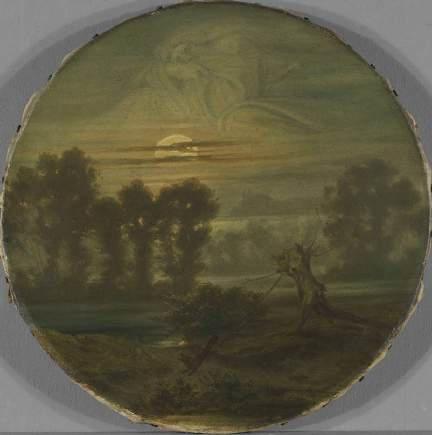
Fig. I - Moritz von Schwind, Die vier Tageszeiten: Der Abend, Oil on canvas, Shack Collection, Bavarian State Paintings Collection, inv. no. 11557
Born in Vienna, Moritz von Schwind studied at the Academy there under Ludwig Schnorr van Carosfeld and Peter von Cornelius. After this, Von Schwind worked and travelled extensively throughout Germany, eventually settling in Munich. In 1846, he was elected a member of the Dresden Academy, later becoming a member of both the Vienna and Berlin Academies, a testament to his reputation and the high esteem in which his colleagues held him.
Von Schwind did more than most artists to develop the German ideas of Romanticism in the 19th century. His works are characterised by their powerful sense of ’Sehnsucht’ - a wistful yearning for bygone times - which was so prevalent in German art of that time. His inspiration came from historical and legendary subjects, often evoking the ideals of chivalry and leaning on a romanticised notion of Medieval times. Many of von Schwind’s best-known works were large illustrations of fairytales derived from this lore, including three magnificent cycles executed in the 1850s and 1860s.
The present work is a study for Von Schwind's third painting in his series of Die Vier Tageszeiten (the 'Four Times of the Day'), a group of paintings now in the Bavarian State Paintings Collection. The series were executed in c.1860 and were acquired by the collector Adolf Friedrich von Schack - who also owned our drawing - in 1865, before they joined the State collections.
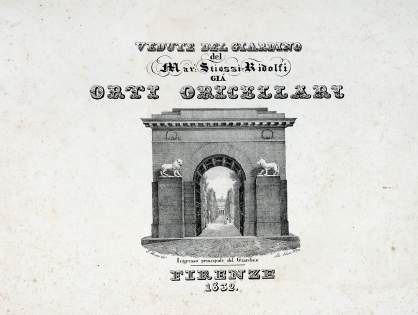
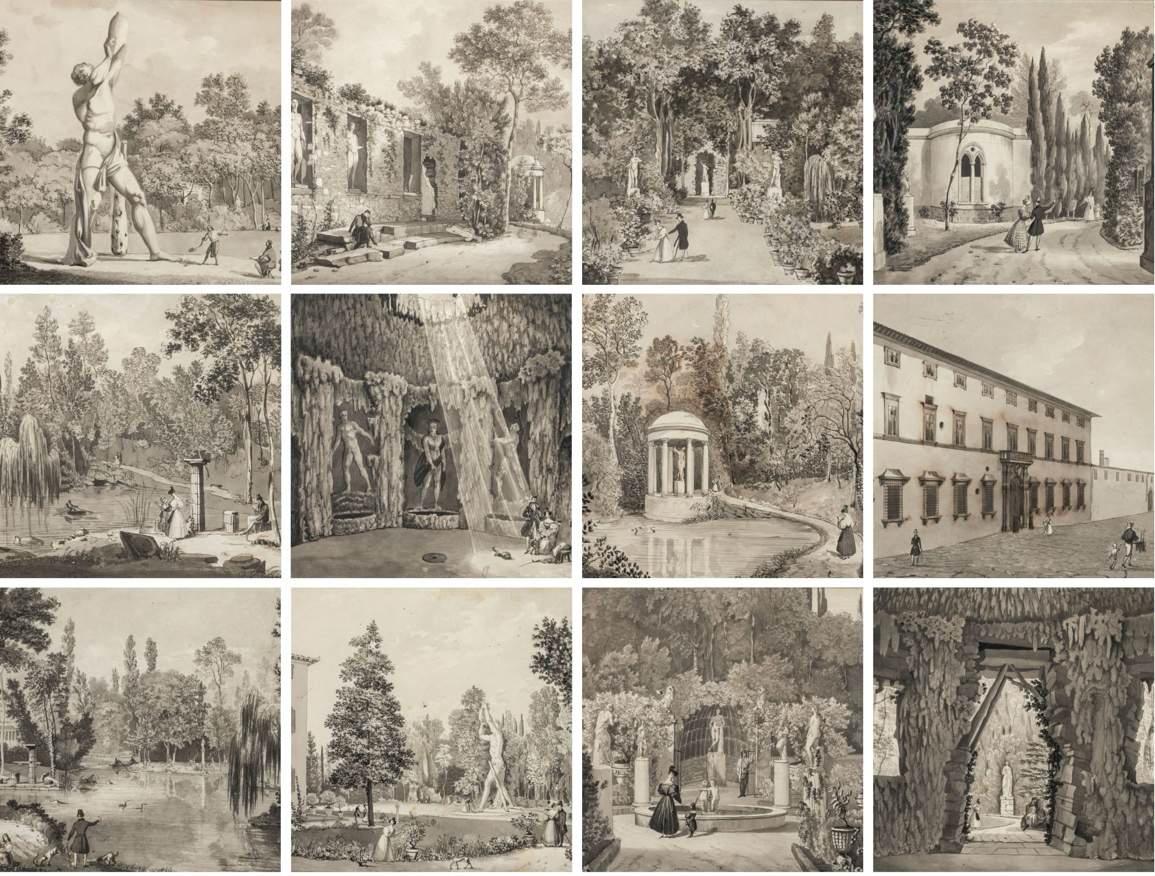
Florence, 1811 - 1877
TWELVE STUDIES FOR 'VEDUTE DEL GIARDINO DEL MAR.
STROZZI-RIDOLFI GIÀ ORTI
ORICELLARI FLORENCE' (1832)
Pen & ink with grey washes
Each 21 x 25 cm | 8.5 x 9.8 in
PROVENANCE
Private collection, France
Published in 1832, the ‘Vedute’ depicted the Oricellari Gardens in Florence, formerly a monastery and known today as the Rucellai gardens (after the Florentine dynasty to whom they belong today). The series shows the fantastical transformation of the centuries-old site in 1808 by the architect-designer Luigi de Cambray Digny (1820-1906), who had been commissioned to create an elaborate 'English' style garden by the Florentine patrician Giuseppe Stiozzi-Ridolfi. Characterised by a central axis culminating at the temple of Flora, with winding footpaths, hillocks, ponds, statues, and artificial ruins, the new arrangement adhered to a precise programme that, in its symbolism - replete with classical inscriptions - turned a walk around the gardens into a morally-edifying ‘exempla virtutis’. The most striking element of the whole scheme was the 17th century sculptor Antonio Novelli's colossal statue of Polyphemus, which remains standing in the gardens today.
LITERATURE
Lithographed by Teofile Salucci for the above publication (Florence, 1832) [see above for frontispiece]
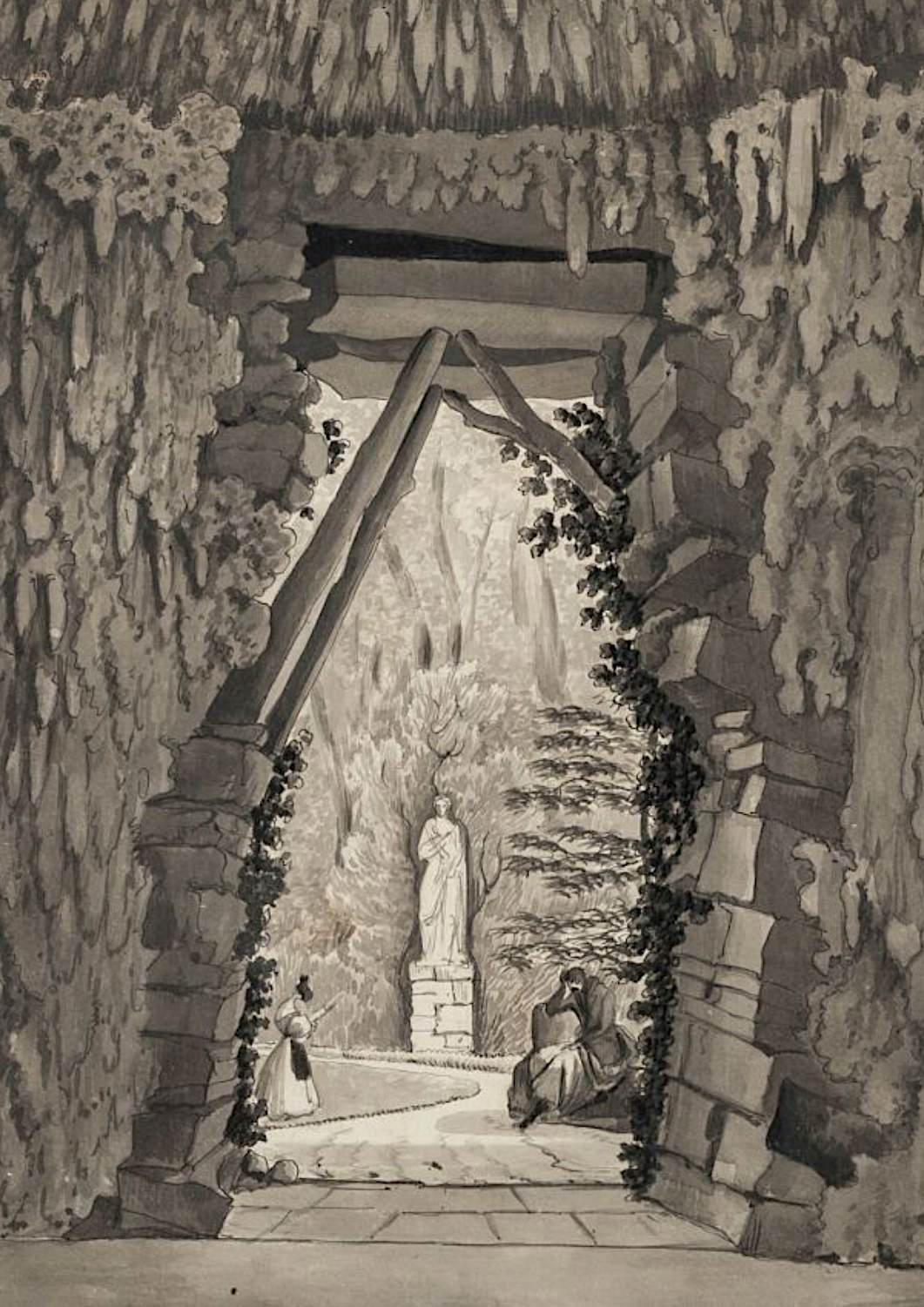
The twenty plates for the publication were lithographs by Teofilo Salucci, and it is possible that Burci's original drawings were given to Strozzi-Ridolfi as a gift, with the twelve present works the only surviving examples of these known thus far. Among the various subjects in the series are the aforementioned Colossus by Novelli, the cave of Polyphemus, a Pantheon, the various small temples and the decorative flower garden. Both the drawings and prints are valuable historical records, as the garden underwent a second redesign in 1861 by its next owner, the Princess Olga Orloff, this time under the auspices of Giuseppe Poggi. The print-series was produced in a relatively limited edition, with just a handful appearing at auction in the past two decades, and very few to be found in public institutions. Emilio Burci produced further topographical drawings of Florence and Pisa which were reproduced in print, as well as a guide to the Uffizi Galleries. He worked almost exclusively in pen & ink with grey wash, though two large-scale oil paintings by Burci of The Arno & Piazza della Signoria appeared at Christie's, New York, in 2014.
Paris, 1815 - 1892, Marly-le-Roi
Signed & inscribed l.r. A. GUILLAUMOT / MARLY
Watercolour heightened with white 33.5 x 21 cm | 13.2 x 8.3 in
Auguste-Alexandre Guillaumot, Château de Marly-le-Roi construit en 1676, détruit en 1798, dessiné et gravé d'après les documents puisés à la bibliothèque impériale et aux archives, Paris (1865);
B. Bentz, 'Auguste Guillaumot et la redécouverte du château de Marly', in Bulletin du Centre de recherche du château de Versailles, 2015;
H. Queval, 'Reconstituer Marly: La genèse de la monographie d'Auguste-Alexandre Guillaumot (1815-1892)', Bulletin du Centre de recherche du château de Versailles, 2018
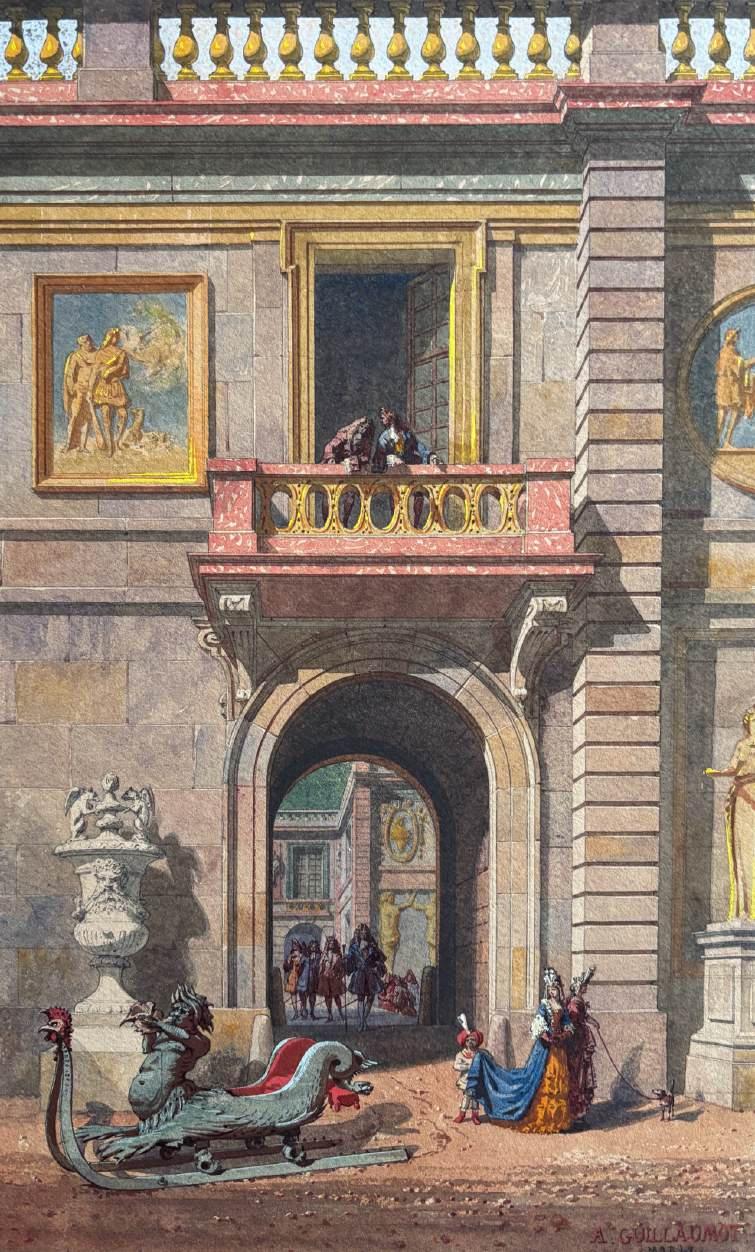
The Château de Marly was a former royal palace of Louis XIV, developed to the West of the much grander Palais de Versailles. It functioned as a less formal and more intimate alternative to the Palace, with courtiers clamouring for a prized invitation to stay in one of its twelve ornate pavilions. Despite its beauty, by the early 19th century, the Château lay in ruins, deserted and overgrown, a forgotten remnant of a bygone age already.
The author of our painting, Auguste Guillaumot, is largely responsible for the Château’s rediscovery and for bringing its former architectural wonders back to life in illustrations. Guillaumot was an architectural draughtsman and engraver, who came from a family of artists and had studied under Augustin-François Lemaître.
He enjoyed a long and successful academic career, showing regularly at the Salon des Artistes and winning various prizes. His chief legacy and his abiding passion for much of his career lay not in Paris but at Marly, and he moved to the nearby village that had been built to support the Château to support his endeavours.
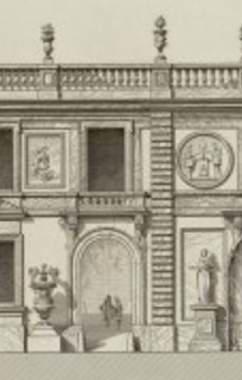
In 1857, Guillaumot published a monograph on the Château and its history, which was accompanied by a view he exhibited that year of the grand watering pool at the Cháteau. The book led to the Commission des monuments historiques reclassifying the site and protecting it, and with this momentum came Guillaumot’s second, larger book on the subject (published in 1865). This featured numerous illustrations, which were then added to in the second edition (1876). A number of the drawings relating to these books are kept in the Musée des Arts Decoratifs, Paris. A print published in 1869 depicts the same building as in our work, the Salle des Gardes (see fig. below right).
Our work is a rare instance of the artist allowing his imagination to run free and insert a colourful array of 18th century courtiers into the scene. A comparable example, slightly less finished than ours and one which remained in the artist’s own collection, was recently sold by Galerie Alexis Bordes, Paris.
Paris, 1821 - 1859
Signed & dated l.r. L. Benouville / Rome Juillet 1851
Pencil with grey wash, heightened with white
20.5 x 17 cm | 8 x 6.7 in
With Colnaghi, New York; Private collection, U.K.
This drawing relates to two other studies of the same subject now in the Musee des Beaux-Arts, Rouen (Inv. 897.6.103 (358) and 897.6.95A (339)). 44
François-Léon Benouville, generally known as Léon Benouville, was one of the most promising history painters of his time, and sadly died young from typhoid fever aged just thirty-eight. Both Léon and his brother Jean-Achille studied in the studio of François-Edouard Picot, in Paris, before they both enrolled at the École des Beaux-Arts at the age of sixteen. Léon began to exhibit at the Salon almost immediately after this, and won the prestigious Prix de Rome for history painting in 1845 (sharing the award with Alexandre Cabanel), as his brother did for historic landscape painting the very same year.
Léon spent just a year in Italy, where he became interested in Early Christian art and the monumentality of the figures depicted. Sadly, very few large-scale works by Léon survive, as one of his most important commissions, a series of works in collaboration with Cabanel for the Hôtel de Ville in Paris, were destroyed in the fire that was started by the Communards in 1871.
44
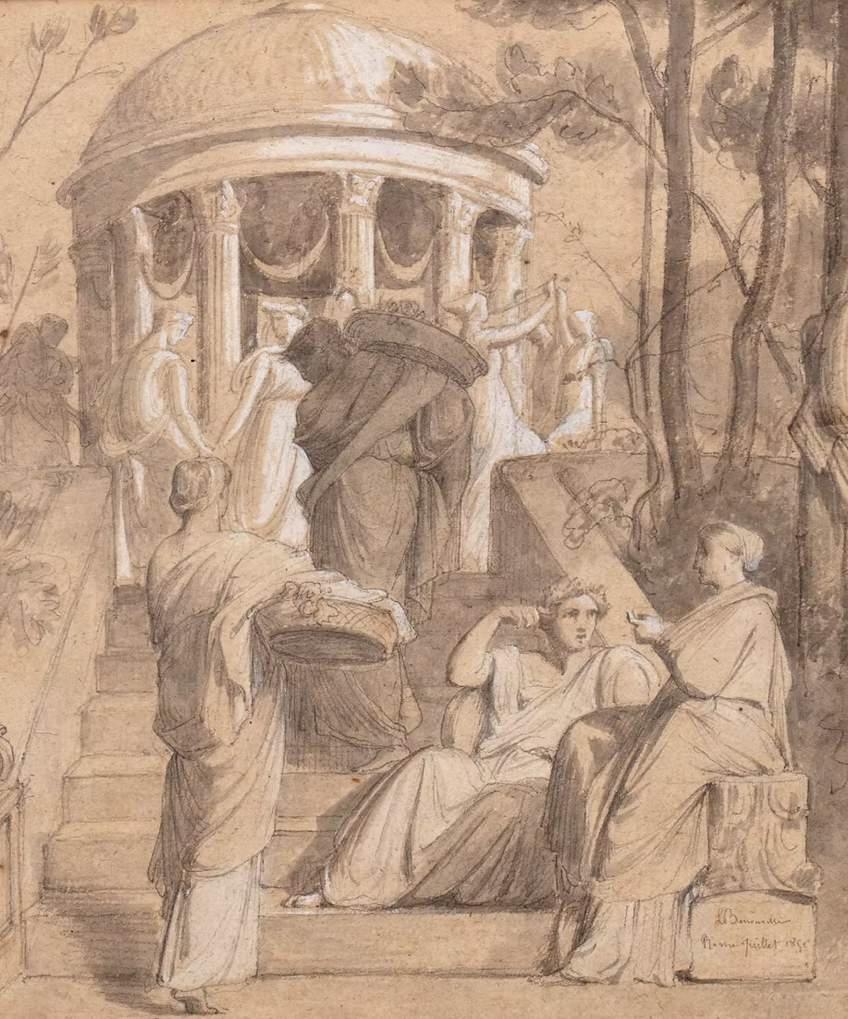
London, 1858 - 1917
THESUS & THE MINOTAUR
Brush & wash with gouache, with faint pencil outlines 27 x 35.5 cm | 10.6 x 14 in
PROVENANCE
With the Grosvenor Gallery, London (by 1879)
Alistair Matthews (1907-1985), London; Private collection, U.K.
&
DISCOVERED BY THE FISHERMAN DICTYS
Brush & wash with gouache, with faint pencil outlines 40.5 x 24 cm
PROVENANCE
With the Grosvenor Gallery, London (by 1879) Private collection, U.K.
(Both) EXHIBITED
London, Grosvenor Gallery, Winter Exhibition 1879-1880
(Both) LITERATURE
T.E. Harrison, Six Greek Myths, London (1879), pls. VI & VIII (respectively)
The present works are from a series of six Greek mythological subjects which Harrison exhibited at the Grosvenor Gallery in 1879. They were published as heliogravures by Harrison & Sons to illustrate a volume retelling six of the greatest classical Hellenic tales, with text from Charles Kingsley's Heroes. The scenes depicted were Hera and Jason; Stheno and Euryale; Dictys, Danae, and Perseus; the Sirens; Theseus and Sinis; and Theseus and the Minotaur. The book, Six Greek Myths, was dedicated to Sir William Blake Richmond, R.A., perhaps a friend of Harrison's through his work with stained-glass design. The book was published in a very small edition, and its subscription list is a testament to Harrison’s reputation among his fellow artists, with names including Lord Leighton, G.F. Watts, Sir Lawrence Alma-Tadema, Edward Burne Jones and Walter Crane.
Harrison was born the son of a builder in St John's Wood, and began his artistic career as more of a decorative artist than a painter; indeed, he does not seem to have undergone a formal education for the latter. He was an early member of the Art Workers' Guild, a group traditionally associated with artisan craftsmen and decorative artists that had been established in 1884 and was strongly influenced by the ideals of William Morris. Today, Harrison's work can be found in various public collections: the University of Texas holds his designs for twelve stained glass windows on the theme of the Seasons in Spenser's ‘The Faerie Queen’, at Betteshanger House (the home of Walter Henry James, Baron Northbourne). Harrison also designed bookplates, including one for the same Lord Northbourne, and he published a book on decorative arts titled Some terms commonly used in ornamental design (London, 1906).
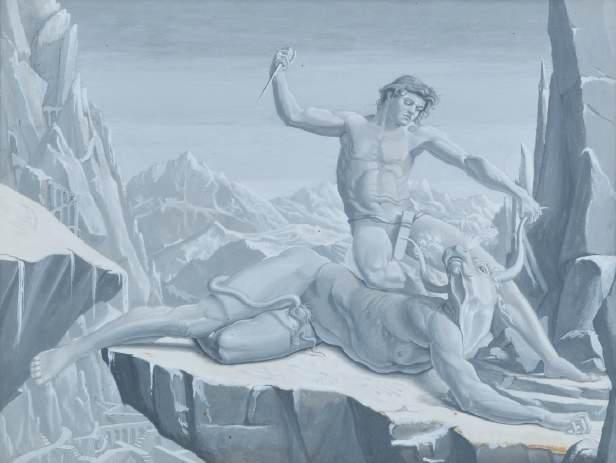
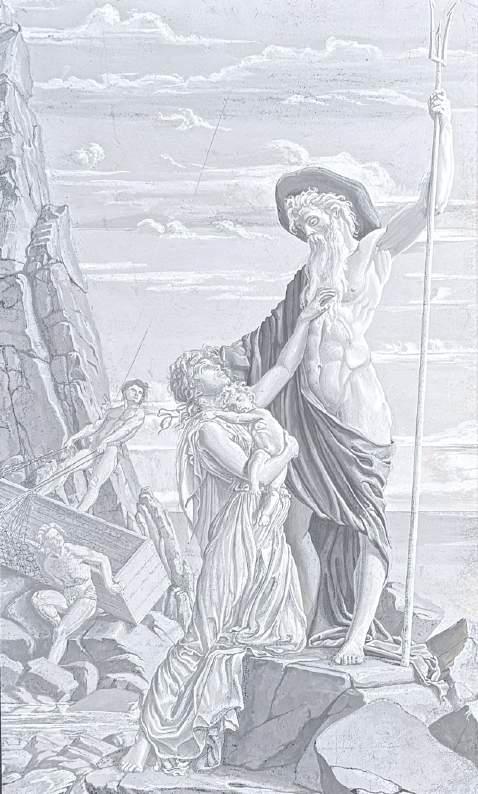
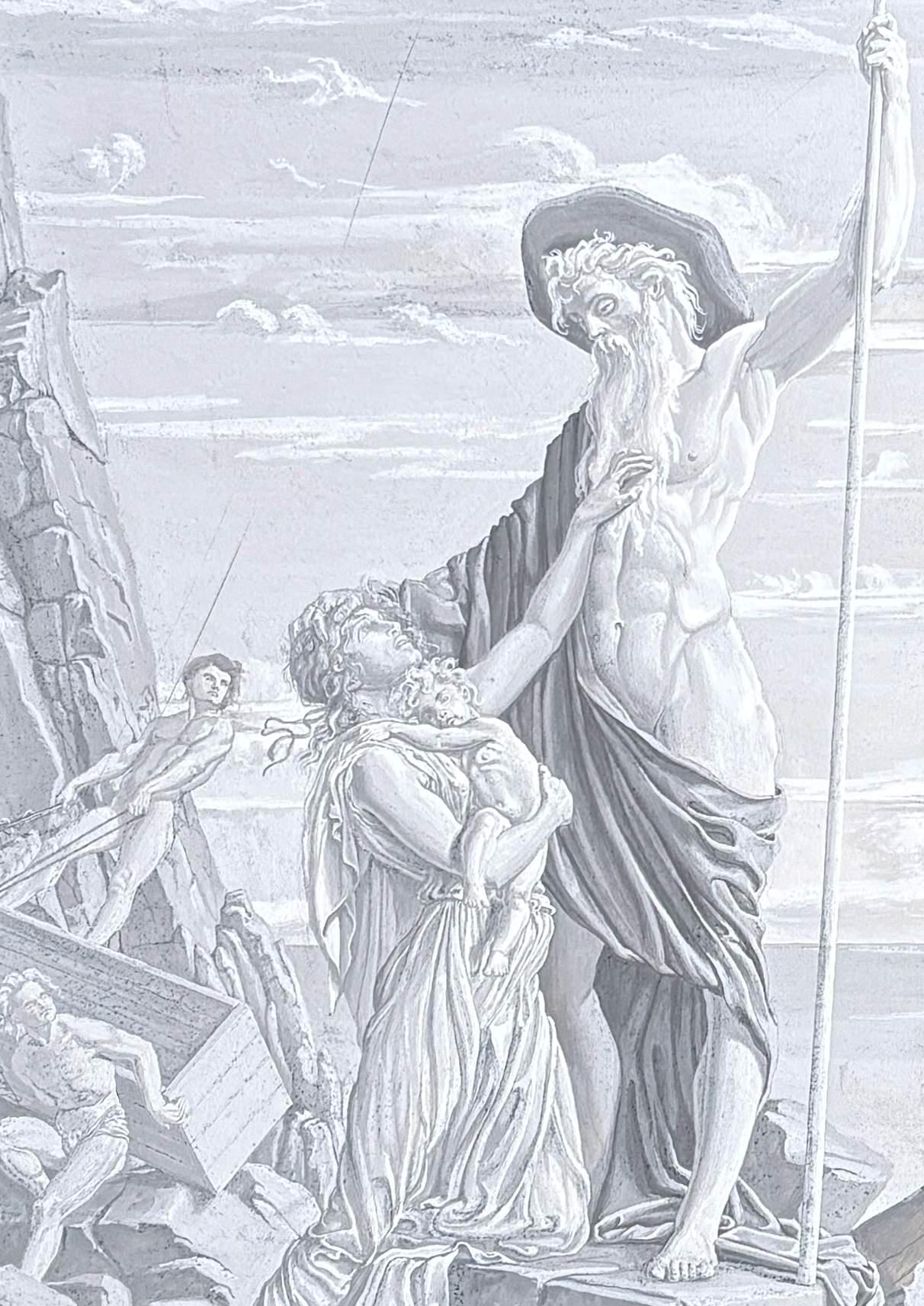
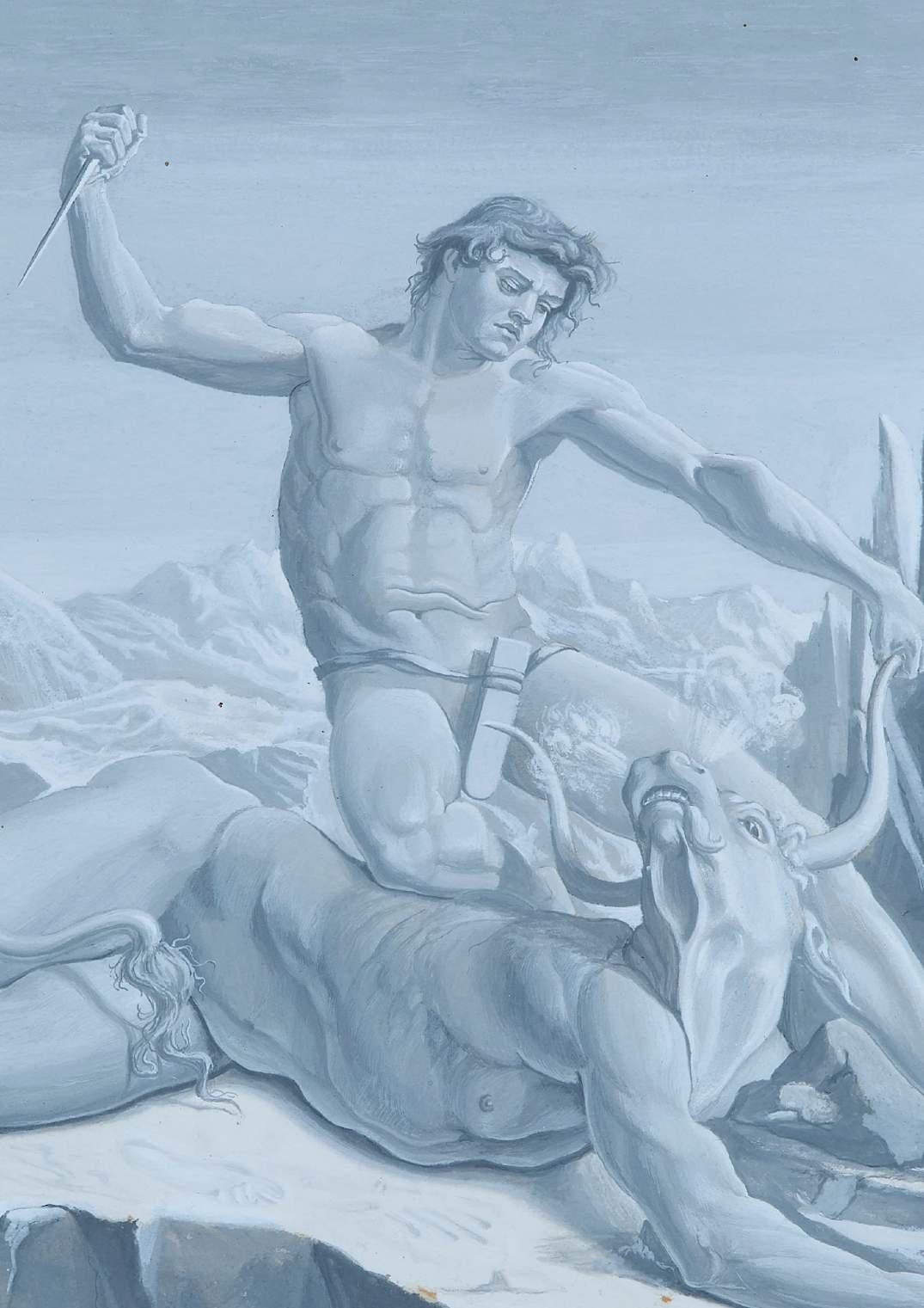
Toulouse, 1870 - 1932
Monogrammed l.m.
Oil on paper
63.5 x 49.5 cm | 25 x 19.5 in
By descent in the artist's family, France; From whom acquired by the previous owner, Private collection, France
Hippolyte Gourse was born in Toulouse, and studied under the artists Jean-Paul Laurens and Benjamin Constant at the École des Beaux-Arts in Paris. He exhibited at the Salon des Artistes Français from 1895 to 1908 and won a bronze medal at the 1900 Universal Exhibition. In 1906, Gourse won a travel grant at the Marseille Colonial Exhibition of that year, and made several trips to Algeria and Tunisia. He also took part in the Salon de la Société Coloniale des Artistes Français in 1924.
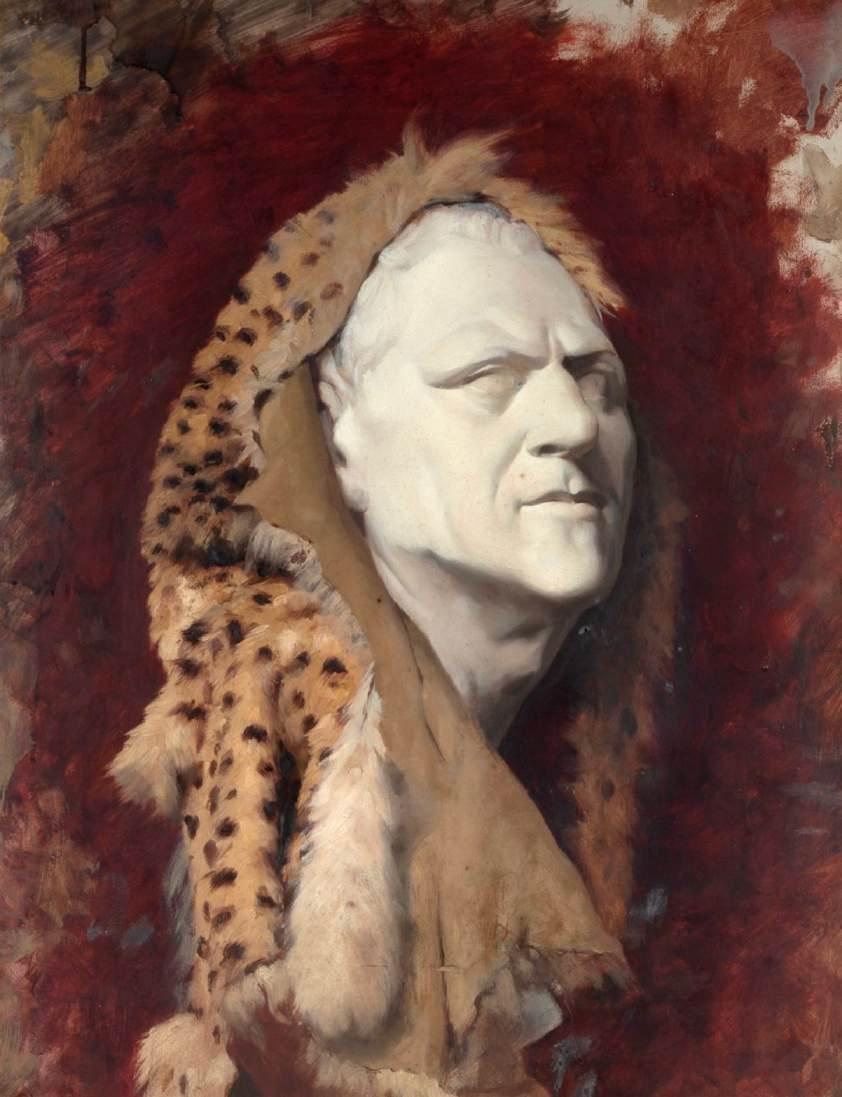
Paris, 1934 - 2019, Malakoff
Signed l.r.
Charcoal with stumping
55 x 43.5 cm | 21.7 x 17.1 in
The Artist's Estate
The present work is something of a synthesis of Dürer’s portraits of men, particularly his Portrait of a Man (Museo del Prado, Madrid, P02180) and the Portrait of Bernhart von Reesen (see fig. I below).
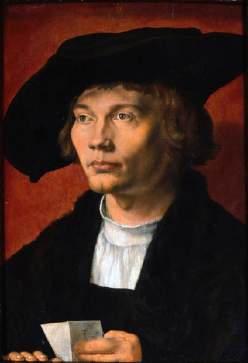
Sam Szafran was one of the most distinctive artistic voices of postwar France, occupying a position outside the aesthetic movements that came and went, instead developing an idiosyncratic but immediately recognisable style all of his own. Although his practice was highly individual, Szafran was nevertheless a well-known figure in the French artistic establishment. He spent time at the start of his career in the Montparnasse cafés, where countercultural icons such as Chet Baker, Jean Arp and Yves Klein soon became his friends, and it was here that he found his first dealer, Jacques Kerchache.
A chance meeting with Alberto Giacometti set Szafran on a lifelong path pursuing figurative work and, particularly, a focus on a single motif. This he would explore in series or cycle of works, with his chosen subjects including cabbages, greenhouses, workshops and the celebrated Escalier series, depictions of the staircase at the building where he kept a studio, 54 Rue de Seine. The 2019 posthumous retrospective of Szafran's works at the Musée de L'Orangerie was titled 'Obsessions d'un Peintre', an indication of the remarkable depths to which the artist explored these subjects.
Szafran's first public showing was at the Salon des Indépendants in Paris in 1957, but it was not until 1965 that he had his first solo exhibition, at Kerchache's gallery. He continued to exhibit throughout his career, earning awards and being decorated by the French state eventually. Retrospectives of Szafran's art have been held at the Fondation Gianadda (on three occasions), the Fondation Maeght, the Musée de la Vie Romantique, the Max Ernst Museum and the Musée de l'Orangerie.
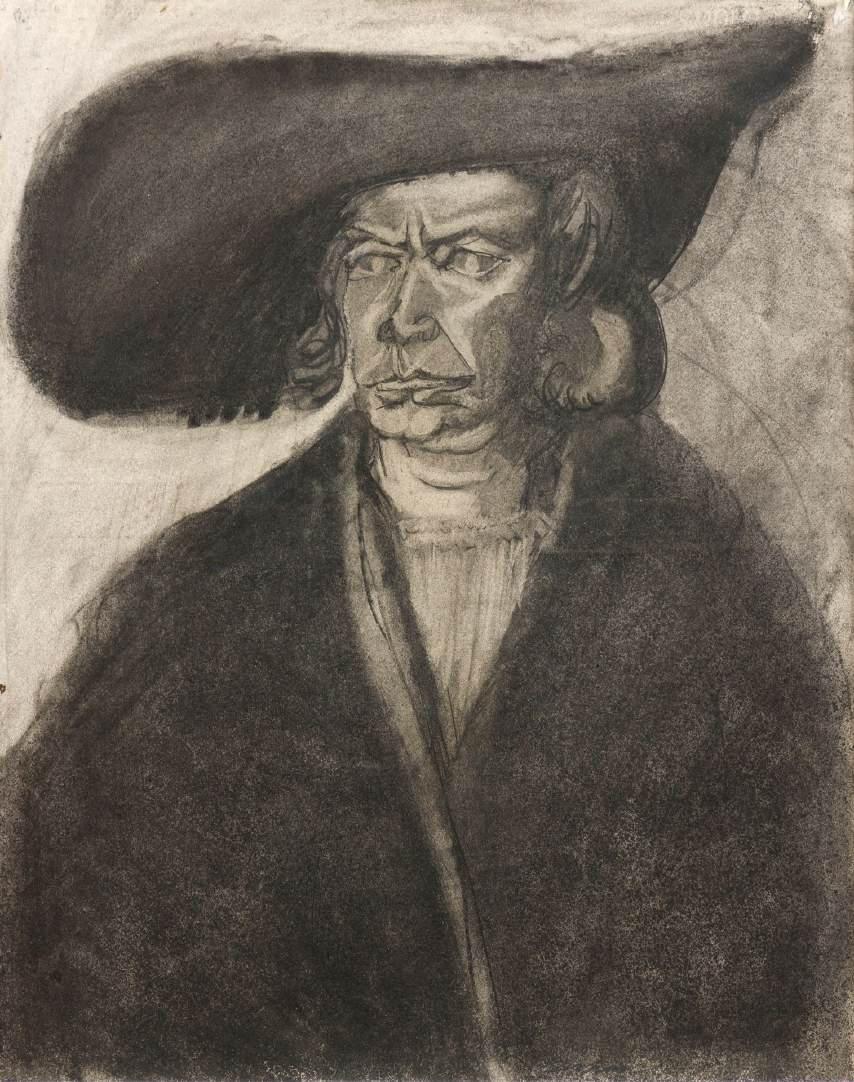
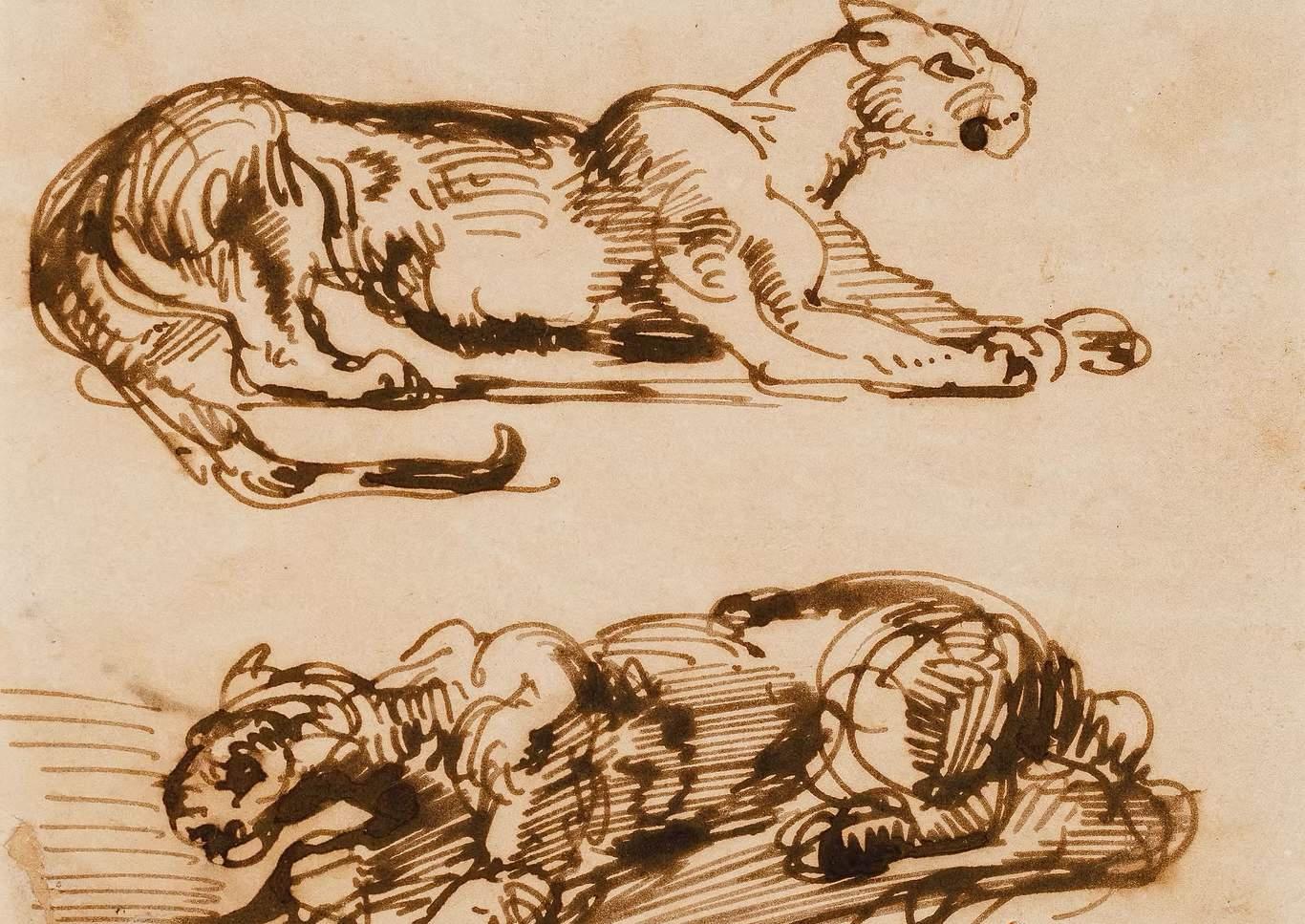
Naples, 1598 - 1680, Rome
Black chalk with pen & ink, heightened with white, on yellow-brown washed laid paper 39.5 x 30 cm | 15.6 x 11.8 in
Professor Eric Stanley, F.B.A. (1923-2018)
By whose estate sold at auction in 2025 (as 'Late 17th / Early 18th Century Italian School')
We are grateful to Prof. Louisa Rice for her generous assistance in cataloguing this artwork, and to Prof. Rice for endorsing the attribution of the work on the basis of digital images. This exciting rediscovery is thought perhaps to be a presentation design for Bernini's commission to redesign the interior of S. Francesca Romana in Rome. The sheet was acquired by the Nonesuch Gallery in 2025, when it was sold without a positive attribution, and has now joined a Private collection in the U.S.A.
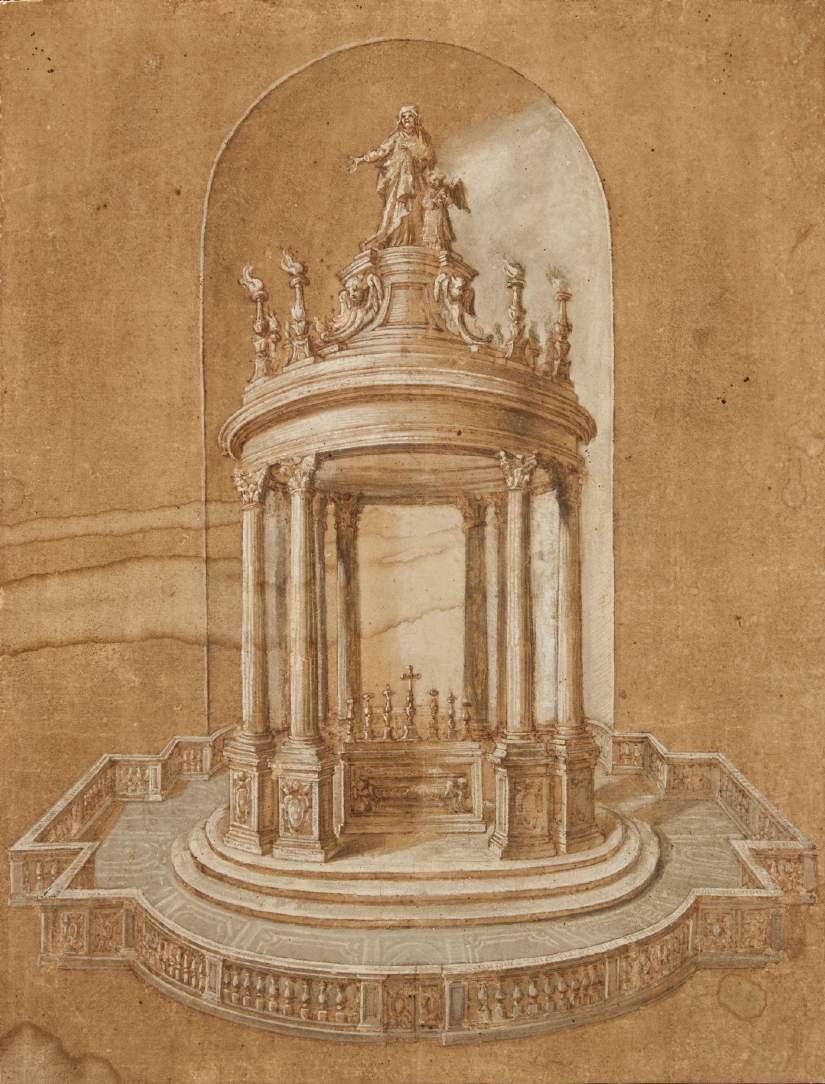
Alexander, William
Benouville , Fran çois - L éon X XIV
Burci , Emilio XIII
C Circignani , Antonio IV
Delacroix , Eug ène XX
De Wedig , Gottfried V
Dup érac , É tienne II
F Fuseli Circle XVII
G
G aremyn , Jan Anton
G ér ôme , Jean - L éon XXI
Gourse , Hippolyte XX
Il Guercino VI
G uillaumot , Auguste XXIV
H
Harrison , T.E. X XVI
Legrand de L érant , Nicolas XV
Leoni , Ottavio III
Luttrell , Edward IX
Master of the Murano G radual I
Robert, Hubert XIII, XIV S
Szafran , Sam X XVIII
Todini , Lorenzo VII
Turner , J.M.W. XVIII V
Von R ohden XIX
Von Schwind X XII
Wijck , Thomas VIII
W orli dge , Thomas X, XI