

I Saw U
Dressed as a Dragonfly on Halloween, Recommending Hot Dogs at Wildrose, and Dancing at the David Byrne Concert
Last Month This Month
Conservatives Zeroed in: It Didn’t Quite Take
Katie Wilson Created a New Blueprint for
PUBLISHER
Tracey Cataldo
MARKETING

Welcome to Paradise: ¡Viva Puerto Rico Libre!
Nov. 6, 2025 - Jan. 10, 2026

Living & Loving Under the Carceral State
Dec. 4, 2025 - Feb. 7, 2026
LONGEST NIGHT a communally-minded Solstice party
Dec. 21, 5-9 p.m.


It’s The Stranger ’s December Issue. We made it to the end of 2025, which by all accounts, was the longest year in recorded history. And what do we have to show for it?
Actually, a lot. After enduring nine intense months of campaigning, we elected a new mayor, two new city council members, and a new city attorney, and as far as we can tell, none of them are secret Republicans. We got our very own women’s hockey team. We saved a major bus lane that was on the chopping block. The Mariners got the closest they’ve ever gotten to the World Series. An orca calf survived long enough to be socially integrated into its pod. The Pastry Project opened a bakery window. Mount Rainier didn’t erupt. And we have 11 shiny Stranger issues in the bag. But amidst all that goodness, we still have some bones to pick. And in these pages, you’ll find The Stranger ’s inaugural Complaints Issue, a non-exhaustive (exhausted, exhausting) list of everything that grinds our gears about Seattle. (pg. 15) This isn’t the transplant bitch-fest you see every two weeks on TikTok. We love this city. And we love it enough to want better for it. We want parks that seem like they actually like people! We want things to be open outside of banking hours! We want grocery stores that aren’t part of the
carceral state! We want more than one public artist! We want drivers that know how to operate a motor vehicle!
But we didn’t want to just leave 2025 with complaints, so we added a couple love letters for you, too. Senior Staff Writer Charles Mudede wrote about how Vangelis’s score for Blade Runner—which will soon be performed by the Seattle Symphony—used synthesizers to create an impossibly expansive city. Stranger contributor Meg van Huygen made you a list of the very best holiday drinks around the city, from taverns to cocktail bars. Michael Wong offers the official Asian Verified Ins and Outs of 2025, and our Books Correspondent, Katie Lee Ellison, finally ranked the best books of the year. But just in case you dare mistake us as unserious, Staff Writer Nathalie Graham dug into a school board race in Tumwater that captures the conservative fervor against trans athletes in Washington. And now that the race for the Mayor’s office is over, we learned what it takes to run a mayoral campaign as a community organizer.
And that wraps our last little gift for you this year. See you in February, with a whole new bag of hijinks.
Merkins
Edging
SECB
Everyone in the Doechii line banding together against the Christian
Hating with nuance and precision
The conjoined Olympia Pizza & Spaghetti House III and Harry’s
The bulldog in Mexico that wears
as a Dragonfly on Halloween, Recommending
ILLUSTRATIONS BY
BRIAN SCAGNELLI

Did you recently share a ~*moment*~ with someone while riding the bus, dancing at the club, or standing in line at the supermarket? Do you want to try to reconnect? Submit your own I Saw U at thestranger.com/ isawu, and maybe we’ll include it in the next roundup! Look for a new batch of I Saw U messages every week on thestranger.com.
Mummy4dragonfly
You, a dragonfly at Conor Byrne on Halloween. I, a mummy with ridiculous liberty spikes. I straightened out your wings. Straighten out my life?
outside Black & Tan Hall on election night
I came out of a pilates class next door, we shared intense eye contact and a brief conversation as I walked by, I wish I would’ve lingered.
D Line Cutie
I saw your name is Jake on your badge. Great style, hair and glasses and you had a chill vibe. I had a blue suitcase and brown leather jacket.
Saturday Night @ Wildrose
You: black button-up, red nails, hot dog rec. Me: gay bar tshirt, space buns. You texted; did I mistype my #? We danced, we kissed, let’s do it again.
Cross the Lane-line?
Was excited by your colors as we swam next to each other at the Ballard pool Monday evening Let’s grab a hot-toddy or some time in a hot tub!
David Byrne concert @ Paramount 11/12
You were getting your lady groove on in the back of Isle 4. I nudged you; you nudged me back as the show closed. Rinse and repeat?
carhartt cutie on the lightrail you waved at me and tapped your mask in
solidarity with mine. i was too shy to compliment you before you got off at westlake… :-(
Man in green jacket with candy during Witches’ Night Out
I was one of the witches at Island Books - you told me there was candy in the back (our priorities align). Want to put a spell on each other?
You liked my yellow Initial D hoodie at the Pixel Grip concert
As we were leaving the venue you complimented by hoodie. Your smile was infectious and your energy was kind. I’d love to take you to another concert.
Cha Cha Lounge 11/14/2025
You blonde in black, we made eye contact shared several smiles, myself long hair also in black. Coffee sometime?
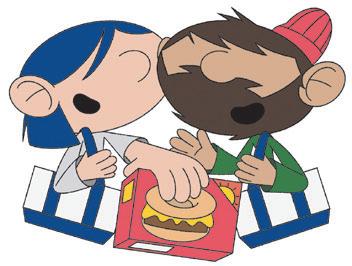
Red Beanie Cutie Swapping Eye Twinkles at Cap Hill TJ’s
We met eyes and grinned cutely in the frozens. You: late 40’s beard/scruff, tan pants, red beanie. Me: short blue hair. Hoping we cross paths again!
Mustached Market Maintenance Man
You: a Pike Place regular w/ a sturdy ‘stache. Me: also a Pike Place regular, sans ‘stache. Come check my mouse traps some time?
-Market Mama
Is it a match? Follow The Stranger on Instagram and leave a comment on our weekly I Saw U posts to connect!




All the Government Shutdowns, Sketchy Surveillance, and New Mayors You May Have Missed in November BY THE STRANGER’S SLOG AM™ SPECIALISTS
Last Month This Month is a recap of all the previous month’s news, featuring headlines from Slog AM. Find it in every issue of The Stranger!
* * *
Katie Wilson is the new mayor. After being edged and edged and edged by King County Elections’ slow, sensuous ballot-counting method, Wilson came out just over 2,000 votes ahead. Our crotches ache, and it’s not a mandate, but at least Bruce Harrell isn’t going to yell at us anymore. That was even harder to come to. If you have a heart, please consider donating to the Bruce Harrell Coping Society. They only have millions of dollars to make the pain go away.
* * *
Much to the disappointment of corporate simps and adult baby milkshake lovers, Wilson stood alongside striking Starbucks workers. Those silly workers want things like benefits and a resolution on more than 700 unfair labor practice claims.
*
* * Trump found out who Katie Wilson was, called her a “beauty,” and then threatened to take away our precious FIFA World Cup because she was a liberal, or a communist. Everyone else called her a socialist.
* * * Wilson is not a socialist, as a number of headlines (and Wilson herself) claims. She is a democratic socialist. Democratic socialists want to counter the failures of capitalism. Socialists wanna abolish the capitalist class altogether. It’s making the rich split the dinner bill instead of eating them for dinner.
* * * City council approved non-socialist Harrell’s last budget. Don’t worry, conservatives, they left plenty of extra money to hire cops and scrub graffiti. And as a treat, it left a maze of fiscal cliffs for Wilson to fall off of.
* * *
We like Wilson, but we’re kind of jealous of New York City for electing Zohran Mamdani . That vision? That charisma? That smokin’ hot wife? Mamdani even rizzed up Donald Trump , who, within hours of meeting him, dressed tastefully for the first time in his life. “You can say it,” Trump said, giving Mamdani a pass to say the f-word (call him a fascist) with a pat on the arm.
* * * Trump said six Democrat military veteran lawmakers (could? should?) be killed for the “seditious” act of telling the troops to disobey unconstitutional orders. That fucking f-word is earning his label every damn day.
* * *
To celebrate Mamdani’s mayoral victory in his own special way, Dick Cheney died Cheney was a classically evil man who presided over the Iraq War and all the terrorism we did to combat terrorism.
* * *
A UPS cargo plane crashed in a fireball on the runway in Louisville, Kentucky, killing 14 people and injuring 23 more. Ideally, planes should not do this
* * *
Let’s not forget the despicable shutdown the numbskull Feds put us through: thousands of flight cancellations. Not paying federal workers. A tug-of-war will-they-won’tthey of food stamps funding between people with souls and Trump and the Trump Supreme Court.
* * *
The US did not attend the UN’s climate talks in Brazil. We were too busy making pain and misery. Trump’s emissions-first policies could cause an additional 1.3 mil lion temperature-related deaths in the 80 years after 2035. But hey, that’s a problem for Emperor Barron Trump II, Mecha Putin, and Martian President Zorp.
* * *
The Seattle Fire Department’s head of human resources alleges she was fired her for trying to address drinking , sexual harassment behavior, and someone slashing a female firefighter’s uniform with a box cutter. She wants $2.5 million from the city.
* * *
proof vest (he could smell the onions, the mustard) is funny, until you think about it. The government went to a lot of effort to convict this guy for a silly crime.
* * *
The Congressional Budget Office was hacked, possibly by a “foreign actor.” Was it Ralph Fiennes?
* * *
The Louvre Heist , during which thieves made off with $102 million in jewels, showed us something amazing about the French approach to IT. According to an employee, the password for the security system for the most famous art museum in the world was



* * *
There’s gonna be a new small local bookstore downtown . It’s called Barnes & Noble. Time for a You’ve Got Mail reboot, but Tom Hanks is the good guy. And Jeff Bezos falls in love with him and they get down crazy style in a Blue Origin spaceship? Yes.
* * *
University of Washington star soccer goalkeeper Mia Hamant died after fighting a rare kidney cancer for seven months. She was 21. Since Mia’s death, the UW soccer team . At press time, they were headed to the NCAA’s elite 8. Our dubs are so up.

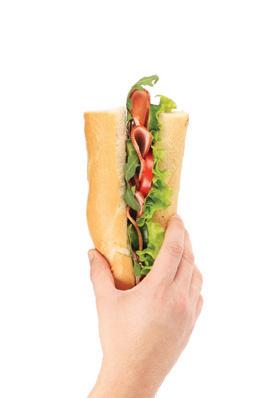
Armed and breadly.
* * *
A jury of his peers found Sean Dunn, the former Justice Department paralegal, not guilty of a misdemeanor for chucking his Subway sandwich at federal agents this summer. The ridiculous case where a federal agent described it exploding on his bullet-
And a French cyclist showed us something amazing about the French body. The 77-year-old man survived a fall down a 130foot ravine. He was stuck for three days, and gained life force by suckling from the red wine he’d been toting in his grocery bags.
* * *
France also showed us where they draw the line. The country ruined the grand opening of Shein’s first physical store in Paris when it suspended online sales over the prepubescent, “childlike” sex dolls on its website. Looking at them ruined our morning.
* * *
Far-right Rep. Clay Higgins (R-Louisiana) isn’t doing his part in the War on Pedos He became the loneliest boy in Congress when he voted against releasing the Epstein files. Literally everyone else in the House and Senate voted to release them.
* * *
A judge dismissed indictments against former FBI Director James Comey and New York Attorney General Letitia James because Trump appointed his prosecutor illegally. They should take themselves to court for being idiots.
* * *
The watchful Feds have released the facial recognition app Mobile Identify so local law enforcement can help them round up immigrants . Jake Laperruque, deputy director of the Center for Democracy & Technology’s Security and Surveillance Project, told 404 Media that handing this helltool to police is “like asking a 16-year-
old who just failed their drivers exams to pick a dozen classmates to hand car keys to.”
* * *
Redmond shut off its AI-powered license plate scanners run by Flock—a private company that can’t be trusted to keep its data from Immigration and Customs Enforcement—after agents arrested seven people in the Eastside suburb.
* * *
Our capacity for imperial violence has gone too far, even for England. The UK stopped sharing intelligence about boats in the Caribbean because they don’t want us to blow them up . According to CNN, the British think our judge, jury, and executioner act is illegal.
* * *
For sale, historic funeral home, regularly used. Three months after an alleged arson turned the historic Columbia Funeral Home and Crematory to ash, the property is for sale. It’s going for a cool $7.5 million. Anyone in need of some ghost roommates?
* * *
After he helped to get the Mariners closer to the World Series than they’ve ever been while the birth of his first child was imminent, first baseman Josh Naylor’s contract ended. Surprising fans, management actually invested in the team. Naylor’s got a five-year contract. He wanted to stick around for the Mariners’ team dog, Tucker. Way to go, dudes.
* * *
King County Exec-Elect Girmay Zahilay reportedly plans to fire about 100 people in appointed positions in his office. Some of them will be invited to reapply—a tradition for the sake of morale. This turnover is normal, but shocking when you haven’t had a new executive in 16 years. At press time, Dow Constantine was playing with the toy trains in his office.


* * *
Two female coyotes have been living near the Washington Park Arboretum. There is no evidence that they’re lesbians , but the state killed one of them for getting too comfortable around people, and that does sound like an Oscar winning lesbo script circa 1997 ■

BY NATHALIE GRAHAM
It’s been a long year for Tumwater , a politically purple town with 24,852 people and three craft breweries that’s become a pawn in a political chess match over transgender rights.
And the whole year, it’s never gotten far from the paint. It began with a high school basketball game. It was February, and the girls’ JV Tumwater High School Thunderbirds basketball team was playing the Shelton High School Highclimbers.
Fifteen-year-old Thunderbird Frances Staudt was warming up when she noticed a girl on the other team was trans. She later told KOMO that she feared the girl would injure her during the game, and complained. But in Washington, trans girls and boys have played with, and against, cis girls and boys for nearly two decades. The trans girl could play, no matter how much Frances complained. She sat out in protest. So did one of her teammates. They still won, 33-16.
Frances said the situation “put her on the spot in the whole gym.” She said she looked over at the trans girl and said, “You are a man.” That was her First Amendment right, she later told KOMO.
The President and Republican Party were behind her. The day before, Trump had signed an executive order banning trans girls and women from playing sports against cis girls and women. Not that there are very many, or that there’s credible scientific evidence proving athletic advantage. But Washington State and the Washington Interscholastic Activities Association (WIAA), the state’s governing body for high school sports, were not on Staudt’s side. The Washington Law Against Discrimination protects transgender people in places of public accommodation, which include school athletic programs, and the WIAA was the first state athletic association in the nation to adopt a trans-inclusive policy.
The WIAA slapped Frances with an ethics violation for calling her opponent a man. This was a catalyst.
First came a civil rights complaint filed on Staudt’s behalf by a right-wing nonprofit called the Foundation Against Intolerance and Racism, or FAIR. Cofounded by Bari Weiss, the “anti-woke” opinion columnist now running CBS news, FAIR’s purpose is to dismantle diversity efforts, like when it sued the Washington State Housing Finance Commission over a homebuyer assistance program for nonwhite people, or when it sued Arkansas for reserving one board seat on a medical board for someone
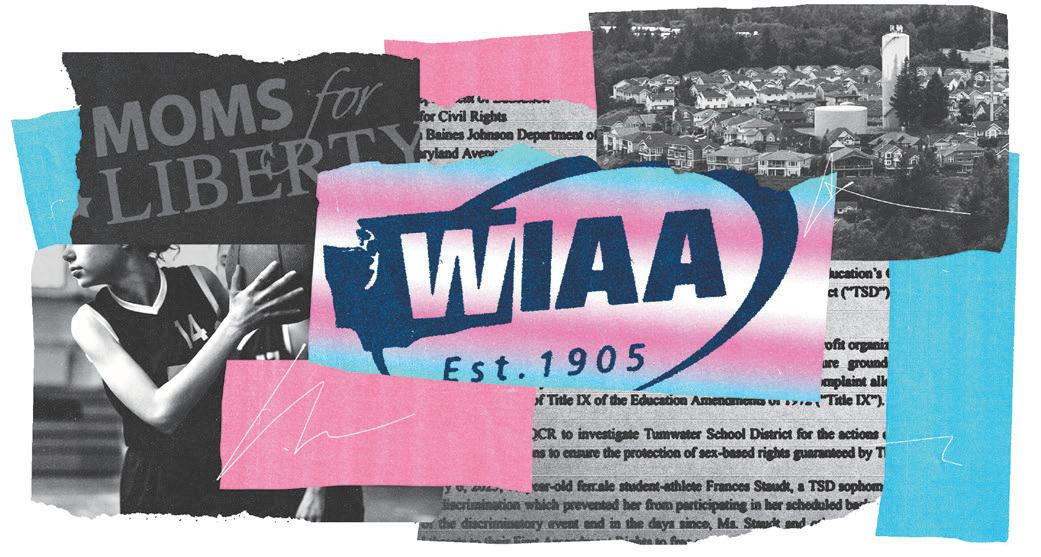
“of a minority race.” The complaint led the Department of Education to investigate the Tumwater School District over alleged Title IX violations. Last April, the Biden Administration expanded Title IX, a 1972 law against sex discrimination in education, to cover anti-gay and antitrans discrimination. The legal rationale is simple: Discrimination against a gay or trans person is a perception that someone is not performing their sex or gender the right way. Trump promised to do away with the change during the campaign, and a federal judge struck it down in early 2025.
Three weeks later, on February 27, the Tumwater School Board held a vote. The WIAA was considering rolling back its trans athlete policy. Back in December, 14 out of 294 Washington school districts had voted to amend these WIAA rules, but
“Tumwater may not be ready for this. You may lose the election.”
not in Tumwater, where the board had not taken up the vote. But then the executive order and the basketball game happened. A resolution to support those amendments passed three to one.
School board member Melissa Beard cast the lone vote against the measure. Nationwide, conservatives have created panic
over trans people to mobilize their base, get elected to public office, and warp curriculum. Republican lawmakers in 28 states have effectively banned trans kids from playing sports, even in places where there had never been issues, or even evidence that trans kids were competing.
Conservatives are attempting to use trans kids as a political wedge here, too.
The Let’s Go Washington’s ballot initiative campaign targets queer and trans kids under the banners of protecting “parents’ rights” and “fairness” in girls’ sports.
Extremist Moms for Liberty candidates have won several school board elections statewide. Beard’s lonely vote was evidence that not all elected officials would speak out against bigoted policy.
Months later, she had a new political challenger. It was Aimee Staudt, Frances’s mother.
Tumwater is situated in one of the only legislative districts in Thurston County with Democratic representatives—Rep. Beth Doglio and Rep. Lisa Parshley—but like its blue neighbors Lacey and Olympia, the conservative politics of nearby rural towns often encroach on the small city.
Those conservative politics prompted the vote to change WIAA’s trans athlete policy. When the vote came, Melissa Beard sat on the dais and reread what she was going to say. “I was like, ‘Yeah, this is it.
Tumwater may not be ready for this. You may lose the election,’” Beard told herself. “And I was okay with that, because I was willing to go down on this issue. It was that
important that people knew where I stood.”
Every seat in the room was taken, a few by people wearing “Protect Trans Kids” shirts. Standing in the back, teens with dyed hair held a trans flag.
Even though the room was packed with people who agreed with her, Beard knew her vote could cost her the election this November.
But she knew she was right.
Beard says that when board members are sworn in, they take an oath to “uphold the constitution and the laws of the United States and the state of Washington.” Trans people are a protected class in Washington. Supporting the measure would go against state antidiscrimination law and violate her oath, she says.
She said exactly that from the dais to the crowded room. “I’m concerned that this resolution communicates that we do not see these students as an equal part of our community,” Beard said. The crowd cheered.
After she said her piece, only one of the four other school board members spoke. Jill Adams, who abstained, worried out loud about Trump’s executive order. “Federal laws have supremacy over state and local items,” Adams said, saying she was caught “between a boulder and a hard surface” with this vote.
A woman in the crowd shouted, “Executive orders are not law!”
“We’re not going to do this,” Beard said. “No.”

She moved on to hear comments from the rest of the board.
Casey Taylor, Ty Kuehl, and Darby Kaikkonen said nothing. Then they voted yes.
“They were all very upset. They were all very frustrated with me,” Beard says. “I don’t know what they thought. I don’t know why they were frustrated.” She paused. “I mean, I lost the vote.”
Beard likes finding common ground. She cut her teeth as an analyst in the Washington State House of Representatives during a deadlock between Republicans and Democrats 25 years ago. She even found compromises during COVID on this board, when other members bristled at the state mask mandates and school closures she supported.
“For whatever reason, they did not want to have that conversation about this particular resolution,” Beard says.
When asked for comment, Kaikkonen sent links to comments she made at a different school board meeting two weeks after the initial vote. Kaikkonen started off by criticising the February 27 meeting for not following the board’s
“This issue is impossible. [It’s] a stalemate, a game of tic-tac-toe in which there’s no winner.”
rules of order—criticism of Beard and how she ran the meeting. Having a crowd present that did not support the policy “created a situation” where Kaikkonen felt she could not “express my point of view… [and] be listened to in an open, fair, and impartial manner.”
“This issue is impossible,” Kaikkonen said about trans kids playing sports. “[It’s] a stalemate, a game of tic-tac-toe in which there’s no winner.” She supports the transgender community, Kaikkonen says, but she also supports women. By way of explanation, Kaikkon told a story.
“I started swimming competitively when I was 8 years old,” she said. She detailed her whole swimming career, at one point holding up her collegiate All-American award for breast stroke.
A week later, Kaikkonen was fired from her job at the Office of the Superintendent of Public Instruction. Superintendent of Public Education and Kaikkonen’s boss at OSPI Chris Reykdal has been vocally supportive of trans kids competing in school sports. In a lawsuit, Kaikkonen alleged her firing was retaliation for her vote. The Office says it filed a motion to dismiss the case because Kaikkonen’s “legal claims all lacked legal merit.” The US District Court in Tacoma dismissed the case in early November.
The other board members did not respond to The Stranger ’s request for comment.
Two months after the vote, the rest of the board asked Beard to resign as board president, and she did. Beard explained she’d planned to rotate the presidency throughout the year, so this was a good
opportunity to do so. But it seems as if she just wanted the issue to go away so she could keep working with her fellow board members.
“I will always put organization over self,” Beard says. “So rather than make them extend any of this pain, they asked me to resign, and I said, ‘Fine, I’ll just resign.’ Can we just get past this?”
Aimee Staudt saw an opportunity. Four days after Beard filed to run for a third term, Staudt filed to run against her. Beard didn’t think it was personal.They lived in the same district. She assumed Staudt would have run anyway.
As an experienced campaigner, Beard normally reaches out to her opponents before the race heats up. But she didn’t do that with Staudt. (“I just didn’t get the sense that she was in it for what’s best for the district,” Beard says.)
Staudt did not respond to our request for an interview.
She also didn’t run much of a campaign. She raised just $1,063. Staudt didn’t spend any money on mailers herself, but was included on a $5,100 mailer campaign from Sarah Overbay, a candidate for the District 1 school board position. Those mailers praised Overbay, Staudt, and other more conservative candidates. On the back, the mailers went negative on their opponents, claiming Beard and the other progressive school board candidates running only cared about “gender politics,” which ironically seemed to be Staudt’s sole issue. That became clear during a candidate forum hosted by the League of Women Voters, the only forum she attended. Staudt—who didn’t even have a campaign website—said she was running to “use common sense and put education first again.” Schools were wasting too much time on political and social agendas and not enough time on teaching students how to read, she said. She called for transparency, to give families a choice and to make sure schools partnered with parents instead of trying to replace them. Her talking points emphasizing a need for parental power and control are textbook for right-wing candidates.
Beard worried about her chances of beating Staudt. She stressed over the possibility of her campaign becoming a national talking point. And for good reason.
In the last month before the November election, anti-trans politics flared up in Tumwater once more.
A sore loser, hedge fund manager Brian Heywood is again funding a signature-gathering campaign for his anti-trans, anti-LGBTQ, and anti-public-education ballot measures.
Heywood’s campaign, Let’s Go Washington (LGW), is gunning for two initiatives on next year’s November ballot.
The first would reinstate the parents’ bill of rights that already passed as an initiative last year. But, much to Heywood & co.’s chagrin, the Legislature mostly nullified it during this year’s session. So, LGW is trying to volley it back.
“We don’t co-parent with the government,” Heywood said in a statement first reported by the Washington State Standard “No government employee can care about or love your child like you do.”
What Heywood really wants is to do away with student privacy and control public education. The Parents Bill of Rights initiative allows parents to “examine” curriculum decisions and school policies, something they already had the right to do, while granting access to their child’s mental health and counseling records. The rule could force teachers and guidance counselors to out LGBTQ kids to their parents, which could be dangerous for those living in unaccepting homes. In an emailed statement, LGW wrote that the initiative would strengthen “communications between parents and school.”
Heywood’s second initiative would ban transgender athletes from playing girls’ sports. The initiative would require athletes to have a doctor certify their sex before they can participate in girls sports. This could require a genital examination.
As Seattle Police Department detective Beth Wareing said at a WA Families for Freedom press conference in November—a campaign to kill Heywood’s iniatives—genital examinations “would increase the risk of sexual abuse for girls participating in sports.”
The LGW campaign seems unbothered by the criticism. Campaign spokesperson Hallie Herzberg called the risk of sexual abuse a lie. “The opposition is proving again how little they care about females in sports,” she said. And the campaign is asking people to literally rally around them inside schools. It’s held five so far, with eight more planned between now and January 2, when LGW plans to turn in its signatures to the Secretary of State’s Office.
In late September, days before she jetted off to Washington, DC, for Trump’s antifa roundtable, right-wing commentator
Brandi Kruse promoted LGW’s signature-gathering event at Tumwater Middle School. Kruse has no official or financial association with LGW, but volunteered to speak at the event, a “Super Signer Kick-Off” for its anti-trans initiatives.
Board member Beard thought holding the event in Tumwater was bizarre and opportunistic. Liza Rankin, Seattle Public Schools board director and member of the Washington State School Directors Association, also thought it intentional and “a little bit weird.”
Holding the rallies at schools can show voters that the initiatives are “about chil -
“These aren’t abstract debates; they’re about real kids who just want to belong.”
dren,” so they can say, “If you love children, you’ll come to this thing,” Rankin explains. But it could also be setting up a confrontation.
The Tumwater rally was planned for October 4, a month ahead of the Beard vs. Staudt race. Kruse spent the days leading up to the event drumming up attention for the rally. When The Stranger asked why, she told us “radical gender ideology belongs
in the dustbin of American politics.”
The week before the planned rally, her tweets turned angry. Tumwater School District had denied the event permit.
“In Washington state, schools will grant facility use permits for grown men in panties to dance for little children. But want to hold an event to support parental rights? Sorry, no can do!” Kruse tweeted, citing a drag event at a school.
Kruse tweeted that the school district “caved to left-wing activists.” Kruse said it was the only LGW event denied a permit.
Schools are sensitive places for politicking. State law doesn’t allow any campaigning involving public resources. Public schools count as a public resource. However, because the LGW initiatives aren’t yet on the ballot, it creates a gray area.
“If they aren’t allowed to do it, they can throw a tantrum,” Rankin says. “What they want is to say they’re being politically persecuted. They want the narrative that ‘We’re just standing up for parents… and it’s the liberal lawmakers who are being mean to us.’”
LGW denies that. “We aren’t looking for a freedom of speech fight,” Herzberg said. The public schools offer a space for people to “turn in their petitions without being harassed, attacked, or stolen from” Herzberg said.
The reasons were more mundane, according to records obtained by The Stranger . LGW’s campaign submitted a permit application three days before the planned event. Tumwater School District requires that applications for permitted events be submitted seven days prior to the event.
“Due to the short timeline, the request wasn’t approved,” a spokesperson with the district said. “It’s our understanding that they met outside of the fencing at Tumwater Middle School on the date they requested use of the building.”
At the event, Staudt’s daughter, Frances, spoke about her experience and about the lack of fairness in girl’s sports. Kruse amplified it online. From the internet attention, the issue seemed big, but only a few dozen people had shown up to the rally.
That could explain the election results in Tumwater.
Beard defeated Staudt with 61 percent of the vote. Beard thinks voters valued her experience, and her record, more than this one issue.
They also valued progressive Julie Watts over Sarah Overbay, the conservative who sent out those negative mailers, in a race for an open seat. On her campaign website, Watts wrote, “Our district is caught in unnecessary political fights—like banning transgender athletes—instead of focusing on what matters. These aren’t abstract debates; they’re about real kids who just want to belong.
“When a school board tells students they don’t deserve inclusion, it’s heartbreaking,” the website read.
But Tumwater is still purple. Incumbent Kuehl, who voted to change WIAA’s policy, and newcomer Rob Warner, who said at a forum that he would not rescind the policy, made it through.
That split feels apt for Tumwater, Beard says. ■





BY HANNAH MURPHY WINTER
PHOTO BY RYDER COLLINS
On November 4, while a blue wave was sweeping key races in New York City, Virginia, and New Jersey, Seattle progressives were biting their nails down to a quick. At 8 p.m., only the first round of ballots had been counted in Seattle, and Katie Wilson, a longtime community organizer and the progressive challenger in the mayoral race, was behind by seven points.
But it wasn’t over that night. That first ballot count was less than a quarter of the vote. Progressives vote late, and the lines at the ballot box at 7:50 p.m. on election night were longer than one election worker had ever seen.
As the week wore on, and progressives’ fingernails disappeared, Wilson’s share of the vote crept up, slowly but steadily. Eight days later, on November 12, the city declared that Katie Wilson would be the next mayor of Seattle.
When she won, comparisons to New York City’s mayor-elect, Zohran Mamdani, were everywhere—and understandably so. They had both seemed to come out of nowhere, with strong on-the-ground campaigns that energized voters months before their elections. They were also both progressives challenging institutional politicians. Mamdani was up against the former governor of New York, who was asking the public to trust him after a very public sexual harassment scandal that forced him to resign. Wilson was up against Bruce Harrell, who’d been in Seattle City Hall for 16 years, first on the city council, then as mayor for the last four years. He, too, had weathered his fair share of scandals: His executive office had a reputation for sexism and sexual harassment, leading to several high-profile resignations; in the middle of his term, it surfaced that early in his career, he’d pulled a gun on a pregnant woman in a dispute over a parking spot. Both men were proud moderate Democrats who had carried on the storied tradition of answering to their big-dollar donors.
For many, Mamdani and Wilson represent a new possibility for the Democratic Party. One that’s less entrenched in the institutions of politics, and more interested in the well-being of working people in their cities. But to win, the two ran remarkably different campaigns. Mamdani is an extraordinary politician. He’s charismatic, charming. He can work a room and rock a podium like nobody’s business.
That’s not Katie Wilson. She didn’t run her campaign as an emerging political star. She ran it as an organizer. And as a result, she offered the left a whole differ-
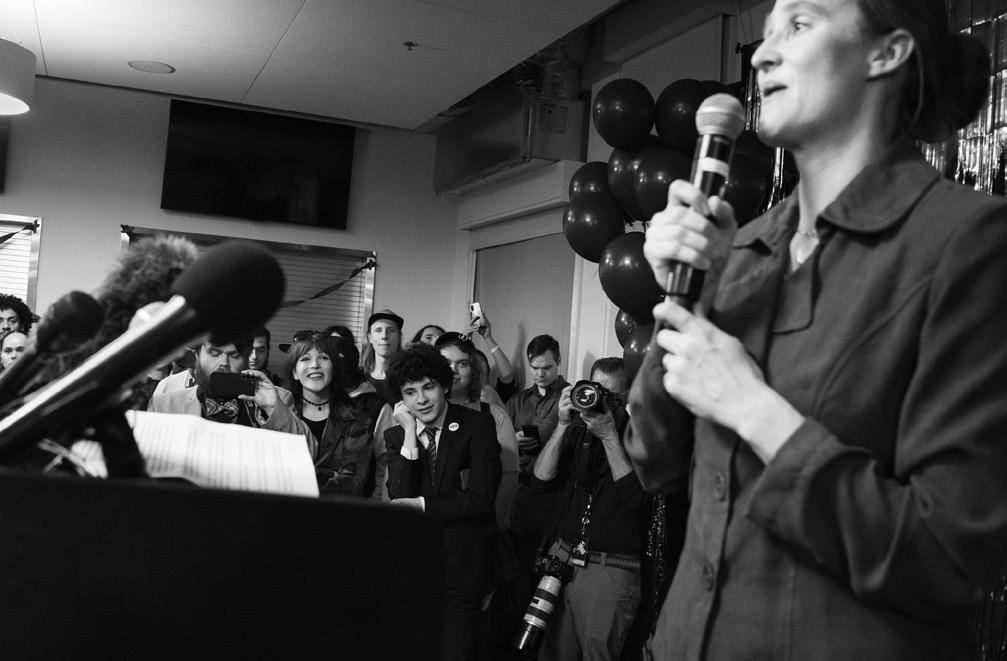
ent model for how progressives can win power for working people.
To understand Wilson’s win, you need to start with three truths: First, Seattle hasn’t reelected a mayor to a second term in almost 20 years. Second, every political institution believed that the incumbent, Mayor Bruce Harrell, was going to break that streak. And third, as of this past spring, almost no one in Seattle knew who Katie Wilson was.
In the lead-up to the primary, the Harrell campaign was riding on those last two truths. Most observers say he ran a “flat campaign.” The message was, more or less, “you want more of this, right?” And many of the major institutions bought it, including the influential labor council MLK Labor, US Representative Pramila Jayapal, Washington State Governor Bob Ferguson, and Attorney General Nick Brown.
That seemed like a reasonable strategy at the top of the campaign. Early polling showed a huge swath of undecided voters, and while press coverage pointed to Wilson’s work as an organizer—helping to raise the minimum wage across the region, save bus lines, increase access to free public transit, fund social housing projects— she was never the face of these wins. She worked in the background to get it done.
Wilson’s record was rooted in a tiny, grassroots organization that she cofounded back in 2011 called the Transit Riders Union. It started with a campaign to save King County Metro bus lines that were facing the chopping block in a recession-era austerity budget. Wilson, who had spent her young adult years researching and studying how to organize working-class power, saw public transit as a vital public good for working families.
Originally called “Save Our Metro,” the campaign had a slow start. Only 30 people showed up for the first meeting (Wilson calls the whole experience a massive learning curve). But then they kept showing up. And as the campaign built momentum, through people power alone, they were able to save those Metro lines.
The Transit Riders Union gradually expanded their scope. They started with improving access to transit by reducing fares for low-income families and making it free for kids under 18. Then they took on renter protections. Then they raised the minimum wage in cities throughout King County. The tiny nonprofit clocked substantial, impactful wins in every campaign, with barely any budget to speak of. Each campaign was driven by passionate volunteers, hitting the pavement and knocking on doors, and Wilson’s knack for coalition
building—pulling in the right coconspirators at the right times.
Jake Simpson, who would eventually become her campaign’s political consultant, first met Wilson in exactly one of those situations. It was 2022, and it was his first year on the SeaTac City Council. She and another member of the Transit Riders Union approached him with a fully written renters’ protection ordinance, requiring that landlords give 120 days notice for major rent increases. It was “ready to go,” he says. She asked him to champion it on the council. He enthusiastically agreed.
“Her approach was amazing,” he says. “I think she knew that a lot of politicians don’t know what the hell they’re doing when it comes to policy work at all,” he says, so rather than advocating for ideas and asking him to translate them into policy, she did the policy work, and then asked him to get it over the finish line. That bill is now law.
So in April, if you knew who Wilson was, it was likely because you had worked alongside her, either as a politician like Simpson had, or as an organization helping to push these policies through. But to those in the know, she was a fighter, a person running a tiny organization that consistently punched above its weight, and someone whose work was always directed at improving the quality of life of working people.
“Every single community organization and every single nonprofit knew Katie Wilson,” says Anthony D’Amico, the recording secretary for the Transit Riders Union. “And I think that’s why she went from an unknown to a known so quickly.”
Those punchy nonprofits came out in force when she announced her campaign in the spring. Tech 4 Housing and House Our Neighbors, two grassroots campaigns that advocate for affordable housing, provided a backbone of early volunteers to help the campaign hit the ground running.
When I asked people who’d worked with her why they showed up so enthusiastically when she announced, it consistently came down to one thing: trust.
A politician like Mamdani draws people in with charisma, says Suresh Chanmugam, a member of the steering committee for Tech 4 Housing and volunteer for her campaign. But Wilson, who was never the face of her work, had no experience selling herself. Instead, her campaign was built on trust that she’d been cultivating for years. “She has a 14-year track record of selflessly working to help make life better for our most marginalized neighbors,” he says.
I asked Wilson if that rang true—if she relied on trust in her record to rally people behind a common goal. It reminded her of the days after the primary, when it was suddenly clear to power brokers in the city that she could soon be the mayor. She’s never had “positional authority” like that, Wilson tells me. The Transit Riders Union always ran on a shoestring budget and at most had two paid staff, including Wilson. So instead of having a staff working for her to achieve her goals, she asked people to work with her.
“The way that I’ve been able to do big things is by getting to a place where people want to work with me, because they’ve had a good experience doing that, because they see that that’s the way that we accomplish big things,” she says. “The authority that I’ve built up over the years is based on goodwill and trust.” Running a campaign on trust allowed her to do something unusual: run a decentralized one. For most of the campaign, she had a minuscule staff of three—all former labor organizers. “That was really intentional for Katie,” Simpson, her political consultant, says. “She wanted a team of organizers doing this work.”
campaign had 2,000 volunteers. There was a small team of dedicated data analysts. There were artists. A photographer. A videographer. Some people only volunteered to write video scripts.
One of the hallmarks of an organizer “is knowing that if you set out your values, there are a large number of people who will come out and support that,” Chanmugam says.
Xochitl Maykovich, one of the campaign’s two field directors, ran the operation on the ground after the primary.
Between August and November, her team knocked on 50,000 doors. To do that, Maykovich essentially ran an organizer training camp. Each neighborhood had a “neighborhood captain” who went through Maykovich’s training for how to recruit volunteers, run a canvas, and report back to the team.
“The thing the Harrell campaign didn’t have—and I think probably almost every other campaign in Seattle recently has not had—is this groundswell of volunteers who are willing to put a ton of their time and energy into this campaign, unpaid,” says Alex Gallo-Brown, her campaign manager.
What Harrell did have was money. He and the PAC that supported him outraised Wilson two to one, backed by big business, developers, and some of Seattle’s wealthiest individuals. In October alone, they spent half a million dollars on TV attack ads. Like Cuomo did with Mamdani, he tried to frame Wilson as an inexperienced communist who would ultimately destroy the city.
And that spending made a difference— at least for a moment. In The Stranger ’s polling in October, Wilson’s lead had shrunk from nine points to a statistical tie. That shift likely came from voters who were undecided, says Hannah Borenstein from DHM Research, who conducted the polling. “We can infer the amount of money Harrell spent likely helped him close the gap and prevent Wilson from gaining support among the around 80,000 additional voters that turned out between the primary and the November election,” she says.
“Every single community organization knew Katie Wilson.”
But that’s where the traditional structure of her campaign ended. It started with “establishing some very core values: that the city really should be one that everyone can survive in, not just if you’re a software engineer or CEO,” Chanmugam says.
By asking people to buy into these core values, he says, the campaign doesn’t have to be guided exclusively from the top. Instead, she had an enormous network of extremely dedicated volunteers. Yes, some were doing traditional door knocking, but the campaign’s Slack channel had 200 core volunteers, and at their largest, the
Wilson ultimately won in the tightest mayoral race in Seattle’s recent history, taking just over 50 percent of the vote. But to politicos in Seattle, that doesn’t represent a lack of a mandate for progressivism in Seattle. It shows that hard-won progressive organizing actually can overcome the money that moderates and conservatives are willing to throw at these races.
“I think people want to see themselves reflected in who’s in office,” Simpson says. “Experience is relevant if you’re interested in getting the same kind of outcomes that we’ve seen for the last 20 years, but when people are tired of those outcomes, then they want someone that’s a lot more like them.”


Seattle is great. Here’s everything that’s wrong with Seattle.
For years, delusional politicians, ass-kissing mainstream media talking heads, and professional liars have been misrepresenting Seattle to the masses: “It’s been taken over by antifa terrorists!” “Seattle is a lawless wasteland!” “The city is spiraling out of control!”
We’ve heard them all before. But their criticisms got loud again during election season, as outsiders started to notice that our own mayoral race had a lot in common with New York’s historic election of Zohran Mamdani. Trump has implied that Seattle is too dangerous to host the 2026 World Cup matches (though violent crime is down), and our new mayor, Katie Wilson, is a “liberal slash communist.” But we are done being your punching bag, America! We love this city and we are proud to call this bewildering little corner of the country our home.
And look, we know it’s not perfect. Our cost of living is about 45 percent higher than the national average. And we have fewer public bathrooms per capita compared to many other major US cities. We consistently rank in the top three “gloomiest” regions, with an average of 226 cloudy days and 156 rainy days per year; we have some of the worst traffic congestion in the country despite studies also claiming we’re one of the best cities for public transportation; and our professional baseball team is the only team in the league who has never made it to the World Series.
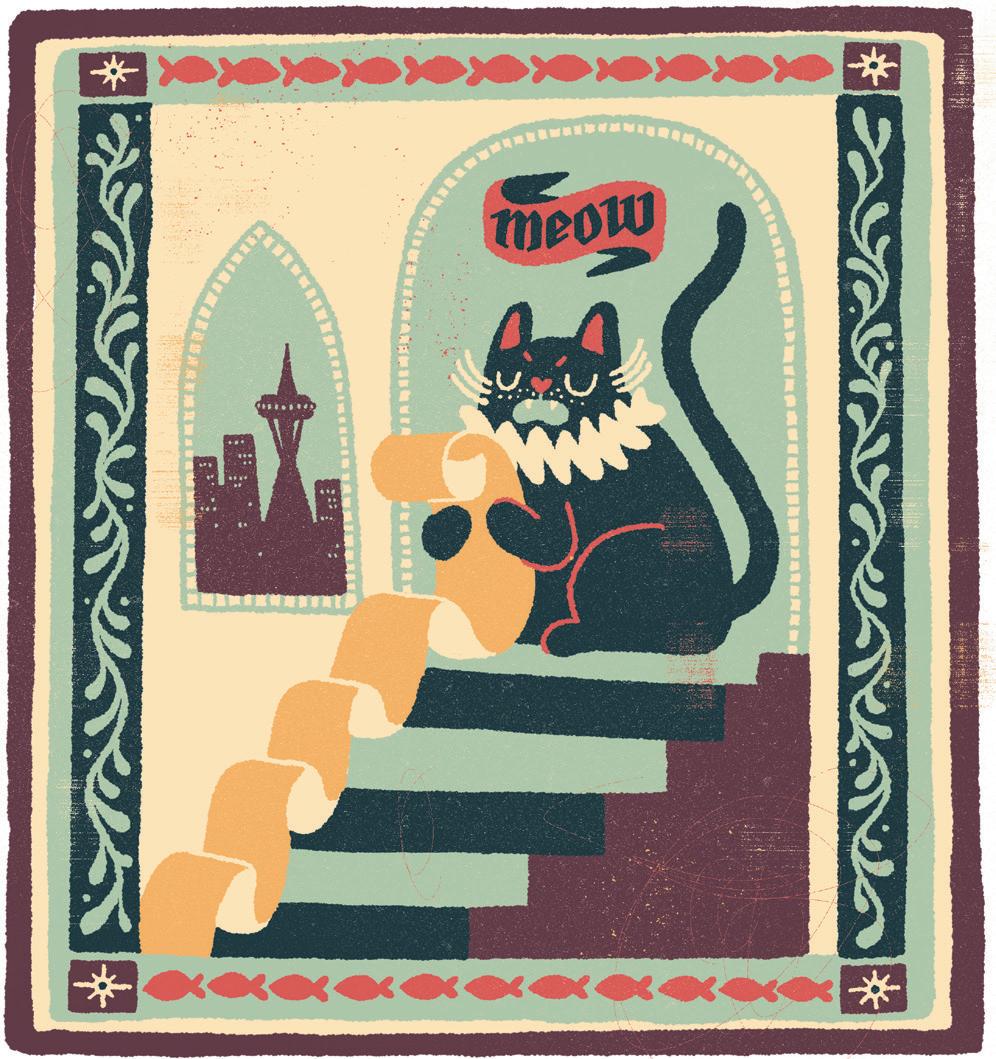
But we love our rain. And our Mariners. And the local organized Antifa Cells, wherever they are.
So if anyone’s gonna talk shit about our home, it’s gonna be us. We live in this city, we work in this city, we eat, drink, and fuck in this city. We see what makes it great, and we know what drives us crazy. We love it enough to want what’s best for it. Therefore, as we stand on the cusp of a new year, with a new mayor and a more progressive City Council incoming, we are submitting, for your consideration, our official list of grievances, delivered with love.
Sincerely, The Stranger

BY VIVIAN Mc CALL
The ice cream was my breaking point. When I want it, I’m usually having a bad day. The locks made it worse. Unbreakable. Comically large. Glittering. Silvery. Affixed to the top right-hand corner of the glass door. I could see the primo shit I was willing to shell out $10 for: the vanilla Häagen-Dazs. I had two options. Smash the glass with my forehead, or smash the big button to call over an underpaid, overworked employee at this understaffed Safeway. I chose “button. ” As I waited, I meditated on ice cream and grocery stores. What they’ve come to. Breaking point is the wrong phrase. Breaking points are supposed to be an endpoint. But what choice do I have, Safeway? QFC? Trader Joe’s is fine—and the canned dolmas make for a banger lunch in a pinch—but I can’t subsist on snacks and quirky TV dinners. I need meat. Veggies. Ingredients. I don’t have the space or wherewithal for a victory garden to overcome this tyranny. I am on a desert island with these companies, and they’ve drawn a dividing line in the sand. Their side has all the coconut trees. Their trees, their jungle rules.
Each one of the following has been a non-breaking breaking point for me: hiring guards to check my receipt as I leave, physically chasing my girlfriend out of the store when she didn’t show them hers, the ban on backpacks, private security following crying homeless people around, private security hiring that skinny white nationalist with extremist tattoos flashing the taser on hip like it was his big, wet, post-coital cock, and, also, the goofy miniature grocery store they’ve set up in the middle of the grocery store that cordons off the booze and toiletries from the rest of the store. I hate it, hate it, hate it. Everyone I know hates it.


poverty. You people watched Les Mis, right? We can all generally agree that Inspector Javert is a dick. Why are we doing this?
Theoretically, the consumer can strike back. Our weapon is our dollars, but let’s survey the battlefield. Fuck. They own it. We can’t boycott food, or practically swap a short walk with heavy groceries for a long walk with heavy groceries, and Amazon delivery just cedes power to bald evil. They’re bending me, and you, and your mother, and your grandmother over the barrel of economic inelasticity and spanking us barehanded.
The supermarket is supposed to be the capitalist Garden of Eden. The one thing that
Our weapon is our dollars, but let’s survey the battlefield. Fuck. They own it.
makes all the bullshit worth it. More food than one could ever hope to eat. More brands than anyone would even want to try, with more brands on the way, all promising something new and better and tastier.
It’s a borderline abuse of shopkeeper’s privilege and—if there’s a lawsuit in this—I hope someone sues the Häagen-Dazs out of them.
It’s a Black Mirror episode in there. I can’t stand seeing people line up, flash their receipt to a guardarmed with a taser while being filmed on who knows how many cameras, who then go about their merry way like this is always how grocery stores have been, how grocery stores should be, and how grocery stores will remain in perpetuity.
We’re told to tolerate this because the market demands it. These private companies claim—often without evidence— that we’re in the middle of an organized retail crime spree the likes of which this country has never seen before. News reports would indicate that they are probably lying about that, but in this market-driven society, they’re allowed to lie without consequence. They’re not accountable for anything, and they’re not responsible for making food more affordable, when the expense drives crimes of
I grew up partly in Florida, which is 90 miles from Cuba. My dad told me—horrifyingly, forebodingly—that Cuba didn’t have grocery stores like ours. There were no brands, no choice. I picked the cans of whole peeled tomatoes for our weekly spaghetti dinner. Forget familiar Hunts. The sexy Contadina lady. Hearty Red Gold. The alluring Cento. In Cuba, tomatoes were just “tomatoes.” I shivered. I shared his horror. In America, the government did not control my tomatoes.
I still buy whole peeled canned tomatoes, and I’m willing to shell out $6 for the primo shit. And I have to be willing to subject myself to a Safeway’s Fisher-Price police state to get them. Some choice. ■

Ihave had it up to here with all these modern Scandinavian-style coffee shop clones. They’re cold, white, and sterile, with all the warmth and ambience of a hospital room. You can usually recognize them by their ubiquitous peg letter menu boards (you know the ones) and uncomfortable metal stools with no back support, seemingly designed to torment anyone even moderately blessed in the cake department. Good luck trying to linger here for more than an hour without your sciatica acting up.
I long for the warm, earthy aesthetic of the ’90s and early 2000s. I want to see squishy, overstuffed armchairs and cushy couches. I want to feel like I just walked onto a Nora Ephron movie set.
A few shops in Seattle still get this cozy, inviting vibe: A Muddy Cup in Wallingford and all locations of Chocolati, which seem frozen in an earlier time (in a good way). C&P Coffee Company in West Seattle, which feels like a living room and bids patrons to “stay awhile.” And Pan de La Selva inside City Hall, whose owner, Mayra Sibrian, decorated it to be colorful and maximalist. Also, RIP to Bedlam Coffee in Belltown—I still miss your comfy reading nooks and cinnamon toast.
JULIANNE BELL
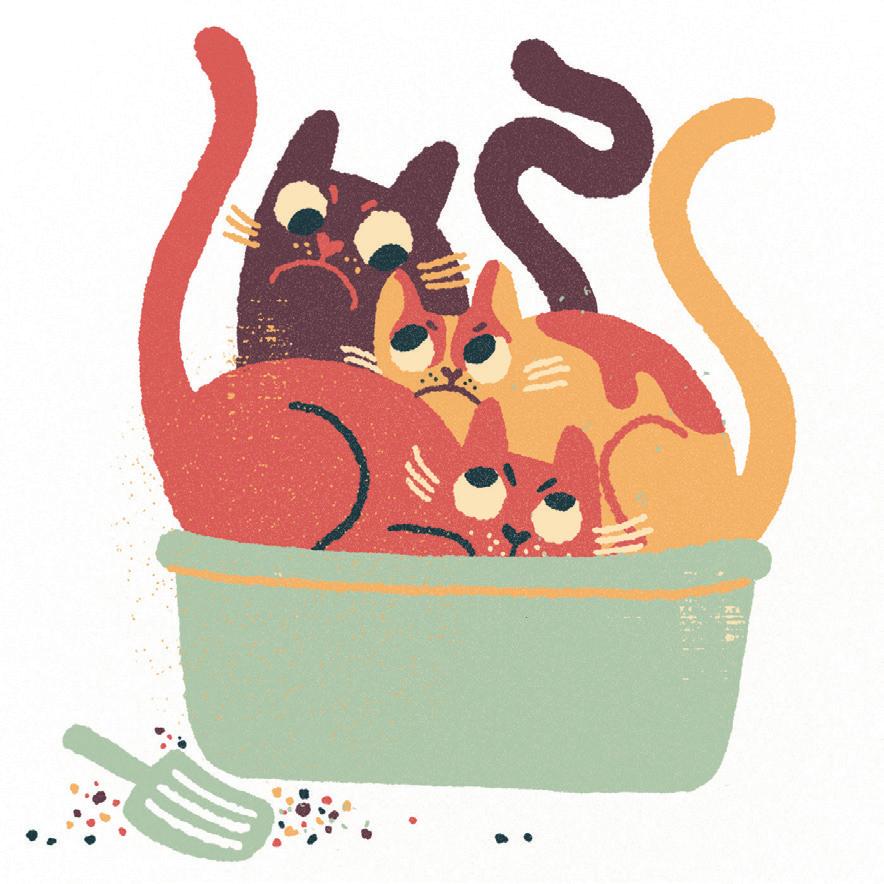
Ipiss. You piss. We all piss. We also shit. Even women. It’s coming out. Right now, maybe. The question is, “where?”
Seattle’s answer: a shrug.
Our potty ratio—about 25 public bathrooms per 100,000 residents—is dismal. What if an Etsy Witch hexes Seattle with the dreaded and all-too-common diarrhea curse? What if RFK Jr. replaces the fluoride in our water supply with Giardia? What if we all lose our keys at the same time? The streets would run brown. To an extent, they already do.
This city generally blames homeless people for that. We don’t have reliable poop and pee statistics, but it’s a reasonable assumption that people who don’t have a bathroom of their own are forced to go outside more than people who do have a bathroom.
Building is challenging. Plumbing is hard. It’d all be so expensive to solve. But I think the bigger barrier is the ugly little thought that public bathrooms “enable” homeless people to live outside. And that a door to piss behind is really just a drug den in waiting. A place for someone to hide and hurt the city’s upstanding citizens. The city is full of private bathrooms—in offices and schools and homes. If they want a bathroom, they can just get a fucking job, right??
peeing. We understand this when there’s a parade, a festival, or a construction site, and line the streets with porta-potties. But when the work and play are over, we slam the door and slap a padlock on it. It’s shameful.
I don’t want to spend all day up on my porcelain throne, but let’s consider what this really means for us. We’re sacrificing a lot to make people suffer.
I bet you make the calculus without even realizing it. The run or park hang you cut short to get within pissing distance of a toilet. The list of private bathrooms in familiar places stored in the back of your mind. The ambiguous worry you won’t be able to find one when visiting somewhere new. The $4 you know you have to spend on bottled water in exchange for a whizz. Over the course of a year, how much do we spend to use the bathroom? $100? $200?

We can play Twister with human rights talk and the complex, social drivers of homelessness. Or, we can accept the simple math. Fewer bathrooms = more public pooping and
Where do you go if you accidentally touch something gross and have to wash your hand? What do you do if your snot-nosed kid needs his diaper changed? Do we think it’s right that some 19-year-old barista is responsible for cleaning up after all the miserable shits that happen within a 10-block radius because the coffee shop they work at is the neighborhood’s only option? Are we really, really better off dispatching a city shit squad to powerwash the alleys in Pioneer Square? Is this the best use of our public resources?
This is beyond antisocial. It’s sociopathic. Bathrooms now! VIVIAN McCALL
BY MEGAN SELING
ILLUSTRATION BY MARK KAUFMAN
The Pacific Northwest is undoubtedly beautiful, and Seattle has no shortage of public parks that double as natureloving reprieves from the city’s crowds and noise. Discovery Park, Lincoln Park, Carkeek Park, Seward Park, they’re all full of winding, wooded trails beneath hundreds, even thousands of trees, with wide-open, grassy playing fields and access to the shores of Lake Washington or Puget Sound, where it’s not rare to spot seals playing or a pod of orcas on the hunt. It’s fucking magical!
What Seattle doesn’t have, though, are city parks. Parks where there’s no hiking, no trail biking, no whale watching—just a place to rest, to read, to people watch on a comfortable bench amid the city’s vibrancy.
Have you seen the public parks in Mexico City and Oaxaca? Their parks are phenomenal. They’re not huge, but they’re entire worlds, tucked into city blocks, among all the commotion. They’re full of beautiful brickwork, stone fountains, and public art. Paved paths are lined with shrubs, flowers, and new and old trees that provide shade to joggers getting in their daily laps or people strolling with their dogs. There are play areas for kids, and a few pieces of utilitarian but well-maintained exercise equipment for adults. And sitting is welcome! Iron benches are plentiful and bolted down—they can’t be locked up at closing time because the parks do not close. Instead, there is lighting throughout, and everything is usable long after sunset.

These spaces are so accommodating and accessible that generations of people have built their daily routines around them—enthusiastic instructors host Zumba classes, teens take dance lessons, and small marching bands practice their routines on the regular. Food carts and other mobile retailers are allowed to set up shop at all hours, only adding to the energizing activity and convenience. They’re the ultimate example of if you build it, they will come… to move, to eat, to work, to unwind right there in the middle of the city.
Seattle’s parks do not compare. Of course, attempts have been made. I’ve spent hours people-watching at Cal Anderson Park on my way home from work. I’ve seen people face off over the oversized chessboards in Occidental Park, and watched players get entertainingly competitive at the ping-pong tables in Hing Hay Park after grabbing some coffee and a Crunchy Cream Malasada from Fuji Bakery. I’ve also noticed the city’s half-hearted effort to establish little pop-up parks by placing a smattering of tables and chairs in places like Westlake Park, Belltown, and South Lake Union, but those are all temporary. Flimsy and foldable.
I’ve had tables and chairs pulled out from underneath me by a park’s employee m d-bite, in some cases, after daring to linger a little too close to sunset. (True story! At least let me finish my Pastry Project sundae next time, guy!)
Instead of building up public spaces and investing in making them usable, enjoyable, even, with permanent seating and garbage cans and public bathrooms, our leadership
has been shutting them down, too focused on eliminating any and all public areas where a person might dare try to loiter or rest. Months ago, three inner-city parks— Seven Hills Park, Lake City Mini Park, and
Sometimes I just want to sit on a real bench, in the middle of a real park, in the city I love, and soak it all in.
the pavilion at Dr. Blanche Lavizzo Park, which has been host to Seattle’s fun and colorful Mexican Guelaguetza celebration for several years—were temporarily closed for the remainder of the year. Oh, are people not using them as you intended, Seattle? Maybe that’s because the city has swept through every public space, eliminating seating, picnic tables, trash cans, and access to public restrooms (see page TK). This isn’t a population problem. People
are not the enemy. There are more than four million people living in Oaxaca, and more than nine million in Mexico City proper, and those major cities are still capable of building and maintaining these beautiful, bustling little parks, public (and free!) third places for people to come, alone or together, and soak the city in. the city in. Please. Katie Wilson, St. Rat’s bestie Alexis Mercedes Rinck, and anyone else who has the keys to the park palace, please, please invest in our inner-city public spaces. Don’t try to erase them. I want to be able to grab a coffee, wander a few blocks, and just sit and watch the city unfold in front of me. I want to quietly judge people for what they’re wearing and make eye contact with strangers’ dogs as they walk by. I want to sit and watch kids fall over while learning how to ride their bikes, because kids falling down is funny. I love that we have so many ways to escape the city’s madness. But I don’t always want to hike or keep track of when a park might close down. Sometimes I just want to sit on a real bench, in the middle of a real park, in the city I love, and soak it all in. ■


As the recent fiasco with Harbor Island Studios made evident (on the chopping block; not on the chopping block), the film industry is not taken seriously by any government body—city, county, or state. We (those who make films) always have to fight tooth and nail for tax incentives, for crumbs to fall from a mighty high budget table. And if that weren’t bad enough, some of our top filmmakers have not made a film in years.
Let’s begin with Zia Mohajerjasbi. He finished shooting Know Your Place in 2019. But despite the attention and awards the film received, Mohajerjasbi has yet to get a new project off the ground. And then there’s S.J. Chiro. She completed her film East of the Mountains, based on a novel by an established writer, David Guterson, in 2020, and counted Tom Skerritt and Mira Sorvino as its stars. And she received positive reviews after its release in 2021. Nevertheless, Chiro is in the same boat as Mohajerjasbi. She has plans, but so far, nothing doing.
Another shocker is Bao Tran, who directed Paper Tigers, a martial arts movie released in 2020. It was Tran’s directorial debut and received rave reviews. Rotten Tomatoes ranks it as one of the Best Action Comedies and Best Asian American Movies. He showed he has the chops to direct bigger and more challenging projects, but he hasn’t released a film in five years. These lags between feature films come with a
heavy price. They erode what a local or regional film industry must always accumulate: institutional memory. A feature film requires a lot of time to plan (pre-production), a large crew and many weeks to execute (production), and several more months to transform footage into a complete work of art (post-production). The process keeps a lot of people in the industry busy and in the city. And the more accessible crew and talent are, the more efficient is the production process. But if your leading directors are not working for years at a time, this vital insti-

tutional memory is depreciated or completely lost. Seattle is condemned to continually reinvent filmmaking. CHARLES MUDEDE

The Wildrose bathroom is not made for the human body.
LWe should be able to tap our credit cards or phones to pay for transit.

Around the world, transit riders are waving their phones or gently tapping their credit cards to enter the glorious universe of a bus, a train, a ferry. In some parts of China, people pay for transit with their palms. Meanwhile, in Seattle, we are stuck in the past.
et me set the scene. You’re in the lesbian bar and you have to pee. You hustle past the bar and through the line of drunk women with no spatial awareness. You arrive at a door and open it. Inside, you find a bathroom with no spatial awareness. The hallway of black stalls ends in a cul-de-sac with a small sink. It’s so narrow that two people cannot squeeze past one another without embracing. This is not sexy close. It’s awkward. The stalls are no better. Forget about fingering. There’s no room for your legs, let alone a purse, if you pee at a normal angle. Side-saddle kind of works, but only barely. I’ve tried every stall. They’re all disappointing. I love you, Wildrose, but I cannot fathom how your bathroom ended up this way. VIVIAN McCALL
Don’t get me wrong, I do not want the palm-payment technology. I would be happy with the simple, elegant alternative of paying my fare the way I pay for everything else: with my card or with my phone. The closest thing we have to the modern era of transit payment is a digital Orca Card that only Google phone owners can use to tap-to-pay. Since I’m a fool who always loses her Orca card or forgets to put money on it, I’ve opted for the digital tickets on the Transit Go App. You cannot scan these tickets. You just tap them and show the bus driver and hope they believe you’ve paid. For a smarter technological alternative to paper tickets, it’s very dumb. We’ve been signaling ourselves as the city of the future for decades. That’s what that big needle in Lower Queen Anne is all about (see: LQA vs. Uptown complaint). We should be on the cutting edge of this stuff. Plus, in a time when transit agencies around the country are struggling to make ends meet, making it easier for people to pay for transit is probably a good thing. Yes, yes, public transit should be free. But, it’s not. So, it should at least be easy to pay for.
We’re behind the times. Places like New York City, Chicago, Salt Lake City, San Francisco, and Portland are ahead of the curve on this. London’s been doing it since 2012. Embarrassing!
No firm date yet, Sound Transit says. “But expect it in 2026.” NATHALIE GRAHAM



I
BY EMILY NOKES
ILLUSTRATION BY OLESIA ILINA
I’m not asking for a 24-hour city. I mean, I am, eventually. But first, I’m simply asking that a city of nearly a million people does not keep the same hours as a small-town bank.
Disclaimer: Seattle businesses, I know you are doing your best. Most of you, at least. The world is against you. From our city being uniquely warped by tech, to our inability to care for folks in crisis on a systemic level, to the fact that Seattle is crazy fucking expensive, to the many other variables that need progressive taxation and a good-for-something Legislature to solve, I cannot imagine how difficult it must be for business owners to make it work.
But this is the Complaints issue, and I do have a Complaint to file. This city closes too fucking early. This is not just my complaint, it seems to be everyone’s. Not a week goes by that we don’t play Seattle’s favorite game: “Is anything open right now?”
The lights go out hours before the light rail skids to a 1 a.m. halt. Our parks shut down so early they seem like they don’t actually want to be parks (see pg. 19); we don’t have a lot in the way of late-night non-bar spaces or events, and our cafes, bakeries, and other daytime shops seem to need to close earlier and earlier. For a city this big and this expensive—we rank ninth most expensive in the U.S., woof—it should be easier to find restaurants open past 7 p.m. outside of a bar setting.
We’re a music city (right, everybody?), a restaurant city, a theater and art city. We’re also a dark, wet, and winter-heavy city. If anyone should understand the value of having more late-night indoor options and reasons to leave the house, it’s a town that spends nine months of the year auditioning for the role of “bleak exterior” in an A24 movie, and still losing to Vancouver.
A multiplicity of later-night options— transit, culture, errands, gatherings—lets us live fuller days without forcing our lives into a narrow window of daylight built entirely around work and sleep, where only productivity is considered a legitimate use of time. A city this big that grinds to a halt by 9 p.m. feels like a sad HOA-run diorama. Is it depleted vitamin D making us SAD, or boredom?
I want to live in a city where I can get off work late, exit a show, or just leave the house at night, and have a plethora of food
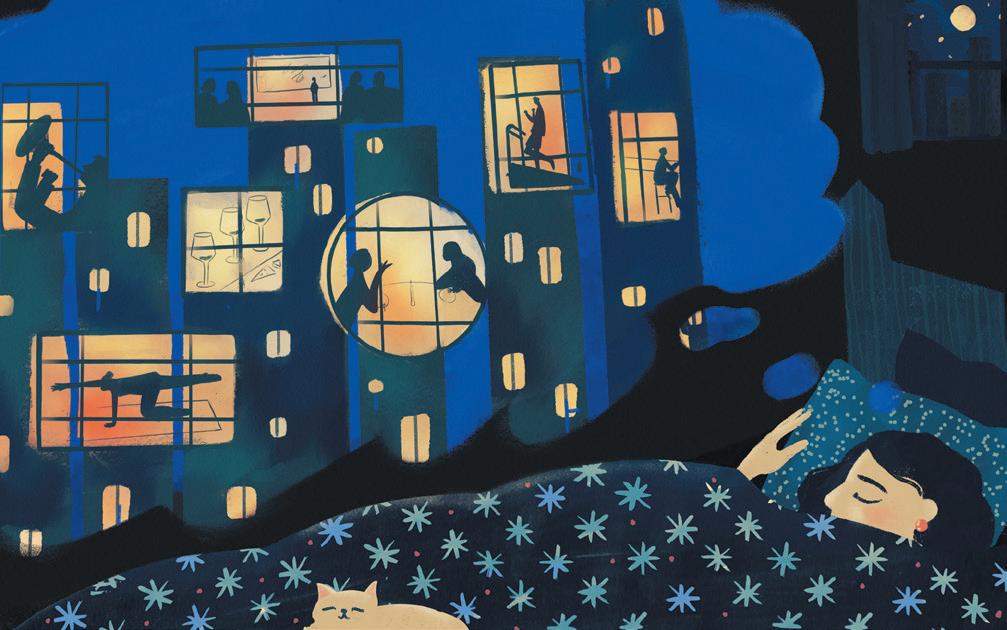
options. Perhaps a 24-hour diner situated in a part of town close to venues and theaters. Perhaps a 24-hour diner anywhere. Imagine the trains and buses are still running frequently and on a real schedule that won’t strand you, and helps make exploring other neighborhoods feel less like a
I’m simply asking that a city of nearly a million people does not keep the same hours as a small-town bank.
major life decision potentially entailing a $70 Uber ride. What makes a 24-hour or 18-hour (can I get 14-hour?) city appealing isn’t the promise of nonstop excitement— we’ll get there—it’s simply having normal, useful options for spontaneity. Pharmacies and grocery stores open late; museums, theaters, galleries, and other spaces holding events on the later side so people who work irregular hours can attend. Even one or two
spots in the image of the old Cafe Presse or Vito’s—both of which served ambience and food late into the night, RIP—might help Seattle feel a bit like her old self again. I know folks are fighting the good fight to stay open at all. I’m just hoping that it’s something we could just think about, together.
While writing this piece, I polled friends and strangers: “What’s your favorite spot for food—or literally anything—open past 10 p.m. in Seattle?” The response was overwhelming. Not necessarily in the amount of tips I received, but in message after message saying “PLEASE, WE NEED THIS, SHARE WHAT YOU FIND.” (I did! See box below.) I will say, the tips I did receive came with exuberant recommendations, which I found heartening, and reminded me that there are bits of hope here yet.
it together. If you build it, we will come (out past 10 p.m.).
Even with the anecdotal enthusiasm, I know there’s still the big looming question of: What if it’s us? If the city itself got its groove back and fostered a late-night vibe, would the people come out and actually enjoy it? We’re weird and anxious and vitamin-D deficient, but I think we can get
On the last kinda-nice autumn night, I realized it was 10 and I hadn’t planned ahead for dinner. Because Hell Is a Grocery Store (see pg. 17) and because I have to remind myself not to waste this one precious life doom-scrolling and paying $28 in fees for a $12 burrito on Grub Hub, I walked down to Hot Mama’s (open until 11 p.m.) and bought two slices at the window. The workers inside were projecting a movie onto a sheet on the wall inside where there used to be indoor seating. They’re always so nice. I sat at one of their metal tables outside; the guy next to me, also solo, nodded in solidarity and set down some sort of large instrument case he was lugging. I was surprised Break Away Vintage across the street was still open; I hadn’t checked it out yet. (Turns out they go until 11 p.m. on weekdays, and until midnight on weekends). Their music was soundtracking the whole corner, and they had good taste. People passed by in good outfits, giggling. It wasn’t even the weekend. This shouldn’t have felt like a big deal, but here, it did. A city dweller in a real city. ■


Iwill never forget the first time I saw Tim Curry as Dr. Frank N. Furter step out of the elevator singing “Sweet Transvestite” in fishnets and a sequin corset. I was 13, at the Admiral Theater’s monthly midnight screening of The Rocky Horror Picture Show (shadow cast by the Vicarious Theatre Company), and I felt deeply confused and excited by my first crush that existed beyond gender. During the film, I joined the crowd in throwing rice, singing loudly to “Touch-A, Touch-A, Touch Me,” and yelling things like “Buy an umbrella, you cheap bitch!” For the first time, I was encouraged to be loud, messy, and wild. I loved it. This experience is not unique— most queer people over 30 have had this ah-ha moment at a midnight screening, whether it was while gazing at Curry’s thighs or wanting to kiss the hottie who’s dressed in Columbia cosplay. As the years have passed, I’ve seen these screenings slowly disappear from Seattle. Now it appears that our city has none left (the nearest is at the Blue Mouse Theatre in Tacoma). While adults needn’t walk far to find a queer community (see: Seattle’s many queer bars), queer teenagers shouldn’t have to miss out on this tradition. Like the alluring Frankenstein Place, midnight screenings of The Rocky Horror Picture Show create a contained queer haven that encourages playful mischief, deviance, and sexual freedom. AUDREY VANN
Seattle drivers are psychopathically passive. We all know this. Yes, driving can be scary and is inherently dangerous, but if you’re behind the wheel, you need to be alert to your surroundings and proactive. Please don’t be so deferential and timid that you yourself become the danger and fuck up everyone’s commute with your insecurities.
Here’s how it works. When it’s time to turn your car, you must turn your car. Get into an efficiency mindset. Your job is to turn your car, not to fret about whether it is polite to turn your car. You put your blinker on, and then you turn your car at a reasonable pace.
You don’t slow to a crawl at the green light, just like you don’t randomly slow to a near stop at an uncontrolled intersection with no stop sign, pedestrians, or other cars coming.
Switching lanes should also be done in a prompt manner. Slowly drifting to wherever you’re going is extremely
not the move. Find a gap, turn on your blinker, and change lanes.
Do not screech to a halt the moment you see a hint of a pedestrian a few feet from the sidewalk. Yes, pedestrians have the right of way. But if they’re not actively crossing the street, you’re just inviting a rear-end collision.
When faced with a four-way stop, review the rules beforehand so you’re confident enough to make it happen when the time comes. In Washington, the first vehicle to arrive has the right-ofway. If two vehicles arrive simultaneously, the one on the left yields to the one on the right. All drivers must also yield to pedestrians and cyclists. This should all happen fairly quickly. If you blank on the rules and someone is waving you forward, go with it, confidently, and then wave back. This is no time to fret, and no time to get overwhelmed. You’ve got this. Remember: Fear is the mind-killer. (And public transit is also an option.) THE STRANGER’S DRIVE-BETTER BOARD

This is a gentle complaint, but babes, some of our beloved Seattle businesses are giving wellness check. If you run a space of any kind, part of the deal is giving the interior a good cleaning every once in a while and refusing to let entropy win.
I get it. This happens at my apartment, too. We’re in the low-lit season for so much of the year that as soon as a single ray of sun comes through the window, you realize you’ve been living like Miss Havisham (gothic icon!) amongst layers of dust, cobwebs, and whatever that black soot is that just kind of accumulates on our window sills. It’s probably last on your list of things to get to, but we’d collectively get a serotonin boost if our fave restaurants, cafes, shops, and galleries did some zhuzhing.
20 25

Some tough love: Beyond sweeping, dusting, and managing the finger-
print-to-glass ratio on a daily basis, if your walls are fucked up, paint them. How’s the signage doing? Does the bus tub nook have its own ecosystem at this point? Lightbulbs: All of them should work. If your bookshelf or display case is half merch, half random crap, edit it down. How are the chairs doing? Are they wobbly, shedding stuffing, or tattooed with ancient gum? Does the bathroom feel like a dare? If you got really into the plastic-flower-wall trend, there will come a time when you may want to fill some of the holes and de-grime those petals. If you have real plants, keep an eye on them, care for them. If any of them have died, it’s time to replace them, cruel as the cycle of life and death may be. If the Christmas lights are half out, let’s replace those, too. And honestly, maybe we don’t need Christmas lights unless we’re really good at hanging them? EMILY NOKES





Why can’t we find anything like this in Seattle?” I’ve whined to my partner too many times while enjoying meals at vegan eateries in Portland, Detroit, and Los Angeles (note: I’ve not been to LA since 2019). You know, places where you can get superior entrees that combine healthy grains, well-spiced vegetables, interesting dressings and sauces, expertly seasoned tofu, tempeh, and legumes, as well as freshly squeezed juices that make you feel Olympian. Places that innovate using high-quality, local ingredients or put ingenious spins on various ethnic specialties, without over-relying on the fryer or draining your bank account.
ecology is vexing. We have the demand and bountiful regional ingredients. The city abounds with vegans and people open to chowing that way on a semi-regular basis. But they are underserved in this burg of 800,000 citizens. So, where are all the sensibly priced, flavorful, plant-based eateries in the vein of those that dominate PDX’s scene?
“But, Dave,” you say, “Seattle has plenty of good vegan restaurants, you ungrateful bastard.” Okay, we do have some decent joints. But... there’s (mush)room for improvement! Now, I haven’t eaten at every vegan spot in the city, but it seems that the hive mind has determined that what the city’s meat-and-dairy-avoiders really want is bar/comfort food, prepared sans animal products. Or a menu laden with meat-substitute items, with too-clever names. (News flash: Most vegans are repulsed by food that replicates the taste of things with faces.) Or grub that’s so rich and pretentious the only folks who can afford it are the pretentious rich. Sure, I liked Plum, but it was a once-a-year treat for non-affluent eaters. Same with Cafe Flora and Harvest Beat. Not everyone here’s tech royalty.
Seattle’s flawed vegan restaurant
I’ve had pleasant experiences at Wayward Vegan, Sunlight Cafe, Oak, and Loving Hut, but their meals never rose above “pretty good”—certainly not on the level of Portland benchmarks Harlow, Norah, and Mirisata. El Borracho excels in the Mexican realm, but that’s a narrow niche. Fremont newcomer Vital Creations shows potential to blossom into something special. Araya’s Place offers solid, varied Thai vegan dishes, but my worst case of food poisoning occurred after eating at the U-District branch. Life on Mars’s bar-food-heavy menu takes risks like David Bowie did with music, but it’s not all Hunky Dory. Chu Minh Tofu is a no-frills, affordable champ, but it’s located behind a barbed-wire fence on a beleaguered ID corner. Ba Bar Green in SLU serves tasty Vietnamese street fare, but it’s merely a grab-and-go window adjoined to Ba Bar proper. This arrangement is a metaphor for how many businesses treat vegans.
Seattle needs restaurants that hit the sweet spot of reasonably priced plates of wholesome, boldly flavored vegan victuals that aren’t hell-bent on tricking carnivores and/or bombing your gut. Entrepreneurs, you’re leaving money on the table. DAVE SEGAL
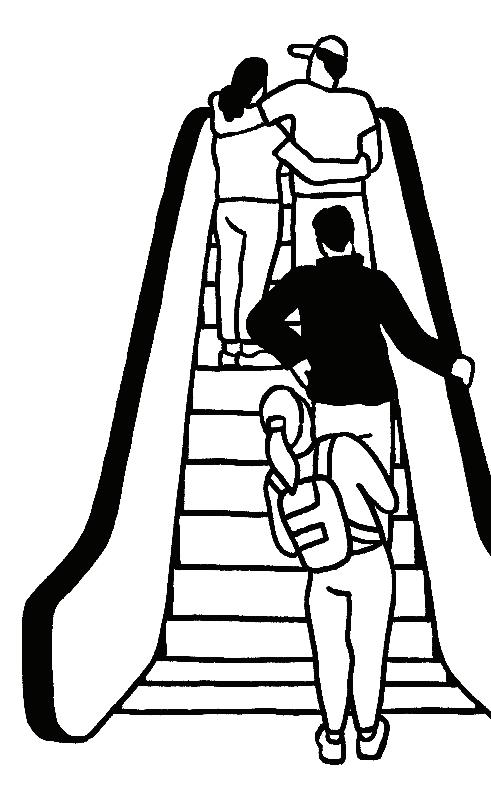
There is a right way to use the escalator. This is important because we have so many escalators. And they are so long. The holes we dug for light rail are so deep. If you are in Seattle, you will find yourself on an escalator. If you do not want to walk up the escalator and would rather be whisked to your destination by the magic of the moving stairs, please stand to the right. This means putting all luggage to the right as well. Then, the people in a hurry, or in pursuit of their daily step goals, can speed by on the left. Standing on the left impedes this. Leaving your bag on the left does, too. We get these thick, clogged bottlenecks. Are we not used to living among other people, Seattle? Over 800,000 people live here now. We must shake our small city-itis. I’m sorry to tell you, but there is hustle and bustle around you now, and it’s not going away. Many of us like that about this growing city. Leave the left lane open. NATHALIE GRAHAM
the sidewalk etiquette isn’t any better.

Gender equality—I love it. People of all genders should be able to do what they want without labels boxing them in or the patriarchy beating them down. And apparently, we’ve decided to apply that philosophy to our sidewalk conduct. The women in my life tell me that men don’t move to the side when they’re walking on the sidewalk. We must have won feminism, because now NOBODY moves on the sidewalk. Men, women, nonbinary people—doesn’t matter! Nobody’s moving out of anyone’s path! And you know what? You SHOULD! It’s RUDE. If you’re walking down the middle of the sidewalk, stop that! If you’re walking with six friends and y’all are taking up the whole sidewalk, CONDENSE! No one should have to duck into doorways or behind those little trees planted in the cement or walk into the literal fucking street to dodge swaths of people who have no concept of spatial awareness or common courtesy. Share the sidewalk! MICAH YIP







BY DAVE SEGAL
ILLUSTRATION BY JORGE CHA
FOOMP!
That was the sound of a dancer’s hand slamming into my cheekbone as I was minding my own business at a recent Cut Chemist show in Nectar Lounge. This incident—which caused no bruise, but did leave a psychic scar—illustrates three key rules of attending music shows: Be aware of your surroundings. Do not invade other people’s space. Understand that you do not exist in a goddamn bubble!
Now, as someone who’s been going to gigs, indoor and outdoor concerts, DJ events, house parties, raves, and record-shop in-stores for 45 years, I’ve picked up some hardearned wisdom that may benefit the public. Much of what I’m going to say here should go without saying. Y’all should’ve learned most of this stuff before puberty. But each generation yields a high percentage of doofuses who need certain guidelines repeatedly drilled into their thick crania. And even then, many fuck up. Those Devo guys were right.
Okay, let’s go over some basic rules of attending music shows in an allegedly civilized society.
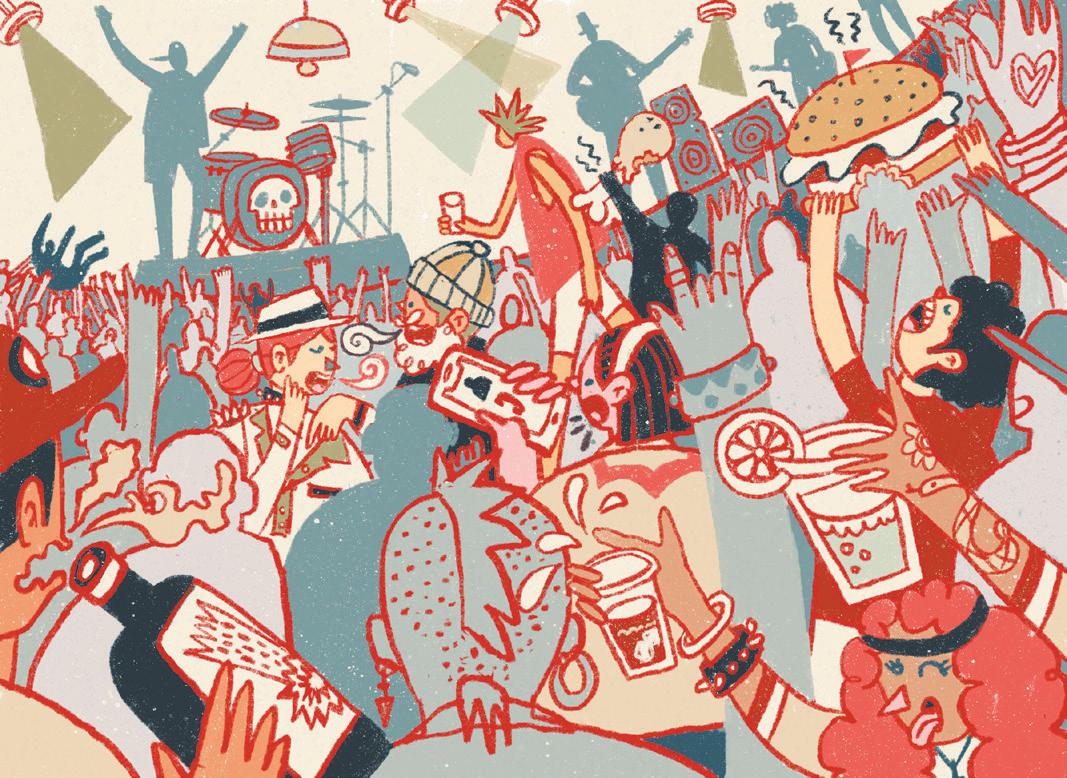
STFU when musicians are performing. Literally nothing you’re saying at a show should take precedence over the sounds emanating from the stage—unless you are suffering a medical emergency. Or if you want to tell me that you dug that one blog post I wrote in 2013. Otherwise, zip it. We didn’t shell out $35 + fees to hear your inane babble. Some years ago at a J.R.C.G. show in Barboza, a few people nearby were shouting at one another in order to be heard over the band’s boisterous horns. Never, ever be those assholes.
If you jostle somebody or step on their toes by mistake, apologize.
Sure, it’s super-important for you to rush up front so you can ogle that hottie at the mic stand, but a quick “Sorry” after a bodycheck or foot stomp goes a long way toward avoiding bad karma. I’m still fuming at the rude boy who rammed into me at Neptune Theatre circa 2017 as he sprinted to get close to King Gizzard and the Lizard Wizard.
This edict applies mainly to jazz audiences: For the love of Alice Coltrane, please do not applaud until songs are finished. I don’t care if it’s “tradition”; clapping after solos or particularly delicious passages drowns out the very great music that we paid handsomely—or strenuously pulled strings for guest list—to hear. Such applause is more about congratulating oneself than rewarding the players. “Hey, everybody—look how awesomely I appreciated this part!” Yeah, yeah... don’t strain a muscle patting yourself on the back, bro.
your rancid beer-and-cigarette breath... particularly when the band I spent $48 + fees to see is tearing the roof off and you’re jabbering in granular detail about the features of your new effects pedals. Not the time and place, Poindexter.
Wear deodorant.
Yes, even you, Phish phan. It’s just common scents.
Don’t fart, unless you’re in the bathroom.
Do your damnedest not to obscure the views of others when taking pics/video with your phone.
This is a corollary to the dictum in paragraph one. Sure, it’s crucial that you document shows on social media for street cred/brand-building/inducing FOMO in your followers. But be mindful about it.
Don’t sing along with the music... unless you have good pipes. We didn’t shell out $89 + fees to hear you
Don’t be a sex pest. Always respect boundaries. Music shows aren’t CPACs.
Don’t bring food into the club. Back in 2018, a dude carried some Bok Bok chicken tenders into Neumos, and the aroma was downright foul. However, if you must consume food while experiencing music, go to the Triple Door or Jazz Alley, venerable nightclubs with quality kitchens and classy decor. The bookings are often great, too.
If you stand over six feet tall, don’t post up near the stage. Look, you won the genetic lottery, so the least you can do is hang out near the back or off to the side.
Tip your bartender well—even if you’re buying non-alcoholic drinks.
They have to put up with a lot of drunken shenanigans, cringe-y flirting, and, often, lousy music.
Bring breath mints. Nobody—especially me—wants to smell
Ancient Greek philosophers observed that sphincter control is crucial to the maintenance of civilization. And you know what? Those geezers nailed it.
Don’t wear any MAGA paraphernalia.
Unless you want your head to be used as a speed bag. After all, this is the “Communist” paradise known as Seattle; be aware of your surroundings.
If you’re wily enough to sneak drugs into the venue (which I don’t condone!), offer me some.
I’ll trade you for a breath mint. ■
Seattle, city of water, has 10 public city-run pools. Two of these pools are only open during the summer. For the rest, you can buy fairly affordable punchcards ($72 for 10 swims) or monthly passes ($85 for 35 days), good for all city pools. This seems like an easy way to get some exercise, right? Except the lap-swimming hours are crazy.
I like Medgar Evers Pool next to Garfield High School in the Central District. When I first started swimming for exercise about two years ago (a byproduct of one of my Play Date columns), Medgar Evers had an early morning lap swim program from 5 a.m. to 7 a.m. But it quietly disappeared about a month after I started swimming. For most days of the week, lap swimming happened only from 11 a.m. to 2:30 p.m. or for two hours in the evening, starting around 6 or 7 p.m. None of them are easy to get to if you work regular hours, and even on a Tuesday at noon, the pool would be full. Evening hours brought it to a whole different level. At least two times in the past few months, I walked in, saw the churn of the water, and opted to save my precious punches left on my pass for a quieter pool experience. Then the city closed the pool for two months.
Now, I’m trying to find which city pool I can swim at instead. All of them have the wildest, weirdest hours and windows for lap swimming. The Ballard Pool seems to only have one-hour time slots for lap
public artist has gone too far.
Everywhere you look, they’re there. Shh. You know who I’m talking about. They’re in the alleyways, they’re on the garage doors. Maybe every garage door at this point. Turn your head for just one moment, let your guard down even a little, and whoosh. A mural of a heavily sedated owl wearing a top hat has appeared, and all you felt was the temperature drop, the static on your skin.
They’ve been here.
They’ll be back.
At first, you tell yourself the figures are harmless. A painting of a goofy little guy, some kind of gnome, maybe a vaguely crosseyed squirrel. It’s kind of cute? But not really your style. That’s okay, not everything is for you. But the more you see them, the more you wish you could also see some other types of art.
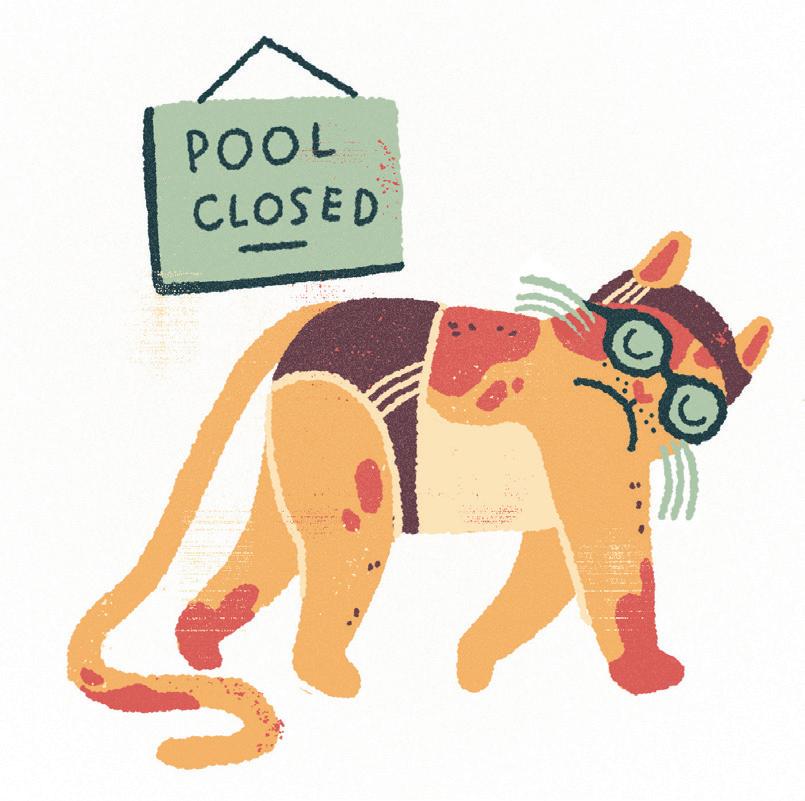
swimming. Some have two hours. But the bulk of these time slots happen in the midmorning or early afternoon, when people are working. The biggest lap-swimming time slot for a Seattle city pool is at the Meadowbrook Pool in Lake City from noon to 4:00 p.m. on Mondays and Wednesdays. Each day has different hours.
For a city surrounded by water, where many people— I assume—want to swim for exercise and not freeze
their tails off in the lakes during the winter, the lack of publicly available pool time is astounding. Perhaps this is a facilities issue; too many programs are sharing the same resources. Or, it’s a staffing problem; in 2022 and 2023, city beaches and pools closed down because there weren’t enough lifeguards. Either way, it’s not enough to allow me to be a consistent swimmer at Seattle’s pools. I’ll probably have to join the YMCA. Sigh. NATHALIE GRAHAM
could, at any moment, be interrupted by an octopus holding a hamburger.
Behind closed doors, your poet friend calls the aesthetic “nautical-java-burner core” (I told you she was a poet). You start to think of it as a whimsy blight. The exterior world smiling back at you with the fixed gaze of a raccoon that’s one bong rip away from pulling out a ukulele at a party, unprompted. “It’s fine, everything’s fine.”
But it’s not fine. Something is starting to feel unsettling about the ubiquity. This can’t be right. We’re smarter than this. Edgy, even. A city that repeatedly chooses the same frictionless aesthetic is revealing something about its own appetite for risk. It is choosing comfort over experiment, legibility over complexity, and familiarity over the possibility of being altered by an encounter with art. This isn’t who we are. Or is it? You can’t remember.
At least it’s just one neighborhood, you think. Or wait. No. You cross the city, there it is again: this time in the form of a heavy-browed sasquatch holding a coffee cup. They’re cropping up faster and faster these days. You hear rumors that there are plans for even more. A thousand new ones, they say. You keep your head down, knowing your peaceful neighborhood walk
After a while, you stop being surprised. That’s the scariest part. You can’t remember the first one you saw. The murals feel older than the city itself, like they arrived in a batch before you did, an advance party softening the terrain. There is no moment of encounter anymore, only a low-resolution background hum of familiarity. The figures are not on the city, they’ve seeped into it. The soft tyranny of the familiar.
They must be stopped, you think. We’re just confusing repetition with importance! You subtly ask around. A barista, a server, a first date; you’re met with pleasantly
blank replies. “They’re just part of the city. It’s not about liking or disliking. They’ve always been here.”
Some say that art should make you feel something. That even if you feel anger or disgust, then it’s done its job. But they’re right, it’s not about liking or disliking, you’re anhedonic. And worried. It’s unsettling that you did, in fact, maybe just prefer the side of the hospital better when it was greige, and blank. We need blank spaces, you begin to think. Just a few. We’ll suffocate without them.
You notice how the work never changes. You realize you are not witnessing an artist grow; you are watching a symbol reproduce. These aren’t murals—they’re sigils. They intend to replicate until every surface has been covered.
Other artists quietly disappear. Who can compete with someone who will cover your building for free? Someone so determined in their spraypaint manifest destiny? The city’s Faustian bargain for getting to boast of being “covered in art.”
One night, you walk home a different way, thinking you’ve outsmarted them. New block, new alley, a blank stretch of concrete. For a moment, the wall is just a wall.
Then you see it: a fresh outline, the first curve of a too-familiar heavy-lidded eye.
They’re here.
This is their city.
You were only ever walking through it. EMILY NOKES
eattle’s streets look like they were named by taking handfuls of Scrabble tiles and some third-grader’s multiplication flashcards, throwing them up in the air, and seeing what tiles and cards landed closest to each other. N 41st St. 33rd Ave NE. NE 196th St. 238th Place SW. Sorry, but that is entirely unreadable. Tell me you look at that and your brain doesn’t just shut down. And since our original city planners might as well have been 6-year-olds with sidewalk chalk, those streets intersect into five-way stops. I don’t care how sparse public transit is here—I would rather take the light rail and live to see another day. MICAH YIP
Gas Works in Gas Works Park should be one word: Gasworks Park.
There has to be a better way than the absolute hell on earth that is leaf blowers.
Seattle has great Mexican food now. It didn’t, but now it does. Shut up about it.
If we can’t, for some reason, make them illegal, then we should sanction the point-blank egging of vehicles that are too loud on purpose.
I don’t care how we do it, but I need to be released from two-factor identification.
Bartenders of Seattle need to stop putting so much ice in Diet Cokes.
It’s unacceptable that the Democratic Socialists of America and the Downtown Seattle Association have the same acronym.
Taco Time’s soft “tacos” are burritos. Adding lettuce to a burrito does not make it a taco. Why have we let them do this since 1960?
It’s Lower Queen Anne, not Uptown.
On that note, it’s Downtown, not the Central Business District. You capitalistic fucks.
We are at full saturation on boba tea joints at this point, guys. Matcha, too. All set, thanks.
For the love of God, please scoot over to make room for people on the light rail, and let people get off the train first before getting on!
There aren’t enough ghosts in this city.
Counterpoint: The Biltmore has enough ghosts for the whole city.
Would it kill you to unclog a storm drain once in a while?
White chefs need to stop haphazardly tossing Sichuan peppercorns/chili crisp/XO sauce into their uninspired farm-to-table menus in a lazy attempt to “spice things up”—if you are going to incorporate ingredients from another culture, do so with intention and respect.
We’re still mad that Seattle passed up the opportunity to name Frelard “Freball.”
There are too many stairs in the new Stranger office, and the elevator is scary.
Stop blaming the “Seattle Freeze.” To borrow a phrase from local band Who Is She?: It’s not Seattle, it’s you.
Counterpoint: The Seattle Freeze exists. Your friendships don’t need to revolve around hobbies. Learn to hang out.
Putting price-tag stickers on glass items is morally reprehensible.
It’s never Cap Hill.
It’s never Capital Hill.
In fact, just keep that neighborhood’s name out of your fucking mouth unless you lived in Seattle before 2020.
Restaurant and bar owners really need to stop making their logos (and menus!) with fugly AI art. Everyone instantaneously knows it’s AI art. You look tacky and dumb.
We have more dogs than kids. Which means we have thousands of Seattleites walking around the sidewalks with hot bags of poop at any given moment. We need public trash cans outside of downtown.

The Stranger ’s Complaint Commission comprises Hannah Murphy Winter, Emily Nokes, Megan Seling, Vivian McCall, and Nathalie Graham. Nearly all restaurant-based complaints were formally submitted by Meg van Huygen.

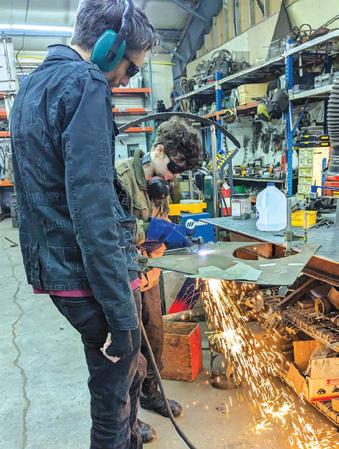



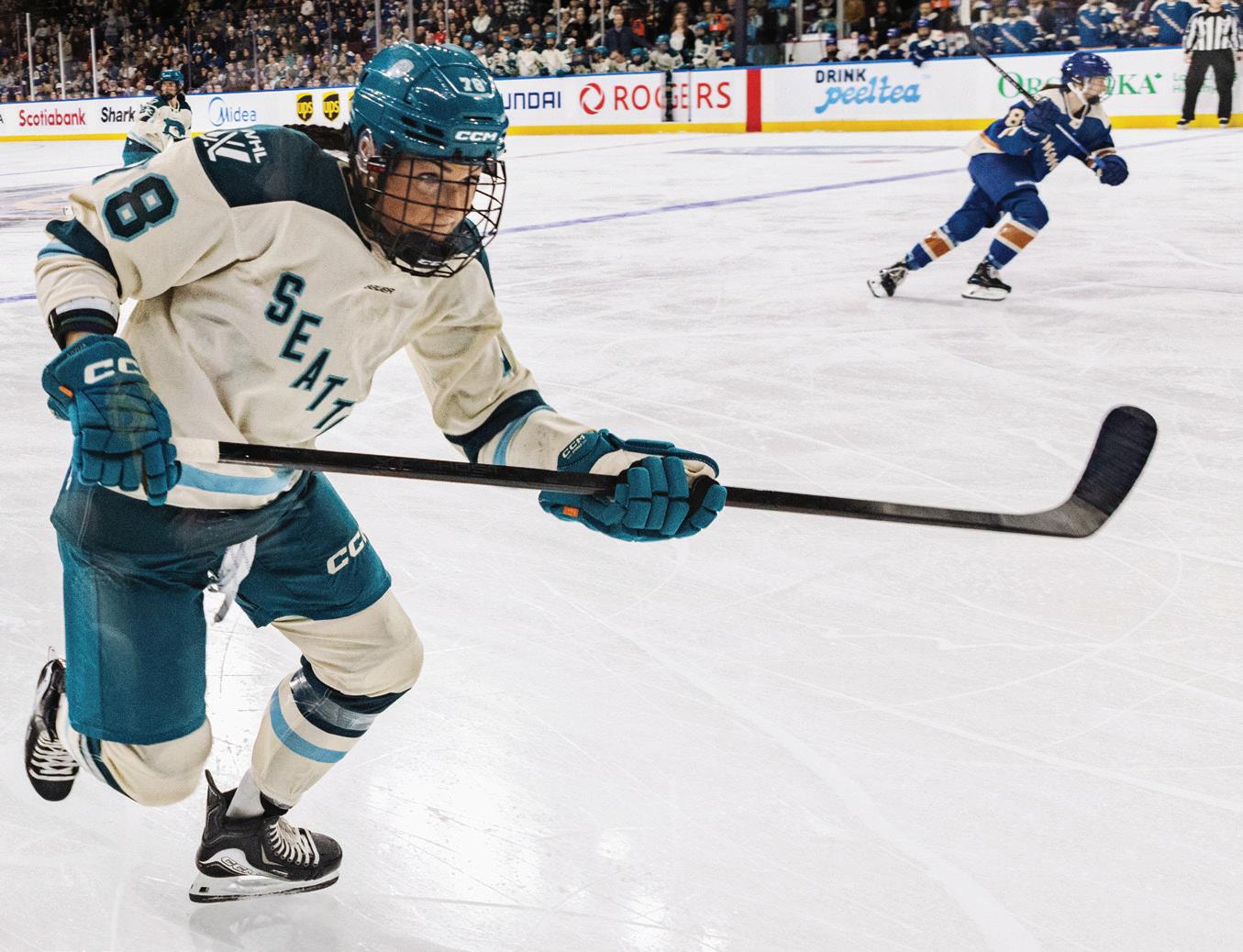
BOOOO!”
“GO HOME, SEATTLE!”
The attempts to establish a rivalry between the Vancouver Goldeneyes and the Seattle Torrent, the two newest additions to the Professional Women’s Hockey League (PWHL), had clearly worked. The playful jeering started the moment the Torrent took the ice on Friday, November 21, for the teams’ inaugural game at Pacific Coliseum in Vancouver, BC.
After the showy staff and player introductions, the flashy hype videos, and the national anthems, a man yelled out one more “Fuck Seattle!” for good measure, and the puck dropped. Cheers filled the rafters of the sold-out, 57-yearold arena, where the Vancouver Canucks established their NHL career in 1970, and 14,958 hockey fans witnessed history.
Their game wasn’t perfect. Training camp started just 10 days prior, giving all these players (most of whom have never skated together before) barely a week to find their rhythm, but the crowd didn’t care. A Disney movie couldn’t have written it better.
Seattle scored first, with Julia Gosling collecting the first goal in Torrent history. Three minutes later, after the Goldeneyes had been edging fans by racking up nearly a dozen shots, alternate captain Sarah Nurse tied it up. With less than a minute to go, Gosling struck again. Hilary Knight laid a beautiful body check on Vancouver’s Ashton Bell to grab control of the
The Seattle Torrent were just an idea this spring. Now they’re our home team.
BY MEGAN SELING
PHOTOS
BY BILLIE WINTER
puck before passing it off to her linemate, who ripped it past Emerance Maschmeyer. And that was just the first period.
The Torrent lost 4-3 in overtime, and though a fair number of Seattle fans had made the trip up north—by the busload, in some cases—no one left disappointed. Everyone was thrilled.
The history of professional women’s hockey in the US and Canada is a dense web, and sorting it all into manageable, bite-sized nuggets of information can make you feel a little bit like Charlie Kelly trying to find Pepe Silvia in It’s Always Sunny in Philadelphia . But here’s the gist: Before the PWHL was founded in 2023, there was the Premier Hockey Federation (PHF), which ran from 2015 to 2023. It was the first professional women’s hockey league to pay players a (meager, very meager) salary. The PHF was renamed from the National Women’s Hockey League (1999–2007), which absorbed some teams from the Western Women’s Hockey League (2004–2011) and was renamed from the Central Ontario Women’s Hockey League (1992–1998). There was also the Canadian Women’s Hockey League, founded by former players of the NWHL in 2007. That folded in 2019 after 12 seasons. Do you see what I mean? Carol! Carol! Carol!
The leagues were always small, and budgets were even smaller. Most didn’t have enough money to pay players, though some did offer stipends when possible. The women often had jobs on the side, and there were few to no resources
for the players off-ice. In a story the Victory Press published in 2020, former NWHL players recalled abysmal working conditions, including having to pee in a trash can during practice because they didn’t have access to locker rooms. (A boys’ junior varsity team had dibs.)
It’s no wonder some people were brought to tears at the sight of professional women’s hockey players finally getting their due, breaking merchandise and season ticket records, being supported by thousands of fervent, passionate fans in a sold-out 15,000-capacity arena on the West Coast of North America, and having access to their own bathrooms. It was about damn time.
No one was surprised when Amy Scheer, Executive Vice President of Business Operations for the PWHL, held a press conference at Climate Pledge Arena on April 30 to confirm that Seattle and Vancouver, BC, would be home to the league’s next two expansion teams. Rumors had been swirling that women’s hockey was on the way for months. In January, the PWHL’s Takeover Tour had stops in both Seattle and Vancouver. More than 12,000 hockey fans filled Climate Pledge to see the Boston Fleet beat the Montréal Victoire 3-2 in a shootout, and a whopping 19,000 people filled Vancouver’s Rogers Arena to see the Montréal Victoire take on the Toronto Sceptres. The Pacific Northwest was clearly ready for PWHL action.
What was surprising, however, was the time that both cities had to pull it off. Puck drop was in November. They had 205 days to build an entire professional hockey team, from the ground up.
The PWHL’s first big move in Seattle was hiring general manager Meghan Turner. She had helped launch one of the original PWHL teams, the Boston Fleet, in 2024. A May 21 start date meant her first shot at signing players for the 2025–26 season, during the exclusive signing window and expansion draft, was just two weeks away. She didn’t even have a permanent office space in Seattle. (And still doesn’t, by the way—the Torrent facilities in Northgate are still under construction.)
Still, Turner was able to make a move no one saw coming.
The PWHL 2025 expansion process worked like this: Seattle and Vancouver each got to kickstart their rosters by picking 12 seasoned PWHL players from the six existing teams—Boston Fleet, Minnesota Frost, Montréal Victoire, New York Sirens, Ottawa Charge, and Toronto Sceptres. Each team could protect just three players from being snatched up. The exclusive signing window was first. Starting on June 4, Seattle and Vancouver had four days to sign up to five players each from the pool of players who were left unprotected. Then came the expansion draft on June 8, with the remaining unprotected players. If any of the original six teams had already forfeited two players, they were allowed to protect one more player before Seattle and Vancouver could pick at least seven more players from the pool to bring their roster to 12.
It’s like a game of chess. Because all the teams have different goals and are considering a variety of factors—some known to the public, some not—it’s nearly impossible to predict whose names will end up on the final lists. Drama can ensue. And this year, that drama came on June 3, when the Boston Fleet announced they would not be protecting their team captain (and Team USA captain, Olympic gold medalist, IIHF gold medalist several times over, and literally one of the most decorated hockey players in the world, male or female), Hilary Knight.
The Athletic called it “shocking.” Days later, Fleet GM Danielle Marmer said it “was the hardest decision I’ve ever made in my professional career to date.” Turner, wisely, signed her immediately. On June 4, Knight became the first player in Seattle’s PWHL history.
subtle foreshadowing. Then the unprotected thing happens, and the opportunity to get out here presented itself. It was like, ‘Yeah, why wouldn’t I do that? That’s kind of everything that I wanted.’
“But on a human level, we had a great room in Boston. We did such a tremendous job building that foundation there, and you know, [there’s] unfinished business, too. I think you get a little remorseful, in that way, leaving friends.”
Turner, for her part, says she didn’t know
sive player (and 5-foot-2-inch firecracker) Cayla Barnes, forwards Danielle Serdachny and Alex Carpenter, and goalie Corinne Schroeder. And on June 20, with a few more players in her pocket, Turner hired the franchise’s first head coach, Steve O’Rourke (who’s from British Columbia, but started his hockey career here in Washington with the Tri-City Americans in Kennewick).
Turner has, over and over again (as much as one can do in a few months, anyway),
it into the league’s top 20.
Now, before anyone can start to regurgitate some brand of “ThEy DoN’t GeT pHySiCaL iN wOmEn’S hOcKeY” nonsense you read on a message board in 2017, let me say this: Yes, they fucking do. PWHL players crunch one another into the boards at full speed to force a turnover, they get scrappy in the crease if someone gets too close to their goalie, and they can deliver a hip check that would make Dan Hamhuis blush.
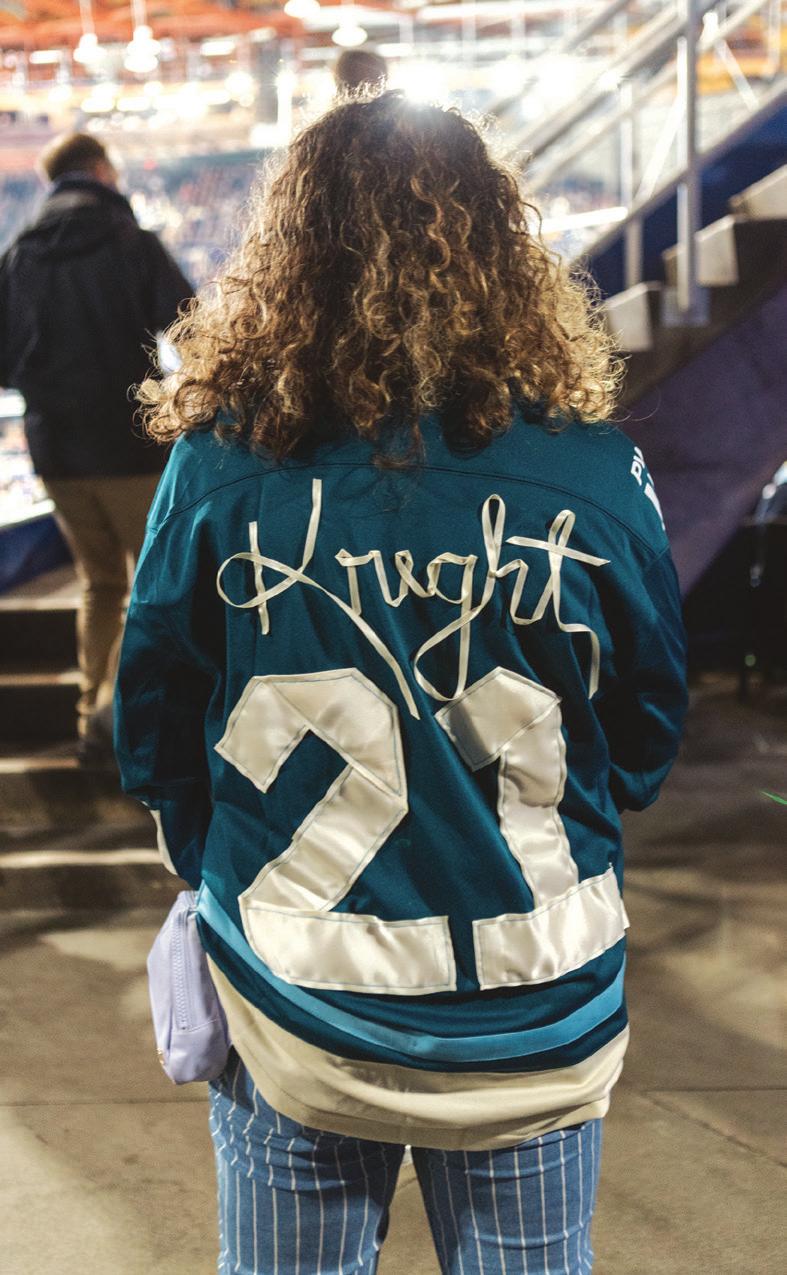
Knight would be left unprotected either.
Knight was as surprised as anyone that Boston left her dangling. At the team’s jersey launch in October, she told me, “When they announced Seattle being an expansion location, I immediately was envious. I was like, ‘Oh my gosh, how cool to have a team out there, I wish I could be out there.’ So,
“I respect the process, so [I] made sure to remove myself from those conversations as they got going, when I knew that I was in the pipeline for this role,” she said during a preseason media scrum. “I found out when everyone else found out, and we went from there.”
That week, Turner also signed defen -
praised O’Rourke for looking to coach a “direct, fast, physical” game. “That’s how we constructed this roster, and what we wanted going into it,” says Turner. “It’s gonna be a physical game, and I expect our opponents to feel it.” To make good on that, they signed Emily Brown, Aneta Tejralová, and Lexie Adzija, three players who all racked up enough hits last season to make
The Torrent are no different. Less than seven minutes into the inaugural game in Vancouver, rookie Jenna Buglioni performed a picture-perfect shoulder check on Vancouver’s Michelle Karvinen. Karvinen fell to the ice, and Buglioni was visibly annoyed when she was called for an illegal body check.
Seattle’s Megan Carter left a mark, too. In the third period, when Vancouver’s alternate captain Sarah Nurse got the puck and tried to skate through Carter while charging the net, Carter stood her ground, and they both went flying through the air. During a replay of the move, commentator (and Olympic gold medalist hockey player) Becky Kellar remarked, “Woof, that’s a big, strong girl, taking Sarah Nurse out.”
Minutes later, Carter, who was clearly displeased that Vancouver’s Gabby Rosenthal fell into Seattle goalie Corinne Schroeder while attempting to score off a rebound, tugged at Rosenthal’s sweater hard enough that she started pulling it up and over her head. Rosenthal rose to her feet, and Carter shoved her a bit more to ensure she got the message: Stay away from the fucking goalie. Carter delivered six hits that night, the most on either team.
“This is such a physical league, and a lot of girls on this team have been around the league enough to know that you’ve got to use the body, you’ve got to play physical,” said the Torrent’s alternate captain, Emily Brown, at Sunday morning practice after the season opener. “I think a lot of us embrace that, too, and really enjoy it.
“Even before the formal checking rules were put in place, we’ve always been teetering—‘Where’s the line? How hard can we push it?’ I mean, you look back five to 10 years to look at the US-Canada rivalry, that’s not a gentle game, ever. But I love it, I love a little physical spice.”
O’Rouke liked what he saw Friday night, too. Though the Torrent lost in overtime, he still praised the team for roughing their opponents up a bit. “That’s gonna be our trademark,” he said during the postgame press conference. “We want to have an identity that’s hard to play against, and I thought we established that tonight. Bugs [Buglioni] took a nice big penalty, showed what her physicality is, and her style of play. That’s where we’re gonna go,
that’s how we’re gonna play the game.”
These players are just as physical as NHL players. They may only have 30 games a season (for now), but they put their bodies on the line night after night, all the same. On Friday, Torrent forward Aneta Tejralová had to be helped off the ice after taking a hard hit against the boards, and her leg appeared to twist in a direction a leg should not twist. She attempted to play another shift or two after assessing her injury, but the Torrent eventually announced she’d be out the rest of the game. At press time, she was still out with a lower-body injury.
There is one glaring difference between the PWHL and the NHL, but it’s off the ice. For the 2025–26 season, the PWHL’s salary cap is $1.3 million per team. In the NHL, it’s $95.5 million. The PWHL’s cap will increase by 3 percent every season as part of the PWHL’s collective bargaining agreement, and there are restrictions on how a team can distribute it. The minimum annual salary this season is $37,131.50 (up from $35,000 last year), and at least five players have to make at least $80,000. Players do get some money if they need to relocate, a $1,600 per month housing stipend, and meal per diems for road games. Teams also get bonuses when they make the playoffs. But no one is in women’s hockey to get rich. In November, KOMO reported that “a single adult needs to earn $135,265 annually to maintain a comfortable lifestyle in the Seattle-Tacoma-Bellevue metro area.”
because the demand is there, the players are there.”
***
Professional women’s hockey in Seattle may have felt like a long time coming, but this is just the start of what will hopefully be a very long, exhilarating journey. Management and marketing meetings only take a team so far; who the Seattle Torrent become now is largely up to us, the city, the fans. And the PWHL didn’t choose Seattle as their next expansion
yourself], who do you want to be, who do you not want to be, and everybody always wanted to be Seattle. Because you go to Seattle, and the Storm games were always full, and they had so much support from the get-go. Seattle just does such a wonderful job supporting their women’s teams. It was almost like, ‘Hey, Captain Obvious, you must come here.’”
Now, we get to see where Seattle takes it. What taunts will fans yell after the Torrent score on the opposing goalie? What rally-
dition of throwing some kind of seafood— why is it always seafood—onto the ice?
The culture of this team will grow in the fan base, game by game. They’ll decide if that rivalry with Vancouver pans out, or if we’ll take a longer, harder look at Boston and decide that Bean Town, former home of the Torrent’s GM and two of the team’s three leadership players, is Enemy #1. They’ll decide which players will earn endearing nicknames that end up on merchandise, in commercials, or even in mayoral campaigns. Who will be Seattle’s next Sir P, Big Dumper, or DB?
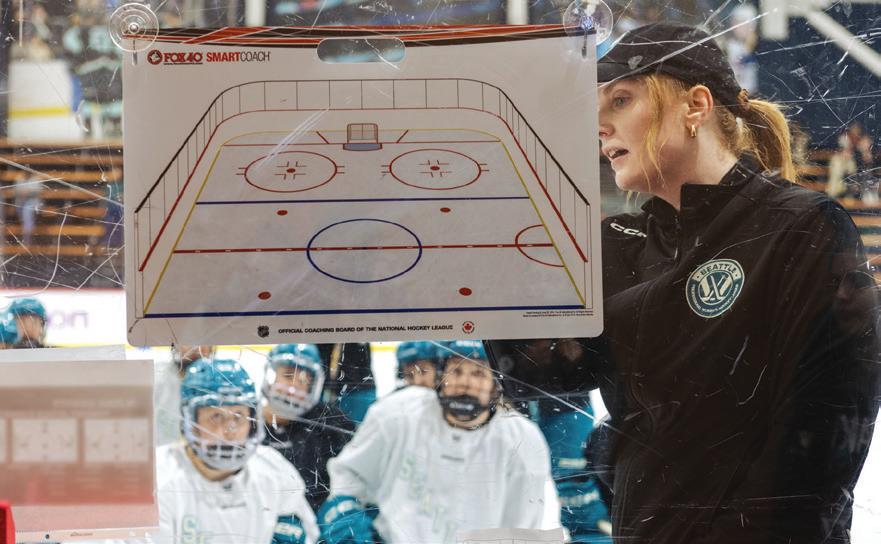
“Seattle just does such a wonderful job supporting their women’s teams. It was almost like, ‘Hey, Captain Obvious, you must come here.’”
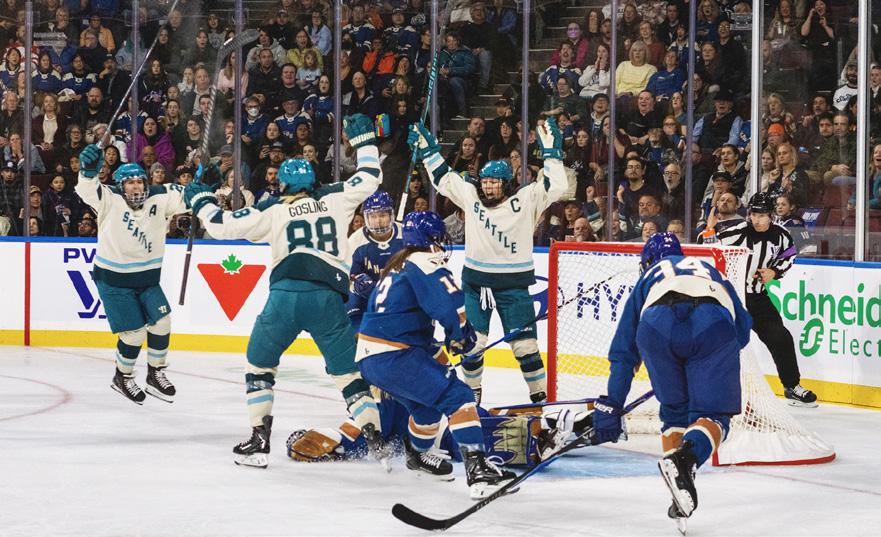
That $1.3 million season salary cap means that the $29,400,000 contract Seattle Kraken defenseman Vince Dunn signed in 2023 could fund the entire PWHL’s eight-team roster for two years and still have several million left over to add a few expansion teams. Still, the fan base—and therefore the amount of money coming in—is growing. PWHL merch sales doubled from season one to season two, according to league statistics, and “Seattle set the record for highest first-day jersey sales of any team at launch.” Seattle and Vancouver brought in more than 5,000 season ticket member deposits each, and, as of September, the league has sold more season tickets in every city than ever before. During a business conference in September, Dodgers CEO Stan Kasten, who’s also a member of the four-person governing board of the PWHL, said, “We are going to be adding more teams much sooner than other people thought
city by shooting a puck at a map and seeing where it hit. They knew exactly what they were doing, said Amy Scheer during a media scrum ahead of the team’s first game.
“Seattle’s interesting. Having worked in the WNBA for so many years and running the New York Liberty business, as a league, you always look to other teams and [ask
ing cry will echo through Climate Pledge’s rafters when the team is down by one with a minute left in the third period? What song will play after the Torrent score, and what kind of cheer will fans weave into it?
Will the crowd emphasize a word from the National Anthem, like when Kraken fans bellow “RED GLARE!” as a nod to the team’s crimson-eyed logo? Will anyone make a tra-
Only after hockey fans from across the region crowd into Climate Pledge, after the puck drops and the songs play, can a fandom’s identity come to fruition organically, in a way even the best marketing teams could never predict.
And it’s clear the fans are ready. They’re hungry for it. Jen Barnes, owner of sports bar Rough & Tumble in Ballard, said sales of their Knight’s Cheese Curds, named after Hilary Knight when the pub opened in 2022, increased 26 percent when Knight signed with the Torrent. Now Barnes has to order about 60 pounds of curds a week to keep them in stock. And all those cheers for the Goldeneyes after they won Friday’s game? They were for Seattle, too. They were for women’s hockey, period. That was clear by all the little girls waving their “Hockey is for everyone” and “Everybody watches women’s sports” signs in the air. Which isn’t to say there isn’t die-hard team loyalty when the puck is in play. At one point, in Friday’s game, Seattle’s Hannah Bilka ricocheted the puck into the net off Vancouver goalie Emerance Maschmeyer, and the Torrent players on the ice cheered. There was commotion. From one angle, it looked like it hit the post but didn’t cross the line. Referee Kyle Bauman waved it off. Torrent players pleaded for a review, and the crowd joined in the debate. Pockets of Seattle fans screamed “Good goal!” as the moment replayed on the Jumobotron. Swaths of Goldeneyes supporters replicated the ref’s “no goal” hand signals.
After several minutes of review—and several minutes of 15,000 fans pleading their case—referee Bauman walked back his initial call. It was a good goal. Goldeneyes fans booed and jeered. The Torrent had taken the lead. I heard another “Fuck you, Seattle!” ring out and chuckled. God, I love hockey. ■


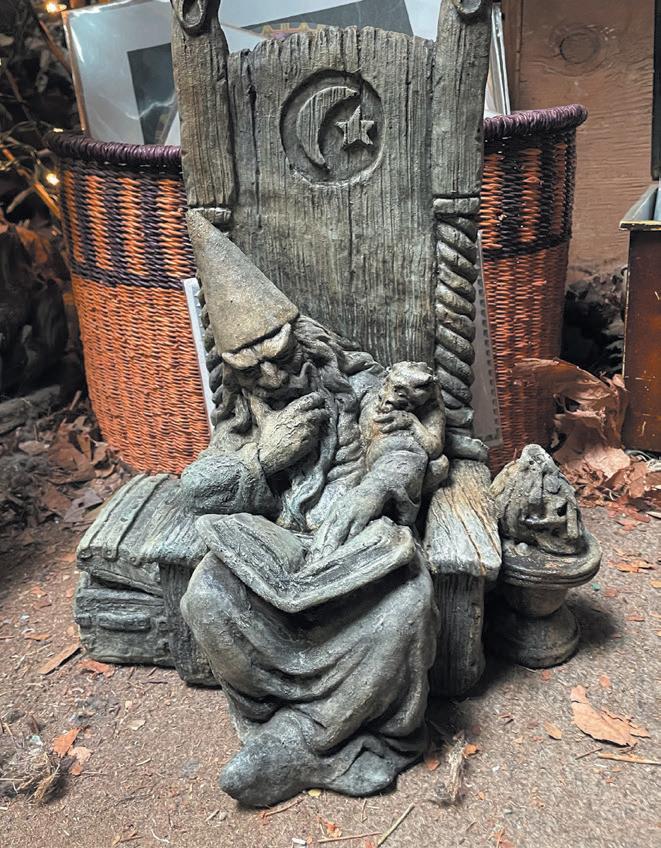


BY CHARLES MUDEDE
ILLUSTRATION BY HARRISON FREEMAN
We open with a row of black smokestacks belching fire. The sky is almost totally black, and one has the impression that the city, which is far down below and has lights like stars stuck in tar, hasn’t seen the sun in a century or more. Suddenly, a bolt of smog lightning. After the rumble, other fireballs rise and roar as a flying car approaches and buzzes by. It’s heading to two massive pyramids in the distance that project columns of light into the night. The pyramids, which look Mayan, are the color of a dying day, and have thousands of cascading office windows. Do people actually work here, or even live in this industrial megalopolis, whose factories dwarf William Blake’s “Satanic mills”?
This is one of the greatest opening scenes in the history of cinema. The movie is, of course, Blade Runner (1982). The pyramids are the headquarters of a biotech corporation, Tyrell Corp, that manufactures androids (replicants) to work hazardous jobs on harsh off-worlds. The flying car is a spinner (a police vehicle). The city is Los Angeles in the year 2019. And what brings the scene together and makes it more sublime, more hellish, more galactic, is Greek-born electronic musician/composer Vangelis’s futuristic score. It’s immersive and expansive. It gives us a sense of a city that’s incomprehensibly large—billions of people, all living somewhere beneath the smokestacks, the corporate pyramids, the flying patrol cars.
The director, Ridley Scott, explained during a Making of Blade Runner interview that he shot the movie at night and used lots of smoke and rain because he didn’t have the budget to directly show the size of this impossible LA. It was beyond the darkness, the rain that never stops, the blasts of smoke from utility holes, passing vehicles, and wall vents. These elements isolate each scene— Rick Deckard (Harrison Ford) crossing a wet street, or waiting for ramen, or entering a spinner. As for the rest of LA, it’s in the music.
Vangelis scored less a movie and more an invisible metropolis that spreads out in all directions and has numberless street lights and boulevards, flying billboards, grounded billboards, nightclubs, strip clubs, bazaars, storefronts, vendors, Vid-Phōn videophone booths, power wires, apartment towers and windows. “[If] you’re not [a] cop, you’re little people!” Officer Harry Bryant (M. Emmet Walsh), the head of the LAPD’s Blade Runner Unit, tells Deckard, a specialized cop—a Blade Runner—who has grown tired of “retiring” rogue androids manufactured by Tyrell Corp. Only a fraction of these “little people” are seen on the screen; the
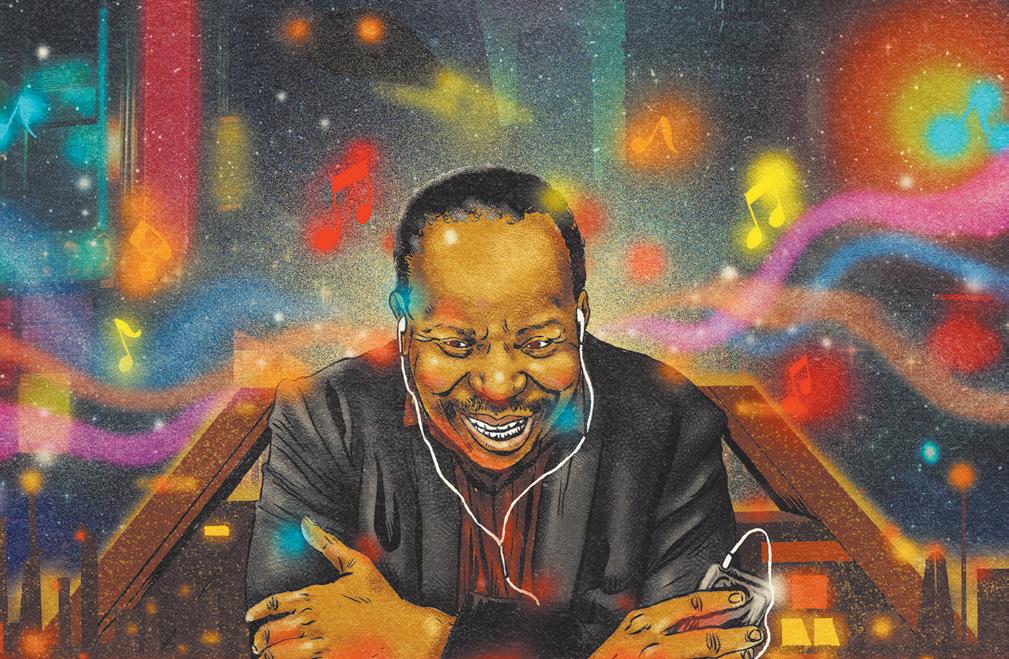
The author, depicted here listening to his favorite version of Vangelis’s futuristic score.
rest are in the music, they inhabit the score like Spinozian modes in the substance of a god whose face is the “whole universe.”
Vangelis, who died in 2022, composed the soundtrack in his “control room,” Nemo Studios, which he operated in London between 1975 and 1987 (his peak years). He primarily used the best synthesizers—his workhorse, the Yamaha CS-80, had a central place in his studio. When we enter the Blade Runner world, we hear the Yamaha CS-80 accompanied by sound effects processed by
Vangelis scored less a movie and more an invisible metropolis that spreads out in all directions.
a digital reverb machine. In fact, his studio, with its computer monitors, synthesizer setup, and mixing console, looks much like the spaceship that slowly approaches the opening’s pyramids.
The genius of hiring Vangelis to score this science-fiction film is not that it’s set in the future, but that he was, at the time, one of the few mainstream musicians who
was familiar with the new instruments. As with Brian Eno, synthesizers and electronic production had been his bread and butter for a decade. And so, the idea was not to make the future city sound purely hightech and unfamiliar, but like a place that combined the old and the new, advanced technologies (flying cars) and old technologies (bicycles), dilapidated buildings with gigantic corporate towers. Vangelis’s music was made with the latest machines from Japan, but in the then-new artificial sounds we hear echoes of the immemorial. This was the city in 1982; this is the city in 2019.
If you are going to perform Vangelis’s Blade Runner score, you must use electronic instruments, which is why the UK-based Avex Ensemble employs, for their live performance of the Blade Runner score, synthesizers, electric strings, electric bass, and electrified drums. Indeed, the Avex Ensemble specializes in electronic film soundtracks, because cinematic worlds such as Blade Runner’s would sound and feel all wrong with traditional orchestral instruments. We would not feel the haunting immensity of Deckard’s LA with the music of, say, Bernard Herrmann, whose masterpiece, Taxi Driver, is set in a New York City that’s as gritty as the streets of Blade Runner’s LA. But we see the people and the city in Taxi Driver . They are not
in the music. Vangelis’s people are invisible; they are specters in a haze that’s as synthetic as the androids Deckard hunts down and kills with his futuristic blaster. Though Avex Ensemble’s performance will be synchronized with the 1982 version of the movie, it could be played to a blank wall in Benaroya Hall. And I think this is Vangelis’s greatest achievement. His score is so masterful, so immersive, so urban in its mood, that it doesn’t really need the movie itself, with its world-weary detective drinking whiskey on a balcony miles above the streets, with its artificial femme fatale whose memories are not real, with its pack of cyclists in the rain and smoke. The score can stand on its own, a fact made plain by the Esper Edition—a bootleg version of the soundtrack that was released in 2002, has 33 tracks, includes dashes of dialogue and sound effects from the film, and runs for 113 minutes (the first official soundtrack, released in 1994, is pretty worthless, as it’s missing many important tracks; the second one, released in 2007, is better but also missing important tracks).
The Esper Edition version, which I often sleep to, is the cookie. It’s all one needs to see-feel Vangelis’s incredible city.
See Blade Runner Live in Concert on Saturday, January 17, 2026, 8 pm at Benaroya Hall.


BY KATIE LEE ELLISON




Instead of another year-end best-of list, I want to shout out the local writers who toil to find the right words in and around our very town, and don’t always get the shine they earn and deserve. In this wild world, local community is ever more critical to our survival, and books are our collective light in the darkness as we barrel toward the winter solstice and the darkest, wettest days of what has been another whomp-dinger-doozle of a g-d-help-me year. Do yourselves a favor and spend your dollars or library time on these artists who give us varied voices, strange stories, and new ways of seeing our world. One by one, here’s how each of them does it.
Diana Xin, Book of Exemplary Women
Book of Exemplary Women is the debut collection of stories from a writer long established in Seattle, Diana Xin. Xin— who ran the Hugo House Fellowship 2015–2016 and is now a contributing editor of Moss, a Seattle literary journal—is well deserving of our attention. In Book of Exemplary Women, dead animals, ghosts, and vampires are our ways into the inner lives of women in the suburbs, from Chicago to Beijing. Ancestral and personal histories haunt these tales, and Xin weaves quiet pain, humor, and anger in her both lyrical and spare prose. It’s a must-read if you’ve struggled with faith or sleeping through the night, or longed for a series of examples of what exemplary women do under ancient and daily pressures.
Sara Jaffe, Hurricane Envy Max Delsohn, writer of the recently released, lauded, brilliant, and highly Seattle-specific short-story collection Crawl , called Hurricane Envy “Sara Jaffe’s masterpiece.” And to that, I say: amen. This collection of stories shocks
with its quiet refusal of resolution: A baby is left in close proximity to a hostile stalker, for example, and no one thing in particular happens as a result. But you can’t help but imagine what might’ve happened beyond the page.
Throughout Hurricane Envy , Jaffe skillfully sucks us into each narrative, then jerks us back into our reader bodies with her precise capture of time. There is often a shock of an event juxtaposed against a stark reality. These stories speak to our greatest social ills through all-too-familiar situations in unfamiliar bars, record shops, and a barn that could hold 40 grand pianos. Compelled? Really, you should be.
Pollokoff, Night Myths • • Before the Body
Abi Pollokoff’s Night Myths • • Before the Body is somatics on the page. In this poetry collection, she creates musicality in her repetition, cutting phrases
Books are our collective light in the darkness as we barrel toward the winter solstice and the darkest, wettest days.
with periods at sharp and frequent intervals to create songs of rage and fury and rebuilding. If you’re a woman confused about what it means to be a woman, how to be a woman, you will find yourself at home in these pages. If you are the type to wonder how we humans are made, how we are put together, and how we come apart, hang out with Pollokoff in this collection. Reading this book had me think-
ing of cycles, of the full surface of our bodies we shed from our skin every seven years, and how compost is life and death at once. Here are some frequently appearing words if you’d like a peek into her style, tropes, and aesthetic leanings: lily, cross and uncross, bonesap, light, insides, birch.
Laura Da’, Severalty
Read this poetry collection and, no matter how well read you may be, learn new words. Be touched in your gut before you see it coming. Get a nuanced, precise, and truly wise voice on the experience of health and survival as a woman and a Native woman in this country, now and before. Laura Da’ writes with her heart and her gigantic mind. A few of Severalty ’s themes and subjects: generations, health, survival, Genesis and Aristotle, rebirth and fruits, nations and treaties, aging and nature, and, of course—because it’s really good poetry—death, love, and time. Da’s writing is a well more of us would do ourselves a favor to tap.
Jamie Silvonek, Marginal Verse
This poetry collection came to me by recommendation from beloved local poet Ally Ang. Jamie Silvonek wrote these poems and published them from prison, where she’s served the last 10 years after having been incarcerated at the age of 15. She was convicted as an adult, has since applied for clemency, and is now in the hands of our judicial system. Marginal Verse is raw, from a sharp mind with a rare and compelling story and perspective. We don’t always get access to published writing from incarcerated folks, and this is an opportunity to engage directly with the inner world of someone living a tragically complex reality inside our broken justice system.
(Also by brilliant local writers who also absolutely deserve your attention and dollars.)
Ching-In Chen, Shiny City
A poetry collection many years in the works from a teacher, an activist, and your favorite local poet’s favorite poet reaching into the history of Chinese immigrants who picked fruit in Riverside, California, to tell the tale of a global future.
Kalehua Kim, Mele
This is Kim’s first collection of poems, which won the 2024 Trio House Press Editors Choice Prize. If you’re a form nerd, you’ll love this book.
Margot Kahn, The Unreliable Tree
Kahn is the author of Horses That Buck: the Story of Champion Bronc Rider Bill Smith , and coeditor of two essay anthologies, This Is the Place, and Wanting (one of my favorites). This collection of poems tracks her early years of parenthood alongside the seasons of her family’s orchard.
Kirsten Sundberg Lunstrum, Outer Stars
Lunstrum is the author of five books of fiction, and this latest won the 2025 Katherine Anne Porter Prize in Short Fiction. The seven stories examine how we survive the wreckage of our planet, physically, relationally, culturally, and psychologically, and offer hope.
Josh Fomon, Our Human Shores
This is Fomon’s second collection of poems. Like Lunstrum’s stories, Fomon takes on “how language is rooted within the Anthropocene—and how poetry shapes meaning-making, faith in people and institutions, and death through lyricism, experiment, and ecopoetics.”
BY AMANDA MANITACH
“Did you see Washington Crossing the Delaware ?” a security officer asked as I scrutinized the labyrinthine floor plan of the Metropolitan Museum of Art. “It’s the largest painting in the American Wing. Nearly 22 feet across!”
I had indeed seen it, in all its largeness. It dominated the gallery packed with a crowd that collectively craned its neck to take in the larger-than-life future president, his stony stoicism radiating bombastically amid turbulent waters. But that’s where my experience of the art diverged from the rest of the tourists in the room.
I held my phone up to the painting, and then, as though a hit of psilocybin had just kicked in, the details of the painting began to move. The floating ice atop the river currents jostled, oars churned, and the chests of men heaved. Words materialized: “Rights Of Nature” seared white against the overcast sky, only to dissipate just as quickly into a scattering flock of white birds. The image of Washington and his men soon melted, water giving way to effervescent vegetation that coalesced into shifting forest, which dissipated into a radiant night sky with the words “landback” stamped into the black. I’d never seen anything like this before—not in a museum, or anywhere.
Nearby visitors did a double take at the image dancing across my phone. This visual sorcery was happening on my screen, augmented reality unfolding in real time. Other people were witnessing a frozen moment painted by Emanuel Leutze in 1851. I was watching an artwork called LANDBACK by an artist called Flechas. Twenty-six artworks like this one are currently being activated at the Met, available to view through the end of the year.
Titled ENCODED , this guerilla art exhibit is an attempt to address the erasure of Indigenous presence throughout American art history. The absence of Indigenous bodies—or Indigenous anything—is a glaring omission among the 20,000 artworks on view in the American Wing. Instead, galleries are filled with pristine, unpeopled landscapes, there for the (re) claiming. The romanticized paintings of Albert Bierstadt and his Hudson River School colleagues set the tone early on, and as colonizers decimated the lives, fortunes, and lands of some 1,000 Indigenous tribes across Turtle Island (the Indigenous name for North America), the genre was cemented into art history. Paintings served as postcards for westward expansion, offering a thinly veiled (if veiled at all) gospel of manifest destiny.

To access ENCODED (on view through the end of the year), visitors at the Met can launch an AR viewer accessible via QR code on the exhibit’s website, encodedatthemet. com. The site also offers a gallery of videos that capture what the experience looks like firsthand, as well as a link to an Amplifier
ENCODED is, simply put, unprecedented— both for the technology it employs and because it is unsanctioned.
app that allows folks at home to activate the static target images through their phone. While it features work made by 17 Indigenous artists from across the continent, ENCODED has tendrils deep through the Pacific Northwest. It is also, simply put, unprecedented, both for the technology it employs and because it is unsanctioned. Not illegal, per se, but executed without permission.
Hacking the Met was something Cleo Barnett had been thinking about for years. It was the kind of thing her nonprofit, Amplifier, was made for. Founded by
Barnett and Aaron Huey nearly 10 years ago in Seattle, the media lab works with artists and technologists to create unforgettable multimedia campaigns focused on disrupting, educating, and amplifying voices. With under 10 employees, the team is small and limber—they can work fast in response to political and cultural events. “We have always been interested in how we can bring the voices of artists from our community into different public spaces, in order to tap into collective consciousness and shift it,” says Barnett. “The American Wing of the Met is the pulse point of the propaganda that we’ve all been told about the founding story of this country in its current form.”
Technology provided a way to address these omissions through AR interventions by Indigenous artists. But the timing and the funding (or lack thereof) was never quite right until this past summer, when Barnett pitched the idea to an anonymous Indigenous funder who agreed to take on the project immediately. With only a threemonth runway to Indigenous Peoples’ Day (the second Monday of October), Barnett brought on Tracy Renée Rector to curate the group of artists. “I wanted to show the breadth of Indigenous technologies, ranging from millennium-old pottery to digital art—a span of Indigenous creativity,”
says Rector, a filmmaker and curator who splits her time between Portland and Tacoma. For the past decade, Rector has served as the executive director of Longhouse Media, which she cofounded and which produces the youth media program Native Lens. “In the two months before the launch, the technology itself changed so much,” says Rector. “The tech is so incredibly new that even a week before the show, there were major adjustments.”
Many of the pieces in ENCODED push the limits of what AR can currently do, like rendering 3D images that are anchored to 3D objects. Katsitsionni Fox’s Gifts From the Ancestors appears tethered to neither earth nor air. The target artwork in the Met’s collection is Indian Vase , a marble amphora by Ames Van Wart, the well-to-do descendant of colonizers (his grandmother was Washington Irving’s sister) and European playboy. The ornate vase, which was created on the occasion of America’s centennial, features two Indigenous warriors perched on the rim, hunched in resignation. The scene of a buffalo hunt—a wistful memory—plays out in relief carved around the base. Seen through the lens of ENCODED, the marble is eclipsed by a huge clay Haudenosaunee vessel painted blue and decorated with meteor showers. As the viewer circles
around the plinth, tails of shooting stars spiral through the air, raining down.
Nearby is Cass Gardiner’s transformation of Jerome B. Thompson’s The Belated Party on Mansfield Mountain. It’s a saccharine painting featuring a group of rosycheeked picnickers in gowns and ascots gathered on a mountaintop. One figure—a shabbier, less dandified iteration of Caspar David Friedrich’s Wanderer Above the Sea of Fog—stands gazing into the expanse of the unfolding mountain range. Gardiner’s activation turns the bucolic landscape into a pixelated image displayed on an old Windows screen—a scene from the Oregon Trail computer game. Two 8-bit Indigenous figures pop up in frame, accompanied by a text block that says: “Look at these guys, acting like they discovered the place.”
Mexican Girl Dying is another piece in the Met’s collection—a woman wounded in battle, rendered in marble, recumbent on the floor of the bustling Charles Engelhard Court. The fortress-like neoclassical façade of the Branch Bank of the United States (originally located on Wall Street) serves as backdrop to the spectacle. Her back is arched as she clutches a naked breast in one hand, a rosary in the other. The sculptor, Thomas Crawford, carved the piece in Rome in 1848, inspired by William H. Prescott’s sensationalized History of the Conquest of Mexico, published just a few years earlier.
Priscilla Dobler Dzul’s augmentation of Mexican Girl Dying is a literal and figurative redressing. The nakedness has been covered with a heavily embroidered pelt of a puma—the digital rendering of a piece Dobler Dzul created for an exhibit at MadArt in Seattle in 2023. The original was made using the pelt of a cougar that died in captivity at a local zoo. The AR component proved one of the most ambitious in the exhibit; both the pelt and the marble sculpture were photographed thousands of times from every angle, in every type of light. (For each piece in ENCODED , the Amplifier team visited and photographed target objects at the Met continually throughout the full breadth of daylight hours in order to seamlessly recreate the image in AR.)
For Dobler Dzul, the intervention is a celebration of her Yucatán Maya ancestry, an attempt to undo the colonial flattening of the cultural identities of nearly 70 Indigenous tribes that populated the region currently known as Mexico. It is also an act of defiance: interrupting a gaze that is endemic to the colonial exploitation of bodies. In another room in the wing, Jarrette Werk reimagines Seymour Joseph Guy’s Story of Golden Locks—a shadowy depiction of a little white girl regaling her siblings with the British fairy tale—into a portrait of his niece, Harmony. Werk is a journalist and photographer who works for Underscore Native News in Portland, an organization that covers Indigenous communities in the Northwest. For his piece, Werk interviewed and filmed his young niece Harmony (or Bííín íθeih in
Aaniiih). In The Story of Bííín íθeih, what emerges from the shadows of Golden Locks is a portrait of exuberance. Trembling rainbows burst into fields of flowers as Harmony describes the joys of being Native.
”So much of the photography of our Native youth has served as propaganda,” Werk says. “Photographers came through Indian boarding schools with a mission to document children being ‘civilized.’ So many of those children look so sad. In the
who gets paid, who gets seen. The work of dismantling and rebuilding these structures goes hand in hand with decolonizing work. Violence, power, and genocide are all intertwined, encoded within art history.
Upon entering the American Wing, DinéYazhi´s piece is one of the first interventions activated through the exhibit’s AR filter, with text superimposed over a lavish mosaic fountain mural designed by Louis Comfort Tiffany. The augmented
As though a hit of psilocybin had just kicked in, the details of the painting began to move.
work I do, the youth I encounter are beautiful, vibrant little spirits. They’re having fun. There are many lasting impacts of colonization, but we’re beginning to see intergenerational healing. That’s what I wanted to showcase.”
Portland-based ENCODED artist, writer, and activist Demian DinéYazhi´, from the Navajo Nation (Diné), doesn’t mince words: “Western art history is colonial propaganda.” It’s one of many letterpress statements DinéYazhi´ created for the series Protect the Sacred Voice , made during a residency at Mullowney Printing.
view reveals a neon sign that flashes across the iridescent Favrile glass swans. It says: we deserve dignity over solidarity / we desire survival over statements / we demand resources over acknowledgements
ENCODED is not DinéYazhi´s first time hacking a museum. Their piece in the 2024 Whitney Biennial served as a Trojan horse of a poem; stanzas of red neon letters mounted to a steel framework made headlines because of a hidden message revealed only after the piece was installed at the museum. As the neon letters intermittently flickered, they spelled out the words “free Palestine.”
Nicholas Galanin’s iconic Never Forget (featuring the words “INDIAN LAND” in the style of the old Hollywood sign, originally erected outside Palm Springs for the 2021 iteration of Desert X) appears nestled along the horizon of Jasper Francis Cropsey’s 1865 painting Valley of Wyoming . In other paintings still, Cannupa Hanska Luger’s Midéegaadi figures dance across hollow landscapes, or emerge through the tangled flourishes of 19th-century wallpaper covering gallery walls—dances to summon the bison back to the land. At times the dancers’ toes balance on the precipitous edge of the painting’s gilt frame. In such moments the seamless integration of the augmented image is pure thrill.
As of now, the Met has yet to issue an official statement about ENCODED and its interventions (though it seems it would behoove the institution to acquire the exhibition works and offer them as a permanent extension of their collection).
Regardless, the strategy behind ENCODED is a success on many levels. It navigates defiance with delicacy: No art was harmed in the making of the exhibit. Perhaps most importantly, it feels like a breakthrough in the way art can be experienced on the most fundamental level. I won’t lie: Once you’ve begun to unlock the
DinéYazhi´ has never stepped foot in the Met. “When I first got the call from Tracy, I was nervous because the Met is one space that I refused to enter,” says DinéYazhi´. “I refused to allow my ancestral philosophies or symbols to be in conversation with the space through my own practice.”
DinéYazhi´s work is frequently rooted in language, text used directly and subversively to critique the institutional structures and powers at play in the art world— powers that dictate who gets to make work,
“At the end of the day it’s not a priority of mine to tell people to go to the Met to experience this exhibition,” DinéYazhi´ says. “I think the major takeaway is that we become aware of ways we maintain our power as artists and as individuals in this shared time in our history. As artists, we need to continue to dream new ways of strategizing in these spaces, of challenging these spaces, of maintaining our voice.”
Unlocking the art in ENCODED feels like a scavenger hunt after a while.
artworks in ENCODED, it’s hard to go back to viewing the static, one-dimensional relics. And I don’t think that’s a bad thing. At a time in human history when technology seems to be threatening our collective intelligence and livelihoods, the breakthroughs produced by Amplifier and the artists of ENCODED prove that we are still only just beginning to discover the potential of the new tools at hand. And (as is often the case), it is artists who lead the way in dreaming that potential to life. ■
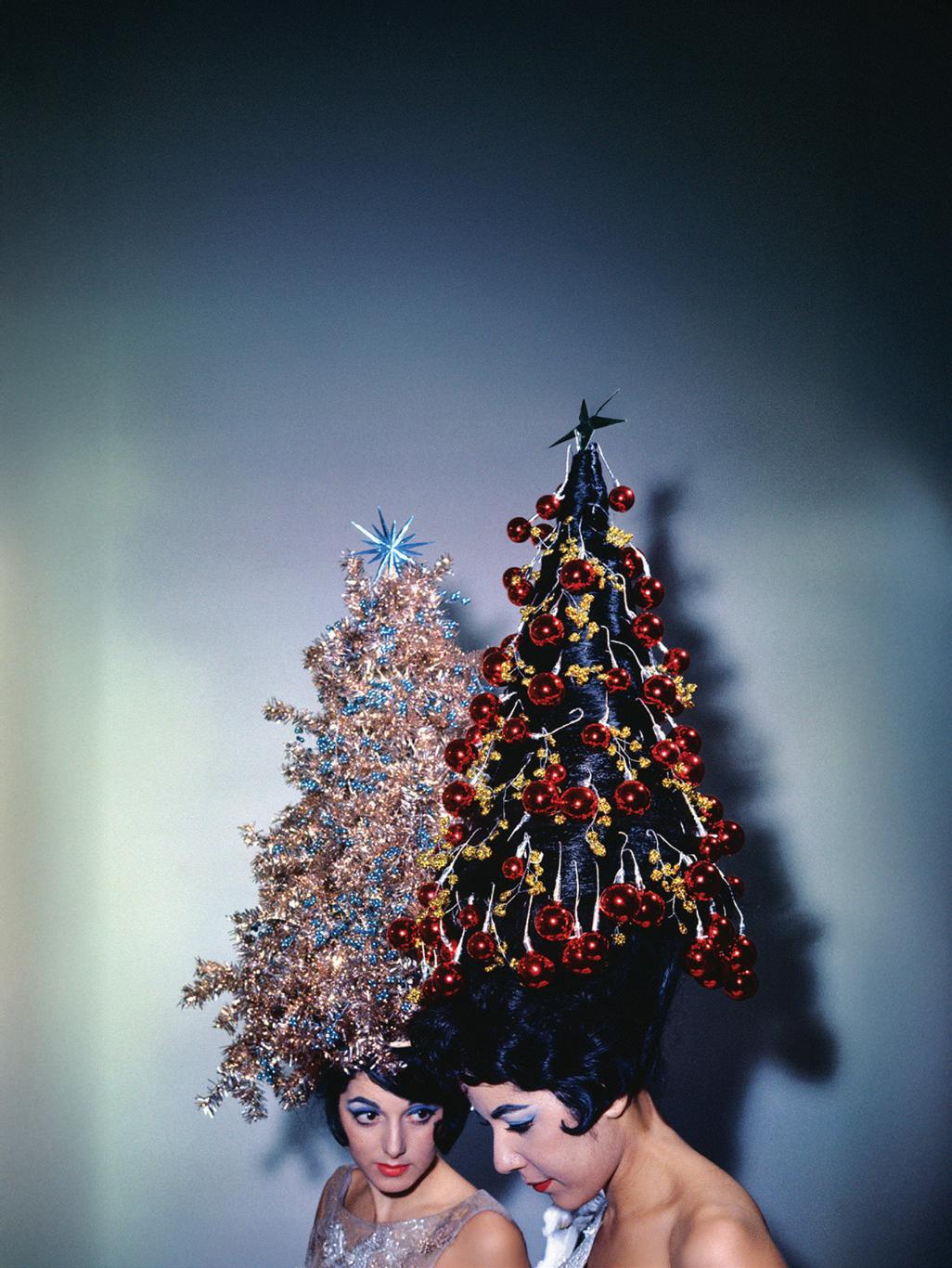

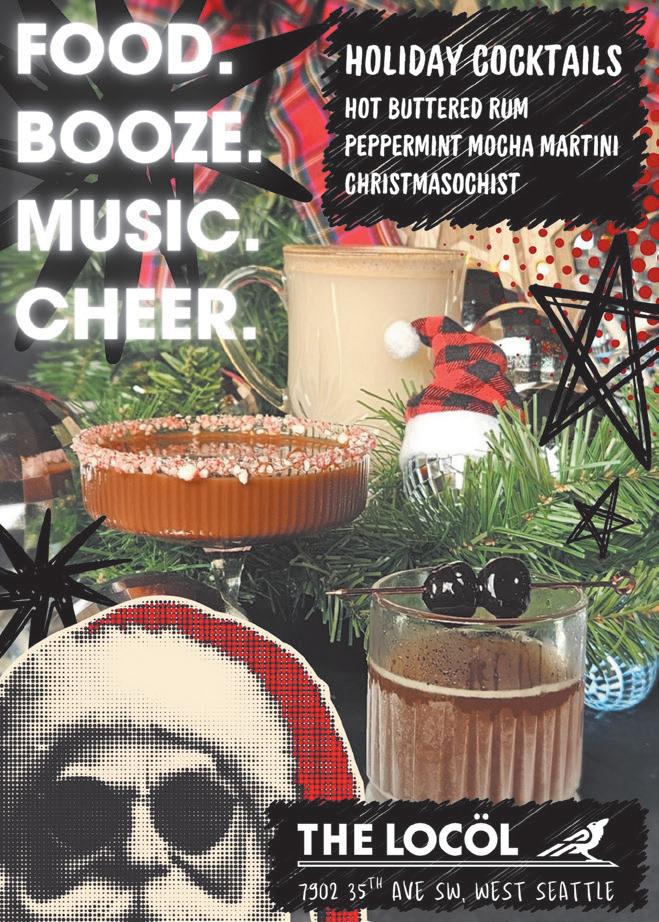

BY MEG VAN HUYGEN
I’ll come out and say it: Here, in the atheist-est part of the nation, the most important part of the holiday season is the food and drink. If you’re in it for the Christmas spirit or the religious euphoria, that’s very nice, and I’m happy for you. But in a sometimes-lonely city of mostly transplants, when weather is doing… what it does this time of year, a nice fatty meal and a boozy drink in hand are more likely to nurture a cold Seattleite’s soul than a production of Handel’s Messiah Also, frankly, this is one of the nation’s great bar towns, and Seattle industry folks tend to really revel in the holiday drink program as a creative prompt. Even if you don’t drink, the city’s bars are primed to hook you up with some serious seasonal cheer to brighten the drizzliest December day—at flexible booze levels. Check it out. We’re good at this.
Your favorite restaurant and mine, Lenox , is one of the few in Seattle that’s doing coquito this year. Their take on this coconutty Caribbean version of eggnog is made with coconut milk, evaporated milk, condensed milk, holiday spices, cacao nibs, and Lenox’s house blend of butterscotchy Bounty gold rum and Planteray’s Three Stars white rum blend. It’s got a lightness to it—all the classic eggnog flavors without the gloppiness. Coquito is

updates for 2025. The Battle Plan is their answer to a clarified milk punch, comprising mezcal AND tequila, Nixta Licor de Elote, Pamplemousse Liqueur, Licor 43, cereal-infused milk, grapefruit, lime, bergamot, and winter spices—topped with club soda and oat & hazelnut foam. Also back is Fuller, Go Easy on the Pepsi!— that’s WhistlePig cask-strength six-year rye, cola reduction, Luxardo sour cherry bitters, Ango bitters, and an orange spritz. (The bar actually bought their own barrel from WhistlePig, so it’s a Sitting Room single-barrel exclusive.)

served at Lenox’s beautiful bar all month, and it’s also available in N/A 32-ounce bottles to take home and add your own rum to (or not).
Once again this year, the Sitting Room is doing their glamorously elaborate Home Alone cocktails, with a couple
Also on Lower Queen Anne, the crunchy old Streamline Tavern is doing a crazy-deluxe eggnog designed by Seattle’s own president of Chartreuse, Matt Pachmayr (bar manager at Le Coin). This one is giving Sitting Room a run for their money when it comes to sheer fance: Matty’s version has yellow and green Chartreuse, L’Encantada XO Armagnac, Roger Groult three-year Calvados, Foursquare 2011 rum, Worthy Park Single Estate Jamaican rum, eggs, sugar, and cream.
At the Portuguese-influenced Lonely Siren in Pike Place, bartender Grace Dai is hyping the Witching Hour Wassail: pear cider, Pisco, Madeira, cardamom, and clove-spiced pear butter. Owner Brandi Sather is also doing a cookie shot, made with housemade tequila butterscotch schnapps, housemade Irish cream, and housemade maple whip—and a housemade cookie on top. Pair it with a pastel de nata, one of Portugal’s national dishes, made
from a recipe by chef Randall Ventura’s grandma, Ana. At Belltown’s Rob Roy , bar manager JoJo Kitchen has devised a whole holiday drink program, and she’s going all out. Among her crafty cocktails this year are the Run Run Reindeer, which is mulled wine reduction, lemon, prosecco, and aromatic bitters, and I’m also a big fan of the understated Snowball Old-Fashioned, made with rye, gingerbread, aromatic and wormwood bitters, and orange essence. If you’re feeling a little more extra, there are a few other highly festooned drinks on the menu with eight or 10 different ingredi ents apiece, served in red and green dinosaur-shaped mugs. Kitchen was largely behind Rob Roy’s recent James Beard Award nomination, so you know every single one of these beverages is a real, ahem, tree-topper.
Along with a dozen other Seattle bars, Dark Room is participating in a promotion by Reykjavík Spirits, wherein each is assigned a cocktail to serve that contains Brennivín, a caraway-flavored aquavit that’s the pride of Iceland. In Icelandic lore, the 13 sons of cannibal troll Grýla, called the Jólasveinar , punish bad children around Yuletide, and each troll child is lending his name to a local cocktail. Dark Room’s serving a drink named for Askasleikir (“Bowl Licker” in English), and it’s got Cocchi Americano, Suze, black lemon bitters, burlesque bitters, and Brennivín Special Cask Aquavit, aged in bourbon and sherry casks. I’m sure all the Yule Lad drinks are delicious, but this one has the good stuff—the red-label Brennivín—and it’s the one you wanna start with.
and I also love the N/A Santa’s Little Helper: It’s essentially a cherry Italian soda, with Luxardo black cherry syrup, soda water, and a splash of cream.
And at the sultry secret-most bar in the city, legendary bartender Keith Waldbauer is bringing back his signature banana bread old-fashioned to the Doctor’s Office as a last blast before he moves on to more southerly climes. ([ Loud stage whisper ]: RENTON.) Made with a house rum blend that’s infused with brioche and a crème de banane liqueur by Pairidaēza that reminds me of plantains, plus a bit of Amaro Amorino Riserva from local operation Letterpress Distilling, the BBOF usually sells out imme-
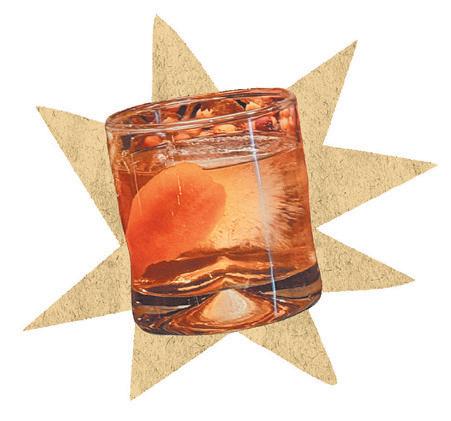
diately, so act fast. Waldbauer will have a batch ready starting December 1. TDO’s also doing their luscious signature eggnog with amontillado sherry and reposado tequila, so you better snag one of those too.
Honorable mention:
The cozy Fireside Room at the Hotel Sorrento is doing a spread of festive drinks to sit with by the hearth. The Sugar & Spice is a fragrant favorite, made with rye, Faretti biscotti liqueur, ginger, orange blossom, and chocolate mole bitters. The Midnight Mistletoe Smooch, with fino sherry, sweet red vermouth, and saffron-scented Meletti Amaro, is another sweet little pick-me-up,
For the third year, Queer/Bar has polymorphed into its big X-messy Christmas Dive Bar manifestation, and it’s reportedly bigger, boozier, and merrier than ever. The bar’s serving up an expanded menu of holiday cocktails with names like Butterbeer Fizz, Grinch Martini, and Mistletoe Margarita, alongside nostalgic snacks like meatballs and Lil Smokies. At press time, there were no available details on what these festive cocktails actually contain, but perhaps more than the specifics of the drinks themselves, it’s about the spirit of the Christmassified space itself—and making merry inside of it. If you swing that way. ■

(And More of What’s Hot and What’s
BY MICHAEL WONG
ILLUSTRATION BY STEVIE SHAO
All of a sudden we’re in the final stretch of 2025, and amid the myriad of orange-colored bullshit.
I’m glad we survived, and am excited to thrive with you in 2026. But as we look forward to a new year, let’s remember what to leave behind: What’s corny, what’s tired, what’s holding us back, and what can we do better? Written by an Asian guy, for Asian people, but to be enjoyed and considered by all. This is the Asian Verified Ins and Outs list for 2026. Ready? Let’s do it.
Asian Baseball Players
Fucking YAWN, am I right?
Okay, it’s not really like that, but sports fans must know, Asians in sports is a boon. (You saw what Koreans did for pop music.)
And I’ll be honest, as an Asian Mariners fan, I’m still quite peeved that Ichiro himself wasn’t enough to lure greatest-baseball-player-ofall-time Shohei Ohtani to Seattle. And what’s worse for me is that the World Series champion Dodgers have a bunch of Asians on the squad (even their
coach is Asian), and with that the World Series MVP is a Japanese man (not even named Shohei).
This reminds me of when KPop Demon Hunters came out. I had the same feeling: Are we winning too much? Are we flying too close to the sun here? Are we poised for a crashout the likes of which has not been seen since cauliflower had its time in the limelight in the 2000-teens?
I don’t want that for us, and if rolling out the Ichiro song and dance doesn’t work to woo incoming Japanese star Munetaka Murakami, I think it’s time Seattle switches our attention to another sport where Asians
are excelling, in our area this time.
In: Asian Basketball Players
While I don’t have news related to a CBA and NBA merger happening in Seattle, what I can offer is that Seattle University has quietly put together a roster full of Asian collegiate superstars from China, Japan, and Korea: the trifecta of cultural imports from the Orient. These stars are Chinese center Houran Dan, Japanese power forward Yuto Kawashima, and Korean forward Junseok Yeo, who also plays for the South Korean national team.
So what is it about little ol’ Seattle Univer-
sity that can attract top Asian talent where major league teams just cannot? I may have an answer. The head coach of Seattle University’s men’s basketball program is none other than Chris Victor, a Caucasian man, yes, but one with deep ball knowledge, and specifically Asian ball knowledge. As a player, this man helped his team in Irvine, CA (the Bellevue of SoCal), win a NAIA (National Association of Intercollegiate Athletics) championship title. This dude was probably chugging bobas and eating KBBQ within mere hours of raising that trophy for Irvine.
This is ball knowledge only a man who came up on the court with Asians can have. And it’s part of why the man is 80-56 over the past four seasons. Something to monitor in Capitol Hill.
We’re in dark times, folks. If it wasn’t bad enough that everyone is using ChatGPT to write unnecessarily reflective Instagram captions about matcha, we are now witnessing the shameless use of AI to generate pictures of food by the restaurants themselves. Make it make sense.
The day I started realizing this was happening, at beloved spots across town, I felt at the center of an Idiocracy reboot. Excuse me, but why in the fuck would you, a Chinese BBQ restaurant, for example, choose to have AI create unsettling pictures of Chinese BBQ, when you could just go into the kitchen and snap a pic of the delicious Chinese BBQ that you actually make and that exists in real life?
This is only one example, but maybe the most egregious. And it comes with a warning: If you, as an operator, feel the need to generate images of food—food that you already make and serve—it’s time to go on a vision trip or something. Find God. Volunteer. I don’t think selling food is for you.
Here’s a big idea: If you sell food, and you have a social media account for that, put photos of food on your social media account.
I’m not even talking about AI (again, don’t use it), I’m talking about posting photos of the food you make in general. You think I’m being facetious, but oftentimes I’ll visit a mom-and-pop page and see maybe 60 to 70 percent of their profile just being flyers of events they got suckered into sponsoring or otherwise promoting. And I’m looking at the family members responsible for running IG while their family operates the business—you know better! Stop fumbling the bag for your fam. If you can’t be bothered to grab some shots of food heading out the pass, repost some of the patrons who tag you throughout the week. Hell, use an OLD picture you may have in your phone, I guarantee it’s better than those 14 terrible Canva flyers parked on the grid for events that already came and went. Take a seat with me when I say this: Give the people what they want! (Pics of the food you make.)
I’m no nightlife historian, but as I see it, the death of the nightclub happened around
the time that kids started feeling good about wearing pajama pants in public. What seemed like an innocuous fashion trend really just put up a mirror to society: Something went terribly wrong, and now our sweatpants- and Crocs-clad society would rather Super Like on an app than
The death of the nightclub happened around the time that kids started feeling good about wearing pajama pants in public.
shoot our shot on the dance floor. Rejection on our own terms. Social interaction and decorum: truly casualties of the pandemic, and infinite scroll.
Makes sense, but let’s take this for what it is: a shakeup in the social structure, an ebb that needs a flow. Without an ample nightlife, what are we to do about this Asian birth rate crisis? What will Vietnamese dudes do with all their Ross button-down shirts? Church only comes once a week, after all. And what will come of the Hennessy and XO stocks if Asian folks start coming out less? We’re not thinking enough of the Cybertrucks.
All this energy needs to go somewhere, though…
In the search for a solid third place in Seattle, and namely one for Asians or Asian stans, a new meta of mahjong social nights has emerged to the delight of many former ABGs and clubbing elite.
Across the CID, these mahjong social clubs have started popping up via Emerald City Tile Club (ECTC), Mahjong Mondays at Kilig, and more. What I can tell you is that night and social life IS alive and well in Seattle, just hidden in after-hours cafe situations across a game legendary among Asian grandmothers.
And regardless of your nationality or familial status, if you’re a cool person and have the mobility to move some tiles around, these mahjong nights are for you.
A perfect foil to the sweaty, EDM-heavy clubbing nights of late, these fun gatherings are right-sized and right-volumed for folks of any age and background to tap in for a good time.
I had the opportunity to pull on a pair of jeans (!!!) and pull up on an ECTC mahjong night at Little Saigon Creative, on a night that happened to host Mahjong author Nicole Wong herself. Following a great keynote interview, the room teemed with gamers who sorted themselves across a dozen tables and started playing motherfucking mahjong, many learning the game for the first time that night. And with a live DJ, food, art, and coffee provided by vendors on site, there was little excuse to not stay a while.
Mahjong social nights are a reminder that the kids are all right, no matter what kinda pants they’re wearing. ■
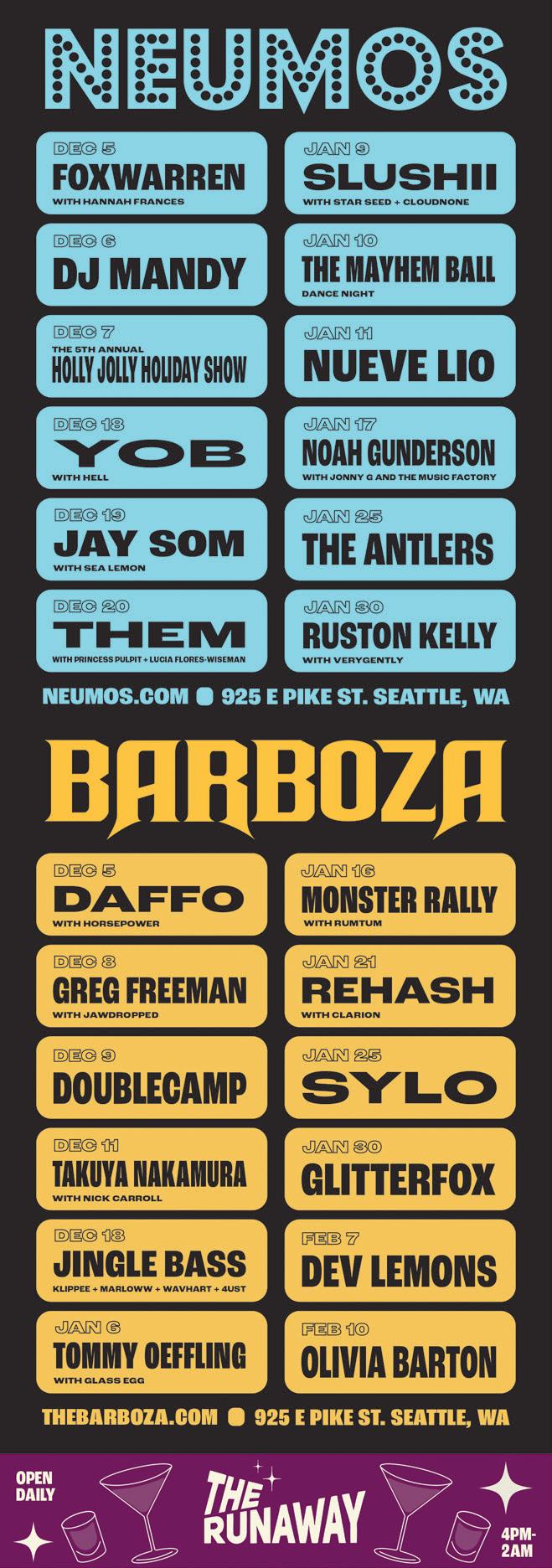



We do our best for accuracy, but please check venue websites for updates and more information, as event details may have changed since press time!
Housekeeping note: We have ceased to include pricing information, unless the event is free or sliding scale. (This is mostly due to third-party ticket vendors, like Ticketmaster, who have a monopoly on pricing that is not only unfair, but also confusing, due to varying fee structures. We hate them, and so should you.)
DEC 4
Rochelle Jordan’s third full-length album, Through the Wall, has made me more excited about new music than I’ve been in a long time, reminding me of when I first heard luminary breakthrough releases like Solange’s A Seat at the Table, SZA’s Ctrl, or Azealia Banks’s 1991. The album leans into a nostalgic club sound, reminiscent of a ’90s fashion show or incidental music on Sex and the City. On the Kaytranada-produced track “The Boy,” Jordan’s velvety vocals sing a
radio-ready hook suitable for Brandy or Aaliyah. My crystal ball says that she will blow up any day now, so don’t miss this intimate show at Barboza. Plus, with openers like London’s Essosa and Seattle’s own Parisalexa, I’m certain that this show will be the dance party of the year. (Barboza, 7 pm, 21+) AUDREY VANN
DEC 5
Felipe Andres Coronel, the Peruvian-bred, Harlem-hardened MC better known as Immortal Technique, is not touring in support of a new album—in fact, the rapper hasn’t released a full-length in roughly
15 years—however, his return to the stage does seem born of the same call to action that led him to release venomous underground-rap classics like Revolutionary Vol. 1 and 2 during the younger Bush presidency. During that time, Tech established himself as the militant mouthpiece of conscious rap, harvesting the revolutionary ethos of bands like Rage Against the Machine and Public Enemy, and cramming it through the meat grinder of the era’s energized battle-rap scene. In more recent years, he has done work counseling prison inmates (of which he was once one), and mentoring young writers, as well as partnering with a nonprofit group to help build an orphanage in Afghanistan. The man walks the walk, and for obvious reasons, there may not be a more appropriate and cathartic time to see an Immortal Technique show that will likely be peppered with political diatribes. We fully recommend you go get an earful. (Nectar Lounge, 8 pm, 21+) TODD HAMM
DEC 11
Takuya Nakamura is not your typical electronic-music producer. The trumpeter and keyboardist moved from Japan to the US in 1990 to study at the New England Conservatory of Music under innovative jazz composer George Russell. This was a big fucking deal, as Russell’s concepts influenced John Coltrane and Miles Davis’s modal music. Nakamura applied those ideas to his own playing, doing sessions with Quincy Jones, David Byrne, Lee “Scratch” Perry, the GZA, Arto Lindsay, and many other notables. Takuya’s solo output encompasses highly musical takes on jazzy drum ‘n’ bass, ambient, broken beat, and funky techno. Check out recent tracks such as “BonJah” and “Caged Bird Flying” and the Jon Hassell-esque dub-jazz of Mysteries of
the Cosmos for examples of his fascinating fusions. Opener Nick Carroll—who used to serve as talent buyer at electronic-music hotbed Kremwerk—is an excellent, eclectic DJ who’s more used to making folks dance for hours at off-the-grid parties than at conventional venues. Trust me, you don’t want to miss his set. (Barboza, 7 pm, 21+) DAVE SEGAL
DEC 12
There’s a small but important coterie of UK groups who respectfully and deftly emulate the motorik rhythms blueprinted by the OG krautrockers. They include Beak>, Cavern of Anti-Matter, Snapped Ankles, Fujiya & Miyagi, and Th’ Faith Healers. Add Cambridge’s Modern Nature to that clique, although they also embrace the sort of wide-screen, brooding rock that Radiohead have taken to the credit union, albeit with less bombast. Led by Ultimate Painting member Jack Cooper (a serious composer who’s had work performed by Apartment House), Modern Nature also have strains of jazzy folk in their DNA, which should appeal to fans of John Martyn and late-career Talk Talk. On this tour, Modern Nature are supporting The Heat Warps, a wonderfully intimate album that imbues minimalist post-rock with beautiful songcraft—a real rarity these days. The sweet-voiced leader of Brigid Dawson and the Mother’s Network formerly played bass and keyboards with Thee Oh Sees. The band’s brilliant 2020 album Ballet of the Apes hovers in the shivery, nocturnal-rock zone of Brightblack Morning Light, but with more instrumental oomph. (Clock-Out Lounge, 8:30 pm, 21+) DAVE SEGAL
DEC 13 & 14
Fela Kuti and Tony Allen may be dead, but their pioneering Afrobeat legacy powers on with more voltage than ever in the 2020s. One of these revolutionary Nigerian musicians’ most skillful disciples, NYC’s Antibalas, have been fanning Fela and Tony’s artistic flames with unmatched fluency and funkiness for a quarter century. The intricate, interlocking polyrhythms, the triumphant horn charts, and the liberatory political lyrics build into perpetual-motion machines that make you think, against all logic, a more just world is possible. Following the departure of long-running singer Duke Amayo after 2020’s Fu Chronicles, Antibalas have returned with the all-instrumental album, Hourglass, which harks back to the group’s first principles, but with greater subtlety. It’s fairly certain that Fela and Tony would bust moves in approval. Opening will be Seattle quartet Midpak, whose serpentine and explosive funk laces African, Latin, and psychedelic elements into potent, partystarting jams. (Hidden Hall, 8 pm, 21+) DAVE SEGAL
DEC 3
I fell in love with Swedish musician Jens Lekman’s music the very first time I heard “You Are the Light (by Which I Travel Into This and That)” on KEXP as a teen and soon graduated to listening to a burned CD of his 2004 debut album When I Said I Wanted to Be Your Dog on repeat, becoming fixated on his melodramatic yearning and witty storytelling. The hopeless romantic has since fulfilled the prophecy he set for himself in the early track “If You Ever Need a Stranger (To Sing at Your Wedding),” in which he volunteered himself as a wedding singer: “You think it’s funny / My obsession with the holy matrimony / But I’m just so amazed to witness true love.” Since then, he’s performed at countless weddings, and his seventh album, Songs for Other People’s Weddings, is a narrative concept album inspired by his experience, accompanied by a tie-in novel by author David Levithan. (Neumos, 7 pm, all ages) JULIANNE BELL
DEC 16
Earlier in this century with Wooden Shjips, guitarist/ vocalist Ripley Johnson took rock to sky-high places through transcendent repetition. Shortly after with keyboardist Sanae Yamada in Moon Duo, he “helped to forge a cool-browed strain of electronic rock that’s ideal for zipping down the Autobahn at breathtaking speeds,” if I may quote myself. Over the last six years, Johnson’s focused on Rose City Band with some of the mellowest and headiest players in Portland. Deviating from Johnson’s previous projects, they ease the foot off the gas pedal and engage in amiable
DEC 16
Earl Sweatshirt has been trying to turn the volume down for years. Once a teenage rap prodigy who found cult fame with, and brotherhood in, “the potty mouth posse” Odd Future Wolf Gang Kill Them All, Earl Sweatshirt now stands at age 31 as one of hip-hop’s old-soul success stories. Having just welcomed his second child and given up booze (and ramped up weed), he confidently told The New York Times’ Popcast this summer that his life is “fuckin’ normal, finally.” The recorded discography of Sweatshirt, born Thebe Neruda Kgositsile, documents the life journey of someone who once helped define, then survived to outgrow, a generation of youthful nihilism. But more than a post-nihilist victory lap, his new album, Live Laugh Love, is a bombastic celebration of passion. Gone are the days where each line was an avalanche of syllables that tumbled across the page like a chorus of cracking double-jointed knuckles; today, Sweatshirt raps with a blunted calm that sounds well-earned, but what remains is the vivid imagery and referential depth you have to rewind (gladly) to fully appreciate, proving he’s still one of the best to ever do it.
(Showbox SoDo, 8 pm, all ages) TODD HAMM
DEC 19
Melina Mae Cortez Duterte, better known by her stage name Jay Som, dubs her brand of dreamy, intimate DIY bedroom pop “headphone music,” citing influences as disparate as Carly Rae Jepsen, Phil Elverum, and Alanis Morissette. She’s opened for musicians like Mitski and Japanese Breakfast, and contributed a song to the 2024 film I Saw the TV Glow. After a six-year break from solo music, during which she meticulously trained her technical skills, she’s released her latest album, Belong, which showcases her growth and leans into pop-punk territory with guest vocals from Hayley Williams of Paramore and Jim Adkins of Jimmy Eat World. Don’t miss an opening set from local artist Natalie Lew of Sea Lemon, who takes inspiration from the eerie beauty of the ocean and describes her vibe as “Costco Cocteau Twins.” (Neumos, 8 pm, all ages) JULIANNE BELL
DEC 31
country rock for people who also dabble with microdosing. Ripley has fashioned an appealing sotto voce singing style (with occasional forays into falsetto) that meshes nicely into the undulating and fluid pedal-steel and faded-denim guitar explorations that dominate RCB recordings. Thankfully, Johnson hasn’t altogether ditched mantric repetition; check out the hypnotic, lysergic “Fear Song” from 2019’s self-titled debut. To reiterate the guiding ethos of my music criticism, the more psychedelic Rose City Band get, the better they sound. So, let’s hope that they enter a reality-altering headspace and get real long gone.
(Tractor Tavern, 8 pm, 21+) DAVE SEGAL
Perhaps this is an unpopular opinion, but Mudhoney could have retired after releasing their 1988 debut single “Touch Me I’m Sick” and still achieved god-tier status in Seattle’s—and Earth’s—underground-rock scene. The foursome’s signature song swerved into the Stooges’ Fun House and pinched Iggy’s nipples hard, while vomiting into Scott Asheton’s kickdrum. How do you follow up such a monumental first release? Well, Mudhoney have soldiered on for 37 years with the same creative nucleus of Mark Arm and Steve Turner, putting subtle variations on their thunderous garage- and psych- rock templates, augmented by abundant and astringent guitar FX. One key to their greatness is, they’re masculine, not macho. Another key is, they possess humor and self-awareness; so even though their sound hasn’t changed much, they still don’t obviously repeat themselves. The band’s riffs and melodies still sting with the vitality of musicians a third of their ages, and even their last four albums—delivered at five-year intervals—rip musically, while spanking all the right people lyrically. These gr*nge warhorses are still thoroughbreds. (Neptune Theatre, 8 pm, all ages) DAVE SEGAL
JAN 3
Consistency, as a critique of art, may connote poorly, but in a medium like metal, which requires an artist to retain an ungodly amount of thunderous energy to remain true and relevant, long-term consistency is rare. To see a High on Fire show—guitarist/vocalist
Matt Pike inevitably bare-chested and imposing, bassist Jeff Matz gray-beardly purveying low-end sludge, and smashing new drummer Coady Willis (who happens to be the same Coady Willis of legendary Northwest outfits the Murder City Devils, Big Business, and occasionally the Melvins)—is to affirm heavy music as the lifeblood of eternal youth. The power trio’s ninth album, 2024’s Cometh the Storm, the first with Willis on kit, carries the same level of fire Pike and co. originally got high on, sounding nothing like you might expect from a group that has earned every right to have gone hoarse and nappy by now. That angle aside, the band still stands in 2025 as a torch-bearer of crunchy sludge metal, continuing to frolic in trippy metal pastures when similar bands of the era like Mastodon sadly could not. (Showbox, 7 pm, all ages) TODD HAMM
JAN 14
It’s understandable if you’ve had your fill of stoic, white-guy guitarists with limited (yet pleasant) vocal ranges. But you should leave a sliver of precious time in your hectic life for Steve Gunn. What he lacks in singing prowess he makes up for in instrumental expressiveness. Gunn’s a guitarist of rare melodic elegance and deceptive soulfulness, as evidenced by his 2013 breakthrough, Time Off, which found him contending with the legacies of British psych-folk masters such as Michael Chapman and Bert Jansch. Since then, Steve’s kept busy with several collabs (Kim Gordon, Mdou Moctar, Mike Cooper, Natural Information Society, etc.) and solo works, steadily building a fan base, with help via Matador Records’ marketing might. This year, Gunn’s released Daylight Daylight and Music for Writers for the more underground No Quarter and Three Lobed labels. The former
thrums with chamber-art-pop splendor; the latter zones out in glowing ambient-drone-fingerpicking space, sans vox. The Triple Door should be a copacetic setting for this music’s understated grandeur. (Triple Door, 7:30 pm, all ages) DAVE SEGAL
JAN 16
For the past 15 years, Cleveland’s Ted Feighan has created a trove of transportive sound collages as Monster Rally. Envision your mid-century Pan Am touching down for several minutes at a time on a volcanic tiki retreat as imagined by the Loyal Order of Water Buffaloes; a bustling, sand-swept day market bearing bold spices and vibrant fabrics from across the empire; a Los Angeles Chinatown bossa nova jazz joint where the password is an inside joke. Alternately, the great thing about Monster Rally is that most of what your brain conjures when dosed with the sounds, Feighan has already made in visual form—most every release has been coupled with an extraordinary magazine cut-out piece of artwork that matches the escapist, exotically colored sounds he’s made, and his live shows are no different. By trade, a multi-instrumentalist beatmaker in the vein of Dirty Art Club, Teebs, or Madlib on his “Curls” beat shit, Feighan has chosen to open his studio for only the second time to outside vocalists (after his 2015 Foreign Pedestrians collab with Bay Area rapper Jay Stone), and the singles so far have displayed the telltale signs of crossover appeal. (Barboza, 6:30 pm, 21+) TODD HAMM
JAN 22
The sound of avant-garde classical ensemble Yarn/ Wire is in the name—fuzzy, fibrous threads interwoven with scratchy, metallic chords. Founded in NYC back in 2005, the adventurous piano/percussion quartet pushes the boundaries of contemporary music with their annual Currents project, which serves as an incubator for innovative experimental music. While their music can be unconventional, the pianos maintain a sound within the classical music realm that is accessible to the general public—meaning, yes, you can bring your parents or grandparents to this without fearing their judgment or discomfort. This is the relaxing kind of experimental music, not the chaotic kind. (Meany Hall, 7:30 pm, all ages) AUDREY VANN
JAN 27
I first heard Welsh musician Cate Le Bon after the release of her 2013 album, Mug Museum, and have been an unabashed fan girl ever since. Her signature sound, which I can only describe as angular, self-assured, and surreal, is a bulletproof formula

that has yet to produce a bad album. Her seventh release, Michelangelo Dying, is no exception. The album is slow-paced and melancholy, with more shoegaze elements than we’ve ever seen from her before, largely due to the all-consuming heartache Le Bon experienced while making the album. The album reaches its apex on “Ride,” featuring my boyfriend John Cale (of the Velvet Underground), which is a molasses-y duet between the Welsh experimentalists bolstered by layered vocals and echoing saxophones. Singer-songwriter/poet Frances Chang will open. (Neptune Theatre, 8 pm, all ages) AUDREY VANN
Pansy, Torch, All Friends Here Dec 3, Tractor Tavern, 8 pm, 21+
19th Annual Tom Waits Tribute Night Dec 6, Conor Byrne Pub, 8 pm, 21+
DJ Mandy Dec 6, Neumos, 10 pm, 21+
Damien Jurado’s December Residency Sundays Dec 7-28, Tractor Tavern, 7:30 pm, 21+
John Prine Christmas with Jenner Fox Band Dec 9, Tractor Tavern, 8 pm, 21+
The Intelligence, Ononos, Dish Pit Dec 10, Chop Suey, 8 pm, 21+
Acapulco Lips, New Age Healers, and iroiro Dec 11, Chop Suey, 8 pm, 21+
Thunderpussy x Mike McCready Dec 11, The Showbox, 8:30 pm, 21+
SMOOCH with Bob Mould and Blondshell Dec 13, The Showbox, 7:30 pm, 21+
Sera Cahoone Band with Carrie Biell Dec 18, Tractor Tavern, 7:30 pm, 21+
Yob with Hell Dec 18, Neumos, 7 pm, 21+
David Benoit Christmas Tribute to Charlie Brown with Courtney Fortune Dec 18-21, Jazz Alley, all ages
Jenny Don’t and the Spurs: Pre-NYE Bash Dec 30, Tractor Tavern, 8 pm, 21+
New Year’s Eve with Kenny G Dec 31, Jazz Alley, 7:30 & 10:30 pm, all ages
Bone Thugs-N-Harmony Jan 9, Crocodile, 6 pm, 21+
Madison Cunningham Jan 10, St. Mark’s Cathedral, 7:30 pm, all ages
The Residents Jan 10, Neptune Theatre, 8 pm, all ages
Seattle Retro Fest Jan 16-17, Crocodile Complex, 6 pm, 21+
Clinton Fearon Jan 17, Nectar Lounge, 8 pm, 21+
Judy Collins Jan 22-25, Jazz Alley, 7:30 pm, all ages
Karl Denson’s Tiny Universe Jan 24, Crocodile, 8 pm, 21+
WAR Jan 29-Feb 1, Jazz Alley, 7:30 pm, all ages

DEC 11
Seattle-born trio Mt Fog uses minimalist electronic sounds and ethereal vocals as a magic wand to “evoke magical spaces, real and imagined.” Their 2024 album, ultraviolet heart machine, gained critical praise due to its whimsical marrying of Björk-style growls with sparkly ’80s synths. Now, the band is back with a new song, “Look Inside,” which they will debut at this single release show along with a snazzy new music video directed by artist Sean Downey with illustrations by Dena Zilber. This show is a must for fans of Cocteau Twins, the Sugarcubes, Kate Bush, Sinéad O’Connor, and Siouxsie & the Banshees. Don’t miss opening sets from cinematic indiepop outfit Von Wildenhaus and improvisational ambient project Power Strip. (Sunset Tavern, 8 pm, 21+) AUDREY VANN




Robyn Hitchcock Feb 6, Neptune Theatre, 8 pm, all ages
GZA Feb 11, Nectar Lounge, 8 pm, 21+
Sudan Archives Feb 14, Neptune Theatre, 8 pm, all ages
The Pains of Being Pure at Heart and Living Hour Feb 16, Vera Project, 7 pm, all ages
Cat Power Feb 20, Paramount Theatre, 8 pm, all ages
Suzanne Vega Feb 22, 7:30 pm, Neptune Theatre, 7:30 pm, all ages
Cardi B: Little Miss Drama Tour Feb 22, Climate Pledge Arena, 7:30 pm, all ages
Aimee Mann: 22 ½ Lost in Space Anniversary Neptune Theatre, 8 pm, all ages
Marissa Nadler Mar 26, Tractor Tavern, 8 pm, 21+
Skullcrusher Mar 30, Barboza, 7 pm, 21+
Raye: This Tour May Contain New Music Apr 3, WAMU Theater, 8 pm, all ages
Cass McCombs with Hand Habits Apr 4, Tractor Tavern, 8:30 pm, 21+
Waxahatchee with MJ Lenderman May 3, Paramount Theatre, 7:30 pm, all ages
DEC 13
For nearly two decades, Equinox Studios in Georgetown has been a hub for arts. Sited in a World War II-era factory, the complex oozes that Georgetown gearhead grit and realness and is home to over 150 artists, from dancers and ceramicists to blacksmiths and painters (such as the brilliant Beth Gehan and Mary Ann Peters). We know that Georgetown loves to throw a good party, and this December iteration
of the Georgetown Art Attack will be one for the books, as it syncs up with the Equinox open house (the annual event usually draws 6-8k visitors). Festivities this year include a pop-up Native Art Market, a host of food trucks, and artist-made fire pits scattered through the block. Live music starts at 4 p.m. with nance!, Flesh Produce, the Noble Manes, Bandski, Sirens of Serpentine Bellydancers, Night Owl, Town Forest, and Lil Lebowsxi. And since it’s Georgetown, of course there will also be a renegade marching band on the premises. (Equinox Studios, 3 pm–late) AMANDA MANITACH
JAN 8–FEB 21
Dan Webb is a woodcarver—the old fashioned kind who chips away slowly at a tree, through sap and heart and bark, to draw things out. His melting chairs and busts draped in luxurious fabric-y folds speak to a mastery of the medium, as well as a playful sensibility that coaxes unexpected meaning from a blank block. Despite the trompe l’oeil playfulness, the wood-ness of Webb’ s sculptures is always felt; the tree is present. Like Michelangelo’s non finito Prisoners emerging from their stone, Webb’s subjects feel as though they’ve willed themselves into being, emerging from the raw pith of the earth. In Yespalier (a portmanteau of yes and espalier—the ancient horticultural technique in which fruit trees are trained along a frame to direct their growth) Webb has created a body of work that is less planned, more improvisational and sketchy. How does one “sketch” with wood? By starting with a simple square frame and carving inward. The resulting sculptures are delightfully meandering, surreal, and all over the place in the best way. (Greg Kucera Gallery) AMANDA MANITACH
OPENS JAN 30
What lies beneath the Great Pacific Garbage Patch? An underwater city loosely based on Seattle and built of fallen trash, of course. While “the damaging effects of commodification and rampant capitalism on our planet” sound like heavy themes for troubled times, this exhibition put on by the group True Misschiff promises to handle the subject with campy panache in an attempt to “normalize non-normative approaches to life and gender” through the adventures of characters like Brosiedon, the douchey ruler of the merpeople. Base Camp 2 has recently restructured its exhibition timeline to focus on four big shows a year, which is great news, as the massive old luggage store space lends itself to immersive worlds such as Merlantis promises to be. In addition to ticketed events and cabaret performances (sponsored by the fictional corporation Blissfish), there will be art for sale, a thematic gift

DEC 12–JAN 10
Three solo shows under one roof at Roq La Rue offer paintings of the jaw-dropping ilk. Each artist wields the paintbrush like a Dutch master, and each delves headlong into the realm of dark fairy tale with their unique twist. Montreal-based Peter Ferguson (described as “Norman Rockwell meets H.P. Lovecraft”) offers luminous (yet somehow dim) visions of sepia-drunk cityscapes and other scenes frozen in time that send the mind spiraling in search of a story. Jean Labourdette’s hyperrealistic miniatures of birds, skulls, and other ephemera are often only two or three inches in size, encased in vintage hinged gilt wood casings or antique reliquaries. John Brophy’s oil paintings of characters seem to glow from within: The shimmer of gathered fabrics, reflecting pools of satin, gloss of grass, and threads of delicate pointelle lace will have you hopelessly, luxuriously lost in the details. (Roq La Rue) AMANDA MANITACH
shop, and more fishy shenanigans available through March. (Base Camp 2) AMANDA MANITACH
More





Scott Coffey: Going on a Walk at the End of the World Through Jan 3, Shift Gallery, free
Asian Comics: Evolution of an Art Form Through Jan 4, MoPOP
Tariqa Waters: Venus Is Missing Through Jan 4, Seattle Art Museum, Wed–Sun
Storytellers: A Group Exhibition Through Jan 6, Stonington Gallery, free
Thirty Years, A Thousand Stories Through Jan 17, ArtX Contemporary, free
Beau Dick: Insatiable Beings Through Jan 18, Frye Art Museum, free
Farm to Table: Art, Food, and Identity in the Age of Impressionism Through Jan 18, Seattle Art Museum
Cultured Commodities: Photographs from the Henry Collection Through Jan 28, Henry Art Gallery, free
Aisha Harrison: Porous Body Through Feb 22, Bainbridge Island Museum of Art, free New Nordic: Cuisine, Aesthetics, and Place Through Mar 8, National Nordic Museum
Boren Banner Series: Camille Trautman Through Apr 12, Frye Art Museum, free
Priscilla Dobler Dzul: Water Carries the Stories of Our Stars Through Apr 19, Frye Art Museum, free Jonathan Lasker: Drawings and Studies Through Sept 27, Frye Art Museum, free
A Room for Animal Intelligence Through Nov 1, Seattle Art Museum
Ten Thousand Things Through Spring 2027, Wing Luke Museum
Ash-Glazed Ceramics from Korea and Japan Through July 12, 2027, Seattle Art Museum
Ai Weiwei: Circle of Animals/Zodiac Heads (Bronze) Through Oct 2027, Olympic Sculpture Park, free Gossip: Between Us Ongoing, Tacoma Art Museum Haunted Ongoing, Tacoma Art Museum
Cut, Stitch, Liminal - Curated by Trung Pham Opens Dec 4, SOIL, free
The One-Two Punch: 100 Years of Robert Colescott Opens Dec 4, Tacoma Art Museum
The Game Show Opens Dec 12, The Vestibule, free Panic Room: Jeju Island.Artist Collective Opens Jan 3, The Vestibule, free
Marjorie Thompson: New Works Opens Jan 6, Patricia Rovzar Gallery, free
Dan Webb: Yespalier Opens Jan 8, Greg Kucera Gallery, free
Sara Jimenez: Why should our bodies end at the skin? Opens Jan 9, MadArt, free Chris Kallmyer: Song Cycle Opens Jan 10, Seattle Art Museum
Crystalline Lens - Curated by Allyce Wood Opens Jan 23, SOIL, free
Qiu Zhijie: Map of the History of Science and Technology Opens Jan 28, Olympic Sculpture Park, free
Samantha Yun Wall: What We Leave Behind Opens Feb 5, Seattle Art Museum
Beyond Mysticism: The Modern Northwest Opens Mar 5, Seattle Art Museum
Monochrome: Calder and Tara Donovan Opens May 13, Seattle Art Museum
JAN 13
Celebrated Irish author Colm Tóibín follows in the footsteps of literary giants like Henry James, James Baldwin, and Elizabeth Bishop, writing intensely human stories with unadorned, rhythmic prose. You’re most likely familiar with him through his sixth novel, Brooklyn, a breakout success that was adapted into

DEC 4
Kolkata-born author Megha Majumdar’s incendiary 2020 debut novel A Burning, which follows the story of an Indian woman who witnesses a terrorist attack on a train, became a New York Times bestseller and was longlisted for the National Book Award that year. Set in the near future of Kolkata, Majumdar’s sophomore novel A Guardian and a Thief tells the intertwining stories of Ma, whose purse containing crucial immigration documents is stolen just before her family’s move to America, and Boomba, the thief who is driven to crime out of his desperation to support his own family. Majumdar will drop by Elliott Bay to discuss her work with local writer Kim Fu, author of Lesser Known Monsters of the 21st Century (Elliott Bay Book Company, 7 pm, free) JULIANNE BELL
the Oscar-nominated 2015 film of the same name starring Saoirse Ronan. Brooklyn revolves around young midcentury Irish immigrant Eilis Lace’s struggle to reconcile her past in Ireland with her new life in New York. Tóibín continued the saga with his 2024 sequel, Long Island, which picks up 30 years later as Eilis finds her marriage with her Italian husband Tony in disarray. Join him for this conversation at Town Hall for a glimpse into the mind of what the Boston Globe called “one of the world’s best living literary writers.” (Town Hall Seattle, 7:30 pm) JULIANNE BELL
JAN 27
National Book Award-nominated fiction writer, poet, and essayist Honorée Fanonne Jeffers spent 15 years researching archives for her critically acclaimed 2020 collection The Age of Phillis, which reimagines the life of revolutionary 18th-century poet Phillis
Limitless: Stories from the Neighborhood That Shaped Seattle Dec 4, Third Place Books Seward Park, 7 pm
Polly Dugan Dec 5, Elliott Bay Book Company, 7 pm
Thom Hartmann with Special Guest Mayor-Elect
Katie Wilson Dec 6, Town Hall Seattle, 7 pm
Yume Kitasei Dec 7, Elliott Bay Book Company, 7 pm
Tyler J. Bieber Dec 8, Elliott Bay Book Company, 7 pm
Cynthia Miller-Idriss and Jen Barnes Dec 10, Town Hall Seattle, 7:30 pm
A ‘Birdbrains’ Reading with Susan Rich & Contributors Dec 14, Elliott Bay Book Company, 7 pm
‘We Are Not Numbers: The Voices of Gaza’s Youth’ A Community Reading Jan 29, Third Place Books Seward Park, 7 pm
Aja Monet Feb 5, Town Hall Seattle, 7:30 pm
Cristina Rivera Garza & Javier Zamora Feb 24, Town Hall Seattle, 7:30 pm
James McBride March 3, Town Hall Seattle, 7:30 pm
Stephen Graham Jones March 30, Town Hall Seattle, 7:30 pm
George Saunders: ‘Vigil: A Novel’ Apr 7, Town Hall Seattle, 7:30 pm
Patrick Radden Keefe April 22, Town Hall Seattle, 7:30 pm
Marlon James May 6, Town Hall Seattle, 7:30 pm
Emily Wilson May 12, Town Hall Seattle, 7:30 pm
Tommy Orange May 21, Town Hall Seattle, 7:30 pm
DEC 6
[Mariah Carey voice] “It’s tiiiime!” Mimi might be the holiday’s reigning queen, but comedian and actor Matt Rogers, cohost of your pop-culture-savvy queer friend’s favorite podcast Las Culturistas, has undoubtedly earned the title of “Pop Prince of Christmas” with his musical comedy TV special and album Have You Heard of Christmas? The hysterical romp features appearances from friends like Bowen Yang and MUNA and is the perfect antidote to Christmas fatigue with its joyfully irreverent take on Yuletide cheer. At his live performance at the Neptune, Rogers will perform songs like “God’s Up to His Tricks!” (in which he calls God a “stupid bitch”), “Lube for the Sleigh,” and “The Hottest Female Up in Whoville.” (Neptune Theatre, 8 pm, all ages) JULIANNE BELL
Wheatley. For her next act, she published her 2021 debut novel The Love Songs of W.E.B. Du Bois, an ambitious 816-page intergenerational epic that traces a Black family’s lineage from before the Civil War to the present. Her latest work is her nonfiction debut Misbehaving at the Crossroads, which explores the crossroads—defined by Jeffers as “a location of difficulty and possibility, a boundary between the divine and the human”—in Black American and African cultures. Jeffers will join host Colleen Echohawk, Community Roots Housing CEO and Seattle Arts and Lectures’ Community Curated Series director, for a discussion on this fascinating intersection. (Town Hall Seattle, 7:30 pm) JULIANNE BELL
DEC 18–20
This evening of performances treats audiences to three different duets, each springing from long-term creative collaborations and exhibiting different choreographic styles. First up is the US premiere of Fable, a work from Bebe Miller with Angie Hauser and Darrell Jones that promises to explore “findings from a 25-year perspective on the contexts of art making through the body over a lifetime, exposing the collision of their internal processes as dance artists, friends, and citizens.” Next, Maurya Kerr, artistic director of the Bay Area-based company tinypistol, will present comet, whom I love, a “duet full of rapture, orbit, intimacy, fury, and presence.” Rachael Lincoln and Leslie Seiters will cap off the night with Fast Craft: Still Unlike Diving, a “study in pause, friction, and the beautiful collapse of certainty” 25 years in the making. (On the Boards, 8 pm, all ages) JULIANNE BELL
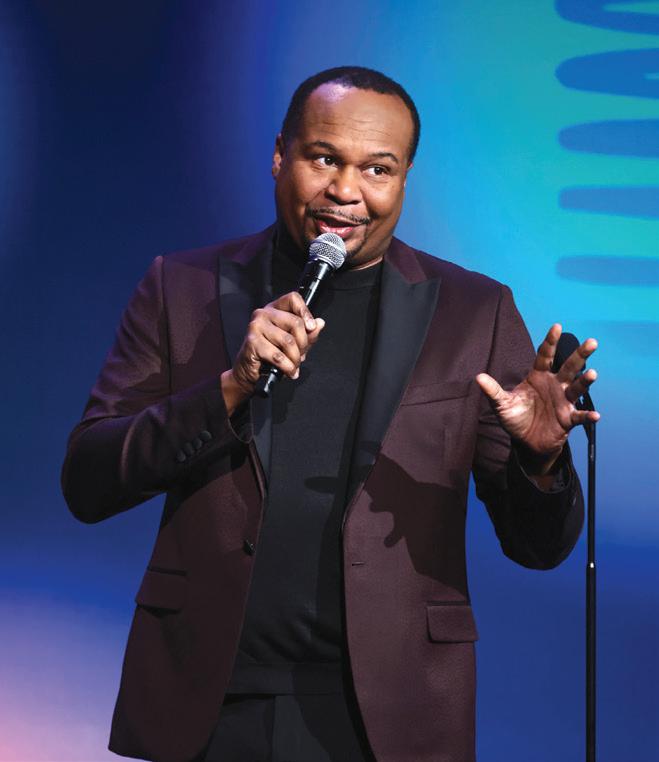
DEC 28
Now more than ever, we need comedians who speak truth to power (with caustic wit, of course), because the MSM have proved themselves to be entirely too complicit in downplaying and normalizing 47’s world-class corruption and enshittifcation of America. Thankfully, Roy Wood Jr. is on the case. He’s shown his heady mettle as a correspondent on Comedy Central’s The Daily Show With Trevor Noah and as host of CNN’s Have I Got News for You. His jabs and uppercuts from the left have caused deep bruises on many deserving mofos. As MC of the 2023 White House Correspondents’ Dinner, Wood hilariously roasted Dems, Repubs, and the media in a tight 25 minutes. And his takes on race are among the most sizzling in the business, including this one: “But if we get rid of the Confederate flag, how am I gonna know who the dangerous white people are?” Beyond those topics, Wood has funny thoughts about relationships, fatherhood, white allies, the travails of grocery shopping, and the ramifications of getting a BBL, among other things. (Neptune Theatre, 7 pm, all ages) DAVE SEGAL
JAN 16 & 18
One of my goals for 2026 is to start frequenting the opera—who’s with me? I want to see Seattleites step out of their Blundstones and Patagonias and into their opera gloves, faux furs, and antique opera glasses for an evening of art and glamour. I’ll be kicking off my Year of Opera with Strauss’s underrated masterpiece, Daphne , inspired by Ovid’s Metamorphoses . Strauss’s take on the Greek myth tells the story of Daphne, a woman who loves nature but has no interest in human romance, who turns into her favorite laurel tree
after mourning the death of her suitor. Not only will this whimsical tale be brought to life on stage by the Seattle Opera, but the Seattle Symphony will join, playing the lush, pastoral score. ( McCaw Hall, various times, all ages ) AUDREY VANN
JAN 29–31
Majorette dance has been a staple of Black girlhood since the 1960s, when it was popularized at HBCUs (Historically Black Colleges and Universities) in the American South. Dressed in their signature glittery costumes, majorettes dance alongside
marching bands and display bold showmanship, glamour, precision, power, and sensuality. In this contemporary performance directed and choreographed by Ogemdi Ude, six Black femmes will pay homage to the majorette dance form, accompanied by composer Robert Lambkin’s score blending “Southern rap, horns, drumlines, and melodic R&B and soul.” Back in September, On the Boards executive director Megan Kiskaddon told Stranger staff writer Nathalie Graham that MAJOR is the show everyone must see in the venue’s 2025–2026 season, explaining, “It’s one of those pieces that anyone would get something out of, because it’s so exuberant.” ( On the Boards, 8 pm, all ages ) JULIANNE BELL
JAN 30–FEB 8
Pacific Northwest Ballet’s production of Cinderella was conceived and choreographed in 1994 by founding artistic director and choreographer Kent Stowell, who sought to emphasize the romantic nature of the fairy tale in contrast to the tragicomic sensibilities of earlier modern productions. The result is an enchanting, swoon-worthy confection filled with dazzling costumes by Tony Award-winning costume designer Martin Pakledinaz and fantastical sets by scenic designer Tony Straiges. Fun facts: The production features over 120 costumes, which required more than a mile of tulle to make, and the trim on Cinderella’s ball gown alone took over 100 hours to create and sew. (McCaw Hall, various times, all ages) JULIANNE BELL
A Very Die Hard Christmas Through Dec 21, Seattle Public Theater, all ages
Scott Shoemaker’s War on Christmas Through Dec 26, Theatre Off Jackson
How the Queens Stole Christmas Through Dec 28, Queer/Bar, 21+
Pacific Northwest Ballet: The Nutcracker Through Dec 28, McCaw Hall, all ages
A John Waters Christmas Dec 2, Neptune Theatre, 8 pm, all ages
A Drag Queen Christmas with Nina West, Lexi Love, Shea Coulee, and more Dec 3, McCaw Hall, 7:30 pm, 18+
Derek Sheen: Unrelatable (Live Taping) with Emma Schmuckler Dec 4, Clock-Out Lounge, 8:30 pm, 21+ Disney’s The Lion King Dec 4–Jan 4, Paramount Theatre, all ages
Alaska: A Very Alaska Christmas Show Dec 5, Neptune Theatre, 8 pm, all ages
The 5th Annual Holly Jolly Holiday Show Dec 7, Neumos, 6 pm, 21+
Land of the Sweets: The Burlesque Nutcracker Dec 10–28, Triple Door
Blue Xmas with Betty Wetter Dec 11, Clock-Out Lounge, 9 pm, 21+
Kitten N’ Lou Present: Jingle All the Gay Dec 12–14, Neptune Theatre, all ages
The Jinkx & DeLa Holiday Show Dec 23-28, Moore Theatre, all ages
Fortune Feimster: Takin’ Care of Biscuits Dec 31, McCaw Hall, 7 pm, all ages
Seattle Rep Presents: The Heart Sellers Jan 2–Feb 1, Leo K. Theater
Tectonic Theater Project’s Here There Are Blueberries Jan 21–Feb 15, Bagley Wright Theater
Topdog/Underdog Feb 4–Mar 1, ArtsWest
Bridge Project 2025 with DaeZhane Day, kelly langeslay, and No Girls No Masters Feb 6–8, Velocity Bosco Presents: GRINDHAUS Feb 7, The Crocodile, 10:30 pm, 21+
The Wiz Feb 10, Paramount Theatre, all ages
The Serpent Sisters Tour: Nymphia Wind and Plastique Tiara Feb 15, Neptune Theatre, 8 pm, all ages
John Jarboe’s Rose: You Are Who You Eat Feb 19–21, On the Boards, 8 pm
Fellow Travellers Feb 21–Mar 1, McCaw Hall
Amy O’Neal: Again, There Is No Other (The Remix) Mar 26–28, On the Boards, 8 pm
Pacific Northwest Ballet Presents: Giselle Apr 10–19, McCaw Hall, all ages
Jonathan Van Ness Apr 24, Moore Theatre, 8 pm, all ages
Margaret Cho Apr 29, Moore Theatre, 7 pm, all ages
DEC 4
If the Big Dark has you feeling glum and you’re in the mood to expand your consciousness with some big laughs along the way, consider this unique comedy/ art film hybrid, which was released earlier this year. Through a combination of “narrative scenes, abstract video montages, and meditative voiceovers,” the psychedelic movie follows two drifters wandering through a desert on an existential journey of self-discovery—New York Magazine’s Vulture likened it to “an ayahuasca session conducted by Mitch Hedberg.” Better yet, co-writer and star Anthony Oberbeck will be present at this special screening. (The Beacon Cinema, 7:30 pm) JULIANNE BELL
DEC 9–11
This lost gem of Japanese independent cinema came out in 1974 and was rediscovered in a film lab warehouse in 2018, leading to its restoration and distribution in America for the first time in 50 years. Evoking the doomed atmosphere of Gregg Araki and the stylish surrealism of Jean-Luc Godard, director Isao Fujisawa’s sole feature film introduces us to Utamaro, a nihilistic vagabond who crosses paths with the beautiful genderfluid shoplifter Giko. Before long, the star-crossed pair must go on the lam for murder and embark on a summer trek through Japan. In short, it’s a queer crime road-trip movie with a Japanese take on French New Wave—what more could you possibly ask for? (The Beacon Cinema, various times) JULIANNE BELL
DEC 13
I won’t pretend that Monika Treut’s Female Misbehavior is for everyone, but if you are interested in feminist post-structuralism, lesbian sadomasochism, or stories of gender- non-conforming artists, keep reading! Released in 1992, Female Misbehavior is a collection of four short documentaries that explore individuals who live outside of society’s expectations of gender and womanhood, or, as one of the film’s subjects, Camille Paglia, puts it, “my everyday life as a social and sexual alien.” The films range from an interview with the aforementioned academic, a portrait of trans poet Max Wolf Valerio, a PCA (Public Cervix Announcement) from “post porn modernist” Annie Sparkle, and a look at New York’s Lesbian Sex Mafia. (NW Film Forum, 4:30 pm) AUDREY VANN
DEC 15–17
The late German-American filmmaker Michael Roemer is primarily known for his landmark films Nothing But a Man (1964) and The Plot Against Harry (1971), but his lesser-known family drama Vengeance Is Mine (1984) could give them a run for their money. On a trip to her family home in Rhode Island, where she hopes to get closure from her traumatic






childhood, Jo (Brooke Adams) befriends neighbor Donna (Trish Van Devere) and finds herself ensnared in another domestic conflict altogether. Criterion Collection writes, “Bringing vérité naturalism to a seemingly melodramatic premise, Roemer crafts a miracle of novelistic psychological insight that, as it unspools, reveals ever-greater depths of human understanding.” (The Beacon Cinema, various times) JULIANNE BELL
JAN 17–18
What can I say about Paul Verhoeven’s landmark 1995 erotic drama that hasn’t already been said? That I felt like a changed person after watching it for the first time? That it is tacky and absurd to a degree approaching transcendence? That never in my life have I seen anything quite like Gina Gershon flirting with Elizabeth Berkley by talking about eating doggy chow? Whether you love or hate the critically panned movie, I’m willing to bet that you’re probably not indifferent. (I’m solidly in the love camp myself, in case you couldn’t guess.) See the psychosexual NC-17 sensation and its bevy of naked breasts on the big screen—drag queen and self-described “birdbrained bombshell” Monday Mourning will give an introduction to the film, which is part of her “Mourning Sickness” series of camp and cult classics. (Northwest Film Forum, 7:30 pm) JULIANNE BELL
More
Truth to Fiction: Blue Dec 4, Northwest Film Forum, 7 pm
WTO/99 Dec 5–14, Northwest Film Forum
SIFF ‘n’ Stitch: Elf Dec 7, SIFF Cinema Uptown, 12 pm
The Muppet Christmas Carol Dec 11–14, SIFF Cinema Uptown
Gremlins Dec 12–18, The Beacon
Gendernauts Dec 13, Northwest Film Forum, 7:30 pm
Deaf Santa Claus Dec 14, SIFF Film Center, 1 pm
Genderation Dec 14, Northwest Film Forum, 7:30 pm The Snow Queen Dec 18–19, The Beacon
It’s a Wonderful Life Dec 18–24, Northwest Film Forum
Who Killed Santa Claus? Dec 21, The Beacon, 5 pm Christmas in Connecticut Dec 21 & 23, The Beacon Ghost Stories for Christmas Dec 23, The Beacon, 7:30 pm
Fanny and Alexander Dec 24, The Beacon, 2 pm Together Dec 27 & 30, The Beacon
Moulin Rouge! New Year’s Eve Sing-along Dec 31, SIFF Cinema Uptown, 6 pm
Peaches Goes Bananas Jan 24–Feb 1, Northwest Film Forum
NOV 17–DEC 25
In 2014, New York bar owner Greg Boehm temporarily transformed his space into a kitschy Christmas wonderland replete with gewgaws and tchotchkes galore. Now, the pop-up has expanded to more than 100 locations all over the world and returns to Belltown’s Rob Roy. Beverages are housed in tackytastic vessels, bedecked with fanciful garnishes like peppers and dried pineapple, and christened with cheeky, pop- culture-referencing names like the “Bad Santa,” the “Yippie Ki Yay Mother F****r” (their asterisks, not ours), and the “You’ll Shoot Your Rye Out.” (Rob Roy, 4 pm–2 am) JULIANNE BELL
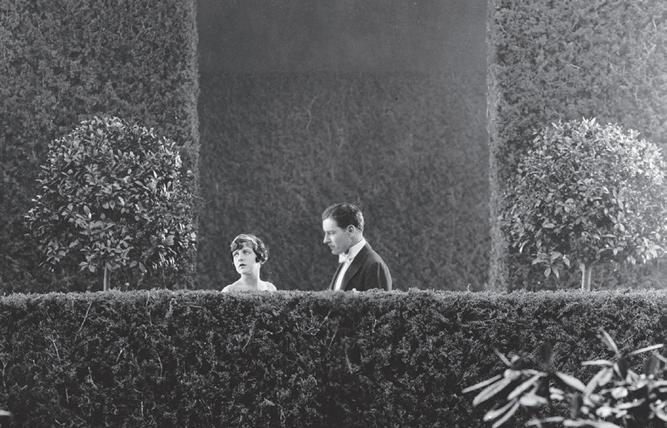
JAN 26
I attended my first Silent Movie Monday last month, and now I am completely obsessed. The film series pays homage to the history of our beloved Paramount Theatre, which opened in 1928, showing silent films accompanied by live musicians on the theater’s original Mighty Wurlitzer (a single organ that’s connected to various pipes and percussion instruments), and serving free, old-fashioned bags of popcorn—it’s truly like stepping into a time machine. For the next Silent Movie Monday, organist Donna Parker will soundtrack Ernst Lubitsch’s 1925 adaptation of Oscar Wilde’s Lady Windermere’s Fan. Set in 1890s London, the film follows an elegant society woman who’s convinced her husband is having an affair. It’s full of drama, scandals, and stunning costumes. Warning: You will likely leave the theater wanting to cut your hair into a 1920s bob. (Paramount Theatre, 7 pm) AUDREY VANN
DEC 11
Our city may have its own regional specialties like teriyaki and Seattle dogs, but does it have its own food culture, and if so, what defines it? Inspired by the exhibition Farm to Table: Art, Food, and Identity in the Age of Impressionism, this talk hosted by Seattle Art Museum will explore these burning questions, as well as the future of Seattle’s restaurant scene and how other cooking traditions have influenced local cuisine. Ruby de Luna of KUOW will moderate a conversation with Cafe Campagne chef/co-owner Daisley Gordon and chef/food writer J. Kenji López-Alt as they contemplate our culinary landscape. (Seattle Art Museum, 6–8 pm, free with admission, all ages) JULIANNE BELL
NOV 20–DEC 24
Lately, I’ve been jealously poring over YouTube videos of German Christmas markets aglow with twinkly lights and full of bustling shoppers bundled up in their puffy winter coats, purchasing everything from handmade gifts to glühwein. I’ve been daydreaming of a Yuletide escape to experience one of these idyllic bazaars for myself, but since that’s not likely in the cards anytime soon, my next best option is Seattle’s Christmas Market, the local take on this Old-World European tradition. The event features live entertainment, over 60 artisan vendors, a lineup of German beers, sweet and savory treats, and of course, the requisite mulled wine to cup in your gloved hands as
Candles, tonic from Bradley’s Tonic, and cookbooks from Book Larder, among others. (Fast Penny Spirits, 1–4:30 pm) JULIANNE BELL
Ballard Farmers Market Every Sunday, Ballard Ave, 9 am–noon, free
Capitol Hill Farmers Market Every Sunday, E Denny Way and Nagle Pl, 11 am–3 pm, free
West Seattle Farmers Market Every Sunday, Alaska Junction, 10 am–2 pm, free
Fremont Sunday Market Every Sunday, Evanston Ave N and N 34th St, 10 am–4 pm, free
Osteria la Spiga’s Fifth Annual Holiday Market Dec 7, Osteria la Spiga, 12–4 pm
Ballard Cocktail Trail Dec 12, Columbia Bank, 6–9 pm
WA Brewers Guild Winter Beer Fest Dec 19–20, Victory Hall at The Boxyard, 21+
Ellensburg Winterhop Brewfest Jan 17, Downtown Ellensburg, 12–5 pm
Strange Brewfest Jan 30–31, Port Townsend
Tacoma Beer Week Feb 27–March 8, various locations across Tacoma
DEC 5–7
you peruse the booths. Plus, ride a Christmas carousel, embark on a scavenger hunt, and snap selfies with the festive mascots Holly and Jolly. (Seattle Center, various times, all ages) JULIANNE BELL
DEC 6
Get ahead of the holiday hubbub and build an arsenal of classy host gifts and stocking stuffers at this market featuring local vendors, hosted by the woman-owned amaro distillery Fast Penny Spirits. One of their amaros, which come in gorgeous bottles with gilded Art-Deco-inspired art, would be a welcome addition to any aspiring mixologist’s bar cart, but you can also choose from items like cocktail kits from Crafted Taste, deluxe cherries from Orasella, vintage glassware from Mix Century Vintage, hand-poured candles from Pumarosa

Urban Craft Uprising launched in 2005 with only 50 booths and is now the largest indie craft event in the Pacific Northwest. The biannual event provides a refreshing alternative to the holiday season’s relentless deluge of consumerism, with over 150 carefully curated vendors to choose from, plus a selection of food trucks to fuel your shopping spree. Handmade goods such as delicate jewelry, bold ceramics, scented candles, bath and body products, stationery, and other charming trinkets are sure to grow even the grinchiest heart at least three sizes. ( Seattle Center Exhibition Hall, various times, all ages ) JULIANNE BELL
DEC 6
What do you get for a person who has everything? The correct answer is something one of a kind. Bad Apple Tattoo’s annual makers market is back for its fourth year with more than a dozen local artists selling their unique items, from clothing, ceramics, and home goods to erotic cookies and surrealist leather keychains. Personally, I have my eyes on the vendors Time Slip Prints, who print band shirts for ’60s girl groups and classic punk bands, and Calico Botanicals, who sell gorgeous handmade beeswax candles. (Bad Apple Tattoo, 11 pm, all ages) AUDREY VANN
More
Riding Together: 135 Years of Cycling in Seattle Through Apr 26, Museum of History & Industry Black Friday Record Store Day Nov 28, various locations
Kickstands Up! 125 Years of Motorcycling in the PNW Opens Nov 28, Museum of History & Industry Seattle Christmas Market through Dec 24, Seattle Center, all ages PhinneyWood Winter Festival Dec 5–7, Phinney Center
Yoga in the Glasshouse Dec 7, Chihuly Garden and Glass, 8



1. Skirt shorter than a maxi or midi
5. San Antonio landmark
10. CPR experts
14. Underground tree part
15. Labor activist Chavez
16. Goodyear or Michelin product
17. Slowly phasing out, in lingo ... and a hint to this puzzle’s theme
1 9. Slangy “Hurry up!”
20. Church service
21. Does a pub crawl
23. Respected tribal member
26. Steamy spa room
28. ___/her pronouns
29. Defective firecracker
30. Beautician’s workplace
32. Annual occasions for cake and presents, briefly
34. Discount grocery chain
36. Be under the weather
37. Seattle Mariner’s stat
38. Splash guard for a truck
40. Cheap souvenir
44. Salish ___
45. Neither’s partner
46. Gumbo vegetable
47. Winter drink served with marshmallows
50. Jim Morrison’s group, with “the”
52. ___ Kat bar
53. Holiday lyrics “... Feliz Navidad / próspero ___ y felicidad”
54. Pat down, like a TSA agent would
56. Rouses from sleep
58. Archenemy
60. Surrounded by
62. “Take it or leave it” yard sale caveat
63. Pacific Northwest slang for its long, lightless winter ... and a hint to the circled squares in this puzzle
68. Dryer residue
69. Currency in Croatia and Cologne
70. Beauty store chain
71. Sonic the Hedgehog’s game company
72. Ejects, like from Mount Rainier
73. Banana skin
DOWN
1. “The Marvelous ___ Maisel”
2. Debtor’s all-vowel note
3. Queer prefix for binary
4. “Who’s there?” response
5. Performs on stage, like at the Paramount Theatre
6. Unintentionally reveals
7. “___ was saying ...”
8. Topknot on a dude
9. Liver, kidney, or heart
10. ___ A Sk___ (drawing toy)
11. “Bottomless” brunch cocktail
12. Prize hoisted after an athletic victory
13. Taste and touch, for two
18. Units of corn
22. Synagogue leader
23. Wax-coated cheese (that is literally “made” backwards)
24. ___lemon (athleisure brand)
25. See 63-Across
27. “You’ve got mail” co.
31. See 63-Across
33. ___ nuggets (Jurassicinspired food)
35. “In that case ...”
37. See 63-Across
39. Toronto Maple ___ (hockey team)
40. Acknowledged applause, like after a play performance
41. See 63-Across
42. The spookiest-sounding of the Great Lakes
43. Skin ink, briefly
45. Rejections
47. Venice waterways
48. Baby’s bodysuit
49. “I’ll be right there!”
50. Serve onto a plate, say
51. Large gulp
55. Religious ceremonies
57. Compute the sum of
59. “øCÛmo ___?”
61. “A swing and a ___!” (call heard at T-Mobile Park)
64. Before, poetically
65. Word following ginger or pale in the names of drinks
66. Roadway abbr. found hidden in “artery”
67. “Harold & Kumar” actor Penn