
Chicago Reader March 2026

Page 1


Written by AUGUST STRINDBERG

In a new version by CONOR MCPHERSON

Directed by ensemble member YASEN PEYANKOV

Featuring ensemble members Cliff Chamberlain, Kathryn Erbe and Jeff Perry

APR 9 - MAY 31

Written by ensemble member TARELL ALVIN MCCRANEY

Directed by AWOYE TIMPO

Featuring ensemble members Alana Arenas, Glenn Davis, Jon Michael Hill and Namir Smallwood

Written by MIA CHUNG

Directed by ensemble member AMY MORTON

Featuring ensemble members Gary Cole, Audrey Francis and Tim Hopper

JUN 4 - JUL 12

THIS ISSUE:

4 Editor’s Note | Conway Best of Chicago, our love letter to the city

4 Reader Letters

One year in, the state’s attorney’s policies suggest a return to the politics of punishment.

CITY LIFE

6 Social Fabric

Nuestro Chicago Archives preserves and highlights Chicago’s rich Latine history through community archiving.

COMMENTARY

8 Opinion | Valdivia

Art is not a luxury in times of fear and oppression, but a necessary act of survival, dignity, and resistance.

FILM

10 Moving Places | Rosenbaum

One film critic questions whether audiences ever genuinely experience a shared cinematic narrative amid competing marketed realities.

BEST OF CHICAGO 2025

12 City Life

The best kid play space that shows up for immigrant families, the best way to see Black Chicago (and beyond) through a fresh lens, and more

18 Buy Local

The best feminist gift shop that turns browsing into community time, the best co ee shop/local goods purveyor that is definitely “not a cult,” and more

26 Sports & Recreation

The best club for queer and trans people starting strength training, the best underground entertainment trend, and more

30 Food & Drink

The best hole-in-the-wall where puppets serve ice cream, the best co ee shop “made possible by immigrants,” the best gay time machine, and more

36 Arts & Culture

A how-to guide to the best place for comedians to attend the school of hard knocks, the best glitz-barf comic about gas station hot dogs, and more

46 Music & Nightlife

The best party to alter your reality, the best band to put the fun in funeral, the best 98-year-old dive bar founded by a world-famous burlesque star, and more

JUDICIAL ELECTION GUIDE

53 Injustice Watch

Your nonpartisan guide to Cook County’s 2026 judicial primary elections

READER RADAR

65 Calendar

A curated monthly guide to what’s actually worth leaving your house for.

FROM TOP LEFT: Aja Essex at Nabala Cafe by Hungu; BabyDolls Boutique by Kirk Williamson; Bueno Days by Estevan Cruz; Dream Blunt Rotation organizers Rich Jones and ShowYouSuck by Sarah Elizabeth Larson; detail from Max & Bunny issue 1 by Coodos; blackcrowned night heron by Jason Weckstein/Flickr via CC BY-NC-SA 2.0

and Kirk Williamson Design by Corianton Hale

INTERIM PUBLISHER

Rob Crocker

CHIEF OF STAFF/SALES DIRECTOR Ellen Kaulig

EDITOR IN CHIEF

Sarah Conway

CREATIVE DIRECTOR

Corianton Hale

ASSISTANT MANAGING EDITOR

Savannah Ray Hugueley

FEATURES AND COPY EDITOR

Kerry Cardoza

PRODUCTION MANAGER AND STAFF PHOTOGRAPHER

Kirk Williamson

SENIOR GRAPHIC DESIGNER

Amber Huff

GRAPHIC

Shira Friedman-Parks

Kerry Reid MUSIC

Philip Montoro CULTURE

Taryn McFadden

NEWS EDITOR

Shawn Mulcahy

PROJECTS EDITOR

Jamie Ludwig

STRATEGIC CONTENT EDITOR

Tyra Nicole Triche

SENIOR WRITERS

Leor Galil, Mike Sula

FEATURES WRITER Katie Prout

SOCIAL JUSTICE REPORTER Devyn-Marshall Brown (DMB)

STAFF WRITER Micco Caporale

DEVELOPMENT MANAGER Joey Mandeville

DATA ASSOCIATE Tatiana Perez

MARKETING MANAGER Maja Stachnik

MARKETING ASSOCIATE Michael Thompson

SALES REPRESENTATIVES

Will Rogers, Kelly Braun, Vanessa Fleming

The choice to exist in a community is holy.

Every pause to say hello to a neighbor on the block, every moment to make sure we’re collectively good, the plucking of thick, waxy greens from a backyard garden for shared nourishment, every swap of the neighborhood broom and shovel (yes, we have communal ones on my street)— these are the small, spiritual acts that bind Chicagoans together.

Every year, we bring you the Chicago Reader’s Best of Chicago, our love letter to the city. This is our handpicked list of the people, places, events, and everyday marvels that our editors, writers, and contributors believe deserve your time, your attention, and, yes, your wholehearted devotion.

Then it was your turn. You came (in droves: over 40,000 Chicagoans!); you saw (over 200 categories!); and you definitely voted (nearly 500,000 times!) for the Reader’s 2025 Best of Chicago ballot, a companion list where readers nominate and vote for their favorite Chicago haunts, restaurants, cultural institutions, and more. In categories ranging from Best Film Programming and Best Stand-up Comic to Best New Book by a Chicagoan and Best Tattoo Artist, there is guaranteed to be a little something for everyone.

This year’s Best of Chicago issue is a celebration of the people, places, and spots that often “start little,” as Martha, a longtime Albany Park resident who stepped in to support street vendors, told contributor Lindsay Eanet. Martha, like everyone else in this year’s Best of Chicago, is precisely who makes up those small, spiritual acts— the real substance of this city.

I can see it in social justice reporter Devyn-Marshall Brown’s “Best new club for queer and trans people getting started with strength training,” where Bucktown’s brick-and-mortar Above the Bar’s Trans Barbell Club coaches “everyone who’s stepped inside a gym before and has felt like it wasn’t made for them.” Above the Bar is always advocating for softness with

READER LETTERS

REFORM IN REVERSE AT THE STATE’S ATTORNEY’S OFFICE

It has been just over a year since Eileen O’Neill Burke took office as Cook County state’s attorney. Now is an appropriate time to assess how her policies are impacting our communities.

The state’s attorney is one of the county’s most powerful elected officials, determining who receives mercy and who faces lengthy sentences, whether law enforcement is held accountable, and how people of color—long subjected to discriminatory policing and harsher prosecution—are treated within the criminal legal system.

wide. She has also stopped keeping and disclosing a list of officers with misconduct histories, a critical step backward in our push for police accountability.

At a time when leaders across the country, state, and city have condemned the brutality of the Trump administration’s U.S. Customs and Border Protection immigration surge operations—where a federal judge found officers deliberately caused serious harm without provocation—our state’s attorney stayed silent.

their mantra “sometimes deadlifts, sometimes deep dish.”

I feel it in the op-ed from Chicago Latino Theater Alliance’s Jorge Valdivia, “Paletero bells to whistles: Latine creation is an act of resistance in Chicago,” where he honors his own late mother, Maria Canchola Valdivia from Los Altos de Jalisco, Ayo el Grande, and her legacy as a singer and songwriter—a dream deferred and found again. Oppression, he writes, not only arrives in raids or policies but in gendered expectations that can put out creation. “Art has never been separate from struggle. It carries it.”

I sense it in laughter, too. Chicago writer, journalist, and professor Arionne Nettles takes us to the “Best show to laugh until you cry” at the Black Excellence Comedy Revue at Second City. She writes, “Right now, the tension from the current news cycle is palpable wherever you turn. Chicagoans are on edge about protecting their neighbors, their rights, and their democracy. But joy and laughter are intangible gifts that this show can give anyone who walks in the theater.”

The Reader ’s future is a space for communities to be heard, celebrated, and seen. That’s why we’ve launched a new column, Social Fabric, that provides a glimpse into the vibrant lives, objects, and spaces that shape our city, cocurated with community archives and local photographers. Through archival photos, Nuestro Chicago Archives founder Thais Beltran shows us what it means to preserve snapshots of love, resilience, and everyday Latine life in Chicago.

The balm for these increasingly fascist times is always care and community; that’s our North Star for the Best of Chicago.

Saving you a seat for the ride, dear reader, where we rewrite the rules on what a city’s strange and storied alternative newspaper can be. v

sconway@chicagoreader.com

Unfortunately, we fear we are moving backward in the righteous fight to uphold accountability and equity. What we see is an office committed solely to the most punitive option, fairness or justice notwithstanding. We need brave leaders committed to fighting policies that target the most vulnerable. The state’s attorney is not currently among them.

In 2021, a diverse coalition celebrated the end of money bond with the passage of the Pretrial Fairness Act, which took effect in 2023. Money bond created a two-tiered system where people with means could purchase their freedom while those without were jailed, disproportionately impacting Black and Brown people while disempowering survivors. The law took a stand on racial equity, survivors’ rights, and public safety.

On the campaign trail, O’Neill Burke promised to uphold the Pretrial Fairness Act and its underlying values. Instead, she has undermined those values and the presumption of innocence itself. On her first day, O’Neill Burke announced her office would always seek pretrial detention in certain cases, irrespective of individual characteristics or the strength of the evidence, including many cases without allegations of violence.

Even as violence continues its downward trajectory, O’Neill Burke’s actions have increased the Cook County jail’s population. In the first three months of 2025, more than 6,800 people were admitted—the highest quarterly admissions since early 2020. Between the first half of 2024 and 2025, her policies contributed to an additional 1,068 people being locked up. When Cook County experiences historic decreases in both property and violent crime, there should be fewer pretrial detention motions, not more.

O’Neill Burke has also abdicated her duty to determine whether police have sufficient evidence for felony gun possession charges and whether arrests result from misconduct. She started this policy in two majority Black neighborhoods, Englewood and Calumet Heights, allowing police to file felony charges without prosecutorial oversight—eliminating any legal check on evidence or investigation integrity. She now plans to expand this city-

After campaigning on promises to advance equity while upholding accountability and fairness together, O’Neill Burke’s behavior is deeply disappointing. With a federal administration attacking anyone disloyal—including many Chicagoans—we desperately need leaders fighting for everyone’s dignity.

As faith leaders, we have witnessed the terrible toll that policies locking up Black and Brown people have on communities. We have seen the power of working with outreach workers and violence interrupters to guide young people away from guns and violence. We understand the importance of focusing not on what someone is alleged to have done, but on what, given a chance and resources, that individual can do for himself and his community.

The last few years have shown that we can simultaneously fight for equity and safety. Crime has dropped even as we’ve pushed for policies ensuring people aren’t unnecessarily jailed awaiting trial. O’Neill Burke’s departure from this trajectory is dangerous. We hope that in year two, she will reconsider these harmful policies. Taking a restorative rather than punitive approach is more effective and humane. We are a proud city that believes in dignity for all, and we hope she joins us in uplifting our community members rather than simply locking them up.

–Pastor Otis Moss, Trinity United Church of Christ, Washington Heights/Roseland

Send letters about our stories or happenings in Chicago to themail@chicagoreader.com and include your postal address. Letters may be edited for length and clarity. themail@chicagoreader.com

Entre Espacios (2023) CARINA YEPEZ

CITY LIFE

Nuestro Chicago Archives and the power of family photographs

The founder of the Instagram-based community archive talks about preserving snapshots of love, resilience, and everyday Latine life in Chicago.

Nuestro Chicago Archives values the nostalgia of physical media.

The act of printing photographs, picking them up from Jewel or Walgreens, and placing them in a physical photo album is now a deliberate practice, given the ubiquity of digital photography. Established in 2024, our community archival project intentionally seeks submissions of printed family photographs taken before 2008 from neighborhoods across the city.

The decision to submit only pre-2008 photos is intentional: After 2008, many photos were uploaded to the cloud or were lost. Community members who send in photos can physically look for the photos they want to submit, possibly discuss them with loved ones, and reflect on good times.

The history of Chicago’s Latinidad shows a continuous cycle of displacement and gentrification. Latine photographers have been widely excluded from the field of photography in the U.S. Yet, our own community members knew they had to create photos and tell those stories, even if academic institutions don’t feature photos of everyday Latinidad. As someone who is both first- and second-generation Mexican American, and whose family roots in Chicago go back to the late 1950s, I find it my duty to document and preserve the stories of those who share similar experiences of coming to this beautiful city.

By sharing photos from across the city, Nuestro Chicago Archives commemorates the love and resilience of immigrant Chicago. The photos featured in this inaugural issue of the Reader’s Social Fabric column celebrate life.

I find that celebrating life right now, especially given the world’s climate and how heavy things are, is more important than ever. We can feel gray clouds of systemic and weaponized racism at the hands of the government constantly looming over us, yet we persevere. Chicago’s Latine history goes back at least

as far as the early 1910s, and those first generations had their share of racism, displacement, and deportation; years have gone by, and these themes seem to be a constant for our community—yet we continue to smile, to laugh, to celebrate big and small milestones.

Many of our own family members came to this beautiful city with little to no connections. They started documenting their new lives and the families they were building, whether through dinners, kindergarten graduations, cookouts at Montrose Beach, or being out in the snow with cousins. It is simple to view Latine immigrants as members of the workforce and to focus on what they contribute to society. Still, Latine people are more than that, and Nuestro Chicago Archives wants

to continue highlighting the stories that may seem mundane to other institutions. Looking at old family photos can bring a feeling of nostalgia and happiness, and even serve as a reminder that times may have been tough when the photo was taken, pushing us to keep seeking out the small joys of life and to capture them with our cameras. v

Beltran, founder of Nuestro Chicago Archives

Social Fabric is a glimpse into the vibrant lives, objects, and spaces that shape our city, cocurated with community archives and local photographers.

sfriedman-parks@chicagoreader.com

Above: Gianni and Gloria Segarra’s birthday, Little Village, 2000s

Right (clockwise from top left): Norma and cousins in the winter, Avondale, circa 1970s

Jose Lopez celebrating his child’s birthday, Little Village, circa 1970s-1980s

Mexican Independence Day Parade, Chicago, circa 1980s

Graduation from Harriet Beecher Stowe Elementary School, Humboldt Park, 1990s

Daniel and his family at Montrose Beach, Uptown, 1988

Domingo and Rosalinda’s wedding day, Chicago, circa 1960s COURTESY NUESTRO CHICAGO ARCHIVES

COMMENTARY

Paletero bells to whistles

Latine creation is an act of resistance in Chicago.

Igrew up on Chicago’s south side, in the heart of Little Village, surrounded by the sounds of paleteros ringing the bells of their ice cream carts, the bright colors of freshly cut fruit, and the aroma of tamales filling the streets. The bells meant summer. They meant joy. They meant children running outside with loose change in their hands and coming back with sticky fingers and bright smiles.

Today, those bells are often replaced by the sharp sound of whistles as neighbors warn one another that U.S. Immigration and Customs Enforcement agents are nearby. The sight of children playing freely has, at times, been replaced by images of families being torn apart and dreams ending in an instant. Where there was once laughter, there is now caution. Where there was ease, there is tension. Where there was joy, there is fear.

This hits home for me. My parents and two older siblings were undocumented until the Immigration Reform and Control Act of 1986. I was the first U.S. citizen born in my family, what some would call an “anchor baby.” My parents saw my birth as a new beginning. I grew up watching them live in fear while working hard to contribute to this country. When the opportunity came, they became proud U.S. citizens.

I learned early that survival requires strength. I also learned that survival without joy comes at a cost.

My mother died a year ago in March. Her name was Maria Canchola Valdivia. She was from Los Altos de Jalisco, Ayo el Grande, to be exact. Artistically, she was known as La Perla Tapatía. Before she became a mother of four in Chicago, she was an aspiring singer and songwriter. Music was not a hobby for her: It was breath. It was identity.

But art has never been separate from struggle. It carries it.

Family obligations forced her to set her dreams aside. Still, she never let them disappear completely. In our kitchen, she would sing while cooking. Sometimes Rocío Dúrcal. Sometimes Vikki Carr. Sometimes songs she wrote herself. The kitchen became her stage.

Over time, the public performances stopped. The invitations faded. The rehearsals disappeared. I watched something in her slowly dim. The more she set herself aside, the heavier she became.

The weight of always putting others first takes something from you. Eventually, she stopped singing altogether. For 15 years, she did not perform.

For many, the kitchen is the heart of the home. But for some Mexicanas, Latinas, and other women of a certain era, it was also where dreams were laid to rest, where passion and promise were folded into the daily care of others.

Oppression does not only arrive in raids or policies. Sometimes it arrives as expectation. As gender roles. As economic pressure. As the quiet belief that art is indulgent when there are bills to pay. As the voice that says now is not the time. What is the price we pay when we stop creating?

Years later, my mother found her way back to singing. It began quietly. A song here. A small performance there. But I could see the difference. Something lit up in her again. The joy I remembered from childhood returned to her eyes. She stood taller. She laughed more freely. In reclaiming her voice, she did not become less of a mother. She became more herself. She was finally both. I did not fully understand that lesson until after she passed.

After her death, I created an altar for her at the National Museum of Mexican Art for their Day of the Dead exhibition. I titled it Flores para La Perla. I re-created a kitchen in her favorite color, fuchsia. Her pink mariachi outfit front and center on the table; her lyrics from one of her songs on the wall for the world to see. And the kitchen table became

ment demanded educational equity and cultural affirmation. The United Farm Workers organized laborers and insisted on dignity. The East Los Angeles walkouts challenged unequal schools. The Young Lords confronted injustice in housing and policing. The Sanctuary Movement protected Central American refugees. In 2006, millions marched against H.R. 4437. Dreamers organized and pushed this country to recognize them.

Throughout it all, there were artists. Poets. Musicians. Theatermakers. Muralists. People who gave those movements sound and color and memory. Movements endure not only because of laws, but because of stories.

We are living through another chapter right now. In moments like this, artists question whether creating matters. Is art frivolous when families are suffering? Should we focus only on policy and protest? But art has never been separate from struggle. It carries it.

Art gives language to grief before it hardens into silence. It builds community where isolation might otherwise take over. It reminds us who we are beyond the trauma imposed on us.

My mother once believed she had to choose between being an artist and being a mother. She was wrong. When she returned to singing, she did not abandon her responsibilities. She reclaimed herself. So what about us?

the stage she had missed. Finally, the mother, the homemaker, and the artist together as one.

On opening night, women approached me in tears. They spoke about their mothers, grandmothers, tías, and primas. About dreams deferred. About talents that never saw an audience. In telling my mother’s story, I realized I was telling theirs, too.

Something shifted in me during that process. I healed a part of myself I had carried for years. Creation did what conversation could not. It restored dignity to her story. It restored dignity to mine. Somehow my mother had taught me one last lesson. This is precisely why art matters in times like these.

When policies attempt to erase communities, art records their presence. When fear silences people, art gives them language. When trauma fractures memory, art preserves it. When public discourse reduces human beings to statistics, art reminds us of their faces.

If simply living in this moment can feel like an act of resistance, then creating becomes part of how we hold on to ourselves. When fear is in the air, to write, to sing, to paint, to perform is not about making noise. It is about refusing to disappear quietly. It is about claiming space for our stories while we are still here to tell them.

I once had a friend ask me whether Latinos would ever have a movement the world would remember. I told them we already have. The Chicano move -

Will we give ourselves permission to create in these times? Or will we wait for a safer moment that may never arrive? Conditions rarely improve without imagination expanding what is possible.

We have a responsibility. Not to be perfect. Not to produce slogans. But to witness. To document. To gather people in rooms where they can see themselves reflected.

Our resistance has never been absent. It lives in kitchens. In theaters. In murals across neighborhoods. In poems and plays written late at night. In altars built in fuchsia-colored rooms.

The question is not whether we have stories worth telling. The question is whether we will tell them.

Give yourself permission to write. To sing. To paint. To stage the story that feels urgent. Surround yourself with people who nurture your creativity. Create even when it feels inconvenient.

Because somewhere, a child is still listening for bells. And if we stop creating, the only sounds they will remember are whistles. v

Jorge Valdivia is the executive director of the Chicago Latino Theater Alliance and an arts and media leader with over 25 years of experience advancing diversity, equity, public engagement, and advocacy in the arts. He champions Latino/a/e and LGBTQ+ communities through festival curation, organizational leadership, and collaborative cultural programming.

themail@chicagoreader.com

María Canchola Valdivia COURTESY OF THE VALDIVIA FAMILY
Saturnino Herrán (1887 - 1918), La ofrenda, 1913, oil on canvas, 72" x 82.6", Acervo INBAL/MUNAL Reproducción autorizada por el Instituto Nacional de Bellas Artes y Literatura, 2026.

MOVING PLACES

Against targeting

Film critic Jonathan Rosenbaum questions whether moviegoers ever truly shared a common story and argues that we now subscribe to competing media realities.

Thirty-three years ago, as a Reader writer, I delivered a rant about the ill effects of targeting—splitting audiences into members of predefined customer groups and ignoring every other facet of their identities. My starting point was the refrain heard in Sleepless in Seattle (1993) that men never understand An Affair to Remember (1957) because “That’s a chick’s movie”—an assertion I found alienating and inaccurate because I loved the latter movie without considering myself a “chick,” and a former girlfriend of mine, whom I took to a screening, thought it was a silly hoot.

I disliked being regarded as a marketing unit and was equally miffed by the ravages of political correctness on limiting the presumed “interests” of women, LGBTQ+ people, and/or individuals of different racial backgrounds, treating all such groups as monoliths rather than as diverse communities. And this was before our culture became further dehumanized by the overt racism of Trump, which assumes that our identities as customers are predetermined rather than freely selected and earned.

As I wrote in my 1993 article, “Missing the Target”:

We’re all being repeatedly assured—not least by the discourse about “correct” representations that surround us— that, regardless of who we are, we all go to movies chiefly in search of role models, positive images of ourselves. . . . According to this rule, I should be on the lookout for movies that project positive images of straight, middle-aged, southern-born male Jews—though the only recent example that springs to mind, Driving Miss Daisy (1989), makes me more than slightly ill. Clearly, I’m being irresponsible by not living up to my demographic duties, but I’m not inclined to feel apologetic. The truth is, I prefer windows to mirrors.

This helps explain why I’m naming this column after my first book, Moving Places (1980)—it speaks to the belief that the more and faster we move, the harder it becomes to define us as customers. For instance, even if I considered myself a hippie in 1968 and a socialist in 1977, I certainly wouldn’t like to be stereotyped

or branded as a hippie socialist, much less as a hippie socialist customer.

The worst aspect of targeting laced with hostility may be how contagious it becomes. Today, I might be doing an injustice to fans of One Battle After Another (2025) by claiming that it gratifies woke folks by flattering us as radicals rather than provoking us into activism. But that ad-speak jingle “woke folks,” equally soft on the ears and mind, glibly caricatures our integrity as freethinking individ -

uals. It also zooms past other issues, like the movie’s blurred, confusing sense of contemporary history, unlike the precise period placements in Thomas Pynchon’s 1990 novel Vineland , which inspired Paul Thomas Anderson’s movie. Thus, if I “target” the film’s advocates, I could be dismissing legitimate as well as dubious reasons for enjoying it in order to score points about its commercial crosspurposes. The desire to simplify everything into either/or ultimately yields

a spiteful collapse into factional scorn rather than any sort of expansion. My Reader piece was written during the early years of cyberculture, when it was still possible to distinguish news from advertising and maybe even to say “us” to signify all Americans rather than those on opposite sides of a second civil war, each side with its own news—that is, a negative definition of citizenship that we’re all expected to buy into as customers. The earlier “us” was a premise that, as a

On the Internet, on streets and highways, on buses or subways, practically everything one reads sounds like an ad rather than a sincere, personal statement from one human being to another. MIKE FREIHEIT

child of the 1950s, I could believe in, even if it was both exploited and undermined by such quasi-deceptive marketing tools as the cold war and the Oscars, which assumed that culture could be adequately established by heaps of propaganda and advertising, alternate versions of the same thing.

As a film critic, I may have overrated Titanic (1997) because it reminded me of a golden age when everything from The Wizard of Oz (1939) to The Best Years of Our Lives (1946) was supposedly addressed to “everyone,” before the studios subdivided us into kids who allegedly wanted bloodless, genocidal uplift, as in Star Wars (1977), and/or superhero role models, and adults who wanted patriotic war movies and/or role models like those in Driving Miss Daisy But the thin, ambiguous line separating film reviewing from advertising stems in part from studios monitoring mainstream criticism, which they view simply as a branch of their promotion. When some of my Reader readers used to complain about me writing on movies they never heard of, I had to remind them that these were films that couldn’t afford multimillion-dollar ad campaigns. I doubt that most of them knew that the final incarnation of the Siskel and Ebert film-reviewing talk show was sponsored by Disney–ABC Domestic Television. This didn’t mean the hosts had to like all the Disney releases, but it did mean they had to review all of them—a courtesy not extended to any other studio. Because “coverage” always entails some form of promotion, these movies were certainly among those privileged few that my Reader readers always heard about.

One could say that Trump enjoys the same sort of licensed perk as Disney, thanks to his monotonous omnipresence. Journalists don’t have to like him— although they risk persecution and losing access if they don’t—yet they’re made to feel that they still have to grant him a steady stream of headlines, whereby the line separating journalism from advertising or propaganda becomes equally vague, especially because the final verdicts about what we see and hear most often belong to the marketplace, based on real or imagined data.

The algorithms that seem to rule our culture and the wallets of tasteless billionaires insist that conflict and animus sell better than agreement and friendship. Presumably, we all need to be shepherded into Fox or MS NOW. Before the marketplace defi ned many of us exclusively as buyers or sellers, with mainstream definitions that excluded some of us while paradoxically trying to attract all of us with terms like “Make America Great Again” (which actually means “Make America White Again”), we often had the nagging suspicion that we all belonged to the same humanity in spite of our differences, with common desires and shared experiences which we could discuss. But today, when I note the hysteria with which most news

is being reported online, I can’t even be sure if this is the same news being reported to other consumers in the same way. Some of them might prefer less hysterical news, or the same news delivered more calmly. I know I do and would, which is one reason why I prefer The Atlantic and grown-ups like Anne Applebaum and Michelle Goldberg to most other print journalists (even though I also subscribe to National Review because I fi nd it better edited than The Nation and don’t always equate interest with agreement). Subscribers to Fox and MS NOW don’t even get the same news, but it may all be equally hysterical. Does this mean that my hysterical reactions to the news are part of what’s being catered to? I can’t be sure about that, either. My only certainty is that humans aren’t being blamed for any of the targeting, correct or incorrect, only algorithms— creating the absurd fiction that no one is to blame.

I recently discovered that this was true even of university presses, which function like Hollywood studios. For my recent collection In Dreams Begin

I’m naming this column after my first book, MovingPlaces (1980)—it speaks to the belief that the more and faster we move, the harder it becomes to define us as customers.

Responsibilities (2024), which featured writing about literature and music as well as film—and indeed focused on the multiple relationships between these arts—the editors at both the University of California Press and Columbia University Press who wanted to publish my book were overruled by their publicists, who decided that books confronting more than one art had to be subdivided into separate markets. In other words, if they can’t figure out how to sell something (and authors’ suggestions on this matter are neither solicited nor welcomed), they won’t publish it. Following Reaganite economics and a regressive philosophy, creating a new market is unthinkable; exhausting tried-and-true markets is the only option. Like my most popular book of criticism, Movie Wars (2000), In Dreams Begin Responsibilities was finally

brought out by a small independent publisher after being rejected by larger presses, even though it sold out its fi rst printing and will receive a larger second printing this year. I guess this must make me a cult writer speaking for others who are demographically off the charts.

The language being used about how Trump has just been “shattered,” or “eviscerated,” or “obliterated” by the perfect reply given to one of his insults is so similar to the language of a previous report of another such putdown of Trump that it borders on plagiarism. Is this because his childish desire for revenge is now being assumed to be an obsession we also want to exercise in “obliterating” him, with a marketable sound bite? Or is it simply because AI makes hyperbole and plagiarism more automatic?

I can’t tell whether this is because all such reports are generated by AI, or because some or all of them are written by people imitating AI. I can’t even decide if I should care whether the writer is human or not, because either way, the discourse is just as inflated and robotic.

On the Internet, on streets and highways, on buses or subways, practically everything one reads sounds like an ad rather than a sincere, personal statement from one human being to another. The only communications we’re assumed to want to receive or give are hysterical outbursts, like those of the Orange Monster or Hitler. This suggests that robots can only speak “sincerely” to other robots, not to mortals—unless we aspire to the same phoniness as theirs when we speak only in italics because by now we expect it from ourselves as well as from others. The canned insincerity of “business as usual”

turns up in telemarketing, too, with the creepy result that most of the language we read or hear every day usually turns out to be a lie meant to extract money from us. As far as the marketplace is concerned, the only difference between customers that matters is their spending power. And most of us, by now, are not spending as much as already spent.

Trump prefers to invade another country—or at least threaten to—in order to keep us all mired in uncertainty, without a clearly defi ned past, present, or future, where everything becomes temporary, apparently based on the theory that only his flailing motion and reality-TV hysteria will begin to seem permanent and therefore graspable. Filmmaker Quentin Tarantino, whose juvenile plots are always revenge plots, seems equally convinced that this is the only kind of “action” scenario that sells, and because the highest aspiration of American civilization currently appears to be making stupid billionaires richer and stupider, that’s where most of the money is. Trump is certainly moving places— or maybe not so certainly, because he believes, unlike the existentialists, that essence precedes existence and presentation trumps content. Either way, the brassy echo of his pitches is clearly a major part of his legacy. (Maureen Dowd in the New York Times: “The depth of his shallowness is infinite.”) But the power of the protesters against the murders committed by federal immigration enforcement agents in Minnesota suggests that we may finally be starting to catch up with him. So maybe his cliche-ridden targeting of us can teach us how to place him directly outside our windows, without mirrors defining or blocking either his views or ours. Looking straight at what’s in front of us is all we need to do; his inability to do the same has never been so evident. v

In his Moving Places column, former Reader film critic Jonathan Rosenbaum treats film as inseparable from life. Here, his criticism fluidly roams across politics, music, literature, and popular culture, making movies windows for understanding the world around us.

themail@chicagoreader.com

Jonathan Rosenbaum COURTESY JONATHAN ROSENBAUM

CITY LIFE

BEST KID PLAY SPACE THAT SHOWS UP FOR IMMIGRANT FAMILIES

La Casa Playroom

As a former preschool teacher, I was drawn to La Casa Playroom because I had rarely seen a space like it on the southwest side. Owner Angie Maciel-Wright tells me she created La Casa for that exact reason: to give Brighton Park families a playroom to call their own. It operates as both a children’s space and a mutual aid hub with donations from Brighton Park neighbors and supporters across the city, including the Brighton Park Neighborhood Council and mutual aid partners Casa De Frutos and Pueblo Eats, that keep the playroom stocked with groceries and baby supplies.

Maciel-Wright and her husband, Jeremy Wright, opened the playroom in July as a space for children ages zero to six and an oasis for families where language and culture are affirmed. The 1,300-squarefoot space is stocked with practical care items, including a breastfeeding cart and a dual-monitor desk for caregivers.

Maciel-Wright says their services grew through community feedback, adding drop-off care, bilingual day camps, and monthly virtual trips that “take the kids around the world” to places including Mexico, Panama, and Guatemala. Australia is next, she says, and Nigeria for Black History Month; also upcoming is a toddler cooking series where kids make tortillas and salsa.

When U.S. Immigration and Customs Enforcement (ICE) agents descended on Chicago, Maciel-Wright says La Casa became a lifeline for the community. The organization coordinated donations with nonprofit partners and delivered supplies to families afraid to leave home. When ICE agents disrupted a virtual trip to Guatemala at the play space, MacielWright and staff sprang into action to protect families. “I took the playroom’s chalkboard, wrote ‘ICE,’ and added an arrow,” she says. “I stood in the middle of the road to let the community know ICE was there, so people could turn their cars if they needed to or keep going past the [ICE] checkpoint. We stayed out there for four or five hours until they left.”

La Casa makes space for families to feel safe again. The playroom also includes lighter rituals, such as Bebéton, a free

toddler-friendly daytime dance party. “As a kid, my parents didn’t have a lot of money, and that creates so many barriers,” Maciel-Wright says. “Seeing everyone together, enjoying it, that’s what community looks like.” 4371 S. Archer, lacasaplayroom.com

BEST POSTPROTEST BUSKING

Taylor Iman singing “Think of Me” from The Phantom of the Opera after the April 5 No Kings march

With pink cheeks and icy hands, my wife and I split off from the mass of roughly 300,000 people slow-walking through downtown Chicago in protest. Thousands more across the country were simultaneously marching in unified defiance of President Donald Trump and Elon Musk, and with this knowledge, I felt the conflicting swells of both hope and despair. My eyes flitted across homemade signs as we peeled down an adjacent block: pleas for a free Palestine, climate justice, the protection of trans people and immigrants; no more Trump, no more Musk. Call-and-response chants hung low and constant in the air, intermingling with the buzz of collective action.

As we turned a corner, departing the pack, a separate voice began to ring through with a different magic to it, bouncing off the sunlit buildings in a way that made it untraceable—from everywhere and nowhere. It took me a moment to identify the song; I knew it was something familiar and emotionally affecting before I could place the melody. It was, of course, “Think of Me” from The Phantom of the Opera, the first professional musical I ever saw live. (Sorry, non–musical theater nerds—you might not get it.) My wife and I laughed at ourselves, almost incredulous at how this siren song, both in contrast to and in tandem with the protest, seemed to draw us in.

Eventually, we found the source of the music: Taylor Iman, a busker with vocals so clean they sounded almost prerecorded. She was posted in front of a downtown theater marquee with a mike and a backing track, moving from Phantom into The Little Mermaid into Hamilton and more. We stayed for a few songs, enjoying the reactions of other passersby as much as Iman’s performance itself, and I left with a greater sense of optimism than our failing democracy could provide. instagram.com/ misstayloriman TARYN MCFADDEN

BEST WAY TO SEE BLACK CHICAGO (AND BEYOND) THROUGH A FRESH LENS

Black Film Club Collective

Suspending disbelief, in film parlance, assumes a poetic faith in which audiences believe in the supernatural to engage with a storyline. The Black Film Club Collective creates an experience that assumes a poetic faith all its own: a lens through which we

can communally immerse ourselves into stories that center Black lives.

Many of us primarily view films at home, not in community, but the Black Film Club Collective was formed in 2020 by Troy Martin and Judene Hylton after a profound conversation about Queen & Slim (2019). Now run by Martin and Chinyere “Chi” Achebe, the collective aims to capture the “nostalgic spirit of 90s poetry scenes with the intimate energy of after-school clubs.”

Since the collective’s beginnings at Troy’s apartment, they’ve hosted dozens of symposia, screenings, and convenings at traditional theaters and unconventional venues alike. These gatherings make space for creatives and fi lm lovers to discuss art and build community, from a recent screening and discussion of the Maya Angelou–directed classic Down in the Delta (1998) that happened at Monday Coffee in North Lawndale to a symposium at the Green Line Performing Arts Center in Washington Park that featured a curated shorts program and panels that engaged local filmmakers. blkfilmclub.com

BEST PLACE TO DAYDREAM UNDER A WILLOW TREE

Humboldt Park

In the heart of summer, when humidity drapes itself over Chicago, and every creature is out to play, the sounds of bomba, salsa, and reggaeton radiate from speakers at Humboldt Park. Children screech from a swing set in the distance. Longtime neighbors bring out their chairs to sit. Food trucks painted with Puerto Rican flags prepare steaming plates of food.

The first time I remember visiting Humboldt Park was with my friend on a warm, end-of-summer day. We walked a few blocks from her apartment to find the shade of a tall willow tree facing the duck pond.

Chicagoans can be territorial about their beaches and parks. These are the settings for first dates, family barbeques and birthday parties, soccer games, and afternoon naps. There’s an intimacy to these outdoor havens.

We unfurled a blanket on the soft grass and watched friendly black ants crawl over our books as we read side-by-side. I felt invited into a deeper intimacy with my friend, with myself, and with this special green space.

At Humboldt Park, I feel kindred to each duck puttering alongside blooming lily pads in the spring or carving their way through partially icy waters in the winter. I eavesdrop, piecing together familiar Spanish phrases as I try to understand a joke that’s filled the air with roarious laughter. The amplified music in the distance becomes another sound of nature, harmonizing with the wind in the leaves.

While there are festivals, sports clubs, and events that light up the park during the warm months of the year, it’s those quiet days under the willow tree that remain the most magical—the warm throb of a September afternoon, as if the city’s pulse moves through you. 1440 N. Humboldt JASMINE BARNES

CITY LIFE

BEST ADVOCACY ORGANIZATION

Winner: Illinois Coalition for Immigrant and Refugee Rights

First runner-up: My Block, My Hood, My City

BEST ALDERPERSON

Winner: Jessie Fuentes

First runner-up: Andre Vasquez

BEST CHARITY

Winner: Greater Chicago Food Depository

First runner-up: PAWS Chicago

BEST CHICAGO INSTAGRAM

Winner: @AGirlAboutChicago

First runner-up: @Chicago_ ForFree

BEST CHICAGO INSTITUTION

Winner: Art Institute of Chicago

First runner-up: Chicago Public Library

BEST CHICAGO SLANG

Winner: Hands O Chicago

First runner-up: Jago

BEST CHICAGO TIKTOK

Winner: @AGirlAboutChicago

First runner-up: @MrSouthLoop

BEST COLLEGE

Winner: Northwestern University

First runner-up: University of Chicago

BEST ELECTED OFFICIAL IN CHICAGO

Winner: Cook County

treasurer Maria Pappas

First runner-up: Mayor Brandon Johnson

BEST EMAIL NEWSLETTER

Winner: Block Club Chicago

First runner-up: Chicago Public Square

AYANA CONTRERAS
From top: La Casa Playroom; Troy Martin (left) and Chinyere “Chi” Achebe of the Black Film Club Collective; willow tree in Humboldt Park. SHIRA FRIEDMAN-PARKS; DANIELLE A. SCRUGGS; JASMINE BARNES

BEST TEAM THAT TOOK

FOR MY TAMALE VENDOR AS MASKED FEDERAL AGENTS TERRORIZED CHICAGO

Martha,

The first time I met Martha, I was in sweatpants, walking the dog.

Martha, an Albany Park resident since the 80s, and another neighbor were out on a chilly Saturday morning slinging tamales. They’d taken over the stand from its usual vendors, allowing them to stay safer at home during the immigration enforcement surge in the fall.

In October, Martha and her wife began distributing flyers and “do not enter” signs to local businesses. They spoke to neighbors at restaurants and laundromats, and it was neighbors’ concerns about regular street vendors that spurred their work. “They’ve been there for over a decade, so we’ve always known them,” Martha tells me. “When we hadn’t seen them for weeks, we started getting concerned.”

Martha connected with the two vendors and offered to take over their stand, with all funds going back to them. Martha even covered the cost of produce. One volunteer was out at the tamale stand every day for three months. The vendors were able to pay their rent and returned to their stand once they felt safe to do so, and Martha and her team began working with another vendor.

The team also helped host three food drives that supported 260 families. Everything Martha and the other volunteers did was word of mouth, from conversations at markets and hair salons. It was rooted in an intentional awareness, of knowing neighbors well enough to notice their absences, to ensure no one is forgotten.

There’s no upside to the federal government’s campaign of terror in Chicago, no responsive act of kindness that outweighs it. But when those in power define themselves through division and cruelty, there’s something transformative about treating our neighbors with concern, compassion, and humanity.

Martha reminds me there’s something we all can do.” Start little,” she says. “If you’re able to collaborate with people, literally do what you can. There are no rules.”

The immigration agents will be gone one day; hopefully soon, and hopefully not just from our streets but from every street. But I hope we as a city sustain the commitment of Martha, her wife, and their crew—the generosity of simply saying to neighbors, “I’m here for you; what do you need?” LINDSAY EANET

BEST POLICE FORCE FOR PROTECTING A MURDEROUS ARMY OF SECRET POLICE

Unified Command of Broadview, Illinois

What would you do if a bloodthirsty horde of fascist soldiers was carrying out a terror campaign in your state? If you’re Illinois governor J.B. Pritzker, you’d call a press

conference where you menacingly tell the president, “If you come for my people, you come through me.” Then, you’d marshal a small army of local cops and state police to protect the fascists’ illegally annexed fortress while beating the people who show up in opposition.

Pritzker made a calculated gamble (something he apparently enjoys doing). At the time, President Donald Trump had federalized the Illinois national guard, stationed troops from Texas at a suburban military base, and was threatening to invade the state to suppress nonexistent

sionally, they clubbed protesters in the head with their batons, arrested suburban moms, and dragged religious leaders to the ground. Mostly, though, they just stood around in staggering numbers, eating pizza from the back of a Salvation Army van or struggling to work machinery. There’s seemingly no limit to the bench of agencies on which they can draw. I’ve spotted more than a half dozen suburban police departments, a Metra police canine unit, and even the tactical team at the Illinois Department of Corrections, nicknamed Orange Crush for the color of its uniforms

and the Donald E. Stephens Convention Center, connected to several other forest preserves to the north and south. The land was once held by Potawatami chief Alexander Robinson, also known as Che-che-pin-quay, and his descendants, who are buried in a cemetery in the south part of the preserve. A fur trader and skilled translator—likely due to his mixed Scots-Irish and Ottawa parentage— Robinson interacted with many key figures in the Chicago region during the early and mid-1800s as a treaty negotiator. The preserve is named for his second wife. It was acquired by the Cook County Forest Preserve over the course of the early 20th century—a process that some of Robinson’s living relatives claim was illegal.

The last time I was there, my friend and I stepped over a discarded mattress and drug paraphernalia. Admittedly, we had gotten lost and couldn’t find the actual entrance on foot. Garbage snags in the trees and floats down the Des Plaines River at its western edge. The understory is dominated by invasive Japanese barberry bushes—a notorious host for ticks. Indeed, we picked one off our canine companion and flung it into the water.

While some of it is degraded and unpleasant, the path along the river is strangely quiet and peaceful. Even in the winter, flocks of birds flit among the old burr oaks.

An array of four-legged wildlife have made the preserve their home too. Large herds of deer, accompanied by raccoons and skunks, emerge at dusk. They do not hesitate to hold their ground on the paths toward the exit. Expect to be stared down by alarmingly bold bucks. I once had to skip a stone toward a dancing skunk— preparing to spray—so I could pass. It resentfully trundled off into the brush, but the message was clear: I was an invasive species at that time of night. N. East River RICHARD PALLARDY

BEST PLACE TO SEE A LIVE POSSUM AND VINTAGE TAXIDERMY

The Insect Asylum

riots outside the U.S. Immigration and Customs Enforcement (ICE) jail in Broadview, Illinois. All the while, masked federal agents were violently abducting community members and arbitrarily beating, tear-gassing, and arresting anti-ICE protesters, neighbors, and journalists alike. To stave off further incursion, Pritzker argued in court and from the bully pulpit that he didn’t need the feds’ help; he could brutalize protesters himself.

Enter: Unified Command, a powerhouse conglomerate of cops led by the Illinois State Police and the Cook County Sheriff ’s Office. They set up vehicle checkpoints, cordoned off public sidewalks, and rigorously enforced arbitrary—and at times conflicting—restrictions on when and where people could protest. Occa-

and penchant for civil rights violations.

If you need protection for your battalion of murderous secret police, look no further than the Unified Command of Broadview. SHAWN MULCAHY

BEST PLACE FOR AN UNSETTLING ENCOUNTER WITH WILDLIFE

Catherine Chevalier Woods

Chicago has a wealth of beautiful natural areas. Catherine Chevalier Woods isn’t among its best. Some areas are a little weird, a little dirty, a little sketchy. It’s part of a ragged shred of wilderness east of O’Hare

You may know the Insect Asylum as a quirky storefront in Logan Square where you can explore a whole underrecognized phylum and boop a possum snout all in the same day, but its coolness goes even deeper. Though the storefront opened on Earth Day 2022, founder Nina Salem originally kicked things off in 2018 with a traveling exhibit called Bug Out Chicago. Salem’s ethical policies go deep, from emphasizing “conservation, community, and kindness” in all of their business interactions to supporting and even training those interested in local conservation efforts. A proud member of the International Association of Butterfly Exhibitors and Suppliers, the Insect Asylum is a licensed wildlife rehabilitator, which she explains sometimes means fostering injured and orphaned wildlife to the point of bottle feeding. They also use ethical suppliers, help organize citizen science missions, and conduct field

From top: Insect Asylum possum; deer at Catherine Chevalier Woods. SHIRA FRIEDMAN-PARKS; KIRK WILLIAMSON

BEST FEDERAL OFFICEHOLDER FROM ILLINOIS

Winner: Senator Tammy Duckworth

First runner-up: Representative Delia Ramirez

BEST INDEPENDENT WEBSITE OR BLOG

Winner: Block Club

Chicago

First runner-up: Chicago Public Square

BEST LANGUAGE INSTRUCTION

Winner: Alliance Française de Chicago

First runner-up: DANK Haus

German American Cultural Center

BEST LIBRARY BRANCH

Winner: Harold Washington Library Center

First runner-up: Sulzer Regional Library

BEST LOCAL TV BROADCAST NEWS

Winner: WGN

First runner-up: WTTW

studies with students to collect data.

So know that when you peruse the vintage taxidermy and view the impressive array of pinned insects, you are supporting a nonprofit that does great things for conservation in the midwest. Most of the displays are touch-friendly as well, making it a great place to touch base with nature during the deep freeze. They offer classes and tours, a low-cost entry community day, sensory-friendly days, beetle pinning events, and wet specimen preservation classes, which is exactly what you’re imagining right now. They even offer animal mortuary

services to those who feel inclined to preserve an aspect of their beloved pets. But let’s face it, the main draw for most of the visitors is the live insect exhibit and the other rescued wild animals they tend to. On my visit alone, I met Opal the possum and Houdini the corn snake and got a good look at tarantulas, hissing cockroaches, and many other species.

Whether you pitch it as a great date night or family field trip, you’ll also find a tiny store up front that puts Etsy to shame. Worth every penny and for a good cause!

2870 N. Milwaukee, theinsectasylum.com

10 Years. 325+ Interviews.

BEST PLACE FOR ALLDAY CARDAMOM DRINKS AND COMMUNITY ORGANIZING

Nabala Cafe

Walking Broadway Avenue, just north of Wilson, late at night, one might hear the live music, the surf sound of conversation, and perhaps the hiss of a milk steamer. A few people enter, and the sound amplifi es as the door opens. It is well past expected coffee shop hours, and this cafe is buzzing.

Nabala Cafe is Uptown’s premier Palestinian eatery, serving Levant fare since 2024. Inspired by the long tradition of Yemeni coffeehouses, Nabala is a place for gathering during the morning, afternoon, and well into the night. It’s open long enough for its personality to shift, almost with the angle of the sun. And if you’re there all day, you might just see this happen.

During its early hours, Nabala is a place of work and focus. If you’re in need of an early-morning kick, there is no shortage of cardamom-infused items to choose from: coffee, cold brew, matcha. “It’s a good spice, man,” says Nabala owner Eyad Zeid. “It’s fundamental and traditional to the way that I’ve had coffee, and it resonates with people not just because it’s unique, but because it’s good and it’s familiar.”

After a few hours, the cafe becomes livelier. Fewer meetings, more meetups. Dates over mezze and chai, hangouts over ma’amoul and sahlab, and reading

To my family and dear friends - thank you for the foundation and constant encouragement.

To my listeners and street team - you show up, you share the music, you spread the word. You are the reason the show grows.

To the team at WZRD - thank you for trusting me with the mic and supporting my ideas along the way. For letting me grow as an artist while encouraging me to bring in talented musicians from around the globe.

To those who invested in and supported this journey - your belief helped make it possible.

And to my wonderful interview guests - this is for you too. Without your stories, your honesty, and your trust, there would be no show. Some of you are no longer with us, and I am honored that our interviews remain as part of your legacy. Your voices live on.

November 2026 marks my 10th year on air and 100’s of hours of interviews with artists, creators, and voices that deserve to be heard.

Tune in to WZRD Chicago every Thursday from 11 am to 3 pm CST on 88.3 FM or stream at wzrdchicago.org

Thank you for listening. Thank you for believing.

Thank you for being part of this story.

Aja Essex performs at Transcendent Frequencies at Nabala Cafe. HUNGU

groups sharing cups of chai karak. If you’re looking for a bigger bite, I recommend the shakshuka sandwich.

Because Nabala’s community is largely composed of organizers, it has become a home for organizing events, typically at night. For instance, they often raise money for humanitarian efforts such as Prosthetics for Palestine or the Middle East Children’s Alliance. On a random night, you might hang around for an ICE watch training, an open mike for reproductive justice, or live music for mutual aid.

“There’s always some kind of component of community aid or fundraising in the middle of it,” says Zeid. “I think people just have a desire to do something for a cause.”

Oh, and while you’re there, try the homemade hummus—it is quite good. 4660 N. Broadway, nabalacafe.com ANDREW STOJKOVICH

BEST PLACE FOR BLEACH SNACKS

Devon Market

There’s a lot to love about Devon Market. Where else can I leave with a stag-shaped bottle of wine, at least five different varieties of panettone, and Cok juice? The grab ’n go section usually has plates of vegan Ethiopian food for $9.99 that are so robust they last me four meals. The produce is cheap like Aldi but of much higher quality; more than you’d expect is locally grown or organic, too. I can find

butter made from seemingly every nut and seed—hazelnut, pistachio, pumpkin, and more—and fake meats I don’t know anywhere else in the city to buy. Still, no confession of adoration for this grocery store would be complete without effusing about its shelf tags and signs.

Devon Market operates on its own logic system—and why not? That’s the beauty of being an independently owned neighborhood grocer satisfying a range of international appetites. Most of the signs are so ordinary as to be unremarkable (“Strawberries, $2.99”), but every so often one will present information that’s a little off-kilter. An omitted word, unusual phrasing, or a typo will give a shelf tag new meaning, which can be amusing (“follow honey mustard dressing”), poetic (“fresh blues, large”), or strange (“Maeco Polo”). Usually, items go on sale for a week or two, but sometimes an item’s sale range will span well over a year. The sale sign will stay up that entire time.

Aisles are marked with parent categories like “snack time” and “bake time,” then broken down by lists of what they contain. One “home care” aisle advertises canned fruit, food storage, fruit snacks, popcorn and nuts, jams and jellies, and yet more fruit snacks. Another, marked “snack time,” includes cooking oil, cat food, charcoal/logs, and bleach. More than a food provider, Devon Market nourishes a sense of humanness and the delightfully absurd reality of being alive. 1440 W. Devon, devonmarket.com MICCO CAPORALE

MEDIA ACCOUNT THAT LAUNCHES PAPER AIRPLANES FROM SKYSCRAPERS

@Chicago_Paper_Airplane

Picture a 23-year-old small-town Michigan transplant who’s in the city seven months after trading a Michigan State degree for a logistics job and South Loop apartment. So begins adulting. Picture a boring day at work, a hastily folded Post-it paper airplane, and an urge to open the window and let ‘er rip.

A few weeks later, picture his shock that the dumb idea worked, gawking at an Instagram post in the throes of virality. He’s Chicago’s latest social media mystery (antihero?), launching paper airplanes off high-rises with the persona of a vulgar Top Gun side character (think “piss missiles” and “air biscuits”) and the classic rock soundtrack to match.

A few months later, @Chicago_Paper_ Airplane has blown past 88,000 Instagram followers, receives appropriately whimsical influencer swag (fancy paper and creatine to “help him throw farther”), and finds two to three new launch locations a week from Chicago fans (some now friends). With the odds of being struck by lightning higher than being hit in the face with a paper airplane, and his good-faith attempts to retrieve the planes (to fight those “glorified littering” comments), he says he’s “doing more good than bad.” But

he’s certainly not trying to get fined. The mask helps, plus it keeps viewers coming back for more.

Don’t say he doesn’t dream big. He’s confident he’ll hit 500,000 followers and pull off a promised face reveal— perhaps atop the Willis Tower? His aspirations range from wildly ambitious (being offered a starring role in the

BEST NETWORKING COMMUNITY/ ORGANIZATION

Winner: International Women in Chicago

First runner-up: Edgewater Chamber of Commerce

BEST NEWSPAPER

Winner: Block Club Chicago

First runner-up: Chicago Tribune

BEST NORTH-SIDE NEIGHBORHOOD

Winner: Lincoln Square

First runner-up: Andersonville

BEST OVERALL RADIO

STATION

Winner: WBEZ 91.5 FM

First runner-up: WXRT 93.1 FM

BEST PODCAST

Winner: City Cast Chicago

First runner-up: CHIRP Radio’s podcasts

Chicago Air and Water Show, launching from the roof of a government building, and flying a massive eight-foot plane) to predictable influencer fare (locking down a sponsorship, receiving merch, and the simple thrill of being recognized on the street).

Why, we ask ourselves, can’t we look away from a one-minute-and-42-second (current

BEST PLACE TO THROW A PARTY

Winner: Irish American Heritage Center

First runner-up: DANK Haus German American Cultural Center

BEST RADIO DJ

Winner: Terri Hemmert

First runner-up: Meagan Panici

BEST SOUTH-SIDE NEIGHBORHOOD

Winner: Pilsen

First runner-up: Hyde Park

BEST STATEWIDE ELECTED OFFICIAL

Winner: Governor J.B. Pritzker

First runner-up: Secretary of State Alexi Giannoulias

BEST SUBURB

Winner: Evanston

First runner-up: Oak Park

personal record!) paper airplane flight, as it inexplicably ascends across our beloved skyline? Because awe and wonder can be hard to come by when adulting sucks, the world is on fire, and our city’s challenges are daunting. “Pick your head up and you might see a plane,” says this Chicago oracle. instagram.com/chicago_paper_airplane MARISSA OBERLANDER v

BEST TOUR

Winner: Chicago Architecture

Center River Cruise Aboard First Lady

First runner-up: Brick of Chicago

BEST TOURIST ATTRACTION (INDOOR)

Winner: Art Institute of Chicago

First runner-up: Shedd Aquarium

BEST TOURIST ATTRACTION (OUTDOOR)

Winner: Chicago Architecture

Center River Cruise Aboard First Lady

First runner-up: Lincoln Park Zoo

BEST WEST-SIDE NEIGHBORHOOD

Winner: Wicker Park

First runner-up: Humboldt Park v

BUY LOCAL

BEST SMALL BOOKSTORE WITH TITLES I NEVER KNEW EXISTED

Jarvis Square Books

BEST NEW BOOKSTORE TO SCORE VINTAGE BOOKS ON HIPPIES, DRUGS, PROMISCUITY, AND EVERYTHING ELSE GOOD AND EVIL

Perpetual Books

Perpetual Books is located somewhere in the nether-zone between Wicker Park and my longtime Ukrainian Village hood, which hasn’t had a bookstore in the 30 years I’ve lived here. Co-owners James Hughes (a former editor of Stop Smiling! magazine, and yes, the son of director John Hughes) and Zylon Tokash (who ran the decade-long institution Open Books) both curated periodical pop-ups before joining forces last year. Hughes’s occasional operation with collaborator Dante Carfagna, Paper and Plastic, included movie posters and records, while Tokash’s Perpetual Books specialized in volumes dubbed “unusual and exceptional.”

In June 2025, the two teamed up to open a brick-and-mortar store at 2136 W. Division, where they’ve enhanced the community with numerous events, including sidewalk book fairs. It’s been fantastic to have the store just blocks away from my pad, and I’ve especially enjoyed walking over with friends visiting from out of town: My Texas bud Jake Garcia (who plays guitar and bass in the Black Angels) bought a wicked stack of rock biographies, and my Iowa pal Pat stocked up on graphic novels and a book on goth culture.

Along with old and new books of all sorts (including my favorite: exploitation paperbacks), Perpetual Books stocks tarot cards, beat poetry, a small but excellently curated LP section, vintage issues of rags like Downbeat , underground comics, and anything else that fits within their general artistic vibe. Somehow everything is immaculately organized into categories, even as it spills out onto carts and tables. The psychedelics section is delightfully awe-inspiring, and those who need to catch up on their Aleister Crowley or Philip K. Dick should head over posthaste. perpetualbookschicago.com

STEVE KRAKOW

There are a few excellent used bookstores in Rogers Park and Edgewater, including Armadillo’s Pillow and Heirloom Books. But with just three hundred square feet, the smallest of the bunch, Jarvis Square Books, most consistently surprises me with titles I haven’t heard of but instantly know I need. On one of my first visits, I found The Correspondence Book: The Letters of Annemarie Schwarzenbach and Carson McCullers—love letters between the Swiss journalist and the author of The Heart Is a Lonely Hunter , documenting their affair, which was cut short by Schwarzenbach’s death from a fall in 1942. Subsequently, I’ve found reprints of work by surrealist painter and novelist Leonora Carrington, books on Black Chicago theater history, and a reprint of David Wojnarowicz’s Memories That Smell Like Gasoline

The shop is owned by writer and former small-press editor Kate Harding and longtime used book buyer Michael Edwards. The two met while working at Evanston’s Bookends & Beginnings and opened their shop at 1522 W. Jarvis in fall 2024. Harding, who’s lived in Rogers Park since 2005, says Jarvis Square Books’s limited space means they’ve “got to curate it more like a gallery than a warehouse.” And they do. Though most of the inventory is used, they also carry new books from small presses (including local publisher and gallery owner Corbett vs. Dempsey) and scholarly presses. “A lot of it—75 percent—is probably just our tastes, which are overlapping but different enough that we cover a lot of ground,” she says. “Everything that I like is kind of what the neighborhood likes: progressive politics, stuff that’s academic but approachable, really good fiction and poetry.”

“Most of the people who shop here live within three blocks of the store,” Harding adds. They’ve also enjoyed the support of other local businesses. Charmers Cafe, just down the street, makes its space available after hours for the store’s book club and other events, such as last month’s book release celebration of Haitians in Chicago with the Haitian American Museum of Chicago. My experiences in Jarvis Square Books confirm Harding’s assertion: “As tiny as it is, you can spend a solid hour browsing here.” jarvissquarebooks.com

BEST PLACE TO SUPPORT INDEPENDENT PLUS-SIZE SELLERS

Curvy Con

Curvy Con is a joyful, size-inclusive market created by and for fat creatives. It’s also proof that community-centered shopping can be both fun and purposeful. Conceived and produced by Taylor Pasche, the event is run in collaboration with a dedicated team from Fat Theatre Project

(FTP), under the artistic direction of Eileen Tull.

Launched in 2024, Curvy Con was born out of a desire to create a welcoming space where fat artists, makers, and patrons could come together to celebrate creativity without the pressure or exclusion often found in traditional markets. While there’s plenty of fabulous plus-size fashion, Curvy Con also highlights plussize creatives working across mediums. Along with clothing, you’ll find art, jewelry, candles, knits, and other thoughtfully made goods. Curvy Con also serves a larger mission: Proceeds help fund FTP’s theatrical season and other size-inclusive events across Chicago.

Founded in 2024 by Tull, the organization produces a wide range of programming, including poetry nights, comedy shows, and fully mounted theater productions. It’s grown quickly from a niche outlet into a vibrant force within the local arts scene. “We were very quickly inundated with positive feedback and interest, showing that the Chicago arts community is longing for more fat-friendly and fat-celebrating spaces,” Tull says.

In just over a year, FTP has presented roughly a dozen short-run events, two Curvy Cons, and it’s now preparing for its third full theatrical production. Curvy Con’s first edition took place at Chicago Danztheatre in Andersonville, followed by a second, equally buzzy iteration at the Empty Bottle this past December. A third edition is already in the works for later this year. Curvy Con vendors are all local to the Chicagoland area and are required to either make their own products or sell vintage goods. Prices range from $2 stickers to $150 fine-art pieces. To stay in the loop about upcoming markets and featured vendors, follow @curvyconchi on social media. fattheatreproject.com/curvy-con ISA GIALLORENZO

BEST INDICATION THAT LEGAL CANNABIS USE HAS BECOME NORMALIZED FOR GOOD OR ILL

$25 o coupons for Okay Dispensary on the backs of Jewel receipts

In fall 1994—as far as my brain allows me to recollect—I went to Great America (now known as Six Flags Great America) with three college friends. I rode shotgun with one pal while the other two drove separately. One of the friends in the other car liked to fashion bongs out of old-school Mickey’s “grenade” bottles using pipe fittings from our local Ace Hardware, and we each kept one in our paraphernalia collections. As we caravanned to the Gurnee, Illinois, amusement park from Beloit College in southern Wisconsin, I packed one such bong. As I sparked up— ever aware of the visibility of such a criminal endeavor—a Wisconsin state cop appeared behind us, lights blaring, out for blood. I stashed the bong in the side-door compartment while my friend pulled over.

BEST “ADULT USE” (RECREATIONAL) BUDTENDER

Winner: Lyzette Soto, Dispensary 33

First runner-up: Noah B, Spark’d

BEST “ADULT USE” DISPENSARY

Winner: Dispensary 33

First runner-up: Cookies

BEST BARBER

Winner: Father and Son Barber Shop

First runner-up: Wallace Wallace

BEST BARBERSHOP

Winner: Father & Son Barber Shop

First runner-up: Barbara&Barbara

BEST BICYCLE SHOP

Winner: Igor Does My Bike

First runner-up: Kozy’s Cyclery

BEST BOARD GAME STORE

Winner: Chicagoland Games Dice Dojo

First runner-up: AlleyCat Comics

BEST CANNABIS BRAND

Winner: Dispensary 33

First runner-up: Spark’d

BEST CANNABIS SUPPER CLUB, HOME CHEF, OR CATERER

Winner: Mindy Segal

First runner-up: Brunch of Stoners

BEST COMICS SHOP

Winner: AlleyCat Comics

Our hearts thumped as we braced ourselves for what we anticipated would be the first domino in an awful chain of events.

Thankfully, the police passed us by, but our immediate relief turned to grave concern for the fate of our two friends, who were engaged in the same activities just ahead of us. But as they pulled over, the cops passed them as well—turns out they’d been pursuing the car in front of them the entire time.

This was one of many such close calls in those days, the very real negative outcomes of which would have sent me to the darkest, most roach-friendly prisons—at least in my battered imagina-

tion. Smoke weed, break the law, do time. No more college. Exiled by my family. We were outlaws, speeding down rural roads, fleeing injustice.

Cut to present-day Chicago. I recently stopped by Jewel in Rogers Park to pick up some paper towels and store-brand sushi and wound up with a coupon on my receipt offering me $25 in savings on weed from Okay Dispensary, located just across the street. Coincidentally, I’d been planning to stop there next anyway. The place is connected to its sister company, West Town Bakery, so I got a cookie. Brave new world. okaycannabis.com

KIRK WILLIAMSON

First runner-up: Quimby’s Bookstore

BEST FLORIST

Winner: Ashland Addison Florist

First runner-up: Flowers for Dreams

From top: Perpetual Books; customers and vendor at Curvy Con; Co ee, donut, and a deal at Okay Dispensary ZYLON TOKASH; EILEEN TULL; KIRK WILLIAMSON

BEST RAVENSWOOD BARBER WHO CAN GIVE YOU A SHARP CUT WHILE REGALING YOU WITH TALES OF DRUMMING AT THE FIRESIDE IN THE 90S

C.J. Heimberger at Northside Barbershop

When it comes to sourcing professionals to help maintain my personal hygiene and grooming regimen, I look to my friends. After all, I can see when a buddy has gotten a sharp haircut. (Just don’t ask me how I investigate my friends’ dental work!) When my pal Joe recommended booking an appointment with C.J. Heimberger at Northside Barbershop in Ravenswood, I gave it a shot. I liked what Heimberger had done with Joe’s hair; it’s clean around the neck, tight on the sides, and frisky up top. Plus, beyond the coif, I knew Joe could account for what I value as someone who sometimes needs to be dragged to a barbershop for a cut: the vibe. I’ve encountered too many establishments whose theatrical displays of burly, testosterone-fueled heteronormativity look like Old Spice commercials. That may be totally fine for dudes who are eager to talk about their FanDuel winnings. Northside Barbership is comparatively chill, with minimal decor (Misfits and Bad Religion figurines, framed gig flyers) that hints at the shop’s punk bonafides. And Heimberger’s got a CV to match; he’s been playing in Chicagoland punk outfits since the mid-90s, when he sat behind the kit in the Fighters, among other bands. He’s by no means boastful, but I’ve found he’ll dig up anecdotes from his punk past if the conversation naturally steers itself in such a direction—after he’s gotten to know you and your hairstyle preferences. Heimberger still plays music, too; he’s in Compulsion, a hardcore band whose ranks include stalwart Ebro Virumbrales (of Charles Bronson, Los Crudos, and MK Ultra). So while I found out about C.J. through a close friend, I bet I also could’ve asked a punk. northsidebarberchicago.com

LEOR GALIL

BEST CHICAGO DJ BOTTLING MUSIC INTO SCENT

Gillie

I first heard of Zernell Gillie when midwest perfumer Alie Kiral (Pearfat Parfum) mentioned him on Instagram, which led me to discover his fragrance House, a lush scent named for the homegrown electronic music style. One whiff and I was back at Smartbar in 2016 with my husband, bodies in motion under the dance-floor lights, the air filled with the scent of florals and warm woods which—like the DJ’s pulsating rhythms—felt sensual, not sweet. Gillie, who is also a professional DJ, channels that spirit across his fragrance line; House opens with aged raspberry and Hawaiian sandalwood, before darker drops of oud and saffron emerge.

BEST FUNERAL/ CREMATION SERVICES

Winner: Inclusive Funeral Care

First runner-up: Gibbons Family Funeral Home

BEST GARDEN SUPPLY

Winner: Gethsemane Garden Center

First runner-up: Adams and Son and Daughter Gardens

BEST HAIRDRESSER

Winner: Christina Crosthwaite, Salon Hex

First runner-up: Eli Mancha, Bang! Salon

BEST HAIR SALON

Winner: We Fucking Love Your Hair

First runner-up: Bang! Salon

BEST HOME FURNISHINGS

Winner: District

First runner-up: Broadway Antique Market

Gillie came of age in the 80s, raised on MTV and Hot Mix 5 on the city’s west side. As a teen who wanted to stand out from the crowd, he chose the leathery Halston Z14 cologne while everyone else wore Drakkar Noir or Polo Green—when he wasn’t sneaking spritzes of his dad’s Pierre Cardin before church.

Gillie’s passion for fragrance grew stronger after moving to Budapest with his family. He told me he’d visit perfume boutiques while on tour in Europe, hunting down niche bottles in cities like Paris and London. The family moved back to the U.S. just before the COVID pandemic. After the clubs shut down, Gillie launched his line with his debut fragrance Disco—named for the first genre he DJed—in 2022. His first run of one hundred bottles sold out in three days.

Gillie has since released six more

BEST INDEPENDENT BOOKSTORE

Winner: Women & Children

First

First runner-up: Myopic Books

BEST JEWELRY STORE

Winner: Bryn Mawr Jewelry Co.

First runner-up: Adornment & Theory

BEST KIDS CLOTHING

Winner: Lilla Barn Clothing

First runner-up: Layers Chicago

BEST LOCAL CLOTHING DESIGNER

Winner: Layers Chicago

First runner-up: Bergen Anderson, Lilla Barn Clothing

BEST MEDICAL BUDTENDER OR PATIENT CARE REP

Winner: Steve Kimbrough, Dispensary 33 Andersonville

First runner-up: Noah B, Spark’d

scents. Each one is named after a different genre with Chicago roots, like a love letter to the city’s sounds. He told me his goal is to bring people joy each time they smell his work, and he develops each formula as meticulously as he builds tracks at his DJ sets. Jazz took 42 versions to finalize. He traces the inspiration for Blues, which is anchored by a note of ebony wood, back to the music he’d hear at Chicago blues venues in early 90s Chicago.

In a fragrance world that treats geography like a luxury stamp, Gillie, who is currently based in LA but frequently returns to his hometown, keeps it local on purpose: “I wanted to make sure I highlighted that Chicago is my own.” He told me, “I wouldn’t be doing this fragrance, this line, if it wasn’t for my experiences in Chicago.” zernellgillie.com

LESLIE HURTADO

BEST FEMINIST GIFT SHOP THAT TURNS BROWSING INTO COMMUNITY TIME

The stretch of Damen south of Winnemac Park has the sort of magic that keeps you walking just to see what surprises the street is hiding. I first wandered into Bon Femmes with my friend Anna Martin, a vintage seller with a soft spot for 80s excess and bright accessories, who wanted to see what was inside.

Upon entering, you’re hit with a jolt of color and charm. The gift shop’s selection of women-made prints, big pastel bows, a cat magazine, charcuterie nail stickers, and playful home decor turns a quick browse into a lingering stop.

Bon Femmes’s story begins in 2015, when founder Omotola Akinbiyi launched a feminist blog, Style and Forks. In 2019, she transformed it into an online shop, and in 2021, she opened the storefront in Ravenswood, where she’d been living for a few years.

Akinbiyi told me that Bon Femmes’s playfulness is intentional. Just check out the charm bar, where you can create a custom necklace or bracelet, with charms starting at $5 and chains at $15. When people walk in and compliment the shop’s cuteness, she laughs and answers, “That’s what I was going for.” Akinbiyi doesn’t follow a strict visual theme when choosing vendors; she picks what she loves, and somehow it all clicks. The shop’s name does a little work, too. It’s a slightly off spin on the French term bonne femme, which translates to “good women.”

Over the past year, Bon Femmes has become more than a store, as Akinbiyi expanded the business to include a studio next door, which hosts beginner-friendly, community-centered classes and events. Recent offerings have included sex-ed workshops, book swaps, and a Galentine’s Day portrait painting night. Akinbiyi said the incense-making workshop has been a crowd favorite, and she’s excited to bring in more workshops in the coming months. bonfemmes.com

LESLIE HURTADO

From left: C.J. Heimberger (left) working on a cut at North Side Barbershop; Zernell Gillie COURTESY NORTHSIDE BARBERSHOP; COURTESY ZERNELL GILLIE

Inclusive Funeral Care

Paper & Pencil

Pen and paper nerds travel from near and far for the chance to poke around this cozy Andersonville shop. Paper & Pencil is known for carrying all of the best stationery. Much of their wares are Japanese, but they also stock local treasures, like the latest Field Notes notebooks.

Paper & Pencil is so tiny that if you pop by on a weekend, you’ll be hard pressed to even turn around. It’s often so overcrowded that you’ll sometimes see a line snaking past the Puppet Bike guy right onto Clark Street. You could easily spend a hundred bucks filling up a tiny paper bag with mini correction tapes, anthropomorphized animal stickers, and .5 millimeter fine-ass pens that are perfect for scribbling in your bespoke journal. As fulfilled as I feel from such experiences, I sometimes wonder whether the shop truly lives up to the hype or if they’ve simply cracked the marketing code.

At a time in history when everyone is craving single-focus analog hobbies to counter their phone obsessions, Paper & Pencil has not only thoughtfully curated the perfect mix of goodies, but they’ve also gone absolutely viral thanks to the fans and community-building efforts of the cofounders. You might even get to rub elbows with them if you join some of the meetups organized by members of the stationery community. Or you can simply drool over the staff ’s cute TikToks showcasing their personal treasures, where you’ll get some good tips on how journaling and planners can help you reconnect with some aspect of yourself.

The shop’s biggest triumph is playing host to the Chicago Stationery Fest. Its inaugural edition last spring was a frenzy of like-minded ephemera-seeking journalers from around the globe convening over junk-journaling techniques, Hobonichi layouts, and their addiction to sticker hoarding while simultaneously social media-influencing their way across Chicago’s cozy cafe scene. The second Chicago Stationery Fest, which runs March 13–15, has already sold out.

In short, Pencil & Paper is the little stationery shop that could: It offers harmless fun, whimsical fantasy, and an illusion of control and organization that we all need right now. It’s also doing its bit to keep many small businesses afloat by carrying so many of their wares. Meanwhile, the stationery obsessed crowd around the cash register as if circling a DJ booth at the club. So please, judge us not. If you too get wistful about which pen to use in your Traveler’s notebook or which highlighter color is the best to display on your Soolla Studio Pouch, then by all means, get in line! paperandpencilchicago.com

KIMZYN CAMPBELL

BEST COFFEE SHOP/ LOCAL GOODS PURVEYOR THAT IS DEFINITELY ‘NOT A CULT’

The Center of Order and Experimentation

The Center of Order and Experimentation (COE) is an ideal place to browse local and imported artisanal goods with a warm drink in hand. Jean Cate tells me she opened this mystical market in

From top: Paper & Pencil in Andersonville; art available at the Center of Order and Experimentation COURTESY PAPER & PENCIL; MANDY LANCIA

2021 as “a way to connect with people and build community in person.” Her warm, inquisitive disposition is reflected in the space’s thoughtful design and in her exceptional curation of functional objects for the curious consumer. COE specializes in “unexpected goods for unexpected times” with a side of humor: Utopian-corporate slogans like “awaiting the end of the world” and disclaimers like “not a cult” cheekily appear throughout their marketing.

COE, whose friendly staff serve a small, some-frills menu from an upholstered retro bar, hosted 35 community events last year; they’re especially adept at pairing their utilitarian wares with food and beverage makers. For instance, “All Things Matcha” featured matcha lattes by Yūjō Matcha, matcha-specific ceramic wares by J.Studios, and matcha pastries by What Margie Made. Molly Eisenberg, who makes quirky pet portraits rendered in clay as MolDog Ceramics, loves the care that Cate puts into the partnership they established in 2023. As she told me via email, the shop invites vendors to afterhours events “so their staff can meet the artist, and know how to talk about us and their other vendors to customers.”

Cate’s self-described “nostalgic, detailed, and enigmatic” aesthetic informs a thoughtful small business experience where community meets commerce, right down to their bespoke custom gift wrapping. Equal parts gallery and store, browsing without purchase is welcome, but I was inspired to procure a little luxury in the form of a candle after its intoxicatingly citrusy scent wafted over from a lit sample next to the register. COE signage advertises the scent Dawn by local fragrance and clothing maker Ruiz Atelier as smelling “like a foggy sunrise over Chicago’s skyline at 5am.” Between their poetic marketing and their ability to deliver on this olfactory promise alone, if COE actually is a cult, I’m ready to join. orderandexperimentation.com

ERIN TOALE

BEST LOW-KEY, GOTHINSPIRED, QUEERPOSITIVE HAIR SALON

Fern & Moody

Hot tip from this Gen Xer who thinks of their hair as the perfect medium to convey their outlook to the world: Never trust a hair salon whose interior doesn’t speak directly to your heart. Fern & Moody speaks to mine through its perfect “dark academia” aesthetic while providing what I need to maintain this mortal coil—especially my hair. Their matte charcoal walls house goth pen-and-ink art treasures and important empathetic mantras (“Protect Trans Rights”), which vie for space with the lush green plants lining the shelves and nooks in the waiting area. Further inside, the salon’s four chairs create a minimal and cozy vibe. The result is calming and chic.

The Bucktown salon, which opened in 2021, operates on the principle that “hair has no gender.” That’s really refreshing, especially for anyone who’s ever tried

BEST MEDICAL CANNABIS DISPENSARY

Winner: Dispensary 33

First runner-up: Sunnyside

BEST MOVING SERVICES

Winner: The Professionals

Moving Specialists

First runner-up: Moovers

Chicago Inc.

BEST PET ADOPTION OR ANIMAL SHELTER

Winner: PAWS Chicago

First runner-up: One Tail at a Time

BEST PET STORE

Winner: Urban Pooch

First runner-up: Ru Haus Pets

BEST PLACE TO BUY GENDER-NEUTRAL CLOTHING

Winner: The Alley Chicago

First runner-up: Layers Chicago

BEST PLACE TO BUY LOCAL WARES

Winner: Andersonville Galleria

First runner-up: Foursided

BEST PLACE TO BUY MEN’S CLOTHING

Winner: Cowboys and Astronauts

First runner-up: Layers Chicago

BEST PLACE TO BUY WOMEN’S CLOTHING

Winner: Layers Chicago

First runner-up: Winsome

BEST PLACE TO GET MARRIED

Winner: Garfield Park Conservatory

First runner-up: The Joinery

BEST PLACE TO GET PICTURES FRAMED

Winner: Foursided

First runner-up: Blackbird Gallery + Framing

BEST REAL ESTATE AGENT

Winner: Jen Romolo, @Properties

First runner-up: Camille Canales

BEST REAL ESTATE COMPANY

Winner: @Properties

First runner-up: Camille Canales Group

to convince a reluctant hair stylist to cut off more than a few inches or buzz an undercut—let alone give their hair a complete makeover. Fern & Moody is for everyone. It’s a judgement-free, low-key zone that’s also intentionally neurodivergent-friendly; they offer accommodations for sensory discomforts as simple as keeping the music slow and low, providing ear buds, and forgoing conversation if you prefer. As they state on their website: “We believe great hair starts with feeling understood. Our team shares the same commitment to creating a space where every person feels seen, respected, and at ease.”

Stylists Francesca, Cameron, Jackie, and Abby are often booked up a month or more in advance, so get your appointment on the books as early as possible. fernandmoodysalon.com

KIMZYN CAMPBELL

BEST PLACE TO BUY COOL GUILT-FREE GIFTS

The Shop at Chicago Fair Trade Museum

If you ever bought into the myth that ethical shopping is boring or laborious, consider it officially busted. The shop at Chicago Fair Trade Museum at 4704 N. Broadway is one of the city’s most delightful spots to buy gifts with a conscience. It’s the kind of place where you’ll come across rare finds people love for what they are and for the intention behind them.

BEST RECORD STORE

Winner: Reckless Records

First runner-up: Rattleback Records

BEST RESALE SHOP

Winner: The Brown Elephant

First runner-up: Lost Girls Vintage

BEST SEX TOY SHOP

Winner: Early to Bed

First runner-up: The Pleasure Chest

Small but mighty, the shop offers something to discover in every corner. One display is entirely dedicated to cats, including charming coin pouches and wallets by Malia Designs, a Cambodia-based brand that helps combat human trafficking. Nearby, shelves overflow with adorable felt and crochet toys. An honorable mention goes to the alpaca plush from Campo ($12.50). According to one especially enthusiastic customer, its fantastically soft, fluffy touch gives it calming properties. We agree.

There’s no shortage of options for grown-ups, either. Gorgeous felt flowers from Global Goods Partners, priced $14 to $21 per stem, make perfect forever bouquets. Tote bags made from recycled feed sacks by Malia Designs feature cool Cambodian lettering, while straw baskets from Gitzell FairTrade International ($79) are certain to spark conversation. Apparel options abound, including coldweather finds like alpaca socks from Alpaca Arte ($24) and hats by Huaywasi. Prices range from $3 to $300, and gift cards are available.

The shop also offers giftable foodstuffs like tea, olive oil, and spices. Executive director Katherine Bissell Córdova’s personal picks include Twin Engine Coffee from Nicaragua ($19.95), Zachi chocolate from Ecuador ($8.99), and intricate quilling cards from Vietnam ($5.95–$35), whose handcrafted textural designs make them feel almost too special to give away.

Founded in 2006, Chicago Fair Trade opened its Uptown museum and store

BEST SHOE STORE

Winner: Alamo Shoes

First runner-up: The Alley Chicago

BEST STREETWEAR BRAND

Winner: Layers Chicago

First runner-up: Dearborn Denim & Apparel

Fern & Moody Salon COURTESY FERN & MOODY SALON

in summer 2024 after wildly successful pop-ups, which they continue to run every November and December. “Our goal has always been to make fair trade accessible, visible, and genuinely exciting,” says Bissell Córdova. The organization, which celebrates its 20th anniversary this year, also hosts community events, including huge clothing swaps each April and October, mending workshops, and other programs that encourage more thoughtful consumption. chicagofairtrade.org ISA GIALLORENZO

BEST MOMMY AND ME BOUTIQUE WITH BABY CLOTHES CUTE ENOUGH FOR A DOLL

BabyDolls Boutique

On a cold December night, I stepped into BabyDolls Boutique on Southport. I’m in the middle of my surrogacy journey, and I was hoping to find something sweet to hold onto while waiting for my little one. Inside feels like a daydream you can shop. A surreal bow mural adorns the wall, and on the shelves are clothes so tiny you could mistake them for doll outfits—alongside plush toys, accessories, and little pieces of jewelry. Owner Vanessa Rodriguez told me that kids are always pressing their faces to the window displays. I realized I’d done the same thing.

Rodriguez opened the shop 15 years ago with a simple goal: to work for herself.

BEST TATTOO ARTIST

Winner: Brooke Englehart

First runner-up: Mike Ramos

BEST TATTOO SHOP

Winner: Logan Square Tattoo

First runner-up: Ophidian Tattoo Gallery

BEST T-SHIRT SHOP

Winner: Strange Cargo

First runner-up: Raygun

At that time, Southport was packed with independent boutiques, and she was the only Latina owner among them. She’s proud that BabyDolls is still here today.

Rodriguez wanted the space to feel handcrafted. When she discovered the wallpaper she wanted came with a fourmonth wait, a client’s mother painted the wall by hand. Another artist spent about a month painting clouds across the ceiling from a ladder.

Her racks pull from everywhere. The store currently stocks imports from Turkey, Australia, and Brazil alongside items from her in-house label, Pink and Blue, which is entirely handmade, right down to the tutus. The shop is built around creating family memories because, as Rodriguez told me, “If you’re looking for something different, you’re going to come to me to receive something special, something unique—something that becomes a heirloom piece you can pass down to other little babies who are special in your life.”

During the pandemic, Rodriguez poured the energy she usually funnelled into running her shop seven days per week into writing. Her children’s book, Chicago Loves Me, illustrated by Lauren Schultz, spotlights the city beyond negative national headlines. Now it is in more than 60 stores and is nearing a reprint. If you buy the book at the boutique, you may end up in the running photo stream of families holding it up with Chicago pride. I can’t wait for my own baby to arrive, so we can hold it up together. babydollsboutique.com

BEST VETERINARIAN

Winner: Ravenswood Animal Hospital

First runner-up: Oz Animal Hospital

BEST VINTAGE STORE

Winner: Lost Girls Vintage

First runner-up: Broadway Antique Market

From left: BabyDolls Boutique; the shop at Chicago Fair Trade Museum KIRK WILLIAMSON; ISA GIALLORENZO

PS O RTS& RECREAT I NO

BEST NEW CLUB FOR QUEER AND TRANS PEOPLE GETTING STARTED WITH STRENGTH TRAINING

Above the Bar’s Trans Barbell Club

Above the Bar landed at its Bucktown brick-and-mortar in 2021 after demand for founder Alex Martinez’s online, socialdistance-friendly training club outpaced what his small room for rent would allow.

Martinez now runs the trans-owned and operated gym on Western Avenue, employing eight coaches and serving 160 members. The spot offers group training, personal training, open gym, and hybrid memberships—and they specialize in working with beginners. “[We’re] for everyone who’s stepped inside a gym before and has felt like it wasn’t made for them,” Martinez says.

Their clientele spans the gamut of trans and nonbinary people, larger or thinner cis people, and anyone who feels selfconscious or may be misgendered at the typical hypermasculine commercial gym full of “big buff dudes.” Outside of formal memberships, Above the Bar really distinguishes itself from its peers with its pop-up community clubs, where they work with outside and on-site instructors to teach pay-what-you-can classes on self-defense, kickboxing, advanced lifting techniques, yoga, and more. Their Trans Barbell Club and trans-only open gym, specifically, are places for genderqueer folk to know with certainty they’ll find each other in the gym. “It’s exactly what it sounds like,” Martinez says. “It’s a bunch of trans folks getting together to learn how to lift barbells.”

When Martinez first started transitioning and working out to get the masculine body he desired, he says he took it too far, until it turned into disordered eating and what was, for him, an unhealthy relationship to fitness and food. Now, more than a decade later, the tagline for Above the Bar is “sometimes deadlifts, sometimes deep dish.” “It is really easy to take something so good for yourself and turn it into something that can hurt you,” he says. “What Above the Bar teaches you is that it doesn’t need to be all or nothing, and it doesn’t need to be perfect. It just needs to be a little bit of something.” abovethebarlife.com DEVYN-MARSHALL BROWN

Interfaith Park

During my first few months of parenthood last summer, each day we all survived was a triumph. When our baby was six weeks old, my spouse had to go back to work parttime. For three days a week, it was just me and my baby sweating on each other. He napped best in motion and on me, but our Edgewater apartment is tiny. Bursting out of the apartment and getting outside was a way of coming back from the edge of crazy. Most mornings, I’d strap my baby to my chest, put on a podcast or call my sister, spend ten dollars on an iced latte, and marvel at the miracle of getting out into the world.

More often than not, we’d make our way to Interfaith Park at Sheridan and Thorndale. Shaded, good for people watching, and a block east from the glittering lake we usually visited next, Interfaith Park became an anchor point in our day. There are benches and an airy pergola, pigeons and people. Despite being off a busy street, it’s peaceful, especially in the morning. Following the path around the pergola, I’d walk him in circles, just like I did in our tiny living room, but here, there was the scent of trees, the song of birds, and the company of adults. The men who lived in Interfaith Park would complement my son, who they thought was a girl (and who cares?). We never exchanged names or anything beyond basic pleasantries; it was enough to be vibing together as the sun brightened from early morning to true day. Walking the circle in the park allowed me a rare treat: Instead of thinking about what came next, or ruminating on my life before, I was just in the present, putting one foot in front of the other while my son nestled close. KATIE PROUT

BEST LATINA-OWNED INCLUSIVE WELLNESS STUDIO BUILDING STRENGTH TOGETHER

The Latina Sweat Project

Walking into a wellness room where you are the only Latina can make self-care feel like a test; after I was mocked in a beginner Pilates class for not knowing how to use a reformer machine, a friend told me to try the Latina Sweat Project in Pilsen. In my first class, the room held women of every color, shape, and size, and the instructors corrected with care. I walked out sore, relieved, and blissful—feeling for the first time that a workout class was led by, and filled with, actual friends.

That welcome is by design. “Hecha por Latinas in 2022,” LSP began as a pop-up yoga studio in Little Village, also hosting mutual aid drives for food and clothing in migrant shelters. It grew into daily programming across southwest Chicago, built around teacher training scholarships and free classes, supported by optional memberships and donations. The yoga studio is led by founder and executive director Margarita Quiñones Peña,

a first-generation Mexican American and DACA recipient born in Durango, Mexico, and raised in Chicago.

When the city feels heavy, LSP blends cultura, sweat, and solidarity. In the past year, they launched an “Immigrant Made” merch line to support wellness programming in Chicago’s underrepresented neighborhoods. They also offered all free classes on January 30, during the “National Shutdown” general strike, after staff voted to open the studio as a sanctuary.

They have hosted everything from a Bad Bunny–inspired class ahead of his Super Bowl halftime performance to a sold-out Pilates for Palestine fundraiser late last year, with 100 percent of proceeds going to the Palestine Children’s Relief Fund.

When Bad Bunny is playing on the speaker, telling you in Spanish: “Mientras uno está vivo, uno debe amar lo más

que pueda,” the class meets you with the same energy. Sweat, yes—but also care, names remembered, people looking out. You come back because the room feels like familia. latinasweatproject.com

BEST PLACE TO SPOT A BLACK-CROWNED NIGHT HERON

The fork in the Chicago River just south of Foster Avenue

I feel self-conscious calling myself a bird-watcher; I don’t orient my free time around the pursuit of unfamiliar bird species, my grasp of avian taxonomy is almost nonexistent, and I’m reliant on Merlin, the free bird-identifi cation app

from Cornell University’s Lab of Ornithology, to fi gure out what winged creatures cross my path 90 percent of the time. But I do have a pair of binoculars and friends who can recognize more than a handful of birds without assistance. I took a casual interest in bird-watching two years into the pandemic—my bubble was tiny, and I fi gured I could use some new hobbies that would force me outside more often. A couple of camping trips and a few visits to the Montrose Point Bird Sanctuary later, I began to look for birds all the time. (Though once you get a feel for birding, that is pretty much called “going outside.”) Birding gave me a different lens to observe the world around me, which has enlivened otherwise ordinary walks.

I’ve seen handfuls of different bird species descend upon the fork in the Chicago River that hugs North Park University’s Holmgren Athletic Complex off Foster Avenue, which I’ve passed more times than I can remember on walks. At that spot, water traveling into the river from the northwest descends via a gently sloping waterfall, a feature that attracts loads of black-crowned night herons. These stumpy creatures have been a source of endless delight for me; they have a wingspan that’s just shy of four feet, and their hunched posture makes them resemble Gru from Despicable Me I’ve seen up to a dozen of these herons stake out spots on the river at one time, an experience that’s made an ordinary walk feel anything but typical.

SPORTS & RECREATION

BEST BOWLING ALLEY

Winner: Waveland Bowl

First runner-up: Avondale Bowl

BEST COMMUNITY FITNESS CENTER

Winner: Fitness Formula Clubs

First runner-up: Bodi Shak

BEST EXERCISE CLASS

Winner: Fitness Formula Clubs

First runner-up: The Barre Code

BEST GENERAL FITNESS GYM

Winner: Fitness Formula Clubs

First runner-up: Anthos Training Clubs

Above the Bar’s gym COURTESY ABOVE THE BAR

WHEN SOMEONE UNHOUSED IS LIVING IN YOUR NEIGHBORHOOD PARK AND YOU DON’T LIKE IT, ACCORDING TO THE PEOPLE WHO LIVE THERE

Despite their popularity with Mayor Brandon Johnson, encampment sweeps— the forcible removal of unhoused people from wherever they live outside—don’t reduce homelessness or human suffering. Sweeps break up relationships, reduce access to vital records, and disrupt communication between unhoused Chicagoans and housing workers, halting any progress toward a safe, stable home. Sweeps do not solve homelessness, but they do increase deaths by accidental overdose for the people they displace. And, if this is the kind of thing you care about, sweeps don’t reduce visible homelessness: Many people evicted from camps just end up at another one down the street.

Every unhoused Chicagoan I’ve ever spoken to says that sweeps hurt them. So what can someone do if they see an encampment in their neighborhood park or public space and want it gone? I asked four current or formerly unhoused Chicagoans this question. Their answers boiled down to this: Help us stay put, and stay alive, until we can move into a permanent home.

“If you see a camp, don’t worry about it. We’re not all bad people. What would help us is mainly water. Water, a bathroom. Oh, and also a little gesture. ‘Hey neighbor,’ is all. Just say hi.” —Leslie, current Legion Park resident

“Give us one of them butane heaters. When it gets cold, it gets cold. I remember it was two degrees on Christmas on Lower Wacker. I was freezing my butt off. You can only cover up so much. It’s a lifesaver. It really is.” —Bob, former Lower Wacker resident

“Ask people what they might need. Blankets and comforters [are] a big thing. Also, extra water. Clothing is another big one. Little garbage cans for their area, some people will use them. It’s always worth a shot to tell someone about [housing] resources.” —Stacie, former Lower Wacker resident

“Not everyone has the same needs, so ask each individual what they need in person. We are at your mercy. We are only hoping the city finds a space for us. Encampment sweeps kill.” — Carmen, current Legion Park resident KATIE PROUT

BEST UNDERGROUND ENTERTAINMENT TREND

Blood wrestling

This cultural moment feels medieval. Maybe it’s something about the collapsing of traditional social models, the rise of authoritarian hierarchies, or the spreading of once preventable diseases and viruses that can kill large swathes of people. Perhaps it’s being forced back into Middle Ages–style espionage by ICE and the omnipresence of the technosurveillance state. Whatever’s going on, it’s renewed an appreciation for the materiality of the body and experiences that emphasize its capacity and limitations.

A combat sport and entertainment source dating back to ancient times, wrestling has long been associated with the modern underground, and in recent years, it’s been more visible at the DIY level: T-boy wrestling, dyke wrestling, mud wrestling, lube wrestling—whether it’s the people wrestling or what they’re grappling in, folks are ravenous for skin on skin. But this year, audiences were out for blood, too. You can see blood appetite at every cultural level right now, whether it’s Salome at the Lyric or Nosferatu and Dracula reboots at the AMC. Anyone connected to kink communities knows needleplay is having a moment, too. It’s no surprise audiences were eager to experience bodies writhing in life’s greatest elixir.

To my knowledge, Chicago hosted at least three blood wrestling events in 2025—two of which were in different DIY spots in Hermosa, which is fast becoming home to the artists and risktakers pushed out by Logan Square and Humboldt Park’s rising rent prices. One even concluded with blood baptisms

performed by artist and bondage purveyor Gnat Rosa Madrid, speaking as much to the culture’s hunger for blood as a desire for romantic pageantry and esoteric ceremony. Which will we see more of in 2026, wrestling, blood, or blood wrestling? MICCO CAPORALE

BEST ACTION TO TAKE BEST HOOP SESSION IN CHICAGO

The W Club

There’s nothing like pickup basketball. There’s magic to waking up on a weekend morning, showing up to a court with or without a ball, and just knowing you can compete and connect with otherwise complete strangers.

Connection is the nature of pickup basketball. There’s something emotionally bare about it: There’s zero to no gear, it’s a contact sport, and there’s nowhere to hide—either you got it, or you don’t. There’s no better way to understand someone than by seeing how they respond on the hardwood. Author Hanif Abdurraqib describes pickups as “revelatory.” “You can often tell who is chasing something that they can no longer access.”

Once bad weather hits, that connection can be harder to find. It’s rare to find an indoor space that will house a group of hoopers, free—until now. Let me introduce you to the W Club. The W Club hosts an indoor basketball run at the Duncan lofts in West Loop each Saturday from 1-3 PM. The only catch? They share out a weekly invite on Instagram, and you have to RSVP before the 20 slots fill up.

Founded in 2025 by Elton Aura, an artist from the Fox Valley area who’s built a rich following and community in Chicago’s art scene over the last decade, and West Loop–based creative director Nemo Harris, the W Club began as a weekly basketball session rooted in consistency and care. What started with fewer than ten people quietly grew by word of mouth, swelling to as many as 40 on the court.

One year in, the runs have blossomed

BEST GYM Winner: Fitness Formula Clubs

First runner-up: Anthos Training Clubs

BEST INCLUSIVE GYM

Winner: Fitness Formula Clubs

First runner-up: Cheetah Gym

BEST NEIGHBORHOOD PARK

Winner: Horner Park

First runner-up: Winnemac Park

BEST PERSONAL TRAINER

Winner: Fitness Formula Clubs

First runner-up: Renee Simms at Alida 126

BEST PLACE TO SKATE (ROLLER OR BOARD)

Winner: The Rink

First runner-up: Dr. Martin Luther King Jr. Rolling Skating and Bowling Center

BEST PROFESSIONAL MEN’S SPORTS TEAM

Winner: Chicago Bears

First runner-up: Chicago Cubs

BEST PROFESSIONAL WOMEN’S SPORTS TEAM

Winner: Chicago Sky

First runner-up: Chicago Stars

BEST RUNNING CLUB

Winner: Read & Run Chicago

First runner-up: Fitness Formula Clubs

BEST YOGA/PILATES FACILITY

Winner: Fitness Formula Clubs

First runner-up: Bloom Yoga

Studio Chicago v

into a social haven for young people to express movement and spark conversation, creative exchange, and early-stage business building—an ecosystem where cultural energy is valued, not extracted. With plans underway for a tentative W Club x Homecourt Collective pop-up shop in spring 2026, the founders are already laying groundwork to turn community momentum into lasting infrastructure.

The saying still holds: Basketball doesn’t build character, it reveals it. And W Club wants you to be part of what they’re showing. instagram.com/w.clubhq

JOSHUA EFERIGHE v

From left: The Latina Sweat Project; blood wrestling with DIY wrestling outfit Mudqueens ESTEVAN CRUZ; @CVNTDENTATA

FOOD & DRINK

BEST INFORMAL DINING SPOT WHERE YOU CAN ORDER LEPESHKA AFTER 11 PM ON A WEDNESDAY

Arzan Cafe

Albany Park has the broadest array of international dining options of any neighborhood in the city. Stand at the nexus of Lawrence and Kedzie, pick a direction, and you’ll have more restaurants you can explore in two blocks than your stomach can accommodate over the course of a few weeks. That is, of course, if you don’t wind up spending your entire budget for dining out on one restaurant, week in and week out. While there’s plenty of food in Albany Park I’m still desperate to try, there are some options I know can’t steer me wrong. Among them is Arzan Cafe, a laid-back eatery that sits across from the last stop on the Brown Line.

I’d been drawn to Arzan Cafe thanks to its late-night crowd; it’s open till midnight and stays bustling after many nearby restaurants close for the night. Arzan specializes in central Asian and Mediterranean food—owner Mirlanbek “Mir” Nurmatov grew up in Kyrgyzstan—and the menu emphasizes meaty meals. I first visited Arzan after a late-night screening at the Davis Theater and was looking for lighter fare, which led me to try lepeshka, a circular flatbread. Arzan’s version is plump and pillowy, with a tough, concave center that’s liberally spiced with sesame seeds and black caraway seeds. The airy dough has a glazed exterior and tastes a bit like a soft pretzel. A full serving is big—I wouldn’t make an entire meal out of just lepeshka, but it’ll definitely fill you up cheaply if you’re feeling peckish after 11 PM on a Wednesday. 4702 N. Kimball, arzancafe.com LEOR GALIL

BEST HOLE-IN-THE-WALL WHERE PUPPETS SERVE ICE CREAM

The Sugar Hole

Why get ice cream served by humans when there’s Puppet Intelligence waiting to steal human scooping jobs at the Sugar Hole? In this case, I prefer the puppets! Each weekend from May through September, you can visit the Color Club on Elston Avenue and saunter up to a

hole in the door where puppets will serve you frozen treats, drinks, and hand pies. It might not be Baskin-Robbins in terms of flavor options, but please keep in mind that your ice cream is being served by really cute hand puppets like Puddles (the blue one with googly eyes) and the toothy wonder, Steve. Check out the whole cast list if you need to know more.

Josh Dihle and Abby Monroe are the owners and operators of the Color Club. Dihle admits there is a magic influence coming from the puppets, one that often freaks out babies and upsets dogs (particularly the life-size Polar Bear puppet), but he says, “Adults tend to open up and get more honest. It can switch from ice cream ordering to therapy in the blink of a little button eye.”

When asked if there were any culinary upgrades in the works for season three at Sugar Hole, Dihle quips, “We may update the menu a bit, but we’re sticking with what works. Our fans come for the puppets, so you’ll see more programming developed by the ‘staff’ this next season. We have a couple of new puppets joining the workforce, as soon as they’re deloused and trained on the ice cream machines.” He also says they’re working on taking the Sugar Hole on the road to farmers’ markets and events with a newly fabricated cat-head-shaped puppet car. Diehard puppet lovers can also consider a puppet-hosted birthday on-site at the Color Club.

I asked Dihle why puppets serving ice cream are such a hit. “They’re both silly. Nobody needs ice cream. It’s fun— but optional. The same is true of using puppets instead of people.” I beg to differ on both counts, but he continues, “It’s also a simple interaction, so a little felt puppet can handle it. You’re not trying to find a great wine pairing for your filet mignon. You’re telling a grumpy duck that you want sprinkles on top.” And who doesn’t crave a simple interaction now and then? 4146 N. Elston, May–September, colorclub.events/ the-sugar-hole KIMZYN CAMPBELL

BEST BEET-CENTRIC WELLNESS RESOURCE

Bani’s Beets

These are yucky times, and it’s easy to feel yucky. The solution? Beets. Better yet: Bani’s Beets.

The beet-centric wellness spot, located in Beverly, began as a health experiment while founder Auriel Banister was navigating an autoimmune disease. In search of something that made her body feel better, Banister began juicing regularly and experimenting with different recipes. One ingredient quickly stood out: beets. “It was a small adjustment that made a large impact,” she says. “It wasn’t too sweet, but I loved it—and my body wanted more.”

Turns out, her body knew exactly what it was doing. Banister explains that beets are a bona fide superfood, best known for supporting the liver—the organ that decides what stays, what goes, and how well the entire system runs. “It’s basi-

cally the engine of the body,” she says. “If it’s not working properly, it shows up everywhere.”

As Banister’s health improved— powered by steady chugging of vibrant purple concoctions—curiosity followed. Coworkers began requesting juices, and soon the office culture shifted. Before long, Banister had a business, fueled by social media, word of mouth, and a whole lot of hustle. In the early days, she delivered juices in parking lots before expanding to farmers’ markets in Hyde Park and River North, and she eventually opened a brickand-mortar storefront in 2018. Banister currently serves about seven thousand customers annually.

Her Beverly location exudes freshness, with a menu centered on five beet-based juices, each $8 and designed for different wellness needs.

Beyond juices, Bani’s Beets offers wellness shots, smoothies, smoothie bowls, salads, and vegetarian toasts. Banister also caters events and offers delivery, along with monthly juice and wellness-shot subscriptions and a curated detox program. In addition, she runs an adjacent event space available for private

rentals, hosts live music, and offers free “health talks” where medical professionals and community experts tackle a range of wellness topics.

Who knew the path to feeling better— and building community—could start with a simple root vegetable that stains everything? 10305 S. Hale, banisbeets.com ISA GIALLORENZO

BEST CONNECTIONSPARKING, INTIMATE DINNER PARTY

“A Taste of Lao Home Flavor” from Ommi Foods and Về Lại

Ommi Foods was founded in 2023 with the goal of showcasing the cuisines, cultures, and stories of mother figures through intimate pop-ups. Their first was “A Palestinian Ghada,” with subsequent events celebrating Bosnian, Sri Lankan, and Nigerian food. Then, in March 2025, Ommi collaborated with Vietnamese and Lao comfort food pop-up Về Lại to host “A Taste of Lao Home Flavor,” a dinner party

featuring Chef Alvis Huynh’s take on the homestyle food he grew up with as a child of immigrants.

At See You Soon, the bright, airy event space within the Kimball Arts Center, the experience began with a welcome drink— an iced longan and jujube tea with a mild, lycheelike sweetness. As guests floated in, we cautiously but politely greeted each other with the refrain, “Have you been to one of these before?” (Most had not.) But soon, 16 of us, mostly strangers, were seated at one long table already set with curated dinnerware and overflowing with vibrant vegetable crudites.

After introductions from Huynh and Firas Suqi of Ommi, the family-style meal included the following: various jeow, or dips, served with sticky rice, crispy pork skin, and veggies; thum mak thang, a punchy and spicy cucumber salad; abundant barbecued meats, including spicy herbal pork sausage, coconut cilantro grilled chicken, and sous vide strip steak; aw gai, an herby, comparatively subtle chicken stew; and khao lod song, or pandan jelly in coconut cream, for dessert.

The food blew me away. I couldn’t help but keep going back for one more dip,

BEST BAGELS

Winner: New York Bagel & Bialy

First runner-up: Steingold’s

BEST BAKERY

Winner: Lost Larson

First runner-up: Mindy’s Bakery

BEST BANH MI

Winner: Nhu Lan

First runner-up: Ba Le Sandwiches

BEST BARBECUE

Winner: Smoque BBQ

First runner-up: Green Street Smoked Meats

BEST BARTENDER

Winner: Kate Iwinski, Take Flight Spirits

First runner-up: Shelly Mercurio, Dorian’s

BEST BEER GARDEN

Winner: Hopleaf Bar

First runner-up: Gene’s Sausage Shop

BEST BEER SHOP

Winner: The Beer

Temple

First runner-up: Andersonville Wine & Spirits

BEST BREAD

Winner: Publican Quality

Bread

First runner-up: Middle Brow

BEST BURGER

Winner: Little Bad Wolf

First runner-up: Redhot Ranch

BEST BUTCHER SHOP

Winner: Paulina Market

First runner-up: Gene’s Sausage Shop

BEST CARIBBEAN RESTAURANT

Winner: Irazú Costa Rican Restaurant & Catering

First runner-up: Marina’s Bistro and Rum Bar

BEST CHEESEMONGER

Winner: Beautiful Rind

First runner-up: Stamper Cheese Company

Clockwise from top left: Lepeshka at Arzan Cafe; Auriel Banister of Bani’s Beets; “A Taste of Lao Home Flavor”; the Sugar Hole LEOR GALIL; GABRIELLE BROWN; KENI ROSALES; COURTESY SUGAR HOLE

one more piece of meat, one more pinch of sticky rice, until I was desperately full. Even so, it was the community that made the meal. As is often the case, with abundant food came abundant conversation, and it seemed as if all dinnergoers had some sort of connection—the same hobby, a similar family history, a comparable job. Across the board, we all shared a deep love for Chicago and its food scene. And after a meal spent elbow-to-elbow, at the end of the night, many of us packaged up leftovers, exchanged numbers, and hugged goodbye as friends. ommi.fyi, velai-chi.com

TARYN MCFADDEN

BEST COFFEE

SHOP

‘MADE POSSIBLE BY IMMIGRANTS’

Bueno Days

Walking into Bueno Days, the first thing you notice is the sound. It doesn’t have the quiet, screen-glow stillness most coffee shops chase. People are greeting someone they know, catching up at the community table, moving through the space as if it belongs to them. It feels like the heart of Little Village, warm and fully awake.

I visited for the first time because I was given a bag of Bueno Days coffee beans. A friend who occasionally hosts journaling workshops at the cafe handed it to me and told me they source from Chiapas, Mexico. Each drink is crafted around Mexican flavor memories. I understood the obsession quickly.

Bueno Days started in 2021 as a project by Alma Blancarte-Mora and Cristobal Mora, growing from pop-ups into a cafe rooted in Mexican heritage and dual identity. That’s why their Elotito latte is a hit. It tastes like the after-school elote stop: smoked corn and comfort with a tortilla milk base and a black salt finish that makes the whole cup feel special. When the weather turns warm, I switch to the hibiscus cold brew: bright, tart, and a little romantic. If you want something to pair with your latte, the tortilla affogato ice cream is delish.

They extend that same care beyond the cup. You will see bread and pastries from local panaderias at the counter; it’s their quiet way of keeping money circulating among immigrant-run neighborhood vendors.

The cafe also functions like a neighborhood living room. You can post up to work, browse gifts from artists, and still feel connected to what is happening around you. When Comercio Popular and Flores Campo Santo shared this space in Kiubo, they hosted events like “Friendship Fridays” for neighborhood creatives. Kiubo has since closed, but Bueno Days still makes room for artists through workshops and art events, like Proof Studio’s mural workshop last summer.

Then you see the cafe’s wall, and it says it straight: “Made Possible By Immigrants.” The merch line backs it; 25 percent of the profit is donated to the Illinois Coalition for Immigrant and Refugee Rights. Bueno Days is what it claims to be: coffee made with love for the

Little Village immigrant community that shaped it. 2901 W. Cermak, buenodays. online LESLIE

BEST COMBINATION OF FOOD AND VIBES AT AN AFRICAN RESTAURANT

Mahari

If you feel like tasting food from the motherland, you don’t have to travel as far as you might think. In the heart of Hyde Park is Mahari, a charming restaurant that hits the vibes and flavors of the

dish. And if you’re looking for an adventurous meal, Muhammad recommends the stuffed plantains.

“We roast them and glaze them and then stuff them with either spicy Creole beef or suya mushrooms, and then we add rice and peas—Jamaican style—and burnt feta,” he says. “It’s a really cool, different type of dish to eat.”

Mahari has found fast success, but Chef Muhammad has no plans to slow down. He intends to stay true to the restaurant’s ultimate goal: “We’re going to stay motivated to take care of one person at a time and one plate at a time.” 1504 E. 55th St., maharirestaurant.com ABENA BEDIAKO

African diaspora with a Creole interpretation. “Mahari” means “gift” in Swahili, and Chef Rahim Muhammad provides his customers with just that.

Muhammad is Creole and grew up cooking with his mother, grandmother, and aunts in Louisiana, so when he opened Mahari in January 2025, it wasn’t hard for him to nail down a specialty.

“We ate things like okra, crawfish—a lot of seafood that resembles West African or Caribbean food,” Muhammad says. “I started to see similarities between what I was raised on and different cuisines that I’ve come to love throughout the city and the country.”

The atmosphere and aesthetic also aim for authenticity: The walls are made of clay. The ceiling holds a beautiful, handwoven centerpiece made of straw and bamboo—a representation of protection. The tables and floors have hand cut tiles from Ecuador and other regions, and the woodwork is courtesy of a gentleman from New Orleans. There are plants and live foliage imported from Africa and the Caribbean. Two staff members even perform live drumming for diners.

But the food is why customers like me keep coming back. Chef Muhammad has a few signature dishes, including the seafood étouffée, a nostalgic, gumbolike

probably made by somebody’s auntie, but I’ve never had a bad one—and if you hunt a bit, you can find them year-round on the Argyle strip. Really, I just want you to explore. I’d start at VN Tofu & Fast Food, where the bánh chưng have big slices of peppery pork belly cooked till the fat is silky but not quite till they fall apart.

Bánh chưng at Phở 888 are gooier and saucier, with the pork cooked down almost completely. I’ve also seen bánh chưng at Ba Le, Tai Nam Market, and Việt Hoa Plaza. You can also just ask around—I’ve gotten good intel at Haibayô Cafe.

BEST LEAFWRAPPED BRICK OF DELICIOUSNESS

Bánh chưng on Argyle

Vietnamese and Vietnamese-adjacent people don’t need me to tell them about bánh chưng, not any more than my fellow white folks need me to explain that fruitcake exists. But maybe, like me, you’ve been shamefully slow to try all the glossy green leaf-wrapped packets sold at bakeries, restaurants, and grocery stores in Uptown’s Asian enclave. It’s not even a question of language barrier—lots of them aren’t labeled!

Bánh chưng look like hefty square bricks, and they’re associated with Tết Nguyên Đán, the celebration of the Lunar New Year. These savory cakes transform humble ingredients—sticky rice, mung bean paste, pork belly—into something rich, dense, unctuous, and intensely flavorful. The seasonings tend to be simple too: salt, sugar, black pepper, fish sauce, shallots, chicken bouillon. Bánh chưng are boiled for around eight hours, and their banana-leaf wrappers (lá dong leaves are hard to get here) tint the rice and infuse it with a perfume like green tea.

The best bánh chưng in the city are

Bánh chưng are delicious at room temperature and can be microwaved or steamed. Frying or grilling a slice will crisp up the rice a bit. You’ll also want a zingy pickle to cut the cake’s glutinous, fatty richness. My favorite so far is dưa món, made with a sweet dark fish-sauce brine and crunchy dried vegetables (most commonly daikon, carrot, green papaya, and the bulbs of an allium called củ kiệu). But I’m still exploring too!

BEST COFFEE AND COMMUNITY HUB STARTED BY A YOUNG ENTREPRENEUR ON THE FAR SOUTH SIDE

Erin’s Cup & Cookies

Local businesses are often cornerstones of Chicago neighborhoods, creating spaces that foster community and connection. There are just a handful tucked into the corners of my far south-side neighborhood—including the renowned sandwich shop, Home of the Hoagy—but one of my favorites is Erin’s Cup & Cookies.

Alongside her partner at the time, Khale Hunter, Erin Polk opened the Morgan Park cafe in November 2023 at the age of 17, fulfilling her dream of opening a coffee

From left: Bueno Days drinks; the interior of Mahari ESTEVAN CRUZ; COURTESY MAHARI RESTAURANT

BEST CHINESE RESTAURANT

Winner: Sun Wah BBQ

First runner-up: Chef’s Special Cocktail Bar

BEST CHINESE TAKEOUT OR DELIVERY

Winner: Lao Sze Chuan

First runner-up: MingHin Cuisine

BEST COCKTAIL

Winner: Dorian’s

First runner-up: Hawksmoor Chicago

BEST COFFEE ROASTER

Winner: Dark Matter Coffee

First runner-up: Metropolis Coffee Company

BEST COFFEE SHOP

Winner: Loaves & Witches

First runner-up: The Understudy Coffee and Books

BEST COOKING CLASSES

Winner: The Chopping Block

First runner-up: The Wooden Spoon

BEST DESSERTS

Winner: Daisies

First runner-up: Defloured: A Gluten-Free Bakery

BEST DOUGHNUTS

Winner: Do-Rite Donuts

First runner-up: Stan’s Donuts & Coffee

BEST FALAFEL

Winner: Taste of Lebanon

First runner-up: Sultan’s Market

BEST FARMERS’ MARKET

Winner: Logan Square Farmers Market

First runner-up: Lincoln Square Farmers Market

BEST FILIPINO RESTAURANT

Winner: Kasama

First runner-up: Bayan Ko Diner

BEST FOOD RELIEF EFFORT

Winner: Greater Chicago Food Depository

First runner-up: Common Pantry

BEST FRIED CHICKEN

Winner: Honey Butter Fried Chicken

First runner-up: Harold’s Chicken

BEST GOURMET MARKET

Winner: L&M Fine Foods

First runner-up: Eataly

BEST GREEK RESTAURANT

Winner: Greek Islands

First runner-up: Psistaria Greek Taverna

BEST HOT DOG

Winner: Superdawg Drive-In

First runner-up: The Weiners Circle

BEST ICE CREAM

Winner: Margie’s Candies

First runner-up: Jeni’s Splendid Ice Creams

BEST INDIAN RESTAURANT

Winner: The Spice Room

First runner-up: Thattu

BEST ITALIAN BEEF SANDWICH

Winner: Johnnie’s Beef

First runner-up: Portillo’s

BEST ITALIAN RESTAURANT

Winner: Monteverde

Restaurant & Pastificio

First runner-up: Club Lucky

BEST KOREAN RESTAURANT

Winner: San Soo Gab San

Korean BBQ

First runner-up: Cho Sun Ok Restaurant

BEST LIQUOR STORE

Winner: Binny’s Beverage Depot

First runner-up: Andersonville Wine & Spirits

BEST LOCAL BEER

Winner: Half Acre Beer Co.

First runner-up: Maplewood Brewery & Distillery

BEST LOCAL DISTILLERY

Winner: Koval

First runner-up: CH Distillery

BEST LOCAL GROCER

Winner: Agora Market

First runner-up: HarvesTime Foods

BEST LOCAL SPIRIT

Winner: Malört

First runner-up: Koval

BEST MEXICAN RESTAURANT

Winner: Mi Tocaya Antojería

First runner-up: Edgewater Tacos

BEST MIDDLE EASTERN RESTAURANT

Winner: Noon O Kabab

First runner-up: Taste of Lebanon

BEST OVERALL RESTAURANT

Winner: Lula Cafe

First runner-up: Rose Mary

shop. I first met Polk in mid-2024, when we chatted about her vision for Erin’s, but I’ve returned many times since for my coffee shop go-tos: a hot chai or an iced

BEST OUTDOOR DINING

Winner: Pizza Lobo

First runner-up: Piccolo Sogno

BEST PIEROGI

Winner: Pierogi Kitchen

First runner-up: Staropolska Restaurant

BEST PIZZA

Winner: Pequod’s Pizza

First runner-up: Spacca Napoli Pizzeria

BEST PIZZA BY THE SLICE

Winner: Pizza Lobo

First runner-up: Jimmy’s Pizza Cafe

BEST PLACE WORTH A WAIT

Winner: Lula Cafe

First runner-up: Kasama

BEST POLISH RESTAURANT

Winner: Staropolska Restaurant

First runner-up: Pierogi Kitchen

BEST POP-UP

Winner: Umami From Scratch

First runner-up: Morning Jay’s

BEST PRESERVES

Winner: Wild Witch Preserves

First runner-up: Pickled Prince

vanilla matcha. In June 2025, after a brief closure, Erin’s reopened with a new logo, a fresh paint job, and a great seasonal menu, with Polk independently running

BEST RAMEN

Winner: Ramen-San

First runner-up: Akahoshi Ramen

BEST RESTAURANT GROUP

Winner: Lettuce Entertain You

First runner-up: Hogsalt

BEST SANDWICH

Winner: J.P. Graziano Grocery

First runner-up: L&M Fine Foods

BEST SEAFOOD RESTAURANT

Winner: Shaw’s Crab House

First runner-up: RPM Seafood

BEST SOUL FOOD RESTAURANT

Winner: Virtue

First runner-up: Big Jones

BEST SOURDOUGH

Winner: Publican Quality Bread

First runner-up: Loaf Lounge

BEST STEAK HOUSE

Winner: Bavette’s Bar & Boeuf

First runner-up: Gibsons Bar & Steakhouse

BEST SUSHI

Winner: Momotaro

First runner-up: 312 Fish Market

BEST TAQUERIA

Winner: Taqueria Chingón

First runner-up: Taqueria El Asadero

Story, shared some history. “Around 1984, John Tessler and his partner, Frank Kocka, bought the bar [then Wag’s Second Story] and ran it as a straight bar, but that only lasted six months. Tessler started promoting it as a gay bar. . . . They were advertising in gay magazines, but they wouldn’t put a flag back then; they would put a Greek letter lambda that meant it was gay.”

He says the bar hasn’t changed much since then. “It’s a good formula. They serve big, strong, fair-priced drinks. . . . It’s like gay Cheers.”

However, it hasn’t always been as wholesome. Until 2004, it had a darkroom. What is now a storage closet was separated from the main bar by curtains and had a booth, a bench, and a TV with a VCR for porn tapes.

“One time, a regular came running out through the curtain [nude] and said, ‘Does anybody know where my clothes are?’” remembers barback Ed Cox. “People were like, ‘It’s so seedy.’ Oh, it did not have a great reputation, but now it does. People flock here. It’s a great little effed up place.”

the operation full-time.

What’s remained unchanged, however, is the local charm I’ve found myself drawn to since the beginning: the pleasant bliss of sunshine pouring in through the storefront window, the smells of brewing espresso and sweet treats, and the cartoon likeness of Erin beaming on the wall. On my latest visit, I enjoyed a vanilla latte and a sausage breakfast sandwich, skimmed the growing community library, and checked out the promotions for community events, such as Karaoke Friday.

Especially since the relaunch, Erin’s Cup & Cookies has served as a valuable hub for Morgan Park residents. It’s clear that Polk is dedicated to her mission of bringing a commonplace north-side experience to residents of the far south side. 1212 W. 111th St., erinscup.com

LAYLA BROWN-CLARK

BEST GAY TIME MACHINE

Second Story Bar

Visiting Second Story Bar is like stepping into a time machine that takes you somewhere that shouldn’t exist at the place and time that it does. Its low-key Streeterville entrance feels like a secret—yes, it’s up those dingy, carpeted stairs—and leads to a cozy, cash-only joint with a mere 36-person capacity.

Bartender Jack Kinsella calls it “magical” because of its “enchanting sense of community that doesn’t exist in other bars. It’s a community of a regular group of people who are interested in each other’s lives.”

He adds, “It’s refreshing to see a gay bar outside of Lakeview. It’s more like a gay bar from the 80s or 90s.” Roupen Demirdjian, who owns the building and operates Sayat Nova, the Armenian restaurant below Second

When asked what gives it such a strong sense of community, Cox said, “You notice no one’s on their phone. People actually talk to each other here. It’s always been like that.” 157 E. Ohio #2, 312-923-9536

ROGER FIERRO

BEST VEGAN RESTAURANT DOING COMEDY AND GIVING BACK

Kale My Name

I first heard about Kale My Name in 2020 when it opened in Albany Park during the COVID-19 stay-at-home order, at a time when most restaurants were only offering takeout or closing their doors completely. A mutual friend, Chicago comedian Tina Youkhana, kept posting about it on Instagram, and it stuck in my head. Growing up in Albany Park—a diverse, gastronomic neighborhood where comfort has many roots—shaped how I think about food, and Kale My Name makes eating vegan feel welcoming.

The food is indulgent and unapologetic. Crowd favorites like cauliflower wings, mac and cheese balls, and their Chicago burger bring the kind of richness people assume vegan food skips. Portions are generous, and the menu leans into bar-food comfort—dishes that are crispy, saucy, and built for sharing.

When the outside world feels overwhelming, I end up on Kale My Name’s Instagram. Owner Nemanja Golubovic plays a straight man in skits while his friend, comedian Tee Sanders, turns him into the bit, and viral Chicago rap artists Adamn Killa and Forever Band drop in often to coach him on being Chicago tough. One reel turns into a dare: 50,000 likes, and Sanders has to do a full makeover, capped with a tongue-in-cheek “date” with Golubovic. The likes pour in, and Tyra Banks slides into the comments with a long list of instructions for Sanders to get ready.

From left: Second Story Bar; patrons at Bokeh hold up signature nonalcoholic cocktails JACK KINSELLA; COURTESY BOKEH

But the feed is not all jokes. During the freeze on federal food assistance in November, the restaurant offered free meals each afternoon for anyone in need and asked those who could to cover the cost of extra meals for others. During periods of heightened fear about U.S. Immigration and Customs Enforcement activity, Golubovic has used social media to speak out against illegal deportations.

Kale My Name briefly expanded to Los Angeles in October 2021 with The Chi’s Tabitha Brown as a co-owner before refocusing on Albany Park. What remains is a restaurant rooted in its block, its people, and its sense of humor. The food just makes it even more special. 3300 W. Montrose, kalemyname.com LESLIE HURTADO

BEST

THIRD-PARTY FOOD DELIVERY PLATFORM INSPIRED BY THE THEORIES OF A LATE 19TH-CENTURY RUSSIAN ANARCHIST

CyclingxSolidarity

If he were alive today, Pyotr Kropotkin probably wouldn’t recognize a tamal. But the Russian philosopher, who popularized the concept of mutual aid, would definitely understand the principles guiding this five-year-old volunteer bike squad that got its start delivering hundreds of burritos every month to hungry Chicagoans in collaboration with the Chicago

Burrito Brigade. Last September, with federal goons marauding across the city kidnapping Brown and Black people, the cyclists mobilized. They organized street vendor bike tours and wholesale buyouts of vulnerable eloteros, paleteros, and tamaleros in order to keep them safe at home, while rolling their elotes, paletas, tamales, tacos, burritos, water, candy, and even cheesecakes around to shelters, encampments, and Love Fridges. cyclingxsolidarity.com MIKE SULA

BEST EXPERIMENTAL COCKTAIL BAR THAT STILL FEELS LIKE HOME

Bokeh

There are a lot of places that make Albany Park the neighborhood I want to live in forever, but one spot that I hold dearly is Bokeh. It’s the rare type of neighborhood bar that redefines what experimental cocktails can feel like and who they’re actually for. Tucked into an unassuming storefront on Kedzie Avenue, just steps from the Brown Line, Bokeh makes genuinely inventive drinks without a hint of pretension.

You can walk in off the street and grab a seat at the bar, and before long, you’re in a real conversation with the bartenders. They’re always game to talk through flavors and techniques, or follow whatever tangent the night takes. It’s an openly queer-friendly place, and

there’s an ease to being there, a sense that you don’t have to explain yourself or make yourself small. In a time when the world feels increasingly committed to pushing people apart, I know I can always stop by Bokeh, have a drink, and feel held by my community; I make friends every time I’m there, whether I plan to or not.

That openness carries through to the menu. The cocktails are high-concept but never cryptic, rooted in familiar flavors rather than exclusivity. Postcards from Japan—a bright, citrus-forward blend of yuzu, shochu, and vodka, served on top of a postcard featuring famous Japanese artwork—feels transportive.

The Emerald City takes the most polarizing spirit, Malört, and softens it with lime leaf, turning even the most devoted Malört haters into converts.

Just as important is Bokeh’s year-round commitment to nonalcoholic drinks: These are not afterthoughts. They are creative, balanced, and treated with the same care as everything else on the menu. Whether you’re not drinking that night or don’t drink at all, flavor comes first.

In a city full of great bars, Bokeh bridges the gap between avant-garde cocktail culture and your everyday neighborhood spot. In addition to their menu of specialty drinks, you can always order a Bartender’s Mood, and they’ll whip you up a surprise beverage, or you can stick with an Old Style. Either way, you’re welcome. 4716 N. Kedzie, bokehchicago.com

MARISSA DE LA CERDA v

SOUTHEAST SPOTLIGHT Perfect Perfections Catering

When it comes to cooking, is there a more important ingredient than love? When Nikida Brock founded her catering business, Perfect Perfections, she knew exactly how to keep customers coming back–“layers and layers of flavor.”

With the knowledge and experience from her time as a buyer for Whole Foods, Brock is well-informed and intentional about the best products to use. At its core, Perfect Perfections is about family and outstanding service; Brock ensures that every interaction leaves an even better taste in her clients’ mouths than her food does. “Giving people an experience is pleasurable to me,” she shares, knowing that her contribution becomes part of someone else’s treasured memories. To her, excellence is a choice, and it’s a choice that can be committed to daily.

Built largely through word-of-mouth, Perfect Perfections Catering is currently rebranding to align with its growth plans. Like Abernathy of A Polished Work, Brock began her business in 2013, but a couple of years ago, Perfect Perfections became her entire focus, allowing her to

BEST THAI RESTAURANT

Winner: Tuk Tuk Thai Isan

Street Food

First runner-up: Immm Rice & Beyond

BEST VEGAN RESTAURANT

Winner: Handlebar

First runner-up: Alice and Friends’ Vegan Kitchen

BEST VEGETARIAN RESTAURANT

Winner: The Chicago Diner

First runner-up: Handlebar

BEST VIETNAMESE RESTAURANT

Winner: HaiSous Vietnamese Kitchen

First runner-up: Nhu Lan

BEST WINE BAR

Winner: Easy Does It

First runner-up: Webster’s Wine Bar

BEST WINE SHOP

Winner: Vin Chicago

First runner-up: Easy Does It v

grow her capabilities. Future goals for Brock include hosting cooking classes, deepening her community engagement, and hopefully opening a brick-andmortar space. With experience serving events as far as Atlanta and no geographic limitations, the possibilities are wide open.

As the o cial caterer of the Southeast Chicago Chamber’s quarterly meetings and other events, it is guaranteed that Perfect Perfections provides excellent sustenance with no shortage of flavor. From appetizers to entrees to sides and dessert, everything Brock makes is deliciously delightful. Whether it’s your next family get-together, work outing, or celebration, Perfect Perfections Catering is there to be your creative, culinary partner!

Nikida Brock

773-936-6416

perfectperfectionscatering@gmail.com Instagram: @perfectperfectionscatering

Read the series

This content is sponsored by the Southeast Chicago Chamber of Commerce

Nikida Brock Perfect Perfections Catering

A RTS& CULTUR E

2. Get there at 6:30 PM. Sign up in order of arrival. You are #27. Your name is called at 11:30 PM.

3. Your four minutes are tepid, but you get three big laughs.

4. Those three big laughs feed your wildest fantasies. You remember the thrill of greeting the room, surprised it was still full close to midnight. The perfect levels of the microphone caught the timbre of your words, causing roars of laughter. The stage smelled of Old Style and grease.

5. Go back. Most people do not get past this. Congratulations and condolences.

BEST SHOW TO LAUGH UNTIL YOU CRY

Black Excellence Comedy Revue at Second City

The first time I saw Second City’s Black Excellence Comedy Revue, I cried real tears from laughing so hard. The 2024 title, Black by Popular Demand, was the second year Chicago’s most acclaimed comedy institution had this very Black show, and my best friend, WBEZ host Sasha-Ann Simons, wanted to cover it for her show. I was just tagging along.

I didn’t know that the year before, Dance Like There Are Black People Watching, was sold out and that this show would be on track to do the same as I cackled in my seat. I had the best time.

But the 2025 show? Oh, that one got me good. We Always Bounce Black was even better than the year before, fully leaning into jokes about Black life and culture that are really enjoyable and just fun for everyone. When it comes to this show, nothing is off-limits. From dating to church, the actors go there and pull in the audience for a night of improv fun.

This year, the new revue Black and Highly Flavored runs through March 20. It’s the perfect time to grab a friend who loves to feel good and spend a couple of hours laughing out loud.

Right now, the tension from the current news cycle is palpable wherever you turn. Chicagoans are on edge about protecting their neighbors, their rights, and their democracy. But joy and laughter are intangible gifts that this show can give anyone who walks in the theater. And I, for one, can’t wait for the shenanigans to begin. Through Fri 3/20, UP Comedy Club at Second City, 230 W. North, secondcity.com ARIONNE NETTLES

BEST PLACE FOR COMEDIANS TO ATTEND THE SCHOOL OF HARD KNOCKS (A HOW-TO GUIDE)

Wednesday night open mike at Cole’s Bar

1. Have your best four minutes ready. Someone who will be on Saturday Night Live in four years is guest hosting tonight.

6. This time, talk to a comedian you saw headline last week. He gets bumped. Sometimes he walks in, not even on the list, and the hosts say, “You’re up next.” That’s how funny he is.

7. Go outside while waiting for your turn. See the natural wonders of Logan Square: graffiti and CBD cafes. The two Chicago handshakes you had will catch up to you.

8. You’re up. You scan the crowd for your new famous comedian friend, hoping he sees a glimmer of genius in you. You crush. Your comedian friend is outside smoking, missing it.

9. You come back three months later. You bomb.

10. The pandemic happens. You have time to berate God for putting the dream of stand-up in your heart with nothing to show for it.

11. You leave Chicago and run away to the California desert.

12. You come back. The room is warmer. The new hosts are Kristi Durkin and Victoria Vincent.

13. You’ve paid your dues getting drunk at shitty dive bar open mikes. You’re funny. You get bumped now.

14. You get here early. Cole’s Bar has always been legendary but now, for you, it’s finally fun. The audience is non-comics who want a good time. The comics are fun to talk to. And if they’re schmoozing and networking, it doesn’t matter, because you’ve seen Los Angeles, baby.

15. You still drink too much at the bar with all the great deals on variations of Chicago handshakes. Cole’s Bar, 2338 N. Milwaukee, Wed 8 PM (sign-up 7:15 PM), colesbarchicago.com STUTI SHARMA

BEST NEW CHICAGO FILM PODCAST

HOSTED BY A MUSIC BOX EMPLOYEE AND A CHICAGO JOURNALIST

Four Stars: A Chicago Film Podcast

Like so many podcasts, Four Stars: A Chicago Film Podcast grew out of talks between friends. Jeremy Marder, a Music Box manager, and Paco Alvarez, a local journalist, have been friends since high school, and as they told me in a joint email statement, “have been having long conversations about film since then.” Over time, they began to “compare Hollywood’s lens of Chicago

[and] our lived experiences in the city.” During lockdown, these talks became their way of staying connected, which led to the fi rst iteration of the podcast. Life got in the way, as it often does, and recording for public consumption was put on hold. Their fi rst offi cial episode that they released to the public as Four Stars came out January 30, 2025.

The podcast’s base model is to discuss a film that takes place in and/or was shot in Chicago. Every episode provides historical context with a look at local news at the time of the film’s release. These segments often involve stories of corruption and have sometimes provided a throughline between episodes as stories unfold over years.

On only their fourth episode they broke format with a conversation about David Ayer’s 2025 Chicago-set actioner A Working Man. By July, they were trusted paragons of Chicago film culture. Actor Joe Farina, son of legendary detective-turned-actor Dennis Farina, spoke with them about his father’s

legacy and ties to the city. Eight months in, the initially monthly podcast released seven episodes in just over two weeks as they covered the Chicago International Film Festival, including two interviews with local filmmakers.

The varied guests mark the show as a community-oriented production and offer knowledge of interest to cinephiles everywhere. Matchmaking site the Modern Yentas invited Chicagoans to join their service and read out some personals. Music Box projectionist Rebecca Lyon spoke about film formats and invited listeners to the theater’s 70mm screenings. A noir fiction writer, a baseball film historian, and Music Box of Horrors programmer Will Morris have also lent their expertise.

In January, they covered their first music video (“The Super Bowl Shuffle”) and season of television (ER season 1)— all part of their mission to “figure out what [media set in Chicago] can teach us about the city, or how they flatten it.” KYLE LOGAN

BEST GLITZ-BARF COMIC ABOUT GAS STATION HOT DOGS

Max and Bunny issue 1

When I first saw the work of Coodos at Chicago Alternative Comics Expo (CAKE) last year, I almost threw up. I was affronted by maximalist layouts of pink bunnies in bows, rainbow worms made of goo, smiling dark sludge, and pucker-faced spiked-choker-wearing blobs. I was obsessed! And then I saw Max and Bunny, a bratty workplace comic bound in pink duct tape. Behind the Happy Mart counter are femme Bunny (human), adding finishing touches to her winged eyeliner, and grunge masc Max (rabbit), grumbling in platform Docs. Evil boss Mr. Gorb enters, dressed in a dick tie to match his personality; “GOOD MORNING, LADIES!”

What continues is a saga familiar to many. Mr. Gorb belts complaints over

ARTS & CULTURE

BEST ART GALLERY

Winner: Andersonville Galleria

First runner-up: Wrightwood 659

BEST ART GROUP OR COLLECTIVE

Winner: Englewood Arts

Collective

First runner-up: BIYA BIYA Productions

BEST CHOREOGRAPHER

Winner: Dawn Xiana Moon

First runner-up: Ms. Brazhal Brewer

BEST COMEDIAN (NON-STANDUP)

Winner: Katie Rae Horn

First runner-up: Laura Dellis

BEST COMEDY SHOW

Winner: My Best Friend Is Black Show

First runner-up: The Not That Late Show

BEST DANCE PRODUCTION

Winner: Raks Inferno

First runner-up: Flavors Festival of Youth Dance, Joel Hall Dancers & Center

BEST DANCE STUDIO OR TRAINING PROGRAM FOR ADULTS

Winner: Hyde Park School of Dance

First runner-up: Bellydance by Phaedra

BEST DANCE STUDIO OR TRAINING PROGRAM FOR YOUTH

Winner: Hyde Park School of Dance

First runner-up: Joel Hall Dancers & Center

BEST DANCE TROUPE

Winner: Jo rey Ballet

First runner-up: Movement

Strengthens Balance Dance Elite Performance Ensemble

Clockwise from top left: Archived items from the Little Palestine Project; panel from Max and Bunny issue 1; the audience at Cole’s Bar’s Wednesday night open mike COURTESY THE LITTLE PALESTINE PROJECT; ILLUSTRATION BY COODOS; STUTI SHARMA

Max not wearing the obscene uniform: a frilly pink minidress and knee-high stockings. (Recalling my stint at the overpriced local burger chain that required carnival-worker outfits, this part hit especially hard.) We pan to the apocalyptically saturated exterior; a customer walks in, asks for a hot dog. Bunny hands him one from the heatlamped display case. Max freaks—the display dogs haven’t been changed out since the store opened, like 700 years ago! But the customer takes a bite and seems happy enough. In this frustration, Coodos (Camille Willaford) perfectly captures the rage of working a minimum-wage, service-industry job under negligent management. It’s upsetting, it’s disgusting, and coworker solidarity is the only way to make it through. In the meantime, Max and Bunny provides a brief hiatus; and when you’re done reading and want to scream, Willaford offers up equally bubblegum rage in the punk outfit Calico Plaid. instagram.com/ coo.dos SHIRA FRIEDMAN-PARKS

BEST HOMEGROWN ARCHIVE DOCUMENTING CHICAGO’S ARAB DIASPORA

Little Palestine Project

A keychain covered in Disney princesses, a sign cross-stitched with the words “god bless our home,” and a silver watch that runs on the wearer’s pulse.

These are some of the keepsakes from the Little Palestine Project, a digital archive started last summer by art historian Dorrah Alharbi that collects the stories of first-generation Arabs who have immigrated to Little Palestine—an area of Chicago’s southwest suburbs that comprises the largest Palestinian community in the U.S.

“It’s a very microlevel history, but that tells the larger history of the diaspora and the social history of Arabs living on Chicago’s south side,” said Alharbi.

One object posted to the project’s Instagram is a Palestinian thobe that belongs to Fatima, the mother-in-law of Alharbi’s older sister. The traditional wedding dress is covered in intricate tatreez, a Palestinian embroidery technique, and features motifs referencing the Palestinian city of Ramallah. At the start of the 1967 Naksa, when she was just 11 years old, Fatima fled her hometown of Imwas to Jordan and later Chicago, during which time her village was ethnically cleansed by Israeli forces.

“I’m really trying to bring out of their shells these older women whose histories and stories aren’t really told,” said Alharbi.

Alharbi grew up in Little Palestine after her family immigrated from Iraq in the mid-90s. While the history of Chicago’s other immigrant communities is well-documented, there hasn’t been a space to hold the stories of Chicago’s Arab and Palestinian diaspora, said Alharbi, at least not one that reflected the lives of her family and neighbors growing up. Since October 7, Israel has committed

genocide against Palestinians in the Gaza Strip with the current death toll likely exceeding 100,000. (source: UN)

“I’m hoping that as a non-Palestinian myself, who has lived alongside many Palestinians, that I’m trying to give voice to these people and their stories,” said Alharbi. What’s not yet in Alharbi’s archive is a large wooden sign marking the edge of Little Palestine at the corner of 93rd and Harlem Avenue. “Free Palestine,” it reads. instagram.com/littlepalestineproject CHARLIE KOLODZIEJ

BEST DANCER

Winner: Dawn Xiana Moon

First runner-up: Alana Hawkins

BEST DRAG PERFORMER

Winner: Derry Queen

First runner-up: Beverly Rage

BEST ESTABLISHED THEATER COMPANY

Winner: Steppenwolf Theatre Company

First runner-up: The NeoFuturists

BEST FILM FESTIVAL

Winner: Chicago International Film Festival

First runner-up: Reeling: The Chicago LGBTQ+ International Film Festival

BEST FILM PROGRAMMING

Winner: Music Box

Theatre

First runner-up: Chicago International Film Festival

BEST FILMMAKER

Winner: Moon Abbott

First runner-up: Sam Hayes

BEST MOVIE THEATER

Winner: Music Box

Theatre

First runner-up: Davis Theater

BEST MOVIE THEATER BAR

Winner: Music Box

Theatre

First runner-up: Logan Theatre

BEST MURAL

Winner: LOVE, LANA by Oscar Joyo

First runner-up: Go Ask the Flowers by Ryan Tova Katz

BEST MUSEUM

Winner: Art Institute of Chicago

First runner-up: Museum of Post Punk and Industrial Music

Freedom From and Freedom To

Hands in a paper bag draw out names, and the tension is palpable. What happens when dozens of sound- and movement-based artists gather, and audience members blindly sort them into sets to spontaneously create together for 15 heart-stopping minutes? Terror and wonder and magic. Everyone is a participant, and everyone is a witness in an encounter made by surrendering to chance. Butoh meets contemporary West African. A B-boy jousts with a modern dancer. An operatic tenor arcs his leg up into Natarajasana mid-vibrato. Someone spontaneously evolves a voguing practice. Someone clambers on top of the fridge. I am just one of over 200 artists who

have participated in Freedom From and Freedom To, a cross-medium happening created and curated by multidisciplinary artist Cristal Sabbagh since 2019. At Elastic Arts three times a year—and roving to venues including Steppenwolf, Compound Yellow, Comfort Station, Alma Gallery, the MCA, and more, every iteration is never to be seen again, a combination neither made in nature nor built in culture but found in practice.

“You can’t predict what will happen,” says Sabbagh. “You have to trust the ingredients and see what they create. There’s a certain energy in the room, a truthfulness. When the synergy clicks, it’s incredibly special. I try to hold onto that feeling as long as I can—especially given how hard the world can be. It feels spiritual.”

What happens when people gather in peace to create with beautiful, raucous daring? It cracks you wide open with awe and joy. tchicago.com IRENE HSIAO

From top: Freedom From and Freedom To; image from Deaf President Now! RICARDO ADAME; COURTESY CONCORDIA STUDIO

BEST DOC10 FILM FESTIVAL SCREENING WITH DEBUTING DIRECTOR IN ATTENDANCE

Deaf President Now! with Nyle DiMarco at the Davis Theater

Like many, I came to know Nyle DiMarco in 2015 through cycle 22 of America’s Next Top Model: Guys & Girls. He (spoiler alert) won the season, becoming the show’s first and only Deaf victor, but in the past decade, he’s transcended this fame entirely as an activist, actor, model, and writer. In 2025, he also branched into feature filmmaking with Deaf President Now!, codirecting and coproducing the documentary alongside Davis Guggenheim.

Deaf President Now! tells the story of the revolutionary student protest movement at Gallaudet University in 1988, sparked by the appointment of a hearing president over multiple Deaf candidates. The documentary screened at the Davis Theater in May 2025—to what seemed like a majority Deaf audience—as part of the Chicago Media Project’s Doc10 Film Festival.

Joined by interpreter Grey Van Pelt, DiMarco addressed moviegoers after the screening for an open Q&A. Unsurprisingly, he was charismatic and captivating (and gorgeous) in person; this slice of Deaf history is one he clearly resonates with, the documentary a labor

of love. Memorably, DiMarco recounted approaching the former student protest leaders—Greg Hlibok, Bridgetta BourneFirl, Jerry Covell, and Tim Rarus, all storytellers in the film—with the idea for the doc, and how they had received similar off ers over the years, but never from a Deaf director. He also explained some of his formal choices in filmmaking, such as when to use American Sign Language (ASL) versus English, and described the arduous but exciting process of sourcing archival footage.

Nearly a year later, I’m still thinking about this film. Considering the recent

BEST MUSICAL

Winner: Amélie

First runner-up: Y2K: A 90’s Musical

BEST NEW BOOK BY A CHICAGOAN

Winner: Original Sins by Eve L. Ewing

First runner-up: Chicago’s Serial Husband by Adam Selzer

BEST NEW PLAY

Winner: Y2K: A 90’s Musical

First runner-up: The Lizzie McGuire Movie: The Play

BEST NEW POETRY COLLECTION BY A CHICAGOAN

Winner: Brutal Companion by Ruben Quesada

First runner-up: Phases of a Butterfly by Unique Poet

BEST NEW THEATER COMPANY

Winner: Bramble Arts Loft

First runner-up: Two Chairs Theatre Co.

BEST NONFICTION WRITER

Winner: Eve L. Ewing

First runner-up: Layne Dixon

BEST NOVELIST

Winner: Rebecca Makkai

First runner-up: Cynthia Pelayo

BEST OPEN MIKE

Winner: A Mic of Their Own at Whiskey Girl Tavern

First runner-up: Eli Tea Bar Friday Open Mic

BEST PERFORMING ARTS FESTIVAL

Winner: Ravinia Festival

First runner-up: Destinos: Chicago International Latino Theater Festival

BEST PHOTOGRAPHER

Winner: Kathleen Hinkel

First runner-up: Steven Piper

BEST PLAYWRIGHT

Winner: Maria Burnham

First runner-up: Brandon Michael Thomas & Ryan J. Hurdle

BEST POET

Winner: Eve L. Ewing

First runner-up: Kathryn P. Haydon

BEST POETRY ORGANIZATION

Winner: Chicago Poetry Center

First runner-up: Poetry Foundation

Cover of Eyewash Video Magazine ILLUSTRATION BY TONY GUARDERAS

BEST PRO IMPROV/ COMEDY TRAINING PROGRAM

Winner: The Second City First runner-up: iO Training Center

BEST READING SERIES

Winner: Blue Hour at Chicago Poetry Center

First runner-up: Read Some Shit Chicago

BEST SKETCH/IMPROV TROUPE

Winner: Craigslist Playdate

First runner-up: Stir Friday Night

BEST STAGE ACTOR

Winner: Laura Jones Macknin

First runner-up: Omari Ferrell

BEST STAGE DIRECTOR

Winner: Abby Seeber

First runner-up: Beth Wolf

BEST STAND-UP COMIC

Winner: Sam Rocha

First runner-up: PJ Walker

BEST STOREFRONT THEATER COMPANY

Winner: Ghostlight Ensemble Theatre Company

First runner-up: Redtwist Theatre

BEST STREET ARTIST

Winner: Ryan Tova Katz

First runner-up: Pizza In the Rain

BEST THEATER BAR OR LOBBY

Winner: Steppenwolf

First runner-up: Annoyance Theatre & Bar

BEST THEATER PRODUCTION

Winner: Y2K: A 90’s Musical

First runner-up: The Pillowman

BEST VENUE FOR BURLESQUE

Winner: The Newport Theater

First runner-up: Bordel

BEST VENUE FOR DANCE

Winner: Harris Theater for Music and Dance

First runner-up: Harold Washington Cultural Center

BEST VENUE FOR DRAG

Winner: Kit Kat Club

First runner-up: Hamburger Mary’s

pro-Palestine student encampments at universities across the country, alongside the Trump administration’s diversity, equity, and inclusion rollbacks in the world of higher education, Deaf President Now! feels like an essential work of protest art. TARYN MCFADDEN

BEST COMMUNITY ARCHIVE HIGHLIGHTING CHICAGO’S LATINE COMMUNITY

Nuestro Chicago Archives

There’s power in documenting. It can be incredibly validating to see your experiences compiled and preserved for posterity or to be seen in a world where your existence is overlooked or denied. That’s always been true, but it’s especially so now, when people at every level of society command us to disbelieve the extreme violence we’re witnessing with our own eyes.

It’s no coincidence those same forces are scrubbing entire databases from the Internet and attempting to erase any history that disagrees with their narrative. Institutions that once served as central repositories for our collective memory have been irreparably harmed. Where officials lack direct control, they resort to threats and coercion. Universities and nonprofi ts, more loyal to the status quo than their stated values, roll over in submission.

Nuestro Chicago Archives is the type of project this moment so separately needs. There’s no pedigree. No agency or foundation calls the shots. It’s an organization by and for the community. The digital archive, launched in 2024, documents Chicago’s rich Latine history through crowdsourced Instagram posts and collaborations with local artists and community organizations. Recent calls for submissions include photos from the pre-2008 punk scene and glamorous, big-haired mall portraits of the 90s and early aughts.

It truly is a community archive, and that’s what makes Nuestro Chicago Archives so necessary. A recent post from Andrés Cervantes shares the story of Mariachi Ameca, a band founded in 1991 by his dad, Jaime, that now includes father and son. Another post tells of a fi ght at a Pilsen bar that led to a missed connection—but ultimately ended in marriage after another chance encounter. One of my favorites is a poster for a 1986 event from the Funk Boyz party crew that invites “Sexx Boyz & Girlz, S.S. Party Crue, co-ed, rejects, high class, and all you party people.” It’s a page in which Chicagoans from all walks of life can see themselves reflected.

At this moment, Nuestro Chicago Archives exists as a radical declaration that Latine people have been and will continue to be integral to the social and economic fabric of our great city. instagram.com/nuestro.chicago.archives

SHAWN MULCAHY

BEST NEW DVD-ONLY ANALOG/DIGITAL MASHUP VIDEO ART ZINE CREATED BY A LOCAL VJ

Eyewash Video Magazine

Eyewash is the best kind of underground art object. Something you’d either hear about from that friend who knows about all the coolest basement shows and microcinema screenings or discover yourself when its blue slim case with abstract, glitchy artwork catches your eye at Facets or Chicago Comics, where the “video magazine” is sold. The DVD-R zine can also be purchased online, but there is no digital or streaming release. Creator-curator and local VJ Taylor Dye says a key factor in the genesis of Eyewash was offering a physical release of the “underserved medium” of short-form video art.

The 12 pieces in the inaugural issue vary in length, style, and aspect ratio. Most have no spoken words; one is so dense with spoken words (many lifted from Søren Kierkegaard) that it has burnt-in subtitles. Some make clear why the first thing you see is a very charming epileptic warning (“Your state of mind is important to us”). It’s a true smorgasbord of images and sounds of the 21st century, something Dye says “can be watched with or without complete attention . . . a backdrop for a party, something to put on and watch with your friends, something to sample from, something to doomscroll on your phone to.”

Yet the work isn’t only the kind of hyperonline material we might expect to doomscroll to. Nor is it solely a project dedicated to archiving the type of art that could become lost media in the deluge of “content” online. There’s a mix and juxtaposition of analog and digital throughout that makes Eyewash feel extra special. One piece features digital creations subject to the staticky interruptions of an imperfectly connected VCR with a finicky tape

inside. Others offer the inverse, with video camcorder footage broken apart by digital glitches or embellished with pixelated overlays that use flat surfaces in the footage as their canvas.

Most exciting, though, is that this is just the first issue of what Dye wants to be an ongoing and hopefully expanding project.

BEST NEW CREATIVE AGENCY AND PRODUCTION HOUSE FOCUSED ON BUILDING COMMUNITY

BIYA BIYA Productions

Yasmin Zacaria Mikhaiel’s career entwines dramaturgy and journalism. She was the production dramaturg for the 2024 Goodman production of Sanaz Toossi’s English, which had a Broadway run last year. She’s been a freelance contributor for the Reader (and is also a former staff member) and now works as the digital producer and project manager for City Bureau. Mikhaiel’s work in both theater and media has frequently focused on SWANA (Southwest Asian and North African) artists and community, and in 2025, she founded BIYA BIYA Productions, a new company that combines creative consulting with producing events aimed at creating spaces for people from the SWANA diaspora to share creativity and joy.

Biya Biya is Farsi for “come, come,” notes Mikhaiel, whose father was born in Iran (her mother was born and raised in Chicago). “It’s kind of coming from that place of just like, fun and gathering, and also the thought that there’s a lot of programs that I can build around ‘Come dance, come eat, come play, come learn.’”

BIYA BIYA had its coming-out April 19 at Solidarity Studios with a multicultural concert and the release of the zine “Have

You Eaten?” (which includes Mikhaiel’s Reader essay of the same title), designed by Jasjyot Singh Hans. Since then, Mikhaiel and her collaborators (including queer maqam ensemble TAYF) have “done about twentyplus programs in the last nine months, which just really speaks to the momentum of committing to artist space.”

BIYA BIYA has hosted workshops on tatreez, Persian calligraphy, mending, zine-making, and maqam, as well as concerts and mixers for queer Muslims. For the creative consulting side, Mikhaiel says, “I see so many of my talented friends as musicians also working as their own press, as their own marketer, as their own venue relations, as their own booking person. What if those tasks were relieved from the artists, and all they could do is just roll up and play their set?” But as she also notes, “It doesn’t have to take a production company to reconnect with your community or your friends. It can be really powerful to host any kind of these events at home.” instagram.com/biya.biya.

productions KERRY REID

BEST PLACE TO TRY OUT YOUR ACT WITH THE MOST SUPPORTIVE AUDIENCE

Stop Motion Plant

Come try out your new material— clowning, puppetry, music, burlesque, poetry, tap dance, or performance art— among the most hyped crowd at Stop Motion Plant’s monthly salon and go home with a new community to call your own. Taking place at venues all around town (even outdoor locations), the cozy aesthetic extends to the group collage that all are encouraged to create during the show, and the scattering of pillows and stuffed animals that create a nesting area for people who like to sit front and center. Since 2019, Stop Motion Plant has

provided a performance space for ideas that need incubating in front of an audience, DIY acts, and experimental jaunts. Original member Kevin Michael Wesson says, “We saw a need in the community to help hold space and foster devisers, outsiders, and storytellers who didn’t feel comfortable experimenting anywhere else at the time.” The cast of members and producers has grown since 2019, and now includes some of Chicago’s most experimental performers: Lindsey Ball, Nikki Bauer, Lily Cox, Beckett Fowler, Perry Hunt, Kristen Jamerson, Timis Tamas, Samantha V, Erica Love Watson, and emeritus founding members Jen Allman and Alé Ramirez.

Stop Motion Plant doesn’t follow a script beyond its commitment to being a safe and (did I mention?) free space for all. At times, it’s hilarious and high-octane, and other times it will move you to tears. At its core, it’s an intimate platform for people to share their most personal insights and experiences through performance, no strings attached. I see it as something of a spiritual homage to community campfire storytelling, where performance surely sprung from in the first place. What more could anyone want from theater? instagram.com/stopmotionplant

KIMZYN CAMPBELL

BEST MOVIE SCREENING TO HELP SEND OFF CHICAGO FILM SOCIETY FROM ITS LONGTIME HOME AT NORTHEASTERN ILLINOIS UNIVERSITY’S AUDITORIUM

Corn’s-A-Poppin’

Last May, the Chicago Film Society (CFS) bid adieu to Northeastern Illinois University’s auditorium with a screening of Vincente Minnelli’s 1953 musical rom-com The Band Wagon . CFS began

From left: BIYA BIYA Productions; Kuumba Lynx Arts & Healing
JORDAN ESPARZA KELLEY; COURTESY KUUMBA LYNX ARTS & HEALING

hosting repertory screenings at NEIU in 2015, and I have to assume the nonprofit would’ve continued programming there had the school not made the call to renovate the auditorium; plans for the updated space left no room for CFS’s projectors, and so the collective had to leave at the end of the spring 2025 season. I’d come to really value the NEIU screenings, which drew college students and retirees to the spacious northwest-side auditorium, so I did my best to make it out to CFS’s final stretch. While I missed The Band Wagon on May 14, I have a hard time thinking any film could’ve offered a better farewell than the May 7 presentation of Corn’s-A-Poppin’ Corn’s-A-Poppin’ —an independently produced musical comedy made in Kansas City in 1954—isn’t an outstanding movie, or even a good one. But this film about a TV variety program underwritten by a struggling popcorn company is endearingly peculiar in a way that invites repeated viewings. Corn’s-A-Poppin’ screened as part of a handful of double bills at nondescript theaters before disappearing. For decades it only survived as a myth thanks to Robert Altman, who cowrote the script during a particularly rough point in his career— according to CFS, he also wished that any remaining copies of Corn’s-A-Poppin’ be destroyed. But it’s CFS, not Altman, that’s responsible for whatever cultural cachet Corn’s-A-Poppin’ has attained. As longtime Reader film critic J.R. Jones detailed in a 2014 feature, CFS cofounder Kyle Westphal traces the Corn cult back to 2007, when he scheduled it for a Doc Films screening that drew 25 people. In 2013, CFS received a National Film Preservation Foundation grant to restore Corn’s-A-Poppin’, which became the nonprofit’s first preservation project. Thanks to CFS’s work, future generations can appreciate the movie’s discombobulating narrative rhythms and delightful postwar pop ditties. Watching Westphal explain CFS’s history with Corn’s-A-Poppin’ before the penultimate screening at NEIU made the experience feel even more sentimental than I expected. LEOR GALIL

BEST ARTS AND HEALING SPACE ON THE NORTH SIDE

Kuumba Lynx Arts & Healing

Uptown—specifically the corner of Lawrence Avenue and Broadway—was once the cradle of Chicago entertainment. From the now-closed Uptown Theatre (opened in 1925) to still-thriving venues like the Riviera Theatre (1918), Aragon Ballroom (1926), and Green Mill Cocktail Lounge (1907, but called Pop Morse’s Roadhouse until 1910), the neighborhood boasts culturally diverse attractions and dining. Today, the area between Lakeview and Edgewater is quietly making a comeback. Popular for its affordability, proximity to the water, and recreational options, Uptown is slowly gaining recognition alongside the West Loop and River North. A recent viral AskChicago Reddit thread comparing Wicker Park, Logan Square, and Uptown overwhelmingly favored the latter.

In the spirit of gatebreaking, the neighborhood’s newest offering might be its best: Kuumba Lynx Arts & Healing.

Located at 4755 N. Sheridan, Kuumba Lynx is a hip-hop-based performing arts studio run by three multicultural women in hip-hop: Jacinda Bullie, Jaquanda Saulter, and Leyda Lady Sol Garcia of Kuumba Lynx—Chicago’s first women-led hip-hop performing arts troupe.

Founded in 1996 under the vision “we are the remedy,” the organization harnesses the arts for healing and has done so at parks, schools, and community spaces. Its Uptown space, which opened May 17, 2025, marked a return to the neighborhood after operating for more than 20 years at the Clarendon Community Center Park before moving in early 2024.

So, what makes it Uptown’s best-kept secret? These are some of the city’s most accomplished hip-hop instructors. While the north side has family-run dance studios dating back to 1953, none match Kuumba Lynx’s authenticity. Lady Sol, the studio’s project manager and one of the class instructors, was one of the first backup dancers for Cajmere, the creator of the “Percolator” dance and song.

Programming spans all ages, including a “Dance Joy” class for ages 50+, and the studio offers a variety of classes, from chair yoga and waistline wellness to Afro Dance, Jamaican dancehall, vogue, and belly dance.

With over ten instructors specializing in niche styles and classes on weekdays and weekends as well as wellness offerings like massage, reiki, and acupuncture, KLAH is perfect for learning a new skill, connecting with yourself, and exploring the neighborhood, making it a secret best unkept.

JOSHUA EFERIGHE

BEST VENUE FOR IMPROV

Winner: Annoyance Theatre & Bar

First runner-up: The iO Theater

BEST VENUE FOR STAND-UP

Winner: The Lincoln Lodge

First runner-up: The Den Theatre

BEST VENUE FOR THEATER

Winner: Steppenwolf Theatre Company

First runner-up: Goodman Theatre

BEST VISUAL

ARTIST

Winner: Tony Fitzpatrick

First runner-up: Anna Claire White

BEST ZINE

Winner: Beach Bums

Jasjyot Singh Hans

First runner-up: MY ENEMIESMY FRIENDS by eri lucia kapling

THE BRIEF WONDROUS LIFE OF OSCAR WAO

BASED ON THE NOVEL THE BRIEF WONDROUS LIFE OF OSCAR WAO BY JUNOT DÍAZ DIRECTED BY WENDY MATEO

NOW THROUGH APRIL 5

Support the National MS Society advance MS research with your purchase of a 7X Bingo Multiplier Instant Ticket from the Illinois Lottery

Did you know that March is Multiple Sclerosis Awareness Month? For nearly two decades, the Illinois Lottery has been supporting the National Multiple Sclerosis Society fund research efforts to find a cure for MS through the proceeds of a specialty ticket. The profit from this Illinois Lottery specialty ticket, in support of the Greater Illinois-Indiana Chapter, is distributed through a grant in collaboration with the Illinois Department of Public Health. This year’s ticket, the 7X Bingo Multiplier Instant Ticket, costs $5 and is available at more than 7,000 Illinois Lottery retailers statewide. Players have a chance to win up to $200,000. Visit the Illinois Lottery website for more information about

this specialty ticket and others, and read on to learn more about the National Multiple Sclerosis Society.

In 1945, a Brooklyn native named Sylvia Lawry wanted to find more support for her brother, who was exhibiting symptoms of multiple sclerosis (MS), so she placed an ad in the New York Times. She had a simple message: “Multiple Sclerosis. Will anyone recovered from it please communicate with patient?”

The response she got was astounding. More than 50 people replied and were looking for answers, just as she and her family had been for years. For Lawry, this sparked what would become a lifelong

passion for MS research. The following year she founded the Advancement of Research on Multiple Sclerosis, known today as the National Multiple Sclerosis Society (NMSS).

Now, 80 years later, the focus on advancing MS research and building a robust community remains at the helm of the NMSS’s mission. MS is a chronic autoimmune disease that affects the brain and spinal cord. Studies have found an estimated one million people in the United States are affected by MS today, with the Midwest having one of the highest prevalence rates in the country. Research that’s funded by the NMSS in collaboration with programs

This content is sponsored by the Illinois Lottery

Data: Courtesy National Multiple Sclerosis Society

Courtesy National Multiple Sclerosis Society

like the Illinois Lottery specialty ticket are critical for discovering more disease-modifying medications, developing more rehabilitation options, and eventually finding a cure.

“Since [the Illinois Lottery] launched this campaign, they have put $17 million into this fund,” says Dana Snodgrass, the executive director of the Greater Illinois-Indiana chapter of the NMSS. “Everybody who applies for grants through the NMSS will

another. “We could think of this as a primer,” he explains. “We want to have an intervention that can prime the central nervous system, so that when it is layered on or combined with other interventions, they can improve the function even more.”

Sandhu is grateful that the NMSS took a chance in investing in his project, as he feels research done around rehabilitation for MS patients has been a neglected area of focus. “People still have to live for

go through a rigorous RFP process.” The funds donated by the Illinois Lottery Specialty Ticket are specifically allocated for research being done in the state and distributed by the Illinois Department of Public Health. Snodgrass says there are no restrictions regarding the type of MS research that can receive this grant.

Last year’s grantee was Dr. Milap Sandhu, a research scientist and physical therapist at Northwestern University’s Shirley Ryan AbilityLab. Sandhu’s study, titled Efficacy and Neurophysiological Mechanisms of Acute Intermittent Hypoxia Therapy Project , aimed to help people living with MS improve their mobility, strength, and function. His intervention involves hypoxia, meaning patients who go a short period of time without oxygen. A lack of oxygen can sound scary, but “if given at a low dose of hypoxia, intermittently, that leads to an adaptive response,” he explains. “The cells sense this lack of oxygen for a brief period of time, and as a result, they adapt so that there is an increased amount of synaptic strength to the neurons. They can speak with each other better.”

In collaboration with Northwestern neurologist Dr. Bruce Cohen, Sandhu has been conducting MS-focused research for about 4 years. “We just finished a study where we did five days of hypoxia, and we found a significant increase in [patient’s] ability to generate strength after five days,” he says. “They also were able to walk faster.”

Sandhu’s goal is to develop and validate interventions that can be effective in combination with one

decades with their impairments,” he says. “I think it behooves us to try and develop interventions which can be targeted towards MS in particular.”

Making these types of advances in research takes much time and can be costly. Sandhu says that he’s been working on the acute intermittent hypoxia therapy project for the past four years. Funding like that which is donated from the Illinois Lottery’s specialty ticket proves to be crucial for long-term research projects like this to remain ongoing.

Not only did the NMSS provide funding for his work, but they also helped Sandhu recruit patients

who would be a good fit for his study. With the society’s assistance, Sandhu was able to connect with people like Emily Greenberg, a trustee for the Greater Illinois-Indiana chapter. She was diagnosed with MS at the age of 15 in 1981, and notes that she was the youngest person to be diagnosed with the disease at the time. She got involved with the NMSS in 2010 and participates in research studies as often as she can.

“Living with MS for this long, it’s always been very important to give back,” Greenberg says. “Anytime I can do any of these studies, I’m happy to do it, because I want to do everything I can to advance MS [research] and find a cure for this disease.”

Greenberg participated in Sandhu’s study and recalls having a terrific experience with him and his team. “Anything Shirley Ryan is doing, I’m always like, ‘Yes, I’m raising my hand,’ because I think they’re just such an amazing rehab center, and they just do incredible work,” she says.

As a trustee, Greenberg is focused on fundraising for the Greater Illinois-Indiana chapter of the NMSS. The chapter hosts annual events like Bike MS, an MS walk, a golf outing, and much more. The chapter even has a fashion show planned for this year that will feature models who are living with MS.

“Raising money for MS through these events is such a great experience because you are out there with other people living with MS, and you get to see how successfully people are living,” Greenberg says. “It’s just such a feel-good moment.”

As a life-long advocate of paying it forward, Greenberg is very appreciative of the Illinois Lottery’s continued support of the NMSS. “It’s because of the money that we get from the Lottery, that we are able to fund a lot of these projects which are really important to advance the mission of finding a cure for MS,” she says. “Allowing people who live with MS to be as functional as possible and live great lives.”

For more about the Greater Illinois-Indiana chapter of the National Multiple Sclerosis Society, visit nationalmssociety.org/resources/get-connected/ in-your-area/ild.

Courtesy National Multiple Sclerosis Society

M U SIC& NIGHTLI F E

BEST BAND TO PUT THE FUN IN FUNERAL

Windy City Ramblers

At the end of Tony Fitzpatrick’s hourslong remembrance of life ceremony at Metro, this New Orleans–style brass band warmed up in the green room, then marched upstairs and onto the stage before leading the standing-room-only crowd into the streets of Wrigleyville for an unpermitted second-line parade that pulled neighbors to their windows and out their doors into the weirdly warm November night.

Horns blaring, drums snaring, handkerchiefs twirling, the parade strutted and bounced under parasols north on Racine to Clark. There it ended in a wild, protracted dance party that somehow didn’t get broken up by the cops. Because it hadn’t been too long since Bovino and his orcs had left town, it felt like a figurative retaking of the streets—one that only Fitzpatrick, who hated ICE as fervently as any of us, could’ve ordered from the grave.

Led by trumpeter Mario Abney, the Ramblers are a nonprofit whose primary mission is school outreach and cultural education. But they take on two to three memorial bookings each month, so that you too can reserve your own joyful jazz funeral. Rates vary based on the number of musicians you require to cut you loose, though the band can offer a sliding scale or accept payment in trade.

I’m going to hire them when I’m dead. windycityramblers.org MIKE

BEST ALL-GIRL MOSH PIT

Any Scarlet Demore show

It’s the moment front woman Cat Ayala looks forward to the most at any Scarlet Demore show: She screams into the mike to clear the floor for women—girls, femmes, butches, everybody. The all-girl mosh pit is the highlight of the set.

With sweat dripping down her face and her jet-black hair lashing the air, Ayala sings a survivor’s manifesto that addresses consent, sexual violence, and misogyny. Fans seize this moment of epic energy to communally shout “Fuck you!” to patriarchal institutions and reclaim their power.

For the all-girl pit, Scarlet Demore

usually play “Dead Men,” from their 2023 EP Baby Teeth. It makes the perfect soundtrack: “Compliance is safer but god knows I hate this,” Ayala howls. “Maybe ‘no’ don’t mean yes / ‘I don’t know’ still means no.” The band update the 1990s underground feminist punk of the riotgrrrl movement into what they call “tits out crycore.”

The current Scarlet Demore lineup, born out of the Chicago DIY scene, consists of Ayala, bassist G Passaro, and guitarists Joel Smith and Jack Kelsey. (They’re currently between permanent drummers and tapping friends to fill in.) Ayala founded the band in 2016, when she was 15, and wrote “Dead Men” when she was 18. Far too many women can relate to its lyrics, regardless of their age, so sadly enough, it’s timeless.

“I do think that anger can be productive and turned into something really beautiful and useful, if given the right outlet,” Ayala says.

Scarlet Demore plan to release new music in May, teasing an album due in late summer. They’ve built their success in part by keeping punk political and not being coy about their solidarity with the marginalized. That’s why they care so much about fostering a space where everyone can mosh without feeling unsafe.

“This is my 30 minutes. This is my set—I can call for an all-femme mosh pit,” Ayala says. “Live music is so necessary—especially in a world right now where everything is so crazy and people are being so harmful to these minority communities.”

Ayala’s guttural screams on “Dead Men” harness the teenage angst we all still carry. When she sings “All you stupid motherfuckers get the hell out my show,” it becomes a banishing spell against harm and violence.

Scarlet Demore are touring this spring supporting Minnesota band Vial, and they’ll make a stop at Beat Kitchen on Friday, May 8. instagram.com/scarletdemore JOCELYN MARTÍNEZ-ROSALES

BEST NEW REASON TO VISIT AUSTIN TOWN HALL PARK

The Chicago Blues Museum’s permanent exhibit “Unsung Austin— West Side Stories”

Walk through the main doors of the field house at Austin Town Hall Park, and you’ll be greeted by a few signs for “Unsung Austin—West Side Stories.” Last May, the Chicago Blues Museum debuted this permanent exhibit celebrating the west side’s musical legacy. “Unsung Austin” largely consists of archival photos and explanatory labels, arranged on the walls of the field house’s ground floor. The building’s Georgian Revival architecture and the rococo touches on certain photo frames give the exhibit an extra touch of historical weight, and the history that’s front and center here is the history of the blues. “Unsung Austin” includes terrific archival photos of Buddy Guy and Junior

Wells alongside detailed written histories of postwar radio deejay Big Bill Hill, west-side clubs such as Ma Bea’s and the Salt & Pepper Lounge, and beloved shop Barney’s Records (plus its associated distribution operation, One Stop Records).

The Barney’s blurb also demonstrates that “Unsung Austin” isn’t likely intended to be exhaustive. It mentions the store’s founder, Willie Barney, and the blues and soul label he launched in 1965, 4 Brothers, named to honor his four sons. Barney’s son Ray took over the business in 1980, and One Stop became a hub for Ray’s internationally influential ghetto-house label, Dance Mania. “Unsung Austin” doesn’t get into any of that. The exhibit recognizes just a handful of popular artists outside the blues—Earth, Wind & Fire in funk, for instance, and Crucial Conflict, Twista, and Da Brat in hip-hop. But “Unsung Austin” clearly wants to encourage curiosity; it’s not trying to be the beginning and the end of anyone’s journey. It didn’t just move me to take a new interest in the west side’s rich blues history—it also gave me a new appreciation for the field house, whose design took inspiration from Independence Hall in Philadelphia. Austin Town Hall Cultural Center, 5610 W. Lake LEOR GALIL

BEST PARTY TO ALTER YOUR REALITY

Fever Dream by Mo Mami

Fever dreams create an uncanny reflection of reality when an elevated body temperature spurs vivid, intense visions. Chicago DJ Mo Mami has turned her own vivid vision into a global rave experience called Fever Dream, and it elevates body temperatures too.

When Mo Mami launched the night in October 2022 (at the Giant Penny Whistle in Pilsen, its most consistent home ever since), she knew exactly what she wanted to do. Her mission was to hold an underground space for BIPOC, LGBTQ+ people, and likeminded dancers, energized by club sounds and bass music from the south side and beyond. Fever Dream conjures an altered reality with a kaleidoscope of electronic beats: house, techno, juke, R&B, baile funk, dembow, Jersey club, batida, reggaeton, gqom, and more. Fever Dream’s themed nights include

MUSIC & NIGHTLIFE

BEST BAR

Winner: Liar’s Club

First runner-up: Best Intentions

BEST BLUES BAND

Winner: Andie & the Bandits

First runner-up: Funky Mojo

Daddy

BEST BOWLING ALLEY

Winner: Waveland Bowl

First runner-up: Avondale Bowl

BEST CLASSICAL ENSEMBLE

Winner: Chicago Symphony Orchestra

First runner-up: Eighth Blackbird

BEST COUNTRY BAND

Winner: Olivia & the Lovers

First runner-up: Wild Earp & the Free for Alls

BEST DIVE BAR

Winner: Empty Bottle

First runner-up: Simon’s Tavern

BEST EMERGING BAND

Winner: Naked Brunch

First runner-up: The Back Alley

BEST EMERGING LOCAL LABEL

Winner: Rosa’s Lounge

Records

First runner-up: Little Headbutt

BEST GAY BAR

Winner: Nobody’s

Darling

First runner-up: Hamburger

Mary’s

sets not only by Mo Mami but also by other DJs from around the city and beyond, and they’re almost always free. The series has hosted Bozito from Miami, Hierba Malita from Austin, Xavier Blk from Portugal, and many more, and last year’s Merry Jukemas party featured two Chicagoans: Mondai (now based in New York) and Constantine. I got my first taste of Mo Mami’s Fever Dream at the inaugural Chicago Margarita Festival, held in Pilsen in May 2024. She immersed me in a fusion of global music that bounced from every corner of Chicago to Latin America and back, all in one swoop. She manifested an infectious energy in the crowd, and I can’t wait to feel it again. instagram.com/feverdreamworldwide LAYLA BROWN-CLARK

BEST 98-YEAR-OLD DIVE BAR FOUNDED BY A WORLD-FAMOUS BURLESQUE STAR

The Levee

A portrait of the late Trudy DeRing hangs above the jukebox at this cashonly Hermosa institution. Also known as “Radiana,” an internationally recognized burlesque star who performed at Madison Square Garden and the Copacabana, DeRing ran Gayety Village (as it was then called) with husband Ben Rynkus as a boîte and burlesque lounge. The couple founded it in 1928 and stayed aboard till the 1950s, and

BEST HIP-HOP DJ

Winner: DJ Ca$h Era

First runner-up: DJ Feelgood

BEST HIP-HOP GROUP

Winner: Afrofuturistics

First runner-up: Mother Nature

BEST HIP-HOP PRODUCER

Winner: Groovebox

First runner-up: C3zr

From top: Windy City Ramblers; a Scarlet Demore mosh pit; owner Warren Johnson and partner Diane Roels at the Levee with a photo of Trudy DeRing COURTESY WINDY CITY RAMBLERS; ZELTZIN VAZQUEZ; SHIRA FRIEDMAN-PARKS

in 1979, Marine Corps veteran Warren Johnson took over, becoming the Levee’s third and current owner. Johnson keeps a scrapbook of DeRing’s photos and notices behind the brass-rail bar, which snakes through the front room and into the spacious game room in the back (a former bowling alley). Johnson can’t speak due to a stroke, but he still puts up kaleidoscopic holiday decorations and trims a tree outside to look like a beer bottle. Partner Diane Roels frequently lays out a spread for special occasions: a Chinese buffet for her birthday, corned beef and cabbage on St. Patrick’s Day, hot dogs for big games. IRL games abound, including darts, pool, ping-pong, and a MacGyvered free-throw basket with a tacked-up tarp to funnel the ball back to you. The Levee’s preserved-in-amber vibe is increasingly endangered among the city’s drinking establishments, and though it feels effortlessly welcoming, it can’t hurt to buy Johnson and Roels a shot if Trudy’s spirit moves you: Jamo Orange for him, Hpnotiq for her. The Levee, 4035 W. Fullerton, 773-342-2808, daleveechicago.com MIKE SULA

BEST EMERGING ANTIFOLK ARTIST WITH A SONG BUILT AROUND A BUZZING ALARM CLOCK

Jason Shapiro

Chicago multi-instrumentalist Jason Shapiro is up to his neck in the national indie-rock youth movement. Last September, he helped kick off the three-day New York City DIY festival Bread & Roses, where the lineup also included Horsegirl, Good Flying Birds, Artificial Go, and a country-tinged Chicago group called National Photo Committee whose drummer is . . . Jason Shapiro. In his solo work, Shapiro undercuts his bubbly power-pop melodies with

silly, idiosyncratic, and self-consciously sophomoric lyrics. His contribution to the 2025 Bread & Roses cassette compilation, the lo-fi “A Lonely Heart Needs Love,” pairs a lovey-dovey acoustic riff of the Jonathan Richman variety with raunchy rhymes about fucking delivered with straightforward sentimentality.

Shapiro describes himself as “Chicago’s most shameless comedian” on the J-card for last year’s J.R.S. Feb. ’25 Mix, but I’d be hard-pressed to name a stand-up who’d try something as instantly obnoxious as building a song around the sound of a blaring alarm clock. Shapiro not only pulls it off, he makes it the first track on Feb. ’25 Mix. Thankfully there’s more to “Mr. Sleepyface” than the alarm: After 20 seconds, it adds a drumbeat redolent of trad drum ’n’ bass and a sashaying house keyboard loop. Once Shapiro switches from processed singing to a goofy, scatological rap, the insistently bleating alarm sounds like it’s energizing his subversive silliness. jasonrshapiro.bandcamp.com LEOR GALIL

BEST MONTHLY PARTY WHERE YOU CAN SMOKE THE WHOLE GARDEN, EAT FREE FOOD, AND WATCH SOME OF CHICAGO’S BEST

MCS

The Dream Blunt Rotation

Chicago rappers Rich Jones and ShowYou Suck (aka Clinton Sandifer) met through the city’s DIY scene more than a dozen years ago, and they’ve been friends ever since. (I’m part of that scene myself, and I’d consider both of them friends too.) They’ve featured on each other’s projects and shared the bill at many shows.

Though anchored in rap, both artists skew more alternative, and neither is shy about delving into pop, R&B, and even

rock. They’ve earned their stripes on the road, so each has a reliable network of musician friends they can call on. They’re also unapologetic music nerds who understand the importance of a strong scene and a great night out. They know that a great event succeeds for the same reasons that a great producer’s compilation did back in the day: You don’t just need access to awesome talent, but you’ve also gotta have the wisdom to know how to put it all together.

Jones is a connector and has spent much of his career as a promoter, booking bills and sharing stages with artists from all over the country. Sandifer is a technician, evolving from influential rapper to touring DJ to respectable music producer and gear aficionado. With sound, set design, and more, he can create an inviting space. Together they set out to throw a monthly that combines three of their favorite things—great music, friends, and cannabis.

Enter the Dream Blunt Rotation, a party that lives up to its name. Interested? You have to DM their dedicated Instagram page for the address, because they’re hosted by a DIY space. But who doesn’t love a little mystery with their outings? And those who come early get complimentary delicacies (wink, wink) while supplies last. The function is heavily curated—from the vittles to the talent— and it feels like a housewarming. For example: They’ve featured Portland MC Old Grape God and Chicago jazz singer Lili K, alongside tasty bites from Jimmy’s Red Hots and small-batch confections from Hey Bud. The idea that people might want to come to a party that feeds the body, mind, and spirit shouldn’t be so progressive, but it is. I could say we don’t deserve the Dream Blunt Rotation, but we do. We all deserve homegrown joy from two amazing humans who care about the future of Chicago’s independent scene. instagram.com/the_dream_blunt_rotation CRISTALLE BOWEN

BEST HOUSE MUSIC

Winner: Derrick Carter

First runner-up: Lori Branch

BEST INDIVIDUAL BLUES MUSICIAN

Winner: Buddy Guy

First runner-up: Shemekia Copeland

BEST INDIVIDUAL HIP-HOP ARTIST

Winner: Chance the Rapper

First runner-up: Levi Stress

BEST INTERNATIONAL OR WORLD MUSIC ACT

Winner: ÉSSO Afrojam Funkbeat

First runner-up: Dawn Xiana Moon

BEST JAZZ ENSEMBLE

Winner: Sons of Ra

First runner-up: Chris Greene Quartet

BEST LOCAL ALBUM OF THE YEAR

Winner: Naked Brunch, At the Humanoid Motel

First runner-up: OK Cool, Chit Chat

BEST LOCAL LABEL

Winner: Pravda

Records

First runner-up: Ur Mom Records

BEST MUSIC FESTIVAL

Winner: Riot Fest

First runner-up: Ravinia Festival

BEST MUSIC PODCAST

Winner: CHIRP Radio podcasts

First runner-up: Car con Carne

BEST MUSIC VENUE

Winner: Salt Shed

First runner-up: Thalia Hall

BEST NEIGHBORHOOD BAR

Winner: Gman Tavern

First runner-up: Simon’s Tavern

BEST NONORCHESTRA CLASSICAL ENSEMBLE

Winner: Third Coast Percussion

First runner-up: Fifth House Ensemble

From left: Jason Shapiro; ShowYouSuck (aka Clinton Sandifer) and Rich Jones, organizers of the Dream Blunt Rotation
COURTESY THE ARTIST; SARAH ELIZABETH LARSON

TWO SISTERS AND A PIANO

BEST SOBER-FOCUSED MUSIC SERIES

Nothing/Assumed at the Empty Bottle

Matt Ciarleglio became co-owner of the Empty Bottle in 2023, but when he started working security at the club in 2010, after a few years playing shows there, he was fresh into adulthood. He worked his way up through different positions (bartender, marketing manager), and along that road, he realized he wanted to get sober. But surrounded by nightlife and still early in his journey, it was hard. At first he didn’t feel comfortable going to most of the bars, venues, and house shows he usually attended. But he still enjoyed shows, being around people, and being social— provided he didn’t feel pressure to partake in extracurricular substances. Enter Nothing/Assumed, Ciarleglio’s soberfocused music series, which is now more than two years along. The series partners with Chicago-based nonalcoholic spirits maker Ritual Zero Proof and features NA cocktails in an intentional space for sober and sober-curious people. The shows happen more or less quarterly—Ciarleglio has thrown seven so far—and all acts featured have at least one member who’s gotten sober or is in recovery.

“Addiction can feel like a weakness,” Ciarleglio says. “It’s been so nice to see these artists get up on a stage in front of a room full of people and feel empowered to be like, ‘Yeah, I got sober, and I’m way better for it.’” Nothing/Assumed headliners have included Strapped, Lala Lala, Josephine Luhman, and Ryley Walker,

and the shows almost always sell out.

“It doesn’t have to be this tragic tale of a fucked-up artist that dies really young,” Ciarleglio says. “You don’t have to be a tortured artist—you can recover. There is a path for that. You can still make good music, go out, socialize, and not feel so othered.”

DEVYN-MARSHALL BROWN

BEST AMBIENT TECHNO MICROLABEL SPECIALIZING IN SMALL-RUN LATHE-CUT RECORDS

Kino Disk

Kino Disk launched two years ago with the ambitious Process Locks, which collects 18 locked grooves of free-floating, dubby techno on two seven-inches, intended to be played together or separately at 33 or 45 rpm. Credited to an anonymous project (its name is two hyphens), Process Locks could’ve been a one-off experiment for Kino Disk. The label grew out of tastemaking northwest-side record shop Signal, whose founder and owner, Blake Karlson, had launched postpunk and industrial label Chicago Research before opening the shop’s first location. In 2023 Signal started an eponymous in-house imprint specializing in vinyl and digital reissues of outre electronic music. That spring it released two records originally from 2000: Rausch , an ambient techno album by the Frank Bretschneider project Komet, and No-Input Mixing Board , a minimalist full-length from Toshimaru Nakamura.

From top: Meditative Mondays at All Saints Episcopal Church; Josephine Luhman played Nothing/Assumed on March 3. MIROSLAVA SOTO; COURTESY THE EMPTY BOTTLE

Because those two reissues are the only things Signal Records has released, it wouldn’t have surprised me if Kino Disk had an equally brief catalog. But in just a couple years, it’s released a trove of new ambient dance music in small runs of lathe-cut records. (“Lathe-cut” means they’re not pressed using molds but rather created on a lathe whose stylus digs grooves into the vinyl.) Kino Disk’s catalog feels like an outgrowth of a small, specific scene, though as an outsider it can be hard to make sense of just how everyone is connected. Some of the label’s artists have only ever released music through Kino Disk and have no meaningful online footprint (KRI, Psalm Star Electric). Others have been active for years—including Jason Letkiewicz of Coded Forms, who’s been making electronic music in various projects for what feels like a lifetime (and who also serves as Kino Disk’s de facto in-house mastering engineer). In June 2025, Kino Disk issued Archive 1, a two-CD, 33-track compilation that demonstrates the focus of the label’s vision and the keenness of its curatorial eye. kinodisk.bandcamp.com LEOR GALIL

BEST PLACE TO MEDITATE WITH LIVE MUSIC

Meditative Mondays at All Saints Episcopal Church

Times like these demand moments of respite where we can pause, restore, and summon our energy to respond to the rough days now and to come. As we continue to move through the fear and violence inflicted by the federal government on our communities and on our country, we can find power in shared stillness. Music has always been a balm for fatigue—sonic medicine we can breathe into or simply let pass through us. When paired with a communal meditation, it’s a perfect antidote for these times. That’s what makes Meditative Mondays at All Saints Episcopal Church such a profound experience.

Since April 2024, Meditative Mondays have been held on the second Monday of most months (upcoming dates are

March 16, April 13, May 11, and June 8).

These evenings are curated by composer Seth Boustead via the nonprofit he cofounded, Access Contemporary Music. They combine guided meditation with live performances of extraordinary classical pieces created in the 20th and 21st centuries. The evening begins with a spoken meditation guided by folks from Bellamy & Associates (a local practice specializing in holistic therapy, life coaching, and Reiki), followed by a program of music. January’s selections were organized around the theme of remembrance and included solo cello compositions by James Tenney, Sofia Gubaidulina, David Fennessy, and J.S. Bach. Past sessions have included John Cage’s famous prepared-piano piece Sonatas and Interludes , Brian Eno’s Music for Airports, Eve Beglarian’s Until It Blazes, and works by Morton Feldman and Arvo Pärt.

The setting is inseparable from the experience. Built in 1884 as a mission church for what was then the suburb of Ravenswood, All Saints is the oldest surviving wood-frame church in Chicago and a rare intact example of Stick style architecture. Designed by John C. Cochrane—best known for the Illinois State Capitol—its graceful interior of exposed beams, decorative woodwork, and elongated stained-glass windows creates a luminous sense of calm. Light filters in softly, and time seems to slow down as the music surrounds us—it’s difficult to imagine a better place in Chicago to sit quietly, listen deeply, shed our weariness, and gather what we need for whatever comes next. acmusic.org/ events/meditative-mondays-2 CATALINA

MARIA JOHNSON

BEST IMPROVISING TUBAIST

How many improvising tubaists does Chicago even have? Is this the compliment I mean it to be? I’ll tell you what makes Beth McDonald such a fun person to have in our improvised-music scene, and you can decide.

A Kino Disk release called 8004, by an artist also alled 8004 COURTESY KINO DISK

First off, banish the oompah shit from your head. This is not that kind of tuba. McDonald also doesn’t play like a bassist in a jazz band—no matter the ensemble, she creates a unique role for herself. Part of this comes from the way she uses amplification. She drops an SM57 microphone down her horn’s bell and runs it through a bass amp so that she can dilate, deepen, and distort her sound with effects pedals.

In the Ken Vandermark band Edition Redux (with keyboardist Erez Dessel and drummer Lily Finnegan), McDonald might nimbly double Vandermark’s sinuous, sharp-cornered saxophone melodies or drive Dessel’s vamping with muscular bass lines—but you’ll also get blurts, chirps, smears, grinding multiphonics, ripping glissandos, and divebombs into bone-shaking pedal tones. In Three Grebes, a semi-improvised rockrooted group with Kalamazoo-based musicians Franki Hand and Isaac Turner, she favors toothy drones that twist and warp like the engine note of a big prop plane refracted through layers of sky.

McDonald moved here 11 years ago from Boston, where she’d studied at the New England Conservatory. Her trajectory since then has been a long cross-fade from classical music into experimentation and improvisation—it’s now so complete that one of her working groups, Where Were We (a trio with Dessel and drummer Tyler Damon), plays entirely spontaneous, anything-goes long-form sets. At the Catalytic Sound Festival in December, she added magmatic burbling and looped roaring to the roiling weirdness of an ad hoc free-improv trio with winds player Ed Wilkerson Jr. and cellist Dorothy Carlos.

“Curious creativity is a state of mind that, to me, is so downplayed in ‘everyday life,’ with its focus on efficiency and ROI,” McDonald says. “But it’s absolutely essential to our humanity.” She collaborates widely, not just with fellow improvisers (pianist Mabel Kwan, saxophonist Dave Rempis, drummer Tim Daisy) but also

with folks from outside that community: She met her Three Grebes comrades through DIY rock fest the PRF BBQ, and she has a multimedia project in the works with weaver Katie Vota.

“There are so many musically generous, thoughtful improvisers in Chicago,” McDonald says. “I feel very lucky to be a part of the scene here!” Chicago is lucky to have her too. bethtuba.com PHILIP MONTORO

BEST CHOIR FOR PEOPLE LOOKING TO GET BACK INTO MUSIC

The Merula Choir at the Swedish American Museum

Growing up, I played several instruments and worked in theater, but within the confines of college, the pandemic, and apartment living, I’ve struggled to incorporate music performance into my adult life—despite the expansiveness of the Chicago scene. (Trust me, I’d get my drum set out of my parents’ basement if I could.) Near the end of 2024, however, I found an entry point via Instagram.

Andersonville’s Swedish American Museum shared a post seeking singers for the Merula Choir, a mixed Swedish a cappella ensemble founded in 2011. Here was an ensemble, free to join, rehearsing weekly in my neighborhood, with no auditions required. You don’t have to know the Swedish language, and though it’ll help if you have some choral experience, that’s not a prerequisite either. As it happened, I was familiar with Swedish from my time studying abroad in college, so it felt like that post was meant for me—a sign from the universe to take the leap, without letting excuses or social anxiety intervene.

In January 2025, I joined the group, which consists of around 20 singers of various ages, backgrounds, and tenures, directed by Anne Weidemanis Mägi. In

the spring, we perform a May concert at the museum, followed by a slot at Andersonville’s Midsommarfest. We then reconvene in the fall to prepare for traditional Saint Lucia performances around the holidays. Some favorite songs from my first year include “Stilla, Sköna Aftontimma,” “Det Brinner en Eld,” and “Och Jungfrun Hon Går i Ringen.”

BEST POP ARTIST

Winner: Dancing Queen: An ABBA Salute

First runner-up: Reva K

BEST PUNK BAND

Winner: Bev Rage & the Drinks First runner-up: Edging

BEST R&B ARTIST

Winner: Sophia Cruz First runner-up: Ascendant

BEST ROCK BAND

Winner: The Back Alley

First runner-up: Naked Brunch

BEST SINGER–SONGWRITER

Winner: Sophia Cruz

First runner-up: Mitch Mead

BEST SUBURBAN MUSIC VENUE

Winner: FitzGerald’s Nightclub First runner-up: SPACE

BEST TRIVIA HOST

Winner: Jessi Meliza of I Like to Watch

First runner-up: Kwizmaster Kirk

Williamson of Kwizmaster Trivia

BEST TRIVIA NIGHT

Winner: I Like to Watch at Gman Tavern

First runner-up: Windy City Trivia

Now in my second year, I fi nd Merula fulfilling, collaborative, and delightfully nerdy. Surprise, surprise—my mental health noticeably improves when I spend two hours a week in dedicated community, off my phone, engrossed in music. Chicago really does have a niche for everyone. instagram.com/merula_chicago TARYN MCFADDEN v

BEST VENUE FOR BLUES MUSIC

Winner: Kingston Mines

First runner-up: Rosa’s Lounge

BEST VENUE FOR CLASSICAL MUSIC

Winner: Symphony Center

First runner-up: Ravinia

BEST VENUE FOR DANCE MUSIC

Winner: Smart Bar

First runner-up: Podlasie Club

BEST VENUE FOR HIPHOP

Winner: Subterranean

First runner-up: Promontory

BEST VENUE FOR JAZZ

Winner: Green Mill

First runner-up: Jazz Showcase

BEST VENUE FOR MAGIC SHOWS

Winner: Chicago Magic Lounge

First runner-up: Liar’s Club

BEST VENUE FOR ROCK MUSIC

Winner: Metro

First runner-up: Empty Bottle v

From left: The Merula Choir; Beth McDonald COURTESY THE MERULA CHOIR; WAITETC 等等

injusticewatch.org/checkyourjudges

WHAT TO KNOW

Find your subcircuit

Cook County is divided into 20 subcircuits, geographic boundaries first created in the 1990s to build a more diverse judiciary. About twothirds of the county’s circuit court judges are elected from subcircuits. Once elected, they have the same roles and responsibilities as judges elected countywide.

Check this map to see which subcircuit you live in. If you’re not sure, you can check your voter ID card, scan the QR code on the opposite page, or visit injusticewatch.org/checkyourjudges

Primary voting

This year’s Illinois primary election is March 17. Early voting in Chicago’s 50 wards and sites around suburban Cook County starts March 2 (and earlier in downtown Chicago and at suburban courthouses). To find your polling place and check your voter status:

• Chicago residents, visit chicagoelections.gov

• Suburban Cook County residents, visit cookcountyclerkil.gov/elections

Who can vote?

Voters must be at least 18 years old, be a U.S. citizen, and reside in their voting precinct for at least 30 days prior to Election Day. People with felony convictions can vote in Illinois as long as they are not serving a felony sentence in prison or jail. People in jail pre-trial and people on mandatory supervised release are eligible to vote.

Sources: Cook County, U.S. Census, Google Maps

About

the cover

The cover art is inspired by Norman Rockwell’s 1968 illustration “The Right to Know,” which accompanied an editorial in Look magazine advocating for more government transparency during the Vietnam War. I see this cover as a reminder to our readers of their responsibility to watch what our government is doing and their power to demand transparency and accountability from judges and other elected officials. —Verónica Martinez, Injustice Watch visual reporter

Map by Jonathon Berlin and Mark Friesen

Why you should check your judges

Judges are powerful officials whose decisions can take someone’s freedom, remove a child from their parents, or evict someone from their home. They have the power to correct or perpetuate injustices. That’s why Injustice Watch created this guide to judicial candidates running in Cook County’s primary elections on March 17. Illinois voters elect judges every two years. This year, 46 candidates are running for 29 judicial vacancies—continuing a trend of declining competition in these races. Most candidates are running for seats on the circuit court, where judges hear cases such as traffic tickets, divorces, evictions, and criminal charges. All candidates this year are running in the Democratic primary; the winners will run unopposed in the November general election.

ABOUT THE GUIDE

More in our digital guide

This is a condensed version of our guide, edited for space. For more detailed candidate profi les, including responses to our candidate survey, complete bar association evaluations, endorsements, and top campaign donors, scan the QR code or visit injusticewatch.org/ checkyourjudges

Understanding the candidate icons

Current or former public defender

controversy

or former prosecutor

judge

Party pick

Current or former public defender: This candidate has served as a public defender, representing clients in criminal cases who can’t afford a private attorney.

Current or former prosecutor: This candidate has served as a prosecutor at the city, county, state, or federal level.

Appointed judge: This judge was appointed by the state Supreme Court to temporarily fi ll a vacancy. Appointed judges must run for a full term to stay on the bench.

Past controversy: This candidate has been involved in some kind of personal or professional controversy. We report what we found in the “Notable” section and offer candidates an opportunity to respond to our reporting.

Democratic Party pick: This candidate has earned the endorsement of the Cook County Democratic Party. The party only endorses candidates in countywide races.

Highly qualified ratings: Two or more bar associations have rated this candidate highly qualified or recommended. Not all bar associations give out ratings higher than qualified.

Negative ratings: At least two bar associations have said this candidate is not recommended or not qualified to be a judge. Candidates who don’t participate in the ratings process are automatically rated as not recommended.

Our team spent months researching the candidates’ legal experience, community involvement, donors, political connections, and controversies. Injustice Watch does not make recommendations or endorsements. Our guide has everything you need to be an informed voter.

1ST APPELLATE | HOFFMAN VACANCY

Experience:

• Presiding judge of the Cook County Circuit Court’s domestic violence division (2021-present)

• Circuit judge hearing divorce, domestic and elder abuse, and eviction cases (2014-2021)

• Senior vice president of BMO Harris Bank, overseeing the bank’s community development activities and serving as its Community Reinvestment Act officer to ensure equitable lending (20072014)

• Deputy chief of staff to Chicago Mayor Richard M. Daley, working on public housing and economic development issues (2006-2007)

• Chicago City Treasurer, elected to oversee city investments (2000-2006)

• Commissioner, Chicago Department of Transportation (1999-2000)

• Commissioner, Chicago Department of Water (1996-1999)

• Various roles in the Chicago departments of law and revenue and as executive assistant to Mayor Daley (1989-1996)

• Cook County assistant state’s attorney in the criminal appeals and juvenile court divisions (1988-1989)

Law school: UIC Law (formerly John Marshall Law School) (1988)

Notable: Rice is well-regarded by domestic violence survivor advocates for her management of the domestic violence courthouse. She has led efforts to increase access to emergency petitions for restraining orders to nearly 24 hours per day.

Rice was the fi rst woman to head Chicago’s transportation and water departments. Rice would be the fi rst openly lesbian appellate court justice in Illinois. Rice’s father, Fred Rice, was Chicago’s fi rst Black police commissioner.

COOK CIRCUIT | BURKE VACANCY

STEVEN Q. McKENZIE 59, Irving Park

Experience:

• Assistant corporation counsel supervisor, Chicago Law Department, overseeing lawsuits against property owners over building code violations (2006-present)

• Director of litigation, Law Center for Better Housing, representing tenants in court (2003-2006)

• Assistant defender, Office of the Illinois State Appellate Defender, representing clients in appeals (2002)

• Attorney for legal aid organizations in Cleveland and Chicago, representing people in poverty and people with HIV/AIDS (1998-2001)

Law school: IIT Chicago-Kent (1997)

Notable: McKenzie, who specializes in housing law, works for the city of Chicago helping to draft housing ordinances and suing landlords over building conditions. For example, McKenzie took numerous landlords to court for failing to heat homes during a cold snap in 2019. In 2014, he helped press the owner of an unsafe Pilsen building to aid tenants with relocation assistance. More recently, he represented the city in a lawsuit against the owners of Ellis Lakeview, a troubled apartment building in Kenwood.

LUZ

46, Palos Hills

Experience:

• Cook County assistant state’s attorney, assigned to the civil bureau, where she defends the county in real estate tax matters. She spent 11 years prosecuting felony and misdemeanor criminal cases. (2007-present)

• Policy adviser, Illinois lieutenant governor’s office, working under then-Lt. Gov. Pat Quinn on proposed legislation related to consumer protections, health care, and the environment (2006-2007)

Law school: UIC Law (formerly John Marshall) (2006)

Notable: In 2020, Toledo won a case in which a New Jersey investment fi rm purchased a segment of the Kennedy Expressway in a Cook County tax sale, which the assessor’s office had misclassified as vacant land, then claimed it was owed $1 million in interest after the sale was deemed erroneous and voided.

LINDA SACKEY

44, Near South Side

Experience:

• Circuit court judge appointed by the Illinois Supreme Court in January 2025, hearing traffic cases

• Judicial clerk to state Supreme Court Justice Mary Jane Theis, evaluating petitions for leave to appeal, reviewing and analyzing motions, and drafting opinions (2019-2025)

• Illinois assistant attorney general in the civil appeals division, fi ling briefs and conducting oral arguments before the Illinois Supreme Court and state and federal courts of appeals (20132018)

• Senior associate at a large law fi rm, focusing on complex commercial, employment, and products liability litigation (2008-2013)

• Law clerk, U.S. Court of Appeals for the Seventh Circuit (2006-2008)

Law school: University of Chicago (2006)

JUDITH C. RICE 68, River Forest
COOK CIRCUIT COBBS VACANCY
MARIA TOLEDO

ASHONTA C. RICE

47, Lower West Side

Experience:

• Attorney in private practice specializing in family law, but also handling real estate, probate, criminal law, and other matters. She also serves as a court-appointed child representative and guardian ad litem. (2007-present)

• Assistant public guardian, Cook County Office of the Public Guardian, representing children in minor guardianship cases, special education advocacy, administrative appeals, and advocacy for minors (2004-2007)

Law school: Loyola University New Orleans (2004)

Notable: Rice fi rst ran for judge in the 15th subcircuit in 2018. She ran for judge countywide in 2024, but was removed from the ballot by the Cook County Electoral Board for failing to include her married name in her fi ling paperwork. Rice was in divorce proceedings at the time.

In 2021, Rice was found by a Cook County Electoral Board hearing officer to have engaged in a “pattern of fraud” while gathering petition signatures for her mother’s campaign for Chicago Heights Park District commissioner. Rice disputed the officer’s fi ndings in an interview with Injustice Watch. “The fi ndings of the hearing officer are her fi ndings and her thoughts, but I testified under oath telling the truth. … I did not collect any fraudulent signatures.” The hearing officer struck 32 signatures collected by Rice; Rice’s mother did not appeal and was removed from the ballot.

MICHAEL CABONARGI

55, Wilmette

Experience:

• Circuit court judge appointed by the Illinois Supreme Court, hearing traffic cases (2025-present)

• Democratic counsel, U.S. Senate Judiciary Committee, researching the backgrounds of Trump administration nominees (January-June 2025)

• Region 5 Director, U.S. Department of Health and Human Services, implementing health care policies across six Midwestern states (2023-2025)

• Commissioner, Cook County Board of Review, evaluating and deciding property tax appeals (2011-2022)

• Senior attorney, U.S. Securities and Exchange Commission, prosecuting fi nancial fraud cases in the Chicago regional office (2005-2011)

• Attorney at two large Chicago law fi rms, where he also represented the Cook County Sheriff ’s Office in police misconduct lawsuits and helped defend the City of Chicago following the closure of Meigs Field (2002-2005)

• Law clerk to U.S. District Court Judge William J. Hibbler (2000-2002)

Law school: University of Illinois (2000)

Notable: Before law school, Cabonargi was an aide to U.S. Sens. Paul Simon and Dick Durbin, and he quickly rose through the Illinois Democratic Party ranks. In 2011, then-Cook County Chief Judge Timothy Evans appointed him to the Board of Review. He was reelected to the board unopposed three times, before losing his seat in 2022.

While Cabonargi was a board commissioner, his wife, Erin Lavin Cabonargi, worked from 2015 to 2019 as a director and consultant for Chicago developer Sterling Bay. Cabonargi initially told Injustice Watch he not only recused himself, but “completely walled off ” himself and his staff from any Sterling Bay property tax appeals during his wife’s tenure. Records show he and his staff participated in deciding at least three Sterling Bay appeals in that period, including one in which he and the other commissioners reduced the valuation of a Hyde Park fitness center, leading to a $110,000 reduction in its taxes. In two other appeals, Cabonargi agreed with other commissioners not to change property valuations. Records provided by the board did not show any other Sterling Bay appeals decided by the commissioners in that period.

Cabonargi told Injustice Watch his recusals put Sterling Bay at a disadvantage because the company’s cases were then decided by only two of the three commissioners. But records provided by the Board of Review showed no instance where Cabonargi recorded a recusal and only the other two commissioners voted on a Sterling Bay appeal. Cabonargi later asked to clarify his statements. “In no case did Sterling Bay receive a benefit while I was commissioner and while my wife worked at Sterling Bay that they would not otherwise have received based upon the evidence they submitted to the board because I interceded to give them a benefit,” he said.

In 2017 and 2018, the county Board of Ethics found Cabonargi and the two other Board of Review commissioners collected improper political donations from real estate professionals who practiced before the Board of Review. Cabonargi’s campaign violations mounted over nine months—even after two ethics board warnings. Cabonargi said he ultimately returned all $82,050 in excessive contributions reported in ethics notices.

In 2017, Cabonargi’s political aides created a second campaign committee, The Fund for 9th District Democrats. Of the $107,813 in donations to this new committee, $90,200 came from real estate professionals whose work included property tax appeals, an Injustice Watch analysis found. Cabonargi said in an interview that he followed the law and quickly returned excess contributions.

Cabonargi also promoted close political operatives to senior positions at the Board of Review while they did campaign work for him, the county Office of the Independent Inspector General reported in 2020. Cabonargi was “Commissioner A” in the report, and his role has not been previously reported. “There were no allegations of criminal or civil misconduct. There was no action. There was just no evidence of misconduct,” Cabonargi said. From 2013 through 2019, Cabonargi sued two former Chicago Tribune columnists over $5,220 Cabonargi said he was owed following the sale of his Logan Square home to them. “It turned legal quickly, in a way I did not expect,” columnist Heidi Stevens told Injustice Watch. Cabonargi ultimately won in court and said he had little recollection of the events.

AVA GEORGE STEWART

58, Near North Side

Experience:

• Solo practitioner representing clients in traffic, DUI, and other criminal cases, along with civil litigation including wrongful death and breach of contract cases (2023-present, 2005-2021)

• Chief of the misdemeanor and traffic division for the Lake County State’s Attorney’s Office (2021-2023)

• City of Chicago municipal prosecutor handling driving offenses (2003-2005)

Law school: University of Illinois (2003)

Notable: Stewart is vice chair of the Illinois Guardianship and Advocacy Commission, a public body that oversees guardianship for people with disabilities and mental illness and advocates for their rights.

D’ANTHONY ‘TONY’ THEDFORD 55, Loop

Experience:

• Circuit court judge appointed by the Illinois Supreme Court, assigned to the pretrial division (2024-present)

• Attorney in private practice handling criminal defense, personal injury, employment, and civil rights cases (2005-2024)

• Cook County assistant public defender (1997-2005)

Law school: University of Alabama (1996)

Notable: Thedford represented the family of Calvin Cross, who was fatally shot by Chicago police in 2011, in a civil lawsuit. The city settled the case for $2 million.

In 2021, county officials considered him to lead the public defender’s office, the Chicago Tribune reported.

Between 2011 and 2018, Thedford and his wife faced state and federal liens seeking about $249,000 in unpaid taxes, interest, and penalties. Thedford told Injustice Watch his state debt had been resolved and he continues to pay the IRS. He said he “will be able to wrap this up pretty soon.”

Thedford said his debts ballooned after he and his wife bought a home and borrowed money to improve it shortly before the 2008 housing crisis. He noted that the Illinois Supreme Court vetted him before appointing him to the bench.

ASHLEY GREER SHAMBLEY

RADIANCE WARD

43, Kenwood

Experience:

• Cook County assistant public defender, serving as lead trial attorney in fi rst-degree murder cases. She previously worked in the felony trial, misdemeanor, and juvenile justice divisions. (2013-present)

• Case manager, Cook County Office of the Chief Judge, in the mortgage foreclosure division (2012-2013)

• Solo practitioner focused on domestic relations and traffic cases (2009-2012)

• Staff attorney, Life Span Center for Legal Services and Advocacy, representing domestic violence survivors in divorce and order of protection proceedings (2007-2009)

Law school: Loyola University Chicago (2007)

NATALIE L. HOWSE

52, Near South Side

Experience:

• Solo practitioner focused on contracts and civil litigation (2025-present)

• Assistant general counsel, Illinois Commission on Equity & Inclusion, reviewing agencies’ procurement decisions and equity policies and responding to Freedom of Information Act requests (2024-2025)

• Manager in the banking division of the Illinois Department of Financial and Professional Regulation, which oversees banks’ compliance with equitable lending laws (2024)

• Litigation attorney, Illinois Department of Children and Family Services, representing the department in administrative cases against parents and legal guardians (2018-2024)

• Cook County assistant state’s attorney in several divisions, including felony review, juvenile court, and felony trials (2001-2018)

Law school: Howard University (2000)

Notable: Howse is the sister of Illinois Appellate Court Judge Nathaniel Howse Jr.

In 2018, Howse was terminated from the Cook County State’s Attorney’s Office. She told Injustice Watch in an interview she had no complaints about being fi red and reflected warmly on her experience there. “I think it was probably time for me to go,” she said.

Between 2007 and 2019, Howse faced two foreclosure cases and two eviction suits from her condominium unit, all of which were dismissed. In that period, she was also sued on three occasions for alleged unpaid debt and had her wages garnished for a default on a student loan. All cases were eventually dismissed and the judgments satisfied.

Howse has also been a landlord, and between 2005 and 2006 fi led a half-dozen evictions against tenants of a 12-unit building in Greater Grand Crossing that her family owned and has since been demolished. Howse said these experiences “would make me a little bit more compassionate for the litigants that appear before me. I understand those fi nancial hardships that they face.”

Howse is a past president of the Cook County Bar Association and has been the director of its foundation’s legal clinic since 2023.

41, Avalon Park

Experience:

• Cook County assistant public defender, mainly handling felony cases, currently assigned to the multiple defendant unit (2012-present)

• Review board member, Illinois Attorney Registration and Disciplinary Commission, appointed by the Illinois Supreme Court to hear appeals in attorney disciplinary cases (2025-present)

• Associate at the law office of John Lyke, now a Cook County judge, focused on criminal defense (2011-2012)

Law school: DePaul University (2010)

Notable: Shambley is on the executive board of the public defenders union and has been outspoken about issues of racial justice and equity in the court system. In 2020, Shambley spoke at a Black Lives Matter rally outside the Cook County criminal courthouse. “It is a different life being a Black public defender, because these are our people every day who are ushered through those doors,” Shambley said at the time.

She also spoke with the Chicago Tribune in 2021 about the backlog of criminal cases as the court came back from the Covid-19 shutdown. She expressed frustration with elected officials who were blaming each other for the court closures and not addressing the root causes of violence.

Shambley represented Paris Sadler, who was accused of shooting a Chicago police officer in 2012. The case became controversial after a prosecutor was caught lying under oath. Sadler eventually pleaded guilty and was sentenced to 25 years in prison.

GINGER ODOM

56, Avalon Park

Experience:

• Circuit court judge appointed by the Illinois Supreme Court, hearing traffic cases (2025-present)

• Director of expungement, Office of the State Appellate Defender, overseeing a program educating people with eligible criminal records about how to expunge or seal their records (2020-2025)

• Assistant appellate defender, Office of the State Appellate Defender, representing criminal defendants in direct appeals (2004-2020)

Law school: IIT Chicago-Kent (2003)

TIFFANY N. BROOKS

49, South Shore

Experience:

• First deputy commissioner, Chicago Business Aff airs and Consumer Protection (2025-present)

• Chief of staff, Clerk of the Circuit Court of Cook County (2023-2024)

• General counsel, Clerk of the Circuit Court of Cook County (2020-2023)

• Assistant commissioner, Chicago Business Aff airs and Consumer Protection, serving as a liaison to the mayor’s office and to other officials (2018-2020)

• Investigator, Civilian Office of Police Accountability, reviewing police misconduct complaints (February-July 2018)

• Legislative aide, Chicago City Council committees on economic development and education and child development, responsible for reviewing and drafting ordinances (2015-2018)

• Solo practitioner on a range of cases, including evictions, probate, criminal defense, and domestic relations (2013-2020)

• Senior lending manager and, later, staff attorney, Urban Partnership Bank, reviewing contracts and managing residential foreclosures (2004-2013)

Law school: UIC Law (formerly John Marshall) (2009)

Notable: Brooks previously ran for judge in the 5th subcircuit in 2022, but lost in a four-way race. In 2015, she ran for 5th Ward alderperson, losing to incumbent Leslie Hairston.

One of Brooks’ largest campaign donors, giving $2,500, is housing developer Elzie Higginbottom, whose East Lake Management & Development Corp. has been criticized for the conditions of its apartment buildings.

Check out our comprehensive digital judicial election guide

For more detailed judicial candidate profi les, including responses to our candidate survey, complete bar association evaluations, endorsements, and top campaign donors, scan the QR code or visit injusticewatch.org/checkyourjudges MORE ONLINE

JOHN CARROLL

55, Riverside

Experience:

• Circuit court judge appointed by the Illinois Supreme Court, hearing domestic violence cases (2025-present)

• Deputy chief of staff, Office of the Illinois Attorney General, focused on legislation and criminal justice policy (2019-2025)

• Cook County assistant state’s attorney in several divisions, including felony trial, sex crimes, narcotics, and the Internet Crimes Against Children Task Force. He also worked for nine years in the legislative unit. (2000-2019)

Law school: Loyola University Chicago (1999)

Notable: In 2021, Carroll was appointed to a four-year term on the Riverside Township Board. He has applied multiple times to be a judge.

74, Cicero

Experience:

• Solo attorney in Berwyn focusing on criminal and civil law, including real estate closings and bankruptcies (1985-present)

• Cook County assistant state’s attorney, drafting appeals and working in suburban courthouses (1980-1985)

Law school: Northern Illinois University (1979)

Notable: This is Reggi’s fourth run for judge. At 74, he is the oldest judicial candidate this year. He has run a limited campaign, reporting no contributions since mid-2024. He declined an interview, but in response to Injustice Watch’s candidate survey, he called his experience an asset. “My 45 years of independent legal practice, as a former prosecutor and longtime general practitioner, have prepared me to bring stability, integrity, and neutrality to the bench.”

RACHEL MARRELLO

51, Riverside

Experience:

• Operations counsel, Cook County Health, serving as a legal adviser for hospital leaders and ensuring compliance with employment laws (2022-present)

• Investigator, Cook County Office of the Independent Inspector General, leading investigations into alleged fraud, waste, and mismanagement (2010-2022)

• Attorney for the Cook County Shakman Compliance Administrator and the Forest Preserve of Cook County, investigating systemic patronage hiring practices (2007-2008; 2009-2010)

• Attorney at several small law fi rms, representing employees and labor unions in arbitration and employment benefit cases (2000-2010)

Law school: IIT Chicago-Kent (2000)

Notable: Marrello was an elected board member of Riverside School District 96 from 2013 to 2017. The Riverside-Brookfield Landmark described her as “not afraid to ruffle feathers, asking tough questions and speaking her mind.” She was a critic of two former superintendents, one of whom she allegedly reported to the State’s Attorney’s Office for “questionable expenses,” the Landmark reported. No charges were fi led. Her husband, Daniel J. Marrello, is a retired Riverside police officer.

STEPHANIE S. KELLY

52, Grand Boulevard

Experience:

• Contract attorney for a national legal recruiting fi rm (2023-present)

• Associate general counsel for labor and employment, Cresco Labs, a national cannabis company (2022-2023)

• Senior corporate counsel, Harley Davidson (2021-2022)

• General counsel, Chicago State University. She started as deputy general counsel and was promoted in 2018. (2017-2020)

• Partner at a national law fi rm, representing employers in labor cases (2014-2016)

• Partner at a large global law fi rm representing employers in labor law cases (2005-2014)

• Associate at a national fi rm (2001-2005)

Law school: IIT Chicago-Kent (2001)

Notable: Kelly is married to Cook County Circuit Court Judge David L. Kelly.

8TH SUBCIRCUIT | GAMRATH VACANCY

KATHLEEN CUNNIFF ORI

46, Lincoln Park

Experience:

• Cook County assistant state’s attorney serving as deputy supervisor of the labor and employment litigation division. She started in the civil actions bureau in 2017 and was promoted in 2019. (2017-present)

• Associate at an international law fi rm, focusing on complex commercial litigation and fi nancial services transactions and conducting internal and external corporate investigations (2010-2017)

• Law clerk for U.S. Appellate Judge William Bauer (2009-2010)

• Law clerk for U.S. District Judge Michael Mihm (2008-2009)

• Associate at a small law fi rm, focusing on commercial litigation cases (2007-2008)

Law school: Loyola University Chicago (2007)

Notable: Ori recently represented the Cook County Health and Hospitals System in a federal civil rights lawsuit alleging the health system failed to accommodate a pharmacy technician who refused to receive the Covid-19 vaccine on religious grounds. The county successfully argued vaccination was the best way to protect vulnerable patients and staff at John H. Stroger Jr. Hospital.

ELIZABETH CHRISTINA DIBLER

47, Lincoln Park

Experience:

• Cook County assistant state’s attorney in several divisions, including felony trial, felony review, and the sexual assault and domestic violence bureau. Last year, she was promoted to deputy supervisor of fi rst appearance court, where she oversees detention eligibility hearings and trains staffers. (2003-present)

Law school: UIC Law (formerly John Marshall) (2003)

Notable: Dibler has prosecuted high-profi le cases, including a Michigan man who was found guilty of threatening to kill former Mayor Lori Lightfoot.

GARSON FISCHER

49, North Center

Experience:

• Illinois assistant attorney general, who has spent his career in the criminal appeals division, becoming a supervising attorney in 2019 and deputy chief in 2022 (2005-present)

Law school: Georgetown University (2005)

Notable: Fischer has represented the state in hundreds of cases before state and federal appeals courts. Last year, he defended the state’s concealed carry laws in a case before the Illinois Supreme Court.

In 2016, Fischer helped prepare a case for argument before the U.S. Supreme Court that was ultimately dismissed.

MARTIN DOUGLAS REGGI

LESTER FINKLE

68, Lincoln Park

Experience:

• Circuit court judge appointed by the Illinois Supreme Court, hearing traffic and domestic violence cases (2025-present)

• Worked at a large, national law fi rm focusing on appeals and complex motions on malpractice and workers’ compensation cases (2022-2025)

• Solo practitioner handling appeals and complex motions in civil and criminal cases (2021-2022)

• Cook County assistant public defender, who started out as a trial attorney in juvenile court and later handled felony trials and appellate cases. In 2003, he became a supervisor of the legal resources division, which handles appeals and post-conviction cases. He was promoted to chief of the division in 2008. He became chief of staff to then-Public Defender Amy Campanelli in 2015. (1984-2021)

Law school: DePaul University (1982)

Notable: Finkle was Campanelli’s chief of staff when she and the county were sued in 2017 by female assistant public defenders who said she and Sheriff Tom Dart were not doing enough to address sexual harassment at the jail. The county settled the lawsuit for $14 million in 2020. Finkle was not named in the suit or accused of wrongdoing.

Finkle has been a fi nalist for Cook County associate judge twice and ran for circuit judge in 1996.

In January 2025, the Illinois Supreme Court appointed Finkle to a six-year term on the Board of Commissioners for the Office of the State Appellate Defender, which represents indigent defendants in appellate cases.

Former colleagues said Finkle has a “brilliant” legal mind, and attorneys who have appeared before him said he is very professional. But some domestic violence advocates have said he lacks patience to preside over a high-volume courtroom where emotions run high. They asked to speak anonymously because they don’t want their clients’ cases to be negatively impacted. In an interview, Finkle said he doesn’t believe he’s been unfair. “I understand sometimes someone can be dissatisfied with my ruling, and I’m sorry for that dissatisfaction,” he said.

DAN BALANOFF

46, Near West Side Experience:

• Top aide to Cook County Board of Review Commissioner Samantha Steele, acting as a legal adviser and overseeing office operations. He also served as a lead litigator at the Illinois Property Tax Appeal Board, where he defended the county’s property assessment values. (2023-2025)

• Chief deputy commissioner, Cook County Board of Review, overseeing administrative functions and internal policies (2022-2023)

• Managing partner at Balanoff and Associates, focusing on estate planning, real estate, and consumer bankruptcy law (2007-present)

Law school: UIC Law (formerly John Marshall) (2007)

Notable: Balanoff comes from a prominent family of judges, politicians, and labor organizers. His father, Robert Balanoff, was a Cook County Circuit Court judge for 20 years until retiring in 2025. His grandmother, Miriam Balanoff, was a Cook County judge and state representative. His uncle, Clem Balanoff, was also a state representative as well as national political director for one of the largest unions representing public transit workers.

Balanoff ran unsuccessfully for judge countywide in 2022.

In June 2024, Balanoff was named as a co-defendant in a federal whistleblower lawsuit against Commissioner Steele. Frank Calabrese, a former employee, accused Balanoff of retaliation, alleging Balanoff demoted him and fi led false disciplinary complaints against him after Calabrese refused to leak information about the Chicago Bears’ tax appeal on their new Arlington Heights property. In January 2025, the county settled the lawsuit for $180,000 without admitting wrongdoing. In an interview with Injustice Watch, Balanoff denied the lawsuit’s allegations and said decisions related to Calabrese’s employment were made by Steele.

In June 2025, a month after Balanoff resigned from the Board of Review, the county’s Board of Ethics fi ned him more than $5,000 related to two investigations, records show. The fi rst alleged Balanoff conducted legal work for his own fi rm, engaged in personal travel, and attended two Cubs games on county time. The second said he wrongly allowed a staffer to attend a

conference on county time.

Balanoff challenged the ethics board’s fi ndings, arguing that the board didn’t have jurisdiction, that he did not knowingly violate the county’s rules, and that his use of county resources did not interfere with his duties or impose extra taxpayer cost.

In an interview with Injustice Watch, Balanoff claimed the controversies surrounding his employment at the Board of Review stemmed from his attempts to unionize the office.

“When you come into an agency like the Board of Review, which has been fraught with corruption, bad decisions, and shadiness for years, and you try and change that, you get a lot of pushback,” Balanoff said.

KATHERINE CAROLE MORRISON

39, Near West Side

Experience:

• Partner at Burns Noland LLP, a small law fi rm, representing state and local governments, including the City of Chicago, and police officers in civil rights lawsuits. She has also defended hospitals, nursing homes, and medical professionals in malpractice cases. (2018-present)

• Associate at a national law fi rm, defending corporations, hospitals, and municipalities in civil lawsuits (2013-2017)

Law school: IIT Chicago-Kent (2012)

Notable: Morrison has helped represent the City of Chicago in high-profi le lawsuits, including a 2013 wrongful death case alleging the Chicago Police Department’s “code of silence” protected a former homicide detective who killed two young men when he crashed into their vehicle while driving drunk. The city settled the lawsuit in 2017, and City Council approved a $20 million payout.

Morrison is the daughter of state Sen. Julie Morrison, a Democrat representing parts of Chicago’s northern suburbs. Morrison’s judicial campaign has received $72,800—the legal limit—from her mother’s campaign fund, as well as $30,000 from Illinois Senate President Don Harmon’s campaign committee.

MORE ONLINE

For more detailed judicial candidate profi les, including responses to our candidate survey, complete bar association evaluations, endorsements, and top campaign donors, scan the QR code or visit injusticewatch.org/checkyourjudges

JARRETT KNOX

44, Oak Park

Experience:

• Cook County assistant state’s attorney, in the child protection division (2019-present)

• Supervising administrative law judge for the Illinois Department of Human Services, presiding over hearings on public assistance eligibility (2018-2019)

• Attorney at the Office of the Cook County Public Guardian, representing minors in abuse and neglect proceedings (2011-2018)

• Staff attorney at a domestic violence legal clinic, representing survivors in order-ofprotection hearings (2011)

• Fellow at the Legal Aid Society of Metropolitan Family Services, representing victims of elder abuse and exploitation (2008-2010)

Law school: DePaul University (2008)

Notable: For more than 15 years, Knox and his wife have been licensed foster parents with the Hephzibah Children’s Association in Oak Park.

JOHN R. CARROZZA

48, Elmwood Park

Experience:

• Solo practitioner based in River Grove primarily handling criminal defense, real estate law, probate, and estate planning (2009-present)

• Associate at a small Chicago law fi rm (2005-2009)

Law school: UIC Law (formerly John Marshall) (2005)

Notable: Carrozza is a fourth-degree member of the Knights of Columbus, whose leaders have historically opposed abortion rights and same-sex marriage. In an interview, Carrozza said he takes no issue with same-sex marriage, and although he opposes abortion on religious grounds, his views would not impact his decision-making as a judge. “Obviously, I would do my absolute 110% best to always be fair and impartial. I do truly believe that my beliefs—whatever they may be—would not come into play with regards to any type of rulings,” he said.

KIM PRZEKOTA

43, Park Ridge

Experience:

• Circuit Court judge appointed by the Illinois Supreme Court, assigned to the domestic violence division (2025-present)

• Cook County assistant state’s attorney, who prosecuted felony cases at the Leighton Criminal Courthouse, served in the grand jury and felony review units, and prosecuted felony and misdemeanor cases at the Skokie courthouse (2008-2025)

Law school: DePaul University (2008)

Notable: Przekota ran for judge in the 11th subcircuit in 2024 but lost in a close race. She was a Division I college swimmer and water polo player and is the head coach of the Loyola Academy girls water polo team. She is married to Wilmette police Sgt. Chris Przekota.

54, Inverness

Experience:

• Cook County assistant state’s attorney assigned to the Skokie courthouse, where he handles felony preliminary hearings, grand jury indictments, and alternative to prosecution programs. Previous assignments include felony trial, child sex crimes, and felony review units. (1999-present)

Law school: IIT Chicago-Kent (1999)

Notable: Groebner’s wife, Susanne, died in 2022 at the age of 46, less than two years after she was elected as a Cook County Circuit Court judge. Groebner’s mother is bankrolling his campaign with a $344,300 loan.

BRITTANY MICHELLE PEDERSEN

46, Elgin

Experience:

• Managing partner of Pedersen & Irvin Ltd., in Kane County, working with former Aurora mayor and Republican gubernatorial candidate Richard Irvin on criminal defense and civil litigation (2017-present)

• Partner at the Law Offices of Tegeler & Pedersen, which became Pedersen’s private practice following her former law partner’s election to the Kane County Circuit Court (2012-2017)

• Kane County assistant public defender, representing indigent individuals, including those involuntarily committed to Elgin Mental Health Center (2009-2012)

Law school: Loyola University Chicago (2008)

Notable: Pedersen ran unsuccessfully for Kane County judge twice, in 2020 and 2022. In both races, Pedersen was not recommended by the Illinois State Bar Association, based on negative reviews from dozens of fellow attorneys.

Pedersen has been charged with driving under the influence three times since 2004, court records show. In the fi rst two cases, she ultimately pleaded guilty to a lesser charge of reckless driving. Her latest arrest came in September 2023, after police in Streamwood pulled her over for speeding and the officer noted signs of impairment, records show. The DUI charge in that case was ultimately dismissed, and Pedersen successfully petitioned to expunge the charge from her record over the objections of the Cook County State’s Attorney’s Office, records show.

“I’ve made mistakes in my life, but it doesn’t mean that I don’t pick myself back up and keep going because that’s the type of person I am … and that’s why I believe that people deserve second chances, and third chances, and maybe sometimes a fourth,” Pedersen said in an interview.

Pedersen is the president of her father’s landscaping company, which was sued in federal court over wage theft allegations in 2018 and 2019, court records show. The earlier lawsuit was settled for an undisclosed amount. The most recent lawsuit, which also named Pedersen as a defendant, was certified as a class-action suit and settled in 2020 for about $100,000. Pedersen said that her father runs the business and she helps with its fi nancial and legal dealings and that the company’s attorneys recommended settling the wagetheft claims.

71, Schaumburg

Experience:

• Managing partner at Kelley, Kelley & Kelley, a law practice founded by his father that specializes in commercial law, business law, and estate planning (1984-present)

Law school: Loyola University Chicago (1980)

Notable: Two of Kelley’s brothers and former law partners, Martin C. Kelley and Thomas J. Kelley, are former Cook County Circuit Court judges. Martin Kelley died in 2024, and Thomas Kelley, whose seat his brother is running for, retired in 2025.

Kelley is the chair of the Board of Trustees of Harper College in Palatine. He has been on the board since 2003 and previously served as dean of graduate studies.

ROBERT ‘BOB’ GROEBNER
WILLIAM F. KELLEY

DAN NARANJO

53, Barrington

Experience:

• Circuit court judge appointed by the Illinois Supreme Court and assigned to the domestic violence division (2025-present)

• Cook County assistant public defender, serving most recently in the multiple defendant and felony trial divisions (2000-2025)

• Associate in a small law fi rm in Miami specializing in criminal defense (1997-2000)

Law school: University of Miami (1997)

Notable: For more than 20 years, Naranjo’s primary residence was in Lake County, according to interviews and property records. Naranjo said he applied to become an associate judge in Lake County in 2024, but was unsuccessful. In December that year, the Illinois Supreme Court began accepting applications to fi ll the vacant Cook County Circuit Court seat previously held by Shannon P. O’Malley, who lost retention after Injustice Watch questioned whether he lived in Cook County, as required. By then, Naranjo said he had moved into a rental in Cook County in order to submit his application. In February 2025, Naranjo and his wife purchased a condo at the edge of the 13th subcircuit. Naranjo was appointed to the O’Malley vacancy in June and put his Lake County house up for sale a month later. Naranjo was born in Cuba and immigrated to the U.S. as a 1-year-old with his family.

40, Garfield Ridge

Experience:

• Partner in a small law fi rm focused on criminal defense (2018-2025)

• Cook County assistant state’s attorney, prosecuting criminal cases and enforcing child support matters (2013-2018)

Law school: UIC Law (formerly John Marshall) (2013)

JESSICA KARINA VELEZ

41, Near West Side

Experience:

• Deputy general counsel, Illinois Office of the Comptroller, providing legal advice on public records requests, contracts, labor and employment, and other issues (2023-2025)

• Senior trial associate at a midsized Chicago law fi rm, managing litigation while conducting trial work and mediations (2016-2023)

• Associate at three Chicago law fi rms, working on personal injury, product liability, and other civil litigation (2012-2016)

Law school: IIT Chicago-Kent (2012)

NATALIA MOORE

54, Calumet City

Experience:

• Lead attorney, Cook County State’s Attorney’s Office child support services division, litigating civil cases on behalf of the Illinois Department of Healthcare and Family Services and criminal cases related to unpaid child support, currently supervising about 12 attorneys (2008-present)

Law school: Thomas Cooley Law School (2006)

Notable: As a child, Moore was a member of the performance troupe Emmett Till Players. Moore also worked as an personal assistant to Mamie Till Mobley, mother of Emmett Till, and continues to serve on the Mamie Till Mobley Memorial Foundation executive board.

In the 1990s, Moore was the host of a popular gospel radio program on WYCA.

In 2024, Moore disclosed to the state’s attorney’s office secondary employment in a real estate investment business she runs with a friend and as a distributor for two multilevel marketing companies: Organo Gold and LifeWave. Moore told Injustice Watch she does not currently have active distributors working under her through either company. “I never sought to move up the ranks,” she said.

MERIDTH HAMMER

55, South Chicago

Experience:

• Attorney in private practice focused on probate, mortgage foreclosure, and estate planning (2009-present)

• Hearing board member for the Illinois Attorney Registration and Disciplinary Commission, issuing recommendations on attorney discipline (2023-present)

• First deputy general counsel, Clerk of the Circuit Court of Cook County (2024-2025)

• Supervising administrative law judge for the Illinois Department of Employment Security, hearing appeals of unemployment benefits decisions (2023-2024)

• Deputy general counsel, Clerk of the Circuit Court of Cook County (2019-2021)

• Corporate counsel, Crosstown Community Development Corporation, a nonprofit in Indianapolis (2009-2012)

• In-house counsel for a software company and a technology consulting fi rm (2004-2009)

Law school: Indiana University (2001)

Notable: Hammer previously ran for judge in a 2022 countywide race and received not recommended ratings from the bar associations. She also unsuccessfully ran for a seat on the South Chicago (4th) Police District Council in 2023.

On a resume submitted to Injustice Watch in early December and posted on her campaign site, Hammer listed her current job as fi rst deputy general counsel for the Clerk of the Circuit Court of Cook County even though she left the role in August 2025. She updated her resume in mid-January after Injustice Watch raised questions, but her website’s About page remained unchanged as of Feb. 2.

Between 2010 and 2020, Hammer faced Indiana and federal tax liens over more than $34,000 in unpaid taxes, all of which were repaid. A number of civil credit judgments were also entered against her in that period, court records show. Hammer has also faced foreclosure on property she owned in Indianapolis and been sued in eviction court. All cases were dismissed. Hammer said experiencing fi nancial setbacks would inform her perspective as a judge. “I do understand people having to be in that position,” she said. “It’s a tough decision to have to choose between paying your mortgage and feeding yourself.”

Check out our comprehensive digital judicial election guide

For more detailed judicial candidate profi les, including responses to our candidate survey, complete bar association evaluations, endorsements, and top campaign donors, scan the QR code or visit injusticewatch.org/checkyourjudges

JULIAN SANCHEZ CROZIER

AMARI DAWSON

17TH SUBCIRCUIT | CARROLL VACANCY

52, Homewood

Experience:

• Cook County assistant state’s attorney in several divisions, including felony review and felony trials, and currently serving in the appeals division (2007-present)

• Director of community corrections at Beloved Community Family Services, a nonprofit organization based in Englewood, where she supervised juvenile diversion programs (2005-2007)

Law school: University of Mississippi (2004)

Notable: At the age of 19, Dawson was sentenced to two years of probation and fi ned $510 in connection with a federal drug trafficking case, according to news reports. Dawson, who referenced her criminal record when she applied to the Cook County State’s Attorney’s Office, did not respond to Injustice Watch’s requests for an interview. Her campaign website refers to Dawson as a teen experiencing “challenges such as dealing with emotional trauma caused by violence, managing motherhood while still in adolescence, and confronting the flaws present within the justice system.” Before law school, Dawson worked as a parole agent for the Illinois Department of Corrections.

BIANCA B. BROWN

40, Lynwood

Experience:

• Associate at a Chicago law fi rm specializing in personal injury defense and wrongful death litigation (2025-present)

• Chief attorney, Chicago Transit Authority, handling complex civil litigation (2021-2025)

• Hearing board member, Illinois Attorney Registration & Disciplinary Commission, issuing recommendations on attorney discipline (2016-2025)

• Cook County assistant state’s attorney, in the civil division, defending agencies and employees in federal civil rights and other litigation (2018-2021)

• Regional director and assistant attorney general, consumer protection division of the Illinois Attorney General’s Office, representing the state in lawsuits against businesses and employers accused of fi nancial fraud and discrimination (2013-2018)

• Assistant corporation counsel, City of Chicago, focused on municipal misdemeanor prosecutions, particularly violations of the city’s gun ordinance (2011-2013)

Law school: Thomas Cooley Law School (2010)

Notable: Brown is the granddaughter of Ethel Skyles Alexander-Taylor, who served in both the Illinois Senate and House between 1979 and 1993.

ANDRÉ THAPEDI

57, South Chicago

Experience:

• Illinois state representative, serving the 32nd District on the South Side. In 2020, he investigated the Covid-19 outbreak at the LaSalle Veterans’ Home that killed 36 residents. (2009-2021)

• A biography by the Illinois General Assembly’s Legislative Review Unit said Thapedi had previously worked in the Cook County State’s Attorney’s Office and the law department of the Chicago Transit Authority, and spent eight years as an attorney at two law fi rms before becoming a partner in Thapedi & Thapedi. Injustice Watch could not verify the dates of these positions.

Law school: UIC Law (formerly John Marshall) (1996)

Notable: Thapedi is the son of the late Cook County Circuit Court Judge Llwellyn Greene-Thapedi. They practiced law together before her death in 2014. As a member of the General Assembly, Thapedi was the fi rst Black chair of the House judiciary-civil committee.

Florida land and business records show Thapedi has maintained a presence in the Fort Myers area for many years. In May 2021, Thapedi surrendered his Illinois driver’s license for a Florida license. Thapedi moved to the 17th subcircuit in February 2025, using a trust to buy a home just inside the subcircuit boundaries. His mortgage called this property his secondary residence and stated his current residence was in Florida. The following month, Thapedi updated his Illinois voter registration with his Chicago home’s address, records show.

In 2012, Thapedi contested allegations of legal incompetence after he briefly represented the family of a 3-year-old Cabrini-Green housing project resident killed after a gate collapsed. Thapedi and his mother claimed legal fees of $597,068, but the trial judge awarded them only about $79,000 after evaluating allegations the Thapedis “grossly overstated” their hours. An appellate court upheld the decision. The Thapedis denied wrongdoing. Thapedi did not respond to requests for comment.

SAM BAE

54, Mount Prospect

Experience:

• Attorney in private practice in Des Plaines focusing on personal injury, real estate, civil rights, domestic relations, and other civil cases (2012-present)

• Attorney at a small fi rm with his sister, Jennifer, practicing in civil court (2000-2012)

• Associate at a midsize Chicago fi rm working on personal injury, commercial, discrimination, and civil rights cases (1999-2000)

Law school: UIC Law (formerly John Marshall) (1998)

Notable: Bae immigrated to the U.S. from South Korea with his family in 1978. He ran unsuccessfully for judge in a northwest suburban subcircuit in 2014. He was elected to the board of River Trails School District 26 and served from 2017 to 2021.

42, Des Plaines

Experience:

• Cook County assistant public defender assigned to the Rolling Meadows courthouse. He previously handled felony and misdemeanor cases in Chicago and represented young people in juvenile court as well as parents in custody hearings. (2010-present)

• Worked at a small suburban law fi rm representing clients in traffic and minor criminal matters (2009-2010)

Law school: Northern Illinois University (2009)

Notable: Ponce de Leon’s uncle is retired Judge Edmund Ponce de Leon, the former presiding judge in Maywood and the fi rst Hispanic judge to oversee a court division in Cook County.

SARA McGANN 47, Beverly

Experience:

• Circuit court judge appointed by the Illinois Supreme Court, hearing traffic cases (2025-present)

• Cook County assistant state’s attorney, working as a supervisor in the criminal appeals division. She previously handled misdemeanor cases and preliminary hearings in the fourth municipal district and worked in drug, mental health, and veterans treatment courts in the fi fth and sixth municipal districts. (2009-2016; 2018-2025)

• Enrollment director at a private high school, leading a capital campaign and supervising workers (2017-2018)

• Public aff airs director, Chicago Department of Streets and Sanitation, managing media relations (2016-2017)

Law school: UIC Law (formerly John Marshall) (2009)

JUAN PONCE DE LEON

19TH SUBCIRCUIT | KANE VACANCY

MONICA SOMERVILLE

64, Beverly

Experience:

• Staff attorney, Cabrini Green Legal Aid, assisting clients with expungements (2025-present)

• Hearing officer, Chicago Department of Business Aff airs and Consumer Protection, hearing appeals related to business license revocations (2024-present)

• Senior attorney, Forest Preserves of Cook County, focusing on contracts and litigation (2023-2024)

• Deputy director, Chicago Department of Finance, working on collection programs and supervising the system to resolve ticket disputes (2018-2021)

• Director of the workers’ compensation program for the Chicago City Council committee on fi nance (2013-2017)

• Supervising administrative law judge, Illinois Department of Employment Security, conducting hearings on unemployment appeals cases (2009-2013)

• Attorney representing the U.S. Postal Service Law Department on employment discrimination cases (2007-2009)

• Administrative law judge, state Department of Employment Security (2003-2007)

• Chief assistant corporation counsel, City of Chicago Law Department, handling wrongful death and other civil lawsuits (2000-2001)

• Litigation counsel, Illinois Attorney Registration and Disciplinary Commission (1997-2000)

• Assistant corporation counsel, City of Chicago, handling personal injury and negligence cases (1991-1997)

Law school: UIC Law (formerly John Marshall) (1989)

Notable: In April 2024, Somerville’s job with the Forest Preserves of Cook County was terminated without explanation before the end of her probationary period, personnel records show. Somerville did not respond to requests for comment.

In 2001, she was fi red from the Chicago Law Department. She claimed in a 2002 lawsuit that she was fi red after she spoke out about race and sex discrimination by her boss, but the city cited poor performance as the reason. Her lawsuit was dismissed.

From 2013 to 2017, Somerville helped run the city’s controversial workers’ compensation program, which was operated for decades by Ald. Ed Burke’s fi nance committee until he was indicted in 2019. A subsequent audit of the program, which included the last year Somerville was in charge, found it did not have measures in place to detect or prevent fraud and that claims data was incomplete and disorganized.

JOHN HARKINS

55, Palos Heights

Experience:

• Assistant general counsel, Cook County Sheriff ’s Office. He previously served as director of the Sheriff ’s Work Alternative Program, a public policy aide, and as liaison to the judiciary. (2009-present)

• Trader at two Chicago investment fi rms (2002-2009)

Law school: UIC Law (formerly John Marshall) (2017)

Notable: Harkins’ wife, Jenny Harkins, is the niece of former Cook County Sheriff Michael Sheahan and James “Skinny” Sheahan, a former aide to Mayor Richard M. Daley. Jenny Harkins’ sister is married to 19th Ward Ald. Matt O’Shea. The Sheahan brothers and O’Shea are listed as part of his campaign committee, along with Sheriff Tom Dart.

Harkins was admitted to the Illinois bar in 2018. Most bar associations will not fi nd a judicial candidate qualified if they have not been an attorney for at least 10 years. Harkins did not respond to questions about his experience.

DAVE CONDRON

51, Beverly

Experience:

• Assistant corporation counsel supervisor, Chicago Law Department, representing the city in civil rights and police misconduct cases (2023-present)

• Associate at a small fi rm, litigating contract disputes (2018-2023)

• Associate at a small Chicago fi rm focused on eminent domain on behalf of various state transportation agencies and personal injury defense (2017-2018)

• Cook County assistant state’s attorney, working in the civil actions bureau, the gang crimes unit, and the public corruption and fi nancial crimes unit (2001-2017)

Law school: IIT Chicago-Kent (2000)

Notable: Condron is married to Yvette C. Loizon, chief of policy for Cook County State’s Attorney Eileen O’Neill Burke.

MICHAEL J. ZINK

46, Lakeview

Experience:

• Circuit court judge appointed by the Illinois Supreme Court, hearing civil cases in the fi rst municipal district (2024-present)

• Partner at a small fi rm specializing in housing and eviction (2004-2024)

Law school: DePaul University (2004)

Notable: Zink unsuccessfully ran for judge in 2024 in the 20th subcircuit. Zink’s campaign website at the time said he “directs his practice towards tenants’ rights and independent landlord support,” but court records showed Zink almost exclusively represented landlords in eviction cases. “What I’ve done quite a bit, in recent years especially, is try to keep tenants out of eviction court,” he said at the time.

Experience:

• Administrative law judge, Illinois Department of Employment Security (2022-present)

• Panel arbitrator, Financial Industry Regulatory Authority, resolving securitiesrelated disputes (2021-present)

• Partner at two small law fi rms, focused on civil litigation, family law, and criminal defense (2008-2010)

• Assistant defender, Office of the State Appellate Defender, fi ling post-conviction petitions on behalf of people in prison who had previously been given death sentences (2004-2010)

• Solo practitioner, focused on civil litigation, criminal defense, and post-conviction proceedings (2000-2004)

• In-house counsel to the Teamsters’ Central States Funds (1997-2000)

• Associate and partner at a midsize law fi rm handling commercial, tort, employment, intellectual property, and criminal defense matters (1985-1997)

• Law clerk, U.S. District Judge Harold A. Baker (1984-1985)

Law school: University of Minnesota (1984)

Notable: From the late 1980s until 2003, Stromsta provided pro bono representation to clients in Illinois death penalty cases. Stromsta ran unsuccessfully for a 10th subcircuit vacancy in 2020.

BELLE KATUBIG

60, Lakeview

Experience:

• Cook County assistant state’s attorney in the medical litigation unit, defending doctors and staff of the Cook County Health System (2018-present)

• Associate and partner at a Chicago law fi rm representing doctors in medical malpractice cases (2001-2018)

• Attorney at two Chicago law fi rms (1997-2001)

Law school: UIC Law (formerly John Marshall) (1996)

CREDITS

Injustice Watch is a nonprofit journalism organization that examines issues of equity and justice in the Cook County court system. We rely on donations from people like you. Our nonpartisan judicial election guides require months of research and reporting. If you fi nd our guides useful, please consider making a donation to support our public service journalism. Scan the QR code or visit injusticewatch.org/donate

Research & reporting: Carlos Ballesteros, Aura Bogado, Alejandra Cancino, Maya Dukmasova, Kelly Garcia, Dan Hinkel, and David Jackson Editing & project management: Jonah Newman Engagement & promotion: Nathan Armstrong, Danny Callison, Amanda Miley, Charles Preston, Jason Schumer, and Maggie Sivit Web development: Monkruman St. Jules and Hayley Owens Cover illustration: Verόnica Martinez

JON STROMSTA 66, North Center
20TH SUBCIRCUIT | MILLER VACANCY

March at Symphony Center

MAR 5-6

MAR 7

Zukerman Trio

MAR 8

Benjamin Grosvenor

MAR 12-14

Jakub Hrůša & Leif Ove Andsnes

MAR 15 IMPACT

Showcasing

MAR

MAR 21

Family

MAR 22

Ravi Shankar Ensemble

MAR 26-29 Muti Conducts Tchaikovsky & Rota

Riccardo

Events

READER RADAR

We do our best to be accurate, but please check venue websites for updates and more information, as event details may have changed since press time.

MUSIC Peaches

SAT 3/7: CORTISA STAR OPENS. Lots of musicians start their records with a bang, but Peaches kicks off No Lube So Rude—the electro-punk artist’s seventh album and first in more than a decade—with her fist firmly up an asshole. On “Hanging Titties,” she raps about intimacy between lovers (“If you sneeze / I will bless you / If you beg / I will fist you / Up your ass / Pass the tissues”). But even as Peaches fucks for pleasure and connection, she fucks with her enemies as an act of defiance. Nepo babies, technocrats, and homophobes, consider yourselves warned.

Born Merrill Nisker in Toronto and based for decades in Berlin, Peaches has been known since her 2000 breakout record, The Teaches of Peaches, as a champion of feminism and LGBTQ+ rights, delivering her messages with a smart, subversive mix of electronic dance

music, hip-hop, rock, and performance art. You could argue that the world has backtracked disastrously in its treatment of women and queer people since 2015, when she released her previous album, Rub. Last month, the hosts of queer comedy podcast StraightioLab asked Peaches if Trump’s first election had shifted society into “the prolapse era,” and she deadpanned, “Definitely. I looked at his face, and I thought: prolapse.” Of course, not even an album as bighearted and bold as No Lube So Rude can steer things back on track, but while our so-called leaders address climate catastrophe and accelerating authoritarianism with milquetoast “concerns,” it’s great to hear Peaches still going for the jugular. “The world needs it,” she told Spin. “I need it. I need to connect with people on all this. It’s batshit crazy out there.”

On righteous dance-floor rager “Not in Your Mouth None of Your Business,” Peaches creates an artful, liberatory collage by chopping, warping, and layering chanted lyrics: “You will never take away our pride / Orders won’t make us lie down and die / Stop fucking up our

lives.” She also celebrates bodily autonomy and club-bathroom liaisons (“Fuck How You Wanna Fuck”) and muses about aging over art-pop and 90s-flavored R&B (“Panna Cotta Delight”).

It’s easy to miss the heart in No Lube So Rude, given that Peaches brings up other body parts so often in her pointed barbs and raunchy gags. But it’d be your loss. The slow, simmering “Take It” touches on the pain of caring for someone who’s there for the good times but runs when shit gets hard. And on scintillating closer “Be Love,” Peaches reminds us what her fight for freedom is all about, singing the refrain over an atmospheric dance beat and earnestly sentimental strings: “I wanna be love.”(The Vic, 8 PM, 18+) JAMIE LUDWIG

The Discussion

MON 3/9: BOOTBLACKS OPEN; DJ PHILLY PEROXIDE SPINS AFTER.

Savannah-based psychedelic sludge-metal greats Kylesa have had as strange a trip as any band. They persevered through triumph and tragedy (founding member Brian Duke died

Peaches

Sat 3/7 at the Vic

from epilepsy soon after their first show in 2001) to help define a time and place in heavy music, creating a massive sound with an experimental streak that incorporated elements of hardcore, prog, and stoner rock. They went on hiatus in 2016, and in late 2024, when they announced their return, there was much rejoicing. The band spent 2025 playing occasional festivals and club dates.

In the intervening years, guitarist and vocalist Laura Pleasants built up her solo project, the Discussion, showcasing her love of postpunk and gothic music. The B-side to their first single, 2020’s “Deathtripper,” is a lush, faithful cover of the Cure’s “A Forest,” and the pulsating, sinuous quality of their original songs carry the listener along in a delirious dream state.

Now based in Los Angeles, Pleasants works with collaborator Jason Corbett (of Canadian postpunks Actors) to create soundscapes that are both nostalgic and timeless—as every goth knows, there’s always another night on the way. The Discussion’s full-length debut, last year’s All the Pretty Flowers (Artoffact), is lovely, dark, and romantic. The Cure remain a clear influence,

THE SQUIRT DELUXE

SOUTHEAST SPOTLIGHT A

Polished Work

A trip to the nail salon should never bring anxieties, and at A Polished Work, that is never an issue. Since 2013, founder and owner Monica Abernathy has created a lavish, lovely space where clients are treated with exceptional care.

Abernathy stewards her salon under the belief that self-care should be both rejuvenating and meaningful. A Polished Work o ers its clients a relaxing getaway from the everyday. Similar to a traditional barbershop experience, Abernathy’s space serves as an essential third space where authentic conversations and connection accompany the array of beauty services. With this deepened sense of community, clients are treated like family; many have been regulars since A Polished Work’s opening. Most importantly, the salon’s services are focused on improving and sustaining nail and skin health all while enhancing natural beauty and confidence.

A Polished Work partners with local small businesses who operate without a brick-and-mortar space to provide them with a physical location to vend. It also maintains a long-standing partnership with the Salvation Army’s Angel Tree program, helping brighten the holidays for families in need.

As a long-standing member of the Southeast Chicago Chamber of Commerce, A Polished Work has been a proud recipient of several business support grants and Abernathy is continuously committed to uplifting the economic well-being of her fellow business owners. Notably, A Polished Work has also been recognized by the City of Chicago as the winner of a Chicago Star Award.

In need of a manicure, pedicure, or just looking for a spa day pick-me-up? A Polished Work is the place for you to relax and rejuvenate!

While A Polished Work continues to cultivate excellence within their space, Abernathy also reinvests in the neighborhood it proudly serves. During Chicago’s iconic summer months, Abernathy uses the beautiful outdoor garden space to host jazz concerts, pop-up shops, paint and sip events, and more. During the holiday season,

A Polished Work

Address: 1000 E. 76th Street

Hours: Monday through Friday: 10 AM - 8 PM

Saturday: 9 AM - 7 PM

Sunday: 9 AM - 1 PM

Website: www.apolishedwork.com 312-715-8870

Instagram @apolishedwork

Read the series

Monica Abernathy A Polished Work

along with fellow goth icons Siouxsie & the Banshees and Cocteau Twins—it’s not a stretch to say this album could’ve come out on 4AD in 1985, and that’s still high praise in 2026. That said, Pleasants brings a distinctive spin to her craft. If you didn’t already know, the rippling, shivering guitars on “In Death and Life” would tell you that yes, this compelling music comes from someone who’s made their stamp on metal. (Sleeping Village, 9 PM, 21+) MONICA KENDRICK

National Photo Committee

MON 3/16: FLORRY HEADLINE.

Waxahatchee’s sharp turn toward alt-country in 2020 and M.J. Lenderman’s breakout as a solo artist in 2024 might be the highest-profile examples, but over the past few years all sorts of indie rockers have burnished their sound with a twang befitting the Grand Ole Opry. That said, I won’t accuse Chicago four-piece National Photo Committee of jumping on a bandwagon. They’ve been kicking around since before the pandemic, and they’ve never followed any muse but their own. Front man Maxwell Bottner came out of Chicagoland hardcore, having drummed in Side Action and later Jewish anti-Zionist band Acid Mikvah, and he’s carried some of that scene’s visual style, lo-fi charm, and impetuous energy into National Photo Committee. In September 2019 he posted a murky live recording of the band from that June, uploading it to YouTube with an image of a handwritten cassette J-card. National Photo Committee’s catalog is sparse, but even as early as the 2021 EP Songs About Sticks and Rocks, Bottner’s drawling baritone perfectly complemented their scruffy tunes. The band contributed “The Bishop” to a 2025 compilation promoting New York City DIY festival Bread & Roses, and pedal steel guitarist Henry Moskal makes the song with his warm, acrobatic playing. At the turn of the year, Bottner uploaded to YouTube an unmastered version of a new National Photo Committee album, Red Hot Photo Committee, only to pull it after a week in anticipation of a physical release. At the end of January, he sent the recording off for mastering, and the finished version should be available for preorder through New York indie Ever/Never Records (on CD and vinyl) any day now. (Empty Bottle, 9 PM, 21+) LEOR GALIL

Steve Hauschildt

THU 3/19: KARA-LIS COVERDALE OPENS.

Somewhere amid the decaying cobblestones of Georgia, Steve Hauschildt is letting his synthesizers simmer. Since 2022, the longtime stalwart of the midwest electronic scene has been making music in Tbilisi, where he moved to be with his fiancee and to escape rising American housing and health-care costs. Hauschildt came to prominence in the aughts as keyboardist and cofounder of Cleveland electronic trio Emeralds, whose boundary-pushing blend

Shabaka Sun 3/29 at Constellation The Discussion Mon 3/9 at Sleeping Village

of patterns and textures native to ambient, kosmische, and shoegaze earned them opening slots with groups such as Throbbing Gristle and Godspeed You! Black Emperor. Emeralds were exalted by Pitchfork and other outlets during the heyday of indie blogs, and though they never experienced a commercial crossover, their albums remain favored by connoisseurs.

Hauschildt released his first solo record, Tragedy & Geometry, in 2011, and since Emeralds dissolved in 2013, he’s focused on making his own material. In 2017 he moved to Chicago, where he enmeshed himself in the local scene. “It’s not really the environment so much as the musicians I’m around and having a sense of community and collaboration,” he told the Tribune in an interview to support his fifth album, 2018’s Dissolvi. “It’s that vibe of Chicago I liked.”

Since then, a lot has shifted for Hauschildt personally and for the world politically. His latest record, Aeropsia (Simul), which dropped in October, is heavy with an expat’s reflections. The wistful opening track, “Statue of Verdigris,” hints at the green patina on the Statue of Liberty and bolsters a sense of disillusionment and wanderlust with subtle sounds of crashing waves. The word “aeropsia” is a medical term for “seeing air,”

recently, their 2026 album Wonderful opts for rage rap in the lineage of Carti and his Opium acolytes. It’s less distinctive and personal than Skaiwater’s previous releases, but traces of their musical curiosity and restlessness remain, and tracks such as “My Zombie” prove that their biggest strength lies in constant juxtaposition: splatter-shot raps and R&B crooning, booming kicks and emotive guitar melodies. Though Skaiwater puts on different hats, they always sound like their raw, emotional self. (Avondale Music Hall, both shows 8 PM, all ages) JOSHUA MINSOO KIM

Shabaka

SUN 3/29: JOY GUIDRY OPENS.

From the spiritual jazz traditions of artists such as Alice Coltrane and Sun Ra comes Shabaka Hutchings, a London reedist known mononymously as “Shabaka.” He’s most closely associated with Sons of Kemet, the globally inspired avant-jazz ensemble he cofounded in 2011 and played with until it disbanded in 2022, but since his childhood his curiosity has wandered through multiple styles and traditions.

also known as visual snow syndrome—which can cause your field of vision to look like an old television image struggling to hold shape. The title track channels that phenomenon by periodically interrupting its tender, gently optimistic melodies with static and other audio haze. Aeropsia is neither prescriptive nor escapist. Rather, it’s a somber embrace of the evolution that comes with dissolution and change, reminding us that the only way out is through. (Epiphany Hall, Epiphany Center for the Arts, 8 PM, 21+) MICCO CAPORALE

Skaiwater

FRI 3/27 AND SAT 3/28: BABY OSAMAA AND VIALICE OPEN BOTH SHOWS.

Skaiwater has never been one to settle on a particular sound. The Nottingham-born, Los Angeles–based rapper had a viral TikTok hit in 2022 with their song “#Miles,” a Jersey club–style tearjerker about breaking up. Later that year, they peddled similarly soft-hued club music on the self-released mixtape Rave, but the track list also included slanted takes on pop punk (“Boys Don’t Cry”) and an acoustic ballad ruptured by blippy atmospherics and a heaving breakbeat (“A Lie”).

Skaiwater leveled up their chameleonic approach on 2024’s #Gigi, an exemplar of contemporary pop rap that traverses different styles while offering a prismatic look at pained emotions. “Rain” is a portrait of grief and acceptance whose dizzying unions of sounds include a blown-out bass line pitted against cooed vocals and glossy keys. “Run” begins as a piano ballad before throwing in the classic “Triggerman” sample found in bounce tracks, while “Shut Up and Drive” throws in slurred vocals reminiscent of Playboi Carti before ending as cathartic pop rock.

For a moment, it seemed like Skaiwater had found their lane. “Feral,” a highlight from their 2025 album #MIA, capitalizes on the emotional resonance of sweetly sung vocals amid rumbling low end. But their series of three PinkPrint mixtapes from last year leans further into experimentation. Skaiwater warps samples from familiar songs by Rihanna, Ariana Grande, Avicii, Drake, and Nicki Minaj into their own heartfelt pangs of romance. The best moments are the most outrageous: the bombastic maximalism of “NFL,” for instance, or the blissed-out sample flip on “We Didn’t Get the Memo.” More

Growing up in Barbados, his parents’ home country, Hutchings took up music when he volunteered for a school ensemble. The teacher handed him a clarinet and said, “You’re playing it,” and he stuck with it. He developed his ear by accompanying recordings of hip-hop artists such as Nas and Tupac and later by performing in reggae bands. Hutchings attended college in London, where he received classical training on clarinet. But his real education came from floating between music scenes: noise, drum ’n’ bass, dub, bebop, and more. In a 2016 interview, he told Bandcamp Daily, “It wasn’t about ‘I’m gonna find the type of music that I like.’ I wanted to go to all the places.”

That desire has served his career well: Hutchings’s projects consistently challenge genre conventions, and he’s often had bands going simultaneously in multiple parts of the world. At age 15, he began playing the saxophone, a practice he described in the same Bandcamp interview as an “esoteric” experience that’s allowed him to express frustrations with American and English culture in ways he couldn’t with words. But in 2023, he decided to abandon the instrument, partly because of how taxing it was to perform on tour and partly to explore instruments and styles from around the world—an attempt to decolonize his practice.

Hutchings’s second solo album, Of the Earth, came out March 6 as the first release on his Shabaka imprint. It reveals that these days he’s enamored with flutes, including the Japanese shakuhachi, the Brazilian pífano, and clay flutes influenced by Mayan tradition. While some of the music shows Hutchings making a return to form—including his saxophone—the album expands on spiritual themes, among them Mecca as both a physical place and a state of mind. The result is a lush sound garden of earthly delights. (Constellation, 8:30 PM, 18+)

MICCO CAPORALE

National Photo Committee Mon 3/16 at the Empty Bottle

JOSEPH OUECHEN

“Countdown”

THROUGH SUN 3/29

The Wizard of Oz has served as a font of inspiration for local artist Marina Ross over the past several years. Ross mines the iconic imagery of the film—Garland as Dorothy, the Emerald City, Dorothy’s farmhouse, poppies—returning to it again and again to work through feelings of grief and issues of memory and time. In this exhibition, curated by Reader contributor Vasia Rigou, Ross’s signature Dorothys, painted in fading monotones, invite viewers into a space where our collective memory is fractured, hoping we might pause to consider how destabilizing the passage of time can be when working through trauma.(Chicago Athletic Association, second floor, free, all ages) KERRY CARDOZA

VISUAL ART

“Spaces for People, Systems for Spaces”

THROUGH SAT 3/21

“Spaces for People, Systems for Spaces” features 15 artists who make art about architecture. With maps, skylines, floor plans, and sculptures, these artists show how our built environments are living, breathing ecosystems.

In the wall-sized Cedar Mont Kids Rocks!, Courttney Cooper drew, with ballpoint pen, a detailed map of his hometown of Cincin-

nati from memory. On top of glued-together pieces of paper, he composed in scrawling detail hundreds of buildings with twisting roads. He captured the relentless movement and everchanging destruction and construction of cities.

“Analyze roots and root systems,” Deb Sokolow wrote on her collaged blueprint Attempted Development of Green Zones “in an arid environment.” Roots, pipes, and wires churn and work unseen. Chicago is a built environment that shapes me every day. It’s the people, and their art and ideas and labor, like the ones in this exhibition,

that make it an ecosystem of life and care. [A longer version of this review can be found on our website.] (Western Exhibitions, free, all ages)

CASSIDY KLEIN

“Life Imitates Art”

THROUGH SAT 3/28

Curated by renowned artist Hank Willis Thomas, who has eight pieces on view, this group exhibition considers how we assign meaning to images, and includes work by local greats Tony Lewis and Nate Young, among others. (Anthony Gallery, free, all ages) KERRY CARDOZA

“It Will Destroy You”

THROUGH SUN 4/19

Curators Isaiah Lee and Samiah Fulcher bring together work from 23 artists, asking visitors to interrogate the atrophying American experiment and help envision ways to reimagine our collective future. (Ukrainian Institute of Modern Art) KERRY CARDOZA

“City in a Garden: Queer Art and Activism in Chicago”

THROUGH SAT 8/16

In “City in a Garden,” an intimate gaze travels through each of its five rooms. The concept of a “city in a garden” implies a kind of camouflage or optical illusion. The viewer is asked to reckon with the hard, concrete edges of urban life colliding with the lush fecundity of the natural world.

The exhibition room “Street” invites a closer look at the history of LGBTQ+ rights in Chicago. Archival materials from the HAHA artist collective detail their Flood project, a volunteer-run storefront with a hydroponic garden that produced medicinal herbs for HIV/ AIDS-positive community members—a garden within a city within a garden; an emblem of queer creativity and care. One wall is covered with black-and-white photographs of early 2000s feminist artists from the Pilot TV collective engaged in storytelling and community building.

Queerness is explored here not as an adjective or an aesthetic but as a verb. Each person depicted is doing, making, connecting, or resisting. Each displayed item is an example of how we might survive pandemics, make art, and hold each other close—in our memory, in our gaze, in our arms. [A longer version of this review can be found on our website.] (Museum of Contemporary Art Chicago, all ages) JASMINE BARNES

“Perennial

City: Experiments in Urban Gardening”

THROUGH MON 9/7

You may know Hull House was the country’s first settlement house—an experimental living situation where volunteers in urban areas would try to help alleviate the burden of poverty on their low-income, often immigrant neighbors. In addition to providing childcare, English and citizenship classes, employment assistance, and art courses, Hull House also heralded the importance of public space. Beginning in the 1890s, the organization helped immigrant groups access unused lots or industrial land for gardening.

Issues of food access and sustainability are as urgent as ever, and artists Olly Costello, Carlos Flores, and Melissa Potter will be sure to inspire you to think more deeply about your local food system. (Jane Addams Hull-House Museum, free, all ages) KERRY CARDOZA

“Crafting Character: The Costumes of Paul Tazewell”

THROUGH MON 9/7

In 2025, Paul Tazewell made headlines for being the first Black man to win an Oscar for best costume design (for his work in Wicked). So the exhibition of his designs on view at the Griffin Museum of Science and Industry—his first ever—feels especially timely. Tazewell has long worked for both stage and screen, starting out on Broadway designing for the hit 90s show Bring in ‘da Noise, Bring in ‘da Funk, and bringing to life the historical costumes of the 2021 movie remake of West Side Story On view here are the costumes themselves, from Glinda’s iconic pink dress to the Schuyler sisters’ Winter’s Ball gowns from Hamilton, in addition to sketches, behind-the-scenes video, and a room of the artist’s formative inspirations. It’s always a delight to unearth the secrets of movie magic—and this exhibition is a rare treat. There are currently no plans to showcase the work elsewhere. (Griffin Museum of Science and Industry, all ages) KERRY CARDOZA

MORE

Mars Expo Release show for Head of Mars, the debut audiovisual album by Omnia Sol Fri 3/6, 8 PM–midnight, No Nation Art Lab, free “Gothic Materialism:,”a group show inspired by cultural theorist Mark Fisher’s writings on technospiritualism Fri 3/6–Sun 3/29, Flatline, free, all ages

“Marika Thunder: Demolition” Through Sat 3/28, M. LeBlanc, free, all ages

“Distances B-tween Us” Through Sat 4/4, Elephant Room Gallery, free, all ages

“Perennial City” unearths this history through rarely seen archival material, presented alongside contemporary work from local artists who consider cultivating land a part of their practice. On view starting March 19, visitors can learn about the history of gardening and growing food in Chicago beyond the confines of private ownership.

“Context 2026” Through Sat 4/18, Filter Photo, free, all ages

“Ex-Sistere” Through Sat 3/14, Murmuration, free, all ages

“The Threshold Varies” Through Fri 4/24, Circle Contemporary, free, all ages

“tether me to the ground or let me float” Through Sat 4/25, ACRE at Epiphany Center for the Arts, free, all ages

MARINA ROSS
Brian Petrone Tectonic Study 07
PHOTO BY IAN VECCHIOTTI, COURTESY OF WESTERN EXHIBITIONS
Glinda’s pink bubble dress
COURTESY OF GRIFFIN MUSEUM OF SCIENCE AND INDUSTRY
Photo by Kyle Flubacker

PERFORMANCE

Der Silbersee: A Winter’s Fairy Tale

THROUGH SUN 3/8

Chicago Opera Theater (COT) presents the local premiere of Kurt Weill’s 1933 “play with music” in three acts (as composer Weill and book writer Georg Kaiser called it, rather than dubbing it an opera). Banned by the Nazis shortly after its opening (which took place at three German theaters simultaneously), Der Silbersee operates at the crossroads of opera, operetta, and musical theater. The story feels like the inverse of Les Misérables: A poor man who is shot while stealing a pineapple, and nursed back to health by the policeman who wounded him. Weill’s score blends elements of popular music, modernism, and Romanticism, while Kaiser’s story uses satire and surrealism to examine how we can find hope and reconciliation in a fractured world. COT general director Lawrence Edelson directs, and James Lowe of the Spokane Symphony makes his COT debut as musical director for the production. (Studebaker Theater) KERRY REID

White Rooster

THU 3/5-SUN 4/12

Three years ago, Matthew C. Yee’s country-and-western-inspired musical at Lookingglass, Lucy and Charlie’s Honeymoon, reimagined the renegade-lovers-on-the-lam trope for an Asian American couple. (Reader critic Irene Hsiao called that production “wacky, earnest, hilarious, and harmonious.”) Now Yee returns to Lookingglass with the world premiere of White Rooster (which he also directs). It’s inspired in part by Chinese traditions and the true story of his great-grandfather, who, as an orphan, was adopted as a son of two children who had also died, but were considered bonded through a “ghost marriage.” Set in a ghost town in the American west built by Chinese miners, Yee’s story uses puppetry, movement, music, and storytelling to delve into the burden of family traditions and grief. (Lookingglass Theater)

KERRY REID

Song About Himself

FRI 3/13–SUN 4/5

Theater Oobleck’s Mickle Maher scored an Equity Jeff Award last year for his adaptation of Berlin, Jason Lutes’s graphic novel about the rise of the Third Reich. Now he’s back with his home company for a revival of his 2015 play that blends Walt Whitman (as the title suggests), artificial intelligence, and free jazz, among other things. Carol, one of the few people still capable of speaking in complete sentences, signs into a social media site created through AI, only to find that she’s the sole member. In his Reader review of the inaugural production, Justin Hayford wrote, “It’s a

Grelley Duvall Best Actress

THU 3/12–SUN 4/12

Alex Grelle (aka Grelley) returns with another of his idiosyncratic embodiments of pop culture and cinematic iconography. In the past, he’s channeled David Bowie in Floor Show; the late princess of Wales in Lady Di; and the late Shelley Duvall (last winter’s The Grelley Duvall Show V). In Grelley Duvall Best Actress, Grelle and his collaborators (including cowriter Jesse Morgan Young, director Kasey Foster, choreographers Erin Kilmurray and Kasey Alfonso, and music director Aunt Kelly) promise “live music, heart-pumping choreography, Oscar-worthy acting, and a slew of puppets” in an exploration of Hollywood glamour and heartache. (Chopin Theatre) KERRY REID

decidedly tricky world to comprehend at first— exacerbated by Maher’s insistence there be no set—but once you’re in, it’s a rich, resounding, disturbingly familiar place.” This production of Song About Himself features sound and music composed by Mark Messing (Mucca Pazza and many other projects) and movement direction by Julia Rhoads, founding artistic director of Lucky Plush. (Facility Theatre) KERRY REID

2026 Winning Works

FRI 3/13–SUN 3/22

Joffrey Ballet’s annual celebration of emerging choreographers returns with five new pieces, all performed by the Grainger Academy of the Joffrey Ballet Conservatory, trainees, and Joffrey Studio Company. The artists chosen for 2026 Winning Works—Fran Diaz, Julia Feldman, DaYoung Jung, Daniel Ojeda, and Alexandra Schooling—were all selected as part of Joffrey’s aim to “broaden access for artists who have been historically excluded from the art form and empower those who embody its values to shape the future of dance.” Diaz is a Spanish choreographer based in Germany; Feldman is a company artist with Sacramento Ballet; Jung, originally from South Korea, is currently rehearsal director for Oklahoma City Ballet; Schooling, originally from Pennsylvania, is also an artist with Oklahoma City Ballet; and Ojeda,

MORE

Two Sisters and a Piano Through Sun 3/29, Writers Theatre

Changing Channels Through Sun 4/12, City Lit Theater

The Dress-Up Play Sat 3/7–Sun 3/22, Jackalope Theatre

The Jackie Wilson Story Sat 3/7–Sun 4/26, Black Ensemble Theater

Jacqueline Novak Thu 3/12–Fri 3/13, Den Theatre

EARLY WARNINGS

Mrs. Krishnan’s Party Tue 4/7– Sun 4/26, Chicago Shakespeare Theater

Out Here Fri 4/10–Sun 5/10, Court Theatre

Both Sat 4/11–Sun 5/10, Teatro Vista at Steppenwolf Theatre

The Curious Life of Edgar Allan Poe Sat

FILM

Heightened Scrutiny (2025) screening

THU 3/5

Heightened Scrutiny is the award-winning documentary about ACLU attorney Chase Strangio’s Supreme Court battle to overturn Tennessee’s ban on gender-affirming care for trans youth (United States v. Skrmetti). The screening will be followed by a panel discussion with experts working to improve trans health care for minors. (CTU Center, 5:15 PM, free, all ages) MICCO CAPORALE

Joe Swanberg presents NoBudge in Chicago

MON 3/9

Enjoy a screening of ten short films by emerging local filmmakers organized by Joe Swanberg, followed by a director Q&A hosted by NoBudge founder Kentucker Audley. (Davis Theater, 7 PM, all ages) MICCO CAPORALE

a native of Queens who previously danced with Ballet Idaho, now works as a freelance choreographer. (MCA Chicago) KERRY REID

MON 3/16 AND TUE 3/17

The Music Box Theatre is celebrating the world of Twin Peaks with a pair of events cohosted by the Horror House, a local Chicago shop dedicated to the genre. There will be two nights of screenings: Fire Walk With Me on Monday and two hand-picked episodes of Twin Peaks on Tuesday. Both nights will feature a postscreening Q&A

SARAH ELIZABETH LARSON
Jaitee Thomas stars in The Jackie Wilson Story at Black Ensemble Theater.
PHOTO BY AARON REESE BOSEMAN
Still from Twin Peaks: Fire Walk with Me (1992) COURTESY MUSIC BOX

where it’s been for a year. Celebrate with birthday-themed horror movies: Alison’s Birthday (1981) and Rabid Grannies (1988). (Music Box Theatre, 11:45 PM, all ages) MICCO CAPORALE

A Celebration at 150 Media Stream

THROUGH SAT 7/4

For the next few months, a new work of video art will be on display at 150 Media Stream, the downtown digital art installation made up of 89 LED blades stretching 22 feet high and 150 feet long, curated by Yuge Zhou. Experimental filmmaker Colin Mason created A Celebration from home movies in the Chicago Film Archives family collections, intending to explore the nostalgia of “good times past” caught on camera in the mid-20th century. (150 N. Riverside Plaza lobby, free, all ages) TARYN MCFADDEN

MORE

Female Misbehavior: The Films of Monika Treut Wed 3/4–Mon 3/30, Music Box Theatre, all ages

Award Winners: Best of the Chicago Underground Film Festival 2025 Fri 3/6, Facets, all ages

The South Side Home Movie Project presents “Spinning Home Movies” Episode 20: “Quiet Still” with Jason Campbell Mon 3/9–Sat 3/14, Arts + Public Life, free, all ages

Free Angela and All Political Prisoners (2012) screening and community discussion Sat 3/7, 1 PM, Chicago Public Library Beverly branch, free, all ages

The Roman Susan Art Foundation and ONE Northside present Two Summers on Hayes Avenue (2025) with postscreening discussion Fri 3/20, 6–8 PM, Mutual Insurance Building, free, all ages

The Chicago European Union Film Festival Spotlight: Cyprus Fri 3/20–Sun 3/22, Siskel Film Center, all ages

Asian Pop-Up Cinema: 20th Edition Fri 3/20–Sun 4/12, locations and times vary, all ages

Open Space Arts presents the Queer Expression Film Fest’s Gay Movie of the Month: Blue Film (2025) Mon 3/30, Facets, 7 PM, all ages

FOOD & DRINK

Time, Silence, and Yeast: A Song of Appreciation for Trappist Communities and Their Beer

SUN 3/8

Valparaiso University theology professor, cicerone, and occasional bartender Marty Tomszak spent nearly four months embedded in Belgian and Dutch Trappist abbeys studying the intersection—and disconnection—between religiously-motivated technical excellence in brewing and the secular fandom that worships everything the monastic community releases. Tomszak will sign copies and lead a discussion of the work, along with a curated tasting of draft and bottled Trappist beers (with snacks). (Kaiser Tiger, 3 PM, 21+, free with reservation at kaisertiger.com) MIKE SULA

Dumpling Battle

MON 3/9

Chef competitors at this battle royale of the stuffed starch arts typically search the globe for inspiration, their entries pushing the limits of what a dumpling can be. It was an arroz caldo siomai with black garlic puree, shallot crisp, and a quail egg that won the popular vote last year.

Chicago Bagel Fest

SAT 3/7

Chicago is undergoing a bagel renaissance. Or is it? Historically we’ve never been much of a bagel town, but a flood of new bakers have emerged since the pandemic, their abundance pointing toward a different kind of mediocrity. Suss out the notable ones among a dozen upstarts (Zeitlin’s, Rosca) and a few o.g.s (The Onion Roll, Steingold’s) at this tasting, featuring live music, giveaways, and bagel “photo ops.” (Old Crow Smokehouse, 10 AM, 21+) MIKE SULA

“Dumpling King” Bryan Collante of Filipino pop-up Tita Tootsies will defend the Dumpling Cup against 15 other comers like Lao Peng You, Kimski, Lilac Tiger, Noriko, Omarcito’s, and Adalina Prime. Guests get one vote on all dumplings—baked, boiled, fried, or steamed— plus a Marz beer or nonalcoholic drink, while a panel of judges decide the always-controversial WTF Award. (Marz, Community Brewing Mothership, 5:30 PM, 21+) MIKE SULA

MORE

Monday Night Foodball The Reader’s guest chef pop-up series, Mondays through March, 5 PM, Thattu, all ages

Uncorked Chicago Touring wine festival with more than one hundred wines from around the world, Sat 3/14, 6:30 PM, Field Museum, 21+ Green City Market Opens Sat 4/4, 7 AM, 1870 N. Clark, free, all ages

THIS & THAT

Abolitionist Party Series

2: Community Health & Safety

SAT 3/7

No New Prisons Illinois and Walls Turned Sideways are hosting their second event in a

Ask an Astrophysicist!

WED 3/11

Avondale’s Skunk Cabbage Books is hosting another installment of its “Ask a Scientist” night, a BYOB evening built around curiosity, conversation, and deep questions about our place in the universe. The featured guest is Dr. Shanika Galaudage, an astrophysicist at Northwestern University and the Adler Planetarium. She studies some of the most extreme objects in existence, like black holes and neutron stars, using gravitational waves to understand how these systems form, evolve, and ultimately collide. If you’ve ever wondered how close real science gets to the mind-bending physics portrayed in 2014’s Interstellar, this is your chance to ask.

Held during Women’s History Month, the event also highlights the reality that women, people of color, LGBTQ+ people, and others remain underrepresented at every stage of astrophysics careers, not because of a lack of talent, but because of persistent systemic barriers. Creating visible spaces where women scientists share their work is part of shifting that story. True to its nature-focused, queer-owned ethos, Skunk Cabbage Books curates events and titles that remind us of humanity’s place in a more-than-human world, from climate and ecology to cosmology. Bring your questions about black holes, space-time, gravitational waves, or even whether love really can transcend dimensions. (Skunk Cabbage Books, 6:30 PM, all ages) SARAH CONWAY

Primary Election Day

TUE 3/17

“series of gatherings uplifting the intersection and entwinement of our movements.”

Focused on community health and safety, this iteration will begin with a protester health and safety training session led by community care leaders Ujimaa Medics at 5 PM. This will be followed by tabling and a dance party, starting at 7:30 PM, where you can move your body to the sounds of Sesa, Mo Mami, and Nick2Bomb. It will be a night to learn, converse, and exchange resources, all rooted in a common cause. The venue is wheelchair accessible, and the hosts ask that people wear masks during the event. ( Walls Turned Sideways, 5-10 PM, all ages, sliding scale ) SAVANNAH RAY HUGUELEY

Gaza Unites Us: A Benefit Iftar for Gaza

SUN 3/8

The Palestinian Youth Movement is partnering with Al Nahda to host their annual Ramadan iftar fundraiser dinner for Gaza. This year, all proceeds will go to the Middle East Children’s Alliance and Al-Takafol Foundation—organizations that provide necessary medical care, aid, and community programs to displaced families in Gaza. Grounded in faith and movement, the night’s program will feature local speakers and performers, including the Palestinian Youth Ensemble, as well as time for the Maghrib and Taraweeh prayers. Tickets for the night, which include dinner, are $50 per person or $400 for a ten-person table. (Al Nahda, Oak Lawn 5:30, all ages) SAVANNAH RAY HUGUELEY

When U.S. senator Dick Durbin announced he wouldn’t seek reelection after his term expires in January, he paved the way for an explosive primary that will see a new politician in the seat for the first time since he was first elected to the post three decades ago. The Senate race might be the top contest of March’s primary election, but there are dozens of candidates to choose from across more than 20 offices on the ballot—including a closely watched battle to succeed Jan Schakowsky in Illinois’s Ninth Congressional District. Other offices up for election include every seat in the state house, numerous county and state judges, the secretary of state, the state treasurer, the state comptroller, and even Cook County Forest Preserve District commissioners. (Find your sample ballot and voting location at chicagoelections.gov, polls open 6 AM-7 PM) SHAWN MULCAHY

Local School Councils elections

WED 3/18

Local School Councils are governing bodies in each school run by Chicago Public Schools, and 477 of them include elected seats. Traditionally composed of parents, teachers, staff, community members, students, and the school’s principal, LSCs can be important sites for the people most affected by school policy to exercise their voices and power. Their primary duties include approving school budgets, creating improvement plans, and evaluating and selecting the principal. Within the last couple of years, they even had the power to decide whether to staff schools with police officers. Elections are taking place this year for elementary and high schools, and every city resident can vote for up to five candidates at their local schools—you just need to live within their attendance boundary or voting district. Students, staff, and parents or guardians with students enrolled at a school can vote there even if it’s not within their district. Before you go to the polls, be sure to check which types of ID to bring, how to complete a ballot, and where you’re eligible to vote. ( Find your local school at schoolinfo.cps.edu/map-lscelection, 6 AM–7 PM ) SAVANNAH RAY HUGUELEY

COURTESY ESA/HUBBLE

Ask an Astrophysicist!

Wed 3/11 at Skunk Cabbage Books

Next Door Dinners raising funds for Midwest Immigration Bond Fund Mon 3/9, 6 PM, Color Club, sliding scale, all ages

NeighborSpace’s City in an Orchard Program: North Lawndale fruit tree pruning workshop Thu 3/5, 10 AM–noon, 16th Street & Hamlin Avenue green infrastructure garden, free, all ages

Ramadan of Return hosted by for the Most Beautiful art collective Sat 3/7, 9 PM, Nabala Cafe, free, all ages

Southeast Side People’s Assembly: Community Over Quantum Sat 3/7, noon–2 PM, Christ Bible Church of Chicago, free, all ages

RAD Rogers Park’s Abolish ICE . . . and Then What? Community Forum Sun 3/8, 1:30-3:30 PM, Living Water Community Church, free, all ages

Ruidosa Art Collective & Ramova Loft

present: Latina Frontwomen of Chicago live panel discussion Sun 3/8, noon, Ramova Loft, free

Emily Galvin Almanza and Aislinn Pulley

discuss The Price of Mercy Mon 3/9, 7 PM, Pilsen Community Books, free

Chicago Dyke March Collective’s Community Iftar Sat 3/14, 6–9 PM, Haymarket House, sliding scale, all ages

Henna tattoos for Eid Sat 3/14 & Sun 3/15, noon–5 PM, Nabala Cafe, free, all ages

Michael Workman reads from Biography of a Villain Fri 3/20, 6:30 PM, Howling Pages, free, all ages

CODEPINK Chicago Book Club discusses Border & Rule: Global Migration, Capitalism, and the Rise of Racist Nationalism by Harsha Walia Sun 3/22, 3–4:30 PM, Pilsen Community Books, free, all ages

Melissa Auf der Maur discusses her new memoir Even the Good Girls Will Cry, plus DJ set Tue 3/24, 7 PM, Salt Shed Three Top Lounge, all ages

Ani DiFranco and Lauren Coyle Rosen discuss The Spirit of Ani Fri 3/27, 7 PM, Cahn Auditorium, Evanston

COURTESY ESA/HUBBLE

CLASSIFIEDS

HOUSING

Three new construction ARO apartments available for rent at The Mabel Exchange - 5920 N Ridge Ave. Two 1-bedrooms for $1,273 per month. One 2-bedroom for $1,527 per month. Available for a March 1st move-in date. Must be income eligible. Households must earn no more than the maximum income levels below. 60% Area Median Income: 1 person$50,400; 2 persons - $57,600; 3 persons - $64,800; 4 persons - $71,940. Priority given to Veterans during the first 30 days of availability. All units are Type A Accessible and located on the first floor. 2-bedroom can currently have two or more individuals apply. Applications open 2/5/26. Applicants with vouchers or other third-party subsidies are welcome to apply. These units are subject to monitoring, compliance, and other restrictions by the City of Chicago’s Department oHousing. For more information visit www.chicago.gov/ARO Contact: rent@solpropinc.com

Aspire Residences in the South Loop has below market-rate rental units available at 2111 S. Wabash Avenue Chicago, IL 60616. 1BR apartments starting at $1,214/ month, 2BR apartments starting at $1,559/ month. Applicants must be income eligible. Households must earn no more than the maximum income levels of 60% of Area Median Income. INCOME MAXIMUMS BELOW: Studio: 1 occupant, $50,400 | 2 occupants, $57,600. Two-Bedroom: 1 occupant, $50,400 | 2 occupants, $57,600 | 3 occupants, $64,800 | 4 occupants, $71,940. Applicants with vouchers or other third-party subsidies are welcome to apply. These units are subject to monitoring, compliance, and other restrictions by the City of Chicago’s Department of Housing. For more information visit www. aspiresouthloop. com/s/aro. Contact us to schedule a tour: 844-9823980 LiveAspire@ fernwoodcommunities.co.

JOBS

Limpic Inc. d/b/a United Tires Online Sales seeks a Web Developer. Mail resume to 3621 N Harlem Ave, Chicago, IL 60634

Software Developer - INFI USA INC (Chicago, IL). Design & build backend systems and APIs. Req. Bachelor’s in CS/ SW Eng./rltd + 2 yrs exp. Salary: $85,467/yr. Send resume: 125 S Clark St, Ste 660, Chicago, IL 60603.

Software Technical Manager, Chicago. Administer software apps; develop analytical tools, reports; create, execute test cases. Master’s in IT; 1yr exp w/DegreeWorks, Ellucian Banner SIS; exp w/ academic software, database mgmt. Start at $88,525 w/ health/ dental/vision/life, 403(b), tuition remission, PTO. Send resume, cover letter to Melissa Munoz-Rush, Illinois Institute of Technology, 10 W 35th St., Ste. 1300, Chicago, IL 60616.

Harris & Harris Ltd. seeks an Accountant I in Chicago, IL to manage accounts receivables. Req. BS in Accounting/Finance or related field + 2 yrs exp. in job offered or related occupation. Must have prior exp w/: managed accounts receivable, applying cash, running wkly reports, work w/ internal & external teams on outstanding balances (MS Dynamics GP/ Great Plains). Accrual acctg; applied data mining & research skills to collect, analyze, & report monthly exp variances to provide detailed explanations & support reconciliation efforts; performed data-entry functions by posting general ledger entries to maintain up-to-date records of company transactions; facilitated period-end reconciliations while tracking funds to evaluate financial conditions & prepared deposits. $74k to $78k / yr. No telecommuting permitted. Benefits: Health, PTO, Disability, Life, Tuition, 401(k). To apply email resume to koneal@harriscollect. com Ref: Accountant I.

CARGOBOSS INC. in Hoffman Estates, IL is looking for a Project Mngmnt Analyst to dev. & coord. POA&M, sup. mngmnt sys., prep. logistics docs/ reports.Min. 24 mo. exp. in PM. Min. BS in Comp. Sys/Inf. Sys/ Sys. Mngmnt/rel. F/T. Email CV to Yuri@cargobossinc.com.

Maren Capital LLC seeks Senior Research Analyst in Chicago, IL to evaluate & monitor current investment holdings & generate new investment ideas. Req Bachelor’s in Business Admin, Finance, or rltd field & 5 yrs exp in job offered or in rltd Sr Private Equity Analyst role. Must have exp: Perform primary research on individual

companies & industries to identify & recommend investment ideas; Present well-developed & process driven investment recommendations for approval; Research & analyze small & mid-cap companies; Analyze & monitor current portfolio holdings & meeting with company mngmnt & conduct site visits; Identify competitors, customers, suppliers, former employees & board members to interview to conduct due diligence; Create & maintain internally generated financial models; & meet with sophisticated investors & prospective clients. Approx 1-2 domestic trips/month for conferences & company visits/research. Telecommuting permitted within commutable distance to office. Send resumes to hr@ marencapital.com; Ref 101 Rhenus Holdings USA,LLC, in Des Plaines, IL seeks Branch Manager: Responsible for all sales and business development duties including calling on accounts to increase revenue and profit. Manage and grow local sales, deep selling current local customer base. 10% domestic travel to company and client sites. Salary: $150,010/year. Apply for job at https://tinyurl.com/4xwj42e3

Northwest General Contractors, Inc. seeks a System Analyst. Mail resume to 799 Roosevelt Road, Bldg 6, Ste 110, Glen Ellyn, IL 60137

Software Engineer(s): RedMane Technology LLC seeks Software Engineer(s) in Chicago, IL to participate in designing, developing, testing, maintaining and delivering customized mission-critical solutions to clients; full SDLC. Hybrid work schedule. Rate of pay $85467$88000/year. Email CV to yourcareer@redmane.com; reference job code D703800162. E.O.E.

Zenobe Americas, Inc. has opening in Chicago, IL for Executive VP, Corporate Finance. Manage day-to-day Corporate Finance functions in N America, up to & incl functional buildout to accom biz growth & objectives. Bach or equiv + 5yrs exp. Travel req up to 1x/mo to domestic locs, UK, & Canada. Salary = $310k/yr; standard co benefits provided. Send CVs to Zenobe Americas, Inc., Attn: Kristen Phelan-Swiderski, 222 S. Riverside Pl, Ste 1500, Chicago, IL 60606. Must ref job title & code: VP-AV.

A American Contractors & Suppliers, Inc. seeks a Department Manager. Mail resume to 7777 N Caldwell Ave, Niles, IL, 60714.

Northwestern Memorial HealthCare seeks Medical Laboratory Scientist (multiple positions) in Chicago, IL & any location throughout the Chicago metropolitan area to perform test procedures in clinical laboratory & convey results to physician or designee in accurate & timely manner for the purpose of patient diagnosis & treatment. BS in Medical Tech or Lab Sci,

Clinical Lab Sci, Chemistry, Biology, or Allied Health, qualifying applicant for req’d ASCP cert exam. ASCP MLS/ MT req’d (ASCPi also accepted). Drug test & background check req’d. Must be willing & able to work a specified shift. Must be willing & able to work at any Chicago metro location. Add’l specific skills req’d. Base salary: $74,110-$96,492.66/year. For position details & to apply, visit: https://jobs.nm.org; Job ID: REF90504B.

Northwestern Memorial HealthCare seeks Lead Medical Laboratory Scientists (multiple openings) in Chicago, IL to perform test procedures in a clinical laboratory and convey results to physician or designee in an accurate and timely manner for the purpose of patient diagnosis and treatment. BS deg. in Medical Technology, Medical Laboratory Science, Clinical Laboratory Science, Chemistry, Biology, or Allied Health, or foreign equivalent req’d. 2 yrs’ of clinical lab experience in a TJC or CAP accredited laboratory req’d. ASCP MLS/MT certification required (ASCPi also accepted). Drug test and background check required. Must be willing and able to work an afternoon/ evening shift. Base salary: $42.36 - $44.53/hour ($88,109 - $92,629.455/yr). For position details & to apply, visit: jobs. nm.org. Job Id: REF90511I WPA Works LLC seeks a Compliance Manager. Mail resume to 1695 Cambridge Dr, Elgin, IL, 60123.

MATCHES Seeking engaged couples on a budget who may be interested in getting married on NYE 2026 in Chicago. Let’s talk! info@ chicagoloveconnection.net We were having sugar cubes at a cafe, your eyes were fire, was there with my trisomy 21 son, there was live music. You said “watch your fingers”, tell me why peersjacob@ yahoo.com Mature sbm seeking women aged 26-56 for friendship & romantic encounters Northside. Text Michael 3128970523

Turn static files into dynamic content formats.
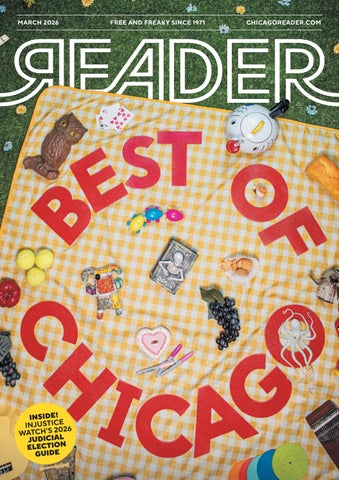
Create a flipbook
Chicago Reader March 2026 by Noisy Creek - Issuu