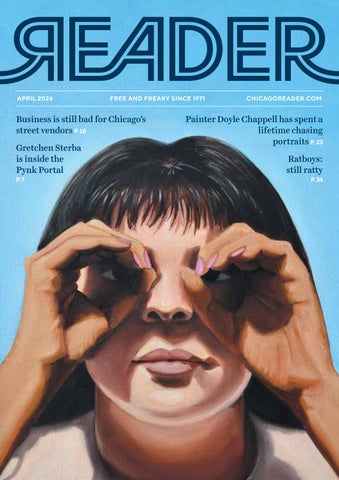
Chicago Reader April 2026

Page 1


TABLE OF CONTENTS

THIS ISSUE:

4 Editor’s Note | Conway Chicago’s hidden worlds are everywhere.

COMMENTARY

6 Opinion | Pastel

What Kyoto taught me about designing cities with artists’ imaginations

CITY LIFE

7 Feature | Sterba Enter the Pynk, Chicago’s sex workerowned pole studio out west.

14 Social Fabric

Black Film Club Collective and photographer Kenn Cook Jr. crafted a living Black archive.

16 Inside Voices | Ehlers Education is key to changing incarceration from a warehouse model to one of rehabilitation.

FOOD & DRINK

18 Feature | Sula Random ICE raids have slowed for now, but this popular street vendor still isn’t cooking outside.

20 Reader Bites | Giallorenzo The trippy vibe at Chocolate Shoppe Ice Cream

NEWS & POLITICS

21 Feature | Chilukuri State lawmakers consider a bill that could change the balance of power in negotiations over the future of data centers in Illinois.

ARTS & CULTURE

23 Feature | Brown Octogenarian artist Doyle Chappell’s swirling portraits capture the inner spirit of their subjects—from Lady Bird Johnson to Daryl Hannah.

THEATER

28 Preview | Reid Out Here at Court Theatre gives a fresh musical spin to the family drama. FILM

30 Feature | Kelly Community Cinema makes moviegoing accessible.

32 Moviegoer | Sachs Passion of the critic

MUSIC

34 Feature | Galil Beloved DIY savant Charles Joseph Smith brings his music aboveground.

40 Feature | Ludwig Ratboys have become a national act—but their commitment to Chicago remains as strong as ever.

READER RADAR

43 Calendar A curated monthly guide to what’s actually worth leaving your house for

CHIEF OF

Rob Crocker

Ellen Kaulig

EDITOR IN CHIEF Sarah Conway CREATIVE DIRECTOR Corianton Hale

ASSISTANT MANAGING

Savannah Ray Hugueley

FEATURES AND COPY

Kerry Cardoza

Kirk Williamson

Amber Huff GRAPHIC DESIGNER & PHOTO RESEARCHER

Shira Friedman-Parks

THEATER & DANCE EDITOR Kerry Reid

MUSIC EDITOR Philip Montoro

CULTURE EDITOR

Taryn McFadden

NEWS EDITOR Shawn Mulcahy

PROJECTS EDITOR Jamie Ludwig

STRATEGIC CONTENT EDITOR Tyra Nicole Triche

SENIOR WRITERS

Leor Galil, Mike Sula

FEATURES WRITER Katie Prout

SOCIAL JUSTICE REPORTER Devyn-Marshall Brown (DMB)

STAFF WRITER Micco Caporale

DEVELOPMENT MANAGER Joey Mandeville

DATA ASSOCIATE Tatiana Perez

MARKETING MANAGER Maja Stachnik

MARKETING ASSOCIATE Michael Thompson

SALES REPRESENTATIVES Will Rogers, Kelly Braun, Vanessa Fleming

EDITOR’S NOTE

April is Chicago’s season of reentry—our city’s very own transition from dark to light as the great thaw hits and buried bulbs finally emerge. Spring is the opening of the many worlds that make up this city, especially those that hide in plain sight. Drive down any street or look down any alley: without recognition, sometimes in deliberate quiet, there lies life. As Chicago thaws into spring, this issue explores the worlds of culture, resistance, care, and memory that shape the city.

Contributor Gretchen Sterba punches with a lavish feature on the Pynk Portal Pole Sanctuary, a sex worker–led studio reshaping Chicago’s pole scene from the ground up in Little Village. Built by Ava V. Marie and Steph (who performs as Gemini Jynx), this studio is both a space for movement and a critique of an industry that often borrows the glitter and glam of sex work while excluding the people who created it.

On the south side, senior writer Mike Sula takes us behind closed doors to profile Bertin, who, alongside her family, runs a beloved but largely hidden restaurant out of her apartment. Once a bustling operation drawing customers from across the midwest, this street vendor has been forced inward by immigration enforcement, but the matriarch still holds it down in defiance. Serving scratch-made hefty corn tortillas and steaming menudo that takes your breath away, Bertin will always leave you wanting to come back to her door. Prepare to get pounced on by her multicolored cockatiel, Bruno.

Our Social Fabric column goes out west, where the Black Film Club Collective and photographer Kenn Cook Jr. are building a living archive of family, migration, and

memory through portrait sessions and communal storytelling. This documenting of Black families in North Lawndale, Austin, and East Garfield Park reminds us that history is not only inherited, but actively created and honored.

This month, we’re also introducing Inside Voices, a new column exclusively from writers inside or impacted by the carceral system in Illinois. In his newest essay debuting the column, our longtime contributor Anthony Ehlers reflects on 33 years in prison and his long fight to access education behind bars.

Beyond the page, our cultural calendar Reader Radar invites you to leave your apartment finally (screaming in better weather) for shows that range from Snow Tha Product’s high-energy performance, to “All My Love” at the Chinese American Museum of Chicago, to avery r. young’s Afro-surrealist world premiere of safronia at the Lyric Opera, to the Black Girlhood film series at Doc Films in Hyde Park. Like this issue’s stories, these events are portals into Chicago’s depth, creativity, and its ever-present contradictions.

I hope you’ll also join us at our next Reader pop-up on April 4 at Avondale’s Magnífico Coffee. Grab a copy of this month’s issue, meet staff writers and editors, sip some damn good coffee, and connect with our friends at the pub, Chicago’s purely DIY print publication you won’t find online.

Don’t forget that Chicago’s hidden worlds are everywhere, even in you. This month’s issue is just one invitation to step inside. v

sconway@chicagoreader.com

Saturnino Herrán (1887 - 1918), La ofrenda, 1913, oil on canvas, 72" x 82.6", Acervo INBAL/MUNAL Reproducción autorizada por el Instituto Nacional de Bellas Artes y Literatura, 2026.
supakid, Untitled (Ricky Renuncia) (2019) COURTESY MCA

Designing cities for humans

After visiting Kyoto, artist Bianca Pastel believes that the people designing our city’s infrastructure should think like artists.

On a recent trip to Kyoto, Japan, I experienced something rare in American cities: a world shaped by thoughtful design. It made me realize something simple but radicall—the people building our world should think like artists.

Kyoto’s environment felt like it had been designed for the human nervous system, especially people with ADHD and anxiety. There was legroom in small spaces. The color palette was calm instead of chaotic. The airport layout flowed naturally instead of feeling overwhelming, and the walkways were wider. Water stations were everywhere, so I did not worry about dehydration, overpriced water, or the impact of single-use plastic on the planet. Public seats were often clean and reclining, with phone and cup holders and a variety of charging cords.

These details may sound small, but together they created something powerful: a sense that the designers of public space cared about the people moving through it. Even without speaking the language, I could navigate easily. Cozy illustrations showed which train to take. The designs were playful, even silly. That sense of whimsy reminded me of nostalgic childhood shows like Blue’s Clues and Dora the

Explorer, where it felt safe to explore and discover the world around me. The experience calmed my nervous system.

Returning to Chicago was a shock.

Everything felt hostile to the senses: noisy trains, cramped platforms, dirty stations, confusing public transit layouts. The design didn’t make me feel happy or inspired. Quite the opposite. Being in those spaces is distressing, and it feels like a mission to get out as fast as possible. Moving through the city felt less like living and more like surviving.

Until I went to Japan, I accepted many things about Chicago. I told myself, “Well, I guess I’ll just suffer whenever I go outside.” But going to Kyoto and seeing simple solutions to small problems at home made me realize that good design can solve many social issues.

In many Black neighborhoods, neglect isn’t accidental. The environment feels engineered to exhaust you—liquor stores next to churches next to funeral homes next to broken infrastructure in a chaotic loop. When you grow up surrounded by that design language, you start to believe that disorder is normal. You do not know anything else is possible.

I’m on a quest to change that. If cities shape our imagination, murals can interrupt the story.

is historic because of what was taken and what has been rebuilt anyway. I believe Black neighborhoods deserve fantasy and a sense of the surreal, not just struggle. We deserve beauty and magic, too. I dream of color, whimsy, and delight flooding our streets, inspiring children and adults alike to dream. Great, creative design has an economic impact and is worth investing in. Just ask Roki Sasaki, who signed with the Dodgers and cited their high-end toilets as a reason why. It would be a mistake to dismiss the design of a toilet as an indicator of the quality of life. Toilet bidets with good lighting and privacy features are included in public transit in Japan. They are clean and well-maintained, with a thoughtful design that suits every body type. In many parts of Chicago, especially when using public transportation, clean restrooms that meet your needs are hard to find. When a city neglects your most basic bodily needs, that communicates exclusion. Clean, well-designed places provide dignity. Neglected design spaces breed shame. Bathrooms are not just infrastructure; they are a psychological reset point.

I’m not romanticizing my time in Japan; I’m using it as proof of what could be when we’re encouraged to explore the world. Across American cities, the visual language of our environments is incredibly strict—boxy buildings, flat shapes, muted colors, repetitive forms. Design has become standardized and unimaginative. In some neighborhoods, it appears as neglect; in others, as sterile uniformity. But in both cases, what’s missing is imagination. There should be a play with shape, color, and form that makes a place feel alive.

In April 2025, I was approached to paint an 18-by-26-foot mural on 63rd and Aberdeen in Englewood. Over the next four months, I sat in community meetings with the residents of the block, walked the neighborhood, attended their block party, and got to know the people who live there.

As I painted in the August heat, neighbors brought me home-cooked meals, watched over me at night, and shared their stories of resilience. I felt the weight of what this space has carried and the resilience of the people who live there. Through conversations with longtime residents and stories shared by photographer, social justice artist, and lifelong Englewood resident Tonika Johnson, who commissioned me to paint the mural, I learned about the deep roots of systemic racism in this neighborhood and how families were scammed out of homeownership in the 60s, and how even today, our people are still fighting for safety, land, and agency.

My contribution, anchored in both history and imagination, is Binky, a character I dreamed up, dressed in full knight’s armor. She is a protective, magical figure standing strong on this historic block. Englewood reflects the full arc of American urban policy in racial containment, white flight, divestment, and resistance. It

As a visual artist, I notice how little creativity is applied to these environments. Where is the whimsy, the softness, the play?

When I dressed Binky in armor, it was a symbol of protection and of honoring the ongoing battles our communities face. Binky becomes a guardian of this space and a reminder to the children, elders, and everyone passing by that we are worthy of being protected, believed in, and imagined into powerful new futures. This mural isn’t just decoration. It’s a prayer, a shield, and a portal.

If our cities were built with artists’ imaginations, our streets wouldn’t just move people, they would nurture them, and children growing up in places like Englewood wouldn’t just learn how to survive their neighborhoods, they would learn how to dream inside them. That’s the power of art—it can change the world. v

Bianca Pastel is a Chicago-based artist whose influences include 90s movies/ cartoons, art deco, photography, and music. She has a background in art and design from Columbia College, and her experience spans album cover creation, children’s book illustration, animation, and graphic design.

themail@chicagoreader.com

Bianca Pastel’s mural at 63rd and Aberdeen in Englewood features Binky, a central character in her work. NICOLE MISFITX

In Little Village, two sex workers built a pole studio that the rest of Chicago’s pole scene has yet to authentically replicate.

MICHAEL IZQUIERDO FOR CHICAGO READER

CITY LIFE

Editor’s note: Sex work remains criminalized in Illinois. Some sources in this story are identified by first name or stage name only; their full names have been withheld to protect their safety. They are marked with an asterisk on first mention.

THE ROOM ON LAWNDALE

he students had gone home. The studio’s luminous neon sign, flamingo pink, in keeping with the name, threw a glistening wash of color across the dim front room of the Pynk Portal Pole Sanctuary, a small but purposeful space on the west side of Chicago.

A few steps from the Hello Kitty–themed bathroom, I sat on the floor with Ava V. Marie*, one of the studio’s co-owners, to smoke a joint and talk about what it costs to keep its doors open. The cascade of bruises on my thighs—a rite of passage, “pole kisses,” as the studio’s regulars call them—was still tender from my last several classes.

“People’s Gas is threatening to cut our shit off,” Ava told me through an exhalation of smoke, as we took in the still studio space together. Her tone wasn’t one of defeat, though; that’s not how the entrepreneur, sex worker, and pole instructor moves.

The Little Village space on Lawndale Avenue is co-owned with Steph*, who performs as Gemini Jynx. Not yet a year old, its classes—Twerk & Pole, Sensual Ascension, Heels Choreography, Candlelight Sensual Restore, among others—fill to capacity most weekends, even if the margins haven’t caught up.

The studio is sex worker–led and sex work–affirming, which in Chicago’s pole scene is rarer than it sounds. Pynk Portal occupies an unusual position: It is at once a pole studio and a rebuke of most pole studios in Chicago. There are at least 13 in the city, mostly clustered on the north side. Some have made genuine efforts at inclusion. But few openly employ sex workers in decision-making roles, and the buzzwords that dominate their marketing, such as “community,” “empowerment,” and “connection,” are language that, critics argue, profits from pole’s history while erasing the poor, queer, and BIPOC sex workers who built it.

Access, though, is not the same as ownership, and in a culture built by sex workers, the difference between being welcomed into a room and holding the deed to it is the whole argument. The pole, they believe, was never just a prop for exercise.

TWO WOMEN, ONE STUDIO

oth Ava and Steph started pole dancing nearly a decade ago. They came together in May 2025, after Siren Chicago, the Logan Square sex-worker-owned pole studio where Ava had taught and which had been a gathering point for their community, closed its doors abruptly. The closure left students, instructors, and sex workers without a home.

“I’ve gone to several studios all around the city,” Steph said, hinting at the divide between the city’s poles. “All of them have been not nice.”

Ava didn’t hesitate. “They’re cliquey as fuck.”

The solution they arrived at was Pynk Portal, where they built the room, set the pay structure, and absorbed the financial risks in six weeks. What helped energize the studio’s birth was that students were already telling Ava what they couldn’t find elsewhere. “Students would come to me at Siren and be like, ‘I just went to this studio last weekend, and I felt fat-shamed,’” she said. “Or, ‘I felt like there was whorephobia.’ I have a student who traveled to every single studio in Chicago—they told me they took their shirt off, and got yelled at. They’re getting yelled at for being comfortable in their body on the pole.”

Pynk Portal connects Chicago to a loose constellation of queer, BIPOC, and sex worker–led spaces that have emerged to do what most pole studios across the country haven’t: hold the room without hierarchy, without the entitled OG energy that tends to follow anyone who’s been in a scene long enough to think they own it.

Ava is 27, a Capricorn, and from the south side. She is a straight shooter in the most specific sense: What you see is what you get, and what you get is someone who has assessed every room she’s entered and decided, precisely and without apology, where she stands. Her onstage persona is sultry and bewitching; you dare not look away, afraid you’ll miss something, but in class, she meets you where you are. Ava’s ego isn’t checked at the door; she knows she’s that girl. She also knows you aren’t, yet, and she remembers what that was like. She lets us know that when we attempt to hoist ourselves on the pole, we inevitably flail.

Long before Pynk Portal, Ava was building the infrastructure that would make it possible. Through her collective, Black Skrippa Brigade, she organized pole performances and shows that centered Black and Brown dancers, creating stages and providing pay when Chicago’s clubs and studios failed to. It was an act of construction as much as resistance: If the rooms don’t exist, you build them.

Steph is 35 and a Gemini. The eight years between her and Ava show up not in maturity but in texture. It’s a different style, a different pace. She doesn’t own a television. A class with Steph is, as I came to think of it, like a March breeze after an unforgiving Chicago winter: mild, present, almost startling in its gentleness. The studio sits in a corner building that has been a lifeline in the Latine community for decades, and in sequence, a carnicería, an AA center, a disability services facility run by Steph’s mother, and finally a family home. Continuous community care, it turns out, was the building’s legacy before the Pynk Portal arrived.

From left: Steph and Ava V. Marie, the owners of the Pynk Portal Pole Sanctuary Studio MICHAEL IZQUIERDO FOR CHICAGO READER
Step into the Pynk Portal and you’ll find no whorephobia, anti-Blackness, body shaming, or respectability politics, the quiet violence of which is present in so many artistic, performance, and fitness spaces across the city.

Steph grew up in East Side and moved to Little Village 15 years ago, and in recent months, she has watched a neighborhood known for street vendors and music playing at all hours go quiet. “In this world, people need to figure out sustainable ways to work,” she said. “You have to have some kind of community you trust enough to build with.”

On a side of the city that often pits Black and Brown people against each other, what Steph and Ava have built is deliberately something else. “So many marginalized communities are vulnerable right now,” Steph told me. Pynk Portal is her answer to that; it’s not a space siloed to one demographic, but one where the work of collective liberation is ongoing, and the people who show up reflect that.

Step into the Pynk Portal and you’ll find no whorephobia, anti-Blackness, body shaming, or respectability politics, the quiet violence of which is present in so many artistic, performance, and fitness spaces across the city. Chicago is the nation’s most segregated city, yet here, interracial solidarity between Black and Brown communities thrives. It is, depending on what you need on a given night, a community, a sanctuary, or a safe space to shake ass. Sex workers are integrated into its creative model and leadership to the point where everyone can feel included. They don’t just teach classes; sex workers own the shop—it’s a distinction that supporters of Pynk Portal say makes a difference.

After an Intro to Beginner Tricks class, I sat with Steph and Diamond WarrenTucker, a 25-year-old Black femme student who had been coming for about a month. We were still in the room, talking about what the classes had done to our bodies, our mental state, something harder to name. Diamond, who is not a sex worker, had found her way to Pynk Portal on her own terms. I asked her why here, why this studio she’d taken to calling “the Pynk.”

“I’m not gonna learn hip-hop from somebody from Spain. I’m going to go to the source every time,” Warren-Tucker said. “They have a deep understanding of what it requires, of what it entails, and what you gain from it. Not in terms of affirmation in the form of applause or external validation, but what it unlocks in you.”

The proof was visible at Sax and the City, an early January event that combined live jazz and pole performances at a packed community space in Pilsen. Ava and Steph performed alongside dancers from Black Skrippa Brigade, and midway through the show, the DJ paused to recognize Ava, whose birthday had been two days earlier. Dressed in 1970s-inspired

attire reminiscent of Diana Ross, she stood as the room showered her with affection. Without her, there would have been no gathering, no dollar bills exchanged, no music in harmony, no captivated audience, and no Pynk Portal.

Catalina*, a 22-year-old nonbinary Puerto Rican who dances at Rick’s Cabaret Chicago near Goose Island (and also a recent graduate of the University

of Chicago, who wrote their thesis on stripping), gushes about Pynk Portal to me, and it helps, too, that they helped build these walls. Catalina was drawn into Ava’s mission with the Black Skrippa Brigade, similar to Steph, who noted Ava was “unwavering” in her vision to provide opportunities for marginalized dancers.

“We are in very hard times right now,”

they said. “We do need people who are making the effort. Stripping is such an alienating job in many ways, because yes, you work with a lot of women, but you’re working against these women at the same time.”

They also touched on the difference between pole fit and genuine pole culture, hilariously comparing pole competitions to “giving Abby Lee Miller” of Dance Moms fame. “It’s so hard to put into words, but teaching other women to find that chord within themselves—something that opens up a whole new world of who they are, how they can move, and who they can be—in ways no pole sports studio is ever going to give them.”

From top: Pynk Portal Pole Sanctuary; inside the studio
MICHAEL IZQUIERDO FOR CHICAGO READER

CITY LIFE

WHAT THE BODY HOLDS

n a brisk Sunday evening in early March, I parked near 28th and Lawndale Avenue and walked briskly toward Pynk Portal for a workshop Steph had conceptualized called Self Love & Touch. The premise was disarmingly simple: nonjudgmental body empowerment, in a room with strangers, with mirrors.

At 30 years old, I’m quite committed to moving my body. I attend ballet twice a week, reformer pilates classes every few days, and strength training about three to four times a week. But as Ava told me during class, “The gym does not translate to the pole.”

After a short stretch-andbreathwork warm-up, she split the four other attendees and me into stations. I started at the pole. Steph asked us to study ourselves and freestyle to the music. Then, to do it again, focusing on one body part. I chose my hips.

“You have to have some kind of community you trust enough to build with.”

It’s awkward, watching yourself in a dimly lit room with other folks you don’t know. “How do you feel?” Steph asked, sitting cross-legged on the floor between us. We looked at each other, bashful. She offered some relief: When she started, she said, she often felt “awkward with shame or disappointment.” “For me,” I said, “I feel awkward with acceptance.” The group hummed in response.

The second station used a metal chair. A snippet of a Rihanna song went by. The third involved pairing up, with one person facing the mirror, moving, and the other watching. “Now, focus on working with your collarbone,” Steph said. After we obliged, the music stopped, and Steph said, “I loved watching all of you.”

After a short break, we paired up, directing one person to focus on their ass and dance for themselves in front of the mirror, while the other sits in a chair, examining how they twerk.

“Girls can teach you all the combos over and over,” Steph said. “You have to develop your own style and get more exploratory in the dance.” Palms sweaty, throat dry,

heart going. I didn’t know these people. But that, I began to understand, was something close to the point. I was leaning into the discomfort under Steph’s guidance; it was, in effect, a trust fall.

“Those watching, what did you see?”

“I saw joy,” one person said.

“I saw focus,” another said.

“But without judgment?” Steph asked. That seemed to be the key.

“I saw resistance,” another said, turning to her partner. “Right?”

For the final stretch, Steph asked each of us to pick a favorite body part and find the beat with it, not looking away from the mirror. Steph joined in with us, wedging herself in the middle between the five of us.

“Legs!” one person called out.

“Feet!” I declared, receiving some chuckles.

I asked Steph to choose for me.

“Head,” she said, without hesitation.

I sat in the metal folding chair, faced the mirror, and moved slowly, as if there were an audience and they were there for me. Shaking ass surrounded by strangers is intrinsically vulnerable, and if you can twerk on the fly, I envy you. Outside this room, a specific kind of noise operates at full volume: starvation rebranded as discipline, the ambient, mono-beautystandard insistence that your body is a problem awaiting a solution in an Ozempic pill. Around halfway through the workshop, that noise faded. And then, without warning, I began to cry. I had shifted to the floor, chair work, then spilling out beneath it, moving through the music from the hips down. Like many people, I carry accumulated tension in my body; I’ve known this for years. What I hadn’t expected was to feel it leave. Within an hour, something had loosened that I hadn’t been aware I’d been holding.

I wasn’t the first person to feel this way in a pole studio, and it turns out there’s research to back it up. A 2023 study in BMC Psychology compared 50 women who took structured pole dance classes with a waitlist control group and found that participants reported greater mental well-being, sexual self-esteem, and overall body appreciation. Writer Akili King, in a 2021 Vogue piece, described the practice as “a new phase in my healing, showing me how I could feel both emotionally soothed and physically strengthened at the same time.” Pole dancing can be a stress reliever, a form of reclamation, and a physical practice that gives practitioners a sense of control over their own bodies. The room on Lawndale already knew that.

From top: Sydsei; Mocha May; and Cherry MICHAEL IZQUIERDO FOR CHICAGO READER

CITY LIFE

A PATTERN NOT DIFFICULT TO READ

onflict is inevitable in any community. Everyone will fall short at some point, but the question is whether the foundation is solid enough to survive it. Queer Skrip Club in Denver, Haymarket Pole Collective in Portland, and Blackstage Pole in London are among the organizations building that kind of ground. Pynk Portal is Chicago’s entry in that ledger.

Cherry*, who has danced with Ava through Black Skrippa Brigade, said that although some pole fitness studios display racial and bodily diversity among their leadership and instructors, such representation does not necessarily align with the values most important to students, particularly sex workers. As a sex worker, 27-year-old Cherry said she has been unable to secure employment at certain Chicago strip clubs because of racism; as a result, she performs at shows organized by sex workers themselves. “Pole fitness studios are not necessarily as welcoming,” she said.

Ava and Steph are the sole owners of Pynk Portal. The economics of running a sex worker–affirming studio in Chicago mean they frequently travel to supplement their income—sometimes nearly a thousand miles—to cities like New Orleans, where, Steph said, club owners hire more Black and Brown dancers than those in Chicago. This transitory work is not unusual. Selena the Stripper*, a Los Angeles–based sex worker and advocate, said dancers have historically been migratory workers, driven not only by season or climate but by a more fundamental calculus of acceptance. “A lot of Black dancers will go to hubs where they’re more accepted,” Selena said. “They might go to Houston or Atlanta. Trans dancers may go to Seattle or Portland to find clubs more mixed. It’s really hard to find good clubs that accept you and have inclusive casting.”

This sense of discrimination showed up in a recent federal case. In 2024, the U.S. Equal Employment Opportunity Commission filed a federal lawsuit alleging that Albany Park’s Admiral Theatre subjected dancers to a hostile and dangerous work environment, including harassment and assault by patrons, and discriminated against Black dancers by assigning them less lucrative shifts, enforcing stricter appearance and work standards, including bans on natural hairstyles, and using racial slurs, including the N-word.

Exclusion in the pole fitness industry, as in most industries, tends not to announce itself; instead, sex workers interviewed for this story say that it can accrue in small administrative decisions and interactions. In reporting this piece, sex workers, dancers, and instructors across Chicago described what it was like to walk into studios owned by people outside the community. While some pole fitness studios have made strides in openly hiring sex workers and BIPOC and LGBTQ+ instructors, critics say representation does not always translate to safety.

“These institutions have shown us that we are not really welcome. It makes me sad to see sex workers changing themselves to try to fit into spaces where they are not wanted,” Cherry said. It doesn’t help that the origin of pole dancing isn’t a story pole studios tend to tell.

Rebelle Cunt* knows the history that is often glossed over. They are a sex worker and the founder of the Heaux History Project, a Chicago-based international network of sex workers, scholars, and artists committed to unearthing the forgotten histories of Black, Brown, and Indigenous sex work. According to Cunt, exotic dance began in the 1800s,

“If you don’t have a sex worker background and you’re teaching a Pole 101 class, and you’re talking about pole as an art form or a fitness model, and you’re not including its origins, that’s erasure. That’s dangerous.”
From left: Steph and Ava started pole dancing nearly a decade ago. MICHAEL IZQUIERDO FOR CHICAGO READER

gradually transforming into the strip-club culture that gave pole dancing its current aesthetic vocabulary: the Pleaser heels, the floor choreography, the particular charge in the room when the music starts. It wasn’t ancient Indian or Chinese pole acrobatics, though that narrative circulates in fitness-world retellings. It was always the Bada Bing.

“If you don’t have a sex worker background and you’re teaching a Pole 101 class, and you’re talking about pole as an art form or a fitness model, and you’re not including its origins, that’s erasure,” Cunt said. “That’s dangerous.”

Some dancers said they felt singled out. Sydsei*, a Black pole instructor who is not a sex worker, began her pole journey at the now-shuttered Siren, after starting pole growing up. As a survivor of sexual assault, she found a sense of reclamation in the practice, particularly when sex workers taught classes. When she decided to teach, she enrolled in instructor training at Pole Icons, a studio with locations in Bucktown and

AN ACT OF RESISTANCE

ynk Portal’s challenges are not only internal to the pole world. This past fall, Steph watched Little Village change in a way she hadn’t seen in 15 years of living there. By December, according to Representative Mike Quigley, annual revenue in Little Village had dropped by 50 percent. “That fucked us,” Ava said, of the U.S. Immigration and Customs Enforcement raids that hit the west side in early 2025. “That fucked us big time.” People stopped showing up for class. “They didn’t ask for their money back. It wasn’t even about a refund. They just didn’t want to be caught outside.”

Slowing down is not an option for the air-and-earth-sign duo. They’re in the

all instructors, regardless of background.”

Park, paying what she described as $2,000 for 50 hours of training.

Sydsei was one of two Black instructors at the studio, so she said that Black students gravitated toward her classes. In one early session in January 2024, she asked what music students wanted. “We want to hear some twerking music; we want to shake our ass,” she recalled them saying. Afterward, she said, owner Aileen Bidwill pulled her aside and suggested she play Dua Lipa or Taylor Swift instead, which felt racially insensitive to Sydsei.

Bidwill said the class in reference was a free, community-based session not limited to a single demographic, held at the end of the teacher training program.

“She never made a comment about my playlist until it was Black music in an entirely Black class, and to counter it with white artists felt racially coded.” In an email to the Reader, Bidwill said that she “did not direct that any specific artists be played” and that any feedback provided was “consistent with the guidance given to

throes of renovating and expanding, hoping to knock down a wall to add three to four more industry-standard poles, which will cost several thousand dollars. Ava even hints at a postpartum pole class while Steph visualizes bringing in instructors for voguing and Latine dance classes, with a community garden out back. Ava and Steph stress that it’s especially important now to have third spaces like Pynk Portal where students, sex workers or not, can thrive.

“Being a sex worker at a time where women are still under attack, now more than ever, and our community is under attack, now more than ever, it’s an act of resistance for us to continue to keep this space open,” Ava said. “Because closing the studio cannot happen. It can’t happen for me, it can’t happen for my business partner, it can’t happen for the students

Bidwill explained that, overall, instructors are trusted to curate their own playlists and are trained to structure them to support pacing and safety, with classes that “start slower and build appropriately.” Sydsei later learned from Mocha May*, a Pakistani sex worker and former Pole Icons instructor, that they had not been charged for training.“ That’s when it really clicked,” Sydsei said. Bidwill said training pathways vary and that no program has been offered since 2023, the year Sydsei completed hers. She wrote that instructors with prior experience sometimes participate in portions of the training as a refresher at no cost, which is a part of company policy. Pole Icons has since shifted to bringing in instructors with existing teaching experience, many of whom are current or former sex workers. Bidwill said she aims to foster an inclusive environment, and her studio, Pole Icons, has been celebrated as a pole studio that both publicly hires sex workers and operates as a safe space for LGBTQ+ and sex worker communities. “We have a zero-tolerance policy for anti-Blackness, discrimination, or harassment. These expectations extend beyond the written policies in our handbook and are part of the culture we expect staff and students to uphold,” Bidwill said. But May felt the studio lacked genuine space for the inevitable conflicts that arise in a community, “for everyone to grow together in community, even when it was uncomfortable,” they said. It came to a head for May when they said they were told that a couple of their classes would be cancelled and others would be transferred to someone else over the next few months. Their time at Pole Icons ultimately ended in August 2025. Previously, Bidwill and May were supposed to meet to have a “professional and constructive conversation” with a neutral third party, a studio liaison, after documented “performance and professionalism concerns” and a write-up for lateness on two occasions. For May, it felt like “there is no room for your humanity

that come here. And it can’t happen for the community.”

During this story’s photoshoot, I asked Ava and Steph what the solution to these seemingly endless issues afflicting the community is: collaboration? “The word ‘collaboration’ is bastardized to me,” Ava said. “People want to collab with us all the time, but collaborating doesn’t mean I do all the work and you get to put your name on it.”

The hours I’ve spent at Pynk Portal to tell this story have proven one thing to me: There is an active, genuine force of care here. Have you eaten? Are you resting your bodies? Have you hydrated?

During one class, which is full despite thunder and lightning crackling outside, a novice student who has been attending for the past several months goes into the kitchenette area and grabs a water jug to

or capacity if you are a person of color in that space.” Bidwill shared that a formal staffing decision was made, following prior documented concerns, and a write-up was handled in coordination after multiple opportunities to meet were offered and declined via text. Later, May found they had been removed from the studio’s system, which Bidwill said is part of company policy. “It was just inconsiderate to everyone involved,” May said. “That was like my home for three years. It has totally turned my life upside down.”

At Catalyst Movement Arts, a West Town pole studio, May, who taught there in 2023 before moving to Pole Icons, described what they said was a workplace in which people of color were routinely characterized as unprofessional. “You have to think about who’s creating the space. I think after a while, owners start to think they’re kind of untouchable,” said May. The studio’s owner, Andrea Caines, is also a day-shift sergeant for the Village of Forest Park, a law-enforcement job that made May feel uncomfortable given the history of criminalization that sex workers face. Caines said that transparency with her staff has always been a priority, and she hadn’t been “presented with any examples of the behavior” that May claimed happened. She wrote in an email statement to the Reader that, “Transparency with our staff has always been a priority for me, and all potential employees were informed about my full-time job in law enforcement before accepting employment. They were given the option to decline the position if they felt uncomfortable with this fact.” Caines also noted that Catalyst Movement Arts proudly employs current and former sex workers and has created “a community that thrives on inclusivity, support, and shared understanding,” and this is the first time an issue of this nature had been brought to her attention in nine years of serving “a beautifully diverse range of clients who are encouraged to use their voices and advocate for themselves from day one in this space.”

refill at the hydration station for everyone. It’s seamless, the way this community acts, even in the small ways, for a purpose bigger than themselves and their individual needs.

Near the end of my last visit, as Ava stretched her long legs on the mat and Steph casually wrapped a private lesson nearby, I mentioned that I’d been watching pole shows for years, though I still struggle on the pole.

Steph sauntered over and showed me a right hook: grip the pole with your right hand, tuck your right knee behind it at waist level, lean your whole body left, and spin. To my surprise, after a couple of clumsy attempts, I landed the move.

“You just need to come to class,” Steph said. “And you will do great things.” v

themail@chicagoreader.com

Humboldt

CITY LIFE

CSOCIAL FABRIC

A living archive on the west side

Black Film Club Collective and photographer Kenn Cook Jr. document the histories being created right now.

hicago’s west side is rich in history, not only in its monuments and institutions, but in the everyday rituals of memory: family photographs passed handto-hand, kitchen table stories told between bites, Sunday dinners that stretch for hours. Neighborhoods remember themselves through people, like Margarette’s family, whose home deed in Douglass Park is memorialized as a symbol of forgiveness between Jewish families who once lived in North Lawndale.

Since 2020, Black Film Club Collective has built a reputation in Chicago for its film salons—intimate screenings that turn watching films into opportunities for conversation, reflection, and shared cultural critique. Our new archival project, Making Meaning, expands that work beyond the screen. Rooted in storytelling, conversation, and image-making, the project invites community members to reflect on the memories and objects that shape our lives. The everyday stories— about family, migration, work, joy, and survival—are often held privately, but they are just as important to our collective history as anything written in a book. What does it mean to archive a community while it is still living?

Moving between film, portraiture, and storytelling, Making Meaning creates a space where people can reflect on what they carry forward from their families and communities. It’s a form of what we call vernacular archiving—the practice of preserving everyday life outside traditional institutions. Archives do not only live in libraries or museums. They live in the stories we tell, the images we preserve, and the ways we gather to remember together.

Making Meaning represents a continuation of work that’s already been happening in the culture for decades. We’re just helping the community give language to it and reflect more intentionally on its impact. Growing up, our homes were full of photo albums, films, and conversations about culture—especially when the family gathered. That informal way of learning and storytelling stayed with us.

This season, we partnered with photographer Kenn Cook Jr., whose portrait practice centers on presence, dignity, and the layered histories held within Black families on the west side. For Cook, whose photography often portrays quiet moments of Black life, the collaboration felt like a natural extension of his work. His portraits hold the echoes of those

who came before and the promise of those who will come after.

On February 28, we hosted Fine Lines, a community portrait day. Inside Monday Coffee, families from North Lawndale, Austin, and East Garfield Park gathered to sit for portraits and share brief reflections about memory and migration.

Participants responded to prompts such as: What brought you here today? What does your family’s migration trail look like? What memory do you want to keep?

Elders spoke about arriving in Chicago

decades ago. Parents reflected on raising children in neighborhoods shaped by change. Younger family members listened, sometimes hearing these stories for the first time. For a moment, it felt like we were being transported back in time together.

As communities across Chicago continue to face displacement and rapid change, Making Meaning offers a slower practice—one rooted in listening, remembering, and honoring what remains. On the west side, memory isn’t

something stored away. It lives in the people who carry it forward. v

–Chinyere Achebe and Troy Martin, cofounders of Black Film Club Collective

Social Fabric is a glimpse into the vibrant lives, objects, and spaces that shape our city, cocurated with community archives and local photographers.

sfriedman-parks@chicagoreader.com

Clockwise from top left: Ramya, Angelica, Reagan, and Jewel. Ramya is wearing her mother’s jewelry. Austin KENN COOK JR.

Above (clockwise from top left):

Margarette (L) and Alice, North Lawndale

Remi (R), Nekeisha, and Royal, holding a family blanket sent to Nekeisha by her grandmother. The blanket, patterned in Scripture, remains a reminder that their family has been rooted in faith for multiple generations. North Lawndale

TeKeasha (L) is the eldest sister of Chris (R). Their aunt Ermia served as a surrogate mother throughout their childhood.

Natalie (L), Tammara, Vergie, holding the family Bible, North Lawndale

Arica and Nathaniel, North Lawndale

Left: Ariya (L), Muteeat, and Amina. Ariya and Amina are holding portraits of Mary Norman and Emma Ryans. Muteeat is holding water and soil from Bimbia in Cameroon.

Austin and East Garfield Park

KENN COOK JR.

INSIDE VOICES

The warehouse model of prison isn’t working, education is

Illinois’s prison education programs have long been proven to lower recidivism rates and change people’s lives, yet they still remain difficult to access.

“Education

Ihave been in prison for 33 years now, and for 28 of those years I tried, unsuccessfully, to get an education. When I was on death row, I was told by corrections officers that getting an education would be a waste of time. After I got off death row, I tried, once again, to take some college or vocational classes since I already had my GED. Once again, I was told that “guys

like me”—those of us with long-term prison sentences—weren’t worth being taught. Imagine being told repeatedly that you don’t deserve to learn. You get an education one way or another in prison; it just comes down to whether you can access a formal one. Many of us are left to learn and rehabilitate ourselves (or not). Even as I’ve focused on growing and rehabilitating,

early on in my time, I learned things I didn’t want to know, like how to bust a safe, rock up dope, and make LSD.

After decades, I was one of 20 applicants selected for the first cohort of Northwestern’s Prison Education Program, founded at the now-closed Stateville Correctional Center in 2018. We earned our associate’s degrees in conjunction with Oakton Community College in

early 2022. And in November 2023, we made history as the first class to earn our bachelor’s degrees in social sciences from Northwestern University. Most of us graduated with honors. While great, this program is very small and privately funded, hosting only 20 men per cohort at Sheridan Correctional Center, where I am now, and another cohort at Logan Correctional Center, one of the state’s women’s

An education, especially a degreebearing education, can bring �inancial mobility. . . . Without an education, you have to scratch and claw.

prisons. That’s out of almost 30,000 people within the Illinois Department of Corrections (IDOC).

People may assume that prisons are designed to rehabilitate people. I can tell you from decades of experience, however, that people are put in prison and not given adequate mental health treatment, education, training, or many options to earn money beyond a few cents each day. And when their time is done, most are shoved out the door, back to where they came from, without much in the way of job prospects.

I think it’s time to broadly change incarceration from this warehouse model to one of rehabilitation and education. An education, especially a degree-bearing education, can bring financial mobility: You can be hired for better jobs that pay a real wage and have a potential for growth. Without an education, you have to scratch and claw.

Since 1987, IDOC has required anyone who will be in prison for more than two years, except those with life sentences, to take the Test of Adult Basic Education. Those who test below the sixthgrade level are required to attend at least

three months of Adult Basic Education instruction. When people test above that level, they may be able to access higher level basic education courses, courses to earn a GED, and vocational courses offered by IDOC’s Office of Adult Education and Vocational Services. But a lot of people come to prison without an education—I have helped numerous guys over the years who couldn’t read or write—so there is a long backlog for these programs. Some guys remain on the waitlists for years, and others are released before they ever get a chance to get their GED. At Sheridan Correctional alone, 216 people are on the Adult Basic Education waitlist as of March 2026.

Access to postsecondary education courses has changed a lot over the decades I’ve been here. In the early 1990s, college and vocational programs were widely neglected. The 1994 Crime Bill banned all people in federal and state prisons from getting need-based federal financial aid, like the Pell Grant, leaving a lot of people cut off from higher education. In 2023, after almost three decades, Pell Grants were finally restored for people in prison, gradually increasing participation in postsecondary education programs.

Now, in Illinois prisons, people can access degree-bearing educational programs through partnerships between IDOC and outside community colleges and universities. Currently, almost a dozen host college programs in prisons across the state. According to a 2025 Open Campus analysis, only about 2,000 people in Illinois prisons are participating in these programs. That’s roughly one in every 15 people incarcerated here. Not to mention that, according to the same study, over two thousand people across the state are on waitlists for these programs, sometimes for years. [IDOC

notes that these “waitlists change daily depending on each program’s academic calendar and capacity.”]

A 2013 study by California-based research organization RAND found that prisoners who participated in a corrections education program were 43 percent less likely to recidivate than those who didn’t get an education. Prisoners who participated in vocational programs were 28 percent more likely to obtain employment than those without vocational training, according to the same RAND study.

There is an especially enormous benefit for those who participate in college-level programs. Recidivism rates drop to roughly 5 percent for those who earn a bachelor’s degree. These programs expand and improve participants’ employment opportunities, allowing for smoother, more successful reentry.

More robust educational programs don’t just improve people in prisons lives, they also make the communities people return to better and safer. Despite truth-in-sentencing laws and death-by-incarceration sentences, the vast majority of people who go to prison will get out. In fact, according to the Bureau of Justice Statistics, over 90 percent of the people who go to prison will go back to the same neighborhoods they came from. In Illinois specifically, about half of the people released from prisons across the state return to Chicago, according to the Illinois Criminal Justice Information Authority.

Given its benefits, every person, regardless of their sentence, should be able to access postsecondary education with transferable credits if their release comes before their degree. It’s also time for more mental health therapy and classes, and for widespread vocational training in trades like welding, plumbing, electrical work, and for obtaining a Commercial Driver’s

CITY LIFE

License. If prisons were really interested in rehabilitation, they would make sure all people in prison could participate in these programs, regardless of their sentences.

For those who say that prisoners shouldn’t get anything, understand that being in prison itself is the punishment. Not being able to go where you want, do what you want, eat what you want, not being able to be there for your family and your children when they need you, that is the punishment.

Education is not just important; it’s a basic human right. I can tell you personally that getting an education was lifechanging. The Northwestern Prison Education Program opened so many doors for me and other graduates, including one who is now out and attending law school at Northwestern.

Education is a powerful tool that can save lives. It can contextualize your past, alter and broaden your outlook on the present, and change your future. Everyone should get that opportunity. v

Anthony Ehlers is an activist, journalist, and artist. He graduated from Northwestern University in 2023 and is now a teaching fellow.

Inside Voices is a series of first-person essays and reported pieces by writers impacted by the Illinois carceral system.
themail@chicagoreader.com

Random ICE raids have slowed for now,

but this

popular neighborhood chef still

isn’t

cooking outside

Business is bad for Bertin and her family—famous for scratch-made menudo and quesadillas—just as it is for thousands of Chicago street vendors.

Editor’s note: Bertin, Ricardo, and Chuy’s names have been changed for this story out of concern for their safety. They are marked with an asterisk on first mention.

Ricardo* squeezes behind his little cousin, who sits cross-legged on an office chair, playing on an iPad.

“We have Coke, we have Sprite, we have water,” he says to a customer, squatting and opening the mini fridge. The door swings wide and pushes the chair—and the girl—against a long folding table where a middle-aged woman and her partner are bowed over bowls of steaming menudo. The table forces the woman back in her own chair as she spoons up the soup, but she course corrects, lifting it to her mouth without spilling a drop or glancing up.

Meanwhile, Bertin* emerges from the kitchen with a plate of warm, handmade corn tortillas, followed by a multicolored cockatiel named Bruno who strafes the open dining/living room toward a covered cage by the front door that houses another bird, a budgie named Blue, who chirps angrily. The parakeet has a temper and might be equally annoyed by the two men slouched on the sofa, scrolling through their phones next to his cage.

This is a Saturday morning in Bertin’s three-bedroom south-side apartment,

which she operates as an informal restaurant on Fridays and Saturdays, serving her famous menudo and quesadillas— with a choice of carne asada, chicharron, chicken, nopal, poblano, or mushroom fillings. In better days, customers came to eat her food from the neighborhood and from all over the city and beyond, some from as far away as Minnesota or Michigan. Most weekends over the last six years, Bertin, who’s 56, and her family set up tables and served her food first out of their own apartment’s garage, and later, when they moved, out of a neighbor’s, who they paid $60 a month in rent. The money they earned—as much as $1,000 a week at its peak—was an important supplement to her husband’s income as a welder.

That all changed last November during the peak of the Trump administration’s Immigration and Customs Enforcement (ICE) and Customs and Border Protection (CBP) invasion.

“They were coming in and just picking people up off the street,” says Bertin’s younger son, Chuy*. “It happened a couple times around here. We got very paranoid, so we tried to open up inside. We had our phone number on a poster with the address of the old place. We started telling people we were gonna be selling from home. But then we would get a lot of anonymous text messages saying, ‘Are you guys open? Can we come in?’ And we’d be like,

Bertin makes tortillas by hand for quesadillas. KIRK WILLIAMSON

‘Wait, we don’t know who these people are.’” They took the poster down.

The family business shut down in November and only reopened in secret in February.

Beginning in 2018, they enjoyed a few successful years, but they took a big hit during COVID, especially when the entire family was bedridden with the virus all at once. Then, in the following months, food prices started to rise, and their profit margins shrank. Customers were already becoming scarce when Trump came back into office.

“We were aware that ICE was going to be coming around and doing raids,” says Chuy, now 18 and set to graduate from high school this spring. He’s planning to study for an EMT license. “This was when it was rumors. Summer we would have days where it would be really packed. The one thing that pretty much held up the business would be the menudo she would sell. There would be a lot of people that would come for that. It’s not like our sales completely died off. We still had remnants of what it used to be. Then slowly, moving into September, October, that’s when sales started to just die off.”

Bertin’s food is unique. Her menudo broth has a buoyant but intensely beefy flavor, lent body by collagen-rich beef trotters, bobbing with bits of cleantasting honeycomb tripe. It’s just the thing to sponge up whatever indiscretions might be lurking in one’s body from the night before.

Her story is unique too. But her change in fortunes is emblematic of many of the six thousand-some vendors registered with the city to sell food on the streets— workers whose exposure makes them particularly vulnerable to random immigration abductions.

“People were still trying to recover from

the Sierra Madre del Sur in Michoacán, the oldest of 11. She learned to cook from a very early age to help feed her younger siblings.

“My sazón comes from my grandmother, my mom’s mother,” Bertin says one Friday afternoon last month, when she was serving Lenten dishes like chiles rellenos, calabacitas con queso, and tortitas de camarón—dried shrimp patties in guajillo sauce. Growing up, “we didn’t have a refrigerator. We didn’t have a cooler. We didn’t have anywhere to store food. Every day we cooked what will be eaten that day. What makes my sazón special is that it’s natural. I don’t use canned ingredients.”

But at the age of 30, Bertin had to leave home.

really mad, like, ‘How you betrayed me. She wasn’t your aunt. It’s going to cost you very dearly.’ They negotiated, and they took us to a gas station to hand us over to the others, but they took us out with rifles.”

Bertin and her cousin made their way to Chicago, where she found work at a factory that manufactured office chairs. She got married and started her family, but she couldn’t adjust to the food.

“Here, putting food in the fridge and then eating it the next day—I didn’t like it,” she says. “It didn’t have the same flavor.” She later took a job as a dishwasher and a prep cook at a Mediterranean restaurant in the Loop.

COVID, and things were going well for a minute,” says Maria Orozco, an organizer with the Street Vendors Association of Chicago (SVAC). “Then ‘Midway Blitz’ happened, and it felt like everything just shut down again, but this time worse than before. People were not coming out. Even those that were going out, there was nobody to buy from them.” Orozco reckons ten to 20 street vendors have been abducted by Department of Homeland Security agents since the fall.

“A lot of street vendors are still scared to vend,” she says. “And the ones that are going out, it’s because they just have no other option than to do what they have to do and risk it. There’s still ICE [presence], and

“A lot of street vendors are still scared to vend. And the ones that are going out, it’s because they just have no other option.”

people are getting detained here in Chicago. Some people are vending inside of local businesses. People are letting them post up shop inside, just so they have a little bit of a safety net to sell and make some money.”

The SVAC has organized vendor buyouts, won grants, and launched GoFundMe and PayPal campaigns together totaling more than $650,000 for street vendor emergency relief.

Bertin’s not sure she’s willing to risk going back to the garage when the weather warms up. But she’s no stranger to risk. She grew up on a ranch high in

“I was very happy on the ranch,” she says. “I never wanted to leave. [But] I was simply a person who a man became obsessed with. He was a bad person. He didn’t have good intentions with the girls. He would take them away, and if [anyone] tried to rescue them, he would kill them. Unfortunately, that man set his eyes on me. He was a real danger to me, and he wanted to take me. That’s why my dad decided I had to leave.”

In the year 2000, the family hired smugglers to guide Bertin, a brother, and a cousin across the Arizona border, where, after walking all night, they narrowly escaped a herd of stampeding bison by hiding in a riverbed. Later, after catching a taxi, they were almost immediately caught by CBP and imprisoned in a caged detention facility. Bertin was sent back across the border. But her brother, who had spent time in Florida and spoke English, was held for weeks under suspicion that he himself was a smuggler. (He wasn’t.)

Bertin wanted to return home, but relatives in Chicago insisted they would find another way. She and her cousin made their second attempt through a sewer system that connected to tunnels across the border. “The coyotes said, ‘Get into that hole,’” she says. “I felt my blood freeze. We had to walk with the water canal and just a small ledge, and we had to put one foot here and the other there. They said, ‘If you fall into the water, that’s where you’ll stay.’ In that moment, I felt like my life had ended.”

When they reached the exit, it was too narrow for Bertin to fit through. She was separated from her cousin and forced to walk further toward another exit. When she finally emerged, she reunited with her cousin at a McDonald’s, but they were kidnapped by another coyote pretending to work with the ones they’d hired. The man drove them to an apartment and attempted to extort her family for more money. Bertin pretended to call an aunt but instead called the original smuggler. The woman soon tracked them to the apartment and a tense standoff ensued.

“They started fighting really badly,” she says. “They cursed each other out, and they had us in the middle. The coyote got

Six years ago, she and her brother decided to go into business for themselves with the idea of setting up a plancha at the Back of the Yards Swap-O-Rama.

“They told us we needed a permit,” says Chuy, who was ten at the time. Back home, “my uncle was like, ‘Man, we already got all this stuff here. It’s a nice day, we might as well just make food here for ourselves, and whoever comes by, we’ll be like, ‘Hey, we’re selling food.’”

The neighbors noticed. People came to eat. They made $130 that first day in the garage, selling out of quesadillas with Bertin’s handmade tortillas—a 100 percent profit over their food costs.

Word of mouth spread. Each week, the number of customers grew, particularly attracted by Bertin’s menudo. Sometimes customers made requests and she would oblige the following week, making, say, enchiladas or pozole. Her husband makes particularly good carnitas.

Ricardo’s job was to take orders and serve food. Chuy was stationed in the apartment kitchen washing dishes, pots, and pans for hours at a time. But as he got older, he began helping his mother in the kitchen, learning to cook the same scratch food she learned from her grandmother.

“She doesn’t want her way of making food to die off with her,” says Chuy. “So she wants one of us to pass it on. When I was younger, we would talk about how we would open up a restaurant someday. So it was always a thing, since I was very young.”

Bertin would like to open a brick-andmortar restaurant one day. After he graduates from college, Chuy wants that too. But maybe not in Chicago. Maybe, Bertin says, they’ll open a restaurant in Mexico.

“The hopes of opening back up?” says Chuy. “We do hope. But right now, even my dad’s considering leaving the country and going back. Since the government is like, ‘We don’t want you guys here.’ They’re making that very clear. So we have to wait and see where this goes. If there are no raids during the summer here, then she would very happily open back up.” v

On May 4, the SVAC will host a street vendor buyout at Monday Night Foodball, the Reader’s weekly chef pop-up at Thattu in Avondale. Details to come.

msula@chicagoreader.com

A portrait of the Virgin of Guadalupe and Pope John Paul II hangs in Bertin’s home. KIRK WILLIAMSON

FOOD & DRINK

READER BITES

The trippy vibe at Chocolate Shoppe Ice Cream

“I

CHICAGO

After my son’s basketball games, it’s not uncommon for us to take the kids out for ice cream. But this time, we got a lot more than a simple sugar high.

It was late in the evening, and we innocently headed to the closest ice cream shop Google Maps had to offer. Little did we know we were about to enter the twilight zone, complete with terrifying characters, a spinning disco ball, and 48 rich flavors to choose from.

As a woman of a certain age, I confess I got a little disoriented upon crossing the threshold into that kaleidoscopic scene. It was around 9 PM on a weeknight, but the music was blasting; it was long past Halloween, yet threatening animal-faced mannequins twirled in the windows; the shop sold sweets, but angry-looking pigs were drawn on the walls. Before I could gather my thoughts, a mom friend suddenly shouted, “It’s Animal Farm !” The next thing I knew, I was being practically attacked with samples—delicious hot chocolate and scrumptious chocolate-filled eclairs among them. Seriously, I wanted to support that (cash-only) local business, but before I could study their abundant menu, here came another sample, then another, and then—before I even realized I was thirsty—a cup of water.

When we finally sat down, I enjoyed a bit of their award-winning flavor This $&@! Just Got Serious, made with salted caramel ice cream, sea-salt fudge, and salted cashews. I also savored some Coconut Almond Bliss, a coconut-flavored

ice cream infused with chocolate flakes and crispy almond pieces.

Once my sensory overload subsided, I decided to investigate the surreal, Orwellian scene, which inexplicably included fake clouds covering the ceiling and flashing strobe lights. “Party Animal Farm,” I suppose? I was then guided to a back room, where owner Ronald Mondell, 76, sat calmly behind a desk, looking perfectly at ease amid the madness. I soon learned that he rotates the shop’s decor every so often, just for fun. Seasoned by the sinister clown show we currently live in, he often leans into political satire, with past setups including “The Grate [sic] Political Circus,” “Matrix,” and “Illuminati/Lizard People.” Just try not to ruin your ice cream by talking about Trump. Chocolate Shoppe Ice Cream, 5337 W. Devon, 773-763-9778 v

Reader Bites celebrates dishes, drinks, and atmospheres from the Chicagoland food scene. Have you had a recent food or drink experience that you can’t stop thinking about?

fooddrink@chicagoreader.com

CORI NAKAMURA LIN | ONIBABA STUDIO FOR CHICAGO READER

Illinois’s data center dilemma

Residents from Joliet to Chicago’s southeast side are pushing back against a wave of proposed data centers. A new state bill could change the balance of power in those negotiations.

At a packed and contentious Joliet City Council meeting on March 17, opponents outnumbered supporters of a proposed data center at the edge of the city, not far from a large warehouse development. People spilled out of the chamber. Some wore union shirts bearing the names of their local chapters, and representatives for IBEW 176 and Will and Grundy Buildings Trade Council spoke out in favor of the project. A much larger group of people— more diverse in age, race, and gender— carried signs reading “No Data Center in Joliet.” Opponents at several points booed

when developers or the mayor spoke and raucously cheered on public comments against the data center. At one point, city councilperson Suzanna Ibarra and city manager Beth Beatty got into a brief argument over the project and due diligence. There were three overflow spaces in preparation for what would eventually become a seven-hour meeting to decide whether the city, some 45 miles from Chicago, would get a data center.

Multiple speakers invoked the Illinois Protecting Our Water, Energy, and Ratepayers Act—or POWER Act—a bill introduced in February by state senator

Ram Villivalam of Chicago that would establish sweeping protections for communities adjacent to data centers in the state, including shifting energy costs from consumers to data center companies, safeguarding against water shortages, and addressing a lack of corporate transparency from companies hoping to bring their business to Illinois. The bill is currently before the Illinois senate’s artificial intelligence (AI) and social media committee. If passed, it will go to the floor for a vote by the full chamber.

Supporters have called the bill “nation leading” for its holistic approach, but

according to reporting by Inside Climate News, it is already facing industry pushback. Brad Tietz, state policy director of the Data Center Coalition, an industry trade association, told the outlet that the bill—combined with other existing Illinois laws—could “significantly harm” the state’s data center market and potentially close it to new development entirely. “It’s just a giant maze of regulatory complexities that would make it very difficult to get a project off the ground in Illinois,” he said.

Amid a nationwide fight over data centers, concerns around water,

KELLY KNAGA

NEWS & POLITICS

electricity, and pollution are at the forefront of communities where developers are proposing to build data centers. By 2028, data centers could use 12 percent of the country’s total electricity, nearly triple what they used in 2023. Developers are eyeing multiple communities across the state for data centers—including in Chicago. But the Illinois POWER Act could change the calculus for companies hoping to use the state’s natural resources and prime real estate. If passed, it could be the most comprehensive legislation governing data centers in the country. Estimates vary, but according to Inside Climate News, the state is home to 108 data centers, with 24 under construction and 51 proposed. While states including Virginia and Texas far exceed the number of data centers in Illinois, the Prairie State still ranks among the top ten in the U.S. Isabel Gloria has lived in Joliet, a major industrial and transportation hub formerly known as the “city of steel and stone,” her whole life and, until recently, worked in communications. Her concerns about AI extend beyond the physical footprint of data centers to her industry as a whole. For many years, she was afraid of the seemingly inevitable layoffs as communications pivoted toward greater use of AI. She was laid off last week. The 33-year-old is a member of Joliet Residents for Responsible Growth, a local group that has been organizing against the data center.

“There’s a lot of people that are against this. It is a very controversial issue, and the people that came up to speak against the data center brought up a variety of concerns that haven’t been addressed by the developers nor the council, such as the public health concerns [from] infrasound,” Gloria said.

While the project has been in the works for many years, the lack of transparency has left Gloria and other community members feeling rushed to respond. Some residents even asked the council to table this issue until the state-level legislation gets passed, a prospect one councilman said was useless. “He basically was saying, like, there’s no point in waiting for the POWER Act,” Gloria said.

The POWER Act would require data centers to bring their own clean energy, ensuring Illinois can meet its climate goals and that everyday ratepayers are not footing the bill for the industry’s electricity use. Consumers in the sprawling PJM market—the largest electric grid operator in the U.S., responsible for delivering power to 65 million people from Illinois to New Jersey—will collectively pay $9.3 billion for energy used by data centers between 2025 and mid-2026, according to the Institute for Energy Economics and Financial Analysis.

The measure would protect drinking water from pollution, ensure that water is used efficiently, and require a cumulative impact assessment to determine whether proposed data center locations are already burdened by pollution. It

would also require a community benefits agreement (CBA) for every project developed in the state to ensure citizens have a say in how the project shapes up. CBAs are often legally binding contracts between a community and a developer, in which community support is often exchanged for the developer’s commitments, which can include local workforce hiring and affordable housing requirements.

ments to hire residents for permanent jobs created at the quantum computing campus, in the form of a CBA. If successful, protections could bring meaningful investment to the predominantly Latino and Black communities in the area, which has a history of industrial pollution.

A March 3 meeting in the south side’s Seventh Ward touched on the megadevelopment. During the meeting, Emily

“We’ve been asking for guardrails at these meetings, that we want more protections for the public—the POWER Act has higher standards than what the developers are currently agreeing to. But it seems that the whole AI industry is moving incredibly fast,” Gloria said.

While Gloria and many others oppose the data center outright, they believe that some regulation is better than nothing. “I don’t want the data center personally, even if there is the POWER Act, but practically speaking, if they are going to build them, they should at least go based on those standards.”

On Chicago’s southeast side, a proposed data center would sit adjacent to the Illinois Quantum and Microelectronics Park, a sprawling 128-acre campus designed to support quantum computing and advanced research. The planned megadevelopment, known as Quantum Shore Chicago, would stretch from 79th to 91st along Lake Michigan. The park will include facilities for companies such as PsiQuantum, its anchor tenant, and other firms, including IBM. It may bring together industry partners and academic institutions, including the University of Chicago and the University of Illinois system. Opponents of Quantum Shore Chicago fear it could exacerbate existing environmental issues because it is being built on the former 440-acre site of U.S. Steel, known as South Works, which operated for more than a century.

Some community groups are pushing back, calling for a halt to the megadevelopment entirely; others are demanding environmental safeguards, protections for local homeowners and renters, and commit -

McCaffery Interests, withdrew from the project. U.S. Steel maintained that the site had already been remediated in compliance with EPA guidelines; however, a nondisclosure agreement obscured the full picture.

The CBA clause of the POWER Act could be a key provision that protects residents from being taken advantage of as data centers grow in popularity.

“We’re requiring that data centers transparently engage with communities via legally binding community benefits agreements,” said Lucy Contreras, Illinois state program manager at GreenLatinos. The national nonprofit organization fights for environmental protections in Latinx communities. “They turn community input into enforceable protections and benefits, ensuring that data centers don’t disproportionately harm the communities where they’re located.”

A crucial aspect, according to Contreras, is that CBAs are legally binding because residents often have little to no input on what happens in their backyards. “CBAs help to address the problem of one-sided development, where we often see that corporations gain profits, and communities are only left to shoulder the costs and not reap any of the benefits of development,” she said.

Easton, a representative of the Illinois Quantum and Microelectronics Park, led the crowd in a chant stating that the development was not a data center, according to Anne Holcomb, founder of the environmental group ETHOS (Environment, Transportation, Health, and Open Space) of South Shore.

“What was so funny, I was like, ‘You’re just talking [out] both sides of your mouth, because your neighbor is going to be a data center,’” Holcomb said. Related Midwest and CRG are developing the Illinois Quantum and Microelectronics Park as part of the broader Quantum Shore Chicago project, which also includes planned data and computing facilities.

Holcomb opposes the project full stop but supports the POWER Act, since it would tackle several pertinent issues, such as grid reliability. “I had two outages last year, and one was about a day, and the other one was only a few hours. But the Bush [neighborhood] has outages a lot more because their wiring is even older than ours is.”

For Holcomb, the bill’s comprehensive nature is what matters most. Among its provisions, she noted, are a requirement for a community advisory board and a prohibition on nondisclosure agreements. The latter, she said, is directly relevant to the South Works site. In 2017, as Barcelona Housing Systems and its partner Emerald Living were negotiating to purchase 440 acres of former U.S. Steel lakefront property, a nondisclosure agreement restricted public access to information about soil contamination at the site. It was in part because of this contamination that a prior developer,

Amalia NietoGomez, executive director of Alliance of the Southeast, is fighting for a CBA on the southeast side. She’s the leader of Coalition for a South Works CBA, which is fighting to secure jobs for local residents, affordable housing, and sustainability from developers. The coalition of nonprofits and community groups— including ETHOS, Alliance of the Southeast, Friends of the Parks, and the Southeast Environmental Task Force—has been organized since 2013 for a legally binding CBA with developers seeking to build on the South Works site.

“The community has been really trying to make sure that any developments that do come to the southeast side are healthy, [and] in the case of South Works, also remediate the land now for the data centers and for quantum. We are concerned about the impacts of that in the construction [phase],” said NietoGomez.

The absence of state-level legislation right now means that individual communities have to fight data center proposals one by one. The central Illinois town of Pekin shot down a data center proposal after fierce community pushback, and the suburbs of Naperville and Lisle did the same. All are majority-white towns, unlike Joliet, which is more racially diverse.

As for Joliet, the city council approved plans for the 795-acre data center campus after yet another marathon hearing on March 19. Two days before the vote, Gloria said many residents knew which side would come out victorious. “A lot of us believe this is already a done deal,” she said. v

themail@chicagoreader.com

Rendering of the Joliet Technology Center campus
COURTESY HILLWOOD, POWERHOUSE DATA CENTERS

A long, strange trip

Painter Doyle Chappell has spent a lifetime chasing portraits, happy accidents, and the spirit inside ordinary things. At 87, he’s still at it in Rogers Park.

AS TOLD TO DEVYN-MARSHALL BROWN

Walking into Doyle Chappell’s Rogers Park apartment feels like it belongs to Willy Wonka, if Wonka had a one-bedroom on the north side of Chicago—it was vivacious, organized chaos. With the landlord’s consent, the 87-year-old painted his walls a deep red and arranged his vibrantly colored acrylic portraits edge-to-edge like a gallery in his living room. A Christmas tree is a permanent fixture in his home, sitting cozily in the center of his space. He’s ornamented it with photos of his loved ones made with childlike DIY craftsmanship. Chappell’s paintings employ both caulking and epoxy adhesives to encase seemingly

random items, giving them a 3D quality. Chappell was born in Houston, Texas, in 1938, and spent the next several decades moving from state to state chasing life-size portrait commissions from wealthy families to keep his family afloat. He made a permanent home in Chicago over a decade ago. Now, when he leaves for out-of-state commissions, he comes right back. His lifetime of works includes Betty Dunn, wife of the late Tennessee governor Winfield C. Dunn; Claudia Alta “Lady Bird” Johnson, wife of President Lyndon B. Johnson; actress Daryl Hannah; Senator Warren Magnuson and his wife, Jermaine; and others.

Abig part of my life has been making money with portraits.

I didn’t need galleries, because when I paint a rich person’s portrait, and they love it, they have an unveiling. Then their friends want portraits from me, and then the ball keeps rolling. People just keep connecting you.

The first job that I had was in commercial art with the Herald Examiner in Los Angeles. I would do the design, the cover. I would do illustrations. I hated it. It was just too bah humbug—too much control. And my wife, Sandra, said, “Doyle, let’s try to make it on what you love. Let’s see

if you can make it on your portraits.” I said, “OK, let’s do it,” with much fear and trepidation. It was around Christmas, and we traveled from Los Angeles to Texas to visit Sandra’s family and friends. I had a couple of portraits with me, and a couple of families in Paris, Texas, started having me paint their family portraits, like $350 each, which was amazing. That was a fortune to me at the time. And then I went to a special gallery in Houston—Ben DuBose’s gallery—and I showed him what I was doing. He said, “I’ve got to introduce you to all my rich people.” He introduced me to a family in Houston that had gotten their

Artist Doyle Chappell gazes out from behind one of the sculptures in his Rogers Park studio. KIRK WILLIAMSON

ARTS & CULTURE

money through the oil thing. I painted the son. Then the son, who was a gay man, introduced me to a friend of his. The price then was under $1,000. I’m underpriced at $5,000 on a life-size portrait now.

My mother was a painter, but my own interest began when I was 12. I had some inks that I had gotten from Walgreens or somewhere, and I was sitting in the middle of my bedroom floor after everybody else had gone to sleep. I got a big piece of paper and started just playing with the colors, dribbling them on the paper. And it was just such a beautiful design, with the colors dribbling freely. I wasn’t even using a brush. I think I was using my hand to smear the colors. But my mother came in upset. “What the hell, you’re supposed to be in bed, asleep, put that crap away. You’re messing up the floor.” My mother did watercolor copies of

the Vargas Girls, 1940s pinup girls that were very popular. She would work on our dining room table. And I’d come behind her and say, “Oh, mommy, that’s so pretty.” One day, she went to the grocery store, left the paints out and her pictures, and I said, “Oh, I can add a little bit.” I started diddling, niddling, and she was so mad at me. But it was the first time that I messed with my mother’s art, and it stuck.

My grandmother always loved my work. To her, anything I did was art. Maybe it was a spool that I put a hat on that turned into a little figure, and she put it on her whatnot shelf, and was, “Oh, I’m so proud of that.

Thank you for giving that to me.” Little encouragements like that when you’re growing up really mean a lot, and they kept me on that trajectory.

By the time I got to the University of

She said, “Oh, Doyle, Lady Bird is desperate to get a hold of you. Lady Bird loved my portrait, and she wants you to paint Lynda and her girls.”

to seeing. Imagine being locked up and limited in your perception of your reality. You’re not seeing possibilities, you’re not seeing new things, you’re just seeing what you perceive about yourself. In order to go beyond that and be a creative person, you have to reach through the door and look for something that is not in your brain. That has to happen over and over again; it’s a daily process. Every day, I’m open to the challenge of seeing things and you in new ways. Because you are a constantly changing image.

At my most active as a portrait artist, Sandra and I moved to Saint Louis and purchased a burned-out trailer, rebuilt it, and we’d pull it behind the car. We could park it in a beautiful area of the forest. I started selling paintings one after another. I’d pass this beautiful Victorian house. It’s a big stone with marble columns and high ceilings and two floors, two stories. I told her, “Sandra, if that ever comes up for sale, I want it.” Well, thousands of dollars were coming into my bank account, and a sign comes up for sale, and I was able to buy it for cash. This is really the life, I thought. But unfortunately, the pendulum swings. If you make it with the museums, it’s a different matter. But when you’re depending on the gravity of people that you’ve painted spreading the word, your income is more precarious. Some of my clients don’t want to spread the word because they want to be the only ones with a Doyle Chappell. Guys, that’s my life. You have power over my life by not introducing me to anybody that you know.

Texas in 1959, where I was majoring in art, I was meeting people whom I related to. People like me. It opened many doors for me, socially, intellectually, spiritually, and sexually. I became confident. Confidence helped me reach out and make friends. It was not until college that I started to open up and discover myself. Not being afraid is a way of opening a door. When I paint, I let accidents happen. If you let the artwork have its own voice, it’s going to be more profound than you could make it. In my life, the happy accident has always been an important way to reach a higher plane. And that’s particularly true in painting. Now, some other artists may feel differently, but if I try to have total control, it’s going to be dead. It’s not going to offer anything new. Happy accidents facilitate me going from blindness

A good example was the show I had in the U.S. Capitol. I found out from the curator that I was the only artist who’s ever had a one-man show in the U.S. Capitol. I painted Jermaine Magnuson and her senator husband, Warren Magnuson. She had a show for me, unveiling it in the U.S. Capitol with other paintings. But I had an agent from Memphis who said, “Oh, Doyle, could you invite me to come to that show?” I talked to Jermaine, and she said, “You can invite her, but just make it known to her that she is not to work the crowd.” Well, my agent got there, and she couldn’t help herself. She started working the crowd like crazy. It really made Jermaine Magnuson very angry. One of the senators’ wives, who was at that show, got word from Jermaine that she shouldn’t commission me, and she canceled on me. Nobody would speak

From top: Doyle Chappell in front of his first painting; Chappell in his sitting room, surrounded by eclectic memories KIRK WILLIAMSON

to me because of Jermaine. Boy, she killed me there in Washington, D.C.

Sandra and I had been living in a beautiful, amazing two-story house that overlooked beautiful land, and when this happened, my money went, it was gone. I became a manager of low-income apartment buildings for people [with Section 8 vouchers]. I was cleaning up the vomit when they’d get sick. One woman killed her husband, and I had to go in and clean up the blood in the apartment. So we moved back to Saint Louis to find more work, because we couldn’t make it in Washington, D.C.

But after a while, Sandra said, “Let’s go back and see if we can get back in the crowd.” So we took our tent, our Coleman stove, and all our tools; we took our daughter, Amanda, and camped out at a park in Virginia, just across the river. In

young girl, “What do you want to do with the rest of your life?” And she said, “I know what I don’t want to do. I don’t want to be an artist. It’s so unstable, there’s too many ups and downs.” But now Amanda is a very successful world-traveling artist herself.

I first found work in Chicago after one of my clients wrote a letter to Georgene Campion, who is based on the North Shore. Campion liked my style. I always move myself first and leave my wife and child behind. Once things get established, I say, “OK, let’s get a place,

and y’all move here too.” I moved here formally around two decades ago. One of my best agents was in Winnetka, and she was a socialite. A socialite doesn’t have to know a whole lot about art. All she has to do is have parties for me and introduce me to her rich friends. One of my first big portraits was Daryl Hannah and the Wexler family. Campion connected me with the Wexlers.

The city of Winnetka used to be totally sold on me—the whole area of north Chicago. I don’t have that right now. I need

When I paint, I let accidents happen. If you let the artwork have its own voice, it’s going to be more profound than you could make it.

ARTS & CULTURE

to get myself an agent. But in the meantime, I’m working on some experimental, abstract pieces that are profound for me. I have an art concept I’ve repainted over the years called Cosmic Christ. It has features from different sexual orientations and different races. It has red hair, blonde hair, blue eyes, brown eyes, and is feminine and masculine. In 2015, I painted the windows of aChurch4Me Metropolitan Community Church with my Cosmic Christ. They’re based in Boystown. I believe higher power reflects through human beings, and we’re just little bitty, bitty, bitty germs in a little, tiny speck of the cosmos. We really are made from the dust of the stars.

Creative transformation is my story of myself, my paintings, my love life, and everything. At 87, I’m still transforming and open to new things. I’ve been sober for a little over a year now, and I feel more connected to people in a way. Connectivity is part of my creative process. For me, a painting must have a person’s energy. I’ll do it by putting some of their things collaged into it. In my mother’s portrait, I have some of her hair collaged into the painting. I have some of her cologne in there. I got a piece of her fingernail that’s hidden in the collage, and it breathes of her. But in the general paintings of people, I look for how they dress; their clothing is very important to me. I don’t want to make them all like just a standard ball gown and suit for a man. No, if I were painting you, I would paint you in this shirt and those pants, as you are now. Your scrappy clothes are not so scrappy. They have a little spirit. To me, the things we have handled have their own spirit. Items are transformed when we interact with them.

I love going through trash and finding materials that can be something else, that have a certain glimmer of viscosity, color, or texture that, when combined, take on something. They’re transformed. v

dmbrown@chicagoreader.com

that park where we lived, there was a pay phone. I called Rear Admiral Dwight Shepherd’s wife, who lived in Washington, D.C. I painted her portrait years ago, before Magnuson, and she loved it. I got her on the phone, and it turned out she was looking for me, too. She said, “Oh, Doyle, Lady Bird is desperate to get a hold of you. Lady Bird loved my portrait, and she wants you to paint Lynda and her girls.” She had already paid another artist to do the other daughter, but she needed a beautiful painting of Lynda and the girls. That is how I came to paint portraits of President Johnson’s wife and daughters.

I asked my daughter, Amanda, as a

Above: Chappell stands before a wall of his portraits of loved ones, including his father, his wife Sandra, Sandra’s mother, and a former partner. Right: Chappell at work on a portrait of his friend, Patrick Ormond. KIRK WILLIAMSON

List of Chicago indie bookstores:

57th Street Books 1301 E. 57th

57th.semcoop.com

Abraham Lincoln Book Shop 824 W. Superior, Suite 100 alincolnbookshop.com

After-Words

23 E. Illinois after-wordschicago.com

Armadillo’s Pillow

6753 N. Sheridan armadillospillow.com

Barbara’s Bookstore in Northwestern Memorial Hospital, 201 E. Huron barbarasbookstores.com

Barbara’s Bookstore in Macy’s, 111 N. State barbarasbookstore.com

The Book Cellar 4736 N. Lincoln bookcellarinc.com

Bookie’s 10324 S. Western bookiesbookstores.com

Bookman’s Corner 2959 N. Clark

Bucket O’Blood Books and Records 3182 N. Elston bucketoblood.com

Build Co ee & Books

6100 S. Blackstone buildco eeandbooks.com

Burst Into Books

119 E. 107th burstintobooks.org

Call & Response Books

1390 E. Hyde Park callandresponsechi.com

City Lit Books 2523 N Kedzie citylitbooks.com

D&Z House of Books 5507 W. Belmont domksiazki.com

Da Book Joint

6900 S. Stony Island dabookjoint.com

Exile in Bookville 410 S. Michigan, Suite 210 exileinbookville.com

New Book Joy 5512 W. Devon newbookjoy.com

Newberry Library Bookshop 60 W. Walton bookshop.newberry.org

Open Books (North Lawndale) 3812 W. 16th open-books.org

Heirloom Books 239-595-7426 6239 N. Clark heirloomchicago.com

Howling Pages 4354 N. Milwaukee howlingpages.com

Jarvis Square Books 1522 W. Jarvis jarvissquarebooks.com

Kibbitznest Books, Brews & Blarney 2212 N. Clybourn kibbitznest.com

The Last Chapter Book Shop 2013 W. Roscoe thelastchapterchicago.com

Lilliput Books 2150 N. Halsted lilliputbookstore.com

Los Amigos Books 2207 N. Western losamigosbooks.com

Madison Street Books 1127 W. Madison madstreetbooks.com

Open Books (Pilsen) 905 W. 19th open-books.org

Open Books (West Loop) 651 W. Lake open-books.org

Paragon Book Gallery 1029 W. 35th paragonbook.com

Passages Wine and Books 1911 W. Chicago passagesbookcafe.com

Perpetual Books 2136 W. Division perpetualbookschicago.com

Pilsen Community Books 1102 W. 18th pilsencommunitybooks.com

Plot Twist Used Books 5938 W. Lawrence plottwistusedbooks.com

Polonia Bookstore 4759 N. Milwaukee polonia.com

Chicago Independent Bookstore Map

Myopic Books 1564 N. Milwaukee myopicbookstore.com

Powell’s Books Chicago 1501 E. 57th powellschicago.com

Quimby’s 1854 W. North quimbys.com

Ravenswood Used Books 2005 W. Montrose ravenswoodusedbooks.com

Restoried Bookshop 4613 N. Kedzie restoriedbookshop.com

RoscoeBooks 2142 W. Roscoe roscoebooks.com

Sandmeyer’s Bookstore 714 S. Dearborn sandmeyersbookstore.com

Seminary Co-Op Bookstore 5751 S. Woodlawn semcoop.com

Skunk Cabbage Books 2826 N. Milwaukee skunkcabbagebooks.com

Slant of Light Books 1543 N. Wells slanto ightbooks.com

Tangible Books 3326 S. Halsted tangiblebookschicago.com

Three Avenues Bookshop 3009 N. Southport threeavenuesbookshop.com

Unabridged Bookstore 3251 N. Broadway unabridgedbookstore.com

Uncharted Books 3632 N. Western unchartedbooks.com

Undercover Books 1232 W. 103rd ucbookschicago.com

Underground Bookstore 1727 E. 87th undergroundbookstore.com

The Understudy Co ee and Books 5531 N. Clark theunderstudy.com

Women & Children First 5233 N. Clark womenandchildren rst.com

OutHeregives a fresh musical spin to the family drama

Court Theatre’s world premiere expands the company’s definition of what a classic can be.

Dawn is a fiftysomething woman living with her husband, Brian, and her daughter, Cleo, in a typical house. Or so they think. But something weird is going on. There are people right outside, looking at them. So Dawn, nervous about their judgment, starts telling them about all the things she’s done to improve the home. “I rebuilt the kitchen cabinets and tightened the leaky faucets. I fixed the annoying freezer hum. I prefer silent appliances.” But she also assures us, “I value spontaneity.” Meanwhile, Brian asks, “Is this an open house? Or an open marriage?”

In Out Here , a new musical by Leslie Buxbaum and Erin McKeown, which has its world premiere at Court Theatre this month, the characters wrestle with what it means to be open and spontaneous without losing everything they thought

they wanted. Dawn thinks she wants a divorce, and she reconnects with her college sweetheart, Robin, who she broke up with when she thought it would be too hard to build a family in a same-sex relationship. Brian starts a new relationship with Gina. And Cleo and Jett, Robin’s nonbinary child, try to figure out what it all means for them as their parents restart their romantic lives in midlife.

The audience is in on the story as the fourth wall dissolves right alongside the boundaries and assumptions the adult characters, especially, have been propping up for years. And the band becomes part of the story, too; one of the musicians does double duty as a mediator for Dawn and Brian, teaching them complicated mnemonic devices to help them keep track of visitation and custody arrangements.

It’s definitely a departure for Court, which began in 1955 as an amateur outdoor summer theater at the University of Chicago and evolved into a center for classics, winning the 2022 Tony Award for best regional theater along the way. They’ve done musicals before, as with 2024’s production of William Finn and James Lapine’s Falsettos (coproduced with TimeLine Theatre) and they’ve produced new work via adaptations, as with last spring’s production of Berlin , adapted by Mickle Maher from Jason Lutes’s graphic novel. (Berlin won several Jeff Awards last year, including best new work for Maher, and it’s also a finalist for the prestigious 2026 Harold and Mimi Steinberg/ATCA New Play Awards, alongside two other plays that premiered in Chicago: Zach Barr’s The Pilon at Red Theater and Kristoffer Diaz’s Things With

Friends at American Blues Theater.) But a built-from-scratch musical without obvious connections to a classic text isn’t necessarily the first project one associates with the company.

Buxbaum is known primarily as a creator of devised work that spans disciplines. She was a cofounder of the legendary early-aughts clown theater troupe 500 Clown and has been a collaborating director with dance theater company Lucky Plush and Third Coast Percussion. Before moving to Chicago, she spent four years in the 90s with the groundbreaking New York performance company Elevator Repair Service. But it’s her connections with U. Chicago, where she’s part of the Committee on Theater and Performance Studies (TAPS), that provided the support for Out Here She began writing the story “in fits

From L: Erin McKeown, David J. Levin, Leslie Buxbaum, and Court Theatre artistic director Avery Willis Hoffman at rehearsal for Out Here JOE MAZZA/BRAVE LUX

and starts” back in 2019. At an early reading, Buxbaum began wondering, “What if music is added? What would that do to this?”

During the pandemic, Buxbaum had met McKeown through a Zoom mini-musicals project, Together Apart , that singer-songwriter Lisa Loeb put together. As McKeown notes, they knew Loeb because they both went to Brown, and McKeown had opened for Loeb on campus when they were still a student. Buxbaum is also a Brown alum. She studied playwriting there with Paula Vogel, whose own work (including 2017’s Tony-nominated play with music, Indecent) and mentorship of playwrights such as Sarah Ruhl, Adam Bock, Lynn Nottage, and Quiara Alegría Hudes has made a huge impact on the contemporary dramatic canon.

Buxbaum was brought on to direct the Zoom musical that McKeown composed. McKeown says Buxbaum “reached out to me less than a year later and said, ‘I really enjoyed what you did on [the Zoom project], and I have this script. Do you wanna make it a musical?’”

McKeown’s most successful musical theater project prior to working with Buxbaum was their collaboration with Hudes on the musical Miss You Like Hell, about a teenage girl and her estranged mother, an undocumented immigrant from Mexico, reconnecting during a road trip. That musical was based on Hudes’s play, 26 Miles (coproduced locally in 2010 by Rivendell Theatre Ensemble and Teatro Vista). The show started out in development at La Jolla Playhouse in San Diego in 2012, and eventually went on to a run at the Public in New York in 2018. Several regional productions were planned for 2020, and then the pandemic put the kibosh on them. (I’ve been waiting for a Chicago company to put it in their season.)

McKeown notes that the long development process for Miss You Like Hell made them skittish about committing to another musical without adequate resources to support the work, and they told Buxbaum that. “She came back and was like, ‘What if we do this through the uniqueness of the Gray Center at University of Chicago?’”

That’s where dramaturg David J. Levin enters the story. Levin has a long history of working with German theater and opera, but in 2011, he was also named

“Stories about women in their 50s in general are not told a lot.”

as the inaugural director for the Gray Center for Arts and Inquiry. He knew Buxbaum as a colleague at U. of C. and came on board as part of what he, Buxbaum, and McKeown now call “the tripod” of creators. Buxbaum notes that

the Gray Center, as well as the Neubauer Collegium for Culture and Society, helped Out Here find institutional support for the development process.

Levin says, “When we originally were thinking about this piece, we thought of it not as a musical, but we called it an ‘undosical.’ I think we meant it was a musical that sought to explore and undo musical form—to try to think about form, but at the same time reinvent it or take it apart in order to reconstruct it. And yet if on a formal level we’re doing that, the piece itself is about the undoing and redoing of a relationship.”

McKeown notes that their songwriting style (they’ve released ten albums over the past 20 years) in some ways lends itself well to musicals. “My two big questions are, ‘What is this fourth wall in music?’ but also, ‘What is the difference between talking and singing?’ And that’s something I’ve been working on in my work for a long time. There’s a whole lineage of my own songs for the last 25 years that are looking at that line between talking and singing, whether it’s tone, whether it’s the way you say a word—the terrible word for it is slam poetry. I’m never gonna claim rap. But there’s a very interesting world to me between talking and singing and trying to put that in musical theater.”

Buxbaum’s experiences with Third Coast as well as other companies provided her with “a really great experience of kind of getting into the language of staging music. I didn’t come in with any givens about what that meant. It wasn’t a form I identified as the form I work in. So in some ways I approached it like I approach all of these other [projects]. How do these things talk to each other?”

Finding out how to talk to each other is a big part of the journey the characters in Out Here take, and as in most musicals, the lyrics in McKeown’s songs are often where concise moving insights arise. In “Tinder & Spark,” Robin and Dawn sing about their initial attraction to each other in college.

“We were lit from the start / Reckless with ignition / Defying definition / The tinder and the spark in a feverish condition.” Can that spark be reignited after 30 years apart?

“I think there’s all kinds of varieties of what a coming-out story is, but I do think one specific to a woman in her 50s is one that hasn’t been told a lot,” Buxbaum says.

“And I also think that stories about women in their 50s in general are not told a lot. I think it’s a story about a woman in her 50s having desire and figuring out, ‘Where does desire at that age live concurrently with being a mom?’ I think it’s also about generational differences of experiencing what queerness is.”

Director Chay Yew, former artistic director for Victory Gardens Theater, was also drawn to the story for the same reasons. “For all its playfulness in terms of convention and form, at heart I think it’s a very complicated subject matter to navigate, which is basically the notion of self and also responsibility and love for

the family unit that you’re part of. And by being part of that, are you taking away your own liberties and your own sexual expression? And what happens when you do that when you are in your 50s and as a lesbian? In terms of musicals and plays, those subjects have not been really articulated very well. And I think I find it very emotionally complicated. And it’s also about ultimately divorce, how people break apart and redefine what home is.”

Levin notes the similarities between Out Here and Vogel’s Indecent , which creates a sort of play-within-a-play drawing upon Yiddish playwright Sholem Asch’s God of Vengeance from 1906, which also explores an affair between two women. “That’s a piece that is invested in the construction of fictional worlds in front of an audience right there, where it’s a compact that’s created between the audience and the players,” says Levin.

There is wit and painful self-awareness sprinkled through Buxbaum’s script and McKeown’s lyrics. At one point, Dawn tells the audience that during the pandemic, she was working out of the closet, which takes us into a song called “In the Closet,” in which she interrogates the supposed safety of hetero marriage and motherhood she chose over a life with Robin.

“And I know it’s a metaphor,” she tells us. Later, she sings quite movingly, “What am I giving up by giving up on me?”

Though it may be an “undo-sical,” Out

Here in its own way fits in well with classic American plays. Buxbaum notes, “One of the things Erin said, which I thought was funny, was, ‘There’s a couch,’ and that would just become our shorthand. ‘Oh, it’s a family drama. There’s a sofa onstage.’” Buxbaum has actually taught a course called Queering the Family Drama at U. of C. “I developed the class initially because I was like, ‘I am writing a piece that in some way is queering a family drama.’”

The stage directions describe Dawn and Brian’s house as being an “island in the middle of the stage.” Little by little, as the characters collide, confess, argue, and make up, we see that the isolation caused by giving up on yourself can only be undone by building messy bridges between your personal island and other people. How do you stop giving up on yourself without hurting other people?

For Buxbaum, whose work has always been intensely collaborative, the audience is the final collaborator with the artists. “We’re mostly just in the weeds of the thing we’re making, but audiences always bring their expectations. And all plays are sort of haunted by other plays, and that will be particular to the relationships that audiences have with other works. That’s actually so much of how things become meaningful in a way. I’ll be really curious about what audiences’ experiences are in relationship to these kinds of questions.” v

kreid@chicagoreader.com

Buxbaum and Levin in rehearsal JOE MAZZA/BRAVE LUX

Community Cinema makes moviegoing accessible

The Chicago Public Library’s film program allows branches citywide to screen movies every day, free of charge.

Movie theaters, like libraries, have no limitations on w ho is welcome in their spaces

However, as ticket prices and the runtime of preshow trailers steadily rise, the financial cost for moviegoing is becoming a burden, and patrons are forced to sit through excessive advertisements. In 2019, with support from the Chicago Public Library Foundation, the Chicago Public Library (CPL) created Community Cinema, a citywide program that allows local branches to screen titles of their choosing, free of charge.

A majority of Chicago’s traditional movie theaters are concentrated on the city’s north side (only two are located south of Roosevelt Road: Doc Films at the University of Chicago and the

Harper Theater in Hyde Park). Community Cinema at CPL, alongside the plethora of independent pop-up and microcinema screenings across the city, is expanding moviegoing accessibility beyond geographic and financial barriers. More than 50 of the 81 CPL branches have participated annually, and each year, all are invited to apply for or renew the partnership, which equips them with the necessary, affordable licensing to show movies without legal battles. While libraries have long offered cardholders the option to rent DVDs—and, through Hoopla, the option to stream thousands of movies and television series—the in-person Community Cinema programming provides opportunities for collective participation, honoring the intended

experience of seeing a movie. Most libraries create their cinema spaces from one of the larger rooms or areas that can fit rows and rows of chairs, or tables and chairs if there is an accompanying activity. While there are currently no capabilities to regularly project films on celluloid (16 mm, 35 mm, etc.), CPL’s current licensing partnership gives access to an extensive digital library.

Community Cinema was initially spearheaded by CPL leader Mariella Colón, who worked closely with the Library Foundation to secure a yearlong licensing deal that permitted unlimited screenings to the participating branches. Since 2022, Mark Burgess, level two adult services librarian, has carried the torch. Thanks to the many, many branch librarians

who planned and executed each event, Community Cinema welcomed more than 16,000 attendees across 53 branches in 2025.

“We want people to make connections at the library, and I really believe in the power of movies to make those connections. I want people coming to the library to see a movie every day, and they can,” Burgess eagerly and earnestly boasted. “We show movies every day, all day.” Most remarkably, Community Cinema’s programming is expansive and inclusive, challenging yet comprehensible. On any given weekday at branches across the city, genre- and decade-spanning titles like Soundtrack to a Coup D’Etat (2024), Widows (2018), Pretty Woman (1990), Higher Learning (1995), School Daze

Community Cinema at the Chicago Public Library
SHIRA FRIEDMAN-PARKS

(1988), Singin’ in the Rain (1952), The Girl From Chicago (1932), and so many more are projected for public enjoyment and enrichment. The thoughtful threads of each branch’s curation resemble Chicago’s innate, authentic cultural fabric and resources. Selected movies are typically spearheaded by one librarian, yet it is also a collaboration across departments to ensure titles align with their community’s interests. From family-friendly to canonically and historically relevant, Community Cinema’s screenings are comparable to an introductory film course without the costly tuition. In alignment with other programming hosted by the City of Chicago, libraries will often screen movies that celebrate cultural heritage months; recently, titles such as Selma (2014) and Black Panther (2018) were shown in honor of Black History Month. In celebration of Women’s History Month, the Beverly branch partnered with the Chicago-based digital archive, Black Women Directors, to screen the 2012 documentary Free Angela and All Political Prisoners

Individual branches and librarians are given the executive authority over the titles they put forth, as they are the experts of the communities and constituents they serve. The only true requirement is to showcase at least three movies per month. The suggested selection for these films can be outlined into one movie for adults, one for teens, and one for children and families; this framing ensures that all age ranges are included. For longtime librarian and current branch manager Dermot Dolan, supporting Community Cinema has manifested in various ways, depending on where he is stationed. During his tenure at the Avalon branch on the south side, the only local theater to the southeast side community was Cinema Chatham, which closed permanently in 2024. This loss in access made the library’s movie screenings a mainstay for Avalon Park moviegoers. Dolan shared that the branch “offered both a matinee and an evening showing— the matinee was a favorite among seniors and a local school that often brought students for historical films, while the evening screenings attracted people coming off of work.”

Certain locations, such as the Edgewater branch, have created complementary programming to bring together a niche group of movie lovers. Once a month, the special edition Screen and Stitch event invites people to knit, sew, crochet, and craft while the movie rolls. At the Little Village branch, librarian Diana Rocha shared that she and her colleagues are best able to serve their community by showcasing films and books that are accessible to Spanish-speaking patrons. In addition to her work curating movies under monthly themes, like minifestivals, Rocha shared that she “dreams of using Community Cinema screenings and conversations as an opening to expose folks to organizing and community work

being done in relation to the issues or stories we watch.” Similarly, at the South Chicago branch, level two librarian Kat Robinson expressed similar sentiments of strategically providing programming that reflects their multicultural and multigenerational patrons: “These screenings offer an opportunity for homeschoolers, knowledge seekers, and beyond.”

Due to limited bandwidth in the program’s budget, there is no substantial fiscal support available for local filmmakers to showcase their movies as part of Community Cinema. However, libraries can provide the necessary space, technology, and operational support for filmmakers interested in screening their films to a public audience. This opportunity could be a pivotal moment for the Chicago filmmaking ecosystem, as it offers an alternative to the traditional film festival distribution model. In fact, at the Vodak–East

“I want people coming to the library to see a movie every day, and they can.”

Side branch, adult librarian Danika Wahlin partnered with the Chicago-based Midwest Film Festival to screen a selection of short films, and she is eager about the possibility of partnering with other cultural institutions to bring more of their offerings directly to East Side residents.

As the program’s popularity grows, Burgess and participating branches are conjuring up new possibilities to broaden the variety of accompanying events with Community Cinema screenings. With the hope of platforming more documentary films, the Harold Washington branch, located in the Loop, hosts a monthly Documentary Club, where patrons are welcome to stick around for a postscreening discussion. The selection of documentaries is geared toward U.S. history and the American experience as a way to spark personal interest in the importance of archiving and engaging critically with documentary filmmaking. Notably, the ability to screen documentaries is available to all 81 branches because of the Chicago Public Library’s existing collection of more than three hundred titles.

Community Cinema furthers the mission of Chicago Public Libraries, and like independent cinemas across the city, audience attendance and reception are what keep it running. The program is entering its seventh year and returning to its pre-pandemic reach, with abundant opportunities still on the horizon. For anyone looking to discover more movies or find fellow film lovers, in the same fashion that you can find your next good book, head to your local library. v

themail@chicagoreader.com

The passion of the critic

Before I prematurely exited the mid-March screening of Todd Verow’s 2012 documentary Bottom at the Leather Archives and Museum—not because I was shocked by the film’s subject, but because I had a terrible stomachache—I was watching a man who, over the course of a year, endeavors to have as much raw sex as possible. Before I left, he was having several condoms full of ejaculate deposited into his rectum. At one point, he comments that what he does for a job doesn’t matter, that it’s simply something he does to get by, to pay his bills, so that he can otherwise be free to pursue his real passion: raw sex.

It’s a shocking premise, to be sure, but

I found myself moved by this singular passion. I was reminded of a documentary I’d watched a few years ago on Le Cinéma Club, Angela Christlieb and Stephen Kijak’s Cinemania (2002), about a cadre of obsessive cinephiles who conform their lives around seeing as many films as possible. I wouldn’t identify as such— seeing movies is my favorite thing to do but not the only thing I like to do. There’s part of me that wishes I could have the same devoted passion as the subjects of either documentary. If I did, I probably wouldn’t have let a stomachache deter me from finishing Bottom (no pun intended). I don’t have much of a passion for documentaries in general, yet I’ve seen several recently. The same weekend as Bottom, I saw a Cinema/Chicago preview screening of Sofia Coppola’s Marc by Sofia (2025) at the Chicago History Museum. One of the other things I like, in addition to film, is

fashion. I’ve loved Marc Jacobs since I was a kid, when he was dressing all the cool girls I aspired to be. Overall the film is fine—I might say that I expected more from Coppola, but as a slight portrait of Jacobs’s creative process and what inspires him, made by one of his close friends, it’s generally satisfying.

It’s definitely the less shocking of the three documentaries I’ve seen in recent weeks that are portraits of singular people. The first was Monika Treut’s Didn’t Do It For Love (1997), which I saw at the Music Box Theatre as part of their ongoing series devoted to the German filmmaker’s underseen oeuvre. It’s about Eva Norvind, a Norwegian-born actress who made her mark in Mexican exploitation cinema and later as a New York City dominatrix. Both this and Bottom gave me insight into worlds I wouldn’t otherwise be privy to, as if people are doors and these films gave me the keys to open them. I also saw Treut’s

My Father is Coming (1991), an oddly wholesome sex comedy about a German man who comes to visit his actress daughter in New York City, where the two end up exploring their sexualities and all the city has to offer them. (For the father, that involves a tryst with none other than Annie Sprinkle—a person can dream!)

I skipped my previous column because I was traveling for work. I’d started

writing a piece on the Oscars, about which I really don’t have any strong opinions, but on my flight, I did catch up with two nominated films: Richard Linklater’s Blue Moon (2025) and Joachim Trier’s Sentimental Value (2025). I’m glad to have seen the latter but wasn’t especially moved. Blue Moon , however, blew me away. Ethan Hawke stars as Lorenz Hart—of songwriting duo Rodgers and Hart—whose partnership with Richard Rodgers was eclipsed by Rodgers’s later pairing with Oscar Hammerstein II. At one point he exclaims, “I have written a handful of words that are going to cheat death.” As long as I aspire to do the same, I fear I’ll never know the ecstasy of a singular passion, the pursuit of which is wholly the achievement.

Until next time, moviegoers. v

The Moviegoer is the diary of a local film bu , collecting the best of what Chicago’s independent and underground film scene has to o er.

themail@chicagoreader.com

SOUTHEAST SPOTLIGHT

Like actual TNT, Chicago’s Southeast Side has a new ramen spot that is entering the neighborhood with a bang! Founded by partners Mari and Tony Macias, TNT Ramen keeps community at its core.

Since opening in August of 2025, the Macias duo has made a point to hire residents of the East side with hopes of providing job opportunities for locals and giving customers familiar faces to see when they enter the restaurant. As the only traditional ramen shop in the area, TNT Ramen is adding variety to what’s available and educating its guests about other cultural cuisines.

In partnership with Chef Abby Wylder, a fellow Kendall College graduate whom Mari met during her studies there, the team works diligently to develop dishes filled with fresh ingredients, sourced locally. While ramen fusion dishes have become increasingly popular on social media, TNT Ramen is keeping it traditional to Japanese methodologies and flavors. Just the idea of broths brewed for 18 hours and noodles from scratch makes our mouths water. And TNT is serving up more than just ramen; their rice dishes, shared plates, and desserts are equally delicious, ensuring there are options for everyone.

In addition to its authenticity, creating a comfortable environment is one of TNT Ramen’s pillars to keep customers coming back. “We want to transport people to another place when they walk through our doors,” Mari shared during the interview with the Southeast

Chamber. While TNT Ramen seeks to excel at its culinary craft, providing people with good, care-filled service is of equal importance.

Take a trip to TNT Ramen to celebrate National Ramen Day on April 4th! Always available Wednesday-Sunday for dine-in, delivery, and take-out, and be sure to go back to try their seasonally designed dishes!

TNT Ramen

Address: 8929 S Commercial Ave, Chicago, IL 60617

Hours: Wed–Sun 11–8

Website: tntramen.com

Email: info@tntramen.com

Phone: (773) 300-1020

Instagram: @tntramen

Read the series

TNT Ramen
Mari and Tony Macias TNT Ramen

A Retrospective on Musician Charles Joseph Smith >> Presented by Chicago Humanities as part of Bridgeport Day 2026. Smith will play piano and participate in a Q&A with Leor Galil moderated by Glenn Curran. Sat 4/18, 7 PM, Co-Prosperity, 3219 S. Morgan, $25 (discounts for CH members), all ages

The savant of the basement show

Charles

DIY

garde operas. I was afraid they’d say no. I’m still a bit shy about doing this.”

IJoseph Smith

is a

beloved

fixture on Chicago’s
scene, but the ambitious music he’s been making for decades has gone mostly unheard—until now.

Dr. Charles Joseph Smith wants to stage an opera called War of the Martian Ghosts . In 2018, he issued an album of neo classical piano pieces with that title through local indie Sooper Records. On April 3, the label will release a compilation of Smith’s recordings that spans a 30-year period called Collected Works and War of the Martian Ghosts

I’ve come to the Smith family home in Beverly to discuss the new collection, but Smith steers the conversation where he wants. For the most part, I let him. This is how I learn that he developed the Martian Ghosts concept in 1996, while earning a doctorate of musical arts at the University

of Illinois Urbana-Champaign.

The idea arrived, he explains, while he worked on a Kurzweil PC88 keyboard. He found a patch that produced laserlike sounds, then recorded an improvisation with a Master Tracks Pro software sequencer. “I titled it ‘War of the Martian Ghosts’ because it sounds like a war for about four and a half minutes,” he says.

Smith’s 2018 Sooper release, his debut for the label, aroused his interest in making War of the Martian Ghosts into an actual opera. “I realized over the years I’ve been exposed to musicals that have been turned into operas,” he says. “I’ve seen the success of The Phantom of the Opera. I didn’t see The Who’s Tommy, but I did see

Jesus Christ Superstar. So if they can do operas, why not me?”

The piano music he recorded for War of the Martian Ghosts was part of an ongoing process of revision and expansion. He’s since added lyrics and written arias for an orchestral arrangement with vocal soloists. He says the version he completed in 2022 runs two hours, maybe two and a half.

“I was gonna try to produce it, but now it’s still a bit way off,” Smith says. “I realized if I wanted to do that, it’s gonna cost me a lot of money—twenty thousand dollars. I was trying to look for grants, maybe even tell Chicago Opera Theater to do that—they do contemporary avant-

f you’ve seen Smith at a show, you might be surprised to hear him describe himself as shy. For more than two decades, he’s been frequenting DIY venues, artsy underground rock shows, and avant-garde concerts, as a fan and sometimes as a performer. You’ll often spot him dancing right up by the stage. And when he dances, it’s impossible to mistake him for anyone else.

Smith is a short, wiry Black man, and he wears thick eyeglasses held on with an even thicker retainer strap—which must help when he’s caught up in the music. Smith is autistic, and he moves with joyful abandon and what looks like a total lack of self-consciousness. He dances with his entire body, and it’s easy to imagine his glasses flying off during a sudden lunge or pivot.

Smith is a fixture in a subcultural realm characterized by evanescence—and this is how I’ve come to know him, albeit mostly from a distance. (On Saturday, April 18, I’ll participate in a Q&A with Smith at Co-Prosperity, for which I’m being paid a small fee.) Most DIY spaces are run by volunteers with no profit motive, so they tend to have short lifespans. Even if the city doesn’t shut them down for lacking the proper licenses, those volunteers will inevitably move on. But year after year, Smith has stayed part of the scene. Chicago’s small indie clubs often book the kinds of DIY acts Smith likes, so he goes to a lot of aboveground venues too. Ben Billington, one of two executive directors at Elastic Arts, says Smith comes to so many shows at the nonprofit Logan Square venue that Billington sometimes waves him through the entrance for free.

“He keeps an incredible tab on the pulse of Chicago music—especially underground music,” Billington says.

“He knows everything that’s going on on a certain night, and he makes choices on where to be and often does lots of different things on one night. He and I share that with each other, where I’ll see him at one show in a basement in Pilsen, and all of a sudden we drive up to Constellation or something and we’re both standing there. It makes me feel good knowing that those kinds of choices are the same choices that Charles is making.”

Smith is also committed to documenting the history of the local DIY scene. He posts, often at length, about specific venues and artists—Cole’s, Ryosuke Kiyasu at Marmalade, Chicago Psych Fest at the Hideout, the band Rat Chasm—on a private Facebook page devoted to the scene. Since 2024, he’s also self-published two books about Chicago DIY that draw heavily on his own experiences: Both volumes are titled Charles Joseph Smith— The Unsung “Keen Guy Hero” in Chicago’s DIY Scene , though the second adds the words The Sequel!

Parts of Smith’s books read like diary

Charles Joseph Smith
DENNIS LARANCE

entries. The second volume, for example, includes a chapter about a 2015 performance by Chicago art-punk group Ono at Club Rectum in Avondale, which was preceded (improbably enough) by a campaign stop from mayoral candidate Jesús “Chuy” García. But Smith doesn’t quote García: “It was hard to recognize what he said,” he writes, “because I did not pay attention to him.” Instead he trains his eye on the crowd that came out for Ono.

Smith personalizes his writing with this approach. I can’t think of another author who’d insert one of his own archival scripts into a history book, but Smith does just that in The Sequel! Credited to Mr. Forefinger, an outsider performance- artist persona Smith has used at DIY spaces, it’s titled “Mr. Forefinger Yoga.”

In 2021, Smith published a more traditional autobiography called The 88 Keys That Opened Doors. It focuses on his challenges as a young Black man managing his autism while pursuing excellence as a pianist. Smith was born in 1970 and diagnosed with autism spectrum disorder at age five. “I lived in a time where if you were diagnosed with ASD and Black, you’re facing double jeopardy,” he says. Smith found refuge in music, beginning piano lessons at eight. And he had, and continues to have, a supportive network of family and friends..

“He’s one of my favorite living composers, Black composers, right now, forever,” says clarinetist, keyboardist, and vocalist Angel Bat Dawid. She’s collaborated with Smith for more than a decade. In February, he played piano in the Great Blk Music Infinity Ensemble as part of the world premiere of Bat Dawid’s The Souls of Black Folk Suite at the Harris Theater. “He’s such a legend in the community, on so many different levels,” she says. “I’m just so happy that finally he’s being seen.”

Vocal instructor Andrew Schultze met Smith when Smith was a student at Roosevelt University in the early 1990s. Schultze relied on the school to provide accompanists for the lessons he taught, and the head of Roosevelt’s piano program, Sharon Rogers, asked several different students to fill that role. Smith worked with Schultze once per week as an accompanist, in part because Rogers thought it might help Smith with his interpersonal skills.

Smith impressed Schultze pretty quickly. “He was so exceptional in his abilities,” Schultze says. “He didn’t have to go home and rehearse. He had the skill to be able to play beautifully at the first look at the music.”

Smith’s family learned in 1978 that he was a musical savant. His older brother, Stanley, had been taking piano lessons at a neighbor’s house for a couple years, and Smith often tagged along with his mother, Emma. Shortly after Smith turned eight, he surprised his family by playing a perfect rendition of a piece he’d over -

heard Stanley practicing. Smith’s parents signed him up for lessons, and he quickly surpassed his brother. “My mother, even my father, Joseph, was shocked on the way I became the prodigy,” Smith says.

In 1980, Smith began studying piano under Sofia Zukerman at the Lehnhoff School of Music and Dance in Hyde Park. Zukerman signed Smith up for his first recital, scheduled for that December, and then helped him manage his stage fright and shyness in time to perform. At age 14, Smith made his competitive debut in the Chicago Area Music Teachers Association piano contest; he placed first in his division with renditions of Joseph Haydn, Felix Mendelssohn, and Frédéric Chopin.

In 1987, Smith became one of the youngest musicians to win an Honorary Member award from the Kodály Institute of the Liszt Academy in Hungary. Smith remembers wearing a tuxedo for the ceremony at the Three Arts Club, where he performed Chopin’s Nocturne no. 7 in C-Sharp Minor. Smith soon began composing under the tutelage of revered pianist Emilio V. del Rosario Jr. One of Smith’s earliest compositions, Scherzo in F Minor, earned him second place in the music composition category at the national Afro-Academic, Cultural, Technological and Scientific Olympics in summer 1988. “Growing up,” Smith says, “I was close to being another Mozart.”

Smith graduated from Roosevelt in 1994 and almost immediately moved to Urbana-Champaign for graduate studies. He was worried he wouldn’t finish his doctorate, but after a few months of delay to make sure he’d met all the requirements, his thesis was approved in October 2002—much to his relief and his parents’ delight. Both Emma and Joseph taught in the City Colleges of Chicago, and Emma had a 20-year career at KennedyKing College, becoming chair of the English department.

For about five years after his return to Chicago, Smith struggled to find a stable job. Even during this period of precarity, though, he landed eye-catching gigs: In November 2006, he flew to a conference at Johannes Gutenberg University Mainz in Germany to present a lecture about the challenges facing Chicago classical radio stations.

Fortunately, in fall 2007, Smith found two part-time jobs he’d keep for many years to come. Hartzell Memorial United Methodist Church in Bronzeville hired him to help accompany the choir and perform at concerts and funerals, a gig he held till 2024. The other job found him through a congregant at Hartzell, who was taking voice lessons with Andrew Schultze at the Fine Arts Building—the same Andrew Schultze who’d worked with Smith as an accompanist at Roosevelt. Schultze worked quickly to hire Smith after learning he’d returned to Chicago.

“When it comes to my teaching, he really contributes so much,” Schultze

says. “He’s very supportive of the students that come in. He plays beautifully from the very beginning. My students all appreciate that, and they really appreciate him, both as a person and as a musician—Charles is an integral part of them taking voice lessons. They have to have him in the room, and they feel comfortable when he’s there.”

Schultze has come to appreciate Smith and his musical abilities more and more over the years, and they’re still working together today. Schultze remembers finding Smith sitting outside his teaching studio with a large book of staff paper. Smith told Schultze he was writing a solo arrangement of a Johannes Brahms concerto. Schultze noticed something was missing.

“There was no musical score in front of him,” Schultze says. “So I said, ‘Charles, where is the music that you’re transcribing and making into this piano version of this huge piece for orchestra?’ He takes his finger, points to his head, and says, ‘It’s in there.’”

Ono reunited in 2008, and they made a point of playing in DIY venues. “That’s where we got hold of

You’ll often spot him dancing right up by the stage. And when he dances, it’s impossible to mistake him for anyone else.

Charles,” says Ono cofounder P. Michael. “Charles was the bon vivant of DIY, so he was at all those little basement places.”

Ono play a kind of mutant blues and gospel, warped and recombined by their avant-garde bent, and those aesthetic choices arise directly from the Black identities of P. Michael and front man Travis. Smith was one of the few Black fans who consistently came to the band’s shows. “It was important that we were talking to our people who look like us,” P. Michael says. “Charles was very important.”

Experiencing Chicago’s DIY scene opened Smith up creatively. “I realized that there are people who are in the status quo and people who are in the counterculture,” he says. “I realized that there’s not one-size-fits-all for music.” The community he found was receptive to his most outre creative ideas. “I made more friends in DIY circles than even traditional ones,” he says. “I realized that it’s easier to make DIY friends than traditional ones, because they’re more carefree, they’re more loose.”

Ben Billington has a long history of playing in unconventional bands (including Ono), and this more or less guaranteed he’d cross paths with Smith. They

DENNIS LARANCE

MUSIC

got chummy and played a couple improvised sets as a piano-and-drums duo.

“His style of playing piano is really physical, really full-body movement, and really getting inside of the sound,” Billington says. “That’s how I treat my drumming. I really lose myself when I perform. More so when I was younger, I would be very physical and wiggly, sort of moving and dancing, almost, behind the drum kit. Charles shared that energy, so it felt really awesome to have that synergy with the two of us.”

Smith’s interest in improvisation also led him to the University of Chicago’s Arts Incubator in Washington Park, where he attended the weekly Sonic Healing Ministries sessions led by composer and saxophonist David Boykin. During a 2014 session, Boykin invited Smith, Bat Dawid, and multi-instrumentalist Adam Zanolini to improvise together. “Even before I said, ‘Hi, my name is Angel,’ it was instantly music with me and Charles,” Bat Dawid says. “Got onstage with me and Adam, [Charles] on the piano, and we all looked at each other, like, ‘Oh my goodness, I wanna do this all the time.’”

At the 2019 Hyde Park Jazz Festival, Bat Dawid premiered her ambitious suite Requiem for Jazz , where Smith played piano in the 15-member ensemble she called Tha ArkeStarzz. (International Anthem released a recording of the concert in 2023.) Bat Dawid also came up with an idea for Smith when Elastic traded in its old grand piano for a new one—the venue briefly had both instruments on the premises at once. “We had a duet where it was him on one piano and me on one piano,” she says. “It was just a vibe, and then we got up and danced.”

“In the second part of the set, I was trying to be like Alicia Keys, playing two pianos at the same time,” Smith says. “Alicia Keys is unstoppable—you cannot ignore her. If she’s a trailblazer at singing and playing keyboards, why not me?”

Sooper Records cofounder Glenn Curran grew up on the far south side, and the punk bands he played in didn’t stray too far afield. He didn’t meet Smith till the mid-2010s, after moving to the north side. One of Curran’s bandmates in art-rock group Longface, Anthony Focareto, also fronted Regular Fucked Up People, a warped rock duo that often invited Smith onstage to dance while they played.

“Meeting someone like Charles, and understanding his reputation and the way people championed him and other artists, gave my perception of the Chicago DIY scene a lot more depth,” Curran says. “It made me understand better this subcultural space as something beyond just bands playing shows.”

Curran saw Smith perform for the first time on January 2, 2017, after deciding he wanted Sooper to release Smith’s music. He booked a daylong recording session

for War of the Martian Ghosts at Minbal in Humboldt Park. “A big part of going into the studio,” Curran says, “was to actually answer the question, ‘Who is Charles as a musical artist?’”

Smith showed up with a binder full of compositions. “His expressiveness as a pianist was captivating, and the way he was channeling everything he had into the instrument,” Curran says. “It was also clear that he had a lot of original material in all different types of genres, and he was eager to explore the studio as a space but also eager to show us what he could do.”

Curran and engineer Dylan Piskula were particularly struck by a cacophonous number that Smith called “War of the Martian Ghosts.” The following February, Sooper released War of the Martian Ghosts on cassette. Ono performed at the album-release show at the Hideout. “I was the headliner for the first time, at any Chicago DIY show,” Smith says. “Headliner!”

When Smith was finishing high school in the late 80s, his mom suggested he try journaling to manage his emotions. He took well to writing, which soothed his anxieties and eventually provided him with material for The 88 Keys That Opened Doors. Smith’s book provides an unflinching look at his challenges with autism, beginning when he was three years old and became selectively mute.

The Illinois State Board of Education, Smith writes, deemed him unfit to attend Chicago Public Schools, so he went all the way through 12th grade at the Beacon Therapeutic School (now UCAN Academy). Despite his burgeoning talents, he felt too shy at school to play piano there. When his brother died of an asthma attack in 1989, Smith laid out his emotions plainly: “I just didn’t know how to feel or what to do,” he wrote. “It had never happened before, and it didn’t make sense.”

This all makes it more remarkable that Smith has persevered and succeeded. He

“It’s easier to make DIY friends than traditional ones,” says Charles Joseph Smith, “because they’re more carefree, they’re more loose.” DENNIS LARANCE

dedicated The 88 Keys in part to Lynn West, who in 2014 had worked with Smith to found a nonprofit called Celebration of Joy that supports young people with ASD via the performing arts. They’d met earlier that year at the Love Shine Festival, which raised funds for children with autism.

West spotted Smith on the dance floor. “I went up and I danced with him,” she says, “and then we got talking, and I just found him very interesting.” She later connected Smith with his editor for The 88 Keys, Kate Hutchinson. West had met her at a Highland Park poetry reading and pitched her on editing Smith’s book.

“I am an editor and taught English for many years, and because I have a son with autism, it seemed like this thing was almost providential,” Hutchinson says. “I don’t believe in fate, but there was something uncanny about the timing. I had just retired. I told her, ‘Yes, let’s look into it.’” Hutchinson met Smith, who presented her with 400 pages of material. “He was so earnest and so determined to get this book done,” she says. “I thought, the least I can do is help him shape it and get it in a manageable format for him.” Smith wanted an established publisher to take on The 88 Keys, but he couldn’t find one willing to take the chance. Once he self-published it, though, people did buy copies.

Curran was among them. “It moved me,” he says. “I read it in a couple of days. I was underlining things, reading passages out loud to my fiancée, and having a really great time with it. It’s what pushed me over the edge and made me understand and see him differently.”

In September 2024, inspired by The 88 Keys, Curran knew he wanted Sooper to tackle an archival release of Smith’s music. He invited Smith to bring everything he’d ever published or released to Cafe Mustache, and he offered to buy copies of all of it so he could start thinking about what that release would include.

Excepting the Martian Ghosts cassette, Smith has mostly self-released his music on CD-R and distributed it by hand, so he was prepared. “He showed up with 63 CD-Rs, a bunch of binders full of poetry and prose, photographs, CVs, copies of his books, and just everything,” Curran says. “A lot of stuff.”

Curran sees Smith’s work as a perfect fit for Sooper’s first archival release. Collected Works and War of the Martian Ghosts is a huge project, a double-LP, triple-CD release with deeply researched liner notes by Curran.

“I’ve also put myself into it in a way that I haven’t necessarily [with] other releases,” Curran says. “And it’s the most Chicago album I could think of. There’s something that feels really good, like a return to form or an opportunity to sort of double down on and renew our values and the things we care about. Because Charles embodies all of the things that motivated us to do this in the first place.” v

lgalil@chicagoreader.com

List of Chicago indie record stores: A Z

1. 606 Records 1808 S. Allport 312-585-6106 606records.com

2. Beverly Records 11612 Western 773-779-0066 beverlyrecords.com

3. Beverly Phono Mart 1808 W. 103rd

773-629-6089

beverlyphonomart.com

4. Bob’s Blues and Jazz Mart 3419 W. Irving Park 773-539-5002 bluesandjazzmart.com

5. Bric-a-Brac Records & Collectibles 2845 N. Milwaukee 773-654-3915 bricabracrecords.com

6. Bridgeport Records 3251 S. Halsted 312-560-6742 bridgeportrecords.com

7. Bucket O’ Blood Books and Records 3182 N. Elston 312-890-3860 bucketoblood.com

8. Disco City #7 2628 N. Milwaukee 773-486-1495

9. Dusty Groove 1120 N. Ashland 773-342-5800 dustygroove.com

10. The Exchange (Lakeview) 935 W. Belmont 773-883-8908 theexchange.com

11. The Exchange (Wicker Park) 1524 N. Milwaukee 773-252-9570 theexchange.com

12. Gramophone Records 2843 N. Clark 773-472-3683 gramaphonerecords.com

13. Graveface Records 1829 N. Milwaukee 912-335-8018 gravefacemuseum.com

14. Groovin High Records 1047 W. Belmont 773-476-6846

15. Hyde Park Records 1377 E. 53rd 773-288-6588 hydeparkrecords.com

16. Interstellar Space Records 2022 W. Montrose 847-920-8159 interstellarspacerecords.com

17. Laurie’s Planet of Sound 4639 N. Lincoln 773-271-3569

18. Let’s Boogie Records 3321 S. Halsted

19. Lily’s Record Shop 2733 W. Division 773-252-7008

20. Loud Pizza Records 1748 W. Lawrence 847-926-7380 loudpizza.com

21. MetalEdge Records & Tapes 6682 N. Northwest Hwy 312-471-5576 metaledgemusic.com

22. Meteor Gem Records 3082 N. Elston, Suite A 630-854-9039 meteor-gem.com

23. Miyagi Records 307 E. Garfield 708-586-9773 miyagirecords.com

24. Morpho Gallery Records 5216 N. Damen 773-878-4255 morphogallery.com

25. Orbit Records 7155 W. Grand 773-771-4528 orbitrecords.com

26. Out of the Past Records 4407 W. Madison 773-626-3878 outofthepastrecords. myshopify.com

27. Pinwheel Records 1459 W. 18th 312-888-9629 pinwheelrecords.com

28. Rattleback Records 5405 N. Clark 773-944-0188 rattlebackrecords.com

29. Reckless Records (Lakeview) 929 W. Belmont 773-404-5080 reckless.com

30. Reckless Records (Loop) 33 S. Wabash 312-795-0878 reckless.com

31. Reckless Records (Wicker Park) 1379 N. Milwaukee 773-235-3727 reckless.com

32. Record Breakers 2935 N. Milwaukee 773-698-8378 recordbreakerschi.com

33. Rolling Stones (Norridge) 7300 W. Irving Park 708-456-0861 rollingstonesmusic.com

34. Round Trip Records 3455 W. Foster 773-654-3092 roundtriprecords.store

35. Shady Rest Vintage & Vinyl 1659 S. Throop 872-444-6488 shadyrestchicago.com

36. Shuga Records 1272 N. Milwaukee 773-278-4085 shugarecords.com

37. Signal Records (Logan Square) 3156 W. Diversey 773-654-3781 signalrecordschicago.com

38. Signal Records (Wicker Park) 1343 N. Ashland 773-636-9215 signalrecordschicago.com

39. Tone Deaf Records 4356 N. Milwaukee 773-372-6643 tonedeafrecs.com

40. Torn Light Records 1855 N. Milwaukee 312-955-0614 tornlightrecords.com

41. Val’s Halla Records (Oak Park) 239 Harrison 708-524-1004 valshallarecords.com

Chicago Independent Record Store Map

SOUTHEAST SPOTLIGHT

Like the hummingbird it’s named after, Colibri Co ee has fluttered into the hearts of East Side residents. The co ee shop cafe has filled a void in the community by providing quality sources of ca eine and a casual daytime space for people to connect, relax, or work.

Colibri Co ee is a family-founded company; Anais Robles, alongside her partner, Juarez Monegain, Jaime Robles (father), Maria Robles (mother), Jaime Jr. (brother), and Idaima Robles (sister) have come together to create a company rooted in care and culture. With Monegain’s 15 years of experience in the food service industry, Colibri intentionally sources from other minority-owned businesses and utilizes all components of ingredients to best reduce waste. The experimentation of their menu items mirrors the other ways Colibri Co ee seeks to be more than just a co ee shop. Each new concept is an educational opportunity for the community and guests to learn about co ee culture and the possibilities of a cafe.

In addition to a delicious array of menu and beverage options, like the rotating monthly lattes and several types of sandwiches, Colibri Co ee is hosting a plethora of programs and events. Notably, their monthly book club

focuses on literature by Black and Brown authors; this reflects the community’s identity and provides them with a safe space to discuss their experiences and uplift their voices. Colibri also opens its space to community leaders and partner organizations for events like crochet workshops or informational sessions about how to collectively organize with your neighbors.

On March 29th, Colibri Co ee celebrated its first full year in business! As Robles looks ahead, they are eager to support more of the South and East Side’s creative community and continue to serve as a resource for critical information and connectivity. With regular new programs and o erings, the Colibri Co ee team has created a sense of wonder that ensures “You have to keep coming back and see what we do next!”

Colibri Co ee

Address: 3639 E 106th St, Chicago, IL 60617

Hours: Mon to Fri 7 AM–4 PM, Sat and Sun 8 AM–4 PM

Menu: order.dripos.com/Colibri-Co ee

Phone: (773) 437-3584

Instagram: @colibrico eechi Read the series

This
Colibri Coffee
Juarez Monegain and Anais Robles Colibri Co ee

MUSIC

Ratboys graduate but don’t move out

With the new Singin’toanEmptyChair, they’ve become a national act—but their commitment to building connections in Chicago remains as strong as ever.

It was a frosty February night in Chicago, but the Beat Kitchen was warm and cozy. Ratboys were playing their sixth album, Singin’ to an Empty Chair —released that morning on the band’s new label, New West—from start to finish.

Ratboys have made a tradition of playing their albums in full on release day (except 2021’s Happy Birthday, Ratboy , which arrived during COVID shutdowns), so this wasn’t unusual. But it was surprising to see the band in such a small room. Their solid catalog, frequent festival appearances, and extensive touring— whether crisscrossing the club circuit or opening big theaters for the likes of the Decemberists—have built their reach beyond their hometown. Singin’ to an Empty Chair is one of the most anticipated Chicago indie-rock records of the year, and Ratboys could easily have filled the Beat Kitchen several times over.

Singer and guitarist Julia Steiner, lead guitarist Dave Sagan, bassist Sean

Neumann, and drummer Marcus Nuccio are out on the road now, on a national headlining tour that ends with a homecoming show at the Vic on Saturday, April 18. Three weeks later, they’ll play a string of dates in the UK and Europe; in June, they’ll hit the east coast and revisit the midwest. Ratboys surprise announced the Beat Kitchen gig three days before it happened, but it had been on the books for months. It doubled as a benefit for the Illinois Coalition for Immigrant & Refugee Rights and Albany Park Mutual Aid. Neumann is actively involved with the latter group.

Steiner name-checked both organizations from the stage, and the crowd erupted in cheers. Since December, all eyes had been trained on Minneapolis, where everyday citizens have organized in droves to fight an invasion by U.S. Immigration and Customs Enforcement. Federal agents had killed stay-at-home mother Renee Nicole Good on January 7 and nurse Alex Pretti on January 24, and people were

reeling. Chicagoans were well-prepared to empathize because our city has suffered similar violence and cruelty at the hands of the feds, especially during the so-called Operation Midway Blitz.

“We feel very proud to live here, in a city where people care about each other. No matter what you look like or where you came from, it doesn’t matter,” Steiner told the sold-out crowd, encouraging them to “resist apathy.” She says the Beat Kitchen show raised more than $3,500.

Ratboys’ chemistry shone bright for the whole album set, from the disarmingly gentle plea of “Open Up” (“If you wanna tell me everything / I won’t go, I’m listening,” Steiner sang) to the sunny twang of “At Peace in the Hundred Acre Wood.” They were joined onstage by pedal-steel guitarist Andy Krull, who also appears on the album. The energy in the room was light, celebratory, and welcoming, full of the joyful catharsis of experiencing live music with a couple hundred like-minded folks.

“Anything we can do to encourage and participate in broader empathy in our communities is what we’re here for.” —Julia Steiner of Ratboys

“Music, especially playing live and enjoying music in person with others, is kind of a life raft in this endless sea of misinformation and distraction and social media and AI—all of these inauthentic stimuli that fly in our face on a daily basis,” Steiner says. “Being able to share music is such a balm for that.”

Ratboys make a great balm during terrible times. Steiner, born in Louis-

Ratboys, Free Range
Ratboys MILES KALCHIK

ville, formed the group as an acoustic project with Sagan in 2011, playing in a Notre Dame dorm room. By the time they released their debut full-length, AOID , in 2015 (their fi rst of five albums on Oregon label Topshelf), they’d relocated to Chicago. (Sagan had grown up in the south suburbs.) The following year, Neumann began touring with Steiner and Sagan, and Nuccio came aboard in 2017. Ratboys became a full-time four-piece in 2020. Along the way, they’ve refined their steadfast, earthy blend of alt-rock, emo, and country.

The music press loves Ratboys too. Various writers have commented on their “likeability,” called them the “nicest” or “kindest” band in Chicago, or suggested that they personify stereotypically midwestern traits such as groundedness, grit, and work ethic. The band find this somewhat mystifying, especially since they come from a DIY scene where friendliness and lack of pretension are the norm. Nuccio quips, “Are all the other bands, like, super mean or something?”

Neumann, a freelance sports journalist, figures people have just noticed that Ratboys consistently make themselves available to fans after shows and genuinely enjoy connecting with them. He doesn’t mind being called “nice,” as long as it isn’t a backhanded compliment. “As a band, it’s not very exciting to look at a review or an interview or something and just see, ‘They were nice,’” he says. “We’re also making art and stuff and putting a lot of effort into that—I hope there’s something to write about there.”

People could also be picking up “niceness” from the feel-good qualities of Ratboys’ music. Even at their wildest, their songs feel like spending a day in the sunshine or scoring an adrenaline buzz at a killer show. Steiner can sing about separation anxiety and panic attacks (as she does on “Anywhere,” the effervescent lead single from Singin’ ) and make it sound wholesome and healthy.

That’s not to say Ratboys can’t create a variety of moods. The driving rocker “What’s Right?” (also from Singin’ ) begins straightforwardly propulsive and shifts midway through into a heavier, darker bridge that dissolves into a quietly intense and satisfying outro. Steiner’s vivid, heartfelt lyrics do much of the heavy lifting in this area: On the title track of 2023’s The Window , she looks through her grandfather’s eyes to tell the story of her grandmother’s death during COVID lockdown. Pandemic restrictions kept him from entering the room with her, and they communicated through a window in her final days.

The title of Singin’ refers to a therapeutic technique: You talk to an empty chair representing someone from your past or present (or a part of yourself) as a way of engaging in a difficult or impossible conversation. Steiner wrote the songs as messages to a relative from whom she’s been estranged for years. She

prefers not to say who it is, but a few days ago she mailed them a copy of the album. “I’m not looking for some grand gesture in return or any sense of closure,” she says. “One of my motivations with this record is [to make] a true, honest, humble gesture of communication, so having it land on their doorstep is kind of the final step in that process.”

Countless albums have ruminated on the complexities of relationships, but few grapple with estrangement as directly as Singin’. It’s everywhere in our lives: relatives turned toxic by MAGA brain worms and cut off, friendships irreparably damaged by accidental misunderstandings, children disowned for expressing their gender or sexual identities, longterm romances that disappear into “no contact” overnight. Even if you haven’t suffered that kind of loss, you surely know what it’s like to struggle to connect with other people when politicians and technocrats seem hell-bent on alienating us from one another and state violence ramps up everywhere. It’s no wonder Singin’ has touched a nerve.

“[The positive response] makes me realize that people have these shared experiences,” Sagan says. “We’re more similar than you’d think.”

Nuccio hopes that listeners dealing with estrangement will find space in these songs to reflect and open up to themselves and one another. “I do think that combats fascism and division,” he adds. “Allowing people to be in the same room as other people who are, like, also feeling and thinking is really powerful.”

They’d hauled their gear to Wisconsin, and Walla had schlepped two suitcases from his place in Norway. They spent a week recording at the cabin, then went to Electrical Audio for two more weeks, using Studio A (including its “dead room,” nicknamed Alcatraz for its uncanny ability to isolate a sound) and Studio B. They wrapped up the album at Evanston’s Rosebud Recordings.

At the time, Ratboys were between labels, and they funded the recording of Singin’ to an Empty Chair entirely themselves—they all continue to work outside the band. “One thing that makes Electrical Audio so cool, it’s very affordable,” Steiner says. “Chris Walla crashed at our house for a lot of it. It was a really nice meld of scrappy DIY and a very high-fidelity professional recording environment—sort of a nutshell of what our band is.”

work better in the daytime, or better in the nighttime, or better in A or B,’ trying to get the best out of each take.”

Ratboys agree that different spaces affect the emotion in their playing, not just because of the sound of the room but also due to lighting, mood, and other factors. By mixing and matching bits and pieces from three studios, they can build more nuanced sonic collages. “I’m not a film person or anything, but I imagine it’s the same way that a director might approach using a different camera here or different lighting there to help convey something,” Neumann says. “A song like ‘Just Want You to Know the Truth’ goes through the narrator’s life in different scenes, so going from room to room on different points might help give a little emotional change.”

“Anything we can do to encourage and participate in broader empathy in our communities is what we’re here for,”

Steiner says.

Steiner initially worried that the album’s topic would make it too revealing or too depressing. But the band’s publicist, Jaycee Rockhold of Pitch Perfect, changed her mind. “She reassured me and told me this is actually quite a common experience and could be pretty radically relatable to people,” Steiner says. “I’ve gotta shout out her for giving me confidence and helping me realize I’m definitely not alone. That’s one reason music is so powerful—it helps me to remember that.”

Ratboys began writing and demoing Singin’ in a cabin in rural Wisconsin in March 2024. They spent much of the next year road-testing material and saving up to pay for the final recordings. In early 2025, they went back to the cabin with producer Chris Walla (formerly of Death Cab for Cutie), who’d worked with them on The Window

Neither Walla nor anyone in Ratboys had ever recorded at Electrical, which remains famous as the home base of the late Steve Albini. That made the experience more of an adventure. “The first day I stepped foot in there was the first day that we started to record,” Neumann says. “We felt like we were in a new playground or something, and I think that shows on the record. We were very excited to test out new gear and try different ideas.”

“We could feel the history in the walls,” Nuccio says. “It kind of had an electricity. Those rooms are just beautiful, they sound beautiful, and it was incredible to be in our own city working on art. I’ll remember it for the rest of my life.”

The finished tracks are, by design, a patchwork of material from each place the band recorded.

“We decided early on that we want to do it with all four of us recording at the same time, similar to how you’d see us live onstage,” Sagan says. “You just have to put the puzzle together, like, ‘This song will

“This album feels very representative of a big life—not just one moment, one feeling, or one day in a life,” Steiner says. “All of the songs in combination with each other feel like they’re really telling a whole story, and within that there’re so many little stories. . . . So to me it totally makes sense that we recorded in different places.”

Ratboys maintain good relations with Topshelf, but signing to New West has had clear advantages—it’s a larger independent label, so they could pay themselves back for the recording costs. And Steiner points out that working with New West’s radio promotions specialist, Joel Habbeshaw, has helped them get their music on the air at WXRT and elsewhere.

“They also recognize we’ve been a band for a long time,” Sagan says. “They’re not trying to steer the ship— they’re very much aligned with Topshelf in the way where they’re letting us cut our teeth and letting us make the big decisions. It feels like a very natural upgrade— like going from a little coupe to a big van.”

For Chicago bands, that kind of upgrade has historically been a step toward an eventual move to New York or Los Angeles. The decline of the industry’s old guard and the increasing power of digital marketing have stripped those cities of much of their importance, but Ratboys wouldn’t be thinking about leaving in any case. As excited as they are to support Singin’ on tour, they’re also daydreaming about coming back.

“Rest assured, we’ll never be away for too long,” Steiner says. “One of the best things about tour is that it makes you realize pretty quickly how you feel about the place you call home. And so for us, when we leave, we miss Chicago. And we always look forward to returning.” v

jludwig@chicagoreader.com

Ratboys, clockwise from top left: Marcus Nuccio, Sean Neumann, Dave Sagan, and Julia Steiner EMILIO HERCE

—Carl Sandburg, “Chicago.” Poetry magazine, March 1914 Happy Poetry Month!

READER RADAR

Snow Tha Product

Fri 4/17 at Ramova Theatre

Events actually worth leaving your house for

check venue websites for updates and

We do our best to be accurate, but please check venue websites for updates and more information, as event details may have changed since press time.

MUSIC RedXerox release show

SUN 4/5: Free Range headline; TV Buddha, Kitship, Uniflora, Current Union TM, P. Noid, and Niko Kapetan open.

When we look back on Chicago music of the 2020s, it’ll be defined in part by the kids who borrowed the title of the Neu! song “Hallogallo” and turned it into the name of a zine, a word for their scene, and a sort of catchall category for their open-minded and historically conscious indie rock. Scene workhorse Eli Schmitt didn’t wait to look back on this decade, though, and last year they began compiling early recordings by Hallogallo acts into Red Xerox: Chicago Youth Beat 2020–2025, a document of this community. Brand-new New York label Desert Island Recordings released the compilation on vinyl in mid-March, and true to the spirit of the Hallogallo zine, the LP includes a 24-page zine about the acts. The A-side gathers the groups

that made Hallogallo a teen-scene sensation, three of which (Horsegirl, Friko, and Lifeguard) have grown into critically lauded indie-rock sensations who’ve toured internationally. On the B-side are many of the acts who’ve since expanded the community and its aesthetic, including Schmitt’s hypno-rock project TV Buddha, lo-fi punk duo P. Noid, and dubby postpunk group Current Union TM. Those three acts are all on the bill at this blowout Red Xerox release party, headlined by Sofia Jensen’s folky Free Range; also appearing are arty experimentalists Uniflora and freak-folk band Kitship, the latter led by Amaya Peña. (In early March, Peña uploaded to Bandcamp a striking album called Am I a Rock? recorded with Kai Slater of Lifeguard and Sharp Pins.) Friko front man Niko Kapetan opens with a solo set, less than three weeks before Friko celebrate their own new record with a headlining show at Metro. Kapetan’s presence here—opening a small club gig when his band can fill a big hall—demonstrates the enduring strength of the bonds among these musicians. (Empty Bottle, 8 PM, 21+) LEOR GALIL

Forever Deaf Fest 7

FRI 4/10: Young Widows headline; Atomic Rule, SeeYouNextTuesday, and Motherless open.

SAT 4/11: Pig Destroyer headline; Weekend Nachos, Scalp, Year of the Knife, Plague Bringer, Hewhocorrupts, and Mellow Harsher open. Speedfreak play an afterparty.

Forever Deaf Productions began this festival in 2018 to bring together Chicago’s metal community in all its glorious stylistic diversity. Its 2026 installment expands the celebration to three venues: Forever Deaf Fest 7 kicks off on Friday at Sleeping Village, heads to Avondale Music Hall on Saturday, and closes later that night with an afterparty at Live Wire featuring classic metal powerhouse Speedfreak.

Forever Deaf Fest remains committed to uplifting local talent, but this year’s bill features artists from across the country. Friday’s headliners are Louisville postpunks Young Widows, who last year released their first studio record in a decade, the searing Power Sucker. They’ll be joined by Atomic Rule, a new metalcore band

featuring members of Every Time I Die and the Acacia Strain, whose eerie, majestic three-song EP The Golden Rose came out in December. Also opening are Michigan grindcore quartet SeeYouNextTuesday and locals Motherless (featuring members of the Atlas Moth and Without Waves), who released their roaring, gnarly debut LP, Do You Feel Safe?, last fall. Saturday’s lineup has deep roots in local metal history. Chicago powerviolence faves Weekend Nachos, who’ve played intermittently since their 2023 reunion, occupy the main support slot, and they say this will be their only show here in 2026. Other opening acts include evocative local industrial-metal duo Plague Bringer, playing live for the first time in a decade, and the wickedly satirical Hewhocorrupts, whose blistering anticapitalist Metallica parodies were a highlight of the early-2000s Chicago metal scene. Other highlights include SoCal hardcore outfit Scalp and Delaware band Year of the Knife, who play a hybrid of hardcore and death metal. Virginia’s Pig Destroyer headline, commemorating the 25th anniversary of their 2001 album Prowler in the Yard with a

full-album set. Despite its vintage, this vicious work of horror can still punch you in the face in one hundred different ways with 22 tracks in less than 40 minutes.

One dollar from each ticket sold will support Headbang for Science, a charity founded by SiriusXM host Jose “the Metal Ambassador” Mangin that provides scholarships for financially strapped high school seniors, undergrads, and graduate students studying science and medicine. And as usual, Kuma’s Corner will create a special Forever Deaf burger, available the week of the festival. (Fri 4/10, Sleeping Village, 8 PM, 21+; Sat 4/11, Avondale Music Hall, 6 PM, 17+, afterparty at Live Wire Lounge, 10 PM, 21+)

Imminence Festival

THU 4/16: A trio of Ken Vandermark, Damon Locks, and Chris Corsano headlines; the Jason Roebke Quartet opens.

FRI 4/17: Hearts & Minds headline; Potliquor with guests Ben Hall and Macie Stewart open.

SAT 4/18: A quartet of Dave Rempis, Jacob Wick, Beth McDonald, and Phil Sudderberg headlines; Bill MacKay & Katinka Kleijn open. Ishmael Ali, Molly Jones, Ben Zucker, and Bill Harris present a free improvisation workshop and open jam.

Spontaneous music happens in the moment, but it always has some relationship to history.

For nearly 25 years, local nonprofit Elastic Arts has maintained its Improvised Music Series (IMS), which has welcomed a diverse array of talent in free improvisation, electroacoustic music, and jazz. The Imminence Festival, an extension of the IMS, places the practices of its alumni in dialogue with the experiments of a new generation of artists, and its inaugural lineup includes past and present series curators.

Two groups can be understood as delineating the path that connects the IMS’s beginning to its present: Hearts & Minds, a long-standing electric jazz trio that consists of bass clarinetist Jason Stein, drummer Chad Taylor, and keyboardist Paul Giallorenzo (a cofounder of Elastic), and the first-time quartet of trumpeter Jacob Wick, tubaist Beth McDonald, drummer Phil Sudderberg, and saxophonist Dave Rempis (who booked the IMS from 2002 till 2023). The current IMS curatorial team—saxophonist Molly Jones, multi-instrumentalist Ben Zucker, and cellist Ishmael Ali—will be joined on Saturday afternoon by drummer Bill Harris for a free improvisation workshop and open jam, which shows where the passed baton is headed.

The Imminence Festival will also welcome ensembles that convene musicians from different disciplines. Potliquor, the local duo of Nigerian American gospel and jazz singerpianist Sharon Udoh (who moved to Chicago in 2022) and turntablist and sculptor Allen Moore, will be joined by polymathic violinist, keyboardist, singer, and guitarist Macie Stewart and Detroit-based pan-improv percussionist

Ben Hall. Bassist Jason Roebke leads a dynamics-scrutinizing quartet that includes new-music pianist Mabel Kwan, jazz drummer Marcus Evans, and fearless winds and didgeridoo master Edward Wilkerson Jr. A first-time trio includes veteran reedist Ken Vandermark, drummer Chris Corsano, and sound, speech, and visual artist Damon Locks. Free-improvising keyboardist Jim Baker will play a rare solo set, and the guitar-cello duo of Bill MacKay and Katinka Kleijn—whose exploratory music combines rock and classical sonorities—will reunite for the first time in more than a year. (All dates Elastic Arts, 8:30 PM, Sat 4/18 workshop and jam 1 PM, all ages) BILL MEYER

Snow Tha Product

FRI 4/17: James Elizabeth opens.

A concert by Snow Tha Product is part no-holdsbarred political rally and part barrio party, full of rhythm and humor. I witnessed such an evening last summer at Ruidosa Fest in New York’s Lincoln Center, where the San Jose rapper born Claudia Alexandra Madriz Meza lit up the crowd with her rapid-fire rhymes, incisive lyricism, and seamless shifts (sometimes midverse) between rapping and singing in English and Spanish. She’s known for constant raucous interaction with her audiences, and despite the venue’s rules, she turned her set into something participatory, not just a passive spectacle. Snow Tha Product gives a proud swagger to her social commentary about identity, politics, and life in the Mexican American community; in the August video for “Sábado,” she depicts a family carne asada that devolves into finger-pointing when she reveals that one of them secretly voted for Donald Trump. She celebrates a dual identity shared by much of her fan base, and she always manages to skewer contradictions, irreverently wink at tropes, and critique colorism within Latine families without shaming anyone or ceasing to affirm her culture. That sensibility has led to collaborations with Latin American artists working in diverse genres: Last month, she appeared on “Cambias Mi Mundo” (“You Change My World”) by singer-songwriter Lila Downs, whose blends of rock and traditional Latin music also explore Mexican American heritage, migration, and cultural memory. This Ramova Theatre performance should uplift and provide space for a collective expression of Latine pride. (Ramova Theatre, 8 PM, all ages)

CATALINA MARIA JOHNSON

Yasmin Williams

FRI 4/17: Samuel Nalangira opens.

Yasmin Williams makes music that strolls gently through a landscape that borders folk, country, Americana, and new age. The fingerstyle guitarist uses her most recent album, 2024’s Acadia (Nonesuch), to situate herself in those traditions, and she invites a stellar lineup of

Emily Rach Beisel

FRI 4/10: Mute Duo open.

Experimental bass clarinetist Emily Rach Beisel loves to get musicians in a room together. Among their many accomplishments in Chicago experimental music and jazz, Beisel founded the monthly Pleiades Series at Elastic Arts, which welcomes femme, nonbinary, and trans improvisers and includes an open jam session. But Beisel is also an exceptional solo artist, capable of single-handedly matching the texture and weight of a midsize orchestra all playing at once. On their second solo album, the new Sumptuous Branching (Amalgam), Beisel plays only bass clarinet and piccolo, augmented with their voice and a battery of electronic effects, but they create an unearthly spectrum of heavy tones. The rapid stuttering that opens “Cantilevers” opens up into toothy interference patterns that bellow, quake, and shoot off pixelated sparks like an ion engine lighting up the blackness of space. Beisel’s approach to heaviness borrows from ambient music and doom metal in equal parts. The maleficent low hum of bass clarinet on “Hollow Ships” spreads like a slowly thickening fogbank, and the way it gets under your skin feels just as powerful as Beisel’s most outrageous and ostentatious eruptions. (Constellation, 8:30 PM, 18+) LEOR GALIL

guests to help her do so. Baroque indie-folk band Darlingside sidle up on the exquisitely twee “Virga”; old-timey Piedmont blues artist Dom Flemons adds rhythm bones to the rootsy “Cliffwalk”; eclectic drummer Malick Koly backs Williams’s layers of electric and acoustic guitar on the rock-tinged “Dream Lake”; and banjoist Allison de Groot and fiddler Tatiana Hargreaves join her for a bluegrass hoedown on “Hummingbird.”

The album’s stylistic diversity—and Williams’s light touch in weaving those sounds together—is a delight as well as a statement. Black women have been central to American roots music from the jump, but even stars as big as Bessie Smith and Odetta have often been overlooked or pushed to the margins by racism and sexism. That’s improved over time—artists such as Tracy Chapman, Rhiannon Giddens, Valerie June, and more recently Amythyst Kiah and Williams herself, have made their voices heard—but every step forward has been met with resistance.

Last April, Williams posted a series of aggressive emails she received from Kennedy Center interim director Richard Grenell after she asked about rollbacks to the cultural institution’s diversity, equity, and inclusion initiatives under President Donald Trump. Grenell went on a tirade, claiming artists were boycotting the center because they hated Republicans and insulting Williams’s intelligence and professionalism. “Yes, I cut the DEI bullshit because we can’t afford to pay people for fringe and niche programming that the public won’t support,” he wrote. After Williams performed at the center in September, she reported that she was met with heckling from a group of Log Cabin Republicans who she says attended the concert for that purpose. In the face of such adversity, Williams’s music functions as a defiant expression of faith in an American tradition that intentionally includes those who’ve been sidestepped and ignored.. (SPACE, 7:30 PM, all ages) NOAH

PETER GANNUSHKIN

Poison Ruïn

WED 4/22: Cruelster, Man-eaters, and Lost Legion open.

Chain mail and scythes populate the covers of Poison Ruïn’s records—a nod to the medieval inspirations behind the group’s punk tunes, which they lace with leftist political ideas. The Philadelphia band began as the solo endeavor of Mac Kennedy, who wanted a creative outlet during pandemic shutdowns and a way to vent his feelings about the capitalism, oppression, and social rot he sees plaguing American culture. He channeled his disquiet into a pair of self-released tapes in 2020 and 2021, introducing a four-piece lineup on the latter. Poison Ruïn signed to Relapse for their breakout full-length debut, 2023’s Härvest, whose title track decries “a tax on the yield.”

At first blush, a legendary metal label might seem like an odd home for a group rooted in anarcho-punk and lo-fi aesthetics, but Kennedy has discussed his affinity for 70s metal, and hints of Judas Priest are discernible amid Poison Ruïn’s punky proclamations. The band have also insinuated a gothy influence into their work, filling the interstices between their propulsive tunes with dour synth passages and the sound of hungry, howling dogs. This approach plays out across each of their releases in various ways. On 2024’s Confrere, they use a folksy instrumental to lead into the rollicking “Execute.” And on their new LP, Hymns From the Hills, Poison Ruïn expand those interludes into full songs: The echoey, melancholy ballad “Howls From the Citadel” dissolves into what sounds like military officers from centuries ago giving orders to their troops, and then the band kick into the taut “Pilgrimage.” It’s the first of three consecutive songs where Poison Ruïn deploy succinct bursts of punk: “Guts (Lay Your Self Aside)” punctuates gang vocals with a martial drum pattern, and the rich “Turn to Dust” is a blast of persistent drumming and properly measured guitar solos whose lyrics deliver a fatalist worldview that sounds like Poison Ruïn have arrived at an idealized thesis statement in song. (Subterranean, 8 PM, 17+)

DAVE CANTOR

GZA

FRIDAY 4/24: GZA headlines, accompanied by Phunky Nomads; Skyzoo and Landon Wordswell open.

A diligent learner who also happens to be an MC is a true gift. At age 59, Gary Eldridge Grice, better known by his stage name GZA, is the oldest member of the Wu-Tang Clan, and if stereotypes hold true, he’s therefore also the wisest. In February, Wu-Tang were nominated for the Rock & Roll Hall of Fame’s class of 2026. The haters who balk at any nominee from outside a narrow guitar-based tradition may clutch their pearls, but few acts are more rock ’n’ roll than Wu-Tang: They’re giants of modern music, and

GZA is one of the most advanced rappers in the fold. With a sharp tongue and even sharper observations, the Genius doesn’t waste bars. His rhymes serve as a reminder that in this crazy existence we call life, it’s best to know how to play chess.

GZA’s landmark second album, 1995’s Liquid Swords, is among the most cherished in the entire catalog of Wu-Tang–related releases. Writer Insanul Ahmed (aka Incilin) summed it up poignantly in a 2015 Medium post: “Liquid Swords is the most Wu-Tang of any of the Wu-Tang albums because it brings the uniqueness of Wu’s aesthetic to the forefront.”

The magic of Wu-Tang is timing and grit. It’s esoteric, hella Black, and fully committed to RZA’s production madness. Liquid Swords exemplifies the group’s trademark fuzzy textures, overdramatic low end, and intricate wordplay, as well as RZA’s truly bizarre sample choices. GZA floats on most tracks with simple yet compelling lyrics. He’s poised and calculated, showcasing his knowledge in the forefront of his bars

If Wu-Tang is indeed for the children (as cofounder Ol’ Dirty Bastard famously asserted in 1998, after the group lost a Grammy to Puff Daddy), then GZA is for the super nerdy kids who read religious texts for fun. I’ll never get over the bar in “B.I.B.L.E. (Basic Instructions Before Leaving Earth)” where GZA raps, “Why should we die to go to heaven? / The earth is already in space." He expertly explores the tumultuous relationship between Black folks and Christianity in the song’s outro, though I don’t agree with his misogyny and opposition to abortion a few bars later. But that’s part of what makes this album—and GZA—great. He challenges you in an intellectual and stylized way, which is what great art is supposed to do (Avondale Music Hall, 8 PM, 18+) CRISTALLE BOWEN

MORE

Mclusky, Pile Sat 4/4, 9 PM, Metro, 18+

Octo Octa, Justin Aulis Long, S4M23 Sat 4/4, 10 PM, Smart Bar, 21+

Subhumans, the Venomous Pinks, Lollygagger Mon 4/6, 8 PM, Reggies Rock Club, all ages

Dirty Three Wed 4/8, 8 PM, Thalia Hall, 17+

Skizzy Mars, Keenan TreVon, Moonlander Wed 4/8, 8 PM, Subterranean, 17+

Cat Clyde, Boy Golden Thu 4/9, 8 PM, Schubas, 18+

Lala Lala, Mother Soki Thu 4/9, 8 PM, Thalia Hall, 17+

Kath Bloom Fri 4/10, 8:30 PM, Hideout, 21+

Lee Fields & Monophonics Fri 4/10, 8 PM, Metro, 18+

Touché Amoré, One Step Closer, Greet Death Fri 4/10, 6 PM, Concord Music Hall, all ages

A Frames, Whippets, Heet Deth Sat 4/11, 9 PM, Empty Bottle, 21+

Health, Carpenter Brut, Desire Sat 4/11, 7:30 PM, Salt Shed, 17+

Snail Mail, Avalon Emerson & the Charm, Sharp Pins Sat 4/11, 7:30 PM, Riviera Theatre, all ages

Art Brut Wed 4/15, 8 PM, Subterranean, 21+

Shi-An Costello’s Alloy Prepared Piano

Project Thu 4/16, 8:30 PM, Constellation, 18+

Sun O))) Thu 4/16, 8 PM, Salt Shed, 17+

Melvin Seals & JGB Fri 4/17, 7:30 PM, Park West, 18+

R.A.P. Ferreira Tue 4/21, 8 PM, Subterranean, 17+

JFDR, Park Hills Circle Tue 4/21, 9 PM, Sleeping Village, 21+ ((( O ))), Moyana Wed 4/22, 8 PM, Sleeping Village, 21+

Grieves, the Street Sweepers Thu 4/23, 8 PM, Subterranean, 17+

Field Medic, Georgia Maq Sat 4/25, 8 PM, Subterranean, 17+ Friko, Chaepter Sat 4/25, 8 PM, Metro, all ages

Model/Actriz, Agriculture Sat 4/25, 8 PM, Thalia Hall, 17+

“Three Generations Intertwined by Lace”

THROUGH 1/9/2027

For those who have muddled through Capital, you may remember the bleak descriptions of the working conditions of the lace makers. It is painstaking work; Marx describes the 12+ hour days, how the work was done primarily by young women and children, and the increasing rates at which the 19th-century lace makers suffered from consumption. This new exhibition highlights the beautiful, time-intensive material, as made by three influential, intergenerational Puerto Rican designers: the late Mili Arango, Lisa Cappalli, and Cecilia Fernández Cappalli. The show features garments spanning more than 80 years, from formal gowns to contemporary ready-to-wear. (National Museum of Puerto Rican Arts and Culture, free, all ages) KERRY CARDOZA

Waxahatchee & MJ Lenderman, Brennan Wedl Mon 4/27, 7:30 PM, Auditorium Theatre, all ages

EARLY WARNINGS

Bruce Springsteen & the E Street Band Wed 4/29, 7:30 PM, United Center, all ages

The Messthetics & James Brandon Lewis Thu 4/30, 8:30 PM, Constellation, 18+

Zinadelphia, Camille Blackman Thu 4/30, 8 PM, Lincoln Hall, 18+

Hasan Raheem Fri 5/1, 7:30 PM, Thalia Hall, all ages

Depresión Sonora, Blood Club, Dark Chisme, Trust Sat 5/2, 8 PM, Park West, all ages

Faetooth, Latter, Bosses Sat 5/2, 8 PM, Subterranean, 17+

Ultra Sunn, Panic Priest Wed 5/13, 9 PM, Sleeping Village, 21+

Corrosion of Conformity, Whores, Crobot Thu 5/14, 6:30 PM, Outset, 17+

Yebba Tue 5/17, Metro, 7:30 PM, all ages

Belle & Sebastian Tue 5/28 and Wed 5/29, 8 PM, Salt Shed, 17+

Bask Wed 5/29, Live Wire Lounge, 7 PM, 21+

Witch Club Satan, Patriarchy Sun 6/7, 8 PM, Reggies Rock Club, 17+

Covet, Lite, Hikes Tue 6/9, 7:30 PM, Thalia Hall, 17+

Son Rompe Pera Fri 6/19, 8 PM, Thalia Hall, 17+

Kim Gordon Tue 6/23, 8 PM, Metro, 18+

Prostitute Sat 6/27, 9 PM, Empty Bottle, 21+

Wale & Smino Wed 7/1, 7 PM, Salt Shed, all ages

Steel Pulse Sun 8/9, 8 PM, Thalia Hall, 17+

Big Thief Thu 8/13, 6:15 PM, Salt Shed, all ages

Marlon Magnée Wed 9/16, 9 PM, Empty Bottle, 21+

Arlo Parks Tue 9/29, 8 PM, Thalia Hall, 17+

VISUAL ART

Our Streets & Our Stories

FRI 4/10

The animals have arrived. In 1937, multihyphenate designer Edgar Miller sculpted creatures to enhance the grounds of the soon-to-open Jane Addams Homes. Miller intimately understood why public housing residents deserve beauty and whimsy; 20 years earlier, he’d taken a room at the Jane Addams Hull House while studying at the Art Institute. Using a modernist art deco style, he crafted seven stone animal sculptures hoping to inspire a sense of reconnecting to one’s humanity through nature. He called the result Animal Court. After undergoing restoration, the animals now live in the Alphawood Foundation Sculpture Garden at the National Public Housing Museum.

COURTESY THE NATIONAL MUSEUM OF PUERTO RICAN ARTS AND CULTURE
GZA Fri 4/24 at Avondale Music Hall

Animal Court is free and open to the public during museum hours, and stories about its impact—as told by residents who enjoyed the federally funded artworks—are included in NPHM’s outdoor interactive audio stations. This guided tour offers a chance to experience them, as well as to learn about the changing neighborhood of Taylor Street. Afterward, there will be a reception and a chance to explore the museum’s public art archives. (National Museum of Public Housing Museum, 5-7 PM, free, registration required) MICCO CAPORALE

“Word Play III: Alberto Aguilar, Alex Bradley Cohen, & Jesse Malmed”

THROUGH SAT 4/18

Local artists Jesse Malmed, Alberto Aguilar, and Alex Bradley Cohen are artistic tricksters, finding the playful in everyday life and bringing levity to the art world for years. They’ve collaborated on and off since at least 2017; I reviewed their inaugural group exhibition—“Worldplay,” which was at Produce Model Gallery in 2017.

“Word Play III” kicks off a year of special programming at the small-but-mighty Noble Square gallery Roots & Culture, as it celebrates its 20th anniversary. Malmed, Aguilar, and Bradley Cohen—who collectively have worked across film, installation, painting, sculpture, performance, drawing, food, you name it—have all shown at Roots & Culture in the past, making their grouping here a fitting homecoming. I can’t think of a better way to honor Chicago’s independent art community than supporting Roots & Culture, who have persevered through this hellish economy for two decades. (Roots & Culture, free, all ages) KERRY CARDOZA

“Context 2026”

THROUGH SAT 4/18

In Filter Photo’s annual survey of contemporary photography, 25 artists selected by Sara Ickow, associate director of exhibitions at the International Center of Photography, investigate the hidden narrative behind still images. The photos capture a moment of in-between, forcing the audience to, quite literally, take a better look at the subjects being photographed.

In 21091604, Zackery Hobler documents a prescribed burning in southwestern Ontario. The fire is a barely visible line of orange, whereas a heavy layer of billowing white smoke takes the center stage. The burn is a regenerative and protective method to enrich the soil, reduce risks of wildfires, and restore fire-dependent habitats. Hobler captured the moment where the cycle of life ends and begins.

Then, there’s Bed Checks 01, where Pratya Jankong lays an intimate photo of a couple in bed next to an Affidavit of Support. The form proves one’s sponsorship for a family or spouse to apply for permanent residence in the U.S. It is an emotional reminder of the hurdles immigrants must cross to achieve safety and happiness—hurdles many others will never encounter.

These photos leave the viewer to wonder what will happen next to the land, the people, and the untold stories captured by the lens. [A longer version of this review can be found on our website.] (Filter Photo, free, all ages) XIAO DACUNHA

“Matisse’s

Jazz: Rhythms in Color”

THROUGH MON 6/1

When I was a know-it-all art school kid long ago, I didn’t see much in Matisse. I thought his pictures were easy, decorative, and lacking the deep gravity of the art I loved and thought I was making. Then I visited MOMA’s 1992 retrospective, and it knocked me on my ass. What hit me so belatedly about his work was the way he married form and content. Sometimes it’s a stormy union, but it is inextricable nonetheless. There is no Matisse picture that you can describe without saying how it is rendered.

The series of cut-paper works he made while bedridden at age 77 may be his best-known images. Here, his decades-long quest to draw with color comes to its apex. He wanted to call it The Circus, and the works retain the scent of the big top, although Jazz is also a fitting name, for the way the saturated colors rhyme, clash, and dance like the African textiles that inspired Matisse.

This is a ticketed show requiring an extra fee, yet it is in the snug Prints and Drawings galleries. This is an odd choice given Matisse’s popularity. In any case, there have been few times in recent memory that Matisse’s vibrance was more welcome. [A longer version of this review can be found on our website.] (Art Institute of Chicago, all ages) DMITRY SAMAROV

“Barbara Nessim: My Compass Is the Line”

THROUGH SUN 6/21

On February 26, administrators at DePaul announced that they plan to shutter the museum at the end of this school year—meaning that its current exhibitions will be the last. So there is an urgency to visiting these shows; one features the bold, playful work of local painter Alice Tippit, and other surveys the career of pioneering New York artist Barbara Nessim. (Both are curated by the stellar Ionit Behar, who recently departed for the MCA.) Nessim was one of the first women to succeed in the field of commercial art and illustration, and was also an early adopter of computer art. Also on view are the artist’s sketchbooks, which offer an unedited glimpse into her creative process. (DePaul Art Museum, free, all ages) KERRY CARDOZA

“Composing Color: Paintings by Alma Thomas”

THROUGH SUN 7/5

We see more art these days than previous generations ever had access to—presented to us, of course, flattened and muted by our screens. But tangible art must be viewed IRL to be truly appreciated, as evinced by the lively abstract paintings of the late Alma Thomas. Thomas’s art is historically important; she was the first student to earn a fine art degree from Howard University and the first African American woman to have a solo show at the Whitney. But beyond her fascinating biography is her work, which she didn’t begin in earnest until her late 60s. Working diligently, with short brush strokes, Thomas composed masterly abstractions, often in bright, buzzing colors. I can’t think of a better artist to usher in the long-awaited spring. (Smart Museum of Art, free, all ages) KERRY CARDOZA

“All My Love”

THROUGH WED 10/14

Bernarda “Bernie” Lo and Albert Wong met in Chicago’s Chinatown in 1966—a heady time to be a young person interested in social change in the U.S. Both were originally from Hong Kong but made a life for themselves in Chicago, marrying in 1968. In 1978, the two were among a small group of friends who founded the Chinese American Service League (CASL)— which has grown into a major community service organization for local residents. Now, the Wongs love story is open for exploration, at this intimate CAMOC exhibition based on their personal correspondence. On view alongside archival photos and donations from the couple’s daughter is a video installation by local artist Yuge Zhou. (Chinese American Museum of Chicago, all ages) KERRY CARDOZA

MORE

“Carrie Gundersdorf: Junonia” Through Sun 4/19, 4th Ward Project Space, free, all ages

“All Lock No Key” Through Sat 4/25, Corbett vs. Dempsey, free, all ages

“take my wife . . . PLEASE!” Through Sat 4/25, Patron, free, all ages

“The Lower World” Through Sat 4/25, Devening Projects, free, all ages

“Living with Modernism” Through Sun 4/26, Elmhurst Art Museum, all ages

“One Twenty-Nine” Fri 4/10–Mon 5/4, Patient Info, free, all ages

“One’s Position (and a route)” Fri 4/17–Sat 6/6, Audible Gallery at Experimental Sound Studio, free, all ages

“Raft” Through Sat 6/13, Gray, free, all ages

“Martin Wong: Chinatown USA” Fri 4/17–Sat 7/18, Wrightwood 659, all ages

LITERATURE

Poetry for the People

THU 4/9

In celebration of National Poetry Month, Haymarket House brings together four luminaries from Chicago’s poetry scene for a reading of works which seek to call forth a more just world. Hosted by Tim Stafford, and presented in partnership with Chicago’s Department of Cultural Affairs and Special Events and the Goodman Theatre, the reading will feature Derrick Austin, I.S. Jones, Diamond Sharp. A reception will follow, and books will be available for purchase. (Haymarket House, free, all ages)

KERRY CARDOZA

Mega Milk launch party

FRI 4/10

In their new book of essays, Brooklyn author Megan Milks reflects on the all-American white drink, with which they share a last name. Milks comes to Women & Children First, where they’ll be in conversation with local author Vera Blossom (whose debut book, How to Fuck Like a

Lisa Low’s Replica launch party

FRI 4/10

Among Pilsen Community Books’s stellar April programming is this celebration for local poet Lisa Low, whose latest collection, Replica, is out March 24 from the University of Wisconsin Press. Replica explores the many versions of ourselves that each of us has, and how those versions adapt in “a world centered on whiteness.” Low will be reading from the work, alongside fellow writers Rob Macaisa Colgate, Su Cho, Maggie Su, and Rachel Castro. (Pilsen Community Books, free, all ages) KERRY CARDOZA

Chicagoland Bookstore Crawl

SAT 4/25

Celebrate Independent Bookstore Day by grabbing your biggest tote bag and heading out to the Chicagoland Bookstore Crawl. To begin, visit any of the 81 participating bookstores to pick up your crawl “passport” and get your first stamp. Visit ten stores, get ten stamps, no purchase required (though good luck resisting temptation). After ten stamps, you get ten percent off from participating bookstores for one year; 15 stamps will get you 15 percent off and unlock additional goodies. For more information, including a map of participating bookstores and advice on how to get around (trolley, anyone?), visit chilovebooks.com. (Chicagoland, times vary, free, all ages) KATIE PROUT

MORE

Verses on Verses writing workshop with Julian Randall Wed 4/8, 7-9 PM, Call & Response Books

Zinemaking with Maco Soto Sun 4/12, 4-6 PM, Pilsen Arts & Community House, sliding scale

Girl, we covered in 2024). (Women & Children First, free, all ages) KERRY CARDOZA
Women and Madness, Barbara Nessim

PERFORMANCE

The Brief Wondrous Life of Oscar Wao

THROUGH SUN 4/12

Junot Díaz’s Pulitzer Prize-winning novel about an awkward young Dominican American man trying to find himself in the 1990s while fighting the “fukú,” or family curse of inherited trauma, gets a stunning premiere at Goodman, thanks to award-winning writer and playwright Marco Antonio Rodríguez and Teatro Vista’s producing artistic director Wendy Mateo. I haven’t laughed or cried as much during a stage performance as I did at this production. Throughout the play, Oscar falls in love with women others reject: Jenni and Ybón, both played by Jalbelly Guzmán. He also gets into trouble with sadistic men, all played by Arik Vega. Throughout it all, Oscar keeps a notebook with him—one that details, with eloquence, his unique experiences. The story digs deep into the roots of those displaced by oppression. It also highlights the hope encountered when stories are shared. This is not a sad story, nor is it a happy story; it is an American story, one that many have experienced and one that others should witness to understand the painful effects of what is currently happening in the United States. [A longer version of this review can be found on our website.] (Goodman Theatre) SANDRA TREVIÑO

Modern Gentleman

THROUGH 4/18

About Face Theatre presents the world premiere of Preston Max Allen’s play about Adam, a 28-year-old newly out trans man negotiating dating and his relationships with his ex, his sister, his coworker, and his new girlfriend. Set in New York City and Greenwich, Connecticut, Allen’s play traces Adam’s own demons as well as the demands of those around him as he comes to terms with who he is now. Now in its 31st season, About Face Theatre has been one of the boldest and most inventive forces in local theater for presenting LGBTQ+ stories, so a trans romcom feels very much in its sweet spot. Landree Fleming, who has been building a growing reputation for staging musical theater in recent years, directs. (Raven Theatre) KERRY REID

The Drowsy Chaperone

THROUGH SUN 4/19

Director L. Walter Stearns’s staging for Theo of this 2006 Tony Award-winning musical is a show-within-a-show that couldn’t be more charming if it tried. If you’re a fan of the earlyaughts Canadian TV comedy Slings & Arrows, set at a fictional Shakespeare festival, the tone of The Drowsy Chaperone may feel familiar: Book writers Bob Martin and Don McKellar and composer Greg Morrison (who created the music and lyrics with Lisa Lambert) are all vets of that show. As Steve McDonagh’s Man in Chair drops the needle on the cast recording of the fictional 1928 musical of the title, a bevy of classic Broadway stereotypes fill up his apartment and spill out into the seating area (some people actually sit at the kitchen table, others at sofas around the periphery). It’s a silly and sweet show that both sends up the ridiculousness of classic musical conventions and reminds us why they hold such appeal. There isn’t a weak link in the cast, and the in-your-lap production makes us feel like we’re guests in the apartment getting our own private performance. [A longer version of this review can be found on our website.] (Theo) KERRY REID

The Sugar Wife

THROUGH SUN 5/3

Saint Patrick’s Day is over, but the Artistic Home keeps Irish history front and center with the U.S. premiere of Elizabeth Kuti’s 2005 drama about Hannah Tewkley, a wealthy Quaker woman in

safronia

FRI 4/17–SAT 4/18

Chicago’s first-ever poet laureate, avery r. young, created this world premiere “Afro-surrealist” piece for Lyric Opera that examines the Great Migration through the story of the Booker family, who fled the south five years earlier but now must return to the scene of their past life in order to bury the family patriarch. The work builds on the collaboration young started with Lyric in 2021’s Twilight: Gods, a radical reimagining of Richard Wagner’s Götterdämmerung presented as a “drive-through” opera as a response to the social distancing required by the COVID pandemic. In safronia, young (whose far-ranging multidisciplinary work has been featured on numerous stages, including the MCA and the Hip Hop Theater Festival) incorporates a number of influences, both narrative (folklore, poetry, and history) and musical (gospel, blues, funk, and soul). In a video for Lyric, young said he told the company that the music wasn’t going to be “no chocolate-covered Mozart”—instead, he promised it would be “church, and what was up at the juke joint.” It’s presented concert-style under the direction of Timothy Douglas. (Lyric Opera) KERRY REID

Dublin in 1850 who works with the city’s poor during the famine years. Her moral conundrum is deepened when she meets an English philanthropist, Alfred Darby, and a formerly enslaved Black woman, Sarah Worth, from the U.S. (Just five years before the time of the play, Frederick Douglass had embarked on a speaking tour in Ireland right after the publication of his autobiography, and observed, “One of the most pleasing features of my visit, thus far, has been a total absence of all manifestations of prejudice against me, on account of my color.”) Alfred and Sarah’s talks about the connections between fortunes built on commodities like sugar and global exploitation and slavery hit Hannah in the gut as she realizes that her fortune and that of her husband depends on the misery of others— an evergreen moral dilemma. Kevin Hagan directs, and Annie Hogan stars as Hannah.

(Theater Wit) KERRY REID

Windfall

THU 4/9–SUN 5/31

Activism and the almighty dollar also clash in Steppenwolf’s latest. “This is a story about money. Don’t let them fool you otherwise,” the press material for Windfall bluntly proclaims. The company assembles some of its heaviest hitters in the ensemble for this world premiere, starting with playwright Tarell Alvin McCraney, who took home the best adapted screenplay Oscar in 2017 for Moonlight and whose The Brother/ Sister Plays (produced at Steppenwolf in 2010) have become canonical in Black contemporary drama. In this drama, directed by Awoye Timpo (who directed Leroy and Lucy at Steppenwolf in 2024), a father who has lost his child to a clash with cops is visited by three strangers who tell him to take the money, leave town, and forget his grief—or stay and be haunted forever. The

cast includes Alana Arenas, co-artistic director Glenn Davis, Jon Michael Hill from Steppenwolf’s Tony Award-winning production of Branden Jacobs-Jenkins’s Purpose, and Namir Smallwood, who just returned from starring opposite Carrie Coon on Broadway in Tracy Letts’s Bug. (Steppenwolf Theatre) KERRY REID

Giordano Dance Chicago

FRI 4/10–SAT 4/11

Giordano Dance Chicago (GDC) rolls out what it’s calling an “extremely celebratory” program of three world premieres at the Harris. Dumb Luck! by GDC resident choreographer and Emmy Award-winner Al Blackstone is described as “rooted in swing style yet infused with contemporary flair”; numaH by Broadway, commercial, and stage choreographer Jon Rua “fuses jazz and street styles for an urban funk sensibility”; and My Kind of Girl, a new duet by DanceOne Convention executive director and founder of Tapaholics Mike Minery, who will perform the work with GDC’s Erina Ueda. The company, founded by the late Gus Giordano in 1963 (when it was called Dance Incorporated Chicago) has moved through various names over the years, from Giordano Dance Company to Gus Giordano Jazz Dance Chicago. Gus Giordano also founded the Jazz Dance World Congress, celebrating the art form with performances from several nations, beginning in 1990 (the most recent one was held in 2012). For the past 41 years, it’s been under the leadership of artistic director (and Gus’s daughter) Nan Giordano, who has maintained a robust training program through the company as well as bringing GDC around the globe for performances. (Harris Theater) KERRY REID

The Cold Hard Truth

SAT 4/18

Jenny Magnus, cofounder of the Curious Theatre Branch and Maestro Subgum and the Whole, a cabaret rock band that brought a heightened theatrical sensibility to their shows, joins forces with Whistling J. Walter (aka Justin Hayford, former Reader theater critic and longtime purveyor of lost gems from the Great American Songbook) for another installment of their occasional collaborations that give a spin to some of their favorite songs. Hayford curates the selections and plays guitar and piano, and they both handle arranging, performing, and whistling duties. This installment promises numbers by Burt Bacharach, George Jones, Cole Porter, Keb’ Mo’, the Carpenters, Mister Rogers, Noël Coward, and more. (Experimental Sound Studio, 7 and 9 PM) KERRY REID

JOHN SHAW, LYRIC OPERA OF CHICAGO
JUSTIN HAYFORD
avery r. young

Loki: The End of the World Tour

FRI 4/24–SUN 6/14

Asgard comes to Glenwood Avenue in this world premiere musical for Lifeline Theatre, featuring a score by George Howe and book by Christina Calvit. The show promises to combine “riotous rock spectacle” with Norse mythology as Freya, Odin, and Thor wrestle with their own agendas and secrets, all building up to one profound question: “In an us vs. them world, can we envision a new mythology?” Calvit and Howe collaborated in the past in the opera turf wars comedy, Queen Lucia, which took home a Jeff Award for best new work back in 2006. Heather Currie directs this explosion of glitter and gods with a cast of 11 actors (or, if you put it in Spinal Tap terms: the cast “goes to 11”). (Lifeline Theatre) KERRY REID

MORE

Odessa Fri 4/3–Sun 4/19, Subtext Studio Theatre at UrbanTheater Company

Static-Head Fri 4/17–Sat 5/2, Impostors Theatre Company at Den Theatre

12 Ophelias Fri 4/10–Sun 5/24, Strawdog Theatre at Factory Theater

Job Thu 4/9–Sun 6/14, Writers Theatre

’night Mother Thu 4/16–Sun 5/24, Redtwist Theatre

Cerqua Rivera Dance Theatre 2026 Concert Series Thu 4/30–Sat 5/2, Dance Center of Columbia College Chicago

EARLY WARNINGS

The Targeted Thu 5/7–Sun 6/14, A Red Orchid Theatre

Solus Fri 5/15–Sun 5/17, Visceral Dance Brokeback Mountain Thu 5/28–Sun 6/28, Chicago Shakespeare Theater

Deeply Rooted Dance Theatre Sat 5/30, Auditorium Theatre

Iceboy! or The Completely Untrue Story of How Eugene O’Neill Came to Write The Iceman Cometh Sat 6/20–Sun 7/26, Goodman Theatre

ness and support. (Film Row Cinema, Columbia College Chicago, 2 PM, all ages) TARYN MCFADDEN

The 15th annual 90-Second Newbery Film Festival

SUN 4/12

This unique festival invites youth from around the world to create 90-second movies inspired by Newbery award- or honor-winning books. The short films screen in various cities each year; in mid April, the Harold Washington Library will host the 15th iteration of the festival. Expect books for sale, authors in attendance, and films created by your very own young neighbors. Tickets are free, but reserve your seat in advance. (Harold Washington Library, Pritzker Auditorium, 2 PM, all ages) TARYN MCFADDEN

The 42nd Chicago Latino Film Festival

THU 4/16–MON 4/27

For more than 40 years, the International Latino Cultural Center of Chicago has presented this festival celebrating Latino filmmakers. The 2026 iteration will include 51 features and 31 shorts screened at the Landmark Century Centre Cinema, with It Would Be Night in Caracas (2025) opening and The Dog, My Father and Us (2025) closing—both in their Chicago premieres. Founder and executive director Pepe Vargas writes in the festival program that the event is meant to counter our apparent new reality, “where abuse of power seems to be the rule of law. Where empathy is seen as a sign of weakness, where the powerful have free rein over our destinies, and where bullies are celebrated as heroes.” To be sure—after the year Chicago’s Latine communities have had, upended by violent federal immigration crackdowns, this is a crucial fest to support. (Landmark Century Centre Cinema, all ages) TARYN MCFADDEN

My Father, Dick Allen docuseries preview and discussion

SAT 4/18

The 25th Chicago Palestine Film Festival

SAT 4/11–SAT 4/25

The longest-running Palestine film festival in the world received a record number of submissions this year, meaning it will return this month at the Siskel Film Center with the largest selection of films to date. Chicago loves to turn out for this essential and varied fest; opening night’s Traces of Home (2025) and closing night’s American Doctor (2025) have already sold out, and more screenings will likely fill up by press time. But CPFF often meets this demand with a selection of encore screenings (Traces of Home is already scheduled to screen again on Tuesday, April 28), so grab your tickets quickly and keep an eye on the schedule. (Siskel Film Center, all ages)

TARYN MCFADDEN

A Body to Live In (2024) screening

WED 4/22

TUE 4/7

Seen self-identifies as “a queer coalition of moving image makers, researchers, and curators,” and on April 7, the group will host this showcase of queer erotica past and present. Contemporary shorts include Hunger by Chicago filmmaker Chris Noon, plus Que Mija Infestation, Pinned & Claimed, Goonweed, and Y2KAGE. The event is BYOB with sliding scale tickets. (Elastic Arts, 6:30 PM, 18+) TARYN MCFADDEN

The Chicago Public Library will celebrate the return of baseball season with a special screening of episode one of My Father, Dick Allen. The brand-new five-episode docuseries tracks the baseball great across his rise to fame, including his successful years on the White Sox and induction into the Baseball Hall of Fame. Plus, stick around after the screening for a panel discussion and audience Q&A. The event is free but requires registration. (The Chicago Public Library’s Richard J. Daley branch, 1–3 PM, age 13+ recommended) TARYN MCFADDEN

Before becoming renowned as the godfather of the modern primitive movement, Fakir Musafar was born Roland Loomis, a wisp of a white boy in South Dakota with a quiet interest in photography. As a teenager, Musafar privately pursued very specific photos—self portraits that documented pushing his body’s limits in radical, expressive ways, such as waist training with a thick leather belt or working past exhaustion while tethered by lumber chain. Later in life, he was at the forefront of popularizing tattooing

and piercing, and he was a key figure in helping to ritualize BDSM, which encouraged developing leather families, events, and clubs.

SAT 4/11

Columbia College Chicago’s Film Row Cinema will host a special screening of Gail Freedman’s 2025 documentary, with Freedman in attendance for a postscreening panel discussion. Inspired by the 2017 historical memoir from Chicago Sun-Times alum Ron Powers, No One Cares About Crazy People explores the United States’s mental health crisis, featuring music by Wilco’s Jeff Tweedy and narration by actor (and Naperville native) Bob Odenkirk. Tickets are $10, and all proceeds benefit mental health aware-

In A Body to Live In, filmmaker Angelo Madsen mines the personal and community archives of Musafar to tell a broader story of bodies in revolt. Madsen puts Musafar and his cultural appropriation in a nuanced context without defending the ways he’s benefited from mining nonwestern histories and aesthetics. Through collaging images and interviews, Madsen focuses on the radical propositions Musafar’s work made, the ripple effect it had, and how it continues to echo in performance art, body modification, AIDS activism, BDSM, and more. The screening will be followed by a Q&A between Madsen and horror tour-de-force Jennifer Reeder. (Music Box Theatre, 9:30 PM) MICCO CAPORALE

Black Girlhood at Doc Films

THROUGH THU 5/21

The University of Chicago’s Doc Films recently announced a film series celebrating Black girlhood, screening weekly on Thursdays through spring. The nine-film project is programmer Danielle Momoh’s “attempt to spotlight films that capture Black girlhood in all its beauty and strife,” in conversation with and in contrast to the common depiction of girlhood as largely white and homogenous. Films include The Color Purple (1985), Girlhood (2014), Pariah (2011), Precious (2009), Naked Acts (1996), Crooklyn (1994), Rafiki (2018), Queen of Katwe (2016), and Akeelah and the Bee (2006). (Doc Films, 7 PM, all ages) TARYN MCFADDEN

COURTESY WATERMELON PICTURES
COURTESY KINO LORBER
Still from All That's Left of You (2025)
Still from Naked Acts (1996), showing as part of Black Girlhood at Doc Films

MORE

High Stakes (2026) short film premiere Mon 4/6, Koval Tasting Room, 6:30–10 PM, all ages

Fugue State: Phase 3 film screening program two Wed 4/8, Elastic Arts, 6:30 PM, all ages

Access Contemporary Music presents the Sound of Silent Film Festival 2026 Wed 4/8, Music Box Theatre, 7:30 PM, all ages

2026 Onion City Experimental Film Festival Thu 4/9–Sun 4/12, Siskel Film Center, Chicago Filmmakers, all ages

Prison Break!: Films of Escape Thu 4/9–Tue 4/28, Music Box Theatre, all ages

Improvised Filmmaking with Henry Hanson Sat 4/11, Facets, 2 PM, free with RSVP, all ages Asian Pop-Up Cinema: 20th Edition Through Sun 4/12, locations and times vary, all ages

Rated Q and Ramona Slick present Moulin Rouge! (2001) Thu 4/16, Music Box Theatre, 9:45 PM with preshow drinks, DJ, and drag show starting at 8:45 PM, all ages

Music Box of Horrors presents The House by the Cemetery (1981) on “an ultra-rare, uncut 35 mm print” Sat 4/25, 11:59 PM, Music Box Theatre, all ages

Documentary Club: Punch 9 screening and discussion Through Mon 4/27, various Chicago Public Library branches, all ages

African Cinema From Independence to Now lecture series Through Sun 5/17, Siskel Film Center, all ages

Iran Through the Lens of Childhood at Doc Films Wednesdays through 5/20, 7 PM, Doc Films, all ages

FOOD&DRINK

Sarah Becan’s Let’s Make Cocktails! book release party and tasting

SAT 4/11

Becan’s forthcoming comic cocktail formularium is just the latest in her series of bright, colorful, high-spirited, and inviting graphic food-focused how-tos. Beginning with her long-running webcomic I Think You’re Saucesome, through Let’s Make Ramen! Let’s Make Dumplings! (with Hugh Amano), and Let’s Make Bread!, she’s established her gift for making big, complicated culinary topics approachable. This solo project, which she’ll sign copies of over cocktails, dives into centuries of drink-making history and vividly depicts the techniques and steps needed to bring it alive behind the home bar. (Challengers Comics + Conversation, 5 PM, 21+) MIKE SULA

Bier Omakase: “I

said

one beer, señor”

THU 4/30

Now in its second year, this welcoming, convivial, beer-focused storytelling series bellies up to the Music Box Theatre bar one hour ahead of the screening of the 1989 Patrick Swayze cult brawler Road House. Cicerone-raconteurs Shana Solarte and Jenny Pfäfflin will present a four-pour tasting, “inspired by the rowdy spirit of the Double Deuce—drawing from the rituals, characters, and charm of dive bar culture . . . rooted in the kinds of places where stories unfold over a beer and spill out onto the big screen.” (Music Box Theatre, 8 PM, 21+) MIKE SULA

THIS &THAT Habibi! A Night For Lebanon

WED 4/1

More than a million people in Lebanon have fled Israel’s bombing campaign across the country since early March—some one-fifth of the population. Israel’s strikes have killed more than one thousand people and injured more than 2,700. Here in Chicago, drag performers Fantasy Banks and Bae Root are turning Roscoe’s Tavern in Lakeview into a glittering night of heartfelt, drag fundraising for displaced families in Lebanon in a call for community.

Abhijeet, Ari Gato, Neutral Gena, and Squeaky Banks are among the nine drag performers on a bill that will raise funds for the Lebanese Red Cross and Nation Station, a Beirut community center that prepares hot meals and relief kits. Amira Jazeera, the Chicago-based queer Palestinian-American artist and producer who blends sticky 80s and 2000s pop music with sumptuous Arabic samples, will be in the house, too, as will Chef Ryan Fakih’s Beity, bringing the warmth of Lebanese hospitality to a plate for a night to remember. (Roscoe’s Tavern, 9 PM) SARAH CONWAY

From Prairie to Poppy: How Struggles for Land, War, and Farming are Connected From Chicago to Palestine

THU 4/9

The Palestinian Youth Movement launched the #MaskOffMaersk campaign during the 2024 People’s Conference for Palestine, which seeks to pressure logistics company Maersk to end its massive role in the supply chain that transports military cargo and arms to Israeli settlements and occupied territories. Logistics companies like Maersk are also a huge part of food supply chains around the world.

The Chicago Dissenters and the Palestinian Youth Movement zine and launch party will include panel discussions that explore the connections between the weapons supply chain, food justice, agriculture, and environmental impacts, from Chicago to Palestine. (Watershed Art & Ecology, 7 PM, all ages, free)

SAVANNAH RAY HUGUELEY

Chicago Humanities: Bridgeport day

SAT 4/18

This year’s annual festival will hold events spanning from March until June, with three main days of programming rooted in different neighborhoods throughout Chicagoland. The first takes place in locations across Bridgeport, with a focus on “racial justice through the lens of geography.” Programming starts at 10 AM, and includes a walking tour with local brick expert Will Quam; a conversation between artist (and MacArthur fellow) Tonika Lewis Johnson, artist Amanda Williams, and writer Keeanga-Yamahtta Taylor; a look at the career of groundbreaking comic artist Art Spiegelman at Ramova Theatre; and a talk between Ibram X. Kendi and Mayor Brandon Johnson on the “great replacement theory,” among many other events. (Various times and locations, all ages) KERRY CARDOZA

Basics of Natural Dye

THU 4/9, 4/16, 4/23, 4/30

Immerse yourself in the world of natural dyes with midwest visual artist Katelyn Patton, who blends her love of urban ecology and the biodiversity in all our city’s plants to craft a dyeing process where both material and color can come

Mexico in a Bottle

SUN 4/26

This sprawling, touring celebration of Mexican spirits leans heavily on mezcal and tequila but also includes upstart producers of gin, whiskey, rum, and esoteric liqueurs. With more than six dozen producers and counting, many pouring multiple expressions, there is much to taste through—it’s a marathon, not a sprint. So there are plenty of small bites to soak up the excesses by the likes of Mi Tocaya Antojería, Taquería Chingón, Carnitas Uruapan, 5 Rabanitos, and more. (Bridgeport Art Center, 4–7 PM, 21+) MIKE SULA

not from more microplastics and toxic goo, but simple, natural materials, giving local color more meaning. Invasive buckthorn, pomegranate, henna, and marigold are the show stealers at this workshop at Humboldt Park’s WasteShed, a creative reuse center and sustainable art hub. You can explore the art of mordanting, immersion dyeing, resists, and pastes. Find some old natural-fiber clothes or cloth, and dive into the process of natural dyeing using materials from your backyard or kitchen counter over four class sessions. Afterwards, you’ll see marigolds and goldenrod as a dear yellow, while hibiscus, hollyhock, and purple basil will take over in your mind for lavish purple and pink. (WasteShed, 6–8:30 PM) SARAH CONWAY

Small Goals, Big Change Chicago

SAT 4/25

This one-day soccer tournament brings community and competition to Back of the Yards. Soccer Without Borders, the international nonprofit that uses soccer to effect change in underserved communities, in partnership with the south side’s CJ Brown Foundation, will host adult seven-versus-seven and youth five-versus-five soccer games and provide T-shirts, snacks, prizes, and more. Funds raised by the tournament will be used to empower south- and west-side youth through soccer and educational programming. Register to play, attend as a spectator, or make a donation, and make big change. (Disclosure: My brother- and sister-in-law work for SWB. It’s an essential organization to support, especially right now.) (Sofive La Pershing, 10:30 AM–3 PM, all ages) TARYN MCFADDEN

MORE

A history of anti-imperalist organizing in the belly of the beast with Dissenters and Buttons of the Left Wed 4/1, 6 PM, Pilsen Community Books, free

Film screening and fundraiser for Revolutionary Women’s League: It Still Rotates (1978) and The Hour of Liberation Has Arrived (1974) Sat 4/4, 7 PM, Inga Books

Advocates for Urban Agriculture’s lead screening Sat 4/11, 11 AM–2 PM, Chicago Nature Play Nature Garden in La Villita, free, all ages

Planting your tea garden workshop with Rainbow City Gardens & Gethsemane Garden Center Sun 4/12, 10–11 AM, Gethsemane Garden Center, free, all ages

Black Skrippa Brigade present Puff & Pole Performances Fri 4/17, 8 PM, Cole’s Bar, 18+ Radical Caregivers Abolition Playdate Sat 4/18, 10 AM, Horner Park Nature Playspace, free, all ages

Clothing swap, mending circle, and bring your extra coats for jail support Sun 4/19, 12 PM, Theatre Y, free, all ages

Planting your salad garden workshop with Rainbow City Gardens & Gethsemane Garden Center Sun 4/25, 11 AM–12 PM, Gethsemane Garden Center, free, all ages

Trash Bash: A bug drag show and pop-up market with vendors celebrating the four-year anniversary of the Insect Asylum Sun 4/25, 6–10 PM, the Insect Asylum

Trenzas & Pilates fundraiser for Illinois Coalition for Immigrant and Refugee Rights Mon 4/26, 8:30–11 AM, Indi Media Studios

MARY WEST

CLASSIFIEDS

month-end general ledger entries, schedules, account reconciliations. Ensure entries comply w/GAAP. Comp expenses to prior months, budget, investigate variances. Run reports. Bank reconciliations. Enter ACH payments. Research tax questions, corresp w/CPA firm on complex issues. Enter fixed assets & leases into appropriate software programs, create monthly journal entries. Process payroll. Audit internal paperwork to ensure authorization. Check emails, respond to staff or vendors inquiries. Verify invoices, follow up w/ payees, posting in QuickBooks. Pay bills. Bachelor’s degree in accounting or business admin. $61,152. Res: M.B.B. Enterprises of Chicago, Inc. jenny@ mbbcorp.com

Assistant Professor-Philosophy, Chicago. Teach courses in humanities dept. Conduct research, attend conferences, mentor students. Occasional local travel required. PhD in philosophy, ethics. Start at $92000 w/ health/ dental/ vision/ life, 403(b), tuition remission, PTO. Send CV & cover letter to Saran Ghatak, Illinois Institute of Technology, 3301 S. Dearborn St., Chicago, IL 60616.

Encyclopaedia Britannica Inc in Chicago, IL seeks Software Engineer II for planning & development of new content management system (CMS) tools for our internal editorial staff. Must have Master’s in Info Systems, Computer Eng, Elec Eng or Computer Science + 2 yrs exp in job offered or related role. Must have exp: 1) Designing, developing & test user applications with React 2) Designing, developing & testing user applications with Python3 3) Developing & implementing programming with ES2016+

& JavaScript 4) Developing & implementing programming with Bootstrap/CSS styling applications 5) Utilizing XML technologies specifically RNG Schema, XSLT, XPath, & Schematron 6) Meeting with product stakeholders & effectively gathering requirements & generating documentation of requirements. Telecommuting/ working from home allowed. Salary range $110,000$118,000 per year. Send resumes to staffing@eb.com Attn Carmen Pagan.

Commercial Sales Manager: Niles IL. Manage team of sale agents of new vehicles at dealership to incr gross profit, volume, customer satisfaction. Keep abreast of tech changes. 2 yrs’ exp in managerial position + bachelor’s degree in any field. $89,981/ year. Res: Golf Mill Motor Sales, Inc, akunda@ hawkauto.com

Hydraulic System Engineer(s)

Hydac Technology Corp. seeks Hydraulic System Engineer(s) in Glendale Heights, IL to determine and document hydraulic system architectures needs and requirements; develop and propose hydraulic solutions/circuits. Up to 20% travel in North America. Rate of pay $106870-$112000 per year. Email CV to John.Simon@ hydacusa.com; reference job code D2415-00038. E.O.E.

Pavement Engineers sought by SITE Technologies in Chicago, IL to assess commercial properties’ assets including pavement, roofs, and verticals. Reqs Masters in Civil Engineering or rltd field. Telecommuting permitted. $90,875/yr. Benefits: medical, dental, vision, life, STD, LTD, EAP, FSA, HSA, DCSA, and 401K w match. Mst hv perm auth to wrk in US. Snd rsm & cvr lttr to 625 W Adams St, Floor 19, Chicago, IL 60661.

Platinum Consulting Services, Inc. seeks: — .NET Dev in Chicago, IL. Design, dev, test & maintain apps using Agile. Build features w/ Python, .NET,

SQL Server; create/maintain stored procs, funcs, indexes, views, tables. Use AWS, CI/CD (Jenkins, GitLab), POSTMAN, REST APIs; code, unit/integration test; work w/ stakeholders on enhancements/support. Use JIRA for sprints/tasks. MS in CS, IT, or related (or foreign equiv.) req’d. Frequent domestic travel/relocation (3-4x/yr+).

40 hrs/wk. Wage $130,707$175,000/yr. — Azure Synapse Pipeline Dev in Chicago, IL. Analyze reporting needs; build/maintain Azure Synapse pipelines; create analytics with serverless SQL & Spark; work with data warehouses; transform data; design/test Power BI dashboards; use Oracle, ETL & relational DBs; write PL/ SQL; use Business Objects; develop apps with Salesforce & MS Dynamics. MS in CS, IT, or related (or foreign equiv.) required. Frequent domestic travel/relocation (3-4x/yr+). 40 hrs/wk. Wage $153,317$190,000/yr. Send resume: HR Dir, Platinum Consulting Services, 2425 W. Lawrence Ave., Chicago, IL 60625. EOE. MORNING AND AFTERNOON SHIFTS FRONT OF HOUSE. FULLTIME AND WEEKENDS. COMPETIVE PAY BASED ON EXPIERENCE.DEPENDABLE AND FRIENDLY A MUST. DAMATO BAKERY, 1124 W GRAND AVE, SEND RESUME TO DAMATOSBAKERY@YAHOO. COM

PLM Teamcenter Software Developers, Oak Brook, IL: Conduct workshops & in-person interviews w/ SMEs & IT Managers for reqt gathering/clarifications. Iterative design of PLM system features on Siemens Teamcenter app. Design & deploy data model using Teamcenter BMIDE. Data migration to Teamcenter PLM system. Some job duties can be performed from home. Travel/relocate to various unanticipated US locs as reqd. Salary: $108,077 - $110,000. Std company benefits. Send res to: Maxil Technology Solutions, Inc; info@maxiltechnology.com Quantitative Trader (Job # ID: 00080674) (Chicago, IL): Design, implement, & deploy trading algorithms. Bachelor’s deg or foreign equivalent in

Math, Stats, Comp Sci, Engg (any specialty field w/in Engg is considered relevant) or a rltd quantitative field, plus 1 yr of exp in the position offered or rltd occupation. Must have exp w/ the following: Math & stats; Back-testing, simulation, & statistical techniques incl auto-regression, auto-correlation & Principal Component Analysis; Data-mining & analysis skills, including experience dealing w/ a large amount of data or tick data; Signal generation & statistical models; & Python or C++. Part-time work from home benefits. Salary: $150,000$250,000/yr. For full benefits visit: https://tower-research. com/careers/. Apply online at https://tower-research. com/open-positions/ or send resume to Tower HR at us-ta@ tower-research.com & indicate job # ID 00080674. Seasoned Bookkeeper- PartTime, 3

A courageous new musical about a family reconfiguring itself and

OUTHERE

CONCEPT BY LESLIE BUXBAUM, DAVID J. LEVIN, AND ERIN MCKEOWN

BOOK AND LYRICS BY LESLIE BUXBAUM

MUSIC AND LYRICS BY ERIN MCKEOWN

DRAMATURGY BY DAVID J. LEVIN

DIRECTED BY CHAY YEW

Dawn has a house, a husband, and a family, but she wants more—she wants her ex-girlfriend, Robin. Sometimes, you have to break something apart to create something better.

APRIL 10 – MAY 10, 2026

Tickets at CourtTheatre.org

Supported by Pritzker Pucker Family Foundation

The Charles Newell Production Fund

Gustavo Bamberger and Martha Van Haitsma

Developed in partnership with Neubauer Collegium for Culture and Society Gray Center for Arts and Inquiry

Turn static files into dynamic content formats.

Create a flipbook