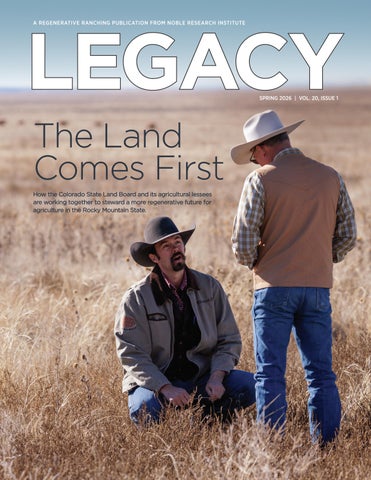

The Land Comes First
How the Colorado State Land Board and its agricultural lessees are working together to steward a more regenerative future for agriculture in the Rocky Mountain State.


At

A Q&A with Dr. Maria Silveira, Director of Research at Noble. DESIGNING YOUR FIRST AMP GRAZING SYSTEM Tips from Noble advisors to make adaptive multipaddock grazing functional and flexible for every ranch.
DEPARTMENTS
FROM OUR RANCHES
Ranch staff and researchers share the changes they've witnessed in the first five years of Noble's transition to regenerative management.
REGENERATIVELY SPEAKING
News from Noble, forwardlooking advice from ranchers across the United States, plus a roundup of social media accounts and podcast episodes of note..
DO-IT-YOURSELF
Sample a Moroccan-inspired beef stew and sharpen your marketing skills in the sale barn with a quick guide and tips from a seasoned rancher.
BEFORE YOU GO
Researcher and advocate, Jason Rowntree, shares his "why" for a career spent in research and education to support the production beef industry.
4 1 0 44 48 4 44 4 8


Jesse Price, regenerative agriculture manager at the Colorado State Land Board (left), inspects forages with his father-in-law on their ranch near Rocky Ford, Colorado.
LEGACY
STEVE RHINES PRESIDENT/CEO
RACHAEL DAVIS EDITOR
CADIE RAMOS GRAPHIC DESIGNER
ROB MATTSON PHOTOGRAPHER
MADDY BEZNER WRITER
LAURA BRENNER WRITER
KELLY McGOUGH COPY EDITOR
AMIE STEARNS
WEB DESIGNER
CONTRIBUTING WRITERS
Laura Nelson
Noble Research Institute is the nation’s largest nonprofit serving farmers and ranchers with research, education and mentorship for regenerating soil health to improve their land, livestock and livelihood. Since 1945, Noble Research Institute has been a leading, trusted resource in agricultural research and education dedicated to land stewardship. Demonstrating our ongoing commitment to regenerating our nation’s grazing lands, Noble actively manages 13,500 acres of working ranchlands to provide real-world insights and applications for farmers and ranchers. To learn more about Noble Research Institute, visit www.noble.org.
Reprint requests may be made by contacting Rachael Davis, editor, by email at rwdavis@ noble.org
Legacy is provided at no cost to the general public as a courtesy of Noble Research Institute. To receive a copy of the magazine or to change your mailing address, please email tlcumbie@ noble.org
Noble Research Institute, LLC
2510 Sam Noble Parkway Ardmore, Oklahoma 73401 580-223-5810
ISSN: 1939-5035
THE LONG VIEW
People like to say the only constant in life is change. While it’s sometimes said with a bit of gruff or disappointment, planning for change is a good mindset for regenerative farm and ranch management. It’s a good mindset for organizations like Noble, as well.
In 2024, we began a large-scale renovation project on our campus in Ardmore, Oklahoma. Our campus is evolving to better serve our mission to support farmers and ranchers. I believe this renovation will create space — literally and proverbially — that will provide ranchers with more in-depth and dynamic educational opportunities.

For those who have visited our campus, you’ll notice two major changes in 2026. In the heart of our campus, we are renovating a space for our team to grow, learn and collaborate. We are calling the new space Noble Commons. It’s both centrally located on campus and intended to be a hub of activity for our different teams. Noble Commons will provide more opportunities for staff from our ranches, research and producer guidance teams to collaborate, share ideas and connect through encounters with their peers. I believe this proximity to each other will build closer working relationships, leading to valuable interactions that will have lasting benefits for our ranches, research and educational curriculum.
The second notable change — and far more visible — is the demolition and removal of the former research lab and greenhouse complex. The building sustained a damaging fire in 2018 and has been out of commission ever since. In its place, we are establishing a new pasture that will support hands-on learning for our grazing and future animal handling courses. It will take a few years to establish proper forages and cover, but we began last fall with winter annuals and this year with summer annuals as we begin to build the soil’s biology. Ultimately, we seek to restore the nearly 6-acre plot to native grasses.
The new demonstration area is connected to a larger acreage located behind our campus. This linkage enables us to maintain and move livestock to and from this new pasture area to facilitate “seeing and doing” to assist in our learning.
The new pasture is positioned next to another renovation project — the Noble Learning Center. Currently a single-story office building, this will be renovated in 2026-2027 to serve as the first dedicated learning space on Noble’s campus. Filling a critical need for our farmer and rancher course attendees, it will be a space built just for learning.
Holding courses on campus also means more opportunities for hosting ranch tours, group dinners and discussions, as well as building a stronger community of like-minded farmers and ranchers.
The change on Noble’s campus is a very good thing. In the short term, there will be chaos of construction — the noise, the impenetrable safety fences and the movement of building materials. But when we take the long view, it’s easy to accommodate a little chaos in exchange for a stronger Noble and better opportunities for farmers and ranchers like you.
We look forward to the dust settling on these projects so that we can welcome visitors to this great space dedicated to our purpose: to save our nation’s grazing lands by promoting land stewardship through management, building soil health and keeping farmers and ranchers on the land. We hope you come visit.

Steve Rhines, president
FROM OUR RANCHES

➤
GROWING THROUGH CHANGE | NOBLE RANCHES
The First Five Years
FIVE YEARS INTO NOBLE RESEARCH INSTITUTE'S transition to regenerative ranch management, ranch managers and researchers share what they've seen change on the land and among the herds.
BY LAURA BRENNER
Many Noble ranch managers, including Chance Tynes, pictured, undertook the work of transitioning to regernative management on not just Noble's land, but their home ranches, too.
IIn February 2021, Noble Research Institute announced that the 75-year-old agricultural research organization would focus all of its operations on regenerative ranching. In the five years since then, Noble’s 13,500 acres of working ranch lands embarked on a transition from conventional management to adaptive management. Each ranch has its own unique context, challenges and breakthroughs. To celebrate five years of regenerative management on Noble’s ranches, our ranches and research teams share what’s changed since 2021.
ANIMAL HUSBANDRY
In the last five years, since Noble began managing its ranches regeneratively, how have you seen livestock performance evolve? Has it improved or stayed the same? In what ways?

The cattle seem to be more accustomed to frequent moves. They’re calmer around humans and maintain a good body condition with better pasture monitoring and plant diversity.”
— Jeremy Westfall, Ranch Assistant, Coffey Ranch
Animal behavior improved and handling is easier. Resilience to environmental stress, such as drought, has been strengthened through adaptive management. I think forage and soil improvements support overall nutrition and long-term carrying capacity better than before.”
— Frank Rhoades, Ranch Assistant, Oswalt Ranch

Here on the Oswalt Ranch we have seen our livestock adapt and thrive on being rotated every day in a regenerative fashion by getting fresh grass each time, keeping parasites down to a minimum. We have also seen our pastures thrive with plenty of rest and recovery. And by letting them grow back, we can hold moisture in the ground longer and prevent runoff.”
— Chance Tynes, Ranch Manager, Oswalt Ranch
[Top] Jeremy Westfall, ranch assistant, moves cattle in 2021, just at the start of Noble's transition period. [Bottom] By 2024, cattle at Noble's ranches had grown accustomed to regular moves, and would gather eagerly at the fenceline.
I would say one of the biggest takeaways that I have had in the last five years is giving livestock the opportunity to be productive on what would traditionally be considered poor or inadequate forage. By setting aside what we think a cow should be eating and observing what they are eating and how they are performing, we can better evolve our individual animal performance by selecting for animals that are productive on what we can grow. Our livestock performance has evolved from an animal that requires multiple inputs to maintain production, to one that requires much less to maintain production, and I believe that is a great improvement.”
— Joe Pokay, General Ranch Manager


I can share insights from the EPSCoR project, comparing our adaptive vs. prescriptive grazing pastures.
PLANT DIVERSITY
In the last five years, what plant species have you seen return to the land? Is a species more abundant or less abundant than before? Has a new-to-the ranch species appeared?
In introduced pastures, we observed an increase of native plant communities under adaptive grazing. This aligns with higher species evenness and Shannon diversity, suggesting that native annual forbs, annual grasses and other subordinate species that were previously suppressed are becoming more common on the landscape. Previously dominant species have become less abundant.
In native rangeland, dominant grass species declined under both grazing strategies, with stronger declines under prescriptive grazing. These declines were accompanied by increases in subdominant C4 grasses, midgrasses and tallgrasses. Tallgrass abundance, increased more under adaptive grazing, suggesting
recovery of structural components characteristic of healthier native rangeland. Forb diversity decreased in adaptive, consistent with some of the literature stating that high-stock-density grazing has a filtering effect for tolerant species.
Overall, the consistent increases in native species' abundance, subdominant grasses, annual forbs and legumes under both grazing strategies, indicate that species already present at very low levels are now expressing more strongly. I believe we can say that both grazing management strategies facilitated the functional return of a more diverse and resilient plant community, even under highly variable weather conditions and recurring drought.”
— Isabella De Faria Maciel, Systems Research Manager
[Top] By spring of 2024, cattle on Noble's Headquarters Ranch developed a taste for an increasing number of native grasses and forbs that populated once entirely introduced on pastures. [Above] A flock of sheep browse a variety of forbs and grasses at Red River Ranch.


In the last five years, I’ve seen some native plants come in — not many because the Red River Ranch is all Bermuda-introduced grasses. And I’ve seen cattle eat other plants/forbs that before they wouldn’t have cause we would’ve had sprayed them.”
— Kye Henington, Ranch Foreman, Red River Ranch
There are areas on every ranch where a highly desirable species is becoming more prevalent. But more than individual plant species that have returned, my take-away on plant diversity is more focused on how the species of plants ebb and flow between years.
For example, pastures that were completely full of what some would consider 'undesirable weeds' one year will be almost devoid of that species the next year. Traditionally, we have been taught to manage 'weeds' chemically or physically before they go to seed so there are less weeds the next year. The more I observe yearslong transitions, it becomes apparent that this philosophy is flawed. We would spray weeds every year and not have a whole lot less the next year, and maybe no change at all in a few years. The weeds are a sign of our management and are trying to tell us to fix something in the way we are managing.
Anecdotally, I believe the 'weeds' are fixing the most limiting factor in the soil, and after a year of doing their job, that issue is resolved, and something else can grow to fix the next issue. Our job is to graze through that with a livestock species that can be the most productive from it and allow the soil to recover once more. Overall, especially after a good year with rain, total forage is more abundant across all the ranches, and that is a testament to good management.”
— Joe Pokay, General Ranch Manager
[Top] Goats prefer different plant species than cattle, which makes them well-suited grazing partners to maximize forage in a pasture. [Middle] Noble's "cold turkey" transition to regenerative management principles provided challenges, but also a unique insight into the rate at which soil and plants adapt.


On Headquarters Ranch, the first thing I noticed was in the areas that were not typically plowed or had heavy chemical use, the areas were basically used to bale hay. There, I used high stock density in early spring and let it rest for six months or more. After that, there was an explosion of native grasses that came in that I had not seen before. Mainly big bluestem. Since then, other natives came, including Indian grass, little bluestem, and side oats grama.
There was another area that had typically been planted in alfalfa. In the second year of regenerative management, I saw an increase in eastern gamagrass. Some areas that were usually plowed have seen an increase in summer grasses, such as crabgrass and buffalo grass. This year, I have seen an increase in Indian grass in areas where I have not seen it before. The forb community seems to be changing nearly every year since we have gone regenerative.
Over the past couple of years, I have been decreasing the amount of acreage I have been no-till drilling the cool season crops due to the fact that many are coming in volunteer. I hope I will be able to stop planting. I still plant the areas that had been abused over the years with summer and cool seasons, but I have seen an increase in both the summer and cool season volunteer grasses and forbs.”
— Paul Luna, Ranch Manager, Headquarters Ranch
[Top Left] Dung beetles are coveted workers on a ranch; these were collected for a research project on Coffey Ranch. [Top Right] Attracting wildlife like these Bobwhite quail can be part of an enterprise on a ranch, or simply a happy byproduct of plant diversity improving habitat and food resources. [Bottom] Cover crops, like this mix of cool season forages, are an important part of the strategy to achieve year-round grazing at Noble's PDF Ranch in Ardmore, Oklahoma.
WILDLIFE
In the last five years, since Noble began managing its ranches adaptively, what changes have you seen in wildlife species? Any behavior changes or population growth/ decline? Has a new-to-the-ranch species appeared?
I have also noticed an increase in butterflies and in the number of birds. Plus, I have noticed dung beetles. This could be because I am now more observant.”
— Paul Luna, Ranch Manager, Headquarters Ranch
Since we’ve become regen, and we’re not growing just monoculture, we’ve had zero issues with armyworms. Not saying they won't show up again, just that we haven’t had an issue, and I know our neighbors have. We quit spraying insecticides and weeds, so now we grow different species that flower and attract those pollinators. I have pictures of weeds that produce flowers, and the bees were flying all over them. The ranch has tons of dung beetles on it now. They might have been there before, but I wasn’t looking for them then.”
— Kevin Pierce, Ranch Manager, Red River Ranch

In the last five years, I’ve seen more turkeys, butterflies, dung beetles and other insects come in. I suspect that's because we're not spraying anything.”
— Kye Henington, Ranch Foreman, Red River Ranch
Monarchs on their migration south.


Ranchers and cows benefit from industry partnerships that aim to increase awareness and accessibility of soil health principles and their impact on livestock and economic outcomes.
WORTHY OF PRAISE
G Bar C Ranch Recognized With Inaugural Noble Land Stewardship Award
NOBLE PRESENTED THE INAUGURAL
Noble Land Stewardship Award to G Bar C Ranch and the Ellis family of Rosston, Texas, at its first annual Roots & Revelry event on Oct. 22, 2025. The award recognizes farmers, ranchers and landowners who are leading the way in regenerative land management


NDSU Study Shows Livestock Boost Cover Crop Returns
An NDSU study found that grazing livestock on cover crops can cut cover crop costs in half while improving farm sustainability and extending the grazing season.

Cattle Farm Leads Sustainable Practices
Choctaw Cattle Company blends science and tradition to model sustainable cattle production in Louisiana through rotational grazing, forage-based diets and hands-on herd management.

SOCIAL MEDIA ACCOUNTS TO FOLLOW
From Our Feeds
Get info and inspiration from what other regenerative ranchers and like-minded peers are saying.
SMALL PRODUCERS INITIATIVE, INSTAGRAM
Based in Texas, the Small Producers Initiative supports small to mid-sized farmers and ranchers with resources, community and educational workshops.
instagram.com/smallproducersinitiative
HAWAII LOWLINE CATTLE COMPANY, FACEBOOK
The Sakata family raise Lowline Aberdeen Angus cattle on the island of Hawaii. Their direct-to-consumer business marries traditional grazing practices with today’s consumer preferences. Follow their unique journey for insights into their “Aloha” philosophy of ranching.
facebook.com/hawaiilowlinecattlecompany
THE REGENAISSANCE, YOUTUBE
A whole YouTube account dedicated to sharing the stories of farmers and ranchers practicing regenerative management across the United States. Plus, in-depth farm tours to see how they’re applying those principles on their land.
youtube.com/@theregenaissance
THE WESTERN SUSTAINABILITY EXCHANGE, INSTAGRAM
Based in Montana, this nonprofit organization shares information about their educational opportunities, resources for regenerative ranchers and producer-focused events. The WSE is a hub of information for ranchers in the Northern Plains.
instagram.com/wsemt
THOUGHTS FROM AROUND THE RANGE
What is your best advice for the next generation of ranchers and farmers?
“Engage in a philosophy of continuous learning. The science of livestock and crop production will grow exponentially over the next 30 years. Those who choose not to engage will find it difficult to market their product. Join industry organizations that represent your product. Serve as members AND in leadership. Seek information from allied associations supporting you. Change can be scary, but so is failing to adapt and move forward. Change is inevitable.”

STEVE WOOTEN, RANCHER
“The next generation of farmers and ranchers must move beyond the status quo if they want to succeed long term. Building a lasting legacy will demand creative problem solving, exploring vertical integration, and finding or creating a strong networking community of people with diverse backgrounds and geographic locations. It will take a commitment to trying new things and being a lifelong learner.”

BRITTANY HEMME, DAIRY FARMER, PRODUCER ADVISORY PANEL MEMBER
“If you first optimize for ecosystem and soil health, everything else gets easier to manage: stocking rate, drought resilience, input costs and long-term value.”

ERIC PERNER, DAIRY FARMER, PRODUCER ADVISORY PANEL MEMBER
Podcast Episodes To Listen To 3
Listen to these recommended episodes on your favorite podcast app.

GRAZING GRASS PODCAST
Episode 189: Building Soil and Beef Quality With Virtual Fencing With Karl Palmberg
Podcast host Cal Hardage talks with Karl Palmberg of Sunlight and Rain farm in northwest Iowa about his return to the family cattle operation and lessons learned during his transition to no-till, virtual fencing and focusing on soil health.

CASUAL CATTLE CONVERSATIONS
How to Extend Grazing Seasons in Northern Climates
Regardless of location, more days spent grazing is something more and more ranchers continue to push for. Luke Ressler farms and ranches alongside his wife, Elli, and her parents in northeastern North Dakota in the Red River Valley. In 2019, they began placing more emphasis on soil health and integrating cattle onto their crop land to add grazing days to their year.

RANCHING RETURNS
Episode 243: Ray Archuleta — Soil Health and His Missouri Farm
Ray Archuleta, also known as “Ray the Soil Guy,” joins host Jared Luhman to discuss the importance of soil health and how Archuleta applies soil health principles on his own farm in Missouri.
NOBLE RESEARCH INSTITUTE’S
Upcoming Courses
Harness the power in your soil for better forage, better livestock and better returns.


MAY 12-13
Ardmore, OK
SEPT. 1-2
Jefferson City, MO
Discover how to make your grazing strategies work for your bottom line.

Learn how to build skills and confidence for evaluating livestock and other assets in today's market conditions.

MAY 20-22
Salida, CO
JUNE 2-4
Jefferson City, MO
NOV. 10-12
Ardmore, OK
Improve your business skills with financial tools to maximize your ranch's profitability.

MAY 21-22
Ardmore, OK
AUG. 18-19
Jefferson City, MO
Use your available forages to get the best out of your livestock and grazing land.

AUG. 12-13
Huntsville, TX
SEPT. 22-24
Jefferson City, MO
OCT. 6-8 Ardmore, OK

A meal of regeneratively sourced beef from Local Yocal owner and rancher, Matt Hamilton, is enjoyed on a regeneratively managed ranch; intentional choices for the inaugural event celebrating stewards of the land.
HONORING LAND LEGACY
THE INAUGURAL ROOTS & REVELRY EVENT honored the progress and efforts of farmers and ranchers who transform grazing lands.
BY LAURA BRENNER

Next to dirt lanes and green pastures, a large white tent sits on the lawn of Noble Research Institute’s Retreat Center. It’s a fitting scene to fill the backdrop of the inaugural Roots & Revelry gathering. The cattle that often graze nearby — and the men and women who dedicate their lives to caring for them and the land they graze — are the representative honorees at the farm-to-table gathering.
Roots & Revelry reflects the vision that guided Lloyd Noble in establishing the organization following the Dust Bowl — that healthy soil is the foundation of a healthy nation. When Noble founded the institute on Sept. 19, 1945, his goal was to help farmers and ranchers steward their land, protect their soil and ensure economic viability.
“This gathering represents something fundamental to our mission — bringing people together who care deeply about the land and understand that its health is tied to our own future,” says Steve Rhines, president and CEO of Noble Research Institute.
As Noble Research Institute marks its 80th anniversary this year, that vision continues through its focus on regenerative management practices that treat the land as a living system where agriculture works in harmony with nature.
“We’re honoring the vision Lloyd Noble had 80 years ago while celebrating the ranchers and farmers who put these principles into practice every single day on their operations,” says Rhines.
Roots & Revelry also honored the inaugural Noble Land Stewardship awardee. The Noble Land Stewardship Award is a national award recognizing farmers, ranchers and landowners who are leading the way in regenerative land management. By encouraging these leaders to share their experiences, the award aims to build awareness around sustainable land use and inspire others in the agricultural community.
G Bar C Ranch and the Ellis family of Rosston, Texas, are the 2025 recipients. They were selected for their commitment to regenerative management practices that have transformed 3,000 acres into a model of biodiversity and resilient cattle production.
“The Ellis family and their ranch team embody what we hoped to celebrate with this award,” says Rhines. “They’ve proven that financial and environmental stewardship go hand in hand, and their willingness to share what they’ve learned makes them ideal ambassadors for ranching.”

“ The Ellis family and their ranch team embody what we hoped to celebrate with this award. They've proven that financial and environmental stewardship go hand in hand, and their willingness to share what they've learned makes them ideal ambassadors for ranching.”
— STEVE RHINES
In 1982, GC Ellis began his dream and established the G Bar C Ranch. Since then, he has guided his ranch to success with his daughter, Meredith, who represents the next generation and future of the ranch, and his ranch manager, Mike Knabe. With a mission to continually improve ranching practices to nurture the environment, they see themselves as caretakers of the land, maintaining biodiversity, natural habitat and clean waterways.
Today, the G Bar C team applies sustainable, regenerative principles to their land, which has grown to 3,000 acres with over 200 mother cows. The cowcalf operation runs black Angus cattle with a strong focus on maternal traits, adaptability to the environment and gentle handling.
Presenting the Noble Land Stewardship Award, Noble's president and CEO, Steve Rhines, shares the history and impact of the Ellis family's work on the G Bar C Ranch.


The ranch has been recognized both locally — by the Texas and Southwestern Cattle Raisers Association — and nationally, receiving the 2023 National Environmental Stewardship Award from National Cattlemen’s Beef Association for its outstanding conservation practices and environmental stewardship.
Meredith attended the event and accepted the award on behalf of her family and ranch team.
"It’s truly humbling to stand here today to accept this award on behalf of the entire team at the G Bar C Ranch,” said Meredith in her acceptance speech. “I’d also like to take a moment to honor my dad and Mike, whose vision and dedication laid the foundation for our ranch.”
Meredith spoke about her return to the ranch 13 years ago to continue her father’s legacy. She believes the ranch made progress toward environmental stewardship and greater sustainability through advocacy and partnerships, especially with Noble Research Institute. “Every step of the way has been guided in part, or in full, by the legacy of Lloyd Noble and the collaboration of
the visionaries at the Noble Research Institute,” she said.
Recipients of the Noble Land Stewardship Award receive a bronze sculpture entitled “Keeper of the Land.” The sculpture honors the power of the grazing animal to restore and build the land.
The unique piece was created by Oklahoma artist John David Rule, a sculptor and master saddlemaker who grew up on a ranch as the son of a cattle buyer.
“We wanted to have movement, because the movement of the buffalo is what kicks the seed to the soil and lets it spread,” explains Rule of the sculpture. “We’re freezing a moment in time that suggests what might happen next and perhaps even what’s just happened.”
The well-attended event celebrated farmers and ranchers while also raising funds to support Noble’s ongoing research and education programs. Its success ensures a bright future for Roots & Revelry and the Noble Land Stewardship Award. If you’re interested in nominating a land steward for the 2026 award, please visit our website, noble. org/roots-and-revelry/noble-land-stewardship-award, for more information.
JOHN DAVID RULE, son of a cattle buyer, grew up on a ranch and spent many summers working at the Oklahoma City Stockyards. The love of art started at an early age with Rule riding his horse to art classes at the age of ten. People, horses, cows, birds of prey and a love of nature keep his approach to art genuine. John is a sculptor and master saddle maker, as well as a master class falconer. He currently lives on his ranch in Minco, Oklahoma, with his wife of 45 years.

Meredith Ellis, far left, stands for a portrait with, from left to right, her father G.C. Ellis, son G.C. Ellis, ranch manager Mike Knabe and employee James Shugart.

Ranching in the Smallest Corner of the United States
AT PECKHAM FARM, students learn how grazing decisions impact soil, animals and the bottom line, all on a landscape where every acre counts.
BY MADDY BEZNER

When most people think of ranching, they picture wide-open rangeland in the West or cattle country in the Southern Plains. They do not usually think of Rhode Island. The smallest state in the United States is known more for coastline and tourism than for sheep flocks or rotational grazing. But on the south side of the University of Rhode Island campus, where the tree lines open into layered pastures, cattle and sheep move across forage in planned rotations. Here, regenerative grazing is taking shape in a place where land is limited and flexibility is essential.
SPOTLIGHT

This work is led by Coleman Replogle, the farm manager at Peckham Farm, the university’s teaching and research farm. Replogle did not grow up on a ranch. His family owns a seafood restaurant in Vero Beach, Florida, and he spent his childhood in the restaurant world. But he also spent a lot of time on horseback, and his family took annual trips to guest ranches in Wyoming. Those summers formed his first connection to livestock and the land. Later, a college internship introduced him to holistic grazing and soil health, and he realized he wanted to pursue ranching as his career.
“I did not grow up in agriculture. I grew up in the restaurant business,” Replogle says. “At Chico Basin Ranch, they exposed me to holistic management. It was a deep dive, and I realized this was what I really liked.”
Replogle went through the TCU Ranch Management program to build the technical foundation he lacked. After graduating, he gained experience in Colorado, Hawaii, Montana and Wyoming. Then life turned him east. His wife is from Rhode Island, and when a posi-
tion opened at Peckham Farm, he took the opportunity.
Today, Replogle manages livestock, grazing, facilities, student workers and research coordination on the farm. Peckham Farm has a dual purpose. It is an experiment station where faculty conduct research, and it is also a teaching facility for students who study animal science and veterinary medicine. The farm maintains five livestock species: cattle, sheep, goats, pigs and poultry.
“My job is to provide livestock for students to work with and to manage the land and property on a day-to-day basis,” Replogle says.
LIMITED ACREAGE REQUIRES EFFICIENT GRAZING
Rhode Island is not a region of large ranches, and land access is one of the biggest challenges for anyone working with livestock in the state. Many farms have been in families for generations or have been purchased by non-agriculture landowners. Leasing land can be difficult and expensive.
“At Chico Basin Ranch, they exposed me to holistic management. It was a deep dive, and I realized this was what I really liked.”
— COLEMAN REPLOGLE
That means pasture acreage must be used carefully.
“You have to be efficient with your space in order to survive because land is so limited here,” Replogle says.
The climate adds complexity. Rhode Island receives good moisture overall, but the area has experienced short seasonal droughts in late summer during the last few years. When pasture recovery slows, there is very little buffer. Overgrazing one section of pasture can set back the whole rotation.
Peckham Farm already had a rotational system in place when Replogle
Peckham Farm is sandwiched between the University of Rhode Island campus and residential development for students and nearby communities.

A land manager in Rhode Island, by way of Wyoming, Colorado, Hawaii and Montana, Coleman Replogle brings his experience on western ranches to the east coast.
LEGACY
R ANCHER SPOTLIGHT
arrived. Students used a rising plate meter to measure forage availability, and paddocks were rotated accordingly. However, Replogle saw opportunities to improve how the rotations were structured. Some paddocks were too large, which allowed livestock to be selective and left behind significant residual. Other areas did not rest long enough between grazings.
Replogle is now planning to install high-tensile electric lanes, allowing paddock sizes to be adjusted more easily. The goal is to be able to increase or decrease grazing pressure based on forage growth, season and species. This flexibility is especially valuable when working with multiple livestock classes.
The cattle at Peckham Farm include Murray Grey, Hereford and Black Baldy crossbred cows. The sheep flock was originally selected for the show ring, but those genetics struggled on pasture with issues such as hoof health and condition loss. Replogle is transitioning the flock toward forage-based Dorset and Shropshire lines with better parasite resistance and adaptability.
“I have been selecting more of the traditional Dorset sheep, more of the forage-based genetics,” Replogle says. “The previous sheep did not perform well on pasture. They would fall apart.”
BALE GRAZING SHOWS VISIBLE SOIL IMPROVEMENT
One of the most impactful management changes Replogle has introduced is bale grazing. During winter, hay bales are placed directly on pastures where livestock can access them. The manure and wasted hay provide concentrated fertility in those areas. When moisture and growing conditions return in spring, the impact is visible.
“We do bale grazing in the wintertime,” Replogle says. “In this drought, I was pointing out to students the spots where we bale grazed that were still green.”


[Top] When students are on winter break, Replogle's on feed duty gathering hay bales to set out for the cattle [Bottom] Principles of regenerative management used on Noble's ranches can be seen in action in Rhode Island, too, as cattle graze on hay used first as feed and second as organic matter to boost soil health.

“ I enjoy getting students who have never stepped foot on a farm but have some interest. Seeing bale-grazed areas staying green was an aha moment for some of them.”
— COLEMAN REPLOGLE
This comparison has been a teaching moment for students who may not have seen soil health principles demonstrated before. The faculty member who monitors soil conditions at Peckham Farm reported significant improvement.
“Since we have started bale grazing, our organic matter has dramatically increased,” Replogle says.
This year, Replogle is pairing bale grazing with frost seeding. Ahead of late winter thaws, he plans to broad-
cast warm-season and deep-rooted forages and then unroll hay bales over the seeded areas. Cattle will graze and trample the hay, pressing seed into the soil surface. The goal is to increase summer forage resilience and extend grazing later into the season.
“I want to get to the point where we are stockpiling forage and feeding less hay,” Replogle says.
SILVOPASTURE AS A LONG-TERM STRATEGY
Replogle is also working with faculty members and students to develop a silvopasture section on the farm. Silvopasture refers to managed grazing under widely spaced trees that provide shade, habitat and potential fodder from leaves and branches. This system is especially promising in humid climates where heat stress can reduce animal performance.
Replogle consulted with Noble Research Institute staff when planning this project. The research component will evaluate animal performance and
forage characteristics under partial shade compared to open pasture.
The silvopasture area is still in early development, but student interest is strong. One student who originally planned to pursue veterinary work is now interested in research focused on land stewardship and grazing ecology. Replogle sees this as a meaningful outcome.
“I enjoy getting students who have never stepped foot on a farm but have some interest,” Replogle says. “Seeing bale-grazed areas staying green was an aha moment for some of them.”
MANAGING WITHIN A SHARED MISSION
Working at a university experiment station offers unique strengths: access to student support, collaboration with research faculty and the chance to try innovative practices in a learning environment. With those opportunities also comes the need to coordinate across multiple academic and research priorities. For instance, some studies call for specific management approaches, such as
A class of students listen as their professor lectures from the turnout paddock at Peckham Farms.
COLEMANREPLOGLE | PECKHAMFARM|RHOD

Collaborative research initiatives between faculty members and farm staff provide valuable data for researchers and learning opportunities for students interested in pursuing deeper knowledge of soil and plant biology.
maintaining sheep with known parasite susceptibility for a parasitology project.
“My friends like to joke that I ranch with handrails,” Replogle says. “There are guidelines in place, but they exist for good reasons.”
Because purchases and projects follow university processes and class schedules, fencing work or equipment acquisition can require a little more planning. Replogle says Noble’s Business of Grazing course helped him strengthen communication and align expectations early. Now, he leads regular planning conversations with faculty and staff involved in the farm.
“When we’re all on the same page from the start, everything runs more smoothly,” Replogle says.
GOATS FILL A NICHE ON SMALL ACREAGE
Beyond the university farm, Replogle recently started a targeted goat grazing business that provides brush control services to landowners in the area. Goat browsing fits the landscape well, since Rhode Island has many small properties with dense undergrowth.
“I do not need a ton of acreage to keep 20 to 50 goats,” Replogle says. “It is actually more profitable than if I was just raising meat goats or sheep on my own.”
This business also creates opportunities for his family to be involved and gives students exposure to alternative livestock enterprises.
A MODEL FOR REGENERATIVE RANCHING IN SMALL SPACES
Rhode Island will never be a large-scale cattle region, but that is not the goal at Peckham Farm. The goal is to improve soil health, livestock performance and grazing literacy among the next generation of agricultural professionals.
The improvements Replogle has seen on the land are measurable. Pastures have more consistent recovery. Organic matter is increasing. Forage diversity is improving. Summer slump periods are moderating. And most importantly, students are learning how
animal health, plant health and soil function are connected.
“Be open-minded and think outside the box,” Replogle says. “Do not be afraid to try something new.”
Regenerative grazing is sometimes discussed in the context of thousands of acres. Peckham Farm shows what it looks like on hundreds. The principles remain the same: planned rest, balanced stocking, observation, adaptive decision-making and patience.
Replogle does not claim to have everything figured out. He sees the work as ongoing and experimental. But the progress is clear in the grass itself, and in the students who walk into his office thinking about veterinary school and leave thinking about soil.


On Peckham Farms, students gain a first-hand understanding of how agicultural production connects to their larger ecosystem.
[Above] Students working toward a bachelor's, master's or PhD. in Sustainable Agriculture and Food Systems at the University of Rhode Island spend time working on Peckham Farms as part of their education. Students gain a first-hand understanding of how agriculture production connects to their larger ecosystem.
LAND
HOW THE COLORADO STATE LAND BOARD and its agricultural lessees are working together to steward a more regenerative future for agriculture in the Rocky Mountain State.
A THE COMES FIRST
cross Colorado’s sweeping plains and rugged canyon country, ranchers and state officials are proving that land can be managed with both agricultural productivity and long-term stewardship in mind. Ranchers are collaborating with the Colorado State Land Board — the state’s second-largest landholder — to balance rancher profitability, natural resource conservation and education funding.
Together, they’re redefining what agricultural leases on state trust lands look like, and the lessons they’re learning could influence how other states manage the millions of acres of state-owned lands across the West.
BY LAURA BRENNER
A HISTORY OF STATE TRUST LAND IN COLORADO
When Colorado became a state in 1876, Congress granted it millions of acres of land — designated as state trust lands — to generate revenue for public education. Some call these “school sections,” as each one is 640 acres. Today, the Colorado State Land Board manages 2.8 million acres of surface land — roughly 10% of all agricultural land in Colorado — making it a critical link between rangeland stewardship and school funding.
In addition to the school sections, the State Land Board owns larger tracts of land — the largest covering more than 86,000 acres — that have been purchased over time to create contiguous blocks of rangeland.
“The founding fathers believed that one of the most important aspects of a successful democracy was an educated electorate,” explains Jesse Price, the State Land Board’s regenerative agriculture manager. “So the purpose of the management of that land was to fund public schools.”
Over time, that mission evolved. A constitutional amendment later clarified that the State Land Board’s purpose was not only to generate reasonable and consistent revenue, but to do so in conjunction with the stewardship of the lands. “We want to make sure we can generate that revenue over time,” Price says, “so we really have a large time scope when we think about how we manage and take care of the land under our purview.”

Jesse Price, rancher and regenerative agriculture manager for the Colorado State Land Board, stands on his wife's family ranch land — an operation that has relied on state land board parcels for generations.

Today, roughly 96% of the stateowned surface lands are leased for agriculture, primarily to ranchers who use them as part of larger grazing operations. These leases, usually 10 years in length, provide long-term stability for lessees while helping fund public schools through rent payments.
The State Land Board also owns 4 million acres of mineral estate, which can be leased to provide additional revenue streams for schools.
“There’s a lot less risk in leasing from the State Land Board than leasing in the private sector,” says Price. “A 10-year lease is a huge benefit — you can count on it.”
BUILDING TRUST, LEASE BY LEASE
For Jackson Donnell, a fifth-generation rancher who also serves as the southern resource specialist for the Colorado State Land Board, public lands stewardship is both professional and personal. His family has leased the same school section for generations.
“You treat it like it’s yours,” he says. “You rotate your cattle through like you would if it was your own grass.”
Donnell sees stewardship as a form of long-term investment — one that requires communication and trust between the State Land Board and lessees. “Even when there’s not a formal rulebook for stewardship, producers understand that good management benefits everyone — the land, the cattle and the state.”
“ Even when there's not a formal rulebook for stewardship, producers understand that good management benefits everyone the land, the cattle and the state.”
— JACKSON DONNELL
Price echoed that sentiment. “We’re essentially being funded by whatever resource we’re using, but we want to do it in a responsible and sustainable
way so that future generations can keep using it,” he says.
Price’s wife’s family ranch, which includes four school sections, has leased from the State Land Board since 1903. “My son is the seventh generation to live on this ranch,” he says. “Part of my job, my personal mission, is to make sure those leases are still here and available for the next seven generations.”
That generational perspective, Price says, shapes how the agency operates. “We have a different time horizon than most organizations,” he notes. “We’ve been around for nearly 150 years, and we plan to hold on to the vast majority of this land for at least another 150. So we’re thinking about decisions that last centuries.”
The connection between State Land Board staff and the land runs deep. Price and Donnell are two examples of how the agency cultivates trust. It’s their connection to the ranching community and commitment to the State Land Board’s mission that eases relationships between lessor and lessee. “Without stewardship, you don’t really have a long-term plan,” says Donnell. "What you do today affects what you have 20 years from now.”
A sunny winter day in Colorado's front range, where these cows graze, can make the day's high of 17° feel much warmer, enough to melt the frost and snow from earlier in the week.

The State Land Board cultivates trust with ranchers across the state through managers like Price, and regional resource specialists like Jackson Donnell, pictured on his ranch in Boone, Colorado.
LEGACY
Over a lifetime, ranchers collect wisdom that's often shared through storytelling. Wooten remembers his grandmother's stories of hardship on the ranch. His father's generation offered a green picture. But a 30-year dry spell looms over Beatty Canyon Ranch and colors the wisdom he intends to impart.

STEWARDSHIP ON SHARED GROUND
Steve Wooten is a rancher in southern Colorado who owns Beatty Canyon Ranch. Wooten partnered with another local ranch family to lease the Chancellor Ranch, more than 51,000 acres of state trust land. When he took over the lease 10 years ago, the property had been degraded by years of overuse. “With some judicious work and our style of adaptive grazing management,” he says, “we feel like the ranch has made a substantial comeback.”
Wooten’s philosophy aligns closely with the State Land Board’s dual mission. His ranch integrates wildlife habitat restoration, data-driven adaptive grazing and experimentation with technology like virtual fencing. “It’s an adaptive tool that saves us from paying for interior fencing at $10,000 a mile,” he says. “It lets you manage cattle movement without the cost and disruption.”
Price says partnerships like Wooten’s reflect the kind of stewardship the agency wants to encourage. “We want to see good stewards of the land,” he explains. “We look for things like healthy ground cover, diversity in plant species and variety in what’s being grazed. We don’t want to see bare ground or overuse — we want land that’s regenerating and resilient.”
That emphasis on resilience resonates with producers like Wooten. “We’ve improved the condition of the ranch. We’ve got more grass, more resiliency and better drought management,” Wooten says. “It’s become a way of doing business, but it’s also what we love to do — especially when we see success.”
LEASING CHALLENGES AND MARKET PRESSURES
For many ranchers, leasing state trust land remains essential to their operations — but it comes with challenges. Maggie Hanna, who operates Hanna Ranch in south-central Colorado, leases roughly 60% of her operation

While Colorado's front range gets the bulk of attention, ranching communities exist along dirt roads like this one, which leads to Beatty Canyon Ranch and other neighboring ranches.
from the State Land Board. “Our relationship to the state trust lands is about as vital a relationship as any other component of this operation,” she says.
The Hanna family signed their first State Land Board lease in 1947. The ranch has relied on that land ever since. Hanna grew up watching her father navigate management decisions on the family ranch. She describes her father’s approach to ranching as “ahead of his time.” She’s referring to his personal interest in natural resource conservation paired with cattle production, which was a relatively novel approach in the 1980s. It’s a tradition she’s carried on long after his passing, but it may be in jeopardy.
“ We've improved the condition of the ranch. We've got more grass, more resiliency and better drought management. It's become a way of doing business, but it's also what we love to do — especially when we see success.”
— STEVE WOOTEN
Hanna acknowledges the growing uncertainty that can come with leasing so much state-owned land. “When you go through ranch planning, you are asked to address your ranch’s greatest weaknesses, and losing the state trust land is one of our greatest threats just because it is such a substantial part of the operation.”
Price confirmed that turnover in leases has become more frequent. “In the early 2000s, we didn’t see leases turn over hardly at all,” he says. “Now we’re seeing more competitive bids — just because there’s limited availability of grazing lands.”
With less available grazing lands — and open space generally — available, leases like Hanna’s become more attractive to bidders of all kinds, not just neighboring ranchers.
The State Land Board layers leases on some land. This means a rancher can sign a grazing lease for the same land that an oil and gas company uses for a mineral lease. “There is no direct competition between the industries,” explains Price. “They have separate leases within the same property, and all have access as they need it.”
“I ranch 12 miles from the Front Range just off I-25,” Hanna says, “so we get a lot of urban pressure. A property north of us has developed into 5,000 acres of solar panels.”
Despite this pressure, both Hanna and Price believe the State Land Board’s focus on stewardship creates an environment where agriculture

ADAPTING TO A NEW TOOLBOX
Investing in technology like virtual fencing felt risky, but the benefits began to outweigh the risks for Steve Wooten, who is trialing options to determine the best system for his context. The upfront cost of the towers and the ongoing subscription pale in comparison to the expense of establishing and maintaining interior fencing across his more than 50,000 acres of rough, canyon terrain.

Frugality is a genetic trait that runs in the family, according to Hanna. It's part of what makes regenerative management appeal to her, and her father before her. Ranching with fewer inputs is good for the bottom line and the ranchland she hopes to pass down to the next generation.


remains viable. “The regenerative grazing commitment of the State Land Board is a hopeful olive branch,” Hanna says. "They still see value in working lands. They are committed to holding our hands moving forward and being on this journey with us.”
A PROGRESSIVE VISION FOR THE FUTURE
In recent years, the Colorado State Land Board has taken a more proactive approach to stewardship — experimenting with regenerative management principles and biodiversity monitoring.
“We’re pretty heavily invested in biocarbon sequestration through better grazing,” Price says. “We’re entering into lease agreements with carbon development companies. The State Land Board is very progressive in a lot of aspects — and we can’t do that without regenerative management practices.”
This shift is driven not just by state policy, but by producers themselves. “I think landowners and producers coming to us asking questions really spurred this faster than we had anticipated,” Price says. “There are a lot of producers who have implemented regenerative practices in one way or another long before we started calling it that.”
That bottom-up innovation aligns with the agency’s philosophy. “A good idea can come from anywhere,” Price says. “As often as we share knowledge with lessees, we’re learning from them too.
They’re the ones on the ground who know the land best.”
One example of that collaboration came through the Noble Land Essentials course, hosted in partnership with the Noble Research Institute last year. “It went very, very well,” Price says. “All the feedback I’ve received was positive. The content was practical, hands-on and resonated with producers.”
The State Land Board is planning to expand those education opportunities statewide. “We’re going to have three one-day seminars next year instead of two,” Price says. “And eventually we want to have one in everyone’s backyard, so they don’t have to travel a hundred miles to get to one.”
PROGRESS THROUGH COLLABORATION
The State Land Board operates as a self-funded agency, meaning it receives no tax dollars. All revenue from leases — whether from agriculture, energy or recreation — goes directly into the Public School Fund, supporting K-12 students across the state.
That model requires balance. “We’re funded by the resources we manage,” Price says, “but we want to make sure we’re doing it responsibly so that it’s still here for future generations.”
Wooten sees that balance as the foundation of Colorado’s success. “The biggest threat isn’t plowing the plains,” he says. “It’s losing 700 acres a day to urban encroachment. We may be
our own worst enemy — the more we improve the ranch, the more attractive it becomes to others.”
The State Land Board’s approach — emphasizing collaboration, education and long-term stewardship — places the land at the center of the conversation. Ranchers have always been incentivized to care for their land, which aligns with the State Land Board’s goal to provide a sustainable revenue source for generations of students to come. As Price put it, “Our job is to remove barriers, test ideas and make sure good management continues to be possible.”
In addition to sharing information and resources about regenerative management, the State Land Board also invested in a full-time biodiversity manager. Their role is to look at setting up partnerships and opportunities to improve biodiversity on state trust lands and enhance resilience through healthier ecosystems.
Despite concerns about the future of her ranch, Hanna values the State Land Board’s role in Colorado agriculture. “Colorado’s state trust lands are showing what it looks like when producers are treated as partners, not just tenants,” she says.
In Colorado, the partnership between State Land Board acres and private hands is working — not just for ranchers and schools, but for the land itself. And as landowners and ranchers across the country look for models to sustain working landscapes and rural communities, Colorado's State Land Board offers a blueprint for the future of collaborative land stewardship.
Hanna's expertise in her career as a grasslands conservation program director and experience as a rancher make her keenly aware that trust between parties is an essential component to encouraging and supporting change on ranches.

On a tour with members of Noble's Producer Advsiory Panel, Silveira sheds light on how researchers work with ranch teams to achieve data that ranchers can use.

CIENCE in ERVICE of TEWARDSHIP
A Q&A WITH DR. MARIA SILVEIRA, Director of Research, about her vision for the future of research at Noble.
BY MADDY BEZNER
After nearly two decades leading research and extension programs at the University of Florida, Maria Silveira, Ph.D., joined Noble Research Institute in June 2025 as director of research. A nationally recognized soil scientist and expert in grassland biogeochemistry, she has authored more than 159 peer-reviewed publications and secured over $24 million in competitive research funding. Now she brings her expertise in soil health, nutrient management and sustainable grazing systems to Noble, where she is guiding a new producer-focused research roadmap for the next five years.
Q:
You are new to Noble. What brought you here, and when did you start?
Q: A:
Is this a new direction or a continuation?
It continues Noble’s philosophy and mission. What is new is the long-term focus that connects current projects to where we want to be in five years instead of moving one project at a time. It also addresses existing gaps in our current research efforts.
Q: A: A:
I officially started full-time on June 16, 2025. I had been transitioning since January while wrapping up projects in Florida. I came because Noble allows me to do what I tried to do as one faculty member but with a full team, real ranches and a mission to help producers. The scale and the potential for impact are much greater here.
Where does the five-year research roadmap stand?
It is intentionally still in development. I want producer input first, along with feedback from other Noble teams. Needs change over five years, so the plan should remain flexible and responsive, not rigid.

Originally from Brazil, Noble's new director of research, Maria Silveira, Ph.D., views Noble's mission through her lens as a soil scientist, professor and researcher.
Q: A:
What are the main priorities?
There are five interconnected priorities, all focused on producers and on producing tangible outcomes.
Producer-centric solutions: Be responsive to evolving producer needs and deliver science-based information that creates tangible benefits for producers.
Soil and natural resources protection: Restore soil function while also protecting water, biodiversity and wildlife habitat.
Building resilience and productivity: Manage grazing lands to enhance productivity, profitability and resilience to external stressors such as drought or pests.
Science-based communication: Share unbiased, science-based information with producers, policymakers and the public.
Emerging technology: Evaluate tools such as remote sensing, precision livestock management and virtual fencing through rigorous scientific methods.

Will collaboration extend beyond Noble’s ranches?
Q: A: acres of Noble's working ranches used as a living laboratory 13.5K
What does it mean for research to be “producer-focused”?
It means starting with real questions from producers and testing solutions at the scale they operate. Noble’s 13,500 acres serve as a living laboratory where we can measure productivity, soil health, biodiversity and resilience under real-world conditions. That connection between research and adoption is essential.
Q: Q: A: A:
Yes. Our ranches will remain central, but we are also interested in developing collaborations that will complement and strengthen Noble’s research mission. We are currently developing proposals in partnership with other organizations. The roadmap will also be intended to serve as a guide for future collaborations and a tool to identify funding opportunities aligned with our science-driven priorities.
How will you measure success?
There are two main measures. The first is whether our work leads to tangible actions that deliver real benefits for producers. The second is the strength of our scientific contributions demonstrated through peer-reviewed publications, recognition within the scientific community and leadership in regenerative agriculture research. We can, and must, be producer-relevant and scientifically strong at the same time.
Science continues to be the cornerstone of our mission, but we also want to ensure our efforts enhance the well-being of producers.
[Right] Connecting Noble's research with the everyday needs of ranchers and farmers is at the heart of Silveira's vision for the future.
Q: A:
Why should ranchers and industry leaders be excited?
Because the plan is centered on producer needs. Science continues to be the cornerstone of our mission, but we also want to ensure our efforts enhance the well-being of producers. Grazing lands cover approximately 40% of the nation's land area, 654 million acres. We want to be an unbiased voice promoting grazing lands as multifunctional systems that deliver a wide range of ecological, economic and societal benefits extending beyond food production. Wellmanaged grazing lands can balance production and conservation — storing carbon, regulating water and supporting wildlife — but most of these benefits are often overlooked by society.

654M acres of U.S. grazing lands (about 40% of U.S. land area)
Why is it important to communicate beyond producers?
There is a lot of misinformation about agriculture in general. Scientific evidence is often less attention-grabbing than biased or sensationalized media. We are committed to unbiased, rigorous science and to sharing it transparently. Clear communication helps policymakers and the public understand the true benefits of grazing lands and the stewardship producers provide every day.
What challenges or opportunities do you see early on?
I am new to Oklahoma, so I am still learning about the state’s beef industry and building relationships. Many of our research goals require multidisciplinary teams, which takes time to establish but will ultimately make our work stronger.
Q: Q: Q: A: A: A:
How will your research connect with Noble’s educational programs?
Directly. As new results come in, we will integrate them into our courses so producers have access to the most current and practical information. That quick connection between research and education is one of Noble’s greatest strengths.
Will you work only with regenerative producers?
No. We want to work with any producer who is willing to improve, whether they consider themselves regenerative or conventional. Labels are not important. What matters is a willingness to test and adopt better practices supported by data.
Where do you see promise with new technology?
There is great potential in tools such as virtual fencing and other emerging technologies. We will test these technologies objectively to assess their impact on animal welfare, economic feasibility and environmental outcomes. That work will involve cross-disciplinary collaboration to ensure the results are practical and relevant for producers.
What are your personal priorities as you lead the research team?
I want to keep Noble’s research tightly aligned with producer needs and to support the professional growth of our team. My focus has shifted from mentoring graduate students to mentoring professionals. Helping them strengthen their skills or pursue advanced degrees helps the entire team succeed.
Q:
Q: Q: Q: A: A: A: A:
How would you summarize the roadmap in one sentence?
Use rigorous and unbiased science to help producers steward grazing lands so they remain productive, resilient and profitable for generations to come.
We want to work with any producer who is willing to improve, whether they consider themselves regenerative or conventional. Labels are not important. What matters is a willingness to test and adopt better practices supported by data.
Silveira examines a handful of soil on a ranch conservation tour in the Centennial Valley of Montana.
Designing Your First AMP Grazing System
TIPS FROM NOBLE ADVISORS to make adaptive multi-paddock grazing functional and flexible for every ranch.
BY LAURA NELSON

management begins with pen and paper before it takes shape on the ground. Ranchers map out their land and their strategy to optimize resources.
When designing your first adaptive multi-paddock (AMP) grazing system, most ranchers naturally start by asking, “Where do I put the fence and water?”
Don’t reach for the pile of posts or trenching equipment just yet, Noble Research Institute regenerative ranching advisors Steve Swaffar and Devlon Ford say. Fencing and water placement are good questions, but not the first ones.
“Everybody wants to start with the layout,” Swaffar says. “But we start with goals. What do you want your grazing to accomplish?”
GOALS BEFORE GEAR
AMP grazing, Ford explains, isn’t a prescription or formula to follow. It’s not another name for rotational grazing or a specific grazing design.
“It’s the ‘adaptive’ that makes it different,” Ford says. “That means we may be grazing 100 head on 200 acres today, and tomorrow we’re grazing 100 head on 10 acres. The point is, we graze with goals in mind — for our livestock, our forages and our soils.”
In his 30-plus years with Noble Research Institute, Ford has tried and tested just about every grazing scenario imaginable. That’s valuable in an AMP system that may be configured in about as many ways as you can imagine.
Start narrowing down your options by considering a more specific problem you want to solve or a goal you want to achieve.
Most goals originate with livestock and finances, but Swaffar encourages ranchers to dig a little deeper and get specific: Are you aiming to increase your carrying capacity or grazable acres? Open up an area using targeted grazing to benefit habitat for a hunting enterprise? Combat brush encroachment or an invasive annual? Regenerate forage on a high-use winter feeding area?
Are there spots of poor-quality forage that need recovery before grazing again, or a specific type of forage that needs season-specific grazing to flourish or be grazed and stomped out?

Or, use an inverse line of questioning to get to big challenges or pain points. “Most people come into our grazing classes because they have a problem they want to fix,” Swaffar says. Get right to the heart of it — are you frustrated with your input costs?
Animal gains? Health challenges?
For many, he says, the root issues often boil down to overstocking and poor utilization. Once you identify the problem, you can set goals to overcome it.
INVENTORY, MAP AND PLAN
the terms ‘distribution’ and ‘utilization’ differently. Distribution is getting animals to the backside of that pasture, in places they don’t typically like to graze. Utilization is how much forage they take.”
“ It's the 'adaptive' that makes it different. That means we may be grazing 100 head on 200 acres today, and tomorrow we're grazing 100 head on 10 acres.”
— DEVLON FORD
Ford defines two terms to keep in mind when designing an AMP system that help make those goals clear: “We use
Both advisors recommend starting with a written plan and pathway to your goals. Inventory your pastures and water resources, the labor you can count on, your livestock and your own skills, Swaffar says. “Know your strengths and your limitations, and be honest with yourself. If you set an unreasonable goal and don’t have the time, capacity or resources to achieve it, it’s too easy to get frustrated and go back to how you’ve always done it.”
Attendees work to calculate and determine various grazing setups in the Noble Grazing Essentials course.

With those existing resources in mind, take a printed or digital map of your property and start sketching where you think you’d like new fences or water to go to help you reach your goals.
“Let it sit for a couple of days or weeks,” Ford says. “Come back, look at it again and you’ll usually see things differently.”
FENCING: START SMALL, LEARN FAST
As you’re sketching out that plan, both advisors suggest a shift in how you think about fencing. In an AMP system, fences are tools for land management as much as livestock control.
“Most people think fences are there just to keep animals in or out,” Ford says. “In an AMP system, we use fences to create ecological hotspots — places where animal impact restores soil health.”
Start with what you have, then add temporary polywire lines to test and learn. If one of your goals is to increase forage utilization, start with a quick
evaluation of what percentage of the pasture generally gets grazed in a season or a 30-day window.
“ In an AMP system, we use fences to create ecological hotspots — places where animal impact restores soil health.”
— DEVLON FORD
“A lot of times, that number is around 50% or less,” Swaffar says. “Then we have to start asking, ‘How do we get animals distributed across that pasture better?’”
Perhaps it’s a resource challenge — are the livestock lingering near water or shade? University of Wyoming research shows that in a 2,500-acre pasture, 77% of grazing occurs within a quarter mile of the water source; this is the same in almost every grazing unit. Animal proximity to the water source, shelter or shade can cause trailing or erosion in an area due to overuse.
Whatever issue you identify, look for the simplest solution first.
Even running one line of polywire with step-in posts to divide that pasture, with your specific resource challenge in mind, can make a big difference.
Along the way, observe how your animals behave, what plants they graze, where they trail, how water moves or how distribution and utilization change. How does the other half of the pasture respond to more rest or a different grazing window?
“If stringing one line of temporary polywire moves you from 50% of that pasture getting grazed to 75%, that’s a big improvement for a pretty small
It doesn't take cattle long to learn to respect a hotwire fence, even a single strand internal fence is enough to manage cattle on Noble ranches.
effort,” Swaffar says. “And once we start seeing that success, we’re driven to see more.”
MITIGATE THE LIMITING FACTOR: WATER
Follow the same principles when it comes to water improvements. You don’t have to invest in an entirely new water system or huge infrastructure updates all at once or right away. Portable watering systems can help distribute animals across a paddock, provided they have sufficient capacity to meet the animals' daily needs.
Some may balk at the time commitment associated with hauling water or moving portable troughs to increase distribution and utilization, but water infrastructure will likely be the greatest limiting factor in a grazing system.
“When it comes to infrastructure, there’s always a spend and a save,” Ford says. “You can spend dollars and save time, or you can spend time and save dollars.”
Whichever way you choose to spend, make sure you’re tracking what you gain from the investment.
“Most ranchers I know want to run more cattle or have more land, but land isn’t cheap,” Ford says. “So your best bet is to make the most of what you already have.”
An AMP grazing system that follows the six soil health principles — know your context, keep the soil covered, increase diversity, optimize appropriate disturbance, keep living roots in the ground, incorporate livestock — really can boost carrying capacity in time. But changing your mindset can be the hardest part.
Ford hears the same objections in the Noble classrooms: This won’t work here.
“The principles will work,” he says. “I’ve seen them work on 140 acres and on 14,000 acres. It’s a matter of whether you want them to — and how you overcome the obstacles you think are stopping you.”


[Top] This pond on Noble's PDF Ranch offers easy water access to the pasture and can be used as a center point to build multiple pastures. [Bottom] Solving for water resources in a divided pasture can be a roadblock, or an opportunity for rancher-innovation. Paul Luna, ranch manager, employs a trough on a sled when a pasture doesn't offer on-site water.

➤ Beef stew simmering on the stove is sure to draw hungry loved ones to the table.
IN THE KITCHEN
Moroccan Beef and Lentil Stew
IF YOU ENJOY MIXING SWEET AND SAVORY, don't let the name intimidate you. This is a hearty and comforting beef stew inspired by the flavors of northern Africa. Because Morocco is situated between the Atlantic Ocean and the Mediterranean Sea, Moroccan food is influenced by a mix of Arab and southern European flavors. This stew combines common Moroccan spices, like cinnamon and cumin, with dried fruits — raisins and apricots — for an international twist on beef stew.

INSTRUCTIONS:
INGREDIENTS:
{ 1 1/2 pounds beef stew meat or chuck roast cut into 1 to 1 1/2-inch pieces
{ 1 teaspoon salt
{ 1/2 teaspoon ground black pepper
{ 1 tablespoon cornstarch
{ 1 tablespoon baking soda
{ 2 tablespoons olive oil
{ 1 medium yellow onion
{ 2 inches fresh ginger
{ 1/2 tablespoon garlic (minced)
{ 1/2 tablespoon cumin
{ 1/2 tablespoon cinnamon
{ 1 cup red wine
{ 3 cups beef broth
{ 3 ounces tomato paste
{ 1 tablespoon honey
{ 1/4 teaspoon crushed red pepper (adjust to your taste preference)
{ 1 cup dry lentils
{ 7 whole dried apricots
{ 1/4 cup raisins
{ 1 cup dry couscous
1. In a large bowl, combine beef, 1/2 teaspoon of salt and pepper, cornstarch and baking soda so each piece of beef is coated in the mixture. This helps the meat retain moisture while it cooks.
2. In a large pot, heat the olive oil over medium-high heat. When the oil is very hot (shimmering, not smoking), add the beef. Turn pieces to sear all sides, cooking the beef until it is well browned on the outside.
3. While the beef is cooking, chop your vegetables. Dice the onion, and mince the garlic. Scrape the skin off the ginger with a spoon, then grate about 2 inches using a cheese grater or finely chop. Add the onion, garlic and ginger to the pot with the beef and cook until tender (about 5 minutes).
4. Add the cumin and cinnamon to the pot. Stir and cook for about 1 minute. Add the red wine and beef broth to deglaze the bottom of the pot.
5. Add the tomato paste, honey, crushed red pepper and remaining salt. Give everything a good stir to dissolve the tomato paste.
6. Bring the mixture to a boil, then reduce the heat to low. Cover and let it simmer for 30 minutes.
7. Add the lentils, stir to incorporate and cover the lentils in liquid. Return the lid and cook for 30 minutes.
8. Stir the stew and add in your rough chopped apricots and raisins. Cook uncovered for another 10 minutes to allow the stew to thicken.
9. While the stew thickens, prepare the couscous according to package instructions.
10. Remove the stew from heat, stir and serve over a bed of couscous.
Prep Time:
Cook Time:
MINUTES 4 SERVINGS
Cook's Tip: You could easily swap out the lentils for chickpeas or another bean. If switching to a canned bean, just reduce the beef broth amount by half. Likewise, you could serve the stew over rice rather than couscous.
IN THE FIELD
How to Read a Livestock Market Report
IF YOU'RE NEW TO READING MARKET REPORTS, you can use this quick guide to define some key terms you'll see in cattle market reports.

Sale barns aren't the only way to buy and sell livestock, but they do offer insight into your local market pricing and can reveal opportunities.
Alivestock market report gives you a look at how the local market is performing. Experts use these reports to provide commentary on the future of the market and suggest where trends are headed. Ranchers can also glean valuable information to make management decisions — if you know what you're looking for. Keep in mind, terms may vary slightly by region.
ANIMAL TYPES
{ Steer: Castrated male
{ Bull: Intact male
{ Heifer: Young female that has not calved yet
{ Bred Heifer: Heifer confirmed pregnant (has not calved yet)
{ Cow: Female that has calved at least once
{ Cull Cow: Cow sold to slaughter (no longer productive)
WEIGHTS AND VOLUMES
{ Cutweight (CWT): Price per 100 lbs of live weight
{ Average Weight: Typical weight of cattle sold
{ Receipts: Total head sold at that auction
MUSCLE AND FINISH
{ Muscle Score (1-3)
• 1 (premium): heavy muscled
• 2 (somewhere in the middle): average
• 3 (discount): light muscled
• 1/2 or 2/3 (in between grades but either toward 1 or 3)
{ Condition Terms
• Fancy (typically higher price): animals that are typically highly desirable with very low risk; they cost slightly more but come with fewer potential problems
• Plain (average to below-average quality): animals that might have some color patches, are in slightly belowaverage condition or have scurs, tipped horns or something else that makes them slightly imperfect
• Fleshy (usually discounted slightly): overfat
• Thin-fleshed (often desirable because you can put gain on quickly!): animals that are lean but healthy
• Gaunt (usually discounted slightly): animals that are very thin or rough
CARCASS AND YIELD
{ Yield Grade (1-5): 1 = best meat-to-bone ratio; 5 = poorest
{ Dressing %: (Carcass weight ÷ Live weight) x 100

When you're new to a region and looking to find the best place to buy and sell your livestock, here are a few good tips from experienced ranchers. Remember, sale barns dictate prices in the market, even if you don't sell there.
1. Browse Around: Don’t just look at the sale barn closest to your ranch — find three to four in the area through an online search or by asking neighboring ranchers. Browse website information, download market reports and use this guide to help you compare options.
2. Get to Know Your Sale Barn: The first time you step into the sale barn shouldn’t be to sell your own livestock. Go ahead of time to see a sale. Watch the auctioneer and ask yourself, are you happy with how the auctioneer is selling livestock? Is he positive? Is there engagement? Are there enough buyers in the room? Check out the back pens, where waiting animals are held and cared for until their sale. Confirm the animals receive care you are comfortable with for your livestock.
3. Confirm Details: When you’re at the barn, ask about their commission fee, yardage fees, and special sales days or dates.
• Commission Fee – This is the fee you pay the sale barn to sell your livestock, either by head or a percentage of the total sale.
• Yardage – Often you can't take livestock to the barn on the day of the sale. So, there is a fee for the barn to care for the animals until the sale date and time. Always confirm they provide what they are charging you for.
• Special Sales – Some barns will host buyers for specific sales, including registered cattle, females, production, horned cattle or specialty animals (bison, small ruminants, chickens).

For more information about leveraging market data to make informed decisions on your ranch, register for an upcoming MarketSMART Ranching course near you.
Q &A
BY LAURA BRENNER
with Jason Rowntree, Researcher & CS Mott Professor of Sustainable Agriculture at Michigan State University
ason Rowntree is a professor of Animal Science at Michigan State University, where he holds the Charles Stewart Mott Distinguished Professorship for Sustainable Agriculture. Rowntree also serves as a co-lead for the Metrics, Management and Monitoring (3M) project. The five-year, $19 million project has marshaled the research capacity of 11 nonprofit organizations, private research organizations and public universities in the United States and the United Kingdom. This project is gathering data across 60 ranches covering 1.69 million acres of land in Oklahoma, Texas, Michigan, Colorado and Wyoming.
How did you get started in your field of research?
I wanted to be an ag teacher. When I was young, my ag teacher was so instrumental in my life. I just knew I wanted to have the same impact on young people. And Texas FFA was hugely important in shaping me. But in college, I enjoyed my animal science classes more than my ag education classes. The final nail in the coffin was when I started doing my shadowing in a high school ag program and realized I probably didn’t have the intestinal fortitude to teach high school ag. After that, I gravitated toward doing more livestock and cattle research and just really found a good niche there, and I’ve been doing it ever since.
What are you working on right now, and how will it help producers?
The type of work I do, I’m outnumbered one to 50 from a science perspective when you look at the impact that science tends to have on policy, NGOs and supply chains. And the fact is there is another side of the story that doesn’t get told. There is so much opportunity to enhance resilience and beef production. Beef cattle aren’t the climate villain they are often portrayed as in the public landscape.
Q: Q: Q: A: A: A:
More than ever, I engage supply chain players. Often, these are younger professionals with sustainability backgrounds. I’ve gotten a lot of satisfaction and feel like I’m having an impact by helping them understand animal science and animal production. I feel like that voice is very much needed today in our supply chains.
What is innovative or unique about your research?
I’ve become very interested in the carbon assessment of beef. I started a long time ago looking at life cycle assessments of beef. To my knowledge, our work was the first that tried to include soil carbon sequestration and improvements into beef-focused literature.
There’s a lot of nuance there, a lot of variation. You can have ranches that are doing a very good job of building carbon. If we account for improved ecological function, it can — without question — lower beef’s environmental footprint considerably.
We need to have high productivity systems, but we need to take care of the land as we go. And I feel like if I could hang my hat on anything in my career, it’s probably trying to lead that more nuanced debate.
Who are you inspired by professionally, and why?

family. If we could all move forward in creating more human context for our natural systems, we would be in much better shape.
Q: Q: A: A:
I had men like Dr. Richard Teague who were mentors for me. And farmers like Gabe Brown, Will Harris, Allen Williams and others who were highly impactful in mentoring me on that landscape management side. Allan Savory, too. He pushed the concept of context, that a goal is something to aspire to, but land management is about context — wants and needs for the land and as a
What do you love most about your work?
I love the production of beef. I’m passionate about cows grazing on healthy grasslands, and I’m passionate about healthy and faithful families and communities. And the fact that we can create a project like the 3M project that has 80 people working on it, not to mention the producers we engage and the organizations we talk to. It’s what gets me out of bed every morning, and it is what excites me about our future.
I’m probably an in-the-closet hippie a little bit. I love trout streams, and I love healthy, high-quality waters, and I want to see those waters vibrant for my grandchildren. I don’t want to see them sucked dry because of irrigation or manure or runoff or whatever. But simultaneously, we have to feed a lot of people. So you can’t just attack a system. Every system is useful. Every system has context. What we have to do is find the problems and do our best to fill those gaps with research and science and address them in a way that we can all move forward in a healthful, regenerative way.
2026 NOBLE LAND STEWARDSHIP AWARD APPLICATIONS ARE OPEN
The Noble Land Stewardship Award is a national award recognizing and celebrating farmers, ranchers and landowners who are leading the way in regenerative land management.
Nomination deadline is May 29, 2026.


Research Institute, LLC

Noble
GRAZERS OF ALL SIZES
Coleman Replogle, farm manager at the University of Rhode Island's Peckham Farm, stewards a variety of livestock and land uses as part of the University's academic programs and research studies.