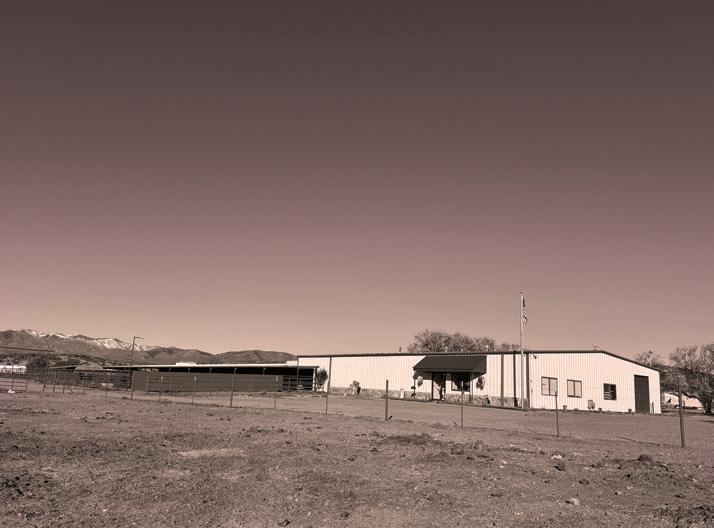
Physical Location 809 First Street, Moriarty NM 87035 President, Antonio Manzanares
n New Mexico Federal Lands Council newmexicofederallandscouncil@gmail.com 3417 Avenida Charada NW, Albuquerque, NM 87107
President, Ty Bays
EDITORIAL & ADVERTISING
Publisher: Caren Cowan
Publisher Emeritus: Chuck Stocks
Advertising Representatives: Chris Martinez Melinda Martinez
Contributing Editors: Carol Wilson Callie Gnatkowski-Gibson Howard Hutchinson Lee Pitts
PRODUCTION
Production Coordinator: Carol Pendleton
Editorial & Advertising Design: Kristy Hinds
ADVERTISING SALES
Chris Martinez at 505-243-9515 or chris@aaalivestock.com
New Mexico Stockman (USPS 381-580)
is published monthly by Caren Cowan, P.O. Box 7127 Albuquerque, NM 87194
Subscription price: 1 year hard copy and digital access $50, Digital access $30 Single issue price $10, Directory price $30 Subscriptions are non-refundable and may be purchased at www.aaalivestock.com
Cull Cows – Should They Stay or Should They Go? And When Should They Go? by Kellie Curry Raper, Oklahoma State University Cooperative Extension State Livestock Marketing Specialist
35 New Mexico Department of Agriculture Hires New Deputy Director/Secretary
36 American Angus Assn. Announces the Ten New Mexico Breeders Who Registered the Most Angus
40 Agricultural Productivity Growth Falls Short of Meeting Global Demands Says Virginia Tech
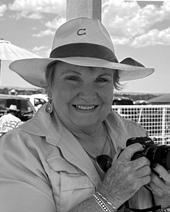
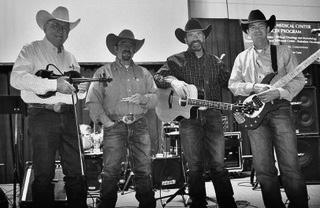
45 New Mexico Writer Photographer & Musician Family Receive 2024 Rounders Award
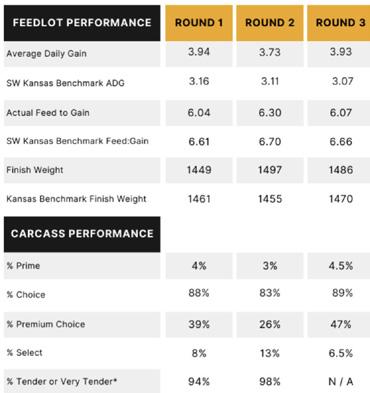
49 Brangus Value Project – Results Rrom Round 3 Are Official by Darrell L. Wilkes, Ph.D., reprinted courtesy of Frontline Beef Producer
53 2024 Joint Stockmen’s Convention Program
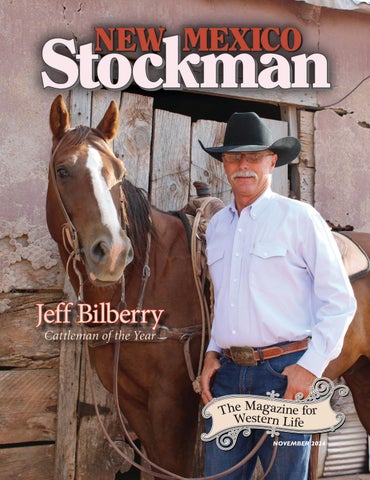
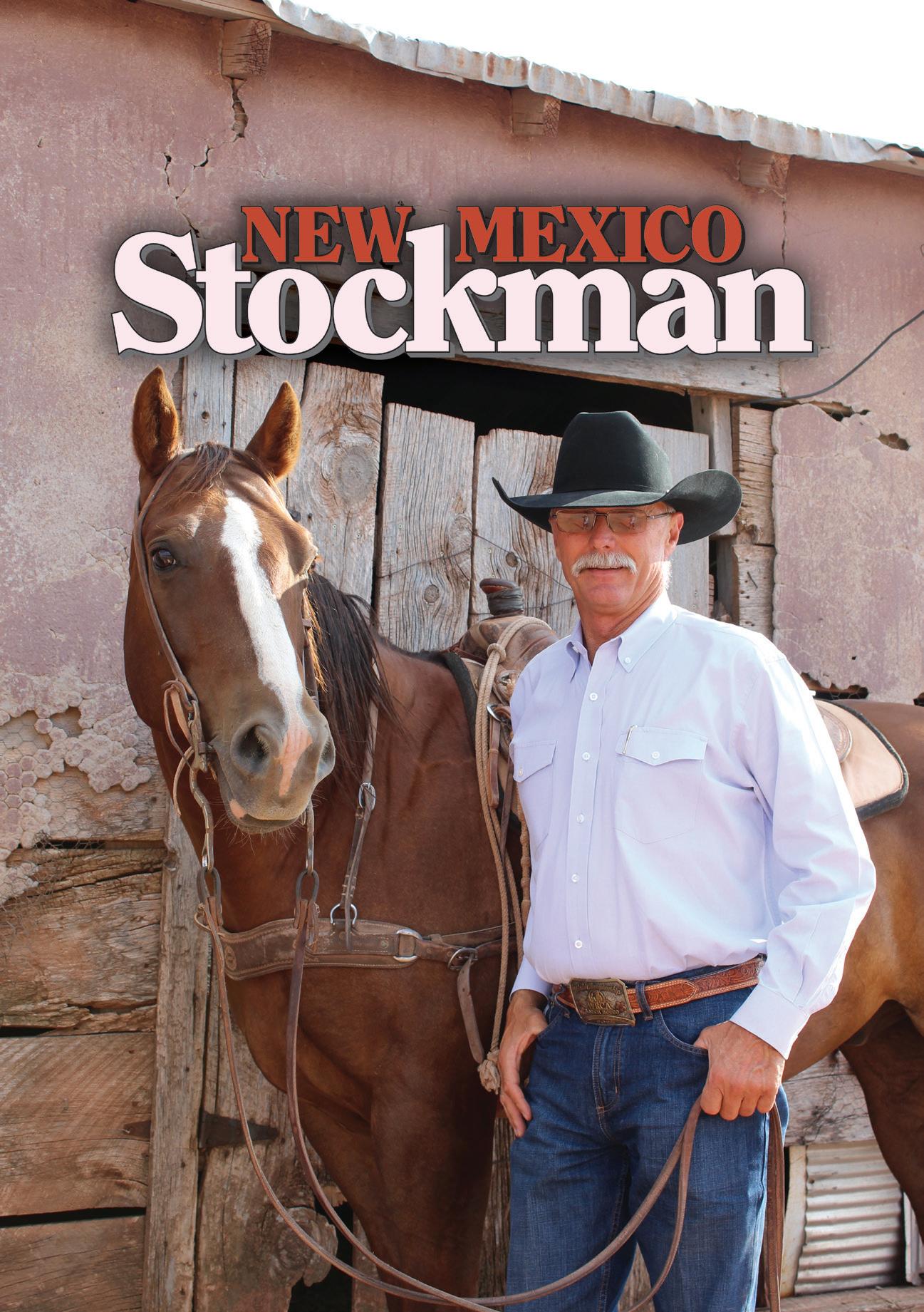
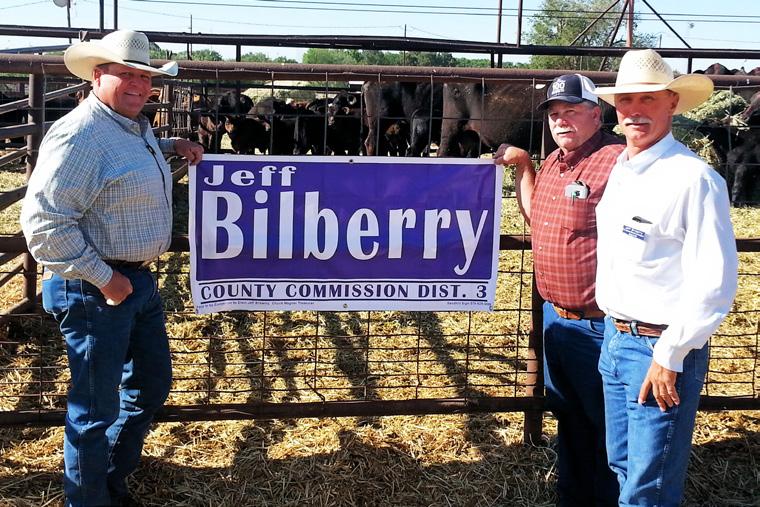
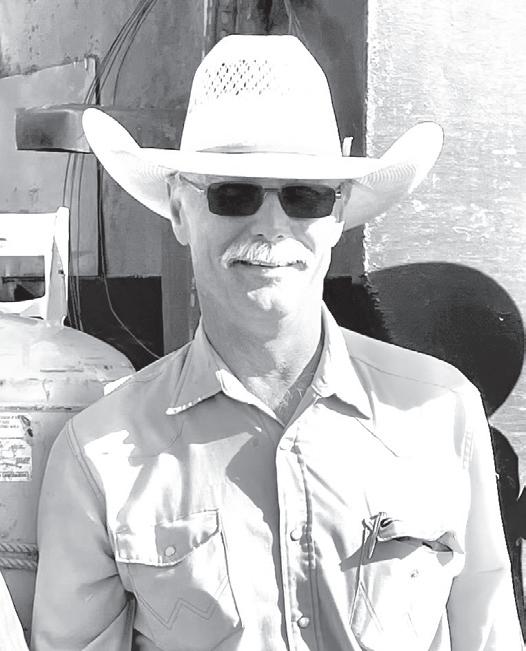
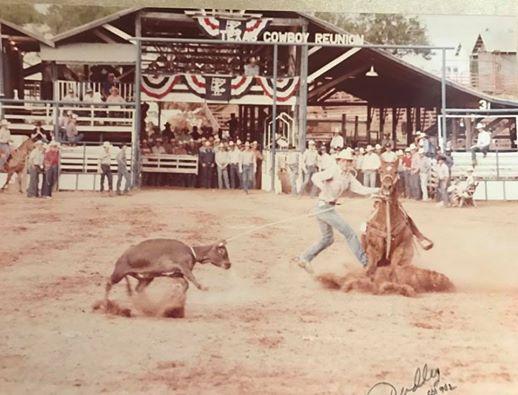
70 Jeff Bilberry, 2024 Cattleman of the Year by Carol Wilson
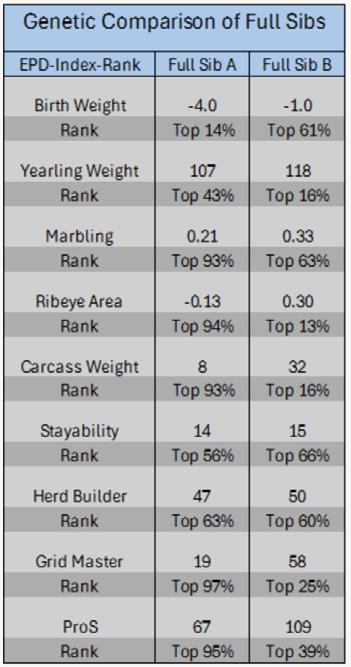
96 Full Siblings Are Often Genetically Different by Tom Brink, RAAA CEO
97 Why Track Cattle by Rachael Oliver, RAAA Assistant Director of Commercial Marketing
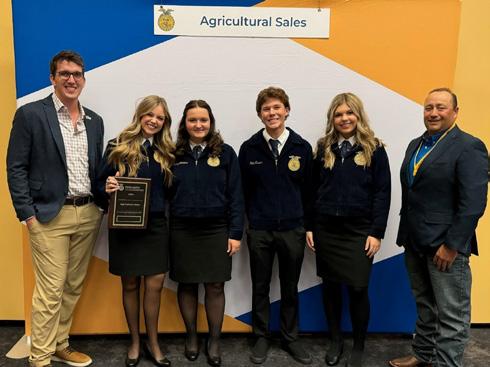
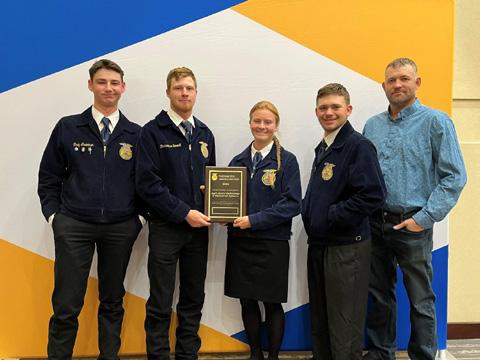
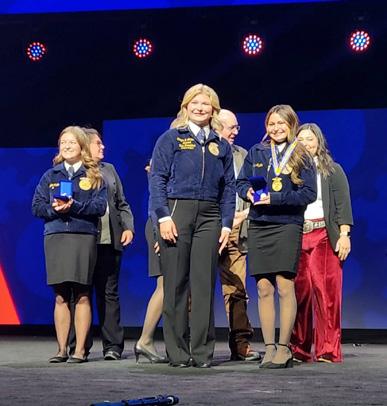
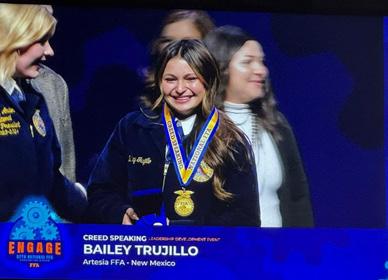
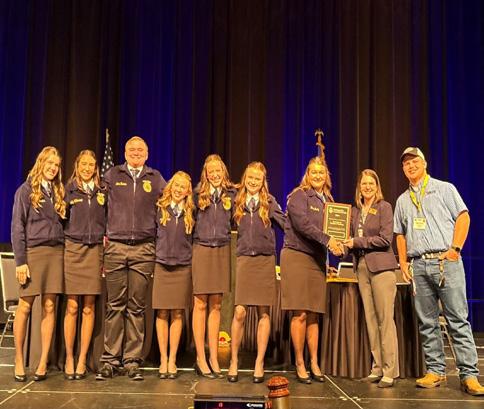
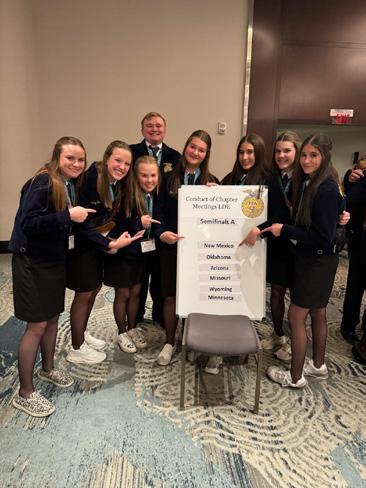
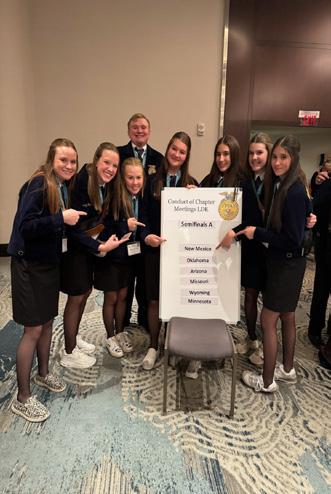
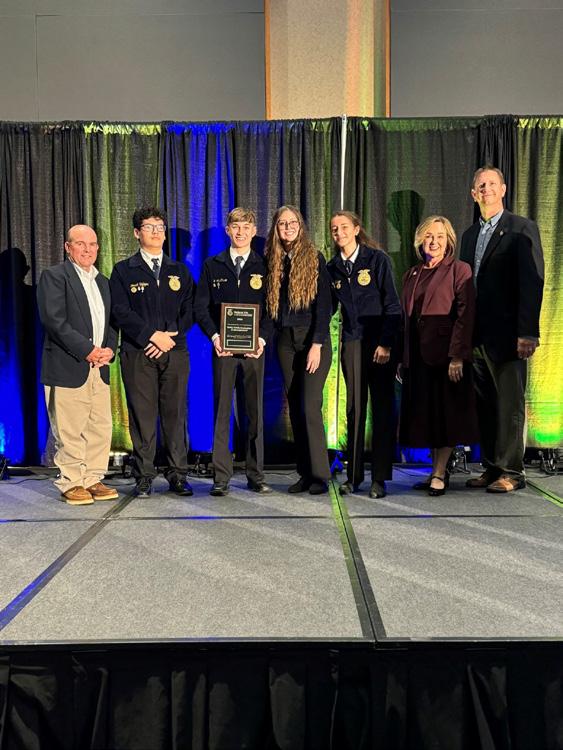
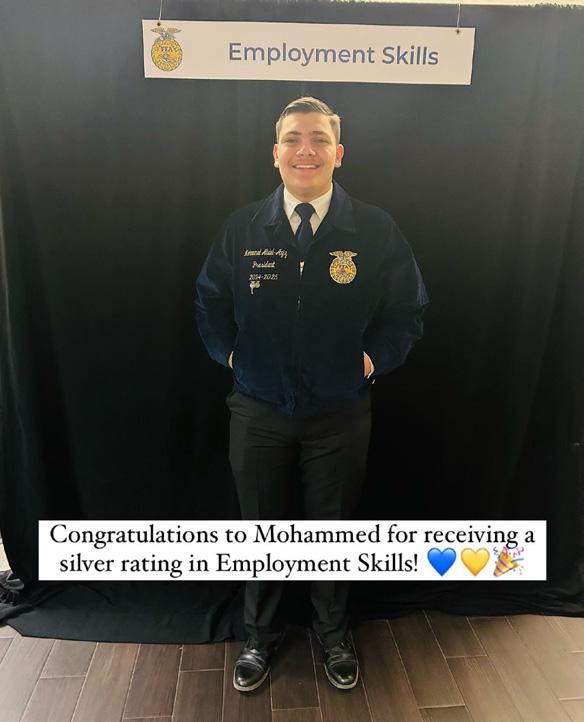
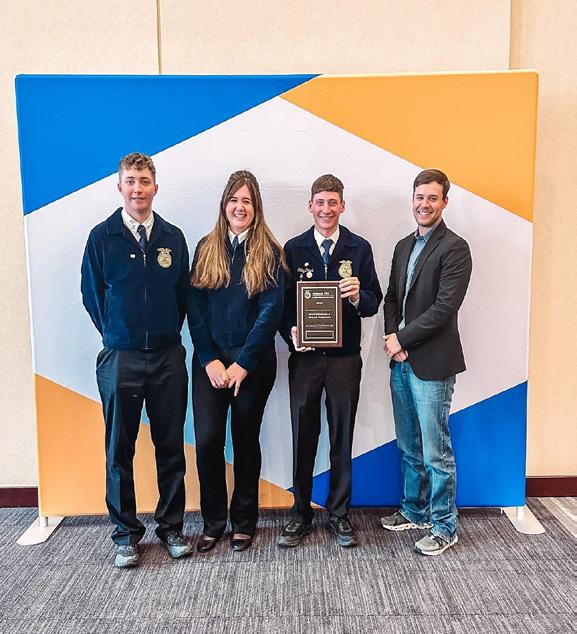
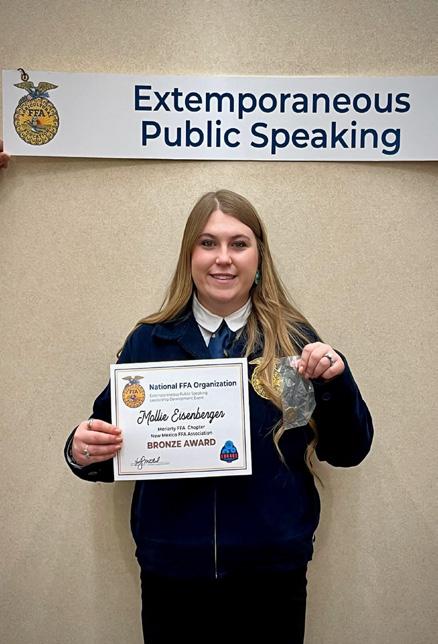
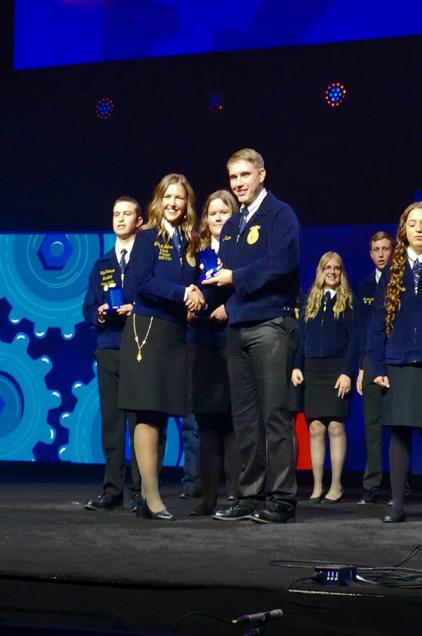
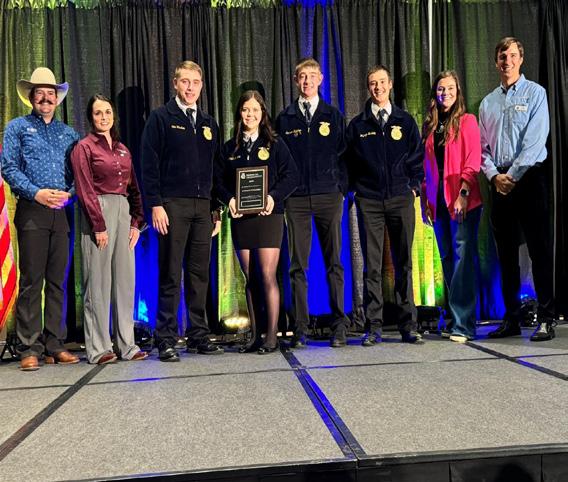
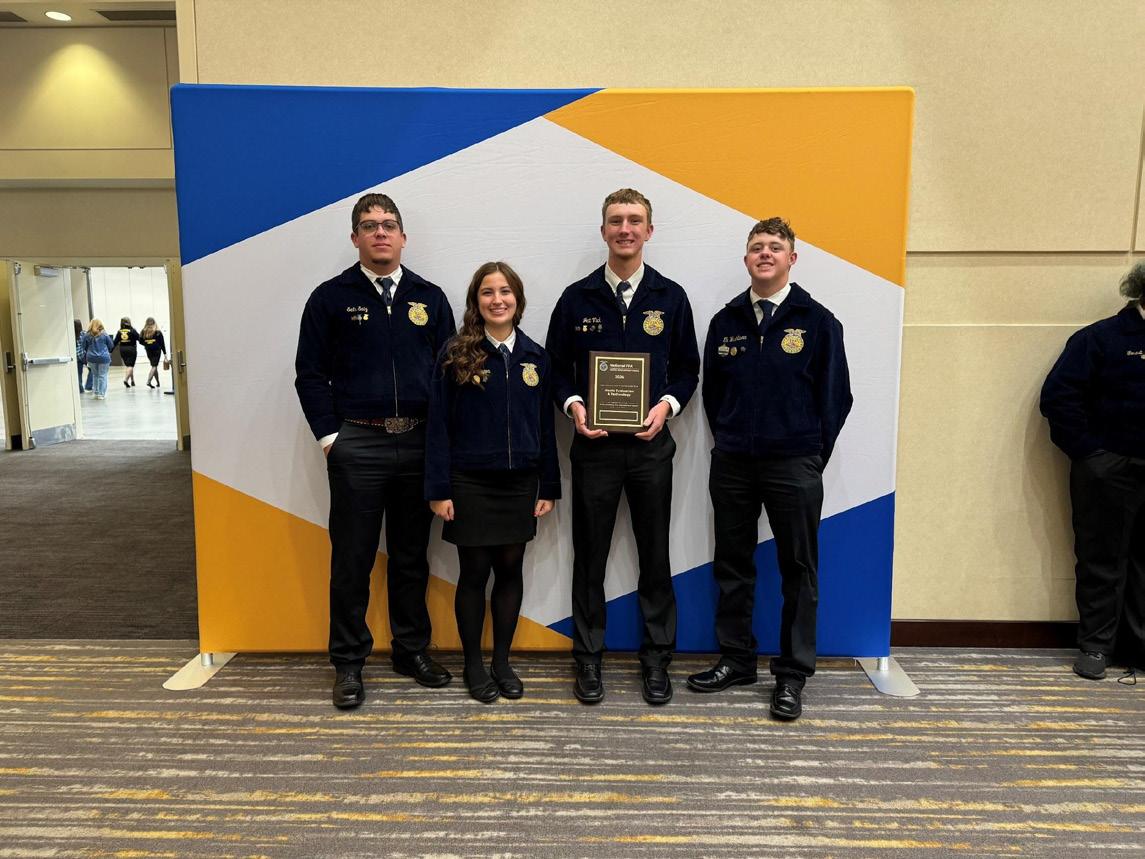
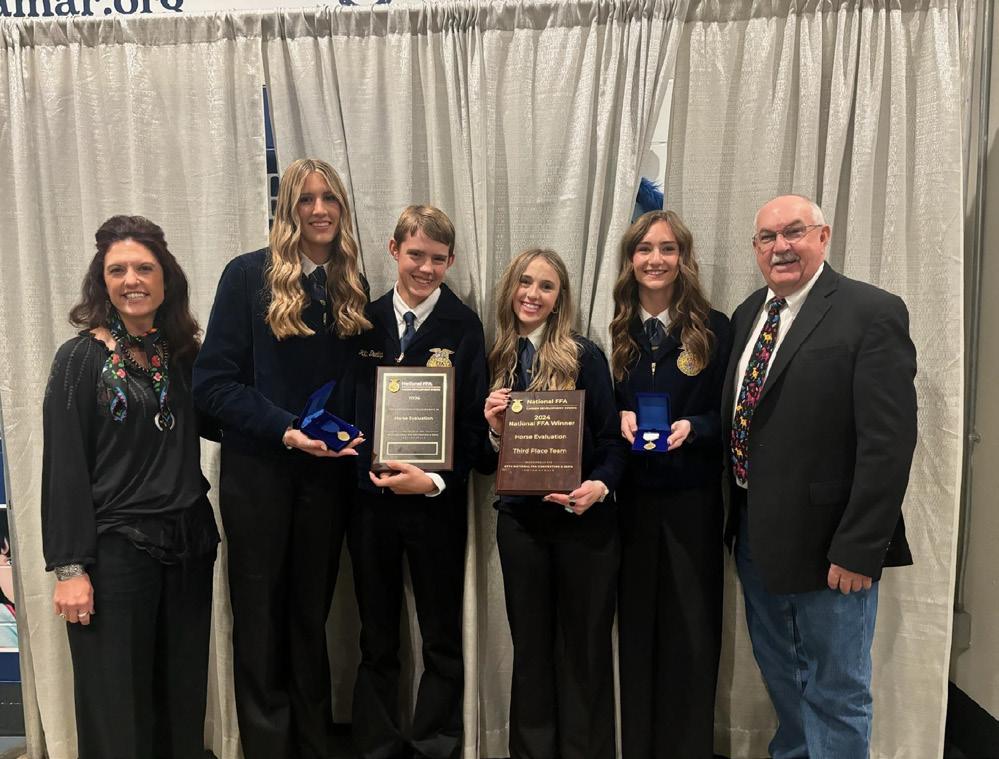
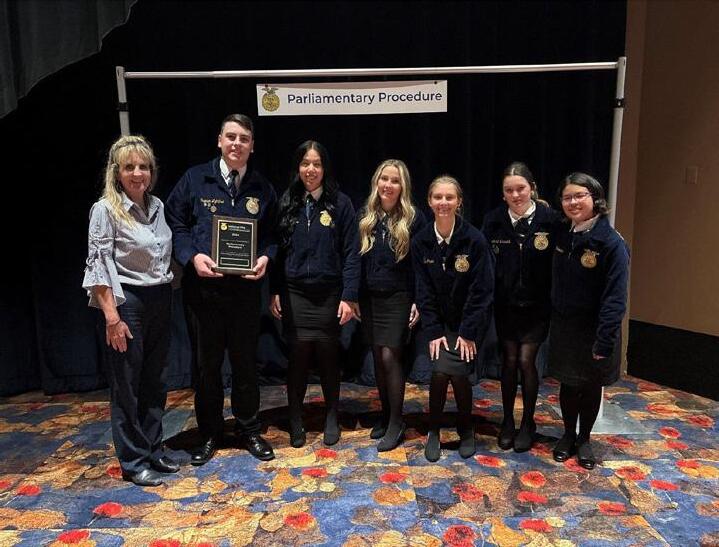
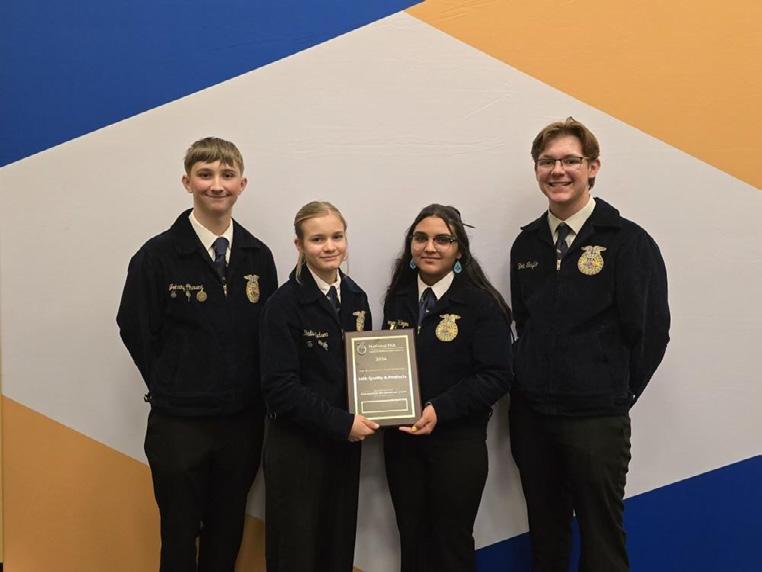
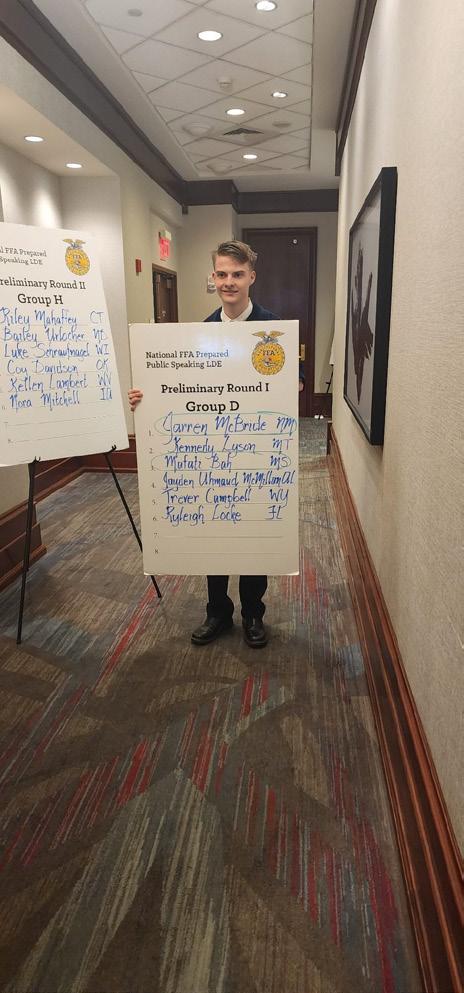
98 New Mexico FFA Shines at the 2024 National FFA Convention
Photo
Carol Wilson. Photo at
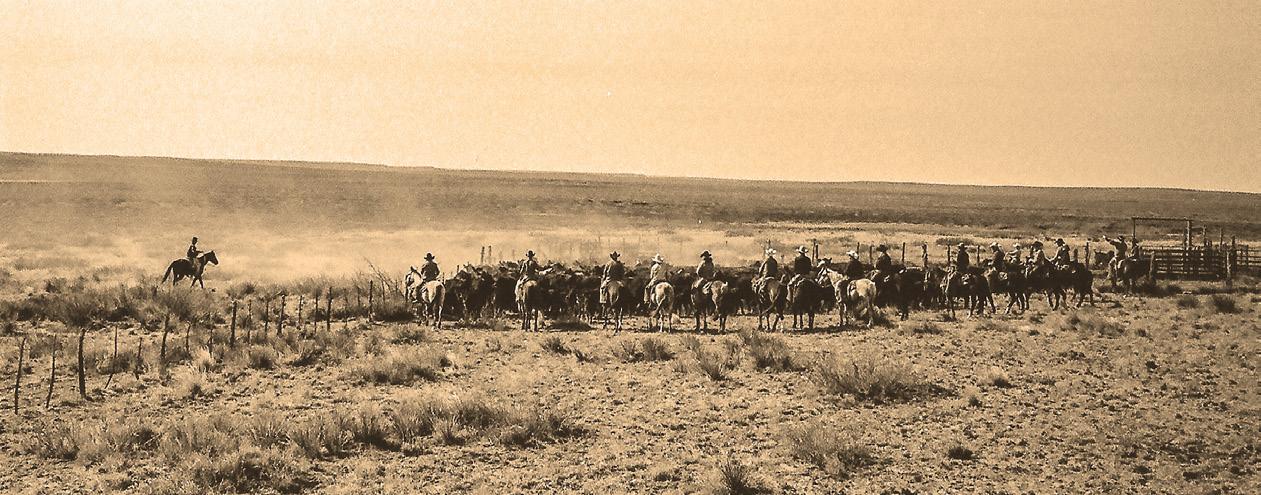
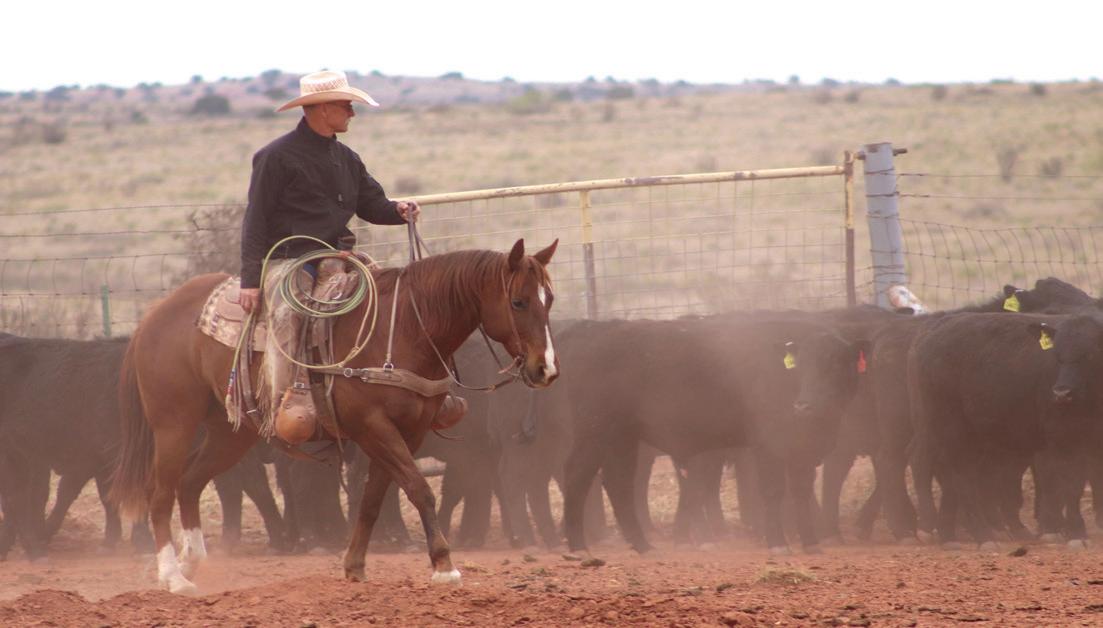
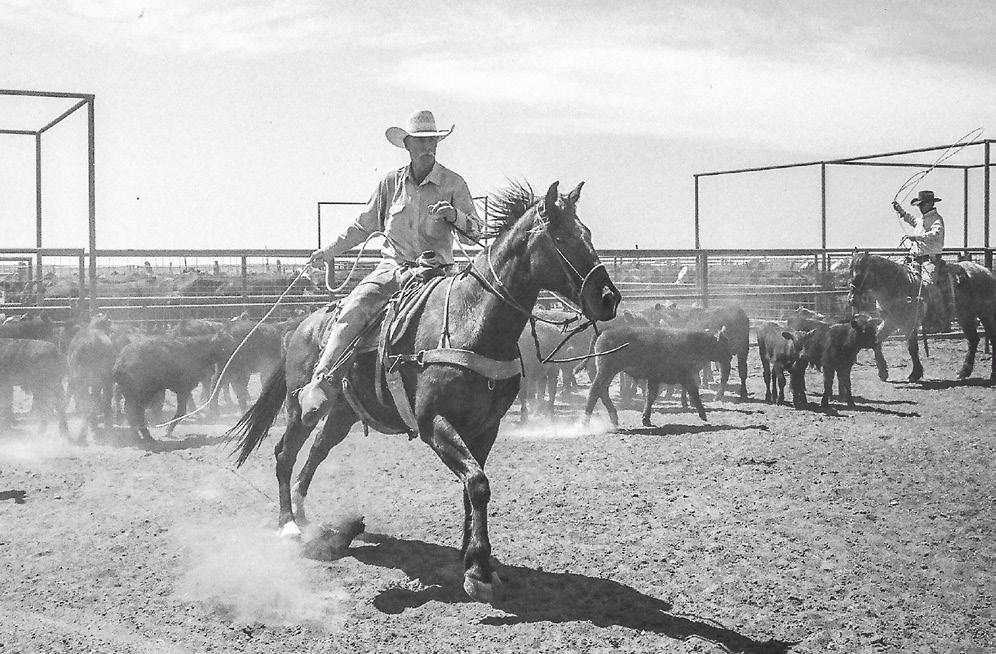
‘Penning Cattle’ at Singletons’s Ranch, 2015, by John Langmere.
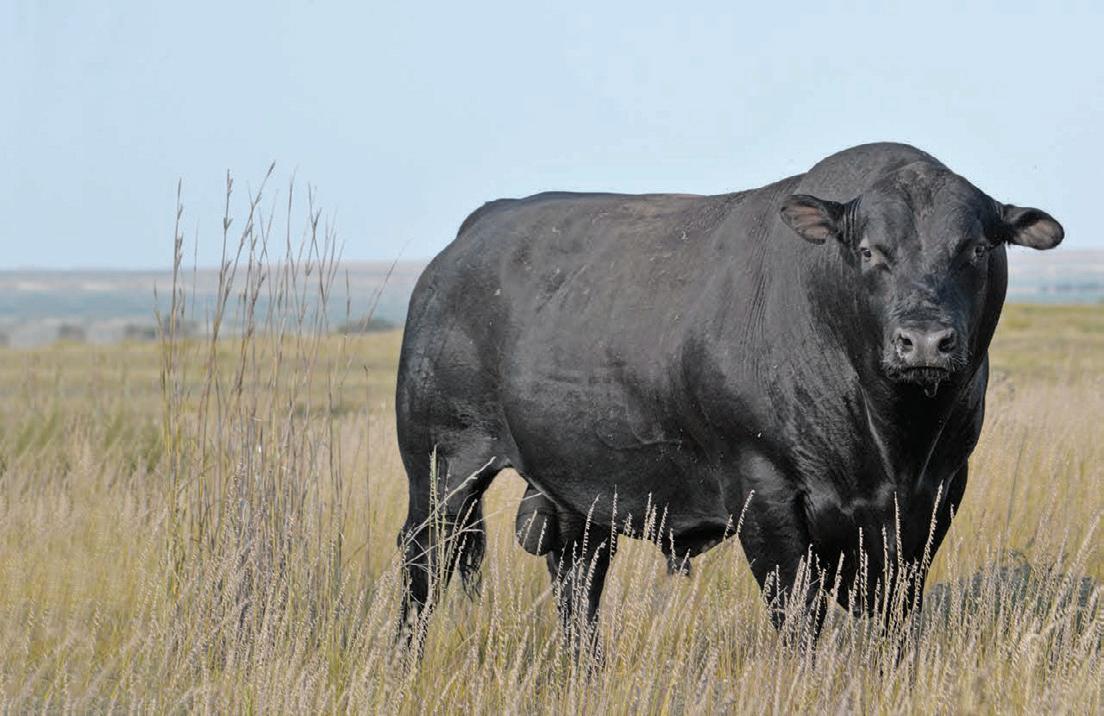
NEW CROP OF BULLS AND HEIFERS AVAILABLE FOR INSPECTION NOV 1 ST PICK THEM AND WE’LL GROW THEM OUT FOR YOU
GRAU GRAU RANCH RANCH
THEY’RE BETTER BECAUSE THEIR SIRES & GRANDSIRES ARE GRAU RANCH BRED
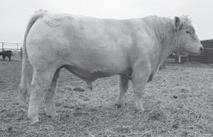
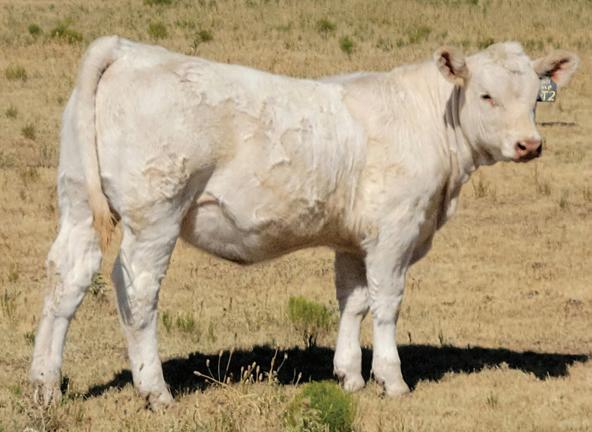
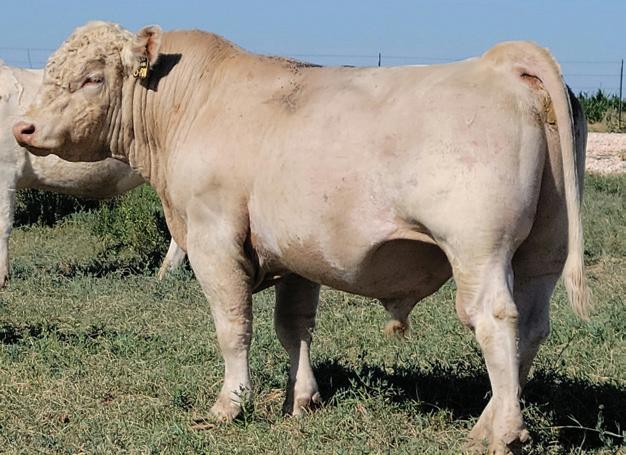
Grau Ranch bull sired the Grand Champion Carcass steer in San Antonio in the production division with 87 head entered. The calf was a purebred Charolais steer.
STATISTICS ARE:
Quality Grade: Prime plus
Yield Grade: 2.3
Ribeye: 16.5
Fat thickness: .4
Dressing %: 62%
The Calf was fed and entered by Andrew Louis Jones from Cal Farley’s Boys Ranch.
These kinds of calves weigh more and bring more money than the others.
by Bronson Corn NMCGA President PRESIDENT’S MESSAGE
Bronson Corn President Roswell
Tom Paterson President-Elect Luna
Dave Kenneke NW Vice President Cimarron
Jeff Decker SE Vice President Lovington
Roy Farr SW Vice President Datil
Cliff Copeland NE Vice President Nara Visa
Becky King-Spindle Vice President at Large Moriarty
Shacey Sullivan Secretary/Treasurer Peralta
Loren Patterson Immediate Past President Corona
Randell Major Past President
Fall Works
As I was lying in bed the other night after a very long hot day for the middle of October, suddenly it sounded like a jet fighter was flying over my house. It took me a minute to realize that it wasn’t a jet fighter coming to take me out, instead it was the wind howling like a midnight lion scream!
Until that moment, I didn’t think that fall was ever going to rear its head, but woof it came in hard, fast, and in a hurry! Now as I lay in bed listening to the wind blow, it got me to thinking about all that I had got done, and what was yet to be completed, both of which aren’t good to think about after a long hard day when you are trying to get to sleep to start it all over again the next day!
Anyway, it got me to thinking about what we have accomplished through Cattle Growers, from the new building that we operate out of, the new database that we have, the legislative wins we have chalked up, the programs that we have implemented, to the new publication that we built from scratch. I am so proud of all that we have accomplished in the last few years as an organization. None of it has been easy, but it has all been worth it!
The catch-22 as I was laying in my bed remembering all that we have accomplished in the last few years, is thinking of what we have to get done to help our membership through these crazy times. So, needless to say, I didn’t get much sleep that night! I compare those sleepless nights to preparing for our fall works.
You can have the best laid plans. Whether you are preparing for weaning, or shipping, you can pre-plan, you can go the extra mile, and even replace all the tie strings on your gates in the pens with fresh ones so they don’t fail. Then in the blink of an eye, life happens, and like a grass fire you have to start all over again.
We’ve all been there. We’ve all felt that horrible feeling, but you know what…. We’re still here! God willing, we will be able to pass on our leaning lessons to our kids and grandkids to help give them a leg up in their future endeavors as they take over the family operations.
If y’all haven’t noticed that my mission through my term as president is to get the next generation informed and involved, and I’m so very blessed to have a team that shares my sentiment! This year is going to be the inaugural year of our Linda Davis Young Cattlemen’s Leadership Academy. We have been blessed with a full class of young adults from the ages of 25-35. Michelle, Abby, and Jenny have got an awesome schedule for these young leaders, and this entire endeavor is 100 percent due to their hard work!
I am also so very thankful for our scholarship sponsors, Depot Farm and Ranch Agency, Purina Mills, our Allied Industry Partners, and our Young Cattlemen’s Leadership Committee. Thanks to these sponsors, we will be handing out $10,000 in sponsorship checks each year. It is so refreshing to see that we had so many applicants this year, and I know that our recipients are excited to receive the assistance!
God has a plan for us all. I understand that His plan isn’t always comfortable, but I can assure you that your team at NMCGA is dedicated to following his direction. That being said, thank you for your support through being a member of the New Mexico Cattle Growers’. We are fighting for each of you!
God Bless You and Your Family
“Ya’ll Have a Good’en “ ▫
Bronson Corn, NMCGA President
Sunday, December 29
Arizona State Fairgrounds – Phoenix, AZ
Ranch Replacement Heifer & Commercial Bull Sale
Looking for new genetics? Come see what top breeders have to offer at this elite Replacement Heifer and Commercial Bull Sale. These cattle will work in tough Southwest environments and produce calves each year that fit real world agriculture. The sale starts at 1:30 PM
Cattlemen’s Day BBQ
Generously provided for our buyers and consigners by the Arizona Farm Bureau. Lunch starts at noon!
For more information, contact: Rick Lehman - 602-481-3879 or visit us as www.anls.org
JUST THE FACTS ... & THEN SOME
by Caren Cowan, Publisher New Mexico Stockman
Sign Wars
Having grown up in the country, I am not the best of urban dwellers. My community is the livestock industry in the West.
When we moved into the neighborhood I had been looking at for years, it quickly became clear that all was not be paradise. The driveway directly across the street held two Prius’ – at least one with a “Wolves Belong” bummer sticker.
We had lots of company and four pickup trucks fit nicely in our driveway… or so we thought. It seems that the two trucks parked closest to the street stuck a bit over the side walk. Our visitors soon had parking tickets.
Given that I have never seen police patrolling this area, clearly our neighbors had secured their services to harass us. We minded our p’s and q’s and things rocked along fine – until election season.
Every fall there is a parade of signs across the street supporting the most liberal of candidates. You can probably guess what my counter has been.
This year we haven’t had a lot of time for signage, but sure enough across the street
there is a population of them, but with a twist. The signs are all far enough back that we are the only ones who see them.
Randy couldn’t help but retaliate with one of our own for the whole world to see.
Utah and the US Supreme Court
A dozen states and several state legislatures have thrown their support behind Utah’s lawsuit that questions whether the Bureau of Land Management can hold onto nearly 18.5 million acres of public land within the state’s borders filing amicus briefs with the US Supreme Court.
An amicus brief, also called a “friend of the court” brief, is filed by organizations or individuals who are not named in the lawsuit, but have an interest in the case or would like to support a particular side.
Leading the charge with the amicus briefs was one filed by the New Mexico Federal Lands Council, the Arizona / New Mexico Coalition of Counties and the New Mexico Farm & Livestock Bureau.
Filed with the U.S. Supreme Court in August, Utah’s lawsuit argues that the BLM can’t indefinitely hold onto land without giving it a designation, like a national monument, national forest or wilderness area. Those 18.5 million acres are what the state calls “unappropriated land” — they’re still leased for grazing, recreation and mineral extraction, but have no designation.
In total, 11 briefs have been filed with the Supreme Court by various groups, states and politicians, all of them supporting Utah’s effort. They include:
Ї Idaho, Alaska, Wyoming and the
Arizona Legislature.
Ї Iowa, which spearheaded a brief signed by attorneys general from Alabama, Arkansas, Mississippi, Nebraska, North Dakota, South Carolina, South Dakota and Texas.
Ї Utah’s entire Congressional delegation, which includes Senators Mitt Romney and Mike Lee, and Representatives Blake Moore, Celeste Maloy, John Curtis and Burgess Owens, all Republicans. Wyoming GOP Rep. Harriet Hageman also signed onto the brief.
Ї The Utah Legislature.
Ї The Wyoming Legislature.
Ї The Utah Association of Counties.
Ї The American Lands Council, a nonprofit organization based in Utah that advocates for access to public lands.
Ї The Sutherland Institute, a Utah-based conservative think tank.
Ї The Utah Public Lands Council, Utah Wool Growers Association, Utah Farm Bureau Federation, and county farm bureaus from Beaver, Garfield, Iron, Kane, Piute, Sanpete, Sevier, Uintah and Washington counties.
Ї The Pacific Legal Foundation, a nonprofit law firm.
NFR
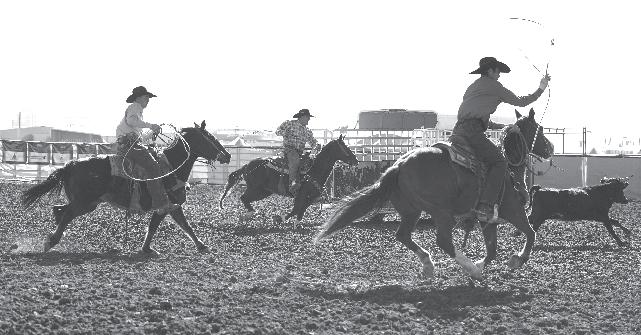
The group of cowboys riding behind the New Mexico flag will be one man up this year. Not only does Clovis’ Shad Mayfield lead the calf roping going into the finals, but he also is in the lead for the All-Around Title.
Former New Mexico State University Saddle Bronc ride Zach Dallas goes into the Finals sitting 13th in the event. Dallas also won the Rookie of Year for Saddle Bronc Riding.
Tatum’s Logan Medlin is sitting fourth in the standing for team roping heelers.
Although break-away ropers are not allowed to compete in the Thomas & Mac Center, two New Mexico ladies are in the top 15. Maddie Deerman, Hope, is sitting 7th, while TiAda Gray is sitting 13th.
The excuse for not letting the women compete during the NFR performances is that it would make the rodeo last too long.
At the Indian National Rodeo Finals, breakaway roping is a rodeo event. This year it was won by Bailey Bates, Mexican Springs, New Mexico. ▫
JANUARY
FEBRUARY
MARCH
APRIL —
MAY — News of the Day
JUNE — Sheepman of the Year
JULY — Directory of Agriculture
AUGUST — The Horse Industry
SEPTEMBER — Charolais; Fairs Across the SW OCTOBER — Hereford; State Fair Results
NOVEMBER — Cattleman of the Year; Angus; Brangus; Red Angus: Joint Stockmen’s Convention Preview
DECEMBER — Bull Buyers Guide
TIMES & OLD TIMERS
by Don Bullis, New Mexico Author donbullis@msn.com
Part Two
(This column concludes the saga of Dirty Dave Rudabaugh, New Mexico outlaw.)
After Rudabaugh killed Las Vegas, New Mexico, jailer Antonio Lino Valdez, and probably John “Little Allen” Llewellyn, he took up with Billy the Kid and his gang of thieves and killers by about June of 1880. He was with Billy at the Greathouse and Kuch road-ranch in November when Lincoln County deputy sheriff James Carlisle was killed under uncertain circumstances. He was with Billy the Kid at Fort Sumner in December when the gang was ambushed by Sheriff Pat Garrett’s posse and the outlaw Tom O’Folliard killed. Rudabaugh, in fact, had his horse shot out from under him in that fight. Rudabaugh was also with Billy when Garrett’s posse killed Charlie Bowdre and captured the gang—including Rudabaugh—at Stinking Spring on December 21, 1880. Others captured that day were Billy Wilson and Tom Pickett.
The posse took the outlaws first to Fort Sumner where a blacksmith chained Bonney
The Sordid Saga of Dirty Dave Rudabaugh
and Rudabaugh together. From there they were taken by wagon to Puerto de Luna and then on to Las Vegas where they were jailed while Garrett made arrangements for train transportation to Santa Fe.
The stopover in Las Vegas was not good news for Rudabaugh. He was well aware that local folks were not likely to have forgotten that he’d killed Deputy Valdez the previous April. Local folks made no effort to take Rudabaugh out of the jail, but when Garrett arrived to take custody of his prisoners, the sheriff only delivered three of them: Bonney, Wilson and Pickett. Garrett demanded that Rudabaugh be turned over to him, but local authorities claimed jurisdiction for the Valdez killing. Garrett held a commission as a deputy U. S. Marshal and claimed that since Rudabaugh had confessed to stage robbery, during which he rifled mail sacks, that made him a federal prisoner, and that took precedence over local charges, even if they were for murder. Garrett acknowledged that Las Vegas could have him back once he’d been tried in Federal Court. The jailers grudgingly released Rudabaugh.
But the fight was not over. Garrett got his prisoners aboard the Santa Fe train, and it
began to pull out when several armed citizens jumped into the engineer’s cabin and halted the engine at gunpoint. Garrett and his deputies, Frank Stewart and Barney Mason, prepared for a fight. Garrett stepped out onto the rear platform of the rail car his prisoners occupied just in time to run face to face into Sheriff Desiderio Romero and four or five other men.
“Let’s go right in and take him [Rudabaugh] out of there!” one of the crowd yelled.
Garrett drew his pistol. “They [the citizens] slid to the ground like a covey of hardback turtles off the banks of the Pecos,” he said later.
The train was at last allowed to depart and arrived in Santa Fe without further incident. The prisoners were locked up in the Santa Fe County jail.
None of the outlaws had any intention of staying in jail any longer than necessary. They went right to work on digging a tunnel by which to affect an escape. The sheriff discovered the plan on March 1, 1881, and foiled it.
Rudabaugh was soon tried in the court of Judge Bradford Prince, convicted and sentenced to 99 years in prison on the federal
charges. He was then released to San Miguel County officials to face murder charges for killing deputy Valdez. Officials realized, however, that he could not receive a fair trial in Las Vegas, so they changed the venue back to Santa Fe. Rudabaugh faced Judge Prince for a second time. This time the sentence was death by hanging. The date was set for May 13, but a stay of execution was granted while the case was appealed. Rudabaugh was returned to the Las Vegas jail to await his doom. One of his cellmates was none other than his old friend J. J. Webb.
While many in Las Vegas were anxious to see Rudabaugh dangling from the end of a rope, others remained friendly to him. On September 18, 1881, someone smuggled a gun into the jail, specifically to Rudabaugh. He attempted escape that night but failed. One of the other prisoners in the jail, Tom Duffy, was killed in the effort. J. J. Webb took no part in the escape attempt.
Rudabaugh would not acquiesce to the hangman’s rope, however. On the morning of December 3, 1881, guards discovered that seven prisoners had escaped during the night, and Dave Rudabaugh and J. J. Webb were among them. All of them had managed to squeeze through a hole in the wall that measured seven inches wide by 19 inches long. One source reported that the fit was so tight
that the prisoners had to remove their clothing to get through the hole. A witness reported seeing Rudabaugh and Webb walking away from town along the railroad track. They soon parted ways, though: Webb went to Arkansas and Rudabaugh to southern Arizona and then to Mexico.
Rudabaugh was never recaptured. Reports filtered back to New Mexico from time to time that he’d been seen along the Mexican border. One source reported that he managed a Mexican cattle ranch for a period of time, but ultimately moved on. Then, early in 1886, he became embroiled in a conflict—some said it was over a card game—with some Mexican citizens at Hidalgo de Parral, Chihuahua. The Albuquerque Evening Democrat for January 16, 1886, reported what happened: “Dave Rudebaugh [sic], a former wicked and lawless character of Las Vegas was killed at Parral, Mexico, a short time ago. He killed two men in the fracas that settled his own hash.” One source reported that Rudabaugh was killed with an ax. The people of Perral then cut the outlaw’s head off and paraded it about the town by torchlight on the end of a pike.
Thus did Mexican justice succeed where the U. S. version failed, and the world was well rid of Dirty Dave Rudabaugh. ▫
Droughts, Fires, and Floods
This year has been one of the most trying for our state in terms of weather. As ranchers and farmers we’re re used to anomalies, but the last several months have been some for the books. Severe drought, fires, and floods have dominated talks of weather as of late.
As I write this (and I’m a little bit late in doing so) we’re getting news that Roswell, Dexter, Hagerman and the surrounding area in Chavez County have been severely impacted by heavy rains and flooding. My heart goes out to our neighbors there. It’s devastating when the moisture you’ve been praying for comes all at once.
Ruidoso is still in recovery from the fires and floods that ravaged the mountain over the summer. But they are rebuilding. It shows their resilience. And the Roswell area will do the same. It will take time, but it will happen.
Other parts of our state are still in a severe, ongoing drought. The maps have shown red in those places for a while now. But our neighbors there are still at it. The hope for rain hasn’t left, and now it’s prayers for winter moisture to help restore the land.
In all of the ups and downs, I admire our neighbors across the state and their support for each other, the way they make the best of a bad situation, and their faith that it will get better. They stand on these things, and teach their children and grandchildren to do the same. This is the fabric we’re made of, and
what makes people who are all cut from the same cloth. It’s generational. Ty and I are raising the sixth generation, as are many of our friends and peers.
It’s with this in mind that I continue to have hope. Hope that the rains will come gently, the fires will be extinguished, and the water will flow easily. It’s tough when you see so much of the news that’s not good, but as I’ve always heard–it’s always one day closer to being better.
Keep the faith and here’s hoping for some gentle weather in the months to come,
– Michelle Greeman NMCB President
Frisco CowBelles have had an active spring and summer. April was busy getting ready for McKeen Ranch Days and the whole crew was helpful for setting up and cleaning up. Copper CowBelles were very helpful doing stations and assisting wherever possible. The scholarship committee worked hard to get applications out to the school. Had several who applied. The main fundraiser for Frisco CowBelles is over Independence Day weekend. A special group did a great job of putting on a Ranch Rodeo. A tasty brisket barbecue, a western art auction with excellent selections and a dance were all held at Glenwood Park. All were well attended and supported. Some tables and chairs were purchased for Glenwood Park as well. At the end of August there is the Catron County Fair. The Champion and Reserve Champion BEEF get an amount plus each beef exhibitor also does. Halloween is coming soon. The plan is
to do a display/contest at the Trunk or Treat at the Los Olmos Lodge and hand out beef by-products. Submitted by Margie McKeen
Powderhorn CattleWomen met in the home of Karen Kelling with Carol Thorpe as co-hostess, and President Ann Sleep presiding with seven members and one guest, Candace Sitzer present. Candace is Joan Key’s niece from Arizona. Karen Kelling led the Invocation, Brenda Copeland led the Pledge of Allegiance, and Sandy McKenna led the Creed. Mary McClain read the minutes of the September 12 meeting. Carol Thorpe gave the Treasurer’s report. Mary read the correspondence, a letter from the Pat Nowlin Scholarship Committee for donation in memory of Sam Cowden. The second letter was from the Cowden family thanking for the donation in his memory. The group signed cards for Yetta Bidigain, Carolyn Bedford, and Get-Well cards for Rhonda Vaughan and Karen Cortese. Ann talked about appointing a nominating committee but didn’t feel mean enough so the group will fill in a slate of officers for next year. The group discussed dues being due and Mary will send cards to all members and some former members requesting their dues. BBQ- serving Meat, Coleslaw, Beans, Sliced Bread, Pickles, and Onion at Barbeque next June. The group talked about doing more advertising for scholarships as we give three, they are now for 2025 $1000 each. It was disappointing that the group could only give one scholarship this year because no one from the other two groups applied. It was decided to give the unused scholarship money to Boys’ and Girls’ Ranch. Brenda brought up the new Corporate Transparency Act. One point of worry was for owners over the age of 75 to have to get a new driver’s license every year and the statement in the information current or it is a $500 a day fine until it is compliant. The group will be talking more about this as it gets closer to the deadlines. Meeting adjourned and everyone enjoyed a brisket lunch cooked by world famous smoker Curtis Kelling. Submitted by Mary McClain ▫
The Link
With the supply chain never more closely aligned, the road ahead bodes well for profitability
by Troy Marshall, Director of Commercial Industry Relations Reprinted Courtesy of the Angus Beef Bulletin
The history of our industry can be boiled down to one contrarian description: massive amounts of incremental improvement within segments without the framework of industry alignment. The lack of industry alignment has at various times led to a wide variety of issues in every segment. Ultimately, it contributed to a lack of competitiveness and a loss of market share, leading to narrowing margins, concentration and consolidation as the industry shrank.
It is no secret that a lack of communication and a lack of cooperation, coupled with a commodity pricing system not designed to send appropriate signals, was problematic — especially in a highly diverse/fragmented and segmented industry.
most optimistic of individuals couldn’t help but become a little cynical. Yet, it is not hyperbole to say there has never been a time in our industry when the supply chain has been more closely aligned. That bodes well for both short-term and long-term profitability prospects.
What got us here?
It has taken a lot of time and effort to get us to this point. The creation of the National Beef Quality Audit was a seminal effort in creating the value-based marketing revolution that has been transforming our industry ever since. Value-based marketing was spawned and aided by other revolutions, as well. The creation of Certified Angus Beef (CAB) sparked the branded revolution. Grid pricing kicked off the pricing revolution. The national genetic evaluations in conjunction with genomics gave us the tools to make unprecedented genetic gains in the DNA revolution.
For the first time ever, we have consistently seen beef demand grow as consumers have sent a clear message of their preferences, and the beef industry responded with the quality revolution that has led to increased dollars flowing into the industry.
The reasons for a lack of alignment in our supply chain are obvious to everyone. There were times in our business, when even the success.
Genetics have increasingly become the No. 1 factor in determining an operation’s
The technology revolution gave us electronic identification (eID) and data management systems that have allowed us to both collect and analyze the data from a total systems approach. The AI (artificial intelligence) revolution is opening new frontiers with mega data promising to fundamentally change the way we analyze and utilize information. It is exponentially increasing the value of data.
The aggregators and those with the expertise to apply the mathematics and the computing power are no longer in the driver’s seat. They have been commoditized, and the value is shifting back to those who hold access to the data. It is not about the models, but rather who has the best data to feed them.
Stepping up
In all of this realignment of our supply chain, one segment of the industry — and I would argue the most important segment of our business, the cow-calf producer — was largely left out of the equation. It was not surprising that the cow-calf industry embraced the genetic tools that directly affected their bottom line, or that they responded to price signals on management and health practices where there were economic incentives to do so.
Your Best Advertising value in the west and beyond
What is somewhat surprising is that they embraced full-heartedly the signals that improved the overall customer experience, even if they were not rewarded appropriately for doing so. Admittedly, their response was not totally altruistic. Better beef demand equates to more dollars, even in a system where the better cattle subsidize the poorer ones.
Revolutionary value of genetics
Perhaps the greatest revolution in our industry has been occurring slowly during this entire time, a revolution so quiet and foundational we failed to recognize how it was transforming our industry. This revolution is in the growing value of genetics as it relates to profitability.
This has happened because of a unique convergence of events: the perfect storm created by higher overall prices, higher input costs, improving premiums and an increasing number of cattle selling on a value-added basis. This has led to increasing differentiation in the marketplace and to premium creation.
We also now have the ability to make rapid genetic progress and defy genetic antagonisms through improved selection
Don’t buy an imposter.
The trickle-down effect from improvements made in the pricing of our product in other segments has increased the incentive for buyers upstream to know what genetics they are buying.
Finally, the rate of improvement and the rate of adoption in best management practices has elevated the importance of genetics. Management, risk mitigation and market timing no longer are significant drivers of profitability. Everyone is doing a good job. There is no longer a lot of play in the system. Best management practices are only significant drivers if they are not widely adopted.
As a result of all of these factors, genetics have increasingly become the No. 1 factor in determining an operation’s success.
The last gap
The AngusLinkSM program was designed to fill the last gap in the industry alignment, giving cow-calf producers the means to differentiate their cattle based on genetic merit and giving their buyers the ability to accurately assign value. AngusLink and the Genetic Merit ScorecardSM do for the cow-calf industry what expected progeny differences (EPDs) did for the seedstock industry, providing a way to differentiate cattle based on genetic merit and assign value according to the value they create.
The AngusLink program was designed to fill the last gap in the industry alignment, giving cow-calf producers the means to differentiate their cattle based on genetic merit and giving their buyers the ability to accurately assign value.
AngusLink is rightly first thought of as a marketing tool designed to reward cow-calf producers for the value they are creating. Secondly, it is often seen as a benchmarking tool not only for buyers, but for producers, so they can monitor how they rank relative to the industry as a whole.
Ultimately, it also plays a role in strengthening the alignment between seedstock producers and their commercial customers, helping to build relationships and facilitate the feedback loop that ties our entire supply chain together, with the common goal of improving the customer experience in order to create value and improve profitability throughout every segment of the industry.
Supply chains have proven the value of an aligned production system, the industry’s supply chain is more aligned than ever, and the resulting opportunities have never been higher.
Editor’s note: Troy Marshall is director of commercial industry relations for the American Angus Association. Angus Beef Bulletin EXTRA, Vol. 16, No. 10-B ▫ tools.
Supplement Delivery Methods for Weaned Calves
by Warren Rusche, South Dakota State University
Reprinted courtesy of the Angus Beef Bulletin
Successfully transitioning calves from nursing through weaning into the next phase of beef production can be stressful, for both cattle and managers. Calves must adapt to new diets and new environments and often face pathogen threats they
did not face on their home ranch. Vaccination protocols, preweaning management and strategies to reduce stress are all important management considerations for successful weaning. One of the most critical success factors in this process is ensuring that calves consume sufficient nutrients to support their immune system and for setting them up for rapid, efficient gains throughout the feeding period.
Providing sufficient trace minerals and feed additives, such as Saccharomyces cerevisiae yeast culture products, are proven approaches that can affect the health of both
J-C Angus Ranch
the animal and the rumen environment. The research question we wanted to ask was, “How effective are different methods in delivering these nutrients; specifically, how did providing a self-fed, cooked molasses block compare to including these additives directly to the diet?”
Doing the research
We used 192 crossbred steer calves in this experiment. These calves all came from a single ranch in western South Dakota, and, based on prior experience with this set of cattle, we expected they would have low concentrations of liver copper. These calves were weaned on the ranch and shipped to the research feedlot at South Dakota State University (SDSU) at Brookings. The steers were vaccinated using our standard receiving protocol. We also sampled a subset for liver trace-mineral concentrations.
We started the steers on a receiving diet of wheatlage, oat hay, dried distillers’ grains and soyhulls that contained 13 percent crude protein (CP) and 47 megacalories (Mcal) per hundredweight (cwt.) net energy for gain (NEg). The steers were then divided into three groups:
1. Receiving diet supplemented with inorganic trace minerals at concentrations to meet the nutrient requirements for growing beef steers (CON).
2. Receiving diet plus a low-moisture, cooked molasses tub containing organic trace minerals and a yeast culture product placed in the pen (TUB).
3. Receiving diet plus a supplement mixed in the diet containing organic trace minerals and a yeast culture product (FORCE). The supplement was designed to match the TUB treatment if the steers ate 0.5 pounds (lb.) per day of the tub.
The TUB and FORCE treatments were fed for the first 28 days of the study. We weighed the tubs daily to estimate tub intake. We conducted liver biopsies on days 14, 28 and 49 to compare against the baseline samples. The entire study lasted 49 days.
Findings
Feed intake. Based on the tub label, the steers in this experiment should have consumed between 0.33 lb. and 0.5 lb. per day. However, they averaged only 0.25 lb. per day for the first 28 days of the study. Tub consumption was greater than expected for the first nine days, but it decreased after that time. Calves on the FORCE treatment had greater feed intake than the CON or TUB treatments during the first 28 days and for the entire 49-day experiment.
Villanueva
MILLER ANGUS
REGISTERED BLACK ANGUS CATTLE
FLOYD, NEW MEXICO (575) 760-9047 (575) 478-2398
CATTLEMEN ’S LIVESTOCK AUCTION BELEN , NM MARCH 2025
MILLER JET BLACK 060
AAA – 19792704
CED +12
+1.6
MILLER FOREMAN 813
AAA – 19179406
CED +5
BULLS AND FEMALES TESTED PI-BVD FREE ALL BULLS TRICH AND FERTILITY TESTED FOR SALE BY PRIVATE TREATY
New Mexico Angus Sale Roswell, NM March 3rd, 2025
Ranchers Pride Sale Clayton, NM April 2025
+85 YW +139 $B +146 MILLER CONFIDENCE PLUS 715 AAA – 18839538
A.I. SIRES: SS BRICKYARD S ARCHITECT 9501 POSS RAWHIDE BASIN SAFE DEPOSIT 9324
Miller Epic 923 AAA - 19504487 CED
Liver copper concentrations: We saw notable differences in liver concentrations of copper. All groups started at near-zero concentrations of copper in the liver, and all groups increased over the course of the experiment.
Steers on the FORCE treatment had greater liver copper concentrations compared to every other group throughout the study. Steers on the TUB treatment had greater liver copper concentrations than the CON treatment at Day 14 and Day 28, and their liver copper concentrations would be considered sufficient by Day 14.
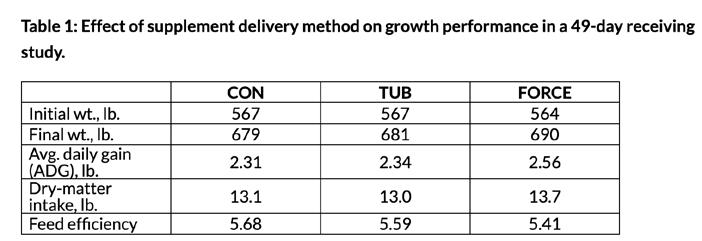
Growth performance: Differences in growth performance are shown in Table 1. Overall differences were small, but steers fed FORCE ate more and gained faster, with no differences in feed efficiency. There were no differences in health outcomes in this study.
What does this mean?
Both the TUB- and FORCE-fed supplement were effective at rebuilding liver copper stores. FORCE also increased cobalt concentrations, but there were no differences for manganese or zinc. In this study, TUB steers dramatically reduced intake after about nine
days. This is similar to an earlier study we conducted at SDSU with calves from the same ranch where tub consumption decreased after five days. Including both trace minerals and a yeast product in the diet for 28 days resulted in 11 lb. more gain during the seven-week study period.
Supplement approach
So, which approach is the best? The answer depends on what resources you have available and the kind of cattle you are feeding. The FORCE treatment resulted in the most-rapid rebuilding of copper stores and supported the highest gains. To achieve that outcome, the FORCE treatment was fed for 28 days compared to fewer days of actual tub consumption. We do not know if the supplement needs to be fed for a full 28 days, or if we could shorten the feeding period to perhaps 14 days and achieve comparable results.
In our studies, calves reduced their intake of the tubs after about seven to 10 days. That might be long enough, considering liver copper concentrations were adequate by that point. The tubs are more convenient, but convenience comes at a greater cost per unit
of feed or nutrient. In some cases, the cost may be justified if it saves labor, simplifies diet mixing and manufacturing needs, or reduces the amount of product in inventory.
Health response
What about health responses? It may be tempting to look at the “bare bones” treatment and compare that to the same performance with zero health issues and conclude that additional supplementation is not necessary.
However, before one reaches that conclusion, keep in mind that this scenario does not represent normal calf receiving conditions. First, these steers were not commingled, which reduces the risk of disease. Secondly, because we need replicated pens to determine what effects these diets may cause, this experiment was conducted with eight steers per pen. It is much easier to locate sick animals in those conditions, and calves have less competition at the bunk.
The bare-bones approach in a group of calves from multiple sources fed in one group could easily result in a very different outcome in terms of sickness and death loss.
Editor’s note: Warren Rusche is an assistant professor and South Dakota State University Extension feedlot management specialist. ▫
TWENTY-FIRST NEW MEXICO ANGUS ASSOCIATION
< > Bull and Heifer Sale Bull Heifer Sale
Monday’ March 3’ 2025
ROSWELL LIVES TOCK AUCTION, ROSWELL, N.M.
Sale time 1:00 p.m.
Bulls will be Graded & Tested For Fertility & Trich
* 70 REGISTERED ANGUS BULLS *
Cattle available for viewing, Sunday, March 2, 2025
All Bulls & Registered Heifers will have 50K or Angus GS Genetic Testing
* PLUS*
a nice selection of Registered and Commercial Heifers
Registered heifers at the New Mexico Angus March sale in Roswell are eligible for the New Mexico Bred Angus Show at the New Mexico State Fair
Candy Trujillo 480-208-1410
Greg Carrasco 575-649-5268
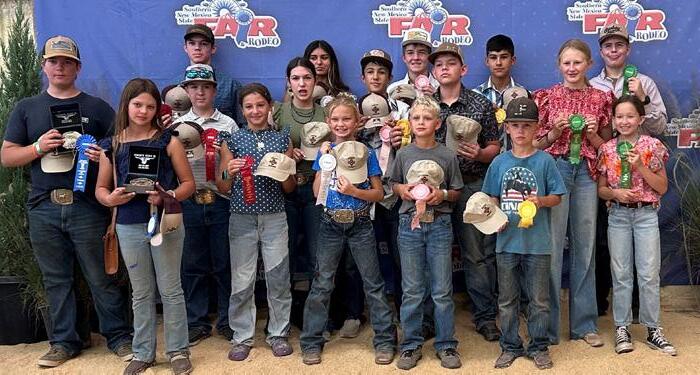
2024 Livestock Judging Contest for Southern New Mexico State Fair
Novice Top Six
1st Kathryn Gibson
2nd Cora Marta
3rd Taylin Richins
4th Foy Neudorf
5th Coleson Forrister
6th Bree Adams
Junior Top Six
1st Lee Justice
T 2nd Trevor Saulsberry
3rd Braelyn Stevenson
4th Adan Marta
5th Zach Gibson
6th Reina Ivey
U BAR RANCH
Producing southwestern Angus cattle that “Fit the Bill”
•Performance in the feedlot and on the range.
•Raising quality Registered Angus cattle since 1991.
•Bulls available private treaty or at the annual Black Angus “Ready for Work” Bull Sale – March 2025 - Belen, NM
Senior Top Six
1st Kaleb Newman (Not Pictured)
2nd Tim Lunt
3rd Esperanza Lopez
4th Brady Wright
5th Julian Kerr
6th Braxton Hoisington
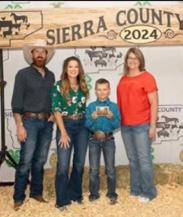
Sierra County Heritage Buckle Winner
Colt Richardson
When asked what new tradition he would like to implement in today’s agriculture Colt said: “Something that would help us on the ranch would be a robotic dog. It could protect the cattle from coyotes, wolves, bears and any other predators 10 hours a day.
“This robot dog would be helpful because it could be looking after cattle so we could be checking other pastures. It would also have night vision to protect the cattle at night that would be the biggest help to us. All the wolves attack at night.”
Colt is the son of John and Megan Richardson, Winston, New Mexico.
To be eligible for the Heritage Buckle award, youth ages 9-15 were asked to write a 200-500-word essay on what new tradition they would like to implement in today’s agriculture industry. ▫
Novice first row; Juniors second row; Seniors back row
Pictured l to r: Senator Pirtle, Senator Brantley, Colt Richardson (winner) and Representative Jaramillo.
Cull Cows – Should They Stay or Should They Go?
And When Should They Go?
by Kellie Curry Raper, Oklahoma State University Cooperative Extension State Livestock Marketing Specialist
Cow-calf producers with spring calving herds typically wean calves in late summer or early fall and subsequently make decisions about culling cows from the herd. The culling decision is based on many factors related to fertility, productivity, management ease, and health, as described in Figure 1.
This graph has three orange boxes with white text. First box has “Cull from herd? Identify open cows, Age, Disposition, Calving ease/difficulty, Structural soundness and Heath issues”. Pointing to the second orange box “Sell or retain for late sale? Market conditions, Cow health, Body Condition Score, Facilities/Labor and Feed source & cost”. Pointing to the third orange
box “Attempt breeding to late sell as bred? Cow age and Bull availability”.
Figure 1. Multidimensional Decisions in Beef Cow Culling and Marketing (Source: K. Raper)
Alongside that culling decision is the marketing decision – the decision to market cull cows immediately or retain them on the farm for marketing at a later date (Raper and Biermacher, 2017). Many factors influence
this decision, including individual cow health, cash flow needs, on-farm resources for retention and feeding, current market conditions versus market expectations, and time. If a cull cow is not healthy enough or structurally sound enough to stay in your herd, she likely needs to go on the trailer for
Upcoming Sale Dates
10, 2025 TAA Spring Spectacular, Salado, Texas OCTOBER 4, 2025
2 Bar Angus Bull Sale, Hereford, Texas
Prime By Design Sale, Hereford, Texas Hosted with Goode Angus OCTOBER 11, 2025
TAA Autumn Classic, Salado, Texas
immediate marketing, as the risk of carrying her for 4 more months outweighs the opportunity for added revenue. If a cull cow carries too much body condition, she should also join those on the trailer, as adding or maintaining weight will likely be more costly than any revenue gained from the seasonal price upswing. On the other hand, if a cull cow is sound, reasonably healthy and not over-conditioned, AND if you have the resources to do so, there are multiple reten-
tion strategies with the potential for increasing cull cow salvage values in a profitable way. These strategies focus on taking advantage of the typical spring upswing in cull cow prices without spending all of the revenue gain on feed intake cost.
This article will focus on feeding strategies and leave the conversation about selling culls as bred cows for later.
In the previously referenced studies, 162 cull cows over a three-year period were assigned either to a native pasture or to a low-cost dry-lot retention program. Market value and retention costs were assessed at
• We we had the most efficient bull at the 2024 Tucumcari Feed Efficiency Test and have had the most efficient bull 3 times in our 11 years at the test.
• We’ll be taking bulls to the test this year out of top AI sires: SAV Resource, SAV Rainfall, Baldridge Drag Iron, Sitz Logic, Vermillion Spur B024.
• Total A.I. & ET Program
October culling and again at one-month intervals from November through March and used to calculate net returns. Net returns from cull cow retention measure the difference in revenue at culling and revenue when marketing at a later date, less the associated retention and feed costs, written as:
Net Returns = Revenue at Marketing –Retention & Feed Costs – Revenue if sold at Culling
Cows retained in the dry-lot setting had higher weight gain, on average, than cows retained on native pasture, but cumulative feed costs also increased at a much faster pace, even with the low-cost strategy. Cows with BCS≤6 (thin and medium) were profitably retained in the native pasture system, regardless of the retention period, with net returns ranging from $20/head in November to $70/head in March. Many of these cows actually lost some weight during the retention period, but the seasonal price upswing ‘outweighed” the lost weight. However, in the low-cost dry lot system, only the 4-month retention period was profitable for thin and medium cows, with net returns of $20/head and $10/head, respectively, as feed costs consumed most of what would be gained from the seasonal price upswing. Net returns for cows with BCS>6 were negative across the board in the dry lot system, with minimal profitability in the pasture system as well. So…as my family says in dominoes, get rid of your big ‘uns! And then carefully consider how to manage and market the rest.
H
Cattle ompany
New Mexico Department of Agriculture Hires
New Deputy Director/Secretary
The New Mexico Department of Agriculture (NMDA) has hired Les Owen to serve as its new Deputy Director/ Secretary. Owen returns to NMDA – where he previously worked in natural resources policy planning – after serving as the Conservation Services Division Director at the Colorado Department of Agriculture for eight years.
Over the course of his career, Owen has held positions as a 4-H agricultural extension agent and as a research associate in what is now New Mexico State University’s Department of Animal and Range Sciences. Owen has dedicated much of his career to effective agricultural land use and range management, energy development, soil and water conservation, wildlife habitat and endangered species conservation, as well as the management of natural resources in
support of agriculture through communication, coordination and collaboration with federal, state and local government agencies and organizations.
Owen was raised on his family’s ranch near Corona, New Mexico.
“We’re glad to welcome Les back to the New Mexico Department of Agriculture,” said New Mexico Secretary of Agriculture Jeff Witte. “Les brings a deep understanding of the agriculture industry here in New Mexico and across the region. His experience providing oversight and coordination of a multitude of agricultural efforts at the local, state and federal levels sets a solid foundation for his work as Deputy Director/Secretary of NMDA.”
“I’m proud to have served the New Mexico Department of Agriculture in natural resource management and now be able to return in a different capacity, at the head of the agency’s leadership,” said Owen. “It’s an honor to lead NMDA alongside Secretary Witte and ensure that the agency fulfills its mission in the best interest of New Mexico’s agriculture industry and all of its constituents.”
Owen joined NMDA Oct. 1 at its Las Cruces main office.
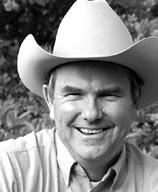
The New Mexico Department of Agriculture (NMDA) has hired Les Owen to serve as its new Deputy Director/ Secretary. Owen joined NMDA Oct. 1 at its Las Cruces main office. (Photo courtesy New Mexico Department of Agriculture)
Les Owen
Service-Age Bulls Available Private Treaty and at Sales at Marana, Prescott, AZ
Susan Wilson-Sanders, DVM 520-403-8510
Ed McClure: 520-306-1574 lazysranchacct@gmail.com
13250 Ash Creek Road, Willcox, AZ 85643
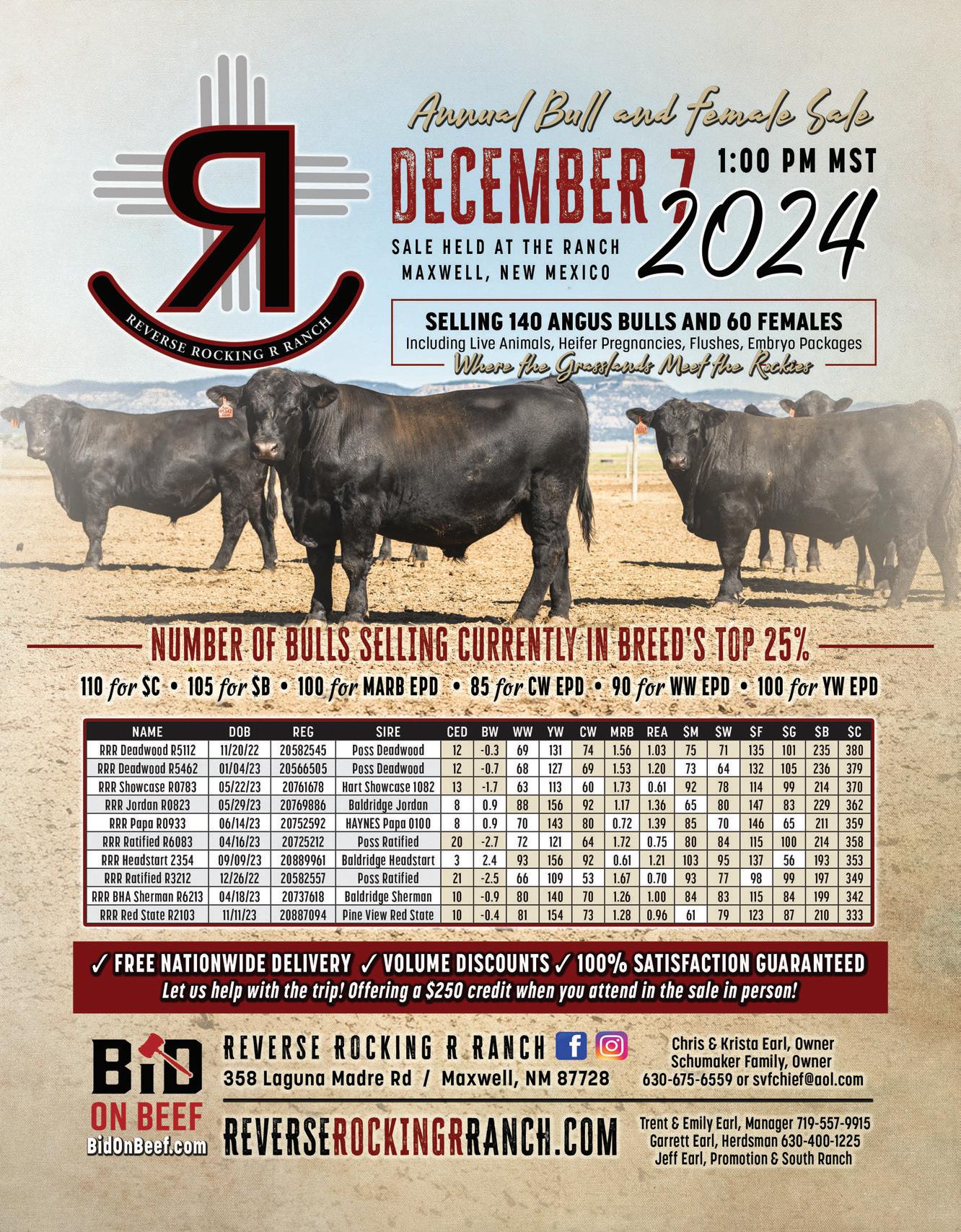
The 10 producers who registered the most Angus beef cattle in the state of New Mexico recorded a total of 1585 Angus with the American Angus Association® during fiscal year 2024, which ended Sept. 30, according to Mark McCully, Association chief executive officer.
The 10 top recorders in New Mexico are:
Bill Gardner, Estancia; Reverse Rocking R Cattle Co, Maxwell; Diamond Seven Angus Ranch, Newkirk; J-C Angus, Moriarty;
U Bar Ranch, Silver City; Pearce Trust Angus Ranch, Caprock; M-Hat Farm, Pueblitos; Robert or Mitzi Miller, Floyd; Shane or Karla Lee, Portales; Perez Cattle Company, Nara Visa. Angus breeders across the nation in 2024 registered 302,716 head of Angus cattle. “Our Association members lead the industry in adopting new technology and breeding the most problem-free cattle for their customers,” McCully said. “Cattlemen across the country continue to find registered Angus seedstock are the most profitable option for their herd.”
GUIDE Bull Buyers 2024
ROSWELL LIVESTOCK AUCTION SALES, INC. & ROSWELL LIVESTOCK AUCTION TRUCKING, INC.
900 North Garden · P.O. Box 2041
Roswell, New Mexico 88201
575-622-5580 www.roswelllivestockauction.com
CATTLE SALES: MONDAYS • HORSE SALES
BENNY WOOTON CELL 575-626-4754
SMILEY WOOTON CELL 575-626-6253
Producers hauling cattle to Roswell Livestock New Mexico Receiving Stations need to call our toll-free number for a Transportation Permit number before leaving home. The Hauling Permit number 1-800-748-1541 is answered 24 hours a day, 7 days a week.
Trucks are available 7 days a week / 24 hours a day
Roswell livestock Auction Receiving stAtions
ATTENTION RECEIVNG STATION CUSTOMERS,
To be able to schedule trucking, all cattle need to be permitted by 1:00 p.m.
LORDSBURG, NM
20 Bar Livestock Highway #90 at NM #3 – East side of highway. Receiving cattle for transport 2nd & 4th Sunday of each month. Smiley Wooton, 575-622-5580 office, 575-626-6253 cell.
PECOS, TX
Jason Heritage is now receiving cattle every Sunday. For information to unload contact Jason Heritage 575-840-9544 or Smiley Wooton 575-626-6253. Receiving cattle every Sunday.
VAN HORN, TX
800 West 2nd, 5 blocks west of Courthouse. Bob Kinford, 432-284-1553. Receiving cattle 1st & 3rd Sundays.
MORIARTY, NM
Two blocks east and one block south of Tillery Chevrolet. Smiley Wooton 575-622-5580 office, 575-626-6253 mobile. Receiving cattle every Sunday
SAN ANTONIO, NM
River Cattle Co. Nine miles east of San Antonio on U.S. 380. Receiving cattle for transport 2nd & 4th Sunday of each month. Smiley Wooton 575-626-6253.
ANTHONY, NM
108 W. Afton Road, La Mesa, NM 88044. Receiving Cattle 2nd & 4th Sunday of each month. Call in advance for details & consignments. Smiley Wooton 575-626-6253 or Genea Caldwell 575-543-5736
by Labradoodle Bennington, III
USDA Expands Market Information for Organics
USDA’s Agricultural Marketing Service (AMS) Market News recently expanded its collection and distribution of price and production cost information for organic agricultural products by adding organic milk, cattle, grains and feedstuffs, and fertilizer to its list of published reports.
Organic products are included among the hundreds of agricultural products for which AMS Market News publishes market information. This data promotes market transparency and helps farmers and businesses make informed business decisions – resulting in a fairer and more competitive marketplace for all participants.
In 2024, AMS Market News, through partnerships with state departments of agriculture and universities, expanded the collection and distribution of price and production cost information for organic agricultural products with organic milk, cattle, fertilizer, and farmer’s markets recently added and expanded coverage of organic grain and feedstuffs to be added in the coming year.
The new information includes:
Ї Farmgate organic milk prices for Vermont and Pennsylvania.
Ї Production cost prices for organic poultry litter fertilizer in Alabama, Maryland, and Pennsylvania.
Ї Additional farmers market coverage in Pennsylvania, Iowa, New York, and California including organic specialty crops and dairy products.
Ї Expanded market information for organic food and feed grade grains and for feedstuffs coming in 2025.
This new information for organics is being made available in accordance with the 2018 Farm Bill (Agricultural Improvement Act of 2018) that re-authorized $5 million to USDA for the collection and reporting of data on the production and marketing of organic agricultural products. As required by the Farm Bill, USDA collects and distributes reporting on prices of organic agricultural products; develops and implements surveys on organic production, handling, and distribution; and conducts analysis on the data for publication in reports.
AG Day Showcases New Mexico Agriculture Nov. 9
Have you ever wanted to enjoy agriculture, food, friends, family and football all at the same time? Well, Nov. 9 is your lucky day. The New Mexico Department of Agriculture (NMDA) and the New Mexico State University (NMSU) College of Agricultural, Consumer and Environmental Sciences (ACES) will host the tenth edition of AG Day prior to the NMSU Homecoming football game.
The street festival is free to the public and will take place from 1 to 4 p.m. in the Pan American south parking lot and the Aggie Memorial Stadium northeast parking lot. The day will culminate
with the NMSU vs. Western Kentucky football game at 4 p.m.
New Mexico Farm and Livestock Bureau and Farm Bureau Financial Services are the Grand Champion Sponsors of the event. AG Day is an opportunity to learn about agriculture through numerous educational booths, many of which by NMSU College of ACES departments, programs and groups and NMSU student organizations. Several booths will also feature local agricultural organizations and businesses.
“Through hands-on activities, engaging demonstrations and collaborative efforts between NMDA and the NMSU College of ACES, AG Day brings agricultural education to life for staff, students and families. Together, we are cultivating a brighter future, where learning is not only impactful but also
fun and interactive,” said New Mexico Secretary of Agriculture Jeff Witte. “AG Day is a great way to come see what is new in the industry and cheer on the Aggies during their Homecoming game.”
The College of ACES is excited about the event as it showcases the hard work students and faculty do to ensure New Mexico agriculture thrives in the future.
“The NMSU College of ACES is proud to participate in the 2024 AG Day, which helps to highlight how the College’s innovative work and activities advance agricultural technology and resources in New Mexico,” said NMSU College of ACES Dean Rolando Flores. “By blending cutting-edge research with hands-on experiences, we make agricultural education both fun and easy to understand, empowering the community to
shape the future of farming and ranching with confidence and creativity.”
There will be plenty of opportunities for families to learn about agriculture. Organizations such as NMSU’s Cooperative Extension Service, New Mexico CowBelles and Elephant Butte Irrigation District will help educate the public about agriculture with fun activities. Attendees will also have a chance to listen to live music and sample New Mexico products.
For more information about AG Day, visit the AG Day webpage, email AGDay@nmda. nmsu.edu or call 575-646-1864. ▫
Custom Cattle Feeding at its Finest
Bar-G Feedyard
Res: 806/364-1172
Mobile: 806/346-2508
Email: jtrotter@bar-g.com
Agricultural Productivity Growth Falls Short of Meeting Global Demands Says Virginia Tech
Adramatic slowdown in agricultural productivity threatens the world’s ability to feed a growing global population and manage environmental challenges, according to the 2024 Global Agricultural Productivity Report (GAP Report), recently released by Virginia Tech’s College of Agriculture and Life Sciences.
The report, “Powering Productivity: Scaling High-Impact Bundles of Proven and Emerging Tools,” says that while research, development, and high-tech farming tools are being developed at a steady pace, a substantial “valley of death” separates the development of new innovations from the people who need to adopt them. It was released at an event at the National Press Club in Washington, D.C.
Agricultural total factor productivity growth is critical for ensuring that agriculture can meet the growing global demand for products by 2050. Sustainable productivity growth is recognized as the single most effective solution to meet this demand and achieve environmental goals. The growth of
total factor productivity in agriculture has historically been driven by research, development, and the dissemination of technologies such as improved crop and animal genetics and precision farming tools and sharing the knowledge to use these tools.
However, a gap between the development of innovations and their delivery to producers – dubbed the “valley of death” – poses a significant threat to achieving agricultural total factor productivity growth goals by 2050.
This year’s report emphasizes the critical need to bridge the “valley of death” by rethinking how production tools are bundled with distribution mechanisms, socio-economic tools, and policy levers. This approach is essential to open new pathways to scale access and adoption, particularly among smallholder producers. The report explores how tailored bundles, integrated with existing proven tools, can overcome the barriers to technology adoption and drive sustainable productivity growth.
“Global agricultural productivity growth has slowed from 1.9 percent annually during 2001-2010 to 0.7 percent annually during 2013-2022,” said Tom Thompson, the report’s executive editor, associate dean of the College of Agriculture and Life Sciences, and director of CALS Global at Virginia Tech. “This dramatic slowdown will prevent
us from reaching our agricultural production and sustainability goals by 2050, with potentially dire impacts on food and nutrition security, unless we reverse this trend.”
The 2023 GAP Index projected that global total factor productivity growth should average 1.91 percent annually to meet agricultural needs by 2050.
New findings suggest that global agricultural productivity growth has slowed even more, and this target now must be revised upward to 2 percent annual total factor productivity growth due to persistently sluggish progress, according to the GAP Report.
The GAP Report, spearheaded by Thompson with Managing Editor Jessica Agnew and Research Lead Tebila Nakelse, aims to shed light on the pathways to unlocking the full potential of total factor productivity growth for the benefit of farmers, society, the environment, and the global economy.
Why is lagging total factor productivity growth such a concern?
Reduced total factor productivity growth reduces competitiveness in global agricultural markets, adversely affecting trade balances and economic stability. It also deters investment in the agricultural sector, further stifling innovation and growth. Socially, the slowdown exacerbates inequalities, particularly impacting smallholder
farmers and rural communities, and widens the gap between urban and rural prosperity.
Reduced productivity growth also hampers the agricultural sector’s ability to adapt to climate change, compromising global food supply stability. A failure to reverse the declining total factor productivity growth trend also may lead to rising food prices, disproportionately affecting low-income households and exacerbating poverty and hunger. Environmentally, to compensate for lower productivity growth, countries may overuse inputs or natural resources, causing environmental degradation and long-term ecological damage.
“Tackling agricultural productivity growth will require cooperation across political and philosophical lines throughout the food system,” said Agnew, associate director of CALS Global. “Using our resources wisely and most efficiently is applicable to every farmer, in every farming system, at every scale of production.”
South Asia’s total factor productivity surge
The 2024 GAP Report finds that South Asia has emerged as a global leader in average annual total factor productivity growth during 2013-22 through significant public and private investment in research and
development, mechanization adoption, and information, communication, and technology innovations. The region experienced 1.4 percent annual growth, outpacing other regions, including North America.
During 2013-22, the United States experienced negative total factor productivity growth, averaging -0.21 percent annually. This downturn can be attributed, in part, to a reduction in public funding for agricultural research and development.
As the home of the Green Revolution, South Asia is using evolving approaches to pursuing sustainable productivity growth, offering actionable policy and investment insights to other world regions that are struggling with lagging total factor productivity growth. However, the report makes it clear that public and private research and development alone will not suffice to achieve the target annual total factor productivity (TFP) growth rate. Bridging the “valley of death” must be a top priority in the coming decade.
“South Asia’s TFP growth highlights the critical role of innovation and investment,” Nakelse said. “Achieving sustainable productivity growth requires bridging the gap between research and widespread adoption. This lesson is vital for all regions seeking to overcome challenges and boost agricultural efficiency.”
Recommended priorities
The 2024 GAP Report outlines several policy and investment priorities to drive agricultural productivity growth:
Ї 1. Invest in agricultural innovation systems: Agriculture innovation systems create dissemination and adoption pathways for existing and new knowledge, technologies, and practices. This includes the infrastructure, human capital and skills development, financial systems, partnerships, socio-cultural considerations, and environmental conditions required for producers at all scales of production, but especially smallholder producers, to access and sustainably adopt productivityenhancing tools.
Ї 2. Expand robust and resilient market access: Producers at all scales of production must be able to access competitive input and output markets. Price discovery, minimized search costs, and information transparency help producers to make informed decisions on the inputs required to optimize productivity and profitability.
Ї 3. Strengthen regional and global trade: Regional and global trade have demonstrated positive impacts on agricultural productivity growth by
opening up larger markets, creating opportunities for specialization, and encouraging adoption of productivityenhancing tools.
Ї 4. Improve quality and reduce loss of outputs: Reducing food loss and waste and improving output quality contribute to agricultural productivity growth by increasing both the value and quantity of usable output from the same or fewer inputs. As pressures from changing climate, pests, disease, and limited access to resources such as affordable financing continue to intensify, it is essential to tailor food loss and waste reduction policies and technologies to specific commodities and local contexts.
Ї 5. Cultivate partnerships and cooperation: Partnerships activate strong agricultural innovation systems and accelerate the development and dissemination of technologies, practices, and knowledge by tailoring productivity-enhancing tools for different contexts.
By strategically bundling production tools with socioeconomic, policy, and distribution mechanisms, we can power productivity growth and create bridges across the “valley of death” tailored to local contexts and cultures, according to the report. ▫
NEW MEXICO FEDERAL LANDS NEWS
by Jerry Schickedanz
Heads Up
The views and opinions expressed do not represent those of the Board of Regents of NMSU, or the New Mexico Stockman
“Trust but verify” the pointed remarks made by President Ronald Reagan during the negotiations with Russia and nuclear arms reduction. The same philosophy should be used when dealing the Federal Government on any level.
The Bureau of Land Management (BLM) manages about one tenth of the lands in America, or approximately 245 million acres. They were granted the authority to manage with the passage of the Federal Land Policy Management Act of 1976. However, they were given clear directions to manage under the principles of multiple use and sustained yield.
Congress had previously defined the multiple uses to be range, timber, watershed and outdoor recreation and wildlife and fish purposes. Conservation was not listed as a multiple use, but the BLM has been hard at work in trying to elevate conservation as a multiple use on par with the Congressional listed multiple uses.
There has been a continuous slight of hand to get conservation also to mean protection. It began with President Biden’s 30 x 30 plan to lock up 30 percent of the land and water in the US. That transformed into America the Beautiful plan for conservation.
It turned into a conservation leasing program proposal that was unveiled for public comment and 200,000 plus comments later, it becomes the Public Land Rule that was released in June of this year. BLM instruction memos are being delivered to the local offices for implementation.
Something to watch for will be the formation of a Federal Advisory Committee to “engage the public and to help inform the Bureaus implementation of the Public Land Rule”. The 25-member committee will be made up of various stakeholders with a broad base. They will advise BLM on best management practices and will participate in the development of agency guidance to support implementation. They will work closely with the statewide Resource Advisory Councils in formulating advice.
Some of you may want to dust off your resume and become a member of the Federal Advisory Committee. I will be on the watch for the call for nominations and charter of the committee.
One of the first things to occur will be an across-the-board Watershed Conditions Assessment. This will guide the BLM to the areas that fit in under the new rule. They will reevaluate every ten years.
There will be more emphasis on Areas of Critical Environmental Concern than has been in the past. The acreage going into ACECs will be increasing to supplement the 30 x 30 goals. It will allow for areas to be considered outside of the normal planning frameworks.
Another element of management will be the protection of Intact Landscapes. This also doesn’t pass the smell test of protection of more land to be included in the 30 x 30 goals. The number of acres will have to be identified in the planning process.
The item that has the environmental community most up in arms is the section on Restoration and Mitigation Leasing program. They had high hopes with the proposed Conservation Leasing in the initiative.
Conservation was to become on equal footing with the other named multiple uses and if implemented as first written, would become above any of the other multiple uses such as range, timber water, etc.
The new program will be a restoration and mitigation lease. Outside entities can enter into a restoration lease in concert with the current lessor if they are approved, put up 100 percent of the predicted cost and have a ten year time limit. At the end of the time period or when the project is done, the entity will lose any ties to the land parcel. I doubt many will become partners in this endeavor.
I will be verifying what is in the memo and what happens in the field.
Keep your eye on the horizon.
GUIDE Bull Buyers 2024
RANCH FOOD & FODDER
by Deanna Dickinson McCall
Green Chile Cheese Squares
The holidays are here. I love seeing the ristras hung on porches, and there’s just something so special about seeing adobe homes and buildings in the snow. You probably have your livestock shipped and whatever other crops you raised are harvested. About the time you think you can take a deep breath and think about relaxing after a year’s work of raising food, here comes the holiday season. It is a busy time of counting your blessings, shopping, making gifts, family and friend get togethers.
There’s nothing better than New Mexico chiles to add a little warmth and spice to the cooler days and nights. The smell of the chiles we produce is intoxicating and inviting on its own. Besides our year-round Christmas theme of red and green chile.
Sometimes you need a quick recipe in case you’re invited to a get-together, and finger-food based gatherings seem to get more and more popular. Card and domino parties
are always going on in addition to holiday based parties. Green chiles seem to be the most popular out of the chiles, starring in a lot of recipes. A lot of folks used canned chiles, but if you are like us, we always have a large amount of roasted green chile sitting in our freezer to use throughout the year. We think the frozen taste fresher and have more flavor. This is actually an old recipe that was popular years ago. I stumbled on it in my recipe collections box. I made a few adjustments and brought it back to life. You can use either canned or frozen chiles in the recipe below. If you use canned, drain them a little before using. This is an easy recipe, using what you probably have on hand. Who doesn’t like a bite of warm, creamy green chile and cheese? The squares can be served warm or at room temperature, making it easier yet. They’re also easy to transport if you’re taking them with you.
Ingredients
2 cups shredded Monterey Jack or pepper jack cheese
2 cups shredded sharp cheddar cheese
1 (7 ounce) can chopped green chilies, drained or 7 or 8 big Hatch green chiles, roasted, peeled and chopped 3/4 cup whole milk, you can replace some of the milk with heavy cream if you like 1/2 cup all-purpose flour
2 large eggs
Garlic salt
Black pepper
¼ tsp of dried oregano
Smoked paprika
Fresh, chopped parsley or cilantro, for garnish, optional
Instructions
Preheat oven to 350 degrees F.
For easier removal line an 8 x 8 inch baking dish, (preferably glass), with a sheet of parchment paper, leaving an overhang on the edges.
Combine the shredded cheeses and add half of them to the baking dish. Top with the green chilies, sprinkle the chile layer with garlic salt and then add the remaining cheese to the top. Gently press down into the pan.
Whisk together the milk and eggs, add the flour and a little garlic salt, the oregano and a sprinkle of black pepper, whisk well. Drizzle evenly across the top of the cheese. Gently press mixture down again. Bake, uncovered for about 30 minutes or until lightly browned on top. Remove and let cool a bit.
Sprinkle on some smoked paprika and cilantro or parsley if you want to make them look a little fancier. When it has cooled enough to handle lift the paper out and cut into small squares. They are fairly rich, so we make bite-sized squares. We like these best when served slightly warm or at room temperature. The recipe is easily doubled, also. ▫
New Mexico WriterPhotographer & Musician Family
Receive 2024 Rounders Award
New Mexico writer-photographer
Julie Carter and musician Joe Delk
Julie Carter was raised on a ranch in Colorado and has lived on a ranch in New Mexico for 40 years. First a writer and later taking up photography to best define the unique reality of the cowboy, Carter has developed her own brand of wit.
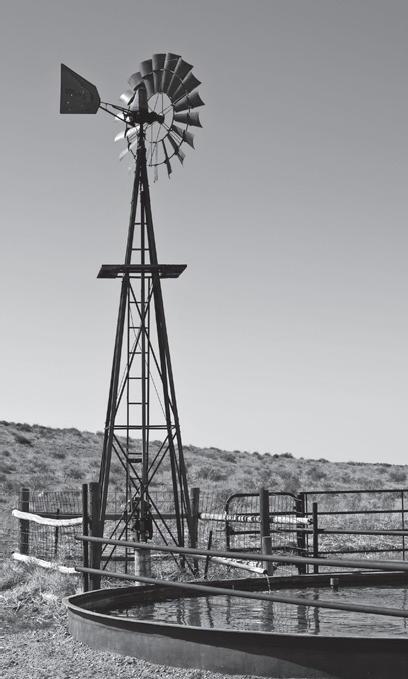
“A photo can be a story,” Carter says. “But sometimes a story needs a photo. I can’t, with any justice, write enough words about a windmill in a New Mexico sunset quite like the right moment in a photo can show it.
“I can write about the sights of the branding corral, but a photo of the smoke from burning hair curling around everything and
received the 2024 Rounders Award Oct. 16 at the New Mexico Farm and Ranch Heritage Museum in Las Cruces.
The award was named after “The Rounders,” a classic Western novel that was written by Max Evans. Created in 1990 by former New Mexico Agriculture Secretary Frank DuBois, the purpose of the award is to honor those who live, promote and articulate the Western way of life.
Max Evans was the first-ever award recipient. The Rounders tradition continues as this year’s recipients join 36 previous honorees.
Evans passed in 2020, however, the Rounders tradition lives on. These individuals are described as vivid creators of Western art that embody the tradition of the award.
New Mexico Agriculture Secretary Jeff Witte presented the awards to Carter and Delk and The Delk Band.
“I am proud of the legacy Max has left in Western culture, and this year’s Rounders Award recipients definitely live and articulate the Western way of life. Max would be proud,” said Witte. “Carter and the Delk family have built vibrant careers with unique talents that reflect the Western way of life. I am honored to welcome them to the group of Rounders recipients.”
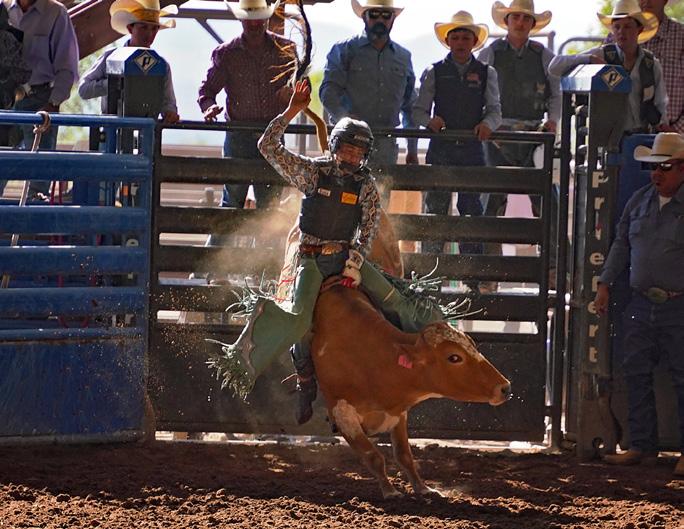
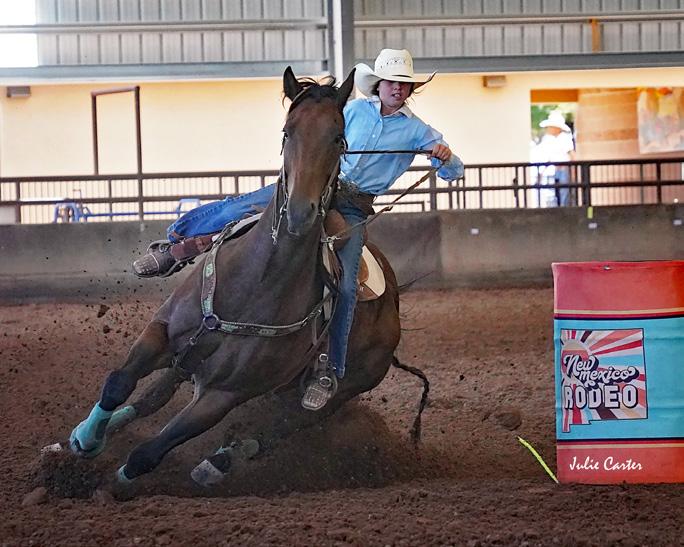
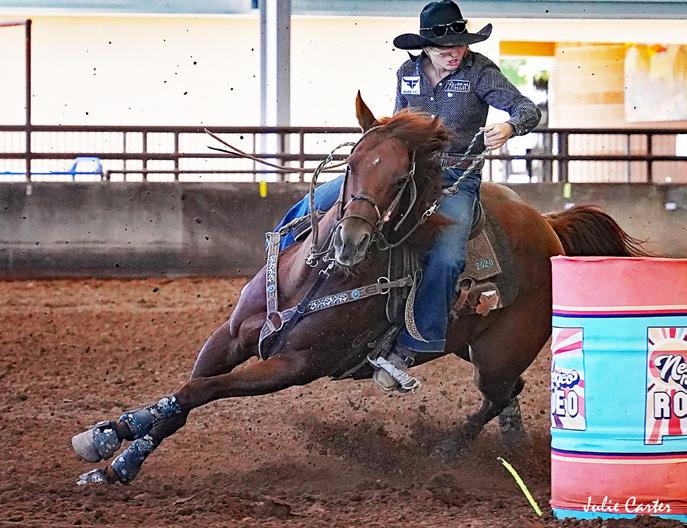
everyone close at hand just brings it to life.” Carter, a freelancer, writes ranch family stories for RANGE Magazine, Livestock Weekly and New Mexico Cattle Growers. She also writes rodeo contestant features for the New Mexico Stockman
Joe Delk’s father Forrest, born in Santa Rita, New Mexico, first picked up the fiddle at the age of seven and went on to play at dances starting in 1934, in a group called “Forrest Delk and his Gully Jumpers.” Joe, Forrest’s oldest son, joined the group and started playing music with his father and brother in the 1950s.
After moving his family to Las Cruces in 1988, Joe made sure his three sons also took an interest in creating music. Sons Neal, Byron and Mark perfected skills on the guitar, bass guitar and drums, respectively, developing tremendous talent that carried “The Delk Band” through the 1990s to venues across New Mexico, Arizona, Texas, Oklahoma, Colorado and Wyoming.
When Forrest passed away in 1996, Joe made sure to carry on his father’s legacy and musical journey, eventually forming a ninepiece dance band that is still active today.
“My dad had a real knack for playing good dance music,” said Joe Delk. At the same time that Joe Delk and The Delk Band are honored with the Rounders Award, this year marks the 90th anniversary of the family band that “plays music for those that come and dance.” ▫
Photographer and writer Julie Carter is a 2024 Rounders Award recipient. The Rounders Award, named after the classic Western novel written by Max Evans, serves to honor those who live, promote, and articulate the Western way of life. (Photo courtesy of Julie Carter)
Joe Delk and The Delk Band are a 2024 Rounders Award recipient. Pictured from left to right: Joe Delk, Mark Delk, Neal Delk and Byron Delk. The Rounders Award, named after the classic Western novel written by Max Evans, serves to honor those who live, promote, and articulate the Western way of life. (Photo courtesy of Joe Delk)
Alexandria Nicole Carter, 23, known to friends and loved ones as Alex, passed away on September 26, 2024. She was born on March 21, 2001 in Austin, Texas to Jackie Daugherty and Eric Gunderson. Alex was a beloved daughter, sister, granddaughter, aunt and friend whose light will forever shine in the hearts of those who knew her.
Alex is survived by her parents, Jackie Daugherty, Eric and Denise Gunderson, and Chane Carter; her siblings, Aubrie Carter, Carlin Carter, Corbin Carter, and Cason Carter; Trey Craft (wife Ali), Jakob Craft.
C she loved to help with the family ranch and spend time in the mountains in Winston as a child.
After earning her cosmetology degree, Alex worked at the Hairport in Truth or Consequences before relocating to Artesia, where she worked at Simply Bare Salon. She was passionate about her work and loved making others feel beautiful.
An avid Dallas Cowboys fan, Alex’s love for the team was only matched by her deep faith in the Lord. She was a dedicated member of Caballo Church of T or C then
contagious smile that could light up any room, Alex was the life of the party, a true joy to be around, and someone who made everyone feel welcome and loved. She never let you go without saying she loved you.
Alex touched the lives of many with her kindness, generosity, and unwavering faith. Her presence will be deeply missed by her family, friends, and everyone whose lives she brightened.
John Arthur Smith, 83, Deming, entered eternal life on the Lord’s Day October 6, 2024. His family is grateful to have had a lifetime of love and happiness with him until his passing.
John Arthur is best known for his service to the state of New Mexico as a state senator from 1989 to 2020. He felt a sense of duty to New Mexico and responsibility to Deming, his hometown. He often said that as a child growing up in Deming, the people in the community were good to him.
It is from the goodness of people that he wanted to repay his community and his state. He often expressed that it is the responsibility of each generation to leave the world a better place for the next generation. His family would like for all individuals wishing to pay tribute to him to do so by engaging in good/positive actions in their communities.
John Arthur was born July 7, 1941 to Benjamin Franklin Smith and Norma Belle Smith (Greene). He is survived by his Deming High School sweetheart, wife of 63 years, Janette Smith (Supak); two sons, four grandchildren, and one great-grandchild (with another on the way). Son, Anthony Smith (wife Sylvia) and their children Daniel and Sasha. Son, John David (wife Diana) and their children Braxton (wife Jackie) with baby inbound and Addi Smith-Pizzala (husband Drew), and their son Urban (great grandson).
The family of Mr. John Arthur Smith ask that in lieu of flowers that donations be made to the Deming Luna County Cancer Support Foundation and any other donations that can be made towards the County of Luna in which he represented and loved for many years.
Editor’s Note: Email caren@aaalivestock.com. Memorial donations may be sent to the Cattlegrowers’ Foundation, a 501(c)3, tax deductable charitable foundation serving the rights of ranch families and educating citizens on governmental actions, policies and practices. Cattlegrowers Foundation, Inc., P.O. Box 7517, Albuquerque, NM 87194. The New Mexico Stockman runs memorials as a courtesy to its readers. If families & friends would like to see more detail, verbatim pieces must be emailed to us, & may be printed at 10¢ per word.
by Lee Pitts
Which Is Which?
I’ve never been a rancher but I’m proud to say that for most of my life I’ve been a cattleman. How can that be? Because a person who owns a ranch may not own a single ruminant, while a cattleman may have thousands of cattle but may not own one acre of ground.
Someone smarter than me once said that the only way to acquire a ranch is through marriage, the womb or the tomb. I struck out on all counts. I think I’m the first in my family to have owned a cow and yet they were ranchers. How can that be?
Because great-grandmother Nora owned a small place where she grew walnuts that everyone in my family referred to as “the ranch”. In California where I was born, raised and reside, anything on which you could grow a bulb garden or two orange trees is called a ranch, whereas everything in Texas smaller than 30 sections is referred to as “a small little place.”
There are BIG differences between a rancher and a cattleman. A rancher owns heavy equipment including a road grader, D7 Cat, baler, bagger, Bobcat and a backhoe. The only piece of equipment owned by a cattleman is an old rusty stock trailer with sketchy wiring.
There may be 1,500 head of cattle on a rancher’s place but not a single quart of milk in the refrigerator. A rancher’s old saddle is sacked and hanging in the barn, his branding irons have been turned into towel hangers, his or her spurs are now wall hangers and old saddle blankets are now part of the decor. A purse dog sleeps in the house, is fed three meals a day plus a snack, rides in the cab and yaps out the window. A cattleman’s truck also serves as the tack room and three or four barking cow dogs are in the bed of the truck. They sleep under the front porch and eat once a day. If they get a snack it’s road kill or something they dug up themselves.
A cattleman eats breakfast at the auction market cafe with his friends and cow buyers
and may not eat again until ten that night. A rancher eats three meals a day at home because the nearest restaurant or coffee shop is an hour away.
A cattleman pays real close attention to the weekly auction market report, the price of fed cattle, and shows up regularly at the auction market to take the pulse of the livestock industry. A rancher is more apt to keep abreast of the Dow Jones and NASDAQ and doesn’t go to the auction yard even if he sells his calves there.
A cattleman has a good ranch horse he and the banker bought and keeps it in his stock trailer saddled up and ready to go at a moment’s notice. He can be mounted up and on the prowl while the rancher is still dressing his horse. Both the rancher and the cattleman’s saddle, bit and spurs may have silver brands on them but the rancher’s weren’t financed with a home equity loan.
A rancher belongs to his county cattlemen’s organization, the Farm Bureau, R-CALF or NCBA, serves on the board of the soil conservation district and is on a variety of committees for countless clubs. The only group a cattleman may belong to is Alcoholics Anonymous.
A rancher goes to Arizona for the winter and team ropes every weekend. A cattleman
can barely get out to go to a jackpot because in winter the roads are covered with black ice and the snow drifts are six feet tall.
A rancher probably has kids who live far, far away who want nothing to do with ranching. If the rancher does own cows they are probably all black, all calve within 60 days, have electronic ear tags, are weaned for 60 days and top the market when they’re sold. A rancher who lives on the ranch probably keeps some poultry around the place.
A cattleman doesn’t eat eggs or raise chickens, has ulcers, and his bulls run with the cows all year long because he has no other place to put them. A rancher has a hired hand, a cattleman has a wife. A rancher pays income tax every year but a cattleman only has that problem one year out of ten.
RIDING HERD
Macklee Cain
New Mexico Junior High School Rodeo Association –
by Julie Carter
This driven 14-year-old 8th grader is taking her last year of junior high rodeo with a new level of intensity to reach her high goals with extended hours of work, practice and focused determination. She is competing in seven events – Light Rifle, Barrels, Poles, Goat Tying, Break Away
Macklee Cain with her five buckles won at the Artesia High School rodeo and her team of rodeo horses Luke, Tic Tac, Heidi and Biscuit. Photo by Julie Carter
roping, Ribbon Roping and this year, she added Team Roping.
The Mountainair teen is the daughter of rancher David Cain and veterinarian Dr. Brenda Mack, and younger sister to Dalli Von, now a New Mexico State University (NMSU) student and rodeo team member. She spends her off time from school keeping five horses ridden, including the two that she’s bringing along in training. It’s a family affair requiring both parents participating in her practice schedule as chute help, dragging the roping sled and driving her to practice team roping and goat tying at other locations.
“I don’t have time to get too nervous in any one event,” she said in describing what it’s like to compete two days in a row in six arena events each day. “Getting four horses saddled, warmed up and ready to go for each event doesn’t leave any extra time. I’ve been
Cattlemens Livestock
working on my self-talk and mental game to go along with it.”
Brenda says Macklee’s very competitive nature is backed up by her natural athleticism and her belief she can do anything she sets her mind to. “She was only 8 and 10 when she attended a couple trick riding schools, meeting all the very high physical criteria to qualify for the school. David had to make her quit when he’d find her trick riding in the pasture alone, with no regard to the dangers of that. She’s sometimes daring beyond good sense.”
Macklee is very grateful for the goat tying coaching from Craig Chavez as well as from her friend Eva Chavez. It has been a game changer in her skill and confidence levels. The team roping evolved quickly under the tutelage of Eric Encinas whose son Brody is heeling behind Macklee for his first year in junior high rodeo.
“And I can’t ever thank my Uncle Wes Mack enough. He is always in the box with me (my emotional support person I call him) and my dad pushes my cattle. I have a team.”
Building on her skill foundation, Macklee has attended several goat tying schools, barrel racing and pole bending clinics and a breakaway school with more on the calendar. “I believe Macklee’s best trait is her willingness to learn and use what she learns,” said David. “Both in the arena and on the ranch, and in her horsemanship skills.”
Her return to the Artesia High School Rodeo in October drove home her belief that it’s her favorite rodeo. Last year she won the All-Around there, and this year returned to claim that title, along with championship average buckles in Goat Tying, Break Away, Team Roping, and Light Rifle. With five new buckles to put in the trophy case her first thought was, “I’m going to have level up on my practices, it’s going to get harder.”
Macklee’s team of horses include her old soldier barrel horse Biscuit, 23, Poles - Heidi, 20, Team Roping head horse, Luke, 17 and Tic Tac, 13, for Break Away and Goat Tying. Tic Tac came to Macklee as a break away horse but she trained him to be a goat horse, in spite of the fact he’d been a tie down horse and really didn’t like her hanging in the stirrup on him or the run by the goat. She used a can of feed at the end of the arena to entice him to keep on going when she stepped off. “He does like his feed,” she laughed. Vegas, 7, and Katy, 5, are the rodeo horses in training.
Macklee likes to be “top hand” at everything she does and that drive will keep her working to reach her All Around goals as well making it to Nationals in every event she can.
Brangus Value Project
– Results from Round 3 are official
by Darrell L. Wilkes, Ph.D.
About 4 years ago, IBBA decided it was time to put our genetic predictions of terminal growth and carcass traits to the ultimate test. We selected a handful of heavily-used sires and mated them A.I. to a common set of commercial cows. The resulting steers were sent to a feedlot and ultimately to a packing plant. We refer to this as Round 1 of the Brangus Value Project. About 80 days after the steers from Round 1 were born,
we bred another group of cows using another sampling of sires to produce steers for Round 2. Likewise for Round 3. As this paper is being written, the Round 4 steers are nursing their dams and the Round 5 steers are in the hopper.
The steers from Round 3 were harvested in June of 2024 and the results are presented in this paper.
Some might say that it was pretty gutsy to do this in such a “public” way. After all, isn’t it well known that indicus-influenced cattle generally under-perform Bos Taurus cattle in the downstream segments of the industry? Aren’t eared cattle supposed to gain less rapidly, have lower dressing percent, have lower quality grade and lower overall carcass value than non-eared cattle? That’s
what everyone seems to think. But we didn’t think it was true of modern Brangus, so we stuck our neck out. We announced to everyone that we were doing this, so we had no choice but to go public with the results.
We entered this project with some confidence. Anyone with an eye for cattle can tell by looking at a modern set of Brangus and Ultra bulls that they are just as deep, soggy and thick-muscled as any set of top end bulls from up north. So, we weren’t too worried about their ability to GROW.
Next, we looked at our genetic trends for carcass traits based on ultrasound. It looked good too, both in terms of marbling and muscling. So, we had some confidence that they would not disappoint us in the packing plant.
As it has turned out, our confidence was not mis-placed. Through Round 3, with 17 sires progeny-tested through this project and almost 300 steers harvested, our Brangus Value steers have out-gained and out-graded industry averages by a significant amount. In fact, as detailed below, our steers have outpaced basic commodity projections by a little more than $200 per head.
Robbs 520-507-2514 4995 Arzberger Rd. Willcox, AZ 85643 osonegro@powerc.net Willcox, AZ
At this point, a skeptic might accuse us of cherry-picking the sires to basically guarantee a positive outcome. We could have done that, but we didn’t. We chose the sires that Brangus breeders had chosen over the past few years. We selected sires that had the most progeny registrations and met a few other basic criteria. We also had to use bulls from which the commercial cooperators wanted
& LARRY
P.O. Box 146, 1700 N. Parker Rd., San Simon, AZ 85632
to keep daughters. These are bulls that Brangus breeders selected for use. Why did they select these bulls? Well, for all the reasons that breeders choose one sire over another – quality of daughters, phenotype, disposition, foot structure, EPD profile, etc,
etc, etc. Sires rise to the top in any breed population for a lot of reasons. Generally, bulls rise to the top because they simply don’t have any “holes”. In a maternal breed like Brangus, a pure “terminal” sire is not likely to see heavy use. In short, we did not cherry-pick the sires for terminal value.
Before we pour into the results, one more point deserves to be made. By using some of the most popular bulls in the breed, the genetic information gained from this project extends to many thousands of animals that are descendants of these bulls. As we fully integrate this information into our genetic evaluation, we simply add more confidence in the EPDs.
RESULTS
The results from Round 3 are presented at right in summary form along with the results from Rounds 1 and 2.
Evaluating the terminal performance of cattle is not all that complicated. It’s a lot simpler than creating a productive cow. The only things that matter to a feedlot are health, growth and carcass value. We compare our growth rate and feed efficiency to a southwest Kansas benchmark that is obtained
from a firm that works with many feedlots and has data on thousands of cattle. We compare our cattle apples-to-apples with cattle that were placed on feed in the same region, at the same time, and of similar placement weight.
It is noted above that our steers have consistently outpaced commodity projections by about $200/hd. How did we derive that number? To understand it, you need to understand how feedlots work.
Feedlots have very sophisticated com-
puter systems and they measure everything. They know exactly how much feed is delivered to each pen of cattle every day and, of course, they know the precise nutritional composition of the ration. Based on the actual feed consumption for a specific pen of cattle, their computers estimate the average daily gain of the cattle in that pen. They use an estimate of average feed conversion based on data that they have accumulated over many years on literally millions of cattle. We call these “commodity projections” because that’s what they are.
With all of this data, the feedlot estimates the cost of gain (COG) for each pen of cattle. Again, they don’t know exactly how much the cattle are gaining each day. They estimate that using commodity averages. As the feeding period draws to a close, the monthly statement from the feedlot shows the com-
puter-estimated COG. In the chart below, this is presented as the “Projected COG”. The actual COG can only be computed when the cattle are weighed on harvest day. In the chart below, the “Actual COG” is based on our total feedlot expenses divided by the total payweight gained by the steers.
Finally, as part of explaining the $200/hd advantage over commodity cattle projections, the finished steers are sold to the packer on a carcass merit formula (grid). We can then compare the gross sales price to the prevailing live price. If the cattle are better than average, they earn a premium on the grid. If they are below average, they earn a discount on the grid compared to the prevailing live price.
The table at right compares the Brangus Value Project steers to commodity projections for feedlot performance and final value.
The performance premium was higher in Round 2 because corn was more expensive. It is logical that more efficient growth per-
continued on page 84 >>
2024 JOINT STOCKMEN'S CONVENTION
Tentative Schedule
WEDNESDAY, DECEMBER 11, 2024
6:00a - 8:00a Executive Committee Breakfast
8:00a – 5:00p Registration
8:00a - 4:00p Range Improvement Task Force
9:00a - 4:30p Cattlemen’s College
Sponsors - RanchBot, Multimin USA
1 :00p – 4:00p New Mexico Beef Council
4:00p – 6:00p Coalition of Counties Meeting
5:00p - 5:30p NMCGA Past President's Meeting
5:30p - 7:00p Trade Show Reception
Sponsors - NM Beef Council & Trade Show Exhibitors
6:00p - 6:45p New Member Reception
7:00p - 9:00p Attitude Adjustment
Sponsor - Allied Industries Committee, Nutrition Plus, American Heritage Bank
THURSDAY , DECEMBER 12, 2024
6:30a - 7:45a NMCGA Board Breakfast
Sponsor - Clovis Livestock Auction
7:30a - 9:00a Linda Davis YCLA Orientation
7:45a - 8:15a NMCGA Finance Committee
8:15a- 5:00p Children’s Lounge
8:00a - 5:00p Registration
8:00a - 5:00p Trade Show
8:00a - 10:00a AG POLICY GENERAL SESSION
9:00a – 5:00p Silent Auction
10:00a - 11:00a Litigation Committee
10:10a - 11:40a POLICY & RESOLUTION SESSION
Promotion & Marketing Committee, Theft & Health Committee, Research & Improvement Committee
11:00a - 12:00p Youth Beef Feeder Contest Awards
11:45a- 1:15p Family Luncheon
Sponsor - American AgCredit
1:00p – 5:00p Tucumcari Bull Test Meeting
1:00p - 2:30p Sustainable Beef Presentations
1:30p - 3:30p PROPERTY RIGHTS GENERAL
................... SESSION
3:40p– 5:00p POLICY & RESOLUTION SESSION
Private Property Committee, Joint Federal & Trust
Lands, Tax & Special Issues Committee
3:45p - 4:40p Allied Industries Committee
4:00p – 5:00p Cross Cultural Committee
SCHEDULE CONTINUED...
4:00p – 5:30p NM CowBelles Past President's ...................... Reception
5:00p - 6:30p NM Hereford Assn Meeting
6:00p – 7:00p Ag Leadership Alumni Reception
Sponsors - NMCGA, NMWGI, NMFLC, DPNM, NMFLB
6:30p – 10:00p NFR Watch Party
Sponsor - Beaverhead Ranch Group, Lyssy and Eckel Feeds, FerAppease
FRIDAY , DECEMBER 13, 2024
6:30a - 8:00a NMCGA Nominating Committee
7:00a - 5:00p Children’s Lounge
7:00a - 11:30a NM CowBelles General
Membership Meeting, Awards
& Officer Installation
8:00a - 5:00p Registration
8:00a- 12:00p Trade Show
8:00a - 10:00a NATURAL RESOURCES GENERAL
SESSION
9:00a – 11:00a Silent Auction
9:00a – 11:00a Cattlegrowers’ Foundation
Meeting
9:45a – 11:00a NMCGA Young Cattlemen’s Leadership Committee
10:10a - 11:40a POLICY & RESOLUTION
SESSION
Wildlife Committee, Oil & Gas Committee, Water Committee
Includes all meals and events excluding Cattlemen’s College
Second Registration including a Spouse or Guest
Student Registration
Registration w/ Cattlemen’s College:
Includes all meals, events and Cattlemen’s College
Second Registration w/ Cattlemen’s College including a Spouse or Guest
Student Registration w/ Cattlemen’s College
SINGLE EVENT Options:
Details
Checks payable to: NMCGA, P.O. Box 850, Moriarty, New Mexico 87035
Early Bird Registration ends December 1, 2024. No refunds. A block of rooms has been reserved at Hotel Albuquerque Old Town for a limited time at $139 plus tax per night. To make room reservations call the reservation line directly at (866) 505-7929 and mention code 2412JCCOVG . Group rate expires Nov. 11, 2024.
YCLA
LINDA DAVIS YOUNG CATTLEMEN’S
LEADERSHIP ACADEMY
INDUCTION CEREMONY
at the Family Luncheon to induct the inaugural class of the Linda Davis Young Cattlemen’s Leadership Academy!
Thursday, December 12, 2024
cattlemen's COLLEGE
Wednesday Dec. 11, 2024
9:00am - 5:00pm Ballroom f - H
“THEY’RE” COMING AFTER OUR RANCH WATER, LAND AND CATTLE. HOW DO WE PROTECT OURSELVES?
DR. JOHN PATERSON
Nutrition & Supplements
DR. CASEY SPACKMAN
ANDREW COPPIN
Recommended Practices to Protect Ranch Lands Efficient Water System Monitoring, Management, and Conservation
Avoiding the Public’s Glare on the Ranch Cattle Utilization and Water Quality
ANTHONY MADRID, USFS
Dealing with the Issues that Affect Public Lands
BID ON $1,500 BULL CREDIT DURING THE AWARDS DINNER. DONATED BY:
FAMILY LUNCHEON SPEAKER
KEVIN OCHSNER, HOST OF NCBA’S CATTLEMEN TO CATTLEMEN
NATURAL RESOURCES
GENERAL SESSION SPEAKER
KAITLYN GLOVER, PUBLIC LANDS COUNCIL EXECUTIVE DIRECTOR
NATURAL RESOURCES
GENERAL SESSION SPEAKER
DR. HEATH HAYDEN
FERA DIAGNOSTICS AND BIOLOGICALS
PROPERTY RIGHTS
GENERAL SESSION SPEAKER
MARGARET BYFIELD, AMERICAN STEWARDS OF LIBERTY
EXECUTIVE DIRECTOR
PROPERTY RIGHTS
GENERAL SESSION SPEAKER
COLIN WOODALL
NCBA
CHIEF EXECUTIVE OFFICER
DR. CRAIG GIFFORD
DR. MARCY WARD
Who’s Who
New Mexico Cattlegrowers’ Association
Board of Directors
Jeff Bilberry – Roswell
Trent Bilberry – Roswell
Irvin Boyd – Eunice
Darrell Brown – Artesia
Jim Bob Burnett – Lake Arthur
Mike Casabonne – Hope
Gerald Chacon – Espanola
Jack Chatfield – Mosquero
Jim Ross Caviness – Maljamar
Brad Christmas – Wagon Mound
John Conniff – Las Cruces
Mike Corn – Roswell
Caren Cowan – Albuquerque
Amanda Culbertson – Amistad
Troy Daniels – Wagon Mound
Bruce Davis – Springer
Joe Delk – Las Cruces
Matthew Denetclaw – Shiprock
Denton Dowell – Clovis
Tracy Drummond – Reserve
Dan Estrada – Trementina
Sage Faulkner – Los Ojos
Kevin Floyd – Roswell
Cole Gardner – Yeso
Sid Gordon – High Rolls
Colten Grau – Grady
Mason Grau – Grady
Michelle Greeman – Silver City
Anita Hand – Datil
Loralee Hunt – Broadview
Trenton Jones – Broadview
Garland King – Capulin
Justin Knight – Tucumcari
Marjorie Lantana – Crownpoint
Boe Lopez – Springer
Marty Mathis – Amistad
Kenneth McKenzie – Encino
Jeff Menges – Safford, AZ
Joe Bill Nunn – Deming
Justin Nunn – Deming
Kyle Perez – Nara Visa
Nancy Phelps – Winston
Tate Pruett – Capitan
Megan Richardson – Winston
Charlie Rogers – Clovis
John Romero – Laguna
Carlos Salazar – Medanales
Troy Sauble – Maxwell
George Sims – Roswell
Tom Spindle – Moriarty
Casey Spradley – Cuba
Who’s Who
Gary Stone – Weed
Kimberly Stone – Capitan
Jim Thorpe – Newkirk
Ernie Torrez – La Jara
Lance Vicente – Vaughn
Phil Wallin – T or C
Dee Wear – Hillsboro
Gene Whetten – Winston
Jimbo Williams – Quemado
Kendal Wilson – Carrizozo
Marshal Wilson – Mesilla Park
Past Presidents
T.E. Mitchell – Albert *1921-1923
Hugh L. Hodge – Silver City *1923-1925
C.M. McDonel – Bell Ranch *1925-1927
Tom P. Tallé – Las Vegas *1927-1929
T.A. Spencer – Carrizozo *1929-1931
Robert H. Royall – Tyrone *1931-1933
Albert K. Mitchell – Albert *1933-1935
Lee S. Evans – Marquez *1935-1937
A.D. Brownfield – Deming *1937-1939
Oliver M. Lee – Alamogordo *1939-1941
Con W. Jackson – Las Vegas *1941-1943
Tom Clayton – Spear *1943-1945
E.G. Hayward – Cimarron *1945-1947
George A. Godfrey – Animas *1947-1949
G.W. Evans – Magdalena *1949-1951
Roy Forehand – Carlsbad *1951-1953
Ed Heringa – Clayton *1953-1955
S. Culberson – Lordsburg *1955-1957
Dick Snyder – Clayton *1957-1959
W.I. Driggers – Santa Rosa *1959-1961
John Stark – Deming *1961-1963
Will Orndorff – Roswell *1963-1965
J.L. (Les) Davis – Cimarron *1965-1967
Noel Rankin – Silver City *1967-1969
W.O. Culbertson, Jr. – Las Vegas *1969-1971
Reuben E. Pankey – Santa Fe *1971-1973
Charlie T. Lee – Alamogordo *1973-1975
Albert J. Mitchell – Albert *1975-1977
Phil Harvey Sr. – Cave Creek – AZ *1977-1979
Phillip Bidegain – Tucumcari *1979-1981
Bob Jones – Crow Flat *1981-1983
Don Hofman – Tucumcari *1983-1985
Peter T. Mocho – Belen *1985-1987
W.F. (Dub) Martin – Santa Fe *1987-1989
H.W. (Bud) Eppers – Roswell *1989-1991
Bill King – Stanley 1991-1993
Wesley Grau – Grady 1993-1995
William Humphries – Tucumcari 1995-1997
Bob Frost – San Jon 1997-1999
Jimmy R. Bason – Hillsboro *1999-2001
Phil H. Bidegain – Tucumcari 2001-2003
Don L. Bebo Lee – Alamogordo 2003-2005
Bill Sauble – Maxwell 2005-2007
Alisa Ogden – Loving 2007-2009
Bert Ancell – Wagon Mound 2009-2011
Rex Wilson – Carrizozo 2011-2013
Jose Varela Lopez – La Cienguilla 2013-2015
Pat Boone – Elida 2015-2017
Tom Sidwell – Tucumcari 2017-2019
Randell Major – Magdalena 2019-2021
Loren Patterson – 2021-2023
Executive Committee
Bronson Corn – Roswell President
Tom Paterson – Luna President-Elect
Becky Spindle – Moriarty Vice President at Large
Jeff Decker – Lovington Southeast Vice President
Cliff Copeland – Nara Visa Northeast Vice President
Roy Farr – Datil Southwest Vice President
Dave Kenneke – Cimarron Northwest Vice President
Shacey Sullivan – Albuquerque Secretary/Treasurer
Randell Major – Magdalena Past President
Loren Patterson – Corona Past President
ASSOCIATION MANAGEMENT
Finance Committee
Chairman – Loren Patterson
All past presidents and NMCGA executive committee
Litigation Committee
Chairman – Alisa Ogden
Vice Chairman – Jim Jackson
Howard Hutchinson
Tom Paterson
Bill Sauble
Phil Bidegain
Mike Casabonne
Nominating Committee
Chairman – Tom Sidwell
Vice Chairman – Bronson Corn
All past presidents
Bylaws Committee
Chairman – Alisa Ogden
Vice Chairman – Pat Boone
Vice Chairman – Kimberly Stone
Allied industries Committee
Co-Chairman – Kristen Drake and Macey McDonald
Secretary – Marissa Diles
Resolutions Committee
Chairman – Casey Spradley
Vice Chairman – Judy Wallin
Feeder Committee
Chairman – Lance Vicente
Who’s Who
MEMBERSHIP RELATIONS
Membership Recruitment Subcommittee
Chairman – Heidi Humphries
Vice Chairman – Cheryl Knight
Cross Cultural Subcommittee
Chairman – Marjorie Lantana
Vice Chairman – Boe Lopez
Young Cattlemen’s Leadership Subcommittee
Chairman – Dusti Caviness
Vice Chairman – Trent Bilberry
Vice Chairman – Barbara Corn
JR Subcommittee
Chairman – Dusti Caviness
Vice Chairman –Trent Bilberry
Vice Chairman – Barbara Corn
animal & range sCienCes
ANIMAL & RANGE SCIENCES
The Department of Animal & Range Sciences is part of the College of Agricultural, Consumer & Environmental Sciences
The Department of Animal & Range Sciences is part of the College of Agricultural, Consumer & Environmental Sciences
Four on-campus animal facilities house: beeF CaTTle/horses/swine/sheep
Students can major in Animal or Rangeland Resources and are provided with the very best of “hands on” academic instruction by our faculty. Fully equipped labs allow students access to cutting-edge research in:
The Department also offers pre-veterinary studies –our graduates have a high acceptance rate into veterinary medicine programs. We offer graduate degrees at the Master of Science and Doctor of Philosophy levels. The M.S. or Ph.D. in Animal Science can emphasize nutrition or physiology, and offers a Ph.D. in Range Science to study range management, range ecology and watershed management.
• The Chihuahuan Desert Rangeland Research Center (The College Ranch) –64,000 acre ranch just outside of Las Cruces
• The Corona Range & Livestock Research Center – 28,000 acre ranch & facilities in Corona, NM
• Student organizations, including a Block & Bridle Club, Pre-Vet Club, Range Club, Horsemen’s Association, Therapeutic Riding Club, & Judging Teams
• Clayton Research Center hosts research on shipping protocols, particularly evaluating the health and performance of newly received cattle, and nutrition and management from feedlot to slaughter
AG POLICY
Legislative Subcommittee
Chairman – Bronson Corn
Co Vice Chairman – Cliff Copeland
Co Vice Chairman – Cole Gardner
Water Subcommittee
Chairman – Anita Hand
Co Vice Chairman – Carlos Salazar
Co Vice Chairman – Casey Spradley
Wildlife Subcommittee
Chairman – Tom Paterson
Co Vice Chairman – Dave Kenneke
Co Vice Chairman – Wes Eaton
Energy, Oil & Gas Subcommittee
Chairman – Irvin Boyd
Co-Vice Chairman – Bill King
Co-Vice Chair – Jim Bob Burnett
Private Lands Subcommittee
Chairman – Kimberly Stone
Vice Chairman – Jeff Bilberry
Federal and Trust Land Subcommittee
Chairman – John Richardson
Co-Vice Chairman – Elena Farr
Co-Vice Chairman – Colton Lee
Dr. John Campbell –575/646-6180 / Dr. Dennis hallford –575-646-2515 http://aces.nmsu.edu/academics/anrs/
Dr. Shanna Ivey – 575-646-2515 • Dr. John Campbell – 575-646-6180
http://aces.nmsu.edu/academics/anrs
Taxation & Special Issues Subcommittee
Chairman – Tamara Hurt
Vice Chairman – Kenneth McKenzie
Theft & Health Subcommittee
Chairman – Dustin Johnson
Vice Chairman – Dan Estrada
Promotion & Marketing Subcommittee
Chairman – Amanda Culbertson
Vice Chairman
Research & Improvement Subcommittee
Chairman – Jim Thorpe
Co-Vice Chairman – Sarah McKenzie
Co – Vice Chairman – Leigh Ann Marez
PAST AWARD WINNERS
Cattleman of the Year
Jeff Bilberry – Elida 2023
Darrell Brown – Weed 2022
Tom Sidwell – Tucumcari 2021
Caren Cowan – Albuquerque 2020
Ayudando Siempre Alli
Brandon Vogt – Albuquerque 2023
Jess Carey – Reserve 2022
Tom Paterson, Houston, TX 2021
Joe Culbertson – Amistad 2020
Green from Ground Up
Jim Thorpe – Newkirk 2023
Kendal & Chelsea Wilson – Carrizozo 2022
Ron Burnett – Datil 2021
Linda Davis – Cimarron 2020
King Service Award
Boe Lopez – Springer 2023
Patty Waid – Albuquerque 2022
Dr. John Wenzel – Las Cruces 2021
Dina Chacon-Reitzel – Albuquerque 2020
Livestock Inspector of the Year
George Mendoza – San Patricio 2023
David Trujillio – T or C 2022
Cathy Truby – Farmington 2021
Justin Gray – Roswell 2020
New Mexico Cowbelles
STATE OFFICERS:
President – Michelle Greeman
President.-Elect – Corrina Casler
Vice President – Misti Orr
Secretary – Tanya Yaste
Treasurer – Shelly Frost
Past President –Vonda Frost
Who’s Who
DISTRICT REPRESENTATIVES
District I Rep. – Kayce Patterson
District II Rep. – Shelly Hathorn
District III Rep. – Fita Witte
District IV Rep. – Madalynn Lee
COMMITTEE CHAIRS
Ag In The Classroom – Traci Curry – Director Britney Lardner – Program Coordinator Audit – Jaime Nystul
Not Just a Little Better — A Lot High Specific Gravity, Heavy Weight Long Warranty Black NRCS Tanks Lifting Eyes — 24 Inch Manhole Please call for the BEST SERVICE & VALUE. Cloudcroft, NM • 1-800/603-8272 nmwatertanks.com
Cattle Capitol – Jatonna Hankins
Chamiza – Sharon Luna
Chuckwagon – Welda Grider
Copper – Patricia Hunt
Corriente – Cheryl Barber
Crown – Kayce Patterson
Frisco – Denise Howard
Lariat – Kathryn Malcolm-Callis
Mesilla Valley – Gretchen Lindsay A Monfette Construction Co. Drinking
Otero – Misti Orr
Pinon – Courtney Mitchell
Powderhorn – Ann Sleep
Sacaton – Ellen Brown
Silver Spur – Trina Davis
President Elect (Acting) – Jackie Shaw
Tobosa Belles – Connie Hargrave
Yucca – Joan Kincaid
New Mexico Wool Growers, Inc.
Officers
Antonio Manzaneres – Tierra Amarilla, President
Shad Cox – Corona – 1st Vice President
Denton Dowell –Clovis, 2nd Vice President
John King – Yeso – Secretary/Treasurer
James Duffey – Roswell – Immediate Past President
Board of Directors
Mike Casabonne – Hope
Jim Cooper – Tinnie
Martin Corn – Roswell
Mike Corn – Roswell
Pete Gnatkowski – Carrizozo
Debbie Jones – Tatum
Honorary Directors
Alice Eppers – Roswell
Ronnie Merritt – Roswell
New Mexico Sheep & Goat Council
Bronson Corn – Roswell – Chairman
Mercedes Cravens – Encino – Vice Chairman
Jim Cooper – Tinnie – Secretary/Treasurer
Mike Corn – Roswell
James Duffy – Roswell
Russell Leonard – Artesia
Antonio Manzanares – Tierra Amarillo
*44 Farms
* ADM Animal Health Nutrition
Who’s Who 2024 Trade Show Vendors
* Agri-Plan Crop Insurance
* AgTrust Farm Credit
Albuquerque Pawn Shop
* American AgCredit
American National Insurance
* Beaverhead Ranch Group
Bill King Ranch
Copeland and Sons LLC
CowBoys for Cancer
* Depot Farm and Ranch Agency
Elanco Animal Health
Express Scale Services
Farm Credit Mid America/Rural 1st
FERA Animal Health
Giant Rubber Water Tanks
Gallagher NA HATSOFF, Inc.
Hayden Outdoors /Farm Bureau
Financial Services
* Hi Pro Feeds
* Insurance Services of New Mexico
* Integrated Breeders
Kent Nutrition
Livestock Nutrition Center
* Lyssy & Eckel Feeds
* Merck Animal Health
Mix 30 Liquid Feed
* Momentum Ag
Multimin USA / Axiota
New Mexico Department of Agriculture
New Mexico Department of Game & Fish
New Mexico FFA
New Mexico Livestock Board
New Mexico State Land Office
New Mexico State University
Animal & Range Sciences
* Nutrition Plus
* Purina Mills
* Ranch-Bot Monitoring Solutions
* Scott Land Company LLC
Shoeshine Booth
Southwest Border Food Protection & Emergency Prep Center
* Suther Feeds - Southwest
TCU Ranch Management
* URUS-SCCL-companies
USDA - APHIS
USDA - FSA
USDA - NRCS
Waypath Employee Benefits
* Williams Ranch Supply
Zoetis
* Denotes NMCGA Allied Industry Member
New Mexico Federal Lads Council
Officers
Ty Bays – President, Silver City
Odie Prather – Vice President, Piñon
Caren Cowan – Secretary/ Treasurer, Albuquerque
Directors
Bebo Lee
– Alamogordo
Bobby Jones – Dell City, TX
Carlos Salazar – Medenales
Mike Casabonne – Hope
Irvin Boyd – Eunice
Howard Hutchinson – Alma
Joe Bill Nunn – Deming
Laura Schneberger – Winston
Larry Reagan – Fort Sumner
José Varela Lopez – La Cieniguella
■ Homes, Mobile Homes
■ Scheduled Equipment, Hay, Cattle, Horses
■ Autos, Pickups, RVs, Motorcycles, Boats, Jet Skis, Four Wheelers
■ Personal/Commercial Liability, Umbrellas, Bonds
■ Corporate & Personal Ranches, and more!
Who’s Who
Dairy Producers of New Mexico OFFICERS
Sybrand Vander Dussen – President – Clovis, NM
John DeRuyter – Vice President - Mesquite, NM
Charlie DeGroot – Immediate Past President – Dexter, NM
Al Squire – Treasurer – Hagerman, NM
Derrell Hanson – Secretary – Clovis, NM
GET THERE: With a powerful 24.8 HP Kubota diesel engine, the RTV-X1100 is redefined, rugged & ready to help you accomplish your chores in comfort from a spacious, all-weather cab.
DIRECTORS
Scott Edeal – Los Lunas, NM
Dale Jones – Veguita, NM
Andy Schaap – Hereford, TX
Mike TeVelde – Hobbs, NM
Roger Westra – Portales, NM
DO MORE: Kubota’s Standard L Series is available in 2WD or 4WD & delivers both performance & quality. Engine, transmission & all integral components are manufactured by Kubota. Features a comfortable, ergonomic seat & intuitive operator controls.
BE POWERFUL: An unbeatable combination of strength & maneuverability with a 135 HP Kubota diesel engine & 24F/24R IntelliShift transmission. With one of the largest cabs in its class, the MGX offers unparalleled comfort & visibility.
MAKE THE CUT: Depend on the Z700 commercial grade zero-turn mower for durability & all-around performance w/48, 54 or 60-inch decks.
RTV-X1100
L3901
M135GX Z725
2024 Sponsors
Legacy Sponsors
American AgCredit
AgTrust Farm Credit
Depot Farm & Ranch Agency
Lyssy & Eckel Feeds
Trade Show Reception
New Mexico Beef Council
Cattlemen’s College
Axiota/Multimin Ranch-Bot
Legacy Award Dinner
Beaverhead Ranch Group
Family Luncheon
American AgCredit
Stockmen’s Award
Luncheon
Animal Health International
Dexter Livestock Commission
Cattleman of the Year Award
American AgCredit CoBank
Allied Industry
Mentor Program
AgTrust Farm Credit
Agri-Plan Crop Insurance
Animal Health International
NMCGA Board of Directors Breakfast
Clovis Livestock Auction
NFR Watch Party
Beaverhead Ranch Group
FERA Animal Health
Lyssy & Eckel Feeds
Ag Policy General Session
Insurance Services of NM
Audio/Visual
Depot Farm & Ranch Agency
Copper Bit
Agri-Plan Crop Insurance
Alisa Ogden
Culbertson-WhatleyRanches
Point Rider
IMI Global /Where Food
Comes From
Wrangler
American Heritage Bank
Corteva Agriscience
Momentum Ag
Nutrition Plus
Williams Ranch Supply
Randell & Lynn Major
Major Ranch Realty
Livestock Inspector of the Year
Sauble Ranch
Scholarships
Depot Farm & Ranch Agency
Purina Animal Nutrition
YCLC Committee
Allied Industries Committee
Cowboy
American Heritage Bank
Bradley 3 Ranch
Dairy Farmers of America
Hooser Ranch/Longinaker
Photography
NMSU/College of ACES
NMSU Cooperative
Extension Service
Bar SL Veterinary Services
Attitude Adjustment
American Heritage Bank
Nutrition Plus
TCU Ranch Management
Camp Coffee
44 Farms
American Heritage Bank
Bill King Ranch
Chavez Soil and Water
Conservation District
Cow Puncher Coffee
Dave & Cindy Kenneke
Elanco Animal Health
Express Scale Services
Farm Credit MidAmerica/ Rural 1st
HATSOFF, Inc.
Hi Pro Feeds
Kent Nutrition
Livestock Nutrition Center
McKenzie Land & Livestock
Mike & Jennifer Corn
NM Hereford Association
Tamara G. Hurt, CPA, P.C.
TCU Ranch Management
URUS-SCCL
Gordon Morris, Chairman of the Board/EVP
Colten Grau, Vice President
M-1500
This manual chute utilizes traditional closure with a long lever arm for secure fast operation.
S-1500 SELF CATCH CHUTE
Features easy-use headgate that allows automatic headcatch with simple adjustments for different size animals.
also have the new Easylock 33 series Arrowquip economy priced chute!
Jeff Bilberry Cattleman of the Year
by Carol Wilson
Afriend calls to ask if they can meet at the fenceline for prayer. Men who have never met him respect him. In the toughest time of his life, his wife by his side, he affirmed his faith in God and his commitment to serve him. Such is Jeff Bilberry, the man lauded by the New Mexico Cattle Growers Association in 2024 as the recipient of the highest honor bestowed by the association, the Cattleman of the Year.
Jeff is known for his work ethic. His deep love of nature and animals. Pride in his way of life and in feeding his fellow man. And unyielding loyalty to family, friends and crew. He adds to that a keen business acumen and understanding of complex relationships between land and animals. He is known for putting the interests of others ahead of his own.
Add to the above character traits the strength of belief in his creator and the humility that comes from knowing that his life is meant to be of service to others, a belief that runs so deep that he starts his day with the prayer, “Lord, what do you need me to do today to bless you? I need to be about your business.”
As he goes about the Lord’s work and the business of ranching in several states, Jeff puts in the miles and the hours. The numbers detailing his responsibilities as the vice president of Singleton Properties are staggering. Jeff oversees the Bojax, Agua Verde and Lobo ranches in New Mexico, along with the Peachtree, Topo and River Island Ranches in California. The New Mexico ranches encompass about half of the one million acres owned by Singleton Properties in New Mexico, with the California ranches adding another 100,000 acres. Ten thousand yearlings graze the ranches in California, with the three New Mexico ranches Jeff supervises home to 4,000 cows and several thousand yearlings.
He is also a public servant who served 16 years on the Elida School Board and is finishing his second term as a Chaves County Commissioner, while serving the last two years as the Commission Chair. As well, Jeff has served the agricultural community in numerous positions and committees. Furthermore, Jeff is a mentor to many young men and is a prayer warrior who stands alongside others going through tough times.
“None of this is about me,” Jeff noted. “God’s gifts to me are about using those gifts in the positions in which he puts me. Whether I am running ranches or being a Dad, a husband, or a community member, I don’t take those responsibilities lightly. I feel a responsibility to give back.”
Legacy of cowmen
Jeff grew up on a ranch south of Kenna, the son of Bud and Alma Lyle Bilberry. Alma Lyle’s grandfather came to the Bosque Grande with a herd of cattle in 1881. Around the turn of the century, the family bought a well drilled by buffalo hunter George Causey, and started a ranch near Kenna.
The Bilberry family moved to New Mexico when Jeff’s grandfather was five or six years old. “They drove their cow herd through Lubbock when two tents made up the whole town,” Jeff recounted. “They eventually settled near Causey.”
Jeff graduated from Elida High School and attended Eastern New Mexico University on a rodeo scholarship as a calf roper. “I lived among the champions, so rodeo was
just part of every day,” he noted. “I had to buy my own cattle, buy my own horses, and build my own arena. Jim Bob and Dillard Nuckols were mentors and greatly influenced me.”
Jeff left college after three years to return to the home ranch and work full time with his Dad, running large numbers of yearlings on wheat. He and cattle buyer Tom Figg spent lots of time south of the border, sleeping in their pickup as they visited ranchos in Mexico buying yearlings.
Jeff met Cheree Chase, a town girl from a military family with North Carolina roots, on a blind date. They were married in June, 1984. “He was still rodeoing a lot and said ‘lets get married before the 4th of July run so you can go with me,’ ” remembers Cheree. “We left the church and stopped by Kenna to get his roping horse and honeymooned at a rodeo in Pecos, Texas.”
Jeff continued to ranch, train horses and rodeo. “We were starving to death just to hold onto the ranch,” he remembers. “After seven years, there wasn’t enough ranch to hold on to. The hardest thing I’ve ever had to do was walk away from the family ranch, but that led me to a career with Singleton ranches. We are where we are because of God’s faithfulness.”
Riding for the brand
In 1992, the Singletons bought the Bojax Ranch north of Roswell and hired Jeff to manage it. In 2006, Jeff was asked to take on the general management of two more Singleton Ranches, the Lobo at Vaughn, and the Agua Verde at Clines Corners. In 2019 he was given the management of Singleton’s three California ranches. He serves as vice president alongside Singleton President Alex Carone who is general manager over the other four New Mexico Singleton ranches.
“Jeff is probably the most dedicated ranch manager I’ve ever seen,” remarked Pat Boone, New Mexico Senator-elect and a lifelong friend. “He is so faithful. Talk about someone who rides for the brand. When he takes a paycheck from someone he is going to be their man.”
Although Jeff and Alex are responsible for more than a million acres of ranchland, tens of thousands of cattle and the livelihood of 50 plus families, Jeff underscores the idea that the people who work for Singleton are the reason for the ranches’ successes. “The guys who tend the water and the cows are what make Singleton operate,” he noted. “We are a huge team of people going in the same direction. Everyone is on the same page. For instance, when we trade cattle, everyone is
Jeff doing one of the things he loves best.
included. It is important to have the people in your organization know what is happening.”
“The men who work for him love him to death, and if they don’t they don’t stick around long,” stated Pat. “They know he
We’re Proud of You Jeff
Photo courtesy of Connie Mitchell
means what he says and says what he means.”
Jeff is known as an old-style cowboy who is a stickler for being on time, taking care of the horses, and taking care of the cattle. “He is just a good manager,” summarized Pat. “His work ethic and effort is second to none.”
“If I were to go out and buy a big ranch, Jeff would be the person I would call to manage it,” Pat continued. “He wouldn’t come, though, because he is that loyal to Singleton.”
Jeff is a leader in the elite group of big ranch managers who oversee vast tracts of land, thousands of cattle and hundreds of cowboys. He has also served in numerous positions and committees in New Mexico including six years as the New Mexico Cattle Growers southeast Vice President, NMCGA
private lands committee, the New Mexico Livestock Board Trich Committee, and the State Land Office Grazing Advisory Board.
“He honors the wishes of the people he works for and doesn’t over-commit his time,” noted Pat. “But he has done what he could do for the industry. For instance, serving on the trich committee brought us through the darkness of that terrible disease.”
Tragedy and testimony
Behind every good man is a good woman, according to the old adage, and Cheree adapted to life at the end of a long dirt road. Neighbors Gary and Rhetta Good claim, “Cheree is one of the best! Whether it is cooking for men, staying in an RV on the Agua Verde ranch, or helping drive to the California ranches, she has done it all. “
Bilberry
You learned from some of the best in the business, plus good cowmen on both sides of your family. And with Cheree by your side, you two make an awesome team!
Carl & Barbara Johnson
On the Bojax the young couple welcomed three children, Tori, Trent and Trey into the family and endured the heartache of loss of a still-born daughter.
Tragedy struck again when they lost Trey in a horse accident in 2003, just a few months shy of his 4th birthday. Jeff and Cheree said goodbye to their youngest in a hospital room, then told a waiting room full of mourning friends and family that nothing would change and they would continue to serve the Lord.
Jeff and Cheree were married in June 1984, so she could go on the 4th of July rodeo run with him.
“We had to press into God, and when you do that you find out what you are made of,”
Jeff stated. “We vowed to each other that we’d get through it together. Our faith in the Lord and our faith and love for each other are what walked us through it. We still had children to raise and we had to focus on them.”
Trent, now an adult and father himself, remembers that his parents stayed the course. “They had the strength to push on,” he stated. “Dad said this is the way of life we chose, and it is what we will continue to do.”
Cheree added, “We couldn’t have made it without God. When we lost Trey, we did ask God to let it not be for nothing. We asked if there was some way we could help other people through what we had been through, and let our tragedy be used in that way.”
Jeff is faithful to tell their story, reminding men to be the spiritual leaders in their homes and to trust in the faithfulness of the Lord. Men he has never met approach him at the WRCA finals, or send cards and letters,
BILBERRY
thanking them both for their testimony and encouragement to let their faith shine.
“Living by faith and trying to walk this road out is the theme of our lives,”
Jeff summarized. “We will continue to tell of our faith in the Lord and his faithfulness to us.”
Mentoring the men
While he was manager of the Bojax ranch, Jeff always asked God to send the men he wanted to the ranch. “Tons of men have come through,” related Cheree. “Some just needed a safe place to stay while they were figuring things out. Others were called to preach while they were here. But most came out here because God was doing something in their lives.” Some men even owe their married status to Jeff, who told them they were welcome to bring a wife to live at the ranch
but not a live-in girlfriend.
“The coolest thing is that some of the young men have been here for a month and some stay for 10 years, but Dad has taken those young fellows in and helped them grow into successful men,” noted Trent. “He has become a father figure to some of them, and they are like brothers to me.”
Trent continued, “Jeff loves deeper than most people will ever realize. Many men
Bilberry Family photo December 2002
have leaned on my Dad pretty hard to get through personal tragedies of their own.”
“Young guys who show up here and don’t even know Dad have a huge amount of respect for him,” Trent noted. “I think that goes back to his integrity and honesty. He does business in a straightforward way, and what you see is what you get.”
From the time he was four years old, Trent was Jeff’s shadow. “I was the kid who had a string of horses because if Dad was going, I was going to be with him,” he noted. “I sat through board meetings, worked cows, and went on long rides looking for cattle. He taught me not just about the work, but how so many of God’s blessings come through the work.”
He continued, “The most valuable thing that man could have done for me was teach
me a work ethic like none other. I still possess that work ethic and have found that doing things together is a lot more fun.”
When Jeff was promoted to vice president of Singleton properties, Trent, called “a chip off of the Jeff block,” by Gary Good, was named manager of the Bojax. He and his wife, Bailey, and young daughter Alice live several cattle guards away from Jeff and Cheree, which means that if the Bojax crew is horseback, Jeff will often be with them. “We are often shorthanded, and with several pastures containing 25 sections, I’ve often said, ‘I am glad you are here, Dad,’” related Trent.
“He is more than a boss, he is a mentor to many,” agreed Gary Good. “Ask anyone who has worked for Jeff for years and they have nothing but respect for him.”
Bilberry
A public servant
The friendship between Jeff Bilberry and Pat Boone is so close that it has often been compared to the Biblical friendship of Jonathan and David. In fact, one friend was searching in vain for Jeff’s contact information when she finally found it filed on her phone under the moniker Pat Bilberry.
Pat and Jeff bounce ideas and plans off of one another and often know the other man’s next move before he makes it, so it should have come as no surprise when Pat, who was Elida School Board president, paid a visit to the ranch one afternoon to inform his friend that he needed him on the school board. “He didn’t want to do it,” Pat recalls. “Especially because of some of the issues we were facing. But he ended up on the school board and stayed hooked. He became a leader because
JEFF BILBERRY
The Lee’s • Hat Ranch, Alamogordo
“HANG IN THERE!” From your friends at The Hat Ranch
The Singleton Crew
he had foresight and wisdom. He isn’t afraid to speak up and isn’t afraid to fight a battle. He is just a really, really good man.” Jeff served 16 years on the Elida School
Board and was president for the last 8 years. “I had to sit on the opposing team’s side just so I could watch my kids play ball,” he related with a smile. Cheree remembers that Jeff never made decisions based on perceived
Congratulations Jeff Bilberry
Cattleman of the Year!
You have set an example for us all. We admire your talent, your abilitiy and your industry leadership.
Slash Triangle Ranch
Congratulations JEFF BILBERRY Cattleman of the Year Marjorie Lantana, Owner ML Lantana Ranch The Beef Industry Salutes You
We Salute You
Jeff Bilberry
Cattleman of the Year
We’re grateful for your unwavering support for our industry and admire your common sense and diligent approach to the cattle business.
Bruce & Trina Davis, Pi Diversified Inc.
My Best To ...
Cattleman of the Year
good for their children or their family, but always made the decision delivering the most good for the most people.
Jeff felt that local government needed someone who had dirt under their finger-
on this well-deserved honor.
YOUR COMPADRES AT THE NEW MEXICO BEEF COUNCIL
Congratulations Jeff, Cheree, Trent & Bailey It takes a family…
John, Kim, Rawley & Brody Stallard
Your efforts on behalf of your community and the cattle industry are deeply appreciated. You are most deserving of this coveted award.
José Varela LópezPuerta del Cañón, LLC
For a Job Well Done The Copeland and Sons Family
nails, so when Smiley Wooten left the Chaves County Board of Commissioners in 2017, Jeff ran for the office. “Smiley had done an excellent job on the commission; and I admit, I was concerned that it would be some time before this ‘new’ commissioner would be effective or even ‘up to speed’ on topics of concern in our part of the state,” noted Bill Williams, county manager of Chaves County.
“Boy, was I wrong,” Bill continued, “It
turns out that Jeff had devoted many years of listening to others express their concerns and finding ways to work out solutions for those needs. Those two items are a big part of who Jeff is: someone who is not too big or important to listen to others, rather someone who is humble and considers others’ concerns to be equally important to his own, and someone who is not too big or important to jump in and take on the most menial of
tasks.”
“He is humble in a way you may not expect from someone who has the influence he has,” agreed Cheree. “Between being on the county commission and taking care of so many men, it is important that he never asks anyone to do anything that he wouldn’t do by their side.”
Bill stated further, “I am equally impressed with Jeff’s ability to almost immediately understand the complexities of a situation. He has the innate ability to condense an issue down to the root concern, and then address that concern. He learns all he can about the problem and will stand toe-totoe and defend his stand and the people he represents.”
“Jeff is not a fair-weather friend,” Bill noted. “He truly treats others as he would like to be treated himself. That does not mean he holds back if you need a better understanding of an issue. He will be honest with you just as he is with himself.”
When Bill was confronted with resolving a serious county problem while simultaneously dealing with a personal tragedy, Jeff’s prayers and encouragement helped him overcome the situation. “I suspect that he has done the very same for many others,” Bill stated. “Jeff lives out the scripture ‘greater love hath no man than this, that a man lay down his life for his friends.’ ”
NEW MEXICO WOOL GROWERS, INC.
Our very best to... Cattleman of the Year Jeff Bilberry
Representing the interests of the sheep industry for over 110 years ... at the Roundhouse, on Capitol Hill and everywhere between.
Dues 3¢ per pound of Sheared Wool – Minimum $50
Thank you for your Hard work in the cattle industry. No one deserves it more than you do! But most of all Thank you for your friendship and leadership in Jesus Christ! — The Burton Family!
New Mexico Wool Growers, Inc. POB 2822, Moriarty, NM 87035 505.247.0584 • 505.842.1766 (fax) nmwgi@nmagriculture.org Follow us on the web at www.nmagriculture.org
Smiley Wooten, Chuck Wagoner and Jeff
looking for the missing yearling, and was long trotting his horse back to his pickup when he remembered to look for an old owl that lived in a tree near a hand-dug well. He detoured to the well and looked down for the owl and saw the missing yearling standing at the bottom of the hole. “I called Jeff and he drug a tractor across 20 miles to come and help me dig that yearling out,” remembers Jimmy. “We took the yearling home and fed him up a little bit, and he shipped with the other calves.”
A cowboy and a cowman
“There are cowboys, and then there are cowmen,” Jimmy noted. “Jeff qualifies as both. He is an excellent cowboy who is at home on a horse and can do everything a good hand can do. And he is also a great cowman who is sharp and always thinking.”
Jeff not only goes the extra mile for the people he represents, but for his friends and neighbors as well. “He is one of the best JEFF
Congratulations. Steward of His land. Stay blessed.
Our Best to you... Cattleman of the Year
You’ve set an example for future generations of ranchers to follow.
Jerry & Michelle Maynard Glenburn, Maine
Jimmy remembers one fall when he gathered his yearlings and was one yearling short in the count. Jimmy rode for three days
Though Jeff is happiest when he is horseback in good country, he spends a lot of time between ranches. His exposure to the ranching culture and traditions of both California and New Mexico introduced him to new ideas and people. “I’ve met some of the finest people in California,” he stated. “Just salt of the earth, and people I’d have never had a chance to meet otherwise.”
Jeff was a teenager when his grandmother neighbors I’ve ever had,” noted rancher Jimmy Ward. “He is always willing to do anything you need.”
Sincerely, We Salute You ...
Houston & Laura McKenzie, Fort Stockton, TX, 432/553-6670
Kenneth & Robbie McKenzie, Palma, NM, 575/760-3260 And the whole McKenzie Crew!
JeffBilberry
Cattleman of the Year
Your fellow cattlemen have honored you with our highest award. We join everyone in the cattle business in saying “Thank You” for your comittment and dedication to family, community and industry.
Jeff calf roping at the Stamford, Texas Amateur Rodeo 1983
gave him a coffee table book full of photos and text highlighting big ranches. Years later, Jeff received a phone call from well known photographer John Langmore, asking if he could come photograph life on the Singleton ranches. Jeff acquiesced, noting how much he loved the book he’d gotten as a teenager which highlighted the photography of John’s father.
John came and documented cowboy life on the Singleton ranch, and when he and Bud
Cot1gratulatiot1s Jeffl
The world would be a better place with more men like Jeff!
- Rebecca Dow
Force later collaborated on a documentary on the working cowboy, John again came to Jeff for photos and interviews.
“Jeff epitomizes the qualities that make working cowboys so unique,” John emphasized. “He is both proud of and honest about his way of life. As his story reveals, the rewards of cowboy-
ing are immense, but so are the hardships. More than simply being tough, you must be grounded in faith and have a deep passion for what you do. Both Jeff and Cheree have those qualities. There is simply an authentic quality to Jeff and Cheree that made them so important in expressing what we wanted to say about the real life of a working cowboy.”
“If you asked Jeff, I suspect he would say he doesn’t stand out among his cowboy peers, he is simply proud to represent them and
Congratulations Jeff Bilberry!
what they stand for,” John continued. “In spite of whatever accolades Jeff might rack, or his current role as a ranch manager and elected official, Jeff will always just be a cowboy at heart. He understands he has an obligation to live up to his full potential, but it will never come at the cost of being anything more than a short walk from a barn and a good horse.”
But John most admires Jeff’s sense of humor. “All of our visits are filled with some gut-busting laughter and a never-ending quest to one-up the other with ever more elaborate practical jokes,” he related with a grin. “To know Jeff is to admire his sense of humor.”
When filming for the documentary, the film crew kept a microphone clipped to Jeff and heard every word he said for a week. Jeff roused them from bed at 2:00 in the morning and dragged them in late at night, just following his normal routine. “He is very good at time management, and he has the fortitude to keep going. Some nights he doesn’t get much sleep,” Cheree volunteered. “He keeps busy and even young men say that he goes so hard it is difficult to keep up with him.”
Joan, David, Marc, Tammy, Cole & Clay Kincaid
(l to r) Trent, Bailey, Alice, Cheree and Jeff Bilberry
As a man responsible for many ranches, Jeff understands that a man doesn’t know what he is capable of until he is under pressure to perform. Accordingly, Jeff visits with his managers and then steps aside and lets them get the work done. “I deal on a business level with them, and they run the day-to-day stuff,” he explained. “They don’t have to call and ask me what I think. I have men who have worked for me for 30 years, and they just know.”
Pat agreed. “He does everything efficiently, but he goes by what the country and the cattle are telling him.” Though Pat is 7 years Jeff’s senior, he looks to Jeff for guid ance and ideas. “He is out and about a lot more, and he has so much country to look after and so many people to deal with, he is a good resource.”
Rodeo strong
Jeff still enjoys a good rodeo and is a proud member of the Singleton Ranches Ranch Rodeo Team, which has qualified for the finals most years since 2008 and twice won Reserve Champion in the World competition. It isn’t uncommon to hear other teams grumbling that “them old guys just beat us,” as the average age of the Singleton
and
CattlemanBilberry of the Year
team is 47. Jeff’s 22-year-old horse tried to buck him off at the grand entry of the finals, and all the young cowboys got big-eyed as the 60-year-old stuck the horse and stayed in the entry. “There is a good reason that the Singleton ranch rodeo team won’t let him quit being on the team,” asserted Gary. “His work ethic and leadership are second to none.”
Blessed to be a blessing
When recognized by his peers as Cattle-
Grau Charolais ranCh
Our Best To Cattleman of the Year
JEFF
Congratulations to you and your family. You were chosen by your peers in this great industry as a leader and as a role model for future generations.
We Salute You.
We salute you for your hard work and dedication to the livestock industry. The Casabonne Family
...for your many contributions to our industry
Bob & Jane Frost San Jon, New Mexico
Nikki Hooser & Kathy Longinaker
Cattleman of the Year
We’re grateful for all you do for the livestock industry – Darrell & Shelly Brown
man of the Year last December at the annual NMCGA meeting in Albuquerque, Jeff was completely caught off guard, and humbled. “With recognition comes great responsibility,” he believes. “Young men are coming up, young men with whom I associate, and you really have to walk out your faith and beliefs before them. If our sons and daughters can’t follow in our footsteps and do a better job than I did, I didn’t do my job well.”
Many friends agree that Jeff has done his job well. He has always put God
JEFF
A great leader is recognized when he chooses the perfect person to follow him. You have that talent!
~ Senator Pat Woods ~
We Salute You Cattleman of the Year
You represent the values of hard work and dedication that cattle people strive for every day.
Jeff and Pat Boone branding. Photo courtesy of John Langmore
first in his life. He has always been there for his friends in good times, and listens and prays with them in the bad times.
Jeff and Cheree have faced the hardships and heartaches of rural life, but they let the trials of life make them lean into their Creator, making them better, not bitter. Jeff
CONGRATULATIONS
CATTLEMAN OF THE YEAR
We appreciate your dedication and hard work on behalf of the livestock industry.
Hall-Gnatkowski, Ancho NM
not only lives the lifestyle but represents rural and Christian values on the school board, before the legislature, and on the Chaves County Commission. The Cattle Growers in New Mexico are understandably proud of having an advocate like Jeff
representing their way of life and ensuring it survives in New Mexico well into the future. ▫
Laura & John Conniff
Jeff roping at Alpine, Texas Ranch Rodeo 2024
formance has even greater value when feed is more expensive.
As you evaluate the data in the chart above, do not misinterpret it. It does not mean that you are guaranteed to make a $216/hd profit by feeding top end Brangus and Ultra steers. If that was the case, I would partner with Elon Musk or Warren Buffett and we would feed all of them. What the numbers show is that these Brangus and Ultra steers beat the commodity averages by about $216/hd. Commodity averages are just that – averages based on years of data on millions of cattle.
Brangus breeders are rightly proud of these results. We will continue the Brangus Value Project and continue to gather more information on more sires. The data will be integrated into our genetic evaluation. We will continue to share this information with cattle buyers, feedlots, packers and especially with commercial cattle producers. Our
Williams Windmill, Inc.
New Mexico Ranch Items and Service Specialist Since 1976 New Mexico Distributor for Aermotor Windmills
message to commercial cow-calf producers is that you can reap the rewards of having a Brangus or Ultrablack cowherd while also producing feeder steers that dramatically exceed commodity average value.
Some closing thoughts that might get me in trouble . . . . because they challenge some myths.
If you take a trip to the Texas Panhandle and tour a few feedlots, you’ll see a lot of eared cattle on feed. In many cases, most stockmen would look at those cattle and would place a bet that they would under-perform a set of Angus or SimAngus steers in, say, Kansas or Nebraska. He would also bet that they’d have poorer quality grades and lighter muscling than their northern counterparts. And, on average, he’d be right.
There’s a belief in eared-cattle-country
that we simply have a perception problem. I’ve heard it said a hundred times that “they pay a discount for eared feeder cattle only because they can”. This statement implies that the feeder cattle marketplace is not rational or, as an economist would say, it is not efficient which means that the market does not understand value. It also implies that there is a very sophisticated conspiracy among feeder cattle buyers to pay less for eared feeder cattle than they’re really worth simply because, well, they can.
This is nonsense. First of all, the feeder cattle marketplace is as transparent and competitive as any market can be. Millions of feeder cattle are offered on the open cash market every year. Buyers compete at auction sales and the highest bidder gets the cattle. And the buyers are not fools. They are feedlots of all sizes who have every intention of feeding the cattle, selling to a packer, making a profit, and repeating it next year.
Now, let’s take these basic facts about the feeder cattle marketplace and try to square them with the notion that eared feeders are discounted because they can be – not because they deserve it.
Let’s look at the $6/cwt discount on 7-weight “eared” feeders that is documented from the Superior Video sales over the past decade or so. To analyze this problem, I’ll borrow a thought from a famous German
MILLER ~Angus~
Dink & Mitzi
575/478-2398 (H) • 575/760-9048 (C) 575 /760-9047
N.M. 236, Floyd, NM 88118 ~
BOB & KAY ANDERSON • 575-421-1809 1995 STATE HWY 3, RIBERA, NM 87560
CreekRunningRanch
THOMPSON RANCH
•
OR RANCH LEASE
DOUBLE BAR R RANCH, NOGALES, AZ — 110 deeded, w/12,224 NF Grazing land, runs 380 yearlong, Great improvements, high rain area. Priced at $3,500,000
TYLER RANCH/FARM — York Az, 544 deeded with 173 irrigated, along with 14,000 state and Blm lease land. 300 head mother cows yearlong. Priced @$2,300,000
Terrell land & livesTock company
575/447-6041
Tye C. Terrell, Jr. P.O. Box 3188, Los Lunas, NM 87031
We Know New Mexico Selling NM ranches for close to 50 Years
Buyers are looking for a ranch. If you have a ranch to sell, give me a call.
Lifetime rancher who is familiar with federal land management policies
SIDWELL FARM & RANCH REALTY, LLC
Tom Sidwell, Qualifying Broker 6237 State Highway 209, Tucumcari, NM 88401 • 575-403-6903 tom@sidwellfarmandranch.com • www.sidwellfarmandranch.com
LAND FOR SALE – DEMING NM –
1,823 Acres of Fee Land/ Partial Water Rights East Side of Florida Mountains
Call Bill Turner or Matthew Rawlings for more information.
Westwater Resources Tel No. 505-843-7643
NMREL 13371 & 49570
Advertise in the
GUIDE Bull Buyers 2024
Join progressive seedstock producers from across the country in offering your bull crop to thousands of potential buyers!
THE SAND CAMP RANCH
(PRICE REDUCED) The Sand Camp Ranch is a quality desert ranch with an excellent grass cover and above average improvements. Located in southern Chaves County east of the productive Pecos River Valley. The ranch is comprised of 2,380 +/- deeded acres, 6,074 NM State Lease Acres, 23,653 Federal BLM Lease Acres and 480 acres Uncontrolled, 32,107 +/- total acres (50.17 Sections). Grazing Capacity set by a Section 3 BLM grazing permit at 405 Animal Units Yearlong. The ranch is watered by five primary wells and an extensive pipeline system. This ranch is ready to go, no deferred maintenance. Price: $3,672,000. This one of the better ranches in the area. It is nicely improved and well-watered. You won’t find anything comparable for the price. Call or email for a brochure and an appointment to come take a look.
EIGHT MILE DRAW LAND
740 ± Acres of unimproved native grassland located four miles west of Roswell in the Six Mile Hill area with frontage along U.S. Highway 70/380. This parcel is fenced on three sides and adjoins 120 acres of additional land that may be purchased. Great investment. $600 per acre.
Scott McNally, Qualifying Broker
Bar M Real Estate, LLC
P.O. Box 428, Roswell, NM 88202
Office: 575-622-5867 Cell: 575-420-1237
Website: www.ranchesnm.com
UNDER CONTRACT! BUCKHORN RANCH IN WICKENBURG, ARIZONA – The Buckhorn Ranch located 15 miles East of Wickenburg, Arizona is a 251 cow, plus 5 horse permit. With 359 deeded acres plus State and BLM leases totals 20,500 +/- of prime Sonoran Desert grazing. Abundant water, workable facilities and diverse feed make this ranch a cattleman’s paradise. $2,000,000
RK RANCH IN PRESCOTT, ARIZONA – The RK Ranch is a smaller working cattle ranch located approximately 25 miles north of Prescott, Arizona. The RK Ranch encompasses approximately +/-6,736 total grazing acres supporting up to 45 CYL. With 110 deeded acres surrounded by USFS this little ranch is truly a gem of a gentleman’s ranch. Equipment and cattle included. $2,200,000
UNDER CONTRACT!!RANDALL RANCH IN ASH FORK, ARIZONA – !This well-watered, working cattle ranch includes 85.88 deeded, non-contiguous acres, 5,749 leased acres from the State of Arizona and 12,000 acres of adverse grazing. The current owner operates a cow-calf operation. The ranch historically runs 250 mother cows producing high quality Angus calves with weaning weights
BROKEN HORN D RANCH IN PRESCOTT, ARIZONA
– The Broken Horn D Ranch provides a unique turn-key opportunity to own a remarkable cattle ranch/beef business property nestled in the picturesque Williamson Valley, Arizona. This distinctive offering is the perfect balance between seclusion and accessibility. With 77 acres of deeded land including 50 acres irrigated pasture, state and private leases this ranch runs 130-180 cattle. Equipment and cattle included. $3,389,000
TRIANGLE C RANCH IN RESERVE, NEW MEXICO
– This working cattle ranch is located east of Reserve, New Mexico in prime grazing lands. Carrying 625 CYL the ranch is located in gentle, rolling grasslands consisting of 2,320 +/deeded acres, a private lease and a 25,055 acre BLM grazing allotment. Many improvements including two homes, bunk house, hanger, air strip, large shops and working facilities. $4,895,000
SOLD! – FX RANCH IN DEWEY, ARIZONA –
With a carrying capacity of 250 CYL, the FX offers an opportunity to raise quality cattle close to all amenities and near the desirable communities of Prescott and Sedona. The headquarters parcel consists of over 12 acres with a beautiful log home, a manager’s house, a barn and corrals. Cattle and brand included. $2,690,000
SOLD! COTTONWOOD SPRINGS RANCH IN RED ROCK, NEW MEXICO
– The Cottonwood Springs is a beautiful, high desert working cattle ranch located approximately 28 miles north of Lordsburg, New Mexico in Grant County. With a carrying capacity of +/-250 CYL, the ranch is well improved with two homes, shop, corrals, interior and exterior fences, working cattle facilities and exceptional water improvements. $2,550,000 Check out our website! www.aglandssw.com
www.scottlandcompany.com
RANCH & FARM
Ben G. Scott – Broker
Krystal M. Nelson – NM QB
800-933-9698
5:00 a.m./10:00 p.m.
REAL ESTATE
We need listings on all types of ag properties large or small!
■ PRICE REDUCED! MULESHOE RANCH – 1,074.18 ac.+/- grassland, great access conveniently located outside of Muleshoe, TX.
■ PRICE REDUCED! CHOICE 320 AC+/-, irrigated farm, w/pivot sprinklers, irrigation wells & an older home which would be liveable or could be moved. Located on pvmt. in prime farming area of Castro Co., TX.
■ PRICE REDUCED! COLFAX COUNTY NM GETAWAY –1,482.90 ac.+/- grassland (1,193.59 ac. +/- Deeded, 289.31 ac. State Lease), great location near all types of mountain recreation.
■ CASTRO CO., TX – 3 farms with good water, owner will sell and cash lease back: 1,319 ac. +/-, 2 half mile pivots; 1,715 ac. +/-, drip irrigated; 1,440 ac. +/-, drip irrigated.
■ UNION CO., NM – divided into three tracts for rotational grazing of 1,822 ac. +/- enrolled in the new Grasslands Conservation Reserve Program & 120 ac. +/- of the property in the standard CRP program. GCRP can be grazed year-round each year. Excellent fencing, one mile of hwy. frontage together with all-weather roads on the remainder, equipped with almost new set of steel working pens with scale, a second set of almost new working pens, watered by subs on electricity with pipelines furnishing water for drinkers in each pasture. Gramma & buffalo grasses. Broker Owned.
■ UNION CO., NM – Just out of Clayton, NM, 2 sections +/- located on pvmt. complete with two large circles containing 398.4 ac. +/- & 452.94 ac. +/- irrigated by pivot sprinklers w/five irrigation wells & accompanying irr. equipment, on pvmt. together w/a lease of 800 ac. +/- of Kiowa National Grassland.
■ U NION CO., NM – Just out of Clayton, a large feedyard w/four circles irrigated by ¼ mile sprinklers, six irr. wells and accompanying irr. equipment just across the hwy. from the two sections w/the grass lease. The two sections w/the grass lease & the feedyard w/four adjoining quarters can be purchased together or separately.
■ KB RANCH – Kenney Co., TX – KB Ranch is a low fenced 802 +/- acre property that is surrounded by large ranches. The ranch has abundant whitetail and is also populated with turkey, dove, quail, hogs and varmint species. Axis are in the area and have been occasionally seen. The ranch lies approximately 9 miles south of Bracketville on TX 131 and is accessed by all weather Standart Road.
■ CLAYTON, NM – 9 ac. +/- located on pvmt. behind a large convenience store on which has been partially begun infrastructure for an RV park. This property will also lend itself well as a large development such as new or existing businesses expanding their company.
■ ANGUS, NM – 250 +/- acres with over a 1/2 mile of NM 48 frontage. Elevations from 6,800 to 7,200 feet. Two springs along a creek. Ideal for future development or build your own getaway home.
■ CLAYTON, NM – 44 acres located approx. 2 miles south of Clayton, NM on Hwy 87 on the East side of the highway. This property has about ½ mile of highway frontage and would be great for residential housing, commercial development or addtl. RV development (adjoins the 16.75 ac. RV park).
■ PALO DURO CREEK TREASURE – 941 acres +/- in Randall Co. NW of Canyon, Tx. STUNNING VIEWS OVERLOOKING PALO DURO CREEK. Turn key cow/calf operation w development potential. Property includes: 3/3/3 ranch style home, 4 wells, large shop plus shed, enclosed livestock working facility w/hydraulic chute, livestock pens & shed, miles of 5 & 6 barbed wire fence & over 7000' of pipe fence. YOU WILL NOT WANT TO MISS THIS! Canyon School District.
RANCHES/FARMS
*SOLD* 472+/- Acre Organic Apple Orchard offered in 5 Tracts Tract 1 – 158+/- Acre with approximately 131 ac of trees, 24,075+/- s.f. of apple processing facilities, cold storage, retail center, two homes, & wells. Tract 2 – Spacious 3 BR, 2 Bath residence on 1.7+/- Acre Tract 3 – 6 6+/- Acre w/new well. Tract 4 – 145 +/- Acre, with mfg home, and well.
Tract 5 – 100+/-Acre, w/well.
Farm - Apache Grove, AZ –335+/- total acres along the scenic Gila River. 120+/- acres of decreed water rights. Pivot and pastures planted in Bermuda. Owner runs 150 head. One bedroom apartment over garage/ office, 30’ x 150’steel barn, plus smaller steel barn, shop/ feed room/tack room, excellent corrals, with squeeze chute, calf table and scale. Must see! $2.5M
*SOLD* 1883.45+/- Acres, McNeal, AZ – Frontier Roads. Good access, 2 registered wells, dirt tanks, fully fenced. Current owner runs 80+/- head seasonally $941,725 Reduced to $847,552 Call Paul Ramirez 520-241-3333.
*SOLD* 305+/- Acres of Land on Ash Creek Pearce, AZ –Excellent potential for agricultural development, qualifies for organic farming, cleared of Mesquites in 2010, good prospect for pecans, wine grapes, corn, cotton, hay. FAA approved landing strip, two domestic wells, fenced and cross fenced. Ask about the solar options available with this property.
SOLD
$457,000
*SOLD* 98+/- Deeded Acre Farm, Bonita, AZ – Great farm in a picture-perfect setting! Two small pivots with 35 acres of water rights. 3 BR, 2 BA Shultz mfg home; 3-sided hay/machine shed, 1,560+/- s.f. shop, hay shed, Connex box, nice set of guardrail and steel corrals with crowding tub, squeeze and scale. 250 gpm irrigation well with 20 HP motor and 13,500+/- gallons of storage. Runs about 40 head of cattle. $750,000
SOLD
SOLD SOLD
doors, fireplace, all steel Kodiak home with 900+/- s.f. detached 3-car garage. This property will sell at Auction starting November 3, 2024. The online only auction will continue through December 3, 2024 and will start closing at 5:00 p.m.
Tranquil Desert Retreat with Home and Horse Facilities on 22+/- Acres, SW of Tucson, AZ–This 1,560+/- s.f. authentically western home on 22 +/- acres comes complete with landscaped gardens, horse arena and pens, chicken coop, workshop and equipment shed and is the perfect get away for those wanting the convenience of services nearby but the privacy of being in rural AZ.
$550,000
SOLD SOLD
*SOLD* 200-300 Head Cattle Ranch, Marana, AZ – 112.8 +/- Deeded ac; 150+/- ac of pasture, 3,700+/- ac of sublease, 14 +/- ac of farm fields, HQ on State Land. 2nd mfg home on deeded. 2 sets of good steel pipe corrals
$1.9M
HORSE PROPERTIES/LAND
*PENDING* 150+/- Acre Farm, Willcox, AZ – 120 Acre full circle pivot with two wells. Ideal location for hay, pecans, pistachios, wine grape cultivation or other crops. Good water, productive soil. Convenient access to I-10.
$525,000
*NEW* Auction 19+/- Ac, 3-BR, 2.5-BA, 2,220+/- s.f. Mountaintop Estate, Sonoita Hwy, Vail AZ –This estate comes complete with 360-degree wrap-around porches with million-dollar views of the surrounding mountains and city lights below. Open floor plan with soaring vaulted wood plank ceilings, granite countertops, solid wood
*SOLD* Auction 10+/- Acre Country Estate in Scenic Sonoita, AZ – This country estate comes complete with a hilltop home, stunning mountain and grassland views, horse stable, large shop, orchard, chicken coop and water features and is the perfect sustainable property. This property sold as a result of our accelerated marketing program. Ask Paul Ramirez about that program today.
*SOLD * ONLIN E AUCTION , Pearce, AZ - Four offerings located in the grasslands at the foot of the beautiful Dragoon Mountains. Sold prior to Auction Lot 1 featured stunning, custom 3 BD, 2 BA territorial style home on 5.5 +/-. Sold Prior to Auction Lots 3, and 4 included 3 vacant, 1+ acre land parcels for a total of 3+/- acres each. Sold at Auction Lot 2 – 3- 1+/- acre lots for a total of 3+/- acres.
SOLD
Keli Cox • 575-937-4616
Nick Cortese • 575-760-3818
Kelly Sparks • 575-760-9214 Rye Richardson • 575-430-0777
Jymmy Kay Cox • 512-921-8877
Donda Richardson • 575-937-1056
Jackie Higgins • 806-787-5814
Jenna Lawrence• 575-937-8849
Dixie Brown • 575-937-1049
Chip Cole
r A n c h B r o k e r
Petroleum Building 14 e Beauregard Ave , Suit e 201 San Angelo, texas 76903-5831 ofc.: 325/655-3555
GUIDE Bull Buyers 2024
in the
Join progressive seedstock producers from across the country in offering your bull crop to thousands of potential buyers!
Contact Chris Martinez chris@aaalivestock.com or 505.243.9515
■ BERRENDA CREEK RANCH — ARREY, NM — 51± section cattle ranch carrying capacity 231 AYL, consisting of 32,870± total acres with 120± deeded acres, 23,646± acres BLM, 9104± acres NM state land, plus 640± acres +/- of adverse state land, twelve wells, nine dirt tanks, one spring, 180,000 gallons of water storage, three pastures. Priced at $1,432,200
VIEW FROM THE BACKSIDE
by Barry Denton
Not Mayberry But Close
(The views expressed in this column are not necessarily those of the New Mexico Cattle Growers’ Association or this publication — and its all woman staff.)
Iwas talking with a buddy of mine today at the ranch about all the things concerning everyday life that have changed in the last 60 years or so. There have been many good changes, but there have also been several bad ones.
For instance, something that concerns us all is the tractor or auto parts store. Remember, when you would call up and ask for a radiator for a 1972 Chevy C20 and they would have one or could get it the next day? Old, retired mechanics used to be the guys answering the phone at the auto parts store. If you had any questions about installation those old guys would tell you the tricks of installation before you left the store with your new radiator.
Service was the most important thing, and the auto parts store made sure that you came back for the next part that you needed. Nowadays auto parts stores hire dopey people that have never turned a wrench. They sit and look at a drawing on a computer screen and have no idea of what they are selling or how it works.
Besides, you even see women in parts stores these days. How are you supposed to tell dirty jokes and discuss a little treason with them around? Not too many years ago you were happy to see the woman up on the wall on a poster in a bikini. What happened to that grand bit of pop culture?
I can remember when I was a boy, and my uncle was the sheriff. About the third week of every month ranchers got their cow check from the cattle sale and the monthly milk checks were issued to the dairymen.
Those guys would always come to town to do their banking, grocery shopping, and to catch up on the gossip at the local bar. Since there were 27 churches
and only one bar in town, everyone congregated at the same place at night. I can remember going there with my uncle the sheriff and sitting on a barstool having a ginger ale with the men.
Yup, they allowed young boys in bars with an adult at that time. I sure felt like a big shot. What was interesting to me is that the sheriff would be having a beer with the mayor, the Catholic priest, the Presbyterian minister, farmers, ranchers, mechanics, school teachers, welders, plumbers, feed salesmen, the barber, etc.
I can remember Ol’ Billy with the Dowagers Hump driving his Farmall “M” to town because he could no longer sit in his pickup. I can remember old man Mills the cattleman driving his Lincoln Continental to town with his head stuck out the window because he was legally blind and had lost his license.
Surely about 11:30 that evening you might encounter Ol’ Billy driving his tractor or old man Mills driving his Lincoln on the wrong side of the road and three sheets to the wind. My uncle the sheriff, would never think of arresting them as this had been their routine for 40 years.
He would make sure that those old widowers got home alright. No one ever got hurt and all the locals would watch out for them as well. There was no need for “Mothers Against Drunk Driving” or DUI laws. All it took was a rural community that supported each other. Both of those old men lived a long time and were themselves contributors to their local community. On Sunday mornings all those hard-working men that had been at the bar a few nights before, would be at church.
Their hair would be parted, and their shoes shined. Everyone took God very seriously and had a healthy fear of him.
Afterward there was likely to be one more prayer and a pie social. As the sun began to set, the fiddlers and guitar players would start in and a dance would commence. There were always a few fights over a girl, gambling, or the length of Mickey Mantle’s last home run. Life was not idyllic, but it was not taken as seriously.
People were dedicated to taking care of their own, good or bad. Sticking together as a community is more vital than you realize. Being divided serves no one. ▫
Full Siblings Are Often Genetically
Different
by Tom Brink, RAAA CEO
Even if two beef animals have the same sire and dam (full siblings), their genetics can be significantly different. The DNA “shuffle of the cards” that takes place at conception can result in billions of possible genetic combinations. To seedstock cattle breeders, this means that closely related animals often end up with distinct genetic differences in economically important traits.
Among full sibs, we may see one that ranks considerably higher (or lower) than the other for virtually any EPD trait.
For example, consider two young, flush mate 1A Red Angus females, born two days apart. Both sisters DNA parent verify to the same sire and same dam. Yet, because they are genotyped, their genomically-enhanced EPDs depict sizable genetic differences in multiple traits (see table below). They are not the same DNA-wise. Nor do they look the same phenotypically. Most breeders would select Full Sib B, if appearance was all that was being considered.
EPD and Index Differences. For starters, the two sisters’ Birth Weight EPDs are separated by 3 pounds (-4.0 versus -1.0), differentiating their corresponding percentile ranks for Birth Weight from the top 14 percent of the breed to the bottom 39 percent. Ribeye Area EPDs between these two full sibs show an even greater difference - bottom 6 percent to the top 13 percent. Carcass Weight EPD rankings range from the top 16 percent to the bottom 7 percent, which is pretty much from one end of the Red Angus bell curve to the other.
There are other traits that are more similar between the two females. Stayability, for example, only varies by one point (14 vs. 15). However, more than not, the genetic differences across multiple traits are substantial, and this affects their indexes too. ProS ranges from the bottom 5 percent to the top 39 percent, indicating that one of the two full sisters has considerably more overall genetic merit. Full Sib B won the genetic lottery when compared to her full sister.
This comparative exercise also underscores the value of genomic testing. Pedigree and individual performance records are helpful in getting an initial understanding of a beef animal’s genetics. But genotyping takes their EPD estimates to a more accurate level, helping breeders know what trait levels they are dealing with and enabling better selection decisions.
Ferguson Ranch
Bulls & Replacement Heifers
mathematician who said that you should always invert the problem. So, let’s invert it. When we invert the problem it poses the question: why would a rational cattle buyer pay a $6/cwt premium for non-eared feeder cattle when they aren’t really worth any more than eared feeder cattle? If he can buy eared feeders $6/cwt cheaper, but they’re really worth the same amount as the non-eared cattle, isn’t that all he’d buy? Of course it is. And, he wouldn’t be the only one. Every other cattle buyer who knew this little “secret” would only bid on eared feeders too. And with a few hundred feeder cattle buyers bidding against each other on a daily basis in the feeder cattle market, how long do you think it would take for one of them to lose their discipline and bid up the eared cattle to a discount of only $5/cwt? Once the conspiracy breaks down, and the secret is no longer a secret, the next bidder bids a $4/cwt discount, and by the time the gavel falls, there is no discount at all because, well, there never should have been a discount because its “only a perception problem”.
Can you see how ridiculous this is? There has not been a 5-decade conspiracy to discount eared feeder cattle when, it’s argued, they shouldn’t be discounted at all. Feeder cattle buyers apply a discount to eared cattle because they have learned over many years, after feeding literally tens of millions of them, that they can only make a profit feeding them if they buy them a little cheaper. This holds true on average, and the discount discussed above holds true on average. But, there are a number of top commercial Brangus producers who sell their steers for a premium because feedlots know the value of the cattle and they compete with one another to own them. There are offsetting groups of eared cattle that are discounted far more than $6/cwt. The discounts can reach $20/cwt or more. It’s about the quality of the cattle, it’s not about the ear.
Problems that have no clear solution are truly bothersome. But, problems that have an obvious solution should be solved. For producers running cows in the heat zones of this country, a Brangus or Ultra cow will out-produce a Bos Taurus cow, but you already know that. If you put top end Brangus and Ultra bulls on those cows, you can produce feeder cattle that won’t be discounted and, in fact, may well fetch a premium. If the entire heat zone of the country was filled with good Brangus cows mated to good Brangus and Ultra bulls, there would be no “ear discount”. The marketplace would figure it out very quickly.
Why Track Cattle
by Rachael Oliver, RAAA Assistant Director of Commercial Marketing
As the fall feeder runs pick up, I often ask producers: Where did your cattle go? Surprisingly, many don’t have an answer.
Why is it important to know where cattle go? Personally, my time at Red Angus working with feedyards and producers has given me a unique perspective. I see calves alongside their dams but I also see them work in a completely different environment, being developed into finished animals. These experiences allow me to better assist producers when they seek marketing advice. Building relationships with the feedyards or individuals handling your cattle can offer valuable insights. Understanding where your cattle go and how they perform at each stage can influence decisions about bull selection, herd management and marketing strategies. This knowledge brings things full circle for producers, giving them a clearer picture of how their operation functions from start to finish.
When you add electronic identification (EID) tags into the equation, the benefits grow. EIDs make tracking cattle easier but more importantly, some feedyards share carcass data. Access to this information can elevate your understanding of your herd’s performance and give you the tools to continually improve.
Success in cattle marketing often comes down to relationships. Being in contact with those handling your calves at each segment of the production chain and asking for data, can take your operation to the next level. If we don’t learn more about our cattle, we can’t unlock their full potential and command a higher premium. ▫
K 2 RedAngus
(575) 502-0013 • Anthony, New Mexico • www.punchycattlecompanyandtanksupply.com facebook.com/Punchy-Cattle-Company-Tank-Supply-1416734078350487 Comes with load cells, gates at both ends and rubber cleated floor, a digital reader and auto balance. We build several different sizes. Give us a call at (575) 502-0013 for pricing & information Punchy Cattle Company Livestock Scales!!
CATTLE COMPANY
LIQUID FEED SUPPLEMENTS LIQUID FEED SUPPLEMENTS
New Mexico FFA Shines at the 2024 National FFA Convention
Las Cruces, NM – The New Mexico FFA Association proudly announces the outstanding achievements of its members at the 2024 National FFA Convention. Our students demonstrated exceptional skill, dedication, and leadership across various competitions, bringing home numerous awards and recognitions.
Agricultural Communication
Las Cruces FFA: Bronze Emblem Team
Ї Members: Zia Miller, Lillyanna Martinez, Jayden Miller, Paisley Anderson
Agricultural Sales
Texico FFA: Silver Emblem Team
MESA FEED PRODUCTS
P.O. Box 418, Clovis, NM 88102
• Custom Formulations
• Consumption Control
• Protected Trace Minerals
• 100% Cane Molasses
• No By-Products
• Nutritional Support
• Equipment Available
• Family Owned & Operated Bryan Shoemaker 575-799-3670 bryan@mesafeedproducts.com Alan Flores 575-693-0325 fandsrail@yahoo.com
Ї Harry Lee (Grants): 3rd Place, Gold Emblem: Plant Systems Category
Honorary American Degree Recipients
Ї Klayton Bearup (Silver City, NM)
Ї Craig Reeves (Clayton, NM)
Ї Chadelle Robinson (Mesilla Park, NM)
Ї Ryan Schwebach (McIntosh, NM)
Ї Shannon Schweback (McIntosh, NM)
National Nominating Committee
Ї Madeline Clark (Carlsbad, NM)
Spotlight on Emily Gossett
In a special highlight, we congratulate Emily Gossett, the Western Region Vice President and proud member of the Silver City FFA Chapter. On Friday, October 25th, 2024, Emily delivered her Retiring Address, titled “Welcome Home,” to a packed audience. Over the past year, Emily has dedicated
herself to serving the FFA organization, traveling more than 100,000 miles to connect with schools, conventions, partners, alumni, and stakeholders. Her commitment and leadership have made her an inspiration to many, and we are incredibly proud of her accomplishments.
Celebrating Wylie Schwebach
In another notable achievement, Moriarty High School graduate and FFA member Wylie Schwebach was honored as the first American Star Farmer in the Area of Agri-
contributed to my understanding of the importance of each job duty and how it all adds to the operation,” said Schwebach. “These qualities are of value in my pursuit of farm ownership and operation.”
The New Mexico FFA Association extends heartfelt congratulations to all par ticipants and winners at the National FFA Convention. These successes exemplify the hard work, dedication, and agricultural skills of our youth. We look forward to con tinuing to support and celebrate the accomplishments of our future leaders in
A.) Agriculture Communication Las Cruces FFA. Bronze Emblem Team
B.) Agricultural Sales, Texico FFA Silver Emblem Team Cole Essex, Gold Emblem Individual. Jayda Goodson, Gold Emblem Individual. Morgan Fury, Silver Emblem Individual. Shelby Jenkins, Bronze Emblem Individual C.) Agricultural Technology and Mechanical Systems Silver City FFA. Gold Emblem Team Walter Woodard, Gold Emblem Individual. Kathryn Woodward, Gold Emblem Individual. Colter Massengill, Silver Emblem Individual. Robert Greeman, Bronze Emblem Individual
A.) Dairy Cattle Evaluation School of Dreams Academy FFA. Gold Emblem Team Ashley Hidalgo, Gold Emblem Individual. Jason Pareo, Gold Emblem Individual. Josiah Vallejos, Silver Emblem Individual. Tamra Skopek, Silver Emblem Individual
B.) Employment Skills Roswell Early College High School FFA. Mohammed Abdel-Aziz, Silver Emblem Ind.
Silver Emblem Team Rosemary Gallegos, Gold Emblem Individual
Dallas Hudson, Silver Emblem Individual
Johnny Chavez, Silver Emblem Individual
Robert Trujillo, Bronze Emblem Individual
Prepared Public Speaking Texico FFA
Gold Emblem Individual Jarren McBride
PreparedPublicSpeaking
Emblem Team
Rodeo Roundup
They Are Off and Running!
Last fall rodeo of the season will be Clovis in November and then a bunch of the NM kids head to Las Vegas for many youth world finals. Spring rodeos will start back up in March 2025.
NMHSRA/NMJHSRA
Socorro Results
Socorro, NM September 13-15, 2024
High School Results
All Around Cowboy Treyden Gonzales
All Around Cowgirl Ellie Powell
Bull Riding Jordan Meador
Saddle Bronc Kaden Miranda
Tie Down Dax Sullivan
Steer Wrestling Pike Ketchum
Team Roping Tyan Gonzales/ Treyden Gonzales
Barrels Ava Packouz
Pole Bending Anastasia Herrera
Goat Tying Wacey Trujillo
Breakaway Wacey Trujillo
Girls Cutting Brie Riley/Ellie Powell tie
Boys Cutting Tate White
Reined Cow Horse Ellie Powell
Light Rifle Rody Mack
Trap Stetson Trujillo/Ace Whitson tie
Junior High School Results
Boys All Around Jace Wild Green
Girls All Around Cylee Jo Roberts
Steer Bareback Jace Wild Green
Steer Saddle Bronc Brody Bisetti
Bull Riding Jace Wild Green
Tiedown Kaden Maya
Chute Dogging Lane Peralta
Team Roping Trigg Rathgen and Ivor Rathgen
Girls Breakaway Paislee Foster
Girls Goat Tying Bonnie Montoya
Pole Bending Bristol Shivor
Barrel Racing Taylor Armenia
Boys Breakaway Reiner McConnel
Ribbon Roping Jayden Padilla and Regan Barba
Boys Goat Tying Hayden Wheeler
Light Rifle Macklee Cain
Jace Green
Kollin Griggs
Hayslee Fair
Riggs Mack
LAST CHANCE FOR 2025
Treydon Gonzales
Pike Ketcham
Hardy Osborn
Addison Tixier
Rodeo Roundup
Eva Chavez
Katy Osburn
Bonnie Montoya
Pistol Barnes
A-C
A Lazy 6 Angus Ranch 24, 72
Aero Tech, Inc 99
Ag Lands Southwest 92
AgTrust Farm Credit 5
Alisa Ogden 80
American Angus Association 20
American Heritage Bank / Colten Grau 68
Animal Health Express 68
Anita Hand 79
Arizona National Livestock Show 10, 11
B&R Construction 84
Bar G Feedyard 39
Bar M Real Estate 90
Beaverhead Outdoors 91
Bill King 21, 80
Bill Marley 81
Bill Sauble 74
BJM Sales & Service Inc 85
Black Angus “Ready for Work”
Bull Sale 26
Bob Frost Ranch 82
Bob Homer 72
Bobby Jones 75
Border Tank Resources 85
Bradley 3 Ranch, Ltd 15, 35, 86
Brinks Brangus / Westall Ranch, 52, 88
Bronson Corn 80
Brown Brothers Ranch 80
Brownfield Ranch & Farm Properties 95
Bruce Davis 75
Brushmaster 85
C Bar Ranch 37, 88
Candy & Calder Ezzell 79
Candy Ray Trujillo’s Black Angus 37
Carl Johnson 72
Carson Real Estate Inc 89, 95
Carter Brangus 86
Carter’s Custom Cuts 101
Casey Beefmasters 88
Casper Baca Rodeo 111
Cattlemen’s Livestock Auction Co 48
Cauthorn & Griffin Insurance 9
Caviness Packing Co , Inc 40
Chacon Family 80
Chas S Middleton & Son 89
Chip Cole Ranch Real Estate 95
Clark Anvil Ranch 87
Clovis Livestock Auction 43
Conniff Cattle Co , LLC 37, 87
Copeland & Sons Herefords, LLC 75
Cornerstone Ranch 23
Cox Ranch Herefords 86
Creighton’s Town & Country 81
Crystal Diamond Brantley 75
CS Cattle Co 81
Culbertson - Whatley Ranch 74
D-F
Dairy Farmers of America 62
Darrell Brown 82
Dave & Cindy Kenneke 81
David & Joan Kincaid 78
Denton Photography 112
Depot Farm & Ranch 3
Desert Scales & Weighing Equipment 85
Diamond Arrow Ranch 72
Diamond Seven Angus 35, 86
Domenici Law Firm, PC 43
Ernie Torrez 82
Express Scales Services 103
Farmway Feed Mill 63
Farr Cattle Co 80
FBFS / Larry Marshall 113
FBFS / Monte Anderson 111
Ferguson Ranch 96
First American Bank 57
Five States Livestock Auction 42
4 Rivers Equipment 7
4G Mountain Angus 35
G-L
Garth Coombes 79
Gary Good 73
Genex / Candy Trujillo 86
Grau Charolais 86, 107
Grau Ranch 6, 86
Hall-Gnatkowski 83
Hargrove Ranch Insurance 105
Harrison Quarter Horses 85
Hatsoff, Inc 62
Headquarters West Ltd / Sam Hubbell 89
Heartstone Angus, LLC 37
Henard Ranch 87
Hi-Pro Feeds / Sendero 2
Hooper Cattle Company 33
Hubbell Ranch 34, 86
Hudson Livestock
Supplements 41
Hutchison Western 114
InoSol Castrator 100
Insurance Services of New Mexico 66
Integrated Breeders Service Plus 104
J & J Auctioneers 102
J-C Angus Ranch 24
James Sammons III 90
Jim Bob Burnett 81
Jim Lyssy 77
Jimmie & Sarah Fitzgerald 79
Joe Bill Nunn 81
John Conniff 83
John Richardson 74
Jon Means 83
José J Varela López 75
K2 Red Angus 97
Rio Hondo Land & Livestock Co 49
Riverside Angus 32
Robbs Brangus 49
Robert Corn 72
Roswell Brangus
Breeders Co-Op 115
Roswell Livestock & Farm Supply 78
Roswell Livestock Auction Company 38, 81
Roswell Wool 58
Running Creek Ranch 88
Rusty’s Weigh Scales & Service 99
Salazar Ranches 86
Santa Rita Ranch 87, 97
Sato Lee 78
Scott Burton 76
Scott Land 93
Select Sires Member Cooperative 87
Sidwell Farm & Ranch
Realty, LLC 90
Singleton Ranches 71
Skaarer Brangus 50, 86
Stacy Kent 75
Stallard Real Estate Services 75, 89
Stan Jones 79
Stockmen’s Feed Bunk, Inc 62
T & S Manufacturing 109
T4 Cattle Company 73
TechniTrack, LLC 85
Terrell Land & Livestock Co 90
The Delk Band 74
The Hat Ranch 74
The Ranches 44
Thompson Ranch 32, 88
Tire Water Troughs 61
Tom Paterson 79
Tom Robb & Sons 87
Tom Sidwell 80
Townsend Brangus 49
Trent Bilberry 72
2 Bar Angus 30, 88
Tye Terrell 80
U Bar Ranch 28
United Country Real Estate / New Mexico Homeranch RE 94