22 Meatingplace Names Caviness Award Honoree by Tom Johnson, meatingplace.com
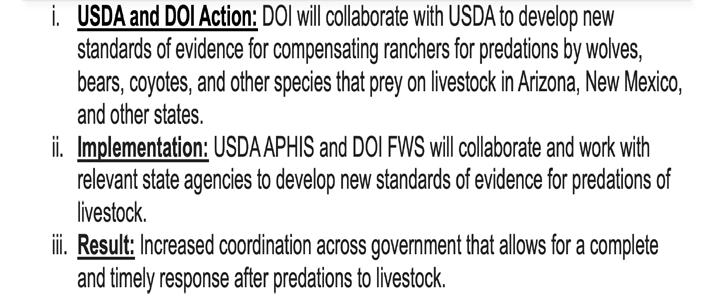
24 USDA Beef Industry Plan White Paper Addresses Mexican Wolves
28 Tyson, Cargill Agree to Multi-Million-Dollar Settlements in Beef Price-Fixing Case by Chris Moore, meatingplace.com
30 Soaring Demand for Dairy Foods Fueled a US Butterfat Boom, But Cheesemakers Need Milk Protein Levels To Catch Up
Source: CoBank
33 American Angus Assn. Announces the Ten New Mexico Breeders Who Registered the Most Angus
38 When the Flames Go Out: Rebuilding the Land After Fire and Flood by the New Mexico Association of Conservation Districts
40 HomeGrown for the Holidays at NM Farm & Ranch Heritage Museum
43 Agricultural Drains May Operate Without Permit
Source: www.agpros.com from an article on Morning AgClips by Ching Lee
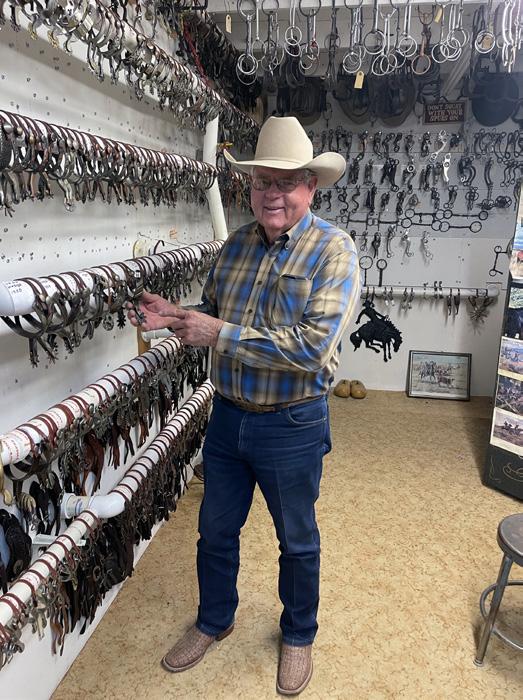
44 NM Singer-Songwriter and Farrier Receive 2025 Rounders Award
45 Pass All the Interstate Health Care Worker Compacts in 2026 by Fred Nathan, Executive Director, Think New Mexico
48 Don’t Waste Our Water Future by Howard Hutchinson
48 Brangus Brief by Kyle Caldwell, International Brangus Breeders Association
54 Ultrasound: Data Is a Tool Used To Enhance the Accuracies of Carcass EPDs
Source: Red Angus Association of America
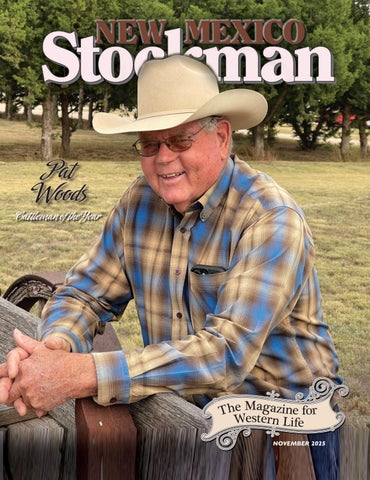
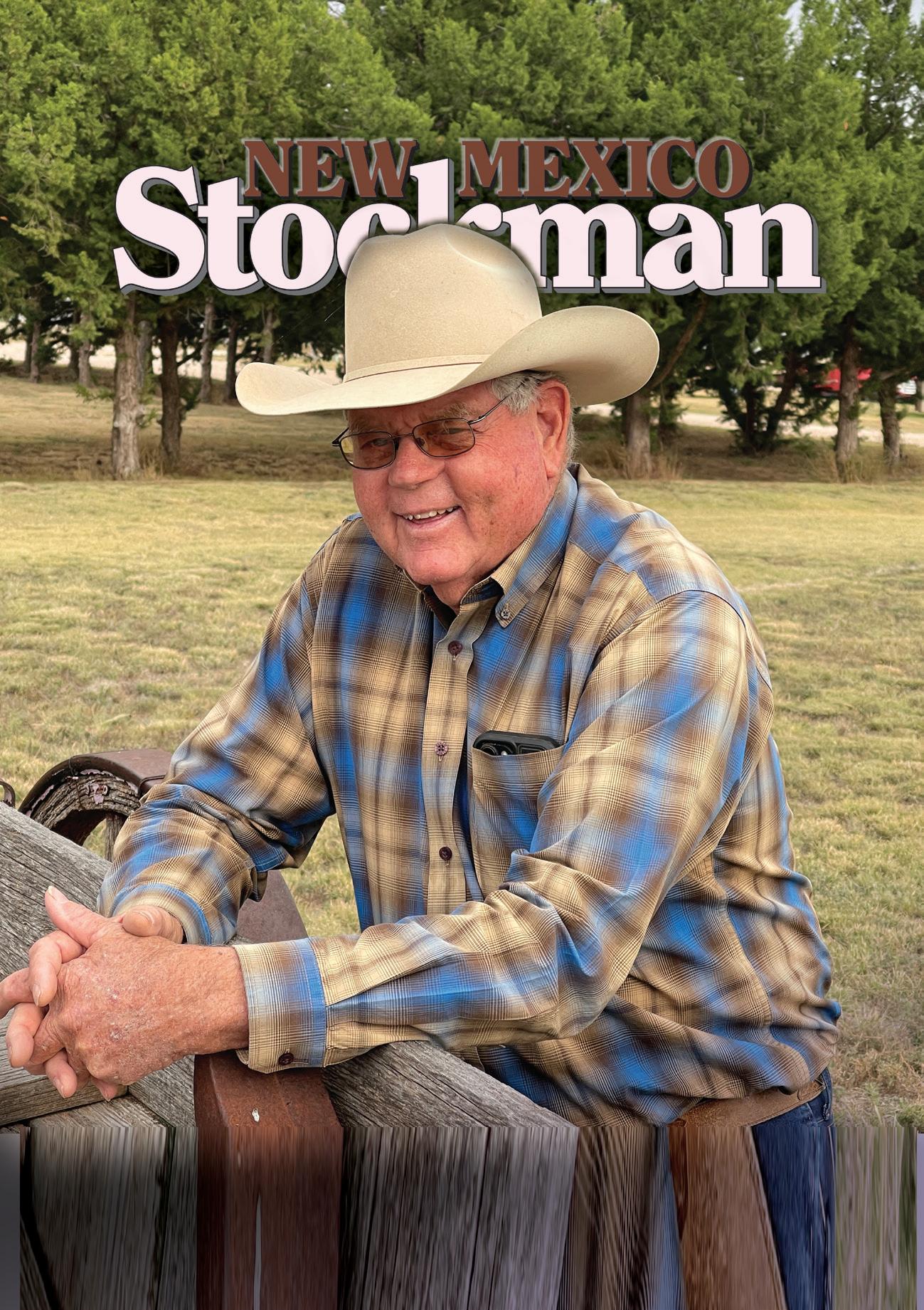
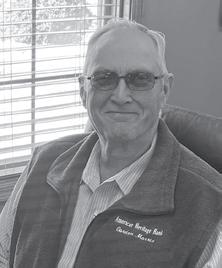
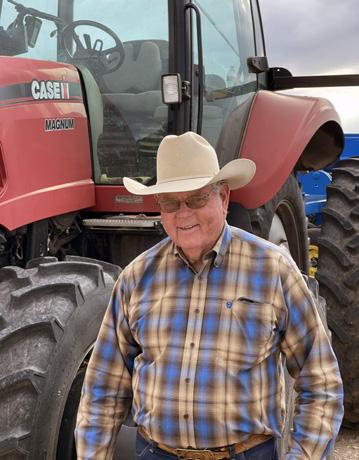
73 Cattleman of the Year
73 Pat Woods, 2025 Cattlemen of the Year by Carol Wilson
90 Baker Ranches, Inc. v. Haaland: Will the Government Get Away with Stealing Water Rights?
Source: Mountain States Legal Foundation
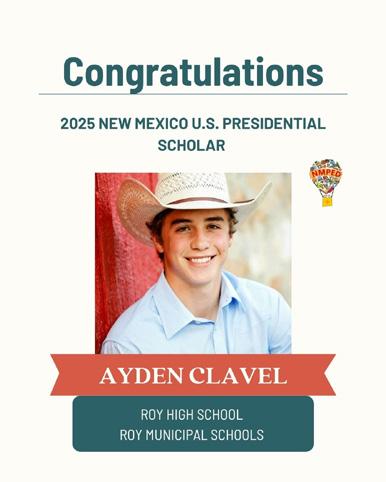
93 Clavel Honored Nationally
94 12th Annual AG Day Set for November 8 at NMSU Homecoming
95 2025 Joint Stockmen’s Convention Program
DEPARTMENTS
10 NMCGA President’s Message by Bronson Corn, NMCGA President
12 Just the Facts ... & Then Some by Caren Cowan, publisher, New Mexico Stockman
13 For the Love of Beef by Patty Waid
16 New Mexico CowBelles Jingle Jangle
26 Riding Herd by Lee Pitts
36 News Update: Hunters, Protein
42 New Mexico Federal Lands News by Jerry Schickedanz
46 New Mexico’s Old Times & Old Timers by Don Bullis
56 In Memoriam
60 View from the Backside by Barry Denton
61 Marketplace
62 Seedstock Guide
65 Real Estate Guide
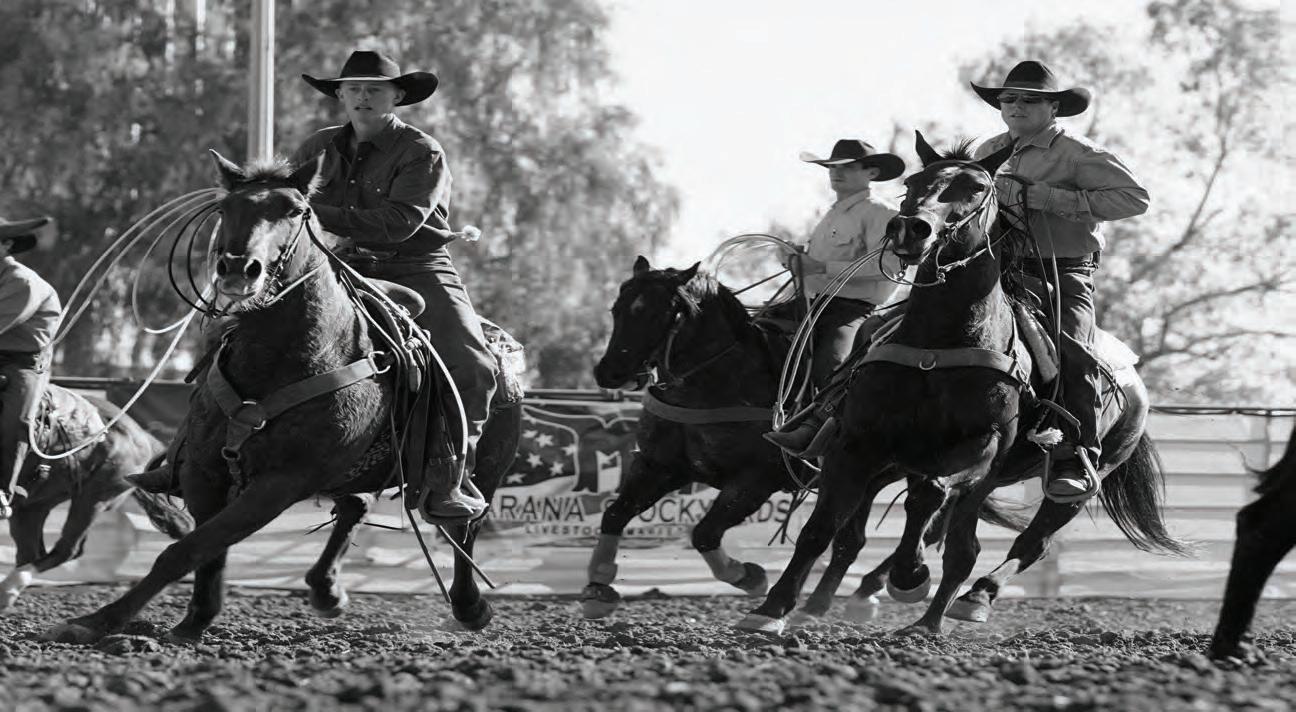
87 From The Arena by Julie Carter and Sage Faulkner
92 Food & Fodder by Deanna Dickinson McCall
112 Advertisers’ Index
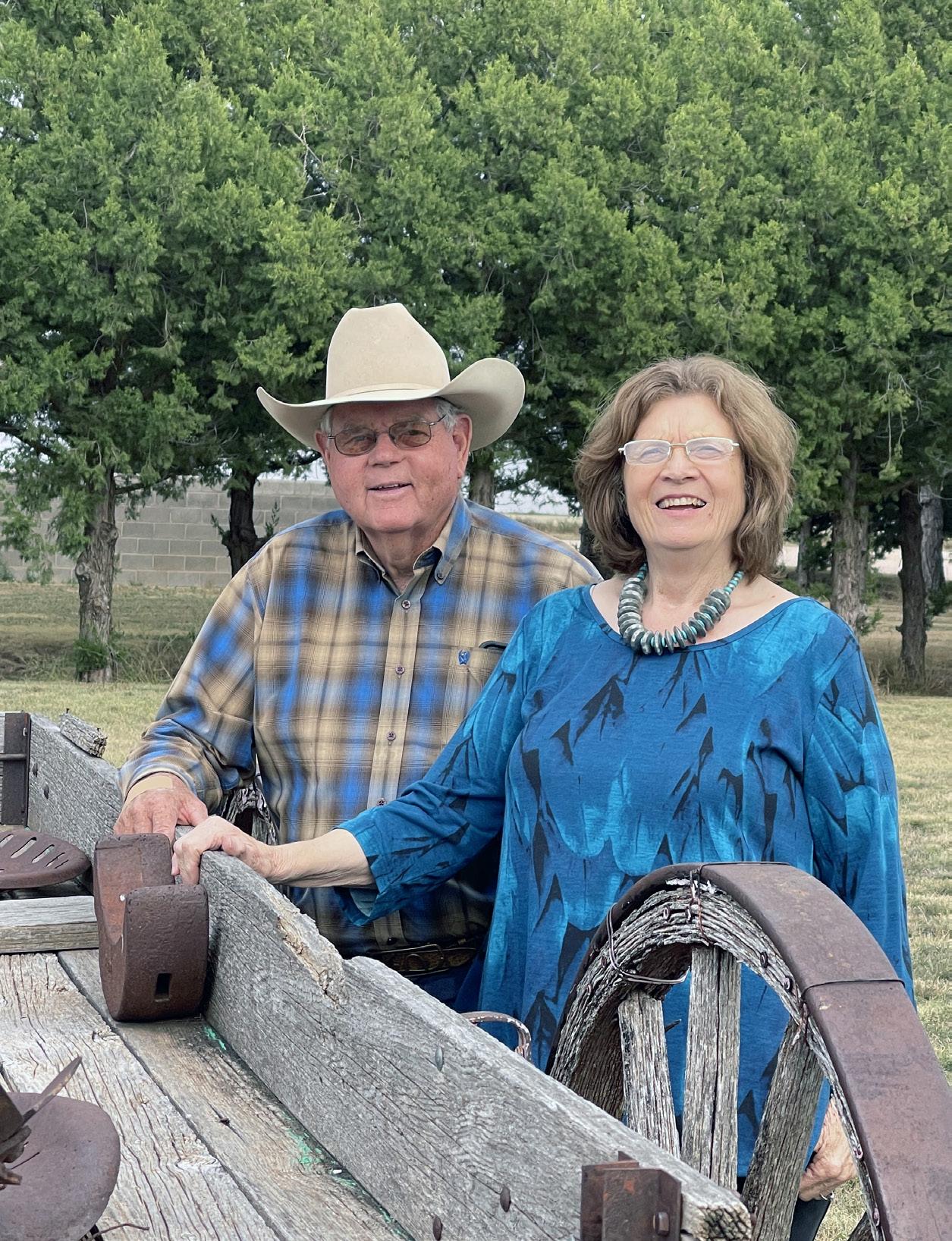
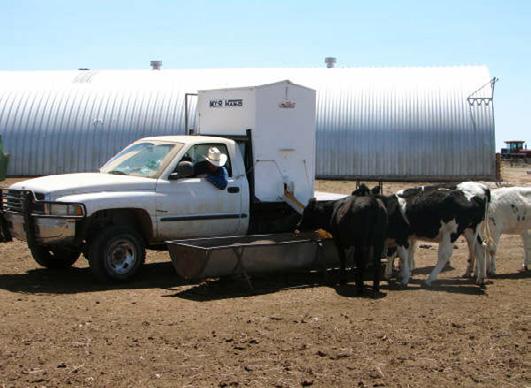
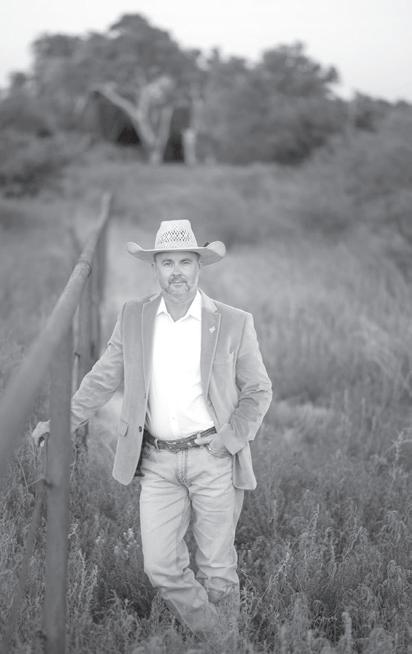
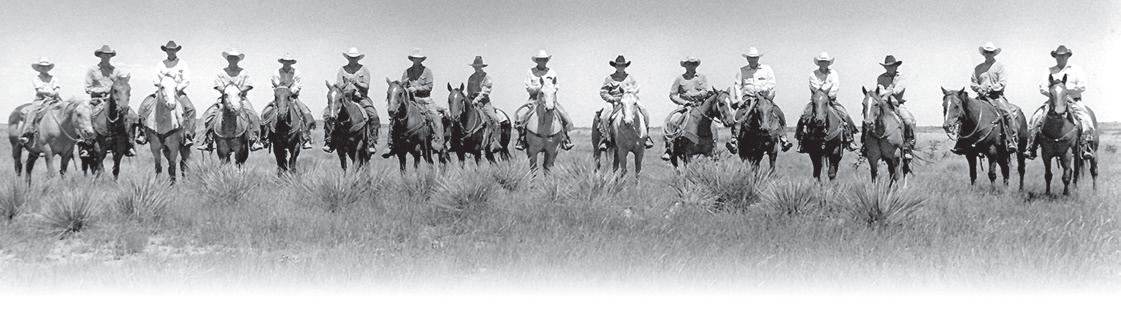
Pat Woods, 2025 Cattleman of the Year.
Photo by Carol Wilson
Grau Ranch Bulls Add to your Pay Weight!
Invest in your rangeland for healthier forage
Stop using half-measures and start restoring your rangeland with Invora® herbicide. With one simple treatment, you get 10+ years of mesquite control, and five for huisache — giving native vegetation the time it needs to fully recover. With healthier forage, your productivity and profitability will thrive for years to come.
See how one treatment can increase forage availability and reduce grazing pressure at envuhealthyforage.com.
by Bronson Corn NMCGA President PRESIDENT’S MESSAGE
Bronson Corn President Roswell
Tom Paterson President-Elect Luna
Dave Kenneke NW Vice President Cimarron
Jeff Decker SE Vice President Lovington
Roy Farr SW Vice President Datil
Cliff Copeland NE Vice President Nara Visa
Becky King-Spindle Vice President at Large Moriarty
Shacey Sullivan Secretary/Treasurer Peralta
Loren Patterson
Immediate Past President Corona
Randell Major Past President
Ihope that everyone has had a chance to take a breath from fall works. It’s been nonstop since the middle of August, and to be honest with you I’m quite ready for it to be over for 2025!
I pray that you and your family have had ample rain, healthy livestock, and a happy, healthy family! I know that there are some of our friends and neighbors who are struggling with their health. I pray God’s will and healing work through the doctors for a full recovery!
It has been crazy in the last couple weeks since President Trump stated that he wanted to import beef from Argentina to lower beef prices in the grocery stores for the American consumers. I mean to tell you that statement caused a lot of fear though many producers across the United States.
It’s a scary thing to hear that once we’ve finally been able to take a breath in the beef industry and be profitable that it could change just as quickly as it came on from a simple statement. Truth is the United States has been importing beef from Argentina, Brazil, Australia as well as thirteen other countries around the world for decades.
Imports into the USA are not even close to a new thing. Almost all of the beef that gets imported into the USA goes straight to ground beef – heck, they even have to add the fat they take off our beef to the imported stuff just to make it taste worth a darn! So, when we hear a statement such as what we heard, it can cause panic. I’m not going to pretend that I can read the future, but I honestly feel like we are going to continue being in a good place! The two percent increase in imports aren’t going to break us. That I’m pretty darn confident about!
Interesting fact: did you know that we have the lowest cattle inventory in 70 years and we are producing more pounds of beef than we ever have? The USA has the best beef in the world, and the world knows it!
With the livestock trade deals that were made in years past, our current administration has seen and heard from the cattle industry in excess. I trust that any trade deals that the USA enters in will have our American beef producer in mind to ensure that it doesn’t hurt us.
USDA and the President fully understand how bad the beef industry has had it in the last 15-20+ years. I don’t know about you, but we are living the prayer that we have been praying for. Many of us have had rain this year, feed prices are plenty affordable, and calf prices are phenomenal!
Point of the story is don’t let fear mongering take over your decisions, the CME Board had a panic reaction, but the cash market is where we live, and it is quite solid!
God has a plan for each and everyone of you, so lean on him for the direction you should go!
“Ya’ll Have A Good’en”
Bronson Corn
by Caren Cowan, Publisher
The Chicken or The Egg.
The “Climate Change” world took big hits in late October. Hitting the news first was the fact that billionaire Bill Gates shifted from doomsday climate warnings to focus on improving human lives.
The next day the Daily Mail reported that “Scientists have discovered that efforts to fix the ozone layer and save the planet over the last 40 years have actually backfired and are set to increase levels of global warming.”
One could guess that Gates knew what was coming and rapidly altered his stance on
the entire subject to make headlines first. For years this entrepreneur has devoted his formidable fortune to climate change and global warming. He focused on these despite the human suffering around the world.
Mr. Gates heretofore has been a leading promoter of the view that a warming climate is an existential crisis that demands urgent political action. His 2021 book How to Avoid a Climate Disaster. “Without innovation,” he wrote, “we cannot keep the earth livable.” The effect on humans “will in all likelihood be catastrophic.”
The liberal philanthropist now says the “doomsday view” about the climate is wrong, and “it’s diverting resources from the most effective things we should be doing to improve life in a warming world,” according to the Wall Street Journal
Now, with the United Nation’s Conference of the Parties (COP30) climate summit coming up soon in Brazil, Mr. Gates offers different advice. In an open memo released on his website (gatesnotes.com), Gates promises “three tough truths about climate,” the first of which is that rising temperatures are “a serious problem” but “will not be the end of civilization.”
“Although climate change will hurt poor people more than anyone else, for the vast
majority of them it will not be the only or even the biggest threat,” he wrote. “The biggest problems are poverty and disease, just as they always have been.”
Health problems related to poverty, such as malaria, kill about eight million people a year, according to Gates. While about 500,000 people a year die from excessive heat, he says, “surprisingly, excessive cold is far deadlier, killing nearly ten times more.”
Gates seems to be echoing Bjorn Lomborg, whose writing has run on these pages. Lomborg, a Danish political scientist, author, and the president of the think tank Copenhagen Consensus Center, has been arguing for years that while warming temperatures are a reality, the world’s poor in particular face far more urgent challenges.
He believes that the best way to cope with rising temperatures is through innovation, adaptation, and policies that continue to spread economic growth and prosperity. This was all outlined in his 2001 book, The Skeptical Environmentalist.
Gates’ new stance has triggered sharp negative reactions from scientists and activists, according to AXIOS. Additionally, it isn’t all sweetness and light for agriculture.
Gates’ memo still blames 19 percent of greenhouse emission on agriculture … he
blames transportation for only 16 percent. I guess he hasn’t figured out that food (agriculture) is essential in providing a better life for the poor and starving around the world.
Nor has he come to grips with the fact that most don’t want and cannot afford electric vehicles.
Back to the Ozone and the Daily Mail
The ozone layer is a natural shield high in the sky that blocks dangerous ultraviolet rays from reaching the Earth. Chemicals from spray cans and old refrigerators were blamed for the massive hole forming in the atmosphere in the 1980s, leading to global efforts aimed at reducing the use of chemical pollutants and repairing the damage. Remember when air conditioning in our autos and homes was semi-affordable?
However, as the hole has closed, an international team from the US and Europe found more ozone gas has filled the upper sky. That extra ozone, which is a special kind of oxygen that forms when sunlight hits regular air, acts like a blanket, trapping heat that would otherwise escape into space. This trapped heat comes directly from the repaired ozone layer itself, not from pollution or other gases.
The new study found that rising ozone levels from both the healing ozone layer and increasing air pollution will trap 40 percent more heat by 2050, adding a notable boost to global warming.
In fact, researchers revealed that this healing process will add enough heat to the planet to cancel out most of the cooling benefits from removing the original ozone-depleting chemicals, known as chlorofluorocarbons (CFCs).
It seems we can’t win for losing. ▫
GUIDE Bull Buyers
As we welcome the holidays, excitement is in the air because Thanksgiving is approaching. Family, good food and festive times are in the making. For this month’s recipe I have an easy, delicious one that can feed company whether they are watching football games or just playing board games Patty’s Pull Apart Beef Sliders.
TOPPING
INSTRUCTIONS
SAUCE This is where the magic happens!
Patty s Pointers
• The first Thanksgiving feast was in 1621 at Plymouth, Massachusetts between the English Pilgrams and the Wampanoag Indians.
• Abraham Lincoln declared Thanksgiving in 1863 during the Civil War.
If you would like to share a recipe, picture or memory:
• Email photos to Caren Cowan, caren.cowan1@gmail.com. All pictures must be in JPG form and 600 DPI.
• Email your recipe or special memory to: Patty Waid, patty@pattywaid.com. 505-250-4952
Deadline for all information: 5th of each month.
All submissions to be published at the discretion of NM Stockman Magazine and is not guaranteed to be posted.
Happy cooking! See you all next month, Patty
Picture: iamhomesteader.com
Featuring Cattlemen’s Day
Tuesday, December 30
Arizona State Fairgrounds – Phoenix, AZ
Ranch Replacement Heifer & Commercial Bull Sale
Looking for new genetics? Come see what top breeders have to offer at this elite Replacement Heifer and Commercial Bull Sale. These cattle will work in tough Southwest environments and produce calves each year that fit real world agriculture. The sale starts at 1:30 PM
Cattlemen’s Day BBQ
Generously provided for our buyers and consigners by the Arizona Farm Bureau. Lunch starts at noon!
For more information, contact: Rick Lehman - 602-481-3879 or visit us as www.aznational.org
Fall is one of my favorite seasons. The crisp air and leaves changing. The calves bawling and the truck leaving. A busy season for us for sure but also the reward at the end of the long, prayerful days of summer.
We have been busy getting ready for our Annual Meeting to be held December 12 at Hotel Albuquerque in conjunction with New Mexico Cattle Growers’ Joint Stockman’s meeting.
We will also be hosting our Past Presidents reception, Thursday December 11.
We recently finished our Photography Contest judging. We had so many incredible entries that judging was a challenge. We chose four photos to become notecards that will be part of our merchandise.
Congratulations to our winners Kyra Monzingo, Alondra Becerril, Cheryl Allsup and Fallon Valasquez. Thank you to everyone who entered!
Blessings to you all.
See you down the road, – Corrina Calser
New Mexico CowBelles President
Mesilla Valley CowBelles met virtually October 24th since only two could make the designated meeting time. Dues increase explained. NMSU Ag Day Nov 8 – Shifts to work available. Ag Explorer October 27 and 28 at Farm and Ranch Museum. Need a presenter on Monday. Contact Janet. Dona Ana County 4-H Festival of Trees – at Homegrown Event Nov 22-23, 2025. This is a Fundraiser for 4-H and MVC has sponsored trees in the past. If sponsored decorating happens on Nov 21 at 1 p.m. One tree will be sponsored in MVC’s name, possibly two. Ag Explorer Trailer program kits sponsored by Mesilla Valley CowBelles explained to membership and are available wherever the trailer goes.
Yucca CowBelles and Wool Growers met on Tuesday Sept 23rd at 10 a.m. in Artesia at
CVE. There were 10 members in attendance. President Joan Kincaid called the meeting to order. Becky Waldrop led the Pledge of Allegiance and Sandi Wilkie read the CowBelle Creed. Minutes were read and approved as read. Ande Marbach gave the treasurer’s report. Grammy’s house donations were brought and will be delivered after the meeting. Dues were collected. Everyone reported on their experience at the County Fair. Sandi Wilkie’s booth for Soil and Water Conservation received the best Educational Booth award. Quilt tickets sales were good, but the Beef Rub sales were low. Michelle Brown said the remaining jars of beef rub will be available at the Pinon Christmas Tree Lighting festivities, November 29th. Everyone agreed the Farm Display was awesome. Joan shared some information on the American Pioneer Ranch in Hico and Stephenville, TX that offers Retreats and Workshops for all things related to ranching and farming. She also shared information about author Dianne Linderman’s new book Everything That Matters . It’s all about Reforging the American pioneer spirit in life today. The next meeting will be October 28 at CVE. Group attendees were reminded to make plans to attend the November Christmas showcase presented by Chaves County Extension clubs November 11 at Eastern New Mexico State Fairgrounds. Jack Coupland spoke to the group, expressing his gratitude for everything during Dana’s illness and after her passing. He shared some special memories, and presented donations given to Yucca CowBelles in her memory. Lauren Marbach reminded of the Christmas theme “The Polar Express” for the Christmas meeting/party. She will be hosting this meeting in her home, and asked attendees to bring a Tree ornament related to trains and/or “The Polar Express” movie. Meeting adjourned. The program was presented by Artesia FFA Students who will be competing at the National Competition on “Conduct of Ceremonies”. The team did a great job presenting an example of the process of holding a meeting. Respectfully submitted, Tina Kincaid, Secretary ▫
Photography Contest Winners (from top to bottom): Alondra Becerril, Kyra Monzingo, Cheryl Allsup, & Fallon Velasquez
Artesia FFA Students
Bull and Heifer Sale
Bull Heifer Sale
Bulls & Heifers available for preview, Sunday, March 8, 2026 All Bulls & Registered Heifers will have 50K Genetic Testing
SALE LOCATION*
DEXTER LIVESTOCK COMMISSION, 274 E. DARBY ROAD, DEXTER, NEW MEXICO Sale time 1 p.m. Bulls will be tested for Fertility & Trich • Meal will be served for buyers & guests
Means Ranch Company Earns Certified Angus Beef Sustainability Award
Source: Angus Journal
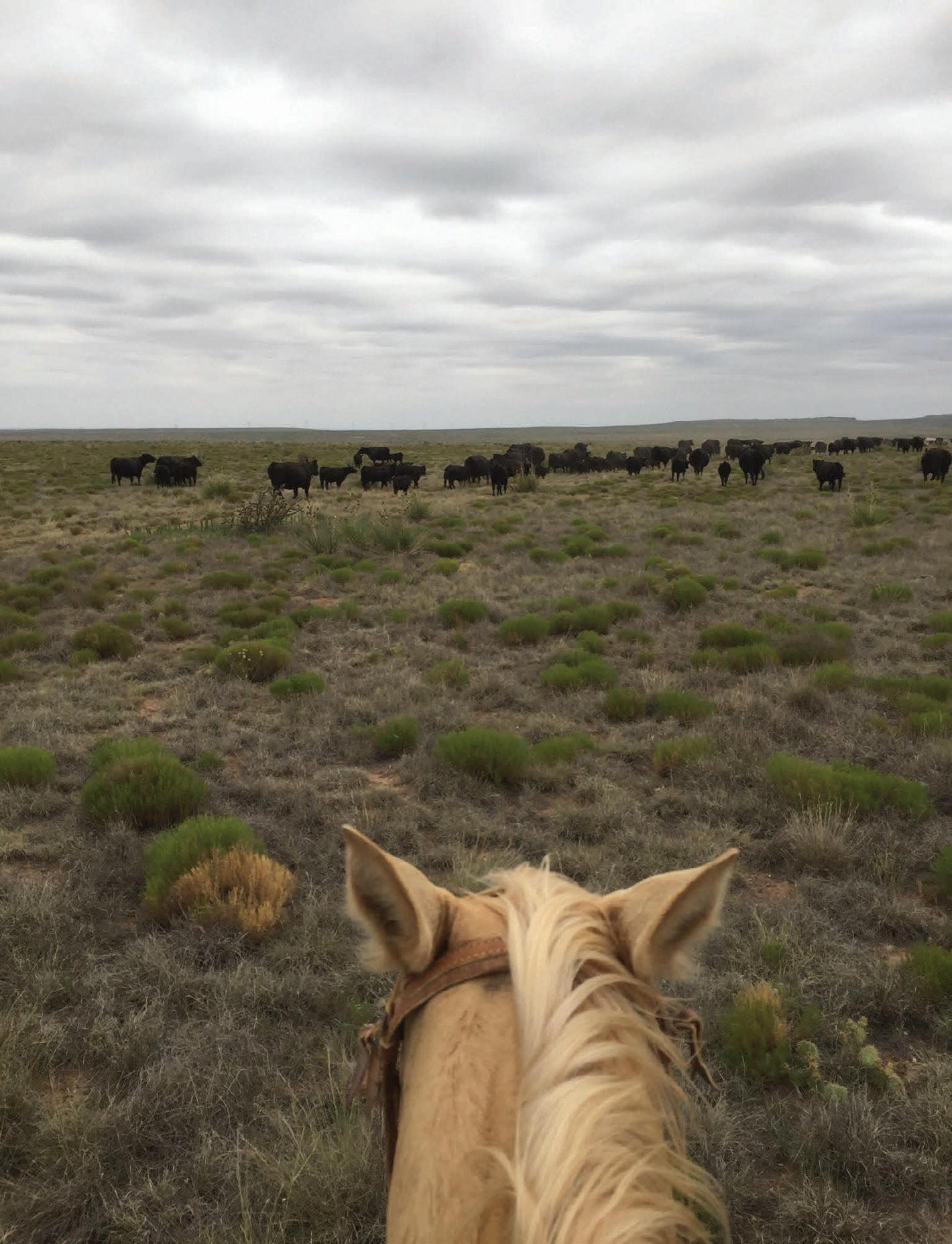
Afar horizon swallows the sky across sparse grama and greasewood that sway under a pitiless sun while jackrabbits dart between cactus spines. Just over the Davis Mountain foothills, cowboys drive Angus cows toward catch pens.
It’s ranching, romanticized. Until you live it. On the Means Ranch, beauty is a thin veil over a desolate land. For four generations, the Means family has ranched in Texas. With a commitment to environmental sustainability, alongside quality Angus genetics, they earned the 2025 Certified Angus Beef (CAB) Sustainability Award.
What makes a ranch sustainable? To Jon Means, it’s simple: the same family, ranching on the same land, for the last 140 years. They could not have done that without sustainability. Responsible use of water, caring for the land and its wildlife, destocking the herd
for drought recovery and then building back with an eye toward grid premiums.
Every Inch
In 1979, Jon and Jackie Means were married and the El Paso girl moved three hours east to the Moon Ranch. She used a bleak term for their view.
“Don’t call it that,” Jon had bantered. “It’s not a desert. We have grass.”
Joined with the Chispa Ranch to span 90,000 acres, it’s a big chunk of the Means Ranch Company, a
decades-old enterprise the couple own. The original Y-6 ranch, established in the 1880s, was only split once and all remains in family hands. There is also a ranch in southwest New Mexico.
“This land here is diverse,” longtime Means Ranch cowboy Clay Miller says. “And
continued on page 20 >>
Jackie and Jon Means
Bill King - 505-220-9909
-
BillKingRanch.com
pasture use, careful not to overgraze and allowing time for the land to heal. Standard stocking allows 60 acres per cow, but they add range cake when necessary.
ics and expand their bull battery. Besides phenotype, Jon uses EPDs, looking closely at birthweight, fertility and carcass traits.
Gravel roads wind through wide-open spaces, bending around mountains to catch pens and cowboy camps. It all looks the same, and although framed plat maps line Jon’s office wall, he knows it like the back of his hand: Where and why fence lines were drawn, shifted to share a water tank with the Y-6 or to let cows get to the other side of a mountain.
Ranching revolves around the environment. Cow numbers are down from the typical 1,200 head because of long, extreme drought. Jackie says running the ranch takes constant management with the diligence of “operating on the margins.”
And probably some faith, too, that enough rain will fall at the right time. The 40 types of native grass are resilient but still need some moisture, and summer rains are key.
Thirty to 40 years ago, average annual rainfall was 10 inches, but Jackie cannot remember a year in this century when they got that much. Multi-year droughts have challenged natural resources to where rotational grazing and water conservation are mandatory.
“We use every inch of this ranch as best we can,” Jackie says.
Jon says they’ve been deliberate with
When Jon’s grandfather was growing up, the Y-6 and Moon Ranch (combined) had only six wells. Today, the Moon Ranch has more than 150 miles of pipeline running water to troughs for cattle.
Solar panels replaced windmills on all 22 wells, while covers limit evaporation on storage tanks.
Birds and wildlife benefit from sustained conservation too, Jackie says. Lacking native trees on the ranch, the Means’ planted adaptable multi-purpose trees—shade for cattle and habitat for birds. They added programs to feed quail and deer.
Everything works in harmony.
“How else would we use it?” Jon says. “The land needs the cattle, and the cattle have to have the land to survive.”
Quality, No Excuses
In the early 1960s, Jon’s father was among the first here to begin switching from Herefords to Angus. Fifty years of striving to breed hardy Angus cattle to fit the terrain led to good structure, with sound feet and legs to travel long distances over rough terrain.
Through the years, Jon and Jackie have traveled the United States to find new genetunforgiving.”
“We buy bulls that will work for us here first,” he says, noting essential fertility. “We’ve got to have a live calf and get that live calf to the feedyard.”
After processing and weaning, steers and heifers part. The latter are developed for replacements while steers are shipped to wheat pasture till they average 800 lb. Then it’s on to the Triangle H feedyard at Garden City, Kansas where the Means’ retain ownership and sometimes partner with the yard.
Predictable, Profitable and Sustainable
“All of our cattle go through that program, and they do amazingly well,” Jon says, noting years of data.
They’re predictable, and they perform well on feed. It all ladders up to profitability. In recent years, Means Ranch Company cattle have had a 53 percent CAB acceptance rate and 48 percent graded Prime, including those qualifying for CAB Prime.
“It always surprises us that our cattle can be as healthy and big as they are, in a land that’s as arid as this,” Jackie says.
It’s a humble statement. Jon and Jackie do what it takes to raise high-quality cattle in a challenging environment—no excuses. ▫
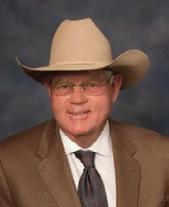
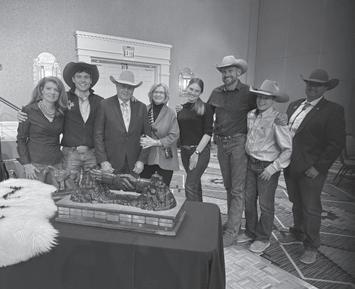
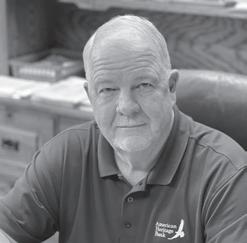
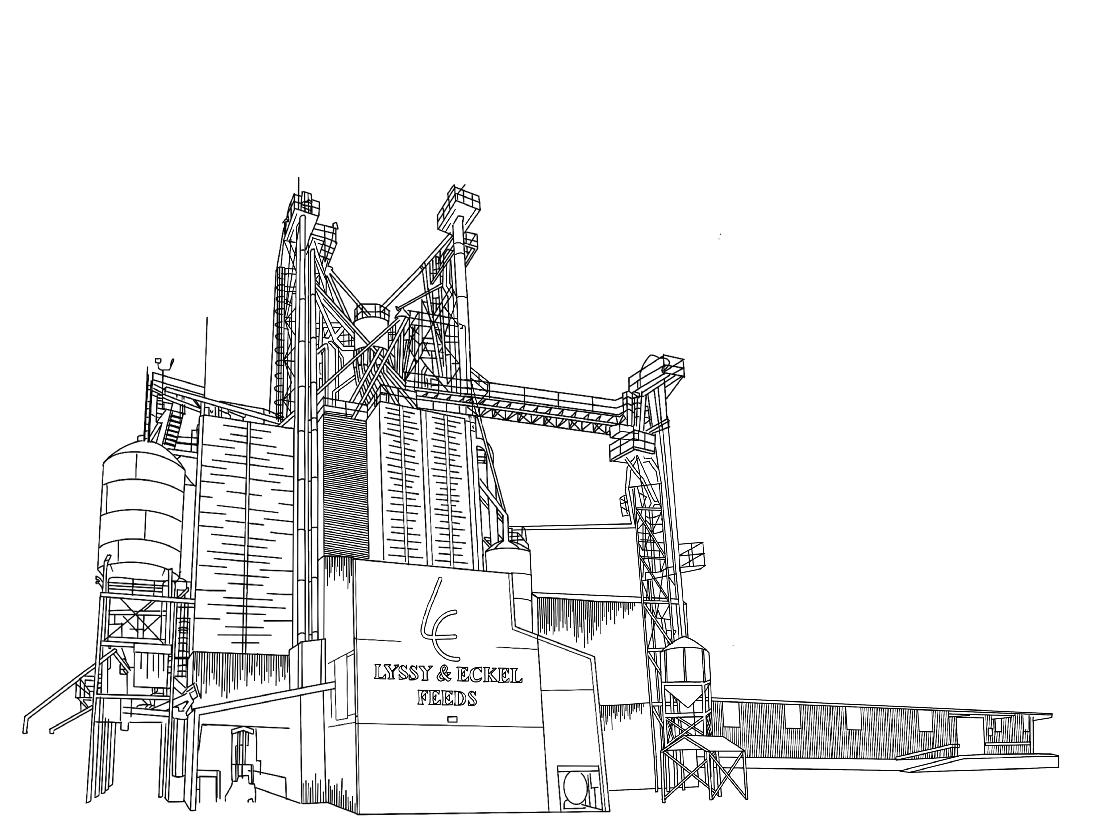
Meatingplace Names Caviness Award Honoree
by Tom Johnston, meatingplace.com
It takes a sturdy business to withstand the unforgiving landscape that is West Texas, let alone the unforgiving landscape of the beef industry — and do so with grace.
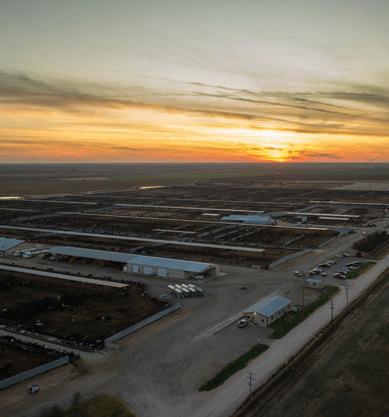
Caviness Beef Packers, a pillar with plants in Amarillo and Hereford, has stood proud and tall since 1962. The three-generation family operation, which began with a handful of cattle and now harvests thousands per day, is as much a beacon as are the sunsets that light those flat West Texas horizons on fire.
It could be said our selection of Caviness and its namesake founder, Terry, as well as sons Trevor (president) and Regan (vice president), to receive our Richard L. Knowlton Award for 2026 is long overdue. They’ve built a body of work in their industry and community that long has more than met the standard.
Named for the late former Hormel Foods CEO, the Knowlton Award honors a company
and executive(s) who exhibit excellent leadership of their business, excellent leadership of their industry, innovative practices, and exemplary community outreach. All together, we call it making money the right way.
“Caviness is a true American success story, starting from humble beginnings and growing into a force in the beef slaughter business,” said Bill Kinross, executive vice president and publisher of Meatingplace. “Terry and his family are some of the most generous people in our industry, giving back to students, workers and their families in the communities they live and work in.”
The Caviness’ are invested in their business, historically building some of the industry’s most modern processing facilities, the latest constructed in a partnership with J.R. Simplot Company (CS Beef Packers) in Kuna, Idaho. They are invested in the industry, reflected in part by Terry’s recent induction into the Meat Industry Hall of Fame with accolades like leading the
National Meat Association and Southwest Meat Association, as well as by Trevor’s seat on the Meat Institute Board of Directors.
And they are invested in their communities in ways almost too many to name, making continuous donations of food and money to local elementary schools, high schools and colleges, as well as local services from police to foster care.
CS Beef Packers recently gave $4 million to help the Boys and Girls Clubs in Kuna, Idaho, build an $11 million facility with services including daycare for 400-500 kids. Caviness also donated $2 million to name the Caviness Meat Science and Innovation Center at West Texas A&M University (WTAMU), as well as $1.25 million toward establishing the “Caviness Davis Distinguished Chair in Meat Science”; and $500,000 to support dependents of Caviness employees in higher education, among other contributions.
Terry Caviness also recently received an honorary Ph.D. in agriculture business from WTAMU.
MILLER ANGUS
REGISTERED BLACK ANGUS CATTLE
FLOYD, NEW MEXICO
(575) 760-9047 (575) 478-2398
FOR SALE BY PRIVATE TREATY
CATTLEMEN ’S LIVESTOCK A UCTION
BELEN , NM M ARCH 2026
New Mexico Angus Sale
Dexter , NM March 9th, 2026
Ranchers Pride Sale
Clayton, NM April 2026
A.I. SIRES:
SS BRICKYARD
CHERRY CREEK BLUE COLLAR G275
YON FLAGSHIP
MAR INNOVATION 251
POSS RAWHIDE
BOYD DYNAMIC 6118
BASIN SAFE DEPOSIT 9324
ALL BULLS TRICH AND FERTILITY TESTED
BULLS AND FEMALES
TESTED PI-BVD FREE
Stickers
Ibelong to that fraternity of people known as “stickers” so named because we tend to stay put and do the same old thing in the same old way. Whereas the average American homeowner stays in their house 11.8 years my wife and I have lived in a house we had built 40 years ago.
Ranchers and farmers know what I’m talking about. Practically every rancher I know is the third, fourth or fifth generation to live on the same ranch. I’ve known two ranchers who were born and died in the same bed. While my wife and I can’t make that claim I am a fifth generation Californian and the last of my family to live here. I know it’s the trend and we should leave California like the smart people are doing but we’re just not built that way. I’m a little angry at the Californians who are giving up and leaving so they can go mess up some other state instead of staying here and putting up a good fight against the communists and socialists who have ruined my once golden state. That was before we were overrun by illegal aliens, lefty professors, government bureaucrats, the homeless, whack-job Hollywood types and rich
nerds who sit at computers all day drinking Five Hour Energy drinks and Mountain Dew who’ve made their pile of dough, bought their yacht and pulled up the ladder behind them.
I can’t help it, I get attached to things, like my wife. Last year we celebrated 50 years of marriage and we commemorated the occasion by going to the same Mexican restaurant we always do. Our last truck we owned for 25 years and our current car, a Buick Lucerne, is the best car we’ve ever owned. It’s 18 years old now, has never had a major mechanical problem, has 70,000 miles on its speedometer and when washed and waxed looks brand new. Since my stroke five years ago I can’t drive so we tend to stay home and we’re satisfied. That’s a word you don’t hear much any more... satisfied.
It used to be that the only person who liked change was a wet baby but now it seems our society can’t change fast enough. Look around and you’ll see dying downtowns replaced by big box stores and Amazon. In my younger years a family could have a nice house, a nice car and a nice life with only one wage earner but now it takes two people working multiple jobs just to stay afloat. They’re only one injury or sickness away from bankruptcy. And this we call progress?
While the parents are working their sons are home playing war games on their computers and getting indoctrinated by dangerous people. When I went to school we never had to worry about some sicko bringing an AR-15 to school to slaughter his fellow classmates. My wife and I couldn’t have kids and when I look around
today I think maybe it was a blessing. When my wife and I got married we were broke but hard work quickly corrected that. Stickers tend to be savers. We still bank at a real bank, I don’t know how Bitcoin or an ATM works, we have one credit card, pay it off every month and we have zero debt. We started out with nothing and were able to buy our first home at 24 years of age and paid it off within five years with both of us working. Today we find kids still living at home at twenty-six, unemployed with a huge student loan to pay off. They are sad and mad and they rebel by assassinating good people who are just trying to help.
Stickers are loyal. We buy the same brands of food we ate when we were kids, use the same old tools, and buy the same gas. Some might look at my wife and I in our old, comfortable and familiar clothes and call us misers or dinosaurs but we’re not opposed to change, but only if it’s a change for the better. You can get hurt out there on the cutting edge.
And you know what? We’ love our happy home and the way we live. It may not be perfect but it’s home and we have no intention of ever leaving except in a hearse or a body bag. ▫
RIDING HERD by Lee Pitts
Settlements in Beef PriceFixing Case
by Chris Moore, meatingplace.com
Tyson Foods and Cargill have agreed to pay a combined $87.5 million to settle a federal class-action lawsuit alleging they conspired to inflate U.S. beef prices by limiting supply.
According to court filings recently in the U.S. District Court for Minnesota, Tyson will pay $55 million and Cargill $32.5 million under preliminary settlements that still require a judge’s approval. The agreements mark the first consumer settlements in the beef price-fixing litigation, which began in 2019.
Plaintiffs’ attorneys estimate the class includes about 36 million consumers across 26 states and the District of Columbia who indirectly purchased beef products — such as chuck, loin and ribs — between August 2014 and December 2019 from retailers including Walmart and Costco. The retailers are not defendants in the case.
Under the settlement terms, Tyson and Cargill agreed to cooperate with consumers pursuing claims against the remaining defendants, JBS USA and National Beef Packing, which have denied wrongdoing. An expert for the plaintiffs estimated total consumer damages at $1.9 billion.
The beef settlement follows Tyson’s separate $85 million deal resolving similar allegations in the pork industry. Tyson, Cargill, and JBS have each denied participating in price-fixing schemes. ▫
Soaring Demand for Dairy Foods Fueled a US Butterfat Boom
But Cheesemakers Need Milk Protein Levels To Catch Up
Source: CoBank
Consumer demand for products like cheese, butter and yogurt that rely on protein and butterfat content continues to drive dairy sales growth in the U.S. and abroad. Over the past decade, milk delivered to U.S. dairy processing plants has become more nutrient-dense with higher levels of the two key components to meet rising demand. However, the pace of growth in butterfat content has far exceeded protein, which creates challenges for U.S. cheddar and American-style cheesemakers that rely on a more balanced ratio of the two.
According to a new report from CoBank’s Knowledge Exchange, excessive butterfat levels can impact cheese quality. In the EU and New Zealand, the two largest dairy exporters, the protein-to-fat ratio has remained far steadier, averting the issues U.S. cheese makers are facing.
THOMPSON RANCH
“U.S. dairy producers did an exceptional job increasing butterfat levels in milk to meet demand,” said Corey Geiger, lead dairy economist at CoBank. “For 10 years, the market couldn’t supply enough of it, and now there’s an oversupply – it’s almost too much of a good thing. Cheesemakers strive for a protein-to-fat ratio near 0.80. Anything significantly lower than that can reduce cheese quality and compromise production yields.”
In recent years, butterfat percentages in U.S. milk have been increasing at twice the pace of protein. From 2000 to 2017, the protein-to-fat ratio held rather constant at 0.82 to 0.84. In the ensuing years, the ratio gradually slipped to 0.77. That is increasingly a concern for cheesemakers as more than onehalf of the U.S. milk supply is destined for cheese production.
The disproportionate growth of butterfat in relation to protein in U.S. milk when compared to the EU and New Zealand could put U.S. cheesemakers at a competitive disadvantage. The EU is the world’s largest dairy exporter, followed by New Zealand. The U.S. is the third largest exporter of dairy products and ingredients. Unlike America’s global competitors, domestic cheese processors face added costs for rebalancing their milk supplies, which reduces efficiency and could
Villanueva •
J-C Angus Ranch
ultimately impact pricing at the farmgate.
Geiger said U.S. cheddar cheesemakers face a growing need to standardize milk either by adding a source of protein like milk protein concentrate or by pulling excess butterfat out. “If cheddar makers don’t standardize inbound milk, fat levels may climb too high and cheese quality could decline as higher fat generally yields a softer cheese,” said Geiger.
In the U.S., Multiple Component Pricing has incentivized butterfat and protein production. From 2000 to 2014, the protein price exceeded butterfat, resulting in rather equal growth between the two components. However, butterfat pay prices exceeded protein prices in eight of the past 10 years. That fueled the butterfat boom, which producers achieved through animal genetics and feeding strategies. Those practices could be shifted to achieve a greater balance between butterfat and protein if the proper price incentives are in place.
Cheese yield pricing could also give farmers incentives to produce milk with a higher protein-to-fat ratio. Geiger said looking to the future, farmgate milk needs to have a protein-to-fat ratio more in line with how milk is utilized to make the entire industry more efficient.
“Regardless of the current challenges associated with excess butterfat, most signals continue to point upward for milk component demand. That represents an opportunity for dairy farmers to produce more milk components so dairy processors can fulfill demand in both domestic and global markets. And advances in research and efficiency are among several reasons the U.S. dairy industry remains on a strong growth trajectory with $10 billion in dairy plant investment coming online through 2028.”
American Angus Assn.
Announces the 10 NM Breeders Who Registered the Most Angus
The 10 producers who registered the most Angus beef cattle in the state of New Mexico recorded a total of 1,539 Angus with the American Angus Association® during fiscal year 2025, which ended Sept. 30, according to Mark McCully, Association chief executive officer.
The 10 top recorders in New Mexico are: Bill Gardner, Estancia; Diamond Seven Angus Ranch, Newkirk; Heartstone Angus, Silver City; U Bar Ranch, Silver City; High Valley Angus, Moriarty; J-C Angus, Moriarty; Scott & Brooke Bidegain, Montoya; Reverse Rocking R Cattle Co, Maxwell; Robert or Mitzi Miller, Floyd; 7 Fingers Angus, Maxwell.
Association members across the nation in 2025 registered 309,926 head of Angus cattle. “Angus breeders lead the way in innovation and genetic progress, giving their commercial cattlemen customers an advantage in the marketplace,” McCully said. “The diversity of the breed means that cattlemen across the country can find the right genetics – no matter their breeding objective.” ▫
CONNIFF CATTLE CO. LLC
U BAR RANCH
Producing southwestern Angus cattle that “Fit the Bill”
• Performance in the feedlot and on the range.
• Raising quality Registered Angus cattle since 1991.
• Bulls available private treaty or at the annual Black Angus “Ready for Work” Bull Sale – March 9, 2026 - Belen, NM
WIDNER ANGUS FARM
ROSWELL LIVESTOCK AUCTION SALES, INC. &
ROSWELL LIVESTOCK AUCTION TRUCKING, INC.
900 North Garden · P.O. Box 2041 Roswell, New Mexico 88201 575-622-5580
www.roswelllivestockauction.com
CATTLE SALES: MONDAYS • HORSE SALES
BENNY WOOTON CELL 575-626-4754
SMILEY WOOTON CELL 575-626-6253
Producers hauling cattle to Roswell Livestock New Mexico Receiving Stations need to call our toll-free number for a Transportation Permit number before leaving home. The Hauling Permit number 1-800-748-1541 is answered 24 hours a day, 7 days a week.
Trucks are available 7 days a week / 24 hours a day
Roswell livestock Auction Receiving stAtions
ATTENTION RECEIVNG STATION CUSTOMERS,
To be able to schedule trucking, all cattle need to be permitted by 1:00 p.m.
LORDSBURG, NM
20 Bar Livestock Highway #90 at NM #3 – East side of highway. Receiving cattle for transport 2nd & 4th Sunday of each month. Smiley Wooton, 575622-5580 office, 575-626-6253 cell.
PECOS, TX
Jason Heritage is now receiving cattle every Sunday. For information to unload contact Jason Heritage 575-840-9544 or Smiley Wooton 575-6266253. Receiving cattle every Sunday.
VAN HORN, TX
800 West 2nd, 5 blocks west of Courthouse. Bob Kinford, 432-284-1553. Receiving cattle 1st & 3rd Sundays.
MORIARTY, NM
Two blocks east and one block south of Tillery Chevrolet. Smiley Wooton 575-622-5580 office, 575-626-6253 mobile. Receiving cattle every Sunday
SAN ANTONIO, NM
River Cattle Co. Nine miles east of San Antonio on U.S. 380. Receiving cattle for transport 2nd & 4th Sunday of each month. Smiley Wooton 575-626-6253.
The rise of GLP-1 weight loss drugs could be helping drive a protein craze in America that has the nation needing to import more meat to meet demand.
So said Wesley Batista, co-controlling shareholder of global meatpacking giant JBS S.A., at the Rothchild & Co. Consumer Conference in London, according to a report by the Financial Times (FT).
“No one knows exactly what is the impact of these new drugs, Ozempic or Mounjaro … but something is happening because protein overall became [a trend],” Batista is quoted as saying. “In the past … the doctor said you should not eat too [many] eggs, you should not eat too much protein. Now it’s the other way around.”
Separately, a study by Cargill found that 61 percent of consumers reported increasing their overall protein intake in 2024, well above 48 percent in 2019.
Even with record-high beef prices in the US, consumers continue to buy, and so the country will need to import “more and more” product to meet the demand, Batista said at the conference, the FT reported.
Those record-high prices are largely the result of a US cattle herd liquidation that reduced cattle numbers to their lowest levels since the 1970s. The agency revised its projection for 2025 beef imports to 5.364 billion pounds, up 1.7 percent from the August estimate but almost 16 percent lower on the year. ▫
Hunters Encouraged to Stay Informed, Be on the Lookout for New World Screwworm
The New Mexico Department of Game and Fish, New Mexico Department of Agriculture and New Mexico Livestock Board are encouraging hunters to help prevent the spread of New World screwworm among wildlife, livestock, pets and people.
New World screwworm (Cochliomyia hominivorax) is a foreign animal disease and poses a serious threat. The fly’s larvae infest open wounds, where they feed on living tissue. The New World screwworm (NWS) was eradicated from the United States decades ago, but recent detections in Mexico pose a risk of northward spread. At this time, it has not been detected in the United States.
As you hunt this season, please check harvested game and live animals you encounter for:
Larvae (maggots) on alive or very recently deceased animals. Unlike other maggots, NWS larvae feed on living tissue and will vacate an animal once it has died and the tissue begins to cool. Common sites are wounds or body openings like the nose or genitalia.
Maggots deep in tissue with foul odor.
In the unlikely event that you see a suspected NWS:
1. Do not eat, handle or transport the animal.
2. Take a GPS location.
3. Take pictures of the wound, larvae and/ or affected animal if possible.
4. If you can, collect a sample safely. Using gloves or tweezers, place several larvae into a sealed container (small jar or plastic vial) with 70 percent alcohol.
5. Label with date, GPS location, species and your contact info.
6. 6. Report and submit immediately to the New Mexico Department of Game and Fish, the New Mexico Livestock Board or the New Mexico Department of Agriculture. Your reports are critical for early detection and rapid response. Quick action could protect wildlife and livestock across the state. ***Please remember that New World screwworms are only found on alive or very recently deceased animals. Even minor mishandling of game meat can cause non-NWS maggots to develop in muscle tissue.***
When the Flames Go Out
Rebuilding the Land After Fire and Flood
by the New Mexico Association of Conservation Districts
New Mexicans know that our work doesn’t end when the last ember dies. Across the state, catastrophic wildfires have left scars on mountains, rangeland, and watersheds — from the Hermits Peak–Calf Canyon Fire in the north to the Black Fire and McBride Fire in the south. But as we’ve learned time and again, when the flames go out, the danger isn’t over.
Without vegetation to slow runoff or roots to hold the soil, even a brief summer storm can unleash torrents of water, ash, and debris. Flash floods and mudflows have damaged ranches, roads, irrigation ditches, and communities miles downstream.
Responding to this new reality requires more than emergency aid — it takes longterm, coordinated conservation. And that’s
where New Mexico’s Soil and Water Conservation Districts (SWCDs) come in.
Local Districts: The Bridge Between Landowners and Government Programs
New Mexico’s 47 local Soil and Water Conservation Districts are uniquely positioned to connect landowners with resources from state and federal agencies. Districts are run by local, elected boards who understand their area’s geography, history, and needs.
After a fire, these districts serve as the “boots on the ground” — organizing erosion control efforts, reseeding projects, and watershed restoration. Through the New Mexico Association of Conservation Districts (NMACD), local districts coordinate with agencies to ensure funding and technical assistance reach the landowners who need it most.
Programs and Partners Working Together
Several state and federal agencies provide funding and expertise to rebuild and protect New Mexico’s lands after wildfires and floods:
USDA Natural Resources Conservation Service (NRCS)
NRCS offers multiple programs that help
private landowners recover and rebuild after fire:
- Emergency Watershed Protection (EWP): Provides financial and technical assistance to address flood risks from burned watersheds.
- Environmental Quality Incentives Program (EQIP): Supports reseeding, cross-fencing, erosion control, and other land restoration practices.
- Conservation Stewardship Program (CSP): Rewards landowners who adopt longterm conservation practices to strengthen soil and water health.
New Mexico Environment Department (NMED)
The NMED plays a key role in protecting surface and groundwater quality after fires. They monitor post-fire runoff, fund watershed restoration through Nonpoint Source Pollution (319) grants, and partner with conservation districts to mitigate contamination of drinking and irrigation water supplies.
New Mexico Forestry Division (Energy, Minerals, and Natural Resources Department - EMNRD)
The Forestry Division leads post-fire rehabilitation on state and private forest
lands. Their Forest and Watershed Restoration Act (FAWRA) program funds thinning, reseeding, and debris removal to reduce flood risk and restore habitat. Through partnerships with SWCDs and local contractors, they ensure work is completed quickly and effectively.
New Mexico Department of Agriculture (NMDA)
NMDA supports districts and producers through the Healthy Soil Program and Watershed Restoration Initiative, which fund projects improving soil structure, vegetation cover, and water retention — all critical for recovery from fire.
Federal Emergency Management Agency (FEMA)
In large disaster areas, FEMA partners with the state to provide public assistance for damaged infrastructure, including culverts, low-water crossings, and flood prevention structures. Conservation districts often help identify local priorities and coordinate on-the-ground implementation.
One Landscape, Many Owners
What makes New Mexico unique — and challenging — is the patchwork of land own-
ership. A single watershed may include federal forest lands, state trust lands, tribal lands, and private ranches. Fire and flood don’t stop at a fence line, so our response can’t either.
That’s why the partnership between state and federal agencies, local districts, and landowners is essential. The Soil and Water Conservation Districts are the connectors that allow these programs to operate seamlessly across jurisdictional boundaries.
Preparedness for the Next Fire
While recovery is vital, prevention is just as important. Conservation districts also lead proactive watershed management — thinning overgrown forests, restoring grasslands, and installing erosion control structures that reduce both fire intensity and flood potential.
By investing in land health now, we build resilience for the future. Healthy soils hold more moisture. Grasses and roots slow runoff. Strategic fuel breaks protect both communities and rangeland.
How to Get Involved
If your land was affected by wildfire or you want to reduce your risk, your first call should be to your local Soil and Water Con-
servation District. District staff can help you:
- Identify available funding and cost-share programs
- Develop site-specific conservation plans
- Coordinate with NRCS, NMED, EMNRD, and NMDA
- Access technical assistance and equipment
Visit www.nmacd.org to find your local district and explore ongoing restoration programs.
Restoring the Land, Together
Wildfire and flood recovery isn’t a one-season effort — it’s a multi-year commitment to healing the land. But New Mexico has a strong foundation: local districts that know their land, agencies that provide resources, and landowners who care deeply about stewardship.
Together, we can turn burn scars into healthy watersheds again — ensuring that our rangelands, forests, and rural communities remain resilient for generations to come.
Cattlemens Livestock
HomeGrown for the Holidays at NM Farm & Ranch Heritage Museum
With the holiday season right around the corner, come sample and shop for New Mexico’s award-winning food products at HomeGrown: A New Mexico Food Show & Gift Market at the New Mexico Farm and Ranch Heritage Museum on November 22 and 23.
The 11th annual HomeGrown event will take place on Saturday from 9 a.m. to 4 p.m. and Sunday from 9 a.m. to 3 p.m. Admission is $10 per vehicle, and the first 100 vehicles at the event each day will receive a free shopping bag. Cash is encouraged for admission.
The New Mexico Farm & Ranch Heritage Museum co-hosts the show with the New Mexico Department of Agriculture (NMDA), which will offer food demonstrations by NEW MEXICO—Taste the Tradition® Chef Ambassador Becky Windels of FARMesilla.
“NMDA is proud to once again co-host HomeGrown with the Museum,” said New Mexico Secretary of Agriculture Jeff Witte. “The event highlights the best of New Mexico’s food, beverage and craft products, and we’re excited to feature one of our newest chef ambassadors as she showcases creative ways to use local ingredients this holiday season.”
Attendees can expect around 60 vendors to be at the event, most representing food and beverage companies from around the state, many of whom are NMDA’s NEW MEXICO — Taste the Tradition® / Grown with Tradition® members. Each booth will offer locally produced products, such as award-winning salsas, nuts, sauces and wine, to sample and purchase. The show will also feature crafts, art, and other hand-made products, including Native American pottery and jewelry from northern and central New Mexico. Food trucks also will be part
show, serving lunch each day.
Some of the vendors include Phil’s Gourmet Sauces of Albuquerque, J.P.M’s Salsa of Las Cruces, Old Barrel Tea Company of Mesilla, Lavender Farm, candles from Cowboy Creations by RCR, coffee from Roots Ruidoso, Worthington Pecan Farm, beef jerky by FOF Foods, My Tia’s Crunchy Granola, Kinna’s Chile Products, New Mexico Sabor from Albuquerque and more. There will also be a select group of New Mexico wineries offering samples, as well as by-the-glass and bottle sales.
Back by popular demand, Doña Ana County 4-H members will be selling their colorfully decorated mini-Christmas trees and wreaths. Guests can purchase raffle tickets for a chance to take home these decorations during the drawing at 2 p.m. on Sunday.
On Saturday kids and families can get a taste of the Museum’s Ag Wagon education program from 10 a.m. to noon to learn about sheep and spin their own wool bracelets.
Visitors can tour the Museum and enjoy the exhibits at no extra cost. The Museum is located at 4100 Dripping Springs Road in Las Cruces and is a division of the New Mexico Department of Cultural Affairs. The 47-acre facility tells the story of 4,000 years of growing food in New Mexico through a variety of exhibits and demonstrations. ▫
Private Treaty Bulls out of Carefully Selected Genetics in the Brangus Breed!
NEW MEXICO FEDERAL LANDS NEWS
by Jerry Schickedanz
Heads Up
The views and opinions expressed do not represent those of the Regents of New Mexico State University
There are so many things happening this past month that it’s hard to settle on any one topic and dig into it. So, I will jump around somewhat in this month’s reporting.
By the time you read this, the comment period to rescind the Roadless Areas under the US Forest Service will have passed. The environmental groups are very much against any opening of roadless areas for development of any kind.
We need to remember that these roadless areas in question are those that have been rejected for wilderness by two previous reviews, RARE I and RARE II. They are in this category because they only meet roadless area criteria and not a special wilderness designation. They are not unique areas or they would already be protected by wilderness designations.
The concern of the current protection of the Mexican Wolf and the Northern Gray Wolf and the problem of the killing of livestock is making more news than ever before. It is not just the “Lone Wolf Crying in the Wilderness” from New Mexico anymore, but includes Colorado, California, Arizona, Oregon and others.
New Mexico for years has been trying to elevate the conversation about the wolf problem, only to fall on deaf ears. The wolf being released in Colorado and Arizona has raised the volume of the topic to a more national level. The expansion of territory into California has produced new voices in opposition to the wolf in cattle country.
Representative Paul A. Gosar from Arizona has introduced a bill, H.R.4255, that is being debated in the House Committee on Natural Resources that would delist the Mexican Wolf from the endangered species designation. This would be a big step in getting some relief from livestock losses that they need and major monetary losses to live-
stock producers.
It has come to my attention that a designation by conservation biologists of a “Charismatic Carnivore” is apparently popular. These are animals that may be rare, endangered, beautiful, cute, impressive or dangerous and wolves fall into this category. The author’s paper that I was reading expressed the comment that we have increased predator contact with urban sprawl and that we need to modify our behavior and thus culture to co-exist with nature. This includes wolves, mountain lions and bears.
Why does Agriculture have to bear the burden and brunt of a culture change to allow charismatic carnivores to destroy their livelihood and way of life? Does one percent of our population have to foot the bill for large charismatic carnivore reintroduction?
There is a continual call by environmental groups to decrease cattle numbers to reduce the methane greenhouse gas emissions produced by cattle. However, have they ever considered that the methane produced by ruminants might be a normal environmental phenomenon?
Beef cattle numbers are currently around 94 million head and are the smallest since the 1970s. If you investigate the history of grazing animals on the plains and mountains, it is estimated that during the 1800s there were approximately 60 million head of Bison. If we included the other native ruminants like elk, deer, moose, the amount of methane being produced then and now might be like what is produced today and could be considered “normal”.
Beef is produced with fewer cows, their offspring are more efficient, and total beef production has been increasing. Thank you to the researchers and land managers for the improvement.
The Department of the Interior has announced that they intend to rescind the Public Lands Rule that was established by the previous administration. The rule elevated “conservation” to the same level as the statutorily named multiple uses. Conservation was recognized as protective use or nonuse versus multiple uses like timber, grazing and recreation.
Keep your eyes on the horizon, as there are many more exciting things coming just over the hill.
Agricultural Drains May Operate Without Permit
Source: www.agpros.com / from an article on Morning AgClips by Ching Lee
In what has been described as a resounding legal victory for agriculture, a federal appeals court has ruled that irrigation return flows discharged to waters of the United States through agricultural drains remain exempt from federal permitting requirements.
The 9th U.S. Circuit Court of Appeals decided that operation of a large-scale Central Valley agricultural drainage system does not require a permit under the federal Clean Water Act (CWA) because the discharge is composed entirely of return flows from irrigated farmlands.
The three-judge panel upheld the dismissal of a lawsuit alleging that the U.S. Bureau of Reclamation and the San Luis & Delta Mendota Water Authority’s operation of the Grassland Bypass Project and the San Luis Drain violated the CWA.
At issue is whether the project, which comprises an extensive underground tile drainage system that takes in water used for crop irrigation, should be exempt from federal National Pollution Discharge Elimination System permitting requirements. The appeals court said yes.
While the CWA generally prohibits the discharge of pollutants into surrounding waters without a permit, it does not regulate agricultural return flows, which refer to irrigation water that doesn’t get absorbed by plants or evaporate but flows back into streams and rivers or infiltrates into groundwater.
Under the federal exemption, the project— which serves 97,400 acres of land within the Delta-Mendota subbasin of the San Joaquin Valley—has operated without an NPDES permit since 1997.
In place of a permit, the project’s discharges have been subject to state and local environmental regulations that set water quality standards for pollutants, require monitoring and establish management practices.
Fishing and environmental groups sought to undo the project’s exempted status, saying it should be revoked because the irrigation return flows commingled with “nonpoint source” pollution such as groundwater seepage, road runoff or dust that’s unrelated to irrigated agriculture prior to discharge.
The court rejected their argument, concluding “that the exemption applies because
the alleged pollutants are either added to the Project via nonpoint sources or via a point source related to crop production.” The opinion said the groups’ reading of the statute “is inconsistent with the purpose and structure of the (Clean Water Act), and as a practical matter would render the irrigated agriculture exemption a dead letter.”
Kari Fisher, senior director and counsel for the California Farm Bureau, said the organization has been following the case since 2011, “given the enormous impact on California growers if the Clean Water Act’s irrigated agricultural exemption was narrowed.”
Farm Bureau and other agricultural groups filed a “friend of the court” brief in support of the U.S. Bureau of Reclamation, San Luis & Delta-Mendota Water Authority and the Grassland Water District, “pointing out that the lawsuit conflicts with the congressional intent of the Clean Water Act and threatened irrigated agriculture in the West,” Fisher said.
The brief noted that agricultural drainage systems much like the San Luis Drain operate throughout the West and are a necessary part of irrigation infrastructure, and that irrigation is indispensable to farming in the West. As such, the case may have far-reaching impacts on farmlands that use and rely on irrigation drainage facilities.
The ruling contains numerous points raised in the brief, including recognition of the broad scope of “irrigated agriculture” and the practical impossibility of excluding diffuse, nonpoint source pollutants.
“The court’s determination of this issue is of utmost importance to everyone involved with irrigated agriculture because without the exemption, thousands of growers and water management entities may be forced to apply for NPDES discharge permits or face immediate discharger liability under the (Clean Water Act),” agricultural groups said in their filing.
California growers already comply with the state’s Irrigated Lands Regulatory Program, which regulates discharges from commercial irrigated lands. If the federal exemption were nullified, Fisher said, they would also be required to apply for federal discharge permits under the Clean Water Act.
Though the 9th Circuit reaffirmed a key protection for irrigated agriculture, irrigators and managers of agricultural drains still must ensure that other sources of pollution are not discharged to agricultural drains. The ruling made clear that the federal exemption does not apply if agricultural drains accept pollutants from sources such as municipal stormwater, wastewater effluent or industrial discharge.” ▫
NM SingerSongwriter and Farrier Receive 2025 Rounders Award
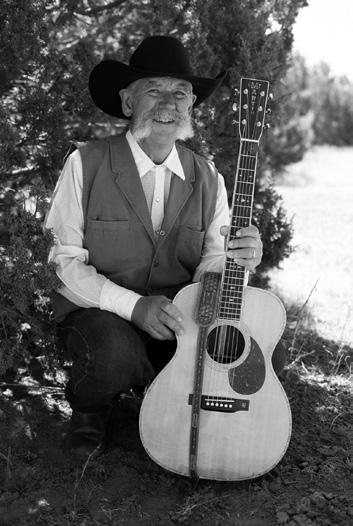
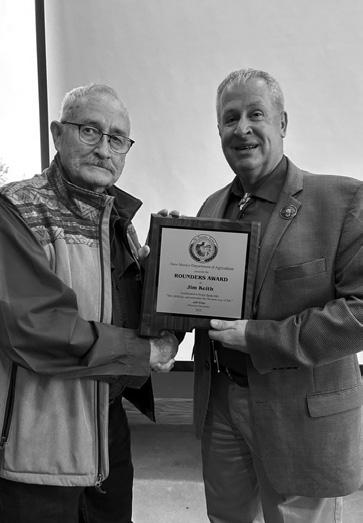
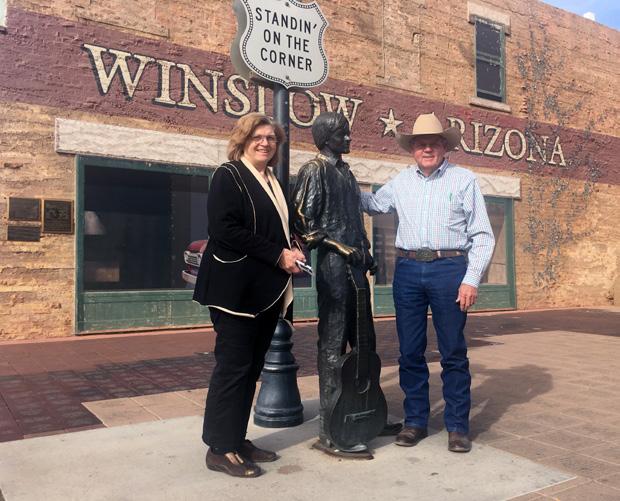
New Mexico singer-songwriter Randy Huston and farrier Jim Keith received the 2025 Rounders Award in October at the New Mexico Farm and Ranch Heritage Museum in Las Cruces.
Randy Huston, a rancher, rodeo competitor and acclaimed singer-songwriter, has performed nationwide. His songs have been recorded by artists such as Lee Ann Womack, Darryl Singletary and Chris LeDoux. Huston has earned numerous awards from the Academy of Western Artists, International Western Music Association, Western Writers of America, and the National Cowboy Hall of Fame. Beyond music, he has been a longtime advocate for American agriculture and continues to raise cattle on his family ranch near Cuervo, New Mexico.
Jim Keith, often described as a “Renaissance man,” grew up in Springer, New
of New Mexico Department of Agriculture
Mexico, and has lived a life deeply tied to ranching, rodeo and horseshoeing. A fourtime World Champion Blacksmith and acclaimed farrier, Keith also taught horse-
shoeing, judged major competitions around the world, and managed the American Farrier Team. In retirement, he turned his focus to cowboy art and writing, publishing I Never Called Myself a Cowboy and working on his second book, Looking Back: 66 Years of Shoeing
New Mexico Agriculture Secretary Jeff Witte presented the awards to Huston and Keith.
“I am proud of the legacy Max has left in Western culture, and this year’s Rounders Award recipients definitely live and articulate the Western way of life. Max would be proud,” said Witte. “Jim Keith and Randy Huston have built remarkable careers that honor our ranching traditions and Western heritage.”
The award was named after The Rounders, a classic Western novel that was written by Max Evans. Created in 1990 by former New Mexico Agriculture Secretary Frank DuBois, the award honors those who live, promote and articulate the Western way of life. Max Evans was the first-ever award recipient. Evans passed in 2020; however, the Rounders tradition lives on. This year’s recipients, described as vivid creators of Western art who embody the tradition of the award, join 38 previous honorees.
For a list of past Rounders Award recipients, visit the NMDA website. ▫
Cowboy and singer-songwriter Randy Huston is a 2025 Rounders Award recipient. The Rounders Award, named after the classic Western novel written by Max Evans, serves to honor those who live, promote, and articulate the Western way of life. (Photo courtesy of Randy Huston)
Farrier Jim Keith is a 2025 Rounders recipient. The Rounders Award, named after the classic Western novel written by Max Evans, serves to honor those who live, promote, and articulate the Western way of life. (Photo courtesy
Pass All the Interstate Health Care Worker Compacts in 2026
by Fred Nathan, Executive Director, Think New Mexico
When the legislature convenes in January, they should enact a straightforward reform that will immediately increase access to health care providers in New Mexico: join all the interstate compacts for health care workers.
Similar to the way that a person can hold a driver’s license from one state and legally drive in another, states that participate in an interstate compacts agree to recognize licenses issued to health care professionals by other states.
New Mexico’s failure to join the compacts means that doctors from other states cannot legally care for New Mexico patients – even via telehealth – without going through our state’s cumbersome licensure process. As a result, New Mexicans who desperately need access to care are forced to wait months for an appointment or travel out of state to find a doctor.
Forty-three states and D.C. participate in the interstate compact for physicians, including all five states that border New Mexico. A growing majority of states also participate in compacts for psychologists, counselors, physical therapists, audiologists and speech therapists, physician assistants, dentists, and emergency medical personnel – all fields where New Mexico has shortages.
States that join the doctor compact experience a 10 to 15 percent increase in the number of doctors being licensed in their state every year after joining the compact, according to the New Mexico Medical Board.
Considering New Mexico’s urgent and worsening health care worker shortage, it is unconscionable that our state remains one of just four states that participates in one or no compacts. Meanwhile Colorado has joined all ten compacts; Utah is in nine; Oklahoma is in eight; Arizona is in seven;
and even Texas is in five.
Since 2003, New Mexico has been one of 40 states in the Nurse Licensure Compact. As many as 80 percent of the nurses at some New Mexico hospitals, particularly in rural and border areas, would not be practicing here if New Mexico was not in this compact.
Passing the interstate compacts will also improve New Mexico’s application for federal funding for rural hospitals. The U.S. Health and Human Service Department will allocate $25 billion a year to states over the next four years from the new Rural Health Transformation Fund. State applications for those dollars will be evaluated based on several factors – including whether the state participates in the compacts for physicians, physician assistants, emergency medical personnel, nurses, and psychologists.
The House already unanimously passed seven of the compacts during the 2025 legislative session. Governor Lujan Grisham is strongly supportive of the compacts as well. (All four candidates for governor, Republican and Democrat, have also endorsed the compacts.)
Unfortunately, during the 2025 regular session, the Senate Judiciary Committee killed six of the seven compact bills without a hearing and killed the doctor compact by making 32 amendments to the bill. Because compacts are agreements between states, all states must agree to the same terms, similar to signing a contract. If New Mexico passes a compact that is materially different from
the version that other states have passed, those other states would not allow us to participate in that compact.
The senators who oppose the compacts are trial lawyers, and their only material objection is that the compacts would not allow trial lawyers to sue the interstate commissions that oversee the compacts for their official acts. This is, by the way, exactly the same protection that New Mexico’s Medical Board already has under state law.
The good news is that support for the health care worker compacts is broad and deep, with endorsements ranging from AARP-NM to Patients Primero to medical providers themselves. Support for the compacts unites New Mexicans across the political spectrum, from multiple Indivisible chapters to the Coalition of Conservatives in Action; from Planned Parenthood of the Rocky Mountains to the Conference of Catholic Bishops; and from the New Mexico Chamber of Commerce to the American Federation of State, County & Municipal Employees union.
New Mexicans should not have to wait any longer for this commonsense reform to increase access to health care and maximize New Mexico’s chances of receiving urgently needed funding for our rural hospitals. Please visit www.thinknewmexico.org to contact your elected officials and urge them to pass all of the interstate compacts for health care workers during the 2026 legislative session.
NEW MEXICO’S OLD TIMES & OLD TIMERS
by Don Bullis, New Mexico Author donbullis@msn.com
Governor Merriwether’s Last Hooray
Territorial Governor David Meriwether’s tenure in New Mexico got off to a rocky start as discussed in last month’s column.
While he was dealing with various problems in New Mexico, an envoy of President Pierce, James Gadsden (1788-1858), was in Old Mexico negotiating a new border treaty to officially settle the border dispute between the two countries. That meant that Meriwether had a very small role to play in the final settlement of the matter. It was left to him, however, to oversee the resettlement of the Mesilla Valley which was returned to the ownership of the United States by the terms of Gadsden’s treaty in late 1853. On November 16, 1854, after a meeting with Governor Trías, Meriwether watched as the Mexican
Flag at Fort Bliss was struck and the United States Flag was raised.
While his first purpose in New Mexico was the settlement of the border dispute, he was also faced with a plethora of Indian problems. These were a continuation of problems that had existed since the Spanish entrada of 1598. Indian depredations, with only a few relatively brief periods of peace, had been a problem since then. The new governor made an effort to create a peaceful frontier.
Meriwether believed that force of arms was the best way to deal with hostile Indians. He supported the organization and maintenance of a large voluntary military force, supported by the federal government, to this purpose. He also favored the establishment of reservations far removed from “white” settlements. This was a departure from his predecessor, William Carr Lane, who had believed in a program of feeding Indians into submission by making them dependent on the territorial government for sustenance. Meriwether understood that such a plan could not succeed forever, and indeed it did not.
When the governor was obliged to tell the Jicarilla Apache people that he could not provide food rations to them, for want of money to do so, they went on the attack. This
was met with counter insurgency efforts by the United States Army. Volunteer troops, four companies of them, under the command of Ceran St. Vrain (1802-1870) and regular army troops under Colonel Thomas Fauntleroy (1796-1883) won out and a peace treaty was signed in July 1854. That did not bring peace to northern New Mexico, however, as the Utes continued raiding in the area. Colonel Fauntleroy defeated them in May 1855.
With a semblance of peace in the northern reaches of the territory in place, Meriwether focused his attention on the Apaches in the South. With the help of the Indian agent, Dr. Michael Steck, he traveled to Fort Thorn—north of present-day Hatch— where he met with a chief named Cuchillo. His own account of the conclusion of this negotiation was, “…[A]fter a long harangue on both sides, peace was made, and they [Apaches] agreed not to molest the Mexicans any more [sic].” This treaty was concluded on mid-June 1855.
His next peace effort was with the Navajo Indians of west central New Mexico. He traveled west to Fort Defiance and met with Navajo leaders Zarcillas Largo and Manuelito during the summer of 1855. He had a wagonload of goods which he passed around as gifts. A treaty which defined Navajo
country was agreed upon and signed in mid-July.
In spite of the work Meriwether did in negotiating peace treaties with the hostile Indians of New Mexico, the Congress of the United States failed to approve a single one of them.
In the fall of 1855, Meriwether took his second leave of absence and returned to the east. He visited with President Pierce and attempted to resign from office. President Pierce said, “We both entered upon the discharge of our duties about the same time, we have gotten along harmoniously, and I prefer you to continue in office until your term expires.” Meriwether returned to New Mexico for the last time in the late spring of 1856.
Back in May 1853 (one source said 1850), the United States Congress had appropriated some $30,000 for the construction of a prison in Santa Fe. It fell to Meriwether to select a site for the new pen, and to appoint a panel of building commissioners. In the former matter, he soon learned that a group of spec ulators owned a piece of land they offered as a site for the prison for $3,000; a parcel of land for which they had paid $1,000 only a few weeks earlier. The governor declined and said, “[I] purchased a site for $500, which was
much more suitable.” That caused a rift between his office and the commissioners he had appointed. He fired all of them and took over supervision of the project himself. He also took on construction of a new state house. He appointed Judge Joab Houghton (1811-1877) as superintendent of the construction projects. That was a wise decision because Houghton was a civil engineer by education.
In spite of that, the projects moved slowly and were not even close to completion when Meriwether’s term in office ended; and in fact, the construction projects were never completed. A federal building was constructed on the prison site some years later.
Meriwether had one more battle to fight before he left the territory. “A number of Americans,” the governor wrote, “mostly gamblers and discharged soldiers, procured the passage of a bill through both houses [of
wether closed his career in Santa Fe much as he had started it: with threats of violence from some of his constituents.
David Meriwether left New Mexico in May 1857 and there is nothing to indicate that he ever returned. When he dictated his autobiography to his granddaughter in 1886, he chose to end it with his term in office, even though he continued to live an active life. He was elected to the Kentucky legislature in 1858 and served off and on for nearly thirty years, serving his last term at the age of eighty-five. It is worth noting that while Meriwether owned slaves and was an advocate of the institution of slavery in his early life, he remained loyal to the Union during the Civil War.
He died in 1893 at the family plantation near Louisville at the age of ninety-two. ▫
Don’t Waste Our Water Future
by Howard Hutchinson
After decades working on water and land issues in New Mexico including over 20 years on the Water Quality Control Commission, one truth stands out: foreclosing potential new water sources shortchanges future generations.
I have spent my life defending water and property rights. Today, produced and brackish water sit in a “gray area” of policy and public perception. But here’s the reality: New Mexico has no new water sources. If we want to sustain our communities, we must explore how to treat and use what we already have.
Unfortunately, fear and opposition to oil and gas use cloud this conversation. Some refuse to even consider treatment options for produced water. That mindset is a disservice to our state. Choosing to do nothing is still a choice — one that leads to higher costs and fewer options.
Texas isn’t waiting. They’re treating produced water, testing its uses, and investing in infrastructure. Meanwhile, New Mexico
pays to truck water across the border — a costly, missed opportunity.
I’ve seen the potential myself, touring a brackish water treatment facility in El Paso. It works. With smart planning and strong oversight, New Mexico can build similar systems to serve communities in need.
Of course, safeguards and accountability are essential. But slamming the door before understanding the possibilities is shortsighted.
New Mexicans have always been innovative. Reusing produced water and treating brackish water should be part of that tradition. These strategies can preserve freshwater, create jobs, and strengthen local economies.
If we fail to adapt, we leave the next generation with fewer tools and higher costs. But if we confront the hard questions today, we give them a stronger, more secure future.
The choice is clear. Let’s stop wasting what we have and start making the most of it.
Brangus Brief
by Kyle Caldwell, International Brangus Breeders Association
The beef industry is never boring. If you want to stay ahead of the game, stay knowledgeable of the industry’s current events. Part of our goal with this new Brangus Journal format is to help Brangus breeders be the best cattlemen you can be by equipping you with the information needed to stay ahead.
The “Meat” of the Matter
Despite minor swings over the last couple of weeks, feeder cattle markets across all weight groups and regions have remained high, driven by a still-weak cattle supply and soft corn market. According to CattleFax, the composite beef carcass cutout (value of a beef carcass) across all quality grades is up $70/cwt over last year at this time, and up $116/cwt from two years ago.
The Choice/Select spread is a measure of the difference in price between a USDA Choice and a USDA Select carcass. This spread typically fluctuates seasonally, getting tighter in January/February, and steadily increasing throughout the year. Right now, the spread is about $12, down from about $20 from the last two years at this time of year, driven in my mind by one major issue made up of a few smaller issues: a tight supply of overfed cattle.
Fed cattle prices are sky-high, so the math says feed them as long as you can. Overfed cattle means more fat on an already heavierthan-ever carcass, leading to an oversupply of fat trimmings with and not enough lean trimmings to satisfy the U.S.’s most popular cut of beef: ground beef. This is what drives U.S. beef imports. It isn’t valuable middle meats like ribeyes, strip loins or tenderloins, it is lean trim to supply the ground beef market.
This is an area of expansion for the U.S. beef industry that focuses not only on the size of a ribeye, but on the total red meat yield of the entire carcass. Brangus cattle have long been known to have superior muscle confirmation compared to British breeds and other American breeds. High quality, high yielding carcasses are the way forward and Brangus will be leading the charge.
Howard Hutchinson lives in Glenwood, New Mexico. He is a former Water Quality Control Commissioner, Executive Director of the Coalition of Arizona/ New Mexico Counties for Stable Economic Growth, and Chair of the San Francisco Soil and Water Conservation District. ▫
Make the Most Out of Your Market Calves
Let’s end on a high note. The calf market is hot- really hot. Premium cattle will always bring a premium, and commodity cattle will always bring commodity prices. I have said it before, and I will say it again. If you have the ability, DO NOT SELL STRAIGHT OFF THE COW, WEAN AND VACCINATE YOUR CALVES!!
Selling value-added calves successfully requires a bit of a mindset shift. Those calves will be weaned and vaccinated one way or another by the time they leave your front gate, so I think of weaning and vaccinating as the bare minimum of what we should be doing as a commercial producer. Consequently, any unrealized “premiums” related to weaning and vaccinating, are avoidable discounts. The real question is, how much
cash are you giving up, paying someone else to do it for you?
According to CattleFax, calves sold straight off the cow bring an average of $200 less per head than those weaned at least 45+ days, although most feeders and backgrounders prefer 60 days. Furthermore, unvaccinated calves are discounted $80 per head; therefore, unweaned, and unvaccinated calves are looking down the barrel of a $280 discount.
Now let’s get to the premiums. According to CattleFax, this year, calves with two rounds of vaccinations (2 rounds of 5-way, and two rounds of 7, 8, or 9-way vaccines) earned an average of $136/head premium over just one round of vaccinations. More-
over, cattle participating in an Age and Source verification program earned an average of $124/head premium over those not on an age and source program.
Here is the good news: the Brangus Vigor feeder calf program through IBBA grants you access to all these premiums in a recognizable, marketable package. Cattle eligible for Brangus Vigor must be sired by a registered Brangus or Ultra bull, age and source verified, weaned 60 days, two rounds of vaccinations and originating from a BQA-certified producer. All these specifications are designed to help you, the producer, maximize the return on your market calves, all for a mere $5/head enrollment fee.
www.lackmorrisonbrangus.com Attend the 35th Annual Roswell Brangus Bull & Female Sale Saturday, February 28, 2026
JANUARY — Wildlife; Gelbvieh; Joint Stockmen’s Convention Results
FEBRUARY — Hereford; Beefmasters; Texas Longhorns
MARCH — Limousin; Santa Gertrudis
APRIL — Dairy
If you would like to see your breed featured email caren@aaalivestock.com
To Reserve Advertising Space email chris@aaalivestock.com or call Chris at 505.243.9515, ext. 28
MAY — News of the Day
JUNE — Sheepman of the Year
JULY — Directory of Agriculture
AUGUST — The Horse Industry
SEPTEMBER — Charolais; Fairs Across the Southwest
OCTOBER — Angus; Brangus; Red Angus; NM State Fair Results
NOVEMBER — Cattleman of the Year; Joint Stockmen’s Convention Preview
DECEMBER — Bull Buyers Guide
PARKER BRANGUS
Private Treaty Sales at the Ranch
Registered & Commercial
“Brangus Raised the Commercial Way”
DIANE PARKER
P.O. Box 146, 1700 N. Parker Rd., San Simon, AZ 85632
Diane’s Cell: 520-403-1967 • Bus: 520-845-2411
Email: jddiane@vtc.net
Jacob Brown - Cell: 520-780-7937
Protect What You’ve Worked For...
You Can Count On Us For All Your Insurance Needs! ... with Pasture, Range and Forage Insurance and Livestock Risk Protection Insurance
It’s Decision Time. From rainfall protection to livestock coverage —We’ve got you! GARNETT INSURANCE AGENCY
Ultrasound
Data is a tool used to enhance the accuracies of carcass EPDs.
Source: Red Angus Association of America
As producers are faced with the challenge of improving the consistency and efficiency of beef production, they are turning more and more to the use of technology to do so. Real-time carcass ultrasound offers producers a means of genetic improvement by enhancing the accuracy of their cattle’s carcass EPDs. While the actual scan information itself can be interesting to review, it has little-to-no-value for genetic improvement unless incorporated into a genetic evaluation.
Relative to progeny testing and actual carcass data collection, ultrasound is a less expensive and more efficient means of evaluating carcass traits in breeding seedstock. The phenotypes collected through ultrasound and used to enhance RAAA carcass EPDs are ribeye area (REA), back fat thickness (BF), percentage of intramuscular fat (IMF).
RAAA requires that these traits are collected by an Ultrasound Guidelines Council
(UGC) Certified Field Technician and the images are interpreted by a UCG Certified Interpreter (lab). After the collection and interpretation process, the data is electronically sent to the RAAA National office where it is uploaded into the REDSPro database for use in EPD calculations.
Ultrasound is a great method for seedstock producers to evaluate the carcass traits in individuals that are not packer bound but will affect their bottom line on those that are. It is best to collect ultrasound information on as many animals in a contemporary group as possible, both males and females.
Data Requirements
1. Animals must have weaning data on file in order for ultrasound information to be used.
2. Animals should be 320 – 440 days of age. Any animal scanned that is younger than 270 days or older than 500 days will not be included.
3. A scan weight must be collected at the time of ultrasound. If a yearling weight is not entered separately by the member, scan weights will automatically default to yearling weights as well.
4. Animals must be submitted with the ID and registration number that corresponds
to their RAAA registration certificate.
Management Codes and Contemporary Groups
A contemporary group is a set of cattle that are exposed to the same environmental conditions and includes ALL cattle within that environment. In addition to the following, animals must be contemporaries at birth and weaning in order to group together at ultrasound or yearling.
1. Animals scanned on the same date.
2. Animals with the same scan management code. Be sure to communicate with your technician about differences in management of animals that may be scanned on the same day so they can designate them accordingly.
3. Group code - if animals are indicated as managed/fed differently, they will be contemporaried separately.
Data Collection Preparation:
1. Schedule an appointment with an Ultrasound Guideline Council (UGC) Certified Field Technician at least one month in advance. Coordinating scanning times with other producers may be less expensive if technicians are able to scan large numbers of cattle in a small geographical area. A list of technicians certified by UGC is available here: https://www.hugedomains.com/ domain_profile.cfm?d=ultrasoundbeef.com.
2. Provide technician with a barn sheet that includes all animals to be scanned.
Ї When logged in to REDSPro, go to Reports/Downloads – My Reports.
Ї Select a group on the left (i.e. 2021 born bulls) or enter the specific registration numbers under Quick Group.
Ї Select the Ultrasound Barn Sheet on the right under Default Reports.
Ї Generate Report and then Download into an Excel file to email to your technician or print off the page. Ensure the correct facilities and responsibilities are covered by communicating with your scan technician and (if applicable) the facility manager. Examples of breeder/facility responsibilities include:
Ї Squeeze chute in a location out of direct sunlight.
Ї Electrical supply for ultrasound machines.
Ї Cattle clipped to ½-inch in scanning locations.
Ї Ability to collect and record animal weight.
Results:
1. The scan technician sends images to an UGC certified lab to be interpreted and the resulting data is automatically forwarded to RAAA.
2. RAAA staff will upload the data upon receipt from the lab. The member will be notified via email that the data has been
received. Other parties will be notified only when contact information from the processing lab indicates to do so.
3. Adjusted measurements are immediately available and can be found in REDSPro under Reports/Downloads – My Reports by generating an Ultrasound Summary Report or viewing the Expanded Report on an animal’s pedigree.
4. EPDs will be updated automatically after the ultrasound information has been run through the subsequent weekly IGSBOLT evaluation. ▫
N ovember 20, 20 25
Commercial Females 400 head bred cows-bred heifers
Lunch at noon, sa le at 1 pm MST At the K2 Sale barn, Wheatland, WY Request your catalog today!
Carolyn Dunlap Bedford, 84, passed away on September 20, 2025, in Richmond, Virginia. Born on May 9, 1941, in Hereford, Texas, she lived a life marked by resilience, warmth, and a deep commitment to family and community.
Carolyn grew up in a ranching family, graduated from Tatum High School in New Mexico in 1959 and went on to attend Eastern
New Mexico University. In 1960, Carolyn married Larry Bedford, who also grew up in a ranching family from New Mexico.
Carolyn’s early years laid the foundation for a life of adaptability and grace as she moved across the country with her family. Corporate acquisitions and mergers in Larry’s agricultural industry necessitated moves to Iowa, Arizona, Michigan, Arkan-
Location: 507 Boundary Court SE, Albuquerque, NM – Live Webcast Auction. Starts at 8:30am
sas, and Kansas. Carolyn had a remarkable ability to create a loving home wherever she went. Her gift for forming lasting friendships enriched each community she touched.
After Larry’s retirement from the corporate world, Carolyn and Larry returned to their roots and moved back to the Bedford Ranch in Santa Rosa, New Mexico. For more than 15 years, they were able to bring friends and family to the ranch and give them a glimpse of ranching life in the high plains. In 2020, Carolyn and Larry moved full-time to Richmond, Virginia.
An accredited floral design judge, Carolyn was frequently recognized for her keen eye and artistic sensibility. Carolyn was a longterm member of the National Garden Club, PEO and Cattle Women, and held various offices in these organizations. In the Richmond area, Carolyn was a member of the Sleepy Hollow Garden Club and the Designers Guild. On a weekly basis, Carolyn turned donated flowers into elegant floral designs and distributed them to nursing homes in the Richmond area. Her passion for floral design brought beauty into the lives of many and reflected her appreciation for nature’s elegance.
A devoted wife and mother, Carolyn is survived by her husband, Larry Bedford; her daughter Danna Flaherty (Richard); her grandsons Max Flaherty and Wyatt Flaherty,
and her step-granddaughter, Sylvia Mosser. Carolyn’s nurturing spirit and steadfast love were central to the lives of those closest to her.
Carolyn was preceded in death by her parents W.O. and Pearl Dunlap; her son William (Bill) Bedford; and her siblings Lewis Dunlap, Cathryn Dunlap Kittleson, Evolyn Dunlap Terpening, Marjorie Dunlap Fraley, and Jim Dunlap.
Carolyn’s legacy is one of enduring love, quiet strength, and an unwavering dedication to those around her. May her memory bring comfort to all who knew her.
Jayne Ilene Taylor was born June 11, 1937, in Clovis to the home of Beulah “May” (Warnock) and Joe Wilcox, and passed from this life on October 6, 2025. Mrs. Taylor grew up in the Kenna community, and graduated from Elida High School in 1955.
Three days later, on May 15, 1955, she was married to Bennie Taylor. Until 1973, they made their home in the Arch community. Since that time, they have lived in Elida where they ranched. Jayne was the consummate ranch wife, working right alongside her husband, doing branding and anything else that needed to be done. She worked hard for the benefit of the agriculture industry, writing letters to senators and representatives. Jayne was a dedicated follower of Christ, and a faithful member of the Dora Church of Christ.
Jayne was an excellent cook as a seamstress. She was a student of Roosevelt County history, and had written a book on the community of Kenna. In addition, she studied genealogy. Jayne had the gift of hospitality, and her home was the gathering center for all sorts of family gatherings. Through the years she had prepared countless meals for funerals and people who had family illness or crises of various sorts. She was always a very soft spoken, kind lady with an encouraging word for family and friends.
Jayne loved antique furniture, and had bought and refinished numerous pieces. Her greatest joy was spending time with her children and grandchildren. One of her favorite activities with them was to play an aggressive game of Aggravation.
She is survived by Bennie, her husband of 70 years; a daughter and son-in-law, Suzanne and Tim Bob Wilson, Andrews, Texas; a son and daughter-in-law, Buddy and Donna Taylor, Elida; four grandchildren, Marcy (Terry) Butts, Terral (Haley) Wilson, Jayme (Randal) Craig, and Janice (Chad) Gustafson; 11 great-grandchildren and 1 great-great-grandchild; and a sister, Josephine Freeman, Fairfax, Virgina.
STICK HORSE SCRIPTURES
by Maureen T. McGinn
This book is a fresh perspective to the vital teachings of the Ten Commandments through the use of a “Stick Horse.” It is a tremendous “hands on” tool for bedtime stories, road trips and Sunday school classes.
The colorful book is designed to be used by parents, grandparents or any adult who cares about children and wants to pass on these timeless truths.
Maureen T. McGinn has loved, and worked with children for over 40 years. She worked as a children’s Pastor for 10 years, through vacation bible schools, backyard bible clubs and all variety of venues. She shares the significant truths of God’s word in a creative way in order to convey God’s truths to children early in their lives.
Hardcover books are $22.95 / Soft cover is $13.95
Books may be ordered at westbowpress.com
These would make great Christmas gifts!
New Mexico is in mourning. Michael Quintana who gave his all to New Mexico and its people, died August 27, 2025 in Las Cruces. He died in his sleep of a heart attack - his dog, his horse and his cowboy hat nearby. He was 75.
Michael adopted New Mexico in his teens. He began a lifelong love affair with the state working cattle on a ranch outside Anthony, near his birth city of El Paso. He went on to earn a Master’s degree in rural economic development at New Mexico State University. It opened the door to several careers, but in his heart-of-hearts Michael was always a New Mexico cowboy. It was as a cowboy with a Master’s that he
helped the Navajo Nation with its Churro Sheep Project and worked with the Indo-Hispano community to reclaim the lands taken from them by the U.S. government despite the promises of the Treaty of Guadalupe Hidalgo.
He worked as a top staffer for the State Legislature and served for a time as district director for New Mexico’s Third Congressional District. He went on to become the state’s District Resource Manager for southern New Mexico. He retired from there in 2020.
Throughout his careers – when not on an annual trek to advise the Kurds of Kazakhstan on improved farm and ranch practices
RIO PECOS VETERINARY
Livestock Veterinary Supplies & Services
- Michael lived his cowboy life by helping countless New Mexico ranchers run their herds and move their cattle to market.
Over the decades of his adult life, Michael lived in Santa Fe, El Rito, Las Cruces and Deming. He took great pride that he roped in rodeos and rode bareback broncs in his youth despite a leg permanently damaged in a high school motorcycle accident.
Born March 29, 1950 in El Paso, Michael is survived by his twin sister JoAnne Quintana, Albuquerque; his brother Joe Quintana, Whidbey Island, Washington; his mother, Beatriz Johnson in memory care El Paso; a beloved niece, Rita Bentley, Durango, Colorado, and her daughter Danielle; and nephews Marcus and Mario Quintana in Washington state. Plus thousands of New Mexicans who knew and loved him well.
May he rest in peace.
Clinton Dewey Harden Jr., 78, Clovis, peacefully passed away on October 18, 2025 at his residence. Clinton “Clint”, also known as Poppy, was born on April 12, 1947 to Clinton Dewey Harden Sr. and Doretha Ellen Miller Harden in Belen.
Clint enjoyed playing his guitar while making up stories, team roping, coaching youth football, boys’ baseball, girls’ basketball, girls’ softball, girls’ AAU Basketball, and played softball for Guy’s Electric coached by Guy Leeder. Clint lovingly called his home “Rancho Not So Grande”. Loved riding with his grandchildren, practicing team roping on his trusty horse, Rascal with his son-in-law, Michael.
He proudly attended the United States Naval Academy from 1965 to 1968 where he was the varsity quarterback. He transferred to University of Utah where he also played varsity quarterback and received a Bachelors of Science in Business Management in 1970. He later went on to receive his Masters in Business Administration from Eastern New Mexico University.
Clint married Kathrine Hope Rexroat on August 5, 1968 in Pampa, Texas. They lived in Salt Lake City, Utah until 1978, moving to Clovis purchasing Twin Cronnie Drive In from his Aunt. Clint ran several businesses in Clovis and became involved in politics campaigning with Walter Bradley, New Mexico Lieutenant Governor. He then worked on Governor Gary Johnson’s campaign. Clint served in Governor Johnson’s Cabinet as Secretary of the Department of Labor until he was appointed as State Senator in 2002 for NM District 7. He served as State Senator for 10 years.
He was known by many to work hard for all the people of New Mexico reaching across
party lines finding common ground and building from there. He worked on legislation to remove barriers for formerly incarcerated individuals seeking to return to work, successfully sponsored Senate Bill 39, requiring insurance companies to cover Autism treatment for children and teens. He continued to successfully ensure coverage and support for people with Autism through adulthood. Following his departure from the Senate in 2012, he entered the lobbying field to continue his public policy work.
Survivors include his wife, Kathrine Harden; daughters, Danielle Henderson (Jack), Dionne Fish (Michael); son, Dustin (Kelli); grandchildren, Lisa Sena (Issac), Matthew Oliveira, Madison Amaral (Devin), Brody Fish, Jaden Harden, Dustin Harden Jr.; great-grandchildren, Samantha Gallegos, Luke Sena, Emily Sena, and Jace Amaral; numerous cousins; and his loyal fur baby companion, Ace.
Memorial Service will be held on Saturday, November 8, 2025, at 2:00 pm at The Chapel, 1500 Thornton Street.
Editor’s Note: Email caren@aaalivestock.com. Memorial donations may be sent to the Cattlegrowers’ Foundation, a 501(c)3, tax deductable charitable foundation serving the rights of ranch families and educating citizens on governmental actions, policies and practices. Cattlegrowers Foundation, Inc., P.O. Box 7517, Albuquerque, NM 87194. The New Mexico Stockman runs memorials as a courtesy to its readers. If families & friends would like to see more detail, verbatim pieces must be emailed to us, & may be printed at 10¢ per word.
VIEW FROM THE BACKSIDE
by Barry Denton
The Folly of Protest
(The views expressed in this column are not necessarily those of the New Mexico Cattle Growers’ Association or this publication.)
It was so funny to see the anti-American paid protestors they were showing on television this past Saturday October the 18th. As the news people tried hard to make the crowds bigger than they were, it just was not working.
Many protest sites were not well attended. Just think, most attendees are paid protestors. I cannot imagine getting up in the morning, getting on a bus, and riding somewhere to protest for a few bucks.
Then throw in the token Hollywood star with a big mouth and you get yourself a minor protest. The funny thing is that the Hollywood star that has probably made millions because of the freedom we have in this country is the one complaining.
While the television cameras are scouring the crowds, they never seem to pick up a group of cowboys or ranchers. I also have never seen any hard-working American at a protest.
Normally they would not have time to protest nor the energy for such a pathetic cause. Stop and think about the paid protestors themselves. They certainly aren’t being escorted to a protest in limousines, they are riding a bus.
That’s pathetic in my book. If I were going to be hauled somewhere to professionally complain about some trivial issue, I would expect to go first class.
According to the television news they estimated 7 million protested. That is less than ten percent of the 72 million that voted for Trump. Not much of an impact
by the folks that are mostly living off the goodwill of the taxpayer.
I will never forget what I saw happen in Mexico back in the late 70s. President Portillo wanted to celebrate the opening of the first nuclear plant in Mexico.
In order to show lots of support for the new plant, Portillo’s government paid thousands of Mexican peons to line the roads cheering as the presidential limousine drove to the nuclear plant.
If I remember correctly the cheering Mexicans got groceries and new blankets in the deal as well. Hey, it’s another way to exploit poor folks to get good television coverage.
Stop and think for a minute about the absurdity of a protest. Just imagine all the energy that gets put into a protest going into helping people in your own community. For instance, if those protestors went directly to their elected representatives in mass, and tried to offer constructive solutions to their problem, then a problem might be remedied.
Think of the impact a Hollywood star with a big mouth could have on wellness if they went to a hospital and tried to inspire healing patients instead of chaos. Instead of riding a damn bus, spend that time and effort helping the elderly with a project they can no longer do.
What self-centered people do not grasp is that acts of kindness and charity always come back to you tenfold.
While I realize that Americans have a right to protest, I also realize that they have a right to be stupid as well. Besides, you will also get to see many of America’s laziest citizens and illegal aliens at a protest.
If they are protesting in your area, it might be good to go down there and take pictures just so you can see what a protestor actually looks like.
I can think of plenty of things to protest such as the communist Beef Checkoff, lack of country of origin labeling on beef, foreign cattle being brought in with fewer restrictions than domestic beef, and so on.
However, I just do not have the time because this ranch works me to death. Believe me, I have plenty of “beefs”! Besides, I hate riding on buses!
Kaddatz Auctioneering & Farm Equipment Sales
New & Used parts, Tractor & Farm Equipment. Salvage yard: Tractors, Combines, Hay & Farm Equipment
Online auctions: We can sell your farm, ranch & construction equipment anywhere in the U.S.
and Gas Development Issues
Rights/Water Quality/Water Disposal OCD Hearings
Disputes Easements/ Access issues Right-of-Way/Condemnation Permitting/ Leasing BLM, Forest Service, State Lands Mineral Development Business Dissolution/ Probate Ranch Sales/ Leases/ Purchases Wind & Solar Leases/ Pollution/ Environmental Gas
Pete V. Domenici, Jr., Esq. 320 Gold Avenue SW – Suite 1000 Albuquerque, NM 87102 505/883-6250 • 505/884-3424 Fax www.DomeniciLaw.com
John & Laura Conniff 1500 Snow Road, Las Cruces, NM 88005 575/644-2900 • john@conniffcattle.com www.conniffcattle.com
Petroleum Building 14 e Beauregard Ave , Suit e 201 San Angelo, texas 76903-5831 ofc : 325/655-3555
Buggy Wheel Ranch – Coconino County, Arizona: 446 deeded acres located between Flagstaff and Williams, north of I-40 in the Pittman Valley. Surrounded by tall ponderosa pine the property has access to electrical service and includes paved access along Buggy Wheel Ranch Road. Tremendous privacy being surround by National Forest land on three sides, yet only minutes to I-40 access. Price: $9,500,000 Contact Traegen Knight.
Milky Ranch – Apache County, Arizona: 450 AU including 37,518 deeded acres with an additional 7,680 acres of Arizona State grazing lease located between Holbrook and Saint Johns, Arizona. The ranch is located directly off of US Highway 180 including seven miles of highway frontage. All access to the ranch is via private property and is contained behind locked gates and provides one-of-a-kind privacy with vast views of the National Park. Also included is an additional 7,270 deeded acres located outside the ranch fence. Price: $14,000,000 — Contact Traegen Knight.
Hay Hollow Property – Navajo County, Arizona: 19,458 deeded acres located between Holbrook and Snowflake, Arizona along the Little Colorado River. Stunning views of painted desert scenery accessible by County roads yet great privacy and the feeling of seclusion. This could be a great investment or development property for solar, wind or residential use. Price: $6,500,000 Contact Traegen Knight.
Burro Springs Ranch – Grant County, New Mexico: 423 AU with 1,073 deeded acres, state and blm leases located north of Lordsburg. Abundant old feed as ranch has been rested for two years. Livestock water supplied by four wells serving over twelve miles of pipeline. Nice set of shipping corrals located just off the improved county road with great access. Price $3,100,000 ESCSROW Contact Traegen Knight
TWO NEW MEXICO RANCHES
TORRANCE COUNTY, ABOUT 8 MILES SE OF WILLARD. 4,680 Acres of Deeded Land plus a small Forest Allotment. Mostly open grassland with some Cedar Trees. Two wells less than 150 feet deep with attached pipeline systems that include enclosed 12,000 gallon storage tanks and a total of 9 water troughs. Sandy-Clay Loam Soils support good turf and no erosion. A nice small operation suitable for a yearlong operation or a seasonal use for cows or yearlings or combination.
GUADALUPE COUNTY, JUST SOUTHWEST OF DILIA; which is between Las Vegas and Santa Rosa. 7,483 ALL Deeded Ranch, joins the Pecos River for over 2 Miles. Varied terrain with lots of “Scenic Views”! Both open grasslands and some pastures with scattered Juniper Trees. Six main Pastures and two smaller pastures-traps. Fences are good to new. Nice 2 bedroom, 1 bath house with a huge living room. Oldervery large barn and a brand-new barn/airplane hanger with concrete floor. A nice Ranch for cows yearlong or yearlings.
Vacant Land For Sale:
APACHE MESA, HWY 84, LAS VEGAS, NM – 140 deeded acres has incredible rim rock views. Mesa top grassland parcel is partially fenced. Has its own private well, power, fiber optics and live in sheds onsite. Great private get away location & owner will finance. Price is $325,000
APACHE MESA, LAS MONTOYAS, NM – 227 acres has two stock dams, fiber optics, power available, partially fenced & has incredible rim rock views. Located close to Hwy 84, easy access! Price is $354,400 & Owner will finance.
TIERRA DE DIOS, ROWE, NM – We have 3 parcels for sale, Two 20 acre parcels and a 10 acre residential parcel. All have electric transformers on the property line, fiber optics & community water stub outs, all are ready to build. Priced from $124,900 to $154,900
COUNTY ROAD B29A, VILLANUEVA, NM – This 38 deeded acre parcel north of Villanueva is partially fenced and shares a 100 gpm and some nice views. No restrictions on a couple of great home sites and its ready for your mfg. home, horses, llamas, goats, cows or kids. County Road maintained access road year round! Asking $89,900
MIAMI 80+/- ACRES, 3 bedroom, 2 bathroom home with water shares, roping arena, steel barn with shop. Other historic barns, Pipe corrals. Far enough off road to be private. Includes 80 shares of irrigation 2350 SHW 21, Miami NM 87729. $569,999
MIAMI PRIVATE 80, Located ¼ mile off blacktop with dedicated easement, 80 +/- deeded acres, large barn, small sleep out, buried utilities, domestic water meter, 80 shares of irrigation and septic able to handle a 3 bedroom home. Some of the best views in Miami. 2050 HWY 21, Miami NM 87729.$559,000
BAR LAZY 7 RANCH, Colfax County, Moreno Valley 594.38 +/- deeded acres, accessed off blacktop between Eagle Nest and Angel Fire. Historic headquarters. Currently used as summer grazing, pond and trees accessed off county road on rear of property as well. Presented “ASIS” New Survey, $3,800,000 $3,629,000
MAXWELL FARM, 320 +/- Deeded acres, 180.80 Irrigable acres, center pivot, mid 2000’s modular home, two water meters, two barns and one large insulated shop on concrete slab. $848,000
SIERRA MADRE RANCH
PATAGONIA, AZ —
Consisting of 50 deeded acres and 21,607 acres of Coronado Nat. Forest grazing acres. 350 head yearlong, beautiful owners home, and Improvements. High Rainfall area. Live water, Many improved springs. Priced at $4,950,000
I have many qualified Buyers looking for Ranches. Give me a call
If you are looking to Buy or Sell a Ranch or Farm in Southwestern NM or Southern AZ give us a call ...
www.scottlandcompany.com
Ben G. Scott – Broker
Krystal M. Nelson – NM QB 800-933-9698
5:00 a.m./10:00 p.m.
RANCH & FARM REAL ESTATE
We need listings on all types of ag properties large or small!
ac. +/- enrolled in the new Grasslands Conservation Reserve Program & 120 ac. +/- of the property in the standard CRP program. GCRP can be grazed year-round each year. Excellent fencing, one mile of hwy. frontage together with all-weather roads on the remainder, equipped with almost new set of steel working pens with scale, a second set of almost new working pens, watered by subs on electricity with pipelines furnishing water for drinkers in each pasture. Gramma & buffalo grasses. Broker owned.
■ UNION CO., NM—
irrigated by ¼ mile sprinklers, five irr. wells, one domestic well for office & feedyard & just across the hwy. an 800 ac. grass lease.
■ GUADALUPE CO., NM—
66 Ranch — 1,540 acres of rolling hills, native pastures, and rugged beauty nestled halfway between Santa Rosa and Tucumcari, New Mexico minutes off I-40 near Newkirk, perfect for ranchers, hunters, and outdoor lovers alike, this Guadalupe County gem offers room to run cattle, space to roam, and unforgettable views in every direction. Sheltering terrain draws in wildlife, making this property the real deal for those who crave privacy, purpose and the outdoors. Privacy, potential, and panoramic skies — give us a call to walk the land and make it yours.
■ QUAY COUNTY ALFALFA AND LIVESTOCK—
miles southeast of Tucumcari, NM in Quay County. A total of 112.3 ± acres irrigated, 107 ± acres of native grassland, and 40 ± acres of dry farmland is combined with a 20’ x 80’ shop with concrete flooring and electricity.
■ TELL, TX HALF SECTION —
TX on the northern end of Cottle County. With the majority of the ranch being native pasture, it lends itself to grazing opportunities, hunting or recreational use. Along with perimeter and interior fencing, a 60 ± acre portion of the property is tilled ground.
■ MULESHOE HOME AND FARM—
a 2017 built home in Bailey County 4.5 miles west of Muleshoe on FM 1760. The home has 3 br, 2 ba and an office. Other improvements on the property include a 4,032 sq.ft. pole barn with attached shed housing horse pens and cattle working pens. A 5 tower Zimmatic center pivot irrigates approximately 70 acres with three irrigation wells equipped with submersible pumps producing a total of approximately 150 GPM.
■ MCLEAN HWY. 273 RANCH —
595 +/- acres, good perimeter fencing, 1 mile hwy. frontage, located 1 ½ miles north of McLean.
■ PRICE REDUCED! CHOICE 320 ac.+/-, sprinklers, irrigation wells & an older home which would be liveable or could be moved. Located on pvmt. in prime farming area of Castro Co., TX.
tract is located roughly 21 miles north of Plains, Texas and 32 miles southwest of Whiteface, Texas. Mule deer in the area. Good small hunting, grazing ranch.
■ CLAYTON, NM.—
Hwy 87 on the East side of the highway. This property has about ½ mile of highway frontage and would be great for residential housing, commercial development or addtl. RV development (adjoins the 16.75 ac. RV park).
■ CLAYTON, NM —
on which has been partially begun infrastructure for an RV park. This property will also lend itself well as a large development such as new or existing businesses expanding their company.
■ DALLAM CO., TX— 480 acres in native grass in northeastern Dallam County. Possible wind potential.
Auctions are gaining momentum like never before—delivering faster results, competitive prices, and real-time excitement. We’re seeing more buyers, more sellers and more success with every auction! Feel free to call us if we can help you accelerate the selling process. Riding for the brand... is our time-honored tradition.
160 +/- Acre, San Simon Pistachio Orchard
■ PALO DURO CREEK TREASURE— 941 acres +/- in Randall Co. NW of Canyon, Tx. STUNNING VIEWS OVER LOOKING PALO DURO CREEK. Turn key cow/ calf operation w development potential. Property includes: 3/3/3 ranch style home, 4 wells, large shop plus shed, enclosed livestock working facility w/hydraulic chute, livestock pens & shed, miles of 5 & 6 barbed wire fence & over 7000’ of pipe fence. YOU WILL NOT WANT TO MISS THIS! Canyon School District.
50 Acres of third leaf Pistachio trees and 110 acres of second leaf trees. Planted and developed with best farming practices. USDA compliant. Irrigation well capable of producing 1,000+ gpm. Well currently equipped with an 8” submersible producing 625 gpm from 350’. $2,610,000. Call Harry Owens.
Prime 39.81+/- Acre Parcel
In the rolling grasslands of Elgin, AZ, a celebrated wine-growing region. Mild year-round climate at an elevation of 4,800’ ideal for homesteading, winery, equestrian pursuits or the peace and quiet of country living. Just 30 minutes from major services. $378,195.00
8+/- Ac, Equestrian Estate, Sonoita, AZ
3,472+/- s.f. home, 5-BR, 3-BA, vaulted ceilings, 3 fireplaces, private office with custom cabinetry, 6-stall horse stable with tack and feed rooms, round pen, outdoor pens, turnout area, fully fenced, 2 pastures, arena panels ready to go, shop 36’ x 36’; totally solar powered, grid tied as backup.
$1.25M. Owner/Broker.
RECENTLY SOLD
Ranches/Farms
Hale Ranch, Patagonia, AZ
218+/- Acres and 60 Head USFS Grazing Allotment. Sold prior to auction.
472± Acre Organic Apple Orchard (5 Tracts)
Horse Properties/Land
10± Acre Country Estate –Sonoita, AZ
Hilltop home with mountain views, stable, shop, orchard, water features. Sold at auction.
Includes processing facilities, retail center, two homes, wells, and apple trees. Sold at auction.
305± Acres – Ash Creek, Pearce, AZ Organic potential, cleared of mesquites, FAA landing strip, two wells, fenced/cross-fenced.
Pearce, AZ – Four Offerings at the Foot of Dragoon Mountains Lot 1: 3BR/2BA custom territorial-style home on 5.5± acres. Lots 3 & 4: Three vacant 1± acre land parcels. Sold prior to auction.
Nancy Belt, Broker 520-221-0807
Harry Owens 602-526-4965
Paul Ramirez 520-241-3333
ANTELOPE
ROSWELL, NM Discover the perfect blend of ranch life, recreation, and investment opportunity with this 737 acre property nestled in the heart of New Mexico ranch country. With 2,800 feet of Hwy 70 road frontage, rolling terrain, and breathtaking views of Capitan Mountain, this property is an ideal candidate for your dream retreat and outdoor living. Excellent new water well producing approximately 40 gallons per minute. New electric line ready for home build and development. Antelope Creek runs through the property enhancing both wildlife habitat and scenic value. Rolling hills and native grasses, perfect for grazing and outdoor recreation. Prime wildlife area, ideal for outdoor enthusiasts.
1907 WHITE MILL ROAD, ROSWELL, NM Horse Facility located southeast of Roswell, NM. Could be used as horse hotel, stallion station, horse facility, or ideal for team ropings. 3 horse barns with almost 100 stalls and runs, hay barns, commodity barn, and small feedyard. Property also has a 3,166 square foot home, office and apartment.
EAST SECOND FARM #1, ROSWELL, NM 29 acres with 29 acres of Artesian Water Rights, early priority. Irrigation wells pumps at 600 gpm, well tests at 784 total dissolved solids. Land is irrigated by side roll sprinklers.
EAST SECOND FARM #2, ROSWELL, NM 91 acres with 96.6 acres of Artesian Water Rights. There are two irrigation wells. Each well is pumping 400-500 gallons per minute to go through side roll sprinklers. Priority date of 1894, 1903, and 1910. Well drilled in 1964. Water test at 645 TDS.
Contact Cherri Michelet Snyder – 575-626-1913 or Jan “JJ’’ Graham – 806-782-1986
Situated in southeastern Colorado, encompassing over 35,654± acres of productive native grass, a livestock production ground spanning deeded land, state lease, and U.S. Forest Service. Designed for serious livestock production, it supports an owner-rated capacity of 600 head, supported by a welldistributed water system with over 30 miles of buried pipeline and multiple wells feeding concrete tanks. $10,500,000
■ MOUNTAIN TOP RANCH — located in Piñon, NM, between the Lincoln National Forest and the Guadalupe National Forest. This ranch has 5,366+/- acres of deeded land located in southwestern corner of Chaves County. The natural wildlife on this ranch boasts of Elk, Mule Deer & Barbary Sheep. The ranch is well improved complete with an excellent water system with 8 miles of pipeline 2” well pipe buried underground. The pipelines are supplied by two wells. The main well is 15 gpm powered by a 3 phase electricity 30,000 gallon storage tank and the south well is 12 gpm with a 4,000 gallon storage tank. The electric lines at the headquarters have been buried underground. With more than 60,000 gallons of water storage throughout the ranch. The pipelines supply 10 storage tanks and many stock tanks and there are a couple spotting blinds. The headquarters has three gorgeous homes with metal roofs, refrigerated air conditioning, fireplace or wood burning stoves. The main house has 2,800 +/- sq ft 4 bedrooms, 3 bathrooms, custom wood cabinets and granite countertops in the kitchen and bathrooms, new wood case windows, fireplace, the home was remodeled in 2005 and has two brand new refrigerated A/C units. The guest house was built by the owner, 800+/- sq ft w/ tile floors and beautiful wood cabinets in the kitchen having 2 bedrooms and 1 bathroom with washer/dryer. The cabin is a cozy 900+/- sq ft 2-bedroom 2 bath prefab home with complete kitchen and washer/dryer.
There are four barns at the headquarters; one of the barns has heated floors, insulated ceilings and walls 2,500 sq ft with a heated floor powered by a boiler. The two other barns are enclosed, the shed row barns are used for storing feed & equipment. The corrals at the headquarters are made out of pipe with a semi load ramp, livestock scale, cattle chute, calf table, alley & feeding pens. The second set of corrals located on the south part of the ranch is built out of pipe and has a calf table. Plus a metal hennery to raise your favorite hunting fowl. There is an airplane runway, six pastures, two traps, eleven water troughs with metal storage tanks & four dirt tanks. The native grasses include Black Grama, Side Oats Grama, Tobossa, Yucca, Pinon Pine Trees and Juniper Trees. The ranch can sustain 75 to 95 grown cattle year long. The highest elevation of the ranch is 6,388+/- feet above sea level and the lowest point is 5,500+/- feet. This ranch is 100% Deeded land, which allows for a sportsman’s hunting ranch with endless possibilities located in Chaves county of southeastern New Mexico. 95 miles from Roswell, 65 miles from Artesia, and 25 miles from Pinon, NM. The ranch is exclusively listed with Keith Brownfield. Priced at $5,600,000
For More Information, Michelet Homestead Realty, Roswell,
NEW LISTING! McKeen Ranch and Farm in Alma, NM
OFFERED FOR THE FIRST TIME IN OVER 100 YEARS - Located on the banks of the San Francisco River, the ranch offers a rare opportunity to own one of the finest small cattle ranches in western New Mexico. Consisting of almost 500 acres of deeded land and the USFS Cedar Breaks grazing allotment, the McKeen Farm & Ranch is easily accessible The property has been operated as a cattle ranch and hay farm but offers multifaceted opportunities. With secured irrigation rights out of the San Francisco River, the fertile soil can support a multitude of crops or a preppers paradise. Its location is ideal for a corporate retreat, dude ranch, summer camp, wedding venue or a base for big game hunting in the Gila Wilderness. The 145 head USFS forest allotment is contiguous to the Ranch and the current owners supplement cattle income with the sale of hay. The ranch is enrolled in the E-Plus elk tag program providing additional recreational opportunity and potential income streams.
Offered at $8,300,000
Shelley Ranch in Queen Creek, AZ
8,000 acres of fully fenced Arizona State Lease Land which is crossed fenced and adequately watered using secured water rights from the CAP canal. This ranch is low cost to operate and provides enough winter feed to historically run between 1500-2000 steers most winters from JanuaryMay. The comprehensive set of working corrals allows for large volumes of cattle to be handled and weighed and shipped in a smooth and timely manner. Offered at $1,650,000
NEW LISTING! Uncle Bill’s Bar in Reserve, NM
Situated within the vast Gila National Forest, Uncle Bill’s is ideally located to serve a steady flow of hunters, hikers, campers, and travelers with seasonal income increases. With approximately 4,100 sq ft under roof, you will find two full bars, booths, pool tables, stage, karaoke machine, numerous storage areas, an upstairs and multiple coolers. The building itself sits on an .19+/- acre parcel that is tied to a commercial area conveniently located in Reserve and at the junction of NM State Roads 12 ND 435. Offered at $1,700,000
NEW LISTING! Whitewater Mesa Ranch & Airfield in Glenwood, NM
With easy access this multi-faceted property spans 764.9 deeded acres on top of Whitewater Mesa at the base of the Mogollon Mountains. The property features extensive improvements including a classic sitebuilt home with extensive 360 degree views of the majestic surrounding area, a two runway registered airfield with hangars, RV hookups, an apartment, and substantial cattle working facilities.This property has historically run up to 25 CYL Offered at $1,700,000
Woodruff Farm in Woodruff, AZ
Turn-key farm located in the beautiful small town of Woodruff, Arizona. The farm includes a newly constructed 4500 sq ft. masonry barn with electric and water, large enough to store yearly hay production. Attached is a newer two bedroom home which is well-constructed, insulated, quiet and comfortable with all the modern amenities. Above the home, two unfinished, rough framed 750 sq. ft studio apartments are located which can be finished with minimal expense. Seller has established 54 acres of alfalfa/grass watered by historic Woodruff Irrigation District. Tractors and attachments may be included with the right offer. Offered at $1,550,000
NEW LISTING! Stargazer Hideaway in Wikieup, AZ
161.59 acre off-grid property located within the Wagon Bow Ranch in northern Arizona’s high desert. It offers fertile soil and a mild fourseason climate suitable for vineyards, lavender, irrigated crops, livestock, or equestrian use. With a 3,600 sq ft home and fully insulated 40’ x 80’ steel workshop this property has too many unique features to mention.The gated property lies within a coveted Bortle Class 2 Dark Sky, a stargazer’s dream. Please see our website for details! Offered at $1,200,000
NEW LISTING! Bourdon Ranch Farm in Snowflake, AZ
Amazing opportunity in a growing area of the White Mountains! Approximately 180 acres including 45 acres planted in permanent pasture. Bring your animals and create your own ranch or farm or invest in a great piece of property to subdivide. Fantastic water area, great soil and welcoming neighborhood. Parcel features amazing views, and is located above the Coconino Aquifer for abundant, clean water. Just off a paved road and close to Show Low. Offered at $1,800,000
NEW LISTING! River’s Edge Farm in Pleasanton, New Mexico
The River’s Edge Farm offers everything today’s homesteader or retiree could want: privacy, self-sufficiency, and natural beauty. With approximately 36 acres and over 11 acres of irrigation rights dating back to the 1880s, this rare property combines historic water security with modern comfort. The custom passive solar adobe home (approx. 1,700 sq. ft.) built in 2013, blends rustic Southwest charm with thoughtful efficiency. Offered at $995,000
Pat Woods 2025 Cattleman of the Year
— by Carol Wilson
Pat and Eva
He plants a seed and prays that God will water it. He turns out cattle on the faith that the forage and grass will grow. His work isn’t measured by hours, but by accomplishments. He doesn’t quit until the job is done. As his ancestors did before him, he tills the land and tends the herd while also building connections with others, which will allow him to share the knowledge that agriculture is the backbone of New Mexico, and indeed, of the nation.
With his feet firmly planted in the fertile Broadview soil, which has been tended for the last century by the previous three generations of his family, Pat Woods is recognized as an outstanding farmer and rancher, a family man with deep convictions, and New Mexico government’s senior spokesperson for agriculture.
A lifetime of caring for cattle and raising crops is the background against which Pat brings the rural issues to the forefront of public discussion. Organizations across the state have paid homage to his skill and
knowledge. Pat was the recipient of the Beef Council’s New Mexico Beef Backer’s Award in 2021 for his outstanding efforts to advance the beef industry through promotion, education and research. Pat and his wife, Eva, and their children Loralee, Charlie and Toby were honored as the New Mexico Farm & Livestock Bureau’s Farm Family of the year in 2013. More recently, the New Mexico Cattle Growers recognized and honored Pat as their 2025 Cattleman of the Year.
Pat humbly insists that he isn’t anything special, but those with whom he has shaken hands to seal a deal trust him implicitly. Those who have seen him negotiate opposing beliefs as the Minority Whip in the New Mexico State Senate laud his diplomacy. Those who don’t hold the political convictions he upholds appreciate that he listens to them and moves to help. Those who have seen him work tirelessly for the betterment of all of New Mexico are motivated by his vision and compassion. Certainly not least, the men and women who make their living from the land appreciate that Pat Woods represents all of New Mexico agriculture, not just his constituents in northeastern New Mexico.
Roots and Boots
The Woods family saga moved to the territory of New Mexico in 1908 when James Charles Woods, Pat’s great-grandfather, heard that the territorial government was giving away free land to homesteaders. One rule was that the prospective landowner had to see the land
before he filed a claim on it. It was February, and snow covered the ground when James Charles first set foot on the land between present-day Grady and Broadview. He kicked the snow off to reveal bare ground underneath, then filed a claim on a quarter section of land near Grady. In March James Charles and his three eldest sons loaded two wagons with supplies and equipment and moved to New Mexico. He wrote, informing his wife Almyra that they made it to New Mexico, and he would send for her and their two youngest sons once he got settled.
The four men worked hard, breaking out sod and learning to make a living on the remote New Mexico prairie. Almyra, unwill-
CattlemanCongratulations of the Year — Pat Woods —
Pat and Eva were married on New Year’s Eve, 1971.
Pat, Eva and their young family.
ing to wait to join her family, had bought train tickets for herself and the two younger boys. When they got off the train in Texico she took in washing to pay the bills until her husband happened to come to town. It was three months before James Charles needed supplies and make the trek to Texico, the nearest town. Upon arrival he was informed that the rest of his family was in town, waiting for him.
The Woods family lived in a tent and a dugout for the three years it took to prove up on their claim. Two months of the year, the family moved to Hereford, Texas, where Jim and his sons used their horse teams to break out sod for local farmers. Almyra, still desiring a wooden house, set up her tub and washboard and took in laundry, making enough money that she could go to the hardware store and buy enough lumber and nails to build a house. They assembled the house in the wagon yard where they were living, then, when it was time to go, the house was disassembled and the nails straightened. The lumber and hardware were packed into wagons and hauled back to the New Mexico prairie, where it was reassembled as a proper house.
“Two people’s income can make an agricultural deal prosper,” Pat reflected over a
century later. “Each child went to work as soon as they could walk, adding to the family income.”
Pat’s grandfather Charlie was one of the two younger sons of James Charles and Almyra. Charlie married Lucy Moss and worked in Amarillo for the telephone company before a falling pole broke his leg. Charlie and Lucy returned to the Broadview area, partnering with one of his brothers. Grain prices were high in the 1940s because of World War II. Their son James Charles Woods II, known as JC, graduated from high school in 1943 and bought a half section of land. JC married Margie Queener in 1944 and was drafted two months later. He served in the South Pacific as a machine gunner and was on a troop ship headed for Japan when the war ended.
JC didn’t get home until February of 1946. His father had farmed JC’s land along with his own and used the profits to pay off the land, so JC and Margie started farming with no debt. JC worked long hours and hired help to drive the tractor during the day, with JC plowing with their one tractor all night.
Mike and Pat were born in 1947 and 1949. The day before Pat was born, a hailstorm destroyed the couple’s dryland wheat crop. The family survived because they still had
cows. Mike and Pat grew up working alongside their parents. JC drove the combine on their custom harvesting business while Margie and the boys drove the truck. JC worked day and night and bought more land as neighbors sold out. When the land that
Pat and grandson Remington.
their great-grandfather originally homesteaded came up for sale, Mike and Pat purchased it with JC’s help while the boys were still in High School.
Tough times produce tough people
The hot, dry ‘50s meant tough times for
New Mexico farmers and ranchers. The country was plowed, but the land was dry, and strong winds produced massive dirt storms. Pat remembers days when you couldn’t see your hand in front of your face. The families who made up the rural communities, such as Grady, Wheatland, Holline and all the other small towns, sold their land to men like JC, who were still willing to bet on future rains. Schools emptied and closed as a mass exodus left the country deserted, with only a few trees and abandoned houses as the only signs that a family had once lived there.
The Woods family sank their roots deeper into the land and hoped and prayed for better times. Pat was 10 when he and Mike would swap off turns driving a
animal & range sCienCes
ANIMAL & RANGE SCIENCES
The Department of Animal & Range Sciences is part of the College of Agricultural, Consumer & Environmental Sciences
Students can major in Animal or Rangeland Resources and are provided with the very best of “hands on” academic instruction by our faculty. Fully equipped labs allow students access to cutting-edge research in: LIVESTOCKNUTRITION / GENETICS / PHYSIOLOGY / ENDOCRINOLOGY / MEATSCIENCE / WOOL / TOXICOLOGY / WATERSHED & RANGELANDECOLOGY / WEED & BRUSHCONTROL / PLANTSYSTEMATICS / GRAZINGMANAGEMENT
The Department also offers pre-veterinary studies –our graduates have a high acceptance rate into veterinary medicine programs. We offer graduate degrees at the Master of Science and Doctor of Philosophy levels. The M.S. or Ph.D. in Animal Science can emphasize nutrition or physiology, and offers a Ph.D. in Range Science to study range management, range ecology and watershed management.
tractor all day while their father drove the other tractor. On rare occasions, they got to swim in the Grady pool or stop by their Grandad Queener’s store in Grady for a snack. Though JC always had a lot of work that needed to be done, he also enjoyed horses and, with a friend, started a 4-H Square Dance Horse Club. Pat was a member of the club who gathered with other 4-H members once or twice a week to practice. Called the Caprock Riders, they got to leave chores behind for several hours in each of the seven summers the club performed at parades and rodeos.
FFA was also a big part of Pat’s high school years. He was the president of the greenhand Parliamentary Procedure Team and became the Star State Greenhand. Four years later, Pat was elected President of the Grady FFA chapter. He was also honored as Star State Farmer. The future state Senator was elected Student Council president as a sophomore and held that office for his remaining three years of High School. Pat applied for and received his American Farmer Degree, all while helping with the cattle and crops at the farm. By the time Pat left for college, his father had amassed 1,000 acres of farm and grazing land.
Who can resist standing on a corner in Winslow, Arizona (from the Eagles song, Take it Easy)?
Dryland Dreams
Pat earned a bachelor’s degree in Agricultural Economics from New Mexico State University. While in college, he also put considerable energy into courting Eva, a young beauty from Los Alamos who was getting her degree in Computer Science and Business. Pat and Eva tied the knot New Year’s Eve of 1971, then graduated from NMSU the following May. Pat’s brother had by this time obtained his teaching degree and did not wish to farm, so Pat and Eva rented Mike’s half of the land the brothers had purchased and farmed for JC, intending to spend a lifetime raising cattle, crops, and children. A daughter, Loralee, joined the family first, followed by Toby and Charlie, twin sons.
Pat, focused and hardworking, gave everything he had to his family, the cattle, and the farm. In the mid-70s the cattle market tanked, and another drought devastated the land. Eva’s father, Superintendent of Utilities in Los Alamos, offered Pat a job as a welder and pipefitter. Eva found employment as a Fortran Programmer in Los Alamos. They moved the remnant of their cow herd to Eva’s parents’ ranch on
PAT WOODS
PAT WOODS
Cattleman
Year
Pat checking cattle on wheat pasture.
Glorieta Mesa and moved the family to Espanola. But their hearts were still in Curry County on a dryland farm, so when it started raining again in the 1980s, the family moved back to Broadview.
“Being involved in agriculture,” Pat said, “instills a great sense of responsibility and promotes the value of hard work and respect.” Once again, Pat gave one hundred percent of himself to the project at hand. He kept extensive records which informed his decisions on which crops to plant and the type of cattle to pasture. Management and theory were scrutinized against records and accounts.
Problems were just opportunities to apply his math or engineering skills. “He is the most practical man I have ever met,” claims Loralee’s husband, Mack Hunt. “If Pat could make a ball bearing instead of buying it, he would do it. He can make anything and figure out any problem.”
Pat utilized cattle to harvest his cropland instead of harvesting it for grain. He raised hay to get his stock through the winter. Hay grazer and millet were also popular stock feeds.
Pat and Eva were very aware that agriculture was teaching a work ethic to their children. “You learn to respect your elders and each other. You learn from generations of the past, and also from the younger generation,” he noted. Loralee and the boys were included in the planning and management… and the work. “I’ve never seen a man work so hard at making his dream successful,” related Charlie. “Dad did it not just for himself, but for my grandparents, and for his children.
Charlie, now an Electrical Engineer employed by Lockheed-Martin, blames his father for making him a morning person. Though Charlie left the farm in 2021, he still internalizes the morals and values inculcated by his parents and agricultural upbringing. “Dad is still my sounding board,” he related, “I talk through everything with him because of his wisdom and problem-solving abilities.”
“He molded my life,” agrees Charlie’s twin, Toby. “Dad steered me in the right direction, corrected me when he needed to, helped me
NEW MEXICO WOOL GROWERS, INC.
Thank you Cattleman of the Year PAT WOODS for your lifelong efforts on behalf of the livestock industry! A Great Neighbor! A
Representing the interests of the sheep industry for over 110 years ... at the Roundhouse, on Capitol Hill and everywhere between.
Dues 3¢ per pound of Sheared Wool – Minimum $50
New Mexico Wool Growers, Inc. POB 2822, Moriarty, NM 87035
505.247.0584 • 505.842.1766 (fax) nmwgi@nmagriculture.org Follow us on the web at www.nmagriculture.org
Pat and the massive family collection of spurs.
with business ideas, and taught me to do my best and always be honest.”
For 20 years, Pat utilized his pastures and forage to grow out replacement dairy heifers, both buying and selling back to the dairyman on the strength of a handshake. “His integrity is without question,” noted Mack Hunt. “You know you can trust Pat Woods. If he gives you his word, you know it will happen.”
While raising three children who excelled in academics, sports, and livestock and horse shows, Pat and Eva bought land and expanded their holdings. They now steward 7,000 acres of farmland and 15,000 acres of grassland and can pasture up to 5,000 head of yearlings in a good year.
“Pat is a true cattleman. He knows the business,” stated Jack Chatfield, state representative from Harding County. “Pat and his Dad put together the place a little bit at a time, the old-fashioned way, with hard work and knowledge.”
“The only way you can stay in agriculture is to embrace technology and change,” Pat mused. “The quality of cattle is improving. Two years ago, we bought two loads of Mexican steers and grew them until we took them to the feedlot. Our home-raised steers gained four pounds a day, while the Mexican steers could only gain 2.5 to 3 pounds a day. That difference is huge when you are trying to turn a profit.”
True trails
Eva worked for the Eastern Plains Council of the Government, an economic development group with headquarters in Clovis. This provided the insurance and paycheck so important to those families who depend on agriculture for a living.
The family was also deeply involved in the workings of their local community. Pat was a member of the volunteer fire department and served on the Church Council Board of the Grady Methodist church. They were fixtures at school events, and Pat was able to award Loralee her high school diploma because, at the time of her graduation, he was president of the Grady School Board.
Throughout his lifetime, Pat has been involved in New Mexico agriculture organizations in many capacities. He served on the Board of Directors and as President of the Curry County Farm and Livestock Board for over a decade and was recognized by the NM Farm and Livestock Bureau with the Distinguished Service to Agriculture Award. He was given the Outstanding Alumni Award by the New Mexico State University Agricul-
Mac Langford, President/CCO
Gordon Morris, Chairman of the Board/EVP
Colten Grau, Vice President
tural Economics and Business Department and is an active member of both the New Mexico Cattle Growers’ Association and the Wheat Growers’ Association.
The U.S. Secretary of Agriculture appointed Pat to two three-year terms on the National Cattlemen’s Beef Board, and he served on the New Mexico Beef Council and the Farmers Electric Cooperative Board. Dina Reitzel, Beef Council executive director at the time, remembers that “Pat took his responsibility to producers seriously. He made it a mission to educate producers about
Congratulations on this well deserved honor. We appreciate your passion and commitment to agriculture
the Beef Checkoff, its structure, funding process, as well as what was being done with those important dollars to benefit the beef industry and beef producers. He truly lives by his philosophy ‘to be involved in whatever it takes to promote agriculture.’”
“Dad’s life is one of service and work,” noted Loralee. “He does anything he can to help in any way he can.”
Pat’s mantra, “you can’t get anything done sitting at home and being a ‘non-joiner. You must be involved,” has taken him away from the cattle and crops more than he may like, but he gratefully acknowledges family support. JC and Margie lived and worked on the farm for many years with Pat and Eva. Son Toby and his daughter, Madisyn Rose, managed the farm before Toby returned to Las Cruces to teach high school math. Loralee and Mack Hunt now take care of the day-to-day operations of the farm and raised their three children, Monet, Remington, and Rigby, in the house next to Pat and Eva.
“When someone volunteers a lot of their time, they need to have family backing them up,” Pat noted. “Agriculture is a joint effort, and I’m grateful for a strong family that helps keep the farm together.”
Work and service
The family ties extend through the generations. “There is nothing I can’t discuss with Pat,” noted Mack Hunt. Loralee agreed. “He takes care of his parents. He takes care of his kids. He takes care of the people in his community. He really practices what he preaches.
Congratulations, SENATOR WOODS
needs some help, he will usually end the conversation with ‘I am going to go see them.’ And then he does. He is an amazing friend.”
“Dad told me not to get distracted about things in life,” Loralee mused, “He stresses that my family and my kids are the most important parts of life and reminds me not to miss that.”
Another thing that distinguishes Pat is his genuine love of work. “He has no hobbies,” noted Mack. “He gives himself 100 percent to what he is doing, whether it is talking to his grandsons or preparing for a Senate meeting, he is all there.”
“He passes that love of work to the next generation,” Loralee affirmed. “He doesn’t guilt anyone into working, and it is not a competition; he just inspires others to work as hard as he does. He motivates those around him to give all they have to a job or a task.”
Grandchildren are recipients of Pat’s wisdom when he drives them to school in the morning. “We call it Life Lessons at 6:00 a.m.,” jokes Mack.
Rigby, Pat’s youngest grandson, agrees. “He will say, ‘Come help me with this project for a minute,’ and six hours later, we will both still be focused on the project.”
“Hard work comes with rewards,” noted Charlie. “You have to take the good years and the bad. One bad year doesn’t define your efforts. Dad taught us there must be a sense of longevity when you make your living from the land.”
Charlie continued, “Growing up on a farm and ranch taught me that I’ve never experienced a hard day at work as an Electrical Engineer. As long as I don’t have a set of posthole diggers in my hands, every day is an easy day.”
A call to service
SPUR RANCH CATTLE
Callie & Tom Paterson
Luna, NM
“Pat makes it a point to go see his mother every chance he gets,” related neighbor and friend Judy Rush, “he will sometimes get up extra early in the morning and drive to Farwell to visit with her, then drive back to Grady in time for Sunday School.”
Judy continued, “If Pat tells us someone is sick or
The well-liked cattleman/feeder took a giant step into public life fourteen years ago when he decided to run for the state Senate to represent Curry and Union Counties and a portion of Harding County. “I realized that there was no one in the Senate who knew agriculture like I did,” he remembers. “I thought agriculture should be represented.”
Pat’s opponent in the primary had name recognition and was backed by the governor. Eva Wood’s advice to her husband was candid: “If you are going to run for this office, you must quit doing anything on the farm for the next three months. You’d better walk the streets of Clovis and talk to everyone who lives there.” Pat knew that wisdom was on Eva’s side, so he took her advice.
“I probably walked every street and
knocked on every door in Clovis,” he reminisced. “When I knocked and the door was opened by someone I didn’t know, they would say, ‘Hi, Pat. I wondered when you would make it to our street.’ And then we would visit.”
Pat had always kept himself informed on the issues facing agriculture and could speak to those issues, but he found himself conversing with people with whom he had nothing in common. As a gentleman, Pat is simply extended the courtesy he’d always extended to friends and took the time to really listen to their issues. “One of the fellows I visited
with remembered my Grandfather walking all over Clovis after he retired from farming,” Pat noted. “My grandfather would pick up medicine for a man who was sick or help people who needed help, and he genuinely cared for others. This man told me, ‘I’ll vote for you. If you are half the man that Charlie Woods was, you are a hell of a man.’”
Political pundits didn’t think Pat had a chance to win the election. His opponent lived in Clovis, but the populace voted for the man who had come to town and taken the time to get to know them. The next election cycle, Pat ran unopposed, a testament to his popularity among his constituents.
Pat has spent the last 14 years serving the people of the state of New Mexico as their Senator. He is now the Minority Whip and the second highest-ranking elected Republican in the state. He is also become a highly venerated statesman, loved and respected by people of both political parties.
His secret? He really cares about people. “Everyone has stuff that they want to talk about,” he noted. “If you will just talk with them about what is important to them, even if it is something about their culture or home or family that has nothing to do with legislation, you get to the point where you can get along, and that is so important. That human
We applaud you ...
Houston & Laura McKenzie, Fort Stockton, TX 432-553-6670
Kenneth & Robbie McKenzie, Palma, NM 575-760-3260
Sarah McKenzie Fort Stockton, TX 915-637-3845
Pat Woods
www.mckenziecattle.com And the whole McKenzie Crew!
interaction that has been established is what makes everything work.”
Pat’s son, Toby, expanded on this thought. “Dad makes it a point to ensure that everyone is comfortable. If he walks into a room where even one person doesn’t know everyone else, he introduces himself and the rest of the room and makes everyone feel like he is glad they are there.”
Ted Rush, Pat’s neighbor, noted that “Pat doesn’t just represent eastern New Mexico. He is the voice of agriculture for the whole state.”
“Everyone knows that Pat will take care of agriculture,” agreed Mack. “But beyond that, he doesn’t have an agenda. He just believes that everyone should have the opportunity to do an honest day’s work and be productive and feel good about themselves. He fundamentally wants to improve the state and the opportunity that exists, and he is open minded to all ideas on how to make things better.”
“He is our go-to man in the Senate,” noted
Pat and his workin’ tractor.
Stan Fury, another neighbor. “When I was on the Board of Farm Credit and we had an issue, we would always turn to Pat.”
Pat has also earned respect in Santa Fe because he acts on issues instead of just listening to someone talk about them. “He wants everyone to have the opportunity to identify problems, overcome problems, and fix problems,” noted Loralee. “That is really inspirational.”
“Every bill that touches or references agriculture has been sponsored or co-sponsored by Pat,” noted Pat Boone, who serves as a senator alongside Pat Woods. “He leads the
way. But there are a lot of people who aren’t involved in agriculture issues who seek time with Pat just because he is a good resource or they want to pick his brain and seek his counsel.”
One bill of extreme importance to agriculture that Senator Woods sponsored was the Veterinary Medical Loan Repayment Program, which created a program to address the shortage of veterinarians in rural and underserved areas by offering loan repayment assistance. “We got the bill pushed through, the governor signed it and there are already vet students taking advantage of this bill,” reports Senator Boone.
Perhaps as important as the bills that were passed were the bills that were blocked by Senator Woods and his cohorts. These bills concern a variety of subjects that either intentionally or unintentionally could cause harm to the people who produce food and fiber. One example was a bill that mandated astronomical and ill-advised tax increases affecting agriculture.
As Senator Woods stands for agriculture and what is right for New Mexico, Eva stands by his side, encouraging and assisting him. “She is a big force in his life,” noted Senator Boone. “She really is the wind beneath his wings. She watches all those committees and posts stuff on Facebook and helps keep him informed. They are a good pair, and great for the state of New Mexico and the people of his District.”
A fellow cattleman and friend, Wesley Grau has served in the New Mexico legislature and knows what it costs, both in time away from his business and dollars spent out of pocket. “I appreciate that Pat takes the
Woods
As Grady School Board Chairman, Pat was proud to award his daughter Loralee her high school diploma.
Feeding dairy heifers back when Pat was growing them out.
time and energy to represent the East side of the state without regard to his time away from the farm and the cattle. He listens to everyone, whether he agrees with them or not,” Wesley noted. “And sometimes in politics you have to give a little to get a little. Pat knows how to do that. He talks with others, sees what they need, and can work out a compromise that leaves everyone happy. And he is really polite and humble about it.”
Pat had been in the Senate six or seven years when Jack Chatfield from Harding
County was elected as representative. “Pat helped set the pace for me,” Jack remembers. “He is as honest and true as they come. It is good to be able to have so much respect for someone who knows how to get so much done.”
Jack stopped by the Woods farm recently and found Pat stacking hay and moving it out of the field. “There he was, working hard, and he still makes the time to attend every meeting,” Jack marveled. “If you go to a meeting and Pat isn’t in attendance, you start
wondering what has happened. He has a real strong work ethic.”
Behind that simple truth are countless early mornings, late nights, and sacrifices that most people will never see.
Say what you mean…mean what you say
The gradual and alarming exodus of rural people from the state’s least populated areas
is of major concern to Senator Woods. In his lifetime, he has seen once-thriving schools shuttered and homes abandoned as rural jobs are lost. “We have to keep the husband and wife both engaged to make things work,” he noted. “Her job off the ranch or farm is just as
important as the farm and ranch work because rural families that extra income and the health insurance to raise a family. They just can’t afford to be without it.”
Senator Woods is a leader in the fight to keep the jobs which anchor families in rural communities. “If the families leave, the land will be bought up by .com corporations, and
they will take the cows off the land and just sit on it as investment property,” he warns. “This is why it is so important to keep rural communities thriving. We may not be able to justify small schools on cost per student, but we can sure justify them on the graduation rate and the performance of their students.”
“I represent the people from Clovis to Clayton and one third of Harding County,” he noted. “It is a big area, but they only get one senator. That senator could easily come from downtown Clovis. If that happens, who is there left who wants to keep their feet on the ground and represent agriculture? There just aren’t that many of us left.”
To that end, he wants to get back to nuts and bolts and common-sense legislation. For instance, he argues that instead of the current law which requires agricultural users to file paperwork to get their gross receipts tax refunded on dyed diesel, the law should be changed so that agricultural users are never charged the tax.
Asking the hard questions
When the lawmakers debate issues, Senator Woods is the one asking the hard questions. When a doctor from out of state who would like to work out of the Union County Hospital one day a week chooses not
Pat playing basketball with his three children while his dad, Jim Woods, looks on.
to do so because of the high cost of malpractice insurance, Pat asks, “What is wrong with this picture. How can we fix it?”
When roads that were just repaired are reported as needing more fixes and more money, Pat asks “Why are the roads in worse shape than they were before they were fixed? What are we doing wrong?” When the state department of education claims they need more money to get reading scores up, Pat asks, “Why can’t our universities crack that nut and help the schools do a better job of
teaching reading? Why aren’t we demanding accountability? Why can’t our colleges give guidance to Albuquerque Public Schools, which is where the reading scores are lowest?”
“It won’t help to just pour money on our problems,” he related. “I am on the Senate Finance Committee, and numbers are pushed at us like water from a firehose. The finance committee tries to justify spending, but money is not the cure for anything. If we do spend money, we need to ensure that the money is spent wisely with accountability.
Thank You
PAT WOODS
The expectation of leadership is what turns things around, so we have to ask the hard questions and expect to make a change.”
Pat knows before he starts that he will lose some battles. He forges on, trying to find common ground with people who believe differently. He encourages other fiscal and political conservatives to join the discussions and be involved in politics. He tirelessly represents agricultural interests on the floor of the Senate. He does it for today, and because he wants to leave a world in which his grand-
PAT WOODS
Your
... for the many things you do for the industry and New Mexico.
“I worked one Legislative session as an analyst for Senator Woods. I found him kind, but decisive in his points.” — Nikki Hooser
children, as the sixth generation of Woods family, can choose to farm and ranch and in so doing can make a good living for themselves and be a part of strong and viable rural communities.
The heart of the harvest
“Sometimes people come into your life and your whole life changes because of their influence,” noted Senator Boone. “Pat is one of those people.”
The heart of a good harvest comes from planting good seed, well chosen for the
ground and growing conditions, and watering and fertilizing judiciously. The seeds Pat has planted through his life are seeds of faith in almighty God, a love of the land and cattle, a devotion to family, a sense of duty and responsibility to community, a sacrificial giving of oneself in service to others, and a responsibility to help govern and use his intellect to make life better for all New Mexicans. Pat has watered these seeds generously, and the heart of the harvest is rich in results, gratitude, and thanks from his peers and fellow agriculturalists. ▫
Richard and Barbara Shaw
Jerry & Michelle Maynard Glenburn, Maine
of the Year
commitment to our rural communities and the cattle industry are greatly appreciated.
Rodeo Roundup
Under the New ‘Big Top’
The end of September saw the NMHSRA and NMJHRA at their second fall season rodeo in Grants enjoying the use of the new covered arena put in place over the last year by the Grants Rodeo Association. The “cover” was most welcome by everyone as the weather moved in with rain and cooler temperatures.
This year marks the significant 99th anniversary for the Grants Rodeo Association, which was founded with the intention of uniting the community through the excitement of rodeo events. Originally located where Grants High School now stands, the rodeo grounds moved in the 1970s to its current location.
The association is run solely by volunteers, underlining its non-profit nature and exemplifying the community spirit of Grants. There are still many plans in play for continued improvement to the arena facility including improved parking and additional buildings for other uses.
As far as the HS/JH competitors were concerned, this fall “half time” rodeo was in a great place to bring their rodeo game to a higher level. They had, for the most part, knocked off the rust and jitters in Socorro at the first one of the season and settled in for some serious point taking.
They know every single point counts for the year end and the coveted top four placings in each event to qualify for Nationals. The High School Rodeo Nationals this year will be July 19 through 25, 2026 at the Sand-
hills Global Event Center Lincoln, Nebraska and Junior High Nationals will be June 21 through 27, 2026 at the Lazy E in Guthrie, Oklahoma.
Another two rounds of Boys and Girls Cutting (competing for Grants and Fort Sumner rodeo points) and one round of Reined Cow Horse competition kicked off the weekend. A huge thanks goes out to all those that help make these events possible (panels, cattle, and hands on deck during the competitions. They are both classic horsemanship events for the Western world and it’s wonderful to see the high school riders plying their skills to something completely different than the traditional rodeo events.
Stay tuned for Fort Sumner results in the next issue of the NM Stockman
GRANTS HS/JH RODEO AVERAGE RESULTS
HS Girls
All Around: Caydence Roberts
HS Boys
All Around: Kyon Hatley
JH Girls
All Around: Payzlee Ware
JH Boys All Around:
Jace Wild Green
Light Rifle:
HS: Zoey Cline
JH: Waylon Valdez
Trap: Lane Helmer
HS Boys Cutting: Bray Bennett
HS Girls Cutting:
Cylee Jo Roberts
HS Reined Cow
Horse: Kyon Hatley
HS Steer Wrestling:
HS Pole Bending: Channing
Robinson
JH Pole Bending: Bristol Shiver
HS Saddle Bronc: Slade Thompson
JH Steer
Saddle Bronc:
Catch Roberts
HS Bull Riding:
Cutter Thompson
JH Bull Riding: Jace Wild Green
JH Steer Bareback
Riding: Jace Wild Green ▫
Tryan Jodie
JH Chute Dogging: Oliver Chadwick
HS Team Roping: Kyon Hatley & Joe Cortese
JH Team Roping: Taylor McCutcheon & Bryce McCutcheon
HS Barrels: Mesa Bruton
JH Barrels: Payzlee Ware
HS Girls Breakaway: Kolbi Henard
JH Girls Breakaway: DaleLynn Romero
JH Boys Breakaway: Jase Burris
JH Ribbon Roping: Jax Jameson & Kollins Griggs
HS Tie Down: Kayden Sherburne
JH Tie Down: Bryce McCutcheon
HS Goat Tying: Wacey Trujillo
JH Goat Tying: Paige Trujillo
JH Boys
Goat Tying: Reiner McConnel
(right) Eva Chavez
Bray Bennett
(above) Reed Trujillo
Cylee Roberts
Rodeo Roundup
Tryan Jodie
Shiloh Young
Riggs Mack and Paige Trujillo
Dawson Mathis and Rylan Montoya
Hazle Haynes
Wacey Trujillo
(above) Jintrie Mirabal
Graden Acuna
(above) Lexi Archuleta and Antonio Montoya
Macklee Cain and Brody Encinias
Kennedy Hintz
PROTECTING WATER & WATERSHEDS
Baker Ranches, Inc. v. Haaland
Will The Government Get Away with Stealing Water Rights?
Source: Mountain States Legal Foundation
For over a century, the waters of Baker and Lehman Creeks have sustained ranching operations in Nevada’s Snake Valley, supporting generations of families who have worked the land. These ranchers hold senior water rights, protected under Nevada law and upheld by decades of legal precedent. Yet today, those rights are under siege by the federal government.
In Baker Ranches, Inc. v. Haaland , the National Park Service (NPS) is diverting critical water resources away from senior rights owners like our client Baker Ranches, obstructing the flow of water, and threatening ranchers with legal action for maintaining their own water infrastructure—a practice explicitly authorized by state law. It isn’t supposed to be this way; Congress decades ago clarified in the law that the federal government must be on a level playing field with other property owners on issues involving Western water rights.
But increasingly, the regulators at the federal government have tried to “opt out” of this directive from Congress. And that is what is happening in the Snake Valley. This case is a high stakes battle against federal overreach that threatens to erode the bedrock of property rights in the American West.
Mountain States Legal Foundation (MSLF) has stepped in to defend these ranchers, challenging the government’s actions and holding them accountable to the law to ensure that no government agency can trample on the rights of American citizens.
Case Summary
For generations, the waters of Baker and Lehman Creeks have flowed through Nevada’s Snake Valley, sustaining the land and the ranching families who call it home. Long before the federal government entered the picture, Baker Ranches, Inc., and its neighbors secured their water rights under Nevada law—rights cemented by state decrees as far back as 1934. These decrees established the ranchers’ seniority in accessing water, a vital resource in the arid American West.
The trouble began in the 1920s when Nevada’s State Engineer conducted an adju-
by Michael Perry
dication of water rights for Baker and Lehman Creeks under state law. During this process, the Forest Service—then a potential federal stakeholder — was properly notified of the proceedings but chose not to participate. As required by law, the State Engineer proceeded without the federal government as a party, resulting in a court-issued decree that formalized water rights for the ranchers.
Everything changed in 1986, when the federal government created Great Basin National Park. Armed only with junior water rights, the National Park Service (NPS) nevertheless began diverting water for its own use, disrupting the natural flow of Baker and Lehman Creeks, and allowing practices that harmed downstream users. Ranchers, simply trying to maintain their water infrastructure as Nevada law allows, were met with threats of law enforcement action—an affront to their legal rights and livelihoods.
But the injustice didn’t stop there. When the ranchers sought to enforce their rights in Nevada state court, the federal government pulled a classic bait-and-switch. They moved the case to federal court, claiming immunity from state enforcement because they hadn’t participated in the original adjudication — a process they were notified about and chose to ignore.
This blatant maneuver flies in the face of the McCarran Amendment, a 1952 federal law that explicitly subjects federal agencies to state water law. Yet the Department of the Interior and the NPS act as though this law doesn’t apply to them, trampling the rights of ordinary Americans and undermining decades of legal precedent.
This is about power. The federal government is gaming the system, inventing and then trying to jump through loopholes and using legal gymnastics to shield itself from accountability. If the Ninth Circuit allows them to get away with this, it won’t just harm Baker Ranches—it will jeopardize water rights across the West and effectively write the McCarran Amendment out of U.S. law.
What’s at Stake?
The McCarran Amendment was designed to create a level playing field, treat ing federal agencies just like any private citizen. If regulators can “opt out” of their obligations, what’s to stop them from going after your water rights—or your land, your home, or your business?
If Baker Ranches loses this fight, the implications are chilling. Senior water rights, many of which were established and recognized by courts more than a century ago, could be swept aside. Decades of legal certainty could evaporate, leaving ranchers, farmers, and communities across the West
vulnerable to bureaucratic overreach. This is a wake-up call for every American who values justice, accountability, and property rights. Water isn’t just a resource—it’s life. And if the government can steal water today, what will they come for tomorrow?
This case isn’t just about ranchers in Nevada; it’s about the rule of law. It’s about ensuring that no government agency can place itself above the very laws that bind us all.
by Deanna Dickinson McCall
King of Beef
If your family is like mine, we sometimes stray from serving what is considered traditional foods at the holidays. To many Americans Thanksgiving and Christmas means turkey with dressing, or baked ham with all the sides. There’s nothing wrong with that, many of us grew up with that. But
beef has always played a distinct role in celebrating special days, like having a roast on Sundays. It was often in the oven during church, so the family could enjoy a wonderful dinner in a short period of time after getting home from services. Nowadays it is often in a crockpot waiting for the family. The king of roasts has always been what was known as the prime rib. It was originally a standing rib roast of Prime grade. Now it is just a standing rib roast of any grade. I recommend you get the highest grade possible. If you’re going to have prime rib, get the best. It can be bone-in or boneless. I prefer bone-in, but many prefer to cook the boneless, believing boneless meat is a better buy. I will argue that meat with bone has superior flavor. And those leftover bones make wonderful flavor in other dishes.
JOIN TODAY!
Purchasing a prime rib is an investment. While it is an expensive cut, I also compare what that many prime rib dinners would cost in a restaurant. I got over the fear of ruining one and through the years I’ve used various methods and cooked both types of prime rib.
This is a simple recipe using the boneless version.
Boneless
Prime Rib
Ingredients:
Rub
Make the rub:
2 TBS black pepper
1 TBS kosher salt
2 TBS ground thyme
2 TBS granulated garlic
1 TBS sugar
2 TBS cumin
4 TBS paprika
•••
2 TBS of rub mix (above)
2 TBS kosher salt
2 TBS black pepper, large grind
1 8 lbs boneless beef rib roast
•••
2 TBS oil
Directions:
Preheat your oven to 425 degrees
Combine the rub mix with the salt and pepper in a small bowl. Rub the oil all over the roast, massaging it in. Generously coat the roast with the rub you’ve made in the small bowl. This will form a crust.
Place a rack on a cookie sheet large enough to catch all the meat’s drippings. Then place the roast on the rack.
Place roast in the oven for 5 to 10 minutes to develop a nice brown crust. Remove the roast and turn the oven down to 350 degrees. Place the roast on the lowest rack
possible. Cook until desired temperature is reached. You need to use a good thermometer, I no longer trust the 15 minutes per lbs method. Start checking in an hour and a half.
When a thermometer inserted into the top-center of the roast shows 125 degrees the meat will be rare in the center and the ends will be medium or medium rare. If your bunch prefers theirs cooked more, go to 130 degrees. Just remember it will continue to cook while it rests. Remove roast from the oven and let it stand for 30 minutes. The meat will continue to cook and it is important you let it rest before slicing. If you slice it too soon all the juices run out and you will have a dry piece of meat. While the roast is resting, pour the drippings and juice into a sauce pan. Reheat the drippings to pour on the meat before serving. You can also doctor up the drippings with beef bullion or bases and herbs or au jus sauce mixes. Strain your finished au jus before serving.
Clavel Honored Nationally
Each year, the U.S. Presidential Scholars Program honors the nation’s most exceptional high school seniors for their achievements in academics, the arts, and career and technical education. Out of nearly 3.9 million graduates in 2025, only 161 students across the country received this prestigious distinction and one of them is Ayden Clavel from Roy High School, Class of 2025!
Currently, Ayden is pursuing Animal Science with a minor in Agricultural Business and Economics at West Texas A&M University.
Reflecting on his journey, Ayden shares this advice with fellow New Mexico students:
“I would just like to encourage students to put in the work and effort to be successful in not just school, but in life as well. There is a decline in the younger generation’s willingness to go through trials to achieve what they really want for themselves. Instead, they lower their goals and expectations.
“Do not let the work or struggles detour you from not doing the right thing or what you truly want to accomplish. Put in the work and time. Experience the trials and eventually you will experience success in achieving your true goals and full potential.”
Ayden is the son of Blair and Darcie Clavel and grandson of Joe and Tootie Clavel.
Los Alamos High School graduate Uxue Sansinena, also received the prestigious distinction.
“My fondest memories and most valuable experiences came from following my passions and interests. Never do something just for the résumé — instead, follow what sparks your curiosity and motivates you. I hope all
New Mexico students find the courage to step outside their comfort zone and never assume a goal is out of reach,” said Sansinena.
The U.S. Presidential Scholars Program was established in 1964. Each year, up to 161 students are named as Presidential Scholars. ▫
12th Annual AG Day Set for Nov. 8 at NMSU
Homecoming
Agriculture, food, friends, family and football all come together at the 12th Annual AG Day, scheduled for Saturday, Nov. 8, 2025, ahead of the New Mexico State Aggies’ Homecoming football game against Kennesaw State.
Hosted by the New Mexico Department of Agriculture (NMDA) and New Mexico State University’s College of Agriculture, Consumer and Environmental Sciences (ACES), the event runs from 11 a.m. to 2 p.m. in the Pan American Center south parking lot, just before the 2 p.m. kickoff inside Aggie Memorial Stadium.
AG Day is a huge tailgate celebration
highlighting the importance of agriculture in New Mexico while offering fun for the whole family. The event will feature:
Ї Food sampling of New Mexico products
Ї Educational booths with hands-on agricultural activities
Ї Family- and kid-friendly exhibits showcasing the role of agriculture in everyday life
New Mexico Farm and Livestock Bureau is the Presenting Sponsor of the event. AG Day involves participation from NMSU student groups, local agricultural organizations and businesses.
“AG Day celebrates what’s behind New Mexico agriculture, especially the educational aspect. It’s a chance for families and students to learn, connect and enjoy our state’s traditions,” said New Mexico Agriculture Secretary Jeff Witte.
The College of ACES views AG Day as an opportunity to showcase some of the latest trends and research in New Mexico’s agriculture industry.
“AG Day allows ACES to showcase how agriculture is evolving. Through hands-on activities and innovation, we’re preparing the next generation for a strong future in farming and ranching,” said Rolando Flores Galarza, dean of the College of ACES.
Organizations such as NMSU Cooperative Extension Service, NM Healthy Soil Working Group and Las Cruces Utilities Water Conservation Program will provide engaging, educational activities. Plenty of family fun will round out the event.
For more information about AG Day, visit the AG Day webpage, email Jane Heitz at jheitz@nmda.nmsu.edu or call 575-646-1864. Find us at: NMDeptAg.nmsu.edu Facebook, Twitter and Instagram: @NMDeptAg YouTube: NMDeptAg LinkedIn: New Mexico Department of Agriculture ▫
J o i n t S t o c k m e n ' s C o n v e n t i o n T e n t a t i v e S c h e d u l e
W E D N E S D A Y , D E C E M B E R 1 0 , 2 0 2 5
6 : 0 0 a - 8 : 0 0 a E x e c u t i v e C o m m i t t e e B r e a k f a s t
8 : 0 0 a – 5 : 0 0 p R e g i s t r a t i o n
8 : 0 0 a - 4 : 0 0 p R a n g e I m p r o v e m e n t T a s k F o r c e
8 : 0 0 a - 4 : 4 5 p C a t t l e m e n ’ s C o l l e g e
1 : 0 0 p – 4 : 0 0 p N e w M e x i c o B e e f C o u n c i l
4 : 0 0 p – 6 : 0 0 p C o a l i t i o n o f C o u n t i e s M e e t i n g
5 : 0 0 p - 5 : 3 0 p N M C G A P a s t P r e s i d e n t ' s M e e t i n g
5 : 3 0 p - 7 : 0 0 p T r a d e S h o w R e c e p t i o n
7 : 0 0 p - 9 : 0 0 p A t t i t u d e A d j u s t m e n t
T H U R S D A Y , D E C E M B E R 1 1 , 2 0 2 5
6 : 3 0 a - 7 : 4 5 a N M C G A B o a r d B r e a k f a s t
7 : 3 0 a - 8 : 4 5 a L i n d a D a v i s Y C L A O r i e n t a t i o n
7 : 4 5 a - 8 : 1 5 a N M C G A F i n a n c e C o m m i t t e e
8 : 1 5 a - 5 : 0 0 p C h i l d r e n ’ s L o u n g e
8 : 0 0 a - 5 : 0 0 p R e g i s t r a t i o n
8 : 0 0 a - 5 : 0 0 p T r a d e S h o w
8 : 0 0 a - 1 0 : 0 0 a A G P R O M O T I O N A N D P O L I C Y . . . . . . . . . . . . . . . . . . . . . G E N E R A L S E S S I O N
9 : 0 0 a – 5 : 0 0 p S i l e n t A u c t i o n
1 0 : 0 0 a - 1 1 : 0 0 a L i t i g a t i o n C o m m i t t e e
1 0 : 1 0 a - 1 1 : 4 0 a P O L I C Y & R E S O L U T I O N S E S S I O N
P r o m o t i o n & M a r k e t i n g C o m m i t t e e , T h e f t & H e a l t h
C o m m i t t e e , R e s e a r c h & I m p r o v e m e n t C o m m i t t e e
1 1 : 0 0 a - 1 2 : 0 0 p Y o u t h B e e f F e e d e r C o n t e s t A w a r d s
1 1 : 4 5 a - 1 : 1 5 p F a m i l y L u n c h e o n
1 : 0 0 p – 5 : 0 0 p T u c u m c a r i B u l l T e s t M e e t i n g
1 : 3 0 p - 3 : 3 0 p P R O P E R T Y R I G H T S G E N E R A L .
. . . . . . . . . . . . S E S S I O N
3 : 4 0 p – 5 : 0 0 p P O L I C Y & R E S O L U T I O N S E S S I O N
P r i v a t e P r o p e r t y C o m m i t t e e , J o i n t F e d e r a l & T r u s t
L a n d s , T a x & S p e c i a l I s s u e s C o m m i t t e e
3 : 4 5 p - 4 : 4 0 p A l l i e d I n d u s t r i e s C o m m i t t e e
4 : 0 0 p – 5 : 0 0 p C r o s s C u l t u r a l C o m m i t t e e
4 : 0 0 p – 5 : 3 0 p N M C o w B e l l e s P a s t P r e s i d e n t ' s
R e c e p t i o n
S C H E D U L E C O N T I N U E D . . .
5 : 0 0 p - 6 : 3 0 p N M H e r e f o r d A s s n M e e t i n g
6 : 0 0 p – 7 : 0 0 p A g L e a d e r s h i p A l u m n i R e c e p t i o n
6 : 3 0 p – 1 0 : 0 0 p N F R W a t c h P a r t y
F R I D A Y , D E C E M B E R 1 2 , 2 0 2 5
6 : 3 0 a - 8 : 0 0 a N M C G A N o m i n a t i n g C o m m i t t e e
7 : 0 0 a - 5 : 0 0 p C h i l d r e n ’ s L o u n g e
7 : 0 0 a - 1 1 : 3 0 a N M C o w B e l l e s G e n e r a l . . . . . . . . . . . . . . . . . . . . . . . M e m b e r s h i p M e e t i n g , A w a r d s & O f f i c e r I n s t a l l a t i o n
8 : 0 0 a - 5 : 0 0 p R e g i s t r a t i o n
8 : 0 0 a - 1 2 : 0 0 p T r a d e S h o w
8 : 0 0 a - 1 0 : 0 0 a N A T U R A L R E S O U R C E S G E N E R A L
. . . . . . . . . . . . . . . . . . . . . S E S S I O N
9 : 0 0 a – 1 1 : 0 0 a S i l e n t A u c t i o n
9 : 0 0 a – 1 1 : 0 0 a C a t t l e g r o w e r s ’ F o u n d a t i o n
. . . . . . . . . . . . . . . . . . . . . . . M e e t i n g
9 : 4 5 a – 1 1 : 0 0 a N M C G A Y o u n g C a t t l e m e n ’ s
L e a d e r s h i p C o m m i t t e e
1 0 : 1 0 a - 1 1 : 4 0 a P O L I C Y & R E S O L U T I O N
. . . . . . . . . . . . . . . . . . . . . . . S E S S I O N
W i l d l i f e C o m m i t t e e , O i l & G a s C o m m i t t e e , W a t e r
C o m m i t t e e
1 0 : 3 0 a – 1 1 : 1 5 a F e e d e r C o m m i t t e e
1 1 : 0 0 a – 1 1 : 4 5 a L e g i s l a t i v e C o m m i t t e e
1 1 : 4 5 a - 1 2 : 0 0 p R e s o l u t i o n s C o m m i t t e e
1 1 : 4 5 a - 1 : 0 0 p S t o c k m e n ’ s A w a r d L u n c h e o n
2 : 1 5 p - 3 : 0 0 p N M C G A B o a r d M e e t i n g
3 : 1 5 p - 5 : 0 0 p G e n e r a l M e m b e r s h i p M e e t i n g
5 : 0 0 p - 5 : 3 0 p N M C G A 2 0 2 5 B o a r d M e e t i n g
6 : 0 0 p - 7 : 0 0 p A t t i t u d e A d j u s t m e n t
7 : 0 0 p - 1 2 : 0 0 a L e g a c y A w a r d s D i n n e r & D a n c e
S A T U R D A Y , D E C E M B E R 1 3 , 2 0 2 5
7 : 3 0 a - 9 : 0 0 a W o r s h i p S e r v i c e
Name:
Spouse or Guest:
Address:
Phone: Email:
Convention Package Options:
Registration:
Includes all meals and events excluding Cattlemen’s College
Second Registration including a Spouse or Guest
Student Registration
Registration w/ Cattlemen’s College:
Includes all meals, events and Cattlemen’s College
Second Registration w/ Cattlemen’s College including a Spouse or Guest
Student Registration w/ Cattlemen’s College
SINGLE EVENT Options:
Who’s Who
New Mexico Cattlegrowers’ Association
Executive Committee
Bronson Corn – Roswell President
Tom Paterson – Luna President-Elect
Becky Spindle – Moriarty Vice President at Large
Jeff Decker – Lovington Southeast Vice President
Cliff Copeland – Nara Visa Northeast Vice President
Roy Farr – Datil Southwest Vice President
Dave Kenneke – Cimarron Northwest Vice President
Shacey Sullivan – Albuquerque Secretary/Treasurer
Randell Major – Magdalena Past President
Loren Patterson – Corona Past President
Staff
Michelle Frost–- Deputy Director
Abby O’Connor – Marketing Director
Jeanette Rowland – Membership Director
Board of Directors
Jeff Bilberry – Roswell
Trent Bilberry – Roswell
Irvin Boyd – Eunice
Darrell Brown – Artesia
Jim Bob Burnett – Lake Arthur
Mike Casabonne – Hope
Gerald Chacon – Espanola
Jack Chatfield – Mosquero
Jim Ross Caviness – Maljamar
Brad Christmas – Wagon Mound
John Conniff – Las Cruces
Mike Corn – Roswell
Caren Cowan – Albuquerque
Amanda Culbertson – Amistad
Troy Daniels – Wagon Mound
Bruce Davis – Springer
Joe Delk – Las Cruces
Matthew Denetclaw – Shiprock
Denton Dowell – Clovis
Tracy Drummond – Reserve
Dan Estrada – Trementina
Sage Faulkner – Los Ojos
Kevin Floyd – Roswell
Cole Gardner – Yeso
Sid Gordon – High Rolls
Colten Grau – Grady
Mason Grau – Grady
Michelle Greeman – Silver City
Anita Hand – Datil
Loralee Hunt – Broadview
Trenton Jones – Broadview
Garland King – Capulin
Justin Knight – Tucumcari
Marjorie Lantana – Crownpoint
Boe Lopez – Springer
Marty Mathis – Amistad
Kenneth McKenzie – Encino
Jeff Menges – Safford, AZ
Joe Bill Nunn – Deming
Justin Nunn – Deming
Kyle Perez – Nara Visa
Nancy Phelps – Winston
Tate Pruett – Capitan
Megan Richardson – Winston
Charlie Rogers – Clovis
John Romero – Laguna
Carlos Salazar – Medanales
Troy Sauble – Maxwell
George Sims – Roswell
Tom Spindle – Moriarty
Casey Spradley – Cuba
Gary Stone – Weed
Kimberly Stone – Capitan
Jim Thorpe – Newkirk
Ernie Torrez – La Jara
Lance Vicente – Vaughn
Phil Wallin – T or C
Dee Wear – Hillsboro
Gene Whetten – Winston
Jimbo Williams – Quemado
Kendal Wilson – Carrizozo
Marshal Wilson – Mesilla Park
Past Presidents
T.E. Mitchell – Albert *1921-1923
Hugh L. Hodge – Silver City *1923-1925
C.M. McDonel – Bell Ranch *1925-1927
Tom P. Tallé – Las Vegas *1927-1929
T.A. Spencer – Carrizozo *1929-1931
Robert H. Royall – Tyrone *1931-1933
Albert K. Mitchell – Albert *1933-1935
Lee S. Evans – Marquez *1935-1937
A.D. Brownfield – Deming *1937-1939
Oliver M. Lee – Alamogordo *1939-1941
Con W. Jackson – Las Vegas *1941-1943
Tom Clayton – Spear *1943-1945
E.G. Hayward – Cimarron *1945-1947
George A. Godfrey – Animas *1947-1949
G.W. Evans – Magdalena *1949-1951
Roy Forehand – Carlsbad *1951-1953
Ed Heringa – Clayton *1953-1955
S. Culberson – Lordsburg *1955-1957
Dick Snyder – Clayton *1957-1959
W.I. Driggers – Santa Rosa *1959-1961
John Stark – Deming *1961-1963
Will Orndorff – Roswell *1963-1965
J.L. (Les) Davis – Cimarron *1965-1967
Noel Rankin – Silver City *1967-1969
W.O. Culbertson, Jr. – Las Vegas *1969-1971
Reuben E. Pankey – Santa Fe *1971-1973
Charlie T. Lee – Alamogordo *1973-1975
Albert J. Mitchell – Albert *1975-1977
Phil Harvey Sr. – Cave Creek, AZ *1977-1979
Phillip Bidegain – Tucumcari *1979-1981
Bob Jones – Crow Flat *1981-1983
Don Hofman – Tucumcari *1983-1985
Peter T. Mocho – Belen *1985-1987
W.F. (Dub) Martin – Santa Fe *1987-1989
H.W. (Bud) Eppers – Roswell *1989-1991
Bill King – Stanley 1991-1993
Wesley Grau – Grady 1993-1995
William Humphries – Tucumcari 1995-1997
Bob Frost – San Jon 1997-1999
Jimmy R. Bason – Hillsboro *1999-2001
Phil H. Bidegain – Tucumcari 2001-2003
Don L. Bebo Lee – Alamogordo 2003-2005
Bill Sauble – Maxwell *2005-2007
Alisa Ogden – Loving 2007-2009
Bert Ancell – Wagon Mound 2009-2011
Rex Wilson – Carrizozo 2011-2013
Jose Varela Lopez – La Cieneguilla 2013-2015
Pat Boone – Elida 2015-2017
Tom Sidwell – Tucumcari 2017-2019
Randell Major – Magdalena 2019-2021
Loren Patterson – 2021-2023
* Deceased
COMMITTEES
ASSOCIATION MANAGEMENT
Finance Committee
Chairman – Loren Patterson
All past presidents and NMCGA executive committee
Litigation Committee
Chairman – Alisa Ogden
Vice Chairman – Loren Patterson
Nominating Committee
Chairman – Randall Major
All past presidents
Bylaws Committee
Chairman – Alisa Ogden
Vice Chairman – Pat Boone
Vice Chairman – Kimberly Stone
Allied industries Committee
Co-Chairman – Kristen Drake and Macey McDonald
Secretary – Marissa Diles
Resolutions Committee
Chairman – Casey Spradley
Vice Chairman – Judy Wallin
Feeder Committee
Chairman – Lance Vicente
MEMBERSHIP
RELATIONS
Membership Recruitment Subcommittee
Regional Vice Presidents Committee
Cross Cultural Subcommittee
Chairman – Dustin Johnson
Vice Chairman – Boe Lopez
Young Cattlemen’s Leadership Subcommittee
Chairman – Dusti Caviness
Vice Chairman – Trent Bilberry
Vice Chairman – Ashley Thompson
JR Subcommittee
Chairman – Dusti Caviness
Vice Chairman –Trent Bilberry
Vice Chairman – Ashley Thompson
AG POLICY
Legislative Subcommittee
Chairman – Tom Paterson
Vice Chairman – Travis McKenzie
Water Subcommittee
Chairman – Anita Hand
Vice Chairman – Dave Kenneke
Wildlife Subcommittee
Chairman – Tom Paterson
Co Vice Chairman – Dave Kenneke
Co Vice Chairman – Wes Eaton
Energy, Oil & Gas Subcommittee
Chairman – Bill King
Co-Vice Chair – Jim Bob Burnett
Private Lands Subcommittee
Chairman – Boe Lopez
Vice Chairman – Jeff Bilberry
Federal and Trust Land Subcommittee
Chairman –Casey Spradley
Co-Vice Chairman – Elena Farr
Co-Vice Chairman – John Richardson
Taxation & Special Issues Subcommittee
Chairman – Tamara Hurt
Vice Chairman – Kenneth McKenzie
Theft & Health Subcommittee
Chairman – Jerrod Harral
Vice Chairman – Dan Estrada
Promotion & Marketing Subcommittee
Chairman – Amanda Culbertson
Research & Improvement Subcommittee
Chairman – Jim Thorpe
Co-Vice Chairman – Sarah McKenzie
Co – Vice Chairman – Leigh Ann Marez
PAST AWARDS
Cattleman of the Year
1952 George Ellis – Bell Ranch
1953 George Cureton – Lordsburg
1954 Prof. John Knox – University Park
1955 J.L. Doak – Grenville
1956 Mrs. Linda Lambert – Mosquero
1957 A.B. Cox – Las Cruces
1958 A.D. Brownfield – Deming
1959 George A. Godfrey – Animas
1960 Lee R. Hammond – Clovis
1961 G.W. Evans – Magdalena
1962 Lee S. Evans – Laguna
1963 Albert K. Mitchell – Albert
1964 Marshall Sellman – Albuquerque
1965 Floyd W. Lee – San Mateo
1966 J.C. Neafus – Newkirk
1967 Joe Pankey – TorC
1968 Alvin M. Stockton – Raton
1969 Sherwood Culberson – Lordsburg
1970 Noel Rankin – Silver City
1971 W.O. Culbertson, Jr. – Las Vegas
1972 George Pendleton – Animas
1973 R.E. Pankey – TorC
1974 Fred Daugherty – Clovis
1975 Bill Littrell – Cimarron
1976 J.L. (Les) Davis – Cimarron
1977 Jasper Koontz – Corrales
1978 Ike Wiggins – Wagon Mound
1979 Jerry Clayton – Lovington
1980 A.F. (Frank) Flint – Bard
1981 Charlie T. Lee – Alamogordo
1982 Von Cain – Mountainair
1983 Dick Snyder – Clayton
1984 Jiggs Dinwiddie – Jal
1984 Tom Linebery – Kermit, TX
1985 Edith Pankey – TorC
1986 Bob Jones – Crow Flat
1987 Phillip Bidegain – Tucumcari
1988 H.W. (Bud) Eppers – Roswell
1989 Don Hofman – Tucumcari
1990 Linda Davis – Cimarron
1991 Peter T. Mocho – Belen
1992 Felicia Thal – Buena Vista
1993 F.F. (Chano) & Stella Montoya – La Plata
1994 Ben & Jane Cain – TorC
1995 Frank Dubois – Las Cruces
1996 Huling “Jupe” Means – Buckhorn
1997 Rob Cox – Organ
TIRE WATER TROUGHS
1998 Bill Humphries – Lindrith
1999 Rusty Tinnin – Bell Ranch
2000 Oliver “Sato” Lee – Mountainair
2001 Bob and Jane Frost – San Jon
2002 Don Cullum – Bakersfield, CA
2003 R.C. (Dick) Manning – Deming
2004 Joe & Vivian Culbertson – Amistad
*2005 Jimmy R. Bason – Hillsboro
2006 Phil H. Bidegan – Tucumcari
2007 Gretchen Sammis – Cimarron
2008 Don “Bebo” Lee – Alamogordo
2009 Wesley Grau – Grady
2010 Bill King – Moriarty
2011 Bob Ricklefs – Cimarron
2012 Bill Sauble – Springer
2013 Sterling Spencer – Carrizozo
2014 Alisa Ogden – Loving
2015 Bert Ancell – Wagon Mound
2016 Rex Wilson – Carrizozo
2017 Joe Bill Nunn – Deming
2018 José Varela Lopez – La Cieneguilla
2019 Pat Boone – Elida
2020 Caren Cowan – Albuquerque
2021 Tom Sidwell – Tucumcari
2022 Darrell Brown – Weed
2023 Jeff Bilberry – Elida
2024 Senator Pat Woods – Broadview
Ayudando Siempre Alli
1994 Governor Bruce & Mrs. Alice King – Stanley
1995 Huling “Jupe” Means – Buckhorn
1996 G.B. Oliver, III – Alamogordo
1997 George Clark – Albuquerque
1998 G.X. McSherry – Deming
1999 Howard Hutchinson – Glenwood
2000 Rachel Thomas – Huachuca City, AZ
2001 Dr. Steve England – Edgewood
2002 Joan Park – Capitan
2003 Karen Budd-Falen – Cheyenne, Wyoming
2004 Chuck Stocks – Albuquerque
2005 Joe Delk – Mesilla
2006 Joe Stell – Carlsbad
2007 Laurie Schneberger – Winston
2008 Tim Cox – Bloomfield
2009 Jeff Witte – Las Cruces
2010 Larry Dominguez – Las Cruces
2011 Andrea Buzzard – Santa Fe
2012 Clint Harden – Clovis
2013 Dennise Bridgers – Rio Rancho
2014 New Mexico Cowbelles
2015 Farm Credit of New Mexico
2016 Gordon Meeks – Santa Fe
2017 Ray Keller – Carlsbad
2018 Romney Todd – Alto
2019 Nick Layman – Albuquerque
2020 Joe Culbertson – Amistad
2021 Tom Paterson – Houston, TX
2022 Jess Carey – Reserve
2023 Brandon Vogt – Albuquerque
2024 Bill Williams – Roswell
The Bud Eppers Memorial “Bud’s Contract” Award
This award is presented by the New Mexico Federal Lands Council
2001 Frank DuBois – Las Cruces
2002 John Fowler, Ph.D. – Las Cruces
2003 Howard Hutchinson – Glenwood
2004 Ron White – Monticello
2005 Caren Cowan – Albuquerque
2006 Karen Budd-Falen – Cheyenne, Wyo.
2007 Chris Allison – Mesilla Park
2008 Mike Casabonne – Hope
2009 Lewis Derrick – Artesia
2010 Alice Eppers – Roswell
2011 Nick Ashcroft – Las Cruces
2012 Dr. Jerry Schickedanz – Las Cruces
2013 Dr. Sam Smallidge – Las Cruces
2014 Laura Schneberger – Winston
2015 Les Owens – Las Cruces
2016 Jeff Witte – Las Cruces
2017 Don L. (Bebo) Lee – Alamogordo
2018 Yvette Herrell – Alamogordo
2022 Carlos Salazar – Medanales
Bruce & Alice King Service Award
2009 Chuck Stocks – Albuquerque
2010 Frank DuBois – Las Cruces
2011 Linda Davis – Cimarron
2012 Timothy Jennings – Roswell
2012 Andy Nunez – Hatch
2013 David Abbey – Santa Fe
2014 New Mexico Dept. of Agriculture
2015 Woods Houghton – Carlsbad
2016 Donna Irwin – Deming
2017 Brian Moore – Clayton
2018 Janet Witte – Las Cruces
2019 Bill Sauble – Maxwell
2020 Dina Chacon Reitzel – Albuquerque
2021 John Wenzel – Las Cruces
2022 Patty Waid – Albuquerque
2022 Boe Lopez – Springer 2023
2024 Howard Hutchinson – Reserve 2024
Green from Ground Up
2019 Sid Goodloe – Capitan
2020 Linda Davis – Cimarron
2021 Ron Burnett – Datil
2022 Kendal & Chelsea Wilson – Carrizozo
2023 Jim Thorpe – Newkirk
2024 Dave Kenneke –Cimarron
Livestock Inspector of the Year
2024 Steven Howard – Portales
2023 George Mendoza – San Patricio
2022 David Trujillio – T or C
2021 Cathy Truby – Farmington
2020 Justin Gray – Roswell
GET THERE: With a powerful 24.8 HP Kubota diesel engine, the RTV-X1100 is redefined, rugged & ready to help you accomplish your chores in comfort from a spacious, all-weather cab.
NMCGA Executive Directors History
Horace H. Hening Jr.
Bob Talbott
Roy Lilly
Jim Brown
Bill Warbois
Denny Gentry
Vic Culbertson
Al Schneberger
Caren Cowan
Jonas Moya
Shelleen Smith
Cattlegrowers Foundation
Caren Cowan – Albuquerque Chairman
Pat Boone – Elida, Vice Chairman
Bob McCrea – Roswell, Secretary
Becky Spindle, Stanley, Treasurer
John Conniff – Las Cruces
Bruce Davis – Springer
Brad Christmas – Wagon Mound
Bill & Carol Alexander – Hillsboro
Troy Sauble – Maxwell
DO MORE: Kubota’s Standard L Series is available in 2WD or 4WD & delivers both performance & quality. Engine, transmission & all integral components are manufactured by Kubota. Features a comfortable, ergonomic seat & intuitive operator controls.
BE POWERFUL: An unbeatable combination of strength & maneuverability with a 135 HP Kubota diesel engine & 24F/24R IntelliShift transmission. With one of the largest cabs in its class, the MGX offers unparalleled comfort & visibility.
MAKE THE CUT: Depend on the Z700 commercial grade zero-turn mower for durability & all-around performance w/48, 54 or 60-inch decks.
RTV-X1100
L3901
M135GX Z725
New Mexico Wool Growers, Inc. Officers
Shad Cox – President
Denton Dowell – 1st Vice President
John King – 2nd Vice President
Richard Dunlap – Secretary/Treasurer
Antonio Manzanares –Immediate Past President
Board of Directors
Mike Casabonne – Hope
Jim Cooper – Tinnie
Martin Corn – Roswell
Mike Corn – Roswell
Pete Gnatkowski – Carrizozo
Debbie Jones – Tatum
Honorary Directors
Ronnie Merritt – Roswell
Past Presidents
1906-1912 Solomon Luna – Los Lunas
1912-1916 H.C. Abbott – Springer
1916-1920 Eduardo M. Otero – Los Lunas
1920-1925 Prager Miller –Roswell
*1926-1927 David Farr – Magdalena
1927-1959 Floyd W. Lee – San Mateo
1960-1961 W.E. Overton – Yeso
1962-1963 Charles D. Fuller – Roswell
1964-1965 Robert F. Corn – Roswell
1966-1967 Abe M. Pena – Grants
1968-1969 Phelps White – Roswell
1970-1971 W.A. Snipes – Roswell
1972-1973 Ivan Watson – Roswell
1974-1975 Robert B. Naylor – Roswell
1975-1976 Anthony E. Treat – Roswell
**1977-1978 Madlyn Cauhape – Hope
***1978-1979 Truman Pierce – Roswell
WANTED: CAREGIVER
Are you passionate about making a positive impact in the life of my Mother? I am seeking a dedicated & compassionate caregiver to take care & provide exceptional care for my mother. As a caregiver, you will play a crucial role in supporting my mother who is Elderly. Schedule is 5 days a week & 5 hours per day. Salary is $30/hour.
Apply by contacting me via email at George (gwssheets@gmail.com) for more details.
1979-1981 T.L. (Sonny) Watts – Piñon
1981-1983 Truman Pierce – Roswell
1983-1985 W.W. Roach – Caprock
1985-1986 Mike Casabonne – Hope
1987-1989 Art Evans – Roswell
1989-1991 Steve Lewis – Artesia
1991-1993 David Kincaid – Piñon
1993-1995 Pete Gnatkowski – Carrizozo
1995-1997 Scott McNally – Roswell
1997-1999 Mark Marley – Roswell
1999-2001 Ron Merritt – Yeso
2001-2003 Tom Runyan – Piñon
2003-2005 Russell Leonard – Hope
2005-2007 Mike Corn – Roswell
2007-2009 Joan Kincaid – Piñon
2009-2011 Jim Cooper – Tinnie
2011-2014 Marc Kincaid – Hope
2014-2016 Leroy Cravens – Encino
2016-2018 John (Punk) Cooper – Mayhill
2018-2021 Bronson Corn – Roswell
2021-2023 James Duffey – Roswell
Antonio Manzanares – Tierra Amarillo
Sheepman of the Year
James Sachse – Las Cruces
Herbert M. (Hub) Corn – Roswell
R.L. (Louis) Merritt – Yeso
R.C. (Punch) Jones – Tatum
George Casabonne – Hope Al Snipes – Roswell
Lloyd Treat – Roswell
H.W. (Bud) Eppers – Roswell
John Cooper – Tinnie Art Evans – Roswell
Truman Pierce – Roswell
Ernest Perez – Encino
Joséph Skeen – Picacho
Ronnie & Beverly Merritt – Yeso
David & Joan Kincaid – Piñon
A.W. & Janice Gnatkowski – Ancho
John P. Cauhape – Piñon
Albert Perez – Vaughn
Martin Yriart – Roswell
Robert B. (Bob) Naylor – Roswell
Anthony (Tony) Treat – Roswell
Mary Skeen – Roswell
Pete & Sarah Gnatkowski – Ancho
Mike Casabonne – Hope
Antonio Manzanares – Tierra Amarillo
Mike Corn – Roswell
Punk Cooper – Mayhill
Bronson Corn – Roswell
Officers
Antonio Manzanares – Tierra Amarilla, Chairman, Northern Representative
James Duffey – Roswell, Secretary/Treasurer, Southern Representative