Physical Location 809 First Street, Moriarty NM 87035
President, Antonio Manzanares
n New Mexico Federal Lands Council newmexicofederallandscouncil@gmail.com 3417 Avenida Charada NW, Albuquerque, NM 87107
President, Ty Bays
DEPARTMENTS
NMCGA President’s Message by Bronson Corn, President
Just the Facts ... & Then Some by Caren Cowan, Publisher New Mexico Stockman
New Mexico CowBelles Jingle Jangle
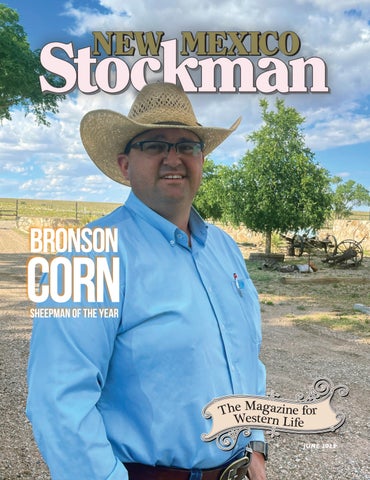
23 Sheepman of the Year
EDITORIAL & ADVERTISING
Publisher: Caren Cowan
Publisher Emeritus: Chuck Stocks
Advertising Representatives: Chris Martinez Melinda Martinez
Contributing Editors: Carol Wilson Callie Gnatkowski-Gibson Howard Hutchinson Lee Pitts
PRODUCTION
Production Coordinator: Carol Pendleton
Editorial & Advertising Design: Kristy Hinds
ADVERTISING SALES
Chris Martinez at 505-243-9515 or chris@aaalivestock.com
New Mexico Stockman (USPS 381-580)
is published monthly by Caren Cowan, P.O. Box 7127 Albuquerque, NM 87194
Subscription price: 1 year hard copy and digital access $50, Digital access $30 Single issue price $10, Directory price $30 Subscriptions are non-refundable and may be purchased at www.aaalivestock.com
New Mexico’s Old Times & Old Timers by Don Bullis 20 Food & Fodder by Deanna Dickinson McCall
36 News Update: Beyond Meat Downsizes, NAIA Applauds Reintroduction of Bipartisan Healthy Dog Importation Act, Update on USDA Efforts to Fight New World Screwworm in Mexico
38 View from the Backside by Barry Denton 41 In Memoriam
Riding Herd by Lee Pitts
49 Beef — It’s What’s for Dinner
Marketplace
Seedstock Guide
Real Estate Guide
Sandhill Sheriffs and Shotgun Diplomacy by a Sandhills Vet in the Tradition of Baxter Black 61 New Mexico Beef Council Bullhorn 74 New Mexico Federal Lands News by Jerry Schickedanz
FEATURES
13 Wolves Among Us
Time to Fix the Broken Equal Access to Justice Act by Nick Smith, Healthy Forests
17 NMDA Launches “Matriarchs of New Mexico Agriculture” Campaign 19 “Serious Defect” in Listing the Lesser Prairie Chicken as Endangered by Hannah Grover, nm.news
21 A Legacy of Leadership by Jayda Goodson, Texico FFA
23 Bronson Corn 2025 Sheepman of the Year by Carol Wilson
40 Gifting to Manage Estate Taxes by Robert Moor, Farm Office, Ohio State University
44 President Trump Seeks to Merge Firefighting Efforts into Single Agency by Caren Cowan
47 Honoring Brandon Devine: A Legacy of Service, Strength and Heart in New Mexico FFA by Madison Kenyon, New Mexico FFA
48 CEI Stops Household Water Appliance Restrictions by Ken Lassmen, Competitive Enterprise Institute
64 Mexican Border Closes Again by Darrell S. Peel, Oklahoma State University Extension Livestock Marketing Specialist, Cow Calf Corner
66 What Meat Wants From New Canadian Government by Lisa M. Keefe, meatingplace.com
67 Needle Selection for Vaccinating Cattle by Mark Z. Johnson, Oklahoma Beef Cattle Breeding Specialist, Cow Calf Corner
68 WOTUS: A Narrowing EPA Definition is Reshaping the Clean Water Act by Brian Bienkowski, The New Lede, Investigate Midwest
71 Nogal & Montosa Camp Meetings Coming Up
72 Water, Shade and the Right Nutrition Can Help Mitigate Heat Stress in Cattle by Chris Forcheria, Beef Research Manager, Purina
Bronson Corn Sheepman of the Year.
THANK YOU TO ALL OUR BUYERS THIS YEAR — FROM MEXICO TO FLORIDA!
GRAU GRAU RANCH RANCH
THEY’RE BETTER BECAUSE THEIR SIRES & GRANDSIRES ARE GRAU RANCH BRED
Grau Ranch bull sired the Grand Champion Carcass steer in San Antonio in the production division with 87 head entered. The calf was a purebred Charolais steer.
STATISTICS ARE:
Quality Grade: Prime plus Yield Grade: 2.3
Ribeye: 16.5
Fat thickness: .4
Dressing %: 62%
The Calf was fed and entered by Andrew Louis Jones from Cal Farley’s Boys Ranch.
These kinds of calves weigh more and bring more money than the others.
BRANGUS ANGUS RED ANGUS
by Bronson Corn NMCGA President PRESIDENT’S MESSAGE
Bronson Corn President Roswell
Tom Paterson President-Elect Luna
Dave Kenneke NW Vice President Cimarron
Jeff Decker SE Vice President Lovington
Roy Farr SW Vice President Datil
Cliff Copeland NE Vice President Nara Visa
Becky King-Spindle Vice President at Large Moriarty
Shacey Sullivan Secretary/Treasurer Peralta
Loren Patterson Immediate Past President Corona
Randell Major Past President
Iwant to start off by saying thank you all for the many kind words that have been shared congratulating me on Sheepman of the Year. It is not very often that you have the President of The New Mexico Cattle Growers being honored as the Sheepman of the Year, I have to say that I am truly honored!
Sheep have been a large part of my family’s legacy since the late 1800s, so needless to say, sheep run deep in my blood. Unfortunately, in 2024 we had to sell our ewe herd. It was not an easy thing to do, but it was the right thing to do.
Our complete herd went to an amazing family here in NM. The King Family that live in the Yeso area were gracious enough to buy the entire herd of ewes from us, and honestly, I cannot think of a better place for them to end up!
The decision was not an easy one by any stretch of the imagination. When you fight every day to keep them alive either from the drought or predators and you wake up one day knowing that you are fighting a losing battle, hard decisions had to be made! This is the reason it is so imperative that you get involved.
Our state policy makers decided that trapping or snaring could not and should not be allowed on any federally allocated lands! We need folks to show up in droves when policies like this are brought up in Santa Fe, especially since the vast majority of the legislators that make policy decisions for agriculture have no clue what production agriculture entails. Now don’t get me wrong, we do have some legislators that know and understand how we operate… It is just not very many!
If there is one thing that you can do to help your friends, family, neighbors, and the next generation of ranchers in our state, it is to get involved! Run for a county commission seat, school board, Soil and Water District, State Representative, State Senate.
Heck, we all know we are in DESPERATE need of Congressmen and Congresswomen! We need folks to take a stand and say enough is enough! If your kids or grandkids are going to stand a chance at making an honest living in ranching, we must get heavily involved.
There is a saying that describes a scary industry and agriculture cycle “Soft times create Soft Men, and Soft Men create Hard Times, Hard times create Hard Men, Hard Men create Soft times.” Hard decisions are never fun to make; we just pray that God leads us to fulfill what He has in store for us in every situation that we face.
As it says in Philippians 1:6 , “Be confident of this, that he who began a good work in you will carry it on to completion until the day of Christ Jesus.” Just know that if He leads you to an obstacle, He will carry you through it!
“Ya’ll Have A Gooden”
Bronson Corn
JUST THE FACTS ... & THEN SOME
by Caren Cowan, Publisher
A Little Good News on the Wolf Front
On May 27 the Arizona Department of Game & Fish picked up the collared pair of Mexican wolves and their pups from a Cochise County ranch. The wolves were translocated to the area on May 24, 2024.
In the meantime the pair, and other wolves, have savaged livestock on area ranches killing up to 30 cows and one colt. With emergency declarations pending, the government made the decision to retrieve the wolves.
This won’t solve the problem even in Cochise County. There are believed to be un-collared wolves in the area. One is said to be a wolf-coyote hybrid. There is no word on the government front on how these are to be addressed.
Nor have there been any long term solutions presented for those in Northeastern Arizona or New Mexico who have suffered at the mouths of wolves for decades.
Shasta County California is having their share of problems with gray wolves and have passed their own emergency resolution along with tips on how to protect yourself from wolves (see page 72). Clearly they are listening to the US Fish & Wildlife Service.
Folks, we have been there and done that with the deterrent tools. The habitat modifications suggested will put people in big country out of business.
The Beef Council Debate May Be Back
A bipartisan group of Senators has introduced the Opportunities for Fairness in Farming (OFF) Act in late May, which would “cut government waste by enforcing transparency in checkoff programs.”
Co-sponsored by U.S. Senators Mike Lee, Cory Booker, Rand Paul and Elizabeth
Warren, the bill aims to prohibit conflicts of interest and anti-competitive practices in these checkoff programs. This group may be bipartisan but it does leave one scratching their head.
Cory Booker and Elizabeth Warren have rarely, if ever, been supportive of agriculture.
“We must change the agricultural checkoff programs that put money in the hands of corporate lobbyists at the expense of farmers and ranchers,” Warren said. “The OFF Act will put commonsense safeguards in place to ensure accountability and transparency for our farmers.”
The OFF Act is endorsed by organizations representing more 200,000 American farmers and ranchers, including the United States Cattlemen’s Association, Farm Action Fund, American Grassfed Association, R-CALF USA, Kansas Cattlemen’s Association and Organization for Competitive Markets.
“America’s farmers are being ripped off by federal checkoff programs that take farmers’ money and play favorites with who they serve,” Lee said in a statement. “The OFF Act will implement accountability measures to cut waste, enforce transparency, and ensure that our farmers get the services they pay for.”
Measures included in the legislation include requiring checkoff boards to release transparent budgets and undergo regular audits.
The lawmakers point to a USDA investigation that found a subcontractor organization had improperly used $302,000 of checkoff program funding as evidence of the bill’s importance.
Keeping Meat Real
While it is not yet an overwhelming movement, measures to ban and/or label cultured meats are marching across the
nation. Mississippi, Florida, Nebraska, Montana, Indiana, and Alabama are among the first to totally ban lab grown meats.
Indiana’s law is a two-year moratorium on the products from July 1, 2025 to June 30, 2027. Following the temporary ban, cultivated meat products will then be required to display the phrase “this is an imitation meat product.”
The Texas Legislature has passed a ban bill that is on its way to Governor Greg Abbott’s desk.
Other states including Iowa, South Carolina, Oklahoma and South Dakota have passed mandatory labeling for the fake meat.
However, Florida is now facing a legal challenge to the 2024 state law from UPSIDE Foods, Inc. The California-based manufacturer of lab-grown poultry products claims the ban violates the Commerce Clause of the U.S. Constitution because it was enacted to shield in-state producers of conventional meat from competition from out-of-state producers of cultivated meat.
The lawsuit also argues that Florida’s law is preempted under federal laws that regulate the interstate market for meat and poultry products. A federal judge has ruled the lawsuit may proceed.
Many consumers express concerns about lab-grown meat, stemming from perceived unnaturalness, health uncertainties, and a preference for traditional meat. A significant portion of the public distrusts this technology due to the unknown risks and a general fear of new food technologies. Additionally, ethical considerations, like the use of animal cells in the initial production stages, raise questions about animal welfare.
While cultivated meat supporters often claim that lab-grown meat is more sustainable than traditional, farm-raised meat products, the Center for the Environment and Welfare, one of the leading critics of labgrown meat, points out researchers at UC Davis vastly disagree. A recent study there found the global warming potential of labbased meat using purified media (the ingredients needed to help animal cells multiply) is four to 25 times greater than the average for retail beef.
New Mexico Stockman
BEWARE OF WOLVES
STAY ALERT
Make noise so you don’t surprise wildlife.
Hike with a walking stick and carry bear spray. Keep dogs on a leash and close to you. Dogs aggravate wolves. If you encounter a wolf, keep the dog away from the wolf.
Never approach a wolf.
IF A WOLF STANDS ITS GROUND OR APPROACHES YOU:
Do not run. Keep eye contact with the wolf and act unafraid.
Aggressively lunge in the direction of the wolf while yelling and clapping your hands.
Make loud noises with whistles, air horns, music or bang pots and pans.
Appear as large and threatening as possible. Make aggressive gestures with your arms and legs or by waving or throwing objects at the wolf.
Act aggressively as you retreat slowly while facing the wolf.
JINGLE
Plot
Most people think about the plot because it generally thickens somewhere in the middle of the story. Our plot seems to be consistent and is only thickened every once in a while. Wink wink.
What do a bunch of ladies do when they get together and discuss the beef industry?
This whole organization is held up by our 20 locals around the state in four districts. These ladies are the cream of the crop and the best of the best. They are dedicated to their local beef industry as well as our state. When called upon they jump at a chance to help in any way they can.
They all have an individual call to action for the reason they are members and they all shine in their roles.
New Mexico CowBelles is truly blessed with the best members. I am truly grateful for each and every one of them and their commitment to our organization.
And anytime the plot thickens, look around and find a CowBelle. We are pretty good at helping you get out of a jam, open a gate, give shots or make you lunch.
And if you haven’t joined in on our story and want to become a member of the New Mexico CowBelles–the Cattlewomen of New Mexico. We invite you to join us now. It’s never too late!
See you down the trail!
– Corrina Casler
New Mexico CowBelles President ▫
Yucca CowBelles held their monthly meeting Tuesday April 21, 2025, at 10:00 a.m. at CVE in Artesia. Eleven members were in attendance. Carol Gutierrez served as hostess. Everyone brought their scissors and cut out the brands for the brand quilt that Carol will make for the raffle at the County Fair in July. Meeting was called to order by President Joan Kincaid. Becky Waldrop led the Pledge of Allegiance and Kyler Bowerman read the CowBelle Creed. Minutes from the previous meeting were read and approved. The District Workshop was reported on by Ande and Becky. Appreciation was expressed to Joan for organizing and getting it all together in short order. Visitors’ comments were all positive and it was agreed it was the
best one in a long time. The presentations were very informative and fun. Everyone had a good time. Thanks to everyone for the great door prizes, all of Ande’s and Becky’s hard work in making the table decorations, name tags and handouts, and to everyone who brought food and drinks and helped set up and clean up after. Ag Day in Artesia will be May 9th at Park Jr. High. Lauren Marbach oversees that project this year. Doc Darnell, The Wine Glass Cowboy, is donating a cowhide again this year for us to raffle off at the County Fair. He donated one last year for the first time. We really appreciate Doc and his generosity. Meeting adjourned. The program was given by Carol Gutierrez, with two different recipes for beef rub. She brought a nice variety of seasonings and little jars for each of the members to make their own beef rub to take home and use. It was so much fun! Thank you, Carol. Respectfully submitted, Tina Kincaid, Secretary
Mesilla Valley CowBelles met at Nopalitos Restaurant on May 6, 2025, with six members present. Minutes and treasurer report given and approved. ANCW fundraiser for scholarships silent auction discussed and shared with members. One item is a Shoofly print. MVCB will donate a print for the silent auction at mid-year, another Shoofly print. Thank you, Bob and Julie Shufelt for always supporting the Ag Industry!!! Ag Explorer discussed: MVC will purchase electric branding irons with different implements for kids to brand, for the Brand presentation box. MVC is still looking for faux meats to go in the beef presentation box and other such items. The other presentation box will be the Beef by Products box; the group just needs to divide their current box. The group voted to pay for the purchase of Beef license plates. Dona Ana Ag Explorer for May was canceled due to testing dates. The SNMSF dates are September 24-28. American Ag Credit is working toward opportunities for Community Ag Projects, more to come soon. The Ag Explorer program at the fair will soon be planning their programs for elementary and career day hopefully. Mesilla Valley is always anxious to assist. Meeting adjourned. Submitted by Janet Witte
Powderhorn Cattlewomen met May 8, 2025 with ten members at the home of Brenda Copeland with Carol Church as co-hostess. Everyone reported on and was thankful for the rain received since the last meeting. Emily Velasquez, Allison Sleep and Jett Vick earned $1,000 scholarships. Schol-
arships have increased and are funded by Powderhorn’s annual Old Fort Days Beef BBQ. In the future, brand napkin proceeds will also add to scholarships, community outreach and beef education. Hamburger meat will again be donated to the Fort Sumner Elementary Honor Student Hamburger Fry. Volunteers are needed for Ag Day at Vaughn Elementary School. Pat Knowlin Memorial donations will be made in memory of Sonny Lappenbush and Emmit Shephard. A get-well card was signed for Danita Agar for her recent hospital stay. Sales have closed for individual brands for the Powderhorn CattleWomen brand napkin. A brand napkin facsimile was shown and a final mockup on an actual napkin will be created, approved, and mass produced in time to sell at the June 14th BBQ. Mary McClain will check on using the napkin template for thank you cards. In lieu of a brand spot, Pat Copeland donated the fee to Powderhorn. Thanks for Pat’s generosity, Sarah Fitzgerald’s expertise and every member’s effort toward this worthwhile project. A detailed discussion of BBQ plans followed. Menu will consist of a Beef BBQ sandwich, condiments, chips, cold bottled water and a variety of homemade desserts for $15.00. Carol is responsible for change. Calls will go out for deserts. It was mentioned that inactive members are especially good at providing desserts. A poster listing former Powderhorn scholarship winners will be front and center along with Beef Council materials. Thanks to the New Mexico Beef Council for subsidizing the beef and providing aprons for servers. Servers are reminded to have their Food Handler Cards up to date. Kari Henry will obtain the NM Environment Dept. temporary food permit. The next meetings are June 12th for BBQ preparation and June 14th for the BBQ. After all the talk about food, a beef, bread and potluck lunch was very much appreciated. Respectfully submitted, Karen Kelling
New Mexico CowBelles: Thank you to all who have submitted their news to Jingle Jangle. As a reminder, please send minutes and/or newsletters to Jingle Jangle, Janet Witte, 1860 Foxboro Ct., Las Cruces, NM 88007 or email: janetwitte@msn.com by the 14th of every month. Have a great year! ▫
Time to Fix the Broken Equal Access to Justice Act
Source: Healthy Forests Healthy Communities
The Equal Access to Justice Act (EAJA) was created with good intentions—to protect individuals and small businesses from being steamrolled by the federal government. Passed in 1980, EAJA was meant to level the playing field by reimbursing legal costs when citizens successfully challenged government overreach.
But decades later, this once-noble law has become a tool for abuse. Well-funded anti-forestry groups now exploit EAJA to block the very forest management projects that communities and public lands desperately need.
Under EAJA, plaintiffs can recover attor-
ney fees from the federal government when they prevail or settle in court. But here’s the catch: even a partial victory or procedural settlement can trigger these payments, regardless of the lawsuit’s broader merit or public benefit.
Many environmental litigants have figured this out—and they’re profiting from it. By suing over fuel reduction and forest health projects, they collect taxpayer-funded attorney fees while obstructing active forest management under the guise of protecting the environment.
The Forest Service alone pays out an estimated $1 million per year in EAJA awards. Including other federal land and wildlife agencies, annual costs likely range from $2 to $3 million.
These figures don’t account for the untold hours of agency staff time, lost productivity, or missed opportunities to implement science-based forest management. In fact, in some regions, more than half of annual land management budgets are now consumed by environmental analysis and litigation defense—rather than project implementation.
Worse still, federal agencies are not even required to track where this money goes. Congress eliminated EAJA reporting requirements in 1995. A 2012 Journal of Leg-
islation article found that EAJA has morphed from a legal backstop into a well-funded engine of obstruction.
It documented how massive 501(c)(3) organizations routinely evade statutory limits on attorney fees, receive excessive awards, and litigate without having any direct financial stake in the outcomes. These lawsuits aren’t about protecting the environment. They’re about stopping management at all costs, regardless of the consequences for forest health, public safety, or rural jobs.
The Trump Administration has attempted to address some of these legal abuses through executive orders encouraging bonding requirements and stricter enforcement of court procedures. These are helpful first steps. But EAJA reform must ultimately come from Congress. Past legislative efforts—including the Government Litigation Savings Act and earlier versions of the Resilient Federal Forests Act—would have limited attorney fees, reinstated transparency, and required plaintiffs to post bonds when seeking to block forest projects. Those reforms were sensible then, and they’re urgently needed now.
Unfortunately, these provisions are missing from today’s key forestry proposals, including the Fix Our Forests Act. That should change.
EAJA was never meant to serve as a blank check for serial litigants. It was designed to ensure fairness, not to fuel a business model based on obstruction. Without reform, taxpayers will continue funding lawsuits that delay or derail the forest projects we so urgently need. It’s time to fix EAJA and return the law to its original purpose—protecting citizens, not empowering ideological anti-forestry groups.
▫
NMDA Launches “Matriarchs of New Mexico Agriculture” Campaign
culture in New Mexico, supporting their families, communities and industry with leadership, mentorship, and advocacy.
A matriarch is defined as a “head of family or tribe” or “an older woman who is powerful within a family or organization,” and NMDA seeks to recognize those who embody these ideals.
“With 2025 as the inaugural year for this campaign, NMDA has selected two legendary women to kick off the campaign and inspire future nominations,” said New Mexico Secretary of Agriculture Jeff Witte. “These two honorees were not only the vision behind this campaign, but have consistently championed the agriculture industry and NMDA’s initiatives in recent years. They will be formally recognized this September.”
Promotional TV and online ads will
launch in January 2026, aligning with the UN’s “International Year of the Woman Farmer” to honor women’s vital role in global food security.
The campaign is open to nominations statewide and welcomes submissions for living and posthumous candidates. Additional details, including a nomination form and official campaign logo, are available at elevateNMag.com.
NMDA invites the agriculture industry, and families across New Mexico to nominate the inspiring women who have made a lasting impression on New Mexico agriculture.
For more information or to submit a nomination, please visit elevateNMag. com.
NEW MEXICO’S OLD TIMES & OLD TIMERS
by Don Bullis, New Mexico Author donbullis@msn.com
Watch out for Prairie Dog Dave
The history of the American West comes to us in various forms. History writers generally try to report on the events of the past as accurately as they can, but it is often a difficult task because many of the sources in the old days did not agree as to the details of anything. Your editor was reminded of this recently when he came across a battered booklet called “Cactus Cognomens,” in what was identified as “The Second Publication of the Albuquerque Corral of the Westerners.” It was dated July 1967 and was edited by Andy Gregg (c. 19302004) who was something of a New Mexico
historian having published a book on the subject.
(Note: your present editor, beginning in 2002, served as Sheriff [president] of this group, now known as the New Mexico Westerners Association, off and on [mostly on] until last month, that is, May 2025. In 1967 the group had 11 members; at present it has about 80.)
A “cognomen,” by the way, is a nick-name. We had to look it up, too.
Gregg cited several items received by the Las Vegas Optic newspaper in 1881 from a correspondent known only as “Cactus.” Since Gregg didn’t seem to believe in the use of quotation marks, it is difficult, actually impossible, to tell who said what on the pages of his report. What follows here seems to be quoted from an item called, “THE FELLOWS WITH NAMES.” It is presented verbatim.
“It may be somewhat interesting to your readers to know that many of the characters whose special desire seems to have been to lead a reckless life, always keeping far in advance of that great civilizer, the railroad, have passed to their home from whence no traveler returns. While many of them are yet alive, plying their terrible vocations in dif-
ferent parts of the country, some of whom we shall speak will be remembered in the mountain countries of the west.”
He then goes on to mention Wild Bill, Buffalo Bill, and Cherokee Bill. None of them had much impact on New Mexico affairs. Wild Bill was already dead (1876) but the other two remained extant.
Cactus continued.
“But little is known … of the real character of Prairie Dog Dave, except that we are informed that he was for a long time a rounder up the wave. [The definition of “up the wave” has not been found.] Mysterious Dave is too well known in this community to dwell upon at length. Fat Jack was not a bad man, he always wore good clothes and was a member of the gang.
“Flap Jack Bill, Fly Speck Sam and Bull Shank Jack all came to Las Vegas about the same time the railroad got here and were soon run in the quay on a charge of train and coach robbery [Bull Shank is a euphemism for Bull ****, the more common vulgarity for “manure”]. Cockeyed Frank is not considered a bad man, although he downed his man about two years ago in an Eastern [sic] town called Dodge City, but it was adjudged by the courts of that country to be justifiable.
“Corn Hole Johnny hails from Texas and his special forte is three card monte. Slim Jim was shot in leadville [sic] about two years ago. Split Nose Red is at present in El Paso getting in his work on tenderfeet.
“Six Shooter Bill, we understand, is at Deming, doing good service in his line [no mention is made of what that “line” might be]. One-Armed Charlie, who was outlawed from Leadville six months ago, came to Vegas, shot the windows out of Burton’s restaurant, was run into Tombstone where, it has been reported, he was handed down for food for the worms of that consecrated soil.
“Alkali Charlie, while at Carson City, was regarded as an honest youth. He was certainly trying to make an honest living at his business, blacking boots. But when he came to Las Vegas, he manifested a desire to be a shooter. He cut a hole in the leg of his boot and in the wee hours of the night, went out on the street and fired his pistol several times, literally perforating the front of the Toejam Saloon and reported that someone had shot at him, showing up the wound in his boot. Judge Steele did not think he could get to the joint as a killer and wisely ordered Alkali to leave town instantly. He has never been heard of since.
“Sheeny Frank is said to be at Lamy Junction making war on peacable [sic] citizens.
Hurricane Bill, we believe, has been regarded as a killer; we don’t at present know if he is alive or not. Texas Frank is hardly worth speaking of. He would, perhaps, at one time liked to have acquired a reputation as a bad man, but Mysterious Dave had no use for him and he left Las Vegas over a year ago for parts unknown. It is believed by many of the fraternity that if he did not kill himself, he had ought to.
“Billy the Kid is sentenced to be hung in Mesilla. [Billy was sentenced on April 15, 1881, only six days before this item appeared in the Optic.] Buggy Jim is in Denver, steering for those who are more expert than himself with the bones. Rattlesnake Bill Joined [sic] Gideons band at Canoncito [sic] about a year ago. Stink Foot Jack and Apache Bill have been lost sight of. We shall at some future period speak of a few more of the memorable gang.”
Yes, in some future issue we will revisit some of the evil doings around Las Vegas, New Mexico, as reported by the anonymous Cactus.
‘Serious Defect’ in Listing The Lesser Prairie Chicken as Endangered
by Hannah Grover, nm.news
The U.S. Fish & Wildlife Service (FWS) and the U.S. Department of the Interior (DOI) have asked a federal district court to send the listing of the lesser prairie chicken under the Endangered Species Act back to the agencies as they plan to vacate the listing.
Industry groups, including the Permian Basin Petroleum Association as well as the State of Texas, challenged the decision to list the southern population of the bird as endangered and the northern population as threatened. The southern population can be found in New Mexico.
In the filing in early May, the FWS stated that it had found a “serious defect” in the rule listing the prairie chicken as threatened and endangered. The agency said vacating the rule would allow the federal government to address that defect as well as the concerns
Texas and the other plaintiffs raised.
The filing comes as Republicans in the U.S. Congress have sought to overturn the protections for the lesser prairie chicken on the basis that it will harm economic development.
According to the filing, the FWS has determined that it did not “provide adequate justification and analysis to support the determination” that the lesser prairie chicken has two distinct population segments that warrant different levels of protection.
The FWS acknowledged that the species will be without federal protections under the Endangered Species Act while it reviews the decision to list the lesser prairie chicken as two distinct populations. However, the court filing states “at least sixteen different conservation efforts and programs administered by state, federal and private entities exist that benefit the lesser prairie chicken.”
Environmental advocacy groups such as the Center for Biological Diversity decried the decision. The Center for Biological Diversity previously attempted to intervene in the court case, but its motion was denied. In denying the motion, the Court stated that the federal government agencies would defend the decision to list the bird under the Endangered Species Act. ▫
LIVESTOCK COMMISSION DEXTER
by Deanna Dickinson McCall
Sweet & Sour Pork
When I was a kid, it was a real treat to go to a Chinese restaurant when we made a trip to town. There were no big Chinese buffets, you had a menu to choose from and order the food you wanted. If it was noon there were usually combination plates to choose from. Some places also offered a la carte dishes.
A favorite for my family was to order family dinners for however many people you had. Dinners for 2 up to dinners for 6. The dinners usually offered a variety of dishes, Cantonese, Mandarin, or Szechuan style. You could get things like sweet and sour meat dishes, tempura shrimp, fried rice, chop suey chow mein with fried noodles, egg foo young,
etc. All those plates of tantalizing food also meant there would be leftovers to take back to the ranch.
Nowadays, if you want Oriental food there’s big buffets, the famous chains the bigger cities have; or frozen concoctions consisting mainly of rice or noodles with little real meat. It is pretty rare to find a place that actually cooks the order.
Like many of you living far from such places we learn to make what we want. Kind of like the old saying of necessity being the mother of invention. Not that certain food cravings are necessary, but it is nice to be able to create what someone really wants.
Most folks on ranches don’t have the options of take-out, restaurant deliveries, etc. I learned at a fairly early age that you get out what you put in, and that applies to ranch living. Not the stuff of Yellowstone or Dallas, but real ranch life. Making the best home you can and that includes serving the best food you can.
You can substitute fresh pineapple in this, just cut it up and in place of the pineapple juice from the can you can use about any juice you have one hand, including orange juice.
I like to serve this on steamed white rice, but stir-fried vegetables are also good as a side, as is fried rice.
Sweet and Sour Pork
Ingredients:
Oil for frying
1 lbs pork tenderloin or boneless pork meat cut into 1 inch cubes
½ cup cornstarch
1 red bell pepper cut into 1 inch pieces
1 green bell pepper cut into 1 inch chucks
1 small onion cut into 1 inch pieces
1 15oz can chunk pineapple with juice
Salt and pepper
Sesame seeds
Chopped green onion tops
Sweet and Sour Sauce: Juice from canned pineapple
2/3 cup of granulated sugar
1/4 cup ketchup or chile sauce
1/2 cup white vinegar
1 Tbs soy sauce
2 Tbs maraschino cherry juice or syrup
1 Tbs grenadine or any sweet fruit syrup
1 tsp garlic salt
1 Tbs cornstarch
Make the sauce first:
Drain the juice off the pineapple
Whisk together the sauce ingredients, set aside
Add salt and pepper to the cornstarch, mix well
Add the pork to the cornstarch, tossing to coat
In a large skillet place pour in oil until about an inch deep
Heat to frying temp, about 350 degrees
Fry pork until golden brown
Remove to a plate to keep warm
Drain off excess oil, leaving just enough to cover the bottom of the pan
Add the peppers and onion to the skillet and sauté until tender but not limp
Add the pork and pineapple to the skillet with the onions and peppers
Add the sauce, gently stir and simmer together a few minutes until sauce is thickened
Spoon onto a platter and garnish with sesame seeds and green onion tops ▫
A Legacy of Leadership
by Jayda Goodson, Texico FFA
In life, it is important to honor those who have made an impact greater than imagined within the National FFA Organization. Tony Johnson is one of those individuals. After more than 30 years of dedicated service, Johnson is retiring — but not without leaving a legacy that will continue to shape lives for generations.
A mentor, coach, advisor and friend, Johnson is more than an educator — he is a pillar of the Corona FFA Chapter and the New Mexico FFA Association.
To many, Johnson is more than just a teacher. “He’s one of the greatest mentors in my life, and the lives of so many others who have been in Corona FFA, past and present,” says Brindle Racher, one of his current students. “Truthfully, I can say I’m endlessly proud and inexplicably grateful to be one of his children.”
That statement captures the essence of who Johnson is. He treats every student like family, recognizing their strengths before they even see them in themselves.
“He finds strengths and qualities in students they might not even be aware of and encourages them to pursue roles in which they will thrive, even if they don’t know it yet,” says Karleigh Erramouspe, a past student. That unwavering belief has led countless students to discover their confidence, their voice and their purpose.
Johnson’s passion for agricultural education isn’t confined to the classroom. He lives the 24/7 lifestyle of an agriculture teacher. From the classroom to stock shows, organizing fairs and conventions, and mentoring the
next generation of teachers, Johnson never stops giving.
“He is always reminding and encouraging members and advisors to be the best version of themselves,” says Izzy Sugg. “He has always believed in me to do things I thought impossible.”
Whether coaching a national-level judging team, emceeing a state convention or quietly offering support backstage, Johnson is the voice — literally and figuratively — of New Mexico FFA.
Now, as he steps into retirement, Johnson remains excited for the future of New Mexico FFA. He sees endless possibilities with the
advancements in agriculture and technology, and believes today’s students are poised to lead the next frontier. Still, when asked what the best part of teaching has been, his answer is simple: the kids.
Johnson’s story isn’t just about the past 30 years. It’s about the thousands of lives he’s touched and the ripple effect those lives will carry forward. Because of people like him, New Mexico FFA is stronger, and a legacy of leadership will live on. ▫
Tony Johnson
Your Best Advertising value in the west and beyond
The Stockman covers some 37 states from Maine to Hawaii and Florida to Washington. The Stockman mails to nearly 6,000 households ... and we are told that many issues are passed on to others for a total readership of 24,000.
Our website is averaging nearly 6,000 unique views.
Our Facebook page is read by 10 countries around the world. Advertising rates from $50 an inch to $2000 for special placement.
Bronson Corn
2025 Sheepman of the Year
by Carol Wilson
His unwavering ambition was to become a sheep rancher and cattleman, like his father, grandfather, great-grandfather, and great-great-grandfather before him. He achieved that goal by facing and conquering constant challenges and through old-fashioned hard work. He is the face and voice of agriculture for hundreds of followers on Snapchat. He has become a leader who works hard, listens intently, thinks constantly, and is always balancing the demands of a strong leader for the industry with the everyday labor demanded by the ranching life.
These days, however, he sits down for one-on-one discussions with United States congressmen routinely. He meets with reporters on his only free afternoon in two weeks. When federal bureaucracy won’t meet with him or answer the questions he poses on behalf of New Mexico agriculture, he flies to Washington to force a meeting, Bronson Corn, not yet 40 years old, has risen to leadership among New Mexico agriculturalists. He has served as the president of the New Mexico Wool Growers’ Association and is currently president of the New Mexico Cattle Growers’ Association. What makes a young man take on these commitments? He saw the need. “There are a lot of people out there that could do a better job than me,” he stressed. “But they haven’t seen the desperation of our state. We need people to get involved in policy, to stand up and be counted so we will have something to leave for our children.”
So Bronson assumed the mantle of leadership. His Snapchat feed, a window into his daily routine, paints a vivid picture of a man with a tireless work ethic and a commitment to doing all he can to advance agriculture. He engages friends with his breezy, casual remarks, often making them laugh but also making them think when he delves into cattle prices or the life experiences of a rancher. His Snapchats always end with the friendly admonition, “Ya’ll have a good one!”
Bronson’s work and legacy on and off the ranch have earned him the distinction of being named Sheepman of the Year by his fellow sheep and wool producers at the Joint Stockman’s meeting in Ruidoso last June.
Love and sheep
Bronson’s goal from a young age was to attend New Mexico State University for two years, then matriculate at the Texas Christian University Ranch Management School. While at NMSU, he arranged his schedule to attend classes two days a week and filled the rest of his hours by running a chile picking
Congratulations Bronson ƒ
Our Sheepman of the Year
rom the time you were a young boy, your uncanny ability to listen and understand has set you apart. It’s more than a gift—it’s who you are. Guided by faith and grounded in generations of ranching tradition, you’ve followed your dream with quiet determination and a strong moral compass. Your unwavering principles guide everything you do, earning the respect of everyone you know.
Your devotion to agriculture, your leadership in the New Mexico Cattle Growers and Wool Growers Associations, and your commitment to your family and community make us all incredibly proud. You truly are the sunshine on a cloudy day.
With all our love, Pop, Lollie, & the rest of your family
Your proud family (from left): Craig Cowden, Jessica (Corn) Cowden, with Conner, Courtney & Creed Cowden; Sterling and Jennifer (Corn) Pierce with their two children Tripp & LeRoy Pierce; mom and dad, Mike & Jennifer Corn; Garrett and Madison Corn with their mom and dad, Barbara and Bronson.
crew for Las Cruces farmer Jim Hill.
Work and school filled his life … but he hadn’t figured on meeting the woman who was to become the love of his life during his last two weeks at NMSU.
Bronson was admitted to Texas Christian University’s Ranch Management program in Fort Worth the same week Barbara was admitted to Texas Tech’s pharmacy school in Amarillo. After the Ranch Management program, where they packed four years of college into two semesters and gained a huge network of contacts in the industry, Barbara and Bronson were married and Bronson farmed with a classmate from TCU while Barbara obtained her pharmacy degree.
Upon their return to New Mexico, Bronson and his cousin, Martin, bought 700 ewes and bucks from Troy Floyd in 2007, pasturing the flocks on family land north of Roswell.
During the same time period, Bronson was charged with caring for all the New Mexico Lamb Coop’s lambs from their weaning in October until January. He routinely cared for 25,000 lambs each fall, a number which swelled to 49,000 one year when the Coop bought and pastured lambs from the Navajo Nation. A common sight around Roswell farm roads was Bronson on his dirt bike, fixing fence and doctoring and shepherding the lambs.
As the lambs left the fields Bronson ran two separate shearing crews to ready them for the feedlots. Later he marketed the Coop’s animals in lots as big as 15,000 animals, thus attracting the big buyers for the New Mexico production.
Make or Break Moments
genetics and numbers.
“He definitely is an out-of-the-box thinker,” confirmed Kevin Floyd, who consults with Bronson on feed choices and has become a close friend. “He put in a grow yard in the middle of a ranch and made it work.”
Loren Patterson, Bronson’s predecessor as president for New Mexico Cattle Growers, calls Bronson “The most innovative rancher I know.” Loren explained, “He manages drought through his grow yard, and he doesn’t have to sell-off his genetics off when things get dry. If something needs to be picked up and given special attention, Bronson can do it. We all talk about having secondary income sources, but Bronson really does it.”
But while Bronson was building a sheep and cattle program, the state of New Mexico
Life was never dull at the Corn Ranch. Barbara was employed as a pharmacist in Roswell, and Bronson applied himself to the raising of lambs, calves, and kids when they welcomed first Garrett and then Madison to the family. Bronson sometimes found lion tracks circling their little trailer. When an animal intruder made its presence known under the bathtub while Bronson was away for the night, Barbara finished the night with Mike and Jennifer Corn, Bronson’s parents. Bronson served as leadership both in New Mexico Wool Growers and American Sheep Industry circles, and he parlayed the knowledge he had gained in his travels visiting sheep operations across the United States into a confinement operation for both sheep and cattle. When his ranch received only five total inches of rain between 2011 and 2015, he built a grow yard where ewes and cows were fed, allowing Bronson to retain his
was making it nearly impossible to stay in the sheep business. New laws making it illegal to trap or snare predators on government lands, as well as drought, forced many sheep producers to make the hard decisions to get out of the sheep business.
“Whenever you can’t protect your own livelihood because you might go to jail, you have a problem,” Bronson summarized.
ANIMAL & RANGE SCIENCES
The Department of Animal & Range Sciences is part of the College of Agricultural, Consumer & Environmental Sciences
Students can major in Animal or Rangeland Resources and are provided with the very best of “hands on” academic instruction by our faculty. Fully equipped labs allow students access to cutting-edge research in: LIVESTOCKNUTRITION / GENETICS / PHYSIOLOGY / ENDOCRINOLOGY / MEATSCIENCE / WOOL / TOXICOLOGY / WATERSHED & RANGELANDECOLOGY / WEED & BRUSHCONTROL / PLANTSYSTEMATICS / GRAZINGMANAGEMENT
The Department also offers pre-veterinary studies –our graduates have a high acceptance rate into veterinary medicine programs. We offer graduate degrees at the Master of Science and Doctor of Philosophy levels. The M.S. or Ph.D. in Animal Science can emphasize nutrition or physiology, and offers a Ph.D. in Range Science to study range management, range ecology and watershed management. Dr. John Campbell –575/646-6180 /
The pride and joy of the Corn family — Old restored ranch truck that survived years in a canyon.
Where there were once millions of sheep in the state, there probably aren’t 10,000 wool sheep still in New Mexico, according to Wool Growers’ estimates.
Bronson served as president of the New
Patronize Our Advertisers
Mexico Wool Growers’ Association from 2018 to 2022, while Mike was concurrently president of the American Sheep Industry Council. “It was a make or break time,” Bronson remembers. “I realized that there
NEW MEXICO WOOL GROWERS, INC.
We’re Proud of You! Our Sheepman of the Year BRONSON CORN
Representing the interests of the sheep industry for over 110 years ... at the Roundhouse, on Capitol Hill and everywhere between.
was some opportunity to make a difference, and change the way the ag industry is perceived. That chance got me hooked on staying involved with the industry.”
Strength and family
Garrett and Madison have learned the values of hard work and faith from their parents. When there is a need, the whole family pulls together as a strong and supportive unit. Bronson describes Garrett as “15 going on 50” with a work ethic to match. Madison, according to her father, is as stubborn as he is, but “you would be hard pressed to find a little girl who loves ranching more.”
Bronson sells his doggie lambs and calves to Garrett and Madison. If an animal dies and the kids ask for their money back, their Dad just welcomes them to the agriculture lifestyle.
“They love the ranch and that is part of what drives me as well,” he commented. “But I will not force my kids to accept my lifestyle. The fact that they want to work in ag gives me the drive to make sure that whatever I leave the industry is done to the best of my ability.”
The family commitment to help each other through the good times and the bad was evident when Bronson was asked to serve back-to-back terms as president of Wool Growers and Cattle Growers. He talked it over with Barbara and his parents and sisters, Jennifer and Jessica. The overwhelming response was, “If you want something done well, you must do it yourself. Go ahead and serve, and we will fill in the gaps here at the ranch.”
Bronson’s faith is a powerful cornerstone of his life, guiding his actions and shaping his character. He broke his back in 2014 and lived in daily pain until 2023, when a surgeon told him he had to have back surgery or risk total paralysis.
One morning before the surgery, Bronson woke up knowing something was different. He lay in bed, trying to come to grips with his paralysis, but when he finally gathered the courage to sit up in bed, he realized that the pain he had lived with for the last nine years was gone, and he wasn’t paralyzed after all. “It was a God moment for sure,” he related. “A heart-opening experience.”
A time for understanding
Whether he is talking to the head of a powerful government agency or listening to a person whose livelihood is threatened, Bronson listens deeply and thoughtfully. He responds with insight and action.
Mike and Bronson model sheepskin vest and jacket made by Weather Wool.
“That isn’t simply a personality trait,” noted Jennifer Corn, Bronson’s mother. “it is a testament to his character and upbringing. He values understanding above all else.”
Bronson understood that he would miss time with his family when he agreed to head New Mexico Cattle Growers as their president, but he also knows that if he wants busy people to see that they can step forward and make a difference for the industry they need to see that it can be done by busy people.
He doesn’t feed as many cattle and sheep in his grow lots as he did before he took on leadership responsibilities. He relies more on his brother-in-law, Sterling Pierce, and Emerson, a Peruvian sheepherder. His calendar is full. The day he met with the Stockman he had an early morning meeting with Congresswoman Theresa Leger Fernandez. In the late afternoon, he got a message from Senator Martin Heinrich’s office, confirming an appointment for the next week.
He keeps facts and figures in his head and can name the acreage and location of land in New Mexico that the federal government is currently trying to take out of production through eminent domain or other takings. The number, 8.5 million acres, is staggering, especially for a state in which
Houston & Laura McKenzie, Fort Stockton, TX, 432/553-6670
Bronson studying fire management with the TCU Ranch Program.
federally allocated land already makes up 40 percent of the total land mass.
“Because of his involvement with the sheep industry and now with the leadership in the cattle industry, he just brings a lot of experience and a world of integrity to his dealings,” asserted Loren. “He is genuine and everyone who deals with him responds to that.”
“It is our own politics that keep us poor,” Bronson asserted. “I wish that the lawmakers, not just in this state but in our country, weren’t so far removed from agriculture. I wish they got their information from those of us actually producing the food and fiber.
“Less than 1.5 percent of our population is involved in production ag, and that isn’t just ranchers, it includes truck drivers and food processors and salesmen. So we produce more than we consume with fewer ranchers and less land. But most lawmakers are so far removed from agriculture that they don’t even know where their food comes from.”
The monster in the corner
The Department of Energy’s National Interest Electric Transmission Corridor (NIETC) proposed to run the length of the east side of New Mexico, is an example of just how important it is that agriculture remains vigilant, well informed, and vocal. The DOE stealthily took the project, which will condemn a 5 to 15 mile wide corridor down the east side of the state under the eminent domain laws, to stage 4 with no communication with affected landowners or county governments.
Ed and Patty Hughes found the NIETC proposal in the federal register and alerted Bronson, who acted as a present-day Paul Revere to spread the alarm. New Mexico Cattle Growers hosted seven in-person town
Madison Corn makes a hand at shearing time.
Third Row (l to r): Tim Hayter, Mr. Brast, Kerry Cornelius, Chancellor Boschini, Dr. Bonnie Mehart, Luther
hall meetings and invited DOE to each meeting. They never responded. “Other states have killed the corridor in their domain based on private property rights and lack of need for a corridor, as well as lack of communication,” Bronson noted. “The DOE hasn’t responded to us, so we are going to them.”
Cattle Growers’ officers and County Commissioners from six different counties traveled to Washington, D.C. to meet with both New Mexico and Texas congressional
delegations as well as Department of Energy, Department of Interior and United States Department of Agriculture.
“The scariest thing you ever face is a monster in the corner that you can’t see,” Bronson explained. “This is the monster. We know it is there but we don’t know what they will do or where they will do it. Once the government gives a token eminent domain payment, they can do anything they want in that 5 to 15 mile corridor. They have taken
Hall-Gnatkowski, Ancho NM
New Mexico farmers and ranchers out of the equation and are trying to do a blanket Environmental Impact Statement to cover two million plus acres.”
Bronson continued, “Our membership has helped us in getting these high level meetings, but we need further help to kill this. We need engagement. We need our membership to step out of their comfort
Good Job Bronson
zone and make the contact, write letters, and do all they can to kill this corridor.”
Bronson’s commitment to do what he says he will do and help others whenever and wherever he can is epitomized in his actions in early May. He was traveling for the industry to participate in a legislative tour, then planned to catch a plane to Washington to head the delegation opposing the NIETC. He ignored persistent and increasing pain, but decided when he got to Albuquerque he decided he ought to get his increasing pain checked out.
Emergency Room doctors sent him into surgery to take out a ruptured appendix. Bronson was disconsolate because he missed the meetings, but praised the leadership who represented New Mexico at the nation’s capital.
Those who have had the privilege of seeing Bronson’s emergence as a leader can echo Kevin Floyd’s assertion, “In the last five years, a good man has become a great man.” He has seen the hard times…the five-inch
rain total in five years…the year that predators killed a fifth of the ewes …a recovery from a broken back…the policies forced on ranchers by lawmakers who don’t know the consequences of their legislation. However, as a 5th generation New Mexico rancher, Bronson believes in agriculture and wants to pass along the family legacy. The only way to do this, he knows, is to educate lawmakers, be involved in policy, and step up to be a part of the solution.
For his willingness to do all of the above, and go far beyond, the sheepmen and cattlemen of New Mexico thank and appreciate Bronson Corn, 2024 Sheepman of the Year. ▫
Tom & Mimi Sidwell, JX Ranch
Corn
We appreciate your dedication and selfless commitment to stockmen everywhere.
Producers hauling cattle to Roswell Livestock New Mexico Receiving Stations need to call our toll-free number for a Transportation Permit number before leaving home. The Hauling Permit number 1-800-748-1541 is answered 24 hours a day, 7 days a week.
Trucks are available 7 days a week / 24 hours a day
Roswell livestock Auction Receiving stAtions
ATTENTION RECEIVNG STATION CUSTOMERS, To be able to schedule trucking, all cattle need to be permitted by 1:00 p.m.
LORDSBURG, NM
20 Bar Livestock Highway #90 at NM #3 – East side of highway. Receiving cattle for transport 2nd & 4th Sunday of each month. Smiley Wooton, 575622-5580 office, 575-626-6253 cell.
PECOS, TX
Jason Heritage is now receiving cattle every Sunday. For information to unload contact Jason Heritage 575-840-9544 or Smiley Wooton 575-6266253. Receiving cattle every Sunday.
VAN HORN, TX
800 West 2nd, 5 blocks west of Courthouse. Bob Kinford, 432-284-1553. Receiving cattle 1st & 3rd Sundays.
MORIARTY, NM
Two blocks east and one block south of Tillery Chevrolet. Smiley Wooton 575-622-5580 office, 575-626-6253 mobile. Receiving cattle every Sunday
SAN ANTONIO, NM
River Cattle Co. Nine miles east of San Antonio on U.S. 380. Receiving cattle for transport 2nd & 4th Sunday of each month. Smiley Wooton 575-626-6253.
Alt-meat maker Beyond Meat gave up part of its headquarters this month, according to documents filed with the US Securities and Exchange Commission.
The company amended its lease on the commercial property in El Segundo, Calif., paying a termination fee of $1 million to surrender 61,566 square feet of the building back to the landlord, while keeping 220,519 square feet at the property.
Additionally, Beyond Meat will transfer the title of ownership for $200,000 worth of items, including a generator and other electrical equipment, and must complete modifications to the property, like rerouting electrical wiring, at an expected cost of $600,000.
The lease change quickly followed the company’s disappointing first-quarter financial results and amid reports that the company is struggling to pay bills on time.
NAIA Applauds Reintroduction of Bipartisan Healthy Dog Importation Act
The National Animal Interest Alliance (NAIA) applauds the reintroduction of the Healthy Dog Importation Act, a bipartisan and bicameral bill that establishes critical health and vaccination safeguards for dogs imported into the United States.
The legislation, introduced by Representatives Dusty Johnson (R-SD) and Don Davis (D-NC) in the House and Senators Chuck Grassley (R-IA) and Tina Smith (D-MN) in the Senate, equips the U.S. Department of Agriculture with additional tools necessary to prevent the introduction and spread of foreign animal diseases.
“Each year, more than one million dogs are imported into the United States, many from regions with inadequate veterinary infrastructure or poor disease control,” said Patti Strand, President of the National Animal Interest Alliance.
“The Healthy Dog Importation Act ensures that imported dogs meet basic health standards before crossing our borders—an essential safeguard not only for animal welfare, but for public health, biosecurity, and the integrity of our domestic pet and livestock industries. It’s a commonsense measure that responds to the realities of an increasingly interconnected world.”
NAIA extends its appreciation to the bipartisan sponsors of this vital legislation and urges Congress to prioritize its passage this year.
Update on USDA Efforts to Fight New World Screwworm in Mexico
U.S. Secretary of Agriculture Brooke L. Rollins in late May provided an update on the U.S. Department of Agriculture’s (USDA) ongoing partnership with Mexico to combat the New World Screwworm (NWS).
Secretary Rollins held a call with her counterpart in Mexico, Secretary Berdegue, to discuss the ongoing threat of NWS and actions being taken by both countries to contain the threat south of the U.S. border. USDA is working daily with Mexico to make sure the resources, tactics, and tools are in place to effectively eradicate NWS. Additionally, Secretary Rollins announced today the USDA is investing $21 million to renovate an existing fruit fly production facility in Metapa, Mexico to further the long-term goal of eradicating this insect.
When operational, this facility will
produce 60-100 million additional sterile NWS flies weekly to push the population further south in Mexico. Given the geographic spread of NWS, this additional production capacity will be critical to our response.
“Our partnership with Mexico is crucial in making this effort a success,” said Secretary Rollins. “We are continuing to work closely with Mexico to push NWS away from the United States and out of Mexico. The investment I am announcing today is one of many efforts my team is making around the clock to protect our animals, our farm economy, and the security of our nation’s food supply.”
Current restrictions on live animal imports from Mexico remain in place, and as previously announced, USDA will continue to evaluate the current suspension every 30 days.
USDA and its partners have used sterile insect technique, or SIT, along with other strategies such as intense surveillance and import controls for decades to eradicate and effectively keep NWS at bay. Currently, U.S. supported sterile insect rearing and dispersal operations in Mexico and Central America have been operating at full production capacity, with up to 44 flights a week releas-
ing 100 million sterile flies. All flies used today are raised in the Panama – United States Commission for the Eradication and Prevention of Screwworm (COPEG) Facility in Panama. This investment in the Metapa facility in Mexico would allow USDA to double the use of SIT.
Additionally, USDA’s Animal and Plant Health Inspection Service (APHIS) and its Mexican counterparts continue to hold ongoing technical calls and meetings on NWS. They are making strong progress toward enhancing surveillance in Mexico, addressing administrative or regulatory roadblocks that could impair an effective response, and ensuring appropriate animal movement controls are in place to prevent further NWS spread. The Mexican delegation joined APHIS in DC last week to discuss these efforts, and APHIS will have a technical team visiting Mexico in the coming weeks to assess the on-the-ground situation and continue working toward key goals around surveillance and animal movement.
What’s Your Beef?
(The views expressed in this column are not necessarily those of the New Mexico Cattle Growers’ Association or this publication.)
US Secretary of Agriculture Brooke Rollins said meetings with the United Kingdom’s Environment Secretary Steve Reed and Business Secretary Jonathan Reynolds, “marked the first of many steps moving forward” while she hopes the UK will consider more US beef in the future. She went on to say that “We have decades of research to show that the beef produced in America whether it is hormone or hormone -free is entirely safe and we believe it is one of the crown jewels of our American agricultural industry.”
It seems that the Brits embrace our pork, poultry, seafood, rice, and specialty crops, but have been hesitant on beef.
However, if you have ever spent some time in the UK you will realize that the Brits know nothing of good beef or even how to cook it. I understand Secretary Rollins is trying to entice them into buying more American beef, but I think it would be more effective if she also included in the trade deal an American Beef cooking school as well.
Every time we have British friends here at the ranch for dinner they can’t stop raving about our American steaks and hamburgers. The UK seems to be ignorant of our American aging process for beef and the use of spices. One other thing that I have noticed which improves nearly any beef dinner is the cold refrigeration of beverages and using more than one ice cube per glass.
This is something else that should be included with the American beef cooking school. It should be very interesting what becomes of these agricultural trade talks with the Brits.
I think our hardworking and brave Secretary Rollins is onto a new market for us if we can just get the Brits to cook wisely. Let’s send them a few hundred barbecue grills and chefs as well.
This should help keep those rising prices
of cattle going. All I can say is let’s breed more cattle in America.
Hey, you must admit the tariffs have been fun so far. Its fun to watch countries and industry alike capitulate to President Trump’s demands.
Some can see the handwriting on the wall, while others will take a little longer. Yes, like you, my portfolio has been hurt, but the rewards will be great in the long run.
Remember, you must take risks and be bold to have a chance to reap huge rewards. Walmart CEO Doug McMillan warns that larger tariffs on China will have the biggest impact.
I cannot imagine Walmart founder Sam Walton ever saying that, as he was very adamant that everything in his stores was, “Made in America.”
On a personal note, I can remember Sam Walton also being very proud that all of the clothes he was wearing that day all came from Walmart. I think that Walmart has gone from being the largest retailer in the US, to being the largest retailer of inferior products made in China.
Why wouldn’t CEO McMillan be obsessed with promoting the “Made In America” slogan once again? He should set an example and view the tariffs as a crusade to promote Sam Walton’s high ideals.
You may ask why this is important to a rancher or farmer. Because the vast majority of us do a certain amount of business with Walmart.
Things seem to be moving briskly with the new Trump administration. Not only is the President a tireless worker, but so are his surrogates.
Consequently, I would love to see the United States Congress get off their butts and accomplish something positive in a timely manner. Those in charge of the US Congress seem to act like the other party won the election. GEEZ! ▫
Gifting to Manage Estate Taxes
by Robert Moor, Farm Office, Ohio State University
The federal estate tax exemption is set to drop dramatically in 2026—from $13.99 million in 2025 to an estimated $7–$7.5 million per person. For some farm families, this shift could result in significant estate tax exposure.
While most estates won’t exceed the new limit, some farmers, especially those with high-value farmland or appreciating assets, will find themselves suddenly at risk of federal estate taxes. Gifting is one strategy to reduce the size of your taxable estate, but it’s not always simple or risk-free. Let’s explore when gifting can help, when it might not, and what to watch out for.
Two Types of Gifts
There are two main gifting categories under federal law:
Ї Annual Exclusion Gifts – In 2025, you can gift up to $19,000 per recipient ($38,000 for couples) annually without
using any of your lifetime exemption. Ї Lifetime Credit Gifts – Larger gifts are allowed, but they reduce your lifetime estate tax exemption. The lifetime estate tax exemption is the amount of wealth that the IRS exempts from estate taxes. The exemption can be used at death, gifted away during life, or a combination of the two.
Example: If a parent gifts a $1,019,000 farm to a child, the first $19,000 is exempt from taxes and does not reduce the parent’s estate tax exemption. The remaining $1,000,000 reduces the parent’s lifetime estate tax exemption from $13.99 million to $12.99 million.
Gifting Strategies That Work
1. Annual Exclusion Gifts
If you’re just slightly over the expected 2026 exemption, annual gifts can move you back under the limit.
Example: A grandparent with 10 grandchildren can gift $190,000 per year. Over 2 years, that’s $380,000—enough to reduce a modest estate and eliminate taxes.
But for high-net-worth individuals, $19,000 per person may be too little to make a significant impact.
2. Lifetime Gifts of Appreciating Assets Large gifts don’t directly reduce estate tax
Cattlemens Livestock
liability (since they reduce your exemption), but they remove future appreciation from your estate.
Example: If you gift farmland worth $1M that later appreciates to $3M, only $1M is deducted from your estate tax exemption — the $2M in appreciation escapes estate taxation entirely.
Potential Downsides of Gifting
Ї No Stepped-Up Basis. Gifting assets during life means recipients take your original tax basis, not the stepped-up value at death—potentially increasing future capital gains taxes.
Ї Loss of Control & Income. You must fully give up ownership and control. Gifting income-producing property could impact your financial security.
Ї Risk of Financial Mismanagement. If a gifted asset is lost to debt, lawsuits, or divorce, it’s gone. One solution? Use an irrevocable trust to hold the gift—this protects assets while still benefiting your heirs.
Another Strategy: Pay Directly for Education & Medical Expenses
The IRS allows unlimited direct payments of tuition or medical bills without using your exemption. But payments must go straight to the provider, not to the individual.
Example: Grandpa has a $9 million estate and wants to reduce its size before the federal estate tax exemption drops in 2026. He has four grandchildren in college and a daughter who recently underwent surgery.
Grandpa pays the following directly:
Ї $20,000 in tuition for each grandchild (4 x $20,000 = $80,000) directly to their universities
Ї $25,000 in hospital bills paid directly to the hospital for his daughter
Total Reduction in Taxable Estate:
$105,000
Impact on Exemption: None—these payments do not count against Joe’s $13.99 million estate tax exemption or annual gift limit, because they qualify under the IRS educational and medical exclusions. Grandpa could still give each of those recipients an additional $19,000 under the annual gift exclusion without any tax consequences.
Gift With Caution and Professional Help
Gifting can be an effective estate tax strategy—but only when used thoughtfully and with professional guidance. Consider the
loss of stepped-up basis, the asset’s appreciation potential, your own financial needs, and the stability of the recipient. For some, the risks of gifting may outweigh the benefits.
With estate tax rules changing in 2026, now is the time to review your estate plan. Consult your attorney and tax advisor to determine if gifting fits your strategy—and how to do it safely. ▫
Royce “Pancho” Maples, 68, passed away May 1, 2025, in Roswell.
On October 8, 1956, Pancho was born to George and Bettie Maples in Artesia. Upon graduation, Pancho joined the United States Army where he served for many years before retiring as a Lieutenant Colonel. He also served as an instructor at New Mexico Military Institute.
He married the love of his life Susie, and they spent almost 50 years married to one another. Pancho was involved in many organizations including the Safari Club and the Roswell Rotary. He had many passions in his life, hobbies that made him the happiest, some that included hunting in Africa, Australia, and Argentina; on these hunts he was blessed to see some dream animals of his.
If he was not hunting, he was farming; he loved the land and being at one with God in nature’s church. He was also an avid sporting clays shooter. Pancho also served the community’s youth as the breeding heifer supervisor for the Eastern New Mexico State Fair. He used this time to mentor the youth in the show cattle world, another passion of
his. One of his biggest passions in life was his friends and family, he treasured the time spent with them.
Those left to eternally treasure and cherish memories of Pancho are his wife, Carol (Susie) Maples; son, Hubert W. Maples; grandchildren, Whitney, Drake, Natalie, and Valery Maples; and siblings, Doug Maples, and his wife Lori; numerous nieces and nephews; and a very large extended family.
In lieu of flowers, Pancho’s family suggests donations be made to St. Jude Children’s Research Hospital in his honor.
Hall of Fame rodeo legend known as Super Looper Roy Cooper, 69, Decatur, Texas, died April 29, 2025, in a house fire at his home in Decatur. He was born on November 13, 1955, to Betty and Tuffy Dale Cooper in Hobbs, New Mexico. He grew up on the family ranch alongside his brother, Clay Tom, and sister, Betty Gale.
In some ways, Cooper was an unlikely rodeo hero. As a youth, horse hair caused his asthma to flare up. He threw himself into it anyway, and by high school he was competing in the National Intercollegiate Rodeo
Cooper’s pro career ended up being a series of broken records and major milestones. He was the highest ever earning rookie his first year as a pro, won three consecutive Professional Rodeo Cowboys Association (PRCA) tie-down titles (and won four overall), won the PRCA All-Around World Title in 1983, and was even in the inaugural ProRodeo Hall of Fame class of 1979. By 1990, he was the PRCA’s all-time leading money winner.
He only slowed down in the 1990s due to a series of injuries, and even then, he continued to win titles. He still remained at or near the top of the earnings charts, and he cemented himself as one of the best in the sport’s history.
Cooper is in the ProRodeo, Rodeo, Cheyenne Frontier Days, Texas Cowboy, Texas Rodeo, and Oklahoma Sports halls of fame, among others.
Family, friends and fans offered tribute to Cooper on social media. “Roy wasn’t just a legend in the arena-he was a legend in life. He inspired so many with his strength, grit, and heart. Whether you knew him personally or admired him from afar, you knew he was someone special.
His love for rodeo, family, and friends ran deep, and he carried that love with quiet pride and unmatched character,” Kathryn Elaine Snedeker said on Facebook. “Our hearts are broken. The world feels a little dimmer without his presence in it.” (By Eric San Juan)
Nancy Peterson Josserand, 90, passed away on April 11, 2025, surrounded by her
loving family in Hereford, Texas. Nancy was born in Loveland, Colorado, on May 10, 1934, to John E. and Ariastene Dana Peterson. She graduated from Loveland High School and attended Mills College in Oakland, California, before marrying Robert D. Josserand on December 19, 1954. Four children were born into this family: Joan Dana, Douglas Robert (deceased, 1991), John Warren and Barry James Josserand. There are eight grandchildren and nine great-grandchildren.
Nancy had been a member of Hereford First Methodist Church since they moved to Texas in 1971 and had held various offices in the local church and was a member of Nettie Slaton Circle. She has also served on the Northwest Texas Conference Board of Trustees and the Board of Pensions and Health Benefits.
She was a past president of the Panhandle-Plains Historical Society, serving for seven years on the Board (1993-2000). She was an honorary member of the Friends of Southwestern Art (the supportive arm of the museum’s Art Department) and helped establish this group in 1996. During her tenure as president of the Society, final plans for a $6,000,000 renovation were approved, a Capital Campaign was initiated and construction started.
She also was a past Board member of Ceta Canyon Camp and Retreat Center, serving for eight years (1996-2004). During this time the Garrison Lodge was built, the Tabernacle was built, and the Schaeffer Challenge Course was added to the campus.
Locally, she had served on the Hereford ISD Leadership Team as a community repAssociation.
resentative and was a HOSTS (Helping One Student to Succeed) mentor for six years, receiving the Angel Award in 1996. She was a 50+ year member of the Bay View Study Club, having served in all offices of that group.
She was a lifetime member of the Girl Scouts of America and served on the Nominating Committee of the Texas Plains Girl Scout Council. She was awarded the Council’s Woman of Distinction for the World of Today and Tomorrow in 1996 and was one of 85 women in the state of Texas honored as a Woman of Distinction in honor of the 85th birthday of Girl Scouting in 1997.
When the CowBelle (now Cattlewomen) organization was formed in Hereford in 1972, Nancy was the first President and also had served on several State and National committees.
In 1998, Nancy and Bob received the Golden Nail Distinguished Volunteer Award and in 2013 the Summitt Award. Nancy was awarded the Distinguished Service Award by the Amarillo Area Women’s Forum in 2000. In 2024 Nancy and Bob (posthumously) received the WTAMU Hall of Champions Legacy Award.
“I’ve tried to live my life according to Paul’s words of encouragement to the Philippians, “I can do all things through Christ Who strengthens me.”
On May 1, 2025, Anthony James Salopek (“James”) passed away peacefully surrounded by his family in his home on the family farm south of Mesilla. James will be dearly missed by the entire Salopek family and many friends gained from his long and
thriving life on earth.
James was born on the family farm and grew up in the beautiful Mesilla valley, where his grandfather and father, one of the original five Salopek brothers, began their family farming operation more than a century ago. From a young age, James and his brothers were adventurous and spirited with their farming endeavors, being among the first to fully convert their existing farm from cotton to pecans. Throughout the years, and throughout many hardships and successes, James worked alongside his father and brothers to build one of the most successful farms in the Southwest.
James was involved professionally with many organizations related to advancing agriculture in New Mexico. He served as Board President of the Elephant Butte Irrigation District for more than 15 years, and as a Board Member for almost 25 years. James was also active in other local, state, and national organizations, including the New Mexico Pecan Growers Association, the Western Pecan Growers Association, the National Water Resources Association, and the Family Farm Alliance.
James was passionate about his involvement in family farming, and whether it was boots on the ground farm labor, or meetings in Washington, D.C., he was always serious and thoughtful about his participation and contributions. In business settings, James had a wise presence about him that garnered respect, and he did not often speak, but when he did, everyone listened. James always “dressed for success” just like his father and uncles before him, most days wearing dress pants, a crisp button-up shirt, and a coat or jacket, even to work on the farm.
Those who knew him, and anyone who met him, were automatically drawn to his quick wit and charm. He would often lovingly refer to those he knew and thought highly of by nicknames, among those being “doll”, “darlin’”, “baby-cakes”, “tocayo” and so many more. His sheer size, as James was an enormous man standing at 6’4 and 250 Lbs., could be intimidating, but once you got to know him, you knew he was a loving teddy bear who wanted nothing but the best for all those who surrounded him.
To see his tenderness on full display, one need look no further than to the many times he would hold his disabled granddaughter’s hand and keep her company and provide her with comfort during large family events, where he was also rarely seen leaving her side. For this reason, he was affectionately referred to by his family as “Papa Bear.”
James was fun! He was constantly joking or making quips to keep the spirit of conver-
sation light. He liked to have a good time, he liked to get out and enjoy life, and he liked to remind those around him to do the same. Anyone found to be too unnecessarily serious in a particular situation would immediately be told to “Take it easy Tommy”, and immediately you knew that was his way of saying ‘life is too precious to worry about this.’
And nobody can deny that James knew how to have a good time, actually, the BEST time! Whether it was evening family time, the regular Wednesday evening “Prayer Meeting” in the 6U farm office, water skiing at the lake with his cousins, snowmobiling with his sons, thrifting with Carol, or throwing horseshoes with other farm families, James was happy and fun to be around, and surprisingly talented at all of what he took on. Among his favorite activities were flying with Rett and watching Anton race cars. At the end of the day, it didn’t matter to James what he was doing so long as he was doing it with his family and friends.
James is survived by sons Anton and Rett Salopek (Samantha), grandchildren Shylee, Cayden, and Fallon, wife Carol Tomei and her children Anne Marie Robles and Patrick Jaquess, his brother Ben Salopek (Mary) and Sisters Mary Jane Carson (Robert) and Anne Nelson (Woody), sister-in-law Marci Salopek, and numerous nieces and nephews, cousins, and aunts. James had an enormous family and was surrounded by love when he passed. He will be forever loved and missed by many.
Darrell Dean Holland, 87, Clovis, passed away on April 8, 2025. Darrell was born on August 13, 1937, to John Holland and Thelma Mouser in Clovis. He married Karen Joy Finifrock on August 18, 1957, in Clovis.
He enjoyed fishing, hunting, playing 42, golfing, attending Sunday school, and riding horses. Darrell was a member of Parkland Baptist Church, his faith and prayer sustained him. He retired from SPS and raised cattle through the years. Darrell was a hardworking man, he loved and supported his family and was an encourager to all.
Survivors include daughter; Barbara Helmer (Donnie), son; Dick Holland (Laurie), son-in-law; Jerry Bradley, brother; Larry Holland, sister-in-law; Mary Finifrock Ausland, 9 grandchildren, 26 great-grandchildren, and numerous nieces and nephews.
Editor’s Note: Email caren@aaalivestock.com. Memorial donations may be sent to the Cattlegrowers’ Foundation, a 501(c)3, tax deductable charitable foundation serving the rights of ranch families and educating citizens on governmental actions, policies and practices. Cattlegrowers Foundation, Inc., P.O. Box 7517, Albuquerque, NM 87194. The New Mexico Stockman runs memorials as a courtesy to its readers. If families & friends would like to see more detail, verbatim pieces must be emailed to us, & may be printed at 10¢ per word.
ROUND WATER TROUGHS
also build NRCSprojecttanks (5k-12K) Call for available sizes
President Trump Seeks to Merge Firefighting Efforts into Single Agency
by Caren Cowan
The Secretaries of the US Department of Agriculture and the US Department of the Interior have signed a joint memo on wildfire preparedness to increase readiness this wildfire season.
This season is expected to be above normal. AG Secretary Brooke Rollins says that the two departments will provide the resources needed to ensure the Forest Service has the strongest and most prepared firefighting force in the world.
The announcement comes as the Trump administration hopes to merge the government’s wildland fighting efforts into a single agency. Currently, firefighting efforts are split among five different agencies and two departments. Trump’s plan would combine all of those into a single “Federal Wildland Fire Service,” which would fall under the Interior Department.
The action has resulted in swift criticism
from former US Forest Service (USFS) employees and firefighters, who claim that this change is detrimental because the fire season is already underway, according to Associated Press (AP).
“
The Southwest fire season usually starts the earliest and is already underway with two major fires in Arizona and several hot spots in Arizona and New Mexico. The California fire season typically starts in June and continues through October. In Washington State fires generally start in July and continue through early October.
The truth of the matter is that wildfires can start any time conditions are right. Hot
FIBERGLASS TANKS
dry winds coupled with dry unmanaged vegetation or lack of vegetation with too many small trees set the stage. A good part of the Mountain West and the Southwest are in moderate to extreme drought.
Interior Secretary Doug Burgum said during testimony before the House Appropriations Committee that the new fire service would streamline work to stamp out blazes.
“We want more firefighters on the front lines and less people trying to make manual decisions on how to allocate resources and personnel,” Burgum said. “We’ve got duplicative and ineffective structures that could be improved.”
Another complaint of the nay-sayers is that the new fire agency will concentrate on suppression rather than management to create lands where fires can burn without becoming catastrophic. They even go so far back as to refer to a 2008 Government Accounting Office (GAO) report to support this contention.
How many acres of forest and private property have burned since 2008? That is not an easy number to find. However, 5,292,468 acres burned in 78,949 fires in 2008. In 2024 8,924,884 acres burned in 64,897 fires. Thus far in 2025 1,121,699 acres have burned in 26,558 fires. There are more fires burning now than when this story began.
Even the GAO would have to admit that five agencies and two departments haven’t found a way to protect forests, private lands, communities and the public from ever increasing catastrophic wildfire. Change is due.
Part of the angst of opponents is a perceived impact on the USFS. According to an AP story, “Cleaving the Forest Service’s firefighting duties from its role as a land manager would be like separating conjoined twins — it would basically kill the agency” said Timothy Ingalsbee with Firefighters United for Safety, Ethics and Ecology, a Eugene, Oregon-based
Forest Service land management is not working and it hasn’t for a long time. For more than 50 years Dr. Wallace Covington, Emeritus Regents’ Professor of Forest Ecology at Northern Arizona University (NAU), and the Emeritus Founding Director of the Ecological Restoration Institute at NAU has taught what was coming if forest management didn’t step up.
Covington is known for his research and outreach activities on conservation, forest health, fire ecology, and ecological restoration, drawn from his research since 1970 on the ponderosa pine, aspen, dry mixed conifer, and pinyon-juniper forests and woodlands of the West, particularly those that surround Flagstaff, Arizona. He has been called perhaps the nation’s most visible forest scientist, by Science magazine.[1]
Given that the plan was announced on May 22, 2025, there are few, if any, documents available on how the plan would work. It would seem that those firefighters would have to be assigned other duties outside of fire season. Could that include forest rehabilitation and management for the conditions on the ground today?
When the biggest critics so far are from former USFS employees, some of whom may have been a part of creating the most catastrophic fire season in New Mexico in 2022 or the back burning of thousands of acres rather than fight a fire, it is time for a deeper look and change. ▫
NMDA Seeks New Chef Ambassadors to Elevate NM Agriculture
The New Mexico Department of Agriculture (NMDA) is accepting applications for its NEW MEXICO— Taste the Tradition® Chef Ambassador Program.
This unique opportunity allows chefs to represent and promote New Mexico agriculture through food, media and live events across the state and beyond.
The application deadline is Friday, June 20, 2025. Application materials and full details are available on the NMDA Chef Ambassador webpage. Completed applications and required attachments must be emailed to tastethetradition@ nmda.nmsu.edu with the applicant’s name in the subject line.
Created by NMDA’s Marketing and Development Division in 2018, the Chef Ambassador Program gives chefs the opportunity to advocate for local agriculture, connect with consumers and showcase New Mexico-grown products in-state and nationally.
“New Mexico agriculture is about families feeding families—and it’s vital to our state’s economy,” said New Mexico Secretary of Agriculture Jeff Witte. “Our locally grown and made products reach markets and restaurants across the country and beyond.”
Two selected chef ambassadors will serve a two-year term, acting as advocates for local ingredients, culinary excellence and the state’s food culture. NMDA is seeking chefs, sous chefs or pastry chefs currently working in New Mexico who are passionate about using and promoting New Mexico-grown and -made products.
For questions, please contact the NMDA Marketing & Development Division at 575-646-4929.
by Lee Pitts
Bad Dog
Well, the greenies really stepped in it this time. And it wasn’t a cow pie they stepped in either, but doggie doo. It’s one thing to claim that cows are terrible because their burps and farts are supposedly causing hurricanes and droughts. After all, cows are only raised by .01 percent of our population so they are easy to pick on without any backlash. But dogs are another story. In articles that were carried in the liberal The Guardian, Mother Jones, and the journal Pacific Conservation Biology, man’s best friend was referred to as an “environmental villain”.
With at least one dog in one third of American homes it makes no sense to tug on a dog’s environmental leash, especially when a national poll found that only 4 percent of the American public dislike dogs. So to suggest that dogs are wreaking havoc on the environment should make Americans reconsider all the bad things the greenies have been saying about cows. After all, it’s hard
to picture a pram riding Yorkie or a kissy-wissy Lab slobbering all over its owner as environmental evils.
The article in The Guardian said that dogs are responsible for “extensive and multifarious environmental impacts, disturbing wildlife, polluting waterways and contributing to carbon emissions, new research has found.” The Guardian article is largely based on an Australian review of existing studies that argued that “the environmental impact of owned dogs is far greater, more insidious, and more concerning than is generally recognized”.
The Aussie review highlighted the impacts of the world’s “commonest large carnivore” in killing and disturbing native wildlife. “In Australia, attacks by unrestrained dogs on little penguins in Tasmania may contribute to colony collapse, modeling suggests.”
The Australian study also said, “Insecticides from flea and tick medications kill aquatic invertebrates when they wash off into waterways. Dog feces can also leave scent traces and affect soil chemistry and plant growth. The carbon footprints of pets are also supposedly significant. A 2020 study found the dry pet food industry had an environmental footprint of around twice the land area of the UK, with greenhouse gas emissions equivalent to the 60th highest-emitting country.” Referring to the dog’s carbon paw print the lead author of the review said, “The research did not intend to be censorious. But
to a certain extent we give a free pass to dogs.”
The Australian review also said, “Researchers attributed the extent of the environmental impacts to the sheer number of dogs globally, as well as the lax or uninformed behavior of dog owners.” It suggested, “Maybe, in some parts of the world, we actually need to consider some slightly more robust laws and suggested that dog exclusion zones might be more suitable in some areas.”
Tell that to the little old lady or old man in the grocery store clinging to their “service animal.”
Regarding this attack on dogs, writer Noah Stanton said, “This latest absurdity serves as a stark reminder: for the radical environmental left, no aspect of traditional life is off limits. Their quest for control, cloaked in the language of saving the planet, inevitably clashes with personal liberty and good old fashioned common sense.”
The backlash has been worse than a pit bull’s bite.
Gabriella Hoffman, Energy & Conservation Director for the Independent Women’s Forum Center, said on Fox News, “This isn’t really about dogs; it’s about an ideology that sees human activity, even the simple joy of owning a pet, as inherently harmful. It’s the same old playbook. First, they came for cows and people said nothing. Now they want to sacrifice dogs to save the planet? Not a winning message by the net-zero crowd, whose track record is notoriously bad. They came for reliable energy, then affordable cars, then meat and dairy – and now, they’re scrutinizing our loyal pets. See the pattern?” she asks.
Commentator Ana Kasparian said, “Is there any enjoyable part of life these insufferable kill joys won’t attack? The attack on dogs isn’t just random; it fits a pattern many of us conservatives have seen coming.” New York Post columnist Jon Levine imagined how a convention of greenies might have planned their losing strategy. “‘How can we win back voters?” they ask. “I know, let’s cancel dogs.’”
Finally, columnist Tim Carney summed it up perfectly, asking, “Did a cat write this?”
Honoring Brandon Devine
A Legacy of Service, Strength and Heart in New Mexico FFA
by Madison Kenyon, New Mexico FFA
Brandon Devine, a cherished pillar of New Mexico FFA and a devoted advocate for agricultural education, passed away on April 27, 2025.
Devine served as the state agricultural education director with the New Mexico FFA state department until he passed. Devine was a gift to FFA, as he taught at Hondo Valley Public Schools for 23 years before moving on to his role at the state.
Garry Aycock, the New Mexico FFA state supervisor of agricultural education, shared about Devine’s life and legacy. “There are no words that can fully capture the kind of man he was — steady and strong, kind-hearted and humble, always willing to lend a hand or share a laugh,” says Aycock. “He lived with integrity, loved his family fiercely and led by a quiet, unwavering example.”
Aycock says Devine was more than a teacher; he was also a role model. “His journey wasn’t always easy, but he met every challenge with grit and grace, never losing sight of his purpose: to serve others and make a difference,” he adds. “His influence reached far beyond the lessons he taught; he shaped futures, instilled confidence and gave countless young people the tools to succeed in life.”
Aycock says Devine’s greatest legacy lies in the quiet moments. “The one-on-one encouragement he gave to a struggling student, the steady support he offered to fellow teachers, the way he showed up for his family and friends with unwavering loyalty,” he adds. “These moments — though often unseen — were the true measure of his life’s impact.”
Devine’s graveside service was held on May 2, 2025, at the Masonic Cemetery in Las Cruces — a place of quiet peace and dignity that matched the spirit with which he lived his life.
“It was a fitting farewell for a man who never asked for the spotlight, but who lit up the lives of those around him just by being himself,” Aycock says. “In every prayer, every tear and every shared memory, his legacy lived on — a true cowboy riding on ahead,
leaving the trail better for those who follow.”
Devine’s wife, Suzanne Devine, shared about his inspiration in the classroom. “He had a blind student in his class the last few years he was there. When that student showed interest in working out in the shop, Brandon carefully helped him do so,” she says. “When that same young man wanted to judge, Brandon encouraged him to do so and he guided him through the milk quality competition.”
She also says he had a lasting impact on his students. “I got a text from a friend who was at a scholarship ceremony. One of Brandon’s former students was there receiving a scholarship to a welding school and credited Brandon for him taking that path,” she adds. “It meant so much to him to hear that his students were doing such amazing things.”
She also says, “Brandon’s proudest accomplishment is our extraordinary son, Jake.”
Jake Devine says his dad was a devout advocate for agriculture and FFA. “My dad loved agricultural education to its core,” he says. “Anytime anyone asked what he did for work, with his face lit up he would quickly reply, ‘I’m an agriculture teacher.’”
Devine says his dad was a humble man, regardless of his impressive achievements. “In 2021, my dad was honored as Ag Teacher of the Year,” he adds. “He and I rode home
after the awards breakfast and he kept saying, ‘I can’t believe this. I don’t deserve that.’ My dad was not enticed by banners or plaques, but rather he recognized the need at Hondo was career readiness. He was so proud of his students’ success outside and after the classroom, and that’s what drove his passion.”
Devine says he is thankful for his dad’s contribution. “He was a father figure to many that he taught, and as his only child, it was truly an honor to share my father with so many,” he says. ▫
Brandon (left) and Jake Devine (right) after Brandon received his honorary American FFA Degree.
CEI Stops Household Water Appliance Restrictions
by Ken Lassmen, Competitive Enterprise Institute
We are winning.
For almost a year, you’ve helped us fight the government’s excessive water restrictions on home appliances in court. CEI sued the Department of Energy (DOE) last June after the agency ignored the Fifth Circuit Court’s opinion that the agency does not have the authority to regulate water usage in energy-based appliances, such as dishwashers and clothes washers.
We sued the agency because, as the Fifth Circuit suggested, Congress gave the DOE the authority to regulate energy use of energy-based appliances, but the statute does not authorize DOE to limit water consumption by these machines.
In late May, the DOE agreed with us! The
agency issued three rules that would rescind Biden-era water use standards for clothes washers, compact clothes washers, and dishwashers. The agency’s reasoning is the same as CEI’s: The Energy Policy Conservation Act does not empower the DOE to regulate appliances beyond energy use.
We did it. Together, we persuaded the government to reconsider the limits of its authority to impose appliance efficiency standards. Violating these limits results in reduced consumer choices and appliances that require more time, energy, and labor.
Today’s typical dishwasher, for instance, takes more than 2.5 hours to complete a full cycle. And you may still need to pre-wash or rewash items to get a clean load, nullifying the purpose of supposed “green” regulations.
DOE’s new rules set the limit for water use back to the value set by Congress due to a lack of legal authority, just as CEI’s lawsuit argued. Thanks to this turn of events, you may soon enjoy shorter cycles and actual appliance efficiency!
And that’s not all. A second major win occurred earlier in May when President Trump signed House Joint Resolution 20 into law. That resolution used the Congressional Review Act to revoke energy limits for tankless water heaters.
After working closely with executive branch staff, CEI led a coalition letter to Congress asking for this rule to be revoked, calling it one of the worst appliance regulations issued by the Biden administration. It would have effectively banned tankless water heaters by making them prohibitively expensive, adding hundreds of dollars to the cost.
We’re thankful to celebrate these victories with you. But we’re far from done leading the charge against counterproductive rules that encumber you in your own home. Senior Fellow Ben Lieberman testified before the House Committee on Oversight and Accountability. He called for the repeal of costly energy provisions in the Inflation Reduction Act, which will distort energy markets and impose further burdens.
Our lawsuit against the DOE is not over. We will seek a solution that will endure beyond the current administration. We know that, with your support, we’ll achieve more necessary changes. Our successes today demonstrate the strength of our united effort when we stand up against government overreach.
45 MINUTES
12 SERVINGS
Easy Beef Breakfast Rolls
6 INGREDIENTS
Ingredients:
1 recipe - Basic Country Beef
Breakfast Sausage
2 large eggs, scrambled 1/2 cup shredded Cheddar cheese
Prepare Basic Country Beef Breakfast Sausage. Remove from skillet.
Step 2
Preheat oven to 350°F. Lightly spray 12 muffin cups with nonstick cooking spray. Combine sausage, scrambled eggs, cheese and water. Stir in optional filling ingredients, if desired. Roll out one dough ball at a time on an unfloured surface to a 4 to 5-inch diameter circle. Place approximately 1/4 cup of sausage filling into the center of the circle. Gather edges of dough and pinch together. With your hands, roll dough back into a ball. Place seam-side down into a muffin cup.
Step 3
Bake 24 to 27 minutes or until rolls are golden brown.
Nutrition information per serving: 409 Calories; 144 Calories from fat; 16g Total Fat (5 g Saturated Fat; 4 g Monounsaturated Fat;) 138 mg Cholesterol; 617 mg Sodium; 35 g Total Carbohydrate; 0 g Dietary Fiber; 32 g Protein; 4.9 mg Iron; 6.2 mg NE Niacin; 0.4 mg Vitamin B6; 2.2 mcg Vitamin B12; 5.7 mg Zinc; 22.2 mcg Selenium; 119.2 mg Choline. Nutrition Tip: This recipe is an excellent source of Protein, Iron, Niacin, Vitamin B6, Vitamin B12, Zinc, Selenium, and Choline. ▫
Basic Country Beef Breakfast Sausage
20 MINUTES
4 SERVINGS
6 INGREDIENTS
Ingredients:
1 pound Ground Beef (93 percent lean or leaner)
2 teaspoons chopped fresh sage or 1/2 teaspoon rubbed sage
1 teaspoon garlic powder
1 teaspoon onion powder
1/2 teaspoon salt
1/4 to 1/2 teaspoon crushed red pepper
Preparation:
Step 1
Combine Ground Beef and seasonings in a large bowl, mixing lightly but thoroughly.
Step 2
To make patties, lightly shape sausage mixture into four 1/2-inch thick patties. Heat a large nonstick skillet over medium heat until hot. Add patties; cook 10 to 12 minutes or until instant-read thermometer inserted horizontally into center registers 160°F, turning occasionally.
Cooking Tip: Cooking times are for fresh or thoroughly thawed ground beef. Ground beef should be cooked to an internal temperature of 160°F. Color is not a reliable indicator of ground beef doneness.
Step 3
To prepare crumbles, heat a large nonstick skillet over medium heat until hot. Add sausage mixture; cook 8 to 10 minutes, breaking into 1/2-inch crumbles and stirring occasionally.
Cooking Tip: Two to 2-1/2 cups fully cooked sausage crumbles can be frozen for 3 to 4 months. To use, heat large nonstick skillet over medium heat until hot. Add frozen crumbles and cook 6 to 9 minutes or until crumbles reach 165°F, stirring occasionally.
Nutrition information per serving using 93% lean ground beef: 181 Calories; 72.9 Calories from fat; 8.1g Total Fat (3.3 g Saturated Fat; 0.2 g Trans Fat; 0.3 g Polyunsaturated Fat; 3.3 g Monounsaturated Fat;) 84 mg Cholesterol; 364 mg Sodium; 1.2 g Total Carbohydrate; 0 g Dietary Fiber; 0 g Total Sugars; 26 g Protein; 0 g Added Sugars; 16.1 mg Calcium; 2.9 mg Iron; 389 mg Potassium; 0 mcg Vitamin D; 0.2 mg Riboflavin; 6.2 mg NE Niacin; 0.4 mg Vitamin B6; 2.8 mcg Vitamin B12; 226 mg Phosphorus; 6.5 mg Zinc; 21.2 mcg Selenium; 94.8 mg Choline. Nutrition Tip: This recipe is an excellent source of Protein, Niacin, Vitamin B6, Vitamin B12, Zinc, and Selenium; and a good source of Iron, Riboflavin, Phosphorus, and Choline.
GRAU RANCH
REAL ESTATE GUIDE
THE SAND CAMP RANCH
The election is over and there is optimism in the ranch real estate and cattle markets. It is time to invest in a quality cattle ranch. The Sand Camp Ranch fits the bill with an excellent grass cover and above average very functional improvements. It has been blessed with abundant moisture and is in excellent condition. Located in southern Chaves County east of the productive Pecos River Valley. The ranch is comprised of 2,380 +/- deeded acres, 6,074 NM State Lease Acres, 23,653 Federal BLM Lease Acres and 480 acres Uncontrolled, 32,107 +/- total acres (50.17 Sections). Grazing Capacity set by a Section 3 BLM grazing permit at a realistic 405 Animal Units Yearlong. The ranch is watered by five primary wells and an extensive interconnected pipeline system. This ranch is ready to go, no deferred maintenance. Price: $3,672,000 This is one of the better ranches in the area. It is nicely improved and well-watered. You won’t find anything comparable for the price. Call or email for a brochure and an appointment to come take a look.
SCOTT MCNALLY, QUALIFYING BROKER • BAR M REAL ESTATE, LLC P.O. Box 428, Roswell, NM 88202 • Office: 575-622-5867 Cell: 575-420-1237 Website: www.ranchesnm.com
FOR SALE IN PECOS VALLEY
Established in 1920, Chas. S. Middleton and Son has been involved in the cattle business, farm and ranch sales and land appraisals for four generations. With arguably the best team of ranch real estate brokers and appraisers in the industry, we are prepared to offer you outstanding service in the farm and ranch brokerage/appraisal business.
Our team of salesmen has the knowledge and the connections to get properties properly marketed, handle inspections, negotiate deals and help with the process of obtaining financing when required. We work with many trust departments, law firms, CPA’s and handle complex deals from start to finish. With a sales team in key locations we are able to serve a broad area and have a better understanding of local aspects other brokerage firms may not understand. Besides having fourteen brokers/salesmen, with five being well qualified appraisers, including four ARA’s (Accredited Rural Appraisers) to serve your needs. Four of our salesmen first had successful careers with Farm Credit Banks as lenders/ appraisers prior to joining our company.
Limited Headquarters West,
520-609-2546
Sam Hubbell
P.O. Box 1039 Sonoita AZ 85637 — Serving NM/AZ —
I Have Many Qualified Buyers Looking For Ranches
MCNALLY www ranchesnm com
575/622-5867
575/420-1237
Ranch Sales & Appraisals
Milky Ranch – Apache County, Arizona: 450 AU including 37,518 deeded acres with an additional 7,680 acres of Arizona State grazing lease located between Holbrook and Saint Johns, Arizona. The ranch is located directly off of US Highway 180 including seven miles of highway frontage. All access to the ranch is via private property and is contained behind locked gates and provides one-of-a-kind privacy with vast views of the National Park. Also included is an additional 7,270 deeded acres located outside the ranch fence. Price: $14,000,000
Hay Hollow Property – Navajo County, Arizona: 19,458 deeded acres located between Holbrook and Snowflake, Arizona along the Little Colorado River. Stunning views of painted desert scenery accessible by County roads yet great privacy and the feeling of seclusion. This could be a great investment or development property for solar, wind or residential use. Price: $6,500,000
80- Acre Mountain Retreat – Apache County, Arizona: 80 deeded acres located in the foothills of the White Mountains and overlooking the town of Eagar. Numerous building sites with amazing views over 100 miles & mountain side privacy yet only 5- minutes from town shopping and dining. The White Mountains provide year-round recreation including winter activities such as snow skiing and snowmobiling. Spring, summer and fall provide opportunities for hiking, fishing, camping & hunting. Property also includes 160-acres of Arizona State Lease land used for livestock grazing. Price: $799,000
MAXWELL PLACE, 39.65 +/- deeded acres, 3 bedroom, 2 bathroom 2 story home. Property is off pavement with big views of the mountain range, mature cottonwood trees, 1 apricot tree, irrigation rights, domestic water meter, older well, barns, useable outbuildings, including root cellar compliment this property. 461 Elm Tree Rd. Maxwell NM 87728
$499,00
COOL CIMARRON CANYON
ESCAPE, 3 bedroom 2 bathroom 2,321 sq ft home built 2009 with amazing back covered porch and attached garage. 29665 HWY 64 Ute Park, NM 87729 $549,000 $535,000
try living with barn wood siding, porches, recent remodel for remote workspace. Irrigation and horse facilities, 57 Wampler St., Miami, NM $370,000 $335,000
Keli Cox • 575-937-4616 Nick Cortese • 575-760-3818
MIAMI 80+/- ACRES, 3 bedroom, 2 bathroom home with water shares, roping arena, steel barn with shop. Other historic barns, Pipe corrals. Far enough off road to be private. Includes 80 shares of irrigation 2350 SHW 21, Miami NM 87729. $569,999
MIAMI DREAM, 14.70 +/- deeded acres. Approx 1,583 sq ft 2 bedroom 1 bath home. Real coun-
BAR LAZY 7 RANCH, Colfax County, Moreno Valley 594.38 +/- deeded acres, accessed off blacktop between Eagle Nest and Angel Fire. Historic headquarters. Currently used as summer grazing, pond and trees accessed off county road on rear of property as well. Presented “ASIS” New Survey, $3,800,000 $3,629,000 SPRINGER VIEW, 29.70 +/- deeded acres. Large house being remodeled, shop, trees, old irrigation pond. All back off highway with great southern aspect. 311 Hwy 56, Colfax County. $209,000 $205,000
MAXWELL FARM, 320 +/- Deeded acres, 180.80 Irrigable acres, center pivot, mid 2000’s modular home, two water meters, two barns and one large insulated shop on concrete slab. $848,000
Nestled in the tall pines of northern New Mexico, a bubbling perennial stream bisects the acreage with a broad grassy meadow. The property is an inholding, surrounded by Forest Service land on three sides, and this is an unparalleled opportunity for a mountain retreat. The land sits at an elevation of 8,700 feet, an idyllic
www.scottlandcompany.com
Ben G. Scott – Broker
Krystal M. Nelson – NM QB 800-933-9698
5:00 a.m./10:00 p.m.
RANCH & FARM REAL ESTATE
We need listings on all types of ag properties large or small!
■ UNION CO., NM – divided into three tracts for rotational grazing of 1,822 ac. +/- enrolled in the new Grasslands Conservation Reserve Program & 120 ac. +/- of the property in the standard CRP program. GCRP can be grazed year-round each year. Excellent Fencing, one mile of hwy. frontage together with all-weather roads on the remainder, equipped with almost new set of steel working pens with scale, a second set of almost new working pens, watered by subs on electricity with pipelines furnishing water for drinkers in each pasture. Gramma & buffalo grasses. Broker owned.
■ UNION CO., NM –circles irrigated by ¼ mile sprinklers, five irr. wells, one domestic well for office & feedyard & just across the hwy. an 800 ac. grass lease.
■ NE NEW MEXICO –irrigated by ¼ mile pivot sprinklers, wells & underground pipe. One ¼ section in grass.
■ QUAY COUNTY ALFALFA AND LIVESTOCK –acres a few miles southeast of Tucumcari, NM in Quay County. A total of 112.3 ± acres irrigated, 107 ± acres of native grassland, and 40 ± acres of dry farmland is combined with a 20’ x 80’ shop with concrete flooring and electricity.
■ TELL TX HALF SECTION –
of Tell, TX on the northern end of Cottle County. With the majority of the ranch being native pasture, it lends itself to grazing opportunities, hunting or recreational use. Along with perimeter and interior fencing, a 60 ± acre portion of the property is tilled ground.
■ MULESHOE HOME AND FARM –with a 2017 built home in Bailey County 4.5 miles west of Muleshoe on FM 1760. The home has 3 br, 2 ba and an office. Other improvements on the property include a 4,032 sq.ft. pole barn with attached shed housing horse pens and cattle working pens. A 5 tower Zimmatic center pivot irrigates approximately 70 acres with three irrigation wells equipped with submersible pumps producing a total of approximately 150 GPM.
■ PRICE REDUCED! CHOICE 320 sprinklers, irrigation wells & an older home which would be liveable or could be moved. Located on pvmt. in prime farming area of Castro Co., TX.
■ P
CRP/ranchland w/irrigation, re-development potential, wells & pipelines already in place.
■ COCHRAN CO., TX. –
production. The tract is located roughly 21 miles north of Plains, Texas and 32 miles southwest of Whiteface, Texas. Mule deer in the area. Good small hunting, grazing ranch.
■ ANGUS, NM –
Elevations from 6,800 to 7,200 feet. Two springs along a creek. Ideal for future development or build your own getaway home.
■ CLAYTON, NM –
NM on Hwy 87 on the East side of the highway. This property has about ½ mile of highway frontage and would be great for residential housing, commercial development or addtl. RV development (adjoins the 16.75 ac. RV park).
■ CLAYTON, NM
convenience store on which has been partially begun infrastructure for an RV park. This property will also lend itself well as a large development such as new or existing businesses expanding their company.
■ DALLAM CO., TX –County. Possible wind potential.
Riding for the brand... is our time-honored tradition.
PENDING Farm - Apache Grove, AZ
■ PALO DURO CREEK TREASURE – 941 acres +/- in Randall Co. NW of Canyon, Tx. STUNNING VIEWS OVER LOOKING PALO DURO CREEK. Turn key cow/calf operation w development potential. Property includes: 3/3/3 ranch style home, 4 wells, large shop plus shed, enclosed livestock working facility w/hydraulic chute, livestock pens & shed, miles of 5 & 6 barbed wire fence & over 7000’ of pipe fence. YOU WILL NOT WANT TO MISS THIS! Canyon School District.
335+/- total acres along the scenic Gila River. 120+/acres of decreed water rights. Pivot and pastures planted in Bermuda. Owner runs 150 head. One bedroom apartment over garage/ office, 30’ x 150’steel barn, plus smaller steel barn, shop/ feed room/tack room, excellent corrals, with squeeze chute, calf table and scale. Must see! $2.5M
150+/- Acre Farm, Willcox, AZ
120 Acre full circle pivot with two wells. Ideal location for hay, pecans, pistachios, wine grape cultivation or other crops. Good water, productive soil. Convenient access to I-10. $450,000
JUST SOLD Hale Ranch, Patagonia, AZ
218+/- Acres and 60 Head USFS Grazing Allotment. Sold prior to auction.
RECENTLY SOLD
Ranches/Farms
472± Acre Organic Apple Orchard (5 Tracts)
Horse Properties/Land
Includes processing facilities, retail center, two homes, wells, and apple trees. Sold at auction.
1883.45± Acres – McNeal, AZ
2 registered wells, dirt tanks, fenced. Ran 80± head seasonally. Sold following auction.
305± Acres – Ash Creek, Pearce, AZ
Organic potential, cleared of mesquites, FAA landing strip, two wells, fenced/cross-fenced.
98± Deeded Acres – Bonita, AZ
2 small pivots, 35 ac water rights, shop, hay shed, 3BR/2BA home, corrals, irrigation well.
200–300 Head Cattle Ranch –Marana, AZ
112.8± deeded acres, pastures, farm fields, HQ on state land, two homes, two sets of steel corrals.
19± Acres – Vail, AZ (Mountaintop Estate) 3BR/2.5BA home with 360° views, wrap-around porch, steel home, detached garage. Sold at auction.
10± Acre Country Estate –Sonoita, AZ
Hilltop home with mountain views, stable, shop, orchard, water features. Sold at auction.
Pearce, AZ – Four Offerings at the Foot of Dragoon Mountains Lot 1: 3BR/2BA custom territorial-style home on 5.5± acres. Lots 3 & 4: Three vacant 1± acre land parcels. Sold prior to auction. Lot 2: Three 1± acre lots (total 3± acres). Sold at auction.
Auctions are gaining momentum like never before—delivering faster results, competitive prices, and real-time excitement. We’re seeing more buyers, more sellers and more success with every auction! Feel free to call us if we can help you accelerate the selling process.
Nancy Belt, Broker 520-221-0807
Harry Owens 602-526-4965
Paul Ramirez 520-241-3333
Aerial Rangeland Spraying, Wildlife Surveys, & Predator Control by
Sandhill Sheriffs and Shotgun Diplomacy
by a Sandhills Vet in the Tradition of Baxter Black
Now folks, out in the Nebraska Sandhills—where the wind’s got a full-time job and even the jackrabbits carry canteens—law and order didn’t come with sirens and flashing lights. No sir. It came in the shape of Sheriff Leonard: a man who spoke softly, carried a dusty .32-20, and believed haste was something reserved for sinners and horses with burrs under their tails.
One particular summer day, round about the early 1900s, when cars had tires made of bubblegum and maps were just guesses with lines, a feller done robbed the Bassett bank. Didn’t bother with a disguise—just grabbed the cash and lit out toward Rose like his pants were full of fire ants.
Townfolk stampeded down Main Street like a cattle drive gone sideways. They burst into the café hollering, “Sheriff! The bank’s been robbed!”
Leonard didn’t even flinch. Just dabbed the pork chop grease off his chin with a napkin big enough to shade a steer and said, “I’ll finish my lunch, then I’ll go get him.”
Well, you’d have thought he suggested knitting a quilt before chasing the thief. “He’ll be gone!”
“He won’t,” Leonard replied, calm as a cow chewing cud. “Sand slows a man down more than morals in a poker game.”
He ambled back to the office, grabbed his rifle, and let some air outta all four tires on his Model A. Science, he claimed. Full tires sink. Half-flat ones float like fried dough at a county fair.
Sure enough, seventeen miles later, there sat our would-be bandit, stuck to the axles in sand, looking more embarrassed than a bull in a tutu. Leonard scooped him and the loot up without so much as a raised voice. Drove home with his tires hissing and his grin hiding under that well-worn mustache.
But crime don’t clock out at sundown.
Prohibition hit the Sandhills like a bad haircut—everywhere, and mostly regrettable. Bootleggers strung tin-can alarms through the brush and brewed firewater thick enough to dissolve fence posts.
One day, a truckload of federal agents, all starch and suspicion, showed up. “Sheriff,” they said, “we hear there’s a still upstream.
Celebrating the Run and Refueling with BEEF
BEEF showed up to cheer on over 1,600 participants of this year’s Shiprock Marathon event. Held the first weekend of May, this USA Today Top Ten ranked marathon is a runner’s favorite for the rugged desert landscapes of the Navajo Nation. The participants are inspired along the way with live music for motivation to create a memorable running experience. For the first time since covid, marathon runners were able to re-fuel with a post-race meal featuring beef that was sponsored by the New Mexico Beef Council, (NMBC). They enjoyed fresh grilled hamburgers, beef hotdogs, fruit, drinks and snacks. The NMBC also enjoyed having a booth presence and handing out Team BEEF Jerseys, visors, hats, backpacks, stickers, recipes and local beef jerky to all in attendance including volunteers, staff, safety and medical teams, and friends and families who were there to support their runners.
All the proceeds for the marathon go to Navajo YES, a non-profit organization with the mission to promote community wellness, lifelong fitness and youth empowerment in communities across the Navajo Nation. We are a proud sponsor of this event and support the cause of the Navajo YES organization by bringing the beef, and look forward to more opportunities to get involved.
Empowering Women in Agriculture
Hundreds of women from across New Mexico attended the 2025 Women in Agriculture Leadership Conference at the end of April at the Inn of the Mountain Gods in Ruidoso, NM. The New Mexico Beef Council helped sponsor this event that focused on inspiring women to develop their leadership skills, network and share knowledge, and learn to better prepare for challenges in an everchanging environment. Carollann Romo, NMBC Executive Director welcomed attendees to the conference on the first night and spoke about the council’s current work on beef promotion, marketing, education and research in our state. The NMBC enjoyed having a booth at the event that offered beef promotional items and resources.
Listen to the NMBC’s Podcast, If you’d like to be featured please Contact Us
NMAND and NMBC Partner to Highlight Muscle Health Research
The New Mexico Academy of Nutrition and Dietetics (NMAND) and the New Mexico Beef Council (NMBC) joined forces to bring cutting-edge research on muscle health and aging to their members. This collaboration centers around a presentation by Dr. Emily Lantz, an expert in nutrition and muscle metabolism, titled "Optimizing Muscle Health in Aging: The Essential Role of Dietary Protein."
Dr. Lantz's research focuses on the impact of dietary protein on muscle preservation, particularly in aging populations. Her work emphasizes the importance of high-quality protein sources, including beef, in maintaining muscle strength and preventing age-related decline. Studies suggest that older adults may benefit from increased protein intake and physical activity to support muscle function and overall health. Through this partnership, NMAND and NMBC aim to educate health professionals, dietitians, and consumers on the latest findings in nutrition science. The initiative includes seminars, workshops, and educational materials highlighting the role of beef and other protein-rich foods in promoting longevity and mobility.
Marjorie Lantana,“Diamond in the Rough Award” nominee
We need a guide.”
Leonard looked ‘em over, then hollered, “Joe! You wanna come?”
Joe, age ten, was game. They rode out at dusk, the sheriff pointing through the trees. “There. Watch for wires. Cans’ll sing if you ain’t careful.”
Then Leonard sat under a tree, leaned back, and invited Joe to sit. “Stay put. Don’t move. No matter what.” And promptly fell asleep, breathing like a hibernating bear.
Later, all holy heck broke loose up the ridge—gunfire, yelling, enough noise to scare the bark off a pine. Joe, wide-eyed and twitchin’, whispered, “Grandpa… should we go?”
“No,” said Leonard, eyes still shut. “Wait.”
After the dust settled and the moon climbed a little higher, they strolled up to find the scene settled in silence—moonshiners and revenuers all deceased and laid out flat like Sunday laundry.
Leonard rested a hand on Joe’s shoulder. “Son… that’s why you wait. ▫
2024 National Intercollegiate Rodeo Scholar American Honors
New Mexico State University (NMSU) and Eastern New Mexico University (ENMU) had their share of 2024 National Intercollegiate Rodeo Association (NIRA) Rodeo Scholar American Honors. The honor is bestowed on NIRA members that have earned points at a 2023-2024 NIRA sanctioned rodeo, been in college for more than one term, earned a 3.5 cumulative grade point average, and have been nominated by their rodeo coach.
NMSU winners
Annie Alexander
Lena Berens
Kennedy Cook
Emily Davenport
Cody Detweiller
Adrian Hernandez
Baily Jo Massey
Levi Mines
Juan Montoya
Ashley Parker
Sherrick Sanborn
Meason Ybarra
CNFR Slated for June 15 to 21
The 2025 College National Finals Rodeo (CNFR) is set to take place from June 15 to June 21 at the Ford Wyoming Center in Casper, Wyoming. This premier collegiate rodeo event brings together over 400 top student-athletes from more than 100 colleges and universities across the U.S., competing in events such as bull riding, barrel racing, saddle bronc, steer wrestling, team roping, and more . Tickets are available for purchase online at CNFR.com, via phone at 307-577-3030, or in person at the Sinclair Box Office at the Ford Wyoming Center. Both individual performance and season tickets are on sale now. Can’t Make It to Casper? Watch LIVE! Catch all the action LIVE on ESPN3 from June 15 through 21: #CNFR2025 #WatchLive #CollegeRodeoNation #ESPN3 #RodeoTime ▫
ENMU Winners
Beau Dean Greeley Eastep
Tyson MacKenzie
Shacie Marr
Shaeden Marr
Tabitha Tomlinson Mesalands
Mexican Border Closes Again
by Derrell S. Peel, Oklahoma State University Extension Livestock Marketing Specialist
Continued detection of New World Screwworm (NWS) in southern Mexico, farther north than initially, has prompted USDAAPHIS to again close the U.S. border to imports of livestock. The border closed initially last November and reopened in early February after additional protocols and inspections were implemented. Thus far in 2025, a total of 197,844 head of feeder cattle have been imported since the border reopened, down 60 percent year over year for the yearto-date. In 2024, a total of 1.25 million head of feeder cattle were imported, with none in the last five weeks of the year.
USDA-APHIS and Mexican officials will continue to cooperate in monitoring and detection of NWS and in the release of sterile NWS flies, the primary means of controlling the spread of the pest. NWS was eradicated in the U.S. in 1966 and, in cooperation with Mexico, the sterile fly program established a boundary at the southern Mexico border, later extended south to Panama. However, over the past two years, NWS has moved north through Central America and again into southern Mexico. The U.S. and Mexico have been working to amp up the sterile fly program since November. Disease metrics will be evaluated regularly, and the border closure will remain in place until progress
is made in containing and controlling NWS in Mexico.
Mexico continues to struggle with challenges in addition to NWS, most notably severe drought in the northwest part of the country, especially in the states of Sonora, Chihuahua, Sinaloa, Durango and Coahuila, with marginal drought extending farther south into Zacatecas and the Bajio (Figure 2). In 2024, nearly 38 percent of feeder cattle imports were spayed heifers, an unusually high heifer percentage that was attributed to drought liquidation. Since the border opened in February, 35 percent of feeder cattle imports have been heifers. Most of these heifers were likely spayed last fall in anticipation of exporting but were unable to because of the border closure from November to February. Any remaining backlogged heifers that were spayed prior to November will not be able to cross now before the six-month clock expires for export of those spayed heifers. Drought liquidation is likely continuing in Mexico.
July 13-19, 2025
Sweetwater Events Complex
3320 Yellowstone Rd, Rock Springs, WY 82901
Sweetwater Trap Club 655 Gookin-White Mountain Road Rock Springs, WY 82901
River Shooting Range (Light Rifle) 175 Scotts Bottom Road, Green River, WY 82935
2025 National Junior High Finals Rodeo
June 22-28, 2025
Iowa State Fairgrounds 3000 E Grand Avenue, Des Moines, IA 50317
Izaak Walton League - Shooting Range IZAAK WALTON LEAGUE 4857 NE 110th Avenue Elkhart, IO 50073
What Meat Wants From New Canadian Government
by Lisa M. Keefe, meatingplace.com
While the U.S. kicked back for Memorial Day, in Canada, Parliament resumed business under the leadership of Prime Minister Mark Carney and the Canadian Meat Council (CMC) made its policy wishes known early.
Noting in a news release that the country’s red meat processing sector contributed more than C$9.4 billion in exports in 2024 — more than half of total production — CMC called out its priorities.
Ї Trade and market access: Restoring full access to China for beef and pork is “urgent.” The Canadian red meat industry is launching the Canadian
Meat Advocacy Office (CMAO) in Beijing, fully funded by industry exporters, which “signals our readiness to grow and strengthen Canada’s competitiveness in the Chinese market.” Also on the list for trade normalization or expansion: the U.S., the EU, Southeast Asia and Latin America.
Ї Labor and immigration reform: The CMC urged the creation of a Federal Food Security Immigration Stream, and a more responsive Temporary Foreign Worker Program tailored to the year-round needs of rural agri-food operations.
Ї Regulatory efficiency: CMC wants the Carney government to align feed ban rules with the U.S., “streamline” CFIA inspection practices, and adopt digital tools such as AI inspections and e-certification.
Ї Supply chain stability: CMC called for a policy framework that “ensures uninterrupted food supply during labor disruptions, while respecting workers’ rights.”
Ї Animal health: With foot and mouth disease and African swine fever rocking markets on other continents, CMC called for faster response to livestock threats in Canada, along with stronger investments in biosecurity and rapid disease detection at borders.
“Canada’s red meat sector is uniquely positioned to help the government achieve its economic and trade objectives,” said Chris White, president and CEO of CMC and the Canada Pork organization. “With targeted support on labor, trade and regulatory modernization, we can contribute to GDP growth, export performance and rural economic development.
“We recognize the urgency of the moment and the opportunity it presents, and we look forward to working in close partnership with policymakers.” ▫
Needle Selection for Vaccinating Cattle
by Mark Z. Johnson, Oklahoma State University Extension Beef Cattle Breeding Specialist, Cow Calf Corner
When selecting a needle, choose one that is sharp, durable and detectable. It should be standard practice to avoid contaminated, burred, bent or broken needles. To help combat the chances of a needle breaking, use a durable, specialized stainless-steel needle with a thick-walled cannula. Change needles as frequently as necessary to guarantee needles remain sharp. If you are managing any blood-borne pathogens in your herd, such as anaplasmosis or bovine leukosis, it is necessary to replace the needle after each animal. Detectable needles offer the benefit of being easily identified and found by the metal detection systems within beef processing plants. The only 100 percent detectable needle is made of a specialized, highly ferritic, stainless-steel alloy.
Route of Administration - Subcutaneous (SQ) (1/2 to 3/4 inch needle)
Route of Administration - Intravenous (IV) (1 1/2 inch needle)
Read product labels to determine the appropriate route of administration, whether it is subcutaneous (sub-Q) or intramuscular (IM). Next, determine the weight of the animal, not only for proper dosage, but also for selection of the appropriate needle. The route of administration determines the length of the needle, while the size of the animal determines the gauge, or diameter, of the needle. Viscosity of the product is another factor in the selection of the proper gauge. Lighter calves require a smaller-diameter needle, whereas heavier animals require a larger-diameter needle. It is important to note that as the gauge increases, the diameter decreases. There can be implications to
selecting the wrong needle. It is critically important to use a needle of the correct length to ensure it enters the correct tissue. When this fails, absorption of the product can be altered, resulting in failed efficacy. Furthermore, when treating young, lightweight calves, if the needle is too long, there is potential to strike a bone or a nerve.
The charts above and on previous page can help in deciding the needle gauge and length required.
Select the needle based on cattle size (use the smallest without bending).
The smaller the gauge number, the larger the needle diameter. For example, a 16 gauge is larger than an 18 gauge. ▫
WOTUS: A Narrowing EPA Definition is Reshaping the Clean Water Act
by Brian Bienkowski, The New Lede, Investigate Midwest
Debra Shankland was a kid when the Cuyahoga River in Ohio caught fire in 1969.
“I saw the dead fish, I smelled it,” the retired biologist and environmental educator told a room of U.S. Environmental Protection Agency (EPA) representatives.
Shankland was one of many speakers at the latest listening session led by the EPA as the agency crafts a new definition for the long controversial language “waters of the United States” contained in the Clean Water Act. The interpretation of that phrase, commonly shorthanded as WOTUS, can have massive implications for the health of small streams, remote wetlands, creeks and other waters.
The EPA, along with the Army Corps of Engineers, released a memo in March that narrowed the scope of what waters receive
The government is aiming to officially clarify and establish a “definition that is simple and durable and withstands the test of time,” EPA administrator Lee Zeldin said.
While Shankland urged the EPA to keep broad protections in place and pointed out the critical functions of wetlands, she was followed and preceded by several speakers from the coal and building industries that mirrored submitted public comments from agricultural representatives applauding the EPA’s moves.
Such changes will remove uncertainty that has “plagued” industries for decades, Susan Asmus, senior vice president of regulatory affairs at the National Association of Home Builders, wrote in a public comment to the EPA.
Ted McKinney, CEO of the bipartisan National Association of State Departments of Agriculture, said in an interview that state regulators are in the best position to protect water, and reduced federal interference will be a boon to both farmers and water quality.
However, some tribes say narrowing Clean Water Act protections will further erode an already limited ability to protect their waters and would ignore geographic differences in water use and flow. And environmental and water advocates say it will lead to more pollution and flooding — at a time when the Trump administration is already cutting drinking water regulations.
“Removing a large number of both wetlands and streams from those basic protections will bring us back to a period of water insecurity that Americans have forgotten and probably do not want to relive,” Jim Murphy, director of legal advocacy for the National Wildlife Federation, said in an interview.
Clean Water Act controversy
The Clean Water Act, established in 1972, protects the “waters of the United States,” but doesn’t explicitly say what waterways are included in that protection. While there have been various legal opinions and challenges over the years, for decades — under both Republican and Democratic administrations — it was generally interpreted that all surface waters had protection. If someone wanted to dump pollutants into, build on, or divert water, they needed permission from the federal government to ensure it wouldn’t affect water quality or ecosystems.
“The Clean Water Act is probably one of the most successful and significant environmental laws that we have,” Murphy said. “It really turned around what was a crisis in
water quality back in the late 60s and early 70s.”
Shankland attested to this in her comments to the EPA. After the Clean Water Act passage, she witnessed the turnaround of the Cuyahoga River and nearby Lake Erie. “Now you go down there, all along the river and Lake Erie … it’s an economic powerhouse,” she said.
Wetlands and out-of-the way streams are at the heart of the tug of war. After the first Trump administration significantly weakened clean water protections, the U.S. Supreme Court weighed in via the Sackett v. EPA case saying the Clean Water Act covered streams, oceans, rivers, lakes but only “adjacent wetlands that are indistinguishable from those bodies of water due to a continuous surface connection.” This put many remote and seasonal streams, wetlands and other bodies of water outside the scope.
The Biden administration’s EPA adopted this interpretation in a broad way — with wetlands only needing a physical connection to a river, lake or ocean to fall under the Clean Water Act. The administration also interpreted the law through a regional lens — for example, what constitutes a “relatively permanent” body of water looks different in the arid Southwest compared to the humid Northeast. In response, 27 states joined lawsuits challenging the Biden administration.
The March memo from the current Trump EPA and Army Corps scrapped the Biden guidelines, removing protections for wetlands that are connected to larger bodies of water via ditches, pipes and culverts.
“What they appear to want to do is to take the terms in the Sackett decision and give them the narrowest possible meaning,” Murphy said.
The action by the EPA is in line with calls from various industries who complain that broad interpretations of the WOTUS definition hurt their interests.
“ Removing a large number of both wetlands and streams from those basic protections will bring us back to a period of water insecurity that Americans have forgotten and probably do not want to relive.” — Jim Murphy, National Wildlife Federation
“It’s time to bring this issue in line with the Supreme Court Decision, Sackett v EPA” and end “unnecessary burdens on landowners and local communities,” Wes Brooks, deputy assistant administrator for the EPA’s Office of Water, said at the opening of Wednesday’s listening session.
Pollution and flooding impacts
All lakes, rivers and larger bodies of water start somewhere — most often in small streams and wetlands. “Pollution flows downstream,” Murphy said.
“The feds were in what we called overreach mode,” McKinney said.
“Nationwide about 50 percent of the flow in our mainstream rivers and larger lakes — a lot of which are direct sources of public drinking water — come from streams that are almost certainly no longer protected” if regulations are reduced, Murphy said.
Heavy farming states already struggle with impaired waters, mostly due to agricultural runoff. For example, roughly 56 percent of Iowa’s rivers and streams and more than 67 percent of its lakes are listed as impaired under the Clean Water Act, according to the most recent state data. The EPA forced the state last year to add seven additional rivers to its impaired list — all due to excess nitrate pollution, which largely comes from fertilizer and manure.
Many of the impaired rivers — including segments of the Cedar River, Des Moines River, Iowa River, Raccoon River and South Skunk River — are drinking water sources
and are contaminated with nitrates, which are linked to birth defects and cancers. In a separate federal fight over wetlands, an Iowa farm owner is challenging a U.S. Department of Agriculture Farm Bill provision — called the “Swampbuster law” — that prohibits farmers from using designated wetlands on their property if they want to be eligible for crop insurance subsidies, farm loans and other federal benefits.
Stuart Swanson, president of the Iowa Corn Growers Association, wrote the EPA
recommending that neither ditches nor farmland that has reverted to wetlands be covered under the Clean Water Act.
Swanson also recommended that ditches be excluded, in part, because they protect farms from flooding. However, a more narrow Clean Water Act could have the opposite effect: wetlands are sponges that hold more than one million gallons of floodwater per acre. If wetlands become paved over or drained that flood water could inundate communities, already dealing with an
Please call Colten Grau to arrange a visit. He’s working hard for our ag community and he’s eager to go to work for you! Give us a chance to compete for your land and operating loans!
increase in severe flooding events due to a changing climate.
“For people not as concerned about the places where ducks and dragonflies and other things live, drinking water and flooding are probably two of the most immediate places that they will see impacts,” Murphy said.
Narrowing the Clean Water Act doesn’t necessarily mean more pollution, according to McKinney.
“The government closest to the people is the best form of government,” McKinney said, adding that about 40 percent of the National Association of State Departments of Agriculture members are Democrats and that bloc has “largely been leading the way with their frustration” over the Clean Water Act.
McKinney acknowledged that farm states like Iowa and Indiana (where he previously served as director of the state’s Department of Agriculture) have farm pollution issues but federal involvement isn’t solving it. “States and landowners have to step up,” he said.
Tribal protections
Tribes across the U.S. have raised concerns about what a more narrow Clean Water Act definition would mean for their water and rights. Only 83 of the 574 federally recognized tribes are currently authorized to review federal permits and licenses under the Clean Water Act. Further restricting what qualifies as a protected water body would only further limit tribal involvement, Ken Norton, chair of the National Tribal Water Council and member of the Hoopa Valley Tribe, said in an interview.
“We already have tribes with no protection,” Norton said. “This is becoming more and more apparent under this [Trump] administration that is weakening the Endangered Species Act and other restrictions, promoting economic development adjacent to tribal lands.”
Tribes in dry, arid regions would be especially impacted, as part of the EPA’s apparent aim is to restrict protections for streams that only flow some times of the year, which are more common — and more vital — in drier Southwest regions.
“Establishing a uniform flow number that is equally applicable to the arid western region, the Great Lakes region, and the New England Forest would be scientifically inaccurate,” Norton and Tabitha Langston, chair of the National Tribal Caucus, wrote in a comment to the EPA.
Melissa Kay, a Tribal Water Institute
Mac Langford, President/CCO
Gordon Morris, Chairman of the Board/EVP
Colten Grau, Vice President
Fellow with the Native American Rights Fund, said in an interview that tribal perspectives vary. Alaska, for example, is full of wetlands, which creates problems in building homes, creating housing insecurity among some tribes. However, in the Southwest, The Pueblo of Laguna Tribe relies on several rivers — the Rio San Jose, the Rio Puerco, Encinal Creek and the Rio Paguate — that are all fed by streams that are not running year-round, so it could lose protection for these vital resources.
“A one-size-fits-all [approach] doesn’t account for historical differences and the differentiations across the different parts of the U.S.,” Kay said.
Any Clean Water Act changes that impact other tribal resources such as fish, hunted game or culturally important plants could impact treaty rights — which are not negotiable.
“If tribes have treaty rights for some resource, what happens off the reservation still affects that resource, so the federal government is still under obligation to protect that,” Daniel Cordalis, an attorney with the Native American Rights Fund, said in an interview.
We ‘are not polluters’
Meanwhile many agricultural, mining, homebuilding and ranching groups say they want clarity from the Clean Water Act as well as a narrowing of its scope.
“The definition of WOTUS has changed multiple times over decades, and has led to significant regulatory uncertainty for family farmers and ranchers,” Rob Larew, president of the National Farmers Union, wrote in a comment to the EPA.
Larew said the Union supported “exemptions for normal agricultural activities” and “opposes broadening the definition of what waters are jurisdictional under the (Clean Water Act).”
Texas & Southwestern Cattle Raisers Association president Carl Ray Polk, Jr. wrote that their members “are not polluters.”
“Generations of ranching families have raised livestock and managed natural resources, often in dry, rugged regions where intermittent creeks and playas are a far cry from navigable waters,” Polk, Jr. wrote. ▫
Nogal & Montosa Camp Meetings Coming Up
The 2025 Nogal Ranchman’s Camp Meeting is slated for July 16 through 20 in Nogal.
Ministers for the event will include Steve Stucker, retired weatherman at KOB TV. He is an ordained pastor, and founder of the UpB4 the Son Ministries & Charities. Billy Tucker, country pastor, writer, publisher and professor is also a minister for the event. He is the past Chair of Language and Communications at Cisco College, Abilene, Texas.
Youth bible studies for age 3 through the 12th grade, broken into three age groups. The bible studies mirror a vacation bible school with games and crafts that relate to the bible content being taught.
Three free meals a day are offered commencing on the evening of July 16. Camp activities run all day on July 17, 18 and 19. Closing services will be on July 20. The facilities offer plenty of room for tents, RVs (no hookups) and camp trailers.
For more information visit http://www. nmrcampmeeting.com or find them on
Facebook.
The Montosa Camp Meeting will run from July 23 through 27 in Datil, New Mexico, commencing with supper on July 23. Free meals are available daily.
Preachers are Paul Summers evangelist, Walt Summers Glory Bound Baptist, San Antonio New Mexico, John Sirman of Windmill Baptist Church in Pie Town. Youth ministers Larry and Lesa Wilganowski of Bremond ,Texas. Camp activities run all day July 23 through 27, ending with services and lunch on the 28th.
The Montosa Campgrounds are on private property with room for primitive camping in tents or RVs. There are restrooms with showers.
For more information contact Wendell Hutchinson, 432-425-7985, or Ryan Krout, 505-659-1924, visit www.montosacampmeeting.com or find them on Facebook.
Both of these camp meetings depend on donations to support their work.
In 1890 Dr. William Bloys started a camp meeting near Fort Davis, Texas. Bloys Camp Meetings have been attended by several generations of families who went on to establish camp meetings nearer their homes as they settled in new areas. New Mexico’s Nogal and Montosa Camp Meetings were established in 1940 and 1941 respectively. ▫
CHASE RANCH OPEN HOUSE
Visit the Historic Chase Ranch founded in 1869! Explore the grounds and corrals! Tour the Main House museum! Swing to live local music artists! Savor smoked goodies from a BBQ food truck!
Capture Gretchen Sammis’ vision to use the Chase Ranch for educating today’s youth about ranching and to preserve the heritage of the Western lifestyle!
July 5, 2025 from 10:00am to 5:00pm
Gretchen Sammis New Mexico Cattleman of the Year 2008 Cowgirl Hall of Fame 1986
Water, Shade and the Right Nutrition Can Help Mitigate Heat Stress in Cattle
by Chris Forcherio, Ph.D., Beef Research Manager, Purina
The weather report says it’s going to be a scorcher, and sure enough – the temperatures start steadily climbing. Cattle start grouping in shady spots. A few cows start panting to stay cool. The flies settle in. And, suddenly, you’ve got a herd struggling with heat stress.
The heat may be unavoidable, but you can take proactive steps to mitigate its impact on your herd. First, let’s look at the dangers of
to see behavior changes – more time in the shade, less time grazing and increased water consumption.
To make the heat even more challenging:
Ї A cow’s rumen activity naturally increases body heat. Fermentation occurs in the rumen, producing heat as bacteria break down and digest forages.
Ї Cattle seek shade to help keep cool. Grouping up in the shade sometimes has the reverse effect and creates a lot of radiant heat between cows. The thermometer might read 90 degrees, but the temperature in the middle of the group could be much hotter.
Ї Crowded cattle attract more flies, causing animals to move even closer together to protect themselves.
Ї Animals with dark hides have a higher risk of suffering heat stress than those
When cows don’t get adequate nutrition, they’re at risk of:
Ї Losing body condition
Ї Taking longer to rebreed
Ї Producing less milk for their growing calf
Ї Generating a weaker immune response
Shasta County, CA Declares Local State of Emergency in Response to Gray Wolf Activity
The Shasta County Board of Supervisors has taken formal action in response to the increasing presence and depredation of gray wolves in rural areas of the county. At its May 13, 2025 meeting, the Board unanimously adopted a resolution declaring a local state of emergency due to the threat posed by gray wolves to public safety, livestock, and property.
In addition to the emergency declaration, the Board also approved a letter to the California Department of Fish and Wildlife (CDFW), requesting immediate assistance and regulatory changes to better equip counties to address this growing concern.
Since late 2024, Shasta County livestock producers have reported multiple confirmed wolf attacks resulting in the deaths of cattle and other livestock. DNA analysis has verified gray wolves as the cause in several of these cases. These attacks have occurred near rural residences where families, children, and agricultural operations are present.
The Board’s resolution notes that wolves have demonstrated bold, abnormal behavior, including attacking livestock without feeding. This behavior, coupled with their presence near homes, creates an imminent public safety risk and a serious challenge for local ranchers and landowners.
Regional Collaboration and State Advocacy
The Board’s letter to CDFW, signed by Chairman Kevin Crye, calls for:
Ї The relocation of problem wolves,
Ї Increased collaboration with property owners to protect their livestock and families,
Ї Active wolf population monitoring, and
Ї Consideration of new regulatory authority allowing county sheriffs to
to health challenges
Ї Long-term fertility consequences If cattle are too hot to graze, they may also be too hot to consume mineral at target intake levels. If you’re using a fly control mineral and intakes are below target levels, cows no longer benefit from it because they
investigate wolf incidents and authorize the removal of specific wolves in public safety situations.
Supervisor Harmon emphasized the seriousness of the situation, stating:
“This is not just about livestock losses. These wolves are coming too close to homes, showing no fear of people, and putting our rural families at risk. We need state support and practical tools to protect our residents.”
Former Supervisor Mary Rickert, a longtime advocate for rural and agricultural communities, also voiced support for the County’s action:
“Ranchers have done their part to coexist with wildlife, but the current wolf policies are out of balance. We need reasonable solutions that don’t leave rural Californians behind.”
What Residents Can Do
Shasta County urges rural residents to take proactive measures to protect their property and report wolf activity.
Habitat Modifications to discourage wolf presence:
Ї Remove diseased animals promptly.
Ї Dispose of carcasses in deep (8-foot+) covered pits away from homes and livestock.
Ї Use predator-resistant fencing around carcass pits or transport remains to a landfill or rendering facility.
Ї Fence or pen livestock at night using secure fencing systems.
Deterrent Tools:
Ї Fladry: Flagged fencing that wolves often avoid (effective for 30–60 days).
Ї Motion-Activated Lights: Install around calving or vulnerable areas and rotate frequently.
Ї Livestock Guarding Dogs: Use trained breeds (e.g., Great Pyrenees, Anatolian Shepherds) in groups. Dogs should never engage or chase wolves.
Shasta County will continue coordinating with CDFW, local law enforcement, and neighboring counties to ensure the safety of its residents and support for its agricultural economy.
aren’t getting a full dose of fly control.
Curb heat stress in cattle by planning for proper shade, water and the right nutrition program.
11 hot weather tips for cattle
1. Ensure access to fresh, clean water. A brood cow drinks 25 to 30 gallons of water on a normal day. She’ll drink even more in hot weather.
2. Check water tanks often to make sure they are clean and free of contamination (algae, feces, organic material, etc.). You might need additional portable tanks to ensure adequate access.
3. Place water tanks in shaded areas to keep water cool if possible. Keep waterers several feet away from buildings or fences, so cattle can access water from all sides.
4. Offer supplements to help cows make the most of their forages. Accuration® Supplements with Intake Modifying Technology® helps feed necessary rumen microbes to keep cattle eating and encourages snack eating behavior.
5. Choose a mineral designed for consistent consumption during hot weather, like Purina® Wind and Rain® Summer Season Mineral.
6. Control flies to prevent further stress
and grazing disturbance. Purina® Wind and Rain® Fly Control Mineral contains Altosid® IGR, an insect growth regulator offering a beneficial mode of action to deliver fly control via cattle nutrition. Consider Purina® Wind and Rain® Fly Control Mineral to stop the horn fly life cycle by preventing pupae from developing into biting, breeding adult flies.
7. Supply ample shade. Whether it’s provided by trees, a manmade building or portable structures, shade is critical. It might be necessary to move cattle to a pasture with trees or additional shade.
8. Strategically move rotational grazing herds to fresh pastures in the late afternoon/ early evening instead of the morning. Cows will have access to fresh grass when temperatures are beginning to cool and will be more likely to graze.
9. Work cattle as early in the day as possible when temperatures are lower.
10. Don’t graze pastures short before moving cows to another. Pastures with taller, thicker grass feels cooler than pastures with short grass where more soil surface is exposed.
11. Observe cattle frequently and take precautions when hot and humid weather is forecast.
Custom Slaughtering & Custom Processing
by Jerry Schickedanz
Heads Up
The views and opinions expressed do not represent those of the Board of Regents of NMSU nor the New Mexico Stockman
Earth Day has been celebrated at the end of April each year since 1970. It has been a time to reflect on environmental awareness and concerns. Initially, Earth Day made some dire predictions for the future of our way of life in the U.S. and around the world. Originally, there was information on turning off electricity in your home to save on energy or planting a tree to reduce carbon dioxide. However, currently, it has been co-opted by radical doomsday groups that use pseudoscience to push their scary agenda.
It is time to reclaim the positive aspects of celebrating Earth Day with the good things that humans have accomplished in America, not the dramatic predictions of the ending of the world. Let’s look at a few of the predictions which did not come to fruition that were made in the 1970s.
Ї Mass starvation from overpopulation.
Ї Civilization would end within 15-30 years due to pollution and resource depletion.
Ї Imminent ice age or catastrophic global cooling.
Ї Americans would need gas masks by 1985 due to air pollution.
Ї Nitrogen fertilizer would render land uninhabitable, or acid rain would destroy forests and lakes.
Most of these and other dire predictions did not materialize as forecast, largely due to technological innovation, policy changes, etc. New laws were passed that improved air and water quality and the Green revolution of grain crop production boosted food supply.
We need to restore Earth Day to an original mission by rejecting the current climate alarmism and focus on tangible and measurable challenges. Humans are not the plague of the earth, but generally good stewards like farmers and ranchers. Our ingenuity has cured diseases and increased life spans, and the list of positive things is long. As someone
who cherishes the environment and life in America, let’s celebrate Earth Day on a positive note, not a doomsday and the end of the world.
There is a buzz in the air over a report from a U.S. biotechnology company, Colossal Biosciences, that it had used a complex genetic process to bring back to life the Dire Wolf from 10,000 years ago. This is like something out of the old Alley Oop comic strip I read as a kid that would bring a stone age man to the current world for a while and go back. It may have some important implications for the plight of an endangered species that we are trying to save.
If this turns out to be a realistic process, then we should not have to worry about a species going extinct, we can bring them back. Secretary of Interior, Doug Burgum, lauded this “de-extinction” technology for its potential conservation implications. He used the scientific breakthrough as an opportunity to applaud innovation—and criticize regulations associated with environmental laws.
President Trump has signed a proclamation to restore fishing waters that had been declared off limits to fishing by President George W. Bush in the Pacific Remote Island Marine National Monument. The original monument was 80,000 square miles and then President Obama increased the monument to 438,000 square miles or the size of Texas and California combined. The reduction in size gives some hope that some of the land based National Monuments that have been established by the Antiquities Act of 1906 will be restored to a smaller acreage.
The impacts of drought in the Southwest are very evident with the cattle trucks moving each day to reduce cow herds to fit the amount of grass still available or, in many instances, to liquidate the ranches’ ability to continue as a cattle ranch. There are tears in their eyes as the trucks pull out with the last load. But as good stewards of the land, the cattle need to go to protect the land.
Keep your eyes on the horizon as my definition of the “monsoon, the time of the year that drought is the least,” and that time is coming up. ▫
Range conditions are not always ideal. When forages are lacking, it’s up to you to fill the gap and help cattle stay productive.
Range Liquid
Maximizes forge use
• Encourages snack eating, causing cattle to be able to eat more forage and get more out of the forage they eat.
Convenient form
• For cattle in large range pasture situations, liquid supplement can be used for replacement heifer development, cows or heifers in mid-to-late gestation and for balancing deficiencies of late summer and fall forages.
• Helps maintain optimal body condition and cattle performance with 5%, 10% or 12% fat formulas.
Provides confidence
• The Purina All Seasons Cattle Nutrition Program delivers solutions that give you confidence you’re doing what’s right for your animals and operation.
• Ensures cattle energy needs are met year-round as forage availability changes.
Liquefy the forage gap. Rely on Purina® Accuration® Range Liquid to provide additional energy and help your cattle reach their fullest potential.
Put the Power of Purina to Work for You!
CONTACT YOUR LOCAL PURINA PROFESSIONAL
Bunks Feed
Hobbs, NM
Jim Selman • 575-397-1228
Dickinson Implement Tucumcari, NM • Luke Haller 575-461-2740