New Mexico Desert Flower and Chipmunk Protected as
$22.5 Million Budget Boosts Operations & Invests in Partner Program Coordination
38 How America Lost Control of the Bird Flu, Setting the Stage for Another Pandemic by Amy Maxmen, kffhealthnews.org
42 Change the Debate and Take Back Liberty Locally by Tom DeWeese, American Policy Center
54 Sustaining Diverse Wildlife Habitats Requires Forest Management by Nick Smith, Healthy Forests Healthy Communities
57 Virtual Fencing Using E-Collars on New Mexico Cattle Ranches by Craig Gifford, Santiago Utsumi, Marcy Ward, Pilja Vitale, Andrew Cox, Jeffrey Vitale, and Sara Marta; College of Agricultural, Consumer and Environmental Sciences, New Mexico State University
78 EU’s Corporate Sustainability Directive Comes with High Costs for American Businesses by Jaclyn De Candio for Protect The Harvest
80 Estimating the Investment Cost of Raising Replacement Heifers by Hannah Baker, State Specialized Extension Agent, Beef & Forage Economics UF/IFAS Extension, Range Cattle Research & Education Center
83 2024 New Mexico Joint Stockmen’s Convention
91 New Mexico Junior High School Rodeo Brody Bisetti Story & Photos by Julie Carter
94 New Mexico Rodeo Association 2024 Stock Contractor of the Year: 777 Rodeo Company by Julie Carter
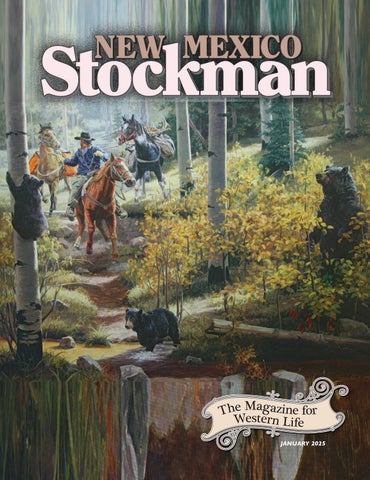
If Mama Ain’t Happy by Jim Tschetter. With the increase in the bear population over the past several years, we now have to watch out for situations which we have never had to consider before. This was a Commissioned painting for the Cervid Research and Recovery Institute (CRRI), an organization devoted to research of Chronic Wasting Disease (specifically in
Bill King - 505-220-9909
Tom Spindle - 505-321-8808 Give us a call to schedule
BillKingRanch.com
Producing rugged, deep sided, thick made, easy doing, range
ready bulls like this sire.
Annual Bull
Sale March 31, 2025
Selling 50 plus Hereford Bulls both Horned & Polled.
by Bronson Corn NMCGA President PRESIDENT’S MESSAGE
Bronson Corn President Roswell
Tom Paterson President-Elect Luna
Dave Kenneke NW Vice President Cimarron
Jeff Decker SE Vice President Lovington
Roy Farr SW Vice President Datil
Cliff Copeland NE Vice President Nara Visa
Becky King-Spindle Vice President at Large Moriarty
Shacey Sullivan Secretary/Treasurer Peralta
Loren Patterson
Immediate Past President Corona
Randell Major Past President
Man, I’m sure excited for 2025 to get rolling! We have a lot to look forward to in this New Year! It’s evident if we stick together there’s no telling what we can accomplish. We ranchers are a very rare breed, but there is nothing quite as strong as a bunch of ranchers banding together and drawing a line in the sand.
I am excited to say that the Department of Energy’s National Interest Electric Transmission Corridor (NIETC) has been canceled due to the overwhelming pushback they have received from the agriculture community. It’s a wonderful sight to see that the government still respects the opinion and the voice of the Ag community.
I hope that all the states involved in this fight see that we will always be stronger together than we can ever be standing alone! Now, if we can get everyone to stay on the fight maybe we can get the America the Beautiful aka 30x30 defunded and revoked! We have the ear and attention of every politician and government agency in the USA since the DOE transmission line was canceled. They were called out on a plan that had little to do with a transmission line and more to do with the more than 11 million acres they wanted to steal for their 30x30 agenda!
I want to touch on our Joint Stockmen’s Convention. What a great time that was! Holy Moly, I’m sure proud to be a part of this organization. The contagious support that we experienced was amazing and appreciated. The Cattleman’s College broke records for attendance and had topics that our membership wanted to learn about. I am proud of those that spent their time and effort to make this event so awesome, and I look forward to what next year has in store for us.
At our NMCGA General Session Meetings, we had a tremendous lineup of speakers and presenters that really stepped up to share what they know and what can be done to help. The attendance was phenomenal this year. I’m glad that y’all decided to come see what we were up to and come see my smiling face. Our YCLC had an awesome event!
The committee put on a dummy roping scholarship fundraiser during the NFR Watch Party, and it was a blast! Funny thing about that roping is that mysteriously enough I was entered several different times, but I never actually entered. Come to find out my dummy roping horse was either running off with me, or I couldn’t get him to leave the box on time. Regardless of the poor performance of my dummy roping horse, yours truly was on the 3rd place team.
During the event, we had a 360 photo shoot stage in the back of the room, sponsored by American AgCredit. There may or may not be a video of me and Loren Patterson showing off our dance moves, but you may have to come back next year to see that video!
We had an amazing set of award winners this year, and I’m truly honored to know these individuals. This year’s Ranch Family of the Year was the Randell Major Family. Their roots run deep in NM, and I was proud that they were able to be recognized.
The Inspector of the Year award goes to Steven Howard. You should be proud, Steven. You had a lot of support letters, and you are well respected!
The Green from the Ground Up award went to Dave Kenneke. Dave exemplifies what dedication and perseverance in land management can do for an operation. The Ayudando Siempre Alli, which is our Friend of the Organization award, goes to Bill Williams. Bill never shies away from a fight, and he’s always going to stand up for what’s right no matter what is affecting our industry and livelihoods.
The Bruce and Alice King Service award went to Howard Hutchinson. For a recovered environmentalist, Howard is an invaluable resource that I’m proud to claim on our team!
Last but not least, our Cattleman of the Year award winner is Pat Woods. My friend was a cowboy long before he was a Senator! If there was ever a man deserving of an award, Pat Woods deserves it!
All that being said, I’m Proud of our Team, and I’m proud of our organization!
John 14:6 “Ya’ll Have A Good’en”
NMCGA President
Bronson Corn,
by Caren Cowan, Publisher New Mexico Stockman
Old World Screw Worms
Twestern states. I can tell you what it was like for a child in southern Arizona not far from the Mexican border. The worst outbreak hit us in mid to late summer.
The weather was the typical two seasons for that part of the world – hot or wind, or both. We rounded up every animal on the ranch. Everything went through the chute and all wounds were stuffed with Co-Ral on a cotton ball. The advent of Co-Ral was a blessing. Prior to that, Peerless Screw Worm Killer, a pink liquid; EQ 335 smear; and another smear were available for treatment.
However they were not very effective and the worms had to be dug out of the wound prior to application – a nasty job.
one of Dad’s boots. I am sure my love of blue dogs started with that Blue dog.
Blue ate one of those Co-Ral cotton balls and died. It was a terrible loss.
The nightmare eventually ended with one of the greatest things the government ever did for the livestock industry. In cooperation with Mexico, the US began dropping boxes of sterile male flies to mate with females and stop fly production.
It took several months to begin to work, but eventually the flies were eradicated. That treatment is already underway to keep the Central American screw worm outbreak under control.
urns out there is no difference between the New World Screw Worm and the ones that invaded the Southern U.S. in the 1960s. This “new” one is present in the New World tropics. It is still widespread in tropical and subtropical parts of the Caribbean and South America, and import of infected animals from endemic areas risks reintroducing the fly to areas where it has been eradicated.
Never missing an opportunity for propaganda, climate change is listed as one of the reasons for this new outbreak.
The New World screw worm fly was the first species on which the sterile insect technique was tested and then applied in a natural environment, resulting in the control and systematic eradication of this species from North and Central America, as well as parts of the Caribbean since the 1950s.
Reading up on screw worms there is a lot of information in Florida and Texas but not so much about other Southern and South-
I don’t know how many cattle we lost, but it had to be plenty. We suffered another family loss during the Co-Ral operation. Dad had a beautiful Australian Shepard that was his best friend. Blue jumped up in the saddle to ride with Dad and slept with his nose in
Additionally the US Department of Agriculture has stopped the import of cattle from Mexico.
On the other hand…
We often joke about “we are from the government and are here to help.” The government hasn’t done its due diligence when it comes to Bird Flu.
After months of inaction, the USDA Animal Plant Health Inspection Service has decided to help. That help comes in the form of costly new regulations that will make it more difficult for egg producers to comply and will continue to drive egg prices up. We paid 50 cents an egg for our last carton!
Federal officials are cracking down on poultry operations looking for taxpayer relief from bird flu losses and will now require a biosecurity audit before insuring birds against future avian influenza outbreaks. The biosecurity requirement is an attempt to rein in the cost of compensating
continued on page 14 >>
ReseRve
growers, who are required to euthanize their entire flock when bird flu is detected. Producers are reimbursed for the market value of the birds they had to euthanize, according to the Minnesota Star Tribune.
Poultry operations that don’t comply with beefed-up biosecurity requirements “will not be eligible for indemnity payments if the premises experiences future infections within the same outbreak,” the USDA said.
What’s up with that?
In recent months meat packers have announced plant closings. Tyson closed three plants and laid off 1,000 employees. Cargill cut five percent of its workforce
worldwide and Butterball announced plans to close its processing facility in Jonesboro, Arkansas, affecting approximately 180 employees.
Subscription
We hope that if you haven’t already renewed your subscription to the New Mexico Stockman, you will consider doing so!
BRANGUS ANGUS RED ANGUS
JINGLE JANGLE
2024 was a year full of great things for the New Mexico CowBelles. Our Annual meeting and District Meeting were both well attended and well received.
Our Past Presidents Reception had a great turn out. ANCW President Ruth Coffey delivered a great message of history and foundation of our beloved organization. She also installed our new officer team and set the tone as she passed us the keys to our individual doors to go forward with.
We appreciate her and everyone who attended.
Our Cowbelle of the Year went to the much deserved Nancy Phelps. We appreciate her so much in everything she adds to our organization. We would also like to say a great big thank you to State Representative Harlan Vincent for his sponsorship of our meeting.
We are looking forward to hosting two District Workshops. Aiming at one in the Eastern part and one in the Western part of the state. Dates are pending and will be released soon.
2025 is going to be great and we are looking forward to all that is in store. Remember each and every one of your stories matters!
– Blessings, Corrina Casler, NMCB President
Powderhorn CattleWomen met in the home of Sarah Fitzgerald with Beverly Overton as co-hostess. There were eight members in attendance and three guests aka Future Beef Promoters. All enjoyed a Chinese Gift Exchange, drew for door prizes, then had a wonderful Lunch of Brisket, Mashed Potatoes, two salads, Hot Rolls and Banana Pudding pie and Pecan Pie and Fruit cake. The group collected four blankets and $127 for Shop with a Cop. Everyone missed those that could not attend. Mary McClain, Sec.
The Yucca CowBelles and Wool Growers held their December meeting and Christmas party Tuesday December 3rd at CVE in Artesia, with 10 members in attendance. Kyler Bowerman was hostess. President Joan Kincaid called the meeting to order. The Pledge of Allegiance was led by Karen Patterson, and Tina Kincaid read the CowBelle Creed. The minutes of the last meeting were read and approved. Tricia Monk gave the Treasurer’s report. Some members still need to pay Dues. Correspondence was shared and Christmas cards were signed for residents at Grammy’s House and Assurance Home. Sign up for hostess for 2025 meetings was passed around, along with proposed programs for the year. Next year’s Christmas party was also announced to be at the home of Lauren Marbach. Polar Express is the planned theme. Outstanding CowBelle awards were given to Lauren Marbach, Karen Patterson and Becky Waldrop. All appreciate their dedication and hard work for CowBelles. After the meeting adjourned everyone enjoyed a Christmas ornament and cookie exchange. Each member shared a favorite Bible verse and/or famous quote. Joan also shared a list of “Eight Gifts That Don’t Cost A Cent”. The group all enjoyed lunch together after-
ward, at La Fonda, courtesy of the club. Respectfully submitted, Tina Kincaid Secretary
New Mexico CowBelles: Thank you to all who have submitted their news to Jingle Jangle. Please send minutes and/ or newsletters by the 15th of each month to Jingle Jangle, Janet Witte, 1860 Foxboro Ct., Las Cruces, NM 88007 or email: janetwitte@msn.com ▫
Meet your 2025 NMCB Executive Officers (r to l): Terri Anne Knight – Vice President, Corrina CaslerPresident, Misti Orr – President Elect, Shelly Frost – Treasurer, Michelle Greeman – Past President, Tanya Yaste – Secretary (not pictured). Congratulations Ladies!
Congratulations to our 2024 CowBelle of the Year, Nancy Phelps! Nancy is a steadfast champion for beef promotion and education. A member of the Chamiza CowBelles, past state president, and current member of the board for Beef Council, she is unwavering in her support for our industry.
American Gelbvieh Junior Association Steer Profitability Challenge
The American Gelbvieh Junior Association (AGJA) and American Gelbvieh Foundation (AGF) have partnered to host the Steer Profitability Challenge alongside the Annual AGF Scale & Rail Contest hosted in Kinsley, Kansas at Kinsley Feeders. This event fulfills AGF’s commitment to youth development and fits into the AGJA 2022-2027 Strategic Plan focus areas of education, outreach, outlook, leadership, and
involvement by creating new relationships between the existing branches of AGF, AGJA, and AGA and providing new opportunities for AGJA membership within AGA activities.
AGJA members who participate in the AGJA Steer Profitability Challenge will have the opportunity to learn more about the cattle feeding industry, what happens to cattle after they leave a cow-calf operation, and how Gelbvieh-influenced cattle fit into that industry. Participants will deliver cattle to the feedlot to be fed and evaluated next to the AGF Scale & Rail Contest cattle and complete a portfolio outlining their event participation from start to finish. All cattle must align with AGF Scale & Rail contest requirements and will also be eligible for Scale & Rail contest awards. Below is a complete list of details and requirements for all participants.
Rules and Guidelines
1. Participants must complete an online entry form by December 1, 2024.
2. Participants must be a current dues-paying member of the AGJA.
3. Age divisions will follow the AGJA Junior Classic guidelines:
a. Junior (ages 8-11 as of January 1, 2025)
b. Intermediate (ages 12-15 as of January 1, 2025)
c. Senior (ages 16-21 as of January 1, 2025)
4. Participants must submit a completed portfolio to the AGA Office by September 1, 2025.
Cattle Delivery
1. Animals arrived at Kinsley Feeders near Kinsley, KS between December 9 and 13, 2024.
Cattle Requirements
1. Each participant must submit a group of three steers for the contest.
2. Steers may be home-raised or purchased by the participant.
3. All steers must have at least one registered Gelbvieh or Balancer parent.
4. All steers must weigh a minimum of 750 lbs. with a maximum of 900 lbs. by December 13, 2024.
5. All steers must be born January 1, 2024, or later.
6. All steers must be weaned a minimum of 30 days before delivery to the feedyard. It
MAKE YOUR CROSSBREEDING COUNT
DAVE & DAWN BOWMAN
55784 Holly Road Olathe, CO 81425
970-323-6833
www.bowkranch.com
REGISTERED
GELBVIEH
SALE
Friday, February 28, 2025
is recommended that steers are closer to a minimum of 45 days weaned before delivery, as the cattle will be more successful in this program.
7. Participants should only enter lively, healthy cattle that have been relatively treatment-free prior to arriving at the feedyard. This will also allow cattle to be as successful in the program as possible and will help minimize death loss.
8. The AGJA Steer Profitability Challenge will accept commercial (sire-identified) and/ or registered steers.
9. Steers are required to have a DNA test and must be sire verified. Tissue samples will be taken at Kinsley Feeders for these DNA tests, and cost will be the responsibility of the AGF.
10. All steers will receive an EID tag upon arrival at the feedyard.
Ownership and Financial Information
1. Participants will retain full ownership of the steers throughout the contest.
2. This is a terminal contest – no exceptions.
3. Participants will be responsible for the cost of feed, yardage, vaccinations, veterinary costs associated with morbidity and loss due to mortality. All costs will be billed to participants directly by the feed yard.
4. Feeding cattle has risks. Participants may seek individual insurance policies for steers submitted to the AGJA Steer Profitability Challenge if they wish.
5. The feed yard will deduct any unpaid costs from the sale of the animal to the packer at harvest time from the gross revenue of the sale and the owner will be paid the net balance.
Awards
There will be two top prizes awarded per age division – one for the top-ranking pen of steers* and one for the top-ranking port-
folio.** Awards will be provided as follows:
1. Champion Junior Pen of Steers*
– belt buckle sponsored by AGF
2. Champion Intermediate Pen of Steers*
– belt buckle sponsored by AGF
3. Champion Senior Pen of Steers*
– belt buckle sponsored by AGF
4. Champion Junior Portfolio**
– belt buckle sponsored by AGF
5. Champion Intermediate Portfolio**
– belt buckle sponsored by AGF
6. Champion Senior Portfolio**
– belt buckle sponsored by AGF
*For the Champion Pen of Steers awards to be separated by these three age divisions, there must be a minimum of five pens of steers submitted in each division. If the minimum is not met, all AGJA Steer Profitability Challenge cattle will be entered into one division.
**Regardless of the presence of different divisions in the steer portion of the contest, all contestants will be separated into three age divisions for the portfolio portion of the contest.
***Junior cattle may be a mix of Gelbvieh and Balancer and do not need to be a siregroup to still be eligible for AGF Scale & Rail contest awards. Adults participants must follow original Scale & Rail rules.
There will also be an opportunity for the top three high scoring Senior portfolio participants to earn a $500 scholarship sponsored by the AGF. The participants that submitted the three highest scoring portfolios will be invited to participate in an interview process during the 2025 AGA Convention. This interview will be conducted by a qualified panel of experts in the cattle feeding industry to assess the participant’s knowledge gained through the contest. Results of this interview process will be announced during the 2025 AGA Convention Year-End Banquet. ▫
JANUARY — Wildlife; Gelbvieh; Joint Stockmen’s Convention Results
FEBRUARY — Beefmasters; Texas Longhorns
MARCH — Limousin; Santa Gertrudis
APRIL — Dairy
MAY — News of the Day
JUNE — Sheepman of the Year
JULY — Directory of Agriculture
AUGUST — The Horse Industry
SEPTEMBER — Charolais; Fairs Across the SW OCTOBER — Hereford; State Fair Results
NOVEMBER — Cattleman of the Year; Angus; Brangus; Red Angus: Joint Stockmen’s Convention Preview
DECEMBER — Bull Buyers Guide
Value of Feed Efficiency Tucumcari Bull Test Sale — Sat., March 8, 2025
VALUE OF FEED EFFICIENCY ASSUMPTIONS:
• Assuming these bulls (actual data from 2021 test) were steers in feedlot, grown from 700 -1400 lbs (700# Gain)
• Cost of feed $185/ton, 62% DM, yardage at $0.25/head/day
• Bull will sire 100 calves in lifetime, calf crop is 50% his genetics, 40% Heritability of FE
• Assumes a bull at 80% ratio for FE does not add any value, other bulls compared to him
• This does not include value of keeping females who are more feed efficient
This chart just shows the added value of keeping calves through the feedlot out of proven
USDA Allocates $165M to Protect Livestock from New World Screwworm
by Sarah Zimmerman, Editor, AGRICULTUREDRIVE
Dive Brief:
Ї The U.S. Department of Agriculture dedicated $165 million in emergency funding to prevent New World screwworm from reaching the United States after the flesh-eating maggot was found in Mexico for the first time in decades.
Ї The money will be used to beef up surveillance and animal health checkpoints, according to a release. The USDA is also working with partners to eradicate the pest in Mexico and Central America and reestablish a biological border in Panama.
Ї The U.S. last month paused cattle imports from Mexico after the country found the pest near the Guatemala border. The National Cattlemen’s Beef
Association said the return of New World screwworm to the U.S. would be “devastating.”
Dive Insight:
New World screwworm poses a significant threat to livestock: The pest can enter an animal through an open wound and feed on their living flesh, which can lead to death.
The U.S. successfully eradicated the pests in the 1960s using sterile flies. At the time, the larvae were costing producers an estimated $50 million to $100 million in losses a year.
However, detections in Mexico throughout the 1970s caused flareups in the southwestern U.S. The outbreaks prompted the two countries to team up and successfully eradicate the fly in Mexico in 1986, according to a USDA reference guide.
Over the last two years, New World screwworm has moved north from a biolog-
ical barrier the U.S. helped establish in Panama. The fly has been found in Costa Rica, Nicaragua, Honduras and Guatemala.
Increased livestock movement and land use changes from deforestation have allowed the fly to escape traditional containment areas, according to the North American Invasive Species Management Association. Rising temperatures linked to climate change have also led to more favorable conditions for the flies to spread.
U.S. Ranchers have been asked to remain on high alert for the fly, which has orange eyes and three dark stripes across its back. Infestations can be difficult to detect early in animals, according to the NAISMA, with symptoms like enlarged wounds, discomfort and visible larvae appearing after significant damage has already occurred.
“The current outbreaks in Central America demonstrate the need for USDA to increase its investment in NWS eradication and prevention,” Jenny Lester Moffitt, USDA Under Secretary for Marketing and Regulatory Programs, said in a statement. “If NWS were to spread to the United States, it would result in significant economic losses and threats to animal health and welfare.”
Arizona Angus Invitational Sale at Marana Stockyards
Mexico Has Become America’s Most Reliable Customer for U.S. Dairy Exports
U.S. dairy exports are approaching record levels as consumer demand for dairy products in Mexico continues to outpace the country’s production. Mexico is the leading export market for U.S. dairy
products, accounting for more than onefourth of international sales. All told, Mexico purchases 4.5 percent of U.S. milk production via dairy products and ingredients.
While milk production in Mexico has grown annually since 2011, it hasn’t been enough to keep pace with surging demand. Dairy product consumption in Mexico has increased by 50 pounds per capita since 2011.
According to a new report from CoBank’s Knowledge Exchange, the upside potential for increasing U.S. dairy sales to Mexico remains strong and broader export market opportunities are positioning the U.S. dairy industry for long-term growth.
“Dairy product sales to Mexico have the potential for continued growth as more consumers enter the middle class and seek higher quality proteins and fats,” said Corey Geiger, lead dairy economist with CoBank.
“Mexico faces an annual dairy product deficit ranging between 25 to 30 percent, and the U.S. supplies over 80 percent of that shortfall. Beyond Mexico, the U.S. has strong growth prospects in the wider dairy export market that will be increasingly important as new dairy processing capacity comes online.”
The European Union and New Zealand currently hold the top two spots for global dairy exports, but milk production in those regions has stalled. Greenhouse gas reduction policies have constrained production in the EU, and New Zealand has likely reached its peak cow population due to land constraints.
Growth prospects for U.S. dairy both domestically and abroad triggered an $8 billion investment in new processing plants that will be ramping up production over the next two years. By the middle of 2025, nearly 20 million pounds of new milk is expected to be flowing through those plants. That means more cheese, whey and other dairy proteins will be seeking a home, and exports are expected to be a major destination for those products.
A generation ago, almost all the milk and dairy foods produced in the U.S. were sold domestically. Today, the milk from one in six tanker trucks leaving American farms is processed into dairy products and ingredients sold to other countries.
Free trade agreements have been instrumental to export growth for dairy and other agricultural products, Geiger noted. Prior to the implementation of the North American Free Trade Agreement in 1994, the U.S. exported just $211 million in dairy products to Mexico.
By 2011, Mexico became America’s first $1 billion dairy export market. Dairy exports to Mexico surpassed $2 billion in 2022 under the United States-Mexico-Canada Agreement.
U.S. dairy exports to Mexico totaled 1.38 billion pounds in 2023, and the 10-year growth rate for U.S. dairy sales to Mexico is 42 percent, according to USDA data. Geiger said the dairy industry is hoping that trajectory continues.
“As the industry prepares for future demand, producers and processors hope Mexico will one day purchase a significant portion of America’s milk production in the form of dairy products and ingredients,” he said.
Why roll the dice?
New Mexico
Desert Flower
Protected as Endangered
The U.S. Fish and Wildlife Service (FWS) has protected the swale paintbrush as endangered under the Endangered Species Act. This 19-inch-tall, yellow-reddish flower is only known to survive in one spot in southwest New Mexico. In former times swale paintbrushes lived
in 11 spots in the Mexican states of Chihuahua and Durango and two spots in the bootheel region of southwest New Mexico. Today they’re only known to survive in a single location in New Mexico; they haven’t been seen in Mexico since 1985. The remaining New Mexican population exists on a 28-acre swath of private land.
In addition to their extremely limited distribution, swale paintbrushes are imperiled by drought from climate change and potential trampling by livestock. Historically the plant was reduced through habitat loss and fragmentation, human alterations in the hydrology of the swales it favors, loss of
Land & Cattle
4 0+YEARS of AI. Our Limousin have a Brown Swiss background that results in greater maternal ability, growth and good dispositions. Our mother cows are selected for their ability to work at high altitude and to wean a growthy calf under range conditions.
5 0+YEARS OF PRODUCING HIGH QUALITY BULLS
Lunch will be served at the Ranch. Sale Catalogs available on request. Airport only 14 miles from Ranch.
natural fire that curbed the encroachment of woody vegetation and regenerated the grasses the flower’s roots parasitize, intensive grazing pressure, and nonnative plants.
The Service will develop a recovery plan for swale paintbrushes that will likely call for reintroducing them to other habitats to ensure the species survives if the current known population is wiped out..
The swale paintbrush was first petitioned for protection in 2007 by WildEarth Guardians, but it took a 2020 lawsuit by the Center for Biological Diversity (CDB) to ensure a deadline by which the protections were enacted.
New Mexico Chipmunk
Protected by Endangered Species Act
Rio Grande Cutthroat Trout Listing Denied
The U.S. Fish & Wildlife Service (FWS) has added the Peñasco least chipmunk of southeastern New Mexico to the list of endangered species. The Service also designated 4,386 acres on the Lincoln National Forest as critical habitat for the chipmunks.
Peñasco least chipmunks are a subspecies of least chipmunk native to the Sacramento Mountains including their spur, the White Mountains, the only region where they’re currently found.
The WildEarth Guardians (WEG) petitioned to add the Peñasco least chipmunk to the endangered list in 2011, but it took a Center for Biological Diversity (CBD) lawsuit last year to secure an agreement with the FWS to set a timeline to determine whether the chipmunk, as well as 12 other disappearing animals, would be listed.
The FWS also denied Endangered Species Act protection for Rio Grande cutthroat trout, which are found in New Mexico and Colorado. ▫
NMDA’s $22.5 Million Budget Boosts Operations & Invests in Partner Program Coordination
The New Mexico Department of Agriculture (NMDA) is requesting $22.5 million in state funding for fiscal year 2026, which covers a range of priorities for the department. The request represents a 6.7 percent increase in NMDA’s operating budget from fiscal year 2025.
“We are committed to fostering an even stronger and more resilient agricultural sector New Mexico, and this budget proposal is a vital step in that direction,” said New Mexico Secretary of Agriculture Jeff Witte.
The NMDA FY26 budget request supports operations such as adding an agricultural water resilience coordinator position, as well as meeting market development and acequia and ditch fund needs.
The FY26 budget request is focused on the following priorities:
Agricultural Water Resilience Coordinator position
Ї An expert with an irrigated agricultural background is needed to accomplish priorities in Gov. Michelle Lujan Grisham’s 50-Year Water Plan and support agricultural participation in regional water planning under the Water Security Planning Act.
Ї This new full-time position will provide agricultural expertise to state water policy discussions, provide technical expertise on water conservation action proposals, act as a liaison to irrigation communities statewide and actively participate in regional water planning efforts.
Ї This position will work closely with other agencies and local governments, including the Office of the State Engineer and Interstate Stream Commission, irrigation and conservancy districts, tribes, nations, pueblos and acequias.
Acequia and Community Ditch Fund
Ї The demands on this fund continually exceed available funds.
Ї FY25 requested funding totaled $1,370,000, but available funds were $790,675;
Ї FY24 requested funding was $1,449,255, with $792,656 available;
Ї FY23 requested funding was $1,151,000, with $794,657 available.
Ї There are 14 active associations, but in FY24, two associations completely depleted funding and one association has only minimal remaining balances due to a high level of activity.
Ї The requested amount would bring this fund to $1,250,000.
Value-added market development (non-recurring funding)
Ї Increasing demands for New Mexico agricultural products requires a larger investment in the New Mexico Grown Approved Supplier Program. The program is designed to grow and diversify New Mexico producers selling to schools and other institutions.
Ї The Approved Supplier Program helps ensure fresh produce that moves through schools, early child care facilities and senior centers is safe, traceable and originates from a garden or farm using thorough and current food safety practices. The program also helps connect farmers with buyers across the state and streamlines internal purchasing processes.
Compensation equivalence
Ї NMDA is a state agency that falls under the New Mexico State University system, and as a result, the agency’s employee compensation has not kept up with that of other state agencie
Ї Gaining compensation equivalence offers a strategic approach to employee retention management and establishes uniformity between NMDA employees and other state agency employees.
Ї This request also addresses salary compression, which occurs when starting salaries for new employees are in close proximity to those of longstanding employees despite differences in skills, experience, performance, seniority or tenure. Funding also will help with retention and longevity.
Employee health insurance funds
Ї NMDA is seeking additional funds to cover its portion of healthcare insurance increases. The additional cost
at $125,000.
NEW CROP OF BULLS AND HEIFERS AVAILABLE FOR INSPECTION NOV 1 ST PICK THEM AND WE’LL GROW THEM OUT FOR YOU
GRAU GRAU RANCH RANCH
THEY’RE BETTER BECAUSE THEIR SIRES & GRANDSIRES ARE GRAU RANCH BRED
Grau Ranch bull sired the Grand Champion Carcass steer in San Antonio in the production division with 87 head entered. The calf was a purebred Charolais steer.
STATISTICS ARE:
Quality Grade: Prime plus
Yield Grade: 2.3
Ribeye: 16.5
Fat thickness: .4
Dressing %: 62%
The Calf was fed and entered by Andrew Louis Jones from Cal Farley’s Boys Ranch.
These kinds of calves weigh more and bring more money than the others.
NMSU Alumnus, Rancher Turns Family Cattle Operation Into International Success Story
William “Bilo” Wallace II and his family have operated the historic Hacienda Rancho Corralitos in northern Mexico for four generations. Wallace grew up on the 60,000-acre cattle ranch near Casas Grandes, Chihuahua, and took over its operations after earning a bachelor’s degree in animal and range sciences from New Mexico State University in 1968.
Wallace credits his alma mater – and professors like Dan Dwyer, Jack Ruttle and Lewis Holland – for teaching him the skills that helped him grow the family ranch into a successful international business. Today, he raises upwards of 1,300 calves each year with four full-time employees, including his two sons, one of whom also graduated from NMSU.
THOMPSON RANCH
“I’m a third-generation rancher, and I’ve lived here on this ranch all my life,” Wallace said. “We are very lucky because we’re only about 150 miles from the United States, and we raise our calves and ship them to the U.S. market.”
It was NMSU’s prime location along the U.S.-Mexico border that most appealed to Wallace, who decided early in life to follow his family’s footsteps into the cattle industry. NMSU’s proximity to Casas Grandes – a three-hour drive – meant he could easily visit the ranch on weekends. Although he was active in the agricultural fraternity Alpha Gamma Rho, Wallace said he mostly concentrated on school-work during his time at NMSU. After graduating, he went straight to working on his ranch, taking what he learned to streamline operations.
“What helped me the most was learning how to better our ranching practices and understanding the business side of things,” he said.
Even as he ran his family ranch, Wallace found time to serve as the president of the Chihuahua Cattleman’s Association, a role in which he became a leading advocate for livestock producers in Chihuahua. He also served as the head of the Chihuahua Animal Health Committee, which helps producers implement USDA regulations on steers and heifers entering the U.S., and was part of a binational committee working to eradicate tuberculosis and brucellosis in livestock.
Beef Ads for the Holidays
NMBC launched a digital out-of-home advertising campaign targeting grocery stores and other relevant retail locations. Ads were strategically placed on screens near store entrances, at checkout, and throughout the store footprint. The campaign promoted Beef as the ideal choice for holiday meals, showcasing its versatility and featuring Appetizers, Roasts, and other Holiday recipes. This campaign effectively reached consumers across the entire state of New Mexico, delivering impactful messages at the point of purchase. Ads included direct calls-to-actions and embedded QR codes which provide consumers easy access to BIWFD recipe content while inspiring shoppers to choose Beef for their next meal.
Family, Fun, and Football at Ag Day 2024
The New Mexico Department of Agriculture and the New Mexico State University College of Agricultural, Consumer and Environmental Sciences hosted this street-fest event with booths that featured family and kid-friendly activities showcasing agricultural learning. The New Mexico Beef Council (NMBC) was happy to sponsor this annual event taking place prior to the NMSU homecoming football game that took place in November. The NMBC partnered with Doña Ana County Farm Bureau to serve delicious beef brisket slider samples to the crowds. Pistol Pete posed for a T-bone Steak photo-op with his friend Kate Cooper while Kimberly Stone, NMBC Vice Chair, handed out I-Heart-Beef stickers to smiling kids of all ages. Families enjoyed the educational Beef Cuts Chart and received a clear stadium bag and fun beef educational items for kids.
From Gate to Plate: A Comprehensive Beef Experience at NMSU
The New Mexico Beef Council provided a true Gate to Plate experience in November at NMSU with their Hotel Tourism and Restaurant Management (HRTM) program. The day included many interactive opportunities for the students at both the NMSU Meat Lab and in the HRTM Classroom. The event began with a tour of the NMSU cattle feedyard, led by Dr. Shanna Ivey and Dr. Eric Scholljegerdes, where participants learned about cattle management and feeding practices. The group then visited the NMSU Meat Lab, where Dr. Francine Giotto discussed meat grading and the meat science program. Eleck Stone and Kate Cooper, NMSU students from ranching families, shared insights into the life and challenges of cattle producers. Jacob Painter demonstrated meat grading and breaking down a carcass, with assistance from the Meat Judging team. In the HRTM Kitchen, Chef Jon Young led a cooking session, teaching participants to prepare a unique beef recipe. Kate Schulz then discussed the nutritional benefits of beef, emphasizing high-quality protein in a balanced diet. The day concluded with a final discussion led by Kate Schulz and Carollann Romo, allowing attendees to ask questions and engage in dialogue. Overall, the event provided a comprehensive exploration of the beef industry, from cattle feedyards to the dinner table, highlighting the importance of beef in nutrition and culinary arts.
The New Mexico Beef Council (NMBC) was thrilled to sponsor the Isleta New Mexico Bowl held on December 28th at University Stadium in Albuquerque. Mouths watered as crowds passed by the NMBC’s cheeseburger banner that was placed at the stadium’s main entrance. The National TV Viewership reached upward towards 3,000,000, with a sideline banner and the “Beef It’s What’s for Dinner” logo being seen loud and clear. Two Public Address Announcements with concurrent logo recognition on the video boards impressed that “lean beef has over 10 essential nutrients in about 170 calories”, during the bowl game. The NMBC was very pleased to have the opportunity to co-brand with the Isleta New Mexico Bowl and Albuquerque’s own, “The Daily Jerky” to include beef jerky in swag bags to 360 coaches, trainers, managers, players and staff from both teams.
Local
We are working on compiling a list of places to purchase beef from locally owned ranches, retailers and packers. We’d love to include you in this directory if you’d like. Follow this QR code to give us information about how customers can buy beef from you.
by Lee Pitts
An Accidental Greenie
When people come to my house for the first time they ask for my address so they can program it into their GPS. I don’t mess with all that stuff so I tell them, “Turn on such and such road and keep going until you come to the house with a herd of cows in the front yard.”
“You have cows in your front yard!” they always ask.
“Sure. I admit they aren’t real cows; instead of muscle and bone my cows are made from rebar and cement, red clay pottery and plastic. I even have a tall, mean lookin’ cowboy with a handlebar mustache to watch over them, although he hasn’t made any sudden moves in the 40 years we’ve lived here.”
I have one concrete cow that must weigh at least a couple hundred pounds that is so valuable that I chained her to a subterranean mass of concrete and steel. I did so because one Halloween night some hooligans were
attempting to pilfer my best cow in the dark of night. Little did they know that my bedroom is not 20 yards from my prized concrete cow so I heard the strains and grunts of three would-be rustlers busting a gut as they tried to corral her. So I grabbed my menacing looking BB gun and went out on my porch where they couldn’t see me and told them in no uncertain terms, “No city dudes are gonna rustle my cow and if you don’t vamoose I’ll give every one of you a load of buckshot in your backside.” I also mentioned in my best John Wayne impression that, “The remedy for cattle rustling in these parts is hanging.”
I guess they took me seriously because they all turned tail and dove into the back of an already escaping pickup as they tried to steal away. Although I got their license plate number I didn’t call the cops because around here we tend to settle our own disputes. The word must have spread because in the ten years since then we haven’t had any further run-ins with poachers, rustlers or grifters.
Well, that last sentence isn’t entirely true because one low-life carefully wound his way through my herd and knocked on my front door. “What do you want?” I asked once again using my best John Wayne voice.
He mustered up his courage and asked me, “I was wondering if you’ve noticed lately that your electric bills are higher?”
“Listen pilgrim, around these parts you don’t go asking about another man’s business.”
“The reason I was asking is because the state of California is offering to give you free solar panels.”
“Is that right? You don’t see any of those gal-darn things on my roof do ya? If I wanted them don’t you think I’d already have them? And I don’t need the state paying for them either. What kind of racket are they runnin’ anyway? That’s what’s wrong with this state, they’re giving everything away. I tell ya, all those politicians in the state capitol belong in the hoosegow.”
That didn’t stop him from launching into a memorized spiel claiming that it was folks like me causing global warming and that my lifestyle was somehow causing natural disasters somewhere in Africa. Then he said we simply had to ban the internal combustion engine by 2035 and achieve net zero carbon emissions by 2050 or, “WE WERE ALL GONNA DIE.”
“Listen buddy-boy, I’m what you might call an accidental greenie. Me and Mrs. Pitts never had any bambinos scampering around the place so when we die that will be the end of the Pitts strain to which I belong. And if you and all your fellow generation XYZ’ers would follow our example that would end the climate change crises right there. That is what you wanted, right?”
Then I turned purple and said in what might be construed as a semi-violent manner, “So if I want to drive a car that you don’t plug in, live in a house without any Chinese made panels on my roof, eat beef from farting cattle and ride herd over my concrete cows that’s my business. Got it mister?”
That old boy was last seen running away with my herd of concrete cows in pursuit. I guess the climate around here didn’t agree with him. ▫
RIDING
HERD
ROSWELL LIVESTOCK AUCTION SALES, INC. & ROSWELL LIVESTOCK AUCTION TRUCKING, INC.
900 North Garden · P.O. Box 2041 Roswell, New Mexico 88201
575-622-5580 www.roswelllivestockauction.com
CATTLE SALES: MONDAYS • HORSE SALES
BENNY WOOTON CELL 575-626-4754
SMILEY WOOTON CELL 575-626-6253
Producers hauling cattle to Roswell Livestock New Mexico Receiving Stations need to call our toll-free number for a Transportation Permit number before leaving home. The Hauling Permit number 1-800-748-1541 is answered 24 hours a day, 7 days a week.
Trucks are available 7 days a week / 24 hours a day
Roswell livestock Auction Receiving stAtions
ATTENTION RECEIVNG STATION CUSTOMERS,
To be able to schedule trucking, all cattle need to be permitted by 1:00 p.m.
LORDSBURG, NM
20 Bar Livestock Highway #90 at NM #3 – East side of highway. Receiving cattle for transport 2nd & 4th Sunday of each month. Smiley Wooton, 575-622-5580 office, 575-626-6253 cell.
PECOS, TX
Jason Heritage is now receiving cattle every Sunday. For information to unload contact Jason Heritage 575-840-9544 or Smiley Wooton 575-626-6253. Receiving cattle every Sunday.
VAN HORN, TX
800 West 2nd, 5 blocks west of Courthouse. Bob Kinford, 432-284-1553. Receiving cattle 1st & 3rd Sundays.
MORIARTY, NM
Two blocks east and one block south of Tillery Chevrolet. Smiley Wooton 575-622-5580 office, 575-626-6253 mobile. Receiving cattle every Sunday
SAN ANTONIO, NM
River Cattle Co. Nine miles east of San Antonio on U.S. 380. Receiving cattle for transport 2nd & 4th Sunday of each month. Smiley Wooton 575-626-6253.
ANTHONY, NM
108 W. Afton Road, La Mesa, NM 88044. Receiving Cattle 2nd & 4th Sunday of each month. Call in advance for details & consignments. Smiley Wooton 575-626-6253 or Genea Caldwell 575-543-5736
by Melissa Sue Sorrells, meatingplace.com
BTrimmed Stake: Beyond Meat CEO Sells
Shares
eyond Meat CEO Ethan Brown sold a total of 475,772 shares of the company on Dec. 12 and 13, according to SEC filings. The total value of these sales — minus exercise price, withholding tax obligations and broker fees — amounted to approximately US$1.48 million.
Following the trades, Brown holds approximately 1,700,000 shares of Beyond.
These trades follow lackluster third quarter financial results, with analyst Ken Goldman with J.P.Morgan noting, “Though we appreciate that fundamentals are on a better path, it’s likely going to be a long time before free cash flow is positive.”
Beyond Meat also still has a challenge in its $1.1 billion long-term debt that comes due in March 2027. ▫
USDA Projects Beef Production to Decline in 2025
by Meghan Grebner, Brownfield Ag News
In its latest Supply and Demand report, the USDA has lowered its beef production estimate for 2025.
The U.S. border remains closed to imports of feeder cattle from Mexico to prevent New World screwworm from entering the United States.
Scott Brown says that largely impacted the USDA’s December numbers. “USDA told us for their 2025 beef production estimate they turned out here in December 25.7 billion pounds of beef to be produced,” he says. That’s a reduction of 615 million pounds from what they said in November.”
While a date hasn’t been established for imports to resume, he tells Brownfield the idea that we’ll be without Mexican cattle for all of 2025 might be a little extreme. “But, the USDA has tended to take this strategy in other commodities when trade has been disrupted like this,” he says.
In mid-December the USDA’s Animal and Plant Health Inspection Service announced $165 million in emergency funding from the Commodity Credit Corporation to protect U.S. livestock and other animals from the pest. The funding would also help the USDA’s ongoing efforts to control its spread. ▫
Port Contract Uncertainty Impacting US Meat Exports
by Chris Moore, meatingplace.com
Looming uncertainty around contract negotiations between the International Longshoremen’s Association and the U.S. Maritime Alliance is already affecting U.S. red meat exports, according to Dan Halstrom, president and CEO of the U.S. Meat Export Federation.
The talks, which broke down in mid-November over automation issues, have shown little progress. Although a tentative agreement on wages was reached in early October, and a temporary extension of the existing labor agreement ended a three-day work stoppage, that extension expires on January 15.
Ocean carriers have begun announcing surcharges related to the potential strike, forcing exporters to divert shipments to other ports where possible.
Currently, 45 percent of waterborne U.S. pork exports and 30 percent of beef exports move through East and Gulf Coast ports, representing about $100 million in U.S. red meat shipped weekly. Another strike could severely limit shipping options, especially for chilled products, and damage the U.S. reputation as a reliable supplier ▫
APHIS Updates Indemnity Program for HPAI on Poultry Farms
by Industry News, The National Provisioner
As part of its ongoing efforts to stop the further spread of highly pathogenic avian influenza and give farmers tools to help combat the disease, the U.S. Department of Agriculture’s Animal and Plant Health Inspection Service (APHIS) has announced an interim final rule that updates the conditions for poultry facilities to receive indemnity and compensation after testing positive for HPAI. Based on evidence that strong biosecurity measures remain the most
effective strategy to combat HPAI, APHIS will now require that farmers undergo a biosecurity audit before restocking their poultry after an HPAI detection, and before receiving future indemnity payments.
“During the outbreak of HPAI in 2014 and 2015, U.S. poultry owners made great improvements to biosecurity to protect their flocks, which greatly reduced the presence of HPAI among the country’s poultry flock,” said Dr. Rosemary Sifford, USDA chief veterinary officer. “Biosecurity is proven to be our best weapon in fighting this virus, and this update will ensure that poultry producers who received indemnity for HPAI are taking measures to stop future introductions of the disease and avoiding actions that contribute to its spread.”
Data shows that most poultry farmers have in place strong biosecurity plans and are able to prevent reinfection. Since the beginning of the current HPAI outbreak in 2022, APHIS has made indemnity payments to over 1,200 producers; of these, 67 unique commercial poultry premises have had at least two HPAI infections during the current outbreak, including 18 premises infected three or more times. Those with reinfections have received over $365 million in indemnity payments, out of nearly $1.1 billion that has been distributed in total.
Under the interim final rule, if a commercial poultry farm affected by HPAI wants to restock their poultry and be eligible for future indemnity on that restock, the premises will be required to pass a biosecurity audit by APHIS before restocking. APHIS will also require a biosecurity audit for commercial poultry premises within the “buffer zone” (minimal seven-kilometer radius around the infected zone) prior to movement of poultry onto the premises if the owner wishes to be eligible for future indemnity for the poultry moved onto the premises.
Additionally, APHIS will not pay indemnity for flocks moved onto premises in active infected zones if the flocks become infected with HPAI within 14 days following the dissolution of the control area around an active infected premises. A producer who does not make corrections recommended in APHIS’ biosecurity audit will not be eligible for indemnity payments if the premises experiences future infections within the same outbreak.
This interim final rule will be effective upon publication in the Federal Register. At that time, APHIS will accept public comments at www.regulations.gov. All comments must be submitted on or before March 3, 2025. After the comment period closes, APHIS will publish another document in the Federal Register including a discussion of any comments received and any amendments the agency is making to the rule.
How America Lost Control of the Bird Flu, Setting the Stage for Another Pandemic
by Amy Maxmen, kffhealthnews.org
Nearly a year into the first outbreak of the bird flu among cattle, the virus shows no sign of slowing. The U.S. government failed to eliminate the virus on dairy farms when it was confined to a handful of states, by quickly identifying infected cows and taking measures to keep their infections from spreading. Now at least 875 herds across 16 states have tested positive.
Experts say they have lost faith in the government’s ability to contain the outbreak.
“We are in a terrible situation and going into a worse situation,” said Angela Rasmussen, a virologist at the University of Saskatchewan in Canada. “I don’t know if the bird flu will become a pandemic, but if it does, we are screwed.”
To understand how the bird flu got out of hand, KFF Health News interviewed nearly 70 government officials, farmers and farmworkers, and researchers with expertise in virology, pandemics, veterinary medicine, and more.
Together with emails obtained from local health departments through public records requests, this investigation revealed key problems, including deference to the farm industry, eroded public health budgets, neglect for the safety of agriculture workers, and the sluggish pace of federal interventions.
Case in point: The U.S. Department of Agriculture finally announced a federal order to test milk nationwide in early December 2024. Researchers welcomed the news but said it should have happened months ago — before the virus was so entrenched.
Far more bird flu damage is inevitable, but the extent of it will be left to the Trump administration and Mother Nature. Already, the USDA has funneled more than $1.7 billion into tamping down the bird flu on poultry farms since 2022, which includes reimbursing farmers who’ve had to cull their flocks, and more than $430 million into combating the bird flu on dairy farms.
In coming years, the bird flu may cost billions of dollars more in expenses and losses. Dairy industry experts say the virus kills roughly two percent to five percent of infected dairy cows and reduces a herd’s milk production by about 20 percent.
Worse, the outbreak poses the threat of a pandemic. More than 60 people in the U.S. have been infected, mainly by cows or poultry, but cases could skyrocket if the virus evolves to spread efficiently from person to person. And the recent news of a person critically ill in Louisiana with the bird flu shows that the virus can be dangerous.
Just a few mutations could allow the bird flu to spread between people. Because viruses mutate within human and animal bodies, each infection is like a pull of a slot machine lever.
Beyond the bird flu, the federal government’s handling of the outbreak reveals cracks in the U.S. health security system that would allow other risky new pathogens to take root.
“This virus may not be the one that takes off,” said Maria Van Kerkhove, director of the emerging diseases group at the World Health Organization. “But this is a real fire exercise right now, and it demonstrates what
needs to be improved.”
It may have been a grackle, a goose, or some other wild bird that infected a cow in northern Texas. In February, the state’s dairy farmers took note when cows stopped making milk. They worked alongside veterinarians to figure out why. In less than two months, veterinary researchers identified the highly pathogenic H5N1 bird flu virus as the culprit.
Long listed among pathogens with pandemic potential, the bird flu’s unprecedented spread among cows marked a worrying shift. It had evolved to thrive in animals that are more like people biologically than birds.
After the USDA announced the dairy outbreak on March 25, control shifted from farmers, veterinarians, and local officials to state and federal agencies. Collaboration disintegrated almost immediately.
Farmers worried the government might block their milk sales or even demand sick cows be killed, as poultry are, said Kay Russo, a livestock veterinarian in Fort Collins, Colorado.
Instead, Russo and other veterinarians said, they were dismayed by inaction. The USDA didn’t respond to their urgent requests to support studies on dairy farms — and for money and confidentiality policies to protect
farmers from financial loss if they agreed to test animals.
The USDA announced that it would conduct studies itself. But researchers grew anxious as weeks passed without results. “Probably the biggest mistake from the USDA was not involving the boots-on-the-ground veterinarians,” Russo said.
The USDA didn’t require lactating cows to be tested before interstate travel until April 29. By then, the outbreak had spread to eight other states. Farmers often move cattle across great distances, for calving in one place, raising in warm, dry climates, and milking in cooler ones. Analyses of the virus’s genes implied that it spread between cows rather than repeatedly jumping from birds into herds.
Milking equipment was a likely source of infection, and there were hints of other possibilities, such as through the air as cows coughed or in droplets on objects, like work boots. But not enough data had been collected to know how exactly it was happening. Many farmers declined to test their herds, despite an announcement of funds to compensate them for lost milk production in May.
“There is a fear within the dairy farmer community that if they become officially
listed as an affected farm, they may lose their milk market,” said Jamie Jonker, chief science officer at the National Milk Producers Federation, an organization that represents dairy farmers. To his knowledge, he added, this hasn’t happened.
Advisories from agriculture departments to farmers were somewhat speculative, too. Officials recommended biosecurity measures such as disinfecting equipment and limiting visitors. As the virus kept spreading throughout the summer, USDA senior official Eric Deeble said at a press briefing, “The response is adequate.”
The USDA, the Centers for Disease Control and Prevention, and the Food and Drug Administration presented a united front at these briefings, calling it a “One Health” approach. In reality, agriculture agencies took the lead.
This was explicit in an email from a local health department in Colorado to the county’s commissioners. “The State is treating this primarily as an agriculture issue (rightly so) and the public health part is secondary,” wrote Jason Chessher, public health director in Weld County, Colorado. The state’s leading agriculture county, Weld’s livestock and poultry industry produces about $1.9 billion in sales each year.
Patchy Surveillance
In July, the bird flu spread from dairies in Colorado to poultry farms. To contain it, two poultry operations employed about 650 temporary workers — Spanish-speaking immigrants as young as 15 — to cull flocks. Inside hot barns, they caught infected birds, gassed them with carbon dioxide, and disposed of the carcasses. Many did the hazardous job without goggles, face masks, and gloves.
By the time Colorado’s health department asked if workers felt sick, five women and four men had been infected. They all had red, swollen eyes — conjunctivitis — and several had such symptoms as fevers, body aches, and nausea.
State health departments posted online notices offering farms protective gear, but dairy workers in several states told KFF Health News that they had none. They also hadn’t heard about the bird flu, never mind tests for it.
Studies in Colorado, Michigan, and Texas would later show that bird flu cases had gone under the radar. In one analysis, eight dairy workers who hadn’t been tested — seven percent of those studied — had antibodies against the virus, a sign that they had been infected.
Missed cases made it impossible to determine how the virus jumped into people and whether it was growing more infectious or dangerous.
“I have been distressed and depressed by the lack of epidemiologic data and the lack of surveillance,” said Nicole Lurie, an executive director at the international organization the Coalition for Epidemic Preparedness Innovations, who served as assistant secretary for preparedness and response in the Obama administration.
Citing “insufficient data,” the British government raised its assessment of the risk posed by the U.S. dairy outbreak in July from three to four on a six-tier scale.
Virologists around the world said they were flabbergasted by how poorly the United States was tracking the situation.
“You are surrounded by highly pathogenic viruses in the wild and in farm animals,” said Marion Koopmans, head of virology at Erasmus Medical Center in the Netherlands. “If three months from now we are at the start of the pandemic, it is nobody’s surprise.”
Although the bird flu is not yet spreading swiftly between people, a shift in that direction could cause immense suffering. The CDC has repeatedly described the cases among farmworkers this year as mild — they
weren’t hospitalized. But that doesn’t mean symptoms are a breeze, or that the virus can’t cause worse.
“It does not look pleasant,” wrote Sean Roberts, an emergency services specialist at the Tulare County, California, health department in an email to colleagues in May. He described photographs of an infected dairy worker in another state: “Apparently, the conjunctivitis that this is causing is not a mild one, but rather ruptured blood vessels and bleeding conjunctiva.”
Over the past 30 years, half of around 900 people diagnosed with bird flu around the world have died. Even if the case fatality rate is much lower for this strain of the bird flu, covid showed how devastating a 1 percent death rate can be when a virus spreads easily.
Like other cases around the world, the person now hospitalized with the bird flu in Louisiana appears to have gotten the virus directly from birds. After the case was announced, the CDC released a statement saying, “A sporadic case of severe H5N1 bird flu illness in a person is not unexpected.”
Grilled Jalapeño Cheddar Meatballs
1 HRS 15 MINS
Time to Cook 20
Servings 8
Ingredients
2 lbs. Ground Beef
1/2 cup tortilla chips, crushed
3/4 cup milk
3 fresh jalapeños, seeded and finely diced
8 oz. block of cheddar cheese, finely diced
1 Tbsp. paprika
2 tsp. garlic powder
2 tsp. Kosher salt
Preparation
1. Step 1
Place the crushed tortilla chips in a large bowl, then add the milk and allow to soften the chips for about 10 minutes.
2. Step 2
After the mixture is soft and has absorbed all the milk, add the Ground Beef, jalapeño, cheese, paprika, garlic, and salt. Mix well to combine all ingredients, then scoop approximately ⅓ - ½ cup of the mixture and form a meatball, repeat until all the mixture has been formed into balls.
3. Step 3
Place the meatballs on a plate or tray and refrigerate them for 30 minutes to firm.
4. Step 4
Light a grill for two zone cooking. For charcoal: light coals and pile them all on one side, creating a hot and cool zone. For propane: light the very end burner on the left or right side, but no other burners. It’s recommended you place a piece of foil under the side without heat to catch any
melting cheese for easy cleanup. The grill should be at MEDIUM temperature, about 350-375°F.
5. Step 5
Place the meatballs on the cool side of the grill (away from the coals or the lit burner) and close the grill lid. Grill for about 25-35 minutes, or until they reach 165°F internal temperature on a meat thermometer.
6. Step 6
Remove the meatballs from the grill and allow to cool slightly before serving.
Cooking Tip: Serve with Mexican rice, beans, or a side salad.
Nutrition information per serving (1 meatball or 1/20 of recipe): 160 Calories; 86 Calories from fat; 9.6 g Total Fat (4.4 g Saturated Fat; 3.5 g Monounsaturated Fat); 52.2 mg Cholesterol; 312.3 mg Sodium; 1.7 g Total Carbohydrate; 0.25 g Dietary Fiber; 16 g Protein; 1.5 mg Iron; 221.8 mg Potassium; 0.03 mg Thiamin; 0.1 mg Riboflavin; 5.3 mg Niacin (NE); 0.2 mg Vitamin B6; 1.4 mcg Vitamin B12; 3.5 mg Zinc; 13.1 mcg Selenium; 43.9 mg Choline. This recipe is an excellent source of Protein, Niacin, Vitamin B12, Selenium, and Zinc. It is a good source of Riboflavin and Vitamin B6. ▫
Clavel
Change the Debate and Take Back Liberty Locally
by Tom DeWeese, American Policy Center
Most Americans tend to think of private property simply as a home –the place where the family resides, stores their belongings, and finds shelter and safety from the elements. It’s where you live. It’s yours because you pay the mortgage and the taxes. Most people don’t give property ownership much more thought than that.
There was a time when property ownership was considered to be much more. Property, and the ability to own and control it, was life itself.
John Adams said, “The moment the idea is admitted into society that property is not as sacred as the law of God, and that there is not a force of law and public justice to protect it, anarchy and tyranny commence.”
The great economist John Locke, whose writings and ideas had a major influence on the nation’s founders, believed that “life and liberty are secure only so long as the right of property is secure.”
Locke warned that human civilization
would be reduced to the level of a pack of wolves and cease to exist because lack of control over your own actions caused fear and insecurity. Private property ownership, Locke argued, brought stability and wealth to individuals, leading to a prosperous society of man. That’s because legal ownership of property is the key to productive development.
Private property ownership is the reason the United States became the wealthiest nation on earth almost overnight. Free individuals, using their own land to create commerce and build personal wealth through the equity of their property, are the root of American success.
Sixty percent of early American businesses were financed through the equity of property ownership. And sixty percent of American jobs were created through those successful businesses. That’s how a free-market economy is built. Private property ownership is the source of personal individual wealth for the average American.
John Locke advocated that if property rights did not exist, then the incentive for an industrious person to develop and improve property would be destroyed; that the industrious person would be deprived of the fruits of his labor; that marauding bands would confiscate, by force, the goods produced by others; and that mankind would be compelled to remain on a bare-subsistence level of hand-to-mouth survival because the accumulation of anything of value would invite attack.
One must only look to the example of the former Soviet Union to see clearly what happens to society when an outlaw government exercises brute force to take control of private property. Under that tyrannical government, each of Locke’s predictions came true.
Throughout its history, the Soviet government excused its every action under the banner of equality for all. There were no property rights, no freedom of enterprise, and no protections for individual actions.
Lust Angus will have 30 bulls selling in the Tucumcari Feed Efficiency Test Sale on March 8th, 2025. Additionally, we will have a dozen 2 year old bulls in the Wildorado Bull Sale on March 7th, 2025.
Instead, the Soviet government enforced redistribution of wealth schemes, confiscating homes from the rich and middle class. Shelves were bare, freedom of choice was non-existent, and personal misery ruled the day.
The same basic redistribution schemes of the Soviets were later used by Zimbabwe’s former dictator, Robert Mugabe, to destroy that agriculturally rich African nation. Mugabe confiscated farmland owned by white farmers and gave it to friends of his corrupt government – most of whom had never even seen a farm.
The result was economic disaster, widespread poverty, and hunger in a land that had once fed the continent. The nation of South Africa is now following in the murderous footsteps of Robert Mugabe as it attacks white farmers, taking their property and again putting it in the hands of those who know nothing about running a farm.
Clearly, John Locke’s warnings have been vindicated. Private property ownership is much more than a house. It is the root of a prosperous, healthy, human society based on the individual’s freedom to live a life of his own, gaining from the fruits of his own labor. Take that option away, and people will always react the same way. They stop producing.
The Lost Definition Of Private Property Rights
In the 1990s, an all-out assault on property rights was well underway, led by a radical environmental movement, resulting in massive federal land grabs in the name of conservation. As one can imagine, courts across the nation were flooded with cases of people attempting to defend their property rights from government takings.
In the state of Washington, one of the major targets for such programs, the state Supreme Court realized it didn’t have an adequate definition of property rights to use in considering such cases. That’s when State Supreme Court Justice Richard B. Sanders wrote a “Fifth Amendment Treatise”, which included the following definition of property rights:
“Property in a thing consists not merely in its ownership and possession, but in the unrestricted right of use, enjoyment, and disposal. Anything which destroys any of the elements of property, to that extent, destroys the property itself. The substantial value of property lies in its use. If the right of use be denied, the value of the property is annihilated, and ownership is rendered a barren right.”
“Use” of the land is the key. Using the land in a productive way that is beneficial to the
owner is what gives the land value. According to Justice Sanders, paying the taxes and mortgage while some undefined government entity can rule and regulate how the property is used, is a “barren right” that annihilates its value.
When you purchase property, how much of the land do you own? What is the depth of the soil? Do you own the water on the land? Do you own the air above it? As property rights expert Dr. Timothy Ball wrote, “All these questions speak to political issues that transcend private, regional, and national boundaries. Nationally and internationally, lack of this knowledge is being exploited by those who seek control…”
How To Fight Back?
For several decades, the radical Left has been dedicated in its efforts to organize at every level of government while advocates of limited government failed to do the required “dirty work” of local organization and activism to protect our freedoms. We gave the Left a pretty clear playing field to organize and seize control, and now we are suffering under the result.
For the dedicated Left, no position is too small. No appointed board is ignored. When was the last time local Conservative activists
cared about positions like City Attorney?
Yet these are the very officials who enforced the COVID-19 lockdown policies. Local government is now infested with Planners, NGOs, and federal agencies dictating policies. And the only reason they have power and influence now is because the Left fought to elect representatives who then gave it to them.
Today, too many elected officials, even the honest ones, fail to understand the roots and goals of the “Sustainable” policies they are enforcing. In their ignorance they respond to critics, saying, “well, that’s just the way it’s done.” As they surrender their elective powers to appointed boards, do they even think of asking themselves, “Who do they actually represent – the voters or the NGOs and appointed boards?”
The threat of man-made climate change is the center of the Deep State’s hold on power. That’s the unrelenting fear tactic that claims the earth will become uninhabitable in ten years unless massive government power controls every human action. Power for the state!
Yet there is ample scientific proof that such claims about man’s effect on the environment are basically non-existent. However, many leaders of the freedom movement
wrongly assume that all we need to do to counter the misinformation from the climate alarmists is to simply write a scholarly paper disproving it and set the record straight.
It doesn’t work because few will understand it, fewer still will ever attempt to read it. In short, we badly overestimate the knowledge, intelligence and attention span of the average citizen and government official whom we are trying to convince. Emotions tend to decide debates rather than facts.
The first step in fighting back is to stop depending on one person, one icon, one president to lead us forward. We must take responsibility ourselves to ensure that the government does not move forward unattended. We need to be directly involved at every level, especially on the local level.
Change the debate to attack anti-freedom policies and expose non-governmental (NGO) carpetbaggers hiding in the shadows dictating policy. You can change the debate by making private property protection the key to your local fight. Sustainable policy cannot be enforced if private property is protected.
Challenge local elected officials to stand with you in protection of private property. If they refuse – expose them. Force elected officials to be personally responsible for their
U BAR RANCH
Producing southwestern Angus cattle that “Fit the Bill”
• Performance in the feedlot and on the range.
• Raising quality Registered Angus cattle since 1991.
• Bulls available private treaty or at the annual Black Angus “Ready for Work” Bull Sale – March 10, 2025 - Belen, NM
actions.
Picture how different our nation would be if we dug in to elect a majority of governors across the nation who understood and operated under the Tenth Amendment, which acknowledges the States’ power to stand against Federal overreach. What if you had a county commission that refused to participate in non-elected regional government?
How would your life change if your city council was made up of individuals who guided your community under the three pillars of freedom, including protection of private property, encouragement and support for local businesses, and the lifting of rules and regulations that stifled personal choices in your individual life? How do we make all of that a reality?
Set a goal to turn your local community into a Freedom Pod. Simply focus on making these goals a reality in your community and if successful, as prosperity spreads, the idea will certainly spread to a neighboring community and then to the next. The challenge is to create a successful blueprint and a cadre of dedicated elected representatives that will begin to move from the local to the state level of government.
That will set the stage for effecting a
federal government as conceived by our forefathers. The result will be the growth of Freedom Pods across the nation. Here is the end game for the forces of freedom.
No matter who is president, we must take control of our cities, counties, state legislatures, and governors. Only then can we stand up to the potential tyranny from Washington, DC. To live your life as YOU choose, start right there in your community – build that Freedom Pod. Act Local and Stop Global!
How do you do that? The American Policy Center (APC) is now working with organizations nationwide to train and motivate local residents to take action in their own communities to push back and restore American freedom.
APC has created a Local Activists Handbook and a Tool Kit with all the details you need to start organizing, training, and improving communications between activists and organizations, to share tactics, ideas, and successes. Learn more at www.americanpolicy.org.
We Know Agriculture...
JANUARY — Wildlife; Gelbvieh; Joint Stockmen’s Convention Results
FEBRUARY — Beefmasters; Texas Longhorns
MARCH — Limousin; Santa Gertrudis
APRIL — Dairy
MAY — News of the Day
JUNE — Sheepman of the Year
JULY — Directory of Agriculture
AUGUST — The Horse Industry
SEPTEMBER — Charolais; Fairs Across the Southwest
OCTOBER — Hereford; New Mexico State Fair Results
NOVEMBER — Cattleman of the Year; Joint Stockmen’s Convention Preview; Angus, Brangus, Red Angus
DECEMBER — Bull Buyers Guide
If you would like to see your breed featured email caren@aaalivestock.com
To Reserve Advertising Space email chris@aaalivestock.com or call Chris at 505.243.9515, ext. 2
Please call Colten Grau to arrange a visit. He’s working hard for our ag community and he’s eager to go to work for you! Give us a
Gordon Morris, Chairman of the Board/EVP
Colten Grau, Vice President
Celebrating a Legacy
Honoring Dina Chacon-Reitzel
The New Mexico Beef Council had the privilege of hosting a retirement reception dinner for our Executive Director,
Dina Chacon-Reitzel, at the Joint Stockmen’s Conference in Albuquerque. Surrounded by friends, family, and colleagues, we celebrated
Dina’s remarkable 36 years of dedicated service to New Mexico’s beef industry.
Throughout her career, Dina worked tirelessly to advocate for ranchers, promote the nutritional value of beef, and preserve New Mexico’s agricultural heritage. Her leadership and passion have left a lasting legacy, inspiring us to carry her vision forward.
Hearing Dina reflect on her career and the honor it was to serve this industry was a powerful reminder of her profound impact.
Dina, thank you for your unwavering commitment to beef and to New Mexico. We are forever grateful for all you’ve done. Wishing you a joyful and well-deserved retirement!
Dina’s family and friends celebrate with her.
■ Homes, Mobile Homes
■ Scheduled Equipment, Hay, Cattle, Horses
■ Autos, Pickups, RVs, Motorcycles, Boats, Jet Skis, Four Wheelers
■ Personal/Commercial Liability, Umbrellas, Bonds
■ Corporate & Personal Ranches, and more!
TIMES & OLD TIMERS
by Don Bullis, New Mexico Author donbullis@msn.com
It was cold in Santa Fe at 8:30 on the evening of February 5, 1891; the ground was covered with snow. Three men met in the law office of Thomas B. Catron (1840-1921) at the corner of Washington and Palace on the Plaza. Catron was there, along with Elias Stover (1836-1927) of Albuquerque and Joseph A. Ancheta (1865-1898) of Silver City. All three were members of the territorial council (akin to today’s state senate), which was then in session. Their purpose was to discuss a legislative bill that would create a public school system in New Mexico.
Suddenly, shots rang out; glass shattered and Ancheta fell to the floor with buckshot wounds in his neck and shoulder. Stover ducked as a rifle ball whizzed past his ear. He was not injured and neither was Catron. A pile of law books and papers had stopped buckshot before it reached the lawyer. The would-be assassins fled on horseback into the night.
A small posse headed by Santa Fe town marshal John Gray attempted to follow the shooters, one of whom could be identified by the horse he rode. It had a crooked hoof that left an unusual print in the snow. The trail led east out of town and the trackers succeeded in following the bad guys until they reached a fork in the road. One of the forks led to Las Vegas and the other to Ojo De La Vaca (Cow Spring). The snow had melted and the hoof marks are said to have disappeared at that point. The posse was stymied.
This was an outrage, of course. Some -
Gunfire in Santa Fe, Legislator wounded: 1891
thing had to be done!
The very next day, a resolution unanimously passed the legislature that authorized a reward of $20,000 for the capture of the perpetrators of the crime. Or did it? Historian Ralph Emerson Twitchell says the money was intended as a reward for the capture of...etc. Historian Howard Lamar says, however, that the $20,000 was “to be used to apprehend the would-be killers.” Some difference.
Three public officials were named to oversee the expenditure of the money: Territorial Governor Bradford Prince (1840-1922), Attorney General Edmund L. Bartlett and Tom Catron himself. This created a complication from the beginning: Prince and Catron hated each other and were engaged in a struggle for control of the territorial Republican Party.
Ardor for the investigation seems to have cooled a bit even though Marshal Gray made inquiry into who at the end of the Ojo De La Vaca Road might have had anything to do with the case. And Governor Prince hired the Pinkerton Detective Agency to look into the matter.
The Denver office of the Pinkerton Agency assigned detective Charlie Siringo (1855-1928) to the case. He arrived in Santa Fe later in the spring. The first question that faced Siringo was who was the intended victim? Only Ancheta had been hit, but a bullet barely missed Stover and Catron was only saved by a stack of books. Ancheta had taken an unpopular stand on the public education bill, that is, in support of it. The Catholic Church actively opposed any such NEW MEXICO’S
law lest the influence of the church be diluted. Many in the Hispanic leadership also opposed it based on fears that Spanish language and traditions might suffer. Could anyone have been mad enough at Ancheta, himself Hispanic, to take a shot at him?
A native New Mexican, Ancheta was born in Mesilla, Doña Ana County, the son of a refugee who fled Mexico during the liberal/ conservative struggle of the middle 1850s. He attended St. Michael’s College in Santa Fe and studied for four years at Notre Dame University, before he opened a law practice at Silver City. He was elected to the territorial legislature in 1890 and 1892.
Stover, a businessman and University of New Mexico Regent who would become president of that institution the following year, was pretty well eliminated as the probable target.
Catron, a lawyer and founding member of the so-called Santa Fe Ring, had acquired numerous enemies over the years. Most recently he had backed Francisco Gonzales y Borrego for Santa Fe County Sheriff against Frank Chavez. Chavez won anyway, but could he be mad enough to go after Catron with a gun? Hard to say for sure.
Governor Prince believed that the entire matter had to do with opposition to the education bill. When Siringo arrived on the scene, the governor pointed him in the direction of territorial representative Pablo Herrera, a known member of the Gorras Blancas, or White Caps; a group of Hispanics who opposed incursion into northeastern New Mexico by Texas ranchers and railroads. They also tended to oppose the education bill.
Siringo’s style of investigation involved infiltrating Las Gorras Blancas, and he did so by becoming close personal friends with Pablo Herrera and his brothers, Juan José and Nicanor. Siringo wrote, “…Pablo and I became inseparable. We consumed much bad liquor and ate many fine meals in swell society at the Montezuma Hotel, six miles from Las Vegas, at the Hot Springs.” The upshot of this effort was that Siringo became convinced that the Herrera brothers had nothing to do with the attempted assassination(s).
That left the investigator to follow the other fork in the road, the one that led to Ojo De La Vaca. Marshal Gray had identified a couple of suspects there and Siringo started with them. It became apparent that two brothers named Garcia were most likely the
shooters, and one of the horses they owned, the one with the irregular hoof print, seemed to confirm it. Siringo told Governor Prince as much. Oddly enough, at that point, the investigator received orders to “drop the matter and discontinue the operation.”
Historian Lamar says the reason for that was that the Garcia brothers were in fact good Republicans and Governor Prince did not wish to further splinter the party by
prosecuting them. Historian Twitchell says this: “Although every effort was made for the apprehension of the persons who perpetrated this outrage, it was never known, until after the statue of limitations had run, who were the guilty individuals.” Twitchell did not share with his readers the names of the guilty parties. It should be noted, too, that Twitchell was an active Republican and he probably agreed with Governor Prince about splintering the party.
And as to what the bad guys hoped to accomplish, Lamar says, “… Siringo had secured a partial confession from one of the [Garcia] brothers, [but] he never found a clear motive as to who were the intended victims.”
That concluded the matter.
JANUARY — Wildlife; Gelbvieh; Joint Stockmen’s Convention Results
FEBRUARY — Beefmasters; Texas Longhorns
MARCH — Limousin; Santa Gertrudis
APRIL — Dairy
MAY — News of the Day
JUNE Sheepman of the Year
JULY — Directory of Agriculture
AUGUST — The Horse Industry
SEPTEMBER — Charolais; Fairs Across the Southwest
OCTOBER — Hereford; New Mexico State Fair Results
NOVEMBER — Cattleman of the Year; Angus; Brangus; Red Angus; Joint Stockmen’s Convention Preview
DECEMBER — Bull Buyers Guide
If you would like to see your breed featured, let us know –caren@aaalivestock.com
To Reserve Your Advertising Space, Contact Chris — chris@aaalivestock. com 505.243.9515 ext. 28
For Real Estate Advertising –caren@aaalivestock.com
Editorial Calendar
& Justine
NEW MEXICO FEDERAL LANDS NEWS
by Jerry Schickedanz
Heads Up
The views and opinions expressed do not represent those of the Board of Regents of NMSU or the New Mexico Stockman
“Whiskey is for drinking and Water is for fighting,” is a quotation attributed by many to be from Mark Twain. The adage is still true today as water is in the news almost every day. With the prolonged drought in the Southwest and reduced snowpacks in the mountains, supplies for farmers and ranchers are being reduced. Governor Michelle Lujan Grisham has proposed 200 million dollars in water legislation for the 2025 legislative session to be considered.
Ranchers are reducing their livestock inventory for the lack of forage and water in some cases due to the drought. Farmers are planting crops that require less water to make the surface irrigation water go further. Conservation of water for municipalities, farmers, ranchers and households is on many minds across New Mexico and the western states.
But there are more storm clouds on the horizon that you need to be aware of.
State Trust Lands or school sections have been intermingled with federal and private lands across New Mexico. When New Mexico became the 47th state in 1912, the state was given ownership of approximately two sections per township to be used for funding public education.
The lands were leased for grazing, farming and commercial use to raise funds for the school system. These lands have been leased for many years by the same families and have been treated as private lands.
The State Land Commissioner has delegated to the lessee the requirement of maintaining the infrastructure on these lands. This includes, where necessary, boundary fences and water development for livestock.
Because of the delegated management and ownership of livestock water rights, water has been developed on state lands and not on federal. The State Engineer, who is responsible for issuing water rights, and NM water law, requires that the water be put to beneficial use. Livestock watering is a listed legal beneficial use.
In New Mexico two large national monuments have been designated in the last ten years, the Rio Grande Del Norte National Monument, 242,000 acres, and the Organ Mountain Desert Peaks National Monument (OMDPNM), 496,000 acres.
Within the designated boundary of the OMDPNM there is approximately 65,000 acres of state land and 10,000 acres of private
which are not included in the national monument. The state lands are proposed to be traded to the BLM in exchange for 76,000 acres of comparable BLM land.
This is where the rub begins.
The state lands will become federal land owned by BLM. The BLM plans to take ownership of the land and the existing private improvements. They apparently intend to claim ownership of the livestock water, as the land will be under federal ownership; however, the livestock water rights were adjudicated through ownership of livestock that are the beneficial user of the water.
The private water rights will be required to be signed over to the federal government through a cooperative agreement. It is my understanding that they will not pay for the water rights as is customary when state land leases change hands. This appears to be a taking of private property without just compensation contrary to the fifth amendment to the constitution.
Hopefully, down the road, the overturning of the Chevron Doctrine by the US Supreme Court in a six to three decision put private property owners on a level playing field when it comes to “takings”. For the past 40 years, judges have used the Chevron Doctrine to defer to an agency’s interpretations and related decisions in disputes taken to court. Perhaps removal of this deference can be used to keep the federal government out of water rights.
Keep your eyes on the horizon (and your water) until the next time. ▫
ROUND WATER TROUGHS
COLLECTORS CORNER
by Jim Olson
Edward F. (E. F.) Blanchard
A Cowboy’s Spur Maker
Born in 1894 in west-central New Mexico, E.F. Blanchard was first and foremost a cowboy, who later became a celebrated spur maker. His distinct designs are well known for their quality and functionality. Working horsemen loved how his spurs fit a boot. Today, his spurs are still prized by cowboys, but they have become highly valued by collectors as well.
Early Days
that he became known far and wide for marking his spurs with “E.F. BLANCHARD YUCCA ARIZ” (or “YUCCA AZ” after 1963) marked on them.
Lasting Impact
E.F. worked well into his 80s and passed away in Kingman, Arizona, in 1982. By then, he had made thousands of pairs of spurs, many of which had been sold through outlets such as the famous Porter’s Saddle Company in Phoenix, AZ. They were also used as incentives, given by Walls Pharmaceutical Company for cattle feedlots who made large purchases. Initially, they were popular in Arizona, New Mexico, and Southern California, but it wasn’t long before Blanchard spurs were being worn by cowboys all across the West.
Designs and Hallmarks
Blanchard spurs had unique traits that made them user-friendly. Features like shorter shanks and wide heel bands were incorporated for a better fit. He also pioneered the angled swing button design, which pretty much eliminated the need for tie-downs below the heels.
► Plate Steel Construction
► Plate Steel Floors
► Pipeline Compatible
We also build NRCSproject tanks (5k-12K) Call for available sizes
BRIAN BOOHER
915/859-6843 • El Paso, Texas
CELL. 915/539-7781
bordertankresources com
Blanchard began making spurs as a sideline while working as a cowboy in his home state of New Mexico. He started regularly hallmarking his spurs sometime during the early 1940s. In 1952, he moved to Arizona to work on a ranch near Seligman. By this time, he was in his late 50s and had transitioned from cowboy to ranch cook. Spur-making became more of a full-time job not long afterward, after he moved on to Yucca, Arizona.
Yucca and Full-Time Spur Making
In 1953, Mr. Blanchard moved to Yucca, Arizona, where he bought a ranch southeast of the town. He later sold the ranch and became a full-time spur maker around 1959. In an interview, he estimated that he made about 350 pairs of spurs annually at this stage in his life. And it was during this time
He made a few different styles numbered 2, 3, 4, 5, 6, and 8, offered in three types of metal: Stainless Steel (SS), Plain Steel (PS), or Tempered Steel (TS). He marked the spurs with their style number, type of metal, and the place he was living at the time. His earliest works bore New Mexico hallmarks such as “DATIL, N.M.,” “SAN ANTONIO, N.M.,” or “MONTICELLO, N.M.” These marks, along with the “SELIGMAN, ARIZ.” hallmark, are the rarest and most sought after by collectors. Yucca spurs with the abbreviation “ARIZ” instead of “AZ” are the next rarest, as they were made in 1963 or earlier, before the postal service standardized state abbreviations to two letters.
A pair of E.F. Blanchard #3 pattern spurs and photos of their hallmarks:
Oddities
Ї The number-four style was the only one that included chap guards standard.
Ї Mountings were rare and only done by request, usually in brass or silver, generally they were initials or brands.
Ї He rarely made bits, preferring to focus on spurs.
Ї He rarely made child’s or women’s sized spurs, However, as he noted in his brochures, Blanchard would custom-make whatever a customer wanted, so variations do exist.
Legacy
Blanchard spurs were handmade, one pair at a time. Later in life, when he was producing a pair per day, he employed a helper to buff and finish the spurs, but every authentic pair of E.F. Blanchard spurs bore his personal craftsmanship.
E.F. Blanchard began as a cowboy making spurs for cowboys, and that is what made his work so prized by those who spent long hours in the saddle. His spurs were highly functional and fit a boot well. To this day, they remain valued among horsemen for their durability, comfort, and style. Now, cowboys and collectors alike buy them not just for use, but also to display as cowboy collectibles. There was even a book written about him. Cowboy Spur Maker: The Story of Ed Blanchard , by Jane Pattie and Tom Kelley, is a must read for any spur collector. Today, Blanchard spurs that once sold for less than $30 a pair can fetch prices 50 to 100 times that! One has to wonder what the cowboy, Edward Fred Blanchard, would think of becoming a superstar in the world of spur collecting and his lasting legacy! ▫
Cattlemens Livestock
Sustaining Diverse Wildlife Habitats Requires Forest Management
by Nick Smith, Healthy Forests Healthy Communities
Forests and grasslands are dynamic ecosystems that rely on natural disturbances, such as fire and storms, to maintain their health and biodiversity. However, decades of reduced timber harvesting and fire suppression have left many forests in need of active management to restore balance and provide critical habitat for wildlife.
Active forest management, including practices like timber harvesting and prescribed burning, is essential for creating young, early successional habitats that many wildlife species depend on for food and shelter. Game birds such as Ruffed Grouse, American Woodcock, and Northern Bobwhite are in decline largely due to a lack of these habitats. Similarly, deer, elk, turkey, and various non-game species thrive in areas
Photo
National Forest Foundation
where young forests and edge habitats are abundant.
Timber harvesting provides significant ecological benefits. By thinning or clearing trees, sunlight reaches the forest floor, encouraging the growth of understory vegetation that serves as food and cover for wildlife. These practices mimic natural disturbances, promoting a mosaic of diverse habitats, from dense young forests to open spaces, which support species with varied needs throughout their life cycles.
Moreover, well-planned timber harvests can help manage invasive species, improve water quality, and increase forest resilience to pests, disease, and wildfires. For landowners and conservationists, these practices not only enhance wildlife habitat but also ensure sustainable economic benefits, keeping forests intact rather than lost to development.
Public lands, particularly those managed by the U.S. Forest Service, have seen a decline in young forest acreage due to reduced timber harvesting over the past few decades. This trend underscores the need for policies that encourage active forest management to improve forest health, reduce wildfire risk, and support biodiversity.
For sportsmen and women, multiple-use lands that are actively managed provide vital access for hunting, fishing, and other recreational activities. Policies supporting timber harvesting and prescribed burns ensure these lands remain productive for wildlife and people alike.
By embracing active forest management, we can sustain and enhance habitats that support a wide array of species while ensuring the long-term health of our forests. Thoughtful and strategic interventions today will yield thriving ecosystems tomorrow.
ANIMAL & RANGE SCIENCES
The Department of Animal & Range Sciences is part of the College of Agricultural, Consumer & Environmental Sciences
Four on-campus animal facilities house: beeF CaTTle/horses/swine/sheep
Students can major in Animal or Rangeland Resources and are provided with the very best of “hands on” academic instruction by our faculty. Fully equipped labs allow students access to cutting-edge research in:
The Department also offers pre-veterinary studies –our graduates have a high acceptance rate into veterinary medicine programs. We offer graduate degrees at the Master of Science and Doctor of Philosophy levels. The M.S. or Ph.D. in Animal Science can emphasize nutrition or physiology, and offers a Ph.D. in Range Science to study range management, range ecology and watershed management.
• The Chihuahuan Desert Rangeland Research Center (The College Ranch) –64,000 acre ranch just outside of Las Cruces
• The Corona Range & Livestock Research Center – 28,000 acre ranch & facilities in Corona, NM
• Student organizations, including a Block & Bridle Club, Pre-Vet Club, Range Club, Horsemen’s Association, Therapeutic Riding Club, & Judging Teams
• Clayton Research Center hosts research on shipping protocols, particularly evaluating the health and performance of newly received cattle, and nutrition and management from feedlot to slaughter
Dr. John Campbell –575/646-6180 / Dr. Dennis hallford –575-646-2515 http://aces.nmsu.edu/academics/anrs/
by Deanna Dickinson McCall
Green Chile Cheese Bread
January and a new year are here. I know many of us are anxious to see what changes are in store for us in our businesses after the recent elections. It is also when some of us want to wipe the slate clean and try doing things differently. Some of us will make resolutions to make changes including things like stopping bad habits and developing good ones. If you’re like me, it seems I make pretty much the same resolutions every year. I still can’t figure out how to take the time and remember to follow the “new” resolutions. Some of it may be due to selective memory.
Eating less bread comes in on the “eating less carbs and less processed food” resolution. We really have improved on that; it is pretty hard to find boxed and processed foods in our kitchen in the last few years.
And we still prefer homemade bread when we do eat bread.
After decades of kneading bread, lifting hay bales and other typical ranch wife chores the idea of making bread began to cause me to wince. Being of the old school type I scoffed at all the no-knead bread recipes. I used to whip cream with a fork and my kids rolled jars of cream to make butter when we lived without electricity for a couple of decades. I had to do things the hard way back then, there really wasn’t a choice.
One day I decided to try some of the new no-knead recipes; after all I have a big, nice mixer sitting on the counter and I really do need to remember to use it and save my elbows. I also believed any yeast bread worth eating had to be hand kneaded, but decided I’d try making bread with a mixer. I have to tell you this is the second really good recipe I’ve found and played with so far. The best part of this recipe is that there’s almost no flour mess to clean up, you use the same bowl to mix and rise the dough in. The second thing is that it has green chile and cheese in it! It has become my husband’s favorite bread and makes a nice addition to any meal, and also is great toasted. Trying new things is my new resolution.
Ingredients
2 1/4 tsp. (1 packet of yeast)
1/2 cup of lukewarm water
1 tsp white sugar
1 TBS room temperature butter
1/2 cup room temperature milk
1 cup roasted, peeled diced green chiles
1 cup grated cheese, Monterey jack, cheddar, whatever you want
3 cups AP flour
1 1/2 tsp. salt
3 TBS melted butter
Directions
Place in mixing bowl:
Yeast, water and sugar, stir and let rest 10 minutes or until foamy
Add the butter, milk, green chiles, and the grated cheese, mix well
Gradually add the flour and salt, mixing well after each addition of flour
Gather up the dough into a ball, scraping the sides of the bowl. It will be a little sticky. Place the dough back into the bowl and cover with a cloth or towel and let rise 2 to 4 hours, or it is doubled
Place the dough (no need to punch down) in a greased bread loaf pan or line the pan with parchment paper. Pour the melted butter over the loaf, covering the top and allowing the excess to run down the sides
Bake at 375 for about 45 to 55 minutes, until golden brown
Let cool a few minutes and turn loaf out and allow to cool on a cooling rack before slicing ▫
Virtual Fencing Using E-Collars on New Mexico Cattle Ranches
by Craig Gifford, Santiago Utsumi, Marcy Ward, Pilja Vitale, Andrew Cox, Jeffrey Vitale, and Sara Marta / College of Agricultural, Consumer and Environmental Sciences, New Mexico State University
Rising Costs of Physical Fencing
New Mexico ranked 21st in U.S. livestock production1. The state is home to 1.3 million head of cattle and has 40 million acres of farmland, which places it 6th in the nation for total farm acreage. These rankings show that New Mexico ranching is extensive, based on large land holdings.
Recent statistics indicate a decline of farms in New Mexico, while farm operating size has been on the rise. The state ranks 4th in the U.S. for largest average land size. New Mexico ranches typically stock cattle at rates up to 250 acres per head with operating sizes often exceeding 25,000 acres.
The extensive nature of New Mexico ranching increases gathering costs in key seasonal operations such as marketing, vaccination, weaning, culling, and restocking. Recent economic trends have created labor shortages and rising labor costs from low labor participation, decreasing rural population, and upward pressure on minimum wage.
Extensive ranching requires substantial investments in fencing, and the cost for these materials have skyrocketed. Traditional 5-wire metal fencing costs approximately $16,000 per mile, and this can rise to over $40,000 in difficult terrain. Higher fencing costs make interior fencing less viable, reducing pasture management options and increasing the likelihood of overgrazing and cattle loss.
A technological development to assist ranchers in alleviating these problems is virtual fencing. Virtual fencing tracks and contains livestock within prescribed boundaries established electronically, reducing labor and physical fence costs while generating improved grazing and animal welfare benefits.
What is Virtual Fencing?
Virtual fencing is an integrated collar-based technology that uses a Global Positioning System (GPS), radio communication, and audio and electric warning
signals to contain livestock within user prescribed perimeters. Virtual fencing requires a battery powered e-collar, access to either a commercially available cell phone tower or a local, user provided Long Range Wide Area Network (LoRaWAN) tower, and software typically installed on rancher’s cell phone.
We assume the use of e-collar designed with GPS technology. Using this software, ranchers can track cattle and bound them within virtual fences via their cell phone or desktop computer. When an e-collar equipped cattle approaches the virtual fencing boundary, they first receive an audio warning that depending on the manufacturer, grows louder and eventually turns into an electric shock, similar to a traditional ground-based electric fence. A few days of training is initially required to ensure virtual fencing operation and animal safety.
What are the potential benefits of virtual fencing?
Virtual fencing has several benefits over physical fencing.
Tracking
Ranchers can track their cattle around the clock–24/7/365–using their cell phone or desktop computer dashboard, without physically visiting the field. With virtual fencing, ranchers know their cattle’s location, gaining
valuable information about their grazing areas, proximity to water sources, and whether they are in predatory areas or sensitive environmental areas.
Tracking saves days of labor, otherwise spent searching and locating cattle when herds need to be gathered for weaning, vaccinations, and marketing. Tracking gives ranchers a greater peace of mind knowing their cattle are well taken care of and out of danger. Ranch managers can assess animal forage efficiency performance by monitoring daily movement of each herd member to fine tune pasture boundaries and identify outliers that can be used when culling.
Replacing physical fencing
In many situations, virtual fencing can replace traditional metal fencing on the exterior perimeter. Even where exterior fencing is maintained, virtual fencing can prolong its life by preventing cattle from pushing up against existing fence.
On the interior, it can more effectively and economically manage pasture, establishing a limitless number of pasture management applications. Cattle can be excluded from environmentally protected areas or rotated among targeted grazing areas while maintaining good water access. With access to forage mapping, virtual fencing can be combined with grazing man-
agement systems to enable precision grazing and generate additional benefits to New Mexico ranches.
What are the potential drawbacks of virtual fencing?
In some systems, technology often requires a higher upfront investment to install a network of radio communication towers for transmitting signals between e-collars and the ranchers’ computer. In other applications, a cellular communication plan is needed to ensure e-collar signal transmission, which in some rural areas may not be available. The e-collars must be worn at all times and can fall off livestock’s necks, especially in rough terrain, where it can become dislodged by plants or during encounters with predators.
Additionally, e-collars need to have their batteries charged every 6 months and as
Cattle need to be trained to the e-collar. Well trained cattle respond effectively to the initial audio warnings to avoid electric shocks.
If not properly trained, cattle can “breakfree” from virtual fencing boundaries or in other circumstances get confused and have difficulty in breaking free of the boundary, risking injury. Additional labor costs may arise from recovering escaping cattle, as cattle could be exposed to additional risks and dangers from being outside of prescribed ranging areas prior to recovery.
The exclusive use of virtual fencing as an exterior fence might not work well in all situations, especially in “fence-out” states such as New Mexico. Cattle from neighboring ranches that neither fence nor use virtual fencing would not be kept off ranches that use it as exterior fencing. Additionally, bulls are known to frequently lose their collars.
other experienced users. When it comes to virtual fencing, there is no better experience than learning by doing.
Ranchers are advised to collaborate early with the manufacturing supplier to define a deployment plan. It is recommended to begin planning at least 6 months prior to the startup date. The choice of system depends on several factors, including the required accuracy for livestock containment and grazing management plan, the collar power system, and the e-collar communication system.
These factors can vary with the type of terrain and availability and location of cellular services. If long range radio communication is used, the network and location of receiving base stations must be designed for optimal communication. Tower requirements will vary depending on the size and terrain, as well as the location of cellular
Training mature cattle during the dry phase is advisable as well as training all adult animals in a virtual fencing-herd. Startup plans must focus on the successful transition of livestock to the virtual fencing system. This transition phase must include plans for e-collar deployment (days -3 to) and initial training of livestock (days 1 to 7), and the first months of virtual fence use (days 7 to
Expect cattle to gradually learn to respond to simple virtual fencing grazing applications (i.e. virtual fence over existing physical fence) to applications of increasing degree of complexity (i.e. exclusion from riparian areas or rested vegetation patches). The length of the training phase, as well as the location, size, and layout of the training areas may vary depending on the ranch, the type of livestock, and rancher’s needs. Animals learn virtual fences from individual experiences and peers, so it is highly advisable to expose all animals to it at once; this will allow successful learning for each individual and helps to form a cohesive virtual fenced herd. Future success of virtual fencing use will largely depend on the success of this
Where can New Mexico ranchers buy virtual fence?
Currently, two major companies sell virtual fencing products and their costs differ due to alternative e-collar design, app features, and digital interface. Vence is virtual fencing designed for large herds and large areas (flat or rugged). The system requires one or more transmitting towers depending on the area and terrain which may add to the costs of the system, but annual e-collar costs are less than other products since e-collar internet access is not required.
Radio communication enables the use of the system in extensive remote areas where internet access is limited, but the tradeoff is reduced accuracy of e-collars (~50 m) for precise livestock contention. Vence e-collars require a replacement of battery that varies with use. Rotational grazing with intensive use of virtual fencing features may reduce battery life to 4-6 months. In contrast, light use of virtual fencing (i.e. over large perimeter areas only) may extend battery life up to 1 year. Using the Vence e-collars for cow position tracking only (without virtual fencing use) may further extend battery life beyond 1 year.
NoFence is a virtual fencing system designed for smaller herds (250 head) and precise applications on smaller grazing areas. The e-collars use cellular internet for two-way cattle-rancher communication. Therefore, towers are not required, but a large fraction of the overall cost is transferred to the price of each e-collar.
Annual e-collar operating costs may be
higher due to the need for cellular internet service. On the other hand, NoFence e-collars operate using micro solar panels. Panels can extend the life of a rechargeable lithium battery, reducing significantly labor costs associated with replacing batteries. NoFence collars are extremely accurate (~1 m) and highly suitable for precise containment of livestock in controlled grazing management applications, but the tradeoff will be of limited use in large remote areas with spotty cellular service. NoFence e-collars also monitor animal motion, offering additional applications as a precision livestock farming and monitoring tool.
Actual costs for both products are highly dependent on context. Ranchers should consider the application tradeoffs associated with each e-collar before purchasing products, which also vary with the characteristics of cattle, landscape, digital infrastructure, ranchers’ expectations and priorities, and fencing regulations. Stay tuned for our follow-up factsheet where the economic costs and benefits are laid out.
Virtual fencing is a viable management tool that can reduce labor cost and improve the operational efficiency for managing and handling livestock and can alleviate the high cost of installing a physical fence. Despite
the tradeoffs mentioned above, e-collars can be a valuable tool for producers in New Mexico. They enable the management of large grazing areas with challenging terrain and help address difficulties in cattle grazing distribution.
For more details visit https://pubs.nmsu. edu/_b/B132/index.html
References & Further Reading
1 United States Department of Agriculture, National Agricultural Statistics Service, Mountain Regional Field Office. (2022). New Mexico Agricultural Statistics: 2022 annual bulletin. https://www. nass.usda.gov/Statistics_by_State/New_Mexico/ Publications/Annual_Statistical_Bulletin/2022/2022NM-Ag-Statistics.pdf
3 Pfost, D., Gerrish, J., Davis, M., & Kennedy, M. (2000, November). Managed grazing system and fencing for distribution of beef manure (EQ379). University of Missouri Extension. https://extension.missouri.edu/ publications/eq379
JANUARY — Wildlife; Gelbvieh; Joint Stockmen’s Convention Results
FEBRUARY — Beefmasters; Texas Longhorns
MARCH — Limousin; Santa Gertrudis
APRIL — Dairy MAY — News of the Day
JUNE — Sheepman of the Year
JULY — Directory of Agriculture
AUGUST — The Horse Industry
SEPTEMBER — Charolais; Fairs Across the Southwest
OCTOBER — Hereford; New Mexico State Fair Results
NOVEMBER — Cattleman of the Year; Angus; Brangus; Red Angus: Joint Stockmen’s Convention Preview
DECEMBER — Bull Buyers Guide If you
MARKETPLACE
Editorial Calendar
JANUARY — Wildlife; Gelbvieh; Joint Stockmen’s Convention Results
FEBRUARY — Beefmasters; Texas Longhorns
MARCH — Limousin; Santa Gertrudis
APRIL — Dairy
MAY — News of the Day
JUNE — Sheepman of the Year
JULY — Directory of Agriculture
AUGUST — The Horse Industry
SEPTEMBER — Charolais; Fairs Across the SW
OCTOBER — Hereford; NM State Fair Results
NOVEMBER — Cattleman of the Year: Joint Stockmen’s Convention Preview: Angus, Brangus, Red Angus
DECEMBER — Bull Buyers Guide
CHAROLAIS
More pounds, more profit.
Charolais genetics deliver more pounds at weaning, with added red-meat yield and conversion. Contact your AICA fieldman for assistance in finding Charolais bulls, females, and to learn about CharAdvantage feeder calf marketing premiums. Visit www.charolaisusa.com to learn more.
DOUBLE BAR R RANCH, NOGALES, AZ — 110 deeded, w/12,224 NF
SOLD SOLD
Grazing land, runs 380 yearlong, Great improvements, high rain area. Priced at $3,500,000
TYLER RANCH/FARM — York Az, 544 deeded with 173 irrigated, along with 14,000 state and Blm lease land. 300 head mother cows yearlong. Priced @$2,300,000
I have many qualified Buyers looking for Ranches. Give me a call
If you are looking to Buy or Sell a Ranch or Farm in Southwestern NM or Southern AZ give us a call ...
Sam Hubbell, Qualifying Broker 520-609-2546
THE SAND CAMP RANCH
The election is over and there is optimism in the ranch real estate and cattle markets. It is time to invest in a quality cattle ranch. The Sand Camp Ranch fits the bill with an excellent grass cover and above average very functional improvements. It has been blessed with abundant moisture and is in excellent condition. Located in southern Chaves County east of the productive Pecos River Valley. The ranch is comprised of 2,380 +/- deeded acres, 6,074 NM State Lease Acres, 23,653 Federal BLM Lease Acres and 480 acres Uncontrolled, 32,107 +/- total acres (50.17 Sections). Grazing Capacity set by a Section 3 BLM grazing permit at a realistic 405 Animal Units Yearlong. The ranch is watered by five primary wells and an extensive interconnected pipeline system. This ranch is ready to go, no deferred maintenance. Price: $3,672,000 This is one of the better ranches in the area. It is nicely improved and well-watered. You won’t find anything comparable for the price. Call or email for a brochure and an appointment to come take a look.
SCOTT MCNALLY, QUALIFYING BROKER • BAR M REAL ESTATE, LLC
■ BERRENDA CREEK RANCH ARREY, NM — 51± section cattle ranch carrying capacity 231 AYL, Priced at $1,432,200 SOLD
■ CAPROCK MOUNTAIN — VAN METER RANCHES — LORDSBURG, NM — 75 +/- Sections carrying capacity is 546 AYL plus 5 horses. SOLD
■ SMITH RANCH — ROAD FORKS, NM — Cattle Ranch & Farm, 336± acres of farmland, 21 Sections 154 AYL Priced at $2,300,000 SOLD
■ PECAN TREE ORCHARD ON McCAN ROAD — DEMING, NM — 322 total acres, two irrigation wells 168 acres of mature pecan trees List price of $3,200,000 SOLD
RANCHES/FARMS
*SOLD* 472+/- Acre Organic Apple Orchard offered in 5 Tracts
Tract 1 – 158+/- Acre with approximately 131 ac of trees, 24,075+/- s.f. of apple processing facilities, cold storage, retail center, two homes, & wells.
Tract 3 – 6 6+/- Acre w/new well. Tract 4 – 145 +/- Acre, with mfg home, and well.
Tract 5 – 100+/-Acre, w/well.
Farm - Apache Grove, AZ –335+/- total acres along the scenic Gila River. 120+/- acres of decreed water rights. Pivot and pastures planted in Bermuda. Owner runs 150 head. One bedroom apartment over garage/ office, 30’ x 150’steel barn, plus smaller steel barn, shop/ feed room/tack room, excellent corrals, with squeeze chute, calf table and scale. Must see! $2.5M
*SOLD* 1883.45+/- Acres, McNeal, AZ – Frontier Roads. Good access, 2 registered wells, dirt tanks, fully fenced. Current owner runs 80+/- head seasonally $941,725 Reduced to $847,552 Call Paul Ramirez 520-241-3333.
*PENDING* 150+/- Acre Farm, Willcox, AZ – 120 Acre full circle pivot with two wells. Ideal location for hay, pecans, pistachios, wine grape cultivation or other crops. Good water, productive soil. Convenient access to I-10.
$525,000
*SOLD* 305+/- Acres of Land on Ash Creek Pearce, AZ –Excellent potential for agricultural development, qualifies for organic farming, cleared of Mesquites in 2010, good prospect for pecans, wine grapes, corn, cotton, hay. FAA approved landing strip, two domestic wells, fenced and cross fenced. Ask about the solar options available with this property.
$457,000
*SOLD* 98+/- Deeded Acre Farm, Bonita, AZ – Great farm in a picture-perfect setting! Two small pivots with 35 acres of water rights. 3 BR, 2 BA Shultz mfg home; 3-sided hay/machine shed, 1,560+/- s.f. shop, hay shed, Connex box, nice set of guardrail and steel corrals with crowding tub, squeeze and scale. 250 gpm irrigation well with 20 HP motor and 13,500+/- gallons of storage. Runs about 40 head of cattle. $750,000
*SOLD* 200-300 Head Cattle Ranch, Marana, AZ – 112.8 +/- Deeded ac; 150+/- ac of pasture, 3,700+/- ac of sublease, 14 +/- ac of farm fields, HQ on State Land. 2nd mfg home on deeded. 2 sets of good steel pipe corrals $1.9M
HORSE PROPERTIES/LAND
*SOLD* Auction 19+/- Ac, 3-BR, 2.5-BA, 2,220+/- s.f. Mountaintop Estate, Sonoita Hwy, Vail AZ –This estate comes complete with 360-degree wrap-around porches with million-dollar views of the surrounding mountains and city lights below. Open floor plan with soaring vaulted wood plank ceilings, granite countertops, solid wood
www.scottlandcompany.com
Brad DeSpain
520-429-2806
Paul Ramirez 520-241-3333
doors, fireplace, all steel Kodiak home with 900+/- s.f. detached 3-car garage. This property will sell at Auction starting November 3, 2024. The online only auction will continue through December 3, 2024 and will start closing at 5:00 p.m.
Tranquil Desert Retreat with Home and Horse Facilities on 22+/- Acres, SW of Tucson, AZ–This 1,560+/- s.f. authentically western home on 22 +/- acres comes complete with landscaped gardens, horse arena and pens, chicken coop, workshop and equipment shed and is the perfect get away for those wanting the convenience of services nearby but the privacy of being in rural AZ.
$550,000
*SOLD* Auction 10+/- Acre Country Estate in Scenic Sonoita, AZ – This country estate comes complete with a hilltop home, stunning mountain and grassland views, horse stable, large shop, orchard, chicken coop and water features and is the perfect sustainable property. This property sold as a result of our accelerated marketing program. Ask Paul Ramirez about that program today.
*SOLD * ONLIN E AUCTION , Pearce, AZ - Four offerings located in the grasslands at the foot of the beautiful Dragoon Mountains. Sold prior to Auction Lot 1 featured stunning, custom 3 BD, 2 BA territorial style home on 5.5 +/-. Sold Prior to Auction Lots 3, and 4 included 3 vacant, 1+ acre land parcels for a total of 3+/- acres each. Sold at Auction Lot 2 – 3- 1+/- acre lots for a total of 3+/- acres.
■ UNION CO., NM – divided into three tracts for rotational grazing of 1,822 ac. +/- enrolled in the new Grasslands Conservation Reserve Program & 120 ac. +/- of the property in the standard CRP program. GCRP can be grazed year-round each year. Excellent fencing, one mile of hwy. frontage together with all-weather roads on the remainder, equipped with almost new set of steel working pens with scale, a second set of almost new working pens, watered by subs on electricity with pipelines furnishing water for drinkers in each pasture. Gramma & buffalo grasses. Broker owned.
■ UNION CO., NM – Just out of Clayton, a large feedyard w/ four circles irrigated by ¼ mile sprinklers, six irr. wells & just across the hwy. an 800 ac. grass lease.
■ PRICE REDUCED! MULESHOE RANCH – 1,074.18 ac.+/grassland, great access conveniently located outside of Muleshoe, TX.
■ PRICE REDUCED! CHOICE 320 ac.+/-, irrigated farm, w/pivot sprinklers, irrigation wells & an older home which would be liveable or could be moved. Located on pvmt. in prime farming area of Castro Co., TX.
– 1,482.90 ac.+/- grassland (1,193.59 ac. +/- Deeded, 289.31 ac. State Lease), great location near all types of mountain recreation.
■ COCHRAN CO., TX. – 160 ac. +/- native grass, existing oil production. The tract is located roughly 21 miles north of Plains, Texas and 32 miles southwest of Whiteface, Texas. Mule deer in the area. Good small hunting, grazing ranch.
■ CASTRO CO., TX – 3 farms with good water, owner will sell and cash lease back: 1,319 ac. +/-, 2 half mile pivots; 1,715 ac. +/-, drip irrigated; 1,440 ac. +/-, drip irrigated.
■ KB RANCH – Kenney Co., TX – KB Ranch is a low fenced 802 +/- acre property that is surrounded by large ranches. The ranch has abundant whitetail and is also populated with turkey, dove, quail, hogs and varmint species. Axis are in the area and have been occasionally seen. The ranch lies approximately 9 miles south of Bracketville on TX 131 and is accessed by all weather Standart Road.
■ ANGUS, NM – 250 +/- acres with over a 1/2 mile of NM 48 frontage. Elevations from 6,800 to 7,200 feet. Two springs along a creek. Ideal for future development or build your own getaway home.
■ CLAYTON, NM – 44 acres located approx.. 2 miles south of Clayton, NM on Hwy 87 on the East side of the highway. This property has about ½ mile of highway frontage and would be great for residential housing, commercial development or addtl. RV development (adjoins the 16.75 ac. RV park).
■ CLAYTON, NM – 9 ac. +/- located on pvmt. behind a large convenience store on which has been partially begun infrastructure for an RV park. This property will also lend itself well as a large development such as new or existing businesses expanding their company.
■ DALLAM CO., TX – 480 acres in native grass in northeastern Dallam County. Possible wind potential.
■ PALO DURO CREEK TREASURE – 941 acres +/- in Randall Co. NW of Canyon, Tx. STUNNING VIEWS OVER LOOKING PALO DURO CREEK – Turn key cow/calf operation w development potential. Property includes: 3/3/3 ranch style home, 4 wells, large shop plus shed, enclosed livestock working facility w/hydraulic chute, livestock pens & shed, miles of 5 & 6 barbed wire fence & over 7000' of pipe fence. YOU WILL NOT WANT TO MISS THIS! Canyon School District.
out our website! www.aglandssw.com
NEW LISTING! PARKER RANCH/GANADO ALLOTMENT
– PARKER, AZ
The Parker Farm consists of +/-364.41 acres of irrigable farmland near Parker Arizona. The farm is located on state land secured by a long-term ag lease serviced by a 1,700 gpm well serviced by natural gas. The Ganado allotment is contiguous to the farm with a carrying capacity of 153 CYL on a 86,800 acre BLM allotment. The allotment has eight wells and is secured by a base water which transfers upon sale. Priced at $1,750,000 Submit all offers.
NEW LISTING!
PINEVETA RANCH
– ASH FORK, AZ The Pineveta Ranch is a working cattle ranch consisting of a total of +/- 23,680 acres of deeded, state lease, and private lands with a grazing capacity of 300+ cattle. The acreage includes +/- 483.64 deeded acres; 5,640.27 acres of ASLD Lease; and 17,556 acres of deeded grazing and mineral rights on adverse private properties. This one pencils out with gentle country, good feed, good water and excellent access. Some cattle are available through private treaty. Offered at $2,500,000
UNDER CONTRACT! BUCKHORN RANCH IN WICKENBURG, AZ – The Buckhorn Ranch located 15 miles East of Wickenburg, Arizona is a 251 cow, plus 5 horse permit. With 359 deeded acres plus State and BLM leases totals 20,500 +/- of prime Sonoran Desert grazing. Abundant water, workable facilities and diverse feed make this ranch a cattleman’s paradise. $2,000,000
RK RANCH IN PRESCOTT, AZ – The RK Ranch is a smaller working cattle ranch located approximately 25 miles north of Prescott, Arizona. The RK Ranch encompasses approximately +/-6,736 total grazing acres supporting up to 45 CYL. With 110 deeded acres surrounded by USFS this little ranch is truly a gem of $2,200,000
RANDALL RANCH IN ASH FORK, AZ – !This well-watered, working cattle ranch includes 85.88 deeded, non-contiguous acres, 5,749 leased acres from the State of Arizona and 12,000 acres of adverse grazing. The current owner operates a cow-calf operation. The ranch historically runs 250 mother cows producing high quality Angus calves with weaning weights between 500 to 550 pounds. $1,250,000
SOLD! RAWHIDE RANCH IN AGUILA, AZ – The Rawhide Ranch is a well appointed working cattlemen’s ranch. Located in Salome Az. 255 AU comprised of State Lease, BLM permit and adverse land as well as 10 acres of deeded. Functional headquarters with APS power and CAP water rights. Offered fully stocked with located desert cows and Charolais bulls. $1,800,000
BROKEN HORN D RANCH IN PRESCOTT, AZ – The Broken Horn D Ranch provides a unique turn-key opportunity to own a remarkable cattle ranch/beef business property nestled in the picturesque Williamson Valley, Arizona. This distinctive offering is the perfect balance between seclusion and accessibility. With 77 acres of deeded land including 50 acres irrigated pasture, state and private leases this ranch runs 130-180 cattle. Equipment and cattle included. $3,389,000
UNDER CONTRACT! TRIANGLE C RANCH IN RESERVE, NM –
This working cattle ranch is located east of Reserve, New Mexico in prime grazing lands. Carrying 625 CYL the ranch is located in gentle, rolling grasslands consisting of 2,320 +/- deeded acres, a private lease and a 25,055 acre BLM grazing allotment. Many improvements including two homes, bunk house, hanger, air strip, large shops and working facilities. $4,895,000
SOLD! – FX RANCH IN DEWEY, ARIZONA – With a carrying capacity of 250 CYL, the FX offers an opportunity to raise quality cattle close to all amenities and near the desirable communities of Prescott and Sedona. The headquarters parcel consists of over 12 acres with a beautiful log home, a manager’s house, a barn and corrals. Cattle and brand included. $2,690,000
SOLD! COTTONWOOD SPRINGS RANCH IN RED ROCK, NEW MEXICO – The Cottonwood Springs is a beautiful, high desert working cattle ranch located approximately 28 miles north of Lordsburg, New Mexico in Grant County. With a carrying capacity of +/-250 CYL, the ranch is well improved with two homes, shop, corrals, interior and exterior fences, working cattle facilities and exceptional water improvements. $2,550,000
MAXWELL PLACE, 39.65 +/- deeded acres, 3 bedroom, 2 bathroom 2 story home. Property is off pavement with big views of the mountain range, mature cottonwood trees, 1 apricot tree, irrigation rights, domestic water meter, older well, barns, useable outbuildings, including root cellar compliment this property. 461 Elm Tree Rd. Maxwell NM 87728
$499,00
COLFAX COUNTY VIEW, 83.22 +/- deeded acres 5 bedroom 3.25 bathroom 3,174 sq ft heated and cooled modern home built 2002 and remodeled since, on hill located 3 miles east of the Colfax Tavern and Diner. Huge barn and many other features. 910 HWY 505 Maxwell NM 87728. $850,000
UTE PARK DREAM, 3 bedroom 2 bathroom 2,321 sq ft home built 2009 with amazing back covered porch and attached garage. 29665 HWY 64 Ute Park, NM 87729
$599,000 $549,000
MIAMI 80+/- ACRES, 3 bedroom, 2 bathroom home with water shares,
roping arena, steel barn with shop. Other historic barns, Pipe corrals. Far enough off road to be private. Includes 80 shares of irrigation 2350 SHW 21, Miami NM 87729. $565,000
MIAMI DREAM, 14.70 +/- deeded acres. Approx 1,583 sq ft 2 bedroom 1 bath home. Real country living with barn wood siding, porches, recent remodel for remote workspace. Irrigation and horse facilities, 57 Wampler St., Miami, NM $370,000 $339,000
BAR LAZY 7 RANCH, Colfax County, Moreno Valley 594.38 +/- deeded acres, accessed off blacktop between Eagle Nest and Angel Fire. Historic headquarters. Currently used as summer grazing, pond and trees accessed off county road on rear of property as well. Presented “ASIS” New Survey, $4,000,000 $3,800,000 SPRINGER VIEW, 29.70 +/- deeded acres. Large house being remodeled, shop, trees, old irrigation pond. All back off highway with great southern aspect. 311 Hwy 56, Colfax County. $209,000 $205,000
CONTRACT
PENDING
AVAILABLE PRIVATE TREATY
• 2-year-old Registered Angus Bulls raised on forage based diet, or developed on cake and grass. Strong bulls ready for heavy service.
• Truck load of Registered Angus Heifers. Bred to low birth weight bull. Call today for more information.
• Select group of 3-year-old Registered Cows. They have weaned their first calf and are bred back for their 2nd. Add these fertile young females to your herd.
UPCOMING EVENTS
• TUCUMCARI BULL TEST & SALE
March 8, 2025, NMSU Science Center
DVAuction or join us for lunch
OFFERING:
17 head of performance & efficiency tested bulls
ALSO OFFERING REPLACEMENT HEIFERS:
8 registered Angus Heifers
Open, ready to breed to Bull of your choice
4 registered Angus Heifers
Bred to low birthweight Connealy Emerald son for spring calving.
• NEW *HIGH ALTITUDE BULL TEST & SALE
March 22, 2025 NMPA Livestock Facility, Abiquiu, NM
OFFERING:
2-year-old Registered Angus Bulls
Performance and PAP tested
TWENTY-FIRST NEW MEXICO ANGUS ASSOCIATION
< > Bull and Heifer Sale Bull Heifer Sale
Monday’ March 3’ 2025
ROSWELL LIVES TOCK AUCTION, ROSWELL, N.M.
Sale time 1:00 p.m.
Bulls will be Graded & Tested For Fertility & Trich
* 70 REGISTERED ANGUS BULLS *
Cattle available for viewing, Sunday, March 2, 2025
All Bulls & Registered Heifers will have 50K or Angus GS Genetic Testing
* PLUS*
a nice selection of Registered and Commercial Heifers
Registered heifers at the New Mexico Angus March sale in Roswell are eligible for the New Mexico Bred Angus Show at the New Mexico State Fair
Candy Trujillo 480-208-1410
Greg Carrasco 575-649-5268
Raul B. Tellez, 84, Las Cruces, entered eternal life on December 16, 2024, surrounded by his family. He was born on February 26, 1940, in Tellezville - La Mesa, New Mexico. As a child he grew up in La Mesa and began his education at La Mesa Elementary and graduated from Gadsden High School in 1958.
The negotiation skills he used in life began very early while attending elementary school in La Mesa when he proudly staged a “walk-out” after lunch one day because Hispanic students were not allowed to ring the school bell. From that day forward – ALL students were given the same opportunity to ring that bell.
During high school he discovered an interest in the Future Farmers of America (FFA) Anthony Chapter. His passion for this specific organization developed at a young age as he was raised and worked on the family farm where he grew up. Upon becoming a member of FFA, he was elected by his peers as the Secretary of the Anthony Chapter and later served as the Chapter & State of New Mexico Vice-President in 195657. His position in FFA made it possible for him to attend the National FFA Convention in Kansas City, Missouri, a moment he was very proud of and still spoke about it today. He received his State Farmer Degree, a Certificate of Merit from A.T.&S.F. Railroad, National FFA Foundation Award for soil and water management and the Santa Fe Award. A memory he shared often was the fact his dinner program had been signed by President Harry S. Truman.
Upon graduation he married the mother of his daughters, Patsy Bustamante and began a career that would take him from assembling bikes for Schwinn in Downtown Las Cruces, to becoming “the milkman” for Prices Creamery to later becoming a truck driver for Whitfield Transportation from 1962 to 1980. Raul began his political calling when he was elected to serve on the Doña Ana County Commission for two terms and enhanced the lives of many residents that put their faith in electing him to office to represent them in District 1.
He was also appointed to the Greater Las Cruces Industrial Development Board. In 1971 he was appointed to the New Mexico-Chihuahua Border Commission – this
was the beginning of the work he truly was passionate for when he began working toward agricultural trade between the two nations. In the early ‘80s he was appointed by Governor Bruce King to serve on the New Mexico Economic Development Board yet making another impact on the state he loved so much.
During this time changes took place in his personal life, and he was reunited with his high school classmate Gloria Acosta. They were united in marriage in 1977 and spent the last 47 years embarking on a life that would take them across the United States, Canada & Mexico, and the fortune of meeting acquaintances along the way that became very close friends on both sides of the border. This was the beginning of a life together that brought him tremendous joy in everything they encountered.
In 1984 he was hired as Marketing Specialist at the New Mexico Department of Agriculture (NMDA) at New Mexico State University (NMSU). This position was one of the most rewarding for him during his 26-year career at NMDA.
The friendships and improved opportunities for cattlemen on both sides of the border that were established during this time proved to be his most recognized accomplishment that increased his circle of friends to a quantity that is indescribable. He was a leader in the development of agricultural trade, not just in New Mexico but around the nation, The exporting he executed went way beyond cattle. Anything agricultural related was going to be located once you asked him to find it.
His “yellow legal pad” was his version of an iPad and you would never see him without one. Upon retirement from NMSU in 2010, he continued working on a consultant level up until his last day. The passion he had to help the Mexican cattlemen was always his priority and was very proud of the multitude of people he was able to assist over the past 40 years in the agricultural industry.
focused solely on helping others succeed whether it was about selling cattle, improving genetics, or navigating the industry.
He loved to tell stories to anyone that would listen, he encouraged everyone he met to become bilingual if you were not already and explained the important impact of speaking Spanish had in his life and career. His knowledge on the history of New Mexico, the history of our relatives, cattle breeding, etc., is indescribable and was always a pleasure to listen to.
The love and support he had for his children; grandchildren and great-grandchildren was unmatched. You would find him at any event they were participating in, whether it was in town or out-of-town, he was there. In recent years he was delighted with his new title of “Great-Grandpa Uber” as he proudly picked up the kids from school and enjoyed a quick meal with them before his next scheduled destination.
Besides spending time with his family and attending every celebratory event, he enjoyed watching a variety of sporting events on television and was always eager to report scores to those of us unable to watch. Raul’s physical appearance was one that was complimented often in the way he carried himself as he always strived to be in the best physical shape possible. He had a huge heart that allowed him to give to many and never expect anything in return. He left behind a legacy of trade relationships and improvement in the cattle industry on both sides of the border.
Raul’s survivors include his wife of 47 years, Gloria; his children and step-children, grandchildren, great-grandchildren, as well as numerous nieces and nephews and a world of friends.
Joel Bennett Johnson, 64, passed away peacefully in his home surrounded by family on December 15, 2024. Joel was born on August 1, 1960 in Tucumcari, New Mexico and grew up in Belen. He graduated from Belen High School in 1978 and then was a member of the United States Air Force. He then spent his career working in telecommunications.
He is survived by his loving wife of 25 years, Kim. She has been his true love, soulmate, best friend and favorite golf and dance partner; twin daughters, Kacey and husband Kody, Tracey and husband Nick and one son, Logan. He was known as Grandpa by his two granddaughters, Payton and Sophia. He’s also survived by his sisters Leslie and husband Scott and Marva and husband Brad,
The numerous accolades, awards, magazine articles written about him and everything in between was just a small testament to the major impact he made in the agricultural community. He never sought recognition or reward, only the satisfaction of knowing he was making a difference. He continued on page 76 >>
along with several nieces and nephews.
Joel was a true outdoors man who loved to hunt, fish, play fast pitch softball, and play golf. He enjoyed the horses; horseback riding, roping, going to the rodeo and the horse races. Here, he never met a stranger. He had a buddy wherever he went. Joel had a passion for cooking. He could please a crowd by providing some of the best home cooking around.
Joel was proud of the work that he did at the Bernardo Wildlife Area. Recently, he
enjoyed being an extra in several movies and rubbing elbows with movie stars. “Don’t you know who I am.”
Olene Sims Whatley, 96, died on November 4, 2024, in Phoenix.
Mrs. Whatley was born on April 27, 1928, to Olan and Louise Sims in Porterville, California. She married Cliff Whatley on Dec. 14, 1946, in Tucson.
Survivors include two daughters and a son, Katie W. Pate, Casa Grande, Fran Whatley, Separ, New Mexico, and Wade Whatley of Oklahoma; eight grandchildren; and five great-grandchildren.
Talaura Frost, April 13, 2001 — Decem-
ber 23, 2024.
It is with heavy hearts we must announce that TR Frost, beloved daughter, sister and soon to be wife and mother, passed away on December 23, 2024, at the age of 23. Born on April 13, 2001, in Show Low, Arizona, Talaura grew up surrounded by the beauty of the mountains and the plains of Texas in the company of horses and her loving family.
From a young age, she displayed an unwavering passion for equine care, setting her sights on becoming an equine dentist when she was just 10 years old. Her hands-on experience included a memorable childhood where she was saved from a potentially dangerous fall by her father, Harvey, who caught her by her diaper.
Talented in the art of team roping, Talaura served as the team roping director alongside her dad, she was the AZ High School Rodeo president, sharing countless memorable moments in the arena. Despite receiving a rodeo scholarship, she made the transformative decision to pursue her dream in equine dentistry, a testament to her dedication and love for horses.
In addition to her passion for horses, Talaura had a heart of gold, especially for animals. She adored dogs too, with a special bond to her emotional support dachshund, “Biscuit.” Her love for animals extended to the countless stray dogs she wished to rescue, embodying her compassionate spirit. “Can we keep it?, we need it, it’s Biscuits brother!
The only thing she loved more was her fiancé, Brandon and the sweet baby boy they were expecting in May.
Talaura is survived by her fiance, Brandon Ben, who was the love she never thought she would find; her parents, Harvey and Kristie Frost; her sister, Payten (Ben) Frost-Johnsrud; half siblings, Nick, Ty, Tasha and the Ben family.
A celebration of life will take place in early spring or summer. Details to come.
Talaura’s fierce spirit, boundless compassion, and love for both people and animals will be deeply missed by all who knew her. Ride in peace “Team Roper”.
Editor’s Note: Email caren@aaalivestock.com. Memorial donations may be sent to the Cattlegrowers’ Foundation, a 501(c)3, tax deductable charitable foundation serving the rights of ranch families and educating citizens on governmental actions, policies and practices. Cattlegrowers Foundation, Inc., P.O. Box 7517, Albuquerque, NM 87194. The New Mexico Stockman runs memorials as a courtesy to its readers. If families & friends would like to see more detail, verbatim pieces must be emailed to us, & may be printed at 10¢ per word. ▫
Sonsray Machinery is pleased to announce the acquisition of Goodman Ag, the CASE IH Agriculture equipment dealerships of New Mexico, Texas, and Arizona.
510 E Main Fabens, TX
2555 W Amador Las Cruces, NM
2700 W Hwy 70 Thatcher, AZ
EU’s Corporate Sustainability Directive Comes with High Costs for American Businesses
by Jaclyn De Candio for Protect The Harvest
Tightening its grip on globalist-oriented climate policy, the European Union (EU) recently adopted a Corporate Sustainability Due Diligence Directive (CSDDD) that mandates qualifying businesses operating in the EU to comply with a stringent set of environmental, social, and governance (ESG) regulations under threat of legal action for non-compliance. The CSDDD governs businesses that both operate in the EU and U.S.-based firms with annual revenue over €450 million that trade with EU countries. Anyone who is rational will understand why CSDDD has not met resistance from the Biden administration.
The American Bar Association (ABA) explains the CSDDD’s direct links to the United Nations (UN): “The Directive will in effect convert the non binding obligations of the UN Guiding Principles on Business and Human Rights and the frameworks in the OECD Guidelines for Multinational Enterprises on Responsible Business Conduct and OECD Due Diligence Guidance for Responsible Business Conduct into legal obligations binding on companies that fall within the CSDDD’s scope (“in-scope” companies or MNEs).”
Links to UN-inspired Globalism
According to the European Commission, the directive’s goal is “Fostering sustainable and responsible corporate behavior for a just transition towards a sustainable economy.” However, the reality is more complex and, arguably, totalitarian in its goals.
The CSDDD requires qualifying businesses to take significant actions to reduce and reverse biodiversity loss, limit water and land use/consumption, prohibit specific types of “disinformation,” ensure labor union rights, and implement climate transition plans to eliminate the use of fossil fuels. This is only a partial list of CSDDD’s requirements, but it’s enough to trigger alarm bells.
Non-compliance could lead to massive fines — as much as 5 percent of a company’s global net turnover (revenue). Additionally,
companies violating CSDDD’s mandates could face lawsuits from individuals or activist groups for alleged damage.
The ABA further cautions that the Directive’s importance should not be underestimated, as it will transform the rights outlined in various international agreements – previously binding only on state parties unless incorporated into domestic law – into legally enforceable obligations for MNEs across all twenty-seven EU member states.
Climate Regulation Overload
So, what’s under the CSDDD’s watchful eye? The goal is control. It is aimed at limiting resource consumption and dutifully, blindly, and mindlessly following “climate transition plans.”
While there are numerous human and child labor rights included in the CSDDD, most of the draconian mandates are found in the environmental and sustainability requirements. These include in-scope companies being obligated to implement a transition plan to reduce greenhouse gas emissions that fall in line with the Paris Agreement’s goal of limiting global warming to 1.5°C above pre-industrial levels and the EU’s “net zero” targets.
It also requires businesses to prevent any measurable environmental degradation from their global operations, with details left to the individual countries to decide. Each EU country will enact its own laws within the CSDDD framework by July 2026.
CSDDD raises many critically important questions that currently remain unanswered, according to the ABA.
Alarmingly, CSDDD’s requirements extend throughout a company’s entire supply chain. For example, a U.S. fast food chain operating in EU countries would be required to force Idaho farmers growing potatoes for French fries sold in EU restaurants to comply
with CSDDD’s mandates. Doing so would preempt U.S. regulations and result in the EU’s control of American food producers.
The EU and UN Intent Should Not be Underestimated
The UN’s Industrial Development Organization (a specialized agency within the UN aimed at promoting industrial development for poverty reduction, inclusive globalization, and environmental sustainability) Director General Gerd Müller is quite enthusiastic about this effort. Gerd stated: “The next step is a binding global set of rules that includes companies worldwide – as Director General of the United Nations organization for sustainable economic and industrial development, I am committed to this.”
CSDDD implementation is a few years away, with some transitional time provided. However, now is the time for American companies with a business presence in EU countries to remain vigilant and demand the U.S. push back on this non-scientific, fact-absent, totalitarian control grab.
Because this impacts global supply chains, it means companies doing business in the EU, even if they have segments of their supply chains in the U.S., will be forced to comply on their home soil as well as abroad. This illustrates another effort to force global control by using climate concerns as a rationale to push the needle further toward totalitarianism.
Keeping American businesses prosperous should not involve them being forced to comply with foreign regulations that apply to their U.S. operations. American companies need to actively engage with policymakers, industry groups, and international forums to ensure that their interests are protected and that they are not burdened by ill-conceived foreign regulations. By doing so, they can help shape a fair and balanced approach to global sustainability that recognizes the unique challenges and contributions of businesses worldwide.
U.S. businesses should stay informed, be proactive in their compliance strategies, and advocate for reasonable and fair regulations that do not compromise their competitive edge or operational integrity. The time to act is now, before the CSDDD and similar directives become a binding reality that could significantly impact their operations, profitability, and freedoms. ▫
Connealy National 7179
Connealy Reformed
KG Justified 3023
Connealy King Air
SAV Rainfall 6846
Connealy Legendary
Tehama Patriarch FO28
Tehama Tahoe B767
Estimating the Investment Cost of Raising Replacement Heifers
by Hannah Baker, State Specialized Extension Agent, Beef and Forage Economics UF/IFAS Extension, Range Cattle Research and Education Center
Acommon question asked each year by cattle producers is, “What should I do with my heifers? Should I raise them as replacements or sell them as weaned heifers?”
This question is especially relevant in today’s market of high prices and the inevitability that expansion will have to start at some point. The answer involves penciling out the expenses and deciding which option best suits an operation in the current market. Costs of developing heifers include the current value of weaned heifers (opportunity cost), variable expenses, breeding costs, fixed expenses, and absorption costs.
The Replacement Heifer Calculator discussed in this article aims to serve as a guide in organizing each of these costs and can be used as an estimation tool to calculate what it may cost to develop heifers on a specific operation and if it is economical to do so. The calculator includes several key cost concepts, including:
1. The opportunity cost of selling weaned heifers must be recognized. “What revenue will be forfeited if I decide to raise these heifers rather than selling them now?” Understanding the opportunity costs allows for comparisons at the end of the estimation process to see which option is the most economical for an operation.
2. Variable expenses (feed, medications, and pasture management) and fixed expenses (land rent, labor, and interest) are important for calculating what each heifer needs so that she will be 60 to 65 percent of her mature body weight at the time of breeding.
A way to remember what costs will go into these sections is to ask: “What is needed for the health and nutrition of the heifer?” Variable expenses will vary across operations and from year to year due to fluctuating input costs. Fixed costs should remain roughly the same year to year but will vary across different operations. Interest is
included to account for the time between the opportunity to sell them as weaned heifers until they are developed.
3. Breeding costs are just that: “What is it going to cost to breed each heifer?” Whether you are using bulls or artificial insemination (AI), there are costs associated with both. Using natural service involves the costs of purchasing and maintaining the bull or bulls. Annual cost is determined using the following formula: ((purchase cost – useful years in the herd)/value at culling).
A bull’s maintenance cost is his total variable costs, similar to a heifer’s variable cost: “What are the costs associated with maintaining the health of a bull?” The annual bull cost plus the maintenance cost is his total cost. This total cost is then multiplied by the number of bulls needed, and then divided by total number of heifers to calculate the breeding cost of each heifer.
4. Absorption costs represent the cost of developing open heifers. These costs are absorbed by the bred heifers that remain in the operation. However, absorbed costs can be offset by the revenue from selling those developed, open heifers.
The cost to develop all heifers is multiplied by the number of open heifers and then divided by the number of bred heifers to assign additional development cost to each bred heifer (cost absorbed).
The revenue received by the sale of open heifers is then divided by the number of bred heifers to offset the additional development cost (revenue absorbed). All totals from each section can now be summed to estimate the cost of developing heifers.
Understanding the full cost to develop heifers allows you to compare that cost to selling heifers at weaning and buying bred replacements. If the price of bred heifers is greater than the total cost to develop bred heifers, a potentially profitable investment has been made in your heifers.
Of course, also important to the decision is your strategy for genetic development, which must be weighed against the value of weaned heifers, development costs, and the cost of purchased replacements. These decisions are all about the goals and risk management strategies of each operation. An example is the total cost to develop 100 heifers is $172,250 or $1,722.5/hd.
However, after considering the revenue of selling 10 open culls, the net development cost is reduced to a total of $150,650 or $1,673.89/hd for each of the remaining 90 bred heifers. Using the results of the example, you would save approximately $27 per head or a total of $2,430 if you raised your replacements (90) rather than buying them.
Even though the price you would have received for selling weaned heifers is higher than the cost of development, the long-term outcome in this scenario suggests that the cost of development was worth the investment. With the value of female cattle expected to rise in the coming months due to inevitable expansion, raising your own replacements to rebuild your herd may be a more economical decision. Expenses can be overwhelming when looked at as a shortterm lump sum. So, it is important to look at them as long-term investments when possible.
The calculator can be found at: https:// rcrec-ona.ifas.ufl.edu/about/directory/staff/ hannah-baker/ ▫
VIEW FROM THE BACKSIDE
by Barry Denton
How Sweet It Is!
The election is finally over, and I am getting used to not having political mail to throw away. Besides, everyone has quit asking for money as well.
I have noticed how magazines, newspapers, and television news are becoming obsolete. These large publishing and broadcasting companies are having to try other routes, or they go out of business.
Most folks get their news from the internet where you have endless choices regarding who you want to believe. No longer do three broadcast networks and a few large newspapers control the news. They still exist, but a smaller and smaller portion of citizens watch or read them.
Change is on the horizon because much of the working class came out to vote. After the election it was clear that America was fed up and chose the more traditional path.
It looks like we will get radical change, which is what we need. January 20th, 2025 cannot come soon enough in my book.
Already we are seeing lots of change just since Mr. Trump won the election. Remarkably attitudes are willing to change in the face of foreign wars, wokeism, border countries, and companies eliminating DEI which stands for diversity, equity, and inclusion policy.
Basically, what it means is that someone was hired because they were a minority instead of on merit. Does affirmative action ring a bell?
On a good note, President Trump has tapped Brooke Rollins, a 52-year-old attorney who graduated from Texas A&M University with an undergraduate degree in agricultural development as Secretary Of Agriculture. Miss Rollins was his domestic policy chief during his first administration.
She had previously served as an aide to former Texas Governor Rick Perry. She is
also a mother of four and has been very involved with her kids showing cattle. 4-H and Future Farmers of America figure prominently in her life.
She wrote on her page on “X”, “It will be the honor of my life to fight for America’s farmers and our Nation’s agricultural communities.” Then she added in all capitols, “Who’s ready to make agriculture great again?”
Zippy Duvall the president of the American Farm Bureau Federation said, “Effective leadership at USDA is more important than ever as farmers and ranchers face a struggling agricultural economy.” He also related that Rollins had a good relationship with the Texas Farm Bureau. Some of the more conservative critics think she is too much a part of the “old guard” which is dedicated to preserving free trade and business friendly practices.
Of course, the leftists had to complain about her too, but we have already seen how much destruction they can cause, so there’s not much point in going there. One thing that we do know is that she has been loyal to President Trump for many years and I’m sure that will continue. Some of my Texas friends think she is wonderful. We are about to find out very soon.
I hope that you got to watch the National Finals Rodeo in Las Vegas, Nevada this year either in person or on the Cowboy Channel. The talent was superb as usual, and each event was not decided until the last performance which made for some good entertainment.
In fact, the race for All Around Cowboy was decided with less than six hundred dollars separating the two top contenders. It was also good to see the large amounts of money paid out to the winning cowboys.
Finally, some of those young folks may get ahead in life. They are an inspiration as well as the great livestock.
Let’s roll into 2025 with a newfound hope for getting ahead and making a better living. Bringing down fuel prices alone will make life much more affordable once again.
I think President Trump’s MAGA policies will start this country rolling like it hasn’t seen in a long time. I’m looking forward to it!
Calendar
Editorial
Plan advertisingyourfor the coming year!
JANUARY — Wildlife; Gelbvieh; Joint Stockmen’s Convention Results
FEBRUARY — Beefmasters; Texas Longhorns
MARCH — Limousin; Santa Gertrudis
APRIL — Dairy
MAY — News of the Day
JUNE — Sheepman of the Year
JULY — Directory of Agriculture
AUGUST — The Horse Industry
SEPTEMBER — Charolais; Fairs Across the Southwest
OCTOBER — Hereford; New Mexico State Fair Results
NOVEMBER — Cattleman of the Year; Joint Stockmen’s Convention Preview; Angus, Brangus, Red Angus
DECEMBER — Bull Buyers Guide
THANKS TO OUR SPONSORS
LEGACY SPONSORS
American AgCredit
AgTrust Farm Credit
Depot Farm & Ranch Agency
Lyssy & Eckel Feeds
TRADE SHOW RECEPTION
New Mexico Beef Council
CATTLEMEN’ S COLLEGE
Axiota/Multimin
Ranch-Bot
LEGACY AWARD DINNER
Beaverhead Ranch Group
FAMILY LUNCHEON
American AgCredit
STOCKMEN’S
AWARD LUNCHEON
Animal Health International
Dexter Livestock Commission
CATTLEMAN OF THE YEAR AWARD
American AgCredit CoBank
COWBOSS
Waypath Employee Benefits
ALLIED INDUSTRY
MENTOR PROGRAM
AgTrust Farm Credit
Agri-Plan Crop Insurance
Animal Health International
NMCGA BOARD OF DIRECTORS BREAKFAST
Clovis Livestock Auction
CHILDREN’S LOUNGE
NM Stockman Magazine
NMSU AG
COMMUNICATIONS VOLUNTEERS
Paul’s Vet Supply
NFR WATCH PARTY
Beaverhead Ranch Group
FERA Animal Health
Lyssy & Eckel Feeds
AG POLICY
GENERAL SESSION
Insurance Services of New Mexico
NATURAL RESOURCES
GENERAL SESSION
New Mexico Oil & Gas Association
AUDIO/VISUAL
Depot Farm & Ranch
Agency
COPPER BIT
Agri-Plan Crop Insurance
Alisa Ogden
Culbertson-Whatley Ranches
POINT RIDER
IMI Global/Where Food Comes From
Campo Lindo Ranch
WRANGLER
American Heritage Bank
Corteva Agriscience
Momentum Ag
Nutrition Plus
Williams Ranch Supply
Randell & Lynn Major
Major Ranch Realty
LIVESTOCK INSPECTOR OF THE YEAR
Sauble Ranch
SCHOLARSHIPS
Depot Farm & Ranch Agency
Purina Animal Nutrition
YCLC Committee
Allied Industries Committee
COWBOY
American Heritage Bank
Bradley 3 Ranch
Dairy Farmers of America
Hooser Ranch/ Longinaker Photography
NMSU/College of ACES
NMSU Cooperative
Extension Service
Bar SL Veterinary Services
ATTITUDE ADJUSTMENT
American Heritage Bank
Nutrition Plus
CAMP COFFEE
44 Farms
American Heritage Bank
Bill King Ranch
Chavez Soil & Water Conservation District
Cow Puncher Coffee
Dave & Cindy Kenneke
Elanco Animal Health
Express Scale Services
Farm Credit MidAmerica/ Rural 1st
HATSOFF, Inc.
Hi Pro Feeds
Kent Nutrition
Livestock Nutrition Center
McKenzie Land & Livestock
Mike & Jennifer Corn
New Mexico
Hereford Association
Tamara G. Hurt, CPA, P.C.
TCU Ranch Management
URUS-SCCL
2025 Cattlemen of the Year
Senator Pat Woods, Broadview
Born and raised on a family farm and ranch near Grady New Mexico, the 2024 Cattleman of the Year is a
fourth-generation rancher, who has dedicated his life to both the land and the people of his community. The farm and ranch, a historic operation that has been in his family for over a century—was homesteaded by his great-grandfather in 1908. In addition to his deep connection to the land, he has also charted a remarkable career beyond the ranch, blending his agricultural roots with a passion for public service to support and protect the agricultural way of life.
Throughout his life, he has never lost sight of his core values—integrity, strong Christian morals, and a commitment to serving others. These principles guided his entry into public service, where he was elected as a New Mexico State Senator. His years in the State Senate have been marked by his dedication to tackling the state’s issues head-on and always striving for solutions that improve the lives of New Mexicans.
Pat Woods is a dedicated
family man married to his wife Eva for over 50 years. Eva has been his biggest supporter and cheerleader through the years. Together, they share three children and four wonderful grandchildren and are blessed to have four generations living on the family ranch.
Pat envisions a New Mexico where every citizen can take pride in their work, feel the satisfaction of a job well done, and have the opportunity to contribute to society. He continues to advocate for policies that support economic growth, promote job creation, and ensure that the state’s resources are managed wisely and fairly.
From his roots as a rancher on a family ranch that has withstood the test of time to his leadership in the New Mexico State Senate, Pat Woods has consistently demonstrated the values of hard work, service, and a deep love for his community. His work in agriculture, public policy, and local organizations has had a lasting impact on the state, and his unopposed run for re-election is a testament to the trust and respect he has earned from the people he serves.
The award was sponsored by American AgCredit and CoBank and was presented by Jeff Bilberry, 2024 Cattleman of the Year. ▫
2024 Ayudando Siempre Alli Award
Bill Williams, Chaves County
Although not born in the great state of New Mexico, the 2024 Ayudando Siempre Alli Award winner has lived here for nearly 60 years. He has lived in the Pecos Valley since 1974. He graduated from Hagerman High School and then received an Agriculture degree from New Mexico State University.
He worked much of his early life in agricultural endeavors, and as a building contractor. In the late 1990s he began a career in government service, and worked for the federal government, in several roles until 2014. He worked for a short time as the Building Inspector, for the City of Roswell,
before arriving to work at Chaves County, in January of 2015, where he worked as the Director of Facilities.
In June 2016, he was promoted to the role of Public Services Director. In December of 2020, he was appointed to the position of Chaves County Manager. Bill Williams’s favorite duties are working with people from throughout Chaves County, to identify and find solutions to problems within our community while encouraging those who are working to make Chaves County a better place.
Bill also enjoys working with agriculturalists and entrepreneurs to highlight that our rural counties produce food, fiber, and minerals for much of the world. Bill is honored to work with so many talented Chaves County employees who continually strive to make this the best county in New Mexico. In 2021 Bill was awarded the New Mexico State Employee of the year by the Arizona & New Mexico Coalition of Counties.
Bill has been married to Tina Williams for 40 years this December. Their family includes their daughter Emily and her husband Matt, who joined the celebration as a surprise, and son Luke.
The award was presented by Bronson Corn, NMCGA President.
Plan advertisingyourfor the coming year!
JANUARY — Wildlife; Gelbvieh; Joint Stockmen’s Convention Results
FEBRUARY — Beefmasters; Texas Longhorns
MARCH — Limousin; Santa Gertrudis
APRIL — Dairy
MAY — News of the Day
JUNE — Sheepman of the Year
JULY — Directory of Agriculture
AUGUST — The Horse Industry
SEPTEMBER — Charolais; Fairs Across the Southwest
OCTOBER — Hereford; New Mexico State Fair Results
NOVEMBER — Cattleman of the Year; Joint Stockmen’s Convention Preview; Angus, Brangus, Red Angus
DECEMBER — Bull Buyers Guide
If
Bill Williams accepts the Ayudando Award from NMCGA President Bronson Corn.
Ayden Clavel is the son of Blair and Darcie Clavel. Growing up on a 5th generation cattle ranch 25 miles east of Roy, Ayden has developed a deep passion for the agriculture industry. In addition to his academic achievements, Ayden is an active and involved student, serving as an officer in organizations such as 4-H, FFA, Student Council, and National Honor Society. Even with his impressive extracurricular resume, Ayden still manages to find time to participate in basketball, football, and track.
After graduation, Ayden plans to continue his education at West Texas A&M in Canyon, Texas, where he will pursue a degree in either Agriculture Business or Animal Science.. ▫
Natalie Smith is a sixth-generation rancher in Mills, New Mexico, and is a proud promotor of beef. She is a senior at Roy High School where she is actively involved in her church, cross country, volleyball, basketball, track, National Honor’s Society, Student Council, 4-H, and FFA.
Natalie and her brothers own and operate Smith Kids Meat Company, and she is also an intern at the Harding County courthouse. She enjoys showing steers. Her goal is to be an attorney in the field of agriculture with a background in constitutional law.
She is passionate about the beef industry and takes great pride and interest in her family’s cattle ranch. She hopes to one day have an operation of her own. The promotion and education of beef to the public is something that is important to her and is vital for the survival of our industry.. ▫
Caysie Wood, a homeschooled senior, comes from proud ranching families in New Mexico. She has been an active and accomplished member of FFA and 4-H, receiving awards for high point individual in horse evaluation and serving as secretary of her local 4-H club, FFA chapter historian, current FFA chapter president and NM FFA District 3 Vice President.
Caysie is also a National Honor Society member and the worship leader at Christ’s church in Roswell, New Mexico. In addition, her horse judging team is headed to nationals this year.
An exceptionally bright and self-motivated student, Caysie plans to further her education after high school to become a large animal nutritionist, with the goal of promoting sustainable agriculture practices and providing safe, nutritious food for her community. ▫
Purina Mills Scholarships
$1,000 to Ayden Clavel
Ayden Clavel is the son of Blair and Darcie Clavel. Growing up on a 5th generation cattle ranch 25 miles east of Roy, Ayden has developed a deep passion for the agriculture industry. In addition to his academic achievements, Ayden is an active and involved student, serving as an officer in organizations such as 4-H, FFA, Student Council, and National Honor Society. Even with his impressive extracurricular resume, Ayden still manages to find time to participate in basketball, football, and track. After graduation, Ayden plans to continue his education at West Texas A&M in Canyon, Texas, where he will pursue a degree in either Agriculture Business or Animal Science.
$1,000 to Chantzee Elliot (not pictured)
Chantzee Elliot, a fifth generation farmer and rancher, has taken part in cattle ranching, livestock showing, and farming since she was a little girl.
Chantzee is a senior at Melrose High School and a member of the National Honor Society, Volleyball team, Basketball team, Track, Rode, and Fellowship of Christian Athletes. She has received “All A Honor Roll” award every year that she has been attending high school and has given the High Achievement ELA award and the Outstanding Culinary Student Award two years in a row. After graduation, Chantzee plans to attend college to pursue a degree in Agriculture Business.
(L to R): Terry Mikulenka Depot Farm and Ranch, Shane Altizer Depot Farm and Ranch, Ayden Clavel scholarship winner, Kim Ross Depot Farm and Ranch, Caysie Wood scholarship winner, Bronson Corn NMCGA President
(L to R): Terry Mikulenka Depot Farm and Ranch, Natalie Smith scholarship winner, Shane Altizer Depot Farm and Ranch
(L to R): Bronson Corn NMCGA President, Steven Swift Purina, Ayden Clavel scholarship winner, Joram Robbs Purina
2024 Young Cattlemen’s Leadership Committee Scholarship –
Libby Modisette - $500
Libby Modisette is currently attending Clarendon College and is majoring in Agricultural Business with a Minor in Political Science. During her time at Clarendon, she has been selected as a member of Clarendon College Honor Society, and has become a recipient of both the Jerry Hawkins Memorial and Ma Cone scholarships.
She was most recently a member of the High Point Team at the Australian ICMJ contest 2024, and high individual deeming herself and team International Champions. She has also been a participant in the Clarendon College Livestock judging team for the fall of 2023 and is currently participating in the Clarendon College 2023-2024 meat judging team, Honor Society and Clarendon Baptist JUMP missionary..
2024
Allied Industries
Scholarship Elia Encinias - $500
Elia Encinias is the daughter of Manny Encinias and Hayley Encinias. Elia is a senior at Moriarty High School who is active in FFA, serving as the District Ill Vice President and Chapter Vice-President. She is an Honor Student and a member of both the Moriarty Messengers Choir and the Varsity Basketball team.
Elia was raised on registered and commercial cow/calf operations in Northeastern and Central New Mexico and has worked her way through all the possible jobs on the ranch. Elia plans to attend West Texas A&M after graduation to pursue a degree in Agricultural Media and Communication..
King Service Award: Howard Hutchinson, Glenwood
In 2009, New Mexico Cattle Growers’ Association founded the King Service Award to recognize the memory and accomplishments of former Governor Bruce King and beloved wife Alice; of which many New Mexican’s were the beneficiary.
The King Service Award honors an individual whose talents and demeanor positively impacts communities in every corner of New Mexico and inspires those around them to take action, too.
This year’s King Service Award Winner is selfless in their service to the people of the Southwest. He is best described as a free market environmentalist who believes that the human species is a symbiotic member of the ecosystem.
He has dedicated his life to service through numerous boards, commissions, and task forces including the NM Water Quality Control Board, San Francisco Soil and Water Conservation District, NM Governor’s Blue Ribbon Task Force, Gila/San Francisco Water Commission and the list goes on.
He has attended every legislative session and fought tirelessly in Santa Fe and in Washington, DC to protect property rights and our way of life. With his years of knowledge in working with the legislature and the Governor’s office, you can say he has made his mark on this state. Howard Hutchinson has served for many years as the Executive Director of the Coalition of Arizona/New Mexico Counties working to protect private property rights and encourage and maintain the multiple use of lands.
The award was presented by Abby O’Connor, granddaughter of Bruce and Alice King.
Abby O’Connor (l) presented the King Service Award to Howard Hutchinson (c). Bronson Corn (r)
2024 NMCGA Photo Contest Winners
Landscape
(above) 1st Place: Emma Sherwood (right) 2nd Place: Jackie
3rd Place: Lizzy McDonald DaveKenneke(l) and Bronson Corn (r)
2024 Green From The Ground Up Award: Dave Kenneke
The 2024 Green From Ground Up award winner manages livestock, farming, timber, wildlife, hunting, and conservation operations. He is the Director of Ranching and Conservation at the Philmont Scout Ranch in Cimarron. He has been at Philmont for the last 23 years.
Prior to that he punched cows at the CS Ranch in Cimarron. He also manages the cattle and farming operations at the Historic Chase Ranch in Cimarron.
Dave Kenneke serves as President of the Miami Water Users Association, is a past President of New Mexico Rural Water Association, has served as a Regional Representative for Interstate Stream Commission Water Planning, and on numerous other state and regional boards and committees. He has been part of the Cimarron Maverick Club Rodeo operation for over 30 years.
Dave earned a bachelor’s and master’s degree in communication from the University of Illinois at Springfield. He and his wife Cindy have two children that are both currently attending New Mexico State University.
Dave works hard along the side of a great team of volunteers to help support, safeguard, and promote the importance of agriculture and beef production.
The award was presented by NMCGA President Bronson Corn.
CONNIFF CATTLE CO. LLC
2024 NMCGA
Heritage
Buckle
Statewide Winner –Jamie Munoz
At just 14 years old, Jamie is an industrious young farmer from Anton Chico who works tirelessly to grow and raise organic produce and beef for local consumers. Alongside his parents and siblings, Jamie tends to acres of alfalfa fields in the village of Dilia. Agriculture has been a central part of his life since childhood, and he has long been accustomed to waking up early to tackle his extensive daily
to-do–list.
A new tradition Jamie would like to implement: “This provokes me to start a “Remember when group”. Every Sunday once a month older generations meet up with the younger generations. I believe by starting this gathering and sharing of oral history, we can help preserve it, document it and be able to ensure that we bridge our generational gap, foster connection amongst producers and ensure that our agricultural heritage lives on.”
The Heritage Buckle Contest attracted 36 applicants from 18 counties across the state. Each county’s winner received a buckle and a one-year NMCGA membership, while the statewide winner, Jamie Munoz, was awarded a $1,000 scholarship. ▫
2024 NMCGA Inspector of the Year N
ew Mexico Cattle Growers’ Association is proud to announce this year’s Livestock Inspector of the year: Steven Howard. In 2019, Steven moved to District 19 and began his career as a supervisor. He resides in Portales with his wife Michelle and their daughter Riley.
Steven is an exemplary family man whose strong work ethic speaks for itself. As an agent, he is always helping with 4-H and FFA tag-ins, as well as assisting families with inspections during fair season. He continues to stand out both professionally and personally, earning the respect of all.
Though soft-spoken and kind-hearted, Steven leads by example. Over the years, he has consistently made difficult situations easier, providing solutions to keep shipments on schedule and ensuring the proper paperwork is always provided to receiving yards. He has been an invaluable asset to cattle operations throughout the region.
The award was sponsored by Sauble Ranch and presented by Troy Sauble. ▫
Amanda Culbertson (l) presented the Buckle Award to Jamie Munoz (c) with NMCGA President Bronson Corn.
Troy Sauble (l) presented the Inspector of the Year buckle to Steven Howard (m), with Bronson Corn (r).
New Mexico Junior High School Rodeo Brody Bisetti
Story & Photos By Julie Carter
Just returning from his first White Tail deer hunt, a successful one at that, the 7th grade Clovis, New Mexico cowboy dialed into his successful rodeo career to date. Brody Bisetti, 13, is packing a brand new title and buckle, and has his eye on the remainder of his 7th grade junior high rodeo season.
Rolling back just a couple weeks, Brody left Las Vegas, Nev. the reigning Reserve Champion Junior Saddle Bronc Rider at the 2024 Yeti Junior World Finals. No stranger to the Vegas stage, this was his 7th year to qualify in the saddle bronc riding. He was only 6 years old when he qualified the first time by covering a mini-bronc at the New Mexico State fair. That sent him to an actual qualifier in Liberal, Kansas where he covered his bronc there sending him to his first Yeti’s Junior World Finals.
Brody was destined for the title “roughie” when he first started out mutton busting at age 4. “I rode some calves after that, tried
some bulls but didn’t care for the horns,” he said. “So stuck with the mini-broncs.” He didn’t have any interest in any other events.
Brody’s Junior High Rodeo career started just last year as a 6th grader when he ended up qualifying for JH Nationals in the Steer Saddle Bronc Riding (the only saddle bronc event for junior high competitors). He finished the first round tied for first with another New Mexico bronc rider, Catch Roberts. He ended up 2nd in the round and 17th overall.
Back at it this fall, Brody is currently again tying Catch for the top of the Steer Saddle Bronc standings going into the spring run. His favorite rodeo last fall was not the one he did the best at, but the one with all the mud, Ft. Sumner. “That was just a lot of getting dirty fun,” he said.
Brody is the son of Damon and Amy Bisetti and has two older sisters, Whitney and Alyssa. He doesn’t get to practice on live bucking stock much except at the rodeos but practices intensely with a spur board and a bucking barrel. It’s working for him. His hobbies include hunting, fishing and target practice with his rifle.
What’s the draw for him to the saddle bronc event? “I just love the thrill of it,” he said without hesitation. “The excitement and the challenge does it for me.” Brody shared that Cody DeMers has really helped him when he attended a CSI Champions Rodeo School.
Spring Junior High rodeos may see Brody return to the Boys Goat Tying with his eye on adding another
Brody passed on a big thanks to his sponsors for helping him get down the road and to the qualifiers for the Yeti Junior World Finals that currently are all held in other states. His sponsors are MC Diesel, Clovis MainStreet, Maxine Oehler, Sharon and Kelcey Koehler, Addie Davis and Backwoods Apparel and Graphics. ▫
Brody Bisetti at the 2024 Junior High National Rodeo.
Brody Bisetti at the 2024 Yeti Junior World Finals.
The last two New Mexico junior and high school rodeos of the year were great. Fort Sumner is a great location and while we got wet, we were blessed to not have the severe storming that Roswell did that same weekend.
Our thoughts and prayers sure went out to and continue to go out to Roswell. New Mexico is blessed with strong and resilient folks, and Roswell is no different.
Spring High School Rodeo Schedule
Lovington March 21-23
Clovis - April 4-6
Socorro - April 18-20
Farmington May 2-4
State Finals Lovington May 22-25
FORT SUMNER RESULTS
NMHSRA
All Around Cowgirl
Addison Kinser
All Around Cowboy
Dacien Montoya
Boys Cutting
Chris Carson
Girls Cutting
Addison Kinser/ Caydence Roberts
Reined Cow Horse
Dacien Montoya
Long Rifle
Zoey Cline
Bull Riding
Dacien Montoya
Saddle Bronc
Kaden Miranda
Tie Down Roping
Braxton McKinley
Barrels
Magdalena Hazle
Pole Bending
Channing
Robinson
Breakaway
Wacey Trujillo
Team Roping
Tyan Gonzales/
Treden Gonzales
Goat Tying
Wacey Trujillo
CLOVIS
NMHSRA
All Around Cowboy
Tate White
All Around Cowgirl
Wacey Trujillo/
Kaydence Roberts
Pole Bending
Channing
Robinson
Bull Riding
Noah Gonzales
Saddle Bronc
Kaden Miranda
Goat tying
Wacey Trujillo
Breakaway
Baylee Nunn
Barrels
Shae Rios
Team Roping
Dax Sullivan/
Cooper Young
Steer Wrestling
Pike Ketcham
NMJHSRA
All Around Cowgirl
Cylee Jo Roberts
All Around Cowboy
Graden Acuna
Bull riding no rides
Steer saddle bronc
Jace Wild Green
Pole Bending
Madalee Aragon
Boys Goat Tying
Jayden Padilla
Ribbon Roping
Graden Acuna/ Kenzie Acuna Barrels
Cylee Jo Roberts
Calf roping
Piston Barnes
Team Roping
Trigg Rathgen/ Ivor Rathgen
Chute Dogging
Grydar Tipton
Boys Breakaway
Jayden Padilla
Girls Breakaway
Taylor Armenta
Long Rifle
Macklee Cain
Steer Saddle Bronc
Brody Bisetti
Boys Breakaway
Jett Jameson
Girls Breakaway
Macklee Cain
Barrels
Taylor Armenta
Team Roping
Rayce Griggs/
Hayden Wheeler
Chute Dogging
Grydar Titpton
Light Rifle
Macklee Cain
Tie Down
Dawson Mathis
Reined Cow Horse
Kyon Hatley
Trap
Cash Chavez
Light Rifle
Zoey Cline
Girls Cutting
Kaydence Roberts
Boys Cutting
Tate White
NMJHSRA
All Around Cowboy
Hayden Wheeler
All Around Cowgirl
Macklee Cain
Pole Bending
Morgan Parra
Bull Riding
Catch Roberts/ Jace Wild Green
Steer Saddle Bronc
Catch Roberts
Boys Goat Tying
Hayden Wheeler
Girls Goat Tying
Paige Trujillo
Steer Bareback
Catch Roberts
Ribbon Roping
Jett Jameson/ Reese Barba
Calf Roping
Jett Jameson
Column 1 – top to bottom
Barret Shiver
Jr Hi Lite Rifle
Paige Trujillo
Jordan Meador
Column 2 – top to bottom
Cylee Roberts
Ace Whitson
Zoe Cline
Aiden Newstead
Column 3 – top to bottom
Lane Helmer
Kaden Miranda
Savino Frank
Callie Potter
Riggs Mack
Column 4 – top to button
Maddie Aragon
Corbon Cass
Elise Martinez
Breely Green
Clair Bieber
Rodeo Roundup
Rodeo Association 2024 Stock Contractor of the Year: 777 Rodeo Company
by Julie Carter
Photos courtesy of 777 Rodeo Company and photographer April McDermid
The 777 Rodeo Company, Texline, Texas made a loud comeback in 2024 and shows no signs of slowing down in 2025. This first year back in rodeo contracting business, they were voted the 2024 NMRA Stock Contractor of the Year. It is the 8th such title for 777 Rodeo Co., but the first under the leadership of Pecos Winters and crew with the seven prior titles going to his dad Guy Winters before 2011.
Broncs from the 777 string also took home some new “hardware.” Bar 11 Jess was named Bareback Horse of the Year, E13 John Cena took Bareback Horse of the Finals and Saddle Bronc Horse of the Year was 44 Shaniqua.
“I have a lot of people to thank for this,” Pecos said. “In particular, my wife Sarah. She’s done so much flanking, picking up at schools, sorting for rodeos, you name it she does it with a smile. My dad Guy Winters’ expertise is unparalleled. We couldn’t do all this without him even though he claims he just “dips Copenhagen and flanks horses.” I also have to thank Annie Winters for picking up for me at everything we do. She was named the 2024 NMRA Finals Pickup Woman.”
Bringing 777 Rodeo Company back from the “archives” has been a family effort. The company was forced to sell out in January 2011 after then owner Guy Winters was seriously hurt in a horse accident, breaking his neck and ultimately breaking the bank. Pecos was only about 14 when it happened.
So even though he worked as a pickup man, his comeback to the business was through rodeo schools.
“I started with rodeo schools,” recalls Pecos. “I was picking up broncs all over from Canada to Mexico and everywhere it was the same. There were no bronc riders. So, I saw where there was a need to build the bucking horse events back and my wife and I decided to start putting on some schools. That was in 2022 and we did just a few and then followed that with some mini-clinics and it just
grew from there. We were seeing our students go out and start showing up in various standings and we had a few right off make the circuit finals.”
“I’ve always loved bucking horses,” said Pecos and I’ve been picking up broncs for 17 years. I started when I was 11 years old.” Pecos’s wife Sarah does a ton of the flanking, picking up at the rodeo schools hosted by 777, sorting and anything else that needs done. “And always with a smile,” Pecos said. Although there may be a temporary lull her action, as she is expecting their first baby, a
Guy Winters pulling the flank on a 777 Rodeo Company Saddle Bronc of the Year, Shaniqua at the NMRA Finals.
Pecos Winters
girl, in February 2025.
Pecos said last year they did a lot more schools than they did rodeos, but the coming year will see them push for more balance with more rodeos. “In fact, a lot of times what we do is we will have a school the day before our rodeo and then we will have a novice bronco riding in the rodeo,” Pecos said. “So those kids will come in and they will get schooled on Thursday and Friday morning. We’ll buck some practice horses, let them get on a handful and then they’ll enter the rodeo.”
Pecos knows exactly what the assignment is. “God gave me the vision and he put everything together,” he said. “Everything, all of it, was designed and lined out by God. I could tell you story after story of the testimonies coming out of the schools. That’s when you know you’re doing what you’re
Rodeo Roundup
Guy Winters with son Pecos Winters receiving the 2024 Stock Contractor of the Year award at the NMRA Finals.
A-C
A Lazy 6 Angus Ranch 32, 64
Aero Tech, Inc 30
Ag Lands Southwest 69
AgTrust Farm Credit 7
American Angus Assoc 25
American Gelbvieh Assoc 18, 64
American Heritage Bank / Colten Grau 45
American International Charolais 62
Angus Invitational Bull Sale 23
Bar A Ranch 62
Bar G Feedyard 37
Bar M Real Estate 66
Beaverhead Outdoors 67
Bill King Ranch 5
BJM Sales & Service Inc 61
Black Angus “Ready for Work” Bull Sale 51
Border Tank Resources 52
Bow K Ranch 20
Bradley 3 Ranch, Ltd 62, 98
Breeder Select Bull Sale / Dexter Lvsk Commission 16
Brinks Brangus / Westall Ranch, 15, 65
Brownfield Ranch & Farm Properties 66
Brushmaster 61
C Bar Ranch 63
Campbell Simmentals 50
Carter Brangus 35, 62
Carter’s Custom Cuts 96
Casey Beefmasters 63
Cattlemen’s Livestock Auction 53
Caviness Packing Co , Inc 40
Chas S Middleton & Son 66
Chip Cole Ranch Real Estate 65
Clark Anvil Ranch 64
Clavel Herefords 41
Clovis Livestock Auction 49
Conniff Cattle Co , LLC 63, 89
Copeland & Sons Herefords 9
Corn Ranches 76
Cornerstone Ranch 27
Cox Ranch Herefords 63
D-O
Denton Photography 95
Desert Scales & Weighing Equipment 61
Diamond Seven Angus 29, 62
Domenici Law Firm, PC 95
Express Scales Services 24
Farmway Feed Mill 38
FBFS / Larry Marshall 56
FBFS / Monte Anderson 95
Five States Livestock Auction 54
4 Rivers Equipment 11
Genex / Candy Trujillo 63
Grau Charolais 62
Grau Ranch 31, 63
Harrison Quarter Horses 61
Headquarters West Ltd / Sam Hubbell 66
Heartstone Angus, LLC 48
Henard Ranch 64
Hi-Pro Feeds / Sendero 8
Hooper Cattle Company 81
Hubbell Ranch 63, 79
Hudson Livestock Supplements 39
Hutchison Western 14
Insurance Services of New Mexico 47
Integrated Breeders Service Plus 76
J & J Auctioneers 84
J-C Angus Ranch 22
James Sammons III 65
Kaddatz Auctioneering & Farm Equipment 61 L & H Manufacturing 52
Lack-Morrison Brangus 65
Lavender Brangus 56
Lazy D Ranch Red Angus 65
Lazy J&G Sales 61
Lazy S Ranch Willcox LLC 64
Lonestar Stockyards, LLC 58
Lust Angus 42
Lyssy & Eckel Feeds 17
Manzano Angus 63, 97
McKenzie Land & Livestock 75
McPherson Heifer Bulls 63
Mesa Tractor, Inc 43, 61
Monfette Construction Co 61
National Animal Interest Alliance 60
NM Angus Bull & Heifer Sale 73
NM Dept of Game & Fish 84
NM Federal Lands Council 90
NM Purina Dealers 100
NMSU Animal & Range Sciences 46, 50, 55
O’Neill Land 70
Olson Land and Cattle 62
P-S
Parker Brangus 65
Perez Cattle Company 3, 62
Pinnacle Solar Power, LLC 54
Pot Of Gold Gelbvieh Assoc 19
Pratt Farms 20, 64
Punchy Cattle Company 28, 45
Red Doc Farm 6
Republic Ranches, LLC 66
Reynolds Land & Cattle 26
Rio Grande Scales & Equipment 61, 87
Rio Hondo Land & Lvsk Co 63
Roswell Brangus Breeders Co-Op 99
Roswell Brangus Bull & Female Sale 2
Offering some very fancy, functional foundation Angus females!
RANCH RAISED. PERFORMANCE SELECTED.
James Henderson • (940) 585-6171, cell
Mary Lou Bradley-Henderson • (940) 585-6471, cell
John Gardner • (806) 777-2799, cell
Minnie Lou Bradley
• Large offering of 16-18 month old Registered Bulls.
• Fertility tested bulls selling with 1st season breeding guarantee.
• All cattle being offered in sale, have been DNA tested, for parentage and genomic value.
• Total bull purchases over $10,000 delivered free to central location, no delivery will cost more than $250 per bull.
• Buying made easy, sight unseen guarantee, leave a bid, buy over the phone through Superior Livestock.
• 60+ years of time tested cattle program, proven ranch to rail results.
34thAnnual ROSWELL BRANGUS SALE
Feb 22, 2025
Roswell Livestock Auction Roswell, NM
Females – 11:00 am
Lunch for Buyers –12 noon
Bulls — 1:00 pm
Horses sell immediately after the Bull sale
Cattle available for viewing Friday, February 21
SELLING:
- 50 Brangus & Ultrablack Bulls
- Over 300 Open & Bred Commercial Females
A Few Select Registered Heifers
A part of Purina’s Sustained® Nutrition program, Wind and Rain® Storm® Cattle Mineral is built on research-proven intake consistency and unsurpassed weather resistance, making it the best option to support health and enhance reproduction and growth performance in your cattle.
Contact your Purina Animal Nutrition dealer or visit purinamills.com/cattle to learn more.