10 NMCGA President’s Message by Bronson Corn, NMCGA President
12 Just the Facts ... & Then Some by Caren Cowan, Publisher, New Mexico Stockman
16 New Mexico CowBelles Jingle Jangle
30 New Mexico’s Old Times & Old Timers by Don Bullis
48 Food & Fodder by Deanna Dickinson McCall
52 News Update: Pearce, JBS Pays
63 Riding Herd by Lee Pitts
64 View from the Backside by Barry Denton
65 In Memoriam
69 New Mexico Federal Lands News by Jerry Schickedanz
71 Sandhill Sheriffs and Shotgun Diplomacy
76 Marketplace
77 Seedstock Guide
81 Real Estate Guide
93 For the Love of Beef by Patty Waid
102 From The Arena by Julie Carter and Sage Faulkner
104 Advertisers’ Index
FEATURES
18 2025 Bull Buyers Guide
26 The Most Valuable Investment in the Beef Herd –The Bull
Source PenState Extension
32 How to Protect Large Animals in a Fire Emergency
Source Texas A & M University
34 NMSU, NM Hay Association to Host 2026 Southwest Hay and Forage Conference
38 Cattle on Feed Report
Source Southern Ag Today
42 Building the Future of Agriculture, One Classroom at a Time by Athena Franco, ffa.org
44 Cull Cows Defy Seasonality by David Anderson, Professor and Extension Economist, Livestock and Food Products Marketing, Dairy, Policy; Source: Southern Ag Today
50 Generations Gather at the Arizona National Livestock Show by Tyler Grandil, Executive Director
18 GUIDE 2025 Bu l l Bu ye rs
51 Preserving New Mexico’s Beef Industry for the Next Generation by Senators Pat Boone, Pat Woods, Crystal Brantley, and Representative Jack Chatfield; newmexicosun.com
54 Doc Jim Lytle
55 Consortium Adopts New Name, “Tribal Self-Governance”
56 Dunes Sagebrush Lizard ESA Documents for Comment
57 Trump Team Proposes Big Changes in ESA Rules by Michael Doyle, Greenwire
58 Latest Activist Trial Outcome Affirms Ideology Does Not Trump Law by Hannah Thompson-Weeman, meatingplace.com
60 American Prairie Sues Montana DNRC for Bison Grazing Permits by Darrell Ehrlick, Daily Montanan
62 Tom W. Paterson, Spur Ranch Cattle Company, Honored with Friend of Conservation Award
70 COP 30 Get the U.S. Out of This Air Travel U.N. Offset Scheme by Craig Rucker, CFACT
72 Selecting Replacement Heifers: Building a Productive Cowherd for the Future by Parker A. Henley and Mark Z. Johnson, Oklahoma State University Extension Beef Cattle Specialists
90 New Mexico Cattle Growers’ Association Heritage Buckles Awarded
92 New WOTUS Rule Out for Comment Source Holland & Knight
96 Rimrock Ranch Youth Team Claims Reserve Championship in Amarillo by Julie Carter
100 Current NMJC Rodeo Team Gunnar Tipton — Past New Mexico High School Rodeo Association by Julie Carter
101 New Mexico Secures $3.5 Million Federal Grant to Strengthen Local Food Supply Chain
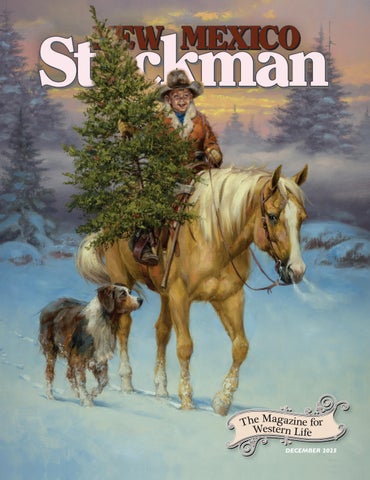
on the cover
“The Family Tree” by Jack Soreson. For more on this and Jack’s other work, visit jacksorensonfineart.com
Texas artist Jack Sorenson CA grew up living the scenes of the Wild West that he paints today. As a kid he roamed through Six Gun City, an Old West frontier town and tourist attraction that his dad built near the Palo Duro Canyon. As soon as he was old enough, his daddy put him to work as a gunslinger and stagecoach driver. “How many people today can say they’ve been run over by a stagecoach?” he asks. “I have!” // Jack’s love of art is similarly deep-rooted. “At the age of six announced to my family that I was going to be a professional artist,” he recalls. “As a boy I spent most of my free time sketching… dogs, trees, wagons, people and horses—especially horses. It’s like a preacher being called—it’s what am supposed to do.” // After his first one-man show sold out in 1974, Jack quit his day job as a horse-breaker and began painting full-time. Today he is one of America’s most celebrated Western artists. Leanin’ Tree has licensed more than one hundred of his images for greeting cards. His work has also been featured on dozens of other products, as well as on the cover of top industry magazines such as Western Horseman, The American Quarter Horse Journal and The Cattleman. Jack credits his success as an artist in part to the fact that he is a storyteller, stating, “I believe that great paintings should tell a story and involve the viewer.” // Jack achieved a career-long goal in 2021 when he was elected to Cowboy Artists of America.
Saturday February 28, 2026
Females sell at 11am — Bulls sell at 1pm
Roswell Livestock Auction
900 N. Garden St. Roswell, NM
50 Registered Brangus and Ultrablack Bulls
200 + Bred and Open Commercial Females
by Bronson Corn NMCGA President PRESIDENT’S MESSAGE
Bronson Corn President Roswell
Tom Paterson President-Elect Luna
Dave Kenneke NW Vice President Cimarron
Jeff Decker SE Vice President Lovington
Roy Farr SW Vice President Datil
Cliff Copeland NE Vice President Nara Visa
Becky King-Spindle Vice President at Large Moriarty
Shacey Sullivan Secretary/Treasurer Peralta
Loren Patterson Immediate Past President Corona
Randell Major Past President
Ipray that each and every one of you had a wonderful Thanksgiving spending time with your family and friends! We are truly blessed that the Good Lord gives us the opportunity to wake up in the morning to do His work!
Sometimes we have a hard time seeing the good things we accomplish through all the struggles we go through on a daily basis. Biblically speaking God presents himself as Fire, the reason for that is fire is clean, pure, something to be feared but respected, something to clean unwanted things in your life, it nourishes you to be able to feed yourself and your family, FIRE is used for everything in your life!
Sometimes God has to through you in the fire so that He can form you into what you are meant to be! So be Thankful for the bad times too, because you never know what you can go through until you’ve come through the fire!
I hope that we had the chance to chat at the annual convention in Albuquerque; what a blast and I am so thankful for the great conversation and new friendships that were made! I hope that you left the convention informed, optimistic, refreshed, and fully understanding what it is that we at the New Mexico Cattle Growers do. I am so very proud of what our team has accomplished over the last couple of years, and I am so thankful for those who were honored during the convention. Through their efforts, our state and organization is much better because of them!
Over the last couple months we have experienced a lot in the livestock industry, our calf prices have take a pretty sizable drop from $375 feeders down to $315, and $240 Live Cattle down to $215. Lots of fear came from the words said from our current administration about lowering the cost of beef for American consumers, the market reaction that we have experienced was definitely impactful, but it was very reactionary!
The paper traders are fleeing like a bunch of rats and a sinking ship, which honestly is not a bad thing! Be confident in your product, the record high prices that we experienced and frankly still have, can only be attributed to supply and demand! We are at the lowest cattle inventory in 50+ years, yet we are producing more pounds of beef in history. Anyone who has payed attention over the last 5-10 years knew this was coming, the writing has been on the wall for a long time, and its still there!
Don’t be discouraged my friends, the American population now know good and well that the cattle industry in the USA hasn’t been all rainbows and butterflies! But guess what…. We’re Still Here! God has big plans for each and every one of us, and if you are in the FIRE right now, be patient as your time is coming!
God Bless you and your family!
“Yall Have A Gooden”
Numbers 6:24
Bronson Corn
by Caren Cowan, Publisher New Mexico Stockman
Facts
President Trump has brought the wrath of agriculture down on himself. I am not making a judgement call one way or another, but all you have to do is look at any agricultural news feed to know the score.
Tariffs are at the top of the concerns, especially with farmers. The Administration is working on fixing things, but it appears that there are millions of dollars in losses that cannot be recovered.
On the beef side, in addition to the tariffs, the President made the misstep of increasing imports from Argentina in an effort to drive down beef prices for consumers. Never mind that beef from Argentina is already being imported and that the amount to be brought in won’t make a lot of difference to anyone.
But we all know that’s not the point. Pitting consumers against ranchers won’t work.
Next the President called for an investigation of the big four packers, something
ranchers have been requesting for decades. There have been several investigations, but the results have all been the same. NOTHING.
This time even the Texas & Southwestern Cattle Raisers (TSCRA) initially supported the investigation, they now state “that the lack of transparency is not where today’s price pressures are coming from,” according to the Cattlemen’s Column: the cattle market is not broken, by Shelby Horn, TSCRA Director.
Rather Horn points to the lag between cattle prices and consumers as well as the negative beef packer margins most of the year. While he noted that “packers certainly have experienced strong margins in some years,” he left out the part that in 2020 packers were making $700 a head while ranchers were losing money on a massive scale.
It is interesting that Tyson chose to shutter one beef plant and pare down another one to a single shift, putting some 4,900 workers out of jobs soon after the President’s investigation announcement. That action alone drove live cattle futures down the limit at the opening of the market on November 24.
The company reported millions in losses over the past couple of years. Tyson’s plans are to pick up the slack by increasing production at its other beef facilities, which have a total weekly slaughter capacity of 155,000 head, according to the Tyson Foods website. They didn’t mention the $1.659 billion in
operating income on $15.436 billion in sales for fiscal year 2020. Nor did they mention that they will acquire the shuttered Cargill turkey plant in Springdale, Arkansas. Tyson plans to retrofit the plant into another chicken processing facility.
Although it seems impossible for this non-economic mind that four groups maintain control over 85 percent of the beef sold in the US isn’t collusion of some kind. I am not holding my breath on the results of this new investigation.
It is also worth noting that President Trump eliminated the tariffs on beef and some other products in late November.
On other fronts…
The Trump Administration has released two new rulemakings that will help ranchers and all Americans. The U.S. Environmental Protection Agency (EPA) and U.S. Army Corps of Engineers on November 17, 2025, announced the release of a proposed rule revising the definition of “waters of the United States” (Proposed WOTUS Rule). The rule is intended to resolve the regulatory
continued on page 14 >>
Phil Harvey Jr. delivers clear, actionable solutions and the confidence to grill and smoke incredible beef every time. This book is a must-have for every ranch family, backyard chef, and every beef loving American! Yes, you can Master the Art of Perfect Beef!
Gift Idea!
uncertainty that has persisted for decades regarding the scope of federal jurisdiction.
Public comments on the proposed rule can be submitted to the official Regulations. gov docket (Docket ID No. EPAHQ-OW-2025-0322) until January 5, 2026.
Read the full article on the proposed changes on page 92 of this issue.
At the same time proposals were released on how the US Fish & Wildlife Service and NOAA Fisheries handle their most important Endangered Species Act (ESA) tasks, from designating critical habitat to setting protection standards for threatened species.
Read the full article on page 57 of this publication.
Comments are due on December 21.
Look for the regulations at: https://www.regulations.gov by searching the following docket numbers:
Ї FWS–HQ–ES–2025–0039 (Section 4)
Ї FWS–HQ–ES–2025–0044 (Section 7)
Ї FWS–HQ–ES–2025–0029 (Section 4(d))
Ї FWS–HQ–ES–2025–0048 (Section 4(b)(2))
Best wishes for a blessed Christmas and a prosperous New Year! ▫
Hello New Mexico CowBelles! I am your Jingle Jangle editor. I received no other news from local CowBelles this month other than the following.
Mesilla Valley CowBelles held meetings virtually to plan and arrange coverage at multiple events. Ag Day at NMSU Football November 8th, and Christmas tree donation to Dona Ana 4-H fundraiser held at Home Grown November 22-23, 2025. Both were huge successes. Mary Esther Grider received the 2025 Volunteer of the Year award at New Mexico Farm and Livestock
• Legal For Trade
•
Bureau’s Annual Meeting as well! This local is extremely proud of her continued efforts and willingness to step up at any given time to share her love for agriculture and the Beef Industry!
Hopefully several of you other locals will start submitting news. They do not always have to be in the form of minutes or formal newsletters. Please send via snail mail or Email. Thank you again! janetwitte@msn. com
Time is something that gets talked about a lot. What time is it? What time does it get dark? What time is dinner? And always the one, time sure does go by fast.
This is my last article as President of New Mexico CowBelles and it seems like it was just yesterday I was nervously writing the first one.
This has been such an incredible year, and I am grateful for the time I have had to be in the role.
Leadership in any way is not an easy task. It comes with lots of second guessing and praying that you make decisions that are best for the organization and its members.
The role is sometimes hard because there may be people who don’t see it the way you see it. I have done my best to represent the cattlewomen of New Mexico and the members of New Mexico CowBelles. From meetings to functions and all places in between. It has been an honor to be the one wearing the tag that says “New Mexico”.
Our state is blessed with wonderful cattlemen and cattlewomen that are passionate about our industry. As the industry is not an easy one and seems to take hits regularly. It is sometimes a tough place to be. I commend and appreciate all the producers and beef advocates in our state who choose to step up and be the voice for our industry.
It has been my pleasure and blessing to be the New Mexico CowBelles President and I thank everyone who has come alongside me to get the job done.
See you down the trail,
– Corrina Casler
New Mexico CowBelles President
capture
Julie Carter jcarternm@live.com fineartamerica.com/profiles/4-julie-carter
Congratulations SENATOR PAT WOODS!
You are most deserving of recognition as Cattleman of the Year.
Thank you for your protection of New Mexico’S Ag industry. Your many years of service have benefited us all.
~ John & Linda Keck Alamo Ranch
Bby the letters, texts, phone calls, and kind words we’ve received. When I opened the magazine and saw how many friends took the time—and spent their money—to place congratulatory ads, it genuinely warmed my heart.
Several fellow legislators have even asked me to sign their personal copies, and I’ve been recognized in a number of interim meetings. Those gestures mean a great deal, not just to me personally, but as an acknowledgment of our industry’s steadfast commitment to feeding America.
We raise an animal that thrives on pasture plants that no human could survive on, and in doing so, it creates a nutritious, high-energy protein—an invaluable food source for families everywhere.
I am deeply grateful to the New Mexico Cattle Growers’ Association for this recognition and for their continued work on behalf of our producers.
Thank you all for this incredible honor.
— Senator Pat Woods
GUIDE 2025Bull Buyers
ALL BREEDS
American Heritage Bank .
Bar G Feedyard
. 57
51
Cattlemen’s LS Auction (Belen) 36
Select Sires Member Coop
Five States Livestock Auction
. 79
44
Fort Worth Stock Show 24
Genex / Candy Trujillo 75, 77
Landmark Mercantile Livestock Auction . . 34
McPherson Heifer Bulls 75, 78
NMSU Animal & Range Sciences 65, 66, 74
Roswell Livestock Auction 52
Tucumcari Bull Test 35
ANGUS
2 Bar Angus 28, 80
4 G Mountain Angus 80
A Lazy 6 Angus . . . . 36, 78
American Angus Association 24
Black Angus “Ready for Work” Bull Sale
. . . . 64
Bill King Ranch 11
Bays Cattle Company 26
Bradley 3 Ranch . . . 73, 78
C Bar Ranch 75, 79
Candy Ray Trujillo’s Black Angus 75
Clark Anvil Ranch . . 69, 79
Conniff Cattle Co LLC 32, 78
Cornerstone Ranch 23
Diamond Seven Angus 47, 77
Hartzog Angus Ranch 43, 78
Heartstone Angus 30
Hennard Ranch . . . 69
Hooper Cattle Company 46 Hubbell Ranch 27, 77
J-C Ranch . .
20
Laflin Ranch . . . . 73
Lazy D Ranch 73, 80
Lust Angus
67 M-Hat Ranch
Angus
J-C Angus Ranch
Producing rugged, deep sided, thick made, easy doing, range
ready bulls like this sire.
Annual Bull
Sale March 30, 2026
Selling 50 plus Hereford Bulls both Horned & Polled.
2025Bull Buyers
GUIDE
Rio Hondo Land & Livestock Co 78
Roswell Brangus Breeders Coop 107
Roswell Brangus Breeders
Bull & Female Sale
. 6
Southwest Brangus Breeders 58
Townsend Brangus . . 60, 107
UBAR Brangus 6, 60, 107
Westall Ranches LLC / Brinks Brangus 19, 80
BRAUNVIEH
Tucumcari Bull Test
CHAROLAIS
35
American Int’l Charolais Association 79
Bar A Ranch
Bill King Ranch
78
11
Bradley 3 Ranch 73, 78
C Bar Ranch
Grau Charolais Ranch
75, 79
41, 77
Grau Ranch 77, 106
Ramro LLC / RJ Cattle Co
31
Thank you so very much for your support through the years! The yearling Hereford horned and polled bulls will be ready to go on a first-come, firstserve basis after the first of the year. They were weaned in early December and are big and stout. They are priced for the commercial man. Feel free to call us if we can help with your bull needs.
We hope you have a very Merry Christmas and a wet, prosperous New Year!
Thank you, Jimmy McCauley
Raising Beefmaster Cattle Since 1982 Excellent Quality – Lasater Breeding
The Most Valuable Investment in the Beef Herd –
The
Bull
Source: PennState Extension
Beef producers are responsible for numerous purchases for the cattle enterprise. They often purchase feed, minerals, equipment, and other supplies that many times are promised to be the “best investment for the ranch.”
There is only one true investment on the ranch that can live up to that promise: the bull in the pasture. If you maintain a closed herd, the genes entering the cow herd will come completely from the bulls you select.
Following three generations of retained heifers, 87.5 percent of the genetic make-up
of the females you return to the herd is the result of the last three bulls you purchased. When you consider the long-term impact of the bull, you can never buy a bull that is too good.
For the beef cow-calf enterprise, the sale of a live calf is the only true source of income. The sale of market cows that did not get bred or lost a calf, and the sale of market bulls, will generate revenue, but it also reduces the capital in the enterprise.
The first step in the selection of a bull is having one that will help the cow produce a live calf. To stack the odds in your favor, you should select a bull with a breed average or lower birth weight and good calving ease. Following the birth of a live calf, the next concern is a calf that will grow and produce the most pounds possible at weaning and sale time for the calf.
Getting the Cow Bred
Cow fertility is an important factor for getting the cows bred, but that is another story for another time. Fertility in young bulls is a function of age, genetics, nutrition, and environment, just to list a few factors. The only objective method for measuring bull fertility is with a breeding soundness examination (BSE).
Bays Cattle Co.
This process combines most of the components that contribute to fertility (scrotal size, sperm concentration, sperm morphology, and a physical exam of the reproductive organs) are all evaluated to develop a final score for a bull. Failure to meet specific benchmarks for any of the factors results in a BSE failure.
The test has been proven to be very efficient for measuring bull fertility in the field. One major limitation of a BSE is that it is only valid for the test on the day of the test for the semen collection evaluated. Most central bull test stations conduct a BSE on bulls to be sold through the program. There are a limited number of veterinarians available to provide an on-farm BSE.
Another consideration for yearling bulls is the bull-to-cow ratio in the herd. Yearling bulls should probably be limited to approximately 15 to 20 cows depending on the size and actual age of the bull.
A yearling should not be expected to service more than one cow per day. If you consider there will be at least one cow in the herd in heat every day in a 21-head cow herd, given on average a 21-day reproductive cycle in the cow, this is the maximum breeding herd for the young sire.
A lot of breeders claim to have rock footed bulls, but we have the real deal here. Several Hereford, mainly polled, but few horned and Angus bulls running in really rough country. I will have them at the house in mid December and on feed for sale. Get them in December before they get fat and soft, turn em out and have a bull that will last you a long time. We breed them to be moderate in size and fertile. No cow that fails to breed gets a chance to fail again. Desert adapted and good doing kind.
It can be increased to about 30 cows for the 2-year-old. Recent work from Colorado State University established, a mature bull should be able to comfortably service 50 cows for the breeding season. To reduce the bull-to-cow ratio from 1-50 to 1-40 has the same effect as purchasing insurance. Consider the cost of the cow that has a fertile heat but is not bred until the following heat cycle, the next month. In today’s calf market, it could likely cost the producer upwards of $150 per calf just from the lost weaning weight.
As mentioned earlier, one additional consideration is buying the bull that has a greater chance of producing a live calf. The birth weight of a calf is the single most important factor for calving difficulty.
Difficult calvings and dystocia generally result in dead calves, dead cows, and/or cows that do not breed back. Using genetic information such as EPDs for Calving Ease and Birth Weight has proven that there will be fewer difficult calvings, resulting in more live calves.
All breed associations publish the average EPDs for Calving Ease and Birth Weight in their population of bulls. Selecting bulls that are at or below breed average for these EPDs for breeding young cows can prove to be very
continued on page 28 >>
beneficial. Especially keep them below breed average if any heifers are to be retained in the herd from any cows because half of the genes for birth weight are supplied by the dam.
Getting More Pounds
At the current price of calves, the day of buying just any old bull from the sale barn must come to an end. This is most likely the most expensive bull a producer can buy. Given the absence of performance records, you have absolutely no opportunity to either reduce your risk for calving difficulty or increase calf growth and performance, resulting in heavier calves at weaning.
The technology and information available for selecting breeding cattle is such that there is no reason to buy inferior bulls.
Expected progeny differences (EPDs),
performance records, and genetic markers are all available to use for bull-buying decisions.
Consider this example of using EPDs to select two bulls:
These EPDs tell us that, when bred to an average group of cows, Bull A will wean calves that are 20 pounds heavier than Bull B, and both will have the same average birth weight. If we use these bulls on an average of 40 cows over four years and wean 95 percent of the calves, we will expect Bull A to wean 3040 more pounds of calf. At $2.25 per pound, that is $6840 more value over the life of the bull.
Considering the return on investment, the $2000 bull actually costs $4800 more to own than the $4000 bull when you consider the value of the calves. Consider bulls are
only “rented.” For the initial investment cost of $4000 for a bull that is later sold for $2500 when he is marketed after just four years of service, the cost to breed each cow in the herd for the four years, just considering the purchase price, is only $9.38 per cow.
While making the decision to buy a bull, set the goals for the herd, identify bulls with the genetic potential to reach those goals, disregard any bull without known genetic information, then select a bull based on the breed, phenotype, or other criteria you require. It will truly be the most important investment you make for the cow herd.
Originally written by John Comerford ▫
Bull and Heifer Sale
Bull Heifer Sale
Bulls & Heifers available for preview, Sunday, March 8, 2026 All Bulls & Registered Heifers will have 50K Genetic Testing
SALE LOCATION*
DEXTER LIVESTOCK COMMISSION, 274 E. DARBY ROAD, DEXTER, NEW MEXICO Sale time 1 p.m. Bulls will be tested for Fertility & Trich • Meal will be served for buyers & guests
by Don Bullis, New Mexico Author donbullis@msn.com
Deputy Jim Kent Murdered by Horse Thieves
Deputy Williams Badly Injured
Deputy Melon, Uninjured, Fetched Help
Aband of horse thieves plied their trade in Union County, New Mexico in the spring of 1909. In one case alone they stole 28 head from the ranch of John King near Folsom. Many other ranchers in the area suffered significant losses of riding stock.
In early June, Sheriff D. W. Snyder heard that stolen horses were being sold to farmers around Richland in southwestern Kansas, and he immediately sent his deputy, Jim Kent, to Kansas to see what he could find. Kent located and recovered several of the horses and found that many others had been traded for mules and other horses. He picked up a trail in Richland that took him to Trinidad, Colorado, where he learned that a man named Clarence Hamilton had sold some mules and horses to a Colorado farmer.
When Hamilton went to a Trinidad bank with the farmer to close the deal and collect payment, he found Deputy Kent waiting for him. It wasn’t long before Hamilton told Kent that a gang made up of the Jamison brothers stole the animals. He said the outlaws maintained a “camp” in eastern Colfax County, near the Union County line, only about five miles from the King ranch.
Sheriff Snyder sent Deputies Kent, H. M. Williams and Gay Melon to arrest the thieves. They reached the King ranch on the evening
of July 1 and spent the night there.
The sun was not yet above the horizon the next morning when the posse took the trail toward the Jamison place. They hid outside the small adobe house before full daylight. Soon enough, one of the outlaws stepped out of the house to gather kindling and firewood for use in preparing breakfast, or other morning chores.
Deputy Kent followed him back inside. At gunpoint he ordered, “Throw up your hands!”
Kent’s demand was quickly answered by a gunshot from an adjoining room. The deputy, shot in the neck, fell to the floor, mortally wounded.
Deputy Williams, not far behind Kent, approached the door and he too was shot and severely wounded.
Deputy Melon hurried away from the scene and raced back to the King ranch for help.
Williams, in great agony from a stomach wound, reached his horse and managed to mount, and he too started for the King ranch. His strength failed him, however, and he collapsed along the road where a second posse from Folson found him some hours later, unconscious from loss of blood.
Newspaper accounts of the day reported that the horse thieves stepped over and around Kent’s body as they finished preparing and eating breakfast. Then they mounted up rode west, toward Raton, but apparently not in great haste.
Meantime, Deputy Melon reached the King ranch and soon John King rode on into Folsom where he sent a telegram to Sheriff Snyder:
July 2, 9:00 a.m.
Sheriff: J. I. Kent killed at Jamison ranch. Take along posse from there overland at once.
Sheriff Snyder and a three-man posse set out from Clayton immediately and by riding hard overtook the killers about midnight at
the George ranch, only 20 miles from the scene of the killing.
One story is that the Jamisons surrendered themselves to Mr. George, who was a Justice of the Peace. Other accounts are less clear as to what the outlaws were doing at the George place.
The officers and their prisoners began the trip back to Clayton at once and arrived there at noon the next day. The Sheriff and his posse had covered a distance of more than 200 miles in about 29 hours. Simple arithmetic shows that the posse averaged nearly seven miles per hour which was pretty speedy traveling in those days. A ride of 50 to 60 miles per day on horseback, an average of three or so miles per hour, was generally considered a day’s work.
The Jamisons were locked in jail, and when another brother, and their father, arrived from Raton to visit them, they were arrested, too.
Deputy Williams survived a long wagon ride in the hot sun to Folsom where a local doctor dressed his wound. The morning train then took him to Trinidad, Colorado, where the bullet could be removed. He survived.
Local newspapers reported that James I. Kent was born in Bartols County, Texas, in 1875. Maps contemporary to the times, as well as modern references, do not show any such county in Texas.
Kent’s obituary read:
“He was a highly esteemed citizen, doing right by his fellow man for the sake of doing right, a friend to those for whom he professed friendship. His untimely death we greatly deplore and realize that one has been called from our midst whose place in our community will be hard to fill.”
Complete details regarding the prosecutions of the Jamison brothers are not known. It is known that George Jamison was convicted of manslaughter for killing Deputy Kent, and sentenced to five years in the Penitentiary. ▫
How to Protect Large Animals in a Fire Emergency
Source:
TTexas A & M University
he winter chill has begun to blow through the U.S., and the comfort of a warm fire is a welcome respite. But as owners move their large animals into their barn to protect them from the elements, there are a number of factors that could lead to an unwanted fire, which can threaten the health and safety of the horses and livestock seeking shelter within them.
Dr. Kyle Johnson, a clinical assistant professor at the Texas A&M College of Veterinary Medicine and Biomedical Sciences, offers advice on how owners can
shield their barns — and their large animals — from this threat by providing a plan to execute if the danger of fire engulfs their property.
Preventive fire measures
Horse barns and other agricultural buildings are often full of flammable items such as hay and shavings. Even the barn itself — if constructed of wood — can serve as fuel for a fire.
“Over 80 percent of barn fires are caused by electrical malfunctions or human errors,” Johnson said. “Such errors may include improper disposal of a cigarette or placing a heat source — such as a space heater or hot equipment — near flammable material.”
Another risk factor to consider is the weather, as lightning strikes are also a common cause of barn fires.
“To combat this worry, barns should have professionally installed lightning protection systems, which are designed to provide lightning with a safe path to follow into the ground,” Johnson said.
Because many barns and other agricultural buildings are located in rural areas, where emergency and firefighter response may be delayed, preventing fire is key, according to Johnson.
CONNIFF CATTLE CO. LLC
“Fire prevention is focused on keeping sources of ignition away from fuel sources and reducing the amount of those fuel sources as much as possible,” he said.
Methods to reduce the risk of barn fires include:
Ї Prohibiting smoking in or around the barn
Ї Ensuring electrical wiring is functioning properly
Ї Avoiding electrical outlet overloading
Ї Prohibiting welding or torch cutting in or around the barn
Ї Storing hay and straw in a separate structure from gasoline and diesel
Ї Removing cobwebs and dusting regularly
“Residential smoke detectors often do not work well in barns because of high humidity and high particulate matter in the air,” Johnson said. “Instead, rely on carbon monoxide detectors or other commercially installed fire detection alarms. Systems that connect directly to a security system company or the local fire department are ideal — such devices can improve response times.”
Urgent evacuations
Even with the most thorough preparations, a fire may still occur that could threaten the safety of your horses and livestock.
“If a fire starts in a barn, it can move very quickly and there may be only minutes to act,” Johnson said. “When ignited, hay, straw, and shavings can reach nearly 300°F in less than five minutes — meaning each second is precious to save an animal’s life.
“It is important to have a properly charged ABC fire extinguisher at each of the barn’s entrances and ensure everyone knows how to operate them,” Johnson said.
In a barn fire situation, calling 911 and evacuating is the best thing an owner can do. As with house fires, no one should enter; doing so could result in serious injury or death from the fire or smoke.
“In addition, the threat of heat, carbon dioxide, carbon monoxide, and other toxic fumes produced by the burning of plastics and other materials can cause horses and livestock to suffocate,” Johnson said.
continued on page 34 >>
Fires can also weaken a barn, thus making it more likely to collapse. With that in mind, it is essential to have an evacuation plan in place ahead of time.
Making a plan
Johnson recommends evacuating large animals using the following steps:
Ї Keep a halter or lead rope close to each stall
Ї Calmly but quickly lead animals away from the fire
Ї Contain the animals in a designated paddock or pasture
Ї Hose the animals off thoroughly
“Hosing animals off can remove any hot embers or fire material and can also decontaminate them,” Johnson said. “Soot from fires contains a lot of nasty substances that can be toxic to horses and humans.”
Following evacuation, all animals involved in or near the flames should be promptly evaluated by a veterinarian.
“Even if a horse doesn’t have evidence of burns, they may have inhaled super-heated air and smoke, which can be deadly,” Johnson said. “Horses may appear healthy at first, but the injuries to the lungs and other tissues can manifest 12-24 hours later as pneumonia.”
Proactive planning
Approaching the threat of fire without a plan not only endangers yourself, but also your property, livestock, horses, and other loved ones; having a barn fire plan is not just a recommendation — it is a necessity.
“Write it down, discuss it with everyone at your barn, and practice it,” Johnson said. “A plan that isn’t written down and rehearsed is only an idea.”
Emergencies can be extremely stressful for humans and animals alike, but being prepared with an evacuation plan can ensure that everyone emerges from a barn fire unharmed.
Pasture Talk is a service of the College of Veterinary Medicine & Biomedical Sciences, Texas A&M University. Stories can be viewed on the web at vetmed. tamu.edu/news/tag/pasture-talk. Suggestions for future topics may be directed to vmbs-editor@tamu. edu.
NM Hay Association to Host 2026 Southwest Hay and Forage Conference
The 2026 Southwest Hay and Forage Conference, hosted by New Mexico State University’s College of Agricultural, Consumer and Environmental Sciences and the New Mexico Hay Association, will feature two special guest speakers who will discuss successful farm transitions and water issues in the West.
“We strive to market your livestock
The conference will take place January 21 through 23 at the Ruidoso Convention Center, 111 Sierra Blanca Drive, in Ruidoso, New Mexico. Among the topics to be presented at the conference include “Corn Leafhopper: An Emerging Pest in Corn,” “Drones for Spraying: Custom Application and Producer Perspective,” and “Small Grain Forage Quality.” There will also be industry and regulation updates provided by researchers and experts. Also this year, a special highlight will be the showcasing of the new Hesston double small square baler recently on the market.
NMSU Extension forage specialist Mark Marsalis said this year’s topics are unique and should appeal to farmers of all interests.
Great Selection of
Now testing 280 bulls and heifers! Only the very best will be sold
Date: Saturday, March 14th, 2026
Time: 1 pm MT
Place: Tucumcari Bull Test
Great Selection of High Quality Bulls and Heifers that Will Fit Your Program
6502 Quay Road Am.5 Tucumcari, NM
Now testing 280 bulls and heifers! Only the very best will be sold
Great Selection of High Quality Bulls and Heifers that Will Fit Your Program
Angus, SimAngus, Simmental, Hereford, Braunvieh, Salers, Red Angus, Charolais, and Limflex breeds represented.
Now testing 280 bulls and heifers! Only the very best will be sold
Now testing 280 bulls and heifers!
Date: Saturday, March 14th, 2026
Time: 1 pm MT
Only the very best will be sold
Date: Saturday, March 14th, 2026
For more information contact: Marcy Ward
Time: 1 pm MT
575-644-3379 or maward@nmsu.edu. Or visit: https://tucbulltest.nmsu.edu/
Place: Tucumcari Bull Test
Can't make the sale? Also Available on…
Quality Bulls and Heifers that Will Fit Your Program
Time: 1 pm MT
Place: Tucumcari Bull Test
Date: Saturday, March 14th, 2026
6502 Quay Road Am.5 Tucumcari, NM
Time: 1 pm MT
6502 Quay Road Am.5 Tucumcari, NM
Angus, SimAngus, Simmental, Hereford, Braunvieh, Salers, Red Angus, Charolais, and Limflex breeds represented.
For more information contact: Marcy Ward 575-644-3379 or maward@nmsu.edu Or visit: https://tucbulltest.nmsu.edu/
6502 Quay Road Am.5 Tucumcari, NM
Angus, SimAngus, Simmental, Hereford, Braunvieh, Salers, Red Angus, Charolais, and Limflex breeds represented.
Efficiency Tested Performance Proven! Heritability to stretch your forage and grow your profits!
For more information contact: Marcy Ward
575-644-3379 or maward@nmsu.edu
Or visit: https://tucbulltest.nmsu.edu/
For more information contact: Marcy Ward 575-644-3379 or maward@nmsu.edu. Or visit: https://tucbulltest.nmsu.edu/
Can't make the sale? Also Available on…
Can't make the sale? Also Available on… Efficiency Tested Performance Proven!
Can't make the sale? Also Available on…
Cattlemens Livestock
CATTLE
“We’ve tried to combine our typical forage production topics with those that impact the agricultural community as a whole and that reach broader audiences,” he said.
Guest speaker Mike Downey, manager of succession planning at UnCommon Farms, will discuss the common traits of highly successful farm transitions. Downey is a partner in Next Gen Ag Advocates, which offers a program with non-family transitions, and matching young and aspiring farmers to retiring farmers or operations who don’t have a successor. He has worked with more than 500 family farms, and provides a unique perspective to help guide other farms through their own succession planning journeys. Free one-on-one consultations will be provided to those interested.
Sam Barncastle, executive director of the Family Farm Alliance, will speak about water issues in the West and policy impacts. She is a New Mexico attorney with more than 17 years of experience in litigation and policy-making regarding water and natural resources on both the state and federal level. She is a 2007 graduate of NMSU, and her family farms in the Mesilla Valley.
Additional topics include a look at the current state of the dairy industry in New Mexico, as well as intercropping alfalfa into young nut tree orchards, both of which apply to other major industries in the state.
Five New Mexico Pesticide Applicator Continuing Education Units, or CEUs, have been approved for the conference. Texas, Arizona and Certified Crop Adviser CEUs will be requested.
The conference will also feature a trade show and its popular Ace-in-the-Hole Casino Party and fundraiser following dinner January 22, as well as the Paint Party with Peggy Krantz that afternoon.
Pre-registration is $150 per person before Dec. 31. Attendees may register after Dec. 31 or at the door for $175. Annual membership dues to the New Mexico Hay Association are $65.
For more information, including a full agenda, visit nmhay.com or forages.nmsu.edu. Registration, payment, sponsorship and vendor info is available at nmhay.com.
The 2026 Southwest Hay and Forage Conference, hosted by New Mexico State University’s College of Agricultural, Consumer and Environmental Sciences and the New Mexico Hay Association, will take place Jan. 21-23 in Ruidoso. (NMSU photo by Josh Bachman) ▫
The Darnells Continue a 132-Year-Old Family Tradition of Raising Good-Doin’ Hereford Cattle Jim, Sue, Jeep, Meghan & Jake Darnell
TEXAS/NEW MEXICO RANCH 5 Paseo De Paz Lane, El Paso, TX 79932 Jim 915-479-5299 Sue 915-549-2534
Email: barjbarherefords@aol.com
OKLAHOMA RANCH Woods County, Oklahoma
Cattle on Feed Report
Source: Southern Ag Today
Amid the drumbeat of bad news in the cattle market over the last month, including on-again, off-again tariffs, jawboning for lower beef prices, and now Tyson’s announcement that they will close their beef packing plant in Lexington, Nebraska, in January, USDA released a cattle on feed report (COF).
USDA caught up on cattle on feed following the shutdown when they released the COF report on November 21st. The report did not contain many surprises. Placements and marketings were down 10 percent and 8 percent, compared to October 2024. The combination left the number of cattle on feed down 1.6 percent compared to November 1, 2024.
The most interesting, and important, number in the report was the number of heifers on feed. Heifers on feed is normally reported in the October report, but that was delayed due to the shutdown. There were 4.355 million heifers on feed on October 1, 2025. That was 245,000 fewer than October 1, 2024, and the fewest heifers on feed for an October since 2018. It also represented the 5th consecutive quarter of year-over-year declines in the number of heifers on feed. That would seem to be positive news if looking for evidence of herd expansion.
But the heifer data on feed for October 2024 would have included spayed heifers imported from Mexico. Over the April-September 2024 period, 266,559 spayed heifers were imported. So, the decline in heifers on feed reflects no imported heifers from Mexico this year and any decline in domestic heifer feedlot placement. The expectation is that fewer spayed heifers would have been imported this year compared to last year, but considering imports, the report doesn’t indicate a lot of heifer retention.
The report included a rare event with Texas slipping to number 2, reporting 10,000 fewer cattle on feed than Nebraska, 2.63 million head versus 2.64 million head. The last time Nebraska had more cattle in feedyards than Texas was May 2018. The lack of Mexican feeder cattle imports is the most important factor in this ranking reversal.
There were a couple of other interesting numbers to think about. More steers were reported on feed than a year ago. At first glance, we might think that seems surprising given the decline in cow numbers, but days on feed is boosting total cattle on feed inventories, given overall declines in cattle numbers.
Isa Beefmaster Sale 2025 I
sa Beefmasters LLC held its 64th Beefmaster Bull Sale on October 4th in San Angelo, Texas. Beefmasters’ largest one-brand sale was outstanding, with 32 buyers from eight U.S. states and Mexico taking home 103 Beefmaster bulls at an average of $10,165. Isa President Lorenzo Lasater stated the sale was
RIO PECOS VETERINARY
Livestock Veterinary Supplies & Services
Beau Bamberg, DMV: 575.317.6768
Jorge Melchor, DMV: 575.308.3950
P.O. Box 129, Roswell, NM 88202
their highest average to date, with excellent demand for quality Beefmaster genetics. Auctioneer Joe Goggins of Billings, Montana, sold the bulls in a blistering time of 2 hours, 10 minutes.
The high-selling bull, L Bar 3544, sold to William Richey of Florida for $25,000. This awesome young herd sire prospect is the son of L Bar 9537 and L Bar 0475 and is the top overall performer in the offering. He boasts an incredible EPD profile, with all 17 EPDs in the top 50 percent of the breed and nine at 15 percent or better.
The two second-high-selling bulls each brought $17,000: L Bar 3510 to Lykes Brothers of Florida and L Bar 3527 to Tyler Blackmon of Alabama. Both sires are also extreme top performers and descendants of L Bar 4519, a son of the great L Bar En Fuego, who sold in this sale in 2011. En Fuego has sired many high-sellers since, and now his descendants are ringing the bell. A truly remarkable genetic line.
Volume buyers included Ray Corona, FL – 10; Diamond and a Half, NM – 10; Rollins Ranch, FL – 10; Goff Ranch, AZ – 8; and Kellis Ranch, AZ – 7. Lasater and his sister and partner, Isabel Hernandez, represent the fifth generation of the family dedicated to breeding performance Beefmaster genetics.
The breed was founded by their grandfather, Tom Lasater, in 1937. This year marks the 88th anniversary of the breed. It is also the 133rd anniversary of the L Bar brand, which was first used by Ed Lasater in 1892 in South Texas. The brand has been used continuously by six generations of the family in Texas and Mexico.
According to Lasater, “This set of bulls represents over 88 years of consistent, balanced selection for economically viable cattle. These bulls will produce excellent feeder calves and replacement heifers in any environment, but especially the tougher ones. With more pounds at weaning, lower input costs, more longevity and the best mother-cow on the planet, Beefmasters can’t be beat.”
The Lasater family would like to extend their heartfelt thanks to everyone in attendance, especially the many repeat customers, including several second- and third-generation buyers. We are already working hard to bring you our 65th set of Beefmaster bulls on October 3, 2026. ▫
Building the Future of Agriculture, One Classroom at a Time
by Athena Franco, ffa.org
cross New Mexico, Britney Lardner has made it her mission to help students discover the importance of agriculture. For over five years as the program coordinator for New Mexico Agriculture in the Classroom (NMAITC), she’s been inspiring students, teachers and volunteers to connect with the industry that keeps our world running. Through her work, Lardner shows what it truly means to live to serve, as she uses her passion and leadership to make a real difference in her community and beyond.
In her role, Lardner travels across the state leading hands-on lessons for K–12 students, organizing AgXplorer field days, and hosting teacher workshops. She also trains volunteers from FFA and 4-H to present agriculture lessons in classrooms, helping them grow their confidence and communication skills along the way. “We encourage volunteers to get ‘AG’tive in the classroom,” she said. “It helps us reach more students while helping presenters find their voice in agriculture.”
Though she isn’t directly involved with the Adopt a Cow program, Lardner proudly promotes it each year to help teachers bring agriculture to life. Her support for programs like this highlights her heart for service — she always finds ways to connect students with agriculture, whether through a fun classroom activity or a simple social media post encouraging teachers to get involved.
Lardner’s passion for agricultural education started in high school when she joined FFA as a senior. Inspired by her siblings’ involvement and her ag teacher’s enthusiasm, she decided to pursue agricultural education at New Mexico State University, later earning her master’s degree in international agriculture from Oklahoma State University.
One of her favorite memories came from
a third-grade class in Albuquerque. After presenting lessons about sheep, goats, and weaving, she was met in the hallway by two students carrying a folder of thank-you cards and a class poster showing everything they learned. “Moments like that remind me why I love what I do,” Lardner said.
Her advice for FFA members who want to make a difference is simple: Start now. “Try something new, get out of your comfort zone, and travel whenever you can,” she encourages. “Even reading to an elementary class can spark the next generation of leaders.”
Whether filling 1,200 cups of cream for a butter-making activity or driving hours to reach a classroom, Lardner pours her heart into everything she does. Through her hard work and heart, she demonstrates how one person’s passion can inspire hundreds — truly living out the motto of “Living to Serve.”
Cull Cows Defy Seasonality
by David Anderson, Professor and Extension Economist, Livestock and Food Products Marketing, Dairy, Policy / Source: Southern Ag Today
All the talk of relaxing tariffs on imported beef, knowing that the majority of our beef imports are lean beef trimmings to go into ground beef competing with cull cow beef, suggested it might be time to take a quick look at the cull cow market.
Custom Slaughtering & Custom Processing
Most will remember that cull cow prices tend to hit their seasonal lows in the Fall. The most important reason for the price decline is that more cows are culled from the herd in the Fall. For beef cattle, the largest proportion of cows are culled in the Fall following calf weaning. On the dairy side, cow culling increases from summertime lows. The increase in supplies of cows for sale results in lower prices. Another contributor to lower prices is the end of grilling season, with consumers shifting over to more Fall and Winter consumption patterns.
So far this Fall, the cull cow market has defied normal seasonality. Southern Plains cull cow auction prices hit about $165 per cwt back in June and have remained there since then. A couple weeks of declines were followed by rebounds back to about $165 per cwt. National average cutter quality cows have declined recently, slipping about $9 per cwt to $126.
While the live cow market has not declined much, the same cannot be said for the cow beef market. The boxed cow beef cutout climbed to $340 per cwt but has declined to $317 over the last two months. Wholesale 90 percent lean beef has declined from $436 to $404 per cwt over the same period. Both the boxed beef cutout and wholesale 90 percent lean have followed the normal season pattern, declining into the Fall.
We are likely to see some increased culling from the dairy side of the beef industry in the coming months. USDA’s latest milk production report indicated the nation’s dairy cow herd at 9.85 million head. That is the largest herd since at least 1993. Milk production in September was 4 percent larger than the year before. Milk prices are beginning to decline sharply with increased production. There is no doubt that the increased returns from using beef bull instead of dairy breed semen to produce cross bred calves is boosting profits and aiding in the dairy herd expansion. Beef cow culling is likely to remain low due to the historically small cow herd and incentives to expand. More dairy cow culling and less beef cow culling will continue to leave cull cow prices high.
Scan to learn more
Efficiency
at it's finest.
Beefmaster genetics are bred to do more with less — delivering fertility, longevity, and performance that pay. When efficiency matters, trust the breed built for it.
by Deanna Dickinson McCall
Christmas time always calls for the best we can give. It is supposed to be about giving and not receiving, but it is also nice when you are on the receiving end of something special that folks love and appreciate. I think one of the best presents to give and to receive is a gift that was homemade, people are giving their love, time and work. Sometimes just doing a chore or repair for someone is a greatly appreciated gift. Cooking and baking are wonderful gifts. Food is so much a part of Christmas, from cookies and desserts to jellies and preserves to an awesome, festive meal. Another gift of love and labor that everyone loves receiving!
With record beef prices many families are not cooking their usual prime rib roast or rib eye steaks. A way to still enjoy a wonderful beef dinner without the higher cost of prime cuts is a tri-tip roast. Because it is often just the two of us, we started having tri-tip roasts/ steaks for special dinners. Tri-tips have been served on central California ranches for a very long time, using the infamous Santa Maria grill. You don’t have to have one to have a great tri-tip.
The cut finally became popular beyond California and is available at most stores. It is sometimes called a steak, sometimes a roast. It is a triangle shape cut from the
bottom sirloin, not to be confused with a sirloin tip roast. They average around 2 lbs, and it is easy to cook as many as you need, one reason for the popularity on the old ranches when feeding a crew, or having a large party.
You can marinate if you aren’t cooking it medium rare, the preferred doneness, as it can dry out quickly. The dry rubbed crust helps to hold the moisture in, also. I don’t recommend medium or well done for this cut.
It is often served with a freshly roasted pepper, onion and tomato salsa, or a chimichurri sauce.
We like both. The typical Central California meal uses the roasted salsa, and includes pinquito beans, green salad and grilled garlic bread.
This is the standard recipe for the tri-tip, minus red oak chips.
Tri-Tip and Santa Maria Sea soning
Ingredients:
2 tsp kosher salt
2 tsp black pepper
2 tsp garlic powder
2 tsp paprika
1 tsp onion powder
1 tsp dried rosemary
¼ tsp cayenne pepper
½ cup of olive oil
1 2- lb tri-tip roast patted dry
Directions:
Mix together all the seasonings for the rub. Rub tri-tip with olive oil, then coat the meat with the seasonings, rubbing it in.
You can place the coated meat back in the frig if you aren’t cooking until later, but it should set out at least 20 minutes before cooking.
You will need to have two different heat levels to grill a tri-tip. One for direct heat for searing and one for in-direct heat for cooking. Hot side should be about 350, cooler around 275.
Place tri-tip on grate over direct heat (hot side) with the lid open, and grill until lightly charred in spots and somewhat brown, 5-7 minutes. Flip over and repeat.
Move the meat to the cooler side and close the lid. In about 35 minutes check the temperature, you want 132 degrees for medium rare.
Once you reach that temperature move to a cutting board and let stand 15 to 20 minutes, it will continue cooking while resting.
Slice against the grain to serve, don’t cut too thick slices. Pour either the traditional salsa or chimichurri sauce over the center of the sliced meat when serving. ▫
ROSWELL LIVESTOCK AUCTION SALES, INC. & ROSWELL LIVESTOCK AUCTION TRUCKING, INC.
900 North Garden · P.O. Box 2041 Roswell, New Mexico 88201
575-622-5580 www.roswelllivestockauction.com
CATTLE SALES: MONDAYS • HORSE SALES
BENNY WOOTON CELL 575-626-4754
SMILEY WOOTON CELL 575-626-6253
Producers hauling cattle to Roswell Livestock New Mexico Receiving Stations need to call our toll-free number for a Transportation Permit number before leaving home. The Hauling Permit number 1-800-748-1541 is answered 24 hours a day, 7 days a week.
Trucks are available 7 days a week / 24 hours a day
Roswell livestock Auction Receiving stAtions
ATTENTION RECEIVNG STATION CUSTOMERS, To be able to schedule trucking, all cattle need to be permitted by 1:00 p.m.
LORDSBURG, NM
20 Bar Livestock Highway #90 at NM #3 – East side of highway. Receiving cattle for transport 2nd & 4th Sunday of each month. Smiley Wooton, 575622-5580 office, 575-626-6253 cell.
PECOS, TX
Jason Heritage is now receiving cattle every Sunday. For information to unload contact Jason Heritage 575-840-9544 or Smiley Wooton 575-6266253. Receiving cattle every Sunday.
VAN HORN, TX
800 West 2nd, 5 blocks west of Courthouse. Bob Kinford, 432-284-1553. Receiving cattle 1st & 3rd Sundays.
MORIARTY, NM
Two blocks east and one block south of Tillery Chevrolet. Smiley Wooton 575-622-5580 office, 575-626-6253 mobile. Receiving cattle every Sunday
SAN ANTONIO, NM
River Cattle Co. Nine miles east of San Antonio on U.S. 380. Receiving cattle for transport 2nd & 4th Sunday of each month. Smiley Wooton 575-626-6253.
JBS USA Food Co. agreed to pay $1.1 million to settle state allegations in New York that the meat processor misled consumers about its commitment to reduce greenhouse gas emissions.
The settlement resolves a 2024 lawsuit by NY Attorney General Letitia James that accused JBS USA of falsely advertising that it would achieve “net zero” greenhouse gas emissions by 2040 despite lacking a credible plan to do so.
The money will support climate-smart agriculture programs in New York that help farmers adopt practices to reduce emissions, boost productivity and improve climate resilience. JBS USA must also reform its environmental marketing practices and submit annual compliance reports to the state for three years.
“This settlement does not reflect an admission of wrongdoing, and JBS USA remains driven to advance sustainable agriculture,” JBS said in a statement to Meatingplace. “As part of the resolution, we will contribute $1.1 million to support climate-smart farming practices. We maintain a continued focus on investing in practical solutions that strengthen the resilience of the food system.”
The attorney general’s office said the company’s “Net Zero by 2040” campaign was not supported by data or feasibility studies and continued even after the Better Business Bureau’s National Advertising Division warned JBS that its claims were unsubstantiated.
The agreement prohibits JBS USA from making deceptive or unverified environmental statements and places the company under monitoring by the Office of the Attorney General through 2028.
Pearce Tapped to lead Bureau of Land Management
by Rachel Frazin, The Hill
President Trump has nominated former Rep. Steve Pearce (R-N.M.) to lead the Bureau of Land Management (BLM). The BLM manages federal lands and sets policy for energy production, grazing and recreation upon them.
Pearce unsuccessfully ran to be New Mexico’s governor in 2018.
by Labradoodle Bennington, III
Doc Jim Lytle
Dr. Jim Lytle, DVM, was born James Victor Lytle, April 7, 1949, in Prescott, Arizona, to Victor and Ethel Lytle. He died October 28, 2025, in Flagstaff following a brief illness. He was 76.
Lytle’s formative years were spent in Prescott. He was involved with sports and spent summers on the family ranch near Tombstone. He was an Eagle Scout and enjoyed many outdoor activities with his father. He graduated from Prescott High School in 1967.
Lytle then attended Colorado State University for undergraduate studies and graduated from CSU Veterinary School in 1974. During college, he met Chris Painter, and the two were married June 29, 1974.
The couple moved to North Platte, Nebraska for his first job as a veterinarian, then transitioned to Wickenburg in 1976 when he was hired at Bar S Animal Clinic. Shortly thereafter, he purchased the clinic and provided care for large and small animals as well as horses and cattle on surrounding ranches. Due to his amazing work
Consortium
Adopts New Name, “Tribal SelfGovernance”
The Self Governance Communication and Education Tribal Consortium (SGCETC) proudly announces its new name and identity: Tribal Self-Governance (TSG).
The change marks a powerful new chapter in the organization’s mission to advance tribal sovereignty, strengthen and expand Self-Governance authority, and protect the foundational principles of self-determination.
Alongside the new name, TSG has launched a redesigned website, www.tribalselfgov.org, providing an improved, accessible hub for resources, educational materials, and stories of tribal success. The updated platform will serve as a central source for news, training opportunities, and advocacy updates related to self-governance and federal policy.
“Our new identity reflects both continuity and progress,” said W. Ron Allen, President
of the TSG Board of Directors. “Tribal Self-Governance represents more than a name – it’s a movement rooted in sovereignty, leadership, and the enduring right of every tribal nation to determine its own path. This organization has always stood on the principle that tribes know what’s best for their people, and that mission continues stronger than ever.”
TSG will continue to lead national education and communication efforts that strengthen and expand the Self-Governance movement. This includes hosting the annual Tribal Self-Governance Conference, producing the award-winning For Our People: Stories of Tribal Self-Governance and Sovereignty docuseries, seeking opportunities to expand and enhance Self-Governance authority, and developing new educational tools to deepen understanding of Self-Governance authority.
“Tribal Self-Governance better reflects who we are and what we stand for,” said Jay Spaan, Executive Director of Tribal Self-Governance. “For more than three decades, Tribes have proven that self-governance works, that when decision-making power is placed in Tribal hands, outcomes improve for our people. This evolution of our name embodies the strength, unity, and vision of
tribal nations leading their own futures.” Registration is now open for the 2026 Tribal Self-Governance Conference, taking place April 7 through 10 at Gila River Wild Horse Pass Resort & Casino in Chandler, Arizona. The annual gathering brings together tribal leaders, advocates, and partners from across the nation to share strategies, celebrate successes, and advance the movement of Tribal Self-Governance. Attendees, vendors, and exhibitors can find detailed registration and hotel information at tribalselfgov.org/tsg-conference/.
Early registration is encouraged, as conference hotel rates and exhibitor space are limited, and all participants are invited to be part of shaping the future of Tribal Self-Governance and policy innovation.
Recent episodes of For Our People have showcased local leadership in healthcare reform, co-management of public lands, food sovereignty, youth mentorship, and community healing, illustrating how Self-Governance continues to drive meaningful change on the ground. Watch the series at www.youtube.com/@tribalselfgov or on the FNX streaming app. ▫
ROUND WATER TROUGHS
► Plate Steel Construction
► Plate Steel Floors
► Pipeline Compatible
We also build NRCSprojecttanks (5k-12K) Call for available sizes
BRIAN BOOHER
El Paso, Texas 915-539-7781
bordertankresources.com
PARKER BRANGUS
Private Treaty Sales at the Ranch
Registered & Commercial
“Brangus Raised the Commercial Way”
DIANE PARKER
P.O. Box 146, 1700 N. Parker Rd., San Simon, AZ 85632
Diane’s Cell: 520-403-1967 • Bus: 520-845-2411
Email: jddiane@vtc.net
Jacob Brown - Cell: 520-780-7937
WANTED: CAREGIVER
Are you passionate about making a positive impact in the life of my Mother? I am seeking a dedicated & compassionate caregiver to take care & provide exceptional care for my mother. As a caregiver, you will play a crucial role in supporting my mother who is Elderly. Schedule is 5 days a week & 5 hours per day. Salary is $30/hour.
Apply by contacting me via email at George (gwssheets@gmail.com) for more details.
Dunes Sagebrush Lizard
Proposed Habitat Conservation Plan and Draft Environmental Assessment Available for
Public Review
The U.S. Fish and Wildlife Service (FWS) is seeking public comments on a proposed habitat conservation plan and a draft environmental assessment for the Crossroads-Hobbs-Roadrunner Transmission Project located in Roosevelt and Lea counties. The HCP and EA are part of the incidental take permit application for the endangered dunes sagebrush lizard under Section 10(a)(1)(B) of the Endangered Species Act. If finalized, the permit would extend over a 60-year term.
NextEra Energy Transmission Southwest LLC developed a proposed habitat conservation plan outlining the construction of approximately 137 miles of 345-kV transmission line and 16 miles of related access roads across a combination of private, trust and state lands. The HCP includes strategies to avoid, minimize, and mitigate potential impacts on the dunes sagebrush lizard, focusing on activities such as construction, operation, and maintenance of the transmission line and roads. It also addresses the anticipated loss of shinnery oak sand dune habitat, which is critical to the survival of the dunes sagebrush lizard.
The HCP proposes to conserve up to 6,000 acres of private land through the establishment of conservation easements to offset impacts to 277 acres of dunes sagebrush lizard habitat. The easement land protects high-quality, occupied areas of dunes sagebrush lizard habitat in addition to providing connectivity to other suitable habitat patches. The HCP would also establish land use restrictions or conditions on up to 20,000 acres of New Mexico State Land Office lands to improve dunes sagebrush lizard habitat connectivity for 35 years.
Habitat conservation plans are voluntary agreements that ensure the effects of non-federal activities on threatened and endangered species are adequately minimized or mitigated. Private landowners play a key role in protecting and promoting habitat conservation. Learn more about habitat conservation plans.
The Federal Register notice, proposed HCP and draft environmental assessment are available for review and comment at www.regulations.gov by searching for docket number FWS–R2–ES–2025–0053. The 30-day public comment begins December 1, 2025.
Trump Team Proposes Big Changes in ESA Rules
by Michael Doyle, Greenwire
The Trump administration launched a long-awaited and far-reaching bid to change how the Endangered Species Act works, with an ambitious set of regulatory proposals longed for by conservatives and loathed by environmentalists in mid November.
The proposals would govern how the Fish and Wildlife Service and NOAA Fisheries handle their most important ESA tasks, from designating critical habitat to setting protection standards for threatened species. If made final, they would reverse myriad regulations set during the Biden administration and restore rules from President Donald Trump’s first term.
“This administration is restoring the Endangered Species Act to its original intent, protecting species through clear, consistent and lawful standards that also respect the livelihoods of Americans who depend on our land and resources,” Interior Secretary Doug Burgum said in a statement.
Burgum added that the proposed revisions “end years of legal confusion and regulatory overreach, delivering certainty to states, tribes, landowners and businesses” while still protecting vulnerable species and habitat.
The package is part of a broader Trump administration effort to revamp implementation of the Endangered Species Act, such as a proposal earlier this year to shrink the definition of “harm” as it is applied to a listed species. FWS and NOAA Fisheries suggested removing habitat modification from counting as harm to an animal or plant protected by the law.
With environmental organizations quickly mobilizing to oppose the rule changes, there will be months, if not years, of robust public commentary and likely lots of litigation ahead. The Biden administration’s rule changes that Trump intends to replace were finalized in April 2024 after federal agencies reported receiving more than 146,000 public comments.
Gordon Morris, Chairman of the Board/EVP
Colten Grau, Vice President Colten will be attending the NM Cattle Growers’ Convention. He hopes
Latest Activist Trial Outcome Affirms Ideology Does Not Trump Law
by Hannah Thompson-Weeman, meatingplace.com
The recent conviction of Direct Action
Everywhere (DXE) activist Zoe Rosenberg should serve as a clear reminder: Passion does not place anyone above the law.
A Sonoma County jury found Rosenberg guilty of felony conspiracy, trespassing, and vehicle tampering after she entered a Petaluma Poultry processing facility (owned by Perdue Farms) in 2023 and removed four live
chickens. Rosenberg, who has been active in DXE since she was a teenager, recorded and publicized the event as an “open rescue,” claiming to have “saved” the birds from poor conditions. She now faces up to five years in prison when sentenced in December.
The jury reached its verdict after just a few hours of deliberation. That efficiency says a lot. Despite emotional arguments about “compassion” and “rescue,” jurors were able to quickly cut through the rhetoric and recognize what this case really was: a deliberate, coordinated act of trespassing and theft.
As I said in our statement after the verdict, “The crimes committed by DXE extremist Zoe Rosenberg are just that — crimes.” It’s encouraging that the jury came to that conclusion so swiftly. Laws cannot be bent or ignored because of extreme ideologies or personal moral codes.
We often hear activists justify these stunts by claiming they are acting out of necessity to prevent animal suffering. But when individuals break into secure facilities, they endanger the very animals they claim to protect. Trespassing into barns or processing plants risks introducing disease pathogens, stresses animals already under
veterinary supervision, and disrupts carefully managed operations designed for safety and welfare.
This case is not an isolated incident. It’s part of a broader escalation in activist behavior that prioritizes attention and disruption over genuine continuous improvement in animal welfare. DXE and similar groups have turned “open rescues” into made-forsocial-media events, complete with police liaisons, trainings on how to react if arrested, and camera crews and press releases ready to go before the animals are even removed.
During the trial, Rosenberg and fellow activist Raven Deerbrook admitted under oath that they had:
• Broken into Petaluma Poultry multiple times
• Disguised themselves as Petaluma Poultry employees
• Created and used fake ID badges with Rosenberg’s photo and a fake name
• Accessed and went through confidential corporate records and data
• Stolen livestock from Petaluma Poultry, Reichardt Duck Farms, and from a Hunter Lane facility
• Attached GPS trackers to 12 trailers
• Cut the fence at the Petaluma Poultry
U BAR RANCH
Producing southwestern Angus cattle that “Fit the Bill”
• Performance in the feedlot and on the range.
• Raising quality Registered Angus cattle since 1991.
• Bulls available private treaty or at the annual Black Angus “Ready for Work” Bull Sale – March 9, 2026 - Belen, NM
facility
• Placed hidden cameras inside Petaluma Poultry and took photos of the facility
It’s important to call this what it is: performance activism. It does nothing to improve animal welfare, support farmers, or educate the public. It does, however, create security threats, biosecurity hazards, and confusion for consumers who are already trying to navigate a complex food system.
Farmers and processors across the country take animal welfare seriously. Every day, they follow science-based care standards and undergo audits, training, and thirdparty certification to ensure animals are treated humanely and handled responsibly. None of that gets clicks, but it’s the real story of animal agriculture.
Rosenberg’s conviction reinforces that
there are real consequences for crossing the line between advocacy and criminality. Courts in multiple states have made it clear that “rescuing” animals without permission is not a moral act. It’s theft. Those decisions matter not only to protect farmers and employees, but also to preserve the rule of law that underpins every industry and community.
This verdict also provides reassurance to everyone working in agriculture that the justice system can still distinguish between lawful activism and unlawful extremism. People absolutely have the right to advocate for causes they believe in. What they don’t have is the right to invade private property, steal animals, and endanger livelihoods in the process.
It’s worth remembering that the system
activists like DXE attack is the same system that has allowed America to provide affordable, abundant, and increasingly sustainable protein to families worldwide. Our farmers and processors invest heavily in welfare, food safety, and environmental progress. They are the true caretakers of animals, both because it is the right thing to do and because their livelihoods depend on it.
This case should mark a turning point in the conversation. Activists can keep pushing their ideology, but the rest of us will continue doing the hard work of feeding people, caring for animals, and respecting the law that protects both. ▫
ABERCROMBIE
American Prairie
Sues Montana DNRC for Bison Grazing Permits
by Darrell Ehrlick, Daily Montanan
American Prairie says it has no other option than to sue the Gianforte administration and Montana Department of Natural Resources and Conservation (MDRC) because the agency refuses to complete an environmental review and issue a grazing lease for a portion of its bison operations.
American Prairie, a nonprofit organization dedicated to creating and maintaining one of the nation’s largest nature reserves, owns large swaths of property and has been dedicated to promoting and preserving prairie land and graze bison. It also offers hunting and recreational opportunities throughout central, northern and eastern Montana.
In a lawsuit filed in Lewis and Clark County District Court, American Prairie said that it renewed a grazing lease, originally granted by the state in 2009, when it expired in 2019. Since then, though, the lawsuit said that the department has sat on the application, arguing at times that it was not bound to the Montana Environmental Policy Act, and conversely that the Act
allowed it to take no action on the grazing renewal.
The state DNRC said it has told American Prairie officials that because the land is adjacent to federal grazing land leased by the U.S. Bureau of Land Management, it is awaiting a final decision about bison grazing there before taking action on its state permit. Currently, the Gianforte administration is challenging the federal lease to American Prairie, saying that federal grazing law does not allow bison, but a federal administrative judge previously rejected that argument and refused to stop American Prairie’s bison grazing. The Gianforte has appealed that federal decision, and court filings say it could take years to resolve. But for now, the federal leases remain intact.
The legal dispute appears to be part of an ongoing campaign by Gov. Greg Gianforte and Montana Attorney General Austin Knudsen, both Republicans, to push back against American Prairie, which they say threatens Montana cattle and beef producers. However, American Prairie’s origins remain rooted in the conservative conservation policies championed by Bozeman-based Property and Environmental Research Center, which advocates for conservation by private property acquisition.
Timelines
In court documents, American Prairie said that it submitted a completed application to the DNRC in 2019, requesting
approval for bison grazing on state trust lands. DNRC requires a review under MEPA laws, but the conservation group argues that state law sets out a specific timeline. It argues that the DNRC must complete a public scoping within 60 days of a completed application, and an environmental review with in 90.
According to court documents, neither action has happened — something the agency doesn’t appear to dispute.
However, American Prairie officials say that despite communication to DNRC Director Amanda Kaster and though department officials recommended approving the lease, the agency has not yet acted on the six-yearold application. Attorneys Mary Cochenour and Matthew Cochenour of Helena, who are representing American Prairie, say that the DNRC has used contradictory legal rationale — at times arguing that the agency isn’t subject to MEPA statutes as a state agency, while also telling American Prairie that MEPA allows it to “take no action” on a state lease, something the conservation group disputes.
American Prairie is taking a rare legal move of filing for a writ of mandamus, a legal maneuver that asks a court to compel a person or agency to complete a task outlined in law. The lawsuit also asks the court to declare that the DNRC has intentionally ignored the request and should be forced to order the grazing permit since American Prairie says the permit complies with law and the organization has used the grazing land previously.
The lawsuit also alleges that the DNRC has granted bison grazing permits on other parcels of state, including noted media mogul Ted Turner’s land. The group alleges that not only has its due process rights been violated, but it has been targeted for unequal treatment.
The lawsuit also claims that MEPA was revised more than 20 years ago by the 2001 Legislature to include a timeline of approval so that the law couldn’t be used to delay decisions indefinitely, which they say is now the case.
“The 2001 Montana Legislature, concerned that MEPA was being used as an obstructionist tool to delay projects, imposed strict timelines for agencies to complete environmental review with the goal of accelerating environmental review,” the lawsuit said.
Cattle, bison and Montana law
American Prairie also pointed out in its court filing that Montana law doesn’t differentiate between cattle and bison. According to the lawsuit, the department manages the land based on a measurement called “animal units month.” Essentially the statistic is meant to gauge the “carrying capacity” of any piece of land. For example, grazing sheep or smaller animals on land takes less forage, water and may have lesser impact on soil and vegetation as the same number of larger animals, like cattle. Since 2009, Montana has applied one AUM for cattle and bison, meaning they’re measured identically by grazing officials.
While American Prairie said that some changes to the lease — like changing use from grazing to agriculture or recreation — would take a review, state trust leases do not require a change on a grazing lease depending on animal, so long as they obey the AUM limits.
“Although the state leases themselves do not require agency approval for change of class, DNRC has long required MEPA environmental review from changing grazing from cattle to bison on state lands,” the lawsuit said.
The DNRC last month told American Prairie officials that it was waiting until a final decision was reached by federal officials, although that could take years.
“DNRC has refused to perform its own independent MEPA analysis related to bison grazing on state trust lands until its appeals of the federal final decision are resolved, even though DNRC is not bound by such federal action,” the lawsuit said. “The appeals could be active for years and could outlive the 10-year leases.”
Currently the federal leases are being
reviewed by the BLM’s Office of Hearings and Appeals, and the lawsuit notes that there are multiple levels of challenges that could continue, including going as far as the United States Supreme Court, likely years aways.
“DNRC cannot both require MEPA analysis and, at the same time, invoke an exemption to avoid MEPA procedures, which is exactly what the agency is doing here. Either MEPA applies, or it does not,” the lawsuit said. “DNRC’s expansive interpretation of the MEPA exemption statute— using it to garner authority to not act at all on any
decision, MEPA or otherwise — is an abuse of the agency’s authority and, at best, an arbitrary and capricious and unlawful act by the agency.”
American Prairie said that in addition to legal costs, which it is asking the courts to award, it has now been forced to purchase thousands in materials and spend time to comply with the DNRC’s delaying a decision.
The Daily Montanan reached out to officials with the Montana DNRC about the lawsuit, and they said they are reviewing it, but generally do not comment on active litigation. ▫
Tom W. Paterson, Spur Ranch Cattle Company, Honored with Friend of Conservation Award
The New Mexico Association of Conservation Districts (NMACD) is proud to announce that Tom W. Paterson, Spur Ranch Cattle Company, has been awarded the prestigious Friends of Conservation Award for his outstanding contributions to natural resource stewardship in New Mexico. Nominated by multiple conservation districts, Paterson has been recognized for decades of leadership in land and water conservation. Since 1999, he has implemented innovative practices on Spur Ranch including erosion control, forest health projects, controlled burns, and grazing management. These efforts have improved the resilience of the land while serving as a model for other ranchers and landowners across the Southwest.
Beyond his own ranch, Paterson has dedicated countless hours to educating others and advocating for conservation at the local, state, and national level. As President-Elect of the New Mexico Cattle Growers’ Association (NMCGA), he has traveled across the Southwest attending conservation district meetings, county commission hearings, and national forums, always representing the voices of ranchers, farmers,and rural families.
During New Mexico’s 60-day legislative session, Paterson was a leading advocate for critical initiatives supported by NMACD such as WRRI Water Conservation Grant, Farm to Table, New Mexico Grown, In-State USDA meat processing, and compensation for ranchers dealing with wolf depredation
—all vital to protecting the state’s land, water, and food systems.
“Tom doesn’t just talk about conservation—he lives it,” said Howard Hutchinson, Supervisor with the San Francisco SWCD. “From the hands-on work he’s done at Spur Ranch to the countless hours he’s spent at meetings and in the Legislature, Tom has shown an unwavering commitment to protecting New Mexico’s natural resources. He is a true friend of conservation.”
The Friends of Conservation Award is given annually to individuals who have demonstrated exemplary dedication to the protection, management, and wise use of New Mexico’s natural resources.
Paterson accepted the award surrounded by colleagues, ranchers, and conservation leaders, who applauded his vision, persistence, and good humor. ▫
Walking Spear Land & Cattle
by Lee Pitts
Kids These Days
When it comes to kids and ranching there are four distinct species we should be concerned about:
#1- The queasy tattooed urchin- These are kids who grew up on a ranch and can’t wait to vamoose. When they are informed by their parents that, “Someday all this ranch will be yours,” they get a nauseous look on their face and run away screaming, “No, no, no.”
They escape to the big city where they’ll have ready access to tattoos that don’t wash off in the shower, earrings and nostril rings, and tongue studs. They want no part of drouths, calving season or stringing barbed wire. They have seen their parents get up at three a.m. to check heifers, stress out over if the banker will renew their loan one more year, worry themselves sick about wolves and whether the BLM will cut their numbers again. They are sick and tired of riding the school bus an hour each day and don’t like
having to drive 50 miles to the mall or to COSTCO. This species was born on third base and doesn’t even realize it.
This species has also been referred to as “Killers of their parent’s dreams.”
#2- The sad-faced second sibling- These are ranch-raised offspring who love everything about the ranching lifestyle and want desperately to come home to raise their kids the way they were brought up. But they can’t because the ranch can only support one more family and the antiquated law of primogeniture states that the exalted oldest son shall inherit everything. (You’d think we lived in England for gosh sakes where William becomes King and Harry is disinherited and sent to California as punishment.) So the younger offspring are forced to find work in the city living a life they hate and dreaming of the good old days when they rode horses, fed cows, and hit the high school rodeo road almost every weekend. They return annually to the ranch to help brand which only makes it worse when they have to go back to their home in the city.
#3- The western bug eyed dreamerThese are kids who live in town, join FFA or 4-H and show animals at the county fair every year. They love everything about animals and the romance of ranching and dream of one day going to college in Kansas, Texas, Colorado or Oklahoma and majoring in animal science. They would gladly trade their sister or brother for the opportunity to grow up on a ranch. I happen to belong to this species and would have willingly thrown my brother in with the deal.
As youngsters we were encouraged by ag
teachers and college professors to pursue our dreams of one day becoming a rancher. Turns out, this bordered on child abuse because there is no way the child can become a rancher unless he or she inherits a 20 million dollar windfall and buys a ranch, or marries into a ranching family which often is too high a price to pay. Besides, the ranching family is on the lookout for such freeloaders.
In my case I’ve never owned more than one acre of ground and had to have seven other jobs just to support my ranching hobby. I started acquiring cattle in the early 1970s which coincided with one of the biggest wrecks in the history of the cattle business. Financially I’d have been waaaay better off buying stock that didn’t have four legs.
#4- The rotten traitorous sibling- Sadly, this is a very prominent species of ranch kids today. Usually the grandparents worked their butts off to acquire ranch land which they then pass on to a father or a mother who built up the ranch into a thriving business with multiple income streams worth many millions. Usually the parents of this endangered species have three or four children and all but one of the kids wants to come home to the build on the ranch’s legacy but there’s always one child who wants his inheritance right now. So the dreams of the three other siblings are dashed when the ranch has to be sold to pay off the greedy traitorous brother or sister. Which reminds me of the old proverb, “The father buys, the son builds, the grandchild sells and his son begs.” ▫
RIDING HERD
VIEW FROM THE BACKSIDE
by Barry Denton
Pondering Ag
(The opinions expressed in this column are not necessarily those of the New Mexico Cattle Growers’ Association or this publication.)
My hat is off to Mr. Bill Bullard and the great non-profit organization known as R-CALF USA. If you are not familiar with it, it is the acronym of Ranchers-Cattlemen Legal Fund- United Stockgrowers Of America.
Their mission is to ensure the profitability and independence of beef and cattle producers. Part of the way they do that is by advocating for Mandatory Country of Origin Labeling, the Farm Bill, and against that ever present un-American tax known as the Beef Checkoff.
I have seen them team up with Turning Point USA to emphasize the globalization of beef and how that kills the independent rancher and eventually kills the United States by controlling our food supply.
That of course is the goal. If you see no
value in this mission tell me the last time as a rancher that you felt independent.
Are there too many Cadillacs in your garage? Stop and think, there are now four packers controlling most of the beef in the world. If you are running livestock on a government grazing lease, are they doing everything they can do to help you?
On top of it, these forced taxes that you are paying to sell your cattle are really destroying your independence. It is so simple to see how taxes destroy freedom.
Yes, I realize that getting a bunch of independent ranchers to come together for a common cause is difficult, but I see R-CALF USA as the only ones in the country making that effort on your behalf. I hope that all independent cattle and sheep producers have become enthusiastic supporters of R-CALF. They are poised as our last hope. Look into it and make up your own mind.
Here is something else that gives me hope for the future of ranchers and food for thought. It is a recent press release from USDA:
“(Washington, D.C., October 22, 2025)Today, U.S. Secretary of Agriculture Brooke L. Rollins, Secretary of the Interior Doug Burgum, Secretary of Health and Human Services Robert F. Kennedy Jr., and Small Business Administrator Kelly Loeffler announced a suite of actions to strengthen the American beef industry, reinforcing and prioritizing the rancher’s critical role in the national security of the United States.
“Since 2017, the United States has lost over 17 percent of family farms, more than 17 percent over the last decade. The national
herd is at a 75 percent low while consumer demand is up 9 percent, over the past decade.
“Because increasing the size of the domestic herd takes time, the U.S. Department Of Agriculture (USDA) is investing now to make these markets less volatile for ranchers over the long term and more affordable for consumers.”
When is the last time you have seen a press release like this from our government concerning ranchers. If my memory serves me, I think it was back during the Reagan Administration with then Secretary of Agriculture Ezra Taft Benson, that rancher’s issues were last seriously addressed.
At least this government knows that the rancher does exist. Now, I do not expect government to solve our problems, but there are a few things they can do to help. I hope we see our anti-trust laws used to break up the packer monopoly.
I see that just yesterday, by executive order President Trump reduced the tariff by 10 percent for foreign beef to ease consumer woes. I understand this move, but personally, I wished he had raised it another 10 percent.
This is a problem that has been building since the 1980s and it won’t be resolved quickly or by one stroke of the pen. Government for the most part has been sitting back and watching the last few years as the globalization of agriculture takes place.
Now is the time for them to step in and pin back some of the globalization practices that are destroying the American Rancher.
Dusty Wold, born January 14, 1976, in Florence, Arizona. Passed into the arms of his Savior November 6, 2025. The eldest of four boys born to Dustin and Vicki Wold, he spent his young life in the mountains around Oracle, Arizona. He learned to love cows and the ranch life.
He spent his summers working for Goff Ranches. He learned to be an Arizona cowboy, riding the rough country in the Mt. Lemon foothills and desert country. After high school, he worked for Ben Billingslea and Jim Lytle on the Fourpaugh in Wickenburg, Arizona. These two men played a pivotal role in shaping Dusty as a ranch manager.
He came back to Oracle and was working for Goffs again when he saw a young woman whose smile he thought he liked a little. He stepped out of his comfort zone and asked her on a date, she accepted and that was the beginning of a 23-year love story. A year later, they were married, they spent a few months
at the King Anvil Ranch south of Tucson before venturing into New Mexico to work for Hap Canning at the Block Ranch in Capitan.
After Hap’s passing in 2005, Dusty stayed on and worked for John Simmons. He grew his skills and his family there in Capitan. Adding Rafe, Cal and Cord to the mix. His faith was grown in Capitan, he grew from knowing there was a God to knowing and pursuing a relationship with Jesus as his Savior. His greatest desire was that his boys would know their dad was a man of God first and foremost.
The family spent a few months in Kansas and then moved back to the Southwest and home to New Mexico. They lived for a few years in the Las Vegas area and made more friends who became family and added the last of his four boys, Grant.
Dusty was given the opportunity God had planned for him in 2013 when he was hired to run the Mescalero Apache Cattle
Enterprises. This was the answer to many prayers and the biggest challenge he would face. His dream was to build up a ranch into a profitable, successful business.
Within a few years, Dusty had made his mark. Growing the herd from 1,200 head into 2,500 head profitable ranch. He had achieved his personal professional goal and was a proud employee of the Mescalero Apache Tribe.
A man of few words, he never felt the need to talk about the cowboy he was but would rather put his head down and let the work show for himself. He was who he said he was, no matter who or where, Dusty was always the same.
He was a man of God who hoped to share the hope of Jesus with those he met, he saw the power and majesty of God’s creation in the vast sky and the calves in the pasture. He
The Department of Animal & Range Sciences is part of the College of Agricultural, Consumer & Environmental Sciences
marveled at the awkwardness of a newborn foal and the beauty of a well-built horse. He could talk for hours about cattle, horses or cow dogs.
In August 2025, Dusty was infected with West Nile Virus, after a valiant fight to recover, his lungs were weakened, and he passed on November 6, 2025. He left a void and a legacy that will be remembered by all those who loved him. A member of First Baptist Ruidoso, a 4-H leader for Mescalero and Otero County. He was a member of the Otero County Fair Board. His desire to be a servant to others was a product of his love and desire to serve Jesus.
Dusty is survived by his parents, Dustin and Vicki Wold of Tularosa; three brothers, Chet (Jessica) Wold, Benson, Arizona; Nate (Crystal) Wold, Oracle; and Reed Wold, Denver, Colorado; nieces and nephews. His in-laws, Tim and Martha Wheeler, Globe, Arizona; his brother-in-law, Micah Wheeler. His beloved wife, partner, other half and best friend of 22 years, Ruth and four sons, Rafe, Cal, Cord, and Grant. In lieu of flowers, the family is requesting donations be made in his honor to Kenya Missions at First Baptist Church in Ruidoso.
Jacquelin (Judy) Ann Iacoletti, 84, Kansas City, peacefully passed away on November 7, 2025 surrounded by her daughter and loving caregivers.
Judy was born in Santa Fe, New Mexico on November 15, 1940 to Alice Faye Graham and Merle (Jack) Rosco Souders, Jr. Judy graduated from Kennewick High School in Washington State before moving to Albuquerque, New Mexico.
Students can major in Animal or Rangeland Resources and are provided with the very best of “hands on” academic instruction by our faculty. Fully equipped labs allow students access to cutting-edge research in: LIVESTOCKNUTRITION / GENETICS / PHYSIOLOGY / ENDOCRINOLOGY / MEATSCIENCE / WOOL / TOXICOLOGY / WATERSHED & RANGELANDECOLOGY / WEED & BRUSHCONTROL / PLANTSYSTEMATICS / GRAZINGMANAGEMENT
The Department also offers pre-veterinary studies –our graduates have a high acceptance rate into veterinary medicine programs. We offer graduate degrees at the Master of Science and Doctor of Philosophy levels. The M.S. or Ph.D. in Animal Science can emphasize nutrition or physiology, and offers a Ph.D. in Range Science to study range management, range ecology and watershed management.
• The Chihuahuan Desert Rangeland Research Center (The College Ranch) –64,000 acre ranch just outside of Las Cruces
• The Corona Range & Livestock Research Center – 28,000 acre ranch & facilities in Corona, NM
• Student organizations, including a Block & Bridle Club, Pre-Vet Club, Range Club, Horsemen’s Association, Therapeutic Riding Club, & Judging Teams
• Clayton Research Center hosts research on shipping protocols, particularly evaluating the health and performance of newly received cattle, and nutrition and management from feedlot to slaughter
Dr. John Campbell –575/646-6180 / Dr. Dennis hallford –575-646-2515 http://aces.nmsu.edu/academics/anrs/
She enjoyed a career as the Executive Secretary at the New Mexico Cattle Growers’ Association where she made many lifelong friends and felt the members were her extended family. Judy enjoyed garage/estate sales and also enjoyed reading, watching movies, working in her backyard, her pet turtles, quilting, hand embroidery, and hand appliqué. While in Albuquerque, Judy was active in the Embroiderers’ Guild of America, Rocky Mountain Region, Sandia Mountains Chapter where she served as membership chair.
Judy is survived by her daughter Kim Gott (David), stepsons Louis Iacoletti (Anja Sinn) and John Iacoletti (Lori), bother Jerry Souders (Gloria), sister in law Mary Kimbell, nephews Dalton Souders (Olga), Ronnie Souders (Victor Chavez), Jerry Kimbell, Curtis Kimbell (Heidi), and one niece Ronda
DeWulf (Mike).
The family would like to thank all of the caregivers in both Albuquerque and Kansas City, along with the hospice teams that cared for Judy. Her family and many friends loved her dearly and she will be missed by all. The family has requested donations to the Parkinson’s Foundation.
Juan Alejandro “Chapo” Varela, 89, passed away peacefully at home in Tucson on April 3, 2025. Chapo graduated from Douglas High School and earned a Bachelor’s in Agricultural Economics from the University of Arizona.
A respected rancher known as “Mr. Brangus,” Chapo pioneered cattle breeding technologies and worked tirelessly to improve livestock across the U.S.-Mexico border. He was also active in politics in Mexico, where he served as a City Councilman in Agua Prieta and a Representative for the State of Sonora in the Mexican Congress.
Chapo is survived by his wife, Norma; children, Jose and Ana; and grandchildren, Jose, Joaquin, Alex, and Luis.
Harry “Dave” D. Eastlake Jr., 88, Amarillo, Texas, passed away on January 10, 2025. He was born to Harry D. Eastlake Sr. and Janice Voelpel Eastlake, in Meadville, Pennsylvania, on December 10, 1936. Dave was raised in Phoenix, Arizona. He attended
Glendale High School where he was involved in FFA and vocational agriculture classes. He graduated from Arizona State University, earning his degree in Livestock Production Management.
His love of horses was set in motion soon after his 8th grade year when his father bought him his first horse. His interest in rodeo began when a neighbor of his taught Dave how to rope. Dave took a turn at riding bulls and bucking horses in high school. During this time he competed in a junior rodeo association. At the same time, he set about developing his roping skills by practicing on a Jersey calf his boss had given him in lieu of his wages at a dairy farm. During his college years he continued to only compete in riding events. However, he had bought a roping horse so that he could continue to hone his roping prowess.
During college Dave worked at the university’s dairy & poultry farms, among other places. After college he took the opportunity to work for a feedlot in Stanfield, Arizona. He rode everyday at the feedlot as well as roped and doctored the cattle.He also learned a lot from two friends who had been attending a roping school. After gaining this experience, he got serious about roping.
joined the PRCA. Throughout the many years of competing in the pro ranks, Dave won or placed in Prescott, Fort Worth, Cheyenne and at numerous other rodeos. In 1970, he was among the top 15 ranked ropers in the world.
At age 40, Dave learned about what is now the National Senior Pro Rodeo Association. He wasn’t keen on being in a “senior” association, but gave in and began to compete. He ended up going to every final from 1979 through 2004. He competed in 50-60 events per year with the NSPRA. He won the world calf roping event five times, along with the team roping and ribbon roping events, one time each.
The jobs Dave held over the years have been many, but all have been related to the agriculture or cattle industry in some way. They include working for the United States Department of Agriculture in Casa Grande, the feedlot in Stanfield, Benedict Cattle Company and Coronado Cattle Company in Tucson, Eli Lilly/ELANCO in Phoenix, Western Beef in Amarillo, American Ag Credit in Guymon, Oklahoma then transferred to Amarillo, and lastly Commodities Corp. He retired in 1993.
Dave served on the executive board for the NSPRA from 1982-1987, in which 3 of
In the early 60’s, Dave started competing in the Arizona Rodeo Association. He became state champion in 1965. In 1966 he Lust Angus will have 30 bulls selling in the Tucumcari Feed Efficiency Test Sale on March 8th, 2025. Additionally, we will have a dozen 2 year old bulls in the Wildorado Bull Sale on March 7th, 2025. Selling 10 two-year old bulls at Wildorado, Texas, Friday, March 6, 2026. Selling 35 yearling bulls at Tucumcari on Saturday, March 14, 2026.
continued on page 68 >>
CONSERVATION OVER PRESERVATION
Michael believes in active land stewardship through conservation not passive preservation. While preservation often seeks to lock land away from use, conservation balances ecological health with economic productivity and public access. Michael supports land policies that allow for responsible grazing, recreation, energy development, and habitat restoration ensuring that our lands remain productive, resilient, and available to future generations. His boots-on-the-ground experience has shown that active management is the best path forward for New Mexico’s diverse and dynamic landscapes. Please sign a petition to get Micheal Perry
those years he was the general manager. He also served as president in 2000. Dave was elected to the NSPRA Hall of Fame in 2003.
Dave’s thoughts on rodeo and roping:
“I rope every day, it’s great exercise. I greatly enjoy it and it keeps me young!”
“Rodeo is a lot of hard work and sacrifices, it’s fun and it’s what I do. Rodeo is a family business. When you compete and travel together you become family. I’m not out there for the money. Being a world champion and placing in the professional rankings is great and something to be proud of!”
Dave is survived by his wife of 48 ½ years, Linda McLendon Eastlake, brother Bruce (Sandy) Eastlake, daughters Melanie (Russell) Latimer and Heidi Carpena, stepson Randy Hopper, grandchildren Gabe (Christy) Carpena, Thor (Alicia) Smith, Brittany (Tyler) Carpena Noel, Shalimar (Devlon) Latimer Darda, Marissa (Cody) Carpena Ballard, Addie and Grayson Hopper, nephew Kevin Eastlake and niece Kendra Eastlake, as well as eight
Editor’s Note: Email caren@aaalivestock.com. Memorial donations may be sent to the Cattlegrowers’ Foundation, a 501(c)3, tax deductable charitable foundation serving the rights of ranch families and educating citizens on governmental actions, policies and practices. Cattlegrowers Foundation, Inc., P.O. Box 7517, Albuquerque, NM 87194. The New Mexico Stockman runs memorials as a courtesy to its readers. If families & friends would like to see more detail, verbatim pieces must be emailed to us, & may
by Jerry Schickedanz
Heads Up
The views and opinions expressed do not represent those of the Board of Regents of NMSU
The “Chickens are coming home to roost” in the environmental protection community. For more than a hundred years, beginning with President Teddy Roosevelt and continuing with Aldo Leopold, Gifford Pinchot, The Wilderness Society and Sierra Club and many others have advocated for wilderness. They have spent their time lobbying Congress to preserve Federal Lands from lands being trammeled by man in perpetuity. Wilderness with a capital W was to be the gold standard of land protection.
A large tract in the Gila National Forest was set aside in 1924 designated as the Gila Primitive Area and managed as a wilderness area. Congress passed the Wilderness Act of 1964, the concept was to preserve land in their most natural “untrammeled state”, where man is a visitor who does not remain. The Forest Service continued this “purity” concept in their recommendations of land for Congress to protect. The protectionist movement should have been happy, and they were for a while.
In their zeal to create set aside land in the name of Wilderness, the purity concept was getting in the way of new Wilderness Areas, and the Eastern Wilderness Act of 1975 was passed. This Act allowed lands with “evidence of past development” to be added to the criteria for consideration of Wilderness designation and allowed to recover their wilderness character over time. This was a major shift in ideology from protection to creation of wilderness.
Over time, Congress has not only designated new wilderness areas but has also responded to pressures from various constituencies to be less strict in the purity concept of nomination and management of the wilderness after designation. Congressional dilution includes legislative riders and special provisions attached to larger bills that allowed activities and conditions were banned by the Wilderness Act.
These include exceptions permitting mechanized recreation, commercial uses and infrastructure maintenance. Designations and boundaries of wilderness areas have been influenced heavily by political
considerations, with Congress sometimes overriding agency recommendations to accommodate local demands or political allies. For example, bills have been passed to expand access for certain recreational uses like bicycles, permanent mountain climbing apparatus in designated wilderness, or to allow trucks on portage trails in the Boundary Waters Canoe Area Wilderness.
As ecology and land management science evolved, some argued that rigid wilderness protections hinder adaptive management needed to address challenges such as climate change, invasive species and wildfire management. Federal agencies have begun restoring landscapes to “desired conditions” that resemble pre-settlement ecosystems. While intended to preserve biodiversity or restore lost habitat, such activities run counter to the act’s “purity” concept and are untrammeled.
The Alaska National Interest Lands Conservation Act of 1980 added over 56 million acres to the National Wilderness Preservation System but made special exceptions for wilderness in Alaska. It allowed practices such as motorized access for traditional uses, maintenance of existing cabins, use for subsistence purposes, fish habitat modification, the establishment of fish hatchery programs and the construction of some new recreation cabins—activities that would not be allowed under the 1964 Act elsewhere.
Congress diluted wilderness protections primarily because it had to reconcile the Wilderness Act’s ambitious preservation ideals with competing economic interests, political realities, evolving environmental science, and social concerns. These pressures led to legislative compromises, exceptions, and reinterpretations that have weakened the core principle of keeping wilderness “untrammeled by man and replacing it with a more flexible framework. While these changes reflect the complexities of managing public lands in a modern, multi-use society, they have generated an enduring controversy among environmentalists who champion the original purity definition of wilderness.
In May of this year, the Forest Service is proposing to do controlled burns in several California Wilderness areas to restore the wilderness into a pre-global warming desired state of naturalness and the same advocates of diluted wilderness are up in arms and the “chickens are in the hen house”.
You can’t have it both ways.
Keep your eyes on the horizon as the future for agriculturists may be picking up with this administration.
COP 30 Get the U.S. Out of This Air Travel U.N. Offset Scheme
by Craig Rucker, CFACT
As world leaders, New Mexico’s Governor, CFACT, and countless others head to Brazil for COP 30, the biggest and most dangerous UN climate conference of the year, we call on the Trump Administration to finish the job and break America free of every useless redistribution scheme created in the name of climate.
Forcing you to pay more to “offset” your airline’s emissions every time you fly internationally does absolutely nothing meaningful to lower the temperature of the Earth. It does plenty to line the pockets of those looking to cash in.
President Obama pushed the United States into the UN’s Carbon Offsetting and Reduction Scheme for International Aviation (CORSIA) following the 39th Assembly of the International Civil Aviation Organiza-
tion (ICAO) in Montreal in 2016.
CORSIA seeks to address CO₂ emissions from international flights by requiring airlines to offset their emissions above a certain threshold by purchasing approved carbon credits.
The United States is currently participating in CORSIA’s “voluntary” phase through 2026. The scheme becomes “mandatory” in 2027.
CORSIA costs you every time you fly internationally. Experience teaches us that, if left unchecked, the costs of this aviation offset folly will grow and grow. Airlines even face a carbon-offset “shortage,” which will put upward pressure on fares.
China does not pay, as you might expect, despite transporting 59.3 million passengers in 2024.
We can expect the airline industry to have mixed opinions about exiting CORSIA.
Many industry insiders viewed forcing airlines to purchase carbon offsets as a lesser evil when they were faced with potentially far costlier schemes. CORSIA kept the airlines out of direct regulation under the Paris Climate Accord. CORSIA critics, both left and right, find themselves in rare agreement in viewing the scheme as a cover for corporate “greenwashing.”
However, President Trump initiated withdrawal of the United States from the Paris Climate Accord soon after taking office. That, coupled with increasing acceptance of the reality that offsets are not an effective
method for reducing CO2 emissions, makes the case for exiting CORSIA an easy one to comprehend.
Ideally, President Trump would have included withdrawing from CORSIA in his January 20, 2025, executive order “Putting America First in International Environmental Agreements.” The Secretary of Transportation would have then notified the UN that America was exiting CORSIA before June 30, 2025.
Secretary Sean Duffy should inform the UN that America is pulling out of CORSIA now, before the scheme’s 2027 “mandatory” offsetting phase begins.
A legal argument can be made that America missed its chance to withdraw; however, CORSIA contains no international enforcement mechanism. If America’s air carriers cease reporting their emissions and purchasing offsets under the scheme, we will effectively be out.
The UN Carbon Offsetting and Reduction Scheme for International Aviation is a costly, wasteful, ineffective climate scheme only a UN bureaucrat or climate profiteer could love.
CFACT advises President Trump to order Secretary Duffy and any and all appropriate officials to withdraw the United States from this UN airline carbon-offset scheme without further delay.
SANDHILL SHERIFFS AND SHOTGUN DIPLOMACY
Martin Luther King (of the Prairie)
In memory of a dog and the cowboy who loved him
Out here where calves hit the ground in snowdrifts and the wind don’t take no for an answer, coyotes are about as welcome as a busted cinch. That’s why every proper spread runs coyote dogs — mostly greyhounds strung tighter than a barbed wire fiddle.
Floyd Arrowsmith, a man built like a corral post and about as flexible, hauled his hounds in a beat-up black Ford that coughed like it hated mornings. He had a plywood dog box full of long-legged chasers. But one dog didn’t ride in the back.
He was black, muscle-bound, and answered to “Martin Luther.” Not Marty. Not Luther. Full name—like a dignitary. He rode shotgun. Always. Floyd didn’t just love that dog—he respected him.
Now, Floyd was the undisputed John Dutton of Rock County. I was the new vet, green as spring wheat. First time we met, he looked me over at the Range Café and said, “You weren’t born here. Might as well pack it up.”
I smiled and said, “Well, sir, now I know I’m stayin’.”
Didn’t win me any favors, but he quit squintin’ at me after that. Still used some vet from two counties over, a fella who showed up like a genie with a thermometer.
Then one sunrise, that same black Ford rolled into my lot, gravel poppin’. Floyd stepped out—and he wasn’t stridin’. He was carryin’ Martin Luther like a baby.
Didn’t speak. Just handed him over, eyes rimmed in tears, and left.
Martin was dyin’. Leptospirosis. Yellow gums. Kidneys shot. I ran fluids, labs, said a prayer or two. Then Dr. Gilg—a part-time
rancher and human doc—showed up with a dialysis kit the size of a calf crate.
We patched Martin together with duct tape and desperation.
That afternoon, Mrs. Arrowsmith called. Said, “You do whatever it takes to save that dog. If you need to fly him to Mayoclinic in Rochester, Minnesota, I’ll get a plane here. Floyd loves that dog more than he loves me.”
“Yes, ma’am,” I said.
Floyd stayed away, but the Arrowsmith clan came in waves—nieces, nephews, neighbors. Martin started perkin’ up. Day three, he ate. Day seven, he was pawin’ the kennel like he’d heard a coyote insult his mother.
So I loaded him up and drove to the café.
When I walked in, the ladies cleared a path. Martin spotted Floyd and sprinted. The old man caught him mid-air and held him like a soldier home from war. Tears flowed.
Floyd looked at the waitress and said, “Martin wants steak and eggs.”
Didn’t say a word to me. Didn’t need to.
That afternoon, two Arrowsmith cowboys pulled up with a heifer in tow.
“You boys lost?” I asked.
“Nope,” they said. “We’re in the right place.”
From then on, I was their vet. All because of a black dog with a preacher’s name and a heart bigger than the Nebraska sky. ▫
Leadership in Quality Herefords
by a Sandhills Vet in the Tradition of Baxter Black
WIDNER ANGUS FARM
C
Selecting Replacement Heifers: Building a Productive Cowherd for the Future
Parker A. Henley and Mark Z. Johnson, Oklahoma State University Extension Beef Cattle Specialists
As we all consider current cow herd dynamics and market trends, producers are evaluating options to rebuild or expand, making this a timely moment to revisit selection priorities. Thoughtful replacement heifer selection is essential to shaping the future of a cowherd. Heifers that fit the production environment, breed early, calve unassisted, and remain productive for years contribute significantly to long-term profitability. This article outlines key traits and tools to consider when making those selections.
Growth Rate to Achieve Early Puberty and Reproductive Readiness
Heifers that reach puberty early are more likely to conceive during their first breeding season and calve by 24 months of age. Early puberty is moderately to highly heritable and positively correlated with lifetime reproductive success.
To support this, heifers should demonstrate consistent growth and reach target weights that promote reproductive readiness. Ideally, they should weigh approximately 65 percent of their projected mature weight at the start of the breeding season (typically between 13 and 15 months of age).
For example, a heifer expected to mature at 1,400 pounds should weigh around 910 pounds at breeding. Reproductive tract scoring, conducted 4 to 6 weeks prior to the breeding season, is a valuable tool for assessing reproductive maturity. Selecting heifers that exhibit early reproductive development lays the foundation for a more fertile, efficient, and productive cowherd.
Fertility and Longevity
Although fertility has low heritability, it is one of the most economically important traits in beef production. Aim for a 60 percent first-service pregnancy rate and 90 percent pregnancy rate within a 60-day breeding season. Early pregnancy diagnosis allows for timely culling of open heifers,
When in Colfax County visit Cimarron and the Aztec Mill Museum “Crossing the Rayado”
which can be marketed as yearlings. Over time, this strategy enhances herd fertility and longevity, as early-calving heifers tend to remain in the herd longer and wean more pounds of calf over their lifetime. Maintaining a buffer of 5 to 10 percent more heifers than needed allows producers to cull sub-fertile individuals without compromising replacement numbers.
Milking Ability and Mammary Development
Optimal milk production is closely tied to forage availability and overall nutritional management. While milking ability is low in heritability, selecting sires with appropriate Milk EPDs can help target the right level of production.
Avoid selecting heifers that were overly fat at weaning, as excessive fat can impair mammary development and future milk yield. When possible, evaluate the udder and teat structure of the dam to anticipate future performance.
Body Type, Disposition, and Structural Soundness
Phenotypic evaluation remains a cornerstone of replacement heifer selection. Avoid extremes in size, as both overly large and small heifers may present challenges in feed efficiency, calving ease, and longevity.
Body type and fleshing ability are also
& Replacement Heifers
575-659-9202 2022 N. Turner, Hobbs, NM 88240 www.lazy-d-redangus.com
important indicators of future productivity. Heifers with adequate rib shape, depth of body, and muscling tend to maintain body condition more effectively, especially under variable nutritional conditions.
Disposition is moderately to highly heritable and plays a significant role in herd management. Calm, manageable heifers improve safety, reduce stress during handling, and often show improved reproductive performance. Culling heifers with poor temperament enhances the working environment and herd efficiency.
Structural soundness, particularly in feet, legs, and eyes, is vital for long-term productivity. Heifers should be evaluated for mobility, hoof integrity, and leg structure to ensure they can thrive in various terrain and withstand the physical demands of breeding, calving, and raising a calf.
Calving Ease and Pelvic Measurements
Pelvic area (PA) measurements can help predict calving ease. A general rule of thumb is dividing PA by 2.1 to estimate the maximum calf weight a heifer can deliver unassisted. For example, a PA of 175 cm² suggests a heifer can calve an 83 lb calf.
Additionally, consider Calving Ease Maternal (CEM) EPDs when selecting sires for virgin heifers. Bulls with higher CEM values produce daughters more likely to
Carnaham Creek Rd., Olsburg, KS 66520 Cell. 785-587-5852 • 785-468-3571
calve unassisted. Selecting bulls with low Birth Weight (BW) and high Calving Ease Direct EPDs is also critical.
Genomics in Heifer Selection
Advancements in DNA testing have added a powerful layer to heifer selection. Genomic-enhanced EPDs combine pedigree, performance, and DNA data to improve prediction accuracy, especially for traits like fertility, longevity, and maternal ability. Genomic tools are especially useful in commercial herds where data may be limited.
Several companies offer affordable DNA testing services that help rank heifers based on genetic potential. These tests provide deep insight at a relatively low cost, helping producers increase confidence in selection decisions, identify heifers with superior genetics, and avoid investing in underperforming animals. Incorporating genomics into your selection strategy supports longterm herd productivity and profitability.
Selecting the oldest heifers, those born early in the calving season, remains a reliable strategy for identifying replacements with strong maternal backgrounds. Heifers should reach 65 percent of their mature weight by breeding and be culled if open after the first season. Investing in sound selection practices, including genomic tools, sets the stage for a more productive and profitable cowherd.
Raymond Boykin, Jr.
BREEDER SINCE 1986
Montgomery, AL Cell: 334/430-0563
etheldozierboykin@yahoo.com
McPHERSON HEIFER BULLS
½ Corriente, ½ Angus bulls. All Solid Black Virgins
½ Corriente, ½ Angus Bred Heifers & Young Pairs Solid Black
Matt • 806/292-1035
Steve • 806/292-1039
Lockney, Texas • Claude, Texas Columbus, New Mexico 14th Annual Production Sale March
Consisting of 50 deeded acres and 21,607 acres of Coronado Nat. Forest grazing acres. 350 head yearlong, beautiful owners home, and Improvements. High Rainfall area. Live water, Many improved springs. Priced at $4,950,000
I have many qualified Buyers looking for Ranches. Give me a call
ANTELOPE RUN RANCH, ROSWELL, NM Discover the perfect blend of ranch life, recreation, and investment opportunity with this 737 acre property nestled in the heart of New Mexico ranch country. With 2,800 feet of Hwy 70 road frontage, rolling terrain, and breathtaking views of Capitan Mountain, this property is an ideal candidate for your dream retreat and outdoor living. Excellent new water well producing approximately 40 gallons per minute. New electric line ready for home build and development. Antelope Creek runs through the property enhancing both wildlife habitat and scenic value. Rolling hills and native grasses, perfect for grazing and outdoor recreation. Prime wildlife area, ideal for outdoor enthusiasts.
1907 WHITE MILL ROAD, ROSWELL, NM Horse Facility located southeast of Roswell, NM. Could be used as horse hotel, stallion station, horse facility, or ideal for team ropings. 3 horse barns with almost 100 stalls and runs, hay barns, commodity barn, and small feedyard. Property also has a 3,166 square foot home, office and apartment.
EAST SECOND FARM #1, ROSWELL, NM 29 acres with 29 acres of Artesian Water Rights, early priority. Irrigation wells pumps at 600 gpm, well tests at 784 total dissolved solids. Land is irrigated by side roll sprinklers.
If you are looking to Buy or Sell a Ranch or Farm in Southwestern NM or Southern AZ give us a call ... Sam Hubbell, Qualifying Broker 520-609-2546 Cherri
EAST SECOND FARM #2, ROSWELL, NM 91 acres with 96.6 acres of Artesian Water Rights. There are two irrigation wells. Each well is pumping 400-500 gallons per minute to go through side roll sprinklers. Priority date of 1894, 1903, and 1910. Well drilled in 1964. Water test at 645 TDS.
Contact Cherri Michelet Snyder – 575-626-1913 or Jan “JJ’’ Graham – 806-782-1986
For More Information, Michelet Homestead Realty, Roswell, NM
SCOTT MCNALLY www ranchesnm com
575/622-5867
575/420-1237
Ranch Sales & Appraisals
James Sammons III
Texas, New Mexico, Arkansas, Oklahoma & Missouri Broker 214.701.1970
jamessammons.com
jsammons@briggsfreeman.com
3131 Turtle Creek Blvd. | 4th Floor Dallas, Texas 75219
JOHNS
Buggy Wheel Ranch – Coconino County, Arizona: 446 deeded acres located between Flagstaff and Williams, north of I-40 in the Pittman Valley. Surrounded by tall ponderosa pine the property has access to electrical service and includes paved access along Buggy Wheel Ranch Road. Tremendous privacy being surround by National Forest land on three sides, yet only minutes to I-40 access. Price: $9,500,000 Contact Traegen Knight.
Milky Ranch – Apache County, Arizona: 450 AU including 37,518 deeded acres with an additional 7,680 acres of Arizona State grazing lease located between Holbrook and Saint Johns, Arizona. The ranch is located directly off of US Highway 180 including seven miles of highway frontage. All access to the ranch is via private property and is contained behind locked gates and provides one-of-a-kind privacy with vast views of the National Park. Also included is an additional 7,270 deeded acres located outside the ranch fence. Price: $14,000,000 — Contact Traegen Knight.
Hay Hollow Property – Navajo County, Arizona: 19,458 deeded acres located between Holbrook and Snowflake, Arizona along the Little Colorado River. Stunning views of painted desert scenery accessible by County roads yet great privacy and the feeling of seclusion. This could be a great investment or development property for solar, wind or residential use. Price: $6,500,000 Contact Traegen Knight.
Burro Springs Ranch – Grant County, New Mexico: 423 AU with 1,073 deeded acres, state and blm leases located north of Lordsburg. Abundant old feed as ranch has been rested for two years. Livestock water supplied by four wells serving over twelve miles of pipeline. Nice set of shipping corrals located just off the improved county road with great access. Price $3,100,000 ESCSROW Contact Traegen Knight
■ MOUNTAIN TOP RANCH — located east of Piñon, NM, in between the Lincoln National Forest and the Guadalupe National Forest. This ranch is 100% deeded land, which allows for a sportsman’s hunting ranch with endless possibilities. This ranch consists of 5,366+/- acres of deeded land. 3 homes, 4 barns, spotting blinds, airplane runway, dog kennels, hennery, six pastures, two traps, two wells 60,000 gallons water storage, 8 miles of pipeline, troughs with storage tanks & dirt tanks. The highest elevation of the ranch is 6,388+/- feet above sea level w/the lowest elevation is 5,500+/- feet located in Chaves county of southeastern New Mexico. Exclusively listed w/Keith Brownfield Priced at $5,600,000
■ AKELA RANCHES — located along I-10 between Las Cruces & Deming, NM 18,467 total acres spread across 28 sections +/- deeded 66+/acres, blm land 7,646+/- acres, state land 5,190+/acres, city of Deming 1,260 acres+/-, adverse land 4,305+/- acres. The ranch is equipped with two sets of corrals and 4 wells w/adequate storage. Priced at $1,200,000
■ NORTH COLUMBUS LEASE — located between Deming & Columbus, NM 23 sections 15,008 +/acres 472.39 +/- acres of deeded land, BLM 403+/acres, state land 790+/- acres, 13,343+/- acres of adverse land. Two wells, two dirt tanks, two sets of corrals. Priced at $900,000
MIAMI 80+/- ACRES, 3 bedroom, 2 bathroom home with water shares, roping arena, steel barn with shop. Other historic barns, Pipe corrals. Far enough off road to be private. Includes 80 shares of irrigation 2350 SHW 21, Miami NM 87729. $569,999
MIAMI PRIVATE 80, Located ¼ mile off blacktop with dedicated easement, 80 +/- deeded acres, large barn, small sleep out, buried utilities, domestic water meter, 80 shares of irrigation and septic able to handle a 3 bedroom home. Some of the best views in Miami. 2050 HWY 21, Miami NM 87729.$559,000
BAR LAZY 7 RANCH, Colfax
County, Moreno Valley 594.38
+/- deeded acres, accessed off blacktop between Eagle Nest and Angel Fire. Historic headquarters. Currently used as summer grazing, pond and trees accessed off county road on rear of property as well. Presented “ASIS” New Survey, $3,800,000 $3,629,000
MAXWELL FARM, 320 +/- Deeded acres, 180.80 Irrigable acres, center pivot, mid 2000’s modular home, two water meters, two barns and one large insulated shop on concrete slab. $848,000
www.scottlandcompany.com
Ben G. Scott – Broker
Krystal M. Nelson – NM QB 800-933-9698
5:00 a.m./10:00 p.m.
RANCH & FARM REAL ESTATE
We need listings on all types of ag properties large or small!
ac. +/- enrolled in the new Grasslands Conservation Reserve Program & 120 ac. +/- of the property in the standard CRP program. GCRP can be grazed year-round each year. Excellent fencing, one mile of hwy. frontage together with all-weather roads on the remainder, equipped with almost new set of steel working pens with scale, a second set of almost new working pens, watered by subs on electricity with pipelines furnishing water for drinkers in each pasture. Gramma & buffalo grasses. Broker owned.
■ UNION CO., NM—
irrigated by ¼ mile sprinklers, five irr. wells, one domestic well for office & feedyard & just across the hwy. an 800 ac. grass lease.
■ GUADALUPE CO., NM—
66 Ranch — 1,540 acres of rolling hills, native pastures, and rugged beauty nestled halfway between Santa Rosa and Tucumcari, New Mexico minutes off I-40 near Newkirk, perfect for ranchers, hunters, and outdoor lovers alike, this Guadalupe County gem offers room to run cattle, space to roam, and unforgettable views in every direction. Sheltering terrain draws in wildlife, making this property the real deal for those who crave privacy, purpose and the outdoors. Privacy, potential, and panoramic skies — give us a call to walk the land and make it yours.
■ QUAY COUNTY ALFALFA AND LIVESTOCK—
miles southeast of Tucumcari, NM in Quay County. A total of 112.3 ± acres irrigated, 107 ± acres of native grassland, and 40 ± acres of dry farmland is combined with a 20’ x 80’ shop with concrete flooring and electricity.
■ TELL, TX HALF SECTION —
TX on the northern end of Cottle County. With the majority of the ranch being native pasture, it lends itself to grazing opportunities, hunting or recreational use. Along with perimeter and interior fencing, a 60 ± acre portion of the property is tilled ground.
■ MULESHOE HOME AND FARM—
a 2017 built home in Bailey County 4.5 miles west of Muleshoe on FM 1760. The home has 3 br, 2 ba and an office. Other improvements on the property include a 4,032 sq.ft. pole barn with attached shed housing horse pens and cattle working pens. A 5 tower Zimmatic center pivot irrigates approximately 70 acres with three irrigation wells equipped with submersible pumps producing a total of approximately 150 GPM.
■ MCLEAN HWY. 273 RANCH —
595 +/- acres, good perimeter fencing, 1 mile hwy. frontage, located 1 ½ miles north of McLean.
■ PRICE REDUCED! CHOICE 320 ac.+/-, sprinklers, irrigation wells & an older home which would be liveable or could be moved. Located on pvmt. in prime farming area of Castro Co., TX.
tract is located roughly 21 miles north of Plains, Texas and 32 miles southwest of Whiteface, Texas. Mule deer in the area. Good small hunting, grazing ranch.
■ CLAYTON, NM.—
Hwy 87 on the East side of the highway. This property has about ½ mile of highway frontage and would be great for residential housing, commercial development or addtl. RV development (adjoins the 16.75 ac. RV park).
■ CLAYTON, NM — on which has been partially begun infrastructure for an RV park. This property will also lend itself well as a large development such as new or existing businesses expanding their company.
■ DALLAM CO., TX— 480 acres in native grass in northeastern Dallam County. Possible wind potential.
Auctions are gaining momentum like never before—delivering faster results, competitive prices, and real-time excitement. We’re seeing more buyers, more sellers and more success with every auction! Feel free to call us if we can help you accelerate the selling process. Riding for the brand... is
■ PALO DURO CREEK TREASURE— 941 acres +/- in Randall Co. NW of Canyon, Tx. STUNNING VIEWS OVER LOOKING PALO DURO CREEK. Turn key cow/ calf operation w development potential. Property includes: 3/3/3 ranch style home, 4 wells, large shop plus shed, enclosed livestock working facility w/hydraulic chute, livestock pens & shed, miles of 5 & 6 barbed wire fence & over 7000’ of pipe fence. YOU WILL NOT WANT TO MISS THIS! Canyon School District.
REDUCED 160 +/- Acre, San Simon Pistachio Orchard
50 Acres of third leaf Pistachio trees and 110 acres of second leaf trees. Planted and developed with best farming practices. USDA compliant. Irrigation well capable of producing 1,000+ gpm. Well currently equipped with an 8” submersible producing 625 gpm from 350’. $2,295,000. Call Harry Owens.
Prime 39.81+/- Acre Parcel
In the rolling grasslands of Elgin, AZ, a celebrated winegrowing region. Mild year-round climate at an elevation of 4,800’ ideal for homesteading, winery, equestrian pursuits or the peace and quiet of country living. Just 30 minutes from major services. $378,195.00
8+/- Ac, Equestrian Estate, Sonoita, AZ
3,472+/- s.f. home, 5-BR, 3-BA, vaulted ceilings, 3 fireplaces, private office with custom cabinetry, 6-stall horse stable with tack and feed rooms, round pen, outdoor pens, turnout area, fully fenced, 2 pastures, arena panels ready to go, shop 36’ x 36’; totally solar powered, grid tied as backup.
$1.25M. Owner/Broker.
RECENTLY SOLD
Ranches/Farms
Hale Ranch, Patagonia, AZ
218+/- Acres and 60 Head USFS Grazing Allotment. Sold prior to auction.
472± Acre Organic Apple Orchard (5 Tracts)
Horse Properties/Land
10± Acre Country Estate –Sonoita, AZ
Hilltop home with mountain views, stable, shop, orchard, water features. Sold at auction.
Includes processing facilities, retail center, two homes, wells, and apple trees. Sold at auction.
305± Acres – Ash Creek, Pearce, AZ Organic potential, cleared of mesquites, FAA landing strip, two wells, fenced/cross-fenced.
Pearce, AZ – Four Offerings at the Foot of Dragoon Mountains Lot 1: 3BR/2BA custom territorial-style home on 5.5± acres. Lots 3 & 4: Three vacant 1± acre land parcels. Sold prior to auction.
Nancy Belt, Broker 520-221-0807
Harry Owens 602-526-4965
Paul Ramirez 520-241-3333
Your Best Advertising value in the west and beyond
The Stockman covers some 37 states from Maine to Hawaii and Florida to Washington. The Stockman mails to nearly 6,000 households ... and we are told that many issues are passed on to others for a total readership of 24,000.
Our website is averaging nearly 6,000 unique views.
Our Facebook page is read by 10 countries around the world. Advertising rates from $50 an inch to $2000 for special placement.
JOIN TODAY!
The proposed regulatory changes released include:
Ї Removing Biden-era rule language that specified ESA listing decisions must be made “without reference to possible economic or other impacts of such determination.” While the law will still require that listings be made solely on the basis of the best scientific and commercial data available, removing the “without reference” language will allow for cost-and-benefit studies to be conducted for the public to consider.
Ї Removing the Fish and Wildlife Service’s use of a “blanket 4(d) rule” that automatically gives all threatened species the same strict level of protection as species designated as endangered. Under the Trump administration proposal, every threatened species would have a tailored protection plan that could allow for specified exceptions to the ESA ban on harming listed species.
Ї Revising the factors taken into account when an agency designates critical habitat. The proposal highlights an assortment of national security and economic impact categories that could keep an area from being designated as critical habitat.
Ї Removing a Biden-era rule that allowed FWS to compel a project proponent to “offset” and not simply mitigate impacts to listed species’ habitat.
“These actions reaffirm our commitment to science-based conservation that works hand in hand with America’s energy, agricultural and infrastructure priorities,” said FWS Director Brian Nesvik.
All of the proposed changes come as the two federal agencies involved cope with significant personnel cuts imposed by the Trump administration, causing some skeptics to question how they will carry out the new proposals.
More Heritage Buckles Awarded
(above) Sierra County / Julie Edgmon,(l) / presented by Rebecca Bartoo (r) (left) Luna County / Huntleigh Chaffin (r) / sponsored and presented by Tamara Hurt (l)
Cibola County / Shane Branum
New WOTUS Rule Out For Comment
Source: Holland & Knight
The U.S. Environmental Protection Agency (EPA) and U.S. Army Corps of Engineers on November 17, 2025, announced the release of a proposed rule revising the definition of “waters of the United States” (Proposed WOTUS Rule). The rule is intended to resolve the regulatory uncertainty that has persisted for decades regarding the scope of federal jurisdiction. Public comments on the proposed rule can be submitted to the official Regulations. gov docket (Docket ID No. EPAHQ-OW-2025-0322) until January 5, 2026.
Among other things, the Proposed WOTUS Rule:
Ї establishes that jurisdictional tributaries must connect to traditional navigable waters either directly or through other features (e.g., a culvert) that provide predictable and consistent flow
defines critical terms consistent with decision, including definitions of “relatively permanent” and “continuous surface connection” with respect to adjacent wetlands
clarifies that ephemeral waters (i.e., those with surface water flowing or standing only in direct response to precipitation) are not jurisdictional because they are not relatively
removes automatic jurisdiction for “interstate waters”
adds and expands certain exclusions for prior converted cropland, ditches, wastewater treatment systems and
The Proposed WOTUS Rule aligns with the goals of the 2025 WOTUS Guidance and rulemaking announcement, aiming to provide consistency that is squarely in line with the U.S. Supreme Court’s reasoning in and borrows some exclusion concepts from the 2020 Navigable Waters Protection Rule (NWPR) promulgated
during the first Trump Administration. Below summarizes the proposed amend ments to the WOTUS definitions in 33 C.F.R. § 328.3 and 40 C.F.R. § 120.2.
New Proposed Definitions
The Proposed WOTUS Rule adds defini tions for certain terms that are intended to guide application of the Sackett standard, including
A. “Relatively permanent” is proposed to be defined as “standing or continuously flowing bodies of surface water that are standing or continuously flowing yearround or at least during the wet season.” The Proposed WOTUS Rule makes clear that ephemeral waters (i.e., those with surface water flowing or standing only in direct response to precipitation) are not jurisdictional because they are not relatively permanent.
The agencies stated that the phrase “at least during the wet season” requires extended periods of predictable, continuous surface hydrology occurring in the same geographic feature year after year in response to the wet season, such as when average monthly precipitation exceeds average monthly evapotranspiration. The agencies are seeking comment on the most appropriate method to identify the wet season under the proposed definition of “relatively permanent.” The proposed rule stresses the notion that such information should be readily available to ordinary citizens and trained professionals, such as through personal observations of field conditions.
They indicate that they intend to use the metrics from the web-based Water-Budget Interactive Modeling Program (WebWIMP) as a primary source for identifying the wet season as opposed to brightline flow volumes or duration. There is an open question as to whether the flow would have to be during the entirety of the wet season or based on some proportion of that season, and they seek comment on that issue
B. “Tributary” is proposed to be defined as “a body of water with relatively permanent flow, and a bed and bank, that connects to a downstream traditional navigable water or the territorial seas, either directly or through one or more waters or features that convey relatively permanent flow.” The Proposed WOTUS Rule clarifies that features without relatively permanent flow would sever juris diction. This definition is fairly consistent with existing practice, essentially treating natural, man-altered and manmade water bodies as tributaries as long as the waters meet the “relatively permanent” standard set
INGREDIENTS
With Christmas upon us and all there is still to do, I thought I would share a great recipe you can make in large batches, ahead of time, and freeze. This recipe is courtesy of NCBA-Beefitswhatsfordinner.com
• 1/2 pound ground beef brisket
• 1/4 pound ground beef ribeye steak boneless
• 1/4 pound ground beef (80% lean)
• 1 cup seasoned stuffing mix
• 1 egg, slightly beaten
• 3 tablespoons water
• 1 teaspoon minced garlic
• 1/4 teaspoon salt
• 1/8 teaspoon pepper
CRANBERRY BARBECUE SAUCE
• 2 teaspoons vegetable oil
• 1/2 cup chopped white onion
• 1 tablespoon minced garlic
• 2-1/2 cups fresh cranberries
• 1/2 cup orange juice
• 1/2 cup water
• 1/3 cup ketchup
• 1/4 cup light brown sugar
• 2 tablespoons cider vinegar
• 2 tablespoons molasses
• 1/2 teaspoon ground red pepper 1/2 teaspoon ground red pepper
Preheat oven to 400°F. Combine brisket, ribeye, stuffing mix, egg, water, garlic, salt and pepper in large bowl, mixing lightly but thoroughly. Shape into 24 1-inch meatballs. Place on rack in broiler pan that has been sprayed with cooking spray. Bake in 400°F oven 18 to 20 minutes until 160°F.
• Meanwhile, prepare Cranberry Barbecue Sauce. Heat oil in medium saucepan over medium heat. Add onion and garlic; cook and stir 2 to 3 minutes or until tender, but not brown. Add remaining ingredients, stirring to combine. Bring to boil; reduce heat and simmer 20 minutes or until cranberries burst and mixture has reduced to thick consistency, stirring occasionally. Remove from heat; cool slightly. Transfer mixture to blender container. Cover, allowing steam to escape. Process until smooth. Season with salt, as desired.
• Serve meatballs with barbecue sauce...pure tangy goodness!
Pa tty s Pointers
• European settlers thought that cranberry flowers looks like a crane’s head, thus the name “cranberry”!
• A single steer can produce enough ground beef to make 720 burgers.
If you would like to share a recipe, picture or memory: Patty Waid, 505-250-4952 patty@pattywaid.com. Deadline: 5th of each month. All submissions to be published at the discretion of New Mexico Stockman Magazine and is not guaranteed to be posted.
Happy cooking!
See you all next month. Patty
Plan advertisingyourfor the coming year!
JANUARY — Wildlife; Gelbvieh; Joint Stockmen’s Convention Results
FEBRUARY — Hereford; Beefmasters; Texas Longhorns
MARCH — Limousin; Santa Gertrudis
APRIL — Dairy
MAY — News of the Day
If you would like to see your breed featured email caren@aaalivestock.com
To Reserve Advertising Space email chris@aaalivestock.com or call Chris at 505.243.9515, ext. 28
JUNE — Sheepman of the Year
JULY — Directory of Agriculture
AUGUST — The Horse Industry
SEPTEMBER — Charolais; Fairs Across the Southwest
OCTOBER — Angus; Brangus; Red Angus; NM State Fair Results
NOVEMBER — Cattleman of the Year; Joint Stockmen’s Convention Preview
DECEMBER — Bull Buyers Guide
forth in Sackett.
Tributaries under the proposed rule may also connect through certain features, both natural (e.g., debris piles, boulder fields or beaver dams) and artificial (e.g., culverts, ditches, pipes, tunnels, pumps, tide gates or dams), even if such features themselves are non-jurisdictional under the proposed rule, as long as those features convey relatively permanent flow. The proposed rule solicits comment on all aspects of the proposed definition of “tributary” and implementation of the definition, including whether to require “bed and banks or additional physical characteristics” in the definition.
The agencies also request comment whether man made features can connect tributaries downstream when they convey relatively permanent flow or if they should sever downstream jurisdiction in all cases other than as part of a water transfer. Under past attempts to address this issue a tributary does not lose its jurisdictional status if it contributes surface water flow to a downstream jurisdictional water through a channelized non-jurisdictional surface water feature such as a culvert, dam, tunnel or other similar artificial feature.
C. “Continuous surface connection,” which is a prerequisite for adjacent wetlands to be considered WOTUS, is proposed to be defined as “having surface water at least during the wet season and abutting (i.e., touching) a jurisdictional water,” thereby creating a two-part test requiring both abutment of jurisdictional water and having surface water at least in the wet season. As described by the agencies, this proposed definition is intended to include wetlands that have “at least semipermanent surface hydrology,” which they believe satisfies the indistinguishability aspect of the Sackett
decision, and excludes wetlands with only saturated soil fed by groundwater.
Additionally, only the portion of the wetland that meets these two factors would be considered jurisdictional adjacent wetlands, regardless of the full scope of the wetland itself. The agencies also propose that culverts do not inherently sever the continuous surface connection when the culvert serves to extend the relatively permanent water.
This would be demonstrated by relatively permanent water flow being present through the culvert, as well as an ordinary high water mark within the culvert, which provides the lateral limits of a tributary extending through the culvert. They are seeking comments on this approach, which would be likely very common such as when a stream passes under a roadway.
The agencies seek comment on an alternative approach whereby wetlands, lakes and ponds would have a “continuous surface connection” only if they abut (i.e., touch) a jurisdictional water and have a perennial presence of surface water (i.e., it is yearround). Only wetlands that have permanent surface water, in addition to abutting a jurisdictional water, would be WOTUS under this alternative approach.
Proposed Changes to Exclusions
The Proposed WOTUS Rule proposes a new groundwater exclusion and revisions to certain existing exclusions, and adds corresponding definitions as follows:
Groundwater. The Proposed WOTUS Rule would add a new exclusion for groundwater, previously proposed in the 2020 NWPR, codifying the existing practice and historic understanding that groundwater is not WOTUS. The exclusion would expressly include groundwater drained through subsurface drainage systems.
Prior Converted Cropland. Under the existing 2023 WOTUS Rule, this existing exclusion expires upon a change in use of the land. The Proposed WOTUS Rule would clarify that the prior converted cropland exclusion would no longer apply when the cropland is abandoned for agricultural purposes for at least five years and the land has reverted to wetlands. The Proposed WOTUS Rule clarifies that the wetland is not automatically jurisdictional at that time; it would be jurisdictional only if it meets the requirements for an adjacent wetland. The Proposed WOTUS Rule also explains that “agricultural purposes” is broadly considered to include a variety of agricultural uses, including idling land for conservation uses and soil
recovery.
Ditches. In an attempt to address confusion with respect to this existing exclusion, the Proposed WOTUS Rule proposes simply that all ditches, including roadside ditches, that are constructed or excavated entirely in dry land are not WOTUS, even if those ditches have relatively permanent flow and connect to jurisdictional waters. The only “ditches” that are intended to fall outside of this exclusion are tidal or navigable-in-fact ditches (i.e., canals).
Wastewater Treatment Systems. The agencies proposed to broaden this exclusion to include all components of a waste treatment system, which the agencies believe largely clarifies existing practice.
Proposed Removal of Interstate Waters and Intrastate Lakes and Ponds
The Proposed WOTUS Rule removes “interstate waters” from the WOTUS definition due to its overbreadth following Sackett. As explained by the agencies, “interstate waters” can be relatively permanent but do not have to be. Removal of “interstate waters” from the WOTUS definition removes an automatic jurisdictional determination with respect to such waters and instead requires
them to be evaluated under the other jurisdictional categories and two-part test set forth in Sackett. The 2023 post-Sackett revisions to the 2023 WOTUS Rule already removed “interstate wetlands” from the WOTUS definition, meaning this proposed removal should not substantially affect the jurisdictional status of existing interstate wetlands.
For similar reasons, the agencies proposed to remove “intrastate” from the lakes and ponds category of the WOTUS definition to make clear that the “relatively permanent” standard applies regardless of whether the water is interstate or intrastate.
Impacts to Wetlands
Overall, with respect to wetlands, the Proposed WOTUS Rule reaffirms the existing law of the land set forth in Sackett that wetlands must be indistinguishable from jurisdictional waters through a continuous surface connection. The Regulatory Impact Analysis prepared by the agencies for the Proposed WOTUS Rule estimates that approximately 19 percent of wetlands listed on the National Wetlands Inventory would be considered WOTUS under the Proposed WOTUS Rule.
In particular, the limitation of jurisdictional wetlands to those portions that have surface water at least during the wet season and abut a jurisdictional water are intended to further limit the scope of permafrost wetlands that are considered to have a continuous surface connection and aid the agencies in making jurisdictional determinations with respect to wetland mosaics.
The Proposed WOTUS Rule also provides implementation guidance for each of the above changes to clarify how these proposed changes would work in practice for field personnel.
This proposed rulemaking aims to solidify Sackett and provide clarity and durability to a longstanding debate. Only time will tell if the Proposed WOTUS Rule affords the finality that would benefit regulators and industry members alike. ▫
Rimrock Ranch Youth Team Claims Reserve Championship in Amarillo
by Julie Carter
Ateam of New Mexico youth ranch rodeo cowboys qualified to compete in the 5th WRCA Youth World Championship Ranch Rodeo in Amarillo in November and cowboyed their way into the Reserve Champion slot. The Rimrock Ranch team consists of Haize Price, Brycen Barnes, Kyon Hatley, Mason Martinez, Tres Estrada.
With consistent and solid runs, the Rimrock team tallied their points for the WCRA Finals Reserve Champion title with qualified times in all five events. They placed 2nd in the Sorting, 3rd in the Trailer Loading, 4th in the Wild Steer Race, 6th in the Doctoring and 7th in the Branding.
The boys had entered three of the 10 qualifier youth ranch rodeos but punched their ticket to the finals by winning the Big Bend Youth Ranch Rodeo in Abilene. They won the Sorting, Team Branding, Trailer Loading and were second in the Team Doctoring and Wild Steer Race. The team was third place at the Youth event in Hugo, Colo., and Roaring Springs, Texas. Only first-place team qualifiers earn a spot at the November finals.
Adding a huge feather to their hats over this last 4th of July, Rimrock Ranch also won the adult Smokey Bear Stampede Ranch Rodeo in Capitan, New Mexico, which as any ranch rodeo eventer will tell you, is no easy feat. The boys have been spectators of that rodeo since they were very small and so to win it as a team was over the top “the best.”
The cowboys come together from a stretch of ranch country from Mosquero to Hobbs. Brycen, Kyon and Haize all high school rodeo together, with roping being their connective event but Brycen (Mosquero) also rides saddle broncs, and Kyon (Hobbs) and Haize (Cuervo) both compete in Reined Cow Horse. Mason is a ranch kid from Solano while the youngest member of the team, Tres, 8, is a 6th generation rancher from Trementina.
These cowboys are proud as punch for their accomplishments and yet with the usual cowboy humbleness they describe the parts they each have on the team. Brycen said when not holding the line in an event, he’s usually the guy under the belly of the steer in the Wild Steer Race as he attempts to keep the steer from running off. Kyon and
Haize do the sorting and roping, and Mason and Tres are line holders and work the branding paint bucket in that event. Mason is also a back up roper in a couple events.
When asked if he had a favorite horse to day work on, Kyon said, “Whoever is out there looking at me in the morning is my favorite.” Tres is only 8 years old, but he follows his sister Mary Ann who went with the Rimrock team to the finals when she was only 5. His favorite part of going to the event is the trade show. He said he really likes the caps, shirts and other cowboy merchandise. He rides 16-year-old “Cowboy” who will, according to Tres, “really watch a cow.”
Kyon Hatley, Mason Martinez and Brycen Barnes with Haize Price aboard the steer.
Mason Martinez, Kyon Hatley, Brycen Barnes assisting rider Haize Price in the steer riding.
Team Branding with Tres Estrada, Mason Martinez and Brycen Barnes at the branding iron.
Haize is the only current team member that has been to WCRA finals before, but the desire to get back there has been contagious among the cowboys. Haize, who lives on the Rimrock Ranch, is the team captain and in his quiet Haize way, just does what he does and expects the others to do the same.
In the meantime, Kyon, Haize and Brycen (all homeschooled) have been ranch day working (often together) and high school rodeoing their way through the fall. There isn’t much doubt when you talk to any of them, they are having the time of their life and don’t plan on having any less fun any time soon.
Rimrock Ranch team members Mason Martinez, Brycen Barnes, Kyon Hatley, Haize Price and Tres Estrada
Haize Price, Mason Martinez, Brycen Barnes and Kyon Hatley in the trailer loading
$35 PREENTRY FEE
$40 SAME DAY ENTRY FEE
$25 NMCGA JUNIOR MEMBERSHIP FEE (IF NOT ALREADY A MEMBER)
2 RINGS, 2 JUDGES
$5 CLEANING FEE PER HEAD
HEIFER SHOW STARTS AT 10AM - STEERS HEIFER SHOW STARTS AT 10AM - STEERS
IMMEDIATELY FOLLOWING IMMEDIATELY FOLLOWING PRE-ENTRIES CLOSE FEB. 10 PRE-ENTRIES CLOSE FEB. 10
SAME DAY ENTRIES FROM 7-8AM DAY OF SAME DAY ENTRIES FROM 7-8AM DAY OF
HEIFER SHOW AT FEB. SAME OF ROOM BLOCKS CLOSE JAN. 31ST: ROOM BLOCKS CLOSE JAN. 31ST: COMFORT INN - EDGEWOOD, COMFORT INN - EDGEWOOD, BEST WESTERN - MORIARTY BEST WESTERN - MORIARTY ROOM BLOCKS
NMJC Rodeo Team Gunnar Tipton — Past New Mexico High School Rodeo Association
by Julie Carter
Bridging the gap:
Gunnar Tipton left his high school senior year behind as Reserved Champion Tie Down Roper and made his way to Rock Springs, Wyoming to compete in his last High School Nationals Rodeo.
Gunnar admitted to being a little lost after graduation from Dora High School. “I was ready to get out of school,” he said. “But then I thought, I don’t know what I’m going to do.” Some brutal honest reflection from Gunnar, but one thing he did know, he was going to keep roping calves.
After a summer of day-working on ranches and roping calves at summer rodeos, Gunnar’s rig headed to Hobbs where he had enrolled in the NMJC Farm and Ranch program and been recruited to the rodeo team as a tie down and team roper.
Gunnar’s high school rodeo credentials (National qualifier for three of his high school years) didn’t buy him any special spot in the college arena. He found himself being tested on a new stage and set out to prove he was worthy.
“I practice just about every day, and often more than once a day. Before morning classes on the days that I can and again later in the day after classes are done, I’m roping calves.”
It paid off for him at the first college rodeo the middle of September in Portales. Gunnar split fourth and fifth in the long go of the rodeo and after a rough run in the
Gunnar at Portales College Rodeo photo by April Ashley McDermid
Gunnar Tipton
short go, he still ended up seventh overall.
Long-time college rodeo coach CJ Aragon said it best. “High school results do not reflect how successful a rodeo athlete will be in college. College and professional competition test your work ethic and your ability to learn from failure, not your raw talent.”
Gunnar said he has managed to bridge the gap from high school rodeo to college level without a lot of nerves or worry. “I’m comfortable in the box,” he said. “When Goose and I back in there, everything is just as it should be and just as we want it to be. Nothing else matters.”
After qualifying and competing at the Junior Patriot in Fort Worth and the Mike Johnson World Tuffest Junior Rodeo in Las Vegas, Gunnar said playing on the “big stage and the bright lights” helped prepare him for competition about anywhere.
“I absolutely love college rodeo and the team,” he said. It’s one big family with everybody rooting for everyone, even those with other colleges.” (Many of those are former high school rodeo competitors with Gunnar.)
Gunnar says that camaraderie in the practice pen and at the rodeos is amazing.
Gunnar heads to Canadian next with the NMJC team. Like so many seniors that moved on to college level rodeo, he’s happy to be where he is, doing what he loves, and it puts a bright light on his future in rodeo. ▫
New Mexico Secures $3.5 Million Federal Grant to Strengthen Local Food Supply Chain
Eighteen New Mexico agribusinesses are set to boost operations with a $3.54 million federal grant, awarded in partnership with the state agriculture department, to strengthen mid-chain food producers.
The Resilient Food Systems Infrastructure (RFSI) competitive grant program is designed to strengthen the “middle of the supply chain” by supporting projects that increase capacity for processing, aggregation and distribution of local foods. Funded projects include construction, purchasing equipment for locally produced products and expanding processing facilities to diversify value-added offerings.
“Supporting our farmers, ranchers and food entrepreneurs is an investment in our economy, and in healthier communities and stronger connections between New Mexicans and the food grown here at home,” said Gov. Michelle Lujan Grisham. “These projects will help ensure that more of the food on our tables is produced, processed and distributed right here in New Mexico.”
Awardees include:
• Backyard Farms, LLC
• Bluefly Farms, LLC
• B Street Market
• Chavez Farms
• Corrales Classic Farms
• Desert Verde Farm, LLC
• El Calvario United Methodist Church
• Frontier Food Hub
• Indian Pueblo Cultural Center
• La Granada
• La Mesa Organic Farms
• New Mexico Ferments
• New Mexico Harvest
• Rio Grande Community Development Corporation
• Santa Fe Farmers Market
• Santa Fe Farmers Market Institute
• Silverleaf Family Farms, LLC
• Statewide Products Company, Inc
“By investing in the middle of the supply chain, we’re helping New Mexico producers bring more local food to market and strengthening our state’s food system,” said New Mexico Secretary of Agriculture Jeff Witte.
Examples of the types of projects to begin include:
Frontier Food Hub, a program of the National Center for Frontier Communities, will purchase and deploy two mobile cold storage units to support Lordsburg, Deming and Catron County. This project will strengthen the supply chain by extending the shelf life of local products, expanding access to programs like Fresh RX and farm-to-school, and creating new market opportunities for growers in rural areas.
La Mesa Organic Farms will upgrade mobile kitchen and processing equipment to increase production of heritage apple cider and blue corn products, expanding into more regional farmers markets while preserving traditional New Mexico foodways.
Statewide Products Company, Inc., a woman-owned food distribution business, will expand service to underserved rural communities by upgrading equipment, adding customer ordering software, and acquiring reduced-emission delivery vehicles to more efficiently transport New Mexico-made products such as chile, salsa and jams.
All projects must be completed by December 15, 2026.
Gunnar Tipton by Julie Carter
Rodeo Roundup
Family, Fun & Friends
The third rodeo weekend in the fall run was nothing short of “the best” all the way around. After two cold and wet rodeo weekends, the weather was about as perfect as an October rodeo can be. Sunshine and good solid competition cocooned the weekend as high school and junior high kids experienced the emotional highs and lows of the sport. But at the end of the day, every one of them gave it their best shot. Learning that there is a next rodeo and another one after that starts at this level.
Fort Sumner served up small town agriculture community hospitality with a side of Pecos River ambiance. Thank you to the Harris Ranch for again hosting the Light Rifle and Trap competition. Great range with the added hospitality of hot coffee and brownies. The rodeo grounds maintain an old timey atmosphere for a weekend stay. The rodeo rigs are parked in surrounding pastures and under the giant historic cottonwood trees, which originated in the 1860s when they were planted by Native Americans. Camp chair camaraderie was everywhere in the evenings and the benefit breakaway and team ropings in the evenings had outstanding turnouts.
For me, the best part was seeing the kids getting better and better at their events. Ten or so fifth graders are making their mark in junior high rodeo and building their confi-
dence that they can be competitive against an 8th grader. The same applies for the 30 or so 9th Graders competing against as many seniors. Points are given where points are earned, without age discrimination.
The associations finished up the fall run in Clovis over Halloween weekend. Those results will be in the January 2026 NM Stockman. The spring season starts in March in Socorro.
Fort Sumner Results
HS Boys All Around: Tied-Dawson Mathis, Ike
Smith, Tate White
HS Girls All Around: Cylee Roberts
JH Boys All Around: Jace Wild Green
JH Girls All Around: Kollins Griggs
Two Day
Average Winners:
HS Light Rifle:
Zoey Cline
JH Light Rifle: Waylan Valdez
HS Trap: Brenden Morris
HS Boys Cutting:
Bray Bennett
HS Girls Cutting: Macklee Cain
HS Reined Cow
Horse: Kyon Hatley
HS Steer Wrestling: Stetson Trujillo
JH Chute Dogging: Oliver Chadwick
HS Team Roping: Holt Haynes & Koen Romero
JH Team Roping: Maison Chavez & Jase Burris
HS Barrels: Mesa Bruton
JH Barrels: Morgan Parra
HS Girls Breakaway: Amy Murphy
JH Girls Breakaway: Kennedy Hintz
JH Boys Breakaway: Jett Gonzales
JH Ribbon Roping: Reiner McConnel & Reagan Barba
HS Tie Down: Rody Mack
JH Tie Down: Bryce McCutcheon
HS Goat Tying: Wacey Trujillo
JH Girls Goat
Tying: Payzlee Ware
JH Boys Goat
Tying: Graden Acuna
HS Pole Bending: Mesa Bruton
JH Pole Bending: Bristol Shiver
HS Saddle Bronc: Tate West
JH Steer Saddle
Bronc: Brody Bisetti
HS Bull Riding: Jaxon Romero
JH Bull Riding: Jace Wild Green
JH Steer Bareback
Riding: Jace Wild Green
Chisum Benjamin
Isabella Garcia
Maddy Aragon
Kyon Hatley
Magdalena Hazle
Neveah Pacheco
Pike Ketcham
Quincy Mack
Riley Caviness
Slade Thompson
Stetson Trujillo
Zoey Cline
A-C
A Lazy 6 Angus Ranch 36, 78
Abercrombie Ranch Herefords 59
AgTrust Farm Credit 2
American Angus Assoc 24
American Brahman Breeders 48
American Gelbvieh Assoc 18, 80
American Heritage Bank 57
American Int’l Charolais 79
American Salers Assoc 72
B & H Herefords 42, 78
Bar A Ranch 78
Bar G Feedyard 51
Bar J Bar Herefords 37, 77
Bar M Real Estate 82
Bays Cattle Company 26
Beaverhead Outdoors 83
Beefmaster Breeders United 45
Bill King Ranch 11
BJM Sales & Service Inc 76
Black Angus “Ready for Work”
Bull Sale 64
Border Tank Resources 56
Bow K Ranch 79
Bradley 3 Ranch, Ltd 73, 78
Brinks Brangus / Westall Ranch, 19, 80
Brownfield Ranch & Farm
Properties 82
Brushmaster 76
C Bar Ranch 75, 79
Campbell Simmentals 65
Candy Ray Trujillo’s
Black Angus 75
Carter Brangus 63, 77
Carter Custom Cuts 44
Casey Beefmasters 75, 78
Cattlegrowers Foundation 13
Cattlemen’s LS Auction Co 36
Cauthorn & Griffin Insurance 7
Chas S Middleton & Son 82
Clark Anvil Ranch 69, 79
Clavel Herefords 50
Coleman Herefords 73
Conniff Cattle Co , LLC 32, 78
Copeland & Sons Herefords 21
Corn Ranches 38
Cornerstone Ranch 23
Cox Ranch Herefords 48, 77
Coyote Ridge Ranch 75
CS Cattle Co 72
D-L
Decker Herefords 71
Denton Photography 94
Depot Farm 3
Dexter LS Commission 14
Diamond Seven Angus 47, 77
Domenici Law Firm, PC 76
Elbrock Ranch 75
Evans Beefmasters 73
Express Scales Services 16
Farmway Feed Mill 53
FBFS / Larry Marshall 61
Ferguson Ranch 75
Five States LS Auction, 44
Fort Worth Stock Show 24
4 Rivers Equipment 8
4G Mountain Angus 80
Ft Sumner Processing 62
Garnett Insurance Agency 89
Genex / Candy Trujillo 75, 77
Grau Charolais 41, 77
Grau Ranch 77, 106
Harrison Quarter Horses 76
Hartzog Angus Ranch 43, 78
Hayhook Lim Flex 20
Headquarters West / Traegen Knight 82
Headquarters West Ltd / Sam Hubbell 81
Heartstone Angus, LLC 30
Henard Ranch 69, 79
Hi-Pro Feeds / Sendero 5
Hooper Cattle 46
Hubbell Ranch 27, 77
Hudson LS Supplements 54
Hutchison Western 105
J & J Auctioneers 42
J-C Angus Ranch 20
James Sammons III 82
John Keck 17
K2 Red Angus 49
Kaddatz Auctioneering & Farm Equipment 76
Keeton Limousin 73
L & H Manufacturing 70
Lack-Morrison Brangus 60
Laflin Ranch 73
Landmark Mercantile LS 34
Lavender Brangus 70, 80
Lazy D Ranch Red Angus 73, 80
Lazy J&G Sales 76
Lonestar Stockyards, LLC 68, 88
LT Ranch 22
Lust Angus 67
Lyssy & Eckel Feeds 105
M,N
M Hat Ranch 61
Major Cattle Co , LLC 24, 77
Manzano Angus 39, 78
McKenzie Land & LS 25
McPherson Heifer Bulls 75, 78
Mesa Lands Comm College 91
Mesa Tractor, Inc 55, 76
Michael Perry For Land Commissioner 68
Michelet Homestead Realty 81
Miller Angus 78
Monfette Construction Co 76
New Mexico Angus Bull & Heifer Sale 29
NM Purina Dealers 108
NMCGA Jackpot Steer Show 99
NMSU Animal & Range Sciences / 65, 66, 74
No-Bull Enterprises LLC 94
N American Limousin Fdtn 40
0-R
O’Neill Land 84 Olson Land and Cattle 75, 77 Parker Brangus 56 Pat Woods 17
Perez Cattle Company 9, 77
Phil Harvey 12
GRAU GRAURANCH RANCH
ROSWELL BRANGUS SALE
Feb 28, 2026
Roswell Livestock Auction Roswell, NM
Females sell @11:00 am
Lunch for Buyers –12 noon
Bulls sell @1:00 pm
Horses sell immediately after the Bull sale
Cattle available for viewing Friday, February 21
SELLING:
-
-
-
BRANGUS
A part of Purina’s Sustained® Nutrition program, Wind and Rain® Storm® Cattle Mineral is built on research-proven intake consistency and unsurpassed weather resistance, making it the best option to support health and enhance reproduction and growth performance in your cattle.
Contact your Purina Animal Nutrition dealer or visit purinamills.com/cattle to learn more.