Physical Location 809 First Street, Moriarty NM 87035 President, Antonio Manzanares
n New Mexico Federal Lands Council newmexicofederallandscouncil@gmail.com 3417 Avenida Charada NW, Albuquerque, NM 87107
President, Ty Bays
EDITORIAL & ADVERTISING
Publisher: Caren Cowan
Publisher Emeritus: Chuck Stocks
Advertising Representatives: Chris Martinez Melinda Martinez
Contributing Editors: Carol Wilson Callie Gnatkowski-Gibson Howard Hutchinson Lee Pitts
PRODUCTION
Production Coordinator: Carol Pendleton
Editorial & Advertising Design: Kristy Hinds
ADVERTISING SALES
Chris Martinez at 505-243-9515 or chris@aaalivestock.com
New Mexico Stockman (USPS 381-580)
is published monthly by Caren Cowan, P.O. Box 7127 Albuquerque, NM 87194
Subscription price: 1 year hard copy and digital access $50, Digital access $30 Single issue price $10, Directory price $30 Subscriptions are non-refundable and may be purchased at www.aaalivestock.com
10 NMCGA President’s Message by Bronson Corn, NMCGA President
12 Just the Facts ... & Then Some by Caren Cowan, publisher, New Mexico Stockman
16 New Mexico CowBelles Jingle Jangle
26 News Update: Riley, Purina
32 New Mexico’s Old Times & Old Timers by Don Bullis
37 Riding Herd by Lee Pitts
41 View from the Backside by Barry Denton
46 In Memoriam
49 Marketplace
51 Seedstock Guide
54 Real Estate Guide
54 Sandhill Sheriffs and Shotgun Diplomacy by a Sandhills Vet in the Tradition of Baxter Black
74 From The Arena by Julie Carter and Sage Faulkner
76 Food & Fodder by Deanna Dickson McCall
78 Advertisers’ Index
FEATURES
14 State Land Office to Host Public Meetings on Proposed Land Exchange with BLM
17 Using EPDs for Selection Source: American International Charolais Association
22 The Monument Mirage How Conservation Economics Disguises Rural Cleansing
Source: Catron County Rancher
28 Rural New Mexico Counties Enlist
SEPTEMBER 2025
17 Charolais
National Support by Bill Williams, Chavez County Manager
30 HHS Allows FDA Emergency Use of Animal Drugs to Combat New World Screwworm
31 10th Circuit Holds New Mexico’s 7-Day Waiting Period Unconstitutional
34 Hungry for Protein & Quality, US Consumers Shrug Off High Beef Prices
Source: CoBank
35 Wolves in the Suburbs: The Hypocrisy of Coexistence
Source: Catron County Rancher
36 Current Value of Replacement Heifers by Mark Z. Johnson, Oklahoma State University Beef Cattle Breeding Specialist
38 USFS Chief Outlines Vision for Logging, Mining & Grazing, Less Wildfire in America’s National Forests by Amanda Eggert, Montana Free Press
39 Minnie Lou Bradley
40 Climate Campaign Lawsuit Seeks to Censor Scientists by Craig Rucker, CFACT
42 Can Large-Scale Solar Installations Coexist with Agriculture in Rural America?
Source: CoBank
44 US Supreme Court Urged to Hear Wyoming CornerCrossing Case by Angus M. Thuemer Jr., WYOfile
55 NMCGA Allied Industry Committee to Host College Interns at 2025 Joint Stockmen’s Convention
64 Deadline Approaching for NMCGA Livestock Inspector of the Year Award
66 New Mexico Cattle Growers’ Association Presents County Heritage Buckle Awards
71 Trump Should Rebuild Historic Grand Canyon Lodge by William Perry Pendley, Washington Examiner
72 Women Who Pick Up Broncs by Sage Faulkner
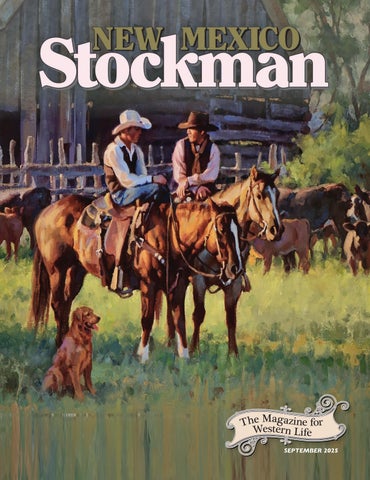
on the cover
“Taking a Break” Oil, 30x24, by Jason Rich honors the cowboy spirit. For this and Jason’s other works and collections visit jasonrichstudios.com
“Every painting starts with the horse for me, the way the light catches its gesture and movement.” It’s no wonder, since artist Jason Rich grew up riding, training and drawing horses on a small farm in southern Idaho. Jason’s interest in art was fostered at a young age, which led him to study art at Utah State University where he received Bachelor and Master of Fine Art degrees.
by Bronson Corn NMCGA President PRESIDENT’S MESSAGE
Bronson Corn President Roswell
Tom Paterson President-Elect Luna
Dave Kenneke NW Vice President Cimarron
Jeff Decker SE Vice President Lovington
Roy Farr SW Vice President Datil
Cliff Copeland NE Vice President Nara Visa
Becky King-Spindle Vice President at Large Moriarty
Shacey Sullivan Secretary/Treasurer Peralta
Loren Patterson
Immediate Past President Corona
Randell Major Past President
As I sit here in my feed truck driving around the ranch, looking at the cured-out grass and the cloudy skies it gives me hope for a brighter future. I received anywhere from 6 1/2 inches down to just below 2 inches for 2025, so not a huge amount of rain but all our country had some.
There are many of those especially in the Southwest whose 2025 rainfall season has been anything but spectacular, my thoughts and prayers go out for those of you who are struggling to get through another year. Those of us in the cattle industry go through a whirlwind of emotions on a year-to-year basis, and it solely revolves around things that we cannot control. Whether that be the lack of rain, input prices skyrocketing year after year, health issues that plague the subconscious parts of our minds, and cattle prices when we sell our calf crop.
These are all things that we cannot control, and it continues to affect the way that we operate year in and year out. That is what makes us unique!
Those who try to push policy revolving around agriculture whether it be at a state level or a national level most of the time do not have a background in agriculture. There used to be a bumper sticker floating around that said on the 8th day God created the Rancher, I firmly believe that, as it takes an individual who cares more about the land, wildlife, livestock, and our family to do this day in and day out.
I do partially disagree with the fact that it is a “lifestyle” as people call it, I think of it more as a calling! For those of us in the cow/calf industry we are seeing a market that has never been seen before. We have options for the first time in a decade; this is only the second time in the last 20 years that many family operations can comfortably work on long term debt. Such an amazing opportunity that we have, and I believe it is not over yet!
As many of you have heard me say over the last several years, we must build a future for the next generation. That time as among us!
Now is the time when the next generation has the opportunity to continue family operations. I am not saying to retire and make your kids take it over, what I am saying is we have an opportunity for the family ranchers that have been struggling year in and year out for the last 30 years to make ends meet, we have the ability to work on long term debt, expanding our operations, doubling up your heifer retention, buying better bull genetics, water infrastructure replacement, fence replacement, all of those things that you do as you can but never seem to get done! In most instances the first generation built the infrastructure, the second generation paid for the infrastructure, the third generation enjoyed the infrastructure, the 4th generation repairs the infrastructure, now the fifth generation does what it can to operate with the infrastructure that was put in 100 to 150 years ago.
I wholeheartedly believe in making the next generation work for everything they get, but if we can help them along so that they don’t face the same struggles that we are now, then maybe our children will be more interested in coming back to the family operation because they know that at least some of headaches aren’t going to fall upon them.
Prices the way they are I would strongly urge the family operations who have never been in this position before to consult with your CPA so that you may have an understanding on how and what to do without having to pay a ridiculous amount of taxes. Who would have ever thought that it hurts to be successful for the first time since the early 80s?
It just does not seem right to finally be in a position to do what we have all dreamed of doing, just to be slapped with a hefty IRS bill. I do not know about you, but I do not want the government to have 33 percent of this year’s calf crop!
As I wrote in the last letter as well, do not be bashful about protecting yourself through next year’s calf crop by utilizing an insurance program, or talking with a hedge firm about some lowcost low risk protection. We have tools available to us now that past generations did not.
Be bold, strong, and courageous! Our God has given us an opportunity, maybe we should ask him how to proceed?
“Y’all Have A Good’en!”
Bronson Corn
JUST THE FACTS ... & THEN SOME
by Caren Cowan, Publisher New Mexico Stockman
Screwworm Hysteria
Iam not saying that screwworms are not a horrific threat to the livestock industry, especially in states along the Mexican Border. The worms are spreading rapidly in Mexico. It doesn’t appear that building a facility to sterilize flies in the US is going to happen fast enough to save us.
However the “popular” media really fell off the edge in late August when a woman who had been in South America was diagnosed with screwworms in the US. While that must have been terrible, it is limited to one person.
According to veterinarians, humans cannot transmit the worms to animals nor can animals transfer to humans. The flies must lay eggs in open wounds or in a humid place like the nose.
Not to be confused with facts, the media is warning of the next pandemic coming from screwworms.
Not happening folks, just like the popular prediction that bird flu would be the next pandemic... since 2022.
Latest Screwworm statistics
Mexico’s official count shows that New World screwworm (NWS) is continuing to spread rapidly in the country, keeping the U.S. border closed to cattle imports and redirecting production to the Mexican packing industry, according to meatingplace.com.
Authorities had a tally of 5,086 cases through August 17, 53 percent more than July’s total, the Reuters news agency reported, citing Mexican government data in mid-August. The infestations were mostly afflicting cattle, though cases were also reported in sheep, horses and dogs.
The Mexican government has announced it will be providing aid to ranchers in the country’s three northern-
Screwworm Hysteria
most states. Growers in the states of Coahuila, Durango and Sonora are expected to receive assistance under the federal investment program Plan Mexico that aims to address challenges in industries critical to the nation’s economy.
Officials at Mexico’s Beef Producers Association, for example, estimate that ranchers have lost $30 million per month since Mexican livestock imports to the United States were officially banned this summer.
New Champions
During the New Mexico Federal Lands Council visit to Washington, D.C. in late June we learned of some potential help for ranchers suffering from the Endangered Species Act and specifically wolves. The Small Business Administration (SBA) was already on the issue, but wants to learn more to do more.
To that end SBA officials will be in wolf country September 9 through September 12 to hear from ranchers living with wolves. Meeting sites will be Winston, Magdalena, Datil and Reserve. For more information please contact Laura Schneberger at 575.740.4661.
USDA to address large animal vet shortage
In late August the US Secretary of Agriculture took the first step in issuing a Rural Veterinary Action Plan that will tackle several issues including:
Ї Enhancing and streamlining Veterinary Grant Programs
Ї Recruit and retain USDA Veterinarians
Ї Research barriers to entry and increase recruitment from rural areas
Better read the label!
In an interview with The Wall Street Journal , Impossible Foods CEO Peter McGuinness said he would potentially produce a burger that was 50 percent plant-based and 50 percent beef, according to meatingplace.com
Whether the remark represented an idle thought or a considered plan wasn’t immediately clear. But it came on the heels of a Washington Post op-ed headline arguing that, “Plant-based meat has a problem. It may need more meat.”
Blended products containing meat with vegetables, mushrooms, or even fruit are looming on the horizon.
McDonald’s taking a bullet...
McDonald’s has admitted that their products are too expensive for their customer base, says meatingplace.com. Starting in September, McDonald’s and its U.S. franchisees will reduce the price of eight popular combo meals by about 15 percent compared to buying the items separately.
The fast-food giant plans to expand its offerings with a $5 breakfast deal and an $8 Big Mac and McNugget special, reviving its “Extra Value Meals” branding.
State Land Office to Host Public Meetings on Proposed Land Exchange with BLM
The New Mexico State Land Office (NMSLO) is hosting a series of four public meetings across Southern New Mexico September 22 - 25, 2025. The meetings will provide an overview of a proposed land exchange between the NMSLO and the federal Bureau of Land Management (BLM).
The NMSLO will also gather feedback at the meetings to help guide the agency’s decisions regarding the exchange. Representatives from the BLM will also be in attendance.
Under the proposed exchange, the NMSLO would transfer roughly 85,000 acres of state trust land to the BLM. In return, the NMSLO would receive federal lands of equal value.
The exchange would allow landlocked
portions of state trust land to be incorporated into the Organ Mountains-Desert Peaks National Monument. Meanwhile, NMSLO would receive lands better suited for the agency’s mission to earn revenue for public schools, universities, and hospitals. Because the NMSLO would receive more valuable lands, the exchange may ultimately be limited to just Doña Ana County but the agency is holding meetings in all potentially included counties.
Interested parties will have an opportunity to provide public comments at the in-person meetings. Public comments may also be emailed to: BLM_NM_LCDO_ Mail@blm.gov. ▫
Las Cruces: Monday, September 22; 6 – 7:30 p.m.
Doña Ana County Government Services Building, Council Chambers, 845 N. Motel Blvd. Lordsburg: Tuesday, September 23; 6 – 7:30 p.m.
Hidalgo County Council Chambers, 305 Pyramid St. Deming: Wednesday, September 24; 6 –7:30 p.m.
Mimbres Valley Special Events Center, 2300 E. Pine St. Silver City: Thursday, September 25; 6 – 7:30 p.m.
Grant County Business and Conference Center, 3031 US-180
BARBER R A NCH
Your answer to real-world success for payday profits and a sustainable cow herd!
Progressive cattlemen have been choosing Barber Ranch bulls for over 75 years.
Wanna know the reason?
Our emphasis has always been on extra muscle in an attractive package.
Our 2025 sale bulls sport impressive carcass EPDs to complement their performance. We offer a unique combination of calving ease, explosive growth and highly desirable carcass traits with extra good looks.
In addition to approximately 100 service-age Hereford bulls, our 2025 San Saba sale will feature approximately 50 head of spring bred registered Hereford heifers— all with genomically enhanced EPDs.
Brett Barber (806) 681-2457
Justin Barber (806) 681-5528
Terri Barber (817) 727-6107
Jacob Toombs (417) 399-0738
Dale & Mary Barber office@barberranch.com 10175 FM 3138, Channing, TX 79018 barberranch.com
Catalog requests: Rylee.R.Barber@gmail.com
Barber Ranch is located 60 miles northwest of Amarillo, Texas. Visitors always welcome!
JINGLE JANGLE
Hello y’all! I hope this finds y’all with enough rain and if not, I pray you get it soon.
July took me to San Diego, California for the American National Cattle Women Summer Meeting. So many great women in attendance. The meetings were productive, and we got a lot accomplished. We attended a San Diego Padres vs. Arizona Diamondbacks Baseball game as a group and we had a ton of fun. Go Diamondbacks, even though they lost.
New Mexico CowBelles received the Honorary 4-H Member Award and Michelle
Greeman accepted it for us. What an honor that was.
I hope y’all are rocking and rolling with your Associate Member sign ups, the contest ends October 1, so go get em’!
Don’t forget New Mexico Beef Council needs our help manning the Beef Happy Hours at State Fair September 5 and 6. Then on September 12 and 13 from 4 to 7 p.m. Please reach out to Liz if you can fill a spot. I sure appreciate all of you and am blessed to be able to represent our organization and state.
See y’all down the trail.
Blessings,
–Corrina Casler
New Mexico CowBelles President
Mesilla Valley CowBelles August Meeting held virtually. Fundraiser: Mary Esther will follow up with more details at the October meeting. Ag Explorer: Mary Esther, Fita, and Margie will present for Ag Explorer during the fair (Wed-Fri). Presentations will be geared towards 3rd graders. Beef Show: MVCB will sponsor the usual buckles for the beef show this year. Gretchen will inform Lindy Gardner. NMF&LB Women’s Leadership Program: Dona Ana Farm and Livestock Bureau will conduct a bean giveaway again this year at the fair. They will use the educational side of the booth on Saturday, September 27. Activity TBD. Booth Clean Up: Let’s plan for the booth clean up on Saturday, September 13. Date change can occur. Group plans to decorate the booth on Wednesday morning of the fair. Discussion of schedule for manning the booth to occur during clean-up. NMSU Ag Day: Mark your calendars for this event: Saturday, November 8, 2025. Next meeting: September 13 (T) at booth clean up.
New Mexico CowBelles thank you to all who have submitted their news to Jingle Jangle. Please send minutes and/or newsletters to Jingle Jangle, Janet Witte, 1860 Foxboro Ct., Las Cruces, NM 88007 or email: janetwitte@msn.com by the 15th of each month.
Using EPDs for Selection
Source: American International Charolais Association
Cattle Evaluations use the term Expected Progeny Differences (EPD) to express genetic transmitting ability of a sire for the various traits listed. An EPD is a prediction of how future progeny of a sire are expected to perform in a particular trait relative to other sires in the analysis. The key word is “difference”. The EPD itself does not imply “good” or “bad” performance. But rather, the EPD gives a prediction of the average difference to expect in the performance of a sire’s progeny relative to other sires in the same analysis.
The EPD for a given trait on each animal in the analysis is compared to every other animal in the analysis. The EPD is reported as a plus or minus value in the unit which the trait is measured.
Each EPD reported is accompanied with an Accuracy (ACC) value. ACC is a measure of reliability regarding the EPD evaluation for a performance trait. Accuracy is reported
as a decimal number between zero and one: large values indicate greater accuracy and more certainty the EPD will show little change as additional progeny information is obtained.
Birth Weight EPD (BW) The expected difference in average birth weight (pounds) of progeny. Birth weight reflects prenatal growth.
Calving Ease Direct (CE) is expressed as a difference in percentage of unassisted births in first calf heifers. A higher value indicates greater calving ease. It predicts the average difference in unassisted births with which a sire’s calves will be born when bred to first-calf heifers.
Calving Ease Maternal (MCE) is expressed as a difference in percentage of unassisted births in first calf daughters. A higher value indicates greater calving ease. It predicts the average difference in unassisted births with which a sire’s daughters will calve as first-calf heifers when compared to daughters of other sires.
Weaning Weight EPD (WW) The expected difference in average weaning weight of calves. The evaluation reflects the genetic influence on pre-weaning growth rate.
Yearling Weight EPD (YW) The expected difference in average yearling weight of progeny. The evaluation reflects genetic influence on both pre-weaning and post-weaning growth rate.
Maternal Milk EPD (Milk) The genetic ability of a sire’s or dam’s daughters to express in pounds of weaning weight in her calves due to her maternal ability through mothering instinct and milk.
Total Maternal EPD (MTL) A value to predict the weaning weight performance of calves from an animal’s daughters due to genetics for growth and maternal ability. Total Maternal is calculated by adding ½ the WW EPD to the Maternal Milk EPD.
Scrotal Circumference EPD (SC) The expected difference in scrotal circumference (expressed in centimeters) of a bull’s or dam’s male offspring at yearling compared to progeny of all other animals evaluated. Research has also indicated a relationship between increased SC EPD and decreased age at puberty for daughters.
Carcass records are adjusted to an age constant endpoint. Therefore selection based on any or all of the carcass merit EPD are comparable among cattle at the same age endpoint. For example, selection based on
increased EPD for carcass weight will result in heavier carcass weights than those animals with lower EPD for carcass weights when the cattle are harvested at the same age.
Carcass Weight EPD (CW) Expected progeny differences for Carcass Weight is a predictor of pounds of retail product at a constant age endpoint. Selection for increased values should result in heavier carcasses, while selection for decreased values should result in lighter carcass weights at the same age endpoint. Carcass Weight EPD are expressed in pounds and is a predictor of the differences in hot carcass weight between parents progeny at an age constant endpoint.
Ribeye Area EPD (REA) Ribeye area is measured from a cross-sectional area of the longissimus dorsi muscle at the 12th rib. Ribeye area is a major component of the USDA yield grade equation and selection for increased ribeye area should result in larger ribeyes and lower yield grades between animals with the same carcass weight. Ribeye area has a positive relationship with weight, the larger the animal the larger the ribeye area. Ribeye Area EPD are expressed in square inches and is a predictor of differences in ribeye area between parents’ progeny at a constant age endpoint.
Fat Thickness EPD (FAT) Fat thickness
is measured at the 12th rib and is the primary component to the USDA Yield Grade equation. Fat thickness has a negative relationship to cutability; therefore, selection based on decreased fat thickness should result in lower yield grades and leaner cattle given the same age endpoint. Fat Thickness EPD are expressed in inches and are a predictor of differences in fat thickness between parent’s progeny at an age constant endpoint.
Marbling Score (MARB) Marbling is a subjective measure of the amount of intramuscular fat in the ribeye muscle. Marbling score is the primary component of USDA Quality grade and selection for increased Marbling Score EPD should result in cattle with higher quality grades at the same age endpoints. Marbling score has a small genetic correlation with fat, therefore producers may select for increased marbling score EPD while not changing external fat thickness when cattle are harvested at the same age-constant endpoint. Marbling EPD is a prediction of the differences in the USDA subjective marbling score between parent’s progeny at an age constant endpoint. Marbling is expressed in the same units as the USDA Marbling Score (see table below), see the accompanying table for USDA Marbling Score in the Carcass Section.
Terminal Sire Index (TSI) The AICA
Terminal Sire Index (TSI) is a formal method of combing Expected Progeny Differences (EPD) – BW, WW, YW, REA, CW, MARB and FAT – into one single value on which to base selection decisions. The TSI uses estimates of the genetic relationships between traits with an economic default value based on three year rolling USDA data.
The TSI represents a dollar index per terminal progeny produced for a bull in the AICA database, ranking them for profit potential. This dollar index is to be interpreted much like a single trait EPD. For example, if Sire A’s index is $191.66 and Sire B’s index is $200.00, then we would expect Sire B’s offspring to average $8.34 more net return ($200.00 minus $191.66) than Sire A’s offspring.
Heritabilities & Genetic Correlations
Heritability may be defined as the proportion of the observed phenotypic variation
Grau Ranch Bulls Add to your Pay Weight!
that is due to genetic variation. For example, when analyzing a group of Charolais calves from the same sire, one would expect some variation in the weaning weights. Since weaning weight is 25 percent heritable, 25 percent of the observed variation is attributable to genetics while the remaining 75 percent of the observed variation is due to environmental influences.
Traits with low heritability estimates are influenced more by environment than by genetics, thus genetic progress from selection may be slow. Traits with low heritability respond greater to the effects of crossbreeding. Since heritability is already an integral part of the EPD calculation, EPD reflects actual differences and requires no adjustment.
Accuracy
Accuracy values give us an indication of how close our estimates are to an animal’s true genetic value. Accuracy values are extremely useful to breeders in determining the reliability of an EPD. An accuracy value can range from 0.0 to 1.0, depending on the amount of information that is known about an animal for any one of the reported traits. As the amount of information included in the analysis of a trait for an animal increases, the accuracy value for that trait increases accordingly. Table 1 shows the standard error of prediction (possible change value for an EPD) at various levels of accuracy for the traits reported. You will notice that as accuracy level increases, the possible change value decreases. Still, an EPD can change from year to year even though it may have a high level of accuracy. The point to remember is that the expected change of an EPD with a high ACC is correspondingly less than those of an EPD with a lower ACC value.
The possible change of identical EPD, given different levels of accuracy can be seen in the example. Two sires have YW EPD of +30, but different ACC values. This figure illustrates the possible range within where the true genetic value is. Sire A has an ACC of .40 with a possible change value of 23 pounds, and Sire B has an ACC of .80 with a possible change value of 8.5 pounds.
BillKingRanch.com Bill King - 505-220-9909 Tom Spindle - 505-321-8808
The Monument Mirage
How Conservation Economics Disguises Rural Cleansing
Source: Catron County Rancher
When the Organ Mountains–Desert Peaks National Monument in southern New Mexico was designated in 2014, boosters promised an economic renaissance. Tourism, they claimed, would skyrocket; small businesses would flourish; jobs would follow. Today, a parade of glossy reports trumpet the supposed bounty: hundreds of millions in new spending, hundreds of jobs created, millions in tax revenue. The Las Cruces Chamber of Commerce echoes the refrain—proof, they say, that conservation pays.
But behind the headlines lies a story of fragile data, inflated modeling, and a deeper
agenda that has little to do with economics.
No Baselines, No Counterfactuals
The first flaw is methodological. To measure economic impact, you need a baseline and a counterfactual. What did the local economy look like before the monument? What would it look like today had the designation never occurred? No one has bothered to answer those questions.
Instead, consultants simply assume causation: tourism rose because of the monument. But southern New Mexico is home to White Sands National Park, the historic town of Mesilla, and state park attractions that were already drawing visitors. The regional economy has grown and diversified since 2014, making it impossible to attribute changes solely to the monument. Without a counterfactual, the claims are little more than advocacy wrapped in numbers.
Thin Data, Inflated Models
On-the-ground visitation data is almost nonexistent. The Bureau of Land Management operates only a few visitor counters at three small entry points to a monument that sprawls across nearly half a million acres. Most visitors enter informally, unrecorded. Yet consultants confidently project over 600,000 annual visitors.
The projections then feed into economic models like IMPLAN. Each hypothetical visitor is assigned a generic spending profile—hotels, meals, gas, souvenirs— which is multiplied across the local economy. The outputs are touted as “$35 million in annual impact” and “hundreds of jobs supported.” But multiplying uncertainty produces nothing more than larger uncertainty. With no reliable baseline and no actual counts, these models are castles built on sand.
The Bigger Picture: Scale of the Economy
Even if the monument were delivering exactly what its boosters promise, the scale pales compared to the bedrock industries of New Mexico.
Ї Outdoor recreation contributed about $3.2 billion in value added in 2023, or 2.4% of New Mexico’s GDP, supporting around 29,000 jobs.
Ї Agriculture and forestry, by contrast, generate nearly twice that output, with deeper ties to land, water, and culture.
Ї And oil and gas dwarfs both. New Mexico is now the second-largest oil
producer in the United States, pumping over two million barrels a day. In 2023 alone, that production delivered $11.3 billion in revenue to state and local governments.
Stack these sectors side by side, and the monument’s supposed “tourism boom” is revealed for what it is: a rounding error in the state’s broader economy.
The Real Objective: Rewilding by Design
So why the relentless emphasis on tourism? Because it provides a politically palatable cover for the true motivation: restricting or eliminating traditional land uses.
National monument status is not just a
branding exercise. National monument interagency planning is directed to prioritize preservation over multiple use—it curtails grazing, logging, mining, and energy development. Environmental NGOs openly support this shift. Groups like WildEarth Guardians and Western Watersheds Project litigate aggressively to close grazing allotments, challenge timber sales, and block mineral leasing. Their long-term vision is what they call rewilding: the transformation of working landscapes into wilderness preserves.
For rural communities, this looks less like conservation and more like rural cleansing—a systematic displacement of industries and livelihoods that have sustained families for generations. Whether mandated by law or achieved through litigation and regula-
tion, the intent is the same: remove people who work the land, and replace them with tourists who merely pass through it.
The Costs of a Mirage
Tourism can complement rural economies. It can create seasonal jobs, stimulate small business, and bring visibility to overlooked communities. But it is not a substitute for the high-wage, year-round employment found in agriculture, forestry, or oil and gas. Nor does it provide the same cultural continuity that comes from ranching families who have managed the land for a century. By selling tourism as an “economic engine,” monument boosters downplay the losses that come with removing multiple uses. They obscure the reality that once grazing permits are retired, once timber
sales are stopped, once mineral rights are withdrawn—those livelihoods are gone forever.
Let’s Debate Honestly
Conservation is a legitimate policy choice. Americans may decide that certain landscapes should be preserved, even at economic cost. But let us be honest about that cost. Let us not disguise it behind glossy reports and speculative multipliers.
Organ Mountains–Desert Peaks was not created to spur economic growth. It was created to lock up land, restrict extractive industries, and further the rewilding vision of environmental groups that see human livelihoods as incompatible with nature. That is a debate worth having. But it should be fought on the grounds of values and tradeoffs—not on the false promise of tourism dollars spun from thin data.
Until we demand clear baselines, real counterfactuals, and transparent acknowledgment of the true objectives, the “monument boom” will remain what it has always been: a mirage. ▫
CBar RANCH
TEXAS
806/828-6249 • 806/786-2078
CHAROLAIS...
63 Years of Charolais experiences! When you want the best, give us a call!
Profit with Charolais Bulls!
With today’s Calf prices, you can get more $$$ from your cows by using a Charolais bull that will add those extra pounds!
And those good smoky and yellow calves are selling at the top of the market!
Heterosis is FREE! and the best sire for that is CHAROLAIS! Join with many others that are going back to Charolais for more Pounds and more $$$!!
Angell Ranch calves near Lovington, NM
ROSWELL LIVESTOCK AUCTION SALES, INC.
& ROSWELL LIVESTOCK AUCTION TRUCKING, INC.
900 North Garden · P.O. Box 2041 Roswell, New Mexico 88201 575-622-5580
www.roswelllivestockauction.com
CATTLE SALES: MONDAYS • HORSE SALES
BENNY WOOTON CELL 575-626-4754
SMILEY WOOTON CELL 575-626-6253
Producers hauling cattle to Roswell Livestock New Mexico Receiving Stations need to call our toll-free number for a Transportation Permit number before leaving home. The Hauling Permit number 1-800-748-1541 is answered 24 hours a day, 7 days a week.
Trucks are available 7 days a week / 24 hours a day
Roswell livestock Auction Receiving stAtions
ATTENTION RECEIVNG STATION CUSTOMERS,
To be able to schedule trucking, all cattle need to be permitted by 1:00 p.m.
LORDSBURG, NM
20 Bar Livestock Highway #90 at NM #3 – East side of highway. Receiving cattle for transport 2nd & 4th Sunday of each month. Smiley Wooton, 575622-5580 office, 575-626-6253 cell.
PECOS, TX
Jason Heritage is now receiving cattle every Sunday. For information to unload contact Jason Heritage 575-840-9544 or Smiley Wooton 575-6266253. Receiving cattle every Sunday.
VAN HORN, TX
800 West 2nd, 5 blocks west of Courthouse. Bob Kinford, 432-284-1553. Receiving cattle 1st & 3rd Sundays.
MORIARTY, NM
Two blocks east and one block south of Tillery Chevrolet. Smiley Wooton 575-622-5580 office, 575-626-6253 mobile. Receiving cattle every Sunday
SAN ANTONIO, NM
River Cattle Co. Nine miles east of San Antonio on U.S. 380. Receiving cattle for transport 2nd & 4th Sunday of each month. Smiley Wooton 575-626-6253.
UPDATE
by Labradoodle Bennington, III
Zach Riley has been appointed as New Mexico State Executive Director for the Farm Service Agency. Raised in eastern New Mexico, he hails from a ranching family that has been raising cattle there for more than four generations.
Previously Riley has worked for then Congressman Steve Pearce, the New Mexico Cattle Growers’ Association, the New Mexico Farm & Live Bureau before moving to Colorado. There he worked for the Colorado Farm Bureau, the Colorado Livestock Association and Tallgrass, an oil and gas company. ▫
Purina Animal Nutrition Unveils Second Edition of the Beef-on-Dairy Industry Report
Purina Animal Nutrition has unveiled the second edition of its Beef-on-Dairy Industry Report, offering producers an in-depth look at the evolving role of beef-on-dairy cattle in the U.S. beef supply chain.
The updated report features the latest data, market analysis and research-backed practices for improving beef-on-dairy outcomes from genetics and nutrition to on-farm management and marketing strategies.
Contributors include leading experts Patrick Linnell, CattleFax; Dr. Ruth Woiwode, University of Nebraska-Lincoln; Dr. Michael Steele, University of Guelph; Dr. Ty Lawrence, West Texas A&M University; Dr. Daniel Thomson, Production Animal Consultation, LLC; Bruce Cobb, Certified Angus Beef; and industry consultant Nevil Speer, alongside Purina Animal Nutrition and Land O’Lakes
experts Dr. Tom Earleywine and Laurence Williams.
“Beef-on-dairy cattle now account for 12-15 percent of fed cattle slaughter, creating a steady source of quality beef at a time when native beef numbers are tight,” says Laurence Williams, beef-on-dairy development for Purina Animal Nutrition. “With intentional genetics, nutrition and management, this group of cattle can deliver consistent quality to consumers while adding lasting value throughout the supply chain.”
The Beef-on-Dairy Industry Report can be downloaded at purinamills.com/ dairy-beef.
Rural New Mexico Counties Enlist
National Support
by Bill Williams, Chavez County Manager
It was as inspirational as a scene from Rocky when rural New Mexico counties garnered the support of the National Association of Counties, in Philadelphia, to oppose the National Interest Electric Transmission Corridors, during their annual meeting. Representatives from eight New Mexico Counties, directly affected by the planned 5 to 15-mile-wide corridor through their counties, teamed up, planned, presented, and fought to assure that 1,841,000 acres will not be taken by the federal government.
The plan for 10 National Interest Electric Transmission Corridors was announced on May 8, 2024, with a high-level explanation of the basis for those “corridors.” Describing a “must have” scenario for all of these 10 corridors to assure electrical distribution across the entire nation anad into areas that did not have adequate power available. Immediately, counties in the affected areas began to question the plans and the vast quantities of land that could be lost to agri-
culture and other uses.
Then, in October of 2024, the Federal Energy Regulatory Commission (FERC), who originally planned to have their application process take place simultaneously with the local government’s processes, changed direction giving themselves the authority to issue transmission permits even after states deny an application in these areas. Many counties took actions and succeeded in their efforts to have the “corridors within their states and counties removed from consideration.
On December 16, 2024, Phase 3 was announced in the Federal Register and advanced three corridors with the Southwest Grid Connector being one of the three. This corridor dissects eight New Mexico Counties, four Colorado Counties, and runs along the western end of the Oklahoma panhandle. It is comprised of over two million acres.
Additionally, the Tribal Energy Access Corridor and the Lake Erie-Canada Corridor were named. Hypothetically, these areas have been selected to enhance grid reliability and reduce consumer costs. A short window for public comments and for entities to request Cooperating Agency Status was announced.
It was after the Federal Register listing
that people in the impacted areas began to realize what the National Interest Electric Transmission Corridors would allow. Serious questions about a government agency’s ability to take vast quantities of land without the consent of Congress began to surface. Many concerns about the eminent domain process were raised as well as how the land acquisitions would be funded.
The federal plan would empower government agents to determine land use, without the involvement of the residents of that land. It would disregard the local government’s policies that are responsible for ensuring that the custom and culture of their communities are considered in any governmental actions. The potential for wrongdoing, and “backroom deals,” is exponentially greater without the oversight of Congress, who determine the law, and the Local Governments, who are in tune with their communities.
Local ranchers reached out to the New Mexico Cattle Growers’ Association, who in turn reached out to the County Commissioners across the affected areas. Within days, a series of six town hall meetings were held, by New Mexico Cattle Growers working with county leadership, in various New Mexico Counties. County Commissioners, managers, and other State and Local elected
officials, and members of the public were invited. Several hundred people attended the town hall meetings; local government officials committed to doing whatever they could to assure that the concerns of their communities were heard.
Immediately, the County Boards of Commissioners passed resolutions in opposition to the National Interest Electric Transmission Corridors, those were forwarded to State, Local, and U.S. elected officials and agencies, to request relief and assistance. Additionally, local governments began working together to determine additional actions that could be taken to raise awareness as well as to get the Department of Energy, or the Federal Energy Regulatory Commission (FERC) to engage with the local governments and their constituencies.
It was at this time that several county
government officials drafted a resolution to go before the National Association of Counties for their consideration and, if approved at the annual meeting, to be lobbied for on the national level, for the upcoming year. It was our hope that the National Association of Counties, who represent over 3,000 counties nationwide, would adopt the resolution opposing the National Interest Electric Transmission Corridors, until such time as the federal government coordinates with state, tribal and county governments.
In March, the request was presented at the NACo Legislative conference, in Washington, D.C. and was adopted as an interim resolution, by the Environment, Energy, and Land Use Committee, and was cross claimed by Agriculture and Rural Affairs, and Public Lands Committees. With the support of dozens of co-sponsors from not only New
Mexico and Colorado, but also, California, Washington, Oregon, and other western states, the resolution was successfully presented at the annual meeting and approved, without opposition, at the General Assembly on July 14, 2025.
Upon reflection, our New Mexico counties standing up against people who do not understand us, might better fit the role of Rambo. The takeaway being: do not underestimate rural New Mexico’s strength or sophistication in a battle! ▫
HHS Allows FDA Emergency Use of Animal Drugs to Combat New World Screwworm
The U.S. Department of Health and Human Services (HHS) has issued a declaration that allows the U.S. Food and Drug Administration (FDA) to issue Emergency Use Authorizations (EUAs) for animal drugs to treat or prevent infestations caused by the New World Screwworm (NWS). This declaration applies only to drugs for animals.
NWS infests warm-blooded animals, including livestock, pets, wildlife, and, in rare cases, humans, causing severe tissue damage and sometimes death. The risk to human health in the United States remains very low, but the potential future threat to animal populations and the food supply chain requires proactive action.
Although eradicated from North America and Central America decades ago, NWS has progressed north since 2022 and is now
approaching the U.S. border with Mexico. This parasite poses an emerging threat to livestock and food security, with potential impacts on both national security and animal health.
“... we are taking decisive action to safeguard the nation’s food supply from this emerging threat,” said HHS Secretary Robert F. Kennedy, Jr. “This authorization equips FDA to act quickly, limit the spread of New World Screwworm, and protect America’s livestock.”
Currently, there are no FDA-approved drugs for NWS in the United States. The FDA through an EUA can authorize the flexible, faster use of certain animal drug products that may be approved for other purposes, or available in other countries, but not formally approved for NWS in the U.S. This ensures veterinarians, farmers, and animal health officials have timely access to the tools they need to protect pets, livestock, and the nation’s food supply.
“Thank you to my friends and partners Secretary Kennedy and Commissioner Makary who are answering the call and supporting our aggressive plan to push back and ultimately defeat this devastating pest. This emergency use authorization is another tool we can use in the fight against New World
Screwworm,” said Secretary of Agriculture Brooke L. Rollins. “Our cattle ranchers and livestock producers are relying on the Trump Administration to defend their livelihoods. Stopping this pest is a national security priority and we are linking arms across President Trump’s cabinet to defend our borders and push back this threat.”
“Our priority is to safeguard both animal health and the nation’s food supply,” said FDA Commissioner Marty Makary, M.D., M.P.H. “FDA is acting swiftly and responsibly to help ensure we have the necessary tools to prevent and control New World Screwworm, minimizing risks to agriculture and public health.”
FDA will provide future guidance to veterinarians and stakeholders on the appropriate use of any products authorized for emergency use and update the New World Screwworm: Information for Veterinarians fda.gov/animal-veterinary /safety-health/new-world-screwworminformation-veterinarians page. ▫
10th Circuit Holds New Mexico’s 7-Day Waiting Period
Unconstitutional
The 10th Circuit Court of Appeals has held New Mexico’s seven-day waiting period for firearm purchases unconstitutional in Ortega v. Grisham, a case brought by the National Rifle Association and Mountain States Legal Foundation, with the support of the National Shooting Sports Foundation.
“In courtrooms across America, the NRA is successfully leading the charge to protect law-abiding Americans’ Second Amendment rights,” said NRA-ILA Executive Director, John Commerford. “The 10th Circuit has sided with the NRA and held that radical waiting period laws are indeed unconstitutional. This decision not only impacts gun owners in New Mexico, Colorado, Utah, Wyoming, Kansas, and Oklahoma, but serves as a key piece in dismantling similar gun control laws across the country.”
New Mexico’s law requires purchasers of firearms to “cool off” for seven days before taking possession of a newly purchased firearm—even after passing a background check and demonstrating that they are not prohibited from owning firearms.
The Tenth Circuit held that New Mexico’s law violates the Second Amendment. Judge Tymkovich, writing for the court, determined that the right to keep and bear arms necessarily includes the lawful acquisition of firearms and, therefore, “cooling off” waiting periods infringe on Second Amendment-protected conduct. Next, the court concluded that waiting periods are a modern invention that are unsupported by our nation’s historical tradition of firearm regulation.
New Mexico’s proffered historical analogues—intoxication laws, licensing regimes, and restrictions that applied only to certain targeted groups—were found insufficient to justify New Mexico’s waiting period law. First, the historical intoxication laws were deemed improper analogues because they prevented the possession of a firearm only during the period of intoxication, not for an arbitrary time period even after the individual sobered up.
Second, New Mexico’s law is unlike
licensing regimes, the court noted, because New Mexico’s law assumes everyone is dangerous until they have waited an arbitrary amount of “cooling off” time.
Finally, the court determined that New Mexico’s law is distinguishable from the restrictions on targeted groups because—in addition to the dubious discriminatory biases underlying those bans—New Mexico’s law is not targeted at all; it applies indiscriminately to the entire populace.
The case will now return to the District Court for the District of New Mexico for the entry of a preliminary injunction. ▫
NEW MEXICO’S OLD TIMES & OLD TIMERS
by Don Bullis, New Mexico Author donbullis@msn.com
The Early Adventures of Governor David Meriwether
David Meriwether (1800-1893) became the third territorial governor of New Mexico in 1853. Unlike either of his predecessors, he had visited Spanish New Mexico toward the end of Spanish hegemony in 1821. He, along with a band of Pawnee Indians and a Negro boy, illegally entered New Mexico in 1819 for the alleged purpose of establishing trade relations with the Spanish government. Meriwether believed that he was the first American to visit New Mexico following Zebulon Pike and his small troop in 1805-1807.
It was a fool’s errand, to a considerable extent. The Spanish were very serious about
keeping their country’s borders closed and they were wary of the 19-year-old interloper from Kentucky. They considered him a spy, which is what they thought of Zeb Pike, too.
The Pawnees who accompanied the party were either killed or fled when Meriwether was taken into custody in what is now northeastern New Mexico. One source asserted that three of them escaped from the soldiers and remained in the area. Meriwether and the young Negro, Alfred, were taken to Santa Fe where Meriwether appeared before Governor Facundo Melgares (1775-c. 1835)—the same man who captured Pike in 1807. The problem was that Meriwether didn’t speak Spanish. This fact gives rise to a question regarding how Meriwether intended to negotiate with the Spanish, regarding trade or anything else. Governor Melgares didn’t speak English, either.
Meriwether was locked up.
Criminal justice in Spanish New Mexico didn’t include a prison system akin to the American model. Criminal penalties often involved corporal punishment, including flogging, or forced labor on public projects. Exile was sometimes ordered and executions were rare, but not unheard of. Many historians refer to jails—carcels—of the day, but they were often much like the one in which Meriwether was housed.
Located in the west end of the Palace of
the Governors, Meriwether described it as “a small, close, dirty apartment, with only a small window about the size of pane of eight by ten glass to admit a little fresh air and light.” Meriwether wasn’t any more complimentary about the food. “[That] night my jailor came with a small earthen bowl with boiled frijoles or red beans. I found [them] so strongly seasoned with pepper that I could not eat it. But I soon devoured the tortillas as I was very hungry.” Nor was he pleased with the sleeping arrangements. “…[S]preading my blanket on the dirty floor, I lay down and tried to get a little sleep. In this I was sadly disappointed, as I thought the bed bugs and fleas would eat me up before morning.”
The next day things began to look up. A French-speaking Padre made himself known to Meriwether, who was passably fluent in French. The two of them appeared before the Governor. When Meriwether told Governor Melgares, by way of the priest, that he was an American, the Governor replied, “Americans are bad people. You have forcibly taken a province from Spain called Florida.” (AdamsOnís Treaty, February 22, 1819.)
The governor then asked why the young American was in New Mexico, and Meriwether told him of his intention to open trade with the Spanish. When he had finished, he wrote, the Governor “shook his head in a very incredulous manner.…” Meriwether was sent
back to his jail.
A few days later, the French-speaking priest appeared again, and asked after the American’s welfare. The prisoner complained, “I [have] to keep fighting flies all day, and the bed bugs and fleas all night.” The priest interceded with the Governor, and Meriwether was allowed out of his cell during the day, but obliged to return in the evening.
While walking on the plaza some days later, the American and priest met again, and Meriwether showed the cleric the bug bites on his hands, arms and face. Again the priest approached the Governor and won another concession for Meriwether. He was allowed to remain free in the town, if he promised not to try and escape. He moved into a room with the priest and found employment with an elderly man, harvesting chile and beans.
It is noteworthy that throughout the autobiographical account of his adventure, Meriwether never provides the name of his benefactor, the French-speaking priest.
After a week of employment, Meriwether was summoned to the Governor’s palace again, for another interview. Melgares again expressed his dislike of Americans, and brought up the time, years before, when “[American] soldiers had been sent into Mexico to seize it.” The reference was to Zebulon Pike’s earlier incursion. In his journals, Pike spoke well of Captain Melgares. It should be mentioned of him, too, that he was Spain’s last governor of New Mexico, from 1818 to 1821, and Mexico’s first governor, in 1821 and 1822.
In spite of the Governor’s distrust of Americans, he agreed to let Meriwether leave New Mexico with the promise that he never return, upon pain of being shot. Meriwether promised, saying, “A stray dog always lives longest where he is treated best.”
After a few days of quibbling about what of his guns, animals, and other equipment would be returned to him, he and young Alfred were escorted out of the capital by a Spanish corporal and one other soldier. The military escort remained with them until they were well beyond Rio Pecos to the east. From there they made their way to a previously established rendezvous where they joined the three Pawnees who had survived the earlier Spanish attack. After several more adventures, the small party made its way back to the Missouri River and Council Bluffs, in March 1821.
When Meriwether returned to New Mexico to become governor, legend holds that on his inauguration day, May 6, 1853, the roof above the room that had been his cell 34 years earlier, collapsed. Everyone counted that as a good sign. But that was not to be.
Chairman of the Board/EVP
Mac Langford, President/CCO
Gordon Morris,
Colten Grau, Vice President
SANTA TERESA, NM
Hungry for Protein & Quality, US Consumers Shrug Off High Beef Prices
Source: CoBank
When retail prices for any consumer product reach record high levels, the corresponding drop in demand usually materializes in short order. Beef appears to be among the few exceptions to that rule, having defied common expectations surrounding price elasticity.
Retail grocery prices for beef skyrocketed in recent years and show no signs of descending any time soon. But surprisingly, demand
has not softened — it’s actually edged upward. According to USDA data, the allfresh retail beef demand index in the second quarter climbed to its highest level in at least 25 years.
The remarkably steady allure of beef, even at current prices, is likely a result of several factors currently shaping consumer food buying behaviors, according to a new research brief from CoBank’s Knowledge Exchange. Key among those factors is the heightened interest in dietary protein, changing health perceptions surrounding beef, and the availability of restaurant-quality beef at retail grocery stores.
“Twelve months ago, the question was whether beef demand would hold up at higher prices, but today most analysts are fairly certain that beef value risk is to the upside,” said Brian Earnest, lead animal protein economist with CoBank. “Retail per capita beef consumption is headed for 60 pounds this year. U.S. consumers can’t seem to get enough protein these days, and among animal proteins beef remains king.”
According to the most recent inflation data released by the U.S. Bureau of Labor Statistics, core inflation was up 2.9 percent year-over-year. Beef price increases towered in comparison. The all-fresh retail beef
& range
ANIMAL & RANGE SCIENCES
The Department of Animal & Range Sciences is part of the College of Agricultural, Consumer & Environmental Sciences
Students can major in Animal or Rangeland Resources and are provided with the very best of “hands on” academic instruction by our faculty. Fully equipped labs allow students access to cutting-edge research in:
The Department also offers pre-veterinary studies –our graduates have a high acceptance rate into veterinary medicine programs. We offer graduate degrees at the Master of Science and Doctor of Philosophy levels. The M.S. or Ph.D. in Animal Science can emphasize nutrition or physiology, and offers a Ph.D. in Range Science to study range management, range ecology and watershed management.
prices surged by 9 percent for the year, hitting an astonishing $8.90 per pound. Even at those levels, prices have been unable to tame unyielding consumer interest in beef.
Improvements in beef quality and the increased availability of premium grade cuts at retail have played a big role in driving demand. The U.S. beef industry is producing a much higher quality product today than it did 30 years ago. Recognizing quality issues in the 1980s, cattle producers began selectively improving herd genetics to produce beef with higher fat marbling and better taste for improved customer experience. Those efforts have paid off as 95% of U.S. beef production is now grading Choice or higher.
Earnest said access to high-quality beef has never been better and American consumers have developed a taste for it. “The COVID-19 pandemic led us to a place where ‘leveling up’ through access to luxury goods is prioritized over luxury services. And beef, specifically high-quality beef, is a luxury good that can be accessed for at-home consumption at a fraction of the cost at fine dining establishments.”
Consumer perceptions surrounding the health aspects of eating beef have also improved in recent years. Fitness-conscious consumers who laud protein content for muscle production often favor beef. The advent of GLP-1 medications for weight loss have also sparked more widespread consumer interest in increasing the amount of protein in their diets.
Tight cattle supplies keep beef prices elevated
• The Chihuahuan Desert Rangeland Research Center (The College Ranch) –64,000 acre ranch just outside of Las Cruces
• The Corona Range & Livestock Research Center – 28,000 acre ranch & facilities in Corona, NM
• Student organizations, including a Block & Bridle Club, Pre-Vet Club, Range Club, Horsemen’s Association, Therapeutic Riding Club, & Judging Teams
• Clayton Research Center hosts research on shipping protocols, particularly evaluating the health and performance of newly received cattle, and nutrition and management from feedlot to slaughter
Dr. John Campbell –575/646-6180 / Dr. Dennis hallford –575-646-2515
http://aces.nmsu.edu/academics/anrs/
The USDA mid-year cattle inventory report released on July 25 revealed the biannual cattle inventory was the lowest mid-year count on record at 94.2 million head – a 75-year low. Analysts are mixed on whether the beef herd is still in contraction or beginning to rebuild. But most observers suggest the nation’s cattle supply will remain strained through at least 2026, and likely through 2027. That means retail beef prices will remain elevated for the foreseeable future. While larger macroeconomic shifts could influence purchasing behavior in the future, so far consumers have shown little appetite for sacrificing beef.
Read the research brief, U.S. Beef Attracts More Customers than it Can Handle.
Wolves in the Suburbs
The Hypocrisy of Coexistence
Source: Catron County Rancher
For years, wolf advocates have told rural families in Arizona and New Mexico that they must ‘learn to coexist’ with wolves. Ranchers are expected to accept the loss of their cows, calves, horses, and dogs. Their livestock and pets literally torn to pieces while still alive. Rural families are told to keep their children inside the house, playing outside only inside a high fenced yard. Pets are attacked and killed on the front porches of homes—all under the banner of ecological necessity. Wolves, we are told, are keystone predators essential for balance.
Why Not Suburbs?
But if wolves are so essential, why don’t wolf advocates demand their reintroduction into suburbia? Across American neighborhoods, deer populations are exploding. They devour gardens, increase vehicle collisions, and spread tick-borne illnesses. Coyotes and raccoons are everywhere.
If wolves are the ecological answer in the Gila or the White Mountains, why aren’t they the answer in Scottsdale, Santa Fe, or suburban Albuquerque. If wolves are nature’s balance, then surely, they’re needed where ecological imbalance is visible every day. After all, wolves live in close proximity to people in places like Europe and India. The fact that dozens of Indian children are killed and eaten every year shouldn’t be a cause for concern.
The Double Standard
Of course, we know why. Wolves in subdivisions would spark outrage. Parents would not tolerate apex predators near bus stops. Families would not accept losing dogs and cats to a program designed for ‘ecologi-
cal balance’.
Homeowners would never allow their yards to become hunting grounds. And so, conveniently, the burden of ‘coexistence’ falls only on those who live in wolf country— ranchers, hunters, rural families—people with the least political clout but the greatest exposure.
Hypocrisy Exposed
Wolf advocates hide behind ecological arguments when it suits them, but their logic collapses the moment it’s tested outside rural America. They argue wolves are essential for balance, but then carve out exemptions for suburbs. They argue wolves must be accepted despite the risks, but only by others. They argue wolves belong in their ‘historic range,’ but ignore that wolves once roamed virtually all of North America—especially the most ecologically productive places where they now argue wolves do not belong.
A Matter of Fairness
The truth is simple: if wolves are too dangerous, disruptive, or impractical for neighborhoods, then they are also too dangerous, disruptive, and impractical for rural communities. Rural people deserve the same respect for safety and quality of life as sub-
urban families. If wolves don’t belong in Tucson or Santa Fe, then neither do they belong in the pastures and towns that surround them. Let’s call this what it is. Neo-colonial rural cleansing. Wolf advocacy organizations like Western Watersheds, WildEarth Guardians and the Center for Biological Diversity want rural inhabitants gone. They want nature parks, devoid of human activity, for their own recreational enjoyment. Not dissimilar to what is happening to traditional herding societies in East Africa, where clearances of rural inhabitants make way for wildlife reserves.
The debate over wolves is not just about biology. It is about fairness. Wolves have recovered, their populations are stable, and the scientific benchmarks for recovery have been met. But wolf advocates continue to push for expansion—not into their own neighborhoods, but into ours. Until they are willing to live by the same rules they write for others, their arguments should be seen for what they are: hollow, hypocritical, and unfair. It is time to stop pretending that ‘coexistence’ means the same thing everywhere. In reality, it has come to mean one thing: rural America pays the price while everyone else applauds from a safe distance.
Current Value of Replacement Heifers
by Mark Z. Johnson, Oklahoma State University Extension Beef Cattle Breeding Specialist
There is evidence of an increase in heifer retention with improved drought conditions across much of the Central Plains and summer video auctions reporting a smaller percentage of heifer calves.
Retention does not appear to be aggressive. With the calf market on pace for another year of record prices providing incentive, herd rebuilding remains sluggish compared to past cycles. Lingering drought continues to limit forage availability in key regions while high interest rates and the substantial capital required to develop or purchase bred females further suppresses expansion.
As well, many producers remain wary of a repeat of the post-2014 market correction, adding a layer of caution to long-term deci-
sion-making. Even with bred female values at record highs, relative to calf prices, breds may still be undervalued, a sign of producer hesitation rather than a lack of economic feasibility. An excellent metric to consider when purchasing bred heifers is the number of calves it takes to pay for the purchase.
Cattlefax recently reported that in 2025, that figure is projected to average just 2.75 calves, well below the long-term average of 4.5 and far beneath the 2015 peak of 9 calves. This ratio is likely to rise over time, driven by higher bred female prices, moderating calf values, or a combination of both. If feed resources allow, this dynamic suggests that adding females to the herd today may be the best time from a breakeven perspective to expand.
Replacement heifers are expensive; not only with respect to dollars invested but also the expenditure of time and labor involved. Recent market reports indicate 550 pound weaned heifer calves selling for well over $2,000 per head.
Those heifers’ calves are still two years away from weaning their first calf if all goes according to plan. Accordingly, operations looking to add inventory may find a better option of purchasing bred heifers in the current market.
What Should Bred Heifers Be Worth?
Assuming weaned calves remain at a value of $2,000 to $2,500 per head over the next few years, your annual cost of running a cow will largely determine what you should invest in a bred heifer. The annual cost of maintaining a beef cow is highly variable and has increased tremendously over the past five years. Variable costs such as fuel, fertilizer and herbicides have been blamed as the primary culprits; however, fixed costs such as equipment, hired labor, and land have increased as well.
Total economic costs associated with U.S. cow-calf production for 2018 were estimated to range from $910 per cow for operations with 500 or more cows to $2,099 per cow for operations with 20 to 49 cows. These results show significant economies of scale, with costs per cow declining with increased herd size.
Kansas Farm Management Association estimates the annual cost of running a cow to be approximately $1,551 according to data collected in 2024. It is noteworthy that pasture and feed only account for $684 of that total. A more detailed breakdown of the other actual expenses is available in the last article referenced below.
Market fundamentals are strong for a continued robust cattle market until cow inventories start to climb. There is currently not much indication of that happening anytime soon. That being said, what bred heifers are worth to your operation (and how many calves a female needs to raise in order recapture your initial purchase price) will depend on how much profit she nets each year per calf rather than on the gross value of each calf she produces.
References:
CattleFax: How Many Calves Does It Take? Margin signals continue to point toward cowherd expansion, but the industry’s response thus far has been measured
USDA: Economic Research Service
Amber Waves : Larger Beef Cow-Calf Farms Have Lower Costs per Cow Than Smaller Operations
Ibet you can’t guess what creature is the most dangerous in the world?
I thought it was wolves but it’s flies. That’s because they carry and spread more diseases than any other animal or insect in the world. Which begs the question... why didn’t Noah grab his big old fly swatter and kill both flies on the Ark when he had the chance?
I was reading about the flies that spread New World screwworm when I came up with an idea that could solve another deadly immigration problem that is spreading mayhem and murder throughout the West. Only this one is coming across our southern AND northern border. I am, of course, referring to wolves. I think we can use the same plan once used to eliminate screwworms from our country and use it to solve our wolf problem.
It seems we tried everything to get rid of the screwworm fly that was driving southern ranchers crazy prior to the 1960s when some brainy scientist came up with the idea to release hundreds of millions of sterile male
screwworm flies to mate with female screwworm flies. The only reason the plan worked to perfection is because monastic female screwworm flies only mate one time and if it’s with a sterile male fly instead of one shooting real bullets, no offspring result. So in one generation the flies are almost gone! The U.S. government spent millions of dollars building facilities to produce the sterile male flies just as they are doing now in an effort to stop the onward march north to America.
The northern movement of the fly is really no different than those big marches of illegal immigrant trains of people, many of them from central and South America, that came in under the Biden administration, only the screwworm flies can fly right through and over Trump’s border wall.
But what if we could use the same game plan with the wolves being imported from Canada and Mexico and turned loose to wreak havoc on the West? What I am proposing is the government should spend billions of dollars building three facilities, one each in Los Angeles, Chicago and New York that would produce millions of sterile male wolves to be turned loose all over the country to mate with the immigrant wolves that are presently murdering sheep, cattle and wildlife indiscriminately. We’re going to need a lot of sterile male wolves because the promiscuous hussies obviously breed more than one time in their lives.
I know what you’re thinking. Wouldn’t these sterile wolves still kill our cattle and sheep too? Under normal circumstances of course they would. Now here’s where I share with you the brilliance of my plan. Using gene editing and genetic modification we snip a few chromosomes from an old California hippie and put them into the genetic
code of the wolves thus producing VEGETARIAN sterile male wolves. This would make it possible for American citizens to actually see and come in contact with the wolves they say they love so much, something that doesn’t happen now. Their only contact with their much beloved lobos now days is watching an animated Disney movie. And because they’d be vegetarians the ranchers wouldn’t have to worry about some wolf watching their kids and pets and counting calories, or about putting their children in cages at the bus stop for their safety. (Shouldn’t it be the other way around?)
We’d have to breed a lot of male sterile vegetarian wolves to overwhelm the intact male wolves and that’s why I think we should also clip and paste a few more chromosomes to make the sterile male wolves much bigger and more muscular so the female wolves would want to breed with them instead of the current crop of serial killers. Over time I believe this would eventually put an end to livestock depredation incidents and urban Americans wouldn’t have to worry about the wolves eating poor Poopsie Whoopsie or Cuddly Wuddly.
And here’s how sneaky smart I am. The first time an urban American sees some big old vegetarian wolf eating her award-winning roses or heirloom tomatoes he or she is going to demand that we send every wolf in America back to where they came from... Canada, Mexico or that place where the Devil dwells. ▫
RIDING HERD
by Lee Pitts
USFS Chief Outlines Vision for Logging, Mining & Grazing, Less Wildfire in America’s National Forests
by Amanda Eggert, Montana Free Press
U.S. Forest Service Chief Tom Shultz said America’s national forests need less wildfire and more logging, mining, grazing and recreational activity.
Schultz was the keynote speaker at a conference organized by the Congressional Western Caucus chaired by U.S. Representative Doug LaMalfa, R-California. The multi-day summit in the Flathead Valley has given U.S. senators and representatives an opportunity to talk policy with state officials, industry groups and prominent think tanks such as Americans for Prosperity.
Schultz said his “back-to-basics” approach to “multiple-use management” will favor expedited review for natural resource devel-
opment by overhauling agency guidance on federal laws such as the National Environmental Policy Act and the Endangered Species Act. Schultz also said he intends to aggressively suppress all wildfires and make more USFS land accessible for recreational use by motorized users and others.
“America should mine, mill and manufacture more,” he told those assembled, adding that more of the country’s national forests will be available to log in the near and long term to comply with Trump’s executive orders and the One Big Beautiful Bill Act.
Schultz said implementing those directives will give companies more certainty to invest in lumber mills, which cost about $250 million to build.
“As [the Forest Service has] pulled back on harvest, there was an extra burden on private land,” he said. “If we are up and down and up and down — or just down — that does not provide certainty to make investments … When we see a mill go away, it is really tough to see that come back. We need to hang on to what we have.”
Shultz said he anticipates that the agency will begin the nuts-and-bolts process for undoing the roadless rule within the next “couple of weeks.” Implemented in 2001 under the administration of former Demo
cratic President Bill Clinton, the roadless rule sought to preserve intact ecosystems by limiting road building.
Schultz also spoke about the “leader’s intent” document he issued earlier this year directing Forest Service personnel to aggressively suppress wildfires.
“There’s a role for fire, but there’s a time and a place,” Schultz said. “The time and place is not June, July, August and September. That’s not the time to be managing for wildfire. We need to be putting the fires out and that’s what we’re doing.”
Asked in a follow-up conversation with Montana Free Press if that full suppression strategy also applies to wilderness areas, which aren’t typically extinguished barring imminent harm to a particular community or resource, Schultz said such decisions would be evaluated case-by-case “based on conditions and the availability of resources.”
He also told MTFP that he’s exploring agency “consolidation” efforts to comply with an executive order President Trump issued at the start of his second term in the White House. A proposal outlined in Trump’s 2026 budget to create an entirely separate wildfire agency is still being developed, he said. The U.S House and the U.S. Senate are currently forwarding differing visions for that reorganization.
“Right now I don’t know what Congress is going to do,” he said.
Schultz indicated that the DOGE-led effort to reduce the Forest Service’s ranks has not led to as many cuts as the Trump administration initially proposed. In February, the agency fired more than 3,000 agency personnel who were considered probationary, meaning they hadn’t been in their current position for more than a year or two.
“We have not been firing people outside that process,” he said, adding that most of those employees returned “eventually.”
Schultz told MTFP that some employees had opted into the early retirement offer, but there is no active reduction-in-force effort underway. Under that program, sometimes called RIF, federal agencies can reduce their payrolls in a manner considered more durable by being more thoughtfully considered.
“I can’t say for certain there won’t be any [reductions in force], but that’s not the plan,” Schutlz said.
Schultz was appointed to lead the Forest Service in February. He is the first chief who hasn’t previously worked for the agency, which he describes as a strength. ▫
Minnie Lou Bradley
Minnie Lou Bradley, Childress, Texas, passed away after a short illness on August 5, 2025. She was born December 15, 1931 in Hinton, Oklahoma to Ralph Thomas Ottinger and Zulema Young Ottinger.
Minnie Lou attended Elementary School in Hinton and graduated from High School in Hydro in 1949. Minnie Lou then enrolled at Oklahoma A&M College where she was the first female in the Animal Husbandry program. While a student, she was the first female to be a member of the Livestock Judging Team and was High Individual at the International Livestock Judging Contest during the 1952 International Fat Stock Show in Chicago, Illinois. She graduated in 1953 with a degree in Animal Husbandry and a Minor in Agriculture Journalism.
She began her career with a position at the Texas Angus Association until she married Billy Jack (Bill) Bradley March 5, 1955. They moved immediately to the recently purchased ranch in Childress County that became known as Bradley 3 Ranch in 1955.
Minnie Lou became an icon in the cattle business. She was the first female elected to the American Angus Association Board of Directors in 1998 and is still the only female to have served as their President and Chairman of the Board in 2005.
She was inducted as a member of the National Cowgirl Hall of Fame in 2006 and the National Saddle & Sirloin Portrait Gallery in 2014. In 2018 she was recognized by Garden & Gun Magazine and did a segment on Texas Country Reporter. In 2019 she was recognized as an Outstanding Alumnus of the College of Agriculture at Oklahoma State University. In 2022 was named an Outstanding Alumnus of the entire University.
Minnie Lou was active in the National Cattlemen’s Beef Association, serving as Vice Chairman of several committees. She was a supporter of Standardized Performance Analysis (SPA), a program to aid cattle producers.
She was a sought after speaker at countless local, regional and national meetings on cattle production. There is not enough time
to cover the vast list of Minnie Lou’s achievements. There was never a job or challenge she wasn’t ready to take on.
Beyond her many agricultural and livestock successes, Minnie Lou was a dedicated supporter of young people in Childress County and beyond and was equally active in her community. Over the years she has served on various boards and committees from local 4-H, school board, Ag Day at school, to even being Parade chairman, and in all things Agriculture related she was involved.
Minnie Lou was passionate about education and devoted lots of time and resources to local youth, not only through elementary and high school, she wanted to be sure they had skills for life. One of her projects (Krockpots for Kids) provided crockpots for youngsters to take home for nourishing meals on evenings and weekends in addition to learning food preparation and safety. Minnie Lou’s reputation was known
throughout agricultural and livestock circles. She was a mentor to countless young women in the agricultural community. There was never a challenge she wasn’t ready to take on.
She was preceded in death by her son Monte Jack Bradley; her parents, Ralph and Zulema Ottinger; her sister Helen Brown, and Helen’s two daughters, Suanne and Kaylinn.
She is survived by Bill Bradley, her daughter Mary Lou Bradley Henderson, husband, James; grandson Raymond Jack Bradley; granddaughter Mandy Ann Popejoy; brother Ted Ottinger; sister Linda Pike; five great-grandchildren, a niece and three nephews, along with countless friends across the nation.
In lieu of flowers, gifts in her memory can be made through the Oklahoma State University Foundation for the Minnie Lou Ottinger Bradley Endowed Scholarship Fund (Fund 21-60600). Please make checks payable to the Oklahoma State University Foundation and mail to OSU Foundation, PO Box 1749, Stillwater, OK 74076-1749. To make a gift online, go to: https:// secure.osugiving.com/s/giving/annual?dsgt=21-60600
Or donations may be made in Minnie Lou’s memory to the American Angus Foundation, 3201 Frederick Avenue, St Joseph MO 64506. AngusFoundation. org ▫
Cattlemens Livestock
Climate Campaign Lawsuit Seeks to Censor Scientists
by Craig Rucker, CFACT
Two prominent left-wing campaign organizations have filed suit to suppress and censor the assessment that five climate science experts recently provided to the Department of Energy.
The Environmental Defense Fund (EDF) and the Union of Concerned Scientists (UCS) filed their complaint in Massachusetts District Court.
(Read their full complaint at CFACT.org)
The DOE climate assessment must terrify the climate/Left.
Their lawsuit does not demand damages, but silence.
The principal relief the EDF and the UCS demand is, in effect, that Energy Secretary Wright be enjoined from thinking, speaking, or accepting public comments about the most sound and unbiased climate assessment to grace the world of science in years.
What has pushed the usual climate suspects into such a tizzy?
Why must the scientific opinions of these five climate experts be suppressed?
CFACT posted an excellent write-up by Rear Admiral Tim Gallaudet, who served at the highest level at NOAA, on CFACT.org:
“In a stark contrast with the ‘mainstream view of climate science,’ the DOE report is unbiased in its objective assessment of the costs, efficacy, and collateral impacts of any ‘climate action’, considering the nation’s need for reliable and affordable energy.
“The fundamental physics of the global carbon cycle dictate that even if emissions were to stop tomorrow, it would take decades to see a meaningful reduction in the global CO2 concentration and hence human influences on the climate. Thus, the authors conclude accordingly that even drastic local actions to reduce GHG emissions will have
negligible effects, such that calling unilateral U.S. reductions ‘combating climate change’ reflects a serious misunderstanding of the scale of the issue.”
The exaggerations and misrepresentations that climate pressure groups push every day collapse under fair and impartial examination.
The DOE climate assessment is a “the emperor has no clothes” moment.
How about this howler? EDF and UCS complain that the climate working group didn’t include THEM, and wasn’t “fairly balanced in terms of their points of view.” Climate discussion that isn’t fairly balanced? What would that be like?
As Rear Admiral Gallaudet sums it up:
“For too long, the American people have been fed an unrealistic narrative that climate change is an existential threat that only drastic reductions in fossil fuel use will solve.
Secretary Wright has finally got it right, and it’s about time that the U.S. supports unbiased and objective climate science.”
(Read the full DOE climate assessment at CFACT.org ) ▫
by Barry Denton
Horse Shows & TV
The number of western style horseshows today is mind boggling. It does not seem to matter which discipline that you are involved in, the number of shows and the number of entries at shows continue to rise.
Part of the reason for this increase is that the economy is good, and more people have that extra money to spend. The arrival of large prize money has also boosted these events.
This is a wonderful thing for horses, horse trainers, veterinarians, horse shoers, barn builders, cattlemen, vehicle manufacturers, jean manufacturers, and anyone else affiliated with the equine industry.
The latest reliable statistic that I could find was a 2023 impact study by the American Horse Council (AHC). According to AHC the horse industry in the United States has a substantial impact and generates $177 billion per year. This in turn creates 2.2 million jobs.
Just ten years ago it was less than half that. Many new people seem to be craving the horse and embracing the western lifestyle as well. Part of the reason for all this is common sense and other reasons may surprise you.
One of the primary reasons for the increase in western horse popularity in
recent years is television. There is a man by the name of Taylor Sheridan and his hit show Yellowstone
What Mr. Sheridan did for our industry was bring it front and center once again. He did this by featuring top end horses and trainers within his series. This took the great horses and cowboys into people’s living rooms. This had not been done in a very long time.
Stop and think of how many years Roy Rogers, Gene Autry, and John Wayne had such a tremendous impact on the United States. It’s been about 40 years now since those guys quit producing westerns.
The trouble is that the public craves the television horse opera. Mr. Sheridan has brought it back to us. The other great thing about Mr. Sheridan is that he competes on horses personally.
He is responsible for creating the “Run For A Million” horse show that has been held in Las Vegas, Nevada the last four years. Competitors do ride for a million-dollar prize. Until four years ago this was unheard of in our industry.
Because of the growing interest in horses the numbers of horse shows with large prize money have increased. Because of this boon, the price of all horses has increased. Yes,
trickle down economics at its finest.
Mr. Sheridan is quite a marketer as well. His show was clever in that he brought back quite a few old-time cowboy actors that sparked renewed interest. He incorporated Buck Taylor from Gunsmoke and Barry Corbin from Lonesome Dove into his show.
Then he brought in real life top end horse trainers, like Bob Avila and Buster Welch. Those men were legends in the horse industry. He also included the famed 4 Sixes Ranch in Texas and their longtime cowboy 90-year-old Boots O’Neal to give it some authenticity.
Mr. Sheridan is clever in how he sends his actors from the show as ambassadors to all the major western horse events. His actors have been at the National Finals Rodeo, the American Quarter Horse World Championship Show, The Arizona Sun Circuit, The World Series Of Roping, and many others. The point is if you expose people to a wonderful lifestyle, it will have a domino effect, and many will embrace it.
Obviously, many liked the show Yellowstone as it stayed at number one during its five seasons. I have also met some people that did not care about it at all. However, you cannot argue with the positive impact it has had on our great horse industry. ▫
Can Large-Scale Solar Installations Coexist
with Agriculture in Rural
Source: CoBank
America?
Local opposition to utility-scale solar installations in rural areas is growing following the rapid pace of new solar developments in recent years. Concerns about land use in areas largely dominated by agricultural production are fueling much of the community-level resistance. With crop production revenue currently under intense pressure and subject to annual volatility, some landowners are welcoming the more consistent revenue advantages of solar landlease payments. But wider opposition could stymie additional solar developments in rural areas, slowing growth in the U.S. energy supply.
According to a new report from CoBank’s Knowledge Exchange, solar expansion could deliver the fastest, most affordable means for increasing the nation’s razor-thin energy reserves while driving new revenue streams for rural communities. However, success will be dependent on regional policy and site planning guidelines that ensure the local communities’ needs and interests are prioritized. The report is the first in a series of upcoming research articles and part of The New Golden Age of Electricity digital hub about rising energy scarcity and securing future power supply for rural America.
“Concerns surrounding the pace of solar developments in rural areas and the implications for land use in agricultural regions are warranted,” said Teri Viswanath, lead
power, energy and water economist with CoBank. “But there are guardrails to reduce the risk of land use tensions and other conflicts that would enable landowners and rural communities to capture the financial benefits of solar projects without displacing or disturbing agriculture farmland.”
Growing resistance to solar installations in rural communities is likely in response to the speedy development that has already taken place and concerns about what future construction might look like. More than onehalf of all U.S. solar installations have materialized since 2020, with 25 percent of that development occurring since the passage of the Inflation Reduction Act in 2022.
Solar energy generation can be installed at a rate five times faster than all other new electricity sources combined and remains the lowest cost solution to expanding energy supplies, even without government subsidies. While federal policy has recently become much less supportive of renewable energy and tax credits are now limited, the costs of solar development remain favorable. The biggest headwind for expanding solar energy production is local opposition.
A recent analysis by USA TODAY found that around 15 percent of counties in the U.S. have some form of restriction on building new utility-scale solar energy projects. This includes outright bans, zoning restrictions, specialized land-use rules or political stonewalls. At least 395 local restrictions across 41 states, in addition to 19 state-level restrictions, are so severe that they effectively block renewable development in these areas.
In rural areas, solar development occurring on prime farmland has had an outsized negative influence from the community perspective. To rectify that trend, American Farmland Trust and the American Farm Bureau have recommended a set of guard-
rails that would prevent the solar industry from siting developments on prime agricultural land.
Those recommendations include prioritizing solar power on shared agricultural land or marginal and brownfield sites, offering a more acceptable pathway for rural communities and landowners to capture the benefits of tax revenue and lease payments. The report also notes that economies of scale and high costs are major reasons why simply installing solar on existing rooftops is not a feasible answer.
Successful efforts to balance local community interests with solar development have the potential to pay off handsomely. According to data collected by the American Clean Power Association, a recurring $739 million came back to communities last year in the form of state and local taxes and landlease payments.
“Regardless of the pace of solar development ahead, future installations will inevitably affect local communities so more engagement from the solar industry is needed,” said Viswanath.
“Strengthening partnerships with agricultural stakeholders and implementing effective land management strategies will be critical to mitigating challenges and gaining acceptance. Solar power is essential for meeting near-term demand growth, and rural America can play a key role in this while diversifying farm income and benefiting local communities through additional tax revenue.”
■ Homes, Mobile Homes
■ Scheduled Equipment, Hay, Cattle, Horses
■ Autos, Pickups, RVs, Motorcycles, Boats, Jet Skis, Four Wheelers
■ Personal/Commercial Liability, Umbrellas, Bonds
■ Corporate & Personal Ranches, and more!
US Supreme Court Urged to Hear Wyoming CornerCrossing Case
by Angus M. Thuermer Jr., WYOFile
Five groups are supporting Elk Mountain Ranch owner Fred Eshelman’s petition for the U.S. Supreme Court to review a 10th Circuit Court of Appeals ruling that he cannot block the public from corner crossing to reach public land surrounded by his ranch.
The groups have filed briefs urging the Supreme Court to take up the matter. The 10th Circuit ruled earlier this year that four Missouri hunters did not trespass when they corner crossed to hunt on public land on Elk Mountain in Carbon County.
Eshelman wants that ruling overturned, claiming that the hunters trespassed. They did not touch his land but passed through the airspace above his property.
United Property Owners of Montana, The Claremont Institute’s Center for Constitutional Jurisprudence, Wyoming Stock Growers’ Association, Wyoming Wool Growers’ Association and Montana Stock-
growers’ Association joined Eshelman in seeking a high-court review.
Corner crossers step from one piece of public land to another where they meet at the common corner with two pieces of private property. Corner crossers do not set foot on private land, but they pass above it.
“There is a need for a nationwide rule addressing corner crossing.”
– John Gabel Connors
At issue is public access to 2.4 million acres of public land in Wyoming and 8.3 million acres across the West that would be “corner locked” and inaccessible to the public if the Supreme Court sides with Eshelman. By controlling access at common corners, a landowner can essentially have exclusive use of public property, the Missouri hunters have said.
The 10th Circuit decision applies to Wyoming, Colorado, Utah, New Mexico, Oklahoma and Kansas. But it leaves a gray area elsewhere in the West, Eshelman’s supporters say.
“The outcome of this case affects 150 million acres of public and private land,” John Gabel Connors wrote in a brief for Montana landowners. “There is a need for a nationwide rule addressing corner crossing, and this case may be the only opportunity
for the Court to consider the issue.”
Unconstitutional?
The groups suggested numerous reasons for the Supreme Court to take up the issue. The three ranching associations also urged justices to reverse the lower-court decision.
Attorneys argued that the 10th Circuit decision was an unconstitutional taking of property without compensation. The appeals court, however, said the 1885 Unlawful Inclosures Act prevented Eshelman from blocking public access to public land in the checkerboard area of Wyoming.
Eshelman never had a right to exclude others and so there was no taking, according to the ruling.
That rubs Montana landowners the wrong way.
“The fundamental flaw in the decision … is the Tenth Circuit’s belief that the UIA ‘permit[s] limited trespass’ and ‘functionally operates like a limited easement’” the brief states. The lower court concluded that corner crossing was legal and Eshelman “was not entitled to compensation for the property right that had been taken.” That “taking” is unconstitutional, the group said.
The 10th Circuit ruling also opens “previously inaccessible property” to the public,
creating headaches for federal and state governments and even limiting the federal government’s power to purchase public access easements, the brief says.
In another brief, the Claremont Institute’s Center for Constitutional Jurisprudence reached back to English common law in its arguments. “[T]he ‘poorest man’ in the meanest hovel can deny entry to the King,” John Eastman wrote of the foundation of the United States’ legal framework.
“The natural right to own and use property … is a foundation of individual liberty,” Eastman’s brief states. “One of the core principles of the American Founding is that individual rights are not granted by majorities or governments but are God-given and inalienable.”
The 10th Circuit decision allows corner crossing in the checkerboard area of southern Wyoming where the government granted land to enable railroad construction. That created the pattern of alternating squaremile sections of public and private land and the ongoing imbroglio.
“Congress created the patchwork mess,” Eastman wrote, “it can fix it as well.” That would be by purchasing easements, he argues.
Ranchers see disruption
Stock growers leaned on potential damage to ranchers and cases known as Leo Sheep and Camfield.
In the Leo Sheep conflict, courts concluded the federal government did not have a right to construct a road across a common corner because the road was partly on private property. In Camfield, fences constructed on private land wrongly prevented access to public grazing pasture, courts decided.
The Camfield decision essentially abated a nuisance and is centered on laws preventing such things, attorney Brandon Jensen wrote for the stock and wool growers. But Leo Sheep addresses implied easements.
The Leo Sheep precedent rejected an implied easement at common corners, albeit for a road. “Certiorari must be granted to provide necessary clarity on the application of existing legal reasoning and Leo Sheep’s effect on precedent under the UIA,” the brief states.
“The [Montana Stock Growers Associa-
tion] believes corner-crossing is a serious threat to the integrity of private land ownership, undermines long-standing property boundaries, and may set a harmful precedent that erodes the ability of landowners to manage and protect their property,” Jensen’s brief states.
The 10th circuit unleashed chaos, the brief suggests.
“Without a systemic and strategic method to acquire access to corner locked federal lands, the public will have access to lands that the state and federal government may not regulate or maintain,” the filing states.
Public access to public lands “can cause
great stress to livestock,” stock growers said. Ranchers will be shouldered with “the burden to absorb the costs to their livestock operation if livestock are disturbed or livestock is lost to an errant hunter’s shot (which certainly happens); the burden to clean up the public lands intermingled with their private lands from trash, empty cartridges, plastic water bottles, gut piles and waste which can attract predators that may also choose to prey on livestock.”
The 10th Circuit decision also creates a gray area with respect to liability, the filing states.
Jeanette Purcella Smoot, December 10, 1929 – July 14, 2025. On July 14, 2025, the world lost a loving, courageous, and talented cowgirl. Jeanette Purcella Smoot departed this life for a better one, leaving behind a legacy of grit, grace, and deep devotion to her family, faith, and land.
Jeanette was born December 10, 1929, in Roswell, New Mexico, to John Franklin and Nettie Pruit Purcella. Although she was an only child, she was surrounded by many cherished cousins to fill the void. As the daughter of ranchers, Jeanette was not only her mother’s little helper but also her father’s right hand—just as comfortable cooking and gardening with her mother as she was out riding with her father, working horses, sheep, and cattle. She built and mended fences, worked windmills and tended to water, and hunted everything from rabbits and deer to mountain lions and bears. She was fearless, capable, and incredibly hardworking.
Jeanette’s early education took place in one-room schoolhouses across Lincoln and
Chaves counties, later graduating from Capitan High School. Of her continuing education, she famously said it was “from the school of hard knocks.”No matter where life took her, Jeanette remained grounded in the values she held dear: stewardship, work ethic, honesty, integrity, loyalty, and commitment.
On July 6, 1947, Jeanette married Tennis “Buster” Smoot. Together they had two daughters, Minette and Sharon. A fun family detail: Jeanette, Minette, and Sharon were all born on a Tuesday at St. Mary’s Hospital in Roswell.
Jeanette was a devoted mother and homemaker until her daughters reached middle school. She loved being involved in their school and social lives. Later, she went to work for the State of New Mexico in Carrizozo. When her daughters left for college, Jeanette and Buster moved to the Purcella Ranch, allowing her parents to retire and move into Roswell.
The ranch—her lifelong passion—was
where Jeanette felt most at home, closest to God, fulfilled, and complete. Captivated by the beauty of the location, nature, and livestock, Jeanette felt there was no greater place. The ranch has been in the family for generations, dating back prior to New Mexico achieving statehood. Jeanette took pride in land conservation, making improvements that made life on the ranch more successful and enjoyable.
Home was always the hub for family and friends to gather for any or no occasion. From jam sessions and dancing in the living room while Buster played the drums, to holiday gatherings,Bible studies, and hearty meals after long days of working cattle or hunting.
After 48 years of marriage, Buster passed away in 1995. Jeanette continued to run the ranch independently for many years. At nearly 74, she moved to Roswell and entered a new chapter of life filled with travel, community, and friendship. It was during this time that she met Jack Kratiger, who became her dear friend and fiancé. Together they played and traveled extensively—domestically and abroad—but her favorite destination (besides the ranch) was always Alaska.
Beyond ranching and travel, Jeanette had
many interests. She loved to dance, paint, woodwork, garden, and craft. She believed in community and was actively involved in the church and agriculture organizations, including: Lincoln County Fair (as both volunteer and competitor), Corriente CowBelles, New Mexico Cattle Growers, Extension Club, PTA, Rebecca Lodge, Red Hats, First Methodist Church of Carrizozo, Grace Community Church of Roswell.
Jeanette was deeply respected and dearly loved by many. Her daughters and sons-inlaw admired her as both mother and “the boss.” As a grandmother—“Gram”—she was unmatched: the ringleader of all things fun and wild. She taught her grandchildren to ride horses and four-wheelers (at full throttle), swim in the stock tank, snow sled on old car hoods, camp under the stars, build forts, zip line into the creek… With every adventure came a chore list a mile long—lessons in responsibility and perseverance that her grandchildren will carry with them forever.
“Well done, good and faithful servant!”
– Matthew 25:23
She is survived by: Minette (Preston) Harper, Silver City; their children Tyrel (Cla rissa) Harper and their children Graylin and Kinley, Silver City; Tarra (Cody)Teel, Ama rillo; Sharon (Billy) Bird of their Lincoln County Ranch, their children Tennise Lucas, Belen, and her children Echo Fenner (Carlos Dioncio, Jr.) of Chula Vista, CA and Tristan (Reina Heiss), Los Angeles; Warren Letch worth (Gherarda Castillo), Lemitar; Amanda (Dustin) Whaley and their children Carson and Rayna, Ruidoso.
Jeanette also leaves behind a large extended family of beloved cousins, nieces, nephews, neighbors, and friends whose lives she touched deeply.
In lieu of flowers, please donate to your favorite charity or organization.
Geraldine “Gerry” Hisel, passed away August 14, 2025 at Plains Regional Medical Center following an illness. Gerry was born August 12, 1933 in Tajique to the home of C.A. “Slim” and Owassa Alice (Tingle) Robinson. She grew up in Pie Town and Yeso and attended Fort Sumner Public School.
Gerry married George Bush “G.B.” Hisel on December 24, 1948 in Yeso. She was a lifelong housewife and loving mother. While living in Yeso she worked as the Postmaster for the Yeso Post Office. Gerry was a member of Central Baptist Church in Clovis where she was a member of the church choir and Charlie’s Angels Sunday School Class. She loved spending time with family and friends. Her pastimes included working at the ranch,
singing in the choir, attending her grandkids rodeo’s, sporting events, and watching old western movies.
Survivors include a son, Dr. Glen Hisel, Clovis; two daughters Roby Porter and husband Leon, Albuquerque; and Quanah Bold, Clovis. Also surviving are eight grandchildren Luke Hisel (Megan), Elida; Catherine Salvo (Johnny), Amarillo; Jacob Hisel, Clovis; John Hisel, Portales; Lance Adams (Leola), Albuquerque; Colt Adams (Rachel), Corona; Joshua Bold (Bevin), Colorado Springs; and Summer Lunsford (London), Clovis; along with 10 great-grandchildren.
The family requests memorial contributions in memory of Geraldine Hisel to the New Mexico Cattle Growers Association, P.O. Box 850, Moriarty, New Mexico 87035. Memo your donation in memory of Geraldine Hisel.
Are you passionate about making a positive impact in the life of my Mother? I am seeking a dedicated & compassionate caregiver to take care & provide exceptional care for my mother. As a caregiver, you will play a crucial role in supporting my mother who is Elderly. Schedule is 5 days a week & 5 hours per day. Salary is $30/hour. Apply by contacting me via email at George ( gwssheets@gmail.com ) for more details.
New Mexico Ranch Items and
New Mexico Distributor for Aermotor Windmills
PARKER BRANGUS
Private Treaty Sales at the
Email:
SEEDSTOCK GUIDE
McPHERSON HEIFER BULLS
Corriente, ½ Angus Bred Heifers & Young Pairs
Matt • 806/292-1035
Steve • 806/292-1039
Lockney, Texas • Claude, Texas Columbus, New Mexico
CONNIFF CATTLE CO.,
John & Laura Conniff 1500 Snow Road, Las Cruces, NM 88005 575/644-2900 • john@conniffcattle.com www.conniffcattle.com
CLARK 32190 Co. Rd. S., Karval, CO 80823 719-446-5223 • 719-892-0160 Cell cathikclark@gmail.com www.ClarkAnvilRanch.com
THOMPSON RANCH
SANDHILL SHERIFFS AND SHOTGUN DIPLOMACY
The Legend of Whitey Callen
In the Nebraska Sandhills, just northwest of Bassett, a modest sixteen-foot metal gate opens to a dusty trail leading to the hidden ranch of Whitey Callen—one of the region’s most legendary figures.
Whitey wasn’t your typical rancher. In his sixties, short and pale with ultra-thick glasses, he earned his nickname from his ghost-like appearance. Despite his poor vision, Whitey was a crack shot. Every fall, neighbors brought their rifles to him to sight in, and he never missed.
Living alone in the hills, Whitey was a mystery. His father, a self-taught lawyer in the early 1900s, left behind a library of law books that still sat untouched in Whitey’s house. Though he spoke little, Whitey was a
survivalist genius. He built hidden tunnels and stocked them with canned food—and dynamite.
The first time I visited Whitey’s place, a rancher friend leasing his land warned me: “Tie a white rag to your truck’s whip antenna, drive slow, and don’t get out. Whitey doesn’t like surprises.” That was no exaggeration.
Then there was the day two hunters trespassed on his land. Whitey was fixing a water gap when shots rang out. He grabbed his old Winchester and climbed the canyon rim, catching the hunters off guard. Without a word, he disarmed them, threw their rifles in his truck bed, and ordered them to drive— escorting them all the way to the courthouse at gunpoint.
Inside, the judge, already familiar with Whitey’s methods, listened patiently. “Whitey,” he said, “you can’t bring people here at gunpoint. That’s illegal off your land. I can’t fine them—but I do have to fine you twenty-five dollars.”
Whitey calmly pulled the cash from his pocket and replied, “Okay. Here’s your twenty-five dollars. Next time, I’ll just shoot ‘em, and you can come pick ‘em up.”
That was classic Whitey—serious, self-assured, and always a step ahead.
Jenna Lawrence• 575-937-8849 Dixie Brown • 575-937-1049
Whitey’s talent with dynamite was equally legendary. My friend Joe Leonard once needed to demolish an old plaster-walled ranch house. Recalling Whitey’s advice—“Just hang a little dynamite in the middle of the room and shoot it”—Joe called him in.
Whitey tied a stick of dynamite to a string, hung it from the ceiling, and shaved it down with a knife—like some backwoods Mr. Magoo. They took cover under a cottonwood tree. Whitey aimed his .22 and fired.
The explosion rocked the land. Dust and plaster flew, and when the air cleared, the house had collapsed. Whitey turned to Joe and said, deadpan: “Joseph, we should’ve whittled a little bit more.”
That was Whitey—an eccentric, a loner, and a man of quiet intensity. He lived by his own rules, hidden behind a gate in the Sandhills, but his legend lives far beyond it.
MIAMI 80+/- ACRES, 3 bedroom, 2 bathroom home with water shares, roping arena, steel barn with shop. Other historic barns, Pipe corrals. Far enough off road to be private. Includes 80 shares of irrigation 2350 SHW 21, Miami NM 87729. $569,999
MIAMI PRIVATE 80, Located ¼ mile off blacktop with dedicated easement, 80 +/- deeded acres, large barn, small sleep out, buried utilities, domestic water meter, 80 shares of irrigation and septic able to handle a 3 bedroom home. Some of the best views in Miami. 2050 HWY 21, Miami NM 87729.$559,000
BAR LAZY 7 RANCH, Colfax County, Moreno Valley 594.38 +/- deeded acres, accessed off blacktop between Eagle Nest and Angel Fire. Historic headquarters. Currently used as summer grazing, pond and trees accessed off county road on rear of property as well. Presented “ASIS” New Survey, $3,800,000 $3,629,000
MAXWELL FARM, 320 +/- Deeded acres, 180.80 Irrigable acres, center pivot, mid 2000’s modular home, two water meters, two barns and one large insulated shop on concrete slab. $848,000
by a Sandhills Vet in the Tradition of Baxter Black
NMCGA Allied Industry Committee to Host College Interns at 2025 Joint Stockmen’s Convention
The New Mexico Cattle Growers’ Association (NMCGA) Allied Industry Committee is excited to announce its upcoming 2025 Joint Stockmen’s Convention in Albuquerque, NM. The committee will welcome college interns at this convention through its Allied Industry Mentorship (AIM) program.
NMCGA President Bronson Corn of Roswell emphasizes, “Our AIM program is designed to help students build valuable connections with industry professionals and cattlemen across New Mexico. We understand that finding the right career path can be challenging for young people, and this internship offers them a unique chance to explore various sectors within agriculture through a single, comprehensive experience.”
Interns will shadow NMCGA leadership and Allied Industry Partners, gaining firsthand insight into their chosen fields while engaging directly with peers and industry leaders. Reflecting on her internship experience, 2024 AIM intern Emerson Hobson shared, “I loved interning at both conferences! The staff is so kind and great to work with and the members are awesome to talk to. It’s great work experience but also a good opportunity to hear the conversations happening in the industry. The connections and contacts I’ve built so far have been truly valuable to me!”
The AIM program also allows businesses to infuse new ideas and energy into their operations, identify emerging talent, and potentially create a pipeline for future fulltime employees. The convention will feature over 15 agriculture-related sectors at the trade show.
Kristin Drake, Chair of the NMCGA Allied Industry Committee, adds, “The AIM internship not only offers exceptional opportunities for college students but also allows industry leaders to engage with and influence the next generation of agriculturists.”
Applications for the AIM program are due by October 15, 2025. For more information, please get in touch with the NMCGA office at (505) 247-0584. ▫
SIERRA MADRE RANCH PATAGONIA, AZ
—
Consisting of 50 deeded acres and 21,607 acres of Coronado Nat. Forest grazing acres. 350 head yearlong, beautiful owners home, and Improvements. High Rainfall area. Live water, Many improved springs. Priced at $4,950,000
I have many qualified Buyers looking for Ranches. Give me a call
If you are looking to Buy or Sell a Ranch or Farm in Southwestern NM or Southern AZ give us a call ... Sam Hubbell, Qualifying Broker
ANTELOPE RUN RANCH, ROSWELL, NM Discover the perfect blend of ranch life, recreation, and investment opportunity with this 737 acre property nestled in the heart of New Mexico ranch country. With 2,800 feet of Hwy 70 road frontage, rolling terrain, and breathtaking views of Capitan Mountain, this property is an ideal candidate for your dream retreat and outdoor living. Excellent new water well producing approximately 40 gallons per minute. New electric line ready for home build and development. Antelope Creek runs through the property enhancing both wildlife habitat and scenic value. Rolling hills and native grasses, perfect for grazing and outdoor recreation. Prime wildlife area, ideal for outdoor enthusiasts.
1907 WHITE MILL ROAD, ROSWELL, NM Horse Facility located southeast of Roswell, NM. Could be used as horse hotel, stallion station, horse facility, or ideal for team ropings. 3 horse barns with almost 100 stalls and runs, hay barns, commodity barn, and small feedyard. Property also has a 3,166 square foot home, office and apartment.
EAST SECOND FARM #1, ROSWELL, NM 29 acres with 29 acres of Artesian Water Rights, early priority. Irrigation wells pumps at 600 gpm, well tests at 784 total dissolved solids. Land is irrigated by side roll sprinklers.
EAST SECOND FARM #2, ROSWELL, NM 91 acres with 96.6 acres of Artesian Water Rights. There are two irrigation wells. Each well is pumping 400-500 gallons per minute to go through side roll sprinklers. Priority date of 1894, 1903, and 1910. Well drilled in 1964. Water test at 645 TDS.
Contact Cherri Michelet Snyder – 575-626-1913 or Jan “JJ’’ Graham – 806-782-1986
For
More Information, Michelet Homestead Realty, Roswell, NM
SCOTT MCNALLY www ranchesnm com
575/622-5867
575/420-1237
Ranch Sales & Appraisals
James Sammons III
Texas, New Mexico, Arkansas, Oklahoma & Missouri Broker 214.701.1970
jamessammons.com
jsammons@briggsfreeman.com
3131 Turtle Creek Blvd. | 4th Floor Dallas, Texas 75219
Milky Ranch – Apache County, Arizona: 450 AU including 37,518 deeded acres with an additional 7,680 acres of Arizona State grazing lease located between Holbrook and Saint Johns, Arizona. The ranch is located directly off of US Highway 180 including seven miles of highway frontage. All access to the ranch is via private property and is contained behind locked gates and provides one-of-a-kind privacy with vast views of the National Park. Also included is an additional 7,270 deeded acres located outside the ranch fence.
Price: $14,000,000 Contact Traegen Knight
Buggy Wheel Ranch – Coconino County, Arizona: 446 deeded acres located between Flagstaff and Williams, north of I-40 in the Pittman Valley. Surrounded by tall ponderosa pine the property has access to electrical service and includes paved access along Buggy Wheel Ranch Road. Tremendous privacy being surrounded by National Forest land on three sides, yet only minutes to I-40 access. Price: $9,500,000 Contact Traegen Knight
80-Acre Mountain Retreat – Apache County, Arizona: 80 deeded acres located in the foothills of the White Mountains and overlooking the town of Eagar. Numerous building sites with amazing views over 100 miles & mountain side privacy yet only five minutes from town shopping and dining. The White Mountains provide year-round recreation including winter activities such as snow skiing and snowmobiling. Spring, summer and fall provide opportunities for hiking, fishing, camping & hunting. Property also includes 160-acres of Arizona State Lease land used for livestock grazing.
Price: $799,000 Contact Traegen Knight
Burro Springs Ranch – Grant County, New Mexico: 423 AU with 1,073 deeded acres, state and blm leases located north of Lordsburg. Abundant old feed as ranch has been rested for two years. Livestock water supplied by four wells serving over twelve miles of pipeline. Nice set of shipping corrals located just off the improved county road with great access. Price $3,100,000 Contact Traegen Knight
■ AKELA RANCHES — located in Deming, NM 18,467 total acres spread across 28 sections +/-, deeded land: 66 acres, Bureau of Land Management (BLM) land: 7,646 acres, New Mexico State land: 5,190 acres, City of Deming: 1,260 acres, Uncontrolled land: 4,305 acres. 107 AYL. Priced at $1,200,000
■ PRIME MIMBRES VALLEY FARM FOR SALE! — The Grey Farm is an exceptional 480-acre farm, located in Deming, NM presents a rare opportunity, 319 acres of water rights. Five irrigation wells with drip irrigation, great water quality. The farm is perfectly suited for growing a variety of crops, including onions, chile, alfalfa, corn, lettuce, and cabbage. Favorable Location: The Mimbres Valley’s rich soil and climate create an ideal environment for agriculture. This farm is well-suited for various agricultural endeavors, from producing high-value specialty crops to maintaining a diversified farming operation. The combination of ample acreage, adjudicated water rights Priced at $2,718,300
■ FLORIDA MOUNTAIN FARM — Prime agricultural property in Deming, NM. Outstanding farm presents 118 acres of irrigated water rights of 321 total acres. Approximately 24 acres are planted with four and five year old pecan trees, irrigated by a sprinkler system. The remaining 94 irrigated acres are equipped with a drip system, two electric wells, site-built home, barn, electric well with a filter station, block system. Priced at $1,200,000
LetItRide Ranch
12,698± Total Acres | $12,202,300 | Torrance County, New Mexico
A turn-key ranch in Central New Mexico featuring a unique combination of natural beauty, top-tier improvements, and excellent potential for livestock production, hunting, and recreation. A true hunter’s paradise, with well-managed wildlife including Elk, Mule Deer, abundant Pronghorn Antelope, and Blue Quail. (11,093± Deeded Acres • 1,605 NM State Lease Acres). $1,100 per deeded acre.
An exceptional Eastern New Mexico cattle ranch, well improved and offering premier hunting opportunities for Mule Deer, Pronghorn Antelope, and Scaled Quail. $725 per deeded acre.
Coe Ranch
10,174.536± acres | $4,450,000 | Lincoln Co, NM
A one-of-a-kind property offering beauty, history, a great location, and one mile of the gorgeous Rio Ruidoso. (378.5± Deeded • 640 NM State Lease • 8,556 US Forest Permit)
Cattle Ranch
A nicely improved grazing unit with well improved headquarters. $4,250,000 with purchase of the Wind Generation Lease. $715 per acre.
A working cattle operation with deep roots in New Mexico history that offers exceptional capacity and well-maintained infrastructure. (7,878± Deeded • 10,315 NM St. Lease.) $655 per deeded acre. 18,193± TTL Acres | $5,238,870 | Chaves & De Baca Co, NM
Canyon Hunting Ranch
A turnkey all-deeded high desert hunting ranch located in the foothills of the Sacramento Mountains, home to elk, mule deer, Aoudad, turkey, quail, and bear. $1,690 per acre. 2,131± acres | $3,600,000 | Lincoln County, NM
Springs Ranch
acres | $749,500 | Union County, NM
The perfect get-a-way, recreational retirement tract located in one of the most beautiful areas of New Mexico. $991.40 per acre.
Riding for the brand... is our time-honored tradition.
160 +/- Acre, San Simon Pistachio Orchard
50 Acres of third leaf Pistachio trees and 110 acres of second leaf trees. Planted and developed with best farming practices. USDA compliant. Irrigation well capable of producing 1,000+ gpm. Well currently equipped with an 8” submersible producing 625 gpm from 350’. $2,610,000.
Call Harry Owens.
SOLD Hale Ranch, Patagonia, AZ
218+/- Acres and 60 Head USFS Grazing Allotment. Sold prior to auction.
RECENTLY SOLD
Ranches/Farms
472± Acre Organic Apple Orchard (5 Tracts)
Horse Properties/Land
19± Acres – Vail, AZ (Mountaintop Estate)
Includes processing facilities, retail center, two homes, wells, and apple trees. Sold at auction.
1883.45± Acres – McNeal, AZ
2 registered wells, dirt tanks, fenced. Ran 80± head seasonally. Sold following auction.
305± Acres – Ash Creek, Pearce, AZ Organic potential, cleared of mesquites, FAA landing strip, two wells, fenced/cross-fenced.
98± Deeded Acres – Bonita, AZ
2 small pivots, 35 ac water rights, shop, hay shed, 3BR/2BA home, corrals, irrigation well.
200–300 Head Cattle Ranch –Marana, AZ
112.8± deeded acres, pastures, farm fields, HQ on state land, two homes, two sets of steel corrals.
3BR/2.5BA home with 360° views, wrap-around porch, steel home, detached garage. Sold at auction.
10± Acre Country Estate –Sonoita, AZ
Hilltop home with mountain views, stable, shop, orchard, water features. Sold at auction.
Pearce, AZ – Four Offerings at the Foot of Dragoon Mountains
Lot 1: 3BR/2BA custom territorial-style home on 5.5± acres. Lots 3 & 4: Three vacant 1± acre land parcels. Sold prior to auction. Lot 2: Three 1± acre lots (total 3± acres). Sold at auction.
Auctions are gaining momentum like never before—delivering faster results, competitive prices, and real-time excitement. We’re seeing more buyers, more sellers and more success with every auction! Feel free to call us if we can help you accelerate the selling process.
Nancy Belt, Broker
520-221-0807
Harry Owens
602-526-4965
Paul Ramirez
520-241-3333
STOCKMENSREALTY.COM
342 CR B41E, RIBERA, NM – Located just south of Ribera, this 2,000 sf wood frame home has 3 bedrooms, two baths & two kitchens. Live in one side & lease the other as its easily a ready made duplex but handily converted back into a 3 bedroom home. Mini splits, baseboard heat and a wood stove heat & cool the home along w/ceiling fans. Seller(s) fenced small garden plot next to the house with raspberry & blackberry bushes nearby. There are apple trees next to the chicken coop & goat shed and the remainder of the 5 acre farm is planted w/brome. The farm is perimeter fenced, has cross fencing plus there are two sheds, one a work shop the other much appreciated storage. This farm has a 3 ac. ft. private domestic well and the flood irrigation is handled from the Los Trigos ditch along with some underground delivery on the east boundary. A huge bonus is an almost new John Deere tractor and several farming attachments, mower, ripper and a planter, all going for the purchase price. Call Ken soon to arrange I’M LOOKING FOR RURAL LISTINGS & RANCH PROPERTY
Your Best Advertising value in the west and beyond
The Stockman covers some 37 states from Maine to Hawaii and Florida to Washington. The Stockman mails to nearly 6,000 households ... and we are told that many issues are passed on to others for a total readership of 24,000.
Our website is averaging nearly 6,000 unique views.
Our Facebook page is read by 10 countries around the world. Advertising rates from $50 an inch to $2000 for special placement.
Deadline Approaching for NMCGA Livestock Inspector of the Year Award
The New Mexico Cattle Growers’ Association (NMCGA) is accepting nominations for their annual New Mexico Livestock Inspector of the Year Award. This honor recognizes the dedicated efforts of livestock inspectors who play a vital role in protecting the state’s livestock industry from disease and theft.
“New Mexico Livestock Inspectors work hard and are an integral part of our industry,” said Bronson Corn, President of NMCGA. “Honoring them is one of the highlights during our Joint Stockmen’s Convention.”
The New Mexico Livestock Board (NMLB) supports this mission by ensuring that inspectors patrol and inspect livestock continuously across the state to maintain the integrity of New Mexico’s livestock sector.
Nominations for the award must include the inspector’s name, address, and a brief explanation of why the nominee deserves recognition. All nominations should be submitted to the NMCGA office by September 15, 2025. The award will be presented during the 2025 Annual Joint Stockmen’s Convention, held December 10th through 13th in Albuquerque.
Nominations can be sent via mail to New Mexico Cattle Growers’ Association, P.O. Box 850, Moriarty, NM 87035; by fax at 505.842.1766; or by email to nmcga20@gmail.com. For additional information, interested parties may contact the NMCGA office at (505) 247-0584.
The NMCGA looks forward to recognizing the outstanding contributions of these essential professionals who help safeguard New Mexico’s livestock industry every day. ▫
40+ Age Advantaged & Yearling Simmental, SimAngus™ & Red Angus Bulls
25+ Simmental, SimAngus™ & Red Angus Bred Heifers Plus a hand selected group of Commercial bred heifers! Volumediscounts&deliveryavailable!
JOURNEYMAN 461M ASA: 4500270 | PB SM
Sire: OMF JOURNEYMAN J24 Dam: SWC HOC ANNIE K 165C
Sire:
Keenan & Hannah Nixon (806) 292-6173
Kirby & Brooke Nixon (806) 292-5207
Gary & Robin Nixon (806) 632-2241
Sire:
New Mexico Cattle Growers’ Association Presents County Heritage Buckle Awards
To be eligible for the Heritage Buckle award, youth ages 9-15 were asked to write a 200-500-word essay explaining “What new innovative technologies or practices would you implement to address the
(left) Chaves County / Madison Corn / sponsored by Waypath (above) Sandoval County / Harper Cornwell / presented and sponsored by Nolberto Hernandez (above right) DeBaca County / Carson Fech / Sponsored by Senator Candy Ezzell, presented by Senator Pat Wood
Last 3-5 years longer than other breeds
20-25% WW boost with Brangus cross
93% grade choice or higher
Quay County / Johnathan Urrea / presented by Cheryl Knight, sponsored by James & Robin Slutz
Lea County /Teegan Halladay / presented by Ryan Bone, sponsored by AgTrust Farm Credit
San Miguel County / Lacy Dunlap / presented by Amber Irons, sponsored by Amber Irons
(top left) Santa Fe County / Clayton Applegate / presented & sponsored by Bill King
(top middle) Union County / Josie Hale / presented & sponsored by Cliff Copeland, Copeland & Sons LLC
(top right) San Juan County / Bailey McDaniel / presented by Marjorie Lantana
(above) Roosevelt County / Greely Goodson / presented by Ryan Bone, sponsored by AgTrust Farm Credit
Trump Should Rebuild Historic Grand Canyon Lodge
by William Perry Pendley, Washington Examiner
With Labor Day behind us, the Dragon Bravo Fire, which began on the Fourth of July with a lightning strike, still rages along the North Rim of Grand Canyon National Park in northwestern Arizona, 168 miles east of Las Vegas. Despite monsoonal moisture and improved weather conditions, it is still only 63 percent contained after consuming 145,504 acres.
Incredibly, when it started, National Park Service officials, rather than undertaking “full suppression” of the blaze, “managed” it as a controlled burn, which they called “confine and contain,” as an “alternative suppression strategy” to “reduce future fire hazards and promote healthier plant growth.”
“Unexpected strong winds” hit the area a week later, causing the fire to rage out of control. In the inferno that followed, the famous Grand Canyon Lodge, built in 1928, was destroyed along with 50 to 80 structures and numerous historic cabins.
At least one expert faulted the NPS for “institutionalizing controlled burns” and for not learning lessons from the disastrous 2000 Cerro Grande Fire, which devastated the Los Alamos National Laboratory in New Mexico. Recently, Arizona’s elected officials called for an investigation into the NPS’s initial approach to the blaze, including claims the agency ignored its fire management plan.
Meanwhile, with the North Rim closed to visitors for the remainder of the NPS’s mid-May to mid-October season, many wonder whether the Grand Canyon Lodge will be rebuilt to its former glory, along with the scores of other accommodations for the area’s one million annual visitors. Although there is no word from the Trump administration or the NPS, I must admit, based on my experience, I have my doubts. Of course, the Grand Canyon Lodge was rebuilt before, in 1937, after it was destroyed by a kitchen fire in 1932; however, those were different days.
I learned how different it was in the 1990s when I represented Colorado’s Clear Creek County, the Alpine Rescue Team, and a Colorado concessionaire in their efforts to compel the U.S. Forest Service to rebuild a
historic and iconic structure, not unlike the Grand Canyon Lodge, atop a Colorado Fourteener in my backyard. Sadly, we lost when the U.S. Court of Appeals for the Tenth Circuit in Denver ruled the agency had the discretion to do whatever it wanted.
If ever an artist popularized the American West, it was Albert Bierstadt, who, in the summer of 1863, journeyed thirty-five miles west of Denver to gaze upon a 14,264-foot peak. To the east, over the foothills, stretched the Great Plains; to the west towered the Rocky Mountains, angular and rock-strewn, dotted with alpine lakes and covered — below timberline — with a lush carpet of pine and shimmering aspen. Bierstadt called his painting of the peak that he named Mount Rosalie, after his future wife, which he completed back east, A Storm in the Rocky Mountains. While his painting became famous, the peak’s name lasted only thirty-two years. In 1895, the Colorado General Assembly switched it to Mount Evans, after Colorado’s second territorial governor. In 2023, the name was changed again to Mount Blue Sky.
People wanted to see the view that inspired Bierstadt. Even before 1920, roads began making their way toward the summit. In 1922, construction of a highway began. In 1930, Colorado State Highway 5, the highest paved road in North America, was completed. Then, in the late 1930s, three Colorado civic leaders decided that the hundreds of thousands of annual Memorial Day through Labor Day motorists to the top of the 15th highest peak in the lower 48 needed a structure to enjoy their visit better. In 1940, construction began on what famed Colorado architect Edwin A. Francis, inspired by “the moon, stars and heavens,” thought was his best work. In 1941, the “Crest House,” built of native boulders and stone, was finished. It was soon deemed eligible for inclusion in the National Register of Historic Places.
Over the years the Crest House served millions of tourists; its employees assisted hundreds of lost, stranded, injured, or ailing visitors to a summit where the atmospheric pressure is 60 percent that of sea-level; and it functioned as a vital communications center for the Alpine Rescue Team, during which Crest House employees provided first aid to trauma victims in “the golden hour” — the first 60 minutes following traumatic injury.
All that ended on September 1, 1979, when a propane fire destroyed the Crest House. The U.S. Forest Service, which then owned the Crest House, received more than $500,000 in damages and insurance to
rebuild the structure.
After years of study, it fell to the administration of President George H.W. Bush, who sought to be the “environmental president,” to determine the fate of the Crest House. Incredibly, Bush’s Forest Service decided not to restore the historic structure, but instead to install “an unstaffed viewing platform and information station [amid] the Crest House ruins.” In doing so, the agency ignored the pleas of Clear Creek County, nearby Idaho Springs, the Alpine Rescue Team, and thousands of visitors. Most incredible was the Forest Service’s response to those who thought the Crest House met a safety need: “There is no requirement or obligation for the Forest Service to ensure the presence of people on a relatively continuous basis at the summit of Mt. Evans for safety-related purposes.”
What a far cry from the day in 1941 when the local Forest Ranger wrote: “The Summit House meets a very outstanding public need, and the Forest Service is anxious to cooperate with you in any particulars that may serve to meet this need more fully.”
Those who think the NPS will not do what the Forest Service did to the Crest House in 1990 may be disappointed when deciding whether to rebuild Grand Canyon Lodge. After all, the Forest Service’s 1941 pledge of support came four years after the NPS rebuilt Grand Canyon Lodge. Fewer than five decades passed before the Forest Service abandoned its promise. It has been almost nine decades since the NPS endorsed that historic structure by rebuilding the Grand Canyon Lodge. It should be rebuilt to historic criteria and standards.
Mr. Pendley, a Wyoming attorney and Coloradobased public-interest lawyer who has been successful at the United States Supreme Court for three decades, served in the Reagan administration, and led the Bureau of Land Management for President Donald Trump. ▫
Rodeo Roundup
Women Who Pick Up Broncs
by Sage Faulkner
In the rodeo arena, the bull fighters often gather the oohs and aahs from the fans in the stands. They deftly dance around the bulls, and they are the first line of defense for the bull riders. Possibly less appreciated by the larger public enjoying the rodeo, the “pick-up men” (and women) are the first and often only line of defense for the contestants riding bucking horses; saddle bronc, ranch broncs, and bareback. Maybe it is less appreciated because the sheer talent it takes to do the job isn’t easily understood by most who enjoy watching a rodeo. Maybe because their eyes are only on the bucking horse and rider, and they think that once the buzzer sounds, the work is done. Maybe good pick-up men and women just make it look too easy!
As the mama of a budding bronc rider over the last decade, and the spouse of a former bronc rider and pick-up man, I have spent a lot of years watching and admiring. It takes a special mindset to make a pick-up man or woman with the chaos that is involved. I have learned that good cowboys don’t always make good pick-up men, and the ability to think and make decisions while riding towards the wreck and not just watching it are few and far between. It takes a special individual to pick up broncs and keep the bronc rider and horse safe. Rare are the cowboys and cowgirls who can read broncs, their horse, their partner in the arena, and a bronc rider. It is literally a job meant to save lives and until you have seen a wreck, one doesn’t don’t know how they will react in the arena.
As our bronc rider grew, he needed more opportunities to practice, and we built a small arena with a bucking chute and fashioned a short stripping chute next to a gate to pull saddles off the practice horses. We began to have practices in earnest, and my husband, Shane, started teaching our girls how to pick up broncs. They’d push and he would pick up, and Monte would ride his practice horses.
As Bayler and Keelin continued to pick up practice pens through
high school, Bayler also began to pick up occasional rodeos. She went to it, eager to learn from some of the best pick-up men in New Mexico and Colorado. While not completely rare, women who pick up broncs aren’t the norm. However, New Mexico happens to have a handful of women who enjoy picking up broncs and are seen at rodeos across the state.
Chancie Roberts, who was born in Nevada and moved to Colorado when she was ten, spent her entire life around horses. Her parents trained racehorses, and they had an indoor arena in Kiowa, CO., where they put on rodeos. Today, she and her family live in southern NM where they both ranch and rodeo. She says she really didn’t set out to pick up broncs but instead wanted the horses she rides to experience as many different jobs as possible. At a rodeo CJ Baca was putting on in Belen in 2023 she asked to help shag bulls and wound up helping push broncs that weekend as well. She had offered to let a pick-up man she knew use her horse so it would get the experience, and he knew her and just told her to get in there and help. She had been an outrider at racetracks in both Denver and Albuquerque, which is as good a
Bayler Faulkner pick up
Bayler Faulkner picking up a bareback rider
Tasha
Trujillo, Madrid Photography April McDermid Photography
background as one could ask for.
Catching runaway racehorses isn’t far off from catching bucking horses! Chancie firmly believes that the horses she rides do 95 percent of the work and as such she won’t put one in the arena that she doesn’t know, without a doubt, can do the job. She says the hardest part about picking up broncs is making sure she doesn’t cause a wreck. That means reading the bronc, the rider, her horse, her partners, and staying
where she needs to be to help. She knows that there are things outside of her control, but she is always focused on helping the rider and the bronc. When I asked her what was unique about her, she laughed and said, “the bling!” Whether it is her turquoise inlaid kick pads, the big loopy turquoise earrings, or her glittery fingernails, she isn’t wrong, her bling is unique. She is comfortable with who she is, and her role as a horsewoman, mother, pick-up woman, trainer and cowgirl.
Sarah Winters wasn’t born into horseback riding like some, but a 4-wheeler wreck with her mom at age five changed her course. Her doctor decided that the best therapy for her broken hip would be horseback riding and swimming. She started taking lessons and it launched her squarely into the life she loves, one centered around horses. She started rodeoing as a kid and through high school, earning a spot on the college rodeo team at La Junta, CO. It was a small rodeo team and she and her teammates helped with the rough stock practice. She didn’t pick up then but would help put neck ropes on rough stock and got comfortable with that side of the arena. She met her now husband, Pecos Winters, and started watching him pick up. They started a rodeo production company and began putting on rough stock riding schools. Sometimes help didn’t show up and she had to help Pecos pick up their rough stock students.
She uses a couple of older horses that she seems to think could do the job without her and says she wouldn’t want to be anyone’s first choice picking up, but she can help if needed. She knows it takes an individual with a strong personality to pick up broncs, saying that “you have to make split second decisions and not second guess it.” She thinks that a pick-up horse needs to have just as strong a personality. She says the quirky ones and rejects, the kind that need to be top dog, seem to do the job best. “And sometimes, they have to just be the bigger bully in the arena!” Sarah credits her abilities to learning from the best pick-up men and learning on horses that already know their job. Her future as a stock contractor with her husband, Pecos, looks bright and even if you don’t see her always picking up, she may be loading bulls or setting flanks, working wherever she is needed to keep the rodeo or school moving smoothly!
Annie Cockrum grew up in a ranching family. Her dad ran yearlings, and she has an older brother that trains cutting horses. Everyone helps in her family, and she says her dad never cared about who was doing the job, so from an early age she wasn’t too concerned about doing a job that a man or woman should do. When she was about fifteen, she spent some time starting colts for her brother in Texas. She worked for Pecos Winters and when he needed help picking up for practices or the schools she would occasionally help. Pecos had an injury that sidelined him for a couple of months. While he healed up, she stepped in and picked up broncs for the practices, schools, and rodeos that Pecos and Sarah had contracted.
Annie is the third generation in her family to pick up at rodeos, so it wasn’t anything new for her and she said her dad and brothers would give advice as she started doing it regularly. When I asked Annie what was hardest for her about picking up, she said she is small, so she doesn’t have much reach and that can be a challenge. She tells me that reading the stock is the part she likes best about picking up broncs. She likes running in to things. Her main mounts are both good at picking up. Her mare that she also ropes on needs all the work she can give her and loves being aggressive. The other mare she uses to pick up on is a former bucking horse, so she knows what is needed and likes getting in there next to the action and mashing horses as needed. Annie has enjoyed her time picking up but also is ready to start a family with her new husband and picking up broncs will be on the back burner for her. She filled a hole that was needed as a pick-up woman and did a good job doing it!
Bayler Faulkner spent the last summer picking up broncs for several stock contractors. She says at the end of the day her job is to
Chancie Roberts picking up
Sarah, Annie, & Bayler picking up
Faulkner practice pen: Bayler, Keelin, & Shane Faulkner
Photo by Julie Carter
Madrid Photography
protect the rider and the horse, often at the expense of herself. “My job is to bail in there and enact these safety measures that allow them to continue on in their career and go on and do it all over again.” She recognizes that she gets to advocate for the western way of life, “Rodeo itself, it’s a spectator sport. Our job is to put on a show for those watching because they have no idea the ins and outs and what is going on. We get this unique opportunity through rodeo to give this snapshot, this eight seconds or sixteen seconds or two seconds, where we can show the abilities that come from the world we live in to an outsider.” Bayler knows and loves the rough stock side of the arena as well as running barrels on the horses she trained. She credits anything she gets done in an arena to her stock and is thankful for the horses she has gotten to work with.
The four women interviewed in this article are as different as day and night. There are some commonalities, though, that set the foundation for their success in and out of the arena. They are each humble. They each trust their horses. They came to the arena for different reasons but none of them came to it for the limelight. They have all had someone say to them that a woman can’t do this job. And they never gave that a second thought. As for me, I will always be thankful for the men and women who work hard to keep bronc riders safe. I’ll always be a fan of these gals and appreciate the incredible skill it takes to be a pick-up woman! ▫
FROM THE ARENA
by Julie Carter —and occasionally Sage Faulkner)
Nat’l High School Finals
Congratulations to the National High School Finals competitors who spent July 13th through19th in Rock Springs, Wyoming. 2025 was a banner year for the High School Finals, boasting over 1,700 contestants from six countries and 53 states/ provinces and 2,169 total entries!
Team New Mexico finished 13th in the overall team standings, with the boys coming in 17th and girls 11th. In division 3 standings (the regional groups of states with similar size contestant pools) NM finished 4th.
Topping the rookie cowgirls, All Around Rookie Girls honors went to Channing Robinson. She also was 6th in the all-around averages for all the girls! Her horse, Frosted Freedom, was the 7th place girls AQHA Horse of the Year. And her horse Epic Vanilla Ice Cream was the 19th place AQHA Horse of the Year. She finished 8th in poles and
RIO PECOS VETERINARY
Beau Bomberg, DMV: 575.317.6768
Jorge Melchor, DMV: 575.308.3950
P.O. Box 129, Roswell, NM 88202
25th in the barrel racing. She says her goal was to be the rookie all around cowgirl for New Mexico, but winning the rookie all around at national finals was definitely a dream come true! The 15-year-old sophomore also enjoys playing volleyball and says her sister, Londyn, is her biggest supporter. Her parents are Garrett and Sara Robinson. Trap shooting was good to the NM competitors, with three in the top ten! Ace Whitson finished 4th in the world, Lane Helmer finished 7th and Ross Kohler finished 8th. Ross tells me he just likes shooting trap, that he has made countless friends across the state because of shooting. His parents are Kendal and Kelsey Kohler, and his younger brother also shoots. He hopes to finish in the top five in NM next year. Lane Helmer, a senior with Dora online High School comes from a family that farms, has wheat pasture cattle, and a feedyard. He hopes to carry on the family tradition and run a wheat cattle operation. He has enjoyed
competing with people from all over the world and getting to meet new people.
He has finished top 7 in all three years he has competed at Finals! Ace came into his third finals hoping to shoot better than last year, and he got that done. He says he thought it was neat that three of the trap shooters were in the shoot-off. He is the son of Wade and Becky, and will be a senior this year. He is thankful to his family and Travis Lightfoot for helping him and he says the fun part about shooting trap this year has been shooting with Lane because he is just fun!
New Mexico’s Zoey Cline finished 5th in the world in light rifle shooting. Zoey says the best part about shooting light rifle in high school rodeo is that she gets to shoot often. “National finals is its own special memory, getting to compete with so many competitors and this year, the weather made it especially challenging but that was a lot of fun!” A homeschooled athlete, Zoey hopes to win the next two years at state finals and finish in the top three at nationals. She also competes in barrels and breakaway, and her older brother also shot light rifle and rodeos. She says she is very appreciative to her family for helping her compete and get down the road!
Ellie Powell finished 8th in reined cow horse and is 18. She attends NM Connections Academy and has a younger brother and older sister. Her dad is a horseshoer, and her mom starts most of their horses. She says her horse, Spiderman, (registered name is Haya Spooky), was purchased at two and her mom started him! He is now 12 and is her main mount for both reined cow horse and her heading horse for team roping. Ellie loves the excitement and adrenaline that goes along with cow horse, especially the turnbacks! She says she likes that you really have to work as a team with your horse and make the best run you can. She knew going into Nationals that they had a solid run and if she could execute that run, they could make top ten. She executed and finished 8th in the world!
In the Saddle Bronc, high school senior, Kaden Miranda, finished 6th in the world. The son of Mike and Sandra, Kaden also has a brother and sister. Kaden will start at NMSU in the fall and is looking forward to both the UPRA finals (he is leading both rookie ranch broncs and saddlebronc) in Texas and the Jr NFR in Las Vegas this December. Kaden says, “Finals was a blast, I got to get on some good challenging horses that really pushed my skills as a saddle bronc
continued on page 77 >>
Rodeo Roundup
Squash Galettes
Idon’t know about you, but by the time September rolls
around I’ve used about every summer squash recipe I have at least a few times. Having a garden also gives me tons of squash, despite giving a lot away. Everyone loves the traditional green chile calabacitas recipes. I also sauté it, steam it, and I occasionally will fry it, much to my husband’s delight. I will even hollow it out and stuff it with meats and veggies and bake it for a main dish. I have also been known to grate it and hide it in various dishes, too, besides making quick bread with it.
So, I was really happy when I found a
totally different way to fix it, in a galette! I started making galettes a few years ago, basically because they are so much less labor intensive than a pie crust. No cutting in the shortening or butter, crimping crusts and doing everything by hand. But I was making desserts, not a side dish. Galettes are a rustic dish and show off that rustic, homemade look, uneven crusts overlapping a mouth watering filling.
Dough Ingredients
1 3/4 cups all-purpose flour, plus more for rolling
2 TBS cornmeal
1 tsp sugar
1 tsp salt
1 ¾ cubes of cold butter, cut into 1/2-inch slices
1 beaten egg
2 TBS ice water
Combine the flour, sugar, cornmeal, salt in a food processor and pulse until mixed. Add half the chilled butter slices gradually and process until thoroughly combined. Add the remaining butter and pulse until the mixture resembles a very coarse meal with pea-size bits of butter. Combine the vinegar and ice water, gradually adding it through the feed tube, pulsing just until evenly combined. Squeeze a bit of the dough-it should just hold its shape and be a little crumbly. Add in and pulse up to 2 tablespoons ice water if it is too crumbly.
Turn the dough out onto a work surface and pat together into a flat disk about 1/2inch thick. Wrap tightly in plastic wrap. Refrigerate until firm, at least 1 hour or up to 2 days.
Ingredients for filling
1 medium yellow squash sliced into 1/8-inch thin rounds
1 medium zucchini sliced into 1/8-inch thin rounds
Salt and pepper
4 slices bacon
1 small red onion, sliced thinly and separated into rings
1 or 2 sliced jalapeños
2 tablespoons extra-virgin olive oil
1 cup shredded mozzarella
3 tablespoons grated Parmesan or Asiago
Red wine vinegar, for brushing
1 beaten egg
Toss the yellow squash and zucchini with 3/4 teaspoon salt in a bowl. Let sit for 15 minutes
Meanwhile, begin cooking the bacon to render out some fat but don’t brown it or make crisp, for about 5 minutes. We want floppy bacon. Let cool slightly, then cut into 1/2-inch pieces. Save the bacon grease.
Pat the squash dry, place in a large bowl with the onion, toss with olive oil, salt and pepper.
Turn oven to 400 degrees. Get the dough out of the fridge. Let warm up a few minutes before rolling out on a floured surface. Roll to about a 12 inch rough circle, then place on an ungreased or parchment lined baking sheet.
Sprinkle the cheeses on the circle, leaving an inch or more border all around. Place the squash, zucchini and onions in a circle, then scatter the bacon and peppers on top. Fold up the edges of the dough, pleating it. Drizzle bacon fat over the filling. Brush crust with egg.
Bake until golden brown all over and the filling is bubbly, 45 to 50 minutes. ▫
(above left) Channing Robinson, Rookie All around girls champion (above right) Zoey Cline, light rifle (below) Kaden Miranda, saddle bronc
rider.” He is grateful to have the opportunity to be the NM state champion, and he says, the best part was riding with his best friend, Hardy Osborn.
Breakaway roping had top twenty finishers with Wacey Trujillo, 15th and Avery Henard, 16th. In the Girls Goat Tying, Teagan Trujillo finished 19th. For Tie Down Roping: Clovis, NM cowboy Kyan Wilhite (competes in the Texas region) finished as the world reserve champion tie down roper! Treyden Gonzales finished 15th in the world.
We are proud of all the NM youth contestants that went to the finals, and we are looking forward to seeing you all continue to excel! Congratulations on a great year and good luck going into the new year.
The NMHSRA and NMJHSRA Schedule:
September 12-14, Socorro September 26-28 Grants
October 10-12 Ft. Sumner
October 31 – Nov 2, Clovis
For more information, please go to www. nmhsra.com
Appreciation goes out to Jennings Pho -
tography for sharing the photos with us for both Junior High Finals and the High School Finals. Thanks Beth and crew!
jenningsrodeophotography.photoreflect.com
Rodeo Roundup
Ag Lands Southwest . . 61
AgTrust Farm Credit . . 5
American Heritage Bank / Colten Grau 33
American International Charolais Assn 25, 53
B&R Construction 60
Bar A Ranch . . . . . 25
Bar G Feedyard . . . . 27
Bar M Real Estate 56
Barber Ranch 15
Beaverhead Outdoors 59
Bill King Ranch 21
BJM Sales & Service Inc . . . 49
Border Tank Resources . . 50
Bradley 3 Ranch, Ltd . . 51
Brinks Brangus / Westall Ranch 13, 53
Brownfield Ranch & Farm Properties 56
Brushmaster . . . . . 50
C Bar Ranch . . . . 25, 52
Carter Brangus 51
Carter’s Custom Cuts 72
Casey Beefmasters 52
Casper Baca Rodeo 77
Cattlemen’s Livestock Auction Co . . . . . 39
Cauthorn & Griffin Insurance 79
Caviness Packing Co , Inc 31
Chas S Middleton & Son 57, 60
Chip Cole Ranch Real Estate 56
Clark Anvil Ranch . . . 53
Clovis Livestock Auction 29
Cobb Charolais 17
Conniff Cattle Co ., LLC . . 52
Copeland & Sons Herefords, LLC 7
Copeland Show Cattle 6
Cox Ranch Herefords 52
Denton Photography 45
Depot Farm & Ranch 3
Dexter Livestock Commission14
Diamond Seven Angus . . 51
Domenici Law Firm, PC 50
Eastern New Mexico State Fair 36
Express Scales Services 20
Farmway Feed Mill . . . 30
FBFS / Larry Marshall . . 48
Five States Livestock Auction 41 Ft Sumner Processing 40 4 Rivers Equipment 9