
Mexico Philharmonic Foundation Inc.
Mexico Philharmonic Foundation Inc.
There are many ways to support the New Mexico Philharmonic and the New Mexico Philharmonic Foundation. We thank our members, donors, volunteers, sponsors, and advertisers for their loyalty and enthusiasm and their help in ensuring the future of symphonic music in New Mexico for years to come.
LOOKING TO MAKE SMART DONATIONS? Based on presentations by professional financial advisors, here are some strategies for giving wisely, following recent changes in the tax law. The advisors identified five strategies that make great sense. Here they are in brief:
GIVE CASH: Whether you itemize deductions or not, it still works well.
GIVE APPRECIATED ASSETS: This helps you avoid capital gains taxes, will give you a potentially more significant deduction if you itemize, and can reduce concentrated positions in a single company.
BUNCH GIVING: Give double your normal amount every other year to maximize deductions.
QUALIFIED CHARITABLE DISTRIBUTION/REQUIRED MINIMUM DISTRIBUTION: If you are required to take an IRA distribution, don’t need the cash, and don’t want the increased taxes, have the distribution sent directly to a qualified charity.
HIGH-INCOME YEARS: If you are going to have highincome years (for any number of reasons), accelerate your deductions, avoid capital gains, and spread out gifts through a Donor-Advised Fund.
BE PROACTIVE: Consult your own financial advisor to help you implement any of these. Please consider applying one or more of these strategies for your extra giving to the NMPhil.
Dear Friends,
I hope you are enjoying a wonderful holiday season. May 2026 be filled with health, happiness, and great music with your New Mexico Philharmonic.
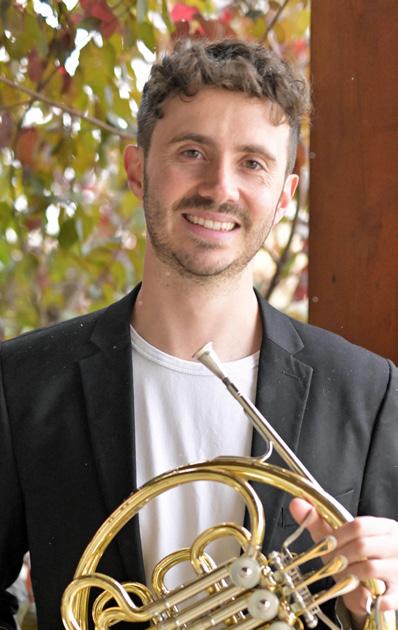
The New Mexico Philharmonic’s 15th-anniversary season continues with some extraordinary concerts. On January 11, 2026, our Afternoon Classics concert at the National Hispanic Cultural Center will feature our outstanding horn players in Konzertstück by Schumann, a concerto for four horns and orchestra. Because I studied horn before becoming a conductor, I can attest that this piece is a true musical monument, and I cannot think of a better showcase than our NMPhil horn players performing it.
On January 24, we will present Acequia, a wonderful new work inspired by New Mexico’s irrigation ditches, written by New Mexican composer Nicolás Lell Benavides. Pianist Roman Rabinovich will then perform Prokofiev’s dynamic and captivating Piano Concerto No. 3, and the concert will conclude with Rachmaninoff’s Symphonic Dances, a work that highlights the orchestra’s virtuosity. This is a concert not to be missed!
Our season continues with a variety of outstanding concerts and soloists. On February 28, guest conductor Alejandro Gómez Guillén will lead Mussorgsky’s Pictures at an Exhibition arranged by Ravel In March, we will feature Giuseppe Gibboni, winner of the Paganini Competition, who is often described as the reincarnation of Paganini himself. April will bring our Three Sopranos concert, presenting amazing arias from beloved operas. We will conclude the season with one of Mahler’s most celebrated works, Symphony No. 5.
You are an extraordinary audience. Thank you for being part of the New Mexico Philharmonic family and for celebrating fifteen years and counting of music that inspires, uplifts, and unites us all. I wish you and your loved ones a wonderful new year.
Sincerely,
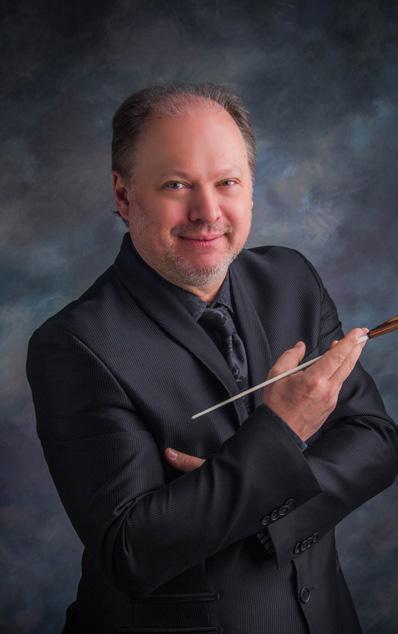
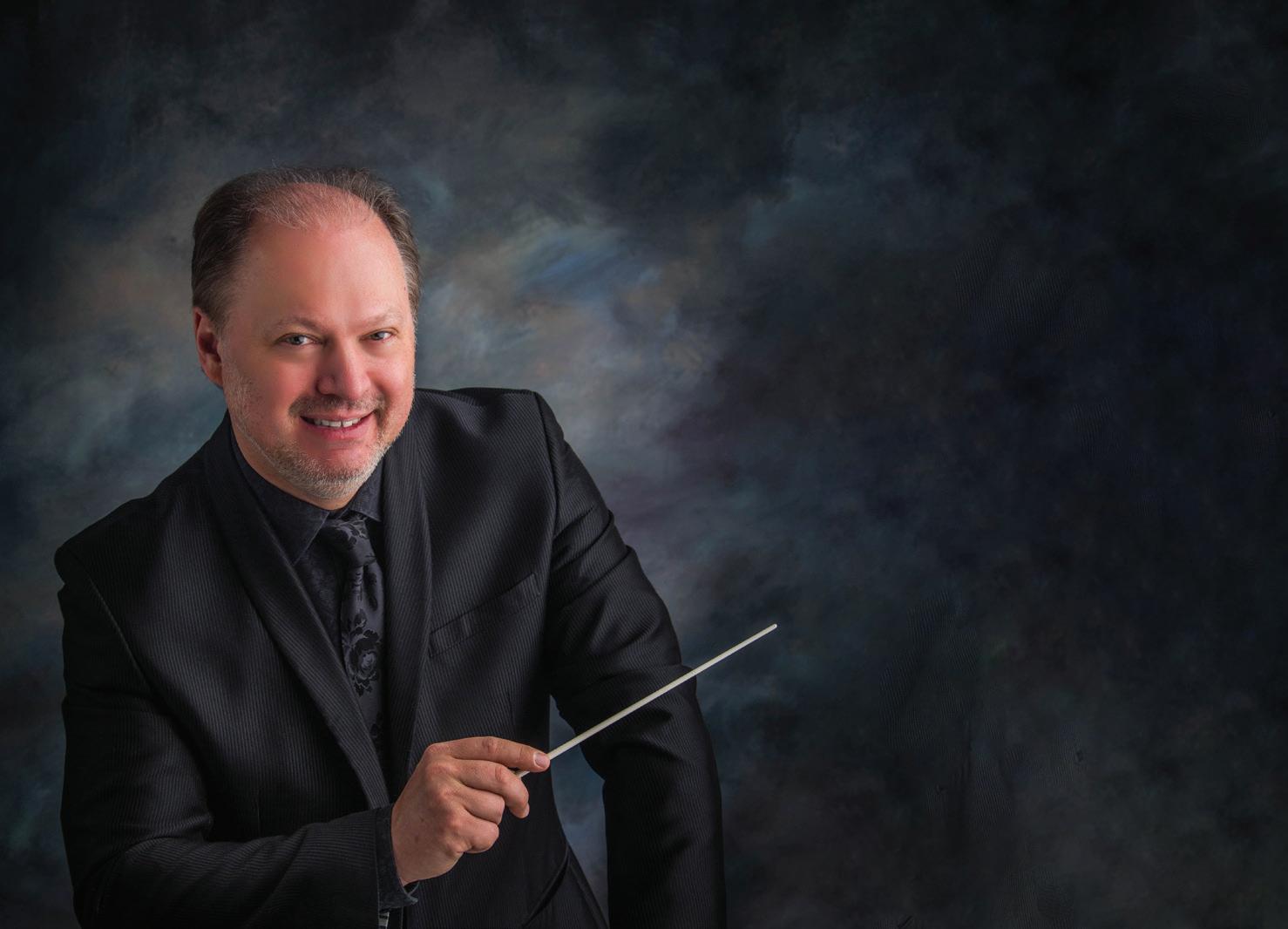
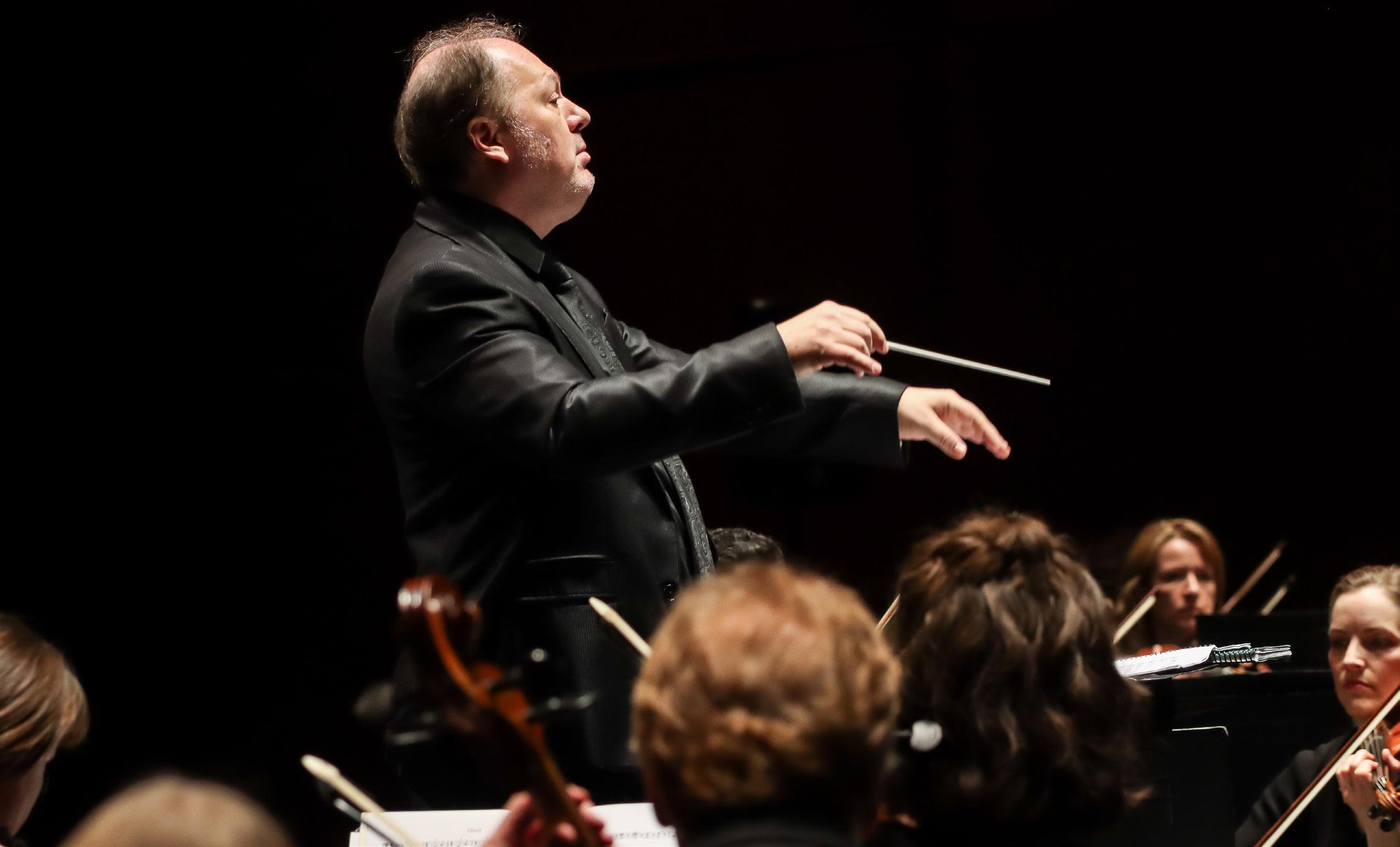
Roberto Minczuk Music Director
In 2017, GRAMMY® Award-winning conductor Roberto Minczuk was appointed Music Director of the New Mexico Philharmonic and of the Theatro Municipal Orchestra of São Paulo. He is also Music Director Laureate of the Calgary Philharmonic Orchestra (Canada) and Conductor Emeritus of the Orquestra Sinfônica Brasileira (Rio de Janeiro). ● read full bio on page 13
Nusenda Credit Union is happy to support The New Mexico Philharmonic in its mission to embrace diversity and enrich lives through music, community engagement, and educational opportunities. Together, we can set the stage for positive change in our communities.
Find a nearby branch, services, and more at nusenda.org
@NusendaCU |
|
POPEJOY ROCK & POPS:
Saturday, December 20, 2025, 6 p.m.
Jamie Reeves conductor
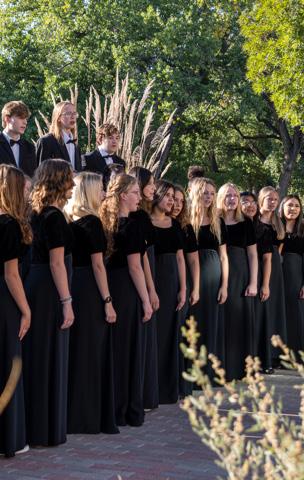
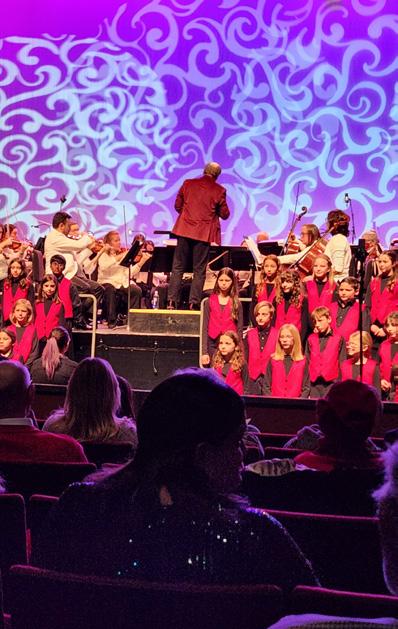
Manzano Day School Chorus/Ally McCurley director Cantate, Bosque School/Joanna Carlson Hart director
V. Sue Cleveland Concert Choir/Jadira Flamm director
Moriarty High School Choir/Meagan Thomas director
Albuquerque Youth Symphony/Dan Whisler director DEC 20
A Christmas Festival Leroy Anderson
Hanukah Fantasy arr. Biegel
The Nutcracker, Suite No. 2, Op. 71b
Pyotr Ilyich Tchaikovsky No. 11, “Scene” No. 12a, “Chocolate” No. 14, “Pas de deux”
Medley From Elf arr. Beck
Concert Suite From The Polar Express, “Believe”
Alan Silvestri arr. Hayes
Popejoy Hall
“Brazilian Sleigh Bells” Percy Faith
Fantasia on Greensleeves
“The Twelve Days of Christmas”
“Stille Nacht”
“White Christmas”
Ralph Vaughan Williams
arr. Dragon
Franz Xaver Gruber arr. Custer/Calvin
Irving Berlin arr. Chase
“Auld Lang Syne” arr. Tyzik
“We Wish You a Merry Christmas” arr. Crocker
“Sleigh Ride” Anderson
MAKING A DIFFERENCE
This performance is made possible by: Frontier Restaurant The City of Albuquerque
AFTERNOON CLASSICS:
Sunday, January 11, 2026, 2 p.m.
Roberto Minczuk Music Director
Peter Erb Horn
Allison Tutton horn
Maria Long horn
Andrew Meyers horn
Coriolan Overture, Op. 62
Ludwig van Beethoven (1770-1827)
Konzertstück in F Major for Four Horns and Orchestra, Op. 86. Robert Schumann
I. Lebhaft (1810-1856)
II. Romanze. Ziemlich langsam, doch nicht schleppend
III. Sehr lebhaft
(Played without pause.)
Peter Erb horn
Allison Tutton horn
Maria Long horn
Andrew Meyers horn
Symphony No. 4 in B-flat Major, Op. 60
I. Adagio—Allegro vivace
II. Adagio
III. Scherzo—Trio: Allegro vivace
IV. Allegro ma non troppo
Beethoven
MAKING A DIFFERENCE
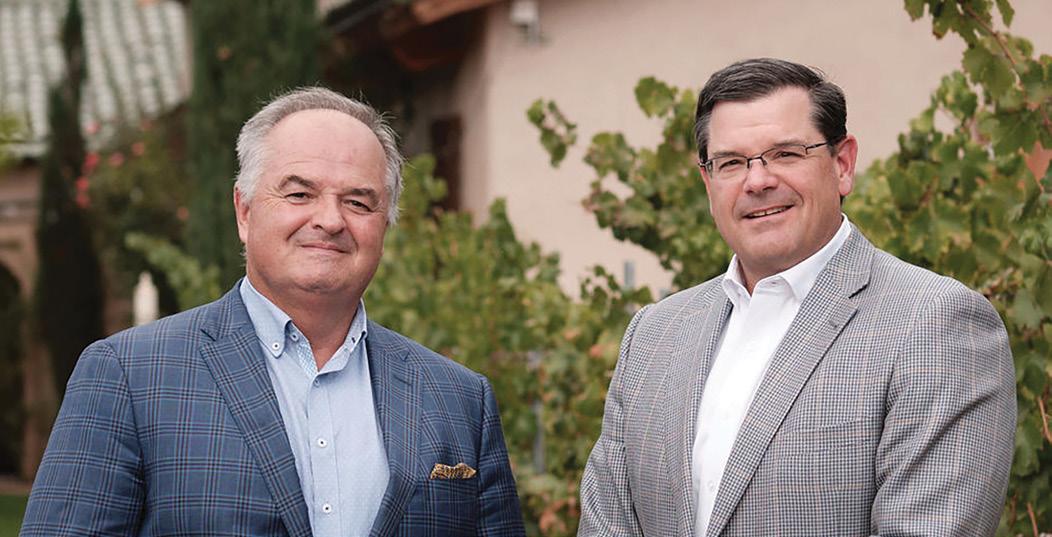
This performance is made possible by: The Kattenhorn Mayo Team at RBC Wealth Management
ADDITIONAL SUPPORT
The Meredith Foundation The Albuquerque Community Foundation
POPEJOY CLASSICS:
Saturday, January 24, 2026, 6 p.m.
Roberto Minczuk Music Director
Roman Rabinovich piano JAN 24
Popejoy Hall
Acequia for Orchestra Nicolás Lell Benavides (b. 1987)
Piano Concerto No. 3 in C Major, Op. 26.
Sergei Prokofiev
I. Andante—Allegro (1891-1953)
II. Tema con variazioni
III. Allegro ma non troppo
Symphonic Dances, Op. 45
Sergei Rachmaninoff
I. Non allegro (1873-1943)
II. Andante con moto (Tempo di valse)
III. Lento assai—Allegro vivace—Lento assai. Come prima—Allegro vivace
MAKING A DIFFERENCE
This performance is made possible by: Cynthia Phillips & Thomas Martin
ADDITIONAL SUPPORT
The New Mexico Philharmonic Foundation
PRE-CONCERT TALK
Made possible by: Menicucci Insurance Company
Hosted by KHFM’s Alexis Corbin
COFFEE CONCERT:
Friday, February 6, 2026, 10:45 a.m.
Roberto Minczuk Music Director
Große Fuge (Grand Fugue), Op. 133
Ancient Airs and Dances, Suite No. 1.
Ludwig van Beethoven (1770-1827)
Ottorino Respighi
I. Balletto detto “Il Conte Orlando” (1879-1936)
II. Gagliarda
III. Villanella
IV. Passo mezzo e Mascherada
Simple Symphony for String Orchestra, Op. 4
MAKING A DIFFERENCE
This performance is made possible by: The New Mexico Philharmonic Foundation
Benjamin Britten
I. Boisterous Bourrée (1913-1976)
II. Playful Pizzicato
III. Sentimental Sarabande
IV. Frolicsome Finale
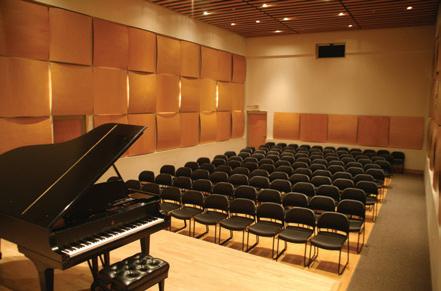
Sunday, February 8, 2026, 3 p.m.
Roberto Minczuk Music Director
Selections from:
Große Fuge (Grand Fugue), Op. 133
Ludwig van Beethoven (1770-1827)
Ancient Airs and Dances, Suite No. 1. Ottorino Respighi (1879-1936)
Simple Symphony for String Orchestra, Op. 4 Benjamin Britten (1913-1976)
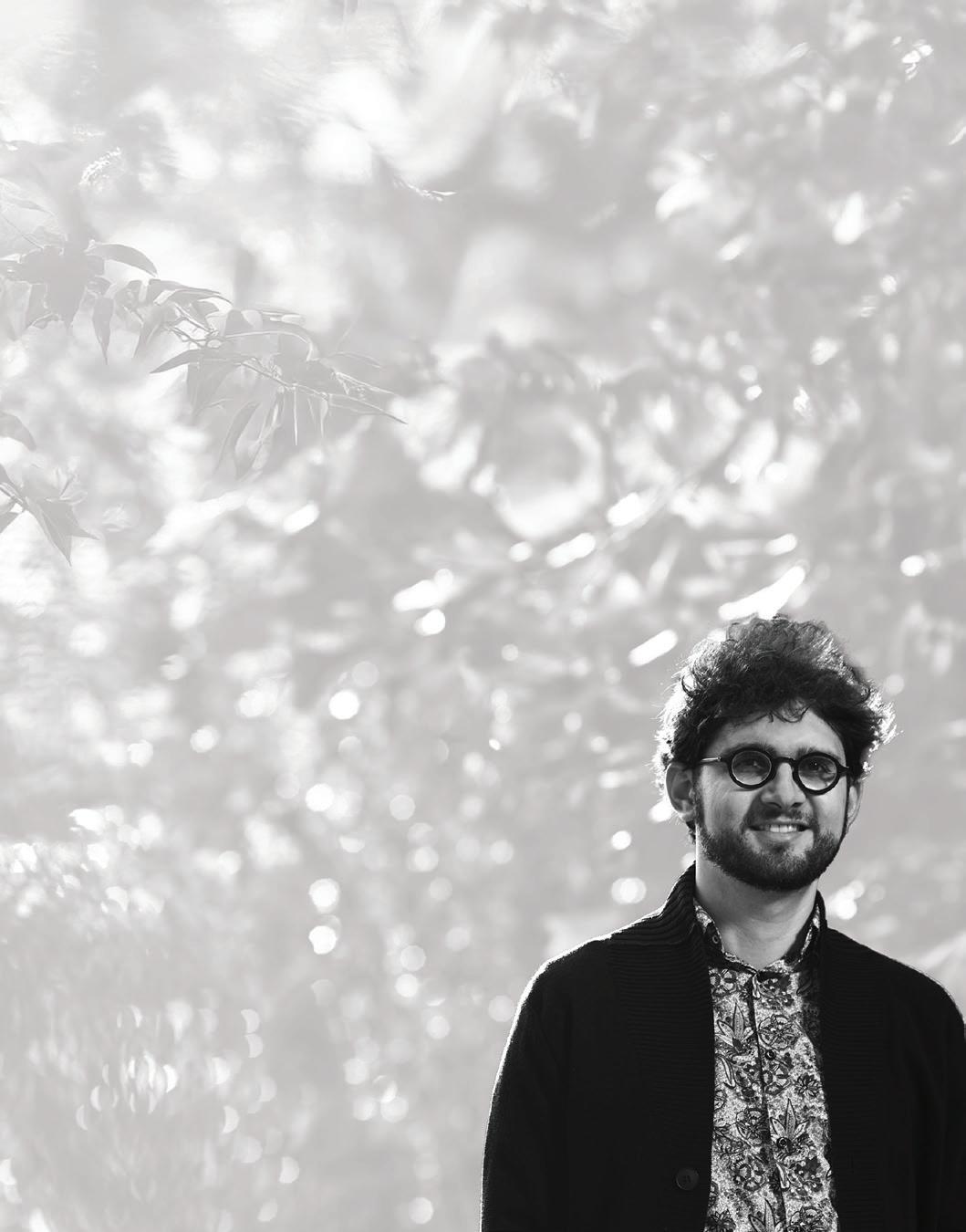
Dr. Ron Bronitsky will host Roman Rabinovich—the
RSVP 1/21/2026 (505) 323 4343 nmphil.org
TICKET
weblink.donorperfect.com/Roman
Immanuel Presbyterian Church
MAKING A DIFFERENCE
This performance is made possible by: Bernalillo County
• Commission Chair Barbara Baca, District 1
• Commissioner Frank Baca, District 2
• Commissioner Walt Benson, District 4
Albuquerque City Council
• Councilor
Dan Champine
• Councilor
Tammy Fiebelkorn
• Councilor
Dan Lewis
• Councilor
Renee Grout
• Councilor
Brook Bassan
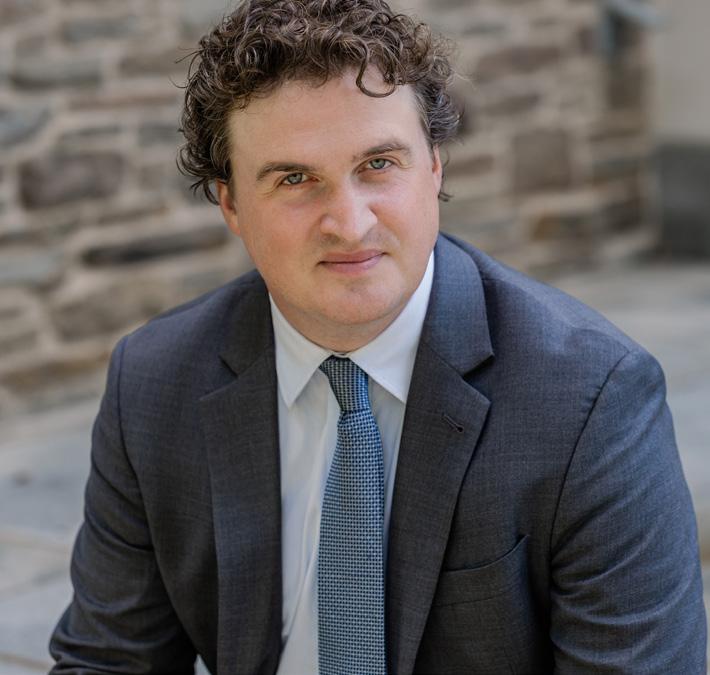
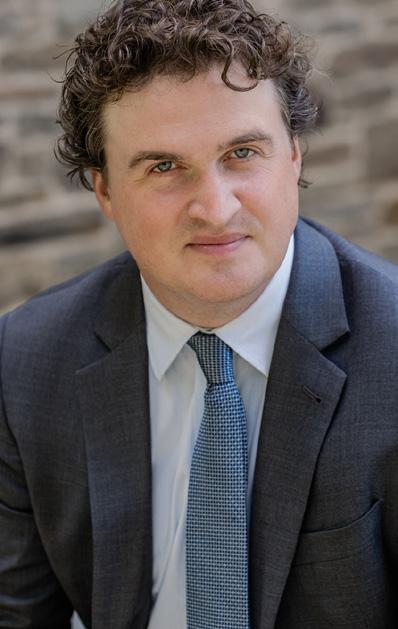
Jamie Reeves is the Music Director and Conductor of the Montgomery Symphony Orchestra, a role he began in the 2021/2022 season. Under his leadership, the MSO has experienced significant artistic growth, delivering dynamic performances and innovative programming. In addition to his work with the MSO, Jamie has recent and upcoming debuts with the Chattanooga Symphony, New Mexico Philharmonic, and Omaha Symphony, and has served as a cover conductor with the New York Philharmonic and the Los Angeles Philharmonic at the Hollywood Bowl.
Dedicated to fostering a vibrant symphonic culture in Montgomery, Jamie engages world-class soloists, celebrates contemporary American music, and commissions new works deeply rooted in the central Alabama community. In the 2024/2025 season, Jamie launched the Alabama Composers Project, a multi-season initiative aimed at commissioning one new work per season by composers from Alabama or whose works are influenced by Alabama’s history and culture. In February 2025, Jamie appointed Nkeiru Okoye as the inaugural William Levi Dawson Composer-inResidence. This collaboration will involve a series of projects culminating in the February 2026 world premiere of A Time for Jubilee, a choral-orchestral work commemorating the 60th anniversary of the historic 1965 Selma to Montgomery March. In November 2025, Jamie led the MSO in a program dedicated to the symphonic works of Tobias Picker, including the U.S. premiere of Picker’s Cello Concerto with cellist Santiago Cañón-Valencia. In recent seasons, Jamie has collaborated with
esteemed soloists including Jeffrey Biegel, Geneva Lewis, Laquita Mitchell, Evren Ozel, and Natasha Paremski.
Jamie’s commitment to enriching Montgomery’s musical landscape is also evident in the orchestra’s engaging pops series, featuring exhilarating film-in-concert performances such as Home Alone, Harry Potter and the Sorcerer’s Stone, Jurassic Park, and Star Wars: A New Hope. He also leads the MSO in the annual Joyce Caddell Holiday Pops, which recently featured America’s Got Talent alumnus Jimmie Herrod. Jamie’s dedication to inspiring young audiences shines through in the annual performances of Carnegie Hall’s Link Up series and the MSO’s early childhood program, Symphonic Storytime
In previous seasons, Jamie has refined his craft through participation in prestigious international conducting master classes and competitions. He has trained at the Lucerne Festival Masterclass with Bernard Haitink, the Cabrillo Festival of Contemporary Music with Cristian Măcelaru, and master classes with the Baltimore Symphony Orchestra under Marin Alsop. He has been recognized as a finalist in the Gregorz Fitelberg and Besançon conducting competitions, where he led the Filharmonia Śląska and L’Orchestre Victor Hugo Franche-Comté.
Jamie has been honored with awards such as the Artistic Excellence Fellowship from Indiana University, the Peabody Career Development Grant from Johns Hopkins University, and the Thelma A. Robinson Award from the International Conductors Guild and the National Federation of Music Clubs. He holds degrees in conducting from Indiana University and the Peabody Conservatory, having studied under esteemed conductors including Marin Alsop, David Effron, Arthur Fagen, and John Ratledge. ●
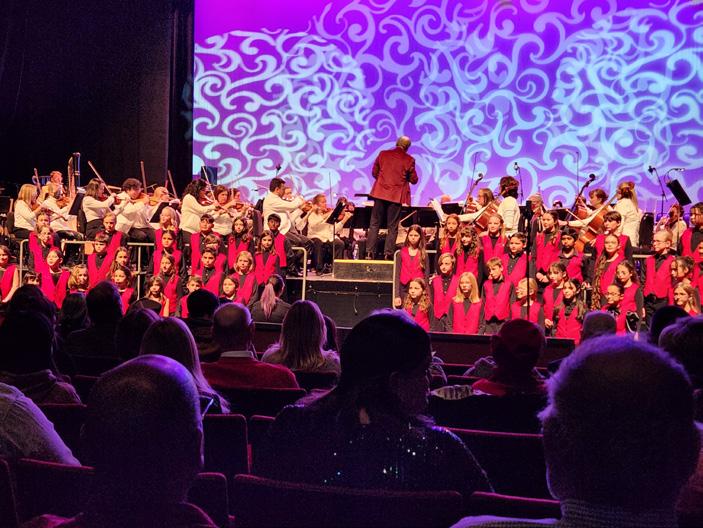
Manzano Day School Chorus/Ally McCurley director
The Manzano Day School Chorus is a non-auditioned group comprising the entire fourth and fifth grades of the school. Chorus rehearsals are built into the six-day rotation as part of the music curriculum.
In addition to chorus, students also have general music classes, focused on singing, playing, moving, creating, and reading music. Music has long been valued as an integral part of education at this historic school, which is now in its eighty-sixth year. The chorus performs in multiple concerts throughout the year and a full musical play each spring. The chorus was privileged to sing for many Holiday Pops concerts with the New Mexico Philharmonic. As service projects, they have sung for hospitals and senior centers.
Manzano Day School is an independent prekindergarten through fifth grade elementary school near Old Town in Albuquerque. Manzano moved to its present location in 1942, having previously held classes in the historic Huning Castle starting in 1938. Our La Glorieta, an adobe hacienda, was originally the home of early Spanish settler Don Diego Trujillo. Generations of families have cherished
the history and warm atmosphere of Manzano Day School. Students learn core curriculum in innovative ways in small classes. In addition, all students receive instruction in music, visual arts, physical education, Spanish, and technology.
Ally McCurley is in her sixth year of teaching elementary general music. She has had a diverse performing career that includes singing in choruses and directing performance groups. With a certification in Orff Schulwerk and training in Kodály and Gordon pedagogies, Ally strives to instill a love for music in all students, while building upon music literacy. Ally attended the University of New Mexico, graduating with her Bachelor’s in music education in 2020 and Master’s in music education in 2022. Throughout the many years as both a performing artist and an educator of all ages, she has prided herself on helping children embrace music through play-based curriculum, movement, drama, and creativity. ●
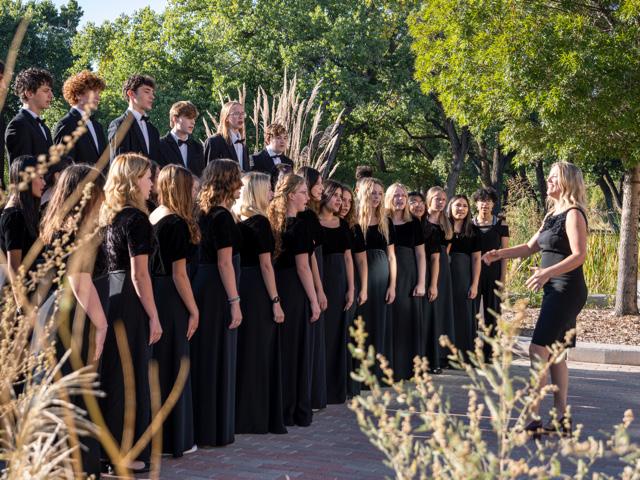
At Bosque, music plays a central role in the school’s culture. Cantate, the upper school choir, has traveled and performed as part of
the Independent Schools Association of the Southwest Arts Festivals in Houston, Dallas, San Antonio, Austin, and Albuquerque; in Savannah, GA; St. Mary’s Basilica in Phoenix, AZ; on the world famous stage at Carnegie Hall in New York City; as part of the Disney Performing Arts series on stage at Disneyland; in St. Peter’s Basilica at the Vatican; the Santa Maria sopra Minerva in Rome, Italy; and at the historic Christ Church Cathedral in Dublin, Ireland.
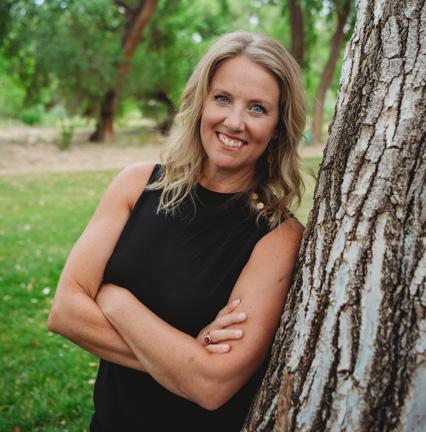
Joanna Carlson Hart is a graduate of the Master’s program in vocal performance at the University of New Mexico and received her Bachelor’s degree from Concordia College in Moorhead, Minnesota, where she studied under the renowned conductor and composer René Clausen. Ms. Hart has sung roles with the Santa Fe Opera, Opera Southwest, UNM Opera Theatre, and the International Opera Academy in Rome, and as a soloist with the Albuquerque Philharmonic, Concordia Choir, St. Joseph Symphony, UNM Orchestra, and the Concordia College Orchestra. In fall 2011, Ms. Hart performed the soprano solo under the direction of Dr. Clausen at Avery Fisher Hall at Lincoln Center in New York City for his piece Memorial. She is in her nineteenth year as director of choirs at Bosque School, an independent College Preparatory School, and has found another love in teaching. Under her direction, the choirs have grown from six students to seventy-five in the upper school, and doubled in size in the middle school.
The choirs at Bosque School have traveled and performed in Savannah, GA; Disneyland; Carnegie Hall stage in New York City; St. Peter’s Basilica at the Vatican in Rome, Italy; St. Mark’s Basilica in Venice, Italy; Christ Cathedral in Dublin, Ireland; and in ISAS Arts Festivals throughout Texas and Oklahoma. Ms. Hart is often invited to adjudicate solo and ensemble and choral festivals throughout New Mexico and loves to work with all choirs and singers. ●
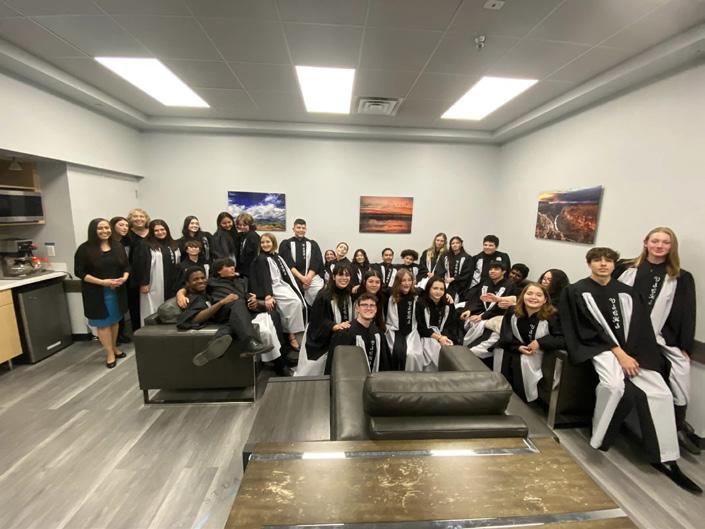
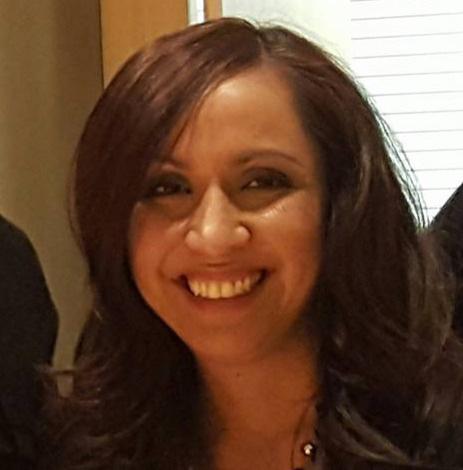
V. Sue Cleveland Concert Choir/Jadira Flamm director
The V. Sue Cleveland Concert Choir is an auditioned, invitation-only ensemble of 31 high-school singers. The choir performs a wide range of repertoire and has recently earned standing ovations at Popejoy Hall in Albuquerque. The group is frequently invited to appear at festivals and to compete in regional and state choral events.
Named “New and Emerging Teacher” in 2011 and the “Music Educator of the Year” 11 years later as selected by the New Mexico Music Educators Association, Jadira Flamm is the choral director at V. Sue Cleveland High School, where she’s been since the school opened its doors in summer 2009.
Jadira Flamm has always been a singer, mostly in church, and is also a vocalist and piano player with a Christian group “The Matthew Project.” She obtained her undergraduate degree in music at New Mexico State, not far from her home in Sunland Park, and followed that with a Master’s degree in music education at the University of New Mexico. She hopes her love for music and singing extends to her students. ●
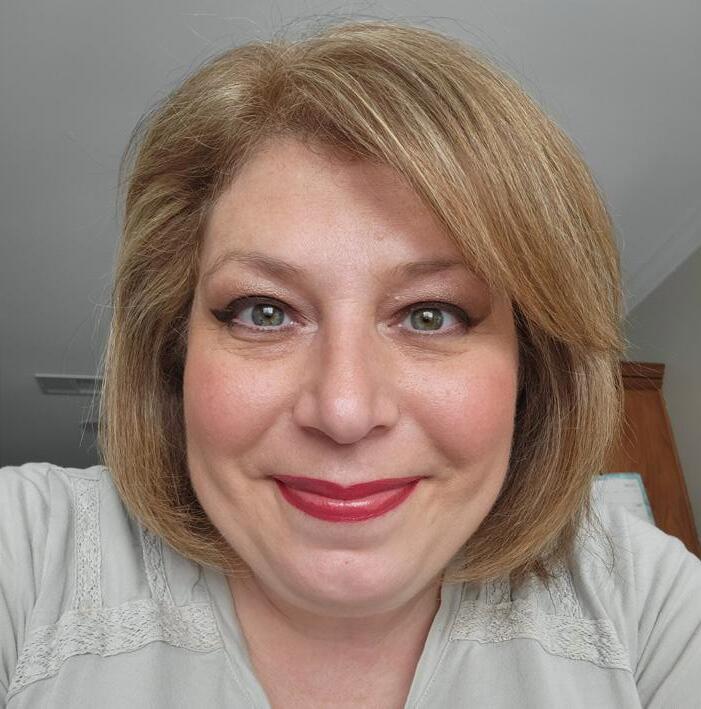
Moriarty High School Choir/Meagan Thomas director
The Moriarty High School Messengers are an auditioned ensemble committed to musical excellence, dynamic performance, and school spirit. Led by Meagan Thomas, the group performs a wide range of repertoire and brings energy and artistry to every event. They proudly represent Moriarty High School and the Pinto community. The Messengers choir has a legacy of over 40 years at Moriarty High School and has carried on the traditions of the school and the community. Most recently, in 2025, the Messengers won two state competitions. Moriarty High School choir director Meagan Thomas was born in Memphis, Tennessee, grew up in Hernando, Mississippi, and was raised in Jonesboro, Arkansas, where she graduated high school from Nettleton Public Schools.
After high school, she went to Arkansas State University in Jonesboro, Arkansas. She graduated with a Bachelor’s degree in music education in 2001 and immediately started her Master’s degree in performance with an emphasis in conducting. Meagan taught for four years as well as sang professionally with Memphis Vocal Arts in Memphis, Tennessee. In 2013, she moved to the west side of Albuquerque with her husband and three children.
Meagan worked for APS for two years before having her last child in 2018. In 2019, she and her family moved to the East Mountains. She substituted for two years at East Mountain High School in Sandia Park and Estancia Valley Classical Academy in Edgewood. She had found a great love for
the East Mountains area and felt part of the wonderful community there.
In 2021, she started singing with the Prince of Peace Lutheran Church and its production of Handel’s Messiah during the holiday season. She is also active in her church, The Church of Jesus Christ of Latter-day Saints, where she volunteers as the primary chorister, sharing her love of music with the little ones.
In the 2025/2026 school year, Meagan started teaching again. This is Meagan’s first year teaching in the Moriarty Edgewood School District as the high school choir director. She loves the staff and students at her new job and looks forward to many years there, feeling she has found her true work home. ●
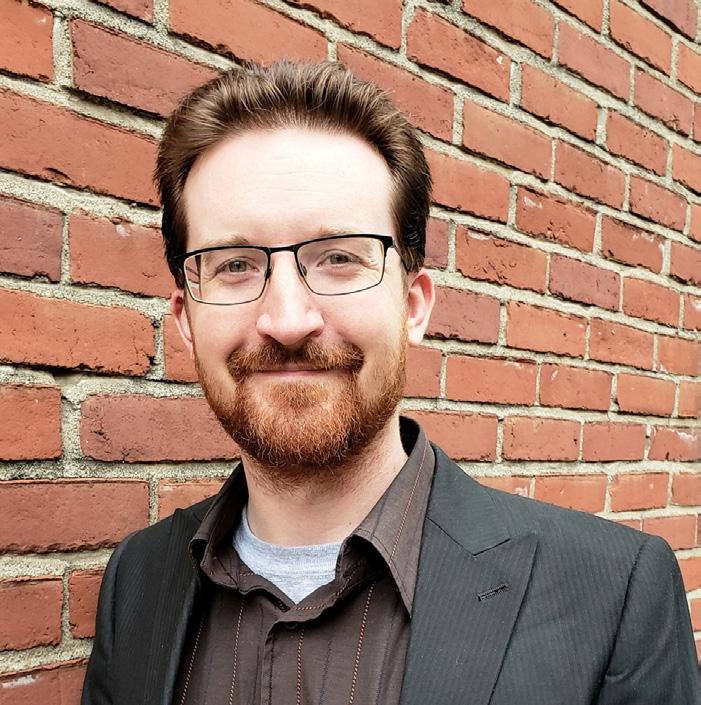
The Youth Symphony is the Albuquerque Youth Symphony Program’s premier ensemble. It is composed of 60-80 of the most talented and dedicated string, woodwind, brass, and percussion players from across the Albuquerque area. Youth Symphony students have the opportunity to hone their skills while performing a wide variety of advanced orchestral repertoire as well as works by contemporary composers.
Dan Whisler has conducted more than 600 works with more than 100 ensembles, including professional orchestras in the USA, England, Spain, Lithuania, Hungary, and Romania. His awards as a conductor include the Downbeat Award in 2011 for Best U.S. College Classical Ensemble (conducting Halffter’s Tiento del primer tono y batalla imperial), the Bel Canto Award for Excellence in Conducting, and winner of the 2015
American Prize in Conducting.
Mr. Whisler’s recent former positions include director of orchestras at the Youth Performing Arts School in Louisville, Kentucky; conductor of the Indianapolis Youth Philharmonic Orchestra in Indianapolis, Indiana; director of orchestras at Center Grove Community School Corporation in Greenwood, Indiana; founding and principal conductor with Intimate Opera of Indianapolis; and faculty member of the String Quartet Program of Northern Colorado in Greeley, Colorado.
An active supporter of new music, Mr. Whisler has premiered 35 works, both as a conductor and as a performer, including conducting the world premiere of the Celtic ballet Deirdre of the Sorrows. He is comfortable with opera and musical theatre literature as well, having been on the conducting staff of Mozart’s Don Giovanni and Così fan tutte, Puccini’s Suor Angelica and Gianni Schicchi, numerous opera scenes concerts for the University of Northern Colorado Opera Theatre, Sondheim’s Sweeney Todd for Theater Workshop of Owensboro (Kentucky), Holst’s Sāvitri and Handel’s Giulio Cesare with Intimate Opera of Indianapolis, and Gilbert and Sullivan’s The Mikado, Purcell’s The Fairy Queen, and Monteverdi’s L’incoronazione di Poppea with the YPAS music department.
An experienced musician (string bass and horn) and music educator, Mr. Whisler has worked with youth orchestras in Kansas, Colorado, New Mexico, New York, Indiana, and Kentucky. At Center Grove, he increased orchestra student enrollment by more than 37 percent and won 17 ISSMA Gold awards in just three years. Under his direction, the YPAS Philharmonia was selected to perform in the 2015 Music for All National Orchestra Festival, the 2016 and 2019 Kentucky Music Educators Association Conferences, The Midwest Clinic (2019), and Heritage Festivals in Chicago (2017) and New York City (2018), as well as international tours to Costa Rica, England, and Wales. He graduated summa cum laude with a BME from Wichita State University (Kansas) and earned an M.M. in orchestral conducting from the University of Northern Colorado. His primary conducting teachers include Russell Guyver and Mark Laycock, with additional studies at 15 conducting institutes throughout the USA, Canada, South America, and Europe
with internationally renowned mentors, including Jorma Panula, Craig Kirchhoff, Markand Thakar, Colin Metters, Victor Yampolsky, Larry Livingston, and Benjamin Zander. ●
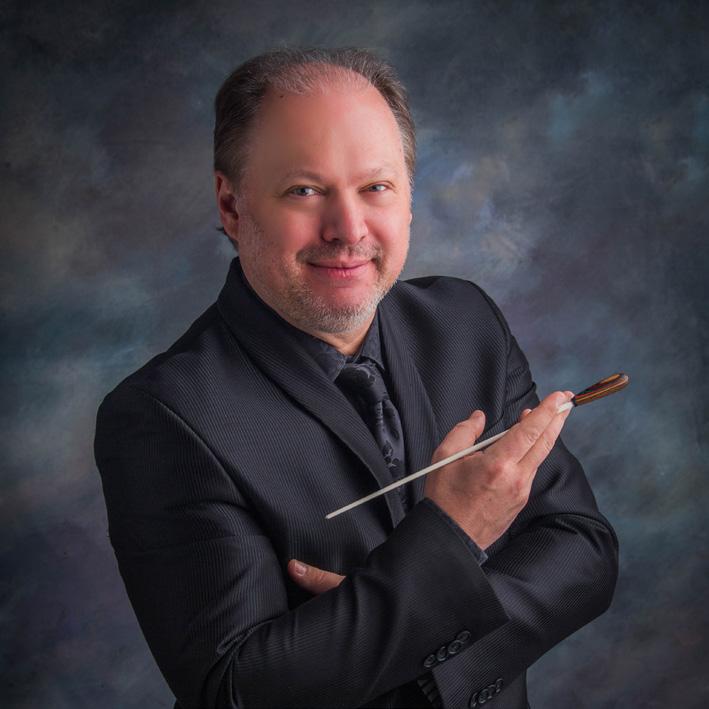
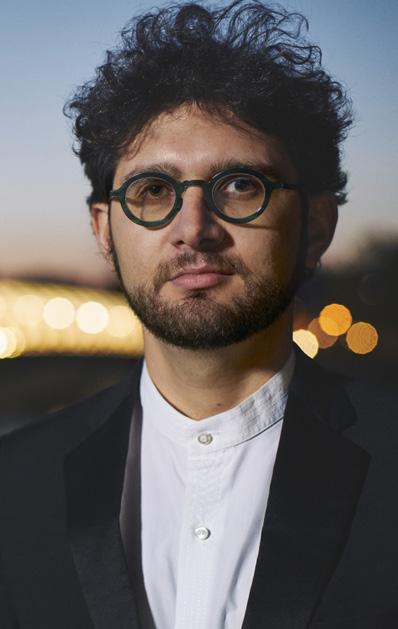
Roberto Minczuk Music Director
In 2017, GRAMMY® Award-winning conductor Roberto Minczuk was appointed Music Director of the New Mexico Philharmonic and of the Theatro Municipal Orchestra of São Paulo. He is also Music Director Laureate of the Calgary Philharmonic Orchestra (Canada) and Conductor Emeritus of the Orquestra Sinfônica Brasileira (Rio de Janeiro). In Calgary, he recently completed a 10-year tenure as Music Director, becoming the longest-running Music Director in the orchestra’s history.
Highlights of Minczuk’s recent seasons include the complete Mahler Symphony Cycle with the Calgary Philharmonic Orchestra; Bach’s St. John Passion, Bruckner’s Symphony No. 7, Beethoven’s Fidelio, Berlioz’s The Damnation of Faust, Mozart’s The Magic Flute, Verdi’s La traviata, Bernstein’s Mass, and Strauss’s Der Rosenkavalier with the Theatro Municipal Orchestra of São Paulo; debuts with the Cincinnati Opera (Mozart’s Don Giovanni), the Tokyo Metropolitan Symphony Orchestra, and Daejeon Philharmonic in South Korea; and return engagements with the Orchestre National de Lille and the New York City Ballet. In the 2016/2017 season, he made return visits to the Israel Symphony Orchestra, as well as the Teatro Colón Philharmonic and Orchestra Estable of Buenos Aires.
A protégé and close colleague of the late Kurt Masur, Minczuk debuted with the New
York Philharmonic in 1998, and by 2002 was Associate Conductor, having worked closely with both Kurt Masur and Lorin Maazel. He has since conducted more than 100 orchestras worldwide, including the New York, Los Angeles, Israel, London, Tokyo, Oslo, and Helsinki Philharmonic Orchestras; the London, San Francisco, Dallas, and Atlanta Symphony Orchestras; and the National Radio (France), Philadelphia, and Cleveland Orchestras, among many others. In March 2006, he led the London Philharmonic Orchestra’s U.S. tour, winning accolades for his leadership of the orchestra in New York, Los Angeles, and San Francisco.
Until 2010, Minczuk held the post of Music Director and Artistic Director of the Opera and Orchestra of the Theatro Municipal Rio de Janeiro, and, until 2005, he served as Principal Guest Conductor of the São Paulo State Symphony Orchestra, where he previously held the position of Co-Artistic Director. Other previous posts include Artistic Director and Principal Conductor of the Ribeirão Preto Symphony, Principal Conductor of the Brasília University Symphony, and a six-year tenure as Artistic Director of the Campos do Jordão International Winter Festival.
Minczuk’s recording of the complete Bachianas Brasileiras of Hector Villa-Lobos with the São Paulo State Symphony Orchestra (BIS label) won the Gramophone Award of Excellence in 2012 for best recording of this repertoire. His other recordings include Danzas Brasileiras, which features rare works by Brazilian composers of the 20th century, and the Complete Symphonic Works of Antonio Carlos Jobim, which won a Latin GRAMMY in 2004 and was nominated for an American GRAMMY in 2006. His three recordings with the Calgary Philharmonic Orchestra include Rhapsody in Blue: The Best of George Gershwin and Beethoven Symphonies 1, 3, 5, and 8. Other recordings include works by Ravel, Piazzolla, Martin, and Tomasi with the London Philharmonic (released by Naxos), and four recordings with the Academic Orchestra of the Campos do Jordão International Winter Festival, including works by Dvořák, Mussorgsky, and Tchaikovsky. Other projects include a 2010 DVD recording with the Chamber Orchestra of Philadelphia, featuring the premiere of Hope: An Oratorio, composed by Jonathan Leshnoff;
a 2011 recording with the Odense Symphony of Poul Ruders’s Symphony No. 4, which was featured as a Gramophone Choice in March 2012; and a recording of Tchaikovsky’s Italian Capriccio with the BBC National Orchestra of Wales, which accompanied the June 2010 edition of BBC Music Magazine. The Academic Orchestra of the Campos do Jordão Festival was the Carlos Gomes prizewinner for its recording from the 2005 Festival, which also garnered the TIM Award for best classical album.
Roberto Minczuk has received numerous awards, including a 2004 Emmy for the program New York City Ballet—Lincoln Center Celebrates Balanchine 100; a 2001 Martin E. Segal Award that recognizes Lincoln Center’s most promising young artists; and several honors in his native country of Brazil, including two best conductor awards from the São Paulo Association of Art Critics and the coveted title of Cultural Personality of the Year. In 2009, he was awarded the Medal Pedro Ernesto, the highest commendation of the City of Rio de Janeiro, and in 2010, he received the Order of the Ipiranga State Government of São Paulo. In 2017, Minczuk received the Medal of Commander of Arts and Culture from the Brazilian government.
A child prodigy, Minczuk was a professional musician by the age of 13. He was admitted into the prestigious Juilliard School at 14 and by the age of 16, he had joined the Orchestra Municipal de São Paulo as solo horn. During his Juilliard years, he appeared as soloist with the New York Youth Symphony at Carnegie Hall and the New York Philharmonic Young People’s Concerts series. Upon his graduation in 1987, he became a member of the Leipzig Gewandhaus Orchestra at the invitation of Kurt Masur. Returning to Brazil in 1989, he studied conducting with Eleazar de Carvalho and John Neschling. He won several awards as a young horn player, including the Mill Santista Youth Award in 1991 and I Eldorado Music. ●
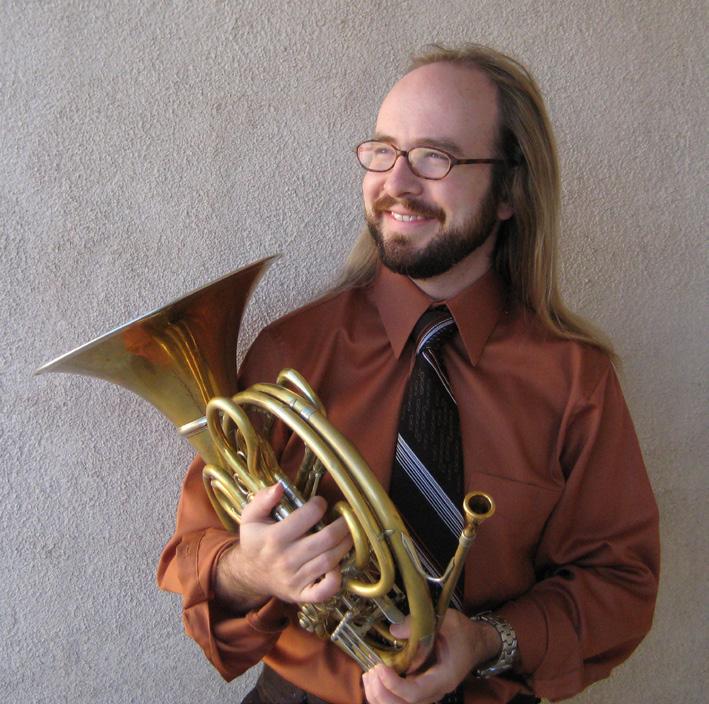
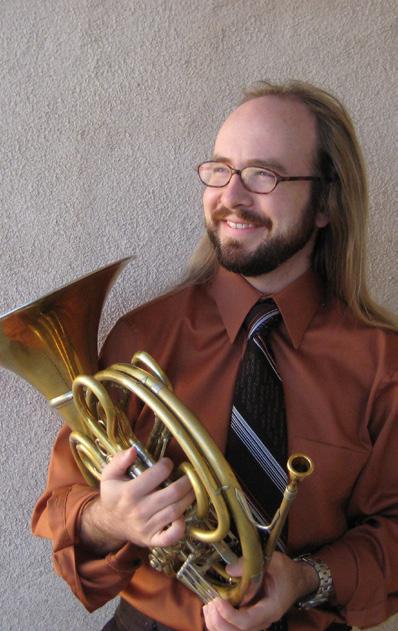
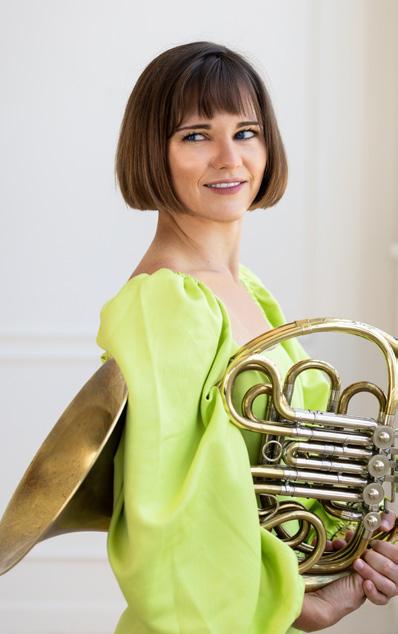
New Orleans native Peter Erb joined the New Mexico Philharmonic as Principal Horn in 2013. He has held positions with the Phoenix Symphony, Louisville Orchestra, and Louisiana Philharmonic Orchestra, and continues to perform as principal horn in the Arizona Opera Orchestra. As a member of the Star Wars in Concert orchestra in 2010, Peter toured the United States and Mexico, performing John Williams’s movie scores. An avid chamber musician, Peter has participated in the Phoenix Chamber Music Society’s annual festival, Albuquerque’s own Church of Beethoven (now Chatter Chamber) series, and the University of Chicago’s Noontime Recital Series. Peter earned his Bachelor’s degree at Northwestern University, where he studied with Gail Williams and Bill Barnewitz. He received his Master’s degree from the University of Akron as a student of Bill Hoyt. After leaving school, he was a member of the Civic Orchestra of Chicago for two seasons and attended the Banff Centre Chamber Music program with his woodwind quintet, Hara Quintet. Peter lives in Albuquerque with his wife, Emily, a clarinetist with the Santa Fe Symphony, their polydactyl Maine Coon Cat, Bigfoot, and the newest addition to the family, Sandy, a German Shepherd mix. ●
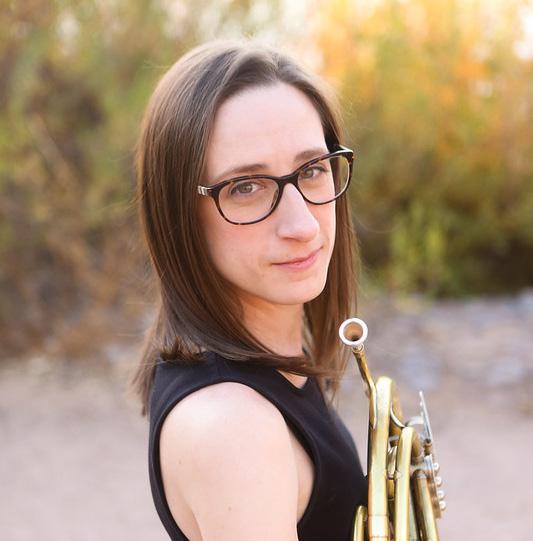
Allison Tutton horn
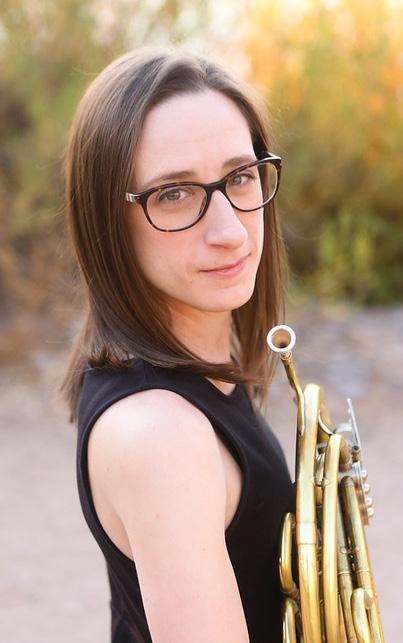
Allison Tutton is second horn of the New Mexico Philharmonic, a position she has held since 2019, following three seasons as fourth horn. She also holds the position of fourth horn in the Quad City Symphony Orchestra (IA) and the Santa Fe Symphony.
She holds degrees from the Boston Conservatory and the Chicago College of Performing Arts (Roosevelt University). Upon completion of her graduate studies, she joined the Civic Orchestra of Chicago and performed numerous times as substitute and extra horn with the Chicago Symphony Orchestra. During the summers, she has participated in the Marrowstone and Texas Music Festivals, and was a member of the Youth Orchestra of the Americas for their Caribbean tour. She has studied with Dale Clevenger, David Griffin, Daniel Gingrich, and Eli Epstein, among others.
Allison, who is originally from the Pacific Northwest, enjoys hiking and curling in her spare time. ●
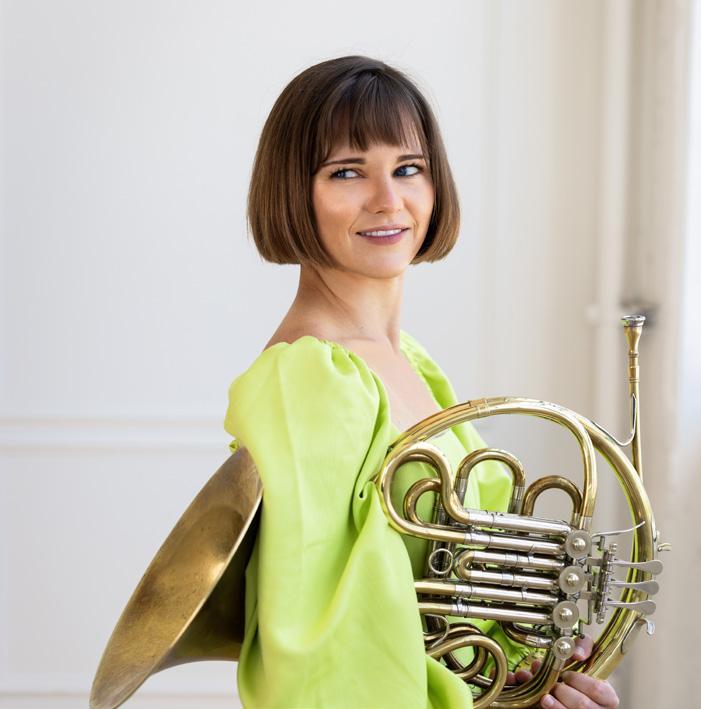
Maria Long horn
Maria Long is currently the associate principal/third horn of the New Mexico Philharmonic, and also performs regularly with the Santa Fe Symphony, Opera Southwest, and Chatter ABQ. She joined the New Mexico Philharmonic in 2022 as assistant principal/ utility horn and has previously held the positions of principal horn with the Longmont Symphony, associate principal/third horn of the West Valley Symphony, and second horn of the Bryan Symphony Orchestra. An avid performer, Maria has performed with groups across the country such as the Colorado Symphony, Alabama Symphony, and Hawaii Symphony, and has spent summers at the Aspen Music Festival, Texas Music Festival, Sewanee Music Festival, and most recently with the Central City Opera.
Maria is also a strong proponent of new music and has commissioned several pieces, even having one of her projects funded by the Meir Rimon Commissioning Assistance Project from the International Horn Society. She is currently pursuing a D.M.A. in performance and pedagogy at the University of Colorado Boulder. When not playing or teaching music, she can be found painting, hiking, or rock climbing. ●
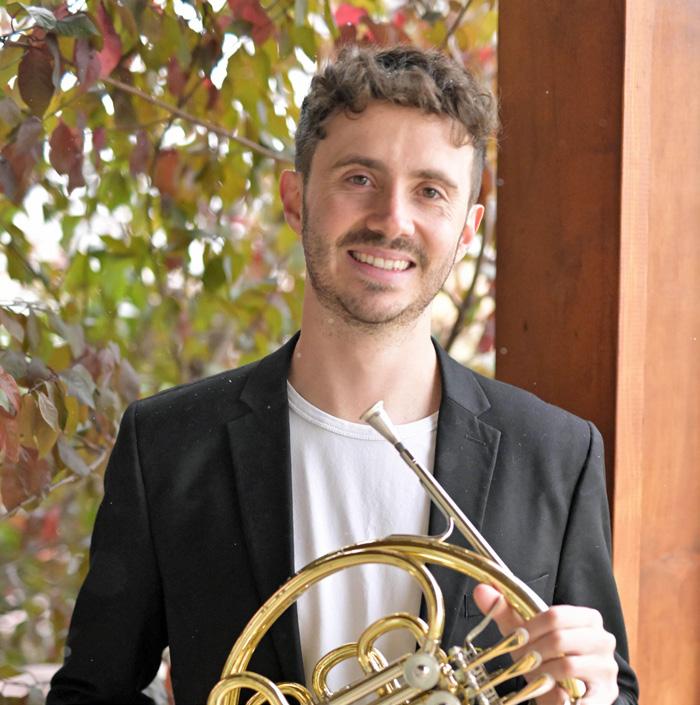
Andrew Meyers horn
Andrew Meyers is the fourth horn of the New Mexico Philharmonic. In addition to his position with the New Mexico Philharmonic, he also holds the position of fourth horn in the Fort Collins Symphony. Additionally, Andrew is an active freelancer and has collaborated with various groups including the Santa Fe Symphony, Cheyenne Symphony Orchestra, Colorado Chamber Orchestra, and the band Streetlight Manifesto.
Andrew studied music performance at Colorado State University for his Bachelor’s degree, and the College-Conservatory of Music at the University of Cincinnati for his Master’s degree. During his time at these institutions, Andrew studied with John McGuire, Denise Tryon, Elizabeth Freimuth, and Karen Schneider.
When not playing horn, Andrew enjoys cycling, great food, and playing a variety of games with friends and family. ●
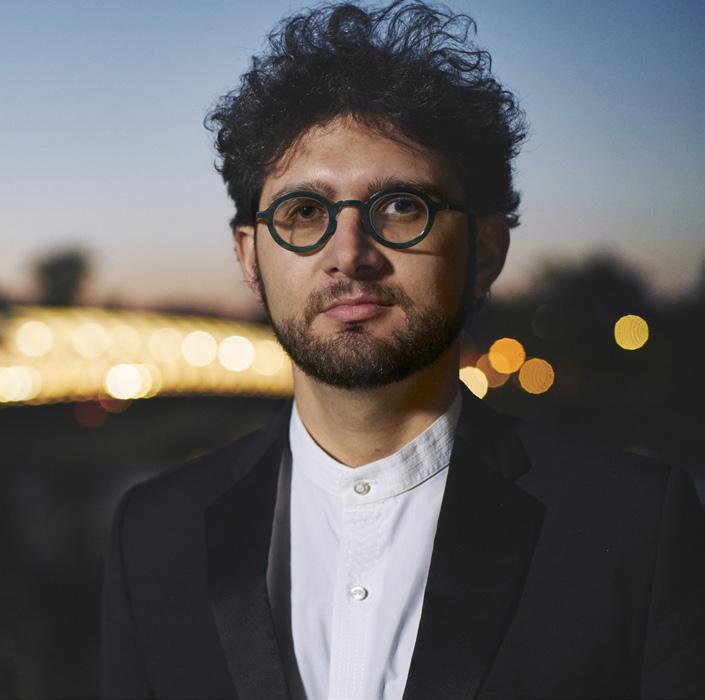
Rabinovich is a pianist of profound musical insight, celebrated for interpretations that combine technical brilliance with bold artistic personality. Winner of the 12th Arthur Rubinstein International Piano Master Competition, he has appeared on major stages across Europe and the U.S., including Gewandhaus, Carnegie Hall, Kennedy Center, Cité de la Musique, Queen Elizabeth Hall, and Wigmore Hall, where he gave three solo recitals in the 2024/2025 season.
Dubbed “a true polymath, in the Renaissance sense of the word” (Seen & Heard International), Rabinovich is also a composer and visual artist. He has garnered acclaim for concerto performances across the centuries, from Bach to Lutosławski, collaborating with leading orchestras worldwide, including the Israel Philharmonic, Royal Scottish National Orchestra, Scottish Chamber Orchestra, Orchestre de Chambre de Paris, Prague Symphony, KBS Symphony, and all major Israeli orchestras. In North America, he has appeared with the Seattle Symphony, Saint Paul Chamber Orchestra, Orpheus Chamber Orchestra, Buffalo Philharmonic, Sarasota Orchestra, Calgary Philharmonic, and Edmonton Symphony. He has worked with conductors including Sir Roger Norrington, Zubin Mehta, Ludovic Morlot, Kristjan Järvi, Michael Stern, Christoph Koenig, Gerard Schwarz, JoAnn Falletta, James Judd, and Joseph Swensen. His 2025/2026 season features concertos by Prokofiev, Ravel, Mendelssohn, Tchaikovsky, and Brahms across the U.S. and Canada.
His recital repertoire spans six centuries, from Byrd to Boulez, with a recent focus on Bach’s Goldberg Variations, accompanied by a 32-episode social media series exploring the work. His recital for Mezzo was televised to 39 countries, reaching millions of viewers. Recent recital appearances include Washington Performing Arts, 92nd Street Y, Philadelphia Chamber Music Society, Shriver Hall, Lincoln Center, Friends of Chamber Music Kansas City, Vancouver Recital Society, Gilmore Keyboard Festival’s Rising Stars Series, the Phillips Collection, Portland Piano International, and Tippet Rise.
He has earned particular acclaim as a Haydn interpreter, presenting complete sonata cycles at the Lammermuir and Bath Festivals, Herbstgold Festival in Eisenstadt, and
ChamberFest Cleveland, after which the Plain Dealer noted, “the composer himself could not have wished for a better performance.”
Rabinovich curated a three-concert “Haydn Day” at Wigmore Hall in 2022.
His recording Haydn Sonatas, Vol. 2, on First Hand Records was Piano International’s Recording of the Month, the magazine observing: “Time and again he finds magic.”
Rabinovich has also recorded solo piano arrangements of major ballets, including Ravel’s Daphnis et Chloé, Stravinsky’s Petrushka, and Prokofiev’s Romeo and Juliet earning the Classical Recording Foundation Artist of the Year award, with BBC Music Magazine praising his “infectious and joyful playing, dazzling passagework, and broad palette of colours.”
An avid chamber musician, Rabinovich has collaborated with the Dover, Modigliani, and Escher Quartets, as well as Steven Isserlis, Benjamin Beilman, Camille Thomas, Fleur Barron, and Helen Charlston. He has appeared at major festivals including Marlboro, La Jolla SummerFest, Klavier Festival Ruhr, Lucerne, Davos, Prague Spring, and MecklenburgVorpommern.
Born in Tashkent and raised in Israel, Rabinovich debuted with the Israel Philharmonic under Zubin Mehta at age 10. A graduate of the Curtis Institute (Seymour Lipkin) and The Juilliard School (Robert McDonald), he was among the first three pianists selected by Sir András Schiff for his Building Bridges series. A passionate curator, he is co-artistic director of the lauded festivals ChamberFest Cleveland and ChamberFest West in Calgary, creating adventurous programs that spark conversation, foster connection, and enrich the communal experience of music. ●
NOTES BY DAVID B. LEVY
One of history’s pivotal composers, Ludwig van Beethoven was born on December 15 or 16, 1770, in Bonn, and died in Vienna on March 26, 1827. His Overture to Heinrich Joseph von Collin’s 1804 drama, Coriolan, was composed in 1807. It received its first performance in March of that same year at a private concert held at the palace of his patron, Prince Franz Joseph von Lobkowitz. His Symphony No. 4 and Piano Concerto No. 4 were also performed at this event. The Overture to Coriolan is scored for 2 flutes, 2 oboes, 2 clarinets, 2 bassoons, 2 horns, 2 trumpets, timpani, and strings. Approximately 8 minutes.
Although Beethoven composed only one opera, Fidelio (originally titled Leonore), he was frequently drawn to compose overtures and incidental music to stage dramas, such as Goethe’s drama Egmont. While lovers of theater may be familiar with William Shakespeare’s play Coriolanus, Beethoven was inspired to write his Coriolan Overture to another drama involving the same character, Gaius Marcius Coriolanus. The author in question was Beethoven’s contemporary, the Viennese playwright Heinrich Joseph von Collin (1771-1811), whose play of the same name dates from 1804. Beethoven’s familiarity with the historical figure of Coriolanus was doubtlessly fed by not only Collin’s play, but also by his self-education whereby he read
as much literature regarding Greco-Roman history, including Plutarch’s Parallel Lives of the Noble Greeks and Romans
The Coriolan Overture is composed in the key of c minor. Much has been written about this tonality being Beethoven’s choice for some of his most dramatic music. Think of his Piano Sonata, “Pathétique,” Op. 13; his String Quartet, Op. 18, No. 4; the Piano Concerto No. 3; and above all, his Symphony No. 5. The Coriolan Overture, whose compositional dates overlap with his work on the Fifth Symphony, comes closest in spirit to that titanic symphony. Indeed, the tautness of its structure, its aggressive and restless nature (representative of Coriolan’s personality), and relentless sense of forward motion make the first movement of the Fifth Symphony and the overture kinsmen. It opens with a powerful gesture—a long unison note that explodes into a dramatic chord. Beethoven repeats the gesture twice more before launching into its restless first theme. A secondary theme in the major mode, perhaps representing Coriolan’s mother’s futile effort to dissuade her son from attacking Rome, is overtaken by the more dramatic elements, again suggesting Coriolan’s impetuous temperament. ●
The great German romantic composer and critic Robert Schumann was born in Zwickau, Saxony, on June 8, 1810, and died
The Coriolan Overture is composed in the key of c minor. Much has been written about this tonality being
Beethoven’s choice for some of his most dramatic music.
in Endenich, near Bonn, on July 29, 1856. Although best known for his works for the piano, the breadth of his compositions extends far beyond that category. Among his works for orchestra, he composed four symphonies and several concertos, including his popular Concerto for Piano, Op. 54. Less familiar, however, are two concertos for violin, one for cello, and the present work, his Konzertstück for Four Horns, composed in 1849 and first performed on February 25, 1850, at the Leipzig Gewandhaus under the direction of Julius Rietz. The soloists were members of the Gewandhaus Orchestra’s horn section. In addition to the quartet of soloists, the work is scored for piccolo, 2 flutes, 2 oboes, 2 clarinets, 2 bassoons, 2 horns ad libitum, 2 trumpets, 3 trombones, timpani, and strings. Approximately 19 minutes.
It is fair to say that the horn (German, Waldhorn) was the quintessential instrument of German Romanticism. One reason for this is the fact that this instrument was the musical symbol for hunting (Jagd). More than mere sport, hunting was the most vital part of German culture and economy—a means of putting food on the table throughout the land. Many representations of the horn’s significance may be found in literature, for example in the title of Achim von Arnim and Clemens Brentano’s anthology of poetry Des Knaben Wunderhorn. Carl Maria von Weber’s landmark opera Der Freischütz (1821) features horns prominently in its overture and “Chorus of Hunters.”
Robert Schumann was hardly immune to the call of this instrument. His Adagio and Allegro, Op. 70, for horn and piano was composed in 1849, the same year he composed his Konzertstück [Concert Piece] for Four Horns and Orchestra, Op. 86. This year also witnessed his Jagdlieder, Op. 137, for men’s choir and four horns. A concerto in all but name, the Konzertstück is a tour de force for the instrument that explores the sound and color of the natural horn, as well as the emerging valved instrument. The work comprises three movements: Lebhaft (Lively), Romanze. Ziemlich langsam, doch nicht schleppend (Rather slow, but without dragging), and Sehr lebhaft (Very lively). ●
Ludwig van Beethoven (1806)
Beethoven’s Symphony No. 4 was first performed in March 1807 at the Viennese palace of the composer’s patron, Prince Lobkowitz. It is scored for flute, 2 oboes, 2 clarinets, 2 bassoons, 2 horns, 2 trumpets, timpani, and strings. Approximately 34 minutes.
Beethoven’s musical imagination kicked into high gear after the completion of the “Eroica” Symphony. The crisis of the Heiligenstadt Testament now behind him, the composer’s “new path” of composition was rife with new ideas. Beethoven has left us a rare verbal testimony of his renewed self-confidence: “Just as you plunge yourself here [Vienna] into the whirlpool of society, so in spite of all social obstacles it is possible for you to write operas. Your deafness shall be a secret no more, even where art is involved!” Evidence from the composer’s sketchbooks from this period clearly indicates that many ideas were pressing soon after the 1805 premiere of “Eroica,” including the early stages for what eventually would mature into a symphony in c minor (No. 5, the completion of which was delayed to 1808). But other works and matters needed more immediate attention— among them being the composer’s amorous involvement with the widowed Countess Josephine von Brunsvik, the completion and staging of the opera Leonore (later, Fidelio), and an increasing threat of Viennese military occupation by the French army (Napoleon’s troops entered the city just days before Leonore’s premiere).
The period spanning the spring of 1806 to the end of 1808 became one of the most productive of Beethoven’s career. The year 1806 alone gave birth to the Piano Sonata in f minor, Op. 57 (“Appassionata”); the Piano Concerto No. 4 in G Major, Op. 58; three String Quartets, Op. 59 (“Razumovsky”); the Symphony No. 4, Op. 60; and the Violin Concerto, Op. 61. Count Franz von Oppersdorff, the dedicatee of the Fourth Symphony, was one of those few wealthy Viennese aristocrats who continued to
A sublime Adagio follows, whose persistent dotted rhythm combines with melodies of unparalleled lyricism.
maintain his own orchestra (Hauskapelle). After hearing a performance by Oppersdorff’s orchestra of the Second Symphony, Beethoven agreed to dedicate a new one—originally the Fifth Symphony—for the Silesian nobleman. For reasons that are not entirely clear, Beethoven delayed work on the Fifth Symphony and turned instead to a new symphony in B-flat Major, a project that consumed the next several months. Curiously, the first performance of the Fourth Symphony (along with the Fourth Piano Concerto and the Overture to Heinrich Collin’s tragedy Coriolan) took place in March 1807 not at Oppersdorff’s palace, however, but at that of Prince Lobkowitz. There is no surviving evidence to show that Oppersdorff’s orchestra ever performed the work.
An intriguing detail of the autograph and early performance material for the Fourth Symphony are indications of “Solo” and “Tutti” in the woodwind, brass, and timpani parts. Jonathan Del Mar, the editor of the Beethoven symphonies for Bärenreiter, speculates that these markings, while authentically Beethoven’s own, postdate the work’s composition and first performance. They may have been added for later performances of the work by larger orchestras in which the number of wind, brass, and timpani players would have been doubled in order to compensate for a larger string section.
Despite Schumann’s famous characterization of the Fourth Symphony as a “slender Greek maiden between two Norse giants,” the work is filled with astonishing athleticism and innovation. Among its novel features is its striking harmonic vocabulary, the sophistication of which is revealed in the mysterious Adagio introduction to the first movement (surely Gustav Mahler had the spirit of this introduction in his ears as he penned the opening of his First Symphony in the 1880s). The opening gesture of a
sustained tonic note—B-flat—may well have been inspired by Haydn’s Symphony No. 102 (1794/5), composed in the same key. As is the case with Haydn’s introduction, Beethoven’s introduction fairly explodes into a boisterous Allegro vivace that, despite its exuberance, never entirely forgets the harmonic clouds from its introduction. A felicitous example comes toward the end of the development section. Beethoven ingeniously scores a series of mysterious rolls on the kettledrum, marked pianissimo. The harmonic function of these soft B-flats is, at first, uncertain. The triumphal arrival of the recapitulation in the full orchestra, fortissimo, solves the mystery.
A sublime Adagio follows, whose persistent dotted rhythm combines with melodies of unparalleled lyricism. The third movement—a scherzo marked Allegro vivace—begins with a jaunty rhythmic conceit that belies its triple meter. The harmonic “cloud” from the first movement passes briefly over the hushed orchestra. The noble trio section is presented two times (the first time Beethoven does so in his symphonies), but the third hearing of the scherzo is truncated, by having (in Tovey’s words) the horns “blow the whole movement away.” The finale, Allegro ma non troppo, is a comedic perpetual motion machine with unexpected loud outbursts and occasional returns of the harmonic “clouds.” As was the case in the Second Symphony, virtuosity abounds. Listen carefully to the principal bassoon, which is called upon to exhibit a dexterity of fingers and tongue unprecedented up to this time in symphonic music. ●
Nicolás Lell Benavides (2024)
Nicolás Lell Benavides was born in 1987 in Albuquerque and grew up in the Los Ranchos area. His Acequia for Orchestra is scored for 3 flutes (1 doubling piccolo), 3 oboes (1 doubling English horn), 2 clarinets, bass clarinet, 2 bassoons (1 doubling contrabassoon), 4 horns, 3 trumpets, 3 trombones, tuba, timpani, 3 percussion, harp, and strings. Approximately 9 minutes.
“Acequia” is an ancient word, brought by the Spanish but Arabic in its origins. It literally refers to an irrigation canal, and the system we use to manage it. The practice of acequia predates the Spanish, as Puebloans surely knew how to direct the flood and river waters to benefit their crops. In the acequia system, an intricate path of ditches is hand-dug throughout an entire region, and a mayordomo measures snowpack in the winter and decides how much water each family receives. How often and how long one can access acequia water from the ditches is how water is shared, and everybody is given something. It’s a beautiful form of water sharing that stands in direct opposition to the English water rights of prior-appropriation, aka first come, first served, that much of the rest of the United States uses. Elsewhere, with concrete lined canals, we measure water down to the drop and whoever was there first can access their full allotted amount, even if that leaves nothing for those downstream. The acequia system only remains in New Mexico and parts of Colorado and is in danger of becoming a casualty of climate change.
I grew up in the North Valley of Albuquerque, a place called the Village of Los Ranchos de Albuquerque. Los Ranchos runs along the Rio Grande and is situated
within the floodplain of the largest Fremont Cottonwood forest on earth, affectionately called the Bosque (forest). In stark contrast to the rest of the city, Los Ranchos is lush and green, with tall trees, grasses, flowers, and farmland. The mighty Rio Grande used to flood annually, depositing organic matter and water, replenishing the aquifer, and providing a haven for migrating birds. In fact, the reproductive cycle of our beloved cottonwood tree depends on flooding. The Rio Grande, like most American rivers, was dammed years ago, and the ecosystem depends on us to maintain it.
My parents take incredible pride in their yard, growing grapes, green chile, and grass for grazing animals (we used to have steer and chickens growing up). One of my jobs was to pick up a large wrought iron handle and walk to the back of the property at our designated time and open up the gates so water could flood our field and our vineyard. Within minutes birds would arrive, my favorite being the mighty sandhill crane, tall and elegant, right at home wading in water, hunting for a meal during its long migration. The cottonwood trees drank their fill and grew tall, and the aquifer replenished itself. The system is intentionally imperfect, because we share the water along the way and flood what we can to keep the ecosystem alive. Because of what we’ve already done, the birds and the trees would die without our intervention every year.
In my lifetime, the neighborhood has changed: more people have moved to Los Ranchos with no interest in the agricultural past. Acequia ditches have fallen into disrepair or worse, paved over with concrete so they no longer connect and share with the earth. Once productive fields have been turned into lawns to be mowed or have gone fallow. Gardeners have been hired because property owners have no interest in growing crops, leaving the most valuable land in New Mexico to become decorative with invasive species. Summers
The piece is in three parts: slow, fast, slow. The water starts in the mountains as snow and ice with music in quartal and quintal harmony, and then thaws and descends into streams and rivers, providing a flush of life as it goes.
are hotter than ever before, and the irrigation windows have narrowed. Last year, my dad couldn’t begin irrigating until a month after he usually does, putting his vineyard at risk of dying in the heat. He had to build a new well, over four times as deep, to get the water that was once a dozen feet underground. Amazingly, he does all his own yard work. When I asked why he did this in his free time he would tell me: “Because our ancestors would have given anything to have a property like this to take care of.”
With the steady march of climate change and ever-drier summers, we must conserve as much water as possible. But what constitutes waste when the lifecycle of the land, constrained by humans, now asks of us to flood it once more for the sake of the forest, the birds, and the groundwater? The practice of the acequia system is at risk of becoming a casualty of climate change as we compete for water with the animals and plants who predate us, and while we must be careful how we use water, we should continue to share it with each other and with the ecosystem. I asked my dad why our street, Guadalupe Trail, was curved when every other street was straight. He told me it was because when the river used to flood, Guadalupe Trail became a seasonal creek, channeling water back to the river. That channel became a path, which became the road. Our way of life depends on doing what the Rio Grande told us was possible, from where we live to how we grow food. We should trust it.
The piece is in three parts: slow, fast, slow. The water starts in the mountains as snow and ice with music in quartal and quintal harmony, and then thaws and descends into streams and rivers, providing a flush of life as it goes. As it reaches the floodplain, it flows into the acequia system, and becomes more organized, building itself into music on thirds, music of animals, humans, and wildlife, and finally it settles once more, sitting in place, tranquil and peaceful as it slowly seeps into the aquifer below, waiting to make its way to the river underground and begin the system again. The work is frequently interrupted by outside events: too little snow, too much heat, canals in disrepair, wildlife not being where it once was, but it comes to completion, nonetheless. There’s still time to save it, but the cracks are showing. ●
NOTES
BY DAVID B. LEVY
Sergei Prokofiev, one of the 20th century’s leading composers, was born in Sontsovka (Ukraine) on April 27, 1891, a date that fell near the end of the era of Tsarist rule. It is one of history’s greatest ironies that Prokofiev died on March 5, 1953, the same day as the Communist dictator Joseph Stalin. His Third Piano Concerto was composed and received its first performance in Chicago on December 16, 1921, with the composer as soloist and Frederick Stock conducting the Chicago Symphony Orchestra. It is scored for piccolo, 2 flutes, 2 oboes, 2 clarinets, 2 bassoons, 4 horns, 2 trumpets, 3 trombones, timpani, percussion (bass drum, castanets, tambourine, and cymbals), and strings. Approximately 27 minutes.
Prokofiev’s Third Piano Concerto has emerged as one of the most popular works of its kind written in the 20th century. The reasons for this popularity are evident enough to anyone who has heard the work and has admired its immense energy, brilliant virtuosity, wit, and sweeping lyricism. Of the five concertos for piano penned by the Russian master, this is the most frequently performed. Although it received its premiere in 1921, the Third Piano Concerto contains musical ideas that Prokofiev conceived as early as 1911. One of the motoric themes from the first movement’s Allegro comes from that year. The theme from the second movement was written in 1913, and two of its variations were composed in 191617. Two themes from the Allegro ma non troppo finale come from a discarded Quartet dating from 1918. Despite its fragmented genesis, the Third Piano Concerto emerges as a wholly integrated work that manages successfully to retain certain thematic links among its three movements. The composer spent the better part of the summer of 1921 in
Prokofiev’s Third Piano Concerto has emerged as one of the most popular works of its kind written in the 20th century.
Brittany forging the final version of the composition.
The first movement (Andante-Allegro) contains a wealth of melodic ideas— now lyrical, now driven as a perpetual motion. The general tonal cast is that of its home key of C Major, in keeping with Prokofiev’s preference for writing in a clearly tonal idiom and eschewing the atonal tendencies of his contemporaries. The second movement is labeled Tema con variazioni. Its gently martial theme is followed by five variations with a coda that brings the theme back in a new orchestration with the soloist in an accompanying role. A striking cadential formula punctuates the theme and each of its variations. The finale is a whirling, waltz-like affair that balances the wealth of themes found in the opening movement with an impressive amalgamation of its own thematic ideas. Clarity of formal design, a hallmark of Prokofiev’s style, is apparent everywhere throughout this masterly work. ●
(1940)
Sergei Vassilevich Rachmaninoff was born in Oneg, Novgorod, on April 1, 1873, and died in Beverly Hills, CA, on March 28, 1943. Famed as both pianist and composer, Rachmaninoff left Russia after the Revolution of 1917, eventually taking up residence in the United States. His Symphonic Dances was written in 1940 and marks his final composition. It received its premiere on January 3, 1941, with Eugene Ormandy conducting
the Philadelphia Orchestra. The work is dedicated to these musicians. It is scored for piccolo, 2 flutes, 2 oboes, English horn, 2 clarinets, bass clarinet, alto saxophone, 2 bassoons, contrabassoon, 4 horns, 3 trumpets, 3 trombones, tuba, timpani, triangle, tambourine, side drum, cymbals, bass drum, tam-tam, xylophone, glockenspiel, tubular bells, harp, piano, and strings. Approximately 33 minutes.
The Russian-born pianist and composer Rachmaninoff falls into the tradition of the great performer-composers of the Romantic style that began with figures such as Niccolo Paganini and Franz Liszt. Like his great predecessors when at their best, his music avoids the selfindulgent kind of virtuosity-for-its-ownsake practiced by less gifted musicians. His music often is quite sentimental, but his melodic gifts were more than sufficient to prevent it from becoming maudlin. In his Symphonic Dances, however, the composer abandoned his earlier style in favor of a leaner, more angular (dare one say modern?) idiom. Had he lived longer, who knows where this new style might have led him?
Rachmaninoff composed the Symphonic Dances while living at the Honeyman Estate in Centerport (Long Island), New York. His original title for this three-movement suite was Fantastic Dances, with movement titles of “Noon,” “Twilight,” and “Midnight.” As the title of the work implies, the composer considered this music suitable for ballet. He hoped that the famous choreographer Fokine would take an interest in it, as he had done with the Rhapsody on a Theme of Paganini for piano and orchestra, but the project never came to fruition. A simultaneously composed version for two pianos also exists, having been
performed by the composer and Vladimir Horowitz at a private party in August 1942. The orchestral version has become Rachmaninoff’s testament—a work that spans his entire life’s work.
An example of this lies in the energetic first dance, marked enigmatically Non allegro, where he quotes at the end the opening theme of his First Symphony (1897), which in turn was derived from motifs characteristic of Russian church music. There is a double sense of nostalgia here as Rachmaninoff spent much of his time after 1918 away from his native Russia. Also, his Symphony No. 1 was a failure at its first performance. An interesting feature of this movement is his prominent writing for the saxophone, an instrument that rarely was to be found in a symphony orchestra (his compatriot Sergei Prokofiev also used the saxophone in some of his works). Encouragement to do so came from the composer/arranger Robert Russell Bennett. The movement is in three clearly delineated sections, the middle part being lyrical, and the last part returning to the theme and mood of the opening.
After its harsh opening in the brass, the second movement (Andante con moto. Tempo di valse) morphs into a curious waltz (in 6/8 time), whose material is a transformation of ideas from the first movement. Colorful writing for the winds punctuates the brass chords, followed by a melancholic tune sung by the English horn and strings that becomes more agitated as it moves toward its conclusion. The movement is peppered with sliding chromatic scales and chord progressions
that give the music a restless feeling of unease. The listener would be forgiven if Maurice Ravel’s evocative choreographic poem La valse comes to mind.
The final dance alternates between two tempi (Lento assai and Allegro vivace) and depicts a struggle between Death, represented by the Western Gregorian chant from the Mass for the Dead, the “Dies Irae,” and Resurrection represented by a quotation from the ninth movement of Rachmaninoff’s Russian Orthodox a cappella choral work of 1915, Allnight Vigil. The latter citation is marked in the score with the word “Alliluya.”
The “Dies irae” tune was used many times in the concert repertory, including Berlioz’s Symphonie fantastique, Liszt’s Totentanz, and other examples by Rachmaninoff himself (Rhapsody on a Theme of Paganini). The text of the Russian chant reads “Blessed be the Lord” (Blagosloven yesi, Gospodi). By setting Western and Eastern chants in apposition and opposition, Rachmaninoff may be interpreted as translating the dual “citizenship” of his own career into musical terms. The composer is quoted as having stated somewhat prophetically about his Symphonic Dances, “It must have been my last spark.” That the Russian Resurrection hymn proves triumphant may also be interpreted as Rachmaninoff’s personal wish that his legacy would be redeemed, as much as a hope for his own resurrection after his death. He needn’t have worried. His music plays on. ●
That the Russian Resurrection hymn proves triumphant may also be interpreted as Rachmaninoff’s personal wish that his legacy would be redeemed, as much as a hope for his own resurrection after his death. He needn’t have worried. His music plays on.
One of history’s pivotal composers, Ludwig van Beethoven was born on December 15 or 16, 1770, in Bonn, and died in Vienna on March 26, 1827. The Große Fuge (Grand Fugue) was the original finale of Beethoven’s String Quartet in B-flat Major, Op. 130, composed in 1825, and one of three quartets commissioned by the Russian Prince Nikolay Boris Galitzin. Beethoven eventually replaced the last movement with an alternate “little” finale, publishing the Große Fuge separately as Op. 133. Beethoven later transcribed the work for piano four-hands and published it under the opus number 134. The autograph manuscript of the string quartet resides in the Jagiellonian Library in Krakow, while the autograph of the piano transcription is housed in the special collections of the library of The Juilliard School of Music in New York City. The Große Fuge is sometimes performed in transcription for string orchestra. The work was arranged for string orchestra by Felix Weingartner in 1933. Approximately 16 minutes.
The Große Fuge (Grand Fugue) is unquestionably one of Beethoven’s most uncompromisingly challenging works, for performers and listeners alike. The reasons for this are not hard to understand.
The Große Fuge, along with the finale of the Piano Sonata in the same key, Op. 106 (“für das Hammerklavier”), are among the most ineffable contrapuntal structures erected up to that time. Its first performance by the Schuppanzigh Quartet took place in Vienna on March 21, 1826. When Beethoven was informed by the violinist Karl Holz that one of the movements of the quartet demanded an encore, but that finale was not well received, the composer is alleged to have said, “And why didn’t they encore the Fugue? That alone should have been repeated! Cattle! Asses!” An early review called the fugue “incomprehensible, like
Chinese” and “a confusion of Babel.” That the work has remained challenging well after its conception is captured best in the well-known words of Igor Stravinsky, who described it as an “absolutely contemporary piece of music that will be contemporary forever.” On a certain level, even its composer recognized its complexity, warning listeners and players alike that its structure was “tantôt libre, tantôt recherchée” (sometimes free, sometimes deliberate). Analysts have sought to fit its ten large sections into some comprehensible structural format, ranging from a self-contained sonata form to a miniature four-movement cycle.
The first part of the composition, marked Overtura, presents a four-note pitch set, a variant of what is found in several movements of the second of the three quartets composed for Prince Nikolay Boris Galitzin of Saint Petersburg—the Quartet in a minor, Op. 132. Beethoven’s recognition of even further possible permutations of the pitch class spawned yet another quartet—the one in c-sharp minor, Op. 131. The Overtura sets out the fugue’s subject in four different modes of expression: forcefully and loudly as long notes followed by a more angular version (Allegro). What follows presents the pitch set gently and quietly (Meno mosso e moderato). Finally, the notes are uttered hesitantly (Allegro), with two eighth notes on the same pitch tied together. The proper way to perform this version has been the source of much discussion by scholars and performers. For those interested in delving deeper into the Große Fuge, the reader is referred to my article “Ma peró beschleunigend”: Notation and Meaning in Ops. 133/134 (Beethoven Forum 14/2, Fall 2007).
Multiple analytical perspectives for the Große Fuge have been proposed by theorists and musicologists. Lewis Lockwood proposes that the work comprises ten distinct sections including the Overtura. The main body of the movement begins with a double fugue (i.e., with two themes, one of which is based on the final iteration of the fournote pitch set). This eventually becomes a triple fugue before transitioning into the
Multiple analytical perspectives for the Große Fuge have been proposed by theorists and musicologists.
movement’s calmer second section that presents the pitch set as it was presented in the Meno mosso e moderato statement of the Overtura. This is followed by a section (Allegro molto e con brio) in which the subject is explored in its angular form. As the work progresses, there are clear references to earlier events. Despite all of the internal struggles within the body of the movement, many of which are couched in minor-key tonalities and filled with harsh dissonances, the music ultimately yields to the home key in which the entire Op. 130 Quartet is based, B-flat Major, thus providing a “lieto fine” (happy ending) to the massive work of which it is a part. ●
NOTES
Ottorino Respighi was born on July 9, 1879, in Bologna, Italy, and died on April 18, 1936, in Rome, Italy. The Ancient Airs and Dances is scored for 2 flutes, 2 oboes, English horn, bassoon, 2 horns, trumpet, harp, harpsichord, and strings. Approximately 16 minutes.
Respighi was an Italian composer, conductor, and musicologist, best known for his so-called Roman trilogy for orchestra, consisting of The Fountains of Rome, The Pines of Rome, and Roman Festivals, in which he introduced into Italian music some of the color of the Russian school (via Rimsky-Korsakov), and some of Richard Strauss’s violent harmonic techniques. However, he was a multifaceted composer whose output
also included chamber music, works for small orchestra, opera, and some splendid songs, and his love of music from the 16th-18th centuries led him to compose some delightful works based on music from that period.
Respighi had his first musical studies with his father, then went to the music school in his native Bologna where he studied violin and viola, composition, and music history from 1891 to 1899. The following year, he went to Russia to become the principal violist in the orchestra of the Russian Imperial Theatre in Saint Petersburg for its season of Italian opera, then returned for a repeat engagement in 1902. During these two extended visits, he studied composition and orchestration with Rimsky-Korsakov, a tutelage that had an enormous effect on his development as a composer. From 1903 to 1908, he pursued a career as a concert violinist, including a stint as first violin in a well-known Italian string quartet. In 1908, he went to Berlin, where he spent a year concertizing and absorbing German culture. He then returned to Italy, where he decided to concentrate full-time on composition, eventually settled in Rome for the rest of his life, and in 1913 accepted a position as professor of composition at the St. Cecilia Conservatory. He was named director of the Conservatory in 1923 but resigned three years later so he could devote more time to composing.
His international fame began in 1917 following the first performances of The Fountains of Rome, and with the addition of Pines in 1924 and Festivals in 1929, he became known as one of the great masters of the orchestra. Arturo Toscanini became one of Respighi’s most fervent advocates, and in fact the world premiere
continued from 21
Respighi was a devoted and enthusiastic scholar of early Italian music, and actually edited editions of works by Monteverdi and Vivaldi. His work in this area created a body of compositions that are in great contrast to his powerful and colorful (and somewhat better-known) orchestral works.
of Roman Festivals was given by the New York Philharmonic under his direction. His music was quite popular here, and he made two visits to the U.S. as a conductor and pianist in 1925 and 1932, respectively. Although it is now rarely performed, his large-scale set of theme and variations titled Metamorphoseon was commissioned by the Boston Symphony Orchestra to help celebrate its 50th anniversary season in 1931.
Respighi was a devoted and enthusiastic scholar of early Italian music, and actually edited editions of works by Monteverdi and Vivaldi. His work in this area created a body of compositions that are in great contrast to his powerful and colorful (and somewhat better-known) orchestral works. Among these delightful creations are the three suites of Ancient Airs and Dances, the Botticelli Triptych, The Birds, and one of his most magical but least-known compositions, the Laud to the Nativity of the Lord. His love of earlier Italian masters also led him to write an absolutely marvelous ballet titled La Boutique fantasque (1919), a brilliant and colorful adaptation for orchestra of many of the late piano pieces and songs of Rossini. The three sets of Ancient Airs and Dances were written in 1917, 1923, and 1932, the first for chamber orchestra, the second for full orchestra, and the third for strings alone. They all feature arrangements of Renaissance and early-Baroque keyboard and lute pieces, dressed up tastefully in 20thcentury orchestral garb. While present-day composers and arrangers usually try to
use some kind of historical perspective in their transcriptions, Respighi had no such resources, and simply set the pieces using his colorful and skillful command of the modern orchestra. Nevertheless, he treated the originals with great respect, much as Stravinsky did in his Pergolesibased ballet Pulcinella. This first suite is based on Renaissance lute pieces by Simone Molinaro, Vincenzo Galilei (father of the famous Galileo), and a few anonymous composers of that time, and is done with an almost 18th-century grace and refinement, utilizing very crisp and clean rhythms. ●
(1933-1934)
Benjamin Britten was born on November 22, 1913, in Lowestoft, England, and died on December 4, 1976, in Aldeburgh, England. Approximately 18 minutes.
After the death of Henry Purcell in 1695, English music went through a remarkable dry spell for almost 200 years with no significant composers until Edward Elgar in the late 19th century. He was the first in a long line of English composers that continues to the present day, and of those, few have been more esteemed than Benjamin Britten. He is the one composer after Elgar who has secured a place in the repertory with a wide-ranging output, and although his music is always
accessible, he had great admiration for modernist composers such as Stravinsky, Schoenberg, and Berg.
When he was 20, Britten went about recasting some piano and song melodies from his pre-teen years into a fourmovement work for string orchestra, and such was the young lad’s precociousness that even these early works could provide a great deal of material for this work. In his own words, this symphony is “based entirely on material from works which the composer wrote between the ages of 9 and 12.” The work has an irresistible youthful appeal with an array of ideas that retain a semblance of innocence, despite having been combined later in a relatively sophisticated manner. Moreover, the string writing is so idiomatic and of such technical ease that even nonprofessional ensembles can handle it with confidence.
As he reworked the original materials, the music emerged not so much as that of a child composer, but rather as a mature composer’s desire to rekindle the spirit of his early days. The symphony was written between December 1933 and February 1934 and is dedicated to his childhood viola teacher, Audrey Alston, who introduced him to Frank Bridge, the English composer, violist, and conductor who was to become a major influence on the young Britten, and whose enlightened attitude and quest for perfection would forever mark Britten’s musical makeup. In the notes to his 1956 recording of the work, Britten wrote, in part, “Once upon a time there was a prep-school boy who was called Britten…He was quite an ordinary little boy…but there was one thing curious about him: He wrote music. He wrote lots of it, reams and reams of it. I don’t really know when he had the time to do it.” Later in life, he would go on to write more individual, more ambitious, and more complex music, but few works of his are more frequently performed than this marvelously expressive and lucidly scored little symphony. ●
Steinway Society
Piano Fund
Steinway Society members make dedicated donations for current and future purchases and maintenance of our Steinway & Sons Grand Piano Model D. Please consider joining the Steinway Society at the donor level that is best for you and be part of your New Mexico Philharmonic by helping us to produce excellence through our music. View benefits online at nmphil.org/steinway-society.
HOROWITZ LEVEL
Donation of $20,000–$50,000
Cliff & Nancy Blaugrund
Lee Blaugrund
Charles & Eugenia Eberle
Roland Gerencer, MD
Dal & Pat Jensen
WHITE KEYS LEVEL
Donation of $6000–$19,999
David Gay
Michael & Roberta Lavin
Diane & William Wiley
Dr. Dean Yannias
BLACK KEYS LEVEL
Donation of $2000–$5999
Meg Aldridge
Carl & Linda Alongi
Joel & Sandra Baca
Stephen & Maureen Baca
William & Paula Bradley
Clark & Mary Cagle
Phillip & Christine Custer
Art Gardenswartz & Sonya
Priestly
Robert & Jean Gough
Helen Grevey
Bill & Carolyn Hallett
Stephen & Aida Heath
Christine Kilroy
Edward J. Kowalczyk
Dwayne & Marj
Longenbaugh
Mary E. Mills
Jan Elizabeth Mitchell
Jacquelyn Robins
Jay Rodman & Wendy Wilkins
Albert Seargeant III, in memory of Ann Seargeant
Terrence Sloan, MD
PEDAL LEVEL
Donation of $500–$1999
Ron Bronitsky, MD
Michael & Cheryl
Bustamante, in memory of Cheryl B. Hall
Daniel & Brigid Conklin, in memory of Marina
Oborotova
Richard & Peg Cronin
Mr. & Mrs. Robert Duff
Custer
Leonard & Patricia Duda
David Foster
Peter Gould
Elene & Robert Gusch
Jonathan & Ellin Hewes
Robert & Toni Kingsley
Dr. Herb & Shelley Koffler
Tyler M. Mason
Thomas & Edel Mayer
Jon McCorkell & Dianne Cress
Bob & Susan McGuire
David & Audrey Northrop
James P. O’Neill & Ellen Bayard
Gary & Carol Overturf
Ruth Ronan
Edward Rose, MD
Marian & Howard Schreyer
Bruce & Sandra Seligman
Frederick & Susan Sherman
David & Heather Spader
Al & Melissa Stotts
Charles & Marcia Wood
PIANO FRIENDS LEVEL
Donation of $50–$499
Wanda Adlesperger
Fran A’Hern-Smith
Joe Alcorn & Sylvia Wittels
Dennis Alexander
Anonymous
Elizabeth Bayne
Judy Bearden-Love
Karen Bielinski-Richardson
Sheila Bogost
Robert Bower & Kathryn
Fry
Stephen & Heidi Brittenham
Dante & Judie Cantrill
Camille Carstens
Olinda Chavez
Beth L. Clark
Henry & Ettajane Conant
John & Katie Cunningham
Marjorie Cypress & Philip
Jameson
Thomas & Martha Domme
Martin J. Doviak
Robert B. Engstrom
Jackie Ericksen
Elle J. Fenoglio
David Fillmore
Blake & Liz Forbes
George Gibbs
Ginger Grossetete
Kerry L. Harmon
Jo Ellen Head
Heidi Hilland
Glenn & Susan Hinchcliffe
Bryan “Lance” & Debrah
Hurt
Nancy Joste
Julia Kavet
M.J. Kircher
Ralph & Heather Kiuttu
Larry W. Langford
Susan Lentz
Claire Lissance
Morgan MacFadden
James & Marilyn Mallinson
Nicholle Maniaci & John
Witiuk
Tom & Constance
Matteson
Jane McGuigan
Martha Ann Miller & Henry Pocock
Robert & Phyllis Moore
Cary & Evelyn Morrow
Katarina Nagy
Edward & Nancy Naimark
Geri Newton
Bob & Bonnie Paine
James Porcher
Dan & Billie Pyzel
Mary Raje
Ray A. Reeder
Karl Ricker
Judith Roderick
Dick & Mary Ruddy
John Sale & Deborah
Dobransky
Katherine Saltzstein
Peggy Schey
Jane Nicholson Scott &
Robert Scott
Laurel Sharp & David
Smukler
Catherine Smith-Hartwig
Cynthia Sontag
Frances Steinbach
Luis & Patricia Stelzner
Linda Trowbridge
Kevin & Laurel Welch
Jeffrey West
Charles & Linda White
Roland & Wendy Wiele
Diane Zavitz, in memory of Pat & Ray Harwick
Linda R. Zipp, MD
12/04/2025
saturday, March 14, 2026 5:30pm - 10:00pm
BALLROOM AT National Hispanic Cultural Center
’50s- and ’60s-era attire, or business casual)
CRESCENDO CIRCLE
$1,000,000 +
The McKinnon Family Foundation
MAESTRO’S CIRCLE
$200,000–$999,999
Lee Blaugrund
Robert J. and Greta L. Dean
Charles, Trustee, & Eugenia Eberle
BRAVO BENEFACTORS
$100,000–$199,999
Robert & Frances Fosnaugh
Thomas Martin, Trustee, & Cynthia Phillips
PHILHARMONIC SOCIETY
$50,000–$99,999
Stephen, Trustee, & Maureen Baca
Margorie & Irvin Dwayne Longenbaugh
Barbara Rivers, Trustee
HARMONY CIRCLE
$20,000–$49,999
William & Carla Cates
Estate of Marian Ausherman
Chavez
Christine Kilroy
SONATA SUPPORTERS
$10,000–$19,999
Ann & Robert Boland
Robert Milne
Dr. Gary & Carol Overturf
Dr. Dean Yannias
RESONANCE GUILD
$6000–$9999
Mary Baca (aka Betty)
Dal Jensen
Jerald & Cindi Parker
Susan Spaven
Richard Zabell & Teresa Apple
PUEBLO PATRONS
$3000–$5999
Dale W. Botts
Daniel & Brigid Conklin
Keith Gilbert
Margaret Harvey & Mark Kilburn
Tyler M. Mason
Thomas & Edel Mayer
David Northrop
John & Karen Schlue
George Thomas
Richard VanDongen
Mary Sue Warner
THE OVERTURE CIRCLE
$1000–$2999
Joel & Sandra Baca
Dorothy M. Barbo
Nancy Berg
Henry & Jennifer Bohnhoff
Henry Botts
Paula Bradley
Clarke & Mary Cagle
Kenneth Conwell II
Krys & Phil Custer
David Espey
Denise Fligner & Terry Edwards
Howard & Debra Friedman
Roland Gerencer, MD
Charles & Judith Gibbon
Marcia Gordon
Robert & Jean Gough
Justin Griffin
Mike & Blanche Griffin
Dr. Lauro G. Guaderrama
Mary Herring
Jonathan Hewes
Sue Johnson & Jim Zabilski
David Kauffman
Elisa Kephart
Alan & Kathleen Lebeck
Judith Levey
Sonnet & Ian McKinnon
Ina Miller
Scott Obenshain
James O’Neill
W. Pierce & Joyce Ostrander
Jill & David Patterson
Clifford Richardson III
Jacquelyn Robins
Jay Rodman & Wendy Wilkins
John Rogers
Christine Sauer
Scott & Carol Schaffer
Heinz & Barbara Schmitt
Richard C. & Eileen J. Simpson
Michael & Janet Sjulin
Terry Sloan
Sydney (Al) & Melissa Stotts
Marian & Jennifer Tanau
Tony & Ann Saiz Trujillo
Rita Villa
Michael Wallace
Peter & Judy Weinreb
William Wiley
Alice J. Wolfsberg
Thomas & Ann Wood
Linda R. Zipp, MD
VISTA VISIONARIES up to $999
505 Southwest Auto
Fay Abrams, in memory of Joseph & Louise Laval
Ninon Adams
Jeffrey G. Allen
Arthur Alpert
Judith Anderson
Lawrence & Katherine Anderson
William Anderson
Anonymous
Leonard & Stephanie Armstrong
Paul Babb
David Baca
Thomas J. & Helen K. Baca Family
Fund
Douglas & Dianne Bailey
Fred & Jan Bales
Sarah Barlow
Rom Barnes
Dave Barney
Edie Beck
David & Betty Begeal
Christopher Behl
Mark & Beth Berger
Barry Berkson
Melbourn & Dorothy Bernstein
Stan & Gay Betzer
Charleen Bishop
Lawrence & Deborah Blank
David & Erin Bouquin
Robert Bower & Kathryn Fry
John Bowers & B.J. Fisher
Marilyn Bowman
Theodore & Sue Bradigan-Trujillo
James & Ann Breeson
W. John Brennan
Jeffrey Bridges
Eric R. Brock & Mae S. Yee
Douglas Brosveen
Susanne Brown
Christopher Calder & Betsey Swan
Dante & Judie Cantrill
A.J. Carson
Ann Carson
Camille Carstens
Robert Case
Joseph Cella
Margaret Chaffey, MD, & John Linder
Robert Chamberlin
Kyle Champion, in honor of Roscoe & Barbara Champion
Roscoe Champion
Dennis Chavez Development Corp.
Olinda Chavez
Douglas Cheney
Helene Chenier
Edith Cherry & Jim See
Stephen & Judy Chreist, in memory of Judith Chant
Judith & Thomas Christopher
Hugh & Kathleen Church
James Cole
Joan Cole
Kenneth & Jane Cole
Randall & Valerie Cole
Mary Compton
Henry & Ettajane Conant
Marcia Congdon
Mark & Susan Conradi
Martha Corley
Bob Crain
Diane Cress
Mark Curtis
Henry Daise
Barbara L. Daniels
Genevieve Davidge
Sally Davis
Drina Denham
Ronald & Faye Detry
Winnie Devore
Michael Dexter
Jerry & Susan Dickinson
Robert & Carol Diggelman
Fran DiMarco
Thomas & Elizabeth Dodson
Thomas M. Domme
Stephen Donaldson
Garrett & Alma Donovan
Leonard Duda
Jeff & Karen Duray
Edward & Carol Ann Dzienis
Martha Egan
Mary Elrick
Jackie Ericksen
Vicky Estrada-Bustillo
Harry & June Ettinger
Elen A. Feinberg
Helen Feinberg
Rosario Fiallos
Stephen & Merilyn Fish
Diane Linda Fleming
Arthur Flicker
Guy Frederick & Michelle Morton
Martin & Ursula Frick
Ronald & Sara Friederich
Marie Fritz
John & Nancy Garth
Allison Gentile
George Gibbs
Bill & Susan Gloyd
Lorraine B. Gordon
Andrea Granger
Alfred & Patricia Green
Peter Gregory
Carl Glenn Guist
Herman Haase
Fletcher & Laura Hahn
Karen Halderson
Samuel & Laila Hall
Fred & Joan Hart
Edgarton (E.R.) Haskin Jr.
Jo Ellen Head
Nancy Hill
Kiernan Holliday
Theresa Homisak
John Homko
Stanley & Helen Hordes
Ralph & Gay Nell Huybrechts
Paul Isaacson
Michael & Sandra Jerome
Lori Johnson
Lawrence & Anne Jones
Robert H. & Mary D. Julyan
John & Julie Kallenbach
Paul Karavas
Stephanie Kauffman
Julia Kavet
Carl & Jeannette Keim
Thomas & Greta Keleher
Henry Kelly
Andrea Kilbury
Barbara Killian
Robert & Toni Kingsley
Marlin E. Kipp
Walter & Allene Kleweno, in memory of Pegg Macy
Gerald Knorovsky
Frances Koenig
Herbert & Michele Koffler
Basil Korin
Hareendra & Sanjani Kulasinghe
Karen Lanin
Rita Leard
Mary E. Lebeck
Margaret Lieberman
Robert & Judy Lindeman
L.D. & Karen Linford
Csaba Linszky
William Lock
Betty Max Logan
Richard & Mary Loyd
Robert Lynn
Douglas Madison
Bruce Malott
Robert & Linda Malseed
Frederic & Joan March
Elizabeth Davis Marra
Salvatore Martino
Janet Matwiyoff
Gary Mazaroff
Joseph McCanna
Andrew McDowell & Natalie Adolphi
David C. McGuire Jr.
Peter McKenna
Charlotte McLeod
Linda McNiel
Donald McQuarie
Eric & Carolyn Metzler
Bruce Miller
Martha A. Miller
Philip Mitchell
Michael Moch
Dr. William Moffatt
Catherine Montgomery
Robert & Phyllis Moore
Claude Morelli
James B. & Mary Ann Moreno
Letitia Morris
Cary & Evelyn Morrow
Karen Mosier
Sharon Moynahan & Gerald Moore
Michael & Judy Muldawer
Shanna Narath
David & Cynthia Nartonis
Geri Newton
Betsy Nichols
David & Marilyn Novat
Richard & Marian Nygren
Maureen Oakes
Richard & Dolly O’Leary
Daniel T. O’Shea
Eric P. Parker
Robert & Rebecca Parker
Deborah Peacock & Nathan Korn
Cristina Pereyra
Elizabeth Perkett
David Peterson
Michael Pierson & Jane Ferris
Karla Puariea
Noel Pugach
Luana Ramsey
Russell & Elizabeth Raskob
Ray Reeder
Ken & Diane Reese
Bonnie Renfro
Lee Reynis
Kay F. Richards
George & Sheila Richmond
Margaret E. Roberts
Matthew Roberts
Shelley Roberts
Thomas Roberts & Leah Albers
Judith Roderick
Catalin Roman
Jeff Romero
Edward Rose, MD
Gerhard Salinger
J. Sapon & Allison Gentile
Warren & Rosemary Saur
Nancy Scheer
Michael & Lisa Scherlacher
Stephen Schoderbek
Marian Schreyer
John & Sherry Schwitz
Jane Scott
Justine Scott
Gretchen Seelinger
Drs. M. Steven Shackley & Kathleen
L. Butler
Barbara & Daniel Shapiro
James Sharp & Janice Bandrofchak
Arthur & Colleen Sheinberg
Joseph Shepherd & Julie Dunleavy
Frederick & Susan Sherman
Beverly Simmons
Rae Lee Siporin
Linda A. Smith
MaryEllen Smith
Linda Smoker
Charles & Ruth Snell
Lillian Snyder
Julianne Stangel
Alexandra Steen
Patricia & Luis Stelzner
Elizabeth Stevens
Maria Stevens
John & Patricia Stover
Kathleen Stratmoen
Lawrence & Mari Straus
Walka & Jonathan Sutin
Donald & Carol Tallman
Peter & Mary Tannen
Ingeborg Taylor, in honor of Julie
Kaved
Ronald T. Taylor
Marta Terlecki
Dolores Teubner
Gary & Nina Thayer
Bruce Thompson & Phyllis Taylor
Betty Tichich
Marvin & Patricia Tillery
Robert Tillotson
Craig Timm & James Wilterding
Dean Tooley
Ronald & Patricia Trellue
Sally Trigg
Jorge Tristani, President, Dennis Chavez Development Corp.
Neda Turner
Harold & Darlene Van Winkle
John Vittal
Volti Subito Productions- Robin
Rupe
Lana Wagner
William & Cynthia Warren
Dale Webster
Joyce & Alan Weitzel
Kevin & Laurel Welch
Jeffrey West
Charles & Linda White
Liza White
The Wiberg Family, in memory of Florence Hendrickson
Tami Kay Wiggins, in memory of Joy Eaton
Kathryn Wissel
Marc & Valerie Woodward
Kenneth Wright
Paula Wynnyckyj
Natalie Yang
Kenneth & Barbara Zaslow
Diana Zavitz
Andrew & Lisa Zawadzki
Michael & Jeanine Zenge
Peter & Ann Ziegler
Mary J. Zimmerman
Alvin Zuckert
12/08/2025 ●
THANK
Donation of $50,000 +
Albuquerque Community Foundation
Meg Aldridge Anonymous
Lee Blaugrund
City of Albuquerque
New Mexico Philharmonic Foundation
BEETHOVEN CIRCLE
Donation of $25,000–$49,999
Bernalillo County Commission Computing Center Inc., Maureen & Stephen Baca
Bob & Greta Dean
Eugenia & Charles Eberle
The Meredith Foundation
Clara M. Young
MOZART CIRCLE
Donation of $10,000–$24,999
Albuquerque Community Foundation, Barbara F FUNd Anonymous Anonymous
Ron Bronitsky, MD, in honor of Olga Kern
Howard & Debra Friedman
Frontier Restaurant/Golden Pride Chicken
Art Gardenswartz & Sonya Priestly
Keith Gilbert
Helen Grevey
Madeleine Grigg-Damberger & Stan Damberger
Mary Herring
Jonathan & Ellin Hewes
Peter Hyde
Dal & Pat Jensen
Thomas & Greta Keleher
Christine Kilroy
Dwayne & Marjorie Longenbaugh
Terri L. Moll, in honor of Mark Moll
Music Guild of New Mexico & Jackie McGehee Young Artists’ Competition for Piano & Strings
New Mexico Oncology Hematology Consultants & New Mexico Health Specialists, practicing at New Mexico Cancer Center
Optum
Cynthia Phillips & Thomas Martin
Sandia Foundation, Hugh & Helen Woodward Fund
Terrence Sloan, MD
Joseph & Carol Stehling
BRAHMS CIRCLE
Donation of $5000–$9999
Carl & Linda Alongi Anonymous Anonymous
Margaret Ann Augustine & A.
Elizabeth Gordon
Mary “Betty” Baca
Ann Boland
Botts Irrevocable Trust
The Cates-Romero Team/RBC
Wealth Management
Richard & Margaret Cronin
Fritz Eberle & Lynn Johnson
ECMC Foundation
Fran Fosnaugh
David Gay
Hancock Family Foundation
Margaret Harvey & Mark Kilburn
The Hubbard Broadcasting Foundation
Chris & Karen Jones
Harry & Betsey Linneman
Myra & Richard Lynch
Bob & Susan McGuire
Menicucci Insurance Agency
Karl & Marion Mueller
Ed & Nancy Naimark
New Mexico Arts
David & Audrey Northrop
George & Mary Novotny
S. Scott Obenshain
Bob & Bonnie Paine
David & Jill Patterson
John Wronosky & Lynn Asbury
Dr. Dean Yannias
CHOPIN CIRCLE
Donation of $3500–$4999
Albuquerque Community Foundation, NDB & CEB Fund
Brian & Laura Bloomquist
D’Addario Foundation
David & Ellen Evans
Hal Hudson
Hank & Bonnie Kelly
Patricia “Pat” Kneen
Laura Sanchez & Kenny Lipe
Jan Elizabeth Mitchell
Southwest Gastroenterology Associates
Melissa & Al Stotts
Marian & Jennifer Tanau
Michael Wallace & Carey Salaz
GRACE THOMPSON CIRCLE
Donation of $1933–$3499
Albuquerque Community Foundation, The Ties Fund
AmFund
Anonymous
Anonymous
Anonymous
Henry & Jennifer Bohnhoff
Bright Ideas/Frank Rowan
Butterfield’s Jewelers
David & Shelly Campbell
Margaret Casbourne
Edwin Case
Century Bank
Daniel & Brigid Conklin
Marjorie Cypress & Philip Jameson
Leonard & Patricia Duda
Richard & Virginia Feddersen
Firestone Family Foundation
Frank & Christine Fredenburgh
George F. Gibbs
Yvonne Gorbett
Maria Griego-Raby & Randy
Royster
Deborah Hanna
Rosalyn Hurley
The Immaculata Fund
Allene Kleweno
KOAT News
Edward J. Kowalczyk
Judith Levey
Tyler M. Mason
Thomas & Edel Mayer
Mary E. Mills
Robert Milne & Ann DeHart
Mark Moll
Claudia Moraga
Diane M. Mueller
Ruth & Charles Needham
Noel Company/Phillip Noel
James O’Neill & Ellen Bayard
Jerald & Cindi Parker
Dick & Marythelma Ransom
Robertson & Sons Violin Shop
Jacquelyn Robins
Jay Rodman & Wendy Wilkins
Edward Rose
Vernon & Susannah Smith
Susan Spaven
Phyllis Taylor & Bruce Thomson
Betty & Luke Vortman Endowment
William Wiley & Diane Chalmers
Wiley
Donation of $1000–$1932
Perri & Neil Altomare
Andrew Family Foundation, Cheryl
Andrew
Anonymous
Anonymous
Joel & Sandra Baca
Gregory Barnes, in memory of
Judith Chant
Nancy M. Berg
Nancy & Cliff Blaugrund
Robert Bower & Kathryn Fry
Sandy Buffett
Michael Bustamante
Kathleen Butler & Steven Shackley
Brian & Aleli Colón
Philip Custer
Jeff & Ashlee Dauenhauer
Jerry & Susan Dickinson
Cynthia Fry & Daymon Ely
Charles & Judith Gibbon
Robert Godshall
Jean & Bob Gough
Jean & Bob Gough, in memory of
Joy Eaton
Nancy Elizabeth Guist
David Hardy & David Martin
David & Judith Harris
James Harvey
JKW Lawyers
Sue Johnson & Jim Zabilski
Stephanie & David Kauffman
Noel & Meredith Kopald
Kathy & John Matter
Roberto Minczuk
David & Alice Monet
Ed Muller
Janice Parker, in memory of Judge
James A. Parker
Stuart & Janice Paster
Mary Raje
Sandra P. & AFLt/Col (r.) Clifford E.
Richardson III
Karl Ricker
Aaron & Elizabeth Robertson
Ruth Ronan
Jasmine Sanchez & Avery Johnson, in honor of their nuptials
Howard & Marian Schreyer
Barbara Servis
Richard & Janet Shagam
Frederick & Susan Sherman
Mark & Maria Stevens
Jane & Doug Swift Fund for Art & Education
George Thomas
Rogan & Laurie Thompson
Rita Villa
Kathleen Waymire
Judy Basen Weinreb
Jeffrey West
David & Evy Worledge
Diana Zavitz
Donation of $500–$999
Fay Abrams
Albuquerque Community Foundation, Lee Blaugrund
Endowment Fund
Albuquerque Community Foundation, Maisel/Goodman
Charitable Endowment Fund
Lawrence & Katherine Anderson
Anonymous
Michael & Leanore Baca
Tonianne Baca-Green
Daniel & Barbara Balik
Elizabeth Bayne
Susan Beard
Richard & Maria Berry
Stan Betzer
Thomas Bird & Brooke Tully
Lawrence & Deborah Blank
Ross Blankinship
Rod & Genelia Boenig
Charles & Aziza Chavez
Paul Clem
Marcia Congdon
James Connell
Bob Crain
John Crawford & Carolyn Quinn
Stephen & Stefani Czuchlewski
Michael Dexter
Michael & Laurel Edenburn
James & Teresa Edens
Roberta Favis
Heidi Fleischmann & James Scott
Diane Fleming
Denise Fligner & Terry Edwards
Joseph Freedman & Susan
Timmons
Reese Gateley
Roland Gerencer, MD
Dennis & Opal Lee Gill
Howard & Janis Gogel
Laurence Golden
Drs. Robert & Maria Goldstein
Berto & Barbara Gorham
Thomas & Linda Grace
Justin M. & Blanche G. Griffin
Harris Hartz
Harris Jewelers
Stephen & Aida Ramos Heath
Donna Hill
Pamelia Hilty (Snow Blossom Gift Fund)
John Homko
Betty Humphrey
Tatiana Hunter
Patrick & Elois Hurley
Stephen Ingram & Amparo Maria
Garcia Ingram
Edwin & Nikolene Isely
Jerry & Diane Janicke
Barbara Johnson
Harrison & Patricia Jones
Marlin Kipp
Stephanie & Kenneth Kuzio
Nick & Susan Landers
Alan & Kathleen Lebeck
Thomas Lenzer
Joe & Pam Limke
Robert Lindeman & Judith Brown
Lindeman
John Linder & Margaret Chaffey
Thomas & Donna Lockner
Dr. Ronald & Ellen Loehman
Marcia & Suzanne Lubar
Anthony Lupinetti & Joanna Fair, in memory of Janet Fair
Bruce F. Malott
Roger & Kathleen McClellan
Jon McCorkell & Dianne Cress
Linda McNiel
Richard & Melissa Meth
Ross & Mary Miesem
Christine & Russell Mink
Napoli Coffee
Mark Napolin
Betsy Nichols
Joyce & Pierce Ostrander
Richard & Susan Perry
Mike Provine
Dr. Barry & Roberta Ramo
Carolyn R. Brown & William Ranken
Barbara Rivers
Justin Robertson
Robin Jackson Photography
Catalin Roman & Sarita Cargas
Christine Sauer
Sally Schwartz
Jane & Robert Scott
Albert Seargeant
Gretchen Seelinger
Sandy Seligman
Dorothy Stermer & Stacy Sacco
David Stryker
Tamara Tomasson
Total Wine & More
Arthur Vall-Spinosa & Sandra
Louise Nunn
James Vaughn
Margaret Vining
Lauren Wilber
Janice & Harvey Yates
Donation of $125–$499
Dr. Fran A’Hern-Smith
Lisa Aimone, in memory of Pauline Jones
Leah Albers & Thomas Roberts
Albuquerque Little Theatre
Gerald Alldredge
Anonymous Anonymous
Sally Bachofer
Douglas Bailey & Kathleen Burke
Jan Bandrofchak & Cleveland
Sharp
Aimee Barabe
William Barber
Harold & Patricia Baskin
Edie Beck
Michael Bencoe
David & Judith Bennahum
Mark & Beth Berger
Beso Jewels
Gregg & Amy Bogost, in memory of
Sheila Bogost
Walter & Celia Bolic
Terry Brownell & Alpha Russell
Jonathan & Caroline Bull
Carol Callaway
Luana Carey
Casa Verde Spa
Dan & Tina Chan
Robert & Olinda Chavez
Douglas Cheney
Beth Clark
Jeff Collins
Mark Compton
Amy Couch
Elizabeth Davis-Marra
Mary Ann & Michael Delleney
Raymond & Anne Doberneck
Thomas & Martha Domme
Carl & Joanne Donsbach
Martin J. Doviak
Jeff & Karen Duray
William & Lydia Earnhart
Reverend Suzanne & Bill Ebel
Enchanted Mesa
Robert & Dolores Engstrom
Jackie Ericksen
David & Frankie Ewing
Mary Filosi
Ralph Garza & Kris Williams
Jean Gabriel
Mary Day Gauer
Rod & Maria Geer
Alfred & Patricia Green
Paul & Marcia Greenbaum
Mina Jane Grothey
Jim & Renee Grout
Regina Guest
J. Michele Guttmann
Lee & Thais Haines
Diana Hardy, in memory of Helen Feinberg
Matt Tyler Hart
John & Diane Hawley
Robert & Angela Hawthorne
Darren Hayden
Toppin & Robert Hodge
Bernhard E. Holzapfel
Hughes Homestead Designs
Paul Isaacson
Gwenellen Janov
Norty & Summers Kalishman
Ann King
Richard Kozoll & Sally Davis, in memory of Dr. Steven Jubelirer
Phil Krehbiel
Jennifer C. Kruger
Elizabeth Kubie
Erik Kuhlmann
Karen Kupper
Stephanie Kuzio, in honor of
Richard White
Janice Langdale
Michael & Roberta Lavin
Jeffery & Jane Lawrence
Honorable Idalia Lechuga-Tena & Marco Gonzales
Jae-Won & Juliane Lee
Linda Lockett
Betty Logan
Daniel Lopez & Linda Vigil Lopez
Ruth Luckasson & Dr. Larry Davis
Robert Lynn & Janet Braziel
Gloria Mallory
Robert & Linda Malseed
The Man’s Hat Shop
Jeffrey Marr
Marcia McCleary
Jane McGuigan
Don McGuire
Chena Mesling
Bruce Miller
Jim Mills & Peggy Sanchez Mills
Ben Mitchell
Louis & Deborah Moench
Danny & Kristin Montes
Robert & Phyllis Moore
Jim & Penny Morris
Shirley Morrison
Cary & Eve Morrow
Ted & Mary Morse
Karen Mosier & Phillip Freeman
Mr. Tux
Sharon Mullis
Kindred & Michael Murillo
Nambé
NMPhil Audience $5 to Thrive
Janeth Nunez del Prado
Rebecca Okun
Del Packwood & Barbara Reeback
Kyle & Letita Peterson
Lang Ha Pham & Hy Tran
Judi Pitch
Placitas Artists Series
Popejoy Presents
Dan & Billie Pyzel
Robert Reinke
Timothy Renk
Lawrence & Joyce Reszka
Kathryn & Chris Rhoads
Jeff Romero
Charles Rumbaugh
Katherine Saltzstein
Donald & Loraine Sanchez
Patrycia Sanchez
Christy Sanford & Michael Shaw
Sarafian’s Oriental Rugs
Brigitte Schimek & Marc
Scudamore
John & Karen Schlue
Laura Scholfield
Daniel & Barbara Shapiro
Dean Sherer
Rich Signe
Beverly Simmons
R.J. & Katherine Simonson
R.J. & Katherine Simonson, in memory of Bill Bradley
Ann Singer
Rae Siporin
George & Vivian Skadron
Thomas Sloan
Steven & Keri Sobolik
Jennifer Starr
Luis & Patricia Stelzner
John & Patricia Stover
Marty Surface & Deborah Goldstein
Larry & Susan Tackman
Tea’ze A More Gourmet Teas
Richard & Dolores Teubner, in memory of Helen Feinberg
Gary & Nina Thayer
Laurence Titman
Dr. Steven Tolber & Louise
Campbell-Tolber
Sally Trigg
Frank & Claire Trujillo
Jay Ven Eman
Tatiana Vetrinskaya
Lawrence Wells
Bronwyn Willis
Linda Wolcott
Uwe Wrede & Michelle Michael
Brian Young & Jennifer Perret
Kari Young
Alvin Zuckert & Louise Martin, in memory of Sam & Mimi Zuckert
FRIENDS OF THE PHILHARMONIC
Donation of $25–$124
Harro & Nancy Ackermann
David & Elizabeth Adams
Natalie Adolphi & Andrew McDowell
Albuquerque Auto Outlet, Paul Cervantes
Jeffrey Allen
Jo Anne Altrichter & Robin Tawney
Roger & Deborah Ames
Judith Anderson
Anonymous
David Baca
Jackie Baca & Ken Genco
Jennifer Bachus
Charlene Baker
Bark Box
Graham Bartlett
Marc & Lorraine Batt, in memory of Helen Feinberg
Kenneth Beebe
David & Betty Begeal
Laura Bemis
Kirk & Debra Benton
Laura Bernay
Melbourne Bernstein
Marianne Berwick
Betty’s Bath & Day Spa
Jocelyn Black, in memory of Helen Feinberg
Thomas & Suzanne Blazier
Dusty & Gay Blech
Henry Botts
Maxine Breland, in memory of
Helen Feinberg
Robert & Marylyn Burridge
California Pizza Kitchen
Camille Carstens
Joseph Cella
Cindy Chapman & Bill Harris
Cheesecake Factory
Barry Clark
Amanda Cohen-Bandy & Matthew
Bandy, in memory of Helen Feinberg
Lisa Collins
Douglas Collister, in memory of Judy Chant
Lawrence & Mary Compton
Kathy Conforti, in memory of Helen Feinberg
Martha Corley
Edward Curtis & Alfred Papillon
Mark A. Curtis
Cara & Chad Curtiss
Daily Grind/Caruso’s
Hubert Davis
Darryl Domonkos
Lisa Donald
Michael & Jana Druxman
D. Reed Eckhardt
Lester & Eleanor Einhorn
Bradley Ellingboe
Matthew Estlack
Vicky Estrada-Bustillo & Juan
Bustillo
Peter & Janet Fagan
Farm & Table
Howard Fegan
Elen Feinberg
Jon & Laura Ferrier
Patrick & Elizabeth Finley
Daniel & Marissa Finnegan
Susan Fitch
Jane & Michael Flax, in memory of Joy Eaton
Rabbi Arthur Flicker
Karin Frings
James & Cynthia Frost
Greg & Jeanne Frye-Mason
Eric & Cristi Furman
Debra Jane Garrett
Lawrence Jay Gibel, MD
Cassy & Andy Goehner, in memory of Juliet Huff
Candace Gordon
Great Harvest Bakery
Matthew & Amy Greer
Stanley & Sara Griffith
Kevin Grunewald, in memory of
Quay Ann Benton
Kenneth Guthrie & Doni Lazar
Ronald Halbgewachs
Leila Hall
Nancy Hamilton
Rachel Hance, in memory of Dolores Hance
Frank & Sue Hardesty
Michael Harrison
Gloria B. Hawk Revocable Trust
Rosa Herst, in memory of Helen Feinberg
Nancy Hill
Ursula Hill
Heidi Hilland, in memory of Dave Hilland
Fred Hindel
Kristin Hogge
Kendell Holmes
Steven Homer
Christopher Isham
Larry James
Peter Jandula-Hudson
Lori Johnson
Ruth Johnson
Barbara Jones
Lawrence & Anne Jones
Brenda Jozwiak
Joel & Debbie Karasik
Ty Kattenhorn
Kelly Jo Designs by Wine
Barbara Kleinfeld
Margaret Knapp
John & Gretchen Kryda
Hareendra & Sanjani Kulasinghe
Dana Lambe
Larry W. Langford
Molly “Mary” Lannon
Lorin Larson
Paul & Julie Laybourne
Rita Leard
Daniel Levy
Edwin Light
Claire Lissance
Larry & Shirlee Londer, in memory of Bill Bradley
Suzanne Lubar & Marcos
Gonzales, in memory of Dr. Larry Lubar
Joan M. Lucas & David Meyerhofer
Sam Lucero & Ron Lahti
Susie Marbury, in memory of Florence Hendrickson
Joan A. March
Elliot S. Marcus, MD
Carolyn Martinez
Carolyn Martinez, in memory of
Judy Chant
Robert & Anne Martinez
Denis & Sallie McCarthy
Martha Marchand
Thomas Merlan & Frances Levine
Moses Michelsohn
George Mikkelsen
Kathleen Miller
Martha Miller
Rachel & John Miller
Mister Car Wash
Bryant & Carole Mitchell
Dr. William Moffatt
Annette Montoya
Letitia Morris
Baker H. Morrow & Joann
Strathman
John & Patsy Mosman
Sharon Moynahan
Brian Mulrey
Alice Myers
Bette Myerson
Albert & Shanna Narath
Ann & James Nelson, in memory of
Louise Laval
New Mexico Museum of Natural
History & Science
Jennifer Newton & Aaron Chacon
NM Escape Room
Ruth O’Keefe
Katherine Ott-Warner
Peter Pabisch
Eric Parker
Robert Parker
Kelly Parkhill
Howard Paul
David & Martha Peercy
Barbara Pierce
Veronica Potts
Daniel Puccetti
Ray Reeder
Mark Regazzi
Reincarnation INC
Carol Renfro
Kerry Renshaw
Donna Rigano
Margaret Roberts
Gerald & Gloria Robinson
Gwenn Robinson, MD, & Dwight Burney III, MD
Glenn & Amy Rosenbaum
Michelle Rossbach
Michael & Joan Rueckhaus
Shannon Runyon
Patricia Ryan
Evelyn E. & Gerhard L. Salinger
Peter & Susan Scala
Screen Images, Inc., Maria
Cordova-Barber
Robert & Joy Semrad
Sheehan Winery
Arthur & Colleen Sheinberg
Joe Shepherd
Rebecca Shores
Deborah & Kim Shoup
Glen & Barbara Smerage
Carl & Marilyn Smith
Stephen Smith
Catherine Smith-Hartwig
Smith’s Community Rewards
Jan & Teresa Sole
Allen & Jean Ann Spalt
Laurel Srite
Stan & Marilyn Stark, in memory of Holly Hodgin
Charlie & Alexandra Steen
Theodore & Imogen Stein
Elizabeth Stevens & Michael
Gallagher
Robert & Jacqueline Sutton
Rosalie Swanson
Michael Thompson
Valerie Tomberlin
Top Golf
John & Karen Trever
Jorge Tristani
Tom Vosburgh & Jeannie Forrester
John & Karin Waldrop
Elaine Watson, in memory of
William Seymour
Dale A. Webster
Weem’s Gallery & Framing
V. Gregory Weirs
Kathy Wharton, in memory of Helen Feinberg
Charles & Linda White
Marybeth White
Bill & Janislee Wiese
Kathryn Wissel
Daniel & Jenny Worledge, in honor of David Worledge
Kenneth Wright
BUSINESS CIRCLE
Bontina
Bright Ideas
The Noel Company
Senspex Incorporatedd 12/08/2025
●
Your continued support makes this possible. The Legacy Society represents people who have provided long-lasting support to the New Mexico Philharmonic through wills, retirement plans, estates, and life income plans. If you included the NMPhil in your planned giving and your name is not listed, please contact (505) 323-4343 to let us know to include you.
Jo Anne Altrichter & Robin Tawney
Maureen & Stephen Baca
Evelyn Patricia Barbier
Edie Beck
Nancy Berg
Sally A. Berg
Thomas C. Bird & Brooke E. Tully
Edison & Ruth Bitsui
Eugenia & Charles Eberle
Bob & Jean Gough
Peter Gregory
Ruth B. Haas
Howard A. Jenkins
Joyce Kaser
Walter & Allene Kleweno
Ron Lahti
Louise Laval
Julianne Louise Lockwood
Dwayne & Marjorie Longenbaugh
Dr. & Mrs. Larry Lubar
Sam Lucero
Joann & Scott MacKenzie
Margaret Macy
Thomas J. Mahler
Gerald McBride
Shirley Morrison
Betsy Nichols
Cynthia Phillips & Thomas Martin
George Richmond
Eugene Rinchik
Barbara Rivers
Gary and Kathy Singer
Terrence Sloan, MD
Jeanne & Sid Steinberg
Charles Stillwell
William Sullivan
Dean Tooley
Betty Vortman
Maryann Wasiolek
William A. Wiley
Charles E. Wood
Dot & Don Wortman
12/08/2025
●
The New Mexico Philharmonic would like to thank the following people for their support and in-kind donations of volunteer time, expertise, services, product, and equipment.
Mayor Tim Keller & the City of Albuquerque
Trudy E. Jones & the Albuquerque City Council
The Bernalillo County Board of Commissioners
Dr. Shelle Sanchez & the Albuquerque Cultural Services Department
Amanda Colburn & the Bernalillo County Special Projects
Councilor Brook Bassan
Councilor Tammy Fiebelkorn
Councilor Renee Grout
Councilor Dan Lewis
BUSINESS & ORGANIZATION
APPRECIATION
The New Mexico Philharmonic Foundation
The Albuquerque Community Foundation
INDIVIDUAL APPRECIATION
Lee Blaugrund & Tanager Properties
Management
Ian McKinnon & The McKinnon Family
Foundation
Billy Brown
Alexis Corbin
Anne Eisfeller
Chris Kershner
Jackie McGehee
Brad Richards
Barbara Rivers
Emily Steinbach
Brent Stevens
VOLUNTEERS HOSTING VISITING MUSICIANS
Don and Cheryl Barker
Ron Bronitsky, MD, & Jim Porcher
Chris and Tom Brown
Isabel Bucher & Graham Bartlett
Mike & Blanche Griffith
Emily Cornelius
Amy Huzjak
Rita Leard
Nicolle Maniaci
Sarah Manthey
Ron & Mary Moya
Steve & Michele Sandager
12/08/2025

Sound Applause

Albuquerque Community Foundation albuquerquefoundation.org
The concerts of the New Mexico Philharmonic are supported in part by the City of Albuquerque Department of Cultural Services, the Bernalillo County, and the Albuquerque Community Foundation.

Bernalillo County bernco.gov

Computing Center Inc. cciofabq.com
REALTY
Gardenswartz Realty
Music Guild of New Mexico musicguildofnewmexico.org
D’Addario Foundation foundation.daddario.com


David S. Campbell, Attorney davidscampbell.com

koat.com Menicucci Insurance Agency mianm.com


Olga Kern International Piano Competition olgakerncompetition.org









Foundation Inc. nmphilfoundation.org

The Musicians
FIRST VIOLIN
Cármelo de los Santos •
Karen McKinnon Concertmaster Chair
Elizabeth Young •• Associate Concertmaster
Sarah Tasker •••
Assistant Concertmaster
Heidi Deifel
Olivia de Souza Maia
Lorenzo Gallegos
Juliana Huestis
Barbara Rivers
Nicolle Maniaci
Barbara Scalf Morris
SECOND VIOLIN
Carol Swift •••
Julanie Lee
Lidija Peno-Kelly
Cleveland Chandler
Liana Austin
Nicolas Armer
André Silva
Sheila McLay
Jessica Retana
Jocelyn Kirsch
Brad Richards
VIOLA
Laura Chang •
Kimberly Fredenburgh •••
Allegra Askew
Christine Rancier
Laura Steiner
Michael Anderson
Lisa DiCarlo
Joan Hinterbichler
Laura Campbell
Principal •
Associate Principal ••
Assistant Principal •••
Assistant ••••
Leave +
One-year position ++
Half-year position +++
Marian Tanau
President & CEO
Roberto Minczuk
Music Director
Christine Rancier
Vice President of Business
Skye Stone
Personnel Manager
Julian Kley
Production Manager
CELLO
Amy Huzjak •
Amy Delevoryas •••
Carla Lehmeier-Tatum
Ian Mayne-Brody
Dana Winograd
David Schepps
Lisa Collins
Felix Wurman Chair
Elizabeth Purvis
BASS
Joe Weldon Ferris •
Mark Tatum •••
Katherine Olszowka
Terry Pruitt
Marco Retana
Frank Murry
FLUTE
Valerie Potter • Esther Fredrickson
Noah Livingston ••
PICCOLO
Esther Fredrickson
OBOE
Kevin Vigneau •
Robert J. and Greta L. Dean Chair
Amanda Talley
ENGLISH HORN
Melissa Peña ••
CLARINET
Marianne Shifrin •
Lori Lovato •••
Jeffrey Brooks
E-FLAT CLARINET
Lori Lovato
BASS CLARINET
Jeffrey Brooks
BASSOON
Stefanie Przybylska •
Denise Turner
HORN
Peter Erb •
Allison Tutton
Maria Long ••
Andrew Meyers
TRUMPET
John Marchiando •
Brynn Marchiando
Sam Oatts ••
TROMBONE
Aaron Zalkind •
Byron Herrington
BASS TROMBONE
David Tall
TUBA
Richard White •
TIMPANI
Tyler Brown •
PERCUSSION
Jeff Cornelius •
Kenneth Dean
Emily Cornelius
HARP
Carla Fabris •
BOARD OF DIRECTORS
Maureen Baca Chair
Al Stotts Vice Chair
Lauren R. Wilber
Secretary
Fritz Eberle
Treasurer
Meg Aldridge
Joel Baca
Ron Bronitsky, MD
Robert Gough
Idalia Lechuga-Tena
Robert McGuire
Roberto Minczuk
Jeffrey Romero
Terrence Sloan, MD
Marian Tanau
Michael Wallace
ADVISORY BOARD
Thomas C. Bird
Lee Blaugrund
Clarke Cagle
Kory Hoggan
William Wiley
Terry Pruitt Principal Librarian
Genevieve Harris
Assistant Librarian
Nancy Naimark Director of Community Relations & Development Officer
Crystal Reiter Office Manager
Laurieanne Lopez Young Musician Initiative Program Manager
Mary Montaño Grants Manager
Lori Newman Editor
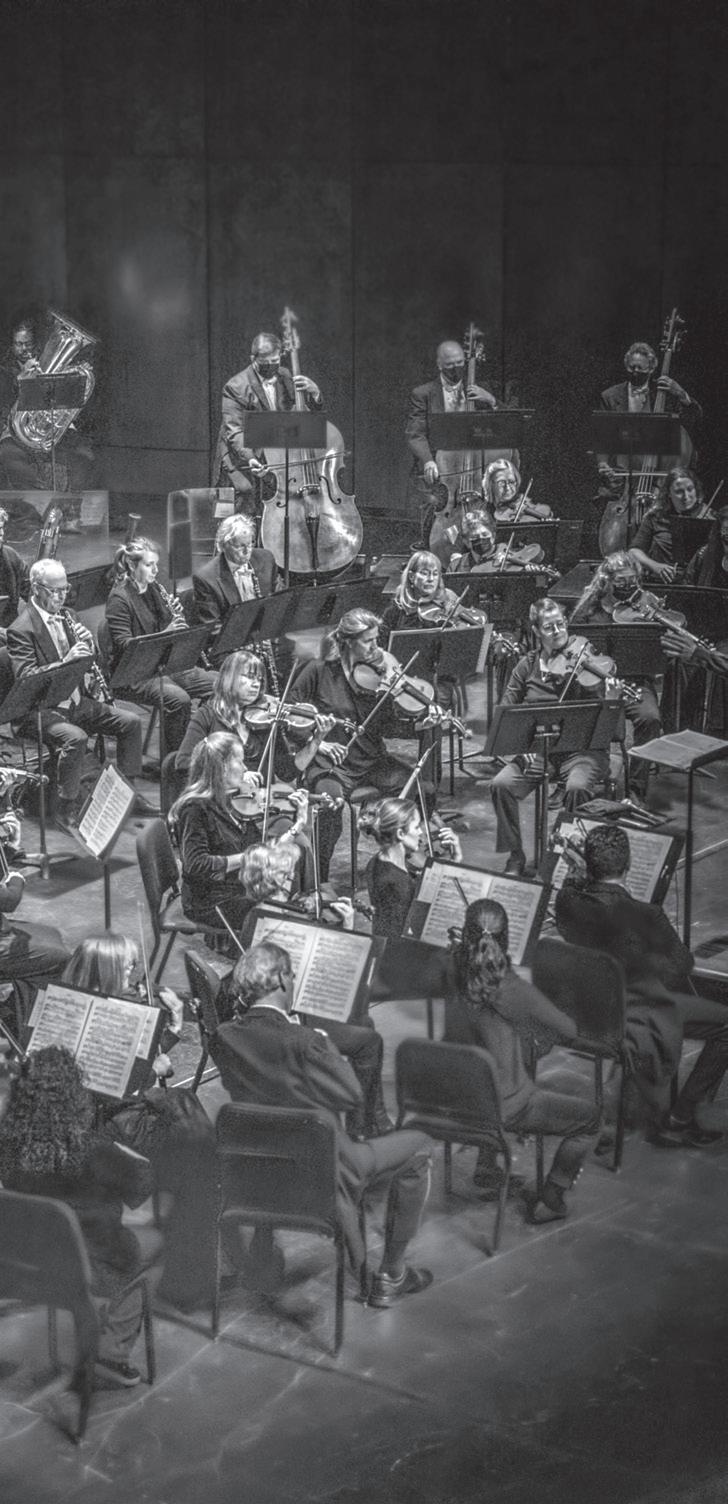

- Thomas Bohlman, Managing Partner