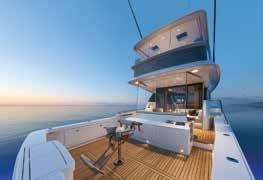
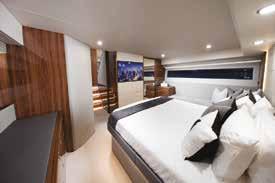
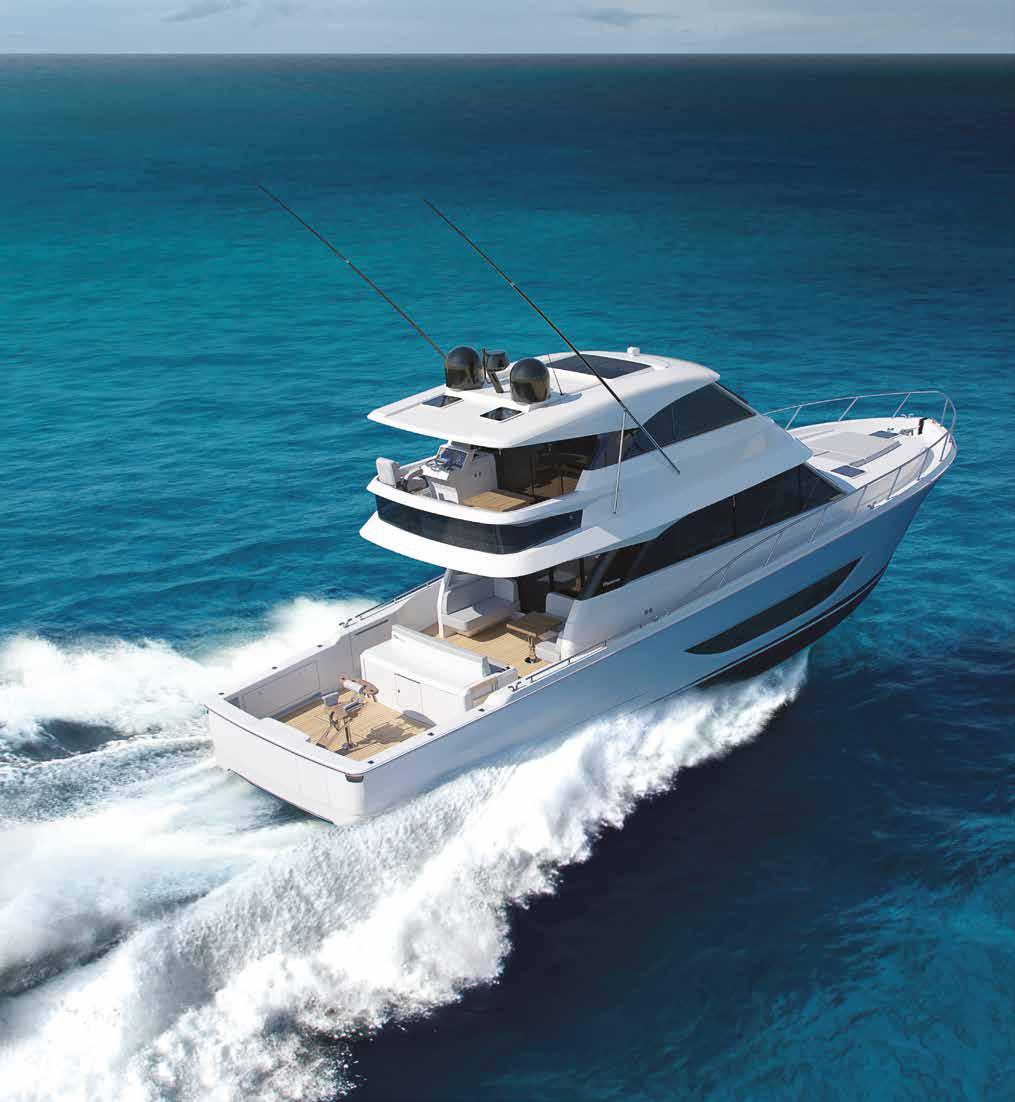
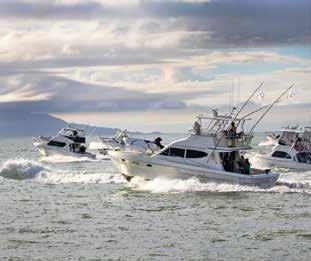
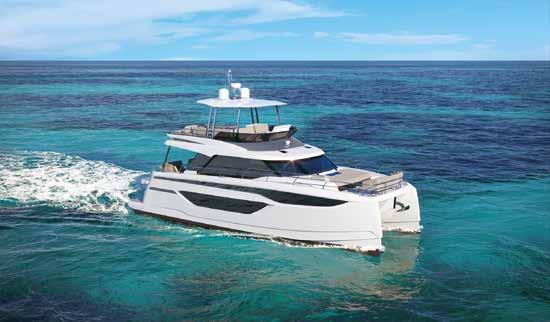
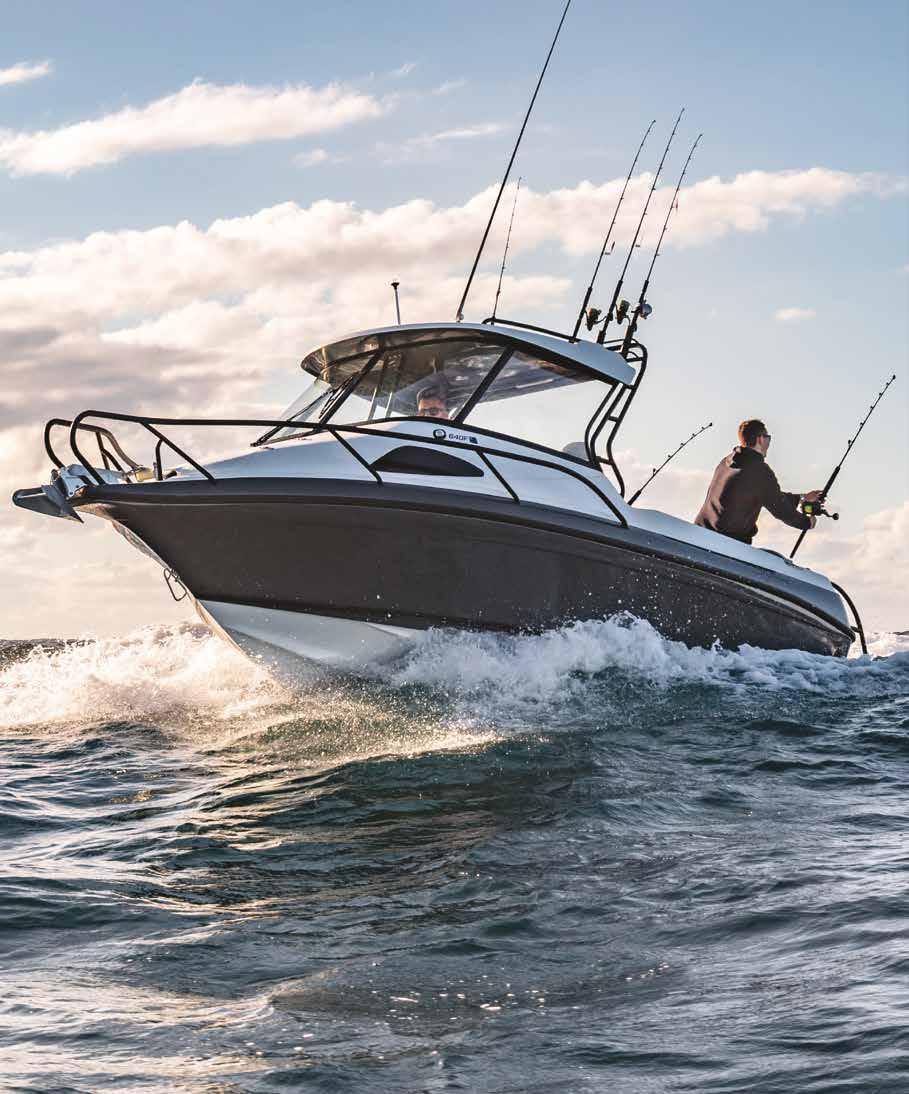
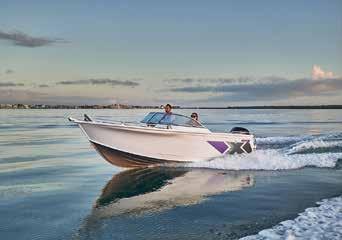
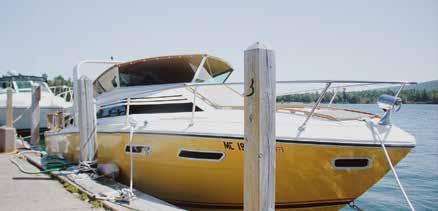
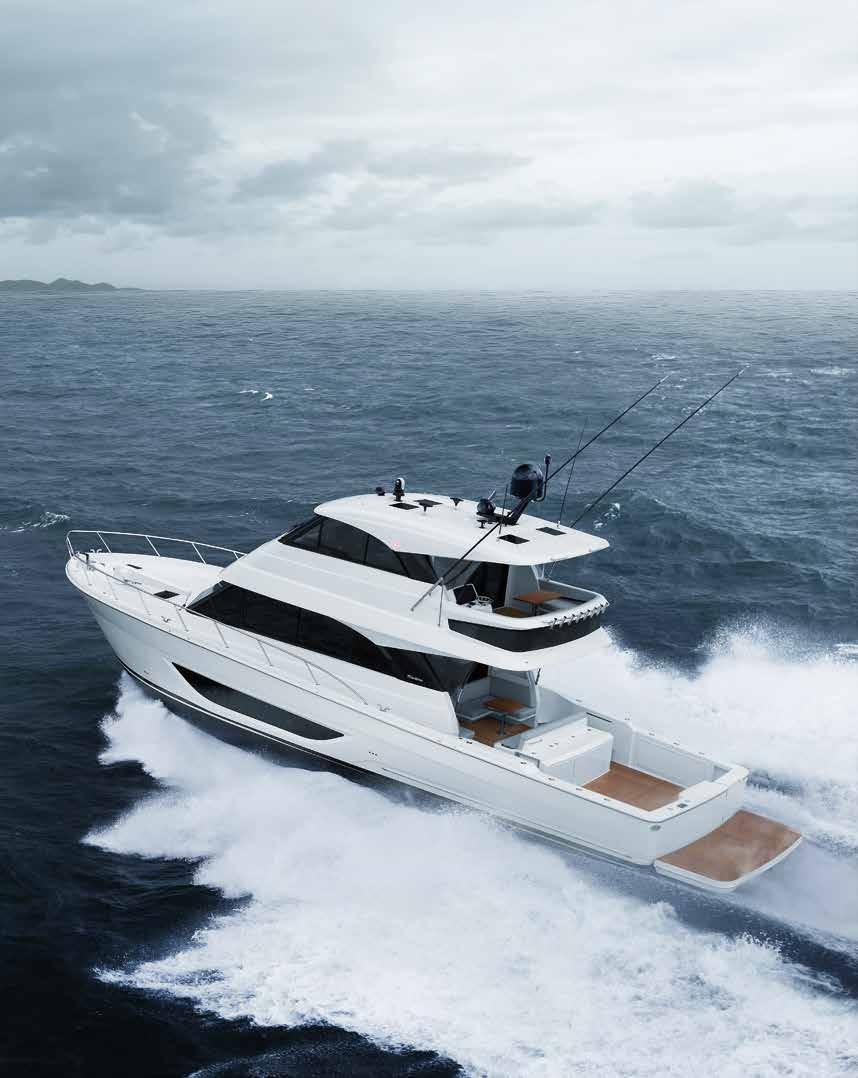
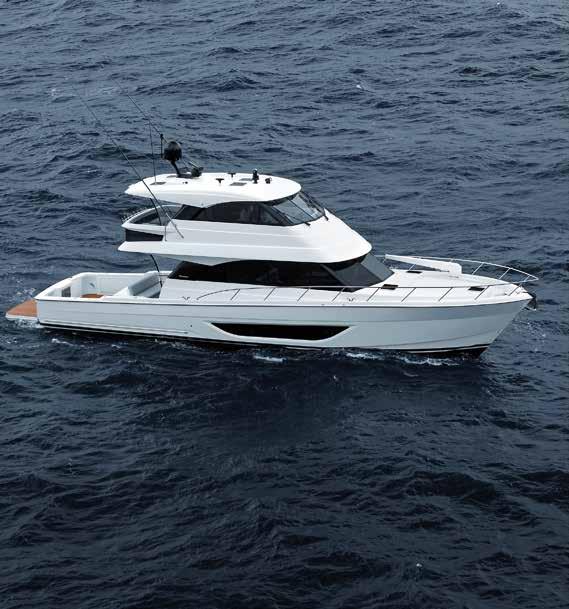
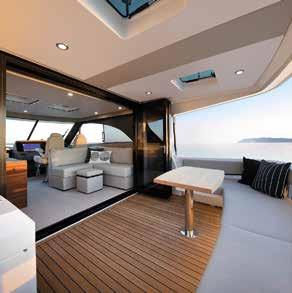
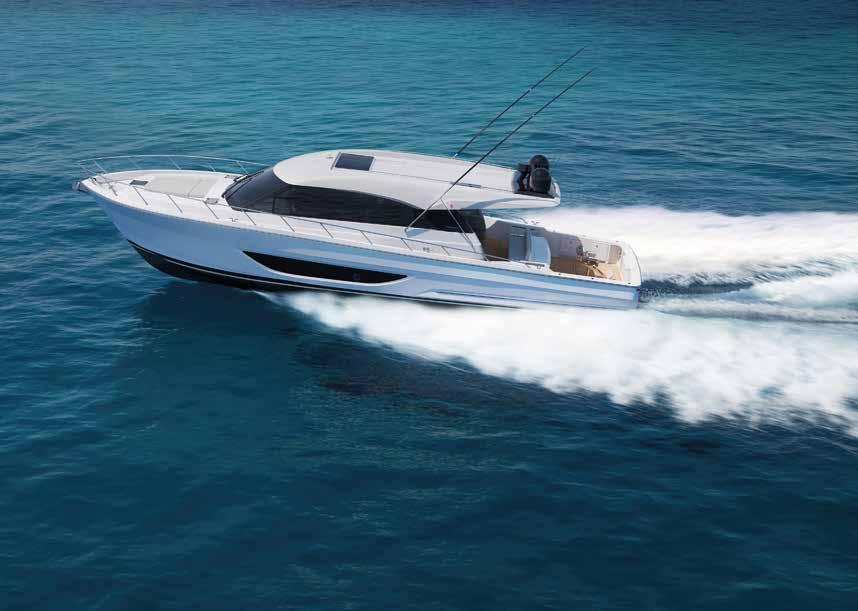
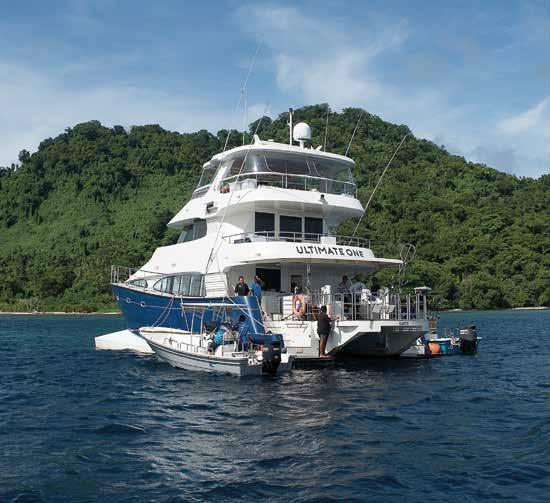
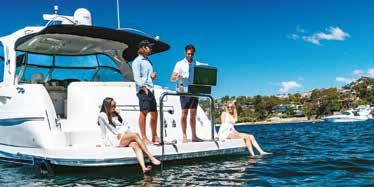
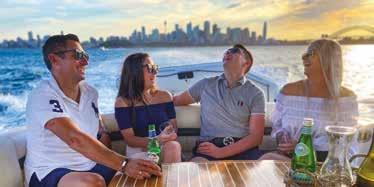
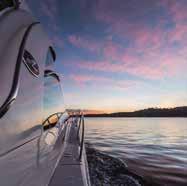
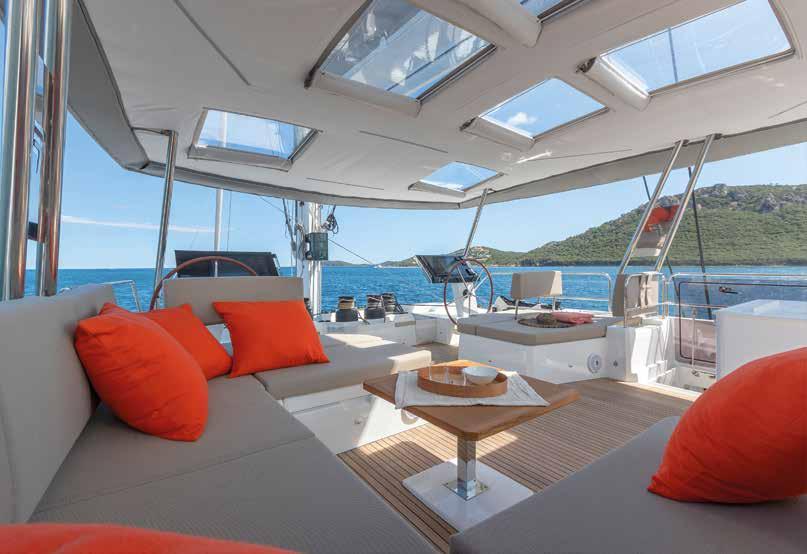
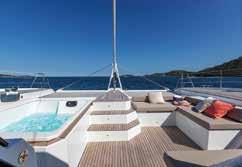
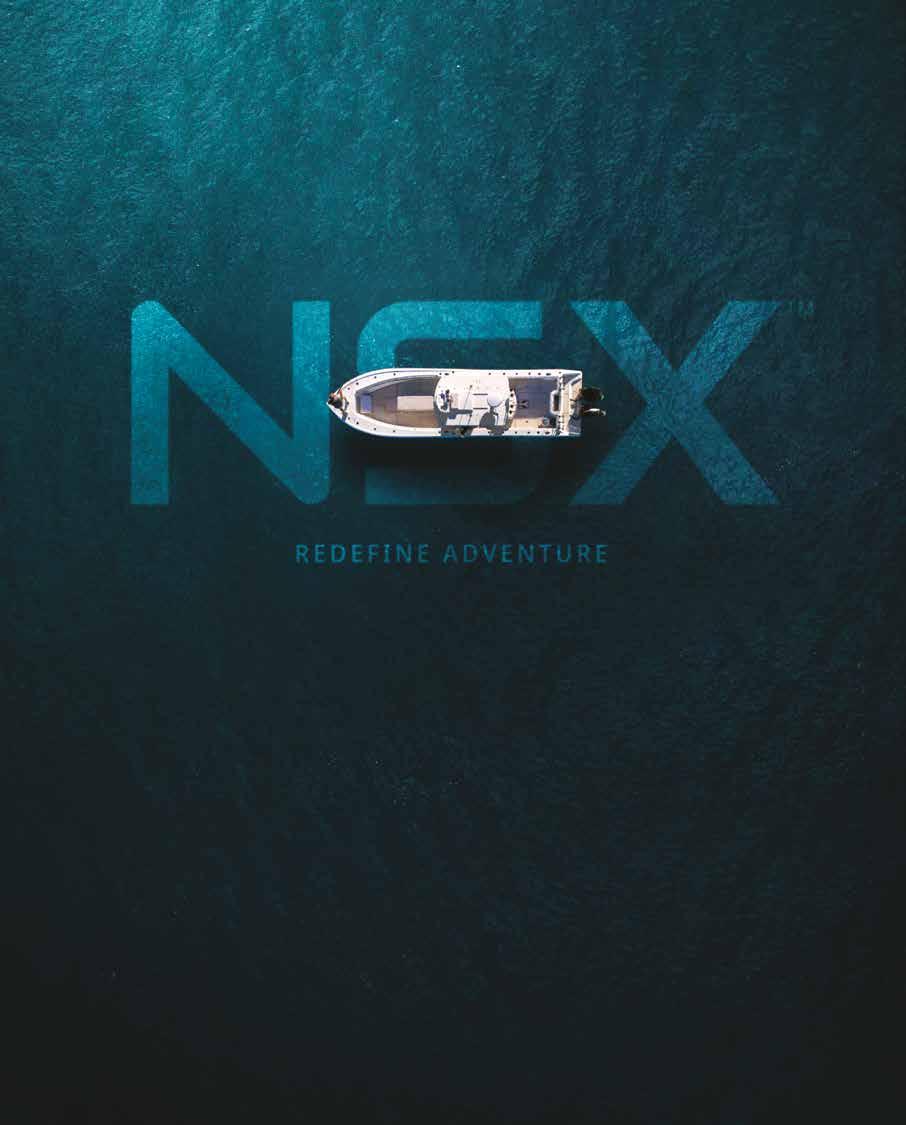
The all new Maritimo M600 is part of the new offshore series that fuses the latest advancements in nautical technology and design with the iconic features of Maritimo’s M-Series models of the past.
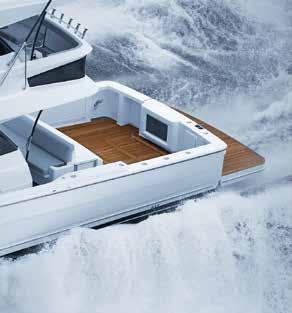
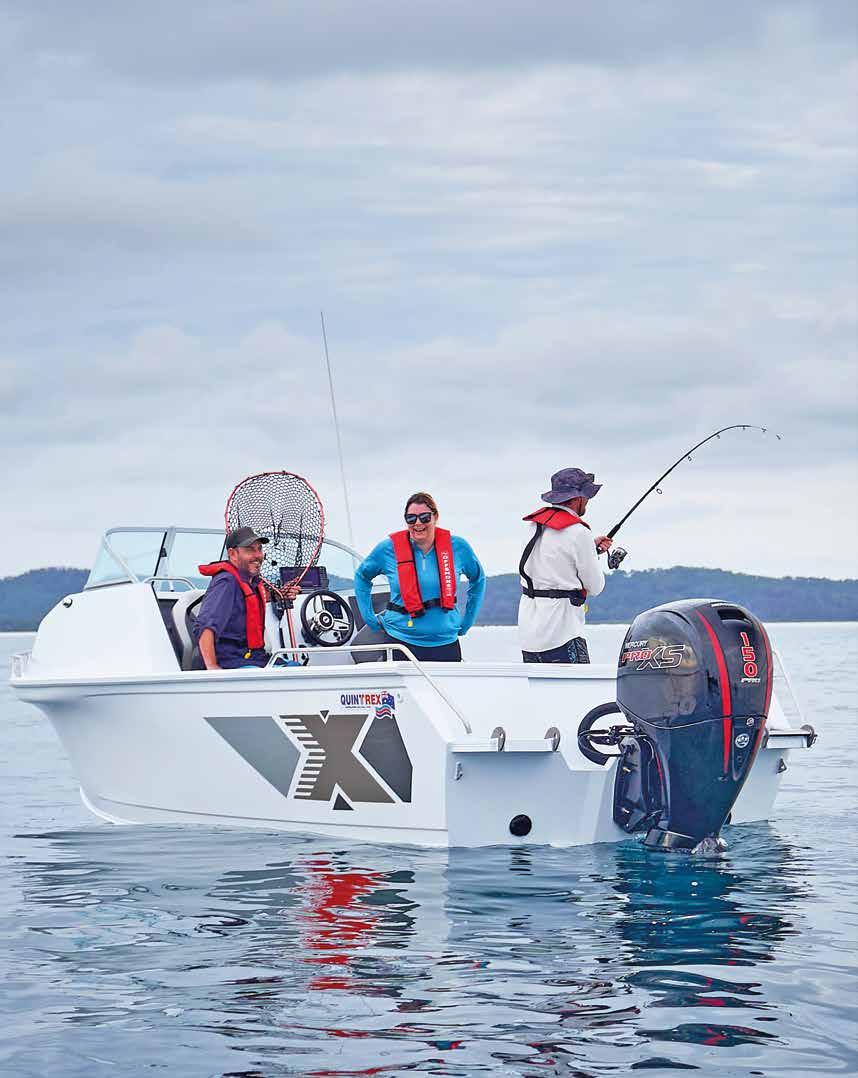
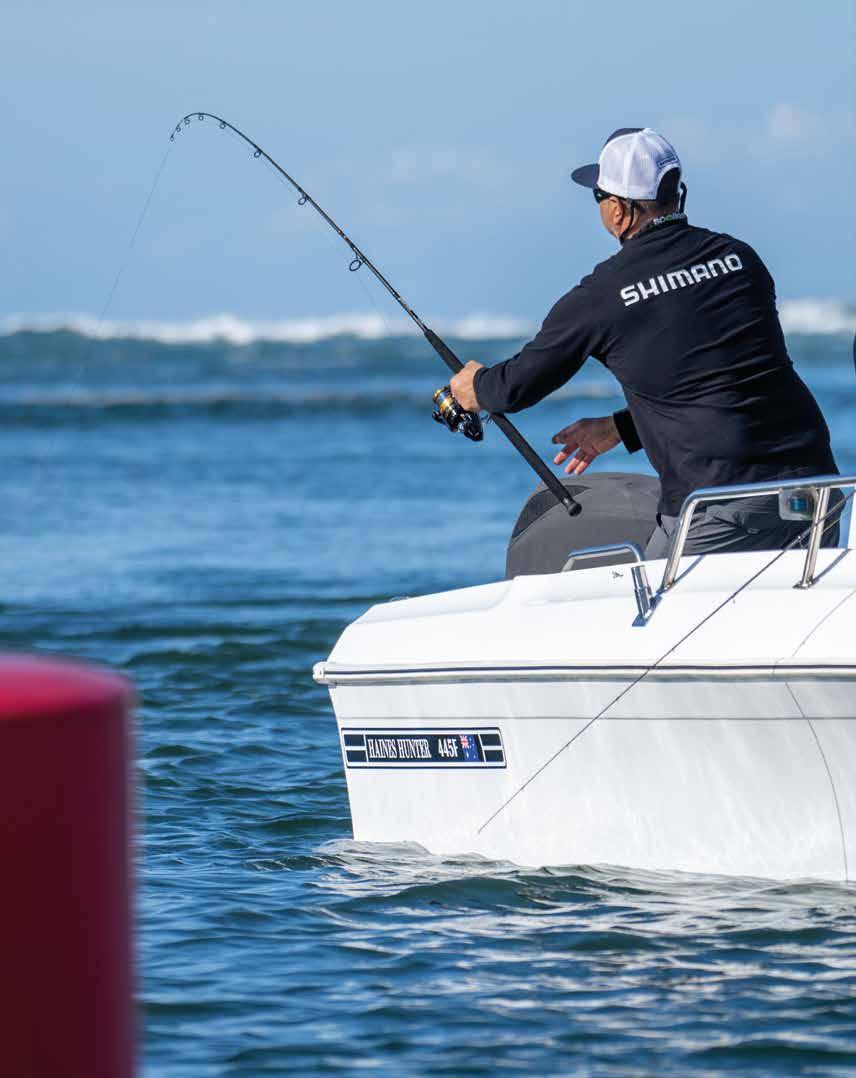
The remarkable new offshore cockpit with enclosed transom makes the M600 Offshore ideal for those fishing enthusiasts or any that embrace the encapsulated deck space with solid separation to the sea.
The Offshore Series exemplifies everything that the Maritimo brand stands for – long range cruising capability, industry defining performance and economy, offshore seaworthiness and high levels of construction integrity. Global Launch at the Sanctuary Cove International Boat Show. maritimo.com.au
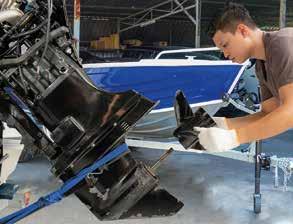
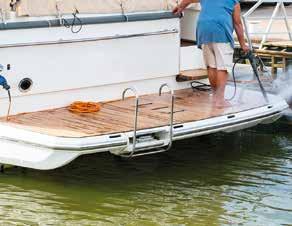
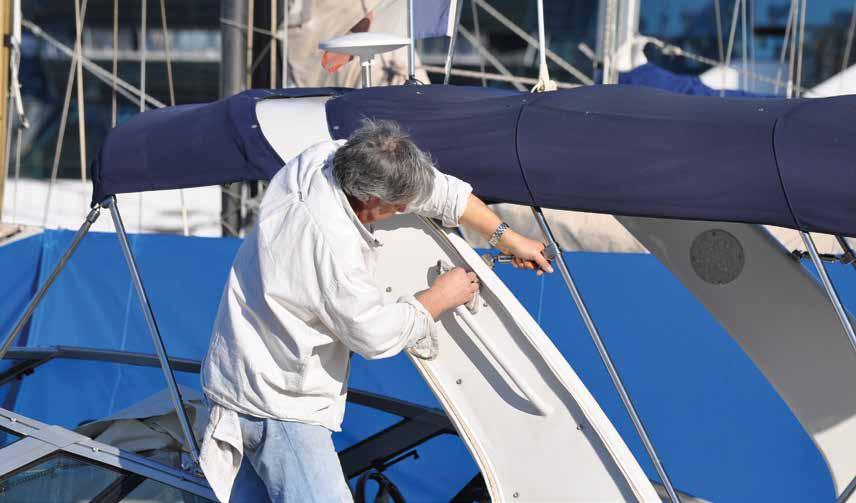
Off-season vessel maintenance, storage, and preparation.
20 MARINA MAGIC
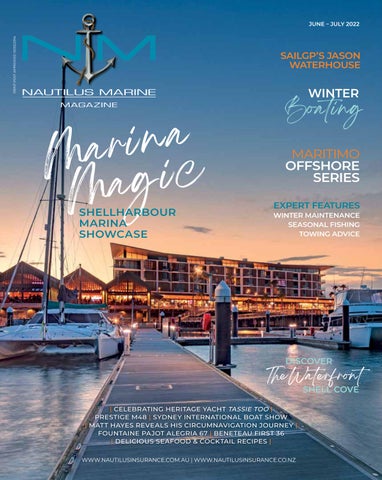
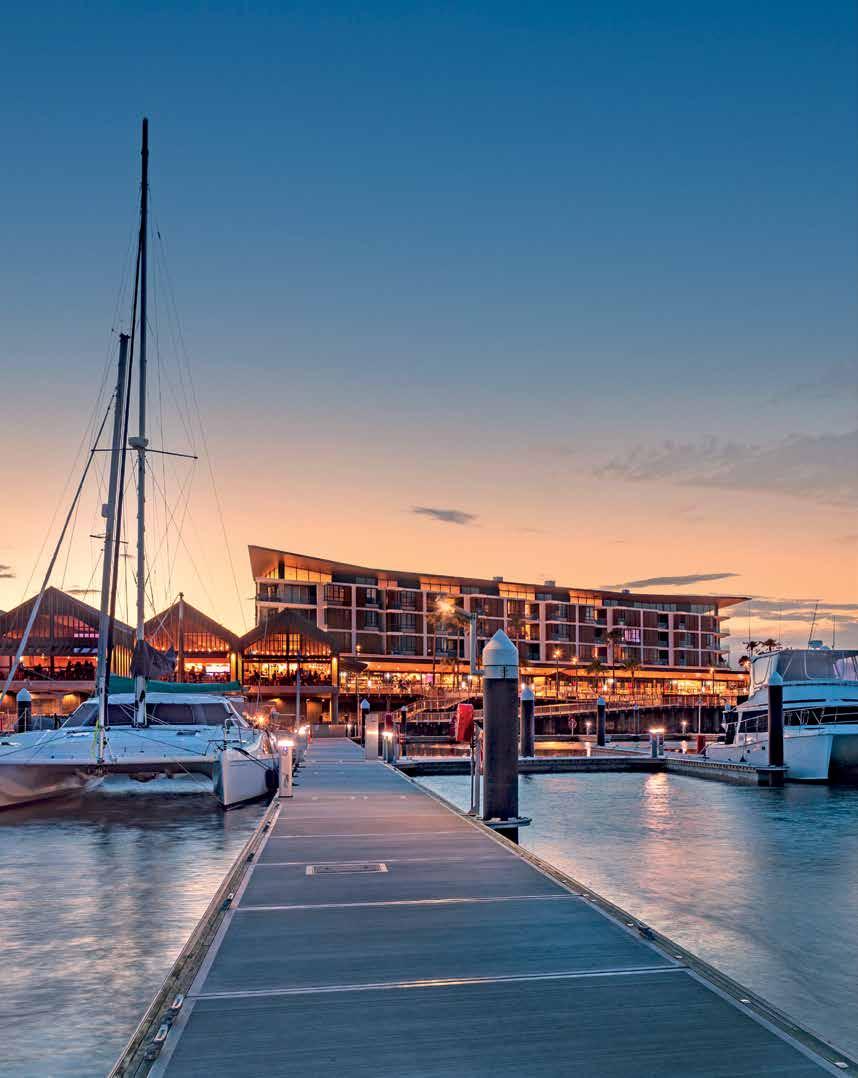
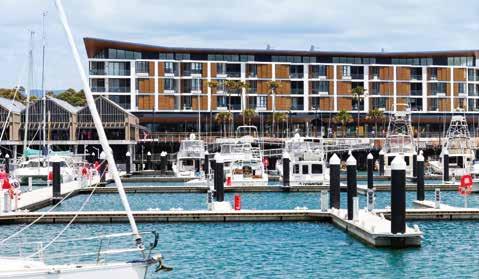
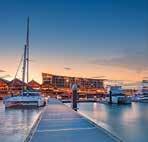
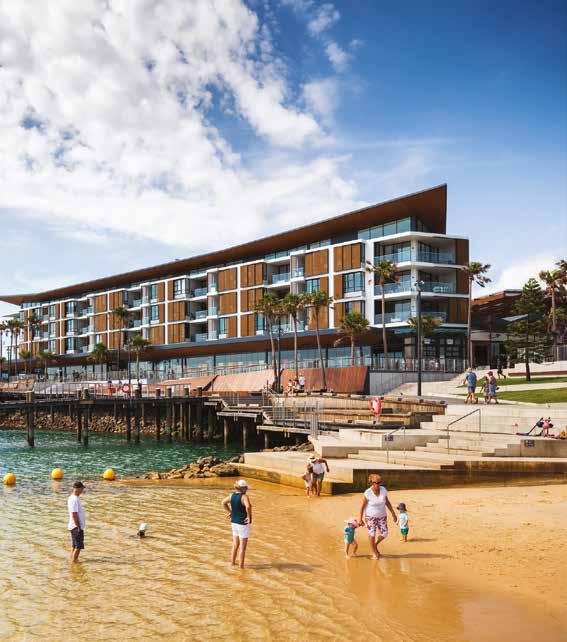
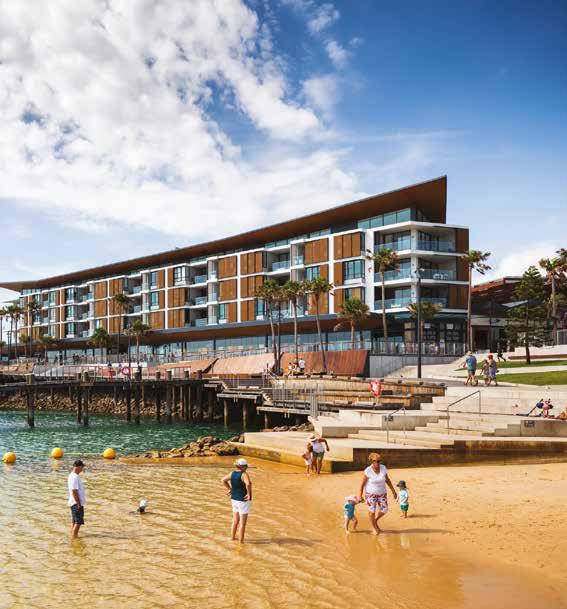
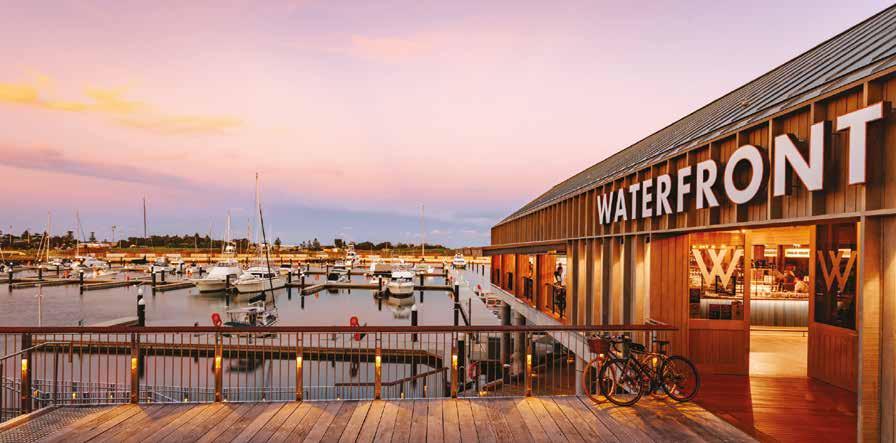
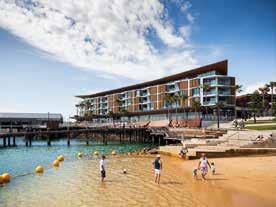
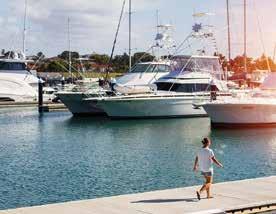
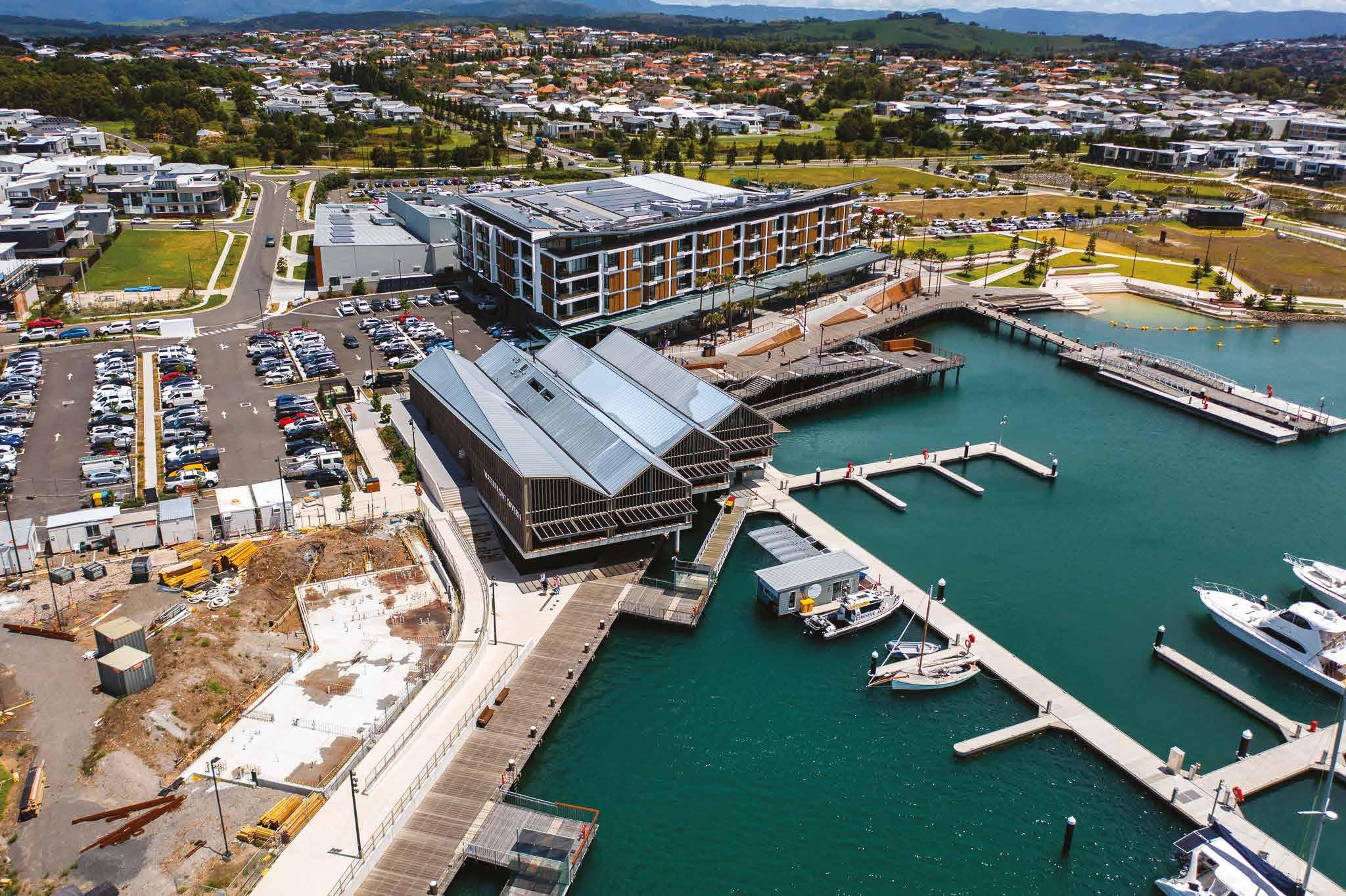
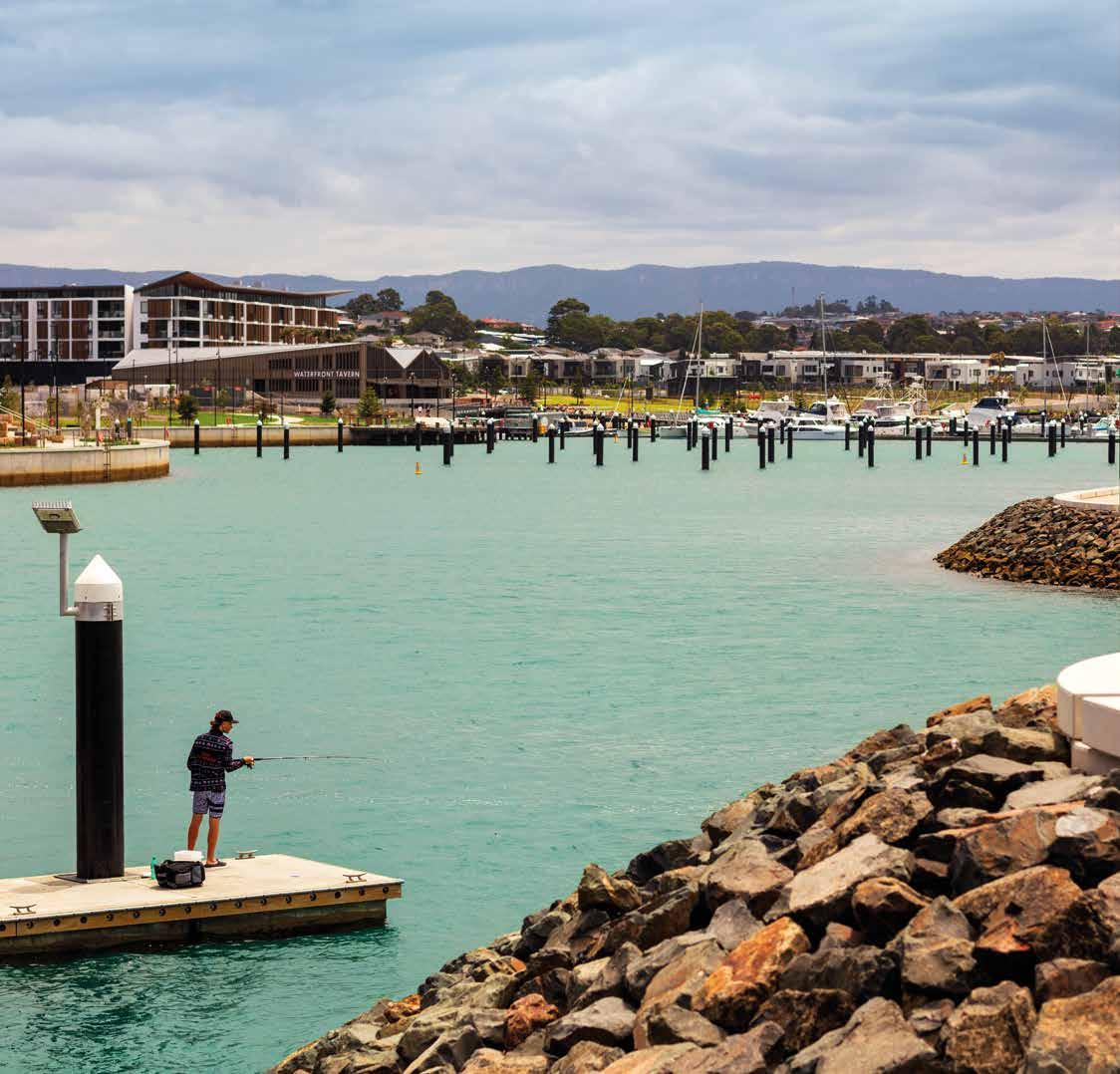
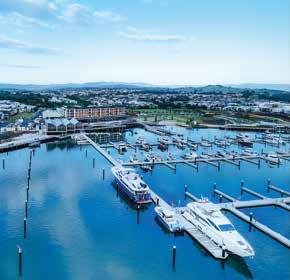
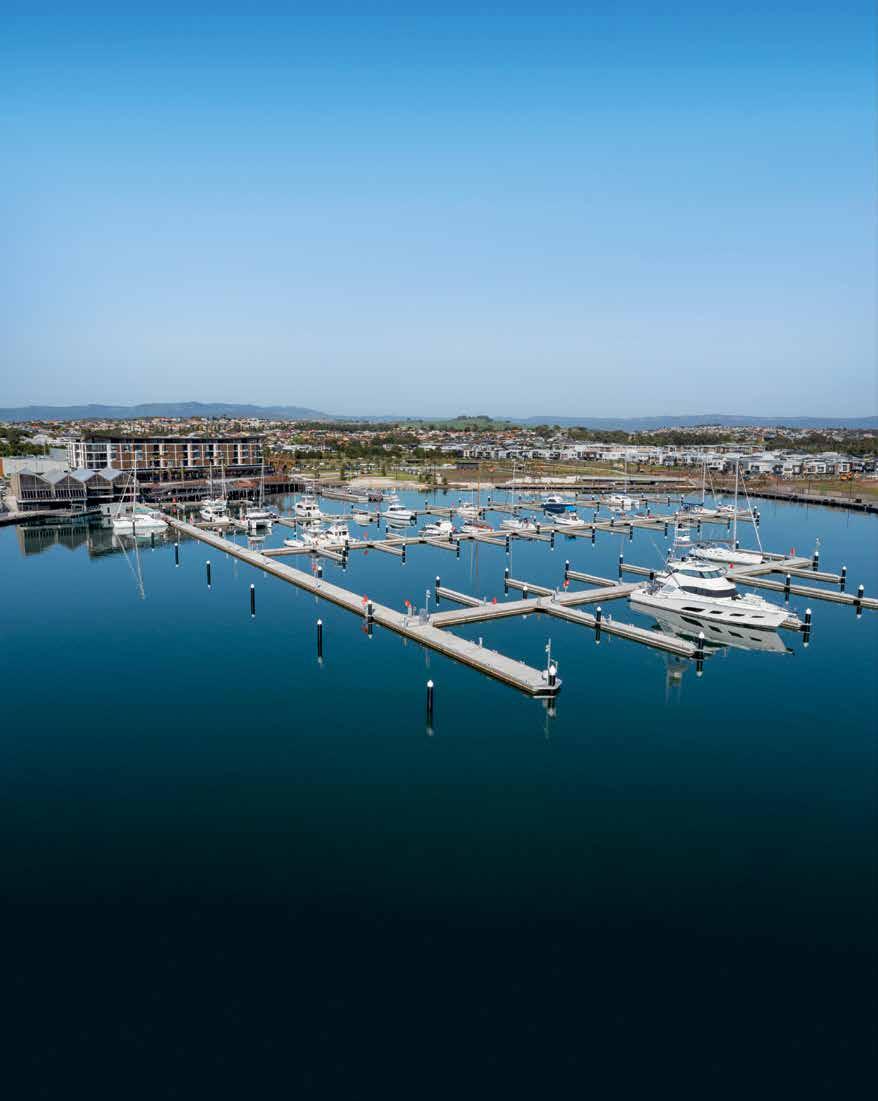
Shellharbour Marina is one of many drawcards of The Waterfront, Shell Cove.
We discover this new boating and lifestyle destination on the NSW South Coast.
Exploring Maritimo’s new Offshore models: the M600 Flybridge and S600 Sedan.
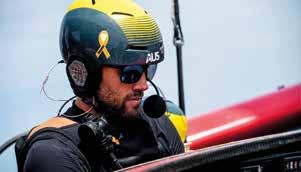
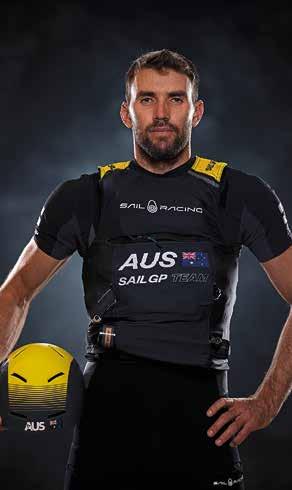
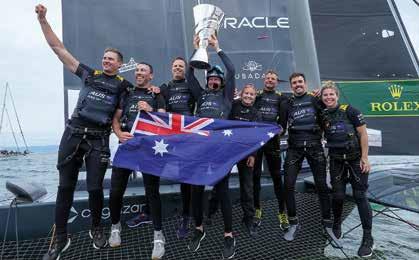
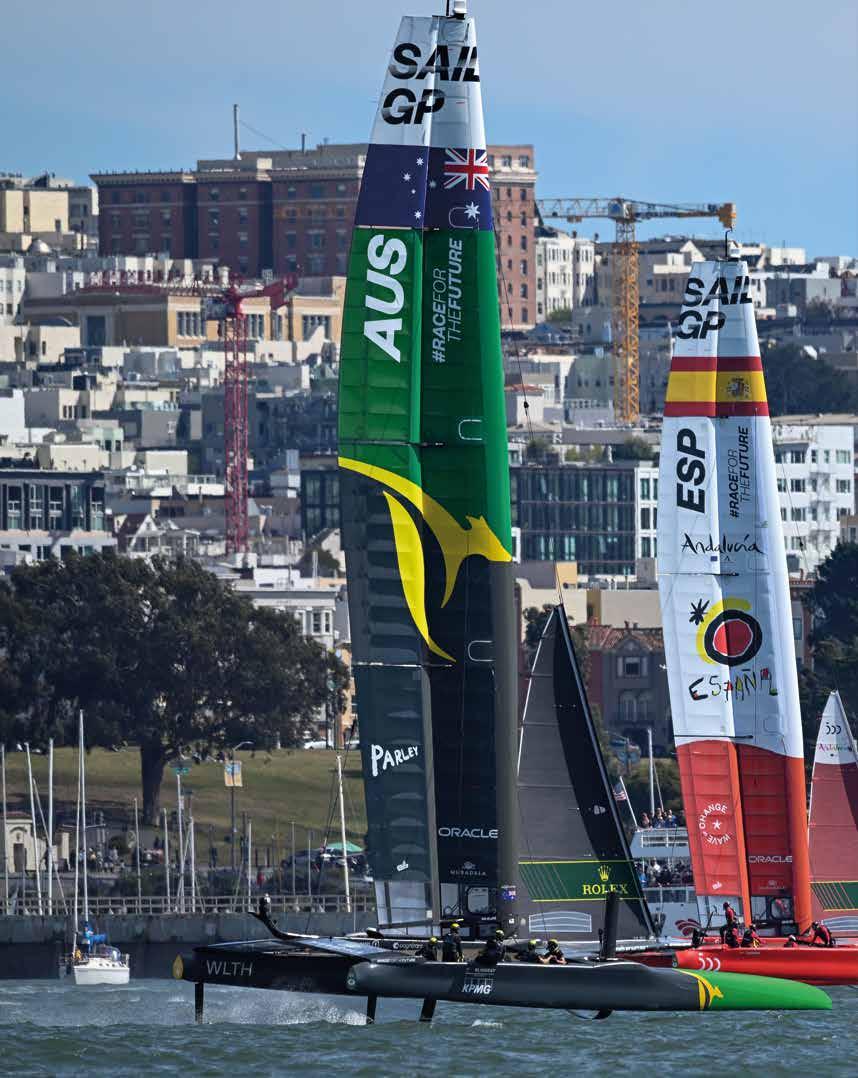
We catch up with the Australian SailGP Team’s Jason Waterhouse.
TOW THE LINE
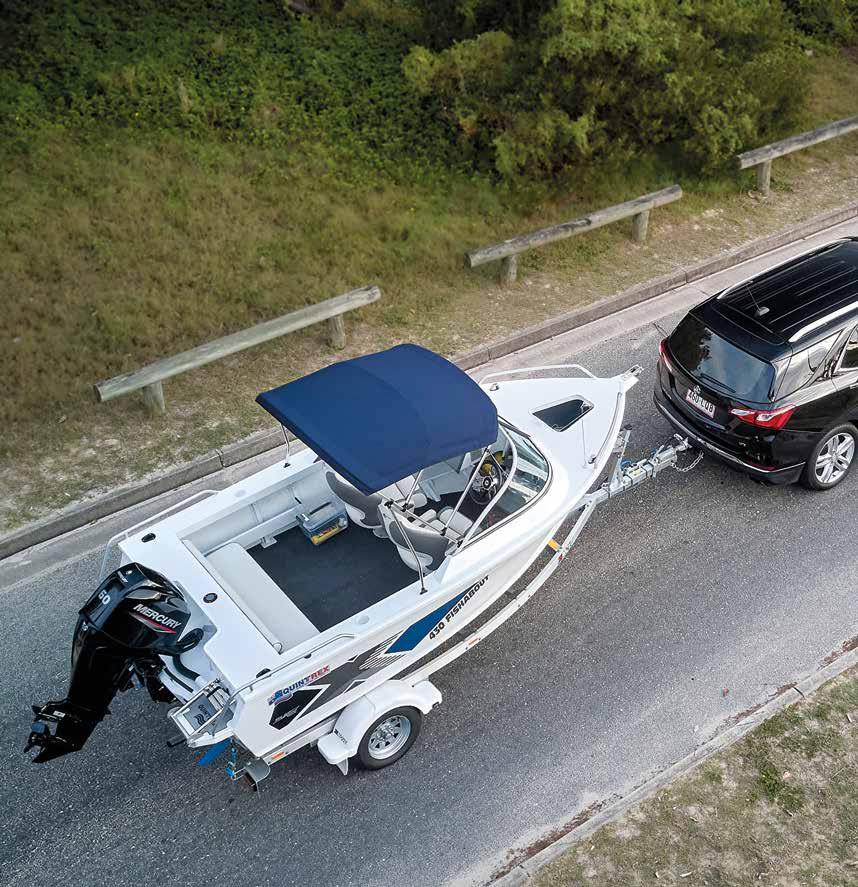
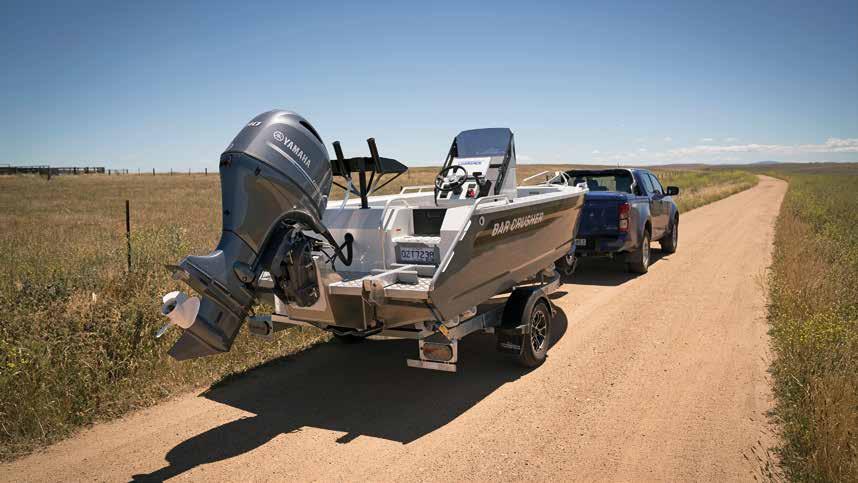
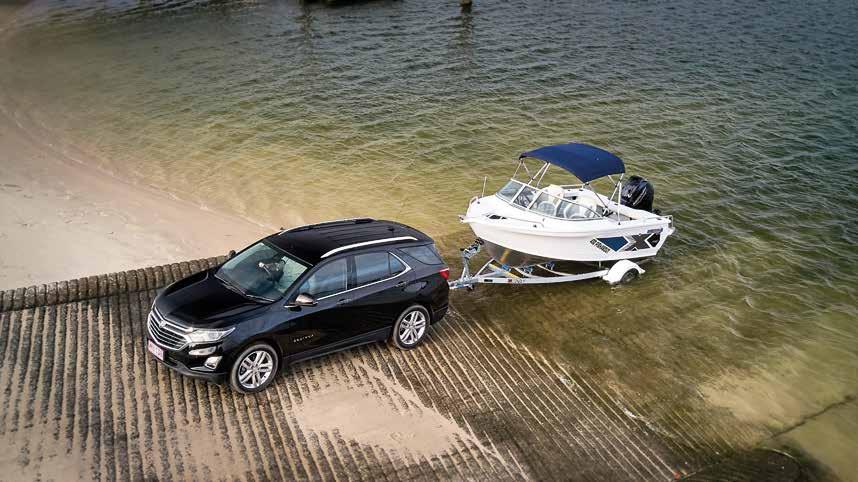
Choosing the right trailer and vehicle to tow your boat is essential for safe and trouble-free boating.
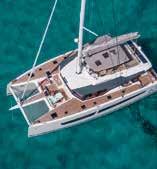
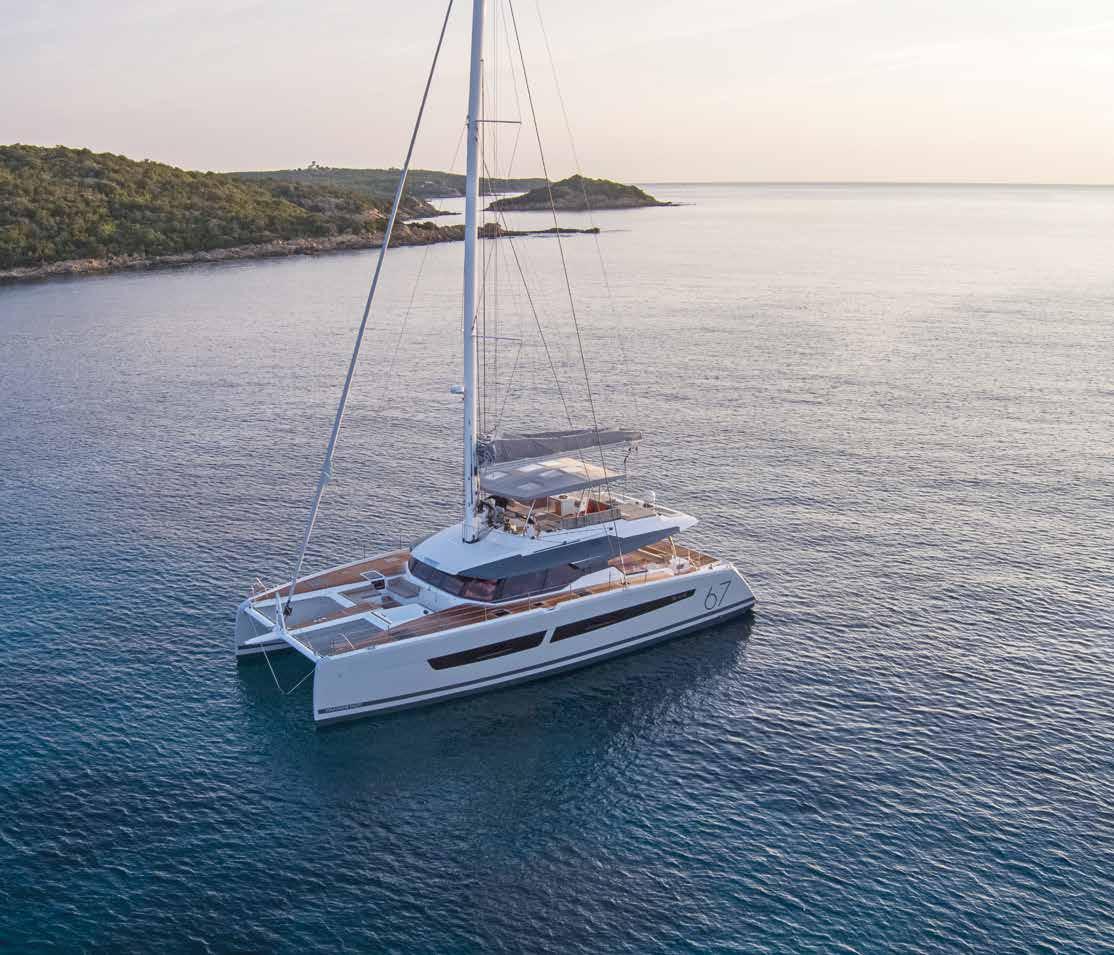
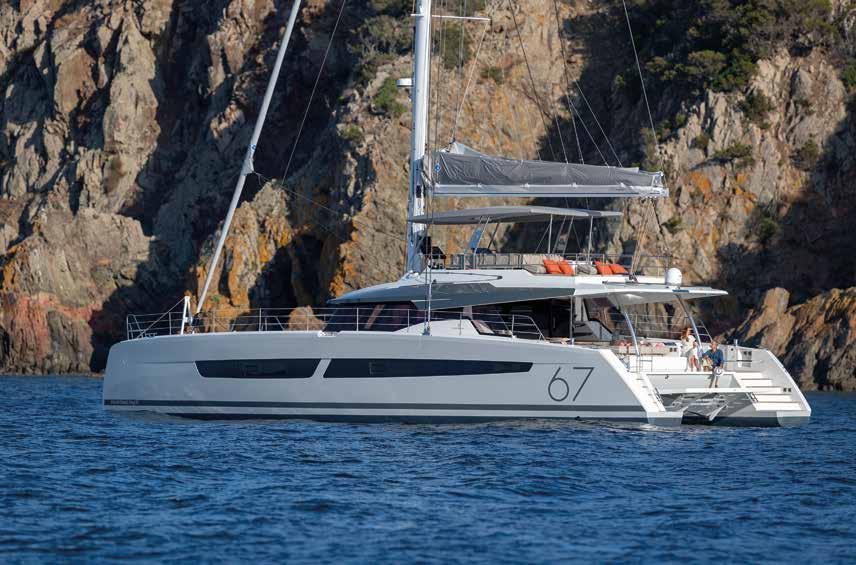
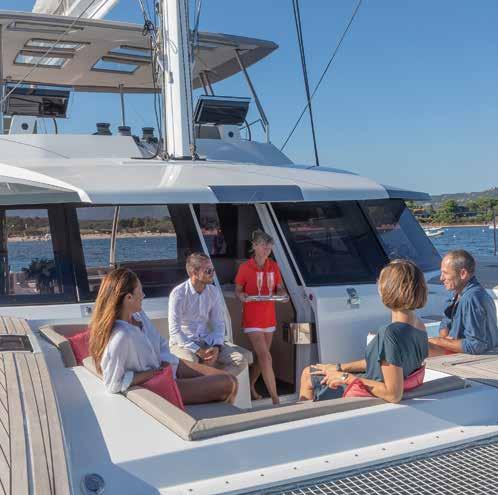
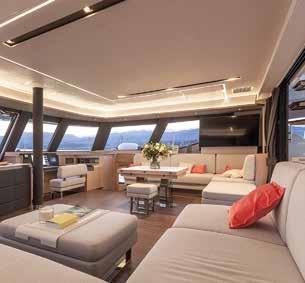
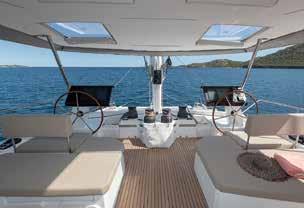
We take a look at Fountaine Pajot’s impressive flagship, the Alegria 67. 72 CASTING A LINE
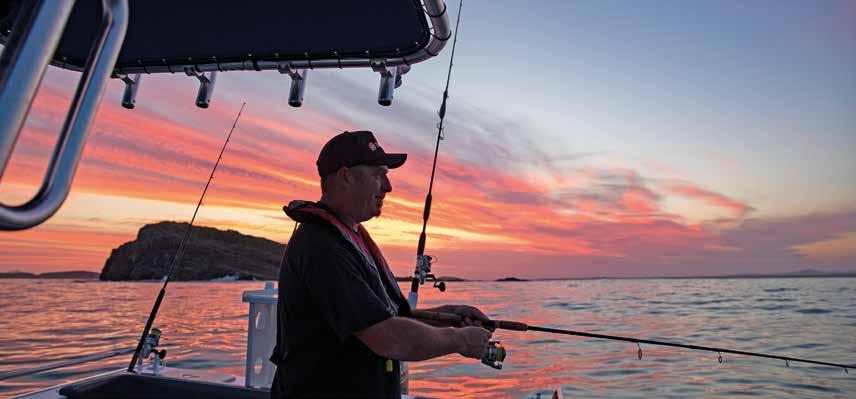
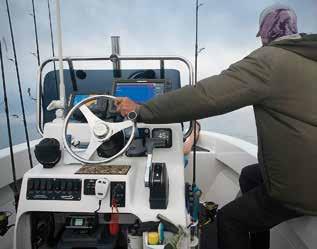
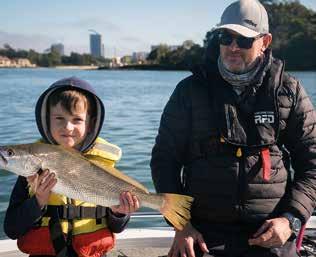
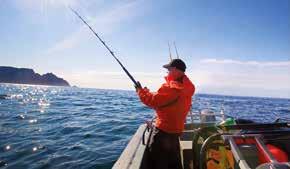
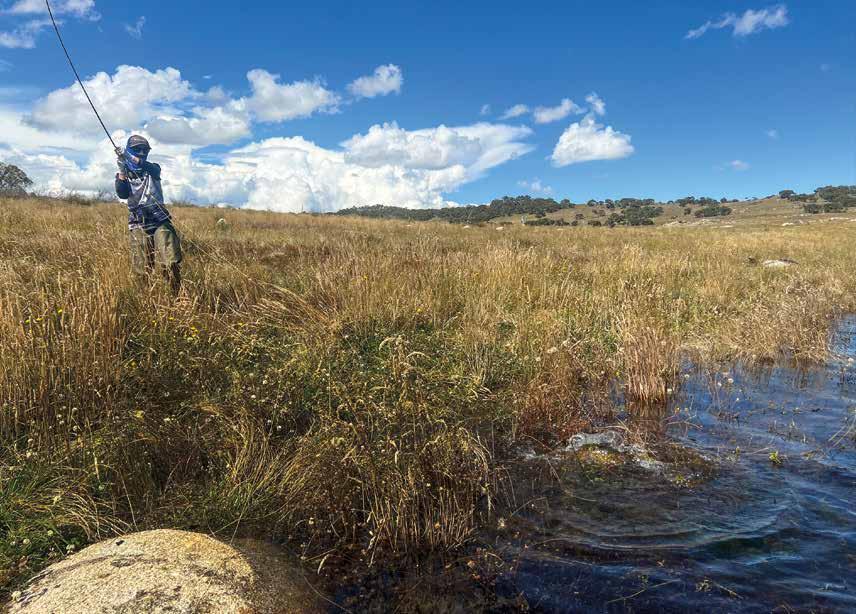
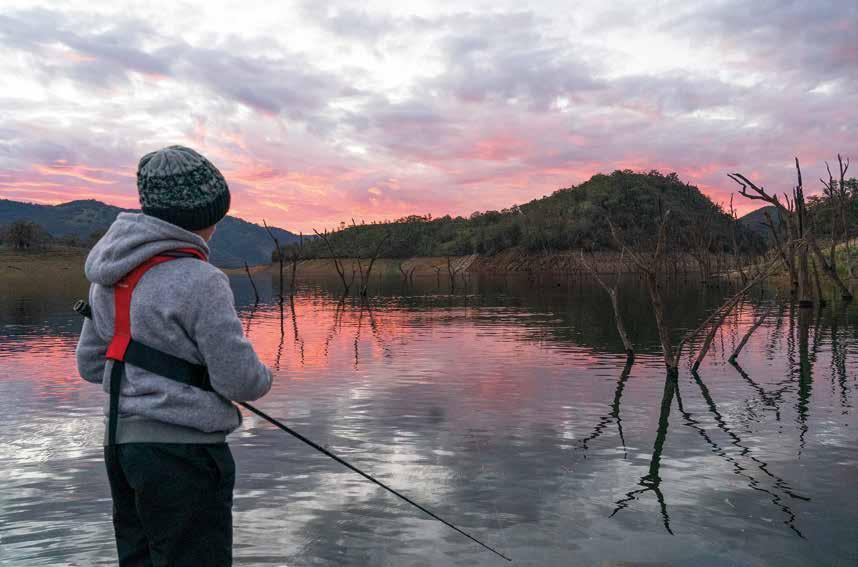
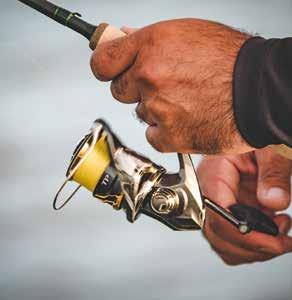
The extreme weather events of recent months have also had an impact on fishos.
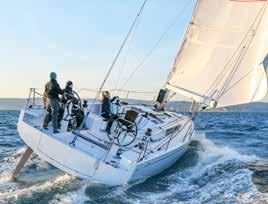
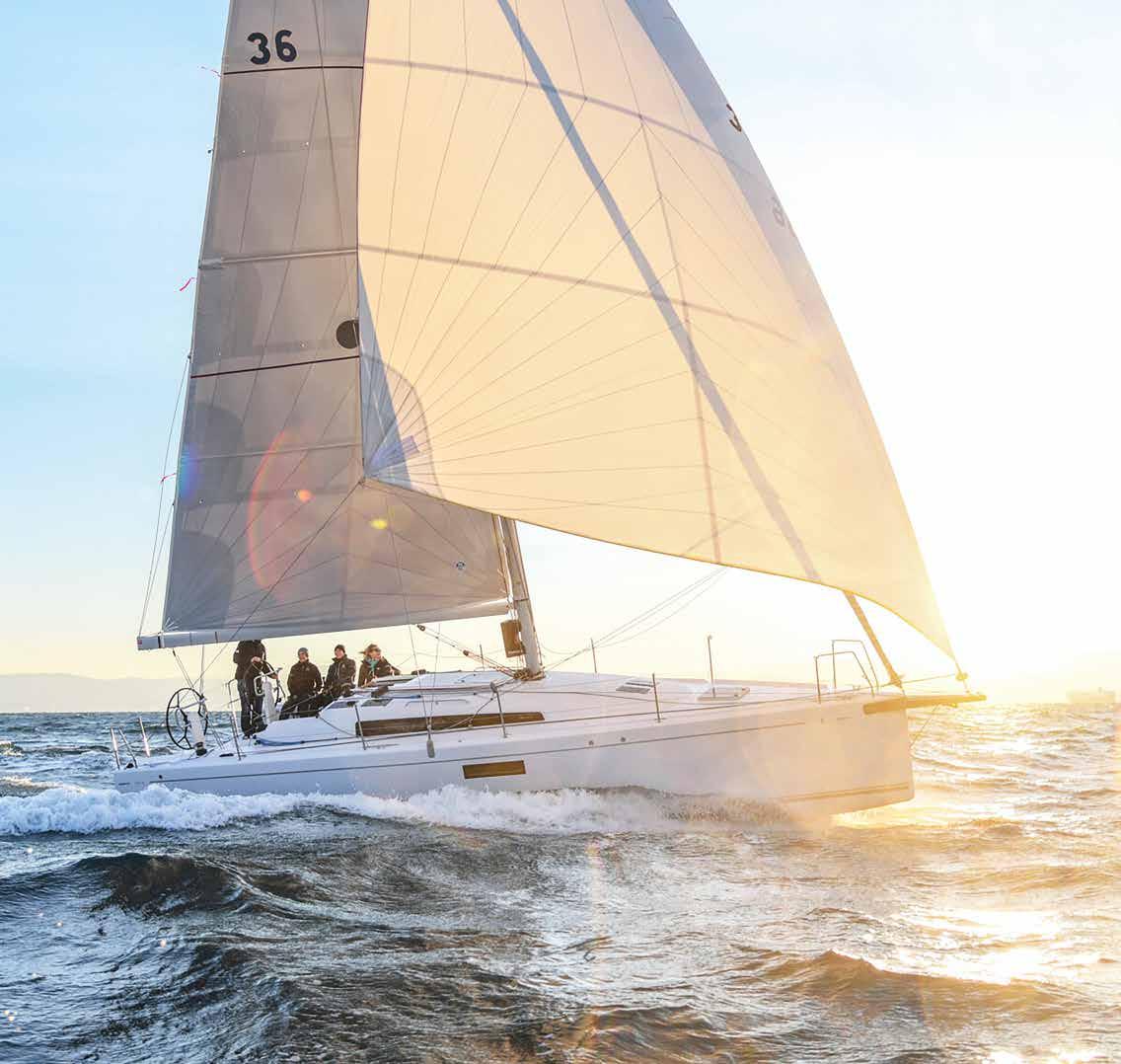
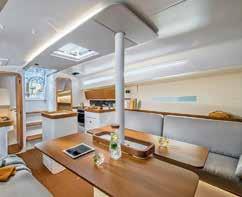
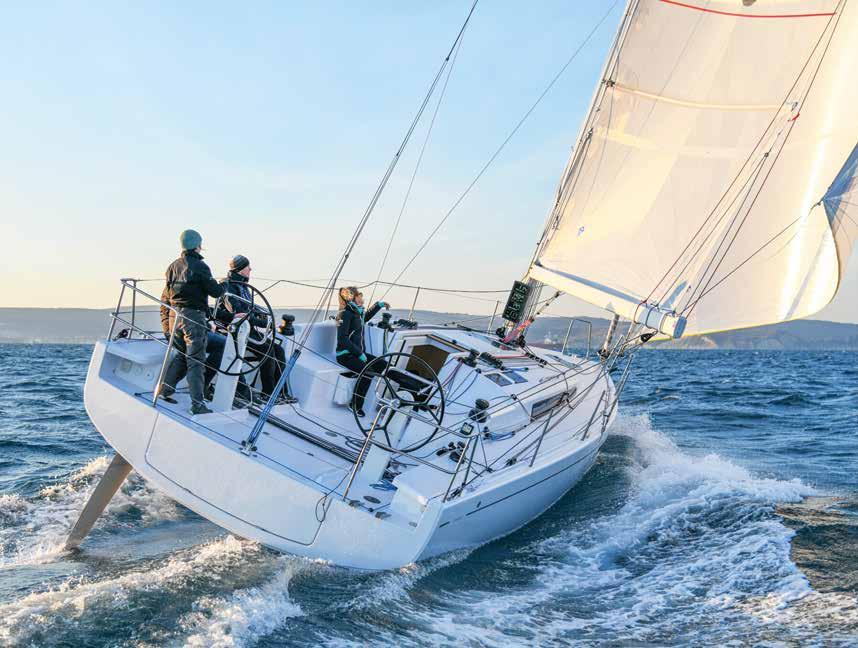
The Beneteau First 36 combines high-performance sailing with the comforts of a cruising yacht.
A
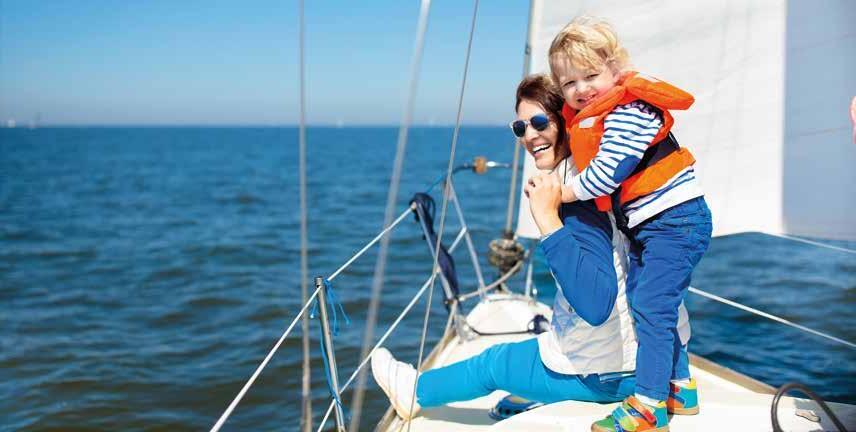
WINTER BOATING
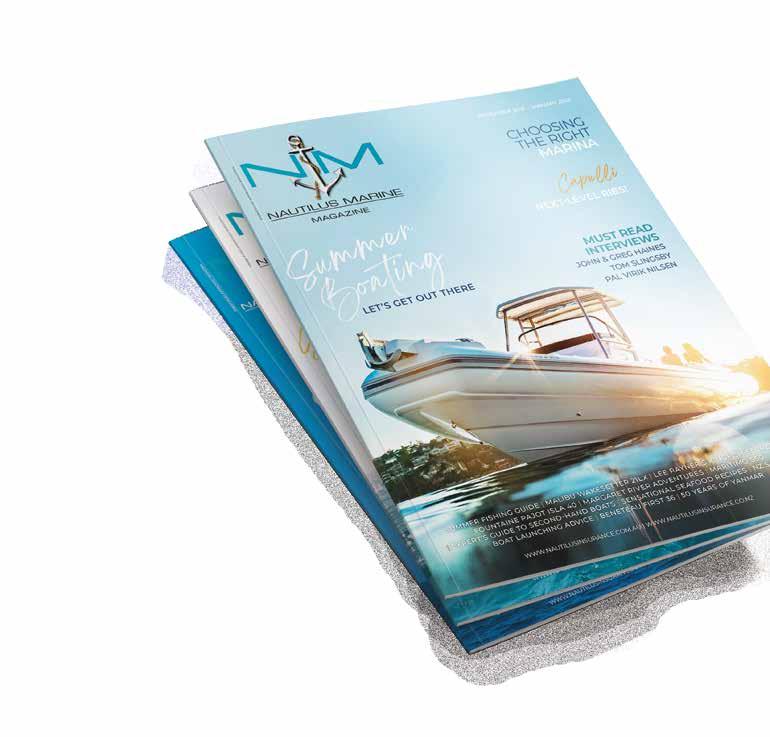
Welcome to the June-July issue of Nautilus Marine Magazine
When it comes to boating in winter, opinions and preferences vary. Some of us boaties love getting out there on crisp and calm winter days. Others among us prefer to bunker down over the cooler months and wait until boating season begins again. Either way, this issue has you covered, with our advice-based winter boating features (pages 28 and 60) and a strong technical feature on offseason boat maintenance and storage (page 14) written by Auckland-based Marine Loss Adjustor Paul Field.
Our ‘cover star’ this issue is the incredible Shellharbour Marina. This impressive new marina is set within Shell Cove Harbour, a man-made, in-shore harbour 50 nautical miles from Sydney, with direct access to the Tasman Sea. For our cover story (page 20), we chatted to Shellharbour Marina Director Les Binkin about the marina’s many unique features and how it provides boaties with a gateway to the stunning NSW South Coast. We also discover the enviable on-water lifestyle on offer at The Waterfront, Shell Cove and the surrounding Shellharbour region (page 84)
There are many other great reads in this issue as well, including our interview with Australian SailGP Team Flight Controller and Olympic silver medallist Jason Waterhouse (page 34 ). particularly enjoyed Jason’s insights regarding the lessons SailGP has taught him about teamwork. As Jason notes, “a good team culture helps to produce results and at the same time having your team hold you at a high standard is really important.” These wise words could be applied to any team environment. They also reflect the values we all uphold here at Nautilus Marine Insurance.
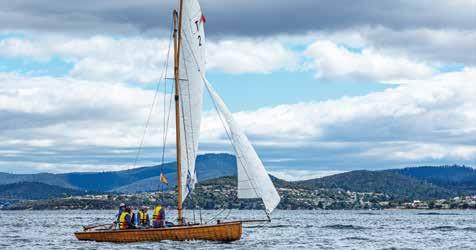
Speaking of teamwork, I hope you will also enjoy our feature and photo shoot with the ‘Friends of Tassie Too’ (page 52). Driven by passion and determination, this inspiring group has accomplished their dream of bringing Tassie Too (a heritage yacht first launched in November 1927) home to Hobart and getting her back on the water again. Tassie Too can now regularly be seen sailing on the River Derwent, and Nautilus Marine Insurance is proud to support this beautiful vessel.
Other highlights of this issue include our interview with Maritimo Head of Design Tom Barry-Cotter about the brand’s Offshore Series (page 30), our comprehensive winter fishing guide (page 74), delicious recipes from the Waterfront Tavern (page 92) and Matt Hayes’ compelling circumnavigation story (page 98).
As always, we love hearing your feedback. So, feel free to get in touch with us and share your thoughts on this issue.
Happy and safe boating!
LYNDON TURNER CEO & PUBLISHER
Behind the issue
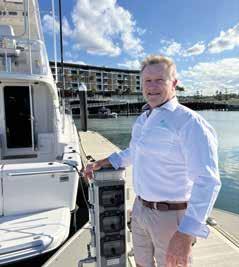
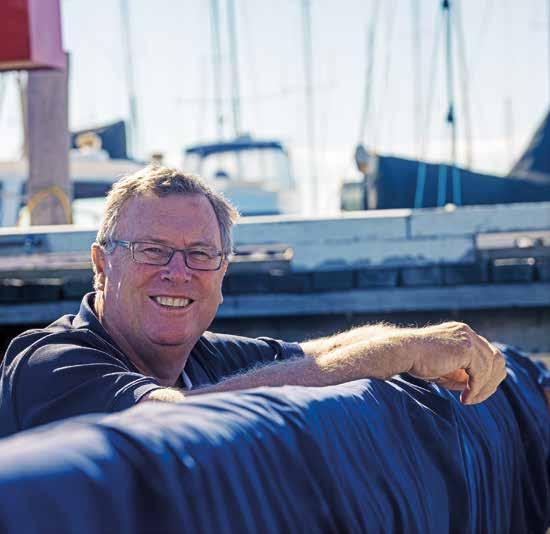
LES BINKIN
Les is the Director of Shellharbour Marina, a successful marine investor and entrepreneur, and Certified Marina Manager. A keen fisherman and pleasure boater, he has spent his entire life on the water and is actively involved in supporting the marine industry and local communities.
“Shellharbour Marina is unique,” says Les. “We’re situated within Shell Cove Harbour, which is 50 nautical miles south of Sydney and has direct access to the Tasman Sea. So, you can come straight out of open water and within about 500 metres you’re in a safe and very well protected harbour.”
MICHAEL COOK
Wollongong local Michael is the new Executive Chef at the Waterfront Tavern. He has 18 years’ experience in the kitchen, including as Group Executive Chef at a leading Sydney hospitality group. Michael’s food philosophy is based around fresh, local and seasonal produce which speaks for itself on the plate. “We want to deliver an experience for our customers that can’t be experienced anywhere else on the NSW South Coast,” says Michael who shares some delicious seafood recipes and tips in this issue.
JACK O’ROURKE
Jack’s passions for being on the water and creating informative safety advice have combined as Deckee’s Content Manager. In this issue, he shares some ways you can keep your docking skills sharp and how to get the most out of boating in winter. “There are still plenty of trips you can make on your boat in the cooler months,” says Jack. “As long as you make a plan, it can be a lot of fun.”
Josie has a passion for storytelling, stemming from her years as a magazine editor, celebrity journalist, pop culture writer, and published author. By her own admission, she’s “obsessed with all things sub-editing, and words in general”, but it’s the ‘Tassie Treasure’ story in this edition that has her moved by what passionate volunteers can manifest back to life, just as they did with the journey of Tassie Too, back to its former glory and sailing once again.
CEO & PUBLISHER: Lyndon Turner – lyndon.turner@nminsurance.com.au
HEAD OF MARKETING, BRAND AND COMMUNICATIONS: Neha Taskar – nehat@nminsurance.com.au
EDITOR & SENIOR MARKETING MANAGER: Sarah Ranawake – sarahr@nminsurance.com.au
ADVERTISING ENQUIRIES: Todd Anderson +61 409 630 733
ART DIRECTOR: Kim Gierdien
SUB-EDITORS: Helen Hayes and Josie Gagliano
HEAD OF DEVELOPMENT – MAJOR ALLIANCE PARTNERS: Tim Baker – timb@nminsurance.com.au
HEAD OF DEVELOPMENT – MAJOR BROKER PARTNERS: Glen Schembri –glens@nminsurance.com.au
HEAD OF UNDERWRITING – PRIVATE PLEASURECRAFT: Chris Dobson – chrisd@nminsurance.com.au
YOU AIN’T SEEN NUTHIN’ YET!
We might be 50, but we think we’ve only just hit our straps. We’ve got a whole lot of new features and developments planned, so our boats are getting even better.
For 50 years Stacer has been helping Aussies have fun on the water. Whether it’s with family and friends or a bunch of fishing mates. Everybody loves our quality fit-outs, unbeatable build strength and ultra reliability.
Other brands find it hard to compete – especially for the price. So if you haven’t owned a Stacer yet, maybe it’s time to say hello to your local dealer. And get ready to have a Stacer in your life for the next 50 years.
JOSIE GAGLIANO
THE Latest
UPDATES AND EVENTS YOU NEED TO KNOW ABOUT.
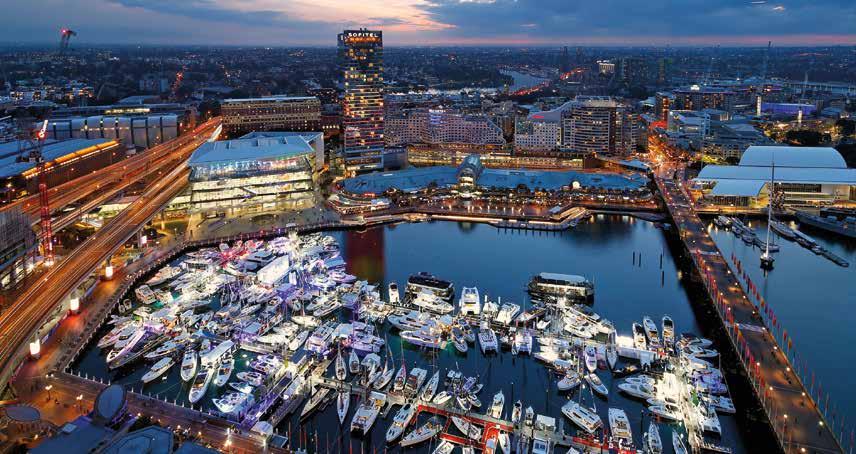
Sydney International Boat Show is back
Over 60,000 boaties are expected to descend on Darling Harbour between 28 July
– 1 August 2022 for the return of the Sydney International Boat Show (SIBS). The 53rd SIBS event will be held at the International Convention Centre (ICC) and is presented in a new partnership between the Boating Industry Association (BIA) and Mulpha Events, owner-operator of the Sanctuary Cove International Boat Show.
The show will encompass both an indoor display space and a 5,000sqm open-air event deck. “We look forward to delivering a worldclass boat show with widespread appeal at the iconic Darling Harbour site and showcasing our exhibitors, partners and the wider marine industry to an enthusiastic audience,” says BIA Vice-President Andrew Fielding.
Mulpha Events General Manager, Johan Hasser, says SIBS 2022 will be particularly focussed on recreational boating. “SIBS 2022 will showcase the fun of being out and about on the water with a particular focus on recreational boating,” says Hasser. “From stand-up paddleboarding and personal watercraft through to powerboats, inflatables and sailing yachts, SIBS will inspire adventure and promote a fun and active marine lifestyle.”
Brands already confirmed for SIBS 2022 include Sunseeker, Princess, Fleming, Multihull Solutions, Short Marine, Palm Beach Motor Yachts, Flagstaff Marine, Iliad, Whitehaven, d’Albora and Chapman Marine. This issue’s cover star, Shellharbour Marina, will also be showcasing at SIBS. Trailer boats, watersports and inflatable craft will be represented by the likes of Insinc Marine, Hunts Marine, GME Marine, Waves Overseas, Sirocco Marine,
GRE Marine, Hobie and Whitewater Sports Marine. The latest marine technology, engines, gear, and gadgets will also be showcased by brands such as Navico, Volvo Penta, Mercury Marine, FLIR Maritime, Garmin, Raymarine, Stella Systems, Dometic, Boating & RV and GME.
SIBS sponsor, Transport for NSW, will be promoting safe and responsible boating, through the Boating Safety Zone. “SIBS allows our Boating Education Officers to share safety advice and engage with new, returning and experienced skippers at the Boating Safety Zone,” says Bernard Carlon, Executive Director of Centres for Road Safety and Maritime Safety at Transport for NSW. Visit www.sydneyboatshow.com.au
Island Cruising NZ sets sail with Pacific Rally
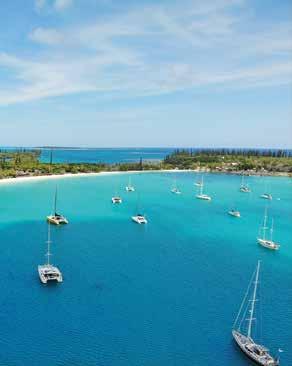
With New Zealand border restrictions easing, sailors are now taking the opportunity to set off and fulfil their cruising dreams. Island Cruising NZ has been running yacht rallies to the Pacific for over 35 years, and this year has two groups of vessels heading north to Fiji. The first group departed from the Bay of Islands at the beginning of May and the second group is leaving from Whangarei at the end of June.
If your vessel is ready and you’re able to spare the time away, it’s not too late to join the June departure. Island Cruising can help you through all the preparations to get offshore and assist you with the documentation for departing New Zealand and arriving in Fiji. Vessels are supported by a professional weather router providing expert advice on the best time to depart NZ and the conditions they can expect ahead, plus they also have a Passage Guardian service where the vessels are monitored and supported on the passage.
First look: Prestige M48
Prestige is acclaimed for crafting luxury motor yachts ranging from 4070ft. Now, the French brand is expanding into power catamarans. The expansion into the multihull market is a major step for Prestige. The recently unveiled M48 is the first model in Prestige’s new M-Line of power cats. The M48 offers an enviable on-water lifestyle thanks to generous living spaces full of natural light and luxurious finishes, with options for either three-cabin or four-cabin (plus skipper cabin) configurations. Contact Sundance Marine, the exclusive Australian dealer for Prestige to find out more.
Visit sundancemarine.com.au
On arrival in Fiji, participants are given a very special welcome. There is the option to cruise with the other rally participants or explore at your leisure.
One of the best things about a yacht rally is the friends you make along the way; other rally participants often become life-long friends. The Island Cruising shore crew will also be there to answer any questions and provide support. Group social events are planned on the way including Fiji Regatta week in September, where the rally boats will be joined by a group of sailors flying up from New Zealand. After the regatta, the fleet will head to New Caledonia where they have a month to explore this stunning destination before returning to New Zealand, or on to Australia, in October.
Love the sound of the rally but can’t make it this year? Looking ahead, next year’s Pacific rally will include Tonga, Vanuatu, Fiji and New Caledonia. Island Cruising NZ also have a rally to Japan in the pipeline – watch this space!
Visit www.islandcruising.nz
3.
Billfish Challenge turns 40
Now in its 40th year, the Billfish Challenge attracts teams of anglers from all over Australia to Townsville and is the annual showcase event of the Townsville Game Fishing Club (TGFC). The waters that surround Townsville not only offer a picturesque marine environment, but they’re also well-known for juvenile marlin and sailfish, which makes the location the perfect setting for an awesome billfish tournament. The Billfish Challenge is one of Australia’s longest-running billfish tournaments and, as previous participants would attest, it is also one of the most social events on the Aussie game fishing scene! This year’s competition will offer teams four full days of fishing between 15 – 20 August, with the champion team set to take home $10,000 in cash and prizes. TGFC is expecting more than 150 participants and over 30 boats to take part in this year’s Billfish Challenge, which will be based out of the Townsville Yacht Club.
Visit www.tgfc.org
Experts guide to
WINTER BOAT MAINTENANCE
AS A MARINE LOSS ADJUSTOR AND NZ COASTGUARD SENIOR MASTER, PAUL FIELD HAS A WEALTH OF BOATING KNOWLEDGE. HERE, HE SHARES SOME ADVICE ABOUT OFF-SEASON VESSEL MAINTENANCE, STORAGE AND PREPARATION.
As we start to see declining daily temperatures, with the evenings getting cooler and the days shorter, we boaties reluctantly have to admit the boating season is drawing to a close. The hardier among us will continue boating throughout the winter months, and to be fair, there are some stunning, often crisp and settled winter days, which can provide some amazing boating adventures during this period. Clothing choices become very important during this time though so if you plan on boating in winter please ensure you invest in good quality wind and waterproof clothing. Keeping the family warm and dry only enhances their boating experience too. However, a large proportion of boaties will look to lay up and place their boats in storage over the winter months. In this article, I thought it useful to share some advice and tips to help assist your craft maintenance through the wet and colder periods. So, read on and ensure your vessel will be ready, serviceable and raring to go when the temperatures start to climb once again.
Consider your storage location
For those fortunate to have enclosed garage storage for their vessels, the winter period tends not to be much of a problem, with craft securely tucked away from the elements. There are still a variety of actions you can take which we will cover off later. For many though, internal storage is not an option and as such, vessels are left outside during the wet and cold of winter. It is common in our profession to see an increase in deterioration-related issues with vessels during early spring. Often, these issues could have been avoided but for a few seemingly simple yet often missed considerations at the end of the previous summer period.
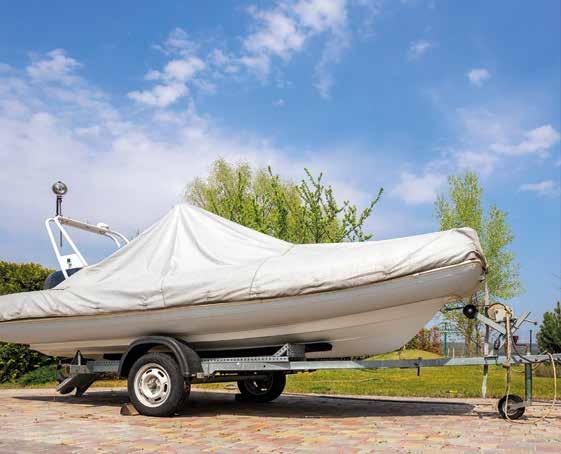
Invest in a suitable waterproof boat cover
When purchasing a cover ensure it correctly fits your craft and does not have large areas of sagging material where water can collect and pool. Consider creating a high point in the craft using a pole and soft pad to ensure good water run-off. There are a variety of designs
and styles on the market with wide variations in protection capability, hence we recommend talking with your local suppliers about the best available options for your vessel configuration. When the vessel is in storage it is important to have the bow slightly elevated so any water, which may sneak its way in, can run to the stern and vacate the craft.
Remove the bung!
We see a significant volume of cases where the bung has been studiously fitted in the craft and not removed following use. Many an inboard engine has become a total loss due to becoming submerged from the craft filling up with water due to the bung being left in. When you do remove the bung, consider attaching it to your steering wheel so it doesn’t get lost and also so it is in a very obvious place for reinsertion prior to your next outing.
Avoid parking your craft under trees that shed leaves
Professionally manufactured purpose covers for vessels are generally not cheap and the last thing anyone needs is staining or compromise from decaying fallen leaves or similar. We have even seen a few boats crushed from fallen branches during storms. We mentioned in our previous article security considerations with under-tree or obscured storage and this follows along with that too. Consider a nice open sunny storage location as this will assist prevent mould and algae cultivation.
Regularly check the craft over winter
Pests, rodents and or other vermin can look to use your vessel as a nice dry warm habitat, hence regular checking and strategic placing of baits and or traps is advised. Periodic checking of the craft also ensures your covers are still fitting correctly, noting heavy rainfall and strong winter winds can cause dislodgement. Even with the bung out of the craft, a regular check that the drain is clear of obstructions is advised as we have seen many a claim from leaf or bilge debris blocking discharge holes.
Consider using a dehumidifier
If practical and electrically safe to do so, consider placing a dehumidifier in the craft to keep the interior nice and dry. Not only does this protect your fabrics and furnishings but it also mitigates corrosion build up on electronics terminals and the like from perpetual dampness. We often advise customers that everything about the marine environment is trying to destroy your boat through such things as UV light and salt, wind, weather etc.
As vessel owners, we spend a lot of our time mitigating the effects of Mother Nature and when your boat is in storage this consideration is just as important to remember. Try to cover up your dashboard and use manufacturers’ electronics screens as sunlight and heat can fade and damage LCD screens.
Internal equipment
Regardless of your craft’s storage location of either internal or external storage, we recommend stripping out the vessel’s loose internal equipment and carpets over the winter period, if not for the full duration, then certainly periodically if possible. Not only does this provide a good opportunity to give all the carpets a good
steam clean but it also gives areas of the vessel a chance to fully dry out – even some of the more obscure remote areas in the boat. As mentioned above, the use of a dehumidifier is invaluable in this application too.
Prepping for winter can be used as a great trigger reminder to check the condition and currency of onboard equipment such as fire extinguishers, life jackets, buoyancy aids, lines, water toys, flares, and any similar such equipment.
Batteries are a common item forgotten during wintertime. Such a crucial piece of onboard equipment is often found left in vessels in the dampest location which is not ideal for battery life and ongoing preservation. With the vessel being stripped down for winterising, take this opportunity to check the expiry date of your batteries.
Either look to regularly give them a good bench charge if they are still in good serviceable condition or alternatively talk to your local retail supplier about replacement with suitable equivalent options.
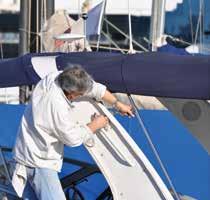
BELOW LEFT: ENSURE YOUR BOAT COVER CORRECTLY FITS YOUR CRAFT.
BELOW RIGHT: BOOK IN MAINTENANCE AND SERVICE CHECKS OVER WINTER.
TACKLE THE WEEKEND HEAD ON
Don’t forget your gear
We have often seen claims from vessel owners who have had their fishing equipment stolen from their vessel while left in storage at their premises. Such gear is portable and easily cartable and therefore unfortunately a target for thieves.
Removing all gear from your vessel alleviates this risk. It is also a prudent time to get your reels serviced in preparation for the next season. A winter recce of your tackle box and stocktake of your fishing equipment can be used as a good reason to “need” to visit your local fishing retailers for all those essential must-haves.
Book in maintenance and service checks
We know the busy periods in the marine industry, they are the same, year in year out. Yet each and every season we see a rush to get boats prepped and in the water for essential summer boating and family activities. Talk with your service agents early and book your craft in over winter for its annual mechanical check-up and service and avoid the rush.
Winter is also an ideal time to do your trailer maintenance. The craft will have hopefully seen many an outing over the summer period,
hence winter is the perfect time to have your service agents check such things as the overall condition of the chassis, axles, u-bolts, couplings, duro torques, wheel bearings, brake systems and similar.
Parts availability for all brands and supply are stretched with the impact of COVID globally. Hence if any major part is found necessary, having some time up your sleeve to allow lead times is essential. Waiting for a part to come from overseas when the sun is out, and the water is flat and calm is not good for anyone’s disposition.
Education courses
While the weather is often not the most favourable for boating during the winter months, consider undertaking a boating education course through a variety of local agencies.
There are a wide number of courses available in all manner of boating aspects. Even a basic refresher course on ‘Rules of the Road’ and general vessel operation can be beneficial. Equally, consider getting the family involved in an educational course or two as this will collectively have everyone better prepared for the upcoming season.
SHELLHARBOUR
With a few simple precautions you can ensure your prized craft is ready and serviceable when the weather starts to improve following winter. Hopefully, this article has given you a few strategies to help protect your vessel and assist with scheduling maintenance works with your service agents over winter to prevent the spring boating preparation rush.
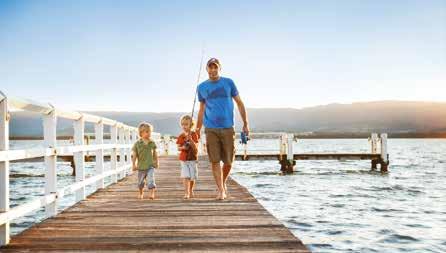
Jetty Lake Illawarra
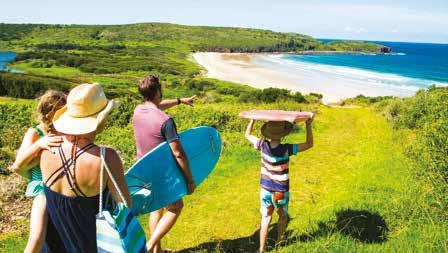
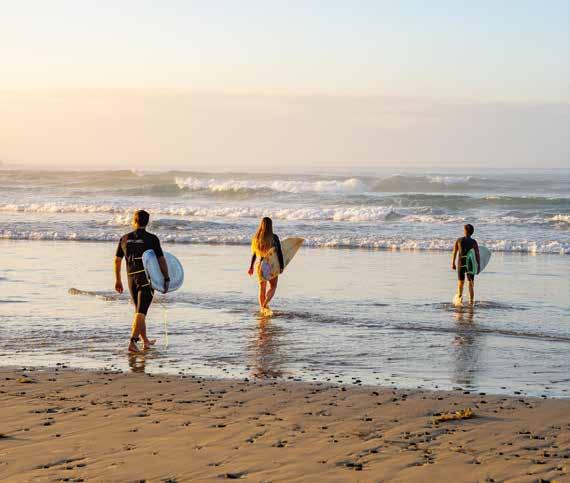
Surfing “The Farm” Killalea
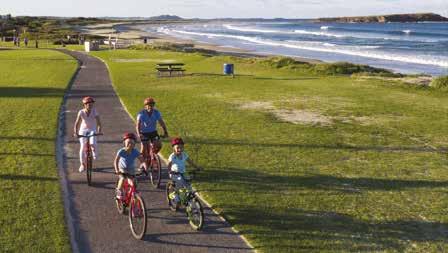
Waterfront Dining Shell Cove
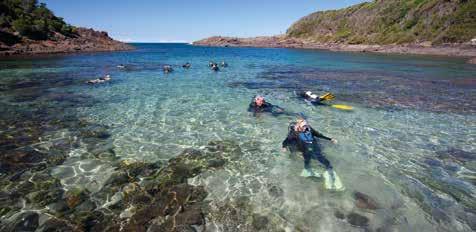
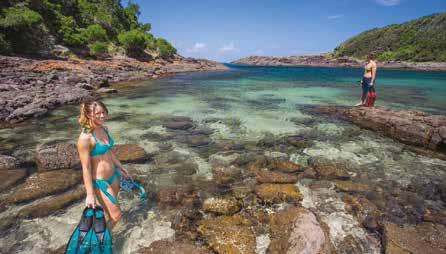
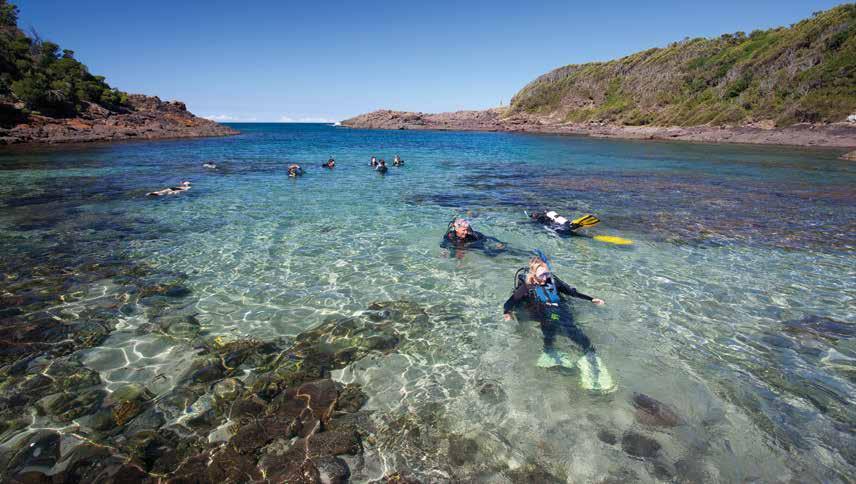
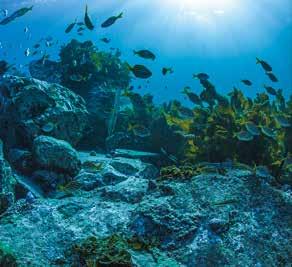
Snorkelling Bushrangers Bay
Cycling Warilla Beach
MAIN: WINTER BOAT MAINTENANCE.
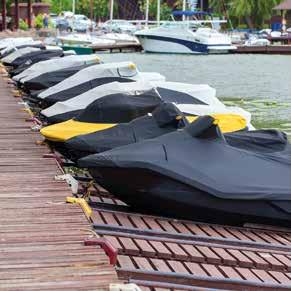
BELOW: PERSONAL WATERCRAFT COVERS.
Marina
MAGIC
WE CHATTED TO SHELLHARBOUR MARINA DIRECTOR LES BINKIN TO FIND OUT ABOUT THE AMAZING LIFESTYLE ON OFFER AT THE NSW SOUTH COAST’S LATEST BOATING DESTINATION. BY SARAH RANAWAKE.
To describe Shellharbour Marina as highly anticipated would be something of an understatement. In fact, when this stunning new marina and harbour opened on the NSW South Coast last October, it was the realisation of a shared vision three decades in the making. We caught up with Shellharbour Marina Director Les Binkin to find out more about this impressive new marina, which offers an amazing on water lifestyle.
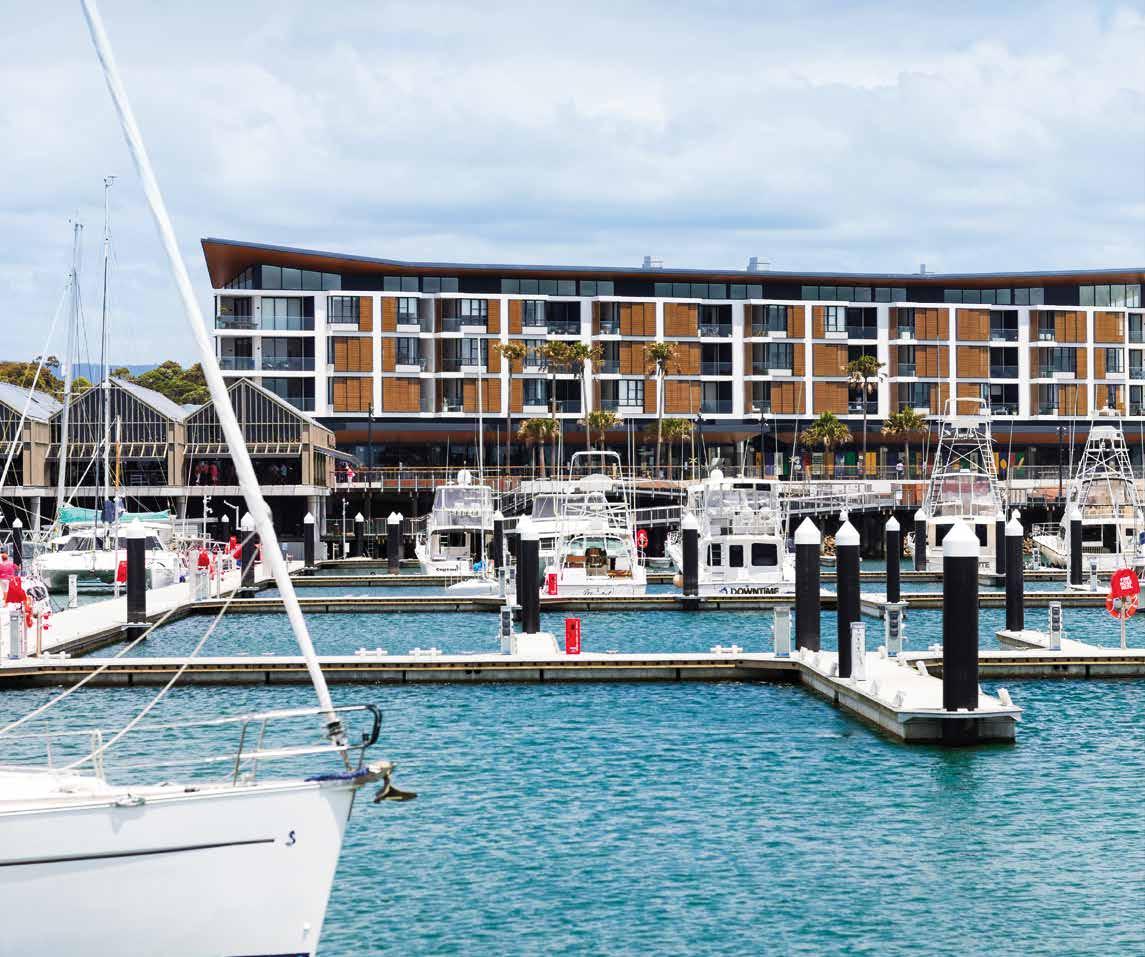
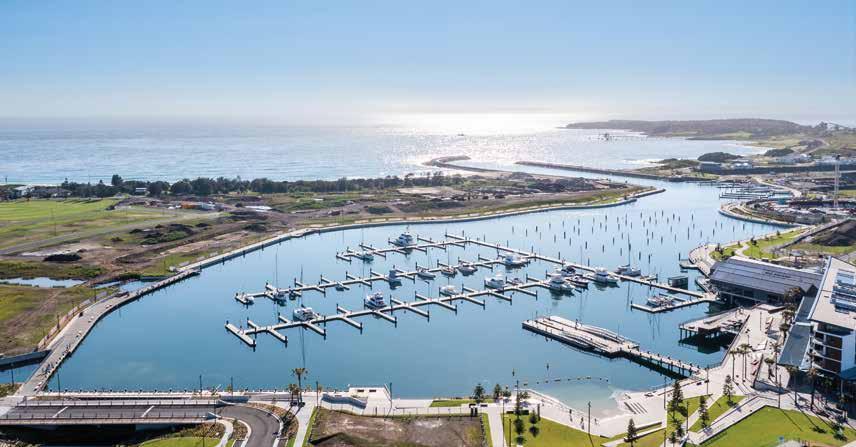
MAIN: SHELLHARBOUR MARINA.
OPPOSITE: SHELLHARBOUR MARINA DIRECTOR LES BINKIN.
What factors make Shellharbour Marina special?
Shellharbour Marina is unique on the NSW South Coast. It is the flagship of The Waterfront, Shell Cove, a major coastal master-planned development located within the Shellharbour local government area. The man-made in-shore harbour provides safe haven for vessels within the 270 berth marina. We’ve had some significant storm events this year alone and Bellingham Marine’s marina structure performed perfectly. We’re also lucky to have staff with a wealth of marine industry experience.
We’re situated within Shell Cove Harbour, which has direct access to the Tasman Sea. So, you can come straight out of open water and within about 500 metres you’re in a safe and very well protected harbour. The marina is just 50 nautical miles south of Sydney Harbour, 30 nautical miles north of Jervis Bay, and only 213kms, or 2.5 hours drive, from Canberra. So, you have that easy access to both Sydney and Canberra, and we’re a good base to explore the rest of the NSW South Coast.
The Waterfront Dining Precinct is literally just metres away from the marina. Easy access to these shopping and dining options is a real asset, and something many marinas don’t have. It’s particularly appealing to cruising vessels. If you’re coming through for a night or two, you don’t need a car to reprovision your
boat or enjoy a great meal. We also have a beautiful boardwalk area around the foreshore which is nearly 3km long leading you on walks to two pristine surf beaches and the Bass Point Reserve.
Can you share some background on the history of the new harbour, marina and surrounding community?
In the early 1980s as a result of the downturn in steel manufacturing, Shellharbour City Council considered options that would help stimulate the local and regional economy. Council embarked on one of the most ambitious development partnerships in the history of Australian local government. They moved and rebuilt the former golf course in a new location nearby to accommodate the project. We now have a very well-regarded golf course, The Links Shell Cove (linksshellcove.com.au), which is another drawcard for boaties who also like golf. If you remember to pack your golf clubs on your boat and want to play a couple of rounds of golf, that’s something our marina staff can arrange for you.
Talk us through some specific features of the marina.
Stage one of the marina opened in late October 2021, with 145 berths. Our fuel system opened in stage one with both high and low
flow diesel (40, 80 and 160 litres flow per minute) and pulp petrol. By the end of 2022, we will have our Marina Services Building delivered. This will have all the client amenities such as a club lounge and bar, commercial laundry, individual and family ensuites and food preparation facilities. It will also be the new home of our marina office. There will also be storage available for clients who want to store equipment or gear while going out on a day cruise.
Stage two of the marina will come in late 2023, with an additional 125 berths being added. In 2024, our Boat Maintenance Facility and dry storage will open. This will include a 120 boat dry stack, undercover work area for 30 metre boats, and a 100 tonne Travel Lift, catering to vessels up to 8.9 metres wide and 98ft/30m in length. It’s a very wide travel lift which makes it perfect for the catamaran market. We will also have a full suite of marine services, commercial tenancies, and chandlery spaces in that building as well. It’s a line-up that we hope will attract boats from all over the country to Shellharbour Marina.
You highlighted the experience of your staff. Why is it so important to have well-trained and professional marina staff?
The training and professionalism of our staff is a huge part of the marina experience – it ultimately works to the advantage and benefit
An exciting development for boaters
“New marina developments in NSW are few and far between, so Shellharbour Marina is an exciting development for boaters and the local community,” says Marina Industries Association CEO Suzanne Davies. “The marina is an accessible berthing location for boaters across the Illawarra, NSW South Coast, and Canberra. It’s a great destination and stopover for those transiting along the NSW coast who require refuelling and need to stock up on provisioning. The development of the boatyard and drystack will also see it become an ideal place to stop for maintenance.”
of our clients and their boats. With a combined 50 years’ experience in the marina industry, our management team is highly experienced in marina operations and boatyards. Ben Schooley, our General Manager at Shellharbour Marina and myself are both Certified Marina Managers (CMM). This is an internationally recognised qualification awarded through the Marina Industries Association (MIA).
The professional development of all our marina staff is also a high priority. Our staff participate in MIA training courses and programs, covering topics such as storm preparedness and environmental spills. This not only ensures that our customers and their boats are well taken care of, but industry best practice also helps our staff protect this beautiful and diverse environment.
Many of our readers are also fishos. We’ve been told that the offshore fishing around Shellharbour is pretty great?
It definitely is. We already have a number of clients who love fishing and we really want to encourage game charter boats to consider basing themselves out of our marina as well. One of the reasons the fishing is so good here is because the continental shelf is fairly close. It’s only about 20 miles offshore. There’s also a lot of bottom structure out there. That lends itself to some great offshore fishing!
The Shellharbour Game Fishing Club (www.shellharbourgamefishingclub.com.au)
held their Blue Water Classic here in March. It was their first fishing competition to be based out of the marina. The lucky winner took home a $50,000 prize for catching the heaviest marlin which was over 220kg!
We’ve also heard a range of marine life already call Shellharbour Marina home?
With the harbour’s close proximity to Bass Point Reserve and Bushrangers Bay Aquatic Reserve, marine life has quickly flourished in the marina. Grey nurse sharks have called our harbour home since it opened, which is fantastic. We have also seen penguins, dolphins, turtles and seals, at times just outside our marina office.
We’re very conscious of looking out for our environment and think it speaks for the quality of our water and how the marina structure has created its own eco-system. It shows marinas can work together with the environment.
Highly experienced and friendly staff. High and low flow diesel (40, 80 and 160 litres flow per minute) and pulp
Pump-out available. Restaurants, bars and shops for provisions just metres from marina. Travel Lift, dry storage and full service boatyard coming soon.
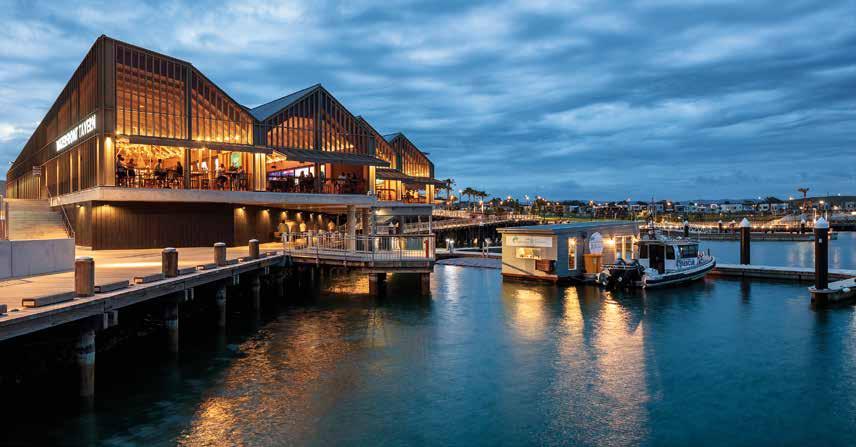
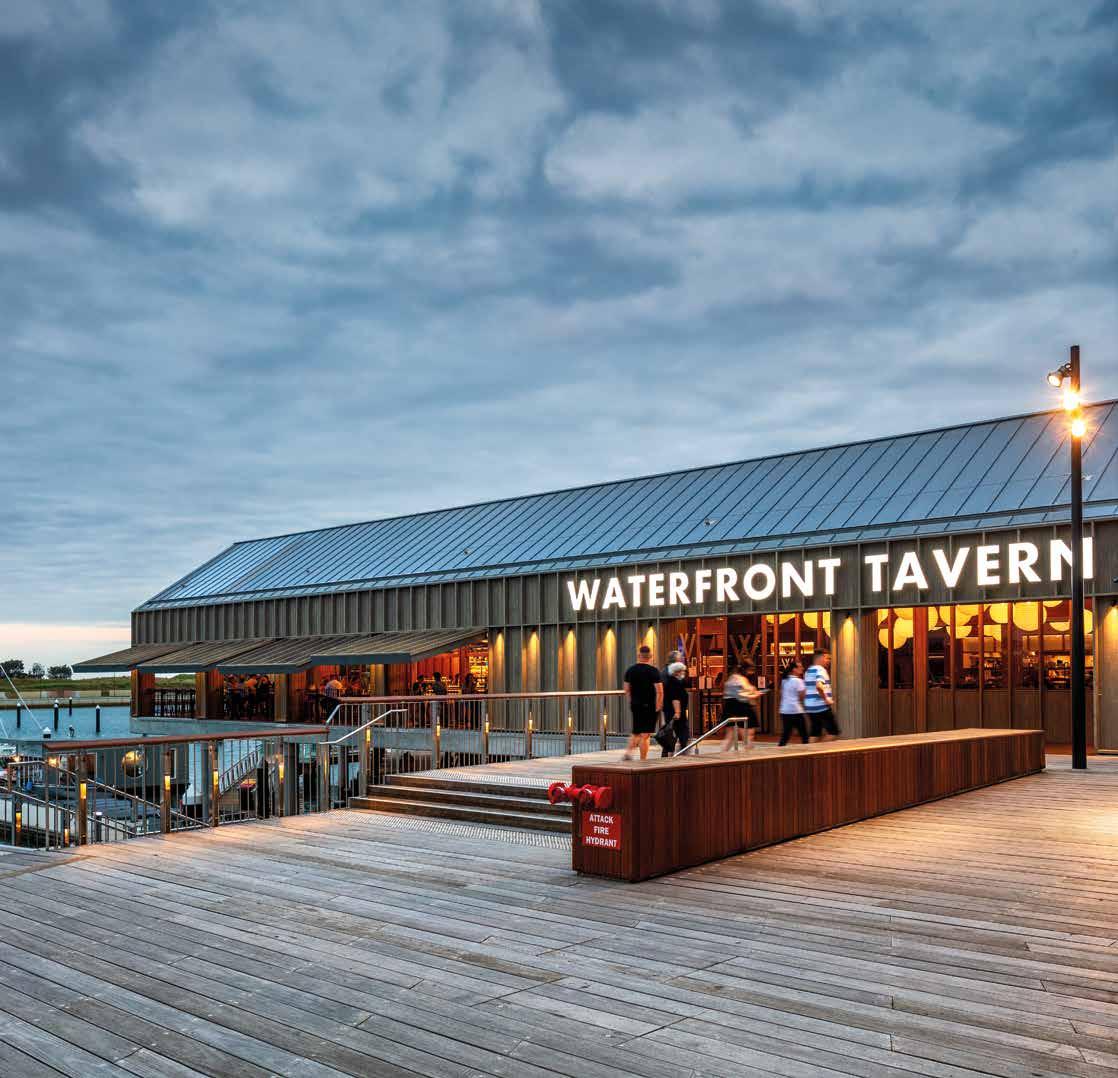
SHELLHARBOUR MARINA AND THE WATERFRONT TAVERN LIT UP AT NIGHT.
Harbourside Living on the South Coast
Shellharbour Marina is one of many drawcards of The Waterfront, Shell Cove, a master planned community developed in partnership with Shellharbour City Council and Frasers Property Australia. We asked Mathew Gulliver, Development Director – Frasers Property Australia, a few questions about this new boating and lifestyle destination.
How unique is it to have a worldclass harbour and marina at the heart of this community?
There is no other community like The Waterfront, Shell Cove on the New South Wales South Coast. It offers a relaxed oceanfront lifestyle with all the boating services and facilities you could need. For boaties, The Waterfront, Shell Cove is an easy drive or cruise to Sydney, and will offer all the services of a major city marina, without the city congestion.
What makes The Waterfront, Shell Cove and the wider Shell Cove area such an appealing area to call home?
There are many attributes that make The Waterfront, Shell Cove a great place to live. With the brand new harbour and marina, The Waterfront Dining Precinct and Tavern all on the harbour’s edge, The Waterfront, Shell Cove is a unique destination on the New South Wales South Coast.
Surrounded by attractive boardwalks, pristine beaches, a state park to the south, an 18-hole golf course, and all the retail conveniences at residents’ doorsteps, it’s a great place to relax when you’re not on the water. A safe harbour between Eden and Sydney, access to a regional airport, and an easy commute to Sydney and Canberra, the community was already an attractive lifestyle option for people in the region. The impact of the pandemic and the broad embrace of flexible working has seen demand intensify.
Can you share a snapshot of the properties on offer at The Waterfront, Shell Cove?
The Waterfront, Shell Cove offers a range of housing options including land lots, homes, and apartments, and there are properties to suit all buyers. We have architecturally designed homes in 2, 3, 4 and 5 bedroom configurations on offer this year.
A new apartment release is coming soon in July, with 2 and 3 bedroom apartments fronting the marina, offering Illawarra escarpment and Shellharbour Marina views, so people can live right next to their boat. Land lots will be available next year near Shellharbour South Beach, where people can build their dream home.
Since the harbour and marina opened last October, Frasers Property has seen demand intensify for all home types on offer. Releases of homes, apartments and land lots in 2022 and 2023 will be sold by ballot, so anyone interested should register online at thewaterfrontshellcove.com.au
What kinds of buyers are you seeing being attracted to The Waterfront, Shell Cove?
People at every stage of life are attracted to the beautiful natural setting and its abundance of open spaces, all within walking distance. The attractiveness of The Waterfront, Shell Cove throughout the region as both a tourism destination and a community has grown. We’ve seen a growing number of purchasers from Sydney and South Coast locals recognising the valued lifestyle on offer.
It also seems like a perfect holiday base or second home, especially for those who enjoy a boating lifestyle... It is. You can have a high quality home or apartment in a master-planned community, with unrivalled amenities and convenience on the waterfront. The South Coast has a pristine coastline and a home at The Waterfront, Shell Cove is a comfortable drive to Sydney.
Lastly, can you give us an update on what’s new at The Waterfront, Shell Cove right now? And what’s coming up for the second half of 2022 and beyond?
It’s another big year of events! The Marina Services Centre is currently under construction and will open later in the year. For the community, the inaugural Food and Wine Festival is planned for later this year, and there’s a full timetable of community events and markets. Looking further ahead, the library and community centre are set to open in 2024.
Crowne Plaza will also be opening a hotel at The Waterfront, Shell Cove in 2025.
For more information visit thewaterfrontshellcove.com.au or call 13 38 38 (in Australia).
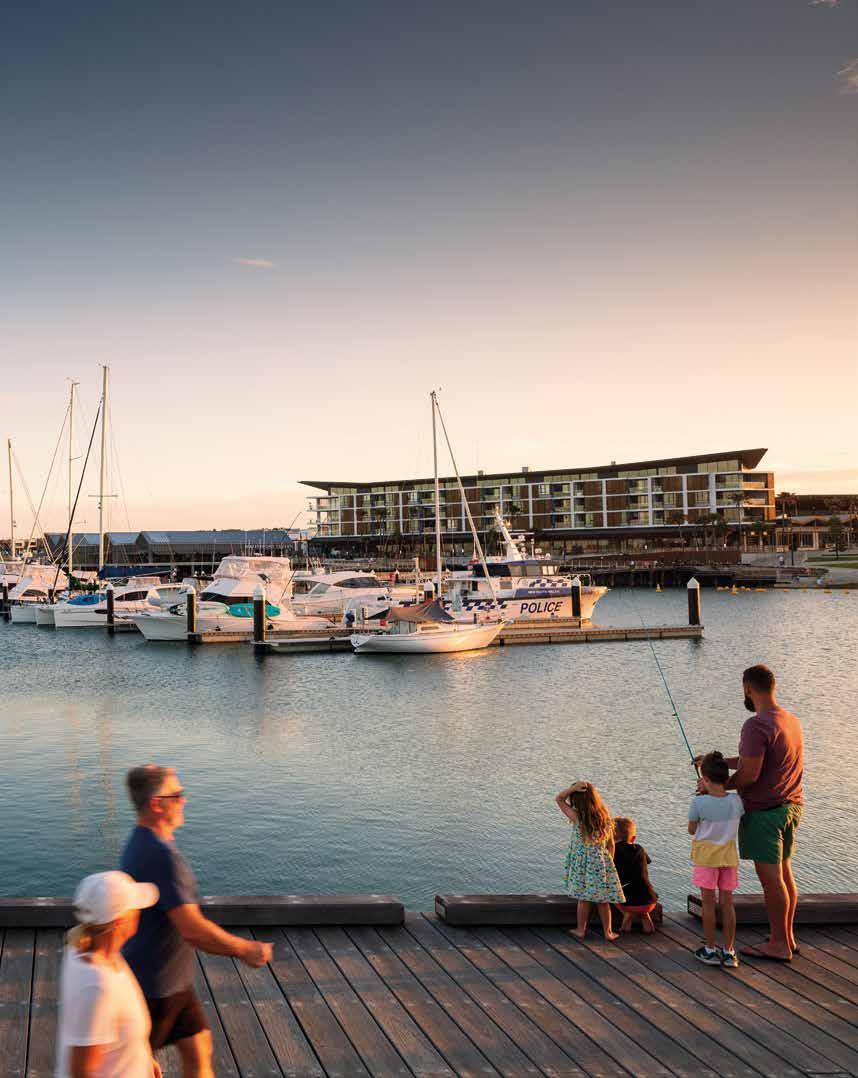
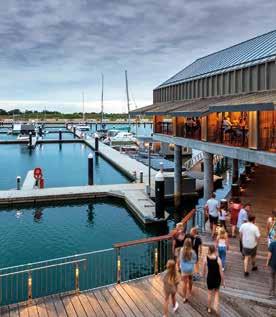
MAIN AND OPPOSITE: THE WATERFRONT, SHELL COVE OFFERS A RELAXED BOATING LIFESTYLE.
Scan to find out more about The Waterfront, Shell Cove.
WE’ VE TEAMED UP WITH THE CREW FROM BOATING APP DECKEE FOR THIS COLUMN TO HELP YOU STAY SAFE AND ENJOY BETTER BOATING.
Boating by Numbers
Over 1 million Australian’s have a boat licence. 62% of all hulls registered in Australia are aluminium.
Fast 5: Perfect your docking technique
1. IT’S NOT A RACE: Have lines and fenders laid out and have your crew in place before you even begin your approach. Many experienced boaters fall into the trap of trying to dock too quickly and rush the process.
2. APPROACH AT A SLIGHT ANGLE: Approaching a dock at a 10-20 degree angle is a good rule of thumb to compensate for a change in wind conditions. If the wind is pushing the boat away from the dock, maintain your speed while adjusting your angle of approach to head more into the wind.
3. PAY ATTENTION TO THE CURRENTS: Use the current to your advantage as it is more likely to affect your speed and control. When you are two to three
boat lengths away, use power sparingly as you drift towards the dock, using prop thrust to adjust direction and current as a braking mechanism.
4. EASY DOES IT: It is important to go slow as you draw alongside the dock. Avoid oversteering when in neutral. Turn the wheel away from the dock to swing the stern in, then turn the steering wheel toward the dock with a light touch in reverse to draw the boat parallel to the dock.
5. COMMUNICATION IS KEY: Providing clear instructions to your crew can help give everyone onboard an understanding of their roles in the process. If you are solo boaters don’t be afraid to ask for assistance from dockhands or fellow boaters.
Boating in winter
The Deckee crew share some advice to help you get out on the water safely this winter.
The days become shorter and the temperatures drop, but winter still offers some great opportunities out on the water. Boating in winter usually means less crowded cruising grounds and fresh conditions. Braving the elements in the colder months isn’t too hard as long as you prepare ahead of time. Setting realistic trip goals will ensure that you and your crew stay safe and enjoy your time together. Here are some tips for boating safely and comfortably in winter.
1. Prepare your boat
Before you leave the dock, do a once-over of your boat to check everything is in tip-top shape. It gets harder to maintain your boat in winter. In particular, engines are harder to turn over in the cold because the oil thickens and requires more power to start. If you plan to do a lot of winter boating, install a solar panel for power all year round. Keep your lines dry by storing them correctly.
2. Make realistic plans
Plan shorter trips and if you do plan on doing longer trips, set off at sunrise and arrive before dark to avoid being in the chill for longer than necessary. Log your trip and let someone know where you are going and when you will be back.
3. Check the forecast
Monitor the weather conditions for any cold fronts. If in doubt, don’t go out. When checking the forecast don’t just look at the temperature, keep an eye on the wind speed and direction, as well as tide times, swell height, sunset and sunrise times. This will help decide when to return from your trip.
4. Dress for the conditions
Wearing appropriate clothing for cold weather conditions should be a top priority.
Choose a comfortable base layer that allows you to add or remove other items of clothing easily should the conditions change. Bring a waterproof jacket with you and additional protection like gloves and a balaclava should you need it.
5. Keep as warm as possible
Hypothermia can set in surprisingly quickly if not closely monitored. Keep yourself and your crew out of the cold as much as possible. Keep hot drinks and food readily available and have dry protected areas and blankets for warmth. Consider covering the cockpit so those at the helm or assisting with navigation are not exposed to the elements for long periods of time.
6. Avoid cold water
It’s an obvious one, but it’s easier said than done when boating. Weatherproofing your boat prevents passengers getting soaked and feeling miserable. Check your drains, portholes and seacocks. Unexpected falls into cold water can be deadly, and cold shock can cause unconsciousness, or can affect your ability to breathe and swim. We recommend you and your crew always wear a life jacket.
Deckee is the free boating app for local information, trip logging, weather, navigational aids and official alerts and notices. The Deckee app is available to download on iOS and Android. Visit deckee.com
OF THE UTE YEAR
“MORE THAN 12 MONTHS AFTER ITS INITIAL RELEASE, THE ISUZU D-MAX IS REALLY STILL QUITE IMPRESSIVE. IT’S STILL RIGHT AT THE TOP OF THE SEGMENT IN JUST ABOUT EVERY DISCIPLINE.”
Trent Nikolic, Managing Editor, DRIVE
Offshore
ADVENTURES
WE TALK TO MARITIMO HEAD OF DESIGN, TOM BARRY-COTTER, ABOUT THE NEW M600 OFFSHORE FLYBRIDGE AND S600 OFFSHORE SEDAN MODELS FRESH FROM THEIR GLOBAL LAUNCHES AT SANCTUARY COVE INTERNATIONAL BOAT SHOW. BY SARAH RANAWAKE.
Maritimo just held the global launch of the M600 Offshore Flybridge and the S600 Offshore Sedan at Sanctuary Cove International Boat Show. How excited were you to finally reveal these two models?
We were very proud to globally launch these new models at Sanctuary Cove International Boat Show. The team has worked incredibly hard over the last few years on this project, so to see owners with M600’s and S600’s on order walking aboard and experiencing these boats is very satisfying for the entire team.
The M600 and the S600 are the latest Offshore models. Can you share some background about the Offshore series?
Maritimo has had a combination of specific offshore fishing models as well as customised Flybridge Motor Yacht models reconfigured for fishing over the years. The Offshore Series was born over a decade ago with the launch of the heralded Maritimo 550 Offshore.
What customer needs were you aiming to tap into with these two Offshore models?
With growing demand for offshore fishing capabilities and enclosed cockpit space, it was very evident that we needed a specific model within our model lineup. The 600 Offshore was developed for owners looking to use their boat for more serious fishing, but had all of the comforts and capabilities of our current long-range motor yachts. The offshore cockpit provides not only fishing functionality, but also offers solid separation between the cockpit and the water for those wanting the more encapsulated cockpit space.
These Offshore models offer customers a unique combination of luxury cruising and serious offshore fishing vessel, don’t they?
OPPOSITE: M600 OFFSHORE FLYBRIDGE.
Yes. The Offshore Series does exactly that. These models combine all of the necessary features for long-range coastal cruising with the ability to be used for some serious fishing. By being long-range motor yachts, they also open up further fishing destinations. These motor yachts offer comforts for families and friends to enjoy which are not featured within a conventional sport fishing boat.
LEFT: TOM BARRY-COTTER.
What role did customer feedback play in developing the M600 and S600 Offshore models?
The 600 Offshore models have been in development since 2019 with customer feedback playing a large role throughout development. Maritimo’s design team and wider network rely heavily on feedback and input from owners, no more so than with the Offshore Series where fishing functionality is so important.
What types of customers will these Offshore motor yachts most appeal to?
The Offshore Series combines the comforts of a cruising motor yacht with the features needed for more serious fishing. Maritimo’s Offshore Series appeals to those who already value the Maritimo difference, in owning a motor yacht that is capable of long-range offshore cruising, with dependable shaft-drive engineering, and high-quality craftsmanship, combined with the expansive offshore cockpit which can be used for fishing, or a range of other uses.
How do you imagine customers using their M600 or S600 Offshore vessel?
These owners may do anything from weekend, or day fishing trips, to longer expeditions to further away destinations for relaxation, or to go where the fish are. By including the comforts of a motor yacht, it means it is not just those who are fishing can enjoy it, there are all the comforts there for the family to join in.
Why are these two Offshore motor yachts so well suited to our Australian and New Zealand waters?
Like all Maritimo motor yachts, the Offshore Series has been made for Australian and New Zealand conditions and style of boating. Our motor yachts are highly economical and set up for long-distance offshore cruising, which is vital within the Australian and New Zealand markets. All Maritimo motor yachts are also designed around extreme climates, so there is plenty of protection and comforts built-in to keep all aboard comfortable and protected from heat, sun, wind, cold, rain, bugs, whatever it may be.
Let’s talk about power and tech. How do these models stack up in terms of performance?
Maritimo motor yachts are well renowned for their performance and economy. The Offshore Series is no exception. There is the more fuel economic base option for those looking to do more long-range cruising, and then there is the Scania and MTU options that offer greater performance.
What are some of the most exciting options available?
There are a range of options for serious fishing enthusiasts like game towers and game poles, to a number of fish chair options in the cockpit. Maritimo can also cater to other specific requests, as with the M600-01, where we have added an additional 4000L fuel tank to enhance the boat’s long-range capability even further.
On a personal note, are you a fan of fishing?
am a big fan of sport fishing and admire the passion that enthusiasts put into it. In saying that, I have only fished a handful of times, and can guarantee that they won’t be biting if am fishing!
Should we expect more Offshore news from Maritimo in the future?
There certainly will be more Offshore Series models in the future.
For more information on the Maritimo Offshore series, visit www.maritimo.com.au or call: +61 7 5588 6000
MAIN: M600 OFFSHORE FLYBRIDGE.
TOP RIGHT: FLYBRIDGE HELM LOUNGE.
BOTTOM RIGHT: FLYBRIDGE SKYLOUNGE.
Flying
HIGH
WITH SAILGP BACK ON AGAIN FOR SEASON 3, WE CATCH UP WITH AUSTRALIAN SAILGP TEAM FLIGHT CONTROLLER AND OLYMPIC SILVER MEDALLIST JASON WATERHOUSE. BY SARAH RANAWAKE.
Can you talk us through your earliest memories of sailing (or boating) and being on the water?
My earliest memories are sailing with my parents around the world on our 40-foot yacht across the Pacific to Australia. It was a yearlong trip from when I was four years old.
Who taught you to sail?
My mum and dad taught me how to sail as they are both world champion sailors in the catamaran class plus my grandparents sailed. I guess you could say sailing is a family legacy!
When did the passion to pursue a career in sailing kick in?
My mum and dad were my heroes in sailing. My dad is not only a really talented racing sailor but also an endurance sailor. wanted to be just like my dad growing up so it was a no brainer that I would pursue this as a career.
Can you give us a bit of a snapshot of your sailing career up to this point? got into racing when I was quite young, winning the Youth World Championship in Brazil in 2009 in the Multihull Class. From there went into training for the Olympics. won silver at the Rio Olympics in the Nacra 17 Class in 2016 with my cousin Lisa Darmanin. I then represented Australia in the Youth Olympics and had the opportunity to compete in the 2017 America’s Cup in Bermuda onboard Softbank Team Japan. All of these experiences led me to join SailGP in Season One as their Flight Controller, which I did alongside training to compete in the 2021 Tokyo Olympics.
Any sailing role models who have had an impact on you over the years?
My dad and also Darren Bundock, who was an idol of mine and became my coach. He won two silver medals in the Multihull class in the Beijing and Sydney Olympics.
Talk to us about what it was like to win a silver medal at the Rio Olympics?
It was a bittersweet moment. I was of course so happy to win a medal at our first Olympics but being one point off winning a gold medal was a hard pill to swallow. It definitely made me more hungry for success. The atmosphere in Rio was amazing. The Olympics had a very different feel but for us it was business as we were so focused and had our heads in the game. It’s more on reflection that you get to sit back and acknowledge how incredible an experience it was.
How does the family connection enhance your sailing partnership with Lisa?
It was a really cool family moment to experience the Olympics as cousins. We are obviously very close on and off the water which I think makes it easier to race in a team.
We have sailed together since 2008 and that long partnership helps to develop trust and communication.
Let’s talk about SailGP. What was it that initially made you want to get involved?
Being an Olympic representative in the Multihull class I obviously wanted to be involved in SailGP. When I heard the crew list that Tom Slingsby was pulling together I knew he had a fiercely competitive and strong team and naturally I wanted to be a part of it.
What different elements do you get out of both SailGP and the Nacra 17?
It’s a very different experience going from a skipper leadership role in Nacra to going to a crew role in SailGP. Having that Multihull background has really helped me in the position of Flight Controller as it’s based on a lot of intuition and feel for the boat.
In your opinion, what factors have made SailGP so successful with such wide appeal?
think the travelling world circuit is really cool as it gives exposure to new fans around the world and gives you a consistent circuit to follow. It’s high performance racing and in my opinion, awe-inspiring to watch. Also, with the boats all being one design it means that it all comes down to the sailors’ skills and how they work as a team.
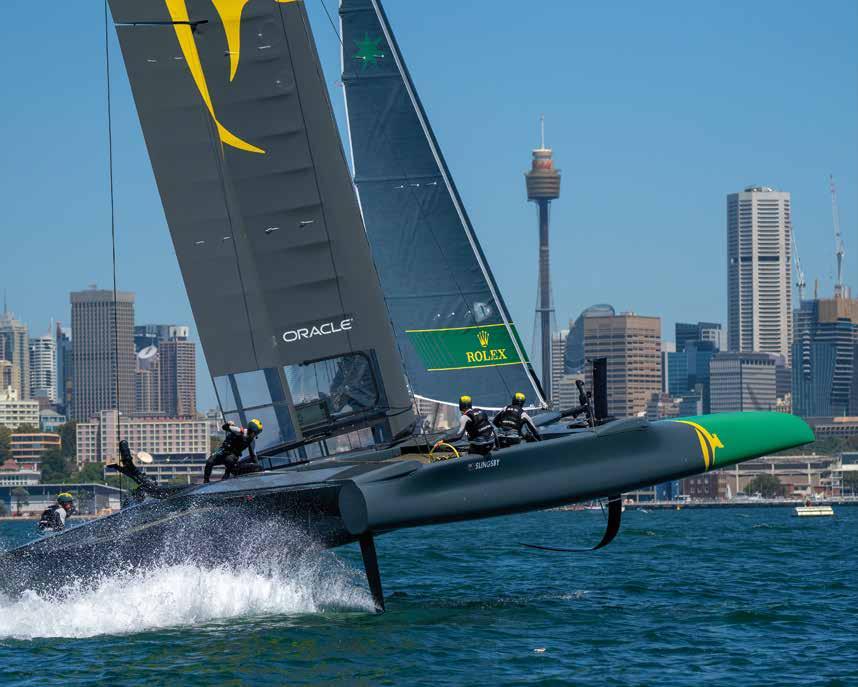
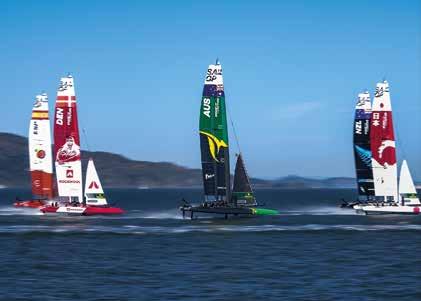
MAIN: THE AUSTRALIA SAILGP TEAM ON SYDNEY HARBOUR.
OPPOSITE: JASON WATERHOUSE.
Can you tell us more about your role in the Aussie team? What do you love most about it?
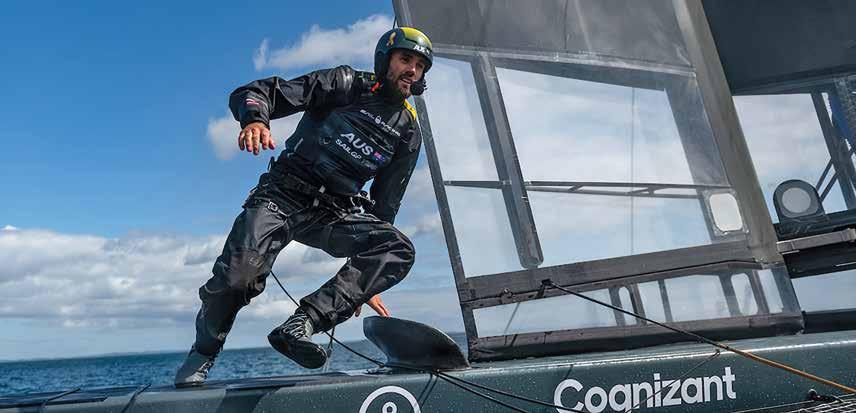
My role as Flight Controller is to control the hydrodynamics of the boat and make sure that the hulls do not touch the water, thus keeping the boat and the crew nice and fast and of course dry. love that it’s a super unique role. There is nothing in sailing quite like it. The pressure it places me under is an adrenaline rush, which as an adrenaline junkie, love.
Having won SailGP two seasons in a row, everyone definitely has their eyes on the Aussie team coming into Season three. Does that add extra pressure or is it just motivation? feel that now that we have won it twice the pressure has actually lifted. It proves that season one wasn’t a fluke and rather that we are the dominant team. That definitely gives us confidence going into the season ahead.
What are you personally hoping to achieve in SailGP coming into the new season?
We of course want to win season three. I also want us to grow as a team and continue to improve how we sail.
Any other future sailing goals outside SailGP? Will you set your sights on Paris 2024 for the Nacra?
A gold medal in the Olympics is a potential goal for the future but there are a few other projects going on which are also keeping me busy.
What lessons has SailGP taught you about teamwork and friendship that could be applied to other areas of life?
I’m lucky to have amazing professional sailors sailing with me who have become mates and help me to look good at my job. I have learned that having a good team culture helps to produce results and at the same time having your team hold you at a high standard is really important.
Any secrets or advice for handling stress and staying cool under pressure?
‘Remember to do your job’ is my motto I like to say to myself and my teammates. Just focus on that not on others. Trust that those around you are doing theirs. When the pressure is on don’t put the blinkers on. Try and relax the shoulders and take your environment in around you, whether you are racing for a Milkybar or $1million dollars.
How important is it to have pathways for young Aussie sailors who want to pursue professional sailing careers?
It’s super important. I was very lucky to have support from Australian Sailing and the Australian Institute of Sport to help me upskill myself and also financially support my endeavours at a young age. For me as a sailor I’m always trying to improve so I can forget that I might be seen as a role model. think we need to give back to the sport and build a legacy which is what our team wants to do.
The SailGP Inspire Program is doing a great job of providing opportunities for aspiring professional athletes in the league but also engaging with the sport on a grassroots level.
What inspires you most about sailing?
For me it’s incredible to be at the top of your game in anything. Being able to compete and really devote myself to this sport is pretty special. Sailing satisfies my competitive hunger which is what gets me out of bed every morning. I’d also say that the sport offers amazing opportunities to travel the world and meet inspiring people who are a part of the sailing community.
Sailing continues to evolve in terms of technology advancements. Can you give us your thoughts on that balance between technology vs nature that will always factor into sailing?
The adoption of foiling in the last decade has been very exciting. The fact that boats are going up to 100km an hour has turned the sport into a white-knuckle riding extreme sport which is needed to attract new fans and the next generation.
In your downtime, would we still catch you on the water?
Definitely! I do the twilight sailing with my family on Pittwater [on Sydney’s Northern Beaches] with my younger nephew steering the boat and yelling at me to do my job better, which is fun.
Follow Jason Waterhouse on Instagram (@jaswaterhouse)
Follow the Australia SailGP Team on Facebook and Instagram @SailGPAUS
Away from sailing do you like to get out on the water doing any other on-water activities?
do kite surfing and also love to surf at Avalon Beach.
Environmental conservation is something SailGP is actively involved in. Talk to us about this issue and why it’s so important to you?
Our team is passionate about using our platform and voices as athletes to create a greener future for our kids and their kids. Plastic pollution in the ocean is one of the biggest threats facing our planet and we want to educate the next generation on how they can be a part of the solution. Sport has the power to create change. With our partners like Parley For The Ocean, we can turn the ocean cause into a truly global movement.
Can you share with us some of your favourite places to sail?
You can’t beat Sydney Harbour. In my opinion it’s one of the top sailing venues in the world.
If you had to sum up your approach to sailing in a sentence what would it be?
Nothing is given, everything is earned.
What is the best advice you could hope to give an up-and-comer just making a start in sailing?
Sail as many different types of boats and do as many different styles of racing as you can.
What is one thing our readers might be surprised to learn about you?
am a terrible cook, but I watch YouTube cooking videos.
Favourite book you’ve ever read? Open by Andre Agassi.
Describe your perfect weekend. Hanging with my wife Kat, eating almond croissants and surfing on Avalon Beach.
What would you spend your last $50 on?
A good coffee!
Scan to find out more about the Australia SailGP Team.
ABOVE LEFT: JASON WATERHOUSE IS THE FLIGHT CONTROLLER FOR THE AUSSIE TEAM.
ABOVE TOP RIGHT: F50 RACING ACTION.
ABOVE BOTTOM RIGHT: SEASON TWO VICTORY!
TOW THE LINE
TOWING YOUR BOAT AND CHOOSING THE RIGHT TRAILER AND VEHICLE IS ESSENTIAL FOR SAFE, TROUBLE-FREE BOATING, WRITES SCOTT THOMAS.
We’ve all experienced a busy boat ramp. It’s often a hectic scene full of mishaps and chaos. That’s because towing trailers is very unfamiliar to most drivers. We don’t do it often enough to have real experience and it often comes to a boiling point at the boat ramp.
It doesn’t have to be that way. With a few basics and some experience, towing a trailer and launching can be stress-free.
More on the boat ramp later, but first, let’s look at all of the other factors around using a trailer, from choosing the correct trailer, choosing the right car, and of course, towing. It’s not as simple as you first think...
Trailer choice
Buying a boat is fun and often all of the attention is aimed at the boat itself. It makes sense I guess; after all, the boat is what it’s all about. Engines also get plenty of attention, and rightly so. But unfortunately, trailers are often the forgotten link.
And a link is exactly what a trailer is and it’s mighty important! The connection between your car, boat and the road should never be underestimated.
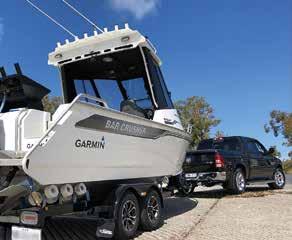
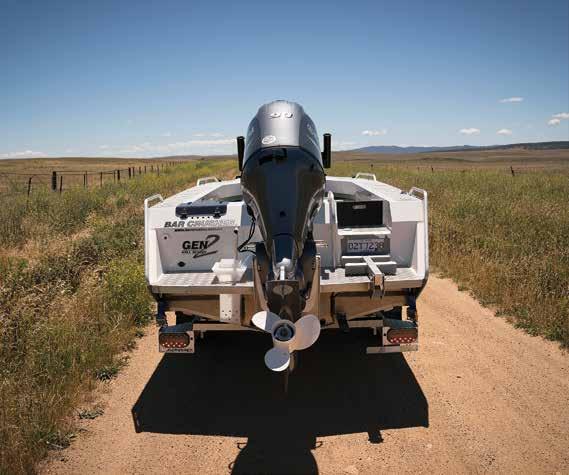
Firstly, suggest choosing the best quality trailer available. This job is made easier these days with many boat companies doing the hard work for you. Companies such as Quintrex, Stacer and Bar Crusher either manufacture their own trailers or work closely with Australian trailer manufacturers to match their boats perfectly.
I once made the mistake of buying a trailer and boat separately and paid the price every time launched and retrieved the boat. They never quite matched.
Having a trailer matched to the boat gives you peace of mind. It allows you to drive without worry and launch without too many hassles.
The good news is, the above boat companies, and others, make trailer choice simple and safe. The bigger decision is the choice of car and working out a safe weight to tow.
If you are buying a trailer separately, here are a few things to watch. Look for quality materials and components. These days many trailers are built from alloy, which is lighter, but good old galvanised steel is still a reliable product, more affordable, and arguably
TOWING CAN BE STRESSFUL FOR NEW BOATERS, BUT IT DOESN’T HAVE TO BE THE CASE.
Having a trailer matched to the boat gives you peace of mind. It allows you to drive without worry and launch without too many hassles.
Hooking up your trailer
Hooking up your boat to the trailer is another important process. Modern vehicles with reverse cameras make it a lot easier. If you don’t have a reverse camera, ask a friend to guide you back until you’re as close as possible to the coupling. Make sure your car and trailer brakes are on and carefully lower the jockey wheel until the coupling clicks into place. Always watch your fingers during this process!
Once the trailer coupling is firmly on the ball of the tow bar, you can swing your jockey wheel up. I always swing it with the wheel towards the back. That way if it ever comes loose it might prevent it from breaking off and potentially injuring someone. Then it’s a matter of securing the safety chain and the plug for the electrics. Check your lights are working and re-check your boat is secured and you’re good to go.
stronger than alloy. Have a chat to your boat dealer when choosing your trailer and they should guide you in the right direction.
At the same time, ensure it’s fitted with quality components and has all of the necessary additions such as good quality brakes, LED lights, jockey wheel, suspension and coupling. Trust me, it won’t take long for inferior components to start breaking down at the most inappropriate time.
Choice of car
I just explained the importance of matching your trailer to your boat for trouble-free towing and launching. The same applies to matching cars and trailers. If your car is inadequate, you make towing more challenging and you’re potentially breaking the law and putting lives in danger. So, what is an adequate car for towing your boat? This is where it gets complicated and I recommend doing as much research as possible. Read on for some basics on towing capacities.
The weigh-in
The subject of towing capacity takes up a lot of space on social media and boating or caravan websites. It’s confusing and often contentious.
Each car has a rated towing capacity. It’s obvious your boat, trailer and engine (the full package) should not be above this weight. However, it’s not that simple.
The first thing you should know is the total weight of your boat/trailer package. The only accurate way you can do this is to take it to a weighbridge. Don’t rely on the estimated weight from the manufacturer. That’s because there are always add-ons and the manufacturer’s weight wouldn’t include fuel, batteries, ice boxes, etc.
Once you have an accurate weight, it’s time to weigh your car. Again, weigh it loaded with everything you usually carry, including passengers and fuel.
Now you have an accurate weight of your loaded boat and loaded car.
Each car and trailer have a maximum load capacity. The combined maximum capacity (vehicle and trailer) is what’s called the Gross Combination Mass or GCM. The boat weight maximum is called the Gross Trailer Mass (GTM) and a fully-loaded car is called the Gross Vehicle Mass (GVM). This is the weight at their maximum legal weights. There are other definitions for cars and boats without weight added, but they’re less relevant and will only confuse things.
Your vehicle’s GVM is important. Every model has a different GVM and that’s usually found online or on the car itself.
Understanding ball weight
Many vehicles designed for towing are 4WDs and many of them have after-market accessories. Each one of these accessories add weight (payload) to the car and that combined reduces the ability to tow heavy loads. Add a few passengers and a tank full of fuel and it can reduce the tow weight significantly.
That said, a common misconception is that any additional weight comes off the total tow capacity. It’s not that simple. That’s where “ball weight” comes in. Ball weight refers to the weight being placed on the tow ball itself. It can vary depending on the weight distribution of the trailer, but as a general rule for towing, it’s 10 per cent of the total weight.
So, for example, if your boat or caravan weighs three tonne, your maximum ball weight is 300kg. This ball weight comes off your total GVM of your vehicle.
If you have fully loaded your vehicle with heavy aftermarket accessories, fuel, passengers and other gear, you may be
dangerously close to its total GVM. Plus, you will need 300kg up your sleeve to accommodate the ball weight.
Choose carefully
Apologies if I have confused you with odd terms and calculations. It is confusing, but necessary to know if you own a large boat that’s getting close to maximum capacity.
Some of the more popular 4WD models sold for towing aren’t legally capable of towing the stated weight once modifications and accessories, even passengers, are added to the vehicle.
Again, talk to your boat dealer, and your car dealer, to ensure your choice of car matches your boat and is safe to drive.
The consequences for towing a boat over its legal weight could be devastating. It’s illegal and very dangerous!
Size restrictions
The above advice on towing weights applies everywhere and to each individual vehicle. Size restrictions are another area
altogether and it becomes even more confusing. My advice here is to check with your state government’s transport authority to find out what applies where you live. And if you plan on travelling from one state to another, again, it’s worth checking.
Some examples of these rules include not having a boat wider than 2.5m, oversized trailers need signage and they must adhere to time restrictions in heavily populated areas. But of course, all of these rules change depending on where you live.
Driving tips
Driving a large boat trailer and learning to reverse is one thing that discourages people from using their boats.
It takes some practice to learn how to tow and that’s best done on quiet roads and boat ramps. Hook up the boat and find a quiet road. Try some manoeuvring and reversing. It’s also worth going to a boat ramp mid-week when less people are around and practice reversing. On that note, always use your mirrors to reverse rather than turning around. Everything is reversed when it comes to turning the wheel and that gets even more confusing when you turn around.
MOST MODERN 4WDS ARE PERFECT FOR TOWING LARGE BOATS.
Trailer maintenance made simple
Even the best quality trailers will inevitably break down if not maintained.
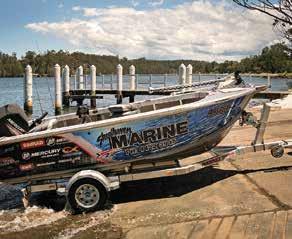
Saltwater is an ongoing concern for moving parts and connections on a trailer. I always prioritise the removal of salt after using it. The sooner you remove the salt, the less chance you will have of corrosion. Pay special attention to the coupling at the front of the trailer and work your way back, hosing all of the moving parts, bolts, springs, rollers, wheels and lights. Even the frame itself, while either alloy or galvanised, can still spread salt elsewhere if left unwashed.
There are also a number of products on the market for removing salt and they are designed to be mixed with water.
Another crucial area on the trailer that needs maintaining are the wheel bearings. It’s worth having someone look at this annually to ensure there’s enough grease. It’s also reasonably easy to do yourself. Many boating trips have been ruined by a faulty wheel bearing, which is a shame for something that’s easily preventable.
A good tip is to think of reversing as pushing your boat. If you “push” your boat towards the ramp, it’s easier to turn the wheel in the correct direction. Trust me, it works!
Back on the road and towing a large boat can be unpredictable. Drive sensibly! Modern cars sometimes make it feel like you can drive like you’re not towing, but that could be a bad move. Ensure there are no sudden stops, no erratic lane changing and no excessive speeds.
Large boats have a tendency to catch wind and can sway at high speeds. It’s best not to slam on your brakes when this happens. Some modern cars actually feature anti-sway control and it’s advisable to use it when you’re towing a large boat along a freeway.
Modern cars also have other features such as lane assist. Sometimes this works against you when towing and can be dangerous, so it’s best switching it off before embarking on a trip.
Another tip is to ensure you have plenty of space when turning corners. The boat won’t go around the corner, it will follow the most direct route. Be conscious of this in city areas.
It’s also important to secure your boat properly and ensure there are no loose belongings in the boat when it’s towing. Police, where live in NSW, have cracked down on this in recent years and heavy fines apply. And one last towing tip... never tow a boat through a fast-food drive-thru. It always ends in tears!
Conclusion
Hopefully, the above advice helps you decide which trailer you need, which car you need to tow it with and how to drive it. It’s an exhausting subject. It’s also worth checking out YouTube for some great videos on towing tips and explanations on vehicle requirements. Most importantly, be sure to visit the website of your state’s transport authority for local rules and regulations and accurate towing information.
TOP LEFT: BIG BOATS CAN BE MORE DIFFICULT TO TOW. ALWAYS ENSURE YOUR VEHICLE IS SPOTTABLE.
BOTTOM LEFT: REGULAR MAINTENANCE ON YOUR TRAILER WILL ENSURE YEARS OF TROUBLE-FREE BOATING.
Enjoy the moment We’ve got you covered
TRAILERS ARE THE UNSUNG HERO OF THE BOATING WORLD.
FIRST
Class
HIGH-PERFORMANCE SAILING CREDENTIALS COMBINE WITH CRUISING COMFORTS TO MAKE BENETEAU’S NEW FIRST 36 ONE SERIOUSLY COVETABLE YACHT.
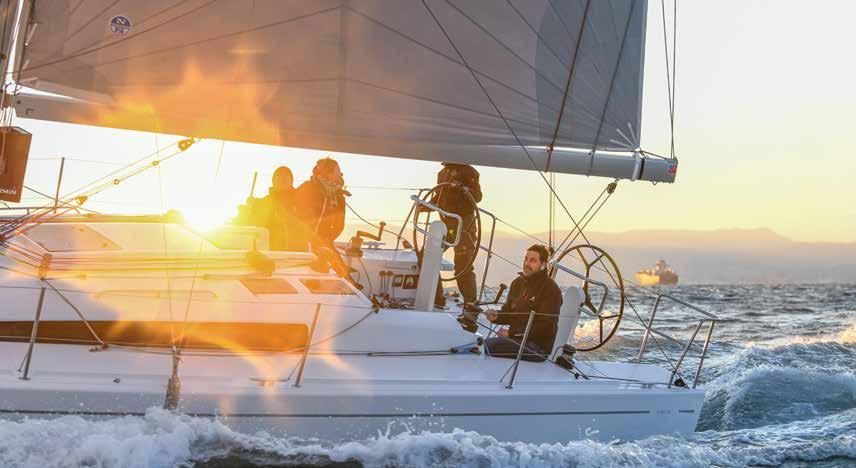
Acclaimed French sailing and powerboat brand Beneteau, has released the latest offering in its renowned First yacht range. Perfect for those who love the thrill of high-performance sailing, the appeal of the Beneteau First 36 isn’t limited to racing. She’s also a comfortable cruising yacht, suited to family holidays or sailing trips with friends. However, the inclusion of onboard comforts hasn’t come at the expense of performance. Rather, the First 36 brings features often found in grand prix racing boats to active cruisers and club racers, while maintaining the experience of high-performance sailing.
According to Chloe Richardson, Marketing and Communications Manager at Sundance Marine, the exclusive Victorian and Tasmanian dealer for Beneteau, the new First 36 has already attracted keen customer interest. “Our clientele has been waiting to see what the next vision was for the First range,” says Richardson. “Our clients are so comfortable with Beneteau’s reputation with the First range. We placed orders as soon as the first renders were released. Customers enjoy the First range as it truly enables them to both race efficiently without compromising on comfort.” We asked Richardson to talk us through some of the key features of the Beneteau First 36.
What is the appeal of the Beneteau First range?
Beneteau has been a pioneer for recreational boating from the outset. I believe this is the first time a mainstream production boat with full cruising facilities, a mid-market price tag and the full support of a worldwide dealer network has been pushed this far towards true high-performance sailing.
The Beneteau First range has always been popular within the sailing community for its ability to combine both performance and comfort. Now, this new vision further excites our clientele bringing even better performance without compromising on comfort. First models have always been designed for sailors who enjoy club racing as much as cruising, bringing the best of both worlds into one single product line.
The signature features of the First range have not changed since its conception in 1977, with the new First 36 the latest release in the First range. The first range starts with your First 14 racing dinghy to the luxury performance First 53 yacht.
Talk to us about the First 36. How would you sum up this boat for readers?
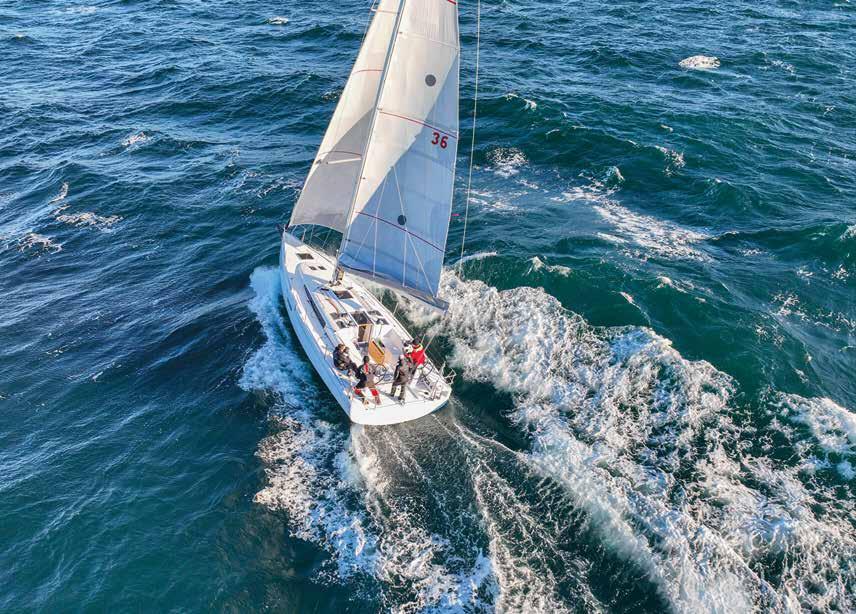
With the ability to fully plane in a moderate breeze, she is expected to be a weapon in the club racing capacity. The best part? The First 36 is optimised for short-handed sailing. You will be able to race the First 36 comfortably with six people and cruise with two!
Where does this model sit within, and compare to, the rest of the Beneteau First range?
With the recent collaboration with Seascape, we have seen the First range go from 14-27ft and introduced the First 53 Yacht. Until now there has been no sweet spot in between for our clientele to upgrade to, but now there is!
The First 36 features all the key elements with the First range making it the perfect club racer, family cruiser or simply a thrilling day sailor.
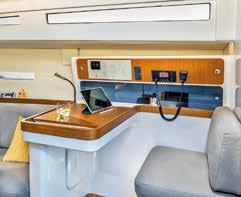
RIGHT TOP: A FOLD DOWN TABLE MAXIMISES SPACE.
RIGHT BELOW: A FULL-SIZED NAVIGATION TABLE.
What are the top three key features of the First 36?
• Ability to plane in moderate breeze.
• Race and cruising layout available.
• Extensive galley space.
Talk to us about the living spaces. What elements enhance the onboard comfort and living experience?
Most customers would purely see the First 36 as a racing boat, but she also boasts the potential to be a fully functioning cruising yacht. Going against the trend, the 36 features a full-sized navigation table. While vital to navigation, it is also a suitable home office!
What types of leisure activities do you imagine people doing on this boat?
The First 36 is made to be the ultimate club racer but at the same time she is just as comfortable taking on the Sydney Hobart Yacht Race. From the race to cruising layout you can make the First 36 suit your sailing requirements.
There truly is nothing better than the ability to race your yacht but also be able to comfortably entertain and the 36 does just that. With the three-cabin layout, you have the ability to spend weekends away or simply convert the cabins to extra storage for water activities.
How would you describe the difference between the cruising and racing layout?
The overall design of the yacht stays the same but upgrades to suit your preferred racing style.
The cruising layout features: Ultra-light bathing platform; Cockpit table for six; Cockpit benches with cushions.
The racing layout features: Ability to alter helm and trim positions to suit short-handed or fully-crewed sailing. Higher steering wheel position. It also allows cross-sheeting of all sheets to the windward side.
Can you talk to us about the interiors and styling? What are some of the most uniquely appealing elements?
You will be instantly wowed by the galley space. With the configuration of the fridge and free-standing island in the centre, you are able to extend the bench space completely across. It is the largest galley in its class. Space is further optimised in the bathroom with a foldable sink!
How well is this boat suited to the Australian and New Zealand lifestyle and waters?
The Australian and New Zealand sailing communities know and trust the Beneteau sailing range. They are made to suit any and all conditions.
ABOVE: AN OPTION OF COCKPIT TABLE IS AVAILABLE.
Scan to check out the First 36.
THE
Let’s talk about performance. How does it stack up in terms of performance?
You can expect the First 36 to outperform many of the cruising racers that are currently on the market. With its extremely light displacement, you can have the ability to plane at moderate speeds, something that is not currently found in this segment of the market.
Talk to us about the tech behind the First 36. What are some of the key elements?
Notably, the entire boat is a vacuum-infused, fully-cored GRP composite structure. This
includes bulkheads and most interior parts. Almost all interior elements contribute to the structural strength of the boat.
What are the key optional upgrades you anticipate buyers fitting to their boat?
We expect many of our owners to upgrade the mast to carbon to further accelerate the racing performance.
For more information, visit sundancemarine.com.au or call 1300 55 00 89 in Australia.
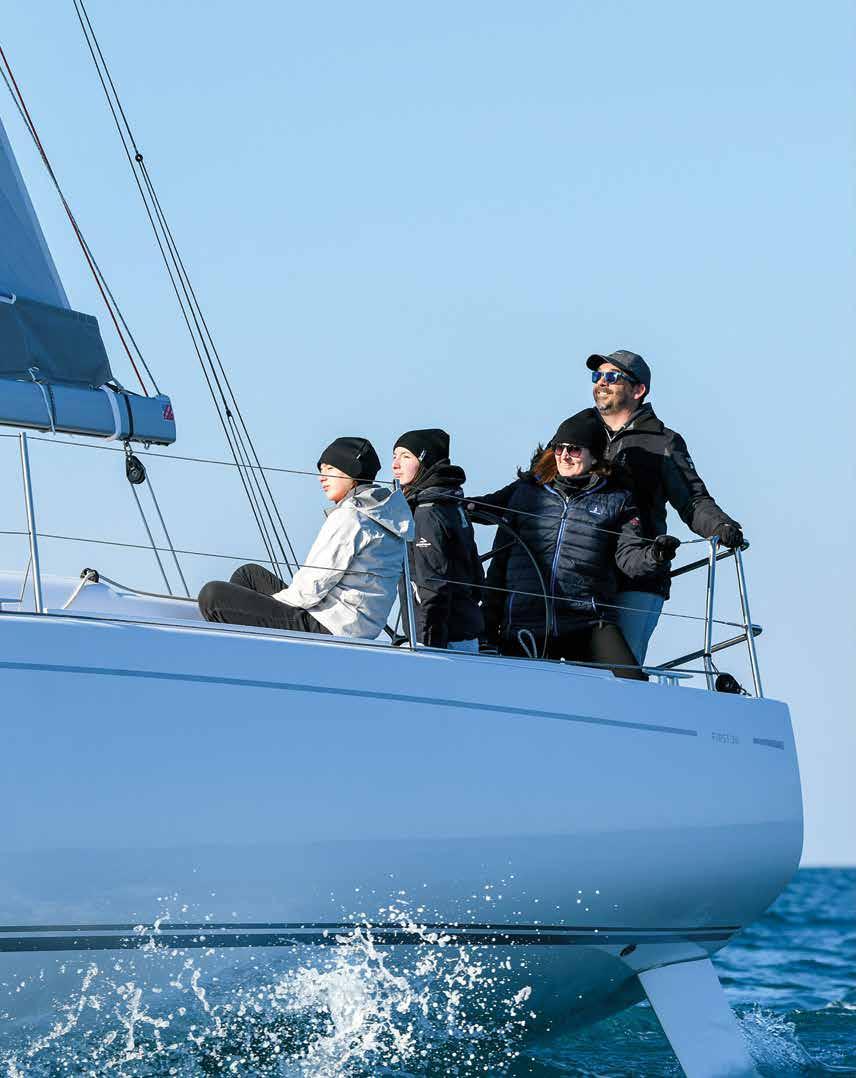
THE FIRST 36 ALSO ALLOWS FOR COMFORTABLE SAILING WITH FAMILY.
COCKPIT SEATING ARRANGEMENT IS A KEY FEATURE OF THE FIRST 36.
TASSIE
Treasure
WITNESS THE PASSION AND DEDICATION OF THOSE WHO HAVE LOVINGLY RESTORED TASSIE TOO BACK TO LIFE. BY JOSIE GAGLIANO.
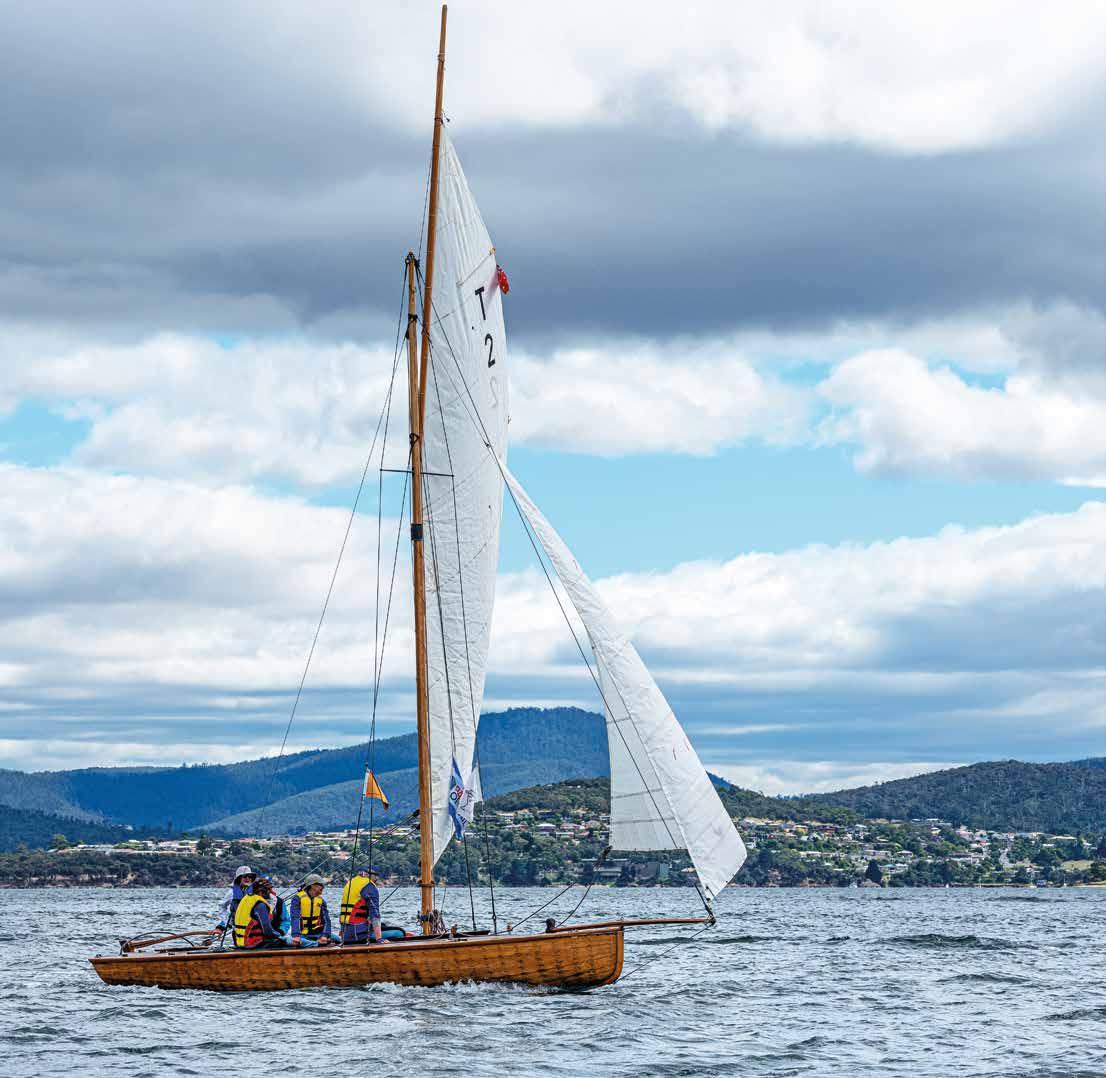
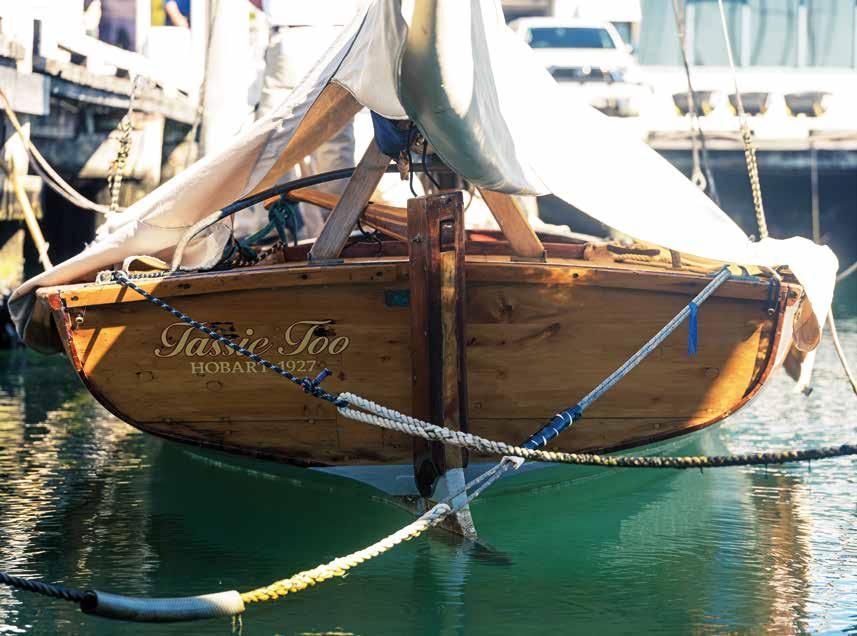
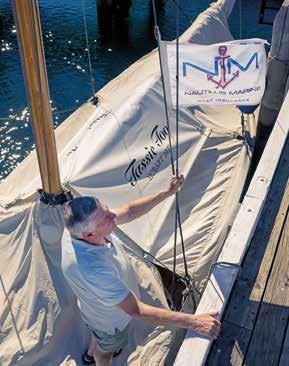
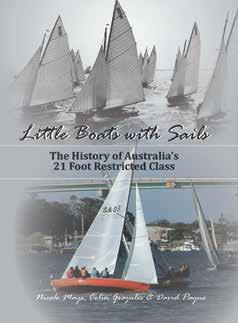
The sunny dispositions of passionate volunteers willing a project back to life often belies strength of character and steely resolve. That can be said of the journey of Tassie Too Originally launched from Battery Point in 1927, the 21ft restricted class yacht would one day be welcomed home to Hobart and nurtured back to life by the passionate ‘Friends of Tassie Too’, to once again sail the seas.
An extensive restoration of the heritagerich Tassie Too was undertaken by Tony Siddons in Melbourne during the early 2000s, which saved the vessel. In 2017, Tassie Too made a triumphant return home to Hobart, with a successful relaunch following in 2018. Since then, the passionate ‘Friends of Tassie Too’ not-for-profit organisation has been established to coordinate the vessel’s
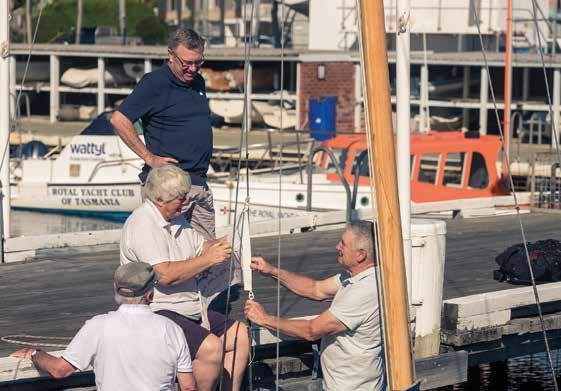
administrative, financial, insurance, scheduling and maintenance efforts. This generosity is accompanied by support from the Tasmanian marine industry, maritime history and sailing community, with the focus to ensure that Tassie Too is well cared for into the future. So far, ‘Friends of Tassie Too’ has secured funds for the vessel’s purchase and undertaken essential maintenance. Now stationed at The Royal Yacht Club of Tasmania, Tassie Too’s future is prosperous again: she features prominently on the River Derwent and is shown off at local events. Nautilus Marine Insurance also proudly supports Tassie Too through insurance cover for both yacht value and legal liability.
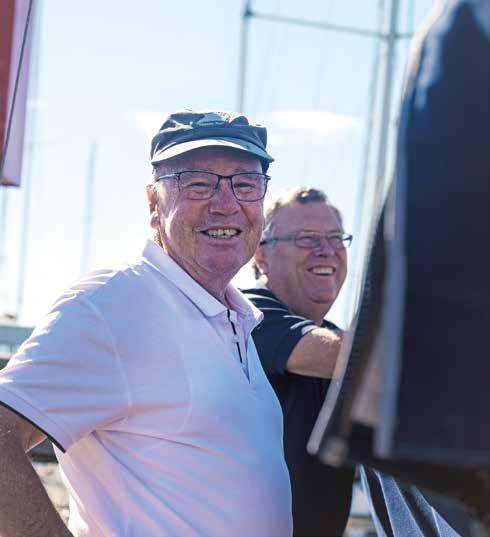
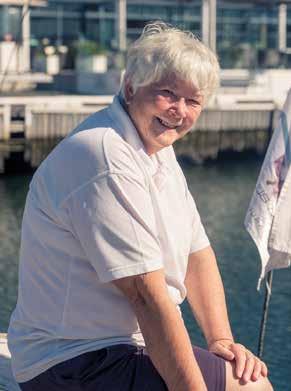
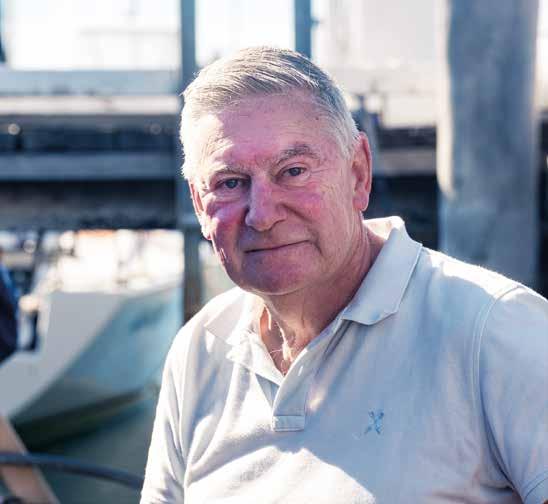
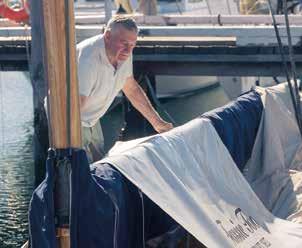
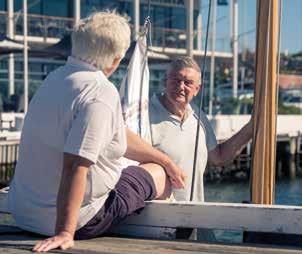
On a sunny Hobart day, we met up with several key ‘Friends of Tassie Too’ to witness their love of this local icon.
THE BEAUTIFUL TASSIE TOO
Bill Batt, 61
Bill Batt has been involved in sailing from a very early age and started racing in Sabots in the early 1970s before moving on to Cadet Dinghy’s, LW Sharpies, Diamonds, Etchells, SB20’s, offshore racing as well as Farr 40s. Growing up in Battery Point, he would spend most of his spare time at the local slip yards doing odd jobs. “The connection to the sea continued with my Navy service. These days I am the Chief Operating Officer with Marine and Safety Tasmania,” says Bill.
“With the family’s extensive involvement in Tassie Too over many years, it was hard to not be in awe of the achievements of Tassie Too and all those that raced her, from an early age.
I became involved with ‘Friends of Tassie Too’ when I was volunteered to take up the treasurer’s role by my brother Kenn. My main role with Tassie Too is to look after the finances of the ‘Friends of Tassie Too association, and while not an overly burdensome role there are always bills to pay!”, says Bill, adding that Tassie Too has great significance for the history of yacht racing in Tasmania, “as the public
interest generated by her success between 1928 and 1954 helped put Tasmanian yacht racing on the map.”
“As perhaps the most original Restricted 21-footer still in existence, she is a testament to the skill and craftsmanship of those that built her nearly 100 years ago,” added Bill, acknowledging that while outclassed by modern designs, “it’s great to see her out on Wednesday afternoon races competing on the Derwent.”
Bill points to his surprise with “how responsive she is sailing upwind, with only a gentle touch required on the tiller.”
“My eye is drawn to the level of expertise that has gone into the design and manufacture of the Egyptian cotton sails (which are sparingly used these days), with the extremely narrow panels sewn together with a very fine stitch. There are some features shared with the modern-day exotic sails with use of battens to maximise the leech profile, but is also carefully scalloped to reduce flutter,” says Bill.
Stuart Harris, 72
Stuart Harris was introduced to sailing in the early 1960s by his father, starting in the Sabot class (Gretchen sail #32) at the Montrose Bay Yacht Club alongside his elder brother Scott, and went on to do most of his dinghy sailing in the Rainbow class (Miyako and Misaki ) and represented Tasmania in Adelaide, Melbourne and Perth.
Having spent most of his life in Tasmania (in Launceston, Devonport, and on King Island), in all these ports outside of Hobart, Stuart kept up his sailing career mostly as a crew; while in Launceston, he was a crew member on board, Sagacious, a 42’ Two Tonner, in which he competed in the Melbourne Devonport race and the 1982 Sydney Hobart.
Both his father Robert (Bob) Harris, and mother Margaret Harris (nee Forsyth) had been brought up around sailing by their parents.
“My paternal grandfather was F. C. (Frank) Harris, a notable for’ard hand and boat owner (Vanity). Frank was also a Vice Commodore of the RYCT when he passed away in the late
1940s. He represented Tasmania mainly as for’ard hand for Harry and WP (Skipper) Batt in the Restricted 21’ class boats Tassie, Tassie Too and Tassie 3. My maternal grandfather was John (Jack) Forsyth, who was the local sailmaker (JR Forsyth and Son) in Salamanca Place. He would have also made sails for all three Tassies,” says Stuart.
Frank Harris was for’ard hand in the original crew of Tassie winning the Forster and Albert Cups representing the Royal Yacht Club of Tasmania in 1925, Tasmania’s first foray into the national competition.
“My father, Bob, represented the State in 1951 in sailing on Tassie 3 with Eddis Boyes as the skipper on Port Phillip Bay. My father always told me of the 21s, and like a typical son, took little notice. In 2003, Tony Siddons brought the restored Tassie Too to the Australian Wooden Boat Festival in Hobart and upon seeing it for the first time, was fascinated,” says Stuart. “I decided there and then to build a model of the boat. At home,
had a log of Huon pine that I had cut into planks to enable me to build in the ‘bread and butter’ method, a scale model of TT at 10 to 1.”
“Jack Hansen, a personal friend of my father and my grandfather Frank, offered to draw me up a set of plans of Tassie Too so could get the model pretty accurate. Jack Hansen was a surviving member of the Tassie Three crew that won the Forster Cup in 1938. He passed away at age 96, some years ago now. The fully-rigged model turned out fairly well, and had sails accurately made by Dennis McGoogan of Sydney, a renowned vintage model yacht sailmaker. I used the same timbers as the original with Huon Pine hull and King Billy deck.”
Meanwhile, unbeknownst to Stuart, the ‘Friends of Tassie Too’ was formed, and Greg Muir and Kenn Batt worked away to purchase the Tassie Too from Tony Siddons and brought her to Hobart where Stuart became associated with them.
“To make my contribution to the group, donated my original model and they used it to raise funds (some $5,500) to help with costs. The model was raffled and won by John Brierley. It is now on display at Brierley Marine in Derwent Park , who remain an ongoing sponsor of Tassie Too,” reveals Stuart.
“I have retained my membership of Friends of Tassie Too and assist where I can with slipping and general maintenance, and have been sailing on the boat with other descendants of the crew (Will Keyes, Kenn Batt, Helen Batt amongst others), but to really sail her at her best she needs younger and stronger and a fitter crew than I.
I must admit that sailing on the boat gives me a sensation and a feeling of nostalgia with knowing that my grandfather and father sailed on this boat and my maternal grandfather made the sails. The boat is beautifully balanced and most people are amazed at the turn of speed the boat has at her age of approaching 100 years,” he adds.
LEFT ABOVE AND BELOW: FRIENDS OF TASSIE TOO
ABOVE: STUART HARRIS AND BILL BATT.
ABOVE: BILL BATT.
RIGHT TOP: TASSIE TOO MAINTENANCE.
RIGHT BOTTOM: FRIENDS OF TASSIE TOO.
Tassie Too made a triumphant return home to Hobart. “ “
Helen Batt, 74
Helen Batt describes herself as “74 years young” and has been sailing ever since she can remember. “Saltwater runs in my blood I think.”
“I grew up on Battery Point in Hobart but in my late 30s I went away for about 20 years. sailed at Port Kembla Sailing Club during that time. returned to Hobart about 15 years ago and have been here ever since. Why I left paradise I’ll never know.
“I was born the year WP ‘Skipper’ Batt and my grandfather HCL Batt died. My father HN [Neall] Batt sailed the Tassie Too at that time, and all through my formative years. I have photos of my elder brother Rae and I dressed in our ‘all whites’ before going out on the boat for the 1953 Opening Day of the sailing season.” Helen reveals Tassie Too and the family achievements in the 21ft class are part of her family heritage, “but hardly ever spoken about”.
“As a result, I know very little about their achievements. Both Rae and were constantly reminded we had a family name we needed to live up to; as we left home, there was always a reminder to ‘remember what your name is and behave’. It was a challenge at times for me, being a woman, sailing in a boy’s and men’s domain,” adds Helen, revealing that her grand uncle Skipper Batt was notorious for being
unwilling to speak of his achievements as was her grandfather HCL Batt, and my father HN Batt held that ethos too, and it was very much passed to her and Rae.
“I got involved with the ‘Friends of Tassie Too’ about the time she was relaunched after a long refit. I took her for a short sail that day with other family members and relatives of the old crew members. Even though she wasn’t tuned or set up for racing, immediately noticed the ‘feel’ of her – so responsive and sensitive, an absolute thoroughbred.
“Last sailing season it was decided that to have her out racing would be a good way of creating a presence of a traditional boat. I helmed her every second or third week along with a crew of like-minded people, some of whom had contributed financially to her refit, and others just wanting to enjoy a Wednesday afternoon sail,” says Helen.
Not only does Tassie Too have an excellent reputation, she’s got the looks to back it up.
“Each time I have sailed the Tassie Too, the amount of people who comment on how good she looks and how they enjoy seeing her on the water is amazing,” says Helen.
“Being owned by the Royal Yacht Club of Tasmania, all the Tassies set the standard in yachting competition at an Australian level. Each crew and helmsman had to prove themselves worthy of being in the crew. Only
the best were chosen, the boats and crews trained against one another, each boat taking it in turns to be in a lee bow position and having to sail out or not as the case may be. Tactics were fine-tuned, as well as crews and the boats themselves,” adds Helen.
“Initially the Tassie and the Tassie Too and the others that followed were thought of as easy beats by the more financial and beautiful boats, but they became the standard others had to match. To some degree think the Tassie Too created the mindset that Tasmania is as good as any other state or better, and even the young ones sailing in Optimists and International National Cadets race with that same level of determination.
Tassie Too and the Tassies in general showed that co-operation and challenging one another leads to success, and most often has better outcomes than one individual alone no matter their financial backing. Tassie Too set the standard in yachting excellence and set the standard all others had to aspire to,” says Helen, further revealing her plans for the vessel.
“I am keen to preserve Tassie Too and her legacy, not only because of my family’s involvement, but because she stands for the class which made Australian Championships a reality: the 21-footer class were open to design innovation and created good seamanship, and
People comment on how good she looks and enjoy seeing her on the water.
“ “
they were the forerunners in changes to design of rigs and hull shape.”
Helen shares that when she first sailed Tassie Too in a race, “I realised I was probably the first woman to do so,” and she felt a great sense of family tradition, and the realisation around how far sailing has come for women.
After taking her grand-niece Charlotte Kratz in a race last year, she felt as if I was passing the family baton in some sense. “Hopefully all my grand nieces and nephews will get a chance to helm Tassie Too at some stage.”
Helen helps familiarise us with Tassie Too, revealing she is sailed with one small snubbing winch to assist the main hand’s muscles, and everything is pulled in by hand, sheets held in the hand, and sailed with a tiller. The tiller allows the skipper to feel tension in the flow of water past the rudder.
“Very few boats break rudder stocks with a tiller. With a wheel, the stresses aren’t felt as much, and the boat driven beyond breaking point, for example, Sydney Hobart boats break rudders regularly,” says Helen.
“The main sheet isn’t touched, only a traveller is eased but mostly not. In Tassie Too, especially in any flukey breeze with puffs coming from different angles, the crew is hard at work easing both main and jib together, then getting it back in again in preparation for the next change of wind. The boat must stay ‘on her feet’, and the helmsperson has to observe where the next wind is going to spread. There are no gadgets to tell the crew that info; the crew must be aware of everything happening around them. Will the helmsperson want to come around, will they shoot the boat through a puff to gain from the one behind?”
adds Helen.
“No one sits on the weather rail, with legs dangling over the top sides enjoying the sun”, says Helen. “Everyone is working as a team.
My dad often said if I could sail a boat in a hard norwester from Sandy Bay point up to Secheron Point without the boat lying down like a dying duck, then could beat anyone. That is how the Tassie Too has to be sailed.”
THE JELLYFISHBOT.
TASSIE TOO IS CERTAINLY A BEAUTY!
ABOVE: HELEN BATT.
RIGHT AND OPPOSITE: RAISING THE FLAG.
Greg Muir, 73
Greg Muir, 73, has been sailing for as long as he can remember, and, living in Battery Point, there were always stories to be heard from family friends who had crewed in ‘Tassies’ (‘Tassie’, ‘Tassie Too’, and ‘Tassie 3 ’).
“My Dad was always a competitive sailor and was involved in a selection trial with Ken Batt, Ediss Boyes, and Lester Gabriel to find the best skipper for the 1951 Forster Cup. They raced a series in Sharpies, and Ediss Boyes was ultimately chosen,” says Greg. “We’ve heard that Dad also helped out with repairs on Tassie Too in the 1930s, during one of the Forster Cups.
Greg himself got involved with ‘Friends of Tassie Too because he saw a group of like-minded individuals, and the opportunity to get Tassie Too back to Hobart “due to her significance to Tasmanian yachting, and to be able to maintain her as a sailing vessel and not just a static museum exhibit.”
“We contributed money and had generous support from other individuals and businesses. The Royal Yacht Club has offered to host her on the Marina in front of the Clubhouse, and also now host a museum of memorabilia relating to the ‘Tassies’”, says Greg, who is involved as an association member, and has helped coordinate aspects of work, from original cradle making for shipping over Bass Strait, to maintaining her today.”
Future legacy
Greg reveals that they have a management plan prepared by the National Maritime Museum that assists in coordinating work, for example, weekly checks on marina ropes, bilge pump working, slipping, anti-fouling, and varnishing.
“Some Restricted 21 class yachts have been built in recent years, but their hull shape is not any more advanced than Tassie Too Tassie Too (as well as Tassie and Tassie 3) were significant in showing that Tasmanians could build yachts on a budget and beat the generally more wealthy mainland owners of restricted 21 class yachts,” says Greg. “I personally love the fact that she is built of local Huon Pine and King Billy timbers. We all love the varnished hull and oiled decks. She was also the most successful restricted 21 yacht in Australia, and the design of hull had special features.
“When we purchased Tassie Too she was swinging on a mooring at Sandringham Yacht Club in Melbourne. She was rarely used and was needing extra care. ‘Bring Her Home to Tasmania’ was our initial fundraising theme, and we wanted to educate Tasmanians about her significance,” says Greg. “It’s a fantastic feeling to get aboard Tassie Too either sailing her or at the marina – she sails easily and is responsive. There’s a real sense of fulfilment and pride in bringing her home.”
A key goal is to pass on their love of this beautiful vessel to the next generation of sailors.
A key goal of the ‘Friends of Tassie Too is to pass on their love of this beautiful vessel to the next generation of sailors. “We have a plan which involves having younger sailors sailing Tassie Too, and we have several grandchildren and great-grandchildren of some of the original crews of Tassie Too who have already been sailing her and helping maintain her,” says Greg, adding that the Tassie Too team are planning a rerun of the Forster Cup in Hobart in February 2023, in conjunction with the Australian wooden boat festival.
While looking forward, it’s hard not to be nostalgic about Tassie Too as Helen can attest.
“I’m sure I’m getting a bit over the hill to race her in the Forster Cup; Wednesday afternoons are more my style these days! Everyone says it will be a relaxed time, but doubt that when that 10-minute gun goes, it will be on; it definitely would be if I was sailing her. I have only sailed Tassie Too with a small main and a second-hand jib, so I’ll look forward to seeing her race with a full kit, a bit of lead along the case, and a crew of fit strong hands.”
Visit www.friendsoftassietoo.org to find out more about this beautiful community-owned yacht.
INTERVIEWS BY SARAH RANAWAKE.
Read about these classic yachts
Want to immerse yourself even more in the history of Tassie Too? Little Boats with Sails: The History of Australia’s 21 Foot Restricted Class is a delightful read which offers a comprehensive history of the 21ft restricted class yachts, starting with one of its major success stories, Tassie Too, and the Tasmanian domination of the Forster Cup.
It details the origins of the 21ft restricted class, and its specifications, and gives a history of the Forster Cup series. The book also summarises all of the craft built to the class, and provides biographies of influential skippers, boat builders and designers, as well as crew lists.
Little Boats with Sails: The History of Australia’s 21 Foot Restricted Class, by Nicole Mays, Colin Grazules and David Payne. (Navarine Publishing; $55)
Visit www.navarine.net
ABOVE AND RIGHT TOP: GREG MUIR.
BOTTOM RIGHT: HELEN BATT AND GREG MUIR.
PHOTOGRAPHY BY ANDREW WILSON
WINTER BOATING
TIPS AND TRICKS FOR ENJOYING BOATING DURING THE COOLER MONTHS. BY SCOTT THOMAS. SAILING IS A
If you own a boat, it makes much more sense to use it throughout the entire year. It really provides the full value of boat ownership and a whole year of fun and enjoyment!
Sure, boating in summer is fun, but winter can provide its own unique appeal. Many of us enjoy cool weather and those who make the effort to go boating during winter will have some fantastic experiences. For starters, there are less people out and about. That means more space at the boat ramp carpark and less traffic on the water. Sometimes winter provides great fishing opportunities you would otherwise miss if you’re a “fair weather fisho”. You will see new things you don’t ordinarily experience in summer. Whales, for example, are a common sight along much of our coastline during the winter months. Even those who prefer cruising or sailing have some fantastic opportunities in the cooler months, especially in places like the Whitsundays.
The endless summer
I recall fishing on a lake in the US state of Oklahoma. All of the marinas featured these funny looking roofs. asked my fishing guide what they were and he explained they’re essential in winter to keep the boats safe from extreme conditions such as snow and even tornados!
That’s not uncommon in many places around the world. Most boaters in the Northern Hemisphere “winterise” their boat each year. As summer ends and the weather cools, their attention switches to hibernation. The boats are covered and put somewhere safe, ready to be uncovered again as the days warm in spring. Where’s the fun in that?
We’re so lucky in Australia and New Zealand to live in a climate that allows yearround outdoor activities, so why stop boating in winter?
That said, it’s not like Australia and New Zealand don’t have their fair share of cold climates. Even so, very few boating areas experience consistent sub-zero temperatures or lengthy periods of snowfall like they do in parts of the US, Canada and Europe. For the most of us, with a few tweaks and tips we’re good to go for a full year of uninterrupted boating.
Get a full year from your pride and joy with these tips.
Choosing the right boat
Choosing the right boat for all seasons is important. In a nutshell, this comes down to selecting the perfect boat for your location and hoping that matches your particular interest or style of boating. If you’re into lounging about on the back of a cruiser in the sunshine, you may have to find a cabin boat and take some shelter during the cooler months. Likewise, if your preferred boat is an open boat for fishing and you live in Tasmania or the South Island of New Zealand, it may not be the best choice for winter.
Be realistic and honest with yourself about the choice of boat before purchasing, or you may well have to “winterise” your boat like our boating friends do in the Northern Hemisphere.
Cabin boats are popular for this very reason. In the summer you can open the windows and take advantage of the airflow and also enjoy the additional shade, yet in winter you’ll be glad for the protection from the cold wind and spray from the water.
If you live in a colder climate in Australia or New Zealand and do a lot of boating and fishing offshore, you could consider an enclosed cabin. As the name suggests, enclosed cabins allow you and your crew to close a door and remove yourselves from the elements. It’s a great idea for offshore fishos who often travel a considerable distance in cool weather or big seas.
You could even get an optional heater for the cabin to make it even more comfortable! Most enclosed cabins are still okay during the warmer months with adequate ventilation, but you’ll be glad you opted for this style of boat when the weather turns bad.
The further north you move, the more options you have for boats. In Queensland, the Northern Territory and the top of Western Australia, open boats reign supreme. Even in the cooler months the weather is warm and so is the water. That said, cabin boats still offer great versatility in all climates.
If you’re not fishing, a centre console or open tinny is the preferred option and fans of cruising have more choice as well. Many boaters live along the East Coast of Australia between Melbourne, Sydney and Brisbane and the weather in these parts is
notoriously unpredictable and can change greatly between seasons. Try and choose a boat with as much versatility as possible that will adapt to all of the weather conditions you’re likely to encounter.
Layer up
This might sound obvious, but many of us don’t pay enough attention to the clothing we wear while boating. It really is the difference between a good boating experience and a bad one.
Keeping your feet dry and warm is essential. For colder climates, look at buying quality waterproof boots. There are many gumboots designed for boating with grippy soles and insulation for keeping you warm. These also come in handy when launching and retrieving your boat. Stepping in the water during winter to launch your boat can be interesting! Of course, don’t go too deep and fill your gumboots with water.
Some people even use waders to launch their boat in alpine climates. That will ensure you stay dry. If you do this, ensure you take them off before setting off in your boat. Wearing waders can be dangerous if you capsize.
The next most important piece of clothing is a waterproof jacket and some waterproof pants. Some of the well-known sailing apparel brands such as Helly Hansen, Musto and Gill have high-quality waterproof jackets and pants made for boating. They’re not cheap, but well worth the money to keep you boating all year and in all conditions.
“Layering” your clothing is the best option here. That means paying attention to each layer of clothing and using breathable quality clothing from the skin layer, the mid-layer, to an external waterproof layer. They all work together to keep you warm and dry. In extreme cold conditions, wear a thin merino wool layer on the base, then a thermal, fleece, followed by the jacket. Gloves and a beanie are also important.
This is a lot of clothing to wear on a boat and some jackets actually have built-in buoyancy to offset the extra weight. You should also wear a lifejacket for the same reason.
Don’t underestimate the need for wet weather gear and warm clothing in warm climates. spent a week on the Coral Sea off Mackay during winter. The prevailing wind during this time of year is from the south east
and it can be relentless. The water is usually choppy and depending on your boat, you will get wet. The cool southerly wind soon chills your body, even if the outside temperature is balmy. I still prefer to have the full pants and jacket outfit.
MIDDLE: COLD WATER, NO WIND, AND ABUNDANT FISHING OPPORTUNITIES.
ABOVE: GRAB A JACKET AND HIT THE WATER THIS
SUNNY WINTER DAYS ARE BEST SPENT BOATING WITH FRIENDS.
TOP: IF YOU OWN AN OPEN BOAT, IT’S BEST YOU INVEST IN SOME QUALITY COLD WEATHER CLOTHING.
WINTER.
SPENDING TIME IN THE TROPICS IS A GREAT WAY TO ESCAPE THE COLD!
Follow the sunshine
If you really love your boating and still find the weather isn’t in your favour, why not travel to a warmer destination? Thankfully, the travel restrictions have eased and there are so many boating friendly destinations in Australia and New Zealand. These days there are also many options for boating travel.
One way of reaching a warmer boating destination is to take your own boat. Simply drive north to warmer climates. It’s important here to have a reliable car and a trailer and boat capable of doing some significant kilometres. But the reward at the other end will be worth it. Not only will you be enjoying warm climates and great fishing or cruising, but you’ll also have the convenience and familiarity of your own boat.
Another option is to hire or charter a boat. You can hire smaller tinnies in practically any medium to large coastal town in Australia. It’s cheap and easy and gets you onto the water quickly. For overnight trips you can look at bareboat charters or even companies such as Floatspace that allow you to hire boats from other private owners.
Tips for staying warm
1. Late launching. With less crowds, you won’t have a problem finding a car park at the boat ramp. Instead, sleep in and go boating during business hours. The sun is up and even in the middle of winter it’s quite warm on the water.
2. The trick to staying warm is layering clothing and ensuring your head, hands and chest are insulated. These are the parts of your body most susceptible to the cold. Your legs don’t need as much insulation.
3. Take a warm drink. There’s nothing better than warm coffee or hot chocolate on the water. Brands such as Yeti make quality insulated mugs and drink bottles to keep your drink warm for hours.
4. Check the forecast. Weather can change suddenly in winter. Check the weather before you leave and avoid being caught out in a sudden storm.
5. Choose an appropriate boat. If you’re looking to buy a new boat, look at what the locals are using during winter and you can’t go wrong.
Destinations such as Hervey Bay, The Whitsundays, Cairns, Port Douglas, Darwin, Exmouth and so many more, offer fantastic winter boating opportunities for those looking to escape the south for some sunshine and warmth.
With international borders reopening, you could also consider an overseas boating trip to a more exotic destination. There are any number of exotic South Pacific destinations with year-round tropical weather. In those places, winter is often the best time to visit with stable conditions for boating. Places like Fiji, New Caledonia, Papua New Guinea, Vanuatu and more offer visitors loads of opportunities for enjoying the water via charters or boat hire.
Stay safe
Back to colder climates and it’s important to talk about safety. Winter is by far the most dangerous time to go boating. Hypothermia is a genuine risk if things go wrong.
Some parts of Australia and New Zealand have very cold water in winter and falling in could put you at risk of hypothermia in a short period. Even Sydney in winter has water cold enough to be a genuine concern.
Never take any risks and always check the weather, plus pay attention to local boating rules and regulations. For example, alpine lakes in NSW have different rules than elsewhere due to the unpredictable weather.
Don’t wait until summer
Hopefully, you’re now convinced winter is not the time to put you or your boat into hibernation. Australia and New Zealand have fantastic weather and access to safe boating destinations 365 days a year. Even those who live in the cold southern states can still enjoy boating with the right preparation and gear and boat choice. And if that’s still not enough, hook the boat up or jump on a plane and enjoy boating in a warm state. I hope you enjoy the season ahead!
BOAT COSTS GETTING YOU DOWN?
Pacific Boating - Own the memory not the boat
THE AFFORDABLE AND HASSLE FREE WAY TO GO BOATING
Spending quality time with friends and family or just exploring some time out alone… there really is no better way to relax than to lap up the tranquility of Sydney’s waterways. Of course owning your own boat means more than just the hefty price tag; the ongoing upkeep and berthing can be a real hassle. For over 15 years Pacific Boating has offered a flexible alternative to owning your own boat with their affordable and hassle free walk on - walk off club concept. New to boating? Pacific Boating provides all the training you need to get you out on the water.
With a Pacific Boating membership you can relax because there really is nothing else to do but enjoy the best that Sydney has to offer.
CRUISING
Luxury
WE TAKE A CLOSER LOOK AT THE LUXURIOUS ALEGRIA 67, FOUNTAINE PAJOT’S STUNNING FLAGSHIP SAILING CATAMARAN, WHICH HAS BEEN ALREADY TURNING HEADS.
Known as one of the world’s leading builders of cruising catamarans, acclaimed French brand Fountaine Pajot has raised the bar again with its impressive flagship, the Alegria 67.
Described by Fountaine Pajot as the jewel in the crown of their Flagship Class range, the Alegria 67 offers buyers a luxurious cruising experience. Internationally renowned naval architecture firm Berret-Racoupeau Yacht
Design has designed the catamaran with an emphasis on comfort, volume, and generous living areas.
The Alegria 67 has also been designed with offshore sailing performance in mind, delivering optimal safety, maximum stability, and superb balance both when underway and at anchor. The catamaran’s interiors are characterised by a soft and elegant aesthetic with muted contemporary tones, quality
finishes and an abundance of natural light thanks to expansive windows.
Available in a variety of layouts, the Alegria 67 is perfect for both luxurious private cruising and charters. The Maestro (Owner’s) version of the Alegria 67 features an impressive and expansive master suite including a luxurious ensuite. All four double guest cabins in this version are also generously proportioned with island beds, private ensuites and an abundance of storage. While the Charter version offers six double cabins (or five doubles plus one twin), each with its own private ensuite.
We caught up with Greg Boller, Sales & Business Development Manager for Multihull Solutions, Fountaine Pajot’s exclusive Asia Pacific distributor, to find out more about the Alegria 67.
THE ALEGRIA 67 IS THE JEWEL IN FOUNTAINE PAJOT’S CROWN.
What are the most uniquely appealing elements about owning a catamaran?
The feeling of volume. The expansive living spaces that afford 360-degree vision to the outside. The stability; living without the issues of heeling over that are part and parcel of monohull sailing yachts.
Is there such a thing as a typical catamaran buyer?
Not anymore. It used to be that clients were monohull sailors who wanted to come across to a multi. Now, it is highly likely the buyers are new or recent entrants to sailing. Catamaran ownership has opened up to a much wider audience of buyers.
Have you seen many new customers moving from monohull yachts to catamarans?
This was probably more common in the past. Many buyers now enter yacht ownership directly into multihull ownership. The draw for those that do is the open-plan and above-deck living space combined with the stability. A common and amusing way of putting this is the saying “no more tilt show”.
What are some of the key design signatures of a Fountaine Pajot catamaran?
The Fountaine Pajot range is distinctive and instantly recognisable. The interior opens onto the exterior to allow for indoor/outdoor living, with panoramic views in the saloon and seamless saloon space and generous galleys. While the outside boat areas are devoted to relaxation. The unique design and the refined line of the hulls guarantee performance while adding a combination of comfort, stability, agility, and elegance on the water.
Why do people choose a Fountaine Pajot over other sailing catamarans?
In this modern age, the clients do a large amount of independent due diligence over a long period of time. Through all of the available information (social media, YouTube etc.) they are able to get a very strong sense of the brand and a knowledge of the product through their own investigation.
Fountaine Pajot is increasingly (and the year-on-year growth in the Fountaine Pajot global share of catamaran sales is testament to this) the brand of choice for clients. A few key factors that we are told
through our research that have contributed to this growth are the design or “look and feel”, reliability, the performance results in “like for like” comparisons and the trust and reputation of the brand. The support offered by the Fountaine Pajot dealer network and exceptional resale values are also key. People also respond to the layout benefits that make the yacht easily handled by sailing couples, including the offset helm station that allows for easy communication. The Alegria 67 is a flybridge model with the helm station and sail controls located on the flybridge. The other X-flybridge model in the Fountaine Pajot range is the Samana 59, while the Isla 40, Astrea 42, Elba 45, Tanna 47 and Aura 51 are offset flybridge models.
Talk to us about the Alegria 67. How would you sum up this catamaran for readers?
A class leader and a game-changer. So many of the other larger sailing catamarans are very boxy and become more like a house on water than a sailing yacht. Fountaine Pajot has designed a yacht that ticks all the boxes. It is stylish, practical, spacious, has impressive sailing performance and is semi-customisable.
How does the Alegria 67 continue to build upon the Fountaine Pajot brand?
As the flagship of the Fountaine Pajot fleet, the Alegria brings together all of the design and development features of the range into one very impressive package. The yard has used its incredible design skills to ensure that every available cubic centimetre is used so that the feel aboard this 67-foot catamaran, in terms of cabin spaces and volumes, is more like a much larger yacht. It is like an optical illusion.
Where does the Alegria 67 sit within the Fountaine Pajot range?
The Alegria 67 is the largest in the Fountaine Pajot range.
In your mind, what types of buyers will this cat most appeal to? What type of cruising or leisure activities do you imagine people doing on the Alegria 67?
The Alegria is perfect as a liveaboard cruising platform for couples, families, and friends. It’s also fantastic for coastal cruising and day sailing. And it is ideal for luxury sailing charters with up to six double guest cabins. People fit out the Alegria with all the ‘toys’ as it is a perfect
platform for diving, kite surfing, windsurfing, SUP, fishing and general exploring.
How does the design of the Alegria 67 cater to the way customers will use their boat?
The open-plan design makes the yacht a perfect play platform. A large lifting platform and stern stairways make accessing the water a breeze. There is a large and wideopen transition between the cockpit and the saloon, which allows you to step free all the way through the cockpit and saloon. There is direct access from the saloon to the foredeck.
The large and comfortable foredeck can also include a spa, if desired. Plus, easy access to a large and fully equipped flybridge adds a whole additional social, entertainment and relaxation zone.
What are the top five key features and selling points of the Alegria 67?
• Smart, visually appealing, and functional design.
• The single-level open-plan and flush/ uninterrupted cockpit and saloon area.
• The incredibly well-appointed and functional owners cabin.
• The large flybridge and foredeck area which create multiple spaces.
• The surprisingly good performance and sailability of the yacht. How would you describe the exterior design and lines of the boat? Stylish, smart and easily identifiable as a Fountaine Pajot.
Can you talk to us about the interiors and styling. What are some of the most uniquely appealing elements? The open-plan saloon is fantastic. Spacious and smart with functional design is the best way of describing the cabins and the bathrooms. The easily accessible cabins are filled with light. The unique access hatches to the aft cabins mean that the yacht is not cluttered with space-wasting interior staircases and hallways. It has a wellappointed kitchen with ample refrigeration. Plus, the intelligent finishing and linings don’t make the yacht look too bulky or heavy.
EXPANSIVE AREAS FOR RELAXING, ENTERTAINING AND ENJOYING THE VIEWS.
What response have you had from customers to the Alegria 67?
We’ve had exceptional reception from customers thus far.
How well is the Alegria 67 suited to the Australian and New Zealand lifestyle and waters? Absolutely perfectly!
Let’s talk about performance. How does this Alegria 67 stack up in terms of sailing performance?
Best in class. The yacht is fully infused and is up to 2+ tonnes lighter than the equivalent competitors.
What are some of the most exciting upgrades and optional extras available with the Alegria 67 that customers you are choosing?
These include an electric platform on the stern; natural or synthetic teak on decks; offshore sails; Jacuzzi bow; carbon rig; fixed flybridge
bimini; cockpit tents; additional refrigeration, wine coolers, ice makers; flybridge galley equipment; full boat reverse-cycle air conditioning; full laundry.
This might be a hard question: but if you had to name your absolute favourite thing about this sailing catamaran, what would it be?
The exterior styling and space. When you stand aboard this yacht, no matter where it might be, you feel special. You just know that people walking past are admiring the boat and are simply envious. Those walking or sailing past are jealous.
For more information visit www.multihullsolutions.com.au or call 1300 855 338 (within Australia).
THE
LIFESTYLE
No matter what side of the boating spectrum you sit on, power or sail, Nautilus Marine Magazine is a must
HIGHS AND LOWS
THE EXTREME WEATHER EVENTS OF RECENT MONTHS HAVE ALSO HAD AN IMPACT ON FISHOS. BY MICK FLETORIDIS.
Australia has long been a land of drought and flooding rains, a fact perfectly demonstrated in recent months. Ever since forecasters announced last spring a La Niña cycle was on its way, we’ve all seen the skies open up. In fact, Sydney received its annual quota of rain by early April, a stat replicated in other areas. We saw the aftermath of all that rain, with flood devastation in south-east Queensland and northern NSW as well as major flooding in major river systems in Sydney and along the NSW South Coast and well into Victoria.
Compared to such devastation fishing does seem a minor consideration. However, with all that rainfall on Australia’s eastern seaboard, fishos frustrated from a lack of fishing wondered “what next?” as there seemed to be no end in sight to the deluge. This was especially so for my local region’s keen cod fishers who’d been long hoping for a reprieve from rising dirty rivers with cappuccino-like flows. Impoundments such as Googong, Burrinjuck, Jindabyne, Eucumbene and others stayed at high levels not seen in the hotter months for many a season.
This meant a shift in the mindset of local anglers normally used to dropping water due to the demands of irrigation, hydro production and more. At the time of writing, Burrinjuck Dam was at over 90 per cent capacity, Googong and local dams supplying water to Canberra and the local region were overflowing, and lakes in the Snowy Mountains were at heights not seen for decades – case in point, Lake Jindabyne’s waters were lapping the edges of
the town for the first time in over 20 years. Even the enigmatic waterway of Lake George outside of Canberra had plenty of the wet stuff for the first time in years.
Getting back to the local cod fishers, they had to adjust their techniques and expectations to have any hope of success. With the Murrumbidgee having been dirty for months and its flow often dangerous, anglers were mostly limited to fishing back eddies and areas of slower flow, which reduced opportunities. That said, it was a timely reminder of the dangers of fishing in such marginal conditions which can endanger the safety of anglers and those attempting rescue operations – no fish is worth risking your life or those of others for.
Despite the wet conditions locally, fish were still being caught by those open to trying new areas and techniques. With conditions not ideal for slowly working large (and expensive) swimbaits or surface lures, big spinnerbaits with big blades churning out the vibes have turned over enough cod to keep the keen guys going back.
Other “noisy” lures such as chatterbaits have accounted for fish that aggressively come out of hiding to ambush these weird creations. Of note is the fact that fishos who’ve been catching cod have often been pulling good numbers, albeit of mostly small fish (perhaps a good sign of a healthy fishery) which might indicate their need to feed aggressively when current allows. Similarly to the local rivers, the constant downpours have meant dams like Googong and Burrinjuck and manmade Canberra lakes such as Burley Griffin, Ginninderra and Tuggeranong
were consistently discoloured. It often seems like you could predict the next downpour to coincide with whenever your next fishing trip was pencilled in.
Local mixed fishery Googong Dam is a deep waterway with thermoclines clearly prominent in the cooler months. With the temperature variations we’ve recently experienced, this dam’s water temps and clarity varied markedly from day-to-day. As a result, the fishing for natives in Googong and other impoundments in the region has been very inconsistent and bite windows hard to predict. If you’re lucky enough to be on the water at the right time though –usually during a period of steady weather – the yellowbelly bite can be well worth the effort. In the higher country the conditions for trout were unusually mild thanks to La Niña. With high water swelling over ground largely dry for years, the abundance of food was overwhelming, which was a boom for the trout. The trout had plenty of food on offer, including a seemingly endless supply of the tiny insects known aptly as midges. They hover over the banks of lakes like Eucumbene, and it can be
hard to present something similar to the fish with such an abundant natural smorgasbord on offer. That said, for fly fishers the Snowy lakes looked the best they have for many years, perhaps with the exception of Tantangara which was consistently being pumped down due to the Snowy 2.0 hydro works. Due to recent mild wet conditions, water temperatures in the high country lakes didn’t rise to uncomfortable levels for trout for long periods and the fishing was consistently good for those who chose their days wisely.
The constant deluge produced floods in many coastal regions and resulted in large outpourings of dirty water that could be seen well offshore in some areas. Beaches were impacted, closed bodies of water opened to the sea and large floating and submerged debris caused boaters to be extra vigilant. Floods often also bring about a cleansing of estuaries that have been closed to the sea and allow easier migration of fish species along the length of rivers. This can also produce fishing opportunities, notably when species such as mulloway, aka jewfish, congregate at
river mouths during flood times to feast on the outpouring of baitfish and the like. However, such conditions also provide potentially dangerous situations for fishing, so always check local forecasts and danger warnings before venturing out.
MAIN: FRESHLY FLOODED GROUND IN THE SNOWY MOUNTAINS. BELOW: BRISBANE RIVER FLOODING.
FISHING IN WINTER
THE COOLER MONTHS HAVE ARRIVED, BUT DON’T DESPAIR, WINTER OFFERS GREAT FISHING OPPORTUNITIES FOR THOSE PREPARED TO BRAVE THE ELEMENTS.
BY MICK FLETORIDIS.
If you’re like most anglers you’ll probably prefer fishing in the warmer seasons, but while the temperature may have dropped there are advantages to fishing in winter. Firstly, less crowded waterways. Winter tends to sort the keenest anglers from the not so keen. Accordingly, dawn starts in the middle of July when it’s close to zero can warrant a sleep in. For those who do get out of bed early though, not having to contend with crowded boat ramps and popular spots is a realistic bonus of fishing at this time of year. Less people fishing gives you a better chance at targeting less pressured fish, not spooked by constant boat noise such as running engines, water slapping boat sides and shorelines, the clanking of dropping anchors –you get the picture.
Depending on where you live and fish, there’s generally a transition period as water temperatures drop, bodies of water ‘roll over’ and fish activity changes as a result. A prime example is the southern influence of the East Australian Current along Australia’s east coast which wanes into winter, triggering fish migrations as the abundant food sources of the warmer months taper off.
This sort of transition period applies in both salt and fresh waters as the likes of prawns and baitfish are prolific inshore in summer and countless terrestrial insects and water-based critters – cicadas, grasshoppers, mudeyes/ dragonflies, tadpoles/frogs etc. largely disappear over winter. That said, adjusting your fishing techniques to match available food sources and taking advantage of territorial behaviours of target species can provide fishing success. Let’s take a general look at some of the productive winter fishing options.
Saltwater
When the air and water temps drop significantly along this country’s east coast (and parts of WA) is typically when the likes of Australian salmon (called kahawai in New Zealand), bonito and tailor invade inshore waters, lured in by large nervous schools of baitfish. Even in busy waterways such as Sydney Harbour, busy surface activity can result as these predators chase skittish prey. At this time, excellent sport fishing can be had, notably by lure fishers and fly fishing exponents who ‘match the hatch’; referring to presenting a lure or fly that closely matches
the particular baitfish the aforementioned predators have on their menu. While this scenario provides sport for boat-based fishers it can be replicated along much of our coastline from shore-based locations such as rock platforms and beaches where in early winter the water temperatures in the surf zones can still be surprisingly warm.
The fishing around this time can be good as salmon and tailor, migrating bream, whiting and other species enter beach gutters to feed on high tide. This is generally a back-to-basics style of fishing with pilchards or beach worms the preferred baits, rigged on ganged-hooks or paternoster-style with star/grapnel sinkers acting as anchors in the strong sudsy current. Lure fishing with metal slugs retrieved fast through the wash to resemble fleeing baitfish also provides thrills and spills from the sand. A floating surf popper – a cup-faced foam head with a feather for a tail – rigged to complement a natural bait also acts as an added attractant and is often deadly on salmon and tailor.
Of the two species commonly encountered from the beach in winter, the Aussie salmon notably turns it on at the end of a line, with strong resistance and aerial displays part and
parcel of its repertoire. It’s the ideal sportfish for youngsters and the inexperienced to get started on as fish fighting skills that come in handy for tackling any species are quickly learnt. Catching salmon and tailor off the beach in winter is sure to get the blood pumping as you’ll regularly find yourself running up and down the sand to bait up, walk into the wash to cast, hook, fight and land fish, then do it all over again. It’s a great way to keep the chill of an early winter start at bay! The tailor also comes into its own at this time and can be caught in larger sizes, especially in some of the larger estuary systems where they tend to take up residence near bait schools. Like salmon, tailor can be caught a number of ways including on bait, lure and fly. Unlike salmon though, tailor have scissor-sharp teeth that can quickly take a toll on lines and lures. As a result, many anglers use short wire traces attached to the main line when tailor are about. Once they grow to over a kilogram in size tailor provide quite a tussle
before landing. Just be wary of those teeth when removing hooks!
Fresh tailor can provide a tasty meal if treated carefully after capture. Once dispatched humanely the fish should be bled to prevent tainting the flesh and then put on ice or in a slurry. The fish’s flesh is soft and needs to be looked after to bring out its best qualities. Best cooked while fresh, not frozen, so limit your catch for the best culinary result.
Rock on
While beaches provide excellent winter fishing, many rock platforms along our vast coastline come into their own at this time of year, especially for some of the less glamourous species that frequent wash zones close to shore. The likes of black and silver drummer (‘pigs’ as they are commonly known), silver trevally, luderick, groper, tarwhine, morwong and more (including snapper) are prime targets from the stones in winter. The easiest and most efficient way of getting among these fish is a basic approach
Winter fishing tips
Fishing in southern parts of Australia and over the ditch in New Zealand in winter requires some thought in terms of appropriate warm weather gear. Nothing spoils a fishing trip faster than being cold or wet so it pays to wear the right clothing. Here are a few ideas to help you stay warm and safe this winter.
• Layering clothing is the preferred method of improving body warmth so you can function comfortably in the cold.
• The base layer is important as it’s the closest to your skin. If you wear the right material it will trap in warmth and wick away moisture to keep you dry and comfortable.
• Quality thermal full-length pants and long sleeve tops are a good investment for winter fishing and make an ideal base layer. Great for extreme cold conditions often associated with inland night fishing for the likes of Murray cod or spawn-run trout.
• Natural fibre materials such as merino wool tops make ideal mid-layers and help stave off the cold.
• Full-length fishing tops such as those made by brands such as Patagonia, Simms, Shimano and others are perfect as an outer layer. They provide warmth and usually offer sun protection built into the material and often a hoodie – perhaps not a major consideration for most at this time of year but always good to have.
• At the coldest times you can top off the outer layer with a warm water-resistant vest that provides added warmth while not restricting arm movement needed for casting. For extreme cold or wet weather, a quality rain jacket is worth every cent.
• Waterproof neoprene or specialist wading socks will help keep your feet warm and dry. Wear suitable footwear to keep your
feet dry on or around water. Don’t wear cheap gumboots as once wet they basically let the cold in. Neoprene boots such as those from Muck are a great alternative as some are rated for wear in below zero conditions. For safety reasons – it’s best not to wear gumboots or waders on boats in case you find yourself in the water.
• Don’t forget sunblock for your exposed skin as it is still relevant in winter and will help combat the windburn that results from exposure to constant strong winds.
• Many fishos rarely wear gloves while fishing due to restricted feel and movement, but quality fingerless gloves will at least keep part of your hands warm. Inexpensive pocket warmers will also warm cold fingers.
• It always pays to carry a hot beverage in a Thermos to boost your inner warmth and spirits when the fishing’s slow.
• Lastly, following the extremely wet past few months that resulted in devastating floods in many regions it’s important to stay up to date with the current conditions of waterways you plan to fish in case of floating debris and water quality issues. Also, always check wind and weather forecasts via reliable apps such as BOM, Predictwind or WillyWeather to be aware of any changing conditions that could affect your plans or safety.
of fresh bait rigged on a strong hook below the lightest running sinker you can get away with, depending on wash strength in the area. Standout baits are locally sourced cunjevoi or fresh peeled Royal Red prawns – the latter can be bought from supermarkets or seafood outlets but tend to be expensive. The good news is they are very effective and what you don’t eat for bait can be cooked up and eaten later at home!
The best game plan is to fish a suitable wash zone or hole of deeper water close to the rocks that offers suitable cover in the form of surface white water. Lob your bait amongst this wash, let it sink a little and keep one-finger control of your line to alert you to bites. Burley (also known as berley) in the form of mashed bread mixed with pieces of your bait of choice can quickly get things on the boil when added sparingly into the wash below you. Keep tossing in burley at regular intervals but don’t go overboard – the idea is to just get your target fish in a feeding mood but not over-fed.
MAIN AND OPPOSITE: ALWAYS DRESS FOR THE ELEMENTS.
The action can come quick and fast in the wash zone so be prepared as the difference between success and failure is measured in split seconds. Ideally, you’ll need a sturdy longish (three-metre+) rod to land the likes of drummer which pull very hard and easily find weaknesses in tackle. Once hooked, they dive for the safety of bommies and underwater rock ledges so hang on and apply plenty of pressure to turn them your way. It’s not for the faint-hearted but sportfishing at its most challenging and rewarding.
A bonus of rock fishing this way is that it can turn up a seafood smorgasbord with black drummer (silver drummer are best avoided as they have an unpleasant strong iodine flavour), bream, luderick and snapper and more, providing some very tasty fillets that more than make the physical effort of rock fishing worthwhile.
Lastly, it shouldn’t be ignored that rock fishing is very dangerous, even in seemingly mild conditions. On tide and wind changes swells and water conditions can quickly alter and as a result rock platforms often become wet and slippery. Always check sea and weather forecasts before hitting the rocks and if conditions look marginal leave it for another day when seas are safer and your life isn’t at risk. Wear a lifejacket or PFD personal flotation device – there are many suitable products on
the market that are comfortable to wear and could just save your life.
Winter offshore
As the warm water of previous months cools, demersal (bottom feeding) species like snapper become more active and frequent inshore reefs in pursuit of the likes of squid and cuttlefish. Along much of the east coast, westerly winds are prevalent and provide reduced swell and calm sea conditions – ideal for fishing from popular-sized trailer boats. As a bonus, anglers don’t have to travel far offshore to find sizzling winter action, especially for the highly-prized snapper.
A handsome large growing fish, the snapper or ‘red’ as it is commonly known, is highly sought after for its excellent fighting ability and culinary qualities. Reds can be caught using a variety of proven techniques including drifting lightly weighted fresh baits amongst a burley trail or deep dropping with paternoster rigs. These days the snapper has become a prime lure fishing target. Scented soft baits like Gulps, Squidgies and others in grub or jerkbait styles in 5” to 7” sizes combined with jigheads in the 3/8th to 1oz range are proven favourites.
Another lesser-known lure type worth trying for reds are Japanese ‘occie’ style jigs that feature a weighted roundish head, rubber skirts and assist hooks and resemble small octopus, cuttlefish or squid. Subtly worked through the
water column with lifts of the rod, occie jigs are very effective fished over inshore reefs and can be complemented with the addition of pieces of fresh cut bait on the hooks.
Quality 5-8kg spin gear is ideal for lure fishing for snapper as it provides a good blend of casting and fighting ability. Snapper aggressively eat lures close to the bottom over shoals and reef and the first run of a hooked fish is make or break time and will test your reel’s drag system and knot-tying skills to the max. They are strong fish and if you can stay connected after that first sizzling run away from the boat, chances are you’ll land the fish. Snapper are an ideal sport fish and superb on the plate. A couple of decent 2kg+ fish will provide plenty of tasty flesh so it’s best to only keep what you can eat fresh.
For those venturing wider offshore there’s a good chance of finding winter gamefish like yellowfin and southern bluefin tuna. Depending on which part of the coastline, there’s also some excellent deep water reef fishing for species such as bar cod, pearl perch, blue-eyed trevalla and hapuka. The latter pair grow to huge sizes in the depths and a long line is needed to get down to them. For those not keen on a heavy workout, electric reels are getting common on many offshore reef fishing boats as they make retrieving baits and pulling heavy fish from the depths a lot easier.
CLOCKWISE FROM LEFT: EARLY MORNING FISHING; DRUMMER ARE A PRIME WINTER SPECIES; WINTER IMPOUNDMENT FISHING.
Fresh options
The biggest boom in freshwater fishing in mainland Australia in recent times revolves around Murray cod. This country’s largest inland native fish has enjoyed a resurgence in numbers since the bad old days of largescale commercial harvesting, illegal fishing, ongoing habitat destruction and bad water management practices. Thankfully this iconic native is now getting the recognition it deserves with better fisheries management, largely driven by conservation-minded anglers employing catch and release on the species to help ensure its future viability.
Once regarded as more of a warm-weather fishing option, these days Murray cod fishing tends to boom in the dead of winter, notably around periods of low light or dark. Periods that in some parts often drop below zero
and really test the staying power of even the keenest fishos! Murray cod can really push the commitment of those that target them, but the rewards can outweigh any discomfort or lack of sleep. Bites from Murray cod can be infrequent to say the least, but that next cast could produce nothing or a huge fish over a metre in length. Either way, anyone who gets involved is sure to get plenty of casting practice!
While lure fishing for cod not that long ago favoured large bibbed deep divers, preferably homegrown models carved from timber, and large bladed spinnerbaits originating from the US largemouth bass fishing scene, today many tackle stores are well stocked with mostly imported lures typically designed for Northern Hemisphere species.
These swimbaits, glidebaits, wakebaits and surface lures in some cases look more like
works of art than serious fishing tools but lend themselves well to the Murray cod scene. The fact that some of these lures cost up to $100 or more doesn’t seem to faze keen codders hoping for an edge against the competition –check out social media cod fishing groups and Instagram and you’ll get the gist of what these guys use and catch.
While Murray cod fishing ramps up during winter, especially in impoundments with good fish stocks, a three-month closed season applies in NSW and Victoria from the end of August; some impoundments now stay open to cod fishing year-round including Copeton Dam in the New England region of NSW and Blowering Dam in the Snowy Mountains. Cod don’t come easy, but put in the time and any discomfort from the cold and those hundreds of casts you’ll make could all prove worthwhile.
Speaking of cold, nowhere in this country sees extremes of weather like the high country of NSW/Victoria where trout fishing can be at times as good as anywhere on the planet. That said, winter is a period of replenishment for Australia’s trout populations, a time when prized browns and rainbows feel the urge to reproduce and keep their species around for the future.
Fishing for trout during their annual spawning period can be a divisive subject amongst fishers, with purists believing they should be left to their own devices at this time. Thankfully the days of large bags of egg-laden or milt spilling trout being killed are well behind us and highly restricted bag limits now apply to spawning run caught fish. So for those who brave below zero temps, frozen fingers and rod runners to tempt territorial trout to eat invading glo-bug flies, Spotted Dog Rapala
minnows and more over spawning redds, the experience can be memorable.
One sportfish species generally associated with fishing in the warmer months, the Australian bass, also offers good winter fishing opportunities. While in its natural habitat of east coast tidal river systems where bass head downstream to saltwater to spawn at this time (and subject to a closed season in various states) stocked bass in impoundments can provide good fishing.
While the fish tend to be deeper than nearer the fringes as in summer, locating a school of hungry winter bass can quickly turn into a hot bite. Locating fish via sounder screens is the preferred method and dropping down small weighted soft plastics and metal ice jigs often does the trick. Good fun.
Here’s to some hot fishing for all this winter. Rug up and get out there!
THOMAS PINTER SHOWS OFF A MURRAY COD.
TARGETING DIFFERENT SPECIES IN WINTER CAN PAY OFF.
ADDITIONAL PHOTOGRAPHY
COURTESY OF NAVICO, QUINTREX, DAIWA AND SHIMANO.
New Zealand winter fishing
Just as across the ditch, the winter options aren’t as diverse in New Zealand as in the hotter months but there’s still good fishing to be found for those who brave the weather and are willing to scale things down. Here are some alternative species to fish for and tips to try this winter.
Fish species
• Trevally – these silver scrappers really come on the bite in winter and respond well to small cut baits such as pilchards fished over reefs close to shore.
• Kawahai – hardly an alternative species as they’re virtually everywhere in the salt in NZ. While not the best eating fish they provide spectacular sport as they are aggressive feeders and perform well on the end of a line.
• Parore – not as highly regarded in NZ as in Australia where they’re called luderick, these handsome omnivores with a leaning toward green plants (weed, sea cabbage) are challenging and fun to catch. They inhabit river mouths and harbours often within close proximity to major populations such as Auckland.
• Squid – winter is prime time for squidding in NZ, especially around harbours and wharves at times of low light when these tasty cephalopods are drawn in by artificial lights and readily latch onto squid jigs.
Tips
• Go light – fish lighter gear for the likes of kawahai (Australian salmon to Aussies) and trevally. The aerial antics of kawahai and never-give-in fighting qualities of trevally are accentuated by light outfits and no-stretch braid lines.
• Bleed and fillet – the kawahai as soon as possible after capture. Remove the blood line from the flesh and you’re left with clean fillets that come up surprisingly well on the table.
• Burley (also known as berley) – using burley sparingly when bait fishing can help concentrate your target species to your area. Mix in small amounts of your preferred bait with loaves of bread and saltwater and throw small amounts into the water you’re fishing. If the current is strong try and deliver burley so it is deposited in your area not far away.
Never lose sight of your assets with Black Knight.
Added protection for your trailer boat or personal watercraft.
Black Knight records your trips in real time while your pleasurecraft or asset is on the move
Receive immediate alerts if your Black Knight moves outside a geofence area, loses power or breaches a pre-set speed limit
High-accuracy 15-second position updates via GPS/GSM
10% discount on your Nautilus Marine Insurance policy for the first year when you purchase and install a Black Knight tracker
Excess reduction available if the tracker is correctly installed and operative at the time of theft. See PDS for more information.
Playback and share your location with family and friends, up to 12 months history to see exactly where you’ve been, stopped and fished, and moored your pleasurecraft
If you believe your trailer boat or PWC is stolen, Black Knight is a priceless tool to assist law enforcement in rapidly finding your asset
ROUGHLY 90 MINUTES SOUTH OF SYDNEY BY ROAD, OR 50 NAUTICAL MILES BY BOAT, SHELLHARBOUR IS BLOSSOMING INTO A MUST-VISIT HAVEN FOR BOATIES. IT’S ALSO THE GATEWAY TO THE NSW SOUTH COAST, WITH A WEALTH OF ACTIVITIES TO BE ENJOYED, WRITES HELEN HAYES.
Iam kicking myself, which is difficult in flippers. I am snorkelling at Bushrangers Bay Aquatic Reserve in Shellharbour, and I can’t believe it is so beautiful, so pristine, so full of life. I am thinking of all the times I was driving south down the M1 from Sydney and didn’t take the turnoff to Shellharbour. won’t make that mistake again. This blossoming area is quickly gaining a reputation as the South Coast’s must-visit boating and lifestyle destination. Sydneysiders and Canberra locals are realising what a gem we have on our doorstep. It is also well-connected with direct regional flights
from Melbourne and Brisbane. The natural attractions have long been the playground of locals and savvy visitors, but that is changing as the rest of us have that light bulb moment. The scenery is stunning, from rolling green hills to rainforests; from beaches to lakes. It is glorious. There are activities and day trip options to lure everyone, especially boaties, thanks to The Waterfront, Shell Cove. From the ambitious vision of Shellharbour City Council, made real through a partnership with Frasers Property Australia, the Waterfront, Shell Cove and it s boating crown jewel, has something for everyone.
ABOVE: BUSHRANGERS BAY AQUATIC RESERVE IS PERFECT FOR DIVING AND SNORKELLING.
BELOW LEFT: MARINE LIFE IN BUSHRANGERS BAY AQUATIC RESERVE.
BOTTOM LEFT: GO WHALE WATCHING WITH SHELLHARBOUR WILD.
Going coastal
Bushrangers Bay Aquatic Reserve stole my heart and blew my mind. It is a sheltered bay with pretty undersea cliffs, reefs, beds of seagrass and kelp providing a home for a plethora of fish and sea critters. The bay sits at the eastern end of another mind-blower – Bass Point Reserve. This place is Heritagelisted, with 72 hectares of coast, significant Indigenous history, and an underwater world, complete with shipwrecks, perfect for scuba diving. See if you can spot the tiny little weedy sea dragons, curious blue gropers, stingrays, and other fish species.
One of the newest tourist businesses in Shellharbour is Shellharbour Wild, which operates out of the very impressive Shellharbour Marina at Shell Cove (shellharbourmarina.com.au). This stunning marina is the heart of The Waterfront, Shell Cove, which is lifting Shellharbour even higher up the list for visitors, holidaymakers, second homeowners, and even sea changers. Hop on board a Shellharbour Wild cruise and watch the coast come alive with beautiful humpback whales on their annual migration journey.
From November to May, you can do a twohour Eco Scenic cruise, taking you down to Bushrangers Bay, and up around Windang and
to the Five Islands, where you might find fur seals sunbathing on the rocks.
Wave action
Surfers will want to strap their boards on the roof racks with two of the most popular breaks, The Farm and Mystics, virtually side by side in the beautiful National Surfing Reserve, Killalea. Here you can escape the crowded Sydney beaches and learn to surf with Pines Surfing Academy. This picturesque tract of coastal land is also perfect for fishing, picnics, bush walking and camping. There are also some great breaks at Shellharbour North and Shellharbour South beaches. Right alongside Shellharbour Village with its restaurants, including the iconic Ocean Beach Hotel built in 1929, as well as cafes and boutiques. Stand up paddle boarders and kayakers have ample places to paddle, including tranquill Lake Illawarra and Shell Cove Harbour. Lake Illawarra is also popular with bike riders, thanks to its foreshore paths. And ocean swimmers will love doing some lazy laps in the 50-metre Beverley Whitfield ocean pool. Yachties and fishos are partial to the odd game of golf, and Shellharbour has you covered there too, with The Links Shell Cove Golf Course (linksshellcove.com.au)
Adventure for all
The impressive 18 hole championship golf course features multiple teeing options for an enjoyable and exhilarating experience for golfers of all skill levels. There’s even something for families with SHANX mini golf. The course is a scaled down version of a full-size golf course, designed to be played with the same rules as golf. The Waterfront, Shell Cove is the largest coastal tourist and residential development ever initiated by a local government authority in Australia. The community has offered a massive gain for the region, with around 3000 residents now calling The Waterfront, Shell Cove home along with plenty of parks, playgrounds, cycleways, a raft of recreational facilities and commercial offerings.
One of the key attractions is Shellharbour Marina, which has 145 state-of-the-art marina berths already opened in stage one. Another 125 berths are set to follow along with dry boat storage and a boat yard. Shellharbour Marina also has direct access to the Tasman Sea, so it couldn’t be any easier to bring your boat down for a weekend, a week, or permanently. Shellharbour Marina is the new blue highway that connects marine access between Sydney and the marine ecosystems along the NSW
South Coast. There is a public boat ramp with trailer parking, and a jetty. For more on this world-class marina, check out our interview with Shellharbour Marina Director Les Binkin on page 20.
The Shell Cove Town Centre has a range of retail shops including a Woolworths supermarket, BWS bottle shop, and pharmacy making it easy to provision the boat for a day’s fishing or a cruise down the coast. The Waterfront Dining Precinct has also opened with a range of food and beverage retailers by the waters’ edge, with the Waterfront Tavern (waterfronttavern.com.au) the hero. It is the place for an afternoon drink or to enjoy a meal by the water with family and friends. Check out our On the Menu feature with the Waterfront Tavern on page 92. There is even more ahead for The Waterfront, Shell Cove with a state-ofthe-art community centre coming in 2024, and luxury hotel accommodation to follow with Crowne Plaza hotel opening in 2025.
Take your boat down from Sydney for a few days, using Shellharbour Marina as a base to explore this spectacular region, or consider leaving it permanently and using the area as a part-time base to explore all the NSW South Coast has to offer.
KILLALEA STATE PARK IS A FAVOURITE FOR SURFERS.
TOP RIGHT: AN AERIAL OF SHELLHARBOUR MARINA.
MIDDLE RIGHT: THE LINKS SHELL COVE GOLF COURSE.
5 reasons to love Shellharbour
• It offers stunning natural surrounds.
• It is paradise for boaties, made accessible thanks to the world-class Shellharbour Marina.
• It offers a relaxed lifestyle, and range of amenities including great food and dining experiences.
• It is within easy driving distance of both Sydney and Canberra. It’s also well connected to both Melbourne and Brisbane thanks to Shellharbour Airport.
• It is the perfect base to explore the idyllic NSW South Coast.
Gateway to the South Coast Shellharbour is well positioned for exploring the many beautiful places of New South Wales. Head inland to the dramatic Illawarra escarpment, which drips with tantalising, lush greenery. There are nature walks to be done in the Macquarie Pass National Park, just near Albion Park, with the Cascades walk an easy option. Stop for a minute and listen to the sounds of the rainforest and you might hear a lyrebird.
While in Albion Park, do a guided tour at the HARS Aviation Museum at Shellharbour Airport. Walk on the wing of a Qantas Boeing 747, sit in the cockpit of an F1-11, check out a Neptune Bomber, and ‘Connie’, a Lockheed Super Constellation. Tours are available 7 days a week, from 10am until 2.30pm.
Head south and enjoy the delights of Kiama, with the blowhole and the lighthouse, the old mining cottages and the surf breaks. Just inland, visit the beautiful rural scenery of Jamberoo. Stop for a lunch at Jamberoo Pub, or take the kids to Jamberoo Action Park.
A little further south from Kiama, Gerringong’s main street has some lovely art
galleries, including Fern Street Gallery, as well as cafés, restaurants and panoramic views over Werri Beach. The Blue Swimmer is a very popular restaurant in these parts, and should you feel the need to walk off the kilojoule intake afterwards, the Coast Walk from Gerringong to Kiama is spectacular.
Antique lovers will want to head further south to Berry, famous for its quirky antiques and boutiques, and just as famous for its donut van. Just ten minutes’ drive away is Shoalhaven Heads, with Seven Mile Beach a great spot for long walks at sunrise, horse riding on the beach with the Regal Riding School or chase some waves surfing with your friends. There are several wineries quite close by, including Mountain Ridge, Two Figs and Coolangatta Estate, which has quite the history. In 1822, Alexander Berry picked Coolangatta as the site for the first settlement on the south coast.
Wine buffs can head a little further south to Silos Estate at Berry, and Cupitts Estate, which is a winery, fromagerie, microbrewery and restaurant, located between Milton and Ulladulla. On the way, stop in at the charming little town of Huskisson in Jervis Bay, home to
a number of whale watching, dolphin spotting, and dive boats, or wiggle your toes in the blinding white sand at Hyams Beach. Speaking of Jervis Bay, it’s a fantastic boating daytrip option for boats moored at Shellharbour Marina, being only 30 nautical miles further south from Shell Cove.
MAIN: VIEWS LIKE THIS AWAIT ON A HIKE TO CASCADE FALLS IN MACQUARIE NATIONAL PARK.
BELOW: A WINE TASTING EXPERIENCE AT CUPITT S WINERY.
The facts
GETTING TO SHELLHARBOUR
Shellharbour is around 90 minutes’ drive from Sydney, or longer if you take the very scenic Grand Pacific Drive, or about two and a half hours drive from Canberra. You can also catch a direct train from Sydney to Shellharbour Junction Station and the journey takes about two hours.
Shellharbour Airport (shellharbourairport.com.au) is just up the road at Albion Park, and Link Airways flies to Shellharbour Airport from Melbourne and Brisbane. The airport was named Australia’s best Small Regional RPT Airport at the Australian Airport Association’s (AAA) National Airport Industry Awards 2021. The airport was also recognised for its environmental sustainably practices, receiving a highly commended sustainability award.
THINGS TO DO
WHERE TO STAY
Places to stay in Shellharbour include a beachside holiday park, motels, and self-catering holiday houses. You might also choose to base yourself nearby. Crowne Plaza will also be opening a luxury waterfront hotel at The Waterfront, Shell Cove in 2025.
Shellharbour Wild
Whale watching tours departing from Shellharbour Marina, The Waterfront, Shell Cove.
Events
• Shellharbour Rocks the Marina music festival in June.
• The Waterfront Food & Wine Festival.
Stay tuned for more info at www.visitshellharbour.com.au
Legasea @Legasea_shellharbour
LegaSea is a stunning self-contained guest house overlooking the harbour and coastline at Shellharbour. The one-bedroom property is stylish and well-designed, and the plunge pool will be beckoning you from the minute you step inside. The bay is right out the front, so if you want a stay waterfront, this is it. Book via Airbnb (www.airbnb.com.au) and check out their Instagram @Legasea_shellharbour
Bangalay Luxury Villas bangalayvillas.com.au
For more information about Shellharbour including additional accommodation options check out the Visit Shellharbour website visitshellharbour.com.au For more information about The Waterfront, Shell Cove visit thewaterfrontshellcove.com.au
Bangalay Luxury Villas: Bangalay Luxury Villas at Shoalhaven Heads added a liberal dose of city flair and elegance to this beachside village (around half an hour from Shellharbour) when it opened in 2018. It offers 14 one-bedroom villas and two two-bedrooms, plus a fourbedroom pet-friendly house right next door. Visit bangalayvillas.com.au
Shellharbour Beachside Holiday Park nrmaparksandresorts.com.au
These cute-as-buttons cabins offer fresh and bright interiors in a lovely beachside location that’s perfect for families and groups of friends. The park offers a range of accommodation options including bungalows, cabins, powered sites, and welcomes campervans. Visit www.nrmaparksandresorts.com.au
Dovecote dovecote.com.au
Located in Gerringong (around 20 minutes drive from Shellharbour) the exquisite Dovecote consists of two architecturally striking stand-alone properties located on farmland by the seaside. The Headland has four bedrooms while The Ranch has two, and both offer luxuries such as spa treatments, a tasting on-site with a wine sommelier or a dinner cooked by a chef, so you don’t need to lift a finger. Visit dovecote.com.au
On the Menu
WATERFRONT WONDER
WE CHECK OUT THE WATERFRONT TAVERN, AN AMAZING NEW VENUE OVERLOOKING SHELLHARBOUR MARINA ON THE NSW SOUTH COAST, WHICH OFFERS STUNNING VIEWS, ELEVATED MODERN PUB FARE AND A WELCOMING ATMOSPHERE.
Nothing tops off a cracking day of boating better than a great meal washed down with something cold. If that dining experience comes with amazing water views, even better. Luckily, all this is on offer at the Waterfront Tavern, an impressive new venue overlooking Shellharbour Marina on the NSW South Coast. With its striking building reminiscent of a majestic old boatshed, the Waterfront Tavern combines a spectacular location with a welcoming atmosphere and delicious modern Australian menu.
It’s proving an appealing combination for boaties, with the option of mooring your vessel at the marina and then walking mere metres to the Tavern. “We recently had our first fishing comp at the marina which was a great success,” reveals Kailee Cross, Assistant Venue Manager. “All the boaties who took part loved the Tavern and had a great time with us.”
Waterfront Tavern Executive Chef Michael Cook says crafting the menu at the Tavern was about ensuring the “dining experience matched our surroundings”. The result is a menu that “embodies elevated modern pubstyle food with flair. All our food is designed to be shared and we pride ourselves on using the freshest ingredients sourced from as many local suppliers as possible.”
We asked Michael to share some of his delicious seafood recipes. “These dishes impress with bold and beautiful flavours,” says Michael. “We love the shared style of eating, where family and friends sit down to catch up and relax and share good food and laughs with one another.”
Kingfish Sashimi
Ingredients
(Serves 3-4)
• 200g Fresh kingfish, skinned and cleaned (blood line removed)
• 5g Wasabi
• 20g Pickled ginger
• Sauce of choice (optional, see tips)
Method
1. Slice kingfish thinly or to desired size.
2. Serve fresh immediately with wasabi and pickled ginger, and sauce of choice.
Top Tips
• For a dipping sauce, try soy sauce, fresh lemon juice, or even a mignonette sauce.
• Ask your fishmonger for sashimi-grade fish.
• For extra flavour, top the sashimi with Furikake. This is a Japanese seasoning typically made from sesame seeds, nori, salt, sugar, which is available in speciality stores and some supermarkets.
• Pair with Brix Spiced Ginger Beer + Native Fingerlime or Corang Estate Tumbarumba 2021 Sauvignon Blanc.
Cooked prawns with Marie Rose Sauce
Ingredients
(Serves 3-4)
• 100g Quality mayonnaise
• 25g Quality tomato sauce
• Splash of Tabasco sauce
• 200gm Fresh cooked prawns, to serve
To make the Marie Rose sauce
Method
1. Combine sauces and mayonnaise in a bowl and mix well.
2. Serve immediately with freshly cooked prawns.
1. Incredible views and a fantastic location –literally steps away from the marina!
2. Sporting lovers will love the Public House (pictured opposite) which even features a suspended whale skeleton! You can catch your favourite game on big screens, plus all the main events are livestreamed.
3. Themed events, including banquets, are held throughout the year. If your visit coincides with a holiday or special occasion, such as Halloween or Easter, expect some fun décor.
4. Weekly outdoor markets are held in partnership with local vendors and businesses who rotate each week.
5. Live music events. The Tavern proudly supports live music and loves showcasing local artists. Stay up to date with upcoming events via the Waterfront Tavern website or follow them on Facebook or Instagram (@thewaterfronttavernshellcove)
Top Tips
• Freshly cooked prawns are readily available to buy. When purchasing cooked prawns, always look for shiny skin. They should also smell salty, like the sea.
• If you are using uncooked fresh prawns, bring salted water to the boil and cook prawns for 3–5 minutes. Drain water and put prawns into an ice bath immediately. Serve fresh.
• Pair with Corang Estate 2021 Southern NSW Rosé or an Elderflower Spritz.
KINGFISH SASHIMI.
MAIN BISTRO.
PUBLIC HOUSE.
COOKED PRAWNS.
Hunky Dory
Ingredients
(Makes 1)
• 30ml Vanilla-infused vodka
(try South Coast brand Tara Distillery)
• 45ml Passionfruit liqueur
• 30ml Pineapple juice
• 30ml Lime
• 15ml Sugar syrup
• Dehydrated lime (for garnish)
Method
1. Add all ingredients to a Boston Shaker.
2. Add ice and shake.
3. Strain into a coupette (cocktail glass)
4. Garnish with dehydrated lime.
Top Tips
• The addition of natural passionfruit pulp adds tartness and balances out the sweetness for this more aperitif style drink.
• Always chill your glass in the fridge first. A cool glass will maintain the quality of the drink longer.
• Be sure to shake well! Pineapple juice will create a beautiful light foam on the top of the drink when shaken hard. This leads to a much more aesthetically pleasing drink.
• The combination of flavours (vanilla, pineapple and passionfruit) is ideal to be enjoyed on a beautiful warm day next to the water.
Berry Nauti
Ingredients
• 30ml Brix White Rum
• 30ml Scylla Raspberry Liqueur
• 30ml Lime juice
• 15ml Sugar syrup
• 15ml Egg whites or aquafaba (see tips)
• Fresh raspberries (optional, see tips)
Method
1. Add all ingredients into a Boston shaker.
2. Dry shake. Add ice and shake again.
3. Fine strain into a coupette (cocktail glass)
Top Tips
• Aquafaba is the starchy liquid leftover from cooked (or canned) chickpeas. It can be used as an egg white substitute.
• Always dry shake first! Shaking all the ingredients without ice will emulsify the egg whites/aquafaba to create a lovely foamy appearance. Adding ice and shaking again will chill the drink.
• Adding in a couple of fresh raspberries before shaking will lead to a deeper colour and richer raspberry flavour!
• This cocktail is best enjoyed before your meal. The subtle sour notes and tart raspberries make for a great aperitif, to activate those taste buds.
Dining Destination
We asked Belinda Bleimuth, General Manager of the Waterfront Tavern and Dining Precinct, to give us the scoop on the NSW’s South Coast’s latest dining destination, overlooking Shellharbour Marina.
What is so special about the Waterfront Tavern and its location?
We want to make the Waterfront Tavern not only the place to be on the NSW South Coast, but alongside Shellharbour Marina, a must-see destination across the entire country. The venue generates so much excitement and energy, which radiates from the staff. There is something here for everyone. We pride ourselves on providing excellent customer service first and foremost, because it’s our customers that make the venue. They love the view and stay for the fantastic food and drinks. Speaking of the view, we are in the most spectacular position, with the Tavern cantilevering out over the water. Shellharbour Marina is an amazing 30-year project where dreams could and did come true! It's still relatively undiscovered but seeing is believing.
Can you share some details about the Waterfront Tavern’s architecture and interior design?
The venue has been designed to look like an old boatshed, with vast amounts of timber and raw elements to give it that authentic boatshed feel. Four pitched roof s, which run the length of the Tavern, also help create this look. We have lots of glass to make the most of the stunning water views, with massive hydraulically controlled windows that lift right up to open up to the water and form an awning – it’s a must-see!
The Waterfront Tavern is part of The Waterfront Dining Precinct. Can you tell us about the other venues and what’s on offer?
Just across from the Waterfront Tavern is another awesome venue called Georgia Rose (pictured). It’s a bit like an inner-city bar with great food and locally brewed beers and spirits. Then there’s the Salty Squid – the must-have fish and chip shop that delivers some interesting creations, like squid tacos and seafood arancini. An ice cream and donut shop with made-toorder cinnamon donuts is also coming soon. In spring, we’ll also be opening an American Burger Bar concept called His Boy Elroy and an Asian-fusion restaurant.
Scan to find out more about the Waterfront Tavern.
MAIN: THE FEATURE MURAL AT GEORGIA ROSE.
HUNKY DORY.
BERRY NAUTI.
5 MINUTES WITH... MATT HAYES
THE OLYMPIAN AND OWNER OF SYDNEY BY SAIL REVEALS WHAT IT’S REALLY LIKE TO COMPLETE A CIRCUMNAVIGATION.
The circumnavigation was something I’d often thought about over the years… was in awe of those who had completed that journey. always thought ‘I’d love to do that someday’ but I wasn’t sure if I’d ever have the opportunity. knew that it would be an incredible adventure and I knew had the skills. Well, I thought I had all the skills, but I certainly learned a lot along the way!
My background has mainly been in racing… I’ve done a lot of international competitions, competed in the Olympics and many SydneyHobarts. I’ve also got a sailing yacht charter company in Sydney (sydneybysail.com). But I’ve always had a hidden dream to go cruising.
The way the circumnavigation came about was interesting…I met a New Zealander named Sydney Seymour through my swimming group, and she had an interest in sailing. mentioned the World ARC Rally to her,
which is a rally where participants sail around the world together. We found out there was only one spot left. I put the deposit down and Sydney became our Project Manager for the trip. For the next 10 months it was pretty much full steam ahead to get the boat ready to go cruising around the world. We joined the rally in some parts, but in the end much of the time we were independently cruising. There were a thousand things that needed to be done to prepare… I mean that literally. don’t know the final number of line items, but our spreadsheet had well over a thousand things in it! Everything from all the first aid equipment including a defibrillator and antibiotics, to generators, satellite communications, plus all the required paperwork. We didn’t cut any corners or spare any expense getting the boat fully prepared. You could be a thousand miles away from shore when something happens, so you need to plan for that.
Our journey around the world took two years and four months… I had different crew for different stages of the journey. Most of the time there were four onboard but at times as few as two crew.
COVID happened in the middle of our journey…it caused delays and changes, but the bonus was having some amazing waters almost to ourselves, apart from locals. Areas in French Polynesia where, between cruise ships, charter boats, and yachts it is usually very difficult to get an anchorage or mooring, we were only one of a handful of boats.
My eldest son Josh joined us from Réunion island...he was involved for the most hazardous part of the journey through the Indian Ocean around to Cape Town. Josh joined me again, along with my youngest son Alex for the leg from Cabadelo, Brazil to Grenada, and again for the final leg of the journey cruising down Australia’s East Coast. It was fantastic to share that experience with my sons – they both loved it.
It’s such a big wide world out there…being able to see it by sea was extraordinary. I like nature and the interactions you have with nature are quite compelling. From swimming with whale sharks and manta rays (pictured above) to having sea birds land on the boat in the middle of storms because they need some respite from the weather. Sadly, in some parts of the world, we also saw a lot of rubbish in the ocean.
I became quite in-tune with the weather during the journey…it was one area where think I enhanced my skills significantly. The ability to observe the sea, the clouds in the sky and interpret the weather. We had a professional weather service we were connected to but generally, I could always tell if there was bad weather coming. I also developed a bit of a sixth sense for when something wasn’t right with the boat. I’ve always had instincts when I’ve been sailing but I’ve never paid as close attention to them as I did when cruising.
INTERVIEW BY SARAH RANAWAKE.
Everything about NSX is designed to bring your fishing adventures closer.
Enjoy our fastest-ever Autorouting and next-gen C-MAP® charts. Experience new, intuitive touch screens and simple sonar setup with hints to assist you when you need it. Count on high-resolution imagery from state-of-the-art sonar technology, like FishReveal™, DownScan Imaging™ and SideScan.
Add compatibility with a wide range of 1 kW transducers for even more target resolution, and there is nothing between you and your next adventure but open water.