The Club Ten Noma resurfaces in L.A.; Range Rover goes electric; Omega redesigns a classic; and a new Private Journey heads to Vietnam and Laos.
32
Heritage & Horsepower Car enthusiast David Coggins enters the rarefied world of racing at the annual Monterey Car Week.
38
Dream Weaver
How the world’s most expensive mattress is made, from A to ZZZ
44
Of Earth and Fire
Best known for its natural riches, Costa Rica’s lush west coast has a hidden side, where ancient pottery techniques still thrive and the nation’s beauty and history are channeled into one-of-a-kind creations.
56
Full Speed Ahead
Indy 500 champion Alex Palou is dominating American openwheel racing. Can the recordbreaking Spaniard usher in a new era for the sport?
62
Made with Love
Culinary star and cookbook author Maxine Sharf folds heritage, heart, and the joy of togetherness into every dish.
74
A Beautiful Legacy
A new generation of collectors is redefining heirlooms, from record-setting watches to travel club memberships.
82
Bel Paese
Photographer Ken Kochey captured the essence of Italy on a Once-in-a-Lifetime Journey filled with exclusive moments and unrivaled access.
92
Live Long and Prosper
Today’s most impactful wellness retreats combine cutting-edge science with centuries-old healing traditions for the ultimate forever-young results.
102
Valley of Plenty
Sonoma may be synonymous with wine, but the laid-back California county’s culinary scene plays second fiddle to none, thanks to farm-fresh ingredients and innovative chefs.
116
Why We Travel
Four modern explorers reflect on the transformative journeys that gave them a new perspective on the world—and life.
56
126
A Statement in Every Shade
This season’s elevated looks call for color and bold ensembles that span every hue in the rainbow.
134
We’ll Always Have Paris Fashion tastemaker Caitlin Geier Fisher discovers a whole new City of Light through the wonder of her 9-year-old daughter.
147 Clubhouse
In conversation with Exclusive Resorts President Melissa Xides; packing with fashion designer Andrew Kwon; new yacht and hotel debuts; and more.
Club Member Benefits
Look for the Exclusive Resorts icon throughout this issue, then turn to page 167 to discover more Members-only perks.
On the Cover
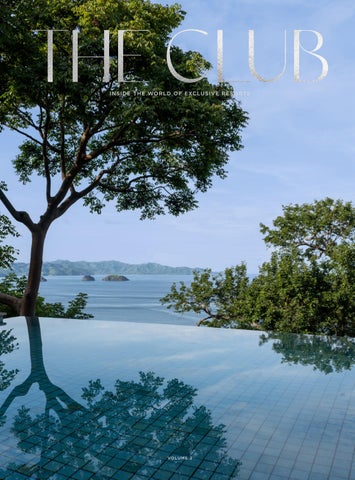
The Residences at Peninsula Papagayo, Costa Rica Photography by Christopher Bagley
The Club experience continues at exclusiveresorts.com/club-journal
Find everything from Club Journals—including a behind-the-scenes video of chef Maxine Sharf’s wonton cooking demo at Park Avenue Place in New York City—to the latest Club news, events, and additions to the Residence Collection.
Shop The Shoppe Look the part on your next getaway—or at home—with Exclusive Resorts–branded fashion and essentials, plus limited-edition offerings from luxury partners. shop.exclusiveresorts.com
Listen Up!
Offering a rare look into the extraordinary lives of Exclusive Resorts Members, the A Life Well-Lived podcast, hosted by CEO James Henderson, features conversations with Fortune 500 executives, visionary entrepreneurs, Michelin-starred chefs, worldrenowned artists, and elite athletes—all united by a shared pursuit to live richer, fuller, more meaningful lives.
As I reflect on my first few weeks with Exclusive Resorts, I feel both grateful and energized to be part of this extraordinary Club—and to be stepping into this role at this particular moment in my life.
A few years ago, I learned something important about myself: When you truly love the work you do, it doesn’t compete with your life; it enhances it. I felt this deeply during my time at Bergdorf Goodman, where the very best service was never transactional— it was intuitive, personal, and built over time.
At Bergdorf, many of our most loyal customers rarely needed to step inside the store at all. Their personal shoppers knew them—quietly, completely—and what they needed often appeared almost before it was asked for. There was ease in that relationship. A confidence rooted in trust. The sense that someone was paying attention on your behalf.
That philosophy is what drew me so powerfully to Exclusive Resorts.
The warmth of the welcome I’ve received—from our teams and from you, our Members—has been nothing
short of affirming. It has reinforced my belief in what makes this Club truly different. Exclusive Resorts exists to support the life you imagined: one defined by time well spent, meaningful experiences, and the freedom that comes from knowing the details are handled with care.
Over the past several years, James Henderson and the team have worked with great intention to strengthen The Club’s sense of community and service. I am honored to join them in stewarding the next chapter of this work.
At its best, The Club becomes one of the most natural and trusted parts of your life. You shouldn’t have to think about where to go next, what will work for your family, or whether an experience will meet your expectations. Our role is to know you—deeply—and to anticipate what you need or want, often long before you have to ask, replacing effort with ease and planning with confidence.
I am inspired by what lies before us. I look forward to meeting many of you in your travels and hearing the stories of the memories you create with your family and friends. My team and I are committed to honoring the promise of Exclusive Resorts—today and in the years to come.
Let us be grateful for the opportunity to explore, to connect, and to live fully. Together, we will continue building a Club defined not only by where we go, but by how thoughtfully we care for one another along the way.
With sincere appreciation and excitement for the journey ahead,
Melissa Xides
Kaitlin Menza
MADE WITH LOVE, PAGE 62
The Taipei-based features writer, who frequently covers culture, travel, and women’s issues, was drawn to the ease behind chef Maxine Scharf’s online appeal. “I’ve always been fascinated by what makes someone connect with an audience,” she says. “With Maxine, it becomes clear almost immediately.”
Chris Wallace
WHY WE TRAVEL, PAGE 118
Christopher Testani
MADE WITH LOVE, PAGE 62
New York–based Testani has captured more than a few notable chefs, including Ina Garten and Padma Lakshmi. “Maxine Sharf’s wontons were so photogenic,” he says, “and we were all eager to get the shot done so we could dig in!”
Christina Gliha
A BEAUTIFUL LEGACY, PAGE 74
The writer and photographer, who spends most of his time on the road reporting, focused on personal growth when writing his essay about how Venice has become a mainstay in his life. “I learned something in the process, which is the greatest gift an assignment can offer,” he says.
“Objects made by true artisans carry memory, intention, and time within them,” says the Toronto-based illustrator. Gliha’s art for this issue was especially familiar, shaped by a lifelong fascination with antique jewelry and furniture. “Engaging with heirlooms like these sparks the imagination and brings a lasting sense of inspiration and joy.”
Discover Clase Azul Master Artisans
JOIN THE CLASE AZUL MÉXICO COMMUNITY
CEO & PUBLISHER
JASON CUTINELLA
JACKIE CARADONIO
Global Editorial Director
BRIAN JOSEPH
Art Director
ERIN AGOSTINELLI
Managing Editor
JILL NEWMAN SCOTT BAY
Style Editor Senior Editor
EDITORIAL & CREATIVE
Writers CHRISTOPHER BAGLEY, ESME BENJAMIN, DAVID COGGINS, CARRIE GOLDBERG, VICTORIA GOMELSKY, OMAR MAMOON, KAITLIN MENZA, TERRY WARD
Photographers CHRISTOPHER BAGLEY, CORBIN GURKIN, ALANNA HALE, KEN KOCHEY, CHRISTOPHER TESTANI
Illustrators STEPHEN COLLINS, CHRISTINA GLIHA
Videographer BRENNAN FREED
Copy Editor DORA DALTON
OPERATIONS
Chief Operating Officer MERRI GRUESSER
Operations Director SABRINE RIVERA
Corporate Affairs JOE V. BOCK
ADVERTISING
Head of Integrated Marketing & Partnerships AMANDA GILLENTINE amanda@nmgnetwork.com
VP Sales MIKE WILEY mike@nmgnetwork.com
Global Brand Partnerships MARLY GRAUBARD marly@nmgnetwork.com
Decades after maximalism first flirted with luxury’s main stage, the pendulum has swung back to extravagant, layered silhouettes—and this time, it’s with a boho flair. La DoubleJ’s Spring 2026 collection establishes the look with Venetian brocades, Riviera-ready looks, and bold patterned garments that feel alive, ahead of the trend, and ready for your next trip. ladoublej.com
2 / AN ICON REBORN
Last year, the design world fell for the reissue of Afra and Tobia Scarpa’s 1970 Monk Chair; now the icon has a new twist with Molteni&C and Cabana magazine behind the wheel. With its monastic lines and sculptural restraint, the cult classic is as relevant today as it was 50 years ago— and the timeless design is sure to endure for 50 more. It’s an investment piece and a multigenerational treasure. molteni.it
As work, wellness, and social life blur into one seamless pursuit, Fitler Club has become Philadelphia’s most coveted private escape. The 136,000-square-foot riverfront members-only spot houses a luxe two-story spa, performance-driven fitness studios, coworking lounges that rival Silicon Valley, and a golf simulator suite where deals are inked between drives. fitlerclub.com the club ten
3 / THE NEW THIRD PLACE
4 / THE SLOW ROAD EAST
From the Private Journey Collection comes Vietnam & Laos: Land of Lanterns and Lotus, a new nine-day itinerary traversing Hội An’s sun-dappled alleys, Hanoi’s colonial boulevards, Luang Prabang’s ancient temples, and Kuang Si’s turquoise waters. Highlights include cycling past emerald rice paddies, meeting master artisans, and learning the recipes of Lao and Vietnamese cuisines.
5 / ORANGE CRUSH
Omega called the shots as the official Winter Games timekeeper—and the world took notice, increasing demand for showy, confident watches. The Omega Seamaster Planet Ocean, defined by its signature blaze-orange, sea-blue, and jet-black bezel, answers the call. Without losing its legacy as the best watch for deep diving (up to 2,000 feet), this new release has been completely redesigned for those who wear their status like a badge: bold, luminous, and built for depth. omegawatches.com
6 / ON ISLAND TIME
In July, the world’s first female master blender in the spirits industry, Dr. Joy Spence, made rum history when she unveiled Appleton Estate “The Source,” a 51-year-old expression—the oldest ever released from Jamaica. The ultra-smooth sipping rum has matured through decades of exposure to tropical heat, something once thought impossible in the hot and humid Caribbean climate. Just 25 crystal decanters have been produced, each priced at $70,000, appletonestate.com
7 / WESTWARD MIGRATION
Denmark’s fabled Noma—the Copenhagen powerhouse repeatedly crowned among the world’s best and the benchmark of modern gastronomy—is staging a 16-week residency in Los Angeles (through June 26, 2026), offering a hyper-local tasting menu at $1,500 per person. The pop-up is transforming a yet-to-be-disclosed Silver Lake locale into a culinary laboratory, with just a sliver of seats available. For those who can’t snag a ticket, the Noma team is also rolling out a retail shop, chef collaborations, and other surprises throughout the city. noma.dk
8 / CURVES AHEAD
Brazilian-born jewelry artisan Fernando Jorge’s new Deep Vertex collection turns fine jewelry into a study of material. Each piece is shaped by color and texture, matching hues in divergent mediums: Carved ebony is set against onyx; dark bloodwood abuts deep red carnelian; and cream opal dissolves into iridescent mother-of-pearl. The craftsmanship is obsessivem, and the effect is powerful minimalism. fernandojorge.co.uk
9 / BEYOND THE FACE
After decades of perfecting the face, La Prairie is finally giving the rest of the body its due. Launched in February, Cashmere Body Cream marks the brand’s first foray below the neck, built on its patented Cellular Complex and a biomimetic peptide inspired by the indulgent feel of cashmere. With it, skin is stronger, smoother, and more resilient, wrapped in a texture that lives up to its name—and the brand’s rarefied reputation. laprairie.com
10 / RED-HOT REVERIE
This spring, Harry Winston is leaning into rubies and pink sapphires, ushering in an embrace of color. As collectors tire of icy uniformity, fine jewelry is playing with emotion, and nothing stirs the heart like red gemstones in the house’s unmistakable constellation designs. It’s a romantic return to glamour. harrywinston.com
HERITAGE & HORSEPOWER
Car enthusiast David Coggins enters the rarefied world of racing at the annual Monterey Car Week.
Photography By TOM O’NEAL
“Monterey Car Week is also well attended by the racing elite, allowing average admirers like me to occasionally rub shoulders with celebrities.”
Ilove cars. Whether rugged (Land Rover), sporty (Porsche), or impossibly gorgeous (a 1961 Aston Martin DB4GT Zagato Coupé)—it bears repeating: I love cars. I should add that I drive a 10-year-old Volvo wagon, which, though perfectly handsome, is not particularly fast. Thus, my daily interaction with highperformance models is usually relegated to watching them as they pass me on the left.
As with any love, it’s only natural that my affection has gotten a bit obsessive. Thus, in my spare time, I seek out places where I can ogle rare and beautiful cars up close. I even made a pilgrimage to the Volvo headquarters in Sweden to pay my respects.
The peak of such places, in my experience, is Monterey Car Week, an annual event held each August in California’s iconic Central Coast, that takes my obsession to its most heightened state. There are cars, of course, new and old, rare and restored, downright historic and ferociously futuristic. But there’s something else too, something in the air: a palpable love of cars. It’s like being at the opening vernissage of Art Basel—only in this case, the art can break the speed limit.
The first Pebble Beach Concours d’Elegance—the final and most celebrated event of Monterey Car Week—was held in 1950. Today, the festivities extend across three locations over the course of a week, with private parties and sales lasting even longer. As one fellow car lover told me, “Business is being done, and fun is being done.”
There are auctions for old cars and orders for new cars. In VIP hospitality tents, there are watch sales, resales, and friends promising to meet at the Daytona 500 or Monaco Grand Prix. There’s also legitimate engineering expertise. Car companies unveil their latest and greatest and even models that are only concepts, with no plans to go into production. (The technology is still useful, I’m told.)
Rolex is a fixture at these events. After all, the intersection of car aficionados and watch aficionados overlaps in a comprehensive way. Both are elegant combinations of form and function, and while the motor and movement may be hidden, performance remains key. It’s fitting then that the
The Pebble Beach Concours d’Elegance is the world’s most prestigious classic car competition, where rare and historic automobiles are judged on design excellence, technical merit, and preservation or restoration accuracy.
During the week’s events,
vintage cars take to the iconic coastal highways of Monterey.
“It was in that moment—that hot lap—that I realized I’d spent my entire life in lukewarm temperatures. The speed was engulfing, like I imagine it would feel to enter another dimension.”
winner of the Pebble Beach Concours d’Elegance receives a handsome Rolex—which, if you ask me, is enough reason to enter your beloved car in the competition.
Monterey Car Week is also well attended by the racing elite, allowing average admirers like me to occasionally rub shoulders with celebrities. At the Quail—where the golf course had been turned into a luxurious garden party, adorned with a Lamborghini Fenomeno, Bugatti Brouillard, and Aston Martin One-77, among many others—I found myself in conversation with racing great Tom Kristensen, the Danish driver and Rolex Testimonee who won Le Mans a record-setting nine times. “I signed four days before my first race,” he reminisced, lightheartedly, adding that today he is more often on a bicycle than behind the wheel. “Traffic frustrates everybody—at Le Mans or on the highway in L.A. I try to relax, but somehow I still end up going fast.”
I soon left the easygoing chitchat for the fast-paced scene of Laguna Seca, a racetrack dramatically set in the hills. This is where ogling pristine cars turns into actually driving pristine cars. You can watch them speeding around the track the way they were meant to be driven—cars of every generation wrapping around the famous corkscrew turn that descends at an alarming angle. “When they’re still, they don’t really do it for me,” Jenson Button said with a laugh. The photogenic British F1 racer who won 15 Grands Prix, and another Rolex Testimonee, stood beside a gorgeous Alfa Romeo, one of six cars he was racing that day. “In historic cars, you feel the race.”
Feeling the race was part of my plan too: While the professionals took a break, I suited up in a balaclava and helmet and strapped into the passenger seat of a Porsche 718 Cayman GTS 4.0. “Hello,” I said, turning to the helmeted driver of the car and sticking my hand out for a shake. It only seemed the proper thing to introduce myself to the person who would soon hold my life in his palm. He shook it, a little surprised. “Have you done this before?” he asked. I have no doubt he already knew the answer. “Well, this should be fun then.” And he took off.
It was in that moment—that hot lap—that I realized I’d spent my entire life in lukewarm temperatures. The speed was engulfing, like I imagine it would feel to enter another dimension. It was purely visceral; reason and overanalysis took a welcome backseat. Speed was the thing, but so was deceleration, the complete range of motion required to hug the track’s wide turns. It was not clear how long we were in the car. Afterward, I was told it was just over a minute. When we were done, I unfolded myself from the car seat and felt a sense of supreme exhilaration and lightness. I grinned widely.
“How was it?” the next rider asked eagerly. “So good,” was all I could say, laughing. So, good! I couldn’t quite imagine how I’d ever go back to my humble Volvo.
The 2026 Monterey Car Week takes place from Friday, August 7, through Sunday, August 16.
weaver dream
Among Hästen’s famed blue-checked mattresses, the Grand Vividus is the most coveted of all—a sleep-inducing masterpiece crafted entirely by hand. Here, a look at how it’s made, from A to ZZZ
By SCOTT BAY
Material Focus
Horsehair, flax, wool, and cotton are teased, aerated, and aligned to encourage airflow and elasticity, allowing the mattress to regulate temperature naturally. The horsehair strands are even braided and unwound manually to enhance the material’s natural springlike behavior.
What does a six-figure mattress feel like? For Hästens, the answer is time—more than 150 years in fact. The nowfamous brand known for its highly coveted, blue-andwhite checkered mattresses, was founded in Köping, Sweden, in 1852, and since then, it has been refining, improving, and perfecting the art of a good night’s sleep.
While much of the industry has long since moved toward foam, speed, and compression, Hästens has remained fixed on handiwork, natural materials, and a belief that comfort is something constructed gradually, not engineered for immediate effect. The result is a product that exists almost outside the contemporary sleep economy—less consumer good than heirloom, nearly as covetable as a work of art.
At the furthest extreme of Hästens’s legendary craftsmanship is the Grand Vividus. Developed in collaboration with Canadian architect and designer Ferris Rafauli, the bed is assembled entirely by hand, from start to finish, by a small team of master artisans. There are no mechanized shortcuts, no adhesives, no synthetic foams—and each stage of construction unfolds slowly: Layers are stitched, springs are tensioned one by one, and materials are given time to settle before the next phase begins.
“Rafauli is the true master in designing ultimate luxury,” says Jan Ryde, fifth-generation family member and CEO of Hästens. “He has the sense, the feeling, and the deep understanding of our products.”
The painstaking process behind each mattress—the Grand Vividus especially—is hardly a secret, the result of precise workmanship, the finest materials, and of course, lots and lots of time.
Layer Upon Layer
A single mattress requires hundreds of hours of uninterrupted craftwork. Master artisans (only a handful of certified craftspeople are permitted to assemble a Hästens mattress) hand-stitch the internal layers, tension the springs, and repeat the process again and again, allowing each layer to settle before the next is added, ensuring structural integrity and long-term resilience.
Crafted to Endure
The Grand Vividus is engineered for decades of use. Designed to evolve rather than degrade, through the rejection of petroleum products, synthetic foams, and adhesives, the signature blue-checked mattress gains character over time. Its comfort even deepens as the allnatural materials adapt to its owner—like sleeping on a custom-tailored cloud every night.
A view of Culebra Bay from the pool deck of an Exclusive Resorts Residence. Opposite: A vase handcrafted by Maribel Sánchez Grijalba.
of EARTH and FIRE
Best known for its natural riches, Costa Rica’s lush west coast has a hidden side, where ancient pottery techniques still thrive and the nation’s beauty and history are channeled into one-of-a-kind creations.
Written and Photographed by CHRISTOPHER BAGLEY
WWhen you’re traveling in Costa Rica—a country blessed with a seemingly endless supply of sublime beaches, idyllic waterfalls, and wildlife-rich jungles— it can be easy to overlook other kinds of attractions. Culture and history? Who needs those while you’re scuba diving in a secret cove or sipping cocktails on the deck of your villa in Peninsula Papagayo, gazing out at the Pacific Ocean?
During my recent stay, I was duly enraptured by the country’s natural wonders, including the capuchin monkeys that popped out of the trees whenever there was fresh-cut mango lying around. But all it took was a rainy day to lure me away from the coast and toward a fascinating, little-known remnant of Costa Rica’s precolonial past. Ninety minutes by car from the plush comforts of Papagayo sits one of the few places in Central America where ancient pottery techniques still thrive—in the backyard workshops of private homes.
Above, from top: Guaitil artisan Irma Gutierrez with one of her piggy banks; a vessel by Luis Gutierrez inspired by ancient Chorotega pieces. Opposite: Johnny Sánchez Grijalba at his family workshop in San Vicente.
“Bienvenido,” ceramicist Maribel Sánchez Grijalba said, welcoming me as I stepped into the studio attached to her small house in the village of San Vicente. Surrounded by buckets of thick, wet clay and cups of liquid pigments, Sánchez was polishing an ornamental water jug while her son, Johnny, sculpted a tiny lizard to perch on the rim of a jar.
In San Vicente and the neighboring village of Guaitil, artisans still source their raw materials—earth and sand for the clay mixture, along with mineral pigments in inky blacks and deep reds—from nearby hillsides. They spin their potter’s wheels the oldfashioned way: by hand, without the aid of electricity or even a foot pedal.
“Making ceramics is a way for us to preserve our heritage, and also to earn a living—a way to survive,” said Sánchez, who learned all she knows about pottery from her mother and grandmother. She was 10 years old when she began making little cups and jars to sell at local markets.
Clockwise, from left: Peninsula Papagayo and the Gulf of Papagayo; a capuchin monkey at Poro Poro restaurant; artisan Luis Gutierrez with one of his vases.
Like most artisans here, Sánchez and Johnny are descendants of the Chorotega people, an Indigenous group whose original homeland is now part of Chiapas, Mexico. Over the centuries, as the Chorotega settled in other parts of Mesoamerica, their bloodlines mixed with those of Africans and Europeans, and many of their traditions were lost, along with their native language. But ancestral ceramics techniques continued to pass from generation to generation. Women made griddles, pots, and water jugs for the kitchen, while men collected earth for clay and firewood for kilns.
Decades ago, as tourism began booming along Costa Rica’s west coast and outsiders caught on to the quality and authenticity of Chorotega pottery, many local families opened workshops. Even the men sat down at the wheel, learning the craft from their mothers and wives. Some artisans also immersed themselves in Chorotega history, studying pre-Columbian pieces in books and museums and creating replicas with traditional methods. In 2016, an official protected-designation seal was established to certify pieces made using local materials and ancient techniques.
Today, visitors can arrange guided tours of the villages, often including lunches of corn tortillas and other local specialties, grilled on earthenware comals. But if you speak a little Spanish and wander on your own, as I did, you’ll find the essence of Chorotega craftsmanship remains fully intact.
That’s how I ended up in Deri Biceño’s backyard, a few blocks from the church on Guaitil’s main square, where children played hide-and-seek as chickens darted among the pigpens. Biceño was making lunch for his family over an open fire before sitting down to work on an armadillo-shaped pot. Behind him loomed his massive, hand-built kiln, an earthen dome mottled by years of smoke. Down the road, I met another veteran
Above: An artisan at the wheel in Guaitil. Opposite: Deri Biceño at work in his backyard atelier.
ceramicist, Irma Gutierrez, and her son, Luis, who showed me some of their treasured pieces, including Gutierrez’s patinaed piggy bank and a fine vase by Luis finished in a creamcolored glaze that glowed like ivory.
The future survival of Chorotega traditions might depend on how artisans navigate the challenges they’re facing today. Teenagers in the villages are more interested in creating digital content than ceramic vessels. The lands containing the main clay deposits are now privately owned, making raw materials costlier and harder to access. And as buyer demand fluctuates and competition among artisans has increased, some have adopted a souvenir-stall approach, producing touristfriendly mugs and plates in decidedly nonlocal blue or yellow hues.
“It’s OK for the practice to adapt and evolve a bit, and to reflect our times,” Johnny Sánchez Grijalba told me. “But traditions need to be maintained.” His mother, like many of the villages’ best artisans, creates some contemporary pieces on commission but prefers to work according to the ancestral methods. She also runs a ceramics museum in San Vicente, where she offers free pottery classes to children.
Back at Peninsula Papagayo the next day, while I was savoring grilled shrimp and a guaro cocktail at Poro Poro restaurant, the dusty workshops of Guaitil and San Vicente seemed very far away. But French-born head chef Nicolas Devenelle told me that shards of antique Chorotega pottery had been discovered near a beach close by, at the bottom of a centuries-old well. Devenelle was planning his own excursion to the villages later in the week to order some vases and decorative pottery for a new lounge space at the restaurant.
“Of course we want to have some beautiful new pieces here,” he said, “so people can see that these traditions are still alive.”
Above: Johnny Sánchez Grijalba in his family studio. Opposite: An Exclusive Resorts Residence on the Gulf of Papagayo.
PENINSULA PAPAGAYO
Exclusive Resorts’ Peninsula Papagayo Residences put you at the heart of Costa Rica’s most dynamic coastal playground. Set within the Poro Poro Beach Club, the collection of 21 four-bedroom Residences pairs laid-back luxury with adventure-ready design, featuring wraparound decks, private infinity pools, and sweeping views of the Culebra Bay coastline—often shared with curious visiting monkeys. Days unfold between beach club lounging,
surfing, and sailing along 23 miles of shoreline, or retreating to the nearby Four Seasons Peninsula Papagayo spa and golf course.
Beyond the Residences, experiences showcase Costa Rica at its most vivid: wildlife-rich Palo Verde boat tours, adrenaline-fueled ziplining through canyon canopies, and restorative volcanic-sand foot treatments.
Indy 500 champion Alex Palou is dominating American open-wheel racing. Can the recordbreaking Spaniard usher in a new era for the sport?
By TERRY WARD
Full Speed
Ahead
Spanish racing driver Alex Palou is in a rare lull: the quiet of the off-season. Autumn has settled in and, for the moment, life has slowed. He’s off the racetrack and at home in Zionsville, Indiana, where his days are spent with his wife, Ester Valle, and their young daughter, Lucia. Soon, the family will head to Palou’s native Spain to celebrate the holidays—a pause that comes after a season defined by relentless momentum.
At 28, Palou is coming off the most successful year of his career, one that delivered both the IndyCar Series championship and a victory at the Indianapolis 500. Before the calendar turns again, he plans to fill the break with family, fresh seafood, and copious plates of paella—recharging ahead of a January return to the Indianapolis Motor Speedway and another run at it all when IndyCar’s 2026 season begins in March.
Long before ovals and victory lanes in the American Midwest, Palou’s racing career unfolded across continents. He came up through Europe’s GP3 series before heading to Japan, where two successful seasons in Super Formula helped shape the talents that would eventually bring him to IndyCar. “I’ve been very lucky to start my career in Europe and then transition to Japan before arriving in the USA,” he says. “It allowed me to gain different knowledge from both cultures and to learn different ways of working with engineers—and with myself as a driver.”
That global apprenticeship paid off quickly once Palou arrived stateside. He made the jump to IndyCar in 2020, and his rookie season immediately signaled a stellar pace. By 2021, he had signed with Chip Ganassi Racing and promptly dominated the IndyCar Series. More titles followed in 2023 and 2024, but last year proved something else entirely. That season, Palou added an Indy 500 victory to his championship tally, becoming the first Spanish driver ever to win the iconic 500-mile event known as “The Greatest Spectacle in Racing.”
For someone who grew up karting in a small town outside Barcelona, it was a defining moment—even if it wasn’t the future he once imagined. Palou began racing competitively at age 6, when Formula 1 (F1) driver Michael Schumacher was his hero. “For a racing driver in single seaters, what you want is to get to F1,” he says. “That’s the dream for everybody because it’s the highest series.”
When Palou first arrived in the U.S. in 2020, that dream felt distant. The transition to IndyCar—and particularly to oval racing—was a steep learning curve for a driver whose entire career had unfolded on road courses. “It was tough,” he says.
Opposite: Spanish racing driver Alex Palou and his team celebrate another Indy500 win. Below: Strapped in and ready to dominate the oval.
“It’s the same racing car, and you’re doing the same thing, which is to race. But the way you need to drive the car, the way you need to feel the car—it’s very different.”
These days, however, Palou is clear-eyed about where he belongs— even with F1 teams circling. He’s fully committed to a future that includes ovals, street circuits, and road courses in the U.S., drawn as much by the culture of IndyCar as by the competition itself. “It’s one of the only series that’s still super pure,” he says, adding that he appreciates that there are “less politics” than in F1.
That sense of balance extends beyond the track. Palou values that his family can be present throughout the season—something that keeps him grounded amid the demands of a compressed calendar. “There’s no pushback from sponsors or teams when you want to have your family travel with you as there is in other series, especially in Europe,” he says.
From his vantage point inside the paddock, Palou sees IndyCar’s momentum continuing to build. While he admits it’s difficult to imagine the series reaching F1’s global scale—especially given its current focus on the U.S. and Canada—recent changes, such as the South American expansion planned for 2027, have brought new energy. A broadcast partnership with Fox Sports has introduced Palou and his peers to a younger audience, pushing drivers beyond race weekends and into mainstream view. Palou even appeared in a Fox Sports Super Bowl promo in 2025, a moment he says helped fans better understand the sport and connect with drivers as personalities.
For Palou, though, the heart of IndyCar remains the people. Beyond preparation, pressure, and winning, it’s the closeness of his team that continues to define the experience. “Compared to F1, the season is very compressed,” he says. “In IndyCar, you spend a lot of time traveling with your team, with your mechanics and your engineers, so the relationship and the chemistry with them is super, super close.”
After a season like 2025, the bar is high—and Palou knows it. But his camp is already committed to clearing it. “When we start in 2026, we don’t really care about 2025 or the past or anything,” he says. “I can always try and be faster by breaking a bit later or carrying more speed. There’s always something that you can push for to try and be a little better.”
For now, anyway, better means more of the same formula that has driven Palou to success: focus, flexibility, and family. “As a driver, your dream is to win races and championships,” he says. “I don’t think there’s any other place I would rather be right now.”
Palou credits the familyfriendly atmosphere as one of the reasons he’s all-in on Indy500.
Culinary star and cookbook author Maxine Sharf
heritage, heart, and the joy of togetherness into every dish.
By KAITLIN MENZA
Made with Love
folds
Photographed by CHRISTOPHER TESTANI
I“can’t remember a time when I didn’t know how to fold wontons,” Maxine Sharf says. “My mom and I joke that I could do it before I ever held hands with a boy.”
The social media star and recipe developer is chopping, mixing, and indeed folding her signature dish, Grandma’s Wontons, in the kitchen at Park Avenue Place, an Exclusive Resorts Residence in the heart of Midtown Manhattan. After growing up in Northern California with a Korean Chinese mother and a Russian, Romanian, and Polish father, Sharf is now based in Los Angeles but spends several months every year in New York. Her broad repertoire as a chef (her calling card: an only-in-America fusion of cultural influences) has garnered a massive following on Instagram at @maxiskitchen, where viewers appreciate Sharf’s sunny disposition and frequent appearances from her mom, Ann.
But back to wontons. Food has always been the throughline in Sharf’s life. After developing her culinary foundation under her mom’s tutelage, she cooked for
friends in college and during her early years in New York City, where she launched a tech career. She met her future husband, Doug Schuessler, in 2014 and suggested throwing a wonton party where she could teach everyone the family skill. “I feel like it was in trying to impress him with my cooking that I started to get more into it,” she says.
Over long, lazy mornings and weekends together, Sharf cooked and cooked, and in 2018, she started posting her process on Instagram. “If you look back at the first video I ever did, it was horrible,” she says. Yet her friends and family loved the clips, and she started gaining more followers. Soon, social media became her number-one hobby, as she spent all her off-hours developing recipes, learning video techniques, and examining her metrics.
It didn’t take a lot of complex data analysis to realize her mom was a big draw. “She is the one who taught me how to cook, so it was always such a natural thing to include her in the cooking videos,” Sharf says. When Ann popped up, “I would get so many comments.” Working with her
Sharf folds wontons at one of Exclusive Resorts’ Park Avenue Place Residences.
“My North Star is always to inspire as many people as I can to feel confident in the kitchen.”
mom wasn’t just for the likes, of course; they’re also best friends who talk on the phone multiple times per day. “It’s been such a fun thing to do together, and she’s such a workhorse. I wouldn’t be where I am without her.”
The turning point for Sharf came in 2022, when she was laid off from her tech job. “It felt like such a gut punch,” she says. “I cried the whole day.” But the wallowing was quickly replaced by a tiny voice that said this might be her chance to pursue cooking full time. The next day, she woke up and filmed three new videos. “Ever since, I feel like I’ve been running as fast as I can.”
Sharf learned quickly that the key to growth was consistency; in the year after her layoff, she aimed to post six new dishes per week, which meant developing recipes, grocery shopping, filming, recording voiceover, editing, and writing. She soon found her most popular posts tended to be family recipes or ones with a great story behind
them. In the nine months after her layoff, Sharf grew from 100,000 to more than 1 million followers.
It wasn’t long before the publishing world came knocking. Editors reached out to suggest she consider a cookbook, which was the professional validation she’d been aiming for. “It always felt like the right next step for me to establish myself as a real recipe developer in the space,” Sharf says.
Maxi’s Kitchen: Easy Go-To Recipes to Make Again and Again debuted in March with 20 of Sharf’s most cherished family dishes alongside 75 new recipes. The book is arranged by days of the week, with Monday featuring healthier, lowerlift meals like miso-butter salmon and sweet-and-sour ginger tofu, and Tuesday suggesting one-pot dishes like Grandpa’s Jjigae and a loaded pizza skillet. The weekend chapters offer longer, more labor-intensive culinary adventures like lasagna or Chinese hand-pulled noodles with chili oil and scallion. “I usually decide what to cook
based on how I’m feeling, and the week has a natural rhythm to it,” Sharf says of the format. “My hope is that it will help people pick the recipes to match their mood.”
There are also charmingly illustrated interstitials such as “How to Cook Pasta Like an Italian,” which was inspired by a family vacation to an Exclusive Resorts villa in Tuscany. “While we were there, we had two incredibly talented home cooks come to the villa and teach us how to make pasta,” Sharf recalls. “We learned dishes like spaghetti vongole, a classic pomodoro, and carbonara. It was such a special experience and really informed the way I cook and think about pasta.”
The book is studded with backstories of charming cultural crossovers, as with “Grandpa’s Giant Baked Italian Sub,” inspired by Sharf’s Korean grandfather, who immigrated to the U.S. to attend pharmacy school at Ohio State University. There, he met Sharf’s grandmother, and together, the couple would hit up an Italian deli before attending football games. “They would get this stacked
American sub with pepperoni, ham, and provolone cheese, and when they moved to Illinois—where they raised my mom and her sisters—they decided to start making it at home,” Sharf says.
While much of her 2026 calendar will be devoted to cookbook events and promotion—the Instagram video of her sobbing mother seeing the final printed version for the first time is a heart-squeezer—Sharf is, as ever, focused on growth. “I have a vision board in my room and at the center it says, ‘To inspire you to cook.’ My North Star is always to inspire as many people as I can to feel confident in the kitchen,” she says.
The feedback from followers, who now number more than 3 million, shows that the inspiration is flowing. “[They] say, ‘I really thought I didn’t know how to cook and now my boyfriend thinks I’m the best cook because I’ve been following your recipes,’” she says. “The people who didn’t think they could do it and then realize they can be really good at it—that means so much to me.”
Sharf’s new cookbook, Maxi’s Kitchen: Easy Go-To Recipes to Make Again and Again, includes 20 family recipes, along with 75 new recipes.
Maxine Sharf’s Grandma’s Wontons
Serves: 8 to 10
(makes about 100 wontons)
Prep time: 20 minutes
Total time: 1 hour 45 minutes
FILLING
4 small dried shiitake mushrooms (or fresh shiitakes)
Boiling water, for soaking
1 pound ground pork or 96/4 ground chicken
1 (8-ounce) can water chestnuts, drained and coarsely chopped
2 tablespoons finely chopped fresh ginger
3 scallions, thinly sliced
1 large egg
1 tablespoon soy sauce
1 tablespoon toasted sesame oil
1 teaspoon kosher salt
½ teaspoon freshly ground black pepper
½ teaspoon sugar
¼ cup water
2 tablespoons cornstarch
SAUCE
3 tablespoons soy sauce
2 tablespoons rice vinegar
2 tablespoons toasted sesame oil
½ teaspoon sugar
1 teaspoon toasted sesame seeds
1 tablespoon chili oil or chili garlic sauce (optional)
FOR FOLDING AND SERVING
2 (12-ounce) packages wonton skins
Toasted sesame oil
Thinly sliced scallions
Finely chopped fresh ginger (optional)
1. Make the filling: Place the dried shiitakes in a heatproof bowl and cover with boiling water. Set aside until rehydrated, for about 20 minutes. Drain and cut mushrooms into small dice, then transfer to a medium bowl.
2. Add the ground pork, water chestnuts, ginger, scallions, egg, soy sauce, sesame oil, salt, pepper, and sugar to the bowl with the mushrooms. Mix with a large spoon or your hand until all the ingredients are evenly distributed.
3. In a separate small bowl, mix together the water and cornstarch until dissolved. Add to the filling and mix to combine.
4. Make the sauce: In a small bowl, mix together the soy sauce, vinegar, sesame oil, sugar, sesame seeds, and chili oil, if using; set aside.
5. Bring a large pot of water to a boil.
6. Meanwhile, fold the wontons: Fill a small bowl with water. Orient a wonton skin in your palm in a diamond shape and place 1 heaping teaspoon of the filling on the bottom corner of the skin, closest to you. Roll from the bottom corner up until the filling is fully covered, then wet the skin to the right of the filling. Hold the wonton with your hands on either side of the filling. Pinch the skin on both sides of the filling to seal (like a candy in a wrapper), then bring both sides in to meet, folding the wet (right) side under the dry (left) side and pinching to seal. (The water will act as an adhesive.)
7. Working in batches of 15 to 20 wontons (so as not to overcrowd the pot), add the wontons to the boiling water and cook until they float to the surface and the internal temperature registers 165ºF on an instant-read thermometer, 2 to 3 minutes. Using a spider strainer, remove the wontons from the pot, allowing the excess water to drip off, and transfer to a serving bowl.
8. To serve: Drizzle the wontons with sesame oil and toss to prevent them from sticking together. Spoon some sauce onto the wontons, saving more to serve on the side. Top with scallions and ginger, if desired, and enjoy!
WHERE TO STAY
PARK AVENUE PLACE
Park Avenue Place offers an elegant home base in the heart of Manhattan, where the energy of New York City awaits the moment you step outside. The 14 Exclusive Resorts twobedroom Residences are each designed with a chic metropolitan sensibility and floor-to-ceiling windows overlooking 54th Street. Fully stocked kitchens make it easy to settle in, whether you’re starting the day with coffee or returning from a day on the town.
From this central address, Broadway stages, Michelin-starred dining, and world-class museums are all within easy reach. Central Park is also close, inviting leisurely walks past Strawberry Fields and Bethesda Fountain or a classic rowboat ride from the Loeb Boathouse. The Exclusive Resorts concierge team stands ready to arrange everything from grocery delivery and restaurant reservations to private tours, tickets, and customized sightseeing.
A new generation of collectors is redefining heirlooms, from record-setting watches to luxury vacation club memberships.
By VICTORIA GOMELSKY Illustrations by CHRISTINA GLIHA
A Beautiful Legacy
The tension, according to eyewitnesses, was palpable. As bidding began for lot 23 at Phillips’s
“Decade One” watch auction in Geneva in early November, the room braced for a moment that watch lovers had been buzzing about for weeks.
Manufactured by Patek Philippe in 1943, the lot in question was a Ref. 1518 perpetual calendar chronograph wristwatch in steel, one of only four known to exist. By the time the hammer fell, the piece had reached $17.6 million against a presale estimate of $9.9 million, becoming the most expensive vintage Patek Philippe wristwatch ever sold and the star lot in the highestgrossing watch auction in history.
For a category of collecting that only came into its own in the early 1980s, wristwatches have made remarkable strides over the past four decades. Their desirability, however, hinges on much more than their appeal as objects of mechanical perfection. Today, the finest examples—the Ref. 1518 and its ilk—form a bona fide asset class, prized as much for their investment potential as for their enduring horological significance.
Patek Philippe has played a key role in that shift. Since the 1996 introduction of its seminal—and still-going— Generations campaign (“You never actually own a Patek Philippe. You merely look after it for the next generation.”), the brand has staked its reputation on the notion that
What distinguishes today’s collectibles is that, for those with discerning taste and the means to buy the best of the best, some luxury purchases can now be counted on to deliver dividends for the next generation.
its wristwatches are family treasures, built to run in perpetuity. Over time, the ads have also communicated a subtler message to those in the know: Patek Philippe timepieces are highly portable stores of wealth ideal for families seeking to diversify their portfolios.
“What makes a great wristwatch an heirloom piece comes down to quality: movements made to be durable, accurate, serviceable; designs that are original and fit wrist sizes of all types; watches conceived from the vision of a singular watchmaker or a great brand and designed for excellence,” says Paul Boutros, deputy chairman and head of watches in the Americas at Phillips.
Of course, people have always sought out well-made, beautiful objects—many with no functional purpose at all—to collect and eventually pass down. What distinguishes today’s collectibles is that, for those with discerning taste and the means to buy the best of the best, some luxury purchases can now be counted on to deliver dividends for the next generation.
Consider the other timepieces that performed well at the Phillips sale, such as the 2006 Tourbillon No. 7 by less well-known independent German watchmaker Christian Klings. The wristwatch, which originally retailed for about $100,000, sold for $1.1 million. Also worth noting, two pieces by celebrated independent watchmaker
François-Paul Journe: the Chronomètre à Résonance Souscription No. 2 and the Tourbillon Souverain TN “Régence Circulaire” in 18k pink gold, which sold for $4.1 million and $2.1 million, respectively.
Journe, who made his name in 2000 with the Résonance, a masterpiece of contemporary horology, is still a newcomer compared to 186-year-old Patek Philippe, but the steep appreciation of his watches and the extraordinary price achieved by the Klings tourbillon reflect rising demand for a new generation of independent watchmakers, nearly all of them men working in Journe’s mold (the Geneva-based Kosovan watchmaker Rexhep Rexhepi chief among them).
“There are so many wealthy people interested in watches, and they want what others don’t have,” Boutros says. “They’ve gravitated to independents, and because there are so few of them, it’s a feeding frenzy when one comes up for auction.”
Vintage jewelry dealer Lauren DeYoung has seen a similar phenomenon in the market for fine jewelry from decades past because of the simple fact that, with each passing year, demand inevitably outpaces supply. “When you’re talking about vintage and antique, things come into the market and things leave the market, but you are never getting an influx of new supply,” she says.
Value, DeYoung says, often comes down to rarity, brand, design, and provenance. Signed pieces—from Bulgari, Cartier, Tiffany & Co., and Van Cleef & Arpels— command premiums, but lesser-known artisans, such as René Boivin and Suzanne Belperron, also boast dedicated followings. Just as important is the emotional dimension. “Jewelry is different from art or wine,” DeYoung says. “You get close to it. You wear it. It becomes part of your personal history.” She gestures to her own ring, its central yellow diamond inherited from her grandmother. “I feel her and my grandfather with me all the time. You don’t get that in other categories.”
Kait McElwee, founder and managing partner of Arcadia Art Consultancy in Charlotte, N.C., might beg to differ. While decorative objects lack jewelry’s portability, there’s no question they are sought-after repositories of history, both personal and political. That’s especially true of crafts. Long overlooked by fine art collectors, the work of craftspeople, such as the quilt makers of Gee’s Bend, Ala., makes up an emerging category of collectibles resonating with contemporary buyers because objects that are painstakingly handmade feel rarefied in the age of AI.
“Personally, I think there’s something very meaningful in our digital age about working with textile, wood, ceramic, and glass,” McElwee says. “These materials are shared amongst virtually all cultures, past and present, across the globe. This makes them very approachable. When this approachability is complemented with mastery of the medium, and a compelling message that is imbued with layers of meaning related to history, theory, and methodology, that can be a winning combination.”
To be sure, every era has produced singular designs virtually guaranteed to delight, and possibly even enrich, future generations. For Nicky Dessources, executive director of the Salon Art + Design fair in New York City, those include a circa 1930s, four-panel, lacquered wood screen by the Swiss French designer Jean Dunand. “It’s so rare, so one of a kind,” Dessources says. “It’s a conversation starter—and it will appreciate.”
Other solid investments include pieces by 20th-century French designer Jean Royère, whose sculptural furniture inspires intense demand, and New York artist Jeremy Anderson, whose ceramic lighting and furnishings “look almost like pieces of jewelry,” Dessources says.
“Once people shift away from transactional travel, they start to think about how many years of spring breaks they have with family and friends.”
SARAH E. O’NEIL, Vice President of Member Engagement, Exclusive Resorts
Both she and McElwee emphasize that as members of the Silent and Boomer generations take part in the Great Wealth Transfer—the widely reported $124 trillion relocation of assets from older generations to younger ones, primarily millennials—one way to ensure that beloved heirlooms are enthusiastically received (“I hear the phrase ‘My kids don’t want it’ probably once a day with my clients,” McElwee says) is by collecting with both intention and a very long view. For starters, that means acquiring pieces that brim with meaning.
“If I can’t write at least two or three pages about it, it’s not a piece I would encourage you to buy,” McElwee says. “I want you to buy things that you can reflect upon because that’s something, whether it’s you or your children down the line, that people will be able to read into and find meaning in.”
The same guidelines apply to purchases of potent potables, says Nick Pegna, Sotheby’s global head of wine and spirits. He refers to a forthcoming sale of Château Lafite bottles dating to the 19th century. “That bottle of 1870 was made in the middle of the Franco-Prussian War,” he says. “It was an extraordinary moment in history and that bottle reflects it.” Its collectability, he notes, hinges on the story it evokes: “There’s a lovely historical element which allows for people to engage with that place and that time.”
Still, Pegna explains that what underpins the market for fine wine is what he calls the “J-curve” of pricing: As a vintage begins drinking beautifully and collectors start opening bottles, supply tightens and prices surge. He points to Bordeaux’s 2005 “deck chair” vintage—so perfect, winemakers joked they could sit back and make amazing wine by doing nothing. “Those wines aren’t ready to drink yet,” he says. “Meanwhile, the 2000 vintage—equally lauded—is now drinking beautifully and selling for three times the price.”
Given that many people today value experiences over things—a lesson amplified by the pandemic—it should come as no surprise that even travel has started to be considered an heirloom to be passed down. For example, Exclusive Resorts is encouraging its Members to think about memberships as inheritable wealth.
“Once people shift away from transactional travel, they start to think about how many years of spring breaks they have with family and friends,” says Sarah E. O’Neil, Exclusive Resorts’ vice president of Member engagement, adding that many members have built the cost of annual dues into their family trusts. Because in the end, the real heirloom isn’t the watch or the jewel, a collectible piece of design or the family vacation, it’s the story we make of it, generation after generation.
Photographer Ken Kochey captured the essence of Italy on a Once-in-a-Lifetime Journey filled with exclusive moments and unrivaled access.
By SCOTT BAY
Bel Paese
FLORENCE
Where
the Renaissance lives on
When photographer Ken Kochey found himself alone with Michelangelo’s David at the Galleria dell’Accademia in Florence for more than 10 minutes, he knew this trip would stand apart from his previous travels to Italy. “After dinner, we had private access to the museum,” he says of the Oncein-a-Lifetime Journey he embarked on with 14 Exclusive Resorts Members in 2024. “Normally, there are throngs of people, so to have a quiet moment with David was very special. It really is meant to be seen from every angle.”
It was a fitting start to the nine-day trip, which would be full of similar behind-the-scenes experiences in Florence,
Opposite: A moment alone at the Galleria dell’Accademia in Florence. This page: The itinerary expertly combined quiet moments in the city with VIP access to art restoration workshops and luxury shopping.
Tuscany, and Rome. For Kochey, the journey’s first stop in the birthplace of the Renaissance was all about—what else?—beauty: “art layered upon art, history in every single thing you look at,” he says. That unfolded with more than a few VIP experiences: visits to ateliers where Renaissance paintings were being restored, a private shopping experience with Gucci, and alfresco dinners by Michelin-starred chefs. Still, there was plenty of time for personal reflection and Kochey relished the opportunity to observe the city from obscure corners of the historic center —and even his room at the Hotel Lungarno, from which he watched the Arno glide by.
Opposite: An intimate tasting at Avignonesi Winery. This page, clockwise from below: The group of less than 15 got an insider peek of the drying grapes; a leisurely lunch followed; the medieval architecture of San Casciano dei Bagni.
Beyond Florence, the hills of Tuscany awaited, along with seemingly endless vineyards and centuries-old villas. Among the latter: Fonteverde, a 400-year-old estate turned spa resort perched above San Casciano dei Bagni. The sprawling property with thermal pools and Roman ruins would be the group’s home base for the next three nights.
That first day, Kochey remembers opening the windows of his hotel room at dusk. “I looked out and—boom! It was one of the best sunsets I’ve seen.” The light fell across the resort grounds, fading into a quiet that felt almost emotional as it reflected off the hills beyond.
The next afternoon, at Avignonesi Winery, a leisurely lunch unfolded among barrels and bunches of drying grapes. Kochey soaked in the vineyard, cherishing what a fellow member of the group described as “the epitome of la dolce vita.” Apt as it was, the rhythm changed drastically the next morning when the group rose to find Ferraris lined up and waiting for a thrilling ride through the countryside. “It was one of those moments that I will never forget,” Kochey says of zipping through vineyards and past centuries-old ruins. “We kept saying to ourselves, ‘How did we get here?’” Tuscany, it turns out, holds room for both contemplation and velocity.
Located in the rolling Tuscan hills is Fonteverde, a 400-year-old estate turned spa resort, where Exclusive Resorts arranged a private Ferrari driving experience for the group, along with a tour of the nearby city of San Casciano dei Bagni.
The world’s most romantic city
Compared to Florence, Rome—the itinerary’s final stop—felt almost cutting edge, its fashionable denizens and modern architecture rising amid classic Eternal City attractions. But its history came alive on Kochey’s first morning there, with a pre-dawn Vatican tour. The group entered through a side door and followed a guard carrying a ring of keys, just as the first lights flickered on through vast halls. “One of the centuries-old keys had the number 1 stamped on it, and that was the key to open the Sistine Chapel,” Kochey says of the remarkable tour. “To have time to see the ceiling—every crack and brush of color—without other people made me appreciate how old the chapel is and how lucky we are to be able to see it with our own eyes.”
The city revealed itself to the group in other ways too. Standing within the Colosseum’s arena, walking the
same dirt where gladiators once battled, they grasped the magnitude of a landmark seen countless times in photos and movies. “From that vantage point, you see what an awe-inspiring structure it really is,” Kochey says. They also ventured into the hills of Castel Gandolfo to visit the pope’s summer residence. “We were able to go back and see the personal quarters,” he says. “There was an oldfashioned turntable and four weirdly modern lime-green chairs in the study. It was fun just to imagine the pope unwinding back there.”
On any other Italian holiday, the scale and crowds may have been overwhelming, but on this truly once-in-alifetime journey, access made all the difference. “It was incredible to get to touch and feel Italy in a much more intimate way.”
Opposite: The manicured gardens of the pope’s summer residence. This page, from left: Golden hour at the Colosseum; the Capitoline Wolf, depicting a scene from the legend of the founding of Rome.
ROME
& Prosper Live Long
Biohacking, metabolic health, and other cutting-edge therapies may have the power to grant us longer (or, at least, better) lives, but the quest for the fountain of youth is nothing new. For as long as humans have walked the earth, we’ve sought ways to extend our time on it through rituals of heat, water, movement, or mindfulness. Today’s most impactful wellness retreats combine the best of both worlds, blending cutting-edge science with centuries-old healing traditions for the ultimate forever-young results.
By ESME BENJAMIN
The Ranch Hudson Valley
UPSTATE NEW YORK
The Ranch collected its first die-hard acolytes during the 2010s, when it opened in the hills of Malibu with its much-loved (and, for some, loathed) programming of intense physical fitness and rigid nutrition protocols. In 2024, the program spread east with this Hudson Valley outpost, located a short drive from New York City. Here, three-, four-, and seven-day programs deliver all the original’s trademark intensity: daily four-hour hikes paired with strength training, yoga, massage, and restorative spa treatments, all supported by a 1,400-calorie vegan diet. Designed to drive both immediate and long-term health improvements, the experience often yields measurable results, which are confirmed by the extremely accurate analysis of a Bod Pod body-composition machine, but The Ranch also prides itself on equipping guests with the tools to further their wellness jump-start long after they’ve returned home.
Aman Tokyo
TOKYO, JAPAN
Every culture has its ancient wellness traditions—arguably the original longevity practices. In Japan, these take the form of onsens, mineral-rich hot springs prized for their therapeutic benefits. At Aman Tokyo, the ritual unfolds within a serene 26,900-square-foot wellness sanctuary, where an onsen soak may be followed by Misogi, a Shinto water purification ceremony designed to cleanse the body and reset the mind. Seasonality plays a central role, with evolving herbal formulations incorporating ingredients such as cherry blossom, magnolia, and green tea in springtime to help guests attune to nature’s rhythms. Still craving analytical wellness data? Add a Wellness Assessment and blend the best of Eastern and Western therapies. The consultation combines traditional Chinese medicine practices like acupuncture and herbal healing with body composition analysis and a postural assessment to optimize mind and body function inside and out.
Miraval Arizona
TUCSON, ARIZONA
The experience at this beloved desert institution—which debuted a renovated Life in Balance Spa in November—is intentionally eclectic, inviting guests to curate a highly personalized approach to their health. Mornings might begin with private strength training to support bone density, followed by a workshop designed to sharpen cognitive performance or a one-on-one session with a sleep scientist to optimize circadian rhythms. The programming balances rigor with play: horoscope happy hour, kintsugi craft workshops, and camp-like activities such as archery all tap into the sense of wonder that often lies dormant as we age. The beauty of this approach is in its breadth, encouraging exploration across modalities to truly achieve a healthier life long-term.
Brenners Park-Hotel & Spa
BADEN-BADEN, GERMANY
Baden-Baden’s wellness roots run deep: The Romans first recognized the restorative power of its mineral-rich thermal springs in the first century, constructing elaborate bathhouses that served both therapeutic and social purposes. Over time, the Black Forest hamlet evolved into one of Europe’s most celebrated spa towns, attracting aristocracy, intellectuals, and cultural figures who believed regular immersion in its waters could restore balance to the body and mind.
Having first opened its doors in 1872, Brenners Park-Hotel & Spa is part of that long legacy, and now, it ushers in its next era with the completion of a two-year renovation. While the Finnish sauna and other wellness facilities have been updated, it is the hotel’s doctor-led health protocols that promise total transformation. Book a five- or 10-day program led by a multidisciplinary team of physicians who, after collecting a comprehensive set of biomarkers through advanced diagnostic testing, synthesize the data into a highly individualized protocol designed to support cellular regeneration, resilience, and long-term health.
Rosewood Schloss Fuschl
SALZBURG, AUSTRIA
Austria’s serene Lake Fuschl has long drawn wellness-seeking celebrities and luminaries. Audrey Hepburn, Clark Gable, Margaret Thatcher, and even Richard Nixon have come to its shores in search of betterment. With the recent opening of this Rosewood hotel set within a 15th-century castle, the tradition continues—and evolves. Among the most advanced offerings at the Asaya Spa is the Peak Performance Bio-Hacking journey, which incorporates bioelectrical impedance and bone-density analysis to establish a baseline before crafting a highly personalized wellness plan that may include cryotherapy, intermittent hypoxia-hyperoxia therapy, and custom nutrition plans. But not everything is so intense: Austrian wellness traditions also abound, from alpine cycling and ice bathing to multisensory Aufguss sauna ceremonies led by a skilled sauna master.
Sensei Lanai, a Four Seasons Resort
LANAI, HAWAI‘I
Tech billionaire Larry Ellison and Dr. David Agus—the renowned oncologist who treated Steve Jobs—conceived Sensei as a data-driven approach to longevity, grounded in the belief that small, sustained changes can extend health span. That comes to life on the secluded island of Lanai, where personalization begins before arrival, with guests receiving a health and fitness wearable to track key metrics in advance. Once at the resort, a dedicated guide and medical team assess baseline performance—including VO₂ max and movement metrics—before designing a bespoke itinerary of private mindset and fitness sessions. Nutrition is equally considered, with meals by Nobu and a curated schedule of daily experiences, from meditation and yoga to forest bathing and microbiome lectures. The setting in paradise is intentional too: Agus has said Hawai‘i’s natural environment supports the mind-body connection central to Sensei’s holistic approach.
Sonoma may be synonymous with wine, but the laid-back California county’s culinary scene plays second fiddle to none, thanks to farm-fresh ingredients and innovative chefs.
VALLEY OF PLENTY
By OMAR MAMOON
by ALANNA HALE
Photography
what you might think first about Sonoma is … well, not Sonoma at all—but Napa. Yes, Napa Valley, the more famous, longer-standing Northern California wine country. Of course, Napa deserves respect. After all, it didn’t just put California on the map; it gave American wine its first literal taste of global success half a century ago.
But over the last decade, Sonoma has emerged from its famous neighbor’s shadow to establish itself not just as an also-ran but as a shining beacon of its own. The wine is crisper and lighter than Napa’s notoriously robust cabernet sauvignons and buttery chardonnays. Thanks to Sonoma’s cooler climes, the region turns out excellent pinot noirs, syrahs, zinfandels, and Rhônes. The energy here is lighter too—more youthful and carefree.
Perhaps most tellingly of Sonoma’s rising star, however, is its ever-growing roster of must-visit restaurants, and much of that culinary growth can be attributed to a notso-secret weapon: Sonoma’s thriving farms. There are more than 3,000 of them in the county, stretching from the Sonoma Coast to the Russian River Valley and the foot of the Mayacamas Mountains. By comparison, there are around 400 wineries in Sonoma (and, for further comparison, about the same amount in Napa). That’s a whole lot of farm-fresh ingredients compressed into a single county— and chefs are taking note.
Best known among them is chef Kyle Connaughton, who opened what is easily Sonoma’s most coveted reservation, SingleThread, along with his wife, farmer
Previous and this spread: Helmed by chef Kyle Connaughton and farmer Katina Connaughton, SingleThread’s elaborate dinners are served kaiseki-style.
Katina Connaughton, in the city of Healdsburg in 2016. “This is really the ideal place,” Kyle says. “It’s a city and region that is centered around agriculture, community, wine, and hospitality, and is a great place to visit but also an amazing place to live with a real and very connected community of people.”
SingleThread is a manifestation of all those coveted riches, showcased via a multi-hour, kaiseki-inspired tasting menu comprised of ingredients sourced almost entirely from the Connaughtons’ 24-acre farm. From first to last bite, each course is exquisite, presented like a foraged masterpiece in donabe (Japanese clay pots) amid florals, moss, and greenery. The first course of every seating sets the tone—in flavor and ethos: A garden spread of meticulously arranged, just-harvested vegetables, herbs, flowers, and roots, it is a true bounty of the earth.
The Connaughtons are the gift that keeps on giving to Sonoma—not least because the couple has nurtured the talents of so many others, such as Sean McGaughey and Melissa Yanc, who recently opened their own venture, Troubadour Bread & Bistro, just a stone’s throw away.
By day, Troubadour is a bakery, where Yanc’s varied sourdough breads—fermented for 51 hours—are enough to induce the most content of carb comas (especially when sliced and sandwiched with rosemary ham and brie). At night, the space is transformed into a formal dining room, where the prix fixe menu presents classic French fare with unmistakable California flare: Mt. Lassen trout à la Normande, coq au vin with chanterelles and burgundy truffle, and an elegant Paris-Brest with hazelnut crème diplomat and passionfruit curd are among the star dishes.
One of the greatest things about Sonoma’s culinary scene is that the most revelatory meals aren’t necessarily extravagant or long affairs. Take El Molino Central, for instance, purveyor
Opposite: Troubadour Bread & Bistro is a bakery by day and an elevated Parisian dining room overseen by chef Sean McGaughey by night. Below: Dungeness crab tostadas and Albondigas Jalisco at El Molino Central.
the
is
At Enclos,
tasting menu
an ode to chef Brian Limoges’s New England roots and classical French training, as well as Sonoma’s farms.
of what many regard as the best chilaquiles in all of California. Made with thick crispy totopos, which chef Karen Taylor Waikiki stone-grinds in-house from organic masa, they’re a sought-after prize available only on weekends and Fridays, resulting in long lines. They’re well worth the wait and often come with a surprise: Sometimes the totopos are tossed in a spicy red tomato habanero; other times, it’s a tangier tomatillo salsa. They’re always served alongside buttery scrambled eggs, fresh creamy chunks of perfectly ripe avocados, and the richest refried beans imaginable.
While Sonoma’s restaurants are steadfast in their commitment to local sourcing, that doesn’t mean you’ll be starved for international flavors. That’s as true at El Molino Central as it is at Golden Bear Station, where chef Joshua Smookler taps into his varied roots—born in Korea, raised by a Jewish family in New York—while playing with fire on his woodburning grill. Given his preferred means of cooking, it’s no surprise that meat is the main event here: Juicy pork chops, giant 48-ounce porterhouse, and even Korean barbecue feasts rule the menu. The pastrami kimchi fried rice is the ultimate mash-up, paying homage to Smookler’s varied influences.
This being wine country, fine-dining finesse is always in order. You’ll find plenty of it at Enclos, the new contemporary coastal Californian restaurant led by chef Brian Limoges, formerly of San Francisco’s Michelinstarred Saison and Quince. In his new spot, Limoges has assembled an all-star team, including chef du cuisine Adam Gale, an alum of Noma and Eleven Madison Park, and Lawrence Nadeau, a longtime French Laundry maître d’ who now manages Enclos’s dining room. The tasting menu—which is served over roughly three hours and consists of eight to 10 courses—is another ode of sorts, this time to Limoges’s New England roots, classical French training, and, of course, the fruits of Sonoma’s farms, from venison and lobster to makrut lime and pomegranate.
Golden Bear Station chef Joshua Smookler taps into his varied roots—from Korea to New York—to create dishes like pastrami kimchi fried rice.
Bistro Lagniappe provides yet another opportunity to capture the NorCal bounty. Chef Jacob Harth opened his restaurant last May with a mission rooted in sustainability. To that end, he spends much of his time outside the kitchen, at farms, ranches, and the harbor at Bodega Bay, sourcing regenerative produce, pasture-raised meats, and responsibly caught seafood. Those efforts are evident on an ever-changing menu that tells you exactly which season you’re in: During summer, that may take the form of a green salad dressed in local olive oil, Meyer lemon, and tamari made in-house from fresh white beans; winter calls for Don Watson lamb cassoulet from the wood-fired oven and served with butter beans, artichoke, and sauce verte. No matter the season, the bistro burger topped with nutty Comté and melty white cheddar in between a house-baked brioche bun is a forever hit.
Of course, nothing makes a Sonoma meal complete like a Sonoma wine—which you’ll find at virtually every restaurant in town. At Valley Bar + Bottle Shop, however, you’re apt to pack a few extra bottles for the road. Opened in 2021, the Sonoma Plaza establishment is part restaurant, part wine shop, allowing guests to pop open virtually anything from its inventory—hundreds of vintages, most of which are low-intervention, organic, and biodynamic from small producers—and pair it with dishes like California crispy rice (adorned with Dungeness crab when in season) and a multilayered mortadella sandwich, piled a mile high.
It’s the kind of everything-from-the-earth experience Sonoma has become famous for, explains Valley Bar’s chef and co-owner Emma Lipp. “In Sonoma, we are uniquely positioned to tell the story of California agriculture,” she says. “We have incredible biodiversity and quality of produce here, which allows ingredients to speak for themselves. Getting to work with so many small farms who treat the earth with respect, all within 80 miles of us— that makes me extremely proud.”
At Valley Bar + Bottle Shop, co-owners Stephanie Reagor (shown, bottom left), Tanner Walle, Emma Lipp (shown, bottom right), and Lauren Feldman pair organic Sonoma wines with locally inspired dishes like California crispy rice and a mouthwatering mortadella sandwich.
WHERE TO STAY
MONTAGE HEALDSBURG
Exclusive Resorts’ two Harvest Home Residences at Montage Healdsburg immerse Members in the refined ease of Sonoma wine country. Set among rolling vineyards, redwood groves, and mountain views, each four-bedroom Residence spans 4,248 square feet with vineyardinspired interiors, a chef’s kitchen, hardwood floors, and generous living spaces designed for gathering. More than 1,000 square feet of outdoor living—complete with terraces or balconies and hot tubs—blurs the line between indoors and out.
Beyond the Residences, Montage Healdsburg delivers a full-spectrum resort experience: creative Northern California dining with French flair at Hazel Hill, restorative treatments at Spa Montage elevated above the vines, and curated adventures ranging from vineyard yoga to private tastings with elite local winemakers.
Views over Sonoma’s dramatic wine country and mountains are on display throughout the four-bedroom Residences.
Travel is an agent for change. It makes us more cultured, more curious, more adventurous, more intelligent. But the way we experience travel changes over time too. With every era of life comes a new perspective—whether viewed through the rosecolored glasses of youth or the wisdom that comes only after decades of experience. In the travelogues that follow, four modern explorers reflect on the journeys that changed them: a young father seeing Japan anew through his 3-year-old son’s eyes, a woman returning to India to reconnect with her heritage, a grandmother discovering how travel can anchor a growing family, and a globetrotter reflecting on his own evolution through repeat visits to Venice.
Illustrations by STEPHEN COLLINS
WHY WE TRAVEL
Glimpsing reflections of myself in Venice
CHRIS WALLACE
When I first traveled to Venice, in the summer of 1999, it was by train. I was 21 and bouncing around Europe on a Eurail pass with all the atomic plasticity of youth. Already I had reverence for the city, full of the doomful romanticism of Thomas Mann—or at least Visconti’s version of A Death in Venice—even then feeling more spiritually aligned with the elder ruin than the bright-eyed muse.
On a lark during that first visit, and with a boldness that still surprises me, I asked the receptionist of the hostel where I was staying to show me around the city. She did, and subsequently ushered me into a whirlwind romance in the most romantic city of all. Apart from my innocence, though, it seems to me, upon reflection, that the visit was animated mostly by a kind of eagerness I hadn’t known before: a hunger for new experience, yes, but also for something more intellectual. Venice appeared to me as a kind of symbol that loomed large in the life and world to which I aspired. It was the right blend of glamorous and debauched, faded and exotic and meaningful, just like the artists I then hoped to emulate.
On a more physical level, Venice presented itself to me as a puzzle to solve, map, unlock—maybe even possess. Throughout every visit since that first one, I have been a bit obsessed with mapping the city, with trying to find the parts of it I remember and those I do not, to see how
it has changed in the time since I was last there—and also to see how I have changed.
With that in mind, I have, over the past decade, been to Venice at least twice a year, to visit friends, to rewalk streets, to check in on the city—and on myself—sometimes for quick stints, sometimes for longer visits. I’ve descended on Venice in the foggy doldrums of January and in the technicolor spectacular of October. In the city’s famous lagoon and Murano glass, I have seen reflections of myself, changed though they were with each new visit.
One of my longer jags in the city came in 2021, after I turned in a book and the world seemed to suddenly stand still. I was exhausted with writing and my life in New York, so I rented an apartment in the Cannaregio neighborhood for a much-needed check-in with myself. The sights, sounds, and labyrinthine city had always gifted me with clarity in the past, so why wouldn’t it now?
That stay gave me the impression, for a short while, that I was an intimate of the city—a temporary Venetian. My eventual departure confirmed for me, however, that I may never be a permanent fixture there, and that I cannot, or at least should not, attempt to make the fantastical mundane. Dreams mustn’t be turned into daily bread, so to speak.
No matter where my travels have taken me during any given year, these Venice check-ins have remained among my most important trips. They show me where my edges are and encourage me to extend them or correct my trajectories to better hew to the new shape in which I find myself. It is on the odd planes of cobbled calli in Venice that I get my truest picture of my now nearly 50-year-old knees and hips. It is also where I get the best picture of my present set of sensitivities.
As Venice welcomes me again and again, I feel myself expanding to meet its embrace, delighting in its delicious and decadent superficiality—in the architecture and art and facades of the city—as well as in the Venetians who have welcomed me into their homes and their worlds, into their interiors. Thirty years after my first fateful backpacker’s exploration of the city, Venice has become a sort of portal to me—not something to possess or to solve, but part of a process that leads me into future selves. It is a way station through which I pass into another dimension of my life, into a fantasy, and into whatever my future holds next.
Connecting with my past in India
REETA BRENDAMOUR
Iwas born in Chicago to Indian immigrants who wanted nothing more than for their children to feel fully American. My father arrived in the United States in the 1950s, when only a handful of Indians were allowed to immigrate each year. My mother joined him soon after, and they built a life from scratch—starting out in a YMCA, shopping at five-and-dime stores, figuring out a new country one decision at a time. Like so many immigrants of their era, they didn’t dwell on where they came from. They were busy becoming Americans.
Still, India was always there, and often throughout my childhood, we visited. My father’s family lived outside New
Delhi, in a small village that felt worlds away from the Chicago streets where I grew up. My mother’s family lived in Bombay—now Mumbai—urban and bustling, entirely different in texture and rhythm.
But those early trips weren’t about discovery. We weren’t tourists. We didn’t visit monuments. We were there for weddings, funerals, one family obligation after another. We were returning to something familiar—even if it felt foreign to me. My mother packed peanut butter in her suitcase because I couldn’t stomach the local cuisine. I didn’t speak the language. Even back then, I vaguely understood my position between two worlds: In India, I was the American granddaughter, cousin, niece. Back home in Chicago, I was the Indian girl.
It wasn’t until much later, after my own children were grown and my parents had passed, that I returned to India on my own. Traveling solo within a tour group, I saw a different place altogether: a place of beautiful chaos and, just beneath the surface, something familiar, even if I was experiencing it for the first time.
On that initial solo trip—my eighth visit to India— I stood before the Taj Mahal for the very first time. It was a revelation. The scale of it, the symmetry, the sheer beauty were all impossible to ignore. Of course, I knew why my parents had never taken me to see it. It’s the same reason most New Yorkers don’t visit the Empire State Building. For them, it had always been there. But this time, my first time as a tourist, I was captivated.
A few years later I returned, and this time I went deeper. I traveled to Amritsar, to the Thar Desert, to small villages that felt suspended in time. In those places, I found myself imagining my father’s upbringing, studying by kerosene lamp. Seeing those villages gave me a new appreciation for what my parents left behind and the courage that took.
There were moments of unexpected connection, too. At Gandhi’s house in Mumbai, I met the spiritual leader’s grandson and, as he talked about his grandfather not as a figure of history but as a man, I felt a surprising kinship. Another time, a tour guide turned to me and said, simply, “Gupta, right?” My family name wasn’t written anywhere.
He just knew. In that moment, I was no longer stuck in the space between Indian and American. I belonged.
On these journeys, I thought often of my last trip to India with my parents. In Mumbai, we went to a restaurant and they ordered everything on the menu, taking only a few bites from each dish. They knew it would be their final visit, and they didn’t want to forget a single flavor. At the end of the night, when we were all impossibly full, my parents boxed everything up and delivered the leftovers to a family waiting outside, who must have feasted on it for days.
My solo trips also gave me something I didn’t expect: new memories with my parents. Traveling within a group allowed me to process my experience in conversation— sharing my family history over dinners and seeing my parents’ homeland through other people’s eyes. At the same time, I had the freedom to move at my own pace, choosing when to join in and when to step away. Experiencing India this way, without the familiar structure of family, brought clarity and, somehow, brought me closer to who I am—and where I come from.
Seeing Tokyo through the awe and wonder of my son
JEREMY SAUM
Luke was mesmerized by the garbage truck rumbling down the cobblestoned Kyoto street. Look how much smaller they are than the ones at home! And they are blue! He darted after it, laughing, while my wife and I struggled to keep up, pushing the stroller over the uneven sidewalk. In that moment, we realized we were seeing a Japan most travelers miss—through the delight and curiosity of a 3-year-old child.
It was 2010, and we were on our first international trip with our son: 10 days criss-crossing the cities and sights of Japan. We knew only two of us would likely remember anything from the trip. The whole thing was ripe for disaster—the 12-hour flight, navigating with the stroller, the fact that potty training was still very much a future goal for Luke. In the weeks leading up to our departure, we had wondered often whether we were making a mistake. But we didn’t want to give up travel just because we had become parents, and even if Luke didn’t remember details, we hoped that early experiences like this might somehow shape his view of himself as a citizen of the world. More selfishly, we had wanted to visit Japan for years. So off we went, diaper bag stuffed to the brim.
Immediately, traveling with a toddler had its drawbacks. It’s hard to appreciate the genius of a Japanese toilet when your jet-lagged child has just thrown up in it. We did not sip expensive whisky or shop for selvedge denim or indulge in three-hour omakase. But traveling with Luke revealed a version of Japan we never would have known without him. Everywhere, people offered small delights meant just for him: a sheet of stickers from the flight attendants, an extra slice of mango from the dried-
fruit vendor, a balloon from the clerk in a lacquerware shop, a toothpick American flag from the chef at the conveyor-belt sushi restaurant. In all our travels, we had never encountered this steady stream of kindness.
Luke, in turn, showed us how much more there was to Japan than its must-visit sights. He didn’t care what you’re supposed to see. He liked the astroturf playground on the roof of a Tokyo department store, where, between bites of a peanut butter sandwich from 7-Eleven, he raced down a plastic slide with local kids who, like Luke, were uninterested in the department store’s exquisitely wrapped hundred-dollar melons.
He was particularly fascinated by the making of the popular street food, takoyaki. In Tokyo’s Asakusa district, we spent 15 minutes watching the vendor pour batter onto the griddle, drop a morsel of octopus into each half sphere, and layer in the fillings before topping them with more batter. Then, the thrilling climax: With a surgeon’s dexterity, he used chopsticks to flip each little ball so it could cook on both sides.
Luke even helped me overcome the shyness I tend to feel when I visit another culture’s holy sites. I’m usually worried about committing some ugly American faux pas, but for Luke, there was no awkwardness. He was simply exploring a world where everything was new. So while my wife and I were impressed by the 1,001 statues of Kannon, the goddess of compassion, at Kyoto’s Sanjūsangen-dō temple, he was drawn in by the sight and smell of burning incense. We lit a stick, then recited what was probably the first prayer of his life. Printed in Sanskrit on a small placard, it asked for the well-being of our loved ones and all living things.
Looking back, I laugh at the naive young parents who thought that 10 days in Japan could somehow turn their 3-year-old into a global citizen. I now know that you can’t really turn your kid into anything. And yet, I remember a night during the pandemic when Luke, at that point in seventh grade, talked me around the globe, country by country, without looking at a map. His collection of miniature flags from the countries he has visited now numbers more than 30. The class schedule from his first term in college included two courses in the geography department. Luke does consider himself a citizen of the world. I have to think that seeing Japan from his stroller was the first step.
Building new bonds, one family trip at a time
DEBRA STILL
For most of my life, I was not a traveler. Early on, my career took over. Most travel was built around work, and I became successful because of my dedication. But that took time—and vacation was just not something we did in a grand way. As my husband and I raised our two daughters, it was always a balancing act, and there simply wasn’t much room in the schedule for family vacations. The first time I took a full two weeks off, I was probably 50 years old.
Then, everything changed: I was diagnosed with breast cancer. That year, on my birthday, I found myself in a hospital chair, receiving chemotherapy. It was there, with a great deal of determination, that I made a decision.
I would not wait any longer to experience the world or share meaningful times with the people I love. By then, our daughters were grown, so when I told them that I wanted to sponsor annual family vacations, they were surprised—maybe even a little confused. We had never done anything like that before. Their boyfriends (now spouses) objected to the “free ride,” but I told them this wasn’t about extravagance. It was about being together.
The first trips were adventurous: Rome and Tuscany, then Prague, Vienna, and Bavaria. In the early days, it was just three adult couples, but before long, we were toting grandchildren along with us. I still remember the first trip we took with our eldest grandson. He was a year old, and everyone was understandably nervous about flying with a baby, but he was perfectly content. One of my favorite photos of him is from that trip, when he sat in an oversized magazine holder in the first-class cabin on the airplane. It still makes me laugh.
As our family grew, how we traveled changed. Hotels no longer made sense—there were too many of us—and I realized that if these annual trips were to continue, we
needed accommodations that allowed us to be together as much as possible. That’s why I joined Exclusive Resorts. Being under one roof changed everything. The grandkids (six of them now) could wake up together and eat cereal in their pajamas while watching endless Taylor Swift videos. At the end of each day, no one had to say goodnight and disappear down a hotel hallway. The Residences provided the foundation for closeness we had never experienced before as three generations.
Of course, I’m still a type A personality to the core, so our family trips are packed with activities. We’ve done parasailing, falconry, and archery. We rode an alpine slide and explored the salt mines of Germany. In Florida recently, I hired a sandcastle coach for the kids so they could build the biggest one on the beach. Once, in Costa Rica, I booked something called a “walk through the treetops.” It turned out to be zip-lining—with no way to get back down except through the course. I was terrified, clinging to my sonin-law, but I did it. My grandchildren still talk about it. Another time, after a jungle cruise surrounded by alligators, my 8-year-old grandson politely asked his mother if we could “approve Dede’s tour agendas” in the future.
These trips created a family closeness that I never experienced as a child. Watching my own grandchildren grow up, side by side, has been one of the greatest joys of my life. These trips have also been a gift to my daughters, motivating them to make the time—no matter how hard it may seem—to carve out these vacation moments with their kids. I tell them not to delay it, as I did. My husband and I have been inspired and fortunate enough to travel widely on our own as well.
Now, as I stand on the brink of retirement, I’m doubling down on travel. In fact, I might have planned too many trips for the coming year! But I want to go and do while I still can—while I can still handle it physically and while exploring the world still sounds exciting. As I see it, I’m not really retiring; I’m redirecting my energies toward new goals. I never want to look back and see blank spaces where shared experiences and connections should have been. I want to remember cousins growing up together, grandchildren who knew their grandparents as fun and active, and, for myself and my husband, a life that didn’t diminish with age, but greatly expanded. Travel has given me that. And thankfully, I’m not done yet.
Neutrals may be the core of any wardrobe, but this season, elevated looks require an ample dose of adventurous color. Whether you opt for a fully monochromatic moment or an ensemble that spans every hue in the rainbow, these covetable pieces will add personality, joy—and plenty of pop—to your style.
By CARRIE GOLDBERG
A S TAT EME N T
IN EVERY SHA D E
Photography by CORBIN GURKIN
Credits
Page 126
Givenchy Antigona mini top-handle bag in yellow, $1,750, givenchy.com / Givenchy Antigona mini top-handle bag in light blue, $2,100, available at nordstrom.com / Saint Laurent Midnight small satin clutch, $1,950, available at net-a-porter.com / Amina Muaddi Taylor leather-trimmed raffia mules, $970, available at net-a-porter.com / Gucci 97 patent-leather mules, $1,100, available at net-a-porter.com / Tory Burch Pierced oval sunglasses, $250, toryburch.com
Page 128
Fendi floral sequin baguette, fendi.com / Balenciaga Le City small bag, $2,550, available at net-a-porter.com / Tom Ford Eva D’Orsay satin pumps, $1,350, available at net-a-porter.com / Alaïa 90 calf-hair pumps, $1,900, available at net-a-porter.com
Page 129
McQueen Manta leather shoulder bag, $2,050, alexandermcqueen.com / Roger Vivier I Love Vivier 100 satin pumps, $890, rogervivier.com / Swarovski Oval dark green sunglasses, available at Swarovski stores / Celine Triomphe red oval-frame sunglasses, $510, available at net-a-porter.com
Page 130
Bottega Veneta Intrecciato check leather Sardine bag, $9,400, available at modaoperandi.com / Olympia Le-Tan Mondrian book clutch, $1,335, available at modaoperandi.com / Saint Laurent Monceau heels, $930, available at fwrd.com / Alaïa Tong mirrored-leather sandals, $1,450, available at net-aporter.com / Givenchy mixed leather pointed-toe mule pumps, $990, available at neimanmarcus.com
Page 131
Hermès Kelly handbag, $15,800, available at Hermès stores nationwide / Bottega Veneta small Andiamo bag, $4,900, available at neimanmarcus.com / Saint Laurent Tallulah patent leather wedges, $1,550, available at net-a-porter.com / Christian Louboutin Miss Z coated canvas mules, $1,045, available at modaoperandi.com
Fashion tastemaker and Club Member Caitlin Geier Fisher discovers a whole new City of Light through the wonder of her 9-year-old daughter
photography by CAITLIN GEIER FISHER
Paris
Striking green awnings dot the Peninsula Paris’s Haussmannian facade.
Paris is both singular and indefinable—that is to say, there is no other city like it, and yet, there isn’t one agreedupon definition of what makes Paris Paris. It has the uncanny ability of being anything and everything to anyone and everyone. It is a city of museums and heritage, of impeccable style and refined elegance, of romantic gardens and loud tourist attractions, of obsessive adoration and dismissive irreverence. Like a delicate millefeuille, the city comes together as a magnificent gestalt, greater than the sum of its parts, composed of layer upon fabulous layer: Saint-Germain’s cafes and galleries, Le Marais’s bohemian energy, Montmartre’s artistic energy, the Champs-Élysées’ luxury shops.
For fashion executive turned tastemaker and designer Caitlin Geier Fisher, those multitudes—so often found beyond the welltrodden path—have always been a personal muse. “One of my favorite things about Paris isn’t the shops or the museums; it’s the spaces in between,” she says. “Just walking around the city is an incredibly inspiring experience in itself: the buildings, the scale, the way everything feels so intentional.” But it was on a recent trip with her 9-year-old daughter, Grace, that brought the City of Light into focus in unexpected new ways.
The magic of that first glimpse of the city was hard to contain, even through the groggy haze induced by Grace’s first red-eye flight. In their hotel room at The Peninsula Paris, the girl pressed her face to the window, looking down
Above, from left: Staving off jetlag with a jaunt to Bon Marché; the ultimate first-night indulgence: chocolate cake in bed.
on the great Haussmannian building’s green awnings and onto a street filled with crowds that had gathered for the city’s Fashion Week. While Fisher may have normally been rushing off to a runway show herself, this trip was strictly for pleasure.
That first day followed a long-held travel philosophy for staving off jetlag: Stay awake, keep it simple, and don’t overplan. Thus, a trip to Bon Marché was in order. They wandered the department store for hours, with Grace ultimately picking out a sketchbook to document her first Parisian journey.
On the drive back to The Peninsula, slumber threatened until, suddenly, the Arc de Triomphe loomed out the window. “Grace was so amazed by it. She insisted we pull over and
get out of the car,” Fisher recalls of the moment. “It was amazing to me, because the Arc had never really struck me like that before.”
It was an early signal of what was to come for mother and daughter. Throughout the trip, familiar—even mundane—sights that Fisher had seen countless times suddenly became new through Grace’s eyes.
The next day was a test in tourism as the pair tackled Grace’s wish list of attractions. At the very top: The Louvre and the Mona Lisa Though Fisher accurately remembered the museum’s large crowds—and warned Grace of the underwhelming proportions of the famous da Vinci painting—she couldn’t help but share in her daughter’s excitement as she snapped photos with a disposable film camera.
Above, from left: Shopping in Saint-Germain; a carousel ride in Tuileries Garden. Opposite: The Place de la Concorde.
Next, it was Fisher’s turn. Much preferring the subdued environment of the Musée de l’Orangerie, she introduced Grace to Monet’s Water Lilies and marveled as her daughter stood absorbed by the masterpiece’s scale and color.
“It was the opposite of the Mona Lisa,” Fisher says. “She was completely taken by it.”
Between museums, there were carousel rides, long lunches, immaculate gardens, shopping in Saint-Germain, and rooftop evenings overlooking the twinkling Eiffel Tower. For Fisher and Grace both, it was a reminder and a revelation that Paris unveils itself best when there is time to linger and get lost.
Evenings provided another surprise for Fisher as she discovered a surprisingly sophisticated dining companion in her daughter. One
Saturday night at Ralph’s, a dimly lit restaurant where the waiters wore crisp white jackets and gloves, Grace was the only child present. The menu skewed formal, the atmosphere unmistakably grown-up, and yet Grace, dressed in a pressed white-collared shirt with a black ribbon tied in a bow around her neck, was the picture of a little lady, sketching in her new journal while Fisher sipped a cocktail.
In the end, Grace discovered her own Paris— one shaped by museums and monuments, artistic discoveries and whimsical moments, first impressions and lasting wonder—even as Fisher’s own interpretation of the city evolved.
“Seeing Paris through my daughter’s eyes made it feel new again,” she says. “I’m forever grateful for the new layers she added to the city for me.”
Above, from left: Introducing Grace to Monet’s Water Lilies at the Musée de l’Orangerie; dinner at Ralph’s. Opposite: Grace prepares to snap a photo with her disposable camera.
Caitlin Geier Fisher shares her shortlist for a parfait mother-daughter getaway.
1 LOULOU
“This cafe is the perfect spot after a morning at the Louvre or for an alfresco lunch. The pastas are incredible—don’t miss the pipe vigate alla vodka.”
2 MUSÉE DE L’ORANGERIE
“It’s a small museum with a big impact. The scale of the Monets are breathtaking, and the amount of art is perfect for a child’s shorter attention span. Remember to book timed tickets in advance—we learned the hard way!”
3 LE BON MARCHÉ
“Le Bon is truly the most magnificent department store. You could spend the entire day in it. If you are short on time for shopping, this packs a big punch.”
4 GIRAFE
“The view of the Eiffel Tower from the outdoor terrace is absolutely magical. Book a 7 p.m. reservation so you are able to enjoy the Tower sparkling at 8 p.m.”
5 CAROUSEL IN TUILERIES GARDEN
“A simple joy and a sweet break from sightseeing. Remember to bring euros as it’s cash only.”
6 LE GRANDE CAFE
“This absolutely stunning new restaurant is so elegant, and the pomme frites and pasta are kid-approved.”
7 LA GALERIE DIOR
“After you explore the captivating exhibit, enjoy a cappuccino and lemonade at the museum’s cafe on the top floor. It’s the perfect fusion of fashion, art, and history. ”
8 RALPH’S RESTAURANT
“Ralph’s is a forever favorite in my book—and a little taste of home for your tiny traveler. The burger is hard to resist and the espresso martini is perfect to cure your jetlag.”
WHERE TO STAY
THE PENINSULA PARIS
Exclusive Resorts’ four Residences at The Peninsula Paris are just steps from the Champs-Élysées and the Arc de Triomphe. These suite-style accommodations pair classic Parisian style—marble bathrooms, muted cream palettes, and original works by French artist Patricia Erbelding— with the Peninsula’s legendary service.
When it’s time to venture out, a chauffeured Mini Cooper S Clubman is waiting for shopping runs and sightseeing loops. Back at the hotel, the culinary lineup is destination-worthy, from L’Oiseau Blanc, the rooftop restaurant and bar with sweeping city views, to Le Lobby’s gilded, old Paris glamour and afternoon tea. A serene Peninsula Spa (the largest in the city) and indoor swimming pool are the ultimate ways to unwind after a day of exploring.
The suite-style Residences at The Peninsula Paris feature marble bathrooms, custom artwork, and private terraces.
A CENTURY OF BEING ICONIC
A South Florida icon since 1926, The Boca Raton Club is an ever-evolving enclave of extraordinary experiences, set on a private piece of paradise. Where generational stories have been written and the next chapters will be the best yet.
The Boca Raton Club is pleased to offer a $10,000 member credit to all new Exclusive Resorts Members upon joining.
A CLUB. A COMMUNITY. A WAY OF LIFE.
clubhouse
Esperanza, Auberge Collection, Los Cabos, Mexico
GameChanger
After a decades-long career in global finance, including many years as a CEO, Kurtis Jang was ready for a pivot—or perhaps, a swing—into a new field. An avid golfer, he’d long been interested in the way equipment shapes the experience of the game, especially for everyday players. That curiosity led him to create LMX Golf (lmxgolf.com), a cutting-edge start-up whose clubs are built around a breakthrough: amorphous alloy, an ultra-elastic metal designed to return more energy at impact. The result? A club that supports higher and farther drives—and a more enjoyable playing experience for all.
What is LMX Golf?
LMX is a new golf brand focused on bringing material innovation to irons. When it comes to golf clubs,
“
We’re chasing more joy, more ease, and a better experience for the people who love the game most. ”
drivers went from persimmon to steel to titanium, but irons have stayed mostly the same. They’re long overdue for a material evolution, which is what we’ve done by using amorphous alloy in our clubs. It’s an advancement similar to what happened with tennis rackets and baseball bats, where equipment changed and made the sport more accessible for everyday players.
What is amorphous alloy and how does it change the way golfers play?
Amorphous alloy is a material science technology that was discovered at Caltech by mixing different metals together, melting them down in a vacuum chamber, and then using a process called rapid quenching. What it does is turn the material from liquid into solid without crystallizing. That matters because crystallized metals behave differently—they’re strong, but they tend to absorb more energy. With amorphous alloy, when something hits it, the material gives and then rebounds, almost like rubber, but it’s stronger than titanium. It can return energy instead of absorbing it, which is exactly what you want in a golf club.
How did you manage to get ahold of this technology?
A close friend of mine bought the rights to this amorphous alloy technology about 25 years ago and started a company around it. It even went public. They raised several hundred million dollars, hit a billion-dollar-plus valuation, and the material was positioned as a kind of industrial revolution because it had applications across sports equipment, medical devices, consumer electronics, and more.
Golf clubs were one of the first products they tried to commercialize, and honestly, it was a disaster. The rapid quenching process didn’t go well, and the material crystallized on impact. When that happens, the club can literally shatter. That’s obviously not workable. Unfortunately, the first company failed, and a lot of people lost a lot of money—including me.
What ultimately changed to make LMX possible?
My friend didn’t let it go. After the company was sold off, he kept working on the process outside the U.S., where R&D is less expensive. He basically spent years fine-tuning the
manufacturing process. Then about three years ago, he called me and said, “I think I figured it out.” He’d found a process that worked, and he said the first product he wanted to launch was a golf club. I was all in.
How do the clubs perform compared with traditional irons?
From my experience playing with them over the last year and a half, the difference shows up most clearly in launch and distance. The clubs help the ball go higher and farther, which matters because, for most amateur golfers, one of the biggest challenges is simply getting the ball up in the air. When the ball launches higher and stays in the air longer, the whole experience changes—it feels easier, more satisfying, and more like the shots you’re trying to hit.
Who are these clubs for?
Our target customer is seniors and baby boomers. A lot of golfers in their 60s and 70s are still strong players, but they lose distance over time. The goal is to give them back that 15 to 20 yards and bring back that feeling of hitting a great shot. That said, I’ve also seen that the benefit isn’t limited to older players. I’ve given the clubs to younger golfers in their 20s and 30s, and they also get more distance.
How are you taking LMX Golf to market?
We’re not going to big sporting goods stores. We’re taking a more direct approach—more like a Tesla model—where you come to us. We want to control the customer journey and work strategically with high-end partners and fitting shops rather than trying to be everywhere at once.
Where do you like to play golf?
I’m based in Orange County, California, and I play at Pelican Hill all the time. I’ve played tons of courses over the years, and golf has also become a big part of my family vacations. We just got back from Mexico, where we stayed at the Exclusive Resorts Residences at Esperanza. I played three rounds of golf while we were there.
How do you think LMX Golf will enhance the game of golf?
That goal is very personal for me. Golf is hard, and a lot of golfers struggle with the same thing, which is getting the ball up in the air. When you hit a shot that launches high and carries, it feels great. It’s satisfying. That’s really what we’re chasing: more joy, more ease, and a better experience for the people who love the game most.
Pelican Hill Golf Club
Eye of the Beholder
In the nearly 20 years she’s been an Exclusive Resorts Member, Annette Bradbury has journeyed to the farthest corners of the world and, along the way, she’s documented it all—the sands of the Gobi Desert, the mountain gorillas of Rwanda, the palaces of Udaipur. For the retired pharmacist, who purchased her first camera when she was a teenager, the practice of capturing faraway places is more than a hobby; it’s an opportunity to memorialize every special moment. “My photographs allow me to relive all of these wonderful places as if they are happening all over again,” she says.
As a photographer, Bradbury is both technical and instinctive, always experimenting with angles, looking beyond the obvious, and often lingering behind to catch what everyone else misses. “Look up, look behind you,” are her guiding tenets, learned from a National Geographic photographer on a Once-in-a-Lifetime Journey, “because often the best shot is not what everybody else is looking at.” Here, she shares the stories behind her most treasured captures from a recent Around-the-World Journey with The Club.
SANDS OF TIME “In the Gobi Desert, we stayed at Three Camel Lodge and slept in traditional gers, or yurts. We were out there for a couple of nights, and it really felt like a completely different world. One of the best parts was visiting a nomadic family of camel herders. The father and son were proud to be photographed with one of their camels. I took photos of them, as well as of this woman in a bright blue outfit riding along a ridge.”
JUST IN TIME “The gorillas of Rwanda were a highlight—and what made it even more memorable was that we almost didn’t get there. The plane sustained a bird strike landing in Azerbaijan, and our departure was delayed while it was repaired. We ended up arriving in Rwanda at four in the morning and had just two hours of sleep before we were out the door for the gorilla trek. But it actually worked out in our favor. Because of the late arrival, the gorillas had already had their morning nap, so they were more active than usual. It was exhausting, but it was absolutely worth it.”
RISING TIDE “San Sebastián was the last stop on the trip, and we crossed the border to visit Biarritz and Saint-Jean-de-Luz. A National Geographic photographer was with us that day, and we spent quite a bit of time out on a little promontory photographing the big waves crashing by the lighthouse and the surfers in the water.”
COLOR CAPTURE “India is incredible for photography, especially Udaipur. I love photographing people because they really give you the essence of a place, and this was one of those moments. We were there during the Ganesh festival, and everybody was looking at the spectacle in the street. People were dancing, drumming, and celebrating. I remember looking up and seeing a woman at a window, just quietly watching everything. It’s a good reminder to look away from what everyone else is looking at.”
Bridal fashion designer Andrew Kwon is known for gowns that balance modern structure with romance—clean lines, refined detail, and an unmistakably elevated point of view. That sensibility shows up in his own wardrobe too via sharply edited monochromatic pieces that work as hard as he does. On the eve of his recent show at New York City’s Spring Bridal Fashion Week, the designer shared the essentials he relies on to look perfectly polished and camera ready while on the move. 1 3
Runway Ready
5 6 4 2
1 / Theory Precise Tee and Cashmere Tracksuit
Kwon’s off-duty uniform is classic and simple: a thin T-shirt from Theory—“I probably own 20 of them,” he says—and a beige cashmere tracksuit “for when I want to be super lax, or when I’m running around before a show.”
2 / Canvas Tote
“Alas, the Fashion Week bag isn’t your cutest bag; it’s the one that can hold everything,” Kwon says. He sacrifices form for function with a sturdy—and very large—canvas tote. “I’ll literally throw everything in there—skin care, makeup, my MacBook, whatever I need to get through the day.”
3 / 111SKIN Sheet Mask
“If it’s a special occasion like Fashion Week, I’ll use one of these very effective— but very expensive—masks,” Kwon says. “Leave it on for about 15 minutes before finishing your skin-care routine and putting on makeup.”
4 / Medicube Booster Pro Wand
Preparing for a fashion show means long days and nights. When Kwon needs a quick skin pick-me-up, he turns to this wand. “I use it in microcurrent mode to lift everything, usually for about five minutes.”
Pro tip: “Skip the conductive gel if you don’t want to look oily.”
5 / Christian Dior White Suit
Kwon’s Fashion Week signature is an allwhite suit, often Christian Dior, “from Kim Jones’s era.” The appeal is in the details: silk against matte fabric, a tonal tuxedo stripe, or a subtle belt. “I own three or four versions and rotate them.”
6/ Fendi Sweater
For a rare pop of color in Kwon’s typically monochromatic ensemble, it’s Fendi all the way. “Of the maybe two bright sweaters in my collection, I wear my orange Fendi sweater the most,” he says. “It’s good to have something a little unexpected in the wardrobe.”
7 / Rimowa Aluminum Luggage
Kwon’s favorite luggage set is welltraveled, well-loved—and well-worn. “The aluminum scratches easily, so I used to be really careful with it, but eventually I realized it looks even better weathered,” he says. “When I’m packing for a show, I’ll cram it so full I usually have to sit on it to close it.”
The Gift of Giving
Philanthropy is often misunderstood. People hear the word and picture endowments, gala dinners, and checks with lots of zeros. But giving back isn’t reserved for the ultrawealthy, nor does it require a formal foundation or a grand public gesture. The truth is simpler, and far more empowering: You don’t need to be wealthy to be a philanthropist.
I believe philanthropy comes in the form of three Ts: time, talent, and treasure. Everyone has at least one of those to give. And when you begin to see it that way, philanthropy stops feeling like something “other people do” and becomes something available to all of us, every day.
For me, it began with time.
My early experience volunteering with Junior Achievement, helping
Member Larry Fichtner makes the case that anyone can be a philanthropist— and the most generous contributions aren’t always measured in money.
high school students build an actual business from the ground up, planted a seed that never left. Watching young people discover what they were capable of, guiding them through mistakes, helping them build confidence, was all deeply rewarding in a way that had nothing to do with money. It was a reminder that the most valuable contribution you can make is often your presence, your attention, your commitment.
Over time, that commitment expanded into the arts. I’m not a musician but I love music and understand that cultural organizations need business leadership as much as they need artistic vision. The arts don’t survive on passion alone. They need structure, sustainable models, and people willing to show up when things are difficult. That insight led to years of work on boards and in leadership roles with organizations like the Calgary Philharmonic Orchestra, the Banff Centre for Arts and Creativity, the Honens International Piano Competition, and currently the National Music Centre, National Arts Centre, and others. Sometimes I’ve
served during moments of crisis, when the work required not just money, but grit, resilience, and more time than anyone can neatly quantify.
That’s where the second T comes in: talent.
Talent doesn’t have to mean artistic talent. It means expertise. It means whatever you’ve learned in life that could help someone else. In my case, it was reading financial statements, building business plans, creating earned revenue strategies, and helping organizations understand what sustainability actually requires.
For my wife, Jan, talent has often been creative work—designing costumes for theater productions like The King and I, donating her discerning eye and her labor in ways that directly shape community events. She’s also served on several civic communities, such as one that expanded and improved the cycling trail infrastructure in our home city of Calgary, and volunteered her time enormously in schools, including those our children attended. She is a testament to
the fact that talent can take many forms: leadership, mentorship, marketing, fundraising, organizing, teaching—anything you can offer that has value beyond yourself.
And then there is the part most people associate with philanthropy: treasure.
I won’t pretend that financial giving doesn’t matter. It does. And yes, Jan and I have made significant commitments over the years. We have contributed to organizations that provide food, shelter, and care to children in need. We have also provided a material level of support to Young Life in the construction of its amazing facility as well as programs that demonstrate to teenagers that they are loved and respected by adults.
But we’ve always seen money as only one tool in a much larger equation. We think of giving as a function of stewardship: You plan for the future, you ensure your family is secure,
and if you have surplus, you deploy it thoughtfully. You don’t give to be seen. You give because you care.
What people often miss is that philanthropy is not only about the recipients. It changes the giver, too. It expands your world. It introduces you to new communities, new friendships, new meaning. Some of our closest relationships have come through the artists and organizations we’ve supported. We’ve hosted dozens of concerts in our home as vehicles for community and fundraising. We’ve flown musicians to destinations around the world, from Costa Rica to Hawaiʻi, to perform and create shared experiences that ripple outward—between our friends, between organizations, and even between Exclusive Resorts Members and the local communities where we travel.
Perhaps the most important thing we’ve done is make philanthropy
part of our family culture. Several years ago, we created a giving fund and invited our children to help determine where it should go. The message was simple: This money is already committed, so go and find something that tugs at you—something you believe in—and be part of giving it away. If we want the next generation to lead with generosity, we know we have to show them what that looks like, and we have to make space for them to participate.
Philanthropy doesn’t have to be grand. It has to be intentional. It has to be motivated by real passion, because when you begin giving—whether through your time, your talent, or your treasure—you discover something surprising: Generosity is not a finite resource. It does not deplete or run out. It expands in perpetuity. And it may be one of the most meaningful measures of a life well-lived.
The Calgary Philharmonic Orchestra, one of many music organizations the Fichtners support.
Taking the Long Way
Philippe Bourguignon has spent a career at the center of some of the world’s most influential institutions, leading Euro Disney, serving on the board of Steve Case’s Revolution Places, and engaging world leaders as co-CEO of the World Economic Forum in Davos. Today, the serial entrepreneur is, as he says, “officially retired”—though he is still plenty busy as co-chairman of Exclusive Resorts, among other appointments. And in his proverbial golden years, there’s one daily meeting he never misses: a walk, marked in his calendar by a simple W.
Fittingly, the habit began with another leadership role. In 2008, Bourguignon was living in Washington, D.C., and had recently joined the board of directors of Zipcar. He was an avid believer in the carshare disruptor’s model—so much so that he sold his own car. A new habit was born of the life change: He began walking to work and discovered a much-needed reset with each step.
I love the serendipity of life—those unexpected encounters that change the course of your day.”
“I realized a big mistake, which is how a lot of people end up burned out: working back-to-back without breaks,” Bourguignon says. “At night, you end up intellectually tired, but you’ve hardly moved all day. Walking gave me more energy at the end of the day.”
That mental stimulation is vital for Bourguignon. In Paris, where he now lives, he never takes the same route twice—even when he’s going somewhere he’s been countless times before. When an unknown street or landmark ignites his curiosity, he follows it. He has even been known to take a taxi far out of his way just so he can walk a new route to his destination.
The same impulse shapes the way he spends time with others. Meetings are rarely in offices or restaurants; they are on the streets of Paris, where conversation is less formal and more spontaneous. The city becomes part of the dialogue, interrupting it in unforeseen ways, widening it, deepening it. “When you walk with people, you have more open discussion,” he says. “The fact that you are disturbed by the outside world brings something to the conversation. Your path on foot shapes the outcome of your discourse.”
Meandering has also forged relationships that wouldn’t otherwise have been made. At the Jardin des Plantes, a historic botanical garden
Marrakech’s medina
he visits once or twice a week, he once stopped to praise the gardeners. One woman stared at him, then hugged him—an unusual gesture in France. “She told me, ‘This is the first time somebody has told us we’re doing a good job,’” Bourguignon recalls. He has since been invited to the gardeners’ weekly briefings, where he has learned how plants from around the world are cared for.
A walk in an unknown place can be even more revelatory. “In Marrakech, where I was raised, I took my daughter’s family, including my three grandchildren, into the medina, and we got lost in the souk,” he recalls. The moment forced interactions with strangers—in Arabic, no less, a language Bourguignon hadn’t spoken in years. “A friendly local proposed to help us, and on the way, he showed us sights we never would have found on our own. It became our best memory from the trip.”
Bourguignon’s philosophy for walking can be distilled to a single word: serendipity. “This word does not exist in French, which means maybe French people do not believe in it, but I love the serendipity of life—those unexpected encounters that change the course of your day.” He collects those unplanned moments like souvenirs, allowing his path to intersect with others in completely unpredictable ways—and changing with each experience gathered. Wherever the W falls on his calendar, Bourguignon guards it with the same seriousness he once reserved for board meetings and official commitments. “The time of the walk may move,” he says, “but it can never be canceled.” After all, he adds, “You never end a walk the same person as when you started it.”
WHY I JOINED:
Eric Dunigan
Welcome to The Club! Tell us about yourself.
I’m based in Austin, Texas, and I’m a dad of four. I’ve spent my career in sales, and I own my own company, which gives me the flexibility to work from anywhere.
What brought you to Exclusive Resorts?
I grew up with five siblings, and growing up, travel just wasn’t part of our life. Once I started seeing more of the world in college, and later through work, I knew I wanted my kids to have that. But with a big family, hotels get complicated and expensive, and I didn’t want the burden of a second home. Exclusive Resorts felt like the right alternative.
How have you traveled with The Club so far?
Extensively. We joined last summer, and we’ve already traveled almost monthly. I’ve purchased about 50 days so far, and I’ll probably add another 10 to 15.
I’m aggressive about planning our trips. I keep a worksheet with everything we want to do and what’s available. The stays that aren’t open yet are highlighted, and then I’ll come back the next week and check again. Some of the high-demand spots feel like a game—you have to know the rules and watch for what drops.
What kinds of trips have you taken?
A lot of it is family travel, but not all of it. Some trips are big family getaways—Sea Island, Deer Valley, Baha Mar. Sea Island was a golf trip with two other families, and it’s probably one of my favorite spots we’ve done so far. And my wife has a girls’ trip planned to Charleston with five friends. She also took the kids to New York City for the holidays.
How has your membership changed the way you travel?
It’s made travel easier and better. Places like Sea Island are five-star but still family-friendly: great food, golf, tennis, kids’ activities. Everything is right there, and you’re not piecing the trip together, so it actually feels like a break. It’s not a ton of work and planning like travel used to be.
Where to next?
We’re doing Laguna Beach and Disneyland next, then Cabo for spring break—and we’re excited to try Grand Cayman, which probably never would have happened without The Club.
Life to the Fullest
For Melissa Xides, the new president of Exclusive Resorts, a life well-lived is one that prioritizes joy. Shaped by three decades leading some of the world’s most influential fashion and luxury brands—most recently at Bergdorf Goodman, where she was chief retail officer for seven years— she brings that perspective to her new role, focusing not just on where Members go, but how they live.
What made this role feel worth saying yes to right now, at this moment in your life? At this stage of my career, I’m very clear on the impact a brand can have on someone’s life. I wanted to align myself with something that helps people actually do the things they imagine for themselves. Exclusive Resorts plays a rare
“
If, in the end, Members look back on their lives and feel they spent their time well, we’ve done our job.”
role—it doesn’t just offer beautiful vacations; it helps shape life moments with the people who matter most. That felt meaningful.
When you first stepped into the role, what immediately felt different about Exclusive Resorts? The focus wasn’t on volume or scale, but on helping Members live fully. I felt an immediate alignment around Member experience and the importance of internal culture in preserving—and raising—the bar. At this point in my career, having a deeper impact on how a customer feels about a brand is incredibly important to me.
You’ve led one of the world’s most iconic luxury institutions. What did Bergdorf Goodman teach you that you carry with you now? True luxury is built on trust and relationships—both with clients and within the team. People can shop anywhere, just as they can travel anywhere; they return because of how a brand makes them feel and the people who create that experience. At Bergdorf, the longevity of the client relationship was closely tied to the care and retention of the team delivering it. Trust, consistency, and emotional connection were
the foundation of the brand. That perspective will deeply inform how I approach my role at Exclusive Resorts, where experiences are even more personal and impactful. Travel shapes how we live, how we remember, and how we find joy, and I’m eager to continue building meaningful, lasting relationships that elevate not just a stay, but a life journey.
What do you believe Members should never have to think about once they belong to Exclusive Resorts? Whether choosing a destination or carving out time with the people they love, Members should never have to worry about where to go, how to plan, or whether a trip is right for their family. Our job is to remove the friction and doubt so they can say yes more often—to travel, to time together, to experiences they might otherwise put off. We work behind the scenes, helping shape the blueprint for a life well-lived.
What early travel experience shaped how you think about what makes an experience meaningful—not just memorable? Traveling to Japan in my early 20s reshaped how I understood the world. Immersed in a culture so different from my own, I was struck by the
kindness of strangers and the pride people took in their surroundings. For the first time, I was visibly different—an outsider—and that awareness brought humility and a deeper respect for perspectives beyond my own. Looking back, I see how essential that experience was in broadening my worldview, and I hope my daughter will one day have similar journeys, ones that don’t just show her new places, but shape how she sees herself and others.
What’s a small detail that can turn a beautiful trip into one that truly stays with you?
Human connection. A warm welcome, a thoughtful moment, an unexpected kindness. Those are the details that turn a trip into a memory you carry forward.
How has being a mother reshaped what “a life well-lived” means to you? It’s made me more conscious of time—how quickly it passes, and how important it is not to postpone the moments that matter. That perspective influences how I lead and how I think about what we offer Members: the confidence to live now, not later.
Exclusive Resorts is about building traditions, not just trips. Is there one you’re building now with your daughter?
Taking my daughter, Eleanor, to visit friends in Vail each year has become one of our favorite traditions. The skiing is always fun, but what truly makes Vail our happy place is the
rhythm of returning and the rare gift of unhurried time together with people we love in a beautiful setting. Even at her young age, Eleanor looks forward to this trip, and I can already see it becoming a core memory. These are the traditions that shape a full life.
When a Member looks back years from now, what do you hope they say Exclusive Resorts gave them?
I hope they say that it gave them permission to prioritize joy and to be more present. If, in the end, Members look back on their lives and feel they spent their time well, we’ve done our job.
Finish the sentence: A life well-lived is one that… … makes room for joy, connection, and the moments that matter most.
The Residences at The Arrabelle in Vail
Pass It On
When you sail on The World there are two modes: cruising mode and expedition mode. The latter is more laid-back. The dress code is relaxed, and experts share their knowledge: marine biologists, scuba pros, National Geographic photographers. And you’re off the ship all day, exploring.
On this sailing, we started in Durban, South Africa, and traveled to Madagascar through the Mozambique Channel, which is a treacherous body of water because the wind is so fierce. But once we arrived, it was absolutely worth the effort. Madagascar is a huge island. The baobab trees were incredible. The lemurs, which everyone associates with the destination, were so fun to watch. And the snorkeling was great.
Before we left home, we were told that people often bring things for locals—practical items like clothes or maybe medicine. I wanted to bring
On an expedition aboard The World, Member John Starr scored a true connection with locals.
something different, something fun. This year, the World Cup is coming to Kansas City, where I live, and I’ve traveled enough to see plenty of kids around the world playing soccer with anything that can pass for a ball because they don’t have the real thing. I thought, why not bring soccer balls with me?
The concept of sharing something when I travel goes back years. When I was in my 20s, I owned a restaurant in Kathmandu, and I would do magic tricks for the kids. I started teaching them a simple rope trick, and they lit up—they loved it. Years later, when I returned, it was amazing: All the kids knew my rope trick!
That’s the kind of connection I was looking for with the soccer balls. So I ordered 50 of them, along with pumps and needles, and packed them into big duffel bags. Each day, I’d take a few balls with me into town and pass them out—spread the love, so to speak. One time, I noticed a pair of muddy soccer cleats outside a hut, and I delivered the ball to the man who I thought would be the owner of the shoes. Turns out they were his wife’s. She came out of the hut and was thrilled by my gift.
We visited schools too, and they halted the lessons and brought the kids out of the classrooms so
everyone could play. Once the balls were inflated, the game organized itself almost instantly. Kids ran in from every direction— some in sandals, some barefoot, many in their school uniforms.
What amazed me was that these kids can really kick! They are not used to playing with an inflated regulationsize ball. More often than not, rolledup clothes wrapped in twine are the best substitution they have, and that makes for a really dense ball. The kids adjusted quickly, figuring out how to dribble, how to pass, how to control the ball’s movement, and, boy, could they send it far and high.
Some people—like my wife, a psychologist—connect by talking, but I’ve always said that I connect by experiences, and that’s what this was all about: connecting. We didn’t have to talk. We didn’t speak the same language anyway. When you smile at someone, they smile back. When you laugh with someone, you become friends. When you play with someone, you form a memory together.
That’s what soccer gave me on my trip with The World, and it was a pleasure to be able to give that to so many others. I guess that’s why they call it the Beautiful Game.
When you smile at someone, they smile back. When you laugh with someone, you become friends. When you play with someone, you form a memory together.”
Sail Away
Exclusive Resorts’ expanded On the Water Collection has introduced a new lineup of fully crewed yachts for charter, designed for effortless escapes—from the Caribbean to the Mediterranean. In the South of France, sail from Monaco to Saint-Tropez aboard CRN (shown), a 145-foot superyacht with five staterooms and alfresco dining terraces. For an ultrasplashy Caribbean sojourn, All In delivers floating five-star energy, with five en-suite staterooms accommodating up to 10 guests for sailings to St. Martin, St. Barts, and Anguilla. Across the portfolio, expect polished interiors, expansive decks, and crews that handle every detail, from cocktails to coastal excursions. The only decision is where to drop anchor next.
Coming Up Rosewood
Exclusive Resorts’ Rosewood Suites Collection has expanded in three new destinations. The Carlyle, A Rosewood Hotel remains Upper East Side perfection—whiteglove service, classic Manhattan glamour, and the legendary Café Carlyle for live jazz and strong martinis. In Okinawa, Rosewood Miyakojima delivers a new kind of beach escape in an all-villa resort set against the island’s legendary Miyako blue waters. And in Europe, Rosewood Amsterdam opened last year in the former Palace of Justice on the UNESCO-listed Prinsengracht, pairing Dutch craftsmanship with canal-house-inspired design.
2026
Mark your calendar for these events, from Exclusive Resorts trips and experiences to global happenings.
April 13–21
ONCE-IN-A-LIFETIME JOURNEY:
SEOUL, BUSAN, AND JEJU ISLAND
SOUTH KOREA
This high-energy, eight-night itinerary begins with the sparkle and glamour of Seoul, where a private welcome reception at the Four Seasons Hotel Seoul marks the official start of a cultural extravaganza. Expect palace tours, a hanbok fitting and tea ceremony, and a private visit to the DMZ border—plus a private yacht sailing in Busan and a final stop on the picturesque island of Jeju.
May 1–2
THE KENTUCKY DERBY
LOUISVILLE, KENTUCKY
No American sporting tradition does pageantry like Derby weekend, where Churchill Downs becomes a sea of seersucker, fascinators, and Champagne-fueled anticipation. Come for the undercard races and people-watching; stay for the Most Exciting Two Minutes in Sports—a blink-and-you-missedit crescendo capped by roses, flashes, and a long night of postrace celebration across the city.
May–June
ONCE-IN-A-LIFETIME JOURNEY:
HELICOPTER GORILLATREKKING EXPERIENCE
RWANDA
This eight-night adventure through Rwanda is elevated by helicopter transfers and rare access to mountain gorillas in Volcanoes National Park. Days revolve around expert-led trekking, wildlife encounters, and dramatic landscapes, while nights
are designed for deep rest in luxe lodges like Magashi Camp (on the shores of Lake Rwanyakazinga) and One&Only Gorilla’s Nest (in the foothills of the Virunga Mountains). Departures on May 1, 11, 16, and 24.
May–July
ONCE-IN-A-LIFETIME JOURNEY:
CAPE TOWN AND KRUGER SAFARI
SOUTH AFRICA
A nine-night, city-to-safari journey begins at One&Only Cape Town on the Victoria & Alfred Waterfront before heading into the wild for stays at andBeyond Ngala Tented Camp in Kruger National Park and Tengile River Lodge in Sabi Sand. Highlights include a wine-paired tasting menu at Fyn, game drives, wildlife photography lessons, and a farewell boma dinner under the stars. Departures on May 4 and 20; June 8, 11, and 24; and July 6, 9, and 22.
June 5–7
FORMULA 1 GRAND
PRIX DE MONACO
MONTE CARLO
When Formula 1 lands in Monte Carlo, the city becomes a high-octane runway. Expect engines echoing off the harbor, Champagne on yacht decks, and terrace tables that feel like prized real estate. Practice and qualifying set the scene, but
Sunday’s race is the main event, best experienced with a clear view of the circuit and a full schedule of after-hours celebrations.
June 11–15
RACE WEEKEND WITH FERRARI
BARCELONA
Barcelona turns up the voltage for the 2026 Grand Prix, with private transfers to Circuit de BarcelonaCatalunya and Ferrari Paddock Club—access that puts you above the team garage and close to the pit-lane action. Expect gourmet hospitality, behind-the-scenes moments, and a meet and greet with a Formula 1 legend, followed by Michelin-level dining and fivestar surroundings as the city shifts into its elegant late-night pulse.
June 26–28
VIP MEMBER EVENT:
FIFA WORLD CUP 2026 STAGE
MATCH EXPERIENCE
MIAMI, FLORIDA
This match weekend is made for maximum energy—and ease. Check into the JW Marriott Marquis downtown, then kick things off with a welcome dinner at Zuma
and an exclusive FIFA Legend meet and greet. The next day brings VIP hospitality and premium midfield seats at Hard Rock Stadium, with seamless transfers throughout.
June 29–July 12
WIMBLEDON
LONDON
Few events marry sport and summer dressing quite like Wimbledon, where strawberries and cream taste better when paired with world-class tennis. The lawns are pristine, the traditions are sacred, and the crowd is as much part of the spectacle as the matches—wide-brimmed hats, Champagne flutes, and quiet excitement that builds point by point. Come for the Centre Court drama; stay for the pageantry.
June–July
ONCE-IN-A-LIFETIME JOURNEY: BIKING IN CHAMPAGNE AND BURGUNDY
FRANCE
Feel the adventure in every muscle on a luxe cycling journey that winds through France’s most storied wine regions, with standout stays including Royal Champagne Hotel & Spa, Domaine Les Crayères, Abbaye de la Bussière, and L’Hôtel de Beaune. Highlights include tastings in
Reims, château-lined rides, and a private tour and dinner in legendary winemaker Joseph Drouhin’s centuries-old cellar. Departures on June 14 and July 5, 12, and 19.
July 2–6
RACE WEEKEND WITH FERRARI
SILVERSTONE, U.K.
Formula 1’s most historic weekend meets elevated British hospitality. With Ferrari Paddock Club access, private transfers, and luxury accommodations at Fawsley Hall Hotel & Spa, you’ll experience the British Grand Prix with gourmet hospitality, pit-lane access, and an intimate meet and greet with an F1 legend. A curated dinner at one of the region’s top restaurants completes the countryside-to-circuit contrast.
July 17–25
ONCE-IN-A-LIFETIME JOURNEY: SEABOURN CRUISE
COPENHAGEN TO LONDON
This eight-night sailing to London calls on Gothenburg and Kristiansand, plus Bruges for canals, chocolates, and waffles, and two full days in Amsterdam for canal cruising and museum hopping. Embark in Copenhagen—where you’ll stay at the new 1 Hotel Copenhagen and visit the Tivoli Gardens—and
enjoy Seabourn Ovation’s elevated dining and polished service throughout the seafaring journey.
July 18–20
VIP MEMBER EVENT:
FIFA WORLD CUP 2026 FINAL MATCH EXPERIENCE
NEW YORK CITY
This is the ultimate World Cup weekend, with a private welcome dinner and FIFA Legend meet and greet, plus a police-escorted arrival at MetLife Stadium for VIP seats at the final match. The city is at your fingertips with a stay at The Club’s Park Avenue Place Residences.
July 30–August 20
ONCE-IN-A-LIFETIME JOURNEY: WORLD HIGHLIGHTS BY PRIVATE JET
This 21-night, globe-spanning expedition travels by private jet from Boston to Reykjavik, Budapest, Tbilisi, Istanbul, Seychelles, Victoria Falls, Benin, and Malta. The itinerary pairs big-ticket destinations with top-tier stays, including Four Seasons Boston, the Reykjavik EDITION, Four Seasons Gresham Palace, and Four Seasons Resort Seychelles.
OPERATED BY NATIONAL GEOGRAPHIC
EXPEDITIONS ON FLIGHTS
OPERATED BY ICELANDAIR
September 3–7
RACE WEEKEND WITH FERRARI MONZA, ITALY
Monza is built for speed, and Ferrari’s home-turf Grand Prix delivers it at full throttle. With private transfers and Ferrari Paddock Club access, the weekend unfolds from coveted vantage points above the team garage and along the start/finish line—perfect for catching all the drama up close. Expect gourmet hospitality, insider access to the Ferrari team, pit-lane strolls, and luxury accommodations in Milan.
September–November
ONCE-IN-A-LIFETIME JOURNEY: TOKYO, KYOTO, AND HAKONE JAPAN
This perfectly paced 10-night journey hits Japan’s most iconic trio—Tokyo’s energy, Kyoto’s tradition, and Hakone’s restorative calm—with stays at the Peninsula Tokyo, Four Seasons Kyoto, and the storied Gora Kadan ryokan. Expect temple visits, a taiko drumming experience,
kaiseki dining, and time built in for Tokyo’s unparalleled food scene. Departures on September 2, 23, and 30; October 14 and 21; and November 4.
October 2–7
VIP MEMBER EVENT: SUPERCARS THROUGH FRANCE
Elite supercars set the pace on this road trip through the French Riviera and beyond, with standout stays to match. Hotels include Terre Blanche, Château de Fonscolombe, Hôtel de Paris Saint-Tropez, and Relais San Maurizio near Barolo. In-between horsepower-fueled legs, enjoy Michelin-level dining, curated wine experiences, and a perfume-making stop in Grasse.
October 22–26
RACE WEEKEND WITH FERRARI AUSTIN, TEXAS
Ferrari in Austin is all about being above the crowd. On this enginerevving itinerary, guests stay at the W Austin or Four Seasons Austin, then kick off the three days of festivities with a welcome dinner at Hestia. All-day dining, pit-lane access, and front-row views above the garage transform practice,
qualifying, and race day into a fully dialed-in weekend of seamless hospitality and serious spectacle.
October
29–November 2
RACE WEEKEND WITH FERRARI
MEXICO CITY
High-altitude drama meets highoctane glamour at the 2026 Mexico City Grand Prix. This group itinerary includes Ferrari garage tours, pitlane strolls, daily transportation to and from the circuit, and access to the Ferrari Paddock Club, complete with gourmet fare and Champagne. Post-race, unwind at the Four Seasons Mexico City or JW Marriott, two refined retreats that balance the weekend’s adrenaline with effortless comfort.
November
ONCE-IN-A-LIFETIME JOURNEY:
GALAPAGOS: THROUGH THE LENS
GALAPAGOS ISLANDS
This photography-forward expedition centers on an intimate sailing aboard the National Geographic Delfina, a seven-stateroom ship designed for
close-up wildlife encounters and expert-led exploration. Expect island hikes, snorkeling, and daily excursions with plenty of aweinducing moments—plus locally sourced meals onboard and oneon-one time with professional photographers. The journey begins and ends with a stay in Quito at the luxurious Casa Gangotena. Departures on November 5 and 12.
December
8–16
ONCE-IN-A-LIFETIME JOURNEY: ANTARCTICA EXPEDITION: FLY THE DRAKE PASSAGE CHILE AND ANTARCTICA
Skip the Drake Passage sailing and fly straight into the adventure. Begin in Puerto Natales with a stay in Chile’s Torres del Paine National Park, at the Singular Patagonia adventure lodge. Then it’s off to the frozen continent via chartered jet. Onboard the National Geographic Orion, you’ll embark on daily expeditions where giant glaciers, floating icebergs, and plentiful wildlife sightings reign.
Club Member Benefits
VIETNAM & LAOS: LAND OF LANTERNS AND LOTUS
Book your journey with the Experiential Travel team at experiences@exclusiveresorts.com.
FITLER CLUB
Exclusive Resorts Members receive limited access and preferred membership pricing. For more information, contact nick@fitlerclub.com.
MONTEREY CAR WEEK
To book tickets and stays, contact the Exclusive Resorts Travel Desk at 877.834.5394.
MIRAVAL ARIZONA RESORT & SPA
Members who book a Residence at Miraval receive a $225 daily activity/ spa credit per person.
ROSEWOOD SCHLOSS FUSCHL Rosewood Schloss Fuschl can be booked using Plan Days by visiting the Member Portal at member.exclusiveresorts.com.
HÄSTENS
Members receive 15 percent off and enjoy the full sleep spa VIP experience when testing mattresses at most major boutiques in the U.S.
SOCIAL CALENDAR
To secure tickets and VIP access to major events around the world, contact the Exclusive Resorts Travel Desk at 877.834.5394.
Sky’s the Limit
It was an early morning for Jim Dreyer and his fellow travelers on a Once-in-a-Lifetime Journey through Turkey. The group rose before sunrise to reach Tiraz Castle, a rocky outcropping near Uçhisar in the heart of Cappadocia. From the elevated vantage point, they watched as hotair balloons lifted slowly over the valley’s fairy-chimney formations, shaped by volcanic erosion over millennia. The spectacle was well worth the predawn wake-up call. “We all bemoaned the early hour we had to endure to be in position to view the sunrise and balloon launch,” Dreyer says of the magical moment. “But, oh, were we rewarded nicely for our efforts!”