ART DIRECTOR: Lea Velocci (lea@grecopublishing com)
OFFICE MANAGER: Donna Greco (donna@grecopublishing com)
www grecopublishing com
by Judell Anderson, CAE, AAM, AASP-MN Executive Director
The Benefit of Associations
as·so·ci·a·tion: a group of people banded together for a common purpose.
With the idea of keeping things light and simple during the summer months, I thought I’d share some trivia about associations
• 66,985 trade and professional associations are recognized by the IRS
• 1 3 million people are employed by membership organizations (including religious organizations, grant making and giving services, social advocacy organizations, civic and social organizations and trade and professional associations).
• $51 billion in payroll is generated by membership organizations
• $142 billion in revenue is generated by trade and professional associations
• $306 billion estimated assets are held by membership organizations
• 63 million Americans volunteered through a membership organization.
• William Hull, a Revolutionary War officer, is considered to have been the first lobbyist.
• The first tradeshow held in the US was in New York City in 1829
• The National Association of the Deaf, founded in 1880, holds the strongest claim to being the first civil rights organization in the country
• President William Howard Taft came up with the idea of the US Chamber of Commerce in 1911.
• At least three former presidents can be counted as former association or union executives. Harry Truman led the National Old Trails Road Association, Bill Clinton chaired the National Governors Association and Ronald Reagan led the Screen Actors Guild for multiple stints in the 1940s and 50s
This data was taken from the American Society of Association Executives’ Power of Associations report, updated in January of this year. The report draws the following conclusion… Associations make broad contributions to American life. They are an essential piece of our national, state and local economies Beyond their direct economic impact, associations play a vital role in enriching communities and creating positive change around the world With their deep wells of expertise and knowledge, associations are able to address numerous business and social concerns and enhance our collective quality of life
To that, I say “Amen!” I’m proud to serve as your association executive director and I am rewarded by the work that AASP-MN does to improve and promote Minnesota’s automotive service industry. Thank you for your support!
Back Up Sensors in Audatex – Drilling the hole for a backup sensor is a not included operation in Audatex per DBRM section 4-2 “Labor for drilling necessary to attach parts (e.g., ornamentation, antennas, etc.).” Reference DEG inquiry #7816.
Fabrication of Sleeves – Creating a sleeve or backing plate is not included in CCC Audatex and Mitchell included the labor for sleeves as long as it is from existing stock. DEG Inquiries 6405, 3856 and 3857.
Audatex Feather, Prime and Block – In order to calculate for materials, Audatex users must go into each unique profile within the estimating system and define the materials rate for Feather, Prime and Block in the rate tab. Like all undefined rates, this may be set at $0 until defined. During the estimate preparation process, you must factor the necessary time for feather, prime and block into the repair time, and then allocate the portion of the total repair hours that they want to apply to the feather, prime and block operation
You can view these tips and others on the DEG website at www degweb org
Minnesota’s Medical Cannabis Act and its Hazy Implications for Employers
Minnesota became the 23rd jurisdiction to adopt a law authorizing the use of medical marijuana in May 2014 by enacting its Medical Cannabis Act (MCA) On July 1, 2015, Minnesota patients qualified to participate in the MCA registry program became eligible to receive distributions of medical cannabis. With the Minnesota Department of Health expecting nearly 5,000 patients to become registered in the first year, employers across the state will find themselves facing a number of potential implications
Historically, Minnesota employers have been allowed to take adverse actions against applicants or employees who tested positive for marijuana use, so long as the employer complied with the Minnesota Drug and Alcohol Testing in the Workplace Act (DATWA). Additionally, marijuana has been, and still is, classified as an illegal controlled substance under federal law With both state and federal law working in conjunction, employers previously had greater ability to make adverse decisions as to applicants or employees based on proven use of marijuana
Under the new MCA, patients diagnosed with a qualifying medical condition (i.e. cancer, glaucoma, HIV/AIDS, Tourette’s Syndrome, amyotrophic lateral sclerosis (ALS), seizures, Crohn’s disease, severe and persistent muscle spasms, terminal illness, or any other medical condition approved by the Minnesota Commissioner of Health) may enter the state registry program, which allows them to use and possess medical marijuana in liquid, pill or vaporized form for medical purposes. Additionally, Minnesota has a lawful consumable products statute, which prohibits employers from taking adverse action against an employee due to “use or enjoyment of lawful consumable products, if the use or enjoyment takes place off the premises of the employer during nonworking hours,” except for certain exceptions. Here lies one of the main issues: If
marijuana use and possession is legal for registered patients under Minnesota law and if Minnesota employers are prohibited from taking adverse action against consumption of lawful products outside the workplace, but federal law still states that marijuana is illegal, then how is an employer with a zero-tolerance drug policy supposed to handle a registered patient employee who tests positive for marijuana use?
On June 15, 2015, the Colorado Supreme Court ruled on this issue in Coates v Dish Network, LLC, a case that dealt with a statute similar to that of Minnesota’s In Coates, an employee tested positive for marijuana under his employer ’s drug testing policy and was terminated. The employee, a licensed medical marijuana user who only used it when at home after work, argued that his use of prescribed medical marijuana was legal under Colorado’s lawful activities statute which, like Minnesota’s lawful consumable products statute, protects employees who consume lawful products outside of work. The court unanimously upheld the employee’s termination, determining that Colorado’s “use of lawful products” law does not protect employees from discipline because marijuana is still considered unlawful under federal law
The inevitable question becomes, how will Minnesota courts interpret this issue in light of the MCA? Although far from certain, there is an argument to be made that Minnesota courts will follow similar reasoning as used in Coates. As with the Colorado statute, the Minnesota lawful consumable products statute does not strictly define the word “lawful ” Regardless of what the MCA says about the legality of medical cannabis, the substance remains illegal under federal law Therefore, in a challenge similar to the one in Coates, Minnesota courts could reason that employees are only protected by the lawful consumable products statute when
by Aaron Kolquist
their off-duty consumption is lawful under both state and federal law
Coates, if nothing else, gives Minnesota employers who wish to maintain a drug free workplace a favorable ruling that supports disciplinary action against an employee using medical marijuana However, it is critical to note that Minnesota’s MCA contains an antidiscrimination provision that is far more extensive than Colorado’s statute. The MCA prohibits employers from discriminating against or otherwise penalizing any person with respect to one - the person’s status as a patient enrolled in the state registry, or two - a patient’s positive drug test for cannabis components, unless the employee used, possessed or was impaired by medical marijuana on employer premises or during hours of employment. Essentially this means that an employee could challenge his or her termination directly under the MCA on discrimination grounds, as opposed to challenging under the lawful consumable products statute In such case, the legitimacy of the termination will depend on whether the employer can prove that the employee used marijuana at work or was impaired by marijuana use while on the clock.
In addition, Minnesota is the only state with medical marijuana legislation that gives an applicant or employee the right to present MCA “registry verification” as an explanation for a positive test result, pursuant to the post-testing procedure set forth in DATWA. The registry verification is proof from the Minnesota Commissioner of Health that the person is in fact enrolled in the state registry. Employers are not necessarily forced to accept such an explanation on its face and may inquire further
One major dilemma is: How will an employer ever be able to prove that an employee used, possessed or was impaired by continued on page 9
REMINDER: MINIMUM WAGE INCREASE EFFECTIVE AUGUST 1ST FOR MINNESOTA EMPLOYERS
Employers with any employees in Minnesota are reminded that Minnesota’s minimum wage law (passed last year) not only increased the minimum wage in 2014, but also included an automatic incremental increase for subsequent years.
For large employers (those who annually conduct at least $500,000 gross sales or business):
• Effective August 1, 2015 - $9/hour
• Effective August 1, 2016 - $9.50/hour
For small employers:
• Effective August 1, 2015 - $7.25/hour
• Effective August 1, 2016 - $7 75/hour
Also, beginning in 2018, the minimum wage for all employers is subject to further increases based on cost of living data
For additional information, including distinguishing between large and small employer status for purposes of the new minimum wage, visit http://www dli mn gov/LS/MinWage asp
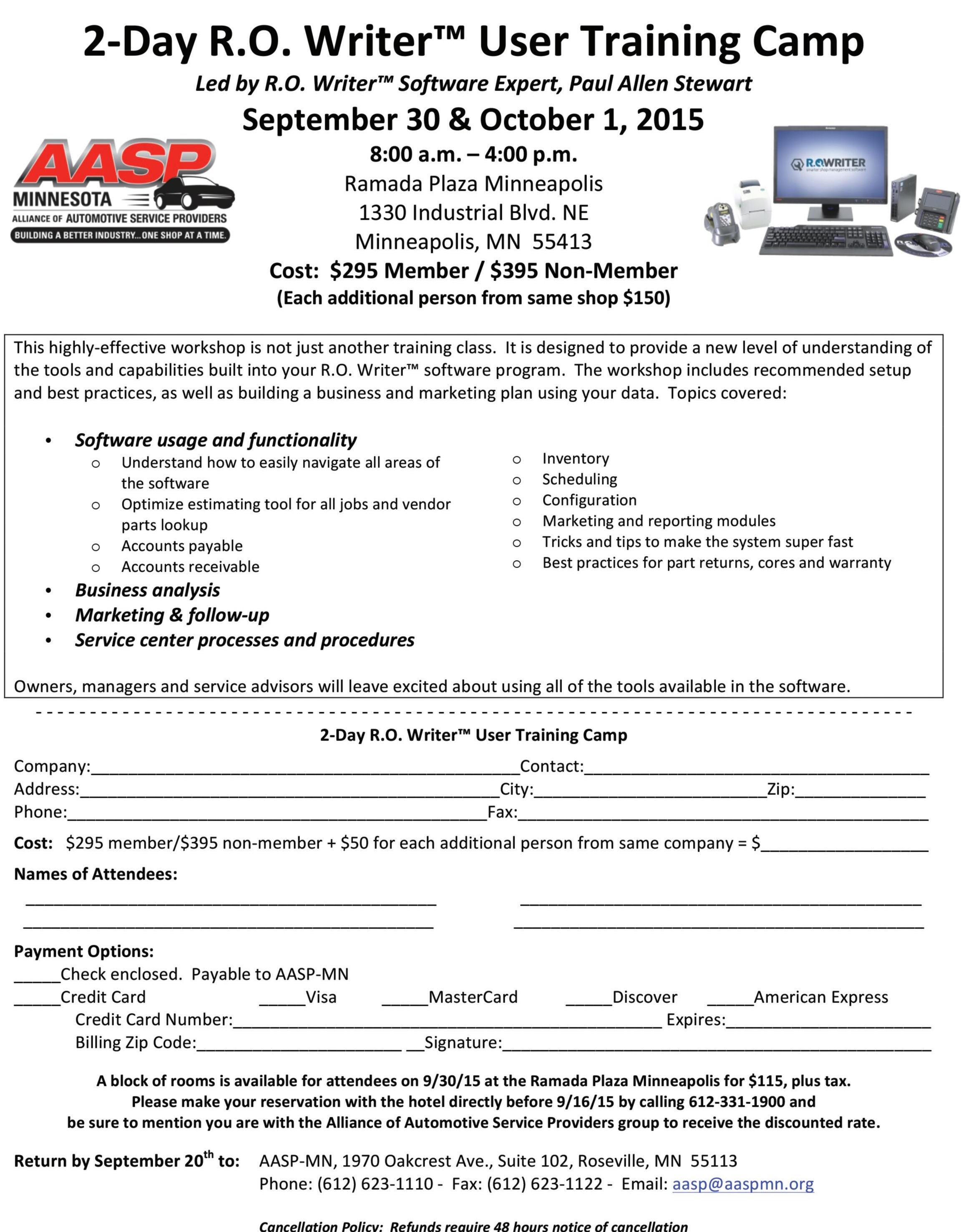
AASP-MN TO HOST TWO-DAY R.O. WRITERTM USER TRAINING CAMP
The Alliance of Automotive Service Providers of Minnesota (AASP-MN) will host a two-day R O WriterTM User Training Camp, from 8am to 4pm, Wednesday, September 30 and Thursday, October 1 at the Ramada Plaza, 1330 Industrial Blvd , NE, Minneapolis.
The training, led by R.O. WriterTM software expert Paul Allen Stewart, is designed to provide a new level of understanding of the tools and capabilities built into the R.O. WriterTM software. The training covers recommended setup and best practices, as well as how to build a business and marketing plan using data collected.
The cost to attend the two-day camp is $295 for members and $395 for non-members Each additional person from the same company may attend for $150
For additional information or to register, see page 20 or contact the AASP-MN office at (612) 623-1110 or 800-852-9071 or visit www aaspmn org
THREE AASP-MN MEMBERS TO RECEIVE AAM DESIGNATION
Three AASP-MN members graduated from the Automotive Management Institute (AMI) and received the Accredited Automotive Manager (AAM) designation at the 2015 Industry Week event (NACE/CARS) in Detroit, Michigan, July 23-25 They were:
• Myles Dahlgren, LaMettry’s Collision
• Randy Notto, Lenfer Automotive & Transmissions
• Charles Whitaker III, Valspar
Congratulations!
To earn the Accredited Automotive Manager (AAM) designation, students must earn 120 credits by successfully completing AMI curriculum.
A reminder
AASP of Minnesota has purchased all of the AMI self-study programs for its members’ use AMI charges $35 for each test taken and there is a $10 shipping and handling fee for us to ship the course out to you For more information, contact the AASPMN office at (612) 623-1110
SEVEN MINNESOTA SCHOLARSHIP RECIPIENTS RECEIVE NATIONAL SCHOLARSHIPS
Earlier this year, AASP-MN awarded $15,000 in scholarships to help post-secondary automotive students pay for tuition during the 2015-16 school year. By completing the application process online at automotivescholarships.com, seven of those students were also awarded scholarships from the Global Automotive Aftermarket Symposium (GAAS), University of the Aftermarket (UAF) or other collaborating organizations this year Five of the students received an additional $2,000, one received $3,000 and the other $4,000 Congratulations to these outstanding students:
• Carver Brownlee, Hibbing Community College, Hibbing (Automotive Service Technology)
• Grant Lieser, Hennepin Technical College, Brooklyn Park (Automotive Service Technology)
• Isaac Connolly, Dakota County Technical College, Rosemount (Auto Body Collision Repair)
• Jesus Sanchez Palomares, Hennepin Technical College, Eden Prairie (Auto Body Collision Repair)
• Phanit Phoutthaphaphone, Hennepin Technical College, Brooklyn Park (Automotive Service Technology)
• Robert Lemke, Ridgewater College, Willmar (Automotive Service Technology)
• Sarah Koepsell-Schmieg, Dakota County Technical College, Rosemount (GM Automotive Service Educational Program)
2015 MINNESOTA I-CAR/SKILLSUSA FALL GOLF EVENT ANNOUNCED
The Minnesota I-CAR/SkillsUSA Volunteer Committee invites golfers and sponsors to the Oak Glen Golf Course in Stillwater on September 16, 2015 for a fun-filled day of golf All proceeds from the event go towards scholarships for future technicians, equipment for technical colleges and other collision industry training needs The four-person scramble, sponsored by the North Central I-CAR Committee, begins at 12:00pm, with dinner and awards following golf
Registration and payment for golfers and/or sponsors can be found on the golf outing’s website, www icargolf com This is a great opportunity for vendors to market their business and support the industry while enjoying a round of golf with industry leaders. Those who can’t participate can help by providing door prizes or auction items by contacting tournament directors Shawn Collins at smcollins@mmm.com or (612) 508-8222 or Jamison Randall at jrandall@latuffbrothers.com or (651) 796-8003.
continued from pg 7
medical marijuana, which comes in pill, liquid or vapor form, while on the job? First, applicants and employees have the right to explain their positive test results with a “registry verification.” Next, most drug tests used by employers gauge recent use, as opposed to actual impairment, which could come back positive from use occurring several days before the test was administered The testing process is further weakened by the fact that most tests are not designed to differentiate between positive results caused by smoking marijuana and positive results caused by using medical marijuana. These are a few of the open concerns surrounding the MCA.
Ultimately, Minnesota employers will need to exercise great prudence in proceeding with any kind of employment decision or action against applicants or employees who are registered medical marijuana users Once an employer knows they are dealing with a registered user, an initial consideration is to diligently confirm the person’s “registry verification.” Employers should also consider updating their testing policies, if they haven’t done so already, to reflect changes in the law One policy update to think about may be defining “legal” drugs as those legal under both state and federal law Another may be for the employer to reserve for itself the right to take adverse action against any positive marijuana test result to the full extent permitted by law This haze of issues surrounding the MCA will surely be litigated in the future, but until the murkiness subsides, it is wise for employers to address these situations in a diligent fashion with sound advice from legal counsel
*** DISCLAIMER: This article should not be deemed legal advice You should always consult with an attorney about your specific circumstances and legal rights and obligations ***
Aaron Kolquist is an associate with Fryberger, Buchanan, Smith & Frederick, P.A. He is a recent J.D. and M.B.A. graduate from the University of North Dakota
EPA BANS USE OF 134A IN NEW MOTOR VEHICLES
The US Environmental Protection Agency (EPA) has issued a final rule that would prohibit the use of certain refrigerants and aerosols, including 134a, based on the availability of better substitutes with a lower global warming potential (GWP). These substances were previously approved by EPA under the Significant New Alternatives Policy (SNAP), which was created to review the health and safety impacts of proposed substitutes for ozone depleting substances
The rule, which was signed by EPA Administrator Gina McCarthy on July 2, would ban the use of 134a as a refrigerant in new motor vehicles beginning with model year 2021. The rule would not affect the use of 134a in vehicles already on the road and therefore not affect the ability to service vehicles currently using 134a.
Further, the rule prohibits the use of 134a as an aerosol in many automotive products beginning one year after its publication in the Federal Register, which is expected to come in the very near future The EPA is permitting an unlimited sell-through period for aerosols already on the market when the prohibition goes into effect Certain aerosols will still be permitted to use 134a under certain use conditions, including for refrigerant flushes and for the cleaning of electrical equipment or electronics.
In the 1990s, the EPA approved HFC 134a as a substitute for R-12, commonly known as Freon, for motor vehicles based on concerns that R-12 had an adverse impact on ozone depletion However, the EPA now contends that 134a has a high GWP and that substitutes with significantly lower GWP, including 1234-vf, 152a and CO2, are readily available and can be used safely on vehicle air conditioners The EPA further contends that substitutes for 134a in aerosol uses, such as 1234 ze(E), are also available and already in use.
According to an EPA release issued on July 2, “Today’s action delivers on the President’s Climate Action Plan and the administration’s commitment to acting on climate And it is in line with steps leading businesses are already taking to reduce and replace HFCs with safer, climate-friendly alternatives,” said EPA Administrator Gina McCarthy “This rule will not only reduce harmful greenhouse gas emissions, but also encourage greater use and development of the next generation of safer HFC alternatives.”
2015: WHO PAYS FOR WHAT?
Surveys show ‘who pays for what’ in terms of ‘not-included’ procedures
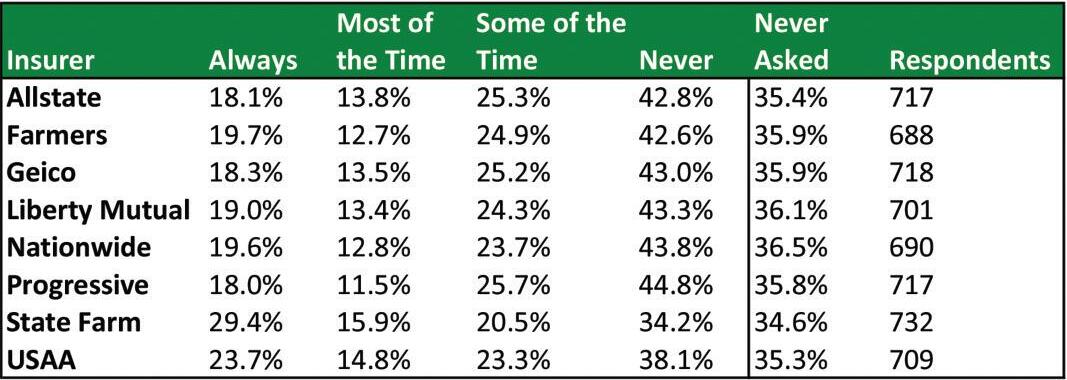
Fully one-third of collision repair shops nationwide said they have never asked to be paid for “masking the engine compartment” when this “not-included” procedure has been necessary as part of a repair, yet another one-third of shops who do seek to be paid for it say they receive that payment “always” or “most of the time.”
That finding is just one of hundreds revealed in a survey conducted recently by Collision Advice, which is also launching a new survey this month
“This confirms something I see as I work with shops around the country,” said Mike Anderson of Collision Advice “On this one procedure alone, for every shop not including this necessary procedure on their estimate, another shop is getting paid for it most, if not all of the time ”
More than 980 shops around the country responded to the survey, which asked them to report how often they are paid for 26 refinish-related procedures by the eight largest auto insurers.
“With that level of response, I believe this is the largest survey ever examining this subject,” Anderson said
He said it is clear from the results of this survey that whether or not a repair facility is reimbursed for a particular procedure depends, to some degree, simply on whether or not the shop negotiates for that operation Though the survey found that reimbursement frequencies do vary by insurance company, DRP status and region of the country, it is clear that none of the procedures are universally rejected by insurers.
Anderson said the quarterly surveys help raise awareness of not-included items and operations that shops may be doing but not itemizing on estimates
“The surveys will help shops understand what these operations are, and whether other shops seek and receive compensation for them – or if they truly are ‘the only one,’” Anderson said
The 62-page report of the first survey findings is now available by clicking on the “Who Pays For What?” logo on the Collision Advice website (www.CollisionAdvice.com).
Shops can also use that link during the month of July to take the latest of the surveys, which covers structural/frame and mechanical-related operations
Anderson said each survey, which will take about 15-30 minutes, should be completed by the shop owner, manager or estimator who is most familiar with the shop’s billing practices and the payment practices of the largest national insurers Each individual shop location (whether a stand-alone business or part of a multi-shop operation) may submit one response to the survey.
Those who complete the survey (and provide optional contact information) receive the survey findings at no charge.
Each shop’s individual responses are held in the strictest confidence and are not released in any way; only cumulative data is released
For more information about the surveys and findings, or to take the current survey, click on the “Who Pays For What?” logo on the Collision Advice website
Collision Advice is an independent training and consulting firm featuring some of the most respected and experienced experts in the collision repair industry. Mike Anderson and his team offer real-world, cutting edge training and guidance both in the classroom and one-on-one in the shop.
by John Gilkeson
New Laws for Wheel Weights
A pair of new laws in Minnesota prohibits certain types of wheel weights The laws address the sale, installation, use and recycling of lead or mercury weights and balancing products Vehicles affected include cars, trucks, aircraft and items such as trailers or campers that are towed behind vehicles.
Lead wheel weights cannot be sold or installed in Minnesota after January 1, 2016, but lead wheel weights installed before then can remain in service. They do not have to be removed Used cars can be bought and sold with lead wheel weights if the weights were installed before January 1, 2016 Lead wheel weights and balancing products must be recycled if they are removed
Non-toxic wheel weights made from steel, zinc or plastic composites are available Prices for these lead-free weights match or are cheaper than lead weights. In fact, one manufacturer recently changed their pricing, making steel weights lower-priced than lead weights
Work with your supplier to return unused weights and recycle used ones All wheel weight manufacturers offer recycling programs. Wheel weights can also be recycled at most Very Small Quantity Generator waste collection centers. A list of VSGQ collections centers and their requirements can be found by typing “w-hw2-51” into the search box on the MPCA website at www.pca.state.mn.us.
Sort removed weights by metal type before recycling if possible Lead wheel weights are usually unmarked, but lead is denser than other metals so lead weights are smaller than other weights Steel weights are sometimes marked FE, S or ST and will stick to a magnet. Zinc weights are sometimes marked ZN or Z.
use on vehicles with large wheels such as semi tractors and trailers, RVs and buses They are typically large mercuryfilled rings installed behind the wheel and tire, or as engine drive shaft balancers Non-mercury balancing weights are less expensive than those with mercury, especially when the cost of cleaning up a spill or release is considered.
Used mercury weights are a type of hazardous waste known as universal waste Store mercury weights in a sturdy container that protects them from breaking. Label the container “Used Mercury Weights,” write the date on the container when the first mercury weight is added and be sure to recycle them within a year
Lead and mercury are highly toxic and have long-term health effects on people – especially children – and wildlife.
Although lead wheel weights cannot be sold or installed in Minnesota (or several other states) after January 1, 2016, they are still allowed in some states If your shop has locations in states where lead weights are allowed, you can send remaining inventory there to be used.
The laws in Minnesota for mercury balancing weights are much stricter than those for lead weights and have been in effect since January 1, 2015. Mercury weights cannot be sold, installed or used Vehicles cannot be sold with mercury weights Any mercury weights you find on a vehicle must be removed and recycled.
Mercury balancing weights are made for aftermarket
A significant percentage of wheel weights fall off during use and contaminate soil and water Employees are exposed at work and bring contamination home with them. For these reasons, the US EPA has encouraged the use of non-toxic wheel weights for many years Vehicle manufacturers haven’t sold new cars or light trucks with lead wheel weights in the US since 2009 Most larger chain stores that do tire work have been phasing out their use of lead weights nationally. More states are prohibiting lead and mercury wheel weights Over time, fewer and fewer cars coming through your shop will have lead or mercury weights on them
Brands and types of replacement weights and more information can be found on the MCPA website at www pca state mn us/wheel-weights Contact John Gilkeson at the MPCA at (651) 757-2391 or email him at john gilkeson@state mn us if you have questions
Vehicle Boom on US Roads
Following no vehicle growth on US roads between 2007 and 2013, car and light truck VIO (vehicles in operation) is now arching into a high growth curve that will explosively expand the light vehicle population more than 33 million by 2020.
Car and light truck VIO in the US was flat from 2007 to 2013, virtually an unprecedented development which occurred only once previously in the four years during World War II when consumer vehicle production in the US was interrupted by the war effort All of this will dramatically change between 2014 and 2020.
Six major takeaways:
• Car and light truck VIO (vehicles in operation) growth can be divided into three periods spanning 20 years: 2000 to 2006, 2007 to 2013 and 2014 to 2020
• From 2000 through 2006, light vehicle VIO (vehicles in operation) increased over 24 million, reflecting strong 1 7 percent annual growth
• There was a dramatic change over the following six years (2007 through 2013) as new car and light truck sales crashed at an unprecedented rate. Light vehicle VIO declined (for the first time since World War II) with the loss of over 300 thousand cars and light trucks on US roads
• Fueled by a robust rebound of new light vehicle sales, 2014 through 2020 light vehicle VIO will soar, recording an estimated 33 million gain in the car and light truck population (compared to 2013)
• The 1.9 percent annual increase in the light vehicle population on US roads projected by Lang Marketing during 2014 through 2020 will mark a dramatic turn around from the preceding six years and create a super-strong force, driving aftermarket product growth
• Each of the three time periods reflect differing rates of vehicle growth (and decline) as well as changes in the percentage of foreign versus domestic nameplates, and the differing age mix of cars and light trucks on US roads
By Dennis Spindler, CBIZ AIA
Top 10 Reasons Why You Should Buy Employment Practices Liability Insurance (EPL)
1 EPL covers both actual and ALLEGED acts of discrimination, harassment, retaliation, wrongful termination and other similar employment-practices violations
2. Three out of five employers are sued by former employees every year
3 Over 40 percent of EPL claims are against firms with fewer than 100 employees.
4 Some Federal and State employment laws apply to all employers, regardless of employee count – any size company has exposure!
5 The Equal Employment Opportunity Commission (EEOC) recorded nearly 93,000 charges in 2013 and obtained more than $365 million in administrative settlements for claimants
6. The financial ramifications of not having EPL insurance can be crippling, especially for small firms because they do not have the operating budgets to handle the defense costs, let alone the settlements or judgments of an uninsured claim
7 The median cost of an EEOC lawsuit in 2011 exceeded $250,000.
8 There is no EPL coverage under other insurance policies such as General Liability (GL). Any endorsement to another policy generally provides insufficient limits, does not provide the breadth of coverage of a separate EPL policy and erodes the limit available for the GL exposure
9 Based on recent data gathered by the Federal Judicial Center (a federal and research agency for the US courts), there were 7,064 wage and hour complaints in 2012, while in 2013 that number jumped to 7,764 – an increase of 10 percent.
10 Recent Supreme Court decisions have lowered the standard of what constitutes retaliatory treatment Retaliation has become the number one most frequently cited form of discrimination, beating out race discrimination. Monetary benefits totaled just under $170 million; however, this number does not include monetary benefits obtained through litigation
If you would like more information or have questions, please contact Dennis Spindler at CBIZ AIA at 763-549-2238 or dspindler@cbizaia com
AASP-MN and Cer tegy Par tnership
AASP-MN is pleased to recommend Certegy, an FIS Company, as the preferred provider for check warranty/verification services
For nearly 50 years, Certegy has been the trusted leader in payment processing and loss prevention solutions, supporting more than 289,000 merchants worldwide. With proven results built on innovative technology and a solid financial reputation, Certegy brings security and reliability to fraud prevention and risk management – valuable commodities for an ever-changing market
The following program is customized specifically for AASPMN members:
• discount rate of only .75 percent, which covers NSF, closed accounts and non-disputed stop payment checks,
• discount rate of 93 percent, which includes full stop-payment coverage,
WORKERS’ COMP INSURANCE
Meadowbrook Insurance Group
Contact: Dennis Spindler
763-549-2238 / dspindler@cbizaia com
Up-front scheduled credit makes Meadowbrook one of the most competitive programs around for Worker s Compensation insurance In addition, members are eligible to receive an annual dividend based on the group’s loss ratio For more information log on to www wcpolicy com/aaspmn
PROPERTY/LIABILITY INSURANCE
CBIZ AIA
Contact: Dennis Spindler
763-549-2238 / dspindler@cbizaia com
CBIZ AIA will present AASP-MN members with quotes from multiple carriers for property/liability insurance and members can choose the program that best fits their situation As an added bonus, CBIZ AIA will offer members an exclusive 10% discount on their property/liability insurance premiums
EMPLOYEE BENEFITS
CBIZ AIA
Contact: Dennis Begley
763-549-2260 / dbegley@cbizaia com
CBIZ AIA will provide AASP-MN member with quotes from multiple carriers for life insurance, health insurance, long-term care and disability insurance
UNIFORM & LINEN SUPPLIES
AmeriPride Services
Contact: Jim Dillon
651-955-1398 / jim dillon@ameripride com
Discounted pricing to members on rental of uniforms, entrance mats shop rags etc Purchases are also discounted Members receive annual rebate equal to 10% of their business with AmeriPride each year
• no transaction or statement fees,
• no check minimums,
• $25 monthly minimum,
• ACH billing and claims payment,
• $1.25 voice surcharge-only if remote transaction was not obtained,
• 60-day claim submission,
• Enhanced Warranty program virtually eliminates disallowed claims and
• discounted equipment pricing
For more information on the AASP-MN program, please contact Heather Ellis at 952-240-5017 or heather.ellis@fisglobal.com.
You may also call toll free (877) 520-2987 to speak with a Certegy representative or email an inquiry with your company name, address and phone number to: product info@fisglobal com and reference “AASPMN” in the subject line
AASP-MN MEMBER BENEFIT PROGRAMS
CREDIT CARD PROCESSING
Association BankCard Services
Contact: Mac Hardin
952-933-2026 / mach@retailfinancialservices biz
Competitive rates for AASP-MN members Terminals and printers sold at cost Monthly rental of equipment is also available
INDUSTRIAL & PAPER PRODUCTS
Wipers & Wipes, Inc
Contact: Dennis Julson
651-486-4866
Discounts on industrial supplies and paper products
Free next-day delivery is available in the metro area
Shipping free to outstate members with $100 purchase
WEBSITE AND INTERNET MARKETING SOLUTIONS
Net Driven
Contact: Jon Napoli
877-860-2005, ext 400 / jnapoli@getnetdriven com
Net Driven is a market leader in website and internet marketing solutions designed exclusively for the automotive industry AASP-MN members who choose Net
Driven are eligible for a $500 discount off their 1st year setup fees For more information, contact Jon Napoli
Stormlogix
Contact: Paul Switzer
732-364-1156 / paul switzer@stormlogix com
Stormlogix extends a discount on its website packages to AASP members Costs can be spread out over 6 months
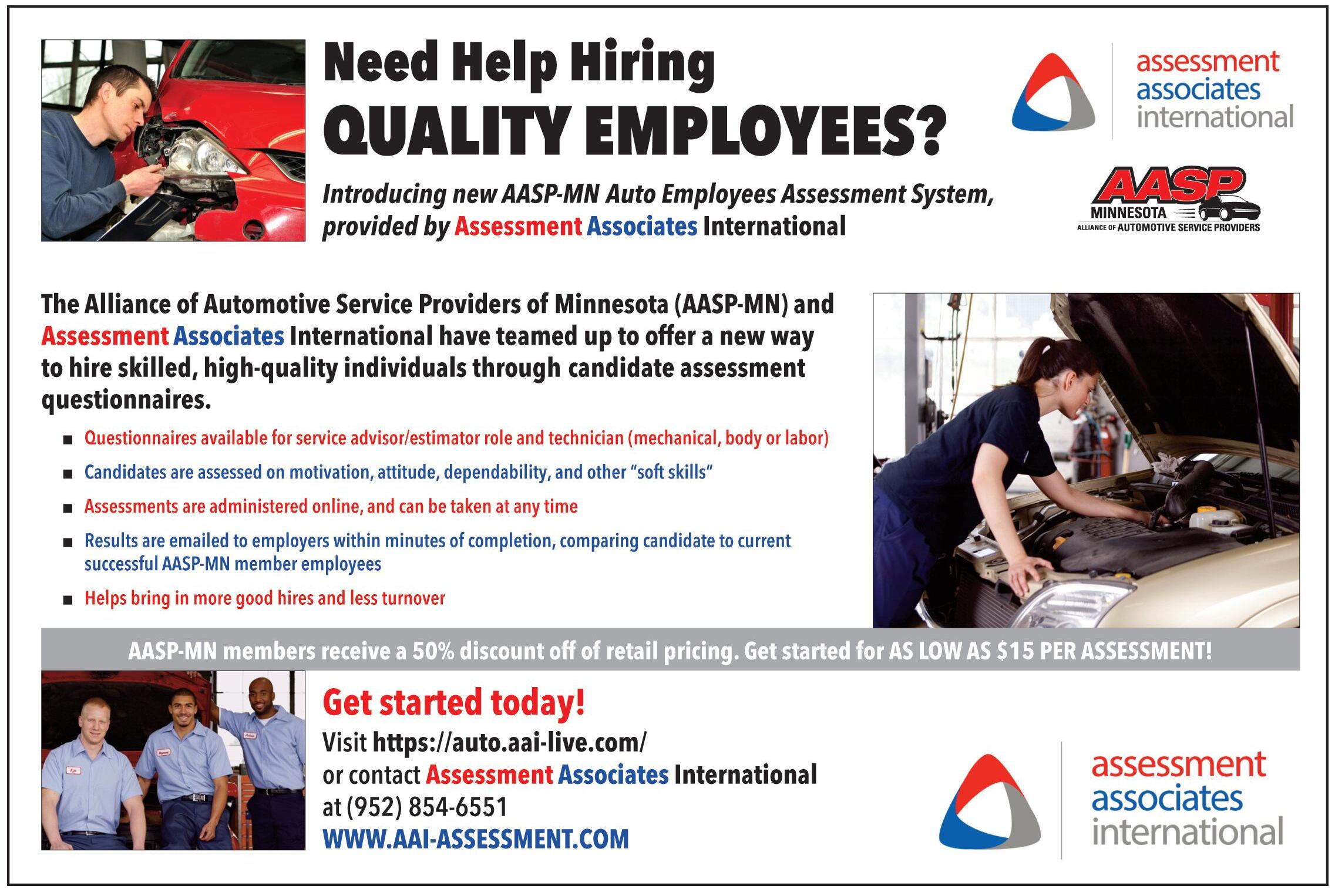
AUTO EMPLOYEE ASSESSMENT
Assessment Associates International
Contact: Ron Page (952) 854-6551 / ronald page@aai-assessment com
www auto aai-live com
Designed to help facilitate and enhance hiring decisions AASP-MN members receive 50 percent off retail price and starts as low as $15 per assessment
TECHNICAL INFORMATION HOTLINE IDENTIFIX
800-288-6220
Members enjoy discounted prices on the industry’s #1 technical information hotline One free call is extended to all first-time AASP-MN member callers
BUSINESS FORMS/CALENDARS
AASP-MN
Contact: Jodi Pillsbury 612-623-1110 / jodi@aaspmn org Discount rate on printed business forms and calendars
SHOP SERVICES
Summit eMarketing Sherpas
Contact: Frank Terlep 888-377-2661 / fterlep@summitsoftwaresolutions com
AASP members receive a 5% discount on all Summit eMarketing Sherpas’ services including: website design and development, search engine optimization, email marketing and communication, online review and reputation management and social media marketing
INFORMATION PROVIDERS
Mitchell1
Contact: Mitchell1 Representative 888-724-6742 x 6986
AASP members are eligible for special Mitchell 1 information and management programs at significant discounts For more information, log onto www mitchell1 com or contact the Mitchell 1 representative at 888-724-6742, X6986
Mitchell International
Contact: Mitchell International Representative 800-238-9111
AASP members receive a 15% discount on any Mitchell RepairCenter TechAdvisor package Visit http://repaircenter mitchell com/Catalog/OEM Repair aspx for more information
PAYROLL PROCESSING
CBIZ Payroll
Contact: Carrie Hobrough 612-436-4620 / chobrough@cbiz com
Members receive 20% discount off standard payroll products and services (excluding 401k) Members who switch prior to June 30 will receive first month of payroll processing free
CHECK GUARANTEE SERVICES
Certegy Check Services
Contact: Heather Ellis 952-240-5017 / heather ellis@fisglobal com