Buildingregs-in particulartheBuilding Safety~egulator-was a hottopicatTechlive
Refurbishing a five-storey office building in central Lincoln that incorporates power and data connections, an addressable fire alarm system, emergency lighting, an intruder alarm and CCTV required large amounts of different cables. The team needed a robust cable containment system that was affordable and available to meet a tight programme.
NICEIC-certified business Brook and Mayo, who carried out the electrical installation at Lincolnshire County Council's Orchard House, specified two ofMarshall-Tuffiex's metal containment systems.
"We've used their metal products before on other projects," says Joe Lill, Brook and Mayo Director. "We purchased a substantial amount as the cable containment had to go from end to end on five floors on both sides of a large, rectangular-shaped building. We specified Marshall-Tuffiex's Basor metal :e: -g cable tray and fast-fix wire basket for i the project."
Before the Lincoln contractor began the electrical refurbishment, they had §' to isolate and strip out all the electrical 0 ! services. This ensured it was safe for the main contractor to remove all the
walls and ceilings of the derelict office block, which is owned by Lincolnshire County Council.
Starting from the building's top floor and working down, Brook and Mayo's electricians installed the new metal containment system along the ceiling, running the various cables inside. These cables are concealed behind a suspended decorative ceiling that features a mixture
of fully automated LED strip lighting panels and recessed decorative lights, also installed by Brook and Mayo.
"All the cables are in the same containment system," says Lill. "But there are individual wire baskets that run parallel with each other above the ceiling. Each different type of cable is placed in its basket to segregate it from the other."
Lill had several teams of electricians working on the job. One team installed the metal containment and a second group followed closely behind, installing the cables in the baskets, with 16 engineers working at the project's peak.
Given that the ground floor is to be used as a registry office, the interior features suspended ring-shaped architectural LED pendants from Zumtobel Lighting UK. The CCTV and intruder alarm systems are located only on the ground floor, as it's a public area. Brook and Mayo also installed a new mains distribution system, 15 new distribution boards and the infrastructure to support the future expansion of the electric vehicle network.
"It was a straightforward project," Lill adds. "I've received positive feedback, with some saying that the new registry office is a lot nicer than the previous one."
DDN'TAEAD THISMAG
DUASHORTCUTTDTHEBESTBITS
7
DVEATD VDU,PAUL ...
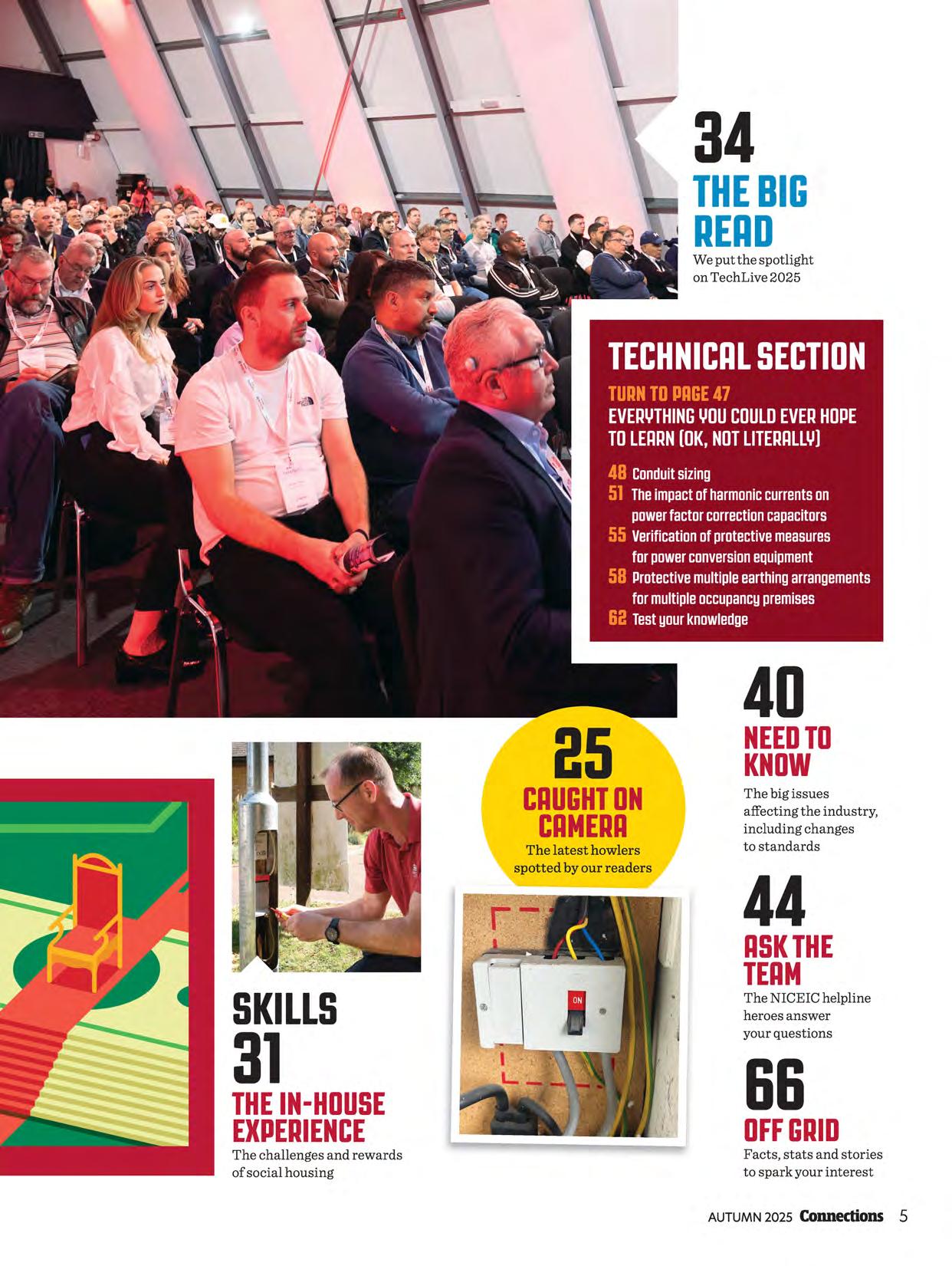
What are the hot topics this issue? Technical Director Paul Collins talks us through what to expect, includingNICEIC TechLive at Millbrook Proving Ground
28 LIFEAFTER SKILLELECTAIC FINALS
Wecatchupwithtwo high achievers
aicd BECOMEANAICO GOLDSTANDARD INSTALLER
At Aico, we understand what a huge responsibility it is to provide home life safety devices into UK homes, which is why we hold both ourselves and the partners we work with to such a high standard. Gold Standard Installers are another way to ensure the safety of UK homes and their residents.
HowcanIbecomeGoldStandard?
Complete our free FIA accredited Expert Installer Training
Join thousands of others in our rewards-based Installer Community
Expand your knowledge with our free City & Guilds Training
Be a member of NICEIC, NAPIT, Select or FIA
If you believe you are already Gold Standard, scan here.
Any questions regarding the Gold Standard rating, please contact your local RelationshipManager.
Advertising: Tom Davison tom.davison@thinkpublishing.co.uk Ben Sellers ben.sellers@thinkpublishing.co.uk
Connections welcomes ideas for contributions. Please email mediaenquiries@certsure.com
All rights reserved. This publication (and any part thereof) may not be reproduced, transmitted or stored in any format without the prior written permission of the publisher. Think Publishing Ltd accepts no liability for the accuracy of the contents or any opinions expressed herein.
Printed by Acorn Web Offset, West Yorkshire. Connections and its paper wrapper are printed on paper from European mills, meeting the highest quality and environmental standards. Both the magazine and the paper wrapper are fully recyclable.
Welcome to the autumn 2025 issue of Connections magazine, where NICEIC's inaugural TechLive event is firmly in the spotlight (page 34). Hundreds of delegates enjoyed a variety of high-quality CPD sessions, chatted with our technical experts, and interacted with our event sponsors and exhibitors at the prestigious Millbrook Proving Ground.
In other news, an update to the Electrotechnical Assessment Specification leads our Need to Know section this quarter (page 40), so please do take a look to understand the changes and assess if they may affect your business.
This issue also takes a look behind the scenes at the family members holding the back office fort for small electrical businesses and sole traders (page 12). With the admin burden of running a small business becoming increasingly onerous, we celebrate the spouses, partners and other family members who keep our certified businesses running.
Keeping with our celebratory theme, we're also following up with SkillELECTRIC UK 2024 winner, Charlie Moore (page 28), as he completes an NICEIC EV charging training course -part of his prize offered by NICEIC and EAL.
And with WorldSkills Shanghai on the horizon, we speak to Tom Williamson, three times SkillELECTRIC finalist and qualified supervisor at NICEIC-certified business Lloyd Morris Electrical, as he steps up to the post of Assistant Training Manager for the WorldSkills Electrical Installation squad (page 29).
We also explore the role ofNICEIC-certified electrical teams working to maintain more than five million social homes across the UK safely (page 31).
And last but not least, don't forget to turn to our CPD-accredited technical articles and prioritise learning and development for you and your team. Use NICEIC's CPD record template, available on our website and at the bottom of our e-newsletters, to log what you read as CPD.
Energetics brings an ambient heat network to retirees
Energetics has installed its first ambient heat network (AHN) at a retirement living complex near Edinburgh for developer Cruden Homes. Energetics, which is part of the Last Mile group of multi-utility infrastructure companies, recommended, installed and commissioned the network for the 48 homes.
"At the early design stage, we had lots of technical meetings," says David Mcinarlin, Energetics' Head of Construction. "We knew gas boilers for new-build residential developments wouldn't be allowed in Scotland from January 2025 under the New Build Heat Standard. In response, we researched and developed an alternative renewable means of heating that would meet building regulations beyond 2025."
Air-source heat pumps had been considered for this project in Barnton, called The Avenue. However, following demonstrations and calculations, an AHN that utilises ground-source heat pumps was selected. This solution will result in 80% lower carbon emissions compared to traditional gas-fired heating, and 54% lower emissions than air-source technology.
To begin with, 18 boreholes of160 m deep were drilled. A network of pipes, manifolds and valves distributes the ambient heat from the boreholes to the heat pump units, which provide space and water heating to each home.
Energetics' brief also involved redistributing electricity from the existing Scottish Power network via a new substation, enabling a low-voltage network to be run to each dwelling. Energetics installed the substation's transformer and apparatus.
"First, we connected the 11,000volt supply from the existing Scottish Power network to the substation," says Mcinarlin. "The substation contains
a transformer that steps down the 11,000 volts to a three-phase 400-volt sitewide network. From that, we installed individual services to each plot supplying single-phase electricity at 230 volts, which in turn powers the heat pumps."
Cruden Homes' electrical contractor, NICEIC-certified CableCom Electrical, carried out the first fix cabling and the second fix for the eight houses and 40 apartments. CableCom also installed each dwelling's consumer unit and an isolator switch for the heat pumps. Energetics then fitted a ground-source heat pump inside each property.
Mcinarlin says that the project had its challenges, particularly when the site flooded at the beginning of construction. But the residents "appreciate the cost savings, the heat that's given out and the fixed tariff that comes with it", he says.
In an innovative move, Energetics supported the development by providing Last Mile's finance or 'asset value' model, which was developed at the tender stage to fund the capital cost of the heat network.
Cruden Homes were ready to embrace a new renewable technology, such as AHN, but they were concerned about the upfront cost of installing a heat network. With this arrangement, underpinned by Last Mile's blue-chip investors, they have benefited from a sizeable capital cost saving. Last Mile will own, operate and maintain the heat network across its lifetime, in addition to providing a 24hour call service for each property owner.
Energetics has seen plenty of interest from other housing developers who have visited the site. The firm has more Scottish projects specifying AHN and Last Mile is installing the UK's largest AHN at a development in Hampshire.
"As it's a new technology, we need education, alternative sequencing of works, adjusted timescales, new logistics and a change in the way the industry operates," says Mcinarlin.
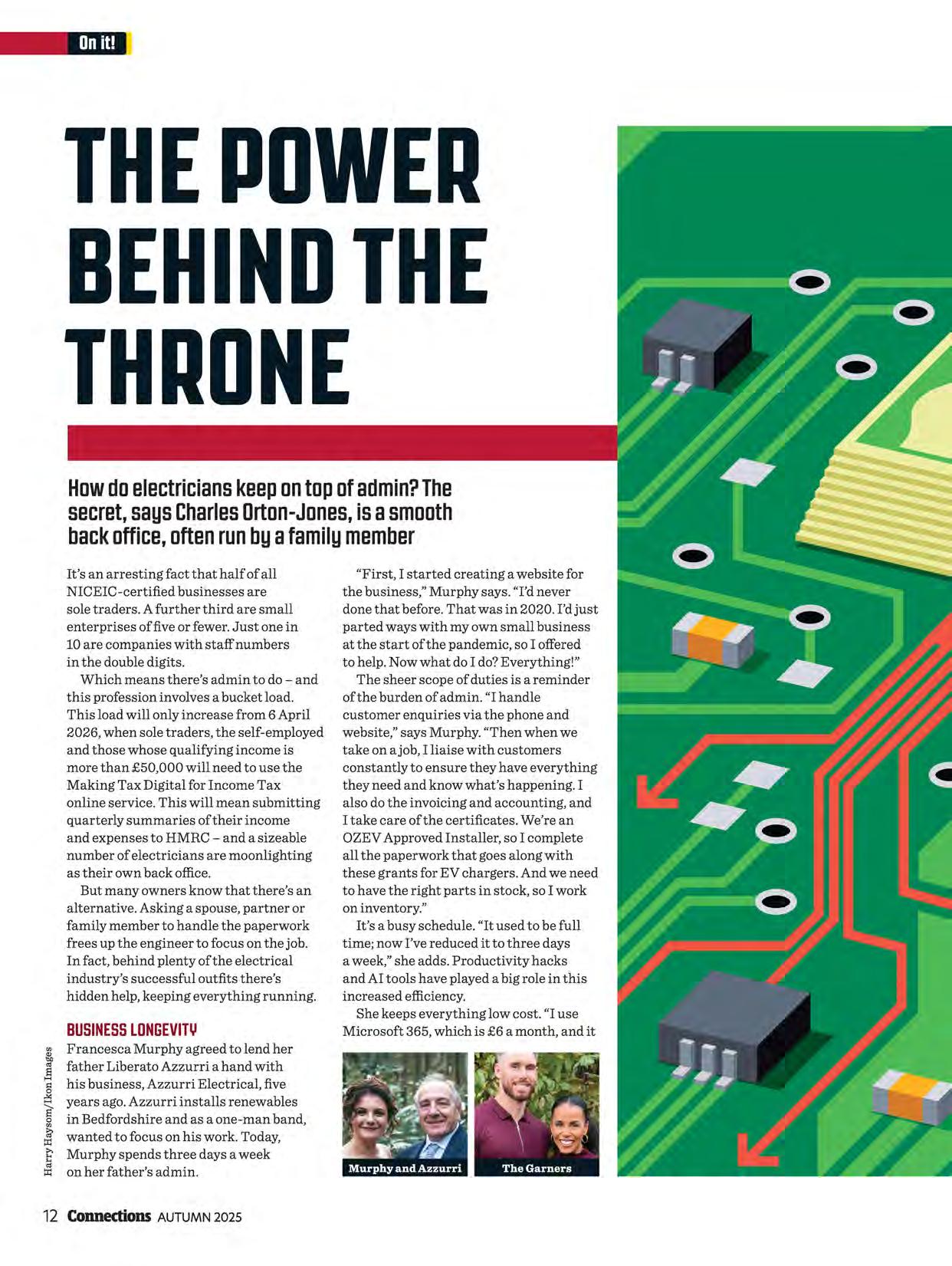
It's an arresting fact that half of all NICEIC-certified businesses are sole traders. A further third are small enterprises of five or fewer. Just one in 10 are companies with staff numbers in the double digits.
Which means there's admin to do -and this profession involves a bucket load. This load will only increase from 6 April 2026, when sole traders, the self-employed and those whose qualifying income is more than £50,000 will need to use the Making Tax Digital for Income Tax online service. This will mean submitting quarterly summaries of their income and expenses to HMRC -and a sizeable number of electricians are moonlighting as their own back office.
But many owners know that there's an alternative. Asking a spouse, partner or family member to handle the paperwork frees up the engineer to focus on the job. In fact, behind plenty of the electrical industry's successful outfits there's hidden help, keeping everything running.
BUSINESSLONGEVITIJ
"First, I started creating a website for the business," Murphy says. "I'd never done that before. That was in 2020. I'd just parted ways with my own small business at the start of the pandemic, so I offered to help. Now what do I do? Everything!"
The sheer scope of duties is a reminder of the burden ofadmin. "I handle customer enquiries via the phone and website," says Murphy. "Then when we take on ajob, I liaise with customers constantly to ensure they have everything they need and know what's happening. I also do the invoicing and accounting, and I take care of the certificates. We're an OZEV Approved Installer, so I complete all the paperwork that goes along with these grants for EV chargers. And we need to have the right parts in stock, so I work on inventory."
It's a busy schedule. "It used to be full time; now I've reduced it to three days a week," she adds. Productivity hacks and AI tools have played a big role in this increased efficiency.
She keeps everything low cost. "I use Microsoft 365, which is £6 a month, and it ., Francesca Murphy agreed to lend her
father Liberato Azzurri a hand with his business, Azzurri Electrical, five years ago. Azzurri installs renewables in Bedfordshire and as a one-man band, wanted to focus on his work. Today, Murphy spends three days a week on her father's admin.
includes Microsoft Forms. I designed a work request intake form questionnaire for our renewable customers to take their information efficiently, such as their house size, age, electricity supplier, electricity usage and so on. Microsoft 365 has a tool called Loop, which makes it easy to share real-time information between Dad and me. We have a checklist for each customer so we can track progress and we share it in Loop."
Taxes are filed with Xero, a popular cloud-based package, but the cost isn't cheap. "It's £40 a month, as we're VAT registered. We work with an accountant, but I do the filings," says Murphy.
Overall, the combination of Azzurri as the electrical engineer and daughter Murphy as the admin expert means both are working to their strengths and enjoy the work. "He's a fanatic," she says of her dad. "He's 64 and doesn't want to stop working." Because of Murphy, he can work as long as he wants.
RDMINMASTERMIND
Liam Garner of LG Electrical has an apprentice and three engineers on the books. He's fully booked with contracts to fit Costa Coffee outlets in hospitals, maintaining the Greater Manchester Police station and big HMO projects.
Garner's wife, Jessica, does his admin. "I tried at first without her. It didn't work," he admits. The pair share the work, each doing what they're suited to. "She does the VAT,pays everything, talks to the accountants and makes sure the books are in order. I do the quotations and costs for a job."
The pair use software for accounts and have accountants to advise on technical matters, while day-to-day operations are handled by Jessica. Liam is doubly grateful for Jessica's contribution, as she has other duties: "We have two small boys, aged two and four, and we have a property business, which she runs. It's fair to say we're constantly busy."
Overall, Garner describes his wife as indispensable. "She's the reason we've been able to grow," says Liam. "Without her, we'd need to employ someone."
For those who need a similar mastermind to run their affairs, but lack the right person, Garner has a suggestion for the future: "We're using AI more. We use it to generate spreadsheets and to handle anything we don't have time to work on."
uAbigadvantage of includingsomeone in operationsistheability totakeclientcallswhile theelectricalengineer is occupiedwithajob.Timely responsestoenquiriesare ahallmarkofimpressive customerservice.
Our industry experts deliver informative, engaging and trusted insights on the latest need-to-know topics.
Missedanepisode?
If you miss the live webinar, join at a time and place that suits you.
The Wire on-demand library features over 50 hours of CPD-accredited webinars.
Topicsavailable on-demand.
• Electrical and renewables fundamentals.
• EICRCoding.
• Regulatory updates.
• Assessment top tips.
• Mental health and wellbeing.
The Wire
Lookingforanswers?
Check out our monthly live-stream Technical Q&A across social media channels: Facebook, Linked In and YouTube. Talk directly to experienced experts and engage with your peers.
Wanttomeetinperson?
Our in-person CPD event, Techlive 25, brought together certified businesses, NICEICexperts, and industry-leading guest speakers for a day of learning and networking.
Stay tuned for more in-person events coming in 2026 -designed to keep you informed about the latest regulatory updates, business tips and more.
Sometimes, when there's no buyer or successor to take on a company, a business owner who wants to step away will have no other option but to wind it down. Just as there are many ways to end a marriage -from an amicable separation to a heartbreaking one -there are many ways to close a company. This practical guide will take you through all the relevant options. By creating a strategy, being proactive about informing staff, customers and partners, and giving yourself plenty of time to tie up loose ends, you can shut up shop smoothly and in a tax-efficient way.
WHENDOESWINDING DOWNMAKESENSE?
ThreekindsofliQuidation
A business owner's first task is to decide on the type ofliquidation that's right for their company. Broadly, there are three options.
lIf the business has ceased trading for three months, owes no money to creditors and has little or nothing left in the bank, you can apply to strike your company from the Companies Register. This costs £44 but you're only eligible to dissolve your company in this way if you aren't currently threatened with liquidation. Having applied heregov.uk/strike-off-your-company-fromcompanies-register -you have seven days to inform anyone affected by the closure of the company or you face a fine. You'll lose access to the company bank account and any monies left will be sent bona vacantia to the Government Legal Department (formerly the Treasury Solicitor).
2
If you're unable to meet your obligations to creditors, then your company is insolvent. When this happens, your company may be forced into compulsory liquidation or you can arrange a creditors' voluntary liquidation. There's a lot ofinformation about insolvency on the government website: gov.uk/closing-a-limited-company
3
If you have a healthy business but can't sell it or pass it on, and you have a fair amount of cash in the bank, you can apply for a solvent liquidation. Take professional tax advice to confirm if you can also access Business Asset Disposal Relief(BADR) when distributing the remaining assets to shareholders. We'll go into more detail about solvent liquidations, also known as members' voluntary liquidations (MVLs), next.
Understandingsolvent liQuidations
Solvent liquidations are a way to wind down a business while extracting value in a tax-efficient way. This is the only form ofliquidation that falls under the umbrella of succession planning, as the others require the business to go into significant decline.
Between 7,000 and 10,000 business owners use the solvent liquidations procedure each year. It's the most tax-efficient way to close a solvent business because the distributions are treated as capital, thus subject
and distributions in specie, such as book debts, property and vans. We have even distributed motorcycles before. There's still tax to pay on these kinds ofbusinessowned assets."
Thebenefitsanddrawbacks
Business owners should always seek expert advice about their individual situation. However, a good rule of thumb is that the cost of a solvent liquidation comes in at between £5,000 and £10,000 in fees for the liquidator but can be more expensive in complex cases. You'll also need to pay to capital gains tax, rather than income, which would be subject to the higher rate of income tax.
"This can be a good way to access a taxefficient lump sum of cash," says Mark Stigwood, a Partner
the tax out of the remainder. This means that it's only worthwhile choosing this route if you have more than £75,000
to unlock. "For smaller amounts, your tax adviser may recommend making a at Attwater Solicitors, who specialises in corporate transactions of all kinds. "Liquidations don't always have the best reputation, but a solvent liquidation can make good sense."
If individual members (or shareholders) qualify for BADR, this offers a reduced capital gains tax rate of14% on qualifying capital distributions up to a lifetime limit of £1m. The chancellor's 2024 Autumn Budget announced that this rate will increase to 18% for capital distributions on or after 6 April 2026. The lifetime limit means that if you were to make £900,000 through a solvent liquidation now, you would only be able to access £100,000 ofBADR in the future.
"Once the capital gains distributions go above £25,000, you need an insolvency practitioner to help you access BADR," explains Alastair Fish, a Licensed Insolvency Practitioner at BRI Business Recovery and Insolvency. "We handle both cash distributions
one-off pension contribution from the company to bring you below the £25,000 threshold instead," Fish says. "We wouldn't start a solvent liquidation without a tax adviser telling us the tax saving available is greater than the cost oftheMVL."
Business owners do have a measure of control over the cost ofliquidations -if they present the insolvency practitioner with a business where the assets have been realised and there's just the cash at bank to deal with, the fees will be lower.
"The liquidator has the power to realise assets and a duty to pay creditors before paying the surplus funds to shareholders," explains Tom Russell, President ofR3, the voice of the insolvency industry. "However, there will be a cost to these duties. Most owner directors will prefer to do a lot of this work themselves to save on professional fees."
An electrician may get a better price selling tools to someone they know, in a controlled way over time, rather
than relying on a last-minute fire sale. Russell adds:
"However, if the director found the process stressful or had other issues to deal with,
"Sometimes the compliancecostof keepingacompany openistoohigh"Thecase forthe electrician
There's currently no data on how many electrotechnical businesses are choosing this route the liquidator could do it all."
Theclockisticking
MVLs had a moment during the Covid pandemic, when many business owners reacted to the uncertainty by winding down previously healthy companies that were suddenly unable to trade. Last year, there was another boom in MVLs.
"We got a tremendous spike in MVLs when Rachel Reeves stood up in October last year," says Fish. "She changed the rules so that, on 6 April 2025, the capital gains tax rate went up to 14% from 10%. That was the busiest I've been with solvent liquidations in 20 years. That announcement, coupled with the employer national insurance tax hike,
when stepping away from the business, and the Office for National Statistics doesn't track MVLs specifically in its data. However, it's likely that this is an increasingly relevant option for many such businesses -and particularly forSMEs.
"The value of many of these businesses lies in the name, the relationships and the customer lists, all of which are often closely tied to the individual," says R3's Russell. "To sell that kind of business without the individual can be challenging. Most of these businesses don't have long-term contracts, doing the majority of the work ad hoc. It can be difficult for these business meant that a lot of business owners moved forward with an MVL."
Electricians may also have MVLstendto spike in response to economic shocks. "Sometimes the compliance cost of keeping a company open is too high," says
a lot of value locked inside the business' assets, such as a van and
• Preparethedeclaration of solvency-thefinalbalance sheetofthecompany.
• Directorsgivenoticetaall shareholdersinaccordance withthecompany'sArticles andMemorandum of Associationthattheywant taplacethecompanyinto members'voluntaryliQuidatian.
• Signandswearadeclaration of solvencyinfrontofasolicitor.
Fish. "MVLs can be a better long-term option than paying bank charges, accountancy fees and other costs."
MVLs shouldn't be undertaken lightly, he warns. "To preserve members' favourable tax treatment, anyone choosing the MVL procedure isn't allowed to start a similar business for two years."
Reeves may plan to make BADR less tax-efficient from next year. Fish explains: "From 6 April 2026, the rate is likely to go up again -Reeves previously stated it would rise to 18% -so we're expecting another potential spike in MVLs before then." We won't know the definite figure until the budget later this year.
A3
tools. "These tools are sometimes quite niche and bespoke," says Russell. "But people won't usually buy a business to acquire a van or tools."
When weighing an MVL against striking the company off the register, it's important to remember that MVLs offer "finality", says Russell. "If the business owner paid out the money as dividends and then struck the company off, there may be loose ends that aren't tied up, which can present a challenge later.
"With an MVL, the liquidator would deal with all creditors and ensure HMRC is satisfied. It demonstrates that the directors are taking their responsibilities seriously by employing a regulated professional.
Free and exclusive to NICEIC-certified businesses, download our app today and gain access to:
• over 39 pocket guides carefully prepared by our NICEICexperts
• five built in calculators to support complex calculations on the go
• the latest news from NICEIC,including upcoming events and CPD opportunities
• quick links to useful resources, including The Wire webinars and Electrical Safety First's Best Practice Guides.
FreeandexclusivetoNICEIC-certifiedbusinesses.
Access the industry's best technical minds and resources and take advantage of the new features the NICEICPocket Guides app can bring to your business.
c+ Scan the QR code to download or visit niceic.com/pocketguides
In the last issue of Connections magazine, our Head of Assessment, Dan Smith, and our Energy Efficiency Schemes Manager, Daniel Yeates, took us through some essential steps for businesses preparing for a successful Micro generation Certification Scheme (MCS) assessment.
In that article, we focused on advice for installers working primarily with solar photovoltaic (PV) and electrical energy storage systems (EESS), also known as battery storage systems.
Here, Smith and Yeates provide their top tips for businesses working with heat pumps.
GETTINGVOURDOCSINAROW
At your MCS assessment, your assessor will evaluate your business's compliance with the latest MCS standards and scheme requirements.
For heat pump installers, the main documents you need to be aware of are:
e MCS00l-1-TheMCSContractor
Standard Part 1: Requirements for MCS Contractors
e MCS 001-2 -The MCS Contractor Standard Part 2: The Certification Process
e MIS 3005-D -The Heat Pump Standard (Design)
e MIS 3005-I -The Heat Pump Standard (Installation)
• MGD 007 -Heat Pump Reference Information and Tools
• MCS 031-Heat Pump System Performance Estimate Template
e MCS 007 -The Heat Pump Product Standard.
These documents are all available for download at mcscertified.com/ standards-tools-library
THEOFFICEASSESSMENT
You'll be assessed against the requirements ofMCS 001-1 and MCS 001-2 at your office address. You'll need to make sure your nominee is present for this part
of the assessment.
In the previous issue of Connections (234), we outlined what we expect of you at your office assessment and how you can best prepare for this part of the
day. Check back to that article on page 16 for an in-depth understanding of what to have on hand for a smooth office assessment.
We're now flipping the script and exploring what certified businesses can expect from their assessor. At the end of the day, we want our businesses to feel that they're getting genuine value from their certification and their assessment. And we consistently hear from you that face-to-face time with your assessor is one of the most valuable parts of your certification.
WHATCANVDUEXPECT?
1.Technicalsupportandguidance
Whether you have a question about a new technology or there's an installation you'd like to discuss, your assessor is here to help. NICEIC assessors are all experienced in the technologies being assessed, with a wealth of practical experience, so do take advantage of their knowledge.
2.Regulatoryupdates
The renewables industry is constantly changing, meaning that regulations are constantly being updated to incorporate new technologies and ways of working, and to ensure maximum safety and reliability.
For example, as many of you will know, the MCS is being updated to minimise paperwork and admin for businesses, and to prioritise evidence of practical skills and quality installations for consumers. Your assessment is the perfect time to speak with your assessor and get to grips with what the changes could mean for your business.
3.Vourvoiceintheindustry
NICEIC representatives sit on most of the major working groups and committees in the industry, including the Heat Pump Association. We use our scale and connections -alongside our knowledge and experience -to influence government and sector
bodies on the issues that matter most. We use the feedback you share during your assessment to help inform our stance on key issues in the various groups and committees we sit on.
By doing so, we aim to help ensure the current regulations are fit for purpose and actionable for those following them. Of course, we still need you to make your voices heard by responding to consultations and drafts for public comment through the appropriate channels.
THEON-SITEASSESSMENT
During this part of your MCS assessment, your nominated technical person will need to take your NICEIC assessor to see a selection of heat pump installations your business has completed over the past 12 months. Says Yeates: "We generally recommend that businesses present their most substantial and representative installations for assessment, prioritising projects with higher risk or complexity.
"If you have a large-scale job, this would be a great one to show off to your assessor. This makes it much easier for us to assess your business's technical prowess and compliance with current standards and regulations."
To succeed at your on-site assessment, it's important that your chosen installations are all compliant with the latest technical standards. Below, we've listed five of the most common nonconformities noted during MCS assessments, so you can avoid them in the future. You'll see that a lot of the non-conformities in this list relate to the design stage of the heat pump installation process. Taking some extra time at this stage and ensuring, for example, that heat loss calculations are correct or that you've considered the specific features of the property in question, can help to avoid complaints and nonconformities down the line.
1Externalpipeworknot continuouslysleevedwith correctlygradedinsulation to takeintoaccountUVprotection and/orinsulationonpenetration ofbuildingfabric.
TESP is frequently contacted by people who believed they were training to become an electrician, but sadly it turns out not to be the case. All too often, they're tempted by training packages that look attractive but leave learners paying thousands of pounds for qualifications that aren't required for electrician status, don't provide the full range of skills needed and can't be completed in the contracted time. That's why we launched our Rogue Trainers campaign: to warn people about the dangers of training providers offering sub-standard packages, the red flags to look out for, and the correct paths to follow.
There has been welcome progress by some training providers working to align themselves to industry standards and change their offerings; however, enquiries are increasing from people who have received training package quotes that don't quite add up -so our Rogue Trainers activity continues to evolve.
If you have friends or colleagues looking to become an electrician, here are our latest tips to share with them.
Take one course at a time: we strongly advise people not to pay for expensive packages of multiple qualifications, which tie you in and are difficult to
complete. Many include courses that aren't essential, are completely unsuitable for new entrants and aren't required for NICEIC certification or ECS card applications.
Watch out for fake 'apprenticeships': some providers incorrectly promote a training course as an apprenticeship. In England, it's a criminal offence under the Enterprise Act 2016 to falsely describe a course or training as an 'apprenticeship' ifit doesn't meet government-approved criteria. The Rogue Trainers website (see box) provides links to recognised apprenticeship providers.
Beware of unrealistic claims on duration: for example, an NVQ placement over a matter of weeks. A limited number of weeks is clearly an insufficient period to gather the range of evidence required for someone who may not have worked in industry before. Even for the most seasoned electrician, it would be a stretch.
Check contract terms carefully: anything less than four years' duration for new entrants is below the industryrecognised training requirements and is unlikely to be achievable, especially with unnecessary qualifications included.
Online learning: ask to review the quality oflearning materials, particularly if the focus is online learning. It's difficult to complete the Level 3 knowledge qualification with limited practical application via self-study.
Paul O'ConnorofHamcrown in Bexleyheath was carrying out an EICR at a property when he found this live head with exposed live parts in an open cupboard next to a fire exit door. "I immediately informed the client with a danger notice, locked the doors, placed a copy of the danger notice on the door and gave one to the client," O'Connor explains.
He advised the client to contact UK Power Networks straight away. "It has now been isolated and the head removed. Believe it or not, I found one of these in another part of the complex 12 years ago, which was also removed." So this isn't the first time O'Connor has appeared on these pages.
James Dillon ofBristol's JRD Electrical found this while quoting for mains interlinked smoke alarms. "With the KMF cover on I thought to myself: that's an interesting use of concentric cables," he says. "The cover off revealed three core 1.5 mm 2 swa cable feeding a 14-way brand-new consumer unit all signed off recently."
He issued an electrical danger notification and informed the client to liaise with the original installer pronto. "It always pays to be inquisitive," Dillon says.
Gordon Bain ofBFG Electrical in North Yorkshire found a shocker at an address in Salt burn. "The gas fitter installing the hob had told the client that the electrics to the oven weren't to standard," he says. "The client had just spent £90,000 on upgrading the property with a view of turning it into a holiday let, so got BFG Electrical to have a look."
After isolating the supply, Bain and his team replaced the oven and connected the unit correctly. "After discussing with the NICEIC assessor, we advised the client to go to trading standards ASAP," Bain says. "The culprit obviously didn't know how to open the termination box on the brand-new cooker."
Timothy Greenaway at Greenaway Electrical in Thanet got a call from a customer about their lights tripping. "After a bit of investigation, I found that mice had chewed though the lighting cable." He's now going to rewire the lighting circuit and fix any other issues he comes across.
A comprehensive training package tailored for practising electricians ready to lead in low carbon technologies.
Gain the essential qualifications to confidently install EV chargingsystems,solarPV, and energystoragesolutions, all aligned with the Electrician Plus model.
Whychoosethebundle?
• Qualifications endorsed by key industry bodies including TESP, MCS and the JIB.
• Three regulated qualifications in one streamlined offer.
• Aligned with the latest Electrotechnical Assessment Specification (EAS},including Mandatory Technical Competence (MTC) criteria.
• Recognised route to demonstrate green tech competence.
• Exclusive savings with our bundle pricing.
Readytogetstarted?
Whatyouneedtoknow.
• Entry requirements and terms apply.
• Courses must be booked within 12 months of purchase.
• Payment options available .
RNNIVEASRAV CERTIFICATES CONGARTULRT
Here are the latest long-standing NICEIC-certified businesses to be awarded with an anniversary certificate.
Certificates are our way of celebrating the loyalty and dedication of our NICEIC-certified businesses, which continue to shine and demonstrate their excellence. Each certified business celebrating a key anniversary is awarded with a new-look, downloadable e-certificate and exclusive logo.
These e-certificates are emailed to customers celebrating their 5th, 10th, 15th, 20th, 25th, 30th, 40th, 50th and 60th anniversaries under schemes AC, DIS, MCS and CPS.
FROM031965:60VERASWITHNICEIC
NAMEOFCOMPANV
Jones6 WhiteheadLtd
WSParsonsLtd
AlexanderBonar6 CoLtd
FROM031975:50VERASWITHNICEIC
NAMEOFCOMPANV
AJShire
NorthLinesElectrical
LeighElectricalContractors
Cl!ElectricalCoLtd
ParkElectricalCoLtd
DerbyHomesLtd
Morris6 Aubrey
EdenElectricalLtd
Mahon-FlemingLtd
LOCATION
Bangor
Tenterden
Ballymena
LOCATION
Wellington
Brigg
Westcliffe
Enfield
Dartford
Derby
l!oss-on-Wye
Edlesborough
Hartshill
SkillELECTRIC UK winner Charlie Moore of Bramham Electrical on the EV course with his trainer, Lawrence Abley
Charlie Moore, last year's winner ofSkillELECTRIC UK, has completed EV charging points training at NICEIC's Ipswich centre. The course rounds off Moore's SkillELECTRIC UK journey, as the Requirements for the Installation of Electric Vehicle Charging Points course was part of his prize offered by NICEIC and EAL.
Last year was the first year an EV charging unit, supplied by Rolec, was included in the main task of the competition. As Moore told Connections at the final: "I haven't had that much experience on the renewable side, so the extra training
and tuition we've had to cover that has been great." Read more about that final in the Connections winter 2024/25 issue on page 26.
Movingonup
Moore undertook the training with Trevor Bramham, his boss at Norfolk's Bramham Electrical, who has supported him throughout his SkillELECTRIC journey. "As a business, we want to do the best we can and we want employees to do the same," Bramham explains.
This was a refresher course for Bramham. "I did it around five years ago, but it's changed an awful lot,
especially on the commercial side. We picked up a lot of new information on the procedures you now have to go through."
Moore, who qualified in 2024, echoes this: "Before this, I hadn't learnt much about the procedure prior to installation, like who you have to notify and calculating the maximum demand on a property. This course has given me a better understanding and has reinforced my knowledge."
Moore has already returned to NICEIC for a fire alarm course. "I want to carry on doing more courses and gain more knowledge," he adds.
Tom Williamson is joining the WorldSkills UK Electrical Installation squad as Assistant Training Manager. Williamson, who's part ofNICEIC-certified business Lloyd Morris Electrical, will support Mitchel Smith, NICEIC's Technical Training Developer. Smith was appointed as Squad UK's Training Manager earlier this year. Together, they'll prepare the UK's top young electrical talent for the WorldSkills Shanghai cycle.
Williamson will take on these new responsibilities alongside his role as a site supervisor at Wrexham business Lloyd Morris Electrical.
He brings a wealth of experience to the role, being a former Worldkills Squad member himself and having reached the SkillELECTRIC UK finals three times. He has a deep understanding of the competition environment and the challenges the competitors will face on the world stage. This will be invaluable when he mentors the Electrical Installation squad as they progress towards the finals.
NICEIC's Smith says Williamson is a fantastic addition to the team. "He has a unique perspective that will really benefit our squad. He knows what it takes to compete at the highest level and has a real passion for helping others to succeed. I'm thrilled to have him on board."
Meanwhile, Williamson is keen to support the next generation. "Competing in SkillELECTRIC was a huge part of my development. I'm excited to give back and help current apprentices reach their potential."
His employer has a strong track record of supporting skills development in the industry. Chris Prendergast, Installations Manager, Lloyd Morris Electrical, is right behind Williamson. "His appointment as Assistant Training Manager is a testament to his dedication and talent. We're confident he'll make a real impact in this new role."
can the squad's NICEIC's media channelsusing#NICEIC.
The UK's 382 local authorities (LAs) own and maintain about 2.5 million houses and flats for social tenants, while more than 1,300 housing associations (HAs) are responsible for another 2.9 million social homes.
In total, there are more than 4.5 million social homes in England alone and at least a million more across Scotland, Wales and Northern Ireland. While some are sold to tenants through right-to-buy schemes, tens of thousands more new social homes are built each year. Each one needs electrical services.
Over the past 40 years, much of this work has been outsourced to electrical
contractors in the hope this would give taxpayers or HAs better value for money. In practice, this hasn't always been the case and in recent years, many LAs and HAs have brought electrical services back in-house.
In-housebenefits
Mark Jukes, Mechanical and Electrical (M&E) Services Manager at Southampton City Council, leads a team of about 50 electricians and four apprentices working in the city's 18,000 social homes and other council properties. Hardly any of the M&E workload allocated to the team is outsourced. Jukes says this is for practical, rather than financial or ideological, reasons.
"Having the work done internally means we've got more direct control over it," he explains. "It gives us greater flexibility and adaptability to take on bigger pieces of work. If something goes wrong
somewhere, we can mobilise quickly to bring in more people."
That's helpful, because much of the team's work is due to problems associated with ageing housing stock, as equipment gets damaged or wears out. The need to be reactive makes proactive planning difficult, as does the fact that the council's budgets have been tightened repeatedly by central government during the past 15 years. "We work closely with an estate management team to spread the money where we can have the greatest impact, but it's challenging to balance competing priorities," says Jukes.
Demands on in-house teams are also driven by regulatory change. For example, social landlords must now comply with new rules for Electrical Installation Condition Reports (EICRs). As of October 2025, these landlords in England must inspect and test electrical installations in social homes at least every five years. (The five-year rule for EICRs in social homes already effectively applies
elsewhere in the UK, but it isn't yet a legal requirement in Northern Ireland.) More on this on page 42.
Southampton City Council was already moving from 10-yearly to five-yearly inspections, conducted only by fully trained and accredited electricians. "That was another factor that supported the development of a dedicated team that can cope with the extra demands placed on social landlords," says Jukes.
Meanwhile, South Tyneside Council also employs electricians in-house to maintain about 16,000 social homes. "The team are driven to ensure electrical compliance in the housing stock, ensuring tenants are safe in their homes," says the council's Electrical Manager, Liam Gatens.
Since 2017, the council has had a policy of completing EICRs every five years or when a tenancy changes.
Attractingnewrecruits
Both councils and HAs struggle to recruit skilled electricians. Pay is often better in the private sector and skills shortages are limiting the supply of suitable candidates.
"The market's hard to predict," says Jukes. "Sometimes we have a lot of people applying, but many aren't qualified to the level we require. In other periods, we're unable to attract the talent we need due to the pay reward available in the private sector."
He says many of the electricians and other qualified tradespeople who work for the council in Southampton want "security: sick pay and a benefits package, rather than just weekly money, which can be short-lived".
LAs and HAs can also offer a good environment for apprentices and for experienced electricians to access other continuing professional
development (CPD) opportunities. South Tyneside Council runs a recruitment campaign for apprentices and a mentoring plan to support newly qualified employees.
Southampton City Council runs "a conveyor belt" of apprentices, says Jukes, who started there as an apprentice in 1990. "We're making more improvements to the way we deliver the apprenticeship, but we've already produced a lot of apprentices we were happy to keep on."
Electricians working in -house for HAs face similar challenges. The HA sector is varied, from small, locally based organisations to big outfits, which may build and manage tens of thousands ofhomes across a large area. For example, Sovereign Network Group (SNG)
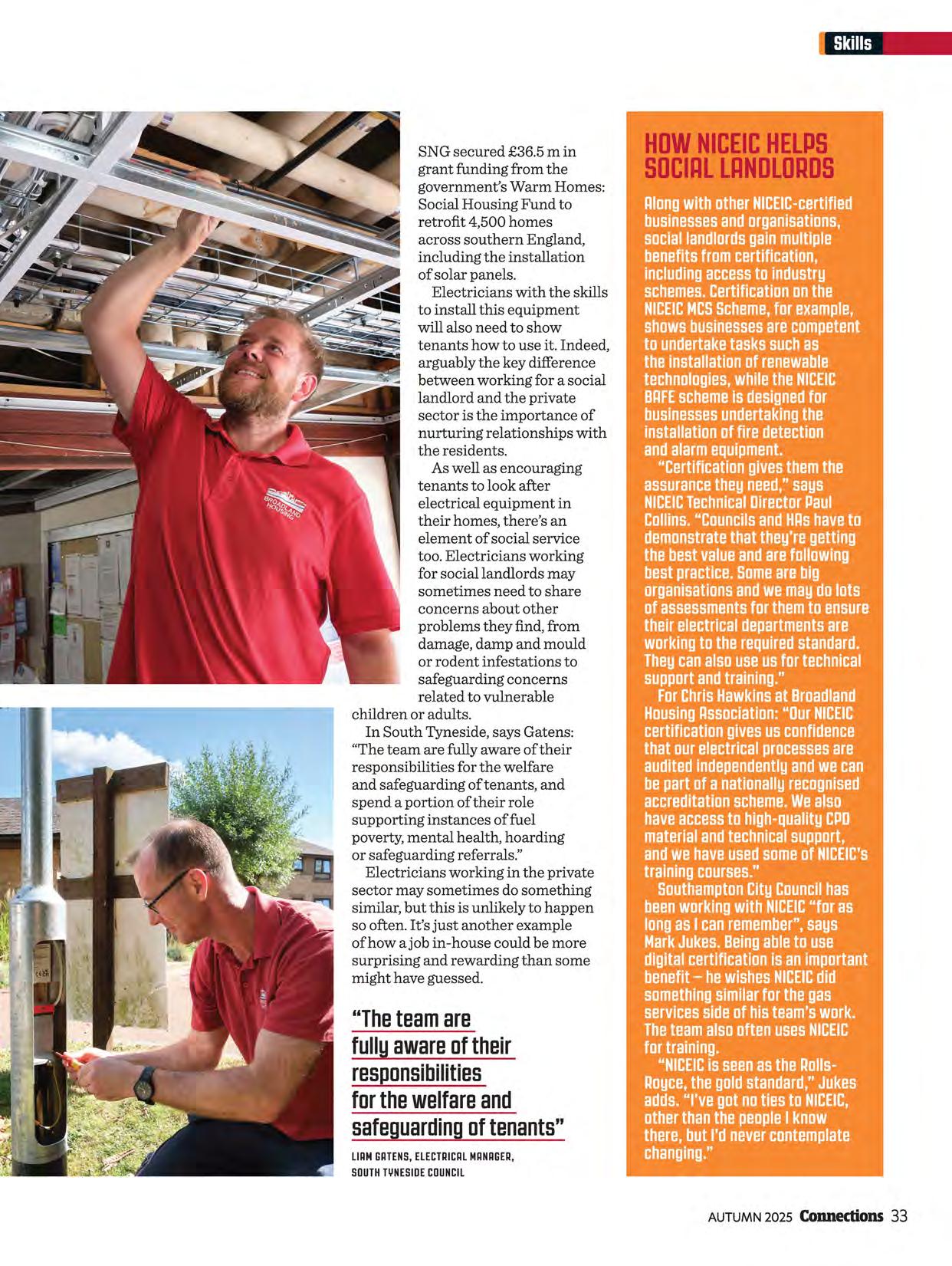
In-house teams in action. This image: South Tyneside Council; right and below: Broadland Housing Association runs 85,000 homes across the south of England and works with developers to both build more and convert existing buildings into homes. Whatever the size of the organisation, electricians have a responsibility to ensure the efficacy and safety of electrical equipment in these homes.
Chris Hawkins is Electrical Manager at Broadland Housing Association, which provides about 5,500 homes in Norfolk and north Suffolk, and has a 21-strong in-house electrical team.
"Our works don't end -we continue constantly with the cycle of required electrical testing, repairs and larger planned electrical works, alongside our technical support responsibilities," he says.
Socialservice
One major focus for most LAs and HAs at present is improving energy efficiency, whether in new-build homes or through retrofitting to help cut tenants' utility bills and carbon emissions. In March 2025,
SNG secured £36.5 min grant funding from the government's Warm Homes: Social Housing Fund to retrofit 4,500 homes across southern England, including the installation of solar panels.
Electricians with the skills to install this equipment will also need to show tenants how to use it. Indeed, arguably the key difference between working for a social landlord and the private sector is the importance of nurturing relationships with the residents.
As well as encouraging tenants to look after electrical equipment in their homes, there's an element of social service too. Electricians working for social landlords may sometimes need to share concerns about other problems they find, from damage, damp and mould or rodent infestations to safeguarding concerns related to vulnerable children or adults.
In South Tyneside, says Gatens: "The team are fully aware of their responsibilities for the welfare and safeguarding of tenants, and spend a portion of their role supporting instances offuel poverty, mental health, hoarding or safeguarding referrals."
Electricians working in the private sector may sometimes do something similar, but this is unlikely to happen so often. It's just another example of how ajob in-house could be more surprising and rewarding than some might have guessed.
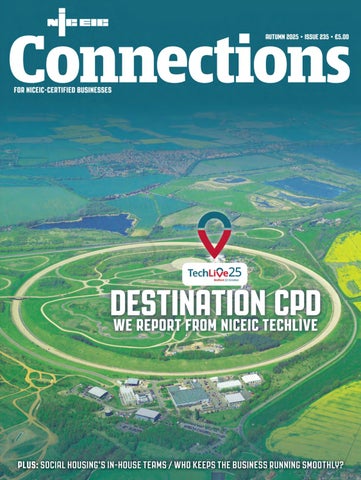
Delegatesgatheredin farceat MillbrookProvingGroundfar NICEICTechlive2025,ourin-personCPDeventfar NICEIC-certified businesses.ClareDawdyreportsanthe day
Gary Anderson, Chair of NICEIC, welcomes delegates
ne October morning, hundreds of delegates from NICEIC-certified businesses around the country descended on a prestigious address in Bedford. A leader in vehicle electrification and future mobility, the famous Millbrook Proving Ground is one of the UK's most advanced vehicle testing and development centres, with more than 70 km ofpurpose-builttracks. It also boasts excellent convention facilities.
Here, some ofNICEIC's brightest technical minds and specialist guest speakers shared their knowledge with the audiences. The event was a chance for NICE IC-certified businesses to get a hefty dose of continuing professional development (CPD) in one go.
As these businesses already know, CPD is an absolute must -not only because it's needed to meet NICEIC scheme requirements, but also because it helps keep them up to speed with technical and regulatory changes, which are in constant
flux as the industry evolves. Our research shows that face-to-face time with NICEIC experts is one of the most valuable aspects of our businesses' certification.
Participants were able to curate their own event from 12 sessions, to focus on the topics most relevant to their business priorities and development goals.
As NICEIC Chair Gary Anderson reminded the audience: "Youkeep this industry safe, smart and respected, and we're proud to support you in that."
THESESSIONS
1.Electrotechnicalandrenewables fundamentals
Athoroughgroundingin the essential competencieselectricalprofessionals needto thrivein anever-changing industry.Including:
• DoI needto bondit?
Arecapof the requirementsand principlesof equipotential for compliancewith BS7671.
• EICRcodingclinic-live Takingparticipantsthroughthe steps to choosethe correctEICRcode.
• Electricalvehiclecharging installations
Anoverviewof the design,installation, inspectionandtestingof EVcharging installations.
• Backto basics:safeisolation
Asessiononthe fundamentals of implementingsafeisolation procedures,includingthe equipmentrequired.
• Theelectrotechnicalassessment: trainingandsupervisionrequirements Arundownof the electrotechnical schemerequirementsfor training andsupervision.
2.Regulatoryupdates
There'sa lot goingon in the industry, as regulationstry to keeppacewith the evolvingnatureof ourprofession. Including:
• Plenarysession:industryupdate Theopeningsessionwasanoverview of recentregulatorychanges.
• MCS:whereit startedandwhere it's going
Anoverviewof MCS,whatit is and redevelopmentchanges.
• BuildingRegulations:what installers needto know
Coveringthe essentialsof the BuildingRegulationsandthe recently introducedrequirementsof the Building SafetyRegulator.
Advicefor runninga successful business,includingmarketingtop tips to superchargeyourbusinessand a rundownof the latest legislation set to impactsmallbusinesses.
"The opening session was attended by all delegates and spotlighted key challenges and opportunities facing NICEICcertifl.ed businesses today. It was a chance to understand the bigger picture and offered valuable context for the later sessions."
PaulCollins NICEICTechnicalDirector
"We included a policy update, because UK policy steers opportunities and shapes future business plans for us and our certified businesses. By keeping up to date and sharing insights, we can all be prepared."
"We want our certified businesses to get the most from their assessment, and understanding the impact of key updates is vital to staying compliant and maintaining their NICEIC certification. The session provided an overview of major updates to the Electrotechnical Assessment Specification (EAS) and explored two key requirements of the assessment: training and supervision."
DanielSmith NICEICHeadof Assessment
MCS:WHEREITSTARTED ANDWHEREIT'SGOING
"We explained where the Microgeneration Certification Scheme (MCS) started and why NICEIC MCS certification is so valuable for those working in the renewables sector. We also covered important updates relating to the upcoming redevelopment of the scheme."
DanielVeates NICEICEnergyEfficiency SchemeManager
MENTALHEALTHAND WELLBEING:SUPPORTING IJDURTEAM
"Many electricians work alone or in small groups, making it hard to spot when someone is struggling. We shared some practical ways to recognise the signs, have supportive conversations and build a culture where we support ourselves and each other so no one faces challenges alone."
"Mental health matters in business, because behind every role is a human being. When people feel supported and valued, they bring their best selves to work. Prioritising mental wellbeing creates a culture of care, where teams thrive."
GraceEllis Director of Welfareat the Electrical lnciustriesCharity (EiC)
ofbuilding regulations compliance, which as a statutory requirement can be considered more important than compliance with BS 7671. There were lots of good questions, which led to a great discussion."
"This was a timely reminder of the obligations under the Electricity At Work Regulations, helping everyone work safely at all times."
llicharci Harvey
Electrical Installation Safety Engineer at Electrical Safety First
MARKETINGTOPTIPS TDSUPERCHARGEIJDUR BUSINESS
"With more than 3.7 m people in the UK using Google Maps daily to find a local business, there are quick wins that NICEICcertified businesses can do to harness the power of Google and grow their business."
FizzBingham DigItal Partnerat llBH
POWERINGVOUR BUSINESS:GROWTH, COMPLIANCEAND SUPPORT
"The business landscape is changing fast and there is " lots coming down the track that will impact NICEICcertified businesses, whether they're a sole trader or have a team behind them. This session gave key updates and intel about free local business support and the available funding."
Grace Ellis and Danny Mouskovias launch The Tools to Talk
TheToolstoTalklaunch
NICE IC TechLive also saw the launch ofNICEIC's initiative to help businesses address mental health challenges in the workplace. The Tools to Talk is being delivered in collaboration with the Electrical Industries Charity (EiC). NICE IC has also contributed £10,000 to help EiC continue to provide vital mental health services.
ANDTHEWINNERIS...
Congratulations to Daniel McSheffrey, winner of the NICEIC TechLive prize draw. McSheffrey, from Actemium Ltd, won £500 off an NICEIC training course or qualification of his choice. Congratulations -we look forward to welcoming you soon.
IT'SAWAAP
From the minute the doors opened till the last delegate left the venue, Millbrook was buzzing. And from the feedback on the day, NICEIC TechLive was a roaring success. Or as Stephen Shokooh of Arcus FM put it: "It's learning, but not the hard way."
TheElectrotechnicalAssessment Specification (EAS) -the industry agreed specification used by certification bodies to assess businesses carrying out electrotechnical work -has been updated. The document, drafted by organisations representing the electrotechnical industry (including competent person scheme providers, trade associations, the Building Safety Regulator, the Welsh Government, ECA, Electrical Safety First, the Electrotechnical Skills Partnership, UKAS and the Institution ofEngineering and Technology), is intended for use by all certification bodies -not just NICEIC -so the update will impact certified businesses across the industry.
Therearetwomajorupdates l. There are clearer competence requirements for anyone carrying out periodic inspection and testing.
All 'employed persons' and qualified supervisors (QSs) undertaking this work under their certification will need to hold an acceptable Level 3 Periodic Testing and Inspection qualification. If your business doesn't currently meet the requirement, your assessor will document this in your next assessment report-but it won't immediately impact your ability to carryout EiC Rs under your certification.You'll have until 1 October 2026 to meet the requirement.
il.Four new low-carbon work categories have been introduced.
• EV charging equipment
• Solar PV systems
• Electrical energy storage systems
• Micro wind turbines
From 1 October 2026, all QSs and 'employed persons' undertaking work in these areas under their certification will need to hold an acceptable qualification. Businesses must also have access to
the latest Technical Reference Documents and use the correct test instruments for each category.
Keyterminology:'employedpersons' 'Employed persons' doesn'tjustmean your staff on payroll. If someone is undertaking the specified work under your business's certification, they're covered by the EAS. This includes directly employed staff, temp/agency workers and/or subcontracted labour, including self-employed individuals and sole traders.
Whynow?
The changes respond to Dame Judith Hackitt's review of the Grenfell Tower fire in 2017,which highlighted inconsistencies in competence standards across the built environment industry. NICEIC welcomes these changes and supports the recommendations that certification bodies are responsible for ensuring all certified businesses are competent to undertake work safely.
Doesthisimpactmybusiness?
Businesses should visit our website (niceic.com/eas-changes-what-youneed-to-know) to determine if action is needed. You can also catch up with the special EAS episode ofThe Wire at niceic.com/thewire
Ifyou'reunsureorwantadvice,NICEIC is heretosupportyoueverystepoftheway. PleasephoneusonD3333818225oremail easchanges@niceic.com
GOVERNMENTBOOST
FDRAPPRENTICESHIPS
'POLICvlPrime Minister Keir
Starmer wants to add another 20,000 young people to apprenticeships or further education, although no date for this has been mentioned. Starmer has promised to invest an extra£800 min education for 16-to 19-year-olds in 2026.
IT'SOUT!BS5266-1
A full revision of BS 5266-1 Emergency lighting-Part 1:Emergency lighting of premises - Code of practice came into effect on 31 October 2025. This supersedes the previous 2016 edition.
BS 5266-1 should be used in conjunction withBSEN 50172:2024-Emergency escape lighting systems and BS EN 1838:2024-Lighting applicationsEmergency lighting for buildings.
The scope of the standard has now been expanded to include emergency escape lighting, emergency local area lighting and standby lighting, as defined. Other significant changes include:
• Replacement of the term 'deviation' by 'variation' where the recommendations of the standard have intentionally not been followed due to the adoption of another technical solution having an equivalent or better outcome.
• Adoption of the term 'place of ultimate safety' to describe a place where there's no immediate or future danger.
There'll be more in-depth coverage in the winter 2025 issue of Connections.
" EVCHARGINGGRANTUPDATE
'POLICvlThe UK Government's new cross-pavement charging and £30 m for fleet depot installations.
£650 m Electric Car Grant offers up to £3,750 offEVs priced under £37,000. For electric vehicle charging point (EVCP) installers, this means a likely increase
With demand set to increase, many electrical contractors are lookingto expand their business into EVCP installation. NICEIC's EV qualifications were among in demand for home charger installations, as more consumers make the switch.
The government also announced a £63 m package supporting infrastructure, including £25 m for the first to carry the prestigious Electrician Plus kitemark, showing that they meet the industry gold standard for training courses
in low-carbon and renewable technologies. niceic.com/training
CAMELOT ELECTRICAVS APPRENTICE WINSBIG
Congratulations to of engineering Jack Hawkins from apprentices. NICEIC-certified "We at Camelot Camelot Electrical Electrical are all in Newport, South so very proud of Wales, for being whatJackhas crowned the achieved during his ECAEdmundson apprenticeship," Apprentice of the says Paul Russell, Year.Hawkins Managing Director impressed the at Camelot Electrical. judgesatthein-"He'sthe perfect person interview, employee and a showcasing how he fantastic role model can be a role model for for all our other the next generation apprentices."
UKSOLARROADMAPISGOODFORCONTRACTORS
lpoLIcvl The UK Go_vernment's solar roadmap- its strategy to support solar energy deployment across the country-signals a shift in how the country will generate, distribute and consume energy in the coming decades.
Launched in June, its ambition is to quadruple solar capacity to 70 GWby 2035, up from 15 GW in 2024. In this way, the government hopes to reduce reliance on fossil fuels, enhance energy security
and, ultimately, lower electricity costs. The government's policy pathway will help to ensure that the environment for innovation and investment has the stability it needs for long-term decision-making.
The roadmap comprises: modernising the grid, expanding rooftop solar, developing a skilled workforce, engaging communities and strengthening the supply chain.
As demand for solar installations grows, building a skilled and competent workforce will be critical. To find out more aboutNICEIC's solar PV training, visit niceic.com/training
ELECTRICALSAFETV IN THERENTEDSECTOR
On 1 November 2025, new rules came into effect in England requiring social landlords to have the electrical installations in their properties inspected and tested by a qualified person at least every five years for all new tenancies. Sociallandlords are also required to undertake in-service inspection and testing of electrical equipment provided as part of a tenancy (also known as PAT testing).
Existingtenancies will fall under these rules from May 2026.
In Northern Ireland, private landlords are also required to carry out periodic inspection and testing in their properties at least every five years, with this rule having come into effect for new tenancies on 1 April 2025. Existingtenancies granted before 1 April 2025 have until 1 December 2025 to comply.
WARMHOMESPLANDETAILSEXPECTED
lpQ LI cvlFundingforthe
WarmH?mes P!an was confi~med in the UK Government's spendmgrev1ew (Connections, summer 2025). It's expected to outline measures to improve energy efficiency and reduce fuel poverty across UK households. It might also include upgrades to insulation, heating systems and support for low-carbon technologies. The plan is due to be published later this year.
IT'SCOMING!AMENDMENT 4
lpQLICvl Thelong-awaited Amendment4,due to be published in 2026, is set to incorporate changes to harmonised standards at European level, which the UK will have to adopt within a certain timeframe. It's expected that this amendment will include requirements for stationary secondary batteries,low-voltage generatingsets,powerover ethernet, energy efficiency, plus functional earthing and
functional equipotential bonding for information and communication technology equipment and systems.
Unti1Amendment4 is published, certified businesses must have access to a copy of Amendment 2 (2022)-the 'brown book'andAmendment3 (2024), which is a free PDF bolt-on.
We'll of course be on hand to support our certified businesses through this transition across 2026 and beyond. Visit: niceic.com/amendment-four
The newsystemforrecordingand reporting income and expenses will soon apply to sole traders, the self-employed and those whose qualifying income is morethan£50,000.
Those with an eligible income above £50,000willjoininApril 2026, and over £30,000 in April 2027, with incomes over £20,000 mandated in April 2028. Visit: gov.uk/government/collections/ making-tax-digital-for-incometax-for-businesses-step-by-step
For admin issues, turn to page 12.
FUTUREHOMES STANDARDDUE
lpQLICyl Earlierthisyear, the Secretary of State for Energy and Climate Change, Ed Miliband, announced that rooftop solar panels would be required on most new homes as part of the UK Government's Future Homes Standard.
This landmark move signalled a shift toward solar by default and it aligns housing policy with the UK's net zero ambitions. Once confirmed, it will represent a major opportunity for installers and contractors to support the rollout of solar and other lowcarbon technologies.
NICEIC will provide updates once information is available.
As part of your NICE IC certification, you and your staff are entitled to a 10% discount on thousands of products at all B&Qand TradePointstores. This discount can be used on top of any promotional offers. And there's no threshold spend. Visitmy.niceic.com/login to submita requestto TradePoint.
A fifth of van drivers have had equipment stolen from vans in the past 12 months, accordingto research by Volkswagen Commercial Vehicles, with the average value of stolen equipment per van upwards of £1,700. *
Despite these risks, more than 40% ofUK van drivers still leave tools in their vehicles overnight. "In a trade where reliability and continuity are key, losing access to your tools canjeopardise deadlines and client trust, threatening your livelihood," says Grant Barnfather, National Sales Leader on behalf ofNICEIC Insurance Services.
Barnfather advises two-pronged proactive protection: physical security and appropriate insurance. He points out that your van may not be fully covered under your contractor insurance. Vehicle theft typically requires a separate commercial van policy.
NICEIC Insurance Services offers commercial vehicle cover with options such as comprehensive protection and a no-claims discount.
NICEIC Insurance Services's free business insurance check compares the cover, service and price you may be receiving elsewhere to see if we can improve on that.
• You can call 0333 015 6629 or send a callback request using niceicinsurance.com/free-business-insurance-check
NICEIC has supported the first electricians to complete the Electrical Underpinning Knowledge and UnderstandingTest, the new entry test for the Experienced Worker Assessment (EWA).
The EWA is for experienced electricians who've been working in the industry for several years but haven't completed an apprenticeship or achieved an equivalent recognised Level 3 vocational qualification. In this way, these electricians can gain the credentials to match their experience.
One such success story is Matt McGarry, who heads up Fuses Electrical, a small but growing firm in Cosby. "The
process was flexible," says McGarry, who passed the entry test with flying colours. "I was able to fitthe course around my work schedule and for a small business like ours, that was absolutely key."
The qualification will help Fuses to meet part of the requirements for a major contract they secured. "This will help us to unlock new opportunities and sets the business up well for the future," he says.
The autumn series of our popular CPD-accredited webinar series, The Wire, has returned with five new episodes to inform and upskill NICEIC-certified businesses.
This season, NICEIC's experts explore some of the industry's most requested topics.
Rewatch the first two episodes in this autumn's series:
• Reliable Power: generators and UPS systems in electrical installations
• ElectrotechnicalAssessment
Specification (EAS): what this means for certified businesses
Electrical Installations in Hazardous Areas: an introduction is on 13 November and Work
Smarter: how to use the NICEIC Pocket Guides app will be available on 27 November.
The autumn series follows the success of the spring series, when more than 8,000 professionals tuned in live and 25,000 caught up on-demand.
A utility company is planning to install new gas meters in an existing block of flats. It's quite difficult and disruptive to install the protective bonding conductors to the new positions by running them inside the properties. Is it permissible to install the protective bonding conductors externally clipped direct around the block to reach the new positions?
Yes. BS 7671 permits the installation of cables or wiring systems, including protective bonding conductors, on the outside of buildings or structures. Consideration would need to be given to any foreseeable external influences that may have a detrimental effect on the conductors. Suitable compensatory measures will need to be employed during installation as appropriate. External influences are detailed in Chapter 52, Section 522 of BS 7671 and NICEIC Pocket Guide 29 (External influences recognised in Section 522).
I've been asked to provide some additional circuits to an existing installation. As part of my pre-work survey, I've noticed that the bonding connection to the incoming gas service pipe isn't within 600 mm of where the service enters the premises. Would this be acceptable or would I need to replace the protective bonding conductor? When undertaking any alterations or additions to an existing installation, Regulation 132.16 includes a requirement to confirm the adequacy of any earthing and bonding arrangements on which the addition/alteration is reliant for reasons of safety. Regulation 544.1.2 requires the bonding connection to be made as near as practicable to the point of entry of a service into the premises. The connection shall be made before any branch pipework. However, it isn't a requirement to make this connection within 600 mm of the point of entry.
We know that an alteration to an existing installation that doesn't result in a new circuit or replacement consumer unit being installed can be certified using a Minor Electrical Installation Works Certificate (MEIWC). Our client is requesting anMEIWC for the changing of damaged accessories. Is this a requirement?
The installer is responsible for providing details of the work undertaken, including the safety checks carried out on the installation that deemed the maintenance work was safe to go ahead, to the customer as an audit trail for their installation. The information can be supplied in any format agreed between the contractor and the customer, but it's often easiest to record the details on an MEIWC. The relevant information could also be documented on a works order, job sheet or similar.
As a landlord, we've recently had an electric vehicle charging point installed. The EICprovided indicates that the electric vehicle charging installation should be tested at an interval of not more than five years. Do I need to get the charging point circuit inspected and tested separately to the rest of the electrical installation?
No. As the property is in the rented sector, the complete electrical installation will need to be inspected and tested at a maximum interval of five years. The electric vehicle charging circuit can be inspected and tested as part of this overall safety check of the installation, removing the need to have separate parts of the installation checked at different times.
It should be noted that the EVCE manufacturer may require functional safety checks to be undertaken by the user on the equipment at specific intervals. These would typically be detailed in the operating manual of the equipment and would fall outside the scope of the EICR.
During several recent periodic inspections, we've noticed that consumer's equipment has been installed in the external meter cabinet. We know from previous Connections articles that this isn't recommended. Would this observation be worthy of a classification code on the EICR?
NICEIC published an article in Connections issue 220 (winter 2021/2022) strongly recommending that no consumer's equipment should be installed with a meter cabinet, as it may need to be removed if the distribution network operator or meter operator felt that the equipment was preventing them from safely maintaining or upgrading their equipment. If the installation of the consumer's equipment in the meter cabinet isn't presenting a safety risk to the user of the installation, this wouldn't normally require a classification code to be recorded on the EICR; however, it could be recorded as an observation, informing the person ordering the report of a possible issue that may arise in the future.
PAULDUDLEV 1960-2025
We're deeply saddened to share the news that our colleague, Paul Dudley, passed away on 9 September 2025. PauljoinedNICEIC as an Assessor and for the past five years was a valued member of our Technical Services team. What set Paul apart wasn't just his remarkable knowledge but his generosity in sharing it and supporting others with kindness and warmth. Paul will be greatly missed byallofus.
SamDonaghy
CONDUITSIZING
Objective:This article examines the methods available for determining an appropriate diameter of conduit for the installation of conductors. The selection must consider both the number of conductors to be installed and the most onerous section of the conduit system into which they will be drawn. Cable grouping factors aren't considered in this article.
Introduction
Regulation 522.8.1 of BS 7671 requires that wiring systems must be selected and erected to avoid damage to cables and their terminations during installation, use or maintenance.
However, BS 7671 doesn't provide guidance on how compliance with this regulation may be achieved.
When designing a conduit system, two commonly accepted methods are used to determine the required diameter.
• The per unit system method.
• The space factor method.
Some electrical contractors may rely solely on previous experience when selecting a conduit size. While this may be adequate in simple cases, this can often result in the selection of conduits of insufficient diameter, making the installation of cables difficult while increasing the risk of mechanical damage to the cables during installation.
This established approach is based on practical application and takes into account the effects of distance between drawing-in points and the number of bends in a particular run, both of which hinder the ability to draw the cables into the conduit.
This method involves using standardised tables to determine a cable factor (based on the cross-sectional area and number of conductors) and a conduit factor (based on the type and length of conduit route, including bends).
To ensure single-core cables can be drawn into a particular conduit system, without the application of excessive force, the sum of the cable factors must be less
than or equal to the conduit factor for the selected conduit diameter.
Different conduit factors are used depending on the type ofrun. For short, straight runs of conduit, the friction between cable and conduit is less than for longer runs or for runs containing bends. As a result, separate tables are used for conduits arranged in:
• straight runs not exceeding 3 m in length
• straight runs exceeding 3 m in length or runs of any length incorporating bends or sets.
The following examples are based on data given in Appendix A ofIET Guidance Note 1 (GNl). Reference to this publication may aid the reader when following the worked examples.
Example one
Four 4 mm 2 single-core PVC conductors are to be drawn into a 3 m length of conduit with no bends. Using the per unit method, determine the minimum size conduit that should be used.
Solution one
From TableAlofGNl:
Cable factor for a 4 mm 2 single-core conductor is 58. Therefore, for four 4mm 2 conductors:
Total cable factor= 4 x 58 = 232
From Table A2 of GNl:
For a straight 3 m length the smallest conduit with a factor equal or larger than 232 is 16 mm, which has a conduit factor of 290.
Section 2
Total length of 5 m with 3 x bends
I' ("l ' /' l@J
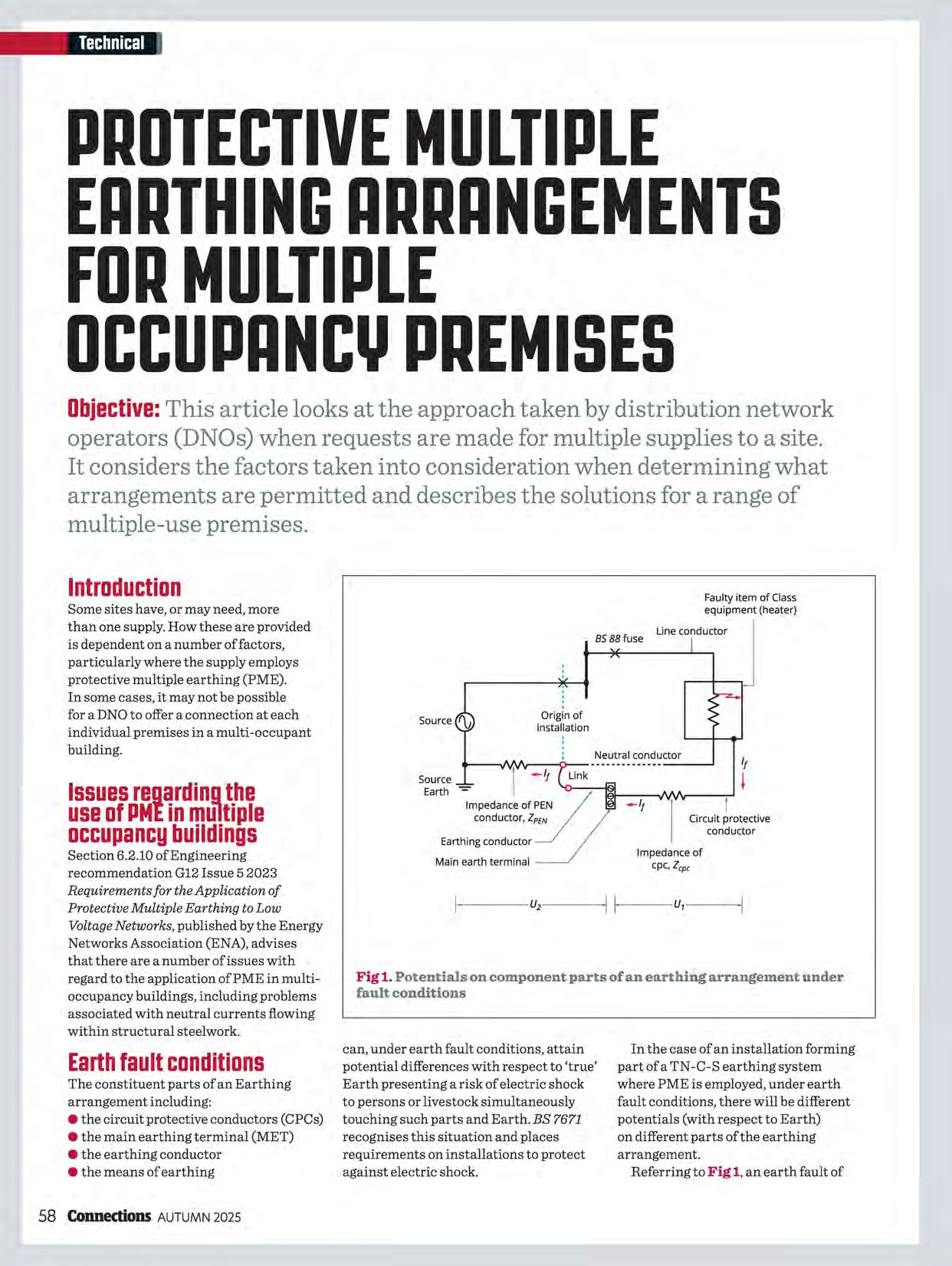
1. Conduit system arrangement
Fig
Example two
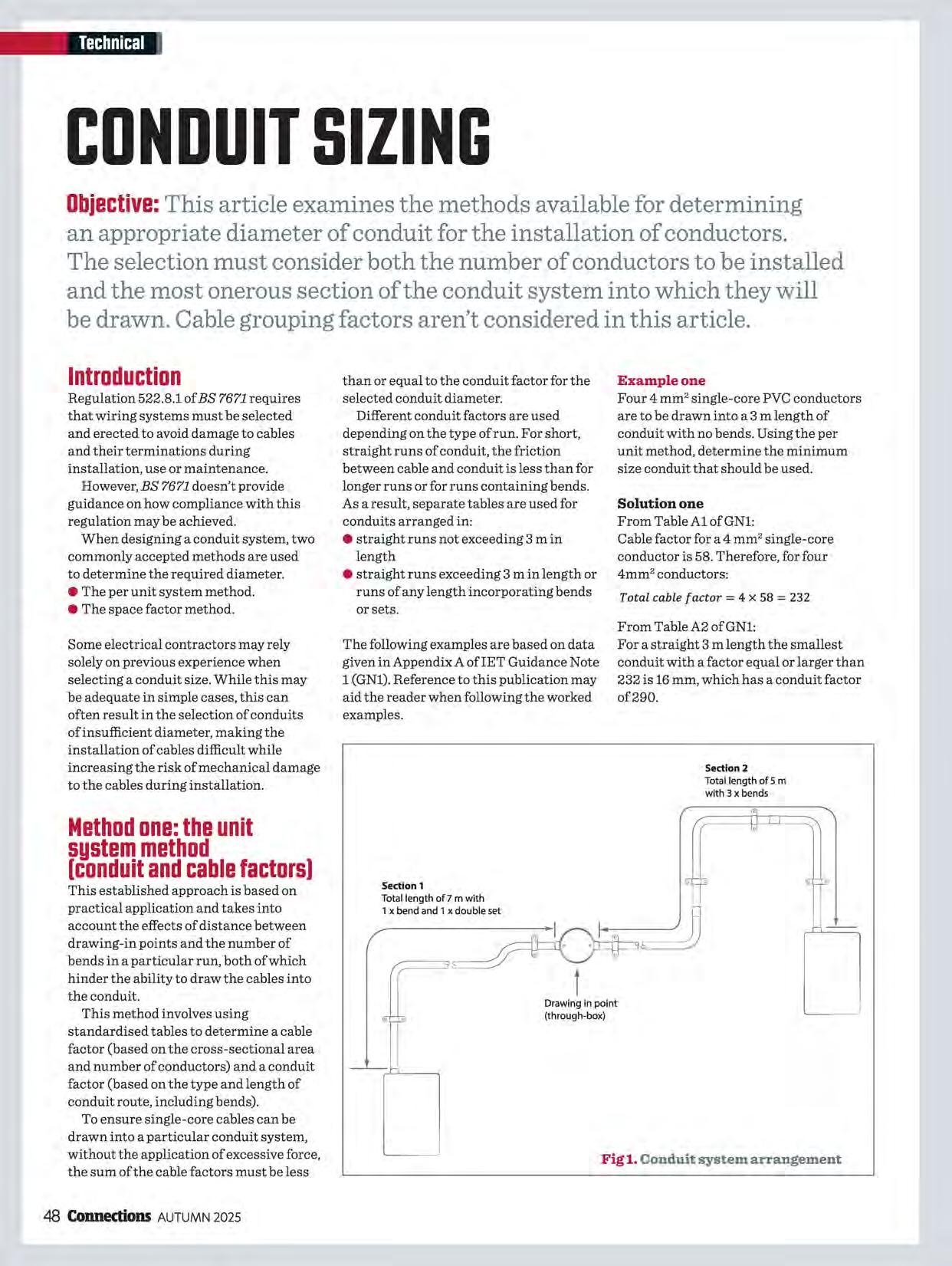
Four 4 mm 2single-core PVC insulated conductors are to be installed in the conduit system shown in Fig 1. Determine the minimum conduit size using the unit system method. Note: a double set can be treated as being equivalent to a single right-angle bend (see paragraph Al ofGNl).
Solution two
From TableA3ofGN1:
Cable factor for a 4 mm 2single-core conductor is 43. Therefore, for four 4mm 2conductors:
Total cable factor= 4 x 43 = 172
From TableA4ofGN1:
For section one
One bend and one double set (equivalent to a conduit run having two right-angle bends) over the 7 m, from Table A4 ofGNl, the smallest conduit size with a factor equal or larger than 172 is 25 mm, having a conduit factor of 311.
For section two
Three bends over the 5 m, the smallest conduit with a factor equal or larger than 172 is 25 mm, having a conduit factor of 260.
As such, the minimum size conduit that should be used in both sections is 25 mm.
The positioning of the draw-in points can influence the size of conduit used. Adjusting or adding draw-in points may give the designer the option ofreducing the size of conduit used.
Comparing both examples one and two illustrates that, for a short straight run, a conduit with a smaller diameter may be used due to reduced friction between the conduit and cable, in comparison to that of the longer length and more complex shape. Methodtwo:theuse
The space factor method may be used as an alternative approach for determining the minimum size of conduit when the installation involves conduit types not covered by the tables in Appendix A ofGNl.
According to GNl, the cross-sectional area occupied by the installed cables
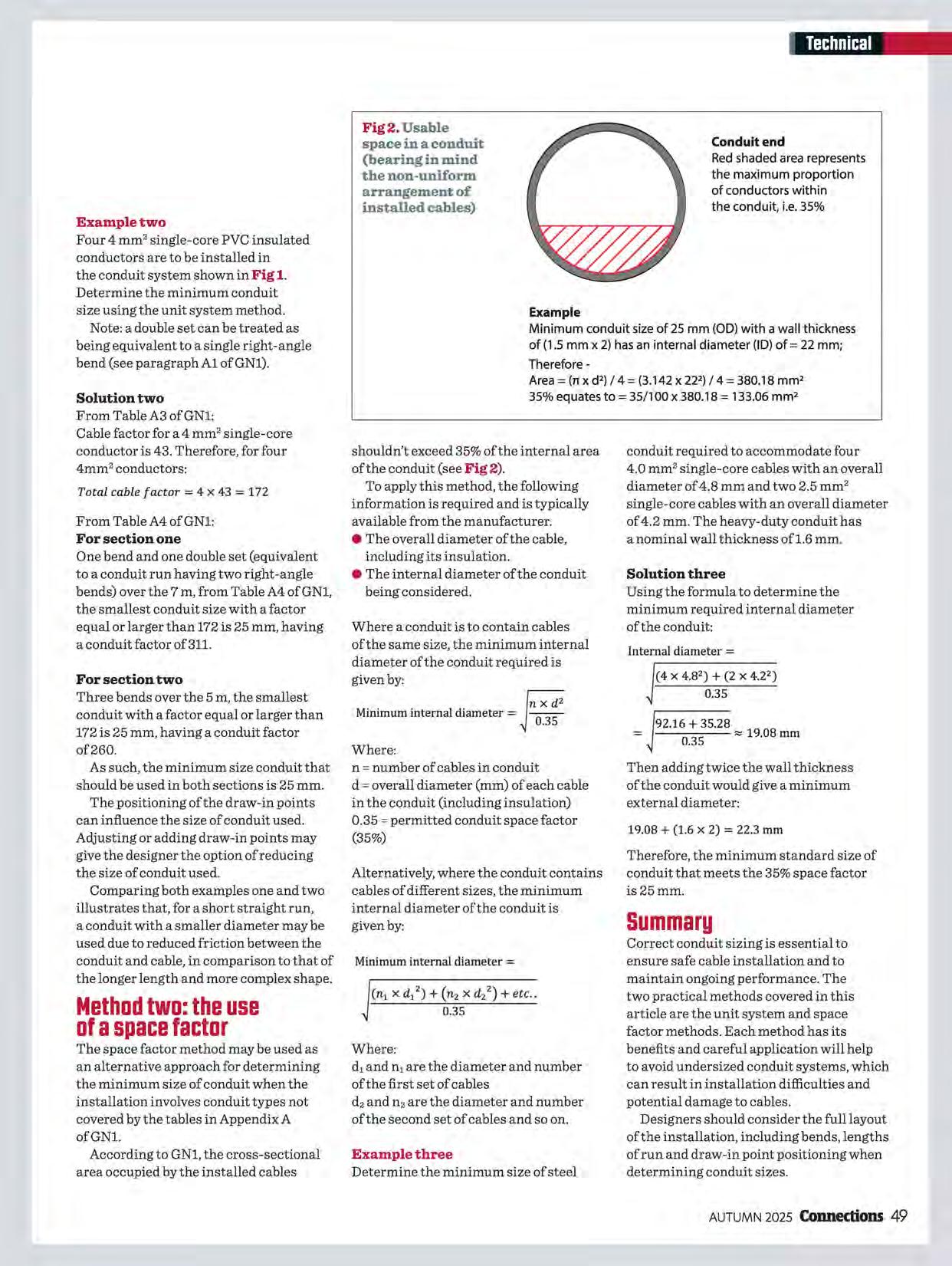
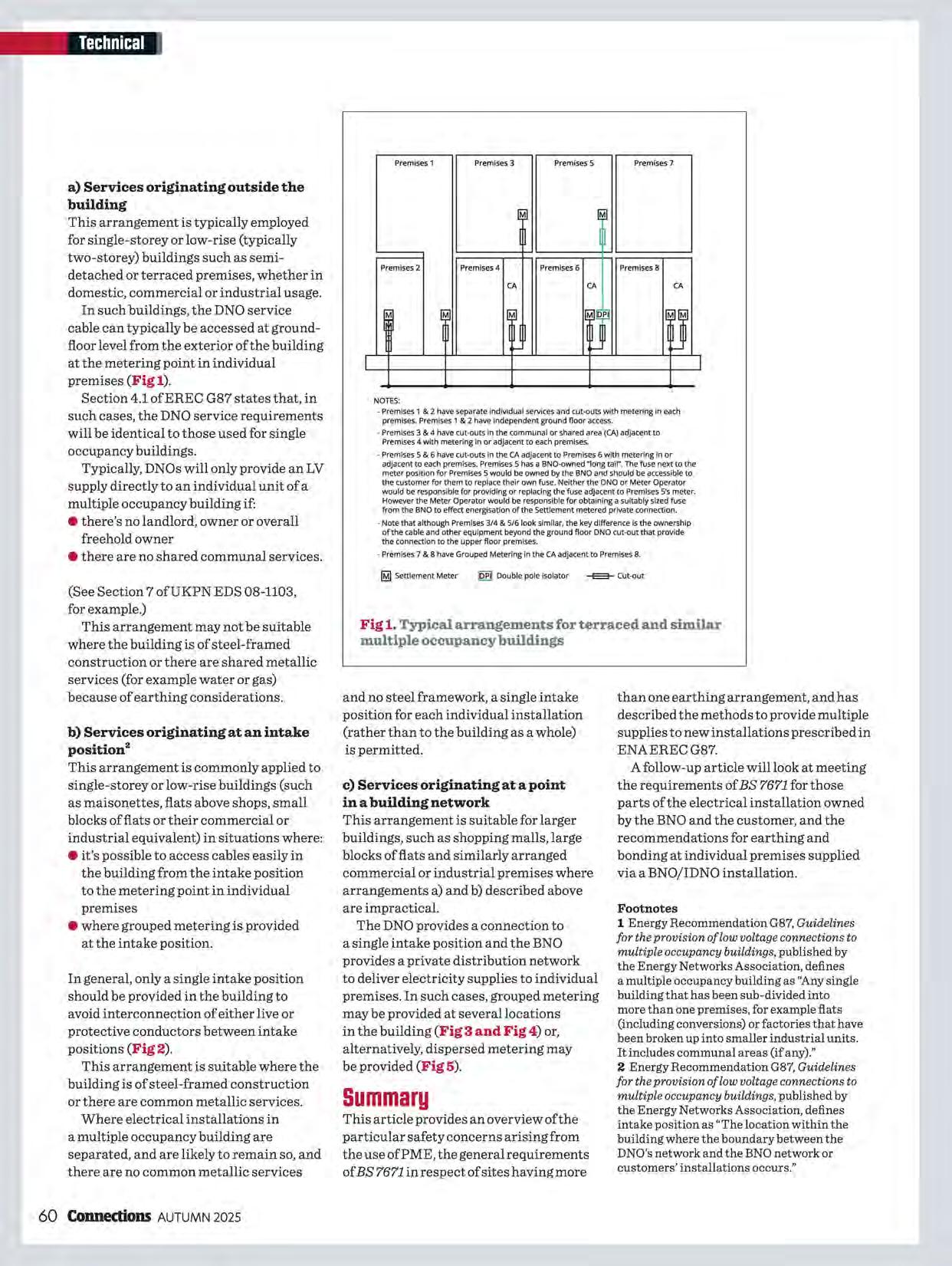
Fig 2. Usable space in a conduit (bearing in mind the non-uniform arrangement of installed cables)
Conduitend
Red shaded area represents the maximum proportion of conductors within the conduit, i.e.35%
Example
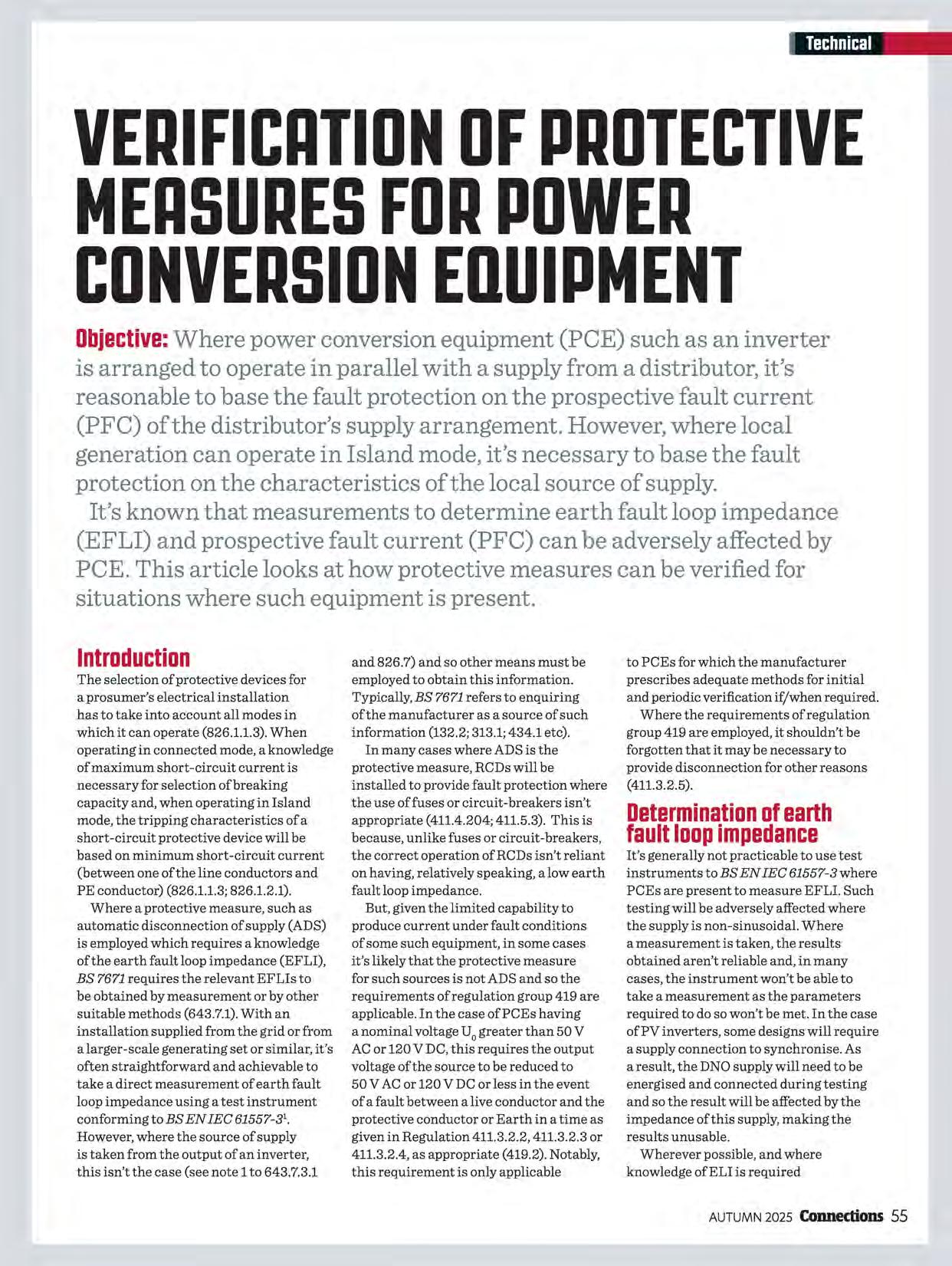
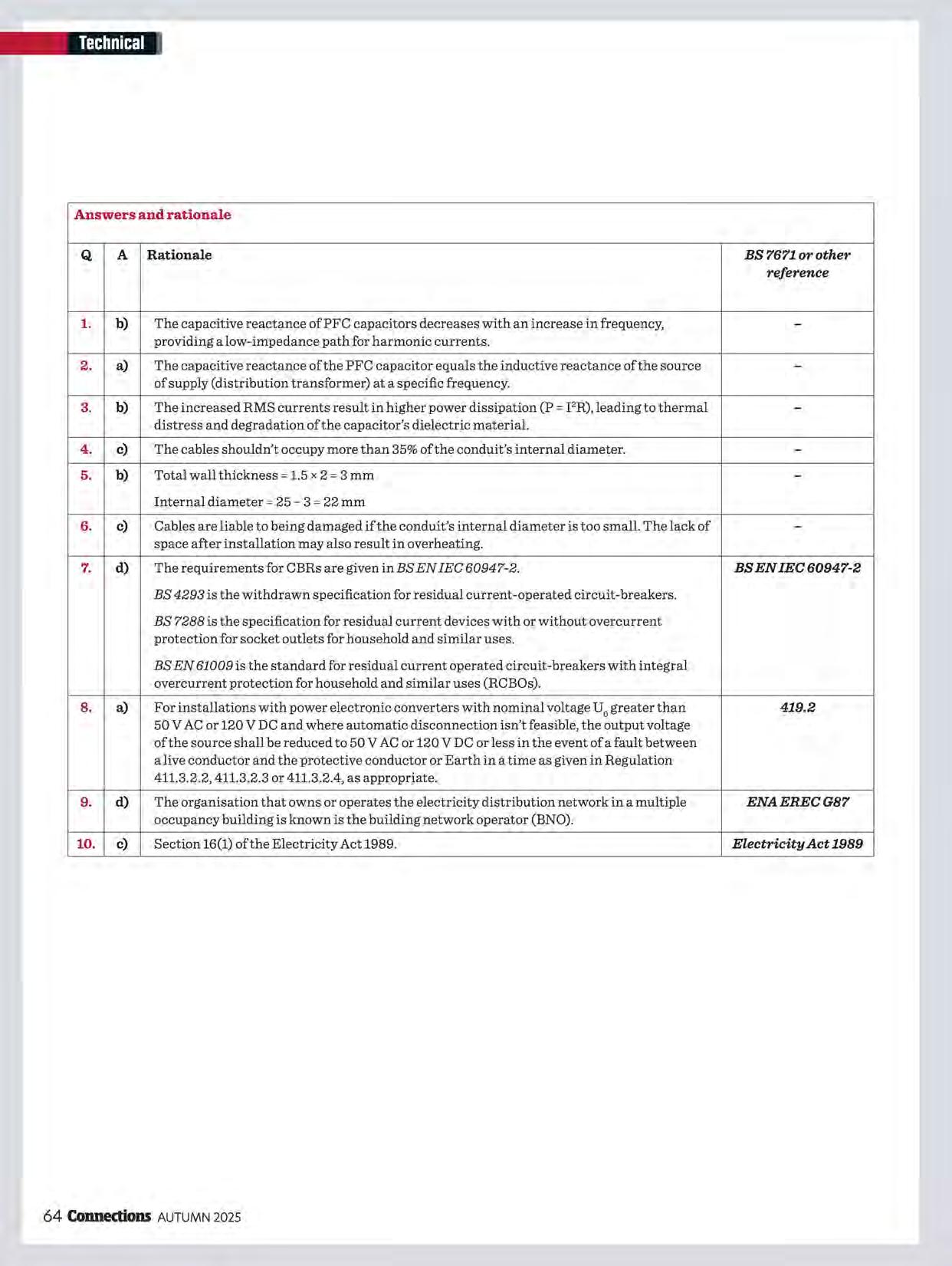
Minimumconduit size of 25 mm (OD)with a wall thickness of (1.5 mm x 2) has an internal diameter (ID)of= 22 mm; ThereforeArea= (rrx d2) / 4 = (3.142x 222) / 4 = 380.18 mm2 35% equates to = 35/100 x 380.18 = 133.06 mm2
shouldn't exceed 35% of the internal area ofthe conduit (see Fig2).
To apply this method, the following information is required and is typically available from the manufacturer.
• The overall diameter of the cable, including its insulation.
• The internal diameter of the conduit being considered.
Where a conduit is to contain cables of the same size, the minimum internal diameter of the conduit required is given by:
Minimum internal diameter =
Where:
n = number of cables in conduit
d = overall diameter (mm) of each cable in the conduit (including insulation)
0.35 = permitted conduit space factor (35%)
Alternatively, where the conduit contains cables of different sizes, the minimum internal diameter of the conduit is given by:
Minimum internal diameter =
(n1 x d/) + (n2 x d,2) + etc .. 0.35
Where:
d, and n, are the diameter and number of the first set of cables d2 and n2 are the diameter and number of the second set of cables and so on.
Example three
Determine the minimum size of steel
conduit required to accommodate four 4.0 mm 2single-core cables with an overall diameter of 4.8 mm and two 2.5 mm 2 single-core cables with an overall diameter of 4.2 mm. The heavy-duty conduit has a nominal wall thickness ofl.6 mm.
Solution three
Using the formula to determine the minimum required internal diameter of the conduit:
Internal diameter = (4 4.8 + (2 4.2 0.35
92.16 + 35.28 1-----"" 19.08 mm 0.35
Then adding twice the wall thickness of the conduit would give a minimum external diameter:
19.08 + (1.6 x 2) = 22.3 mm
Therefore, the minimum standard size of conduit that meets the 35% space factor is25mm.
Summary
Correct conduit sizing is essential to ensure safe cable installation and to maintain ongoing performance. The two practical methods covered in this article are the unit system and space factor methods. Each method has its benefits and careful application will help to avoid undersized conduit systems, which can result in installation difficulties and potential damage to cables.
Designers should consider the full layout of the installation, including bends, lengths ofrun and draw-in point positioning when determining conduit sizes.
10% off insurance for NICEICcertified businesses* .
ReputableUK-basedinsurers.
Specially negotiated prices from UK-based leading insurers and specialist providers.
FREEbusinessinsurancecheck.
While other insurance providers ask you what you want, we advise you what you need. So you don't pay for cover you don't need. Simple.
NICEICcertificationstrengthens yourreputation.
Cover arranged by NICEICInsurance Services protects your livelihood.
Agreatexperience.
13,900 customers can't be wrong.
Proud winners of the Feefo Platinum Trusted Service Award for delivering exceptional customer service .
THEIMPACT OF HARMONICCUAAENTS
Objective:This is the second article in a series which examines the impact of harmonic currents on power factor correction (PFC) capacitors. This time, the focus is on two main problems: overcurrent due to harmonics and parallel resonance. Some practical examples are provided to illustrate and aid engineers and technicians in understanding power quality issues.
Introduction
In modern electrical power systems, the increasing use of non-linear loads such as variable frequency drives (VFDs), uninterruptible power supplies and various power electronics has raised significant concerns regarding power quality. While these devices improve energy efficiency and control, they introduce harmonic currents into the electrical system. Harmonics are currents or voltages with frequencies that are integer multiples of the fundamental frequency, typically 50 Hz.
The presence of harmonics, particularly 5th and 7th harmonics, can negatively affect power factor correction because they often coincide with resonant frequencies in systems with PFC capacitors. These capacitors are essential components for improving the power factor in electrical installations. Further information relating to harmonics can be found in previous editions of Connections (issues 229, 230 and 231).
Understanding PFCcapacitors
Inductive loads, such as induction motors, draw current that lags behind the supply voltage by some angle (0), resulting in a low power factor. While it's recognised that non-linear loads introduce harmonic currents into the electrical system affecting the power quality, they may also have an inductive element required for functionality (EMI filters or windings) that can affect power factor.
PFC capacitors are therefore introduced to counteract this lagging current by providing a leading capacitive current, thereby improving the overall
Fig 1.
illustrating how introducing a capacitive current reduces the phase angle between total current and supply voltage (not drawn to scale).
phase angle and power factor of the system.
Fig 1 shows a phasor diagram where the addition of the capacitive current reduces the phase angle between the total current and supply voltage, moving the power factor closer to unity. Such correction leads to more efficient power usage, reduced losses and lower utility charges.
Although PFC capacitors are generally reliable and require minimal maintenance, they can be adversely affected by harmonic currents in the electrical installation.
The capacitive reactance of a capacitor is inversely proportional to both the frequency of the AC signal and the capacitance.
Capacitive reactance (Xe) is given by the formula:
Xe= 2rrfC
Where:
f is the frequency (Hz) Cis the capacitance (farads)
Phasor diagram
This inverse relationship means that as the frequency increases, capacitive reactance decreases.
Although PFC capacitors are typically designed to operate optimally at the fundamental frequency (50 Hz) when exposed to such harmonic currents, the capacitor becomes subjected to currents at multiple frequencies. The decreased reactance therefore allows for an increased flow of harmonic currents, which can lead to overcurrent conditions. For example, consider a PFC capacitor with a capacitance C oflO0 µFin a 50 Hz system.
• At the fundamental frequency (50 Hz), the capacitive reactance is:
Xcl = 2n X 50 X 100 X 10- 6 = 3 LS 3 f!
• The capacitive reactance at the 5th harmonic (250 Hz): 1
Xcs = 2n X 250 X 100 X 10- 6 = 6 •37 f!
This significant decrease in reactance at higher frequencies implies that the capacitor provides a much lower impedance path for harmonic currents, resulting in increased current flow through the capacitor. The result is the total current through the capacitor is the vector sum of the currents at the fundamental and at all harmonic frequencies. The root mean square (RMS) value of the total current can be determined using the formula:
Where:
In is the RMS current at the n thharmonic frequency
Increased RMS currents lead to higher power dissipation, as power dissipated in the capacitor is proportional to the square of the current (P= I2R). This results in increased temperatures in the capacitor, causing thermal distress while accelerating the degradation of dielectric materials, ultimately reducing the capacitor's life cycle and potentially
PARALLELRESONANCEEQUIVALENTCIRCUIT
Fig 2. Equivalent circuit of an electrical system with a PFC capacitor connected across linear and non-linear loads
leading to failure. Dielectric breakdown in localised capacitors is a common occurrence when used in combination with a VFD, in which holes are often found puncturing through the plates of the capacitor material.
Fig 2 shows an equivalent circuit for an electrical system incorporating linear and non-linear loads in which harmonic currents are generated and may interact with PFC capacitors in ways that lead to overcurrent conditions.
As can be seen in Fig 2, the harmonic current tends to flow in the opposite direction to the fundamental current and, noticeably, in the same direction as the harmonic voltage across the load. This is because harmonic components are injected into the distribution system by the load itself; circulating currents therefore originate from the load.
Key:
LSC = short-circuit inductance of the distribution transformer'
C = capacitance of the PFC capacitor
h = harmonic currents drawn by the non-linear load
Vh= harmonic voltage(s)
To mitigate such risks, PFC capacitors are typically rated at 1.3 times or 130% of their expected maximum reactive current 2 at the nominal supply voltage and fundamental frequency. This higher
rating provides a safety margin to accommodate the additional harmonic current.
Additionally, harmonic current (h) produced by non -linear loads flows through the installation's impedance and generates voltage drops at harmonic frequencies, resulting in distorted voltages (Vi,).These distorted harmonic voltages superimpose on the fundamental voltage and are applied across all connected loads, inducing additional harmonic currents even in linear loads. This can lead to operational problems such as unwanted tripping of protective devices and increased losses.
Problemtwo: parallelresonance
When considering the equivalent circuit given in Fig 2, parallel resonance occurs when the capacitive reactance (Xe) of the PFC capacitor equals the inductive reactance (Xr) of the supply system (distribution transformer) at a specific frequency. The resonant frequency (f,) can be calculated using formula: 1 fr=----
Where:
LSC is the short-circuit inductance of the supply system
C is the capacitance of the PFC capacitor
Resonancein AC Circuits
Z is minimum at 1-+----'r--=e-=--so-=--n'--'-a=n-'--c=--=e'---'f"--re-=--q:iu=-e-=--n-=-c=-<y
frequency (H2 )
Fig 3. Graph showing the relationship between capacitive reactance x. and inductive reactance XL against frequency, illustrating the point of resonance (f) and the resultant impedance (Z)
For example, assuming a supply system with LSC oflO mH and C oflO0 µF, the resonant frequency is approximately: 1
fr = ---;::::==::::;::::=====;: X 10- 3 X 100 X 10- 6 1 = 0.006283 = 159.15 Hz
This resonant frequency is close to the 3rd harmonic (150 Hz) in a 50 Hz system. If harmonic currents at this frequency are present, resonance can result in amplification of harmonic currents, causing high impedance and voltage magnification.
This can lead to:
• unwanted tripping of protective devices
• failure of overcurrent protective devices
• severe overvoltages and overcurrent with the potential to damage equipment.
Combinedeffects onPFCcapacitors
The combination of overcurrent due to decreased capacitive reactance at harmonic frequencies and resonanceinduced overvoltages can severely impact PFC capacitors. Increased thermal stress resulting from higher RMS currents and voltage stress from resonance-induced overvoltages can lead
to dielectric breakdown of the capacitor material. This not only shortens the life cycle of the capacitors but can also affect the reliability of the entire electrical system, potentially leading to increased maintenance costs and interruption.
Summary
Understanding the impact of harmonics on PFC capacitors is necessary for managing power systems with non-linear loads. Harmonic currents can cause overcurrent conditions and resonance, leading to significant damage to PFC capacitors and other system components. Recognition of these effects is the first step in mitigating the risks associated with harmonics in electrical systems.
A subsequent article will explore the practical methods for mitigating the effects of harmonics on PFC capacitors, including the use ofanti-harmonic reactors, passive filters and active filters. These solutions are important for maintaining power quality and ensuring the longevity of electrical equipment in modern electrical systems.
Footnotes
1 The overriding influence on the impedance at the transformer is the inductance. Therefore, the effects of the resistance have been omitted for clarity.
2 Maximum permissible current is given in BS EN 60831-1 Shunt power capacitors of the self-healing type for a.c. systems having a rated voltage up to and including 1000 V Part 1: General - Performance, testing and rating - Safety requirements - Guide for installation and operation.
• a host of savings on our on line shop and with Tradepoint
• new training opportunities and much more.
StayintheknowwithNICEIC.
Don't miss out on the latest news and opportunities from NICEIC. You don't have to be an NICEIC-certified business to receive the newsletter, so sign up now to receive the next issue straight to your in box.
And don't forget that all NICEIC-certified businesses also receive The Circuit e-newsletter every month, just one of the many CPD resources we offer to provide our businesses with essential updates, help and advice relating to your certification.
Objective:Where power conversion equipment (PCE) such as an inverter is arranged to operate in parallel with a supply from a distributor, it's reasonable to base the fault protection on the prospective fault current (PFC) of the distributor's supply arrangement. However, where local generation can operate in Island mode, it's necessary to base the fault protection on the characteristics of the local source of supply. It's known that measurements to determine earth fault loop impedance (EFLI) and prospective fault current (PFC) can be adversely affected by PCE. This article looks at how protective measures can be verified for situations where such equipment is present.
Introduction
The selection of protective devices for a prosumer's electrical installation has to take into account all modes in which it can operate (826.1.1.3). When operating in connected mode, a knowledge of maximum short-circuit current is necessary for selection of breaking capacity and, when operating in Island mode, the tripping characteristics of a short-circuit protective device will be based on minimum short-circuit current (between one of the line conductors and PE conductor) (826.1.1.3; 826.1.2.1). Where a protective measure, such as automatic disconnection of supply (ADS) is employed which requires a knowledge of the earth fault loop impedance (EFLI), BS 7671 requires the relevant EFLis to be obtained by measurement or by other suitable methods (643.7.1). With an installation supplied from the grid or from a larger-scale generating set or similar, it's often straightforward and achievable to take a direct measurement of earth fault loop impedance using a test instrument conforming to BS EN IEC 61557-3 1 However, where the source of supply is taken from the output of an inverter, this isn't the case (see note 1 to 643.7.3.1
and 826.7) and so other means must be employed to obtain this information. Typically, BS 7671 refers to enquiring of the manufacturer as a source of such information (132.2; 313.1; 434.1 etc).
In many cases where ADS is the protective measure, RCDs will be installed to provide fault protection where the use of fuses or circuit-breakers isn't appropriate (411.4.204; 411.5.3). This is because, unlike fuses or circuit-breakers, the correct operation ofRCDs isn't reliant on having, relatively speaking, a low earth fault loop impedance.
But, given the limited capability to produce current under fault conditions of some such equipment, in some cases it's likely that the protective measure for such sources is not ADS and so the requirements ofregulation group 419 are applicable. In the case of PCEs having a nominal voltage UO greater than 50 V AC or 120 V DC, this requires the output voltage of the source to be reduced to 50 V AC or 120 V DC or less in the event of a fault between a live conductor and the protective conductor or Earth in a time as given in Regulation 411.3.2.2, 411.3.2.3 or 411.3.2.4, as appropriate (419.2). Notably, this requirement is only applicable
to PC Es for which the manufacturer prescribes adequate methods for initial and periodic verification if/when required. Where the requirements ofregulation group 419 are employed, it shouldn't be forgotten that it may be necessary to provide disconnection for other reasons (411.3.2.5).
Determinationofearth faultloopimpedance
It's generally not practicable to use test instruments to BS EN IEC 61557-3 where PC Es are present to measure EFLI. Such testing will be adversely affected where the supply is non-sinusoidal. Where a measurement is taken, the results obtained aren't reliable and, in many cases, the instrument won't be able to take a measurement as the parameters required to do so won't be met. In the case of PV inverters, some designs will require a supply connection to synchronise. As a result, the DNO supply will need to be energised and connected during testing and so the result will be affected by the impedance ofthis supply, making the results unusable.
Wherever possible, and where knowledge of ELI is required
(643.7.3.1), reference should be made to manufacturer's data for the PCE in question. In reality, it's difficult to get the necessary information in this manner. In such cases, a reasonable approximation of ELI can be obtained using the maximum rated power output of the PCE at 230 V. In most cases, it's likely that the limited prospective fault current available from the PCE will make it necessary to install RCDs to provide this automatic disconnection in the event of a fault.
Where the islanded supply installation is configured as part of a TN-S system, as is commonly the case, ELI may be derived using the expression given in Regulation 411.4.4 rearranged to make Z, the subject:
As an RCD is being used, I. is the residual operating current providing the requisite disconnection time, in this case five seconds (distribution circuit). When a Type AC or Type A RCD to BS EN 61008-1 or BS EN 61009-1 is employed,
I.= I &i as for RCDs ofrating exceeding 30 mA, a current ofI &i gives a maximum disconnection time of300 ms (Table 1 of BS EN 61008-1). So for an RCD having I &i oflO0mA:
230
z <s - 0.1
Zs::;; 2.3 kfl.
Where a Type B RCD to BS EN 62423 is used (712.531.3.5.1), I.= 2IAnfor a disconnection time of300 ms (break time for residual direct currents which result from rectifying circuits and for residual smooth direct current: Table 1 of BS EN 62423).
230
z <s - 0.2
Zs ::;;1.15 kfl.
Where a Type B CBR to BS EN 60947-2 is used (712.531.3.5.1), the device shall operate in the case ofresidual pulsating direct currents superimposed by a residual smooth direct current of0.4 times the rated residual current (I &i) or
10 mA, whichever is the highest value. In such cases, the tripping current for a CBR having an I Anexceeding 30 mA shall not exceed 1.4 I An (Clause B.4.4.3 of BS EN IEC60947-2). So, for a 100 mA CBR:
230 z <-s - 0.14
Zs $ 1.64 kfl.
In all the above cases, the use of an RCD will provide fault protection to the PCE.
Regulation419.2
For power electronic converters (PE Cs) with a nominal voltage UO greater than 50 V AC or 120 V DC, where automatic disconnection isn't feasible, the PEC can be designed such that the output voltage of the source falls to 50 V AC or 120 V DC or less in the event of a fault between a live conductor and the protective conductor or Earth within the requisite disconnection time for the circuit arrangement given in regulation group 411.3.2 (419.2). As a distribution circuit, a disconnection time of five seconds is permitted if the arrangement is connected as TN-S (411.2.3) or one second if the arrangement is TT (411.3.2.4).
Where Regulation 419.2 is employed, this should be made clear on the certification for the installation and documentation from the manufacturer declaring that this approach has been employed in the equipment should be appended to the certification (Fig 1). It should be noted that, as this approach is permitted in BS 7671, this is not a departure.
An RCD isn't required at the AC output terminals of this equipment.
When operating in Island mode, voltage is reduced to a safe level within the time given in BS 7671 section 419 in the event of a fault of negligible impedance.
Fig 1. Exemplar declaration of the employment of Regulation 419.2 in a PV inverter
Conclusions
For smaller scale PC Es such as those employed in solar PV systems in domestic premises, the prospective fault current will be approximately the same as the maximum rated power output of the PCE at 230 V declared by the manufacturer. This will be insufficient to operate a circuit-breaker or fuse.
As a result, it's likely that automatic disconnection under fault conditions will be provided by an RCD or CBR. Where this is the case, the maximum permitted earth fault loop impedance can be determined with the expression in Regulation 411.4.4 using the residual operating current providing disconnection in the time specified in Regulation 411.3.2.2 or Regulation 411.3.2.3. This will vary dependent on the type ofRCD/CBR that is used. In any case, the resultant maximum ELI obtained will be readily achievable. As an alternative to the use of an RCD/CBR, the methodology described in regulation 419.2 may be employed. For PE Cs with a nominal voltage U0 greater than 50 V AC or 120 V DC, where automatic disconnection is not feasible, the PEC can be designed such that the output voltage of the source falls to 50 V AC or 120 V DC or less in the event of a fault between a live conductor and the protective conductor or Earth within the requisite disconnection time for the circuit arrangement given in regulation group 411.3.2. Where this approach is adopted, this should be made clear on the electrical certification and manufacturer's data clarifying that this methodology has been employed in their equipment should be attached to the certification.
Footnote 1. BS EN IEC 61557-3:2022 Electrical safety in low voltage distribution systems up to 1,000 V AC and 1,500 V DC -Equipment for testing, measuring or monitoring of protective measures Part 3: Loop impedance
Objective:This article looks at the approach taken by distribution network operators (DNOs) when requests are made for multiple supplies to a site. It considers the factors taken into consideration when determining what arrangements are permitted and describes the solutions for a range of multiple-use premises.
Introduction
Some sites have, or may need, more than one supply. How these are provided is dependent on a number of factors, particularly where the supply employs protective multiple earthing (PME). In some cases, it may not be possible for a DNO to offer a connection at each individual premises in a multi-occupant building.
Section 6.2.10 of Engineering recommendation G12 Issue 5 2023 Requirements for the Application of Protective Multiple Earthing to Low Voltage Networks, published by the Energy Networks Association (ENA), advises that there are a number of issues with regard to the application of PME in multioccupancy buildings, including problems associated with neutral currents flowing within structural steelwork.
Earthfaultconditions
The constituent parts of an Earthing arrangement including:
• the circuit protective conductors (CPCs)
• the main earthing terminal (MET)
• the earthing conductor
• the means of earthing
Faulty item of Class equipment (heater)
88fuse Line conductor
of installation
Earth= :I
Source j .,..ft Link
Impedance of PEN conductor, ZPEN Earthing conductor
Main earth terminal
Circuit protective conductor
Impedance of cpc, Zcpc
Fig 1. Potentials on component parts of an earthing arrangement under fault conditions
can, under earth fault conditions, attain potential differences with respect to 'true' Earth presenting a risk of electric shock to persons or livestock simultaneously touching such parts and Earth. BS 7671 recognises this situation and places requirements on installations to protect against electric shock.
In the case of an installation forming part of a TN-C-S earthing system where PME is employed, under earth fault conditions, there will be different potentials (with respect to Earth) on different parts of the earthing arrangement. Referring to Fig 1, an earth fault of
Installation 1
Earthing arrangement 1
Installation 2
Earthing arrangement 2
Protective device
Common protective conductor must either:
-be able to carry maximum fault current likely to flow, or
-be earthed in one installation and insulated in the other, and
- -if part of a cable, the protective conductor must be earthed only in the installation containing the associated protective device
Fig 2. Requirements for protective conductors between installations with separate earthing arrangements
negligible impedance has occurred between the line conductor and the metallic casing of a piece of Class I electrical equipment. The fault current passes through the CPC to the MET, causing a potential difference U, (which is derived from Ir x Zcpc) between the exposed-conductive-parts of the Class I equipment and the MET. Additionally, the fault current passes through the earthing conductor which, for the purposes of the example, has negligible impedance and the protective earth neutral (PEN) conductor of the supply, causing a further potential difference U2 (derived from If x ZPEN) between the MET and Earth.
Under the particular fault conditions indicated in the diagram:
• the potential of the MET will be If x ZPEN volts with respect to source earth
• the potential of the exposedconductive-partwill be U, + U2 (Ir x Zcpc + Ifx ZPEN) volts above source earth.
Simultaneously accessible exposedconductive-parts are required to be connected to the same earthing system either individually or collectively (411.3.1.1).This means that simultaneously accessible exposedconductive-parts will remain at substantially the same potential under earth fault conditions.
However, where a number of installations have separate earthing arrangements, BS 7671 requires that any protective conductors common to more than one installation shall either:
• be capable of carrying the maximum fault current likely to pass through them;or
• be earthed in only one installation and be insulated from the earthing arrangements of any other installation.
Where this is the case and the protective conductor forms part of a cable, the protective conductor shall only be earthed in the installation containing the associated protective device.
Where a protective conductor is shared by more than one installation, its crosssectional area must be sufficient to be capable of safely carrying the largest fault current likely to pass through it from any installation. Fig 2 summarises the requirements of Regulation 542.1.3.3.
Section 16(1) of the Electricity Act 1989 places a duty on a DNO to offer to make a connection between the DNO's distribution system and any premises when requested to do so by the owner or occupier of the premises. Nevertheless, it may not be reasonable in all the circumstances for a DNO to make connections at the individual premises in a multiple occupancy building'. In such circumstances, alternative connection arrangements may be required, as permitted under Section 17(2)(c) of the Act, such as:
• providing a connection for each individual premises at a communal position in the multiple occupancy building
• treating a multiple occupancy building as a single premises and providing a single connection for private distribution by a building network operator (ENO), the organisation that owns or operates the electricity distribution network in the building.
Section 3 ofEREC G87 advises that, in general, connections to individual premises in multiple occupancy buildings may be made by a service that originates:
a) outside the building
b) at an intake position
c) at a point in a building network.
These options are considered in further detail in this article.
a) Services originating outside the building
This arrangement is typically employed for single-storey or low-rise (typically two-storey) buildings such as semidetached or terraced premises, whether in domestic, commercial or industrial usage. In such buildings, the DNO service cable can typically be accessed at groundfloor level from the exterior of the building at the metering point in individual premises (Fig 1).
Section 4.1 ofEREC G87 states that, in such cases, the DNO service requirements will be identical to those used for single occupancy buildings.
Typically, DNOs will only provide an LV supply directly to an individual unit of a multiple occupancy building if:
• there's no landlord, owner or overall freehold owner
• there are no shared communal services.
(See Section 7 ofUKPN EDS 08-1103, for example.)
This arrangement may not be suitable where the building is of steel-framed construction or there are shared metallic services (for example water or gas) because of earthing considerations.
b) Services originating at an intake position 2
This arrangement is commonly applied to single-storey or low-rise buildings (such as maisonettes, flats above shops, small blocks of flats or their commercial or industrial equivalent) in situations where:
• it's possible to access cables easily in the building from the intake position to the metering point in individual premises
• where grouped metering is provided at the intake position.
In general, only a single intake position should be provided in the building to avoid interconnection of either live or protective conductors between intake positions (Fig2).
This arrangement is suitable where the building is of steel-framed construction or there are common metallic services. Where electrical installations in a multiple occupancy building are separated, and are likely to remain so, and there are no common metallic services
Fig 1. Typical arrangements for terraced and similar multiple occupancy buildings
and no steel framework, a single intake position for each individual installation (rather than to the building as a whole) is permitted.
c) Services originating at a point in a building network
This arrangement is suitable for larger buildings, such as shopping malls, large blocks of flats and similarly arranged commercial or industrial premises where arrangements a) and b) described above are impractical.
The DNO provides a connection to a single intake position and the ENO provides a private distribution network to deliver electricity supplies to individual premises. In such cases, grouped metering may be provided at several locations in the building (Fig 3 and Fig 4) or, alternatively, dispersed metering may be provided (Fig 5).
Summary
This article provides an overview of the particular safety concerns arising from the use of PME, the general requirements of BS 7671 in respect of sites having more
than one earthing arrangement, and has described the methods to provide multiple supplies to new installations prescribed in ENAEREC G87.
A follow-up article will look at meeting the requirements of BS 7671 for those parts of the electrical installation owned by the ENO and the customer, and the recommendations for earthing and bonding at individual premises supplied via a ENO/IDNO installation.
Footnotes
1 Energy Recommendation G87, Guidelines for the provision of low voltage connections to multiple occupancy buildings, published by the Energy Networks Association, defines a multiple occupancy building as "Any single building that has been sub-divided into more than one premises, for example flats (including conversions) or factories that have been broken up into smaller industrial units. It includes communal areas (ifany)."
2 Energy Recommendation G87, Guidelines for the provision of low voltage connections to multiple occupancy buildings, published by the Energy Networks Association, defines intake position as "The location within the building where the boundary between the DNO's network and the BNO network or customers' installations occurs."
NOTES:
-Dispersed Metering may be provided as an alternative to Grouped Metering. -Alternative means of isolating the phase conductors after the meters such as isolators or circuit-breakers may be installed.
-Note that equipment between the meter and the consumer unit/disribution board may be owned by the customer rather than the BNO, depending on circumstances.
Fig 2. Connections to individual premises from grouped metering at the single intake position for the premises
Fig 3. LV connection from DNO LV network with grouped metering at the intake position
4. BNO network with grouped metering
5. BNO network with dispersed metering
Fig
Fig
In the following multiple-choice questions, you should choose one of the four options that, in your opinion, is the correct answer. You may find it useful to refer to the technical articles in this issue of Connections and BS 7671:2018+A2:2022.
The answers to the questions, accompanied by a briefrationale, can be found at the end of the technical section.
1. What's the primary reason that power factor correction (PFC) capacitors can experience overcurrent conditions in the presence of harmonic currents?
a) The capacitive reactance of PFC capacitors increases with an increase in frequency, causing them to block harmonic currents
b) The capacitive reactance of PFC capacitors decreases with an increase in frequency, providing a low-impedance path for harmonic currents
c) The inductive reactance of the supply decreases with frequency, leading to increased harmonic current flow through the supply
d) Harmonic currents have no effect on PFC capacitors; overcurrent conditions are caused by overvoltage only
2. Parallel resonance in an electrical system occurs when:
a) The capacitive reactance of the capacitor equals the inductive reactance of the source of supply at a specific frequency
b) The supply voltage exceeds the rated voltage of the PFC capacitor at a specific frequency
c) The total harmonic distortion (THD) of the system drops to zero
d) The load current leads the supply voltage by 90°
3. Why can increased RMS currents due to harmonic frequencies lead to the premature failure of PFC capacitors?
a) Higher RMS currents cause mechanical vibration that may physically damage the capacitor
b) Increased RMS currents result in higher power dissipation, leading to thermal distress and degradation of the capacitor's dielectric material
c) Higher RMS currents reduce the capacitive reactance, making the capacitors ineffective
d) Increased RMS currents improve power factor, causing the capacitors to overcompensate
4. What's the purpose of the 35% space factor when calculating conduit size?
a) To allow for cable expansion due to temperature rise
b) To prevent electromagnetic interference within the conduit
c) To ensure cables occupy no more than 35% of the conduit's internal diameter
d) To account for the wall thickness of the conduit
5. For a 25 mm steel conduit with a wall thickness ofl.5 mm, what's the correct internal diameter used for the conduit fill calculation?
a) 25mm
b) 22mm
c) 21mm
d) 20mm
6. What's the primary risk if the conduit is too small for the cables installed?
a) Overvoltage during a fault condition
b) Undervoltage at the load
c) Damage to cables during installation and risk of overheating
d) Increased resistance
7. The requirements for circuitbreakers incorporating residual current protection (CBR) are given in Annex B of which of the following standards?
a) BS4293
b) BS7288
c) BSEN61009-1
d) BSENIEC60947-2
8. In situations where provision of automatic disconnection isn't feasible for installations with power conversion equipment of nominal voltage greater than 50 V AC, the output of the source shall be reduced to what voltage within the requisite time specified for disconnection of the circuit given in regulation group 411.3.2?
a) 50VAC
b) 60VDC
c) ll0VAC
d) 150VDC
9. The organisation that owns or operates the electricity distribution network in a building is known as the:
a) Meter operator
b) Distribution network operator (DNO)
c) Supplier
d) Building network operator (BNO)
10. Which of the following places a duty on DNOs to offer to make a connection between the DNO's distribution system and any premises (or other distribution system) when requested to do so by the owner or occupier of the premises (or other distribution system)?
a) Electricity Safety, Quality and Continuity Regulations 2002
b) Electricity at Work regulations 1989
c) Electricity Act 1989
d) Building Regulations 2010
ICONDESKTOP MODULES
Distinctive, modern desktop modules with two individually switched UK power sockets and integral USBA and USB C charging ports as standard
Answers and rationale
Q A Rationale
1. b) The capacitive reactance of PFC capacitors decreases with an increase in frequency,providing a low-impedance path for harmonic currents.
2. a) The capacitive reactance of the PFC capacitor equals the inductive reactance of the sourceof supply (distribution transformer) at a specific frequency.
3. b) The increased RMS currents result in higher power dissipation (P = 12R),leading to thermaldistress and degradation of the capacitor's dielectric material.
4. c) The cables shouldn't occupy more than 35% of the conduit's internal diameter. -
5. b) Total wall thickness= 1.5 x 2 = 3 mmInternal diameter= 25 -3 = 22 mm
6. c) Cables are liable to being damaged if the conduit's internal diameter is too small. The lack ofspace after installation may also result in overheating.
7. d) The requirements for CBRs are given in BS EN IEC 60947-2.
BS 4293 is the withdrawn specification for residual current-operated circuit-breakers.
BS 7288 is the specification for residual current devices with or without overcurrent protection for socket outlets for household and similar uses.
BS EN 61009 is the standard for residual current operated circuit-breakers with integral overcurrent protection for household and similar uses (RCBOs).
8. a) For installations with power electronic converters with nominal voltage U O greater than 419.2 50 V AC or 120 V DC and where automatic disconnection isn't feasible, the output voltage of the source shall be reduced to 50 V AC or 120 V DC or less in the event of a fault between a live conductor and the protective conductor or Earth in a time as given in Regulation 411.3.2.2, 411.3.2.3 or 411.3.2.4, as appropriate.
9. d) The organisation that owns or operates the electricity distribution network in a multiple ENAERECG87 occupancy building is known is the building network operator (ENO).
10. c) Section 16(1) of the Electricity Act 1989. Electricity Act 1989
DFFGAiD
C~N~IRSTORE ENERGY?
Solar and wind energy are great, if you can store anyexcessfor a dull (and windless) day. Tech company Augwind Energy plans to fill one of Germany's 400 redundant subterranean salt caverns with compressed air. With its Air Battery, twin underground chambers exchange water to compress and decompress air at large scales, and can store air for months. Augwind told The Engineer that a typical salt cavern could store enough compressed air to generate three to eight GWh of electricity at acostofUS$10 to US$15 per kWh.
Like NICEIC, Millbrook Proving Ground goes back decades. Built in the 1960s, it's one of the UK's most advanced vehicle testing and development centres, and has 70 km of purpose-built tracks. The site is considered a leader in vehicle electrification and future mobility. As well as a battery test centre, it has laboratories for crash, fire and gradient testing, and facilities dedicated to connected and automated vehicle technologies. Which made it the ideal venue for NICEIC TechLive (full report on pages 34 to 38).
CABLINGJUSTGOTECO
There's a brackish beach in Oregon where bacteria are mimicking electrical wiring. It's a sort of cable bacteria, which link to each other to make a chain. Its outer shell is ridged and there's a fibre inside containing a nickel-centred metal complex. This functions as a 'biological wire' that efficiently transports electrons along the filament, according to Wired. "It is as if the structure itself was designed with an engineering intent," the article explains.
But what's the real-world application? The researchers believe it could help with the creation ofbiodegradable electronic devices and biosensors. That's one in the eye for landfill.
MKSENTRYRANGE
MKSentry Circuit Protection provides a range of metal 3 phase Type B enclsoures with a complete portfolio of safety devices. The empty and part-populated variants enable the installer/end user to create a bespoke configuration with incoming switch, surge device (SPD), and combinations of arc fault (AFDD}, earth leakage (RCD/RCBO) and over current (MCB/RCBO).
Suitable for commercial and industrial applications with enclosure options for incoming switch with RCD (Type A or B) or with surge device (SPD). All of the MK Sentry devices within the range are 10kA with single, double and triple pole MCB's in both B and C Curve. And to complete the range connectors, contactors and accessories.
GreenbrookElectrical West Road, Harlow, Essex, CM20 2BG, United Kingdom
Phone: 01279 772700
• Full range of empty and pre-populated boards -4 to 16 module