Heather Cevasco, Executive Director 135 East State Street
Doylestown, PA 18901 215.348.9413 • www.bucksbar.org email submissions to BucksWritsEditor@gmail.com
Publishing Group is the official publisher of the Bucks County Bar Association’s theWRITS magazine.
WINTER/SPRING 2026
The Difference Financial Planning Can Make: Why the Right Advisor Changes Everything
Many people work with a financial advisor. Fewer...
Emeritus Attorney Ron Smolow Strengthens LASP’s Bristol Office Through Pro Bono Service
On a busy Monday morning in December, Ron...
Additional Guidance on AI Use in the Legal Profession
Artificial intelligence, or AI, is one of the hottest...
Bucks County Legal Lore
At the beginning of this year, Joe Khan became...
Bar Exam Horror Stories
Undoubtedly, one of the most stressful periods in an...
Twins: We’re Not all the Same!
I am a twin. This is no cause for alarm. There’s not...
The Bucks County Bar Association Annual Dinner
The 2025 Bucks County Bar Association (BCBA)...
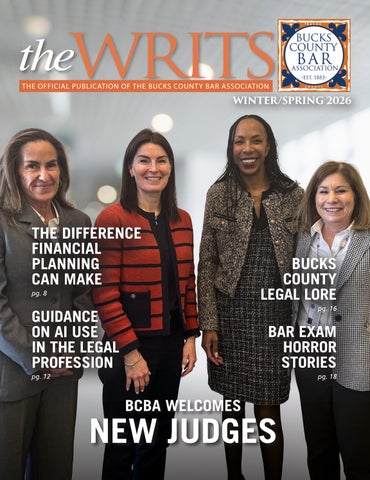
On the Cover (left to right): Hon. Dawn DiDonato Burke, Hon. Amy M. Fitzpatrick, Hon. Tiffany M. Thomas-Smith, Hon. Linda Bobrin
President’s Message
Hello dear readers! It is such a pleasure to be the President of the Bucks County Bar Association (BCBA). I am truly humbled and honored to be in this position and thank our membership for instilling their trust in me.
With that said, I want to discuss the amazing event that occurred on February 12th. It was the annual Opening of the Assizes event and this year’s event was indeed more fabulous than most. It was a Bravo-themed event, starting with a CLE regarding a huge legal industry scandal that made its way into the Real Housewives universe. This event was both fun and uplifting, providing positive moments of fun and friendship.
The Opening of Assizes hit all the Bravo marks, with Vanderpump Rules drinks, Real Housewives of New Jersey cookies, and even an appearance from my favorite Housewife, Lisa Barlow. However, the success of Opening of the Assizes should not be credited to me. The success is entirely the result of the hard work and creativity of the amazing staff at the Bucks County Bar Association. Huge thank you’s to Heather Cevasco, Barb Sauers, Kristen Norcross, Emily McGee, and Kelly Mott for everything they did to make this event so legally fabulous.
I also must thank my colleague and friend, Lisa Bothwell, for her incredible work in researching and gathering information for the CLE presentation. Further thanks to Sean Gresh and Chloe Boudazin for agreeing to participate in the CLE without any real understanding of what was to be discussed. Chloe jumped in at the last minute when Steve Jones had to bail due to childcare issues. But Steve’s loss was our win as Chloe did an amazing job and provided great ethical knowledge. Steve was there in spirit, however, as we did have small cutout of his face.
Additionally, there are several amazing CLEs happening at the bar association and I encourage all the lawyers reading this message to check out what is available. Every section and division in the bar association will be hosting CLEs throughout the year so there will be several opportunities to get credits. Stay tuned!
With that said, I would be remiss to not take a moment to share my thoughts on what is happening in our country at
this pivotal time. I am deeply saddened to see our country lean into force and fear instead of compassion and humanity. I am further alarmed to see the Constitutional rights that were integral to the founding of this country trampled upon and forgotten. Freedom of speech, freedom of the press, and the right to due process are integral to the success of this nation and our democracy. Coming upon the 250th anniversary of the United States, it is incredibly upsetting to see the current state of this country. Arresting journalists and children in immigration detention centers is not what I want for this country. People jailed without any due process is unacceptable. We can and sincerely must do better.
– Melanie J. Wender, Esquire
Bucks
County Bar Association President
Melanie Wender is a partner at Antheil, Maslow & MacMinn, LLP, in Doylestown, PA, where she practices family law.
We Welcome Your Feedback!
Thanks for your interest in theWRITS. Please send all comments, questions, submissions to: BucksWritsEditor@gmail.com
ATTORNEY DISCIPLINARY AND ETHICS MATTERS
Representation, consultation and expert testimony in disciplinary matters and matters involving ethical issues, bar admissions and the Rules of Professional Conduct
James C. Schwartzman, Esq.
• Judge, Court of Judicial Discipline
• Former Chairman, Judicial Conduct Board of Pennsylvania
• Former Chairman, Disciplinary Board of the Supreme Court of Pennsylvania
• Former Chairman, Continuing Legal Education Board of the Supreme Court of Pennsylvania
• Former Chairman, Supreme Court of Pennsylvania Interest on Lawyers Trust Account Board
• Former Federal Prosecutor
• Selected by his peers as one of the top 100 Super Lawyers in PA and the top 100 Super Lawyers in Philadelphia
• Named by his peers as Best Lawyers in America 2022 and 2015 Philadelphia “Lawyer of the Year” Ethics and Professional Responsibility Law and Legal Malpractice Law
1500 Market Street, East Tower, Suite 1800 • Philadelphia, PA 19102 (215) 751-2863
Melanie J. Wender, Esquire Bucks County Bar Association President
From the Editor…
In 1964, Bob Dylan (the real one, not Timothee Chalamet) wrote: “And you better start swimming / Or you’ll sink like a stone / For the times they are a-changing’.” In the months since our last edition of theWRITS, we have seen a lot of changes in our world, our community, our Bar Association, and more. We have seen an election that has ushered into office the first bona fide Democrat Bucks County District Attorney since the 1800’s, a new sheriff, a new prothonotary, four new common pleas court judges, and more. We welcomed a new president of our Bar Association to lead us into a new year, who brings eclectic energy, infectious enthusiasm, and abundant optimism to her new role.
We have seen continued political controversies and conflicts. The President has reignited the debate over the strategic importance of the Arctic, and trade wars that start and stop and start again, so often that it is hard to follow. We have seen clashes between citizens and law enforcement resulting in videotaped tragedies—videos that can be watched by a dozen different people who might offer a dozen different perspectives. Honest and reasonable Americans may disagree as to the merits of federal law enforcement’s targeted immigration activities in U.S. cities; however, it is more than a little disconcerting to see so many police wearing masks while doing it. These are scenes reminiscent of lesser-developed nations, not the most advanced democracy in the world. But the fact that ICE agents feel that they need to conceal their identities for their own safety while in the performance of their duties is also troubling, as it is never acceptable to target law enforcement officers with violence for doing their jobs. I am not sure what the solution to this problem is, but we need to figure it out, and quickly.
We have also seen changes on the global stage. From changes in relationship dynamics among long-time allies to U.S. intervention in the leadership of foreign nations, we are seeing substantial and far-reaching changes to the way that our country projects itself around the world. While the U.S. has been covertly involved in challenging perceived hostile regimes for much of its history, this year American intervention has become more overt and has gripped the headlines. History will tell whether such intervention has made our world and our country safer.
We are also seeing potential precedent-setting decisions from the U.S. Supreme Court. The Court is considering a broad cross-section of topics, such as:
• Whether the President exceeded his authority in attempting to fire Federal Reserve Board Governor Lisa Cook, and what constitutes removal “for cause” under the Federal Reserve Act, a statute designed to insulate monetary policy from political influence. This case could have broad implications for the ability of the executive to remove other term-appointed, purportedly apolitical officers.
• Whether the President can restrict birthright citizenship and the proper interpretation of the 14th Amendment. The President’s order told U.S. agencies not to recognize the citizenship of children born in the U.S. if neither parent is an American citizen nor a legal permanent resident. This raises issues that were previously believed by many to be well-settled.
• Whether alleged racial gerrymandering in Louisiana violates Sec. 2 of the Voting Rights Act.
• In a case involving the Federal Trade Commission, the Court will consider whether tenure protections granted by Congress to heads of independent agencies impermissibly encroach upon executive powers. For anyone who practices Administrative Law (or studied it in law school), this and the Cook case will be ones to watch.
• Whether states may ban transgender athletes from female sports teams. The Court heard arguments as to bans in Idaho and West Virginia, where the lower courts sided with the transgender students.
• The Court is considering a Colorado law that bans psychotherapists from conducting “conversion therapy” that aims to change a minor’s sexual orientation or gender identity. This case involved a Christian licensed counselor who argued that such a law was an abridgement of free speech. The state argued that it is regulating professional conduct, not speech, and that the state has the power to prohibit practices that it deems unsafe and ineffective.
• Whether a Hawaii law that restricts the carrying of handguns on private property that is open to the public without the property owner’s permission violates the Second Amendment. An example of such private property that is open to the public is a local business.
• Whether a federal law that bars users of illegal drugs from owning guns violates the Second Amendment. Currently, the Gun Control Act of 1968 prohibits gun possession by users of illegal drugs.
Other cases on the Court’s docket involve access to donor lists of anti-abortion crisis pregnancy centers; religious rights of prison inmates; whether execution of death row inmates with low intelligence quotients violates the 8th Amendment; the legality of FCC fines against U.S. wireless carriers for sharing customer location data without their consent, and more.
Travis P. Nelson, Esquire Editor, the WRITS
Regardless of your politics, it will be a very interesting year for Court watchers.
Amidst the conflict that seems to abound, it is not surprising to find oneself searching for stability, for a peaceful rock of emotional or social refuge in an uncertain world. As I have written previously, one way is to volunteer your legal time, talents, and treasure for causes you value. Even causes that are unpopular, if pursued in the spirit of justice, equality, and defense of fundamental rights, are worth the endeavor. After all, John Adams defended British soldiers charged with murder during the Boston Massacre, in the face of incredible public backlash.
On March 15, 1965, President Lyndon Johnson said, “In our time, we have come to live with moments of great crisis. Our lives have been marked with debate about great issues; issues of war and peace, issues of prosperity and depression.” While over 60 years have passed, our country is still grappling with these issues. Politicians talk about income inequality and the role of war in achieving peace around the globe and security at home. This year’s midterm elections will offer a point for reflection and inflection—to affirm that our society is going in the right direction, or to mandate a course correction. These events have an undeniable impact on our clients and
our communities; on our families and our friends; and on our freedoms and our fears. It is incumbent on us all to stay vigilant, to stay involved, and to stay hopeful as we weather the various storms of 2026 together.
Travis P. Nelson is a partner in the Philadelphia office of Polsinelli, P.C., where he practices financial institutions regulation and enforcement, and is a Doylestown resident. Travis is also the Editor of theWRITS.
– Travis P. Nelson, Esquire
THE DIFFERENCE FINANCIAL PLANNING CAN MAKE
Why the Right Advisor Changes Everything
By Brandon McFadden, CWS®, AIF®, MBA, Wealth Director, Bryn Mawr Trust Advisors
MANY PEOPLE WORK WITH A FINANCIAL ADVISOR. FEWER WORK WITH A TRUE PLANNING PARTNER.
On the surface, the distinction can feel subtle. Your advisor manages your investments, rebalances your portfolio, and checks in from time to time. Your statements look fine. Markets move up and down, but overall, things seem to be working. And yet, beneath that surface, an important question often goes unanswered: Is anyone actually helping you plan your financial life—or just manage your money?
The difference matters more than most people realize.
MONEY MANAGEMENT IS ONLY THE STARTING POINT
Investment management is important. No question about it. Managing risk, building diversified portfolios, and aligning investments with goals are foundational elements of financial success. But investments alone don’t make a plan.
Without context—your family dynamics, career path, tax situation, long-term goals, and values—even well-managed money can fall short of its potential. A portfolio can perform
reasonably well and still fail to support the life you want to live. True financial planning starts where money management stops.
THE PLANNING GAP MANY INVESTORS DON’T SEE
Many advisors say they “do planning.” Planning is often limited to surface-level conversations or one-time projections created early in the relationship and rarely revisited. A comprehensive plan isn’t a document that sits in a folder. It’s a living, evolving strategy that adapts as your life changes.
Career shifts. Family responsibilities grow. Children become adults. Aging parents need support. Businesses are built, sold, or passed on. Tax laws change. Markets change. Life changes.
If your financial strategy doesn’t change with it, you’re not planning—you’re reacting.
PLANNING STARTS WITH UNDERSTANDING YOU
A true planning-focused advisor begins by deeply understanding you—not just your balance sheet.
That means learning about your family structure, your responsibilities, and your relationships. It means understanding both the small details and the big picture: how you make decisions, what keeps you up at night, and what you ultimately want your money to do for you and the people you care about.
Family dynamics matter more than most people expect. Blended families. Multigenerational households. Children with different needs. Aging parents. Business partners who are also family members. These complexities can dramatically shape financial decisions—and ignoring them can lead to unintended consequences.
A planning partner takes the time to understand these nuances before offering advice.
WHY “ONE-SIZE-FITS-ALL” ADVICE FALLS SHORT
Generic financial advice is everywhere. Online articles, social media posts, and market commentary can be useful—but they are no substitute for personalized planning. What works for one family may be completely inappropriate for another.
A comprehensive advisor recognizes that decisions about retirement, estate planning, charitable giving, and tax strategies must be tailored to your unique situation. The “right” answer is rarely universal. Planning requires judgment, context, and coordination—not just calculations.
THE ADVISOR AS YOUR CENTRAL COORDINATOR
One of the most overlooked roles of a great financial advisor is that of central coordinator. Your financial life likely involves multiple professionals: accountants, attorneys, trust officers,
insurance specialists, and business advisors. When these professionals operate in silos, important details can be missed. Strategies can conflict. Opportunities can be overlooked. A true planning advisor serves as your go-to person—the one who understands the full picture and helps ensure all parts of your financial life are working together. They don’t replace your other advisors. They bring them together.
BRINGING STRATEGY INTO FOCUS
Comprehensive financial planning integrates every major area of your financial life:
• Cash flow and spending
• Investment strategy
• Tax planning
• Retirement planning
• Estate and legacy planning
• Risk management and insurance
• Business planning, when applicable
Each area influences the others. Decisions shouldn’t be made in isolation. For example, an investment decision without tax awareness may create unnecessary tax exposure. An estate plan without updated beneficiary coordination may undermine your intentions. A retirement strategy without cash-flow clarity may create stress instead of confidence. Integration is what turns good intentions into effective outcomes.
PLANNING IS ONGOING—NOT A ONE-TIME EVENT
One of the biggest misconceptions about financial planning is that it’s something you “finish.” In reality, planning is a continuous process. A strong advisor revisits your strategy regularly, proactively adjusting for life events, regulatory changes, and evolving goals. They anticipate issues before they become problems and help you make informed decisions at critical moments. This ongoing partnership creates confidence—not just in your finances, but in your ability to navigate change.
THE EMOTIONAL SIDE OF FINANCIAL PLANNING
Money decisions are rarely just about numbers. They’re about security, freedom, responsibility, and legacy. They’re about caring for family, preparing for the unexpected, and making meaningful choices with the resources you’ve built. A planning-focused advisor recognizes the emotional weight behind financial decisions and creates space for those conversations. They listen as much as they advise. That human element is often what separates a transactional relationship from a trusted partnership.
WHAT TO EXPECT FROM A TRUE PLANNING PARTNER
If you’re working with a financial advisor—considering one—it’s worth asking some important questions:
• How well do they understand my family dynamics and long-term goals?
• Do they proactively bring planning ideas, or only respond when I ask?
• Are tax, estate, and investment strategies coordinated?
• Do they help me think through major life decisions—not just financial transactions?
• Do I see them as my central planning resource?
If the answers feel unclear, it may be time to reassess the relationship.
THE LONG-TERM IMPACT OF COMPREHENSIVE PLANNING
The true value of financial planning often isn’t visible in a single year’s performance. It shows up over time in reduced stress, better decisions, fewer surprises, and greater confidence about
the future. It shows up in smoother transitions, clearer priorities, and strategies that align with what matters most. When done well, planning doesn’t just protect wealth. It enhances quality of life.
MANAGING MONEY IS IMPORTANT. PLANNING YOUR FINANCIAL LIFE IS ESSENTIAL.
A financial advisor who partners with you—who understands your family, coordinates your planning, and serves as your strategic guide—can make a meaningful difference in your long-term success. The right advisor doesn’t just help you grow your assets. They help you use them wisely, intentionally, and in alignment with the life you want to build. That is the difference financial planning can make.
Brandon McFadden is the Wealth Director for the Doylestown office serving Bucks County. He leads an advice-driven, cross-functional team of investment advisors and wealth and trust advisors. He is a Certified Wealth Strategist® and an Accredited Investment Fiduciary professional®. He holds an MBA in Finance from Holy Family University and a B.S. in Economics from Strayer University. Contact Brandon at bmcfadden@bmt.com or 484.804.7045.
YOUR HEALTH, OUR COMMITMENT
Care with Heart and Expertise.
At Prime Healthcare, Pennsylvania Region, our dedicated team fosters healing and wellness. By partnering with patients, we enhance community health outcomes.
With a focus on best practices and kindness, let’s create a healthier tomorrow—when you choose us, we choose you!
EMERITUS ATTORNEY RON SMOLOW STRENGTHENS LASP’S BRISTOL OFFICE THROUGH PRO BONO SERVICE
By Erika Becker
On a busy Monday morning in December, Ron Smolow, a volunteer at Legal Aid of Southeastern PA (LASP)’s Bristol office, was a bit distracted. He had just received a reply brief from opposing counsel in an unemployment compensation case and was busy anticipating the myriad ways he might respond.
Ron is an emeritus attorney volunteer with LASP. In late 2024, as his retirement approached, Ron reached out to LASP, hoping to find a way to continue using the skills he had developed over 50 years in private practice. Within a few weeks, Ron obtained emeritus attorney status and became an LASP volunteer.
In Pennsylvania, emeritus attorney status allows a retired attorney to practice law by volunteering with a qualified legal aid organization such as LASP. Registration fees and continuing legal education requirements are reduced, and emeritus attorneys are covered by the legal aid organization’s professional liability insurance policy.
Ron volunteers at LASP’s Bristol office on Monday and Wednesday morning every week. He is a generalist, so he is there to help as cases come in. He works closely with Managing Attorney Rhonda Sherrod to review files, discuss case strategy, and find ways to use his experience to fill the gaps where LASP clients need help.
Ron explained that the emeritus attorney program has made it possible for him to contribute to the community without having to worry about the pressures that come with having to keep the lights on in private practice. After years spent working in tandem with a dedicated support staff, Ron is working to become more self-sufficient by conducting his own legal research and typing his own legal briefs. “It’s a work in progress,” he said. Ron also finds that the issues facing LASP clients are far different from his private practice. He describes it as “regular, real meaty stuff” that is extremely important to clients. Ron is not afraid to dive into new things, and he is confident in doing so with the support of LASP staff.
“The colleague factor is extraordinary,” Ron said. “The Bristol staff are as dedicated as people can be. They are stretched but connected and dedicated. It’s a situation with interesting facts, deserving clients, and colleagues with great focus.”
LASP staff celebrate a birthday luncheon at the Bristol office, including Staff Attorney Rob Kim, Emeritus Attorney Ron Smolow, Office Manager Durene McCarty, Staff Attorney Melissa Reuter, Paralegal Randi Reifner, and Managing Attorney Rhonda Sherrod. (Not pictured is Staff Attorney Jill Duffy.)
Ron’s commitment to the Bristol office has increased LASP’s capacity to serve clients. This became apparent in a recent collections case. Ron discovered a defect in a 19-year-old default judgment. He submitted a 25-page petition to strike the judgment as a matter of law and eventually settled the matter for a substantial amount. According to Ron, there is no better feeling in the world than being invited into a client’s home for coffee and cake while delivering a distribution check that will have a real impact. He described it as the perfect morning.
“Volunteering in retirement lets me maintain the value of my experience—to not let it evaporate,” Ron said. “It helps to feel connected and provides a sense of community. There is a learning curve, but one thing you learn quickly is that there is plenty you can do to make life better for clients.”
LASP is happy to work with retired attorneys who are interested in volunteering under Emeritus status. Emeritus attorneys can volunteer in a variety of ways. If you are interested, please contact Erika Becker, LASP Pro Bono Director, at ebecker@ lasp.org or Megan Reinprecht, LASP Staff Attorney and Bucks County Pro Bono Coordinator, at mreinprecht@lasp.org.
Erika Becker is the Pro Bono Director at Legal Aid of Southeastern Pennsylvania
ADDITIONAL GUIDANCE ON AI USE
in the Legal Profession
By Lisa Bothwell, Esquire
A
RTIFICIAL INTELLIGENCE, OR AI, IS ONE OF THE HOTTEST TOPICS RIGHT NOW, DOMINATING NEWS, BUSINESS RESEARCH, AND POLICY DISCUSSIONS AS THE TECHNOLOGY IS RAPIDLY BECOMING CAPABLE OF DOING THINGS THAT PREVIOUSLY ONLY HUMANS COULD DO, AND IT CONTINUES TO IMPROVE. AI is useful for both work and personal matters and does not require any specialized knowledge or equipment. It feels like we are at an inflection point, like when smartphones were first released, and people do not want to be left behind.
The legal community is grappling with how to ethically incorporate AI without inadvertently breaking attorneyclient privilege nor releasing confidential information. Clients are increasingly expecting firms to leverage AI for efficiency. Firms that have an official AI policy or publicly state that its attorneys are learning how to best use the tool, appear to be ahead of the curve, likely increasing that firm’s chance of attracting and retaining business.
Certain firms have publicly announced AI programs or dedicated AI training for its associates. Ropes & Gray, a firm headquartered in Boston with over 1,500 attorneys across 16 offices, recently instituted a program called “TrAIblazers.”1 The program allows first-year associates to devote 20% (approximately 400 hours) of their billable time to learning how to use artificial intelligence tools.2 This is a large investment into the technology (forgoing up to 400 hours per associate that could be billed to clients) but the associates are expected to work in mentoring circles to discuss how they have used Ropes & Gray’s 15+ approved AI tools and the opportunities they have identified with the technology.3 The associates will also be teaching the Ropes & Gray AI chatbots and improving the technology through their interactions. A Ropes & Gray spokesperson stated, “[T]he work that first-year associates will do will evolve as AI continues to change the practice of law.”4
Other firms such as Latham & Watkins, K&L Gates, and Orrick Herrington & Sutcliffe LLP have instituted dedicated training programs for their summer associate and general associate programs.5 The training covers the use of specific AI tools and ethical considerations.6 In 2024, Latham & Watkins, a firm headquartered in New York City with over 3,500 attorneys across 29 offices, brought all 400 of its first-year associates to Washington, D.C. for a mandatory two-day AI academy.7 The firm announced that it also has multiple events and AI training programs throughout the year for its attorneys.8 Orrick Herrington & Sutcliffe, LLP, a firm headquartered in San Francisco with over 1,000 attorneys across 25 offices, trains its summer associates on Gen AI, and culminates the training in a “AI Day” filled with related activities.9 Orrick announced that it plans to roll out additional trainings.10
There are firms that are developing their own internal AI chatbots, such as Dechert LLP’s “DechertMind” and Barnes & Thornburg’s “ChatBT,” or are partnering with legal tech startups to use specialized AI platforms such as CoCounsel, Harvey AI, and Lexis + AI.11 Other firms, such as Orrick, also have their own in-house AI platform, and highlight it on its website.12 Orrick states on its website, “We are not only on the forefront of advising our clients on AI but also its
safe and responsible adoption to enhance the quality and efficiency of our services.”13
While most people now think that AI will transform how legal work is performed and how it is valued, there have been bumps in the road. There have been numerous instances of attorneys submitting filings to the court with citations to cases that do not exist and attorneys who failed to verify those cases.14
Today’s AI bots are based on complex mathematical systems that analyze an enormous amount of data, but the AI bots are unable to determine between what is true or false.15 Sometimes the generative AI model produces coherent sounding material, but it is ultimately false or fabricated— called an AI hallucination. AI researchers believe that the technology will always hallucinate despite their best efforts.16 The prevalence of issues with AI prompted the need for guidance:
GUIDANCE FOR ATTORNEYS
In May 2024, the Pennsylvania and Philadelphia Bar Associations jointly issued a formal opinion (the “Joint Formal Opinion”) concerning the use of AI or generative AI17 (“Gen AI”) by the bar.18 The Pennsylvania Rules of Professional Conduct do not specifically address the use of AI or Gen AI, so while the Joint Formal Opinion is non-binding, the Joint Formal Opinion aimed to educate attorneys on the benefits and pitfalls of the technology and provide ethical guidelines.19
The Joint Formal Opinion explained the history of the technology, noting that while AI has been used for many years in legal software, Gen AI is different since it creates content.20 It is the creation of content that requires a heightened level of attention and awareness.21 The Joint Formal Opinion likened Gen AI to “having an assistant who can create legal documents, analyze cases, and provide insight into potential outcomes of legal issues.”22
Some of the ethical guidelines imposed on attorneys by the Joint Formal Opinion are as follows: (1) be competent in the use of AI technologies; (2) confirm the accuracy and relevancy of citations; (3) safeguard information and ensure that the AI system handles confidential information appropriately; (4) clearly communicate with clients about their use of AI technologies in practice; (5) engage in continuing legal education and stay informed about ethical issues and best practices for AI use; and (6) ensure that data used to train AI models is accurate, unbiased, and ethically sourced.23 Further, attorneys must ensure that AI-related expenses are reasonable and appropriately disclosed to clients.24 Many law firms now include AI use in their engagement letters.
Beyond engagement letters, the Joint Formal Opinion noted that some firms are implementing internal policies on Gen AI use and safeguarding client information.25
GUIDANCE FOR JUDGES AND COURT PERSONNEL
The Pennsylvania Supreme Court issued an order on September 9, 2025 approving the “Interim Policy on the Use of Generative Artificial Intelligence by Judicial Officers and Court Personnel”26 to “promote and ensure the safe and appropriate use of Gen AI” by personnel (the “Policy”).27 The seven-page document went into effect on December 8, 2025.28 Pennsylvania’s new Policy will primarily allow five uses: (1) summarizing documents; (2) conducting primarily legal research, provided the Gen AI tool used was trained on a comprehensive, up-to-date collection of reputable legal authorities; (3) drafting initial documents; (4) editing readability; and (5) to provide interactive chatbots or similar services to the public and self-represented litigants.29 The Policy states that users must observe high standards of conduct to “safeguard the judiciary’s integrity and independence” and are responsible for the accuracy of their work.30
The Policy states that judges and court personnel (collectively referred to herein as “Personnel”) may share any case records, administrative records, or information in a secured AI system that will be treated in a confidential and privileged manner.31 Despite the permitted uses, the Policy explicitly provides that Non-Public Information should not be shared with Non-Secured AI systems.32 “Non-Public Information” is defined as “any and all information that is restricted by federal law, state law, policy, and other relevant legal authority.”33 A Non-Secured AI System means an “AI system that does not protect and guarantee the confidentiality of data or documents entered into the system by users” while a “Secured AI System” does protect the confidentiality and privilege of all data and documents entered into the system.34 Personnel cannot use information to train an AI system, share the records or information with any unauthorized third party, or expose the records or information to the public domain.35 Personnel are responsible for identifying Non-Public Information.36
The Policy tries to balance efficiency while requiring human oversight.37 Personnel are only permitted to use approved AI tools and need to comply with all applicable laws, including copyright laws.38 Leadership in each court must use due diligence to ensure compliance with the Policy, including reviewing any contract with a vendor and any end user licensing agreement.39 Leadership must also review contracts entered into prior to the effective date of the Policy to confirm that Personnel are able to continue to use
the services and products.40 Personnel will not be permitted to use a system for which a contract permits the vendor or any downstream subcontractors to view or use the content put into the system or the content is exposed to the public domain.41
Two days after the Policy was instituted, the Judicial Ethics Advisory Board issued General Guidance on the use of Generative Artificial Intelligence (the “Ethics Opinion”).42 The Ethics Opinion is explicit that while there is no requirement for Personnel to use Gen AI to perform the functions of their office, it is part of a judge’s ethical obligation to become familiar with AI technology.43 Personnel is required to “foundationally understand” AI and Gen AI since the technology is or will be widely used by court personnel, attorneys, litigants, and witnesses.44 Personnel is encouraged to acquire as much training as possible on the functionality, form, and uses of AI and Gen AI. Further, Personnel should read and become familiar with the Policy.45 If Personnel does intend to use Gen AI, they must be proficient in the capabilities and limitations of Gen AI. and be able to use it properly.46 The Ethics Opinion listed some resources for Personnel to become familiar with AI and Gen AI, which the Ethics Opinion stated is one of the first steps in Personnel determining how Personnel can ethically use such technology.47
The Ethics Opinion requires that judges ensure that all of those that they supervise adhere to the Policy and have the resources and training necessary to become competent in the technology.48 The Policy provides that Personnel may be required to disclose the use of a Gen AI tool in their work product.49 While not yet required, it is good practice to track how Gen AI is being used in Personnel’s work product.50
The Ethics Opinion expounded on how Gen AI is likely to transform the practice of law and justice system:
As AI becomes embedded in everyday practice, judges must be alert to the possibility that algorithmic recommendations may appear authoritative even when they lack transparency or reliability. They must guard against any erosion of decision-making autonomy, ensuring that human judgment, not automated suggestion, remains the true arbiter of justice. They must also consider how AI affects access to justice: while Gen AI tools have the potential to empower self-represented litigants, streamline filings, and reduce burdens on court staff, they also introduce disparities for those without technological access or literacy. Therefore, competence encompasses not only understanding how AI assists the courts but also
how it may disadvantage individuals who lack equitable access to these emerging resources.
Ultimately, as technology continues to reshape the contours of modern life, the judiciary must reaffirm its commitment to principled adaptation.51
CONCLUSION
The use of AI raises genuine questions about employment, creativity, education, misinformation, and privacy. It is unknown how the legal profession will shift or adjust to address what AI cannot do—judgment, strategy, and client relationships—but it is clear that AI is becoming more accepted and to ignore it is to be at a competitive disadvantage.
Lisa A. Bothwell is a partner at Antheil, Maslow & MacMinn, LLP, in Doylestown, PA, where she practices corporate law. Ms. Bothwell is the Chair of the Women Lawyers’ Division of the Bucks County Bar Association.
References:
1. Megan R. Baca & Amy Ross, In Managing Intellectual Property, Amy Ross and Megan Baca Discuss How AI is Changing Law Firm Training Strategies (Dec. 8, 2025), https://www.ropesgray.com/en/news-andevents/news/2025/12/amy-ross-and-megan-baca-discuss-how-ai-ischanging-law-firm-training-strategies.
2. Id.
3. Stephen Embry, The Grace to Dabble: Two Big Law Firms Look To An AI-First Future, Above the Law (Nov. 17, 2025), https://abovethelaw. com/2025/11/the-grace-to-dabble-two-biglaw-firms-look-to-anai-first-future/.
4. Baca, supra note 1.
5. Embry, supra note 3; Ryan Harroff & Jon Campisi, AI Boom Forces Law Firms Tech Leaders To Rethink Training Practices, Law.com (Dec. 4, 2025), https://www.law.com/americanlawyer/2025/12/04/ai-boomforces-law-firm-tech-leaders-to-rethink-training-practices/.
6. Id.
7. Embry, supra note 3.
8. Id.
9. Riley Kelly, The Power of Training: The Importance of Educating Lawyers on AI Tools to Successfully Scale Pro Bono Efforts, Pro Bono Institute (Aug. 28, 2024), https://www.probonoinst.org/2024/08/28/ the-power-of-training-the-importance-of-educating-lawyers-on-aitools-to-successfully-scale-pro-bono-efforts/.
10. Id.
11. Harroff, supra note 5.
12. Orrick, AI Adoption @Orrick, https://www.orrick.com/en/Innovation/ AI-Adoption-at-Orrick.
13. Id.
14. See Professional Guidance Committee Joint Formal Opinion 2024-200, Ethical Issues Regarding the Use of Artificial Intelligence, Pennsylvania Bar Association Committee on Legal Ethics and Professional Responsibility and Philadelphia Bar Association (2024), 5.
15. Cade Metz & Karen Weise, AI Is Getting More Powerful, but Its Hallucinations Are Getting Worse, May 5, 2025, N.Y. Times,
17. The Pennsylvania Supreme Court’s policy defined generative AI or “GenAI” as “algorithms and/or computer processes that use artificial intelligence to generate text, audio, or images based on user prompts. These systems may be (and, presently, mostly are) trained on sets of data from the Internet or proprietary sources.” See Section 1(B), (F) of the Supreme Court Order of September 9, 2025.
18. Professional Guidance Committee Joint Formal Opinion 2024-200, supra note 14.
19. Id.
20. Id. at 3-4.
21. Id. at 3.
22. Id. at 4.
23. Id.
24. Id. at 16.
25. Id. at 15.
26. Max Mitchell, Pa. High Court Allows Judges, Personnel to Use AI for Document Summary, Preliminary Legal Research, Law.com (Sept. 9, 2025), https://www.law.com/thelegalintelligencer/2025/09/09/ pa-high-court-allows-judges-personnel-to-use-ai-for-document-summary-preliminary-legal-research/.
27. General Ethics Guidance No. 2-2025, Use of Generative Artificial Intelligence, Judicial Ethics Advisory Board (2025).
28. Id. at 4.
29. Id.
30. Id. at 5.
31. Id.
32. Id. at 6.
33. Id. at 1-2.
34. Id. at 2.
35. Id. at 6.
36. Id.
37. Use of Generative Artificial Intelligence, Dec. 10, 2025, General Ethics Guidance No. 2-2025, https://www.pacourts.us/Storage/media/ pdfs/20251215/201356-generalguidanceno.2-2025.pdf.
38. General Ethics Guidance No. 2-2025, supra note 26, at 5.
39. Id. at 7.
40. Id.
41. Id.
42. Use of Generative Artificial Intelligence, Dec. 10, 2025, General Ethics Guidance No. 2-2025, https://www.pacourts.us/Storage/media/ pdfs/20251215/201356-generalguidanceno.2-2025.pdf.
43. Id. at 4.
44. Id.
45. Id.
46. Id.
47. Id.
48. Id.
49. Id.
50. Id.
51. Id. at 7.
BUCKS COUNTY LEGAL LORE…
THE 1965 DISTRICT ATTORNEY’S CONTEST: BUCKS COUNTY’S MOST DIVISIVE ELECTION EVER
By Chris Serpico, Esquire
AT THE BEGINNING OF THIS YEAR, JOE KHAN BECAME THE FIRST DEMOCRAT TO SERVE AS DISTRICT ATTORNEY IN BUCKS COUNTY SINCE THE END OF THE CIVIL WAR—BUT THERE’S A FOOTNOTE TO THAT HEADLINE FOUND IN MOST NEWS REPORTS THAT REFERS TO THE ELECTION OF 1965. That is when Ward Clark, a Republican, switched parties to run as a Democrat after losing the Republican Primary, and immediately switched back to the GOP after winning the general election in November.
To better understand the events that led to Clark’s astonishing victory, it’s necessary to take a step back in
time and look more closely at the 1965 District Attorney’s contest—an election which was to greatly alter the judiciary of Bucks County for decades to come.
In the spring of 1965, incumbent DA William Carlin announced that he would not run for re-election. Instead, he formally endorsed as his successor, 37-year-old Ward F. Clark, then serving as one of Carlin’s assistant DAs. Another assistant DA in the office, 32-year-old William H. Eastburn III, also decided to seek the nomination. Active in the Bucks County Republican party, Eastburn quickly garnered the support of most Republican leaders in the county. But there was one prominent Republican who did not support Eastburn, and who labored to put together a coalition of Republican and Democratic leaders to thwart Eastburn’s candidacy.
Alan Williams, Jr., was a 38-year-old Doylestown attorney, who had already been elected four times to serve as a legislator in the Pennsylvania State Assembly on the Republican ticket, and was a rising star in the party. But by 1965 he had become discouraged with what he perceived as the Republican party’s rightward shift when it had supported Barry Goldwater in the previous year’s presidential election. He believed it was important “to preserve a place in the Republican party for liberals and progressives, like himself.”
In the closely contested primary election that May, with the support of the Republican hierarchy, Eastburn was able to fend off Clark’s “Republican Alliance” ticket by 2,246 votes to secure his party’s nomination for District Attorney. Ward Clark and his chief strategist,
Alan Williams, would not admit defeat. Instead, they approached Democratic Chairman John Welsh and convinced him to have the Democratic nominee for District Attorney, a little-known Yardley attorney named Issac Garb, step aside and allow Clark to take his place on the Democratic ticket in the November election. (Garb had previously served as an assistant U.S. attorney, as well as an assistant public defender in Bucks County.)
As an inducement to Garb, the parties agreed that in return for agreeing to step aside, Garb would be promised an appointment to the bench to replace Judge John Fullam who had recently been elevated to the U.S. District Court.
The campaign was intense, to say the least. John Justus Bodley, Chairman of the Bucks County Board of Commissioners, said he had never experienced as vicious a primary campaign in a district attorney race as that conducted against Bill Eastburn. He was quoted in a local newspaper as saying, “Bill Eastburn’s opponent has sunk to the depths with as vicious a campaign of character assassinations and untruths as I have ever witnessed.”
Calling themselves “The Bi-Partisan Lawyers for Clark Committee,” a Bucks County group, under the direction of Bill Carlin and James Fitzcharles, published a “box score” in the local papers and in campaign mailings which compared the candidates’ qualifications for office. The ad was devastating—and highly effective—as it laid out in great detail the overwhelming experience that Clark had accumulated as a prosecutor compared to his opponent. Clark later commented, “No question about it, the ‘box score’ was the single most important thing we did.”
When Election Day came around on November 2, 1965, the pieces were all in place for a monumental upset. As the votes were tallied, it became apparent that Ward Clark and his “fusion” ticket had defeated the endorsed Republican candidate, William Eastburn, by more than 5,000 votes. Clark had become the first Democrat to serve as Bucks County’s District Attorney since 1894. Eastburn refused to personally concede the election to Clark, appearing at Democratic headquarters saying, “Ordinarily I would have, but not with the filthy type of campaign they ran.” Alan Williams ripped into Republican Chairman Myron Harris, saying, “Harris has been an absentee chairman. He let Eastburn run the party, and the voters have indicated what they think of Eastburn.”
As a lawyer who began practicing in Bucks County in 1983, I had the opportunity many times in my career to either appear before or against each one of the leading players
in the mini-drama I’ve detailed in this story. At that early time in my professional journey, I had no idea as to what had transpired decades earlier and how the careers of these Bucks County legal legends intersected. It is my hope that by resurrecting the story of the fabled election of 1965, and by examining other fascinating episodes of “Bucks County Legal Lore” in future issues of theWRITS, our readers will gain a greater appreciation and fuller understanding of some of the more colorful and notorious episodes in Bucks County’s legal history.
Now, as for those who may ask, “So, What Became of Them,” I append the following epilogue:
• Ward Clark was re-elected Bucks County District Attorney in 1969 with no Democratic opposition. He later was a partner in the Doylestown law firm of Pratt Clark Gathright and Brett before being appointed as Judge on the Bucks County Court of Common Pleas in 1985. He died in 2010.
• William Eastburn, a partner at the Doylestown law firm of Eastburn and Gray (no relation), he became as well-known as a humanitarian as he was an attorney. He made significant contributions to improve the lives of American Indians, the victims of Hurricane Katrina, and addicted adolescents. After being shot by a mentally ill client in 1993, he became a leading advocate for gun-control legislation. He died in 2008.
• Issac Garb served as a Judge on the Bucks County Court of Common Pleas for 33 years from his appointment in 1966 to his retirement in 1999. He was the President Judge for two decades. He presided over some of the most publicized cases in Pennsylvania of the late 20th century, including the Point Pleasant Pumping station case and the trial of William Bradfield of the “Main Line Murders” case. He died in 2012.
• Alan Williams, Jr., was a partner at Eastburn, Gray and Williams until 1963 when he opened his own law practice. As co-founder of the Bucks County Young Republicans, he served four terms as State Representative from 1958-1966. Following the election of 1965, he became disillusioned with the Republican Party, and he became a staunch Democrat. His sons Alan Williams, III, and Keith Williams practice law in Bucks County. He died in 2005.
Christopher Serpico is an attorney at The Law Offices of Christopher J. Serpico, in Doylestown, PA, where he practices primarily criminal defense and wills and estates.
Bar Exam
HORROR STORIES
By Lisa Bothwell, Esquire
Undoubtedly, one of the most stressful periods in an attorney’s life is studying and taking the bar exam. The massive scope of the material, high stakes, pure fatigue, and social isolation wore on me in a way I had not experienced before. Compounding the experience for me was that I decided relatively last minute to forgo studying at my Boston apartment, and live and study at my mother’s house in Warminster to save money. As part of the whirlwind of moving out of my apartment and subletting my room, I failed to update my address with the Pennsylvania Board of Law Examiners (the “Board”). My bar exam entrance ticket (with detailed information for exam day) was mailed to my Boston apartment. I realized this when I called the Board’s office a little over a week before the exam date because I still had not received my ticket. The employee I spoke with at the Board was largely unhelpful. There was “no time” to mail me another ticket. The Board could (would?) not email a copy to me, nor could I pick a copy up ahead of exam day. It would be fine, and I was overreacting. I should arrive a bit early before the doors opened to pick up my entrance ticket before having the administrators check my computer with everyone else. None of my former roommates could find my
ticket, and the other apartments in my former building filled with college students claimed they had not seen it when my former roommates asked. I could not find any details about when to arrive online and did not know anyone else sitting for the Pennsylvania exam. I was out of options and told myself that it would be fine like the Board employee said.
It was not fine. The Board employee told me the time the doors opened to the exam room, not the check-in area. I thought I had arrived early but in fact arrived only 10 minutes before the check-in area was to be shut down. There was a long line, and I had to plead with administrators to check me in and examine my computer. I was the last test taker admitted to the exam room and was frazzled and distracted by the time I took my seat. Luckily, I was able to calm down while we waited for the exam to start and I passed.
My bar exam “horror story” pales in comparison to others I have heard. It seems like most people I talk to have some additional stressor or snafu during the exam. One of my law school friends reported that multiple test-takers had their exam software program freeze while taking the California
exam. It eventually worked but caused a lot of undue stress in the meantime. Another friend had a map app direct her in a direction that was away from the test site while she was already running late for unascertainable reasons.
Until recently, the worst bar exam horror story I heard was an Illinois woman who went into labor during the 2020 bar exam.1 The 2020 bar exam was significantly impacted by the COVID-19 pandemic, and Illinois shifted the exam from July to a remote October exam.2 Brianna Hill, a graduate from Loyola University Chicago School of Law, was 38 weeks pregnant during the rescheduled exam.3 Hill reported that she requested an accommodation for additional bathroom breaks due to her pregnancy but was denied.4 Hill’s water broke about 30 minutes into the test on Day 1.5 Not wanting to be disqualified from the exam, she continued and only went to the hospital after she completed the two sections administered on the first day.6 Hill’s first child, a boy, was born that evening. The hospital staff reserved a private room for Hill on the labor and delivery floor, and Hill finished Day 2 of the exam.7 Hill passed.8
I asked some of our fellow Bucks County attorneys about their bar exam horror stories, which are below:
STRESS OVERLOAD
Fellow test-takers or testing conditions can sometimes be the added stressor or distraction:
No direct experience, but the woman in front of me had her laptop freeze up just as the exam began. She nearly had a nervous breakdown but ultimately pulled it together and handwrote her essays.
— Gabe Montemuro, Antheil, Maslow & MacMinn,
LLP
I took the bar in 2021 when it was administered remotely. There were strict rules about sounds and what could be in the background during the exam, and that summer we had numerous problems with my apartment building. The electricity was regularly out for hours if not days at a time (July heat in a 12th story apartment, plus loss of Wi-Fi, and computer power), and they were doing incredibly loud construction on the street below us. Fortunately, Eastburn and Gray was happy to let me use one of their conference rooms for my exam and John Schaeffer in our firm took protecting my conference room during the exam very seriously.
— Abby Bukowski, Eastburn & Gray, PC
Two of my law school classmates were dating and living together at the time we took the bar exam. While I was not
close with them, people noticed that the man was not at the exam on Day 1. A story circulated that the morning of the exam, the man woke up, told his girlfriend he was going to get them coffee, and left the apartment. After he left, he texted his girlfriend that he could not take the exam but that she needed to go take it. It really screwed up the girlfriend’s focus that day.
A girl a few seats down from me had her computer completely melt down during the exam. She panicked and left the room in tears.
I finished the exam about 10 minutes earlier than I ever had on a practice exam. I silently freaked out, opened a Lifesaver in my pocket, popped it in my mouth, and decided I was happy it was over. Spoiler alert, I passed.
— Steve Jones, Begley, Carlin & Mandio, LLP
PROCTOR INTERFERENCE
Other times it is the proctor that is the distraction:
When I was taking the bar exam, two proctors decided to have a conversation over my head. I eventually said what are you doing, and they stopped talking. It was during the multiple-choice portion!
— Melanie Wender, Antheil Maslow & MacMinn, LLP
My friend wore a hoodie to test day in the Philadelphia Convention Center (which is apparently against the rules), and they were very tempted to make her remove it. She indicated that she was not sure she could power through and take the test in her bra, but I had tried to encourage her to do so. At least no one had their phones to post pictures. Luckily, she was allowed to take it and not asked to denude.
— Nicole O’Hara, Pierson Ferdinand
The proctor at New Jersey exam was rocking, praying, and chanting while reading the Bible to herself the whole time—in the front row. I was seated in the front row, which should have been great—there is no one in front of you to distract you. Wrong.
A common fear is that you or someone in your household will be sick or have a health event on exam day:
I woke up the morning of Day 1 of the bar exam with a fever and vomiting. I had not slept well but had no choice
but to drag myself to the exam at Temple. I spent the breaks napping and sipping water and managed to get through Day 1. Day 2 was better, but I was still ill (and in fact remained so for 2 more days). Fortunately, I made it through and passed.
— Anonymous
My niece, Jordan, had a seizure in the middle of the night prior to the second day of testing so I was up with her for a bit. Oddly enough, that also gave me a sense of normality and helped me feel a little better the next morning. The world was still turning outside of this test.
— Jennifer Dickerson, Antheil Maslow & MacMinn, LLP
DEADLINES
Opting into computer-based testing:
I missed the deadline to opt into computer-based testing and had to handwrite my PA bar exam essays.
After passing the New Jersey bar, I found out I had a character and fitness issue to clear up—there was an ambulance bill on my credit report from when I was 18. It was from a few weeks before I left for college, and I had never seen the bill or heard from the collection agency. I had to track it down and pay it to pass.
— Nicole Durso, Stark & Stark PC
A CASE OF MISTAKEN IDENTITY
The problem with unknowingly sharing a name with another test-taker:
Two people named Thomas Donnelly took the bar exam in July 1993. One passed and one failed. Back in the stone ages before internet, they used to post the names in a book at the public ledger building. Public review. Although I saw the failure first, thankfully I was the Thomas Donnelly that passed.
— Thomas Donnelly, Antheil Maslow & MacMinn, LLP
I largely block out my memories of taking the bar exam until July every year. The memories of the stress and anxiety come flooding back when I talk to someone who is studying for the bar exam. Now, I focus on how to be as supportive as possible. Below are some meaningful ways to support someone preparing for the bar exam:
• Be Supportive Without Adding Pressure. Respect their study schedule and need for focused time but check in periodically without being intrusive. Send an encouraging text but do not necessarily expect a text back, or mail them a card to let them know you are thinking of them. Let them lead the conversation
about the test. If they do not bring it up, focus on other topics. While not the bar exam, I will always remember how understanding one of my best friends was about her wedding during my third year of law school. I was looking for and failing to secure a job and was very stressed out. My best friend had a destination wedding in Mexico and put absolutely no pressure on me. She told me to do what I could, and do not worry about the rest. I went and had a wonderful time with everyone celebrating them. She is still one of my best and most supportive friends to this day.
• Offer Emotional Support. You can offer emotional support by listening to a test-taker without judgment and validating their hard work. Be patient when they are stressed, irritable, or less available than usually. Celebrate small milestones with them, like finishing a subject or completing a practice exam.
• Avoid Empty Platitudes. Avoid platitudes or empty reassurances about the exam (e.g., “You will be great” or “You are so smart, you will pass”) but let them know you believe in their hard work. You can also let them know that they do not need to know everything perfectly; they just need to know enough. It is normal to feel underprepared but just focus on studying as much as they can. A person cannot know everything and accepting that can alleviate some of the pressure. Some of the anxiety that they are feeling is their brain trying to keep them alert, not necessarily evidence that something is wrong. If you think they will be receptive, you can offer some perspective. The world will keep turning no matter the outcome of the exam.
• Encourage Self-Care. Encourage a test-taker to practice self-care during this time. You can frame self-care as part of the studying strategy, not something competing with it. Sleep, exercise, and rest helps improve retention and ultimately performance. While that makes logical sense, it can be hard to accept that when you are on a tight studying schedule with vast material. Therefore, remind them that rest is productive, not procrastination— the brain needs time to consolidate information and recharge. If you notice that a test-taker is not practicing self-care, you can ask them to go for a 20-minute walk with you or a coffee run. If they mention they keep skipping meals, you can bring them a healthy lunch for you to share together or gift them healthy snacks. If possible, handle logistics for them that drain mental energy so they can focus on studying. Encourage the test taker to plan something to look forward to after the exam.
• Additional Preparation to Alleviate Anxiety. Some people, me included, get anxiety about the logistics of going somewhere. If the test-taker has such anxiety, encourage them to map out how they will get to the test. If they are taking the train, what is the train schedule? What is the next available train if that one is late or full? If they are parking, where are close available lots? Is parking free or how much cash will they need? Can they make a parking reservation ahead of time? They should buy their packed lunch ahead of time and pack it the night before. Everything possible should be laid out the night before so they are not running around the morning of the exam.
• Do Not Talk About Possible Test Results Too Soon. Let them decompress without immediately asking how it went. Many people feel uncertain regardless of how they performed. If they do not want to talk about the exam, follow their lead. If they keep fixating on a particular essay or multiple-choice question, try to redirect their attention to an unrelated topic. Focus on the accomplishment of taking the exam and it being over, at least for now.
The above bar exam horror stories are not just about additional stressors or snafus surrounding the exam—they
are about the toll of high-stakes pressure on real people. If someone in your life will be taking the bar exam in the future, try to make the hard parts less hard and validate their experience.
Lisa A. Bothwell is a partner at Antheil, Maslow & MacMinn, LLP, in Doylestown, PA, where she practices corporate law. Ms. Bothwell is the Chair of the Women Lawyers’ Division of the Bucks County Bar Association.
References:
1. Heather Murphy, She Was Going Into Labor. But She Had a Bar Exam to Finish, The New York Times (Oct. 13, 2020), https://www.nytimes. com/2020/10/13/us/bar-exam-labor.html.
2. Lauren M. Johnson, Woman goes into labor and gives birth in the middle of taking the bar exam, CNN (Oct. 11, 2020), https://www. cnn.com/2020/10/10/us/mom-has-baby-while-taking-bar-exam-trnd.
3. Murphy, supra note 1.
4. Id.
5. Johnson, supra note 2,
6. Murphy, supra note 1.
7. Ashley, Exclusive Interview with Brianna Hill – Who Went into Labor During the Bar Exam (and Passed!), JD Advising, https://jdadvising. com/qa-with-brianna-hill-who-went-into-labor-a-baby-during-thebar-exam-and-passed/.
8. Id.
STEPHANIE M. SHORTALL
JEREMY D. PUGLIA
JO N ATHA N J RU S SE L L
JEREMY A. WHALEN
THOMAS A. BLACKBURN
feature TWINS: WE’RE NOT ALL THE SAME!
By Dianne C. Magee, Esquire
IAM A TWIN. This is no cause for alarm. There’s not another one of me floating out there. I have a twin brother, so I’m a fraternal (dizygotic) twin, not an identical (monozygotic) twin. Fraternal twins result from the fertilization of two eggs, while identical twins are the product of one fertilized egg that splits. Fraternal twins share 50% of their genetic makeup, so they’re like any other siblings—they just happen to be produced and born together. Identical twins, though, share 100% of their genes. Fraternal twins make up about 70% of all twin births, and their existence—without medical intervention—tends to run in families, like mine.
I noticed that two of the Bucks County Common Pleas judicial clerks, who were featured in an issue of the WRITS last summer, wrote that they were fraternal twins. Because—in my experience—being a twin was unusual, I found that to be remarkable. Not surprisingly, twin births have become much more common in the last 45 years or so. From 1915, when twin statistics were first compiled, to 1980, the rate of twin births in the United States remained relatively stable, at about 2% of all births. From 1980 to 2009, according to the CDC, that rate more than doubled. In 2023, the rate had slightly decreased, with 30.7 twin births for every 1000 births, but notably, many more twins are born today than when I was born in 1958. Of course, the reasons for this proliferation of multiple births lies with modern medicine and sociological changes, specifically IVF (in vitro fertilization) and more older mothers, who are more likely to ovulate more than one egg at a time.
The stories of twins seem to start with the tale of Remus and Romulus in Roman mythology about the founding of Rome, after Romulus killed his brother. Warring twins are then featured in the Biblical story of Jacob and Esau, the fraternal twin sons
of Isaac, who was the son of Abraham. Jacob changed his name to Israel and became the father of the 12 tribes of Israel, while Esau fathered the Edomites, the traditional enemies of Israel. Perhaps the most famous twins before the 20th century were Chang and Eng Bunker, the “Siamese” conjoined twins who toured this country as circus acts during the 19th century and, rather astonishingly, fathered 21 children between them. They died within hours of each other in 1874 at age 62. Until recently, male twins were dominant in literature and history.
Of course, in the modern era, more celebrities are twins. Fraternal twins Robin and Maurice Gibbs of Bee Gees fame were born in 1949. The entertainment world also features the most famous twins of all time: Mary-Kate and Ashley Olsen, who—shockingly—turn 40 this year! Harry Potter fans will recognize identical twins Oliver and James Phelps. In sports, Tiki and Ronde Barber both played for over 10 years in the NFL, and the Rivers triplets (replicated twins) ski for Jamaica. Other newsworthy twins are astronauts Mark and Scott Kelly (identical); Presidential daughters Barbara Bush and Jenna Hager Bush (fraternal); and Julian and Joaquin Castro (identical).
On the local BCBA level, Sam Totaro has an identical twin brother, and even he can’t identify who is who in childhood photos. I don’t have that problem. In case you can’t tell, I’m the twin on the left in both photos here. In appearance, I have always been the twin of my mother—whose aged visage I now see every morning in my bathroom mirror. My brother, Ned, on the other hand, has the curly hair and physical makeup of our father’s side of the family.
Since I’ve worked for Grim, Biehn & Thatcher, four attorneys here—including me—have been fraternal twins: Bill Thatcher,
with a twin brother, and David Caro and Joel Steinman, who both had twin sisters. With about 15 attorneys in the firm during the relevant times, we are a statistical anomaly, especially because we all were born well before 1980. Bill, a child of the 1920s, participated for many years in twin studies, completing questionnaires for academic study on an annual basis.
Growing up in a small town in New Mexico, my brother and I were a rare breed and, thus, were always referenced by our mother’s friends as “the twins,” although we were not dressed alike after age four. Our elementary school had only two classes per grade. The first-grade room assignment was based upon birthdate, so we were in the same first grade. After that, we were intentionally split into separate classrooms but were together again in middle school when the classes were “tracked,” supposedly according to ability. Our father had died when we were four months old, so, when we were 13 and our mother remarried, forcing us to move to parts unknown, we were both glad to have a “buddy” with whom to share new neighborhoods, new schools, new swim teams, and new friends.
Is it true that twins have a special bond and are telepathic? I can only say that my brother has always been the far more intelligent twin. He was the valedictorian of our high school
graduating class in Honolulu, and he majored in physics at Harvard. Interestingly, my son looks more like him than do any of his four sons. The two of us had similar interests and participated in many of the same activities. I couldn’t play Little League baseball, though, because, back then, only boys were allowed to play. From the time I can remember, I knew that life was unfair. My brother could eat anything he wanted in gargantuan quantities and, to this day, he remains stick thin. I—on the other hand—can smell baked goods and gain a pound. But we have had interesting experiences over the years where we discover that we are thinking the same thing at the same time. As an example, when I was in law school, many years ago but having lived separate and apart from Ned for many years, he magically picked the record—which I had in my mind—out of my voluminous collection of vinyl. Did that have anything to do with our twinness? I don’t know. I will say that one year he sent me a belated birthday card, asserting that he had “forgotten” my birthday. If nothing else, we share a bizarre since of humor.
Dianne Magee is a partner at Grim, Biehn & Thatcher, P.C., in Perkasie, PA, where her practice focuses on estate planning, estate administration, Orphans’ Court litigation, mediation, and elder law, serving clients primarily in Bucks, Montgomery, Lehigh, and Northampton Counties.
• MLM has returned a dividend to policyholders annually since 1988, over $88 million total
• First dollar defense- a loss only deductible can produce a substantial savings for firms facing nuisance type claims
• Full prior acts coverage
• Offers an array of services to mitigate risks including three free CLEs for policyholders each policy year, $165 value
THE BUCKS COUNTY BAR ASSOCIATION ANNUAL DINNER
THE 2025 BUCKS COUNTY BAR ASSOCIATION (BCBA) ANNUAL MEETING AND DINNER WAS AN OPPORTUNITY FOR MEMBERS TO BE RECOGNIZED FOR THEIR CONTRIBUTIONS AND DEDICATION TO THE BAR ASSOCIATION, PRO BONO WORK, AND THE COMMUNITY AT LARGE. The recipients of these awards are nominated by their fellow members of the Bar Association, which bestows the awards with an additional layer of appreciation.
THE MARK E. GOLDBERG AWARD
The Mark E. Goldberg Award is presented to a “member of the Bucks County Bar Association, including honorary members, demonstrating a continuing commitment to community service outside the legal profession. The eligible candidate shall perpetuate personal relationships established with leaders of the religious, academic, recreational, and charitable segments of the Bucks County community by: Proven legal competence; Honor; Trust; Service; and Respect for the rule of law and the administration of justice.”
The Mark E. Goldberg Community Service Award was presented to Lawrence R. Scheetz, Jr. for a continuing commitment to providing outstanding service to the Bucks County community.
WILLIAM H. EASTBURN, III AWARD
The purpose of the William H. Eastburn, III Award is to recognize “the person or entity who has made significant contributions to the Bucks County system of justice. The qualities of the recipient(s), who shall not be a member of the Bucks County Bar Association, shall be to: Promote better understanding of our system of justice; Encourage greater respect for law and the courts; Stimulate a deeper sense of individual responsibility so that citizens recognize their duties as well as their rights; Contribute to the effective functioning of our institutions of government; and Foster a better understanding and appreciation of the rule of law.”
and the
County Community College for their Civics Initiatives which provide a significant contribution to the Bucks County system of justice.
THE ARTHUR B. WALSH, JR. PRO BONO PUBLICO AWARD
The purpose of the Arthur B. Walsh, Jr. Pro Bono Publico Award is to recognize “the BCBA member who has made significant contributions to the Bucks County system of justice in the form of Pro Bono service. One award is given annually to a member of the Bucks County Bar Association, who by their actions and example have made “Equal Justice Under Law” a meaningful good and ideal for our legal society. The qualities of the recipient(s), shall be to: Demonstrate selfless service to the members of the community of limited means; Demonstrate selfless service to charitable, religious, civic, community, governmental and educational organizations in matters which are designed primarily to address the needs of persons of limited means; enhanced the human dignity of others by improving or delivering volunteer legal services to our nation’s poor and disadvantaged.”
The William H. Eastburn, III Award was presented to Tracy Timby
Bucks
The Arthur B. Walsh, Jr. Pro Bono Publico Award was presented to Brooke E. Newborn, who, by her actions and example, has made “Equal Justice Under Law” a meaningful goal and ideal for our legal society.
HARRIET MIMS AWARD
This award is named after Harriet Mims, who was the first female judge in Bucks County and one of the first women admitted to the Bucks County Bar. The award is presented annually to a “female attorney who exhibits the characteristics of strength, leadership and integrity who also has served as a mentor to young lawyers.”
The Women Lawyers’ Division Harriet M. Mims Award was presented to The Honorable Charissa J. Liller, who as a mentor to young lawyers, exhibits the characteristics of strength, leadership, and integrity.
THE BUCKS COUNTY BAR FOUNDATION AWARD
The Bucks County Bar Foundation Award was established in 2019 as part of the 15th Anniversary of the Foundation and is presented to honor a “Foundation supporter, who throughout his or her career has provided extraordinary service, including through support of the Bucks County Bar Foundation, to the mission of accomplishing access to justice for all. The recipient may be a member of the BCBA or a member of the community.”
The Bucks County Bar Foundation Award was presented to Frank Cervone, who received it on behalf of his late wife, Judith Algeo. The award recognizes ones providing extraordinary service, including through support of the BCBF, to the mission of accomplishing equal access to justice for all.
THE BUCKS COUNTY BAR ASSOCIATION’S PRESIDENT’S AWARD
The President’s Award is given annually, at the personal discretion of the BCBA President, in recognition of the recipient’s dedication and service, which has helped make the BCBA as successful as it is today.
The Bucks County Bar Association President’s Award was presented to Jeffrey A. Liebmann in recognition of his dedication and service, which has helped make our Bar Association as successful as it is today
Becoming a United States Citizen
By Dianne C. Magee, Esquire
On the morning of January 15th, I was thrilled to witness a United States naturalization ceremony at the Wilkie D. Ferguson, Jr. Federal Courthouse in Miami, Florida. The Honorable U.S. Magistrate Judge Ellen D’Angelo administered the oath and welcomed 41 new citizens from 21 countries, one of whom was my daughterin-law, now Mayeline Magee from the Dominican Republic.
I had never had the privilege to attend such a ceremony. We assembled in a large room—not a courtroom—at the top of a modern, 20-year-old courthouse, one of a multiplicity of courthouses within a two-block area or so of downtown Miami. Everyone was on time at 8:30 a.m., although we learned upon arrival per the programs handed out to us that the ceremony would not begin until 10:00 a.m. We had to explain to my excited granddaughters that this is how we spend most of our time in courthouses—waiting! Fortunately, the building had a well-stocked snack bar.
The ceremony was short and sweet—a grand finale for what had been an arduous bureaucratic journey for most of those assembled, who recited the Pledge of Allegiance with ease, and have probably learned more about our government than is known by many birthright citizens. The process had taken about five and a half years for Mayeline, which was relatively quick: she had arrived here on a fiancé visa, married my son about two weeks later before the Honorable Gary Gambardella at the 9/11 Memorial outside the Justice Center, and obtained her green card as soon as possible. Mayeline was one of three volunteer speakers among the new citizens, and she received cheers
and loud applause when she waved her small American flag and described how important the day was for the future of her family.
And it is! She is already registered to vote and has a U.S. passport, relieving us of much anxiety for her foreign travel. We departed the joyous occasion that morning and emerged into warm sunshine, congratulating and embracing
our future citizens and sharing their happiness and hopefulness for our new lives together.
Dianne Magee is a partner at Grim, Biehn & Thatcher, P.C., in Perkasie, PA, where her practice focuses on estate planning, estate administration, Orphans’ Court litigation, mediation, and elder law, serving clients primarily in Bucks, Montgomery, Lehigh, and Northampton Counties.
Zlock, Grisillo & Repko MANAGING PARTNER’S CORNER
Zlock, Grisillo and Repko traces its origins back to 1996, when a small firm was created to focus on providing clients with exceptional service in all types of family law matters, such as divorce, custody, property distribution, and domestic violence. Over the past 30 years, the firm has changed quite a bit, including with the recent merger of Zlock & Grisillo and Repko Law, LLC to form our current office. But throughout that time, one constant has remained—our commitment to helping clients get through some of life’s most challenging moments.
Of course, the greatest strength of our firm is the people who work here. Our firm prides itself on the quality of our attorneys, who show up every day ready to work hard for each and every client with a basic principle in mind: helping them the way we would want to be helped if we were the client. We are also constantly keeping an eye out for potential new lawyers to join our firm who share our commitment to outstanding client representation and who would be a good “fit” for the office, as the ability to work well with the other members of our office is just as important as any lawyer’s ability in a courtroom.
But our firm is much more than just the attorneys—our staff members are the other half of our proverbial office coin. They help keep our practices on track, assist with managing our files, help us prepare for court, and make sure client accounts are kept current. For everyone to reach their highest potential, the managing attorneys in the firm know we need to stay connected with our employees. That is why we regularly meet with office personnel to discuss their work experiences at the firm and ideas they have for improving office work product and efficiency. We value
what the members of our firm contribute, and we genuinely care about them and their families. The truth is that everyone in our office spends more time with us than they do with their own families. So, while our focus is always on the client, we also know that life doesn’t end at the office front door, and we are invested in everyone’s well-being.
We also know that growth is not just a goal but a necessity, and not merely for the sake of growing. Our focus on growth is solely for the sake of making sure we provide the best representation and service to our clients. Part of this means that we stay attentive to new technological trends, updates on changes to the law, and new ideas for law office management. Of course, the biggest trend right now is artificial intelligence. Its value to lawyers can be significant, but we are also very much aware of the dangers with using it and remain cognizant of its limitations. Work-life balance has also taken on new meaning for most people, especially since 2020, so to help our lawyers and staff remain connected to the office—and to offer them the flexibility that today’s work force value—we provide them with the ability to work remotely when situations in their lives require it. Our goal has been, and always will be, to create an office focused on our clients, and we know that the best way to do that is to make sure we have a positive, engaged, accommodating, and efficient office for everyone who works here.
At Zlock, Grisillo & Repko, we pride ourselves on providing our clients with exceptional legal representation, and we know that this can only happen with the right team, which is exactly what we have and exactly what our management team works to maintain every day.
Trivia Night
LAW CLERK PROFILES
Alexander Hallam Reede and Maria Murray
The Bucks County Bar Association is extremely proud of its members who serve as judicial law clerks. Many of these clerks are newly minted from law school, and display incredible promise to serve as future leaders of the Bar Association. As a recurring column, theWRITS will feature profiles on a few members of the current clerkship class. In this edition, we are proud to present Alexander Hallam Reede, law clerk to the Hon. Brian T. McGuffin, and Maria Murray, law clerk to the Hon. Denise M. Bowman.
Alexander Hallam Reede
theWRITS: Tell us about yourself.
My name is Alexander Hallam Reede, and I have the privilege of serving as a law clerk for the Hon. Brian T. McGuffin. I was born in Vineland, NJ. I was raised primarily in Allentown, Pennsylvania, where I attended Parkland High School. After graduating from Parkland, I went on to attend Washington & Jefferson College in western Pennsylvania where I graduated with majors in Economics and Gender & Women’s Studies. Following college, I attended Widener University Delaware Law School in Wilmington, DE. I passed the Bar Exam in October 2025.
theWRITS: What made you decide to live or work in Bucks County?
I lived in Levittown for the first few years of grade school and I have family in that area. I wanted to work in Bucks County, specifically Doylestown, because it is different enough from where I grew up, but similar enough that I don’t feel like a fish out of water.
theWRITS: What made you want to become an attorney? Who were your role models or inspirations, and why?
I wanted to become an attorney because I wanted to employ the knowledge and skills of both my collegiate majors (Economics and Gender & Women’s Studies) in my future profession. As such, law school felt like a natural progression to a field where I can truly express myself.
theWRITS: Describe a day in the life of a law clerk in your judge’s chambers.
As a law clerk to Judge McGuffin, the day-to-day can be very different depending on what is scheduled in Court. Much of
the job involves analyzing and writing about the issues coming before the Judge. Everything is important and there is rarely a wasted moment.
theWRITS: What was the most interesting case that you have worked on for your judge?
Perhaps I’m biased towards economic issues, but my favorite case I have worked on is a trust issue which required the testimony of multiple economic experts. It showed me an area of the law I didn’t initially think would interest me, but I have since started to consider trust law and estate planning law for my future endeavors.
theWRITS: What type of law do you want to go into after your clerkship, and where do you see yourself in five years?
I am interested in pursuing areas of the law that incorporate economics including Consumer Protection law, Antitrust law, and potentially trusts and estate planning law. I hope to see myself in five years working in one of those fields.
theWRITS: What is your favorite fictional character from the legal industry?
Harvey Specter (Gabriel Macht) from Suits is my favorite depiction of a lawyer on TV.
theWRITS: What has been your favorite place to travel to and why?
I have not travelled all that much, but I love taking trips up to Centre County, Pennsylvania to visit my grandparents, go to Penn State games, and attend the Centre County Grange Fair.
theWRITS: What advice would you give a law student to help prepare for a clerkship in Bucks County?
Thoroughness is the name of the game. While it may often feel like you’re pressed up against a deadline, the thoroughness of your work cannot be sacrificed for the sake of speed.
theWRITS: What do you do when not working as a clerk? Outside of work I am usually playing with my cat, watching a sports game, or exploring the historical amenities of Bucks County.
theWRITS: What is your favorite bar or restaurant in Bucks County?
I live in Doylestown, so I have become partial to Chambers 19, but I am always looking for new and exciting places to eat!
Maria Murray
theWRITS: Tell us about yourself.
I am Judge Bowman’s law clerk. I started working in this position in September of 2025 and it has been a great experience. I graduated from Drexel University’s Thomas R. Kline School of Law in May 2025. Before law school, I attended the University of Delaware for my undergraduate degree and graduated in May 2022. I was born and raised in Bethlehem, Pennsylvania.
theWRITS: What made you decide to live or work in Bucks County?
I am from Northampton County, but I am becoming more familiar with Bucks County. I have learned that Doylestown is a wonderful area with many great restaurants, cafes, and shops.
theWRITS: What made you want to become an attorney? Who were your role models or inspirations, and why?
I have always enjoyed reading, writing, and researching. I was a political science major in college and many of those classes encouraged critical thinking, which is an important skill as an attorney. I also grew up exposed to the legal profession, as my dad was an attorney for many years and is now a judge. While in college, I interned with a judge whose advice and mentorship as a woman in the legal profession helped me officially decide to attend law school to become an attorney.
theWRITS: Describe a day in the life of a law clerk in your judge’s chambers.
I typically start the day by meeting with Judge Bowman. We discuss current writing and research assignments and the schedule for the day. Depending on the court schedule, I am present in the courtroom for Family Court and Juvenile Court. I usually end the day by recapping hearings and my next tasks. So far, I have been able to work on a variety of research and
writing assignments and have gained valuable observational experience in court.
theWRITS: What was the most interesting case that you have worked on for your judge?
I did not have any experience in family law or juvenile law before my clerkship. These cases have been very interesting. Each type of law has specific procedures, laws, and strategies. It has been a great and unique learning experience.
theWRITS: What type of law do you want to go into after your clerkship, and where do you see yourself in five years?
I am interested in civil litigation, but I am not sure yet about the specific direction. I hope to gain more experience in this area during my clerkship with Judge Bowman. In five years, I would like to be practicing as an attorney in civil litigation.
theWRITS: What is your favorite fictional character from the legal industry?
I would say Elle Woods from Legally Blonde and Vinny Gambini from My Cousin Vinny. They’re very different from each other, but I think they both represent the value of different perspectives and unique skills.
theWRITS: What has been your favorite place to travel to and why?
After the Bar Exam, I went on a trip to Paris and London with a few friends. We were able to see many famous tourist spots, learn about the local cultures, and try new foods. It was a wonderful trip!
theWRITS: What advice would you give a law student to help prepare for a clerkship in Bucks County?
My advice is to be open-minded and ready to learn. As a law clerk, you will learn from your judge, the attorneys that appear in court, the documents that are submitted by counsel, and the support staff. These lessons may be about legal procedure, or they may be about how to interact with litigants and opposing counsel. Be willing and ready to learn from those around you.
theWRITS: What do you do when not working as a clerk?
I enjoy reading, but I currently have a long commute to work, so I started listening to audiobooks instead. I mainly spend my free time with friends and family. I like trying new restaurants, going to the movies, and watching Philly sports.
theWRITS: What is your favorite bar or restaurant in Bucks County?
I haven’t been able to spend much time in Doylestown outside of work, but I really enjoy Lilly’s Gourmet and Chambers 19 Bistro & Bar.
NEW MEMBER PROFILE
Kenneth Hone
As part of theWRITS’ continuing mission to introduce new members to the Bucks County Bar Association, we will feature a regular column on a new member.
theWRITS: Tell us about yourself.
I grew up in Ringoes, New Jersey. I was born with internal bleeding—which my family jokes was just the start of my “bleeding heart” that would guide my career and community spirit. My mom, Barbara Hone, raised three children as a single parent without child support. She did whatever it took, working multiple jobs, and together with my grandmother, she even used a nearby unused farmer’s plot to grow vegetables so we could get by. We didn’t have many material things or travel much, but we always found ways to laugh, love, and be part of our community. To this day, my hometown considers my mom their mom too— that’s how special she is, and how fortunate I am.
My 8th-grade class had just 55 students, so we all knew each other like siblings, and even elementary school reunions feel like family gatherings. My mom instilled in me that if you want to be part of something special, you must commit and make a difference—and she lived that lesson every day. Baseball was the heartbeat of our town, and she made sure we were part of it, not just playing in our games, but attending every game because it was the town’s event. While we lacked financial resources, we were rich in
what truly mattered: community, love, and dignity. She also taught me that hard work is dignified, no matter the pay.
I met my wife, Rebecca, at Trenton State College. We worked part-time while attending school full-time, putting ourselves through college. When it came time for law school, I faced a choice between prestigious schools out of state or Temple, near the love of my life. The decision was simple—Temple. After graduating, I worked at a large law firm until an opening at the Bucks County Public Defender’s Office arose. I applied and was offered the position. When I told Rebecca—despite the lower pay—her only question was: “Will we be okay?” I said it would be tight for a while, but yes. She replied, “Follow your dream, follow your heart.”
Rebecca has been my moral compass, my support, and my partner in every sense. Her love and guidance have helped me become a better person than I ever could have been on my own. I am blessed to have had two incredible women in my life—my mom and my wife—who set high personal goals and led by example, and a wonderful wife who is the best partner and mother one could hope for their children.
theWRITS: If you are from Bucks County, what made you decide to live or work here?
Simply put, love brought me here. I fell in love with the most incredible person I have ever met—a lifelong Bucks County resident—who introduced me not only to what it means to have a compassionate, equal partner in every sense, but also to a truly remarkable county. Through her, I discovered a place rich in nature, the arts, and deeply rooted history, with close-knit communities like the one I now call home. When deciding where I wanted to practice, all it took was a walk down Main Street in Doylestown to know this was the best county seat in Pennsylvania—historic, charming, walkable, and filled with great food and culture.
theWRITS: What made you want to become an attorney? Who were your role models or inspirations and why?
I wanted to become an attorney because I believe deeply in making a real difference and ensuring that everyone— regardless of age, politics, gender, race, or any other characteristic, is treated fairly, with dignity and respect.
That belief comes directly from how I was raised. I grew up with very modest beginnings, supported by my mother and grandmother, who worked any and every job they could— waitressing, cleaning houses, delivering newspapers—to provide for our family. Despite long hours and low pay, my mother was always present in our lives: serving as a scout leader, volunteering at school, and staying deeply involved in our small town of Ringoes.
In a town where baseball was the heart of the community, she made sure we were part of it—not just as players, but as members of something larger. Every night, she kept score for the entire league, connecting families, kids, and neighbors, and reinforcing the importance of community and shared responsibility. Watching her taught me that one’s impact and value are not measured by income, but by dedication, service, and showing up for others.
theWRITS: Describe a day in the life of your practice. A typical day in my practice is long, full, and deeply committed. I believe in working hard and living fully, and I approach representing every client the way I would want someone to represent my own child—the way my mother would expect. That mindset means my days start early and often end late. I am always thinking about my cases, but it never feels like work because this is my passion. A retired teacher once told me, “I never worked a day in my life because I loved what I did,” and I’ve tried to live by those words.
Most days begin early—often around 6:00 a.m.—and don’t always end when business hours do. Whether it’s a late-night email, early prison visit, or extra preparation before court, I do what the moment requires. I start my mornings with coffee and breakfast alongside my wife, Rebecca, my partner and moral compass, grounding myself before the day begins.
I arrive early to the office or court, greeted by our dedicated and friendly support staff, usually with a shared joke or my music playing just a bit too loudly—some levity before a day that demands focus and resolve. I work closely with colleagues, mentoring some while learning from others, whether they are seasoned attorneys or newly impassioned advocates. We learn from one another, support one another, and work as a team, even on our busiest days. It’s an office filled with professionalism, friendship, and purpose—a place that truly feels like a second home.
I’m inspired by small, meaningful moments—a kind word from a former client, a note from a colleague, or seeing
someone succeed because we helped open a door. The work is demanding and often requires long, relentless hours, but when someone entrusts me with their life and future, that commitment is essential. I’m able to give that level of dedication because of the support, respect, and camaraderie of my colleagues at the Public Defender’s Office.
When the workday ends, we sometimes unwind together— grabbing a drink, debating fantasy football, or teaming up for trivia night—strengthening the bonds that make our work possible. My days end returning home, for dinner at home with my wife, and until recently, our two incredible children, who have now found their own paths into educating our youth. They’ve learned, as I did, that our greatest wealth is what we give of ourselves.
theWRITS: What was the most interesting case/ matters that you have worked on in your career?
It would be easy to point to a single moment—a not-guilty verdict followed by an emotional embrace from a client and their family, or an appellate decision that adopted an argument I advanced and changed the law in a way that now protects countless others. Those moments are deeply meaningful. But honestly, I don’t know that I can choose just one case or project as the most interesting of my career.
I’ve been fortunate to have a wide range of opportunities, and I see value in all of the work I’ve been able to do. I have represented individuals facing homicide charges—clients who have called me “Superman,” or who have told me that even when the outcome was not what they hoped for, they would want me to represent them again if given the chance. To me, that speaks to something more important than results alone. Success is often found not just in the outcome, but in the process: in respect, dignity, fairness, and being truly heard.
I’ve handled cases where saving a driver’s license meant preserving someone’s career and their ability to support a family. I’ve spent time speaking with families devastated by painful outcomes, helping them understand what happened and ensuring they were treated with compassion. I make it a point to ensure every client knows they have a right to counsel—and to an advocate who is accessible. I give my clients my direct phone number and explain that while I can’t promise I’m available 24/7, they can always reach out. If I answer at an odd hour, that’s my choice— because I want them to know they are not alone.
What ultimately makes the work most interesting and meaningful to me is not any single case, but what people do with the opportunity I fight to secure for them. Whether it’s sharing in a client’s success or standing with them when things do not go as hoped, the privilege of being present in those moments—and of offering steady advocacy throughout—is what defines the most important work of my career.
theWRITS: What made you want to go into your field of practice, and where do you see yourself in five years?
I was drawn to my specific field of practice by a simple but deeply held belief in fairness, dignity, and respect for all. I believe that an authentic, fair, and equal process is the foundation of justice—one that allows for accountability, rehabilitation, or acceptance. No system is perfect, and achieving all three is not always possible, but that reality has never stopped me from trying, regardless of the role or position I hold.
At the core of my work is the understanding that none of us should be judged solely on our worst day, just as we do not deserve to be defined only by our best. That belief drives my commitment to persist, protect, and provide advocacy for everyone—whether I agree with them or their positions, whether they are perceived as similar to me, diametrically opposed, or anywhere in between. The measure of justice, to me, is how fairly and humanely the process treats each person.
I have been fortunate to gain a broad range of experiences that have reinforced and refined these values. I have volunteered with the Network of Victim Assistance and the Division of Youth and Family Services, worked with the National Center for State Courts overseeing court operations, and served as a judicial intern supporting the judiciary from within. I have interned in a civil rights division defending law enforcement, served as a public defender, and represented government entities and corporations. In addition, my perspective has been shaped personally—both as a victim myself and as someone who has witnessed harm to those I love. Each role, each position, and each experience has brought its own challenges and rewards, and together they have given me a well-rounded, informed understanding of the justice system from every side.
As for where I see myself in five years, I see myself continuing to do the work I love and finding meaning in it, supported by my family and alongside my wife and partner.
I want to continue to make a difference, whether as continuing to share my experience and mentoring younger attorneys or embracing new opportunities. I look forward to making the biggest difference I can, always.
I cannot predict exactly what the future holds, but I know the values I will carry forward. I will remain authentic, I will give my best, and I will strive for fairness, equality and justice for all.
theWRITS: What is your favorite fictional character from the legal profession? What is your favorite movie that portrays the legal profession?
I’m going to bend the rules a bit here, because the legal figures who inspire me most are real people whose stories have been brought to life on screen: Ruth Bader Ginsburg and Bryan Stevenson. Both faced long odds and barriers that had nothing to do with their ability or integrity, yet they stayed the course with persistence, humility, and an unwavering commitment to fairness.
What I admire most is how they showed up—with dignity, consistency, and heart. Their families were part of their journeys, keeping them grounded through the hard moments. And despite deep disagreements, both found ways to engage respectfully with people who saw the world very differently. That kind of grace, paired with fierce advocacy, is powerful.
Favorite fictional legal character: Ruth Bader Ginsburg as portrayed in On the Basis of Sex. She represents thoughtful, strategic lawyering—proof that real change often comes not from being the loudest voice in the room, but from patience, preparation, and persistence.
Favorite legal film: Just Mercy. Bryan Stevenson’s work reflects what I believe the law can and should be: advocacy rooted in compassion, courage in the face of injustice, and a deep belief in human dignity and redemption.
Together, these stories capture the version of the legal profession that inspires me most—principled, resilient, and driven by the idea that the law can be a force for meaningful, lasting change.
theWRITS: What has been your favorite place to travel to and why?
I can’t point to a single favorite place, because for me travel has never been about where as much as who I am with and how the experience is shared. Every place holds its own greatness, history, and beauty, and I know there are many more destinations ahead of me still to discover. I will always
cherish my cross-country drives with family, our civil rights trails, and goal of seeing every national park.
But if I must choose, I choose our family trip through London, Ireland, and Scotland—not only for the landscapes and cultures, but because of the moment in our lives. It was our last full family trip together, taken as we were emerging from COVID. During that journey, we celebrated a promotion, a wedding anniversary, an engagement, and a college graduation. What made it unforgettable was that we were all together, sharing those milestones as a family.
The list of places is long, but what endures most are the memories, the shared time, and the connections that made each journey matter. But no matter where we go we are inspired by each new dawn, and we will always chase sunsets together.
theWRITS: What advice would you give a law student to help prepare for a career in Bucks County, and specifically in your area of practice?
My advice to a law student is to be authentic, stay true to yourself, and remain dedicated every day you practice. This profession offers a rare opportunity to make a real difference and to experience the fulfillment that comes from helping others. It is a privilege, and one we honor only by giving our best to those we help.
If you want to be a great public defender, start by understanding that this work is about people, not cases. Learn to listen deeply, speak honestly, and treat every client with dignity—especially when no one else does. That trust is the foundation of effective advocacy.
Commit to excellence. Know the law, prepare relentlessly, and show up ready every day, even when the system feels unfair or the outcome is out of your control. Courage in this work often looks quiet: standing firm, raising your voice when it matters, and refusing to cut corners.
Accept that you won’t win everything—but you must fight as if each case matters, because to your client, it does. Measure success not only by results, but by whether you were present, prepared, and principled.
Finally, protect your humanity. The work is heavy, but it is also meaningful. If you care for yourself, stay curious, and remember why you chose this path, you can build a career that is both impactful and sustaining. You cannot guarantee outcomes—only effort.
The Bucks County Mediation and Arbitration Center (BCMAC) is owned and operated by Barbara N. Lyons, Esq. She is certified, skilled and experienced in neutral arbitration, mediation and case evaluation. Attorneys work closely with Barbara from initial contact to the conclusion of their case.
BCMAC is a full-service ADR provider addressing issues involving, but not limited to:
•Contract and real estate disputes
BCMAC is a full-service ADR provider addressing issues involving:
•Medical malpractice
•Equity matters
• Personal injury premises and product liability
•Employer/employee disputes
•Underinsured and uninsured motorist cases
• Commercial and insurance matters
•Business mergers and dissolutions
• Real estate and equity disputes
•Personal injury
•Municipal matters
BCMAC provides cost-effective and real-world solutions for attorneys and their clients, business and industry professionals.
BCMAC provides cost-effective and real-world solutions to attorneys, consumers, business and industry professionals, employees, employers and government agencies.
Bucks County Mediation and Arbitration Center
The Farm, 220 Farm Lane, Doylestown, PA 18901
For more information call (215) 340-7655 or visit www.bcmac.org.
Bucks County Mediation and Arbitration Center
The Farm, 220 Farm Lane, Doylestown, PA 18901
For more information call (215) 340-7655 or visit www.bcmac.org.
theWRITS: What do you do when not practicing law? When I’m not practicing law, I’m usually outside— hiking, traveling, coaching a baseball game, or hosting a community movie night. I love winding down at the PERG with family and friends around a fire, and I’m always working on my home or finding creative ways to give old things new life.
I’m drawn to nature, people, and different cultures, and my own journey has shown me that some of the best things come from taking an unexpected path. Embrace the moment, cherish the memories. For nearly twenty years, I founded and volunteered to run the Village Renaissance Faire-A-Faire for a Cause, doing everything from set-up and design to promotion and coordinating volunteers, easily volunteering hundreds of hours annually to create a family friendly affordable fundraiser for our public library. Along the way, we raised nearly half a million dollars, and it became one of the most meaningful community experiences of my life.
Those experiences shaped how I see the world: big things often start small, and growth comes from saying yes to opportunity. I try to meet change with curiosity and
Our Mission
The Burgman Financial Group is a multi-generational Financial Planning and Wealth Management firm with a zeal to educate and serve our clients. We partner with them, explaining their options, building and implementing their financial plan to realize their unique dreams and goals.
Perhaps that sounds a bit different? Candidly, we hope it does. We are trained as educators and planners, and our entire team is dedicated to helping you achieve financial security.
Our clients believe in the choices they’ve made with us and are confident their plan will succeed.
Michael D. Burgman CFP®, ChFC®, CLU®, CLTC®
Jay C. Burgman CFP®, AEP®
Contact Us: 267.337.7471
Email : burgmanfinancial@nm.com
Website : https://burgmanfinancial.nm.com/
gratitude, stay open to what’s next, and always make time to chase sunsets.
theWRITS: If you had not become an attorney, what job or career do you think you would have pursued? If I had not become an attorney, I believe I still would have pursued a path centered on making a difference and giving back. There are many ways to do that, and I think my role would have been shaped by where I could have the greatest impact while still being able to support my family’s needs— and some of our wants as well.
I have always enjoyed being an active member of my community. Over the years, that has taken many forms: volunteering in youth sports, serving on a committee that successfully resisted the cancellation of ninth-grade athletics, helping create additional leagues so there was baseball for everyone, and guiding a team to back-to-back championships when others believed they could not compete at the travel level. I’ve helped restore the Schofield Ford Covered Bridge, led scouting programs, and what is probably my most ambitious endeavor— creating and leading all aspects of the Village Renaissance Faire for 20 years.
Through that effort, I helped bring people together to entertain hundreds of thousands (definitely not by performing myself—no one wants that), while raising hundreds of thousands of dollars for a public library. The goal was to meet community needs, save taxpayers money, and provide affordable, family-friendly entertainment, and it remains one of the most rewarding experiences of my life.
Ultimately, whatever career I chose would have been about enjoying life, being part of a community, and finding meaning through service—living fully, loving deeply, and laughing often.
theWRITS: What is your favorite bar or restaurant in Bucks County?
This is a really unfair question—Bucks County is full of wonderful places to enjoy a meal or a drink with friends and family. Each is special, and there is a favorite time at each. But if I have to choose one, I’ll go with The Other Side. It has affordable drinks, a street-side view, great food, lively happy hours, live entertainment, and trivia nights. I also love the name—it reminds me that in life, it’s always important to consider and appreciate the other side.
That said, to all the other amazing spots in Bucks County… I still love you too.
Bench Bar at Seaview
September 18-20
Veterans Day Luncheon
BUCKS COUNTY PRO BONO HONOR ROLL
OCT. 1 – DEC. 31, 2025
THANK YOU for volunteering your valuable time to provide high quality legal representation to Bucks County residents. You provided pro bono representation for plaintiffs and defense in Protection from Abuse court every Wednesday. You assisted clients with wills, divorce, custody, and bankruptcy. You volunteered your time for the Mortgage Foreclosure Diversion Program and went to landlord-tenant court to prevent eviction. Thank you, too, to all those who provided financial assistance through donations and arbitration allowances. Legal Aid of Southeastern PA (LASP) could not assist as many individuals without this support. Your efforts help to ensure that there is justice for all.
Anonymous (2)
W. Austin Allen II
Lidia Alperovich
Karen Barton
Cynthia Bashore
Basil Beck
Mike Berkowitz
Helen Berman
Ronald Bolig
Chloe Boudazin
Zachary Breidenbach
Chris Brill
Abigail Bukowski
Dawn Burke
Sheila Callahan
Melissa Cantwell
Maureen B. Carlton
Bill Casey
Audrey Crites
Kristen Davis
Jen Dickerson
Jen Donaldson
Tom Donnelly
Timothy Duffy
Nicole Durso
Caroline A. Edwards
Susan Levy Eisenberg
Patrick Farris
Sen. Frank A. Farry
Madeline Felix
Christina Finello
Elizabeth Fineman
Rachel Fingles
Nathan Fox
Michael Frisbie
Elizabeth Wood Fritsch
Martin Ghen
Lois Gianneschi
Susan Gibson
Thomas Glavin
Lynelle Gleason
William Goldman
Jesse Hackell
Kevin Hand
Judy Hayman
Heather Hines
Robin Holmes
Randall Hugo
Andrew Hurwitz
Chisom Ihejirika
Dylan Isenberg
Walter Jones
Francine Kaplan
Morris Kaplan
Richard Kempes
Barbara Kirk
Larry Lefkowitz
Jeffrey Liebmann
Marc Lynde
Diane Magee
Christopher Mahoney
Robert Mancini
Brooke Marasheski
Matthew Marchini
Joseph Marinaro
Tina Mazaheri
Matthew Mazzoni
Pam McMormick
Janice Mitchell
Greg Mitsch
Neil Mittelman
Gabriel Montemuro
William Moore
Douglas T. Mormello
Sandra Morris
Madison A. Morton
Brooke Newborn
Brian Newman
Nicholas Ng
Fatih Oguz
Lisa Patterson
Catherine Porter
Joseph Ramagli
Harry Reese
Robert Repko
Jose L. Roman, III
Gail Roth
Kate Roth
Max Rutkowski
Jen Ryan
Russel P. Sacco
Bill Salerno
Robert Salzer
William Schaefer
James Schildt
Chris Serpico
Carol Shelly
Michael R. Shelton
David Silver
Chris Simcox
Arlene Simolike
Ronald Smolow
Mindy J. Snyder
Jill Spirk
Amir Stark
Joel Steinman
Richard Stern
Megan Stricker
Francis J. Sullivan
Michael Terkanian
Kathleen Thomas
Julia R. Toner
John Torrente
Karen Ulmer
Bernard Vielle
Michele Vielle
Joseph Visco
Sara Webster
Megan Weiler
Melanie J. Wender
Suart Wilder
Keith Williams
Shari Williams
Don Williford
Ryan Wirsch
Lily Yazno-Bartle
Stephen Zaffuto
Kevin Zlock
– Megan Reinprecht, LASP Staff Attorney & Bucks County Pro Bono Coordinator