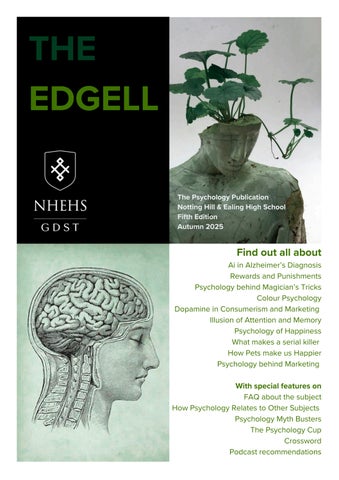
The Edgell 2025

Page 1


THE EDGELL

The Psychology Publication

Notting Hill & Ealing High School

Fifth Edition

Autumn 2025

Meet the Team!

Hi! I’m Melissa, studying Biology, Psychology and English Language for my A Levels I’m hoping to study Psychology at University next year as I love how broad it is, including SO many different fields! An extremely fun fact about psychology is that your gut produces more serotonin than your brain! Serotonin is a hormone, sometimes referred to as, “the happy hormone”. This is partially why people stress about gut health so much!

ey, I’m Mahi and I’m studying Psychology, Biology and Geography

A-Level I plan on studying Psychology at University as it has such extraordinary real-world impact from social to scientific plications. My fun fact about Psychology is that one of the longest ords in the dictionary ‘hippopotomonstrosesquippedaliophobia’ is e name for the fear of long words!

Hi!! I’m Areesha and my A Levels are Psychology, Chemistry and Maths I am hoping to study Psychology at university because I am really interested in everything to do with the subject from neuropsychology to social psychology. My fun fact is the average person makes around 35,000 decisions every day, 95% of which are subconscious!

Hey! I’m Morven and I study Psychology (who’d have thought it?), Biology, Maths and Further Maths! I am planning on studying Psychology at university because I really enjoy learning about what influences behavior and social dynamics! My favourite psychological fact is that we often overestimate our own competence. For example, 94% of Swedes believe that their driving skills put them in the top 50% of Swedish drivers

Meet the teachers

Mrs Chutter

When did you first discover you were interested in Psychology?

I don't remember exactly when I realised I was interested in the subject, but I was very sure that I wanted to study it at A Level, and had an amazing teacher called Mrs Shearing, and it was her influence that made me realise I should study it at university (I was days away from applying to study Geography)

What and where did you study at University?

I studied Psychology at the University of West England - I could have taken a named award in Health Psychology or Developmental Psychology, because of the optional units I studied, but just certified in Psychology

If you could meet any famous Psychologist who would it be? Why?

I would have loved to meet Irving Gottesman - he was so prolific in his field and really changed our understanding of genetics research and of mental illness; but if I could meet any living psychologist, it would be Jennifer Eberhardt, who has done some amazing research on racial bias in the justice system

If you could research any topic or theory within Psychology, what would it be?

The topic I found most interesting at Uni was the Psychology of Addictive Behaviours, particularly effectiveness and efficacy of different treatment combinations for those recovering from substance use issues, which I would love to study further.

What do you love most about Psychology?

Psychology is so diverse and relates to so many features of our day to day lives, so there really is something for everyone Also, it is such a young discipline compared to most subjects, with new fields and ideas emerging all the time, so I am always developing my own understanding.

What is your favourite book on Psychology?

It's really hard to choose! But one book I've really enjoyed lately is Kay Redfield-Jamison's book "An Unquiet Mind" - she has amazing insight into bipolar disorder, as she is a practising psychiatrist, researcher and someone who has lived with the condition for a very long time.

What advice would you give to someone studying Psychology in sixth form?

Psychology has so much to offer, but it requires a bit of patience at the beginning of A level study because it isn't like anything else you will have studied previously.

Mr Hegarty

When did you first discover you were interested in Psychology?

It’s a long, long time ago (and it was all fields round here in those days and, as you can see from the picture on the right, colour had not been invented) but I think it was reading Oliver Sacks’s book ‘The Man Who Mistook His Wife for a Hat’ that really got me interested.

What and where did you study at University?

Psychology at Bristol

If you could meet any famous Psychologist who would it be? Why?

Robert Winston - his work is great and he is an amazing communicator.

If you could research any topic or theory within Psychology, what would it be? Right now, probably something to do with how we can use evidence based Psychology in the classroom When I grow up, I would like to think about the Psychology of Food and Taste

What do you love most about Psychology?

It is so broad and covers so many aspects of our existence - there is something for everyone.

What is your favourite book on Psychology?

Shrinks: The Untold Story of Psychiatry - Jeffrey Lieberman and Ogi Ogas and Desperate Remedies: Psychiatry and the Mysteries of Mental Illness by Andrew Scull These are both fascinating histories of the ups and downs of the psychiatric profession

Opening Skinner's Box by Laren Slater - According to one review ‘The author sets out to investigate the twentieth century through a series of ten fascinating, witty and sometimes shocking accounts of its key psychological experiments Starting with the founder of modern scientific experimentation, B F Skinner’

What advice would you give to someone studying Psychology in sixth form?

Read, read, read and then do a bit more reading.

How does Psychology relate to your favourite subjects?

(Answers from the subject teachers themselves!)

English Language (Mrs Eastwood):

“They are inextricably linked: Linguistic relativity suggests to us that language has a significant influence on our thoughts and perceptions Language is important not only in the study of psychology, but also in the practice of psychological therapies: the success of talk therapy reveals the power of communication to manage personal and social difficulties.”

Economics (Mr Grant):

“There is a huge, and fascinating, overlap and interaction between Economics and Psychology. This has been particularly developed in recent years in the area of Behavioural Economics: which focuses on how and why individuals actually make decisions. Earlier classical Economics assumed people were entirely rational but psychological insights show people are actually influenced by many other factors. Understanding this allows Economists to design policies that are more effective because they utilise people's actual psychology. For anyone interested in finding out more I recommend exploring books or articles by Richard Thaler (Nudge, Misbehaving, The Winner's Curse) , Cass Sunstein, Daniel Kahneman, or the wonderfully named "Behavioural Economics saved my dog: Life advice for the imperfect human" by Daniel Ariely.”

Music (Mr Guthrie):

“One of the main functions of music is to move people emotionally: to excite, to console, to surprise... and so many more. This is so intrinsically linked with our cognition. Psychology can be of huge importance to us as musicians in helping to inform both how we assess the reception of different types of music and how we decide to perform it. If you're interested in finding out more, have a look into Music Therapy and/ or, more specifically, the study of using music in dementia care.”

PE (Mr Bennett):

“Psychology relates to PE and sport at both school and elite levels by influencing how athletes think, feel, and perform. In school PE, psychological concepts are built directly into lessons. Teachers use ideas such as motivation, confidence, feedback, and teamwork to encourage participation and improve performance. At the elite level, sports psychology helps athletes manage pressure, set goals, stay focused, and perform under stress. In both settings, mental preparation is as important as physical training. Sports psychology is also a key part of the academic PE curriculum, where pupils learn how these principles are applied in a sporting context.”

Neurocognitive disorders are medical conditions that involve a decline in an individual's cognitive functions due to a damage or dysfunction of the brain Cognitive functions can include problems surrounding memory, attention, and problem solving which can affect the individual’s mental health and quality of life. In this article, I will be focussing on Alzheimer’s disease as a primary example, given its rapid increase in the number of cases worldwide and the large amount of research dedicated to improving its early detection Every year, there are nearly 10 million new cases of dementia, which is the umbrella term for a range of conditions affected by cognitive decline, with Alzheimer’s disease being the most common cause, accounting for 60-80% of those cases It is believed that forms of AI such as machine learning for brain analysis can be introduced to spot signs of Alzheimer’s from up to seven years before clinical symptoms start to show

Alzheimer’s is predictable as it follows a progression of features. These features could involve genetics, lifestyle and age. This makes Alzheimer’s a crucial disease to research, as not only does it affect the most people but it is also the most complicated to understand The main symptom of Alzheimer's

disease is memory loss, which tends to worsen over time. Other symptoms may develop over time as well, including trouble concentrating, troubled thinking, and changes in personality and behaviour such as depression, aggression, and changes in sleep habits

Alzheimer’s Disease is caused by a dysfunction in the brain It essentially begins with a buildup of proteins in the form of amyloid plaques and neurofibrillary tangles in the brain. Due to these tangles forming, the transport system gets disrupted which causes damage to the cells Damage to the brain cells and lack of communication between them results in a large quantity of brain cells dying over time, which causes the brain to shrink, leading to symptoms.

Although Alzheimer’s does not have a cure, there are treatments to help manage symptoms and potentially slow down disease progression For this reason, early detection of Alzheimer’s would be highly beneficial as it would allow for earlier medical intervention, access to clinical trials, and the opportunity for individuals to plan ahead and make decisions about care and lifestyle adjustments.

One way in which Artificial Intelligence can enhance early diagnosis of Alzheimer's is by applying machine learning and deep learning techniques to neuroimaging data such as MRI and PET scans, detecting subtle brain changes invisible to human radiologists. Deep learning models, which mimic neural networks, have achieved over 90% accuracy

in identifying early biomarkers years before symptoms appear. AI can also analyse blood samples to detect abnormal patterns of amyloid and tau proteins, which begin accumulating up to 20 years before clinical onset Additionally, AI-powered cognitive assessments using natural language processing can identify subtle changes in speech, grammar, and fluency, enabling earlier detection of mild cognitive impairment linked to Alzheimer’s

There have been many examples of previous research and case studies of Artificial Intelligence being used in Alzheimer’s related healthcare services, where it has been proven that it would actually work From advanced analysis of brain scans, using deep learning models to identifying subtle speech pattern changes and early risk factors in electronic health records, AI shows significant promise in predicting the likelihood of developing disease years before symptoms appear. Early diagnosis can give patients access to treatments sooner, allow for lifestyle changes to reduce risk factors, and provide time for individuals and families to plan for the future

However, these benefits must be balanced with careful consideration of ethical concerns such as privacy, consent, data bias, and the role of healthcare professionals Overall, while AI is not a replacement for human expertise in healthcare, its introduction into healthcare tools offers a lot of support that could affect the way we approach Alzheimer’s and other neurocognitive disorders in the years to come.

The study of why humans behave the way that they do has fascinated psychologists for centuries: From automatic learning without us even being aware, to learned responses through reinforcement and punishment. This forms the basis of the behaviourist perspective, focussing on observable actions rather than internal mental processes Two psychologists, during the early to mid-19th century, Ivan Pavlov and B F Skinner studied how rewards and punishments shape learning and behaviour Their experiments, though differing in approach and method, revealed fundamental principles of learning that continue to inform psychology, education and the healthcare industry today.

Pavlov’s famous experiment demonstrated that dogs could be conditioned to salivate at the sound of a ringing bell if that sound was repeatedly presented at the same time that they were given food. Classical conditioning is learning through association, but Pavlov's inadvertently renowned findings were actually initially an accident He was researching the digestive systems of dogs when he noticed that they salivated at the nurses ringing a

bell when the dogs were given food This showed that a neutral cue (the bell) could trigger an automatic response (salivation) after being linked with a positive stimulus (food). In everyday life, we form associations too: For example, hearing your alarm sound may make you feel stressed, alert or annoyed, even if you are in a relaxed state, such as during the weekend Pavlov’s work on learned associations laid the groundwork for Skinner’s later studies, but also helps to understand phobias and develop treatments for these, such as systematic desensitisation and aversion therapy.

Building on Pavlov’s ideas, B F Skinner focused on consequences in what he called operant conditioning, through some quite controversial methods, and resulted in pigeons being trained to guide missiles. His experiment on rats showed that when behaviours are followed by rewards (reinforcement), that behaviour is more likely to repeat, and conversely, if an action is followed by punishment, then that specific behaviour will cease, at least temporarily Through his invention of the ‘Skinner Box’ (a chamber with a lever that released food pellets when pressed, which was a response mechanism that the animal would be trained to use), he was able to demonstrate positive reinforcement in rats By placing a rat in the Skinner Box and through trial and error, the rat learned that pressing the lever resulted in a food reward, demonstrating positive reinforcement and increasing the frequency of lever-pressing behaviour. Conditioning happens in a three-term contingency: Today known as The ABCs of Behaviour. A stands for Antecedent: the rat accidentally hits the lever that triggers the release of food B stands for Behaviour and refers to the

response; the rat keeps pressing the lever C stands for Consequence when the food comes out when the lever is pressed. This allowed Skinner to train various animals such as pigeons to recognise photographs of people, walk in figure-of-eight and even play ping pong!

Skinner even went as far as creating Project Pigeon during World War II On a screen, an image of an object was projected to the pigeon, which was trained to recognise the pattern of the target (e.g. an artillery unit or a warship), and peck it on the screen when they saw it When three pigeons could peck at the target simultaneously, it was concluded that the pigeons were able to aim the missile in that direction and hit the target whilst they were still situated inside the missile. For obvious ethical and practical reasons, Project Pigeon was cancelled during WW2, but remains an early lesson in the power of operant conditioning and the technology that makes it possible

Nevertheless, Skinner's findings have helped to improve classroom behaviour and the criminal justice system to this day. Pavlov demonstrated how simple associations could produce conditioned responses, whilst Skinner highlighted how reinforcement and punishment influence the likelihood of behaviours being repeated From dogs salivating at bells ringing to pigeons guiding missiles, their experiments illustrate the remarkable ways in which behaviour can be conditioned. Together, their work laid the foundation for modern behavioural psychology and continues to shape how we understand learning in everyday life.

A magic trick always appears to be simple: the coin was in her hand and now it isn’t Now you see it, now you don’t. But beneath the well-rehearsed performance of a magician, there are many layers they must conceal and there are many ways they must manipulate their audience’s focus Some of these are the misdirection of attention, verbal suggestibility and the synchronisation of blinks

One of the ways a magician utilises psychology to ensure a trick appears truly magical is by using the misdirection of attention. Ascanio and Etcheverry’s (2000) study suggested that there are three degrees of misdirection The first is that the magician performs two simultaneous actions: the ‘secret move’ and the ‘distractor’ By the audience having to attempt to look at both, their focus is reduced so the method for the trick can go sufficiently unnoticed. The second degree is that the actions are not perceptually equivalent, meaning that a larger move covers a smaller, discreet one The third degree overlaps with Sharpe’s theory of active misdirection Sharpe suggested that active misdirection is when a

transient change in sound or movement is used to focus attention away from the trick. This can also be called attentional confusion. It is also suggested that magicians attempt to create high and low areas of interest For example, a magician may draw the audience's attention away from the edge of a table (area of low interest), where they will then drop something from

For the trick to work, it has been found that the misdirection has to go unnoticed, meaning that the audience cannot know that they've been misled This is called change blindness and refers to how people failed to notice substantial change to a visual scene. An example of this is the well-known video where the players are passing around a basketball and the audience is asked to count the number of throws, thus making you unaware of a gorilla passing through the back of the scene (Simons and Chabris (1999)) Teszka et al (2021) used linguistic cues (i.e. asking a question) in their study of this to throw the audience’s focus.

The second way a participant can be fooled by magic tricks is verbal suggestion This is the idea that an individual can experience cognitive changes in response to a verbal suggestion In terms of magic, this can look like a magician hinting at something occurring in the trick, causing the audience to be more inclined to believe that it is true, even though it may not be. This can look like someone placing a key on a table and telling those

watching that the key is bending, even though it is stationary. This was done in a study with two groups of participants. A fake psychic suggested to one of the groups that the key in the video was still bending In the suggested condition, the participants were more likely to report that the key did continue to bend To add to this, those who believed that the key did continue to bend were described as more confident in this testimony, than those who are not told, and they were also far less likely to recall that they were suggested this by the psychic.

The final way is the natural synchronisation of blinks Richard Wiseman’s work into this aimed to suggest that the participating audience are more likely to fall for a magician's trick due to their blinks occurring not only simultaneously but also during the ‘secret actions’ done by the magician. This is what makes them unaware of what is happening. People blink not only to keep the eye lubricated and healthy, but also to boost intensity for forthcoming focus This is manipulated by magicians who use rhythms and patterns when speaking in tricks to create these areas of relaxed external attention (the point where audience members are then more likely to blink). This relaxation of attention then leaves space for the magician to complete the ‘secret action’ Wiseman found that blinks are strongly associated with specific stimuli, like pauses in conversations

In conclusion, magicians have developed a range of techniques to encourage an audience to relax their attention or focus on other things when performing the crucial ‘secret actions’

Colour psychology is the study of how different colours can influence human behaviour, perception and emotions It examines both the conscious and unconscious reactions that people exhibit when exposed to specific colours, ranging from subtle shifts in mood and attention to more pronounced effects on decision-making, perception and focus. Research in this field suggests that colours are not only for aesthetic purposes; they carry symbolic meanings, evoke physiological reactions, and contribute to social and cultural identity Colour psychology is frequently used in today's society as the impact of colour is deeply shaped by personal

experience, developmental context, and cultural background.

Colour psychology spans from ancient cultures using colour for both symbolic and therapeutic purposes Ancient Egyptians used colours like orange as wall decoration to lessen fatigue and blue to relieve pain Some hues were associated with gods and spiritual practices to improve health and restore balance. Later on, colour began being viewed as an expression of inner psychological traits and therefore introduced its way into therapeutic practices which formed the beginnings of art therapy Today, colour psychology functions as an interdisciplinary field, linking psychology, marketing, design and neuroscience to provoke emotions and desired reactions from people.

There are scientific processes that explain how and why colours impact behaviour. The retina receives light wavelengths that are processed into electrical signals by the hypothalamus and visual cortex These signals can trigger emotions, hormonal responses and affect mood, cognition and physiology. Furthermore, certain colours provoke emotions due to association with cultural or personal experiences. For example, most western countries use red as an indication of stopping or ‘power off' whereas it is also associated with purity and fertility in India Purple also connotes both creativity and magic, along with luxury due to the fact that purple dye was uncommon and expensive in ancient times and therefore it was saved for royalty. Colours can impact and influence mood from personal memories and experiences. Evidence suggests that our brains are wired to like or dislike

certain colours This can be due to evolutionary reasons or personal preferences. For example, blue and green tend to be more popular due to them representing elements of nature.

One example of the applications of colour psychology is in education, where it is utilised to improve focus, productivity and overall attitudes in the classroom Colours such as blue and green are used in many classrooms in today's society. Blue connotes focus and creates a calming atmosphere due to its association with natural elements such as water and sky These induce feelings of stability and serenity Psychology suggests exposure to blue tones can lower heart rate, reduce stress and increase concentration, making it useful for a classroom setting. Similarly, green is used in school environments as it is associated with balance, relaxation and renewal. This is due to the fact that it is one of the most easily processed colours for eyes and therefore reduces eye strain

Many designers and marketing strategies also utilise colour psychology to influence decision-making, enforce brand identities along with shaping user behaviour and perception. Businesses often apply colour psychology techniques to communicate values, for example, using green to highlight sustainability It is also used to provoke responses from users and attract attention to their business One example of this is Coca-Cola, which primarily uses red in their logo and has been doing so for a long time. Research shows that consistency of colour use can increase brand recognition by up to 80% and therefore has a long-term strategic value Red is often used to convey urgency, energy

and alertness, hence why it is often used in sales signs and important logos. Studies in cognitive psychology have shown that when something is written in red, it is more likely to be noticed and remembered The applications of colour psychology in these fields has shown to be highly effective, not only in influencing human behaviour but also to improve brand and businesses perception

In conclusion, colour psychology demonstrates the increasing impact that visual stimuli have on behaviour, cognition and moods. From historical roots in healing and associations with cultural contexts to modern day use in marketing, design and education, colour has remained a large influence on human behaviour and decision-making

motivation, learning and decision making This drives consumer behaviour by increasing desire and leading people to act on rewards. Marketers exploit this by creating suspense, offering variable and personalised rewards and fostering curiosity through techniques like limited time offers and surprise bonuses to encourage engagement and purchases In this essay, I will explore the psychological basis of dopamine and its applications in consumer behaviour, the economic business implications and the ethical debates surrounding the topic and the use it has in marketing

Why do people check their phones hundreds of times of day? The answer may lie in dopamine - the brain's chemical of reward and anticipation Dopamine is a neurotransmitter that acts as a chemical message in the brain that influences

Dopamine acts as a motivator and learning signal within the brain's pathways. The ventral tegmental area produces dopamine, which is then released into another brain region called the amygdala when we experience natural rewards like food, sex or social interaction This surge signals that the activity was valuable which motivates us to repeat the behaviour and helps the brain encode the cue associated with it. Dopamine is not simply about pleasure but also about anticipation Schult’s research (1997) on reward prediction error showed interestingly that dopamine firing increases when a reward is predicted, not when it is received; however, if the reward does not appear it drops This distinction between liking and wanting explains why uncertain or variable rewards such as those found in gambling or notifications from your phone can be a special power to drive someone's behaviour

Previous studies by Olds and Milner (1954) demonstrated the same effect: rats would self

stimulate brain regions linked to dopamine thousands of times an hour, ignoring food and rest to repeat the rewarding sensation.

Marketers have applied these findings directly to shape consumer engagement. Advertising often uses emotional triggers and repetition to capture attention and activate reward circuits. In retail reward schemes and flash sales exploit dopamine's driven anticipation Digital platforms go further relying heavily on variable reinforcement schedules: the unpredictable timings of likes or notifications mirror the mechanics of things like slot machines which keeps users checking repeatedly in hope of the next small reward.

Behavioural economics reinforces these practices. For instance, present bias explains why consumers prefer immediate gratification over long term benefits while loss aversion means scarcity marketing can trigger anxiety about missing out These strategies blend psychological theory with the real world business practice demonstrating how dopamine knowledge is directly monetised

On a business level, dopamine driven techniques are highly profitable They boost sales, extend consumer engagement and build brand loyalty especially in industries like social media and gambling. However there are costs: productivity losses due to digital distraction and healthcare burdens linked to overconsumption of addictive products The rise of neuromarketing illustrates the scale of investment Companies now use brain scanning technologies like fMRI and EEG to refine

advertisements and predict consumer responses signalling that this field will continue to expand.

While effective the exploitation of dopamine raises ethical concerns Critics argue that these strategies border on manipulation. Parallels can be drawn with gambling, tobacco and high sugar/fatty foods where industries profit from behaviours that may harm an individual or influence an individual's behaviour Regulatory debates have emerged, for example around social media design and loot boxes in gambling

Furthermore dopamine driven marketing may not generate long term value; consumers may experience burnout or distrust brands that are perceived as manipulative. Businesses must therefore weigh short-term gains against potential reputational and regulatory risks.

To conclude, dopamine plays a central role in bridging psychology and economic strategies and marketing. Its function in reward anticipation explains why uncertainty and novelty are so effective in shaping consumer behaviour Businesses that understand this have gained immense profit but at the cost of growing concerns about consumer welfare and sustainability Looking forward to the integration of neuroscience, psychology and economics in marketing is likely to deepen. Yet society must carefully balance commercial incentives with ethical responsibility to ensure that consumer wellbeing is not sacrificed for profit

We believe ourselves to be highly observant and accurate when recalling what happens around us.

Assuming that if we look directly at something, we will be able to notice it, and if we experience an event, we will be able to remember it as clearly as we first experienced it However, research has shown that this is far from the truth. Our minds are able to play tricks on us, these being the illusion of attention and the illusion of memory, both revealing how unreliable human perception and memory can be

The illusion of attention refers to the wrong belief that we register everything we see in front of us However, in reality, our attention is actually limited; we are only able to focus on one thing at a time deeply or multiple things with less awareness of each object.

One case involves a submarine accident that occurred in 2001. As the submarine prepared to surface, a crew member was asked to look through the periscope to check if there were any ships. The crew member saw nothing; therefore, the submarine rose, but it collided with a fishing vessel How did this happen when the area had been checked prior? The answer lies within the illusion of

attention Looking directly at something does not always guarantee that you will be able to consciously register it. The fishing vessel was present, but the crew members' observation and attention had failed to capture and register it This type of mistake, however, is not rare; our awareness can only capture a small portion of the world at any moment, and important details can go unnoticed

Driving whilst using a phone is also another example Most drivers believe and assume that as long as their eyes are on the road and their hands are on the wheel, they are safe; however, experiments have shown otherwise. The danger, for example, is not only about having one hand on the wheel; it's about your divided attention Even when using a hands-free device, having conversations on the phone, in the car with passengers or listening to music, this dramatically reduces awareness on the road. Drivers focussing on other things react more slowly to traffic lights, take longer to move and usually fail to notice sudden dangers. Studies show that these distractions have the same effect as alcohol does on drivers' reaction times and attention to the road Both tasks, driving and talking, seem and feel effortless on their own, but when combined, they hinder attention This reveals the reality that directing our eyes towards something will not always guarantee that we process it properly.

The illusion of memory is the belief that memory works like a recording; it remembers and visualises every single detail However, memory is reconstructive When remembering an event, the brain pieces fragments together and fills the gaps

with assumptions, this being a schema pattern, these extra assumptions sometimes add in details that were never originally there.

This is highlighted through experiments such as memorising a list of words. This list of words was all related to sleep, including terms such as ‘bed,’ ‘rest,’ ‘dream,’ and ‘yawn ’ Yet a great number of participants recalled the word ‘sleep’ even though it had not been listed This is because it fits the pattern; it shows how easily memory can be distorted and manipulated itself in order to fill in the gaps, even in something as basic as remembering and recalling a list of words.

Memory distortions can also happen in emotionally charged events. In one real incident, a student accused his coach of choking him. First of all, he had recalled that the assistant coach pulled the coach away; however, the assistant denied that that had happened When video evidence was published, it showed that the coach had indeed grabbed the student's throat; however, no one had intervened. The student's memory was partially correct, as he did remember the coach grabbing him by the throat, but this recording showed that over time, his mind had reconstructed and elaborated his memory, filling in the gaps to create a memory that was incorrect Meanwhile, according to the coach, he claims not to remember the incident at all, because this physical reaction and interaction seemed to be normal and routine to him, therefore did not register with him as something significant. This example highlights how two people who witnessed the same event recalled it in completely

opposing ways, both being highly convinced of their own version.

Together, the illusion of attention and memory show us the limit of the human brain. We are not as observant or accurate as we think we are, and often fail to see things directly in front of us and believe in memories that have never happened This shows why caution is necessary when relying on our own judgment

Just as there is a biological reason for everything in psychology, there is a scientific reason for happiness In the past science has looked closely at happiness as being ‘hedonically defined’ - the outcome of the pursuit of pleasure over pain, and recently neuroscientists, such as Kringelbach and Berridge have made progress into the investigation of the functional neuroanatomy of pleasure. They found that for many years in the discipline of psychology, pleasure has been closely associated with happiness; additionally, that pleasure is not only a thought or sensation, but rather an outcome of brain activity in dedicated ‘hedonic systems’ Another more scientific study was done by Kesebir and Diener where they report that in happiness surveys, more than 80% of participants rated their

overall ‘eudaimonic’ life satisfaction as “pretty to very happy” and, at the same time, 80% of people interviewed also rate their current, hedonic ‘mood’ as positive.

However, it can be argued the extent to which happiness can be measured Some individuals, such as Norrish and Vella-Brodrick, argue that maybe happiness should not be the subject of scientific explanation because it is impossible to objectively measure it. Ed Diener, however, argues that happiness is subjective and people are happy if they think they are, and each person is the best judge of whether they are in fact happy or not Measuring subjective wellbeing makes a scientific explanation of happiness possible, asking questions like ‘are you happy?, and ‘what would you rate your happiness on a scale of 1-10?’. This is known as the experience sampling method (ESM) providing a way to assess subjective well being. Diener provided evidence that subjective wellbeing has “construct validity” meaning that it is measuring something ‘real’! This is because the evidence showed that subjective wellbeing is constant over time, is highly correlated with some personality traits and has the capacity to predict future outcomes. He also suggests that it is possible to measure happiness if done by using valid, reliable methods

Affective state theory - this theory of happiness proposes that happiness is a result of one’s overall emotional state. Bradburn argues that happiness is made up of two separate components that are independent and uncorrelated: positive and negative effects; according to him happiness is a global judgement people make by comparing their

negative and positive affect This led to the development of the Affect Development scale, the scale is made up of ten moods and the subject reflects on whether they have been in that mood state in the past week A measure of the quality of life as an indication of happiness is derived from the idea that if negative things are taken away there is a more positive conclusion to the sum Affect state theory also takes the view that the absence of negative affect is not the same as the presence of positive affects.

Walter A Pitkin wrote a book ‘The Psychology of Happiness’ covering the differences between happiness and other emotions including pleasure and enjoyment, he argues that achieving happiness was not only the result of luck or chance, and since he had published the book psychologists have been researching happiness and trying to define it. According to psychology, happiness is about more than experiencing a positive mood, subjective wellbeing is mentioned Psychological questioning of happiness is important because it is not only associated with improved physical and mental health, happiness is a priority for people - across the world, happiness is seen as a more important outcome compared to making lots of money or living a meaningful life There are three ways that psychologists study happiness:

1) Need and goal satisfaction theories

These theories suggest that happiness can be found in striving to achieve appropriate goals and meeting a person’s fundamental needs. Deci and Ryan proposed Self-determination Theory, which is the idea that wellbeing is achieved when one meets

their basic human needs, including autonomy, competence and relatedness.

2) Genetic and personality predisposition theory

These propose that wellbeing is affected by genes and is associated with personality traits - implying that wellbeing does not change over time

3) Process/activity theory

These theories argue that wellbeing may be improved by participating in activities that are engaging and require effort.

When you walk into a room and see a dog wagging its tail or a cat curling up on someone’s lap, it’s hard not to feel at least a little bit happier But why do pets have such a powerful effect on us? Is it simply because they’re cute, or is there something deeper happening in our brains? Psychologists have studied the bond between humans and animals for decades, and the evidence shows that pets can have a surprisingly strong influence on our emotions and even our health

One of the clearest ways pets affect us is by reducing stress. When we interact with animals, our brains release chemicals like oxytocin (often called the love hormone), which is the same chemical released when parents bond with their children Stroking a dog or cat can also lower levels of cortisol, the hormone linked with stress This is why therapy animals are used in schools, hospitals, and care homes as their presence can calm people down and help with social connection. For example, studies have found that university students who spend time with therapy dogs during exam season report feeling less anxious So, pets aren’t just fun companions but also act as a kind of natural stress relief

Pets also play a role in reducing loneliness and improving mental health. During the COVID-19 lockdowns, many people said that their pets gave them a sense of routine and comfort when they were cut off from friends and family Psychologists suggest that the unconditional love animals offer is especially powerful Unlike humans, pets don’t judge or criticise, which can make them a safe source of support. For teenagers and older adults in particular, this companionship can boost self-esteem and help fight feelings of isolation. In fact, surveys show that pet owners often report higher levels of happiness and life satisfaction than non-owners

The benefits of pets aren’t only emotional but also encourage healthier behaviour. Dog owners are more likely to get outside and exercise, which has knock-on benefits for both body and mind. Even the responsibility of feeding and caring for a pet can

give people a sense of purpose, which psychologists link to resilience and positive wellbeing. For children, growing up with a pet can teach empathy and responsibility, as they learn to think about another being’s needs alongside their own

However, looking after an animal comes with challenges such as financial and time commitment Some studies even suggest that the benefits of pet ownership can depend on factors like personality and lifestyle. For example, if someone dislikes animals or struggles with the responsibility, owning a pet might actually increase stress So while pets can make many people happier, they aren’t the answer for everyone

However, research still suggests pets can play an important role in supporting mental health and wellbeing. For me, the most interesting part of this is how much of the effect comes down to simple, everyday interactions - even as someone that is allergic to cats with a cat! It reminds us that happiness doesn’t always have to come from big achievements or expensive experiences but small, consistent sources of comfort that matter most.

Even if we don’t all have the chance to own a pet, we can still seek out the same benefits by spending time with animals in other ways – volunteering at shelters, visiting friends’ pets, or even just watching the neighbour’s cat sunbathe in the garden.

In today’s world, people come across marketing almost everywhere they go Whether it is a poster at the train station, an advert on television, or a pop-up on a website, companies are always looking for ways to grab attention and spark interest. Given the saturation of advertising in daily life, businesses increasingly rely on psychological strategies to influence consumer behaviour. This essay will explore three prominent psychological tactics in marketing: priming, scarcity, and the decoy effect

Priming is a psychological phenomenon whereby exposure to one stimulus subconsciously influences responses to subsequent stimuli. In marketing, priming is often used to direct attention away from less appealing attributes, such as price, and toward more desirable qualities, such as safety, comfort, or status A notable study by Naomi Mandel and Eric J Johnson demonstrated this effect by manipulating the background design of a website Participants were asked to choose between two cars, such as a Volvo or a BMW. Those who had been primed with monetary cues paid more attention to price, while those primed with safety cues focused on safety information This

experiment illustrates how subtle environmental changes can shift consumer preferences. Companies frequently employ brand priming to establish strong associations in the consumer’s mind. For instance, Nike primes consumers with concepts of achievement and athleticism through its slogan “Just Do It” and its use of elite athletes in promotional campaigns Coca-Cola similarly leverages imagery in its “Open the Happy Can” campaign, where the design of the can opening resembles a smile, thereby linking the act of consumption with happiness. Such examples highlight the persuasive potential of priming in shaping consumer perceptions

Another widely applied psychological principle in marketing is scarcity, which is rooted in the economic law of supply and demand. Scarcity increases the perceived value of a product by creating the impression that it is limited or rare. A 1975 study illustrates this effect: participants rated identical chocolate chip cookies more highly when they were presented in a jar containing only two cookies compared to a jar with ten This finding reflects how scarcity enhances desirability, even when the objective quality remains unchanged Online retailers frequently employ scarcity tactics through phrases such as “only a few left in stock”, often highlighted in red to evoke urgency. This strategy compels consumers to make quicker purchasing decisions, fearing that hesitation may lead to missed opportunities

A further strategy is the decoy effect, which exploits consumers’ tendency to compare options relative to one another rather than in absolute terms. Dan Ariely’s TED talk, “Are We in Control of Our Own Decisions?”, provides a well-documented example from The

Economist’s subscription model The company offered three packages: an online-only subscription for $59, a print-only subscription for $125, and a combined print-and-online subscription also for $125. When presented with all three options, most participants chose the combined package, perceiving it as a superior deal However, when the print-only option was removed, preferences shifted toward the cheapest option This experiment highlights how the inclusion of a strategically chosen “decoy” option can steer consumers toward higher-value purchases.

In conclusion, psychological principles such as priming, scarcity, and the decoy effect reveal how consumer behaviour can be subtly yet powerfully shaped by marketing tactics These methods encourage individuals to make decisions that may not always align with rational economic reasoning but instead are guided by subconscious influences and relative comparisons. Awareness of such strategies is essential for consumers seeking to make more deliberate and informed choices in an environment saturated with persuasive marketing

Psychology Cup 2025

Abstract:

We believed that being a younger sibling meant that a person was likely to be less perseverant. To test this hypothesis, we found a sample of 22 students in Year 12 and gave them a short quiz of 6 anagrams, with the 4th anagram (oneci) being impossible to solve We timed how long the participants (PPTs) took before giving up We found that there was a significant difference in the time that younger siblings took compared to older siblings and only children. The mean times in seconds (excluding the anomalies) spent attempting to solve the anagram were 351.4, 120.6, and 359.8 for older, younger and only children respectively Further research with a larger and more diverse sample size would improve this experiment and bring a stronger understanding to this question

Introduction:

We hypothesised that younger siblings would be less perseverant than older siblings and only children, with little difference between the latter two

H1 = PPTs who have older siblings will persevere for less time when challenged with solving an impossible task (an unsolvable anagram), compared to PPTs with younger siblings or no siblings.

H₀= There will be no difference between PPTs, who have older siblings, compared to younger siblings or no siblings, at how long it takes for them to give up at solving an impossible task.

The type of our experiment is quasi as it is already determined whether the PPTs have siblings or not

The experiment design we used is independent measures as each participant does the experiment only once.

Sample and Procedure:

Our target population was people in our year group Initially, we sent out a form to ask some people in our year group whether they were able to take part in our experiment and when they were free; this was volunteer sampling. However, we gained the majority of our sample via opportunity sampling. We did this by asking whoever we saw in our year group to take part in our experiment during our free periods and lunchtimes Often, they agreed straight away, but in some cases they were too busy at the moment and scheduled for a later time This led to us having an overall sample of 22.

We created 6 anagrams, with the 4th being the critical one as it was impossible Before officially beginning the experiment, we read a script to the PPTs The script explained that we would not disclose the aim of our experiment in order to ensure it is reliable, and that we would debrief the PPT after and that they had the right to withdraw at any time. We also made it clear that the questions must be done in order and the answer has to be stated aloud before the PPT could move on to the

next This was so that we knew when to begin timing how long the PPT persevered for. We also gave the PPT the chance to ask questions before beginning the experiment. Once the PPT moved onto the 4th question, we used the stopwatch function on our phones to keep track of the time spent on the question If the PPT asked about whether the question was possible, we insisted that all the questions had answers

When the PPT gave up on the anagram, we asked them to fill out a questionnaire. The questionnaire included both open and closed questions, such as “How would you describe your emotions/thoughts during that test? Write as much as you like” and “Do you have siblings? Yes No” This self-report gave us both qualitative and quantitative data that we used to gain further insight into testing our hypothesis.

After each experiment was over, we debriefed the PPTs and apologised for the deceit

Results:

Table to show the mean and standard deviation for the time (seconds) taken on question 4 (Q4): Time in seconds Mean

Older Sibling 351 4 154 1

Younger

Sibling 120 6 79 6

Only Child 359 8 671

Our self-report included the question “Do you often find yourself asking for help from your siblings?”.

From the answers to this question, we found that the youngest siblings were more inclined to ask their siblings for help They tended towards yes, answering with ‘always’ or ‘sometimes’, while the majority of older siblings answered with ‘rarely’ or ‘sometimes’

Conclusions:

From this data, we can conclude that our hypothesis is correct and younger siblings are less perseverant than their older siblings or people with no siblings However, it is important to note that our experiment does not show causation due to it being a quasi-experiment and therefore we cannot claim this to be universally true.

FAQ about Psychology

What are some key topics covered?

The course is divided into 3 components: The first component is research methods which outlines techniques for collecting and analysing data with stats involved

The second component is core studies where you use evaluative techniques and debates to outline and analyse various studies and experiments that have been conducted. This spans from the social, developmental, biological, individual differences and cognitive area.

The third component is Applied Psychology, and it involves Issues in Mental Health, Criminal Psychology, and Child Psychology. In each of these topics, we explore a wide variety of subtopics such as History of Mental Health, types of mental disorders, and forensic evidence.

How is the course assessed?

Psychology A-Level is fully exam based, meaning there is no coursework The first paper is worth 90 marks about research methods, the second is Psychological themes through core studies worth 105 marks (35% of total A-Level) and the third section is applied Psychology also worth 105 marks.

Is there any maths in the course?

Although many students find the maths and statistics section daunting, it is actually not too bad. As you can see through our introductions, not all of us do maths as an A-Level so we can say from firsthand experience that once the teachers help you get your head around it, you are all set. The maths and stats are in Paper 1 where you learn about levels of data, descriptive statistics and inferential statistics (stats tests) You are not expected to know all of this coming into Psychology! The teachers help you and show you that the maths is not a problem

What do those who study Psychology go on to do at university and jobs?

Psychology is related to lots of subjects (as shown by the teachers' responses!). This means that it can help you in any university degree or field of work There is a big range of options from careers in mental health (like clinical, counseling, forensic) to business in HR, marketing, market research.

Psychology Myth Busters

Do you know whether these statements are true or false? Check your answers on page 26!

1. When you are taught using your preferred ‘learning style’, you learn more effectively.

e.g. visual learners process information best in the form of diagrams, videos and graphs, kinesthetic learners learn best hands-on, and auditory learners benefit from lectures

2. You shouldn’t revise for a test whilst listening to music. The conditions in which you take the test should be the same as the ones in which you revise

3. If you play Mozart to babies, they will grow up to be more intelligent.

There is an increase in the cognitive development of children who under the age of three listened to Mozart

4. You can either be left-brained or right-brained. Those who are left-brained are more logical and analytical, while those who are right brained are more creative!

5. If you meet someone who is attractive or likable, you are also likely to assume that they are really intelligent. Your judgement of someone is skewed b

6. The same brain areas activate when someone experiences social rejection as when they experience physical pain. Some of these regions of the brain include th t i i l t t

Everyone loves a crossword puzzle

Podcasts

- The Psychology Podcast-

This podcast talks with scientists and other individuals to give you a deeper knowledge of yourself and the world you live in. This podcast will be especially interesting to those curious about mental illness and more niche topics within Psychology.

The Upside of OCD- with Michael Alcee| The Science of Morbid Curiosity - with Dr Coltan Skrivner The Anxious Generation - Jonathan Hait

- Pop Psych 101 -

This interesting podcast uses popular movies, TV shows and books to discuss mental illness through the lens of pop culture. The podcast creates a balance of both serious and funny topics to educate and normalise discussions on mental health.

Existential Crises and the Female Experience in Barbie: with Ryan Engelstad and Hayley Roberts | The Progression of Alzheimer’s in Still Alice: with Ryan Engelstad and Hayley Roberts | Change and Parenting in Ted Lasso: Season 3

- Speaking of Psychology -

This fascinating and factual podcast discusses some of the latest, most important and relevant psychological research being conducted today, it often takes the perspective of different guests each specialised in a specific area of psychology: Why we procrastinate and what to do about it, with Fuschia Sirois, PhD | How to overcome feeling an imposter, with Lisa Orbé-Austin, PhD, and Kevin Cokley, PhD | Can a pathological liar be cured? With Drew Curtis, PhD and Christi

- All in the Mind -

In this podcast, Claudia Hammond Vedantam discusses mental health, psychology and neuroscience to explore how and why we think and behave.

Surfing and mental health, grief for dead celebrities, and being unique | Smartphones and children, mental health labels and climate anxiety | Languishing and the search for meaning in the modern world

Answers:

Psychology Myth Busters

1 False; According to the BPS (British Psychological Society), a recent survey of British teachers found that more that 96% previously believed this, but the research surrounding it has been proven to be unreliable and it fails to correlate with people's actual learning performance

2 True; According to Grant et al, context-based learning (learning in the same environment as where you will do the test) improves your recall and recognition of a topic! If you want to learn more about this, do Psychology A Level!

3 False; The 'Mozart Effect' was proposed by Shaw and Rauscher in 1993; however, the findings were the result of a Type I error and therefore this is not true.

4 False; While it is true that certain sides of the brain have more specialised, localised functions, the cognitive functions of the brain largely require the interconnection of both hemispheres.

5 True; The Halo effect is very much real and it is one of the many cognitive biases that humans experience

6. True; Studies using fMRI scans have proven that both of these experiences use similar neural pathways to process! How cool!

How many did you get right?

THE EDGELL

The Psychology Publication

Notting Hill & Ealing High School

Fifth Edition

Autumn 2025

Turn static files into dynamic content formats.

Create a flipbook