


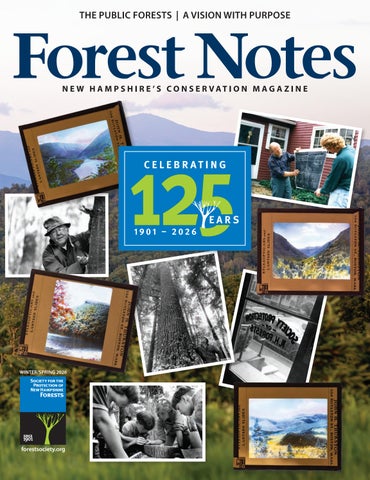
Wake up to sweeping mountain views, quiet mornings, and the timeless charm of The Rocks.
The Gardener ’s Cottage — once par t of the historic Glessner family estate —has been thoughtfully restored to welcome today ’s visitors while honoring more than a centur y of conser vation and care.
• Sleeps up to nine, per fec t for families and groups.
• Step outside to trails, histor y, and peaceful landscapes.
• Your stay suppor ts year-round education and land stewardship at The Rocks.


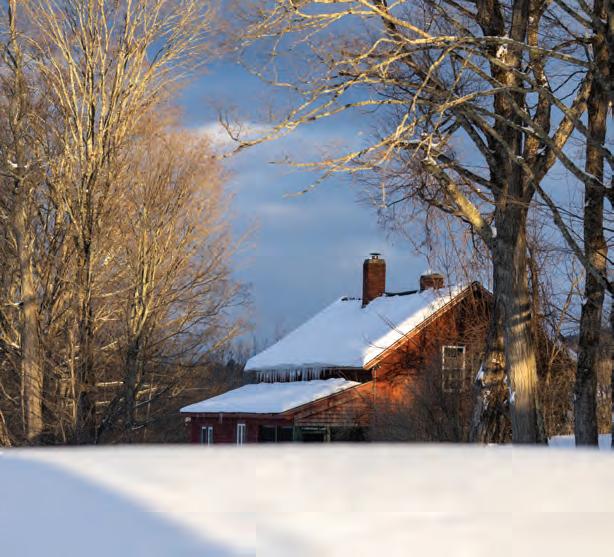
+ Forest Society K icks O ff 125th in Style
+ Happy Bir thday S P N H F
+ Forest Society Celebrates Grant Awards as LCHIP Marks its 25th Anniversar y
+ Legislative Update: Proposed Bill Targeting the Nonprofit Sector
+ Trees for Troops
CHAIR
Jason Hicks, Meredith VI CE CHAIR
Drew Kellner, Brookline
SECRETARY
Susan Arnold, Strafford
TREASURER
Allyson Hicks, Concord
PRESID E NT
Jack Savage, New Durham
B OARD O F TRUSTEES
Philip Bryce, Deering
Deb Buxton, Greenfield
George Epstein, Silver Lake
Peter Fauver, North Conway
Don Floyd, Concord
Jameson French, Portsmouth
Patricia Losik, Rye STAFF
Jim Merrill, Manchester
Amy Reagle Meyers, Jaffrey
Michael Morison, Peterborough
Elizabeth Salas, Weare
Bill “ Tuck” Tucker, Goffstown
Tom Wagner, Campton
Janet Zeller, Concord
Josh Abbott, Regional Stewardship Manager
Ben Aldrich, Field Forester
Frank Allen, Building and Grounds Assistant
Sarah AlSamaraee, Stewardship & Forestry Administrative Coordinator
Dave Anderson, Senior Director of Education
Kristine Arey, Program Director, The Rocks
Emily Bartolini, Southeast Region Program Manager
Brie Belisle, Regional Stewardship Manager
Nik Berube, Maintenance Assistant
Naomi Brattlof, Director of Easement Stewardship
Adam Buxbaum, Christmas Tree Farmer, The Rocks
Rita Carroll, Tree Farm Administrator
Tony Cheek, Vice President for Finance
Connie Colton, Administrative Assistant
Linda Dammann, Development Assistant
Carrie Deegan, Vice President for Recreation Management and Public Engagement
Leah Hart, Land Conservation Project Manager
Stacie Hernandez, Land Conservation Project Manager
Brian Hotz, Senior Land Conservation Project Manager
Steve Junkin, Field Forester
Susanne Kibler-Hacker, Senior Philanthropy Advisor
Allan Krygeris, Senior Technolog y Specialist
Matt Leahy, Public Policy Director
Margaret Liszka, Membership Director
Kaylin Lustig, Concord Community Engagement Manager
Nigel Manley, Senior Outreach Manager, The Rocks
Ann McCoy, Development Manager
Stephanie Milender, Human Resources Director
Michelle Morse, Finance Specialist
Carl Murphy, Facilities Manager
Nora Noble-Christoff, Land Protection and Stewardship Coordinator
Cara Pearson, Membership Specialist
Meredith Reed O Donnell, Foundation Relations Manager
Tina Ripley, Administrative Coordinator
Ilissa Sargent, Regional Stewardship Manager
Jack Savage, President
Matt Scaccia, Recreation and Community Relations Manager
Ryan Smith, Communications Manager
Justin Smulski, Digital Marketing & Content Manager
Kaity Stanton, Regional Development Manager – Seacoast
Maria Stewart, Senior Executive Assistant
Dylan Summers, Stewardship Projects Manager
Laurel Swope-Brush, Land Steward & Volunteer Programs Coordinator
Lauren Thomas, Administrative Assistant, The Rocks
Anne Truslow, Vice President for Development
Wendy Weisiger, Managing Forester
Brenna Woodman, Director of Communications
Harriette Yazzie-Whitcomb, Administrative Assistant
If we are to be New Hampshire everlasting, as we have set out to do for more than a century, we must be unfallen.
One hundred and twenty-five years ago, the Society for the Protection of New Hampshire Forests was enjoying its first year in existence Governor Frank West Rollins was among our nine founders, eight men and one woman Philip Ayres was hired as the Forest Society’s first forester, a newly established field of study (Learn more about him on page 14 )
The singular goal then was to see legislation passed to establish a White Mountain National Forest (WMNF) across a landscape that had been largely cut over In New Hampshire, only the federal government had the ability to aggregate that much land The benefit of keeping those acres as future forests extended to all, including business interests The need was urgent
On March 1, 1911, the Weeks Act passed, named for Massachusetts Congressman John Weeks, originally from Lancaster, NH. President Taft signed the bill, and the national forest began to be formed Today we count more than 750,000 acres part of the WMNF in New Hampshire.
“Because of the action and achievement commenced that day the face of
were not changed, but preser ved for us and future generations,” wrote Governor Wa
1969 histor y, New Hampshire Everlasting and Unfallen.
“Imagine the rolling hills and coiled
with no White Mountain National Forest, no organized responsibility for fire protection, no statewide forestry organization or state forestry department, no educational programs in forestr y and conser vation,” he wrote.
We
selves privileged to live and visit a New Hampshire that is today still 80 percent forested Today the state, towns, and dozens of land trusts recognize the importance of our forests by owning and protecting more than 34 percent of land statewide.
The Forest Society itself, having helped secure the White Mountains, now owns and manages more than 70,000 acres and holds conservation easements on 140,000 more. Imagine if we did not.
What we cannot do, 125 years later, is imagine that our work conserving forests is complete. Though the Forest Society and New Hampshire forests have survived recessions, wars, hurricanes, pandemics, a
protection demands unending advocacy
To
more about our ambitious vision for the decades to come, turn to page 20
We invite all to join us.

Jack Savage is the president of the Forest Society He can be reached by email at jsavage@forestsociety.org.
Projec t Update
Morrill Dair y Farm (Concord) forestsociety.org/morrillfarm
Projec t Update
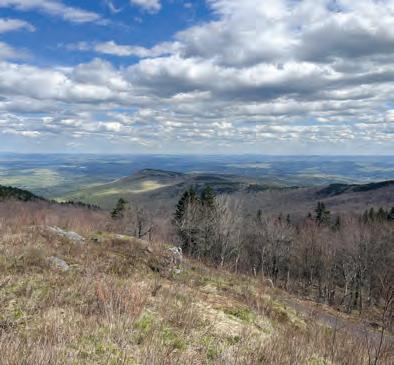
Mount Kearsarge ( Warner) forestsociety.org/mountkearsarge
“I thought the “Hike With Heart” theme that was chosen for the 2025 Five Hikes Challenge was so appropriate! I personally love celebrating and having the connection to New Hampshire’s forests. The forest is my HAPPY place, including my trip to Madame Sherri Forest (pictured) The opportunity to participate this fall gave me a purpose.”
–Dawna Marie O’Donal (Facebook)
Society for the Protection of New Hampshire Forests
A nonprofit membership organization founded in 1901 to protect the state’s most important landscapes and promote wise use of its renewable natural resources
Basic annual membership fee is $45 and includes a subscription to Forest Notes
Editor: Ryan Smith
Design & Production: The Secret Agency
Printing: R.C. Brayshaw & Company, Inc.
Projec t Update
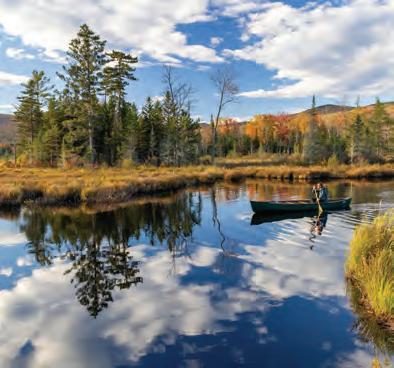
Campton Bog (Campton–Rumney) forestsociety.org/camptonbog
@ForestSociety facebook com/ForestSociety
Tag #forestsociety on Instagram for a chance to be featured in a future issue of Forest Notes.

Forest Notes is printed on elemental chlorine-free Sappi Flo paper with 10 percent post-consumer recycled content Sappi Flo is made from pulp purchased from suppliers who document sound environmental practices and sustainable forest management.
Permission is required for reproduction of any part of this magazine
Copyright 2026 SPNHF US ISSN: 0015 7457
54 Portsmouth Street, Concord, N H 03301 | Phone: 603-224-9945 | Fax: 603-228-0423
info@forestsociety org | forestsociety org
The Forest Society proudly supports the following organizations:



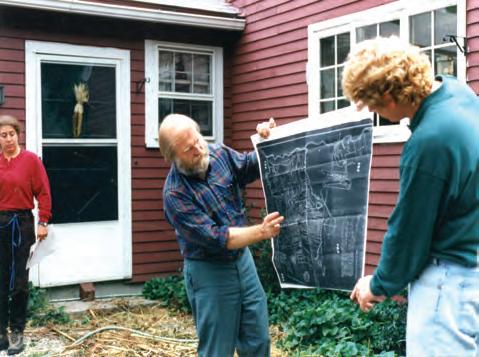
1. State Archaeologist Gary Hume (left) holds a map of Monson Center in Hollis and Milford with then Forest Society Director of Outreach Dick Ober at an event promoting the conservation of the property
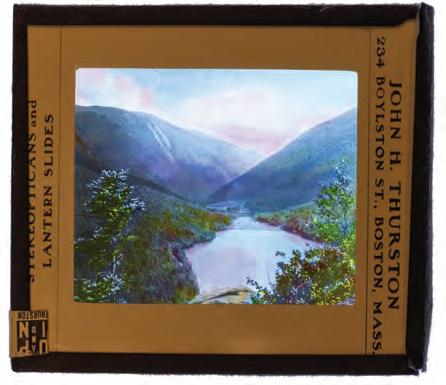
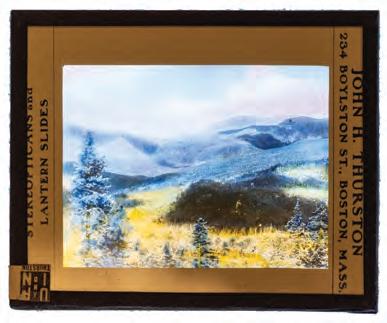
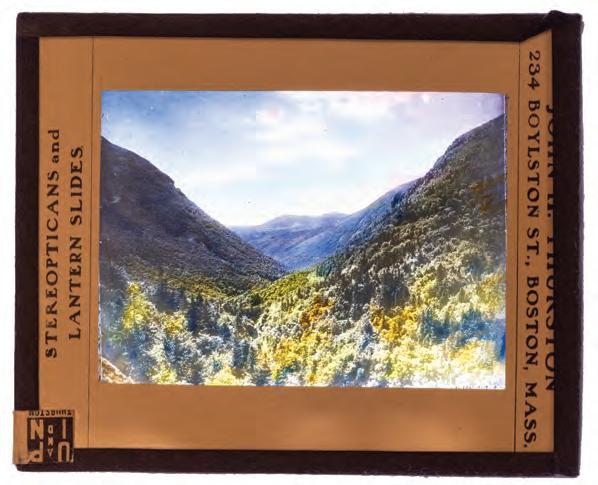
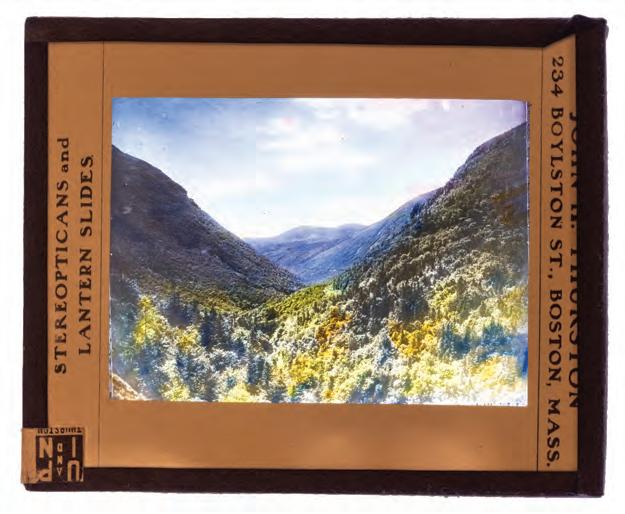
2. In the 1900s, Philip Ayres, the Forest Society’s first forester, made the case for protecting eastern forests, including the White Mountain National Forest, through his dramatic colorized “Magic Lantern” slideshows. Crawford Notch (pictured) and other iconic locations featured on this page were a main focus of the Forest Society to protect from destructive logging.
3. The Forest Society’s first office was located in Boston at 5 Joy Street until it moved to 5 South Street in Concord, New Hampshire (pictured).
4. An Ayres lantern slide of Mount Washington
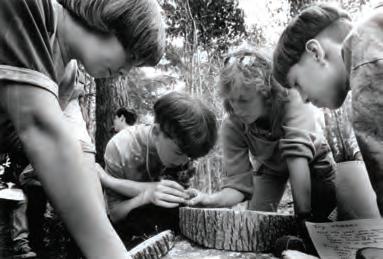
5. A Forest Society Conservation Camp educator shows her students how to determine the age of a white ash tree by counting the rings in the stump
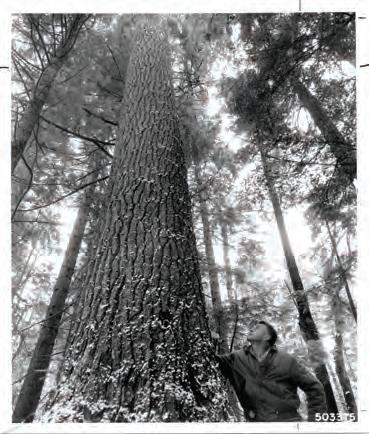
6. A forester admires a high-quality white pine sawlog in a managed forest.
7. An Ayres lantern slide of the Old Man of the Mountain resting high above Profile Lake in Franconia Notch.
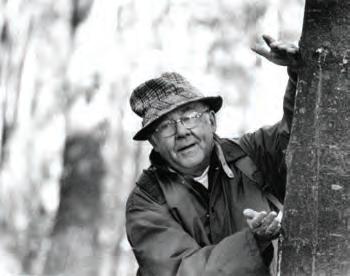
8. Forest Society Education Director Leslie “Les” Clark shows the annual growth increment indicated by a whirl of branch scars on a white pine tree
9. An Ayres lantern slide of Franconia Notch.
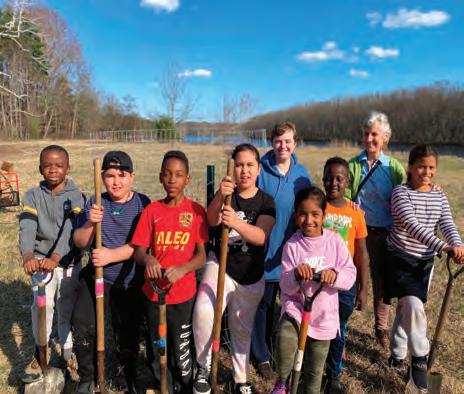
10. Students from Concord’s Broken Ground Elementary School plant mulberry trees on the Merrimack River Floodplain.
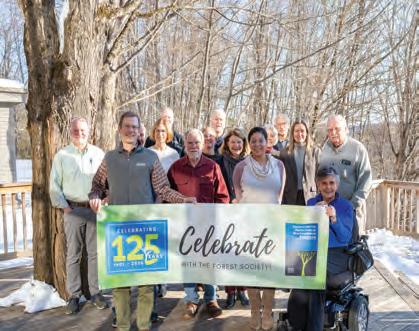
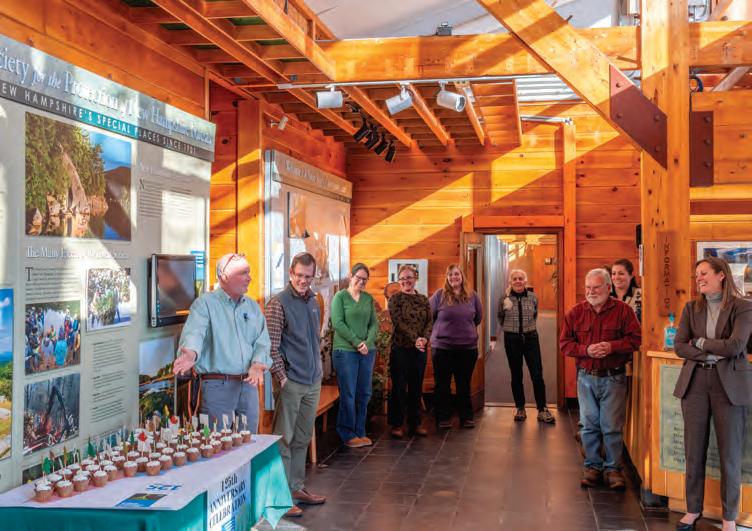
11. The Forest Society board (pictured) celebrated the organization’s 125th birthday with staff on February 6, 2026, at the Conservation Center in Concord.
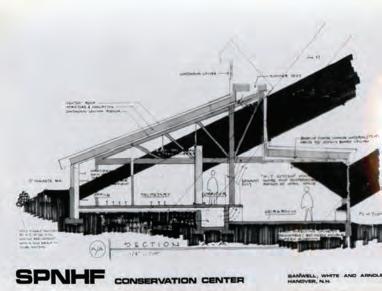
12. A cutaway view of the Concord Conservation Center main building, circa 1979, showing the angle of the roof pitch to maximize winter solar gain for passive heating and minimize summer solar gain for passive cooling/shade.
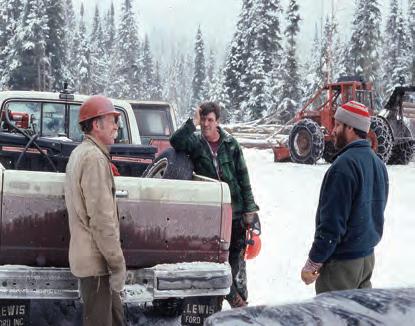
13. Loggers and foresters meet on the landing for lunch Note the vintage 1970s orange “Timberjack” rubber-tired cable skidder with double-diamond studded chains in the background
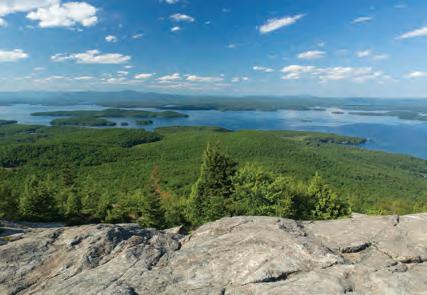
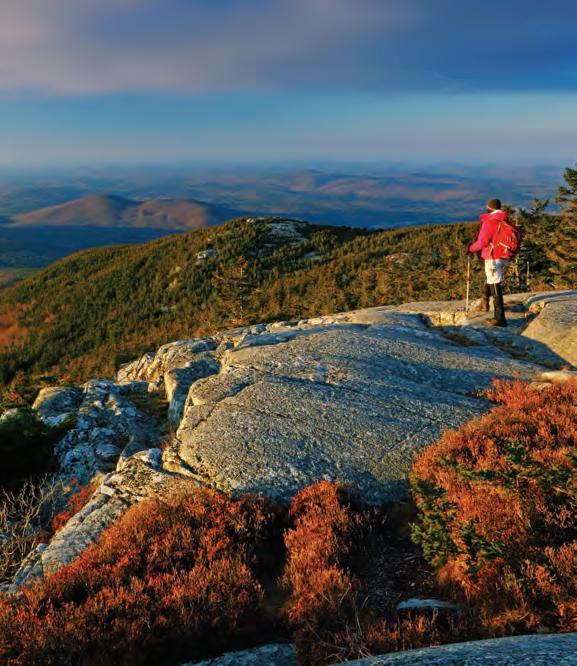
14. One of the Forest Society’s most popular destinations, Mount Major and its panoramic summit, provides sweeping views of Lake Winnipesaukee, the Belknap Range, and the White Mountains.
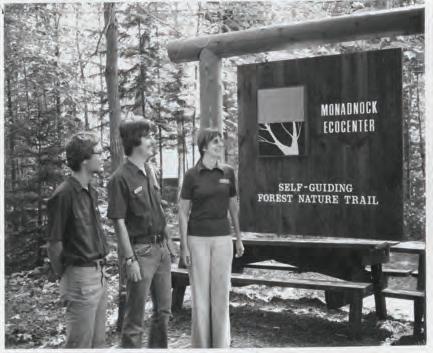
15. Forest Society staff talk to hikers at the Mount Monadnock Eco Center. A self-guided Forest Nature Trail loop in the surrounding woods included native tree and shrub ID during the summer season.
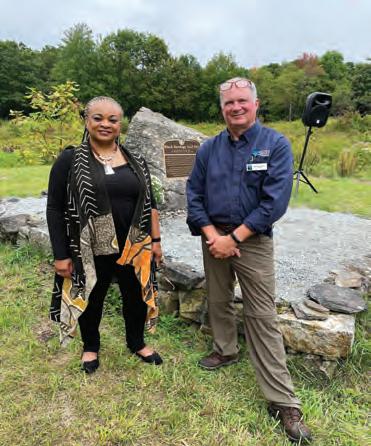
16. JerriAnne Boggis, executive director of the Black Heritage Trail of NH, and Jack Savage, Forest Society president, stand in front a plaque at the Welch Family Farm that honors the Due family and Jack, a once-enslaved African who gained his freedom and lived in Hancock in the late 1700s and early 1800s.
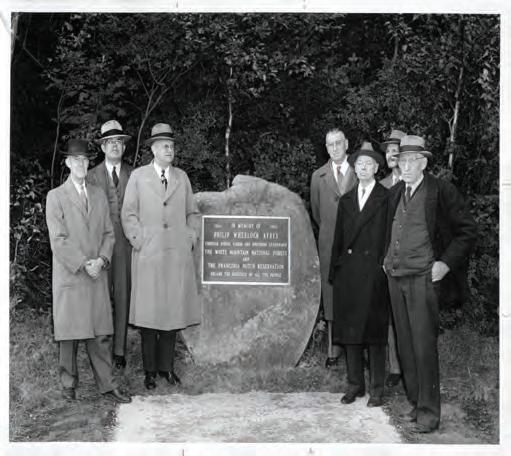
17. State of New Hampshire dignitaries attend the dedication ceremony of the Philip Ayres Memorial plaque in Franconia Notch State Park
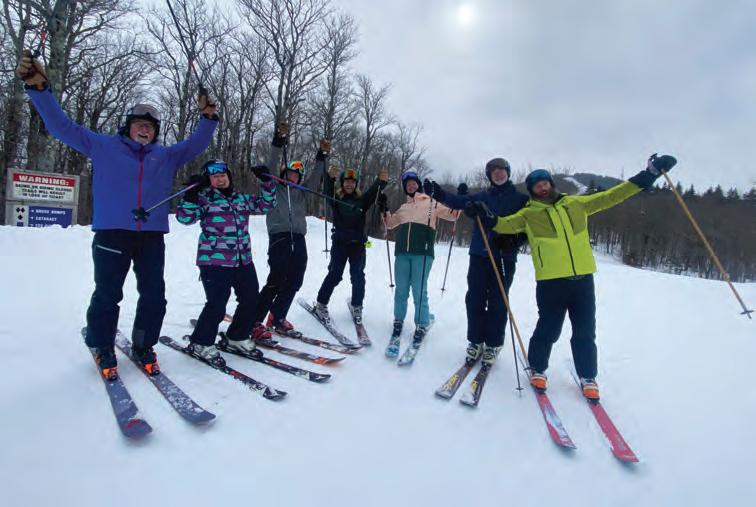
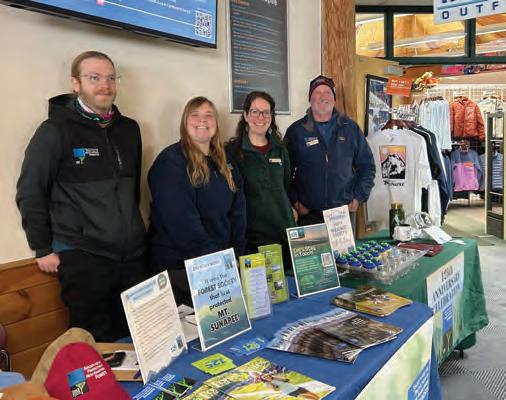
From skiing at Mount Sunapee with staff and supporters to a special visit with the Governor, it was an exciting start to the Forest Society’s 125th year in early February
The Forest Society marked the 125th a n n i v e r s a r y o f i t s f o u n d i n g d a t e o f Februar y 6, 1901, with a celebrator y ski day at one of the first landscapes it protected, Mount Sunapee In collaboration with Mount Sunapee Ski Resort, deeply d i s c o u n t e d l i f t t i c k e t s w e r e o f f e r e d t o Forest Society members on February 6, and more than 40 people participated. “This was a great way for the Forest Society to thank our members, as well as to engage with others in the Sunapee community
Board and staff members ushered in the Forest Society’s 125th year at Mount Sunapee in February.

Naomi Brattlof
While many of us have been celebrating a snow y winter here in NH, we equally k now the excitement many of us are feeling as we head into spring. The stewardship managers have been hard at work behind their desks all winter prepping for the busy field season ahead. Some of you may have even already heard from them as they begin to organize their field schedules. While it may still be a few more weeks before we are out in the woods monitoring, we’d like to remind you that we’re here to answer questions and talk through any potential plans on your easement land
about our long history on the mountain,” said Carrie Deegan, VP for recreation mana
. T h e Forest Society first purchased 656 acres on the north side of Mount Sunapee in 1912, primarily to prevent the slopes from being clearcut by paper company owners Thanks to additional protection efforts, the “Mount Sunapee Forest Reser vation” g
d e s before 1,116 acres of land was transferred to the State in 1948 to establish Mount Sunapee State Park. “We’re grateful to New Hampshire State Parks and Vail Resorts for granting this fantastic engagement opportunity on our 125th anniversary!”
Landowners of Forest Society Conser vation Easements: We are hosting an Open House event in August showcasing Forest Society easement lands throughout the state! If you’d like to learn more or be involved in this event, please connec t with Naomi at nbrattlof@forestsociety.org or (603) 856-4055.
Naomi Brattlof Easement Stewardship Director
forestsociety.org/steward- contac t
Timber Barons for eons went on a spree
They saw nothing more profitable than a big tree. They cut down the trees for masts and for spars, Trees for the markets nearby and afar.
They never, oh never, were able to see The value of the forests because of the trees Trees for rail ties and trees for house beams
Sent them all tumbling down in the streams
Potash for farms, so much they could earn: Not a thought for the future Burn, Baby, Burn!
Clear-cutting the White Mountains was next on the docket: No protest could be heard above all the racket.
But in 1901 came the Company of Eight
To save the White Mountains before it’s too late With wisdom and foresight, they were able to see The value that the forest had for the trees.
They formed the Society to preserve and protect, To research and educate, and to stop the neglect, To selectively cut for the health of a stand, And preserve habitations for all life on the land
For a century and a quarter, to be just exact, We see the results of that visionary act
Thousands of acres the White Mountains, too Are saved now forever to enjoy, and to view Hail to the Society for the seeds you have planted And for the unending gift to New Hampshire you’ve granted!
Margaret M. Yatsevitch
Margaret (“Daisy”) Yatsevitch is a retired teacher-educator and has been a member of the Forest Society for more than 35 years.
A P R I L 22
Mount Major Ear th Day and V TOP Kickoff
Mount Major, Alton
MAY 15
Merrimack River Floodplain
All Persons Trail Dedication
Merrimack River Outdoor Education & Conser vation Area, Concord J U LY 14
Forest Society Day at Lost River
Lost River, Nor th Woodstock
AU G U S T 22
Vistas and Vibes Outdoor Concer t
The Rocks, Bethlehem
S E P T E M B E R 10–14
Monadnock Trails Week
Mount Monadnock and Gap Mountain
26
The Forest Society ’s 125th Annual Meeting
The Rocks, Bethlehem
For more events celebrating the Forest Society ’s 125th anniversar y, visit forestsociety.org/events.
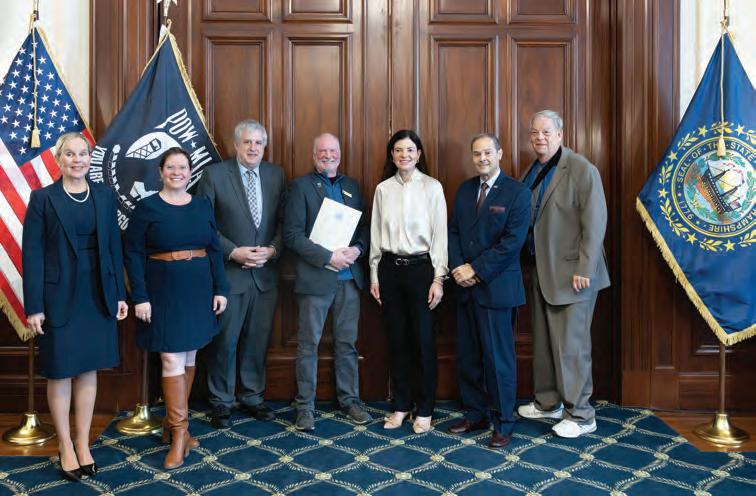
Executive Councilors Janet
Joe
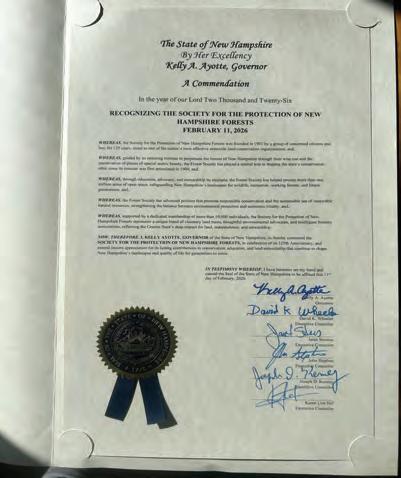
John Stephen, and David Whee Forest Society President Jack Savage and Governo Ayotte for a photo during the governor’s proclam of the Forest Society’s 125th anniversary at the S House on February 11, 2026.
The proclamation document issued by th office of Kelly Ayotte and the New Hampshire Executive Council
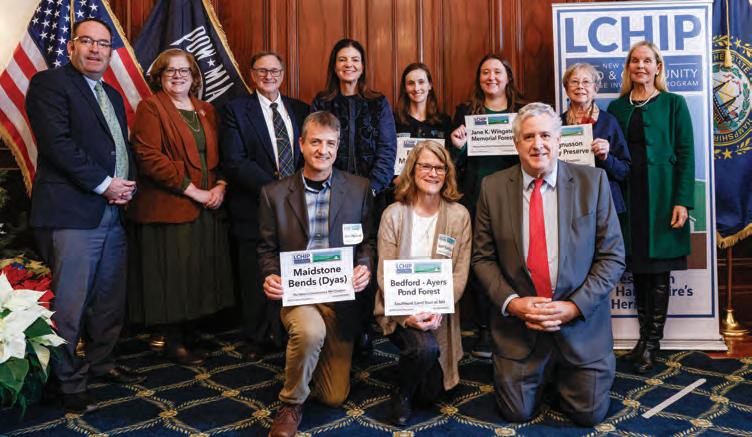
I n D e c e m b e r 2 0 2 5 , G o v e r n o r K e l l y Ayotte joined the New Hampshire Land and Community Heritage Investment Program (LCHIP) Committee in announcing $3.5 million in matching grants to support 31 land conservation and historic preservation projects across the state. The grants will support efforts to rehabilitate 21 historic buildings and permanently conserve nearly 3,000 acres of farmland, timberland, and e c o l o g i c a l l y s
corners of the state.
a l
T h e F o r e s t S o c i e t y w a s a w a r d e d t h r e e g r a n t s t h a t w i
i n M a d b u r y, N
together protecting nearly 1,800 acres
Expanding Powder Major ’s Forest in Madbur y
The Powder Major’s Forest in Madbury w a s i n i t i a l l y c o n s e r v e
M
m e t Elementar y School. The Forest Society is working with a dedicated landowner to the north of the property to acquire and c o n s e r v e a n a d d i t i o n a l 1 3 3 a c r e s t
e x t e n d s a l l t h
Madbury. For more about the campaign to protect this special place, turn to page 24
Conser ving the Nelson Highlands in Nelson, Antrim,
The Forest Society is embarking on a pivotal initiative to acquire and permanently conser ve the 650-acre Nelson Highlands property in Nelson, Antrim, and Hancock. This acquisition is highly strategic, as it will be a major addition to the extensive network of conserved lands known as the Super Sanctuar y The Nelson Highlands sits directly in the heart of the Quabbin-toCardigan Conservation Focus area, which traces a critical south-to-north ecological spine from central Massachusetts through the Monadnock and Sunapee regions and up to the White Mountains. The property location virtually encircled by existing c o n s e r v a t i o n l a n d e n s u r e s m a x i m u m
connectivity and protection of wildlife corridors. Remote in character, the property encompasses four peaks over 1,600 feet in elevation, offering diverse habitats The land is currently managed for sustainable forestry resources The Forest Society and the Harris Center for Conser vation E d
project over the coming year A grant of $200,000 from LCHIP will be matched through a significant collaborative fundraising campaign in 2026.
Located adjacent to Gile State Forest, Carter Brook Wildlife Management Area, and other conser ved lands, the Pillsbur y R
Springfield on the border with Grafton This remote tract of primarily northern h
managed for many years by a licensed forester. The high-elevation, rugged terrain o n t h e p
life habitat, including crucial habitat for wild Eastern Brook Trout The property is used by hunters, and there is a snowmobile trail that connects directly into the extensive networks of Gile State Forest and Carter Brook Wildlife Management
Area, enhancing local recreational opport u n i
sar y matching funds and conser ve this land as working forest and wildlife habitat. Additional fundraising to complete the project will continue through 2026 “LCHIP grants provide essential anchor funding that allows ambitious conser vation projects to succeed,” Forest Society President Jack Savage says. “They leverage diverse funding sources and unite partners in a common purpose: to conser ve New Hampshire’s forests, mountains, waters, and landscapes for the benefit of all We are also thrilled to be part of LCHIP’s 25th anniversary celebration The accomplishm
generations ”
each dollar contributed by LCHIP with at least one added dollar and complete t h e f u
program’s rigorous standards. This year’s $3 5 million awards will be matched by more than $13 million from other public and private sources, infusing $17 million into the state’s economy through direct project activity.
House Bill 1293, legislation that would tax the land and buildings of nonprofit organizations, had a public hearing on Januar y 29, 2026 If enacted as drafted, this bill could create significant financial c
p
b l i c a c c e s s , a n d s e r v e c o m m u n i t i e s statewide. The Forest Society testified in opposition to HB 1293, underscoring the unintended consequences the bill could have for conservation, public benefit, and charitable missions
On Februar y 2, the House Committee o n Wa y s a n d M e a n s v o t e d t o s e n d HB 1293 to interim study. In the New Hampshire Legislature, interim study is a procedural step that pauses action on a bill to allow for further research, discussion,
and review often used for complex or far-reaching proposals. While this action halts the bill for now, it does not mean HB 1293 has been defeated. The committee may revisit the legislation later this year, and it is possible the bill either in its current form or an amended version could be considered for a vote in 2027
We will continue to monitor HB 1293 closely and keep you informed as developments arise In the meantime, we extend our sincere thanks to the 786 individuals who registered their opposition to this bill. Your voices made a difference, and your engagement remains critical as this issue evolves
To read the Forest Society ’s testimony, visit forestsociety.org/hb1293
The Forest Society encourages landowners to consult with a licensed forester before undertaking land management activities. The following are paid advertisers.
Evergreen Forest Management, LLC
Specializing in creative, ecological approaches to forest management that are designed to provide long-term economic benefits to landowners and their forests. 752 Rt 103A Newbur y, NH 03255 • 802-310-0292 efm-llc.com
Mar tin Forestr y Consulting, LLC
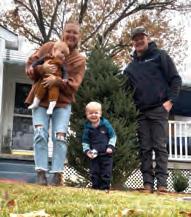
Trees for Troops, a program of the Christmas SPIRIT Foundation, provides free, farmgrown Christmas trees to United States armed forces members ser ving in all branches of the militar y and their families through donations, sponsorships, grants, and the work of many volunteers. In 2025, more than 340 Christmas tree farms, including The Rocks in Bethlehem, donated a total of 21,117 trees that were delivered to 94 militar y bases across the countr y. This is the 12th year The Rocks has par ticipated in the program, and in 2025 it donated 40 trees Over the lifetime of the program, Trees for Troops has now organized the donation and distribution of more than 347,000 trees. Here are just some of the responses we received from ser vice members this year.
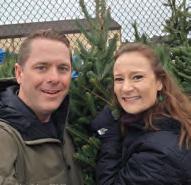
My name is Vickie Greatwood, and my boyfriend, Andy, and I got [a Rocks Christmas tree] at the Trees for Troops event at Fort Story this year Andy has been single the past few Christmases and didn’t bother getting a tree. This year we have each other and, since I’m a huge Christmas fanatic, it was a blessing and wonderful date to pick a tree and give Andy a little bit of the Christmas spirit this year! It’s also my very first live tree. It’s so beautiful and perfect! Thank you!
We are so grateful for the Trees for Troops program and even more grateful for organizations like the Forest Society that donate these trees! This year was our first time getting a tree, and when I read the tag that showed how far your tree had traveled, I knew this was our tree! Your tree made it all the way to Chesapeake, VA! It’s also pretty cool to see it came from Bethlehem. The tree is a beauty and we are so excited to have it in our home this season Thank you again! – The Neyman Family (Justin, Olivia, Luke and Cooper)
Offering complete forest management ser vices, including timber sales, cruises, appraisals, and wildlife habitat management. Ask us about recreation trail planning, construction, Brontosaurus mowing, and forestry excavation services. P.O. Box 89, New Hampton, NH 03256 • 603-744-9484 Email: mar tinforestr y@gmail.com
Meadowsend Consulting Company
Quality Consulting Forestr y with Integrity Guaranteed
Jeremy Turner, NHLPF #318 – Southern NH jturner@meadowsendco com
Matthias Nevins, NHLPF #518 – Central NH mnevins@meadowsendco com
Ryan Kilborn, NHLPF #442 – Nor thern NH rkilborn@meadowsendco com
Vast range of quality land management ser vices. Connect with us for a free site consultation! meadowsendco.com • 603-526-8686
Licensed foresters should address inquiries about advertising to Anne Truslow by calling 603-224-9945 or emailing atruslow@forestsociety.org.
By Steve Junkin
De e r a r e p
r e f e r e n t i a l f e e d e r s , n o t
u n l i k e h u m a n s t h a t p r e f e r c e rtain foods over others If a deer
h a d t o c h o o s e b e t w e e n e a t i n g a n o a k
s a p l i n g o r a b e e c h s a p l i n g , t h e y w i l l invariably choose oak first. Perhaps to a
d e e r t h e o a k t r e e i s t h e “ c h e e s e b u r g e r ” of the forest, and the beech is the lowly
“ c e l e r y. ” I k n o w w h a t I w o u l d c h o o s e .
T h i s p r e f e r e n c e m o s t l i k e l y s t e m s f r o m
a d i f f e r e n c e i n m i n e r a l s a n d v i t a m i n s
f r o m o n e t r e e t o t h e o t h e r I t h a s b e e n documented that deer seek and feed on planted trees that have come from a nurser y because the added fertilizer causes a h i g h e r c o m p o s i t i o n o f n u t r i e n t s i n t h e seedling This can be frustrating to planting efforts, which is why you will almost always find some sort of fence or tubing protecting newly planted trees Deer also p r e f e r e n t i a l l y f e e d o n t r e e s t h a t s p r o u t
f r o m c u t s t u m p s b e c a u s e t h o s e s p r o u t s are supported by a large root system that pumps greater amounts of nutrients into the stems as compared with a sapling that sprouted from seed
F o r e s t e r s d o n ’t m i n d f e e d i n g d e e r some trees, but evidence shows that the c o m p o s i t
shifting composition is white-tailed deer Ironically, deer might be eating themselves o
cascading effect on other organisms in the forest to boot. Because of their preferential feeding, certain tree species cannot grow beyond the height of a stump sprout or young seedling before being gobbled up In high deer density areas, we typically s e e m o r e y
b i r c h , a n d A m e r i c a n h o p h o r n b e a m g r o w i n g i n t h e u n d e r s t o r y a n d m u c h
l e
yellow birch. Diversity in our forests is a key component to healthy and climate resilient forests and deer threaten this.
This article is not going to dive into deer management that is better left for another time. Managing big game species i
assured that biologists from NH Fish and Game work hard to maintain the right balance between the deer population and a healthy ecosystem.
B e y o
regions to the south have tried fencing areas of the forest, which is extremely expensive and difficult to maintain Even t e m p o r a r y f e n c
t and a single branch falling on part of a fence can cause a costly breach. But where
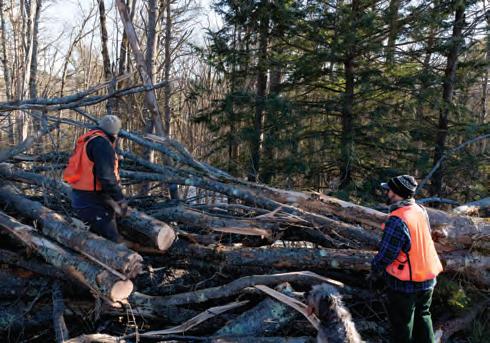
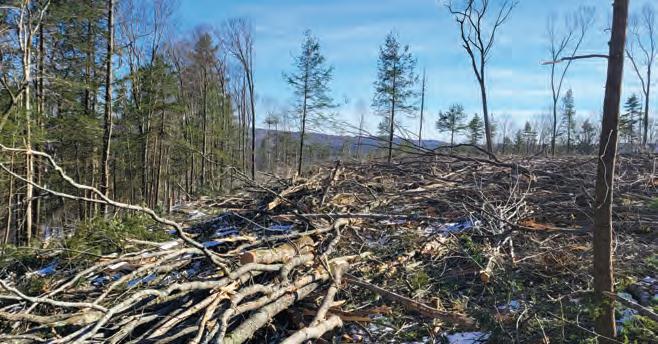
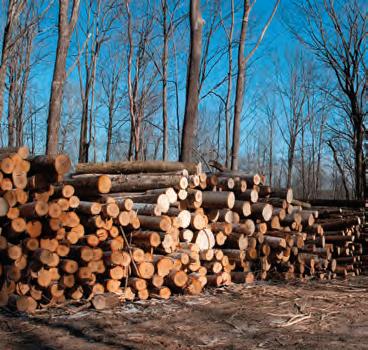
there is a will, there is a way It turns out there are fence and barrier options t h a t a l r e a d y e x i s t i n o u r f o r e s t s t h e y j u s t n e e d t o b e b u i l t . D u r i n g a t i m b e r har vest, there is no better time to build a temporary barrier than when a forest is prescribed for a regeneration cut and the material that is needed for the natural fence is produced on site. Patch cuts and clearcuts are prescribed when foresters are tr ying to promote and regenerate early successional and mid-shade tolerant tree species These treatments can produce a lot of tree tops and branches (aka slash) and additional low-value trees (aka pulp). All this material can be used in a way that creates a temporary deer deterrent.
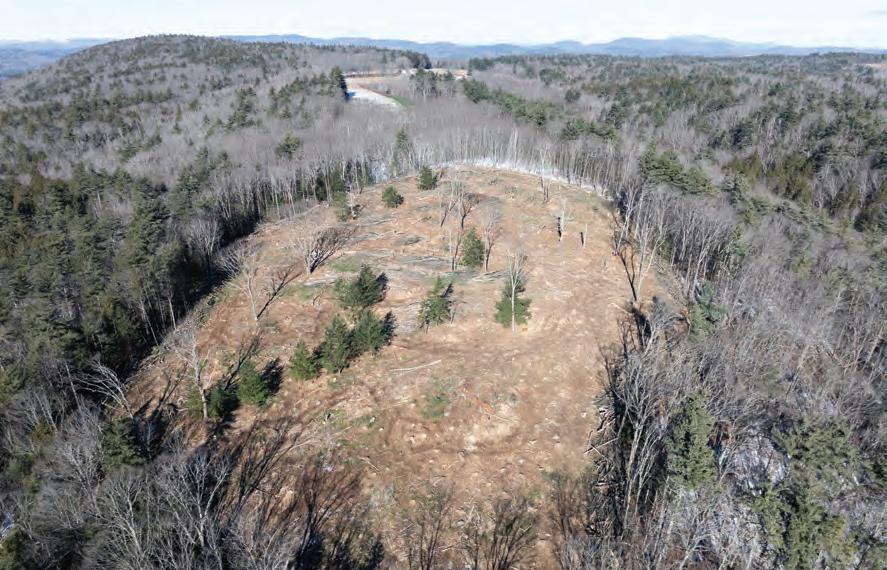
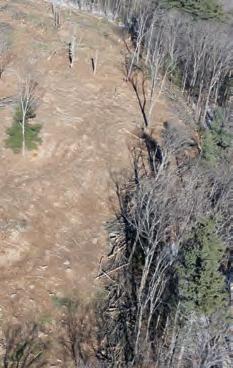
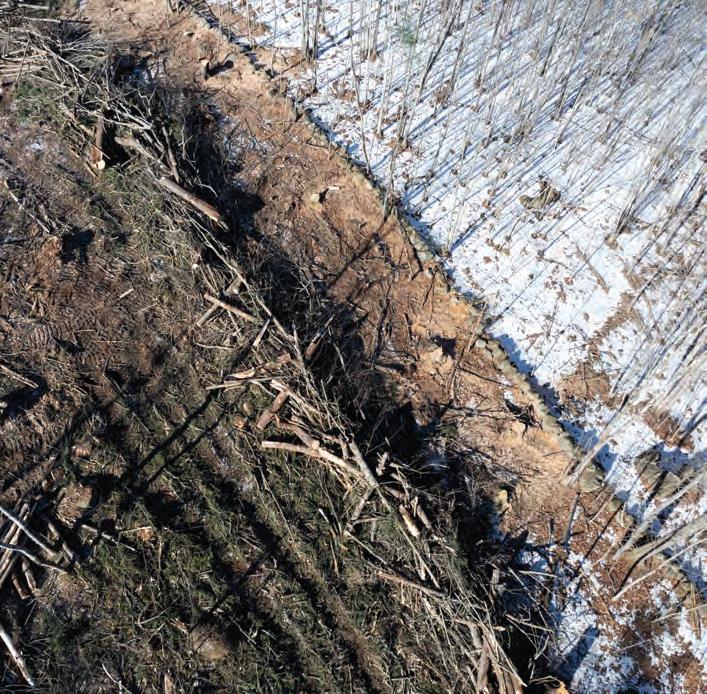
In other parts of the Northeast and M i d - A t l a n t i c , d e e r b r o w s e i s s u e s h a v e been occurring for many years, especially i n C o n n e c t i c u t a n d N e w Yo r k , w h i c h h a v e m u c h h i g h e r d e e r d e n s i t i e s T h i s winter, the Forest Society, working with logging contractor Chuck Rose, Inc , is e x p e r i m e n t i n g w i t h t w o d e e r - d e t e r r e n t approaches slash walls and slash blankets that were successful in these states at t h e D u d l e y P o n d F o r e s t i n H e n n i k e r. Both approaches use low-grade material and slash but in slightly different ways. We also tapped the experience of UNH C o o p e r a t i v e E x t e n s i o n F o r e s t e r S t e v e Roberge, who procured the grant funding and assisted with the design and layout of the regeneration areas.
A slash wall is constructed around the perimeter of an area that was harvested with the intent to regenerate a certain mix of tree species that will become the future forest In the case of Dudley Pond, foresters are aiming to protect a seven-acre site The recommended dimensions of the wall are eight feet high by ten feet deep, exceeding the hurdling distance of even the finest jumpers of deer The girth also increases the wall’s ability to withstand all types of weather conditions, including heavy snow. Built properly, these walls can deter deer for five-plus years before they show signs of degradation and breech susceptibility By that point, seedlings have had a chance to grow tall and out of reach of a deer’s mouth.
Take the leftover slash material (e g , tops of trees and branches) from a harvest and create a 100-foot wide slash blanket that buffers the perimeter of the regeneration area and, voilà, you’ve got a gnarly looking obstacle course made to deter even the s l y e s t o f d e e r U p o n c o m p l e t i o n , t h e blanket at Dudley Pond will be 11 acres, which will not only serve as habitat for birds and small animals but it will also ward off hungry deer Four feet tall by at least 100 feet wide are the recommended dimensions of the blanket, so by the time the material breaks down the saplings have grown without pressure.
This spring, species including red oak, s u g a r m a p l e , y e l l o w b i rc h , p i n c h e r r y, black cherr y, and white ash will begin to sprout in the newly exposed soil at Dudley Pond Forest Recently, the Natural Resources Conser vation Ser vice (NRCS) added slash walls and slash blankets to its list of Conservation Practice programs, g i v i n g l a n d o w n e r s t h e o p p o r t u n i t y t o apply for incentive payments to implement these techniques T h e D u d l e y P o n d
e possible through an NRCS Conser vation Innovation Grant awarded to the UNH C o o p e r
Wildlife Team In partnership with UNH’s forestry program, the Forest Society implemented this project to create opportunities f o r p u b l i c e d u c a t i o n a n d p r o f e s s i o n a l knowledge sharing, including tours that were held in January and February 2026 The project will also generate valuable information on costs, feasibility, and the l i k e l
. Moving for ward, the Forest Society will continue working with our partners to refine these practices in New Hampshire and develop recommendations to guide future implementation. The deer might not like it, but the trees surely will
Steve Junkin is a field forester for the Forest Society
By Nigel Manley
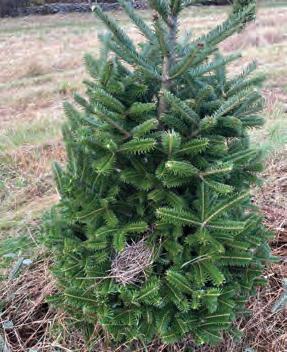
Christmas tree fields in northern New England are working lands c a p e s t h a t s u p p o r t m o r e t h a n rows of different species of firs, pines, and spruce At the Forest Society’s Christmas
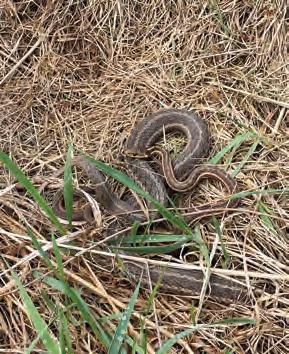
Tr e e F a r m a t T h e R o c k s i n B e t h l e h e m , more than 40 acres of fields provide habi t a t f o r a w i d e r a n g e o f w i l d l i f e F r o m insects that pollinate and recycle nutrients to large mammals that move along the forest edge, these farms are assets to the local ecosystems. Wildlife might not be present every day, but they are always shaping the health of the land and the quality and quantity of the trees grown for the holiday season
The Struc ture of the Landscape
C h r i s t m a s t r e e f i e l d s a r e t y p i c a l l y open early- to mid-successional habitats
Compared with dense forests, they have more sunlight reaching the ground; grow a variety of grasses, herbs, and shrubs; and see frequent disturbance due to mowing, pruning, and harvesting This creates opportunities for many species that cannot thrive in closed forests or in developed areas.
A t T h e R o c k s , m o r e t h a n 1 8 , 0 0 0 Christmas trees are growing in some parts of the fields while other areas are left unplanted and support native plants Over time, these spaces become layered habitats The variation in vegetation structure provides food and cover for birds, mammals, and insects throughout the year “It’s wonderful to have so many different kinds of birds and animals present,” says Adam Buxbaum, Christmas tree farmer at The Rocks. “If you want a balanced ecosystem, you need diversity ”
B i r d s a r e a m o n g t h e m o s t v i s i b l e wildlife at The Rocks. Many species use the
fields for foraging, nesting, and protection. A short stroll to the picnic table on the hill offers many opportunities to spy winged traffic in the air and on the ground.
A m e r
that hover over open fields, scanning for insects, mice, and voles. These birds are efficient predators of small mammals a benefit in tree fields, where rodents can eat seeds and chew on the bases of young
box has been installed on a tall post in one field to attract nesting pairs When
trees Cedar waxwings will nest regularly i
obser ved nesting within smaller, closely spaced conifers.
By maintaining a range of tree sizes and preser ving wooded edges, Christmas tree farms such as The Rocks provide nesting o p p o r t u n i t i e s f o r a d i v
tree-nesting birds. Together with groundnesting birds and raptors, these species highlight the role of Christmas tree fields a
Bethlehem’s working landscape
C
having to use chemical control.
property as well, including the Northern Harrier, which can be seen riding thermals over the fields
Several bird species nest on or near the ground, especially in fields that are not mowed early in the season In these fields, ground-nesting bird populations increase. Species such as killdeer, woodcock, wild turkeys, and bobolinks benefit from taller grasses and undisturbed ground cover.
In addition to birds that forage or nest
and shelter As trees mature, they provide d
throughout the White Mountains region. This habitat supports a variety of treenesting birds common to Bethlehem and the surrounding North Country.
American robins are one of the most popular tree farm residents and can often
variety of mammals, from small rodents to large herbivores “While many animals continue to lose habitat, Christmas tree f
where many species can thrive,” Buxbaum notes.
White-tailed deer are common visitors t o C h
where open fields meet forest edges. Deer browse on grasses, clover, and the buds of younger Christmas trees At The Rocks, there is little damage done by deer unless the winter is particularly harsh
Porcupines are familiar residents of early successional habitats and forest edges. They feed on bark, buds, and twigs of trees and shrubs. In Christmas tree fields, porcupines may chew on the lower branches of taller trees and completely denude tree seedlings p a r t i c u l a r l y i n w i n t e r m o n t h s w h e n other food is limited While this can be frustrating for growers, porcupines are
a natural part of the ecosystem, helping cycle nutrients and serving as prey for large carnivores such as fishers.
Black bears are adaptable omnivores In Christmas tree fields, they are often seen foraging during the warmer months particularly on clover, which is planted as a cover crop around the trees. Bears will also dig into rotten stumps searching for ant lar vae a high-protein food source and will break open ground wasp nests to eat the lar vae within Ground wasps and other social insects build nests in the soil as well as the trees, and their lar vae are rich in nutrients that bears seek out, e s p e c i a l l y i n s p r i n g a n d e a r l y s u m m e r after hibernation
T h e s e f e e d i n g b e h a v i o r s c a n d i s t u r b soil and plants, but they are part of the natural pattern of bear foraging behavior in New England’s mixed agricultural and forested landscapes
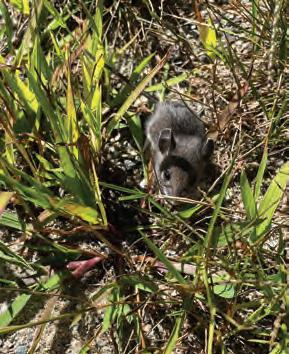
Mice, voles, shrews, and chipmunks are abundant in and around tree fields. These animals feed on seeds, roots, and insects. They are key prey for raptors and carnivores. In fields with thick grass and brushy edges, small mammals find cover f r o m p r e d a t o r s a n d c o n t r i b u t e t o s o i l a e r a t i o n a n d n u t r i e n t c y c l i n g t h r o u g h their burrowing.
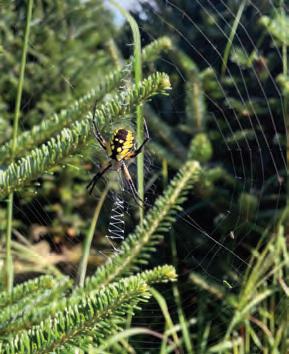
Insects are foundational to the food web Pollinators, including bees and butterflies, visit wildflowers in field margins and fallow patches. Beetles and ants break down dead plant material, returning nutrients to the soil Ground wasps, while occasionally disrupted by predators such as bears, help control other insect populations
A t T h e R o c k s , f i e l d s l e f t t o g r o w seasonal wildflowers attract a diversity of pollinators These insects not only support wild plants but also benefit the broader landscape by enhancing soil health and supporting higher trophic levels birds and small mammals that feed on them
Habitat Management Prac tices Wi
decisions At The Rocks, several practices support biodiversity while balancing tree production.
Delaying early spring mowing benefits ground-nesting birds. Leaving grass and herbaceous cover through the breeding s
and young birds to fledge successfully. Strategic mowing later in the season still m
without compromising nesting success
I
needed nesting structures for these small
raptors. This supports kestrel populations and creates a natural control for rodents t
g
. Additional perches and brush piles offer hunting sites for other raptors and cover for small mammals.
Ma in tai ni ng un- mo we d b uff er st rip s a l o n g w o o d
margins creates travel corridors for wildlife These buffers connect habitats and reduce disturbance. They also slow runoff during heavy rain events, improving the water quality on the farm.
Christmas tree fields in northern New England are more than agricultural plots. They are dynamic ecosystems where birds, mammals, and insects interact. At The Rocks, the presence of kestrels hunting from boxes, deer feeding and producing offspring, bears digging for insect larvae, a
where mowing is managed thoughtfully all illustrate the ecological complexity of working landscapes By recognizing and supporting wildlife needs, tree farms can contribute to regional biodiversity while producing trees for the holiday season. “I love that in growing these trees and maintaining the fields, I get to be a part of this unique environment,” Buxbaum says. “To see an entire community of organisms thrive is very gratifying.”
By Marcia Schmidt Blaine
[Editor’s note: This story was originally published in Beyond the Notches: Stories of Place in New Hampshire’s North Country (Bondcliff Books in partnership with Monadnock Institute of Nature, Place and Culture at Frankin Pierce University, 2011); reprinted by permission.]
Th e p u b l i c d i s c o v e re d
t h e W h i t e M o u n t a i n s
i n t h e e a r l y 1 8 0 0 s ,
a n d a r r i v e d i n e v e r l a r g e r
n u m b e r s , a t t r a c t e d b y t h e
a w e i n s p i r i n g s c e n e r y a n d
v a s t s t a n d s o f f o re s t . B y t h e 1880s, the mountains echoed
w i t h t h e s o u n d o f s a w s a s those bent on profit cut every t re e , w h i l e t o u r i s t s s t ro l l e d
a l o n g t h e v e r a n d a s o f t h e grand hotels and the intrepid
c l i m b e d t h e m o u n t a i n p ea ks in search of panoramic views. Increasingly, the two cultures
c o l l i d e d . Vi s i o n a r i e s J o s e p h
B . Wa l ke r a n d P h i l i p A y re s
a w o ke N e w H a m p s h i re a n d
t h e n at i o n t o t h e e c o n o m i c ,
s p i r i t u a l , a n d e n v i ro n m e n t a l
i m p o r t a n c e o f t h e W h i t e
M o u n t a i n f o re s t s . Th e i r w o r k
m a d e t h e W h i t e M o u n t a i n National Forest a reality.
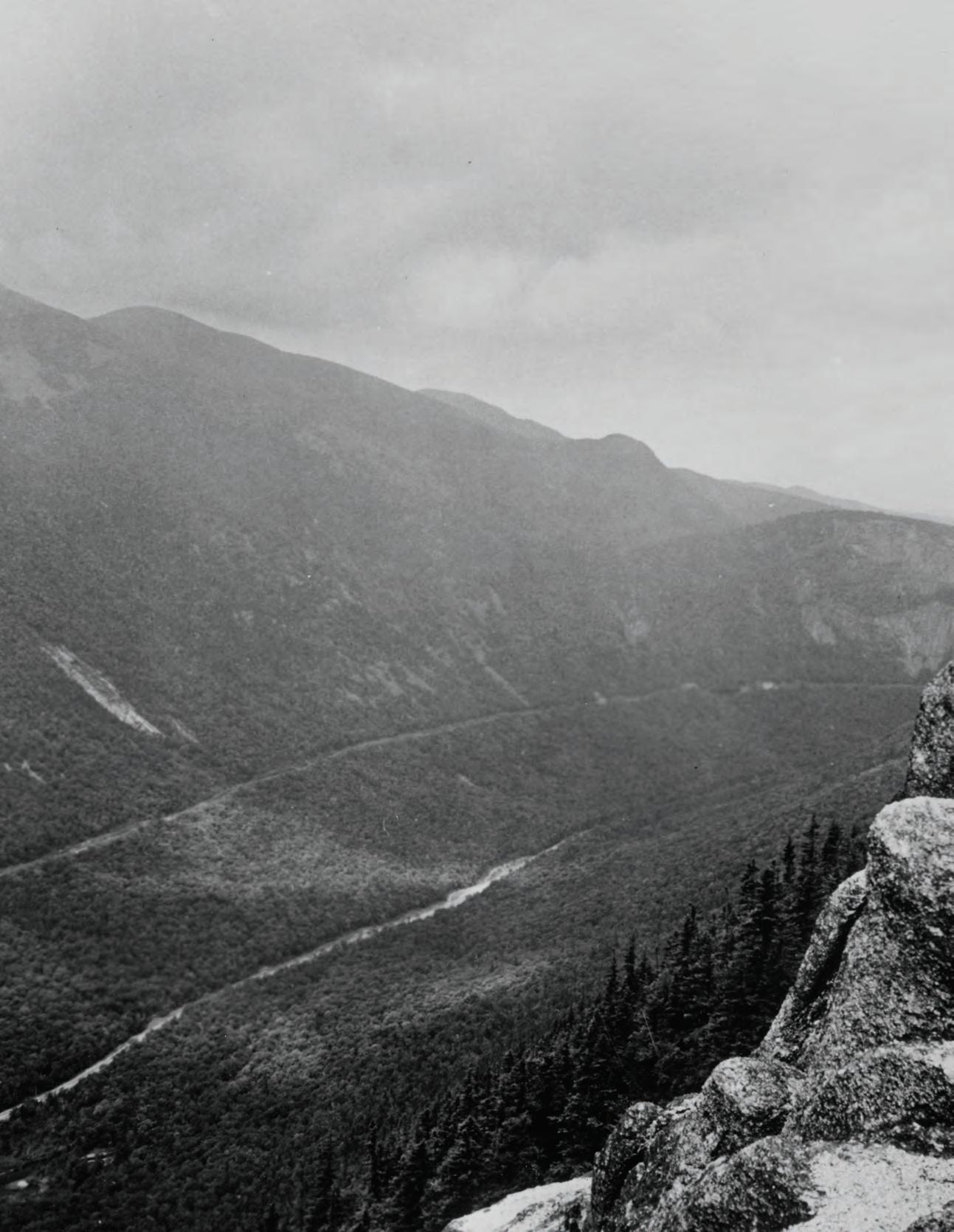
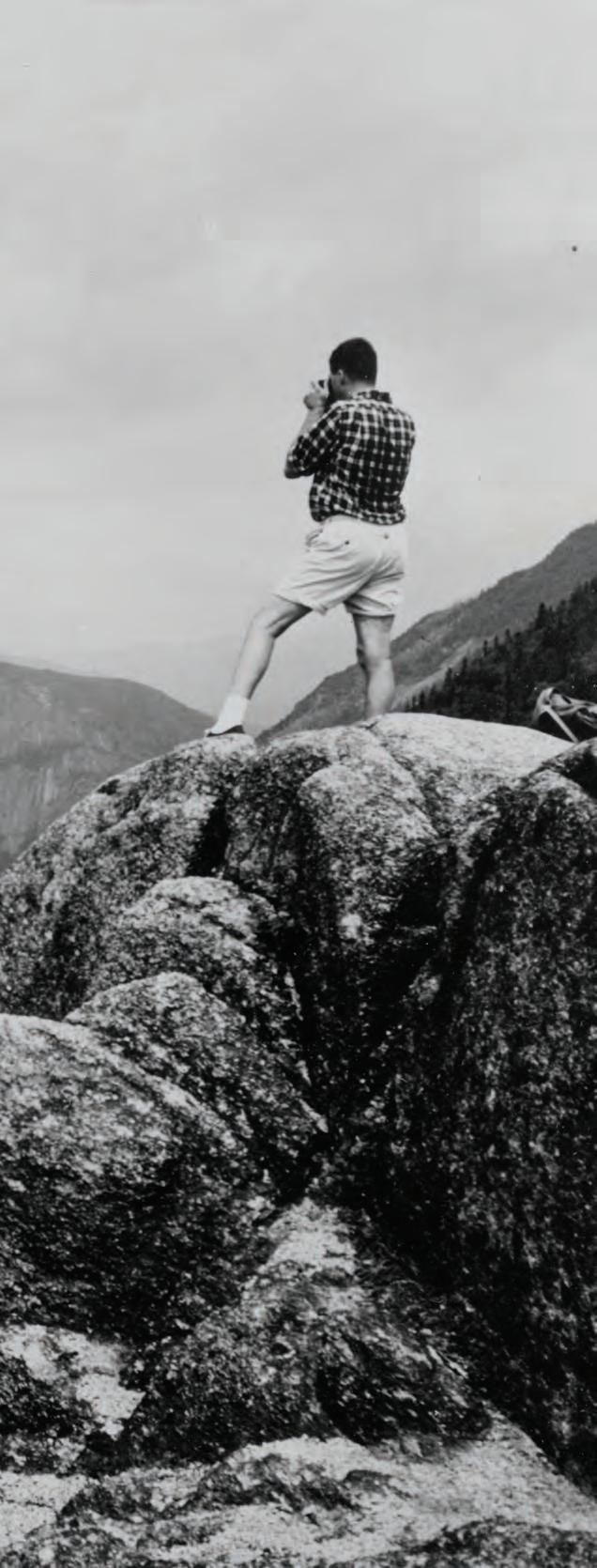
Philip Ayres used lantern slides in the early 1900s to advocate for protecting the White Mountain region, including Crawford Notch. While photographic technology has evolved from slides to black-and-white to digital so too have the landscapes Ayres and others worked to protect.
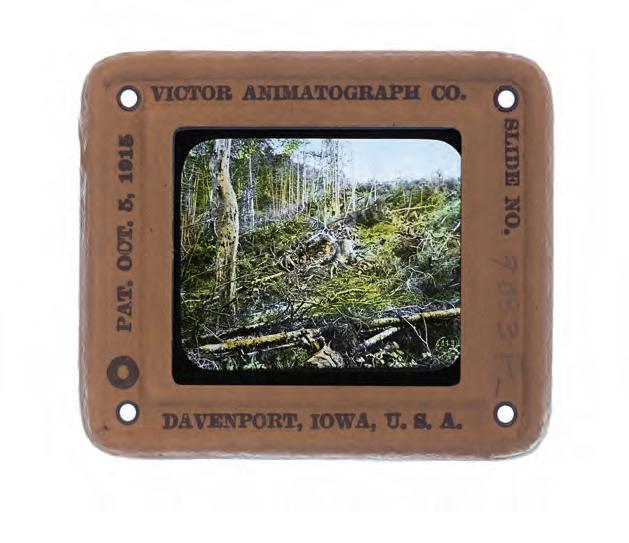
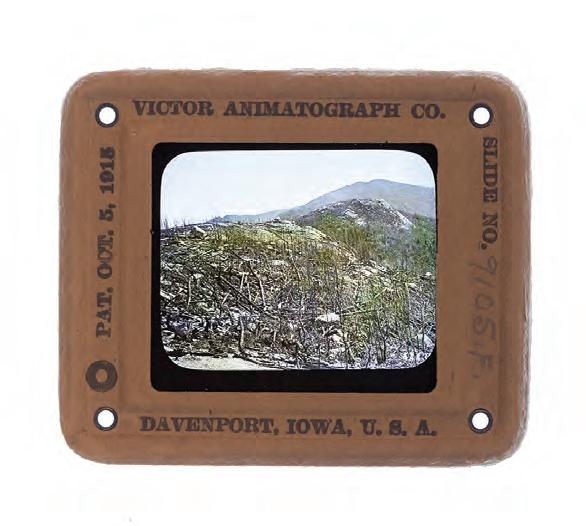
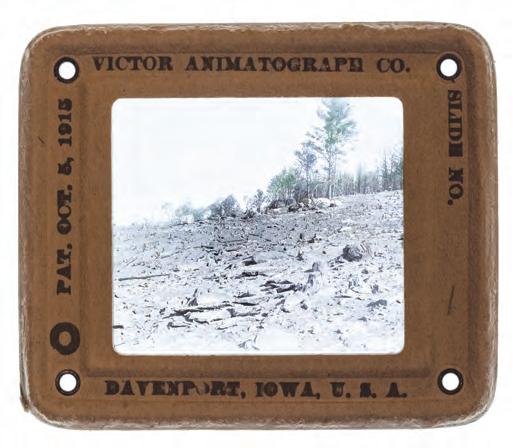
Unchecked logging, as seen in Philip Ayres’s magic lantern slideshow, became a rallying cry for the Forest Society and other organizations to create a White Mountain National Forest in the 1910s.
Long before it was popular, Joseph B. Walker urged New Hampshirites to protect their forests Born in 1822, Walker was a Concord , N H , native who trained as a lawyer but turned to business and civic affairs. While he apparently did quite well in railroads and banking, his passion was farm and forest He served the state on multiple committees, beginning in the early 1870s, investigating water power, agricultural lands, forests and forestry As a member of the state legislature, he urged the state to investigate practices of loggers and called for forest management. He ser ved on the first state forestr y commission, appointed in 1881, to investigate “forest depletion.”
Wa l k e r ’s l o v e o f t h e W h i t e M o u n t a i n s b e g a n w h e n h e was a teenager In 1838, he stayed near the Notch in one of the Crawfords’ rustic inns, a trip he thoroughly enjoyed. This experience fixed the White Mountains as an area worth saving He admitted as much in a speech he gave in 1895 in which he said that, along with being impressed by the mountain forests, “possibly the impress[ion] may have been deepened somewhat by the society of the landlord’s two daughters, and also a little more by the abundant supply of mountain trout served upon his table ” Walker’s wealth made possible repeated stays in the White Mountains and, given his fondness for forests, desirable He w a s i n c r e a s i n g l y d i
s
eye in the early 1870s “A few years ago the lumberman made his appearance, and half a centur y of persistent effort will be requisite to restore the charms which his axe destroyed in a single season ” Clearly the forests needed better management “What can we do to avert the dangers that impend, for I hold that we cannot afford much longer to do nothing We are drifting towards a timber famine.” He called for a survey of New Hampshire’s forests to understand not only their commercial but their aesthetic character Given the date for his speech, 1871, Walker was in the forefront of what would become a national progressive conser vation movement Even so, Walker was not alone in his concern for the forests. The first national park was
created in 1872 and the Appalachian Mountain Club, with its White Mountains focus, formed in 1876.
But most citizens believed in absolute economic freedom without regard for long-term repercussions Unrestricted logging continued as the pulp mill industry slipped into high gear during the 1880s. Pulp mills could use logs of all sizes and clear cuts became the norm Loggers “swept away the forests” from the Ammonoosuc River valley and then moved into “the grand old woods” surrounding Crawford Notch and Walker’s summer retreats The fires that followed the woodsmen left a blackened, gnarled landscape with only stubs remaining of the once virgin forest Some individuals, including the head of Manchester’s Amoskeag Mill, the largest mills in New England, and hotel owners, spoke out against the destruction of New England’s watershed The forests retained rain water and released it slowly Without a forest cover, there were increasing spring floods and fall droughts
The devastating fires of 1886 gained the attention of many. Walker used their attention “As one now looks upon the two towering sentinels of fire-blasted rock which mark the opening of [Zealand] valley, there blazes into his mind, in letters of living fire, the terrible inscription which Dante in his Divine Comedy placed over the entrance to hell: ‘All Hope Abandon Ye Who Enter Here ’”
Walker was a practical man and accepted that recognition of the economic benefits of the forests could create support for forest management and thus forest protection where none then existed. He worked with the New Hampshire Forestr y Commission from its beginnings in the early 1880s to advocate for what was then a radical idea: government purchase of private lands for a “public forest.” In an 1883 address, he suggested “the purchase, at low and established prices, by the state, of some of the denuded areas recently cut over, to be held and managed hereafter as public forests ” He had moved from supporting voluntary forest management of private lands to the belief that public ownership was necessary for forest preservation.

Hampered by a lack of funding, the state did little; the legislature passed a few forestry laws and, in 1893, created a p e r m a n e n t f o r e s t r y c o m m i s s i o n B u t Wa l k e r w a s n o t discouraged. During this time (1883–1893), far more had been attained than was apparent to a superficial obser ver Many persons realized the value of forest property and the importance of its proper management Because of the importance of New Hampshire’s textile industr y, in later speeches he focused on the waterpower provided by the region’s rivers “The greatest injury to be feared from a hasty and unwise removal of these forests is the impairment of the water power upon which many of our most important manufacturing interests are dependent ” Public ownership, he explained, could create a number of benefits: protection from drought, flood, and fire, along with the thoughtful preser vation of the “mature” stands of trees, education of farmers to see timber as another crop, and the protection of the forests for tourism. Walker was an early advocate of what is now called multiple use.
Walker’s rallying cry was picked up by a small group of New Hampshire and New England citizens. As the forests disappeared, concern grew among tourists, hotel owners, conservationists, women’s clubs, artists, hikers, business and political leaders, as well as established loggers and logging companies who feared for future forests This disparate group found that they had a common theme: save the forests But how? Many thorny issues were tangled together in the preservation cause. Was it constitutional for the state or national government to purchase land for conservation? Was conser vation a worthy use of taxpayers’ money? Did clear cutting the remote mountain watershed areas affect water flow downstream? How could a poor state like New Hampshire even consider purchasing and replanting forest lands without help? Should the federal government be able to purchase control over lands now within the sway of state power and part of the state tax base?
By 1900, Walker knew that success would require a national effort and saw hope in the organized work of Gifford Pinchot in the southern Appalachians. But Joseph B. Walker was then 78 years old and beginning to slow down His son and several other key political players urged the creation of an association to protect the White Mountains, “so as to present the whole matter effectively to the incoming legislature. Unless this is done, the lumber barons will stand off action for another two years by which time their work of desolation may be advanced beyond repair.” The aging Walker wished that “some person in supremest [sic] sympathy with the spirit of these mountains and forests might appear” to take up the cause The forests needed a new standard bearer
Walker’s work inspired a small but influential group of state citizens who banded together in 1901 to create The
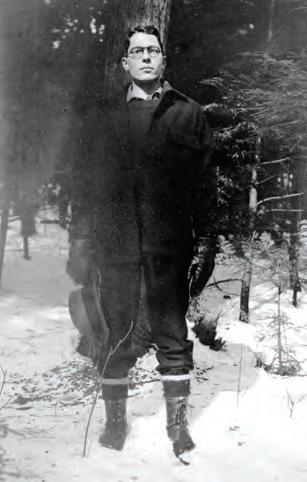
The Forest Society’s first forester, Philip Ayres
Society for the Protection o f N e w H a m p s h i r e Forests Led by Governor F r a n k We s t R o l l i n s , t h e g r o u p i n c l u d e d l e a d e r s from the New Hampshire Women’s Clubs, the state a g r i c u l t u r e d e p a r t m e n t , the state legislature, the hotel industr y, the state n e w s p a p e r s , a n d J o s e p h T. Wa l k e r, t h e a s s i s t a n t secretary of state for New Hampshire and the son of Joseph B The “mission” of the Society was “to protect the White Mountains, which are rapidly being clear-cut.” The early Forest Society leaders recognized that they needed a trained forester They hired Philip W Ayres In Ayres, Walker found a worthy descendant and the forests found a new and effective advocate.
Born in Iowa in 1861, Ayres had little exposure to the White Mountains before 1901, but he had a lifelong love of trees He received a Ph.D. in histor y, worked as a reporter for a short while and then spent over ten years in progressive social reform organizations But health problems forced him to leave his work. In 1899, he married Alice Stanley Taylor. A New England native, Taylor was an activist who worked in similar progressive organizations in Massachusetts and Rhode Island. It was perhaps through mutual work with progressive charities that the two met When Philip’s health declined, she persuaded her husband to return to school. At the age of 40, Ayres received a forestr y degree from Cornell in 1901
When Ayres was asked by the Society for the Protection of New Hampshire Forests to work for them, it is easy to imagine that his native New England wife was happy to return to her roots But it was more than family connections or a desire to practice his new profession that brought Ayres to New Hampshire Taking Walker’s work an explicit step further, Ayres accepted the job on the condition that they allow him to advocate for a national forest reserve As he later phrased it, Society leaders “wanted to save at least a portion of [the White Mountains], and needed a forester I suggested a National Forest in the White Mountains as the most direct and only adequate remedy.” This focused New Hampshire’s efforts to preserve the forests to a single remedy
Ayres brought new energy, new ideas, and writing and forestry experience to the movement to save the White Mountains forests. He knew that widespread public support was needed to create a national forest reserve. He needed to convince North Country residents, railroad owners, mill owners, foresters, loggers, tourists
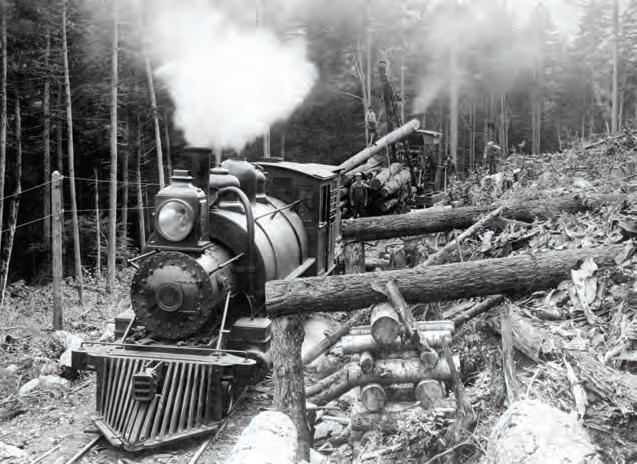
By 1900, railroads had pushed deeper into the White Mountains to provide transport of the last remaining primeval timber in formerly inaccessible regions. Above, J.E. Henry’s Baldwin Engine #4 ships the remaining logs in a clearcut along the East Branch of the Pemigewassett River to the mills in Lincoln, N.H.
from all over the countr y, and enough Congressmen of the importance of the White Mountains for the entire nation. In his first year, he listened to all those concerned with the Whites; he explored the forests, asked questions, and gained the knowledge he needed He recognized that the movement was “an attempt to preserve what remain[ed] of the forest cover.” The steeper slopes of the White Mountains were most in need of protection. As he later wrote, “six large lumber companies, each with its logging railway, were stripping the high slopes of the White Mountains… the greater part of the forest remained on the ground as slash, that became very dry. In that summer, 1903, eighty thousand acres in the White Mountains burned over.” Like Walker, Ayres understood that it would be impossible to save the forests simply by stressing their aesthetic benefits. He knew economic reasons with interstate repercussions could gain the greatest support and provide lasting protection to the woods of northern New Hampshire. He used one of Walker’s points the need to protect the headwaters of important rivers as the main reason to protect the mountains The rivers flowing out of the White Mountains (the Saco, Androscoggin, Merrimack, and Connecticut Rivers) “supply power to more factories than any other waters in the country, and their even flow is of vast importance ” Destruction of the forests would lead to the destruction of New England’s economy
Ay r e s i g n i t e d t h e m o v e m e n t w i t h n a t i o n a l a c t i o n . H e addressed Congress for the first time in 1902 He wrote articles in the Concord, Manchester, Boston, and New York newspapers urging readers to contact their congressmen to protect the scenic and economic facets of the White Mountains In December 1903, Senator Jacob H. Gallinger and Representative Frank D. Currier, both of New Hampshire, introduced the first White Mountain forest “reser vation” bill into Congress Over the next several years, it moved slowly through various committees and hearings.
The movement to create a national forest in New Hampshire faced some strong opposition. While the large mill owners in
protecting the forests meant putting them out of business and destroying the economy of northern New Hampshire Western congressmen would not vote for the purchase of private lands by the national government fearing that the government would take over lands in their states. One senator who opposed the law at the time called proposed legislation “the most radical piece of legislation that has ever been proposed in the Congress of the United States.” The leader of the southern national forest movement, U S Forest Ser vice Chief Gifford Pinchot, fought against a northern forest reserve, believing Congress would not approve both Distinguished army engineer Hiram Chittenden said that there was no “vital relationship between forests and water flow.” Willis L. Moore, chief of the U.S. Weather Bureau, agreed Anti-tax and property rights advocates simply fought the idea. Even strong preservationists, such as John Muir, opposed the idea of “multiple use” of forests
Along with his political savvy, Ayres was a persuasive speaker. He created an educational campaign to teach people about the economic importance of the forests He convinced powerful individuals to declare publicly that the White Mountains were worthy of national attention and the taxpayers’ money In his 1907 annual message, President Theodore Roosevelt declared: “We should acquire in the Appalachian and White Mountain regions all the forestlands that it is possible to acquire for the use of the Nation. These lands, because they form a National asset, are as emphatically national as the rivers which they feed ”
O t h e r s j o i n e d h i m i n v o i c
Coolidge of the Amoskeag Mills, Orton Brown of Brown Paper Company, and New Hampshire’s national political leadership along with most of New England’s political leadership from governors through representatives and senators Ayres used their support as a way to convince others to support the movement. H e w r o t e a p a m p h l e t s p e c i fi c a l
titled “Reasons for a National Forest Reser vation in the White Mountains.” He gave lectures ever ywhere and anywhere, and showed his audiences the destruction of the White Mountains “[SPNHF] has worked on… economic ground[s] almost entirely, because this is the basis for action at Washington It has not forgotten the need also of protecting the scenic beauty of the White Mountains.”
It was his ability to reach all constituents that gradually made a difference. He increased the already diverse coalition by getting the support of the National Women’s Clubs, the New England Boards of Trade, the American Society of Civil Engineers, almost a
individuals concerned with forest lands, logging, tourism, and business. Even the American Pulp & Paper Association supported a White Mountains national forest Numerous chambers of c
industries supported and contributed to the cause. Articles
appeared in major newspapers advocating the creation of a national forest in the White Mountains. Yet Congress did not pass the bill
Philip Ayres, along with the president of the Appalachian Mountain Club and the Secretary of the Massachusetts Forestry Association, met with national representatives from all the New England states in Boston on Halloween, 1906 John W Weeks was then a freshman Congressman representing the 12th District of Massachusetts. More importantly, Weeks was a native and summer resident of Lancaster in northern New Hampshire Weeks promised to help guide the idea in Congress.
In the summer of 1907, fires blanketed the Whites as over 35,000 acres were lost Destruction of the forest continued, p r o m p t i n g Ay r e s t o w r i t e , “ o n o n e o f t h e b r a n c h e s o f t h e Pemigewasset, the East Branch, in Lincoln, forest destruction has gone far. The operating company does not expect any future return after the primeval forest is gone It cuts clean and has no care for the future of the forest. From 50,000 to 75,000 acres are already laid bare; on most of it nearly every tree has been cut. …It has become almost literally true that, where until recently stood a primeval forest, after cutting there remains standing scarcely a pole on which a bird can build its nest ”
In 1908, Congressman Weeks was appointed to the Agricultural Committee, the committee that handled the national forest bills, and he began public support for the creation of a national forest in the White Mountains. He rewrote the national forest bill, combining forest preser vation with watershed protection and fire control. He “organized a successful campaign in the House” where the bill had been repeatedly defeated. Political foes of the progressives worked furiously to tr y to defeat the bill The powerful Speaker of the House, Joe Cannon, who had promised “not one cent for scenery,” repeatedly killed it Finally, in March 1910, the House revolted and removed Cannon’s control over the Rules Committee. Weeks’ bill reached the House floor soon after and passed June 24 In January 1911, Ayres went to work again, issuing “An Appeal” for public assistance to pass the “White Mountain Forest Bill ” “The Weeks Bill for national forests in the White Mountains and Southern Appalachians is not making the progress in Congress that is necessary if it is to pass at this session of Congress, or before the White Mountains are denuded far more severely than they now are. The Senate has passed this measure three times in different forms, but is now waiting for action by the House. The House that passed this bill a year ago, in the previous Congress, is now engrossed in other matters Where are the New England Congressmen?” The public responded with a flood of mail to their representatives and urged more aggressive action The House and Senate versions were reconciled shortly thereafter and voted through Congress. The Weeks Act became law when President Taft signed it on March 1, 1911
Joseph B Walker lived to see the passage of the bill We can only imagine what it meant to him. He died in Januar y
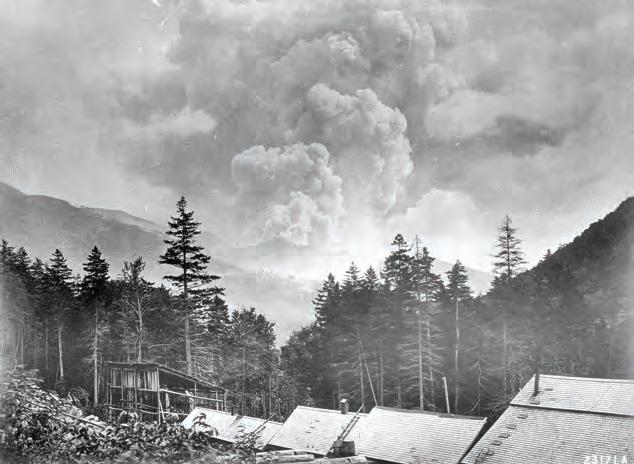
Forest fires in the early 1900s, like this one on Owl’s Head in the now designated Pemigewasset Wilderness in the White Mountain National Forest, devasted thousands of acres of forest land, causing run off and water quality issues downstream
8, 1913, at the age of 90 Ayres called Walker “The Founder of the Forestr y Movement in the State” and understood that he continued Walker’s work. In many ways, Philip W. Ayres’s work was just beginning He worked for the Society for the Protection of New Hampshire Forests, identifying pieces of land that should be part of the new national forest and lobbying for them until he left the Society in 1935 He died in 1945, knowing that the White Mountain National Forest protected “a little more than one thousand square miles ”
In a 1913 article in The New York Times, the author wrote that “the new preser ve will thus be of great economic advantage as well as afford permanent pleasure to the thousands who annually visit the White Hills. Too much praise cannot be given to the long-continued efforts of the Society for the Protection of New Hampshire Forests and of its Forester, Mr. Philip W. Ayres, for originating the plan of the National Eastern Reser ve and for stimulating official enthusiasm in the project ” The author did not know that the “long-continued efforts” were actually much longer than he recognized and took the leadership of two men: Philip W Ayres and Joseph B. Walker. Walker, now known as the “‘father’ of New Hampshire forestry,” first recognized that the forest should be conserved as a public resource He created the momentum needed to recognize the White Mountains as an asset to be safeguarded. Philip Ayres picked up his standard as it dipped and raised it high. He argued that the Whites were “a national treasure, and as such, should be protected by federal law ” Both Ayres and Walker dedicated their lives to the northern forests Their efforts continue to benefit the nation and the North Country today.
Marcia Schmidt Blaine is a professor emerita of history She earned her B A from the College of William and Mary, a Ph D from the University of New Hampshire, and taught at Plymouth State University before her retirement in 2021. She continues to research, write, and serve on the boards of New Hampshire Humanities and the New Hampshire Historical Society.
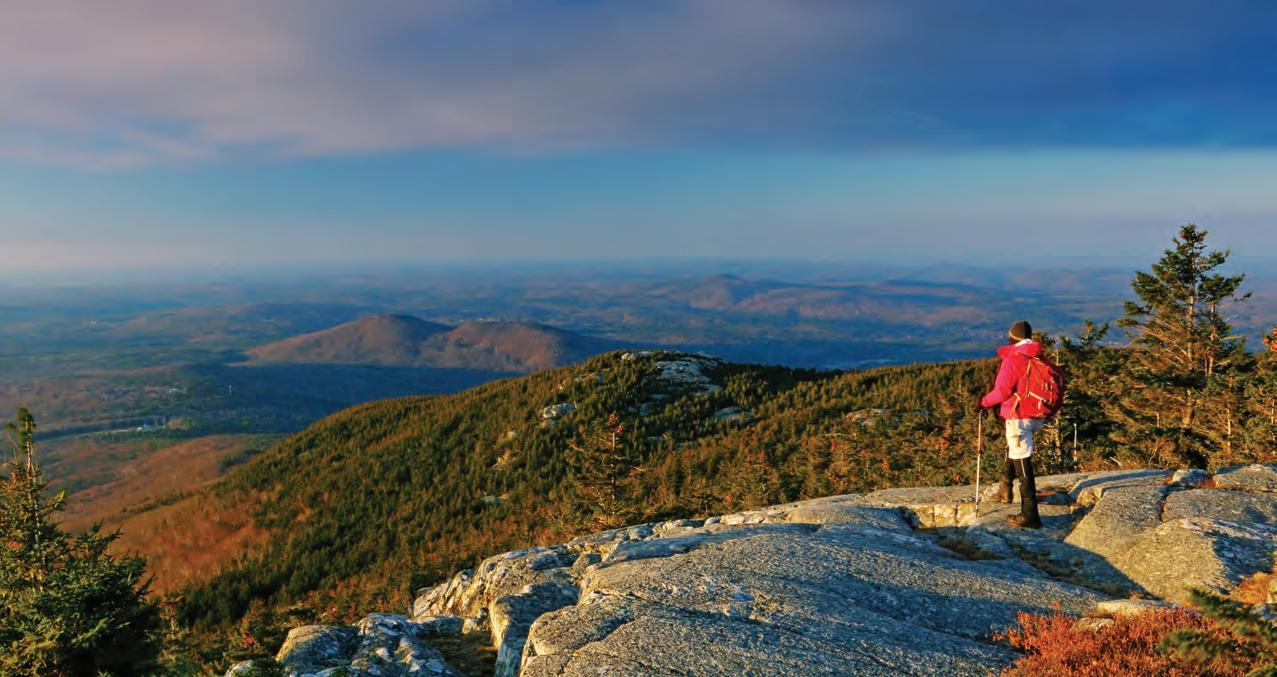
This year, 2026, marks not only the 250th anniversary of the United States of America, but also the 125th anniversary of the founding of the Society for the Protection of New Hampshire Forests. We have existed for half the life of the nation.
The work of the Forest Society is in many ways quintessentially American to ensure that our natural resources thrive for the benefit of all, balancing use and protection, with no barrier to access As an organization, we rely on participation and engagement we are only as strong as the people empowered to connect with the land, who become good stewards, take a stand when needed, and support conser vation in the ways they are able This is all part of the legacy we inherited and the one we will leave to future generations
The Forest Society’s mission is as important today as it was in 1901 Our challenges are different, but our values remain constant, and we have 125 years of experience and success to propel us into the next 125 What is the New Hampshire we all hope to see in 2151?!
A s a n y o n e w h o h a s w o r k e d i n t h e w o o d s o v e r t h e p a s t generation can tell you, New Hampshire’s forests are changing. Climate change is reshaping our forests, waters, and communities Erratic temperature patterns, extreme storms, evolving pests and disease, changing wildlife behavior, and a range of development trends are stressing natural systems across the state. While forest conservation and management alone won’t reverse the effects of a warming climate, forests provide a powerful and measurable positive impact by producing clean water and air, storing carbon, mitigating flood damage, sustaining wildlife, supplying durable forest products, and giving people places to recreate, learn,
and bolster their wellness. The Forest Society’s long experience developing practical tools, collaborative strategies, and on-theground solutions positions us to meet this moment.
We are guided by a vision of New Hampshire that includes interconnected lands and waters that strengthen New Hampshire’s c o m m u n i t i e s e c
includes forests managed for resilience and diversity, recreational infrastructure that is sustainable and welcoming, and learning opportunities that deepen our understanding of and engagement with the natural world
WORK CONTINUES AND IT BELONGS TO ALL OF US
O
happen by accident. The New Hampshire landscape that we all enjoy today is the product of many hands working together, doing the work every day It happened because people cared neighbors, landowners, volunteers, members, and partners who understood that forests matter and that perpetuating them is a shared responsibility.
Together, we have conser ved remarkable places and built a foundation that benefits New Hampshire ever y day But the pace of change is accelerating. Climate impacts, development pressure, and shifting needs demand action now guided by experience, science, and a long-term commitment to the land.
The good news is progress happens when people act together As we begin our next chapter, we hope you will stay engaged and encourage others to join in caring for New Hampshire’s forests. The challenges ahead are real and so is the opportunity What we do next, together, will shape the forests of tomorrow.
The hear t of the Forest Society’s conser vation work is protecting land, caring for it over time, engaging people, and working together to ensure forests thrive in New Hampshire for generations to come. This work is grounded in four key priorities:
Conser ving forests at scale and working with landowners and par tners to conser ve interconnected, biologically diverse landscapes. By 2040, our goal is to help safeguard 40 percent of New Hampshire an additional 400,000 acres—supporting clean water, wildlife habitat, climate resilience, working forests, and public access for all. In 2026, the Forest Society owns and manages about 70,000 acres across the state. By 2040, our goal is to own 100,000 acres to be managed for multiple uses, including eco-reser ves, recreation lands, and working forests.
Excelling in stewarding the lands we care for.
Through science-based forestr y, habitat restoration, and sustainable recreational management, we are committed to strengthening forest health and resilience, keeping these lands productive, vibrant, and adaptable as the climate changes. We will continue to improve the recreational experience on our lands while ensuring ecological integrity. We believe that the Forest Society must continue to lead in exemplar y management, applying and sharing our expertise in forest and recreation management while always incorporating new technologies and best practices.
Engaging and educating the next generation of foresters, conser vationists, outdoor enthusiasts, scientists, and advocates to care for these forests. Our lands provide places for recreation, learning, and wellness, and our programs bring people of all ages into the forest to experience and delight in its value firsthand. Volunteers, students, and community members are essential members of our extended family, helping to carr y forward a shared ethic of stewardship that ensures forests remain central to life in New Hampshire.
Advocating for forests and the incentives that help keep them as forests.
Working with towns, landowners, land trusts, agencies, and partners, we will advance effective conservation and climate policy, defend the integrity of conserved lands, and support collaborative solutions that reflect both local values and statewide needs.
Together, these priorities will guide every decision the Forest Society makes to reflect a holistic approach that balances conservation, stewardship, engagement, and advocacy.
By Matt Leahy
When one looks over the timel i n e o f t h e F o r e s t S o c i e t y ’s
1 2 5 - y e a r h i s t o r y, t h e c o ntributions the organization has made to conserving the landscapes in our state are readily apparent. The campaigns it’s led to protect the White Mountain National F o r e s t a n d m a n y i c o n i c s t a t e p a r k s , i n c l u d i n g M o u n t S u n a p e e a n d M o u n t M o n a d n o c k , a r e c e r t a i n l y n o t a b l e B u t perhaps the most far-reaching campaign the Forest Society has led is the establishment of the Current Use Program in New Hampshire, the law that encourages the p r e s e r v a t i o n o f u n d e v e l o p e d f a r m a n d forest lands.
As noted in past stories about Current Use in Forest Notes, it is true we can only s p e c u l a t e a b o u t w
N
w H a m
e would look like if the program did not exist. However, and as illustrated in the 2025 report The Benefits of New Hampshire’s Open Space, we do know that open space c a n m a k e c o m m u n i t i e s h e a l t h i e r a n d m o r e r e s i l i e n t b y p r o t e c t i n g d r i n k i n g water, preventing and controlling floods, p r o v i d i n g d r o u g h t r e s i s t a n c e , a n d improving air quality. Open space also supports a strong economy. Forests cover most of the state of New Hampshire and are the foundation of the forest-based e c o n o m y A n d o p e n s p a c e s u p p o r t s a robust tourism and outdoor recreation economy.
The purpose of this program is succinctly stated in the New Hampshire Current Use law RSA 79-A:1 (enacted July 1, 1973): “It is hereby declared to be in the public interest to encourage the preser vation of open space, thus providing a healthful and attractive outdoor environment for work and recreation of the state’s citizens, maintaining the character of the state’s l a n d s c a p e , a n d c o n s e r v i n g t h e l a n d , w a t e r, f o r e s t , a g r i c u l t u r a l , a n d w i l d l i f e resources. It is further declared to be in
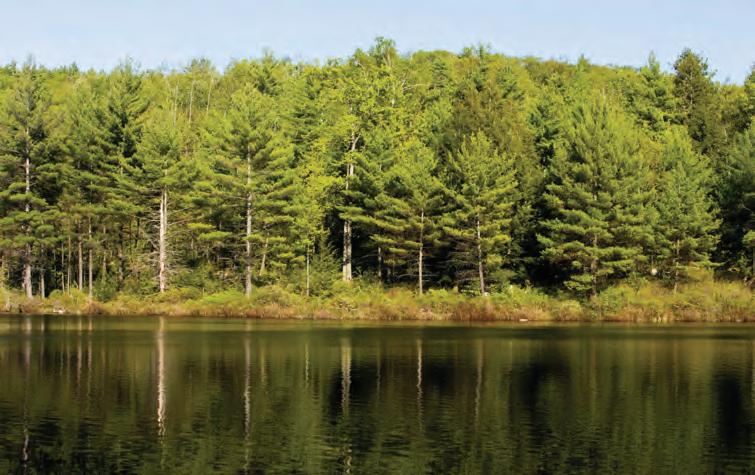
of open space due to property taxation at values incompatible with open space usage Open space land imposes few if any costs on local government and is therefore
Remarkably, although written more than 50 years ago, that preamble is still wholly relevant D
Current Use has its critics who claim it prevents needed development or it unfairly shifts the tax burden onto other segments of the population. During the 2026 New Hampshire Legislative session, the Forest Society saw another attack on the program. House Bill 1691 proposed to make so many confusing and complicated changes to Current Use that, if enacted, would have fundamentally gutted its purpose Fortunately, advocates for the Current Use program were able to defeat that bill
As Governor Ayotte noted in her 2025 budget address, “Our natural beauty as a state is both one of our points of pride and the bedrock of our unique quality of life. To
me, it’s pretty much common sense to say that our North Country, our Lakes Region, our beautiful open spaces, shouldn’t be scarred by poorly envisioned projects that detract from our quality of life.”
We agree. Advocating for the successful establishment of Current Use stands as one of the most significant achievements of the Forest Society’s 125-year history. As we look to the next 125 years, ensuring the program continues will be one of our most significant responsibilities yet
Matt Leahy is the public policy director for the Forest Society
To read the repor t, The Benefits of New Hampshire’s Open Space, visit forestsociety.org/document/benefitsnhs- open-space -full-repor t.pdf.
To read the Forest Society ’s testimonial in opposition to House Bill 1691, visit forestsociety.org/currentusetestimonial.
Together Mak ing New Hampshire a Great Place to Live, Work , and
We thank our business par tners for their generous suppor t during our 125th anniversar y year.
Summit Circle ($5,000 and up)
Athletic Brewing Company
Garnet Hill Inc.
Mainstay Technologies
Merrimack County Savings Bank
Nathan Wechsler & Company
Seaboard International Forest Products, LLC
Whalen Public & Media Relations, LLC
Trustees’ Circle ($2,500 to $4,999)
Badger, Peabody & Smith Realty, Inc
Collette Travel
Mallor y Por traits
Newbur ypor t Bank
Nor theast Delta Dental
The Secret Agenc y, LLC
President ’s Circle ($1,000 to $2,499)
Aesthetic Dental Center
BCM Environmental & Land Law, PLLC
Bensonwood & Unity Homes
Chinburg Proper ties
EOS Research Ltd
Frog Hollow Forestr y Lumbard & Kellner, LLC
Maxfield Real Estate
Meredith Village Savings Bank
New England Private Wealth Advisors, LLC
Nor thland Forest Products, Inc
Ransmeier & Spellman, P C
Rockywold-Deephaven Camps, Inc.
Upstream Tech
W S Badger Company, Inc
Steward ($750 to $999)
Law O ffice of Leonard D Harden
Par tner ($500 to $749)
Arcomm Communications Corporation
Blue Loon Baker y R.C. Brayshaw & Company
Blue Mountain Forest Association
Brookdale Fruit Farm
Capitol Craftsman, LLC
Durgin and Crowell Lumber Co , Inc
Half Moon Enterprises
The Lyme Timber Company LP
Meadowsend Timberlands Limited
Par tner (continued)
Milestone Construction LLC
The Music Mill
NH Conser vation Real Estate
Pine Springs
R M Piper, Inc
RSP Studio
Leigh B. Starer, LLC
Whole Wealth Management, LLC
Colleague ($250 to $499)
Ancient Traditions Natural Medicine, LLC
Banyan Global
Bittner Proper ty Management
Blaktop, Inc
Dog Cove Corp.
Dublin Road Tap Room & Eater y Evergreen Forest Management LLC
Forest Land Improvement, Inc.
Frost Pond Carpentr y Gideon Asen LLC
Grappone Management Company
Great Brook Veterinar y Clinic
Hammond Lumber Company
Hancock Lumber
H.L. Turner Group, Inc
Innovative Natural Resource Solutions, LLC
Kel-Log, Inc
Kozikowsk i Proper ties, LLC
Law O ffice of Michael M Ransmeier, PC
Mulligan Forest, LLC
Nor theast Forest Ser vices
O ffice of Michael M Ransmeier, PC
Old Mill Proper ties, LLC
Pelletier Realty Group
Pembroke Automotive Ser vices
Por tsmouth Paddle Board Company, LLC
Proctor Hill Forestr y and Logging, LLC
REI Co - op Bedford
Rek ’-Lis Brewing Company
Robbins Lumber Inc.
Seven Birches Winer y
Tri-State Iron Works
Twin State Sand and Gravel Co., Inc.
Underhill Acres, Inc.
Vik ing Forest Products
Winnipesaukee Chocolates
Zachar y Berger Associates, Ltd.
ADP, LLC
Advent International
American Biltrite, Inc.
Amgen, Inc
Bank of America
Bank of New Hampshire
Boston Scientific
Bristol-Myers Squibb Company
The Cigna Group
Cleveland H Dodge Foundation, Inc
Davis Polk & Wardwell, LLP
Dell, Inc.
Erie Insurance
Gar tner, Inc.
Gilead Sciences, Inc.
Google, LLC
Gradient
Hearst Communications, Inc.
Intel Corporation
Jacobs Solutions, Inc
Jefferies Financial Group, Inc.
Johnson & Johnson
Liber ty Mutual Insurance
Lincoln Financial Group
Mac y ’s, Inc
Manulife Financial Corporation
Microsoft Corporation
Motorola Solutions, Inc
NetApp, Inc
Prudential Financial, Inc.
Raytheon Technologies Corporation
Shell Oil Company
Takeda Pharmaceuticals, Inc.
Thermo Fisher Scientific, Inc.
The Travelers Companies, Inc
UnitedHealth Group
Ver tex Pharmaceuticals, Inc.
VMware, Inc
We are grateful to the many businesses that suppor t the Forest Society with gifts of less than $250. The Forest Society…Where Conservation and Business Meet For information about business memberships, sponsorships, or to initiate a gift membership program for your clients or employees, please contac t Anne Truslow at (603) 224-9945 or atruslow@forestsociety org
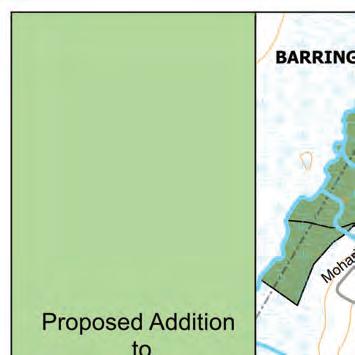
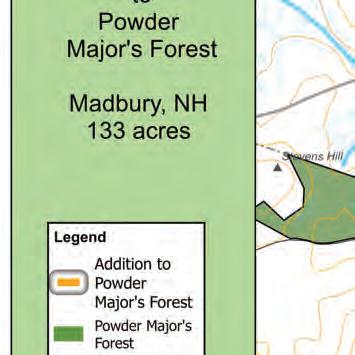
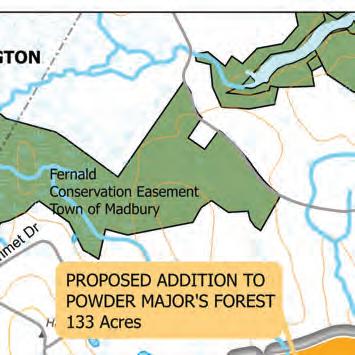
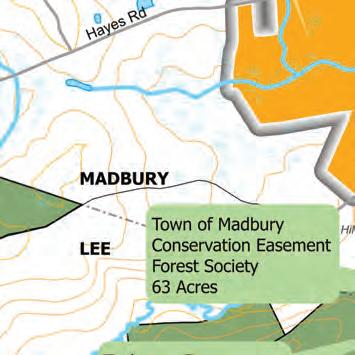
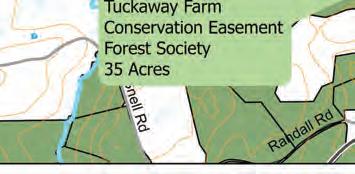
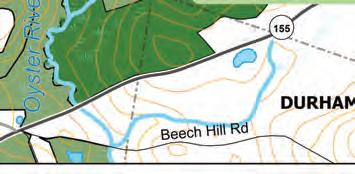
In 2016, the Forest Society mounted an ambitious campaign to conser ve P o w d e r M a j o r ’s F a r m a n d F o r e s t i n Madbury, Lee, and Durham, raising $2 25 million to protect nearly 300 acres in total in 2017 Today, this land offers a network of hiking, biking, and riding trails near M o h a r i m e t S c h o o l a n d Ti b b e t t s F i e l d o n R o u t e 1 5 5 i n M a d b u r y T h e p r o perty includes a mix of habitat types and frontage along the Oyster River and Dube Brook, supporting wildlife and water quality, and connects to conser vation easements at Tuckaway Farm, completed by the Forest Society in 2021.
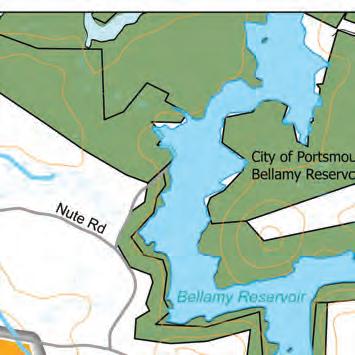
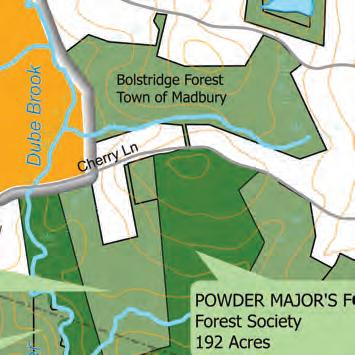
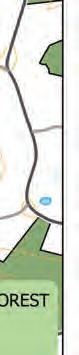
Now, the Forest Society can expand the protected area at Powder Major’s Forest b y p u rc h a s i n g 1 3 3 a c r e s t o t h e n o r t h , extending the network of conser vation land from Cherry Lane through to Hayes Road in Madbur y The property borders the Town of Madbury’s Bolstridge Forest, just south of the Bellamy Reser voir. The City of Portsmouth has actively conserved land around the perimeter of the Bellamy R e s e r v o i r f o r s e v e r a l y e a r s , a s i t i s t h e drinking water source for the city.
T h e P o w d e r M a j o r ’s F o r e s t A d d i t i o n
i n c l u d e s s i g n i fi c a n t f r o n t a g e o n D u b e
B r o o k , a m a i n t r i b u t a r y o f t h e O y s t e r River, and falls within a corridor between t h e B e l l a m y R i v e r a n d t h e O y s t e r R i v e r,
b o t h h e a d w a t e r s o u rc e s f o r t h e G r e a t
B a y I t i s a l s o s i t u a t e d w i t h i n t h e G r e a t
Thicket National Wildlife Refuge’s priority area for promoting early successional and shrubland habitat to support threat-
e n e d a n d d e c l i n i n g s p e c i e s , i n c l u d i n g
N e w E n g l a n d c o t t o n t a i l , A m e r i c a n w o o d c o c k , r u f f e d g r o u s e , a n d m o n a rc h
b u t t e r f l y T h e p r o p e r t y s e r v e s a s a n
i m p o r t a n t c o r r i d o r f
d l i f e
m e n t b e t w e e n P o w d e r M a j o r ’s F o r e s t t o t h e B e l l a m y R i v e r a n d o t h e r c o n s e r v e d areas situated to the north.
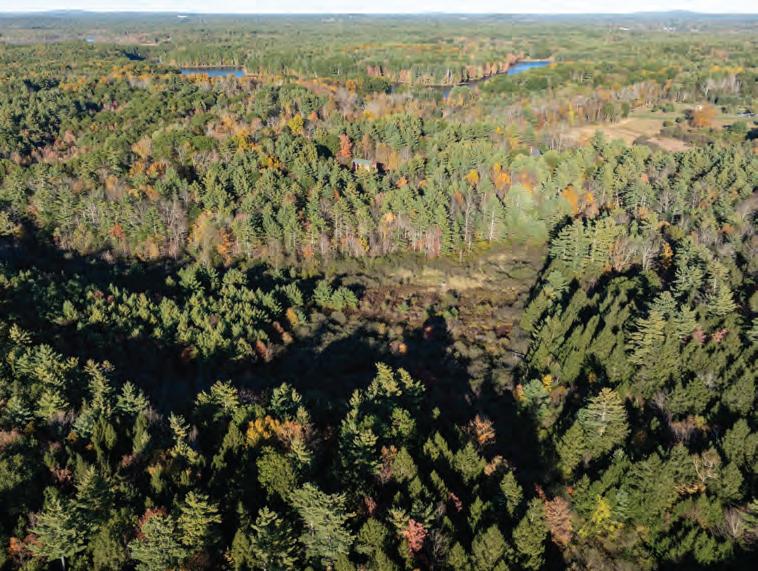
The Powder Major’s Forest addition will protect significant frontage along Dube Brook and a wetland complex that provides habitat for many resident and migratory birds.
The Forest Society has an agreement to purchase the 133 acres, with a total project cost, including expenses and a stewardship f
resources, we have already received generous grants from the NH Drinking Water and Groundwater Trust Fund program and S o u rc e Wa t e r P
H Land and Community Heritage Investment Program (LCHIP), the Great Bay Resource Protection Partnership, and funding provided by the Town of Madbury. The Forest Society must raise the final $150,000 from private sources. These lands will be managed primarily for habitat and water resource values, with no new trails planned in the near term. It is an ideal spot for shy New England cottontails, migratory songbird stopovers,
conservation corridor north of Route 155 will expand to nearly 700 acres, including land held by the Town of Madbur y and c
d private lands
In this thickly populated part of the state, protecting freshwater resources for drinking water, maintaining large blocks of diverse forest types, and protecting the water quality of Great Bay is especially urgent. We are pleased to have the opportunity to expand Powder Major’s Forest and continue to manage this land for its natural values Please join us by making a gift to the Powder Major’s Forest Addition t
$150,000 by June 30, 2026, so that we can complete the project by the end of 2026.


54 Por tsmouth Street
Concord, NH 03301-5400
Address Ser vice Requested
Y E A R S I N
AND WE’RE JUST GET TING STARTED.
This year, join us for pop-up outings, special gatherings, and a big annual meeting celebration this fall as we celebrate the Forest Society’s 125th anniversary. Together, members like you have shaped a legacy of conservation that reaches every corner of New Hampshire. Imagine what’s possible as more neighbors, friends, and communities step into this next chapter with us.