GET YOUR FREE COPY OF THE PAPER DELIVERED STRAIGHT TO YOUR INBOX, VISIT WWW.IWANTMYPAPER.COM
No. 22 Vol. 1
www.mypaperonline.com • 973-809-4784 January 2026
The Life and Legacy of Elizabeth Cady Stanton
I
By Henry M. Holden n November 1880, Elizabeth Cady Stanton (1815-1902) resided in Tenafly, New Jersey. Stanton was renowned as one of the leading figures of the early women’s rights, or Suffrage movement, in the United States. She is best known for penning the Declaration of Sentiments for the Seneca Falls Convention and for her pivotal role in organizing the women’s suffrage movement across the nation. On Election Day in November 1880, Stanton decided to cast a ballot, powerfully demonstrating her sincere belief in the right of all women to vote. Throughout her life, Stanton passionately sought to elevate the status of women by demanding equal rights and rallying the somewhat disorganized Suffrage movement. While other women attempted to advance the cause, few were as strong-willed as Stanton. The challenge remained how to spark nationwide change and draw attention to the cause. Women’s suffrage refers to the right of women to vote in national or local elections, a right denied to women in societies as far back as ancient Greece and republican Rome, as well as in the early democracies that emerged in Europe during the 18th century. Even when the voting franchise was expanded in the United Kingdom in 1832, women continued to be excluded from all voting rights. Stanton’s commitment to women’s rights began in her childhood, influenced by evenings spent with her father, who would often read to her. In addition to this informal education, Stanton attended the co-educational Johnstown Academy in her hometown of Johnstown, New York, until age 16. She then continued her studies at the Troy Female Seminary, later known as the Emma Willard School after its founder. Although Stanton aspired to attend Union College, following in the footsteps of her male classmates from Johnstown Academy, she was barred from entry solely because of her sex. Reflecting on these formative experiences with discrimination, Stanton wrote with deep regret about her inability to compete academically on equal footing: “When those with whom I had studied and contended for prizes for five years came to bid me good-by, and I learned of the barrier that prevented me from following in their footsteps–‘no girls admitted here’–my displeasure and indignity knew no bounds. … Again I felt more keenly than ever the humiliation of the distinctions made on the grounds of sex.” Before focusing entirely on women’s rights, Stanton was active in the temperance and abolition movements. Through these causes, she met her future husband, Henry Brewster Stanton. When they married in 1840, she insisted
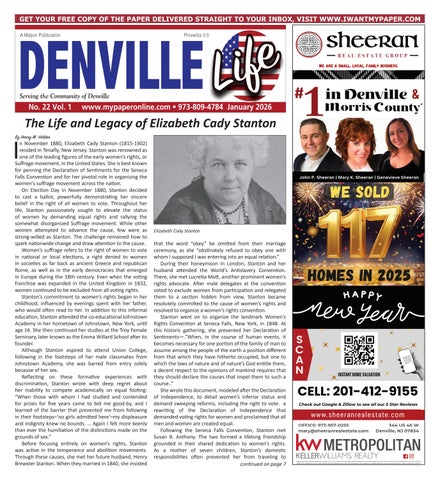
Elizabeth Cady Stanton
that the word “obey” be omitted from their marriage ceremony, as she “obstinately refused to obey one with whom I supposed I was entering into an equal relation.” During their honeymoon in London, Stanton and her husband attended the World’s Antislavery Convention. There, she met Lucretia Mott, another prominent women’s rights advocate. After male delegates at the convention voted to exclude women from participation and relegated them to a section hidden from view, Stanton became resolutely committed to the cause of women’s rights and resolved to organize a women’s rights convention. Stanton went on to organize the landmark Women’s Rights Convention at Seneca Falls, New York, in 1848. At this historic gathering, she presented her Declaration of Sentiments—.”When, in the course of human events, it becomes necessary for one portion of the family of man to assume among the people of the earth a position different from that which they have hitherto occupied, but one to which the laws of nature and of nature’s God entitle them, a decent respect to the opinions of mankind requires that they should declare the causes that impel them to such a course..” She wrote this document, modeled after the Declaration of Independence, to detail women’s inferior status and demand sweeping reforms, including the right to vote. a rewriting of the Declaration of Independence that demanded voting rights for women and proclaimed that all men and women are created equal. Following the Seneca Falls Convention, Stanton met Susan B. Anthony. The two formed a lifelong friendship grounded in their shared dedication to women’s rights. As a mother of seven children, Stanton’s domestic responsibilities often prevented her from traveling to continued on page 7