Editor-in-Chief | Hajra Munir
Managing Editor | Lucas Griffith
Multimedia Editor | Jared Meadows
Chief Photographer | Tavish Sweeney
News Editor | Joe Carey
Features Editor | Brooke Burkhardt
Sports Editor | Brianna Jones
Opinion Editor | Madelyn Stewart
News Reporter | Chloe Hall
Features Reporter | Avery Padgett
Sports Reporter | Colin Kunz
Opinion Reporter | Lela Walker
Vodcast Producer | Erik Hemmert
Social Media Director | Chaz Timko
Designer | Abigail Raubenolt
Business Manager | Ginny McCabe
Editorial Adviser | Jenny Wohlfarth
HAJRA MUNIR | EDITOR-IN-CHIEF
Hey Bearcats!
As college students, it’s easy to forget about post-grad realities and neglect career planning. Between classes, clubs, jobs and co-ops, your plate is already full. Sometimes, just getting through the week feels like enough of a challenge — and thinking about your future career can feel overwhelming or far away.
But whether you’re a first-year just finishing your first semester or a senior only moments away from walking the stage, it’s never too early — or too late — to start building your portfolio and preparing for what comes next. The truth is, career planning doesn’t have to be intimidating. It can be exciting and a chance to explore what you’re passionate about and imagine where you want to go.
In this career guide, our staff put together stories designed to help you take that next step with confidence. You’ll find practical advice on writing a standout resume and building your LinkedIn profile, plus insights from UC students and alum who’ve been where you are. From what to wear to a career fair to advice on finding an internship, this issue covers it all.
No matter where you are on your journey, I hope these stories remind you that your career path doesn’t have to look like anyone else’s — and that it is OK to take your time figuring it out.
Hajra Munir

A strong college resume isn’t just a list of places you’ve been. It demonstrates your potential and provides evidence of your drive and transferrable skills. The first step in this process is putting it all on paper. Consistency throughout a resume is critical to its overall cohesion.
Your resume should be clean, professional and easy to skim. Utilize a standard font, like Times New Roman, and maintain a single-page length. According to the Harvard Business Review, hiring managers often spend about seven seconds on an initial review, so make sure your resume isn’t visually overwhelming.
For college students, the education section of your resume belongs right at the top of the page. Here, you’ll list your university, degree, major, expected graduation date and your GPA. However, it is advised that if your GPA is below a 3.0, you may want to leave it off. You can further bolster this section by mentioning academic honors, highly relevant coursework or study abroad experience.

Following the education section is the experience section. Include relevant part-time jobs, internships, volunteer work, relevant campus leadership roles and even significant academic projects. The key here is not simply to describe your duties, but to tell the story of your achievements.
Rebecca Hale, assistant director at UC’s Bearcat Promise Career Studio, advises that “for someone reading a resume, it is much more interesting to read a story rather than a collection of tasks.”
She strengthens this point with a tip to “reach back out to the people you have worked with and ask them from their perspective what difference you made to the team.”
For example, instead of writing, “Responsible for managing social media,” instead say, “Managed five social media platforms, resulting in a 15% increase in student engagement over one semester.” It is important to always start your bullet points with powerful action verbs such as developed, spearheaded or analyzed.

Crucially, every job application demands a unique resume. You must tailor your application by reading the job description and integrating relevant skills into your document. If an internship description emphasizes “data analysis,” ensure your bullet points highlight instances where you analyzed data, even if it was for a campus club or class project.
Finally, remember to proofread your resume for typos and grammatical errors. You should also have a friend or career services review it. Your college resume is a living document so you will want to be updating it regularly and tailoring it for each opportunity. This will ensure your application consistently moves from the “maybe” pile to the “interview” list.





At Crane ChemPharma & Energy, we believe in investing in the future, starting with our interns. Our internship program is designed to provide hands-on experience and set you on a path for long-term success.
Internship Opportunities Available In
- Quality
- Operations
- Supply Chain
- CBS (Crane Business System)
- Sustaining Engineering
- Cryogenics
- Inside Sales
- New Production Development
- Human Resources
- Manufacturing Engineering
Why Intern with Crane?
- Mentorship from industry professionals


- Real-world projects that make an impact
- A culture that values innovation, integrity and collaboration
We’re Hiring Full-Time Too!
Our full-time positions come with competitive benefits, opportunities for career growth, and the chance to work with cutting -edge technologies. If you're looking locally, you can filter by location using ‘OH, Cincinnati’ , But we also have global opportunities too.
Learn more & Apply: www.cranecpe.com/careers
BROOKE BURKHARDT | FEATURES EDITOR
Career fairs are exciting, but often imposing, opportunities for students seeking to make real-world connections. Figuring out what to wear can cause anxiety — what exactly is “business casual” — but there are many options for students dress professionally while maintaining a unique flair.
Keep it classy and remember the best thing you can bring to a career fair is yourself. Putting on a good outfit may enhance your confidence and make you more memorable to employers.

A collared shirt is a good base for a simple business outfit — casual or professional. Shirts can be neutral colors or with a small pattern.
For warmer months, a short-sleeved blouse or polo shirt is a good compromise for professional or business casual.
If you choose to wear a short-sleeved shirt, opt to bring a small cardigan.
Dress modestly and wear neutral colors. A pop of color or a simple pattern will add a touch of individuality.Attend the fair nicely groomed, with minimal to light makeup. Apply perfume or cologne for an extra touch of cleanliness and sophistication. Do not over accessorize. Bring a small bag to hold business cards and resumes. Organization is key to looking professional; you don’t want to walk around with loose cards or papers. All shoes must be closed-toed and clean (no scruffs or fraying).
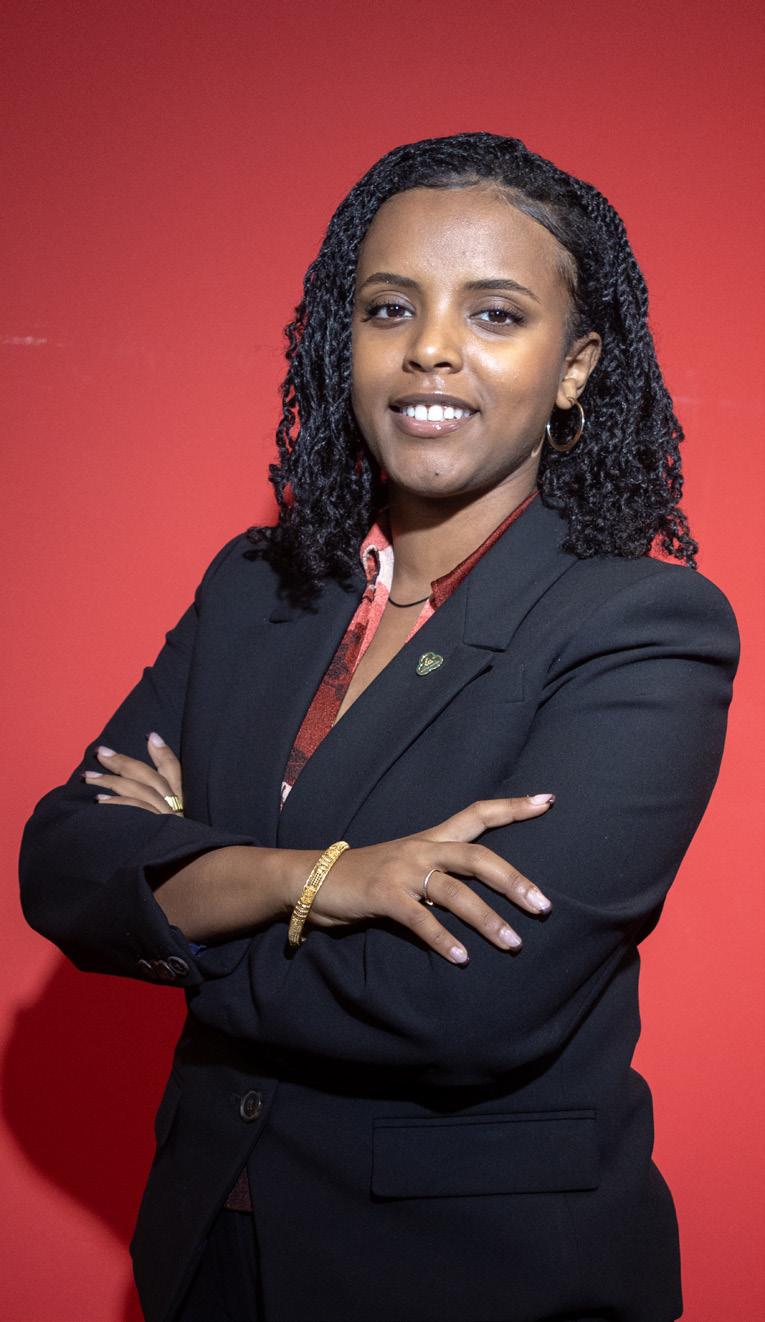
Well-fitted dress pants are a staple of a classic business outfit. They are a highly versatile article of clothing that fits any season or event. Khaki pants also fit this category; refrain from wearing any cargo pants.
You can swap the pants for a pencil skirt if that is more your style.
Maxi or midi dresses are also great options for a simpler yet sleek look.
Spending money on professional clothes can be expensive. Department stores such as Kohl’s or Dillard’s have great options in various sizes, but these pieces are priced so high that they aren’t the always accessible. Most thrift stores also have a wide range of used business clothes in near-perfect condition.
Professional garments can also be found in discount stores like T.J. Maxx and Marshalls. Blazers, dress pants and shoes are also found at these stores for a reduced price.

Dressier loafers, oxfords, small heels or ballet flats are excellent options that complement nearly every outfit. Do not wear any casual or gym shoes.

BRIANNA JONES | SPORTS EDITOR
As the workforce continues to shift and change, so do the skills employers are seeking when hiring. Here are the top five skills employers look for in potential employees:
Analytical thinking involves breaking complex problems into parts to find logical solutions. It’s used in tasks such as data analysis, strategic planning and any work that requires a structured, rational approach to problem-solving and decision-making. This skill drives innovation, and is a catalyst for new ideas and approaches.
3
Teamwork is a fluid process where individuals with diverse skills work together to solve problems. Developing the skills to collaborate with colleagues improves communication, problem solving and critical thinking and enhances learning by allowing people to share diverse perspectives and learn from peers to work more efficiently.
5 1
Active learning is an educational approach that engages students in doing and thinking about what they are learning. It focuses on developing skills and higher-order thinking rather than simply transmitting knowledge. Learning strategies teach students how to consume information more effectively by introducing methods and techniques for understanding, retaining and applying new knowledge.
4
Professionalism demonstrates competence and respect in a work environment. A high level of professionalism showcases principles that guide the approach to a job. This is crucial to building trust, creating a positive work environment and ensuring the long-term success of both individuals and organizations.
Leadership is the ability to influence, guide and inspire a group of people toward a common goal. This involves setting direction, building a vision, motivating others and fostering a collaborative environment to achieve shared objectives. Leadership is important in college because it develops skills for success in future careers and increases overall confidence.
All college students have likely heard the defeated words, “I’m just going to give up,” whether said by a friend or themselves. They want to give up after a bad exam or low grade. But there can come a point when the words switch from a joke to a more serious sentiment — and the question evolves — how do you know when to quit, whether that means quitting a major or college itself?
According to Raven Flanigan, a director of academic student advising in the College of Arts and Sciences at the University of Cincinnati, quitting often carries an undeserved stigma. Flanigan has worked with undecided and pre-program students for approximately eight years and has had countless conversations about when students should start thinking about “pivoting,” a word she prefers over “quitting.”
About one-third of students pursuing a bachelor’s degree change their major at least once during college, according to a study from
George Mason University. Still, many hesitate to switch paths because of time, financial or family concerns.
According to Flanigan and Vikki Kowalczyk, an assistant director of the University Honors Program, students can ask themselves five questions to decide whether it might be time to quit: Am I enjoying the material? Is the career path aligned with my interests, strengths and personality? Have I used all available resources to improve in a class, but it’s still not working? Can I see the path ahead of me, and do I like it? Is this major taking a toll on my mental health?
In addition to these questions, Flanigan advises students considering dropping out of college to first ask whether they simply need to withdraw from a class, switch majors, take time off or use campus resources before quitting entirely.
Paula Davis Lampley, program director of professional development and community impact
at the College of Engineering and Applied Science, did just that when she left a successful engineering career to attend law school.
Lampley encourages students to look for different opportunities even after graduation. “We don’t give ourselves the wide-open spaces that we need to dream,” Lampley said. “There’s so much out there.”
Lampley advises students to not discount transferable skills, give themselves grace and act with confidence when making a more dramatic change.
“It’s OK to quit something, it’s OK to stop doing something, its OK to make changes — that’s part of growth,” Kowalczyk said.
“We fall in love, and we fall out of love with a lot of things over our lifetimes,” Kowalczyk added.
You’ve got to own it; AVERY PADGETT | FEATURES REPORTER you’ve got to love it.”
JULIA VIANNA SISTE | CONTRIBUTOR
As their academic years go by, international students start thinking more about their careers. There are a lot of employment options, from practical trainings to completely new visas, for these students to consider while they are still studying and post-graduation.
The first option international students have is an on-campus job. Most of these can be found through Handshake or the official University of Cincinnati (UC) website, and they do not require special authorization. Students can work between 20 and 40 hours per week, depending on breaks.
Another option for international students is co-ops and internships. Students can participate in Curricular Practical Training (CPT), which allows them to gain real-world experience while still enrolled at the university.
To be eligible, students must have been enrolled for at least one full academic year, have
a job offer related to their major and receive authorization from their designated school official. Students can complete as many CPTs as they want for part-time positions without affecting their Optional Practical Training (OPT). OPT is another valuable option. After graduation, international students have one year to find a job and work full time in the United States with OPT. During that year, they may remain unemployed for no more than 90 days to maintain their status, so most begin job hunting while still in their senior year.
Rebecca Hale, assistant director at the Bearcat Promise Career Studio, emphasizes students need to focus on “applying for OPT on time, so that means not too early and not too late.”
Caleb Loayza Jiménez, a UC mechanical engineering alum from Peru currently working under OPT, previously worked with his current team as a co-op CPT student. He said he had an interest in joining the team full time, learned
about the job as soon as it was posted, and began working one month after graduation.
The final option for international students is obtaining an H-1B visa after completing OPT. To qualify, students must have a job offer they have accepted, and their employer must pay certain fees and register them in the selection process for the annual cap of 85,000 visas.
Hale said, “Looking for jobs starts as soon as they get here. Students take proactive steps to to build an online presence, to network, to find your people, to find opportunities to grow either through paid or unpaid experiences, to build your resume or to figure out what you might love to do.”
UC students have access to a variety of resources that can support them, including Interstride, the Bearcat Promise Career Studio and the university’s International Services office.
LELA WALKER | OPINION REPORTER
Every year, there are several tasks that students have to complete to be on track with their studies and future career. To help make the process a little bit easier, here are specialized career prep checklists for each year of your college career to help you stay on track.
Meet with your academic advisor regularly to stay on track with classes.
Visit the Bearcat Promise Career Studio for professional headshots and advice from a career coach.
Bond with your peers and faculty in your Learning Community.
Explore majors and student organizations that are related to your career field.
Begin gaining volunteer and part-time work experience to grow your resume.
Create and update your LinkedIn and Handshake profiles.
Purchase professional clothing for interviews and career fairs.
If you are an honors student, create and develop your honors portfolio and explore honors experiences.
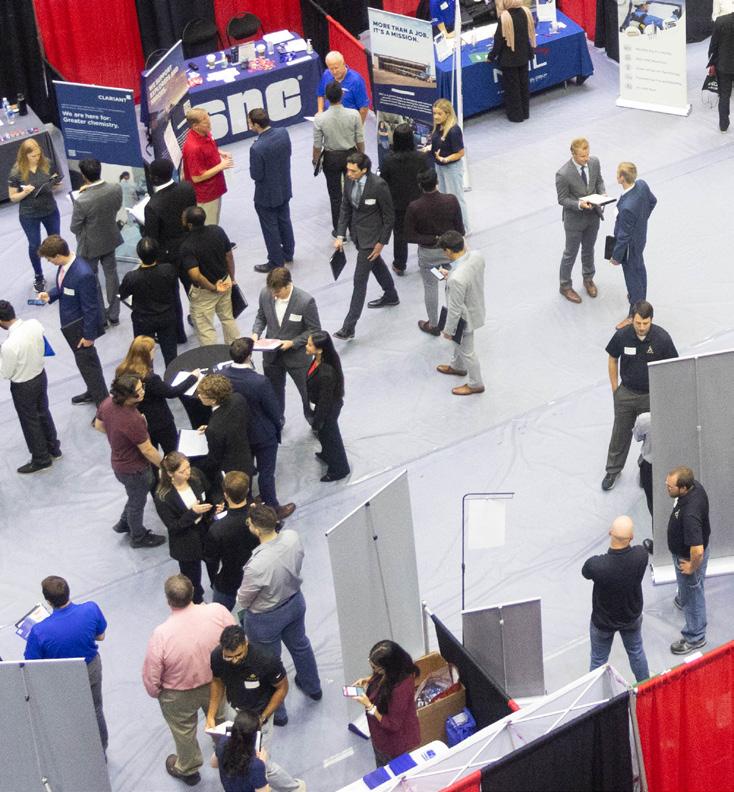
Attend fall and spring career fairs.
Explore internships, co-ops and research opportunities.
University Honors Program Discover and Biomedical Research and Mentoring Program (RaMP) are excellent research opportunities with faculty, if you are an honors student.
Lean into leadership roles within clubs and organizations.
Build a close relationship with your professors, peers and alums.
Explore study abroad, volunteering and service-learning opportunities.
Add new experience to your resume and develop cover letters for interviews.
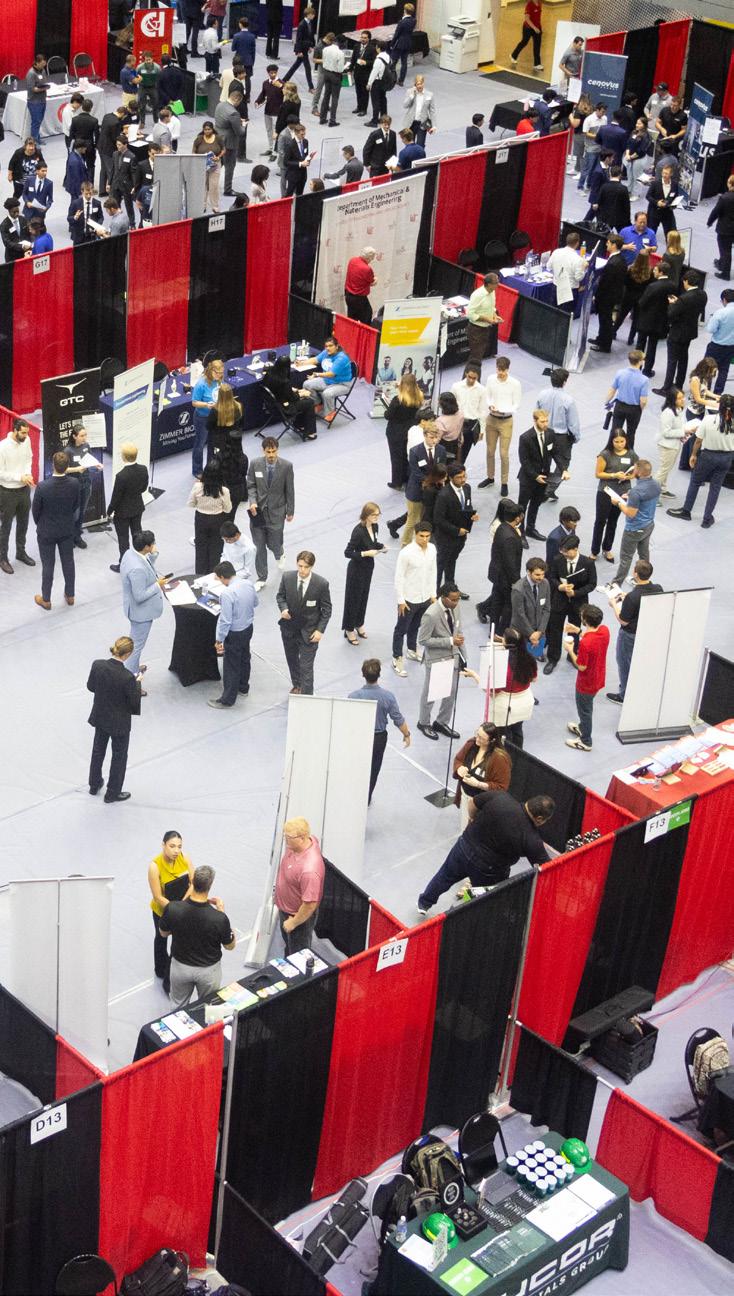
If you are considering graduate school, study for entrance exams and explore graduate schools to apply to.
Ask for recommendation letters from trusted professors and leadership figures.
Continue to apply for internships, co-ops and research experiences.
Polish your resume and cover letters for interviews.
Apply for graduation.
Meet with your career coach to finalize your resume and graduate school documents.
Continue to meet with your academic advisor to make sure you are on track to graduate.
Attend career events to get connected with potential employers and recruiters.
Begin applying to full-time jobs on Handshake, LinkedIn, Indeed and organization websites as early as possible.
You may need to apply to multiple postings before landing a position. Several months can pass between applying and getting an offer. Keep track of applications and employer communication on a spreadsheet.
Create a follow-up plan to stay in touch with people after graduating.
This may include mentors, professors, faculty and peers.
If you are an honors student, confirm that you have completed at least five honors experiences.
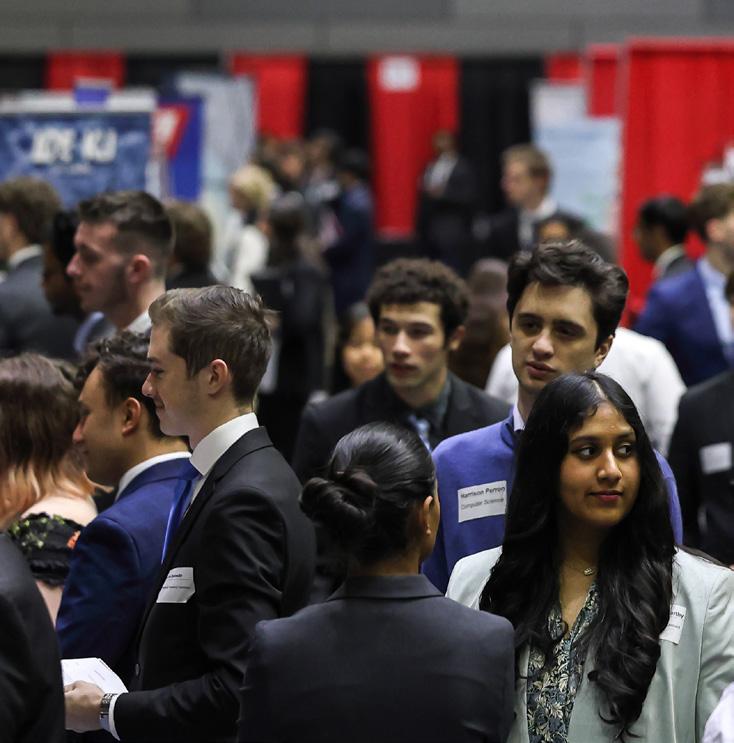
University of Cincinnati (UC) Business, Engineering and IT Career Fair on Sept. 17, 2025, at the UC Campus Recreation Center in Cincinnati. LUCAS SCHMIED | CONTRIBUTOR
CHLOE HALL | NEWS REPORTER
Entering the job market can be a daunting experience. Whether you are searching for an internship, co-op or preparing to apply to your post-graduation job, it can be a lot to handle. Ensuring that you are well prepared to start that process could be the deciding factor in whether you are offered a position.
With so many classes, clubs and potential work opportunities available to University of Cincinnati (UC) students, it is important to know how to use these experiences to build a resume and nail that critical interview.
AND AUTHENTICITY
Mia Rohrer, a third-year communications design major at UC, spoke about her first and second co-op rotation experiences at the 1819 Innovation Hub.
As a student in UC’s school of Design, Architecture, Art and Planning (DAAP), Rohrer was required to complete resume and portfolio workshops in preparation for interviews. Rohrer encourages student applicants to mention the hobbies and professional experiences that they are involved with while interviewing, citing her own interests in student government and photography.
“The big thing I did to stand out was including extracurriculars and showing that I really knew about those things and that I really cared and was passionate about my portfolio,” Rohrer said. “Having those extracurriculars helped set me apart from other people.”
Rohrer said she tried to keep the interview experience as casual as she could. “This was one of few interviews I was doing and I was terrified,” Roher said. “But I was not afraid to be authentically myself.”
“But I was not afraid to be authentically myself.”
Erin McKeon, a third-year chemical engineering major, spoke about her experience transitioning from one co-op to the other.
“They give you interview and resume tips and support us through the career fair,” McKeon said. “I made sure to make my LinkedIn and keep everything up to date.”
McKeon said a key component to an effective LinkedIn page is a fleshed-out skills section.
“Make sure your skill section is very relevant and tangible,” McKeon said, “No one will care if you put down communication or something because everyone is going to say that. They want to see more technical skills.”
All students tend to learn something from their previous job, often something they realized they like or don’t like about the work environment. Learning and reflecting on previous interviews and positions can help students when starting a new job search or continuing in a current role.
“They give you interview and resume tips and support us through the career fair.”

LUCAS SCHMIED | CONTRIBUTOR
Finding the right job after graduation can be overwhelming. The News Record spoke with Design, Art, Architecture and Planning (DAAP) alum Erin Roddy about her post-graduation experiences and early career.
Roddy attended the University of Cincinnati (UC) after high school and returned at age 23 to earn a bachelor’s degree in fashion design with a minor in marketing. Her first job after graduation was as a fashion designer in the women’s cut-andsew knits department at American Eagle. She is now the owner and creator of the local women’s activewear brand MEAS.
Q: How did you find out about this job?
Roddy: I knew the manager from an internship at another company, and I had previously interned at American Eagle when she hired me for another internship there. Those experiences and that relationship directly led to my first full-time position there after graduation.
Q: What did the application process for this job look like?
A: For the internship, I submitted a resume, a design portfolio and was asked to complete a department-specific design project. Because I
COLIN KUNZ | SPORTS REPORTER
In today’s digital world, every student looking for an internship, co-op or job needs a LinkedIn. It’s a job market necessity that combines elements of a resume and a social media platform. It allows job seekers to connect with other like-minded individuals and provides them with the opportunity to secure employment. While it sounds easy to set up, many students don’t know where to begin.
One great place to start on campus is the Bearcat Promise Career studio, which allows students to sit down and meet with coaches to work on things like resumes, upcoming interviews and their LinkedIn profile.
had already done that work and built a strong relationship with my manager, I was offered the full-time role shortly after graduation.
Q: What was your experience in this first job? What worked for you and what didn’t?
A: My experience was an incredible continuation of what DAAP prepared me for — exposure to many different facets of the fashion industry. Before and after graduation, I was fortunate to work for several corporate fashion companies in a variety of roles as well as a few smaller companies where I wore many hats. That range of experience helped me understand not just the type of work I loved, but also the environments I thrived in.
Q: What overall advice do you have for students graduating from UC that you wish you would have known before applying, selecting and/or working at your first post-college job?
A: Network and intern as much as possible. You don’t need to be the absolute best at everything, but if you build strong relationships with people who know you and believe in you, they will open doors for you. Internships are invaluable for exploring different roles and
Arielle Mintz, a fourth-year marketing and communications major at UC, is also a Peer Career Coach at the studio and one of her biggest pieces of advice is for students to start early with their LinkedIn.
“I would recommend, for sure — as a first year — as soon as you can, starting to build your LinkedIn profile,” Mintz said.
But what should students focus on after creating their LinkedIn page?
A strong starting point includes basic information such as your year in school, major and any previous work experience. This information is essential and can help you begin building connections right away. Even students with limited job experience can include valuable details to strengthen their LinkedIn profiles.
It can start with something as simple as a post about your status as a university student or a recent class project.
industries and for helping you figure out where you want to land. Don’t rush into a career just for the sake of having one. Interview companies as much as they interview you — if it’s the right fit, you won’t just get hired by them, you’ll be excited to hire them as part of your future.

“Maybe you just finished a class project. It’s not necessarily a job you had, but you’re still gaining experience in college,” Mintz said. One area that allows students to stand out when building their profile is the bio, or “about” section. This space provides an opportunity to describe yourself, include your current job status or indicate that you’re seeking a position. It can also highlight extracurricular activities and the skills developed through them.
Once your profile is complete, you’re ready to begin networking and exploring job opportunities.
“Just messaging people is a huge way to try and connect with someone, and building those connections can lead to finding you a job, an internship or just simply a connection to have a conversation with someone.”
People often find themselves in careers completely unrelated to the major they studied in college. Still, many professionals find ways to apply and parallel things they learned in school to their careers.
Caleb Keyes, for instance, has a degree in English literary studies with a minor in communications from Otterbein University but works as a data consultant for an Ohio startup, Impower AI. As he’s grown in his career, he has found many similarities between data and essay writing.
“Coding syntax parallels grammar in an essay and coding is 90% figuring out the ‘why’ to what you are doing, which is also a lot like essay writing. In both, you have to understand
who you’re writing to,” Keyes said. “English and programming are very similar in a way that doesn’t make much sense on paper but makes a lot of sense in execution.”
Similarly, Heather Rogers, co-president of a specialized timer company, Time Timer, holds a degree in sociology from the University of Chicago.
“Sociology taught me how to read, write and think critically, which I still use when writing emails, writing summaries and when making business plans,” she said.
Bebe Hodges, a trending news reporter for the Cincinnati Enquirer, holds a degree in both anthropology and communications theory
AUDREY ZELINSKI | CONTRIBUTOR
from the University of Pennsylvania. She grew up in a self-proclaimed social bubble that anthropology helped her break out of.
Hodges explained, “Anthropology taught me just how much people can have different perspectives, different belief systems and about how people carry themselves.”
In learning about this variety of different perspectives, Hodges discovered two invaluable skills she utilizes in her job. “Anthropology taught me to have a certain sensitivity to a variety of people, and how to have respect when talking to so many people a day,” she said.


Jude Hoffner holds a French literature degree from Wesleyan University in Middletown, Connecticut, and is now a self-employed consultant in the database and performance marketing industry at JMD-AL. His career doesn’t align with his passions, nor does he believe passion needs to be a part of a successful, fulfilling career.His career doesn’t align with his passions, nor does he believe passion needs to be part of a successful, fulfilling career.
“I’d encourage kids to not tie their sense of self-worth, personal satisfaction and identity to their career or profession,” Hoffner said. “If you end up in a career that aligns very well with your sense of purpose, ethical grounding and provides a sense of profound satisfaction, that’s of course terrific. But the reality is that it rarely happens and that’s totally OK.”

JOE CAREY | NEWS EDITOR
For college students of all stripes, the term “research” may seem inaccessible, undefined or even vaguely pretentious. The word denotes a higher-brow academicism, bringing to mind graduate students in fancy offices bent over hopelessly arcane projects. Undergraduates, particularly those in non-STEM fields, may well ask: is there a lab coat for me?
At the University of Cincinnati (UC), the short answer is yes. Though we tend to associate academic research with science or medicine, nearly every field of study has research opportunities.
If research is something excites you, the easiest way to start is by connecting with professors who share enthusiasm for your topic. UC’s faculty directory lists every paid researcher affiliated with the university. Make a list of professors whose work or interests catch your attention and consider introducing yourself over email. This message should be brief: state your year, major and interest in research. Ask them their office hours and if they are available for an appointment.
Before meeting a potential mentor in person, take time to research the researcher. Skim through their published work and consider whether you see yourself pursuing similar projects. Pay attention to any work the professor has co-written with students and get a sense of the roles they performed. If possible, reach out to the professor’s current student assistants. This will give you an idea of whether the faculty member is a good fit, and if their research suits your interests and schedule.
When meeting a faculty member in-person, be open about those factors. Explain how you came upon your area of study, and how your interests intersect with theirs. Inform them of your professional or academic aspirations and communicate clearly how researching with them will service those goals. The more grounded and confident your pitch, the more willing the faculty member will be to move forward.
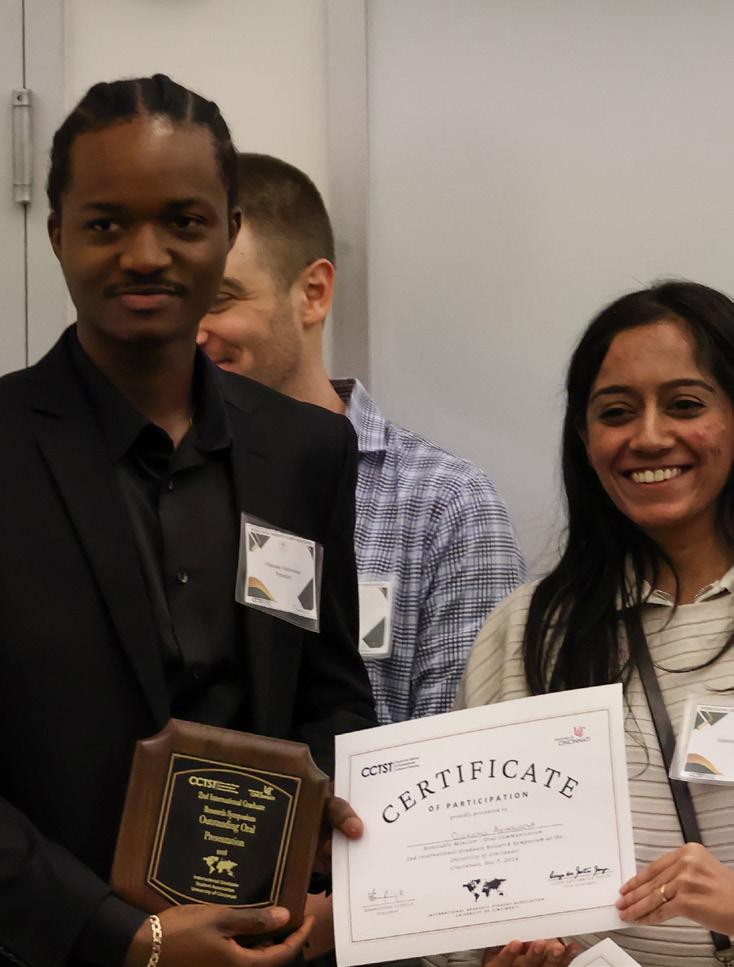
“the easiest way to start is by connecting with professors”
Undergraduate research is a versatile extracurricular, with applications in every discipline and career path. It requires you to plan effectively, argue clearly and meet hard deadlines; qualities that employers and graduate programs will always value.
As an R-1 research institution, UC houses hundreds of ongoing research studies across its 15 academic colleges and over 350 major programs. Whether conducted by individual faculty or overseen by institutions like the Portman Center for Policy Solutions or 1819 Innovation Hub, these endeavors actively recruit student assistants to their project teams. The avenues for practical research experience are here, and need only motivated, unabashedly curious student thinkers.
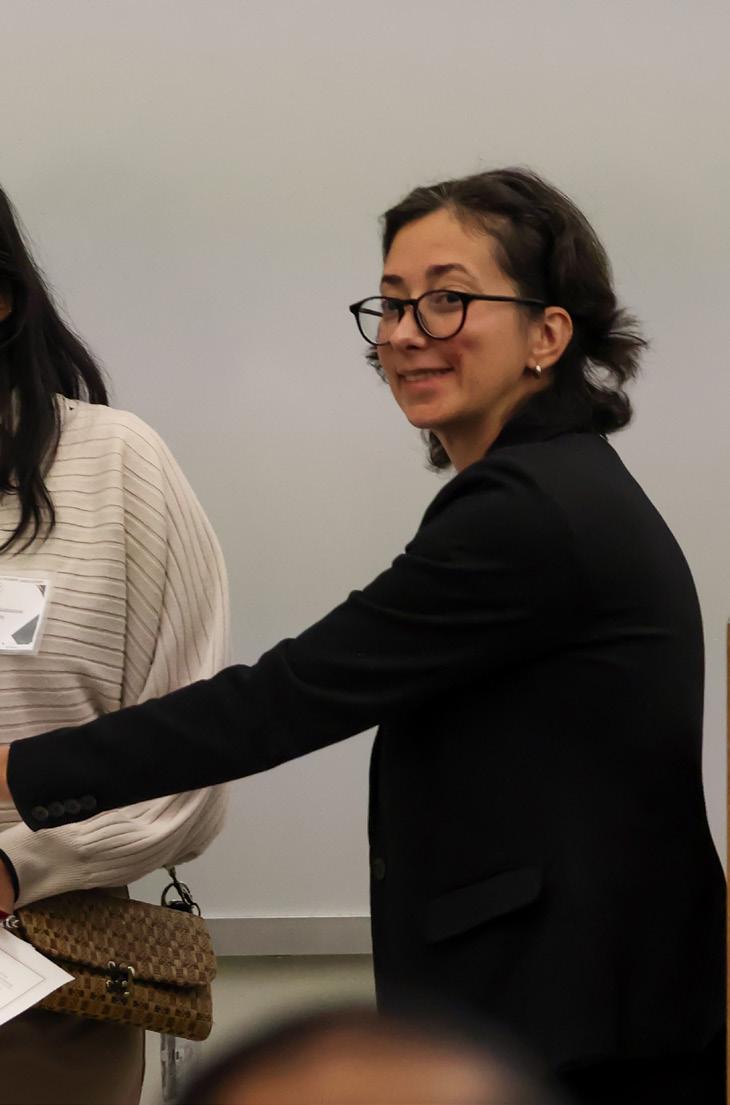
HAJRA MUNIR | EDITOR-IN-CHIEF
College students often struggle to balance classes, part-time jobs and campus life, and career planning can easily fall by the wayside. Ellie Bridges, director of the University of Cincinnati’s (UC) Bearcat Promise Career Studio, and UC student Keegan Piekarski, a fourth-year political science major, shared the most common mistakes students make — and how to avoid them.
1
According to Bridges, one of the most common pitfalls students face is putting off career planning “until the last minute.” She explained how this mistake “just means you could miss out on a lot of great opportunities” and she noted that students often underestimate how quickly college passes and fail to take advantage of resources early.
2
A common mistake students make is failing to seek guidance on resumes. Bridges said students often rely on a single, static document instead of tailoring it to each opportunity. “Make a template for yourself that’s just a basic outline, and use that template every time you apply to a new job, and fill it in with the things that they want. You want to curate your resume and make it unique to yourself. If you do want to get your foot in the door, make it true to you,” Piekarski said.
3
Networking is a crucial skill that students frequently struggle to develop. “College students have a really important card, being the college student card, because professionals really want to help college students,” Bridges said. “I also think a lot of students aren’t using resources
like the LinkedIn alumni tool, which shows you where UC alum have went on to work, and it helps you understand their pathway.”
4 6 5 7
Hands-on experience is key to career readiness, but some students overlook it. Bridges emphasized that gaining hands-on experiences such as co-op, an internship or research is critical to career planning as a college student.
8 9
In the age of new technology, Bridges warned against overreliance on artificial intelligence (AI). Bridges commented on how employers are noticing stark differences between someone’s resume versus how they present themselves in an interview, due to an excessive use of AI. “AI is not a replacement for you as a person and your experiences,” she said.
Piekarski stressed that students must actively work on building their personal brand. “The most important thing that I’ve learned from college is making yourself marketable. Now that means pursuing projects in your own time, because if you don’t have a portfolio with something important that you’ve worked on to show for it, most companies will probably disregard you within the first five minutes.”
Fear can hold students back from pursuing important opportunities. “Another big mistake I probably made was being too nervous to apply. So just applying in general without the fear of rejection is good,” Piekarski said.
Bridges noted that students sometimes focus too much on technical skills. “Employers tell us all the time that they can teach the technical part. They can’t teach attitude or initiative.”
Finally, Bridges urged students to reflect on their preferences and strengths early. “It’s just as important to understand what you don’t like, as it is to know what you do; and some people find that out in college, versus waiting until you’re a professional.”
Both Bridges and Piekarski emphasized the value of authenticity. Bridges said, “To be yourself, be yourself authentically throughout the process. And it’s OK to pursue what interests you. It’s OK to change your major, to change your mind.”
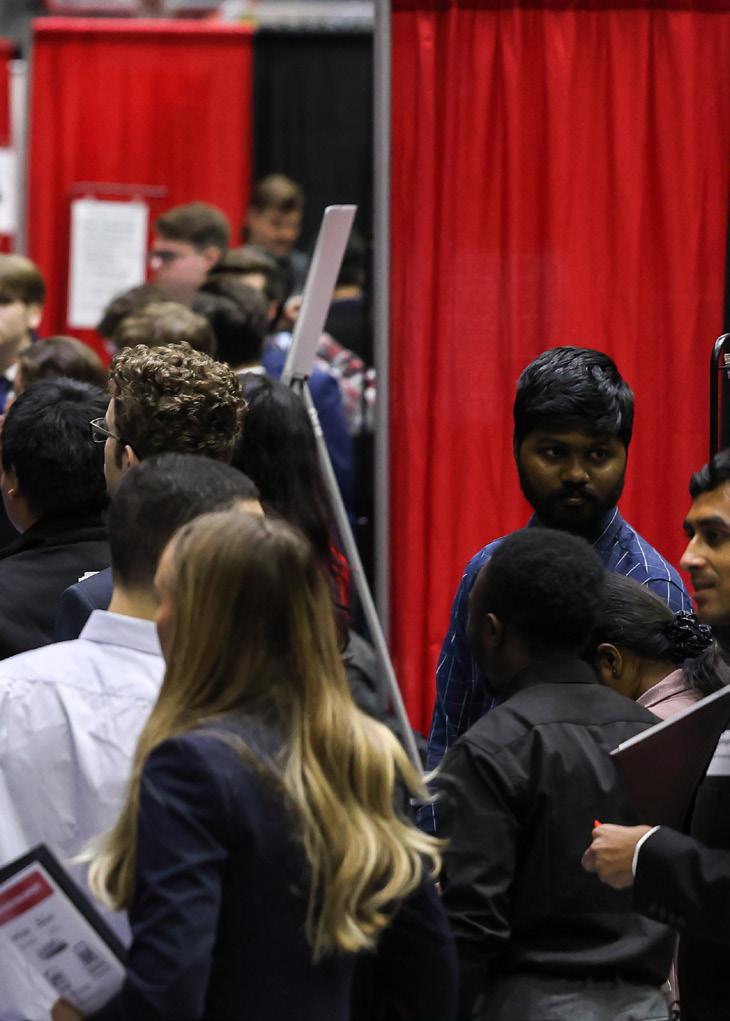
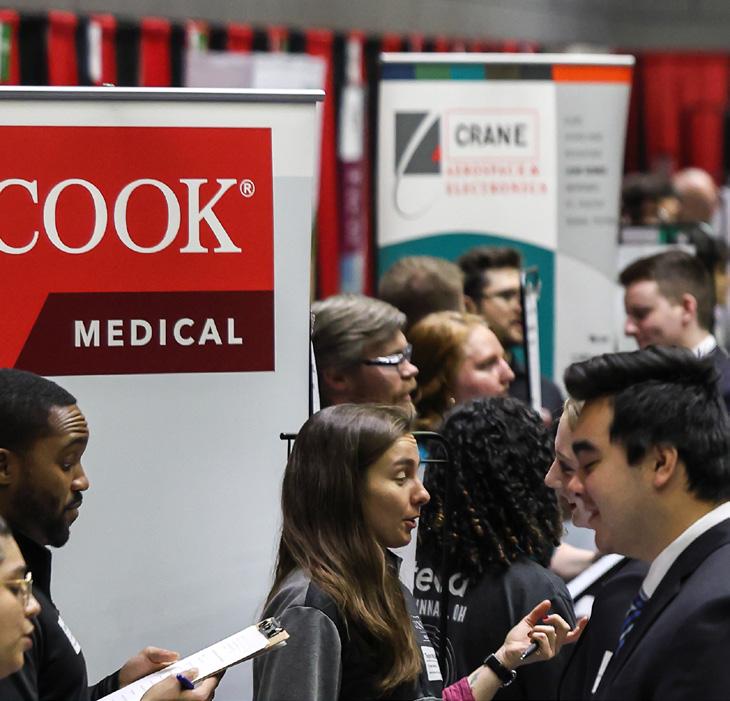
University of Cincinnati (UC) Professional and Technical Career Fair on Feb. 13, 2025, at the UC Campus Recreation Center in Cincinnati.
LUCAS GRIFFITH | MANAGING EDITOR
Finding an internship or a co-op is a process that nearly every college student must go through. While it may seem an incredibly intimidating prospect, it is not nearly as difficult as you may think. Being prepared and knowing where to begin your search can relieve an immense amount of the initial stress, and The News Record is here to help with that.
While requirements for internships or co-ops vary across majors, the hiring process itself is generally the same. Online platforms, in-class opportunities and on-campus job fairs offer a number of avenues into the job market for college students.

The University of Cincinnati (UC) hosts several career fairs throughout the year that will allow you to meet face-to-face with recruiters from a wide variety of companies. These events are a great opportunity to network with and introduce yourself to representatives from prospective companies you may be interested in applying for.
Career fairs are also the perfect time to start making connections on LinkedIn, Handshake, Indeed and other online platforms where companies post job openings. For each platform, create a profile that showcases information about yourself and your career interests. Like a social media algorithm, the platforms will then begin to recommend individual and company profiles for you to follow or “connect” with.
“One of the easiest ways to find out about internships or co-ops is by regularly attending class.”
Some specific UC programs hold career fairs exclusively for one discipline. UC’s 2025 spring semester will feature a Public Policy and Government Fair, Insurance and Risk Management Career Fair, Behavioral Health Fair and several other recruitment opportunities. Information for these fairs can be found on the UC website.

Check your feed regularly as your network grows — new posts about internships, co-ops and job opportunities will often appear from your connections.
One of the easiest ways to find out about internships or co-ops is by regularly attending class. Oftentimes professors will include announcements from their departments with information about internships and co-ops. Department career fairs and interview opportunities often involve companies with strong internship or co-op programs designed to employ college students.
If you are struggling to find an internship or co-op, talk to your advisor or the specific staff in charge of the internship program for your major. They know how to make the process easier and are there to help you. Part of their job is to help connect students with preprofessional programs and provide a range of contacts for students to reach out to.
UC’s co-op program is currently ranked No. 4 in the United States, according to the U.S. News & World Report’s 2026 college rankings. This status presents unique opportunities for students looking to enter professional life.

University of Cincinnati (UC) student Hannah Toronto prepares a customer’s order on April 2, 2025, at The 86 Coffee Bar in the UC College-Conservatory of Music in Cincinnati.
TAVISH
SWEENEY | CHIEF PHOTOGRAPHER

Study break with Uber Eats. Get 40% off your next two orders